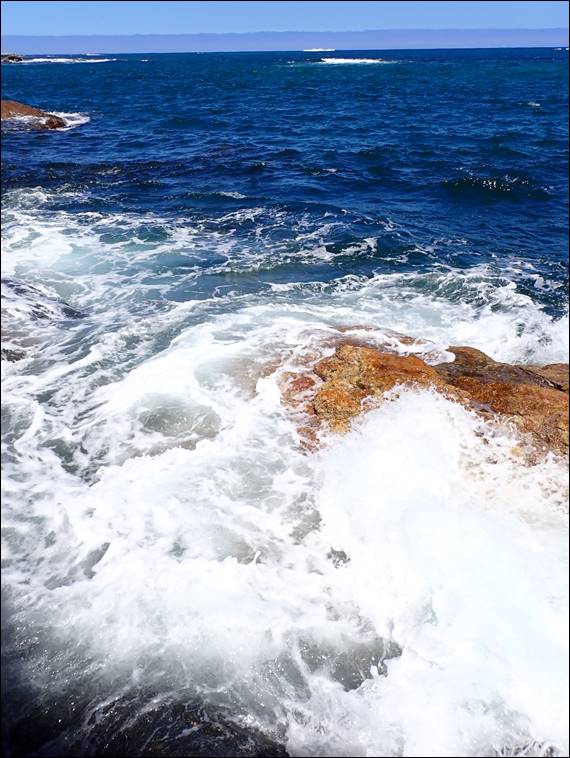
For those old enough to remember when the original film came out in 1981. It’s more engaging story and the iconic cinematography of the day means it well and truly trumps the modern 2010 remake. The newer film heavily relied on CGI for impact, taking away from the plot and resulting in a cookie cutter action-styled focused film typical of the early 2010s. This week we were preparing for our own Clash of the Titans. A strong cold front was expected to hit the south west of Western Australia, as the weekend encroached:
As it made its way eastwards, tropical cyclone Narelle was heading west. Skimming the northern coast of Australia. It is the first cyclone in 20 years to make landfall in three states or territories. First coming in as category five before changing into a tropical low, and then re-intensifying above Western Australia back to category 4. It reached the western edge as the cold front approached. Resulting in it swinging south and making landfall further down the coast than usual. A phenomena that has only occurred twice since records started in 1970s:
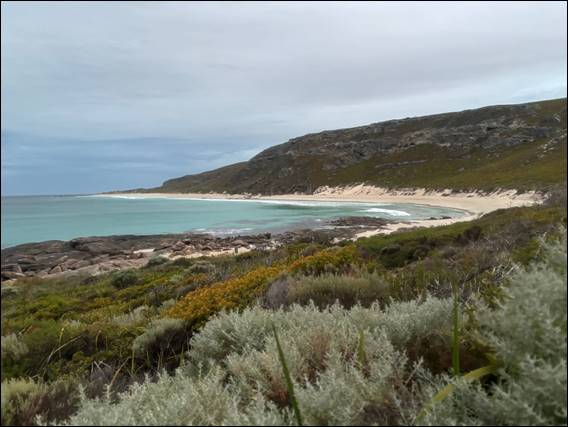
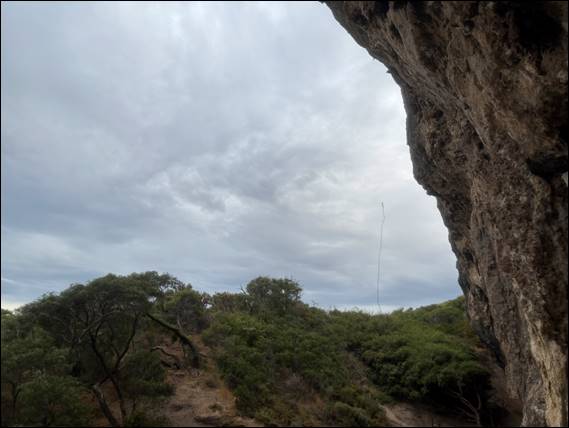
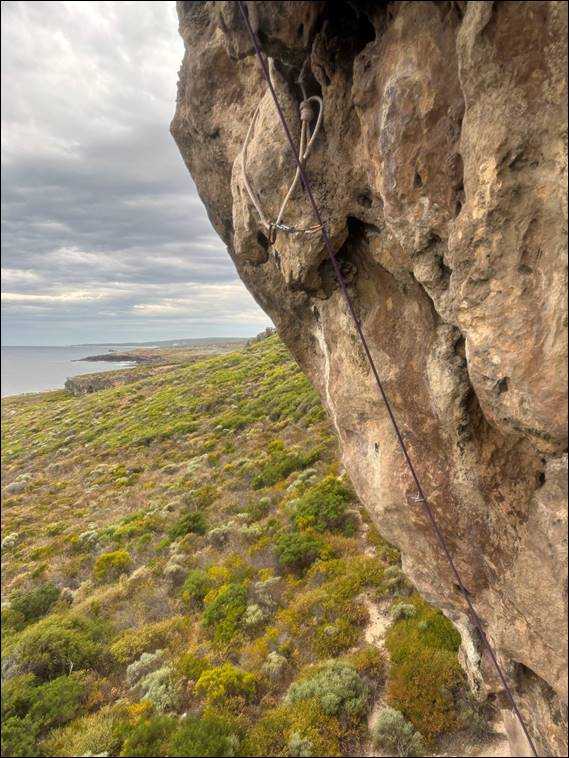
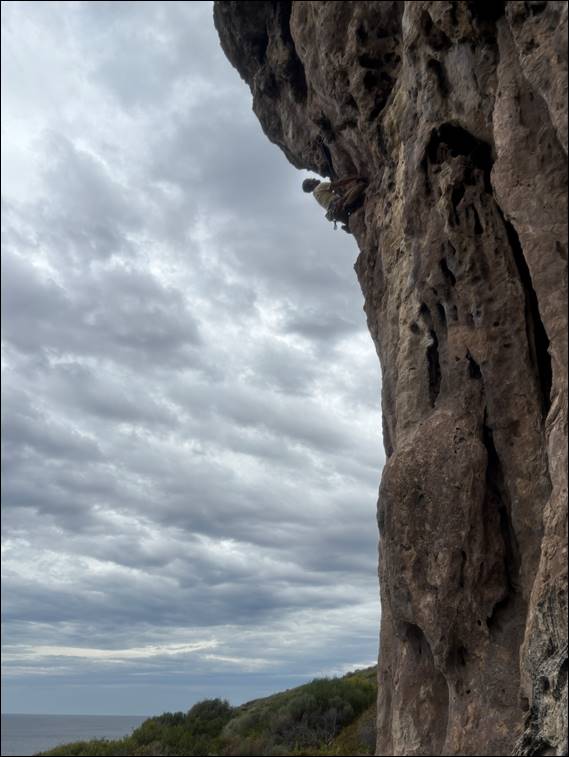
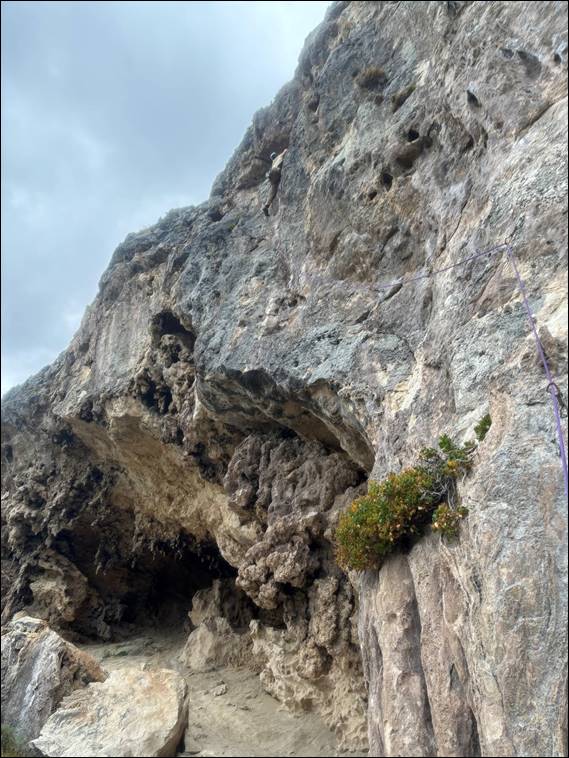
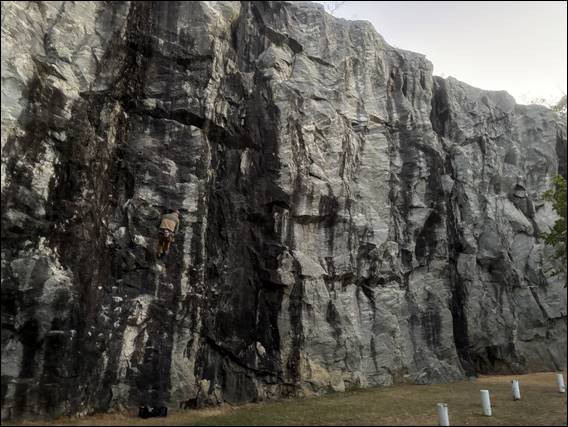
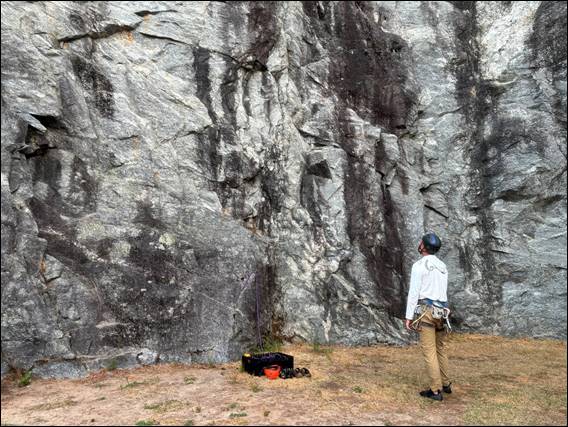
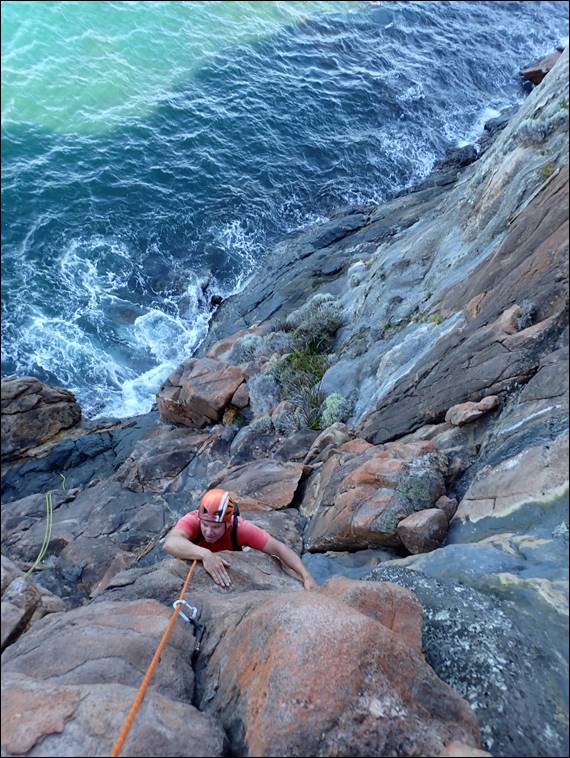
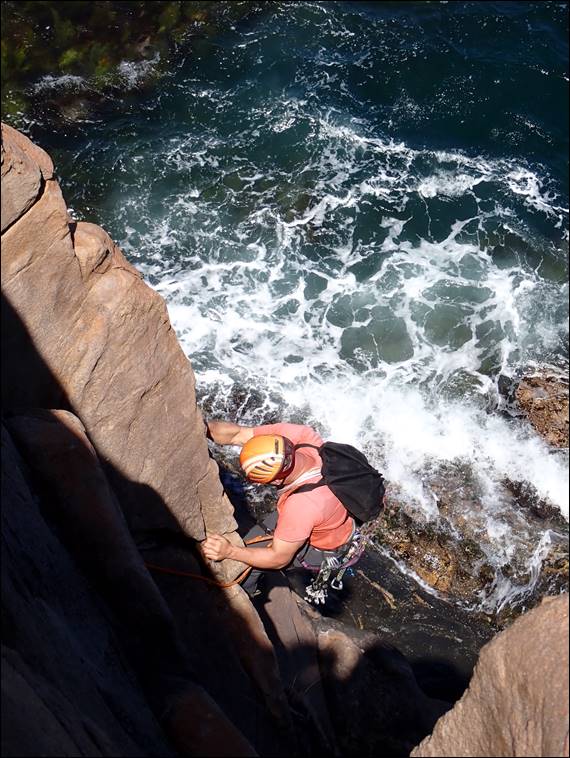
Howsie and I had been plotting our own course way before any of this was on the radar, for a day out on Friday. Watching the forecast change daily as the week progressed, we decided that regardless of what may come we would stick to our guns. Heading to Bobs Hollow, where we were certain there would be no clashing of titans. The impressive and intimidating limestone cliffs, with its steep pumpy routes would no doubt smash us mere mortals. But we suspected a clash or two with the rock if we pushed things that bit to the point of falling:
Parking up just after first light, allowed us a walk in without the need for head torches to avoid stumbling on the at times rocky path. Keeping a good pace, it was a still and cool morning. Not a breeze was in the air, maybe the foreboding of the calm before the storm. While the sky had a high blanket of cloud stretching far and wide without a break, it looked like we may be lucky with our timing. The occasional drop or two of rain left their mark on the mostly sandy track, but they were few and far between. We kept our hopes up, or at least I did:
As I have previously hinted at a few times, the climbing here intimidates Howsie. For someone who can be remarkably cool and calm on technical, sketchy, and runout face climbing, on overhung stuff he is quick to crumble. Whether it was the big weekend he just had, germs his kids were showing signs of having, or band practise the night before, he was wavering as soon as the looming white limestone walls were above us. I personally feel he has a knack for allowing the prospect of climbing here getting to him before we arrive:
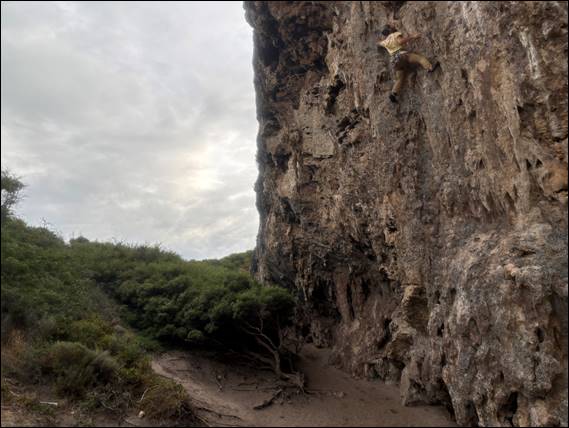
I kicked things off, as it was my turn to take first lead. Picking what I felt was a sensible warm up grade on a line that was nice and long, offering a gentle first half before steepen up. There are not many lines that are not steep for some of the climb. It is part of the attraction of the place. During and since COVID times the areas popularity surged when those who climb in Thailand were not able to fly. So they came here for their jug haul fix. In his book of climbing in Australia, John Morris recently rated Bob’s Hollow as the best limestone cliff in the country:
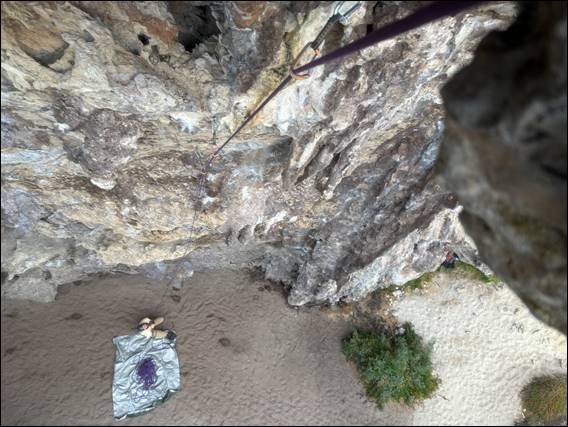
Not that there are too many limestone crags for it to contend against, despite the size of Australia. Howsie, looked to be going OK on the first line until the overhung section. Here he battled with his head more than the steepness. But once your head takes hold you start second guessing yourself, which results in you hanging on the holds too long and pumping out. This it set the scene. We found less steep routes for him to lead, as I wasn’t going to allow him to forego his leads. And I bagged the steeper ones without pushing the grades:
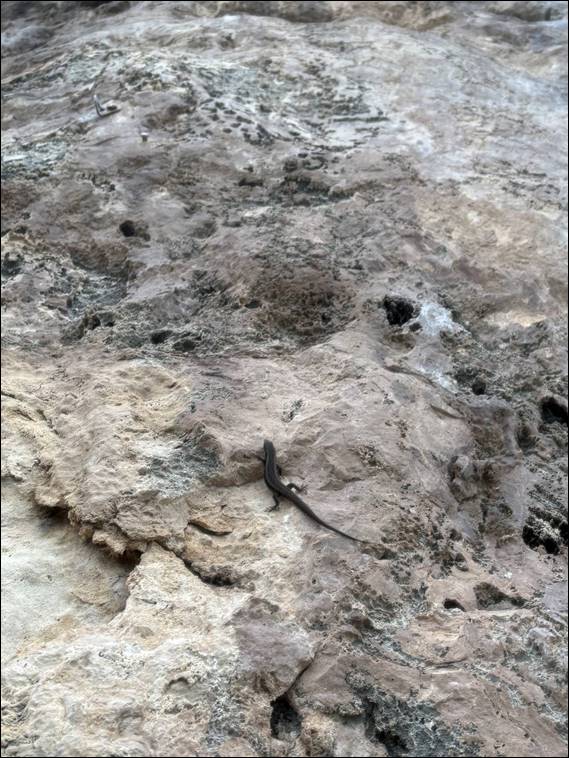
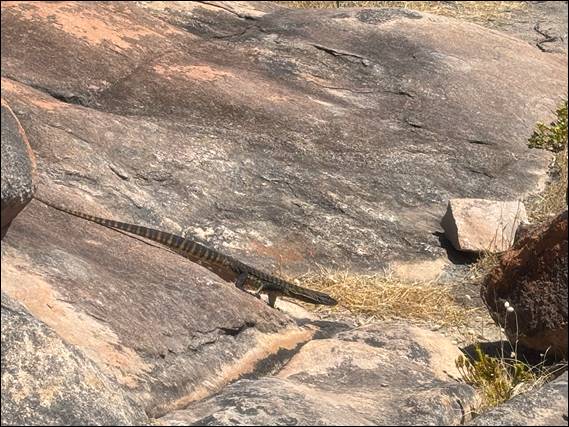
This of course didn’t detract from our enjoyment, and we racked up seven fine lines. As the morning wore on, despite us wearing ourselves down physically, Howsie confessed to finding that he was becoming more comfortable with the climbing style. We may well have thought this before, but we talked about how we should make an effort to come here a bit more often to allow him to build on the progress. Time will tell, although neither us of think we will ever have the climbing skills of this Southwestern Crevice Skink (Egernia napoleonis):
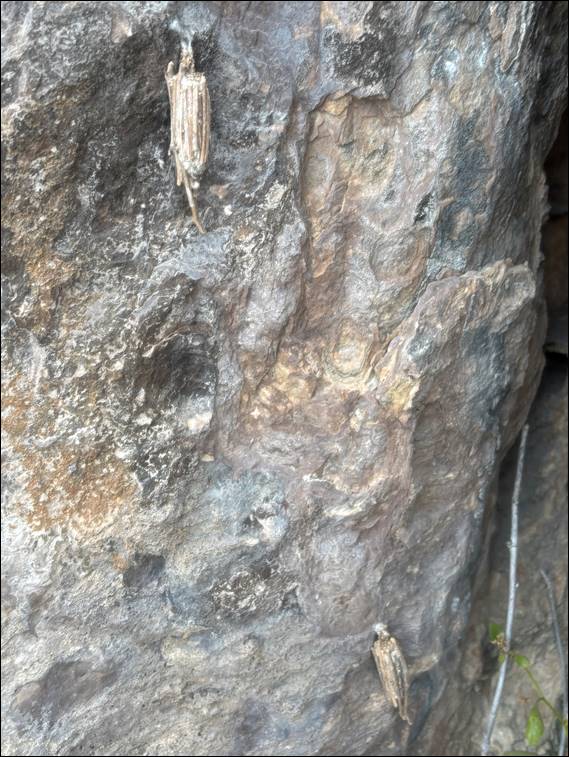
Another creature we found clinging off the rock were these larvae stage Faggot Case Moths (Clania ignobilis). Being a case moth, the larvae builds a home of twigs that it takes from the plants it feeds off. The ends of each are meticulously shaped removing any sharp edges and from one end the head and thorax, with hardened skin, protrudes. Only males transform into moths. The females remain flightless and never leave the protection of the case. Their home differs, as it include two twigs longer than the rest and we found both male and female cases:
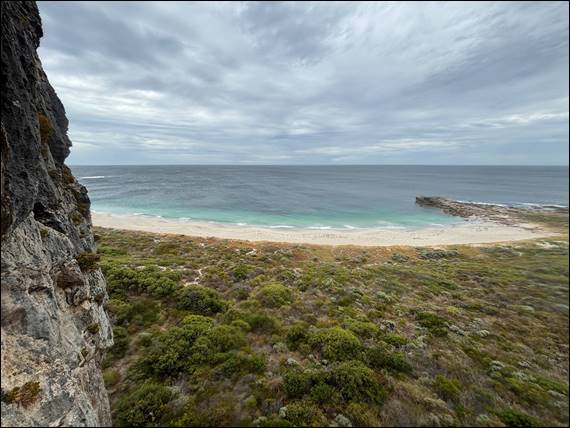
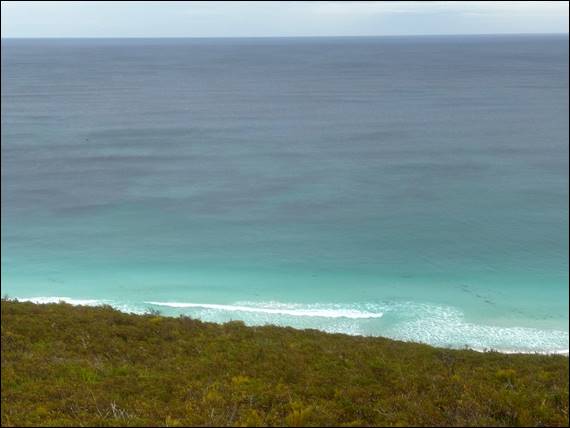
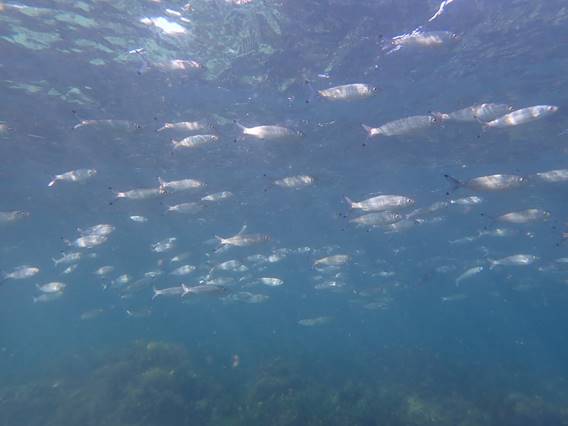
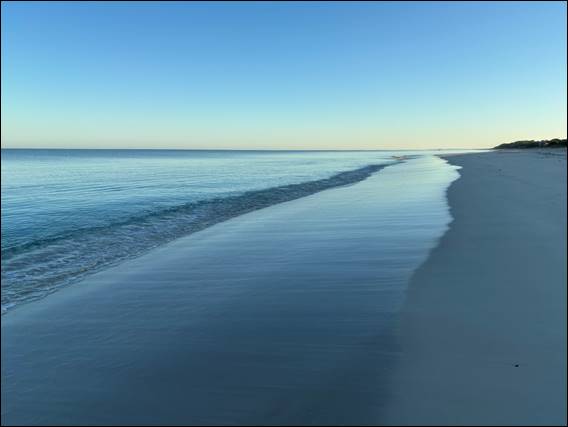
As can be seen the weather was perfect. Staying dry, cool, and calm all morning and only on the last climb did we start to feel the humidity start to creep upwards. The near shore ocean was a crystal clear aqua colour, and from the crag we spied pods of dolphins in the shallows and what looked likely to be a large shoal of salmon. The 2026 great salmon run has started, with increasing activity being observed along this coast. The fishing folk will be getting excited about this but not just them, and we spied a couple of others too on the walk out:
The image below was taken as we walked out. It is probably impossible to see, but we saw at least two sharks in the shallows that at times came into the surf zone. Shallow enough to force their fin and tail to be be clearly seen thrashing about in the water. While they may not be Bronze Whalers (Carcharhinus brachyurus), they particularly known to enter the shallows when feeding on schools of migrating fish like salmon. While watching the water we also had to watch where we stepped, as there were quite a few processionary caterpillars out:
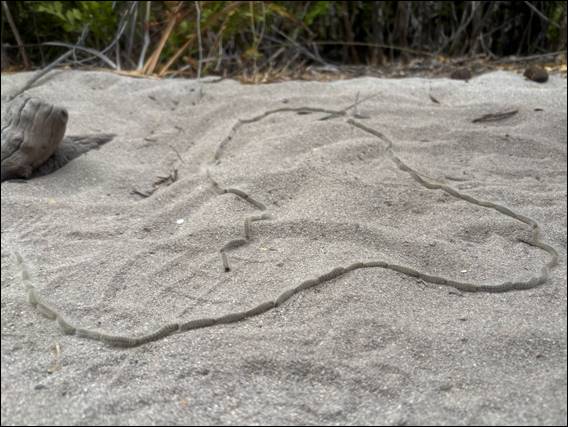
If they survive these will transform into the Bag-shelter Moth (Ochrogaster lunifer). From approx. December to May the caterpillars moult 7 times, resulting in 8 instar stages. They remaining in a silk nest for the first seven. For the 8th instar stage they leave the nest and form these single-file lines, at times including a hundred or more. Each one keeps contact with the tail hairs of the one in front, and as can be seen below the procession was on a collision course. When this happens they form a circular mass of confusion:
We simply had to watch for a while to see how it all unfolded. At the point of impact they started to bunch up, unsure of which way to go. For us the way forward was clear and after watching the display for a bit, we left them to it and made a beeline for the car. It was not until midday that the drops started to fall on the windscreen. The combined effect of the cold front and tropical cyclone Narelle, still approx. 800km to the north, started to hit. Since the first drops the slow and steady rain hasn’t abated as I type this 18 hours later, but there have been no strong winds. For our area at least, maybe the clash of the weather titans had a bit of a cancelling out effect:
With no one able to make it out on rock over the weekend and not feeling like a solo mission I was at a bit of a loose end. Typing up my finds from earlier in the week Lisa headed down to the beach for her weekly bob with the Peppy Plungers. Sending me images of what looked like a relatively flat and calm ocean. There was certainly more movement than I experienced during the week but it looked slow and sluggish. Decision made. I suited up, drove down to the other end of Peppy Beach, and started to walk aiming to go past the point:
There were just a couple of cars on the beach, one towing a boat slowed down as it went past and they offered me a lift. I said thanks and passed on the offer, telling them I enjoyed the walk. While true, at the back of my mind was the fact that with my sedentary job I needed to take every opportunity to move about. Going just shy of a mile I caught up and passed the people who offered me a lift, as they prepared to launch their boat. Thanking them again and saying that in all the years of heading this way they had been the first to offer me a lift:
This got me thinking whether everyone else who had driven past me, over the many years, have simply observed me walking with my gear and thought he’s not going to want a lift. That said very few have ever waved or acknowledge me. As such maybe, as appears to be the growing trend in modern western life, they are just focused on themselves. Indeed there are studies that suggest social media, technology, and the more fragmented family ties have affected social cohesion and resulted in people having a greater interest on their own wants:
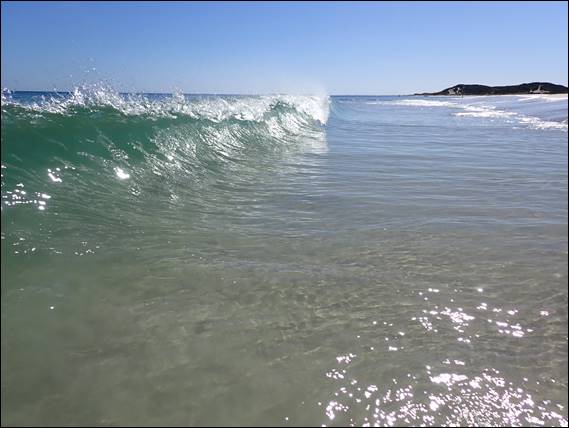
Before I go any further down what may be a dark and dangerous road, which someone else got me going down. The first image shows the near shore waters were somewhat cloudy, the slow sluggish swell was stirring things up. But being hopefully I dove in and swam the approx. 200m out to the reef, where it was better in patches. In the second image I only saw the Dusky Morwong (Dactylophora nigricans) when it moved on. Building on my observation of human interactions, was it a gut instinct that made the fish swim away or was there more to it:
There are many studies to test the cognitive ability of creatures. Checking their aptitude to recognise themselves, others, and/or responding to being looked at. Did the Dusky Morwong detect my shape as a risk, as opposed to that of a dolphin or seal? In the second image Banded Sweep (Scorpis georgiana) and Western Pomfred (Schuettea woodwardi) would often meet me face on. Making their bodies look thin, as if to become invisible. While Silver Drummers (Kyphosus sydneyanus) didn’t seem to care if I saw them, just taking a wide berth:
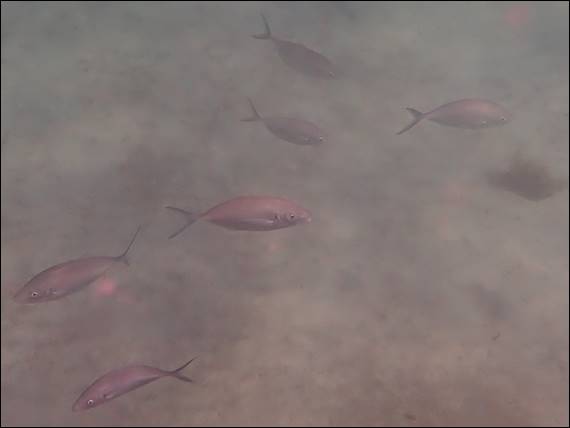
The Silver Trevally (Pseudocaranx georgianus) were also fine with my presence, when above them. Each time I went down they would disperse to a safe distance, returning as I went back to the surface. The above Masked Stingaree (Trygonoptera personata) took on a different approach. Simply freezing like a statute once I looked at it. Putting faith into its camouflage I guess. Most showed signs of scopaesthesia, a phenomenon of sensing that you are being stared at. Not just an awareness of another form but also that the form is looking at you:
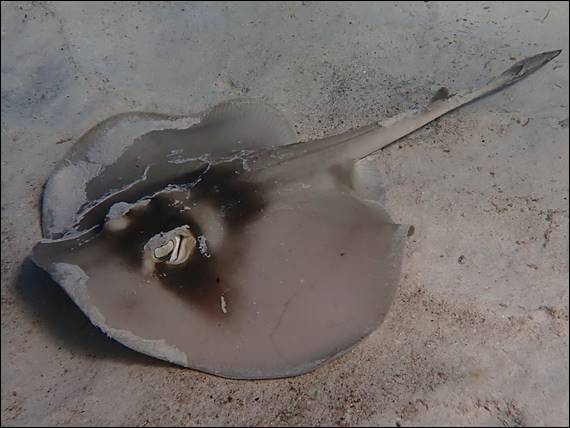
The above good sized Smooth Stingray (Bathytoshia brevicaudata) seemed happy to swim round me. Then as I looked towards it, it reassessed it’s options and took on the approach shown in the video. Seemingly deciding hiding was the better option. This seems to go against most research I’ve found that explores different creatures ability to focus their attention on threats based on another’s gaze or focus. It is suggested this higher-order cognitive ability is generally limited to mammals, birds, and some specific social animals:
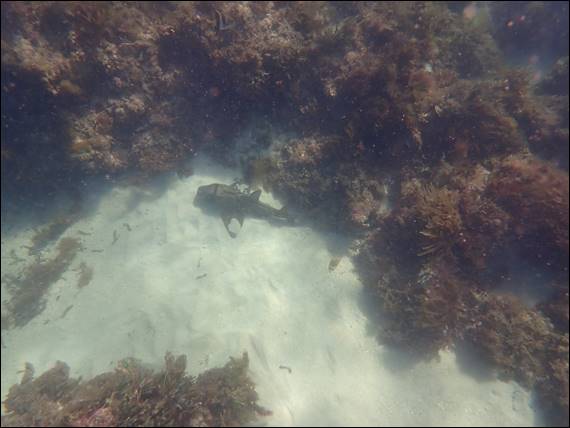
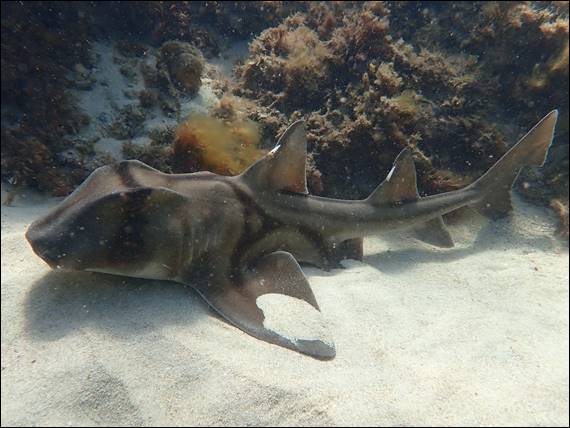
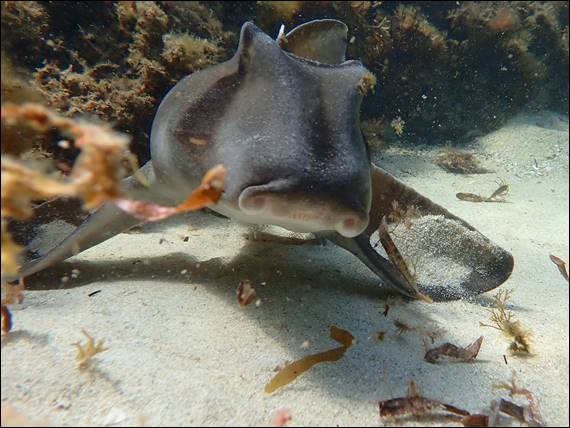
It was Verity that led me down this path when she sent me an article released less than a week ago. Detailing a study of fish in Lake Tanganyika in eastern Africa that explored this very trait. They found the fish in the study did display scopaesthesia and responded differently depending on whether you looked at or away from them. It was my last test specimen that I was most excited about. It was impossible to miss the outline of the Port Jackson Shark (Heterodontus portusjacksoni) on the sandy base, which I approached with great caution:
Not because I was afraid of it. Their teeth are small and they are benthic feeders. Sucking up the sediment along with sea urchins, crabs, starfish, and at times small fish. I just didn’t want to scare it away. First swimming alongside to get a close up view as above. It didn’t move a muscle. Then wanting to get a little closer to get a front on image of its large nostrils, which enable it to multitask. Both smelling for prey and breathing, while sucking up the sediments through its mouth. This time I was not so happy turning and swimming away in no great rush:
Normally I have a few bits with me that I stash on the shore but not today. This allowed me to follow the reef all the way back to where I accessed the beach. Taking about an hour and half. Covering a variety of ground both deep and shallow. Over reef, weed, sand, and broken ground. It was a lovely peaceful snorkel. The only human disturbances, even though I was 200m out with my head under water, was when I heard someone driving like an idiot on the beach. Fortunately not too often, despite how many cars were now out:
I’ve said it before but it has been somewhat of a shocker of a snorkelling season, which I now say with a pinch of salt. I had to search through my images to help with this post. While it is true that I have not been in the water anywhere near as much as usual, there have been windows of opportunities and I have seen some cool things. This weekend, and stretching well into next week, provided one of the biggest windows so far. And due to the long settled period, you could also say it will potentially provide one of the best views of the season:
Feeling somewhat achy from two days of climbing Sunday was a rest day to allow my body to recover. A perfect time to have a soak in the ocean to assist with the muscle relaxation. Wandering down it looked pretty good, other than having a group of people already in the water exploring my local reef. It may sound a little shellfish, pun intended, but I’m so used to being alone out there. Plus two of them had fishing spears which I seriously hoped they did not use. Especially with one fish I spotted, but I better catch up before I get to that:
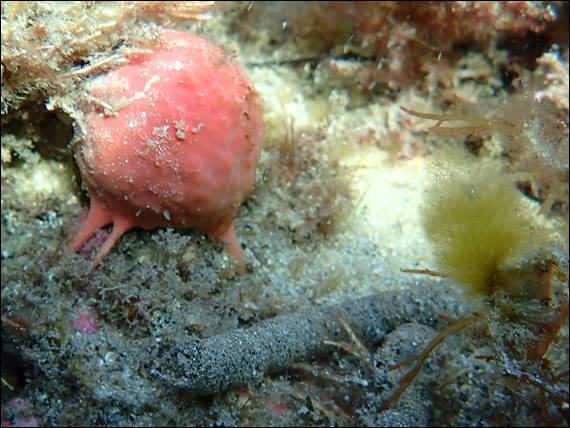
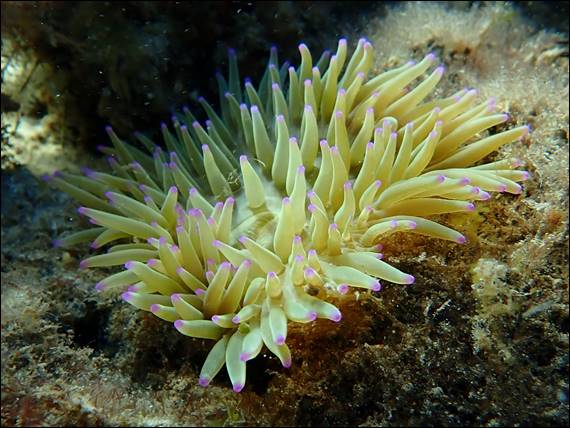
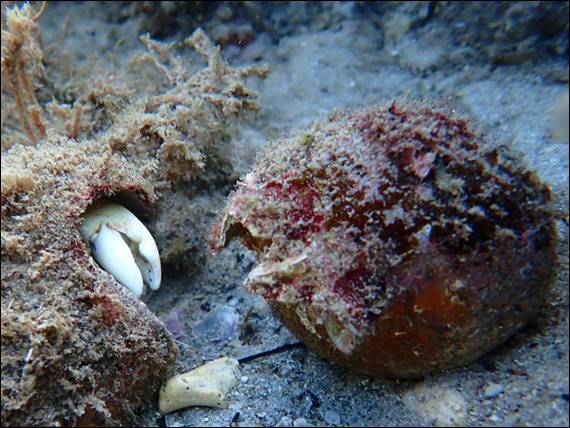
Although I spotted quite a few familiar species the fish were not out in any great numbers, but most of the images didn’t make the cut. Instead I’ve started with a Pink Golf Ball Sponge (Tethya bergquistae), one I liked because of the long, thin, root-like structures being visible. Used to secure itself. Then the above Sand Anemone (Heteractis malu). I would normally see these in abundance, but not this year. And below one of the fifteen species of Diogenid or two species of Pagurid, or in layman terms hermit crabs. Having a snoozing during the day:
The fish I really hope alluded the other people in the water was this Longsnout Boarfish (Pentaceropsis recurvirostris). They are described as being both curious and territorial towards divers. I’ve only seen them a few times, the last time being four years back. Today it stuck around for an age, allowing me to swim alongside it and get some great images. On occasion coming close with its eyes fixed on me. Mostly solitary but during summer pairs may come into shallow waters where they head to spawn. I’ve not come across a pair yet:
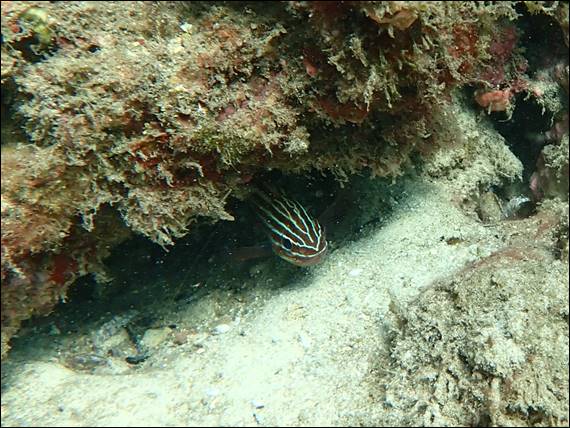
Below is one more image from Sunday, a Western Striped Cardinalfish (Ostorhinchus victoriae). As with so much marine life, another nocturnal species. It can however be, and is often, found as it shelters in caves and under ledges during the day, as this adult at a whopping three inches was. And while it may be a night swimmer it is one of the fish seen most times I come out, that is if I am in the mood to duck dive and check out the hidey holes. This week my work from home days were a little different, working in my favour:
Another trip to Perth resulted in my usual two days at home, at the end of the week, being scattered. The plan was to get out for a swim on Monday and Wednesday morning, both before the daytime winds had a chance to shift and also before the swell started to pick up again on Thursday. A well laid plan that would have worked if I wasn’t so work conscious. On Monday by the time I got down, being mid-afternoon, the easterlies were chopping it up. Come Wednesday I decided to relax my brain a bit and make a conscious effort to get out:
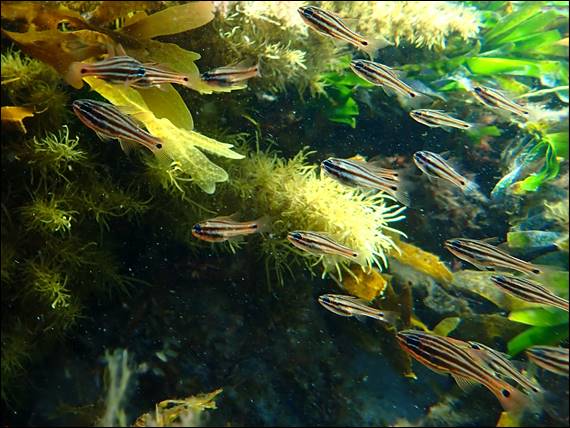
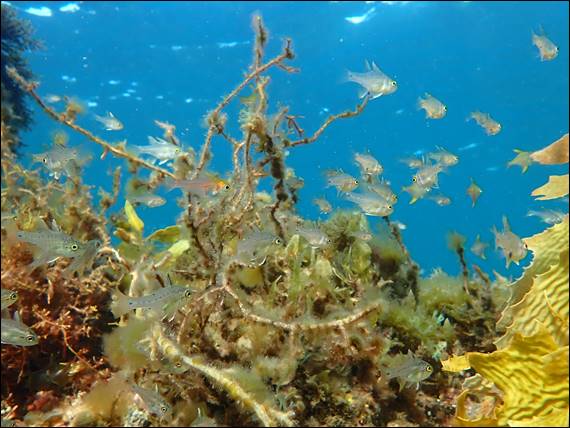
Not only that but, to recoup just a smidge of the additional hours work is currently demanding, I drove down to other side of Peppy Beach for a swim over the reef out from the Capel River mouth. The ground here, as shown by the images, was looking quite bright and colourful, in contrast to the sediment and algae covered reef of my local spot. I immediately spotted lots of schools of young fish. Leading on for the last image from Sunday, the first above image is of juvenile Western Striped Cardinalfish looking like mini adults:
Next are juvenile Western Pomfred (Schuettea woodwardi), with a couple of mates hiding amongst them. After all there is truth it the term safety in numbers, especially when so young and vulnerable. Western Pomfred display yellow in the body when young and that shifts to silver as they age. Adults have yellow colouring mostly restricted to the edges of their fins. These are multiple batch spawners. A single fish can produce young several times within a single season, with the spawning often being associated with the lunar cycles:
Lunar-synchronized spawning, yes it is a real term, has several benefits and is displayed by a lot of fish species. It results in spawning being undertaken at select times by many fish. Vast amounts of sperm and eggs are released, which increases the chance of fertility and also overwhelms predators. Back to my images, above are juvenile Gobbleguts (Ostorhinchus rueppellii). As with Western Striped Cardinalfish these are mouthbrooders. The males can carry a staggering 50 to 230 fertilised eggs in their mouths for about two weeks:
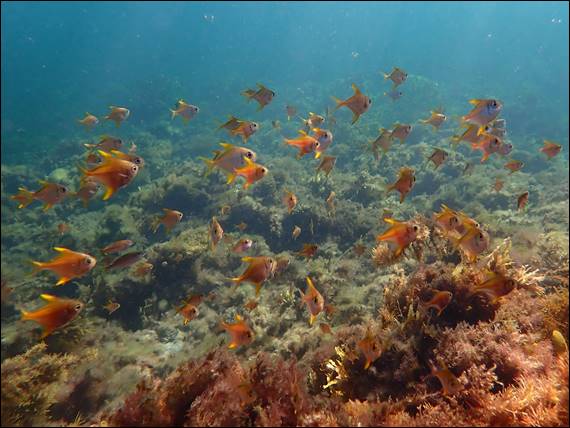
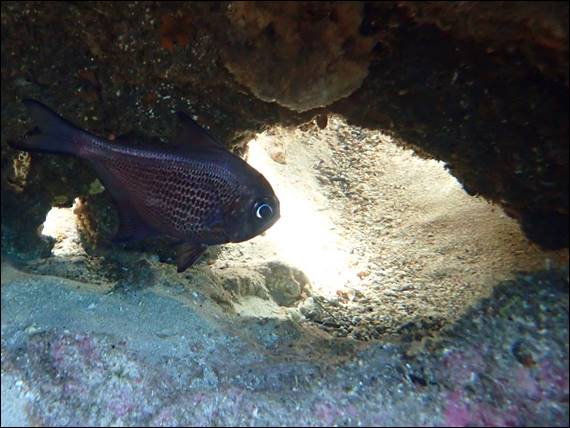
If you look closely you can see one young fish that is quite different, being a juvenile Bigscale Bullseye (Pempheris multiradiata). It is described as having a bronze to yellowish tinge along its back, to my mind it looks orange, and distinct yellow pelvic fins with black tips. The rest of the body being translucent. This creates an illusion of a half-eaten body. Believed to be a form of camouflage developed by this species. Very different in appearance to their adult form shown above, this one being approx. eight inches but they can grow to a full foot:
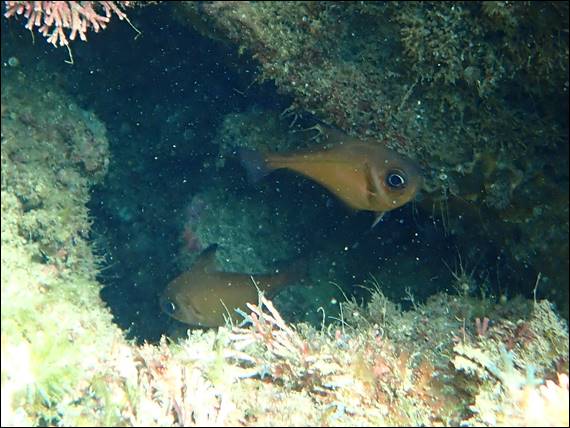
I have found have all species of Bullseye to be generally pretty skittish. Today however they were more accommodating to my intrusions than I am used to. Above are two Rough Bullseye (Pempheris klunzingeri). Very different in appearance to the Bigscale Bullseye, with a body of pale bronze to coppery-brown. With this colouration I almost felt the juvenile I spotted could be from this species but my research indicates that is not the case. While a common find below are Western Striped Grunter (Helotes octolineatus):
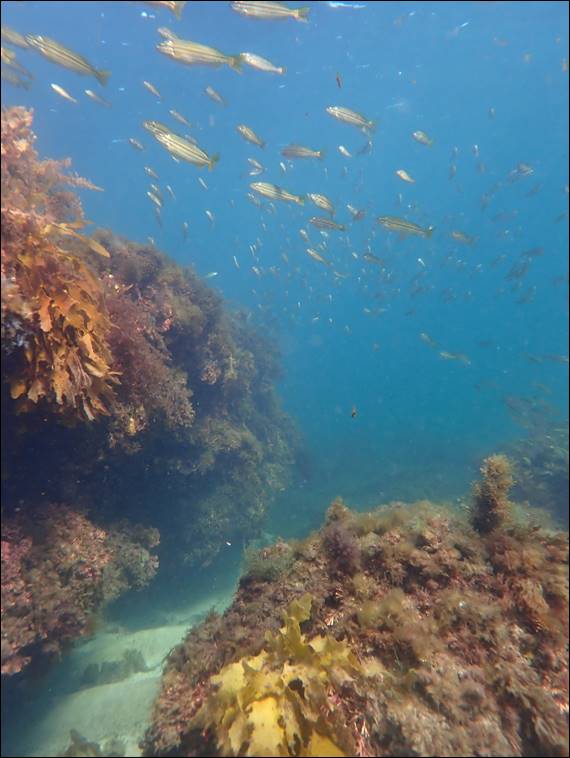
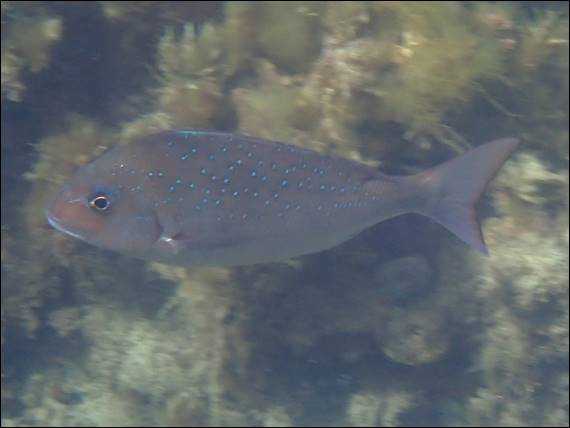
Included to show the water clarity. The view was pretty damn good! I also came across large schools of Australian Herring (Arripis georgianus), which can live up to a ripe ole age of twelve. However, they are very popular and most caught by both recreational and commercial fishers are between 1 and 4 years old, according to WA’s fisheries research. A bit of a scary thought for their long term future, seeing they become mature at around 2 to 3 years old. Another popular fish, one I have only seen once before, is the Snapper (Chrysophrys auratus):
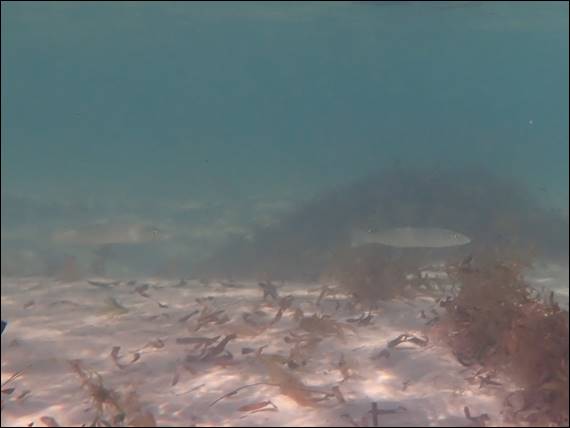
Shown below, these can live to over 40 years. Based on the obvious blue dots this one is likely to be between what they call a ‘cockney bream’ or ‘squires’, both stages being under a year or two old, and ‘pan-sized’. Their size in the latter is approx. a foot, which this one was just shy of. This stage occurs when they are three and five years of age, as they reach sexual maturity and the spots begin to fade. It was time to think about heading back in to my desk. On the way in I took one last image of Sea Mullet (Mugil cephalus) right on the shoreline:
Adults exhibit a schooling behaviour forming large groups on the shoreline or just outside the surf zone, as these were. The term ‘mullet’ is engrained in Australian culture, referring to a hairstyle associated with a ‘bogan’ in the 70/80s. That said the term wasn’t recorded as being used in this way until the 90s, after the song “Mullet Head” by the Beastie Boys came out in 1994. The first written use of the term mullet head was however way before in 1857 to describe a ‘stupid, dull person’ and based on the perceived lack of intelligence of the Sea Mullet. Maybe harsh for a fish that has adapted to differing environments across vast oceans:
I’ve banged on about phrases from the homelands enough. So this time, for a change, I’ll start today with one from Australia. Some may recall the term being used by a prominent character from Australia’s longest running soap opera, which in four days’ time will have its 41st anniversary. While the use of the term in this show elevated its popularity, and resulted in it becoming an accepted national catchphrase, it first emerged in print some fifty years prior in the 1930s. And if you have not already guessed, I am talking about ‘flamin’ galah’:
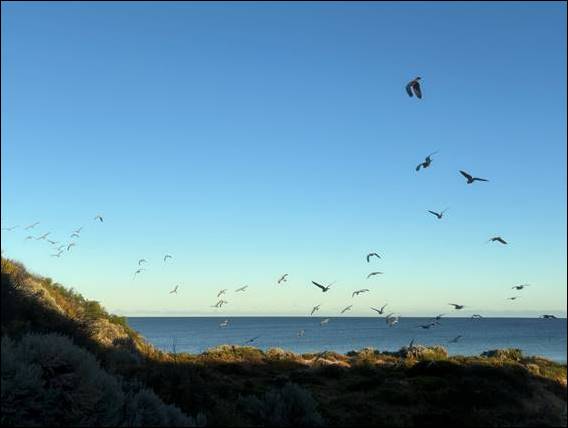
It is stated as originally being used as an insult. These days however it is used in more of an affectionate way. While the Galah (Eolophus roseicapilla), one of Australia’s most abundant and familiar parrots, is a highly intelligent bird, the term makes use of its more light-hearted side. Known to act like a bit of a clown at times, the term is used to incite someone is acting like a fool or idiot. So what brought all this on you may ask. It was a huge flock of the Galah’s that flew above round us in circles, as Lisa and I went for a wander on the beach on Thursday:
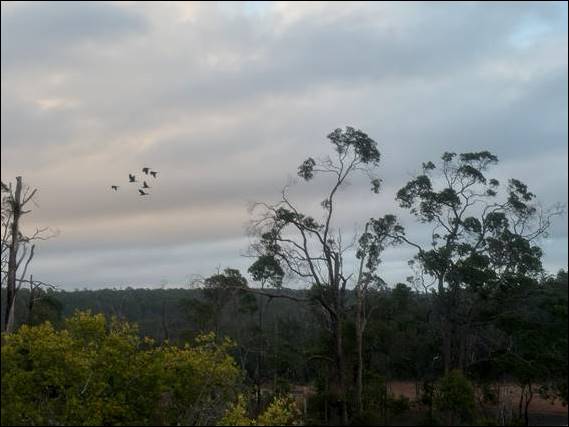
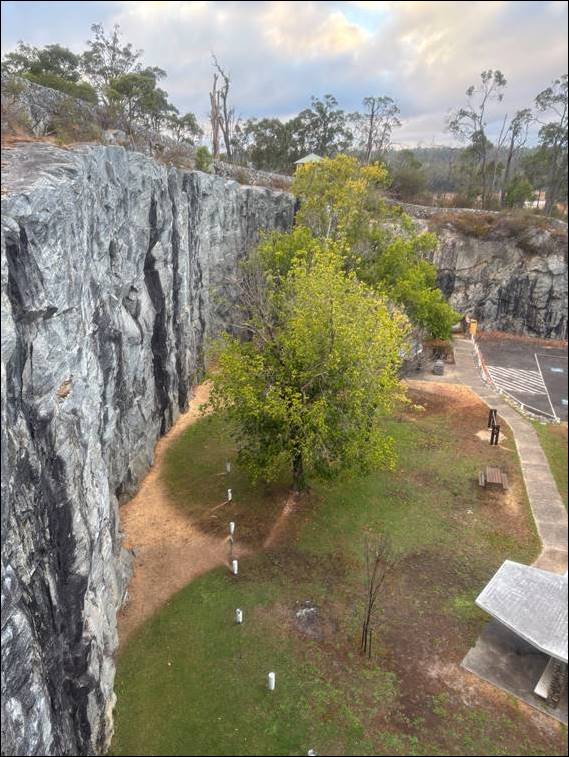
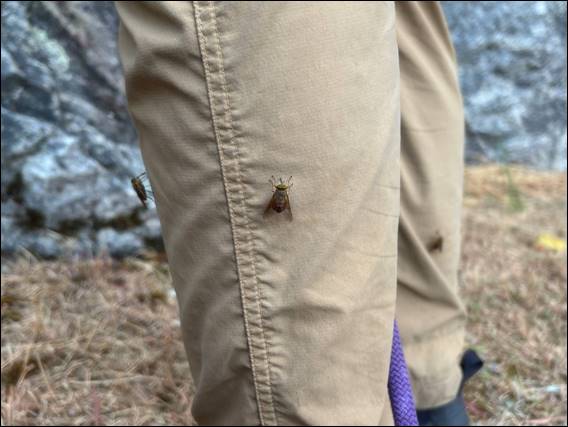
Friday morning I traded the high-pitched and raucous “chi-chi” or “chill-chill” screeching of the Galah’s with the loud and harsh “karrak” or “kree” grating of the Forest Red-tailed Black Cockatoo (Calyptorhynchus banksii naso). These came and went during Howsie and my early morning climb, as we yet again graced the steep technical walls of Welly Dam. While the Forest Red-tailed Black Cockatoos flew on high, we were very pleased to discover that back at ground level that not one March Fly (Tabanidae) came out to feed:
As I belayed Howsie I did notice one White-kneed Mosquito (Aedes alboannulatus) land on my hand. This species is a potential spreader of Murray Valley encephalitis virus, a rare but potentially serious infection of the brain, That said this species is considered a poor transmitter compared to others. Plus, while it is possible to catch the virus in the South West of Western Australia, the risk is much lower than in the northern parts of the state. Not willing to take the chance and rather than take a snap I flicked it off, and didn’t spot any more:
Friday’s session was going to be a little shorter than usual, due to a meeting that Howsie had to get back for. We pondered whether to hit less lines and maybe try something a little more testy, or get some mileage in on the more well-rehearsed climbs. Not that these slightly lower grade routes are pushovers. We still needed to work to get them clean when we plumped for the latter option. Having to work a little harder when the morning came in cloudy with a light sprinkle. Raising the humidity, which resulted in the friction reducing a tad:
We were also weighing up the fact that we had plans to get out the next day, and did not want to wear ourselves out too much from the session at the dam. As is always the case we thoroughly enjoyed the before work session. Being outdoors in nature alone is reward enough; the climbing is an added bonus. Making us feel like we had accomplished heaps before most people’s days are only just getting going, as they focus on the humdrum of yet another day at work. On Saturday we were not restricted by return times:
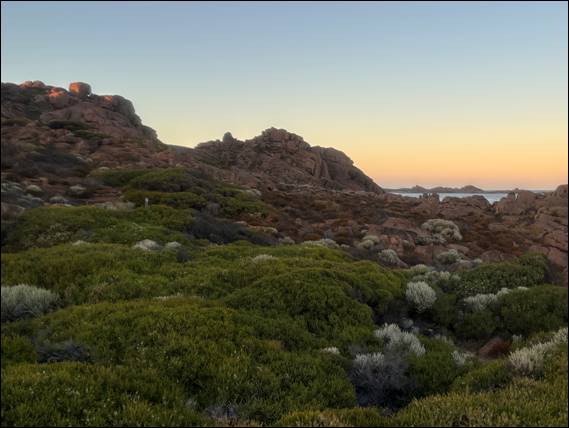
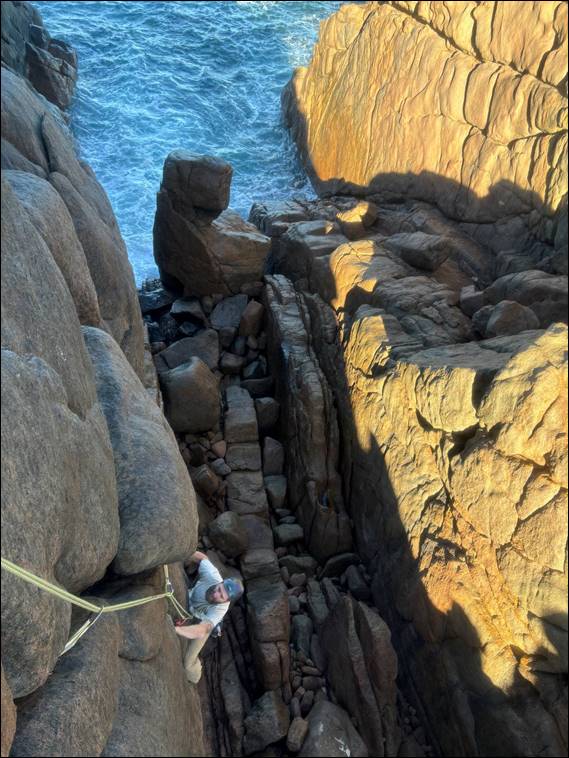
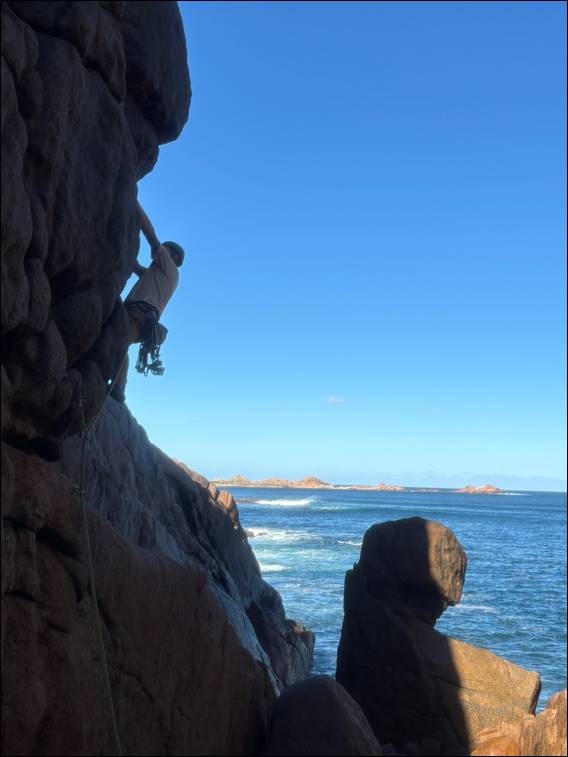
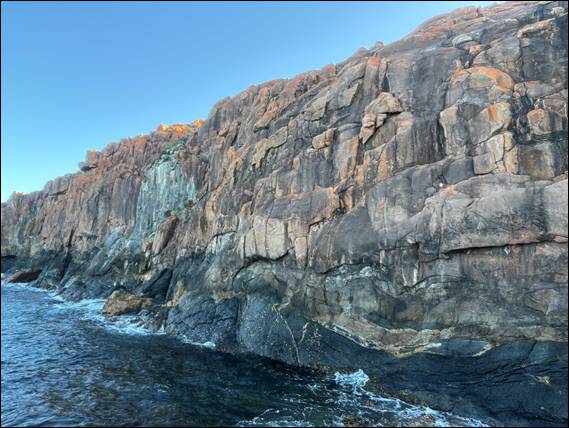
Allowing us a slightly more relaxed start. Arriving at Smiths Beach after first light, and just as the sun’s rays were hitting the peaks in the landscape Scrambling into the zawn, the walls were damp. Whether from overnight salt spray or maybe the morning dew, the impact was the same. The first couple of lines were that bit more nervous. The dampness added to the insecurity of holds that were already affected by the uncomfortable gritty and flaky surface of the granitic gneiss. A sign, as with all trips here, that no one has been climbing here:
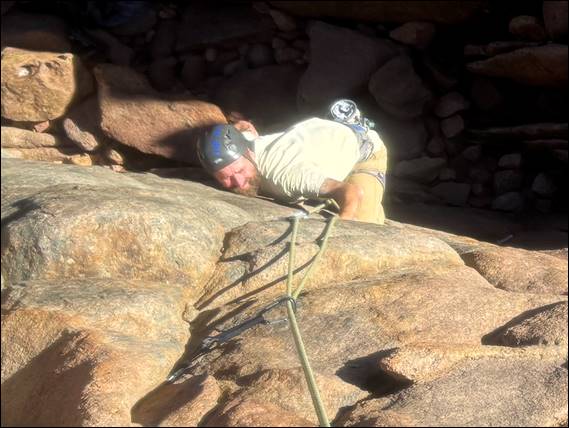
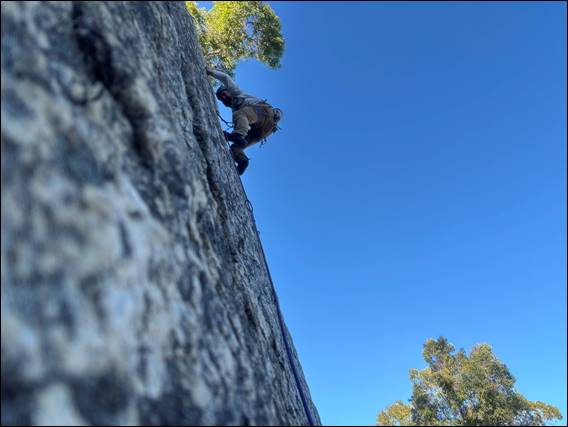
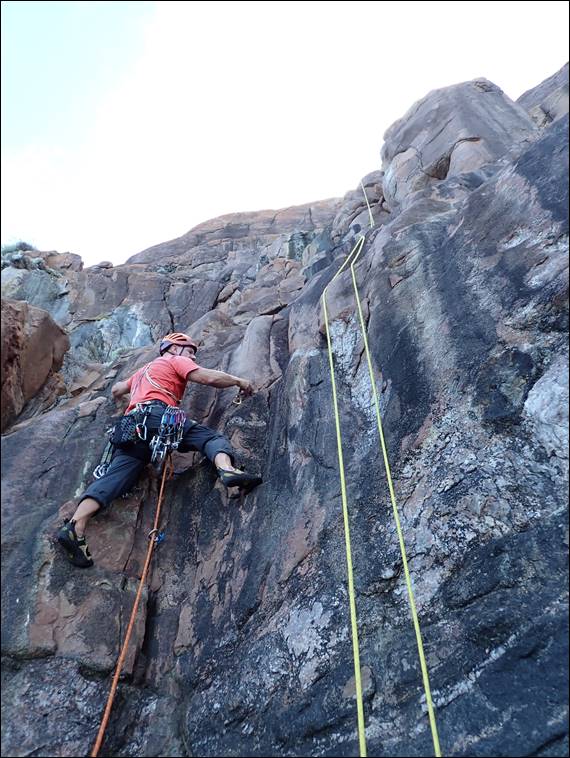
Maybe foolishly, my first lead was the first route I established at this intimidating place. It felt like a complete an utter sandbag and my muscles were screaming, as I tested the gear in earnest. In my head I could hear myself say you ‘flamin’ galah’. Howsie did a sterling job coming up second, a few images up. The workout took its toll, as he then took on his second lead on a steep route that could also be a sandbag, courtesy of Crag this time. I am however, pleased to say that as the morning wore on, the sun hit the walls drying them out beautifully:
There was no more testing of gear placements and as we had at the dam, we bagged three fine climbs each but took twice as long. The above image shows we had to work hard on the last route, a clear sign it was time to wrap things up. But before I wrap this post up, below is a video of a Purple Swift-Footed Shore Crab (Leptograpsus variegatus). Roof climbing as it was feasting on what are likely to be a non-biting species of Midge (Chironomidae), based on our experience of having to occasionally climb with swarms of them round us, until I disturbed it:
One of my favourite lines from any film is ‘keep to the road, stay clear of the moors, and beware of the full moon’. And in case you are not aware of the flick, it comes from the early 80s classic ‘An American Werewolf in London’. This came out a couple of years before Michael Jackson’s epic video for his hit ‘Thriller’. The special effects won Rick Baker the first ever first-ever Academy Award for Best Makeup. Being for the werewolf transformation scene, which used new and original special effects, with no computer-generated imagery:
Last weekend Lisa and I hoped for a bit of a transformation. Not one quite as monstrous. Simply getting away for a few nights, taking advantage of the long weekend, to relax. Deciding a bit late in the day to go away and being a long weekend, our options for finding somewhere available were limited. Ending up in Pemberton, where on the first day as per previous visits here, it rained. The second day cleared up but we only squeezed in one short walk close to town. The rest of the time we spent eating, playing games, and chilling out:
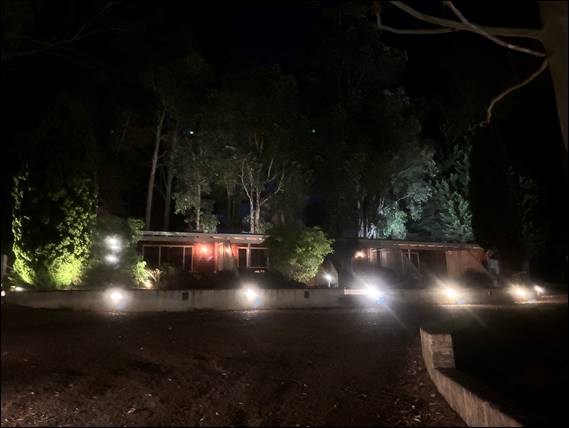
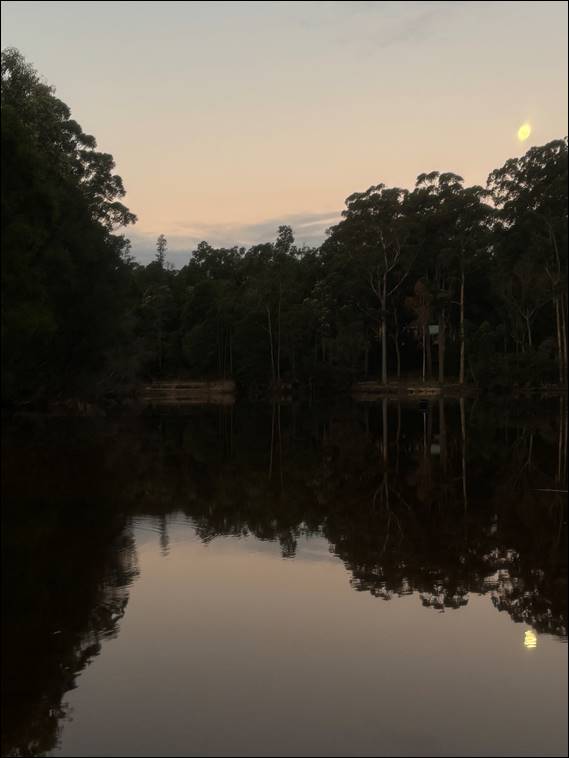
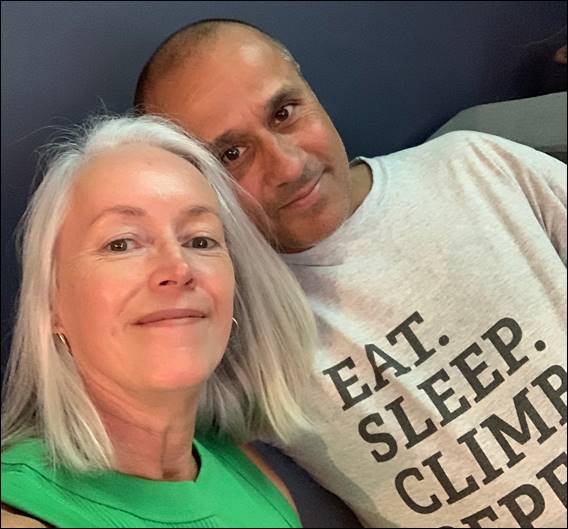
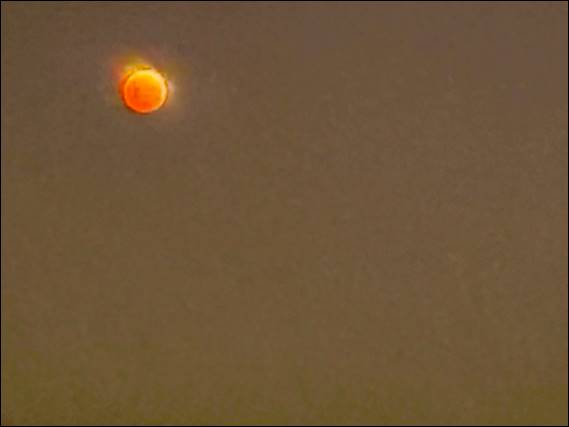
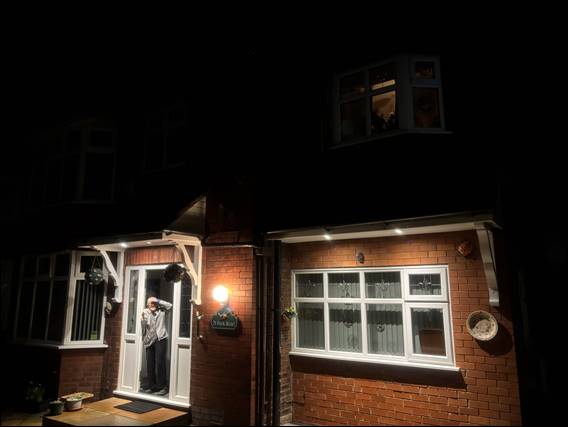
As such there are only a few images from our wonderful mini-break. The place where we stayed, all lit up at night. Above the moon tipping over the towering Karri trees, which help make this general area so special and soothing. And below Lisa and me in a rare selfie image, after having soaked up a heap of relaxing energy. Transformation complete, we headed home on Monday. It was the moons turn to transform on Tuesday night, into a Blood Moon. A fancy word for a total lunar eclipse that occurs when the sun, earth, and moon line up:
As the earth is sandwiched between them, it blocks out the direct sunlight that usually reflects off the moon. The eerie colour of the moon that results is caused by Rayleigh scattering. The light from the sun passes through the earth’s atmosphere, in which the oxygen and nitrogen particles scatter the blue light. Only the yellow and red light make it through, and this is then reflected off the moon. Yellow and red make up orange, and during the whole event the moon can look red, rusty orange, or a deep crimson:
I make no apology for the above fuzzy image. Being the best I could manage with my hand held phone on night setting for a shaky long exposure. This spectacle occurs approx. every three years and the whole process takes close to an hour. The last time it occurred we had cloudy skies, so missed out. This time round we were in for a real treat as, with a cloudless night sky. Fast forward to Thursday, when I joined Lisa and the pooches for her morning beach walk. And as may be evident the water wasn’t looking great. Again:
My friend Verity, in Perth, recently sent an update on her underwater adventures. Weaving a few stats into her exploits, and advising she has managed an average of 2.5 snorkels/week over nearly three months. Way more than me. I can probably count the number of times I’ve been in the water on my fingers, and not including my thumbs would still have spare digits. I could of course have driven to coastal areas with bed sediments not as affected by the higher swells. Verity has even suggested I could head up to her local spots, and they do look good:
They are however a solid two hours and 190km away. One day I really should head up there, as the different marine life does look very cool. That said and in keeping with the t-shirt I am wearing in the selfie, I generally reserve car trips of that length, and much shorter, for my adventures on rock. This occurred on Friday, with yet another quick session up at Welly Dam. Another before work trip with my partner in climb, Howsie. Here once more the moon added that extra little something to images of this place that would otherwise all meld into one:
These sessions are short and sharp, and we kinda view them as training. Time on rock is what we are after. So not picking climbs so hard that we waste time working one or two moves, but push things just enough to wear ourselves out. If we get it right, which we did this time, later that day we start to get a satisfying achy feeling. This ache, also known as Delayed Onset Muscle Soreness (DOMS), comes from microscopic tears in muscle fibres. As such when it occurs, time off and rest is what the body needs before returning to said activity:
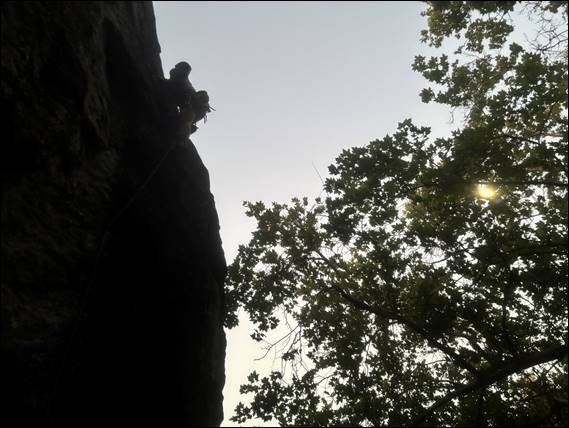
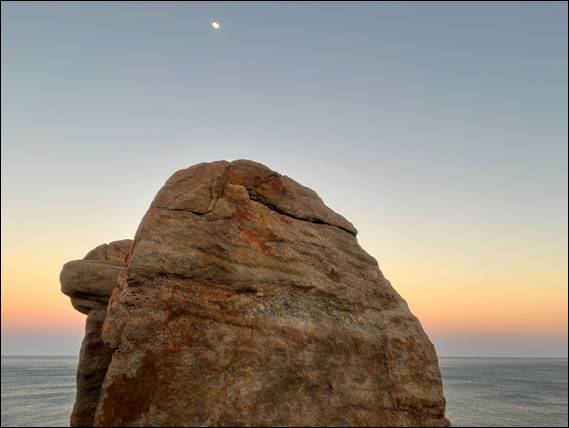
Added to that, the need to be careful of my repairing tendons would suggest I should have made use of the weekend to allow for ‘time and rest’. However, I liked the idea of a climb by the ocean and put out a call for a relaxed climb on Saturday. I got no bites, maybe another sign to rest up. The pull was however too strong, and this saw me watch first light come in at Wilyabrup. The moon was, once more, adding to the imagery from this past week of mostly outdoor fun. I didn’t expect to see any werewolf’s, but a dolphin would have been nice:
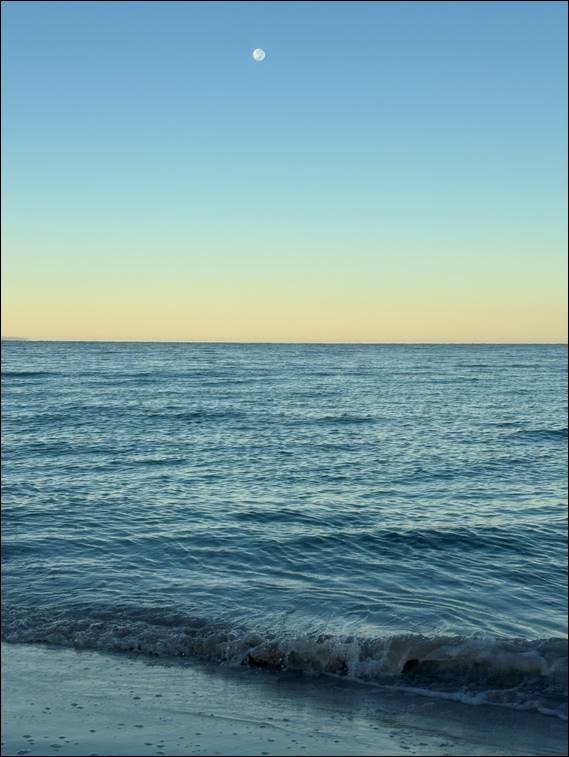
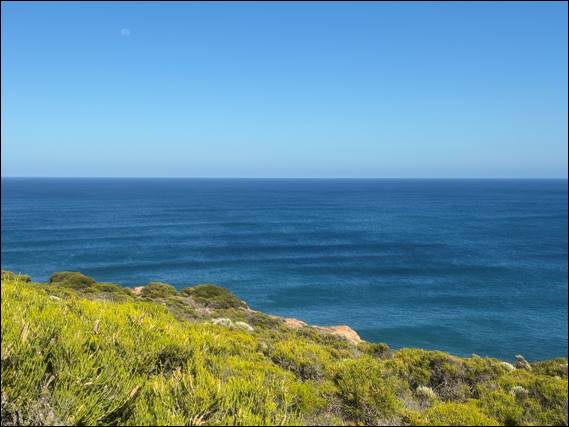
While I cleaned up on the Dolphin Smiles wall and ended with Hope, references only local climber’s will understand, I saw no dolphins. That was despite the perfect sets of waves for them to surf in on, which were rolling in all morning. These can be seen above as I walked out, which is the last image with the moon in it. In contrast the ocean in our local bay was looking relatively calm and clear. Much better than it has been for most of this snorkelling season. And with the added encouragement of seeing Verity’s images, I went in for a dip:
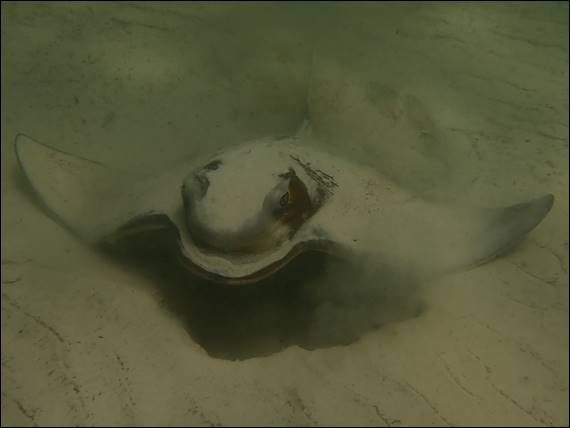
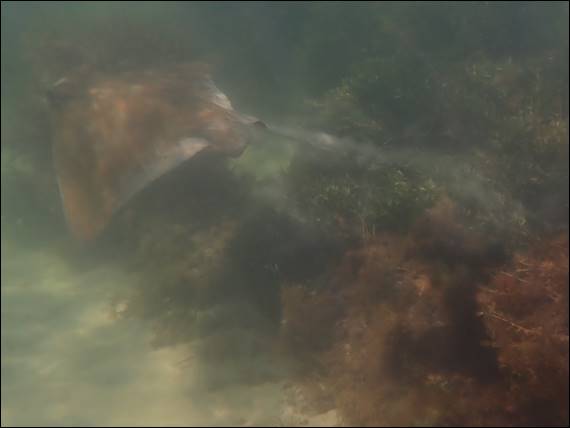
Despite being quiet and seeing very few fish, it was a lovely cool temperature after the hot time on rock. The two stars of the shows were a wonderful bait ball of juvenile Striped Eel Catfish (Plotosus lineatus), and a Southern Eagle Ray (Myliobatis australis) that was mostly buried in the sand when I spotted it. Until I endeavoured to get a rare, for me, front on image. Not taking too kindly to my intrusion it rose out of the sand, spun round, and disappeared. Back at the beach just as I got out, a pod of dolphins cruised by. Bliss:
When arranging today’s adventure, I asked Howsie what time he’d like to meet and then didn’t think anything of it. This saw us beat first light by a good twenty minutes, as we rolled into our destination. With a mere waxing crescent 5% full moon it was still dark, allowing us a glorious sight of the stars above. I have avoided this place for twelve weeks, as it probably was not the wisest place to climb during my rehab. However, as reported when I got out with Darby a few weeks back, I have been the green light to give myself a bit more of a test:
I’ve also had a couple of weeks of real rest from rock. That is other than the very enjoyable lower grade fun with Rod at the Crystal Palace a few days back, during and after which there were no tell-tale signs that anything was amiss. Considering the limited light, you may have thought I would offer the sharp end to the culprit who had dragged me out of bed half an hour earlier than necessary. Instead I racked up and jumped on a route that was familiar and sensible enough to be able to climb with a mix of feel and sight, completing it before first light:
Unlike the slow and steady mornings of England where you can savour the changing morning hues, which I relished just a week back, first light here rushes in. It takes 20-30 minutes to go from first light to sunrise, and it seems that it is far less to go from first light to plenty of light. This image is taken just over fifteen minutes, after the above one. Allowing Howsie to pick any line he fancied, without any excuses of not being able to see the holds. That said and being the first visit back here in three months, we had no intention of going too hard:
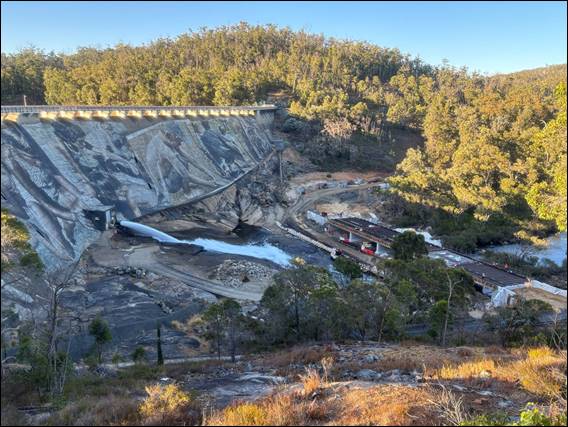
The dark start reminded us of the year we came here before work on a Friday nearly every week for the whole year, which was a decade back. While I am still on holiday, today was a before work climb for Howsie. As such we didn’t want to dilly-dally in-between lines, and kept up a good momentum. Dare I say a better pace that the building of the new bridge at the base of the dam. Work started in March 2025, nearly four years after the old bridge was closed. While they are making progress it looks like the full build will take well over a year:
There was one time today Howsie was not quite so decisive. Or should I fess up and say that I put doubt into his mind, as on this occasion I placed the crate between two lines. One he had mentioned and the other I not so subtly hinted he should have a crack at, which he was not sure if he was quite up to today. The crate was more towards the one I was encouraging him to jump on, which he did after some procrastinating. And with just a little egging on at the right time, as his arms were wavering, he kept going and managed a fine clean ascent:
Another reason for keeping moving, other than the timeline, was that from early on the pesky March Flies (Tabanidae) were out. Emerging from their slumber and ready to feed, just as we were about to hit our second route; fortunately still being a bit sluggish. Howsie had come here last week, later in the morning than today, and they were so bad that he bailed after just one route. He is not normally irked by them, and will be happy to put up with them long after I’m well and truly over their biting antics. So I knew that they must be bad this year:
As we kept moving, they remained a bit slow. This meant that while at times we were surrounded by a swarm of them, sometimes also called a cloud, business, or cluster, they didn’t affect our focus as we ticked one climb after another. And just like they didn’t bother us too much, my elbow was also behaving itself. Something that I was very happy about, as we hit eight fine lines. Finishing in good time we left ahead of schedule and before the time for feasting really began, when ‘it must be blood and must be fresh’:
My last post of a dive was over six weeks back; an unusual abstinence for watery activities for this time of year. Up until March the image library for each successive year would normally be filled with more underwater than above water imagery. I did have a sneaky snorkel a week after the last one I posted, and while the water clarity wasn’t too bad there was really nothing of interest to be seen. Having taken this week off, both to get back into the (time) zone and ease my body back into the humdrum of life, I can join Lisa for her morning beach walks:
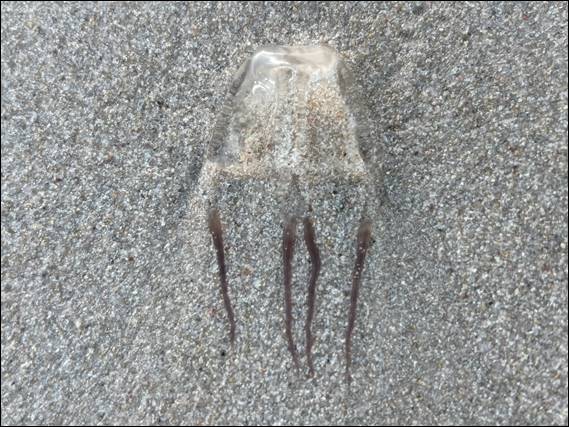
Today the ocean looked flat with hardly a ripple to be seen. In addition the nearshore waters looked to be reasonably clear. However, while there may not have been any waves the water’s edge was gently surging up and down the beach. And as it did so South Western Stingers (Carybdea xaymacana) were left stranded in the sand. The freshly washed up ones still pulsated. In response to the nervous system continuing to function and tell the muscular ring on the bottom of their bell, used to propel it through the water, to rhythmically contract:
There are four main life stages of jellyfish. As a box jellyfish (Cubozoa) the last two stages of the South Western Stinger comprise a juvenile and adult medusa stage. Thus skipping the ephyra stage that some other jellyfish go through. Key features distinguishing juvenile from adult medusa stages are the bell size and length of the tentacles. The term medusa having been adopted, not surprisingly, because similar to the mythological Medusa with snakes instead of hair turning people to stone, the sting from jellyfish can sometimes deliver a paralysing sting:
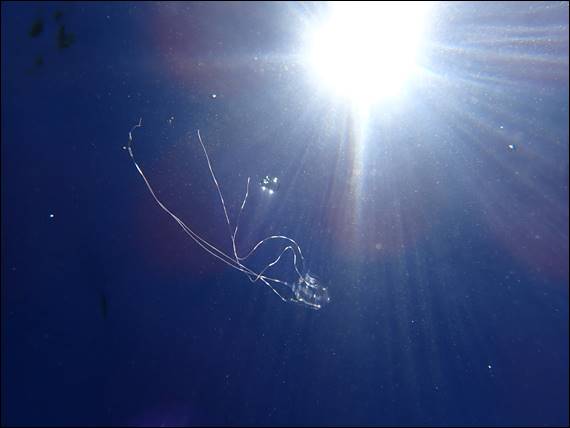
In the above two images. The washed up specimen has tentacles of similar length to the bell, whereas the free swimming specimen above has much longer tentacles. These may be examples of the juvenile and adult medusa stages, although the bells are similar sizes and when washed up the tentacles contract which could explain the darker colour. Even after being washed up the nematocysts, or stinging cells, can remain active. The ability to sting can last several hours and potentially up to a day. The duration being dependent upon the tentacles staying moist:
Encouraged by the conditions, but not being completely fooled in view of the length of water washed beach, I decided that after the household chores were done I should jump in. And just to try something different I went off the beach at Wave Walk. Here the reef is very close to shore and also quite shallow, making it a bit of a nursey to quite a few species. The water, as expected, was a tad cloudy. I started by scouring the deeper waters for half an hour with nothing to show for it, before heading back along the shallower near shore reef:
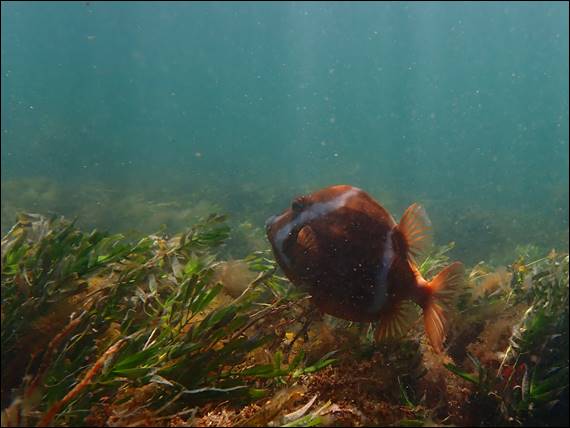
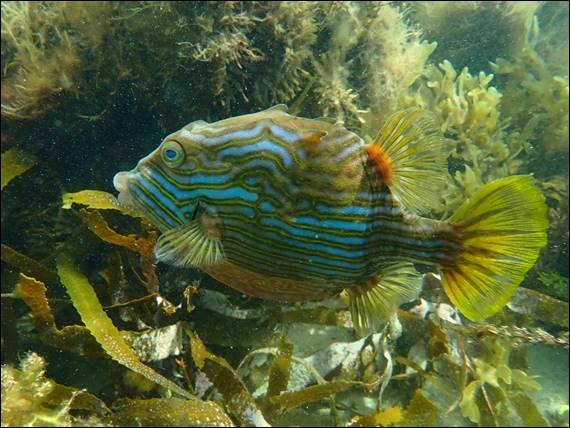
Fish came into sight here, with the boys showing off their colours such as the above male Whitebarred Boxfish (Anoplocapros lenticularis) and Shaw’s Cowfish (Aracana aurita). Maybe giving it one last go with the ladies, as the spawning season for these species starts to draw to a close. In the murkiness my eyes caught a Southern Eagle Ray (Myliobatis tenuicaudatus) leisurely cruising along side me. Content to simply watch it glide, it was not till I went to take an image that is sped up. Leaving a trail of the dust in the water behind it:
After the long thirty-two hour trip back from the homelands, this morning was day two of waking up in Western Australia time. It felt much harder to rouse and get going today than it did yesterday. As a person who is normally up early and ready to go as soon as I wake up, it is a strange feeling to roll out of bed at six and feel like all I want to do is crawl back into it. No doubt within a day or two the body clock will be back to the old routine. Today, however I had arranged to head out for a climb and as such I had no choice but get moving:
The destination was the furthest crag from home in the south west and most southerly in the Leeuwin-Naturaliste National Park. Cosy Corner, being an hour a half drive away. During which, after the narrow, winding, pot-holed, and high stonewall-sided country lanes I bombed about with the folks on just last week, even the country roads felt like highways. Easily wide enough to allow two cars to pass by each other without so much of a hint of worry. Some may be doing the maths, it is after all summer, and yes you are right:
It was a later than usual start for me. The agreed 8am commencement time had been organised with Rod. His request and for reasons that made sense, plus it allowed me in my sluggish state to feel ready for action when I arrived. You may recall Darby, who I climbed with at Moses Rocks just before my visit to the homelands to see the folks. Well he had bumped into Rod during a climbing trip to the south coast, and after getting chatting he mentioned to Rod that I had just released a bunch of mini-guides for the south west:
One being Cosy Corner, which so happens to be Rod’s local crag. The lucky bugger lives a short ten minute drive down the road. On learning about the mini-guide he reached out, letting me know that he has been cleaning the place up. Having recently got back into roped climbing, as opposed to just pebble pinching, he’d been visiting the crag regularly. And clean-up he did. Not just in bagging heaps of new routes, which led me to updating the mini-guide, but also picking up all the litter and broken glass left by careless tourists and visitors:
He had put up lines at various locations along the main face, and a stack of some fifteen or so at an area he named the Crystal Palace. The face can be seen in the second image, and it includes a fat quartz vein above the black Anorthosite base. This is up to a meter deep in some parts, and is where the name came from. Howsie and I have often looked at this wall and pondered whether to play on it. Each time having instead gone to the other cleaner looking parts of the main area, where we have managed to bag a number of first ascents:
Not however as many as Rod had. And this led to he and I organising a catch-up at his local crag, where he offered to point out some of the lines. The climbs at the crystal palace have not been individually included in the mini-guide, the area has merely been given a mention stating that all the likely lines have been climbed. As the images suggest it is a broken face. Ramps and ledges, break up the steeper sections. These offer mini-expedition type lines, as opposed to the more sustained routes that most ‘modern’ climbers seek:
And when I say the ‘modern’ climbers, I mean those who tend to have come out of the gyms with prowess and glory being the goal. As opposed to the old school trad climbers who head outdoors to absorb the whole adventure. Rod, like me, is of the latter sort. As such we both lapped up the climbs, with their varied climbing despite the grades being relatively low. Rapping down and then climbing out, relishing the grippy rock and gear placements, until the sun started to pop over the top of the cliff and the tide below began to lap at our feet:
Even with the late start this allowed us to get six very fun climbs in. With plenty more to sample, but that will be for another time. Maybe Howsie and I should have jumped on this gem of an area, but we snoozed and lost out. Before we left Rod was keen to point out a particular route, one that is in the mini-guide and called Neptune’s Trident. I am definitely keen to jump on it, on a calmer ocean day. Wandering along to the vantage point a Southern Heath Monitor (Varanus rosenbergi) lazily walked across our path, topping off a wonderful morning out:
Nine months can fly past to the point that if you sneezed you might just miss it. During my last trip to the homelands at the tail end of, a very flowery, British spring time I sneezed a lot due to a bad bout of hay fever. This time I hoped that would not be the case, being in the thick of winter. Who knew what the weather had in store. Heading back on a nine month rotation allows me to sample a range of times of the year; each one bringing a different adventure for my morning walks and the daily car trips with the folks, as we head into the countryside:
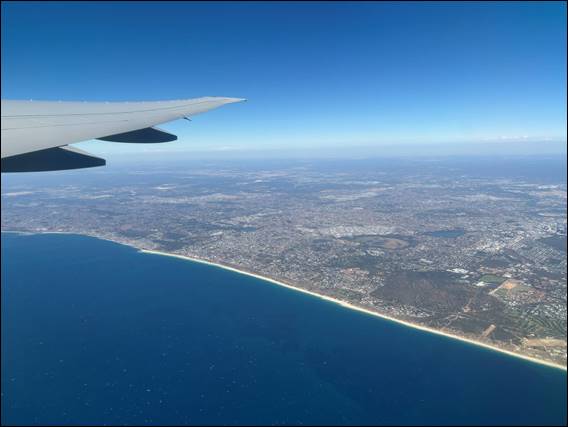
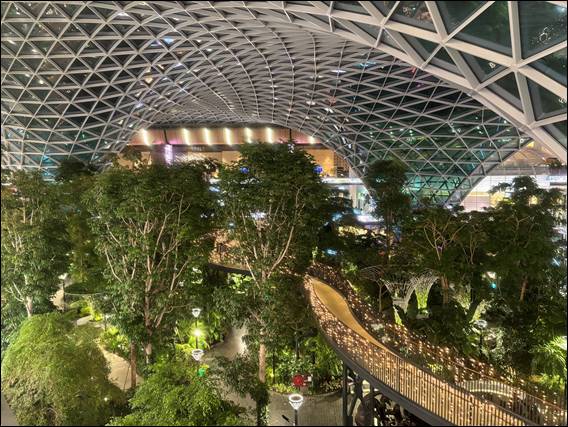
It was a warm mid to high thirties in Perth when I left, on a different airline to my usual choice. This saw me stopping over for a few hours in Doha, at an airport that in one particular area looked more like a botanical garden. The grandeur of the place putting our international airport terminals back home to shame, on so many levels. The setting made the few hours that bit easier to cope with, as my eyelids were getting very heavy. Then it was onto Manchester where at 6am I was greeted with darkness and lowly single digit temperatures:
Seeta kindly picked me up and we stopped on the way home to get a bite to eat, and to catch up. It was still a wee bit early to be getting to the folks place, plus she was heading away for a well-deserved trip away later today. Meaning it was the only chance for us to natter about life and things in general. My trip had been planned around my sisters week long break, which allowed her to be rest assured that I would be around to keep an eye on the folks. The week had been kept free of appointments, which meant our trips out would be fun ones:
Having arrived as early as I had. And feeling not too bad we had time to squeeze in a visit to the Yonderman Café, on the first day. I do like this place and was hoping once more to sample their wonderful oatcakes, and break out the first of what was to be many games. The meal was everything I have come to expect here, bloomin’ marvellous. Something we all agreed on. Despite being nine months between visits here, the staff still recognised us and we had a good chat. They even asked if we would make a second visit to them this time round:
I wasn’t able to make any promises about squeezing in another trip there this time. Due to what is becoming a bit of a routine, and having already planned our destinations for each day. Most times we had lunch at a pub, and then made our way to a café for dessert. There were however a couple of lunches at cafés, at the request of the folks. As mentioned before, the weather was all a bit uncertain. Some parts of England have received rain every day of this year, and this has resulted in some areas being affected by serious flooding:
The flooding has been for extended periods, resulting in many people also being without water and/or power. The folks are however lucky with where they live, which has not, and due to the topography is not likely to be flood affected. Being winter, wet weather was to be expected. It is a time of the year when you may question whether country drives to explore new places is worthwhile. However heading out in different conditions other than just when it is nice, provides for a different experience:
For our first day out, which usually lasted for 5 to 7 hours, we headed across to Holmfirth, located in the Holme Valley of West Yorkshire. On my last trip when Dave, my folks postie for many a year, and I had headed out for a walk he had suggested the area. This is where a British show called Last of the Summer Wine was filmed. It ran for a whooping thirty seven years from 1973 till 2010. A show about the exploits of local characters called Compo, Clegg, and Foggy, which is reputed to hold the record as the world’s longest-running comedy:
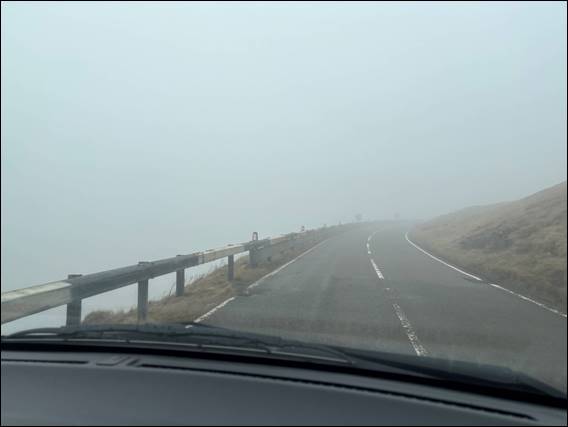
It was and still is a very popular, and in my opinion brilliant show. The town has not surprisingly cashed in on this, and has become a bit of a tourist attraction. As such while we drove through it, we did not aim for a pub in the town. Before we get there, and talking about the weather again, you will see several images up that as we passed over Holme Moss Summit we were well and truly encased in cloud. The steep drop to the side of the road hidden from sight, the steep inclines make this a renowned and challenging climb for cyclists:
This has resulted in it often being referred to as “Le Col de Moss”, and today we fortunately did not come across any cyclists. The folks loved the experience, view or not, as we drove up and over the highest point. In the lower lying land we dropped below the cloud that still hung heavy above us. Making our way to the Rose & Crown, in Thurstonland where the landlord made the comment of “so you are the people who made the booking”. My last couple of trips have been in the warmer months and as such places were booked up:
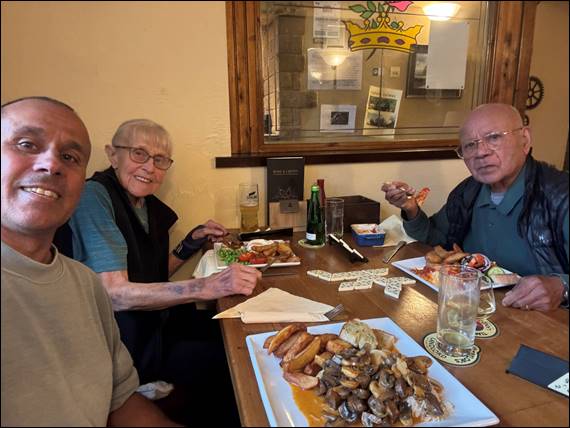
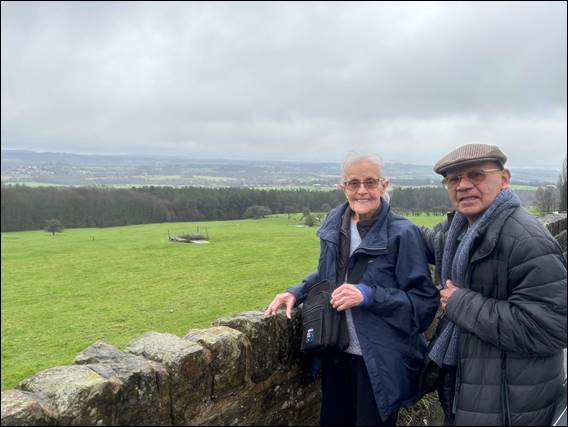
This time most of the places were relatively quiet, so I may not have needed to book. But a couple of spots were pretty busy so I am glad I did. Our first meal was lush, brimming platefuls of food were relished and devoured. My dad and mam, at 92 and 94 respectively, still manage to have a healthy appetite. And while they are slowing down and more wobbly than last time, they are still able to manage and enjoy these trips. Compared to my last visit I could tell there had been a significant change in their mobility, but they are still both sharp:
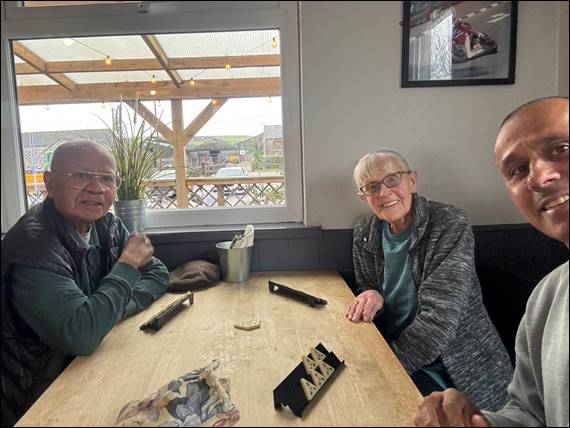
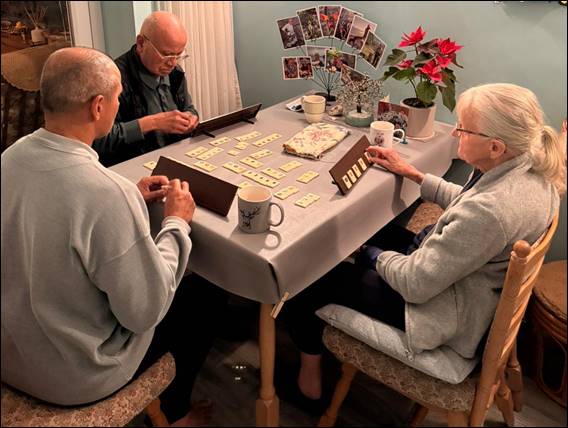
Proven by their ability to play that games, which we played both at home and when we went out. Triominos, may seem an easy enough game. However, they are still quick to add up the dice and scores for Yahtzee, and manage to shuffle all the tiles on the table about to make different sets in Rummikub. This time however, in part due to the weather but also their mobility there was very limited walking. Confined to walking to and from the car to get the house and places we were eating. Between each place we ate there was a country drive:
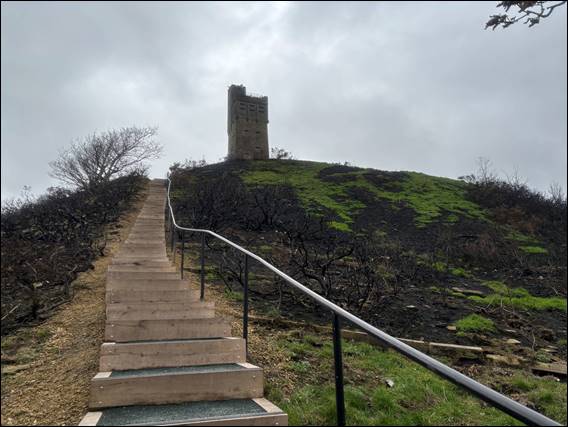
The drives between each stop varied from one and half to half an hour, allowing us to take in various routes and different sights. After our stomach filling meal at the Rose & Crown, we spotted a tall building on a hill. This resulted in a diversion. At a carpark I ran up the many steps to check it out, leaving the folks in the car; only to find a higher carpark that we then drove to. Castle Hill, was first known to be settled some 4,000 year ago. The tower however is a mere 127 years old, constructed to commemorate Queen Victoria’s Diamond Jubilee:
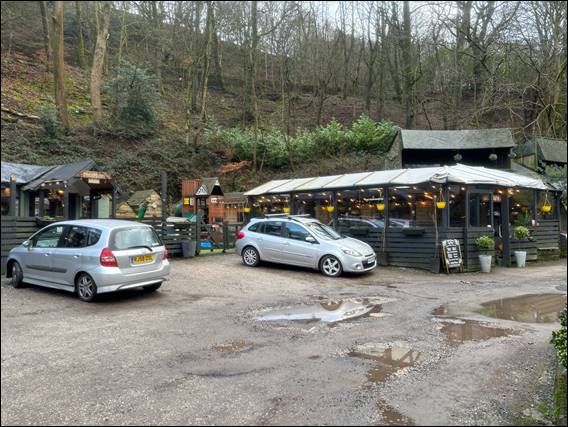
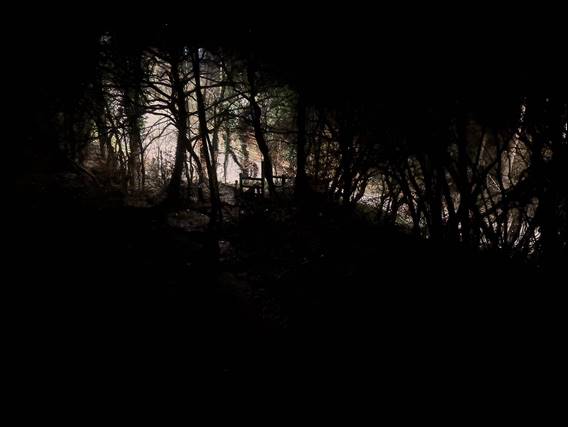
We then motored along to the Wild Café, hidden off the beaten track. It was so good, with the best cheesecake I’ve ever had despite being gluten free and vegan. They gave us the last piece to take home, which my dad snaffled at some point. I’ve slotted in an image that is pretty dark. Despite first light and sunrise not arriving till 6:45 and 7:20’ish, I still had a few early morning walks. Some of the paths were muddier than I had previously experienced, making for fun and slippery times. Arriving back as the morning and folks were stirring:
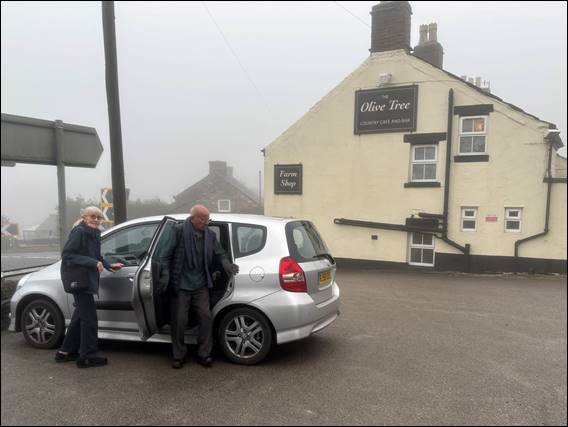
On a couple of mornings however, it was either raining too much or my boots were still to sodden from the previous day. For our second day, we headed out for a double café trip. My dad was keen to get back to the Olive Tree Café, which they had been too several times with my sister. It was my first time here and I could see why they liked it. This was the only day that my dad’s Parkinson got in the way of him enjoying the meal, which was a real shame as it was a place of his choice. The staff were however wonderful, and took it in their stride:
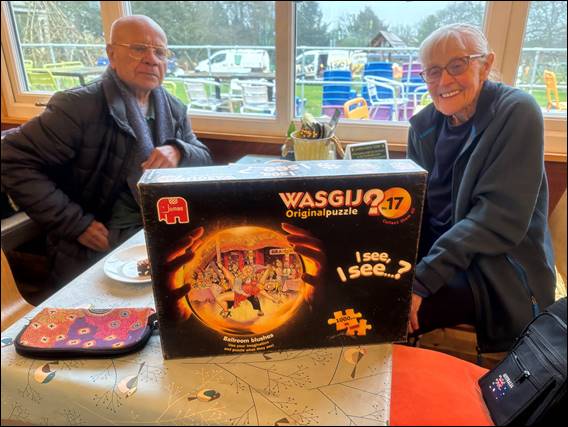
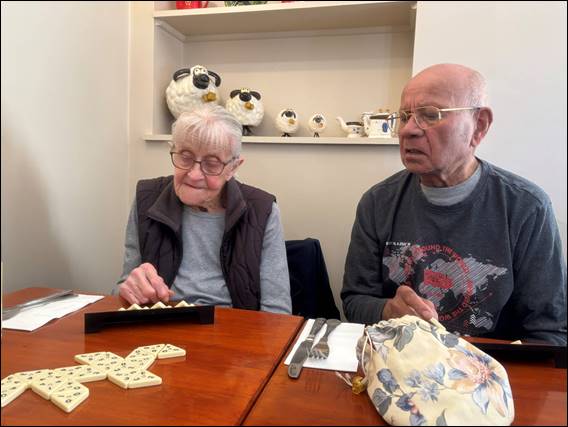
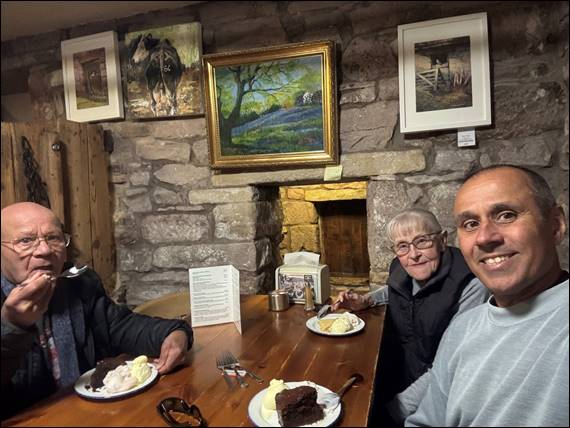
In fact everywhere we went as I escorted the folks in, at times one on each arm, not just staff but also other patrons were extremely considerate. Opening doors, moving out of the way, giving us time to shuffle in, and also spending time to have a chat. My dad likes a chat, and will bend the ear of anyone willing to listen. The staff at the Olive Tree Café were particular champions in this regard. After we moved on he was back to his usual self and was able to thoroughly enjoy cake and tea at the Quackers Café, in the image with the puzzle:
The puzzle is relevant, being a Wasjig puzzle. Elseya and my favourite brand of puzzle. The day I left home, Elseya, Jade, and I worked furiously to finish the one that had been hogging the table for a few weeks. This resulted in us finishing the puzzle, and me departing for the airport some twenty or so minutes later than I intended too. The next puzzle we will start just so happens to the same as the one in the image above. This was also the only puzzle at this café, in amongst the games that people can make use of as they enjoy their beverages:
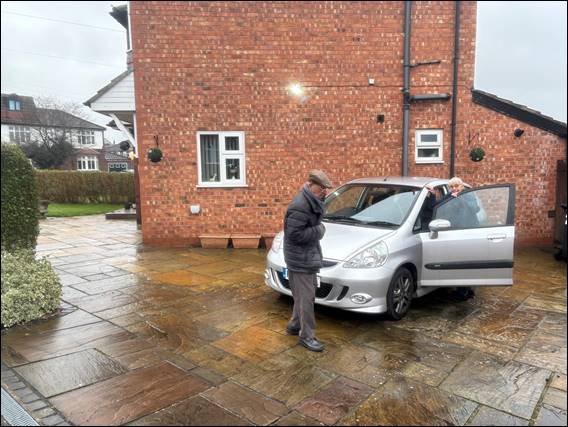
In the next image the folks are getting into the car for the next trip out. Rugged up and hugging their clothes round them. The temperatures never hit double figures, and it was not uncommon to be below five degrees. It was after all winter. The pavers out the front of the house, and also in the back garden were once again algae coated. When wet they were quite slippery and dangerous for the folks. As such in between trips out and games, and when the limited daylight hours permitted, I set about pressure washing them:
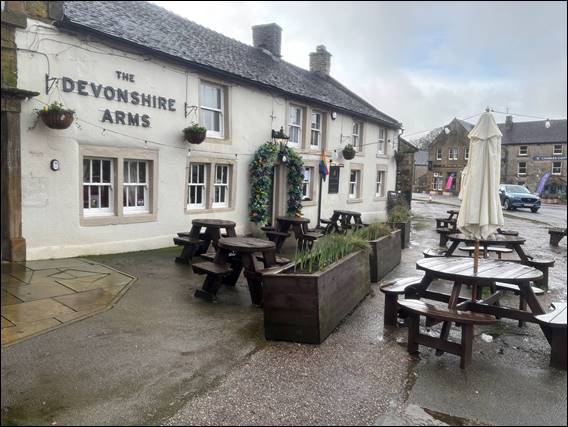
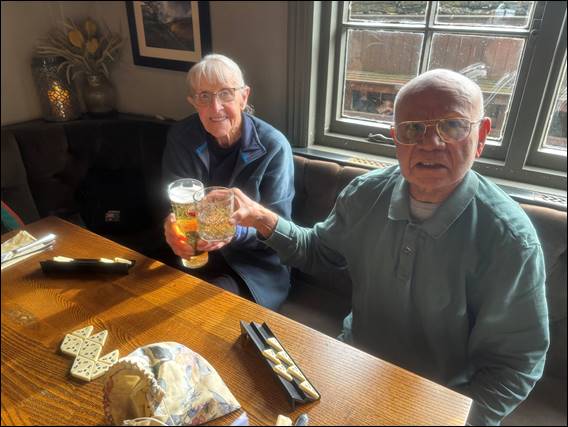
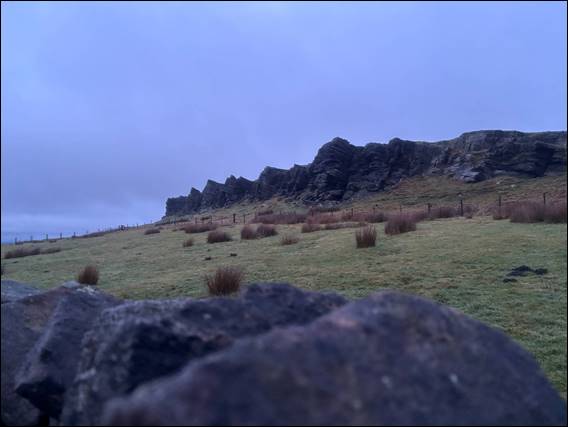
It took quite a few sessions and chewed into time a fair bit, but was well worth it once it was done. In the image they are getting into the car to head to the Devonshire Arms, the only pub that was a last minute choice. Required when my chosen place suddenly changed its opening hours. It was a great replacement, worthy of a repeat visit. The folks are cheersing Elseya’s birthday, which I unfortunately missed due to the timing of this visit. This journey saw us dip into the Staffordshire Peak District, a sneaky trip by me so we could drive past The Roaches:
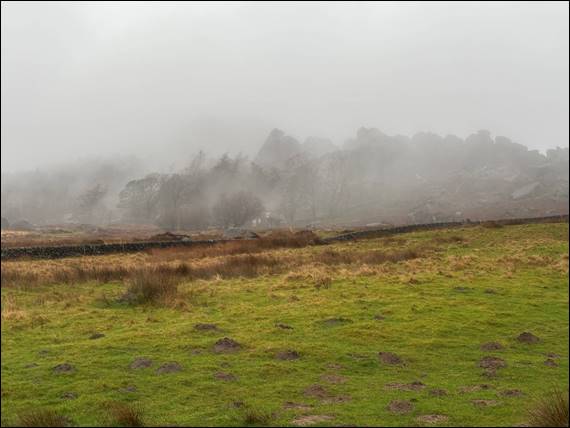
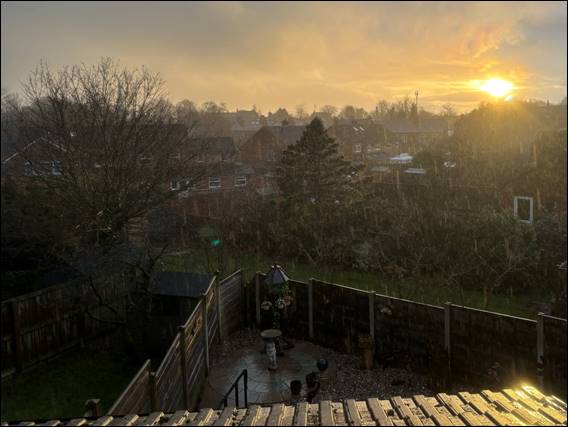
The café we visited before the drive by was the one we liked least, although as my dad reminds me the staff were lovely. The Roaches were shrouded in cloud, but it was still worth it. I was going to say that once we got home, even though it was raining, we finally got to see a bit of sun. However, if you check the image from the pub the shadows hint it also came out for a bit then to. During our time in the car however it was once more misty and cloudy. Back home the games came out again and Leena, who took the sneaky picture, popped over:
I mentioned Dave the old postie, old as in previous as opposed to age. And once more on this trip he and I organised a day to get into the hills. I’ve write that great hike up separately: https://sandbagged.blog/2026/02/12/mostly-sensible/. The intermission of a day in-between the trips for my folks was needed, as they were getting a little weary and the bit of quiet time to recuperate was well timed. After the hike with Dave I had enough time to complete the work on the pavers, by which time my feet were sloshing about in water inside my boots. Meaning there was no morning walk the next day:
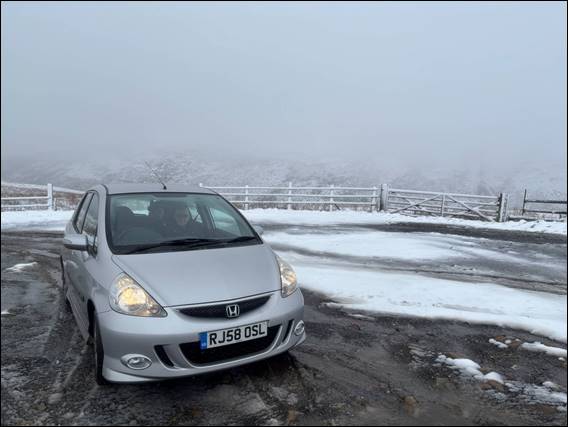
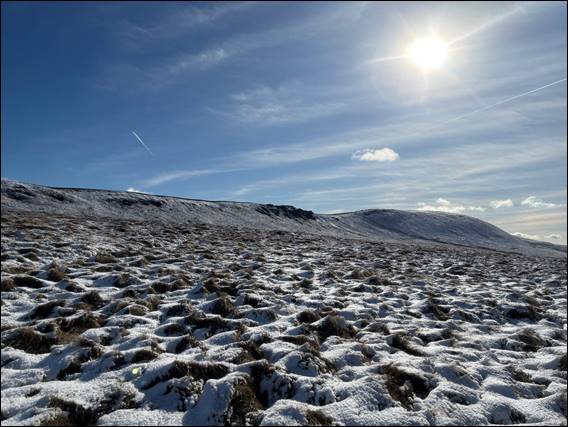
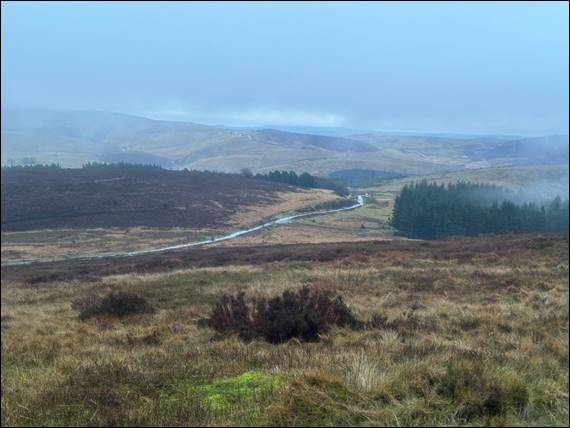
That night Neil and Leena popped over for a takeaway, which was the only evening meal we had and indeed needed. With a forecast for clearer weather on Friday and as we had not seen the views from Holme Moss Summit on our first full day trip, I decided to take the same route. As we approached the valley before the mighty hills, snow was sprinkled on the higher ground. Needless to say I got very excited, and the folks were also very happy to see the white stuff. Being a novelty, as it is not the sort of weather they would normally get out in:
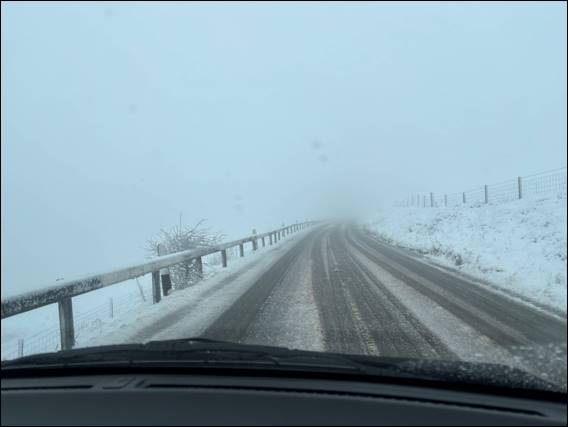
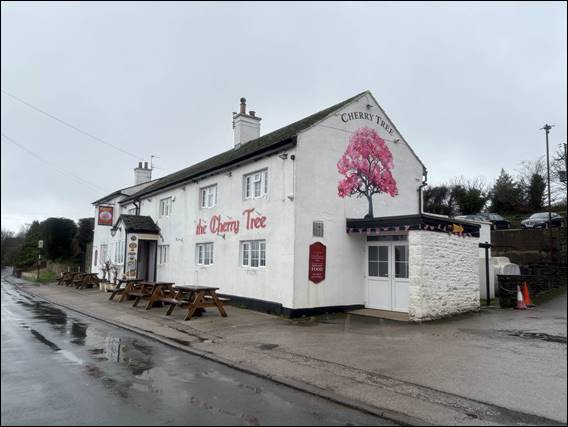
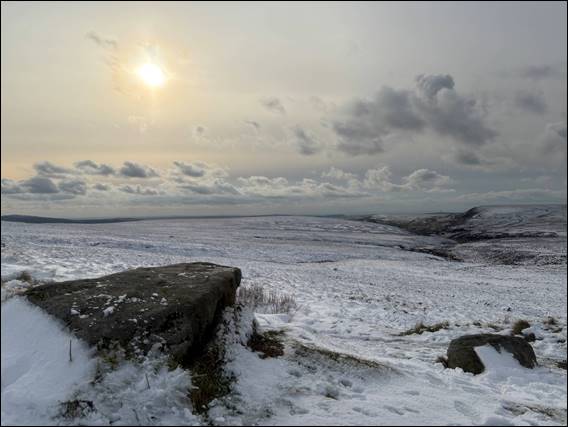
As we drove up into the hills the snow fell thick and fast. The top had a good four to six inches. The road was slushy and we went slowly especially on the steeper and windier sections. It was absolutely brilliant. I stopped several times, braving the zero degrees and biting wind to get out and take it all in. Needless to say the folks stayed in the car. To top it off the Cherry Tree pub was another cracker, with a wonderful outlook. Even in the depths of winter it was very popular with heaps of tables reserved. I felt better for booking this one:
The café I had planned was called the Hidden Gem, but google maps took us the wrong way and we couldn’t find it. Having had the time to check it out in more detail I can see where we went wrong. But rather than waste time while we were out, I quickly spied another place and that turned out really good. We even got snowed on as we went back to the car, before heading back over as many high hills as we could to see more snowy landscapes. Including Snake Pass opened in 1821. Known for hairpin bends, steep gradients, and sweeping views:
These road conditions also means it is detailed as being “high-risk, accident-prone nature, winter closures, and recent landslips”. We risked it regardless, despite the conditions that were far from clear as forecast. Being well and truly rewarded with stunning views. Saturday arrived and was again forecast to be clear day. Looking out the window at 5:30 I could see stars. Having intended to get one last morning walk in, it looked to be a good day for it. Minus four degrees also meant the puddles and mud would all be frozen solid:
It was a lovely walk, and despite the temperatures it didn’t feel too bad. The best part was watching the morning hues change, as shown in the above two images. Unlike back home sunrise here is a slow affair. One you can savour and really absorb due to occurring at such a gentle pace. The clear skies meant that we were in for a treat of great sights for our last trip out. The intention being to head to the Goyt Valley area. My only concern was that in view of the mercury rarely going above zero degrees today, was whether ice would be on the roads:
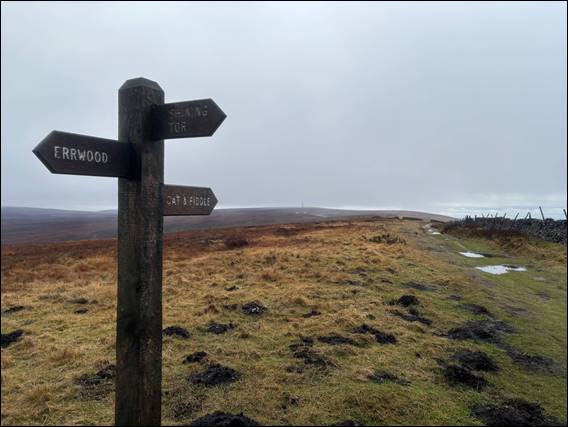
Dave suggested it should be fine, so we went for it. He was mostly right, but ice did indeed exist on some of the steeper hills where the sun had not got to. I kept a careful eye out, and on occasion it was not possible to avoid the wheels spinning. Luckily for us these sections were short lived and we were able to safely navigate our way along. Being a Saturday throngs of others were out. Above is Cats and Shining Tor, where Dave and I had hiked over only meeting one person. Today, as that local had predicted, it was like a highway:
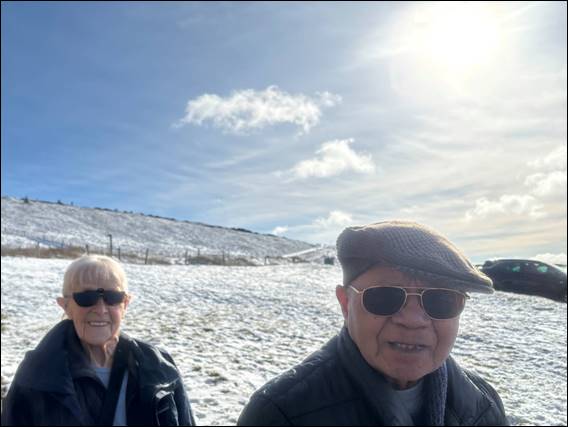
Our destination today was a place we went to last time. That time it had been an afternoon café stop, for tea and cake only. The folks checked out the menu back then and said that they thought it would be a nice place to have lunch. I’m very pleased they did, and that we went there today. The blues skies and white covered hills resulted in the Peak View Tea Rooms really living up to its name. This time the folks did get out of the car and onto the snow just to get to the café, making me a little nervous so we moved extra cautiously:
Not wanting to waste such a wonderful experience, we drove round a fair bit afterwards. The roads we took went round Axe Edge Moor, where Staffordshire, Cheshire, and Derbyshire meet. Resulting in us dipping in and out of each county multiple times. Back in the 18th century criminals & convicts would use this location to escape across these boarders. The reason being that back in the day law enforcement in each county was separate, a system that no longer exists but back then it allowed them avoid being apprehended:
We also drove through Flash. The highest village in the United Kingdom, being 1,519 feet or 463 m above sea level. Wanlockhead in Scotland was claimed to be higher by 12 feet or 4 m, however while Wanlockhead is indeed a village there are no buildings there at the claimed elevation. After such a great café and drive, you may think the last café would likely be a letdown. It was however really good. The Blaze Farm tea rooms are in an old milking shed and boasts scrumptious homemade and award winning “Hilly Billy Ice Cream”:
Maybe a strange choice in such cold temperatures but we had ours with hot chocolate fudge cake and apple pie, which “warmed the cockles of our hearts”. A Latin based 17th century idiom, meaning to make someone feel deep happiness, contentment, or a sense of cosy, affectionate gratitude. A fitting way to end the trip. In the evening I could tell the folks were weary, making mistakes in the games they didn’t earlier in the week. A sure sign a week of fun, was just right. Next morning I left them in darkness, to have a much needed day or three of relaxation:
Last time I visited England, Dave and I only managed an afternoon hike. During which he mentioned he had considered taking me for a walk round Windgather Rocks. The short 12m rock face is claimed to be one of the friendliest and most popular climbing crags in the Peak District. It has been a favourite for many people over the last hundred years, having an abundance of routes. Many lower grade lines means it is a great place to learn to lead climb. On trad of course, as bolts are an extreme rarity in the Peak District, although the climbs are at times a little run out:
In fact bolts are forbidden on gritstone, so only exist from historic placements of which there are very few indeed. Windgather Rocks comprises Chatsworth Grit, a carboniferous sandstone formed 300–360 million years ago. The a coarse-grained nature of this type of “grit” lends itself to even better friction if that is possible. This in part makes the location such a beginner-friendly crag. Why is all this relevant? Well Dave had hinted to being up for giving climbing a crack, and I found out he has many years back had a go at climbing at this very location:
In our favour his neighbour is an avid climber, and she was happy to lend us all the gear meaning I didn’t need to cart all my stuff over. While she questioned Dave about rock climbing in winter, in my days of climbing in England we climbed year round so knew what we may be up for condition wise. We had a date set and gear organised for the great adventure, however as the day approached and due to stuff that was happening in Dave’s life he confessed to not being in the right head space for climbing:
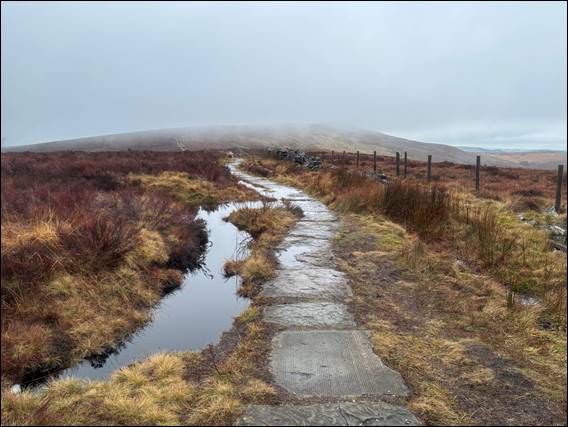
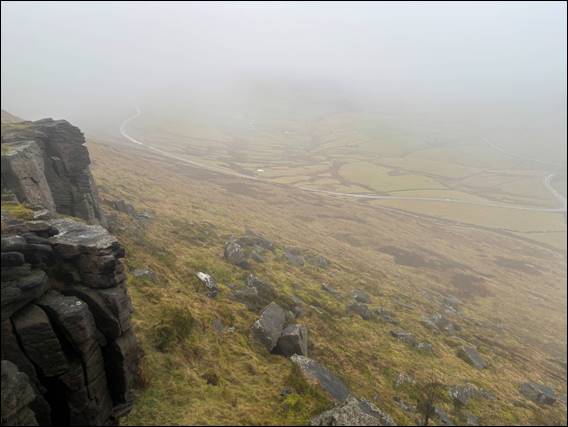
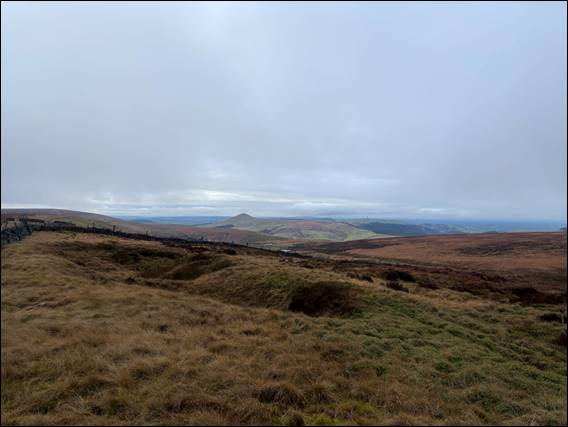
He was however still very keen to get out for a hike, to help blow the cobwebs away. Picking me up relatively early so we could get back just after lunch, we still headed to Windgather Rocks with the intention of hiking round part of the Goyt Valley. As with the first few days of country drives with my folks, the cloud hung low in the sky. Tendrils stretching down into, and being blown by a cold wind up, the valleys. Above we have just passed Cats Tor and ahead lay Shining Tor, at 40m higher and with its peak just about covered in clouds:
Shining Tor is the highest hill in the county of Cheshire, and on a good day 360 degree views stretch far and wide taking in the Clwydian Range in North Wales and The Wrekin in Shropshire, amongst other land marks. But not today. Being a weekday the area was quiet and we met very few people for the majority of the walk. On the hike up to Shining Tor only one local came past. He had a bit of chat in part as he spotted me picking up litter and was grateful for that. Mentioning that on a nice day the place is transformed with hundreds flocking here:
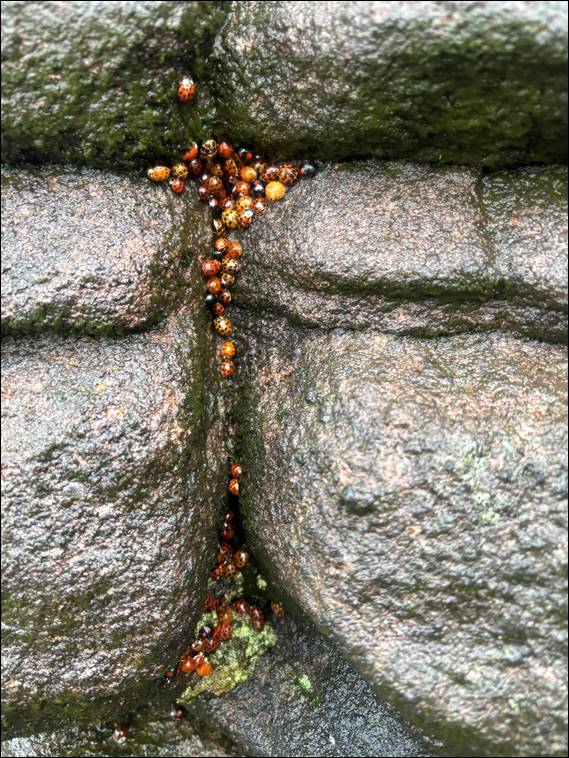
As I stood atop the short walls shown above, I spied more rubbish so went down to get it. Intending to also use it as an excuse to scramble back up the rocks. They were however green and slimy, so I erred on the better side of caution and didn’t attempt them. Making me think that it was a good thing that Dave had swayed today’s adventure from vertical ascents to those of a more gentle angle. I did however spot hundreds of Ladybirds (Coccinellidae). Such clusters are called a loveliness, and are used to stay warm and safe during hibernation:
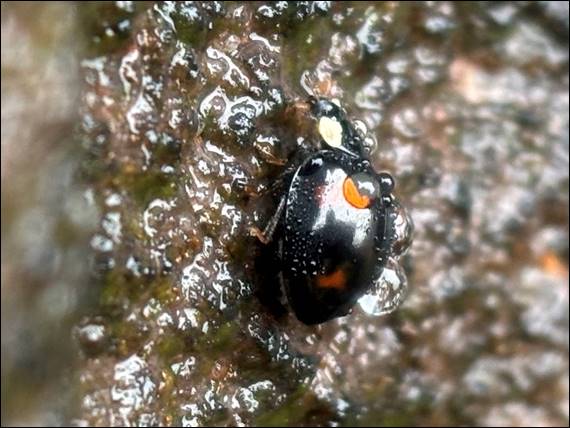
I’d never seen these clusters before. There were large groups of them in the cracks all over this rock, and it looked pretty amazing. There were also quite a few differing patterned and coloured ladybirds. I have now read that there are over 40 species in the United Kingdom, with 26 easily recognizable due to distinct features, and 5-6,000 worldwide. I could be wrong but the above may be a melanic (black) colour morph of the Harlequin Ladybird (Harmonia axyridis Var. Spectabilis), and kinda wish I had taken more images of the different sorts we saw:
Above and looking west is Shutlingsloe, it is right on the edge of the Peak District and stands at 506 meters (1,660 feet). This particular peak has steeper sides than others and from the right direction, as I discovered on the last day out with the folks, it can resemble a distinct alpine style pyramid-shaped profile. This has earned it the local name of the “Matterhorn of Cheshire”, despite standing at only 11% of the height of the Matterhorn in the Swiss Alps. As we approached a T-junction in the path another prominent landmark came to view, this time an inn (or pub):
The Cat and Fiddle Inn was the second-highest pub in Britain at 515 meters (1,689 feet), so higher than the “Matterhorn of Cheshire”. But is pipped of the title by 13 meters (43 feet), by the Tan Hill Inn in Swaledale, North Yorkshire. The Cat and Fiddle Inn however closed down in 2015, and when it reopened in 2020 it became a distillery as opposed to a traditional pub. Unlike a couple of years back when Dave and I unsuccessfully changed course to head to the Snake Pass Inn, https://sandbagged.blog/2024/05/05/hard-yakka/, this time we were not tempted:
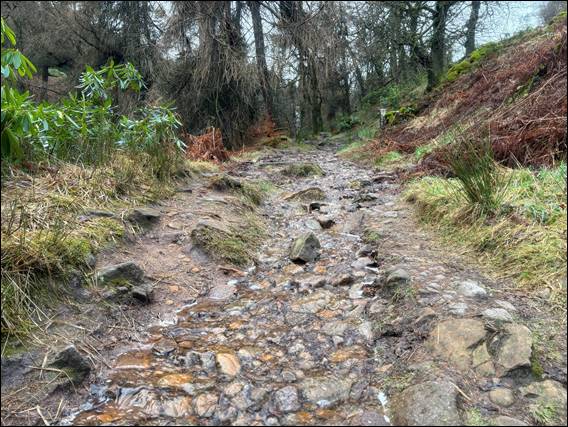
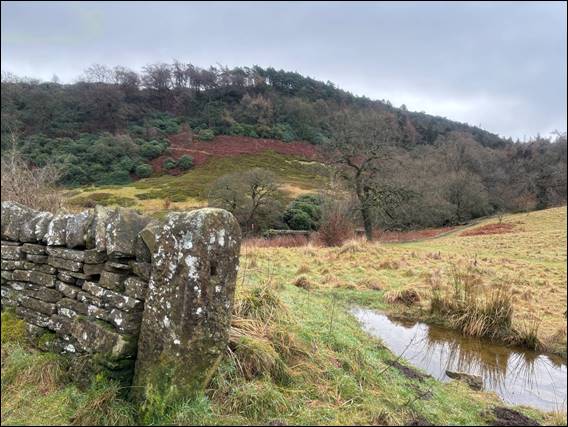
Instead we made our way down towards Errwood, taking a winding path through a wood and navigating long sections of the path that resembled a stream. This took us in a roundabout way, as we stumbled across tracks that took our fancy, to the Errwood Hall Burial Ground. Here the Grimshawe family and their favourite servants have been laid to rest. This now makes more sense, as Dave I wondered why some graves had stone headstones and others had iron crosses. The latter no doubt being for the favourite servants:
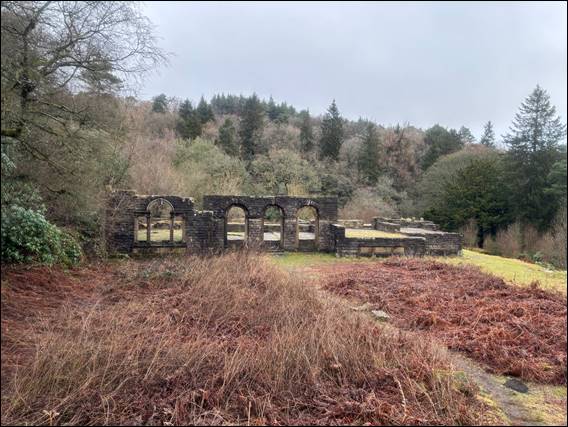
The Grimshawes owned the estate until 1930. It was then sold to the Stockport Corporation, who built the Fernilee and Errwood reservoirs in the 1930s and 1960s respectively, as key water supply sources. We were heading there next, but not before passing the remains of Errwood Hall. Once a stately 19th century mansion, completed in the 1830s in the centre of a 2,000 acre estate that included a private coal mine as well as the Cat & Fiddle Inn. After the death of the last resident in 1929, the hall was demolished in 1934:
Below are the only remnants of the mighty halls. Not being a formally listed building, they were able to modify what was left primarily due to safety risks. These obvious modification in part takes away from the feel of the place. It includes a shrine dedicated to a Spanish governess that taught the family’s children, and who is rumoured to haunt what is left of the house. Leaving the ruins behind we made our way down to the waterbodies, firstly the upper Errwood reservoirs. Completed in 1968 for a princely sum of £1,500,000:
And then onto Fernilee reservoir, completed in 1938 for a mere £480,000. Within this one there are several buildings, which includes the Chilworth Gunpowder Factory. Originally established in 1801 as the Fernilee Gunpowder Works, until it was taken over in 1888 by the Chilworth Gunpowder Company. It was operated until 1921. Closing down due to the consolidation, primarily in Scotland, and declining demand of gun powder post-World War I. And finally being laid to rest with most of the buildings being submerged underwater:
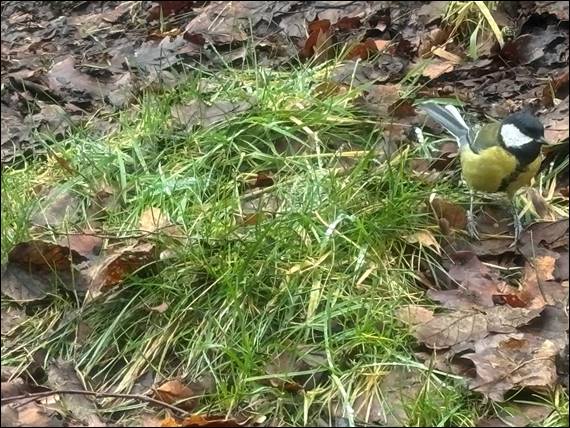
I’ve not mentioned any of the birdlife that we both heard and saw, which seemed to come alive more and more as we walked. Most species were mentioned in the above linked post, so the only one to crack a reference is the above Great Tit (Parus major). Obviously used to human contact, as they allowed us to get very close. We saw these as we wandered along the reservoir, and soon after Dave hinted this had turned into a Sunday stroll. In response to this we diverted up a small goat track straight up the hill. A track that soon disappeared:
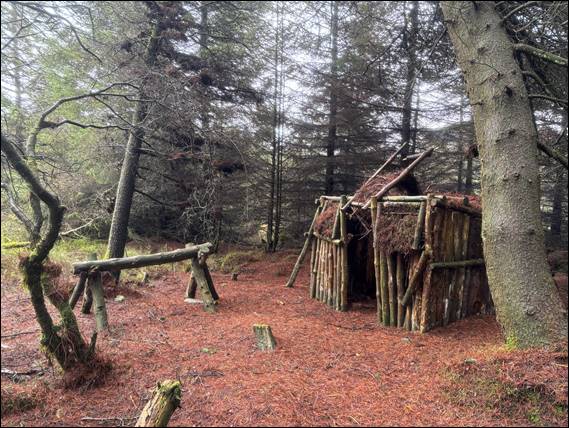
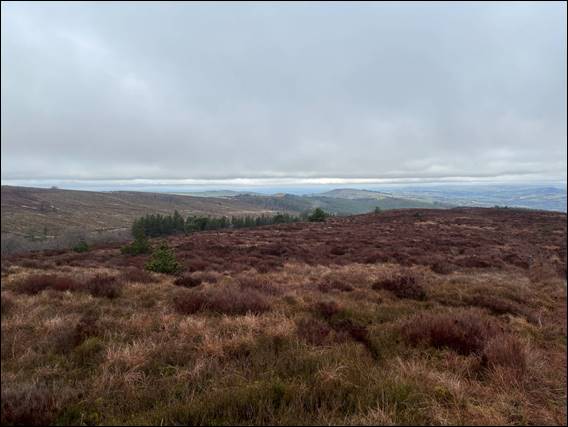
With no paths and deep in the woods we came across the above shack, which someone had painstakingly built. Continuing up to the top of Hoo Moor to allow us to see where to go, and from here we sighted Windgather Rocks. This terrain had no paths and was a bog land of tuffs and holes, ready to fill your boots with water. This happened regularly. It was slow going, and made even slower when we tried to cut through a felled pine plantation with dangerously slimy and rotten timbers. It was no longer a Sunday stroll, and Dave pulled me up and talked sense into me. We retreated and circumvented the dangerous path:
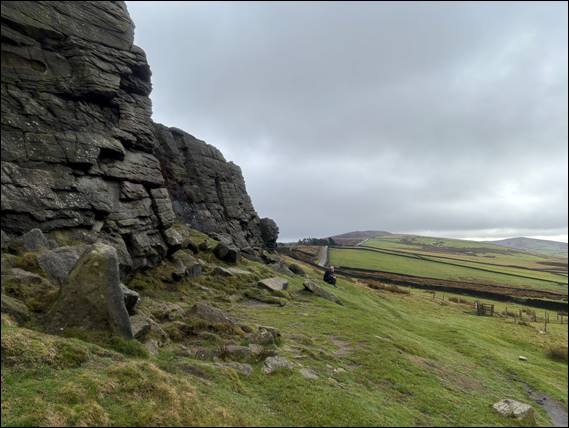
Back on the bog lands we eventually found a path that took us to Windgather Rocks. Weary but very happy. Here I had to at least have a close up look at what the place had to offer, and being sensible I did this from the ground. Dave meanwhile sat there looking across the valley caught up in his own thoughts. Then as we were about to leave he pointed to a slab and said it looked pretty good, and that was enough. Despite the wet and muddy boots I headed up the slab. Dave tried not to watch but couldn’t stop himself, holding his breathe the whole time. Maybe next time I’ll get him up a line or two here:


 Sandbagged