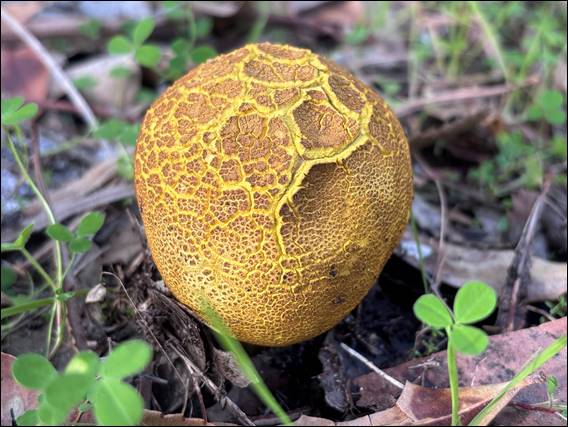
They say a positive attitude drives success. So after work rather than pound the streets of Peppy Beach, and with a spring in my step, I went for a walk round Manea Park. The circuit I took involved moments of wandering, connected by periods of pounding. With a view of getting the benefit of slightly more vigorous activity while also hoping to enjoy a few finds. The first splash of colour to hit my eye was this Smooth or Onion Earthball (Scleroderma cepa). These, like orchids, are mycorrhizal. Meaning they make use of a helpful partnership:
A partnership between fungi and plant roots. It is extremely common, found in approx. 90% of all plant species. In this case the Smooth Earthball is the fungi, which has an ectomycorrhizae partnership. This term comes from three Ancient Greek words of ektós, múkēs, and rhíza meaning outside, fungus, and root. This type of partnership is where the fungus mostly stays outside of the, usually woody, plants roots. It occurs for 5-10% of plant species. The other type of partnership is called endomycorrhizae, which orchids benefit from:
The start of the term coming from endon meaning within or inside, and in this case the fungi penetrates the plants roots. If you have done the maths you will realise this is the more common form of mycorrhizal, with 80-85% of plant species making use of it. Orchids fall in this large group, but have also adapted a specialized form. A topic for another time, as I now need to stop wandering and start pounding to catch up. Above is the Murdoch Snail Orchid (Pterostylis ectypha), also known as the Thick-Sepaled Snail Orchid, due to chunky ears:
The species is often confused with the Short-Eared Snail Orchid (Pterostylis brevisepala). For me however this never occurs as this alternate species is restricted to Perth and Lancelin, hence not found where I regularly go hunting. Above are Red-Sepaled Snail Orchids (Pterostylis erubescens). When they bloom these have a large green flower, which gradually transitions to deep reddish-brown tones as it ages. This colour change can result due to an accumulation or shifting of water-soluble plant pigments in the outer parts of a flower:
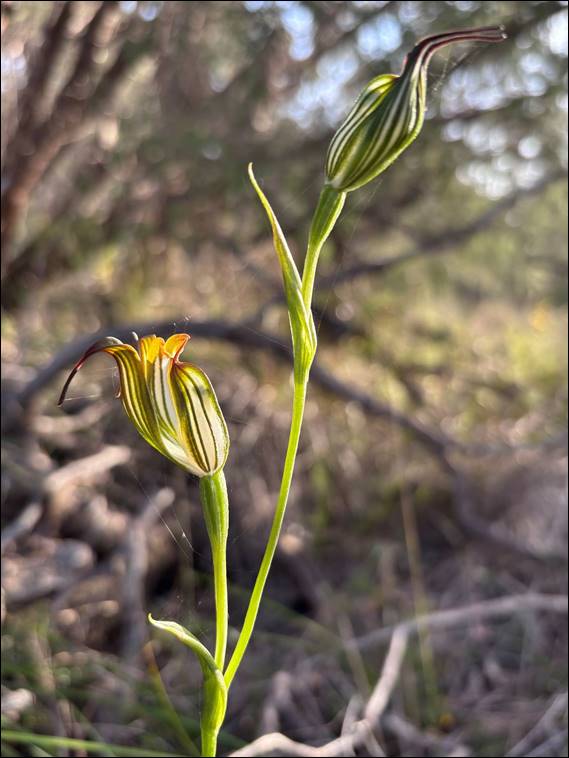
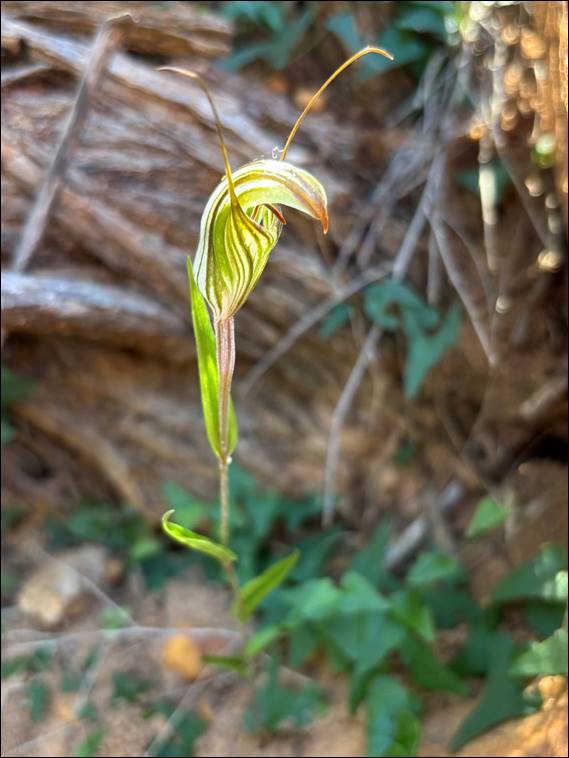
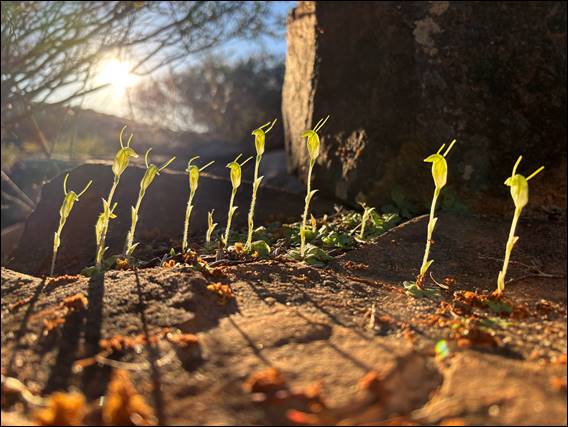
This includes the sepals and the petals, and occurs as the chlorophyll in these parts break down. The speed and intensity of the process is influenced by exposure to both sunlight and temperature, and what with our sunnier winter I wonder if it will be enhanced. I only saw a few Snail Orchids, whereas the above Jug Orchid (Pterostylis recurve) was coming out in big numbers. The flowers burst out with crisp green and white stripes, and being another orchid species that changes colour with age they also turn into deep reddish-brown tones:
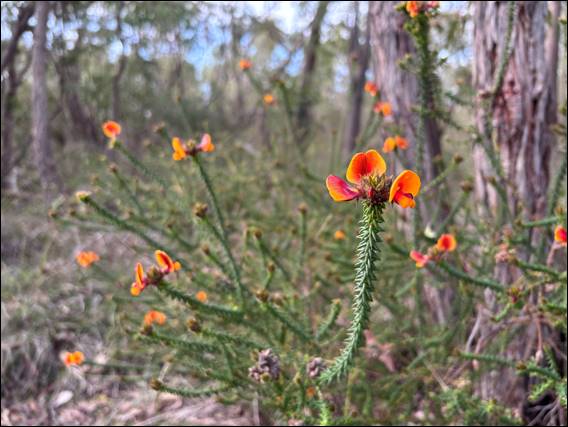
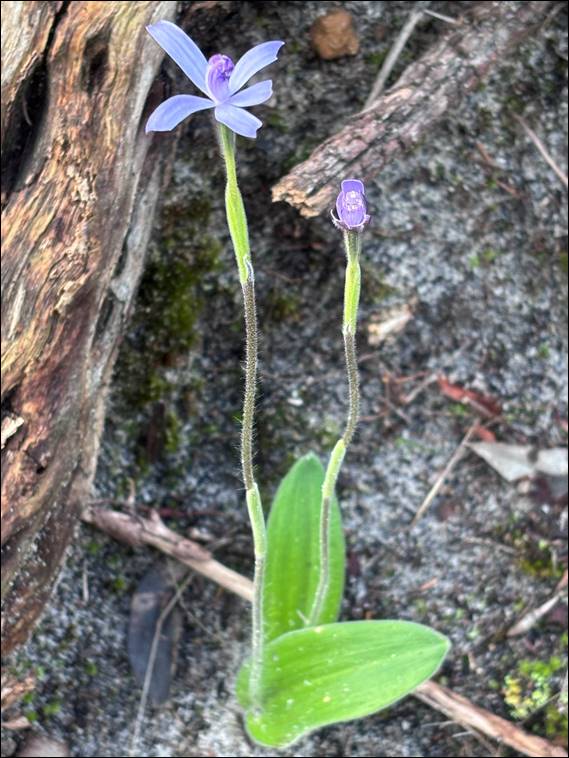
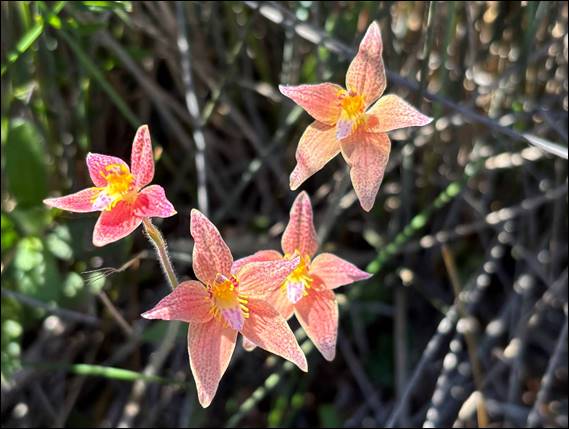
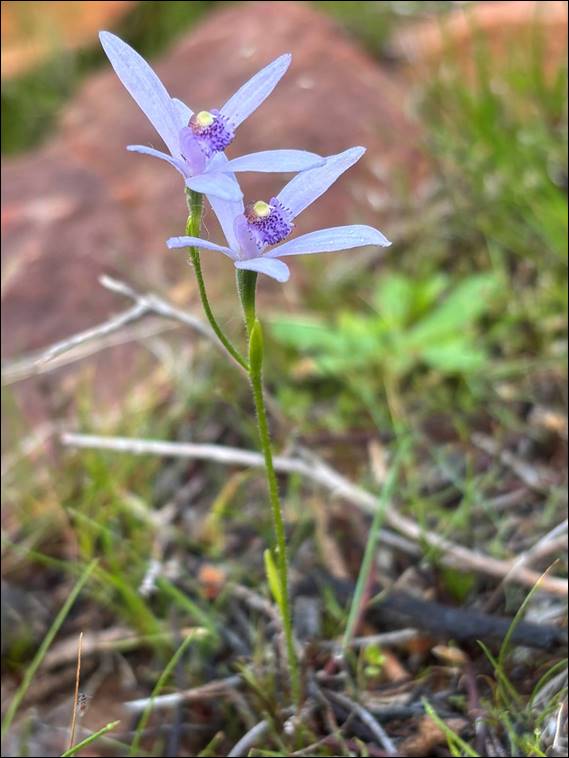
Above is a Skinner’s Pea (Loricobbia skinneri) not an orchid, obviously from the name. It’s beautiful and colourful flowers were however hard to walk past. These particularly like low-lying, winter-wet swampy areas and seasonal depressions. Local populations are often found in conservation lands or secure reserves, but can be sparse. As such it is classified as Priority Four, by the Department of Biodiversity, Conservation and Attractions, indicating it is rare or near threatened. Another colourful find was the below Silky Blue Orchid (Cyanicula sericea):
Their stand out colour makes them highly visible and easy targets for passing herbivores. As a result the soft and succulent petals and buds are frequently grazed by wildlife, and pests alike. A common misconception is that all orchids require fire to flower, however it is only a small group of local species that do. The Silky Blue Orchid is one that benefits from fire and will be much more prolific after a summer bushfire. Orchids and fire is yet another interesting topic I have no room for in this post, as I once more need to pick up my pace:
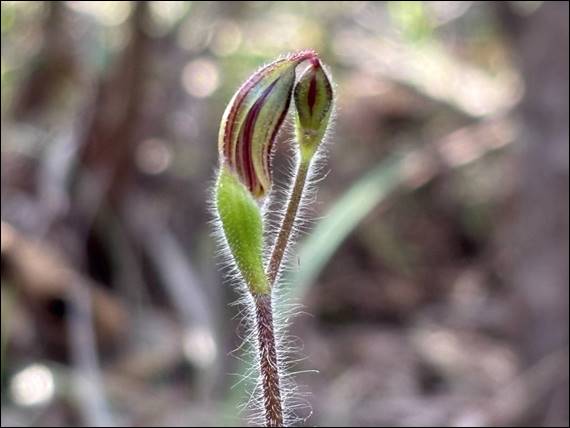
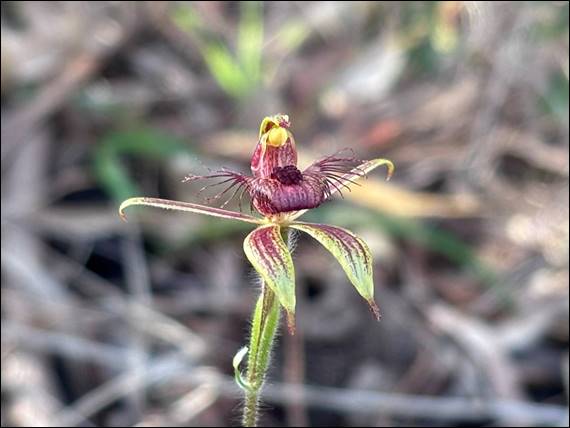
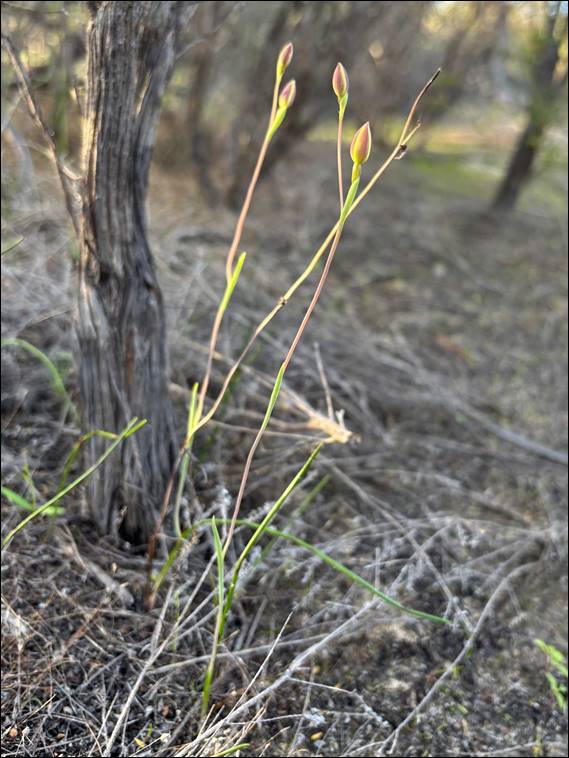
Above is a bud of a Dancing Spider Orchid (Caladenia discoidea) about to open, and below I found just one in bloom. This species is a little unusual, with an almost entirely horizontal flower. Not a form that shouts out to me as looking like a dancer, and I have wondered why it is so called. The species name of discoidea comes from two Latin words of discus and oideus meaning a throwing disc, platter, or round plate and resembling or like. Referring to the labellum shape, and this doesn’t help. The common name is in fact quite simply a playful linguistic link to the word disco in the species name:
After all the hiking and climbing last weekend, my body was telling me that a quiet time was in order. Saturday was whiled away with housework and finishing off yet another puzzle, and not much else to be honest. By Sunday however my body decided it needed a stretch. Or was it just me wanting to see how our local orchids were faring, after having found such an amazing bounty up north. I was fully aware we have just had the second driest July on record in our local area, the waterways are low and dams are not filling. Everything is a tad dry:
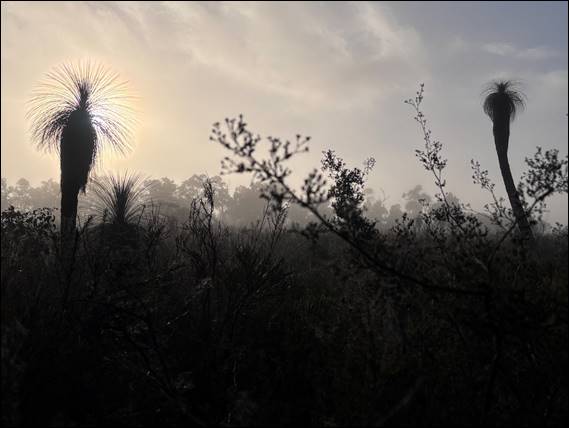
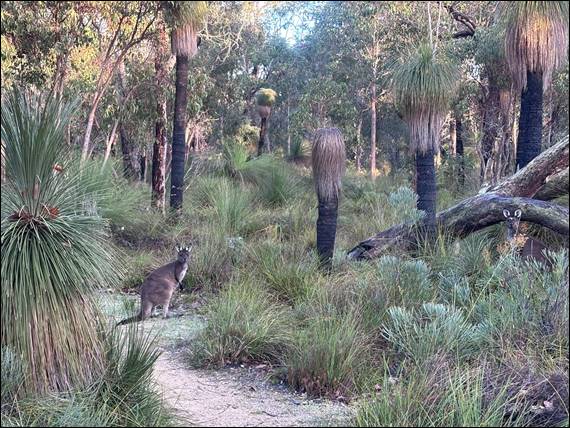
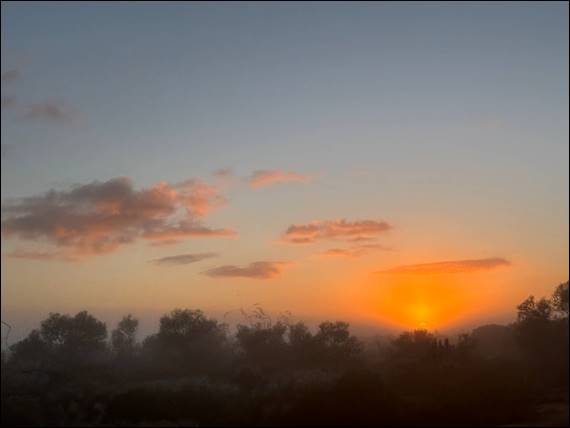
The morning came in misty, allowing the sun to create an eerie feel. While I looked around for orchids I really didn’t have much success. Maybe due to the dry spell the early winter species have decided not to appear. Maybe they will appear a little later, but I’m not convinced. I did stumble across quite a few Western Grey Kangaroos (Macropus fuliginosus). These two were not fussed by my presence allowing me to get quite close. The males of this species, unlike others, emit a strong smell remarkably like curry, earning it the nickname ‘stinker’:
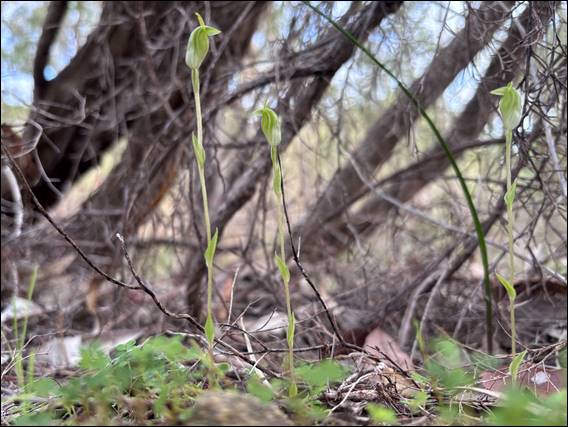
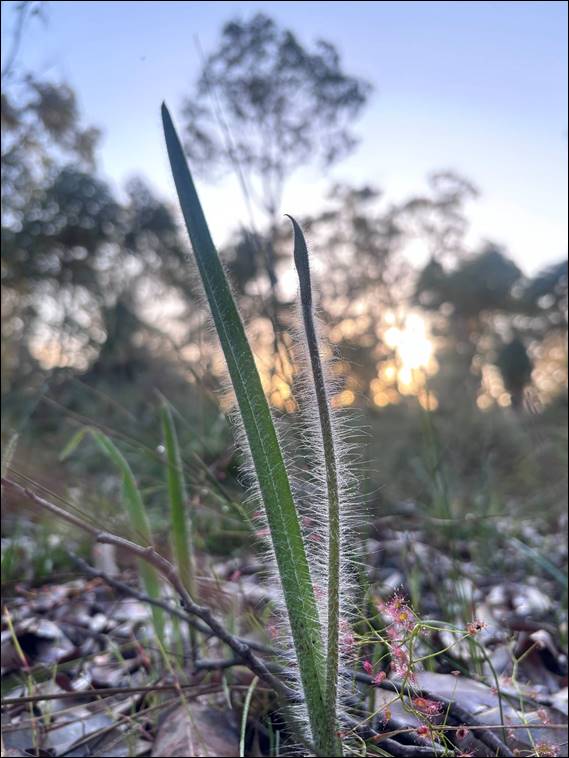
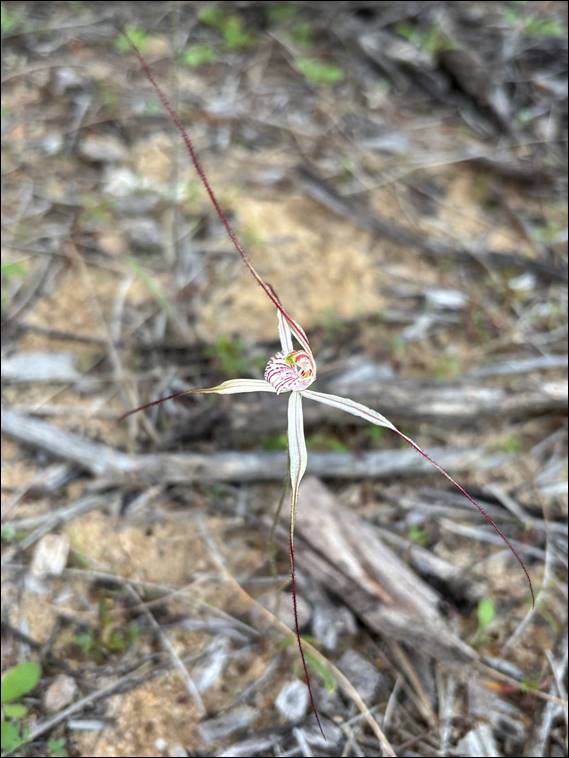
There were no males about for me to test this fact, but I also feel that if there had been they would have hopped off a lot quicker. The winter orchids may not be out, but the spikes of several up and coming spring species are on the way. I won’t confess to knowing all the species by their leaf. It can be confusing as all true Spider Orchids feature a single, upright, hairy basal leaf and a visibly hairy flowering stem. But I do know this one is from the Rusty Spider Orchids (Caladenia ferruginea), which is a regular arrival at Ambergate:
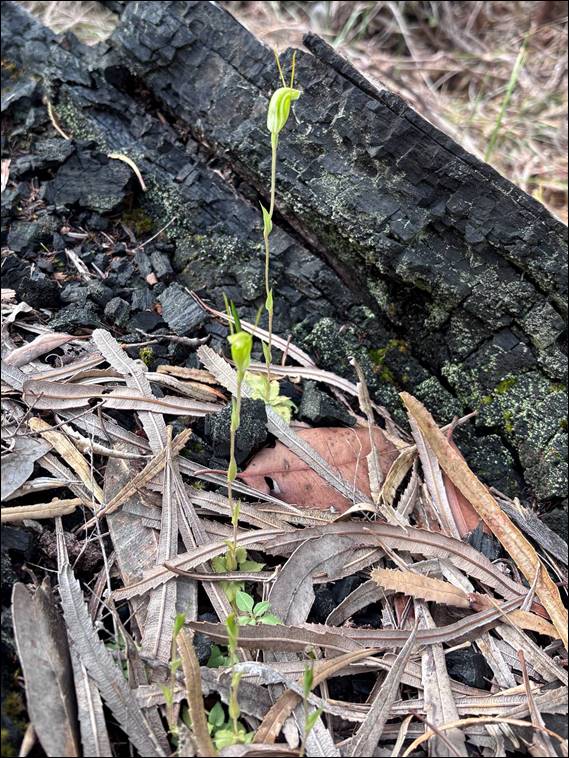
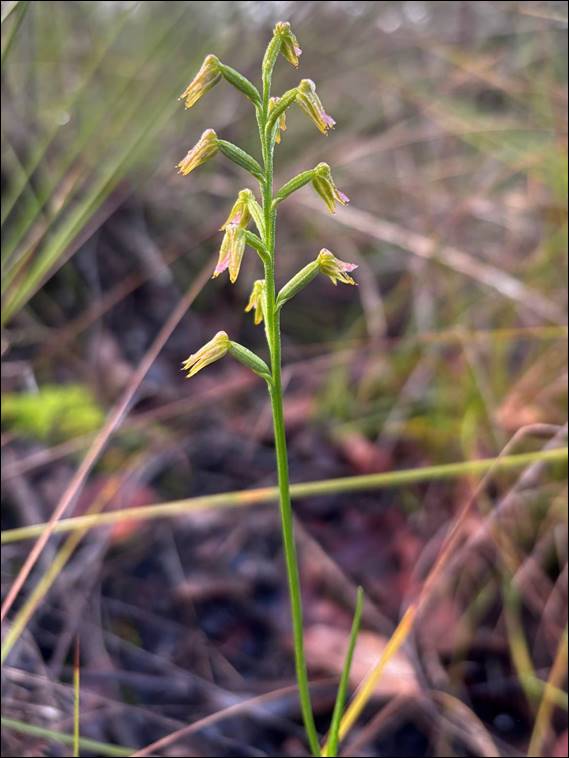
I kinda lied. There were Banded Greenhoods flowering, which I have seen several times already this season. I also found an Autumn Leek Orchid (Prasophyllum parvifolium), but just one. While not open the hint of pink differentiates it from the Scented Autumn Leek Orchid (Prasophyllum sp. ‘early’). Called ‘early’ because it flowers between April and June, and I have already found them in early June. Whereas the Autumn Leek Orchid flowers between June and August, so it this one has arrived right at the end of its normal period of blooming:
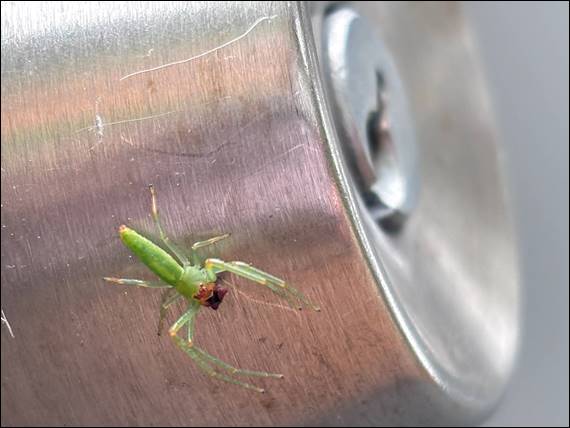
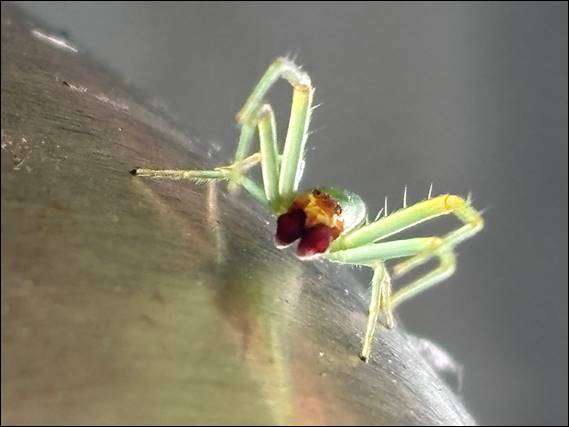
My next find, which is why I have decided to tap up another post, is not from my walk but when I got home. This Long Green Crab Spider (Cetratus rubropunctatus) was on the handle of the side door to our shed. They would normally blend seamlessly into green leaves and foliage, but on the silvery handle it clearly stood out. The species name rubropunctatus comes from the Latin words ruber and punctatus, meaning red and spotted. This relates to the spots near the rear of the abdomen, not as I thought the colouration at the head:
The rear spots can be dark green, brown, or missing entirely. Females and males grow up to 7mm and 5mm in length, this one being a mature male. Distinguished by the enlarged deep red pedipalps. These form a pair of appendages that are right next to the mouth, between the fangs and the front legs. Being used for several functions. They enhance three of the spiders senses being feel, taste, and smell; are used to hold and crush prey, while injecting them with digestive fluids; and during mating the tips are used to transfer sperm to females:
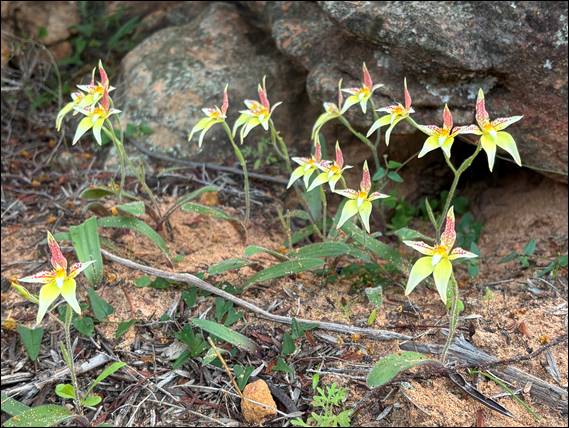
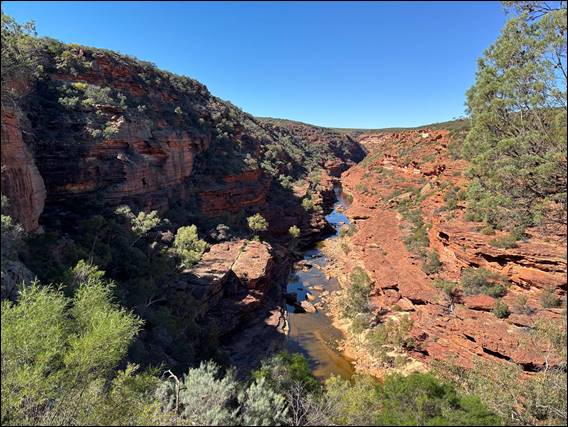
It really was the furthest thought from my mind, as Rongy and I made our way towards the Z-Bend lookout at Kalbarri National Park (https://sandbagged.blog/2026/08/03/kalbarri-bronze/). So much so that I wasn’t looking out for them, and it was Rongy who spotted the first orchid. Just another Cowslip you may be thinking. After all when these bloom they tend to flower in vast numbers, all over the place. We were however some 650km north of my usual hunting ground, in a very different climate and landscape. One that I am not at all familiar with, and have never hunted in:
There are four recorded subspecies of Cowslips in Western Australia, two being found in our patch. This is the most northern of the four being the Kalbarri Cowslip Orchid (Caladenia flava subsp. maculata). Looking different because of the brown-red spots. Which is where the species name maculata comes from, meaning “spotted” in Greek. I‘ve not seen the fourth subspecies found in inland in Wandoo woodlands, which has the smallest range and is the latest flowering,. Next was another one you may be quick to pass by, just being a Pink Fairy:
The name Pink Fairy is used for three species, being latifolia, reptans, and nana. The latter two have two subspecies each, making it five all up. Four of the five are found down south, and the above is the only one not found in our patch. With a range round Geraldton and Kalbarri. This find of the Pale Pink Fairy Orchid (Caladenia reptans subsp. impensa) has filled the gap for me, having now seen all five. As with all Pink Fairies, this one spreads and multiplies underground and was in abundant patches of tight clusters of many plants:
Cowslips and Pink Fairies are known to hybridise, and we were very lucky to find a cluster of the above Kalbarri Cowslip / Pale Pink Fairy Orchid hybrid. A spectacular flower, made even more so by the spotted pattern. We looked long and hard after this for more but didn’t see any, so felt pretty chuffed with the find. The next spot was probably only seen because someone else was checking it out. Although after that we spotted a few more. A year or so back I thought I had seen these, until I realised they do not extend to our coastal area:
Their range extends across a wide area from Kalbarri down to Esperance, but are more inland out towards the Wheatbelt. The point at the end of the dorsal sepal, which looks like a hood, and the long, narrow, down-curved labellum that extends out of the shell is a clear sign of this being a Green-Veined Shell Orchid (Pterostylis scabra). Next up, and we hadn’t even got to the lookout let alone the gorge to touch rock yet, was one of the thirty odd Snail Orchid species. This one is often found in shallow pockets of sand or clay on top of rocky terrain:
Again wide spread, from Kalbarri down to Israelite Bay. And again not found in our area, having a range that overlaps the Green-Veined Shell Orchid and extends even further inland past the Wheatbelt. The Hairy Stemmed Snail Orchid (Pterostylis setulosa) was an amazing fifth first time find, but we had now arrived at the gorge and it was time to climb. The people who had turned our attention to the fourth find, mentioned they had found ‘just a white spider’ at the Skywalk lookout. And this warranted investigation but not on our first day:
If you have delved into https://sandbagged.blog/2026/08/03/kalbarri-bronze/, you will already know we went to the other lookout on our second day. Not just because of the potential for orchids, but also due to the eerie misty morning. You’ll have to visit that post to see images of that, but above we did find the Noble Spider Orchid (Caladenia nobilis). These do extend to our area and I have previously struggled to decide if I had found it or not. Being one of the many Wispy Spider Orchids that all look very similar:
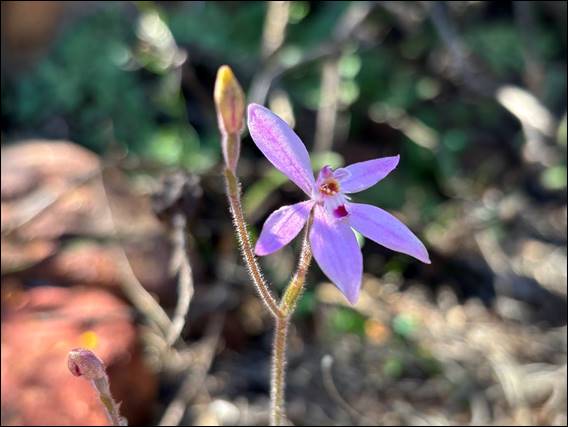
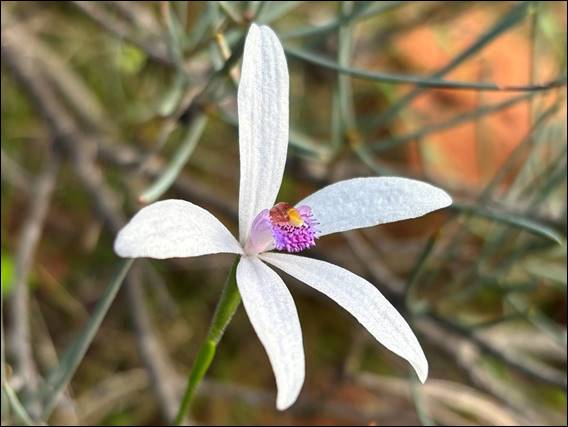
It is has the largest flower of the Wispy Spiders, and after much checking, this time I am confident my identification is on the money. This species is pretty particular, in that while it attracts many insect species, only the male Thynnid Flower Wasp (Rhagigaster discrepans) is of the exact size and displays the right behaviour needed to pollinate it. Above is another we find locally, but I have not seen it for a few years due to poor seasonal conditions. The Blue Fairy Orchid (Pheladenia deformis) genus and species name both relate to same flower part:
Pheladenia comes from ancient Greek words phelos and aden meaning ‘deceitful’ and ‘gland’, while deformis is a Latin word meaning ‘misshapen’. These all relate to the unusual labellum, which looks like a fuzzy beard, and which also earns this orchid the nickname of ‘Blue Beard’. There is only one species, but that said it can display petal colour variants including pinkish or yellow. The above white variant is said to be uncommon, so was a fortunate find and is why I have included two images of this orchid. We found both at the Z-Bend lookout area:
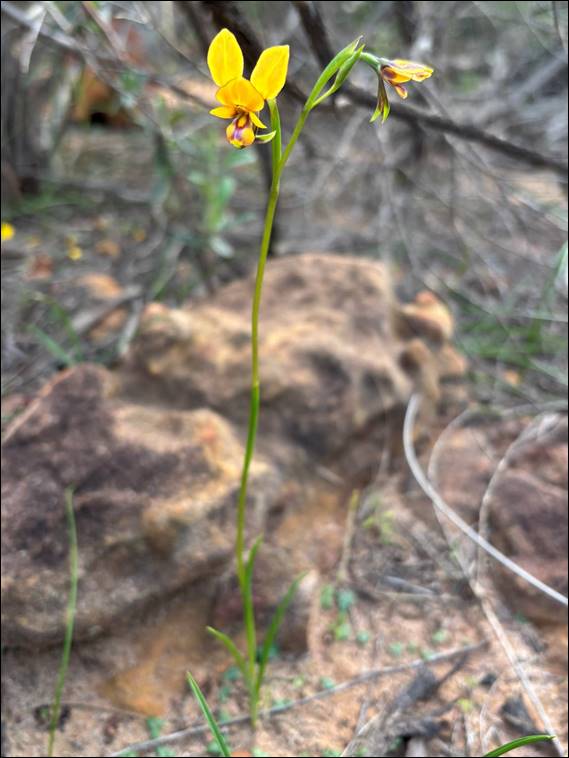
Walking back after that day’s climbing, again on the track between the lookout and the carpark, was this single Sedge-loving Donkey Orchid (Diuris carecta). New find number six for me, being a species not found in my usual hunting range. There are only a few Donkey Orchids found this far north, and this one seemed a little odd based on its described habitat. However, the two or three linear leaves, tall flowering stem, and strongly curved lateral sepals sets it apart from other northern species. So I am again confident with the identification:
It was the only one of that species we spotted, and I thought that may have been it for orchids. Then on the walk back from Four Ways I spied the above Lemon-Scented Sun Orchids (Thelymitra antennifera). Passing them a bit later in the day when they were in cool dappled light from the low sun, with their petals tightly closed. I’ve read that they are one of the most common types of sun orchids in Western Australia. I have seen them but based on my observation of other sun orchids I’m not sure that is completely true:
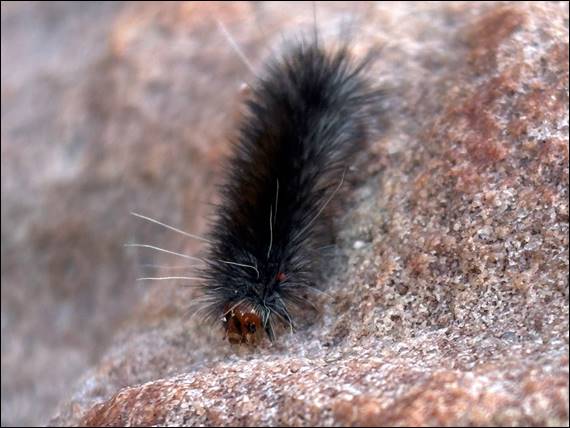
You may have noticed I have not recorded our finds in chronological order, instead collating them in groups. Next up are the larval stage of members of the order Lepidoptera, being butterflies and moths. We saw lots of the above, one of several species referred to as a Woolly Bear Caterpillar due to its appearance. Being a caterpillar of an Australian Black and White Tiger Moth (Ardices glatignyi). Easily identified by its smooth, dark orange-red head capsule, as well as the stiff black-and-brown bristle hairs with just a few long sensory hairs:
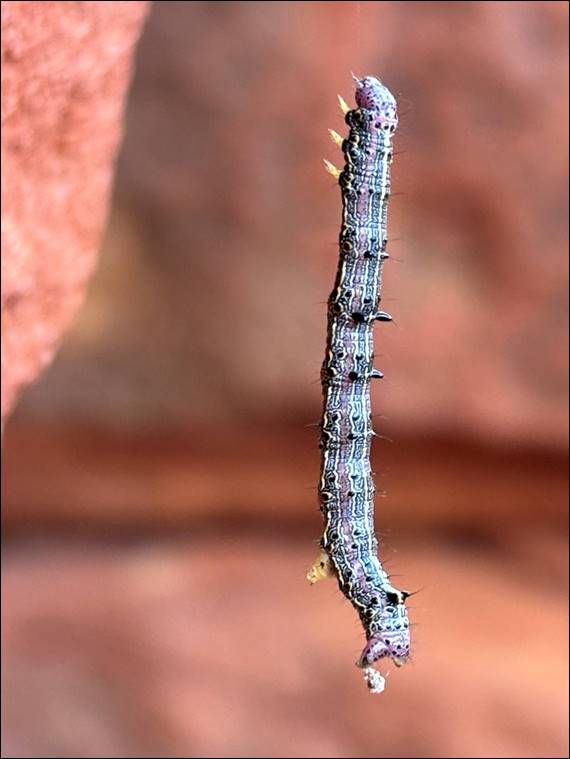
The above can easily be stated to be a looper caterpillar or inchworm. Only having legs at the front and rear of its body, it has a distinctive way of walking. Its mid-body arches up into a loop, before extend forward to repeat the motion. To narrow it down any further has however been a lot trickier. So much so I can only say it is in the Ennominae subfamily and likely a species in the Ectropis or Pholodes genera. Based on its size and behaviour it is likely to be a fully mature caterpillar ready to pupate. You’d think I’d have more luck with the next:
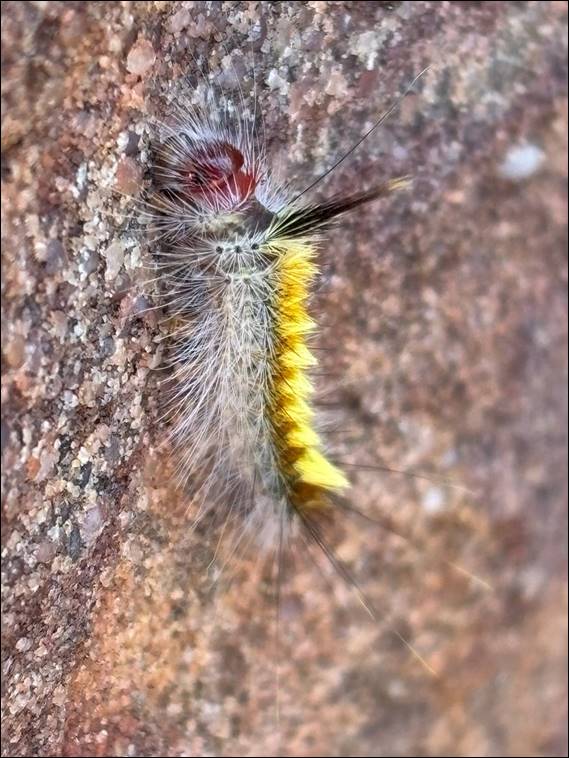
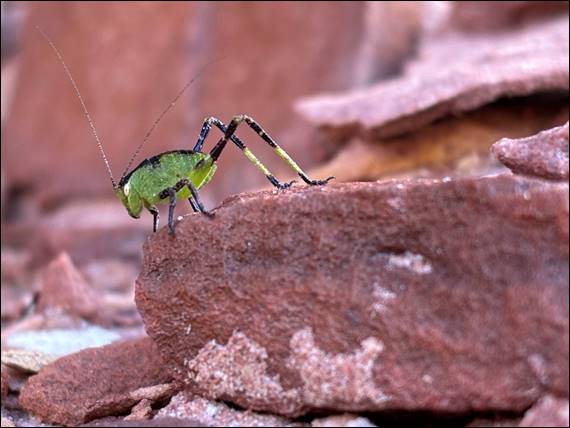
The colouration and configuration of the hairs is quite amazing including radiating white and grey side hairs, a band of dense yellow-cream tussocks along its spine, sparse pale tipped feeler hairs at the rear and front, and a single dark tuft of hair behind the head that is called a ‘hair pencil’. All I can say it is a Tussock Moth caterpillar from the subfamily Lymantriinae, but can’t narrow it down any more. The same goes for the next find as we move into a few different insects. This one being an immature juvenile of a Katydid, sat at the base of Kalbarri Bronze:
Distinguished from grasshoppers by the exceptionally long, thread-like antennae. The nymphs of these can vary massively in colour patterns, making identification very hard. It is possible that this may be a 32-Spotted Katydid (Ephippitytha trigintiduoguttata), whose juveniles have dark leg bandings. A study identified that Katydids found in Kalbarri National Park exhibited unique acoustic courtship behaviours, which includes a complex, precisely timed audio dialog between the male and female:
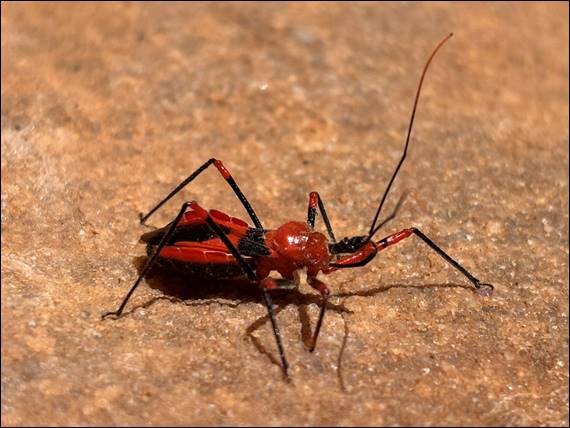
This is very different to most insects globally, which rely on a one-way system in which only the male calls out to lure a female to them. Continuing with the colour displays, above is an Orange Assassin Bug (Gminatus australis) whose bright appearance is very much a warning. Being able to inflict a painful bite if handled. These are not fussy eaters, and will prey on any insect. Converting, or more precisely melting, their innards into a liquid meal. When other insects are scarce they will even turn to cannibalistic behaviour:
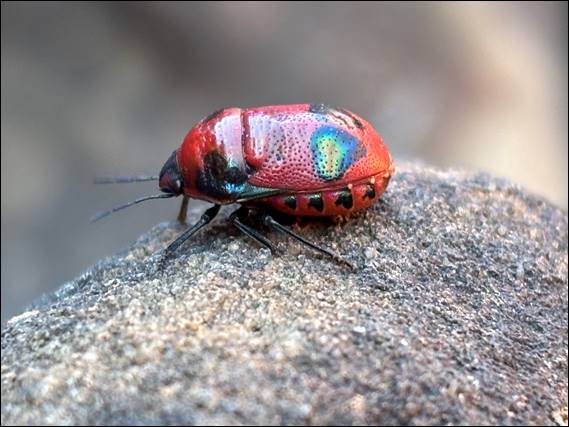
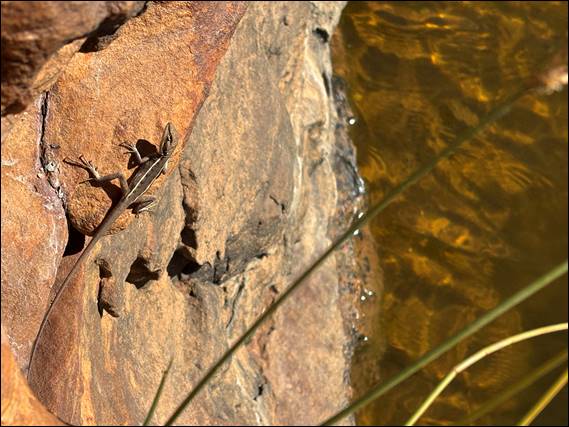
The above Red Jewel Bug (Choerocoris paganus) is the last of the insects. Commonly found across all of Australia, although the patterning can vary a lot. This one happened to be at the end of the river crossing when we exited the amphitheatre. Perched on a rock surrounded by water. And as such it seems fitting to introduce one member of the colony that inhabited the ravine, you will again need to flick to my other post for context. Taken as we were scrambling into the ravine this was the first Long-nosed Dragon (Gowidonlongirostris) we came across:
Mark and I had seen just one last time. On this trip however we saw quite a few more, all bar one being in this area. Rongy and I spent quite a bit of time admiring them, full grown adults to juveniles. They are known to lift and wave their front legs, a habit that has earned them the nickname of a ‘Ta-Ta’ Dragon as if they are waving goodbye. It is thought this action may help cool their feet down after running across scorching hot desert sand or ground. They are incredible quick and when extra speed is required they can run just on their hind legs:
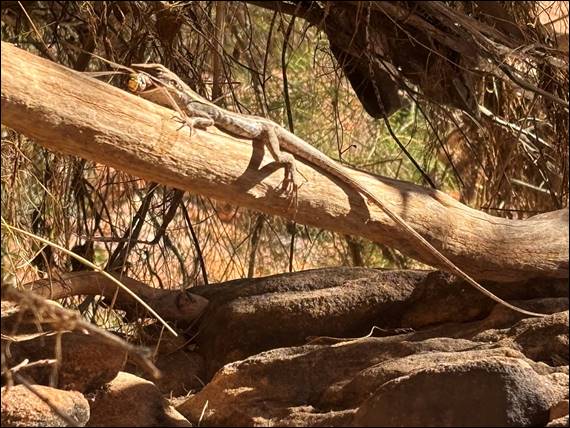
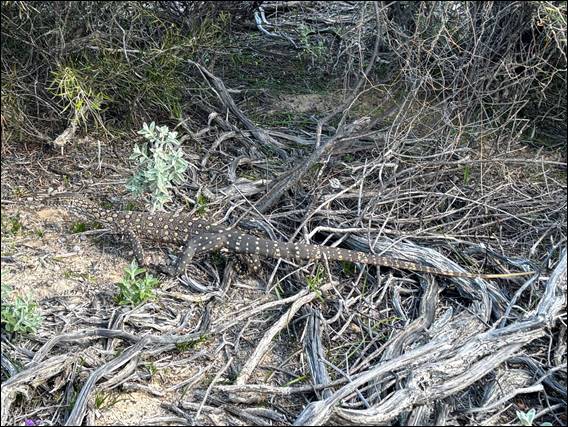
The reason for a second image of a Long-nosed Dragon should be obvious, but if you missed it take a closer look above. We felt very lucky to have seen this sight, the Dragonfly probably wasn’t so pleased. The next picture was taken as we walked out of Four Ways, a wonderful Perentie (Varanus giganteus). A common sight from Lisa and my days in Alice Springs, this is the furthest south along the coast of Western Australia you will find them. When threatened they will exhale noisily and puff up their body, this one was chilled and didn’t change pace:
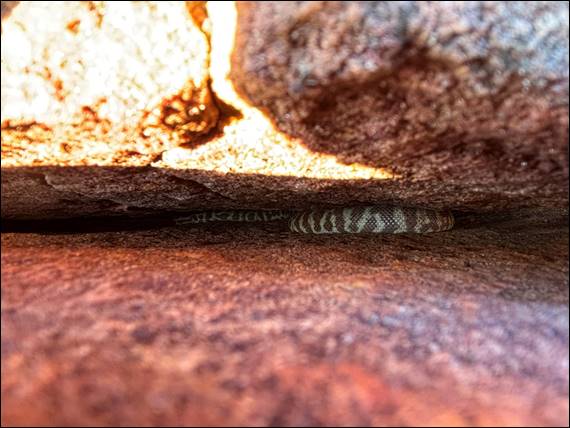
The last gem to close this post was found at Hawks Head on our last morning before driving home. We spotted not one but two Stimson’s Pythons (Antaresia stimsoni). Being nocturnal ambush predators, we found them buried in rock crevices. It was unlikely they would come out and bask, instead snoozing the day away enjoying the steady temperature their hidey hole offers. Despite having the largest range of all the Australian python species, they are not found in our local area. So they were great finds, and an awesome way to end the trip:
It was just under nine years back that I made the eight hour journey north to Kalbarri (https://sandbagged.blog/2017/11/10/the-proclaimers/). Back then it was with Mark. A buddy from my Alice Springs days, who climbed like an unforgiving machine. The nine day adventure resulted in a crazy and long list of unrelenting hard routes. Proving too much for me and my body, and I came away from that trip a wreck. The experience wasn’t helped by the mercury tipping over thirty five most days, and at times hitting forty and above:
This time round, being three months earlier, cooler climes were expected. Rongy will confess to being out of shape, and not having the head space that he would have liked coming here. Then there was me. Carrying injuries for way to long now, and having mostly bumble climbed this, and much of last, year. As such way more relaxed climbs were on the agenda. We only had four days for the there-and-back again mission, so started early. I left home at three with clear skies above. And am sure I saw a shooting star as I drove out of Peppy Beach:
I had. Finding out afterwards that a rare double meteor shower was gracing Western Australia. One peaking on the very morning that I was driving out. While the Southern Delta Aquariids and the Alpha Capricornids could have offered an opportunity to see up to 25 shooting stars each hour, the display was dampened by the sun’s reflection off the near full moon. By the time I got to Rongy’s clouds obscured the sky, so there were no more stars to be seen, shooting or not. However, over the trip I did spot quite a few more:
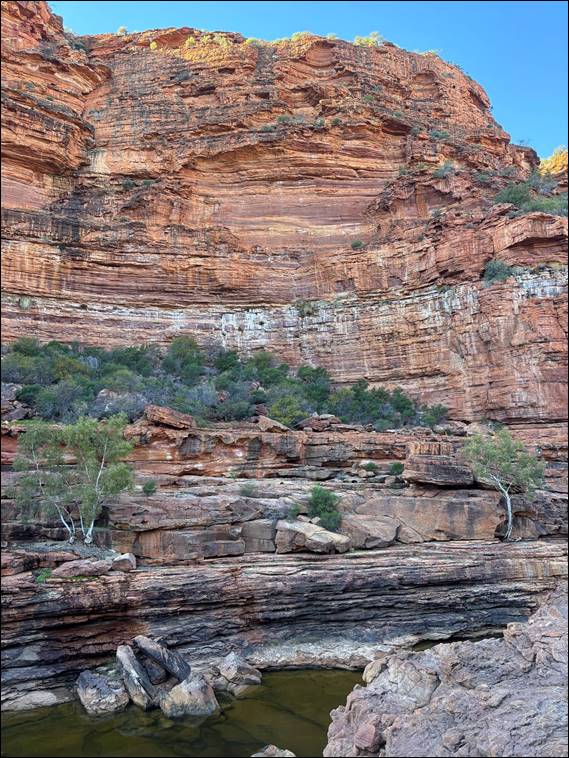
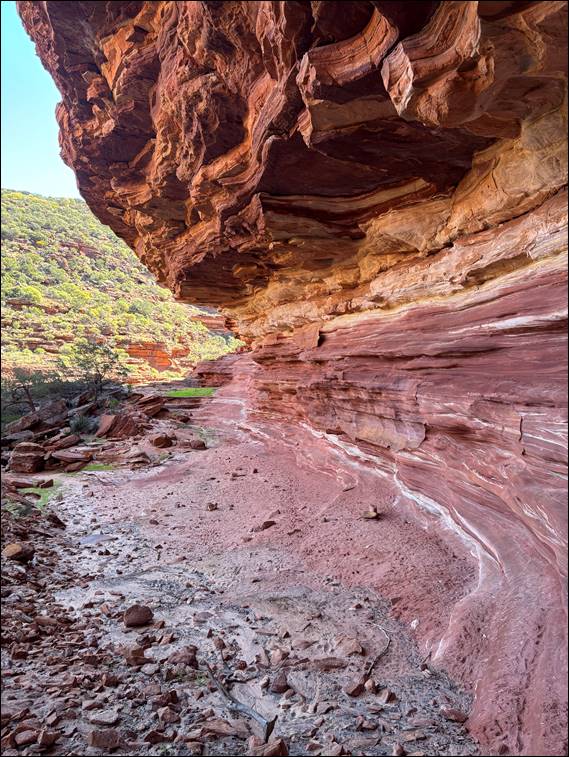
The early start resulted in Rongy and I walking in for our first sample of rock a bit before midday. A glorious blue sky above, hardly a breeze, and a warm temperature. All around the red rocks in the landscape brought back great memories of Alice Springs (https://sandbagged.blog/2017/11/03/part-11-alice-springs-rock-rock-and-more-rock/). Unlike the Red Centre of Australia, this part of the continent does not comprised Heavy Tree Quartzite. The rock here is Tumblagooda Sandstone, which provides a variety of visually exciting views:
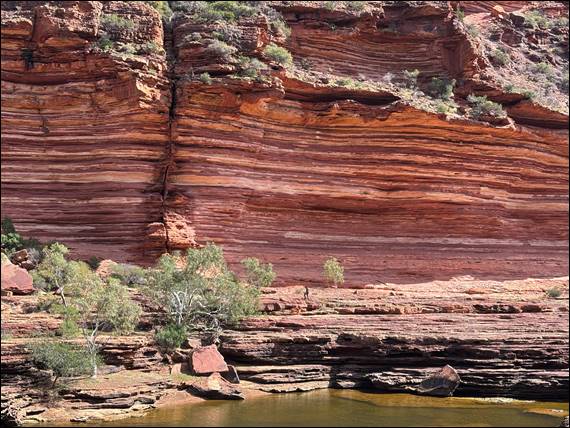
Some areas, as will be seen later, comprise wonderful layered cakes. Alternate deposits of red and white sandstone. Then there are the areas where iron has stained the rock, which has resulted in a coating that makes it very smooth to touch and gives it a slick look. The sandstone comprises deposits laid in shallow basins, which in some areas has resulted in great textures varying from ripple beds, mass worm castings, and fossils. The geology alone provides a variable feast for the eyes, but we were here to climb it too:
Starting on the very same route that Mark and I had. Back then it was getting dark and I was weary from the drive. But I still managed to cruise up the line and wonder what all the fuss was about. This time I was refreshed and wasn’t fighting against a fading light. It did however feel way trickier than it should have, at the grade. Even thought-provoking. All in a very good way, and I loved it. Even if I was nervous at times. This changed Rongy and my thoughts on the routes next to it, quite a few grades harder and described as run out:
We played on one more before heading upstream to another spot. Allowing Rongy a stint on the sharp end, and I was very pleased as he ate it up and thoroughly enjoyed it. Not feeling like we had anything to prove we called it after three lines and headed to the campsite. Unfortunately, the spot just off the Z-Bends carpark had been booked by a school group forcing us to stay at a homestead. This meant it was a 30km drive each way, but there was little we could do about it. The homestead was lovely, the camping spots not so much:
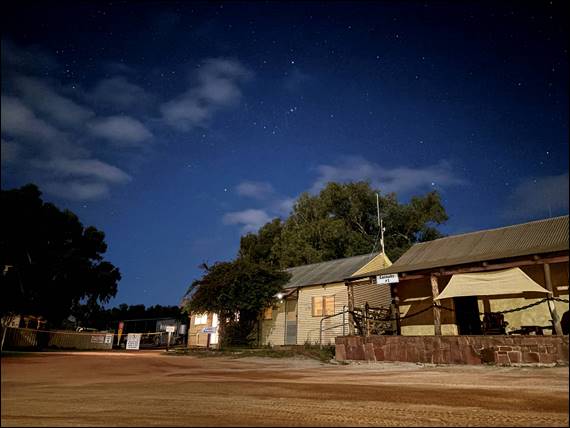
We made use of the camp kitchen before hitting the sack. Next morning my body clock saw me getting up shortly after four. Creeping out of my tent as quietly as possible, before heading back to the camp kitchen. This can be seen three images up with a blanket of stars above. Several cups of tea later and after seeing a shooting star or two I went for a wander on the track alongside the Murchison River. The very same river that has carved out the gorges in the national park that we were climbing on during the day:
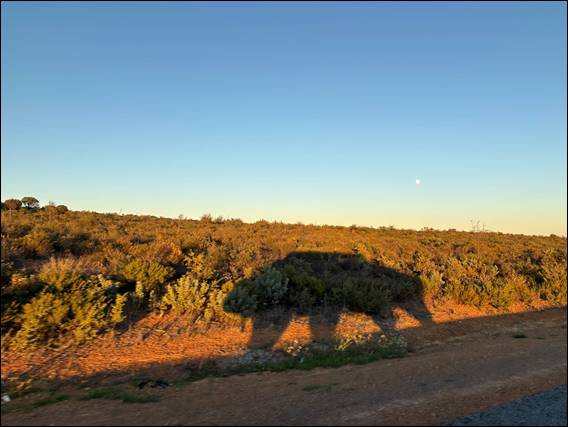
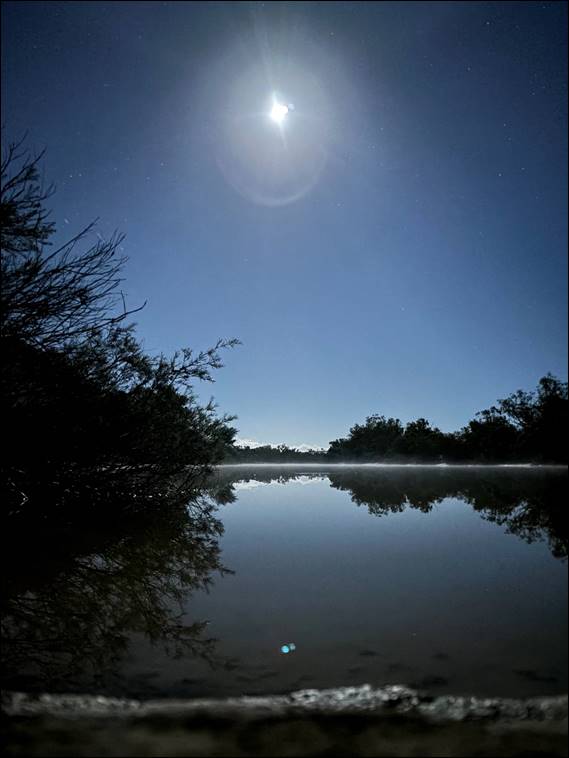
At the homestead there were no gorges, allowing me to easily make my way in the relative darkness to a spot where I took the image of the moon above the still waters. Shining so very brightly, and clearly showing why the shooting star display was being outshone. I headed back to fill Rongy and my sippy mugs before tapping on his tent, two and half hours after I had got up. Neither of us were particularly keen on spending time making breakfast at the homestead, so decided to head straight to the gorge and make breakfast at the carpark:
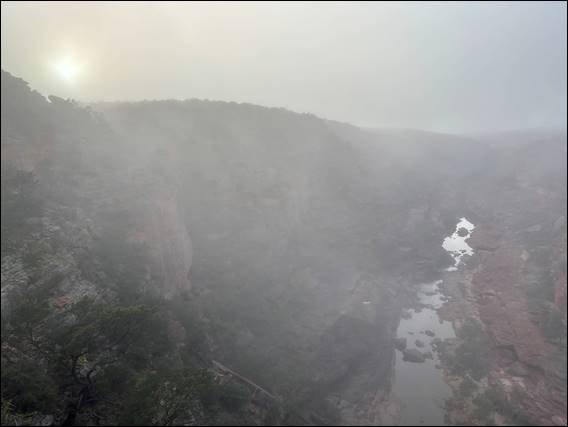
During the drive in mist came and went, being quite thick in places. It provided a great sight and seeing we were not here to crank hard or pack the routes in, we made a diversion to the skywalk lookout. Experiencing the place with not a soul about, before heading back to the Z-Bend carpark. First walked to the gorge to see it filled in mist. Then wandering back up to make breakfast, while watching the mist slowly lift as the sun crept higher in the sky. It was a great place to kick back, munch on our food, and then pack the bags for the hike in:
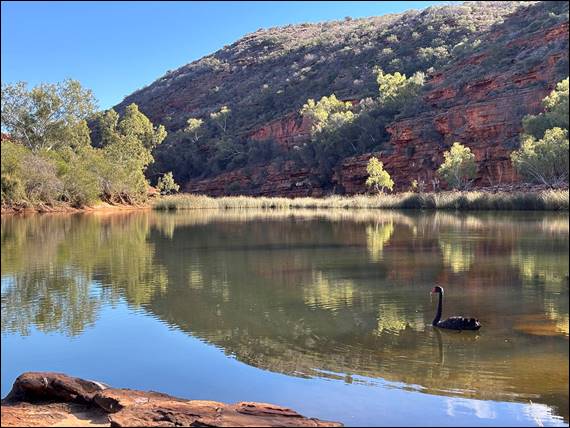
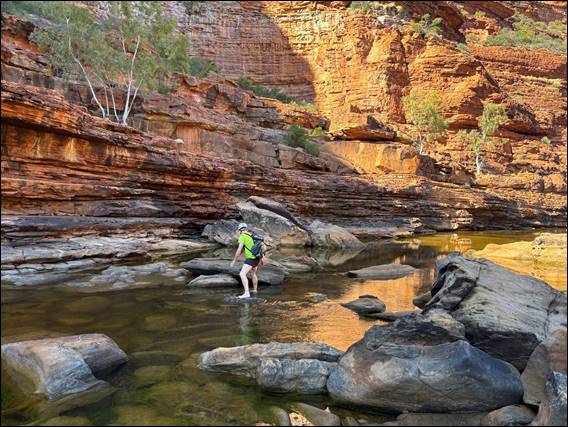
Today we were going to Four Ways. Two images up and after the three kilometre hike from the car park we got to the magical expansive pool at the centre of where four distinct gorges and watercourses meet. The official bird emblem of Western Australia, A Black Swan (Cygnus atratus), was having a feed of weed. Not too fussed by our presence. We took in the breathtaking views before carrying on, heading upstream in search of a wall that had alluded Mark and I. Information on the location several spots were not publicly available back then:
Seeing it this time round it is hard to understand how we missed it, mind you there is such an expanse of rock here that I can also kind of see how we did. I am sure we would have lapped up all the routes on this wall back then, they were certainly within my grade range. This time however most were stretching the friendship. Not only that but the wall was seeping, and not just a little bit either. I still jumped on the ‘easiest’ line, which proved amazingly good. I would love to build a bit of stamina for the other lines on this wall, maybe next time:
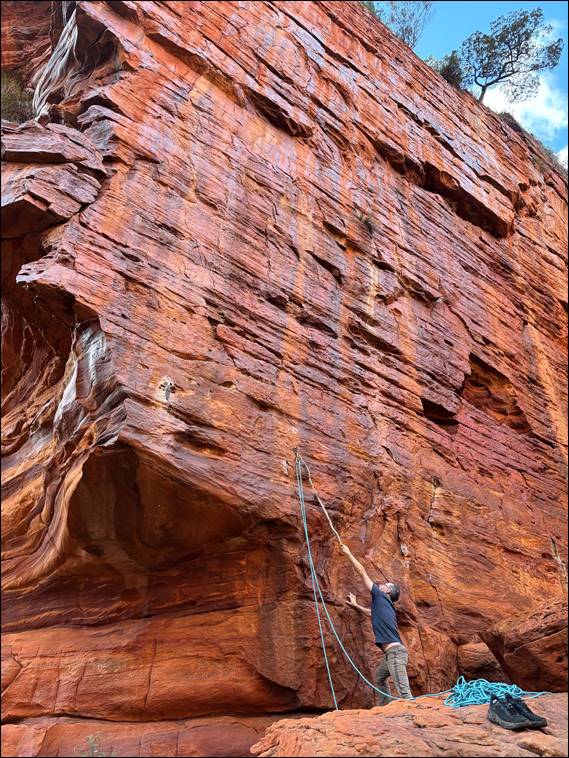
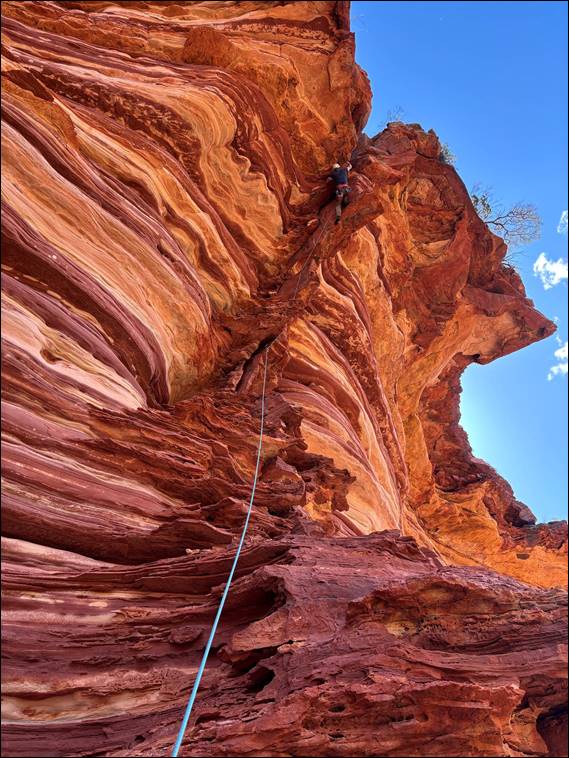
The other routes were harder and wetter, which put us off jumping on them. Not that it bothered us as there was a line on the other side of the river we had in mind. Providing a perfect example of the layered cake sight I mentioned earlier. Rongy was keen to bag this one, and after having had two laps on the steep sport route my arms were happy for him to take it on. It had very cool features and positions, making it an equally memorable line. The pace today was slow, we lazed about, nibbled on food, and did quite a bit of exploring:
In fact we saw some of nature’s great treasures but they are not included in this post. I have decided to separate that pot of gold out and you can find out about them in another post, aptly called Kalbarri Gold (https://sandbagged.blog/2026/08/03/kalbarri-gold/). This post being named after the above route. It would seem there is no Kalbarri Silver, but I would say this place has stacks of silver linings. A place you can lose yourself in and, if you come with the right attitude, it is impossible not to thoroughly enjoy what is on offer. If you hadn’t guessed, the climbing at all grades is very cool here:
We both felt the above line looked a bit meh, but were glad we decided to jump on it. Having loads of character, with one very confusing section that made us both second guess what we were supposed to do. Time in the gorge seemed to slip by, so we decided to start the leisurely hike out. Giving us just enough daylight to make and have dinner at the car park. You can tell the campsite really didn’t grab us. With twenty five sites crammed side by side, as they say goes ‘you can choose your home, but you can’t choose your neighbours’:
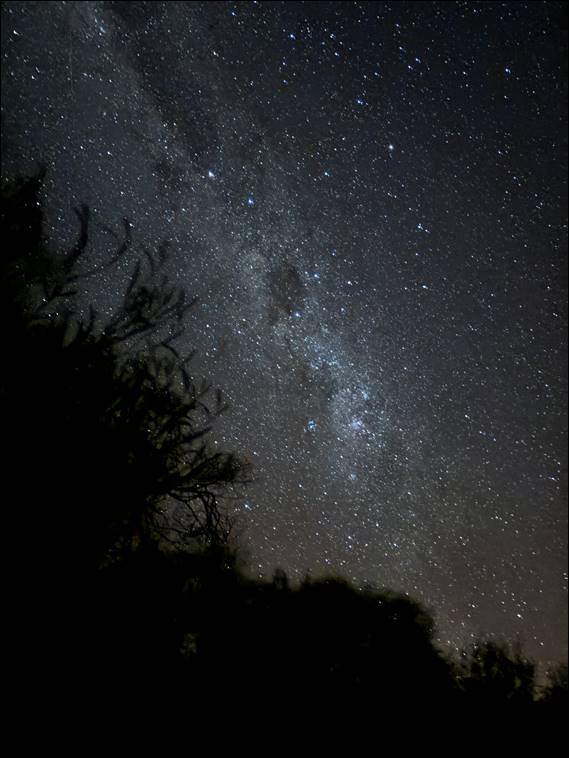
Before hitting the sack, and while the moon was hidden below the horizon, we wandered along the riverside track. Finding a spot where the lights of the campsites did not disturb our view of the amazing night sky. It really is crazy what phone cameras can capture, such as the core of the Milky Way above. Rongy has a different phone with a camera that has night sky settings. He managed to capture quite a few shooting stars that we couldn’t see with our naked eyes, although looking more closely maybe that is one in the top left of my image:
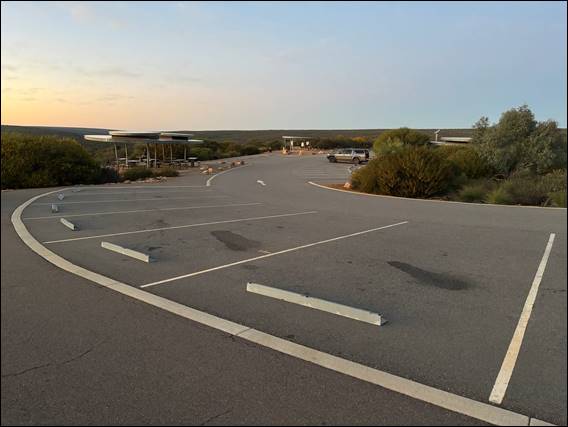
Next morning I was up early again, and we had agreed to head out at six. Leaving before first light crept into the sky and anyone else had roused. We went back to the Z-Bend carpark to have breakfast. Nine years back this carpark was an open space with gravel, and the only facility was a bush-shack like long-drop toilet. It feels so much more swish now, but they have done a great job of making the structures feel like they fit in and do not stand out too much. Like yesterday there was not a soul in sight, but unlike yesterday there was no mist:
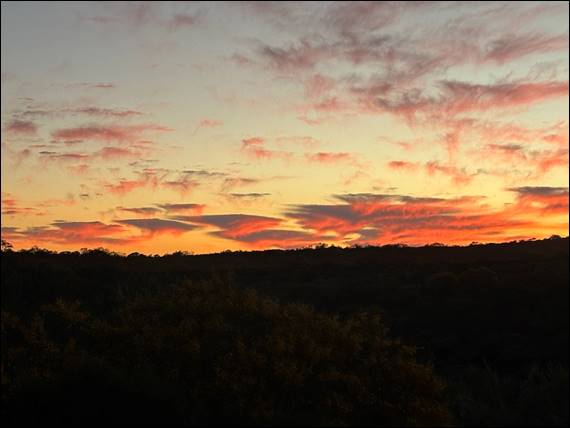
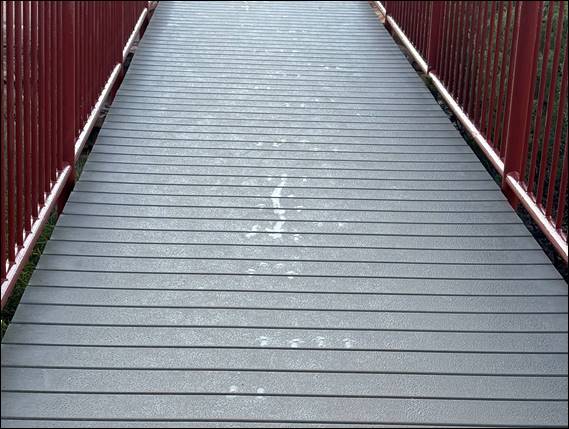
Instead our view comprised the above lenticular clouds (stratocumulus lenticularis), being gloriously lit up as the sun started to rise. Their unique shape catching the light in spectacular fashion. We certainly were not complaining. Breakfast made and eaten, cooking gear cleared away, packs sorted and shouldered it was time to walk back into the main Z-Bend gorge. We were the first to get to the look out, not surprisingly. Or were we. Approaching the dew covered bridge to the lookout, there were prints from another early riser:
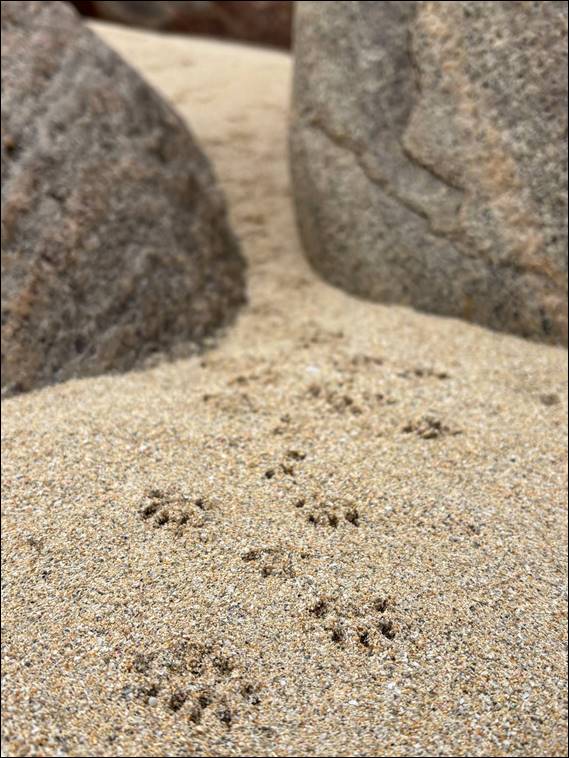
We like to think it was from a Black-Flanked Rock-Wallaby (Petrogale lateralis). This endangered species was last seen in these gorges in 1995, and were thought to have been displaced by foxes and goats. That was until 2015, when climbers, yes climbers, spotted and photographed a pair with a joey! This led to translocation efforts, taking a few Black-Flanked Rock-Wallabies from the Western Australian Wheatbelt. Resulting in building a self-sustaining population. The best part is that despite this find climbing is still allowed:
In fact the efforts of one particular climber, resulted in very good relationships being built with the rangers of this National Park. Nine years back we were very lucky to have spotted a Black-Flanked Rock-Wallaby, not this time. As a side note Lisa and I have seen loads of these in Central Australia, although that local population belongs to a distinct subspecies called the Central Australian Rock-wallaby (Petrogale lateralis centralis). Again, nine years back we saw one movement camera watching out for these wallabies, which is where we saw one:
This time round we spotted heaps of movement cameras, dotted along the way to the more frequented climbing spots. So while climbing is tolerated, and not impacting on the self-sustaining wallaby population, we are being monitored more heavily. The climbing is quite unique and stunning, and has become extremely popular mainly due to one crag. We passed that crag on the way to our chosen place. I do hope it’s popularity doesn’t result in poor behaviour restricting future access. Climbing here is and should be treated as a privilege:
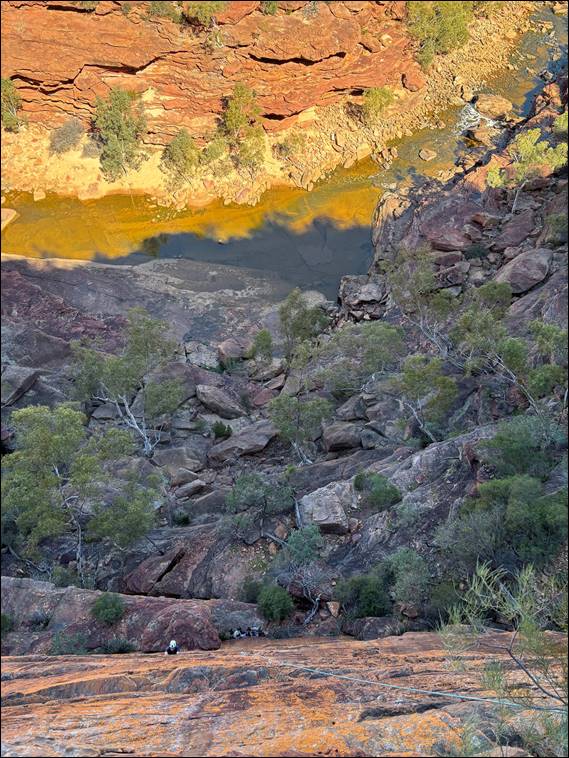
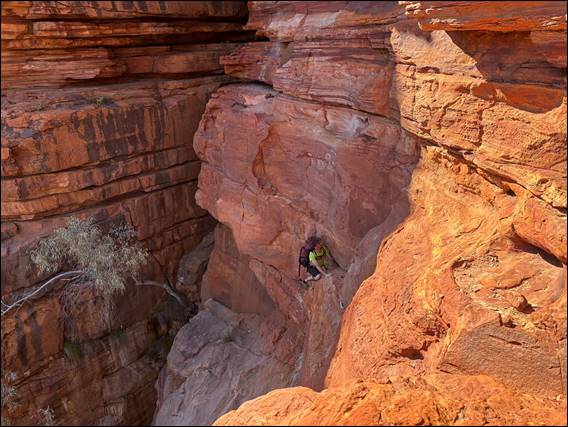
Today we were aiming to get to the might amphitheatre, three images up. Unlike any other spot here, it offers multi pitch routes. The guidebook suggests a 40mnin walk in time from the carpark. I would suggest that is a little misleading to say the least. Admittedly we were guilty of blindly following pink tape, that unknowingly took us to the top of an abseil wall used by school groups. That did not however add too much time, it was a wayward cairn and the guidebook description that led us astray. Two images up we are having to backtrack:
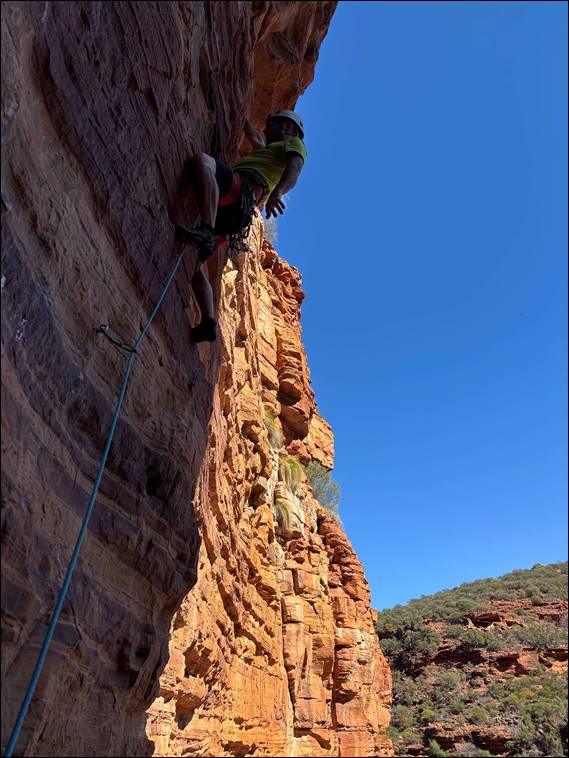
It had some nervous scrambling moments making us um and ah about what to do. Finally we found a super simple river crossing. Getting into the amphitheatre with its towering walls after three hours. It was a great adventure, but by then we had the wind knocked out of us. The tall faces gave more of a Stirling Range feeling, with possible loose rock and vegetated sections on rarely if ever climbed lines. Luckily there were a couple of bolted sport routes, one being in our range. Above Rongy is having the first bash, before his head gave in:
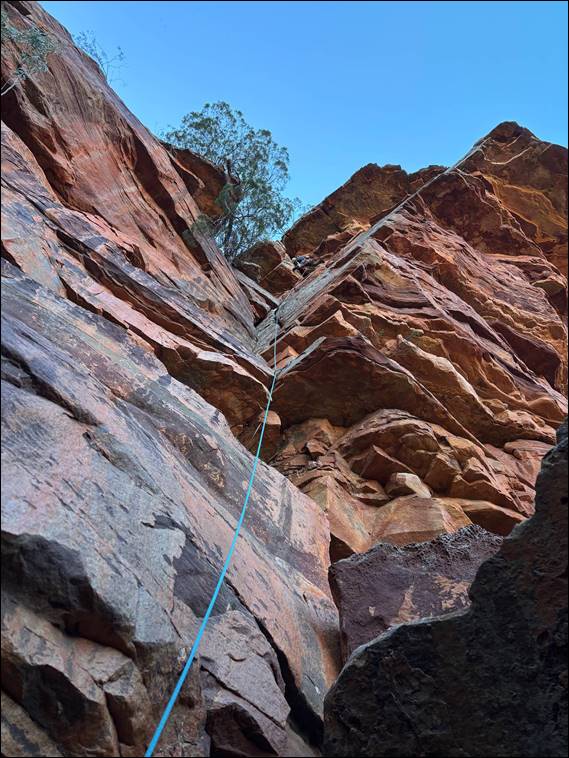
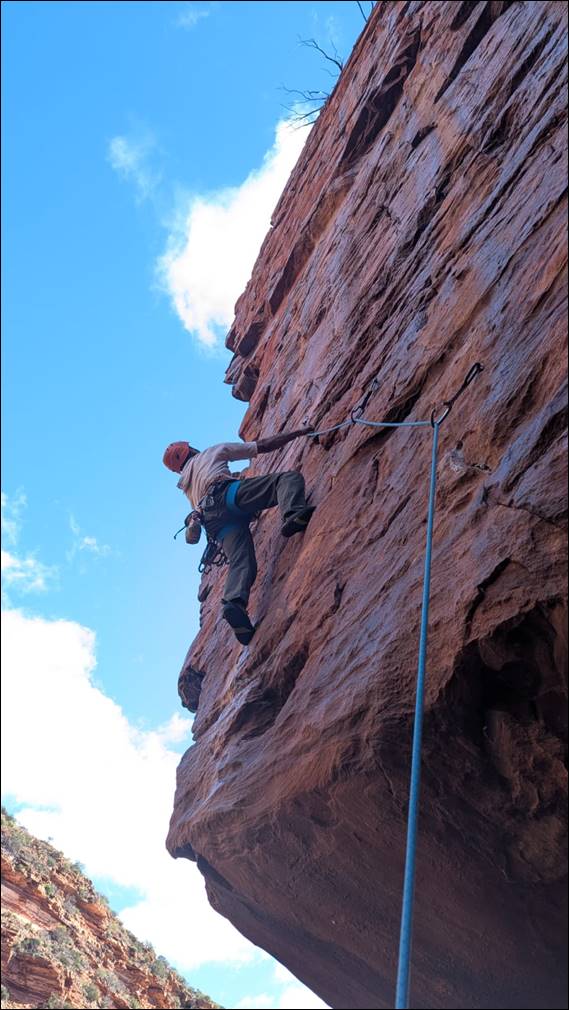
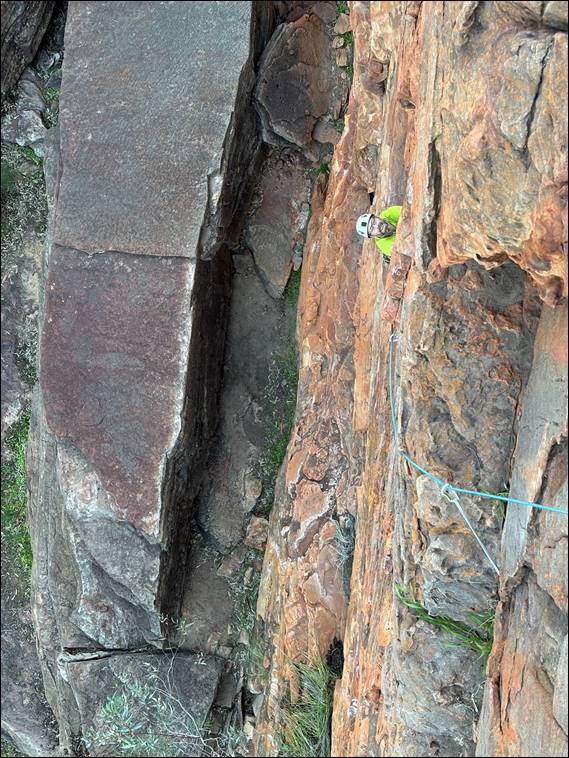
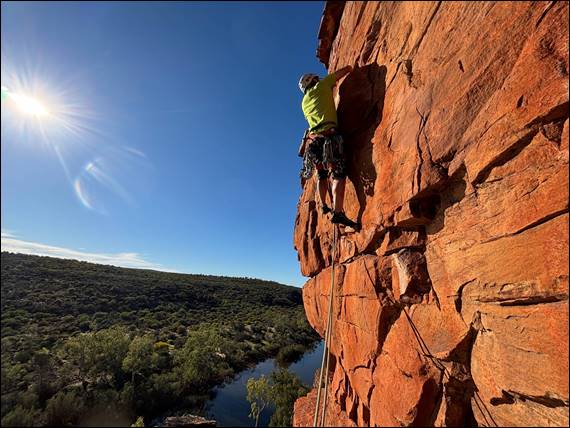
It was awesome, but as with many routes here it was steep and pumpy. Very different from the more technical, balancy routes we climb down our way. After two laps on it the sun crept round and it felt hot. Deciding on a bit of exploring before heading out, only to find what is reported as the hardest climb in Western Australia. An epic rising traverse up the above very steep roof, and it is a full trad climb. Much of the climbing at Kalbarri is of that nature, on great features, exposed, and feeling a bit full on. The awesome ravine below was no different:
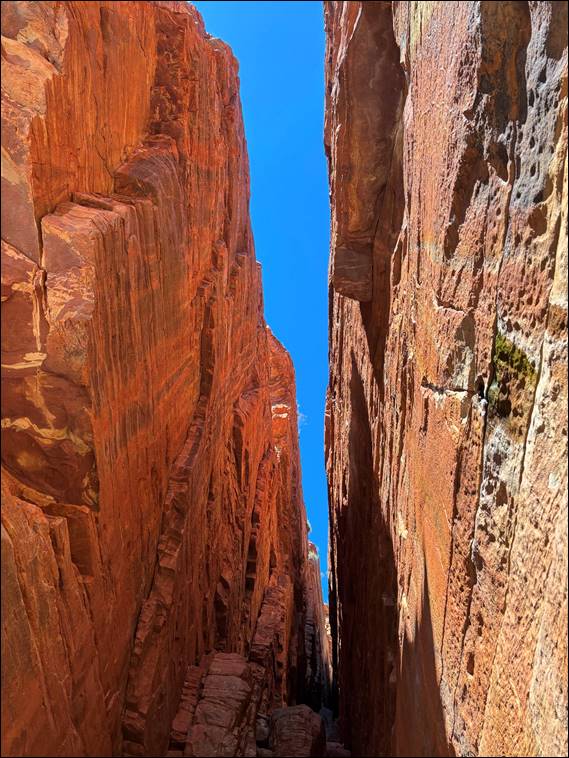
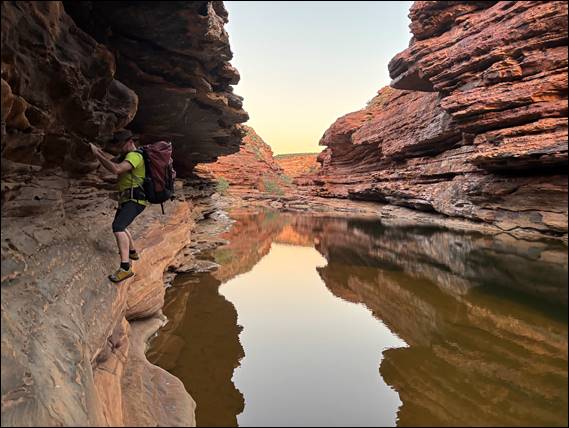
We bouldered our way along the waterline into the above narrow cleft, the walls on the left falling to trad routes of grade 23 upwards. In my Alice Springs days I would have been game, this time I just lay below them in awe. The Ravine provided a great home for a colony that kept us here for quite some time, but of what you’ll have to dig into the other post. After much exploring and munching on food, we started to wander back. Rongy was keen for me to sample the routes on the appropriately named Coriander Wall:
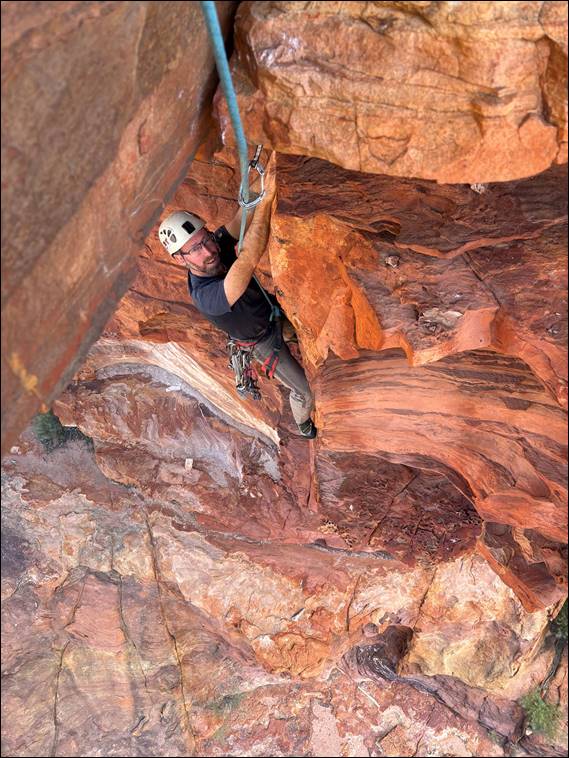
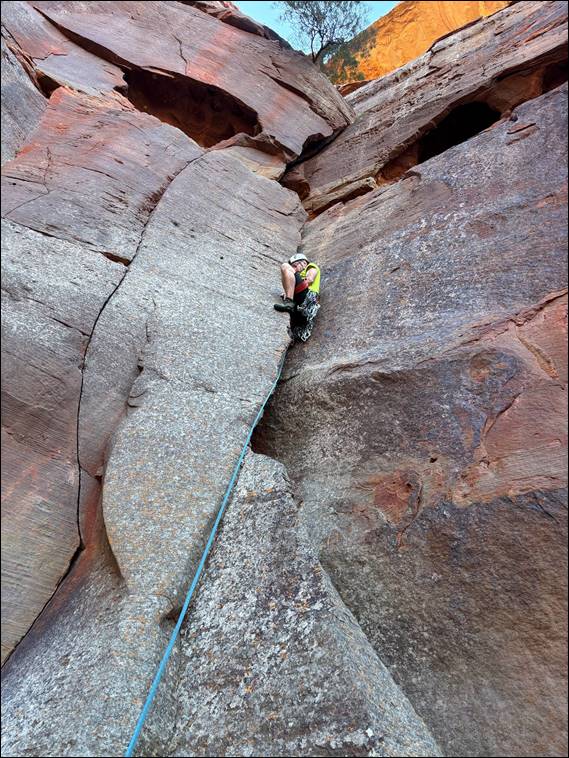
Depending on your genes, coriander can either have a fresh, bright citrus flavour or a sharp, unpleasant taste of bath soap or dirt. Equally, the routes on this wall could be said to be ones you’ll love or hate. All trad, but very grungy and bold, with little gear and/or loose rock. I let Rongy take the lead on the above, before we both got completely shut down on a bolted line to the immediate left. At a grade that we should have been able to see and work the moves. Neither of us could see how it went. It was a bit demoralising and not the way to end the day:
As such while walking back, and despite having packed everything up, I decided to run up a trad line that looked to have some fun features. It was indeed fun, but felt very oomph at the end of what had been a tiring day. We had no idea of what the route was, but reading up on the crag during the drive home the description said it had less than ideal placements on bad rock, climb it only if you have to. Well we did climb it because we wanted to end on a high note, and it certainly provided that. Finally heading back I suggested the low level way:
This included several scrambles, just above the waterline making for a very cool way to finish up. And no we didn’t fall in the water, we did however only just manage to get back to the main lookout track before darkness descended. Needless to say we didn’t cook dinner at the carpark this time, opting to make use of the camp kitchen for only the second time. We had packed a lot into the day, and when I finally got to lay in a prone position in my sleeping bag it felt lush. Sleep took me relatively easily, despite the noisy neighbours:
Next morning as I sipped my cuppa, looking up at the morning stars Rongy wandered along. Having heard me get up and deciding that what with the long drive home, an early start may be a good idea. Before that drive started in earnest we were however going to a spot neither of us had been to before. On the drive into Hawks Head, we had to stop for the first time. Two Western Brush Wallabies (Notamacropus irma) sat there looking at us. Also known as black-gloved wallabies due to the black paws:
They also have a unique running technique. When escaping from danger, they keep their heads low and stretch their long tails straight out behind them instead of bouncing upright. This morning they did not sense danger as we slowly approached. Instead lazily hopping off into the scrub. This short wall had a bunch of lines on it, but didn’t look to get much attention. A bit like the lookout, and unlike the others in the park we only saw a few cars roll in and out of here. Good news for us, as we were in full view of the lookout platform:
While short in stature, this little wall provided very fun routes. In keeping with the rest of the climbing in Kalbarri it felt a tad steep. Mind you this may have been enhanced due to my body being general weary from all the hiking, and arms tiring from three days of great routes. I also somehow happened to start on the line with the trickiest gear placements, of the five routes we romped up here. It was good to get that one out of the way first, and I started to feel more comfy with each line we hit even though the grades were going up:
The wall was in full unrelenting sun, and as had been the case for most of our time here there was very little breeze. It was heating up, we also had in mind that there was still the drive home. Packing up we had an early lunch at the car park with hardly a soul about. Of the two cars that did roll in, one lot didn’t get out and the others stayed no more than five minutes. Their loss in my opinion, this is a place to slow down. And I have to say I really enjoyed not having such a heavy focus on the climbing, being able to soak up the area in other ways:
Due to other commitments, there was limited time to get out and about today. While Lisa was bobbing in the ocean I was in need of a dose of nature to help me make it through the social conventions that lay ahead. A quick walk round the Capel Nature Reserve was just the ticket. Considering we are in the heart of winter, the weather has been unusually dry and warm. My hopes of finding another orchid species or fun fungi were low, and proven correct. No doubt they too are confused about what the climate is doing, and whether to come out:
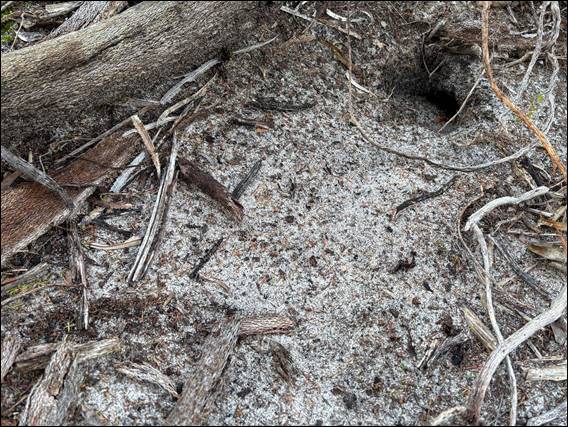
This was good as I needed to make it a short in and out visit. A month or so back I mentioned how a Quenda (Isoodon obesulus subsp. fusciventer) could dig nearly 4 metric tons of dirt in a single year, while foraging. There were not surprisingly cone shaped holes dotted about, as below, where they had hunted for food. But it was the third image that really made me decide to write this post. If you look closely there is a burrow on the right-hand side. A small maybe 5-10mm opening. With a comparative mountain of sand that has been excavated:
This led me down a rabbit hole of trying to identify what may have undertaken this mammoth earth moving task. Looking at the entrance angle and diameter it is possibly a sand wasp, and after trawling through many information sources I feel it could have been a Small Sand Wasp (Bembix variabilis). This along with Bembix littoralis are the most abundant and widespread species in Australia, with the one I have plumped for being the more commonly encountered. I’ve read that they normally do not leave the mound but scatter the dirt to level the area:
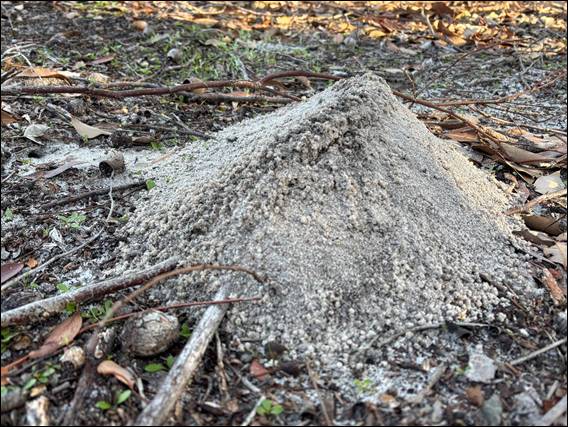
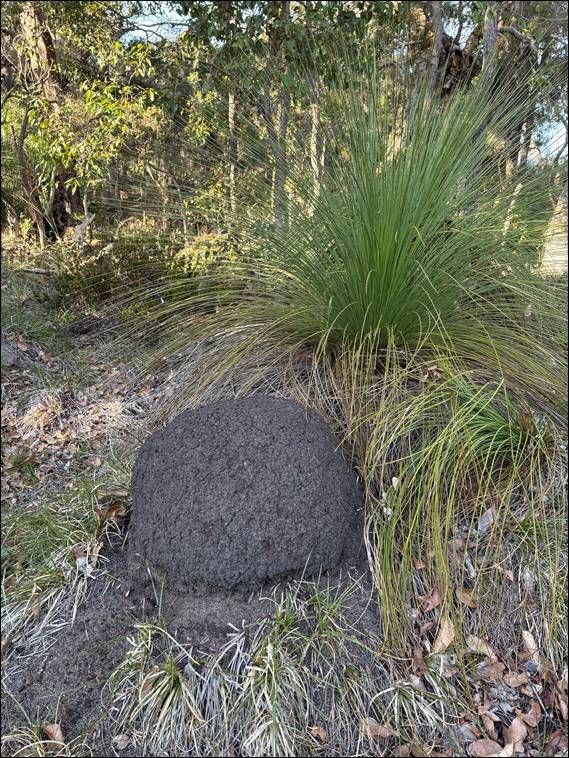
That said, this all looked very fresh. It may have been a working progress, but I didn’t have the time to sit and watch if I was on the money. A bit like my space in this post being limited. Hence, while I have dug out many amazing facts about these insects I’ll leave that for when I am lucky enough to capture an image of one. Next are the workings of more than one earth mover. Being the air conditioning unit of the home of Snouted Termites (Nasutitermes exitiosus), who dig underground tunnels that can extend up to 60m from the mound:
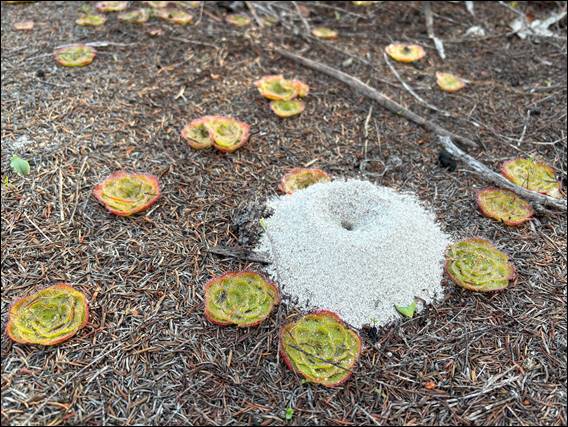
Rather than discard the excavated material they make use of it by binding it with their salvia to create these mounds that are usually no more than 75m high. At the base there are distinct marks, along with debris, from where a predator has been endeavouring to get a feed on some of the up to 2.5 million termites that can form a single colony. A Quenda or Short-Beaked Echidna (Tachyglossus aculeatus) are the likely unwanted evening visitors, who came scratching at the door. Below is the sign of another digger, a Funnel Ant (Aphaenogaster):
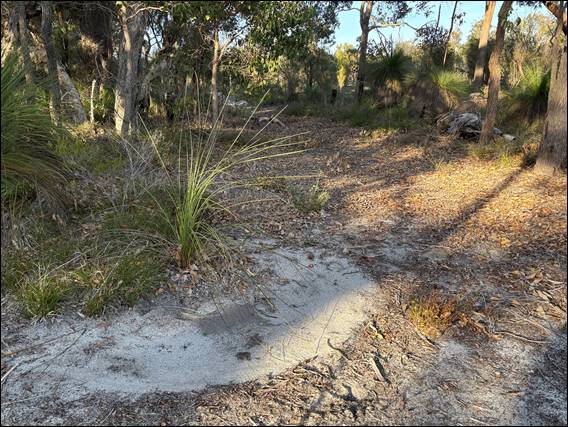
Likely to be Aphaenogaster poultoni, they are known for creating a symmetrical cone-shaped mound from the sand they excavate while creating their underground labyrinth. The network of tunnels help drain the soil. Creating ideal highly drained sandy conditions that Sundews thrive on, in this case Painted Sundews(Drosera zonaria). The last earth mover is a juvenile stage Western Australian Grass Tree (Xanthorrhoea preissii). This sweeping action has an intended purpose of reducing fire risk, preventing excess moisture, and deterring pests:
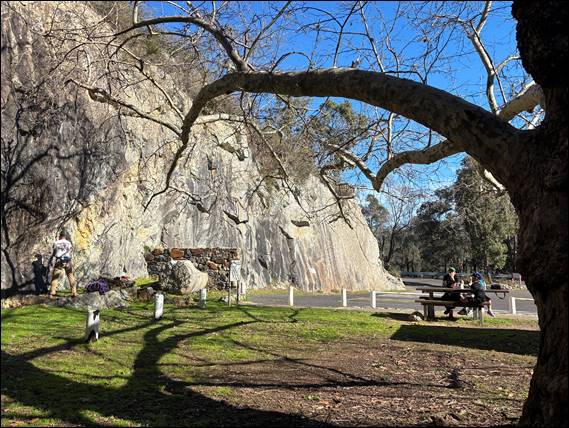
With a pretty average forecast threatening to ruin any chance of outdoor fun later in the week, Howsie and I did a bit of calendar juggling to allow us to nip up the hill for a quick session on Wednesday afternoon. While inclement weather was approaching we have just had an unseasonal warm spell, so we were hoping for good conditions. This made the outing feel reminiscent of Lisa and my time in Alice Springs, when Jason and I would break up the working week with a morning climb on most Wednesdays. Life is after all for living:
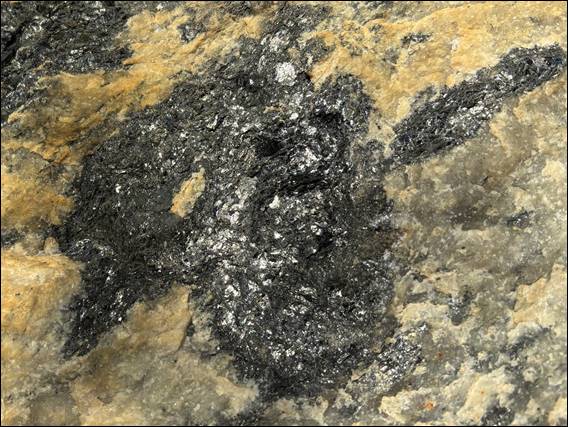
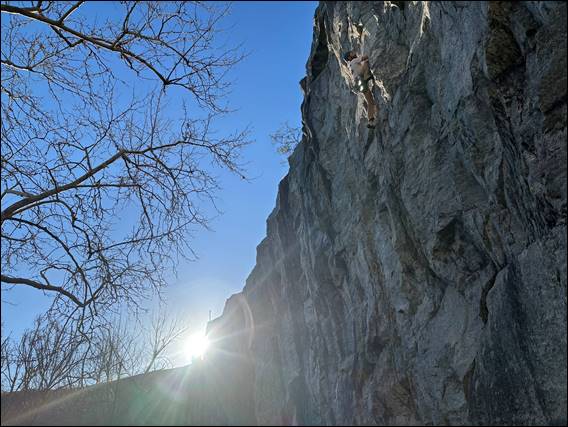
Winter days in Central Australia are so often cloudless blue skies and a wonderful warm temperature, and Wednesday 15 July in the South West of Western Australia was just that. The temperature peaked just below 23 degrees in Wellington National Park, which broke the 120 year old record for the warmest July day on record. Above the sun is glittering of a large clusters of biotite mica in the quarry’s porphyritic granite, which means that we can only be starting our session on one route. One that has proven tricky most times we come back to it:
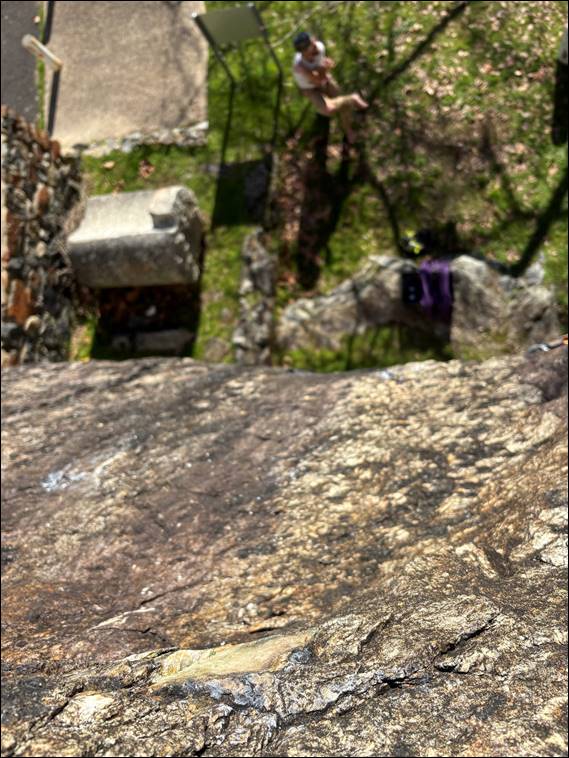
The heat was on in more ways than one, not only that but we had an audience. Being a lovely afternoon during the winter school holiday, the risk of people being about was always going to be high. While you may think this would be an impetus to perform. Once on this particular route our minds blocked everything out, focusing solely on the tricky crux section that often throws us a curveball. It did just that when I went up first, and then also when Howsie went up. He however got thrown a second curveball after the crux sequence, when a hold blew:
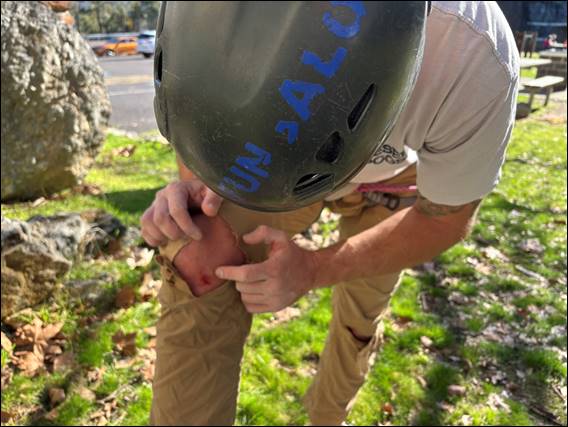
As if this route wasn’t hard enough already. He had to go and shave off part of a hold that is kinda important, shaving off part of his skin in the process. I was keen for a second lap, wanting to get a clean lead of the line so I could put it to bed for 2026, but I faltered once more. Like Howsie I took a reasonable whipper, but my skin remained intact. Despite feeling more worked than we should have from just one climb, with only a few hours up our sleeves it was time to move onto another line. Maybe next time we should start more wisely:
Howsie’s chosen line went much better for both of us. Then I foolishly turned the dial up another notch. Picking a climb we knew would give us grief. But we had already fallen in front of the audience, so it didn’t matter what happened now. The show continued with one big fall from me, before knuckling down to work the line. After which, as the sun crept round to light up the main wall and the clock chewed into our allocated time, Howsie opted for the safety of a rope above him. Despite all the thrills and spills, we of course had a great time:
As with any weather forecast a threat can turn into an opportunity. Watching the charts it seemed that Saturday could provide just that, with a weather window opening up. This time Rongy it was keen to get out. So we found ourselves arriving late in the morning at Wilyabrup, ensuring we gave enough time for any morning showers to have passed over. The sun was again out but unlike when I climbed at the dam with Howsie, today we were rugged up. Strong onshore winds were stirring up white capped waves and buffeting the cliffs head-on:
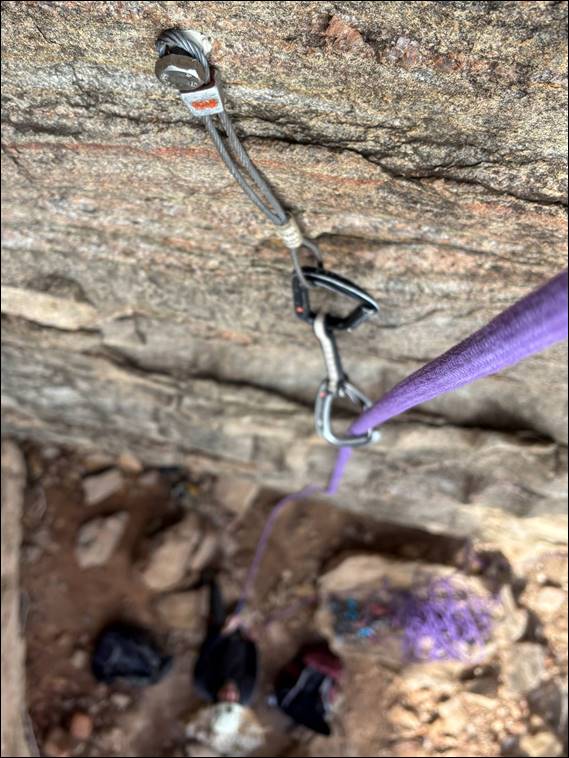
There were no lofty expectations today. Since his return from travels Rongy would admit to having turned into a bit of a part time climber. We started far more sensibly than Howsie and I had at the Dam. For this weekend’s foray we decided on using Rongy’s gear and my rope, a reverse of last time we came here. The only problem with that being that Mikie still has Rongy’s bolt plates in Queensland. As such for my first lead I had to resort to using wires instead of plates for the cheap Australian bolts. Making for a truly mixed trad/sport climb:
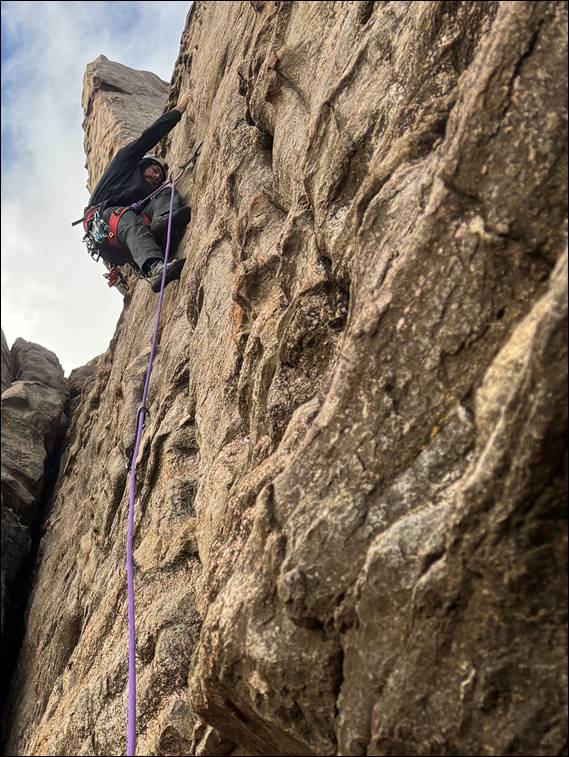
The sensible grades continued and after what Rongy described as a wobbly first lead, he was soon back to his normal confident self. For his second lead, below, he is running out the gear. Not due to over confidence but because there is nothing else that you can place. You would be hard pressed to have known that overnight it had been raining here. Added to that the onshore winds had not covered the rock in that unwanted salty spray. The walls were in awesome condition. So good that I decided to jump on a more spicy runout trad line:
It fell with ease for both of us, boosting Rongy’s confidence to the point he started eyeing up even fiercer competition. This time with the safety of fixed hangers, so there was no fiddling about with trad gear that uses up more energy. However, after passing the first two bolts his lack of climbing fitness started to show. His arms tired and his mind started to eat away at his confidence to make the next move and clip the third bolt. Several attempts later he decided to be sensible and abort the mission. Still keen to jump on this route he gave me the rope:
Cruising it to the halfway’ish ledge, it was my turn to be overly confident. I rushed a move above the next bolt only to find myself flying, and then dangling with the rope taut above me someway well below the ledge. Once back at the ledge it was time to refocus and I cruised the rest of the route. Rongy however had made the right choice to back off the lead, his arms were toasted and he had to really battle his way up on second. A bit like another part time climber, Seb, who also had to work hard to follow up a route on this steep wall a while back:
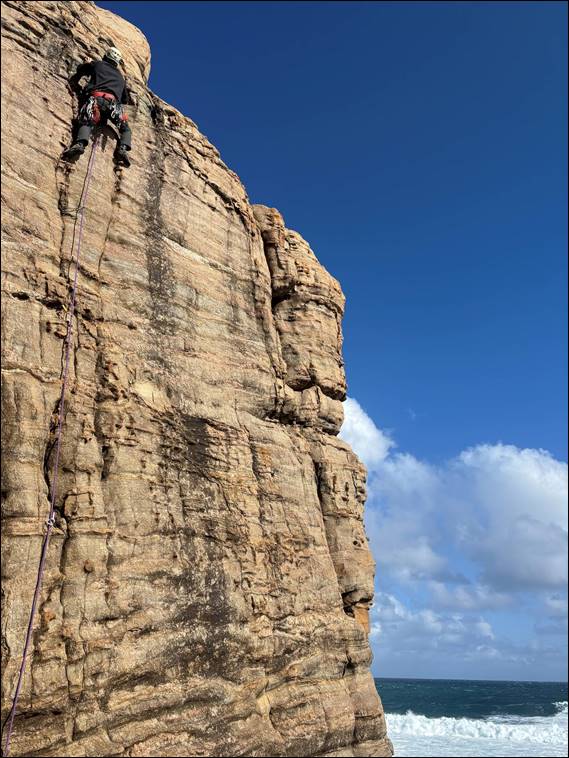
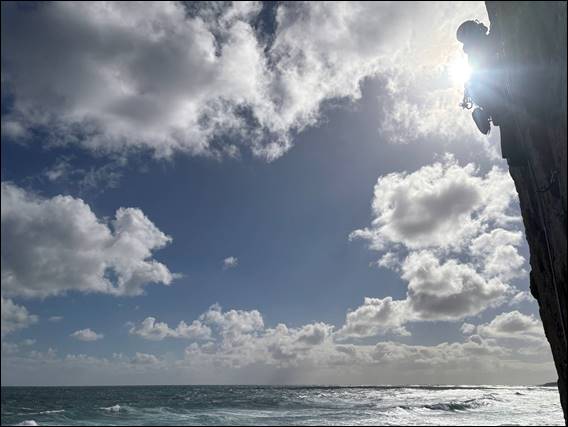
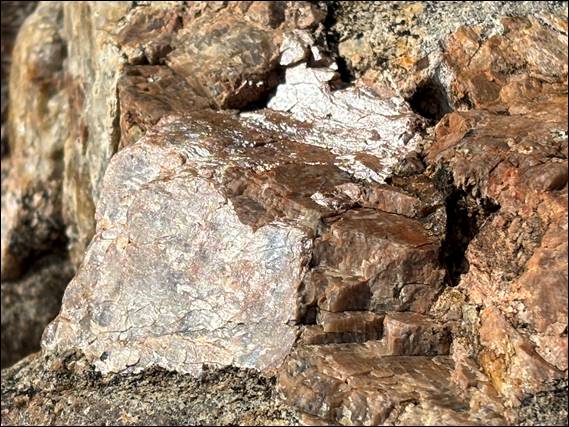
There was just enough gas left in the tank to climb out on the usual suspect, with packs on of course. Rongy opted to go second, not wanting to come unstuck. Especially with a pack on his back. I was happy to gobble up another lead in the glorious conditions, which was sadly not warm enough to lure out any reptiles. In particular a python. So I’ll end the post as I started with the sun shining of a mineral, this time a large band of alkali feldspar running through the granitic gneiss of the Wilyabrup cliffs. The rock after all, is the main attraction:
Not that there are any orchids I was particular looking for, a wander in the Capel Nature Reserve was in order today if only to stretch the legs. Quite a few Globe Heath (Brachyloma preissii) were in flower. Normally blooming in autumn, they are however highly adaptable to unseasonal rains and have been found to flower anytime from February to September. Endemic to Western Australia, it is one of a staggering 200,000 specimens collected in Western Australia over four years from 1838 by Johann August Ludwig Preiss, who it is named after:
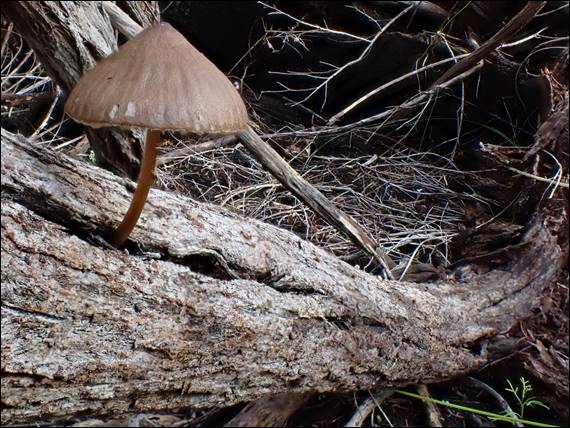
They may be small , but the nectar-rich flowers are shaped perfectly for native Australian honeyeater birds. While it may not be needed for honeyeater bird species, a term in ornithology is LBB standing for “Little Brown Bird”. By coincidence the common name of a bird called a Dunnock (Prunella modularis) loosely means “little brown bird” in Old English. This term is used for hard to identify species without a close up inspection, and today I came across a similar term used in mycology or mushroom science:
LBMs, and you may have guessed meaning “little brown mushrooms”, is often used. There are hundreds of small, dull-brown mushrooms that look almost identical. Without a spore print or microscopic analysis, a true identification can be near impossible. However, I’m quite confident the above LBM is highly likely to be a Common Bonnet (Mycena subgalericulata). They are often found in colonies but can fruit singly as this one is. The next two may not fit the term LBM, but I am still not too confident I have identified them correctly:
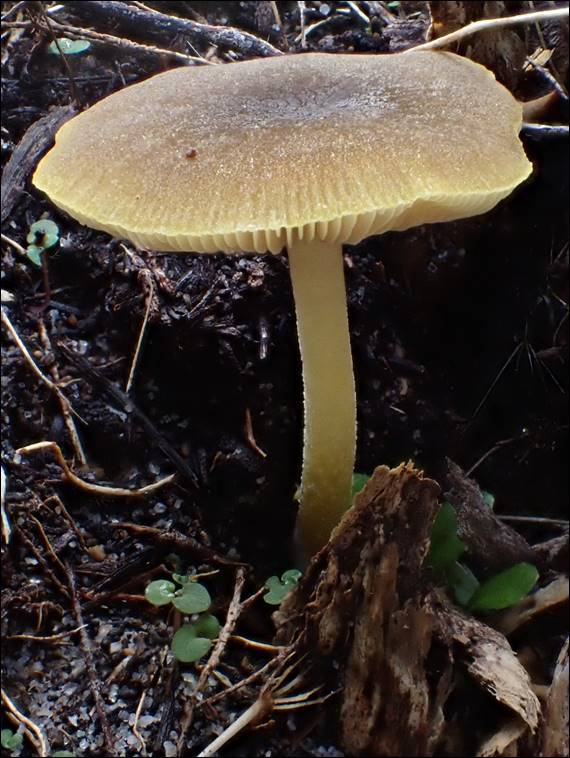
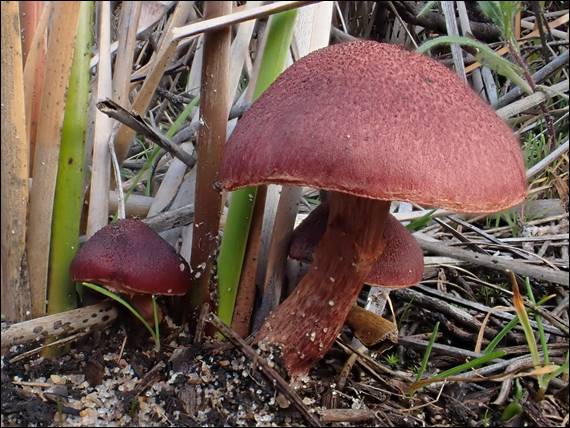
The above could be a Yellow Fieldcap (Bolbitius titubans), being a widespread species found on every continent excluding Antarctica. And is one of the shortest-lived mushrooms, sprouting in the morning dew and can be completely withered or faded by the afternoon sun. And below I may have come across some Plums-and-Custard (Tricholomopsis rutilans). Non-native to Australia, it usually prefers dead pines of the Northern Hemisphere but has grown to enjoy various native hardwood trees in Western Australia:
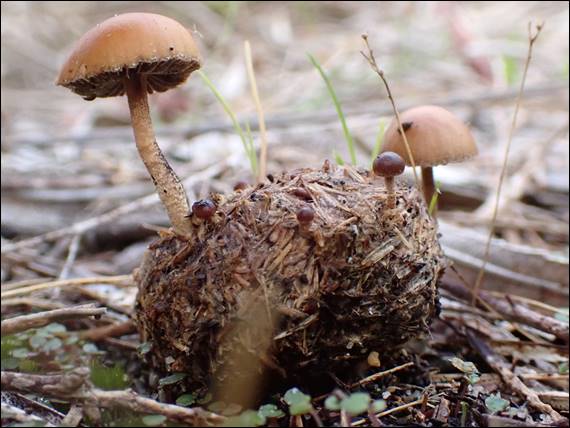
It may look like it is growing out of the sandy soil, but if I am right it will be feasting on the rotting wood buried underneath. Next up is an easy one, the Dung-loving Deconica (Psilocybe coprophila). I really like the image, and while you may not want to look at dung, the more you do the more mushrooms you’ll see. They only grow on the dung of herbivores, as dung from carnivores contains too much protein and lacks the right plant fibres this mushroom needs. It gets even more fussy, and only grows on dung that is not too fresh and not too old:
Another easy one to get right is the Yellow Navel (Lichenomphalia chromacea). These pop up in groups of varying sizes during autumn, and always in association with a green algal mat. In fact without this lush spongy garden bed it cannot survive. The algae makes sugar from water and carbon dioxide, which the mushroom uses as food. And in return the caps provides an umbrella so the algae is at less risk of drying out. This teamwork allows the pair to grow in poor soil where neither could survive alone:
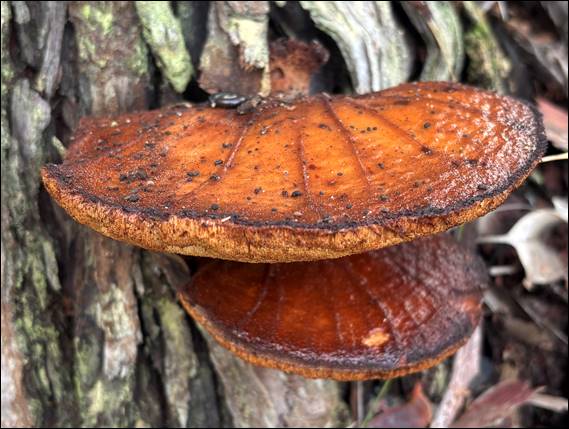
One last easy identification, a Beefsteak Fungus (Fistulina spiculifera). This specimen has a really cool patterned upper side. Underneath there are millions of tiny, tightly packed tubes instead of gills. The genus name of Fistulina comes from Latin meaning “small tube or pipe”. Tiny Fungus Gnats (Mycetophilidae) lay their eggs in-between these tubes so when their larvae hatch they have a safe, food-filled home. Mind you they are not too fussy what mushrooms they make use of, so are not only attracted to ones with tube like structures:
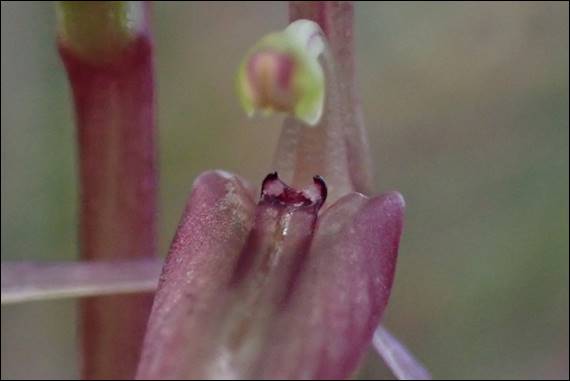
Fungus Gnats (Mycetophilidae) don’t only visit mushrooms. They are also the primary pollinator of Mosquito Orchids (Cyrtostylis robusta). I came across a patch of leaves near the car with a few in flower, and after my research last weekend took the time to take a close up look. As with other Cyrtostylis species it has a unique labellum, which acts as a landing pad for the Fungus Gnats. They are attracted by a tiny puddle of nectar held in a small pool at the base of the labellum, which is secreted by the two Calli that arch over the pool:
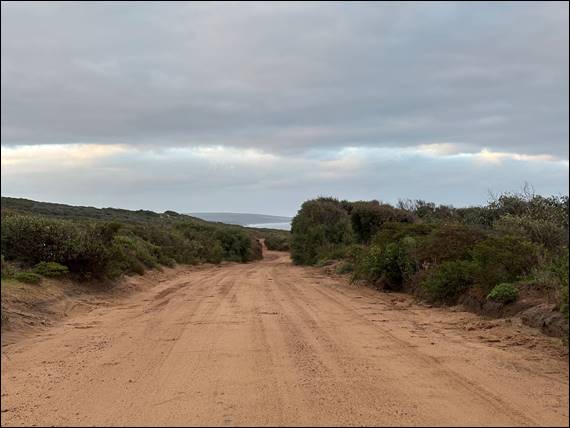
I can’t say my motivation was very high today. Blame the winter blues, no one being available, needing to be mindful of my dodgy joints, or possibly the imaginary tickle in the back of my throat courtesy of Lisa. She is weary, so much so she didn’t even go down to watch the Peppy Plungers, well plunge. At least I was not feeling weary, but I did leave a little later than usual. Waiting till she stirred, before deciding to go for it, so I could check in to see how she was going. Heading somewhere cruisy, where the final bit of the drive can be rough:
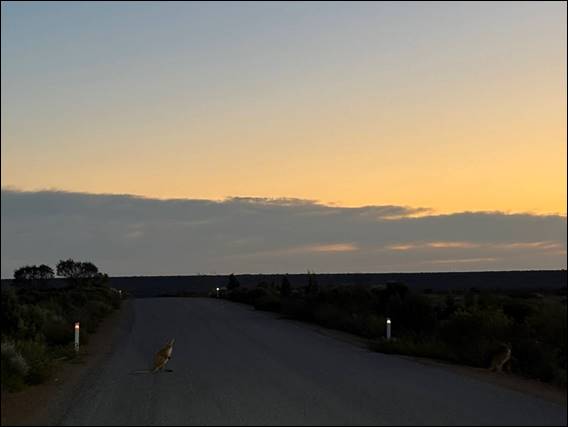
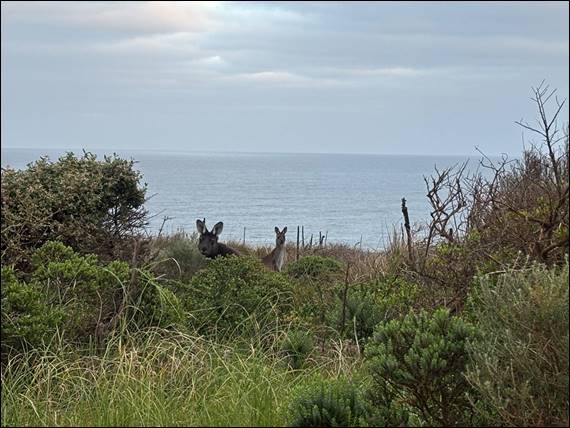
This would normally be no problem in my big rig. However, we recently sold that and I now drive a ‘normal’ car. One in which I would feel every bump of a rough corrugated dirt road. Fortunately, they must have graded it recently and it felt pretty good. I went slow anyway, as I had a nagging feeling. Sure enough, over three separate stretches, five Western Grey Kangaroos (Macropus fuliginosus) did their level best to put a dent in my car. The first of which can be seen cheekily looking at me, after safely making it across my path and into the scrub:
While now focused I had been a little distracted, in part due to the 12”single mix playing. A form of vinyl I always thought had been invented purely to make money. Encouraging avid fans to part with even more cash, as they keenly collected every bit of vinyl released by the artists they revered. But I was wrong, the magical 12” single came from a mistake. In 1975 a disco DJ named Tom Moulton used a blank of this larger disc for a test press, by accident. Singles up until then were pressed on the 7”disc, or as we knew them the good ole 45:
The name 45 coming from the revolutions per minute that it was played at, and being a smaller disc song lengths were limited to 5min. A 12”disc, played at 33 revolutions per minute, and enabled the grooves to be cut deeper and wider while allowing for a 12min song. This gave a louder sound with a punchier bass, which was perfect for the era of disco. It also meant the spacing between lull points in a track were more clearly visible. Making it easier to merge and/or mix songs, which revolutionized the DJ dance music genre:
Having safely arrived at my destination, with no dings in the car, during the walk in my joints did not complain. I was then greeted by an unexpectedly dry crag, with only a hint of where water had been running down a day or so before. It was my turn to get into the groove and start lapping up line after line. A bit like the songs on a vinyl LP it was a smooth transition from one route to the next. And just like a 12” LP that can generally fit 4-6 songs on each side before being flipped over, I had to change the belay anchors every 4-6 laps:
You may wonder why a 12”single can only have a track up to 12min long, when a 12” LP can hold 4-6 songs that would require twice the duration. It again comes down to the width and depth of the grooves, and the same as used in the humble 45 is applied to a 12” LP. And as you may have guessed from above, this results in a quieter sound and less punchy bass. While I never jumped on anything too punchy today, it all felt good and the body, for the most part, didn’t complain. So I climbed quietly, not needing any vocal encouragement today:
I only broke out the chalk on one route, and then just for two holds on a short sequence. Talking of short periods, the music cassette and CD, only lasted for a relatively short duration of approx. 30 and 20 years respectively. And while there may have been a lull between the mid-80s to mid-2000s, it is fair to say that the humble vinyl has lasted the test of time since it made its first appearance in 1948, with its resurgence lasting to present day. The last track to play in this post is from a Southern Brown Bandicoot (Isoodon obesulus subsp. fusciventer):
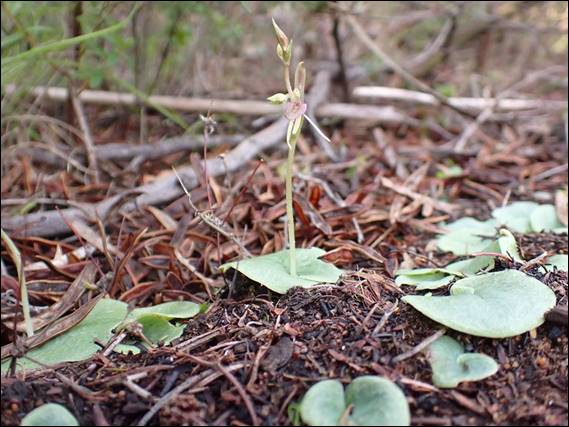
Of the myriad of small basal leaves I spotted at Castle rock a few weeks back, only one had a stem and was in flower today. Even when flowering these can be pesky things to differentiate but I feel confident to say this is a Mosquito Orchid (Cyrtostylis robusta). As with several orchids here, they do not grow from a seed but a tuber. Resulting in each years plant effectively being a clone. The seedless process results in large colonies forming, in which every plant is genetically identical. It is common for only a few plants in a colony to flower:
Digging deeper into these, and other Cyrtostylis, there are finer details that I have previously overlooked. Next time I will have to take the time to take some macro images. A bit of a silly term considering it means to take close-up images of the small or micro details. One of the features I want to check out are the two glands on the labellum. Said to resemble eyes. These are used to attract Fungus Gnats (Mycetophilidae), and also other very small flies, to aid pollination. But these fooled insects are not the only way pollination can occur:
With approx. 450 species of orchids in the region very few are known to use autogamy, which means it can pollinate itself. Most species have a barrier between the pollinia, which hold the pollen, and the stigma, which is the ‘gatekeeper’. The gatekeeper makes sure the pollen is worthy, which is a whole other story for another time. If Cyrtostylis are not visited by any pollinators the pollinia breaks down and makes direct contact with the stigma, resulting in fertilization. This may explain why some species are out in larger numbers nearly every year:
I was however not here to hunt orchids. Climbing was on the cards. But I had a bit of time to kill when Craig was delayed, due to having trouble wrangling Henry and Charlie who were a bit resistant to leaving the house. A slower walk to the crag looking for orchids and a bit of bouldering kept me busy until they arrived. Needless to say it was a late start. By the time we touched rock it was close to three hours after the Peppy Plungers had submerged themselves in the ocean. Not that Lisa managed to get in the water today:
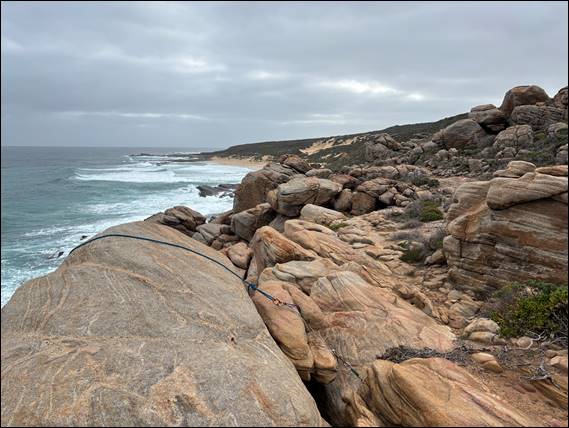
As the images show there was a bit of a swell, and as she walked in a wave came in loaded with a good sized rock that caught her right on the shin. That was enough to put her off. The waves were also a problem for Henry, not being the best conditions for fishing. Charlie however had a few things packed away to keep him occupied. Including a book that he can be seen reading in a nook he found that was protected from the fresh wind. While the sun was high in the sky and offer some warmth, the wind countered this in equal measure:
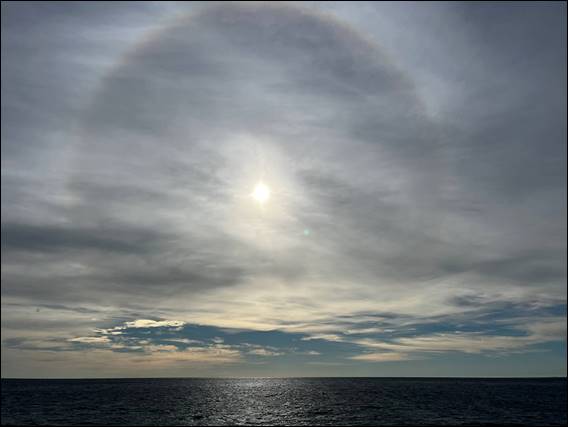
A high veil of cloud was tempering the effects of the sun’s rays. In the third image Charlie captured a great image of a sun halo, an effect caused as the sunlight was distorted by millions of microscopic ice crystals suspended in high-altitude cirrus or cirrostratus clouds. Today they were cirrostratus clouds, which forms veil like sheets covered larger areas as opposed to wispy hair like features of cirrus clouds. We witnessed a 22° halo, the most frequently seen and common of halos. They can also form horizontal lines, pillars, and various arcs:
While the waves never stopped, Henry did eventually find a perch from where to throw a line in. Not that he had any success. Meanwhile Craig and I did what we came here to do. Ticking off a few lines. Nothing too serious, meaning we could go lead for lead. Craig was looking very calm and collected on rock today. There were no slips or rests on our chosen lines, and today I did have more focus and bagged the route that spat me off last time. Soon enough lunchtime caught up with us, which we were alerted to by the boys who were getting hungry:
Before we could get them back to the cars, where they had left their lunch, there was the short 600m walk. Made all the slower when Craig pulled out his macro lens in case there was anything worthy of an image. And of course we found a few things. He was taking a much more professional approach with artificial lighting and image composition, whereas I went for the point and shot approach. We only stopped a couple of times, sensing that food for the boys was a more pressing matter and they were going to hang about afterwards anyway:
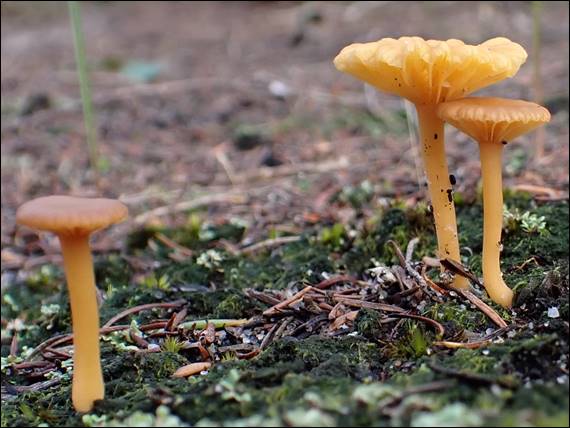
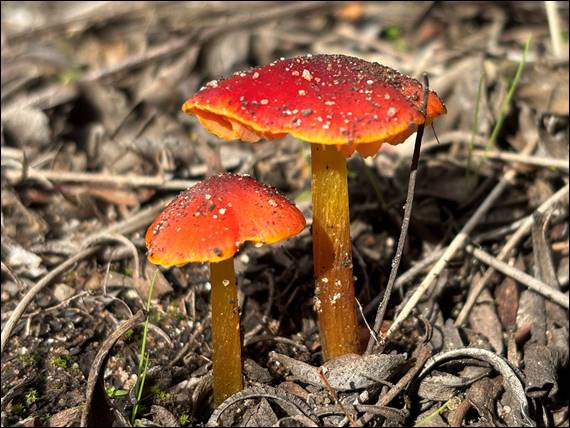
The first find was a Waxcap (Hygrocybe polychroma). Only a few of the thirty odd species of Waxcaps in the south west are known to grow in sandy coastal heath environments. This is one, and it has no specific common name. The scientific name is however interesting comprising Hygr and cybe meaning moisture and head, and poly and chrom meaning many and bright colour. Mushrooms comprise 85-92% water, and Waxcaps are in the upper range. This Waxcap species is also one that comes is a myriad of colours from yellow through to red:
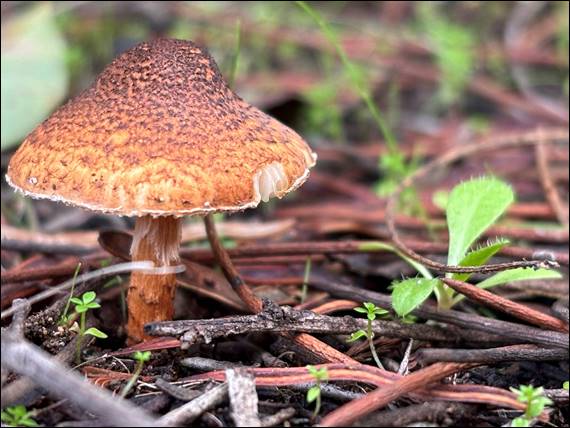
The next fungi has features from the Lepiota genus, and the closest match is an introduced species. The caps size, central knob, scaly surface, brown colour, and white gills along with a scaly stem that is chestnut-brown all point to a Chestnut Dapperling (Lepiota castanea). This species can contain lethal amounts of amatoxins that attack the liver and kidneys. However the toxin levels vary wildly based on geography, and is completely absent in some regional populations. While something looks to have had a nibble on it, we left it alone:
A month back I mentioned how I had been told I needed to get up and about more regularly, leading me to go for a brisk walks. Not long after that breaking news my right knee started to play up. This was something I had been worried about before my trip to the Stirling Ranges with Howsie. A heavy pack with good length steep hikes, plus of course all the climbing, had weighed on my mind. Were my legs up to it or not? During and after the trip I had no problem. It was not until I started my brisk unladen walks that things started to unravel:
When it got to the point that I felt I should not be heading out for the regular walks, it was back to the physio. Here is where we started to unpick what was happening. Over several sessions this resulted in us tracing things back quite a way. I feel like I have managed to stay relatively injury free when it comes to climbing. Yes I have had a few spills that have slowed me down but I have always bounced back. But my problems started before my climbing did. I have always had a duck-footed gait, I realised this after a nasty groundball during a silly solo:
I’ve read that adults can develop this gait from muscle imbalances, sedentary habits, or skeletal alignment. Mine has been with me the whole time I have played hockey, which I started at a tender age when I ran every day so it was not due to sedentary habits. I have also in my younger days had a healthy balance of upper and lower body sports. So I struggle to see that it was a muscle imbalance, but it could have been. As for skeletal alignment, I have no idea. Regardless of why I have had this silly walk for decades, it can result in joint pains:
The solo I feel from, which Kym will recall from 2013, is what alerted me to all of this. Bad compression damage in both ankles meant I had to learn to walking with better alignment from the hips down. Then three year later in 2016 came a fall off Wiggin’s indoor wall. One that ended with a nasty landing on a low hold. Hollering out in pain, and then saying don’t worry I’ll be right for our Welly Dam session in the morning. I was not. I severely damaged my deltoid ligament on the inside of my right ankle. That took some work before I was back up and out:
Next in line came a fall on my own creation at the place that Howsie and I were heading to today. Back in 2024 I took a quite long pendulum swing that saw me damage my medial collateral ligament, on the inside of my right knee. I have to ask why does it always have to be my right side? That again slowed me down for a wee bit but I bounced back. Or so I thought, until I started my brisk walks. And this recent issue came down to my safety sandals. Or more precisely the biomechanics of my body, and how my safety sandals don’t help with that:
The previously busted right ankle means my right foot arch is weak and collapses. This then pulls on the inside of my right knee, which has already been weakened. Added to that while I have learnt to walk not quite so duck-footed, it is a bad habit that I do slip back into at times and is one that again puts pressure on the inside of my knees. The really funny thing about this, is that walking aggravates it by climbing does not. Again thinking biomechanics it makes sense. Climbing puts pressure on the legs in a purposeful and direct way:
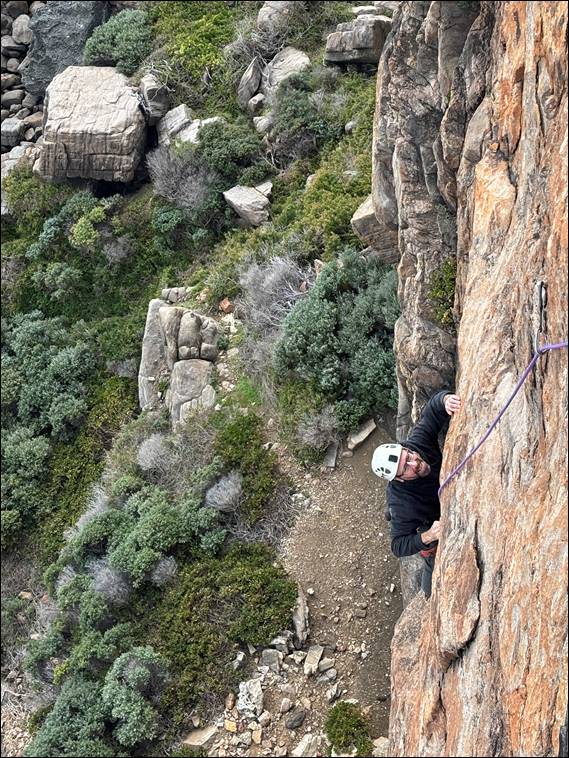
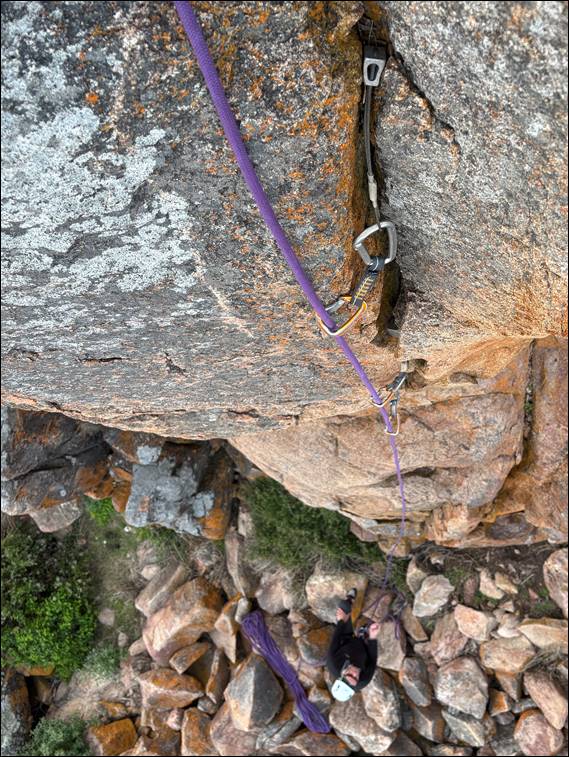
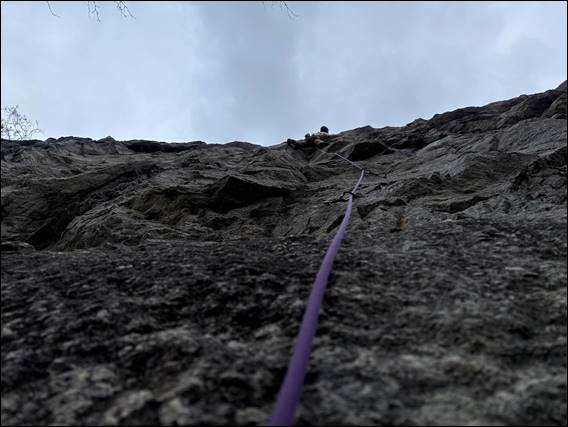
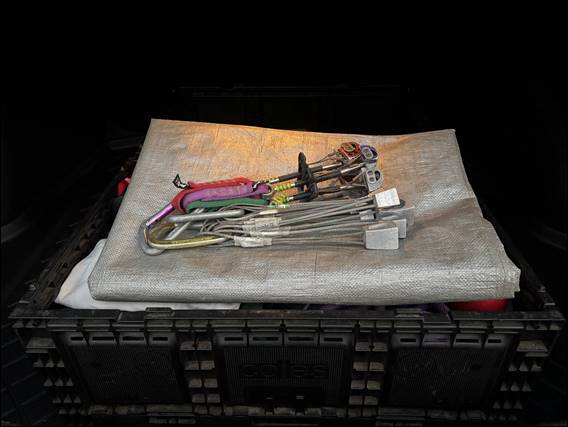
Very different to when you walk. The solution, other than physio and rehab exercises to build up the necessary muscles and once again learn how to walk, is to wear shoes. Admittedly shoes with a heighted arch for added support and to improve my skeletal alignment. The safety sandals, at least when I go walking, have to be left behind. Today Howsie decided not to jump on my route, which I fell off two years back. Despite me packing the essential few bits of trad gear in my crate. Due to the conditions, so he says, which resulted in us both falling of the last line several times:
 Sandbagged