Our mornings on the big day have certainly changed over time, the manic excitement when Elseya was young has long gone. Now it is more likely the house will be quiet until way after my usual wake up time. So before the rituals of the day, which still hold fast, began Lisa and I took advantage of the changed routine, quiet before the ‘other mad rush’, and a promising looking ocean to head to the beach. We had it practically to ourselves, being Christmas Day the ‘other mad rush’ of the holiday makers would not descend on us until Boxing Day:
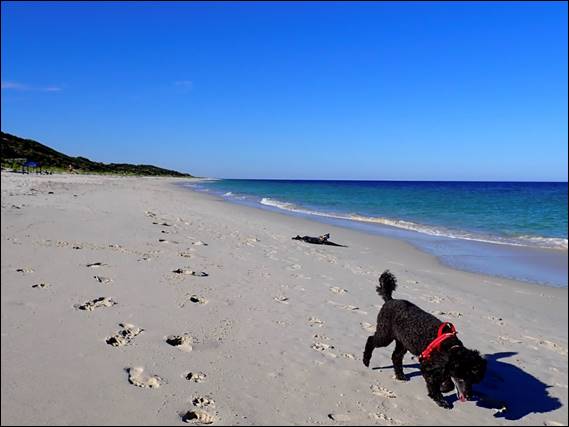
Lisa set up camp with her shelter, and being still in the relative cool of the morning the poodles joined us. This also allowed them to say hello to all the other dogs that wandered up and down the beach with their owners in tow, as I immersed myself in the water. It was indeed good, better than expected and I stayed out for a good while. A lovely way to start the day, not that there was too much that really caught my attention. But just because it was the big day I did like this Red Tube Worm (Protula sp), that was imitating a Christmas tree:
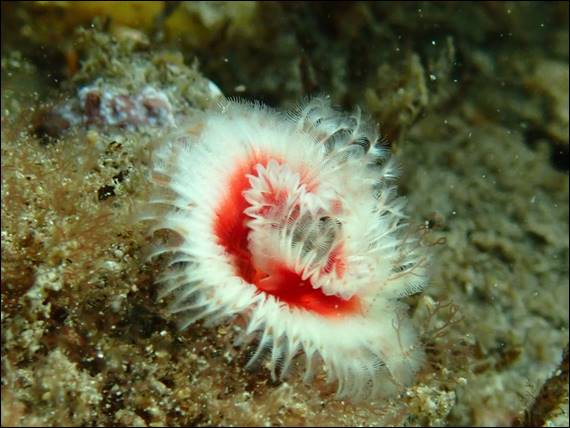
There is a Christmas Tree Worm (Spirobranchus giganteus). They have a conical Conifer (Pinophyta) tree shape, like the form a classic Christmas tree. But are found in tropical waters, not here. I’ve previously suggested this was a Red Fanworm (Protula bispiralis). However, digging deeper I feel that was definitely a stretch. Not that I have managed to narrow it down to a species, and nor have several others whose research I use as my reference tools. That is despite it being relative common in the general area:

The only other image I’ve included from that dive is a Blue Swimmer Crab (Portunus pelagicus). They have earned a few common names due to their behaviour and appearance, one being Sand Crab because they bury themselves in sand or mud during the daytime and winter. I spotted the antenna and eyes poking out of the sand. Not managing to get an image of just these, as when I started to get too close it pulled itself out ready for defence. Due to conditions and climbing I did not return to the water until the eve of New Year’s Eve:
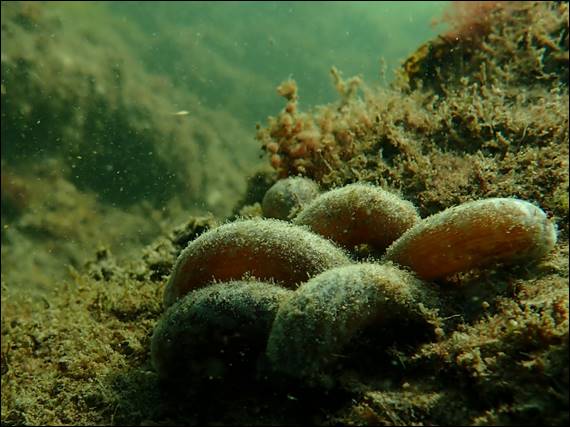
Going in off our local beach again. The image above clearing showing the dusting of detritus coating everything, referred to as marine snow. Even the water movement created from my flippers being enough to remobilise this into the water column. For our beach much of this is a result of the nutrients and organic matter washed into Geographe Bay, from the Capel River. While a groundwater fed river that receives inflow year round, the river flows are only strong enough to breach the beach and enter the ocean in winter:
Winter is also when the prevailing ocean current of this area are the strongest. The Leeuwin Current flows from the north along Western Australia, bringing with it warmer waters. This keeps the local water temperature up a bit in winter, however because the strength of the current subsides over summer the waters do not reach tropical temperatures. During 2025 the Leeuwin Current was stronger than average, likely due to ongoing La Niña conditions. This has resulted in water temperatures down our way being some 3-4 degree above average:

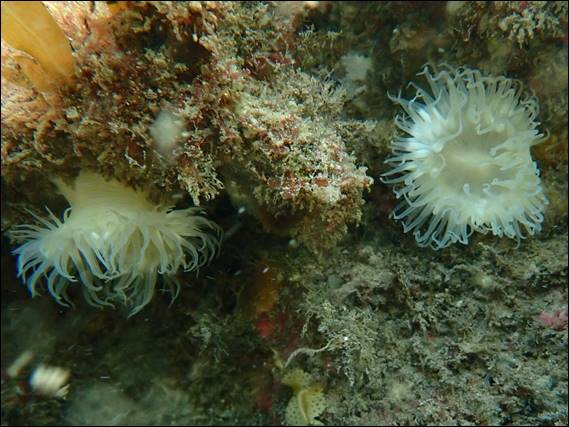
I seem to have drifted through this post faster than expected, so will now get back on topic. The dusty image shows a small collection of Cliftons Zoanthid (Isaurus Cliftoni). I have identified Finger Zoanthid (Zoanthus praelongus) in three previous posts, and stand by those identifications. The key difference between the two varieties are the pattern and shape. Cliftons Zoanthid tend to be shorter and chubbier, so are also sometimes called Sausage Zoanthids. These creatures are related to anemones, of which I have included two species:
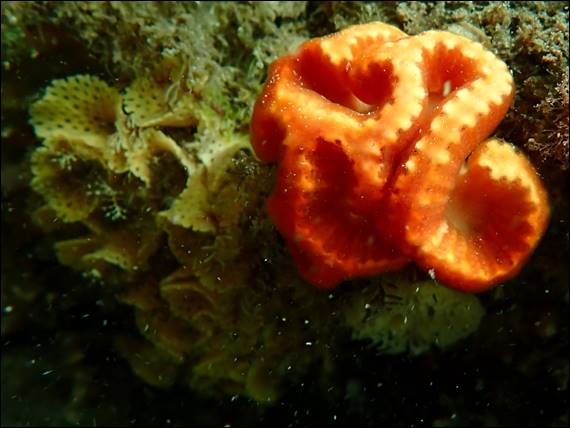
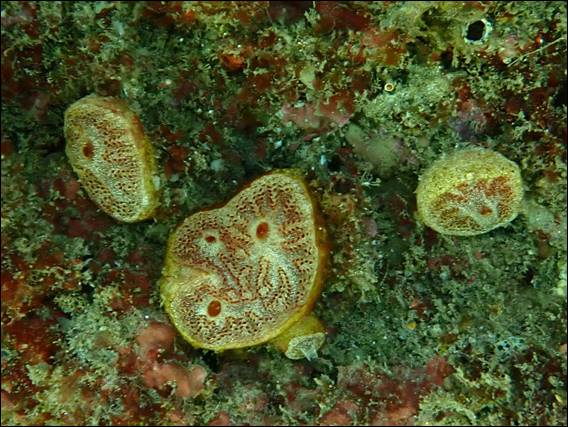
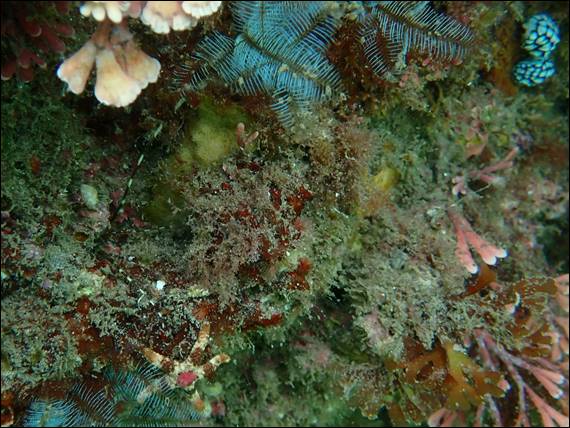
I’ve really struggled to identify either. The first may be White Anemone (Actinothoe glandulosa). I have related the scientific name with a different common name in a previous post, and can no longer find a reference that relates to the detail I provided back then. Drawing a blank with the second, addling my brain in the process. This neatly takes me to the Brain Ascidian (Sycozoa cerebriformis) above. One of the many types of sea squirts, and something I have accurately provided details of before. Although this specimen is much more colourful:

You may be wondering why the anemones and ascidian were not coated in marine snow, like the zoanthid. This is primarily because the latter was laying on the open ground while the former were found on vertical section of reef and at times under ledges. And then there is the above image with beautifully clear water, and clean unaffected weed. This was taken on the actual New Year’s Eve. When the swell having finally dropped below a meter inspired me to walk past the point, which is north of where the Capel River spills into the sea during winter:
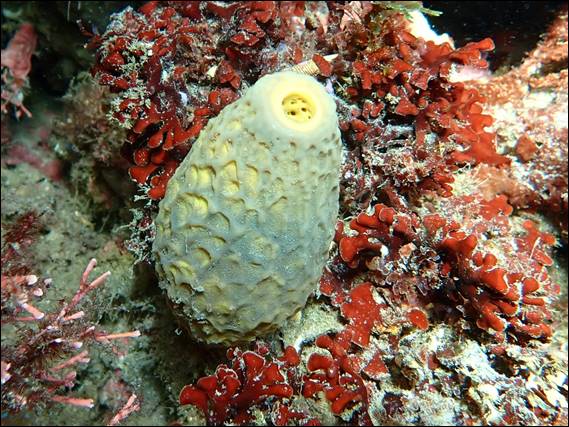
I find that a swell of less than a meter is when the water clarity really improves off our local beach. That said being north of where the river comes in, this area isn’t as affected by what the Capel River pours in. There are also no other waterways that flow into the bay to the north. As such it generally has better conditions, plus it has a far bigger reef. You may wonder why I don’t head there all the time. Simply because our local beach is so convenient, I can walk to it in a few minutes, and have had great success there over the years so it is still good:
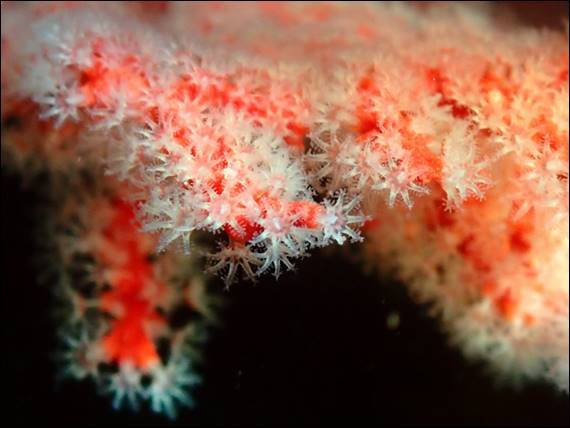
I’ve skipped past a sponge. They come in a huge array of shapes, sizes, and colours and I did find a single image online that looked similar. Sadly there were no details that accompanied the image to help with an identification. As such onto the above, a close up of a Zimmers Sea Fan (Mopsella Zimmeri). Previous posts have images of whole fans, which look pretty stunning. This time I’m showing the tiny anemone-like polyps each with their eight arms out. They filter food particles to provide energy for the fan, which is a colony of animals not a plant:
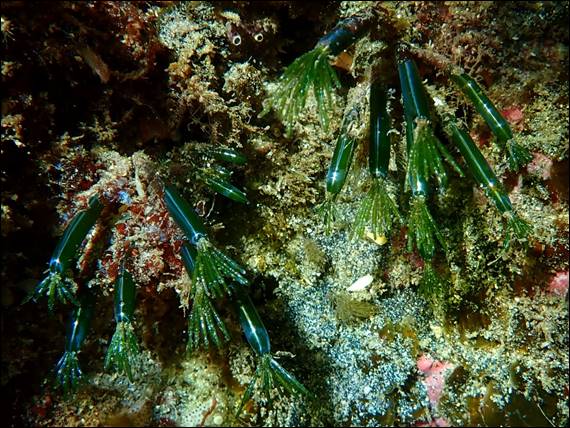
The best way to explore the reef is to spend time under water, checking the caves and ledges. In one the light was reflecting off something that resembled glass, being the above. I’m really pleased with this find, as it has only two sightings recorded in Western Australia. This sighting was of an early stage of Palm Tree Alga (Apjohnia laetevirens). The young plants are described as having a metallic sheen, which is what had attracted my attention. There are only two species worldwide, and this one only exists along the southern coast of Australia:
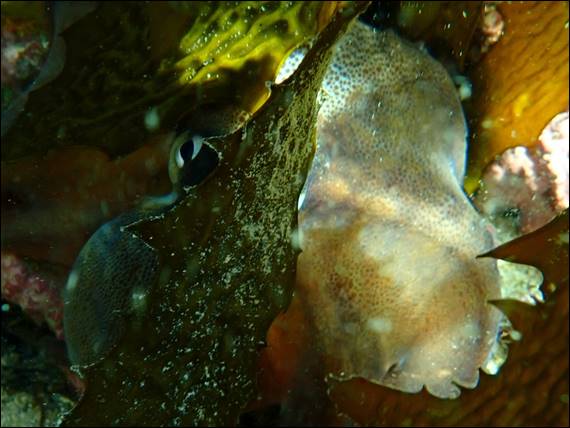
In terms of fish, crustaceans, and cephalopods all was quiet other than the above octopus. By the time I got down, it had hidden behind some weed and as I approached in a flash it was gone. I have always referred to these as the Gloomy Octopus (Octopus Tetricus), and for the first sighting recorded in my blog from 2020 hinted that I was not sure. Researching more it is in fact a Western Rock Octopus (Octopus djinda). This separate species was not identified until 2021, and before that it was considered to be the same as eastern states Gloomy Octopus:

I’ve now gone back and corrected all my posts so they refer to our local octopus, other than the original sighting as technically I was correct back then. Rolling into the New Year and I was up and out in the water early. For some different territory I went out directly from where the Capel River breaches the beach in winter time. Another near ninety minutes of bliss exploring all the nooks and crannies, this time with more fish. The above fishy image being of the ever curious Banded Sweeps (Scorpis georgiana), with a single Moonlighter (Tilodon sexfasciatus):
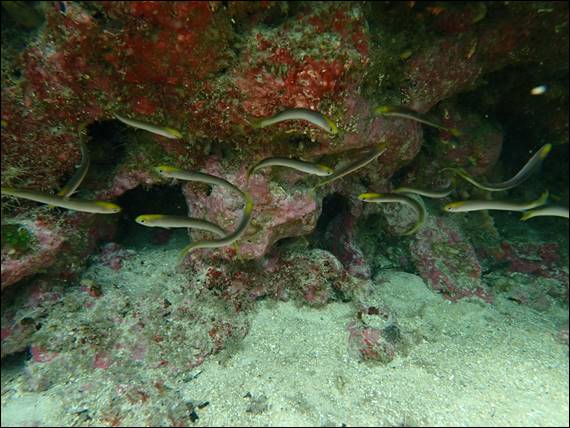
Banded Sweeps are schooling fish, while Moonlighters are generally solitary or in pairs. Both inhabit similar environments, and as such they can be seen together not that I see it too often. Above is a school of Yellowhead Hulafish (Trachinops noarlungae), their bodies are slim and long. Until you look close they seem more eel like than fish. This is due to their caudal, dorsal, and pectoral fins being respectively pointed, low, and small. The body shape seems to me to enhance their dance like swimming motion, which is kinda captured above:
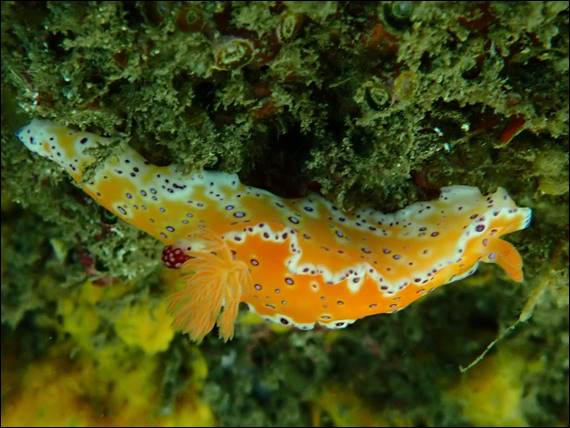
Checking out all the ledges I came across my second species of nudibranch of the season, a Short-tailed Nudibranch (Ceratosoma brevicaudatum). Despite the name this is the largest of over 100 described species of nudibranchs in the family Chromodoridae. The tail for this species referring to the strawberry like protrusion behind the gills. Next is likely a sea squirt, while very unquie in appearance I have not been able to narrow it down. My last image shows two Pustulose Wart Slug (Phyllidiella pustulosa) mating, and a juvenile sea star I can’t identify:
But what really caught my eye were the brown and white striped feelers sticking out of a hole above the sea star. I watched them for some time, as they waved about in the water. I think they are antennule, the smelling organs of shrimp and lobsters. Based on all the species I have checked the patterning suggest it may be a Juvenile Ornate Spiny Lobster (Panulirus ornatus). There are no observations on record for this area and only rare sightings in Perth. However, due to the warmer waters pushing further south this year I could be on the money:
 Sandbagged