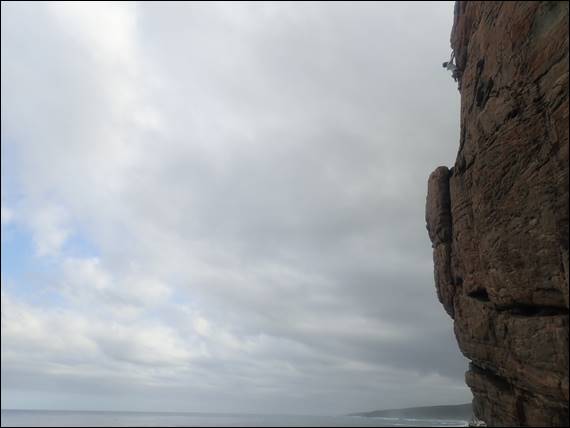
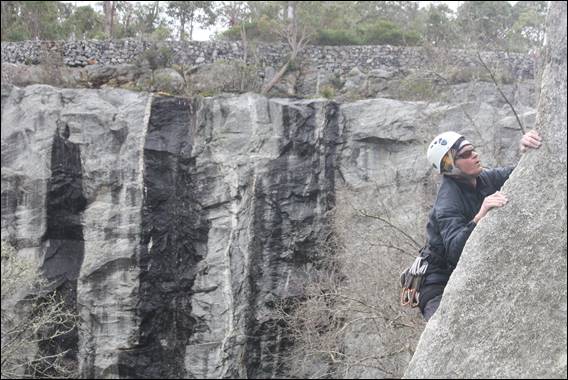
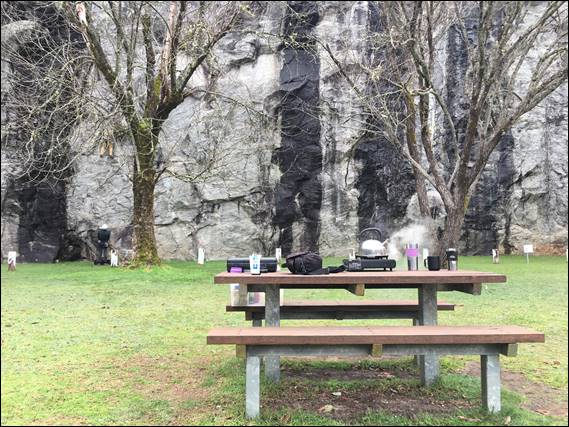
The risk with long weekends is that it can get pretty busy at the crag. But being the last day before I go back to work, after a few weeks off the idea of heading out was just too tempting. And much to Howsie and my surprise we ended up with the cliffs all to ourselves, although as the morning wore on we did spot a few people who were out for a wander. It started off a bit gloomy and overcast, which could have resulted in the humidity being up. This could have hampered the primary goal of today, but luckily it cleared up nicely:
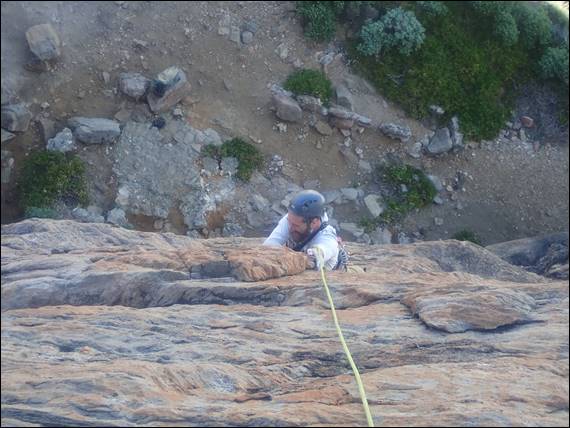
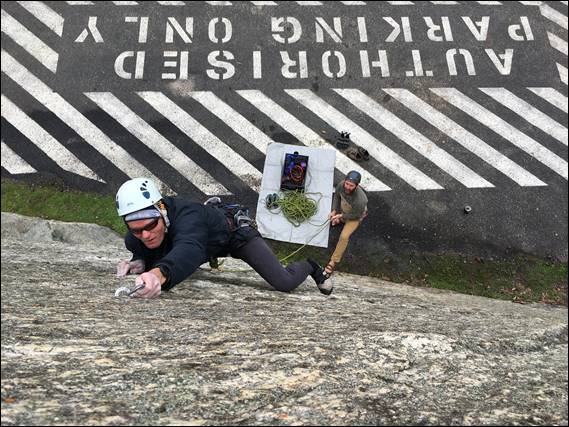
We had come here specifically to allow Howsie to progress is on again off again 2023 challenge. The difficulty of climbing for this year is entirely achievable although like so many other activities, it is of course relative to someone’s ability. And for us grade 23, while not a ridiculous target, is a level of difficulty that we do not often extend ourselves too. The other thing I considered for today was the way Howsie’s mind can work against him when a climb gets a little testy. So I decided to encourage him to start at a reasonable grade so as to get into the right headspace:
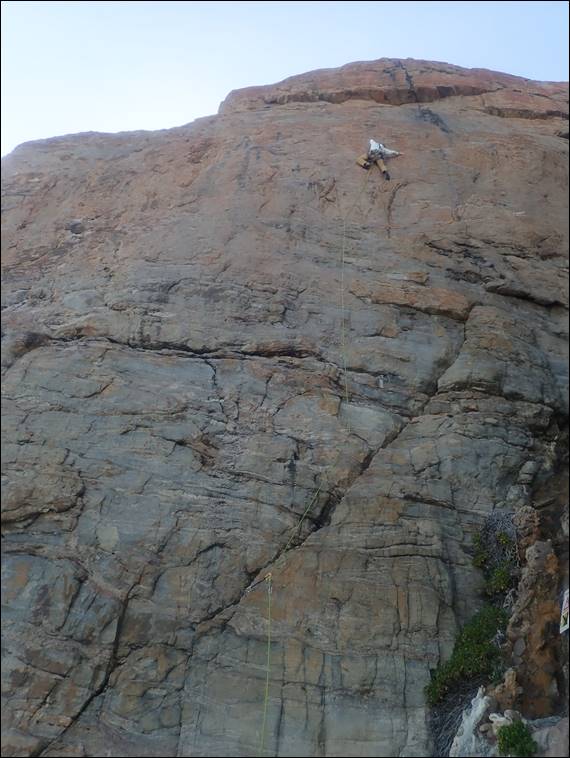
On the “warm-up” lead at grade 19 he got up to his usual antics of letting his mind play games. It was a good prompt to have a little chat about it and make sure he could shake it off for his next lead. Before that he had a slightly more relaxed second following me up a grade 17. Then we headed across to Steel Wall for the main dish of the day, a dish that Howsie has never sampled. The lower section is shared with climbs he has been on numerous times before, but once past the horizontal break every hold and position would need to be figured out on-sight and I was not going to give anything away:
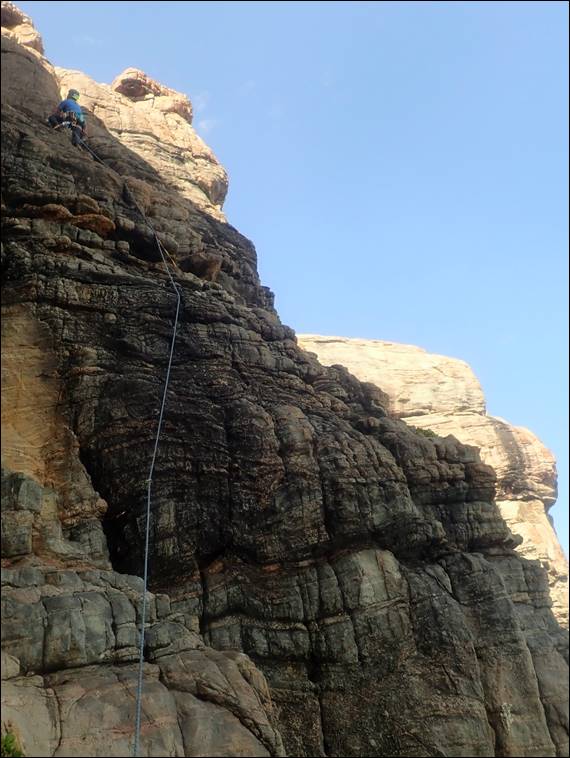
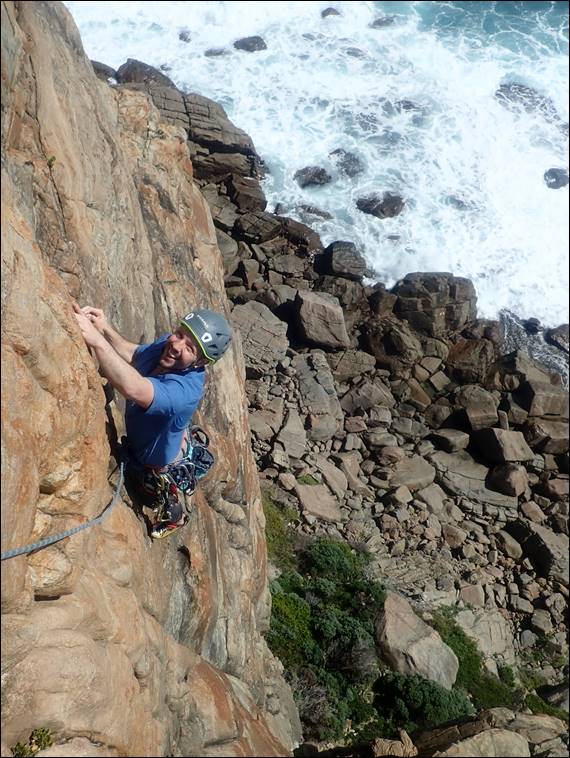
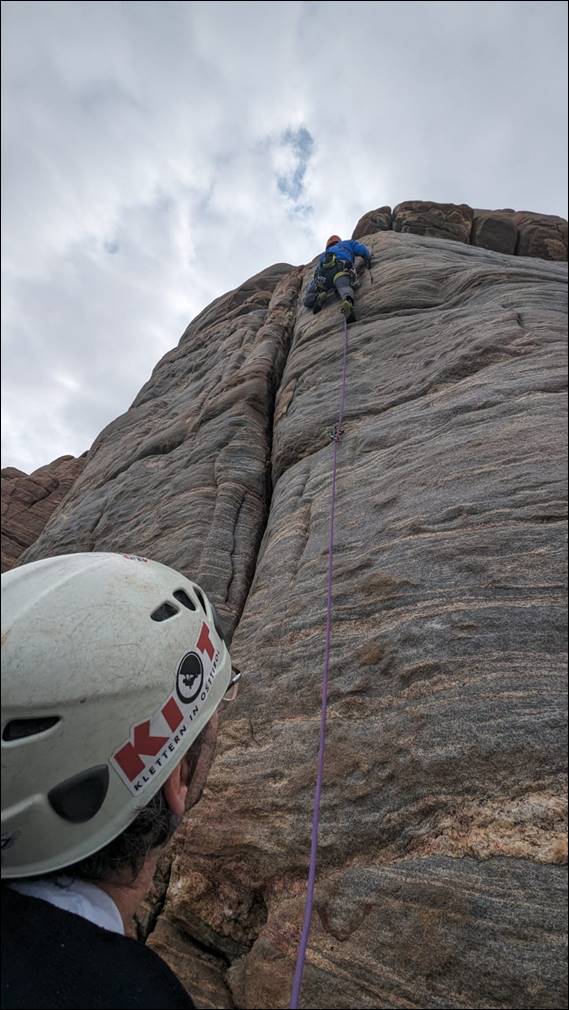
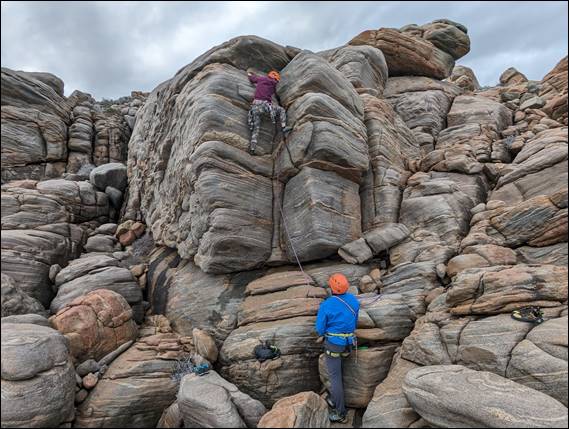
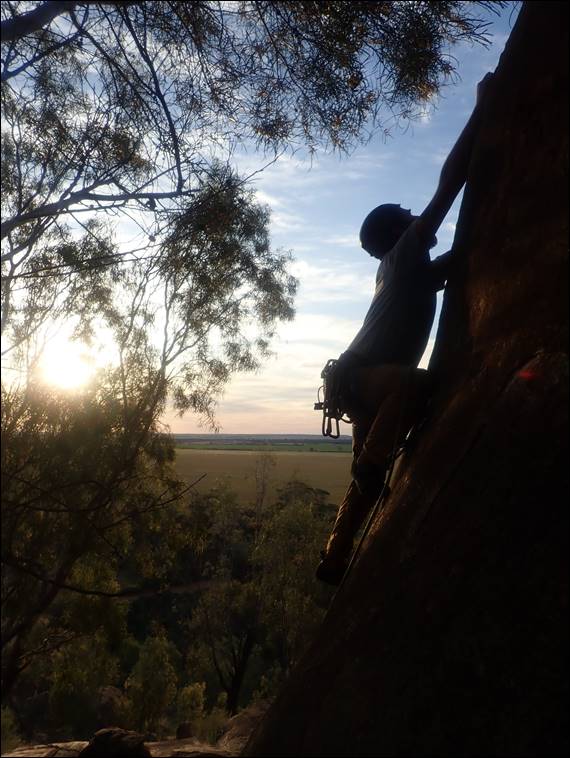
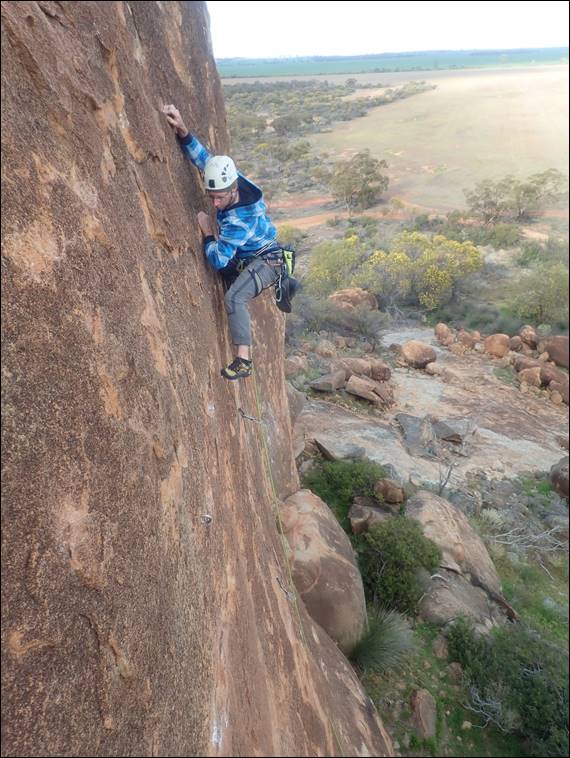
The tactics for the first route seemed to be working, and he tackled this much harder line with a completely different attitude. Not so afraid to go for it and being that bit bolder when the going got tough, and there are plenty of places on this climb where that happens. I do not think there were any expectations from either of us that it would be a clean lead or that he would necessarily top out. But it was good to see him focus on working out each move one step at a time, and then be prepared to accept the airtime when his fingers couldn’t cling onto the small crimps or his feet couldn’t stick the awkward holds:
After an hour on the wall and quite a few big falls he finally conceded that his body was physically exhausted and he had reached the high point on this particular route for the day. To give you an idea of how long that would have felt like for him, both of us had romped up the first two climbs in the same time he had worked just the first two thirds of this climb. This meant the gear was still hanging on the wall above us, and to retrieve it there were two options. The first being for me to head up and finish the route, and then Howsie could follow up with the safety of having a rope above him:
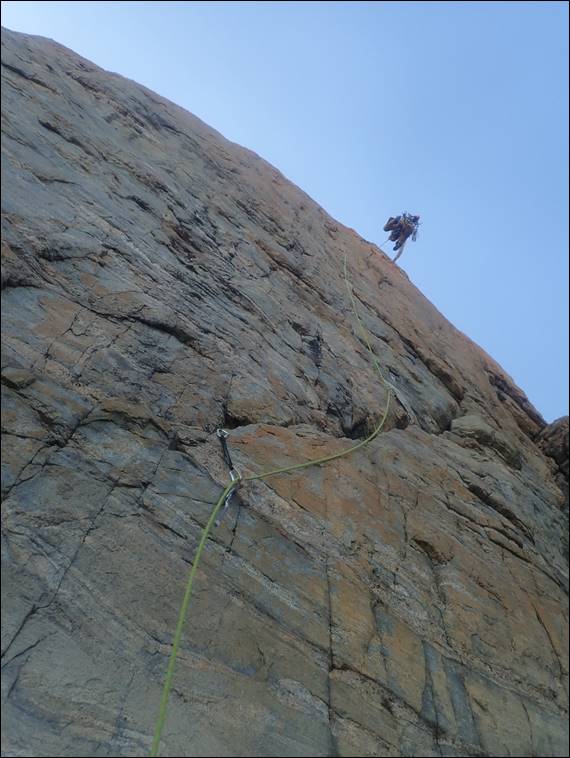
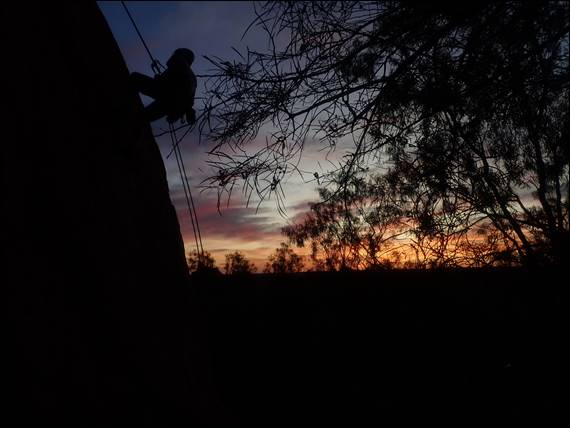
This would have however given him intel on the holds, moves, and positions that he had, as yet, not encountered. After a bit of discussion it was agreed to go for option two, which was for me to run up a different line on the same wall to allow us to rap down to clean the gear of his route. The climb we picked was still no walk in the park at grade 20, with a steep fingery crux section that spat him off. It was a battle but eventually he got up, after which I rapped down to clean his line while he wandered down the path. That way he was still none-the-wiser of what the rest of his climb had instore for him. Back at the base it was clear Howsie didn’t have much left to offer, so it was a gentle climb out on a grade 13 with packs of course:
He had just enough left to get up the last climb of the morning. Made extra special when we spotted two Southwestern Carpet Pythons (Morelia imbricata) on route, a Bark-mimicking Grasshopper (Coryphistes ruricola) that waited patiently in position so we both got to see it, and then as we sat atop looking out to sea we got to watch a whale breaching. And while there were no crustacean in sight, Howsie confessed he was feeling a little shellfish for not wanting me to finish off the grade 23. I was however not crabby about it, as I wanted him to enjoy stepping into the unknown above his high point on his next attempt:
Less than twelve hours after completing the twenty eight hour door to door trip home from the UK I was meeting Rob in the Capel, at the slightly tardy time of eight in the morning. He was a little surprised that I was keen to get out, but I find that getting straight back into a routine is the best way to overcome jetlag. And what better way to do that than heading out and about on the first day into the fresh air and being active. Rob kindly offered to drive today, and I was more than happy to accept his offer:
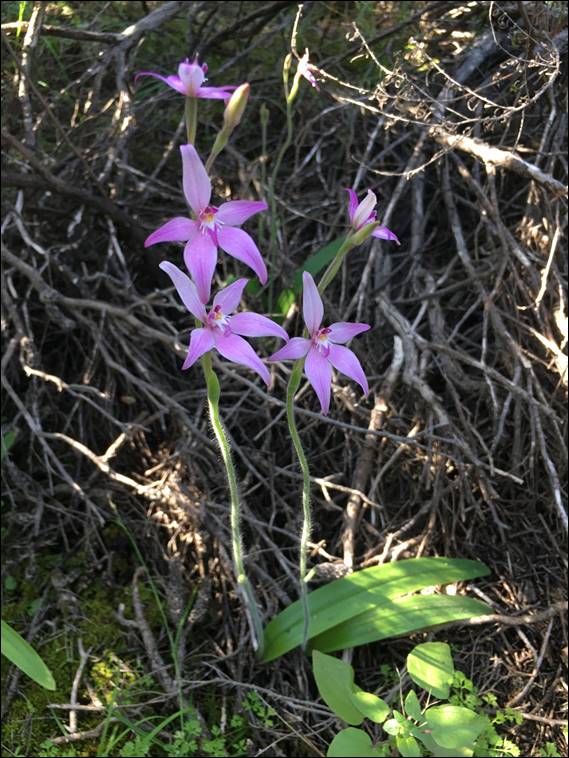
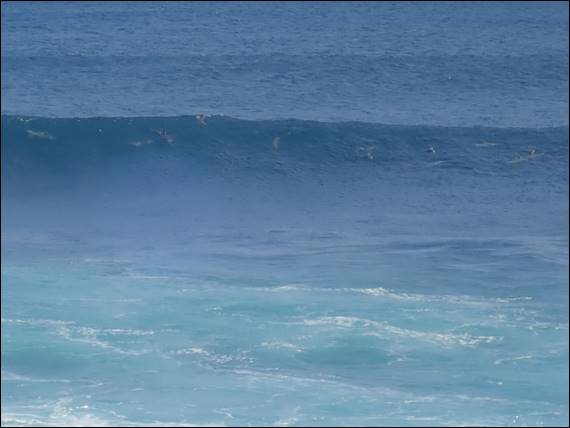
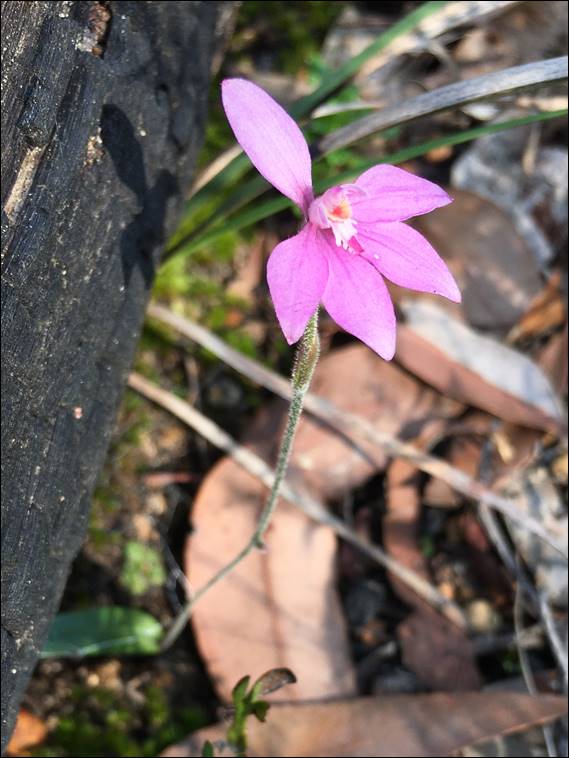
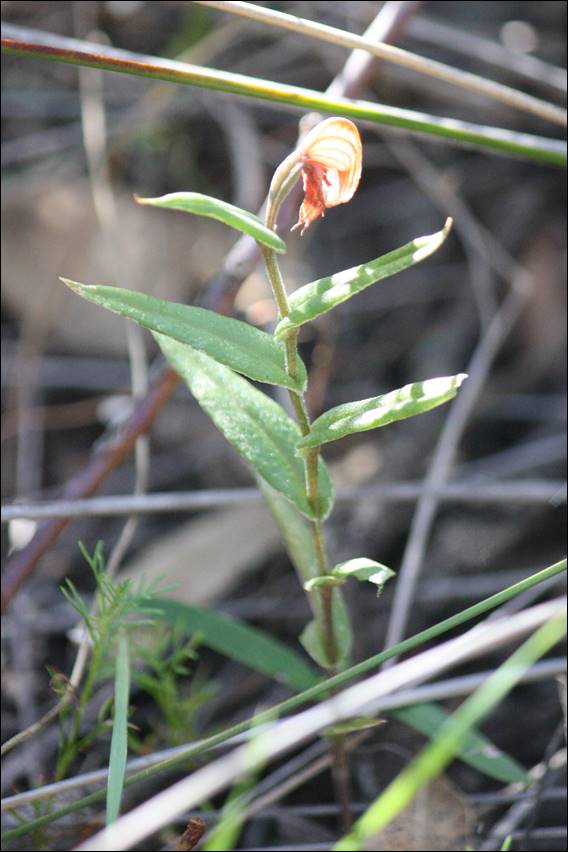
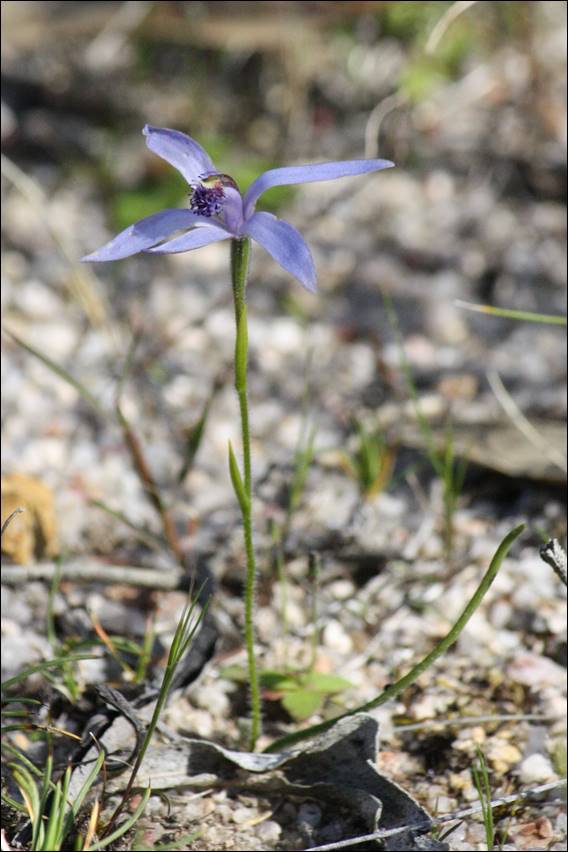
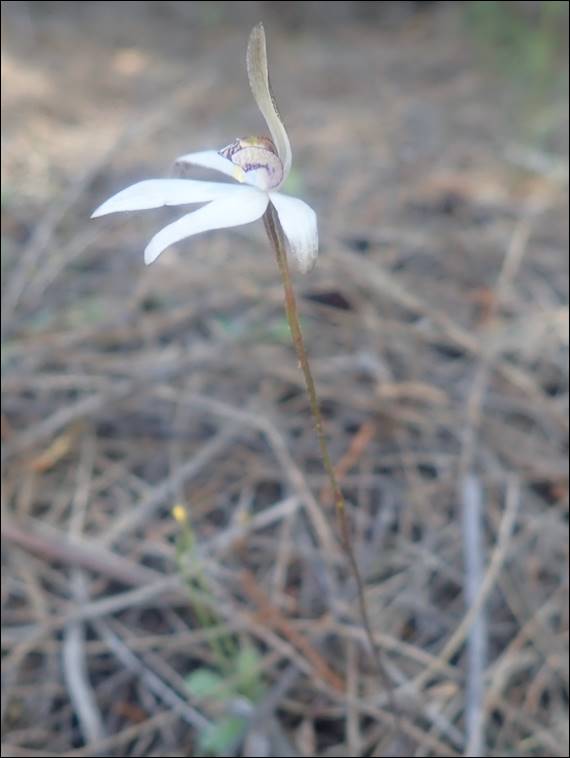
What a way to come back home, wandering down to Wilyabrup and be greeted by orchids and a good half hour display of aquatic acrobatics by some fifty plus dolphins. I found out that Rob’s wife also likes orchids, so to allow him to remember what we saw I’m going to recount them but have only included an image of a Pink Fairy (Caladenia latifolia), which was out in abundance. The others in flower being Purple Enamel Orchid (Elythranthera brunonis), Murdoch Snail Orchid (Pterostylis ectypha), and Cowslip (Caladenia flava):
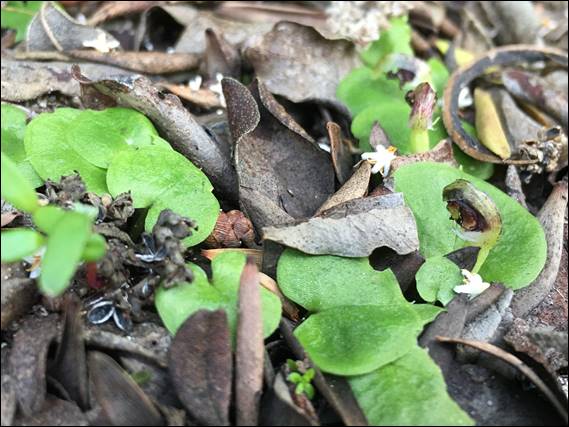
And just because I am so stoked to have spotted it this year, I couldn’t help myself from also showing him the tiny basal leaf of the Sandhill Helmet Orchid (Corybas despectans), the flower of which was now completely gone. It took a while before we started to climb, as the dolphin display continued. Each time it looked like they were moving away they came back for another play in the waves, until finally they continued south out of sight. Despite already being past nine we were the only ones to enjoy the show, having the place to ourselves:
We continued to be alone the whole time with no other climbers, tour/school groups, or even walkers being about. It is a rare occasion these days not to see a single soul, but we did not complain. Having the pick of the climbs, I left Rob to let me know what he was keen to have a bash at, whether on lead or second. Picking off some of the relaxing classics with nothing too serious, which suited where he is currently at with his climbing and I was at with my slightly woolly feeling head and slightly lethargic feeling body:
I was a little surprised when he suggested one particular line, being a long and very enjoyable climb that has a start that puts many off. Fairly graded, in my opinion as a traditional climber, but gym and sport climbers claim it is a complete and utter sandbag. This made me think about a TV series called The Climb, which I watched on the flight back from the UK. A bunch of amateur climbers were given the chance to win sponsorship to launch their professional career, and of all the climbs they were put up against there was only one traditional climb:
The rest were sport climbs with bolts, bouldering problems protected by crash mats at the base, and deep water solo routes above the ocean. Interestingly, traditional climbing was talked about as being the most dangerous form of climbing, despite the cuts and bruises they got on the dynamic sport routes; several scary falls from the boulder problems with one that resulted in a knee injury requiring care; and the numerous up to 20m falls into the ocean for which if the entry into the water was at the wrong angle could have resulted in serious injury:
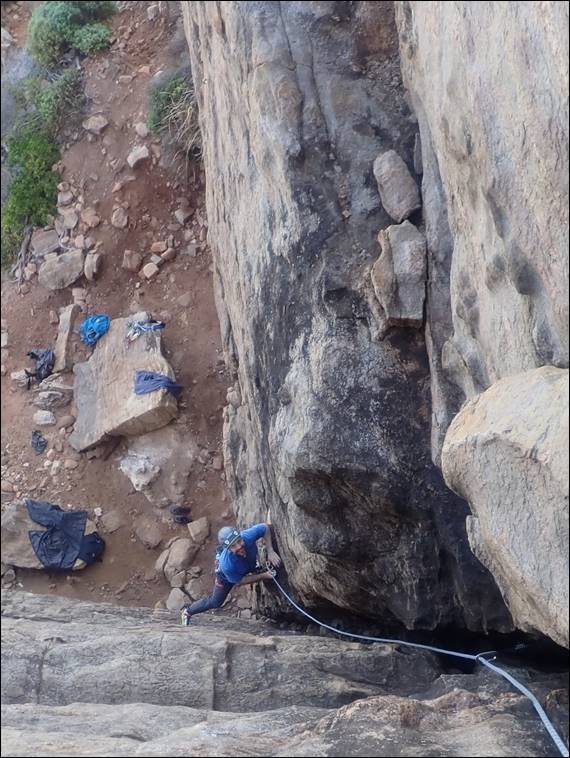
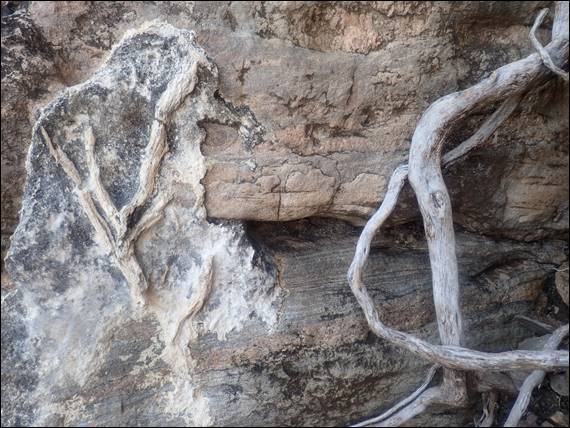
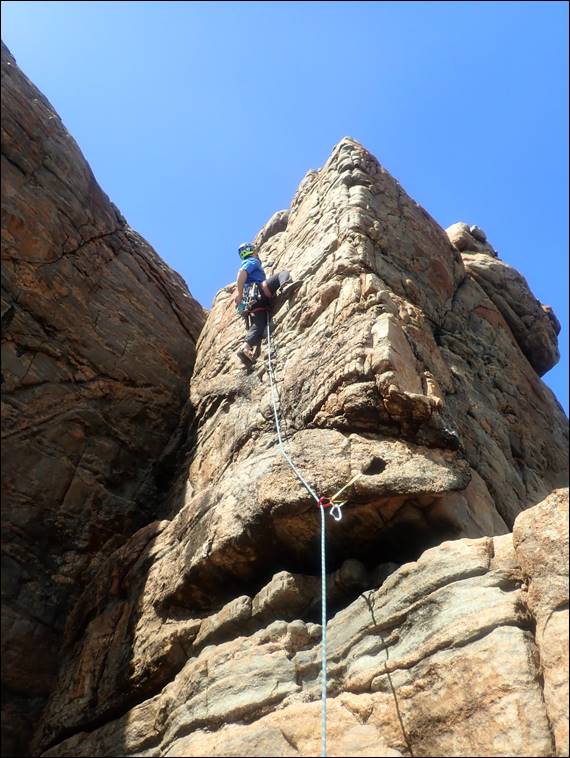
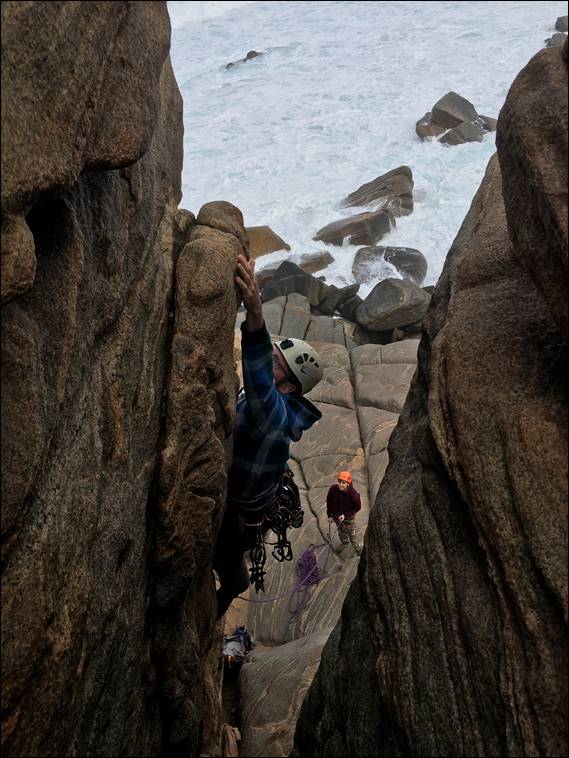
On the plus side if such fallacies about traditional climbing keep areas such as this relatively quiet then that is fine with me. And getting back to the line I was surprised Rob was keen to follow me up, I thought it may have unnerved him to take on another lead. He did waiver for a bit but I managed to encourage him to keep going. He managed a clean lead on a line he had never been on before, which was great to watch. Despite coming to these local areas so often I am still surprised at what I have overlooked, such as the sight in the above image:
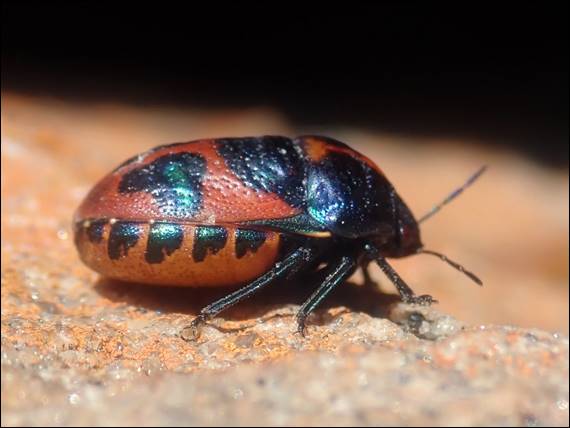
How I have missed seeing the contrasting calcified roots or branches right next to the dry bare roots I have no idea. I also missed this little fella, which Rob spotted, and despite the orange colouration of this specimen it is a Red Jewel Bug (Choerocoris paganus). I was starting to tire but rather than walk out we decided to climb out. Hoping to, but not, finding one more scaly friend in addition to the many Southwestern Crevice Skink (Egernia napoleonis) and Buchanan’s Snake-eyed Skink (Cryptoblepharus buchananii) who today, like us, were just enjoying being out:
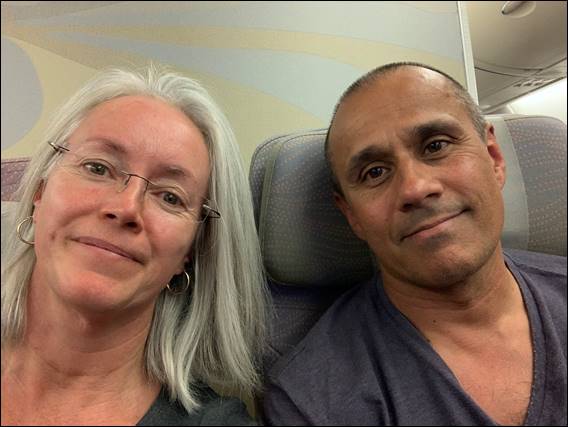
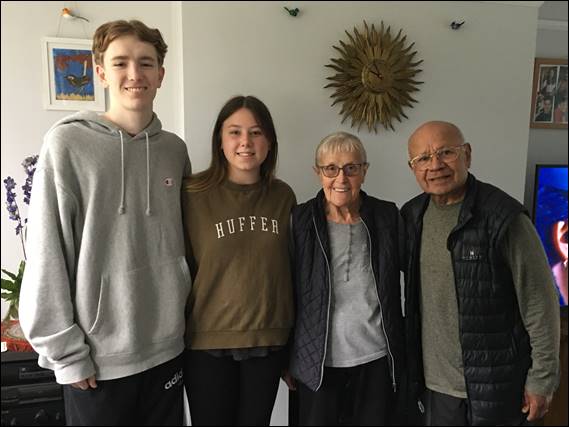
Last year Lisa and I went back to the UK separately at different times and to different locations. This time we went together to spend some time with, and look after, the folks while Seeta, my sister who is there primary carer, took a well-deserved holiday with her family. Both my Mam and Dad will tell me often that getting old is no fun. They are however lucky in many regards, as while their physical faculties are reducing they have not been hit by certain ailments that bring a debilitating loss of cognitive functioning:
Not only did Lisa join me, but Elseya and her boyfriend Griffin also came along. It’s been five years since Elseya has been back to the UK so she was keen to see her Oma and Opa, which put an extra wide smile of the folks face. Griffin has travelled with his family, but never to the UK. I personally feel he was pretty brave, seeing it was yet again a short and sharp week long trip with a sole purpose of looking after the folks. That did not however stop the two of them from taking advantage of being in the UK and doing some exploring by themselves:
We arrived in time to catch up with Seeta and her family for a few hours before they departed for sunny Spain. Wend were then left with their house and car keys, allowing us to settle in after the long trip. For the first night we also had a surprise visitor for dinner. Angus, my brother, happened to be working not too far away and was staying up for one night so joined us for a scrumptious Chinese. Unfortunately, we brought bugs with us resulting in some of us not feeling all that great and impacting how much we did:
This understandably reduced Elseya and Griffin’s motivation to get out and about as much as they could have. They made plans to travel bit further afield to check out a few sights that they respectively had interests in, making use of the far improved rail network that the UK offers in comparison to Western Australia. Sadly, as it was only one trip became reality being a short day into Manchester. That said they enjoyed themselves and it may have given them a taste enough to want to join us again one day in the UK to get a bit further afield:
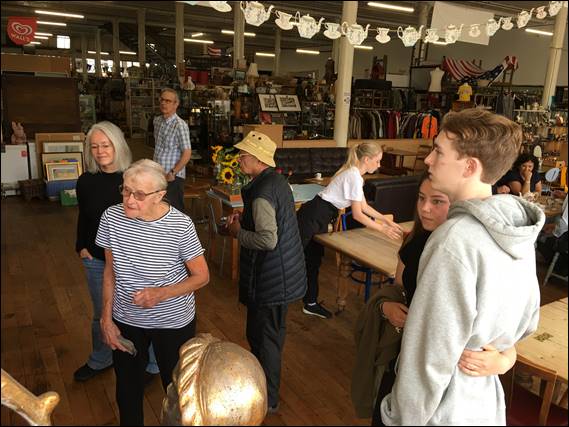
As can be seen we did still got out and about with the folks, sticking mostly to local places. Staring with the must do visit to Pear Mill. If you are keen to read a bit more about this unusually place check out the post of my last visit https://sandbagged.blog/2022/08/01/time-to-head-back/. I thought this place with all of its antiquity and quirky items would be of interest to both Lisa and Elseya and was not disappointed. For Lisa it brought back a bounty of memories and Elseya got drawn in by the abundance of interesting items to check out:
So much so that we ended up with a second visit there, this time with Lisa’s Mum and sister, Becky, who came up from Torquay for a day visit adding to more family for Griffin to meet. This required a four plus hour journey each way, so we were very appreciative of them making the trip. Rewarding them with a visit to see my folks followed by a brew and trip down memory lane at Pear Mill. A place that Lisa’s Mum never got to when she used to live not that far away from here. Then it was onto the Romiley Arms for a lovely late pub lunch, before they had to start to the long trip home:
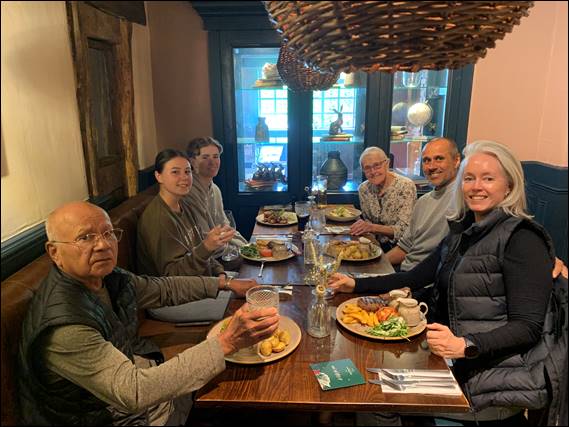
Pubs were of course part of the itinerary, and we managed to get to a few. This included a couple of lunchtimes out with the folks, with one that I was particularly keen to try. The Hare and Hounds is located at the top of Werneth Low, a hill that is part of the Pennine range and offers great views across to Manchester. I have passed this pub numerous times on my early morning walks in previous visits, and it looked good and certainly was. This time I didn’t get any early morning walks in, having the family with me it was a different kinda trip:
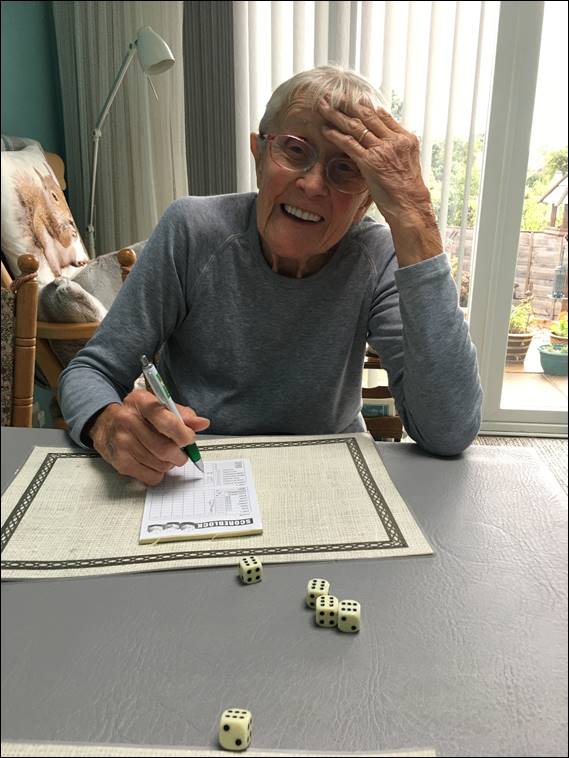
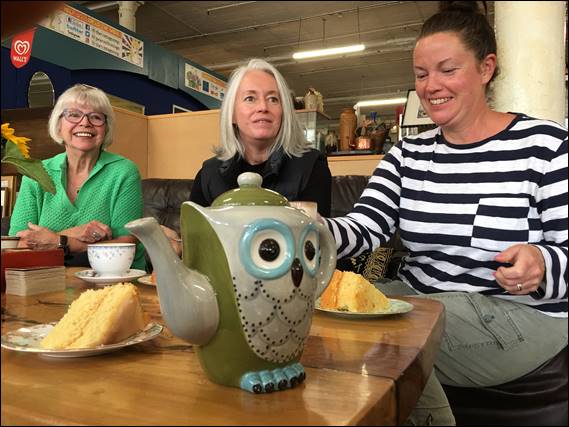
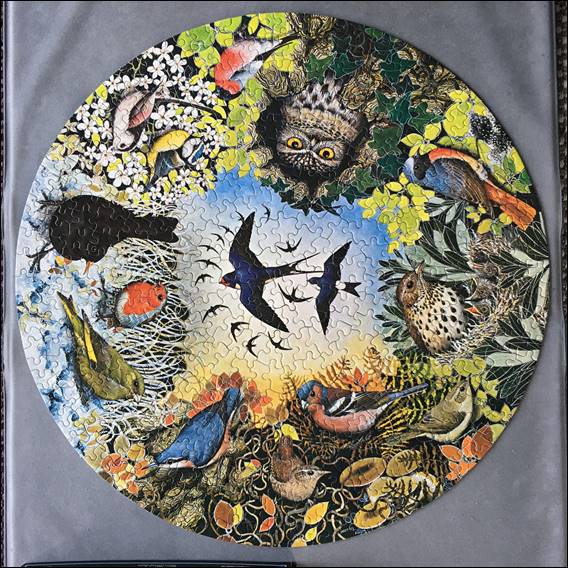
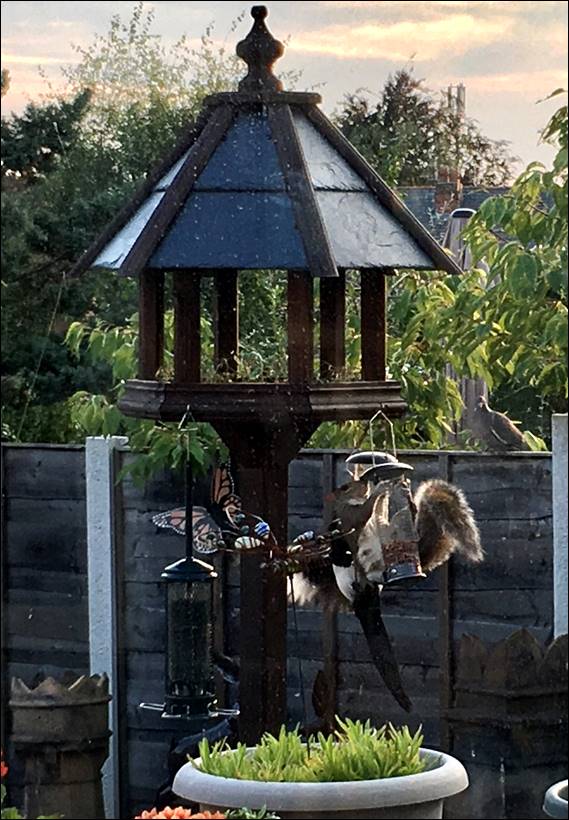
That said some things didn’t change, including playing games and getting through a few puzzles. And while we managed a few trips out, my folks mobility has certainly declined since my last visit in March this year. This meant the times we headed out only included a short walk. That is not to say they are house bound and we did the odd walk into Romiley with them to have a feast in a café. I had to include the next not so clear image, my Mam likes to watch the birds and also gets a visit from a local squirrel twice a day:
This has resulted in needing to reinforce the feeders, which the squirrel can gnaw through and destroy in one visit. There are squirrel proof bird feeders these days, which means the birds have a chance at having a feed too. But on this occasion a Jackdaw was more interested in having a go at the squirrel than getting a feed. This show went one for a while before the squirrel decided it wasn’t worth hanging about. Unfortunately, the weather came in for the second half of the trip, and this prevented us doing as much as we would have liked:
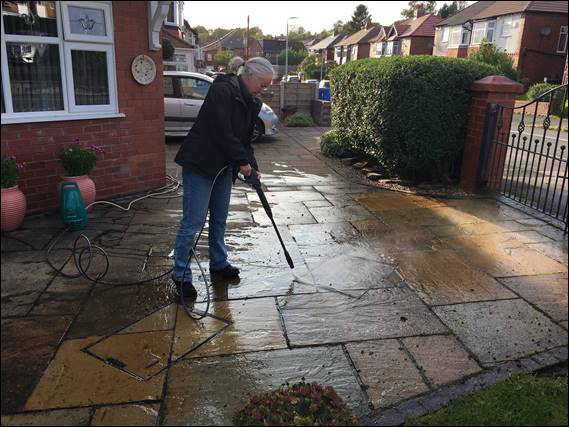
It was in this period that Elseya and Griffin finally managed a trip into Manchester, and got drenched. Meanwhile Lisa and I took the folks out for another pub lunch at the local pub called the Spreadeagle. A pub I have memoires of having a magnificent feed many, many years back. And again was not disappointed, enjoying another feast while we watched the driving rain outside. On the plus side the rain made us realise how slippery the paving at the house got when it rained, due to the build-up of algae:
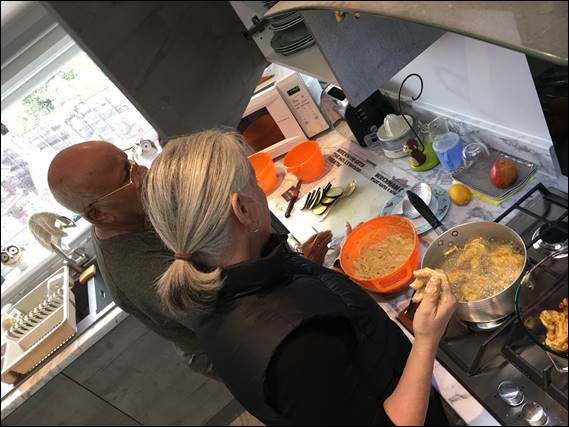
Lisa spotted a pressure cleaner at Seeta’s place so we were happy to provide assistance with many the less than enjoyable chores she has to manage, by cleaning the paving. Just like on previous visits, we did not spend time on the chore of cooking. Making life easy by taking advantage of the many varied takeaway and eating out options right on the doorstep. There was however one meal that was cooked, being onion bhajis. A dish my Dad used to cook on a fairly regular basis as we were growing up:
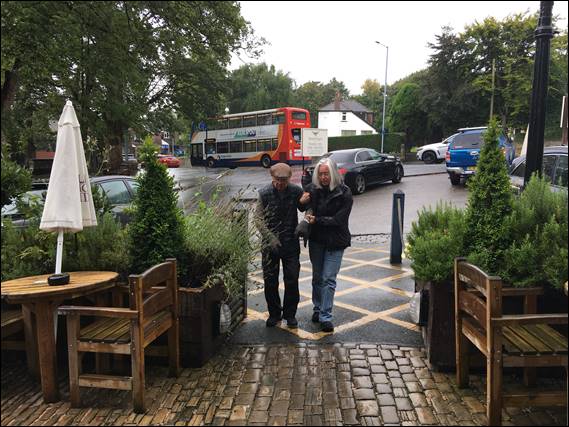
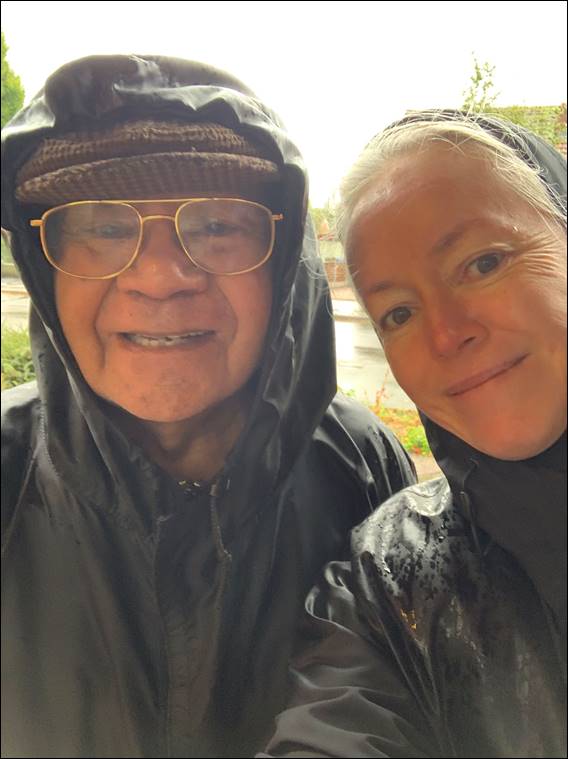
It was certainly a little different not staying at my folks house, but with four of us that would have been too much for them. It was also handy for us to ensure that my sister’s house remained occupied. That didn’t stop us spending a lot of time round the folks place and had fun times. My Dad was invigorated by our visit to risk his morning walk to pick up the paper even when it was wet and a bit windy. Enlisting the use of Lisa’s arm to hold onto, as they braved getting wet while I stayed dry and warm puzzling away with my Mam:
Elseya and Griffin also got sucked in by the puzzles. All up we managed to finish the one that was on the table when we arrived, complete three more, and get a fifth started leaving that one for my Mam to complete. As has happened on each visit, the week came to an end all too soon and it was time for us to head home. Being the same day Seeta’s family returned from Spain, to ensure the continuity of support was there. All things considered the folks aren’t doing too bad, and while getting old may not be fun we all had fun during our visit:
It’s been a while since Sarah has joined us for a climb, so we let her pick the location. I was happy when she picked Moses Rocks, which always offers a fun outing. There are two areas of Moses Rocks that she hasn’t climbed at, but the conditions today were not conducive for either of them. To be honest neither Rongy nor I had anything in particular in mind. So we dumped the bags at the first area the walk-in takes you past, and started climbing. Picking lines that we had not been on for a while:
Rumpoles Rocks was one of the areas Sarah hadn’t climbed at, but the routes can feel a bit tricky and maybe would have felt harder in these conditions. That said not all the ones we climbed today were Sarah’s cup of tea, but she was happy to simply be out and jump on routes that looked appealing. I was pleased this included Hathersage and Stanage Youth, just because the names have references to the Peak District in the England. But Classic Thrash, above, and Kami-kaze Catfish did not pull her in:
The latter almost being a bit too much for me and I almost peeled off. Deciding to move to another area Sarah was still not too keen to jump on rock, allowing Rongy and I to pick a couple of choice routes on Hands Up Wall. Both selecting climbs named after characters of the satirical British comic Viz, founded in 1979 and very popular in the 80s when the routes were established. Rongy enjoyed delicately slabbing up Johnny Fartpants, which inspired me to have a bash on another route I haven’t led for a long time:
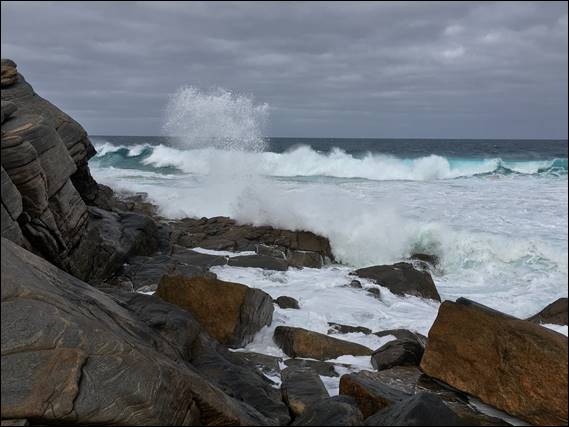
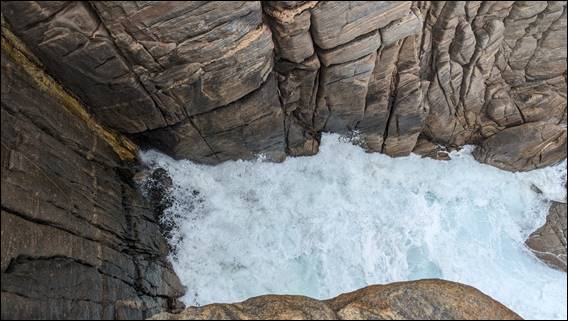
Fat Slags, above, climbs in a similar fashion to Rongy line but is just that bit steeper. Good friction is required to avoid popping off especially at the very start. Fortunately, despite the high tide, rough swell, and strong onshore winds, the rock was in great condition. These conditions did however keep us out of the Zawn, below, being the second area Sarah hasn’t climbed in. While I didn’t falter on my climb, Sarah made me almost fall over afterwards by saying she wanted to have a climb, on lead:
Since I have known her, she has adamantly stated she would never lead climb. And I’m still not sure what made her decide to change her mind and have a go today. I’m not however one to hold people back when it comes to having a go on lead. She’d also picked out the route based on the description in the guidebook, which I wrote, so I have to say she picked well. Mini Thor is a short but great line, so after a bit of tuition on lead climbing she set off. Whatever was holding her back from following us up the other lines, was vanquished:
Not showing any signs of nerves and placing great gear, which is plentiful on this route making it a great beginners climb. Rongy couldn’t recall previously climbing on this small face, probably having walked past it numerous times and overlooking it because it is so short. But after climbing Sarah’s route, his eyes were drawn to the slightly overhanging wall to the left. Offering the slightly pumpy Blake and the Thoroughbreds. Maybe it was the steepness but Sarah wasn’t interested in that line, and had even taken her harness off:
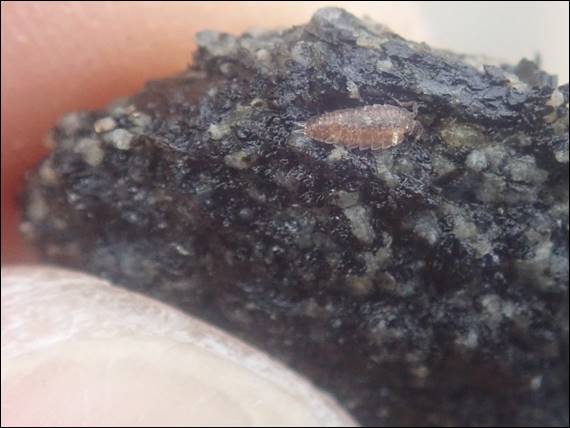
Not a reptile was in sight, despite both of us checking lots of nooks and crannies. Other than the occasional passing gull, the only creature spotted was this tiny Deto marina. It probably wasn’t more than a few millimetres long. Sarah spied it, and my eyes would never have noticed it without a magnifying glass. It is a genus of the woodlice family, and known to live in intertidal zones on or under rocks feeding on algae. There are five confirmed species, but only this one is listed as having been sighted in Australia on the Atlas of Living Australia:
To give you an idea of scale, a small part of my thumbnail is at the bottom of the image, so some may say I’m forgiven for not having noticed the creature. Sarah surprised me one more time when she said she was keen for one more route, but this time on second. So her harness went back on, for Many Hands on wonderfully rounded holds to round of our time at Moses Rocks. While they may have thought the climbing was over I led them on merry way back to the car that included just a wee bit of scrambling:
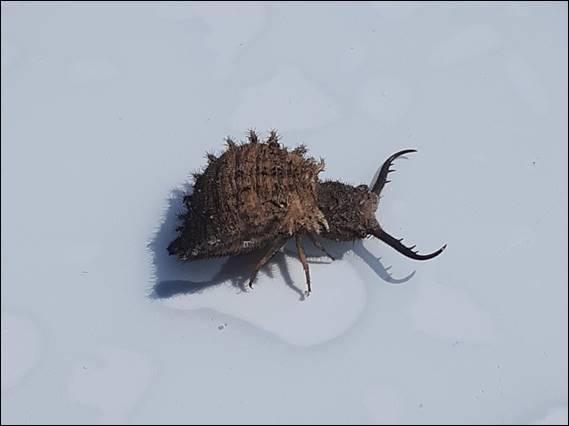
Being early spring I try to temper my expectations when I head out for a wander. This week managing two visits into nature, intentionally squeezing them in as I won’t be out and about as much as usual for a couple of weeks. However, before I managed my first excursion Pat from work, who is keen to get out on rock so you may hear about him again, sent me an image asking if I knew what he had found. I did and it reminded me of when Lisa and I used to work at Ooraminna Station Homestead some 40km south of Alice Springs, where I used to take tourists on nature walks:
Being what is commonly called an Antlion (Myrmeleontidae), although with approx. 2,000 species worldwide I won’t even attempt to work out which one it is. The family name originates from two Greek words of mýrmex and léon, meaning ant and lion of course! As you may have guessed their primary diet is ants, and I can only assume the term lion is used due to their ferocious ability to capture their prey. The species I am familiar with do not however hunt them like lions, but trap them in the conical pits they dig in sandy soils. These pits are no bigger than 5cm deep and 7.5cm wide at the top:
The steepness of the sides are enough to result in the ants falling to the base, underneath which the Antlion, with its scary looking mandibles, waits. If an ant looks like it might escape Antlions have been observed to flick sand at it to make it loose its footing, and tumble back down. Antlions are the larva stage of this insect, which can last years and during periods of no food they can stay dormant underground for many months. When they eventually transform into their adult phase they become airborne as Lacewings, whose life span is much shorter at 25 to 45 days:
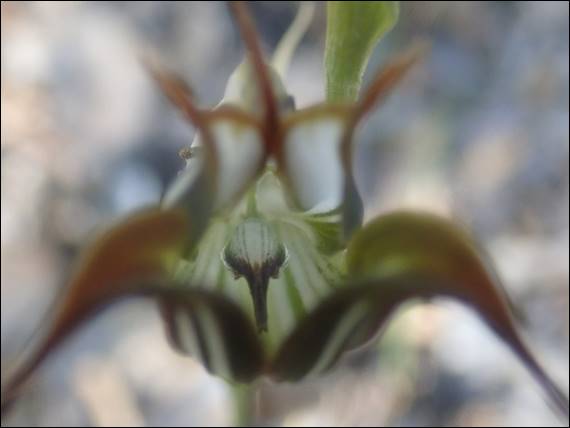
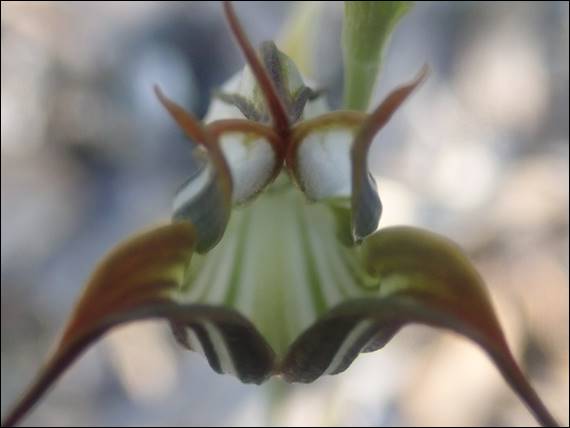
During my nature walks at the homestead, and those for my own pleasure, I have only had success in finding an Antlion once. Pushing my hands round and under the pit and sieving the sand out through my fingers, so it was really cool to the one Pat found. I’ve described the insect luring and trapping nature of Greenhood Orchids several times, but unlike the Antlion I thought they did not consume the insect merely use them to facilitate pollination. Done by forcing them to escape the trap and brush past the stigma to deposit any pollen on them and then the anther to collect pollen from the flower. The above and below images are taken from the top of the same Jug Orchid (Pterostylis recurva):
Taken before and then after I managed to trigger the labellum, by giving the flower head a little shake. This was enough to trick the sensitive-to-the-touch labellum into thinking an insect had landed on it. In the second image it has sprung towards the back of the flower, an action that traps the insect and forces it to crawl up past the stigma and anther to escape. For those keen I have found a website that has some great imagery of this, and a theory that the plant-insect relationship could include the need to trap and kill a gnat after pollination (https://www.foxeslair.org/foxypress/shell-and-jug-orchids):
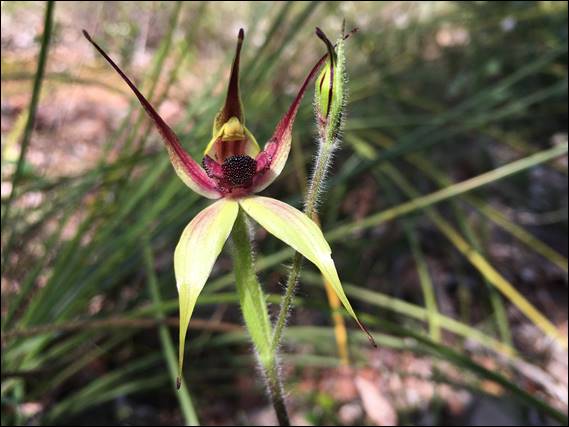
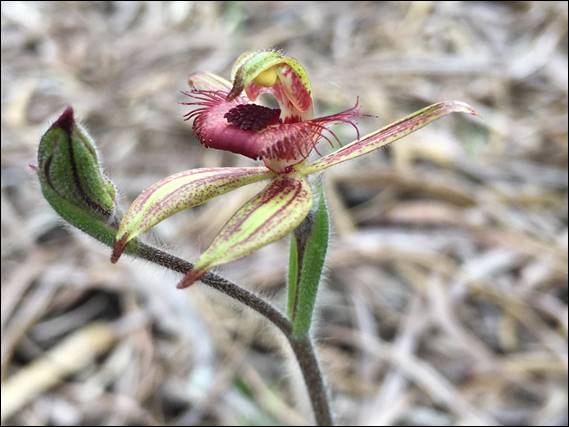
Other than the first image of the Antlion the others until now and below are from a wander at the Capel Nature Reserve on Thursday. Knowing how mosquito ridden this place can be I wore closed in shoes, which is a rarity for me. This helped minimise the number of successful strikes these pesky insects managed to get. Things had certainly progressed here. The first image is of one of the many Sandplain White Spider Orchid (Caladenia speciosa), and below is the only Flying Duck Orchid (Paracaleana nigrita) I found in flower. But the above orchid, which was just starting to come out in numbers, is the one to go here for. The Chapman’s Spider Orchid (Caladenia chapmanii) is, in my opinion, one of the most spectacular spider orchids:
There were others I spotted at Capel, which I was equally excited about but I am also trying to refrain from repeating the use of the same orchids in too many posts. So onto Friday when I popped out for my first wander of the season round Crooked Brook. Josh, also from work, had been here last weekend and reported that there wasn’t heaps to see yet. It is however in many ways a different landscape to the places I visit more regularly on the more sandy coastal plain, plus a fair bit more had come out at Capel in a relatively short period, so I was keen to give it a go. The lower storey vegetation was certainly full of colour:
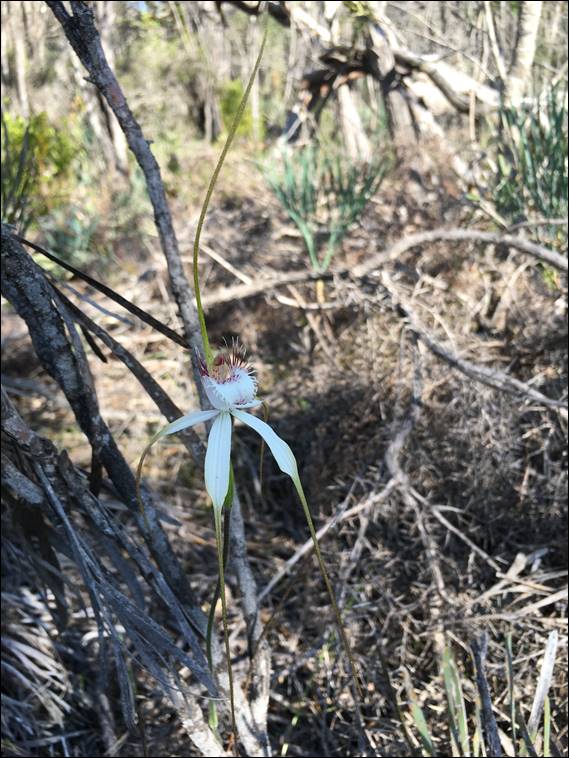
I’ve popped the next image in now even though it was the last species I spotted. Having confessed previously that I struggle with identifying White Spider Orchids, based on the very long petals and sepals I’d suggest this find was a Splendid White Spider Orchid (Caladenia splendens). While they tend to prefer winter wet areas, they are also found at the fringe of granite outcrops were water seepages can occur. So its presence in this more rocky and granitic landscape is plausible. It was the only White Spider Orchid I found, and I didn’t even spot any spikes to indicate more may be coming up:
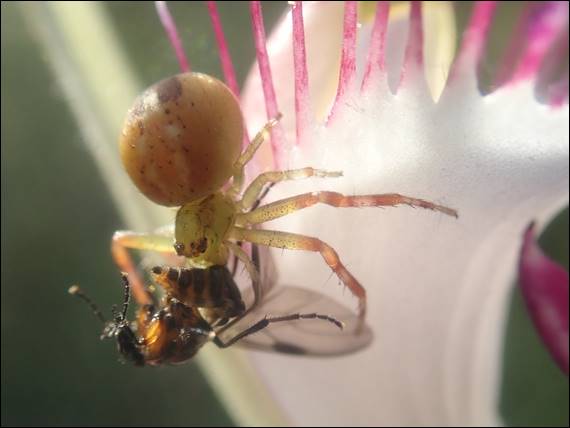
The reason I went out of sequence with my images was because of what was on one of the flowers. Called Flower or Crab Spider, there are three Australian subfamilies and I was able to get good enough images to narrow this one down to the Thomisinae subfamily. The eight eyes that are in two rows of four, are raised above the head on tubercles, and can rotate independently of each other. This subfamily is more drab in colours than the other two being Stephanopis and Tharpyna, but this usually aids with their camouflage, with some species able to change colour to match their home:
They are territorial creatures and you will generally only find one spider on a flower, other than when they are mating. They will normally remain on their chosen flower until it has wilted, and then find another one to claim as home. The colour of this one obviously did not match its chosen home, which may be why I was lucky enough to spot it. At night they hide on the underside of the flower out of sight from their own predators, and by day they becoming the predator. Sitting patiently waiting for prey, they are known as ambush hunters. Using their spiny front legs to grab their prey and then quickly bitting into its head to deliver its venom:
This one had managed to catch a bee. From the shrivelled appearance of the bees abdomen and swollen abdomen of the spider it is fair to say the feeding process was well underway. Comprising the injection of digestive juices to liquefy the bees internal tissues, that can then be sucked up like a soup. So the name Flower Spider is obvious, but why a Crab Spider you may ask. Two reasons, the legs curve forward in a crab-like fashion but also due to the much smaller back legs they are able to, and do, move sideways. I think I’ve managed to narrow this one down, at first thinking it was Diaea cruentata, however it looks like this species was transferred from the genus of Diaea to Australomisidia in 2014. Making it Blood Spattered Diaea(Australomisidiacruentata):
There were of course quite a few other orchids out and I managed to spot two Leaping Spider Orchids (Caladenia macrostylis), easily identified by the cluster of deep purple calli in the middle of the flower. I’m not aware of another spider orchid that has this feature. Above I kept the Jug Orchids (Pterostylis recurva) as the hero of the image, to allow people to get an idea of the angle I was taking images of the inside of a Jug Orchid during my walk in Capel. However, also captured in the above image are five Bird Orchids (Pterostylis barbata), if you can spot them all, which were the most prolific orchid in flower of which I found as many as twenty:
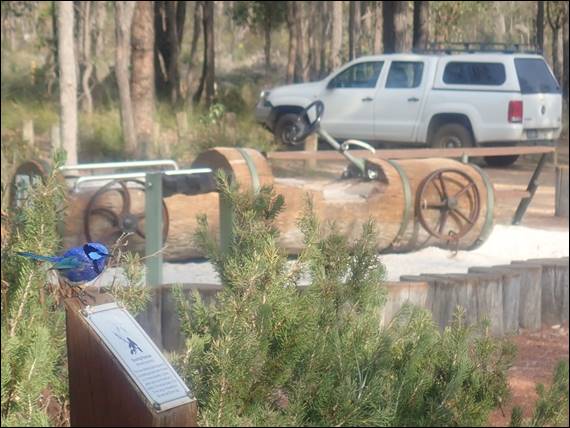
I also spotted a few Little Pink Fairy Orchids (Caladenia reptans), which can be found in clumps but I wasn’t that lucky today. They are often up against the trunks of live or fallen tree, maybe as there is more moisture available. Although there is also a theory it is because of the protection these locations provide the small delicate flower. While I had tempered my expectations this week, I was certainly not disappointed and it is fair to say I was more than pleasantly surprised. Then to top things off, just as I got near the car, a male Splendid Fairywren (Malurus splendens) that would normally not stay still for more than a few seconds sat atop a post for ages:
A damp forecast resulted in me bailing on a trip to Perth to climb with Mario. The five to six hour round trip for a possibly wet rock experience simply didn’t seem appealing. Instead of the excitement of going somewhere new, and as there was the promise of a dry’ish morning locally, Wilyabrup seemed a good plan. With a front edging our way I left Lisa to head to the beach for a plunge in the two plus meter swell, which I hear was “entertaining”. And I drove down preparing for the fresh to strong north westerlies, with gusts of up to 50km/hr. Some may consider standing at the top of a cliff in those conditions is not particularly safe. But I am sure that was not the reason I found myself going solo once more:
Being physced by the fingery crimping we enjoyed last weekend at Eaglestone Rock, I was keen for something similar. The only face that I felt could compare was Steel Wall, which conveniently also has a bunch of bolts along the top to set up anchors. And being as atmospheric as it was today, I made good use of these being tied in the whole time as I moved about along the edge setting up the ropes. I didn’t have much success with throwing the rope down, it blew horizontally and ended up resting on top of the crag to my left. So the raps down included needing to coil the rope, carry it down with me, and feed it out as I abseiled down:
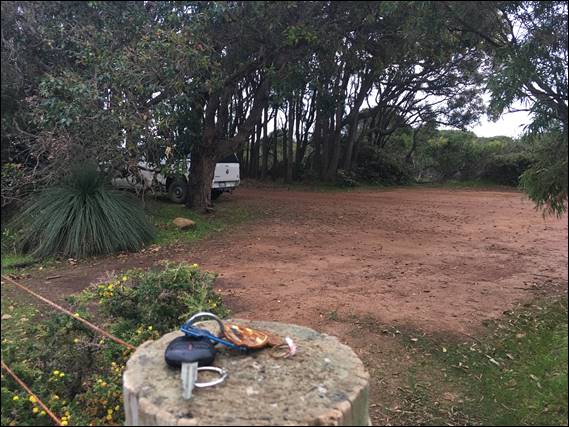
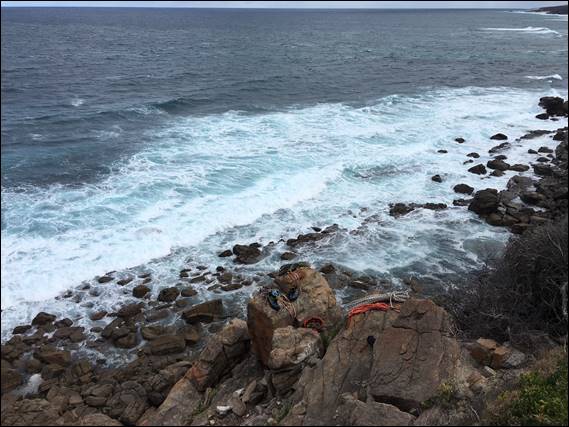
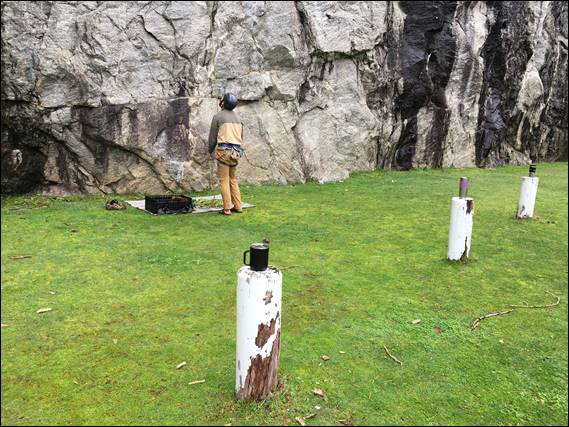
It was a great choice, I love the lines on Steel Wall and the windy day resulted in the rock being super dry. While the rain fell out to sea, the humidity seemed to be really low resulting in every hold, including the small slopers, felling very grippy. I wonder if a couple of the images I have included might have people wondering why. The car keys were on the post as I arrived and reminded me of when I lost mine at The Roaches in England. It seems I made no reference to that unfortunate incident in my ditty about all my visits to that magical place. So below is a brief recount and I still don’t understand the logic of a certain individual:
My keys had a tag on them, so it was possible to get them back to me. Bear in mind this was decades back, so the tag was not electronic and mobile phones were yet to be a thing for the common folk. The individual who found them decided it would be better to take the keys home and then trace me, instead of leaving them somewhere obvious like happened today at Wilyabrup, or at café, pub, or police station just down the road. This decision resulted in hours of hunting all over the crag and eventually needing to have my car towed 300 plus kilometres home. I hope the owner of the keys in the first image has a less arduous and frustrating experience:
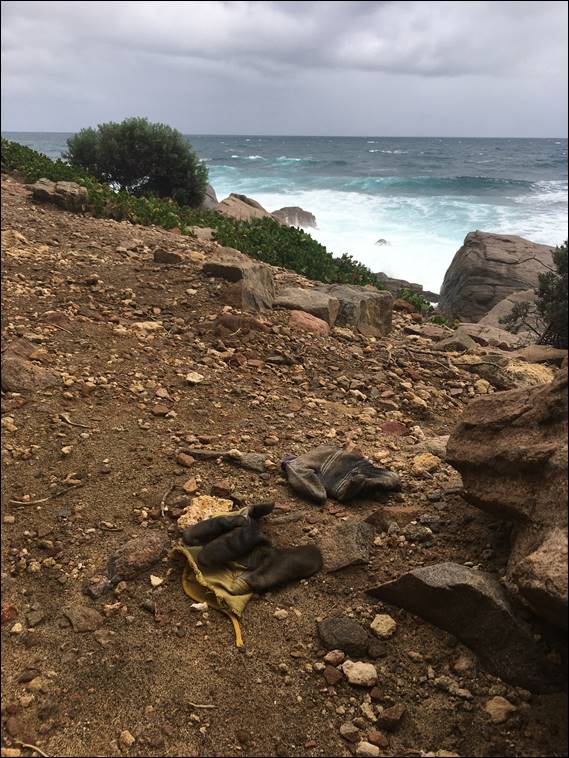
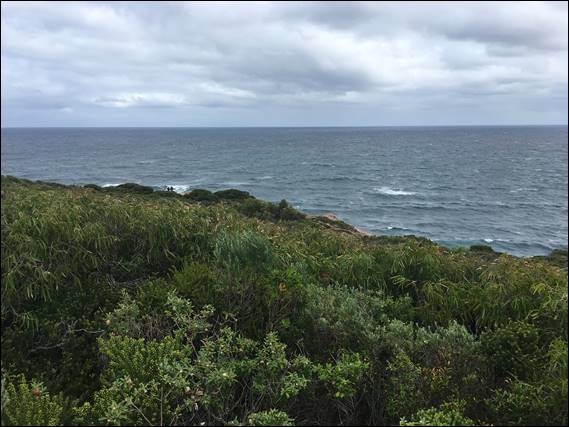
As I was wrapping up for the morning Mick rocked up with a couple of clients, so for convenience he made use of me to ensure the abseil line and top ropes actually got to the deck. It is always nice to catch up with Mick and I was of course happy to help. Other than seeing them I had the place to myself, which didn’t surprise me and suited me fine. If you look above I left Mick and his clients to it, allowing them to enjoy having the place all to themselves as I had. And now I should explain the image of the gloves. These had been left either by a group or some abseilers, I’ve never seen the need to use gloves myself so offered them to Mick. He was not interested so unlike the car keys I took these home where they ended up in the bin:
Heading out solo I generally climb pretty quickly, and it was only coming up to ten as I walked out. There have been a few news articles to suggest that the wildflower season in some more inland areas has been disappointing. So seeing I had finished early and would be driving past a couple of potential orchid sites, I thought well why not and I could check to see if spring had sprung into action at our local spots. I didn’t come across any first time sightings but as Elspeth from work said, when we spotted our first Cowslip (Caladenia flava) of the year, you have to celebrate the first sighting of the new season. That said I haven’t included any images of that Cowslip, nor the others of that species that I spotted today:
My first two images were taken at Ambergate, where I found a few orchids that were getting ready to flower. So for something different I have included images of the orchids I found that were just about to open up, as opposed to orchids I found in flower. The first image is an easy one to identify and there is nothing else like it, being a Rattle Beak Orchid (Lyperanthus serratus). However, the above one is not as straight forward. Definitely a Spider Orchid (Caladenia), but there are close to 140 species in the south west of Western Australia. Taking an punt, based on what I have found at this reserve before, I’d hazard a guess that it may have been a Swamp or Rusty Spider Orchid:
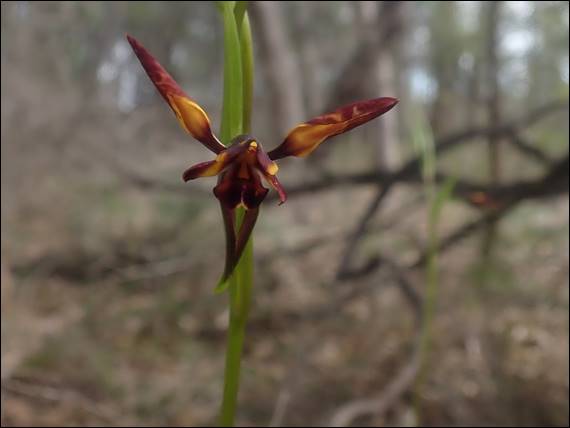
My next stop was way more mosquito ridden, and I do need to be careful as there are reports of Ross River Virus having been detected this year. At Ruabon Nature Reserve I had more luck with orchids in flower, finding both the Yalgorup Donkey Orchid (Diuris porphyrochila) and Kemerton Donkey Orchid (Diuris cruenta). Differentiated by the colours, with the former flower having generally less, if any, yellow and including a deep purple labellum mid-lobe. The flower of the latter is not as darkly coloured being more of a rust brown in colour, other than the yellow “ears” that are tinged rust brown. The colour and pattern of the back of the petals of the above orchid also gave the above one away, being a Purple Enamel Orchid (Elythranthera brunonis):
The bud of the above orchid looks a little like life rafts, but when opened up will become the very distinctive Flying Duck Orchid (Paracaleana nigrita). Duck orchids are often found alongside hammer orchids, this place is no different and below with its much taller stem is the King-in-his-Carriage Orchid (Drakaea glyptodon). So tall that I didn’t get a decent image with the bud and small heart shaped basal leaf. Last weekend when Howsie recounted details from a book he was reading, I suggested that the elbow orchids mentioned may have been hammer orchids as they have an “elbow” joint in them. That was the case, but since my find at Eaglestone Rock I now know there is an actual and completely different Elbow Orchid, and I am still wondering if I’ll drive all the way back to see it in flower in summer:
In the fictional world created by Terry Pratchett, the Discworld is held up by four giant elephants that in turn stand on top of the giant star turtle, as it travels through space. The fifth elephant is said to have crashed into the Discworld at the beginning of time, leaving a wealth of treasures. This may all seem very abstract, but I used to love reading the Discworld books of which there are forty one. They conjured up a magical world filled with wonder and awe, and in truth that is not too far from our world if we care to take the time to look about:
Coincidently this happened to be my fifth trip to our destination, but this time we had agreed that we would take in a few stops along the way there and back. After all orchid season is upon us and this offered a rare opportunity to look round somewhere quite different to all the local spots I frequent. Also with three of us heading out there would be more time to look about as we climbed, and as such I came home with a bounty of images. While I didn’t capture everything I saw there was enough to make me spilt this post into two halves:
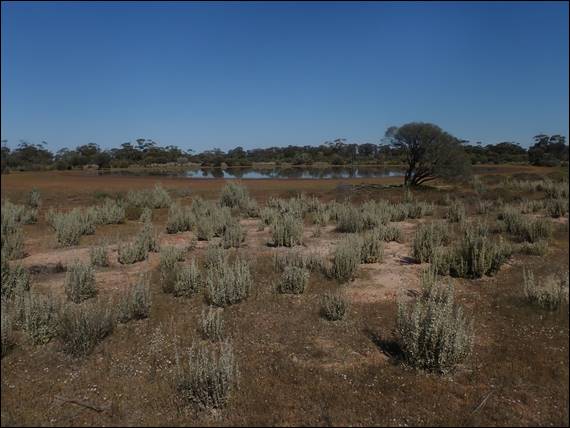
This first half is about the trip in general, and the second half contains a good selection of the flowers, birds, reptiles, and insects. We didn’t need to have an early start and I left home on Friday at 7:30, picking up Rongy and then heading over to get Howsie. From there a three hour’ish north-north-easterly direction took us to Nonalling Nature Reserve. Here we had a bite to eat and popped the kettle on. The reserve, shown in the first image covers some 490 hectares and contains the lakes of White Water and Brown Lakes:
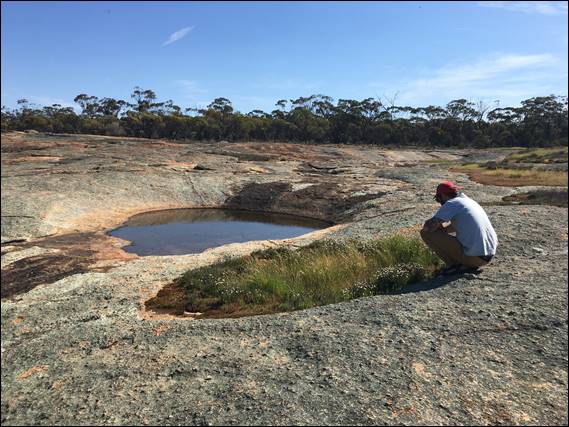
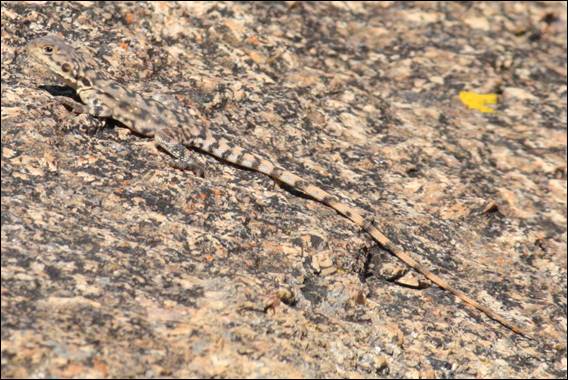
While we only scratched the surface of the first reserve, but what we saw didn’t strike us as being in particular good condition and we failed to find much of interest. But it was a lovely spot to stretch the legs, and once fed with a fresh cuppa ready for the next leg we drove to Totadgin Rock Nature Reserve. A sweltering 32 degrees, but we still walked the approx. 1km circuit that took us atop the granite outcrop. Here we found dragons scampering about and the gnamma holes, which still held water, providing thriving mini ecosystems:
Gnamma holes are natural depressions or rock-holes, which are formed by chemical weathering. These hold water for prolonged periods in areas where rainfall is low and sporadic, and were important sources of fresh water for Aboriginal people. The reserve was really worth spending time at. In addition to the dragons, we found quite a few orchids as we marvelled at other shrubs in bloom and of course the rock features. After an hour an half we hit the road again for the last leg that took us to Lake Campion Nature Reserve:
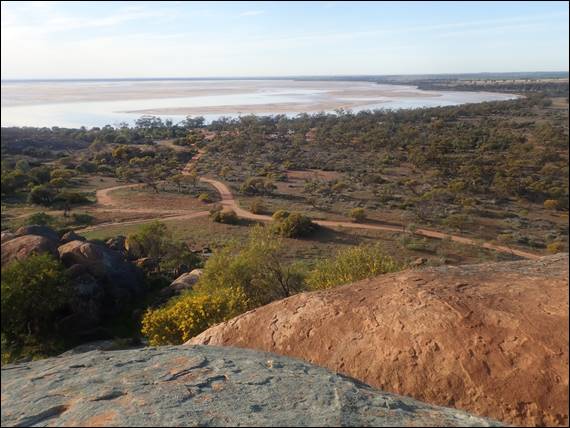
I have always considered this place to be called Lake Brown, but that is the name of the area to the north west. The, at times salt lake, that we have always stayed near is in fact called Lake Campion. On this trip, maybe a third of the lakes area looked to be underwater, and it is next to this lake that Eaglestone Rock sits. We arrived some seven hours after leaving Bunbury, giving us time to set up camp and head to the rock to get a few routes in. As I said, I have been here five times, and Rongy and Howsie have also been a few times:
We have probably climbed all the routes here that we are likely to, unless we had the inclination to train and go for the harder lines. At this point in time however, none of us had that inclination besides the climbing is different to anything else we have close by and there are enough routes to keep us interested for the few days. The last line was finished as the light faded, and we headed back to camp grateful for the meals that we, or in my case Lisa, had pre-prepared. Saving a lot of phaff time before we settled down, content after a great day:
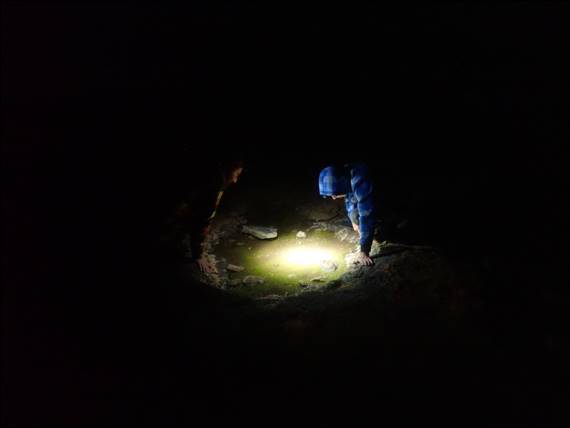
Feeling a bit too early to hit the sack we decided to check the granite outcrop to see if we could find anything. With a bit of luck there would be a snake looking about for a feed, but as it was despite carefully lifting rocks and looking under ledges and boulders not a critter was about, other than spiders. We instead started to look at the gnamma holes, which had some aquatic bugs that magically come to life when water appears. As there is no connection with any permanent water bodies, there must be just enough soil for buried eggs to lie and wait:
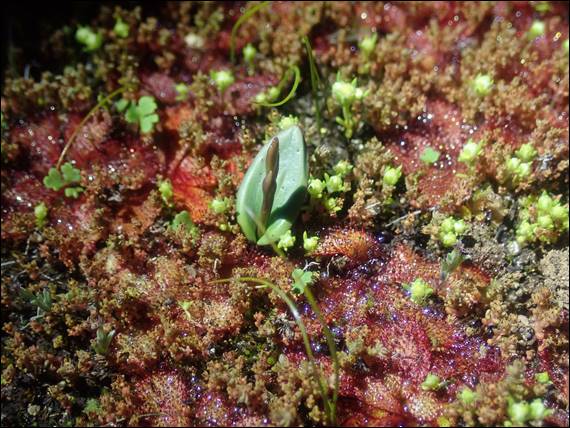
Howsie spotted the above tiny leaf, being the fleshy leaf of an Elbow Orchid (Spiculaea ciliata) that is found in small pockets of shallow soil on granite outcrops. It is the only flower, bird, reptile, or insect image that made it into the first part of this post. That is because it is special find, being very different from all other orchids. The small leaf usually withers by the time the plant flowers in October to January, when the temperature can reach the high thirties. And despite the unbearable conditions I am pondering going back to see it in flower:
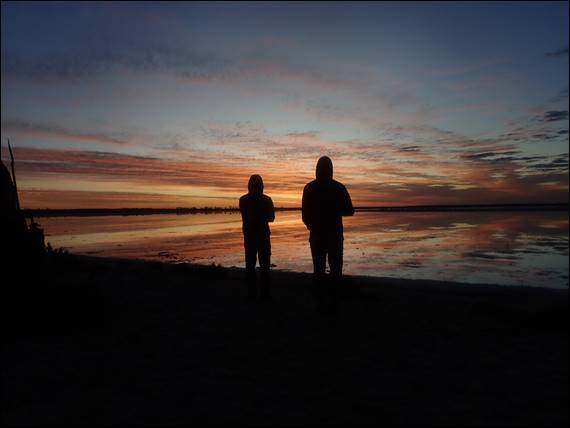
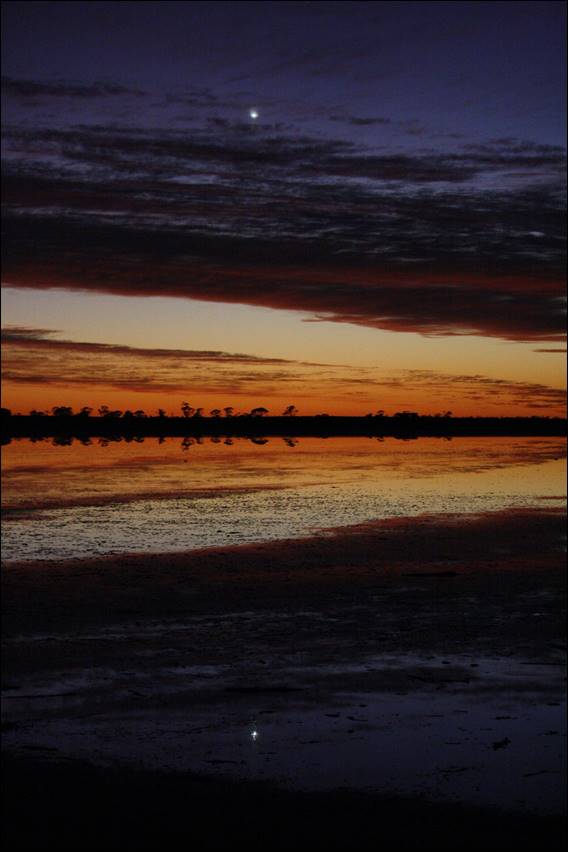
Back at camp we slid into our tents for the night. When camping I do enjoy watching the day wake up, and could be heard quietly pottering about to make a cuppa in the dark. Taking the welcome brew down to the edge of the lake to watch the sky fill with colours. Rongy joined me to watch a very spectacular sunrise, and it is possible that in order to capture the perfect moment I took just as many images of sunrises and sunsets as I did flowers, birds, reptiles, and insects. I have however culled them more heavily and also refrained from including too many:
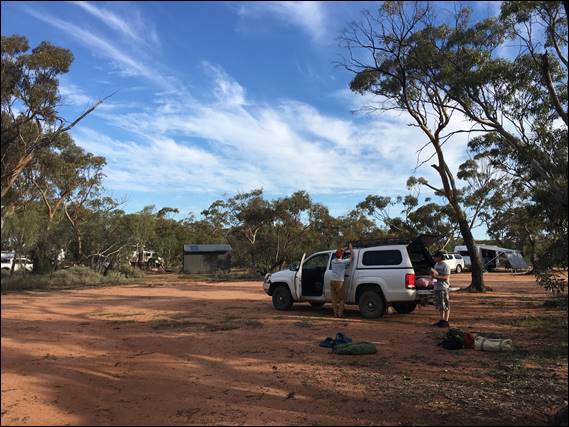
We knew it would be another hot day, so breakfast was soon cooked and eaten. Then a quick walk up to the rocks to crack on and get some routes under our belt before it got too hot. Something that has changed here is that the free camping has been limited to one area. We used to camp at the base of the rock, but that is no longer permitted. Mind you it really is not too far to walk, and controlling the camping here is probably not a bad thing. You may be able to make out the caravans nestled under the trees at the edge of the lake in the above image:
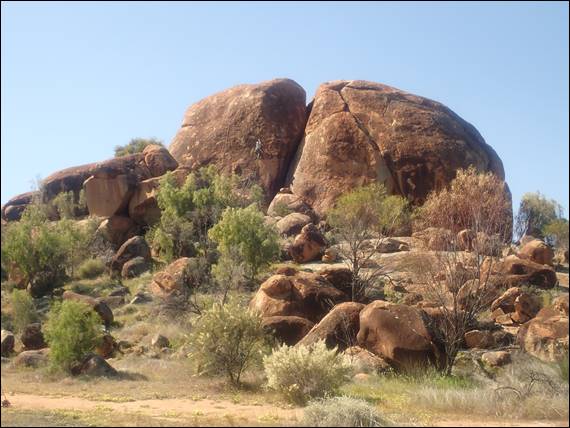
While there were quite a few staying at the campground, we were the only climbers and it was nice to have the place to ourselves. While it may be called Eaglestone Rock, I do feel that looking at the images again it could conceivably be an elephant with its body, head, and trunk laying down. And maybe this is where the fifth elephant was laid to rest, it certainly is a wonderful place. The landscape seems harsh and barren but we saw quite a few birds and insects, while the reptiles were a rare spot they were certainly about:
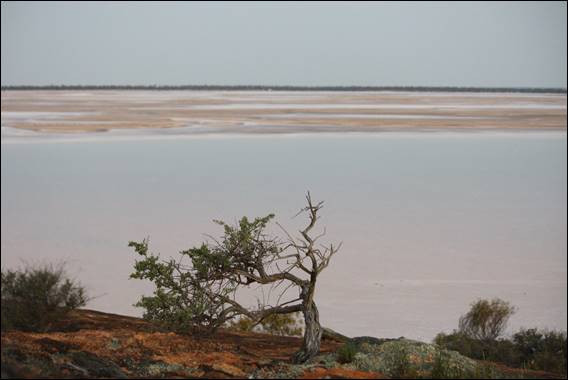
After packing in seven lines we were getting both hot and sore, so it was time to head back to camp for lunch and a cuppa. There seem to be a whisper of a breeze at camp and the shade was dappled at best, so it felt pretty stifling. Instead of enduring that, we went back to the rock where the shade it afforded, along with the breeze from being higher in the landscape made for a much cooler place. We got side-tracked and walked to the above isolated lake to check it out, but there wasn’t much to see so went back to rest in the shade of the fifth elephant:
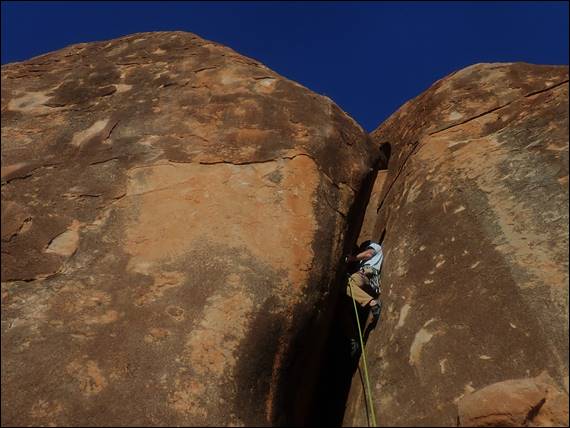
As things started to cool down we kicked things off again, Howsie had drawn the short straw and had to climb the chimney in full sun while Rongy and I snuck in shorter lines on the shady side. It was sweaty work and the rough granite was starting to wear down the skin on our fingers. The granite here is not as hard as that found at Welly Dam or round the Perth Hills, and you could see the texture starting to smooth off on quite a few holds. They were however still coarse enough to bite into the ever thinning layer of skin on our fingertips:
Three climbs in and we were ready to throw the towel in, plus none of the other routes were in any way inviting what with the still hot rock, sore bodies, and tender fingertips. The temperature finally started to dip as the sun lowered closer to the horizon, so we took a protracted route back to camp up and over the granite outcrops. The occasional dragon fled from our path, but not much else was to be seen. Another quick and easy reheat meal went down well, after which we ventured back to the isolated lake in the dark hoping to find frogs:
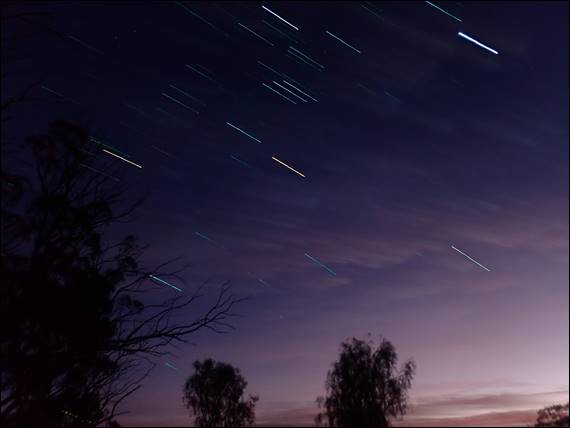
While we heard a few croaking they remained hidden, and we ambled back to lie down for the night. I was up earlier than the first morning and discovered a setting on my camera that I hadn’t played with before. So set it up and left it for half an hour to track the stars as the light once more crept into the sky. The camera did its thing, and I got the kettle on for the first brew of the morning. This time all three of us took a brew down and watched the light show at the edge of Champion Lake. As we broke camp no one was prepared to commit as to whether to squeeze a climb in:
So I made an executive decision. We packed the car and drove to the base of the rock, agreeing to one route each. Repeating lines form the previous day, but they are very good and each of us led a line we had not led the day before. One each was sufficient, the fingertips didn’t feel like they had recovered enough and the bodies seemed happy not to have to endure anymore. Besides we had the long journey home today, during which we aimed to stop in at one more nature reserve requiring a reasonable detour. Heading off we let the fifth elephant rest in peace:
On the way to Kokerbin Nature Reserve we saw several big outcrops that yearned for us to stop and hike up to them, but I kept driving and all was forgiven when we saw the third largest monolith in Australia. Coming in after Mount Wudinna in South Australia and of course Uluru in the Northern Territory, as the largest. This claim is hotly contended, as is the second spot, so it may or may not be the third largest. Regardless, interesting natural architecture and boulders strewn round the base with shrubs in flower made for a magnificent sight:
We walked up the 122m it rises above the surrounds, watching out for movement and orchids. Taking in the view once on top, while enjoying the aerial combat of butterflies aggressively protecting their patch. We didn’t stay as long as the reserve deserved, but it was pretty hot again and we still had four hours in the car ahead of us. I did however, after being impressed with a couple of the reserves we had visited, make a mental note to suggest to Lisa we consider a Wheatbelt road trip sometime to check out a few more reserves:
The next section is for the nature enthusiast to read, or if you just want a stickybeak you can flick through the images of just some of the treasures we spotted in this small but magical slice of the world. And while I have the chance I’ll pop in another sunrise image:
I’m pretty sure that we spotted both the Little Laughing Leek Orchid (Prasophyllum gracile) and Laughing Leek Orchid (Prasophyllum macrostachyum), with this being the Laughing Leek Orchid based on the darker flowers. These leek orchids don’t grow very tall and are found all over, but in drier places are limited to areas where water pools, such as the gnamma holes on granite outcrops. These were only noticed at the Totadgin Rock Nature Reserve:
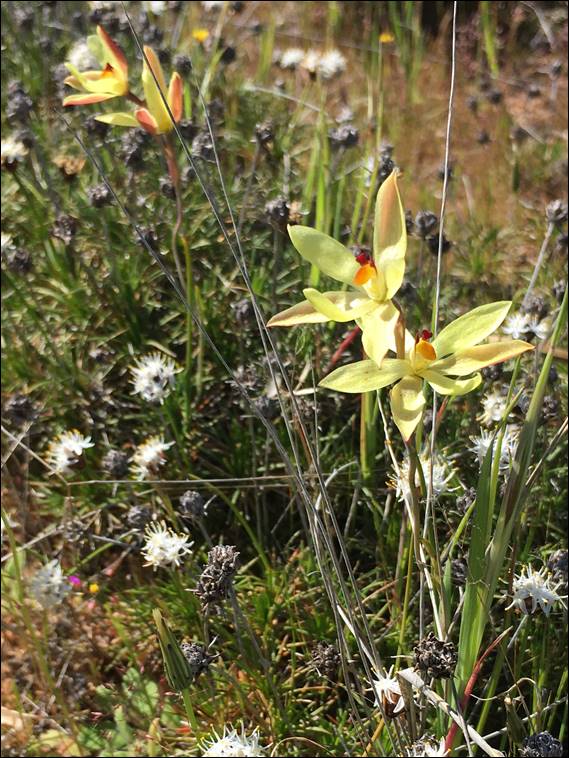
While a common orchid in Western Australia, South Australia, and Victoria this next species is considered endangered in Tasmania due to the isolated and small areas it can be found. Despite generally being common, I do not recall seeing the Lemon-Scented Sun Orchid (Thelymitra antennifera) before but I could be wrong. On this trip we found this cheerful looking orchid at both the Totadgin Rock & Kokerbin Nature Reserve:
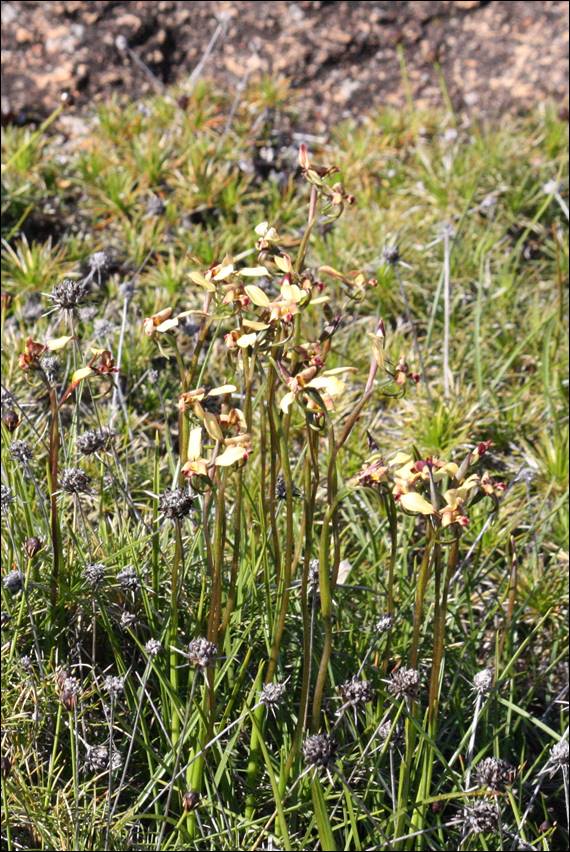
The Yellow Granite Donkey Orchid (Diuris hazeliae) was found in numbers both in the wet gnamma holes of Totadgin Rock Nature Reserve & Eaglestone Rock, and also along the base of the former granite dome in the surrounding wet soils. I’m confident in identifying this one based on the descriptions I’ve found, being a species that it is almost exclusively found on granite outcrops:
Another first time find for me is this Mallee Banded Greenhood (Pterostylis arbuscula). I’ve based this on the plant height, and singular nature and colour of the flower, which was sadly on its way out. This aligns with its flowering period of June to early September, and we found a second specimen with two flowers that was even further gone. It is also a bit of a giveaway that we found it in amongst Mallee shrubland at the Totadgin Rock Nature Reserve:
While I have seen plenty of Blue Fairy Orchids (Pheladenia deformis) I have generally only observed the pale blue variety, so this more purple tinged specimen at Totadgin Rock Nature Reserve was a great find. Again close to the end of its flowering period, so the flower was a little wilted. It is the only species of the Pheladenia genus that is endemic to Australia, being found all over the country other than in Queensland and the Northern Territory:
The final orchid find was a small scattering of dainty Sugar Orchids (Ericksonella saccharata) at the Kokerbin Nature Reserve. This orchid was previously included with the Caladenia genus, which includes the Sugar Candy Orchid that I have seen before. But has since been given its own genus with this being the only species. It is smaller than the Sugar Candy Orchid and found throughout the Wheatbelt, whereas the Sugar Candy Orchid does not extend as far inland, preferring moist and swampy locations:
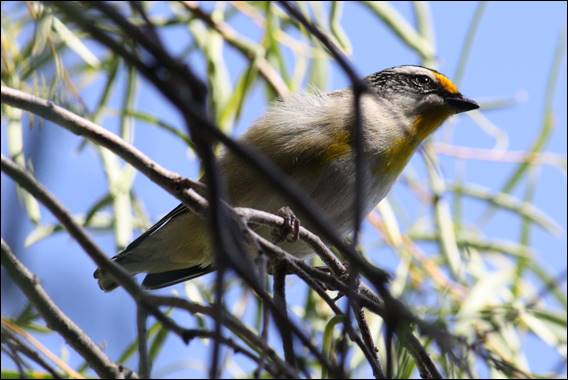
Of all the birds I spotted this was by far my favourite, despite being the most common of the four pardalote species and the least colourful. As I watched the climbing action or inaction on Emu Walking at Eaglestone Rock, sorry Rongy and Howsie, this Striated Pardalote (Pardalotus striatus) landed within meters of me and sang its heart out. After several minutes it flew off, but it returned again during the morning and that time it seemed content to just sit near me with no song:
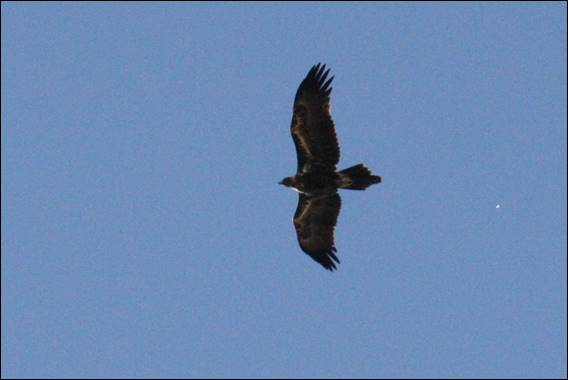
As we climbed at Eaglestone Rock it only seemed appropriate to have a Wedge-Tailed Eagle (Aquila audax) soaring high above us, with the unmistakable shape of its tail. We also spotted one sat in a tree as we approached the Kokerbin Nature Reserve but didn’t stop and try and take an image. Generally they are happy to sit and watch you drive past, but as soon as you stop they will often fly off, so we let is rest:
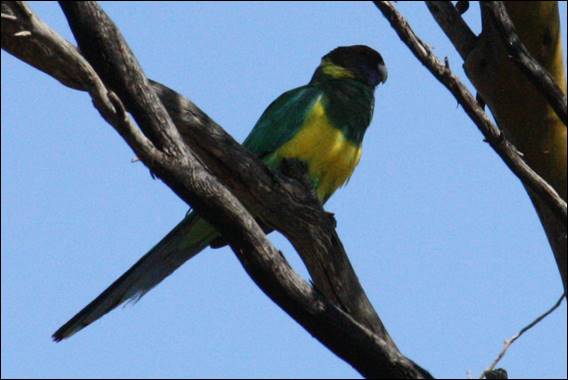
The Australian Ringneck Parrot may seem like an unlikely one to include here, but as we watched this one at Eaglestone Rock the different pattern of this sub-species was pointed out to me. There are four subspecies, and this one is the one Lisa and I used to see so often in Alice Springs, being the Port Lincoln Parrot (Barnardius zonarius zonarius) and distinguished by the yellow belly. In the South West of Western Australia we generally see the Twenty-eight Parrot (Barnardius zonarius semitorquatus), which does not have the yellow belly:
Another familiar and commonly seen bird of prey that watched, as we climbed on Eaglestone Rock, was the Nankeen Kestrel (Falco cenchroides). So common in fact we saw it pretty well everywhere we went and also as we drove. Often hovering in one spot looking down for prey, and as the name suggest it is from the Falco Genus, or Falcons. Found both here in Australia and New Guinea, and being one of the smallest Falcon species:
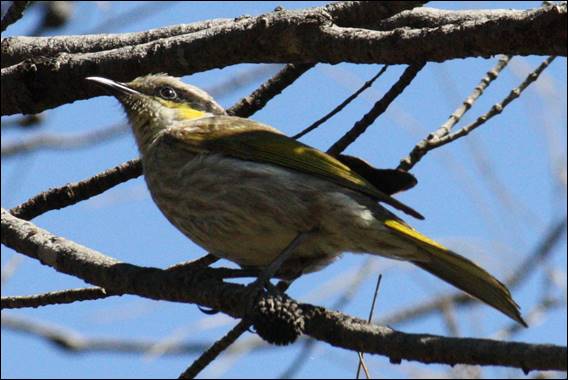
Walking back to the car at the Kokerbin Nature Reserve this Singing Honeyeater (Gavicalis virescens) landed just of the path and seemed to want me to taken an image. At first I just watched it, but it stayed close and after I eventually reached for my camera and took a few shots it only stayed for a moment longer. With some 55 genera and 186 species of honeyeaters, the Singing Honeyeater is found across the widest range covering most of Australia:
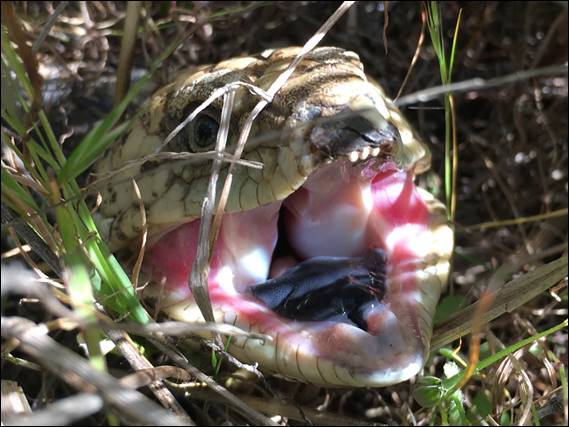
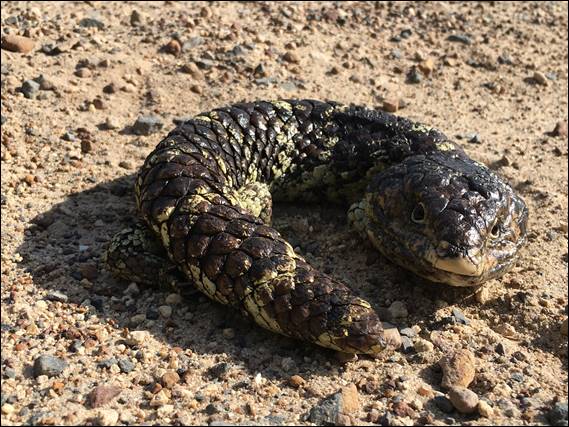
There were of course many, many Bobtails (Tiliqua rugose) mostly on the road as we drove along, with a few as roadkill due to unobservant or uninterested drivers. I sent a picture of one of the two we spotted in the Totadgin Rock and Kokerbin Nature Reserves to Chris, my uncle in Holland, and the name Bobtail had him perplexed. So he researched it and sent me some details about them including another of their common names the Blue-Tongued Skink, and this images clearly shows where that comes from:
We saw many Ornate Crevice Dragons (Ctenophorus ornatus) at both the Totadgin Rock and Kokerbin Nature Reserve. We had to keep a sharp eye out as they are very well camouflaged, and it only when they move that you spot them. Often they started to bob their head before they ran to a narrow crevice to hide in. They inhabit granite outcrops, rarely leaving these landforms other than to give birth. Due to all the clearing newborns do not move between outcrops as much anymore resulting in a reduction in genetic diversity, which increases the risk of eventual extinction:
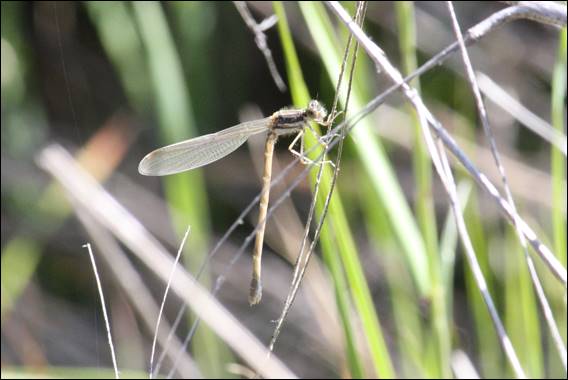
When we got to the Nonalling Nature Reserve it was not looking all that promising, but due to the lake there was a hive of activity in and about the fringing vegetation. Sitting there for a while I manage to snap pictures of three different damselflies. Dragonflies hold their wings out to the side, and damselflies hold theirs along their bodies when resting. Damselflies are also generally slimier and both wings are of the same size. This means that unlike dragonflies, which have smaller back wings, they can’t fly backwards:
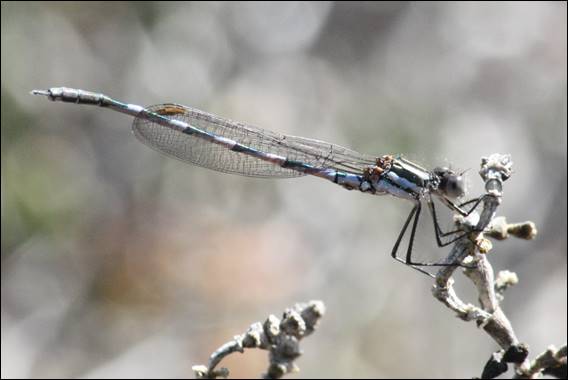
You’ll notice I have skirted round saying what damselfly is in the above image, which is because I have really struggled to work it out. I was also intrigued by the way the abdomen is at ninety degrees to the prothorax, which I have not noticed while trawling hundreds of images while trying to identify it. All the online images show the body straight, like the two below that I think are a male and female Western Ringtail (Austrolestes aleison):
This species is endemic to South West Australia, extending as far north as we were heading on our trip. The male is blue and black, above, and the female is a duller colour, but with similar patterning. If I really wanted to be sure of this identification I would need to check the top of the second segment of the abdomen, which has a goblet-shaped pattern. This is where the species name aleison is from, derived from a Greek word meaning a goblet:
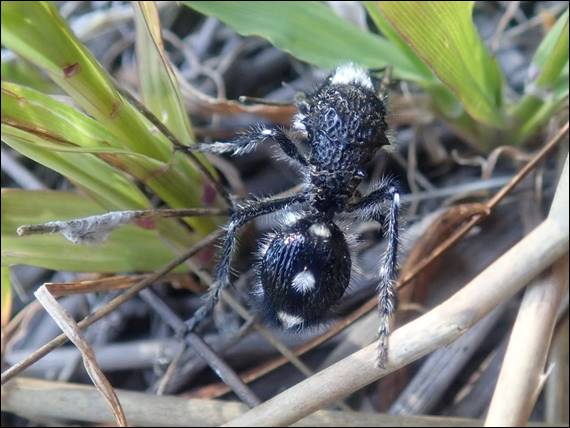
On arrival at the campsite at Eaglestone Rock this Velvet Ant (Bothriomutilla rugicollis) was spotted in the scrub. It is in fact not an ant at all, being a wingless female wasp. Only the males have wings, and like any wasp they can deliver a painful sting. They are parasitoid, meaning its young develop on or within another organism. They lay their eggs near the eggs or larva of a host, and when the velvet ant larvae hatches a meal is ready and waiting:
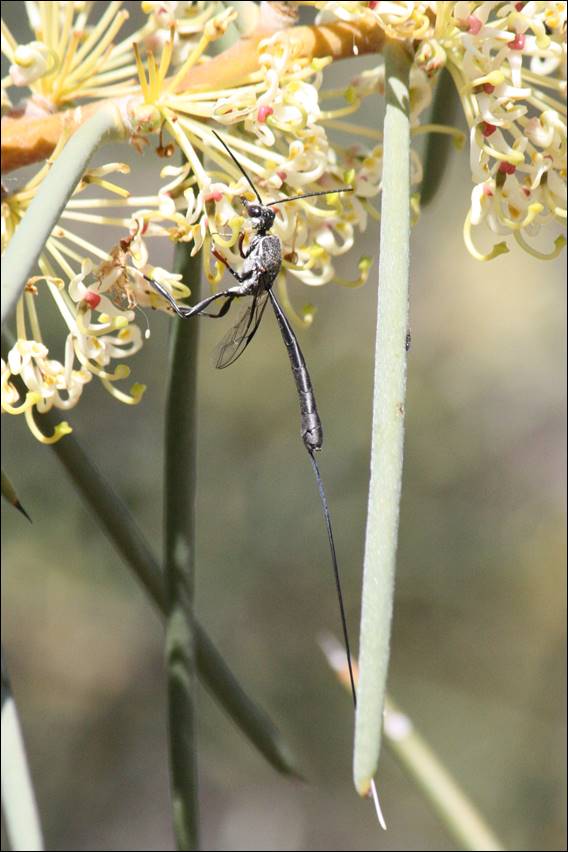
With all the blossoms out and having time to sit about and look round at Eaglestone Rock there were lots of insects about, this one really caught my eye. A female Gasteruptiid Wasp (Gasteruption sp), another parasitoid. I’ve not managed to narrow it down to a species of which there are many. This one lays its eggs inside the another wasp and solitary bee, which are bees that live alone but at times nest close together. Only the female has the distinctive white-tipped ovipositor, and as you may guess that is used drill into the host to inject eggs:
As we walked up the granite dome of Kokerbin Nature Reserve if you kept a sharp eye out you’d see movement on the rock near your feet. In all cases I spotted movement it was a Red Tiger Assassin Bug (Havinthus rufovarius). While small if threatened they might bite. They use venom to paralyse and liquefy prey, and it can also be very painful for people. They watched as I approached and backed off always facing me down, as opposed to turning and running:
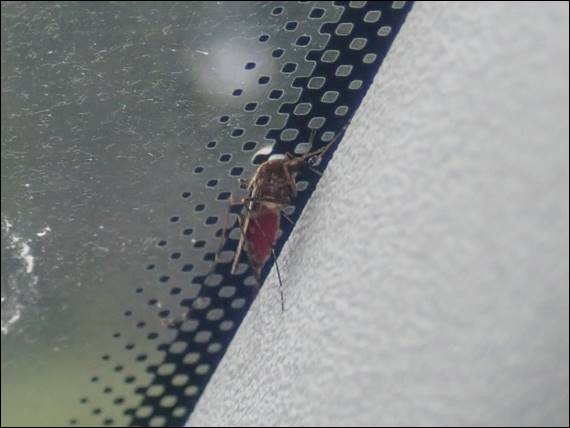
Finally, there are six common mosquito species in Western Australia. This one is likely to be Aedes vigilax, based on where it hitched a ride and that it was extremely active in the day. This species has by far the highest ability to travel from its breading site, at up to 100km. It became engorged with blood from one of us, along with two others that entered the car at the Kokerbin Nature Reserve, before the final four hour stretch of the homeward journey. I might even dig out The Fifth Elephant and read it again:
On Saturday Lisa and I headed out for the morning, but that had been a town visit and as such did not satisfied my desire to be outdoors. Orchid season could be considered a little early, but regardless of that I headed to the Capel Nature Reserve later the same day. Before I got there, and to avoid it being squashed, I stopped and encouraged this South Western Bobtail (Tiliqua rugose) off the road. The thick plates of the heavily armoured body, can vary considerably in colour from dark brown to cream. If you check the one we recently saw at Wilyabrup that had an almost entirely orange head https://sandbagged.blog/2023/08/05/blurred-vision/, a colour that was completely absent from this one:
Once parked up and on foot proper, I spotted heaps of orchids. Some still yet to sprout, some with buds, and several in flower. The pick of the flowering ones was this Bird Orchid (Pterostylis barbata), the species name of barbata being a Latin word meaning “bearded”. There are twelve species of what are sometimes called bearded greenhoods. And to date I have only come across this one, which is the most common species and was first formally described in 1840. The bearded nature of the labellum is not only used to name this species. It also plays a very special role to ensure pollination occurs:
The labellum is very sensitive to touch. When a gnat, having been attracted by a scent the orchid releases lands on it, it springs up. This pushes the unsuspecting gnat into the cavity formed by the fused petals and dorsal sepal, which forms the bird’s body. The labellum stays there blocking any exit and forcing the gnat to crawl up through the body so it can escape via the opening at the birds throat. On this journey it passes the sticky stigma (female organs) that take any pollen the gnat may be carrying, before then having to pass the anthers (male organs) and as it brushes past them fresh pollen sticks to its body:
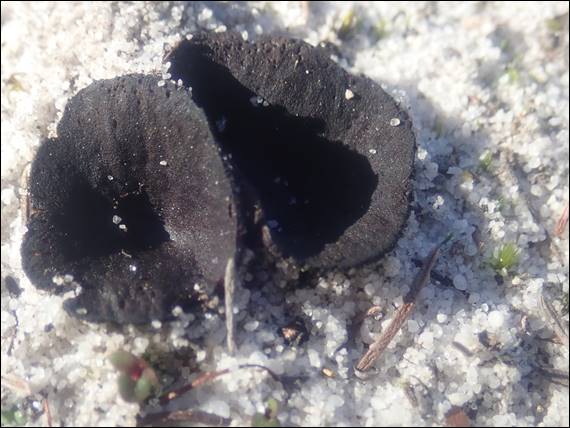
I also spotted a few of the above small black disks in the sand. I believe they are Flat Black Cup Fungus (Plicaria cf. alveolata), which is mycorrhizal. This term derives from two Greek words of mýkēs and rhiza, which mean fungus and root. These words are apt as mycorrhiza is the name for a fungus that has a symbiotic relationship with the roots of a plant. The fungus colonizes the root tissue of its host, from which it takes carbohydrate. And in return the fungus provides the host with nutrients, which it has absorbed from the soil. This particular fungus is quite fragile and easily broken, so needed to be careful and look down as I walked along the open tracks:
Seeing I mentioned the Slender Snail Orchid (Pterostylis crispula), in my last post I thought I would include an image of one I found at the Capel Nature reserve. Being easily identified by the long sepals that look like the snail’s antenna. I managed to get another trip outdoors on Sunday. Seeing no one was available, I decided a solo top-roping climbing mission was in order thinking I might sneak a visit to another reserve for more orchid hunting on the way home. I was tossing up between going a bit harder or just kicking back on more moderate routes, and opted for the latter:
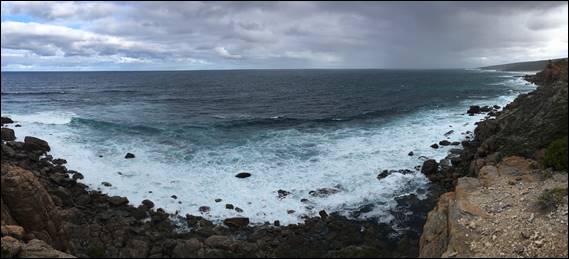
Fortune was on my side as a big rain band passed to the north and no more than a few drops fell where I was. The cloudy sky and stiff westerly wind kept the temperatures down, so I wasn’t really expecting to see any scaly friends. Although, that didn’t stop me checking every crevice with no joy. Partly due to opting for more moderate routes, but also due to the chosen crag, I quickly clocked up my normal six routes and was feeling good. So I kept going and eventually doubled my usually tally, and Bob you’ll be happy to hear I bagged close to 1,200ft. Better still, as I rapped down the last route of the day I had a lucky find:
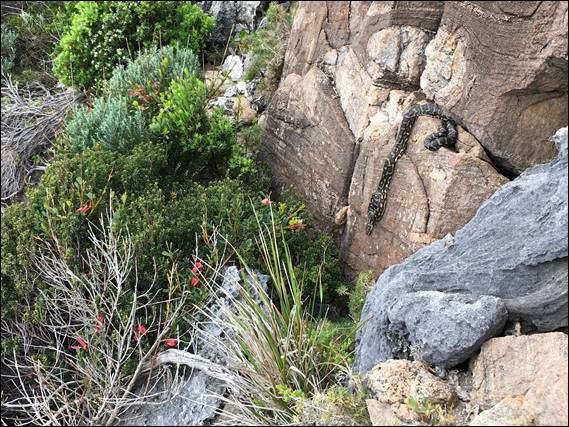
Looking about, it was hard to miss this South-western Carpet Python (Morelia imbricata). These snakes can grow up to four meters long over their fifteen to thirty year lifespan, but most only grow to a little over two meters. It was hard to say how long this one was. I’d say it was easily one and a half meters, but I’m tempted to say it was closer to two meters. The thickest part of the body looked to be almost as thick as my wrist, and it is easily the biggest specimen I have seen. It was a great way to finish up the session, and it didn’t end there because I spotted quite a few snail orchids on the side of the track on the walk out:
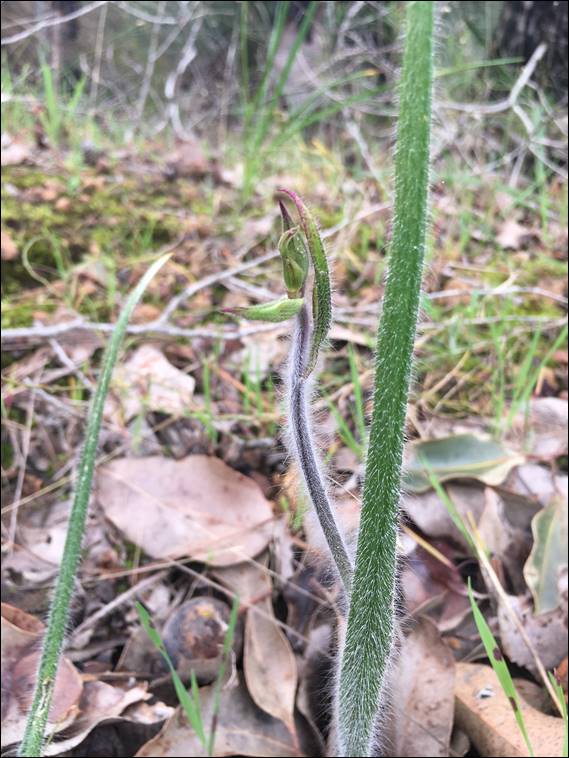
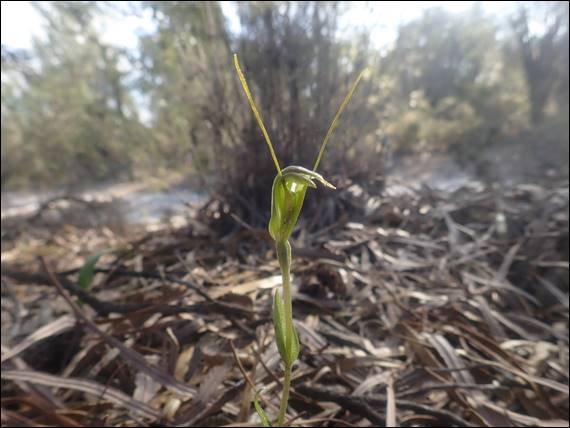
Upon closer inspection of one I noticed these Sandhill Helmet Orchids (Corybas despectans), which is a first time find for me. They are known to flower between June to September, and sadly they looked to have only recently passed their flowering period. I have walked this track literally hundreds and hundreds of times, and have never spotted these before. Maybe in part because I don’t wear my glasses when I come here, whereas this time I was. Mind you these were tiny, the basal leaf being no more than 15mm across and the flower was half the size of that. If the flower had been in full bloom you would have noticed that it faces downward, which is why the Latin word despectans has been used for this species meaning “look down upon”:
When given a challenge Howsie is always keen to give it a go. So after a lunchtime walk on Wednesday, with Josh and Mark, I sent him the following image. We were of course primarily orchid hunting and found a few, including the first Pink Fairy (Caladenia latifolia) and Slender Snail Orchid (Pterostylis crispula) sighting of the season. But it was this seedling, looking a little like a butterfly as it was just starting to germinate that we really liked. Being at such an early stage made it hard, and Howsie came back with three possible genus:
This was narrowed down to one genus and two species, after I told him where we had found it. Being the Candlestick Banksia (Banksia attenuata) or Bull Banksia (Banksia grandis). Banksia trees are highly susceptible to Phytophthora dieback, which is found in some areas around Manea Park. And what with all the visitors this place attracts there are shoe cleaning stations to prevent the spread of infected soils between areas. Hopefully, lots of the seedlings we spotted will flourish and over time replace the, too many, mature trees that have been struck down:
It has been a good week. Kym was up from Albany and he popped over for a catch-up and feed on Monday evening, after which he headed to the west coast to visit friends. Sadly the rest of his family did not make the trip, for one reason or another. However, we agreed that a weekend adventure down his way was long overdue. We pencilled in October to rectify that, when I’ll hopefully catch up with the whole crew. Seeing he was up our way I suggested he may want to venture out for a climb with Howsie on Friday morning, after which he was due to head back:
I had assumed he was staying in Dardanup with family, so Welly Dam would have been ideal and close. It also happened to be Craig’s birthday this week, and he was home from his FIFO job. This allowed the opportunity to get him out on Friday for his usual present of a climb. And as you can no doubt tell I once again took advantage of my flexible working arrangements. Opting to join the motley crew on Friday morning, before heading back home to work for the afternoon. As is sometimes the way, not everything pans out as planned and Kym didn’t make it:
Partly down to my assumption of where he would be staying on Thursday night, and we all know what assuming things can lead to. As it happened Craig had also assumed he would not be leading anything at the fearful dam. A thought that was more deeply embedded in his mind when he saw the conditions, with the black streaks running with water. And like my assumption his was also wrong. With surprisingly little persuasion we steered him to some of the more gentle and shorter, but still worthy and heady, routes at the dam:
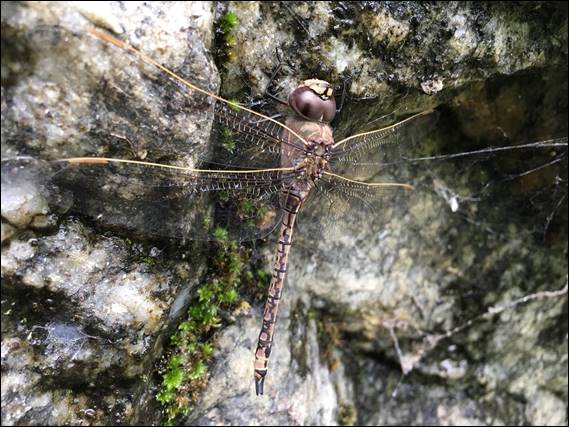
Having three allowed time to find a few different angles for photos, making a brew, and checking out the wetter parts of the crag to marvel at the small habitats, like the one shown several images above. Hoping to find some critters of interest, which finally paid off with this Australian Emperor Dragonfly (Anax papuensis). Being as cold as it was, I was able to get close up and personal to have a really good look. The dragonfly didn’t even flinch. Howsie and I pondered how long it would live for and got it very wrong:
Generally moths will live for a few days, butterflies for two to three weeks, but dragonflies can live anywhere from a week to six months. They are one of the first winged insects to have evolved. Being around almost 300 million years, which is a thousand times longer than humans. There are some 5,000 species found all over the globe except Antarctica, with +300 species in Australia. The Australian Emperor Dragonfly is found all over the country, and at up to 70mm long is one of the larger species. Living, in its adult stage of life as a dragonfly, for two to three months. As for us at Welly Dam, we lasted about four hours:
The pace was relaxed, interspersed with drinking tea, and hanging about during some relatively slow ascents. But the steep walls, as usually happens here, didn’t take long to sap our strength. So even with the rests between our individual battles on the cold hard granite we were all very satisfied with the time we spent here. And as the last lap on the last line was being completed the temperature had seemingly risen enough for the insects to finally come out. And this drew out a mob of hungry male and female Splendid Fairywrens (Malurus splendens), who hopped about right under Howsie’s’ feet dressed in their eclipse plumage. But there are no images to share as I was too busy enjoying just observing:
After a lazy start to the day I got itchy feet and convinced Lisa it would be nice to take the poodles out for a walk, or should I say sniff, round Manea Park. From the start I was not expecting to see much, and certainly not thinking that I would see enough to write up a post. That changed within the first hundred metres, but I’ll keep this post brief. My main reason for it is this beautiful Dancing Spider Orchid (Caladenia discoidea). A first time find for me, and being easily distinguished by quite a few features including the way the short petals are held horizontal:
Soon after we stumbled across the below lovely Silky Blue Orchid (Caladenia sericea), the term sericea meaning “silken” or “silky” in Latin. But not referring to the flower or its petals but the leaf. While there has not been a year that I have not seen this orchid the first time I spot it each season, it still feel special. I was surprised at how many species were in bloom, and we also saw the Robust Snail (Pterostylis dilatata), Jug (Pterostylis recurve), Hare (Leporella fimbriata), Midge (Cyrtostylis huegelii), and Banded Greenhood (Pterostylis vittata):
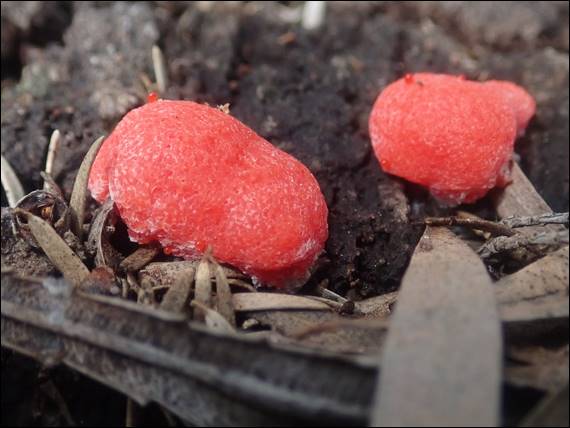
I don’t think I will see too many really cool fungi this year, as we really have not had a wet winter despite some big storms that brought isolated heavy rainfall events. And I can’t add this next one to my list, as it is not a fungi. Strawberry Slime Mould (Tubifera ferruginosa), is often found on wood and may look like a fungi but it does not send a mass of hyphae (a bit like roots) into the surface below it. Rather comprising a structure made from something called plasmodia, which have no cell walls and as they are not fixed to the surface, it can move:
This movement is used to engulf whatever may be considered food such as bacteria and spores, a bit like the way a single celled amoeba feeds. As we headed back towards the car with the dogs all sniffed out we spotted orchid species number seven, the Kemerton Donkey Orchid (Diuris cruenta). I had seen the stems previously but was not sure what flower it was or indeed whether they were an orchid. However, the deep colours of the flower of this species gives it away. It is also where it gets its name with cruenta meaning “stained or spotted with blood” in Latin:
Before we got back to the car Lisa found a small acacia bush with a heap of Jewel Beetle (Stigmodera gratiosa) feeding off the flowers. There are seven Australian species in the genus Stigmodera but it is the native Western Australian species that were particularly sought after. In 1978 this resulted in these beetles being the first invertebrates in Australia to be protection under the Western Australia Wildlife Conservation Act 1950. The reason being that their carapace were highly sought after by collectors and used for jewellery:















 Sandbagged