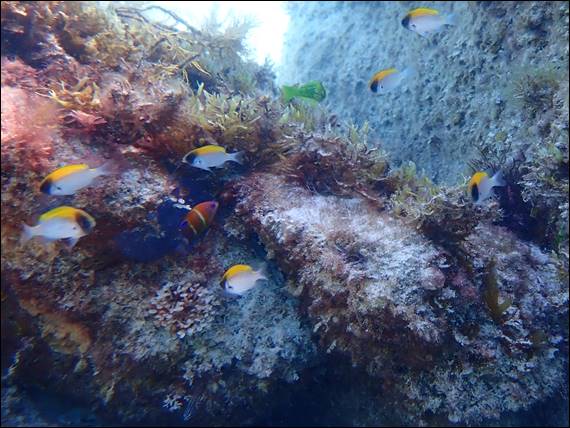
Back in the homeland it’s a common thing to hear ‘its grim up north’, or at least it used to be. Having lived in the north and south of England and really enjoying both areas for different reasons, I’d disagree. Hence, I’d rather say ‘it’s different up north’. And Western Australia is similar, although from a climate perspective even more so. Ranging from tropical in the north to Mediterranean in the south. Even the short distance of approx. 200km from where we live to Perth can see quite a change, as Verity proved when she went for a snorkel this morning:
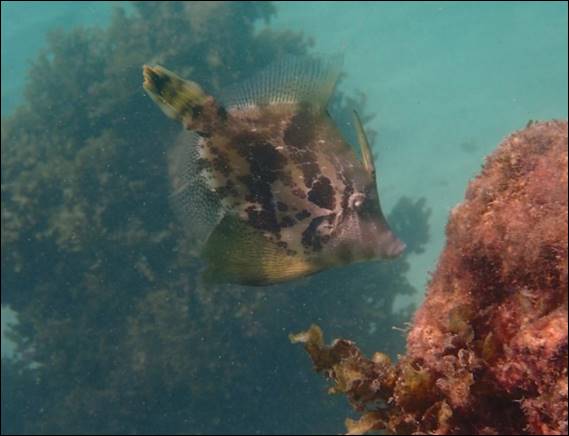
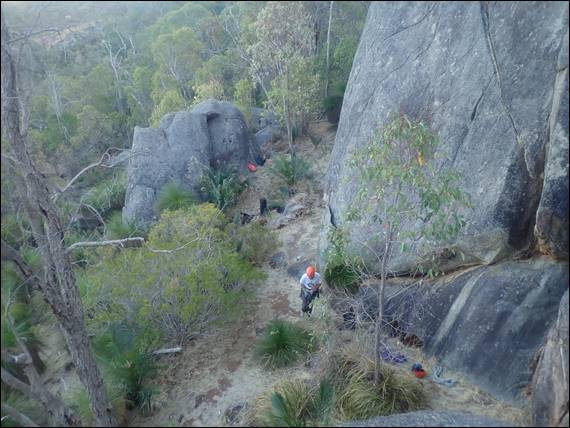
The waters at her local spot proving to be much better than my local pea soup. Enabling her to spot several Fantail Leatherjackets (Monacanthus chinensis). A fish that doesn’t venture this far south, which means I will not be lucky enough to find round these parts. And while she was enjoying the waters before it feels too cold, Howsie and I set off for yet another Friday climb. Yes I have restarted my attempts to get my leave hours down by sneaking out on the last working day of the week, and I’m not doing a very good job of it:
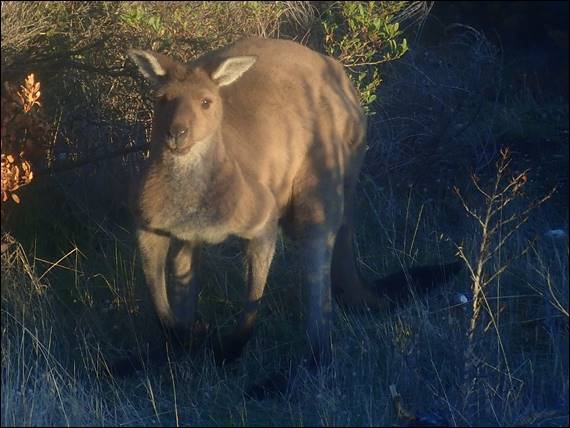
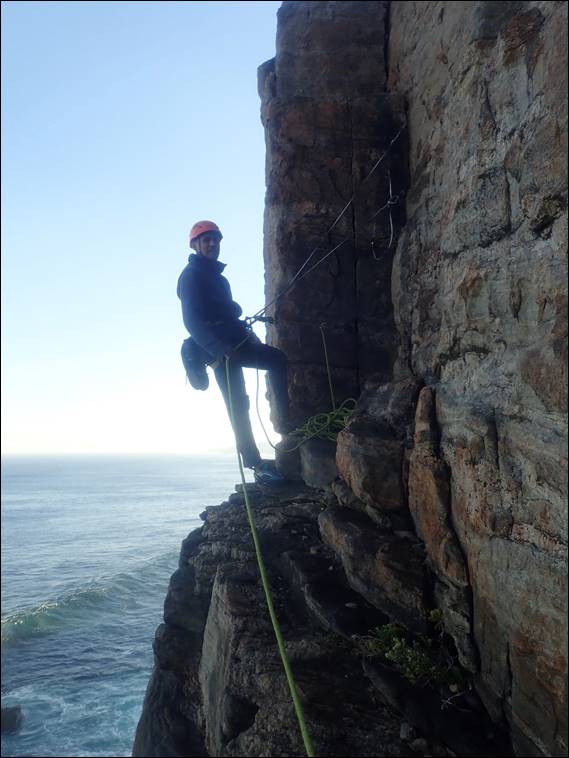
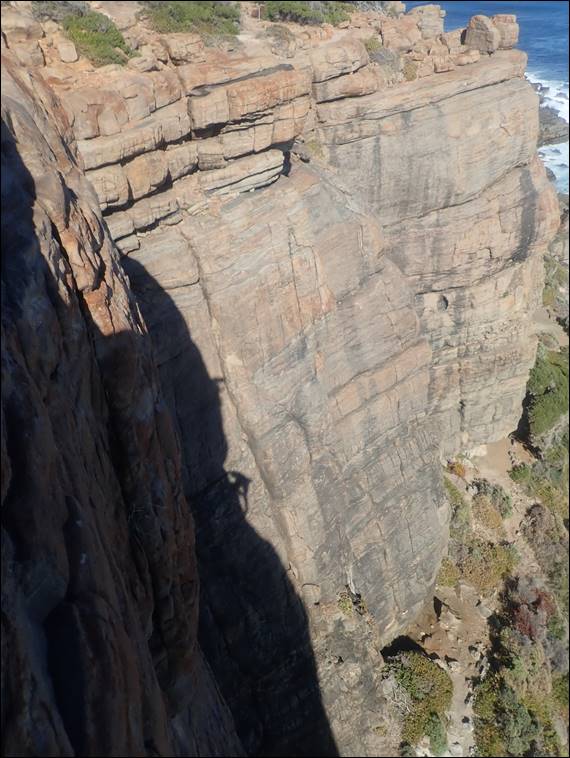
We were greeted by a large male Western Grey Kangaroo (Macropus fuliginosus), as we walked towards the cliffs. Not worried by our intrusion, it took a lazy hop to get off the path and then just watched us as we walked past. While it was looking super chilled, it’s broad muscular shoulders suggested that it was best not to tangle with this one. Continuing down to Wilyabrup we chatted about what we might jump on. Should we continue on the 2024 challenge and push the grades, or have a more laid back day and maybe get some mileage in:
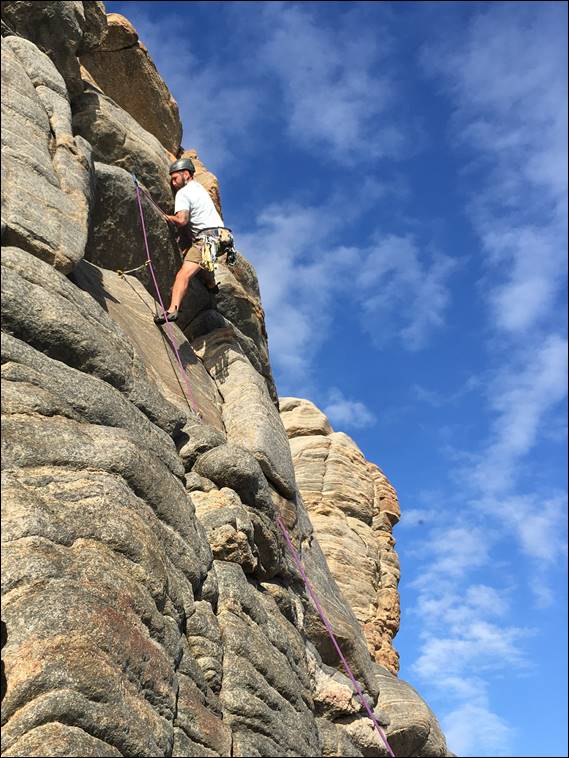
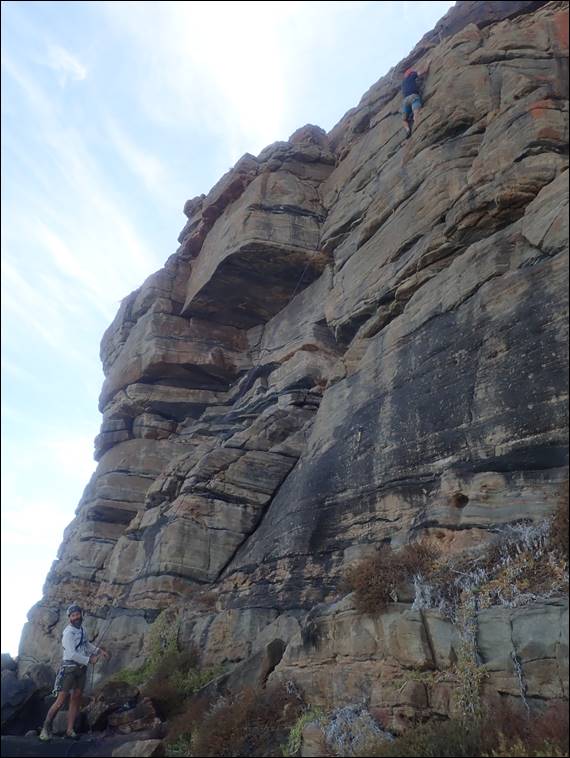
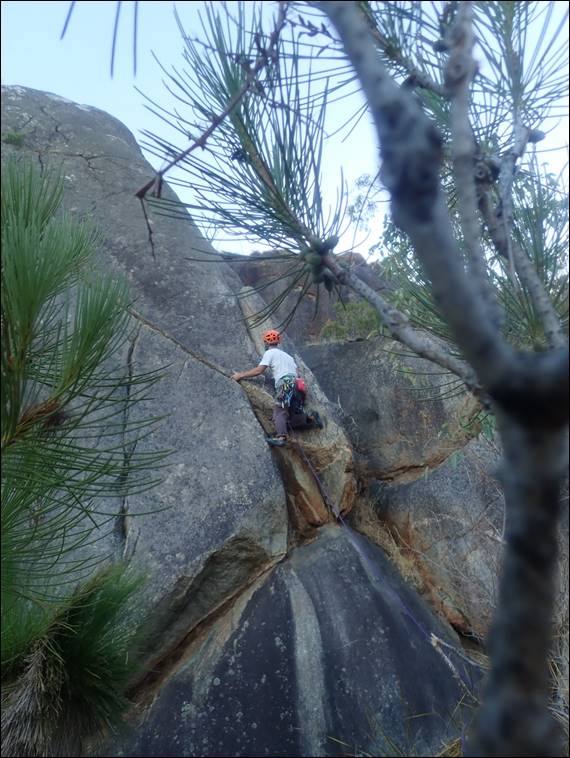
We opted to start with mileage and see where the day took us. Ten cruisy lines would be fun, and the first two pitches were exactly that. Allowing me to continue making good use of my crag booty, and this time I brought all of it along. Howsie inspected the carabiners and slings for wear and corrosion, and was unable to find any. In fact the gear looked practically unused. Our next two lines were not quite as easy, being three grades harder. The first seemed fine, but on the second we both hinted that our not so muscular shoulders were starting to feel it:
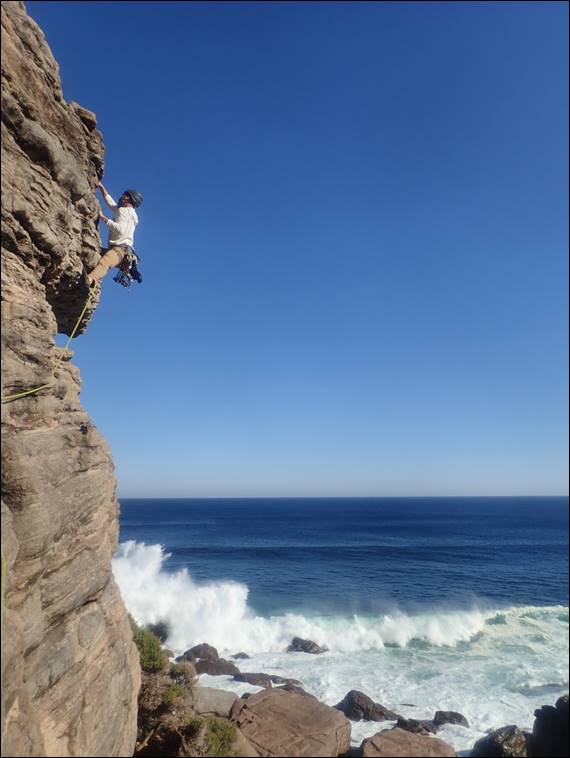
We were just enjoying being out and wanted to keep it that way, so dropped the grades back down by three for the next two routes. Searching for any signs of our local Carpet Python as we climbed them. Sadly only finding an old snakeskin tucked behind a flake. The easier lines seemed to revitalise us as the iconic Steel Wall, on which we started the day, again drew our attention. It meant bumping the grades up by six. Both of us spent time on the halfway ledge to have a that bit more of a breather than usual, which assited us in managing clean ascents. The two lines did however take enough out of us to call it a day:
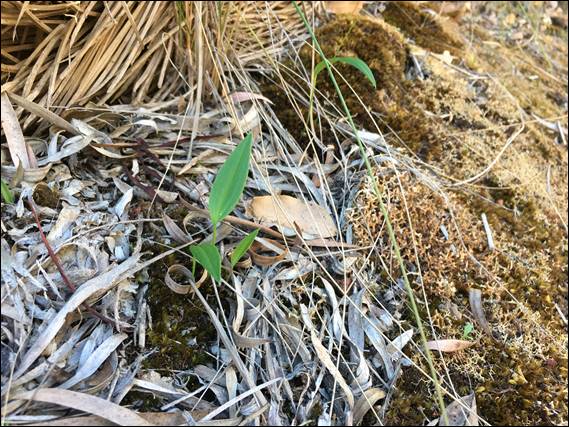
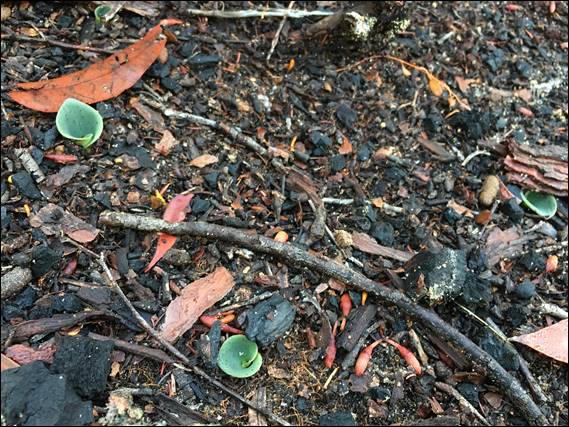
Being happy with our lot, and not worrying about having fallen short of our intended ten climb goal. I knew it was the right choice for me when I puffed my way back up the path, with my legs feeling pretty ‘tree trunky’. As I scoured the bush, Howsie mentioned a friend had sent him an image of a Common Bunny Orchid (Eriochilus dilatatus) found in the hills that fringe Perth. And a bit like I started this post, I said to him ‘it’s different up north’ and the orchids usually flower earlier up there. We did however find a small patch of Common Bunny Orchid leaves, indicating the orchids are on their way:
My work days have been a bit all over the shop since I returned from the UK, and I found myself working from home on Wednesday this week. which is unusual. And even more unusually I found myself joining Lisa for part of her morning routine, when she took the dogs down the beach for a quick run on the sand. It is not often I join her when working from home. When she goes down I have already spent a good one to two hours working, by which time my mind is singularly focused on what I need to do:
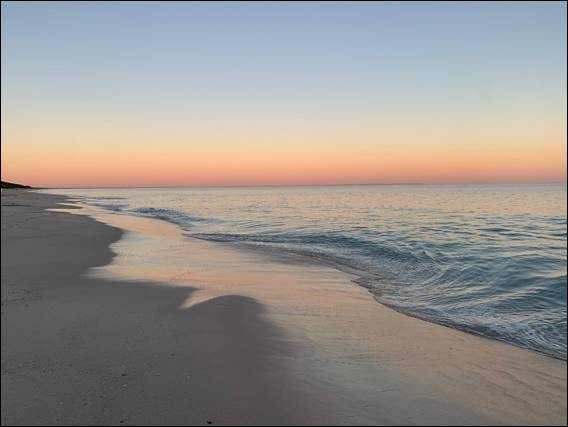
I find it hard to switch off when I know I will soon have to get back into the same frame of mind. This would normally result in me not being fully in the present. Thereby not giving the sensory delights around me there just due, and of course not paying attention to Lisa. Today, however, I made a concerted effort and relished the morning hues coming from the horizon and being reflected off the ocean and wet sand. Meanwhile, Lisa was busy chatting away to another beach walker, being one of her fellow Peppy Plungers, leaving me in my own world:
The ocean looked reasonably flat with the near waters looking clear, and I started to believe Verity. She had suggested that there were still good swims to be had this season, and that I should not be putting my snorkel gear away just yet. Providing evidence of this from her recent swim at Woodman Point Almo Jetty up in Perth, which I have to say has some very beautiful marine life living on its piles. The swell back at our beach was up about 1.7m, but the winds were light and the surface of the water belied what lay beneath:
So mid-afternoon when my brain was just about fried, I pulled the snorkel gear out of storage, suited up, and wandered down. Still trying to convince my mind that it was worth going in. It only took a few quick strokes before I was in two to three meters of water and all I could see was pea soup. The above image was taken looking up, after I ducked dived down. It was so bad that I struggled to find my local reef. Every so often I could see the surface below slightly darken, but each time I went down it was just a heap of sea wrack:
Still I couldn’t find the reef proper. Popping my head up to get my bearings based on the landmarks and my distance from the shore. It made no sense, I am sure I should have been right above it. Due to the conditions I didn’t see the point of going further out, or was it that I didn’t dare. But did keep going down mostly just to watch the sea wrack being washed back and forth along the sea bed. I also spotted a circular rock, about the size of a football or as they call them here soccer ball, and that too was being rolled back and forth:
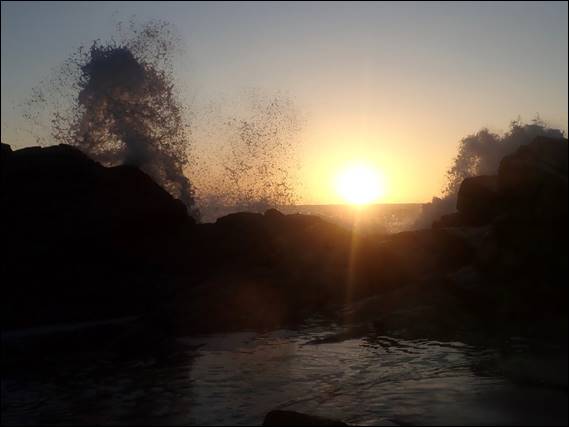
Every time I looked up the surface of the water seemed to be relative flat. All I could think of is ‘beware of the under toad’, as the water beneath the surface pushed me this way and that. Eventually heading for shore where I was bowled over by a series of bigger waves. At least I saw one Western Smooth Boxfish (Anoplocapros amygdaloides), a live one and not just a carapace. It felt like the waves were pushing me out and saying ‘give it up’. I did however go back later, but only to watch the sun go down. This time my snorkel gear will stay stowed away:
The weather has finally broken after the hottest and driest period on record for the South West of Western Australia. Much to the relief of many, but the first rains is not always good news. While I was in England a local dump of 50mm of rain, approx. 7% of the average annual rainfall, resulted in organic rich soils from dry agricultural lands being washed into a major river system. This is likely it have been a contributing factor for the drop in dissolved oxygen that led to a significant fish kill. Something unfortunately not uncommon at this time of the year:
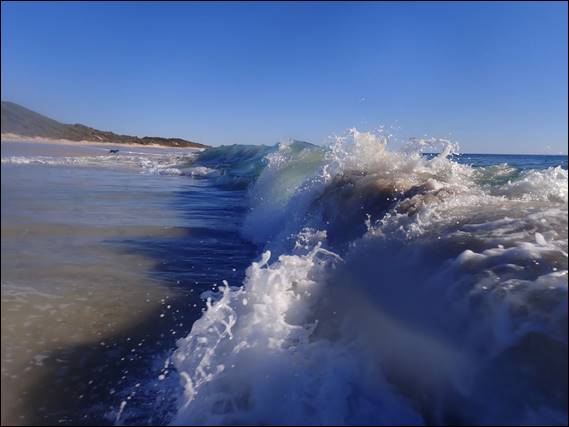
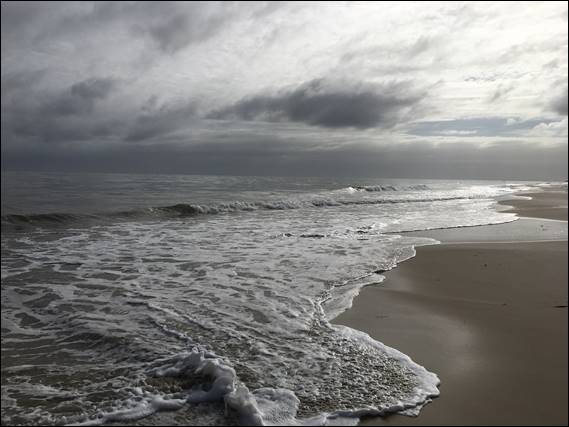
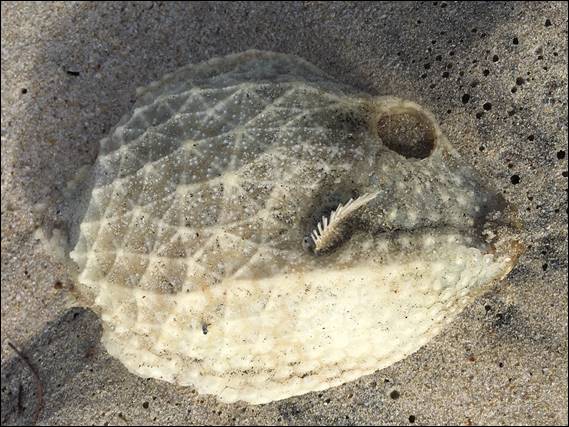
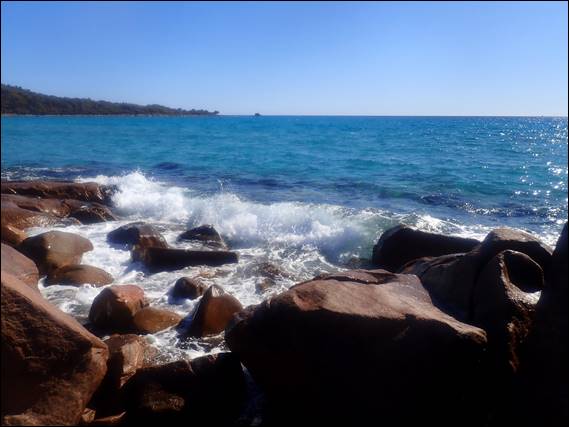
The change has also stirred up the ocean. The clear water I swam in on the day I flew out has turned brown. While the image doesn’t look too rough, the visibility is shot and my snorkel gear is packed away. The only fish I’ll see now being the ones washed up during the bigger storms. This Western Smooth Boxfish (Anoplocapros amygdaloides) was dead long before it was stranded on the beach. The exposed carapace clearly showing the protective shell-like bony structure of fused plates, with the only holes being for the eyes, mouth, and fins:
While the snorkel gear is packed away, it is the time of the year that the first orchids would normally appear. Not too many species are out this early, but there is one in particular that I am yet to find. While not filled with confidence, considering the preceding hot and dry six months, I went to check out one of the best local spots. What I didn’t factor in was the result of another weather induced phenomena, which again can result in negative outcomes for this time of the year and is again described by the Bureau of Meteorology as not uncommon:
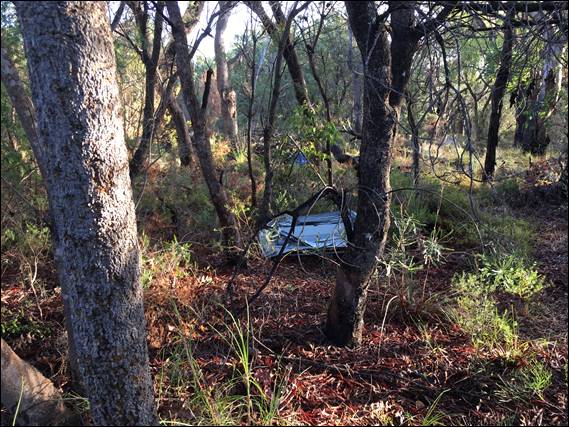
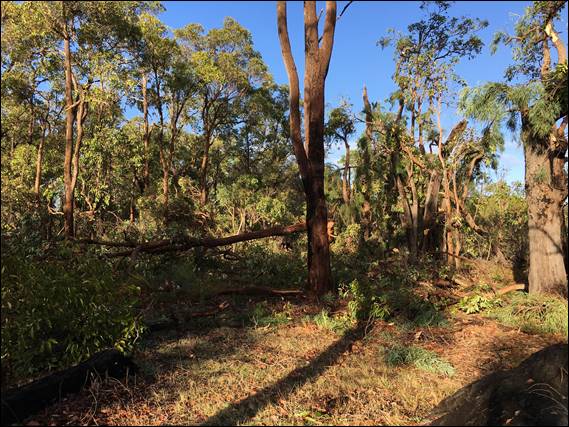
On Friday a cold front lashed the area, and a tornado formed. Wreaking havoc in its path, ripping off roofs and, along with anything not tethered down, lifting them high into the sky. The debris was scatter across a wide area. As I started my wander through Manea Park there were sizeable, twisted bits of corrugated roof sheets deep in the vegetation, as well as assorted household items. Along the path taken by the tornado trees with trunks up to half a meter in diameter had been twisted and snapped like they were twigs:
Despite the destruction, I continued with my walk needing to work round fallen trees and limbs that blocked the path in multiple spots. My initial thinking that seeing any orchids was unlikely, was correct. I kept my eyes mostly on the ground, and the only sightings was a small collection of leaves just breaking through the ground. They didn’t look like the basal leafs of the orchid species commonly found at this time of the year, being the Bunny, Hare, and Leafless Orchids. With the last one being the species I have not yet found:
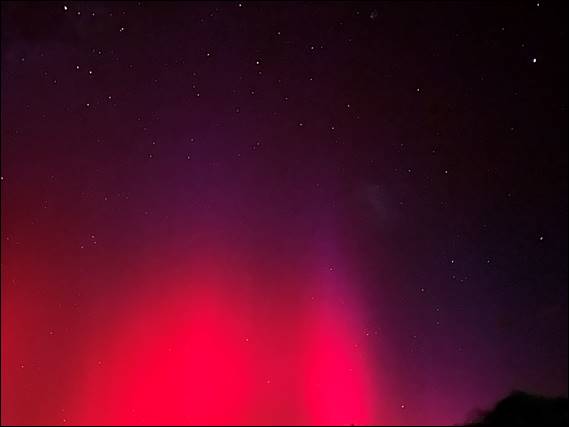
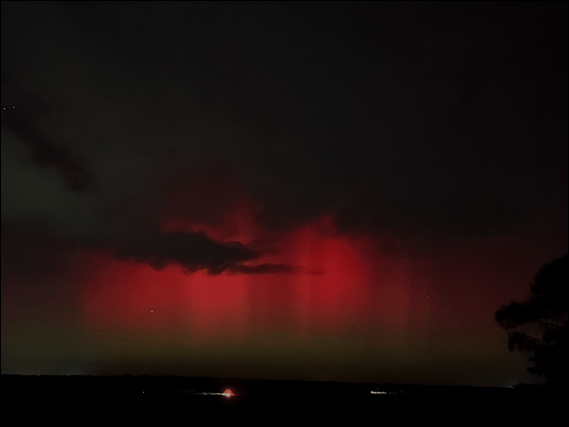
Something else I have always been keen to see is the aurora australis, or southern lights. This weekend with the first extreme geomagnetic storm in twenty years, it seems that half the world has had the opportunity. The aurora australis being on display in the southern and aurora borealis, or northern lights, on display in the northern hemisphere. These displays come about due to something that sounds like it has come out of a SciFi film. With plasma and magnetic fields, which have erupted from the sun, travelling across space to earth:
Verity, who writes up and sends out her recount of her many adventures, has travelled to Antarctica where she witnessed the aurora australis. She said that to the naked eye it wasn’t anywhere near as spectacular as the images people take. And tonight while it was great to see, it was as she had said. These two images being taken by my daughter, on her phone. The plasma and magnetic fields were obviously not interfering with the technology of the phone, as it transformed the faint glow in the sky into a dramatic and uncommon sight for where we live:
When reaching for my glasses as I got out of the car for my morning walk to look for orchids, the tiny screw that held the frame tightly round one of the lenses had come out. Luckily all the parts of the dismantled glasses were still in the case, enabling me to fix them back at home. It is therefore possible my lack of luck with the hunt was partially due to wearing my prescription sunglasses. That said it was fortunate I had my glasses at all. Going through the security check in Singapore for the final flight home my bag was checked and they fell out:
It was only because I was keen to prepare for a quick getaway on arrival at Perth that I noticed this. While waiting in the departure lounge I pulled out the car keys, parking ticket, but couldn’t find the glasses. They had been put to one side at the security gate, and I do wonder if they would have tried to find the owner if I hadn’t gone back. The reason my bag had been pulled to one side was the crag booty I had collected on Kinder Scout, during my walk with Dave the postie. The unusual metallic objects not surprisingly drawing their attention:
For the climbers out there the crag booty comprised: a 60, 100, and 200cm sling; a quickdraw, and two wire and a locking carabiner; and a no.10 and 11 offset wire. A bit over $200 worth, so whoever left them may be a bit sad but must have had good reason to leave it halfway up a waterfall. Hopefully they are safe and unscathed. Being truthful the amount of gear left behind and their placements indicated a lack of experience. And there was little point leaving it there to succumb to the elements that were quite literally raining down on them:
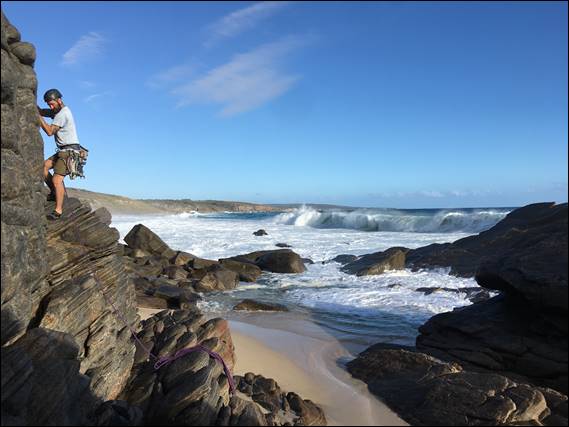
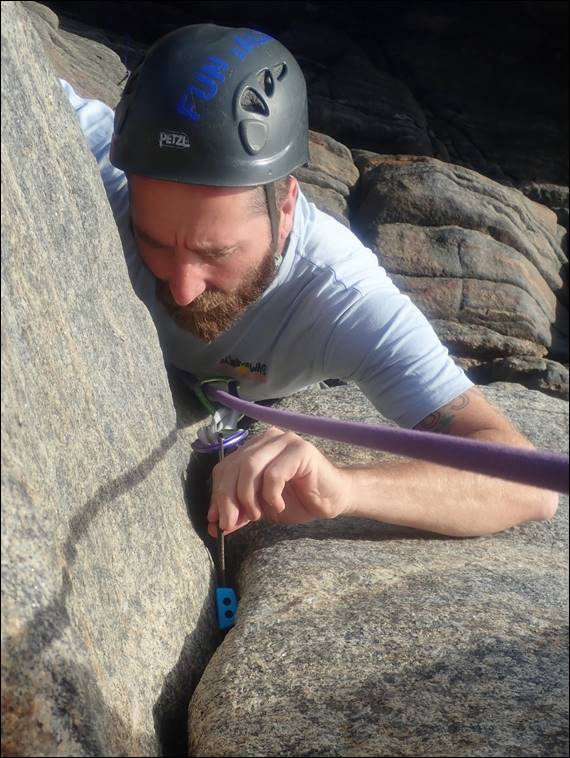
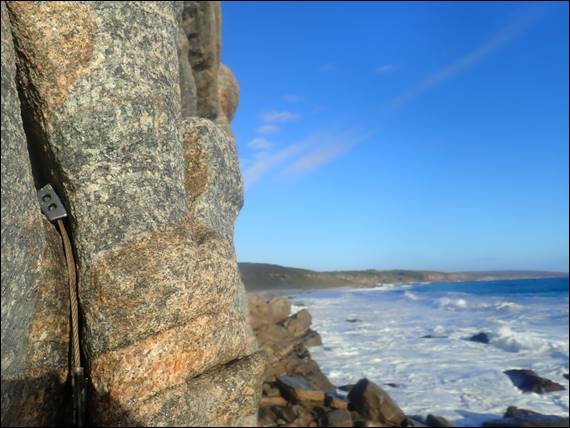
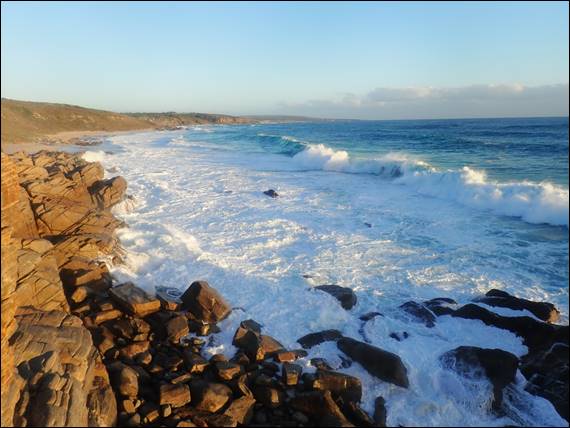
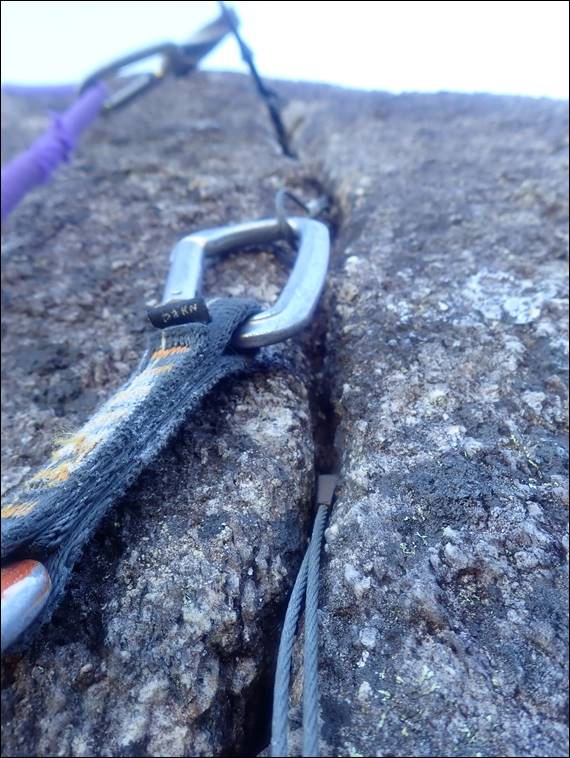
Today in complete contrast the rock was bone dry. Not even a hint of that pesky and greasy salt spray, despite the crashing waves being brought in on a rough swell. And while Howsie had brought his rack, I couldn’t resist bringing the two offset wires. Luckily back at the waterfall I managed to remove them from their placements with ease. Today however, they sat perfectly in the flared cracks and bit tightly against the more textured rock, something normal wires just wouldn’t do. So much so Howsie had to get out the nut tool to help ease them out of their snug and secure placements:
There was a risk I wasn’t going to get any images of the nut placements. Similar to the glasses coming apart, the strap on my camera had worked its way loose. On my first climb, as I went to take an image, I watched helplessly when the camera fell three of so meters. Bouncing of the rock several times. Amazingly there was not a scratch on the all-important lens and screen, and the body only received a couple of extra dings to show it was well used. On the plus side Howsie was climbing well, and managed to bag the second ascent of the difficult to read Off the Rails without any hints:
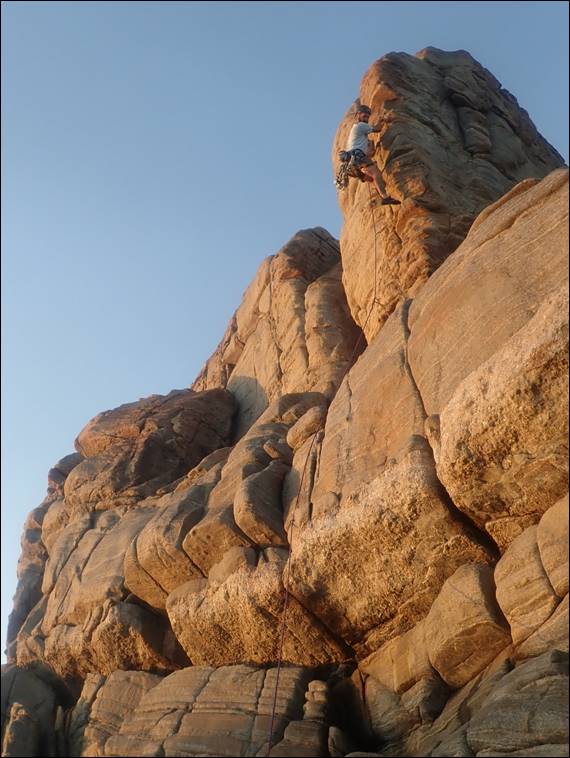
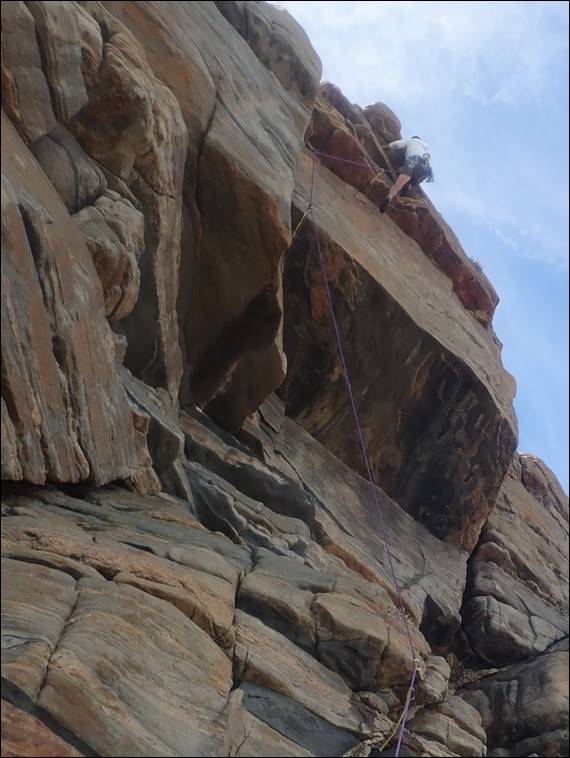
You may recall this climb as my most recent addition to this wall. Established when I came here with Craig just four months back. Howsie hung on his arms and before they gave out he eventually unlocked the puzzle of the first roof, after multiple attempts. Today for the first time this year, we enjoyed an afternoon climb. This was due to kids sports dictating Howsie’s availability, although we both agreed climbing in the evening light was wonderful. And in the cooler time of year, having the sun on your back feels good. We had evened up the numbers between us, but there was still a bit of time before the sun set:
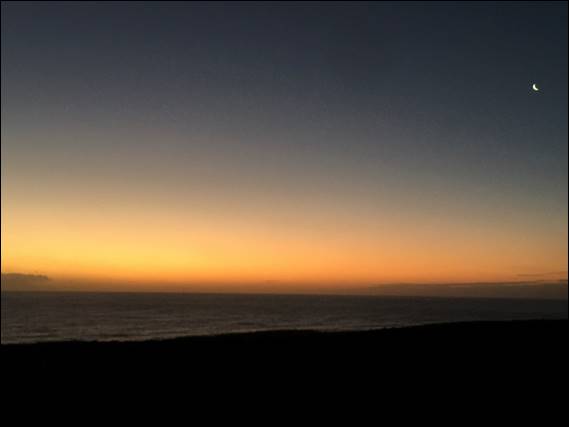
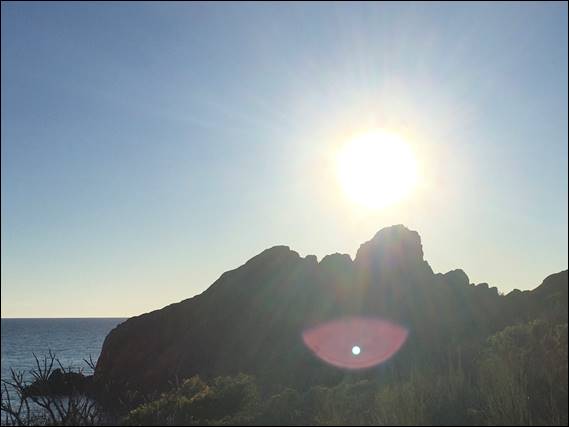
Howsie was keen to maximize the use of the evening light, and jumped on one more climb. I was more than happy with that, finding a perfect rock to sit on to watch the sun inch towards the horizon, as I belayed him. With the sun gone we packed up and walked out, as the light was sucked out of the sky. Reaching the car as the darkness was taking a stronger hold of the sky, allowing the thin slither of a moon to shine through. It had certainly been a very enjoyable trip out, although I think I have said that for every one of the many trips to Moses Rocks:
This visit was a little touch and go, as in addition to the crag booty I had possibly brought something else back with me or someone here had shared it with me since my return. After battling through whatever it was on Wednesday, I was then unable to function on Thursday. Taking a day off work sick for the first time in as long as I can remember. I like to think the power of positive thinking assisted my recovery, allowing me to muddle my way through work on Friday and get out today. The friendly and lower grade routes at Moses were the perfect choice, as I was still a little wobbly on the rock:
Who is Dave the postman you may ask. He has been the deliverer of post for my Mam and Dad since they moved up to Romiley some five’ish years back. And my sister, Seeta, for as long as she has been living in Romiley. He had been delivering the post on that particular round for thirty years up until a few weeks back. And being a well-liked and friendly character, he has built up a great relationship with many on his rounds. And I know my folks for one, will dearly miss his friendly chats as he check in to see how they are going:
He is still delivering post, so why the move you may ask. It’s simply really, he is now delivering from the sorting office just round the corner from where he lives. And in an equally quiet and pleasant part of the world, one from which on a clear day Kinder Scout is clearly visible. You may also ask how it came to be that I would be taking a day out from my trip to see my folks to head into the hills with Dave. Well he took a liking to the weekly postcards I would send to my folks, personalised with an image from our life and my adventures:
With my folks, and my, knowledge and acceptance he always enjoyed seeing what was happening in our life down under. And knowing I enjoyed the great outdoors and also indulged in early morning wanders when back in Britain, he had offered to take me out for a day hiking sometime, if I was keen. We had attempted to make this happen last September, but the weather and illnesses got in the way. And being truthful, as Lisa, Elseya, and Griffin had also joined me for that week, it also felt kinda wrong to head away for a day:
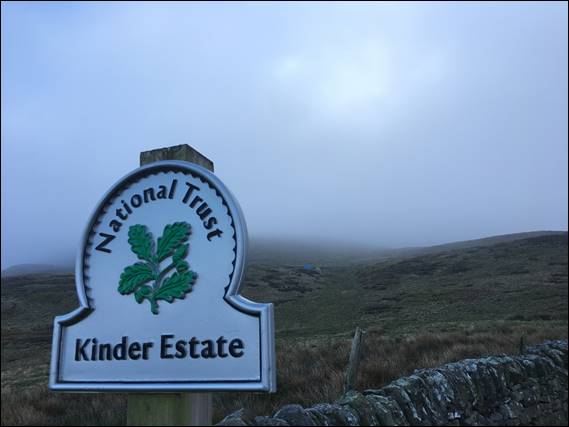
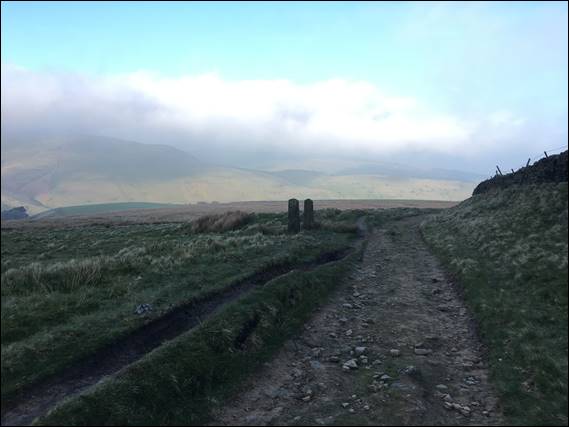
This trip however, I went by myself, there were no bugs to hold anyone back, and the weather forecast was looking favourable. So Wednesday morning I was being picked up at six thirty from my folks house, where Dave first had to apologise to my Mam for moving to a different delivery round. Something that had happened pretty quickly, so he did not have the time to say farewell to all the locals. Then it was a quick thirty minute drive to downstream of Kinder Reservoir, where we shouldered our packs and continued on foot:
Dave has been up Kinder Scout numerous times over his life, being a local lad. And during his first week of delivering on his newly acquired rounds he had looked across to it, and thought it may be a good destination for today. He had asked if I had any preferences, and while I pondered suggesting a few places I knew with great rocky edges full of fun routes I resisted and allowed him to choose. I didn’t find out our destination until the day we drove put, and was not disappointed. Having been up Kinder Scout only once before, thirty years back:
It is the highest point in the Peak District, at a lofty 2,087 feet above sea level offering lovely vistas. It was also the site of the 1932 Mass Trespass, a time when rambles from nearby towns peacefully protested to ensure public access on what was then private land. This event assisted in resulted in changes in legislation and was an instrumental part in the campaign for open access. This eventually led National Parks being created in Britain, with the Peak District being the first one founded on 17 April 1951:
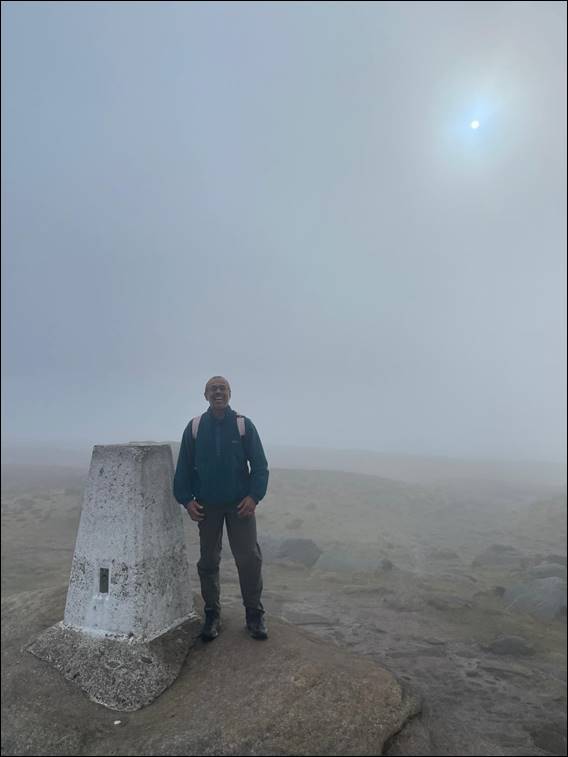
It’s a place steeped in much history and culture, and Dave was a fountain of knowledge as we walked and talked. He was however concerned that the day may not turn out as good as forecast, as we walked up the incline to the trig point at Kinder Low (2,077 feet). There are some six and half thousand trig points, which were built from 1936 onwards to assist the Ordnance Survey in creating a single national map and one reference system for Great Britain. This resulted in the OSGB36 datum and the National Grid, a system that is still used today:
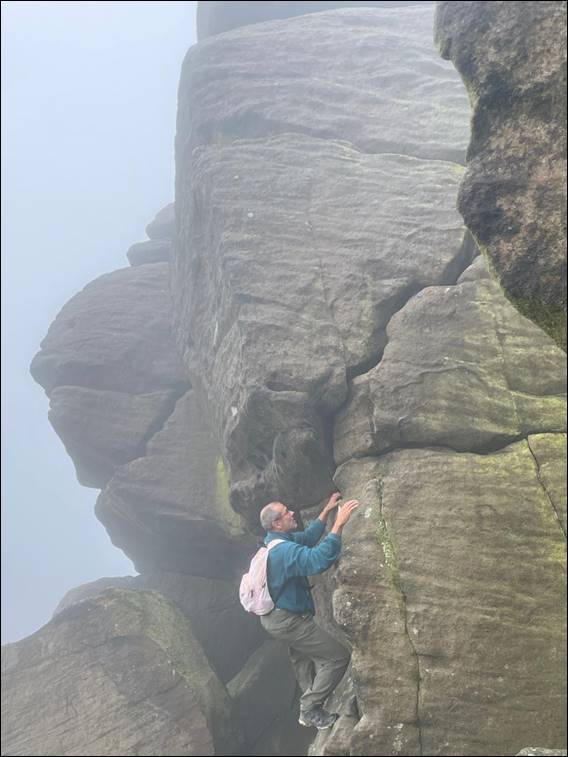
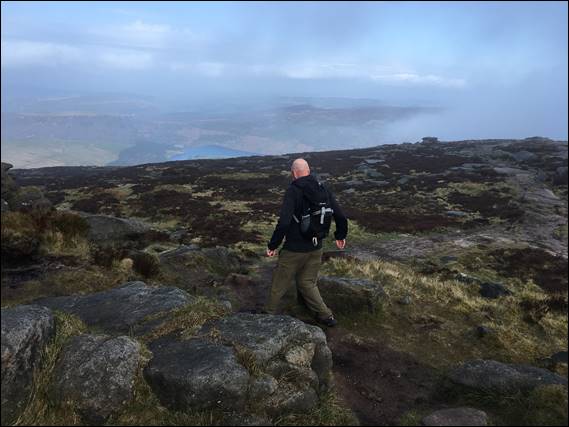
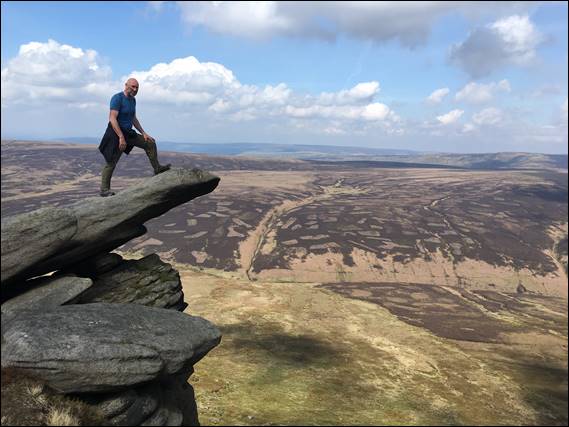
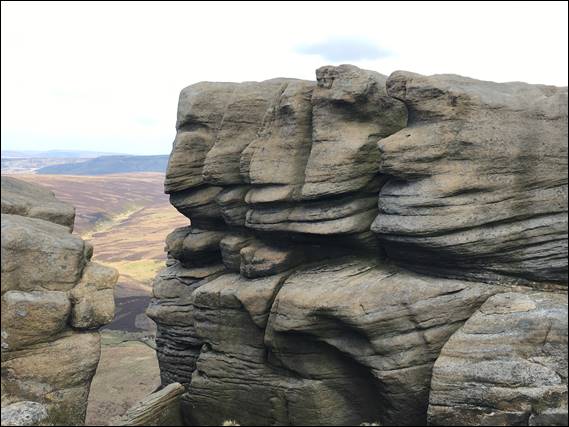
You may notice the trig point is not as high as the highest point on Kinder Scout, by ten feet or approx. three meters. The highest point does not have a trig point, and is merely marked by a mound of grass and small cairn. But once on the edge of the plateau the views are equally stunning from all directions and heights, so while we didn’t reach that extra ten feet of elevation it made no difference to the experience. You will also have seen that I got to play on a bit of rock, holding myself back from going too high as Dave watched on nervously:
The clouds came and went, and two images up we reached the waterfall of Kinder Scout as the cloud rolled back in. The only other time I have been here, there was more water flowing over it and the wind funnelled up the valley. Blowing the falling water right back up and over the waterfall. Creating a stunning rainbow in the mist filled valley. Today it was a mere trickle, and as Dave explained while it has been damp and cold it had not been raining heavily for prolonged periods. The low flows coming off the peaty plateau back his views:
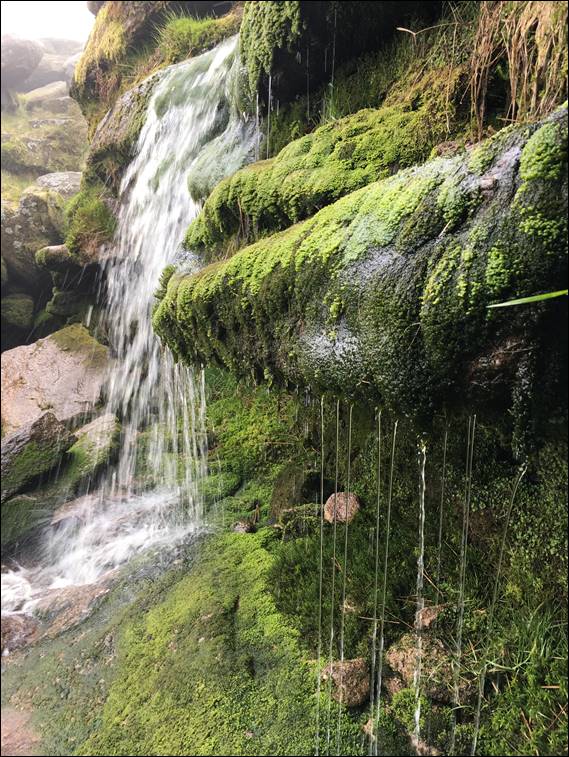
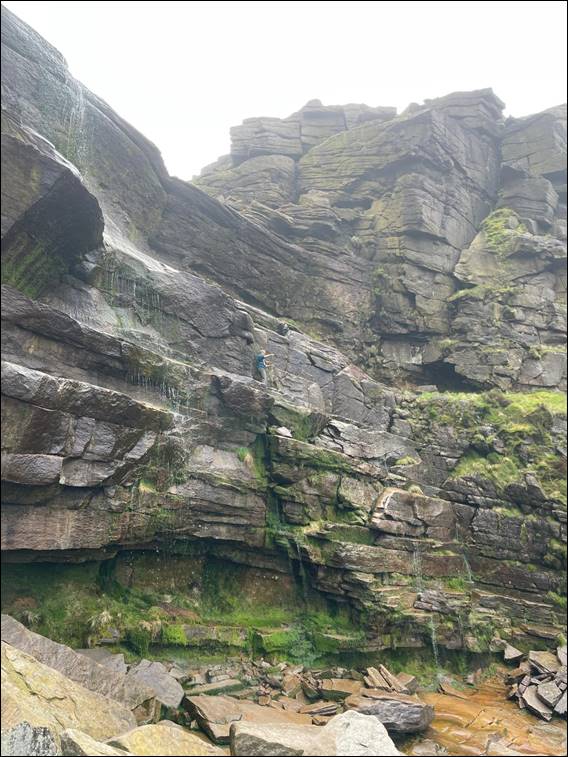
As we watched the trickle of water, I spotted some climbing gear part way up the waterfall and mentioned it to Dave. Suggesting that we could try to get down there to check it out, but also saying it may be too hard to get to. He was keen to find a way down so we scoured the immediate valley, guarded steep rocky outcrops. Spying a likely decent we walked round crossing the creek. This is where I took the close up image and the amount of water looks bigger than it is. I was however taken by the all the lush greenery:
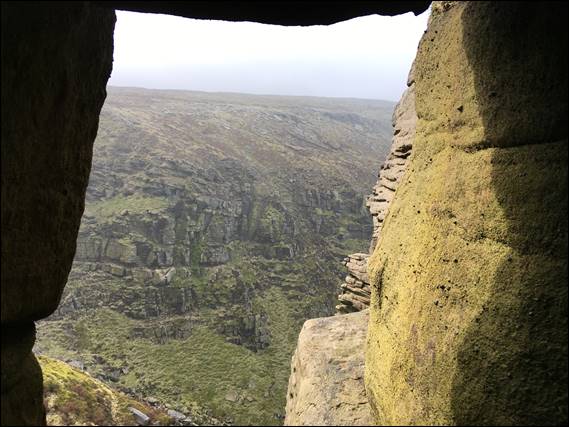
To get down we had to down climb a chimney and pop out of a small opening onto a final rock step. Dave confessed to having never progressed from hiking to true scrambling, so this took him out of his comfort zone. But showing determination he managed to get down. A low level traverse then took us back to the head of the horseshoe shaped valley and the base of the waterfall. Dave was content to watch from the side while I scrambled across to the right-hand corner and climb up the falling water, before traversing left to retrieve the gear:
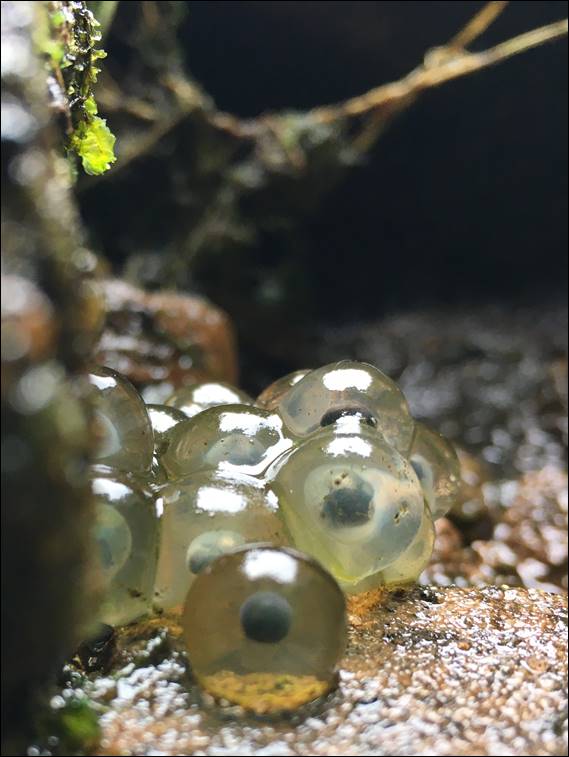
He confessed that this made him ponder his options if things should go south, so was relieved when I got back down. He had even scrambled across to the base of where I had gone up, and I reckon with a bit of encouragement I could easily get him into scrambling and maybe even climbing. Back at the packs I spotted the above spawn in a crevice where the water was splashing up. We weren’t sure if it was frog or toad spawn, but it may be frog spawn which is laid in clumps as opposed to toad spawn that is laid in strings:
Scrambling back up to the main plateau, we had a sit down and bite to eat looking out and the clouds lifted for good. I had to resist the temptation of scrambling back down to climb up one of the many inviting features, as we relaxed here for a bit. Eventually we continued on our chosen path being the thirteen mile Kinder Scout mass trespass walk, which we were doing in the reverse direction to the linked site. Our time on the plateau was coming to an end and soon we made our way down the steep steps to a crossroad in the path:
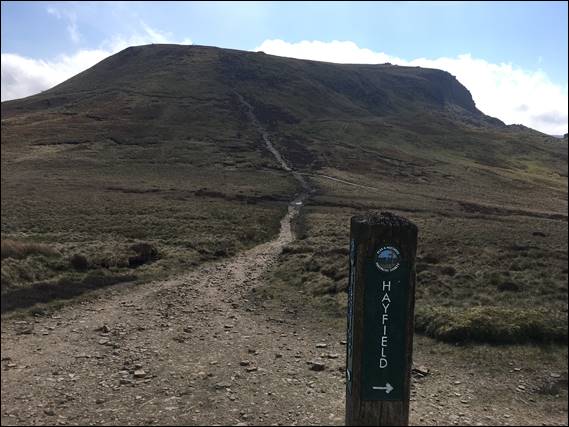
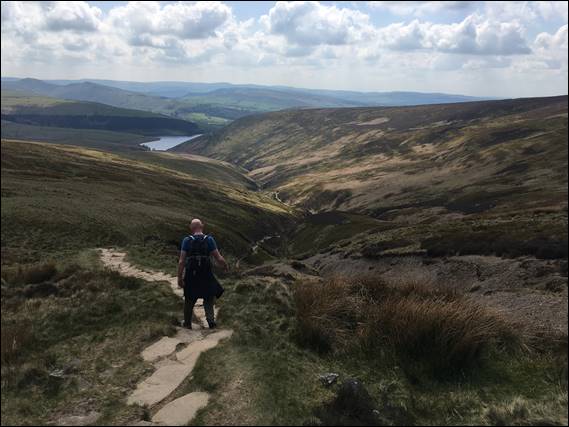
The steep decline can be seen below, and it was during this descent that we saw the most people on what was otherwise a quiet day. We had cheerily said hello to them as they huffed and puffed their way up, something we were to ponder on later. It was still early as we hit the crossroad and our direction was towards Hayfield, but I was tempted by the sign pointing in the opposite direction to Snake Inn. Dave reckoned it would be a couple of miles and maybe an hours walk to get there, but he warned it may no longer be a pub:
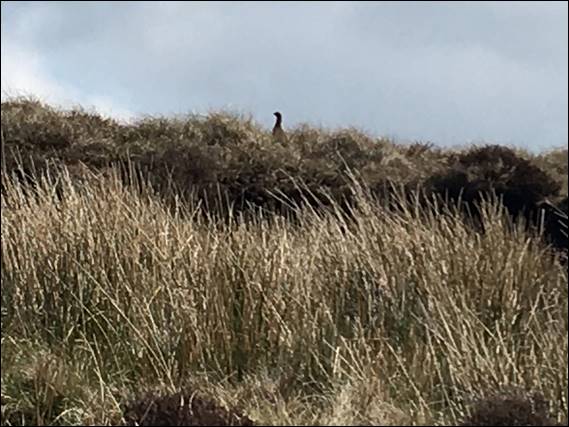
Many of these pubs have their original name and have sadly been turned into bed and breakfast places, but we walked on regardless. Listening out for the familiar calls of the more common moorland birds such as the Skylark (Alauda arvensis), which true to its name came out to play in numbers when the blue skies came. The distinctive bubbling call of the Curlew (Numenius arquata), which we heard but only saw on occasion. And then there were the Red Grouse (Lagopus lagopus) shown below, given away by the fleck of red on its head:
None of the birds we spotted allowed us to get too close, as we walked and walked. The valley meandered round the ridges that dropped into the valley, and each time there was no sign of the A57 or the more commonly call Snake Pass. A road that connects Manchester and Sheffield built way back in 1821. With each footfall there were two thoughts in my head. What if the Snake Inn isn’t a pub anymore and secondly we are going to have to walk back the same way, which somehow was becoming less and less inviting:
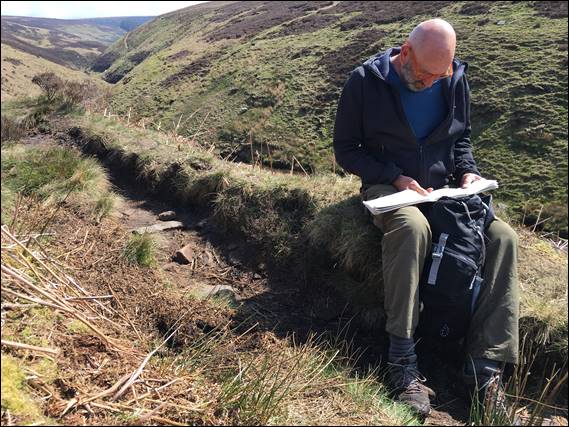
Eventually we had a conflab and decided it was time to consult the map. The result was that the two miles and approx. one hour was a tad of an underestimation. We could well have been two thirds of the way there, but it may be less. The road passed through the dark green forest all the way at the end of the valley to the right in the image below. Neither of us were keen on going all that way just to turn round and come back without the reward of a pint. So it was time to make a decision:
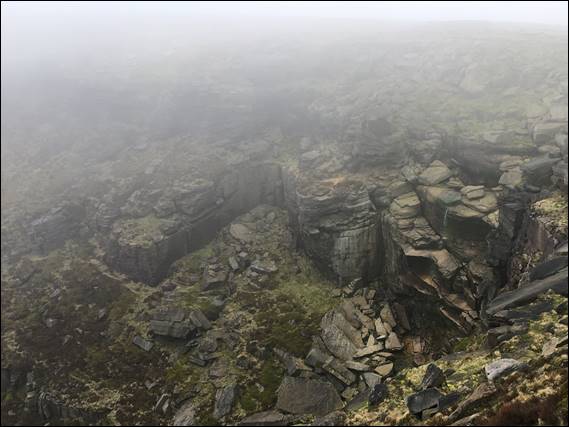
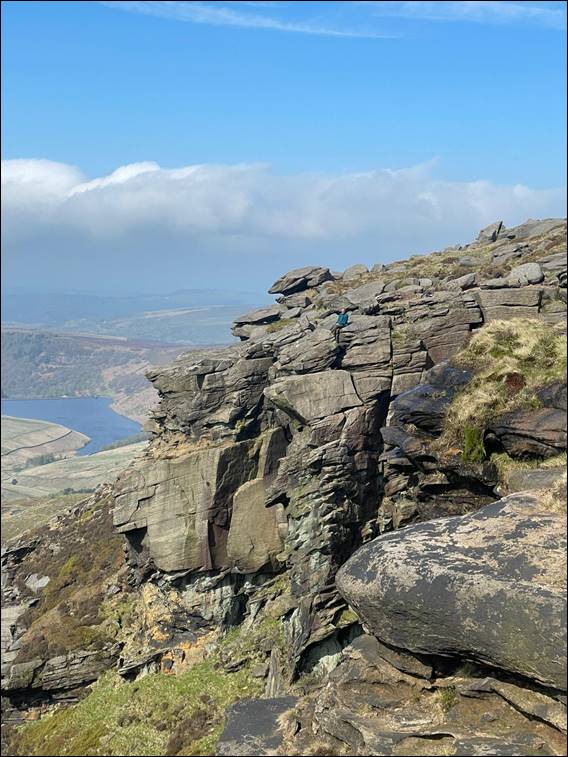
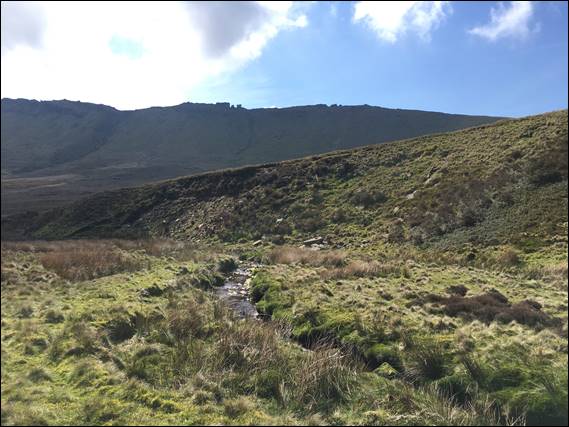
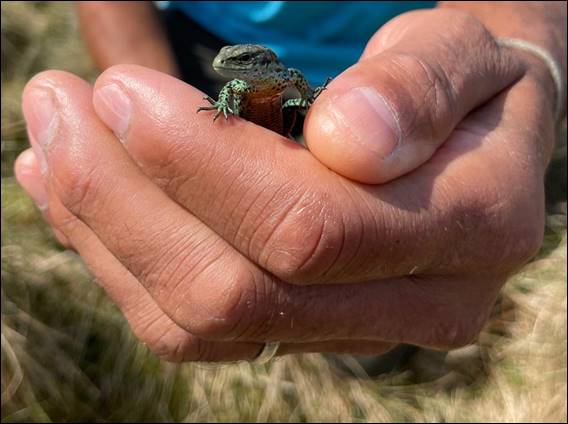
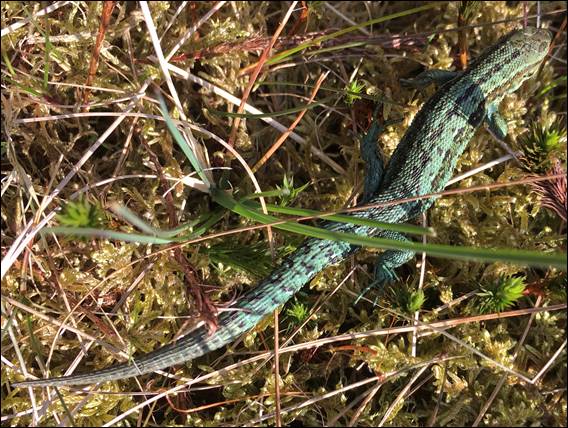
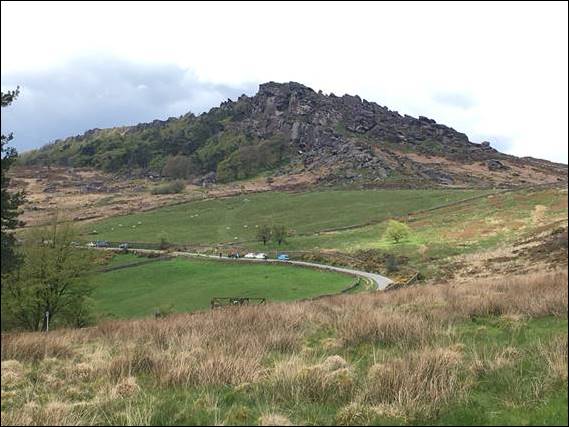
So for a second time we went off track, deciding to take a rising traverse up the side of the valley to reach The Edge. The rocky skyline shown two images up. We spied a section that wasn’t guarded by near vertical rocky outcrops and started our way upslope. With no path we had to be careful on the tussocks of grass, so as not to twist an ankle. Dave saw a movement in one of these and we dropped to our knees looking about to find the first reptile, being a Common lizard (Zootoca vivipara):
As the name suggests it is the most widespread and common of the lizards found in the United Kingdom. This one however is just a little less common in that it is a green variant. I say just a little as while they are usually brownish-grey, colour variants are not that unusually and can include yellows, green, and even jet black. As we sat in awe of our find Dave also spotted a small section of a moulted snakeskin. There are three species of snake in England although the habitat of Smooth Snake (Coronella austriaca) is restricted to the south:
As such it was either from an Adder (Vipera berus), the only venomous species, or more likely a Grass Snake (Natrix helvetica). I’ve only ever seen one snake in England and that was an Adder trapped in a well, which I managed to rescue. We didn’t see any more reptiles, and as we continued the trudge up the ever steepening slope we reflected on how chirpy we had been towards the people hiking up the steep steps. Not that we would have begrudged someone being friendly and saying hello, but a little less upbeat may have been better:
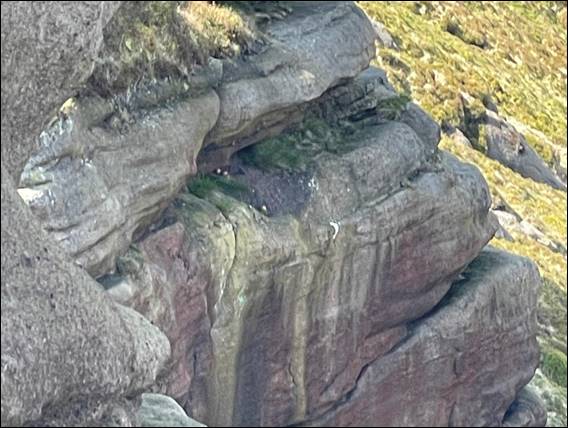
We made it and were now ready for some lunch. Our legs had that tree-trunk feeling, which was probably fair seeing we had hiked up to the plateau twice now. As we had made our way up the last sections we had spotted a Peregrine Falcon (Falco peregrinus), or more truthfully it had spotted us. Circling in and out with a rasping kack-kack-kack-kack sound. This was a warning as they are generally silent. And sure enough we watched as it landed on a horizontal break on a short buttress not far away, and from above we spied three eggs shown above:
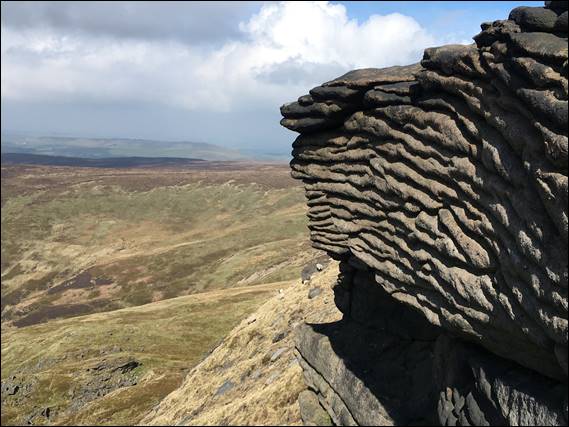
It looked like one egg had rolled out of the nest, precariously sat on the edge it was probably done for. We ate some food at what seemed a safe distance and out of sight of the nest. Not far enough obviously, as the kack-kack-kack-kack sound continued so we moved on to leave it in peace. As we followed The Edge towards the top of the steep steps we had previously walked down, we marvelled at the many rock features. Along the way I noticed the patchwork pattern in the moorlands on the opposite side of the valley:
Dave explained that this was done to boost the Grouse populations for when the grouse-shooting season begins on 12 August. He also told me that over the years he has tried to find a number of aircraft crash sites, and pointed one out to me in the valley side way below The Edge. I’ve read there may be in excess of three hundred across the Peak District. Many occurred between 1939 and 1963, and nearly all were military aircraft. The majority of crashes are reported to be due to navigational errors, during poor weather conditions:
Most of the pilots in world war two did not have enough training, were very young, and unfamiliar with the landscape. To work out their location when they were lost they needed to drop below the cloud line so they could see landmarks such as roads. This combined with the topography often led to them crashing into the hillsides. At the steep steps we went down, this time not meeting anyone coming up. And at the crossroads, we followed the sign to Hayfield. Taking us down William Clough and towards Kinder Reservoir:
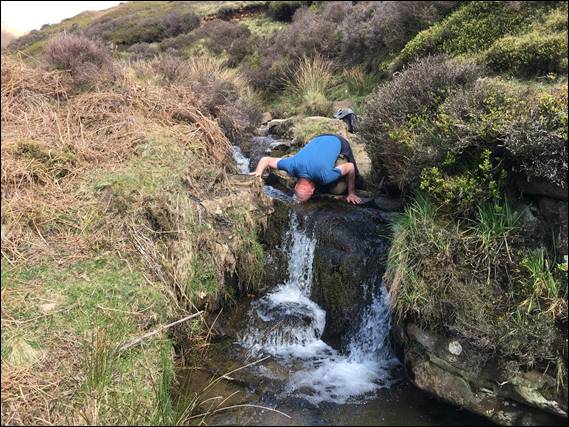
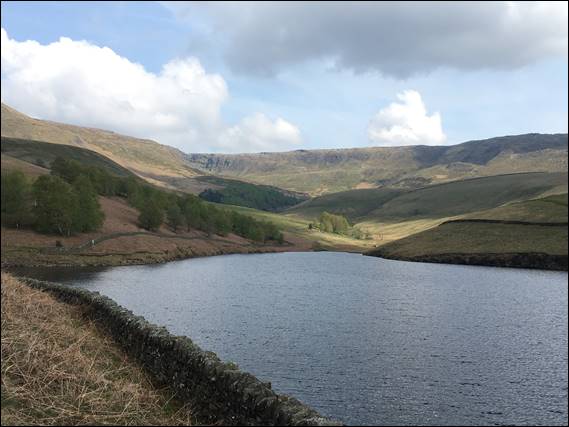
Similar to as we attempted to reach the Snake Inn, a creekline gurgled away the entire way down the path until it dropped into the reservoir. It was a wonderful sound. Dave cooled his head off part way down, and we then stopped just shy of the reservoir to soak our feet in the cool waters. The track then became a much more well-trodden path along the reservoir, for the final leg back towards the car. This time Dave purposely said that this last leg always felt longer than expected, maybe due to the underestimation of his previous thinking:
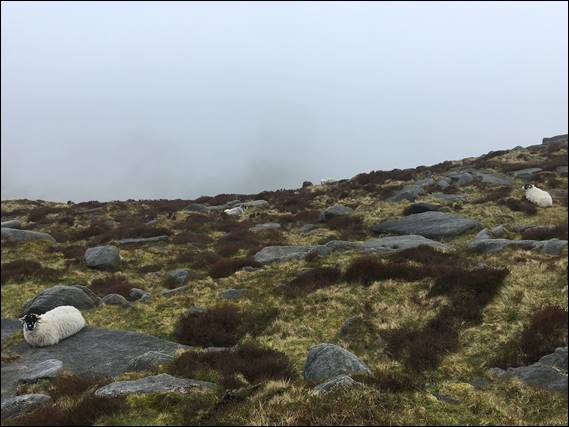
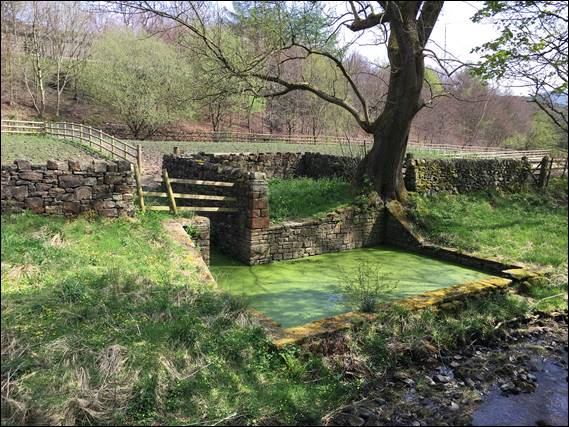
Not that the deviation from our planned hike had worried me. It had certainly provided us with some great sights both big and small. And as we got closer to the car I was impressed with one more sight. What might be considered an over-engineered sheep dip built between 1900 and 1910, still standing strong but no longer used. We had seen sheep all over Kinder Scout, and wondered how they were rounded up seeing they were spread across such a vast and at times difficult to access landscape. The answer is simple, hard yakka:
It was time to fly once more back to the homeland. I’d heard I should expect wet and damp conditions. Spring had not been what it normally would have been. No surprises there, when does the climate behave in accordance with the season of old now anyway. Unlike the last trip it was only me flying over this time, and I went with Singapore Airlines. This was purely on the basis that the food selection was more suited to my pescatarian diet. Another plus was I could wander round the Butterfly Garden, after the short first five hour flight:
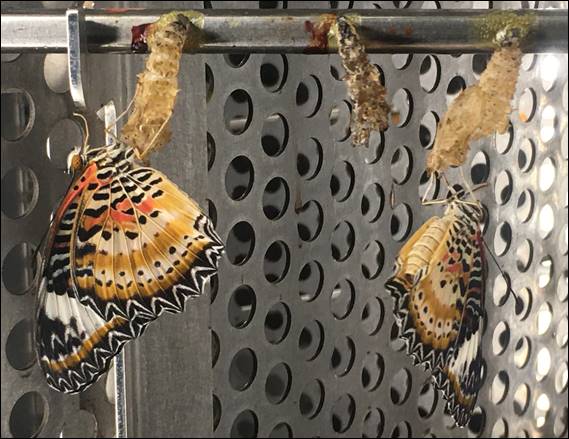
Sadly walking round the garden at one in the morning wasn’t ideal. Most of the butterflies were asleep. I probably found close to ten of the reputed forty seven species they have here, but left them be and the only image is of a couple of newly emerged New Lacewing (Cethosia cyane) in the lighted pupa enclosure. The next flight was a bit of a killer at thirteen and half hours. Mostly because I didn’t want to disturb the two elderly people sat next to me. So a note to myself that an aisle seat is the way to go next time:
Being a mid-morning arrival at Manchester my Mam and Dad had to get up that bit earlier than normal to be able to meet me at the airport. But they manage it and this allowed us to do what is turning out to be a bit of a tradition, and head straight to Pear Mill for brunch. I do not think the quirky tea pots and ramshackle collection of antiquities at this place will ever get boring, and the cuppa and brunch went down very well. Followed by a slice of cake, chosen from a spectacular selection. And then it was time to head back to the house and settle in:
As before, this visit was only a week long. Some people are a bit shocked when I say I am only going back for this duration, but short frequent trips is the way to go rather than long infrequent trips. The folks, understandably at their ripe ole age of over ninety, are a bit exhausted after a week of having their routine being upset. This includes more trips out, earlier wake up times, and generally more energy being needed due to the extra person being about, even when we just loaf about in the house:
To be honest I can’t recall what we did for the rest of the first day. I do however know that I got straight into Greenwich Mean Time by staying up all day, going to bed at a sensible time, and as I do at home getting up at five in the morning. This is way too early to rouse the folks, so not having my family over I snuck out, as quietly as the creaky floorboards would allow, and headed for a wander. I intended for my first walk to be a short one just to get back into it, but once out I changed my mind:
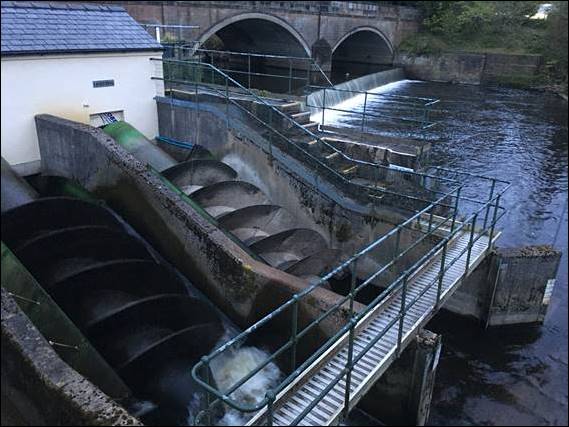
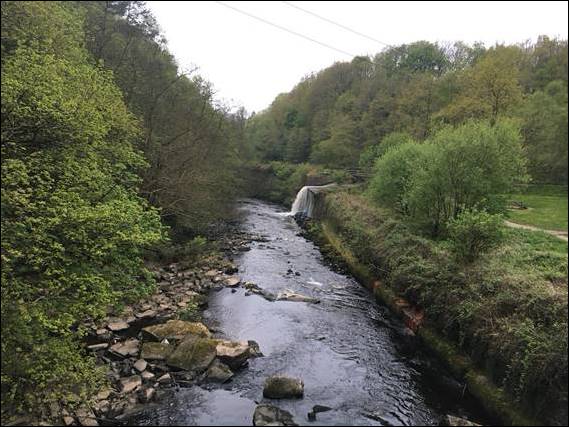
This resulted in me walking past the community hydro plant at Otters Pool on the River Goyt, which can deliver as much as 60kW of power during high flow. The brisk five mile walk was great, ending with a walk along the scenic Peak Forest Canal. It seemed that I had brought the good weather with me, and the week was shaping up to be pretty good. Despite the morning temperatures only being about five degrees it felt pretty warm. The more humid conditions are likely to have played a part in that, and with each walk I did I wore less and less layers:
Depending on how far I walked, which varied from five to twelve miles, my mornings would start with one to two and a half hours of fresh air. The intent being to allow the folks to maintain their later waking up times, and slowly ease into the day. This of course didn’t happen, and they would get up than bit earlier and I would find them milling round the house. Since my last visit I noticed that it takes a lot more time for them to get ready, mobility and ability having definitely declined even though that visit was only in September last year:
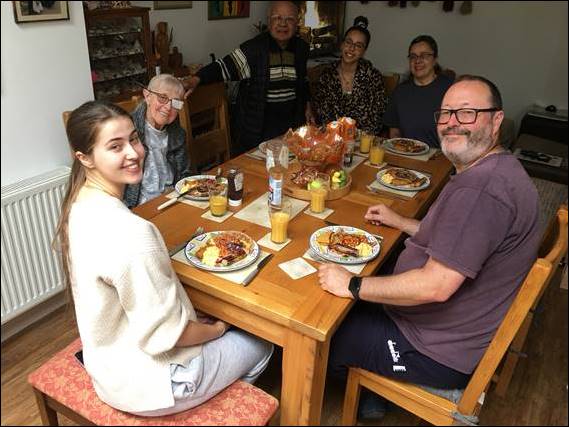
Being Sunday Neil prepared a big cook up for brunch for everyone, which went down very well indeed. We walked over to Seeta’s house, which is only a short distance round the corner. As with the mobility, the pace the folks can walk has also reduced further but the good thing is that they still manage to keep moving. And while the distances they can manage have reduced, Seeta still gets them out and about and not just for the many appointments. In fact with her help they are undoubtedly the most well-travelled ninety year olds in Romiley:
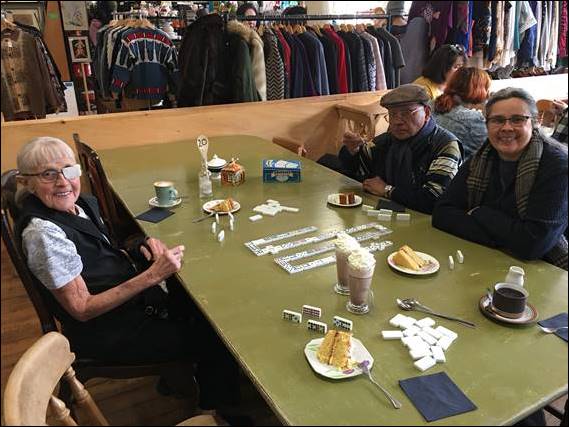
After brunch we jumped into the car and headed down to the Roaches, where during my last solo trip back I spent several hours walking round and reliving my many, many climbing trips here. This time I didn’t scamper off to the hills and rocks. Instead we all escaped the cold biting wind that had picked up by having tea and cake in the Roaches Teahouse. I was all in favour of that, as we were unable to do that on the last trip due to it being closed for a function. With new owners it certainly doesn’t have the same feel anymore, it was still good:
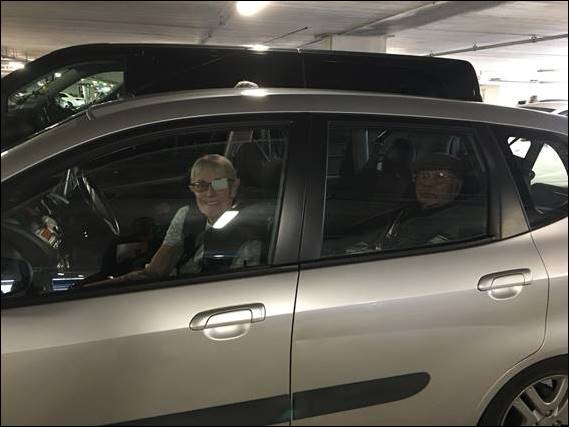
Leena was offered, or was it encouraged, to drive us to The Roaches. She is still learning and it was a big step up to have four passengers in the car. It was also the first time she had driven on the open roads. That may sound strange, but all her driving to date has been town/city driving. The narrow roads and sheer volume of traffic on those roads means the speed limit is rarely above forty miles an hour, and that is when you can actually get up to those speeds. Learning to drive in England would definitely be way more stressful than at home:
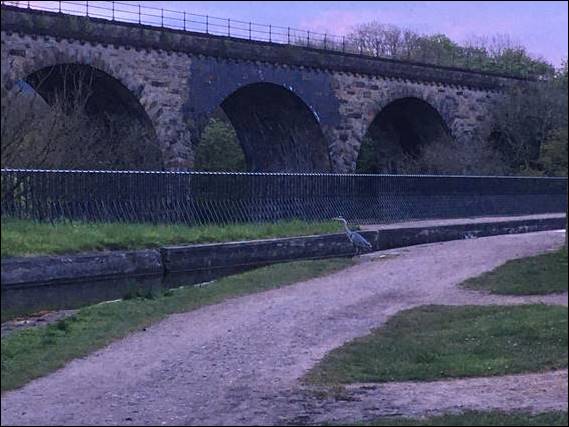
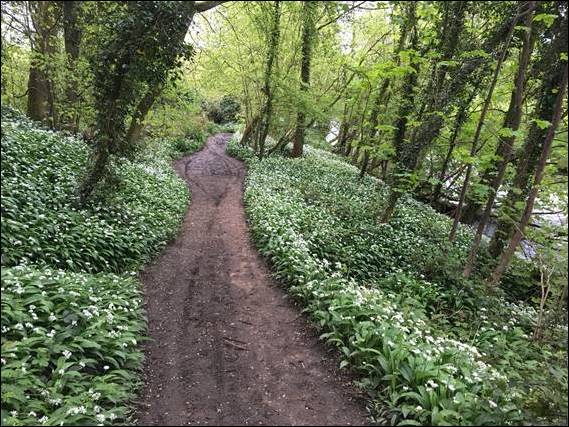
Monday came and while the rest of the world went about preparing for a normal weekday, I was back out for a seven mile walk that took in canal and this time the River Etherow. Just before I left the canal I spied an unmistakable Grey Heron (Ardea cinerea), being the first time I have seen one on my morning walks. While it may have been a damp spring, the flowers were still out and carpets of Wild Garlic (Allium ursinum) covered some sections of the forested areas the path went through. Making the air smell glorious, if you like garlic:
Back at the house the folks were up and getting ready, today we had to be out the door for an appointment. Seeta is their primary carer and does a sterling job of fitting the many, many appointments in. In addition to the more enjoyable trips out, amongst work and family life. These appointment are all over, requiring at times an hour drive each way, so can chew into a big chuck of the day. After my dad’s physio appointment it was lunch time and we went to Woodley hoping for a feed of fish and chips, but it was closed so instead we went to a café:
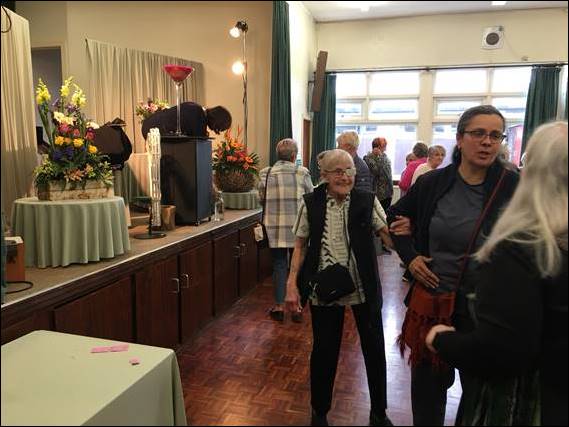
The reason for going there being that there was a flower show on in Woodley, and my Mam enjoys going to them. Watching someone arrange flowers is not for everyone, but today Seeta was not alone in joining Mam. Both myself and Dad also got to ‘enjoy’ the experience, and it was his first one. My trips back are after all about the folks, and this includes doing the things they enjoy. My Dad found it interesting, but admitted that it was not for him, so I get the feeling he won’t be going back for another show:
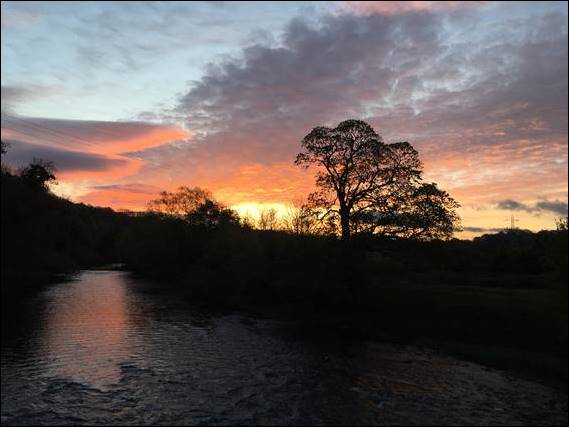
At these flower shows, the displays are raffled off and while we didn’t win anything the lady who photobombed the image, and is talking to Seeta, gave her wining arrangement to my Mam. So we did not go away empty handed. It may not sound like we did much on Monday but we got back to the house sometime after four, making it a long enough day. And the next day there was an even earlier appointment, again for my Dad. As such my morning walk was a short four miles, being rewarded with a stunning sunrise:
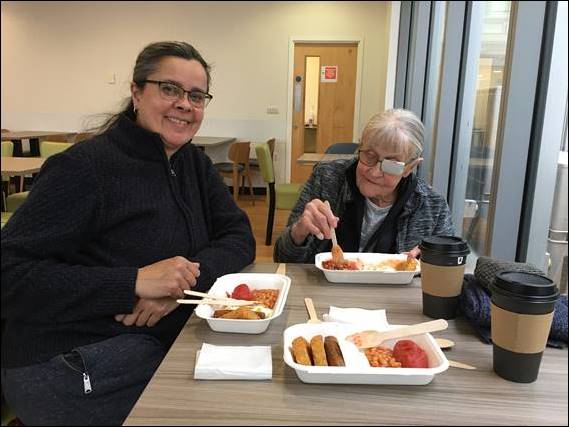
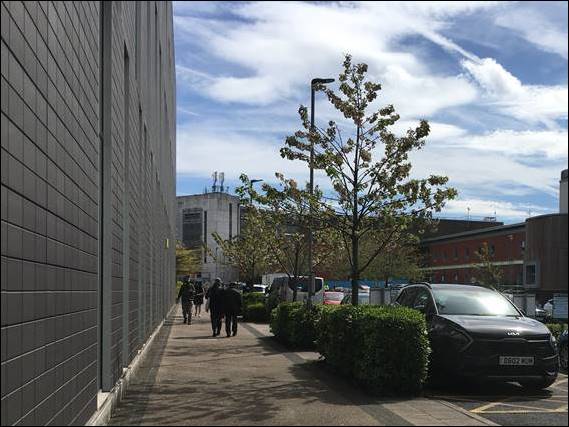
We had to be on the road at 7:30’ish, and it takes the folks a good hour to hour and a half to get up and be ready. So it really was an early start for them. Needed as due to the rush hour traffic to get to the hospital in Manchester it could take anywhere up to an hour. Once there it was a case of sitting round waiting for approx. a couple of hours while my Dad was being seen to. This allowed time for the three of us to enjoy a very yummy breakfast in the hospital canteen, a short walk to a ‘cheapy’ shop, and then a sit down at yet another Coast Coffee:
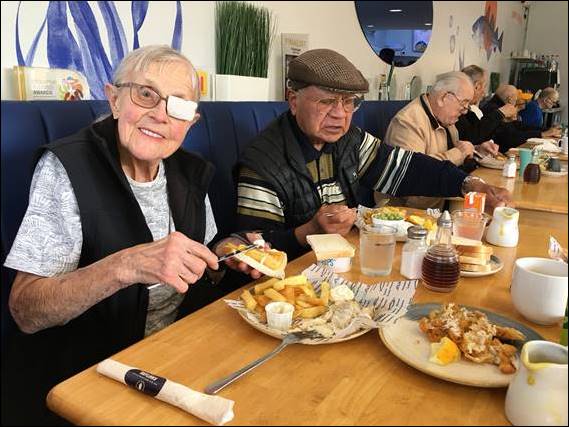
After life in our sleepy and small village of Peppermint Grove Beach for over a decade now, being in British city felt very strange. Super busy and built up, so much more so than our local town of Bunbury and even our state capital of Perth. I certainly would not confess to feeling comfortable or at ease in places that are that hectic and busy, but can manage it for small doses. As can be seen we ended up back in Woodley for lunch. This time making it to the award winning fish and chip shop, which certainly lived up to its reputation:
Being back at the house earlier today I took advantage to get a few jobs done. There was a list of things and while the intention was get to them on Thursday, getting started today would be a big help. The list also included things that Seeta simply can’t find to the time for. After cracking on and sorting out the shed and garden stuff, replacing a bleeping smoke detector battery, and doing a bit of painting there was also time to get the games out. Ideally there would be time every day for a few games, but it had been too busy up until now:
Something else planned for this trip was a day out in the hills with Dave the postman. We had attempted to get out for a day during my visit last year, but the weather was awful and we were also hit by bugs. This time however the weather gods were shining on us and as such I didn’t head out for an early morning walk. Instead got picked up at six thirty for a full day hike. This also provided the folks with a well-deserved and much needed rest after four busy days. That said my Dad did have a GP visit to get to, thankfully local and just down the road:
I’ve decided to write up my day in the hills as a separate post. It would have made this one way too long. So I’ll skip to Thursday, the day for jobs. I wasn’t sure how my legs would feel but headed out early all the same, foolishly or not picking the longest walk in the book of walks from Romiley Station. It is the only walk in this book that I had not been on before, mainly due to the length being twelve miles. While the majority fo the loop is in great country, it does take in more industrial sections than the others:
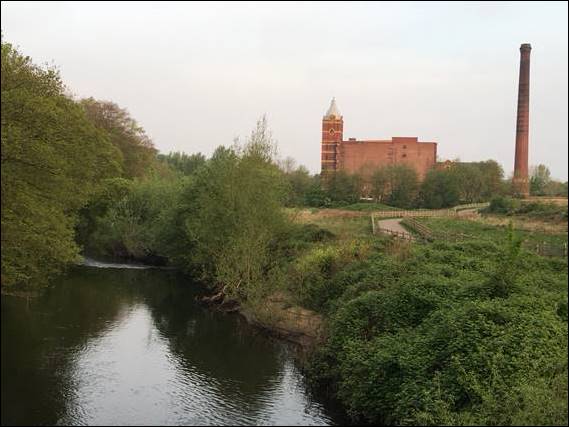
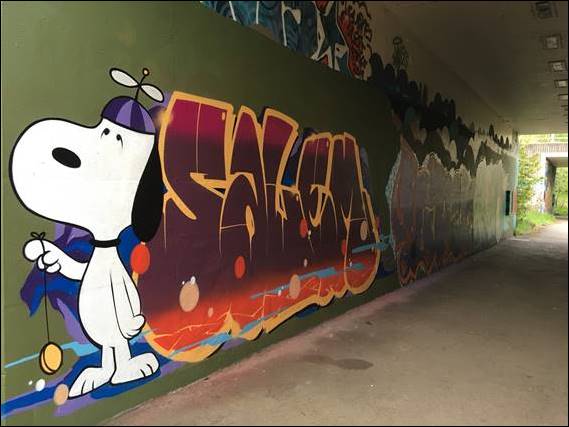
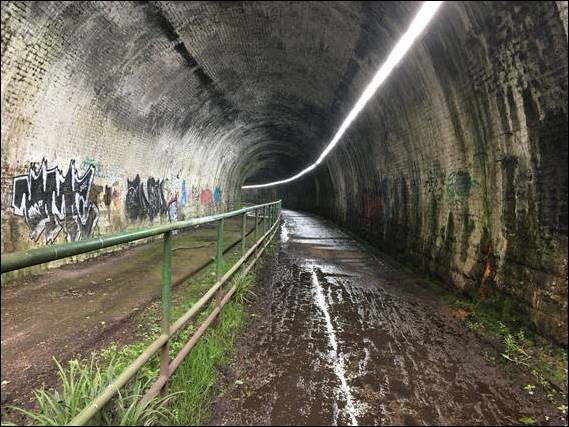
The first image being as I approached Pear Mill, way too early to be able to pop in for tea and cake. The next image is from a series of underpasses that takes you across the first motorway crossing. Colourful graffiti coating every inch of the walls, but none of it was offensive and much of it looked like reasonable street art. The book provides an alternative path to the tunnel above, for those who do not like long tunnels. It is a 156m disused rail tunnel, which was opened in 1863 and is part of a track that has replaced the rail:
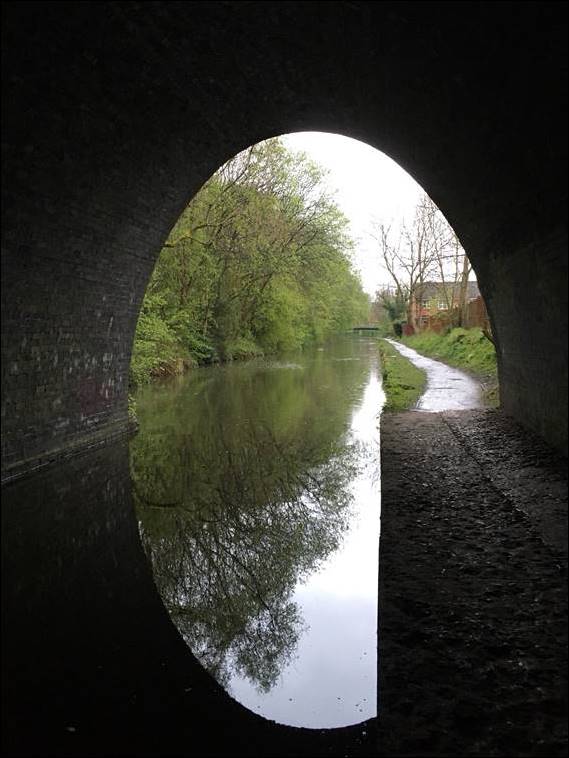
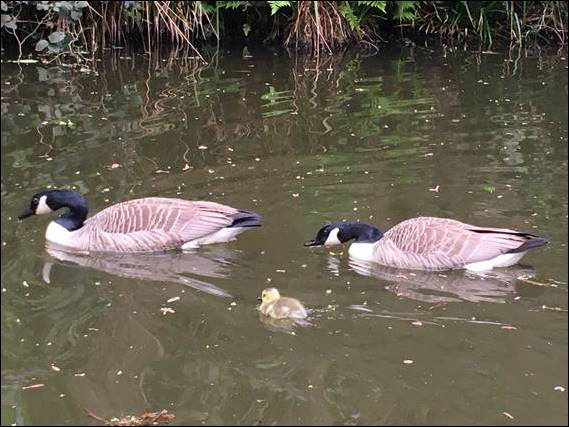
The tunnel was certainly very well lit, and I find it interesting that the book specifically mentions people may not be comfortable using the tunnel. As there are equally long tunnels to go through on the Peak Forest Canal, and they have no lighting in them. No special mention is made in the book for alternative routes for these. And on the final section of today’s walk, along the canal, I went through the 160m Woodley Tunnel in darkness. After which I saw the only Canada Goose (Branta Canadensis) gosling I saw during my walks:
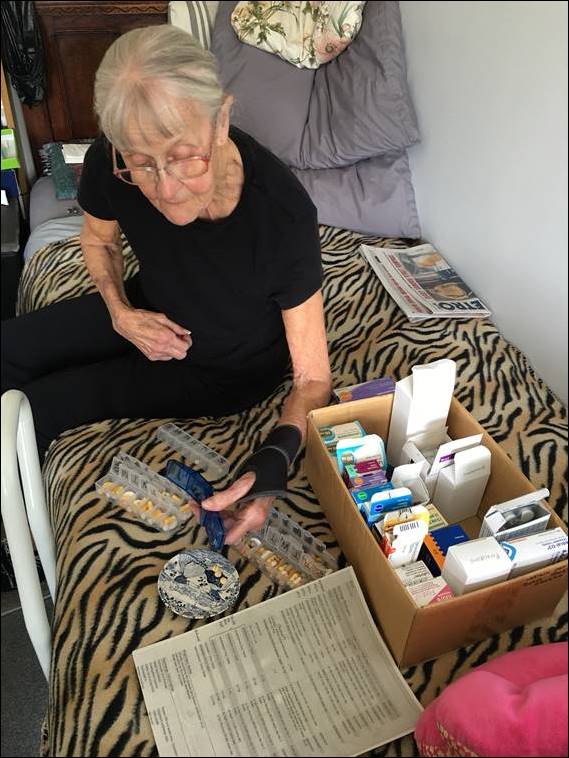
Seeta was working a very long day on a polling station for the local elections, leaving us alone all day. This is partly why I had in mind to get the jobs done today, but before I could start my Dad was keen to vote. I accompanied him just down the road and we then wandered to the local shops to make a circuit of the short walk, which chewed up a good hour. Then it was time to fill the pill boxes for my Mam. It is staggering how many tablets both my Dad and Mam take, and that little job also ate away close to an hour:
Having got a head start on a few of the other things on Tuesday, the main task today was a repeat of what Lisa had initiated during our visit in September last year. Pressure washing the paving slabs. With such a damp climate the algae is quick to take hold and when wet it makes for lethal conditions for those unsteady on their feet, such as my folks. I thought that having been done approx. seven month back it would be a short job. However, all up it took some six and half hours. Looking so much better afterwards, and being far safer too:
There was still time in the day left for a game, only the second time on this trip! After which we all agreed an early dinner was in order, so I wandered down to the local Indian to grab a takeaway as soon as the door opened. With Friday came my last morning walk, one of the best in the book with eight miles and nearly all of it in the countryside. Taking in the heights of Werneth Low, the beauty of the forested Etherow Country Park, and serene River Etherow and River Goyt, and finishing of course along the canal:
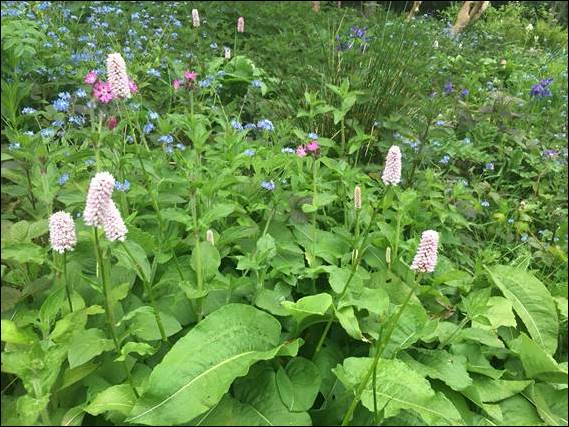
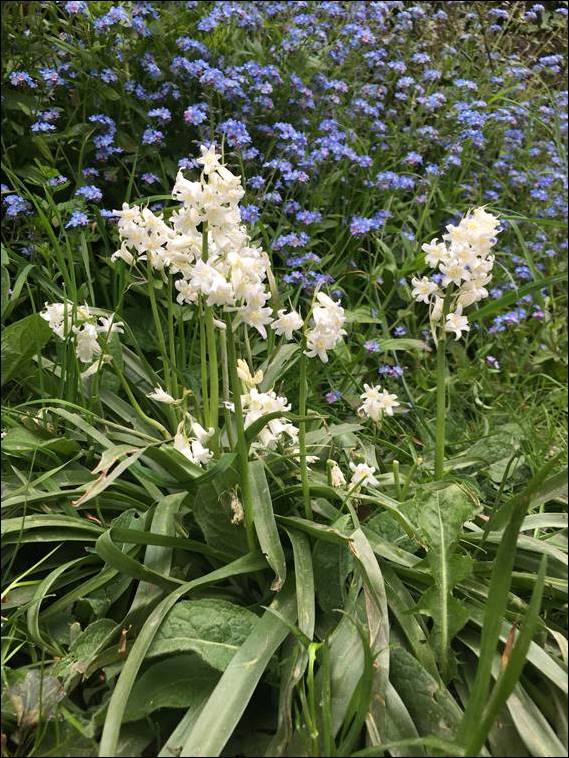
I really enjoyed all the flowers that were out, but also kept a keen eye out for feather friends. Like all the walks there were plenty about, but today I was very happy to see a Jay (Garrulus glandarius). I’ve not seen many in my previous years in Britain, and they are described as being quite difficult to see, as they are shy and rarely move far from cover. I didn’t get an image of worth so there are a few images of flowers instead, the sort of flower show I do enjoy. Including below, the oxymoron named, White Bluebells (Hyacinthoides hispanica):
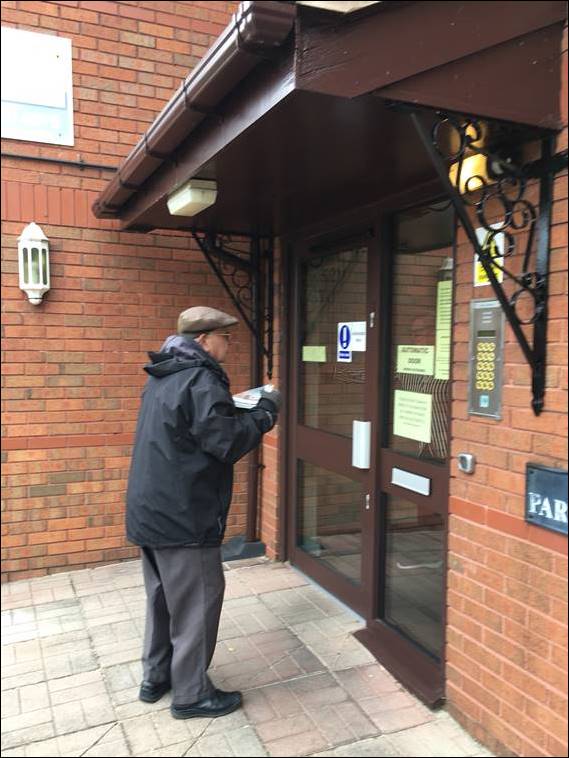
Back at the house it was time to scrub my boots free of any hint of mud, if I hadn’t I would no doubt have fallen foul of Australia’s’ strict customs control. And then donning my sandals to help the oldest paperboy take the local rag to the old peoples home. Today was another day of heading out, but with no appointments to get too we could afford a later start time for a more fun trip. Not taking any chances we aimed for a place that was tried and tested, and sadly being a Friday Leena was working so couldn’t chauffeur us today:
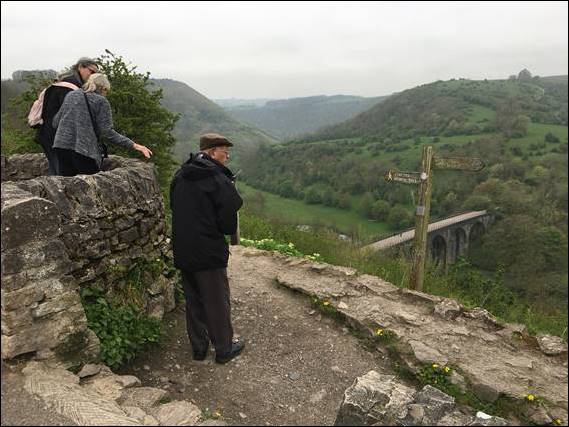
Our aim was to head towards Bakewell. Taking in the impressive Monsal Head on the way, which overlooks another rail line that has been converted into a hiking trail. The trails here looked great, and on a good day this place gets packed. But today there were not too many people about, maybe because the drizzle had returned. We were wrapped up warm and while the trail looked inviting, it was way too steep to even contemplate a short walk with the folks. Instead the cosy Hobbs Café was calling us:
Here we had a very welcome hot drink and as seems to be the custom bit of cake too. With all the eating out during the day we tended not to have too many big evening meals, which suited me fine. The Indian was probably the main exception of the trip, but on that day there were no trips out for a feed. It would have been nice to pop into the local café, which my Mam really likes. But time was not on our side and when I gave her the option, she said she would prefer to have the pavers cleaned. The sensible choice:
All warmed up we took one more look down into the valley before jumping back in the car. Heading to the Lathkil Hotel, a little out of the way place that they had stumbled across a year or two back. And since then having been back a few times. Bakewell is not far away but is simply way too touristy and busy. And this place is quiet and provides was is touted as the ‘most spectacular and unrivalled panoramic views of any pub in the Peak District’. Overlooking the Lathkil Dale, and even on a misty moisty day, as today, it was pretty specky:
We sat in the comfort of the pub, looking out and occasionally spotting hikers braving the cooler conditions outside. And it was here that I had my one and only pint of the trip. I’m not quite sure how we managed it, but we all polished off our mains and a dessert each despite the not that long ago cake. And of course no trip seems to be complete without a stop in a Costa Coffee on the way home, one part of the trip tradition that I did not partake in during our days out. Back home, and certainly not needing any more food, we got the games out:
As is always the way what seemed like a long week ended abruptly, but we certainly packed a lot in. And on Saturday morning despite needing to leave before eight Leena popped over with Seeta, all keen and ready to chauffeur me to the airport. The traffic wasn’t too bad at that time on a Saturday, but you still need your wits about you to find where to go. I have no doubt that the journey back for them may have taken a detour past a Costa Coffee before the folks could rest up and get back to their normal daily routine, while I prepared myself once more to fly back home:
I’ve managed one more dip in this unusual season. And it may be the last until the next snorkelling season comes along, as I’ll be unable to get into the water for a little while. It felt cool walking down this morning, and we have recently had some overnight single digit readings on the thermometer. The temperatures are finally starting to drop, as we head into the middle of Autumn. But the calm, rain free conditions persist. Two very weak low fronts have hit us, but they did not bring any rain and barely any wind:
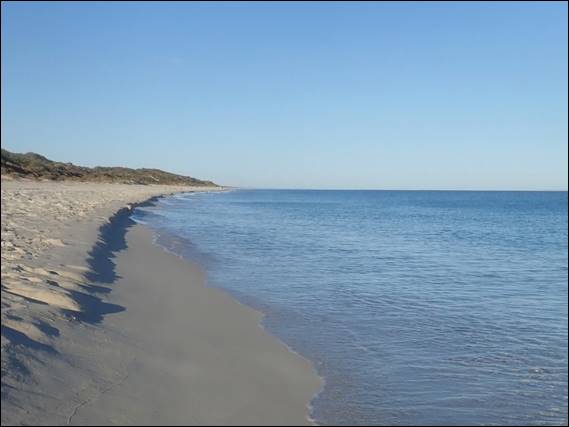
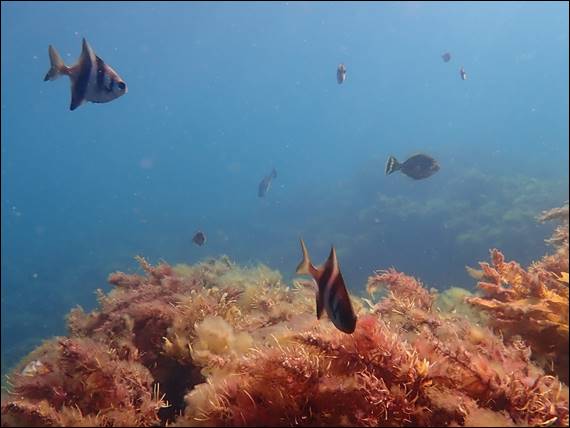
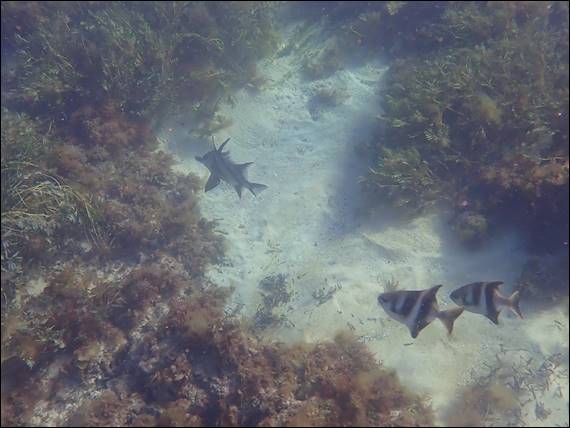
The beach had a steeper slope where it slid beneath the water, typical of winter and indicating wavier conditions. The water was however lovely and clear. The lower and less intense sun and cool water quickly sucked the heat out of my body. I know I got colder than normal, as my fingers are still painfully tingling as I type. It may not have been as clear as my swim last weekend up round the bay, but it was lovely for our local beach. Banded Sweeps and Horseshoe Leatherjackets happily followed me round as I did my familiar lap:
I’ve previously called this a European Fan Worm (Sabella spallanzani), which is listed as a pest. Having looked them up again I could have been mistaken. My originally identification was made using a diving site that has a wealth of marine creatures, all catalogued making it easy to use. This time however it may have mislead me, as the feathers on the European Fan Worm radiate out in a spiral. Whereas this one has more of a flat feather structure, so while it is definitely is a Feather Duster Tubeworm (Sabellastarte) I’m not sure what species:
There seemed to be plenty of fish about, and I even spotted one that I do not recall seeing before. No more than six inches long with a very distinctive olive green body that was black in the lower half from the middle of the body back. It had striking big blue-green eyes. Despite coming across it twice during my swim, I was sadly unable to take a picture to allow me to identify it. Maybe because I was not able to stay down for long, as I was struggling with the cold. That said it was also not keen on me getting close and quickly darted off for cover:
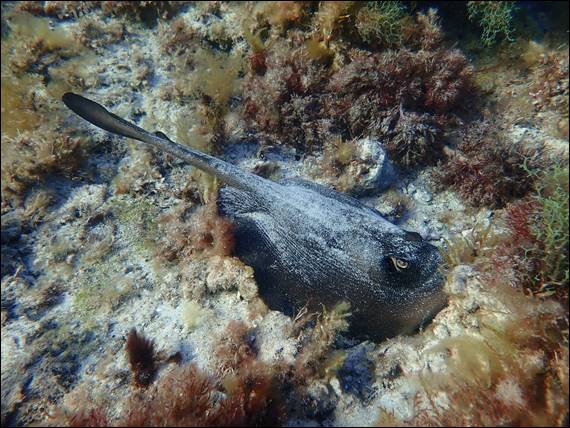
If these conditions persist until I’m able to get in the water again, I will hopefully come across it again. I’ll definitely be wearing my wetsuit to keep me warmer and weights to help with getting and staying down. And while that particular fish didn’t allow me to get close I was very happy to come across the above Striped Stingaree (Trygonoptera ovalis). I was even more pleased to then come across a lonesome fish, one I have previously come across only a couple of times. Easily distinguishable from the ever present Banded Sweeps:
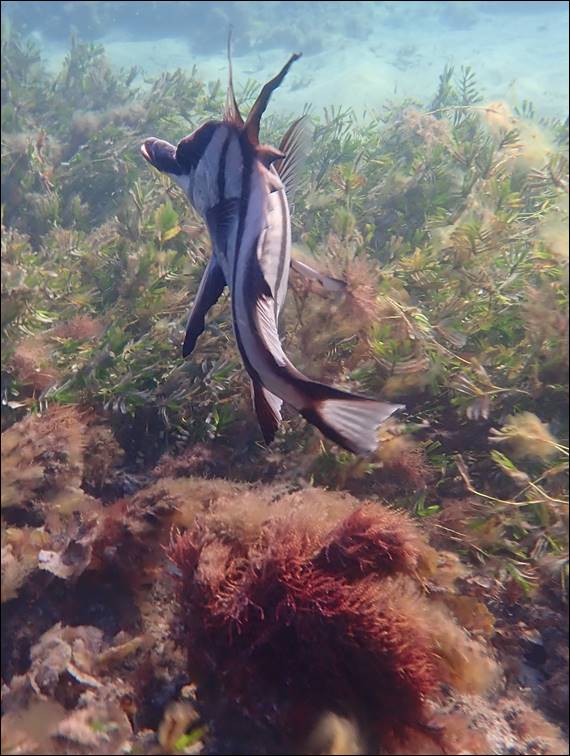
This Longsnout Boarfish (Pentaceropsis recurvirostris) couldn’t seem to make its mind up as to whether it was comfortable with me being about or not. Never trying too hard to get away, but when I did pop down to say hello it would start to swim away. There was no great urgency in its movements when it dawdled away. We played this game for a while. I guess I wasn’t stressing it out, if it really wanted to shake me it could have. While I did not get a side on image I liked this one, showing its lovely and seemingly effortless fluid movement:
A few people at work have been keen to see what the appeal of rock is all about. I‘ve already converted Sam, and today Mike decided to have a go. He had confessed to being scared of heights, so had set his expectations of achieving anything quite low. Pat, also from work, joined us for his second taste. You may recall he joined Sam and myself for his first climb last year. When he neglecting to tell us about his fear of high places, until he had a bit of an episode part way up the first climb (https://sandbagged.blog/2023/09/30/a-bit-too-spicy/):
Seeing Howsie had to work yesterday, which is why I went out by myself, he managed to get a day pass to join us today. I’d given him the heads up that I was taking two newbies out, both of whom had self-confessed to being acrophobic, so not to expect too much action. We are however on the same page, in that our trips are far more than the challenges we face on rock. The simple pleasure of being out in nature and just having fun is the number one priority. The climbing is a bonus, and fits in neatly with the other benefits of getting out:
Mike was a bit aggrieved at not only having to get up and out the house in the dark, but also meeting in Capel before light had truly entered the sky. It did however allow us to watch the wisps of cloud go through their morning colour transformation, as we drove toward Wilyabrup. From the carpark we had a bit more of a hike than usual ahead of us, as we aimed to get to The Playground and Lost Buttress. We pondered whether to take the snorkel gear, and hearing the waves in the distance I made an executive decision. It stayed in the car:
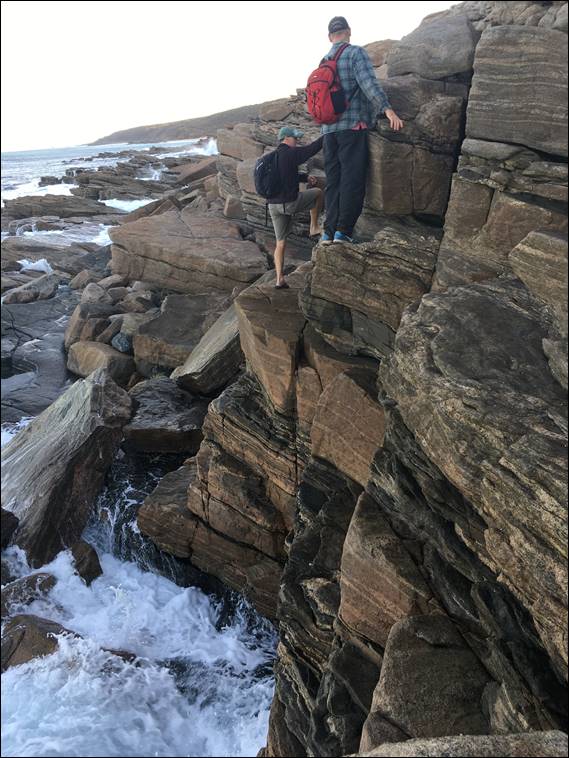
Our destination was the perfect place to test where Pat and Mike’s heads were today, and as I’ve said many a time climbing is both a mental and physical challenge. This spot would allow us to progress slowly, in a fun less intense way than jumping straight onto longer roped climbs. The approach also allowed Howsie and I to take a slightly more obstacle course type path. Requiring rock hopping, skipping over wave washed gaps, and an airy traverse. We could have avoided some of these obstacles, but it was a good way to get everyone focused:
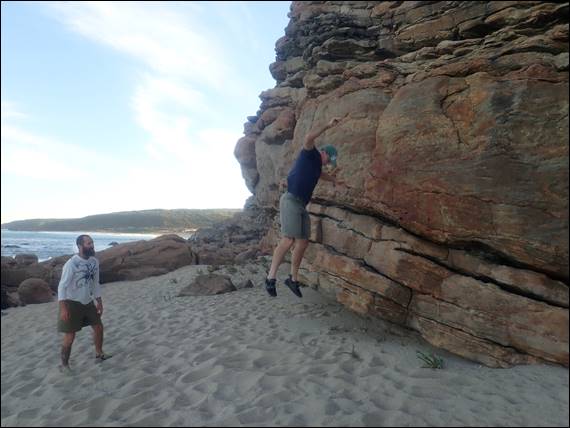
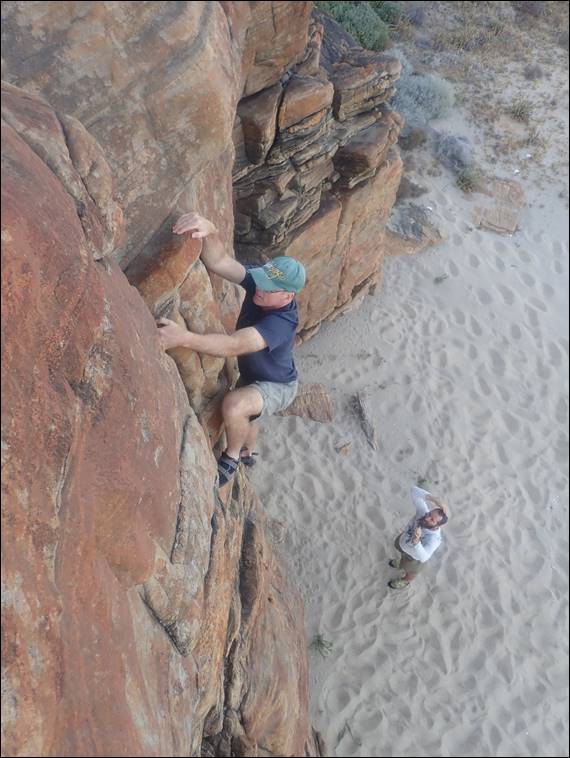
We started at The Playground, partaking in a form of climbing called bouldering. One description of this climbing style states ‘Leaving behind ropes and harnesses and just using climbing shoes and a bag of chalk over safety mats, your challenge is to climb short but tricky bouldering “problems” (a route, or sequence of moves) using balance, technique, strength, and your brain’. We didn’t have mats as the rock has a beautiful soft bed of sand below it, and the first lesson was how to jump and/or fall off:
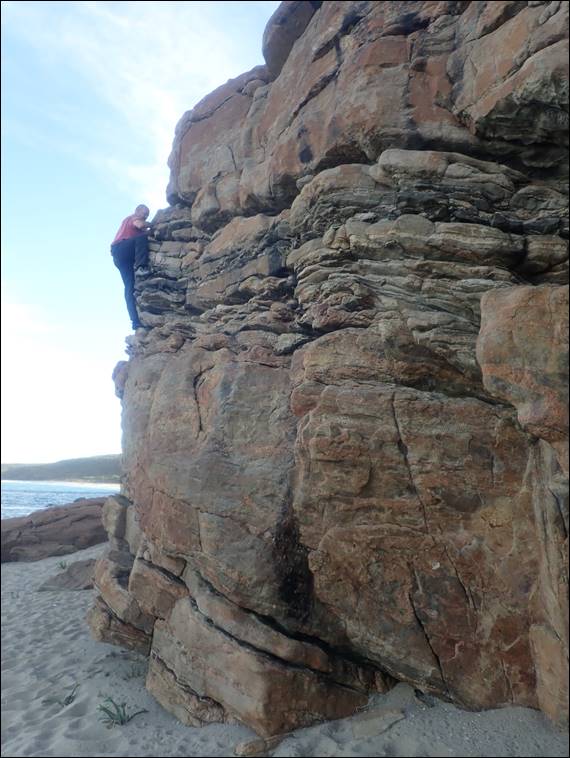
Memories of Pat clinging to the rock in fear came back, as his body seemed to prevent him from letting go. Eventually he jumped and it was all good. Then he surprised us all when he scaled the full height of the crag for the next problem. While it was not a competition this also set the tone for Mike. We were not sending them up anything too hard. Spending time providing tips on climbing efficiently, which was paying of. So we slowly ramped up the steepness and difficulty with each problem. Anyone passing by would never have guessed they had an ‘extreme or irrational fear of heights’:
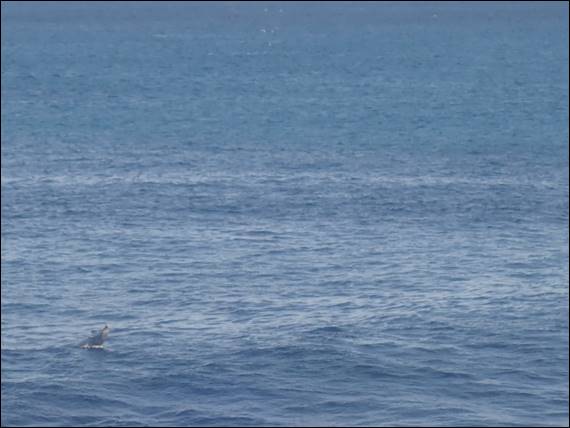
We of course had moments when we sat still to take in the views, and there were plenty of times when we wondered if my executive decision to leave the snorkel gear behind was the right one. Then a set of waves would roll in and any hesitation in answering was gone. While we didn’t go in the water, the dolphins were out. Cruising up and down the coast the whole time. Calves, in amongst the grownups, were being more playful and on occasion jumped out of the water. While on the rock the grownups were the ones up to antics at The Playground:
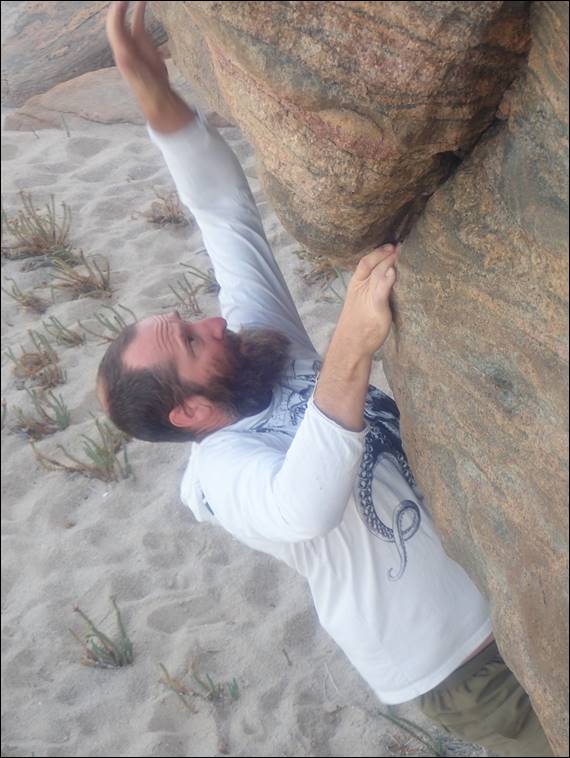
I lost count of how many boulder problems everyone went up, but it was way more than I had expected. And I think it was probably also more than Pat and Mike had expected, plus Pat had certainly redeemed himself from his brief episode on his first trip out. The good thing about The Playground is it offers problems for everyone, so Howsie and I were not missing out in testing our headspace or in his case finger strength. And today he simply wasn’t able to stick a couple of the finger locks despite many attempts, including this one:
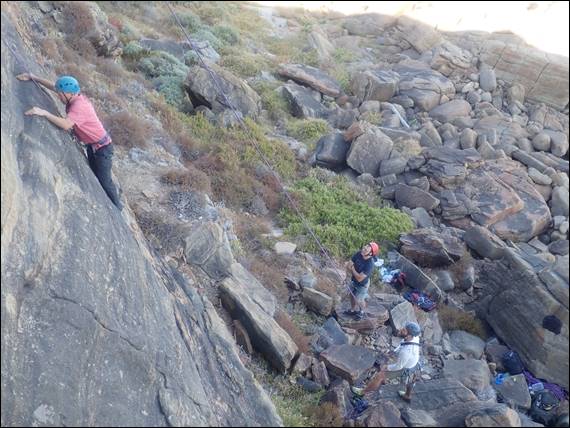
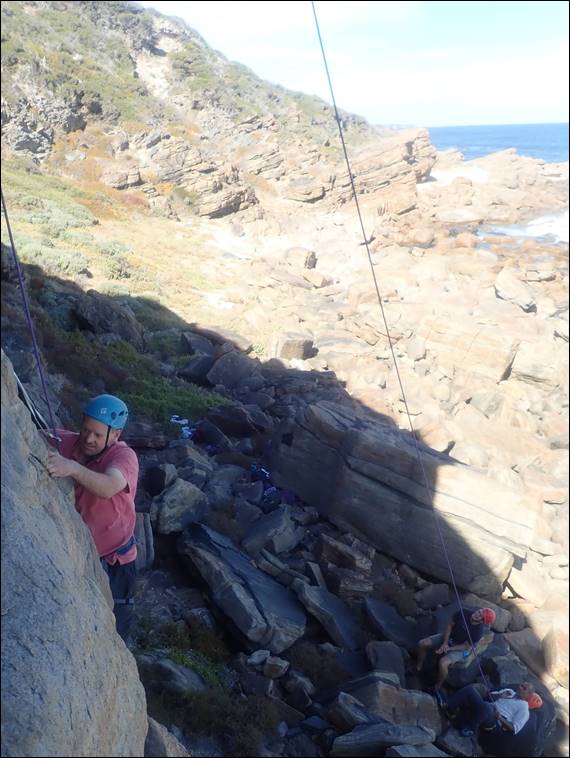
After such a successful time bouldering, it was time to pull out the harnesses, ropes, and gear to allow Howsie to bag a few trad leads at Lost Buttress. After which, he set up a top rope to allow Pat and Mike to have a bash at some longer routes. Whether it was the need for all the safety gear or something else I’m not sure, but as they climbed these lines their heads seemed to holding them back. Both of them found the routes more challenging, even though technically they were no harder than anything their had conquered while bouldering:
With plenty of encouragement and tips, as they climbed, the battle against their thoughts was won and they both made it to the top of the first climb. I imagine that at double the height of the boulder problems, their acrophobia started to creep back to the fore. And may also be taking hold that bit more due to tiring muscles, and brains becoming weary from suppressing their fears. Back down any negative thoughts that may have started to creep in were washed away, by watching the dolphins and again questioning leaving the snorkel gear in the car:
For the second slightly harder climb Howsie had great fun leading, but watching him dip into his chalk bag and stop to think about the moves near the top probably made Pat and Mike also think twice. They both gave it a crack, but the delicate moves near the top where the handholds turn to fingertip sized friction edges it was just too much. Neither of them however panicked and that in itself was huge. After that and not surprisingly they admitted to being mentally and physically fatigued, and happy to call it a day:
We had left some gear at the top, so Howsie got to pick one more line before we packed up. And in answer to Pat who asked as we drove home if we had climbed enough, both Howsie and I could feel that satisfying ache in our muscles during the final ascent. Walking out we agreed that if we had taken the snorkel gear, there wouldn’t have been enough time to have a swim anyway. And Mike said he could now understand why we started early, as there was nowhere to hide as the sun beat down on us as we walked out:
When at work and asked how I am going, my normal response is ‘not bad’. I’ve been called out on this a few times, being questioned where in the spectrum of possible moods that places me. The question is often loaded, with the assumption I am indicating I may be erring on the gloomy side. A bit like Eeyore but not quite as bad as Marvin, the manically depressed robot. For me however it just means I’m going OK, but seeing Lisa and I work hard on maintaining a good life to work balance, with the emphasis on life I know where I’d rather be:
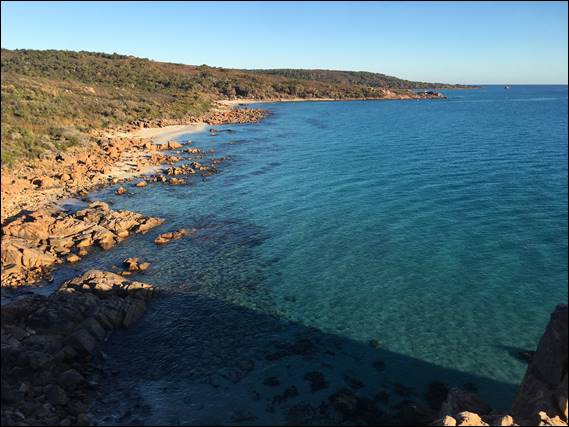
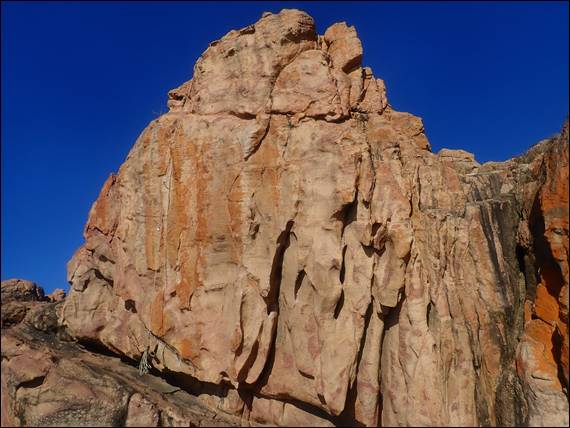
And that is where I found myself today. Walking towards Castle Rock on yet another unusually warm day for autumn, with a blinding blue sky. Being by myself I plumped for this location to allow me to double dip, so to speak. The rock was inviting but the water was also looking pretty good. In fact last weekend would have been even better in the water, with a gentle breeze and slight swell for an extended period. But after my climb with Pontus, I was beat and didn’t have the energy on Saturday or Sunday to head to the water:
Or to do much at all, and that weary feeling extended into the early part of the week. Not that it stopped me going to work, which may sound in conflict with trying to maintain that life to work balance. I may be ‘not bad’ while at work, but I do have a strong work ethic and need to be pretty bad to take a sickie. Another thing Lisa and I have in common, and tell each off for as sometimes it is to our detriment. I’m not entirely sure I have shaken whatever is lurking in the background. My body felt heavy and lacked coordination, as I pulled myself up the routes:
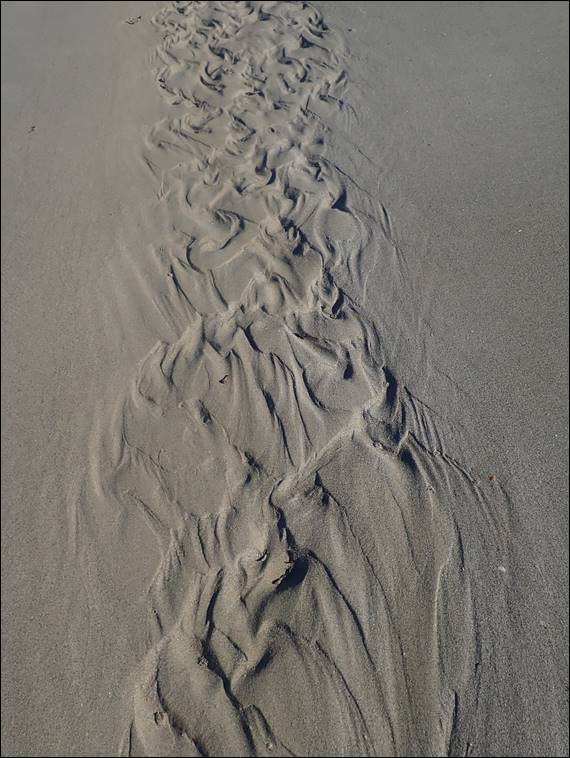
I did however have fun on the four lines I hit. Although, on the last one where the rope is hanging in the above image it all started to feel a bit too hard. I fell off at the same spot on both laps, indicating it was time to change activity. Not having carried the snorkelling gear to the rock I walked back to the car. Scrambling over the rocks and beach rather than taking the track, where I found some groovy patterns carved into the sand by the water. After getting changed, I then walked approximately the same distance but in the opposite direction:
Aiming to find some new ground, plus being salmon season the fishers were out and something told me no one would be at Gull Rock. It is a bit over half way between Castle Rock and Meelup beach, and I guessed it may be a bit further than the fishers would want to carry their gear. Whether my thinking was on the money or not, there was not a fishing line in sight. And as is usually the case along this bit of coastline the water was clear and full of fish, and it also felt so good on the body. I’ve mentioned many of the fish in previous posts:
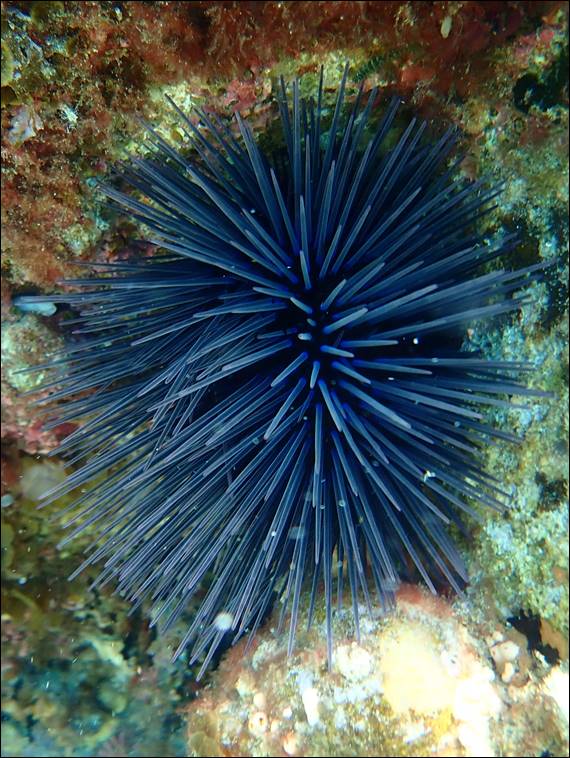
I did however enjoy seeing the Tarwhine (Rhabdosargus sarba), which is rarely seen at my local reef. Tarwhine is the most common name, but I prefer the Goldlined Seabream. It is a species that the fishers would be keen to hook. They would also be happy with the Australian Herring (Arripis georgianus) I saw. It was fun watching the fast predatory Herring chase and pick off bait fish, which were about in huge numbers. In addition to be rewarded by all the fish, the below Western Hollow Spine Urchin (Centrostephanus tenuispinus) is a first time sighting for me:
The spines are more slender and delicate looking than those of the Purple Urchin (Heliocidaris erythrogramma), which litters my local reef. Gull Rock is so named due to the boulders sitting proud of the water that provide a perfect perch away from people. Looking round the base of these on the more protected landward side I found scores of smaller fish. Below in the greatest numbers are adult sized Blackhead Puller (Chromis klunzingeri). This image also captures a small green wrasse, but have no idea what species it is and have never been able to get a clear image of this fish due to it being skittish and fast:
The juvenile Western Scalyfin (Parma occidentalis) was however the centrepiece. The brown body with three vertical white stripes and fluorescent blue dots across the face and in the upper dorsal fin, made it look very fancy. I had only been in the water for thirty minutes but was starting to get bashed about a bit. The small waves packed punches above their size making it interesting getting out on the slippery rocks. Feeling refreshed from the short but great dive I walked back to the car, placed neatly in the middle of today’s two playgrounds:
There’s only one good reason to get up earlier than I need to on a weekday, and as you can probably guess that is to go climbing. A few weeks back I almost made the near two hour trip to meet Pontus at a small spot just north of Pinjarra. As it was, things went sideways and alternative plans without Pontus were made. Today we made amends for that. Arriving within minutes of each other to be greet by a biting wind, which was howling off the scarp, through the valley, and onwards down to the coastal plains:
This is the only place in Western Australia I can think off where you can climb on two different types of rock. Each requiring a different climbing style. Having been here a few times over the last ten years, I was happy for Pontus to pick the routes and take the sharp end. He’s keen as mustard, so there were no complaints from his side about does arrangements. To escape the wind being funnelled along the road, we started on the natural granite outcrop of Boomer Crag. Nestled up on the side of the valley it is situated in a more sheltered location:
On a winters morning the rock on any inland crag can feel bitterly cold. I’ve had experiences here when our fingers have become painfully numb for at least the first couple of routes. Today despite the winds best efforts to cool things down, our continued warm and dry spell prevented that. It has been the warmest and direst spring, summer, and so far also autumn on record. With no rain other than a few light sprinkles since October. The country is dry, scorched, and dusty. On the plus side it does make for great climbing conditions:
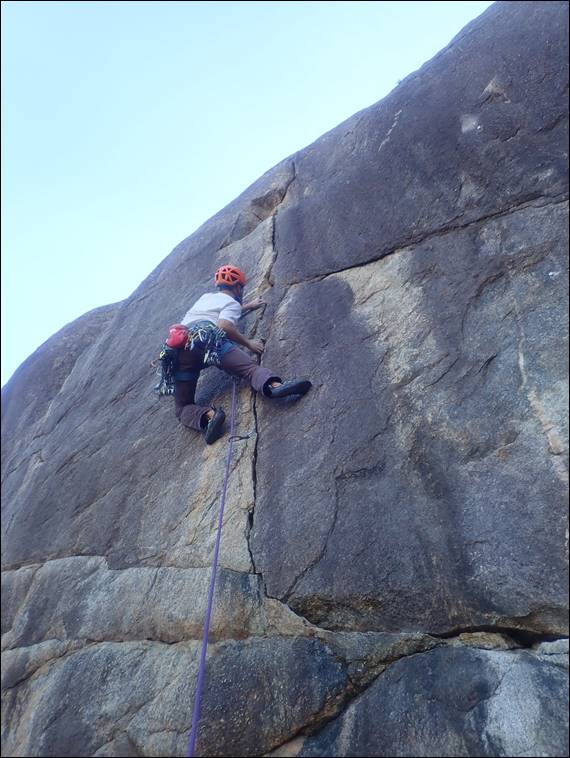
Pontus is still relatively new to trad climbing, so the conditions were ideal. Not needing to battle the elements, as well as deal with the mental drain of finding and placing protection. On one line he choose, his level of trust was tested when he had to place and put full faith in what are called micro wires. Not even that phased him and to boot for the next climb, he clocked up his hardest trad lead to date. And did so in much better style that I did, when feeling somewhat weary and not so coordinating I slipped off into the safety of the rope:
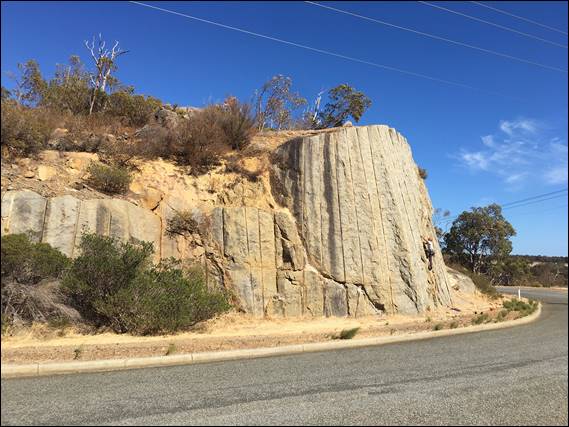
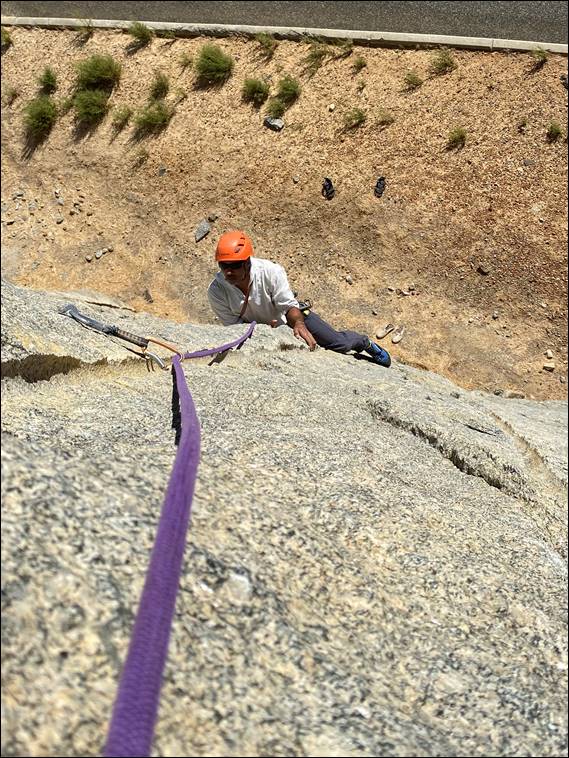
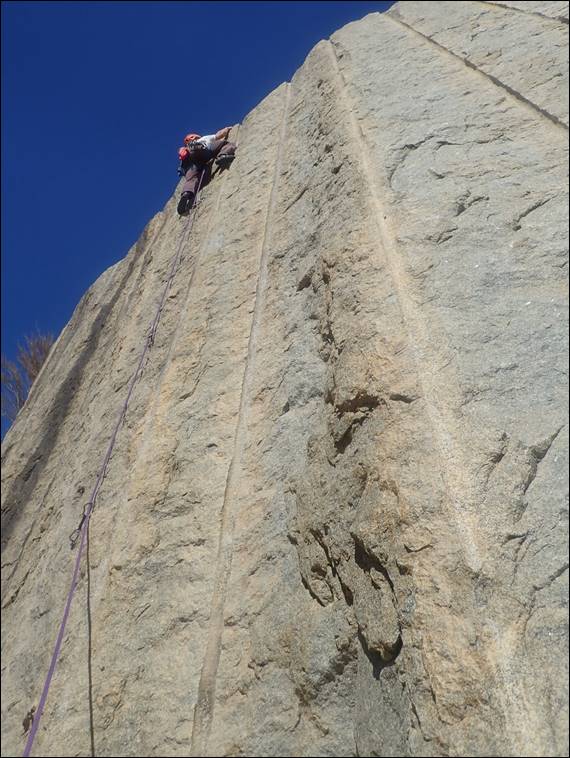
We watched from on high, as the sun began to soak the valley below. This is where Spring Grove Farm Cutting sits, just off the road. After four great lines on the natural outcrop in the shade, we made our way back down to the manmade rock face before it got too toasty. The steep granite walls offer both trad and sport routes, and we started with a bit off bolt clipping. This allowed Pontus to get used to the rock and style required. It was a good move as it was warming up and felt a bit sweaty, making the holds feel a little less secure:
I also feel he was not too keen to jump on the trad lines, as they required larger camming devices to be used in a rather unusual way. To see what I mean check out this post, https://sandbagged.blog/2021/06/19/the-george-michael-effect/. Pontus felt he would rather follow someone, after they had led one of the routes. To allow him to see what the placements were like. I can’t say I was surprised, being relatively new to trad climbing it was good to see him being cautious about going too extreme with inventive placements:
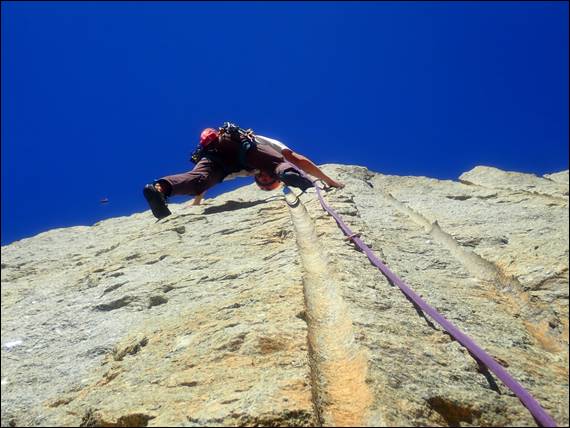
Today I was not in the mood to jump on lead. I can put my finger on why, but my body just wasn’t up to it. As such I was very pleased when Pontus was happy to keep taking on the leads, as long as they were the bolted lines. He kept going even when the comfort levels were being tested. The heat was being concentrated on our bodies, from the sun on our backs and also as it was being reflected off the bright rock. Not only were our fingertips starting to get that bit more sweaty, but our toes were starting to heat up:
The black rubber on the shoes were efficiently transferring the heat, and the way climbing shoes are designed our toes were front and centre of where the heat was ending up. We managed four lines in the sun, which evened things up nicely between the two delightful crags. The spicy final moves on the last climb were enough for Pontus to call it quits, and I was more than happy with that. I can see a return trip being required, so I can redeem myself on the route I slipped off. But also to lead one of the unusual trad lines to see if I can encourage Pontus to give it a go:







 Sandbagged