Placed on hold

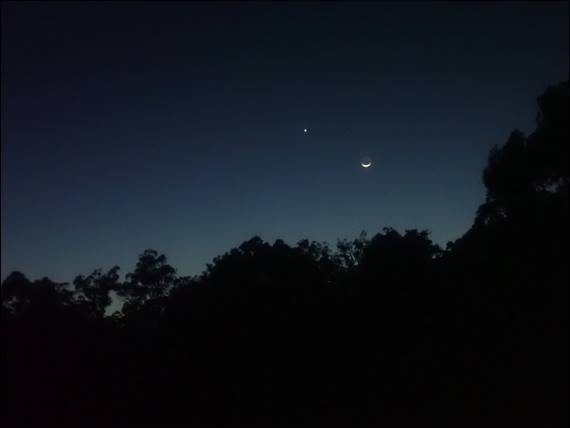
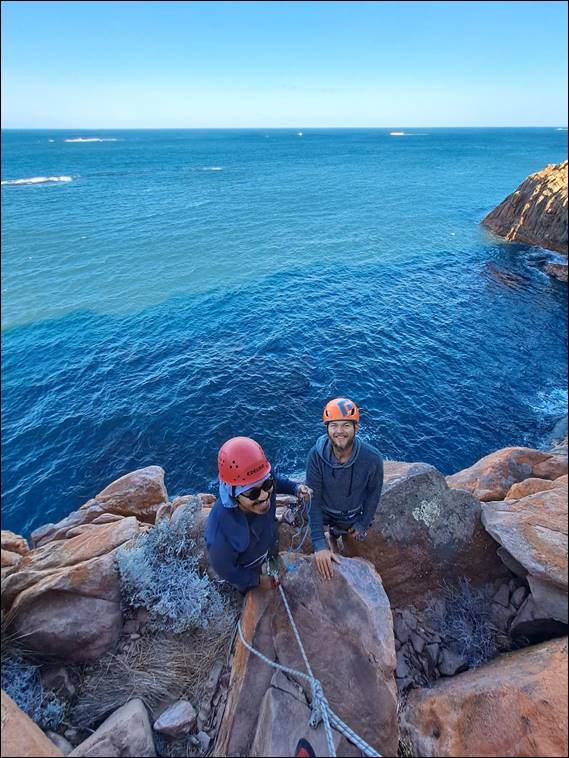
The on again, off again traveller is back in town.  So I won’t say this is the last climb in the south west of Western Australia before Rongy and Sarah hit the road.  I have done that before and been proven wrong to many times.  Plus we have made tentative arrangements to get out again on the weekend.  After my last trip here with Howsie and Mikey I managed to aggravate my shoulder and I was resting it up.  So for those that follow all my words you may be asking why am I climbing before my big trip, which was to start in just a few days away:

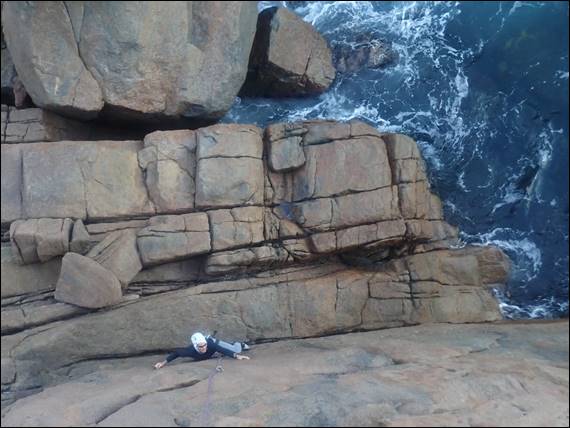
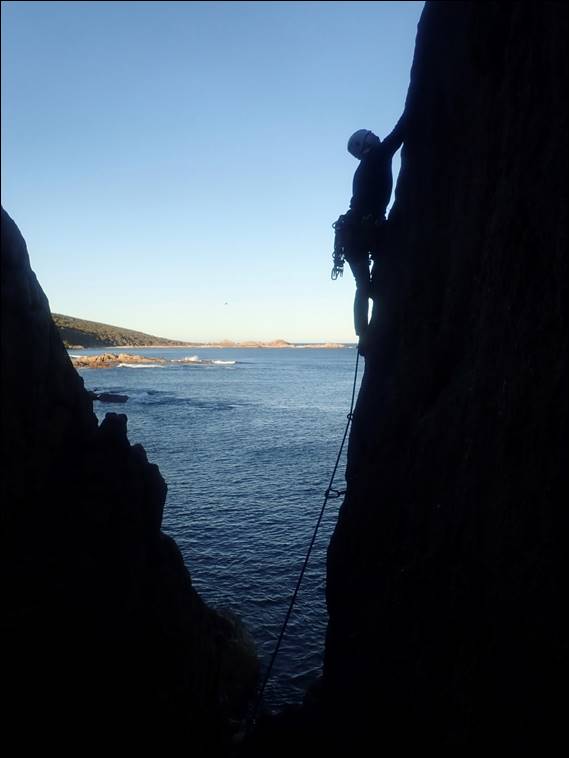
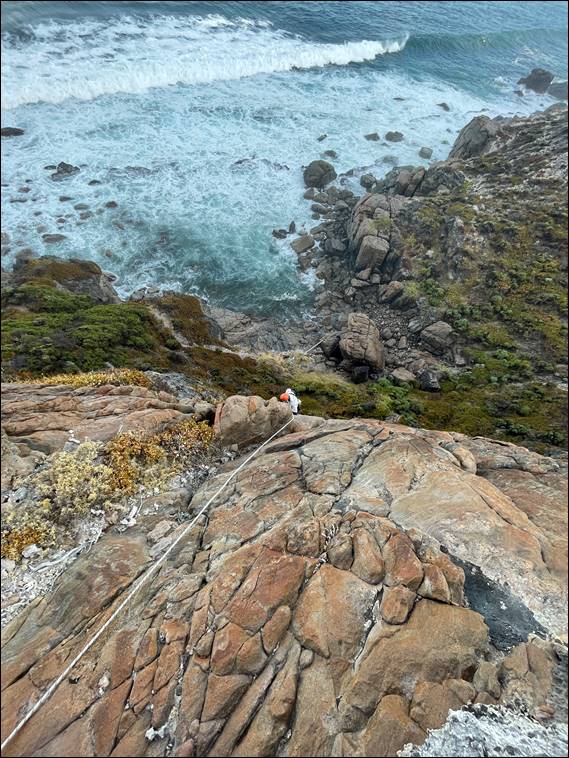
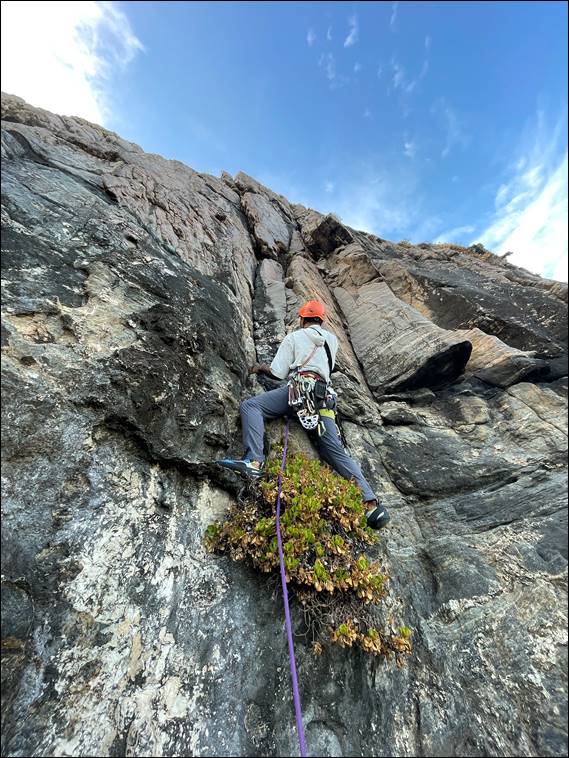
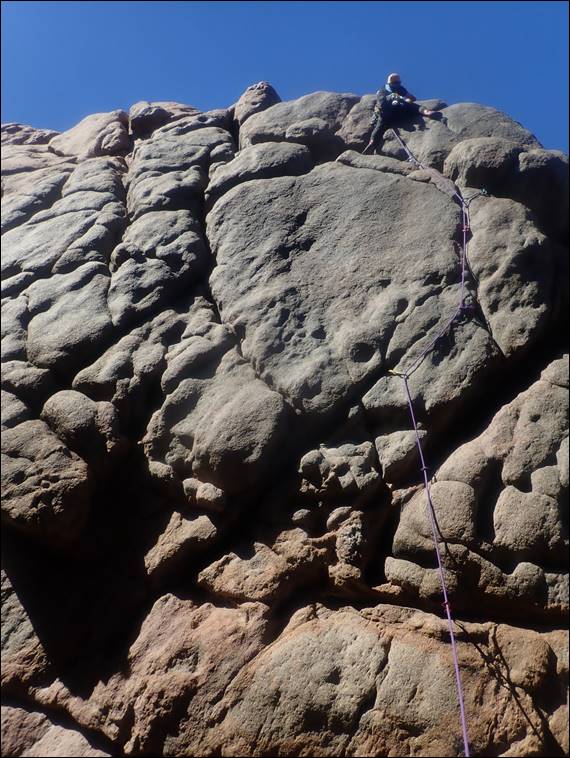
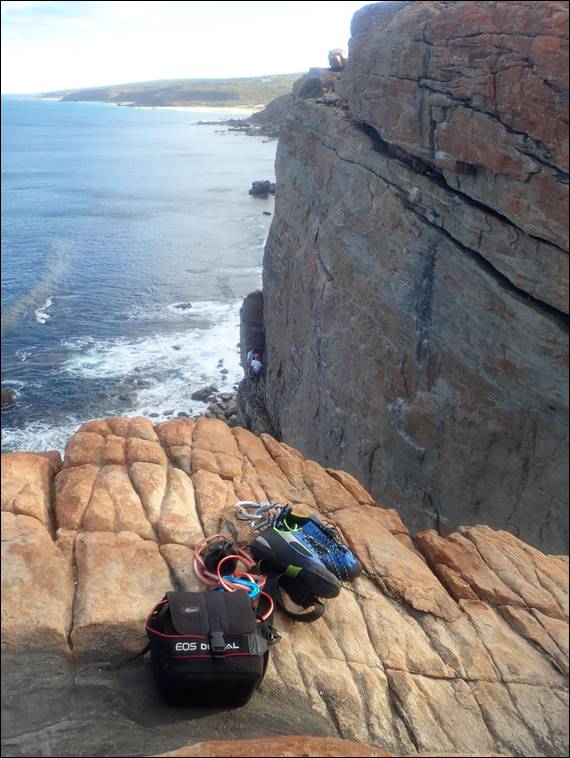
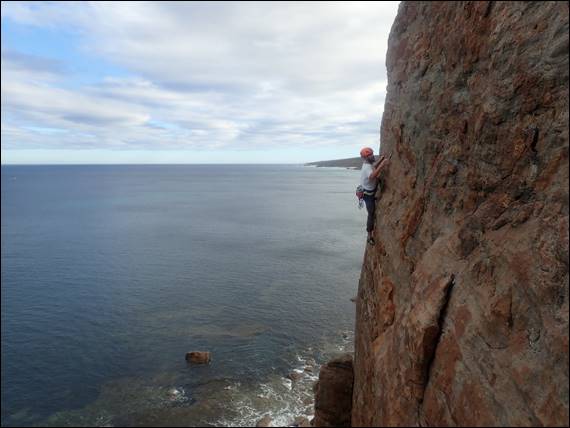
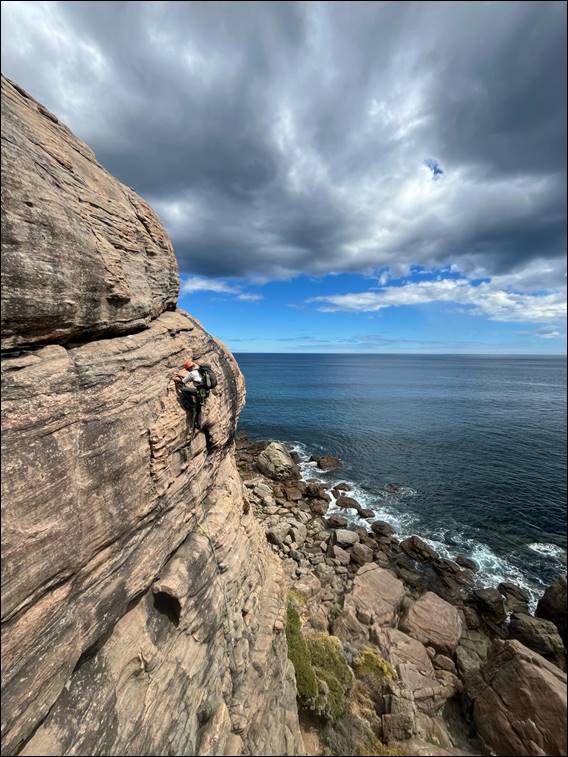
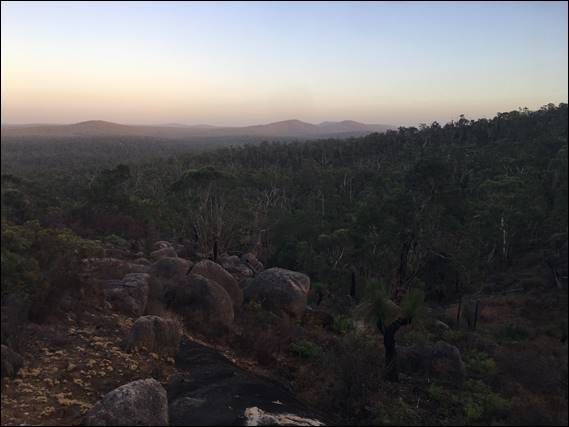
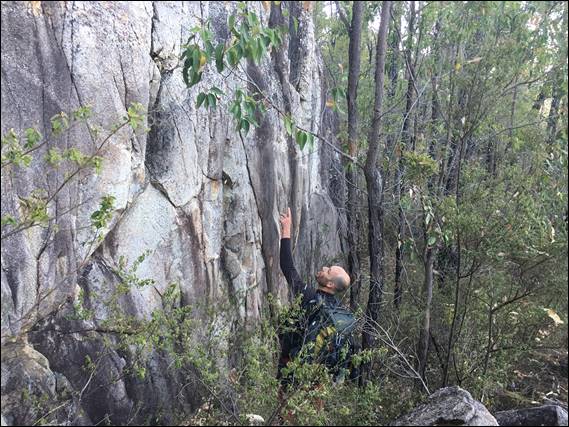
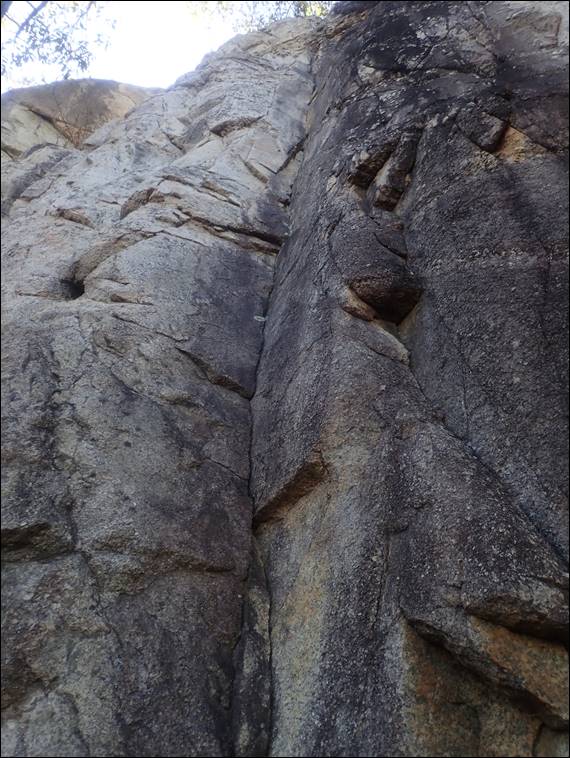
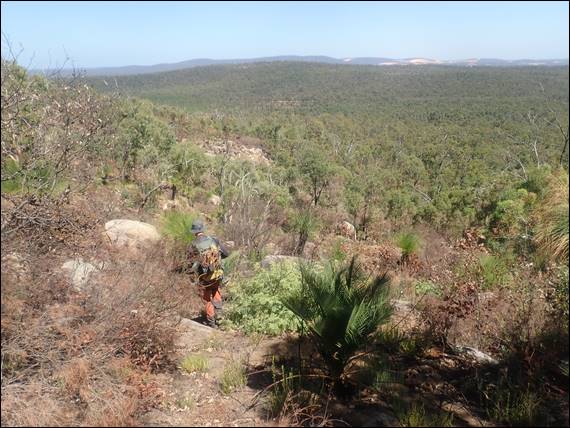
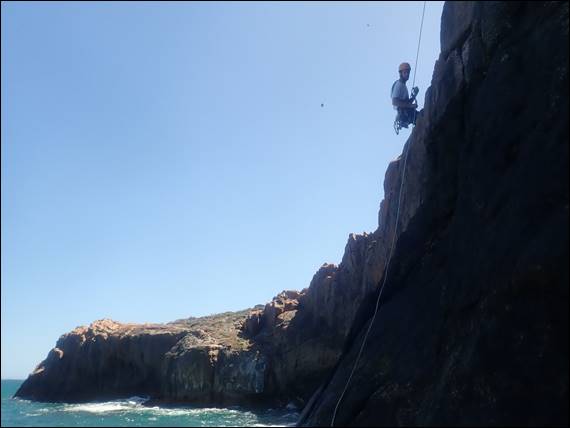
“Was to” being the operative words.  It was not my shoulder that put paid to the trip, but Dan’s.  Managing to dislocate his, while paddling on a surfboard to catch a small wave literally just a few days back.  This meant we only had one fit and functional experienced sailor resulting in too much risk for our planned sail.  The intention had been to sail eleven hours from Victoria to Deal Island in the middle of the Bass Strait.  Anchor up and climb the big granite cliffs.  So much bigger than what Rongy and I were climbing today at Moses Rocks:

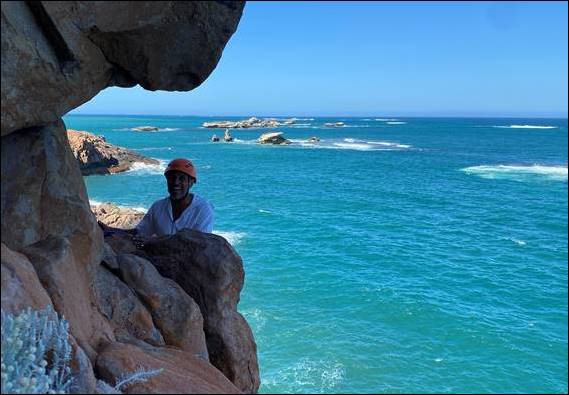
I have literally just been chatting to Dan and we are already talking about next year’s trip to Deal Island.  So in the words of Johnny Logan ‘What’s another year’, and Dan and I can treat this proposed trip a bit like the last one we had planned for April 2020.  That was delayed by two years to the day because of COVID, but we got there in the end.  There seems to be a running theme here, a bit like Rongy and his goodbyes, that aren’t really goodbyes.  That was a lot of words to say I’m back on rock, after what has felt like a long break:

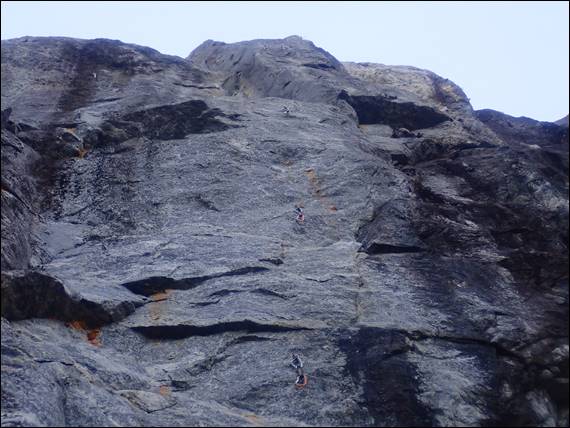
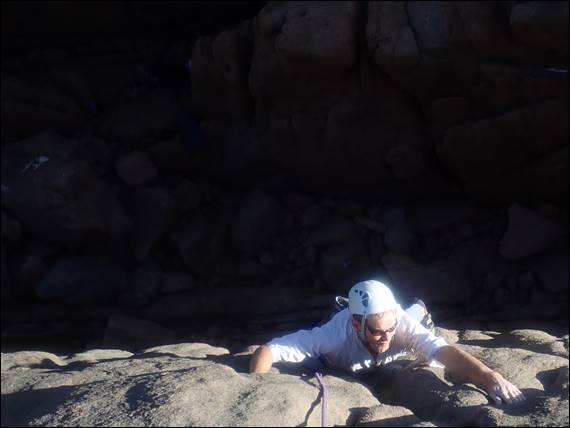
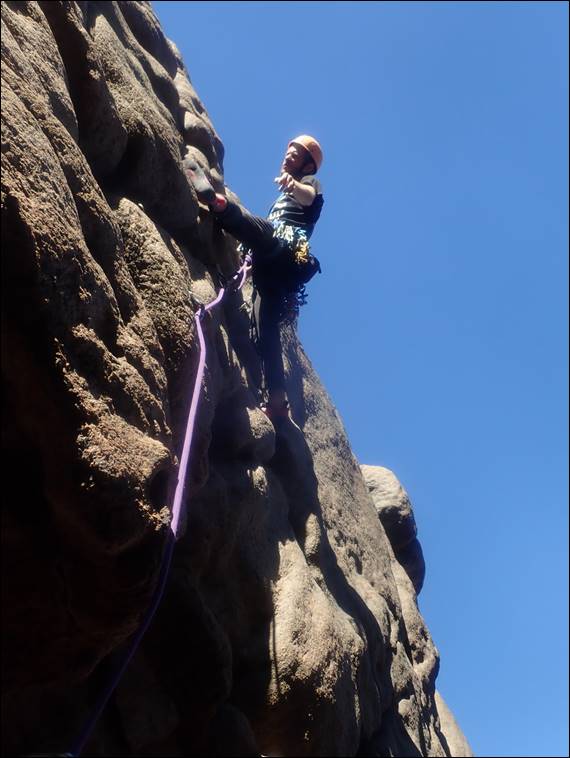
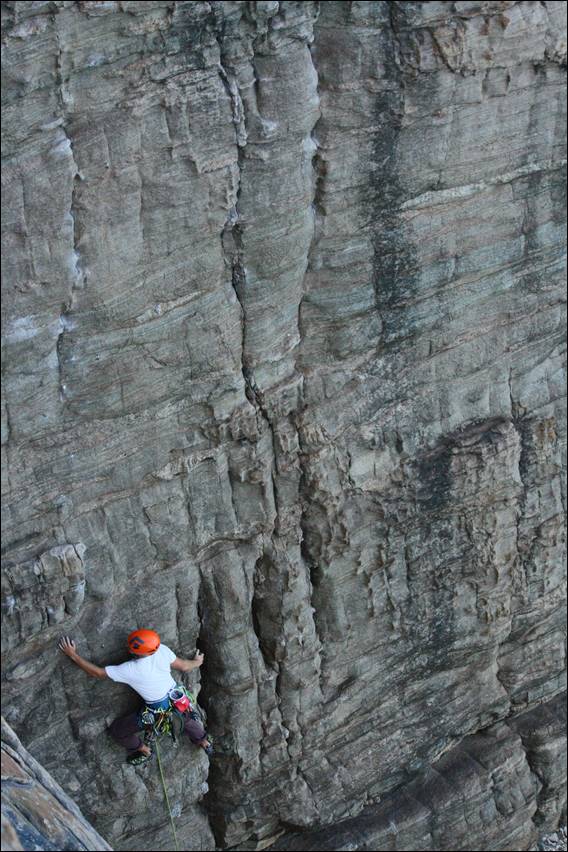
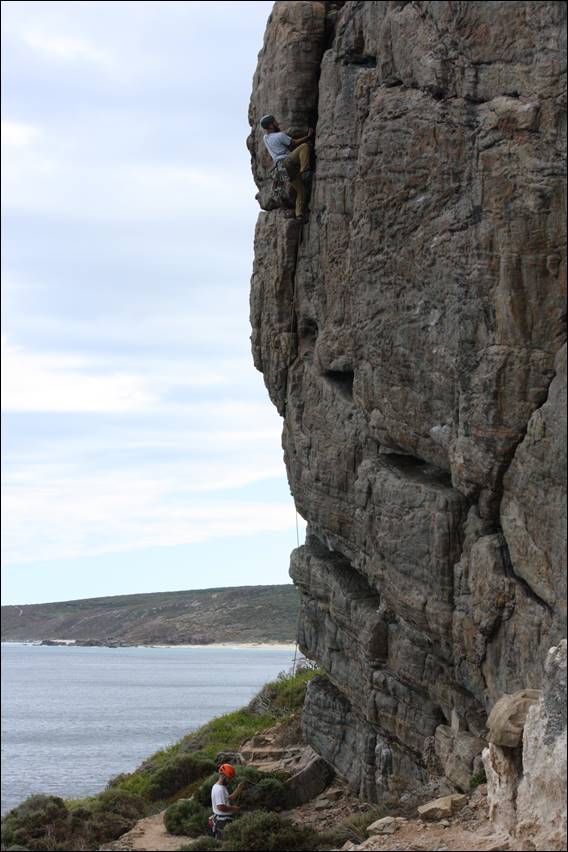
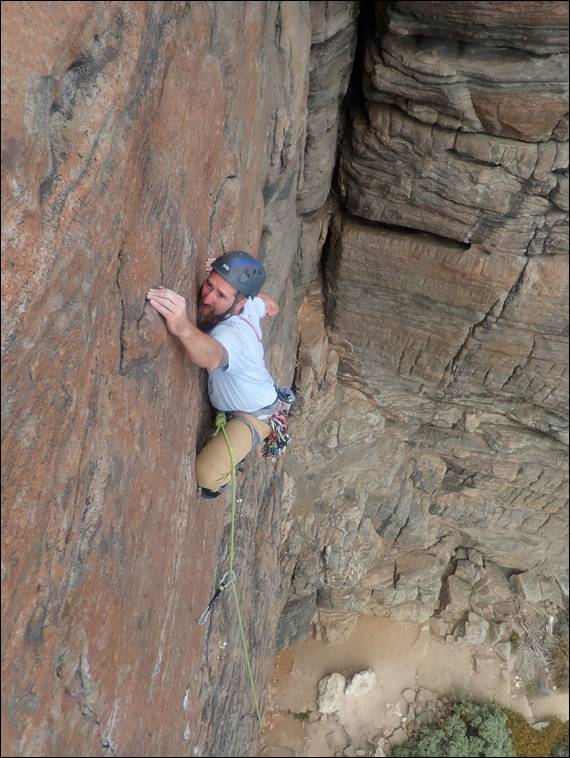
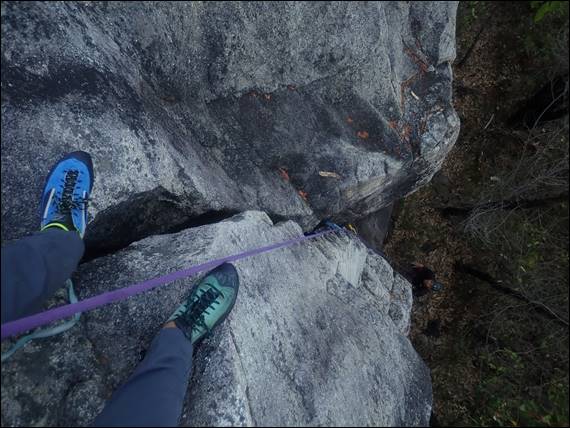
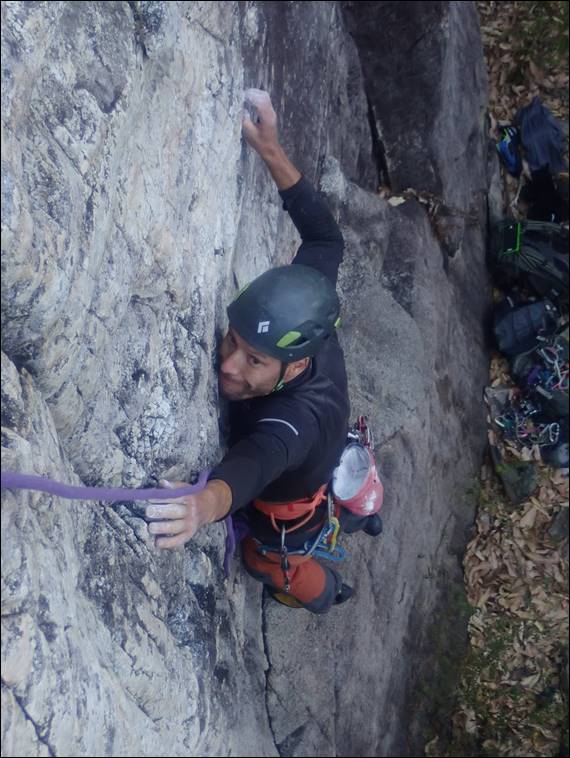
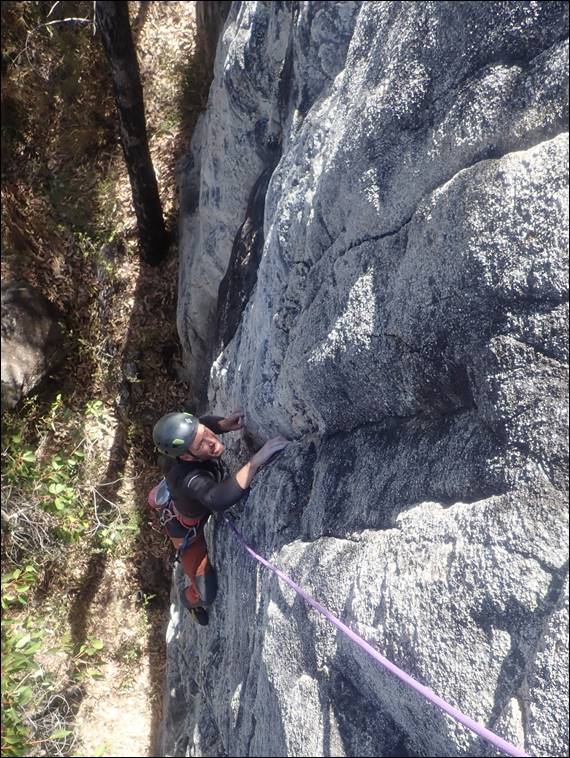
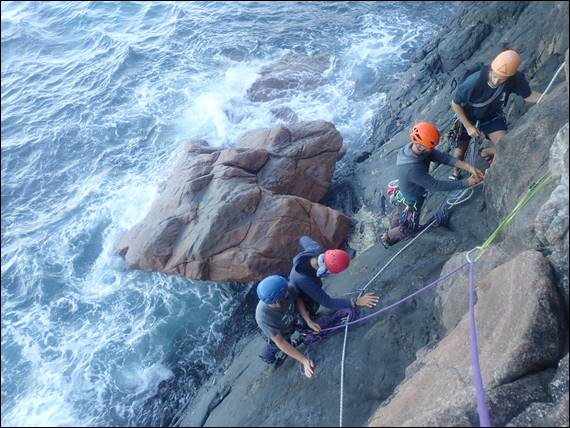
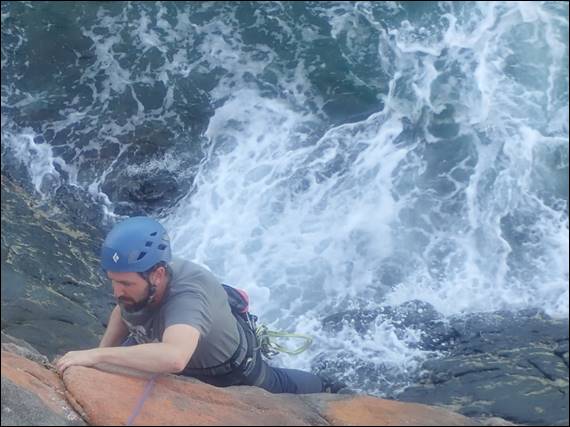
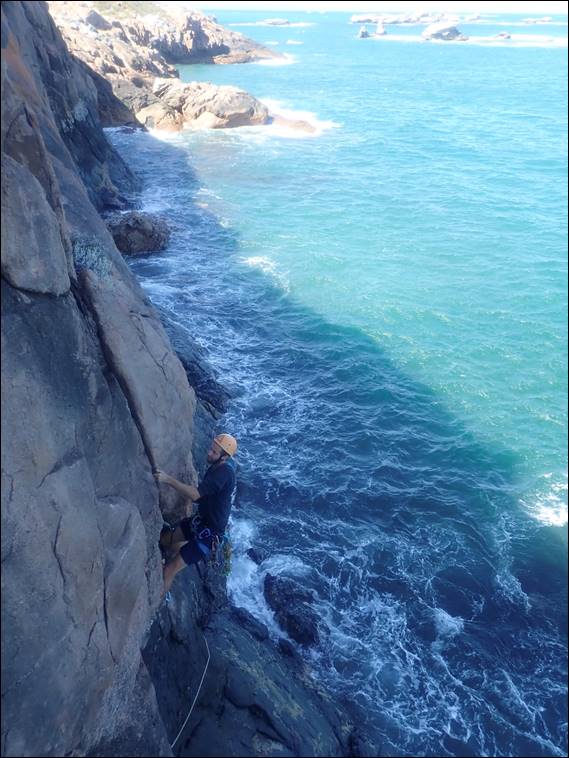
It was in fact only eighteen days since I had touched rock.  The twinges from my shoulder had subsided, and I felt risking a climb would be OK.  And it was.  Although there was one climb I decided not to follow up, due to the physically demanding nature.  Being the one below and my most recent creation here, called The Bunyip.  This was probably only the second ascent, and Rongy agreed the grade of 19/20 seemed reasonable.  Putting to bed the discussions on the day of the first ascent with Craig, Howsie, and Ash that it was another sandbag route:

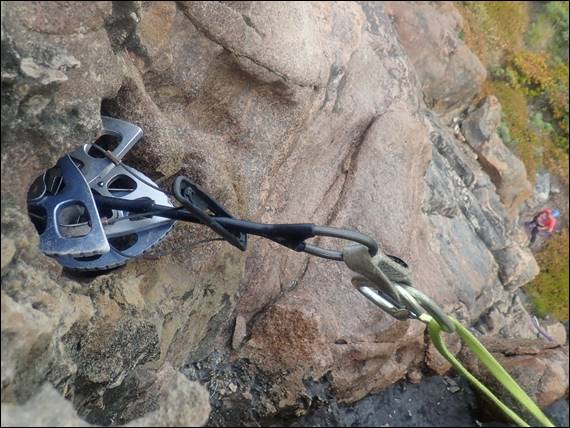
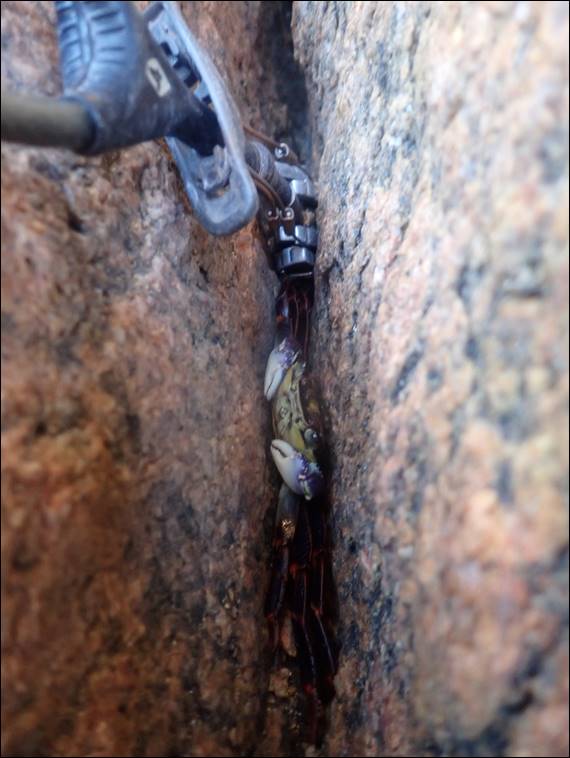
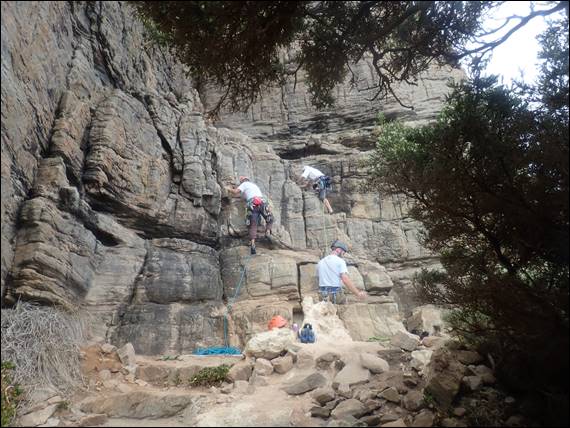
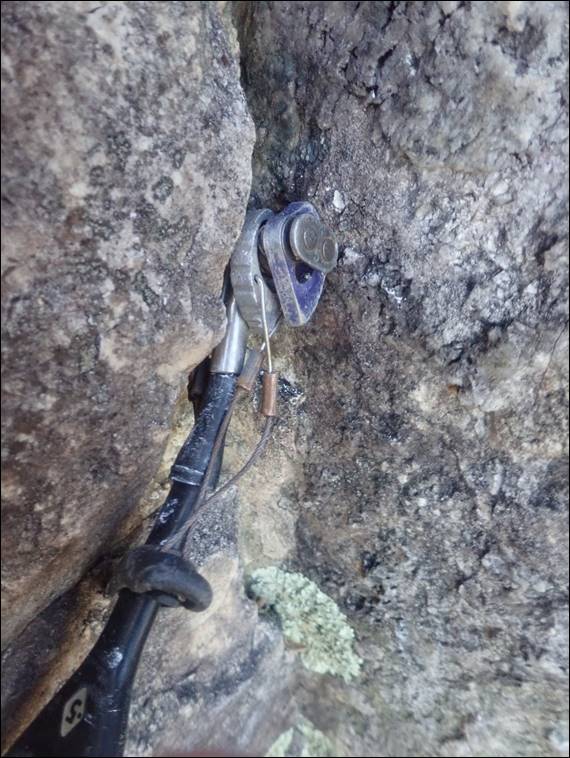
Today we were climbing on Rongy’s gear, as I had lent my rack and ropes to Dan and Jo.  They were over for a family Christmas and had all headed south, where they intending to get a one day’s climb in the mighty south coast.  Dan managed to pop his shoulder before they went climbing, rubbing a bit more salt into the wound.  But this did mean I got to help christen Rongy’s latest acquisition, a set of five C3 cams that he got for a steel.  I even managed to climb two routes only using his new shiny gear, hopefully I didn’t scratch it up to much:

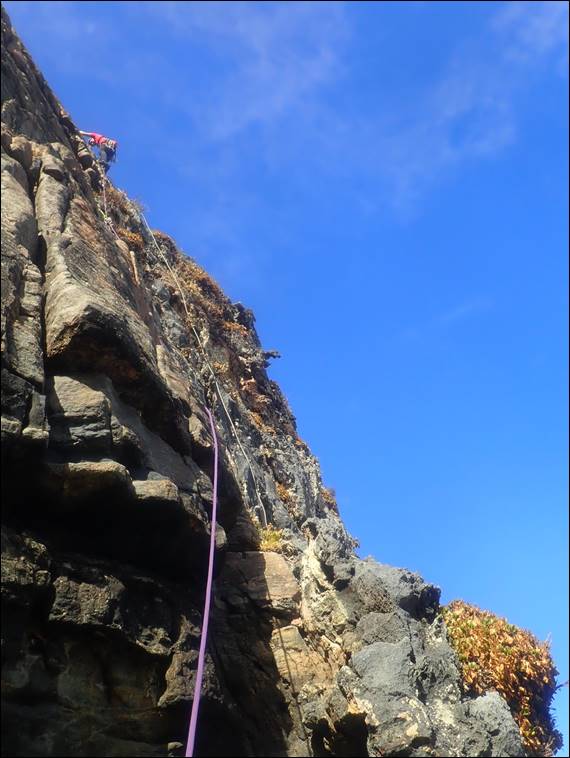
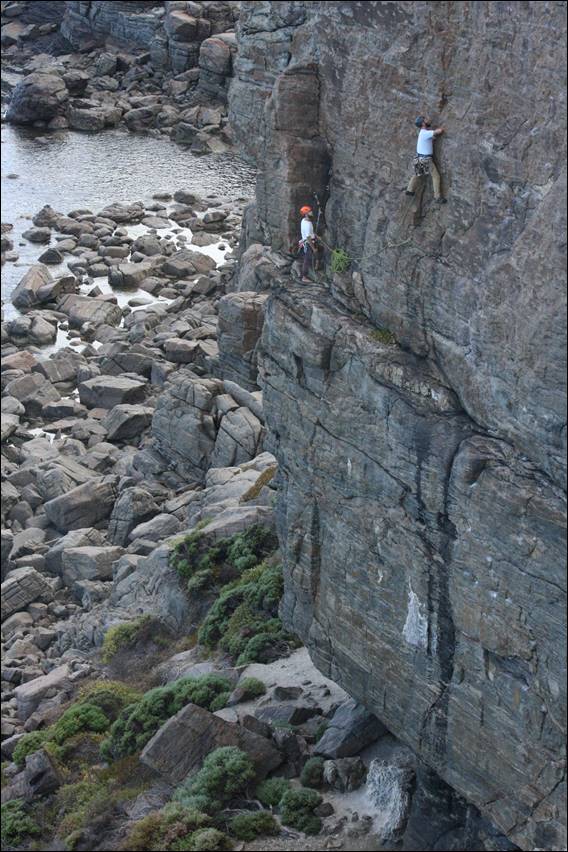
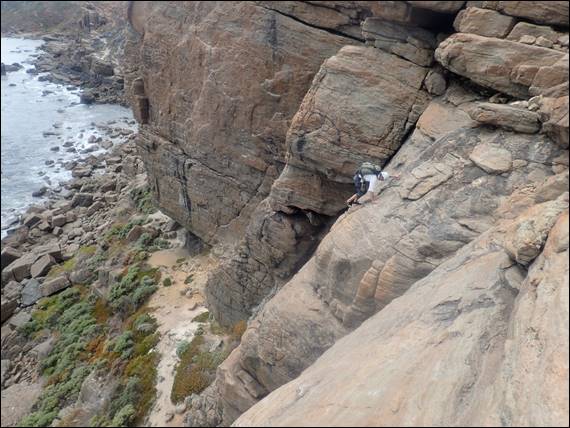
Despite not being as tall as the up to 150m high granite cliffs on offer on Deal Island, which has been placed on hold.  Moses Rocks, or more precisely the section called Rumpoles Rocks, was good to us today.  We had a thoroughly enjoyable time, and even spied yet another possible first ascent.  I sadly jumped on it as the last climb of the morning and didn’t have enough gumption left to pull the moves over the roof, so missed the on-sight glory.  At least we now know it goes, so I’ll hopefully be back in the not too distant future to bag that one:

Motion pictures

Dog walking doesn’t stop at Peppy Beach just because it was Christmas day.  I again joined them, jumping in at a new location. But the ground was pretty ordinary and there were no extra presents waiting for me under the water, other than thick patches of stingers.  Heading back after the walk and snorkel the beach was already starting to fill.  It would no doubt be a busy day on the beach, so I was happy to head home.  However, later on Lisa was keen to get to the beach herself.  And to my surprise she messaged me saying it was pretty well empty:

Encouraged by the lack of people I popped down shortly afterwards, with the intention of having a second dip.  Not put off by the stingers of the morning, nor the onshore wind that was starting to chop up the water.  In fact the small consistent waves that seemed to get a little bigger as I swam, resulted in the stingers no longer guarding the upper water column.  They were instead lurking near the sandy seabed, away from the chop and me.  And being waves driven by the afternoon wind, as opposed to swell, the water was reasonably clear:

Like the morning there was not a lot to report on, and I spent most of my time popping down to get a really good look at what I spotted above.  The mottled pale brown pattern could only mean one fish, a Cobbler Wobbegong (Sutorectus tentaculatus).  Better still, it was a full sized adult of approx. a meter long.  This nocturnal hunter was resting peacefully, and wasn’t put off by my persistent dives to get a really good look.  Also called carpetsharks due to the patterning and also the distinctive barbels near the mouth, both clearly visible above:

The name Wobbegong is also said to be due to the distinctive barbels, which for some species are very tassel like.  Coming from one of the many Australian Indigenous languages and said to translate to ‘shaggy beard’.  There are twelve species of Wobbegongs, most grow to less than four feet, but two reach about ten feet.  While not one of the big species, being an adult it was the biggest Cobbler Wobbegong I’ve come across.  Making me pretty chuffed that Lisa had encouraged me to pop down for a second dip:

So much so that I joined the dog patrol the morning after the big day.  While others ready themselves to deal with the crowds of people at the Boxing Day sales, I prepared myself for the hordes of stingers.  Luckily they were short lived and close to shore, and I was soon bobbing about looking for anything that looked unusual.  Not such stood out but I went down anyway, and I’ll take a punt that this was a False Burrowing Anemone (Actinothoe glandulosa).  It’s the closest I could get to a match, and as the name suggests this species doesn’t burrow like most other anemones do:

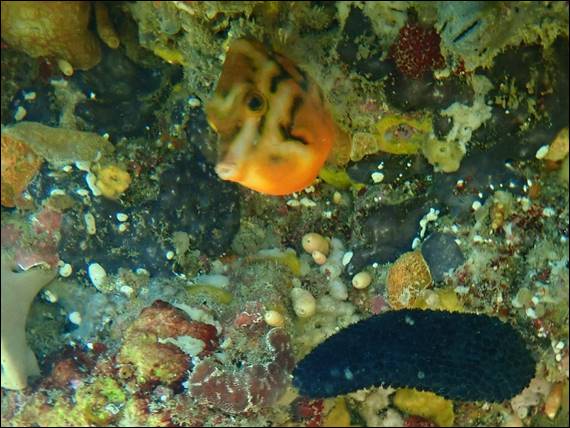
It does however have a column that it embeds into the substrate.  A common anemone on the temperate reefs off the south west of Western Australia, and often found in clusters.  The next image also includes a Rough Sea Cucumber (Australostichopus mollis), known as the vacuum cleaners of the sea.  At night they suck up the sand to get whatever organic particles there may be, and excretes long strands of clean sand.  The reason for taking the image was however the iridescent juvenile McCulloch’s Scalyfin (Parma mccullochi):

I also noticed afterwards that there was shrimp poking its head up in front of the Rough Sea Cucumber.  I can find no common name for the shrimp, but believe the scientific name is Palaemonetes atrinubes.  This marine shrimp is closely related to the freshwater South-west Glass Shrimp (Palaemon australis), which is found in the connected rivers and drain but also way inland.  My next find I can’t even provide a guess for, other than it resembles a bivalve mollusc.  I was drawn to the discarded Bicoloured Razor Clam (Pinna bicolor) shell:

Once I was down I noticed the distinctive opening of what looked to be a bivalve.  It detected unusual movement in water when I got too close and snapped shut.  But it did not have an obvious shell and the two halves were certainly not similar in shape, as I would expect for a bivalve.  But like a Bicoloured Razor Clam it looked to have the base borrowed into the sand for stability and possibly a degree of protection.  One last underwater Boxing Day find being a Horned Blenny (Parablennius intermedius):

It was poking its head out by no more than a centimetre of what looked to be an old tubeworm home.  Then as I poked my head out of the water a small flocks of Eastern Reef Egret (Egretta sacra) skimmed across the surface.  There was also a solitary Greater Crested Tern (Thalasseus bergii), right on the shoreline hoovering about looking for a feed.  No doubt thinking the chances of a catch were heightened due to some people fishing, or more likely as the burley they had thrown into the water was attracting fish in the shallows:

Terns may be related to gulls, but they have straighter pointed beaks, forked tails, and a much more graceful flight patterns.  We watched it bob about and then hoover before diving down to catch a fish, too fast for me to get a focused image.  Previously called sea-swallows due to the forked tail and smooth flight.  Despite some great finds down out end of the beach, today I decided to head to the north eastern end of Peppy Beach where the Capel River flows into the ocean during winter.  The water was flat and inviting:

But being summer, the rivers in this part of Australia have very limited if any flows.  The Capel River is fed by groundwater year round; so while there was no sign of a river mouth on the beach a pool of freshwater persists in the river year round.  It was pretty smelly today, no doubt coming from the breakdown of algae coming from excessive eutrophication.  A result of the nutrients that have been washed down from the upstream farmlands, now festering in the stagnant pool of warm water.  That wasn’t so inviting:

To get away from the smell I quickly popped my head underwater. There is some great ground here two to three hundred meters out. I spotted heaps of fish as I went out, and once in the good stuff I was diving down to every crevice and cave I could see. Above a Rock Flathead (Platycephalus laevigatus) was barely visible, and as I took the image it shot off. However, my next find has to be the best to date. Not one but two adult Port Jackson Sharks (Heterodontus portusjacksoni) under separate ledges, so I couldn’t get an image with both:

This was the larger of the two, and I’d guess close to four feet long.  They can grow to a bit over five feet but more commonly males grow to two and half and females to three feet, so this really was a big one.  Like the Wobbegong, it is another nocturnal feeder, and was happy for me to go down a couple of times to take a few images.  But unlike the Wobbegong after that they both decided to move on.  Fortunately, they did not view my actions as threatening.  Like Wobbegongs, they are not considered dangerous but if provoked have been known to defend themselves:

Fair to say I was buzzing after that find, and will be for some days to come.  It didn’t however stop me taking a few more images.  I’d seen the above small fish a fair bit and decided to try and identify them.  They are reputed to be one of the most abundant wrasse species found within their range, although the wrasse I see the most has to be the Snakeskin Wrasse (Eupetrichthys angustipes).  I’ve seen the female a few times but I can’t recall ever seeing the male, both of which look very different to the above two juvenile Western King Wrasse (Coris auricularis):

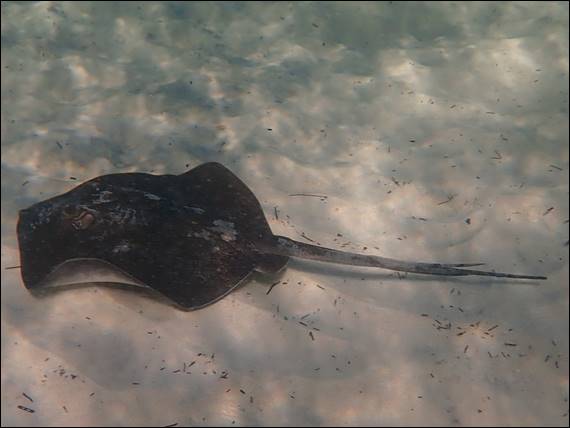
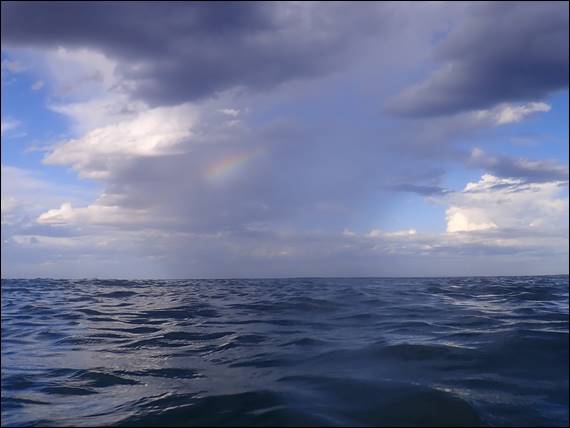
Clouds were forming overhead as I headed in, so the above image isn’t the best.  I was however very pleased to see a good sized Smooth Stingray (Bathytoshia brevicaudata) glide past me, so have included it.  These gentle giants can be up to four meters long and two meters wide, this one was no more than half that.  I’ll leave you with one last image, well a series of images.  I purposely floated above to avoid my find darting away.  Being one of two motion pictures I got of a Western Rock Octopus (Octopus djinda) doing it’s very best to hide from me:

Ending on a colourful note

With time on my hands and limited options for driving anywhere, it has been time to explore a few more local sights.  Since my last day at work for 2023 on Thursday, I’ve managed to get into the water five times.  Each time sampling a new part of the coastline off Peppy Beach, and in part assisted by tagging along with the dog walking crew with Lisa.  That is until I spot a section where I decide to jump in, leaving them to carry on without me.  The first dip on Friday morning was extra special as a dolphin lazily swam past me.  So close I could have reached out and brushed its smooth and rubbery feeling skin:

I refrained and thought I had taken a video that included looking right into its eye, but I must have been too excited and didn’t press the button to start recording.  Swimming round a new location was lovely, not having favourite spots to go to and just exploring with no idea of what I might find.  I did like the bright yellow encrusting sponge below, which I believe may be a Crella (Pytheas).  This sponge is no more than a few centimetres thick, but is still laced with pores and channels through which the water is circulated as detritus, plankton, viruses, and bacteria are filtered out:

Sponges, like corals, do not move about comprising a collection of aquatic invertebrates.  Other than that they are completely different in just about every way, including their anatomy, way of feeding, and in how they reproduce.  Corals are also much more complex organisms made of many cells, while sponges comprise very simple creatures.  However, both are important to the marine ecology and have adapted to many variety of conditions.  There are some six to seven thousand and eight to nine thousands identified species of corals and sponges respectively:

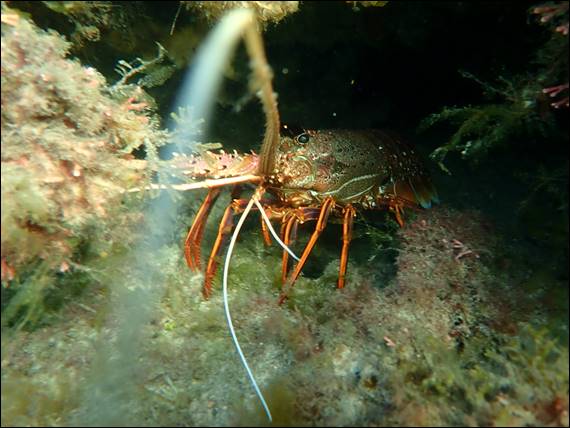
I often chose where I duck dived down due to an interesting looking bright sponge.  However, with so species I have failed miserably in trying to identify anymore.  The above Western Rock Lobster (Panulirus cygnus) was an easy identification, but I only took the image as I endeavoured to digitally capture the Southern Roughy (Trachichthys australis).  Normally a nocturnal fish it was refuging under this ledge until I disturbed it, after which it used several lobsters as shields to avoid the lens.  Heading back in a number of juvenile Bight Stingaree (Trygonoptera ovalis) were scouring the shallows and were also not keen on the camera (or more likely me) but didn’t have anything to hide behind:

I liked the above image and persisted, due to the Bight Stingaree being followed by a small school of Australian Herring (Arripis georgianus).  A fish that is sometimes mistaken with the below juvenile Western Australian Salmon (Arripis truttaceus).  These fish when fully grown reach up to one meter and can weigh a tad over ten kilograms.  And are very popular recreationally due to their fight, so much so that there is an official salmon run season.  But their flesh is considered less desirably being strongly flavoured, a bit oily, coarse, and on the soft side.  As such when fished commercially, they are mostly used for canning:

During one dive I spotted what looked to be a exoskeleton of a Pebble Crab, but which species I have no idea.  All crustaceans moult, when their hard protective shell becomes to small for them.  It’s an energy consuming process, and involved four stages, which includes starting to preparing a new initial soft shell under the old one, dissolving and making use of some of the calcium carbonate from the old shell, shedding the old shell and then finishing off the new one.  A process that can take hours and it is at that final stage the crab is most vulnerable:

I can’t even recall what I had spotted when I went down and noticed this small fish right by my hand.  Seemingly too scared to move, I took a quick snap, already with an idea that I had seen a Threefin.  It is either a juvenile male or a female Blackthroat Threefin (Helcogramma decurrens), the adult male being easily identified and quite stunning (https://sandbagged.blog/2021/03/14/barren-ground/).  This fish is in some ways similar to a Blenny, which is worth mentioning as you will see later.  Although these have three dorsal fins, which you may guess is where the name comes from, and relatively large scales, not that I got close enough to inspect them:

And just for something a bit different, I’ve included a Feather-star (Crinoids).  Related to and just like starfish, brittle stars, sea urchins, and sea cucumbers, they are an animal not a plant.  There are not as many species to choose from as corals or sponges, but I’ve still managed to fail.  This may be due to them often being overlooked, despite being found all over the place. Therefore, I haven’t found too many images to compare it against.  Juveniles are attached to a substrata by a stalk, which they lose when they become adults allowing them to move about and even swim:

In fact they can be quite quick have been observed to move along a surface at five centimetres per second.  After each dive I swim across a few open sandy areas in search of rays, but as yet I haven’t spotted any other than the Bight Stingaree.  A creature that I do however see often in these areas is the Blue swimmer crab (Portunus armatus), sometimes just their eyes poking out.  They have evolved to be on stalks allowing them to look out for predators while buried.  Other times they quickly bury themselves before I get to them, but this one allowed me to sneak up on it:

I spotted this fish from above, the distinctive shape intrigued me so I dove down someway away and snuck up on it. And while not the best quality image it was enough for me to know it was a Blenny and definitely not a Threefin, but which one? There are more species than I realised, and it has been one of the hardest fish I have to try and identity to date. Maybe because it is likely a juvenile, based on size, and many fish will change their appearance significantly as they mature. The fringe of tentacles above and behind the eyes, which had an orange iris, along with the pale bands and spots along its body makes me think it may be a False Tasmanian Blenny (Parablennius postoculomaculatus):

Today I was very happy as I saw my first octopus of the season.  It moved at speed, dropping against a rock and using its amazing skill to change skin colour and texture.  Going down, it shot off and went against some weed and changed again.  Next time I went down it disappeared from sight.  An octopus’s skin contains thousands of elastic sacs that contain pigments, called chromatophores.  There are a variety of pigment colours in these balloon like sacs, and an intricate network of nerves and muscles control how much of each colour is visible by blowing up or deflating the sacs.  There is more to it, in terms of skin texture and also an ability to create iridescent colours and even reflect the surrounding colours:

But I’ll leave it there, and have included two images of the Western Rock Octopus (Octopus djinda) after I found it again hiding in the very place I first saw it come from.  I was also a little sad to read they only reach an age of three years.  A primary reason being that the process of reproduction is a cause of death.  Males will live a for a few months after mating, and females pass away shortly after the eggs have hatched.  From the time of laying thousands of eggs in a long chain the female won’t feed again.  This may last for up to a month, during which she will blow water over the eggs to prevent algae growing on them and she will also defend them against predators:

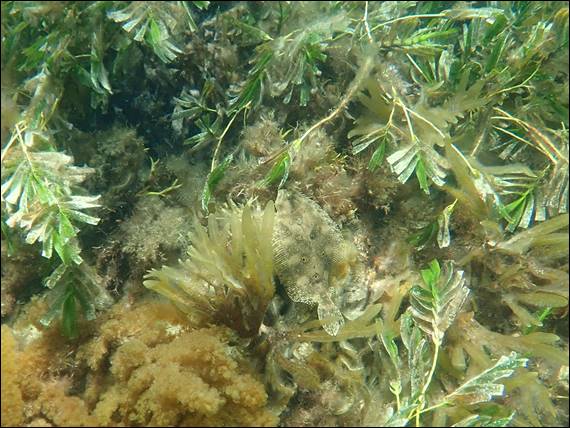
I also managed a dip at Forrest Beach today, which is a short ten minute drive away.  Lisa was meeting a friend so I tagged along to try my luck in the water there.  Here I spotted an adult Bight Stingaree (Trygonoptera ovalis), at its maximum size of approx. two feet.  Nestled in a seagrass meadow of Posidonia sinuosa.  Despite only being about ten kilometres down the coast from us, we do not get much of seagrass.  It is however a valuable plant for identifying the health of the bay.  The amount of algae on the grass, which can be seen below, helps to work out the level of nutrient enrichment.  Nutrients coming from our urban and agricultural drains:

Seagrass meadows are critically important as they provide refuge, a source of food, and a nursery for many marine creatures.  If we lose them, many other species will also suffer, including the much sought after Western Rock Lobster.  Seagrasses and also take up a significant amount of carbon dioxide worldwide, and as such are being developed as valuable ecosystem in the global carbon market.  So it really does make sense for us to protect them, but most people are oblivious of what is happening below the surface:

Well seeing it is Christmas Eve I better end this one on a more colourful note.  And what better way than to include a splash of an orange sponge, but I have no idea which species.  The area had loads of them, sticking up a bit like termite mounds and adding to the quite different feel of diving Forrest Beach. And finally a beautiful Red Tube Worm (Protula bispiralis).  One that allowed me to dive down and take numerous images, without retracting the featherlike filters back into its cylindrical shell:

A healthy level of nervousness

Lisa and my time was all above-board this weekend.  Lisa had suggested we book onto a keelboat sailing course, to provide me with some prior hands on experience before my big trip.  It was a bit uncertain as to whether the course would go ahead.  Being the only ones booked for this weekend, and they needed a minimum of four people to make it cost effective.  No one else booked.  However, Adventure Sailing, with a bit of encouragement from Emma who we had been dealing with, gave us an early Christmas Present:

So Saturday morning, completely unsure of what to expect, we made the short drive to Port Geographe.  Parked up and within 20min were on the boat receiving a rundown of the basics, which included a plethora of nautical names and phrases that our instructor for the day, Tim, rattled off.  Like I can rattle off climbing language.  Something that continued for the next two days.  And was further compounded by having a few trainee instructors tag along, resulting in five people throwing these unfamiliar words at us:

It was all part of it, and as the first day wore on the names and phrases took on meaning.  Assisted by practicing the basics of sailing, including preparing the boat for sailing and when coming in and then undertaking manoeuvres.  On Saturday we also had Rosie to help ease us into things on the first day.  A day for which we experienced no more than moderate winds.  Not a bad way to start, allowing us to focus on each step in a more relaxed way.  Not needing to react to sudden gusts or change of wind at speed:

We must have spent five hours on the water in the first day, and with just two of us we covered heaps and got lots of practical experience.  Sunday blew in with fresh to strong, and at times gusty, winds.  And while I drove the boat out of the marina is a very relaxed manner, once in the bay I wasn’t able to kick back with my feet up.  Due to the stronger winds we downsized the jib, and even then didn’t actually put it up, and reefed the mainsail to make is shorter.  Even then we were moving a fair bit faster than at any time on Saturday:

Emma was happy for Lisa and I to take the tiller for the entire trip, and it was so different to our chilled Saturday.  Needing to be a bit more decisive and quicker with our decision making.  We were also glad for the extra hands today from Sasha and Potsi, which really assisted as we went through ‘man overboard’ drills and other manoeuvres.  And despite the need for constant vigilance of changes in the conditions, it was not stressful and we both really enjoyed the experience as well as all the banter and laughs:

I had confessed to Dan when first invited on the big trip, which is now only two weeks away, that while not worried I was just a little nervous.  That healthy level of nervousness that makes you tread carefully and consider the risks appropriately.  But not so much as to hold you back from giving things a go.  However, after these two days on the water I feel the levels of nervousness have dropped a notch or two.  Thanks for the suggestion Lisa!  That said where we are heading will probably be a whole lot different to the protected waters of Geographe Bay:

A quick dip

The sting in the tail today was not so much from our pesky local jellies.  There are being found in increasing numbers, patrolling the shallows of our local beach.  But with care it is possible to navigate your way through them safely.  It was that I was not able to join in with the fun happening down at Wilyabrup.  Howsie and Ash had teed up a trip out, and were being joined by Mikey and Josh.  Work got in the way, as the mad pre-Christmas shutdown rush is on, when everyone decides to send everything in and ask us to try and get to it quickly:

I am also conscious of not using the car too much.  The overheating issues are still lingering, and the work required for the next step to try and resolve it are booked in for mid-January.  Added to that, I may have been having just that bit too much fun on rock this year.  Indeed, looking back I have certainly been out and about a fair bit, and had some great weekends away to the Perth Hills, Eaglestone Rock, and the mighty South Coast.  So I can’t complain, but my old shoulder injury has started to.  And that is more of a worry than work or my car:

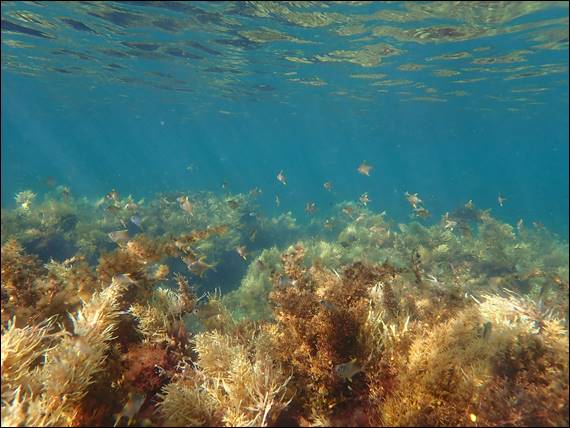
As such I stayed home today.  I’ll also miss out on an early before work climb at Welly Dam on Monday, when Mikey will take on the lines I put up at the start of 2023 (hopefully).  With his rope being held by Howsie, and being joined by Rongy and Sarah for one last climb in WA before they finally head off on their travels.  Or so they say, and based on past experience I won’t be convinced till they hit the road and stay on it.  While I will miss out on these more social outings, I was accompanied under water today by more fish than normal:

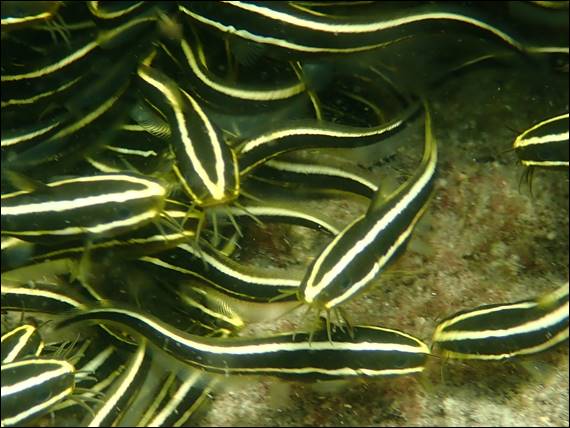
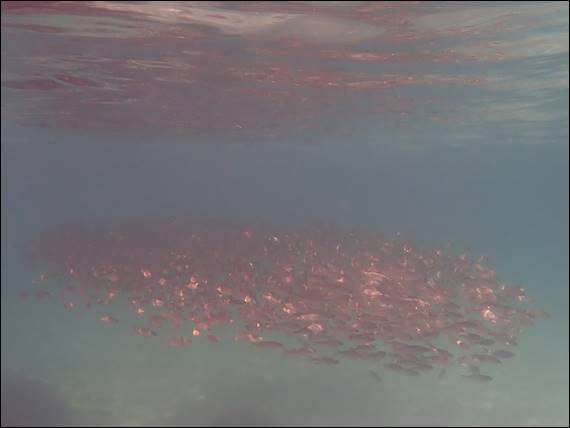
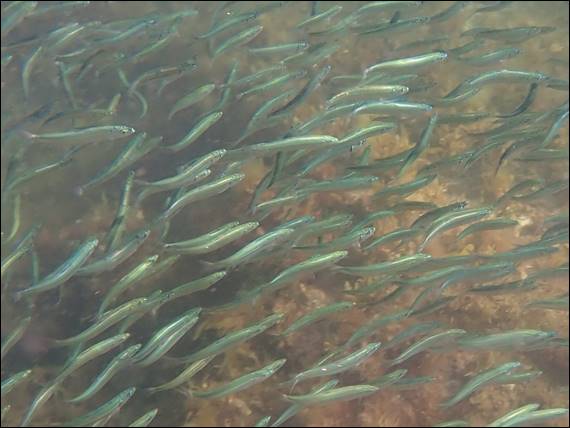
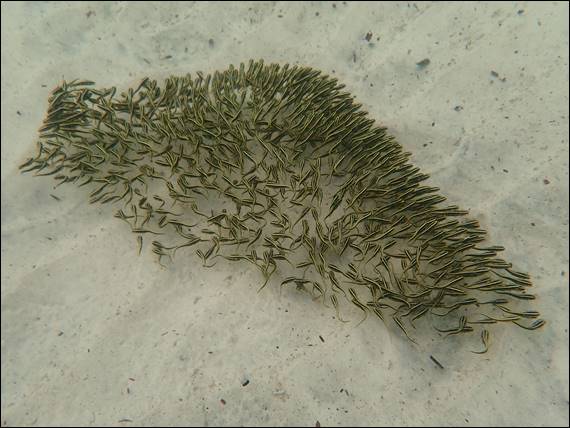
Plenty of schools were out, but the above mass of Western Striped Grunter (Helotes octolineatus) was the most fun.  They followed and swam underneath me, and when I duck dived down a circle opened up in the middle of them.  It felt like being in the eye of a storm, as the fish swam in circles round me almost from the seabed to the surface.  In addition to the schools the usual suspects were out, and despite being included in my last post I couldn’t resists this clearer image of a female Herring Cale (Olisthops cyanomelas)

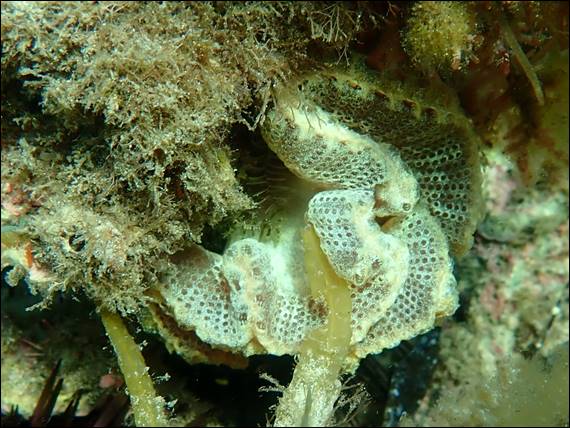
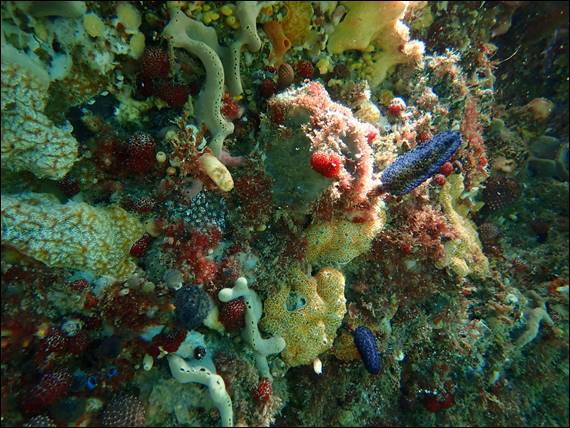
The final image from my quick workday dip is a colonial ascidian.  As the name suggests it is a colony of tiny animals, that commonly forms round a substrate such as a sponge or reef.  This one however, looked to be unattached and able to move freely.  Looking a bit like a sea cucumber, although the intricate pattern and small siphons over its body gives it away.  They are very hard to identify without examining their internal structure, so is beyond my skills.  We see these unattached variety washed up on the beach, but this is the first one I have seen underwater:

From every angle

Mikey is back in town for a while, having made the journey from over east again.  That means there are more opportunities to get out, as he is always keen and motivated.  Having arrived with a tick list in mind, which included a few lines at Moses Rocks.  More than a few in fact, enough to probably spend a reasonably long day there.  But both he and Howsie have young families, also want and need to cram quality family time in while they are all in one part of Australia.  We knew it was an ambitious list for Moses, so just took it one climb at a time:

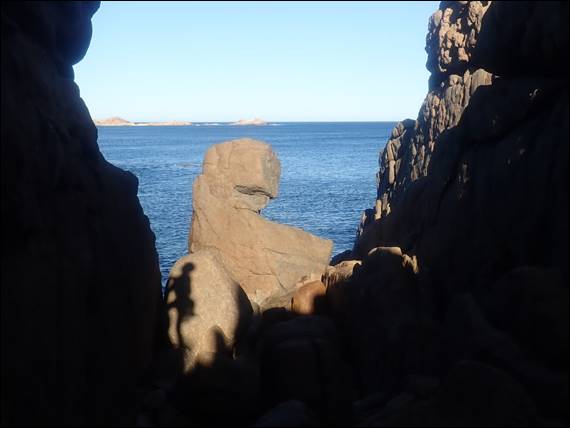
Walking in the tide was visibly very low.  The small bay from which the sand is often washed away had a thick and low angled blanket of sand stretching into the sea, with very few boulders in view.  As such I was keen to see what was happening in the zawn, which aligned well with a couple of lines that Mikey had in mind.  So we walked past the harder lines he was keen to jump on.  Instead rapping into the zawn where most of the walls were wonderfully high and dry, unusually allowing access to nearly all the routes:

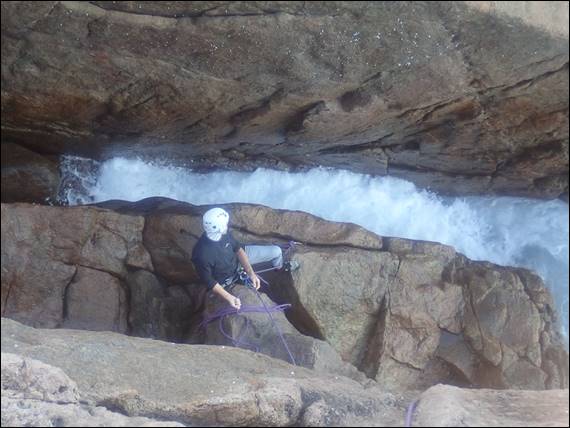
I was the tag along today, so was happy to let Mikey and Howsie jump on alternate leads.  Using my time to snap a few images from angles, which when you climb with just two are impossible to get.  All three of us love the zawn, being right on the water’s edge, having steep walls, and providing fun climbing even if it never gets too hard.  Mikey started on one of the original lines called Freddy Kruger’s Claw.  For Howsie’s first lead I showed him the possible new line that I had purposely not climbed yet, so as yet has not been named:

I had told him some time back that I’d leave it for him to nab, although we were not too sure whether it may seem a little contrived or indeed if it was worth climbing.  Happily it was not contrived and worth the time.  He thoroughly enjoyed jumping on something unfamiliar.  Stepping into the unknown with the potential of having anything thrown at you certainly makes climbing more exciting.  And having climbed every route here, here bar this one, was another reason I was happy for the two of them to take on the challenges on the floppy end:

Mikey had on his list a route that I am not sure if anyone else has ever clocked up a second ascent of.  Very few people venture here making me fairly confident with this statement, although maybe Rongy has led it.  I can’t recall.  Dreamweaver was a line I put up with Craig in our heydays, and has a blank looking start to further help put people of trying it.  But it was on Mikey’s list and I was of course encouraging him to look beyond the blank start.  As he climbed, I was busily working out the best angles to deal with the contrast created by the rising sun:

I’m pleased to report it was a good route, and well graded.  And in view of the near optimal conditions I next encouraged Howsie, with Mikey’s help, to jump on a line that I knew for sure had never been repeated.  I put The Beach up with Rongy when this place was a beach, the only time I’ve seen it like that in eighteen years.  It was so unusual that I had to put an image of the beach on the back of the Moses Rocks mini-guide, to prove it really happened.  As can be seen above it was not quite as good conditions today.  Howsie was nervous, but went for it:

You could tell it challenged him.  Eventually he made it up, just as a Mikey and I were lucky to look out the window of the zawn and spot a pod of dolphins cruise past.  This time it is questionable as to whether the grade I had assigned the climb was reasonable.  It certainly felt challenging, and could easily be bumped up one grade and maybe more.  Mind you, will anyone ever attempt it again?  Maybe not so there is no need to update any records about the grade, and it can be a ‘nice’ surprise to anyone keen to try it as it had been for Howsie:

We spent most of our time in the zawn, which I took in from almost every conceivable angle other than from the sky.  Scrambling and rock hopping to get the best vantage points.  Time slipped away, but left us enough of a buffer to tick two more routes off Mikey’s list before we walked out.  The stiffer opposition of Twist Until you Lock and the much easier Mini Thor, which we all soloed.  While I won’t get out with them on all of their adventures while Mikey is over, but I hope to get out and catch up with the brother’s Howe again soon:

Lucky last

It was that bit harder to motivate myself to get up.  But having promised Lisa a cuppa in bed, before she need to get up and head down for her Saturday morning bob in the ocean, I forced myself.  Even though I didn’t feel like being vertical, once up I’m not the sort of person that can easily go back to being horizontal.  Cuppa drunk and Lisa was soon up and out the door.  Shortly after she sent me a video of what the ocean was doing.  It was still early in terms of how high the sun was in the sky:

But the water conditions looked promising plus I was up now, and we were aiming to head into town, which would prevent a later dip.  Wandering onto the beach, to the right I could see Lisa and the Peppy Plungers getting ready to dip.  While to the left the small but regular as clockwork dog walking crew, which Lisa sometimes catches up with during her before work walk, were giving their four legged friends a run on the sand.  I stayed in the middle, making my way out of the shallows cautiously, dodging the pockets of stingers:

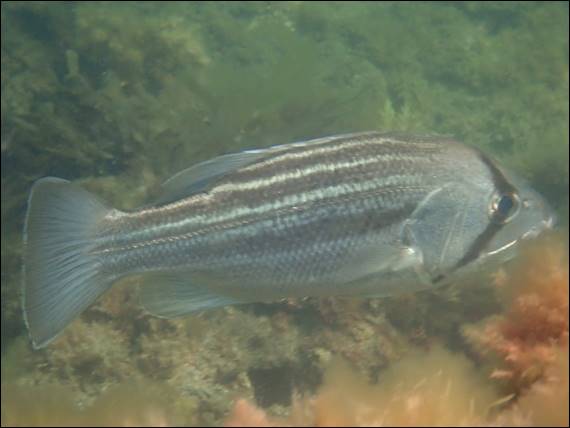
The sun was still low, as was the tide and swell.  So much so that the reef was a bit closer and the water was in pretty good conditions.  I was hoping to see my first ray of the season today, and while I thought I was in luck it was not to be.  The big shape hoovering on the bottom was instead an adult Dusky Morwong (Dactylophora nigricans), shown in the first image and the largest species of fish I’ve seen here.  Still not fully awake, and allowing me to get very close before leisurely swimming off.  And while I got some images super close, I kinda liked the one in this post:

Many of the fish were out in a more chilled way than usual.  Allowing me to say hello and snap a few pictures, before they decided their personal space was being invaded too much. Two images above an Old Wife (Enoplosus armatus), which at my local reef is normally hiding in the crevices was out and about.  And even the above Rough Bullseye (Pempheris klunzingeri) allowed me to get a reasonable image.  They are normally very skittish, and usually being found under ledges I have struggled to get any in focus images of them:
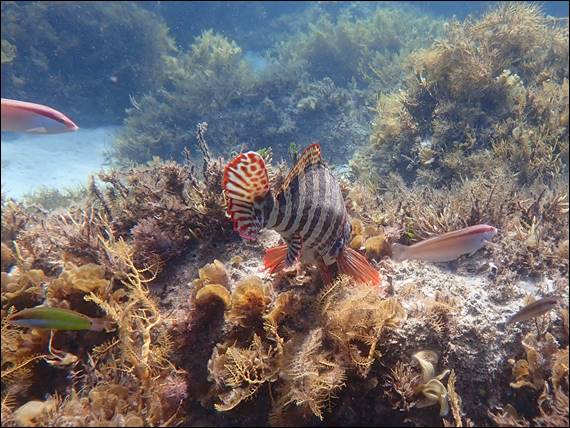
The above female Herring Cale (Olisthops cyanomelas) was not as keen on me lurking about.  If you didn’t know it was there it would have been wonderfully camouflaged in the kelp.  These, like most wrasses, change sex and colour during its life.  The juvenile is disguised as well as the female being a mix of brown and yellow, but with blue wavy lines on the head, which this one did not have.  While the males are more brazen, and can be spotted from afar being a pale blue to almost black and have striking blue lines on the caudal (tail) fin:

The lucky last fish to be included in this write up, is a juvenile.  It followed me for ten plus minutes and all the way back to the shore.  Circling my head the whole time.  Approx. 50mm long, silvery with faint yellow on the dorsal and caudal fin and vertical lines on the main body.  Being so young it is a tough call, and maybe a Skipjack Trevally (Pseudocaranx dentex).  They school when young, so it has been separated from a school that may have been attacked, as it had some scarring in front of the dorsal fin.  So being called lucky last may be apt, if it survives:

All in one

After an attempt by a colleague to give me extra work “to prevent me from heading to the beach”, I did the only thing I could do.  After all it was a go-a-bit-slower, work from home Friday and I was feeling a bit fried.  Plus there is nothing better than a dip in the ocean to reinvigorate the brain, even if the water temperature is starting to feel almost bath like.  The water temperature is currently 21 degrees, which is getting close the long term average maximum that peaks in March.  Mind you the average year round variance is only 6 degrees:

So it is not so much the water temperature that makes it feel so much colder in winter; it is the air temperature, wind, and lack of radiant heat from the sun.  Being a quick dip I went in only wearing my boardies.  After a very refreshing half an hour I didn’t even feel a tingle of coldness.  Back at my desk Rob was however happy I hadn’t refrained from heading down, when I sent him images of what the people in the above boats were hunting.  Unlike my last dive, this time I could have reached out and caught several Rock Lobsters (Panulirus Cygnus):

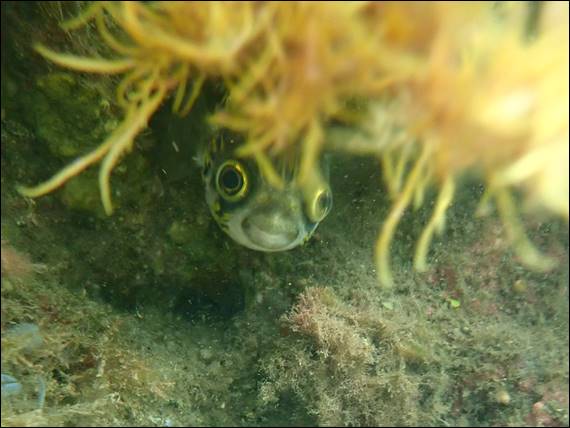
The fish were also out and about feeling braver.  Allowing me to get that bit closer, or maybe it was that I was able to stay under a little longer.  Sneaking up on them from the side, ambush style.  Of the images my favourite are the above female Shaw’s Cowfish (Aracana aurita) with its deep red keel like belly, and below female Western Smooth Boxfish (Anoplocapros amygdaloides) that seemed to be play peekaboo with me.  Both are boxfish, a family that also includes cofferfish and trunkfish.  Cowfish being names due to the obvious horn like feature:

Often I will swim from the reef across a sandy section.  Keeping an eye out for any subtle change in the wave pattern the sand, which is made as a result of the rhythmical motion of the water.  The change in pattern can be for several reasons.  The one I am interested in is the potential for something being hidden just below the surface.  When I got too close to the two stalk like eyes, a Blue Swimmer Crab (Portunus pelagicus) sprung out like a Jack-in-the-box, taking on its defensive posture to make it look bigger that it really is:

Back at my desk it was back to the grind, but with the weekend just round the corner plans had been laid.  Josh was keen to get out.  However, my car woes continue and we have still not managed to pinpoint the reason for the overheating warnings.  To the point I’m not prepare to risk taking it out.  While living out at Peppy Beach is wonderful, not having wheels leaves us somewhat hamstrung.  Josh kindly offered to pick me up, for which I was grateful, and we headed to a place he had, until today, not sampled:

In past posts I’ve, maybe too often, talked of the fearsome reputation Smiths Beach holds.  So I did wonder if he had remembered that when he suggested the location.  On the plus side I really enjoy the climbing here, so was happy to pick off a few of the lower grade lines to make sure Josh had fighting chance on them.  Despite getting the early sun, which was already up when we arrived, the two chimney like features on Harbour Wall were the obvious choice.  Both of which Josh ate up even enjoying, I think, worming up The Drunken Sailor:

We then retreated to the narrower second zawn, which is afforded shade for a wee bit longer.  Not that it was overly hot today, more so to allow us to keep the grades reasonable.  This meant picking off a couple of routes I haven’t led for many years, and carefully eyed them up before committing.  Below I am looking up at one of my routes called Deceptive Looks, which wasn’t too bad but I confess that it would scare the bejeebers out of any grade 13 leader.  It was however the next route that played on my mind:

Photographic Belayer is aptly named, as the gear is relatively sparse making the belayer at times redundant  That said on the pointy end it is a very nervous lead, and Josh was a little worried himself when I kicked into serious mode.  As I write this I had to check my images to work out when I last led the line.  To my surprise it seems I have only led it once before and was a week after Craig had established it.  Back in January 2011, when I was a bit more fearless than these days.  Um maybe another sandbag route, but at least this one is Craig’s not mine:

It’s good to have moments like that, when you feel right on the edge, just to stop you from becoming complacent.  Josh found the relatively long crux sequence somewhat challenging so I was surprised when we suggested one more line before we wrapped thing up.  But he did and while I found the last line more reasonable, his ability to hold onto the rounded holds was nearly fully depleted.  Not helped by his fingertips being raw and sore from the abrasive rock, but he batted on regardless.  The rope was then coiled and stashed in my rucksack:

Fortunately, having a healthy depth of skin left on your fingers is not a requirement for what we had in mind next.  It is becoming more of a regular thing to head round the bay to Canal Rocks and go for a dip after scaling the cliffs at Smiths Beach.  The ocean was relatively calm today, and I was tempted to jump straight in off the rocks.  One day I will.  The water is certainly a bit deeper there, but we could see the weed covered boulders below the surface and it looked like interesting ground.  Today however we went in in at the boat ramp:

Like yesterday I decided to go in with just my boardies.  No wetsuit, or even a rashy that Josh had opted for.  Possibly a brave move by me as the water temperature on the west coast is some 4 degrees cooler than at our local beach that is in the more protected Geographe Bay.  It certainly felt more brisk as I dove in.  Preferring to get it over with quickly, as opposed to torturing yourself as the water creeps higher up your body when you walk in slowly.  All of that was washed from my mind as the abundance of fish came to sight:

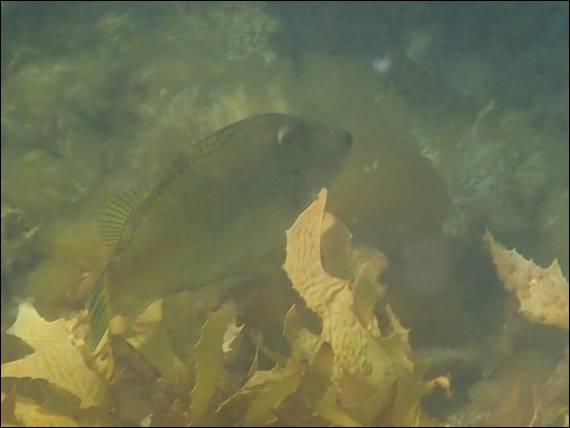
It may seem I have included images of two different fish above.  I’m reasonably confident the first one is a Filefish (Monacanthidae), in part because of the distinct shape of the lower part of the body near the pelvic fins.  That said it is not unique to filefish and I have not been able to identify which species.  And as I attempted to follow it, it seemed to change colour.  Therefore, I am not sure if I ended up following the same fish.  And looking more closely at the images the body shape near the pelvic fins looks different in the above image:

Needless to say I have given up, but was interested to read that some Filefish can change their appearance very quickly in 1 to 3 seconds.  So, I was not hallucinating when I saw the first fish change right before my eyes.  Leatherjackets, a similar shaped fish, can also change colour, but I have not been able to find out how quickly.  I spied another colour changing marine creature, and got excited.  The above Giant Cuttlefish (Sepia apama), while not at the maximum length of one meter it was a good sized one and as Josh dove down to it, it swam under a ledge:

It didn’t seem to mind me popping down to say hello several times.  Each time seemingly more comfortable with my presence, getting closer to me and not putting on as much of a colourful display.  While there were many species out there, here is another Western Smooth Boxfish.  I included it, as it had much deeper colours than the specimens I find off my local beach.  Half an hour was enough, and as we made our way back in this fish was happy for me to take an image.  While I have seen them before, as yet I have not pinned down what it is:

Perfect picture

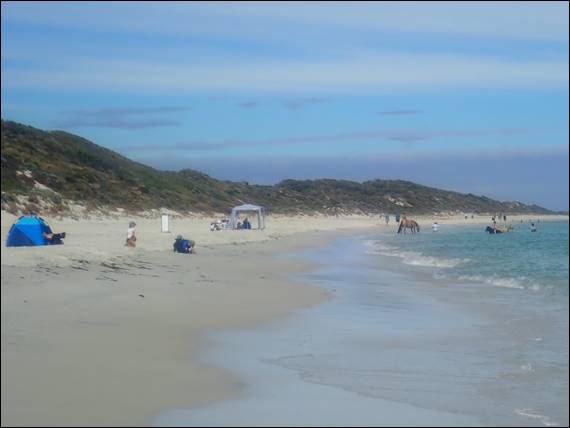
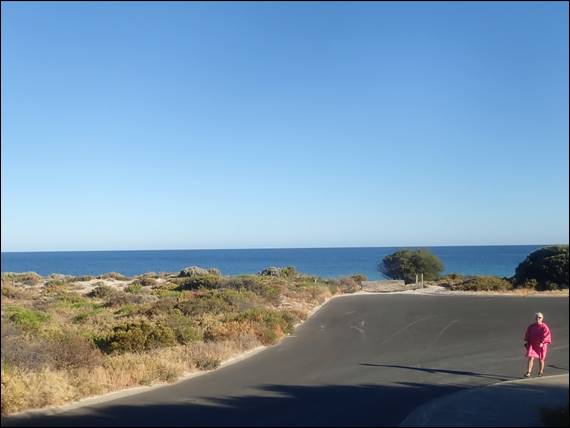
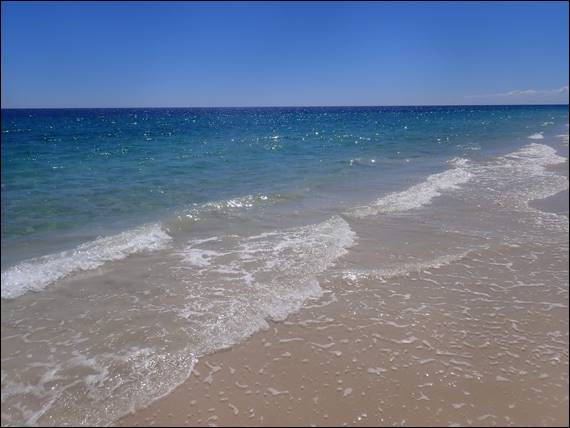
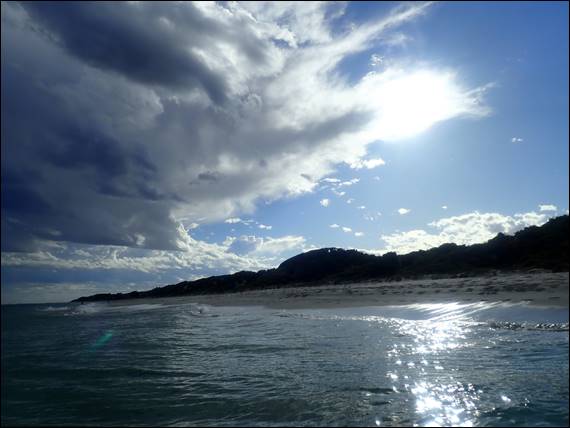
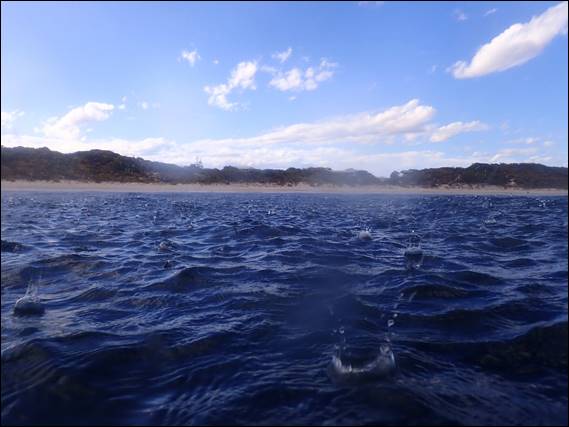
‘Picture perfect’ is the only way to describe this sight, but it is not one I saw.  Lisa is down the beach most mornings walking the dogs before she heads to work, and also on weekends since she has started cold plunging.  The frequency of her visits provides more chance of seeing the beach in such tranquil conditions.  And inspired by such sights, she has even dropped hints that she might get out on the paddleboard this summer, and only time will tell about that:

The above image was taken last weekend, while I was climbing down on the south coast.  And based on the relatively settled and almost summery conditions we are experiencing, even though it is still spring, I was hoping for similar sights this this weekend.  Summery may not be the right choice of words, and it has been described as a heatwave.  Something that in Australia is based on the ‘excess heat factor’, which is assessed the maximum and minimum temperatures over a 3-day period against the thirty day average.  Fair to say it has felt warm:

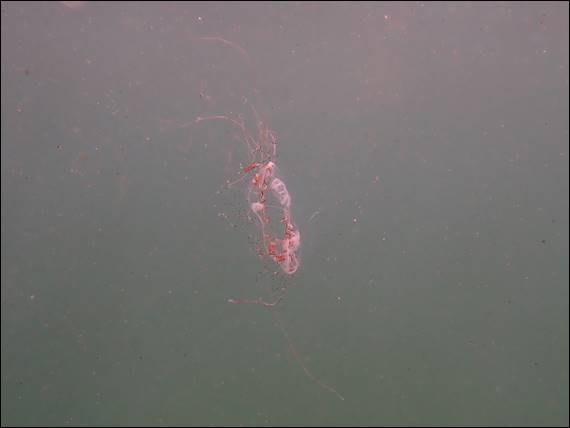
Last weekend Lisa also captured the above image that I really like, and don’t like.  From a photography perspective I love it, having only ever taken images of them in the water myself.  But being a South Western Stingers (Carybdea xaymacana), I’m not so thrilled.  They normally make their first appearance much closer to Christmas, when the summer school holiday starts.  Their presence, and the not as idyllic conditions as the first image, didn’t however stop me from dipping into the water twice today:

I was fully expecting not to see the abundant fish life I saw of Meelup Regional Park or at Canal Rocks, and was not disappointed when my expectations were met.  But the ease of walking down and diving in, without driving, makes it worthwhile.  I was happy to find the above Pale Mosaic Seastar (Echinaster arcystatus), one I have mentioned before so started digging for interesting facts about it.  I read, again so it seems now that I have looked back at past posts, that some say this species resembles the Mosaic Seastar (Plectaster decanus):

Making me wonder if that was the seastar I found, and failed to identify, the last time I wrote about the Pale Mosaic Seastar (https://sandbagged.blog/2021/11/20/a-biology-lesson/).  Many seastars are carnivorous and prey on molluscs, but both of these two species feed mainly on sponges, but also other sessile animals.  The term sessile meaning they are not able to move about, being attached to a solid substrate.  Marine animals, other than sponges, that are sessile include corals, bryozoan, truncate, and barnacles, with the last also found on boats:

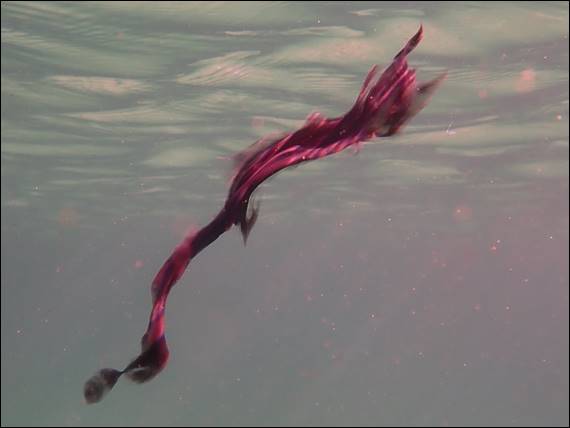
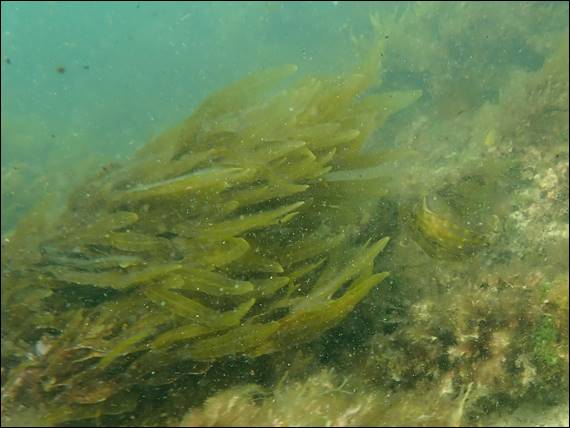
And there have been plenty of boats out, with talk of bountiful amounts of Western Rock Lobster (Panulirus Cygnus) for the picking.  Not that Rongy had much success recently.  The people on the boat a few images up were however not diving but fishing.  The weed floating in the foreground of the same image, being the above weed.  Entangled in fishing line that had snapped, or been cut, due to the hook and weight being caught in the reef below.  Not something I like to see, or leave behind, so spent some time retrieving all of the line:

I found one Western Rock Lobster, above, who was not game to sit still for a picture.  And this seemed to be a similar theme, when I spotted what I am sure was a Red Bait Crab (Plagusia chabrus) grazing on the reef.  I didn’t bother going down, knowing how skittish crabs can be.  Sure enough my presence floating above was enough to make it crawl deeper into the reef.  I also briefly saw the very distinctive shape of a juvenile Port Jackson Shark (Heterodontus portusjacksoni), of which I have only ever seen one before:

As soon as I saw it, it disappeared into the crevices of the reef.  If I saw right, it came from one of the lucky 10% of eggs laid by these sharks.  The other 90% get eaten by predators, during ten to eleven months it take for the eggs to mature.  My last image being of a Biscuit Seastar (Tosia australis).  They come in a multitude of colours and patterns, but the distinctive shape and six to eight knobbly plates along each arm makes it easy to identify.  While it may not have been picture perfect above, below the surface it was still possible to get some perfect pictures:

Averting a mid-wall crisis

Ash has been absent from my posts for a while, and for good reason.  He has been a bit of a national and global trotter, but is now back in the sleepy south west of Western Australia for a bit.  Some months before he reached the shores of this island, he had reached out and suggested we should hit the road and head south for a trip.  With a particular climbing spot in mind that he is somewhat partial too.  Rongy would have joined but you may recall that while he should be travelling himself, he is currently stuck in Perth working:

And the initially considered fourth member was Howsie, who could make it.  In fact I doubt if wild horses could have held him back.  And it was a good thing too, as Ash had been battling some bug the week before the trip.  Advising us just days before the off that he would head down separately, allowing him a later departure on the Friday.  The intention being to optimise his chances of being healthy and enjoying our destination on day two.  Howsie was happy to take his rig, which I was thankful for as mine has a gremlin at the moment:

Being picked up from home on Friday morning he told me his rig also had a gremlin, one that he had hoped would have been fixed on Thursday.  The choice was to take my rig and risk it over heating, or take his for which there was a chance it may not start.  A case of six of one and half a dozen of a another, and Howsie drove.  Our first stop on the south coast tour was Blindmans Bluff, a small but fun crag hidden from sight and just a stone’s throw from the Peak Head carpark.  Short single pitch slabbing on smooth south coast granite:

Rain had fallen every day in the first half of the preceding week, but the forecast for our four days down here were nothing but glorious.  Twenty degrees, mostly cloudy with hints of sun, light to moderate westerly winds, and a small swell.  The last too being particularly important for the crag that Ash was super keen to get too.  We racked up a stack of great climbs during the afternoon and the conditions could not have been perfect, and even the Australian Common March Flies (Tabanus australicus) didn’t seem interested in taking our blood today:

The image of the fly was while it sat on my climbing shoe, not caring to move as I took aim and snapped an image showing its strong straight proboscis that would normally be used to pierce the skin and suck out some blood.  But not today, and the only soreness we had after climbing here was a tingle on the fingertips.  Resulting from the coarse sandpaper like rock steadily removed layers of skin.  I’m not going to recount every line we did, but for those who are keen and as I have for some of my longer trips, there is a route list at the end of the post:

One thing we had previously agreed was that this trip was all about mid-grade fun, no aiming for high numbers other than in the meterage we covered.  The hardest route being grade 19 and there was only one, on the first crag and the very worthy crag classic shown two images up.  We had intended to camp at the Panorama campsite for the trip, but Friday was the one and only day of the year that they were closed due to an ultramarathon event.  So we instead met Ash at the campsite at Cosy Corner:

It has been many a year since Lisa, Elseya, and I have campedat Cosy Corner and much has changed.  That includes our previous site being closed, needing to now pay, and there being a camp warden on site.  At times well-meaning camp wardens can be a little annoying, but today we were grateful to have them about.  On the short 1km, or so, gravel road approaching the camping area some schoolies were hooning in and out at stupid speeds.  ambivalent of other road users and frustration levels they seemed to leave at most places they went:

Some of the people already camping there were preparing to leave, not willing to put up with the schoolies antics.  But the camp warden put their foot down and the schoolies were sent on their way.  Fortunately it was the only encounter we had with them during our time down here, and as it grew dark Ash rocked up.  Soon after he popped his tent up it seemed everyone at the now peaceful campsite hit the sack, as did we.  The other campers were still tucked up in bed when we got up, packed up the tents, and drove out:

It was 5am but the sun was up and it was bright.  We left Ash’s car at the national park entrance and lowered the pressure on Howsie’s tyres, in preparation for the drive into the mighty West Cape Howe.  This was the place that Ash really wanted to get to, he loves it here.  Dark cliffs fall into the Great Australian Bight, and with the wrong wind direction and higher swells this can result in sea spray making the rock feel greasy.  It was however perfect today, although before we sampled the rock to test it we had breakfast and a cuppa:

Ash was happy to follow up with the safety of a rope above him, and Howsie and I already had a bit of a route list mapped out.  Mid-grade fun on lines that we had not been on before bar one, or so Howsie thought.  Then I checked his guide and he had also marked up the first two lines during our trip here in 2012, when he climbed them with Andrew.  Any memory of the routes was long gone so he was happy to jump on them again.  Each route offering long pitches on quality and sustained lines, bliss:

This is however a pretty serious place.  It is off the beaten track, the setting is for some intimidating, and due to the nature of the rock and situation there can at times be lose rock.  Safety is always first and foremost when we climb, and here it is that bit more first and foremost.  Double checking everything you do, staying tied in at all times, and climbing with confidence but equal amounts of caution to check each hold before committing to it.  Regardless of all that it is still easy to see why Ash loves it so much:

Four wonderful climbs in and it felt like lunch time was here.  The carpark is very close to the cliffs, so it was just a few minutes to get back.  Here the food came out again and the kettle once more went on.  We had the place to ourselves, and despite the great climbing here in the seven or so times I’ve climbed here only on one of those occasions did I see anyone else climb.  Possibly it is due to the access and situation that keeps some away, being that bit more of an effort physically and mentally:

As we munched our lunch, a silent visitor crept up on us.  Howsie spotted it first and Ash gave a shriek, and only then did the Bobtail Lizard (Tiliqua rugosa) seem to notice us and take a slightly deviated path.  By which time he was within half a meter of me, and seemingly unperturbed by our presence.  Fed and watered we were back on rock, on a multi-pitch route that happened to be the first route Ash had ever climbed here.  It was a storming line, with a huge belay ledge at half height on which all three of us could have laid out and star fished:

The next route was unexpectedly the final route of the day.  A line that Howsie had attempted to find with his brother Mikie a year or so back.  They had rapped into the wrong area so didn’t get to climb it, as such we took our time to make sure we found the right location.  It looked steeper and more intimidating that the other walls we had climbed, and Ash opted not to come down.  We did however still required his services, when we foolishly left the guidebook on top.  Looking up the wall we were not entirely sure where to go:

The guidebook is being lowered on the end of the rope in the above image, and even with the topo in the guide it was misleading.  Resulting in me going slightly off line, and Howsie having to work his way back on line for the second pitch.  We may not have climbed the route entirely as intended but it was still fantastic.  All the mucking about had however meant we spent twice the time on this route than any of the others, maybe we were also starting to tire.  So while we went off track it was still a great way to end the climbing on day two:

Howsie’s car started without a hitch, phew.  It is probably not the best place to get stranded, but it did have a bit of a turn when we stopped to pick up Ash’s car.  Howsie does have a trick when it doesn’t want to start, and for now that seemed to work.  That night we stayed at the Panorama campsite, stopping in Albany on the way to grab dinner first.  After the tents were pitched we made use of the communal area to sort the gear ready for the next morning.  The next place would require a bit more of a walk in, so food, water, and gear had to be sorted:

At  night we were reminded that it was schoolies week, as we settled down for the night.  Just like at Cosy Corner the campsite fell silent soon after darkness descended, and as the wind eased and picked up we could hear the doof doof music from some distant place drift off and then get louder.  Not so loud that it was clear but audible enough to be like the sound of a mosquito, not quite allowing you to enter that perfect deep sleep.  But it didn’t stop me from getting up early.  It seemed to get light earlier and dark later here, compared to back home:

Indeed it looks like first light arrives some quarter of an hour earlier in Albany compared to where we live.  But interestingly last light is more or less at the same time.  I’m not quite sure how that works, but my circadian rhythm was in tune and cups of tea were awaiting the others as they rose from their tents.  Today’s destination was Peak Head, a place that Ash was yet to climb at and Howsie had only been to once before to climb.  It was my fourth trip here, and there is a climb that one day I should jump on, today however it was one for Howsie to consider:

And consider it he did.  I lost track of time, as he stood looking at it then sat down continuing to stare at the steep finger crack.  It looks down at you both inviting you in and making you feel daunted at the same time.  There was even some head holding, rocking, and for a while the child’s pose was assumed.  Eventually weighing up many factors, including the intent of sticking to mid-grade fun, he decided to leave it for another day.  I was quite literally spat of this line on my first visit here in 2006, and in 2015 the start of the climb baffled Dan and when offered the rope I simply didn’t have the energy for it:

So I could fully appreciate the quandary that Howsie was battling with.  On the plus side there is another magical route that takes you off the ledge, where 50m of open space awaits below your feet.  A curving traverse crosses the big face and eventually leads to a series of ledges and cracks.  All of which Howsie gobbled up with great delight.  Having so much fun that he passed the belay ledge and kept climbing until there was no rope left.  He then had to down climb several meters and as the rope went slack below him something unexpected happened:

Ash and I waited patiently, and when we heard the shout that we were on belay and could climb when ready we knew something was amiss.  As Howsie had down climbed the twin ropes had slipped into a vertical crack, and as he went to pull the slack in to belay us they had locked against each other.  The issue being this occurred midway up the 50m pitch.  We managed to avert the mid-wall crisis, when I self-belayed myself up the rope until I reached the offending crack and freed the rope.  Problem solved and we continued up the pitch, followed by two more with nothing but air below us and smiles on our faces:

The wander back down to the bags brought up the dilemma of what to do next, it was early and there was plenty of time to squeeze another route in.  But the grades only went up and as Howsie pondered his choices again I looked about and spotted a native bee that was also in a pickle.  Having overindulged in nectar and being covered in pollen it was tangled up in the stamen of this Coastal Pigface (Carpobrutus virescens).  I’ve since discovered there are over 2,000 native bee species in Australia, with 800 of them being found in Western Australia:

Meanwhile, Ash laid down.  He was shattered.  Climbing for me is a great way to disengage the brain and soak up the surrounds.  Ash’s brain isn’t wired that way and his buzzing brain combined with other factors had left him feeling very weary.  So much so he was considering heading back that afternoon.  This aided Howsie in his decision making and unlike the unlucky bee, Howsie was released from his tangled web of options at Peak Head.  We trudged out, stopping along the way to provide advice to a couple from Oregon:

They were over for a week long climbing trip seeking worthy multi-pitch climbs, and had come up behind us on the route we had just done.  We sent them off with some pointers on places to go and lines to climb.  Then back at the campsite we saw Ash off.  This left Howsie and I to head back out for the afternoon to explore, plumping for one of the crags at the Blowholes.  No multi-pitch routes awaited us here, but at 25m tall the climbs felt a good length.  And to boot we were right next to the crashing waves, which provided a great atmosphere:

Main Wall was developed in the 80s, and you could immediately tell it was developed by old school climbers.  The lines looked imposing and even the lowly graded ones visually looked tricky.  Later that evening when we caught up with Kym, Meg, Tess, Claire, and Beau, Kym said he had been seriously sandbagged at this crag before.  Making us feel somewhat justified in our thoughts, as we stood below the face.  Being my lead I plumped for a wicked rising corner, a line Howsie had shown interest in also.  But first in, best dressed and all that:

It was amazing, and didn’t get a single star in the guide or even a line to say that it was a worthy route or anything.  At our local crags we both agreed it would have had stars splashed all over it.  Making us keen to get another climb in, and Howsie chose based on aesthetics as opposed to grades.  Aesthetics is something that the cove we were in had all over it.  In addition to great granite walls there were stunning sections of conglomerate rocks.  Car and even transit van sized boulders poked out, and the floor below was littered with round boulders that had over time popped out:

Howsie picked a beauty, providing a style of climbing we do not get too much of over our way.  Both he and I were tiring now, after three days of climbing and a few good walks.  We managed the line, and thoroughly enjoyed it.  Marvelling, and also being somewhat jealous, of all the hidden gems that the south coast has tucked away.  And while there were certainly more lines to tempt us, we felt it was time to head out.  Kym was sadly unable to join us during this trip, but we simply had to have a catch up so we headed over for a cuppa or two:

Sunday night was peaceful and maybe that is why I was up extra early in the morning, way before first light.  Having a camp kitchen was handy allowing me to brew a cuppa without making too much noise.  I sat and watched another sunrise, which made me wonder how Tomski was going in Israeli as I hadn’t heard for a few days.  Howsie was up in time for when I was making my second cuppa.  Today was the day we would drive home, so we had a decent breakfast and then made a third cuppa for me and second for him, ready for the journey out:

While we like to get home at a reasonable time after a decent trip away, we were up early and had already decided it was time for a tree change.  We are talking towering karri trees, which could mean only one place… Mount Frankland.  A two’ish hour drive from where we had slept the night, yet we still managed to be at the base of the climb by eight.  Not being greedy, our plan was to sneak in one route that would summit out and allow us to take in the landscape from the top.  And again I handed Howsie the rope:

I get out heaps more than he does, and I have also led the climbs at Blindmans Bluff, Peak Head, and Mount Frankland that we had on our radar.  The last one we had in mind is another beauty, and one that does not get much attention.  The first pitch being the meat of the climb and offering a long 47m delicate path up the slab.  A cool crisp morning and superb dry rock made it all the more special, as he tippy toed his way up.  Occasionally shaking out his calves, when there was a slightly more forgiving foot hold on offer:

I was happy stood at the base.  Surrounded by a feeling of serenity that the greenery around me seemed to instil.  Standing on a pile of leaves that had collected against the granite dome over years.  Making a perfect compost and no doubt a home for many critters, although I struggled to see any.  The one spider I did see, and attempted to get a close up of, was bright green and less than a three millimetres in size including the legs.  Wandering about on the rock, looking like it was checking its webs for anything tasty that may have been trapped:

With mere meters left in the rope Howsie reached the belay, and was rewarded with a view from above.  It was my time to pad up the steep granite dome and leave the spider, which I have not been able to identify, to its own devices.  I didn’t stop too long at the belay and made my way up the much easier second pitch.  So easy that I body-belayed Howsie up after me.  Being conscious that he would be moving fast, it was easier to keep up with his rapid pace by using the old school belay technique.  One that some, in this day and age, may frown upon:

Looking out at the tree canopy stretching into the distance we could make out the wonderful ocean that laps, or more like smashes, against the amazing playground of the south coast.  For this trip at least our climbing was done, and we were extremely satisfied and also appreciative of Ash for suggesting a wee trip away, so thank you.  With five areas visited, and eighteen awesome mid-grade routes comprising twenty three pitches climbed in perfect condition, who wouldn’t be happy.  And it made us think an annual South Coast jaunt isn’t such a bad idea.  For now however it was time to head home, back to our creature comforts and understanding families:

The route list

Blindmans Bluff
Birdbath (8m, 15)*** (CH lead, KS second)
Currawong Crack (15m, 17)* (KS lead, CH second)
Captain Goodvibes (15m, 19)*** (CH lead, KS second)
Frogmouth (10m, 16)** (KS lead, CH second)
Blue Cheer (10m, 17)** (CH lead, KS second)
Birthmark (8m, 18) (KS lead, CH second)
So lo (6m, 8) (KS/CH solo)
Lo too (6m, 10) (KS/CH solo)

West Cape Howe
Mo (35m 15)** (CH lead, KS/AG second)
Curly (35m 15)** (KS lead, CH/AG second)
Shitsky (35m 17)* (CH lead, KS/AG second)
Punkin and Hoonin (35m 17)** (KS lead, CH/AG second)
Andromeda (50m 15)** (CH/KS alt lead, AG second)
Wired Flake (50m 16)*** (CH/KS alt lead)

Peak Head
Albatross (105m 15)*** (CH/KS alt lead, AG second)

Blowholes, Main Wall
Just in Time (26m 14) (KS lead, CH second)
Obelix (23m 10) (CH lead, KS second)

Mount Frankland
Purveyors of Matters Large and Small for the Masses (77m 18)* (CH/KS alt lead)