Going back for more

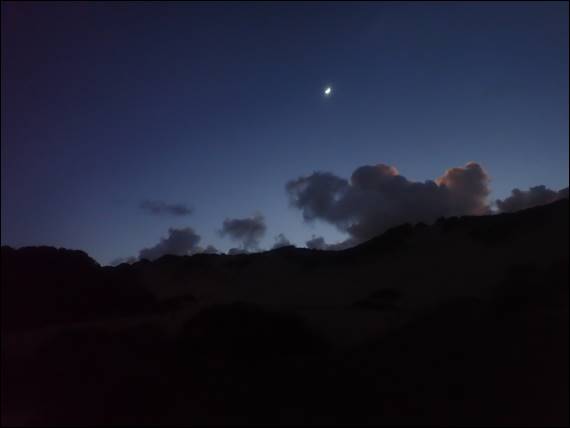
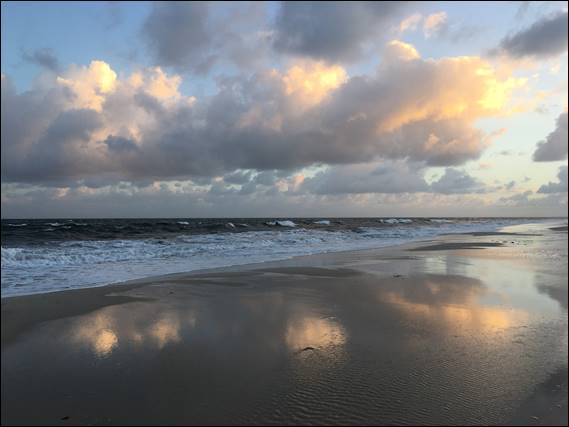
Geez, it feels good to be able to hop in the car and drive without needing to nervously listen for the thermo fan to kick in or the warning light to alert me that things are heating up.  I’m way more alert as the driver than a passenger.  So it was nice to be driving and putting all of my attention on everything around me, and not wasting any on the possibility of an engine issue.  Such as the waning gibbous reflected in the water, as I crossed the Capel River.  Being the phase of the moon as it transitions from full to half.  This morning it was at 99% and looked particularly beautiful:

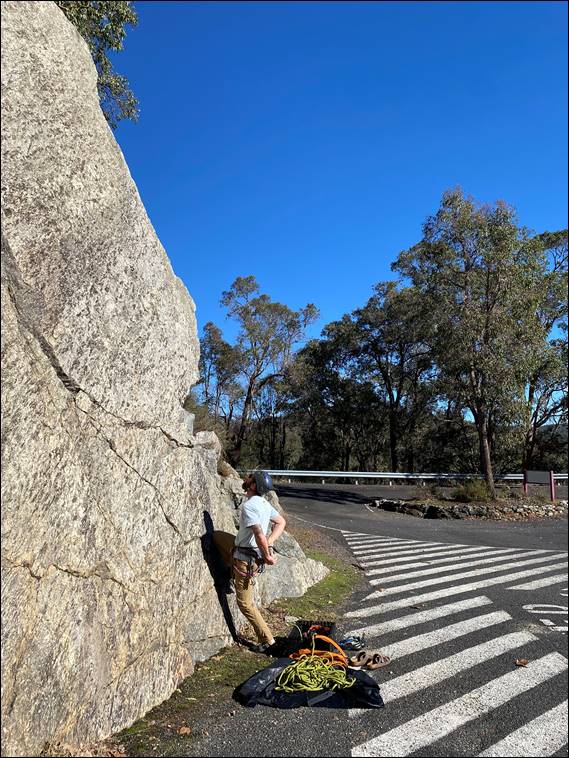
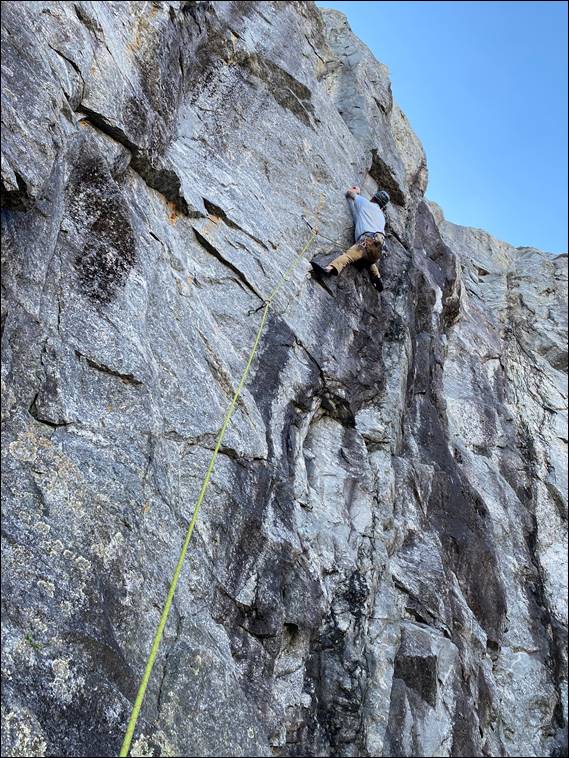
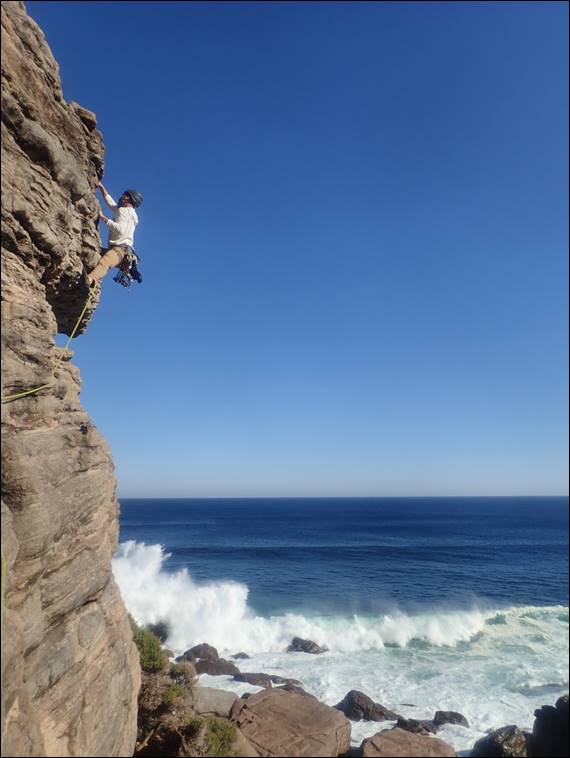
The term gibbous comes from the Latin noun gibbus, which means humped or hunched.  The word was adapted for use in the English language to describe items that are rounded or convex.  Hence a waning and waxing gibbous is a moon that is becoming less and more round, respectively.  On Friday I had suggested to Pontus I could be up for a climb today, and had suggested Welly Dam.  A physical and strenuous place to climb, which offers the sort of climbing that could result in a rounded back and hunched shoulders, called a climbers hunch:

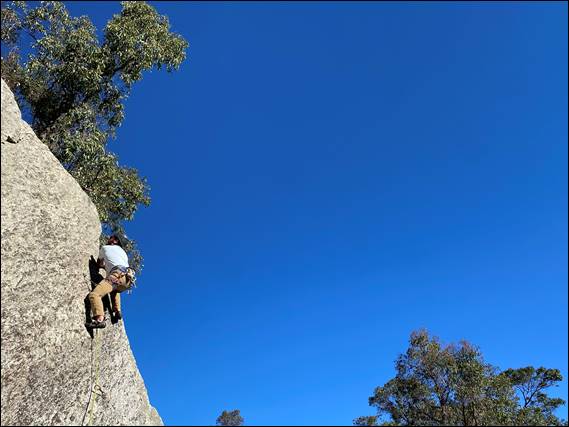
Climbing involves lots of overhead motions, and this can result in tightness in the chest and shoulders.  This repetitive form of movement can result, in the spine being pulled out of alignment and the back then becomes curved or hunched.  I’m drifting off topic here a bit, but I have previously talked about traditional climbing, and this not only relates to placing your own protection but also to some degree the techniques used.  The surge of indoor gyms has resulted in people learning to climb routes that for the most part use these overhead movements:

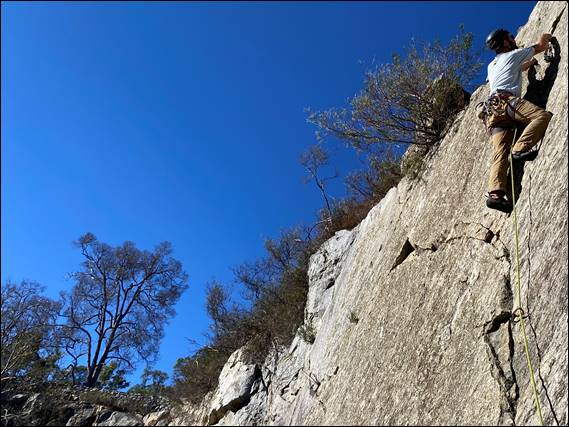
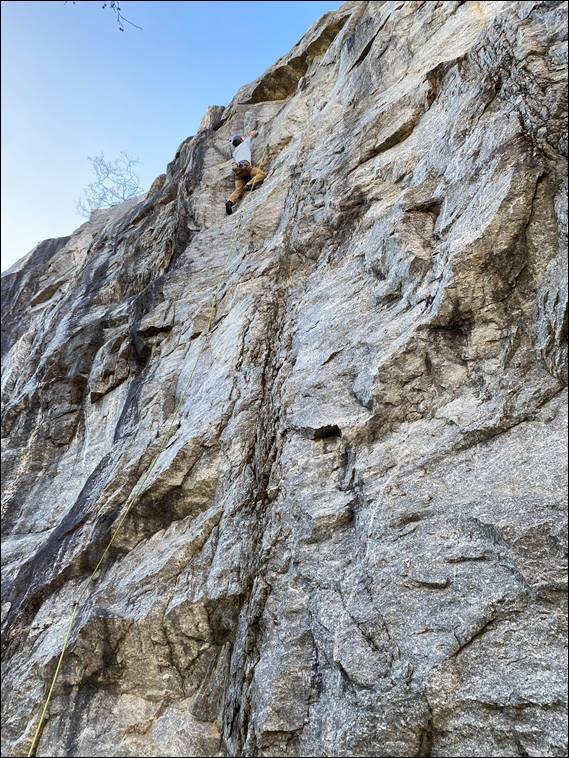
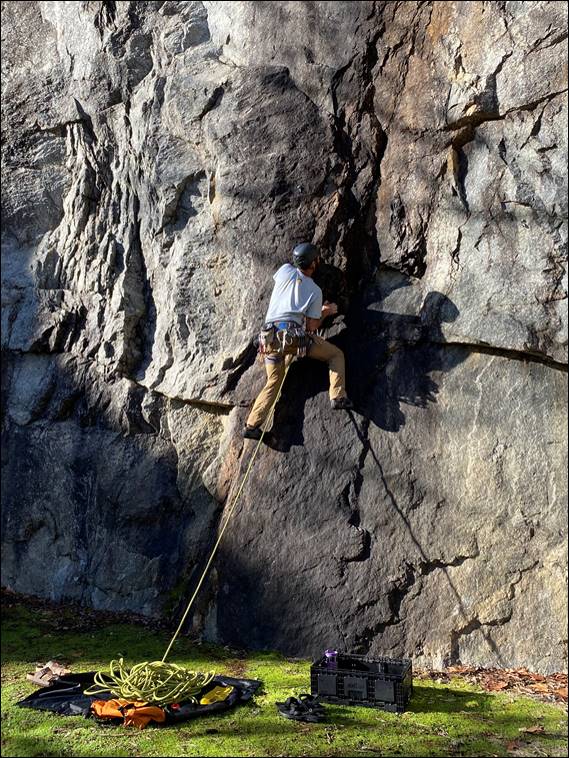
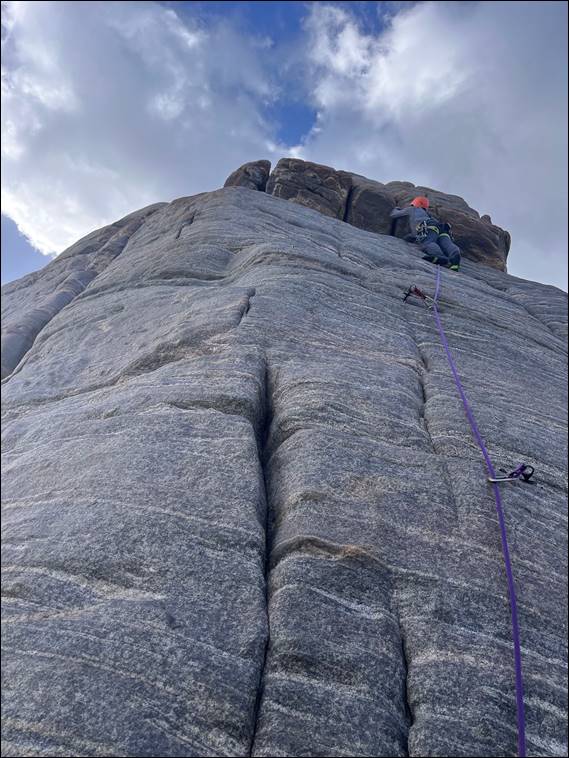
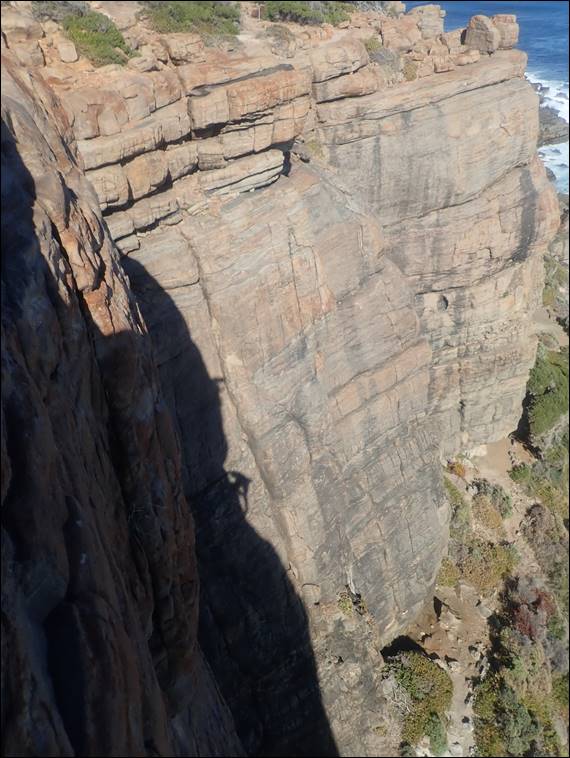
Traditional climbing styles use heaps of other movements, and when climbing at Welly Dam these can be very useful.  And if side pulls, underclings, mantles, down palms, etc. are not applied the climbing here becomes much harder than it needs to be.  This may be one of the reasons people find the climbing here tough, always looking for the next overhead hold to crank down on.  I was pleased to see Pontus was making good use of these techniques.  We didn’t have the place to ourselves today and another couple who were not using them anywhere near as much were struggling:
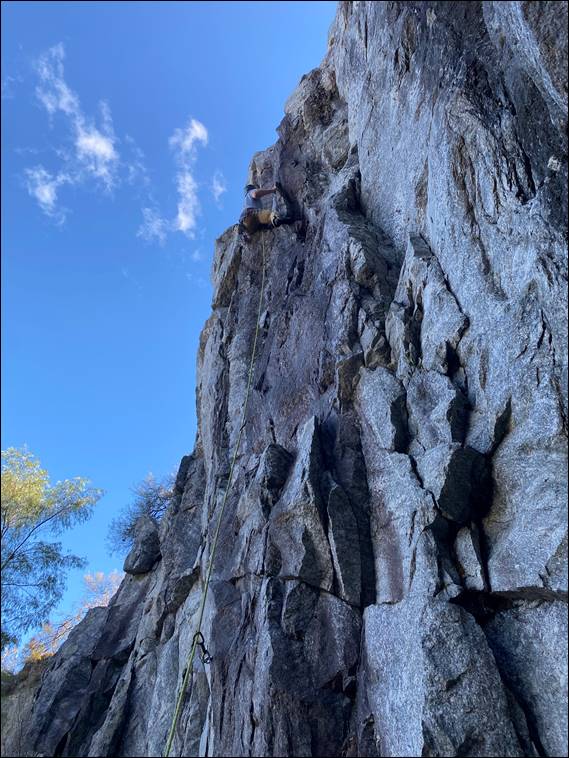
I think it is fair to say Pontus really liked it here.  Not just the climbing style, but also the bolt spacing, explaining that it allowed him to focus on the climbing without stopping too often to clip.  It was refreshing to hear!  He quickly got used to and enjoyed the deceptive nature of the climbing.  The rock texture and colouration makes it hard to read.  At times bomber looking holds fail to impress, while holds invisible to the naked eye from below suddenly appear just when you need them.  We clocked up line after line, mostly nothing too silly in grade being his introduction to the dam, but we threw the occasional line in that started to push his limits:

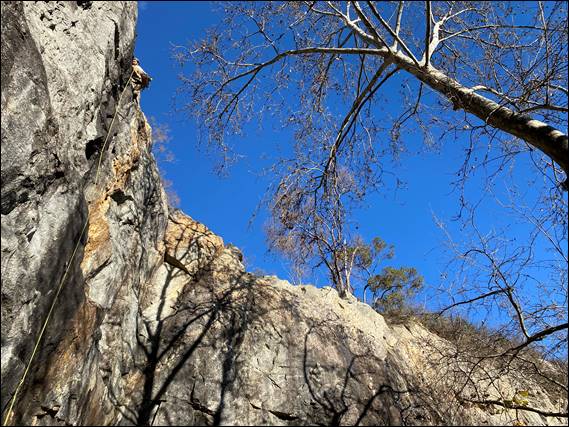
Mind you I feel leaving these to a little later in the morning was a contributing factor.  Eight climbs here is a reasonable session by most people’s standard, which we managed to clock up as the other couple were still fighting their way up their third line.  We were wrapping up when Josh and Kellie turned up, with the kids in tow, having just walked the 6km river walk from their campsite.  With the climbing over Pontus hinted he may run the same track, seeing it was a nice cool day.  While my legs had finally recovered from the stairs session, I had no inclination to join him but feel I should join Lisa and hit the stairs again on Wednesday:

No objection

Another four day week.  Um, there is a risk I might start to get used to this, but it can’t last forever.  Only until I have reduced the leave I have built up.  My rationale for taking it being that I’m doing my bit to help I reduce the leave liability risk of my employer!  This suits Howsie a treat seeing he does not work on Friday’s.  Today we made good use of the opportunity to progress his 2024 challenge, at Wilyabrup.  The only concern being whether my legs would hold up.  Lisa is not content with Pilates, weights, and her Saturday morning ocean dip:

She convinced the Peppy Plungers that they could meet on Wednesday’s after work, and pound up and down the 119 steps of the Peppermint Grove Beach lookout.  Sitting atop Mount Stirling, it is the tallest peak between Bunbury and Busselton.  There is however no stopping to enjoy the view.  Once up it is time to go back down and hit repeat, her aim is to manage ten laps by April.  This week I suggested I might be keen to join, as I really do need to do amore cardio based exercise.  We did eight laps and Thursday morning I was feeling great:

Then DOMs (delayed-onset muscle soreness) started to creep in, and this morning with every step I had to take downhill my legs really were not impressed.  On the plus side, and for those following my car drama’s, it’s finally been resolved so I was able to drive this morning.  It’s only take close to four months and three different mechanics to get there.  As we walked in I pushed my complaining legs top the back of my mind and suggested we climb a few of the lesser climbed routes.  I topped out on our first route, Verbosity, as the sun crept over the land:

My calves were burning as I bridged up the initial corner, but I wasn’t giving into them.  Howsie then hit Hole World, above, and not being a route he has been on very often it did make him stop and think.  Mind you it is fair to say that the runout at the crux is a little unnerving.  My next line was one Peter recently aborted on, no doubt due to all the other routes we had done and the fact that the sun was bearing down the rock face.  I had to focus, and grunt a bit, to get up A Pocket Full of Nothing but didn’t notice how my legs felt, not once:

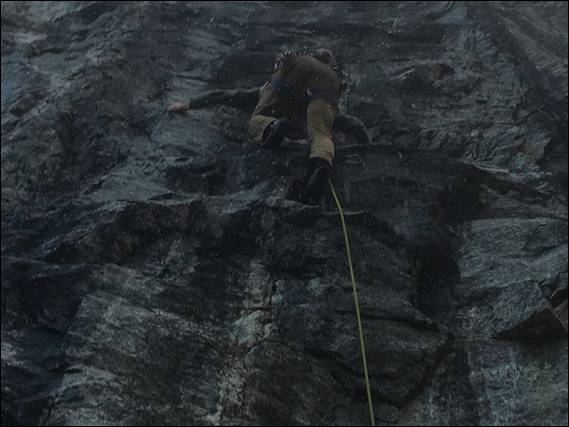
As I was grunting away, Pontus was quietly going up Hope, as shown above.  Learning the finer delights of trad climbing.  He is travelling about and in the areas for a while, and managed to hook up with Sam for a day.  While we didn’t know either of them, we discovered Sam and we have common acquaintances.  Numbers were exchanged later in the day in the hope of getting out on rock another time.  Boosting our options of people to get out with, just as the numbers in our local crew have started dwindle.  Down to business now, and it was time for Howsie to get serious:

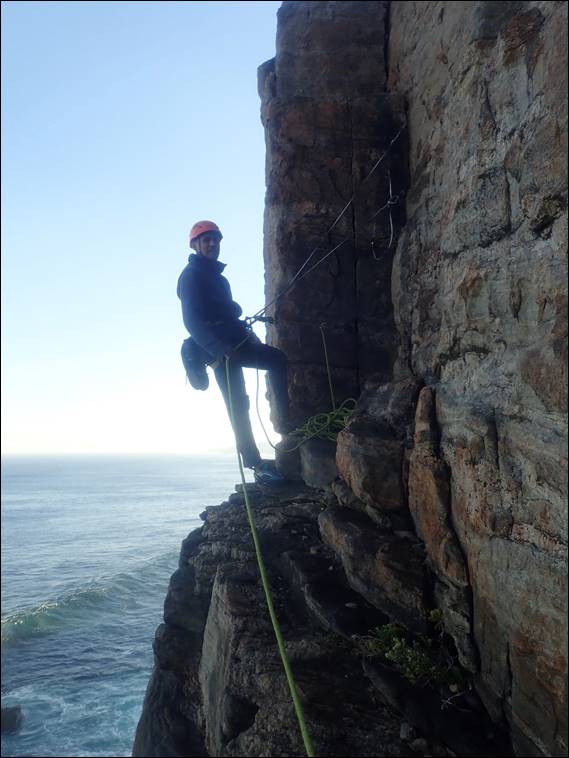
As we wandered down from my lead, Mick walked in with a couple of clients.  We had a chat, as we always do, and he was excited to hear Howsie was going to try The Spin of It.  His fourth 24 for 2024, and a climb that neither of us have ever been on.  Mick didn’t give too much away, only mentioning a couple of things.  Not enough to unlock the very, very reachy crux move, from which Howsie popped off a couple of times.  But maybe third or fourth shot he managed to stick it, just as Mick was hanging over the edge showing his group how to abseil:

Howsie was beaming and rightly so, it is not a grade we often attempt and it was a storming effort.  This time for our decent I managed to save my legs, by making use of Mick’s rap line.  Back down, Howsie hinted he needs to get back on the line to get it clean.  Although not today, and he almost seemed a little surprised as I suggested another line.  Continuing with another often overlooked line, I kinda romped up The Unbolted and the Beautiful.  My arms were a bit more tired than I expected, and the feeling of achiness somehow made me also notice my legs.  In fact most of my body was starting to suggest it was time to wrap it up:

But not before one last route to even up the leads, and Rhys’s Rapid Retreat is yet another rarely climbed route.  Strangely three of the climb obscura we scaled today are my creations, I’ll admit they lend themselves more to the true traditional aficionado.  Howsie was definitely feeling it on this line, as he battled up the steeper sections.  As did I.  And listening to our bodies I suggested we didn’t climb out with packs on Hope, in search of Carpet Pythons, as we had talked about doing at the start of the morning.  No objection was raised:

Circular journeys

The body was weary after a reasonable session at Bob’s Hollow, and Josh almost missed the chance to get out today.  Messaging me just as I getting ready to hit the sack last night.  Despite being achy, the draw of another morning out on rock was just too appealing.  He also got a surprise when I suggested a slightly later pickup time, to what he put forward.  It doesn’t happen very often.  So for a second morning, I was walking down the streets of Peppermint Grove Beach before anyone else was up and about.  And this time got to see a lovely sunrise:

Josh has yet to get to Bob’s Hollow for a climb, but he’ll need to build up a bit more upper body strength and technique to be able to cope with the steepness.  Today we were heading for more slabby routes at Moses Rocks, called the friendly crag for more reason than one.  Inviting and grippy rock, interesting lines, shorter and lower grade routes, and a wonderful backdrop that instils a comfortable aura.  As we walked along the beach a pod of dolphins surfed a wave towards the shore, jumping out the back before the waters got to shallow:

We stood and watched them for quite a while, as they slowly cruised southwards, every so often picking a wave to surf in on.  Eventually, we decided it was time to continue the hike to the crag.  And when we got to Rumpoles Rocks, the dolphins appeared once more to great us with more aquatic antics.  We again stopped to watch them.  Just as they were cruising past at a relaxed and leisurely pace, we too were in no rush.  Finally we pulled our harness on, and covered the flapper on my toe before slipping my climbing shoes on:

I had preselected the routes for today, or at least the first four.  Climbs that would provide enough of a challenge, and make Josh work on his body position and footwork.  You can’t get away with yarding up on your arms at Moses, the rock while comfortable to hold is rounded in nature.  This forces you to get into positions to make the holds more effective, otherwise you risk pumping out and possibly falling off.  I hadn’t mentioned any of this to Josh, and then he told me he had come today with the intention of putting more focus on his technique:

We racked up the four intended lines.  On each one he did really well in thinking about how to use the holds, and climb more fluidly and efficiently.  After each route we sat at the top of the cliff to sort the gear and coil the rope.  From our vantage point we also got to see the dolphins multiple times.  They were lazily swimming along the coast to the north before turning back to head south, and so it continued during the morning.  We too in a chilled way went up the crag, only to then go back down, before hitting repeat:

Josh was going well and keen to jump on another couple of routes, which meant picking slightly trickier climbs.  He watched my approach, and with a bit of encouragement and some pointers climbed them in good style.  By the time we topped out on the sixth route, his arms were jelly enough to call it.  This suited me, as I was starting to feel yesterday’s workout.  For a final time, as we went back down, the dolphins came past.  A we finished our circular journey of climbing up and walking down, they too headed off not to be seen again:

Good hygiene

Friday morning arrived at a time that most would not have realised existed.  Lisa was still tucked up in bed, as I quietly rolled out, and went about my usual morning routine before I head out for a climb.  This included pouring two cups of tea into thermos mugs, one for me to take and one to pop on the bedside table for Lisa to sip at a more reasonable time of the morning.  Howsie chose Bob’s Hollow, for which it is worth a bit of an earlier departure, and he’d kindly offered to pick me up from home:

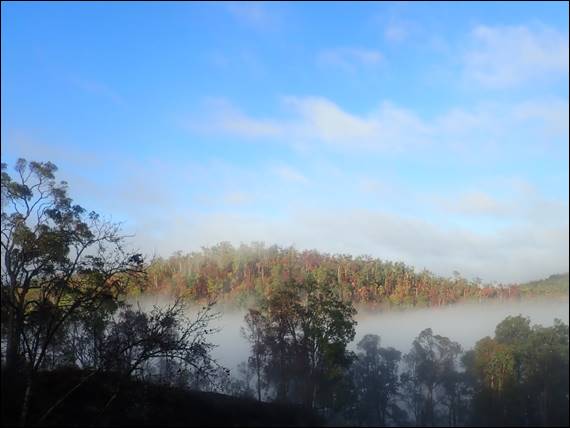
If he had rolled into our driveway the dogs would have kicked off, and woken not just Lisa but also the whole neighbourhood.  So I left the house a little earlier than the agreed pick-up time, and started down the street on foot.  Our aim was to be walking into the crag at sunrise.  As it was we didn’t get to see a sunrise, or any pretty morning hues, with the sky at our destination being caked in grey looming clouds.  Along the side of the track the bush was more of a low groundcover, still recovering from bushfires some years back:

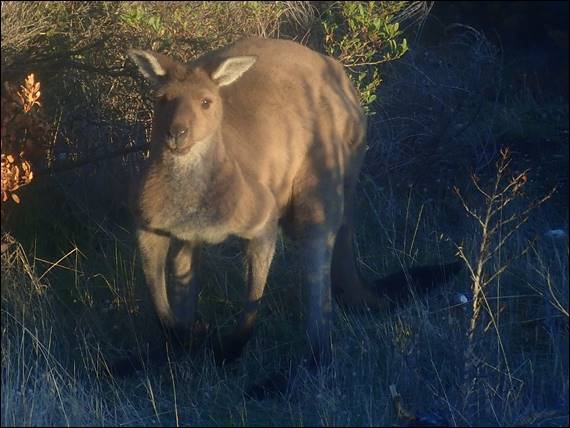
The long, hot, and dry summer we have had hasn’t helped it’s recovery.  Yellowing to brown leaves showing that the vegetation was under heat stress.  Occasional limestone nodules and roots on the path meant we kept our eyes on the track, and we almost missed the above kangaroo.  It was just a meter or two of the track, and bounded off to get a bit further away from us just as we were upon it.  While we missed a chance for a closer look, by stopping before it hop away, at least we didn’t stub our toes:

There was a very slight intention to progress Howsie’s 2024, with a play on the one and only grade 24 route here.  There are however a number of 21s, 22s, and 23s here that he has never been on, climbs he didn’t manage to get on in their respective years.  Our pre-trip chat had alluded to a few 22s and one 21 that were likely candidates.  Bob’s Hollow is a steep limestone cliff, overhanging for the most part.  A very different style of climbing to our usual destinations, so before we would consider these routes there was a need to warm up:

After our warm up route, Howsie admitted to being pretty pumped and his expectations for what might occur dropped considerably.  Neither of us come here often enough, and we really aren’t used to the steep powerful routes.  In years gone by, we climbed here quite a few times a year, but in the last three years I’ve been here twice and Howsie has been maybe once.  I didn’t feel too bad on the first line and decided to hit the grade 21, a line I had never been on before.  It was steep and pumpy, and I nearly popped off a few times but somehow managed to bag it:

Howsie, to his credit, pulled the rope to give it a crack on lead.  But with an already weary body, it made him work extra hard.  Every time he fell off, and sat in the harness, he had to expend valuable energy to get back on the rock and repeat moves.  This ends up quickly sapping what stamina he had left.  The day continued like this, but he never gave up, and while we may not have bagged anything harder than that 21, he kept going.  A 22 I had not been on before drew my attention, but when I got to the steepest section it was dripping wet and I retreated:

Considering the record breaking dry and hot this summer we are experiencing, we were surprised at how much seepage was occurring.  Above you can see some plants, unfortunately weeds, taking advantage of the drip line from stalactites.  Despite the all too quickly tiring arms, and in places wet rock, we bagged eight routes and had a lot of fun.  The lower than expected grades didn’t dampen our mood.  The fine dark sand at the northern end of the crag seemed to cake everything it touched.  With the risk of the sand grains being fine enough to get through the protective sheaf of the rope:

So keeping it on the tarp was important, and each time we pulled the rope we aimed to get it to land on the tarp.  Something we managed surprisingly well.  Then midway through our morning, and while not looking were I was walking, I stubbed a toe on a root and took the top of it.  The toe that is not the root.  So for a while I had to make sure I kept not just the rope but also my foot on the tarp.  And then once I popped my climbing shoes back on, which felt comfortable enough, this enabled some form of hygiene by preventing my foot from getting any grubbier than they already were:

Fact and fiction

Third time lucky seems to work.  The cause of my four months of woes has been revealed, by mechanic number three.  I sadly still have to wait another week for the parts to arrive and everything being put back together.  They have had the car since last Thursday, resulting in me working from home for most of this week.  And until today I have managed to avoid the temptation of sneaking down to the beach.  That changed today, being my ‘Friday’ as I am taking a day off to go climbing tomorrow, and I popped down after closing the laptop:

A quick look provides multiple origins of the term ‘third time lucky’, the one I liked was the story of John ‘Babbacombe’ Lee.  A sailor from the West Country in England, where Lisa was born and grew up.  Back in 1885 he was sentence to death and survived three hangings resulting in his sentence being commuted and being set free.  However, the term predates this event and other theories cite magical beliefs, religion, and common folk lore.  Back to today, since the weekend’s amazing conditions the swell and wind have been up a bit:

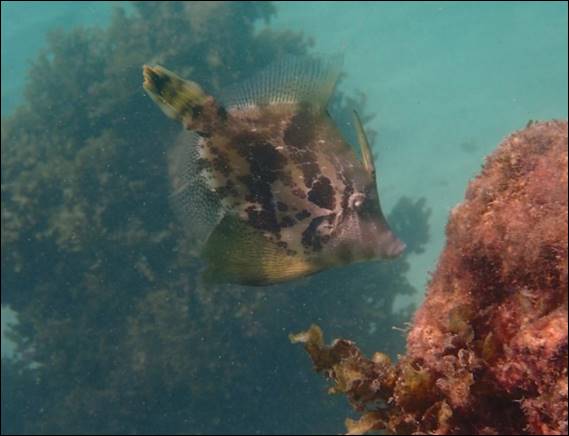
The surface was still a bit choppy this afternoon.  No matter, as I decided to go in regardless of the conditions because it was another stinky hot summers day.  Beautifully clear water greeted me, as I started my exploring.  It all seemed a little quiet but I managed to sneak up on the above juvenile Moonlighter (Tilodon sexfasciatus).  Juvenile’s tend to be solitary, whereas adults are known to school.  Their appearance and size also change considerably when they mature, but they head out to deeper waters so I have not come across any adults:

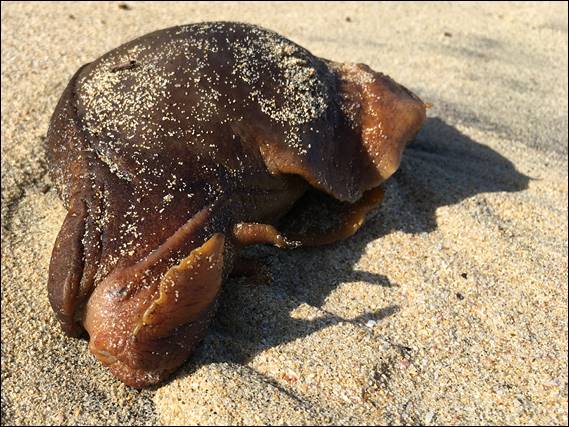
Under a shelf I spotted a small Southern Bailer (Melo miltonis) with a damaged shell.  These carnivorous molluscs tend to feed at night and on overcast days, so I was a little surprised to see it on such a cloudless bright day when the water was so clear.  It always amazes me how big the foot of these creatures are relatively, almost making the protective shell a little superfluous.  Maybe that is why they would normally bury themselves in the sand during the day.  The below Pale Mosaic Seastar (Echinaster arcystatus) caught my eye because of its lovely purple hue:

It looked a little comical with round limbs that looked like arms and legs sprawled out, as if it was a coach potato watching TV.  This made me wonder if this maybe the species that was the inspiration for Patrick Star.  Who you may ask, but I’ll get to that.  It is not such a silly notion, as Stephen Hillenburg studied marine biology and was working for the Ocean Institute when he created a comic book called ‘The Intertidal Zone’.  This was the inspiration for SpongeBob SquarePants, and of course Patrick Star is, well, one of the ‘stars’ of that show:

Back to facts, and I couldn’t resist including the above Female Western Smooth Boxfish (Anoplocapros amygdaloides).  The body was a brilliant white and the intricate texture was very visible and amazing to see.  I also liked its little friend, and follower, who is difficult to identify.  I’ve seen this small fish before and back then thought it may be a juvenile Skipjack Trevally (Pseudocaranx dentex), but that really is a guess.  I’ll leave you with one last image of a second and much bigger Southern Bailer, and I challenge you to find its eye.  Something I have not noticed their eyes before, as I usually out on murky days:

Making contact

‘It’s just out there’, swim out to the pontoon and the same distance again.  So I have been told a few times.  Lisa was heading out for her Saturday morning plunge, and the crew enter the water right off where the pontoon is located.  You could say I decided to try this new bit of reef, which I have heard about for a number of years, on the basis of safety in numbers.  If that was lurking in the back of my mind as a rationale, it was a false sense of security.  The plungers never go past the pontoon, and don’t always go that far:

They were waiting on the beach for the full contingency before they went in.  The Saturday morning dip being just as much about the social as it is about being in the water.  They are a great crew for sure, but I’m not one for chatter so left them there and started a beeline to the pontoon.  Here I said a quick hello to a solitary Greater Crested Tern (Thalasseus bergii), both of us happy with our isolation.  I looked back to gauge how far I had come and how far I would need to go, and swam on.  Leaving the Greater Crested Tern in peace:

With no idea of what to expect other than it was supposed to be good, I swam the same distance again, and again, and then again.  The plungers were a mere speck back at the beach and I continued to swim.  With easily six meters plus of water below me, I started to allow my mind question how much I was liking isolation right now.  A stupid thought, which I pushed to the back of my mind.  Eventually the depth started to reduce.  I had been told there were some great plate corals and that spurred me on, and then gave me a clue when I arrived:

It was deeper than I expected, or was led to believe.  Some bommies came to approx. four meters but much of it was deeper.  This was immediately obvious from the green tinge of the view below me.  Fifty percent of the brightness beaming down from above is lost in the first meter of water due to both reflection and refraction.  Then with depth the colours start to disappear.  Following the rainbow colours, red, orange, yellow, green, and finally blue are lost at approx. depths of four, seven, ten, twenty, and sixty meters:

I’ve previously tried to identify these plate corals, having seen them elsewhere.  I had considered it may be of the Astreopora genus, but with more resources at my fingertips I believe it may be a Yellow Scroll Coral (Turbinaria reniformis).  These form various shapes including singular plates, such as the ones I saw today.  Added to that the colour, corallites size and spacing, and distinct rim free of corallites all point towards it.  I could immediately see why those chasing Western Rock Lobster (Panulirus Cygnus) would like it here:

I dove down to the big caves and ledges hoping to find some big but gentle creatures resting for the day, other than Western Rock Lobsters.  Sadly, while it was a nice spot and I spent a good length of time checking it out, I didn’t find much.  The only fish that I don’t normally see was a solitary young Snapper (Chrysophrys auratus) maybe a foot in length.  It kept coming back, each time keeping a health distance.  Hence the third image is gloomy, but good enough to check the body shape and see the many small electric blue spots scattered on upper sides:

Eventually I started back, and here I came across smaller young Snapper, as shown two images up.  Snapper are one of the most popular food and sport fish in southern Australia, growing to four feet, weighing up to twenty kilograms, and living to forty years old if they manage to avoid being caught.  The ones I had seen were obviously very young.  A school of young Southern Garfish (Hyporhamphus melanochir) also appeared.  Keeping their distance, and like the Snapper I had seen these too were well below their full size of close to two feet:

Back at shore the plungers were, as I had left them, on the beach.  If it wasn’t for the wet bathers and hair I could have questioned if they had even been in.  I asked them how far I had gone, and was surprised to hear that they through I had been as far out as the above boat that had just arrived.  I’m not sure I’d go back there, maybe one day but I’m not in a rush.  Seeing the winds were staying light all day, I asked Lisa if she fancied having a second plunge in the afternoon and she surprised me by saying she was keen for a snorkel:

It has been several years since Lisa has been out for a snorkel.  The fear of bitey things having crept up and put her off, which is why the plungers have been so good for her.  Going into the water with a social crew has put her mind at ease, and given her confidence about being back in the water.  As Lisa and I say ‘if anyone can a Pelican can’.  So it felt like the right time for her to get back into snorkelling when two Australian Pelicans (Pelecanus conspicillatus) glided over the water, check the image above, just out from where we stood:

This time we were not intending to be in deep water, but the term deep is relative depending on where your comfort zone is.  Lisa had already said she probably won’t go as far out as I would, which was fine.  Almost immediately we saw fish clear as daylight, in the much shallow waters than I had been that morning.  When I spotted a Western Rock Octopus (Octopus djinda) it provided a great opportunity for Lisa to have a bash at duck diving, so she could get a closer look.  And just like the one I found last week this one also surprised me when it reached out:

I normally snorkel with my head under water the entire time.  Swimming with someone else changes that.  There is the need to occasional pop up and check where they are, and at times call them over because you have found something cool.  In the shallow water I did this one time, and out of the corner of my eye I saw fish, with a body shape like young snapper, jump clean out of the water.  This occurred several times.  Fish will usually jump like that if they are stressed or feel threatened, the big question is what made them feel that way:

I thought that would put paid to Lisa’s snorkel, but it didn’t.  Maybe because it was some way from where we were.  She did however stay closer to shore, as I swam out, missing out on the shoal of Southern Calamari Squid (Sepioteuthis australis) a couple of images up.  But when I came across a huge school Western Striped Grunter (Helotes octolineatus), and too her credit, she joined me several hundred meter out.  We made our way back to shore where we saw a juvenile Northern Sand Flathead (Platycephalus endrachtensis), this time with a black fleck visible on the tail:

With the added height advantage of being on the beach, we could see a shape where the fish had been jumping.  Someone was out there snorkelling, whether they were there before and the reason for the jumping fish we will never know.  They stayed there for a long time and seemed to going down to check the area out heaps.  So this morning that’s where I went, and was greeted by relatively barren ground.  Not as deep as past the pontoon, but deep enough to distort the colours, with ground that really wasn’t that interesting:
I gave it time to see if I missed something.  Scouring the area and going down to check out the limited small bommies.  Nothing jumped out and I eventually gave up, wondering what had caught the attention of the person we had seen.  It took me a while to orientate myself and work out where my usual patch of reef was.  Here I was rewarded with plenty to see.  Included yet another Western Rock Octopus, this one was however content to watch me from the safety of its daytime hidey-hole.  Making no effort to reach out and make contact:

A rare sight

It’s normally ‘thank god it’s Friday’, but this week I was more looking forward to Thursday.  Not because Thursday was my Friday, it wasn’t and I worked the full five days this week.  It was due to the stars aligning providing the lowest swell, along with light winds, and clear blue skies.  We’ve also tipped into the forties again, and being my working from home day I could break my time at keyboard and screen up with a couple of refreshing dips in the water.  Only the slightest ripples were evident, and the water was beautifully clear:

My first find was within ten meters of leaving the shoreline, above.  I almost missed it, as you may have.  A Smalltooth Flounder (Pseudorhombus jenynsii) was doing its thing, being perfectly camouflaged on the sand.  I took the above precautionary snap before positioning myself to go down and take a closer image, by which time it was gone.  Leaving me to identify the species from afar.  Fortunately, the four spots in a square and two along the middle near the tail, which may not be too obvious without the full resolution image, gave it away:

Flounder’s camouflaging techniques extend beyond its flatness, being able to change colour.  In addition the eyes protrude from the body, allowing it to see when it buries its body under the sand.  They start life like a typical fish, with eyes on either side of its body.  As it matures and flattens one eye gradually moves across to join the other one, and which eye moves depends on the species.  The Smalltooth Flounder being a ‘left-eye’ flounder, meaning the right eye has moved to the left side of the body and once there each eye can move independently:

My second find was a juvenile Northern Sand Flathead (Platycephalus endrachtensis), equally well camouflaged on the sand, although the closer image I got gives it away more easily.  This species is recognised by black stripes on the tail, which is where it gets another one of its names, being a Flagtail Flathead.  These weren’t evident, most likely to its young age.  It did however portray the expected brown spots on the head and body with a sandy background colour.  It is one of the smallest Australian flatheads, growing to a foot and half in length:

The water column above the sandy bed was filled with Southern School Whiting (Sillago bassensis), while below juvenile Blue Spotted Goatfish (Upeneichthys vlamingi) are starting to get visibly bigger.  Eventually, I made it to the reef and here I was greeted by a Western Australian Nudibranch (Chromodoris westraliensis).  This stunningly colourful creature was making absolutely no effort to be camouflaged against the drab background.  Reported to be the most common species of the Perth region, this was my first sighting:
It made me wonder how many species I have found.  There are hundreds of species in the waters of Western Australia, spread across 10,194 km of coastline ranging from temperate to tropical environments.  So after trawling back through my records I happy to find that I have now recorded fives species during my shore free dives.  Previous species being the Red-Netted (Goniobranchus tinctorius), Black Dendrodorid (Dendrodoris nigra), Short Tailed (Ceratosoma brevicaudatum), and White-Margin (Glossodoris rufomarginata) Nudibranchs:
I’ll leave you to search my blog if you want to see my images of these other species.  Meanwhile my journey continues and I had left the reef and started back across the open sandy bed.  Where I went down to check out what was making the above trail.  I believe it was a Variegated Pheasant Shell (Phasianella variegata) snail, but can’t be certain.  They tend to graze on seaweeds and seagrasses but are also found on reefs and coastal shores in shallow depths up to 5m:

The morning and afternoon dives were spectacular, and along the way I spotted Giant Cuttlefish (Sepia apama), Southern Calamari Squid (Sepioteuthis australis), Southern Eagle Ray (Myliobatis australis), Western Shovelnose Stingaree (Trygonoptera mucosa), and fish galore including two Striped Catfish (Plotosus lineatus) bait balls and a curious Dusky Morwong (Dactylophora nigricans), which swam up to me.  I was also quite taken by the hundreds and hundreds of Lugworms (Arenicola marina) egg sacs littering the seabed in the deeper waters:

Friday came and the visibility was equally good.  I didn’t think there was any way I could top what I had been lucky enough to see the day before.  Going in the water isn’t however just about what I see, although that is awesome.  It is also a great way to chill out, quite literally on a forty degree day, and a wonderful way to free the mind.  There wasn’t anything new to report on the sand, but soon after getting to the reef this Southern Eagle Ray (Myliobatis australis) appeared and allowed me to swim alongside it:

I was in the water a little earlier today, due to an early’ish meeting that I wanted to prepare for.  This worked to my advantage when I stumbled across a school of Yellowhead Hulafish (Trachinops noarlungae), dancing the open waters.  I’ve often seen them lurking the darker recesses of caves and overhangs, resulting in poorer quality images.  This time the yellow on their heads and distinctive shaped tails flashed as the light hit them, adding to their energetic movements.  Putting the docile Western Gobbleguts (Ostorhinchus rueppellii) to shame:

In a past post I have pondered whether this creature was a Pustulose Wart Slug (Phyllidiella pustulosa) or Mimic Flatworm (Pseudoceros imitatus).  This time I can say with more certainty it is a Mimic Flatworm, the colours may be similar but the patterning and shapes on the body are quite different.  While the Pustulose Wart Slug has a fuller body, which this one looks to have, when I got home and looked more closely there are in fact two Mimic Flatworms.  It is possible they are mating which occurs via hypodermic insemination through the body tissue:

Sounds painful so I’ll not go any further on that topic.  There wasn’t anything else exciting or more to the point different from yesterday.  As I headed back across the deeper waters over the sand, I drifted further out due to the great visibility and came across a bit of reef that I hadn’t looked at before.  It didn’t seem anything special from above, but went down just in case.  Quite by chance spotting the unmistakable eye of a Western Rock Octopus (Octopus djinda), a curious one that reached out and wrapped it tentacle round my camera:

I went down three times and on the first two occasions it reached out.  Being in approx. four meters of water I struggled to stay down too long, so sadly I didn’t get to test how far it may have gone in interacting we me.  It was now definitely time to get back to work but even that couldn’t bring me down from the high of that encounter.  Later in the afternoon I was back in the water and the fish were everywhere.  I have however only included one image, which captures five species with a cautious looking Globefish (Diodon nicthemerus) in the middle:

The four species shown above have all coped recent mentions, other than possibly the Horseshoe Leatherjacket (Meuschenia hippocrepis).  And then I was blown away when I spotted the distinctive head of a Green Turtle (Chelonia mydas).  While these are found worldwide it is a rare sight to see them off our small stretch of Western Australia’s coastline, and only my second.  I was even more chuffed when, unlike my last encounter, this one lazily swam away before injecting a burst of speed and disappearing:

A sore loser

It was a bit of a déjà vu moment.  Leaving the house, the stars were visible meaning it was a clear sky.  However, as Josh, Howsie, and I got closer to Wilyabrup the clouds masked the sky.  Soon after we could see the mist coating the landscape.  Finally, as we arrived and got out of the car, the rain gently fell.  I knew the temperature would drop ten to fifteen degrees from our recent stinky forty degree days, as a cool change was rolling in.  I had even noticed, just the night before, a twenty percent chance of less than one millimetre of precipitation:

But at least, last weekend, the rain had waited till Craig and I had managed three hours of fun on rock.  Today I wondered if it may put a dampener on what might be achievable from the outset.  Although, a bit like going in for a swim when the conditions are not ideal, there is always that glimmer of hope something good will come of it.  The three of us didn’t really make anything of our predicament.  It was just another day at the crag, as we shouldered our packs and walked in.  Not even remarking that we got a little wetter, as we brushed past the vegetation:

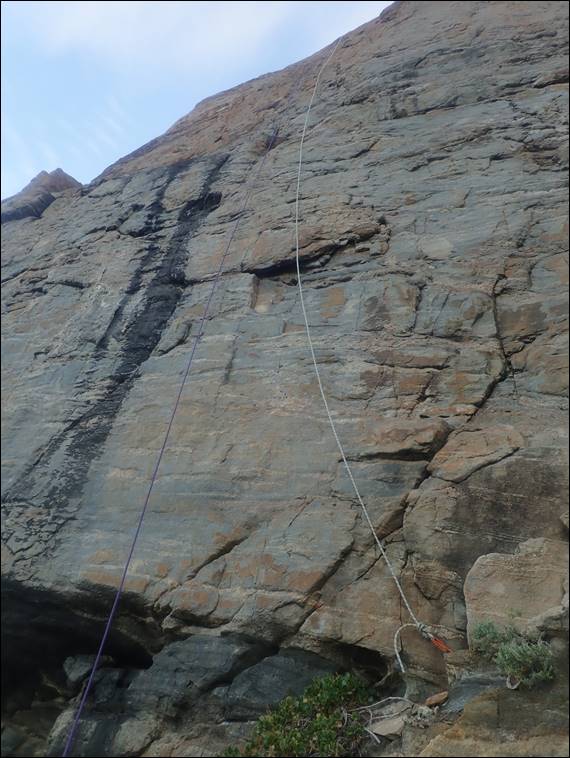
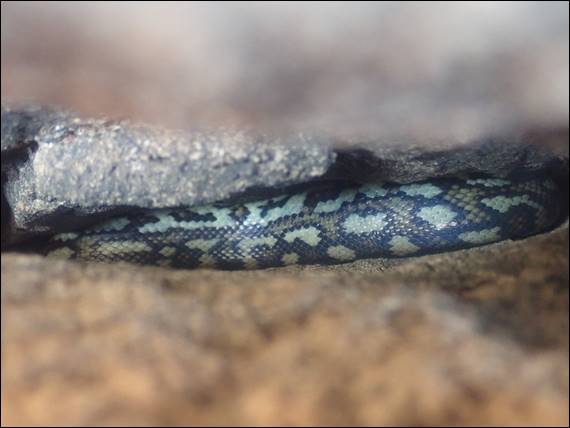
In part due to the conditions, I kicked things off on the route we would normally finish on.  It felt like it had been a very long time since I had climbed Hope.  Looking back at my four thousand plus images of climbing at Wilyabrup, it was in September.  While only three and half months, that is a long time for me not to have been on this route.  The last time was with Howsie, and we had seen two of our local Southwestern Carpet Python (Morelia imbricata) friends basking on the route https://sandbagged.blog/2023/09/25/a-little-crustacean/:

Today it seemed right to climb Hope first up when Josh spotted a beautiful skin at the base of the climb, as shown in the first image.  Indicating our friends had grown since we last saw them, and I can say friends as we spotted three snake skins in all.  As the images show the clouds had lifted and the rain had abated.  It was still damp but climbable.  Josh grumbled just a little bit about the greasy rock on the crux of Hope, while below I could see Howsie’s thoughts lay elsewhere.  He was peering across, and eventually walked over, to Steel Wall:

But before there was any hint of climbing on Steel Wall, Howsie weaved his way up one of the very first routes established here.  The very fun Stormcock, which at the grade weaves through some very impressive territory.  After that and in search of more snakes, again only finding skins, I climbed Glory.  Josh followed up as a flash of lightening lit up the sky out to sea, followed by a deep and reverberating rumble.  Howsie was then undecided about the conditions, and pondered on two lines.  To help, Josh made him choose the hand the rock was in:

He picked the hand without the rock, which in theory meant he should climb the easier line.  His response however showed dismay making Josh and I, almost in unison, tell him he should just pick the climb he wanted to do.  Like a surprised but excited kid, he accepted what was being offered.  To get ready for the show, Josh shuffled a few rocks about to make sure he had a comfortable rock armchair.  And so it began, but the show was reasonably short lived, and as he climbed rain started to gentle fall.  This did not put him off and on his third attempt at the crux of Heavy Metal he powered through it.  Notching up a third 24 for 2024, which meant I had to follow up to clean the line:

While most of the route is not too bad that crux is certainly pretty testy, and I’m not sure I would have led it.  Josh was happy to sit this one out, and had even taken his harness of by the time we got back down.  This had to go back on, as I eased up on the grades by climbing Thunder Thighs.  We didn’t hear anymore thunder and there was a lack of thigh action by Josh, who was tiring.  This resulted in his footwork not being the best so he didn’t make use of the biggest muscle group we have, in our thighs.  He managed a clean ascent but admitted to being toasted, although not enough to stop him offering to carry our packs up:

This was to allow Howsie to lead the climb he should have, when he had picked the hand without the rock.  So while he had lost the game he came good in the end, kinda playing by the rules.  He was however a little sore, after two great leads on stiff oppositions,.  I was also feeling weary, and we were very grateful to Josh for being our Sherpa and saving us the need to head back down just to carry our packs to where we now sat.  To polish the day off, as we wandered out, we came across a great find.  An Orange-backed Robberfly (Mauropteron pelago); and I’m glad to say that despite the conditions on our arrival we were certainly not robbed of a great morning on the cliffs:

Stripy friends

Meh, meaning uninspiring or unexceptional, is how I would describe the water this week.  The swell conditions were affected by what is called a groundswell.  This occurs when winds far out to sea covering long distances transfer its energy to the water, and normally results in a longer swell period.  On a summers day we usually experience a windswell, which is when the winds are closer to shore, but only in the afternoon when the land is hotter.  The air moves from the cooler waters towards the shoreline, and results in a shorter swell period:

Thursday and Friday Lisa’s before work routine was at the dog walking stage.  She sends me a picture of the ocean but today it was a video.  The slow and deliberate water movement was evident, but overall it looked reasonable flat.  Working from home meant it was a three minute walk to jump in, and while it was looking meh I decided to do it.  The most prolific fish I saw was the above Western Striped Cardinalfish (Ostorhinchus victoriae).  Usually a nocturnal species but out today in greater numbers and larger sizes than I would normally expect:

I have discovered the scientific species name comes from Victoria Settlement in the Northern Territory, which was established 1838 and named after Queen Victoria.  Proposed to be a strategic port for trade, it was not as successful as hoped and only remained operation for eleven years.  What’s strange about all this is that the Western Striped Cardinalfish range only extends along the western coast.  A different species called the Striped Cardinalfish (Ostorhinchus fasciatus) is found along the northern coastline, including Victoria Settlement:

In my second image I got to see a very majestic full sized adult Southern Eagle Ray (Myliobatis tenuicaudatus), I spotted it in the gloominess and started to follow it out to sea.  Gliding with intent, but no great purpose, away from me.  This species is named after its whip-like tail, from the Latin tenuis and caudatus meaning thin or slender and tailed.  They can have a variable pattern of greyish-blue spots and bars, and this one was displaying a very clear and beautiful pattern.  So while not a clear it is the best image I got, as it lured me further out:

I eventually stopped following it, and only then realised just how far out I had gone.  Without the ray to focus on suddenly I felt a tad lonely out there, so made my way back to shallower waters where the bottom was at least visible.  A couple of images above is a collection of not two, but three Razor Clam (Pinna bicolor).  You’ll need to look hard to see the third.  These are like icebergs.  They can reach a ripe old age of eighteen years and while the shells can reach fifty centimetres in length, I usually see no more than five centimetres above the surface:

Two images up, as I was wrapping up my first snorkel, I came across a lovely Masked Stingaree (Trygonoptera personata).  Diving down to say hello, it wriggled about to bury itself a little deeper in the weed, kicking up a heap of sediment.  This along with the low amount of light making it down that far made the chance of a close up image impossible.  It is a little surprising at times how gloomy it can be, when there is a clear blue sky.  That said it was worth going in just to cool down.  And on my second swim I was rewarded by seeing another handsome stripy friend, a Western Talma (Chelmonops curiosus):

Driving with confidence

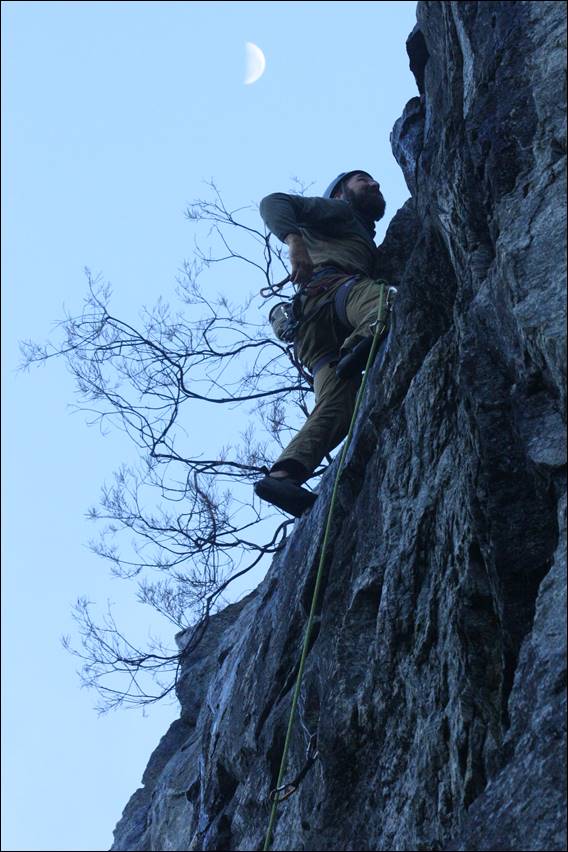
With a long weekend upon us it would have been rude not to get out twice.  The ocean conditions were not the best for snorkelling, so the climbing won out and I found myself driving back out to Wilyabrup.  This time with Craig, who was on a timeline to get back before the strike of midday.  No surprises this meant we had an early start, arriving at the car park in darkness at five.  Walking in while first light battled to break through the cloud fill sky.  These started to part within an hour, allowing light through and the moon to show its face:

Today I drove, and Craig had brought his car diagnostic tool to allow us to monitor what was going on.  This was required as I needed to pin down whether it was a sensor fault or an actual over heating issue.  My car does not have a temperature gauge, a dumb omission in my view.  Sadly in the darkness of the night we didn’t manage to get the diagnostic tool talking to the car, so we drove down without knowing what was happening under the hood.  I had my fingers crossed it would all be OK, like the last time I drove down so early:

The car made it down, although the thermal fan kicked in to cool the engine when we pulled up.  Probably disturbing the people camping in the carpark, but we heard no noises to indicate they were unhappy with us.  At the crag, just like not knowing what was going on under the hood of my car, we need to trust in the rock not always knowing what lies underneath.  On the third climb, one of my own creations, I put faith in a hold I had trusted several times before.  Next thing I knew, I was flying through the air and the fingertip undercling hold followed me:

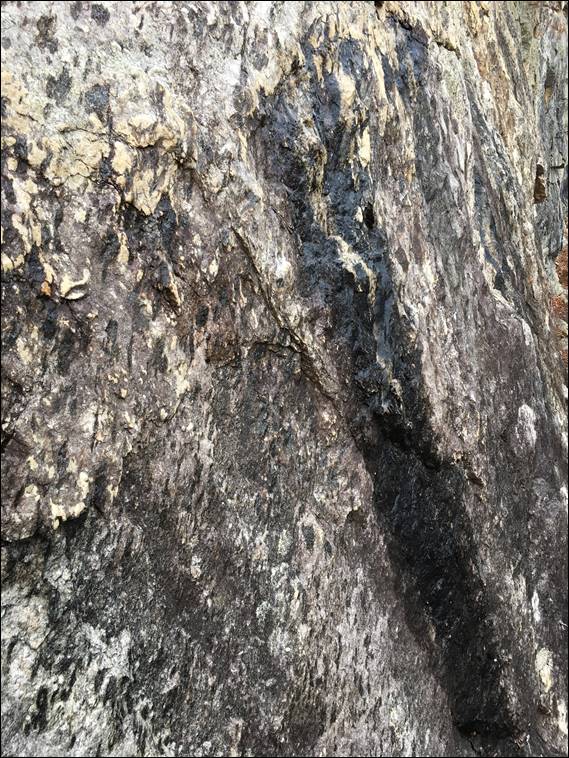
The climb is called Knocking on Heaven’s Door, and on the first ascent I tapped on each and every hold on the upper wall to see if it sounded hollow or loose.  Knocking with more intensity as the gear got further and further below my feet.  I don’t think it would have given me any extra insights today.  The small hold was securely attached, but only by a small area shown by the light coloured patch.  Luckily the gear is bomber and held just fine, as the ropes stretched to bring me to rest six meters lower than where I had been:

It’s been a while since I took a proper whipper, and this was certainly one of them.  It of course did not stop us, and we continued to enjoy the climbing at the Organ Pipes, as this place is known.  I even took the dislodged hold home with me to add to my rock collection.  In addition to a good tennis ball sized ecchymosis, bruise, on my upper thigh were I swung back into the rock.  It is questionable as to which is more colourful, the bright orange gneiss on the outer surface of the rock, or black and purple created by the damaged and leaking capillaries:

We poured a cuppa after bagging six routes, and sat back to watch the sea and spotted dolphins.  As we sipped, the colours of the sky were dulled by a front heading landwards.  Rather than pack up we sat, drank our tea, and observed the way the wind was pushing the clouds.  As luck would have it, they were not coming our way.  Allowing us to rap back down for another route.  Yet again one of my creations and Craig was happy I led this one, as it was again a little run out and sporting the occasional loose hold waiting to surprise you:

The holds didn’t surprise me this time, managing to get a clean lead in.  Craig was however on high alert, especially when I started to run it out and then spend ages trying to find gear.  I often wonder why this area doesn’t get much attention, maybe it’s in my face as to why.  For me these aspects of traditional climbing are all part of it, so they don’t put me off but others are more easily discouraged.  Spying a second front come our way, one that looked menacing, this time we were discouraged from trying to get another climb in:

While the idea of any more climbing, even though the clock had only just reached nine, was washed away, we were rewarded on the walk out.  Seeing a tiny froglet, possibly a Quacking Froglet (Crinia georgiana).  And also having time and daylight to allow Craig to figure out how to get the diagnostic tool to talk to my car.  Allowing me to drive with confidence, as we monitored what was actual happening to the coolant temperature.  It wasn’t behaving but we could tell it wasn’t at critical levels, and gave us some clues as to what to try next: