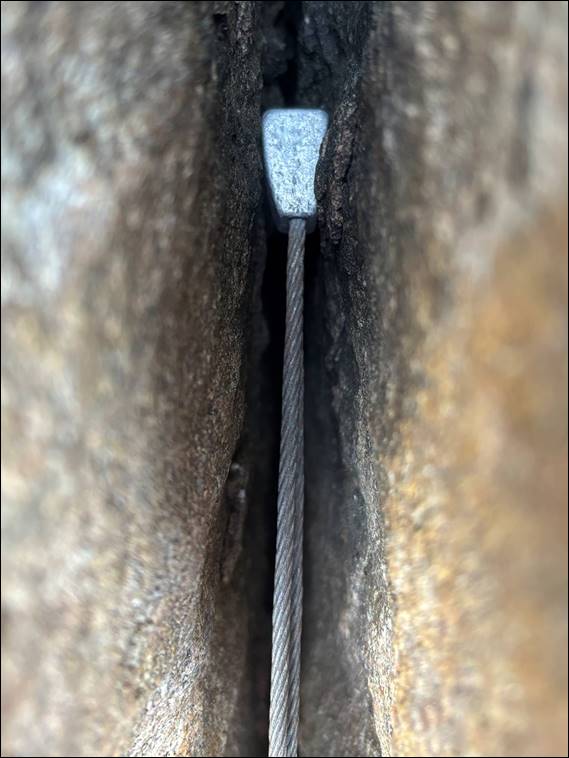
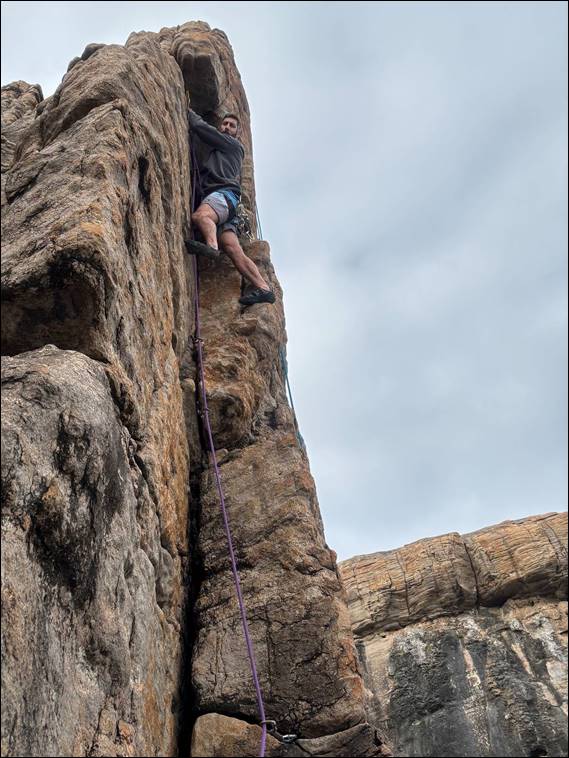
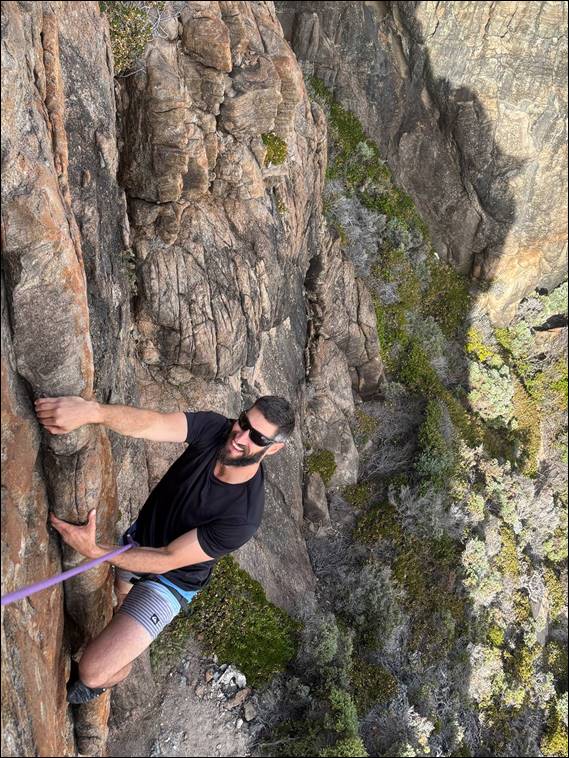
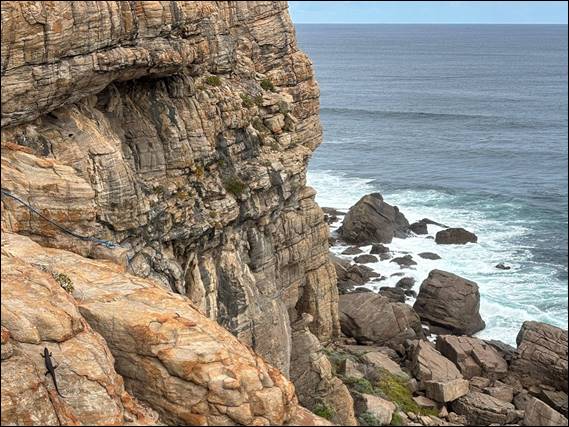
The Good, the Bad, and the Ugly

Back in the era when cassette tapes were all the rage, I had an album titled Greatest Western Themes.  It got a good workout.  There’s something about the music from the older westerns that I kinda like.  One composer stood out on this album, Ennio Morricone.  In addition to his previous achievements, once he moved into composing scores for cinema he clocked up some 400.  It was however his western themes that saw him rise to international stardom.  One still regarded as ‘one of the most recognizable and influential soundtracks in history’:
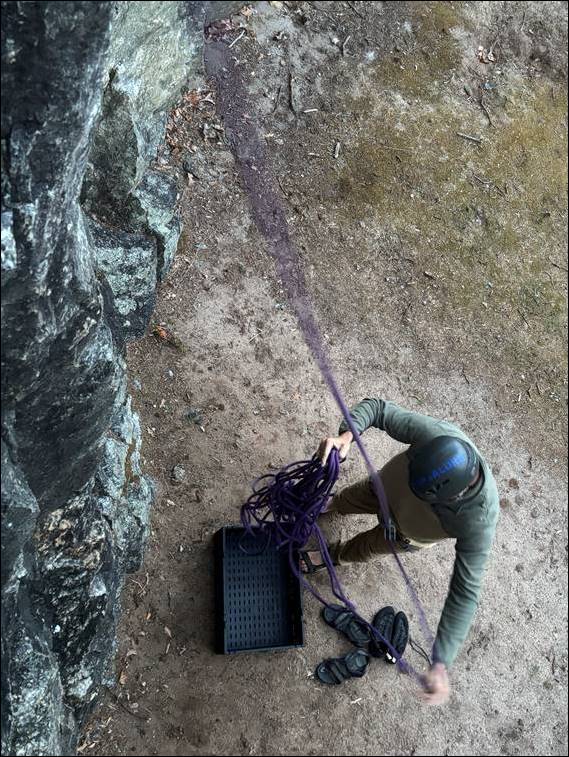
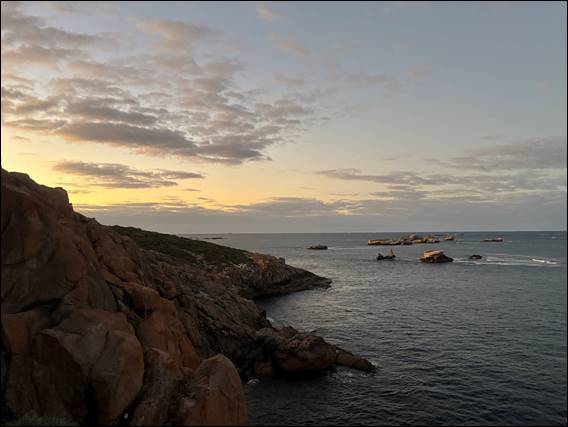
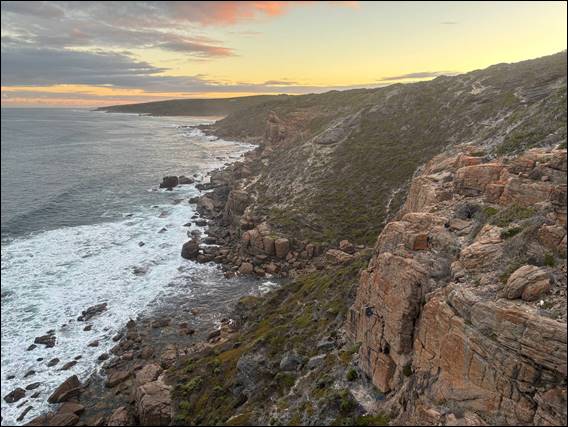
The title of this particular film is apt in some ways for today’s adventure.  It all began on a dark morning, when the unmistakable sound of drops hitting the veranda roof made the very clear statement that the weather had arrived early.  The room lit up when I turned my phone on to check the radar.  It hinted it was moving south east and hadn’t made it to where we were going.  The radar like the forecast, when checked yesterday, was full of misinformation.  The wipers stayed on for most of the journey into Bunbury and from there up the hill:
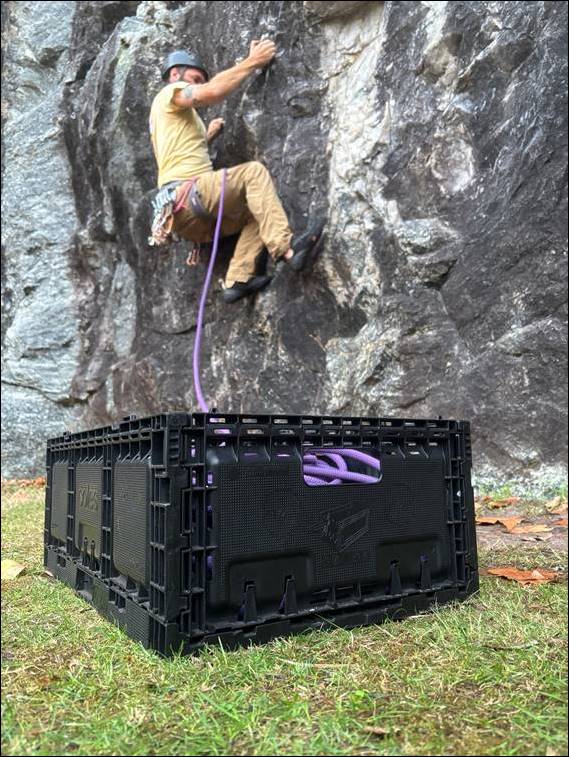
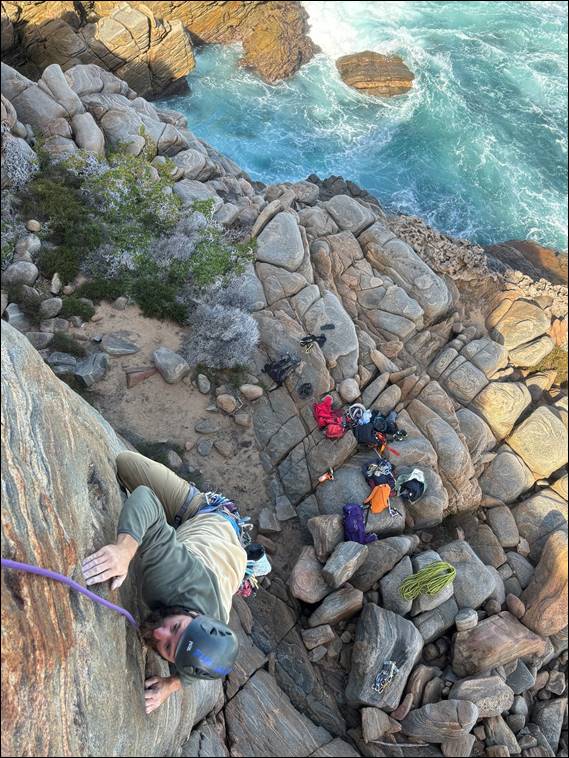
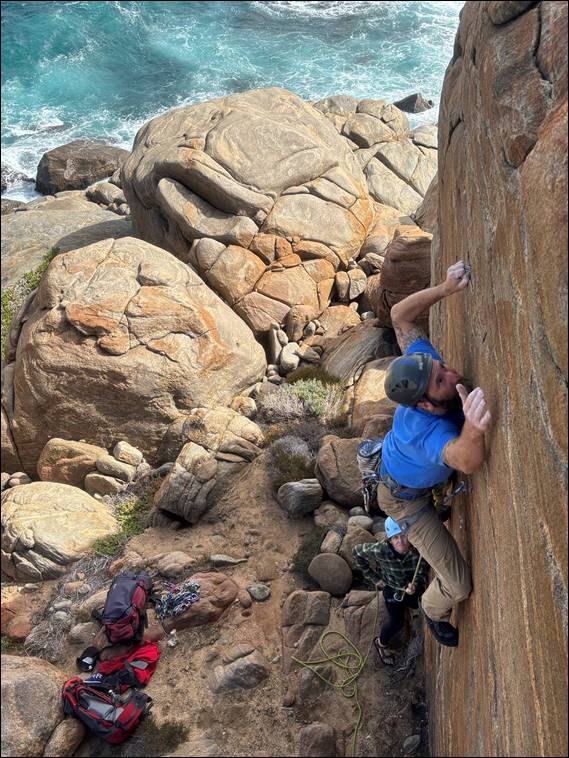
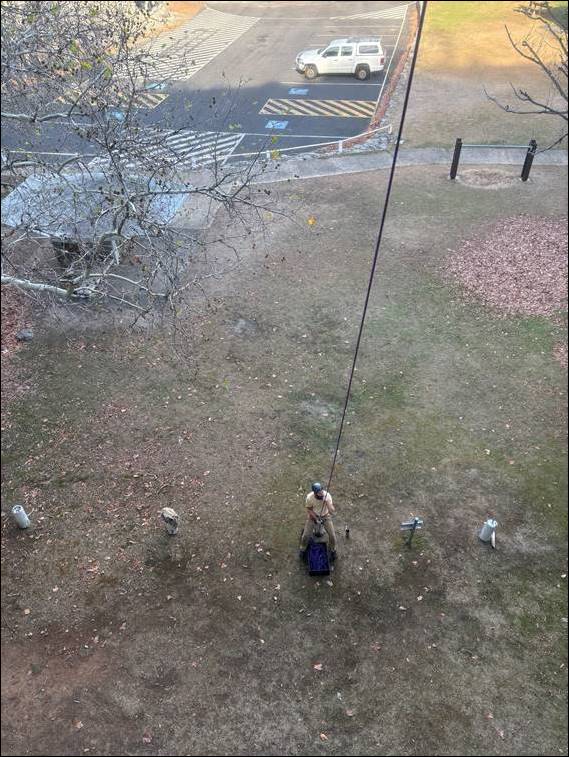
You may well be asking why we would be going to Welly Dam, after all my posts about how tough this place can be.  And you would be doubly right to question my reasoning based on my confessions about the injuries I am managing.  However, the weather system was forecast to hit the capes coming in from the west.  So we decided the inland option was better, and if it had been dry here it would have been fine.  It was not.  We were not rained out but the lichen covered sections had turned all spongy from soaking up the moisture:
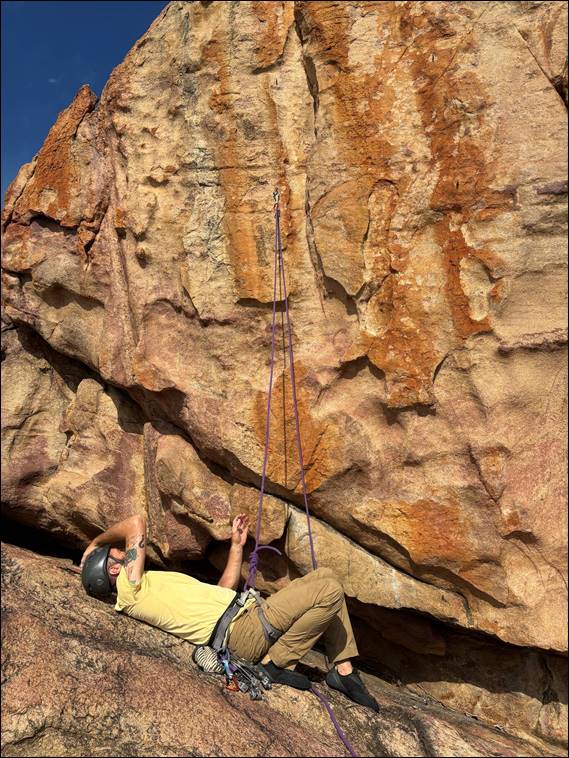
Even the bare granite was moist to touch.  This meant the friction was nothing less than pants.  As a result we crimped, pulled, and generally held onto each hold much harder than we normally do.  Not the best for my elbows in the state they are, and on the third line my left one protested with a solid twinge.  It was time to come back down, and let Howsie lead that one.  Rightly or wrongly I went back up with the rope above me, being very careful of the angle I loaded the arms as I went.  It was definitely time to break out the kettle and biscuits:
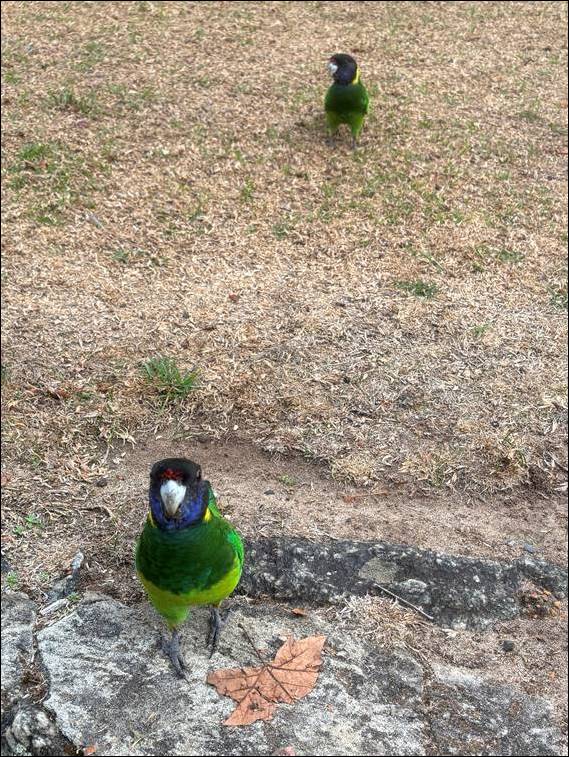
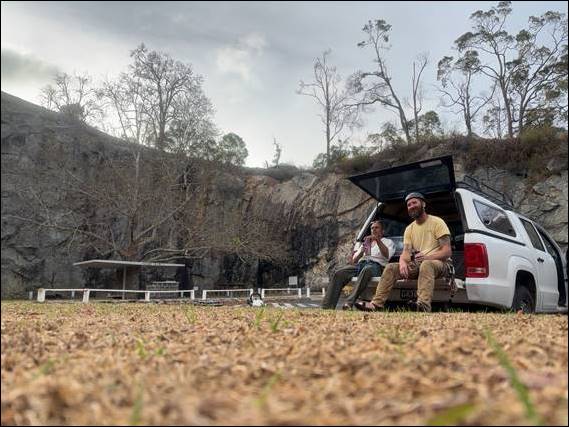
The tea kit was loaded into the car yesterday, with biscuits added as an extra bonus.  Being something we do not often have in our house.  There were no illusions it would feel tough today, even if it was dry.  We haven’t been coming often enough to be ready for what this place, like no other in the South West, does to your body.  And today, more than most times, the brew was very welcome as we watched the Australian Ringnecks (Barnardius zonarius) get closer and closer.  Invading our space so much I thought they may eat out of my hand:
The parrot in the image became camera shy and froze, despite my hand being right under its beak with tasty morsels on offer.  And then flew off with its mates as my fingers brushed its feathers.  With the entertainment having flown off, it was back to the rock.  Where I let Howsie take all the leads.  Pleased that he was keen to take on the slippy holds and risk the falls.  With the safety of the rope above me, my brain wasn’t making me hold on quite as tight as they would with on lead.  For the penultimate climb Howsie popped his head over the top:
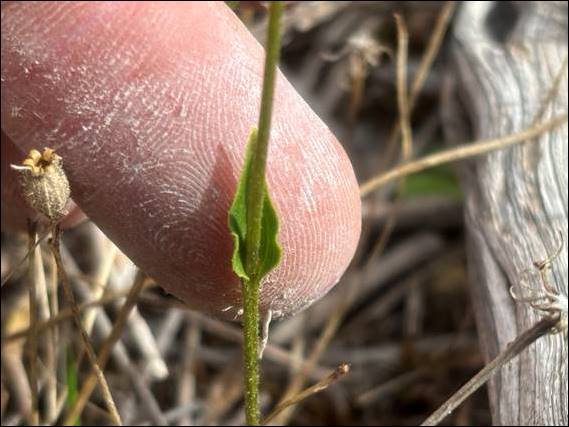
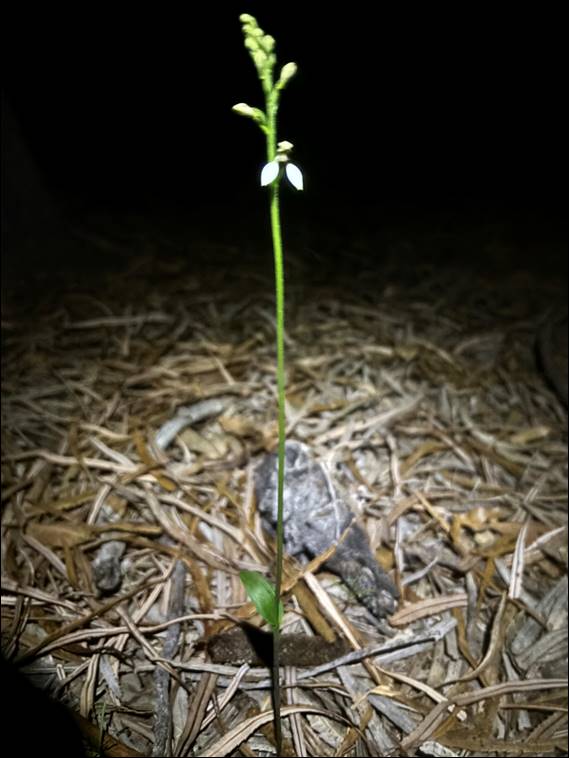
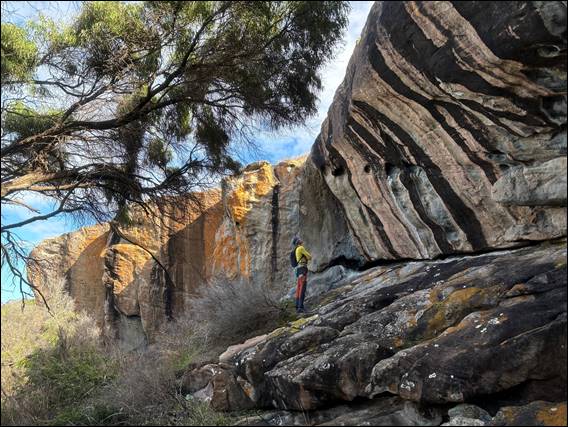
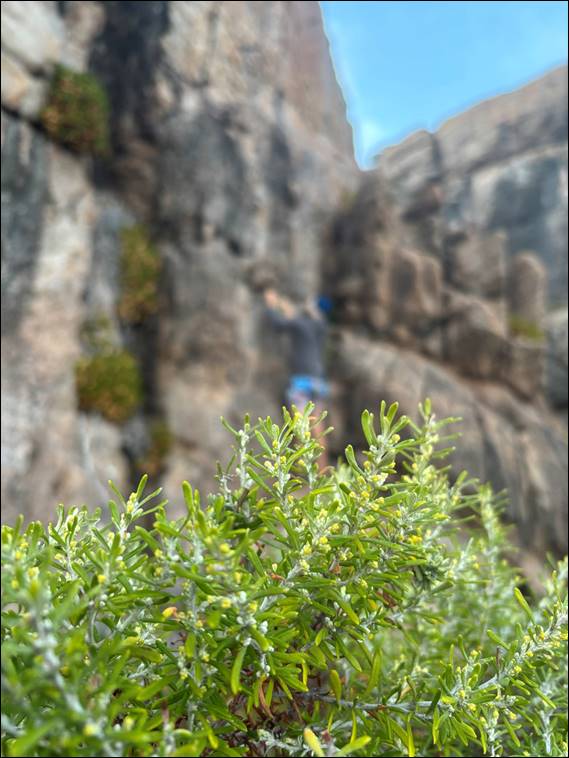
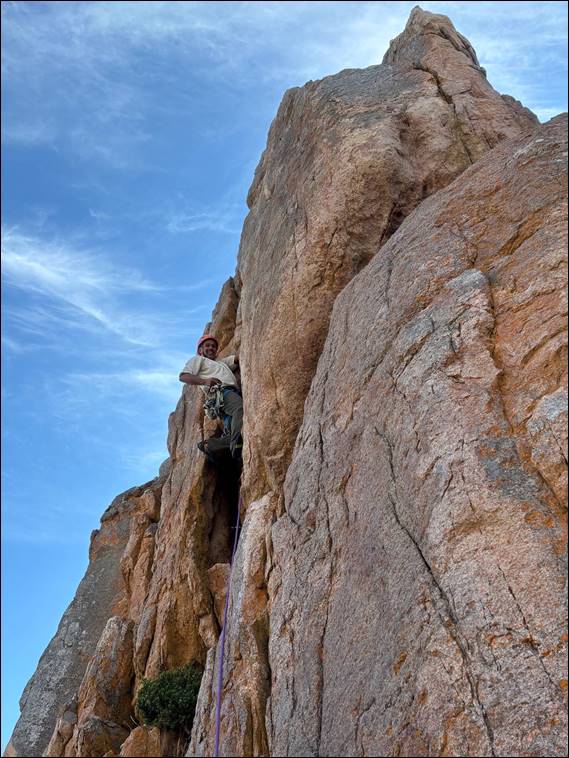
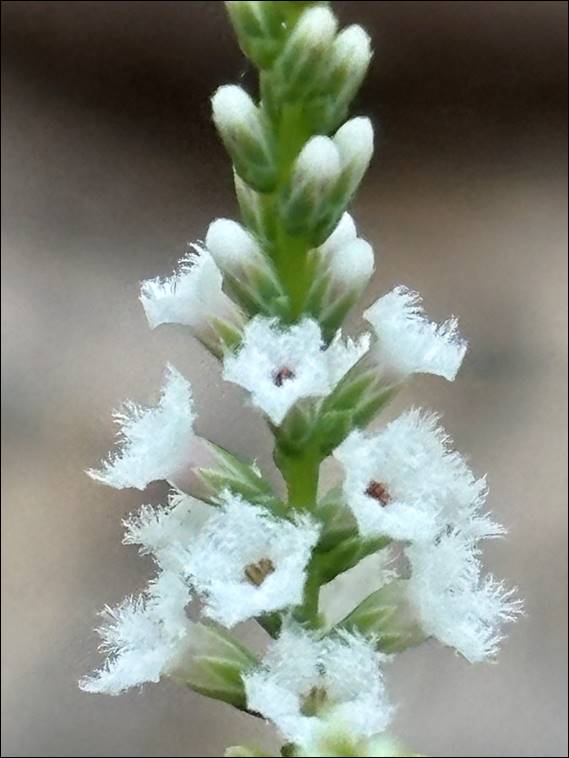
Just to have a look.  He called down that he could see what looked like Bunny Orchids.  This resulted in me steering him towards a route, for the last climb, that would see us top out and have to walk down.  He seemed keen, and with the somewhat painful climbing behind us the focus was now on dainty little flowers.  Using the information I recently read up on, I got all excited.  As can be seen above we found a bunch of them with small crinkly leaves.  Added to that it looked like the petals were hugging the column, so they could be one of two types:
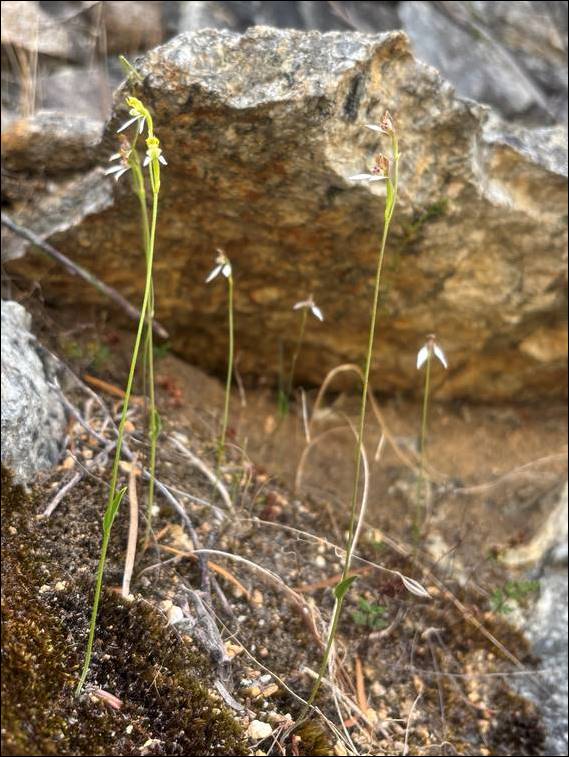
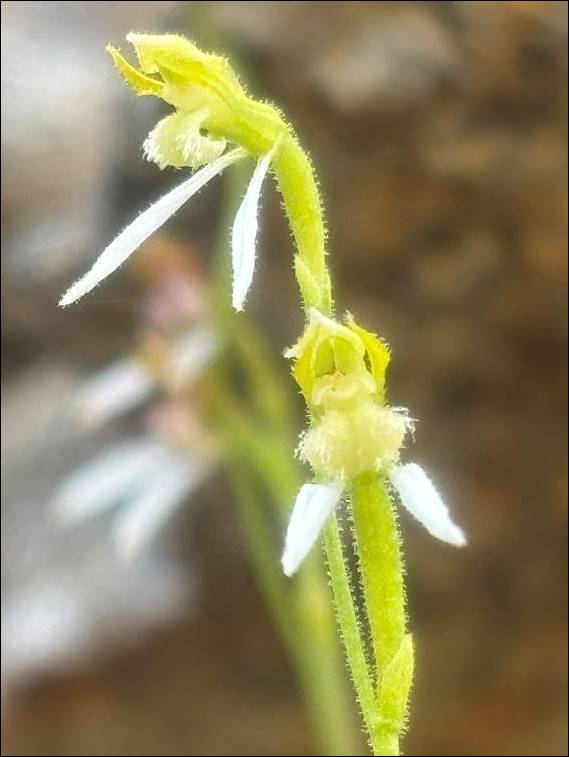
I’ve not seen either before, so whichever it was I would have been happy.  Back home after much checking out of the details we captured on film, looking at my books, and researching several online guides and databases, I am pretty sure these were Crinkle-Leafed Bunny Orchids (Eriochilus dilatatus subsp. undulatus).  Even better we found one plant that was a lutea form, striped of the usual colours and only displaying pale hues.  While I won’t say what falls under each, you could say that today we sampled The Good, the Bad, and the Ugly:
Fore!

I’ve again found myself fall foul of my own enthusiasm.  Pushing things that bit too far, such that my body is giving me warning signs to ease up.  The niggles of golfers elbow developing in both arms.  More than likely as a result of the weights session rather than the climbing, but to be safe I’m putting the brakes on most forms of exercise.  Hence the golfing title of fore, which has made me dig into where this term originates.  It seems it is a debated phrase, and may in fact come from an artillery term as opposed to a pure golfing term:

Either way it has been described as a phrase to warn people in front of what is happening, which may sound strange in terms of being an artillery term.  And maybe for this reason the modern historians feel this use cannot be proven or is unlikely.  It is also unlikely, that despite the threat of injuries that I will stop climbing.  Ease up yes, but to not get out at all is not in my nature unless I’m completely physically incapacitated.  And where better to go when you want a low grade fun day out, but Moses Rocks:

Josh was keen and it so happens our last trip out was here, but he didn’t mind that.  It wasn’t an early start by any means, and in front of us there was another party of four climbers.  In the near two decades of climbing here this has been unheard of.  I’ve met people hear by arrangement, and seen signs of other climbers having been about, but have never seen anyone else climb while I’ve been here.  As we passed them at the norther end, we had a quick meet and greet and then left them to it, as we continued to Hands Up Wall:

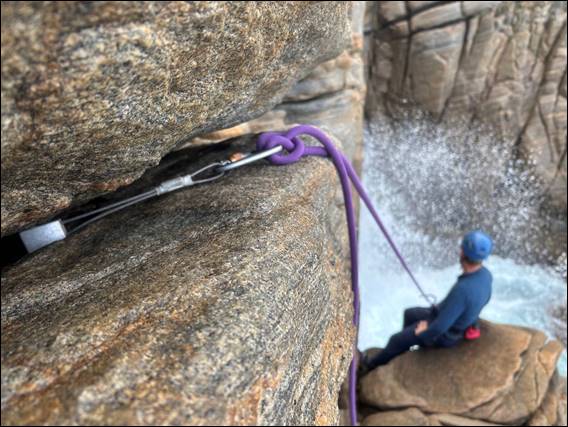
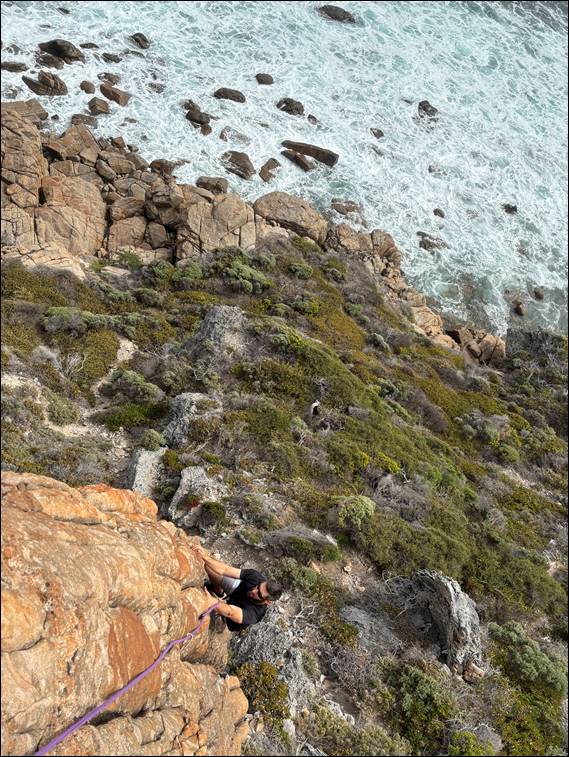
Today was going to be a busy day at the crag, so Josh and I went ahead of Howsie’s crew to get a couple of lines in before they turned up.  This included a warm up on a pretty wet crack on the main wall, before I suggested that we could try the above route.  A line that I doubt anyone else has ever climbed since I put it up.  The conditions were perfect for it today.  Boiling white water below, crashing sound bouncing off the walls, and the occasional larger waves to encourage you to not dilly-dally at the base for too long:

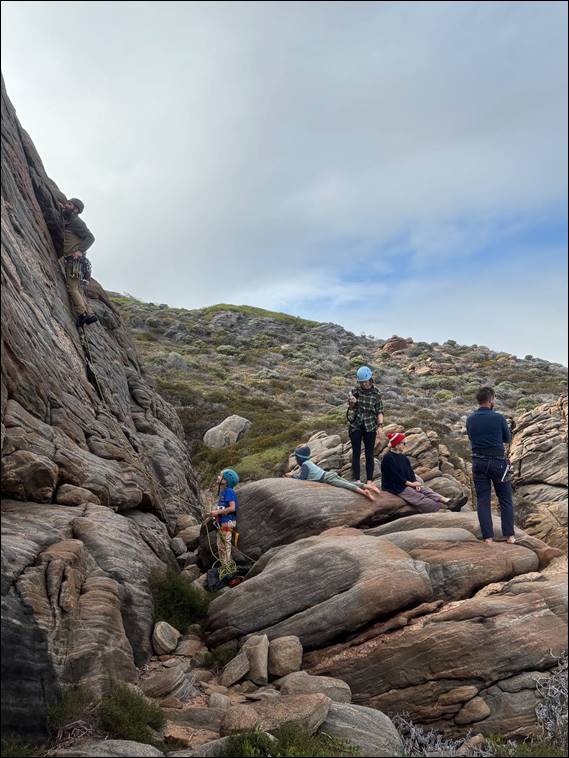
I might add that when I led it Josh was belaying high and dry, as I climbed down a corner as far as I dared before stepping right to start heading back up the middle of the wall.  As he followed me up loving the experience and really enjoying the climbing to, the Howsie mob turned up.  Howsie, Nadia, Fergus, Frank, as well as Marnie who I haven’t caught up with for years.  I didn’t realise it but this was Howsie birthday outing, although to start with he didn’t cram too much climbing in.  Instead being belayed by, and then belaying Fergus:

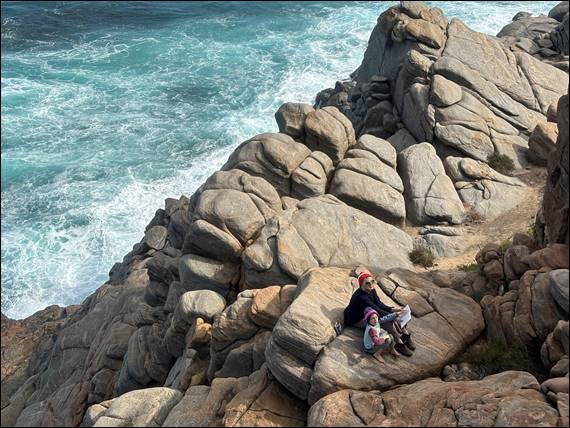
I ran up a few of the easier lines with Josh and Marnie in tow, as Howsie kept the boys going.  Fergus was more keen to climb than Frank, but they both had a go.  Frank was soon climbed out, which didn’t take too long and he sat with Nadia.  Out came the sketch books, and I was a bit remiss when I didn’t get to have a peak at their artistry of the walls and us climbing them.  Eventually Fergus had also had his fill but not before taking on a tricky corner, especially for someone of his size.  Howsie was not surprisingly still keen to climb:

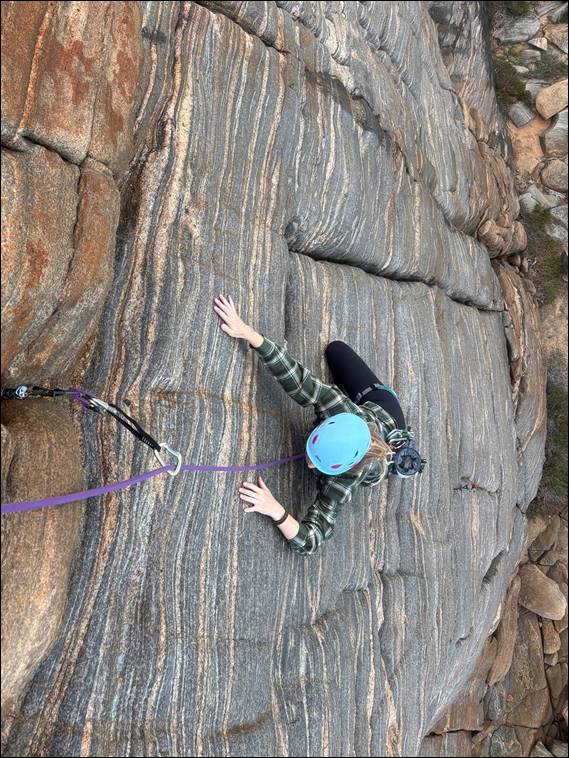
So with people pottering about exploring, drawing, and taking photos I threw the rope down.  It conveniently hung down in a place where Howsie could play on two lines.  It was a case of warming his fingers up before me moved to a smaller wall, which I knew he was keen to get to.  The route below was not the one I had climbed, keeping my sensible head on I had tackled the easier crack to its left.  But with climbing easy is a relative term, last time Josh really struggled on it this time however he made much better work of it:

It was however not Marnie’s style.  She got up it but it took a fair amount of effort.  Being encouraged from below by the entourage.  To wrap up the morning we headed to Red Wall, a short crag with a couple of punchy lines.  I headed up the easier crack, which this time did not prove easy for Josh who had a real battle.  Howsie played on a line to our left, one he’s been keen to try for some time.  It wasn’t the best conditions, the was rock glistening, but he managed all the moves and is now looking forward to our next trip here when he hopes to bag it:

Taking a bow

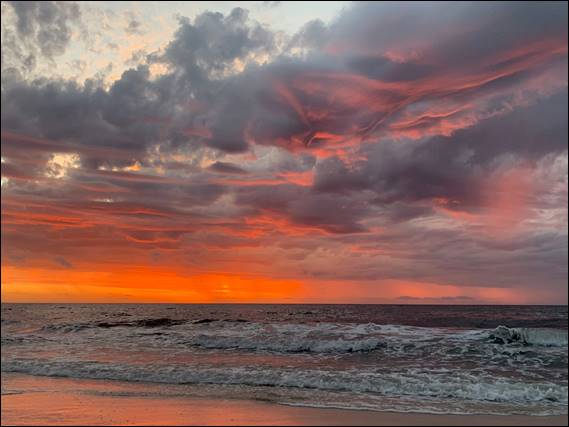
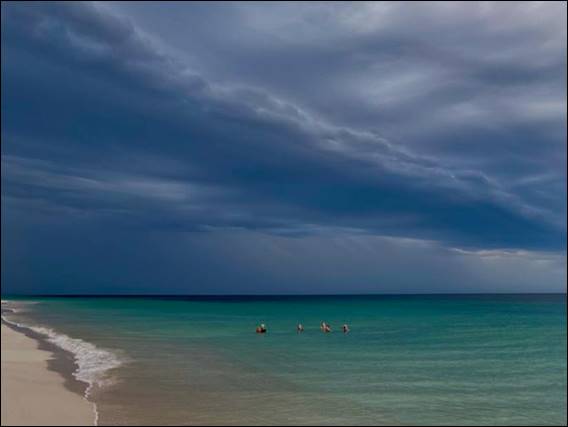
The sun is rising later and once up staying lower in the sky.  The swell is also looking that bit bigger and as a result the beach is transitioning towards wintery conditions.  The writing was on the wall and the snorkel gear was packed away last weekend.  It has been a pretty disappointing season for swimming with the fish.  But when you get to see the sky as it was when Lisa and I took the poodles down the beach on Wednesday night all that was forgiven and forgotten.  It is still a glorious place to be even if the underwater visibility was pants:

I’ve now shifted my gaze to terrestrial treasures.  Having had several wanders at the Manea Park and the Cape Nature Reserve.  My first trip to Manea Park, conveniently on the way home from work, didn’t yield any flowering orchids.  But I did enjoy watching the bees bury themselves deep into flowers of this Swamp Banksia (Banksia littoralis).  A species endemic to the south-west of Western Australia, which I’ve read may be a bit more resistant to dieback than other western banksias.  A good thing considering the impact the disease is having:

Manea Park is well known for its biodiversity and boasts quite a range of banksia species.  While the above Swamp Banksia was in bloom many others were not.  The various species flower anywhere from late summer through to winter, with some species flowering as late as spring.  Another plant out in flower, this time of the Orchidaceae or orchid family, was the Common Bunny Orchid (Eriochilus dilatatus subsp. multiflorus).  On my first walk I only found one spike with no flowers, but during the next wander I found a couple of plants flowering:

There are six species of white bunny orchids, including six subspecies.  Each having flowers that look very similar, and the best way to distinguish them are by the stems and leaves.  To date I’ve only found two of the subspecies.  Then there are the pink species, and I have never seen any of them.  The pinks generally only flower after a hot summer fire, so tend to be more difficult to track down.  For my next adventure I decided to try a bit of night time herping.  On advice from Sarah I headed out all hopeful at 8pm to the Capel Nature Reserve:

I spent in excess of an hour, wandering round checking the leaf litter, trunks (live and fallen), and foliage.  Wondering what insects and/or reptiles may come out at night for a feed.  The answer, at least from my observations, was none.  Not even a possum, kangaroo, nor wallaby could be heard or seen.  In fact it was deafeningly quiet, as I slowly walked round keeping an eye on where the beam of my torch landed.  The only find being a solitary Common Bunny Orchid, whose subspecies name comes from a Latin word that is apt and should be obvious:

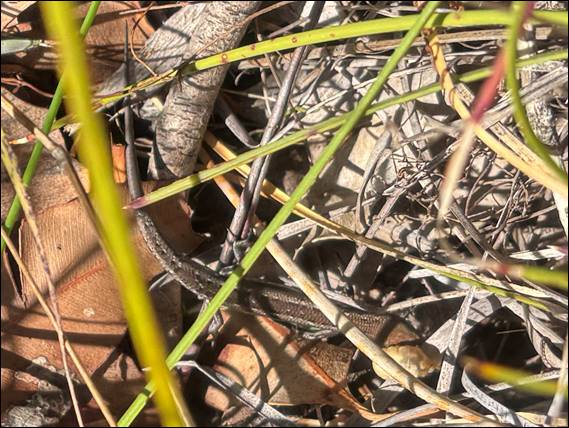
The common name of common is also apt.  Today when Lisa I wandered round the Ambergate Reserve we spotted a good number of them.  I won’t lie and got a little excited when I thought the leaf of a few specimens indicated I’d found a different subspecies, but that was never the case.  As it warmed up we caught the movement of commonly seen Buchanan’s Snake-eyed Skinks (Cryptoblepharus buchananii), scurrying off the path and through the leaf litter.  They hunt small insects and are very agile, even being able to leap into the air to catch flies:

The above one is carrying a snail, and once happy we were not going to intervene or come any closer it allowed us to observe it nibbling away.  We sadly didn’t spot any bigger reptiles, but this flower caught my attention.  Looking to be sprouting straight out of a tuber.  It was not till I got home that I spotted the leaves of a sundew round the base.  Not yet fully matured, and as such not creating the distinctive rosette of sticky leaves of this carnivorous Drosera rosulata.  Yet another plant that is endemic to southwest Western Australia:

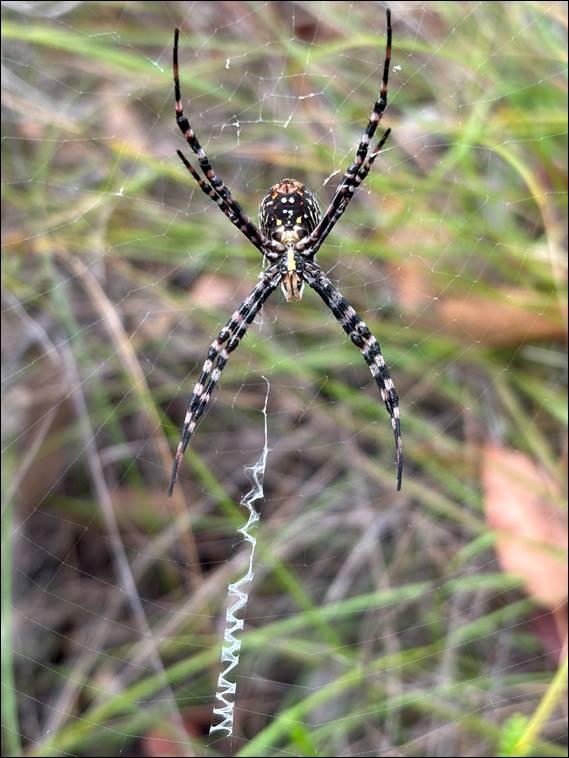
The next find is however not endemic, being introduced.  Although I have no idea of when or whether by accident or on purpose.  Native to North and South America the Banded Orb Weaving or Banded Garden Spider (Argiope trifasciata) has successfully spread round much of the globe.  I’ve seen one before, so if you want to see the distinctive pattern of the top of the spider check this post https://sandbagged.blog/2022/04/07/the-beach-shack/.  I liked this image that shows the zig-zag pattern of the stabilimenta, i.e. web decoration:

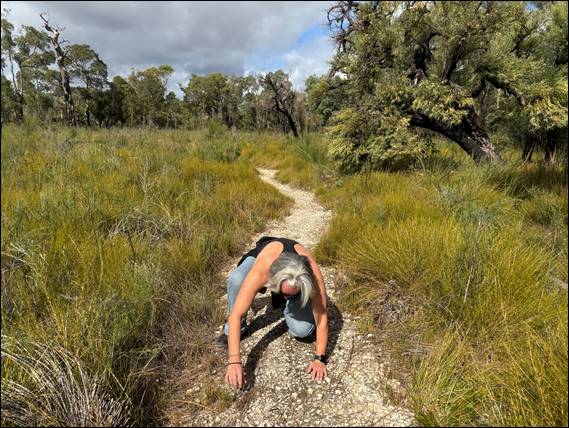
The feature is not made of the same silk that the web is constructed, and isn’t even sticky.  Its purpose is not clear.  Some say it could be used to attract prey while others think it may provide a degree of camouflage, although I don’t see that.  We also spied quite a few Australian Golden Orb-Weaving Spiders (Nephila edulis), and the path had a fair few of these much bigger webs spanning across the track.  Not keen to walk into them, Lisa kept a careful eye out to try and avoid disturbing them.  On occasion taking a bow, as we crept under them:

Shades of grades

Sixes were in the air.  The 6th moon phase was on display with a 66% waning gibbous moon.  Lighting the path as Mario and I aimed for a first light start at Cosy Corner, at 6am.  Driving out yesterday the moon was hidden behind a blanket of clouds.  Today it look very different.  Maybe for that reason the kangaroos and wallabies were way more lively.  It felt like they were firing warning shots across the front of the bonnet.  Within 500m three hopped from behind the trees and undergrowth into my path.  I drove out slowly, watching carefully:
Down with the family for the long weekend, Mario was keen to sneak a climb in.  This meant I had a good hour and quarter by myself in the car on the drive down to Conto Campsite, where they were staying.  Not quite sure what to listen to I let Spotify pick a mix based on Watershed.  The South African, as opposed to the American band.  Turning out to be an aptly named band when Mario told me that it had rained fairly consistently during Friday.  Half an inch may not seem like much, but the cliff tops are the perfect watershed for the cliffs:

The term watershed can mean an area that collects and directs water to a specific point, or can describe something that results in a notable change.  The South African band used it to symbolises the positive change made when they formed the band, while the American band used it to honour the Newark Watershed feeding Pequannock River.  The rivers name comes from a Lenape word meaning ‘cleared land ready or being readied for cultivation’.  So for the Delaware Indians, it relates to the second meaning of the word but not in a good way:
Now back to Cosy Corner, where the even-grained granitic gneiss had channelled Friday’s rainfall to the low points along the cliff face.  Water was still dripping down some of the cracks, and oozing from under flakes.  The limestone and flowstone looked particular uninviting, and having soaked up moisture some of the black streaks glistened.  But where the granitic gneiss lay bare, other than for the red lichen that makes the rocks glow a wonderful colour in the early morning and late evening light, the rock was dry and the friction was on point:
The place is not to be confused with the Bay of Fires in Tasmania, which displays a similar landscape with red lichen covered Devonian granite.  Mario was however on fire, armed with his above trademark No.4 Camelot.  Without verbalising it I offered to be his belaying tour guide, seeing it was only his second visit here.  Pointing him towards the lines he hadn’t been on before.  Keeping in with the theme of six, we jumped on a couple of routes in the guide and the four routes Howsie have put up here that are not in the guide:

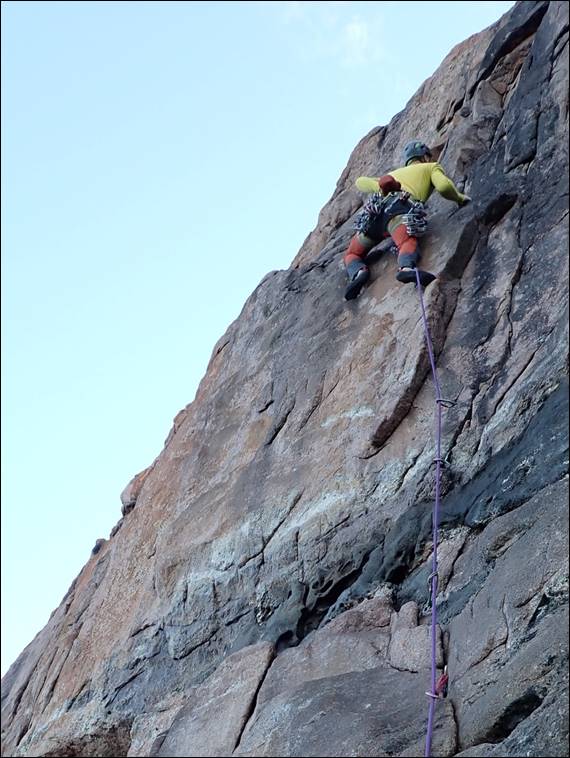
Sorry to say Rongy your and my lines from our last trip here were looking very unpleasant.  They will have to wait until the next trip here for their second ascent.  We didn’t hit anything too serious grade wise.  Not that worried Mario who enjoyed the routes finding they all provided interesting and worthy climbing.  With sufficient gear, most of the time.  The two stand outs were those in the above and below images of Mario on lead, which should make Howsie happy.  They also happened to be the two climbs with a disconcerting, but not too silly, runout:

But as for grades, this crag is probably the place where I reckon they really are all over the shop.  And just based on today that could be said for old and new routes alike, with some over and some under graded.  Not that I was able to subjectively add to this discussion today.  I felt like I was climbing like a cabbage.  There are plenty of excuses I could put out there such as being weary from yesterday, getting used to my new shoes, having had two early starts on the trot, or just feeling my age.  All I can say is I am glad Mario was happy to bag all the leads:

It was finally time to call it, but not before checking out Wave Wall.  Despite hinting a day or two back there was a climb he was keen to play on in this amphitheatre, Mario conceded it all looked a little too steep and pumpy for today.  I was both pleased about that, and that we had wandered in here.  In a similar theme to my climbing today, I lost my way entering the area by trying to get through some scrub. Nearly stepping on this Southwestern Carpet Python (Morelia imbricata), one of the six species of the genus Morelia found in Australia:

Walking on sunshine

The car slowly came to a standstill.  Having spotted them a long way off, the wallaby and it’s joey stood motionless in front of the car as it came to a stop.  The intense full beams made brighter by the light bar, had either blinded them or confused them to the point they became statues.  Instead of reaching for my camera to take a snap as they continued to sit there, I was content to just watch them until they lazily lopped across the road into the bush.  Thinking it is better to see them sit on the road, as opposed to when they hop out of nowhere:

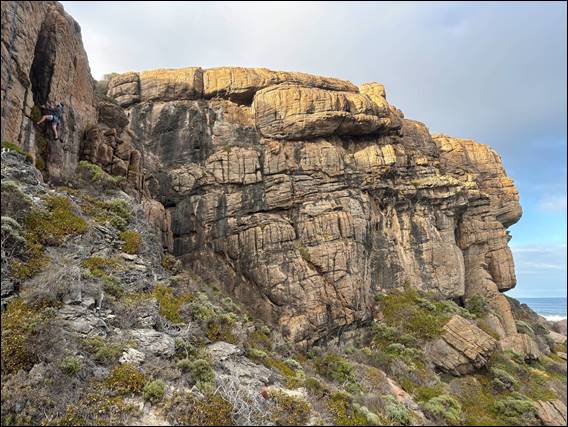
Another early morning, but not too crazy a start.  It’s just as Lisa had remarked to me a few weeks back, the days are starting to wake up a little later.  I was on my way to pick Sam up, who has not touched rock for just over a year and half.  For this reason we were heading to a cruisy little crag, where he was keen to be reintroduced to placing gear and maybe have a lead.  Wilyabrup has a few such small crags, which rarely get attention.  Being Easter I also suggested here as we were likely to have the place to ourselves, while the main crag fills up:

Sam hinted that maybe I should take the first lead.  His thinking that this would allow him to ease back into it, and also enable him to check out how I set up the top belay anchors.  The latter part seemed to weigh more on his mind than jumping onto the sharp end.  I could fully understand his thoughts, after all as I climbed after him I was putting my life in his hands.  Belaying is a serious and a big responsibility.  I however had faith in his ability, even though he hadn’t put the skills into practise for a long time.  Even when he had, it was not that often:

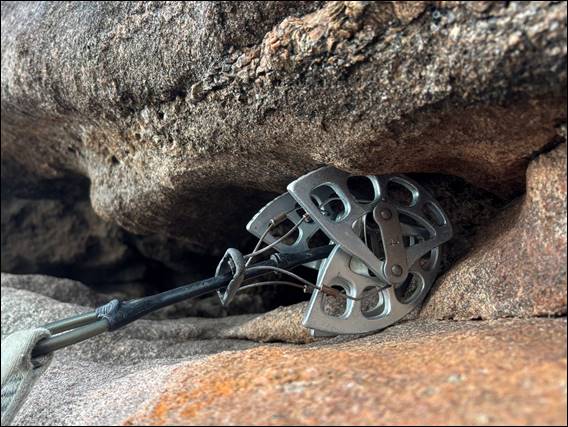
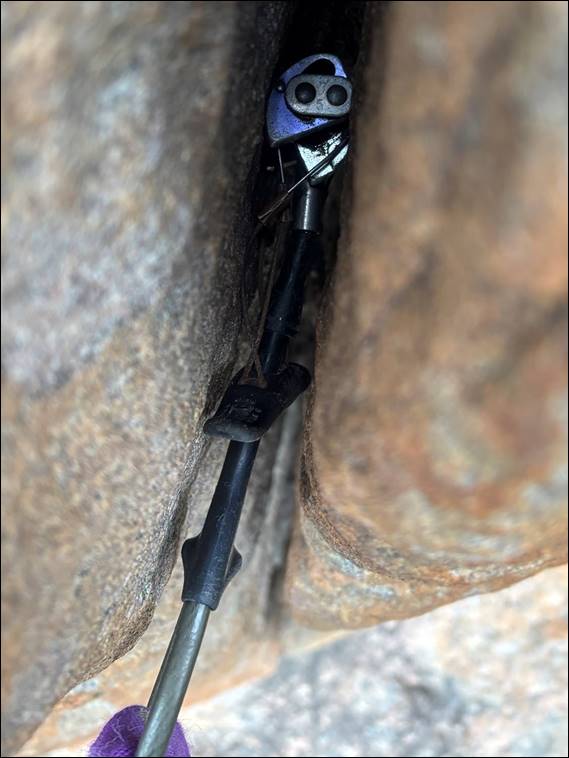
It meant spending time refreshing his knowledge and understanding, and taking things slowly.  Including when I climbed after him so I could check each piece.  Happy to find that he had retained the basics.  All the gear slotted in was well thought out and bomb proof, even when he was not so convinced.  Interestingly his faith in the gear placements was tiered.  Wires were great, tricam pretty good, but when it came to cams not so much.  This trend indicated that as the hardware became more mechanically reliant the less trust he had in them:

I get it, my journey into trad all those decades back started the same way.  And like me, several people I have climbed with over the years, would prefer a solid bit of metal wedged into a crack.  As opposed to relying on springs and hinges to generate the friction needed to keep the gear in place.  This did not however stop Sam selecting the right gear for each placement.  As the morning wore on it felt the imbalance of faith started to even out.  Helped by leading each route, when in my usual way I kept calmly handed him the rope and gear:

This was never questioned.  He simply accepted the rope and climbed.  As I had to trust in his belay anchors when I followed, he had to trust I wasn’t going to send him up something too silly.  The route below, was his third lead.  Having watched him climb and place gear I thought he’d be OK with it.  Not that any encouragement was needed, the corner and sweeping arched rooflet piqued his interest as soon as I pointed to it.  He did however tell me afterwards that it had certainly put him out there, and he had felt pretty exposed:

A position that conjured up mixed emotions of exhilaration while being nerve wrecking.  The only thing to do in those situation being to slow down, breathe, and make purposeful and controlled decisions.  Sam’s words not mine!  I did however think getting him to lead the next route may have been a stretch too far.  The line has a couple of decent runout sections, and a ground fall potential from quite high up.  Again Sam’s words.  Having said that to me after he had observed me on the sharp end and followed up, grateful to have the rope above him:

Four seemed a good time for a brew, seeing Sam had packed a flask.  Coinciding nicely with the typical “time for tea” time of 3:30 to 5:00pm.  A British tradition that started at the end of the 19th century when a close friend of Queen Victoria had a sinking feeling late in the afternoon.  Needing something between lunch and dinner to replenish her energy levels.  With our energy levels topped up there was time to squeeze a couple more lines in, one lead each.  After completing his lead Sam looked over and spied the first reptile of the day:

I’d been scouring all the cracks and crevices without success.  This made the sight of the King’s Skink (Egernia kingii) soaking up the sun feel like a privilege.  Chilling out on a steep slab.  Scampering for cover if we made any sudden movements, before coming back out.  Making our roped climbing efforts today seem trivial in comparison.  We were not however out for egos and high grades, just having fun.  Ending the session in exactly that way, with a first ascent up another one of the fine easy angled walls to create Sunny Sidewalk:

Sunny Sidewalk (15m, 12), start-up Sunny Arête until you have the confidence to step left onto next pillar just above the undercut flakes to take the sidewalk up the pleasant slab (Seewraj, Avery 2025).

The tortoise and the hare

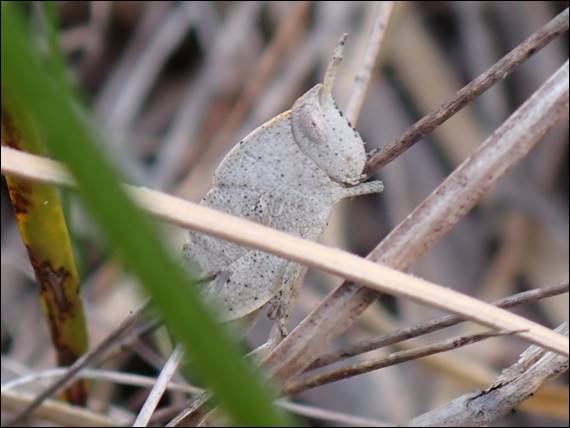
Third time lucky, or at least I was hoping, as I found myself again wandering through the Capel Nature Reserve.  Mind you I can’t say if I would have been too upset if there were no orchids out.  Just wandering through the bush is reward enough.  At times it surprises me how little can be seen on some of my visits.  Making me wonder if I should have a wander one evening, to see what comes out at night.  With a full moon tonight it would have been nice to be out, but it didn’t happen this time.  If I had I may not have seen this little grasshopper nymph:

As they head up to feast on green leaves at night.  It could be either a Gumleaf Grasshopper (Goniaea australasiae) or Slender Gumleaf Grasshopper (Goniaea vocans).  The nymph and adult of each species being similar, but my gut tells me it was the latter.  Resting during the day in the grasses, allowed me to see it when it try to avoid me.  Close to this nymph I also spotted an adult.  While I took a bunch of images, in my haste I didn’t keep any as it looked like any old grasshopper.  If I had I may have been able to more definitively identified it:

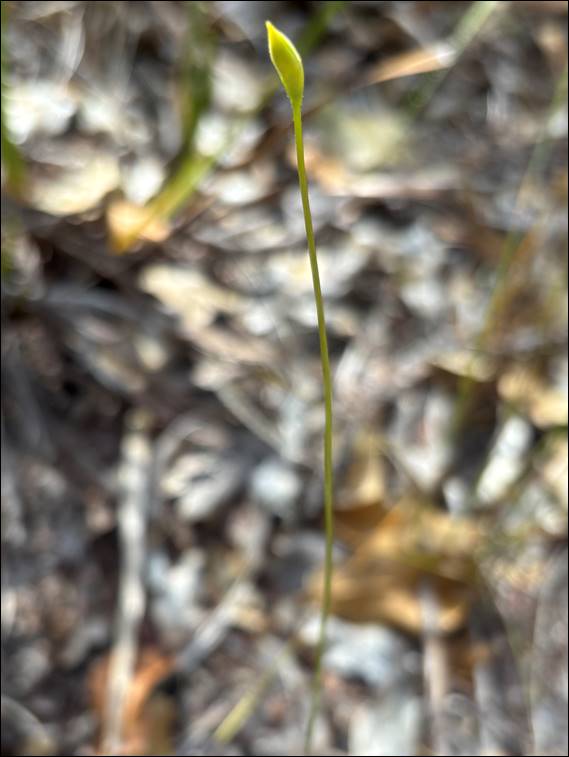
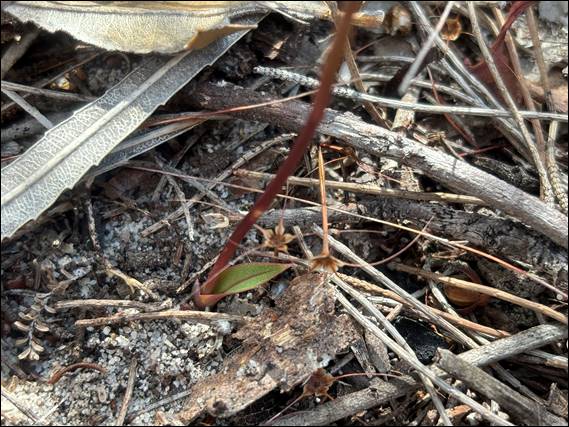
Haste cannot be used to describe how I wandered round the bush, I most definitely go slow.  Careful footfalls to avoid stepping on something, pleasant or unpleasant.  Not quite snail, but maybe tortoise paced.  If I went any faster I would not have seen the above solitary spike.  With no basal leaf visible it could be one of several species of orchid, getting ready to flower.  The below shrub was easier to identify, having already started to flower.  One of 150 plus species of Beard-Heaths (Leucopogon), the majority being found in Western Australia:

I’ve gone a step further, and pinned it down to Leucopogon glabellus a species endemic to the South West of Western Australia.  The description of flower says inside the five petals there is a beard of white hairs.  The petals fuse into a tube, with the tips rolled back.  This facial hair is common in the genus, and Leucopogon comes from two ancient Greek words meaning “white” and “beard”.  The genus name reminds me of the mischievous leprechaun, and Irish folklore creature said to reveal the location of hidden treasure when captured:

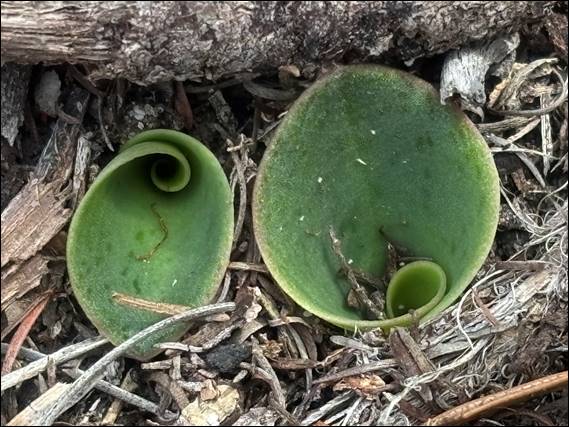
While it did not lead me to a flowering orchid.  It felt luck was on my side when I soon after stumbled across a small clump of the same spike I saw before.  This time showing the basal leaf, so at least I now knew what I was looking for now as I kept my slow pace.  A pace that after an hour in hadn’t seen me go very far.  More basal leaves came into view.  Curling out of the ground with no stem visible, so again could be any number of species.  I wonder if they take this shape to more effectively collect water from rainfall and/or dew to aid their growth:

My pace soon slowed to the point I sat down, to watch the legs of a Leaf Curling Spider (Phonognatha graeffei) as they awaited for the vibrations of their prey.  At times it came out a bit more, but never fully.  The ingenious house, built by the female, is usually silked shut at the top with the opening pointing down.  This one may not look fully enclosed at the top, but was still a marvel to behold when you took in the intricacy of its work.  It seems like a lot of effort for just a single year of life, especially seeing the female makes a second as a nursery:

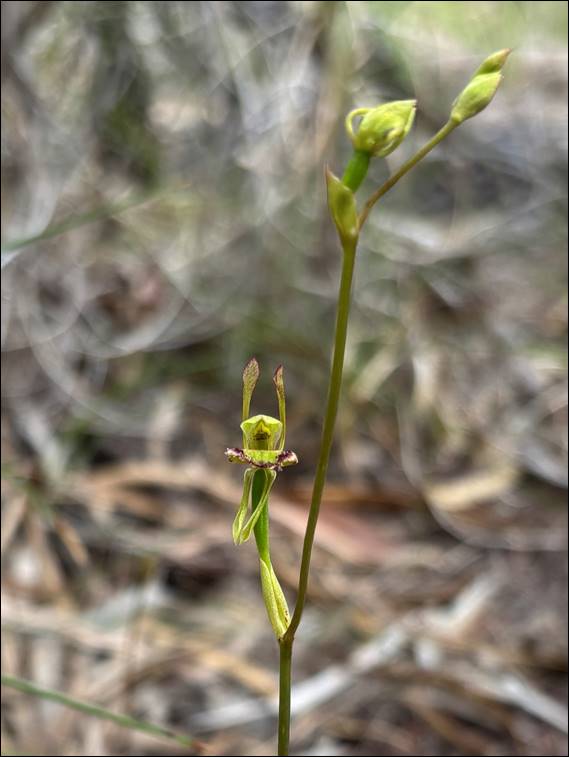
Ninety minutes in and with the finish line in sight, and this tortoise finally got to meet the hare.  Or more precisely little hare, as the genus is derived from the Latin word lepus with the diminutive suffix of ella.  Only one bud was in flower.  Not fully formed and the labellum did not yet have its fringe on display, which is where the species name comes from.  There is however only one species in this genus, being the Hare Orchid (Leporella fimbriata).  It is one of the first orchids to come into flower as the year rolls in, and if pollination does not occur it can be found in flower right through to September:

Busy bees

Howsie will admit that sometimes the weight of all the hats he wears can be a little overwhelming.  Today for example a voluntary afternoon commitment came up, being half way up to Mandurah north of Bunbury.  After last weeks failed Friday foray Howsie was still very keen to get out this week, and as Friday approached we played with the options.  Boomer Crag up near Pinjarra or Welly Dam would have suited due to being on the right side of Bunbury.  Cutting down how much travelling he’d have to do:

But when pushed for a decision late on Thursday he plumped for Castle Rock.  This surprised me a little, being 80 odd kilometres in the wrong direction.  This hinted to me that he may have been after a more relaxed climb.  The small outcrop, does have a few punchy routes, but most are fairly cruisy.  After he jumped in my car at Capel, for the second leg of the journey to the crag, he admitted to feeling pretty weary.  Several days on site of doing mechanical weed control with hand held tools in difficult locations, hadn’t helped:

And while I am very much a desk jockey with my work, after a couple of weights sessions in the shed with Lisa and a couple of bouldering sessions this week, the thought of a more gentle day also appealed to me.  To the point that I offered up all the leads to Howsie, so he could dictate how the morning would roll.  This was in part as he still had a little voice inside of him, telling him to jump on one or two of the more challenging climbs here.  And in part because I’ve led all the routes we were likely to try more times than him:

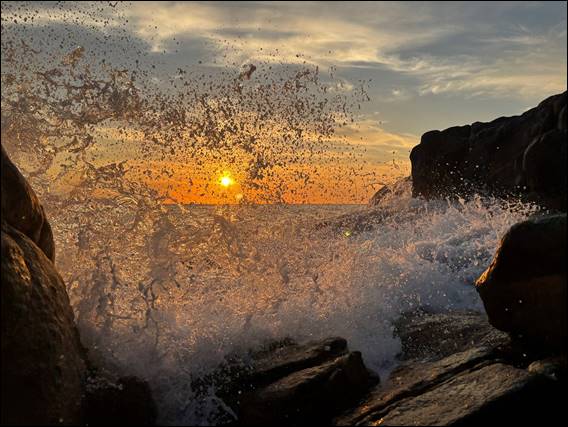
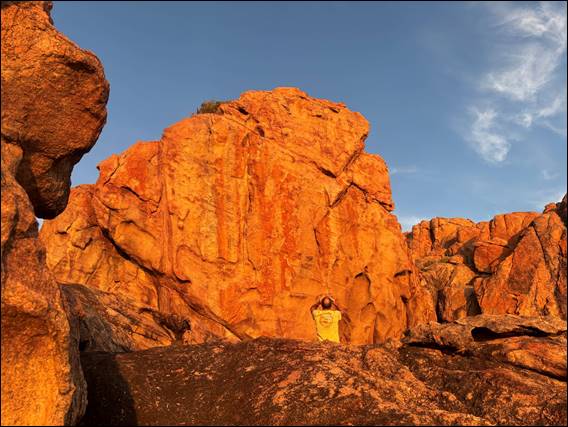
We arrived just after sunrise.  In time to watch the fiery red ball rise above the horizon, and then start to turn orange as it crept higher.  Dumping our bags below the main wall, which was aglow with the morning light, I left Howsie to ponder how the day would start.  While I rock hopped a bit further along the coast to snap a few artistic shots at the water’s edge.  Holding tightly onto my phone to avoid another expensive incident.  On my return he was still stood in the same position looking up at the wall, eyeing up a tough route:

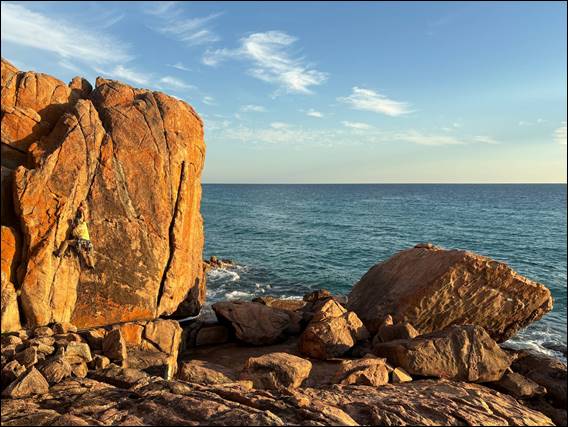
His brain was working hard, struggling to make a decision and using up precious energy.  To break the cycle, I persuaded him to jump on the most gentle of warms ups we could do on this side of the castle.  Allowing him to stretch his muscles and see how he was moving on rock.  This led to another two easy but fun routes, above and below, which I was surprised to hear he had not climbed before.  Despite having enjoyed the three lines, he still couldn’t make his mind up as to whether to go hard:

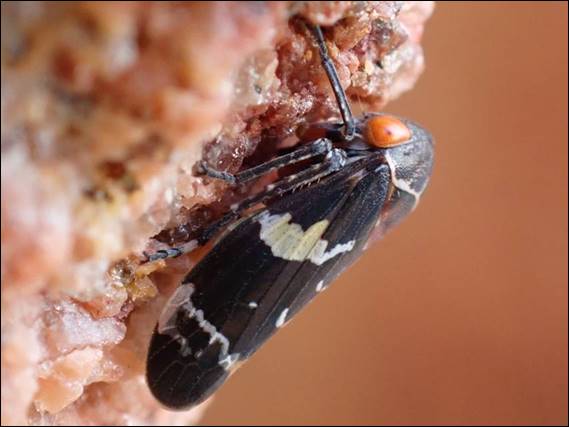
The only way to know, was to step it up a notch.  And hit the main wall, on which even the lowest graded climb can feel pretty steep and pumpy.  His approach immediately changed.  The need to mentally prepare kicked in, and he started to procrastinate before heaving himself off the deck.  On the plus this did mean we spotted this Punctata Gumtree Hopper (Eurymeloides punctata), at not much more than a centimetre long.  There are some 20,000 described species of Hoppers making them one of the bigger families in the Hemiptera order:

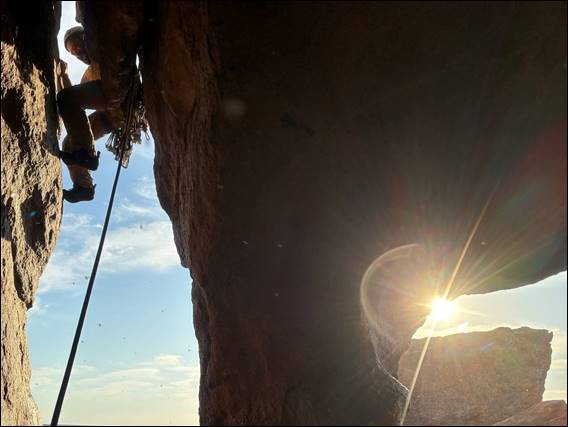
And while I get side tracked.  This is the order that includes insects known as true bugs, which makes sense as Howsie and I first though it may have been a Cicada that is a group that falls in the true bug collection.  Hoppers feed on the sap from plants, and excrete the excess sugar which attracts ants.  The ants in turn provide a kind of protection.  Protection, at least, on this climb being ample and easy to place.  So once he got moving, he kept the momentum going, maybe also being motivated by me recording the ascent:

Despite the pleasing ascent his body was still not convinced it was ready to step it up a notch.  So a fifth route was slotted in on less steep terrain before the options started to run dry.  By now it was also starting to warm up a tad, being in full sun.  Adding to the factors working against him for the sixth route.  The number six is considered to be lucky in some cultures, and even symbolises smooth progress and good fortune.  But today climb number six it was the one that sapped what energy remained:

It seemed that even the honey dew poop of the Punctata Gumtree Hopper, if it could be produced in large enough quantities, was likely to sufficiently replenish Howsie’s battery levels.  Having had the luxury of the rope above me all morning I offered to take the lead.  Not that I managed a clean ascent, but at least the rope was above for Howsie.  When he made it up after me, it was official.  The line being eyed up on our arrival would have to wait for another trip.  There were however two more reasonable climbs, thankfully in the shade:

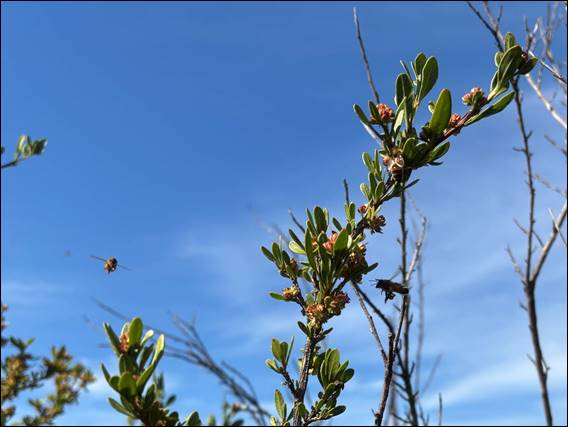
I was more than happy to gobble these up, wrapping up a fun morning with eight routes.  Yet another number that I have read is considered lucky.  In fact it seems quite a few single digit numbers could be considered lucky, depending on what culture you want to adopt for the day.  But eight was enough and we felt like we had had our fill, a bit like we thought these bees had.  They were busy collecting pollen from one species of shrub, which Howsie didn’t recognise, even though the pollen baskets on their hind legs looked to be overflowing:

The right conditions

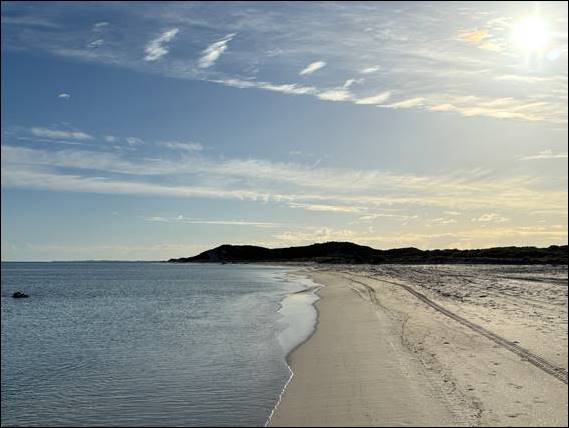
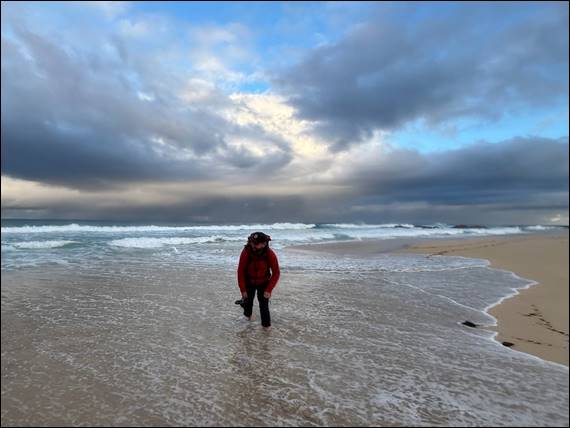
Encouraged by yesterday’s ocean conditions, which had finally settled down to what we would normally expect it be like, I decided to walk past the point to the more intact reefs.  I could have driven.  A sand bar had formed across the Capel River mouth. as usually happens during the low rainfall period of the year.  What with my sedentary job, I didn’t mind walking down and it was only a couple of kilometres.  Beside if I drove I’ve have to let the tyres down and then pump them back up, and that becomes a phaff that I just can’t be bothered with:

Only a few cars were parked up by the water’s edge as I wandered along.  Most people were fishing, using a rod and reel.  One person however was using a drop net.  If you look carefully you can see where he is aiming for, the surface being broken by the fish as they nibble at the bait he’d thrown in.  This reminded me of when I watched this technique being used in Ghana.  One part of my role was installing dry season gardens, which required us to install pipes through the walls of existing dams.  This of course meant lowering the water level:

We held community sessions to warn of over fishing the reservoirs as it became smaller, but it was hard to prevent the onslaught.  The main fish being catfish and tilapia, and the fish stocks took a serious hit each time.  I’ve read that tilapia is estimated to provide 60% of the protein intake of Ghanaians, being one of the main staple foods.  In 2012 the Global Affairs Canada invested significant funds to boost the tilapia market in both the Upper East and the Upper West regions, I lived in the latter.  I wonder if any of the villages I worked were included:

One day I hope to dig out my dairies and slides, and write about my two years in the Upper West region.  But for now my head was underwater.  Yesterday in boardies I got goose bumps as I snorkelled, so today I wet-suited up hoping that would also keep those stinging filaments at bay if they were about.  In writing this post I have looked back through past finds and found I previously used a very similar image of the above impressive plate coral.  I guessed back then it was of the Astreopora genus, and like then haven’t managed to pin it down any further:

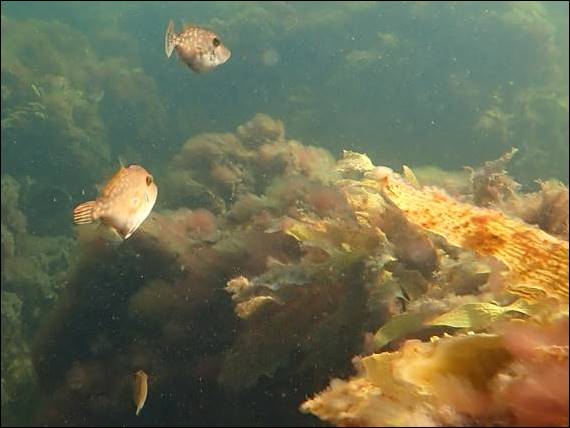
Despite being great conditions, and this reef being way more intact, the fish life wasn’t up to its usual standard.  Even checking in the caves and under ledges there was very little to be seen.  A few fish that were out in numbers were the Western Gobbleguts (Ostorhinchus rueppellii) and Banded Sweep (Scorpis georgiana), the latter following me about in case I stirred up the sediment and released a tasty morsel.  Above there were also quite a few juvenile Horseshoe Leatherjacket (Meuschenia hippocrepis):

For a while they had me guessing as the body shape had a distinct lobe where the pelvic fin usually is.  However, they had the namesake horseshoe marking on the midside and it seems as they mature this lobe is drawn back into the body.  Unlike yesterday’s Spinytail Leatherjacket (Acanthaluteres brownie), these were less inclined to allow me close.  Something I’d observed when I last wrote up about the Spinytail Leatherjackets.  Another fish out in numbers were juvenile Brownfield’s Wrasse (Halichoeres brownfieldi), shown above:

Wrasses generally do not group, or shoal.  The Brownfield’s Wrasse breaks this rule with both adult and larger juveniles commonly forming large schools.  I gave it a good half hour in the deeper water.  Hoping that a shoal of bigger fish might appear or that I may stumble across something bigger.  It was not to be.  So I wandered towards the shallower reefs, where eye-popping colours greeted me.  Maybe due to having less of a water column to hide in, things came into sight.  Such as these juvenile Silver Drummer (Kyphosus sydneyanus):

I did wonder about these as the back of the tail was not fully dark, as my research indicates they would normally be.  Then I noticed how many of the drummers look alike, and also cross over in their range.  Two species are found further north, but with warming seas they may be drifting down.  Then some thirty years back a new species was identified that shares the same range, and looks to me practically the same.  Despite my research I was not able to confirm if this was a juvenile of a different species, so I am left guessing:

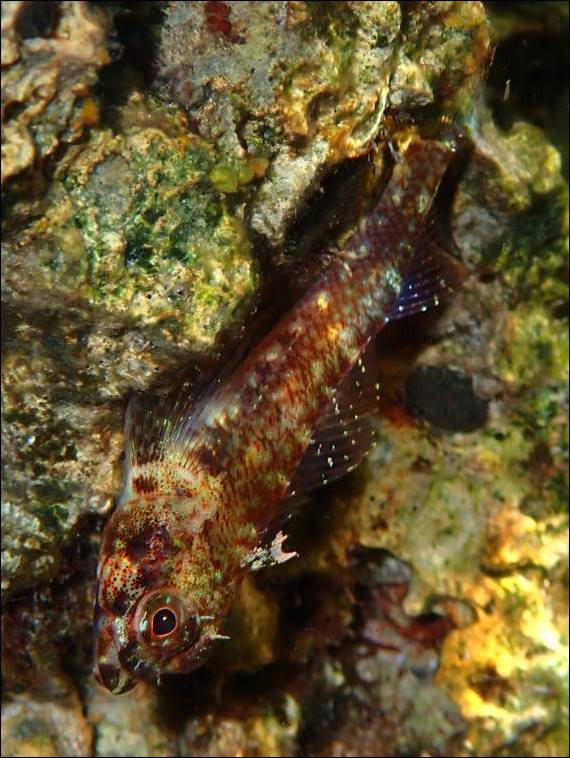
The shallows allowed me to get close up, and above is a Leeuwin Triplefin (Norfolkia leeuwin), only two inches long.  Again looking back I may have seen this before.  This time noting it is missing the bands on the face, I had incorrectly identified it back then as the Common Threefin (Forsterygion lapillum).  Below is an Eleven-armed Sea Star (Coscinasterias muricata), nothing new but being so shallow the colours really stood out.  Next time I get such a chance I need to look much closely, as it has small appendages with claws round the spines:

I’ve zoomed in but the image quality is not good enough to see them.  These small claws are used for defence but also to catch food.  Holding on to it until it dies or one of the many arms can reach it and pull it towards its mouth.  Another interesting fact I found out is that smaller specimens can split themselves in half.  Each half then regenerates the missing tissue, a form of reproduction called binary fission.  Larger specimens reproduce by releasing sperm and eggs into the sea, as to why it uses two methods at different periods of its life is not clear:

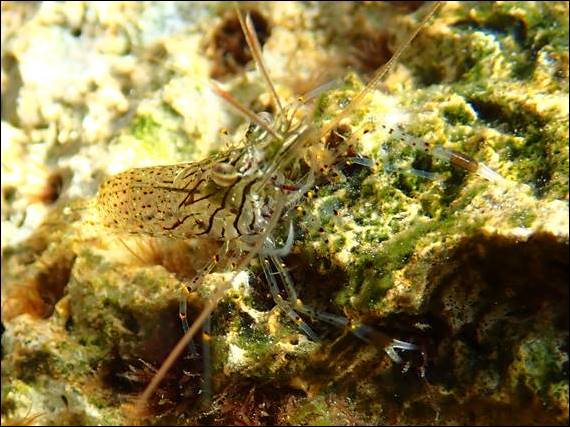
Above is what I had previously thought may have been a type of Boxer Shrimp, it is however a Red-handed Shrimp (Palaemon serenus).  Being so named due to the red marks just above the claws, which are on the elongated second pair of legs.  This is where it gets it’s common name from but the scientific name comes from a Latin word serēnus.  This means clear, bright, serene, tranquil, or calm.  Quite apt for today’s dive.  I got out, due to feeling a little chilly, after an hour in the water and even after I had walked back, the water still looked serēnus:

Enhanced vision

Lisa and I hit the shed this week for the first time since we, probably, got hit by COVID.  I’m not sure either of us were fully prepared for it, but we managed two sessions and also aim to get back in on the weekend.  I also opened up the doors on Tuesday after work for a boulder, which David, Josh, and Craig popped along.  It was clear the wall had not been used for some time.  Webs crisscrossed between the holds.  And knowing we have a family of them in the shed, what was likely to be the skin from the head of a King’s Skink (Egernia kingii):

Needless to say the body was certainly feeling it, but up until Thursday night I was still keen to head out with Howsie for another Friday escape.  Our plans were however scuppered when a front rolled in, and we decided to bail.  It was a good job as it proceeded to dump 40mm during the time we would have been out.  Instead I worked, jumping back onto my wall in the afternoon as the rain continued to play tunes on the steel roof.  It eased off later in the day, and then came back in early Saturday.  Clearing up enough just in time to allow Lisa to bob:

I didn’t bother trying to arrange a climb on Saturday knowing it would start wet.  My thoughts were instead eyeing up the Capel Nature Reserve, wondering whether any orchids may have started to appear yet.  None had, or at least not that I saw.  But it was still nice being out, especially as it felt a little chilly.  This time I stumbled across a Australian Garden Orb Weaver (Hortophora transmarina), usually hiding in the day time this nocturnal spider was building its web so I took the chance to get a bit of footage:

Unlike the Golden Orb Weaving Spider I saw last time, this one constructs, takes down and rebuilds their web on a daily basis.  So adept at it, that it only takes them about half an hour to build one from scratch.  There was much fauna to be found, but this ant stood out being approx. 15mm long.  I believe it is a carpenter ant, possibly Camponotus rufus.  Like termites they munch on wood, but unlike termite they do not consume the wood but discard a material that looks a little like sawdust.  Making them important in the process of decomposition in forests:

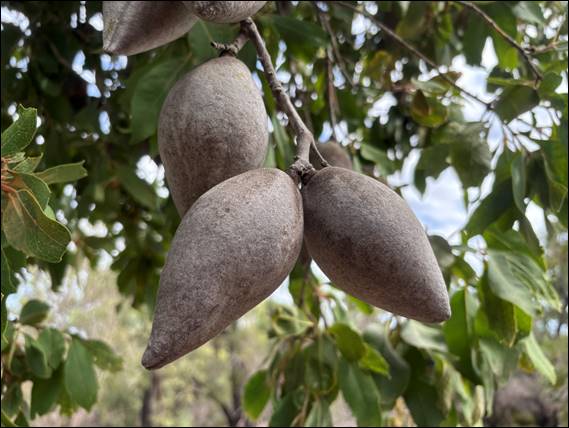
I also kept an eye on the trees, the reserve has an impresses variety.  This image is of the seed pods of the Western Woody Pear (Xylomelum occidentale).  The name occidentalis quite simply means ‘western’ in Latin, and this species is endemic to the south west corner of Western Australia.  The reason for the common name is obvious.  However, while the three inch long pods have a thin outer layer that is soft and slightly furry inside the are solid.  As they ripen they dry out, split open to disperse the seeds, and what is felt looks like a pair of wings:

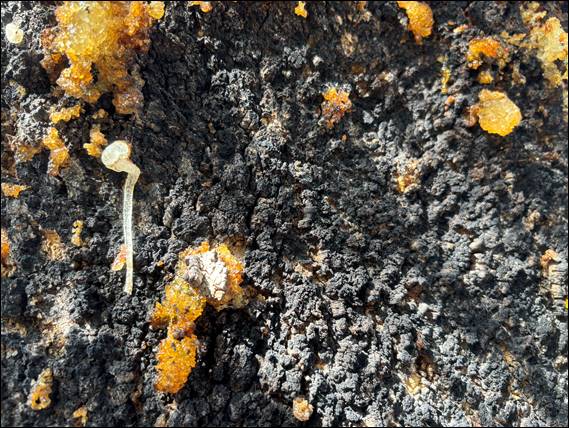
I found other great seed pods, but the next image is of the bark of the Western Sheoak (Allocasuarina fraseriana).  I’ve read that these trees are known to produce a jelly like caustic sap, but haven’t found out what triggers this.  The leaves of this tree are spines, that fall and create a soft flooring.  So soft that these areas were used for giving birth by Noongar women.  This practise may have stopped, but the tree itself is still sought after for its wood.  It has a lace like pattern, ideal for wood-turning and carving of decorative ornaments:

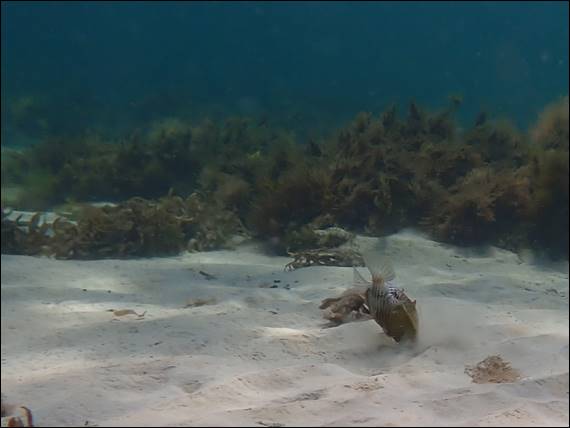
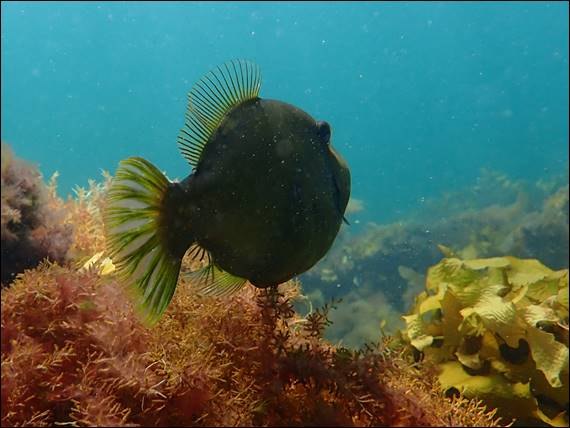
After an hour or so I headed home and drove past the beach to a surprisingly flat looking ocean.  Not wanting to waste the opportunity, I was soon jumping in the water.  Under the surface it was clear and calm, there was hardly any swell which seemed like a first this season.  I got closer to this female Shaw’s Cowfish (Aracana aurita), but liked the picture as it showed it blowing jets of water to search for invertebrates buried in the sand.  I’ve often seen this, but rarely manage to get close enough before they notice me and swim away:

The next image is of a Spinytail Leatherjacket (Acanthaluteres brownie) swimming away.  I again got some great shots as I swam next to a few of them.  This image however allowed the light to emphasise the structure of the caudal fin, or tail, which I really liked.  It took a bit of working out to identify these, despite seeing males and females.  The males didn’t have the expected bright colouration round the head, but clearly displayed the yellow patch around the spines on the caudal peduncle, which is where the body narrows and the tail attaches:

They get to about 46cm, and these were 30cm long.  Clearly not juveniles, as they are more of a mustard orange colour.  Therefore, the mystery of why the males were not putting on their usual colourful display remains.  The water column had Comb Jellies (Ctenophora) floating about, and also these string like filaments that I have not been able to work out.  They may be a type of Apolemia, but I am not really convinced of that.  What I did know is that they stung, and it was impossible to avoid them.  Maybe a wetsuit would have been a good idea:

The last image is of a Globefish (Diodon nicthemerus).  The name means night and day in Greek, coming from nyctos and hemera.  It is suggested this was given due to the silvery-white underside and dark upper side.  The colouration is presumably camaflauge, but this fish has another defence.  Being able to suck air or water in to quickly inflate, and in so doing all its spines stick out.  Something I have never seen, despite getting very close to them.  If you look carefully there looks to be an opaque lens over the eye that looks a bit like a contact lens.  I have not been able to find out any information as to whether this is normal or not:

Putting on a show

I bumped into a long term local when I came out of the water after the dive in which I saw the least, out of my three recent dips.  They told me of memories of diving here in the 80s and seeing abundant and diverse marine life.  Claiming something changed in the 90s, and since then the underwater ecology has never recovered.  This made me want to see if I could pin down something that could have resulted in such a change.  I’ve heard commercial seine fishing is to blame, which uses a vertical net with weights on the base and floats at the top:

The net is placed in the water to create an enclosed areas.  Off our beach one end of the net is held on the beach, a boat takes the rest out and drops it in a large arch bringing the other end back to beach.  The net is then dragged to shore.  This technique can disturb the life cycle of fish if carried out in spawning or nursery grounds, or by capturing juvenile species of fish that stay close to the shore.  This practise has however occurred here for decades before the 90s.  It is also restricted to specific areas and times of the year, presumably to lessen impacts:

Other risks to the environment are the sediment and pollutants that come out of the Capel River.  This historically didn’t directly connect to the ocean, instead flowing south west through a series of wetlands behind the primary dunes.  Eventually meeting the ocean via the Wonnerup Inlet 12km along the coastline.  To assist in draining the land cuts were made through the primary dune, with two in close proximity.  The first, in 1865, was call Higgins Cut, which has a Grade A heritage listing.  This no longer has direct connection with the ocean:

The second was called McCourt Cut, constructed approx. ten year later, and is where the Capel River now flows.  This cut does not have any heritage listing, but is still connected to the ocean with seasonal closures due to band bars forming during low flow periods.  The drainage enables agricultural land uses, and a pathway for organic matter to enter and significantly change the local marine ecology.  This change occurred over a hundred years before the 80s.  Although more intensive agriculture has been adopted with time, which may contribute:

So it was back to the drawing board.  A 2019 report provides a review of the ocean temperatures round Australia.  The data from 1870 is not surprisingly coarse, but three stations provide fine scale data since 1940.  For the South West, between 1930 and 2019 there has been a steady increase in temperature of approx. 0.8 degrees with no notable sudden changes during this period.  Again drawing a blank, I noted the residential properties were first created in 1965, and development expanded from 1975.  So maybe this is the cause:

After all the area does not have reticulated sewer, so all our waste is infiltrated into the dunes and through the groundwater system is connected to the ocean.  It’s hard to pin it down a definitive cause.  It is more likely, based on what I’ve read, to be an accumulation of land and climate factors.  As such I have been unable to verify the claim that there was a significant impact of change in the 90s, by the local I bumped into.  It has however finally made me look into this a bit more, so when people make random claims I am a bit more informed:

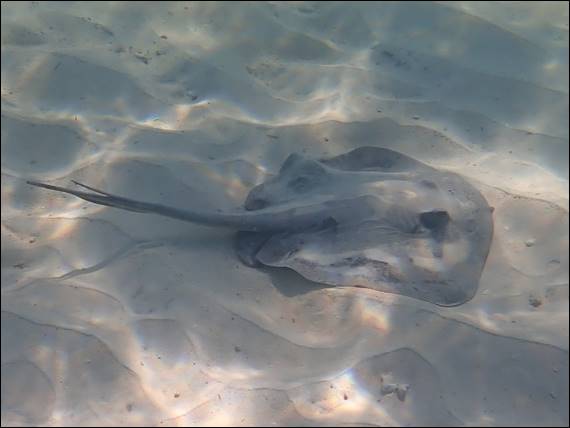
Regardless of the state of the local area, I’m still getting out there to see what I can find.  With a recent low’ish swell period during my first dive on late Thursday I saw a fair bit, despite the surface bobbing up and down.  The first image is of a Juvenile Smooth Stingray (Bathytoshia brevicaudata).  Also known as a Short-tailed Stingray, with the species name coming from brevis and cauda , meaning short and tail in Latin.  As it swam off, a small school of Tarwhine (Rhabdosargus sarba) crossed between us.  At only 15cm long they too were juveniles:

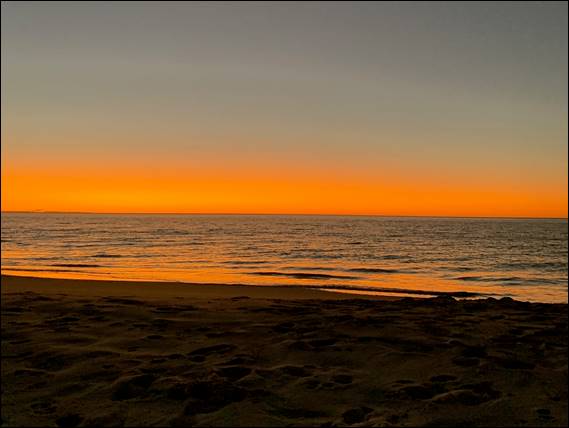
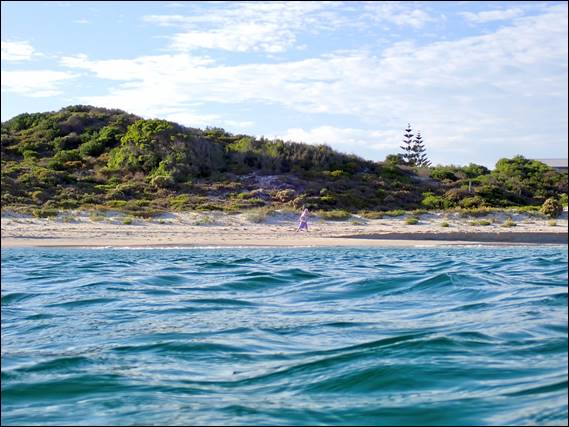
As I came back to shore and right off the beach a Southern Bluespotted Flathead (Platycephalus speculator).  This too was quite young being only 30cm long, which is a third of what they can grow too.  Speculator is Latin for explorer, searcher, and investigator.  It is said this may have been used because this species has larger eyes than others.  Later in the day Lisa went for a sip and dip with the Peppy Plungers, and took the sunset image.  Telling me when she got back that the water looked flat and very snorkelable, however I would disagree:

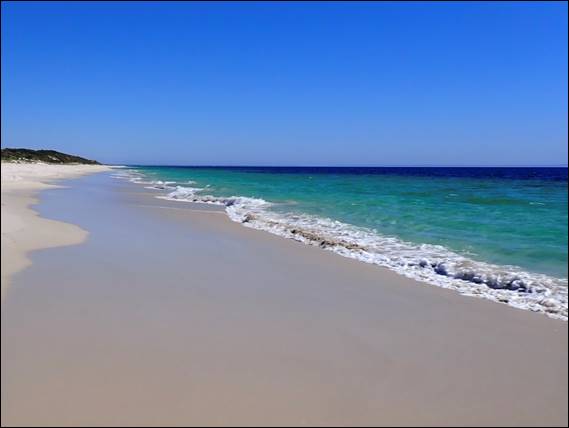
The next image explains why.  The flat surface occurs when there are no wind waves.  These are created by local winds and are choppy and frequent.  The other factor is swell, which is generated by distant winds and results in water movements that are smoother and more spaced.  One way to check for swell on seemingly calm days, is to see how far up the beach the water goes, and it was coming up a long way.  On Friday the swell and wind waves, as shown by that and the next image, were against me but I chanced is anyway:

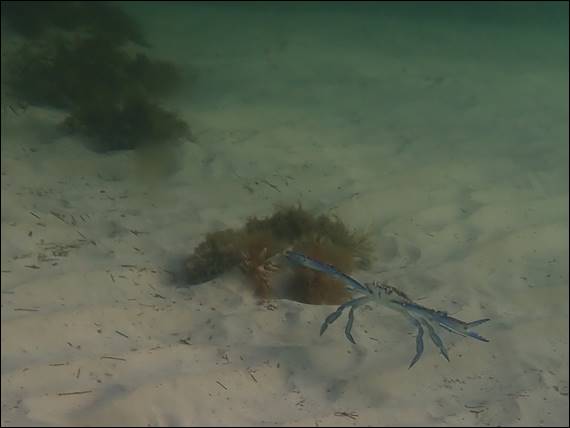
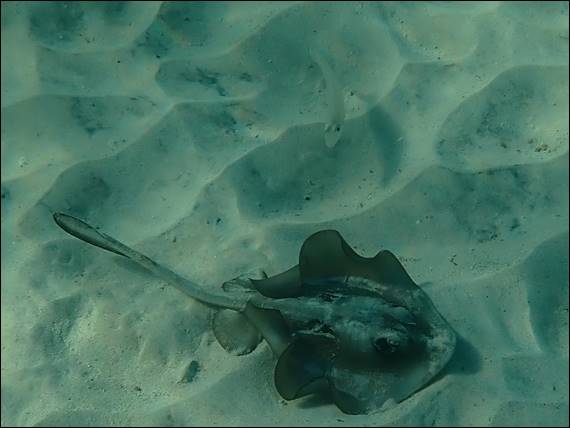
Lucky enough to spot a dolphin swim past me, but there wasn’t much else.  Not one image was taken.  I guessed they were staying protected in amongst the crevices and caves of the reef.  Not put off a Saturday morning dive seemed in order.  Providing the calmest conditions, and almost immediately I saw a Blue Swimmer Crab (Portunus pelagicus).  Hop and glide away from me before standing its ground pinchers stretched out and ready for action.  Next a small Striped Stingaree (Trygonoptera ovalis) remained calm and allowed me to get close:

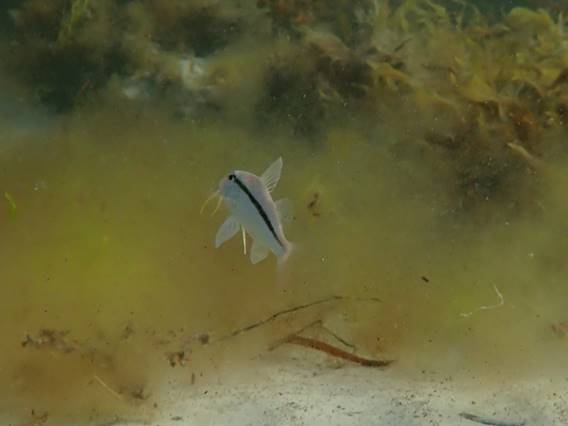
Fish that did not darting for cover when I got close were Old Wifes (Enoplosus armatus), Magpie Morwongs (Goniistius gibbosus), Globefish (Diodon nicthemerus), Horseshoe Leatherjackets (Meuschenia hippocrepis), Western Talmas (Chelmonops curiosus).  The last ones looked to be playing chasey, although I have read they are pretty territorial so it may not have been playful.  In the above images are an adult Moonlighter (Tilodon sexfasciatus) and juvenile Bluespotted Goatfish (Upeneichthys vlamingii), which also shows a cloud like algae:

This algae seems more prolific this year, a sign of poor water quality.  Above Lisa was walking back from her Saturday morning dip with the Peppy Plungers, where just earlier commercial fishers had driven looking for a likely catch.  Reminding me of two of the probable causes for the ecological decline.  My exit was delayed by this very young Striped Stingaree displaying its flexible margins. So flexible that it is the most agile stingaree species.  A juvenile Yellowfin Whiting (Sillago schomburgkii), which are known to shelter along shorelines, also watched the display: