FOMO

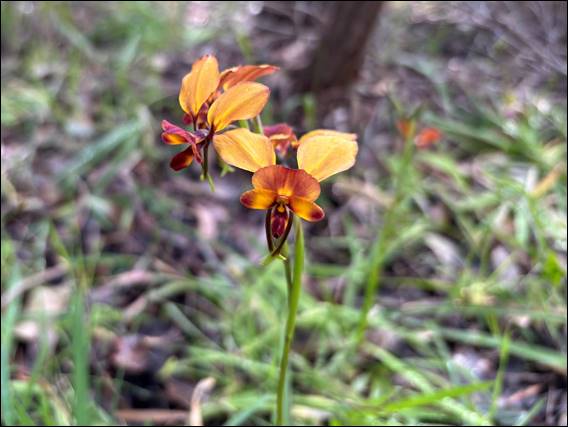
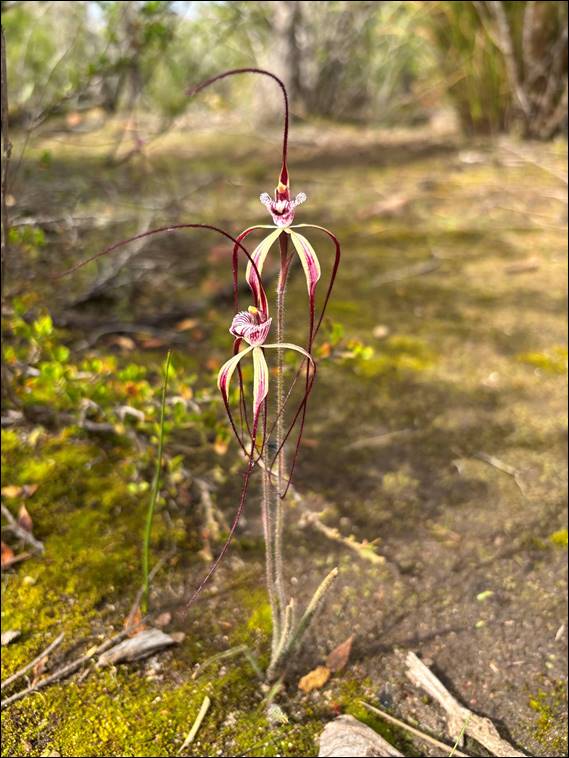
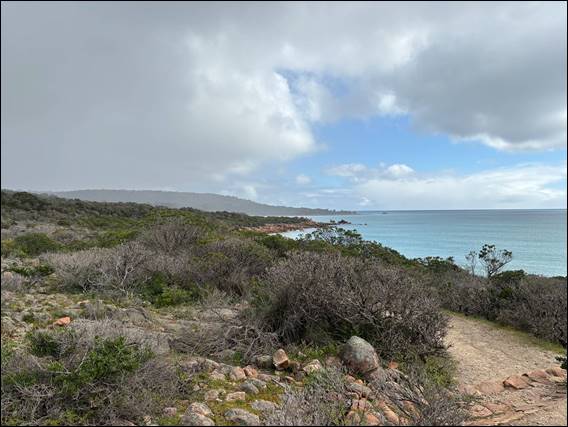
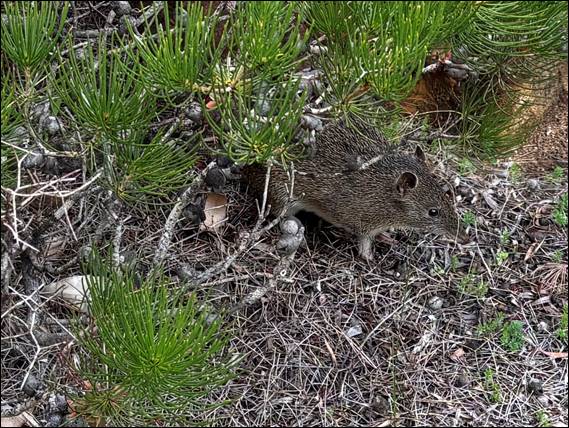
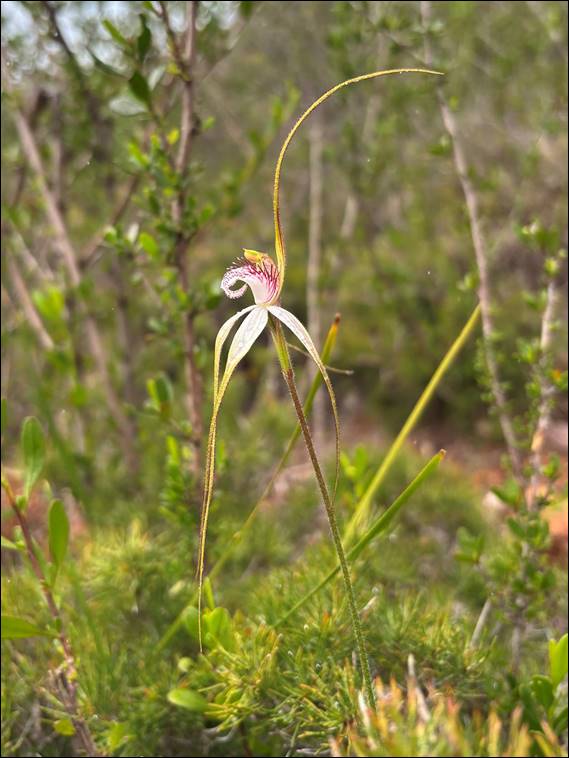
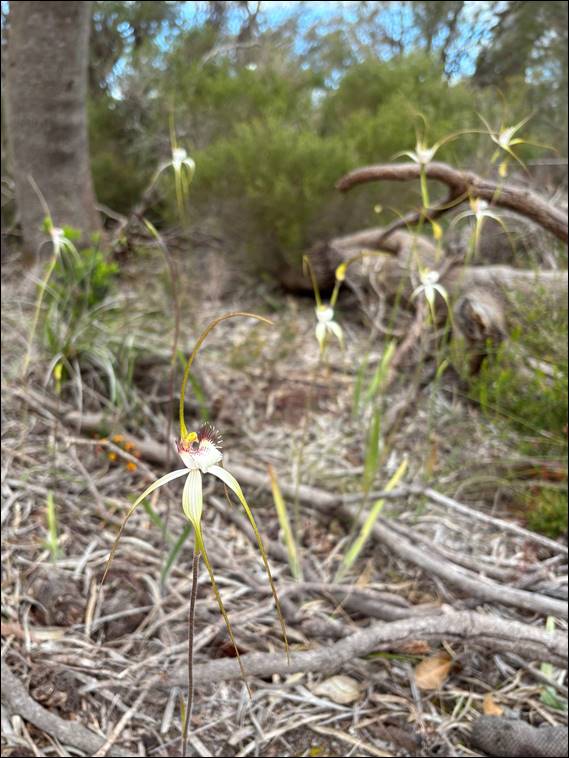
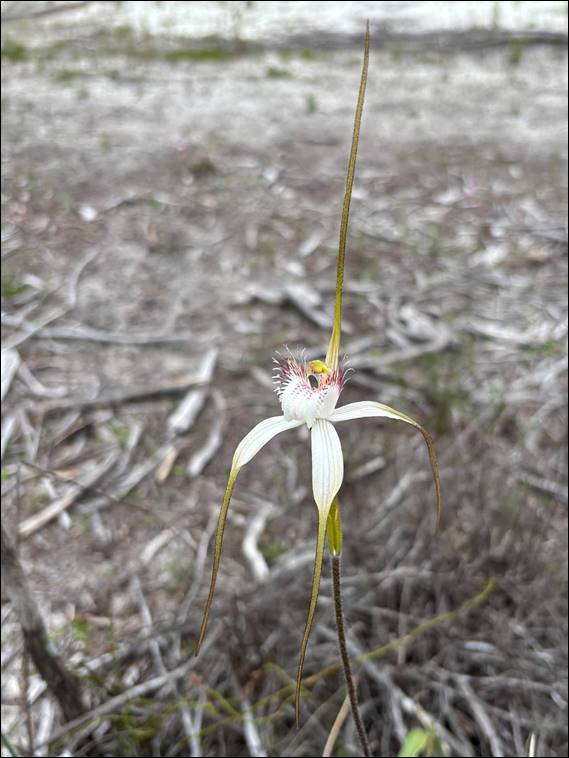
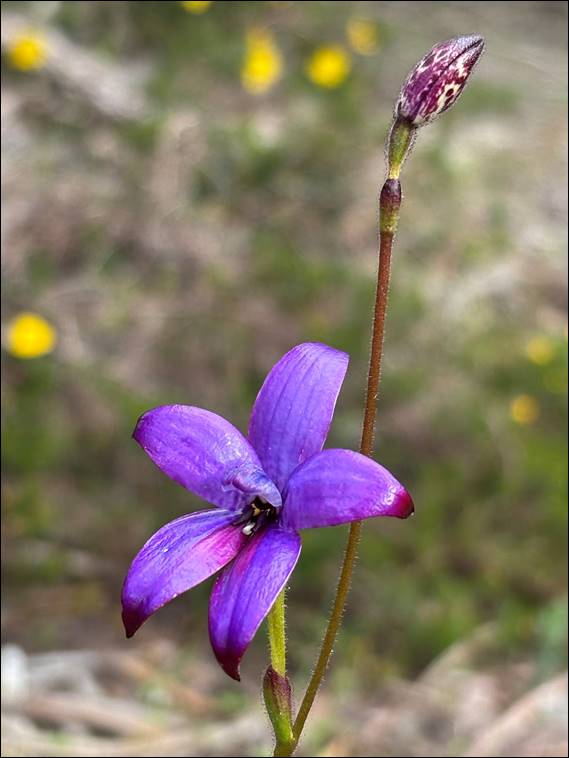
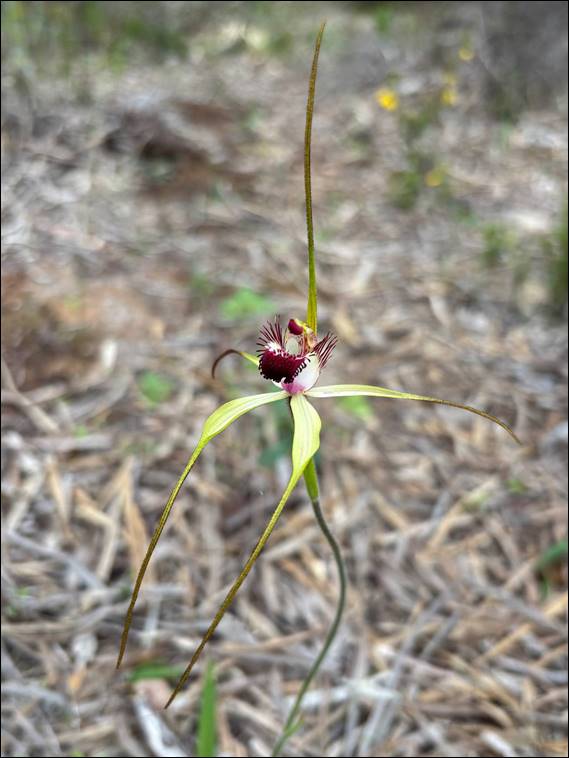
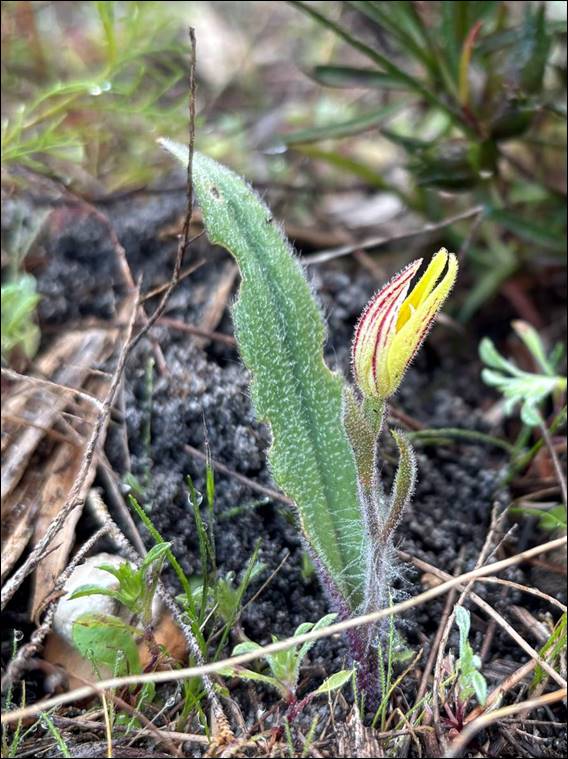
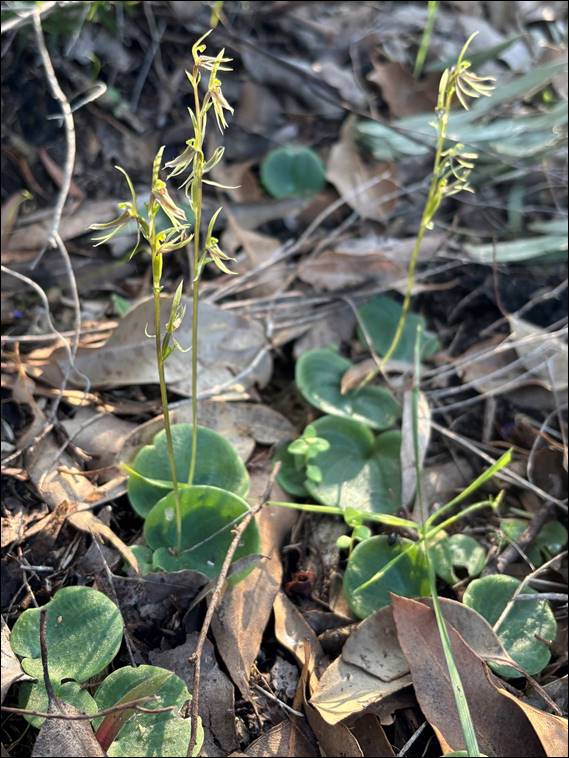
It wasn’t FOMO that resulted in me driving towards Welly Dam at first light.  The trip was certainly not for a climb.  That would have been dumb after what happened on the last visit just a few weeks back.  Climbing aside, during that last trip with Howsie we were lucky to see some great orchids.  At that time I explained the features to look for to help identify them.  He’d use this new found knowledge early this week to recognise some Swamp Bunny Orchid (Eriochilus helonomos), during a work trip along the bank of the Collie River:

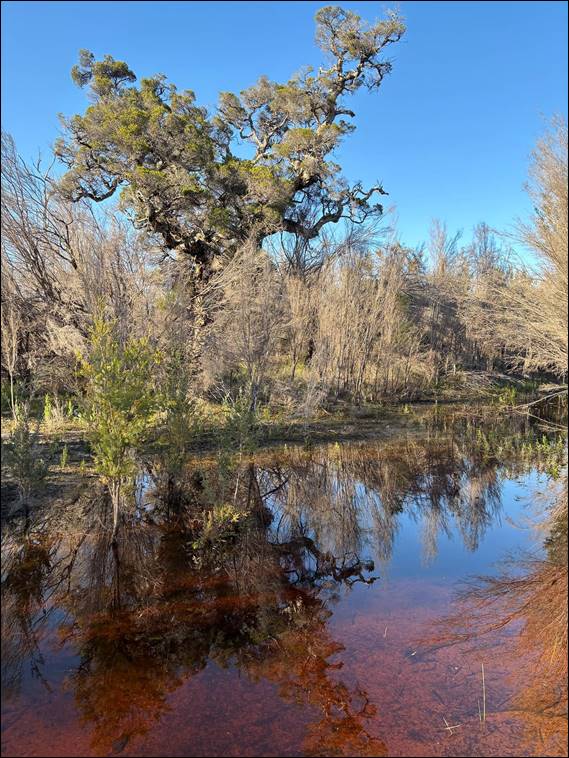
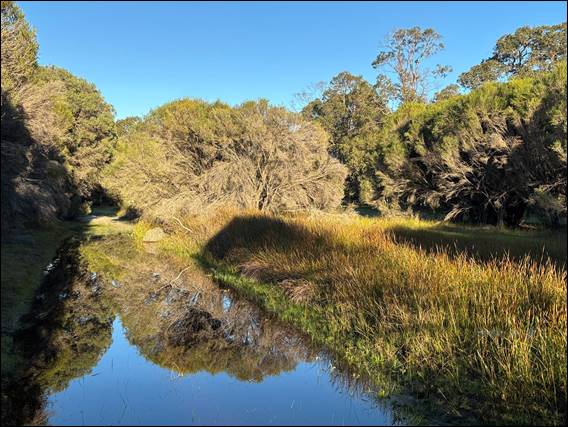
A species that has alluded me to date.  I could have used his direction to find them.  However, it felt a bit excessive to drive the approximately three hour round trip, for no other purpose.  Instead, and because he had spotted them on the South Branch of the Collie River, I hoped they could also be on banks of the main branch of the Collie River.  Hence why I was heading to Wellington National Park.  Lisa had a morning full of stuff that she wasn’t to crack on with, so I went solo.  Making it that bit easier to sneak out and arrive at first light:

Getting there early, when it was not so bright, had other bonuses.  This place has got very popular.  Not just with the hikers, but also the mountain bikers.  Many of what used to be great trails to wander along peacefully are now dual use.  So you need to keep an eye out for those travelling on two wheels, more often than not dressed in Lycra, who tend to go that bit faster.  The roads were mostly quiet but a car tailgated me most of the way into the park.  Seemingly not caring that if I had to brake suddenly they would likely have rear ended me:

They pulled up alongside me in the parking area that was devoid of anyone else, and a woman hopped out to get ready for a walk.  After a polite hello I left her to it and went ahead.  I didn’t see her again, so I guess her walking pace did not match her driving pace.  I must admit I kept a pretty good speed.  Keeping an eye out along the way, but also keen for some mileage.  Much as I was keen to spy some orchids, after what Howsie had told me yesterday, a few days earlier I had already decided to have a longer hike to get a bit of a cardio workout:

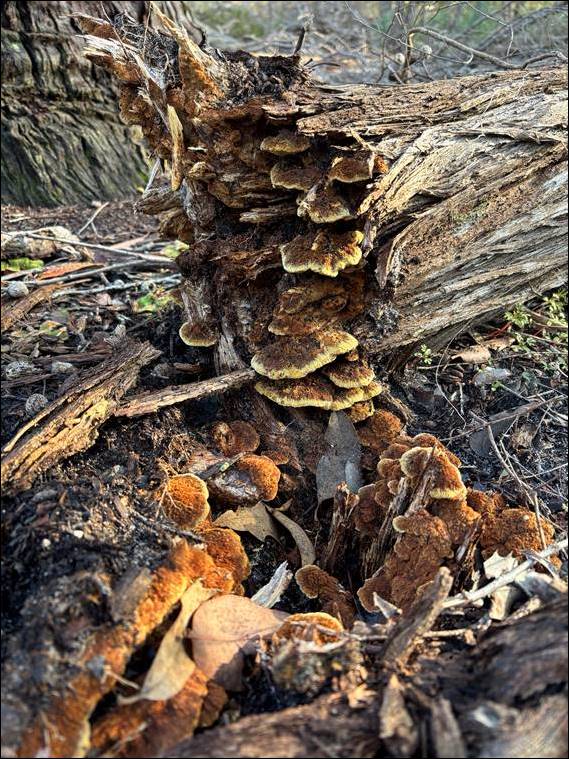
I’ll get to the orchids later, as the stars of the day were the fungi.  A couple of images up is one from the Boletus genus, which is as far as I have managed to get with it.  The giveaway for the genus being under the cap.  A mass of porous almost honeycomb looking flesh, as opposed to the neat radial lines of gills.  I started along the river walk from the Honeymoon Pool end, and it took just over an hour to get to Welly Dam.  The longest I stopped was when for a Tammar Wallaby (Notamacropus eugenii), two in fact and both observed me as much as I did them:

They are the smallest of the seven living species in the genus Notamacropus, and have a couple of special qualities.  This includes having colour vision, using less energy than most when hopping, and also being able to drink sea water.  The latter being in their favour due to the Collie River suffering from inland salinity.  Not reaching ocean salinity levels of 35,000mg/L, but being over double, and at times triple, what is considered the levels for fresh water.  There used to be an eighth species, sadly after colonisation the species only lasted another 85 years:

Moving on, the second fungi image may be of a Dark Melanoleuca (Melanoleuca cf. fusca).  That is according to a fungi field guide of the general area that I have a copy of.  My web searches hoover suggest maybe not, and hasn’t helped to suggest what it may be.  For me, identifying fungi feels like working on a really tricky puzzle.  Of which I have one that is still in the box, unopened.  The image is a little like the above one, but instead of Jarrah and Marri trees, it is of the taller Karri trees found further south in the Boranup Forest:

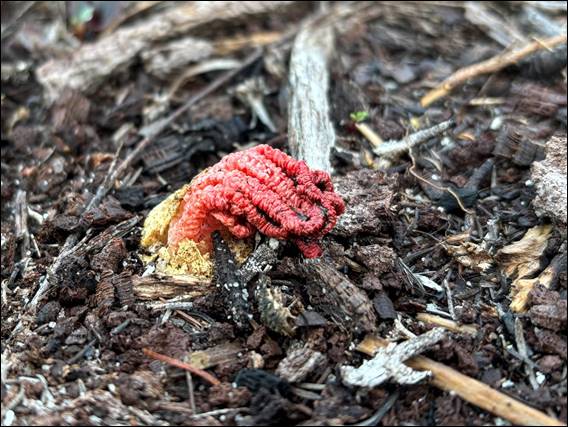
This time my field guide hasn’t helped me one bit with the above find, and after lots of research I may have to admit defeat.  But just like puzzling if you keep going eventually you’ll find a piece that fits.  Although to be fair there really is no mistaking the below, and very aptly named, Egg Yolk Fungus (Bolbitius titubans) for anything else.  It would seem I was lucky with my timing to see them in all their glory.  Several sites suggest they typically live for no more than 24 hours, making it one of the shortest-lived mushrooms:

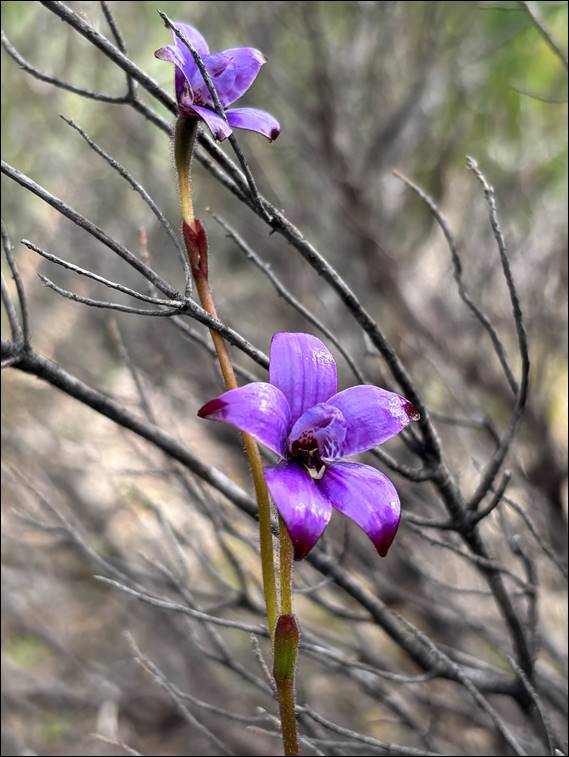
Finding natures wonders will so often happen when you are in the right place at the right time, so to a degree is a bit of luck.  For example all those great orchids Howsie and I saw just two weeks, at the top of the walls we climb, were gone.  However, with time you build up a knowledge base of what you have found and where.  Mind you I do feel going back to the same places takes away some of the fun of the hunt.  Today’s hunt scored me more Common and Crinkle-Leafed Bunny Orchids, both of which I have already seen this season:

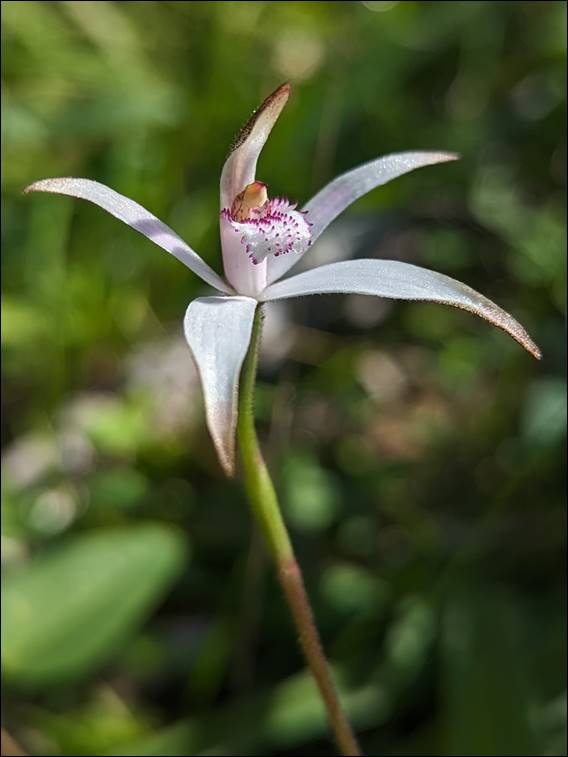
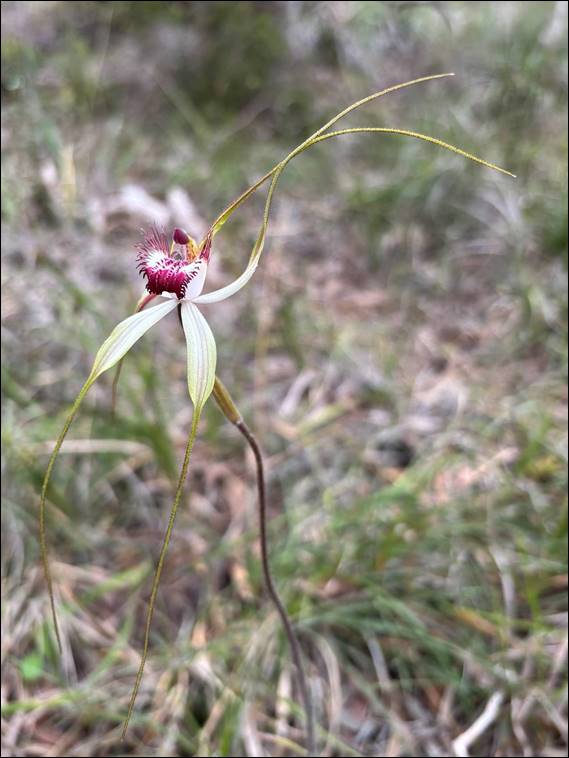
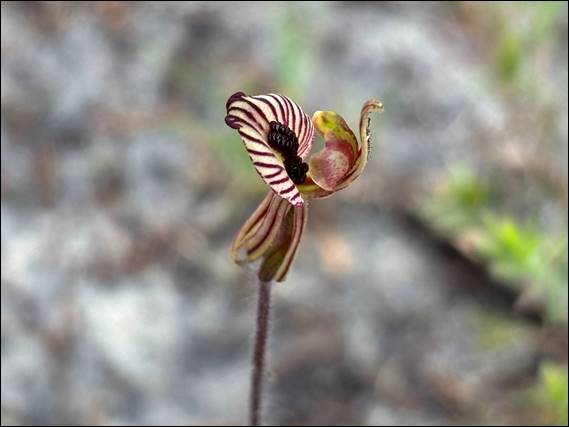
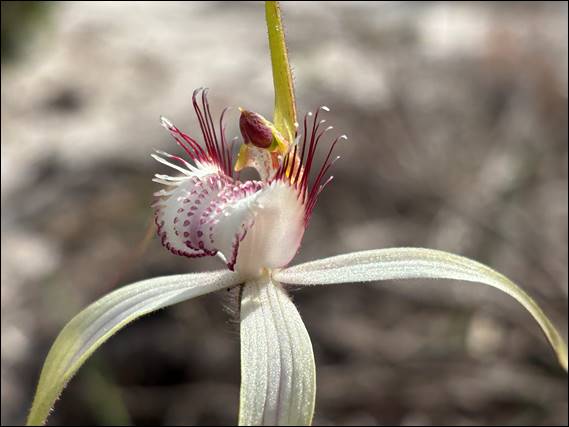
I also added the Easter Bunny Orchid (Eriochilus dilatatus subsp. magnus) and above White Bunny Orchid (Eriochilus dilatatus).  Increasing my chance of luck today by walking back on the tracks higher in the landscape, through differing vegetation and soil types.  This also assisted in me working up a bit more of a sweat on a ten mile, or so, circuit up and down the hills.  All that said maybe next year I won’t rely on luck alone, and may dip into Howsie’s beta to see the Swamp Bunny.  For now however I can safely say I do not have fear of missing orchids:

Sticking to the schedule

With Nadia away with friends, we had to wait till a wee bit later in the morning before we could hit the road for another Friday rock session.  It meant the chance of a collision with the animals was far reduced.  Although the roads were significantly busier with the less fortunate souls that still had to go to work today.  All these factors had to be taken account of, if Howsie was to get back in time for the school pick up.  Driving down we got organised.  Agreeing the climbs on the hit list, and the times for various steps to make sure we returned on time:

While I enjoy the walk back down after a climb, due to the circumstances I brought a rap line.  Maximising our time going up the rock, by speeding up our descents.  With strategically selected routes and the rap line placed in the middle of the cluster, we were set to go.  For those wondering, yes I do still need to be careful.  To lessen the risk of me doing something silly, I told Howsie he was on point for the whole session.  A rope above me as I climbed would allow me to be more relaxed, and be less likely to make sudden movements out of desperation:

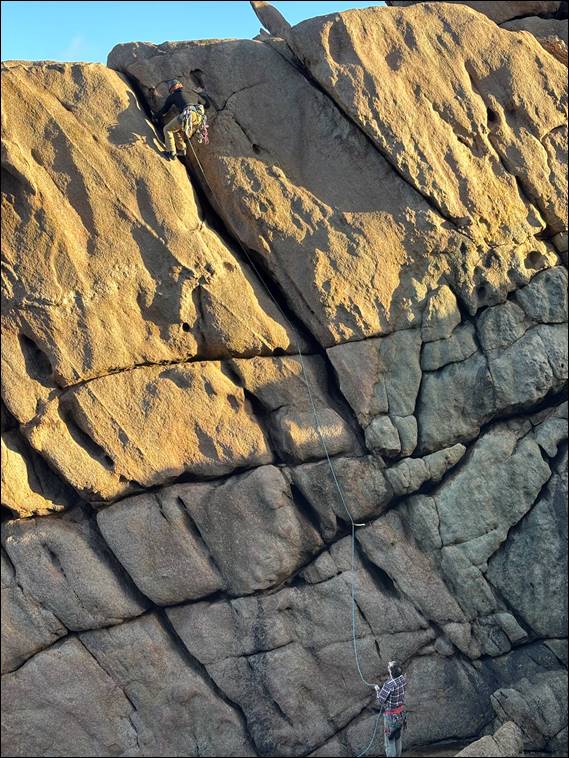
There was no complaint from the other side.  In addition, and before, we had started the trip down Howsie had hinted at moderating the grades to doubly make sure I was being sensible.  There was however one route here that Howsie has previously bottled on.  Never having managed a completed lead on it.  Admittedly there is at least one pretty spicy moment on it.  Other parts feel airy and runout even though they are not.  This makes it as much of a mental battle as a physical one, and this set the scene for the lines we picked for the day:

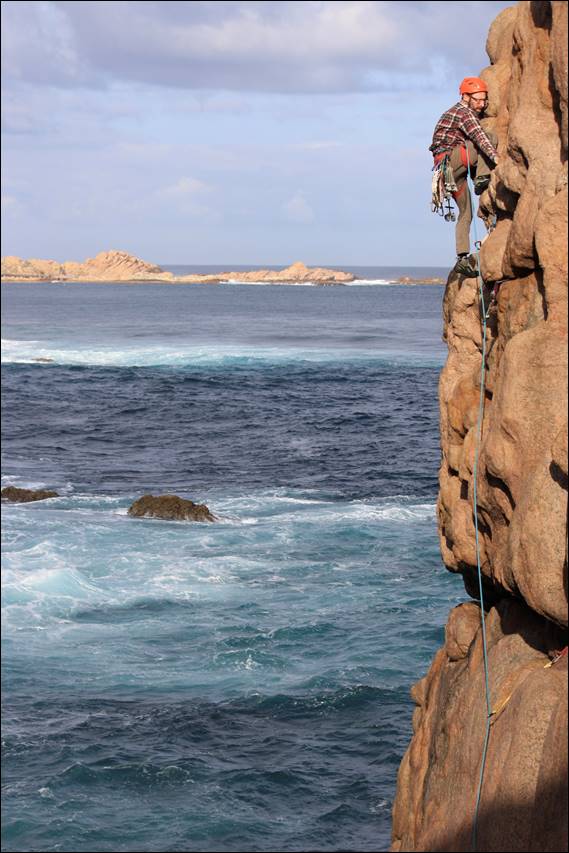
Not super high in difficulty, but each climb having a bit of a reputation for being a mental sandbag at their grade.  And not surprisingly they are all fully trad, there would be no bolt clipping today.  After Adrian’s battle on the route below not that long back, this was one I suggested as fitting the bill.  Howsie having no memory of ever leading it trusted my thoughts.  It took one test run to get over the crux bulge.  Coming back to the stance below to compose himself before going for it.  Made more impressive, due to the rough swell today:

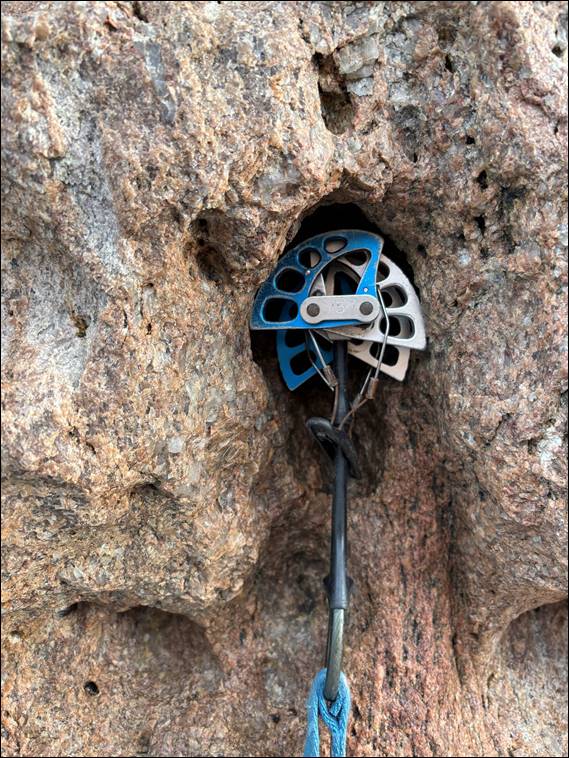
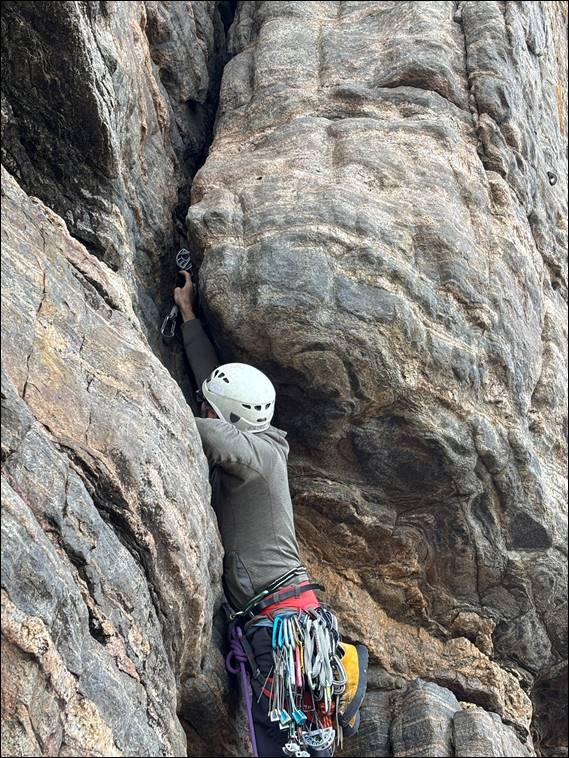
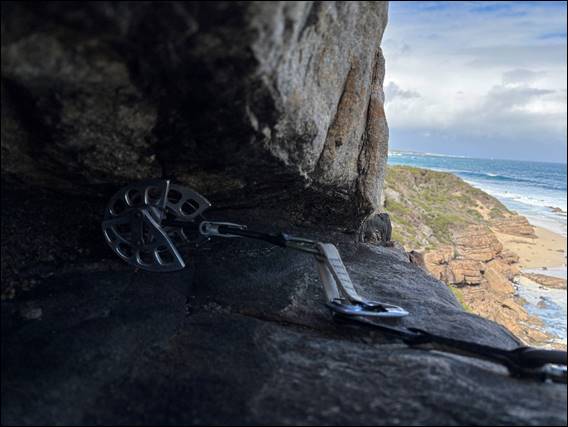
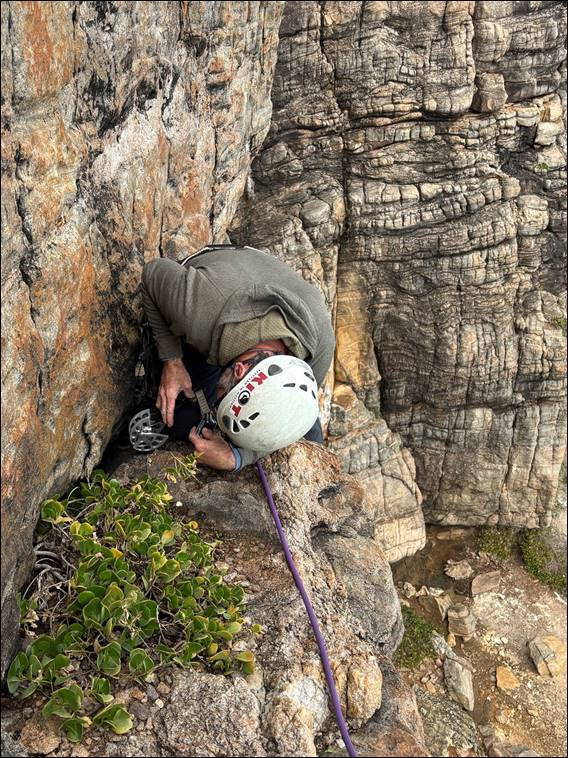
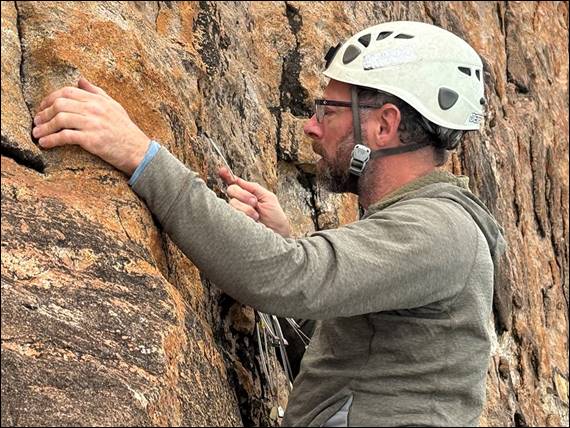
We were not racing to pack the lines in, just aiming to keep a steady pace.  It was up to Howsie’s head to decide the rate he would take on, and style he would ascend, each route.  Three lines in and he was starting to feel his arms, the flash pump on the first route didn’t help.  The super long runout on the second and greasiness on the third had then made him grip that bit harder.  None of this helped when on the fourth climb.  At the crux where you have to leave your gear behind, he started to lose the mental battle.  But not completely:

Down climbing the sequence back to the ledge to shake out, and refocus.  I’m reading a book, which is a rare occurrence, called ‘Ron Fawcett – Rock Athlete: The story of a climbing legend’.  As an autobiography it might sound like ole Ron is blowing his own trumpet.  However, he was an exceptional climber and pioneered rock climbing into a new era with amazing first ascents.  Lines many thought would need to wait for several generation to come.  Climbed without the modern sticky rubber shoes or protection.  They are still a significant undertaking today:

Why is any of this relevant you may ask.  Well, in the 70s when Ron was at the forefront of British rock climbing and up there with the world’s best climbers, I have just been reading about what was called the yoyo technique.  Frowned upon by the previous generation of climbers, but accepted by the modern day elite to make ascents that bit safer.  Climbing as high as you dared placing gear, and then coming back down.  Then repeating this with the rope already above you at the high point reached.  With the aim to get that bit higher:

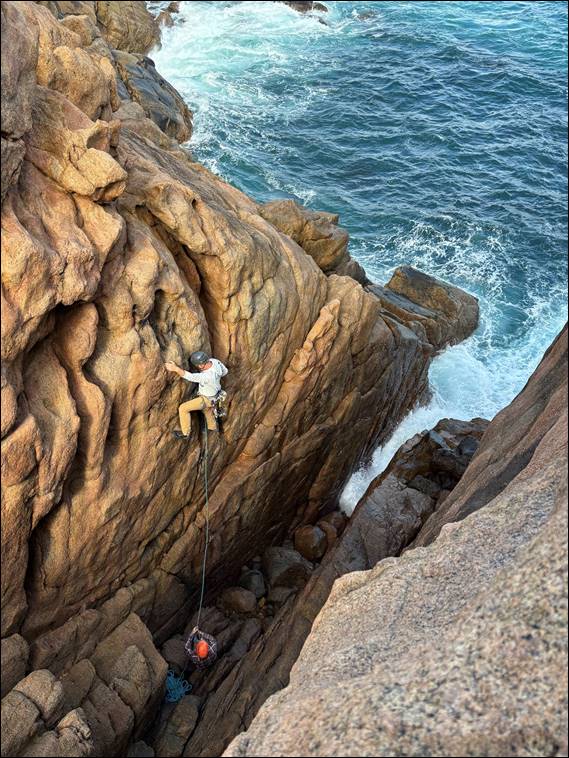
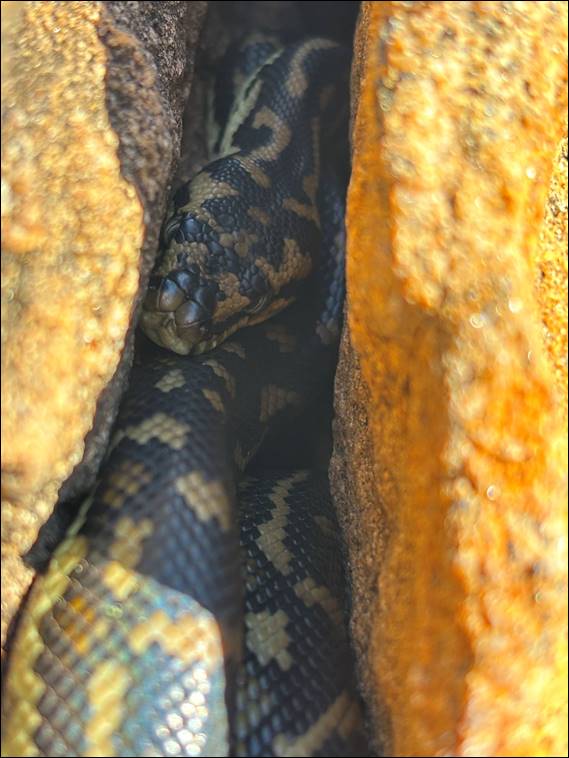
I guess if this technique was good enough for Ron, then its good enough for Howsie.  After resting up he stormed up the line.  Then despite his nerves tingling, bagging the above route in one push.  The one he’s previously backed off and never completed.  The last line had to be the obvious one to climb out on with packs.  Having an added bonus of a baby Carpet Python buried deep in the flake on high.  Not purposely watching the clock, we somehow packed up, got back to the car, and arrived at Capel pretty well bang on our pre-planned timeline:

Following my footsteps

It may be dead but I couldn’t resist including an image of this Hairy Stone Crab (Lomis hirta), mainly because it is the first time I have found one.  While the name includes the word crab, it only has three pairs of legs in addition to the claws.  This means it is not a true crab and is a carcinisation, or non-crab crustaceans that has evolved over time to form a crab-like body.  They only grow to about an inch wide so this one may have died of old age.  We spotted it as we rock hopped along the coast to the Playground, and were equally fascinated by it:

We being Craig, a different Craig to the usual one, and myself.  Mikie had introduced Craig to the group a little while back.  When I posted that I was up for a cruisy Saturday morning out, he jumped at the chance to join me.  An easy trip was on order after I went to see a sports medical practitioner last week.  The good news being that I was advised not to stop all activities, the bad news was that I have added tennis elbow to my golfers elbow alignments.  I had to have a giggle when the practitioner asked if I was a professional climber:

Unlike the Hairy Stone Crab I did not pretend to be something I am not and was pretty clear that I was not a professional climber.  Despite this, after quizzing me about how much I climb he wasn’t so convinced.  Now all I can do is wait on an x-ray and ultrasound to see just how much damage I’ve done.  And like the Hairy Stone Crab, age is not on my side.  At least not in relation to the time it will take to heal.  Back to today and Craig didn’t know me from a bar of soap, but was willing to put his trust in me when I said I would teach him trad climbing:

The Playground was the perfect place.  Short low grade lines that suited both my need to take it easy, and his need to be on something easy.  Allowing him to focus more on learning how to place gear and practising good rope work.  We had just had a glorious end to the week, only to be greeted to the ‘slight’ chance of a shower this morning.  Craig made no mention of this as we walked in, having picked up from the chat on our group that I wasn’t adverse to being out in damp conditions.  He also found out on the walk in that I liked a bit of adventure:

I took us along the slippery boulders on the coast.  At times needing to wait for a set of waves to calm down before making our way across the wetter sections.  I was the one to fall foul of this folly, being hit by the spray of a wave and getting soaked from head to toe.  All I could think was how pleased I was that I had bought a waterproof case for my phone.  Craig followed where I went and we eventually reached The Playground.  I started to download knowledge before Craig racked up and tied in, and it looked like we may have been in luck:

We even managed to get a line in, before the rain hit.  Most times along this coast we get a short sharp shower and can sit it out.  Then, being so compact and with no porosity, the gneiss will dry out quickly.  The ‘slight’ chance of a shower was however a ‘bit’ misleading.  It rained, rained, and rained for the next two climbs.  Even then when we thought we had got through to the other side, it came back.  Craig climbed on unperturbed, taking lead after lead.  Water was running down the rock and we were both soaked to the skin.  And still we continued:

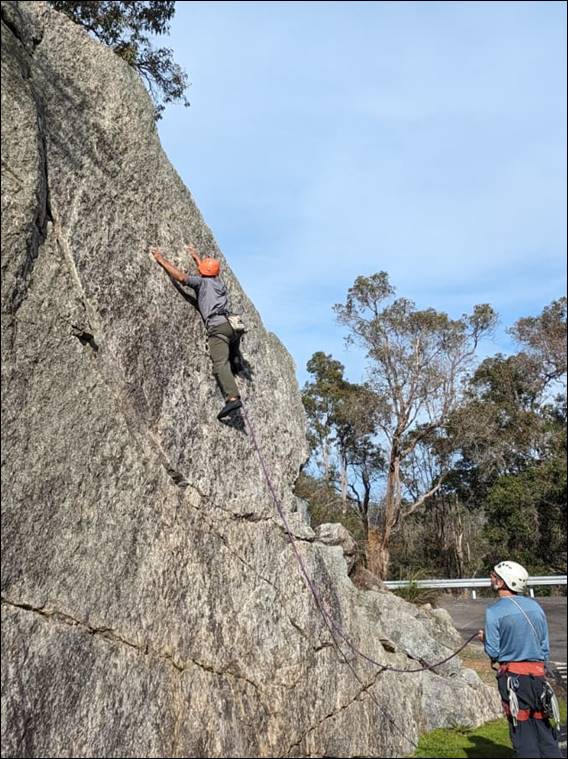
With each climb I checked the gear, his belay set up and anchors, and we talked through various elements.  It was a rare thing for him to put a foot wrong, which was pretty impressive considering it was his first time of leading, first time of using trad, and even more so the conditions that we were out in.  That did however finally change and the sun won out, which was very welcome indeed.  Working our way from right to left the wall got steeper with each climb, and it was the fifth route below that was Craig’s undoing:

Taking his first lead fall on trad, and then taking several more at the same spot before admitting defeat and sending me up to finish the job off.  We had a bit of a chat about grading, both for lead climbing and bouldering.  At this place a few of my solos have been significantly upgraded, which I am still not convinced about.  However, that aside he will be happy to know that the climb that had pumped him out so much is suggested, on The Crag, to be a V2 boulder problem.  Not put off we kept moving left, below:

Another climb that made him work hard, but with perseverance he managed a clean ascent.  There was no testing the gear this time, and again I was not able to fault what Craig had put in.  He did however make the route that bit harder for himself, as a result of starting to tire and not thinking about technique as much as he could.  I though he was going to be keen to bail and call it a day, but instead said he had one more lead in him.  This time the climbing eased up, and it was a pleasant line with the sun on our back.  A nice way to wrap up the session:

There was of course the walk back to contend with, and I did wonder if Craig would once more blindly follow my footsteps back along the coast.  He did.  Admittedly the sun had dried up most of the boulders nicely, although there were a couple of sections for which we had to be careful with our timing.  It was Craig that fell foul on the return trip, but not to the same degree.  Trusting in mounds of seaweed he lost a leg thigh deep, fortunately out of harm’s way as the waves crashed behind him.  I get the feeling Craig will be keen to get out again:

The three Fs

The Peppy Plungers only dared to go into the water waist deep this morning.  It was a tad wavy, and the less than ideal weather continued into the morning.  On her return Lisa and I pottered about and finally got round to breakfast as we played a game.  When she then hinted it was time to hit the books to prepare for next week’s study load, it was the perfect segue for me to head out the door.  Armed with a brew in my sippy mug, and not put off by the patchy rain nor the rainbow that hung low in the sky over the Capel Nature Reserve:

The wet weather of late had started to bring out some familiar fungi.  The above being an edible Southern Oyster Mushroom (Pleurotus ostreatus), if my identification is correct.  As I just had breakfasts I felt no need to test that.  This species crosses over two of the three main types of fungi, being both a decomposer and a weak pathogenic.  Due to being found on both dead and live wood, but more generally the former as it was today.  Decomposers are an essential part of the forests ecosystem, breaking down dead organic matter to make it more bioavailable:

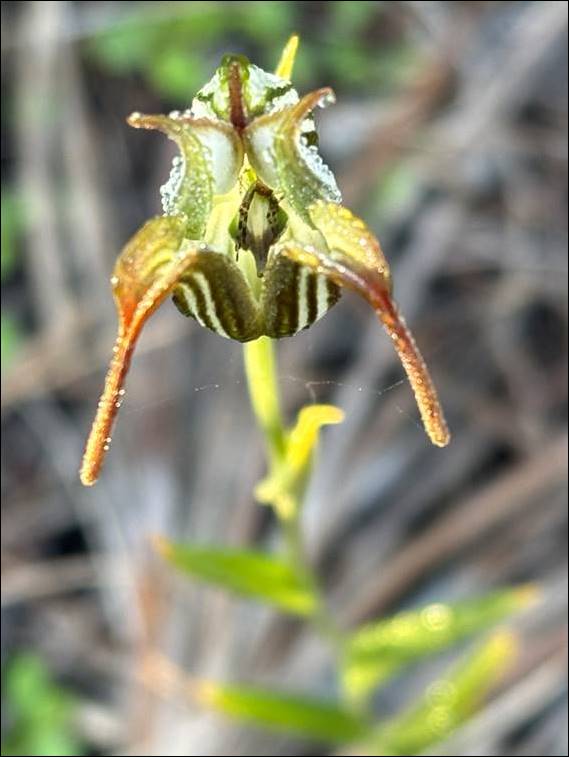
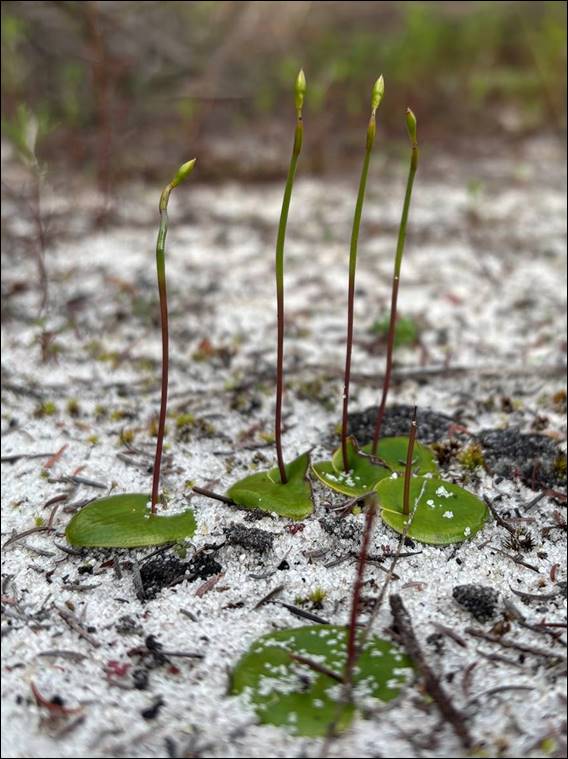
Needless to say pathogenic, or disease, fungi have a negative impact by invading and often killing their hosts.  This can be trees, insects, and/or other organisms.  As for the third main type of fungi, I’ll get to that later.  A few weeks back I thought the first orchid spike I saw, as shown in the second image of this post https://sandbagged.blog/2025/04/12/the-tortoise-and-the-hare/, was a Hare Orchid.  Much to my surprise and delight it was in fact the above Leafless Orchid (Praecoxanthus aphyllus). Only the second one of these that I have seen:

There were many Hare Orchids (Leporella fimbriata) in flower today.  Lots in full colour, not just sporting the beard that gives this orchid its species name of fimbriata, a Latin word meaning fringed, but also having the delicate spotted pattern on the side of the broad labellum on proud display.  During recent wanders its amazed me how rare it is to find any insects, so I was happy to come across this one.  Even when, after a lot of digging about, it turned out to be nothing more than a Common Gum Tree Shield Bug (Poecilometis patruelis):

There are many genera and species of Shield Bugs that like to live on gum trees, and they share many similarities.  The way to tell them apart, like some orchid species, is the detail.  This can be the wing numbers and arrangements, segments of antennae, and placement of mouth parts.  This one was a bit trickier, being in the nymph stage.  From the time of hatching they go through up to five nymph or instar stages, each time moulting their exoskeleton.  Not getting their wings until they become adults, and I’d suggest this one is at the 5th instar stage:

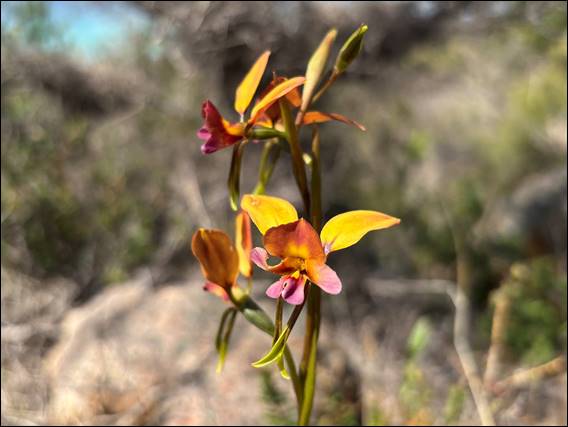
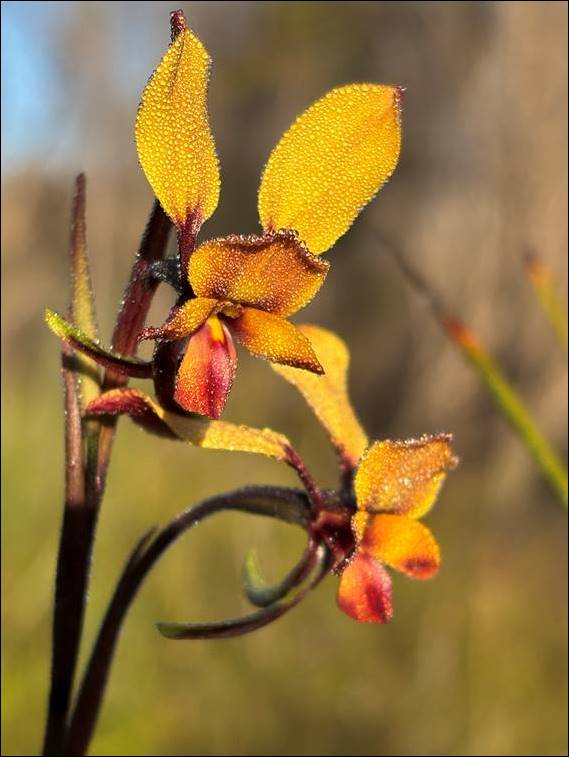
After a while I followed a track toward an area I’ve not been before, marvelling at the patches of little basal leaves that I recognised as Hare Orchids.  And then I noticed the ones shown below, which are from the Glossy-Leaved Hammer Orchid (Drakaea elastica).  Just a few weeks back I discovered that they are located in the general area, but I’ve never seen them.  With only 42 known places in which they are found and a total population size of around 230 plants across these areas, they are listed as “endangered” by the state and federal government:

This listing means the probability of extinction of the species in the wild has been assessed to be greater 20% within in 20 years or within 5 generations of the species, whichever is longer.  Hence why I was so delighted with my find of ten plants, and I went so far as to mark a pin of the location.  I will however have to wait till September or October to see if any of them flower.  Next up is a fungi belonging to the third main type, a mycorrhizal or symbiotic fungi.  Without these many plants and animals would struggle to thrive, so they too are essential:

This one is an Erupting Russula (Russula erumpens), bursting into the light from under the earth.  Fungi in this type can act like a secondary root system, extracting nutrients from the soil and supplying them to plants, including orchids.  In fact many orchids are highly reliant on specific fungi, just like they are on specific insects to pollinate them, another area of their fascinating life I have yet to delve into.  In the world of conservation and management we often refer to flora and fauna, many feel it is time to change that to the three Fs of flora, fauna, and fungi:

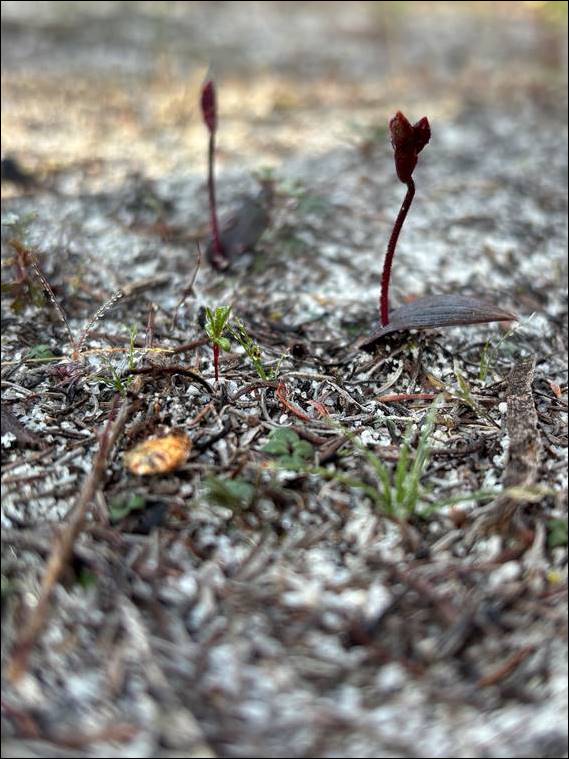
Deep into my second hour or walking, and to be honest I had no idea I’d been wandering about that long, I almost missed a second Leafless Orchid.  Not that they are easy to spot, it’s there in the above image if you can see it near the base of the picture.  This one was more mature, with petals that had a bit more colour in them.  These orchids are highly fragrant, to help them attract native bees for pollination.  The purple labellum has yellow calli to resemble pollen-bearing stamens, but there is no nectar so any bees attracted by the scent get no reward for their services:

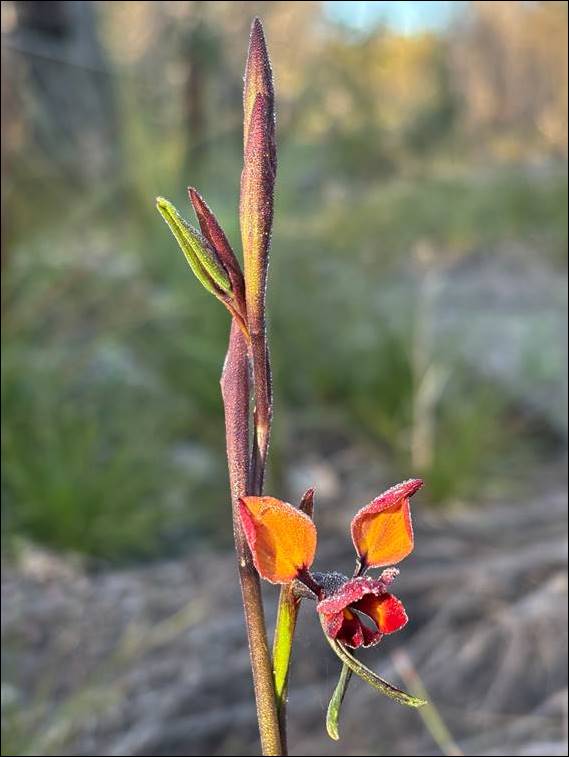
For my last image, I found one Scented Autumn Leek Orchid (Prasophyllum sp. ‘early’) starting to bud.  These flower in autumn, April to May, and should not be confused with the similar looking and incorrectly named Autumn Leek Orchid (Prasophyllum parvifolium).  Incorrect because it does not flower until winter arrives.  In the background was one of the many Common Bunny Orchids (Riochilus dilatatus subsp. Multiflorus), showing why it is named so.  The most number of flowers I saw on a single plant was six, a far cry from the twenty flowers one plant can have:

The Good, the Bad, and the Ugly

Back in the era when cassette tapes were all the rage, I had an album titled Greatest Western Themes.  It got a good workout.  There’s something about the music from the older westerns that I kinda like.  One composer stood out on this album, Ennio Morricone.  In addition to his previous achievements, once he moved into composing scores for cinema he clocked up some 400.  It was however his western themes that saw him rise to international stardom.  One still regarded as ‘one of the most recognizable and influential soundtracks in history’:

The title of this particular film is apt in some ways for today’s adventure.  It all began on a dark morning, when the unmistakable sound of drops hitting the veranda roof made the very clear statement that the weather had arrived early.  The room lit up when I turned my phone on to check the radar.  It hinted it was moving south east and hadn’t made it to where we were going.  The radar like the forecast, when checked yesterday, was full of misinformation.  The wipers stayed on for most of the journey into Bunbury and from there up the hill:

You may well be asking why we would be going to Welly Dam, after all my posts about how tough this place can be.  And you would be doubly right to question my reasoning based on my confessions about the injuries I am managing.  However, the weather system was forecast to hit the capes coming in from the west.  So we decided the inland option was better, and if it had been dry here it would have been fine.  It was not.  We were not rained out but the lichen covered sections had turned all spongy from soaking up the moisture:

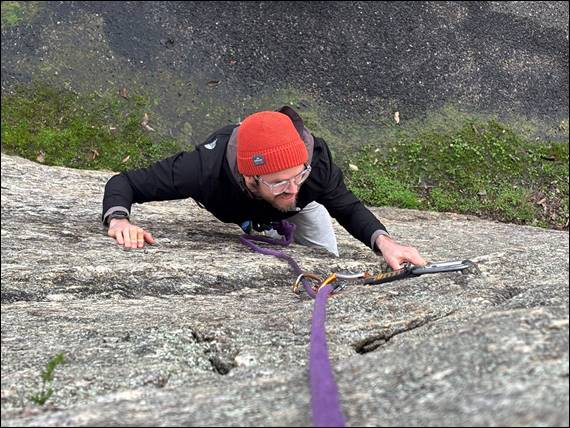
Even the bare granite was moist to touch.  This meant the friction was nothing less than pants.  As a result we crimped, pulled, and generally held onto each hold much harder than we normally do.  Not the best for my elbows in the state they are, and on the third line my left one protested with a solid twinge.  It was time to come back down, and let Howsie lead that one.  Rightly or wrongly I went back up with the rope above me, being very careful of the angle I loaded the arms as I went.  It was definitely time to break out the kettle and biscuits:

The tea kit was loaded into the car yesterday, with biscuits added as an extra bonus.  Being something we do not often have in our house.  There were no illusions it would feel tough today, even if it was dry.  We haven’t been coming often enough to be ready for what this place, like no other in the South West, does to your body.  And today, more than most times, the brew was very welcome as we watched the Australian Ringnecks (Barnardius zonarius) get closer and closer.  Invading our space so much I thought they may eat out of my hand:

The parrot in the image became camera shy and froze, despite my hand being right under its beak with tasty morsels on offer.  And then flew off with its mates as my fingers brushed its feathers.  With the entertainment having flown off, it was back to the rock.  Where I let Howsie take all the leads.  Pleased that he was keen to take on the slippy holds and risk the falls.  With the safety of the rope above me, my brain wasn’t making me hold on quite as tight as they would with on lead.  For the penultimate climb Howsie popped his head over the top:

Just to have a look.  He called down that he could see what looked like Bunny Orchids.  This resulted in me steering him towards a route, for the last climb, that would see us top out and have to walk down.  He seemed keen, and with the somewhat painful climbing behind us the focus was now on dainty little flowers.  Using the information I recently read up on, I got all excited.  As can be seen above we found a bunch of them with small crinkly leaves.  Added to that it looked like the petals were hugging the column, so they could be one of two types:

I’ve not seen either before, so whichever it was I would have been happy.  Back home after much checking out of the details we captured on film, looking at my books, and researching several online guides and databases, I am pretty sure these were Crinkle-Leafed Bunny Orchids (Eriochilus dilatatus subsp. undulatus).  Even better we found one plant that was a lutea form, striped of the usual colours and only displaying pale hues.  While I won’t say what falls under each, you could say that today we sampled The Good, the Bad, and the Ugly:

Fore!

I’ve again found myself fall foul of my own enthusiasm.  Pushing things that bit too far, such that my body is giving me warning signs to ease up.  The niggles of golfers elbow developing in both arms.  More than likely as a result of the weights session rather than the climbing, but to be safe I’m putting the brakes on most forms of exercise.  Hence the golfing title of fore, which has made me dig into where this term originates.  It seems it is a debated phrase, and may in fact come from an artillery term as opposed to a pure golfing term:

Either way it has been described as a phrase to warn people in front of what is happening, which may sound strange in terms of being an artillery term.  And maybe for this reason the modern historians feel this use cannot be proven or is unlikely.  It is also unlikely, that despite the threat of injuries that I will stop climbing.  Ease up yes, but to not get out at all is not in my nature unless I’m completely physically incapacitated.  And where better to go when you want a low grade fun day out, but Moses Rocks:

Josh was keen and it so happens our last trip out was here, but he didn’t mind that.  It wasn’t an early start by any means, and in front of us there was another party of four climbers.  In the near two decades of climbing here this has been unheard of.  I’ve met people hear by arrangement, and seen signs of other climbers having been about, but have never seen anyone else climb while I’ve been here.  As we passed them at the norther end, we had a quick meet and greet and then left them to it, as we continued to Hands Up Wall:

Today was going to be a busy day at the crag, so Josh and I went ahead of Howsie’s crew to get a couple of lines in before they turned up.  This included a warm up on a pretty wet crack on the main wall, before I suggested that we could try the above route.  A line that I doubt anyone else has ever climbed since I put it up.  The conditions were perfect for it today.  Boiling white water below, crashing sound bouncing off the walls, and the occasional larger waves to encourage you to not dilly-dally at the base for too long:

I might add that when I led it Josh was belaying high and dry, as I climbed down a corner as far as I dared before stepping right to start heading back up the middle of the wall.  As he followed me up loving the experience and really enjoying the climbing to, the Howsie mob turned up.  Howsie, Nadia, Fergus, Frank, as well as Marnie who I haven’t caught up with for years.  I didn’t realise it but this was Howsie birthday outing, although to start with he didn’t cram too much climbing in.  Instead being belayed by, and then belaying Fergus:

I ran up a few of the easier lines with Josh and Marnie in tow, as Howsie kept the boys going.  Fergus was more keen to climb than Frank, but they both had a go.  Frank was soon climbed out, which didn’t take too long and he sat with Nadia.  Out came the sketch books, and I was a bit remiss when I didn’t get to have a peak at their artistry of the walls and us climbing them.  Eventually Fergus had also had his fill but not before taking on a tricky corner, especially for someone of his size.  Howsie was not surprisingly still keen to climb:

So with people pottering about exploring, drawing, and taking photos I threw the rope down.  It conveniently hung down in a place where Howsie could play on two lines.  It was a case of warming his fingers up before me moved to a smaller wall, which I knew he was keen to get to.  The route below was not the one I had climbed, keeping my sensible head on I had tackled the easier crack to its left.  But with climbing easy is a relative term, last time Josh really struggled on it this time however he made much better work of it:

It was however not Marnie’s style.  She got up it but it took a fair amount of effort.  Being encouraged from below by the entourage.  To wrap up the morning we headed to Red Wall, a short crag with a couple of punchy lines.  I headed up the easier crack, which this time did not prove easy for Josh who had a real battle.  Howsie played on a line to our left, one he’s been keen to try for some time.  It wasn’t the best conditions, the was rock glistening, but he managed all the moves and is now looking forward to our next trip here when he hopes to bag it:

Taking a bow

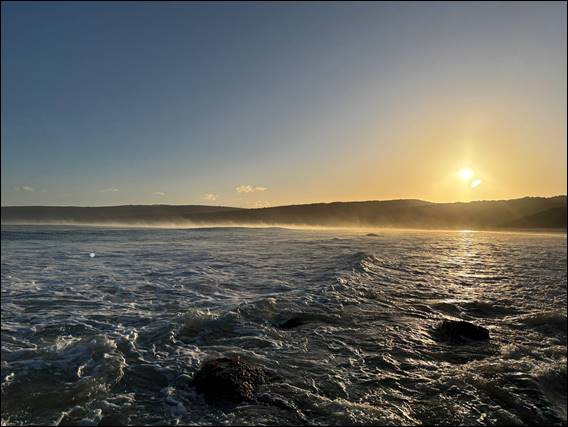
The sun is rising later and once up staying lower in the sky.  The swell is also looking that bit bigger and as a result the beach is transitioning towards wintery conditions.  The writing was on the wall and the snorkel gear was packed away last weekend.  It has been a pretty disappointing season for swimming with the fish.  But when you get to see the sky as it was when Lisa and I took the poodles down the beach on Wednesday night all that was forgiven and forgotten.  It is still a glorious place to be even if the underwater visibility was pants:

I’ve now shifted my gaze to terrestrial treasures.  Having had several wanders at the Manea Park and the Cape Nature Reserve.  My first trip to Manea Park, conveniently on the way home from work, didn’t yield any flowering orchids.  But I did enjoy watching the bees bury themselves deep into flowers of this Swamp Banksia (Banksia littoralis).  A species endemic to the south-west of Western Australia, which I’ve read may be a bit more resistant to dieback than other western banksias.  A good thing considering the impact the disease is having:

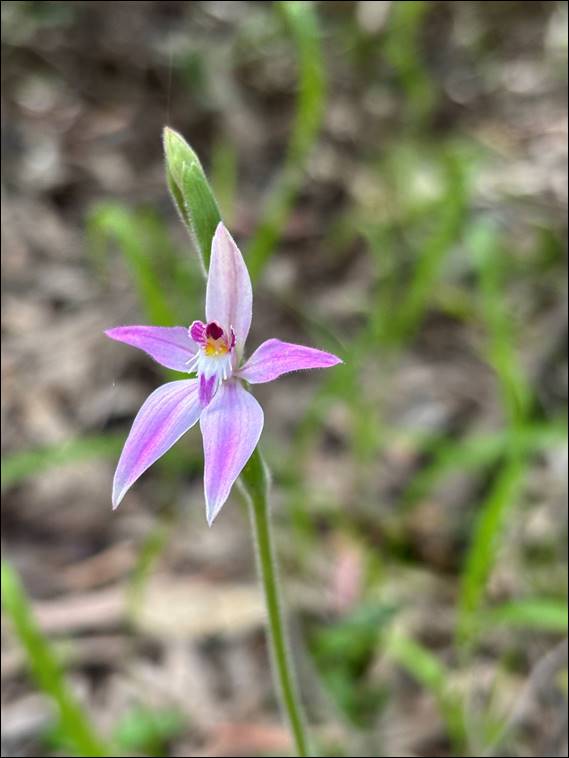
Manea Park is well known for its biodiversity and boasts quite a range of banksia species.  While the above Swamp Banksia was in bloom many others were not.  The various species flower anywhere from late summer through to winter, with some species flowering as late as spring.  Another plant out in flower, this time of the Orchidaceae or orchid family, was the Common Bunny Orchid (Eriochilus dilatatus subsp. multiflorus).  On my first walk I only found one spike with no flowers, but during the next wander I found a couple of plants flowering:

There are six species of white bunny orchids, including six subspecies.  Each having flowers that look very similar, and the best way to distinguish them are by the stems and leaves.  To date I’ve only found two of the subspecies.  Then there are the pink species, and I have never seen any of them.  The pinks generally only flower after a hot summer fire, so tend to be more difficult to track down.  For my next adventure I decided to try a bit of night time herping.  On advice from Sarah I headed out all hopeful at 8pm to the Capel Nature Reserve:

I spent in excess of an hour, wandering round checking the leaf litter, trunks (live and fallen), and foliage.  Wondering what insects and/or reptiles may come out at night for a feed.  The answer, at least from my observations, was none.  Not even a possum, kangaroo, nor wallaby could be heard or seen.  In fact it was deafeningly quiet, as I slowly walked round keeping an eye on where the beam of my torch landed.  The only find being a solitary Common Bunny Orchid, whose subspecies name comes from a Latin word that is apt and should be obvious:

The common name of common is also apt.  Today when Lisa I wandered round the Ambergate Reserve we spotted a good number of them.  I won’t lie and got a little excited when I thought the leaf of a few specimens indicated I’d found a different subspecies, but that was never the case.  As it warmed up we caught the movement of commonly seen Buchanan’s Snake-eyed Skinks (Cryptoblepharus buchananii), scurrying off the path and through the leaf litter.  They hunt small insects and are very agile, even being able to leap into the air to catch flies:

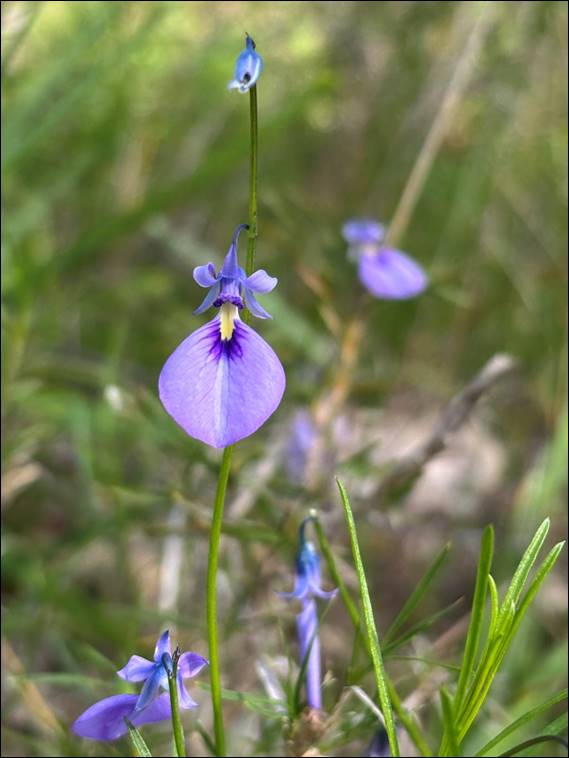
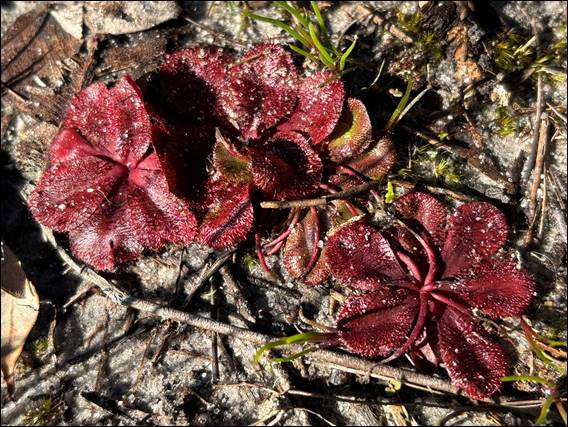
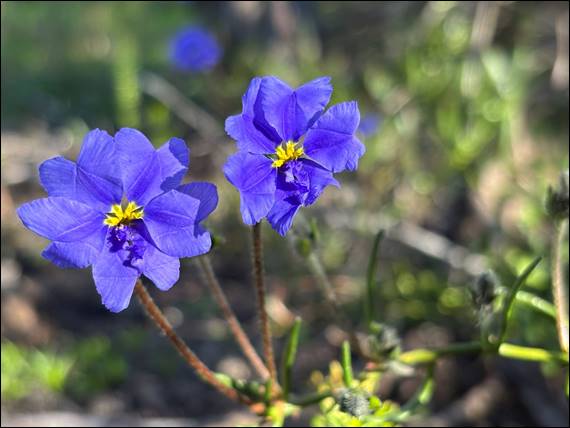
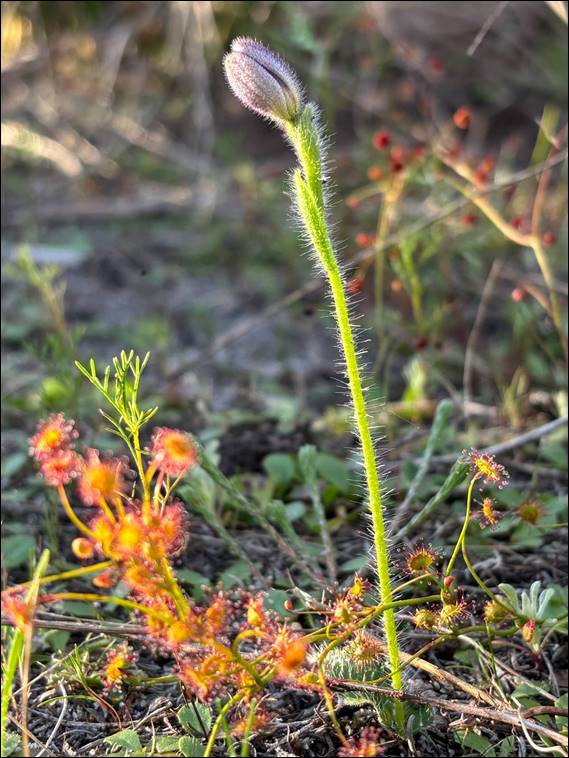
The above one is carrying a snail, and once happy we were not going to intervene or come any closer it allowed us to observe it nibbling away.  We sadly didn’t spot any bigger reptiles, but this flower caught my attention.  Looking to be sprouting straight out of a tuber.  It was not till I got home that I spotted the leaves of a sundew round the base.  Not yet fully matured, and as such not creating the distinctive rosette of sticky leaves of this carnivorous Drosera rosulata.  Yet another plant that is endemic to southwest Western Australia:

The next find is however not endemic, being introduced.  Although I have no idea of when or whether by accident or on purpose.  Native to North and South America the Banded Orb Weaving or Banded Garden Spider (Argiope trifasciata) has successfully spread round much of the globe.  I’ve seen one before, so if you want to see the distinctive pattern of the top of the spider check this post https://sandbagged.blog/2022/04/07/the-beach-shack/.  I liked this image that shows the zig-zag pattern of the stabilimenta, i.e. web decoration:

The feature is not made of the same silk that the web is constructed, and isn’t even sticky.  Its purpose is not clear.  Some say it could be used to attract prey while others think it may provide a degree of camouflage, although I don’t see that.  We also spied quite a few Australian Golden Orb-Weaving Spiders (Nephila edulis), and the path had a fair few of these much bigger webs spanning across the track.  Not keen to walk into them, Lisa kept a careful eye out to try and avoid disturbing them.  On occasion taking a bow, as we crept under them:

Shades of grades

Sixes were in the air.  The 6th moon phase was on display with a 66% waning gibbous moon.  Lighting the path as Mario and I aimed for a first light start at Cosy Corner, at 6am.  Driving out yesterday the moon was hidden behind a blanket of clouds.  Today it look very different.  Maybe for that reason the kangaroos and wallabies were way more lively.  It felt like they were firing warning shots across the front of the bonnet.  Within 500m three hopped from behind the trees and undergrowth into my path.  I drove out slowly, watching carefully:

Down with the family for the long weekend, Mario was keen to sneak a climb in.  This meant I had a good hour and quarter by myself in the car on the drive down to Conto Campsite, where they were staying.  Not quite sure what to listen to I let Spotify pick a mix based on Watershed.  The South African, as opposed to the American band.  Turning out to be an aptly named band when Mario told me that it had rained fairly consistently during Friday.  Half an inch may not seem like much, but the cliff tops are the perfect watershed for the cliffs:

The term watershed can mean an area that collects and directs water to a specific point, or can describe something that results in a notable change.  The South African band used it to symbolises the positive change made when they formed the band, while the American band used it to honour the Newark Watershed feeding Pequannock River.  The rivers name comes from a Lenape word meaning ‘cleared land ready or being readied for cultivation’.  So for the Delaware Indians, it relates to the second meaning of the word but not in a good way:

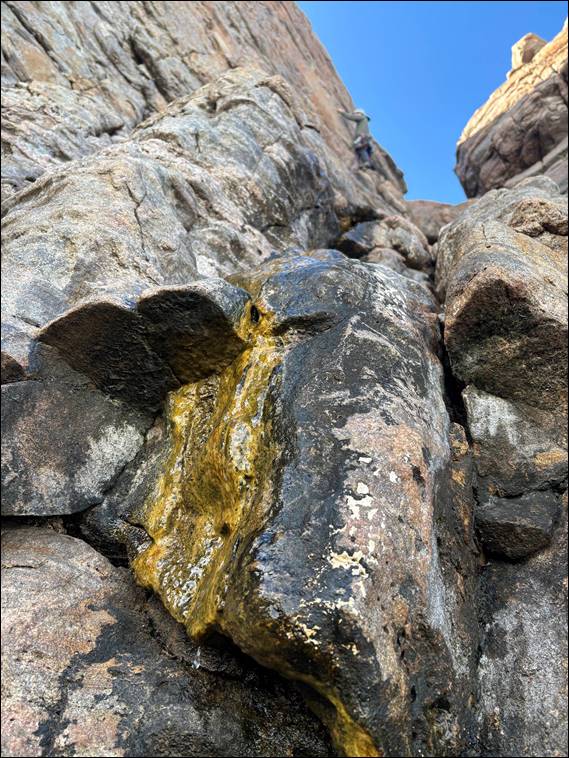
Now back to Cosy Corner, where the even-grained granitic gneiss had channelled Friday’s rainfall to the low points along the cliff face.  Water was still dripping down some of the cracks, and oozing from under flakes.  The limestone and flowstone looked particular uninviting, and having soaked up moisture some of the black streaks glistened.  But where the granitic gneiss lay bare, other than for the red lichen that makes the rocks glow a wonderful colour in the early morning and late evening light, the rock was dry and the friction was on point:

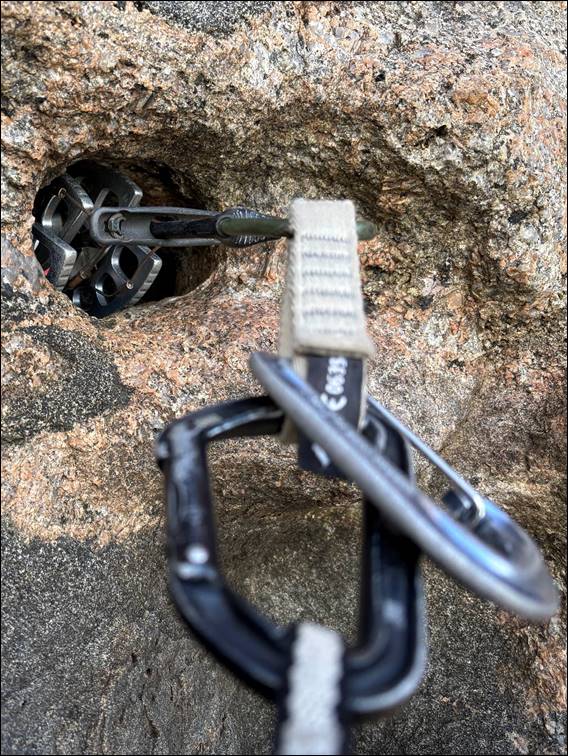
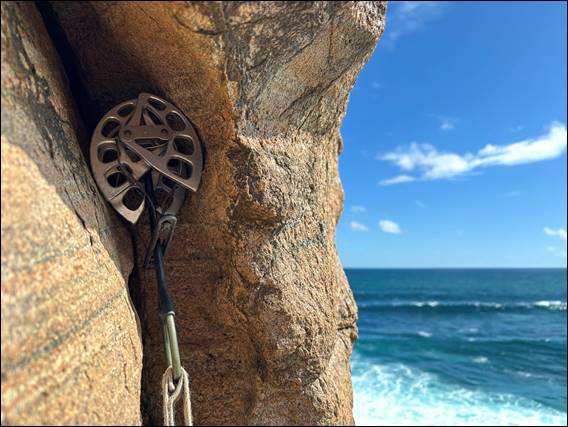
The place is not to be confused with the Bay of Fires in Tasmania, which displays a similar landscape with red lichen covered Devonian granite.  Mario was however on fire, armed with his above trademark No.4 Camelot.  Without verbalising it I offered to be his belaying tour guide, seeing it was only his second visit here.  Pointing him towards the lines he hadn’t been on before.  Keeping in with the theme of six, we jumped on a couple of routes in the guide and the four routes Howsie have put up here that are not in the guide:

Sorry to say Rongy your and my lines from our last trip here were looking very unpleasant.  They will have to wait until the next trip here for their second ascent.  We didn’t hit anything too serious grade wise.  Not that worried Mario who enjoyed the routes finding they all provided interesting and worthy climbing.  With sufficient gear, most of the time.  The two stand outs were those in the above and below images of Mario on lead, which should make Howsie happy.  They also happened to be the two climbs with a disconcerting, but not too silly, runout:

But as for grades, this crag is probably the place where I reckon they really are all over the shop.  And just based on today that could be said for old and new routes alike, with some over and some under graded.  Not that I was able to subjectively add to this discussion today.  I felt like I was climbing like a cabbage.  There are plenty of excuses I could put out there such as being weary from yesterday, getting used to my new shoes, having had two early starts on the trot, or just feeling my age.  All I can say is I am glad Mario was happy to bag all the leads:

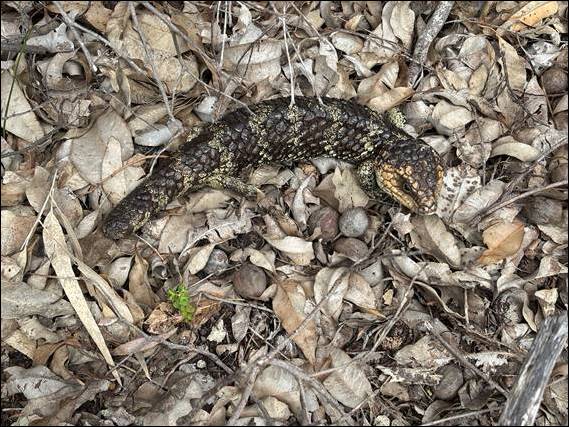
It was finally time to call it, but not before checking out Wave Wall.  Despite hinting a day or two back there was a climb he was keen to play on in this amphitheatre, Mario conceded it all looked a little too steep and pumpy for today.  I was both pleased about that, and that we had wandered in here.  In a similar theme to my climbing today, I lost my way entering the area by trying to get through some scrub. Nearly stepping on this Southwestern Carpet Python (Morelia imbricata), one of the six species of the genus Morelia found in Australia:

Walking on sunshine

The car slowly came to a standstill.  Having spotted them a long way off, the wallaby and it’s joey stood motionless in front of the car as it came to a stop.  The intense full beams made brighter by the light bar, had either blinded them or confused them to the point they became statues.  Instead of reaching for my camera to take a snap as they continued to sit there, I was content to just watch them until they lazily lopped across the road into the bush.  Thinking it is better to see them sit on the road, as opposed to when they hop out of nowhere:

Another early morning, but not too crazy a start.  It’s just as Lisa had remarked to me a few weeks back, the days are starting to wake up a little later.  I was on my way to pick Sam up, who has not touched rock for just over a year and half.  For this reason we were heading to a cruisy little crag, where he was keen to be reintroduced to placing gear and maybe have a lead.  Wilyabrup has a few such small crags, which rarely get attention.  Being Easter I also suggested here as we were likely to have the place to ourselves, while the main crag fills up:

Sam hinted that maybe I should take the first lead.  His thinking that this would allow him to ease back into it, and also enable him to check out how I set up the top belay anchors.  The latter part seemed to weigh more on his mind than jumping onto the sharp end.  I could fully understand his thoughts, after all as I climbed after him I was putting my life in his hands.  Belaying is a serious and a big responsibility.  I however had faith in his ability, even though he hadn’t put the skills into practise for a long time.  Even when he had, it was not that often:

It meant spending time refreshing his knowledge and understanding, and taking things slowly.  Including when I climbed after him so I could check each piece.  Happy to find that he had retained the basics.  All the gear slotted in was well thought out and bomb proof, even when he was not so convinced.  Interestingly his faith in the gear placements was tiered.  Wires were great, tricam pretty good, but when it came to cams not so much.  This trend indicated that as the hardware became more mechanically reliant the less trust he had in them:

I get it, my journey into trad all those decades back started the same way.  And like me, several people I have climbed with over the years, would prefer a solid bit of metal wedged into a crack.  As opposed to relying on springs and hinges to generate the friction needed to keep the gear in place.  This did not however stop Sam selecting the right gear for each placement.  As the morning wore on it felt the imbalance of faith started to even out.  Helped by leading each route, when in my usual way I kept calmly handed him the rope and gear:

This was never questioned.  He simply accepted the rope and climbed.  As I had to trust in his belay anchors when I followed, he had to trust I wasn’t going to send him up something too silly.  The route below, was his third lead.  Having watched him climb and place gear I thought he’d be OK with it.  Not that any encouragement was needed, the corner and sweeping arched rooflet piqued his interest as soon as I pointed to it.  He did however tell me afterwards that it had certainly put him out there, and he had felt pretty exposed:

A position that conjured up mixed emotions of exhilaration while being nerve wrecking.  The only thing to do in those situation being to slow down, breathe, and make purposeful and controlled decisions.  Sam’s words not mine!  I did however think getting him to lead the next route may have been a stretch too far.  The line has a couple of decent runout sections, and a ground fall potential from quite high up.  Again Sam’s words.  Having said that to me after he had observed me on the sharp end and followed up, grateful to have the rope above him:

Four seemed a good time for a brew, seeing Sam had packed a flask.  Coinciding nicely with the typical “time for tea” time of 3:30 to 5:00pm.  A British tradition that started at the end of the 19th century when a close friend of Queen Victoria had a sinking feeling late in the afternoon.  Needing something between lunch and dinner to replenish her energy levels.  With our energy levels topped up there was time to squeeze a couple more lines in, one lead each.  After completing his lead Sam looked over and spied the first reptile of the day:

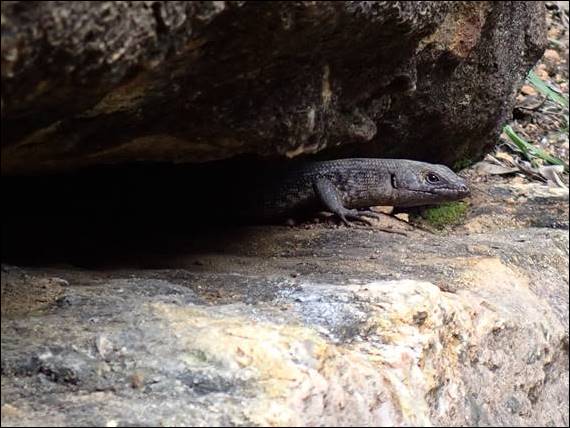
I’d been scouring all the cracks and crevices without success.  This made the sight of the King’s Skink (Egernia kingii) soaking up the sun feel like a privilege.  Chilling out on a steep slab.  Scampering for cover if we made any sudden movements, before coming back out.  Making our roped climbing efforts today seem trivial in comparison.  We were not however out for egos and high grades, just having fun.  Ending the session in exactly that way, with a first ascent up another one of the fine easy angled walls to create Sunny Sidewalk:

Sunny Sidewalk (15m, 12), start-up Sunny Arête until you have the confidence to step left onto next pillar just above the undercut flakes to take the sidewalk up the pleasant slab (Seewraj, Avery 2025).

The tortoise and the hare

Third time lucky, or at least I was hoping, as I found myself again wandering through the Capel Nature Reserve.  Mind you I can’t say if I would have been too upset if there were no orchids out.  Just wandering through the bush is reward enough.  At times it surprises me how little can be seen on some of my visits.  Making me wonder if I should have a wander one evening, to see what comes out at night.  With a full moon tonight it would have been nice to be out, but it didn’t happen this time.  If I had I may not have seen this little grasshopper nymph:

As they head up to feast on green leaves at night.  It could be either a Gumleaf Grasshopper (Goniaea australasiae) or Slender Gumleaf Grasshopper (Goniaea vocans).  The nymph and adult of each species being similar, but my gut tells me it was the latter.  Resting during the day in the grasses, allowed me to see it when it try to avoid me.  Close to this nymph I also spotted an adult.  While I took a bunch of images, in my haste I didn’t keep any as it looked like any old grasshopper.  If I had I may have been able to more definitively identified it:

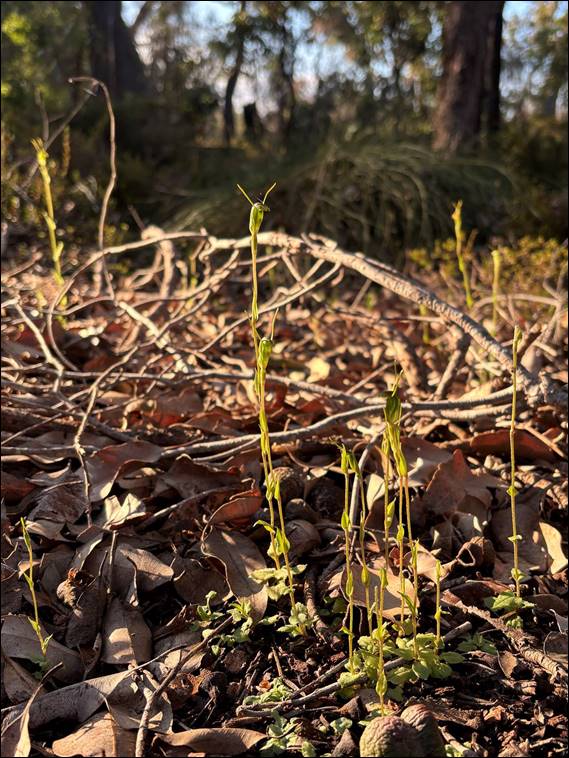
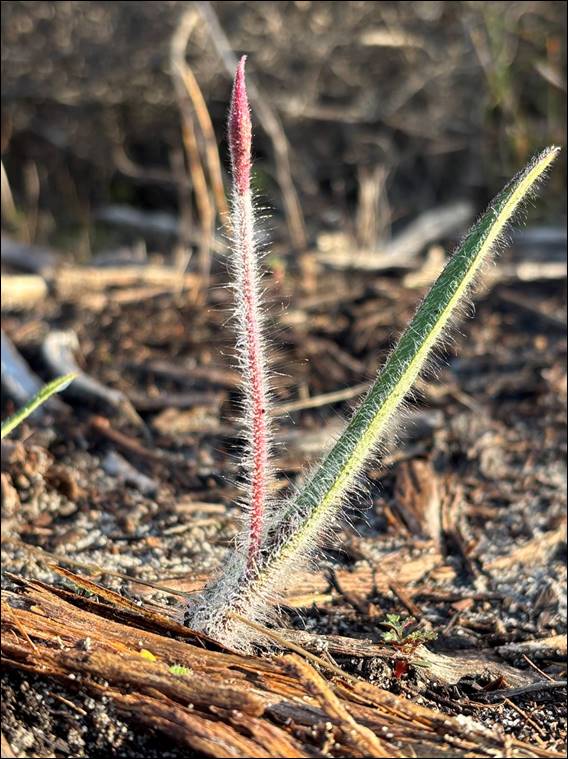
Haste cannot be used to describe how I wandered round the bush, I most definitely go slow.  Careful footfalls to avoid stepping on something, pleasant or unpleasant.  Not quite snail, but maybe tortoise paced.  If I went any faster I would not have seen the above solitary spike.  With no basal leaf visible it could be one of several species of orchid, getting ready to flower.  The below shrub was easier to identify, having already started to flower.  One of 150 plus species of Beard-Heaths (Leucopogon), the majority being found in Western Australia:

I’ve gone a step further, and pinned it down to Leucopogon glabellus a species endemic to the South West of Western Australia.  The description of flower says inside the five petals there is a beard of white hairs.  The petals fuse into a tube, with the tips rolled back.  This facial hair is common in the genus, and Leucopogon comes from two ancient Greek words meaning “white” and “beard”.  The genus name reminds me of the mischievous leprechaun, and Irish folklore creature said to reveal the location of hidden treasure when captured:

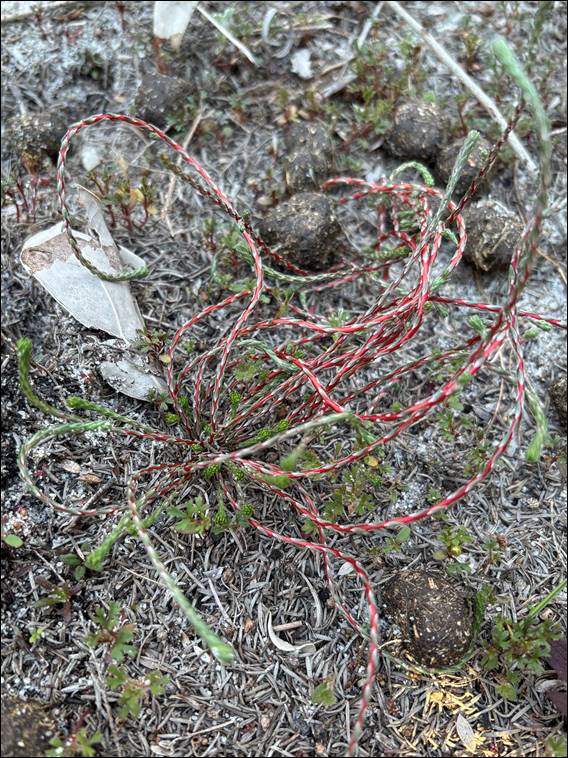
While it did not lead me to a flowering orchid.  It felt luck was on my side when I soon after stumbled across a small clump of the same spike I saw before.  This time showing the basal leaf, so at least I now knew what I was looking for now as I kept my slow pace.  A pace that after an hour in hadn’t seen me go very far.  More basal leaves came into view.  Curling out of the ground with no stem visible, so again could be any number of species.  I wonder if they take this shape to more effectively collect water from rainfall and/or dew to aid their growth:

My pace soon slowed to the point I sat down, to watch the legs of a Leaf Curling Spider (Phonognatha graeffei) as they awaited for the vibrations of their prey.  At times it came out a bit more, but never fully.  The ingenious house, built by the female, is usually silked shut at the top with the opening pointing down.  This one may not look fully enclosed at the top, but was still a marvel to behold when you took in the intricacy of its work.  It seems like a lot of effort for just a single year of life, especially seeing the female makes a second as a nursery:

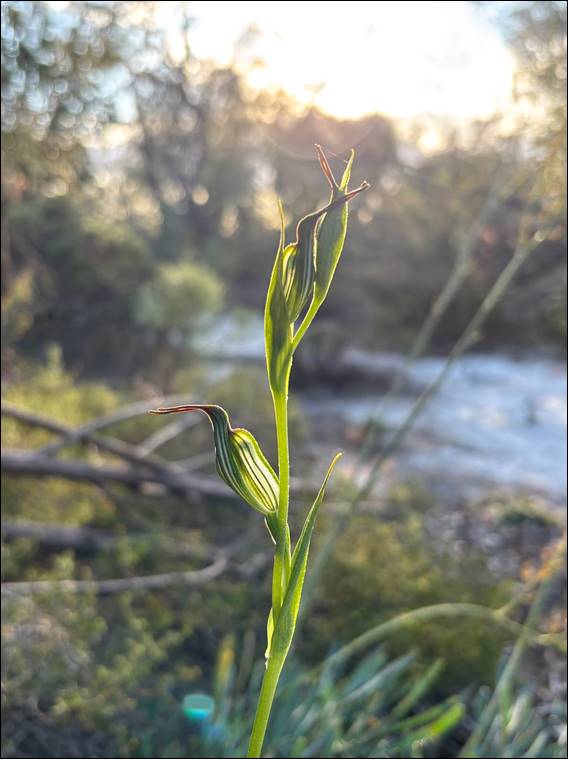
Ninety minutes in and with the finish line in sight, and this tortoise finally got to meet the hare.  Or more precisely little hare, as the genus is derived from the Latin word lepus with the diminutive suffix of ella.  Only one bud was in flower.  Not fully formed and the labellum did not yet have its fringe on display, which is where the species name comes from.  There is however only one species in this genus, being the Hare Orchid (Leporella fimbriata).  It is one of the first orchids to come into flower as the year rolls in, and if pollination does not occur it can be found in flower right through to September: