Tipping the scales

With an extra day in hand to get into nature this working week, and considering I have not touched rock once in September, you may be surprised to hear that I opted not to climb today.  I could be pleased with myself for showing restrain in not going too hard, to avoid the risk of aggravating the stupid self-inflicted injuries sustained this year.  I may not have touched rock in three weeks, for various reasons, but I have been back on my boulder wall.  Pulling on those plastic holds, which is way more intense than the climbing I do on real rock:

Even then I have been sensible.  Not going too hard, even though it is so tempting to push that bit more.  The flow of climbing, for me, is intoxicating drawing me in and making me yearn for more.  Lisa will recall many an outdoor trip in the red centre where I have said ‘just one more climb’, even as the sun starts to belt down on us making things uncomfortably hot.  Just one more lap on the boulder wall is more risky, being harsher on the tendons and muscles.  So I have spaced my two sessions and also kept the pace and problem selections reasonable:

You could say I am endeavouring to tip the scale in my favour.  We shall see if my approach pays off when I finally get to head out for a climb on Sunday, with Adrian.  It has been a while since I have picked on a British idiom, and for this post ‘Tipping the Scales’ seems apt.  It can be used to indicate two things, either to fiddle things to provide you with an advantage or to relate to a deciding factor.  It is a subtle difference but comes down to whether the scales were tipped by something that was considered or included by intent or chance:

For my Friday outing I admit there was very much intent but it still wasn’t a done deal that I would be rewarded.  Heading to the Meelup Regional Park.  And knowing a few spots where good orchids may be from Lisa and my visit here last year, which was only two week later in the season.  Not thinking I would walk too far, my tote bag only had a bit of fruit, muesli bar, and small bottle of water in it.  I started walking it was clear my intended advantage may not pay off, being very different conditions with the soil in many places still completely soggy:

To be honest I wasn’t completely surprised.  I did not however expect to be hit by the on and off showers.  The cool, cloudy, and damp conditions did tip to my advantage when I came across a Quenda (Isoodon fusciventer).  Usually foraging at dawn or dusk, these small marsupials are known to be active in the day especially during winter.  Coming to a complete standstill as soon as I caught the movement out of the corner of my eye, a bit like playing statutes.  It watched me, then decided it was safe to scamper in front of me across the path:

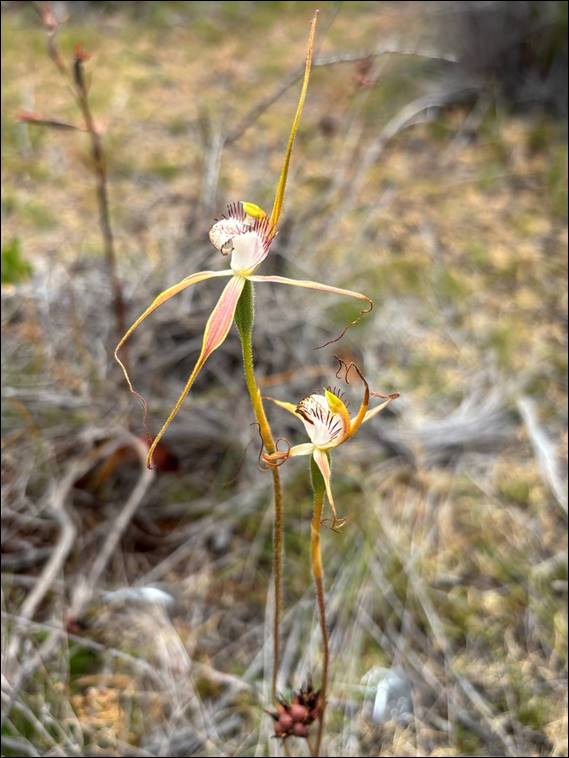
As the images show not all was lost on the orchid front.  I had popped into the Blythe Reserve in Dunsborough, before the main event, where just one or two Sandplain Donkey Orchids (Diuris tinctoria) out.  Better than nothing.  Then starting on the track along the Meelup Regional Park coast the first stretch takes you down towards the coastline.  Here a couple of Chapman’s Spider Orchids (Caladenia chapmanii), boosted my confidence.  They may have appeared in my last post but as I said in that, I make no apology for including them (again):

Other than the Chapman’s Spider Orchids and wonderful Quenda, there was nothing.  This resulted in my thinking that I wouldn’t walk too far changing.  Setting my sights on Eagle Bay to walk the entire coastal track in the park, which would be close to a ten mile round trip.  My pace had to pick up considerably.  Having had a late start to allow me to get some housework in, and needing to get back for other household duties.  Closing in on Eagle Bay I was rewarded with a single Hills White Spider Orchid (Caladenia longicauda subsp. Clivicola):

As I arrived at Eagle Bay a lonely Pink Fairy (Caladenia latifolia) was in the road reserve in the middle of the hamlet.  Worth including because of the mix of its name sake colour, along with paler shades.  There was no hanging about and it was straight back, continually scouring the sides to see if I had missed anything.  I hadn’t, or at least not that I saw.  Deciding to see if moving to higher ground may work in my favour, I threw the in Meelup Beach Lookout circuit.  The path leading up the ridge was muddy in parts, and again there was nothing to see:

Although it gave a great vantage point to watch the ocean.  It seemed calm enough for a snorkel.  Whales were in the bay, and two images up there is a bit of tail action.  It was here as I spent a few moments to soak in the view that I was missing Lisa and my traditional cuppa and cheese sandwich.  Having severely miscalculated my provisions, and rather daftly also skipped breakfast.  Walking across the top of the granite ridge the above cluster of colourful flowers of a Needle Leaved Chorizima (Chorizema aciculare subsp. aciculare) really stood out:

With their pink tinge, there were also a few Dunsborough Donkey Orchids (Diuris jonesii).  Bringing my Donkey Orchid species tally to five this season.  Just to prove I really was looking hard for orchids, despite my pace, I somehow spotted this single and oh so impressive Cape Mustard Orchid (Caladenia caesarea subsp. maritima).  Even though it was almost hidden from view behind some scrub.  While riding high from my Quenda encounter, this find tipped the hike into a new realm.  Having only seen the critically endangered orchid once before:

Having spent a bit of time atop, checking out a few finds and enjoying some whale watching.  When I got back down to the coastal track it was time to pick up the pace again.  No more orchids to report but as the day moved into the afternoon, the temperature had risen.  Bringing out a few scaly friends, bit of an abstract link to the theme but I’ll take it.  A female King’s Skink (Egernia kingii) saw me coming and scuttled into a crevice.  Deciding to make the herpers out there jealous I took a minute or two to wait.  Sure enough she popped out again:

Part of the coastal track is currently under repairs, which forces a deviation along the beach and over some rocky sections.  Working in my favour on the way back when it meant I stumbled across a male King’s Skink (Egernia kingii), who attempted to avoid my gaze by partially hiding in a bit of scrub.  But not working in my favour when, by choice, I decided to continue the rock hopping a bit further than necessary.  This turned out to be quite a long way, when there was no indication that a goat track would lead me back to the coastal path:

The rocks grew taller and steeper, requiring more effort to negotiate.  Energy levels were heading in the wrong direction, not by chance but by my own doing.  The provisions had been consumed some time back, and a weariness was coming over me.  Stepping off a particularly high rock either a foot slipped or I had tipped too far over and lost my balance.  After a forced few moments of rest to compose and check myself, I carried on battered and bruised.  On the plus side on the last stretch one more scaly friend, a Bobtail (Tiliqua rugose), came out to say hello:

The Race

This post starts where it ends.  The last find I have included made we go back in time, which like last week resulted in me uploading not one but two new but quite old posts.  They go way back to 2010 and 2011.  The reason being is that is where my orchid fascination started, fifteen years ago.  It was our first camping trip to the magnificent Stirling Ranges that introduced me to the delights of these hugely varied and diverse plants.  More specifically it was the Mount Trio Bush Camp that kicked it off, with all the images and information they had on display:

My write up of that first trip found here: https://sandbagged.blog/2010/10/18/a-striling-range-holiday/. If you dare to go through that you will notice a very different style applied to write up our adventures.  Back then it was very much about keeping overseas family and friends up to date on what we had been up too.  An image says a thousand words, and I leaned on that by including lots of pictures with just a short sentence for each.  That posts also show how wrong I was with some of my early assumed identifications:

So enamoured by the location and campsites, in 2011 we went back for another spring break at the Mount Trio Bush Camp: https://sandbagged.blog/2011/10/24/glamping/. On our first trip, and as it had only recently been established, we had the place quite literally to ourselves.  For the second visit we saw more people but not many, and today it has been completed transformed.  Being deservedly popular, but with popularity the quiet charm that drew us there each spring time while Elseya was young diminished:

As I was fully expecting, I have neglected all the images in this post and relived fond memories of the past.  That is after all one of the reasons for keeping a record of such treasured moments.  First by images, then by emails, and now by these posts.  The reason for including the second post is that was the first time that I saw what I very unexpectedly stumbled across at the end of my second walk this week.  To understand that you will have to get to the end of this write up, which captures the walks that I squeezed in on Wednesday and Thursday:

The weather was not too bad all things considered, and the week ahead is looking like the winter fronts may be behind us.  I’ve previously mentioned that Rongy and Sarah recently returned from their long travels.  They have been inspired by my finds to start looking for orchids.  Sending me a fair few images of what they have discovered.  It was one of those finds that led me to head to the Dalyellup Tuart Forest on Wednesday.  Having only walked through that bit of bush once before, late last season I haven’t really explored it:

This was a bit of an assisted find, having been given the coordinates of where to go.  Rather than making a beeline for that spot I started some way off to explore what else may be about.  It was pretty quiet on the orchid front.  Granted I saw heaps of Cowslips and Donkey’s, but little else.  I did however really like the Wild Violet (Hybanthus calycinus) in the first image, this plant has had a bit of a back and forth name change over time.  Being switched between genera going from Hybanthus to Pigea, but still widely recognised as Hybanthus:

It goes to show how tricky this business of identify plants and their true names can be.  Sometimes I really do wonder why I put myself through it!  When I got to the special spot I hunted and hunted, but there was nothing to see.  After a solid half an hour I decided to text Sarah and let her know I failed.  A few minutes later the phone pinged and she replied to say she was heading into town soon and could stop by to show me where they were.  This led to various pins being shared of where we were, which was a considerable distance apart:

You could say this was more than an assisted find seeing I was going to be led right to the spot.  It was certainly not in keeping with how I like to find orchids, but this one was special.  As I made my way towards Sarah, taking a straight line through the bush, I stumbled across two Sugar Candy Orchids (Caladenia hirta subsp. hirta).  Being the species I was after, and allowing me to get that great feeling of just stumbling across the find.  The reason it was special find, is that I have not seen these before and didn’t realise they could be found here:

I have however seen one of the two subspecies at the Stirling Ranges.  The subspecies being the Sugar Candy Orchids (Caladenia hirta subsp. hirta) that is white, and Pink Candy Orchid (Caladenia hirta subsp. Rosea), which is obviously pink and the one I have seen before.  This one is detailed as being a common subspecies that is found in Banksia, tuart and peppermint woodland.  So I find is amazing that I have not come across it before here.  I then caught up with Sarah and overall I got to see five of them making the trip out very worthwhile:

In the same area there were also quite a lot of Pink Fairies (Caladenia latifolia), being the third image.  Common as anything but worthy of inclusion, and linking nicely to the rather grainy video of a male Splendid Fairywren (Malurus splendens).  We stood and watched for what seemed like forever.  Normally skittish and quick to hide in the bush this male didn’t care, putting on a great display that was hard to pull ourselves away from.  But we did eventually, leaving him to carry on chirping away:

On Thursday I went to see how the spiders were going at the Capel Nature Reserve, and the images speak for themselves.  It was hard to walk more than a few minutes without seeing another one, totally stunning.  The first two images from this reserve being of clumps of White Spider Orchid (Caladenia longicauda subsp. longicauda).  The third being the Sandplain White Spider Orchid (Caladenia speciosa), identifiable by the long tangled fringes.  Like hair that is allowed to grow without trimming, these can be prone to splitting:

This was the species that I recently found to be listed as Priority 4, meaning they are considered rare or near threatened.  I’ve broken the spiders up with a Purple Enamel Orchid (Elythranthera brunonis).  I like the image included as it has a bud displaying the mottled pattern that resides on the back of the petals and sepals once the flow opens.  I tell people to check this overlooked feature out, as it is quite beautiful.   Capel was certainly on fire, and I also found a King Spider Orchid (Caladenia pectinata) with its deep red tip on the labellum:

This species of the king orchids spreads its sepals and petals elegantly.  The next image is a cross between a King Spider and White Spider Orchid.  Having the red tipped labellum and sepals and petals being coloured and displayed like the latter species.  I have unapologetically included two images of some of the many Chapman’s Spider Orchids (Caladenia chapmanii).  There are plenty more spikes that are yet to flower, and I can safely say I will never ‘tyre’ of seeing these magnificent spiders with their display of a multitude of stunning colours:

It feels like I have just raced to the finish line.  Here, finally, are two images of a Zebra Orchid (Caladenia cairnsiana) that I almost didn’t see.  These come from a underground tuber and are described as usually being found in scattered groups or sometimes in clumps of more than ten.  I’ve only ever seen these, like the Sugar Candy Orchids, in the Stirling Ranges.  Indeed this species was first described from a specimen collected in the Stirling Ranges.  Finding them, as described, in groups and clumps.  Tried as I might I did not see any more here:

My favourite

In keeping up with our promise to each other for regular trips, Lisa and I had a night away booked for last weekend.  It turned out to be a bit of a wash out in several ways.  Regardless of that we still enjoyed being away, and a changed environment always helps to recharge the batteries.  I slept through most of our time down in Pemberton, doing my best to shake whatever it was I went down with on Friday.  While this may seem a wasted opportunity not to be wandering under the tall Karri Trees (Eucalyptus diversicolor), it was raining:

Not just a drizzle or passing shower.  Over the course of Saturday a neat two inches fell.  And Sunday morning was not shaping up any different.  We have been known to go for a walk in the rain, but all things considered we agreed it wasn’t worth it this time.  So we slobbed out instead.  On the way back we did however stop in at Beedelup Falls, I was keen to stretch my legs before we hit the journey back in earnest.  Plus with the great winter rainfall we have had I was keen to see how the falls were shaping up since the last time we saw it in 2017:

This made me search through my posts to see what it looked like back then.  To my surprise the email with images from that trip had not been added to this blog.  That has now been rectified.  Like this visit it was wet, the difference being that time we did go out for a walk.  Finding some great fungi making it definitely worthy adding.  I can also now link it to this post for a contrast of how the waterfall was looking: https://sandbagged.blog/2017/07/16/a-few-nights-away-from-it-all/.  Indeed this year it was pumping:

I have been through the monthly rainfall records and 2017 looked to be a decent rainfall year, not far off what we have been seeing this year for the Pemberton area.  I’m going to guess that having gone there in July last time the streamflow had not risen to the rate we saw in September this year.  Sounds obvious but on the drive back the soils on both sides of the road were saturated, to the point water was cascading into the roadside drains.  A sight I have not seen, and long-time locals also say is a welcome sight harking back to a proper winter of old:

Certainly where we live, a mere 100km to the north as the crow flies, it has been a winter of old.  At I have the ‘pleasure’ of dealing with enquiries from people complaining about wet properties, due to both groundwater coming to surface and creeks and drains overflowing.  The people who have lived here for more than thirty years say it is a welcome sight; those with shorter memories are not so happy, looking for someone to blame.  As to be expected the wetter conditions are however resulting in a slightly different orchid season:

Unlike the wet weekend just gone, the proceeding week was shaping to be quite nice.  Sunny days with temperatures over twenty degrees.  Of course I had recovered enough to head back to the office, maybe in part due to my moral compass and work ethics.  I did however decide to not keep adding silly amounts of hours to increasing bank of leave.  Blocking out my calendar from 2pm each day and making a conscious effort to get out for an afternoon wander to visit a few of the good spots we have, which worked on most days:

I was urged on even more to go for daily walks by the promise of, what a surprise, another wet weekend coming our way.  One that looks likely to stretch into next week.  It seems that rambling is the theme of this post, as I have babbled on while the images have been slipping past.  With only one having been referenced.  It is now time to make amends and play catch up.  The first image is one that I really wished it had not been raining for, as I would have got down on the ground and spent more time getting shot from differing angles:

A simple Karri Snail Orchid (Pterostylis karri), and we didn’t too much more in flower during the short walk to and from the waterfall.  However, this one is not in its usual form.  To start with there is only a single lower sepal, or antenna, unusually located at the front of the galea or hood instead of two at either side.  The hood, which is usually made fusion of the dorsal sepal and two lateral petals looks to have split.  The lateral petals having separated and spread to the sides to form what looks like two floppy ears.  It’s finds like this that I find so fun:

These are the only two images from our weekend away.  After that and for my first weekday wander, on Tuesday, the images are from Crooked Brook.  Here I was greater by a glorious floral carpet, with more coverage that I can recall before.  Or is that just my short-term memory taking control?  Mostly provided by Glow Wattle (Acacia lasiocarpa), and what I believe may be Beard Heath (Leucopogon pulchellus).  I was going to add a close up image of the latter just because I loved the small fluffy petals of this flower:

This feature is where the genus name of Leucopogon comes from, being derived from two the Greek words of leuco (white) and pogon (beard).  I’ve included a species from this genus in a previous post.  This one is however in my humble opinion more beautiful and little, which is what the species name means in Latin.  There are many species in this genus and I have read that the greatest diversity can be found in the south western of Australia, lucky us.  I did think with all that shrubbery in bloom I would struggle to see much else:

It was hard to get the eyes to focus away from the colourful lower storey vegetation, and look closer at the ground.  There were a few orchids out, mostly repeat finds and in low numbers.  The one that was in greatest abundance was a first time find for this season.  The wonderful Bird Orchid (Pterostylis barbata).  It seems Crooked Brook is the place to find these, and on this one walk I found close to twenty.  It did feel that the orchids were lacking, perhaps waiting for a longer period of drier conditions, so I started to look for other gems:

I’ll skip an image and jump to the sundew, it has taken some time to have the confidence to say it may be a Bridal Rainbow (Drosera marchantii).  We have many species and it would be easier to identify if the flower had been out.  Even without the pink flower the leaf blades with their tentacles are still a very pretty sight.  For this species they occur singular along the stem and generally dangle downwards.  I am also daring to venture into the enormous variety of pea flowers, and the purple ones I believe are Elliptic-Leaved Hovea (Hovea elliptica):

I personally like the other name it gets of Karri Blue Bush, and feel the shape of the leaves gives this one away.  There is however an abundance of peas making it tricky business.  It is time to move along, as the train driver would instruct us to do during the rush hour commute as we crammed into the London underground trains.  Everyone trying to stay close to the doors, rather than getting packed in like sardines further away and risking not being able to get out at your stop.  I really do not miss those days:

The cluster of brown bark resembling fungi has had me stumped, and the closest I can get is Coltricia cinnamomea.  The fringe like edge, slightly radial pattern, and sponge like underside make me think I am close.  But I am not overly convinced.  And now I’ll go back to the lone fungus that is starting to emerge from the gravel.  This one I have had absolutely no luck with, maybe it is still in the early stages of development.  The spongy like stem and potential for a cap makes me wonder if it is the same genus of Coltricia:

Back into more familiar territory of orchids I have included the Reaching Spider Orchid (Caladenia arrecta).  This is a very easy one to identify.  I’ll confess that I know where this one is found at Crook Brook, and due to the lack of other first time seasonal finds I sought this one out.  I did however also find one at Manea Park during another afternoon walk, the first time I have seen them there.  It is one of my favourite spider orchids, taking pride of place as the background image on my phone:

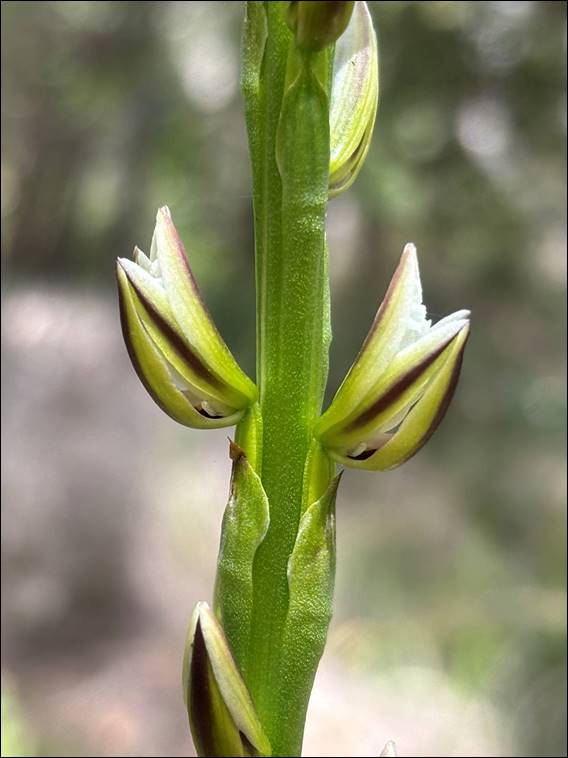
Another orchid out, although I only found the one, was the Fringed Leek Orchid (Prasophyllum fimbria).  A tall and elegant spike with seventy or more flowers arranged along the upper section of the spike.  The images shows a weevil doing exactly what the plant has developed to encourage it to do, delving into the flower for pollen transfer.  I have stopped short of trying to identify the weevil, and will instead speedily get to the Common Brown Pea (Bossiaea eriocarpa) and a random image of some tadpoles as I came to the end of the walk:

Wednesday afternoon it was time to visit Manea Park.  A place renowned in Bunbury for being the place to go to see orchids in spring time.  There were certainly heaps of donkeys and cowslips out.  Other than that it was very thin.  There are usually lots of white spider orchids here.  Not only did I not see one, but I also saw very few spikes indicating that they were on their way.  There was the old faithful Dancing Spider Orchid (Caladenia discoidea), again I know where to look but this year the patch had grown bigger and spread wider:

It was good to know that some species were liking the conditions this season.  Due to the lack of orchids I again dipped into the peas.  Finding the Skinner’s Pea (Pultenaea skinneri).  The stem and leaf structure making this one a relatively easy one to work out.  A good find for me, as it is listed as a Priority Four species, being considered rare or near threatened.  I continued to wander through the park for near to two hours with little having been found.  Yearning for some colour next up is a Brick Red Laccaria (Laccaria lateritia):

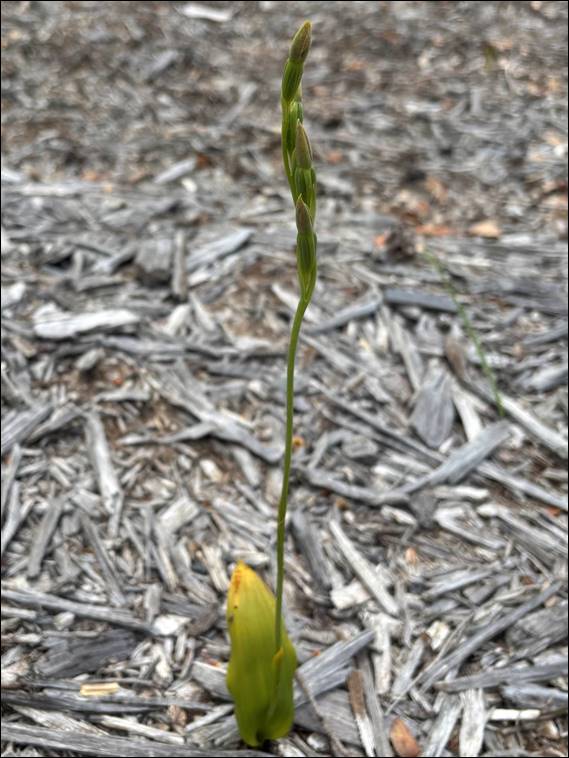
I’ve also included a repeat find of a Kemerton Donkey Orchid (Diuris cruenta), only due to the striking deep purple labellum of this specimen.  I really was keen to see and include more colour.  To wrap up the images for Manea Park is a plain green basal leaf, with a spike forming and silhouetted behind it.  I saw these popping up everywhere, so maybe there is another species that is liking these wetter conditions.  I guessed while waking, and was pleased to find I was correct in thinking, they were Leopard Sun-Orchids (Thelymitra benthamiana):

Thursday it was the Franklandia Nature Reserve, a place I only came across last year.  Here I spent about the same length of time, scouring all over.  A few usual suspects were out but you really had to look for them.  The best finds being the two above images of wispy spider orchids.  Known for their thin, thread-like sepals and petals.  I believe they may be the Pendant Spider Orchid (Caladenia pendens) and Noble Spider Orchid (Caladenia nobilis).  However, like so many similar species of spider orchids they are tricky to tell apart:

Before hitting the road to drive home the above female Wandering Percher Dragonfly (Diplacodes bipunctata) kindly posed for me for a considerable duration.  Friday came and it was time for a local jaunt at the Capel Nature Reserve.  Despite the varying number of images I have included for each place, I had spent one and half to two hours at each.  You could say I had a healthy dose of nature this week, and feel all the better for it.  Of all the places this one seemed to have the best abundance and variety, hinting a promise of more to come. And it was the same last year:

The ones that are tantalising close to coming out can wait for another time.  And hopefully this next week of wet spring weather doesn’t impact their willingness to fully bloom.  Above is a Pink Rainbow (Drosera menziesii), for me one of the more striking erect sundews.  There were plenty of specimens out with pink flowers on display at the top of their stems but it was the deep red leaves that caught my attention.  Among the promise of what is yet to come were way more spider orchid spikes than I had seen collectively in the other three locations:

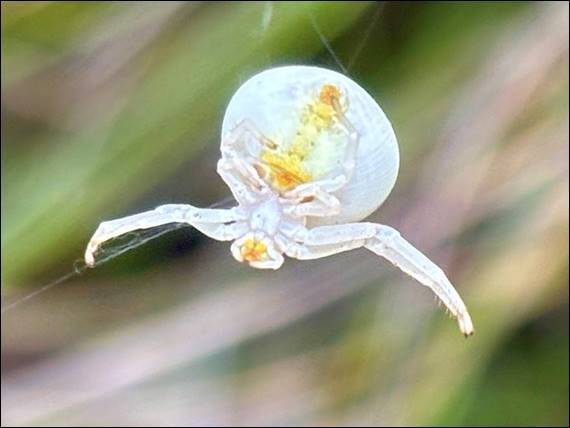
Very few were out in bloom but a few were about.  I believe the above is a White Spider Orchid (Caladenia longicauda subsp. longicauda) and below is a Hill’s White Spider Orchid (Caladenia longicauda subsp. Clivicola).  As I mentioned before similar species of spider orchids get tricky, and the white spiders are no different.  The latter of these two has a narrower labellum with shorter fringes, so it does look to fit the bill.  And like the earlier weevil I am not going to try and identify the photo bombing Crab spider (Thomisidae):

I of course had to check the elusive Glossy-leafed Hammer Orchids (Drakaea elastica), and they are still looking like they will flower.  They are one of the later flowering Drakaeas. Not due to come out until October.  To wrap up this rather lengthy ramble is the Purple Enamel Orchid (Elythranthera brunonis).  Lots and lots of these were scattered about with lot more looking to bloom.  While I have a few reserves I can head to, a bit like a pick and mix selection there is usually a favourite. It’s pretty obvious which is mine and where I’ll head if I get a chance next week:

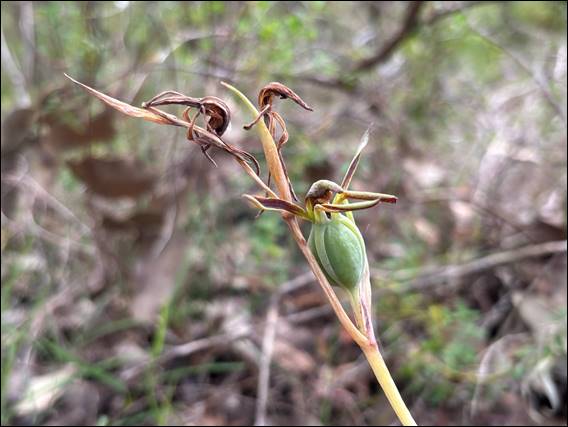
A complete unknown

Was I hoping that now spring had arrived, I might get away without catching one of the many bugs that have been going round.  I had done well despite people dropping like flies round me and Lisa’s best efforts by bringing bugs home for weeks on end.  But no, although not taking hold till Friday allowing me a Thursday wander.  While my current condition affords me a hoarse or raspy voice, I will still not be able to get away with mimicking the distinctive nasal delivery style of the singer who is the focus of the film that has the same title as this post:

Bob Dylan was given the title of “King of Folk Music” after his 1963 appearance at the Newport Folk Festival.  A happy coincidence in that the only new seasonal find at the Ruabon Nature Reserve was the King-in-his-carriage (Drakaea glyptodon).  Locally it seems to be the earliest of the hammer orchids to flower.  I’m still waiting for those elusive endangered species at the Capel Nature Reserve to even form a full bud.  The King-in-his-carriage is the most commonly seen species here, distinct from the others by the shorter and more swollen labellum:

The above is also a common endemic species of the south west.  It may not look like anything special.  However, a work colleague that has taken to hitting the many tracks in the general area has been testing my ability to identify finds that stand out to him.  The Red Leaved Sundew (Drosera bulbosa) can have as many as twelve leaves that start pale green to yellow in winter.  When spring brings more intense sunlight anthocyanin, a water soluble pigment, is produced.  Changing the leaves to this wonderful deep red, and providing a sort of sunscreen:

In the lowering sun of my later than usual wander the above Western Bearded Dragon (Pogona minor minor) was in no need of sun protection.  Indeed soaking in and relishing its warmth.  Not moving a muscle while I got really close and observed it for some time.  Only it’s eye moved, following me carefully.  It is the largest of three subspecies.  But even with a body length of up to half a foot, it would still be an easy prey for overhead predators.  If I could see it then they certainly could.  This does not however stop them basking on fence posts or alike:

Walking back towards where I had parked, I stumbled across a few cages.  Similar to those I found in the Capel Nature Reserve, which were protecting the endangered hammer orchids.  There was a lonely spider orchid leaf in one that I will come back to check in a few weeks to see what species it may be.  I assume it must be something unusual, unlike this Common Dampiera (Dampiera linearis).  Yet another endemic floral species of this corner of Australia.  So common that it seems no one has bothered to published any interesting facts about it:

Very pretty and delicate nonetheless, so more than worthy of inclusion.  I took the image at the Capel Nature Reserve.  Being kinda on the way home I thought why not stop in.  Secretly hoping to find my first ‘true’ spider orchid in flower.  I say that as while I spotted the Cowslip Orchid (Caladenia flava) in full bloom, as well as Dwarf Pink Fairy (Caladenia reptans), it is the Caladenia species with the long petals and sepals that really stand out.  This week Mario, having been on his lunchtime walks in Perth, sent me photos of some amazing specimens:

The orchids come out earlier in Perth.  Where it warms up quicker than here, being further north.  There are many species found there that do not extend to our area, and vice versa of course.  So I will admit to having a bit of orchid envy, not enough however to make me drive the 400km round trip.  I did not find any of the more dramatic spiders in bloom.  Plenty were getting very close, such as the above Sandplain White Spider Orchid (Caladenia speciosa).  The name speciosa meaning “beautiful”, “handsome”, “splendid”, or “showy” in Latin:

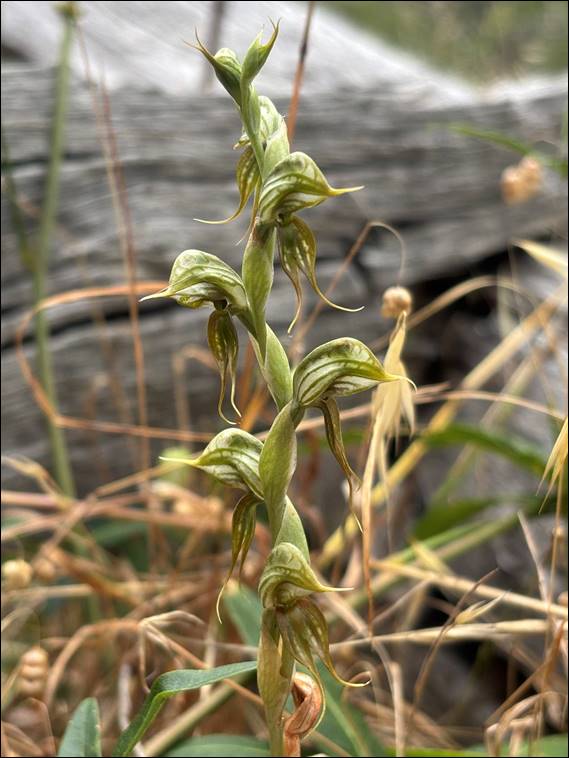
An apt name and one that makes me feel a bit more justified in distinguishing between the more attractive species of spider orchid.  The Sandplain White Spider Orchid is a regular here, I have however only just realised that it is classified as rare or near threatened.  So we are lucky to have it in relative abundance in our local nature reserve.  This post ends as it started, with some complete unknowns.  Even with Howsie’s help we have no idea what the above may be.  The below has also alluded me, looking both orchidy and not orchidy:

Smile for the camera

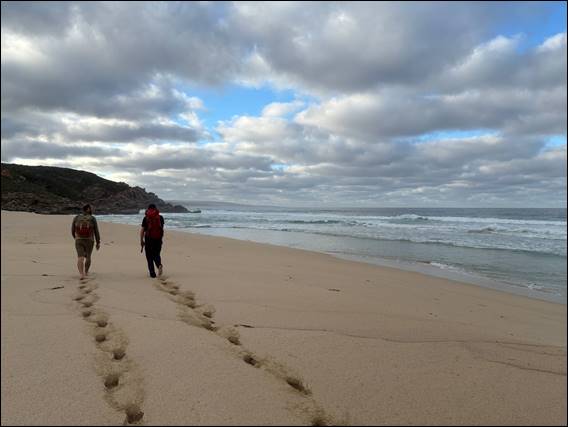
The climbing this morning was on occasion interrupted by text messages flying between John and I about his book.  He was busy with last minute edits.  Telling me how he was thinking of dealing with my comments, as well as a few other oddities that I had picked up.  I was just arriving at the spot we park up to walk into Smiths Beach, on another crisp and cold morning.  Steam was drifting off the ocean as the sun started to warm up our part of the world.  Three thousand plus kilometres west of where John was no doubt frantically typing away:

For Howsie, Rongy, and I there was no rushing.  It was a slightly later start that made the driving that bit more relaxed.  More light to see what might lie ahead, and also a lower chance of kangaroos being on the road.  Rongy was the one keen to come here.  He had suggested it for last weekend’s destination.  A big swell, recent rain, and the possibility of more water from the sky had swayed us to the more friendly Wilyabrup.  Today all three of those reasons not to come here last time were absent.  Plus he was all fired up about one particular route:

Howsie was just happy to get out, no matter where we went.  He did however hint at not feeling very climbing fit.  Something I doubt he would have mentioned if we had been going to any one of the other coastal crags along this slice of the west coast.  I too was also not fussed about where we went.  I did however go a step further than Howsie, saying upfront that the two of them could bag all the leads today.  Ah Smiths Beach.  The trad climbing crag that holds the same fearsome reputation that Welly Dam does for sport climbing:

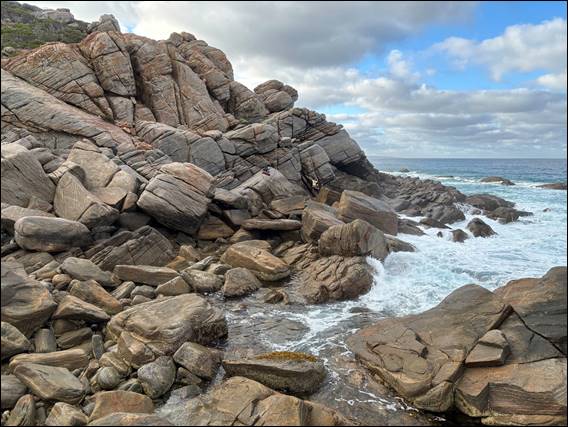
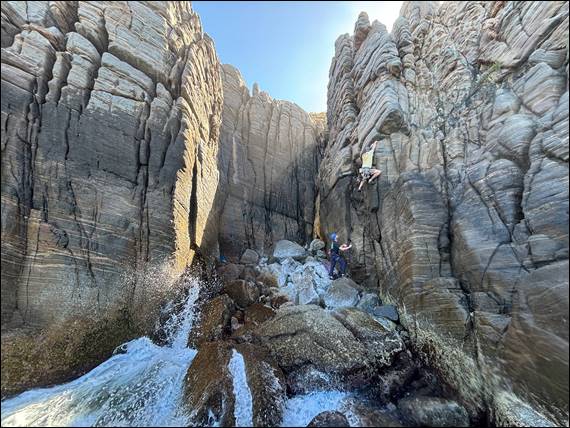
Due to me messaging John, and wanting to get a decent image of the mist over the ocean, the other two wandered ahead of me.  I got to the top of the zawn after they had already scrambled into it.  The first thing I noticed was that they were wandering to the right hand wall, called Harbour Wall.  Not intentional named for this reason but a harbour would suggest it is a place of safety.  The left hand wall of Camelot Castle, which you first pass under as you enter the zawn, looms ominously above you.  Steep and foreboding:

Just like the purpose of castle walls, this face feels like it is intended to keep would intruders out.  Rongy and Howsie had felt this imposing feature staring them down.  As if taunting them and saying “do you dare”?  It had been too long since they had climbed here.  They did not dare.  Instead being drawn to the relative safety of the harbour.  Full of quality low to moderate grade routes, that would have slotted perfectly into the options of climbs to choose from for John’s book.  Sadly during his trip to the west he did not have the time to come here:

As we messaged each other I sent John an image or two of our surrounds and antics.  His responses indicated that the visual wow factor of this place piqued his interest.  With luck I’ll be able to provide him with a tour of our local spots later this year, allowing him to sample them for himself.  For Smiths Beach in particular I am interested to see what he thinks of the grades we gave these lines, when we established the place very nearly fifteen years back.  Today we were a little unsure, but that is not an unusual feeling to have when climbing here:

The rounded holds and technical nature of the climbing is both extremely engaging, quite physical, and very deceptive.  It takes a few more regular visits to Smiths Beach before you once more become accustomed to the style and are willing to push the grades a bit more, a bit like climbing at Welly Dam.  We found the moderate and supposedly lower graded routes satisfied our desire to climb, while slowly but surely nibbling away at our stamina and energy levels.  To the point that we didn’t try to siege the castle walls, as we pondered what next:

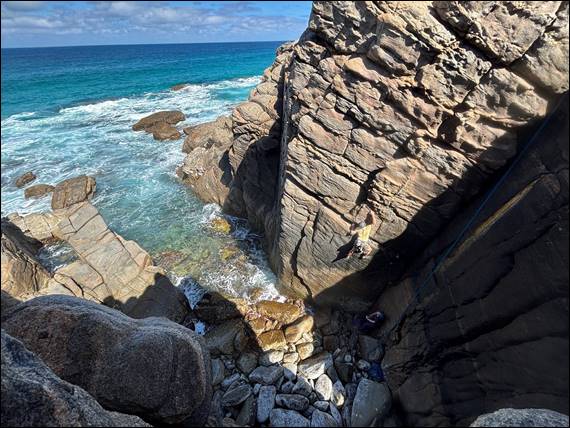
To my surprise neither Howsie nor Rongy had any recollection of climbing the above line, in the second and smaller zawn.  Allowing yet another route within our grade range for the day to be bagged.  A range that is the focus of John’s book, and certainly worthy.  Indeed his book is putting the spotlight on climbs that are often overlooked.  Not considered hard or extreme enough to be given the limelight in today’s many forms of media.  I would however challenge any capable climber to come here, bag what we did today, and not come away smiling:

Leave me alone

Getting ready for a wander this morning with thoughts of a near three quarter of an hour drive, my plans were scuppered.  My own doing.  I started messaging John, which saw me doing a bit more editing of his near complete book of moderate climbs in Australia.  English language was my worse subject at school, by far, so I find it funny that I am checking amongst other things grammar.  It has taken some self-education to make sure my advice is correct.  However, as most will realise, English is a complex language with many variables:

Several people are assisting as editors.  Resulting in differing views being provided on some matters, especially punctuation.  Poor old John is feeling a bit like a piggy in the middle, with conflicting advice coming from multiple fronts.  To assist he is also doing some of the same self-education I’ve undertaken, to check his options.  The end is tantalisingly close.  Come Monday it’ll all be done and dusted, in terms of edits and changes, when the book goes to print.  My suggestion has been to go with what he prefers, and stick to his guns:

There wasn’t a whole heap that I could contribute this morning.  Although it was enough for me to miss my window of opportunity for a walk slightly further away.  There was a time limit.  Lisa and I were aiming to head out for breakfast at our recently found favourite haunt.  Still keen to get into nature meant going to the another old faithful, the Capel Nature Reserve.  Days are warmer but last night was cold.  Barely breaking past the point where water reaches its maximum density, 4°C.  Strolling along my toes were tingling in my safety sandals:

I hardly dared wonder how cold it was for Lisa and the Peppy Plungers this morning.  Sticking to their weekend ritual of submerging themselves in the ocean.  Later I heard they unanimously agreed it was freezing.  My tingling toes, in comparison to them dropping their core temperature, wasn’t worth mentioning when I got home.  Happily I was able instead to report on some great finds.  Like me a few orchids had also started to notice the warmer days.  It was amazing what has since popped up since last weekend, when I spent hours looking:

In the first image, the brilliant vermilion-red colour, looking all the more stunning in the morning light, drew me towards the fungus.  For some reason the Scarlet Bracket Fungus (Pycnoporus coccineus) had inverted.  Maybe someone had knocked the branch.  Luckily for me it allowed a close inspection of the intricate honeycombed structure, created by a myriad of cavities in which the spores are formed.  This is a repeat fungus from a few weeks back and the second image is a repeat from last weekend here, a Jug Orchid (Pterostylis recurva):

My reason for including it was not the Jug Orchid but what I saw inside it.  More than likely a Flower Spider (Thomisidae), wanting to be left in peace.  Quite a few Jug Orchids were in flower, which surprised me as I had not noticed their stems last weekend.  Equally I had not seen the stems of Yalgorup Donkey Orchids (Diuris porphyrochila) nor Kemerton Donkey Orchids (Diuris cruenta), shown in the third and fourth images respectively.  Yet today they were out in force, made all the more prettier by being covered in tiny dew drops.  The last species for this post is the earliest flowering of the Duck Orchids:

A Flying Duck Orchid (Caleana nigrita) not quite ready to put on a floral display.  But one John will appreciate, as he has used an image of a Large Duck Orchid (Caleana major) in his book.  Sadly a species not found over here.  Unlike the above Oak Conk (Fuscoporia gilva) that for some reason caught my eye like the Scarlet Bracket Fungus had, which is found all over.  I made it home in time for Lisa and I to head out and grab a relaxing munch and game; followed by a wander at the Ambergate Nature Reserve.  Where there was absolutely nothing to see, other than a shy Bobtail Lizard (Tiliqua rugosa) that buried its head in undergrowth:

Playing catch-up

We are creeping toward the end of winter and into spring, with only a week left.  No doubt this will result in a higher chance of me bumping into others out hunting orchids in my local haunts.  The south west of Western Australia is well known for its diversity of orchids, and it attracts avid hunters from both within the state and across Australia.  I’ve come across people who have said that they make an annual pilgrimage here to check what may be out.  So before things start to heat up I thought I’d squeeze another quiet stroll in:

I’ve previously mentioned that whether some species will be in flower can be reliant on summer bushfires.  But most species can more reliably be expected to emerge from their winter slumber.  Not being dependent upon anything so extreme to be aware that it is time to come out.  There are two obvious catalysts.  Heat, not as high as that created by fire, just the seasonal warming daytime temperatures.  Kind of linked to this is the intensity of the sun and the increasing daylight hours, which can also be a biological trigger:

The other obvious one being the abating rain, although there is more to rainfall patterns with the build-up of the soil moisture ratio also being important.  Without the right mix the dormant plants may not be able to adequately access water and the nutrients required to give them the energy to grow.  Purely for convenience I popped into the Capel Nature Reserve, less driving required allowing more time for very slow walking.  With the amount of trips I make here you may think I know ever square metre, but there are still undiscovered nooks:

My approach of heading into the bush and wandering about aimlessly with no idea of direction, distance, and often time, means I really have no idea of which bits I have been to and which I have not.  Today however I came across a patch, which I can say with a degree of certainty, that I have not seen previously.  Before I get to that I probably need to play catch-up.  Having admitted to walking very slowly, I am equally guilty at time of rambling on in my post, so I first need to provide a bit of context for the images included so far:

The Caladenia genus is that of the mighty spider orchids.  All up there are approx. 350 species, 180 of which can be found in Western Australia, and 140 in the south west.  While there are many other genus of orchids, the spiders are regarded by some as the most spectacular.  Varying in shape, size, and colour and with so many crammed in one part of the state it is clear why people would want to come here.  The most common being the Cowslip Orchid (Caladenia flava subsp. flava), for which I still like to celebrate the first one I see each season:

Shown in the first image it usually found in flower from July to August, this is yet another species hinting to me that we are having a late and potentially compressed orchid season.  For the second image I got rather excited, when I came across clump of Glossy-leaved Hammer Orchids (Drakaea elastica).  The second area I have found them.  Unlike the other spot, which is on an access track, this one is more protected and looked to have a few preparing to flower.  An important enough find for me to pin the location and photograph it for when I go back:

Wandering along a mere thirty yards and into another clearing I spotted five or six cages, shown in the third image.  And sure enough they were located over more patches of this critically endangered species, under World Conservation Union.  Noting that strangely, and a bit disappointingly, under state and federal Australian legislation it is only listed as rare and endangered, respectively.  I found more patches spread across this area, not protected by cages.  Quite a few had spiked and look like they may bloom, as shown in the fourth image:

The stroll was proving to be a success when I also came across a fungi I have been keeping an eye out for.  Having only stumbled across it once before, some years back.  The creepy looking Craypot Stinkhorn (Colus pusillus), for which there is no need to say which image it is in.  The wrinkly red finger like tentacles will form a cage like structure.  This happen all in the course of a day, and it looks to me the cage is yet to form.  More success was had in finding flowering orchid species with repeat finds of fairies, snails (two images up), and greenhoods:

For the latter genus this included my first, nearly in flower, Jug Orchid (Pterostylis recurva) shown two images up.  There are usually heaps of these about, but this was the only plant I found.  Then there were loads of Caladenia genus spikes, some of which I recognised, others I am not so sure.  The above I am pretty confident is a Chapman’s Spider Orchid (Caladenia chapmanii), which is a real beauty.  After picking up the pace I have final caught up with my images, however I may head out again later to see if the Craypot Stinkhorn has formed its cage:

Snug as a bug

Due to Howsie having changed his job he is now working a five days a week.  This has scuppered our geologically focused weekday excursions, which we were lucky to have enjoyed for quite some time.  However, with the return of Rongy and Sarah from their near twenty months of travel, the chance to squeeze in the occasionally weekday climb has been rekindled for the immediate future at least.  Picking the right day to head out is still feel a bit like playing Russian roulette, well maybe not quite to that extreme:

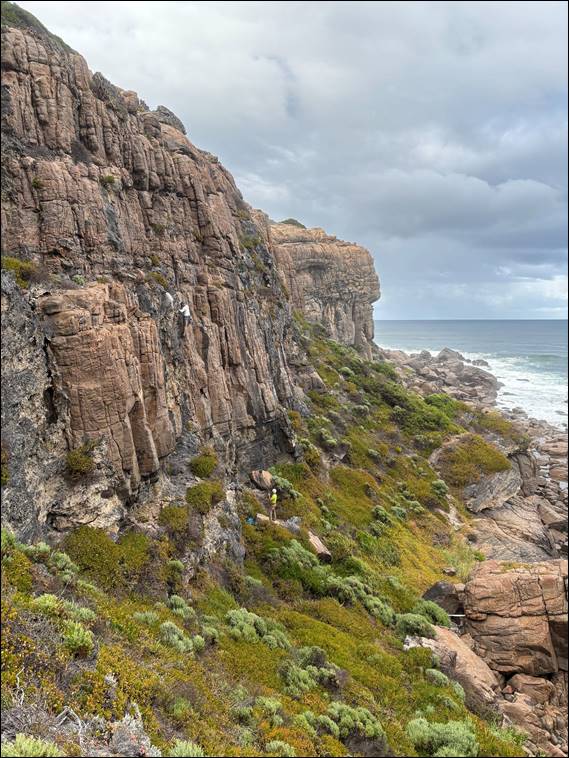
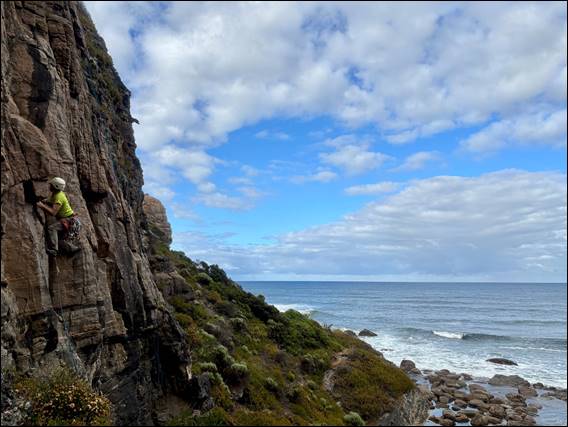
But it is hard to predict what the conditions will be like on any given day at a particular location.  In the end Friday won out although it was still a little hit and miss as to where we would go.  A decision left till the last moment, as we were driving down.  Mind you watching gloomy clouds, rainbows, and raindrops dancing on the windscreen it did not inspire that we had made the right choice.  I was quietly hopeful, and indeed we had chosen wisely.  As we parked up and looked west the clouds were parting to let some blue sky show:

There was the occasional sign of the seemingly continual wet winter months we have had.  The orange slime had me wondering and from what I have found it is could be a result of leached mineral deposits.  I do not recall seeing such a vivid orange here before, and this was the only place on the crag where I saw it.  I am doing a bit of guess work, and it may have been enhanced due to the near continual flow of water through the fissures and cracks in the granitic genesis, over a number of months:

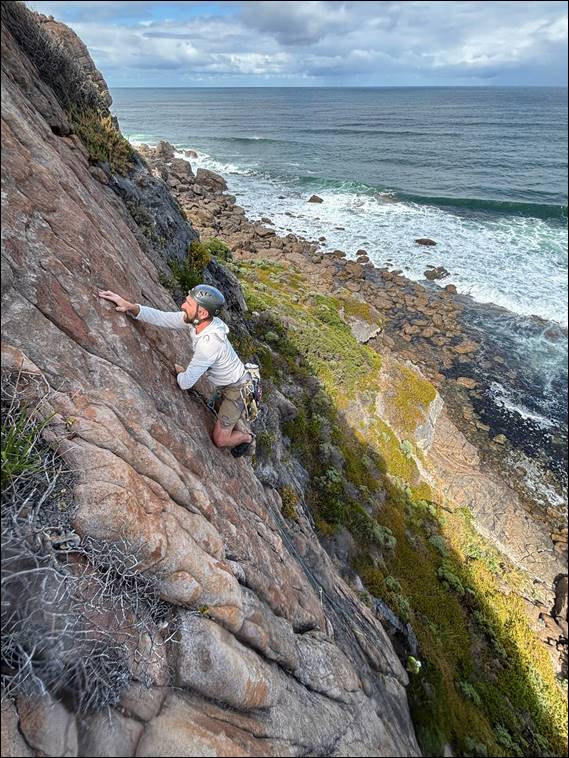
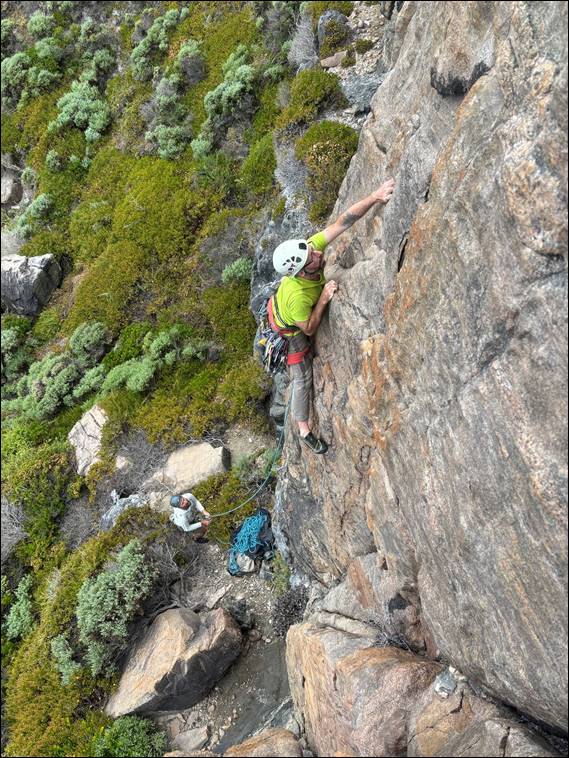
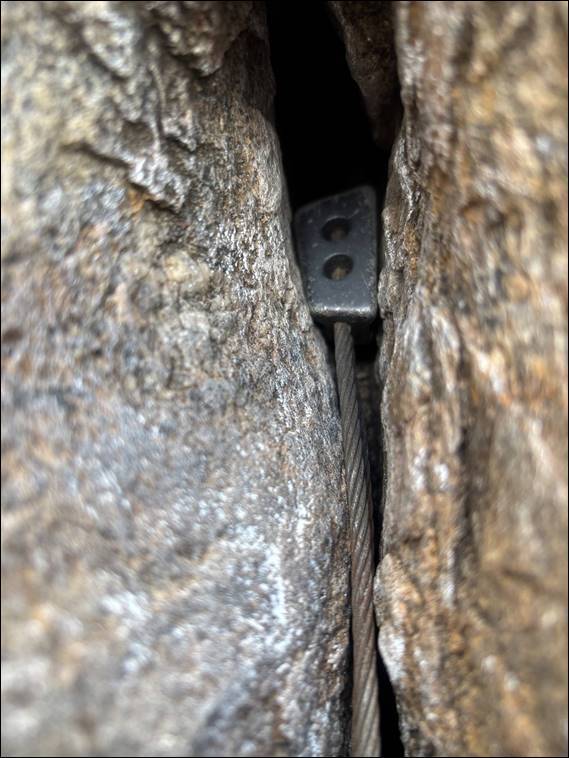
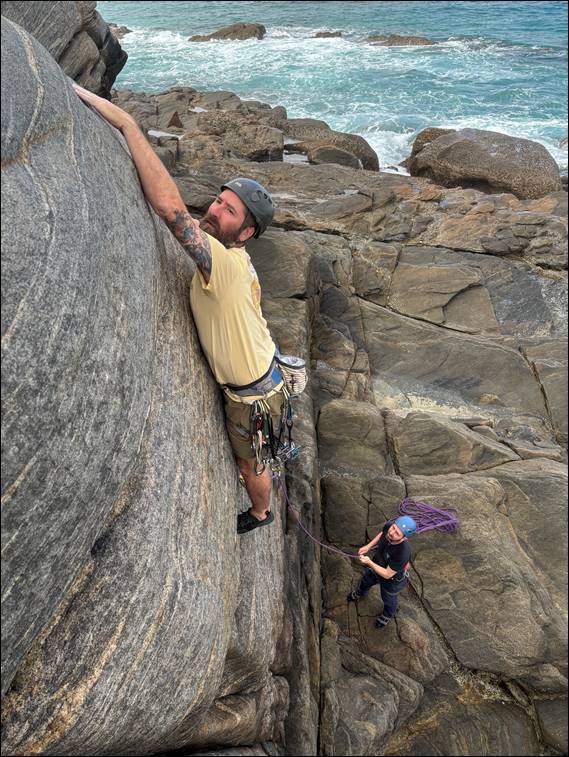
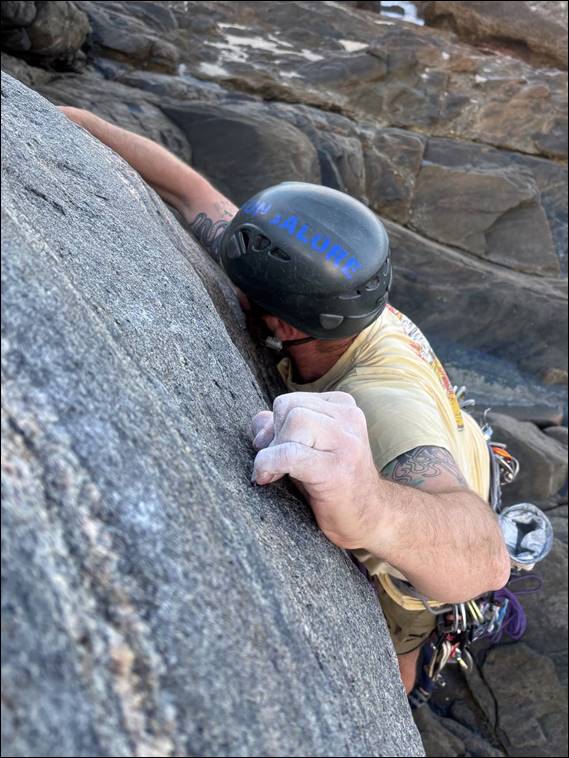
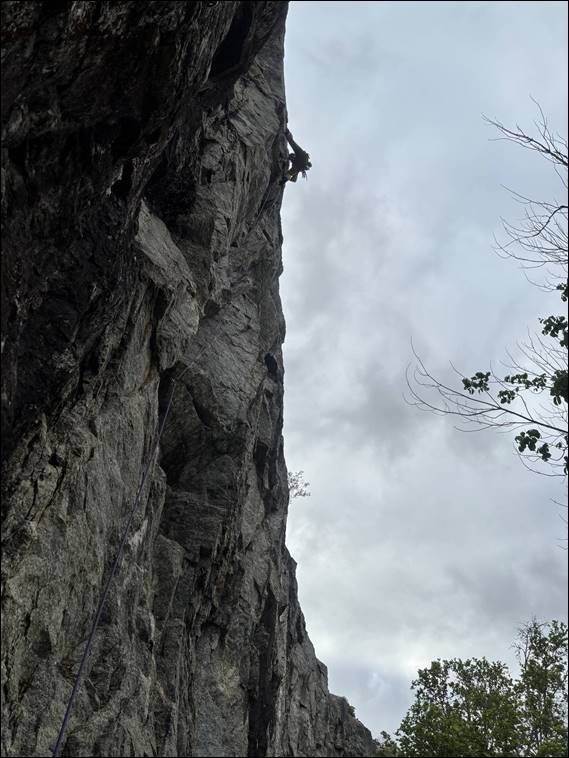
Other than the occasional bit of rock with water seeping down, the rock was mostly in near mint condition.  As Rongy has been away, and this was his first climb at Wilyabrup since his return I let him choose the lines and also lead them.  Not that he was short of getting climbing in during his travels.  It did however mean I could relax a bit more on the routes.  As may be evident from the images he had set himself a task to place the No.4 Camelot on each climb.  A piece of traditional climbing protection that does not get the same following as the pink tricam:

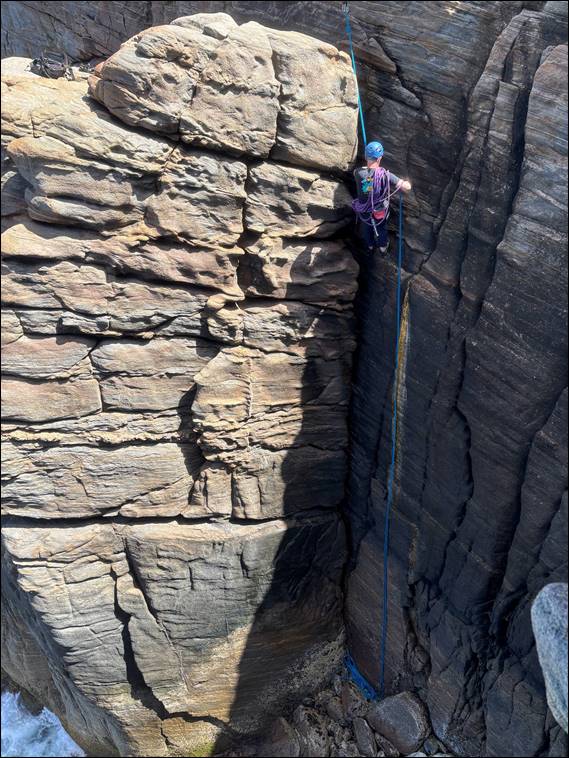
Yes there really is a following for the small pink tricam, which I have mentioned in a past post: https://sandbagged.blog/2025/01/25/weighing-up-the-choices/.  That said Mario will be happy to see us paying homage to what is often the biggest bit of gear on someone’s harness, and which in his mind is one of the best.  He will endeavour to place this beast on most routes, although sometimes it is just too damn big to find a spot.  For the climb below, a two pitch route, the trusty bit of hardware was placed in the exactly the same spot on both pitches:

We guessed Mario would not been too upset with this approach, as there was nowhere else on either pitch it would fit.  For the second pitch it was needed more as a directionally piece to avoid a zipper effect.  Meaning having all the gear rip out due to where the belayer is standing, if the leader fell and the rope went tight.  The belay stance for this line is off to the side.  The route follows a great seam it is but very thin and only takes the tiniest and tinniest of wires for quite some distance.  It looks like Rongy is contemplating how good they may be:

These wires are in complete contrast to the might No.4 Camelot, but if placed well are great.  Some of these small wires have brass heads, which are designed to mould to the rock to increase the friction, in a fall situation.  Camelot’s will also increase the friction with the rock when arresting a fall, by virtue of the camming movement.  For the last climb of the day Rongy offered me the pointy end, there was of course only one option.  The obvious finale that would allow us to climb out with packs, and look for a friend:

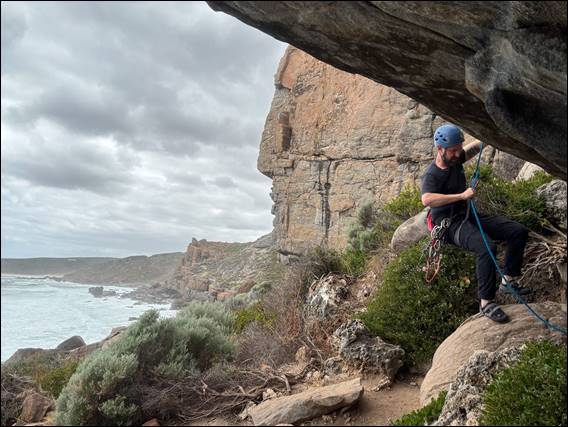
I am of course not referring to the first commercially successful camming devices for climbing; the Wild Country Friends that were released in the mid-70s.  I added a raft of these friends to my arsenal when I bought my first rack in the early-90s.  The Camelot’s were released several years later.  No the friend we were looking for, as you may have already guessed, was of course of the a scaly type.  Sure enough a Southwestern Carpet Python (Morelia imbricata) was, like the above No.4 Camelot, snuggly placed in the big flake:

That’ll do

One thing I will never get tired of is watching the world wake up.  The pre-sunrise hues may not have been stretching across the skies this morning, but it was still a beautiful sight.  The road ahead was taking me towards the light, meaning I was heading east.  There is only one climbing destination that way, within a reasonable distance, being Welly Dam.  Some may be surprised I was heading there today.  Seeing how I have mention that I still needed to be careful to ensure I keep moving forward on my road to recovery:

Added to that I was out on rock just a couple of days back with Craig.  Today was however going to be a very relaxed session at the Dam, if there could ever be such a thing.  Matt works in the same office as me, and as I worked from home on Friday a message popped up from him with a picture of my online mini-guide about the climbing at Welly Dam.  He has been looking for activities to keep in shape, and has been coming to the Wellington National Park for decades.  As a kid and then more recently with his family, and to hike and mountain bike:

He confessed to never having climbed before, but had always enjoyed scrambling up rocks.  During his trips this way he had noticed the bolts and thought why not try it.  One thing led to another and after a quick google search he stumbled across my guide.  At the time he was not aware that I climbed, and he was also completely oblivious to the delights of Welly Dam.  Having read in my guide he picked up that the place has in the past been given a bad rap.  In my opinion a rap that is undeserved, but I was very clear that this is not a beginners place:

He was however super keen to give it a go.  Living ten minutes from Welly Dam and due to family commitments not having the time to be able to drive and walk into the more forgiving places to learn the ropes along the west coast, we ended up agreeing to meet here today.  Luckily his shoe size was such that he could fit into my shoes, so I came armed with shoes, harness, ropes, and gear.  When he asked what he needed to bring my reply was simply ‘a can do attitude and to be prepared to be defeated by the dam’:

As with anyone starting out there is a fair amount of downloading to be done: which muscles to use and when; having real faith in your footwork and the shoes, check the second image; thinking of the most efficient way to move and position your body; and remembering to breathe.  Sounds so obvious, but it is amazing how these simple things can be completely forgotten when you get into an unfamiliar or comfortable situation.  And for a first taste of climbing Welly Dam does not offer any routes that are not likely to put you on edge:

Matt was not put off.  After some instructions and a bit of bouldering, which lasted maybe half to three quarters of an hour, there were more instructions.  This time of rope work, belaying, trad gear, and safety calls.  Essential knowledge before we tied in for a real climb.  It was just as this was happening that another car rolled in, and through the open window I saw Sarah and Rongy’s smiling faces.  Telling me that just yesterday they got back from their 20 or so months of travelling, under a cloak of secrecy.  So it was a complete shock to see them:

The timing of their arrival at the dam was great.  With a few more people about support and encouragement could be given from above and below, as Matt made his first ever roped climbing ascent.  Needing to put the mass of information he had been given, over the last hour or two, into practise.  Holding it together and even finding a hands free rest half way up, although to start with I wasn’t sure he would follow my instructions to let go with his hands and dangle them by his waist.  Enjoying it so much he then belayed Rongy on another line:

Managing to get up, despite finding it technically way more difficulty and also having a tiring body.  Understanding that from here on the routes would only get harder, he was happy call it a day.  He may however have got the bug, hinting he would be investing in a pair of climbing shoes.  With just the three of us left Rongy encouraged me to take a lead, before he jumped on one more route.  It was a lovely and unexpected catch-up.  And while it may not sound like we did heaps of routes, what with all the bouldering my body told me enough was enough:

Here’s hoping

A distinctive noise came from above at daybreak, as I started my walk at Manea Park.  But not one that I expected to hear from above.  I was a bit surprised to see a male and female Australian Shelduck (Tadorna tadornoides) high up in a tree.  I’ve had to do a bit of reading up and found that they are known to roost in various places including rabbit burrows and holes in cliffs, but they prefer tree hollows both to roost and nest.  In this regard they are similar to what may be regarded as the aptly named Australian Wood Duck (Chenonetta jubata):

These two species are in contrast to most other duck species that prefer to nest near water, and will only on occasion use tree hollows.  I left them to it and very soon after stumbled on another nice surprise.  A Silky Blue Orchid (Cyanicula sericea) with just one flower.  Last year because we seemed to go from winter to summer temperatures, without much in-between, we didn’t get to see too many of these.  Similarly this year, as it has been wet for longer, it seems that some of the more common Snail and Greenhood species are not very common:

Not too far down the way I found a solitary Dwarf Pink Fairy (Caladenia reptans), the earliest pink fairy species to flower.  The spot was more out of luck, seeing I had taken a wrong turn that took me back out of the park and I only spied it as I came back the same way.  I’ve got a few local places lined up that I know I will have a reasonable chance of finding particular species.  But heading back to the same ole haunts for repeat finds takes the joy out of going to new patches of bush and unexpectedly stumbling across what it may have to offer:

Intending to be out for a short walk, the two early finds got me keen to take a bigger loop into a few parts of the park that I had not been too before.  This included some very swampy areas.  Where there were tracks, long stretches of them were under water.  Undeterred I marched on.  When I wasn’t watching my step to avoid getting too wet, I was looking all over for something fun.  The orchids seemed to dry up on me for this area, although I did spot quite a lot of Earthball (Sclerodermataceae) and Earthstar (Geastraceae):

I believe the one that I have included below is a Smooth or Onion Earthball (Scleroderma cepa).  I have not been able to find out to much about this species, but as they age they turn from white to a pale brown or yellowish brown.  The outer skin can have tiny scales or be smooth, hence it’s common name.  I did wonder if it was a Puffball (Agaricaceae) because of the small opening at the top.  However, the thicker and more leathery skin, which is called the peridium, made it clear that it was not a puffball:

My next image clearly of a Sundew (Drosera).  The plant had a small basal rosette of leaves, from which five equal length stems came out.  Not upright but extending out horizontally, being held just above the ground.  This gave the plant a star like form, which stood out from other sundews I have seen.  Along each stem the small green leaves had delicate pink tentacles each with a sticky dewdrop, called mucilage, at the end.  From a distance the cluster of leaves at the end of each stem, as shown below, made the stems look clubbed:

Despite all the detail I took note of, I have not been able to link this plant with the more commonly found sundews in this area.  Mind you there are over 150 species in the South West of Western Australia, so I am not all that surprised I didn’t find it.  I may have failed with the identification, but I did come across another orchid.  The Midge Orchid (Cyrtostylis huegelii) is normally out in July and can be found in big numbers.  This year it has taken till today, mid-August, for me to find any and even then I only found a couple flowering:

While some species seem thin on the ground, I’m hoping that the slightly different seasonal conditions this year may bring out a few other species.  Whether ones I have not seen so much, or if I am lucky species I have yet to stumble across.  I will do my utmost to hunt them out, but the success or not of the orchids coming out are at the mercy of the weather gods.  We will have to wait and see how favourably they look down on us.  But for now, as I ended my two hour walk I was super happy to find a second Silky Blue Orchid (Cyanicula sericea):