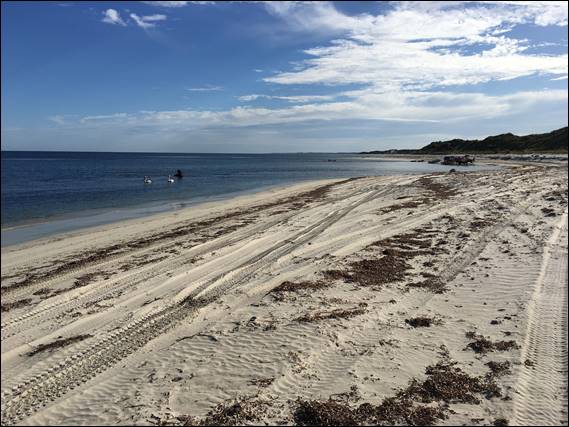
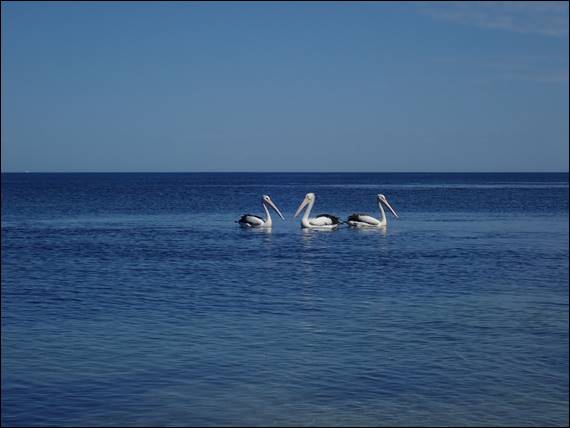
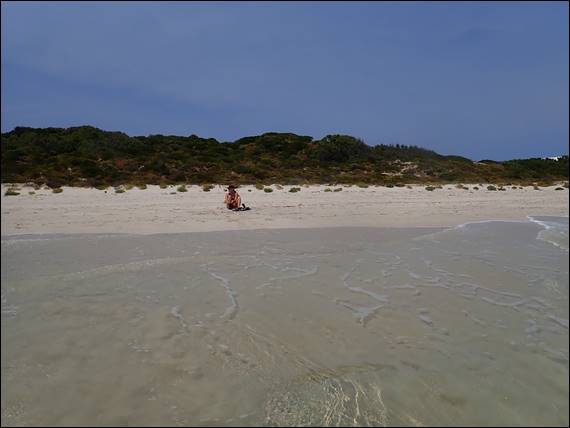
The same troop of us headed out past The Point as last time and as we drove out we finally came across a bay that was free cars. Each bay seemed to have occupants already set up, and in the bay we chose we were nestled between two parties. Behind us a couple were fishing and ahead of us was one of the commercial fishing crew. Their boats were just coming in and they started to pull in the drag net, meaning they would soon be one their way. A few pelicans were drifting about, maybe due to the presence of the commercial fishing crew as I have not seen them swimming along the coast before:
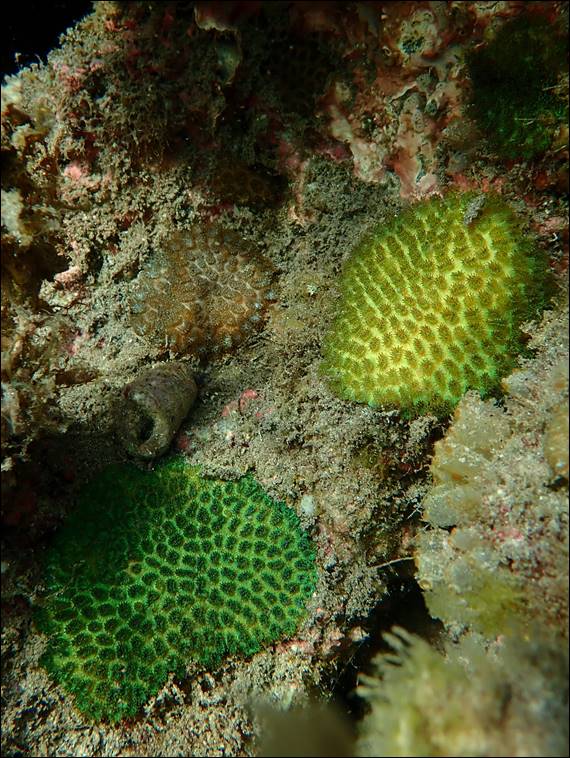
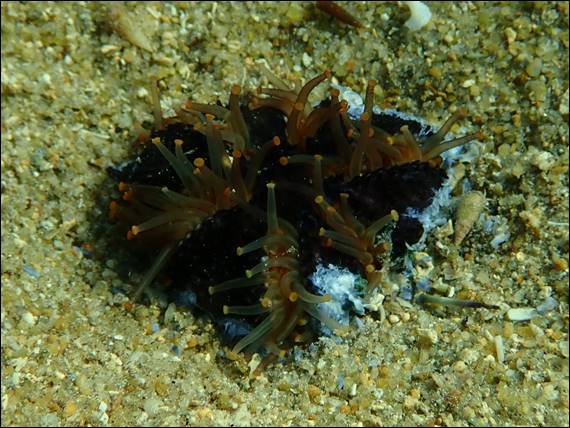
I was first in leaving the others to kit up and catch up, the water near shore was murky but I took my time as you never know what might appear. I spied these three corals close together and I was really taken by the different colours all in one spot. It is not uncommon for us to find these hard corals washed up on the beach, and I have some vague recollection of trying to identify them before. I’m not even going to try this time, but did like how the filaments are clearing visible, feasting on all the sediments that were stirred up in the water. Next time I will have a bash at getting some more detailed images, which will also help with identify them:
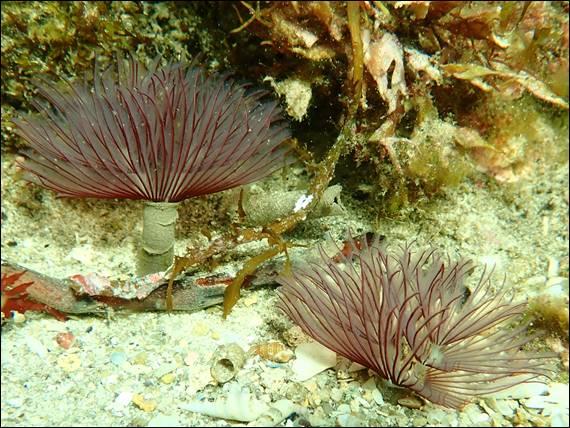
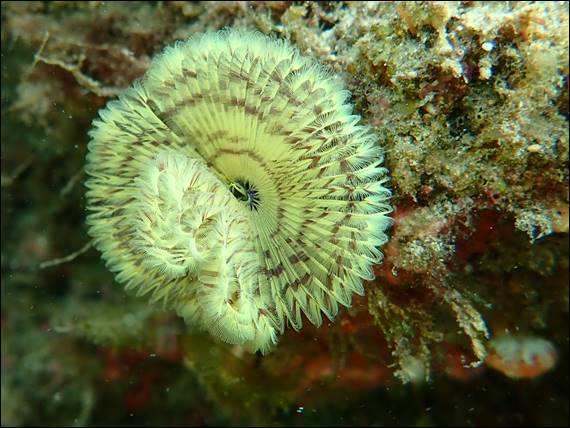
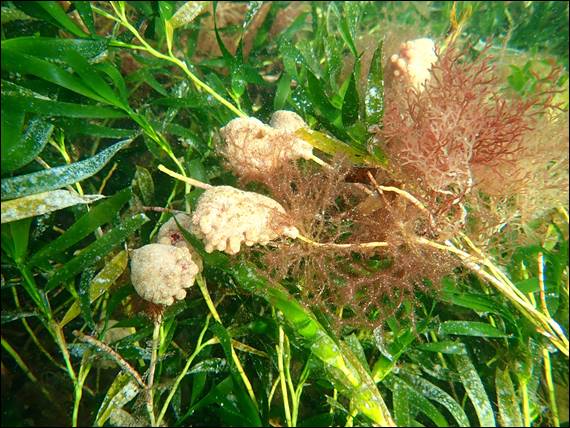
Last weekend I posted about what I thought was a Feather Duster Worm. I have since discovered that it was a Southern Australian Fanworm, reputedly to be the most impressive of all the fanworms: https://sandbagged.blog/2021/02/05/playing-hide-and-seek/. Today I came across what I believe really are Feather Duster Tubeworms, a patch of about ten clustered together. I was careful not to get too close to avoid them shooting back into their protective tube, one of which you can see without the worm sticking its feathery branchiae out. Hopefully, this time I have correctly identified it:
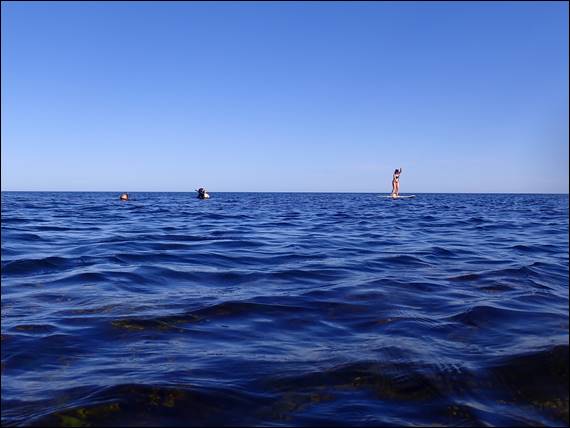
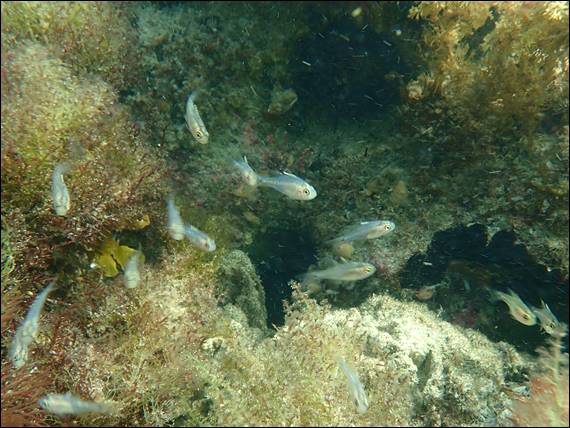
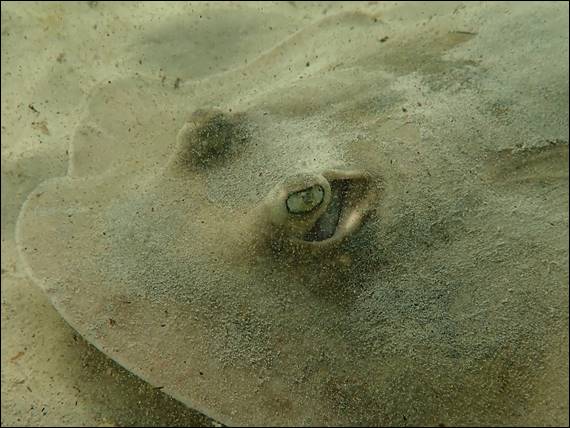
I came across several large Southern Eagle Rays, which I am guessing were fully grown adults. I had called them Australian Cownose Ray, in the same post that I linked above. While it seems that I am mistaken I am struggling to accept this, as the Eagle Ray has a variable pattern of spots while the Cownose Ray is plain on top like the ones I see. While we were continuing to search below, Lisa and Monica had decided to head out on their stand up paddleboards, carefully avoiding the shallow reef areas in case they fell off. As I continued my journey I came across plenty of shoals of small fish and isolated larger ones. Sadly the larger ones I really wanted to show you were just too quick:
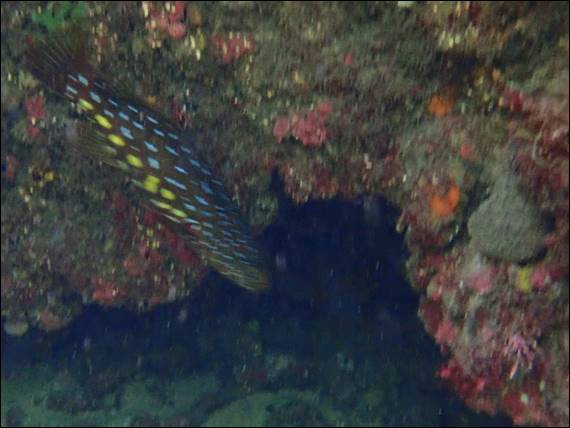
As soon as I saw them they were off, and while I caught each of them on camera, it was never a clear image. This area had heaps of interconnected caves and swim throughs, more than any area we had previously been too. This allowed these fish lots of places to quickly get away often way too small for us to follow. The first one was a Spiny Tailed Leatherjacket, a fish I have been hoping to see for a long time due to four distinct yellow spines near the base of the tail. The next was what I believe to be a Rock Cale, the shape, mottled patterning and spotted tail is what makes me sure of this. And the last one I that I simply have to include was the spectacular Harlequin Cod, and I do wonder what my chances of seeing one of these again is:
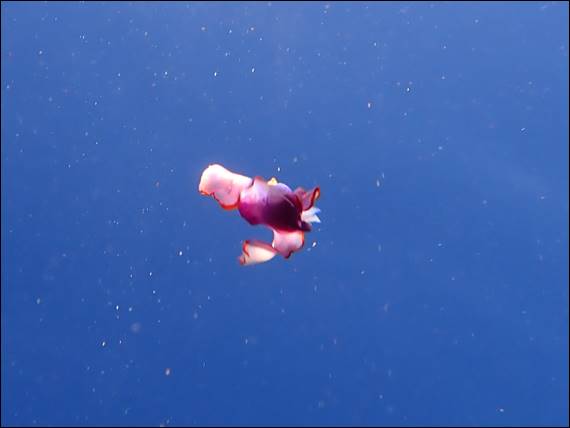
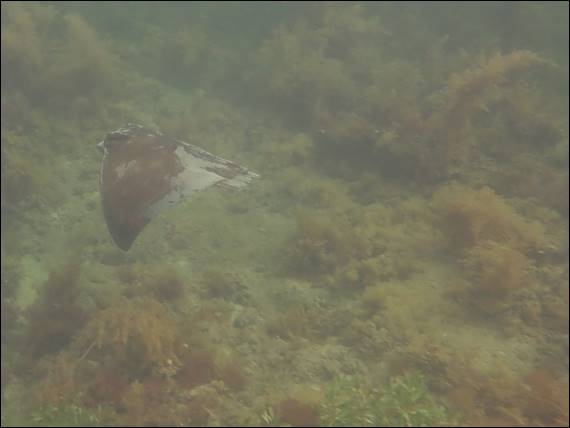
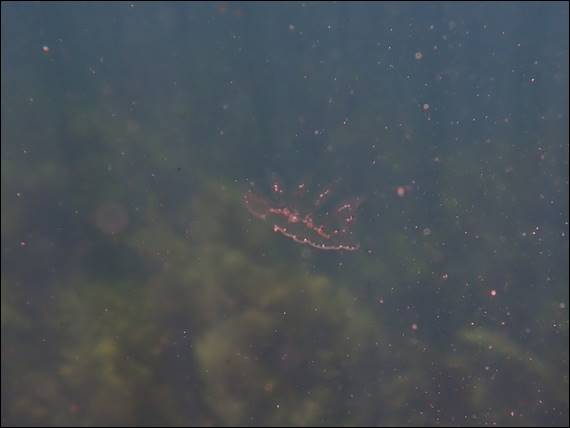
In my post yesterday (https://sandbagged.blog/2021/02/13/a-splash-of-colour/) I included what I believe to be a juvenile pipefish. The first and only other time I have seen this was on Australia Day 2016, and during that same snorkel five years back I also came across a Batwing Sea Slug. So it seems really uncanny that today I came across my second sighting of a Batwing Sea Slug. The image is taken from below making it look like it is flying through the air, and as I watched it the reason for its name was pretty obvious. I studied it for ages and of course simply had to take a video, as it flapped about in front of me:
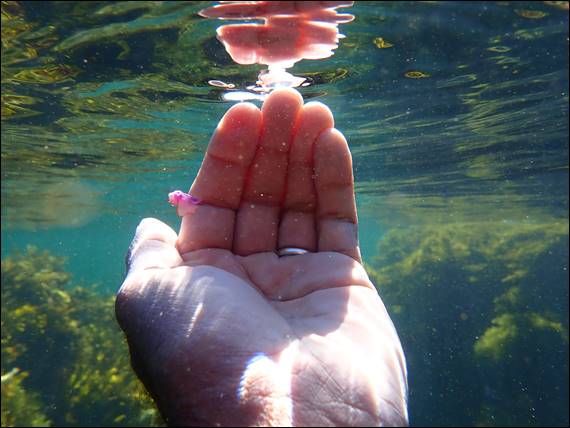
If you watch the weed behind, more so towards the end of the video, you’ll see how the swell was pushing the water back and forth. It was pretty impressive how this little creature managed to stay mostly in one spot with all the water pushing me about this way and that. To give you an idea of the size of some of my finds I quite like this mage, it just goes to show how you really have to keep a sharp eye out for all sizes, shapes, colours and movements. Today there was more that got away from me than what I managed to catch on camera, but those are the breaks and it was still lovely being out there:
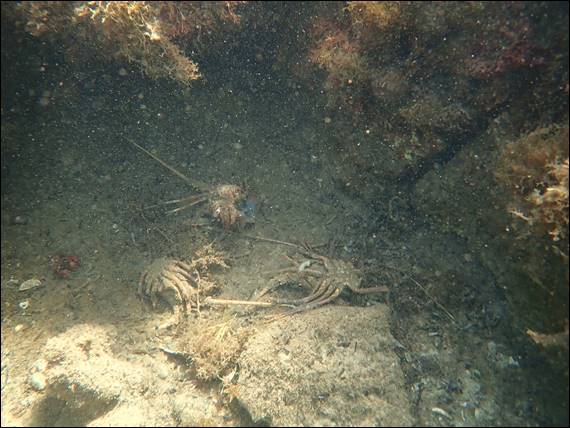
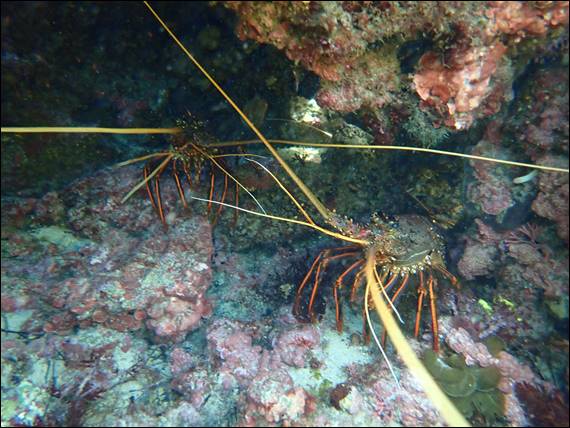
As I drifted about I came across a rock lobster graveyard, the remnants of others who had been in luck during their dive and had taken home a feast. You may also be able to tell that I was heading back to shore as the water was getting murky again. Unlike these previous people Gav and Geoff however came in empty handed, what they found was either undersized or too quick to get away. The latter being a bit like how I had faired with the fish today, just too many escape routes for the critters. Still they too came out smiling, as we all did:
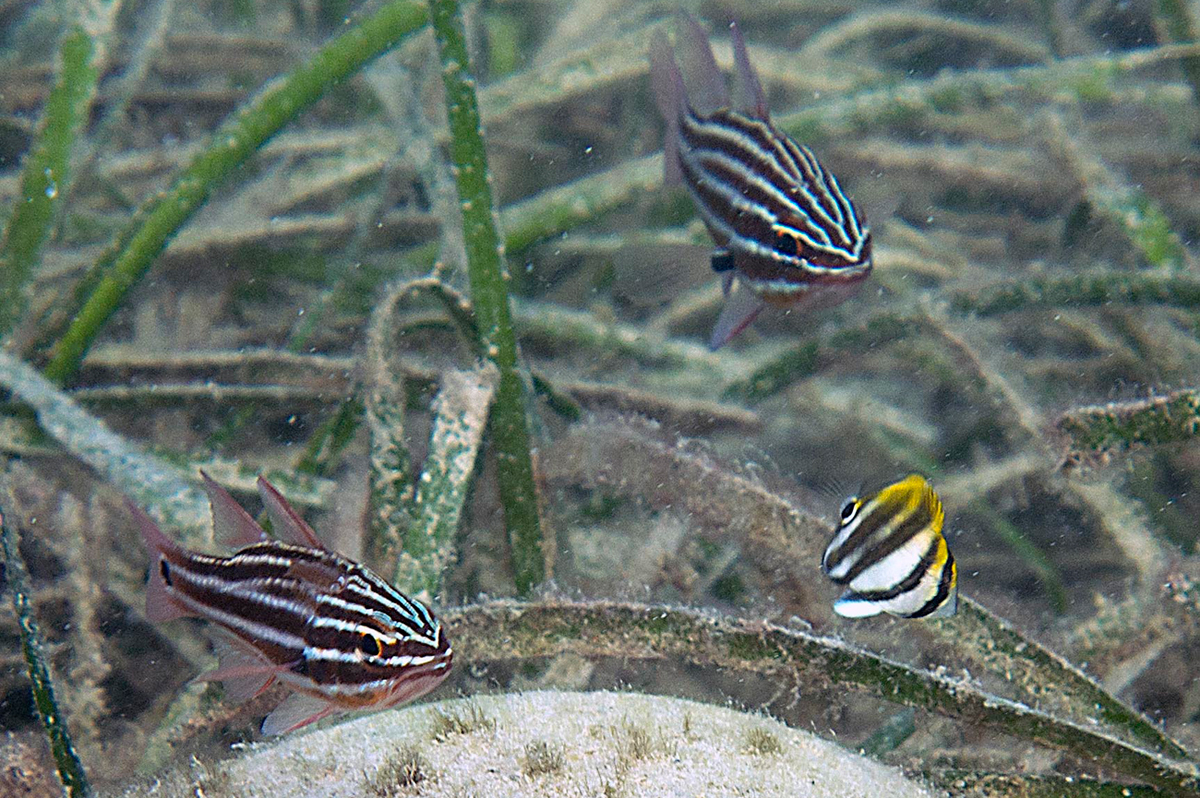
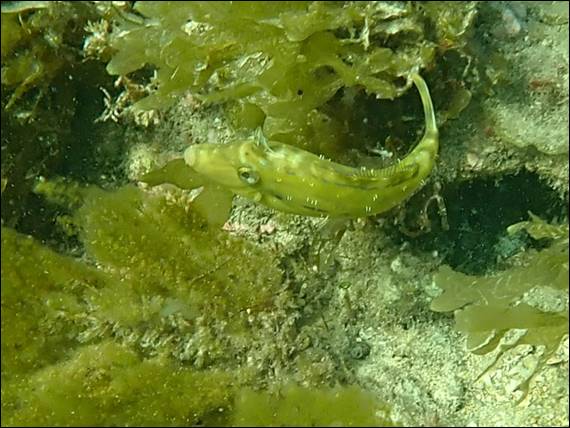
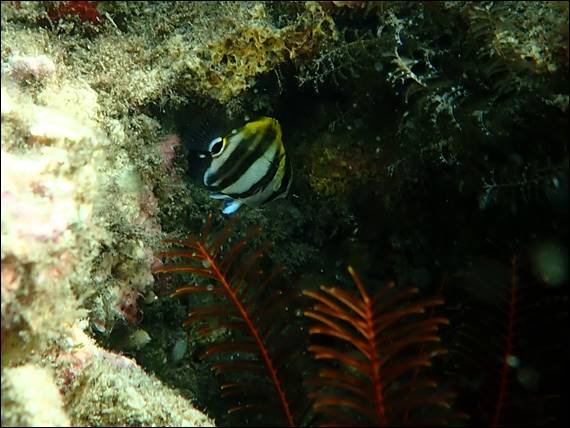
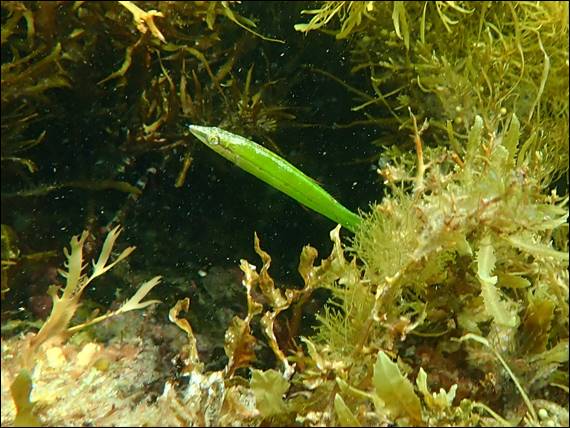
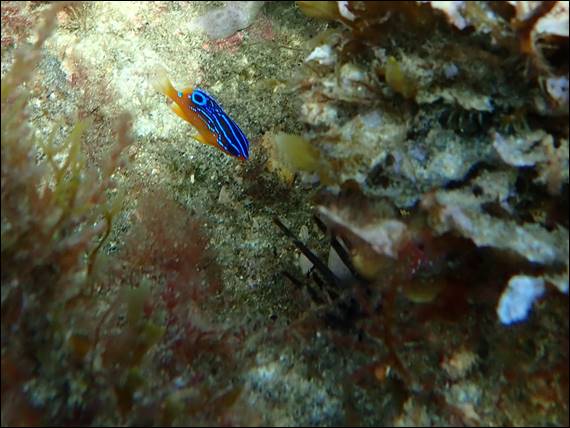
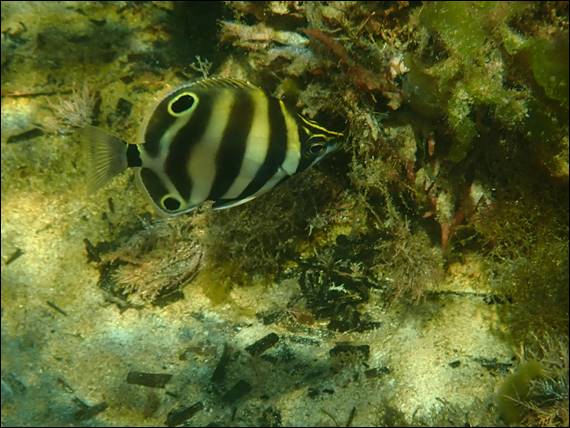
My last find was a small shoal of what I believe to be Blue Weed Whiting, which happens to be the same as that little green fish I snapped yesterday only that one was a juvenile. I’ve also had the other two small juvenile fish identified, Rongy was right with the juvenile McCullochs Scalyfin. The other one that I guessed may be a Coralfish or Bannerfish really surprised me and is a Ocellate Butterflyfish. You would never guess it from the look of the adult but on the Fish of Australia website there is also an image of a juvenile that is identical to what I found. These fish don’t usually venture this far south, so it was a really good find:
In the image above I was so focused on the Blue Weed Whiting, which I followed round for ages trying to get a clearer image, that I didn’t even notice the Gobbleguts and Western Pomfret to the left until I got home. It had been another amazing swim and as we packed things back in our cars the wind died and the water went flat. Much as it was tempting to warm up and head back out, one by one we drove off. The pelicans were still bobbing about in the shallows looking like they were having a good feed, so we left them in peace and took a leisurely pace driving out past the increasing number of cars:
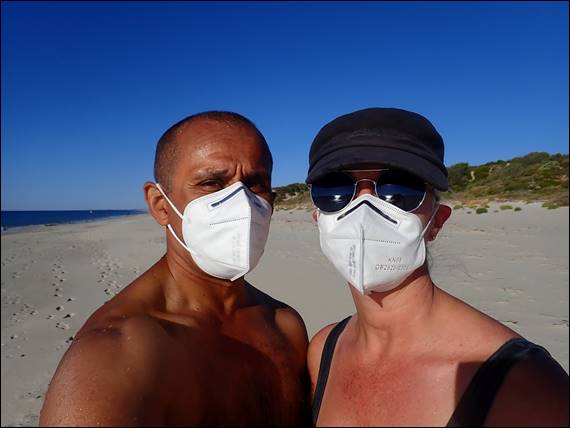
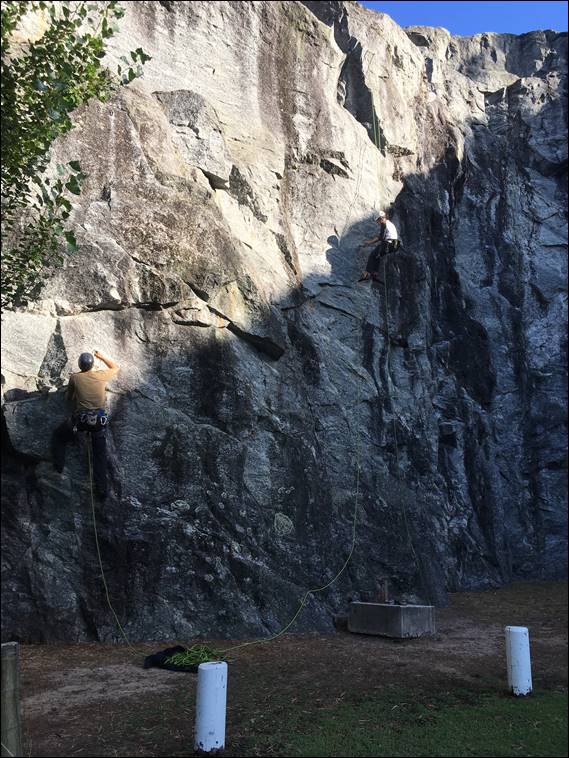
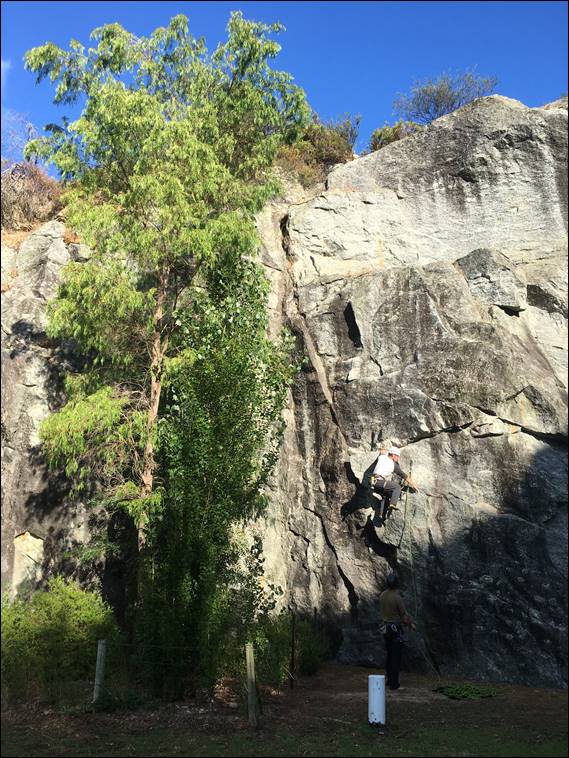
I’ve only had one full week of work since mid-December and that was working from home, so it really didn’t feel like a full week with all the snorkels I got in. This week was also short, as Lisa and I drove up to Perth to help our daughter settle in at University. As a result of the restrictions in the Perth area and despite being back home, we are now required to wear masks if we leave our house. That is until midnight on Saturday, as long as no more COVID cases are identified. This was however not going to stop me heading out for a before work climb on Friday. But I do realise that heading back to Welly Dam will soon become tiresome for you to read about:
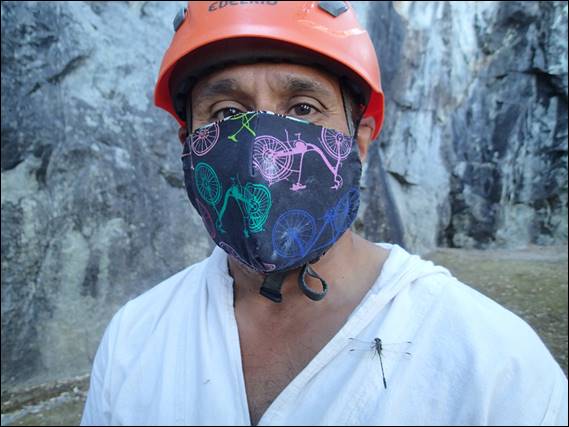
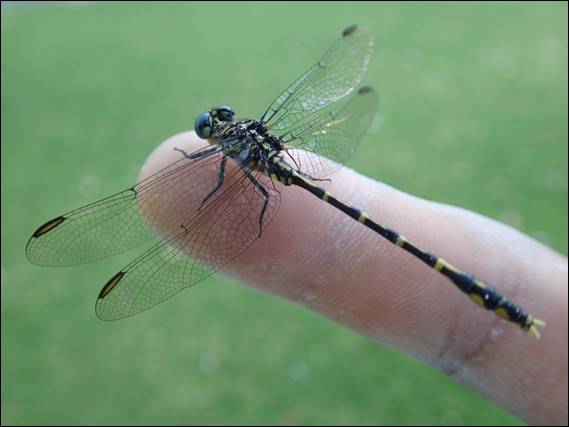
So I do not propose to tell you about how well organised we were climbing with three, using two sets of gear, each of us leading each route, keeping the grades respectable and still managing to squeeze six climbs into a three hour session! I do however, want to mention this beautiful Damselfly that was on the rock, as I climbed up, and then when I came down it went onto my top. Supposedly the way to tell dragonflies and damselflies apart is that the former have different sized rear and fore wings. Based on the colours I have guessed it may be a Australian Duskhawker Damselfly, and am eagerly awaiting to find out if I am right:
Rather than head to the office I worked from home on Friday. This allowed me to be mask free and also to have the accompaniment of music, with a compilation of 80s singer song writers. This morning being Saturday there was no work. So after a few domestic duties had been seen too, and seeing the conditions looked primo, I headed down to our local beach. Near shore I saw more stingers than before this season, but they soon parted and I drifted safely to the thankfully stinger free deeper water. Here I found a curious creature a mere 15mm long, when it was stretched out:
I have seen this before a long time back and got in touch with a local marine scientist working at the Busselton Jetty. I was told that it could be a juvenile pipefish, but they were not able to identify it any further than that due to the images not being very clear. So I spent a while snapping loads of images of this one in the hope that at least one would come out clear. I also took a short video if you are interested to see how it moves through the water. I also took a video of this Eleven-Armed Sea Star, the reason being so you could see just how quickly this particular sea star moves:
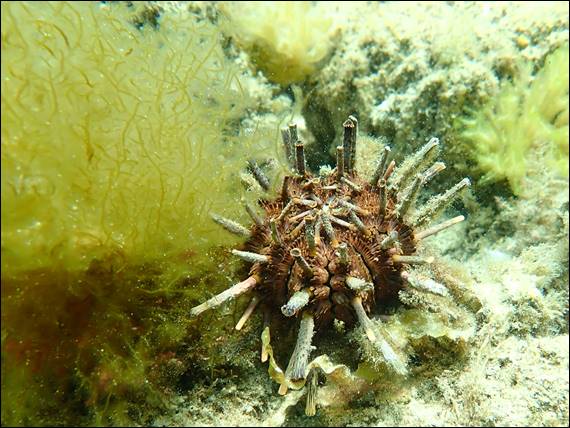
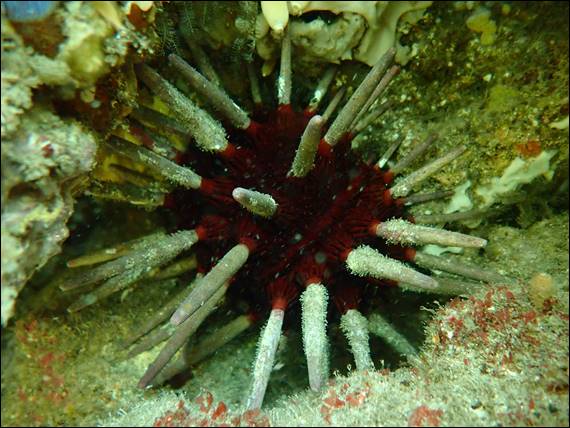
Being a carnivorous sea star it feeds on small crabs and marine worms, and is different to most sea stars as it has four rows of tube feet on the underside of their arms. Most other sea stars only have two rows. I’m guessing, but this may be why it is able to move so much quicker or it may be so it can hold onto its prey. I also came across another Western Slate Pencil Urchin, and this one was in a brighter location allowing a clearer image. Due to not having as many spines as other urchins these are more vulnerable and as a consequence wedge themselves in cracks. This in turn rounds off the ends of their thick spines:
As I looked from above I spotted a small trigger fish, today I had donned my short wetsuit and weights. This allowed me to stay out a bit longer, and also duck dive down more efficiently and with less bodily movement. It still wasn’t enough to prevent this fish spotting me early on and making a dash for the weed. But after waiting patiently, it came out again and I got a good enough image to identify it as a juvenile Horseshoe Leatherjacket. The patterning gives it away, but what really struck me were the small spines along its side. I don’t recall seeing these on the adults:
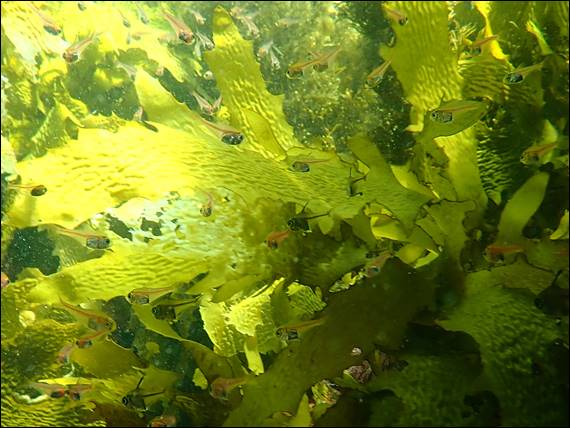
My next spot came from the slightest splash of colour, this tiny fish would have been no more than 10mm long. The size of it becoming apparent when you compare it to the hydrozoan, which looks like a fern type plant but is in fact a colony of very small predatory animals. They are ready to give you a surprise like a jelly fish might if you get too close. Back to this fish, it is again a juvenile making it hard to identify. I’m really not sure but the shape and markings makes me think a Coralfish or Bannerfish:
My discovery of small beautiful fish continued. Next I spotted a short, maybe 50mm long, slender but distinct stripe of green that stood out and seemed to be moving. The green was fluorescent and mesmerising. I was able to dive down away from the area and sneak up from below. While I didn’t move or moved very slowly it was fine. It did however dart for cover a couple of times, and as I sat there waiting patiently it popped back out again. Yet another juvenile and again I’m stuck between two species, either a Weed Whiting or Cigar Wrasse:
While I saw lots of other juvenile including Hulafish, Gobbleguts, Pomfrey, etc. these were all in small shoals and I have included images of these previously. The last fish that I wanted to include in this post was again solitary, and looked simply stunning. The blue patterning certainly didn’t help it hide and despite the depth it was at, how could I miss the blue dot moving about. Another tiny find maybe 20mm long that looks like a Fire Damsel, but they do not come this far south. So the search continued and with a bit of help from Rongy it has been identified as a juvenile McCullochs Scalyfin:
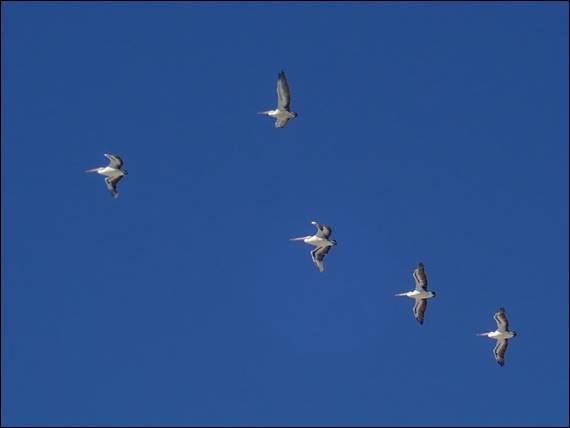
Along the way today I spotted a small ray, plenty of fish and sea stars so overall it was a great snorkel. The conditions look to continue today so I warn you I might be popping out again this afternoon and will almost certainly be back out tomorrow. The latter trip will be down past The Point so I’ll be taking the full length wetsuit for a longer dive if the conditions hold. Coming out of the water and just to prove I’m not solely focused on marine life, I took a quick snap of a few pelicans soaring on high, which was a little how I was feeling after all my finds:
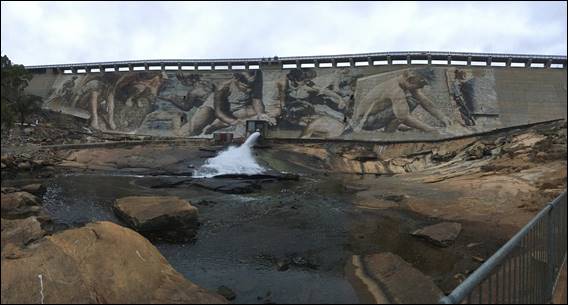
Ever hopeful that the five day lockdown was enough to abate an increase in community spreading of the virus, we organised a trip to Welly Dam for Saturday morning. It wasn’t until the bells tolled at six o’clock Friday evening did we were whether our planned trip would be allowed to go ahead. Fortune was on our side and I found myself making a cuppa for the journey ready to leave the house at 5am, and of course one for Lisa in a sippy cup to be enjoyed at what some might call a more respectable time of the morning. Arriving at the Dam the Muriel is getting close to being finished so I stopped for a while to admire the impressive work:
It was dark for more of the drive than I had expected, remember we had started to climb here at 5am just a week back. This was part due to the remains of a cyclone pushing a cloud bank over us, but also due to the longest day having passed and the seasons being on the downward slope to the shortest day. I met Howsie and Mikey at the Dam, and we reckoned that our 5am before work climb may require head torches soon for the first climb. Also as the early morning temperatures drop, which won’t be for at least three months, Rongy who doesn’t function so well in the cold may decide not to join us before work. But that is the future and we were in the present:
Mikey has been over for close to a month, and this is the first time I have met him. Usually on his trips over here it would be a matter of days from his arrival that we would meet up at some crag. For this trip he is however staying for a year, so the pressure to cram trips out to rock is off. Also he has completed his 10km challenge so the urgency to get out on new routes is also off. Howsie however has his own challenge, as you should well know by now, and to kick things off I suggested he lead Ebonie Road. I had good reason to suggest this climb:
It could have been a tall ask, not only is it a route that he used to really struggle on but it was also the first route of the day, so the muscles hadn’t been warmed up yet. But he cruised it in great style, after which we pulled the rope twice so both Mikey and then I could lead it. As we were getting down to business Andrew rocked up, new to the south west climbing community and also new to climbing. As his first venture on rock Welly Dam was probably not the best choice. But he had made the effort, so Mikey jumped on Murky Corner. Being one of the easier lines here it offered a good intro to Welly Dam for Andrew:
Andrew had a crack at the corner, while needing to learning all the basic techniques. This included that it is best to keep on your toes and not the sides of your feet as son many new climber do, as this allows you more ability to twist your legs; using your core muscles to pull into the wall, and take the weight of your arms; not over gripping with your hands, and learning to relax even when you are scared; resting when you can, and focusing on breathing to help you relax; and most importantly use your feet and legs, they are after all the biggest and strongest muscles you have. It was a huge ask on the steep and technical walls at Welly Dam:
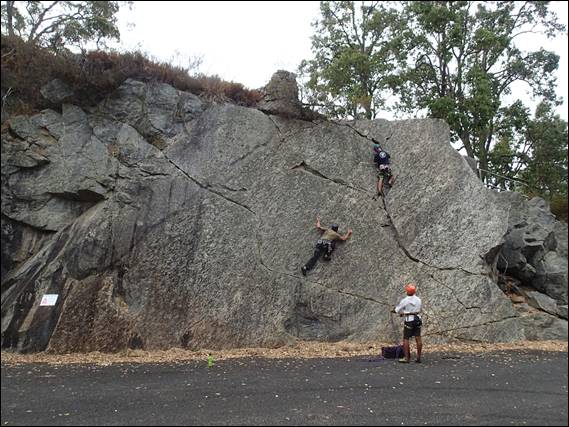
What with Andrew having a crack at climbing for the first time, and adding Murky Corner to our itinerary my lead changed from what I had in mind to a route closer by so we could hang about together as a group. So instead of A Walk in Central Park I picked an equally fingery route, but one that is way more sustained and technical. Small fingertip sized holds, smeary feet, sustained moves to link together and the risk of descent falls all make Taj vs The World one of the best routes here, in my opinion. Despite knowing this route inside out, I was close to coming off several times but somehow managed to cling on each time:
Howsie and then Mikey went next and neither of them fare so well, the first and second clip isn’t too bad. A few small holds and long reaches can get you there, but between the second and third clip it gets serious. Non-stop action, that you need to tackle at a steady and controlled pace. It is not until your feet are above the last draw can you reach the next clip, and even then making that clip feels tenuous and scary. If you don’t make it there is plenty of air time that awaits you, as they both found out on numerous occasions slowly wearing down their stamina and shredding the skin from their finger tips:
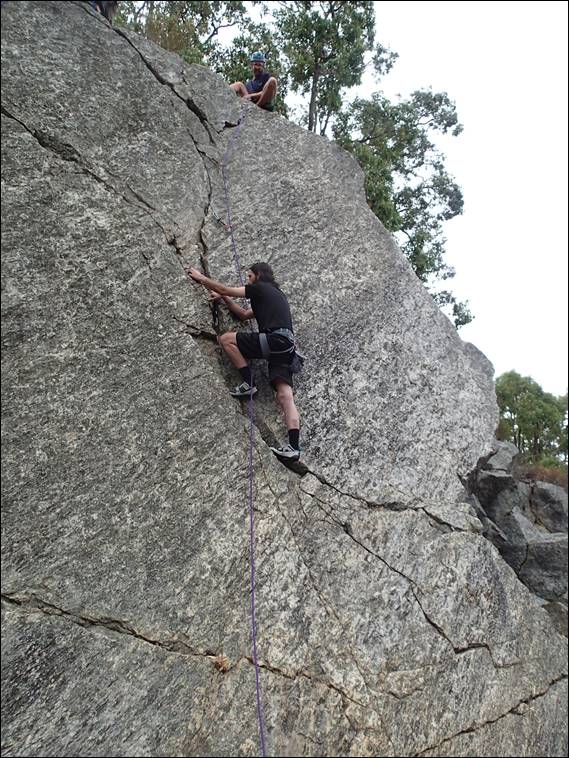
So with Andrew having been beaten by Murky Corner, after a valent effort and trying in a determined fashion while being strongly encouraged and tutored by the three of us below, and Howsie and Mikey finally deciding they needed a break we had a change of scenery. On our last trip here Rongy had talked up Irish Stew, one of the fine but short slab routes straight off the carpark. This wall also has a route that we felt Andrew would have a far better chance of getting up. So Howsie hit Irish Stew while Mikey climbed The Crack, with me belaying both of them at the same time:
While some may roll their eyes at some of our antics and be quick to tell us that it probably is not sensible nor safe, we did confess to Andrew that what he was witnessing was not the best practise and also something we do not do very often. No drama’s befell us and they both managed a clean ascent, allowing Andrew to have a bash at the Crack while I followed Howsie up Irish Stew. And yes Rongy it was great fun, and worth climbing again after such a long time of walking past it. Andrew did well and managed to get up the Crack, but the two routes of the day had wiped him out:
With that he decided to not climb anymore, which was probably very sensible and I do hope that he wasn’t put off this wonderful pastime by having had his first experience at the very intimidating and extremely unforgiving Welly Dam. While it may sound like I’m not selling the place, these are the words that many use on their first visit here. You however need to immerse yourself in the place several times before you start to realise just how great it is. The three of us carried on but before we returned to the unfinished business on the big walls I lead B Young, allowing Howsie and Mikey to get used to small fingertip holds again:
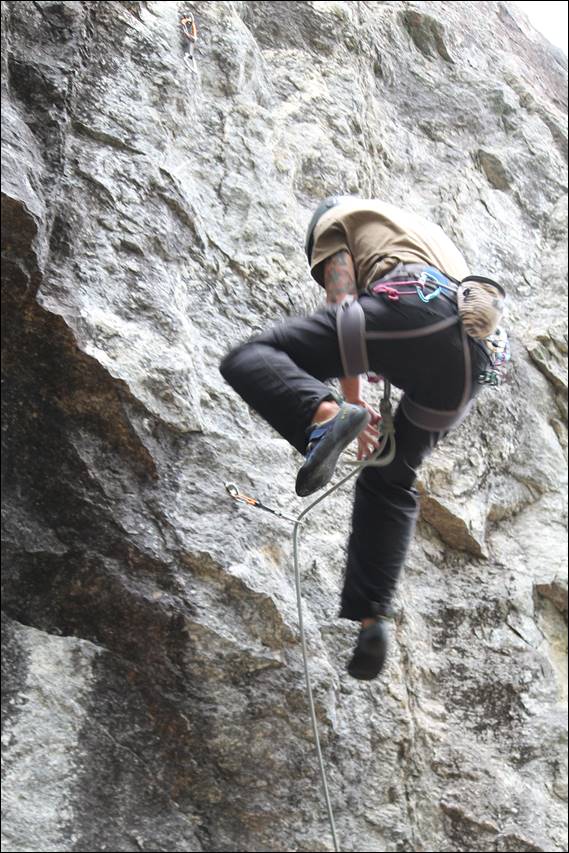
Back on Taj and Howsie made short work of the route this time, bagging another 21. So all that was left was for Mikey to get up it. He didn’t get to the third clip, again and again and again. Taking fall after fall after fall and at times not looking to be making any progress. Eventually he reached the conclusion he again needed a rest from this climb, as his energy was being sucked out of him and his fingertips became more and more tender. So Howsie walked along the crag ready to point me to a climb he want to follow up on, finally deciding on my original intention of A Walk in Central Park:
Central Park is a route named so as it can spit you off at any time, and you never know when that might happen. However, after triumphing on Taj the holds on Central Park felt generous and easy to navigate. The only issue with the route being that you need to top out, since Steve had removed the ugly but effective chains at the top. So as Howsie followed up I suggested he might like to down climb Pocket Knife rather than walk off. And strangely, as so often happens when I suggest such things, he did. Mikey was resting up so I promptly did the same as Howsie, before it was back to Taj:
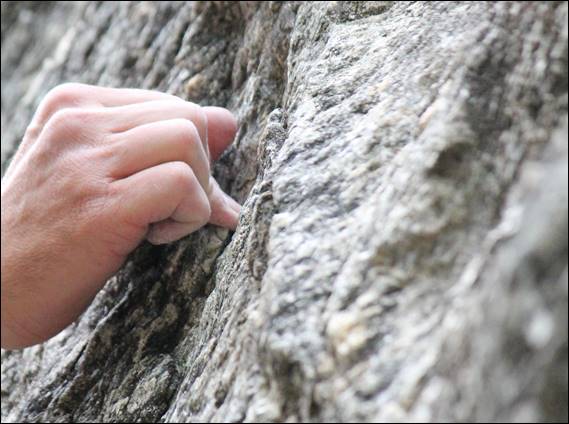
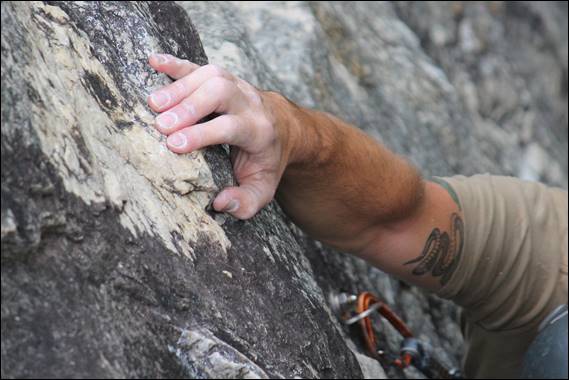
As can be seen above Mikey tried again, and again, and again. I’ve included a quick video clip of one of his attempts, in which he make a remark that could be said about so many of the holds on this route… just before he takes yet another fall. To give you an idea the hold he is talking about is worse than the one shown in the image below, which again is from this route. His persistence was admirable and finally, I’m pleased to say, it paid off. Neither of them had anything left in the tank for more climbing, so having watched the boys on this route for so long I couldn’t resist and had to jump on it one more time before we packed up and headed home:
Well I didn’t manage a snorkel every workday this week, and in truth I’m not sure why. The winds were predicted to be up so I was sceptical about my chances. However, from early on each morning before it was light I listened out to get an idea of what the winds were actual up to and most days it was calm. That along with the chance to take advantage of working from home and where we live enabled me get out four days out of five, the first one I have already written up a post for. And as you might imagine with three dips to report on in this post it will be a bit longer than usual. Even more so as I also reflect on past finds and report back on a few identifications I have since obtained:
On Tuesday I had to schedule the snorkel around some meetings, and this resulted in heading down a little later in the morning. The forecast had indicated it would work well, but when we got down there things had picked up and the surface was starting to roll. Today however Lisa was intending to come into the water with me, so we went in anyway. No wetsuits were donned today, nor for any of my swims this week. This was in part intentional so I wouldn’t stay out too long and chew up too much of the working day. Working from home save me an hour of travel each day, but I still need to do my hours and I’m not one for working into the evenings:
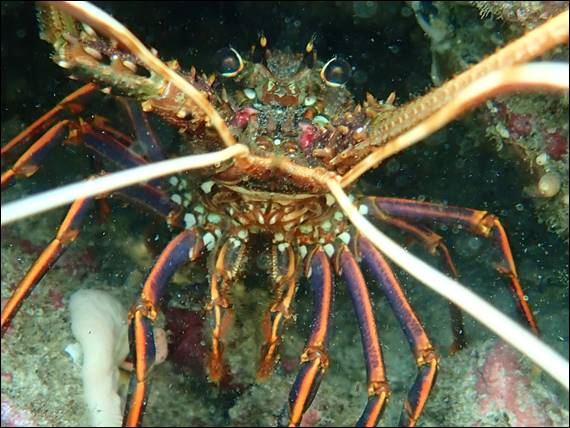
While not a new find this image of a Rock Lobster is probably one of the clearest I have taken to date. It hadn’t picked the best place to be and struggled to get much further away from my lens allowing me a bit more time to focus the camera, and also being in more light than when I have attempted to snap them deeper inside their hidey holes. The mosaic patterning is stunning, resembling a glass stained window with precisely placed small segments of colour looking like jewels. The best part is that being out in the open just a bit meant that Lisa got to see it from her vantage point on the surface, she’s not one for duck diving so this was the first one she has seen underwater:
One of the most common fish see is the Orange Spotted Wrasse, a fish that will hide in the weed and stick it’s head out observing where I am and what my intended actions maybe. Acting on my actions as soon as I make a move. Today I spotted what I felt to be a different wrasse and as I attempted to catch it on camera it acted in very much the same way making use of the weed, popping it’s head out and darting away when I got to close only to hide a bit further away and again watch me. Checking my fish book as I type away I have discovered that it is the male Orange Spotted Wrasse, whereas the ones I see more commonly are the female of this fish.
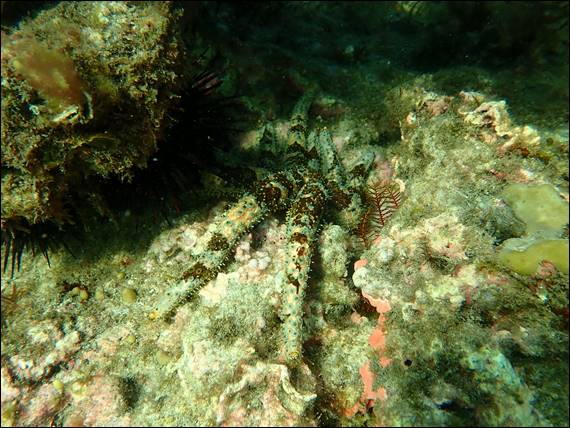
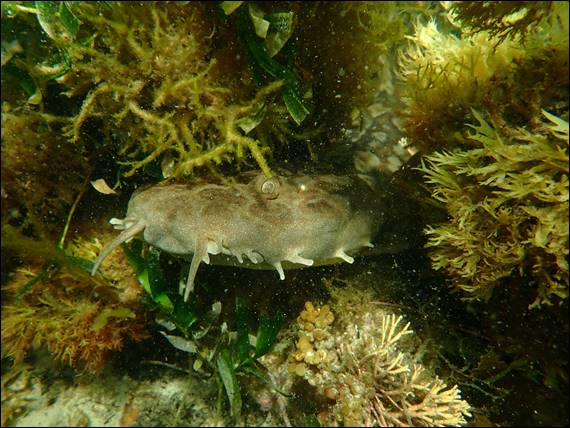
So on the topic of identifying fish, through QuestaGame it seems that the Wobbegong I spotted and reported in my post called Trying to Focus was not the spotted variety but the western variety. These two look very similar but the spotted variation has a distinctive triangle pattern between the eyes on top of the head. Looking back at the images it is now obvious that it doesn’t. Despite my persistent research to attempt to identify the following urchin I finally had to resort to my App. I’ve seen a few of these urchins and thought they were pencil urchins, due to the thickness of the spines. What has thrown me is the textured nature of the spines and what looked like suckers on the ends. I was however close, and it is actually an Impressive Pencil Urchin:
Lisa got cold pretty quickly during our swim and that along with the rolling water, which had made her feel a little sea sick, resulted in her going in before me. I didn’t stay out all that much longer as what with the later start the swell was picking up and work was calling me, with the next meeting booked in precisely one hour after I had walked out of the house. Making my way back in I scoured the ocean floor for one more find worth checking out, and while I see so many Shaw Cowfish this female was in amongst the more soft looking weed and made for a nice image:
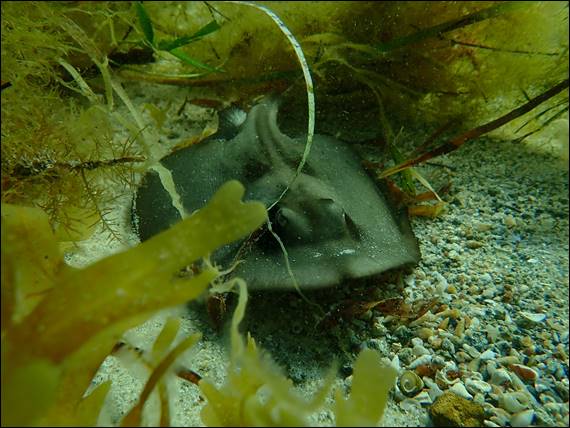
The water had certainly roughened up and it usually when I get to the shore I realise how much. This is where I found Lisa soaking, up a few rays. That reminds me that we had seen a ray as soon as we had gone out. The little Stingaree that I had seen in my previous snorkel was again in the shallows, and it was once more hiding in all the weed that had become detached during less calm conditions and was now collecting on the sandy area near the beach. I had called it a Bight Stingaree in my post having relied on my books, but checking it out in more detail before posting it on QuestaGame I changed my mind:
This time I guessed correctly that it was a Striped Stingaree, the marking were just that little bit different. I also discovered the Striped Stingaree is endemic to the shallow waters off the South West of Western Australia, so this one really is at home at our local beach. I can’t recall now why but Wednesday came and went and I didn’t get out for a swim. When Thursday arrived it was a different story and this time I head out before eight to be greeted to beautifully calm conditions and an empty beach. Obeying the rules of the lock down I still however wore my mask walking to and from the spot I go into the water. Almost immediately I thought I had come across that little Striped Stingaree for a third time:
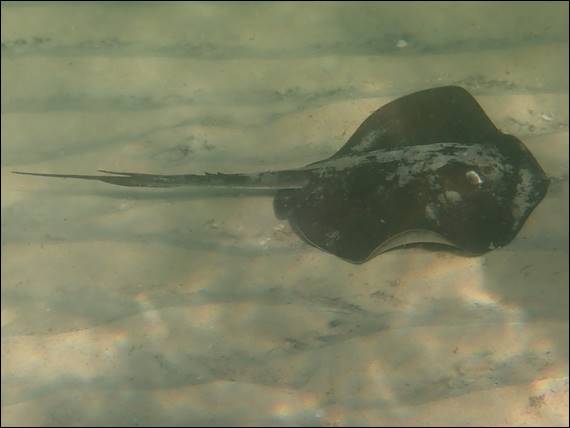
Despite being almost identical in size if you look back at the images of the previous post, No Complaints, you will notice a few differences. I’ll mention the colouration first, this one was far darker and didn’t have the same subtle patterning of the previous stingaree. But more obvious was the shape of the tail, this one was pointed at the end and that was a clear indication to me that this was not a stingaree but a stingray. My guess was a Black Stingray, and a juvenile at that as they can reach up to 4m long. I’ve only ever seen the adults at Peppy Beach once and they are huge. I also took a bit of video footage of this small one so you can see how they propel themselves through the water, it is really graceful and lovely to watch:
Now the way QuestaGame works is that other players get a chance to guess your finds, and after that has been completed the experts come in to undertake the final verifications. I have noticed that often the other players will provide a more detailed guess delving into the species, whereas the experts will often stay at the next level up of the genus or at times family. The reason being that the lower levels at times require far more conclusive evidence, which they at times mention is just not possible to verify from the images provided. For my stingray above I’m waiting for the verification but it looks like it may be the Giant Black Stingray, which can grow up to 4.3m long. What distinguishes the two I have not been able to find out, so I’ll await the experts verdict and see if they give me any advice on the differences to look out for next time:
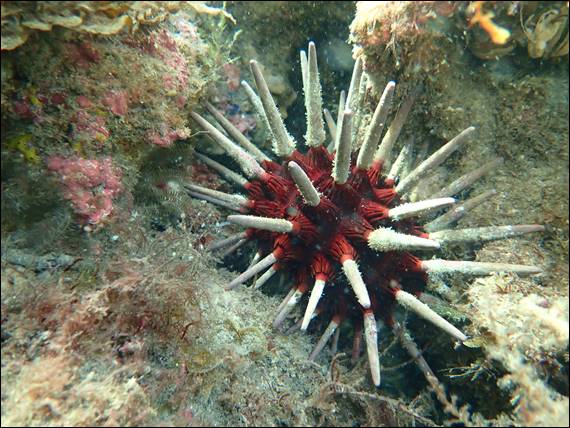
I was however correct first hit with the above urchin. Like the Impressive Pencil Urchin I do not get to see these Western Slate Pencil Urchins all that often. This one also has distinctive chunky spines, but these are smooth with blunt rounded ends. Also the body is deep red colour, as oppose to brown and the finer patterning on the body is less prominent. I tend to find these stuck deep in rocky hollows and relatively clean. Whereas the other variety is more out in the open and often covered in weed, almost obscuring it from view. This one however was much easier to identify using google and all the local websites I make use of to identify my finds, making me think it may be more widely spread or the other variety is so well camouflaged when it coats itself in weed that people just don’t see it:
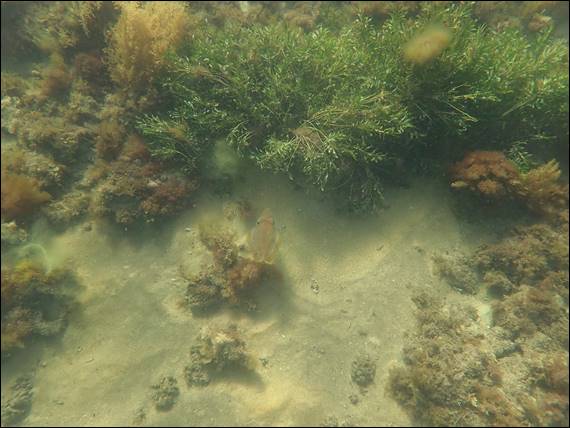
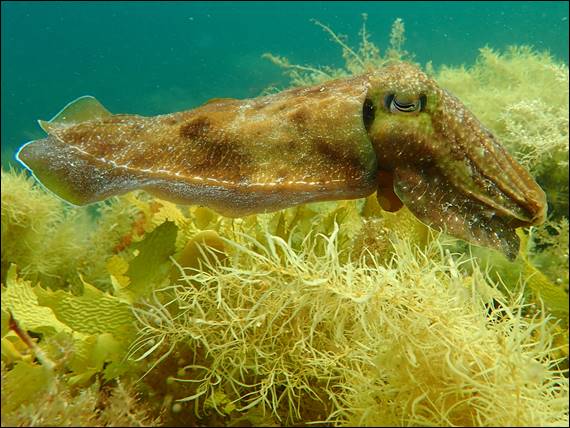
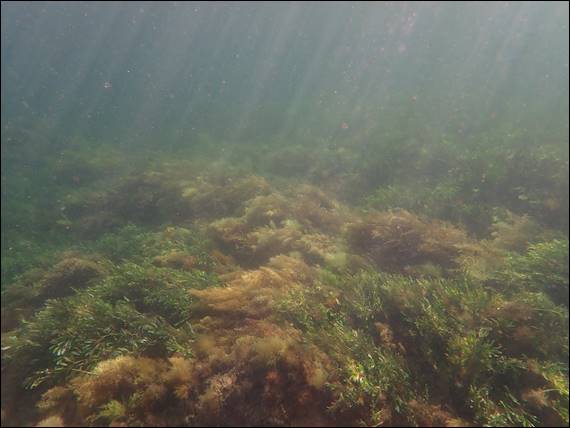
I have passed over the above image but it is included for a very good reason. Not only does it show how amazing the visibility was today but if you look closely you will hopefully see why I took it. A Giant Cuttlefish was cruising along underneath me. It was clear that it had spotted me, as it made a slow but determined path towards the clump of weed in front of it. Once there it nestled underneath the weed, away from my prying eyes. The swell wasn’t huge today but the 15-20 second cycle would gently push the water shoreward and then back out to sea, and on the shoreward path it drew the weed the same way revealing the cuttlefish:
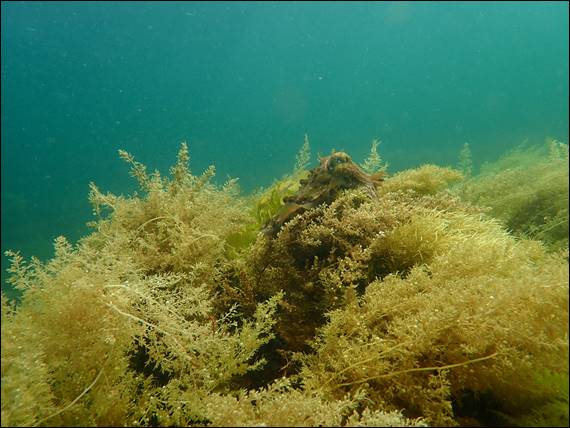
It was in 3-4m of water and I duck dived down to check out the cuttlefish, and I’m pleased to report it didn’t seem too perturbed by me saying hello. I can count on one hand the number of times I have come across these gentle creatures and it always feel like a great privilege. Despite getting cold I hung about for ages and eventually it came out and carried on with its journey, which took it up and over a shallower part of the reef. While I didn’t take any video footage this time, I got a heap of stunning images including this one in which you can clearly see its funnel underneath the head. It draws water in through this funnel, which then passes over its gill allowing it to extract oxygen:
I headed back to shore starting to chill on the inside. This wasn’t helped by cloud creeping over the sky and blocking out the warming rays of the sun. With reduce light the water looked more murky and I couldn’t see as far away from me. As I looked sideways I could just make out a dark shape heading my way. As it approached it diverted round me at a very healthy distance, too far to get a clear image but close enough for me to be able to see that it was another ray, and this one was missing its tail. Maybe the chances are too small but I do wonder if it the same tail-less ray I have seen before. Sadly having trawled through thousands of past images I can’t find any evidence of that previous encounter:
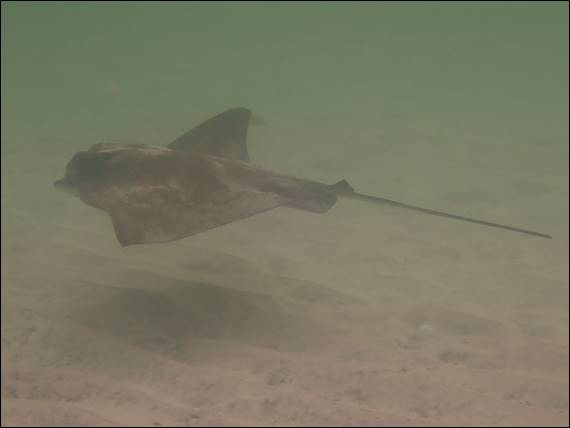
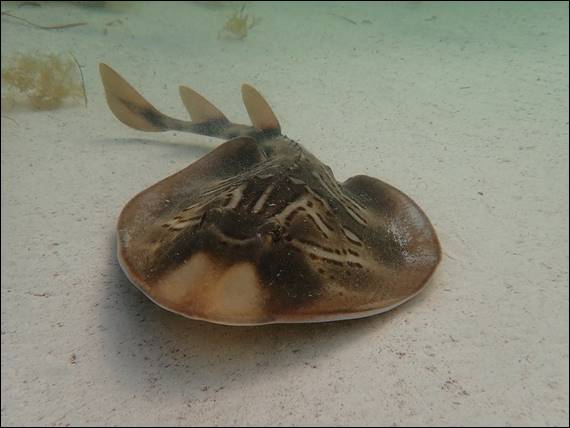
I left it to head on its way and as I got closer to shore another and then third similar ray came my way size both with their tails intact. These two were clearly different and there was a larger and smaller one, the image below being of the latter. Long whip like tails made it easier to have a go at identifying them. I also took a short clip of their very different swimming technique, compared to the previous stingray, this time using their more pointed wings just like a bird. I have always called these Eagle Rays, but it seems that Eagle Rays usually have a variable pattern of spots and stripes. These did not so I guess it may be the Australian Cownose Ray, but another player on QuestaGame suggests it is an Southern Eagle Ray. Another one I’ll have to await the experts verification on:
With so many finds I was out a bit longer on Thursday. Back in my office at home I was shivering a little and my fingers were not function fully as I tried to tap away at the keyboard. It took a good hour before the tea I was constantly sipping warmed me up from inside, while the fleece jacket I was wearing was keeping me insulated on the outside. Friday came and again the wind was low and water calm, as I went in the visibility was the best yet. I’ve continued to see lots of Blue Swimmer Crab, and while they are amazing to see they just seem too common to pop onto QuestaGame. I did however pop down for a closer look at this one and it didn’t seem to want to swim far away or bury itself. So I took a video of it both crawling and swimming away from me:
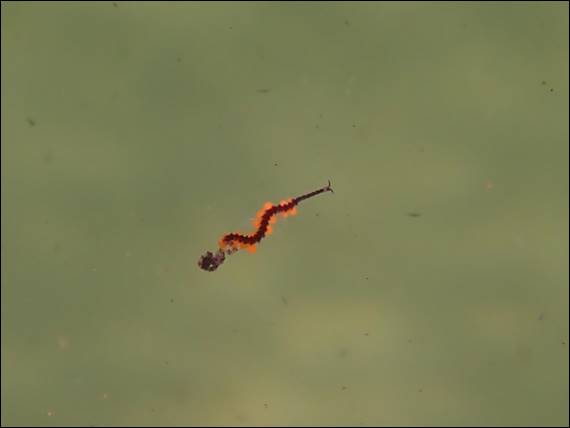
As I went over the reef proper the life below me seemed quiet, so I bobbed about keenly looked out to both sides hoping to spot more creatures heading my way. So now seems to good time to mention that the very small thing I found floating near the surface, and included in a recent previous post called Trying to Focus, has been identified as a Melibe Nudibranch. Growing up seven inches long this was obviously a juvenile. The image was in focus enough to be able to have the plate like features identified as cerata, which are structures that can be used for breathing, digestion and also defence. They are usually found on the surface but at times become detached and will then float about, and I was lucky to be in the right time at the right place to see this one. I’ve not come across a mature one of these, but checking them out online they look very cool:
Nothing headed my way. Some may think that is a good thing but while coming out is a great way to just relax and free the mind of quite literally everything, I also head out to see things big or small. With little to grab my attention I started to randomly duck dive down, and that allowed me to get a rare full body image of a small female Orange Spotted Wrasse. As soon I as pressed the button it darted into the weed and repeated the pattern I had seen so often before, poking its head out and as I get closer darting off to the next place to observe me from. More often than not they stay within eyeshot and do not seem to swim off so I can’t find them. It almost feels like playing a game of hide and seek, and the way they stay reasonably close it feel like they want to game to continue:
On one of my random dives down I spotted a Feather Duster Worm, and I’m pretty sure it is exactly the same one I included in most post almost a year ago to the day on 27 January 2020 (https://sandbagged.blog/2020/01/27/the-old-stomping-ground/). Today however the water really was calm and I was able to get very close. Both of these factors making it easy to get some great focused close up images of the intricate feathery branchiae, which is the technical name for gills. Eventually after three or four dives down to check this beauty out it retracted into its protective tube. But to see an image of the tube you will have to head to my previous post:
Today it was a shorter stint in the water, but as I came back in my luck with rays for the week continued. I caught sight of a Striped Stingaree the tail giving it away. Maybe the same one from the previous days, but this time it wasn’t so content to be observed and quickly darted off. I then spotted a Southern Fiddler Ray and was hoping to get some footage of this fella swimming to add to the collection. Sadly each time I went down it settled down and stayed motionless. A bit like a kid playing hide and seek, thinking that if you don’t move and close your eyes it magical becomes hidden from sight:
Not that I’m complaining, as what we are going through really is a drop in the ocean compared to so many other people round the world, but we have after all our months of freedom gone into a five day lockdown. I wouldn’t be surprised if it gets extended and if that happen the timing would be a shame, as next week Elseya is supposed to be heading off to university. Moving out and finding her own two feet without the immediate security of home, with us there to help her out. I am however getting distracted:
Seeing we are working from home and only allowed out for an hour a day for some exercise, what better an idea than to head to the beach. So after shutting down the computer after work that is what Lisa and I did. I of course checked the wind, swell and tide conditions before heading down and decided to take a chance. Before I had even got to the reef I came across a Bight Stingaree trying to hide in the mass of weed collecting on the sand, settling out after last week’s less favourable conditions. I went down to check it out one time to often and it was off:
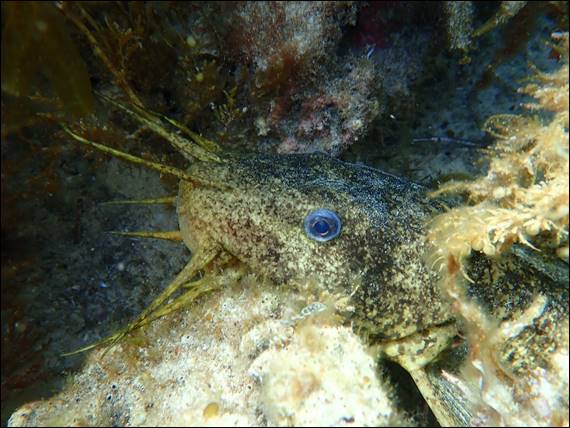
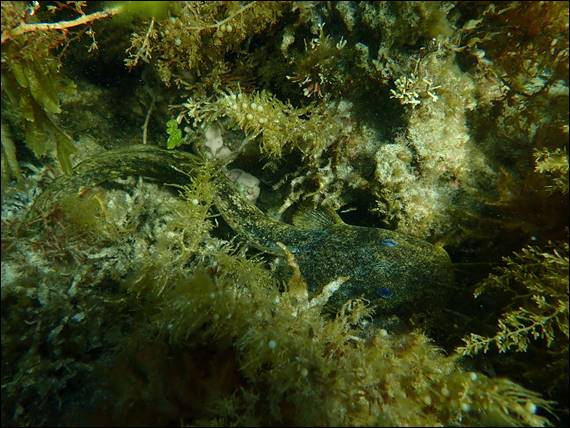
The water clarity was pretty good. And as I came over the reef I saw a nice trigger fish, which disappeared with what looked to be a sudden flick of a tail. Something looked wrong, the tail looked too big so I went down and sure enough there was another fish that hadn’t run for cover. The long feelers near the mouth are a pretty good indicator of what I had come across, and I have been hoping to see one of these for a long time. The large googly eyes looked like the one you can buy from a craft shop, and appeared to be stuck on and disproportionately large:
Estuary Catfish are benthic fish, like the Spotted Wobbegong I found on the last dive. Meaning they dwell on the lowest part of the water body, the feelers search out the food and a large mouth sucks it up. The broad head like the eyes looked too large for the rest of the body, which ends in a skinny almost flat vertical tail. Like the little Stingaree this fish also has venomous spines, and I’ve just read they can be very painful and repeat stabs can be fatal. So it’s lucky I didn’t get too close:
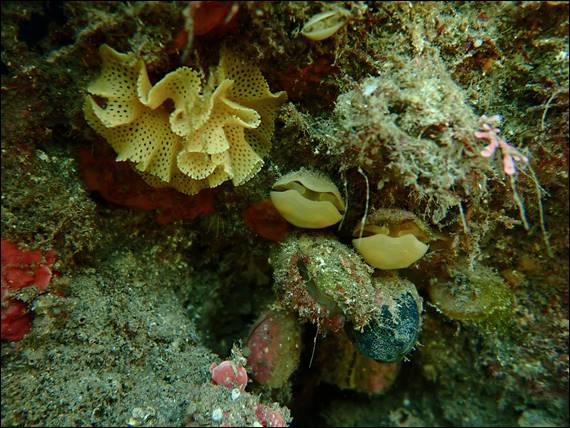
Fuelled with curiosity and a urge to find more things I ducked dived down to just about every ledge I could find. Lots more juvenile fish were out, and while I followed them about it was more just to observe than take images. Checking out under each ledge I was hoping that something might be lurking but that was not to be. I did however really like this little collection of bivalves with a bryozoan nested next to them. The bivalves detected my presence and rapidly shut, I seem to have a knack for disturbing things today:
In one of the sandy patches a strange shape caught my eye, and on closer inspection I was greeted with this sight. Part of me was hoping it was another fascinating burrowing creature and I was just lucky to have spied it. But now looking at it and after consulting with Rongy we wonder if it may be the underside of a Cushion Sea Star. The white bits being decaying flesh. There is a sea urchin spine next to it and maybe that is the culprit? While I could have dug round it to check it out, and gruesome as this may seem, it is usually best to leave such natural situations to play out as nature intended:
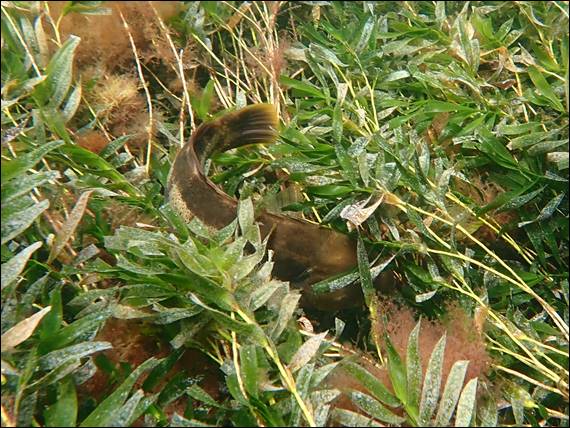
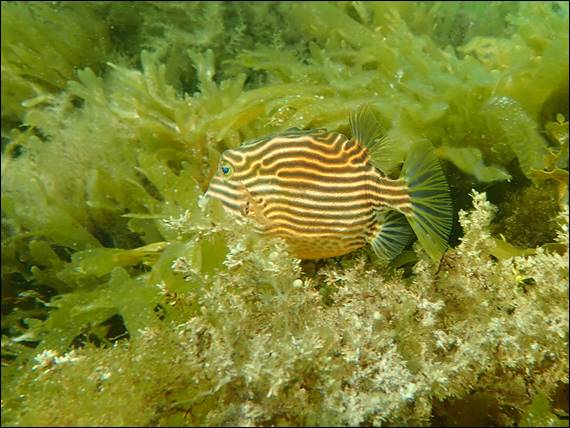
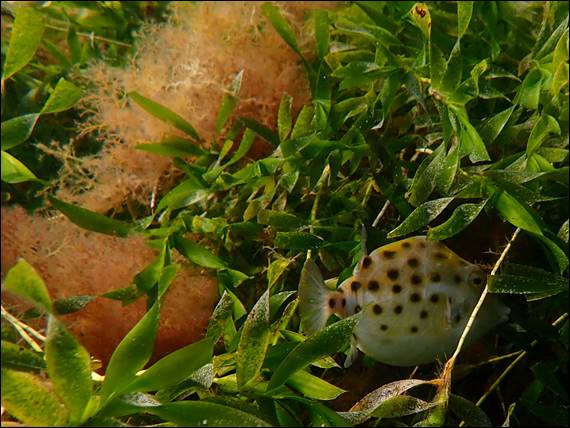
My search continued and there were fish here and there, no big shoals like in my last dive but a few pretty ones. While I have capture images of Smooth Western Boxfish numerous times before, I really like this picture. The fish stands out really well against the lush green background. While it wasn’t overly keen on me prying into its life, it kept popping in and out of the weed as if to allow me to capture a few great images. For once here is a fish that I feel the female is prettier than the male, and I left her alone while I carried on with my own journey:
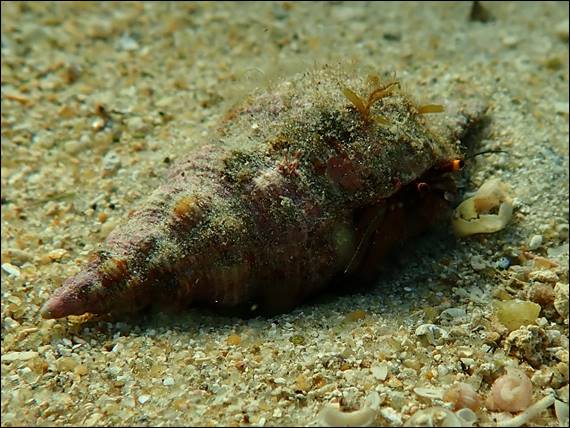
The direction of that journey was now to the shoreline. Only being in my boardies today the water was sucking the heat out of my body that bit quicker. But as is so often the case I got distracted, this time by what I believed to be a Coral Shell. As I got closer I noticed that there was an inhabitant, and for a change it seemed not to mind me being about. Due to the direction the light was coming I wasn’t able to get a clear image of its legs and claws but the two piercing orange eyes and its long skinny antenna can be clearly seen:
So it is fair to say that I really am not complaining about being in lock down. With our beach a short three minute walk away, being snorkelling season, and the water seeming to come to life after a bit of a sketchy start what better place to be stuck. Despite the beach not having many people on it, the odd dog walker and swimmer, we still donned our masks as directed. I get the feeling that there may be a few more beach trips this week, but whether I’ll score such great afternoon conditions in the water is yet to be seen:
Seeing I had bouldered on my indoor wall on Wednesday and then climbed at Welly Dam before work on Friday, I had already decided that I needed to rest up from climbing this weekend leaving me two whole days to get some snorkelling in. Geoff and I were hoping to go in for a dip and kept an eye on the conditions, Friday night and Saturday morning the wind was lousy so we opted for a Sunday dip. However, after a busy morning of domestic chores on Saturday I checked the forecast and it looked like the wind would drop soon after midday:
Drop it did and the water went pancake, with only ripples hitting the beach. With optimism I went in only to be greeted by a pea soup visibility. Not a huge surprise, as it needs time for the sediment and weed to settle out. Seeing I was in the water I went for a look anyway. My only find of note being two spawn masses from the Giant Troubridge Head-shield Slug, a slug that feeds on other burrowing slugs and eats them whole. How do I know this you may ask, well I came across the same sack like discovery off Higgins Cut a few weeks back and managed to get it identified on QuestaGame:
I lasted 20min in the water as it just wasn’t worth staying out any longer. Sunday however was another day, and with light winds all night a nice low tide I felt like my optimism might be better placed today. Even more so as we had decided to head past The Point, where the reef is full of weed with less sand about to be stirred up. It was the first time I have driven on the beach this season, heading down past the Capel River mouth. We went quite a way passing a few vehicles, the masses have all left due to school going back tomorrow (in theory):
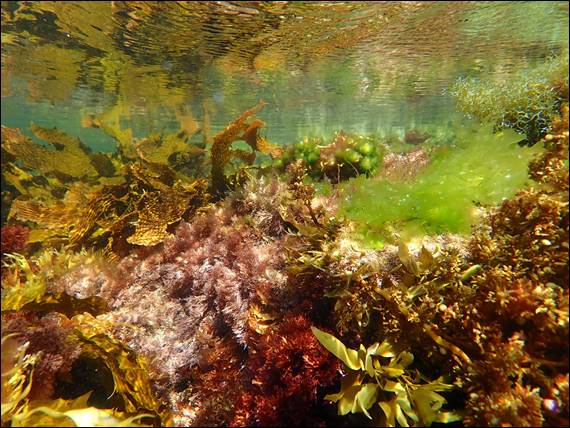
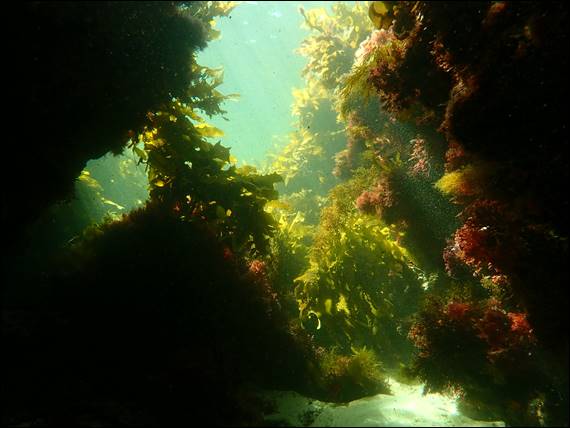
I say in theory, as just this afternoon it was announced that the school holidays would be extended by a week, due to a lockdown coming into effect. Regardless of that all the tourists were gone, the caravan park looks almost empty and the beaches are thankfully once again quiet. Geoff, Nana, Gav, Moni and Lisa and I headed out today, and we were not disappointed. The water was flat, wind was gentle and water was clear. Just 30m off the shore and we were greeted by beautifully coloured weed:
The low tide meant that much of the reef was close to the surface, there are crevices that you can follow into the main reef. They open up with caves below, and I went in and out of these in the hope of finding something interesting, stuck and unable to easily escape my lens. Nothing was about, just like I have said in previous posts it seems life had not truly started to come out on the reefs, at least not in the numbers that we experienced last year. After a while the ever faithful Banded Sweeps appeared, and one by one I spotted other fish both young and mature:
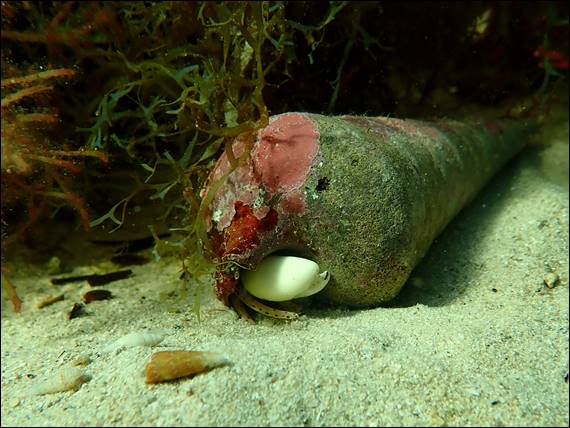
Some in large numbers such as the Herring others isolated such as the Herring Cale. There were also lots of Bell Clapper shells littering the small sandy areas in-between the reef. At night time these shells, or more correctly the creatures that live inside them move about the floor leaving a trail in the sand, as the large home is dragged along. Keen to see if I could find one of the inhabitants, I went down checking them out and was in luck. The claw and a couple of legs from a Hermit Crab poking out from this one, and quickly retracting when it realised I was watching:
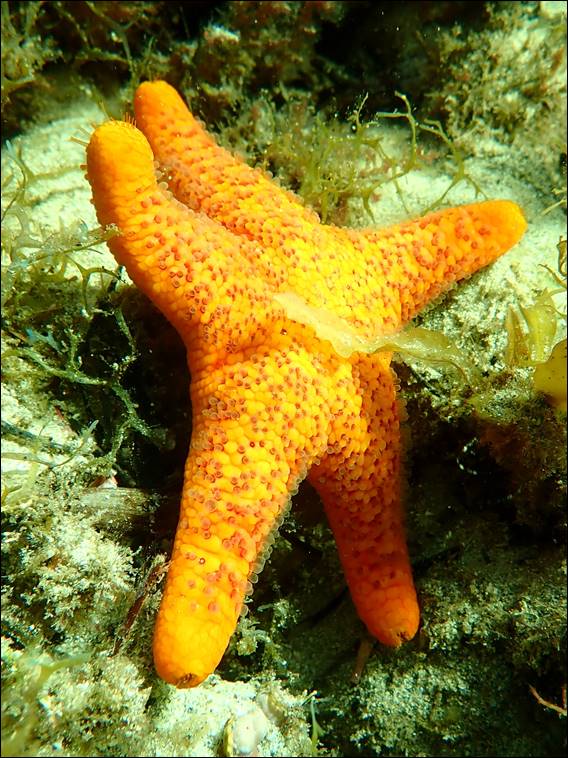
With no new fish to report below is an image of a striking bright orange Velvet Sea Star. Most sea stars I’ve found are red or orange in colour, not just the velvet but also mosaic and biscuit sea stars, and this makes them easy to spot. The small sacks protruding from their bobbly skin, I’m told are like gills and assist with oxygen exchange. Like fish they extract the oxygen from the water, a reason why taking these creatures out of the water is fatal for them:
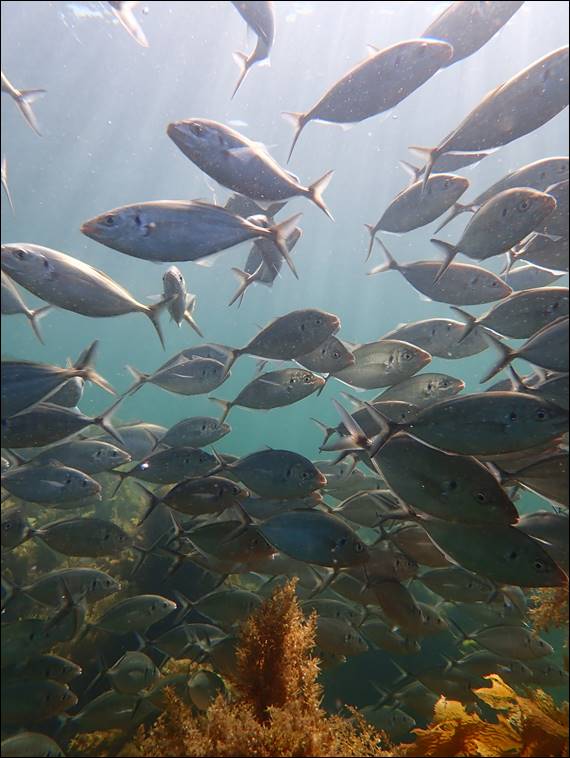
The fish that I spied in good sized shoals were Herring and Buff Bream, these would spot me and go round me. Then came along a large shoal of more sleek slivery looking fish, probably a thousand of them or more, and they were heading right for me. The school of White Trevally hung about unafraid of me and when I ducked dived down they circled me, only to continue on a more linear path as I went back up to the surface. Never seeming to be in a rush to get away allowing me lots of time to interact with them:
The six of us had seemed to go in different directions, Gav and Geoff were ready to nab a feed if they could. Catch bags and spear guns at the ready they scooted about duck diving up and down checking all the hidey holes. Rock lobsters were about, the long white antenna sticking far enough out to be seen from above gave them away, but they were hiding just deep enough in these rocky shelters to escape Gav and Geoff’s clutches. Even when Gav went back to the beach to grab his scuba gear allowing him to stay down longer and try that bit harder:
Lisa stayed close to shore, not usually one to go out to deeper water. Moni and Nana followed the boys for a while before going solo. While it may seem a little rude of me not to stick with Lisa, she wouldn’t have ventured out as far as me and in truth once you head is under water you really don’t communicate all that much. I did pop my head up occasionally to see where the others were and they were scatter about and usually far away, I was alternating between checking out the deeper water then heading to the reef:
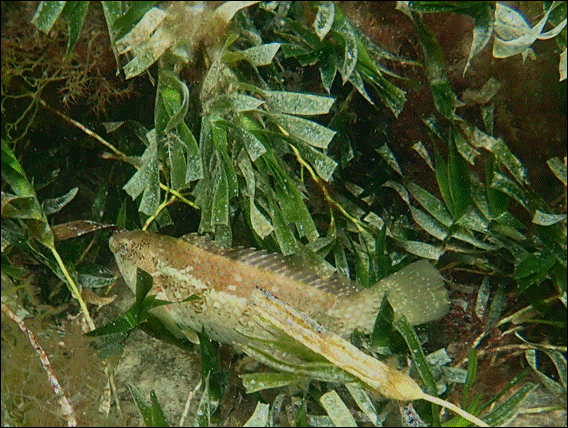
Above I spied a very well camouflaged fish, with just its head poking above the weed carefully watching me. Hoping to sneak up on it and get a better image I was disappointed as it darted off, only allowing me a very quick look at the body shape and colouration. My guess is a Rainbow Cale, the same type of fish that got away from me near Canal Rocks. I’m was little surprised with the length of time I seemed to be spending in the water and the amount of ground that I was covering that I hadn’t managed to find too many other new fish or creatures:
With the water clarity I got some great images of Buff Bream, which seemed to follow me round almost as much as the Banded Sweeps, despite them keeping a healthier distance than the White Trevally. I also came across this very beautiful and curious Juvenile Moonlighter, this one being quite young. You can tell by the very distinct black dot with a yellow band round them, at the bottom and top of the anal and rear dorsal fins. As they get older the bottom one fades first and then eventually the top one also disappears:
With all the sheltered areas round this reef I found quite a few juvenile fish, but these ones were the most prolific. I came across them several times in large numbers, and haven’t seen them off my local beach. The deep abdomen with a body that tapers off to towards the tail, a relatively large eye and prominent dorsal fin makes me think they maybe young Bullseye. Quite different the juvenile Gobbleguts in my last fishy post, including having an orange spine. It is hard to get good image of small and transparent fish; the camera focuses on the background:
I had the same issue with this small creature, which was transparent for most of its body. I almost passed it by, but it looked a little different. As I watched it, this 1cm long animal looked to have five stegosaurus like plates sticking up and seemed to compress and then extend itself in a manner to allow it to propel its way through the water. I watched it for a while, even taking a video in which it was even more of blurred. Definitely one for me to have checked out by others, and I’m not even going to try and guess what it was.
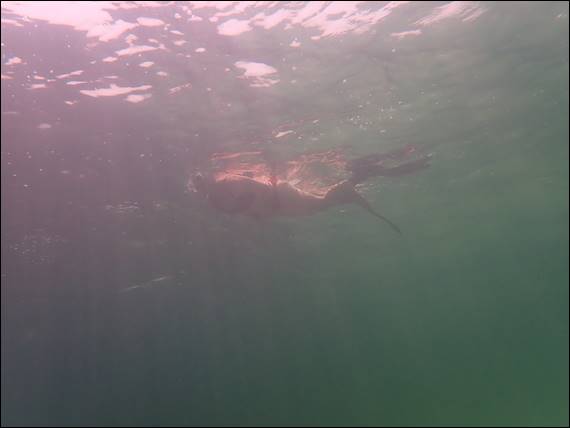
My fingertips were finally starting to tingle and looking up everyone else was back on the beach, some had been there for a while now. Heading in I saw a flick of a tail and after searching the area I spotted the familiar head of a Wobbegong, or a carpet shark. I’ve seen them before but this is the first one this season, he came out of the weed and swam to a more secure place allowing me a great look at the markings making me sure it is a Spotted Wobbegong. It was then time to get out after my longest snorkel ever, having spent 2 hours in the water:
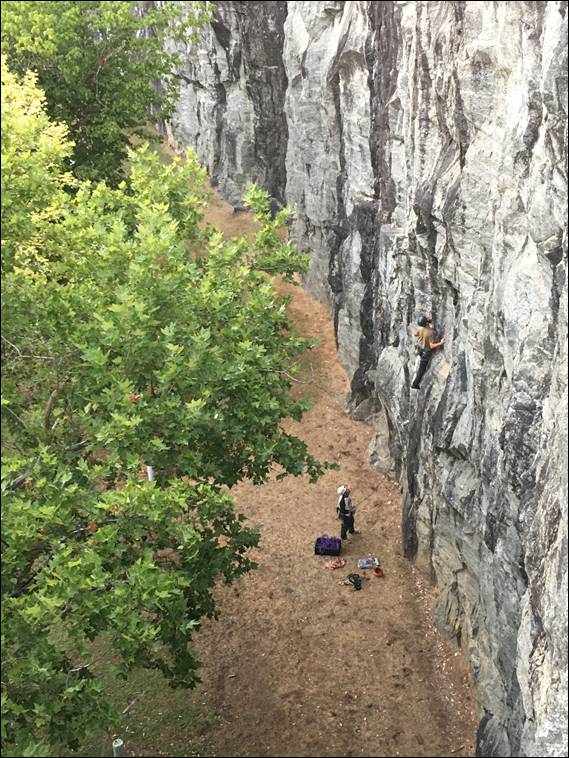
Being woken by the alarm at 3:45 made me wonder what I was thinking when I said I would meet Howsie and Rongy up at Welly Dam for a before work climb. My mind nor body was ready for such a rude awakening and if it wasn’t for the full moon, most of the journey would have been in total darkness. That said the view back towards the lights of Bunbury, as I drove up the scarp was pretty specky. And as I got closer to the crag I could see light starting to creep into the sky from the east:
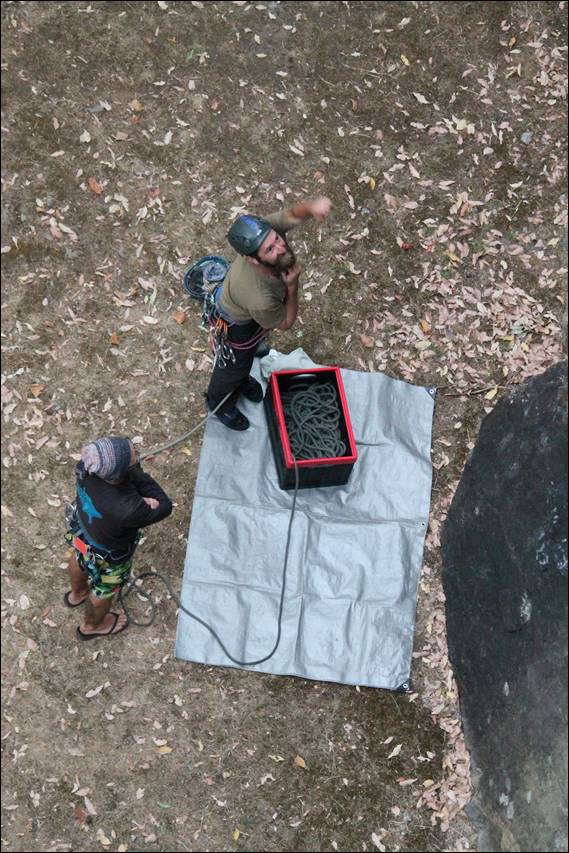
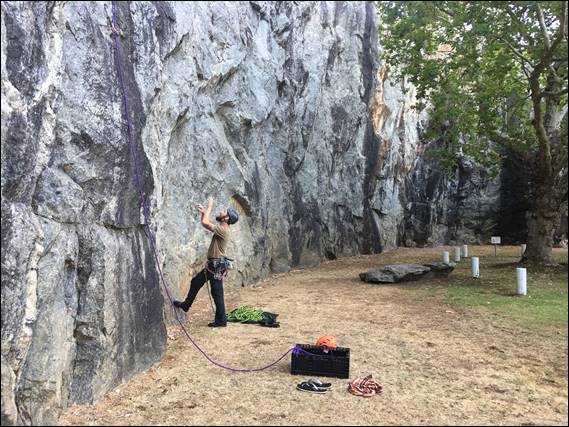
It felt like it was dark enough to use head torches as we pulled our harnesses on, but as Rongy made his way up the first few meters up the crag it either got lighter or our eyes were adjusting to the available light. By the time Rongy was coming back down Raging Torrent the morning had truly broken. Now climbing with three, while trying to squeeze the routes in before heading to work, means we have to be efficient in the way we climb. It was my lead next and I had already set the crate below my chosen route before Rongy had finished his route:
It started off as if all three of us were aging men. I was wondering how I would pull up after pulling plastic on Wednesday night, and with no one else turning up I bouldered by myself and in situation like that I am a little guilty of probably going too hard for too long with not enough rests. Rongy had been out on a big mountain bike ride just yesterday and Howsie had been rehearsing with his band to get ready for a gig this weekend. Despite each of us confessing to reasons we may be tired today, we still pulled the rope after every lead forcing each of us to lead every route:
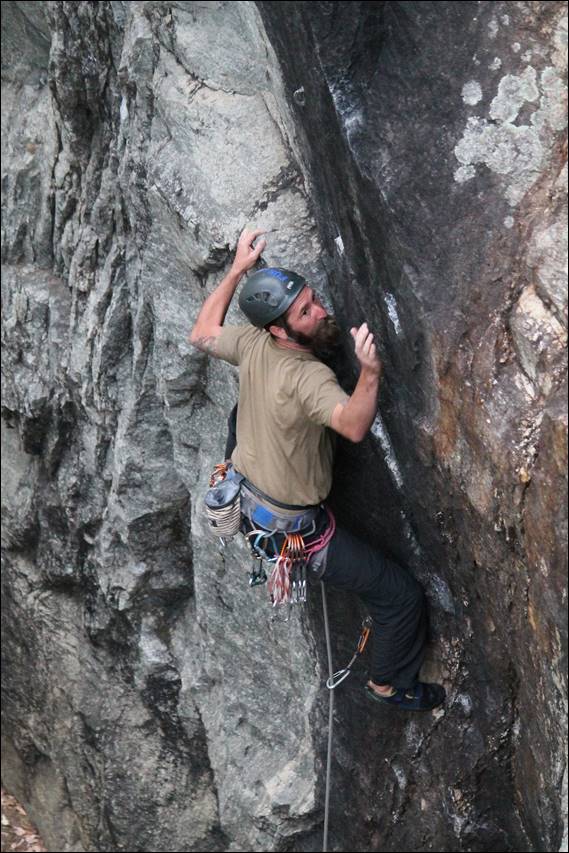
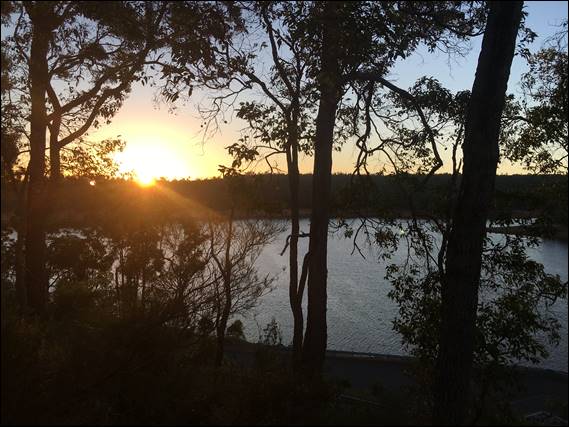
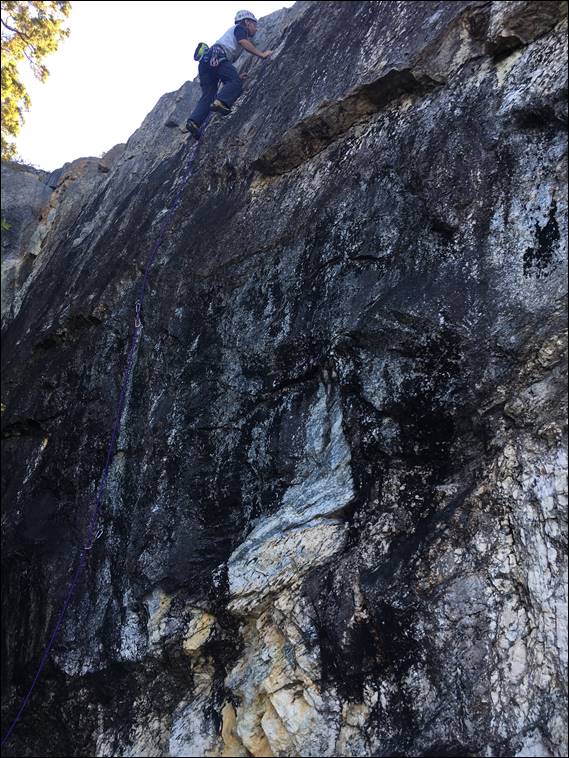
I had picked BBQ. My thinking being that the first route would limber Howsie’s body up being a traditional style route with lots of three dimensional moves. Then BBQ would warm up the fingers with more technical moves on small holds. All of this was to prepare Howsie for his lead, which of course being 2021 was a grade 21. As he led up my route, he was looking pretty lethargic and I managed to not only run round to get some top down images but also run between the crag and the view over the reservoir as the sun finally popped over the horizon:
When I came back down there was no putting off the inevitable, Just Do It was next. As Rongy cleaned BBQ, Howsie did a quick mental check of the moves that lay ahead. Like an elite athlete he was not only going through the moves in his mind but also physically going through them with his arms. Despite Rongy and my initial, but admittedly short lived, gripes of being tired it would seem that drumming take more out of you than bouldering or mountain biking. We both fared better than Howsie on his chosen route:
Rongy was on fire, what’s new, as he then taunted Howsie by picking a second 21 for his next route… Silverback. A feisty start leading into a delicate and balancy second half, one that threatens to spit you off if you lack conviction or stall for just a moment too long. Rongy walked up it, so fast in fact that he was practically finished before I had cleaned the last route and had a chance to come over an snap an image. I stalled for a little too long on the slab and was spat off, and Howsie did the same claiming it was his chin that pushed him off:
We both got it on the next shot, which is good as Howsie at least managed to complete and tick of one grade 21 today. I really had no idea what to do next, so Rongy pointed me to Shock Therapy which I gobbled up in just a few minutes. If this is the result of bouldering by myself maybe I should do it more often? It was only at this point that I got to hear the Red-Tailed Black Cockatoos. It was only very faint and they didn’t fly over us, but it still counts and I’m yet to climb here without hearing them:
Rongy managed another clean lead, claiming to have almost fallen off near the top, yeah right. Howsie meanwhile foresaw he would take a fall and resorted to seconding the route, as such with a rope above him when he took the fall that he had foreseen he didn’t go too far. By the end of it he was pretty knackered and so chose the short but fun Block and Tackle to polish off whatever strength was left in his arms. By now the sky was a glorious blue and the 3:45 alarm was forgotten and forgiven:
With a cyclone bearing down on the northern parts of Western Australia a weather change was on the cards for us too. Clouds were forming in the sky, the temperature was dropping by double digits, the winds however were not changing and if anything seemed to be less intense that previous weeks. I chanced a dip in at Wave Walk yesterday but due to the cloud and a bit of a swell visibility was horrendous. I stayed in hoping to chance across something worth reporting about but came out without having snapped a single image, which is a first:
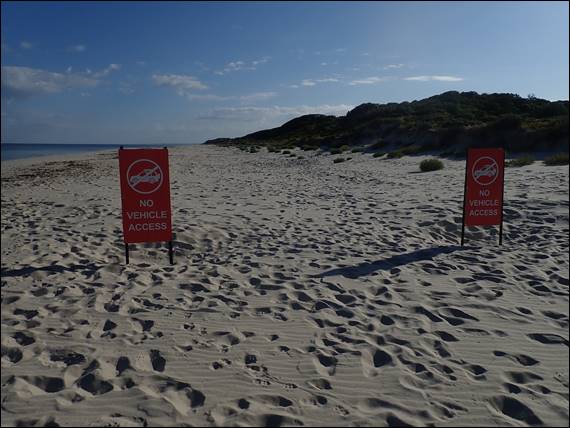
Today it was a much clearer sky and there was but a whisper of wind, so I went down to our local beach. The beach sported two new and very visible signs warning people where they could and couldn’t take their vehicles. I’m guessing, as I type this, that the beach will be overrun with 4WDs and big family setups. No doubt everyone will be doing the traditional trip to the water on Australia Day. While it would have been good to wait probably an hour for the sun to get a bit higher in the sky, the high probability of crowds was a good reason to head down early:
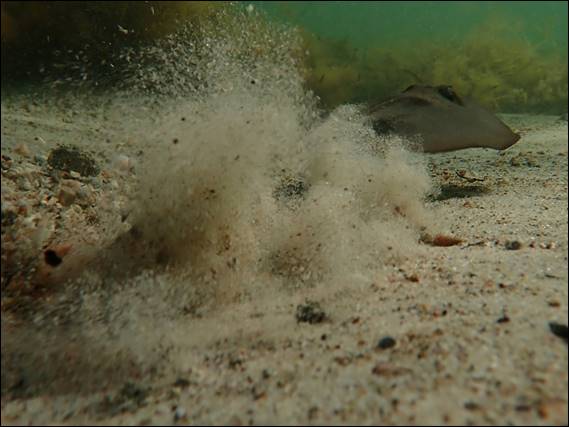
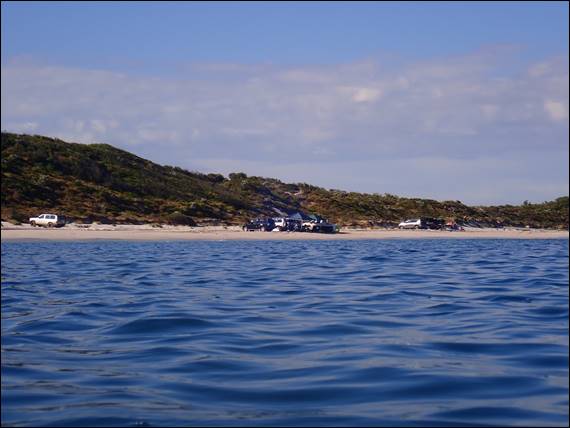
The beach was already starting to fill up with cars coming down, and it looked like at least one party had spent the previous night camped here. Underwater the visibility was way better than the previous day, but with a relatively low sun the light was struggling to penetrate the water. As I crossed the initial sandy patch I spotted the shape of a Western Shovel Nose Ray, blending is beautifully with the sand. I dove down a couple of times to have a closer look but tried not to disturb him too much:
When the visibility isn’t so great the water feels so much deeper. Admittedly it was three hours past high tide, and the encroachment of a full moon was making the tidal variation more pronounced. But even with the greater tidal range is only a matter of a metre. The low sun was sending its rays down and they were reflecting of the sediment that was floating about in the water. A swell was still about but it had eased off from yesterday. So with little chance of seeing much from above it was time to start going down for a closer inspection:
There wasn’t too much to see, the nooks and crannies all looked quiet and while I saw a few fish there was nothing particular exciting. Also when the light is low trying to get any decent images under the ledges is pretty well impossible. It is about time however that I included a picture of the one fish that without doubt I am guaranteed to see on every dive. The Banded Sweep is quite a large heavy set fish. They will follow me round no doubt hoping that I will dislodge some food, as I unintentionally but at times unavoidably disturb the sediment:
Yesterday due to the water not looking great and thinking I might not be in for long I didn’t bother with a wetsuit. Entering the water it normally best to just dive in rather than slowly creep out as the water inches up your body. But the water had felt so much warmer, almost bath like. So today I didn’t bother with a wetsuit and again it felt warm. I have mentioned that I am starting to see more shoals of baby fish, which I should technically call juvenile fish. And I wonder if the water warming up might be partially responsible:
I find the above variety bobbing about near the top of the weed. Allowing me to dive down and come up from underneath to get much clearer images. With a small round silvery abdomen and transparent tail, they seem so different from the juvenile Western Gobbleguts that I find hiding under rock shelves (below). The body of the fish below being silvery with black dots starting to form along their sides, making them easy to identify. That said in the image above the distinct black spot at the tail and similar eyes makes me think they too are Western Gobbleguts just younger:
Maybe I haven’t been l noticing it in previous years, but the weed this year has got lots of nodule like growths on it. The 3-5cm, light brown, knobbly growths almost looks like an infection. A bit like when a fungus is growing out of a tree trunk. As yet I have not got a clue as to what it may be and whether it is or is not a sign of poor health. I’m hoping not as if the weed starts to suffer most of the life I get to see would likely move to other areas. Something for me to check on QuestaGame and report back on:
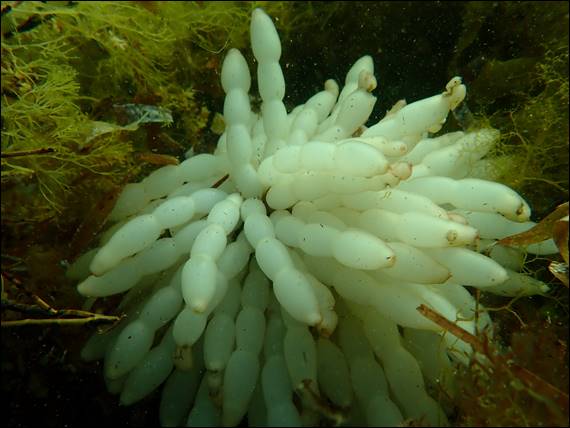
As I scoured the weed I came across two collections of eggs. Initially passing them off as Southern Calamari Squid eggs, the same as those I recently found off Higgins Cut. Those were confirmed as Southern Calamari Squid eggs using QuestaGame. These however where not straight cylindrical shaped, but instead looking like one of those oddly shaped long balloons that narrow and then widen out multiple times. I think these may be Bigfin Reef Squid Eggs, and will test my theory using QuestaGame to see if I am right:
Despite only being in my boardies I wasn’t feeling cold, but I was approaching the 45min mark and we were due to head to the neighbours for breakfast. Time to head in, and as I usually do I took a leisurely pace scouring the sand. I was again rewarded finding a Sparsely Spotted Stingaree, and this time I did duck dive down several times and get close. The thing that fascinates me most about rays being their eyes, and I wonder how well they can see and what I look like to them:
I was obviously not completely terrifying as I headed down several times and got really close. I persisted and kept going down I must have become sufficiently annoying, as it finally decided to swim off. Based on its rate of departure, which was not fast, I would say I was more of a nuisance than a threat. I was however warry as I headed back to shore, yesterday a stinger got me across my chest and I didn’t fancy a repeat performance. While not around in great numbers they are starting to become more abundant:
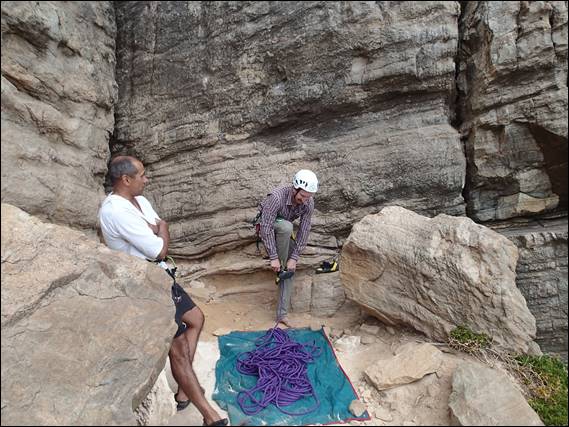
The group of climbers on our South West WhatsApp group has had a bit of a growth spurt recently, and this includes a few new to climbing and a number of non-trad climbers. A few of these people have expressed an interest in trying trad climbing, and I’ve put it out there that I’m happy to show them the ropes so to speak. Ash is one of those people. Previously a sport climber, currently a boulderer and with his sights on adding trad climbing to round off his climbing skills. And this morning we found ourselves at Wilyabrup to get the ball rolling:
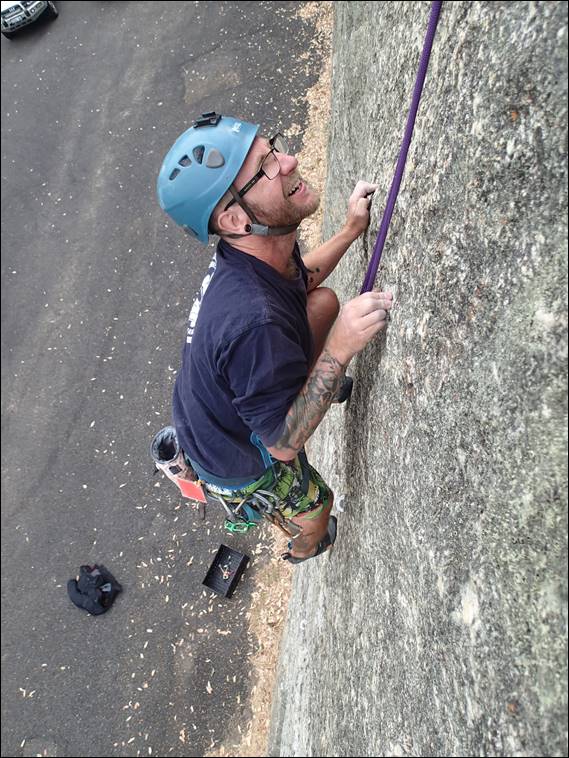
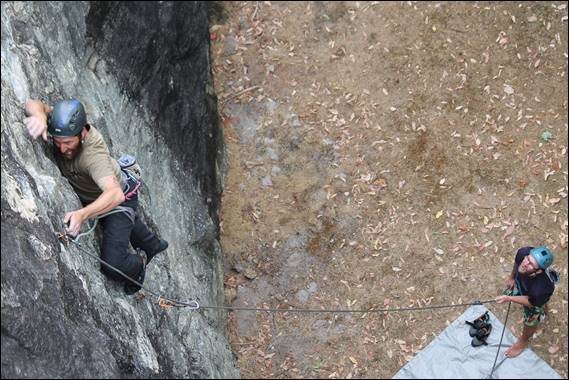
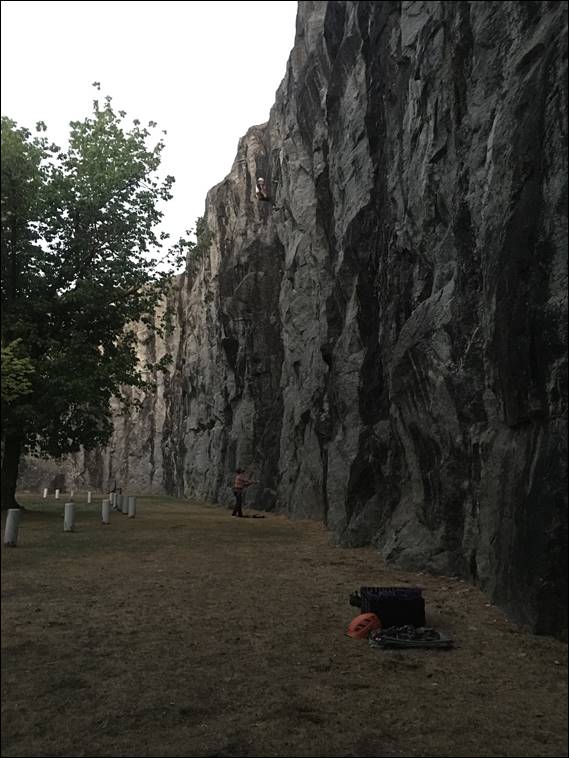
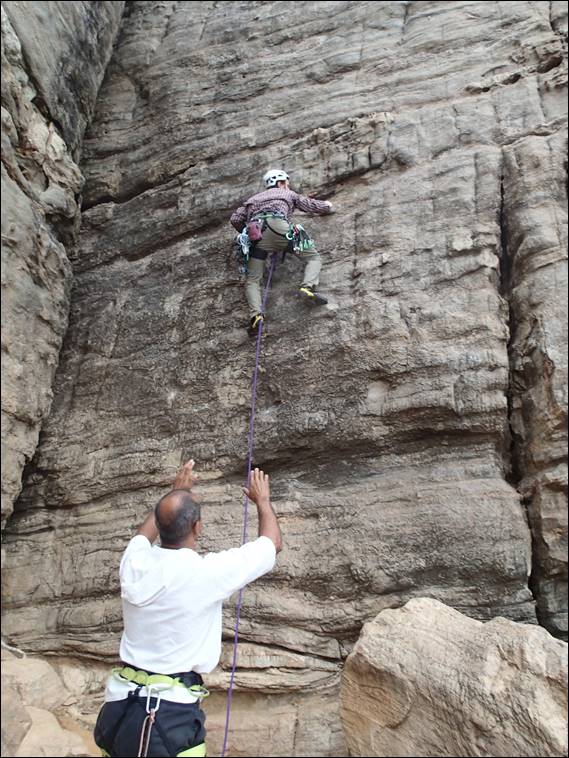
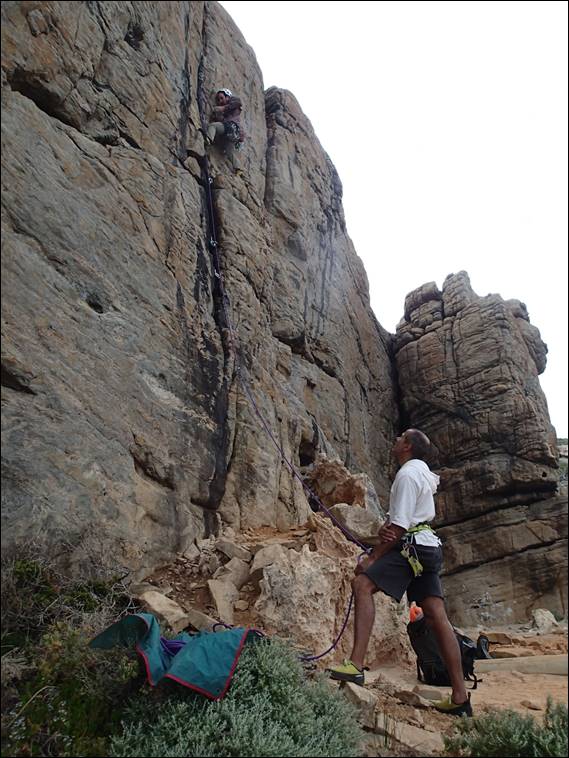
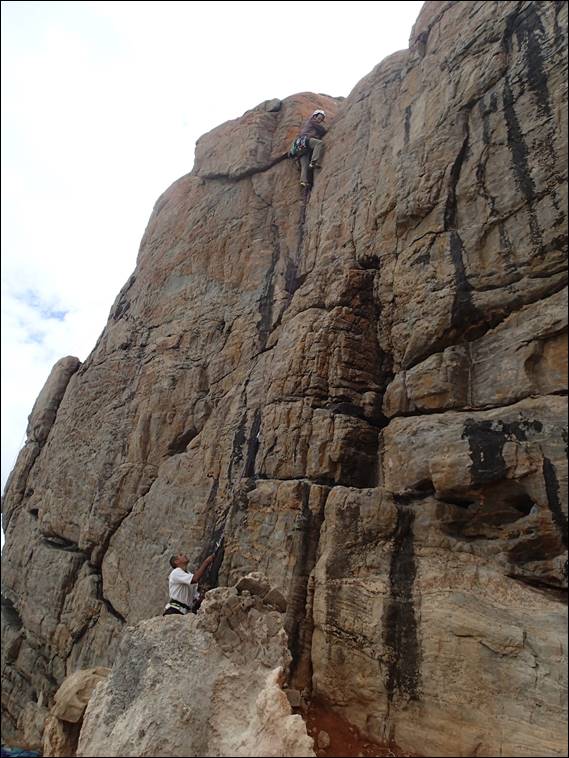
When I picked him up I wasn’t so sure how we would go, a stomach bug had plagued him over the last three days resulting in him lacking energy. During the walk in he trailed behind Jaime and I and was not looking the best. Still when we got to the base of the crag and I pointed him to the first lead I had in mind, he willingly pulled on the harness and racked up. Now I mentioned he was a previous sport climber and now a boulderer, so I picked Setting Sun as the first route. Because it starts as a bit of a boulder problem, and Mario please note I am actually spotting him:
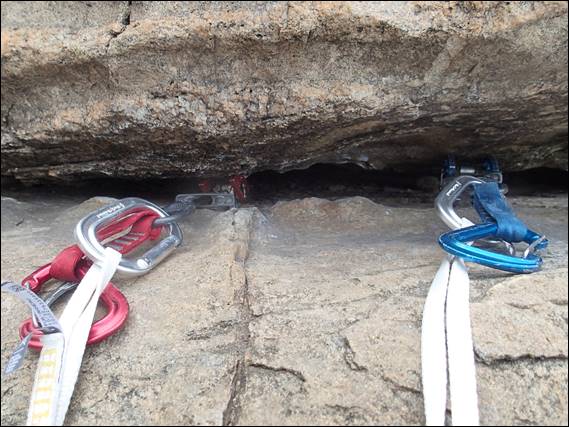
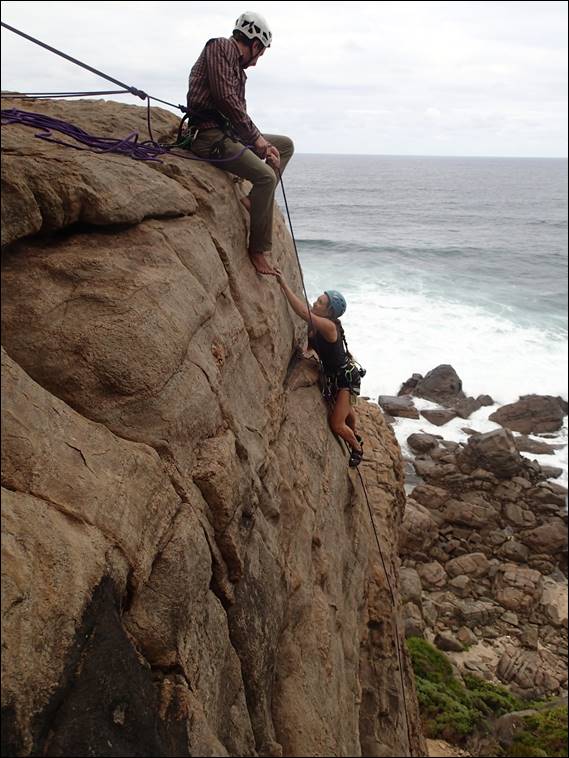
There is then a line of three bolts that leads up the steep wall, and only after then there is a need to use some trad gear in a horizontal break before ascending the top slabby wall. This allowed him to feel comfortable with leading and only need to use trad for a small section. Before he set off there was a quick lesson in placing cams, and he placed two in the break for me to inspect. The key things I had mention was not to over-cam them so they would be hard to get out, consider direction of fall and make sure they don’t walk in by extending them:
I’m happy to report both of his cams were well placed and I was confident they would hold a fall, so much so that I fell on them myself to prove to him they were good. While they would always hold my fall there are two faults in both placements and I wonder who will spot them. Once on top it was time to show Ash what to consider in setting up a belay. First and foremost in case the second falls have bomber gear, keep the system tensioned and make sure it is directional. Secondly but for me equally important are to make sure it is a comfortable belay stance and that whenever possible you can see the person following you up:
As part of all these instructions and tips, there was the rope work to talk about. I love the double figure of eight or bunny ears and that was the first knot I showed him, next being a clove hitch. With these two knots you can set up a system that is easy to adjust from your harness without needing to walk back and forth to your anchors. All this takes time and it is hard not to overload and confuse people, but Ash seemed to have a good grasp of the concepts and was taking it all in. But we were here to learn trad, so next up was a full trad lead:
Not only was Ash being a great sponge, soaking up all my advice, but he was starting to perk up. Energy levels may still be lacking from the last three days but he was relaxed and mentally happy to be leading, which in some ways is more important than having the energy. Twenty Questions was a good next route, easier than the first bolted line and plenty of opportunity for gear placements, whether wires, hexes or cams. Being Ash’s first full trad lead it was time to talk about the carcass catcher, the first piece needing to be directional not only for a fall but also the position of the belayer, so both downwards and outwards:
This is so important to avoid the zipper effect should the leader take a fall. The rope tensions all the way down and if the belayer is stood back a bit, as they most often do, this can result in the first piece popping out. I’ve seen this happen when every piece bar the very top one has popped, which is very scary and highly undesirable. Ash of course had no trouble with the climbing and also managed to mostly place appropriately spaced gear, he also set up his own belay system perfectly. My only criticism when I topped out was that he had run out the top a little, due in part to it being so easy:
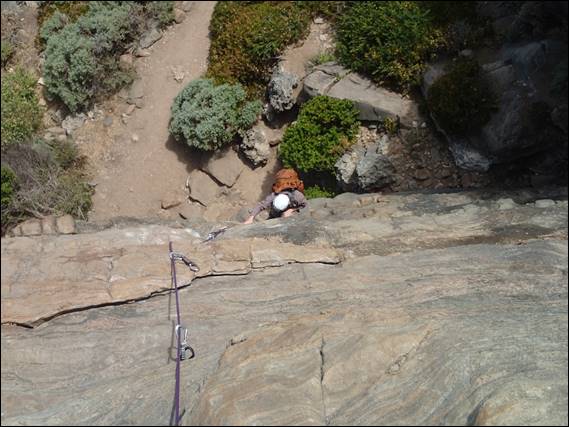
I was presently surprised by his carcass catcher, a solid cam in a horizontal (above). This time the errors of the first cams he placed had been rectified, the outer lobs pointing downwards making it a more stable placement and the extender connected to the sling and not the plastic loop. Indeed all of his cams were great, none were over-camed and all bar one was directional. He hadn’t however used any passive gear, so the next choice of climb needed to be carefully thought about to make sure he had lots of opportunities to use wires:
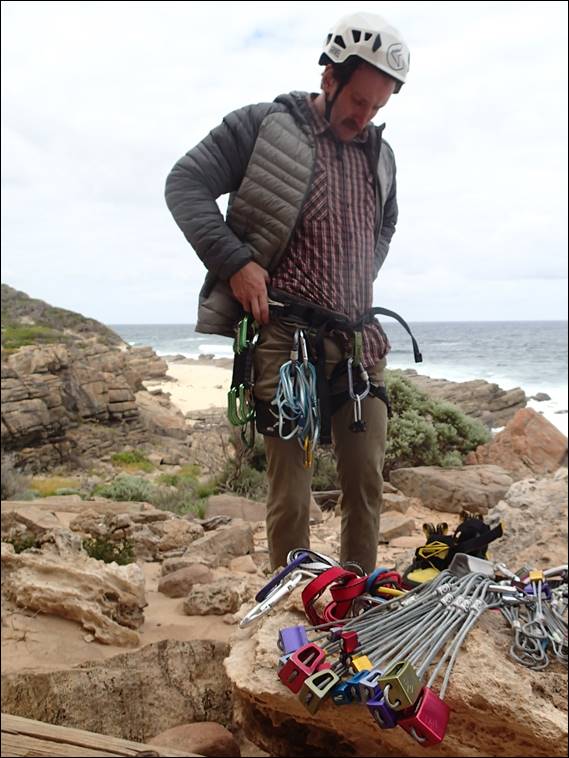
My initial thought was Hope, a steady grade with heaps of wires opportunities. However, this would be the third lead on the trot and taking into account Ash was not 100% I felt a shorter line was required. The obvious one being Left Hand Crack, no end of gear opportunities but also bumping up the grade a bit. Before he set off there were more instructions on wire placements. Looking to make sure there is good contact on both sides, the rock is solid, the wires are preferably deep, the chance that the wires popping out is reduced by making sure they are well seated, and of course making sure they are directional:
One more instruction was given before he set off, and that was to make he used wires or hexes first and only resorted to the use of cams when he was really stumped. The first five pieces were wires, and then he reached the meat of the climb. The crack steepens as the footholds become smaller and the moves become trickier and more sustained. It was time for a bit of yo-yoing, a common sight for leaders getting nervous. He went up and down numerous times, eventually deciding to place a cam to give him the confidence to move up:
He also placed a wire above that. Then with a good three meters of climbing ahead of him he didn’t look to be checking for anymore gear opportunities. By his movements I could tell he was considering to continue to the top. I knew that there was an awkward top out, so started to become nervous as he surged upwards. I moved closer to the wall to reduce how much rope was paid out and preparing myself to catch a fall. It thankfully never came, even when near the top his foot slipped, but fortunately he held on and composed himself before topping out:
If he had slipped off it would have been 5-6m fall, and I had a bit of a word with him about it afterwards. Ash replied saying that as he was going up, he could hear a voice in his head and it was me telling him to look for a gear placements. I had to laugh as I was actually thinking it, but didn’t want to shout up to him, and distract him while he was so focused on the moves. That aside every wire placement was bomber being well seated and directional and having good contact. A top lead and I do hope he is pleased with it:
The only reason I considered putting him up it is that I know he is capable of far harder moves. That said when you climb trad even the strongest of boulderers or sport climbers can crumble under the mental strain of having to place and more importantly trust own gear. Even when the moves are ten grades lower than what they can climb. Ash was now, and not really surprisingly, looking exhausted. So I offered to lead one last route to allow him to check my gear. Jaime was also done. She handed the camera back to me before heading out and leaving us to the obvious choice of Hope:
I was a little surprised when Ash had suggested climbing out with packs, I’m of course well accustomed to this so was more than happy to. So off I set saying that in view of this being a chance for him to inspect my gear I would lace the route with 15 bits of gear, all wires. As it was I only managed 12 bits on route, any more would have been plain ridiculous. He was slow following me up. Maybe because he was tiring, the sun was on us, or due to all the gear he had to get out. As he topped out he said never again, and my heart dropped as I thought I had put him off trad climbing:
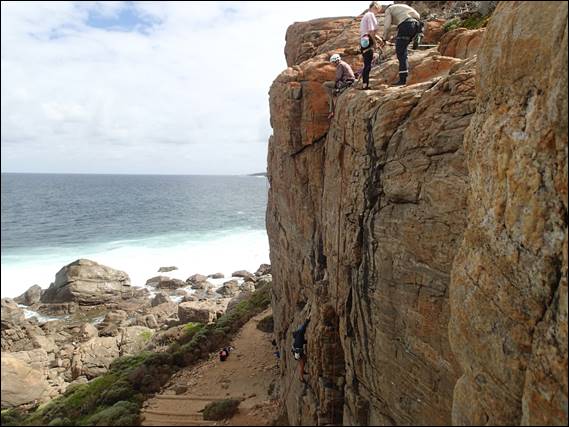
Thankfully not and he is keen for more, but he hated climbing with a pack on and swore never to suggest it again. Now while due to clever photography the images do not show many other people around it was certainly busy here. We started with an empty crag but by the time we were ready to leave all the usual classic lines were being attempted. It was the first time ever that I have had to wait for a couple to finish top roping Hope before we could climb it and then, as Ash prepared to second up, for another party to start setting up below us to lead it. It was definitely time to depart:
The easterlies looked to be easing after another bout of strong winds so Lisa, Geoff, Esky and myself decided on a local snorkel off Wave Walk. Yesterday, as I returned home from climbing, I had taken a quick detour to check what was happening with the water and from my vantage point while it was a little choppy it looked crystal clear. This morning it didn’t look the same but we put that down to the morning sun not being high in the sky. When it is higher is penetrates the water and rebounds of the white sand to provide an amazing aqua-blue:
The forecast suggested today would start with a southerly, so off shore wind, which made us think it may have been nice and flat. The wind wasn’t due to turn till mid-morning, but the signs were already there for a change to occur and the ripples were beginning to form. However, we were there and it looked invite, so with a positive attitude we suited up to go in. This was to be Lisa’s first snorkel of the season, and as such it took a little more work to wash the toothpaste out of her mask. It was put on last season and since then had hardened up, being now a bit on the stubborn side to rinse off:
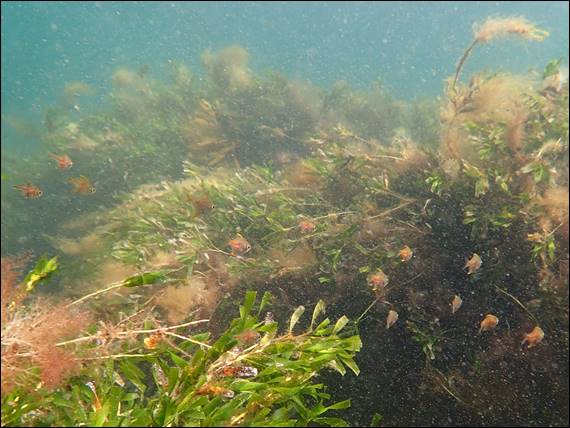
The water was clear and I set off on my usual tour of the reef, which is just a short distance off the shoreline. Scouring the weed as the gentle, but ever present, swell was pushing it back and forth. It was just enough to stir up a bit of the sediment. As I looked around small shoals of baby fish started to appear, Elongated hardyheads, Bullseye and Western Pomfrey. These are signs of what I would normally expect to see in December, as the snorkelling season kicks off. Banded Sweeps, Goatfish, Green Wrasse, Herring Cale and other usual suspect popped up here and there, but not in great numbers:
There was also a small school of Herring and then Western Striped Trumpeter fish swam past, they were heading towards the others and I hoped Lisa would see them. The reef felt more asleep compared to my previous trips here, so I ventured further out. Across another deeper patch of sand and towards the next bank of weed. The water was deeper and it was harder to see the tell-tale signs of something unusual. The reef came up a bit in places and I duck dived down to check under shelves and in caves but nothing unusual showed up:
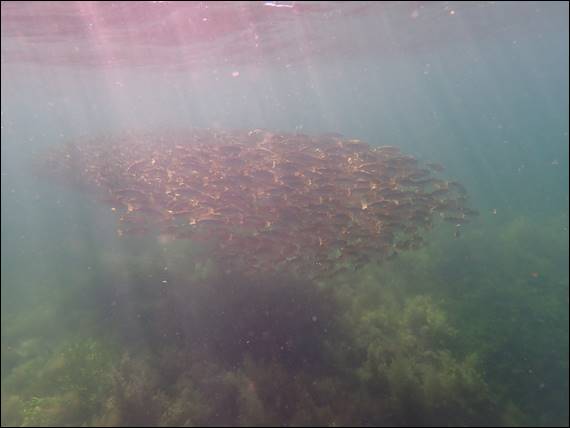
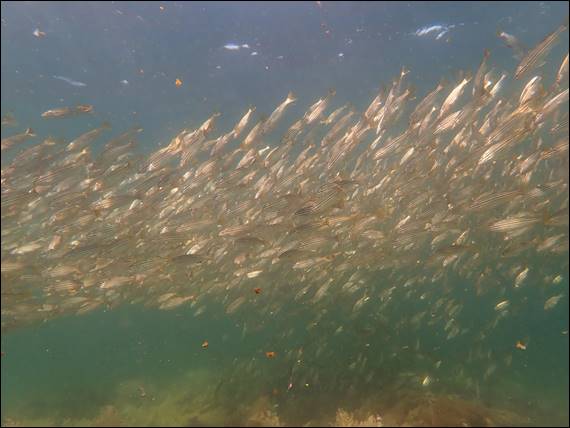
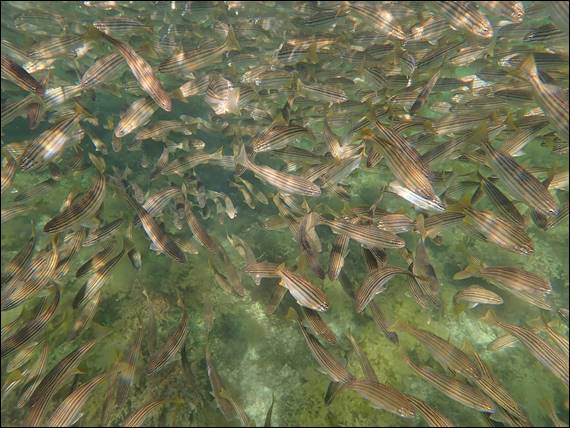
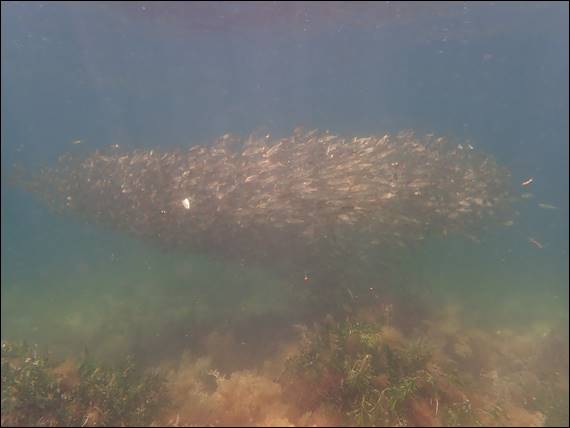
I did however notice that there seemed to be a lot more excrement floating about in the water. I do occasionally see this, but today it looked to be abundant so I kept a keen eye out for what may be about. A larger school of Herring drifted past, but not in the numbers required to generate all the waste floating around me. Then I noticed what looked like a storm cloud (above). This was a massive school of Western Striped Trumpeters, thousands and thousands of them:
They were all tightly knit together with those in the middle heading down to the bottom to scour the weed for a feed, making it look like a mushroom cloud. Unafraid of my presence I got closer and they were happy for me to swim through them and if I stopped they would circle round me blocking out the light. As I did so they lost the cloud formation and spread out and it wasn’t until then that I realised just how many there were. It’s a shame they were not making the sound from which they get their name isn’t louder, as it would have sounded amazing:
It felt like I spent ages diving in, under, over and round these fish and took a few videos, two are linked below. Eventually popped my head up and I could see the other three were either heading in or back at the beach. I started to make my way in but before I got to far I looked back, the big shoal looked to be regrouping into a cloud formation. Leaving them behind the wind had well and truly turned and the water was getting choppy. I kept a watchful eye out but nothing else was to be seen, again the reef seemed to be asleep. No matter, it was lovely to get my head under water and the conditions over the next few days are looking promising:






 Sandbagged