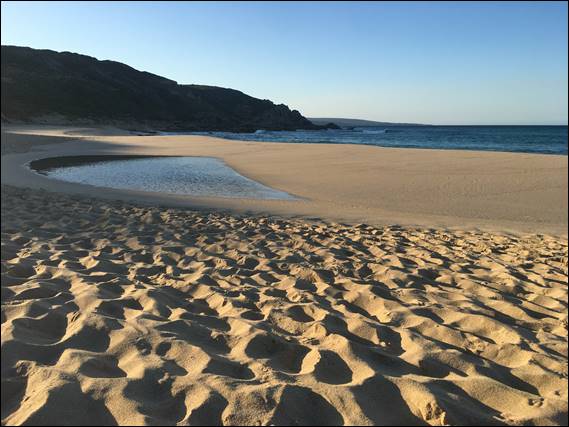
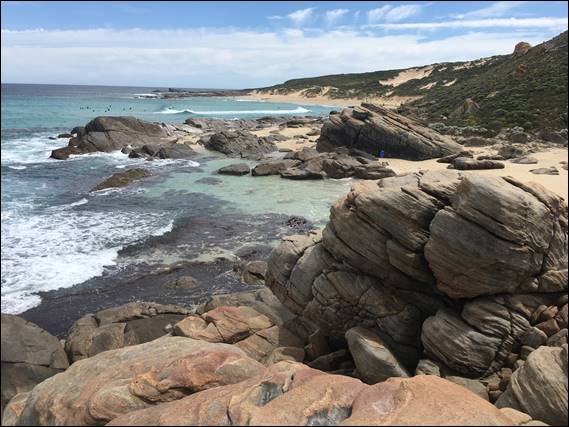
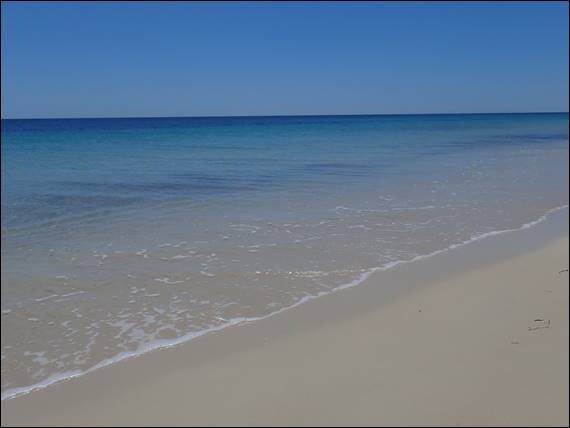
The beach is back! During my previous trips to Moses Rocks I was in awe of just how much of the beach had been washed away by the winter storms. The last trip was in late August only ten weeks back (https://wordpress.com/post/sandbagged.blog/6710). But the sand is now returning and not just to the main beach, which was beautifully lit up in the morning light, but also the little cove that we cross before getting to the crag:
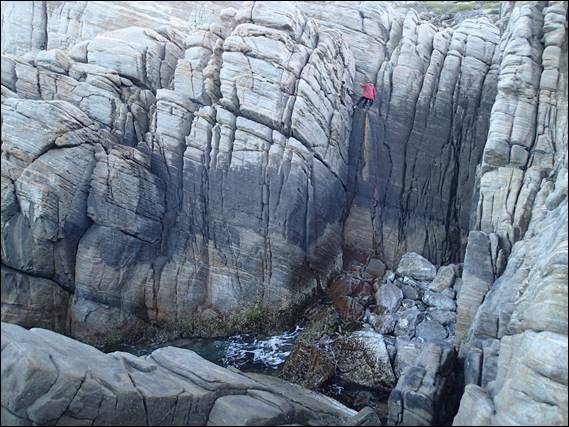
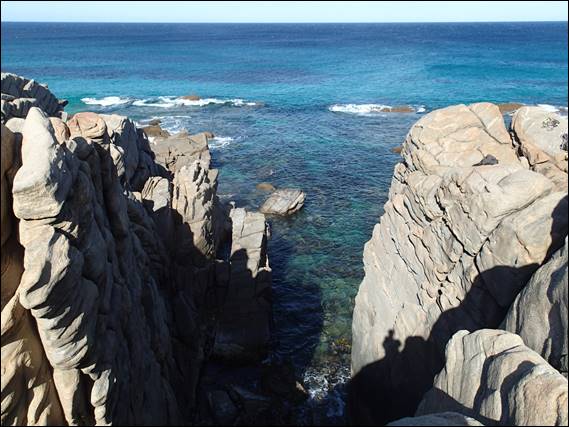
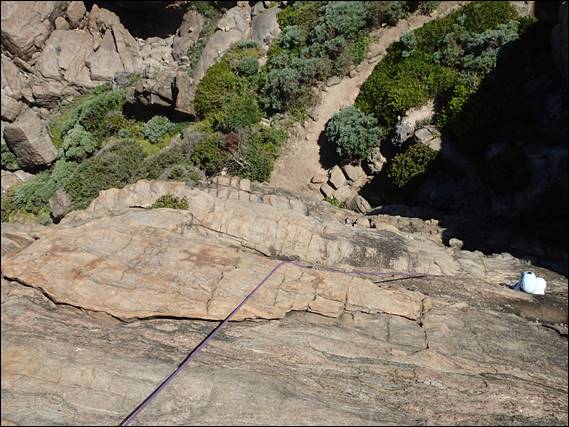
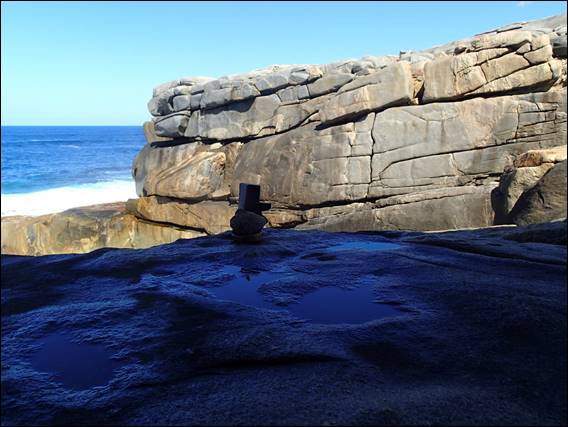
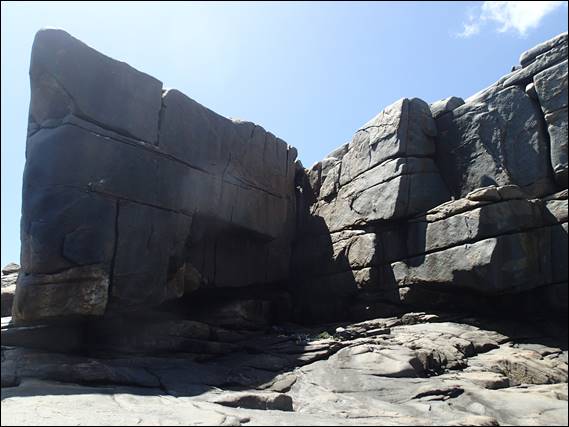
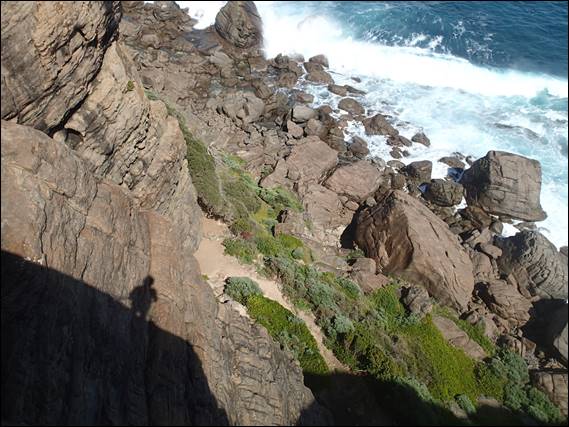
Today Andrew was keen to get back out and like me he really likes Moses Rocks. My thoughts were on climbing in one particular spot and he seemed amenable to the idea. So we wandered along the top of the crag, and set ourselves up to rap into the zawn. With a two to three meter swell I wasn’t sure it would work, but easterly winds and a low’ish tide made it possible. Better still, and I was a little surprised, the rock was dry with no seepage coming down the slab at the back of the zawn:
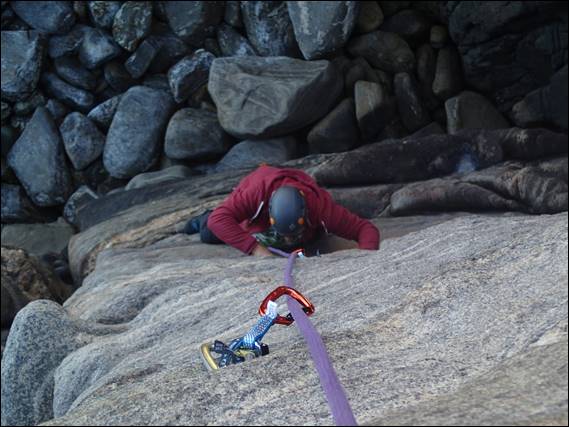
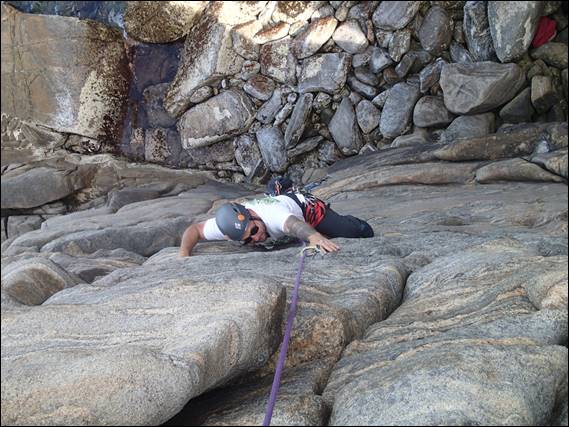
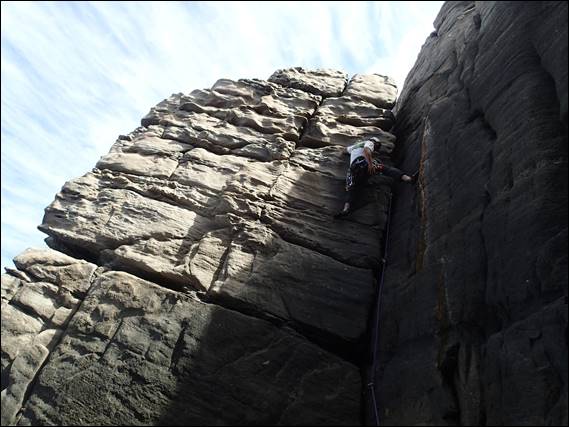
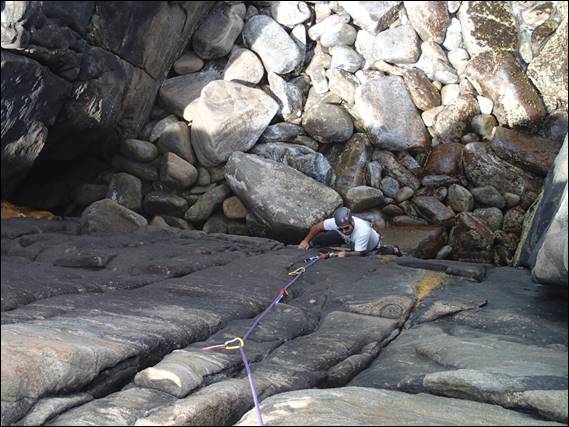
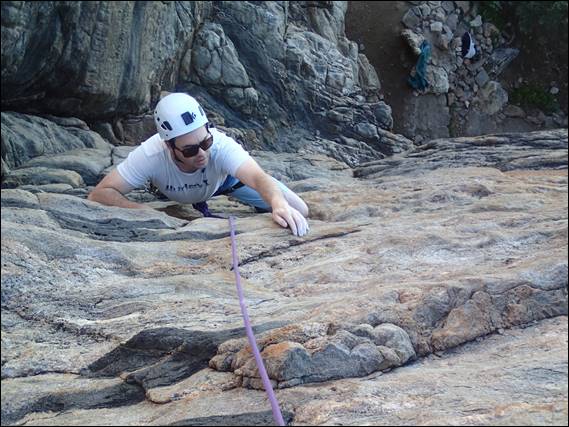
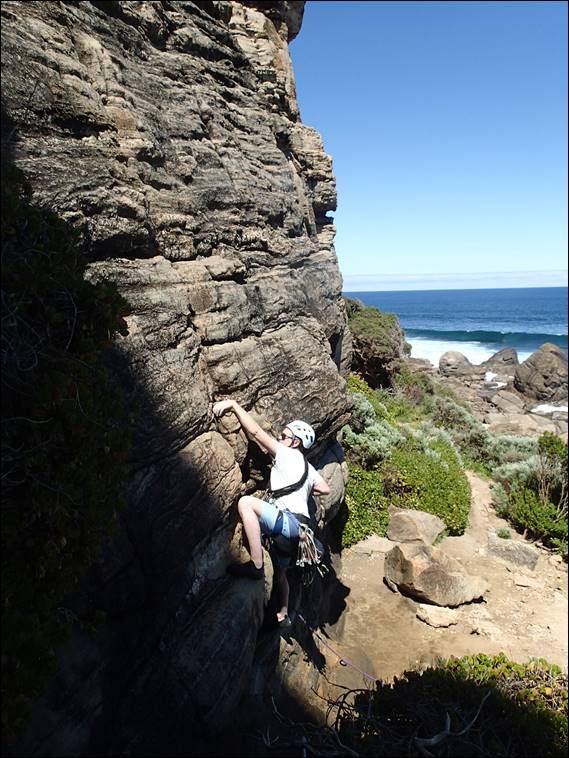
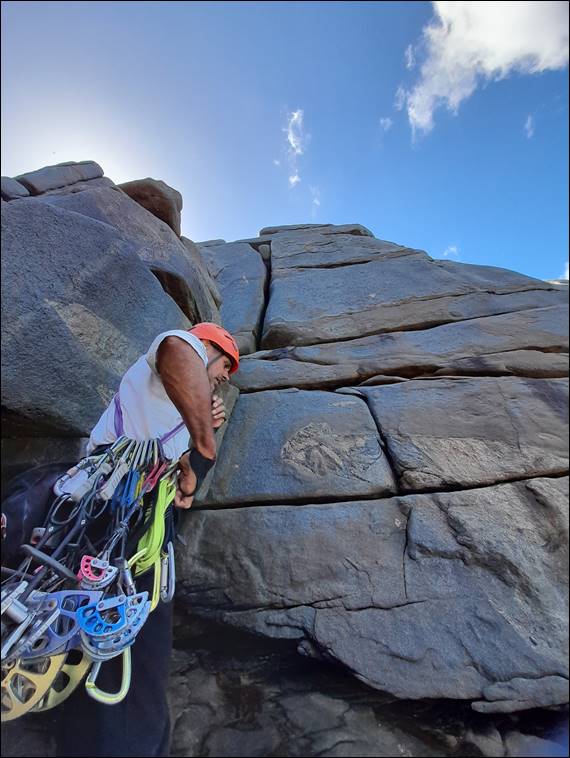
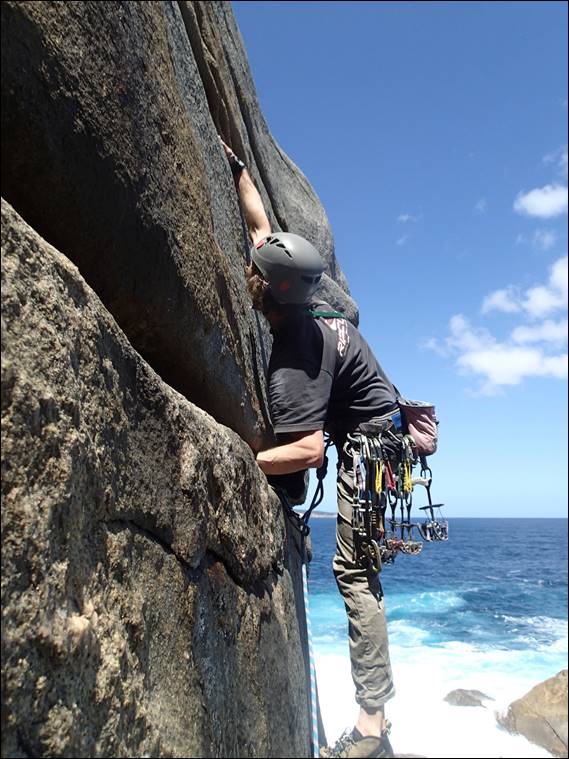
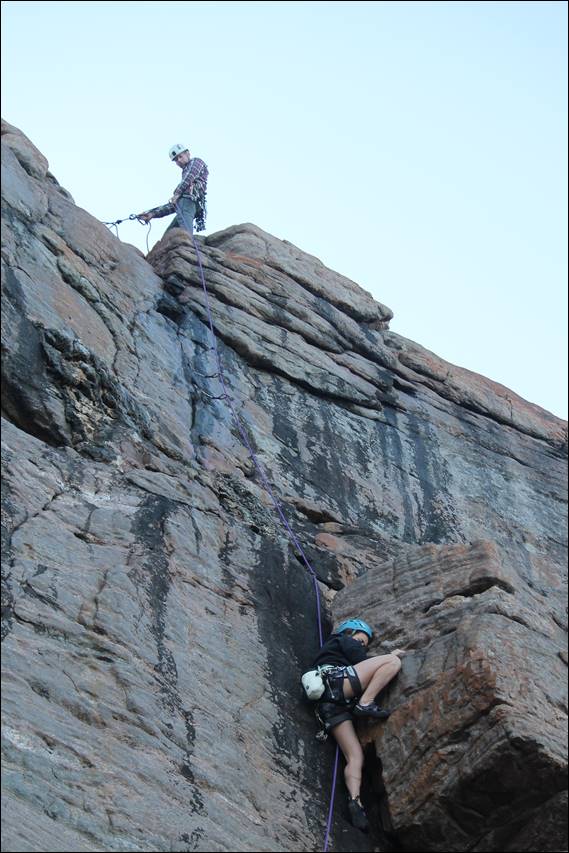
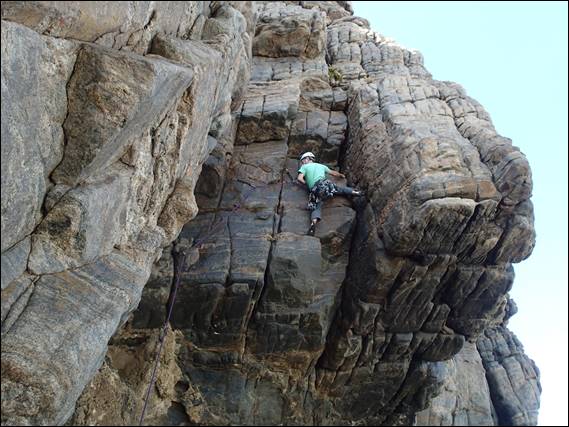
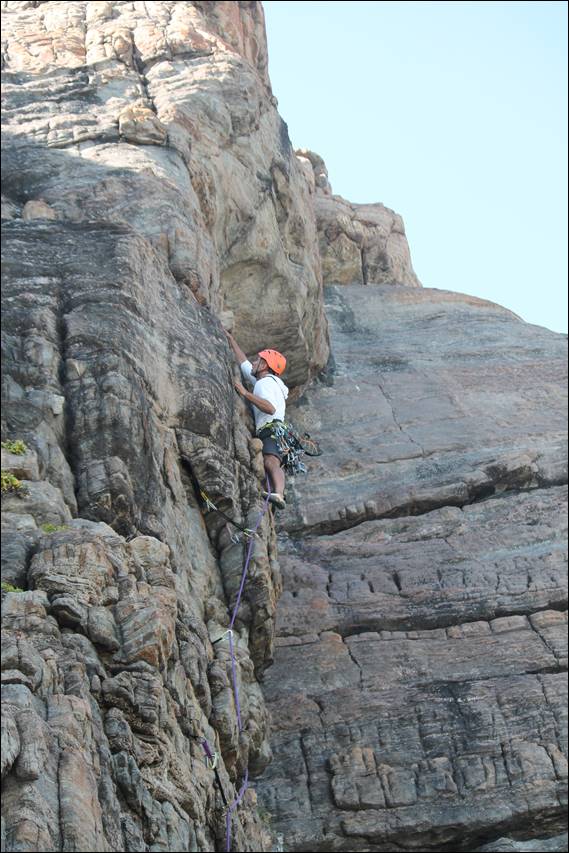
None of the routes here are particularly hard, especially when the rock is as dry as it was today. But Andrew was still more than happy for me to rack up for the first lead. And I of course obliged. These routes mostly have generous holds, although the horizontal breaks in which they sit can feel a little spaced, plus most of the holds are rounded or slopers. Regardless of that I felt immediately at home, as my hands made contact with the friction this rock offers which more than makes up for the lack of positive edges to pull on:
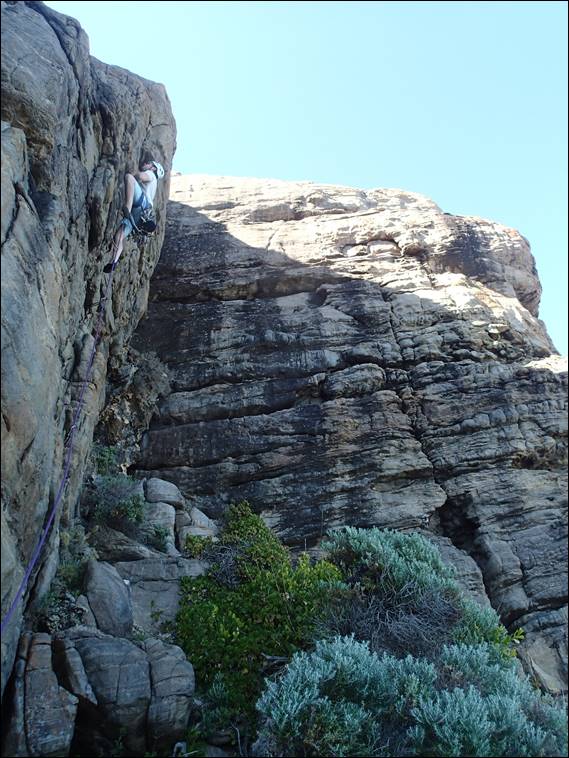
Climbing initially on the southern wall we didn’t use the rap line for each decent, instead scrambling down. The scramble is never too hard but you do need to keep your wits about you, checking the rock and watching where you are going. I wasn’t too worried about not rapping in each time, as I feel much more comfortable scrambling down. It just seems to me you have more control of what you are doing. I was soon on the sharp end again, as Andrew was happy for me to lead him up another route:
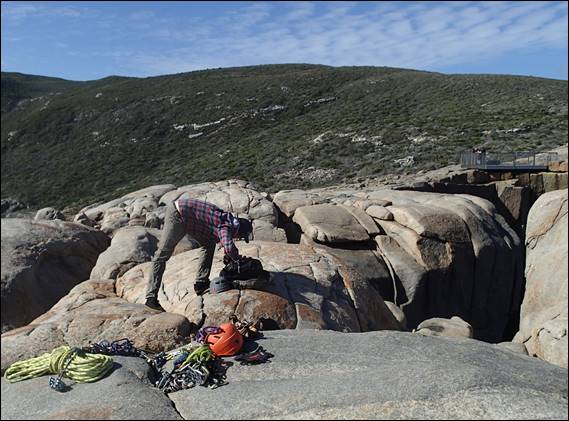
The local climbers may notice the shiny looking quick draw above. Like a few others, Andrew took advantage of a local outdoor shop selling these quick draws at almost half the retail price. And since having bought them he was yet to put them into action. Normally we would have organised who was to bring what, but for one reason or another that didn’t happen this time. So while I had carted all my gear in we only used my cams and I racked up with his quick draws, extenders, wires and tricams:
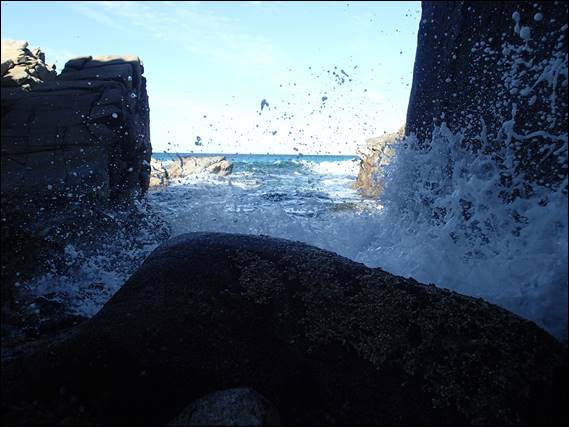
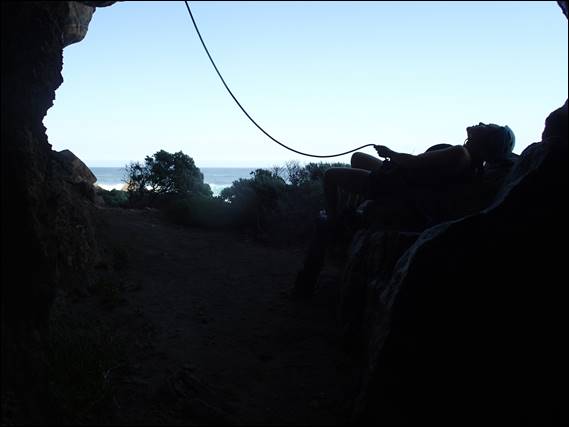
As we scrambled down for the third route Andrew started to hint that he might be keen to have a lead. He racked up while I sat there and watched as the next set of waves rolled in and sent water spraying over the rocks. It felt great to be back in the zawn, the low tide and easterly wind kept the swell from coming in too hard. That said we kept a sharp eye out in case anything bigger came in. Whenever the next set of waves rolled in, they sounded worse than they were and only on one occasion did we get caught out when both of us landed up with wet feet:
Andrew tackled the right side of the slab at the back of the zawn and I could tell from his movements and chatter that he was having a ball. So I was hopefully I could encourage him to bag another lead. As we sorted the gear looking out to sea the water in front of the crag was looking very inviting. I mentioned my plans to mix up the trips out with a snorkel, which Andrew liked the sound of. But we both agreed that the swell would need to drop a bit before it was worth thinking of going in here, so maybe next time:
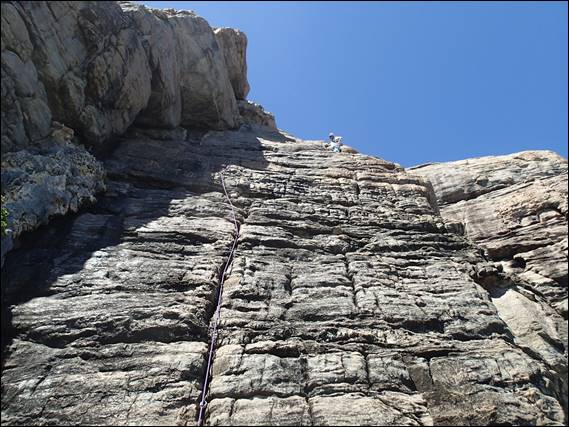
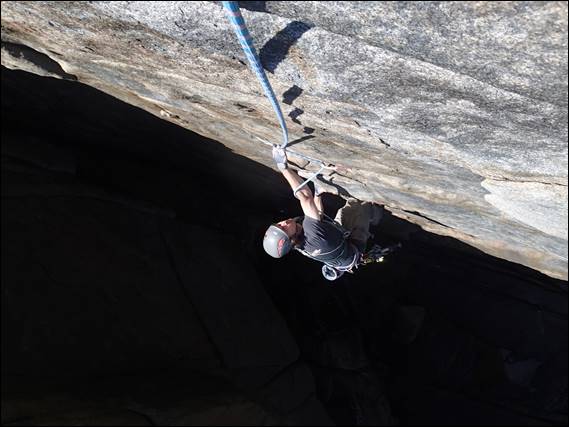
Going back down Andrew was happy for me to take the next lead, so we plumped for the classic of the zawn that also happens to be one of the first route recorded here. Two routes were established in 1989 by Tyson. By then there were five instalments of the A Nightmare on Elm Street franchise, which he made use on in naming the two routes he put up. I had led Freddy Kruger’s Claw for my second lead, but this one called A Wet Dream on Elm Street is the best line. With a steep middle section that keeps you on edge:
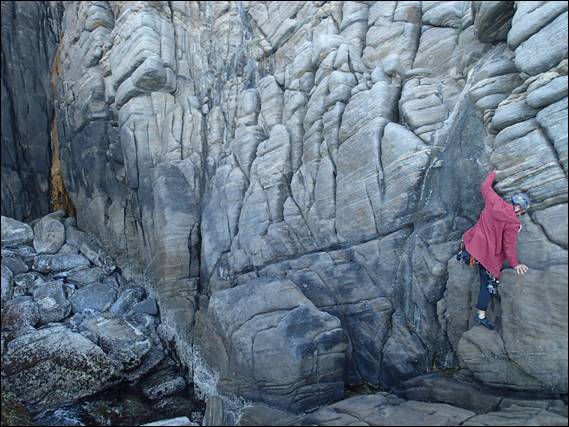
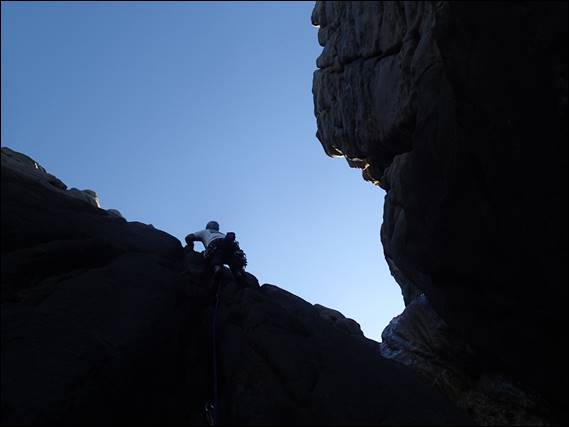
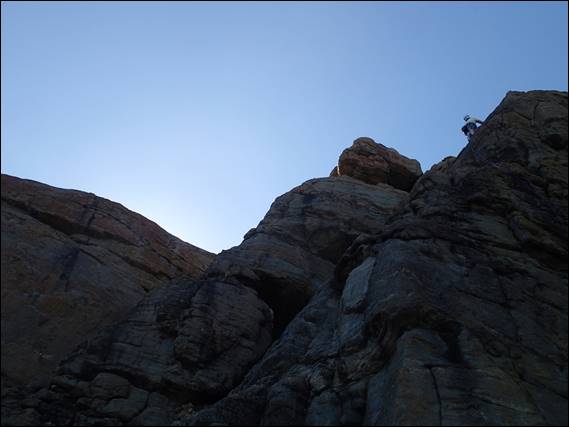
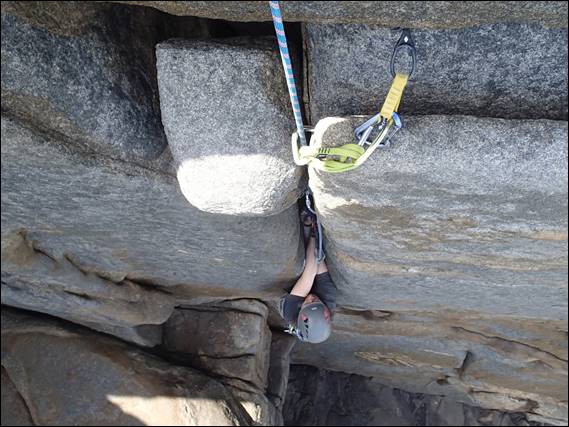
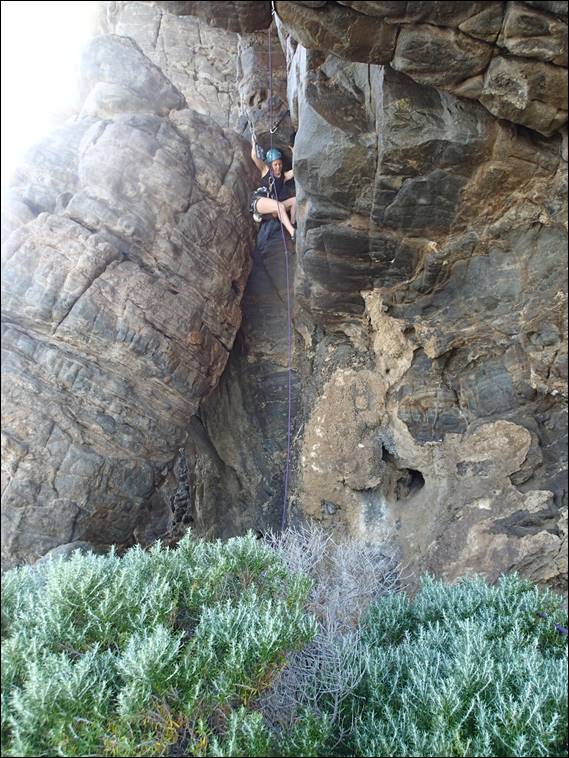
I could tell Andrew was getting tired, as he followed me up this steeper line. But as you will see above he had left his jacket in the zawn, so we had to go back down at least one more time. I wasn’t sure if he would be keen, but I kept hinting that he could take the floppy end for a second lead. And I was very happy when he racked up and tied in to take on the big corner. He was a bit tired I could hear concern in his voice, as he made the first few moves. This also happened to be when we both got caught out by a wave:
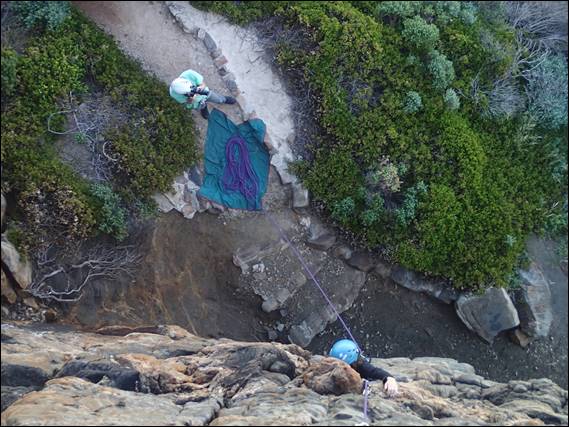
He inched his way up, breathing more heavily and each movement looked like it felt strenuous and tenuous. That no doubt meant he was holding on harder than he needed to, further draining his energy. But the gear is plentiful on this line and each time he placed a piece I could see and hear him relax a bit, before going back into tension as he moved above the gear. In part as I was away from the base of his route to avoid standing slippery boulders and in part not being sure how he would go, I anchored myself in ready to take the fall:
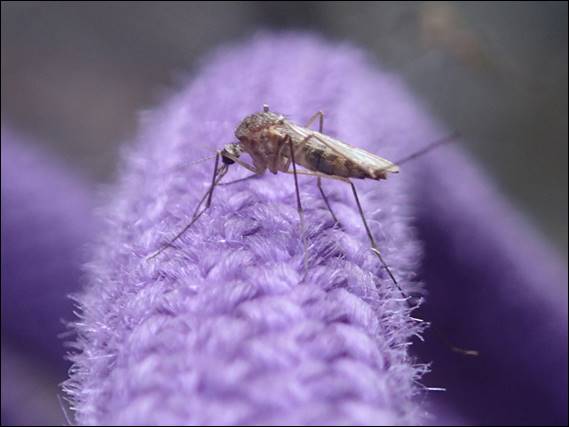
But just like the mosquitos that never gave up trying to draw blood, even from the rope! Andrew also didn’t give up and he managed a clean ascent with no falls or rests, topping out deservedly very happy. Admitting afterwards that he had to push himself both mentally and physically to keep going. This time there was no reasons to head back down, but he foolishly told me he probably had one more second in him. So it was we rapped back down:
Knowing that Andrew was a tad tired I picked one of the slabs at the back of the wall. This one looked the thinnest and most poorly protected of the lines on the slab, and it is not one I have led before. I made it harder for myself by avoiding the bigger holds but even using them I wonder if this is the hardest line on the slab, which is contrary to what the guidebook says. I even noticed that there is a typo that snuck into the guide, well not so much a typo but more of a not so uncommon mix up of mine with lefts and rights:
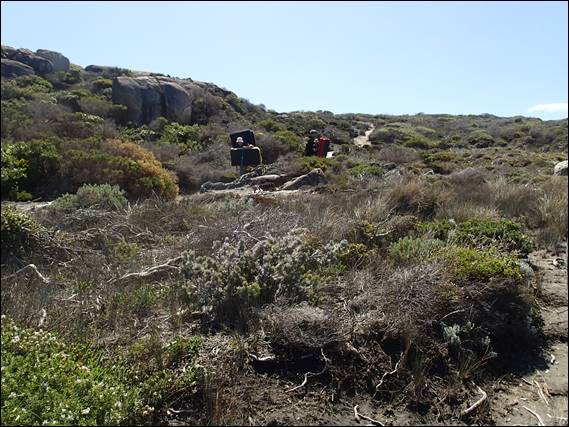
Speaking of guides, Andrew spied one at the base of Hand’s Up Wall just across from where we were. Obviously having been left behind by someone and fortunately only sporting a little water damage, and unfortunately having no hint of who the owner may be. Needless to say we took it with us as we walked out, going along the base of the crag in case there may have been more crag booty lying about. There were no other forgotten treasures to be found but we did have a surprise as the beach came into view:
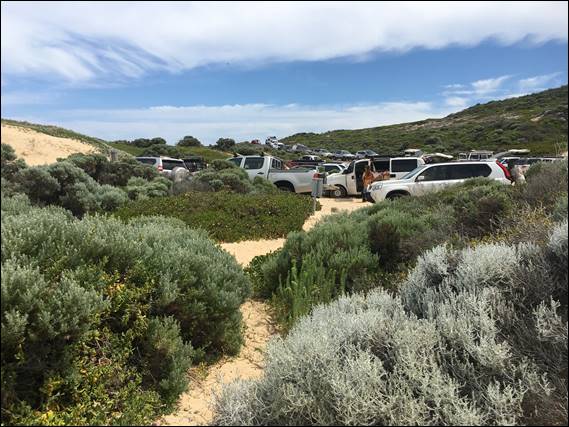
The beach was packed with more people than I’ve ever seen here. Heaps of people were surfing, so many so that we wondered if there was an event on. But as we wandered along the beach, which had been empty on our arrival, there were no signs of an organised event being run. I guess the sun was just bringing everyone out, and like the beach the carpark and road leading towards it was also packed. It felt weird coming into this hive of social activity after we had the crag all to ourselves, completely unaware of and isolated from the beach that was getting increasingly busier:
The sun sets and rises really quickly in this part of the world, and if you look away you might miss that magical moment. In a similarly fast fashion the season seems to have switch over almost overnight. It seems that after weeks of looking at a grey and weed ridden ocean things have magically cleared up. The only reason we spotted it was because Lisa and I were heading back along Forest Beach Road, after a late breakfast and game of King Cribbage in Busselton. The only nagging doubt I had, having just come of the back of another front, was whether it may have been a bit chilly:
I feel that I normally wait till its properly warmed up before going in, closer to the school summer holidays that are still five weeks away. However, my mind was made up and so this swim felt like it may be one of the earliest snorkels of any season for me. I rugged up with my wetsuit and headed down, and as I walked along to my usual entry point I dipped my feet in the water and much to my surprise it didn’t feel too bad. Swimming out, as the water trickled into the wetsuit, it felt a little cool but the trapped water soon warmed up:
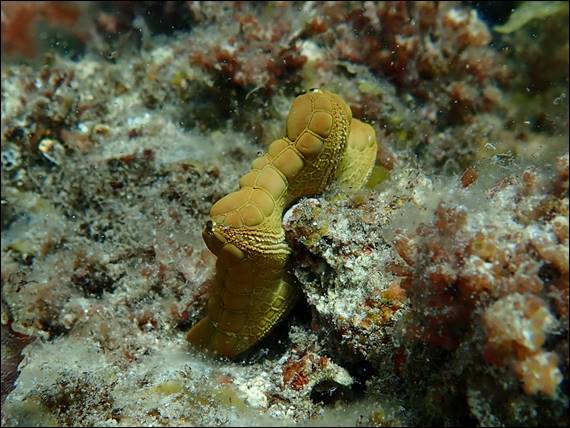
It felt really good to be back in the water, and the visibility was amazing. There wasn’t a heap of fish life to report on, but it was great to say hello to some familiar faces. I did however spot heaps of seastars. Including quite a few of the above Biscuit Seastars, and this one seemed to have latched onto something tasty being in unusually position that left its soft and more vulnerable underside exposed. I have not come across a mustard brown one before and based on the colour and swollen plates at the end of each arm, I think it may be a Southern Biscuit Star (Tosia australis):
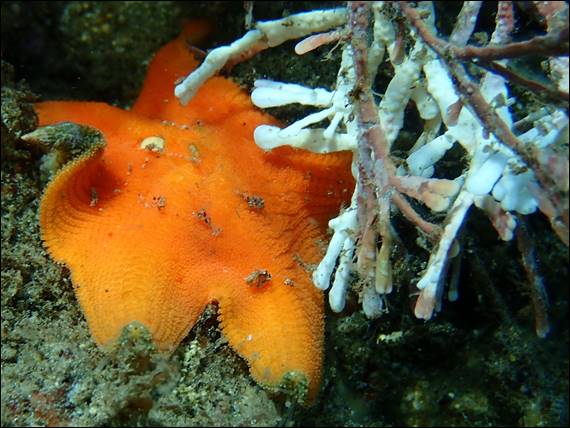
Above is a Bat Star seastar (Patiria miniata) that not surprisingly gets its name from the webbing between the arms. I’ve seen them before, but not in bright orange. It seems this seastar is a bit of a gut bucket and will eat both plants and animals, regardless of whether they are alive or dead. It does this by covering the food source with its stomach, releasing digestive juices that liquefies the food and then ingesting the tasty meal. It is also a bit different in that there are no pincers, which most starfish use to clean their skin surface. Instead it has small, moving hairs that create enough of a water current to keep its skin clean:
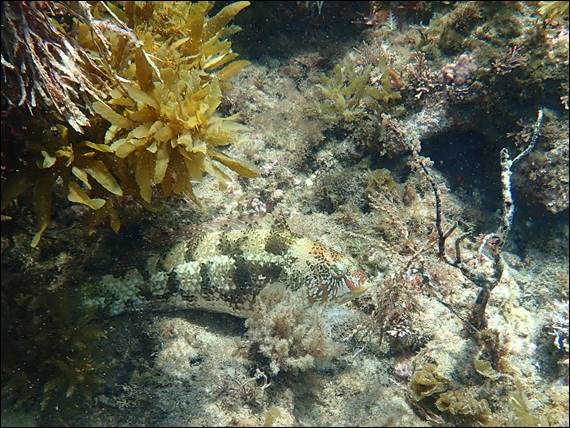
I had to include one image of a fish, and for this post it is a female Brown Spotted Wrasse, Notolabrus parilus. Whenever I kicked my fins to come back up from a duck dive I would stir up the sediments, and within second these fish would be darting though the murky water I left behind. I’m guessing looking for food. I can tell I’m out of snorkelling practice, as my breathe holding ability seems to have waned somewhat. I felt like I struggled to stay down too long, but I made an extra big effort when I came across this floral garden arrangement:
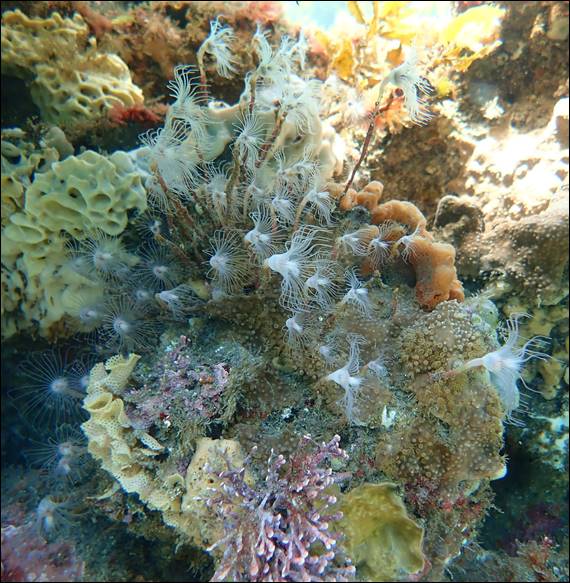
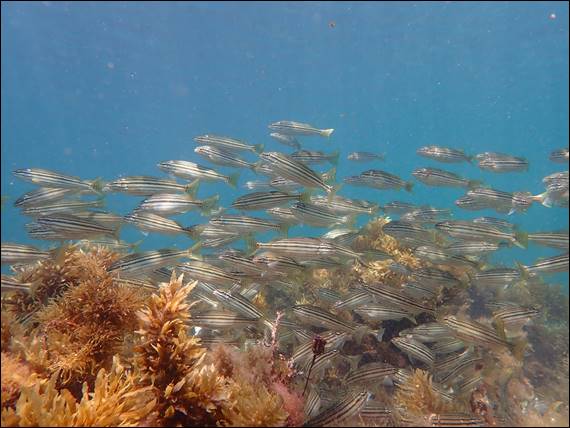
I’ve made a mental note of the location I found this amazing sight, which was under a rock shelf, and hope to be able to find it again to get some better close up images. They are obviously not feather duster worms, but I’m pretty sure they are filter feeders of some type. I can only guess they are tube worms, but have failed miserably in trying to find out any more detail on them. While I wasn’t feeling cold, after what felt like ages I started to make my way in. That was until I got distracted by this school of Western Striped Grunter, Helotes octolineatus:
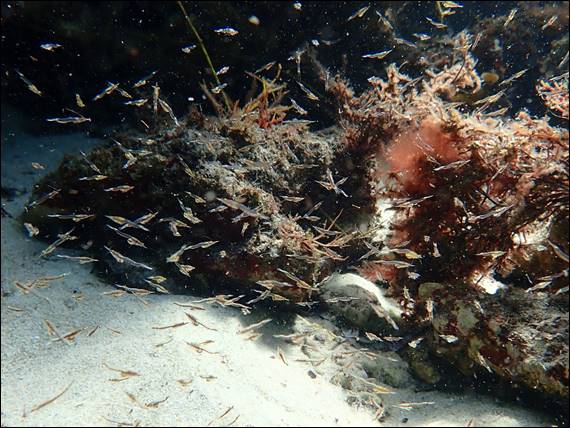
It was a forty minute dunk and I didn’t come out blue with cold, which I’ll take as a good sign for the season to come. I even came across a few schools of baby fish, something I didn’t see until quite late into last season. Now last year I had intended to combine a swim with my climbing trips, so I could check out some new locations a bit further afield. Hopefully I can make that happen this time, but for now I’ve already lined up a snorkel next weekend at a new location not too far from home. Fingers crossed the conditions are alright:
Steve was in need of a circuit breaker from the non-stop lifestyle of the big smoke. And what better way to do that than to head down to the relatively sleepy south west, camp out and then head to the cliffs at almost day break. In addition he also managed to get a bit adventurous 4WDing in to get to the scheduled campsite he was aiming for. Plus he managed to catch his own dinner and prepare a fish curry. With such a rewarding, peaceful and relaxing afternoon and night out with nature, when we met at the Wilyabrup carpark he was ready for adventure:
Both Hannah and Glen had hinted at joining us this morning. Sadly neither of them made it, and this left the two of us with the crag all to ourselves. It had been a while since Steve had been out and managed to climb with any conviction plus, as I was to find out later, in his usually way he had done a thing or two that wasn’t helping with his mobility nor state of mind. Wandering along the base of the cliff we passed English Ethics. It was looking in reasonable condition, compared to previous trips here, but I knew that would be way to feisty for Steve:
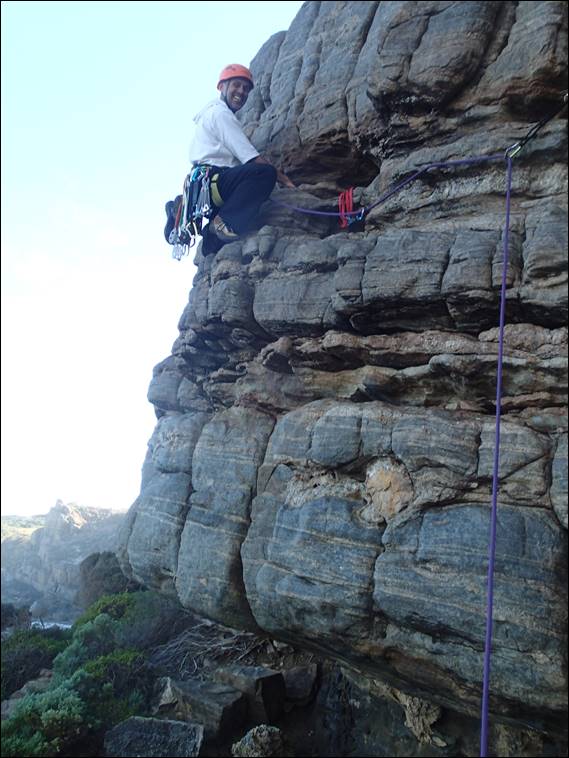
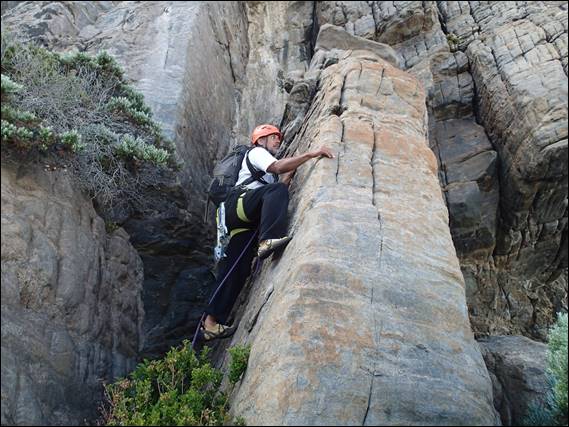
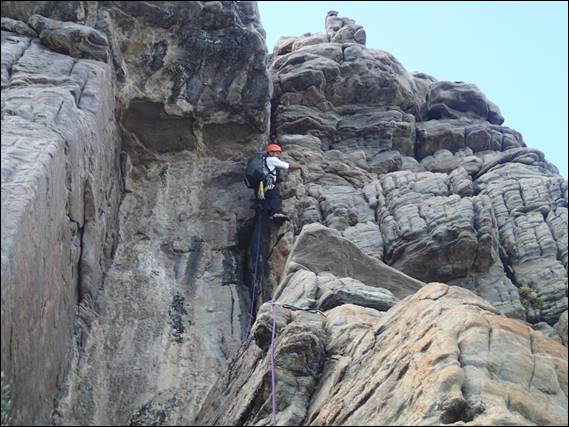
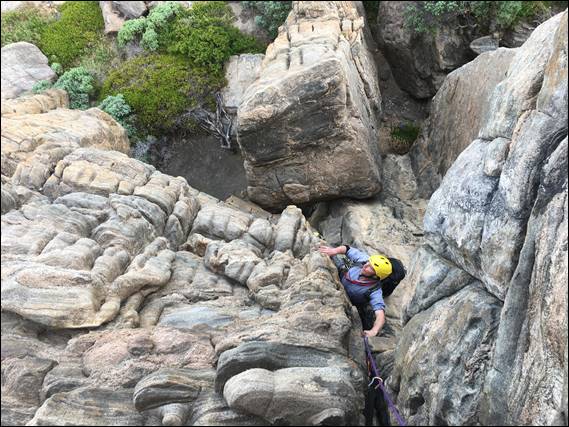
We walked on, what we needed was something fun and nothing too taxing. Orryjohn fitted the bill, and it didn’t take long to come to this decision. I could see Steve’s eyes drawn to it and a grin spread across his face, a bit like a kid in a toy shop when they see what they would really like for Christmas. I was more than happy with his choice, an enjoyable trad outing with a flared chimney, at the back of which there is crack wide enough to gobble up even Steve’s biggest tricams. While I had offered to supply the gear and rope, he insisted on bringing his tricams:
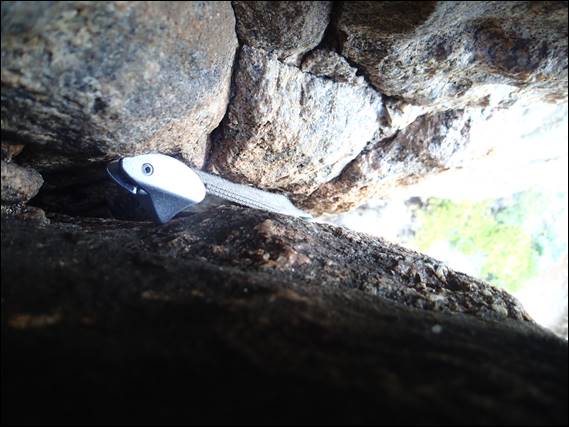
Due to the route he’d picked I only allowed Steve to put tricams on his harness, which I knew he wouldn’t mind. For those more familiar with climbing protection, you may recognise the wired tricams Steve is fiddling with above. The only other person I know who has these being Wiggins, and after one outing they never saw the light of day again. But when Steve stumbled across these without knowing about Wiggins nor my experience of them, just like the appeal of Orryjohn today he simply had to have some. It was to be their first outing, and the question is whether they will make it out again:
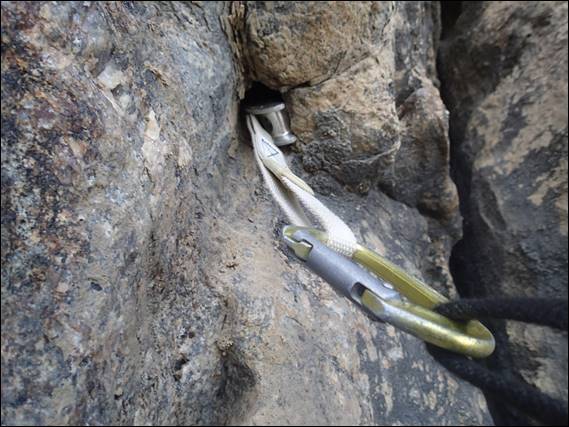
By the time he had fiddled the wired tricam into position and clipped the rope in, I had scampered like a mountain goat from my lofty position taking images back down to put Steve safely on belay. Now for those not familiar with climbing protection, the way tricams work is by using the rotation on the single pivot/point to wedge the curved back against the rock. For those mechanically minded; as the wire, or in the image below tape, is loaded it pulls the back of the curved edge forward to increase the pressure on the back curve creating greater friction. So why did Wiggins hide his wired tricams from daylight you may ask:
With a taped tricam it is usually not too hard to push the head of the tricam back, reducing the pressure on the back curve allowing the piece of gear to be taken out. But with the wired tricams, the wire becomes spring loaded when it is placed. This means when taking it out you need to continually place tension on the wire to stop the spring loading effect, as well as knock the head back to remove the pressure on the back curve. These two actions are opposing, so can be pretty hard to achieve while hanging onto the rock. So while they may provide completely bomber protection for the leader, the person coming up second can have a very hard time getting them out:
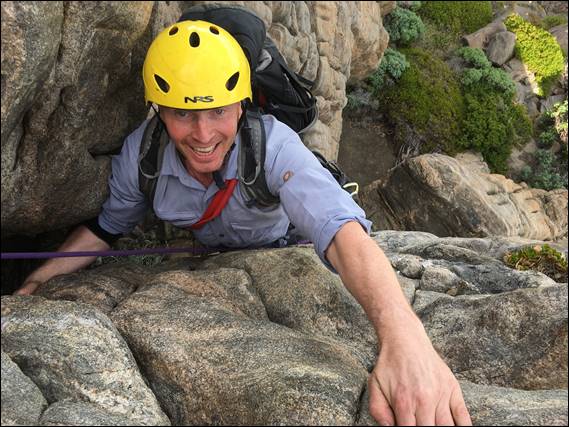
Steve had not been moving too well on his first lead. It was easy to see that he was comfortable being out and was placing enough solid gear, but his movements seemed awkward and he wasn’t really in the right frame of mind. While I suspected something as he led, it wasn’t until after I followed him up the route that I discovered about the “thing or two” he had done recently. As soon as I heard it made absolute sense as to why he was not moving as well as would be expected, nor why his focus was a little off kilter today. But it wasn’t until he had followed me up my lead that he hinted it was bad enough to consider calling it a day:
It wasn’t that my route had been too hard and worn him down too much, as it really wasn’t very difficult. In fact the line isn’t even written up as a route, and I doubt that anyone ever thinks to climb it. I picked the line because I could tell we needed to go easy, and more importantly because I saw a great opportunity to place a sling. This was the only piece I used that wasn’t a tricam, and I also used a wired tricam! After we got back down and I offered Steve two options, pack up and walk out or climb out with the packs. I was quietly happy when he voted for the latter:
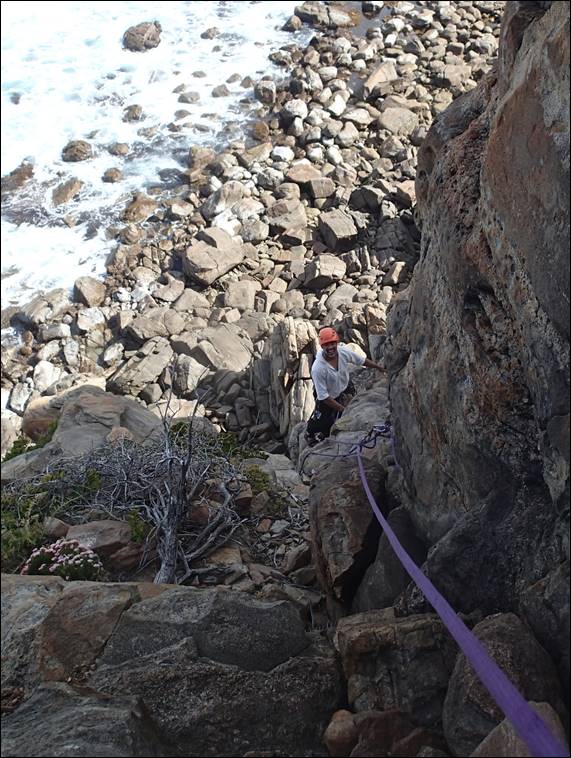
We plumped for another low grade but tradition style climb. I was again only armed with tricams and Steve was tickled pink when he came across one of his larger tricams nestled in the perfect pocket, shown below. I had intended to climb one of the earliest recorded routes here, Stormcock first written up as having been climbed in 1973. But I had never climbed it and after the climbing big leaning block, from which the climb gets its name, I went straight up. While never too hard it felt more sustained and certainly had exposure:
In addition it was made more exciting by a reasonably weighted pack on my back, full of my climbing gear that had been unused today. It was a stellar line and I thoroughly enjoyed it, and began to wonder why I hadn’t previously climbed on this section of Wilyabrup more often. It’s the same area where a month or two back I sent Rongy up a line he had never done before. I was nervous about what he might say but he ranted and raved about it. I think on my next trip to Wilyabrup I’ll aim to jump on another line here, as there are a few I have yet to experience:
Next time I will however check the guidebook. Despite having written it myself, today proved I really didn’t know where all the routes went. The original Stormcock route, traversed right from the top of the block and then up an arête. The steep crack I had climbed seems to be part of a route called Sombre, which was quite a few grades harder than the intended line. Despite this and how he was feeling, plus not knowing what we were really climbing, Steve also loved the line and came up beaming. And I think all the bomber tricams added to his pleasure:
He was also very weary, and we really did need to call it a day now. It was probably one of my shortest visits to Wilyabrup on record, but we had bagged three very fun traditional style routes. Plus we had laced all three with copious amounts of tricams of multiple sizes and styles, which is always enough to put a smile of both Steve and my faces. So it didn’t feel wrong as we packed up and walked out, getting back to the cars before 9am. Leaving the twenty plus people we walked past, as they headed to the cliffs, to enjoy the crag in a more crowded state. I also have a feeling that the trip had provided the much needed circuit breaker Steve was looking for:
With the warmer weather, supposedly, on its way and first light getting earlier and earlier Rongy, Howsie and I have decided to once again start up a weekday before works climb. I don’t intend to record every session, as it will get a bit repetitive, but this one is warranted it is the first. On the way up the scarp driving through state forest, as light was just creeping into the sky, I avoided a number of kangaroos. I also spotted an echidna crossing the road. While I have seen these guys up close and personal many times before, it was the first sighting in what I consider my own back yard. While I stopped to check it out, he was quick to scoot off the road and into the bush:
The above image was taken at ten past five… may the proceeding begin! Rongy was a little late arriving but still in time to join us for the first line. Being the first session we haven’t sorted travel arrangements and will endeavour to reduce our carbon emissions for future sessions, with at least two of us carpooling. The great thing about these early morning sessions is that we get hew place to ourselves. After the last few daytime trips here with families and tourists staring at, photographing and even videoing us it felt very nice indeed:
The only on watchers this morning were a bunch of kookaburras. After an hour or so they got bored, or realised that there would be no food scraps from us and moved on. Of course and as to be expected we heard the distant cawing of the red-tailed cockatoos, but there was no other sound to disturb our concentration. The intention of these sessions is more to get us climbing fit. Also for Rongy and Howsie it is also an easy way for them to squeeze a climb in during their changing lifestyles, with ever more demands on their time:
This being evident by how few weekends they have got out on rock. In fact they both found a number of the routes here unfamiliar, despite having both led them numerous times over the years. They were also lacing the usual climbing stamina they once had. At times I could tell they were starting to tire, question what to do and/or yoyo wasting precious strength. So on occasion I guided them as to where either a hand or foot hold was, and how to best use them. Almost to millimetre accuracy. It’s not something I would normally do. However for today, seeing they were getting back into it the beta was very well received:
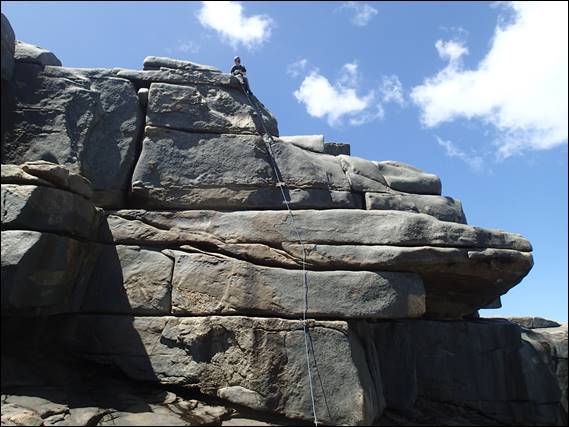
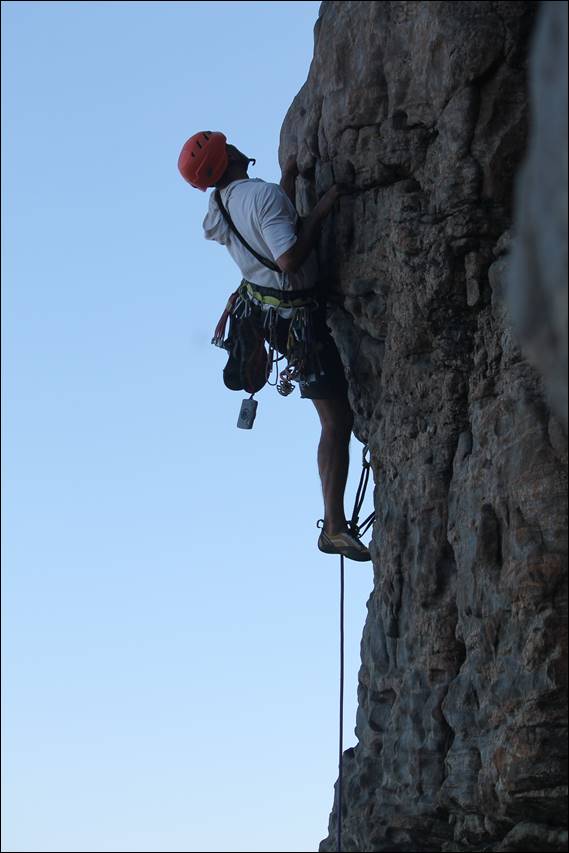
You could at a stretch call these before work sessions training, not that I like to think of them as such. But we are very focused and organised to maximise the climbing time. If you check the second image you’ll see Howsie cleaning the line he finished, as Rongy starts up the next one. Two sets of draws and ropes and a well-planned attack keeps us moving, and there isn’t a lot of rest between climbs for anyone. Today we picked six lines that we were comfortable with meant we could smash out the quota in less than three hours:
For this first session only one person led each line, the other two seconded up with the rope above. As we continue these quick fire morning climbs this will change and we will pull the rope every time, but for today we were easing back into it. Hitting six lines in rapid succession on the steep technical walls of Welly Dam can be pretty intense, so I’ll have to be careful not to overdo it especially as we start to jump on the harder lines on offer. Even after finishing up there is no dilly-dallying, it is then time to drive back down the scarp to Bunbury, work and today rain:
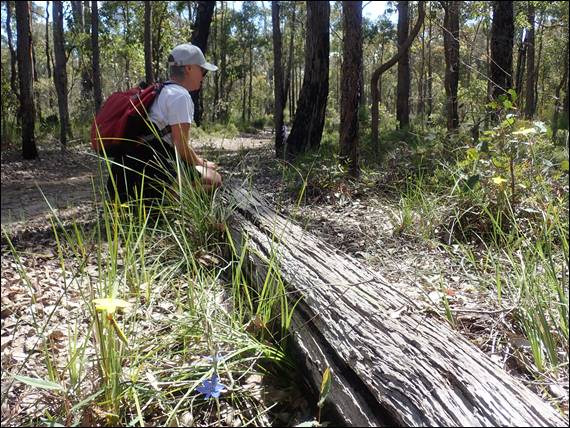
It’s amazing just how many walks are dotted about the place, and I seem to be hearing about them as more people cotton on to my growing flower fetish. The most recent one being a spot out in the Wheatbelt reputedly littered with orchids, including several I have not as yet personally sighted. But that place is a two-hour trip, one way, so it is tempting to leave it for next spring. Today Lisa and I didn’t fancy going too far away, and we opted for a quick 45min drive to a short walk that Glen mentioned to me just yesterday:
The Kondil Wildflower Walk is just out of Nannup and offers three walks the longest a mere 3.3km. Strangely several websites suggested allowing up to three hours for this walk. Lisa and I, even when I’m in full “look at the one, and that one, and that one…” mode, can cover 3km in an hour, so either this walk was overflowing with treasures or they were making allowances for the real, really, really unfit. The general area was forested for the Allocasuarina tree in the early 1900’s when Barrabup Mill was operational:
Casuarina comes from the neo-Latin word of casuarius, which means Cassowary. The tree looks a bit like a pine with thin spindly leaves that droop down, very much like the feathers of the Cassowary bird (but also the more broadly distributed Emu in my mind). Allos means other, in Greek, and was used to describe this endemic Australian tree’s relationship with the broader Casuarina genus. When Lisa and I saw these trees, we pondered what they were and they reminded us of the Desert Oaks we used to see and love in Central Australia:
The Desert Oaks, or Allocasuarina decaisneana, are directly related to those found near Nanup, which have a common name of Sheoak, or Allocasuarina fraseriana. The name Sheoak being given as the timber resembled the deciduous Oak tree that the workers were familiar with from back in England. I seem to have digressed and talked about a whole heap of stuff I hadn’t intended too, and I’m sad to say I didn’t even take a picture of any Sheoaks. Instead my focus was on the smaller flowers dotted about the place:
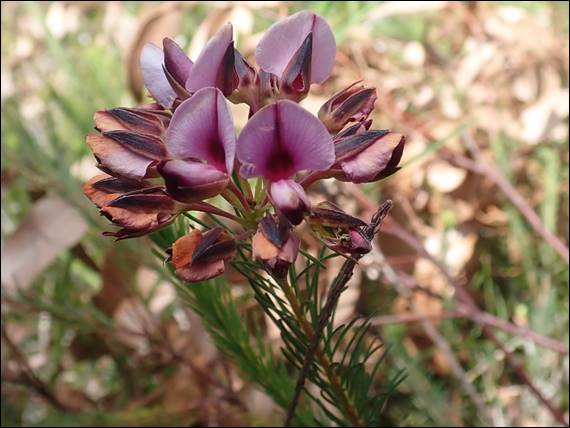
So far I have included an image of Banksia grandis, commonly called the bull or giant banksia. What struck us about this tree, which was only just starting its journey, was the strange looking centre. We were not entirely sure what it was, but having checked it out it is now pretty obvious that they are the new leaves at a very early stage of development. The second image is of a Granny Bonnet pea, Isotropis cuneifolia. The flower was larger than most peas at close to 20mm across and had very clean and clear colours, with a lovely orange fringe round the petals:
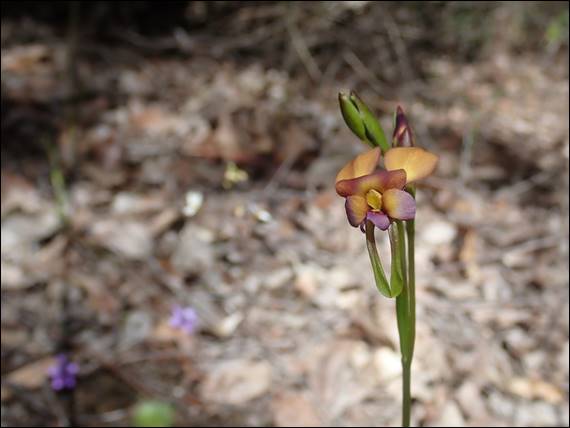
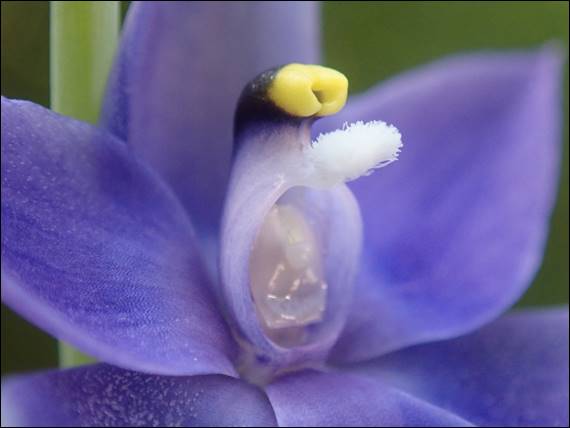
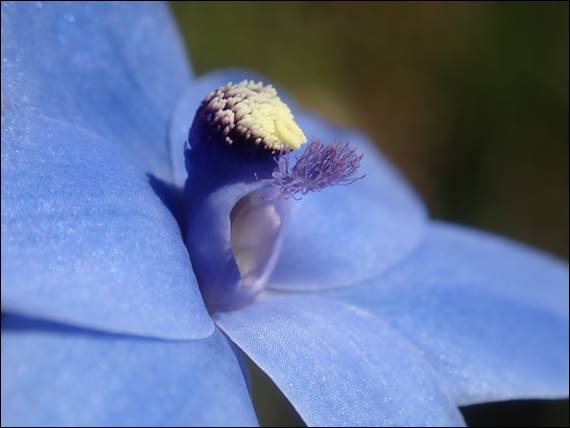
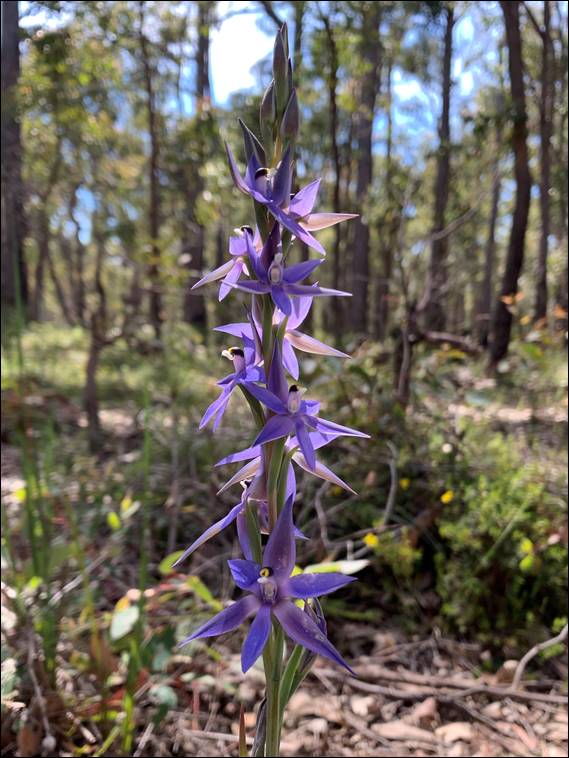
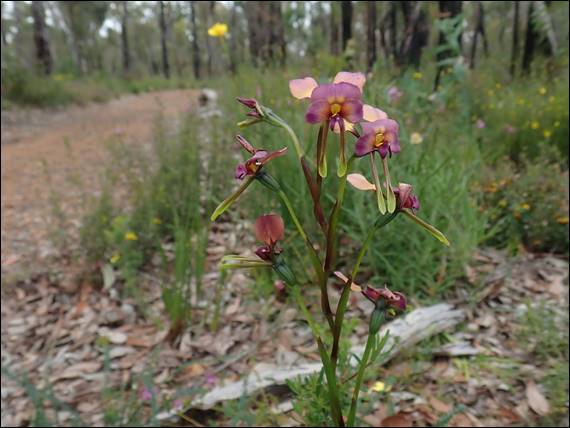
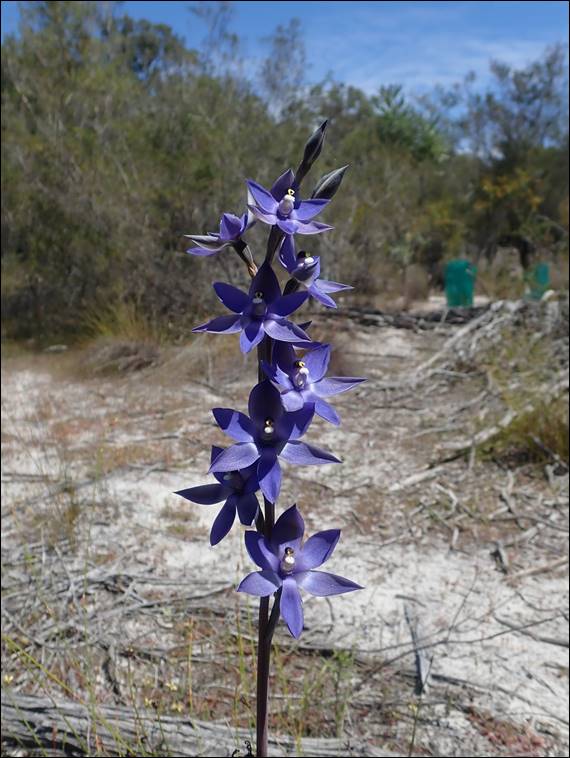
We did pretty well and found seven or eight species of orchids on the walk, all of which we had previously seen or so we thought. If you look closely you will see a couple of Purple Enamels in the background of the image of a Pansy Orchid. The close up above and below are of the Scented Sun and then Blue Lady Orchid, and I purposely took the close up images to show the difference in the column and tufts. The Scented Sun Orchid being the most common of the sun orchids, and can grow up to a meter in height and have upwards of fifteen flowers on one stem:
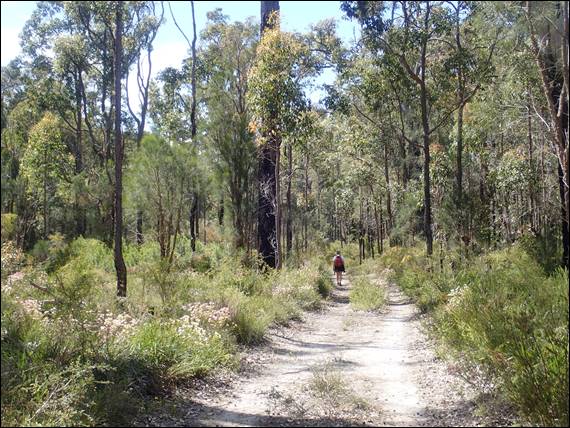
The reason for including the image of Lisa walking ahead of me, was not because of mosquitos of which there were a few. But the nastier March Flies, it is warming up and it is the first time we have come across them on our walks. Mosquitos stick a needle in you, while in comparison the March Flies will take a pound of flesh. Lisa did however stop a few times including when we came across this next Scented Sun Orchid, and it was after this that we started to wonder if we were seeing different plants:
The petals and sepals on this one were much narrower and the flower looked much more star like. It seems that this could be either the Scented or Plain Sun Orchid, but they are hard to tell apart. All I can find to tell them apart is that the latter flowers slightly later in the season, but their flowering period does overlap. That is when I then started to question whether the shorter plants we were seeing, all of which looked to have wider petals, such as that in the close up image earlier on, may be the Shy or Slender Sun Orchid but other than size I could see no distinguishing features:
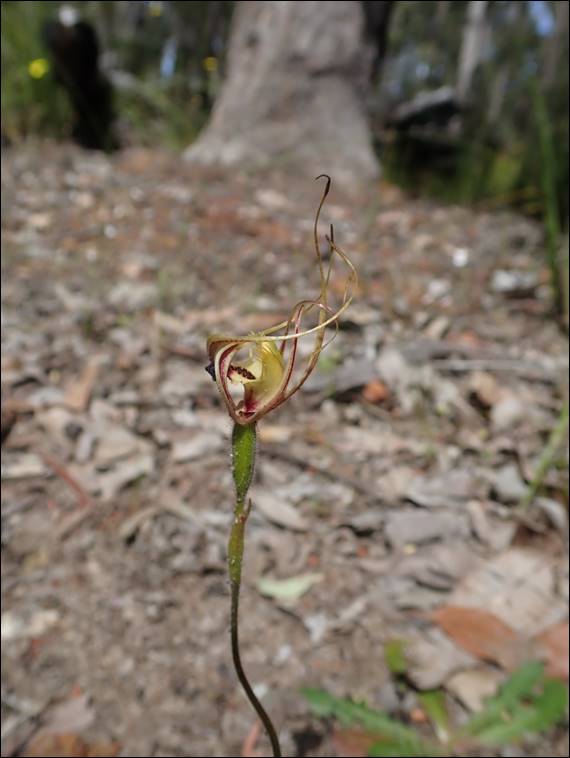
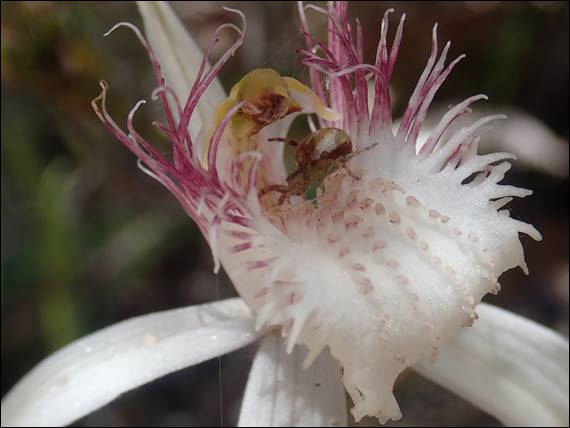
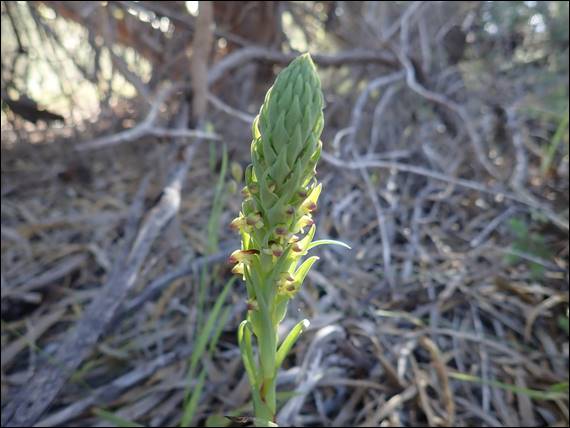
As I said we did pretty well on the Orchid front, and in addition to the above mentioned finds we saw Cowslips, Rattle Beaks, a single White Spider and several Forest Mantis. The latter were getting on in life and shrivelling up. While there are so many varied shapes and sizes of orchids in the South West of Western Australia, there is one thing in common and that is at the base of the flower is where the ovary sits. It is possible to tell if pollination has been successful, as the green pod between the stem and the flower will swell up:
To my untrained eye I’m going to take a stab and say the above Forrest Mantis was not successful with reproduction, which I say because for some other orchids I’ve seen the ovary has been very noticeably swollen and looking back at other images of Forest Mantises this one isn’t. Below was a pea that stood out for me, due to the tight cluster and the deep colours of the flowers. It seems this plant, endemic to the south-west of Western Australia (again!), has had a name change over the years. Originally named Burtonia conferta in 1825, and changed in 1987 to Gompholobium confertum:
I haven’t discovered the reason for the name change, but the term confertum means “crowded”. This does not relate to the cluster of flowers at the end of each branch, but the foliage itself. Despite the trails being relatively short and also in quite close proximity to each other, the area was lovely to wander through. Unless there were other people on the tracks, which only happened once for us, you would have no idea how close they were. Indeed, when we walked on the next circuit there’s no way we could have told we were within tens of meters of the last track:
I’ve mentioned both the Purple and Yellow Flag, or Patersonia sericea and umbrosa, and we saw plenty of them today. We did however find one plant that was definitely of the same genus, but I’ve been unable to identify the species. I hazard a guess that it may have been a single albino plant, but while the three petals were a soothing pale creamy colour the stamin was the same distinctive yellow of those found on the purple and yellow variety. I’ve been using Google Lens but can safely say for this trip it has been utterly useless:
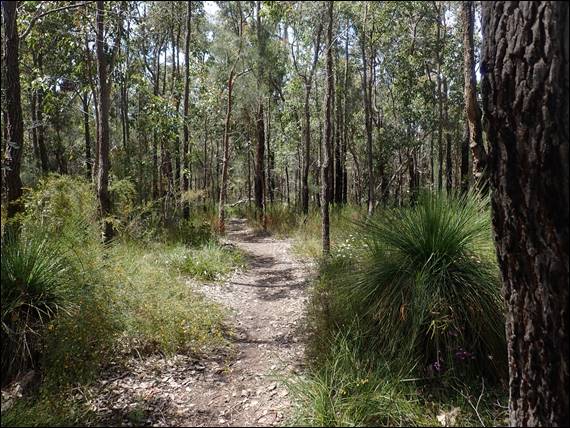
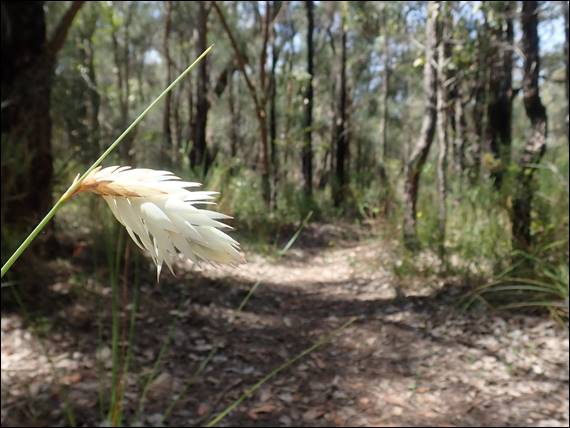
We’ve also been spotting and taking a liking to the many native grass species. These are usually clumping and do not sprawl across and engulf the ground like the pasture or turf grasses that we have introduced. The seed or is it flower head of these grasses are architecturally fascinating, and they look like they have been created by a perfectionist with perfectly sized overlapping leaves with just a hint of colour graduation. The image below being of a Hooded Lily, Johnsonia lupulina, that was opening up in the warm sun:
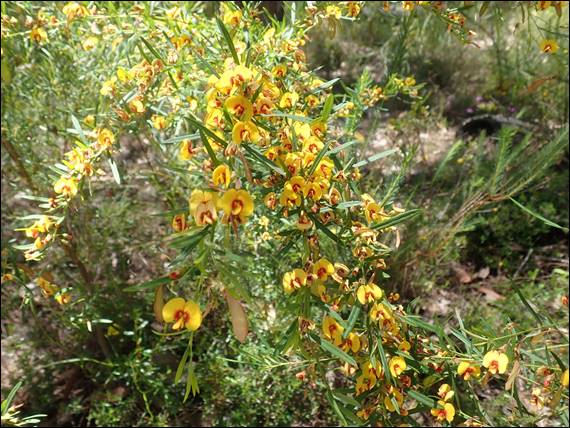
One last pea, this one being Bossiaea linophylla and I can’t find a common name for it. Abundant and much smaller flowers than the other peas I have included in this post. But they stood out so brightly when the sun hit them. The flowers can be a bright yellow to orange or apricot-coloured or red flowers, and the fruit of this plant is known to attract the Western Rosella parrot. The reason I took the image was that I thought it was the plant from which I found the fruit or seedpods, but looking at the leaf structure now it is obvious I was wrong:
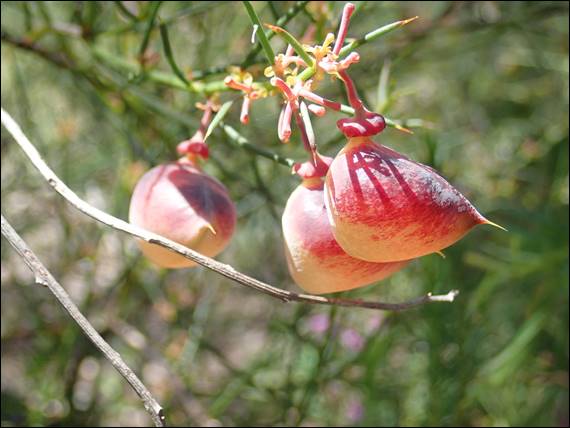
So now I have no idea what plant this was, but I simply couldn’t walk past these strange looking bulbous pods and had to include them. I have attempted to identify them with Google Lens and had some quite funny results. Originally leaving the app to pick out the part of the image to focus on it suggested they were peaches, then when I manually focused it on just one whole pod it came back with a pomegranate. Of course there is no way of telling Google Lens they are only 20-30mm in size, so you can understand the results. Needless to say I’ve given up on this one, but if I come across them again I will untangle the plants to see it I can track down any flowers that will hopefully be easier to identify:
Even packing in the two longer trails we were ready to leave within a few hours, which was a good job as the sun was out and it was getting warmer. It seems that dogs are allowed here, so Lisa has in mind to pop back with the poodles. If that happens sooner rather than later, I might get a chance to check the above pods out in more detail. But for now, we considered heading into Nannup for a bite to eat but have taken a liking to the Shelter in Busselton. So this is where we ended up for lunch and a celebratory beer to say cheers to twenty-one great years of marriage:
It’s been a while since Glen has been out on rock and this week he posted that he was keen to reinitiate his involvement in climbing. He also foolishly posted that last weekend he went out fishing, and left home at 4:30am. However, instead of capitalising on the chance for an early start and possible first light climb we were wandering down the path at 6:30 well after another glorious day had begun. The reason for not getting out so early was mostly because Glen self-confessed to not being all that fit, and it had been close to a year since he had touched rock:
Despite the long duration since he had climbed, and his very intermittent appearance on rock for a year or two before that, Glen hinted of two climbs he might consider leading. But before we got to that it felt only right for me to take the sharp end, allowing him to reassociate himself to what climbing felt like with the safety of a rope above. Tom Thumb is a fun route up a widening crack that almost gets to body width. As I watched his footwork looked a little cack-handed and I could see the extreme focus on his face, as he worked the route:
He indicated the first taste of rock was a bit of a rude awakening and his forearms were pumped. Also that his head was in a bit of a spin. So I was a little surprised when he said he would jump on lead, hitting the first route he had mentioned before. Twenty Questions was in his sights, and as is so often the case your ability and mindset can really change when you are leading. With the rope below the brain can sharpens and old skills can come back to the fore, as proven by Glen who really didn’t spend too long in getting up the line:
I had to encourage him to pop a piece of gear in a couple of occasions. As I could see from his movements he was tempted to move on and run out the gear. But other than the two interjections I was impressed with how he kept his cool and didn’t do anything silly. All of his gear was bomber, something I come to expect of Glen when he remembers to put it in, and is in part as a result of all his prior state emergency services training. The reason he was keen to come to Wilyabrup today was to jump on longer lines, as most other crags round here are relatively short:
I thought that may have been his undoing when I next led Thunder Thighs. The initial crack that is six or so meters long can feel insecure and technical. Then the upper section requires more focus on small holds, for the grade, up a steep wall. But he again impressed, and while I could see him shaking out a lot more than on the previous two routes he held it together. Today I was making sure my belays were set up to ensure that if Glen took a fall I’d be in a comfy position not needing to take any weight, but I never had to put any of the setups to the test:
The other route Glen had in mind to have a go at leading was Hope, but after the first three routes and based on how his body was feeling he sensibly lowered his sights. Instead he opted for the alternative start of Dunlop Special. I understood what he was thinking, in that he would have the initial steep wall to deal with after which the route would switch to a nice angled slab. So as his energy levels depleted the climbing would get less strenuous. That said, climbing is so much more a mental challenge than physical. And today Glen was definitely managing to control the mental strain, when the climbing got steeper:
Once on the slab he was able to relax a bit more, but his movements were getting slower and more deliberate. A sure sign of getting tired, but his well laid plan served him well and the easier angle provided lots of opportunity to rest that he sensibly made use of. I was all prepared to hear that it was time to wrap up for the day. But as we sat on top of the crag Glen said he was happy to follow me up Hope, comic to the self-realisation that it was probably a bit too hard for him today. As we wandered back down, it was close to ten and finally other people had arrived:
While there was currently only one small crew that had arrived, we were advised that a big mob of climbers were on their way down. While he seems to have an aversion to them, Glen confessed that early starts were great. Not only to avoid the sun but also the crowds. In addition for both of us climbing isn’t a sport and we come here to enjoy the place. While it may come across a little selfish, it feels like we can enjoy the setting more when the place is quiet and peaceful:
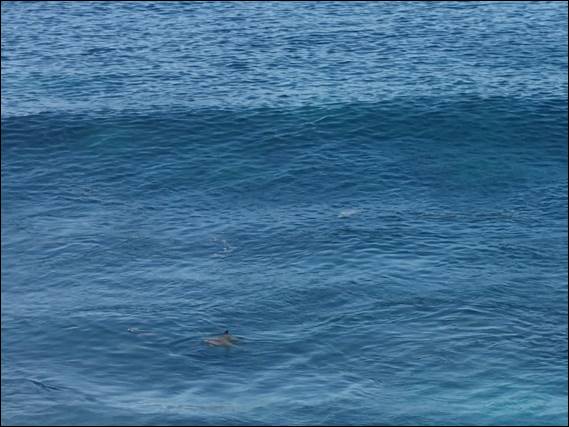
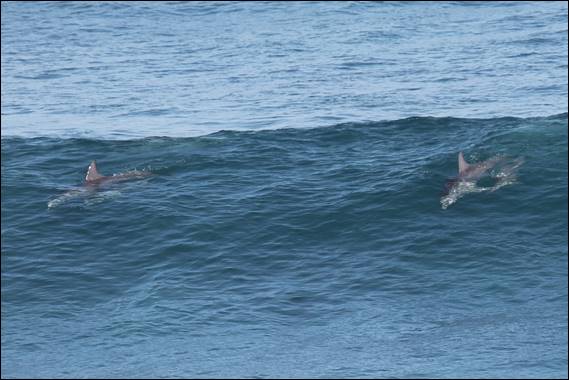
For those who know the route, you may notice what is wrong with the image above. While Glen had started well as he got half way up the crux sequence his head started to play games. I can say that as he had enough strength, will power and control to be able to traverse off the line, Heading left and up with no prior knowledge of what lay ahead, without slapping for holds or losing control. Also he probably expended more energy doing that than if had simply finished off the crux sequence. After his little detour he stood there shaking out his arms, as he watched out to sea. There was no rush, as we both watched a small pod of dolphins cruise past:
As we wandered back down more climbers were milling about, with more ropes and gear being taken out as we passed. We said a few hellos as we carried on towards the final route of the morning. I’m not entirely sure how or why but Glen was up for a final lead. I had previously pointed him towards First Climb, and it was decided that we would climb out with packs. However, I could see he was getting weary so we stuffed all of our gear into my pack ready for me to shoulder when I followed him out. That was a definitely a wise move, with Glen climbing slower and slower:
After each move he stopped looking for the next holds and where he might place gear. I could see him breathing more heavily and his body had that weird hanging posture that is not quite boneless but wanting to slump into a heap. Then, as he approached the part where he was supposed to launch into the corner he falter. Just like his last trip outdoors eleven months back, when I sent him up this very line, the corner drove fear into his heart and intimidated him to the point that he took the very same detour he did back then. He finished up Dunlop Special but there was no shame to it. Having managed to get up six routes, half of which he led, I really couldn’t bag him out… this time:
Kym and I have been trying, and failing, to tee up a weekend to catch up for some time now. The wet winter and now spring we have had has not helped our cause. But this Friday I had to head to Albany for work, helping out with a workshop that ran from nine till two. It seemed the weather gods where being kind to us and there was a possible window of opportunity aligned with this weekend, squeezed between yet two more prolonged wet periods. I rolled into Albany at eight on Friday morning and despite the forecast of dry weather it was raining, but I put those thoughts to one side and headed to work:
As with all good workshops it overran, but not by too much and I was at Kym’s place sipping on a cuppa by three. We would normally have a plan for our catch-ups, These normally comprise a classic big multi-pitch route, a remote hard to access crag, camping out and/or stunning new routes to bag. But this time we had no plans other than heading out to a local crag, and then see what gives. Kym and Meg live at the perfect location, for climbing, with so many crags and boulder fields within a short drive. It only took five minutes and we were parked up at The Gap:
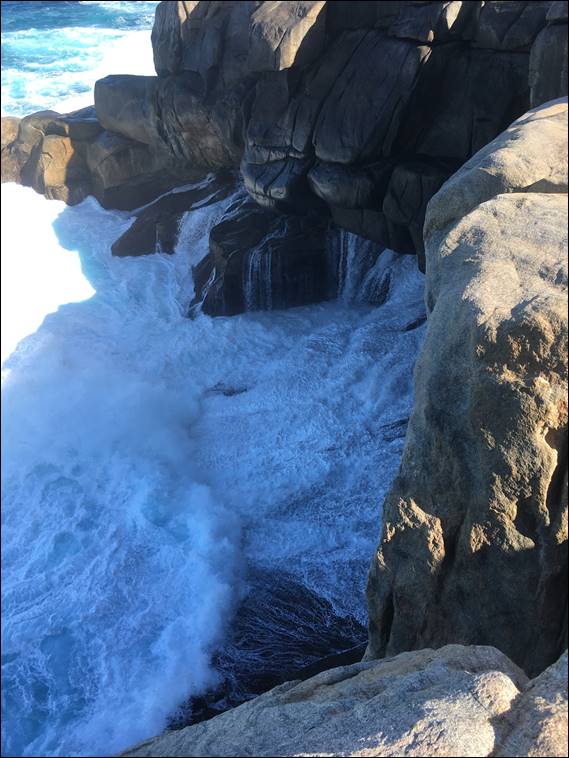
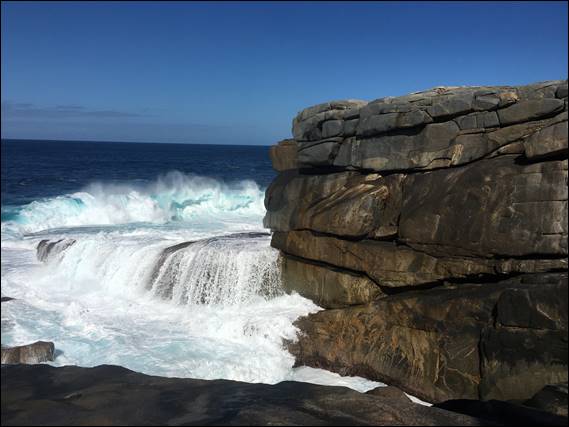
This is a place that I have wanted to climb for many years, but have never got to. You may recall The Gap from the week long climbing trip with Rongy, Howsie and Andrew nearly a year back: https://sandbagged.blog/2020/11/13/south-coast-revisited/. It doesn’t feel like that long ago, but there you go. We had some wild weather on that trip and the day we came to The Gap we had no illusions of getting a climb in. We came to see the massive swell smash the coast, and it was spectacular. Today it was very different, despite the rainy start to the day it was now glorious and the rock had dried up just enough for us to have a play:
There are a few reasons I have not climbed here before. One being it is very close to the public and secondly it has a bit of a reputation for being hard. Neither reason should have put me off before, yes there are lots of people about but as I found out there are many spots where you can hide away from them. Even now with so many more people out and about due to the lack of travel allowed, we were soon out of sight and it felt like we had the whole place to ourselves. As for being hard, well there isn’t a lot of easy stuff and what makes those climbs feel even trickier is the climbing style:
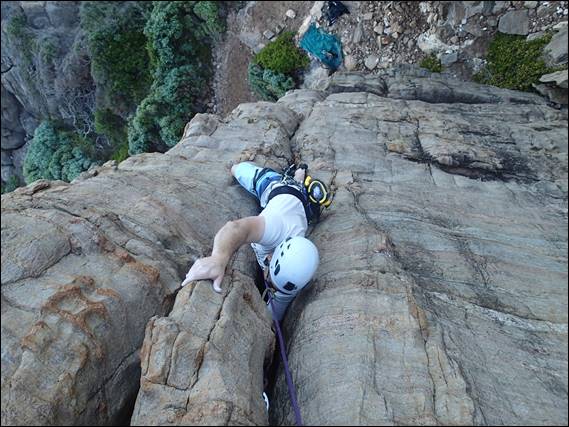
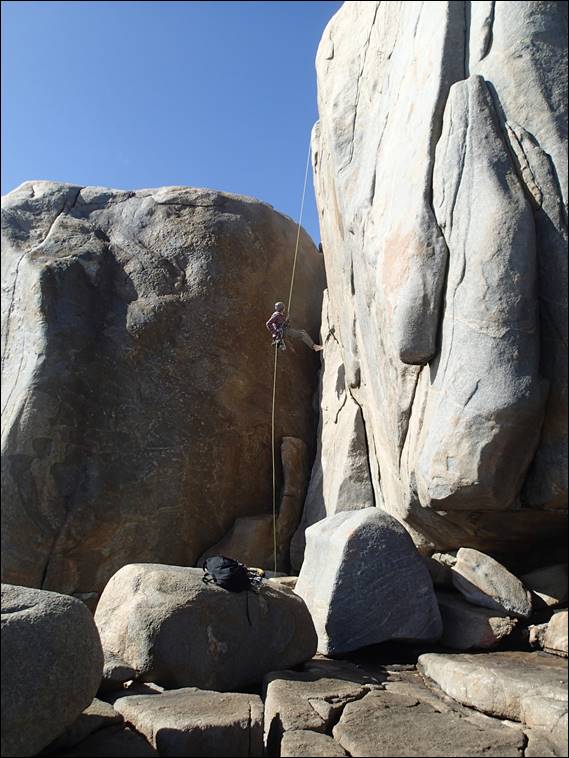
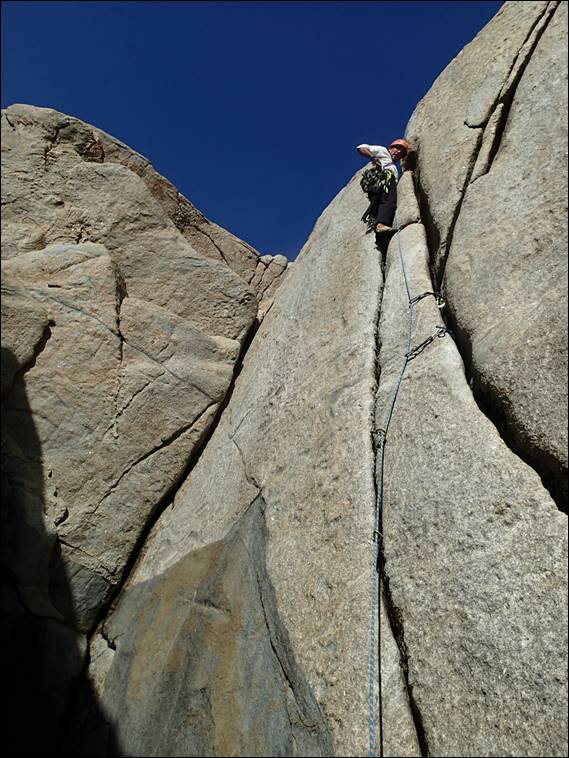
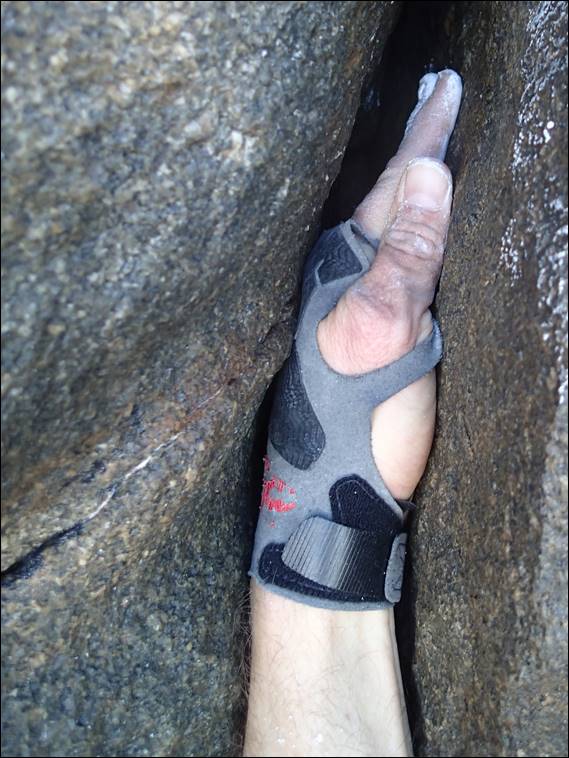
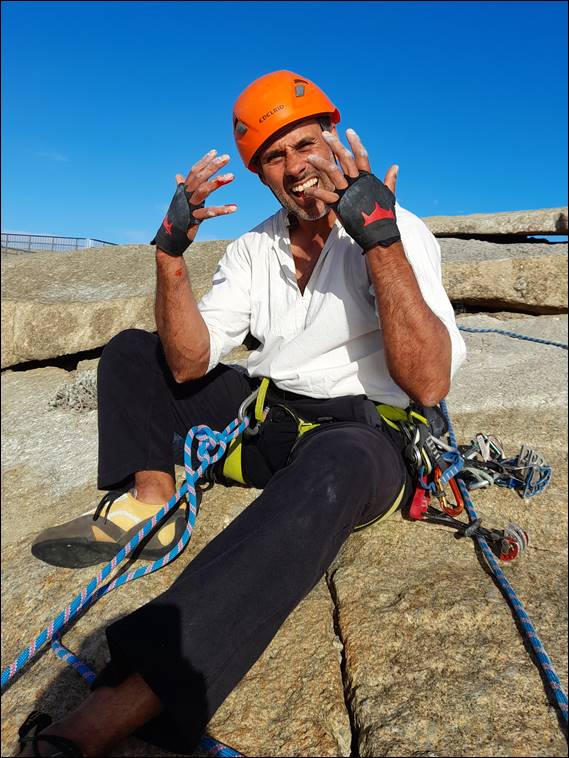
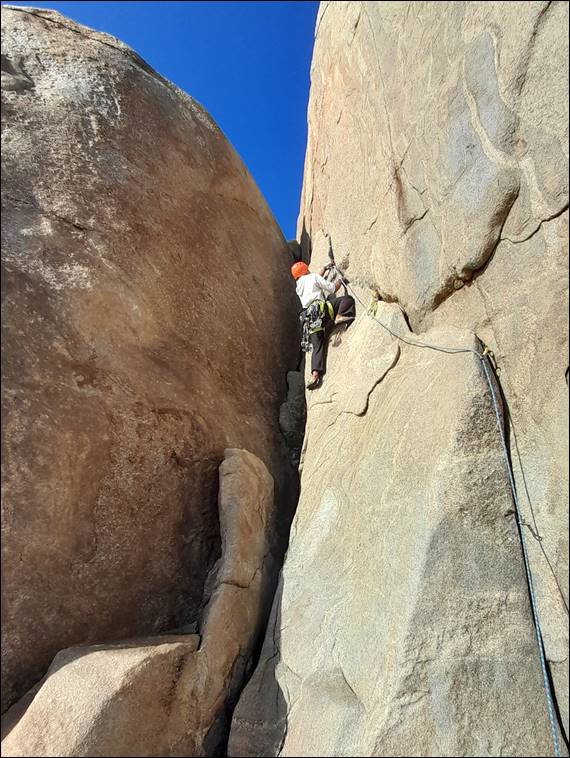
Jamming is an old school traditional technique of climbing. Instead of finding a hold to curl your fingers round you wedge your body parts into a crack and hope that nought but friction will keep it there. Above Kym made use of a perfect hand jam, and while it is not a technique I will profess to be proficient in there are two things that make jamming here a bit more forgiving. The first is the smooth texture of the granite, so when you press your skin against the rock there are rarely any sharp crystals or rock surfaces that are sharp or painful. Secondly, Dan had kindly bought me a pair of crack gloves and they made a huge difference and provide greater friction, as well as protection for the back of your hand:
The first route things went well, it felt tougher than it should have. I could blame the 4am start or the rock that was a still bit greasy after all the rain and big swells of the week before. But, in truth it was my jamming style and ability that made me work that bit harder than I should have. After that, and following Kym up the route he led next, I felt more prepared mentally. Things or should I say jams slotted into place. And not just hand jams, also fist jams and arm bars. The final moves required a finger jam which had to be reached at full stretch. The fingers on my right hand didn’t quite get in deep enough, resulting in a painful slip should you care to zoom in to see the damage:
The routes may not be super long, but they are steep and strenuous and require the whole body to engage. There is no just using your arms and to climb well here you have to activate every muscle. Despite my body feeling it after just two routes the sun was still in the sky and it seemed silly not to make use of the daylight, so back down we went. One of the things I love about traditional climbs is the natural features or weaknesses that they follow, in which you can place protection. This route followed an amazing looking flake followed by a wide chimney that you had to wriggle your body up in an exposed position with limited protection:
I was a tad nervous, as it was the same grade as the route Kym had just led. But I needn’t have worried. That was maybe because it didn’t require jamming the whole way and had a fair bit of laybacking which I relish. Where you holding onto the flake and press your feet against the wall, a style that I feel I am not too shabby at. Despite the slip on the second route, all three climbs were very classy. Solid clean lines with sustained and interesting climbing. We made plans to come back here in the morning to hit more of the fine routes on offer. The grades would be going up, but I felt more prepared for them after my reintroduction to the art of jamming:
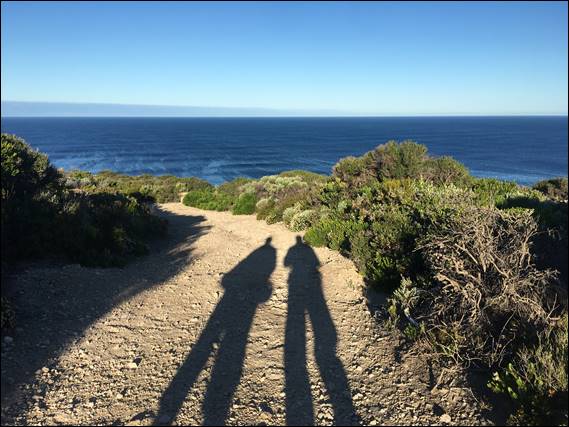
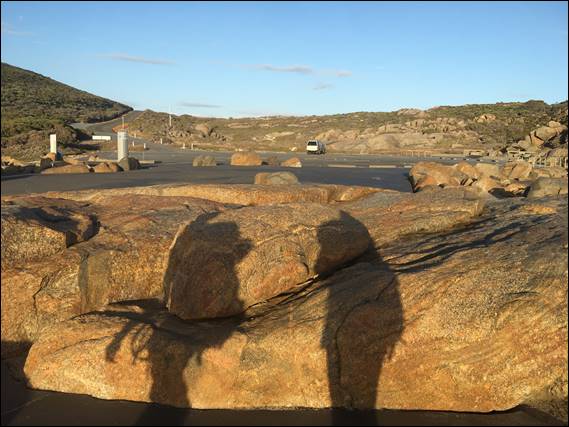
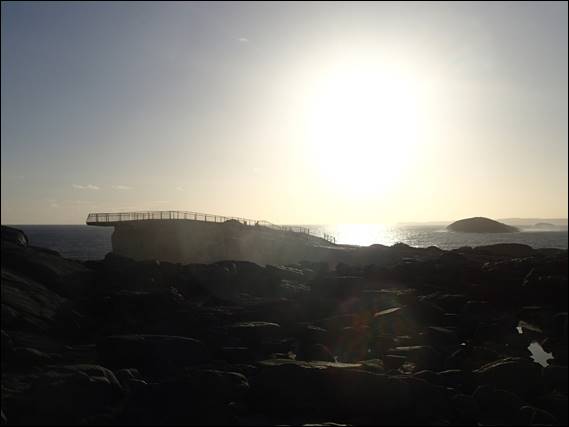
The evening and morning light are well known to provide the best light for photography. But, as the shadows grew longer and the orange hue of the lowering sun made things glow in that magical way we had the place to ourselves. The viewing platform stood eerily empty, as the sun drifted towards the horizon and mist from the crashing waves drifted up from The Gap. Both Kym and I felt weary but very satisfied, as we threw the packs back in the ute and drove off, wondering what the morning would bring. Back at the house I caught up with Meg and the kids, Beau had grown so much and was a right little chatter box. He, Tess and Claire were going well and as with any house with three young kids the place never seemed to stop:
Kym was working that night so he headed off soon before eight and I hit the sack, as their house started to go quiet. As is the way when I have an early start, I wake at a similar time for several days afterwards. It is almost as if my body gets rewired and it takes a few days to reset. Rather than disturb the household I headed out for a walk, and I soon realised I was pretty achy already without having hit the rock. Meg was making breakfast when I got back to the house and everyone was up. Being a Saturday morning with no school to get ready for everyone was fairly chilled and there didn’t seem to be that urgency of rushing into the day:
Kym rocked up soon after 7:30 and had a reasonably quiet night, even having managed to get a bit of sleep. I’m not sure how he manages to keep his energy levels up with the irregular work hours, study and of course the family. He and Meg somehow seem to make it work and whenever I come down they always seem to manage to have the energy to make me feel so welcome. He came back this morning raring to go, so it wasn’t long before we were back in the car for a short five minute drive. The water looked reasonable flat to my untrained eye Kym however suspected, and was right, as wandered around checking the various walls:
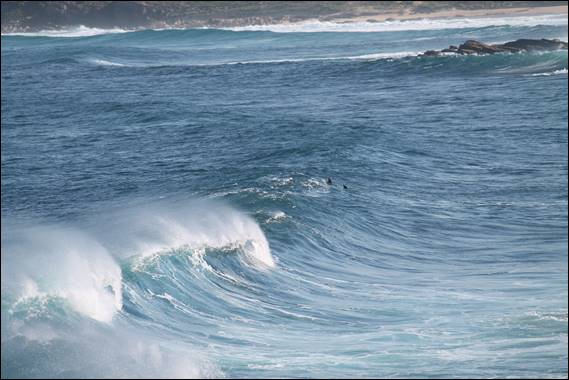
The swell hadn’t gone down, it just seemed flatter because the swell period was longer. But when the sets came in the rocky coast got pummelled. This resulted in spray drifting upwards landing on the rock and not only making it damp but giving it that greasy feel. Seeing the granite here is quite smooth. and you have to rely so heavily on friction to make those jams stick, the conditions were not looking favourable. Especially seeing we would have to up the grades if we went to the same area. Instead we wandered eastwards and the big waves, as shown in the video below, made it look likely that we might not get to climb here:
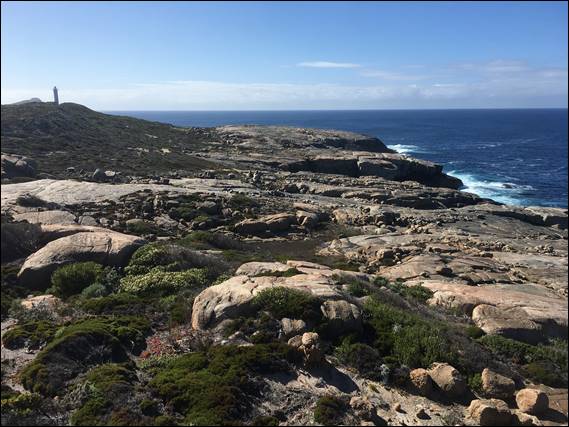
Whenever I think of The Gap at Albany, I tend to only consider of the main tourist feature where the paths and viewing platforms are. If you walk east from there the place is littered with rock faces. I was aware and had been to the amphitheatre before but today that too was wet. So we continued to the next area called Zig Zag, which I wasn’t even aware of and is a seldom if not rarely visited area. Kym had only climbed here a few times, and wasn’t even sure what the routes were. The rock looked marginally bit better here, and the lines looked fun so we dropped the packs and got ready:
We started today’s session a bit more sensibly, Kym pointed out a wide crack on the far wall in the sun. I was happy to jump on a more relaxed line to get the body moving the this offered that opportunity. As Kym set up his phone to capture the action, I sat and watched the waves occasionally looking up at the wide crack wondering how I would go. As I started up I wedged my hands, fists and arms in, and I felt comfortable and secure jamming my way up the first route of the day. It seemed kinda nice not knowing the routes or having an agenda, instead we scoped the place looking for lines that looked appealing and interesting. Then we just let the day unfold:
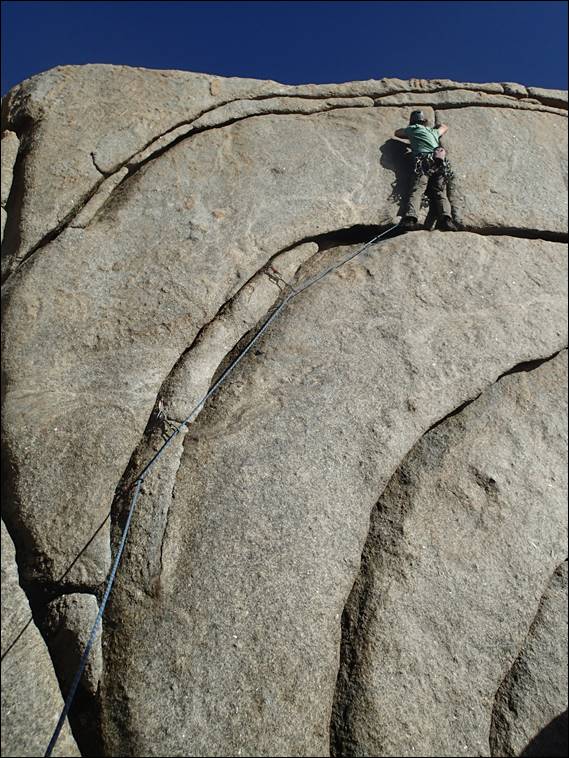
I was a little surprised when Kym opted for what looked to be a stiff opposition for just the second climb. A short but steep wall with a series of vertical and horizontal cracks that took you on a dog legged line up the face. It started with strenuous jamming and laybacking off the deck. On the steeper wall the jams felt a little less secure, with hands and feet squished in a narrow and more shallow crack. From the first horizontal break, tenuous and balancy moves on small rounded holds where needed to make it to the second horizontal break. All this made more nervous due to the dampness. And it was only then that the route really got serious:
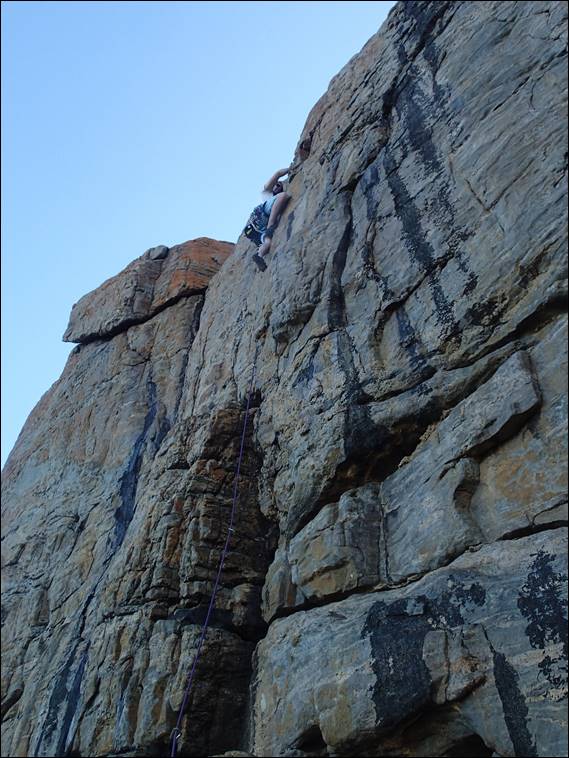
You can see the line Kym followed, towards the left of the wall. The chalk marks giving it away. The top vertical crack was flared and difficult, even for Kym with all his jamming skills. By flared I mean that the sides were not parallel, with the crack being narrow at the back and wider at the face. These cracks are tough to jam, and Kym had a battle on his hands quite literally. And made all the harder with limited options for feet. He eventually unlocked it but it required pulling up on a dodgy jam, then in an unbalanced position releasing the jam and slapping the same hand higher up and hoping it would stick:
Having a rope above makes things feel not as bad, but there was no way I could climb the final crack of the route the way Kym had. I still had to jam the flared crack but the slap of faith was not in my repertoire of skills mentally or physically, so I had to work out a different way. It felt super strenuous when I eventually figured out what worked for me, and we both felt like the route had given us a right royal serve. After such a battle you would think we would pick something fun and a bit easier. But no, and added to that I’m sure an off-width crack is definitely not on everyone’s list of what they would call fun:
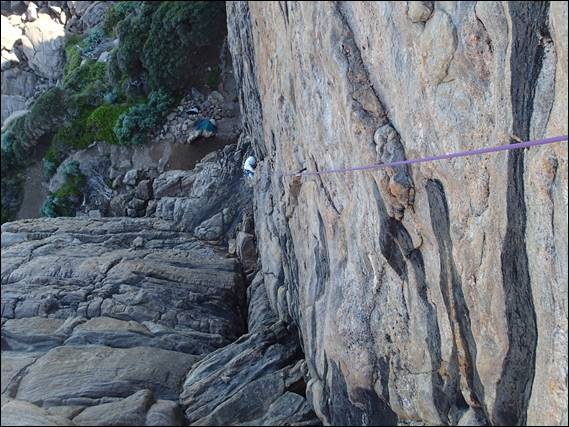
But we had lugged the big guns with us, the number five and six Camelots, and we had to use them at least once. I felt laddened down with all the hardware hanging off me, but it got used and I was very grateful for them once I got stuck into the meat of the crack. Too wide to fit hand or fist jams and too narrow to squeeze your body into. Arm bars also didn’t feel secure and added to that it was steep. It was a monstrous fight to be able to stay in and then try and move upwards. I had to use hand-stack jams, something I had never done before, and knee bars. Needless to say I fell out of it lots of times, and each time lost a bit more skin. By the time I topped out it felt like I had been put through a cheese grater, and we call this fun:
Kym also struggled but nowhere near as much as I had. With his far greater jamming skills coming into play, he seemed to make much lighted work of it and I think it is fair to say he probably didn’t lose any skin. This the style for much of Albany climbing, jamming rules down here and you either learn to do it right or struggle to get up many of the great lines. There are very, very few climbs where I live that require full on jamming. It is however a technique that I strangely enjoy. I just need to make more of an effort to get down here so I can hone my skills and learn how to avoid losing so much skin:
The next line was far more relaxed, and in many ways reminded me of climbing in the Peak District of England. The home of gritstone, famous in the climbing community, known for its gnarly trad routes https://sandbagged.blog/2017/07/30/part-4-the-peak-district-learning-the-ropes/. It has a very wide range of routes and there are literally thousands of them. As such I was able to and did avoid the lines with more full on jamming, instead opting for routes with layback flakes and technical walls. Kym was starting to get weary, not surprising after his night shift, but he battled his way up this fun route. It had funky moves between wide horizontal breaks that needed a bit of thought, and finished on a fun upper section with layback flakes:
There was one more route we had to bag, Kym felt it may not have been previously climbed. It looked great with what looked like, from the ground, just enough holds and gear to make it go. So I set off full of confidence until I got half way up. Here perched on the steep wall it became evident the spaced horizontal breaks were sloping downwards and not very deep. Small slopey holds and only friction for feet were between me and the top 5m above, plus the gear was unknown. Added to this the slightly greasy rock and my weary body made it less appealing, so I traversed left into the more obvious line to top out. One to leave for next time and better conditions:
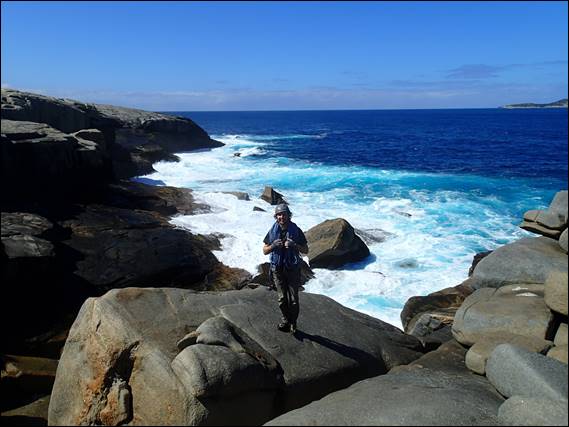
It may seem that we hadn’t climbed a lot today, but our bodies told us otherwise. Plus these trips are not all about the climbing. Catching up and just being outdoors soaking up the atmosphere, which this place provided in bucket loads, is all part of it. Kym and I certainly felt we had had our fill. Plus I was driving the four hours home today and it would be nice to get back in daylight, which I managed only just. Walking out we came across Michael and Zed hauling lots of boulder mats in, we wished them luck thinking the conditions may not be what they were expecting. No matter, just like us having being spat off several routes, they will hopefully still have fun:
Lisa and I couldn’t work out when we had last visited this spot. I didn’t think it had been too many years but my images indicate it has been ten. Crooked Brook is a great hidden gem, not too far from where Lisa works in Boyanup. A possible reason this place is kept in tip-top condition is that it has been jointly managed by The Crooked Brook Forest Association, basically a bunch of volunteers, and state government for fifteen years. There is nothing like a sense of ownership to get people to come out, lend a hand and keep a place in good condition:
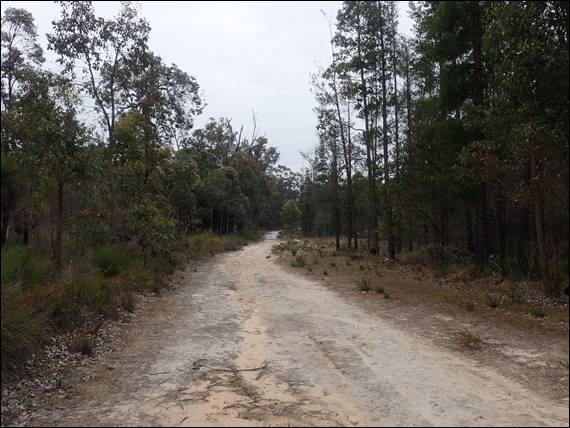
There are four walks ranging from a mere 700m to ten kilometres and we thought we had been round all of them, but as we set off on the longer hike it really didn’t feel familiar. The Crooked Brook Forest has a sliver of pine plantation reaching into it, and the start of the walk followed the divide between native bush and plantation along a wide track. I’ve said it before and stand by it that walking on such wide tracks just doesn’t give you that feeling of being in amongst nature. However, the pine forest with its open bare ground did remind me of good memories of a walk or two in the Netherlands many years back:
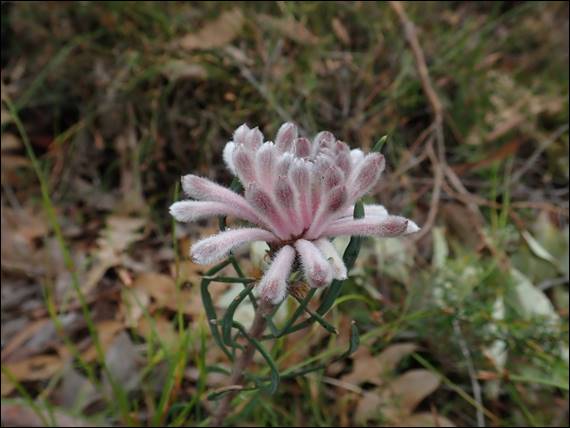
It felt like the plants were a long way away and it was easy to get into a big stride and not have a good look to see what was about. Fortunately the circuit, as we found out, was very varied and it went over granite hills and sandy swampy areas and as you can imagine this provided a continually changing floral display. So while it may have started a little bland on the flowers and colour front it certainly improved a lot. The interesting flower below caught our eye as it looked all velvety and soft and quite different to anything else. It’s an endemic plant to the area called a Pixie Mops, and is an understorey plant that doesn’t grow above a meter in height:
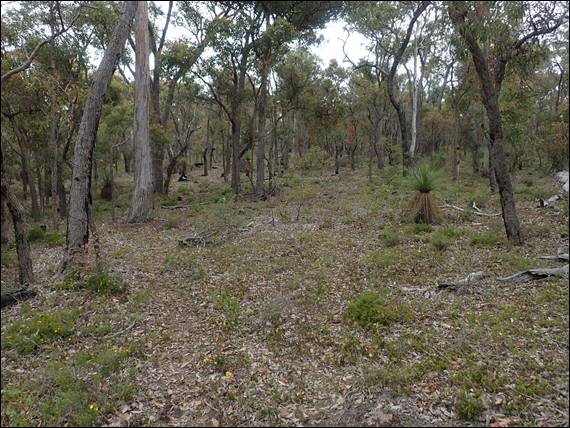
Within a short distance we were guided by the markers off the wide track and into the sort of path that we really enjoy. The Marri trees closed in and the ground cover was right by our feet. What struck us about this general area was that there didn’t seem to be too much thick understorey, and some places like below were very open. Unlike so many places we have walked this year, here the vegetation seemed to mostly go from upper storey straight to ground cover. Meaning you could gaze a long way into the bush and giving quite a different feel:
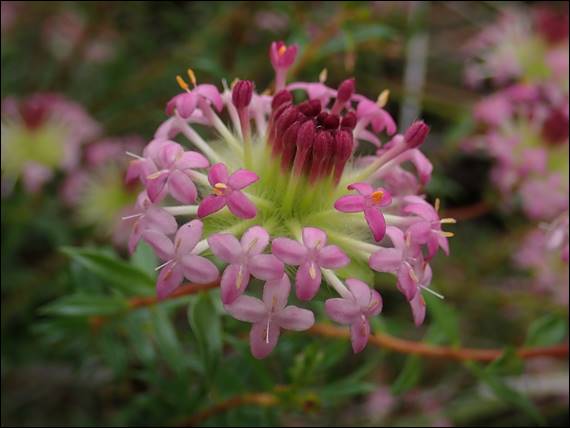
It certainly started full of greens and browns with only a splattering of colour. This was another flower that really caught out attention and we found them in both pink and white. The flower head certainly looked a lot like the small coastal groundcover we have seen so much of. These however were a shrub, with flower heads not so tightly packed and more sparse on longer branches. I’ve asked Howsie if he could identify it but without more images and detail all he could come up with was what I managed to find, in that it is a Pimelea:
There are some 150 species of this plant including about 110 in Australia and 36 in New Zealand, and they are commonly called Rice Flowers but I can’t find out why. They can be found as herbs, which I assume are the ones we have seen along the coast, or small shrubs which is what we found here. The flowers are easily distinguished as they are clumped at the end of the branch and comprise four petal-like sepals and two stamens, which can be clearly seen above. If I was being brave I’d guess that it may be a small shrub native to this area called Pimelea ferruginea:
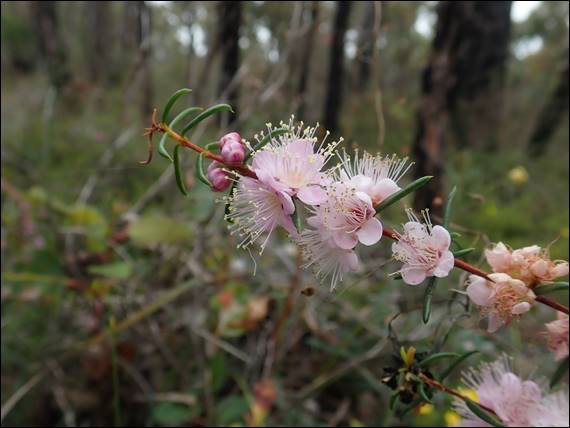
As we went on our way the variety of flower we saw was super impressive, above it is clearly a Myrtle and Howsie has plumped for a Pink-flowered Myrtle or Hypocalymma angustifolium. We found these in both bright pink and this pale pink variety, so he could be on the money as it comes in different shades of pink through to white. One of the reasons I have included it, other than we were both quite taken at this dainty flower, was that if you look closely you’ll see a strand of a spider’s web coming of the last flower on the branch. We seemed to be walking through a lot of these but we never noticed any spiders:
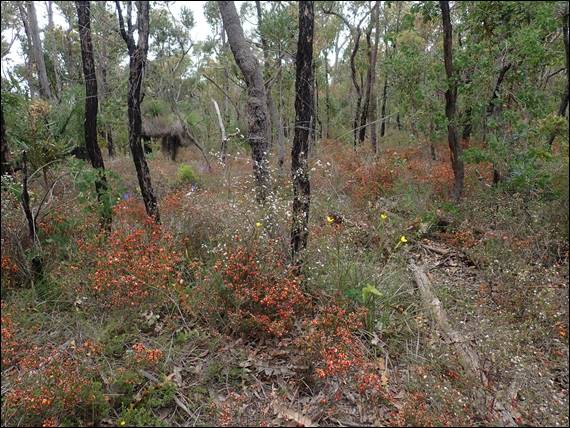
The above image shows how some areas lit up and through these section we slowed down and had a bit more of a look about. The main colour in this image being the brown orange from yet another pea, I thought it may be a Chorizema, but Howsie is probably right with Bossiaea ornata. Regardless of that the story of how Chorizema got its name is way to interesting to not include. It was first recorded by explorers in 1792 and the thirsty exploratory party spotted it near a waterhole, so they named it by linking two Greek words of choros (dance) and zema (a drinking vessel):
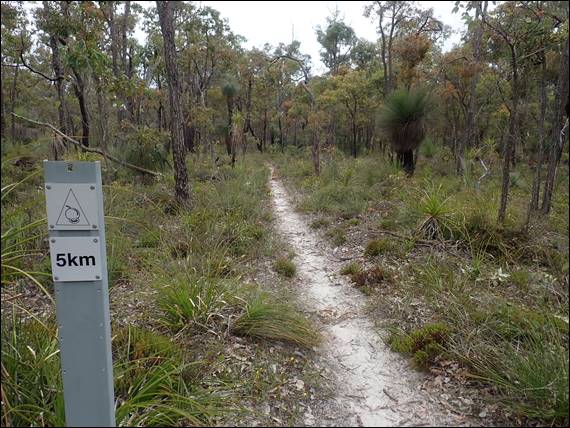
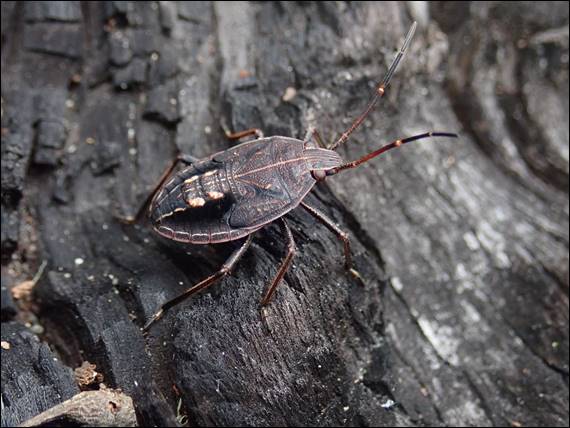
Another unusual aspect of this walk was that it had distance markers ever kilometre. And as per custom we had hauled a flask of tea and cheese sandwiches along with us. As well as other snacks that never made it out of the pack, maybe because it was easy walking and we didn’t need as many breaks to top up the energy levels. At the half way point we found a great spot to take a load off. I spotted this Shield beetle that stayed on the big stump that we used as both a table and chair the whole time we were there. You may be waiting for me to say I’m checking what it is on QuestaGame, but I have decided to stop using the App as I was spending way too long logging all my finds:
So instead I have been using Google Lens to give me a starting point and then research beyond that, for some things it has been great but others it has really struggled on. Now I’m sure you have been waiting with baited breathe to see how we went with Orchid hunting. Well it didn’t feel like that were too many but when we tallied up our find, which included the Forest Mantis, Giant Donkey, Purple Pansy, Purple Enamel, Pink Enamel, Cowslip, White Spider, Jug, Scented Sun, Blue Lady and King in his Carriage Orchid it wasn’t bad at all. But no species that I haven’t seen this year:
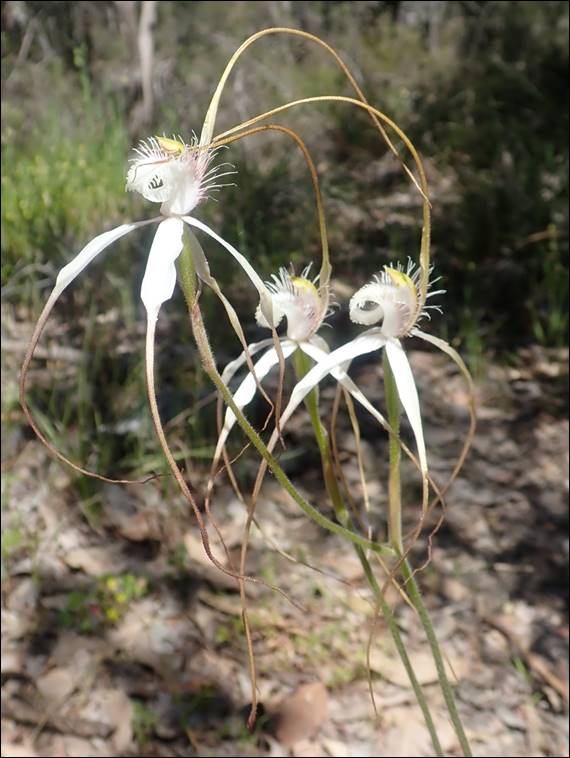
The King in his Carriage was a single plant and very much at the end of its life, but I was really happy to spot it so Lisa could see it. I also thought we were out of luck with spiders until we found three close together near the end of the walk. The most prominent orchids we saw were the Cowslips and Enamel Orchids and there were thousands. The latter started a bit of a game of trying to work out if they were pink or purple enamels, for example are these all the same or not. Some were a bit more obvious and we decided when we couldn’t work it our we’d call them pinkle:
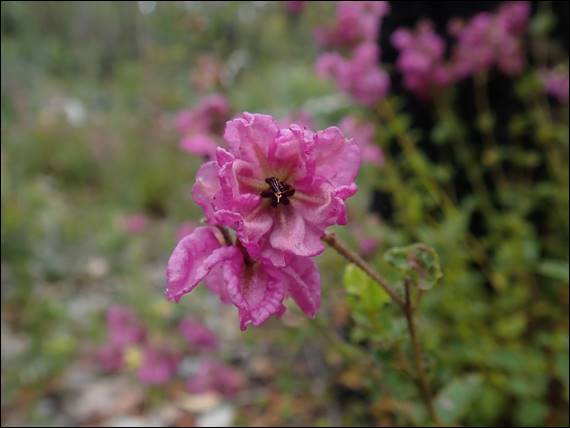
Here is a plant that Google Lens suggested was a Chrysanthemum, which is obviously well off the mark. And Howsie has suggested maybe a Thomasia and as he usually is I reckon he is on the money. I’m going to go a step further and say it may be Thomasia grandiflora, commonly and very originally known as large-flowered thomasia. It’s another true local and endemic to the south-west of Western Australia. And the reason I think I’m right is that the flowers are described as a “pinkish-purple with a papery appearance hanging in pendants from the leaf axils”. This is exactly how I was going to describe it, just like the tissue paper flowers our daughter Elseya used to make:
The plants in the next image also really caught our attention, they seemed to pop up in certain areas in vast numbers and we have never seen them before. It wasn’t till the end of the walk that a little sign told us it was called a Pineapple Lily. However, checking it out online the state’s floral database suggests its name is the Pineapple Bush or Dasypogon hookeri. Other than telling me it is a perennial herb or tree-like monocot I can’t find anything out. I do however now know that monocots are grass-like flowering plants, of which only one leaf is capable of producing seeds:
While I haven’t included images to show it, the track did reach the edge of the forest and follow along the boundary with the rolling green pastures of the surrounding farmland. While some may not like the thought of that, it did provide a bigger mix of sights and we didn’t mind having a bit more of a vista every so often. Another aspect of this area that really appealed to Lisa was that it seemed you could take dogs here. We bumped into a few people out with their pooches, and while she said hello to the dogs I scoured the ground:
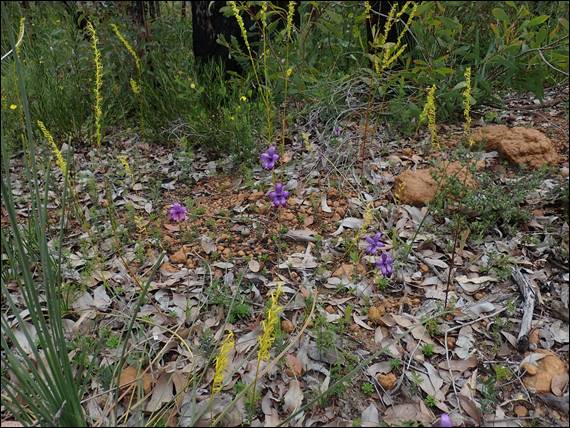
Above, and as we walked through the swampy area, there were heaps of basal leaves telling me orchids were about. But I couldn’t tell if they were yet to come out or had already bloomed and gone back to ground. In this area we only found enamel but that included this fine specimen of both a Pink and Purple Enamel next to each other. Lisa seemed to be able to distinguish the different colours better than me. And without getting into detail women tend to have better colour perception than men, it all comes down to how many and what sort of cones you have in your retina:
Most people’s colour visualization system is known as trichromacy, which means they see in three colours. But some people can see in four colours, having a tetrachromacy system and women are more likely to have this. So it is very possible that despite only confirming that I have found a Pink Enamel in my last post, I may have been finding them for years. As we neared the end of the hike we decided to add in an extra couple of kilometre loop in, as it had been such a lovely walk. I’m glad we did as we came across some beautiful red and green kangaroo paws, and while I had included in my last post Lisa was yet to see them:
Seeing things were going to warm up today we got down to the crag a bit earlier than previous months. It was not quite a first light for the first climb, but that will no doubt come as summer approaches. It seems with the better weather a few more of the local climbing crew were out and about and we saw Ash and Yohan, as well as a bunch of others milling about. In addition Mikey and Howsie were planning for a Sunday foray, so it is good to see a few more of the group getting out there. Not saying it was too early a start for Dan but he opted to head out for a sail instead seeing the conditions were so good for it:
When Jaime found out that it was just going to be her and me heading out she asked if Dan would be joining. On finding out that he was not, she contacted him to see if he would. Then late Friday night Rongy’s plans for the day had changed and he said he was keen for a climb, which made it three again. Jaimie didn’t known this till we picked her up in the early morning light, and she was a little relieved. The reason being that she hasn’t been out all that much and will confess isn’t very climbing fit:
Rongy is no different, life gets in the way sometimes and for an extended period now his presence has reduced a fair bit. But he has many years of experience under his belt, and that helps no end while Jaimie is still to be fair new to the game. I had already planned the day in my mind, going at a steady pace and aiming to hit four lines of equal grade. A grade that rarely gets climbed here at Wilyabrup. The reason for that is that the lines that happen to be at this grade are all a little obscure, rambly, inconsistent and if I dare say it more traditional in style:
I gave Rongy the option of which ones he was keen to lead, and he kicked the day off on Gutted. I thought it was one of the original 70s routes here but am mistaken and it was put up in 93. That surprised me as it is nowhere near as hard as a grade 16 and I feel in 93 they would have been more aware of that. But the wet crack at the top added a bit of extra excitement. I then jumped on Hole World, which felt more like it with a few tricky sections to it. Rongy however, wasn’t watching as I climbed nor as Jaimie went up. He instead was behind the lens observing action elsewhere:
On arrival, as we stood atop the cliff Jaime had spotted dolphins. They briefly appeared and were gone heading south. Rongy saw a fin and I saw none. Then as I was heading up my route she spotted another and large pod just to the north, just off from Driftwood Bay. They looked to be congregated in a circle as if they were feeding, fins popping out with the occasional body appearing. Staying in one spot forming a cycle to trap fish inside before individually darting through the centre and grabbing a feed, while the rest kept the meal contained:
Whether they were feeding or just teaching the young tricks of the trade was unclear. But after finishing they slowly cruise south right in front of where we were. I was belaying from above by then and was conflicted with watching and helping Jaimie past the higher tricky section or, as Rongy was, watching the action out to sea. It was a lovely show of jumps, body flops and a bit of wave surfing. This was the best image captured, and both of the adults look to have young with them making me think the original exercise we saw was a training exercise:
It was a stellar day and as we wanderer back down, it was unclear as to why no one else would have thought to come down. Each time we walked past the Inner Space Wall my eyes were drawn to English Ethics, but at four grades harder that was not on the agenda for today. Plus it was looking once more a bit damp with water seeping right down the line. Instead we headed to the opposite end of the crag to the Stormcock Area. Here Rongy jumped on a route that he didn’t even know existed and I can only recall leading once:
Jaime was happy to assume belay position again. Rongy and I asked each time she assume position if that was OK and she rightly pointed out later that we had all belayed the same amount just from different ends of the rope. I was really unsure of two things for this line, firstly if Rongy would like it, as not only had he not climbed it before but he didn’t know it existed. And secondly how Jaimie would find it. It was wet in this area being trapped away from sunlight or drying winds, and with overlaps and rooves above and the huge leaning block that forms the Stormcock to the side:
It is fair to say Rongy really, really liked the not so aptly named Consolation Prize . More three dimensional and traditional than many routes here with lots of variety of movement and climbing styles required. He was buzzing as he went up the route and even rated it highly, wondering how he had overlooked it for all these years. Then it was Jaimie turn and she too relishes these more traditional “all of body” type routes, and while she seemed to get into some interesting contorted positions she managed the climb and thoroughly enjoyed it:
This time as we wandered down a couple had set up a top rope on Unclaimed in the Fat Chance Area. This route, which Dan, Jaimie and I climbed on the last trip here, happens to be right next to Setting Sun and can be seen in the very first image of this post. Jaimie’s eyes were sharp today and not only had she spotted the dolphins, but as we climbed the first route she also spotted that there were draws on the three bolts of Setting Sun. The evidence being in the very first image. Rongy nor I were particular bothered in draws, as crag booty, and we never retrieved them:
We headed to our next climb, Rhys’s Rapid Retreat. The last 16 at Wilyabrup, if I exclude all the smaller buttresses that are a bit of a walk to the north of the Stormcock Area. I was a little surprised when I read we had given this route 16, I thought it was more feisty. It felt a bit harder on lead and as Jaimie came up she too struggled. Then when Rongy followed up he found a hold at the crux sequence that I have never noticed in the many times I have been on the route. With that beta I feel the route can be claimed to be only 16. This time as we walked down Yohan was back with a group of friends setting up a top rope next to English Ethics:
It was a bit of a Deja-vu from two weeks back, and put paid to any notion of me attempting English Ethics this time. Not that I was particularly motivated for it today. The couple were still on Unclaimed and seeing the draws on Setting Sun hadn’t belonged to anyone at the crag we let them know in case they wanted to grab them. Walking out Jaimie’s eyes again were on point, as she spied a Southern Heath Monitor ambling up the path ahead of us. It was 11 and the sun was hot, which is when we found Ash walking towards the crag to meet another Perth crew that had not yet arrived, I was personally happy to leave them to bake in the sun as it continued tracking to the west:
At work I’m not known for mingling or sitting in the tea room to have a yarn, and can usually be found tucked away in front of my computer getting on it. Some may say I’m a little introvert and others may say antisocial, but for me I’m there to work and live my life away from the office. However, Friday is my go a bit slower day and this week I actually took a lunch break and visited a small reserve a few minutes away. One website touts Manea Park as “Bunbury’s premier bush reserve” yet despite working so close to it, this was my first visit here:
A limestone track takes you on a loop walk that is just over 2km, and I had picked a bit of a stinker of a day to have a wander at lunchtime. The car thermometer told me the temperature was hitting thirty degrees, and it felt hot. Stretches of the track are however shaded by low shrubs and trees, and underneath these is an array of understorey that included what I had come out to see. In several sections there was evidence of where the Friends of Manea Park had been clearing weeds and revegetating with natives and when they found orchids they had fenced them off making them even easier to spot:
While the above and below images may seem the same they are different orchids. And before I tell you which ones they are here are a few words about orchids from the big man himself, Sir David Attenborough: “Each and every species of flowering plant has its own unique evolutionary story that’s closely coupled with the animals that pollinate it. But one family of flowering plant has developed this relationship in more complex ways than any other, and in doing so has become the most numerous, and diverse, on the planet.”:
In addition this this mighty claim, there are an estimated 25,000 species of orchid on the planet and this represents 10 per cent of all flowering plants. The south west of Western Australia contains about 400 species of orchids, which makes my tally this year of somewhere between 40 and 50 species seem a bit pathetic. But while I have raised my efforts in orchid hunting up a notch or two on previous years, I’m still not at the point of cataloguing my finds, hence not knowing precisely how many species I have found:
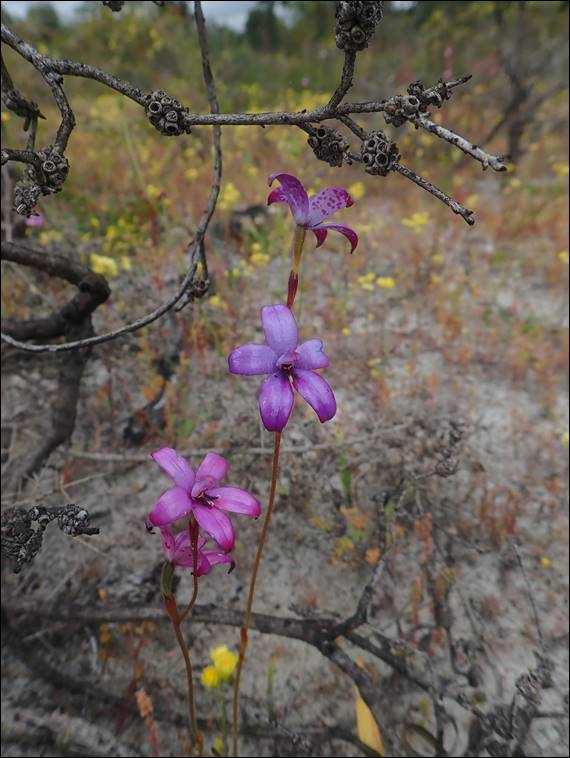
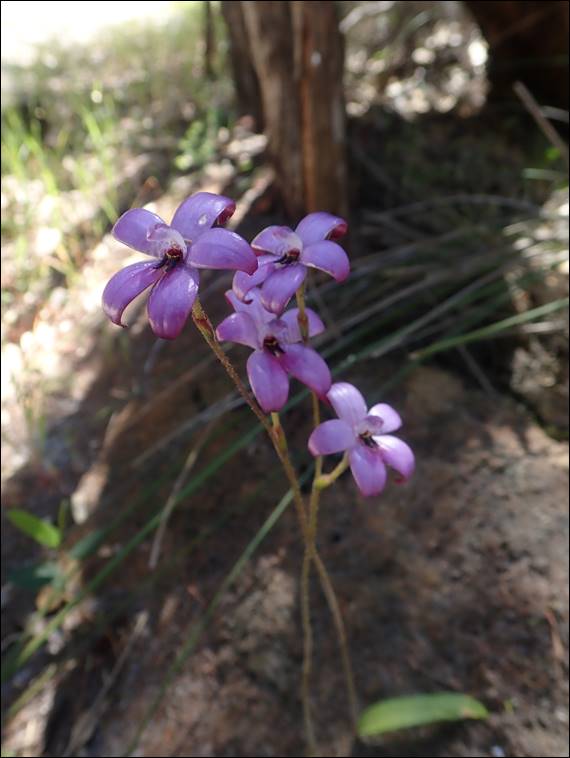
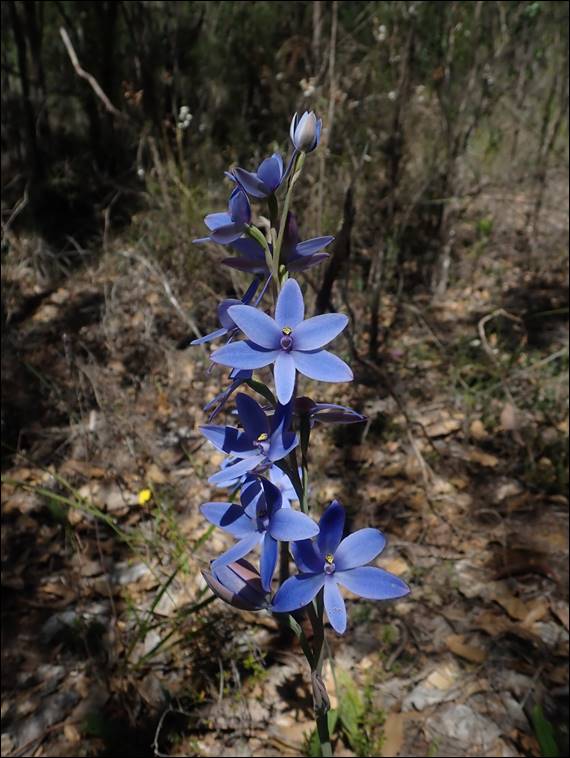
As I said earlier it was a hot day and I was not the only one out for a walk. I have often seen bobtails, but it is not often I have found a pair together. Back to orchids and you may easily recognise the Purple Enamel in the first image, I liked the image as it had two plants each with two flowers out. Most I have seen to date have only had a single flower. The next two are a Blue Lady Orchid and then Scented Sun Orchid, if you look closely you may see main difference of the petal and sepal shape and hue. When you get to detail the labellum is also different:
Manea Park is known for its wild flowers and there were a lot out, so I had to include just one which is the Orange Star. It was a very bright day so the image above may not do it justice, but the colours are a brilliant orange and it stands out amongst all the other flowering plants. This one grows in swamps and Manea Park has several wetlands, but unless you knew it you would not be able tell as you walk round the path. This plant is extremely sensitive to phytophthora, commonly called dieback:
I have just read that Phytophthora comes from two Greek words of phytón, meaning plant, and phthorá, meaning destruction. So literally translates as the plant-destroyer and it is devastatingly effective is doing so. Seeing the Orange Star was a good sign that this destructive plant pathogen has not, yet, taken hold in Manea Park. Again back to orchids, and I came across another species of spider orchid, this one being the Sandplain White Spider Orchid. Identifiable by amongst other things the four rows of mostly white calli, as well as ragged fringes, on the labellum:
It was time to head back to the office, and I have to say that I thoroughly enjoyed my wander. I might be tempted to head back there again, as I spotted quite a few orchids that were yet to bloom. Back in the office, a work colleague noticed an image of an orchid on my screen and showed me an image of a spider orchid he had found recently at a small reserve not far from where we live. So after work instead of heading home I drove out to Ruabon Nature Reserve, a small patch of bush I have driven past many times before and never even noticed:
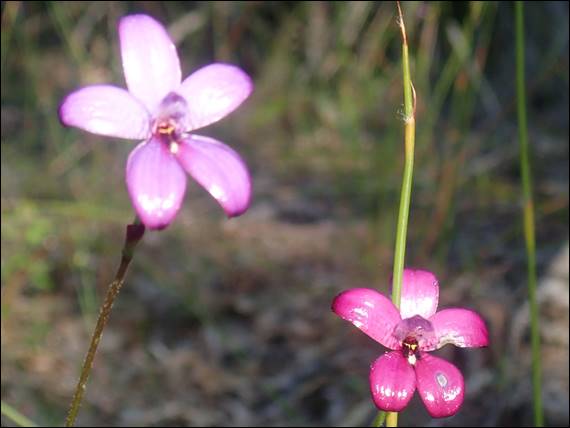
I hadn’t asked for any details of where he had spotted the spider orchid, so I parked up on the side of the road and started to walk along some obvious vehicle tracks and then along kangaroo trails keeping an eye out. Just like at Manea Park I found a few regulars, including Pink Fairies, Cowslips, Purple Enamels. Common Mignonette and Mantis but not what I was looking for. I did however come across the above introduced South African Orchid, which was first recorded near Albany in 1944 and has now spread widely across the south west of Western Australia:
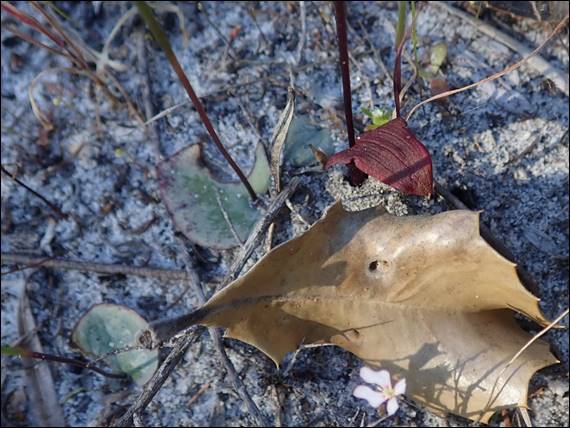
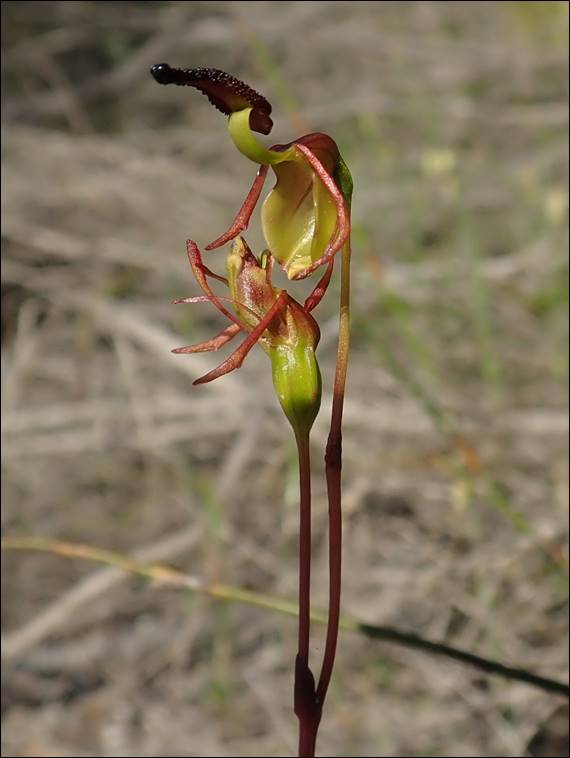
I eventually found where my work collage would have been, a track that lead to groundwater observation bores. Along this track I spotted the familiar leaf of the King in his Carriage Orchid, the green leaf above, and next to it was a deep red leaf that was elevated off the ground. This belongs to another orchid that I have been hoping to find, the Flying Duck Orchid. I found this one in varies stages of blossoming making me think I had found a whole heap of species, but it was the leaf images that told me later they were all one in the same:
I was not successful in finding any spider orchids, let alone the one that my work colleague had spotted and photographed. A reason I was keen to find it was because it seemed to me to be one that is found out in the Wheatbelt, a completely different environment to here. With the season we have been having there are new species being found and some species being found out of their previously thought range. It is therefore was possible I was right, but without personally spotting and trying to more positively identify it I sadly can’t tell:
I wouldn’t normally include two images of the same plant in a post, unless there is good reason such as the previous image of the spider I found making its home in the Sandplain White Spider Orchid. And similarly there is a reason for including a second enamel orchid image, as the one above includes both a Purple and Pink Enamel Orchid. It’s a subtle difference but a call I’m happy to make, both are supposed to be common throughout the south west and until now I have not found one that I felt confident in saying is the pink variety until now:
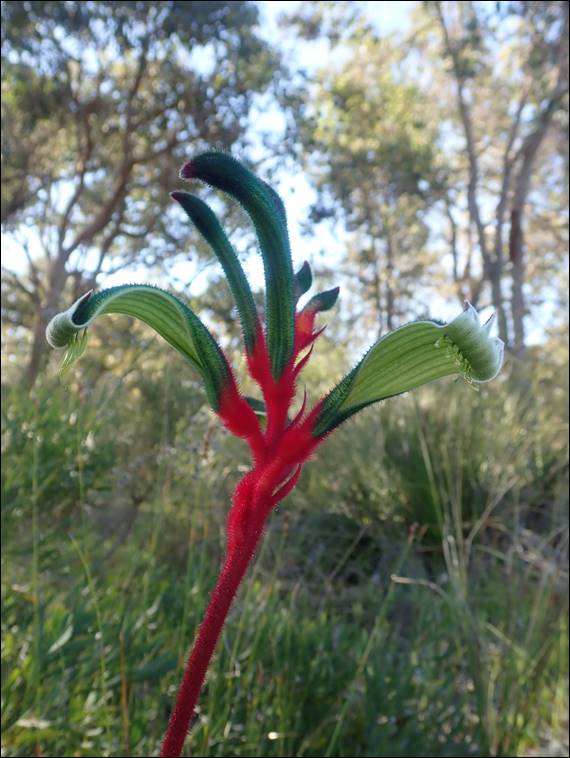
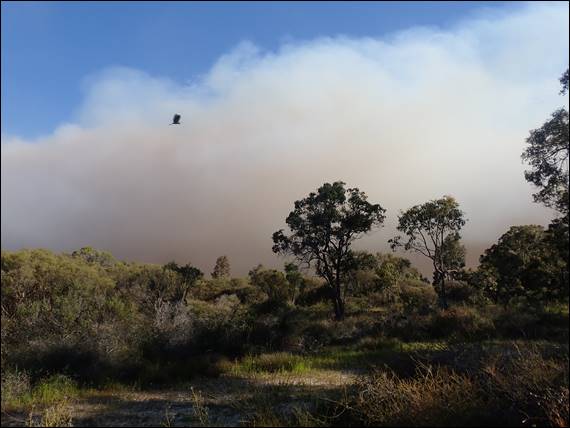
The other plant that I found at both locations, which I spent some time checking out was the Red and Green Kangaroo Paw. The colours on these plants were extremely vivid and contrasting making them stand out. However, unlike my increasing interest in orchids I will refrain from trying to find all eleven species of kangaroo paws. As I made my way back to the car to head home I couldn’t resist an image of the dirty brown looking clouds forming in the south, a sign of bushfires raging that were hopefully controlled burns:






 Sandbagged