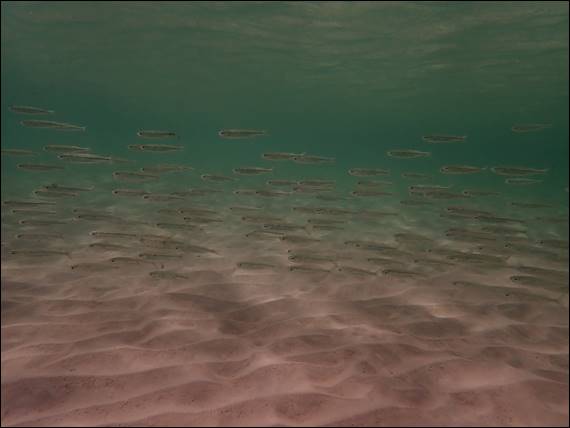
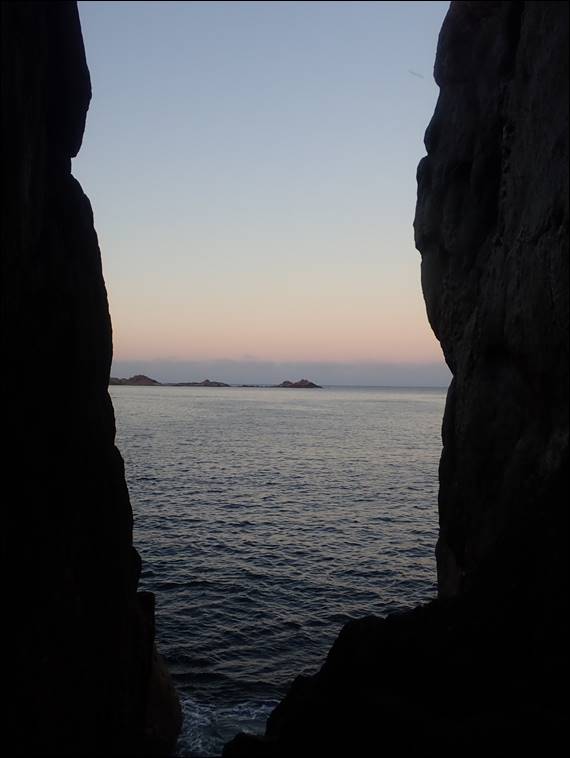
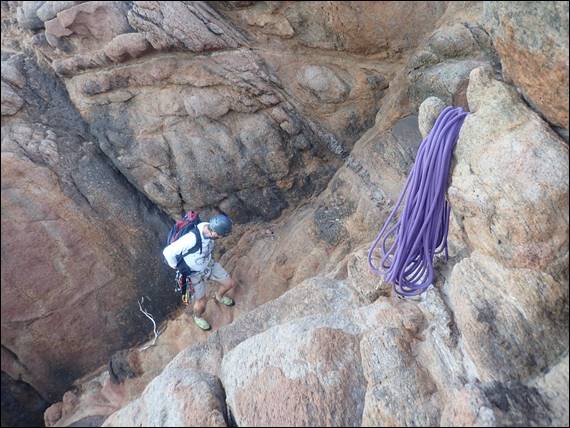
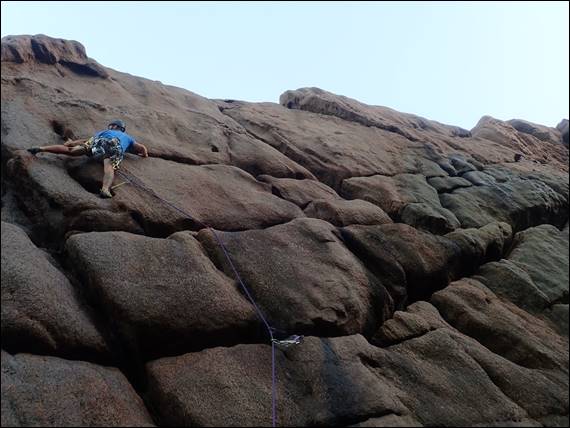
Lisa and I couldn’t work out when we had last visited this spot. I didn’t think it had been too many years but my images indicate it has been ten. Crooked Brook is a great hidden gem, not too far from where Lisa works in Boyanup. A possible reason this place is kept in tip-top condition is that it has been jointly managed by The Crooked Brook Forest Association, basically a bunch of volunteers, and state government for fifteen years. There is nothing like a sense of ownership to get people to come out, lend a hand and keep a place in good condition:
There are four walks ranging from a mere 700m to ten kilometres and we thought we had been round all of them, but as we set off on the longer hike it really didn’t feel familiar. The Crooked Brook Forest has a sliver of pine plantation reaching into it, and the start of the walk followed the divide between native bush and plantation along a wide track. I’ve said it before and stand by it that walking on such wide tracks just doesn’t give you that feeling of being in amongst nature. However, the pine forest with its open bare ground did remind me of good memories of a walk or two in the Netherlands many years back:
It felt like the plants were a long way away and it was easy to get into a big stride and not have a good look to see what was about. Fortunately the circuit, as we found out, was very varied and it went over granite hills and sandy swampy areas and as you can imagine this provided a continually changing floral display. So while it may have started a little bland on the flowers and colour front it certainly improved a lot. The interesting flower below caught our eye as it looked all velvety and soft and quite different to anything else. It’s an endemic plant to the area called a Pixie Mops, and is an understorey plant that doesn’t grow above a meter in height:
Within a short distance we were guided by the markers off the wide track and into the sort of path that we really enjoy. The Marri trees closed in and the ground cover was right by our feet. What struck us about this general area was that there didn’t seem to be too much thick understorey, and some places like below were very open. Unlike so many places we have walked this year, here the vegetation seemed to mostly go from upper storey straight to ground cover. Meaning you could gaze a long way into the bush and giving quite a different feel:
It certainly started full of greens and browns with only a splattering of colour. This was another flower that really caught out attention and we found them in both pink and white. The flower head certainly looked a lot like the small coastal groundcover we have seen so much of. These however were a shrub, with flower heads not so tightly packed and more sparse on longer branches. I’ve asked Howsie if he could identify it but without more images and detail all he could come up with was what I managed to find, in that it is a Pimelea:
There are some 150 species of this plant including about 110 in Australia and 36 in New Zealand, and they are commonly called Rice Flowers but I can’t find out why. They can be found as herbs, which I assume are the ones we have seen along the coast, or small shrubs which is what we found here. The flowers are easily distinguished as they are clumped at the end of the branch and comprise four petal-like sepals and two stamens, which can be clearly seen above. If I was being brave I’d guess that it may be a small shrub native to this area called Pimelea ferruginea:
As we went on our way the variety of flower we saw was super impressive, above it is clearly a Myrtle and Howsie has plumped for a Pink-flowered Myrtle or Hypocalymma angustifolium. We found these in both bright pink and this pale pink variety, so he could be on the money as it comes in different shades of pink through to white. One of the reasons I have included it, other than we were both quite taken at this dainty flower, was that if you look closely you’ll see a strand of a spider’s web coming of the last flower on the branch. We seemed to be walking through a lot of these but we never noticed any spiders:
The above image shows how some areas lit up and through these section we slowed down and had a bit more of a look about. The main colour in this image being the brown orange from yet another pea, I thought it may be a Chorizema, but Howsie is probably right with Bossiaea ornata. Regardless of that the story of how Chorizema got its name is way to interesting to not include. It was first recorded by explorers in 1792 and the thirsty exploratory party spotted it near a waterhole, so they named it by linking two Greek words of choros (dance) and zema (a drinking vessel):
Another unusual aspect of this walk was that it had distance markers ever kilometre. And as per custom we had hauled a flask of tea and cheese sandwiches along with us. As well as other snacks that never made it out of the pack, maybe because it was easy walking and we didn’t need as many breaks to top up the energy levels. At the half way point we found a great spot to take a load off. I spotted this Shield beetle that stayed on the big stump that we used as both a table and chair the whole time we were there. You may be waiting for me to say I’m checking what it is on QuestaGame, but I have decided to stop using the App as I was spending way too long logging all my finds:
So instead I have been using Google Lens to give me a starting point and then research beyond that, for some things it has been great but others it has really struggled on. Now I’m sure you have been waiting with baited breathe to see how we went with Orchid hunting. Well it didn’t feel like that were too many but when we tallied up our find, which included the Forest Mantis, Giant Donkey, Purple Pansy, Purple Enamel, Pink Enamel, Cowslip, White Spider, Jug, Scented Sun, Blue Lady and King in his Carriage Orchid it wasn’t bad at all. But no species that I haven’t seen this year:
The King in his Carriage was a single plant and very much at the end of its life, but I was really happy to spot it so Lisa could see it. I also thought we were out of luck with spiders until we found three close together near the end of the walk. The most prominent orchids we saw were the Cowslips and Enamel Orchids and there were thousands. The latter started a bit of a game of trying to work out if they were pink or purple enamels, for example are these all the same or not. Some were a bit more obvious and we decided when we couldn’t work it our we’d call them pinkle:
Here is a plant that Google Lens suggested was a Chrysanthemum, which is obviously well off the mark. And Howsie has suggested maybe a Thomasia and as he usually is I reckon he is on the money. I’m going to go a step further and say it may be Thomasia grandiflora, commonly and very originally known as large-flowered thomasia. It’s another true local and endemic to the south-west of Western Australia. And the reason I think I’m right is that the flowers are described as a “pinkish-purple with a papery appearance hanging in pendants from the leaf axils”. This is exactly how I was going to describe it, just like the tissue paper flowers our daughter Elseya used to make:
The plants in the next image also really caught our attention, they seemed to pop up in certain areas in vast numbers and we have never seen them before. It wasn’t till the end of the walk that a little sign told us it was called a Pineapple Lily. However, checking it out online the state’s floral database suggests its name is the Pineapple Bush or Dasypogon hookeri. Other than telling me it is a perennial herb or tree-like monocot I can’t find anything out. I do however now know that monocots are grass-like flowering plants, of which only one leaf is capable of producing seeds:
While I haven’t included images to show it, the track did reach the edge of the forest and follow along the boundary with the rolling green pastures of the surrounding farmland. While some may not like the thought of that, it did provide a bigger mix of sights and we didn’t mind having a bit more of a vista every so often. Another aspect of this area that really appealed to Lisa was that it seemed you could take dogs here. We bumped into a few people out with their pooches, and while she said hello to the dogs I scoured the ground:
Above, and as we walked through the swampy area, there were heaps of basal leaves telling me orchids were about. But I couldn’t tell if they were yet to come out or had already bloomed and gone back to ground. In this area we only found enamel but that included this fine specimen of both a Pink and Purple Enamel next to each other. Lisa seemed to be able to distinguish the different colours better than me. And without getting into detail women tend to have better colour perception than men, it all comes down to how many and what sort of cones you have in your retina:
Most people’s colour visualization system is known as trichromacy, which means they see in three colours. But some people can see in four colours, having a tetrachromacy system and women are more likely to have this. So it is very possible that despite only confirming that I have found a Pink Enamel in my last post, I may have been finding them for years. As we neared the end of the hike we decided to add in an extra couple of kilometre loop in, as it had been such a lovely walk. I’m glad we did as we came across some beautiful red and green kangaroo paws, and while I had included in my last post Lisa was yet to see them:
Seeing things were going to warm up today we got down to the crag a bit earlier than previous months. It was not quite a first light for the first climb, but that will no doubt come as summer approaches. It seems with the better weather a few more of the local climbing crew were out and about and we saw Ash and Yohan, as well as a bunch of others milling about. In addition Mikey and Howsie were planning for a Sunday foray, so it is good to see a few more of the group getting out there. Not saying it was too early a start for Dan but he opted to head out for a sail instead seeing the conditions were so good for it:
When Jaime found out that it was just going to be her and me heading out she asked if Dan would be joining. On finding out that he was not, she contacted him to see if he would. Then late Friday night Rongy’s plans for the day had changed and he said he was keen for a climb, which made it three again. Jaimie didn’t known this till we picked her up in the early morning light, and she was a little relieved. The reason being that she hasn’t been out all that much and will confess isn’t very climbing fit:
Rongy is no different, life gets in the way sometimes and for an extended period now his presence has reduced a fair bit. But he has many years of experience under his belt, and that helps no end while Jaimie is still to be fair new to the game. I had already planned the day in my mind, going at a steady pace and aiming to hit four lines of equal grade. A grade that rarely gets climbed here at Wilyabrup. The reason for that is that the lines that happen to be at this grade are all a little obscure, rambly, inconsistent and if I dare say it more traditional in style:
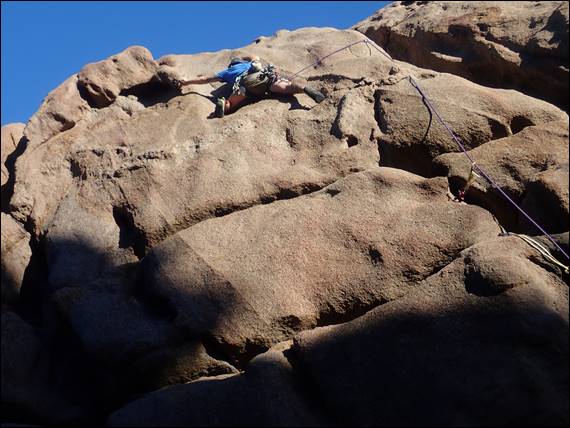
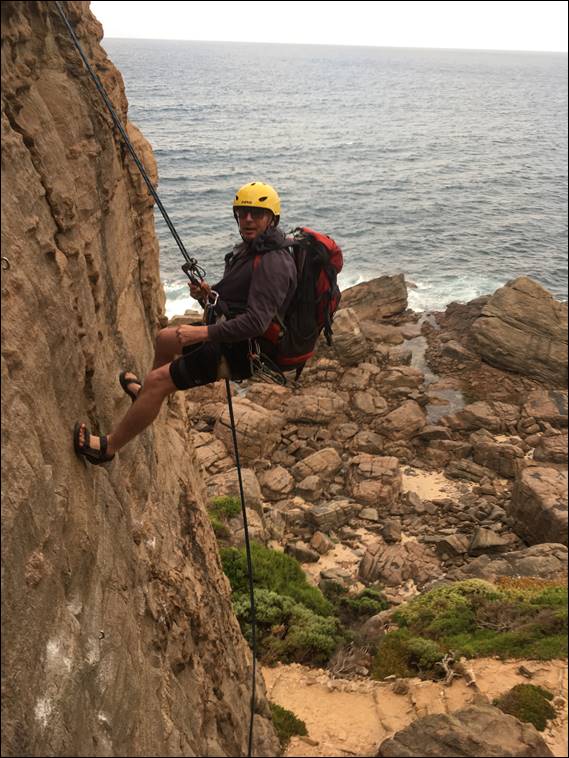
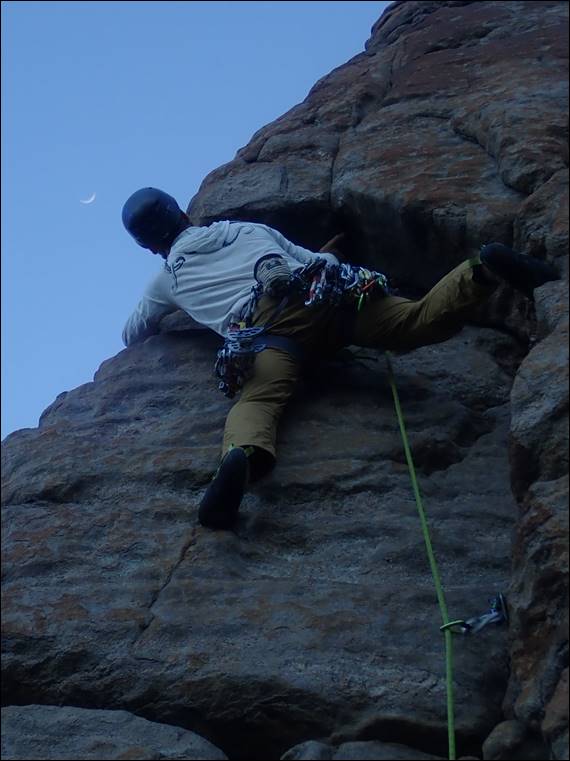
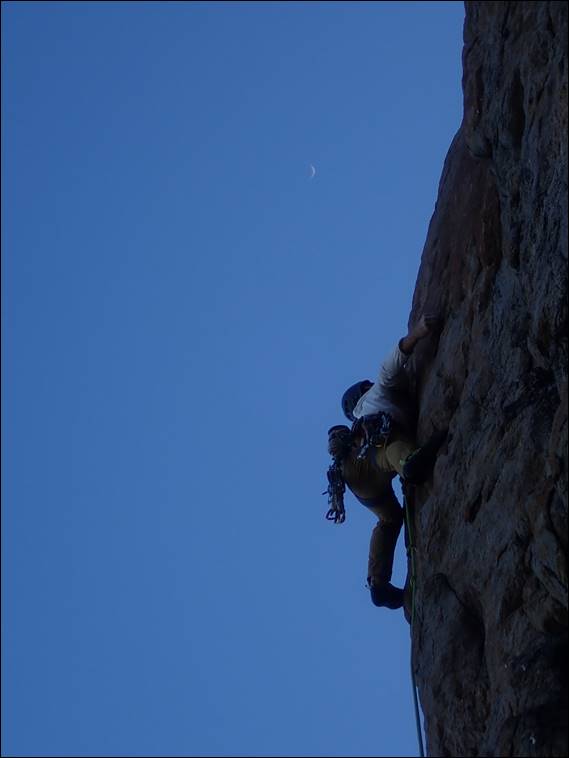
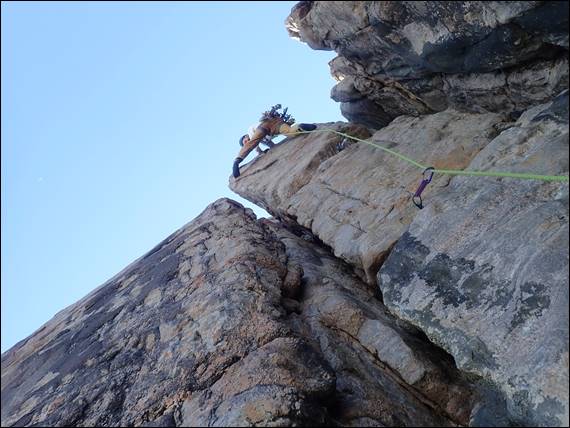
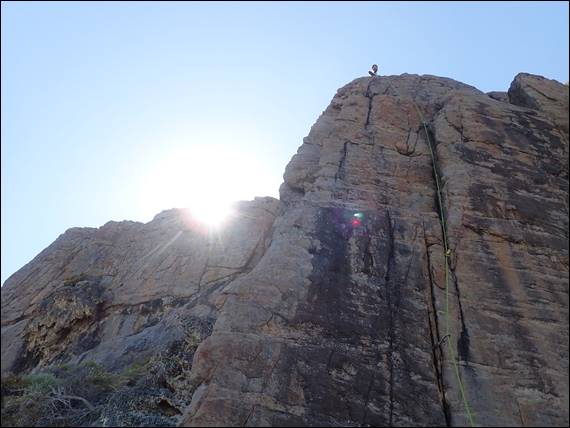
I gave Rongy the option of which ones he was keen to lead, and he kicked the day off on Gutted. I thought it was one of the original 70s routes here but am mistaken and it was put up in 93. That surprised me as it is nowhere near as hard as a grade 16 and I feel in 93 they would have been more aware of that. But the wet crack at the top added a bit of extra excitement. I then jumped on Hole World, which felt more like it with a few tricky sections to it. Rongy however, wasn’t watching as I climbed nor as Jaimie went up. He instead was behind the lens observing action elsewhere:
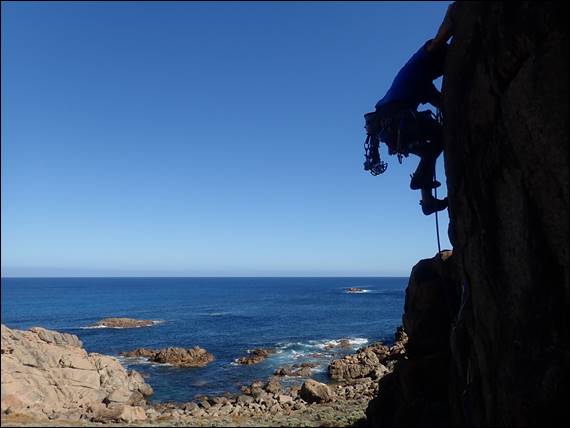
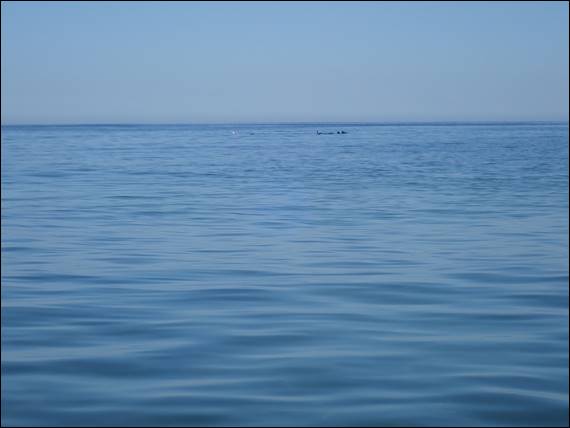
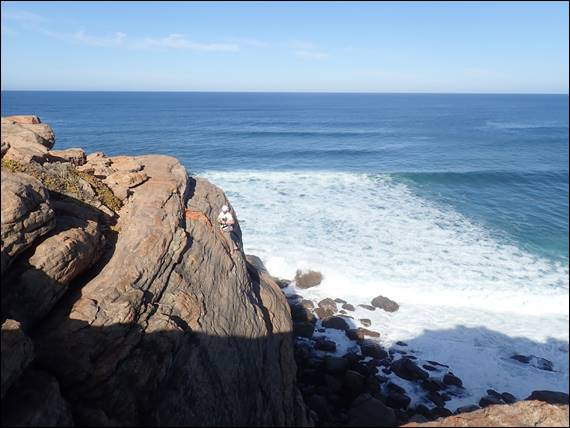
On arrival, as we stood atop the cliff Jaime had spotted dolphins. They briefly appeared and were gone heading south. Rongy saw a fin and I saw none. Then as I was heading up my route she spotted another and large pod just to the north, just off from Driftwood Bay. They looked to be congregated in a circle as if they were feeding, fins popping out with the occasional body appearing. Staying in one spot forming a cycle to trap fish inside before individually darting through the centre and grabbing a feed, while the rest kept the meal contained:
Whether they were feeding or just teaching the young tricks of the trade was unclear. But after finishing they slowly cruise south right in front of where we were. I was belaying from above by then and was conflicted with watching and helping Jaimie past the higher tricky section or, as Rongy was, watching the action out to sea. It was a lovely show of jumps, body flops and a bit of wave surfing. This was the best image captured, and both of the adults look to have young with them making me think the original exercise we saw was a training exercise:
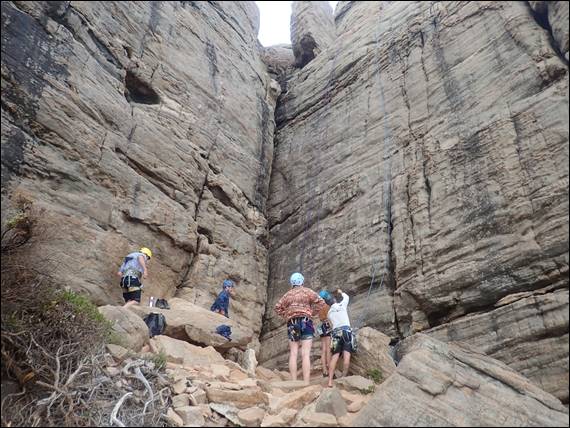
It was a stellar day and as we wanderer back down, it was unclear as to why no one else would have thought to come down. Each time we walked past the Inner Space Wall my eyes were drawn to English Ethics, but at four grades harder that was not on the agenda for today. Plus it was looking once more a bit damp with water seeping right down the line. Instead we headed to the opposite end of the crag to the Stormcock Area. Here Rongy jumped on a route that he didn’t even know existed and I can only recall leading once:
Jaime was happy to assume belay position again. Rongy and I asked each time she assume position if that was OK and she rightly pointed out later that we had all belayed the same amount just from different ends of the rope. I was really unsure of two things for this line, firstly if Rongy would like it, as not only had he not climbed it before but he didn’t know it existed. And secondly how Jaimie would find it. It was wet in this area being trapped away from sunlight or drying winds, and with overlaps and rooves above and the huge leaning block that forms the Stormcock to the side:
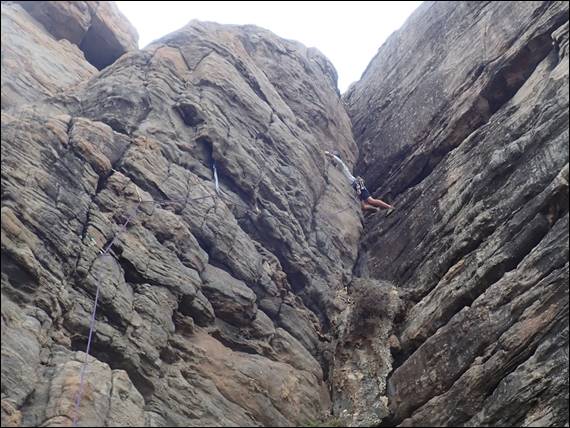
It is fair to say Rongy really, really liked the not so aptly named Consolation Prize . More three dimensional and traditional than many routes here with lots of variety of movement and climbing styles required. He was buzzing as he went up the route and even rated it highly, wondering how he had overlooked it for all these years. Then it was Jaimie turn and she too relishes these more traditional “all of body” type routes, and while she seemed to get into some interesting contorted positions she managed the climb and thoroughly enjoyed it:
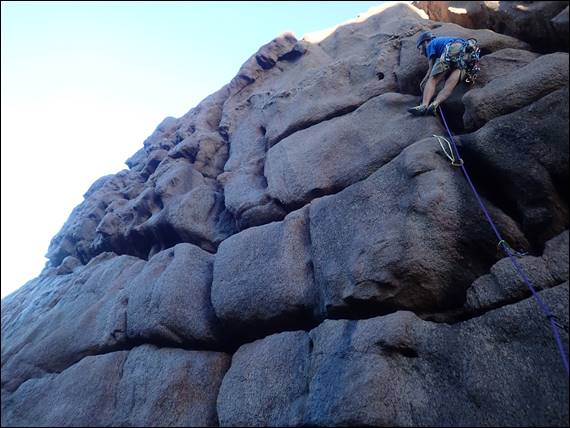
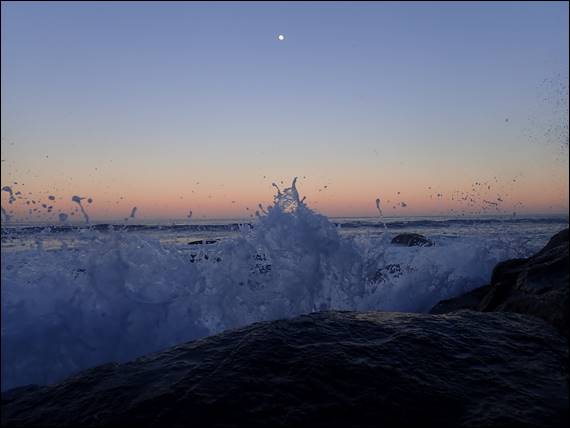
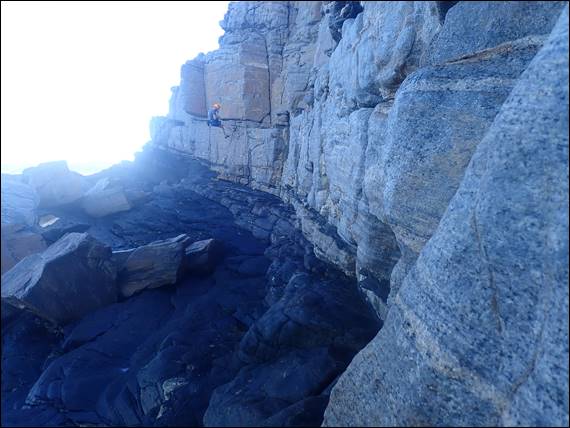
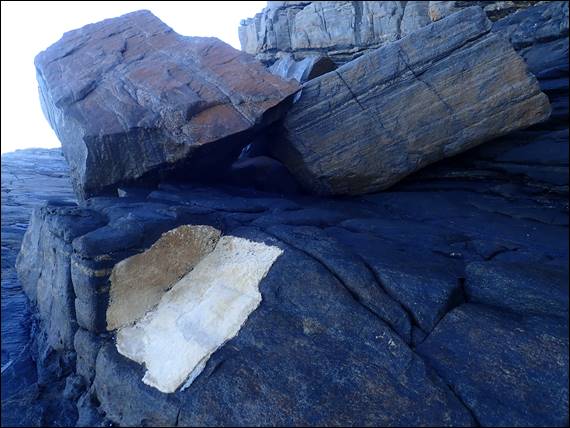
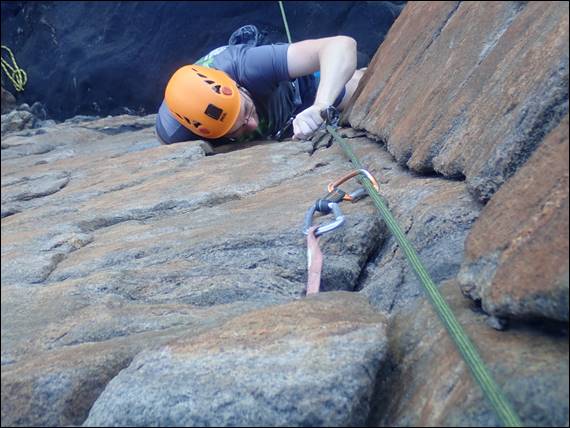
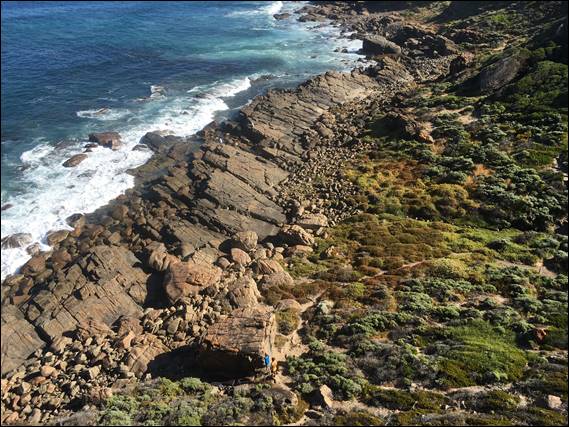
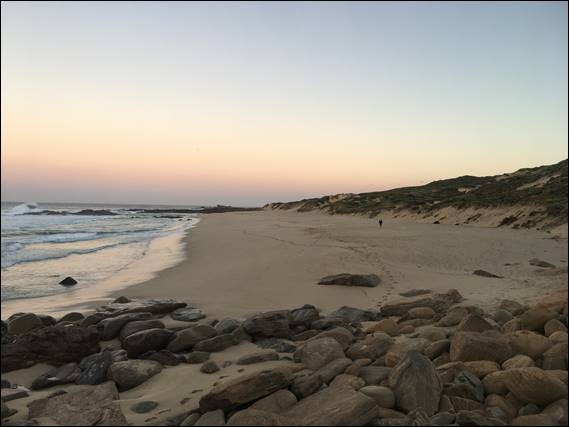
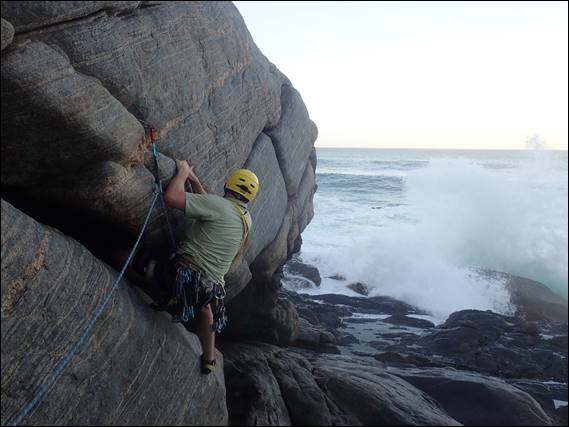
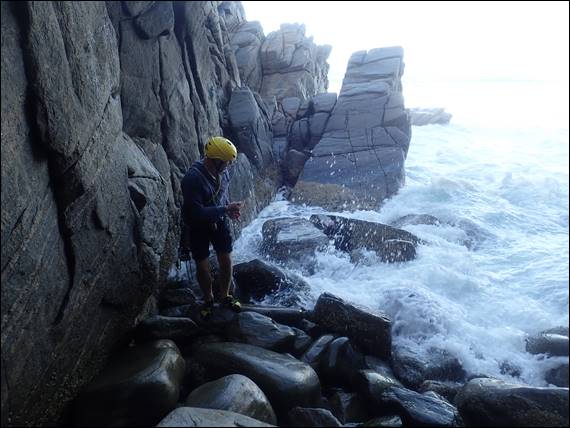
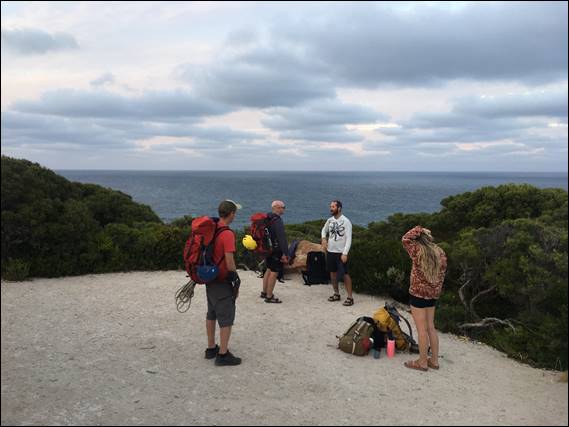
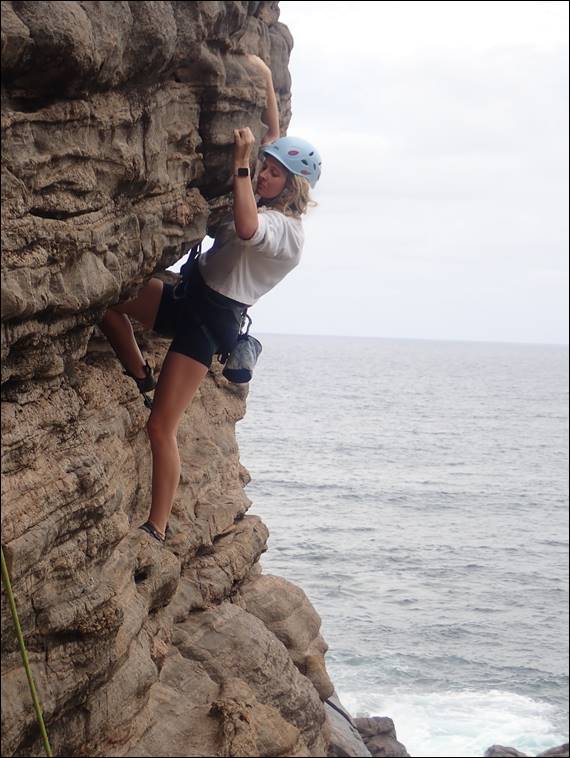
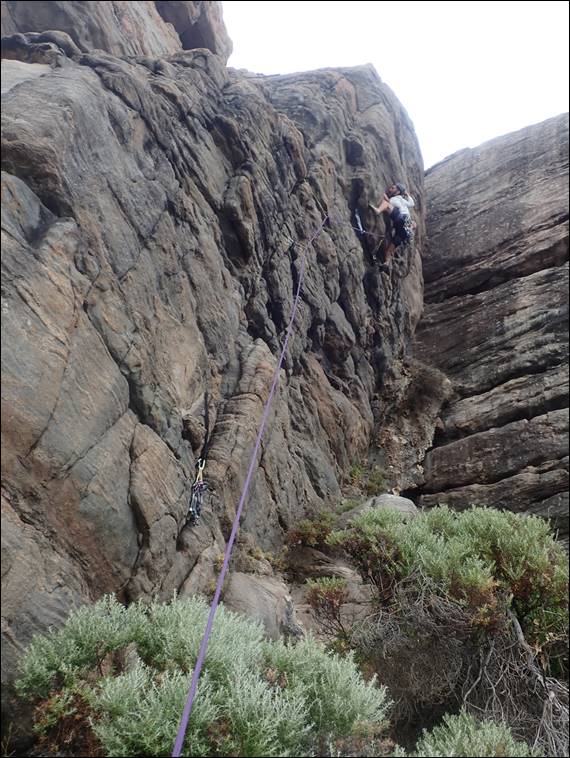
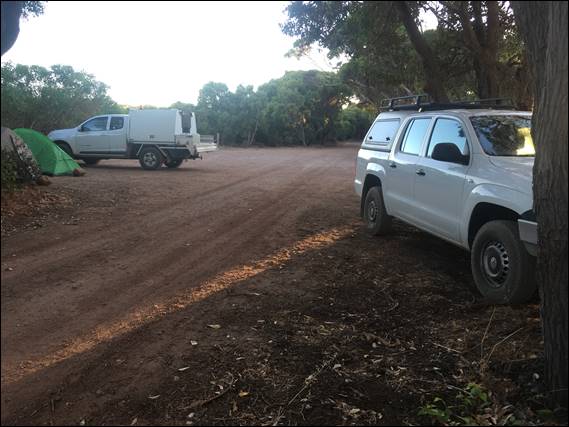
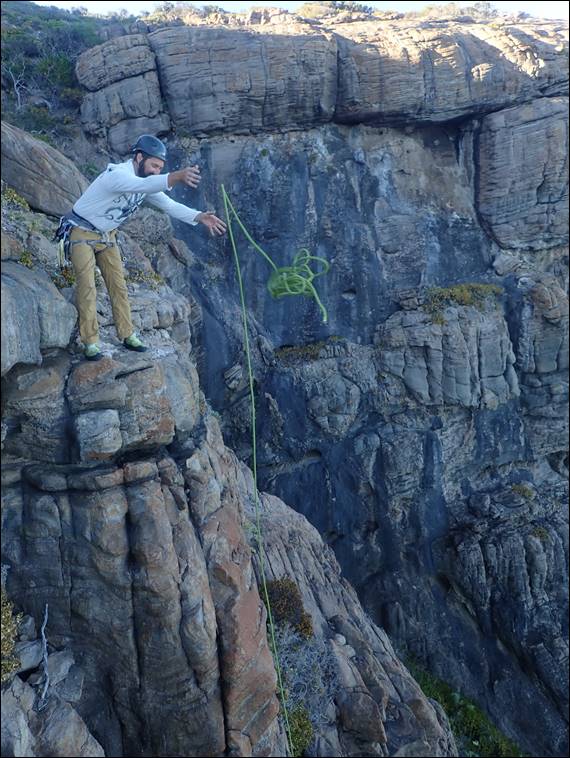
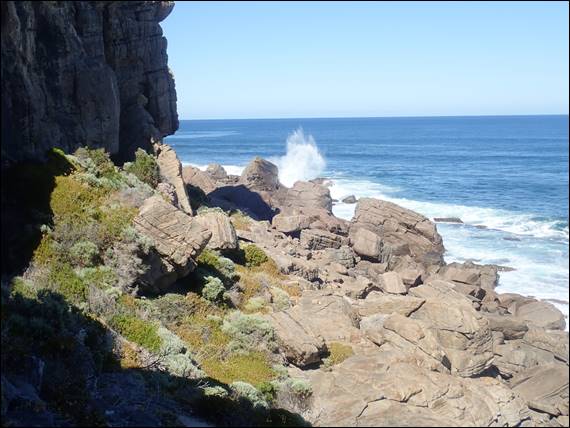
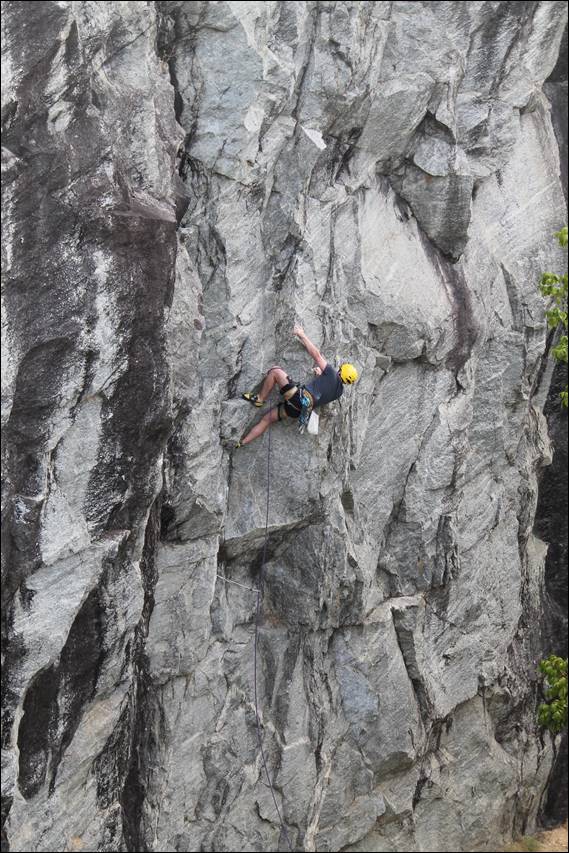
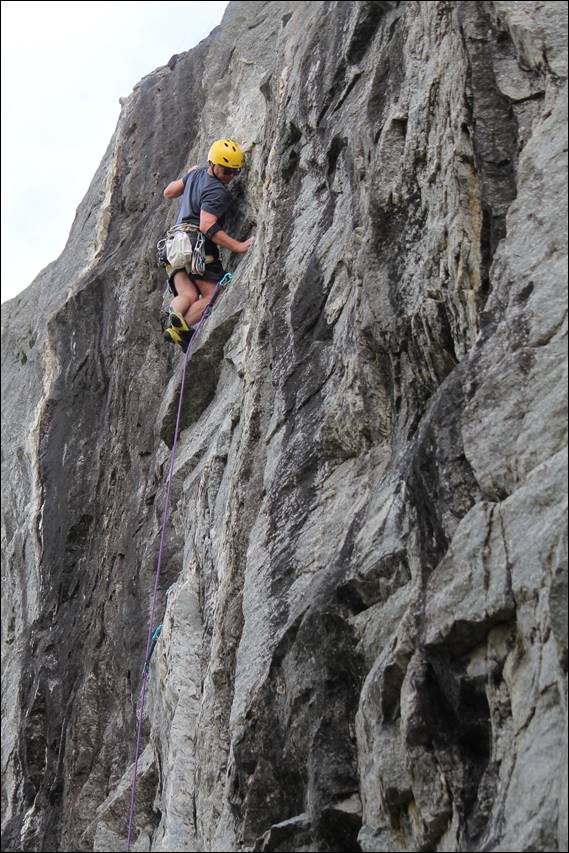
This time as we wandered down a couple had set up a top rope on Unclaimed in the Fat Chance Area. This route, which Dan, Jaimie and I climbed on the last trip here, happens to be right next to Setting Sun and can be seen in the very first image of this post. Jaimie’s eyes were sharp today and not only had she spotted the dolphins, but as we climbed the first route she also spotted that there were draws on the three bolts of Setting Sun. The evidence being in the very first image. Rongy nor I were particular bothered in draws, as crag booty, and we never retrieved them:
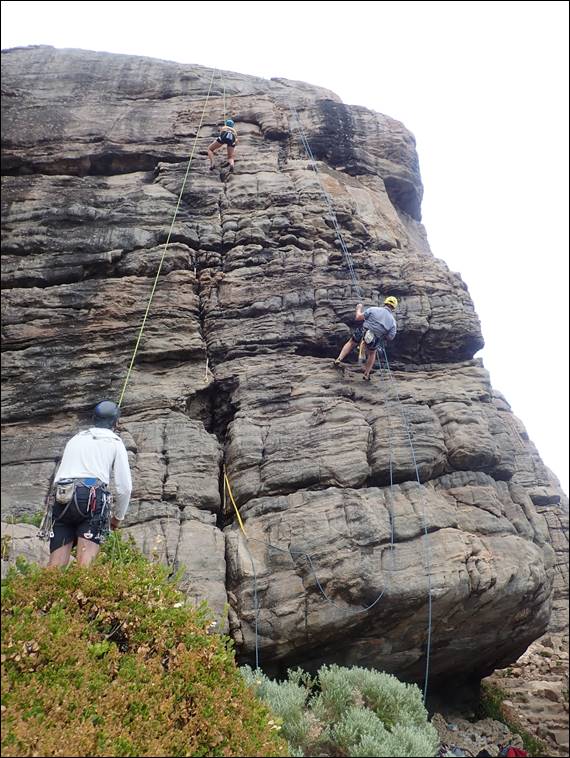
We headed to our next climb, Rhys’s Rapid Retreat. The last 16 at Wilyabrup, if I exclude all the smaller buttresses that are a bit of a walk to the north of the Stormcock Area. I was a little surprised when I read we had given this route 16, I thought it was more feisty. It felt a bit harder on lead and as Jaimie came up she too struggled. Then when Rongy followed up he found a hold at the crux sequence that I have never noticed in the many times I have been on the route. With that beta I feel the route can be claimed to be only 16. This time as we walked down Yohan was back with a group of friends setting up a top rope next to English Ethics:
It was a bit of a Deja-vu from two weeks back, and put paid to any notion of me attempting English Ethics this time. Not that I was particularly motivated for it today. The couple were still on Unclaimed and seeing the draws on Setting Sun hadn’t belonged to anyone at the crag we let them know in case they wanted to grab them. Walking out Jaimie’s eyes again were on point, as she spied a Southern Heath Monitor ambling up the path ahead of us. It was 11 and the sun was hot, which is when we found Ash walking towards the crag to meet another Perth crew that had not yet arrived, I was personally happy to leave them to bake in the sun as it continued tracking to the west:
At work I’m not known for mingling or sitting in the tea room to have a yarn, and can usually be found tucked away in front of my computer getting on it. Some may say I’m a little introvert and others may say antisocial, but for me I’m there to work and live my life away from the office. However, Friday is my go a bit slower day and this week I actually took a lunch break and visited a small reserve a few minutes away. One website touts Manea Park as “Bunbury’s premier bush reserve” yet despite working so close to it, this was my first visit here:
A limestone track takes you on a loop walk that is just over 2km, and I had picked a bit of a stinker of a day to have a wander at lunchtime. The car thermometer told me the temperature was hitting thirty degrees, and it felt hot. Stretches of the track are however shaded by low shrubs and trees, and underneath these is an array of understorey that included what I had come out to see. In several sections there was evidence of where the Friends of Manea Park had been clearing weeds and revegetating with natives and when they found orchids they had fenced them off making them even easier to spot:
While the above and below images may seem the same they are different orchids. And before I tell you which ones they are here are a few words about orchids from the big man himself, Sir David Attenborough: “Each and every species of flowering plant has its own unique evolutionary story that’s closely coupled with the animals that pollinate it. But one family of flowering plant has developed this relationship in more complex ways than any other, and in doing so has become the most numerous, and diverse, on the planet.”:
In addition this this mighty claim, there are an estimated 25,000 species of orchid on the planet and this represents 10 per cent of all flowering plants. The south west of Western Australia contains about 400 species of orchids, which makes my tally this year of somewhere between 40 and 50 species seem a bit pathetic. But while I have raised my efforts in orchid hunting up a notch or two on previous years, I’m still not at the point of cataloguing my finds, hence not knowing precisely how many species I have found:
As I said earlier it was a hot day and I was not the only one out for a walk. I have often seen bobtails, but it is not often I have found a pair together. Back to orchids and you may easily recognise the Purple Enamel in the first image, I liked the image as it had two plants each with two flowers out. Most I have seen to date have only had a single flower. The next two are a Blue Lady Orchid and then Scented Sun Orchid, if you look closely you may see main difference of the petal and sepal shape and hue. When you get to detail the labellum is also different:
Manea Park is known for its wild flowers and there were a lot out, so I had to include just one which is the Orange Star. It was a very bright day so the image above may not do it justice, but the colours are a brilliant orange and it stands out amongst all the other flowering plants. This one grows in swamps and Manea Park has several wetlands, but unless you knew it you would not be able tell as you walk round the path. This plant is extremely sensitive to phytophthora, commonly called dieback:
I have just read that Phytophthora comes from two Greek words of phytón, meaning plant, and phthorá, meaning destruction. So literally translates as the plant-destroyer and it is devastatingly effective is doing so. Seeing the Orange Star was a good sign that this destructive plant pathogen has not, yet, taken hold in Manea Park. Again back to orchids, and I came across another species of spider orchid, this one being the Sandplain White Spider Orchid. Identifiable by amongst other things the four rows of mostly white calli, as well as ragged fringes, on the labellum:
It was time to head back to the office, and I have to say that I thoroughly enjoyed my wander. I might be tempted to head back there again, as I spotted quite a few orchids that were yet to bloom. Back in the office, a work colleague noticed an image of an orchid on my screen and showed me an image of a spider orchid he had found recently at a small reserve not far from where we live. So after work instead of heading home I drove out to Ruabon Nature Reserve, a small patch of bush I have driven past many times before and never even noticed:
I hadn’t asked for any details of where he had spotted the spider orchid, so I parked up on the side of the road and started to walk along some obvious vehicle tracks and then along kangaroo trails keeping an eye out. Just like at Manea Park I found a few regulars, including Pink Fairies, Cowslips, Purple Enamels. Common Mignonette and Mantis but not what I was looking for. I did however come across the above introduced South African Orchid, which was first recorded near Albany in 1944 and has now spread widely across the south west of Western Australia:
I eventually found where my work collage would have been, a track that lead to groundwater observation bores. Along this track I spotted the familiar leaf of the King in his Carriage Orchid, the green leaf above, and next to it was a deep red leaf that was elevated off the ground. This belongs to another orchid that I have been hoping to find, the Flying Duck Orchid. I found this one in varies stages of blossoming making me think I had found a whole heap of species, but it was the leaf images that told me later they were all one in the same:
I was not successful in finding any spider orchids, let alone the one that my work colleague had spotted and photographed. A reason I was keen to find it was because it seemed to me to be one that is found out in the Wheatbelt, a completely different environment to here. With the season we have been having there are new species being found and some species being found out of their previously thought range. It is therefore was possible I was right, but without personally spotting and trying to more positively identify it I sadly can’t tell:
I wouldn’t normally include two images of the same plant in a post, unless there is good reason such as the previous image of the spider I found making its home in the Sandplain White Spider Orchid. And similarly there is a reason for including a second enamel orchid image, as the one above includes both a Purple and Pink Enamel Orchid. It’s a subtle difference but a call I’m happy to make, both are supposed to be common throughout the south west and until now I have not found one that I felt confident in saying is the pink variety until now:
The other plant that I found at both locations, which I spent some time checking out was the Red and Green Kangaroo Paw. The colours on these plants were extremely vivid and contrasting making them stand out. However, unlike my increasing interest in orchids I will refrain from trying to find all eleven species of kangaroo paws. As I made my way back to the car to head home I couldn’t resist an image of the dirty brown looking clouds forming in the south, a sign of bushfires raging that were hopefully controlled burns:
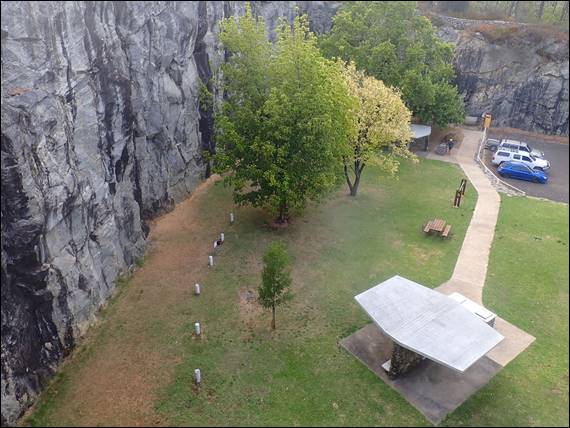
Being the last weekend of the school holidays there was every chance the roads would be chockers. Meaning that later in the day the cars would slow to a snail’s pace, as the throngs of holiday makers head back up to Perth. So it made sense to pick a place to climb that was closer to home and would also avoid us travelling in the same direction as all the people heading home. The obvious place was Welly Dam and despite not arriving till seven, I didn’t see any cars at the mountain bike trails nor at the quarry when I arrived:
There was however this strange object, which wasn’t there the last time we climbed here. I just assumed it was a bar for kids to play on, but Dan suggested it was maybe a bike rack although not the sort that either of us had ever seen before. I was also a little confused by the inscription on the two sides, Wambenger Trails. Having looked it up, it seems this the name for the trails round Collie and it means brush-tailed phascogale. A small native marsupial that is supposed to be relatively common around Collie, but it is also a bit of an elusive creature:
I’ve seen them a couple of times before round where we live. They are mostly carnivorous and quite ferocious when they hunt. While the phascogale is so much smaller than a chicken they have been known to go for them, which is possibly why they visited our place in Capel where we had ducks and chickens galore. Steve was driving down from Perth to join us but early on car trouble struck with a coolant hose bursting. He wasn’t in his usual car in which he would have had a wide selection of things to help fix the problem:
However, being the ever resourceful fella he is he did have climbing tape, and that was enough to seal the hole well enough for him to make the journey back home. This was the shorter distance and more sensible option. So it was up to Dan and myself to bag a few routes, with less rests in-between climbs than we would have had if Steve had made it. I kicked things off running up Raging Torrent, a climb that is poorly understood and as such gets a bit of a bashing on the climbing website called The Crag. My reward was not only enjoying this fine line but also finding a few orchids at the top of the face:
Several patches of Common Donkey Orchids were in bloom, and a bunch of sun orchids were getting ready to blossom. This resulted in a slight interlude, as I scrambled up to inspect the local flora before Dan got to climb. While he has climbed here a fair bit he really couldn’t recall any of the routes, so when it was his turn he went for one that looked fun without really knowing what it was. Just Do It was a good choice, and while there was a bit of wet rock next to it the line was dry. In fact the whole place is finally starting to dry up after a wet winter, so wet that some people thought the reservoir would fill up and dam would spill. When this happens it is quite spectacular:
Unless we get a very wet October, which isn’t looking likely, there won’t be enough flow left this season to fill the dam and allow it to spill. The last time that happened was back in 2014. That said August was particularly wet and there was a huge inflow from the rivers, and now the reservoir is sitting at a healthy 91% full which is more than any year since 2014 (https://www.watercorporation.com.au/Our-water/Rainfall-and-dams/Dam-levels/Wellington-Dam). Talking of not filing up, I had just climbed A Walk in Central Park and it was nine thirty, and we still had the place to ourselves. The last few times I’ve climbed here, the place was getting pretty crowded by this time:
Dan’s stamina isn’t what it used to be, mostly due to a lack of contact time on rock resulting from COVID restrictions over east. So he was very grateful when the kettle went on to make a cuppa, allowing him to reset his energy levels. This seemed to work a treat and for his next lead he bumped up the grade and made clean work of Pole Voltz. Thoroughly enjoying the less powerful and more delicate and technical climbing it offered. Just to the left of this route is a rambling line Steve had been keen to lead today. This is his own creation called Scraggly Daggly Do, and follows an easy blocky crack line. Dan and I passed this line up leaving it for Steve to enjoy next time:
On top of Pole Voltz I spotted more sun orchids, and this time they were in bloom allowing me to identify them as the Scented Sun Orchid. All round there were heaps of flowers out and as I drove back home today the air was filled with the perfumed scent of the acacias. This made me think that Lisa and I should head up this way to hike round one of the trails in the next week or two. Before it gets too hot and dry, and the orchids start to disappear. It was my lead next and as we both seemed to be climbing well, and also due to Dan raising the bar, I jumped on Red Alert:
For most but not all the routes today we pulled the rope through after each lead, allowing us both to jump on the floppy end. It was as Dan was setting off after me that the number of people arriving started to increase, and one group in particular was fascinated with what we were doing. So much so that Dan may become Facebook or Insta famous, as several of them videoed and photographed his prowess on rock. They also posed in the foreground so they too could be part of the social media fame, should it come. I took a couple of sneaky images of them just prove I’m not making this up:
This is the kind of thing that has dampened the lure of Welly Dam for me this year. To avoid this occurring it is best to get here early, climb hard and fast and leave before the tourists arrive. Fortunately today the place never got too crowded, at least not to the same standard of other trips this year. For our last route Dan jumped on T3 and he was again being keenly observed and recorded, but when it was my turn the people still about left us to do our thing while they did theirs. While this influx of people isn’t great the climbing still is; so while I may bellyache about them I’ve no doubt we will come back here again soon:
This image just doesn’t do justice to the spectacle we were lucky to observe today, again due to the size of most of the flowers the colour is mostly lost amongst the foliage of the vegetation. Lisa and I have been to the Ambergate nature reserve a few times, last year we came here in spring (https://sandbagged.blog/2020/09/28/flower-power/) and then winter this year. Today we fancied an easy wander just to get out of the house, and the lure of being so close to home, and Busselton so we could head to The Shelter Brewery on the foreshore afterwards, pulled us this way:
I went through my post from last spring to see what we found back then, and to avoid repeating myself. Also to see if I still felt like I had correctly identified the orchid finds from back then. I don’t think I did too bad last time, but there is one I reckon I got wrong that I will get to later. The first one we spotted was the most common here, obviously a spider orchid but which one. I flipped and flopped between a couple of species before deciding I had got it right last time. The petals and sepals are narrower and more clubbed than the Carousal Spider, which I thought it may have been:
In addition to the above Karri Spider there were a few Forest Mantis out. While we saw heaps of Mantis Orchids down at the Stirling Ranges earlier this week, they were the Fringed Mantis that has a greener labellum that is slightly less pointy towards the end. The Fringed Mantis also has a larger flower that is generally less brightly coloured than this species. In addition the Forest Mantis tends to holds the lateral sepals closer together in a way that it looks like it is praying just like a mantis. I wonder if anyone will now go to my previous post to check if I’m right:
The next find was a small patch of Donkey Orchids, and while I seem to have included images of these in many of my recent posts these are yet again a different species. The bright mauve to purple labellum and labellum wings that graduate to a bright yellow in the middle and mauve ting along the broad ear like petals looked lovely when the sun hit them. This Purple Pansy Donkey has a smaller flower in size and also overall plant height and also has brighter colours than the Giant Donkey Orchid we saw in the Stirling Ranges. I mention that as the Giant also had purple colouring, so from a simple image with no indication of scale they could be confused:
Breaking away from orchids for a while there were a few other flowers that really stood out. Similar to the pink peas that we saw on our walk up Mount Magog, which I believe were the Painted Lady Legume, we today saw large purple peas. Don’t ask me why but because they are called the Common Hovea I decided not to include an image. Instead here is the Brilliant Yellow Flag, which was the flower that stood out the most due to its colour but also its size. It was the biggest flower we saw at up to five centimetres across:
The above flower has a close cousin that we have seen more frequently called the Purple Flag, and when we first saw it I felt it looked out of place and may have been a weed. They are however native and indeed endemic to Western Australia. A perennial herbaceous plant from the iridaceae family and they certainly seem different to most that we have come across. The name iridaceae comes from irises that means rainbow, which makes sense due to the many brightly coloured variety. Part way round the walk is a creek and we sat here and watched a Nankeen Night Heron, that Lisa spotted fly from the water’s edge up into the trees. Too high and too far away to capture an image, so all you get is this picture:
The area was littered with tree guards, some upright and still pegged in the position they were placed to provide protection for a seedling. But many had been dislodged and were scattered about, as if someone had been littering. This area had a lot of bare ground with no under storey, allowing pasture grasses and weeds to take hold. There had been a concerted effort to revegetated the area with natives, and the number of tree guards were testament to that. Granted it would be a hugely difficult task without very persistent and labour intensive weed control. This didn’t seem to have been happening enough and that, along with foraging kangaroos and rabbits, had resulted in what seemed to be a poor success rate in plants surviving:
As we continued our walk we soon left the area that was sadly still being hijacked by the agricultural plants, that were been so successfully used on all four sides of this little nature reserve. Back in the native habitat we spotted a couple of Common Mignonette Orchids, above. When looking for orchids many people might just walk by these plants, with flowers literally only millimetres high. Indeed Lisa struggled a little with the variety of shapes and sizes of the orchids we were finding. As well as those shown in this post there were also Rattle Beaks, Purple Enamels and Cowslips but you will have to look at the post from last spring, linked above:
The other non-orchid that will get a mention is the Kangaroo Paw. Another plant endemic to Western Australia of which there are eleven species, this one being the green. The most revered is the red and green, so much so it was made the state floral emblem in 1960. While many people have them in their gardens native Kangaroo Paws are very hard to cultivate and have evolved to specific soils and conditions. For this reason hybrids have been specially breed for the purpose of gardens. I can’t recall seeing any other than the green, so will have to keep an eye out for them next time:
Lisa was getting pretty good at spotting the orchids as we went along, and on occasion out came her phone to try to identify them. Ironically, this is something I mentioned in my last post as a path I didn’t want to go down. This is the plant that started it and she wasn’t able to identify it. I’m not surprised at that for a couple of reasons. Firstly, and I only noticed this as I looked at the images back home, the clubs of the petals and sepals and also the apex of the labellum have been removed. If it had been an animal I’m sure they would have eaten the whole plant, so I find this very strange and as such possibly a deliberate act:
Secondly it is an unusually variant called a Lutea form, which means yellowish in colour or having parts or marks that are yellowish. The next difficult question of course is which spider orchid is this a Lutea form of. I feel confident in saying that we had observed both the Karri and King Spider Orchids, the former shown earlier and the latter shown below. So my guess is that this was a Lutea (yellow) form King Spider, and by all accounts it seems that these variants are quite unusual to find. It is just a shame that something or more likely someone had to deface it. There is one last image after this one and again it may be an unusual find, this one however has had me sitting on the fence and still does:
What struck me about this plant, and this one only, was that the plant was close to a meter high. In addition the petals were being held so strikingly upright and rigid and the labellum underside was green and not the white, both aspects unlike the King specimen above. I’m not sure if these observations are enough for me to be able to say this is a Carbunup King Spider, which is one of the tallest spider orchids with the largest flower. Last spring I identified one of my finds as a Carbunup King Spider, but now I’m sure it was a King Spider and you’ll have to go to my previous post to check it out yourself. If today’s find is a Carbunup King Spider I’m pretty happy as these are declared as Rare Flora under the Western Australian Wildlife Conservation Act 1950 and Critically Endangered under the Environment Protection and Biodiversity Conservation Act 1999. Either way shortly after this find it was then time for a well-deserved feed at the Shelter:
Last year Lisa and I camped out at the Stirling Ranges for our anniversary at the end of October. It was a hot few days and while we did get a bit of rain to cool things off briefly, in truth it was pretty uncomfortable. But, as is always the case when we crash at the Mount Trio Bush Camp we had a good time. In part because it is a beautiful place but also to catch up with the owners, John and Margot who we have now known for eleven years. This year we went for Lisa’s birthday, just under four weeks earlier than last year:
Two things struck us, it was busy. Much busier than we have ever known it, and there were portable loos scattered round the area to help with the additional load. Eleven years back, when we first came here it was during the spring school holiday and yet we had several nights with the place all to ourselves. This year they have had up to 350 people camping each night. It was a huge change, but not unsurprising with most Western Australians being unable to go on their usual interstate or overseas trips. And as such seeking out alternative local adventures:
The second thing was the water, we have seen water trickle down the creek line before. But this year it has properly flowed for extended periods, and the last time John could recall this happening was in 2006. It was also much cooler than last year, which suited us fine. We had three nights away which meant two days to chill out and explore. No surprises in that Lisa did more of the chilling out and I did more of the exploring, and being spring you can probably guess what I was looking for:
Camping out we tend to hit the sack early, and then I’m up and about at first light. The dawn chorus was wonderful with a mixture of so many birds. I could only recognise the obvious and bigger birds, such as the magpie, cockatoos, ringnecks, wattlebirds and crows. There was also the quieter background song from a myriad of small birds that probably included willy wagtails, fantails, robins, wrens, etc. There is a great nature trail in the bush camp, but also plenty of bushland to explore both in the camp and in the national park that sits right on the edge of the camp:
So each morning it was a similar routine, I’d get up and go for an hour to an hour and half wander. Come back and make a cuppa for both of us and then go for another hour plus wander. When I got back Lisa and I would head to the camp kitchen for a lazy breakfast. The good thing about the routine being that the morning rush in the camp kitchen would have died down by then, and generally the people left lingering about were after a quiet morning. After that we would then get ready to head out for a wander together:
On the first full day we decided to climb Mount Magog, which is the only publicly advertised peak for hiking up that we have never been to. It was also one of the lesser frequented ones, and there was only one car parked up when we arrived. The track crossed a small creek and then took a steady and increasingly steepening track, which takes a reasonably direct route for four kilometres. Mount Magog is supposed to have a steep finish that requires scrambling, which is in part why we hadn’t attempted it before:
In the areas that had been so decimated in the 2020 fires, life was definitely coming back and I’ll come back to that later. Some areas had burned way too hot and much of the seedbank in the soil was destroyed, one area we visited on the second day was like this and the regrowth was in complete contrast to the more balanced ecology we were seeing here. The fires hadn’t extended to this part of the park, and as such the bush was amazingly diverse and the landscape was littered with flowers:
The track switched from sandy to rocky areas and then back again, and with the changing soils the vegetation also switched. As can be see above and below we were spotting small sundews through to amazing peas. The ones below were the most stunning, each flower was about two centimetres high and even in the semi-cloudy conditions the pink shone so brightly. Then of course there were the orchids to spot, I’ve already included images of four species I found but I will refrain from mentioning all of them:
One reason for not mentioning all of them is that there were too many. During the trip I found thirty species and/or hybrids species, and possibly more as some of them were just too hard to really know if they were different. I’ll mention a couple of the more special finds but that will come later. In the image below the track looks like it is heading to Mount Talyuberlup, a place that we have both hiked up before and I have also climbed at. But the track slowly drifts leftward to the peak just hidden behind the shrub:
Mount Magog and Talyuberlup are connected by a ridge and I was really tempted to suggest we hike the ridge, but knew that it would probably be a bit too much for Lisa. However, one day I’ll be keen to extend the hike to take in both peaks. As the track steepened up, our heads looked down and we did not take in so much of the scenery round us. This did however make me notice small holes along the track. At first I thought they were holes made from hiking poles, but on closer inspection these were raised holes:
The raised portion was strengthened by securely placed twigs, and I can only guess that these are to prevent the hole from being flooded. I never saw anything go in or come out of these burrows so can’t tell you what creature was housed within. While it was a steep track there were no steps, a couple of the hikes in the Stirling Ranges have steps that are way too high and we are not that keen on them. We were also pleasantly surprised to find that the final stretch only had a couple of sections to scramble up. This was the worse section but Lisa was determined and managed it with relative ease:
It was a cloudy and windy day to be on top of a peak, but we found a bit of respite from the wind and even weathered a shower that came over. It made us wonder what it might be like going back down; the rocky scramble sections would be pretty dicey in the wet. Fortunately the rain passed over and the wind was such that the rock would soon dry, plus that band was followed by mostly clear skies. It then felt good to lie back on a rock armchair in the sun, munching on some snacks. Soon my eyes started to drift and I found a whole bunch of orchids in the undergrowth:
The group ahead of us were still on top enjoying just being out there, a man and his two sons, but there was plenty of room up there plus just like us they were just quietly enjoying the place. Someone else also turned up but had to head off after a quick photo. His girlfriend hadn’t managed the rock steps, so was waiting a bit below the top. The group of three said a quick scramble across the ridge to the next peak, not Talyuberlup but the second peak of Magog was worth it. So I left Lisa to have a quick scramble and sure enough they were right:
The sheer face of the main peak was stunning to see, even better with the backdrop of Talyuberlup. When I got back the third group was there in full, the woman had managed to conjure up the courage to get up the rocky steps to enjoy the views. Before Lisa and I headed off we munched on a few more snacks and watched the fearless lizards come out to join us sunbathing. They may be also realise that were humans are tasty morsels might be dropped, and they got really close to us looking about and only scampering away if we moved suddenly:
We left the peak in reverse order, and as such the first group had the peak to themselves once more. Going downhill is so much harder on your knees and Lisa started to feel hers when we got to the steep descent. But there was no rush and we took a slow and steady pace. This allowed me to look about a bit more on this section than I had as we came up; when our heads were just watching the track. I really liked this banksia, quite literally growing out of the middle of a big solid boulder and I’m honestly not sure where it’s roots went:
The track started to become less steep and soon we were on the almost level path back. I took a heap of images of the more visually stunning flowers, and like the orchids too many to include. With every intention of identifying all the flowers and writing about some of them, I decided against that after having to spend hours trying to work out the thirty orchid species. So I will leave the flower identification for another time. The next orchid is one that I really wanted to mention, which is an albino Zebra orchid. I have no idea how rare it is to find them but I was very chuffed to spot it:
The drive back to camp took us through the middle of the ranges. We stopped at the central lookout carpark only to find a short walk up a peak allowing you to take in the view both east and west of the peaks stretching out. Another walk that we had not been on before, and didn’t even know existed. It was strange to think just how many people were staying at the campsite yet how few we saw out. I feel that most stay in the eastern side and many only come here to head up Bluff Knoll, the highest peak and the one with the most high steps, which was good for us today:
Back at the camp the numbers had thinned out and what we noticed that many of the noisier groups had moved on. Not to say they were rowdy, but some people seem to just be naturally louder and are probably not even aware of it. We had timed our outing today well and once we were settled in the camp kitchen making food and playing a game the rain set in. The fire pits didn’t have anyone round them, which was an unusual sight and one that didn’t last for too long after the rain abated:
The next morning came and with it the morning chorus to tell me it was time to get up. I again started the day with a wander round the nature trail, going the other direction this time. I also remembered to take my glasses this time and that helped me to spot quite a few things I missed the day before. I have to also admit to not strictly sticking to the track. Knowing the area quite well from all our visits here there are a few extra spots I head for that I have had a fair bit of success in finding orchids at:
The ever faithful finds here seem to be the fringed mantis, below, and dragon orchids. These two are present in masses, but are definitely not the only ones to be found here. In my head I had counted up, if I was lucky, 25 species. It wasn’t until I got home and started to look in more detail at the images that I saw the differences come out. Especially with the donkey and spider orchids, with seven and three species from each respectively. It did however get to a point where it was simply getting to hard to distinguish between them:
This may have been due to my orchid guide being for the South West of Western Australia and I probably need to get the guide for the Wheatbelt and South Coast. Also this time I had to get down to the real minutia to try to identify some species. This included going as far as not just looking at the shape and size of the labellum and its fringes, but also the colour and even colour graduations. Then there are the calli, the little protruding parts on the labellum, and looking at their shape and colour, how far they extend and how many rows there are:
Then for some species you need to look at the same level of detail for the petals and sepals, so it is an intensive process. I take lots of images, but without noting the slight variations out in the field it is easy to not take enough images of the different plants found. While I really enjoy finding them and working it all out, I can’t bring myself to start trying to identify them in the field with my guide at hand. As such I do wonder if I am reaching my upper threshold of desire to go much deeper, and then on top of all that there are the hybrids such as this Cowslip Fairy:
Mind you all that said orchids are mostly out in spring. So by the time summer arrives and I get back in the water and start trawling over my marine books, for all the finds when I’m snorkelling, it won’t feel like I’ve got competing interests for my time. While I might seem to spend a lot of time hunting orchids, one of my fondest memories of the nature trail is however the simple daisy. Elseya would love to just sit in amongst them. On this trip I rarely got to see them open up, my morning walks were too early and they were still closed up waiting for the sun:
It was time to bring Lisa that cuppa, and I changed things a bit this time round by making the cuppa before my first walk. The rationale being that our thermos mugs are so effective that the tea is simply too hot to drink if I made it after the walk. This way is had an hour and half to cool just enough to make it a drinkable temperature. Lisa was once again snug as a bug in her sleeping bag, happy as Larry with her kindle reading and dozing as the day woke up round her. So with tea delivered I wandered once more:
In addition to loving hearing and seeing the birds on my early jaunts, and much as they are seen all over, I still get enjoy seeing the roos out and about. Wandering through the bush it is usually the thump, thump sound that tells me to look up and sure enough I’ll see them hopping at what seems to them a leisurely pace away. There are a few about that are more used to people, such as this doe. Her joey however was less convinced and immediately hid behind her and then disappeared into her pouch, as she carried on munching taking no heed of me:
It is a reasonably quick stroll towards the edge of the property, from where you get into the national park. I’ve never really ventured far beyond the boundary line so today was the day. But before I got there I scoured the ground for whatever I might see and it was because of the doe above that I changed direction and stumbled across my second albino orchid. This time it was a dragon, with all the reds and darker greens stripped away it looked a little ghostly. I only came across the two albinos, I heard rumour of a couple of albino mantis but never found them:
Once in the national park the track I was looking for was called Six Chains track. I believe it takes you all the way to Mount Trio, but I wasn’t intending to go that far. Besides it took me a while to find out where it was. The directions I had remembered were vague and once in the bush it all looks the same. I eventually hit the creek, which I didn’t expect, and just followed that until the track came into view allowing me to find heaps of orchids I would not have otherwise seen. The track is actually a firebreak so wide enough to remain clear and obvious:
Due to the heavy rain last week the creek crossing had blown out somewhat, the small culvert had been no match for the flows that had thundered down. As the water had flowed over the top of the crossing it washed out all the sand and resulted in this mess, but luckily the vegetation up and downstream had held the banks firm so I was able to hop over the narrower section. Then I was simply followed the track until I decided I should probably head back, killing another hour and half just enjoying being out:
The firebreak while evident didn’t seem to get lots of traffic and had heaps of flowers growing in the more open ground. The landscape changed with the changing soils, as I wandered and there was heaps to see. It was a lovely peaceful walk with the views of Mount Trio ahead and Mount Hassle and Mount Toolbrunup to the south, so I was never really going to get lost. I occasionally ducked into the bush to the side to have a sticky beak, but never went too far just in case I did lose my bearings. Eventually it felt like it was time to turn back:
Again not rushing I found more and more things to spend time checking out and as I was capturing images of a great orchid just off the track someone walked up behind me. I guessed, and was right in thinking, it was Jarred. I’d only met him once before years back. He takes the orchids tours and spends hours searching for them, I found out later that his sister works at the same place I do and I have had the odd communication with her even though she is based in Perth. It’s a small world. He mentioned he had found an unusually orchid and pointed in a direction saying it was a twenty minute walk that way:
I kept that direction in mind for tomorrow. Then as he headed off to get ready to provide the tour, I strolled for a little longer coming across yet another find. A Prisoner Spider, which is a cross between a Zebra and Joseph Spider Orchid, identified by the longer petals and sepals. The distinct zebra part being the colourful stripy labellum, so very different to the albino version I found. The Joseph Spider, so being called due to the many colours it can display including yellow, white, red and purples and each flower can display them in a myriad of ways:
Lisa was about ready for breakfast when I returned, so it was another reasonably quiet and lazy time down at the camp kitchen. We decided to head further south to the Porongurup’s today, the reason being that the hike would be flatter and that would prevent any chance of aggravating her knees further. However, things went a little pear shaped after breakfast when the rear canopy window shattered. There was the clean-up and a few calls to see if we could get it fixed, which we couldn’t, that chewed up time. By then the rain started to fall:
We still started to drive south an hour plus later after the shattering experience, and in the distance the Porongurup’s were practically hidden from view. The clouds had engulfed them and it was raining steadily, so we decided to turn back and head instead to Mount Toolbrunup where the clouds were more broken and the rain seemed to be light, as shown above. This is the first peak that Elseya walked up, and she choose it because from the campsite she saw it was in the clouds and she wanted to walk in the clouds:
The mind of a seven year old is wonderful, but we were in luck as the clouds stayed until we got to the top on that day and she got to walk in the clouds. It is my favourite hike here, and not only because of that story. The path and terrain is highly variable and interesting and the peak itself it a proper mountain type peak with a pinnacle to stand on. I knew today we wouldn’t get as far as that peak, our aim was to have a stroll and we planned to reach the base of the boulder scree slope where it got steeper:
The path to get to the boulder field seemed longer and steeper than either of us remembered. But with a slow and steady pace we made it. This peak like Mount Trio had been well and truly ravaged by the fires in late 2020, and this is one of the areas where it had burned so hot the seed base in the soils had been destroyed. As such the returning vegetation wasn’t as varied as other places and seemed quite unvaried. The other visually striking, and slightly eerie, aspect was the way the dead trees in the gully we were hiking up, were all bowing towards the peak:
We got back down just as the rain really hit and we headed back to camp for a hot cuppa, snacks and game. The wetter weather brought with it a chill in the air, and sitting in the camp kitchen we got cold so Lisa said she would head to the tent to curl up in her sleeping bag and read. But somehow I managed to convince her to come for a little wander to check out the local flora. I showed her a few of the finds and we also got a wonderful display from a mob of white tailed cockatoos, before she decided it was time to headed back to get warm:
I stayed out and above is one of my finds as I scoured “in that direction for about twenty minutes” in search of the unusual orchid Jarred had found. This spider orchid is not what I was hoping to find but was still pretty cool. It is also one of the spiders I have really struggled to identify, maybe an Enigmatic Spider Orchid but I can’t be sure. There were also heaps of tell-tell basal leaves to indicate more orchids were going to come out at some point. For some leaves the stems were coming up but the flowers were yet to open:
I spent several hours looking round but never found the unusual orchids. While it may be a small world in terms of degrees of separation of us humans, in terms of finding a flower in a patch of bush within “twenty minute walk in that general direction” it feels like a very big world. As the sun got lower in the sky I gave up with my search and headed back. Being so wet this year and just recently the ground was pretty damp in places, and this meant there were lots of fungi out. I saw heaps of really cool ones, but refrained from stopping to check those out as well keeping my focus mainly on flowers:
Our last evening came and the vibe of the camp kitchen changed once more. This time there seemed to be more families, with parents that wanted to have music playing and didn’t seem to care or notice that that their kids ran amuck screaming at the tops of their voices. It wasn’t the most peaceful of evenings so we retired early and left them to it. On my return to the kitchen to make a cuppa in the morning, it was empty and blissfully peaceful. Then for one final morning I headed out for a wander, this time walking along the fire breaks towards Mount Hassle:
This track took in higher and much rockier ground, it was more of a walk than a flower hunt and I soon put some kilometres behind me. I walked past the neighbouring property, which is where Jarred lives and I spotted a roo leaping through the crop of wheat. The reason that seemed strange was that the paddock had a serious roo fence round it. I asked him about it later and he later told me that a couple of roos had got in when the fence was damaged in the fire. When they repaired the fence and they couldn’t get the roos out and so they remained. There is also some bush in the same fenced area so they seem happy enough:
After his property the track turns to head south, and as the image above show heads towards Mount Hassel on the left and Mount Toolbrunup on the right. Way too far to think about going, and also as the track dipped into the valley there was no way to get across. This area was a swamp, the still water providing a crystal clear and flat mirror in which the trees were reflected. It was a lovely sight and a very tranquil place, so I spent quite a bit of time soaking it all up. Wandering round the edge of the water checking out plants:
I eventually got back to camp and Lisa looked more alert than the last two mornings. It was not that she was actually more awake, only that she had finished her book and didn’t have another one to start. So as I handed her the cuppa she hinted that we should head down for breakfast. Seeing we were heading off today an earlier breakfast wasn’t a bad thing. The camp kitchen was still relatively quiet, and as I was making a second cuppa Jarred came over and said he had an hour before the tour so was happy to take me out to see the unusual orchid:
Lisa was fine with me heading off at a drop of a hat, so we went walking some twenty minutes in that general direction. Where we came cross the sight above, and it was not until you looked more closely that ten or so King in his Carriage Orchids could be seen. They were stunning with the flower being approx. one centimetre high and the plant only standing maybe ten centimetres high. On my two wanders out this way I wasn’t far from where they were, but doubt I would have spotted them:
After spending some time being amazed at the king sitting there looking comfortable, we wandered back and had a good chat. Jarred has definitely got the bug and is an orchid fanatic, and I learnt a lot in that short time about the area and orchids for which I was hugely grateful. While I was a sponge taking in all that knowledge, I also knew that I would never get that involved. I’ll stay on the edge of keeping interested and checking things out, as there are too many other things out there that I also enjoy looking for and checking out:
We got back and Lisa too was sitting pretty, a comfy position in the warm morning sun, cup of coffee in one hand and something to ready in the other. After breakfast we clearing up and packed away a dry tent, which is always a massive bonus, and sorted the car. We stopped to say good bye to Margot as we passed their home. She told us there were plans underway for a second camp kitchen, so the place will change even more. I’m not sure how she and John find the energy to keep everything going, it’s a monstrous job but we are certainly glad they do:
On the road home we made one stop at a patch of bush just outside Boyup Brook. I had spotted a heap of flowers that I thought were Donkey Orchids as we had drove down, but they were just a weed that looked like them when you drive past at 110 km/hr. When we stopped we did however found heaps of huge Stark White Spider Orchids, as well as many other interesting stuff. It was certainly a great trip. And despite the Mount Trio Bush Camp getting so popular, we still love the place and will no doubt go back next spring:
Despite being the last day of a long weekend, we risked a walk at Cape Naturaliste. Located at the northerly end of the Leeuwin-Naturaliste National Park this is where the Cape to Cape track, mentioned in my last post, starts or ends depending on whether you hike south to north or north to south. Why was it risky, well to start with being a long weekend it could have been busy, as it is a very accessible area, and secondly as it was the last day of a long weekend the traffic heading home could have been hideous. But I was wrong on both counts:
That was probably due to the long weekend being tacked onto the school holidays, so there wasn’t the mad rush when everyone has limited time to cram in their intended activities and journeys. One reason Lisa was keen to come here was that with ocean views from most parts of the walk there would be the chance to look out for whales. So, we took advantage of the numerous places to “park-your-bum” and watch the ocean. Well, Lisa did and I used these times to scour the ground looking for anything that stood out:
There were plenty of flowers out, and to change things a bit I took a few images of the non-orchid flowers that caught my eye. Above was a small and delicate flower that I think may be False Boronia. The one below I am more convinced of, and is a perennial herb called Milkmaid. This species is Bruchardia congesta and found, amongst other places, on dunes and in coastal environments. A similar species, Bruchardia umbellata, found in woodland and heath habitats, has a cluster of nondescript flavoured carrot like tubers that can be eaten raw or cooked. Needless to say I didn’t pull up any plants to check if this was also true for the species we saw:
Lisa spotted a couple of beetles on the path so I moved them to safer ground, something I did in an area not too far from here last year (https://sandbagged.blog/2020/10/08/stuffed-jalapenos/). It was a Cockchafer beetle and I’ve mentioned them before. There are hundreds of varieties of these beetles, and they are difficult to tell apart. But I was fascinated to read the only way to distinguish the various species belonging to the Heteronyx genus, which I think this one is, was by looking at the layout of hairs around the anus of the larvae:
I have come across the larvae of a Cockchafer beetle once before but didn’t think to check that particular detail (https://sandbagged.blog/2020/08/14/stiff-as-a-board/). Even though it was a cloudy day the colours of the low shrubs and herbs still shone out. These seemed more prominent on the rocky and higher parts of the walk. As the track dipped into lower ground it was more of a mass of greens, with occasional flowers. I’m not sure why this may be and the only thing I can think of is that maybe the higher ground is drier, and the plants wait for drier conditions before they flower:
There were of course orchids about, including most of the ones we had seen at Mount Duckworth just yesterday. So, while this is yet another Dunsborough Donkey Orchid, it is worth including due to the Jewel Beetle. Called such, not only because of the brilliant colours but also as the wing case is textured and this helps create an appearance of cut precious stones. Due to their amazing appearance insect collectors held them in high regard in the mid-1900s and the only insect that was more sought after for a period were tropical butterflies:
The appeal of jewel beetles was so high that they were exported from Australia at such a rate to make their existence become threatened. For this reason, in 1978 the jewel beetles were listed under the WA Wildlife Conservation Act to help protect them and allow numbers to restore. They were the first invertebrates in Australia to get this level of environmental protection. We did come across one new orchid being the Exotic Spider Orchid, which Jaime and Alan had told me they had seen heaps of, so I was expecting to find them:
This next flower is endemic to Western Australia, found from Cape Leeuwin up to Fremantle in low heath, loamy soils, limestone and sand dunes. It is known as Dampier’s rose, Diplolaena dampieri, and was one of several flowers that provided an additional sensory experience due to its strong aroma. I’m sure you will have guessed that the main reason for taking the image was however the net-winged beetles, with their very distinctive antenna and ribbed wing case. I’ll only go as far as to say they are in the Lycidae family, trying to work out their genus or species is a bit too hard:
While the slower moving beetles were reasonably compliant when I wanted to capture some images the many birds we saw were not, as has been the case on most of our walks. We did however stop several times as they flitted across the path hiding in the shrubs on either side, and of the smaller birds only the dependable New Holland Honeyeater ever sat still allowing us to observe them. This one sat pruning itself for what felt like ages, and then there were others that bobbed about within the open space of the path catching a feed while on the wing, right in front of us:
It was certainly busier than previous walks, but we still enjoyed being out again. Something else that was different was that we didn’t shoulder the rucksack, even though Lisa had made up the flask along with snacks. But it didn’t go to waste and after we finished the walk, we stopped somewhere quiet along the coast to enjoy a cuppa and feed. Here we once again marvelled at the stunning aqua blue colour of the ocean on the eastern side of the cape, which was very contrasting to the darker blue green of the water on the west side of the cape where we had just been:
Lisa and I headed out for a local wander today. The forecast was a tad iffy so we didn’t fancy going too far afield only to be rained on, as happened last weekend. But we needn’t have worried and the precipitation never came and it even started to feel a bit too warm when the sun came out. We picked a loop walk just north of Yallingup and started at Mount Duckworth. On the steep decent down towards the coast I spotted big patches full of Pink Fairy, Donkey and Cowslip orchids. We were also serenaded by a large flock of White Tailed Cockatoos as the alighted after being scared by an eagle:
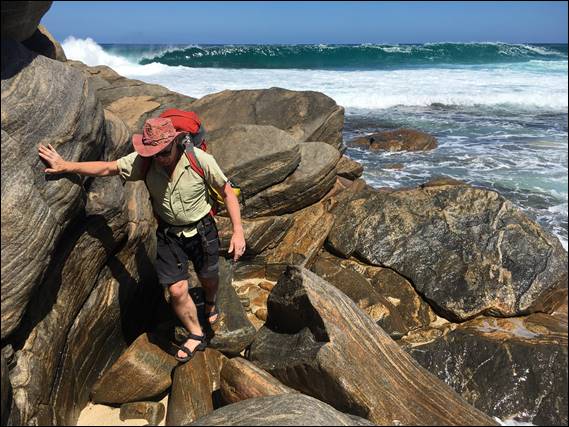
The coastal path was part of the Cape to Cape walk, a 250km coastal hike that takes you along the entire length of the Leeuwin-Naturaliste National Park. It is a walk that we would one day be keen to hike end to end, but today we only joined it for a short four kilometres. The track passes all of the climbing spots I frequent on the western coastline. And in the image below, for those who know what to look for, it is possible to make out Smiths Beach Rocks. Despite the great start to the walk, in terms of orchids, there were not many along this part of the track as sides of the path were covered in weeds:
After a while we spotted an area that looked like a good place to have a cuppa, it was a little way off the path but there was a goat track to take us there. The Cape to Cape path didn’t seem to truly skirt the coast. Possibly to keep people away from the steep drop into the ocean. The sandy dunes here are protected by interlaced beds or limestone, as can be seen above. Much of the limestone comprises a fragile rock that comprises sand cemented by calcium carbonate that has percolated through the dunes with rainwater, over thousands of years. At times, in a geological sense, this process was paused allowing plants to grow:
When it started up again the roots of these plants became encapsulated by the calcium carbonate. Then as the organic matter broke down, it left solution pipes that provided a pathway for the water. Overtime these pipes fill with calcium carbonate as it came out of solution. And being more concentrated within the pipe it created a much harder formation. The skeletal remains of these plants have now become exposed, as the softer calcified sand has been eroded away. It was a fascinating landscape to see, and completely unexpected:
Once we hit the track again we didn’t dilly-dally and kept a steady pace, it was a wide and featureless path with low scrub on either side. It seemed a shame that the track wasn’t closer to the ocean, to allow more of a view of the coastal formations. We found out that the original track was closer to the coast but the markers have since been moved to this wider path, maybe due to increased usage. With weeds once again smothering the vegetation on either side of the track there was little hope of finding any orchids. We did however keep an eye on the ocean, and spotted a whale that breached several times for us:
The next section of our walk took us along a four wheel drive track, as we hiked back up the soft sandy dune for several kilometres until we were back up on the ridgeline. During this section numerous cars passed us. But unlike last weekend, everyone that passed us slowed down and some even stopped to have a quick chat. If felt like a slog going back up the dune, but we did spot more orchids as we got higher up. I previously mentioned that we had seen donkey orchids at the start of the walk, and these were by far the most prolific orchids we saw:
There were so many that I just couldn’t believe they were all the same, so I took a few more images than maybe necessary to allow me to check them out later. I’m pretty sure that the ones we saw the most of were the Dunsborough Donkey Orchids. They were a much taller plant and were up to half a meter in height. The colours of the sepals and petals were a deep brown-purple, see two images above. Then there was the above smaller, both in height and flower size, variety:
As the image shows it also had a more golden colour and had “ears” that were more rounded in shape, and I believe it was the Pansy Orchid. This made me check our trip to Narrogin a few weeks back (https://sandbagged.blog/2021/09/11/itsy-bitsy-spider/), and looking at the features of our previous find in more detail I reckon they were the Western Wheatbelt Donkey Orchids. It is very similar to the Common Donkey Orchid, which I first called it, but has slightly smaller flowers and looking back at donkey orchids I have found in previous years I now reckon my first guess was wrong:
With all this talk of donkey orchids I’m getting behind. After the four wheel drive track we followed a fire break. As the images above show the vegetation included low trees and had thick understorey, and this section of the walk had the most flowers. It was very beautiful, and hidden in the understorey I spotted the same three orchids I had already seen. There were also a few greenhoods that were past their due by date, and the one below that was yet to open, which is a Beak Orchid:
The fire break varied from a reasonable path to a bit of a bush bash, so it was obviously no longer maintained. But it was a great section and we spotted heaps of cool flowers and also the odd fungi that was still hanging about. The understorey seemed to change quite a lot and we saw areas dominated by acacia, banksia and sword grass. There was also one section devoid of any understorey. This recently burnt area seemed quite eerie but beautiful in its own way, the only probably being that it seemed the weed species were coming back first:
On the last stretch of the firebreak, before we popped out at the paddock we started from, the understorey was nothing but Arum Lilies. This is a plant I have mentioned in previous posts and one that is a really invasive pest. Yesterday Dan asked me if I knew where they had come from. I was unable to tell him, but I can now advise they were brought over from South Africa in the mid-19th century, as an ornamental plant. In South Africa the fleshy tubers when boiled provided a starchy food source but they are poisonous when eaten raw, a real risk for livestock:
Another not so early start, and that can only mean I was climbing with Dan today. The sun was well and truly up as I drove to Capel to meet him. But to be fair, for me it is a short ten minute drive, while for Dan it is close to three quarters of an hour. We had already decided that today was a good day for Wilyabrup, a week of sun was hopefully enough to dry the steep hand-jamming crack of Blondes Have More fun. A thrutchy climb that starts up an overhung crack, which for some reason Dan would like to have a crack at:
I too had my eye on a route. English Ethics, and in true British trad style it is sketchy and serious and of course should only be climbed ground up so you don’t know what to expect. I’ve not had the gumption to lead it to date, having had several false starts on it over the years and always backing off due to lack of gear. But with some serious trad leads at Smiths under my belt from recent trips there, I felt better prepared. The question is who had the more crazy idea of what fun is. But as is sensible we started on something very much within our abilities to warm up on:
Jaime also joined us this morning. And the three of us wandered back down in full sun, after enjoying the more relaxed delights of an easy start to the days fun. Despite it being a stunning day, a long weekend and a late start we were still the first people at the crag. And as the day wore on, and we were there till well after midday, only two others climbers turned up. There was of course the usual “wandering out yonder” tourists, who probably would never have come here if they were allowed to travel more freely out of Western Australia:
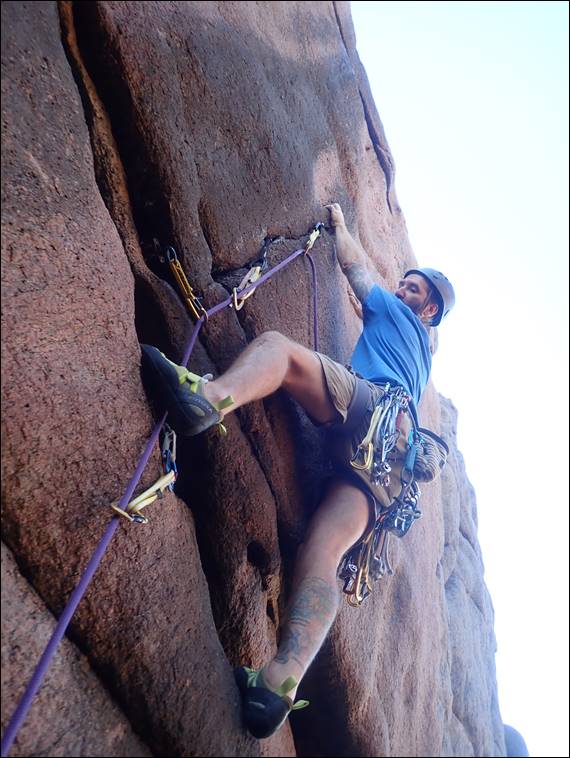
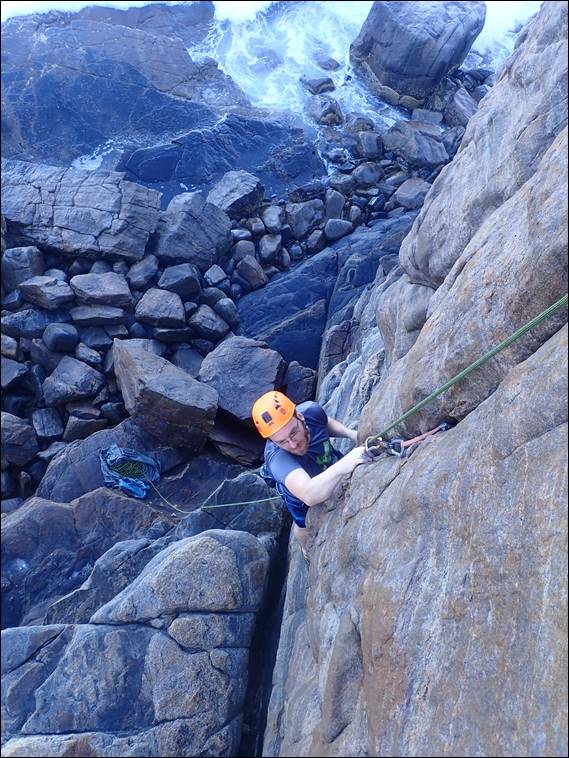
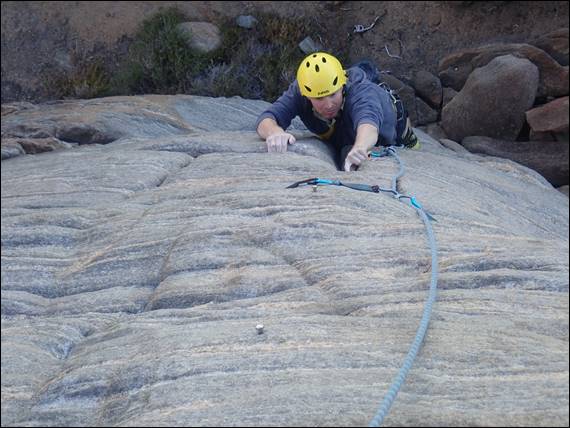
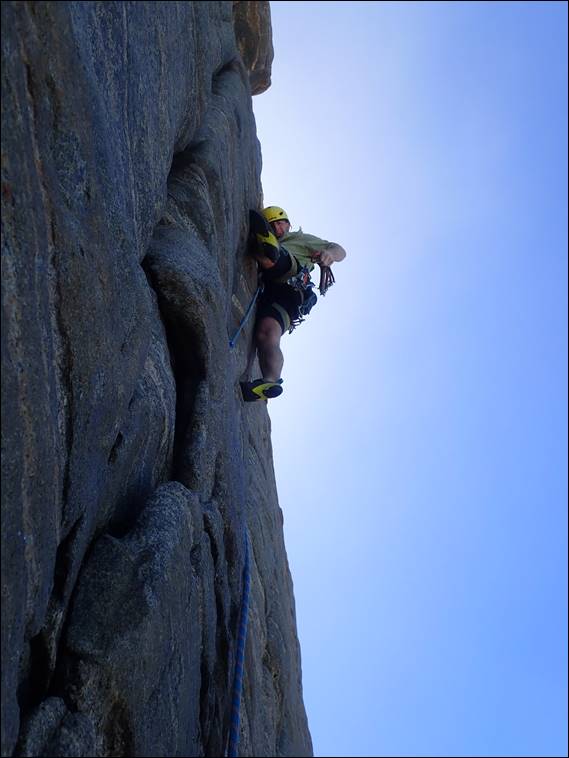
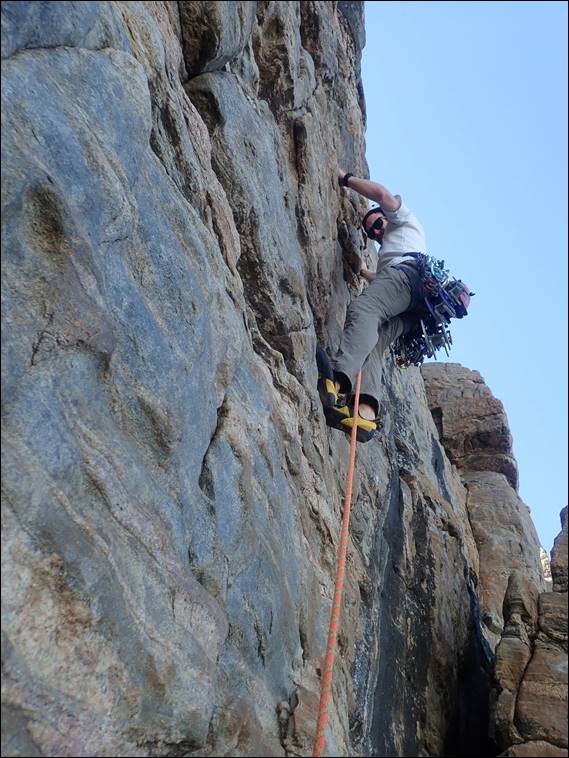
Jaime is still adamant that she will never lead. Today I was willing to accept that, as she hasn’t climbed much of late. For this reason the second line I picked was one that had two approaches. A direct thinner and more delicate route for Dan and I, and easier line just a few meters to the left for Jaime. While the image below may not be all that exciting, it is the only images with Jaime in to prove she really did join us. Dan had some technical camera operation issues, which meant he managed to miss all the amazing poses I struck before I got to the stance where I could finally clip the first carrot:
The reason for Jaime not being in many images is in part due to her having the camera while the exciting activity of leading was going on. She didn’t intend to stay with us all morning, but while she was we picked routes that she could reasonably have a crack at. This was however not the case for where I suggested Dan go next. A wall at Wilyabrup that rarely gets much attention, maybe because the routes are broken by a huge picnic ledge. But they are still good fun and offer a style of climbing that is quite different, another possible reason people don’t climb these routes. Dan really enjoyed it but Jaime no so much, although while Dan was watching she did spot whales one of which fully breached numerous times so not all was lost:
It was as Jaime was attempting to climb the above route that Oliver and Yohan turned up, neither having climbed for several years so they were keen for some fun easy routes to top rope to get back into it. I pointed them to the obvious route, which happened to be right next to English Ethics. So while I was super keen to jump on it for my next lead, it felt a little weird to climb on a route literally a few meters from them when there is no one else at the crag. So instead I decided on a route that still feels bit gnarly but is also one I have led before. Dan loved the look of way I started up the bouldery bottom section, but I’ll come back to that later:
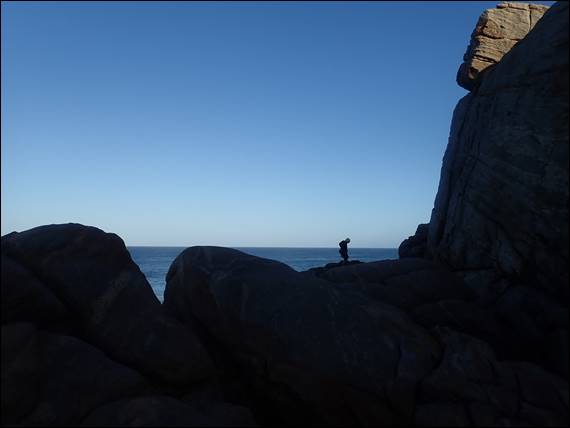
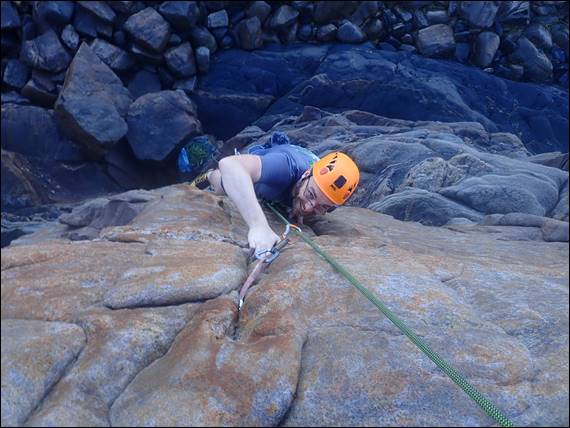
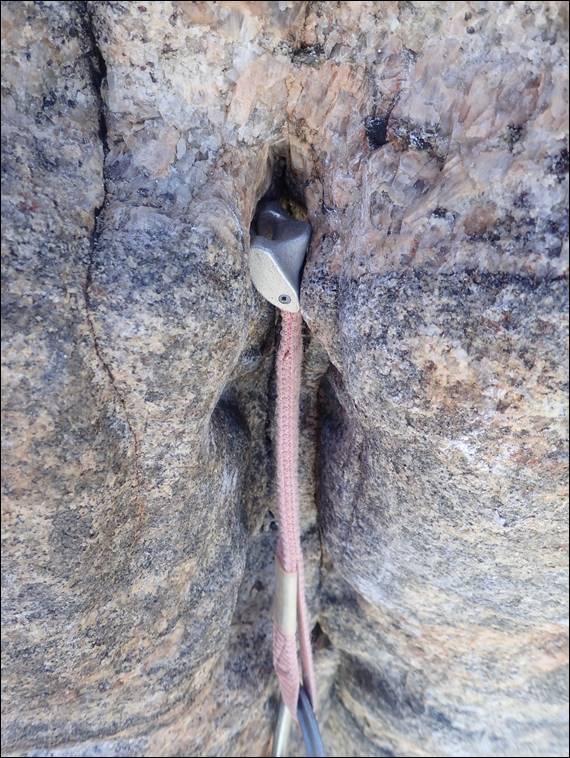
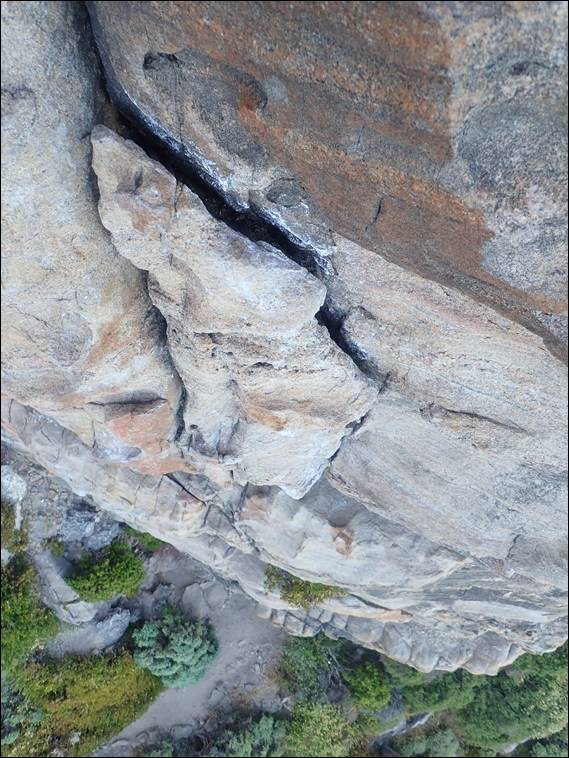
Jaime saw where the line went and decided it was worth hanging about to take images, and we are glad she did. Not just because of the images, but also as I forgot to take bolt plates with me plus I didn’t have my wires as a substitute for bolt plates. I hung about on the route while she raced to the gear, got all tangled up getting the plates of the carabiner, and then started to throw them up at me. The first didn’t reach me, the second I missed but I was very happy to say third time lucky and I finally had a plate. My arms were burning by now but I somehow completed the route without falling off, and I’m still not sure how:
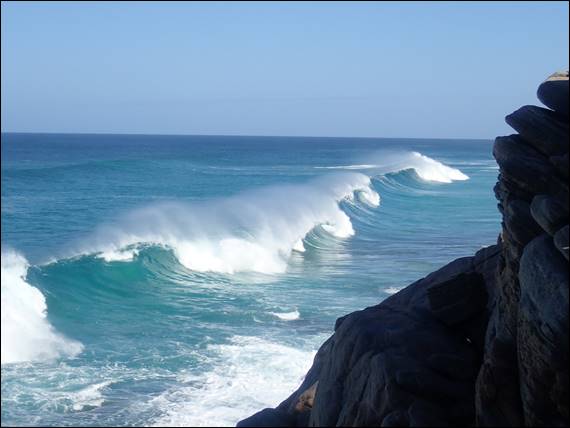
As Dan topped out after following me, I declared that English Ethics was off the table for me. He too said that he had felt pretty pumped on the route and wasn’t likely to tackle Blondes Have More fun. So you’ll have to wait for another time to see how we go on those two routes, assuming we do eventually get onto them. Jaime left us at this point, and despite Dan saying he was pretty pumped he then climbed the highest graded route of the day, Mid-Wall Crisis, with amazing grace and composure. That was how it looked to me from below, however afterwards he told me he was seriously pumped on the route:
We again found that we had the crag to ourselves, but the sun felt too hot and we were gassed. Although I’m not convinced Dan really was, as before the last climb he donned his crack gloves and practiced for Blondes Have More Fun by climbing the crack below the bouldery moves of my last route. I videoed Dan, see below, and am glad he didn’t video me as I failed miserably when I tried. For the final route of the day we climbed out with packs, hoping to see a Carpet Python sunbathing at the top of the flake where I have seen one so many times before, but it was not to be this time:
It was a week of possibilities as Sunday approached, and it could have ended up with six of us heading out for a climb. A number that we have not managed for a long time, but as the day got closer, and even a mere hour before my departure from home, a few people dropped out leaving us with four. Also for various reasons we headed out in three cars, but I won’t bore you with the details of why. This resulted in me arriving first, and after Lisa and my wet walk yesterday it looked like today might have been a repeat event:
It rained on an off as I drove out, and as the boys strolled in after me I wondered what they would say about it. The low rain-bearing clouds to the south were making their way towards us and the rock was wet. But Smiths Beach friction won’t be beat by a bit of rain and they were not put off by the conditions. So we descended into the Zawn. Now you may think that I would have a Déjà-vu moment, seeing I had been here last week with Dan. But no, last weekend my feeling was one of slight dread, an emotion that Smiths Beach rocks can bring on:
Today having had a recent visit here I felt more prepared for the place. I also had plans for what I needed to tackle to prove to myself that I had overcome that feeling of fear that the place can create. You may also be thinking here comes a post that will be a bit samey, but again think again. I have not included much about the climbing, instead focusing on other aspects of this place. For example this seal, which eagle-eyed Howsie spotted and that stayed with us for hours. It also remained for most of the time in this strange position:
Howsie was again on point when we discussed why we were observing this behaviour. The seal’s capillaries are close to the surface of its skin, and by putting the flipper it can catch whatever heat the sun might be able to provide. If it was too hot the body would be underwater to cool down. Fortunately for the seal, and us, the clouds slowly broke up and eventually stayed away, allowing the sun through. What we could not understand was why the seal would not have just found a rock to purchase on and take in even more of the heat on offer from above:
Today Craig and I had gate crashed Mikey and Howsie’s morning session. If Dan had been able to get out we would have been headed to Moses Rocks. But seeing he wasn’t able to join us, we decided to be social and join the boys. Mikey, for a moment, forgot he was at a true trad crag. No he didn’t try to clip this bolt plate but as he started to climb he did have the rope over his shoulder, ready for the first piece of gear. Needless to say the trad patrol (i.e. me) put him right and he duly complied and went back to more traditional approaches:
The little snail seen above was one of probably millions, they were all over the walls and even on the rocks that were being relentlessly smashed by the waves. Its name is quite simply Marine Snail, or for those more academic types Austrolittorina unifasciata. They are the most abundant mollusc you will find on the rocky shores along Western and southern Australia as well as New Zealand. They were sprawled across the rock platforms and faces, and were ready to feast on the lichens and algae. Just waiting for them to be moistened by either the ocean or rain:
While we were scaling the cliffs, our best endeavours were completely outdone by the Purple Rock Crab or Leptograpsus variegatus. These are found across the entire southern subtropical Indo-pacific Oceans, and are masterful climbers. Clinging onto vertical and overhung faces, nimbly scuttling about while picking at the lichen and algae with their claws. Being omnivores they are also known to prey on barnacles and limpets, and for the latter they wait patiently for the limpet to start moving before swiftly placing their claw under the shell and throwing the limpet upside down:
I named one of the routes here after these fellas, and I did attempt Crab Scuttle today. But as can be seen below the waves were on occasion still reasonably big and the seaward wall this route was on was wet as. Despite trying several times I just couldn’t commit to the unprotected moves up the initial blank looking wall. A common thought going through my mind, did I under-grade every route here? No matter, as I did climb the route I wanted too on Harbour Wall. A route Howsie also led allowing me to include a short video of him topping out on Crow’s Nest:
With two routes under each of our belts we left Harbour Wall and headed to our packs. As we wandered back I spotted a bright orange crab and this is where I get a little confused. While I am pretty sure it is the Swift Footed Crab, it seems to have the same Latin name as the Purple Rock Crab. So I will wait to see if anyone out there can unravel this mystery for me. I still included the image I captured, as you will see this one also has a tasty meat dish. But I have had no success in working out what crab was on the menu:
Craig had done us proud today and brought not one but two flasks of tea, sorry Dan maybe next time! We sat and supped on a welcome cuppa and chilled out for a bit. Then it was back into action on the mighty face of Camelot Castle. Craig indicated quite assertively that he was more than happy with his two leads for the morning and I could take the floppy end from here on in. That was fine with me and we romped up a couple of routes finishing on the second line I had was keen to test my psych against, Lady of the Lake:
This wall is that bit further away from the ocean and there are no more interesting creatures or facts to share with you. The seal was long gone; the crabs still scurried about; and the snails we hadn’t knocked off, as we had indulged in our pastime, were still clinging on. While I had spent a fair bit of time watching these creatures and observing their behaviour, we too had been observed. On numerous occasions we would look up to the top of the zawn and a party of walkers would be peering down at us. I do wonder what Latin name they might give us:
Whatever it may be we had a blast today and thoroughly enjoyed ourselves, finishing the session with a second cuppa while sorting the gear in glorious sunshine. My guess is insanus stultis or in English, crazy stupid people. You may have been expecting that I was going to say people might have called us Muppets, thinking that was the connection with the title of this post. However, this time the title is completely unconnected to the tail. It is in honour of those TV legends, The Muppets, who graced our screens for the first time 45 years ago today. Happy birthday Kermit and all your colleagues: