Back in August it was claimed that spring and potentially summer would end up a tad wet across all of Australia. So far that prediction is proving right in our south west corner. Forecast of the back of a negative Indian Ocean Dipole forming, which a phenomenon that not surprisingly occurs across the Indian Ocean. Created by the temperature difference of the ocean surface in the west and east. It can form three phases of positive, neutral, and negative. The negative cycle is created when the ocean is warmer in the east than west:
Australia has had its hottest year on record for ocean temperatures between July 2024 and June 2025. In West Australia we experienced the longest, largest, and most intense ocean heatwave on record. Starting in late 2024 and peaking in early 2025, with surface temperatures of the sea being as much as 4 degrees Celsius higher than average. As such the negative Indian Ocean Dipole was not all that unexpected. However, then came along another quirk of mother nature. A sudden stratospheric warming over Antarctica:
This resulted in the air temperature soaring by more than 30 degrees Celsius. Sounds catastrophic, however sudden is probably an exaggeration. It can takes weeks for these sort of temperature shifts. Also this is a warming of the stratosphere, which is the layer of the atmosphere between 10 and 50km above the surface of the earth. So we are not talking an Armageddon weather shift. While these events occur approx. every two years in the Northern Hemisphere, they are however rare in the Southern Hemisphere:
Over some 45 years only three moderate to major such events have occurred in the southern hemisphere. Being in 1988, 2002, and 2019. The phenomena has the greatest impact when it occurs in spring, with the worse recorded impact being in 2019. Off the back of a drought this was the catalyst for the devastating Black Summer over east, during which some 19 million hectares of bush burned. As should hint that the sudden stratospheric warming over Antarctica results in a drying and hot climate in Australia:
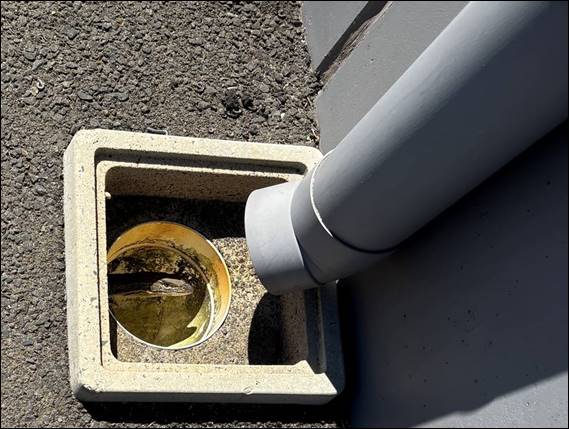
The opposite effect of a negative Indian Ocean Dipole. Which one of these mighty weather systems wins out is yet to be seen. For now no one is game to predict the outcome. Indeed most of us, just like the Sand Monitor (Varanus gouldii) in the first image, simply carry on with life. Blissfully unaware of any of this stuff. I find it funny how I spend so many hours traipsing round the bush looking for wildlife. Then as I sit at work a monitor casually walks past the one and only window in our concrete box of an office. Unable to resist I wandered outside:
Oblivious to goings on in the atmosphere above, but the close proximity of a person was enough to make the monitor hide away in a stormwater drain. At least it would have been nice and cool in there, as the temperatures were on the rise. Closing in on thirty degrees on Monday; the day the monitor walked past. On Tuesday it crept higher and after work I headed to Crook Brook where the car thermometer told me it was edging to the mid-thirties. Not put off I wandered round a couple of the loops, to see what I might see:
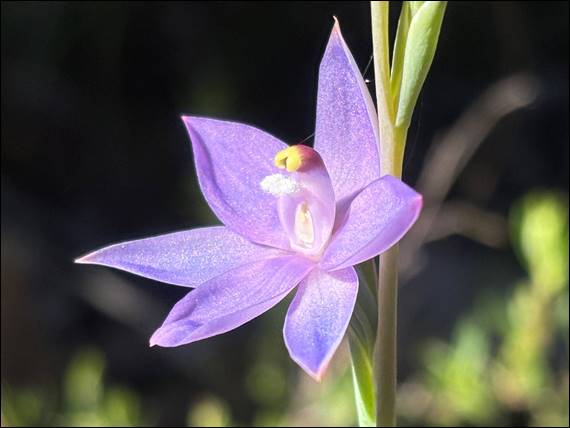
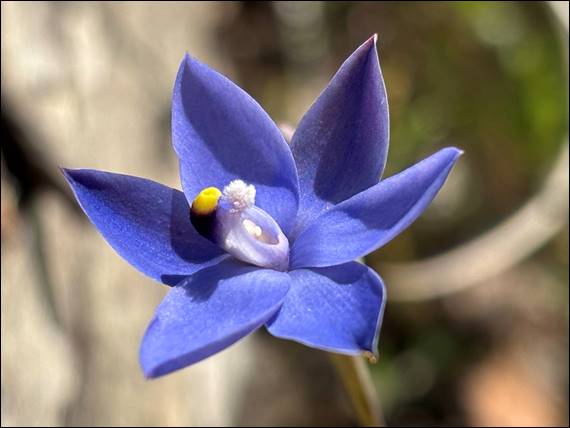
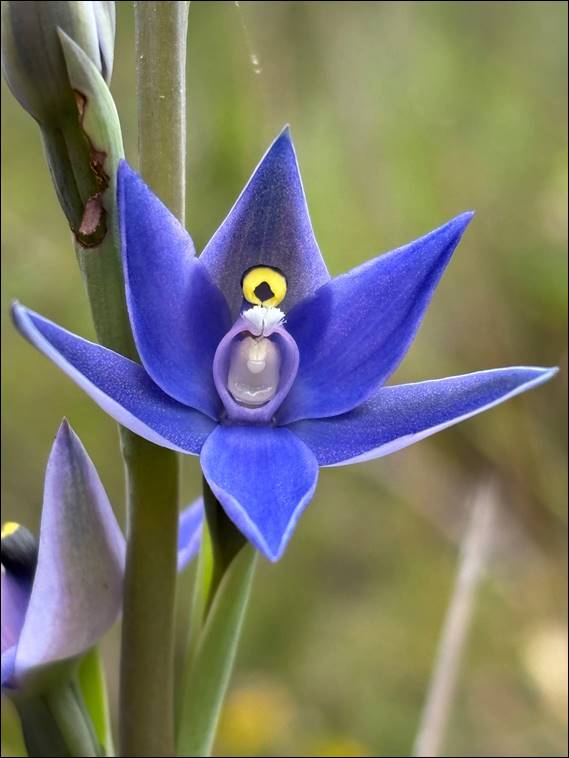
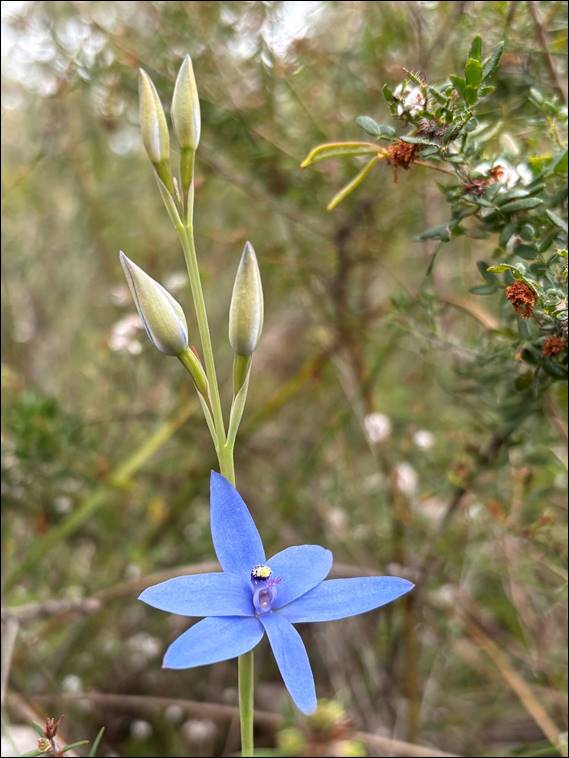
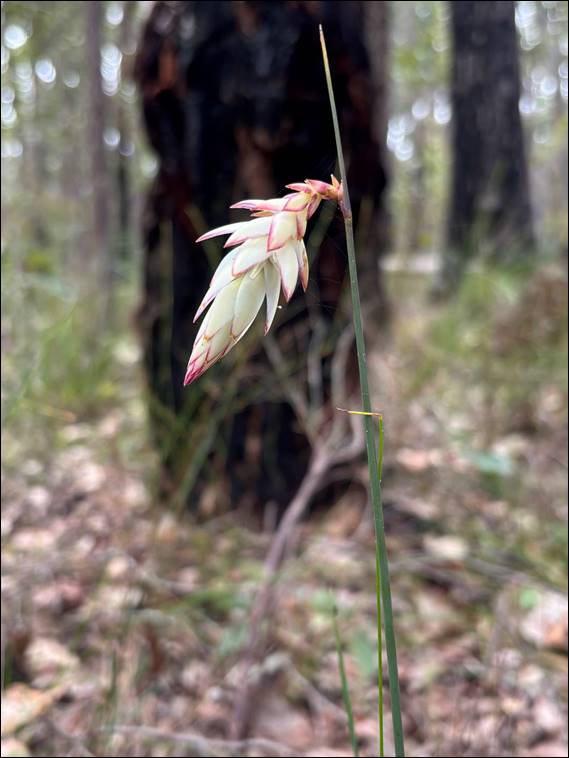
Not as much as I had hoped. With a blistering sun you would expect the sun orchids to be loving it, but no. They were by far the most prolific of the orchids out, but very few had their flowers open. I only spied one Scented Sun Orchid (Thelymitra macrophylla) and a couple of Shy Sun Orchid (Thelymitra graminea) open, shown in the images. I realise they do not do great in extreme heat but didn’t feel it was ridiculously hot today. Although warm enough for the Bobtail (Tiliqua rugosa) to be active and not wanting to put up with me hovering about:
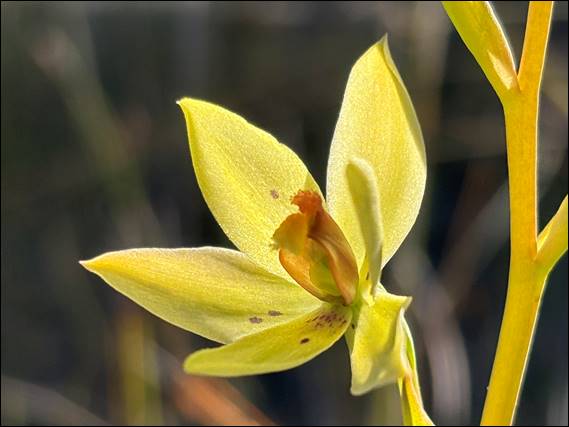
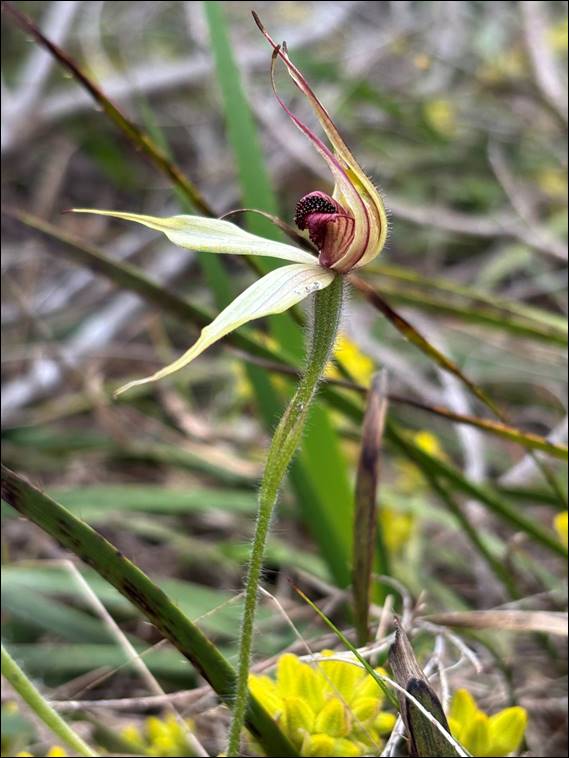
Both the Slender Sun (Thelymitra pauciflora) and Blue Lady Orchids (Thelymitra crinita) were out, but again their flowers were closed so there are no images. However, the icing, or should I say custard, on the cake was my first ever sighting of a Custard Orchid (Thelymitra villosa). Three plants all up with only one flower open, such a good find there are two images. I knew they pop up here but until this sighting I had not been lucky enough to find one. Despite having found five suns, as with the two big whether systems, this didn’t spell destruction:
I should explain the Aztec myth of creation of the Five Suns is based on the cycles of creation and destruction. Four sun gods, called Tezcatlipoca, Quetzalcoatl, Tlaloc, and Chalchiuhtlicue, each failed to create a world that lasted. The fifth sun god, Huitzilopochtli, was however successful. Although it is said that sacrifices are required to keep the sun (god) moving across the sky, including human sacrifices. Moving onto brighter topics as I finished my wander at Crooked Brook I stumbled across one of the two tallest spider orchid species:
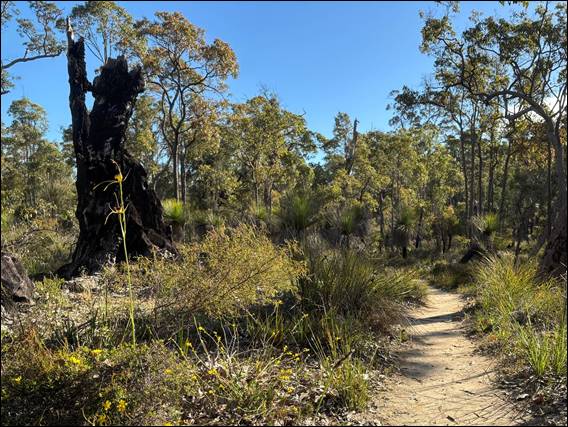
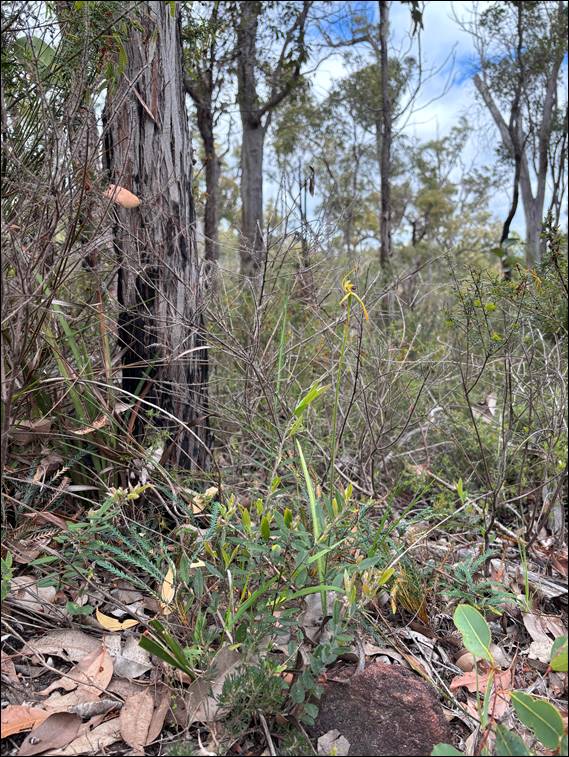
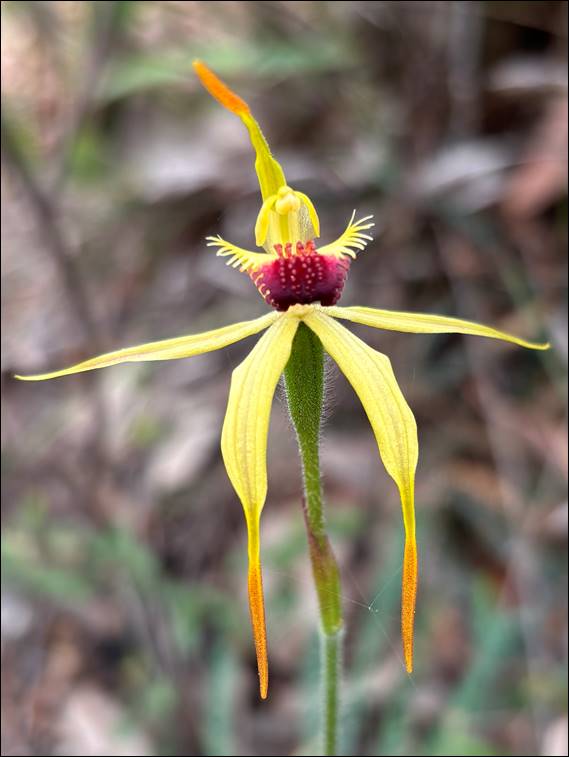
Standing proud at the side of the track two images up, you should be able to make out a magnificent Carbunup King Spider Orchid (Caladenia procera) with two flowers. The only spider orchid I saw, and then at Manea Park on Wednesday in half the temperature I didn’t see any. And despite being not as hot but still sunny, none of the many sun orchids were in flower. Other than one Leopard Orchid (Thelymitra benthamiana), being the sixth sun of the week. The Sixth Sun referring to the next era after the world of the Fifth Sun ends:
The era of the Sixth Sun provides an opportunity. Either move toward destruction or gain a higher state of being and understanding of the world. If it ever came to it I wonder what path the human race would take. For now my path at Manea Park didn’t offer anything else on the orchid front but I did get to see a swarm of bees, which I didn’t dare get any closer to than shown above. Then at the Capel Nature Reserve on Thursday I only found repeat sun orchids. It was raining so this time at least I could understand why they were all clammed shut:
The car remained in the driveway since returning from my climb with Howsie and Craig on Monday. Having forewarned them I had brought an unwanted guest back from Lisa and my travels they said they were happy to take the gamble and get out with me. It took a greater hold after that trip and I spluttering through three days of working from home, so as not to upset my work colleagues by going into the office. Using the power of positive thinking each day, as I wanted to apply a bit of nature-based medicine to vanquish the unwanted guest:
This time no one was available to get out. Top rope soloing at Smiths Beach was on my mind. But when Saturday morning rolled in, my body said it wasn’t a wise choice. Instead Castle Rock won out, with its more relaxed lines and shorter walk in. A rare footprint free beach greeted me, making for a great not so early morning shot. The trickle of water running down the beach comes from Dolugup Brook. Claimed to be the least disturbed of the 14 waterways in the Geographe Catchment. The fact it is running so late in October is very unusual:
We had another front roll through on Friday and overnight, and a rainbow hinted that rain was still falling on Cape Naturaliste as I drove towards it. Fortunately by the time I arrived the skies had cleared. There was hardly a breeze as I slowly ambled the short 500m path to Castle Rock, with not an orchid in sight. However, out to sea a whale, like me, made a slow path along the coast. Leisurely surfacing at a frequent rate to blow, a sight that was worthy of stopping for awhile to enjoy. Two whales are seen here regularly but as you’ll see it could be another:
The Humpback Whale (Megaptera novaeangliae) and Southern Right Whale (Eubalaena australis) are frequent visitors. The latter has distinctive V-shaped blow, while the former has a bushy blow. The initial blow certainly looks to have a bushy look before tapering out into a thin column of mist. Having watched the video too many times trying to pick details, there is another option. I’m not however game to suggest it is a Blue Whale (Balaenoptera musculus), which are seen here but rarely. Moving in opposite directions, we eventually parted ways:
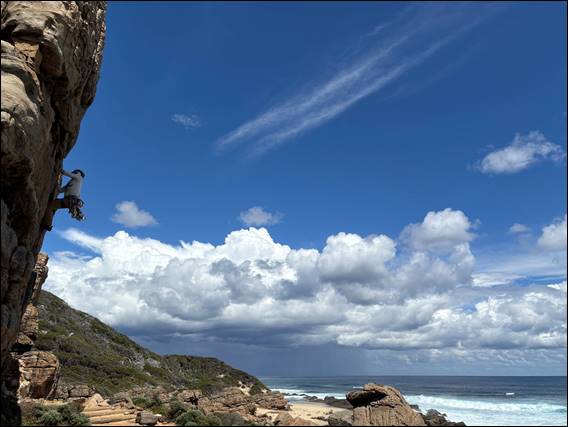
Arriving at the top of Castle Rock, which really isn’t all that high, I had to take five before the next stage. The enviable clear water below, compared to our local beach, looking inviting for a snorkel. The first sensibly chosen line is easy but today felt a little tough. I put this down to being the first climb and needing to limber up a bit more than usual. Nature-based medicine can involve natural remedies and outdoor activities and I was applying the latter so kept going. The body began to move more freely, and while I needed a rest between routes they all fell:
I did not fall, which was a plus. Mind you on these grades and on lines I’ve done countless times, even today that would have been a little disappointing. I purposely did not attempt one particular route. It was within today’s the grade limits and would have even up the numbers, but it is most certainly one of my sandbag climbs. Just as I had when I arrived I took five atop. For a snack, to take in the view, and prepare myself for the walk out. You may think that I would have headed home after what some may consider sufficient medicine:
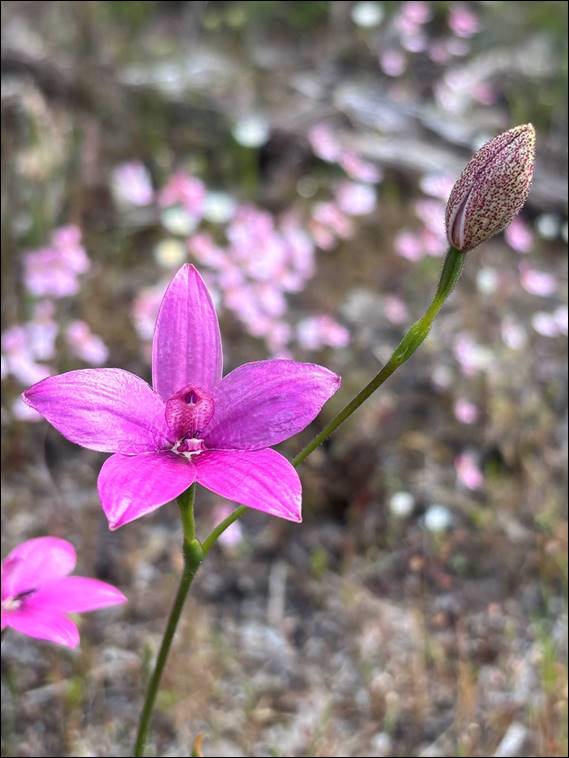
I however had other intentions. My original thought to go to Smiths Beach was to hunt a spider orchid I am yet to find. It is known to flower in an area that is proposed to be developed, meaning the patch of bush will be lost. Not being keen to drive there today I instead went to the nearby southern end of the Meelup Regional Park. Rewarded with two new orchid finds for the seasons. The Pink Enamel Orchid (Elythranthera emarginata), in an image with a lovely backdrop of pale pink Book Triggerplant (Stylidium calcaratum):
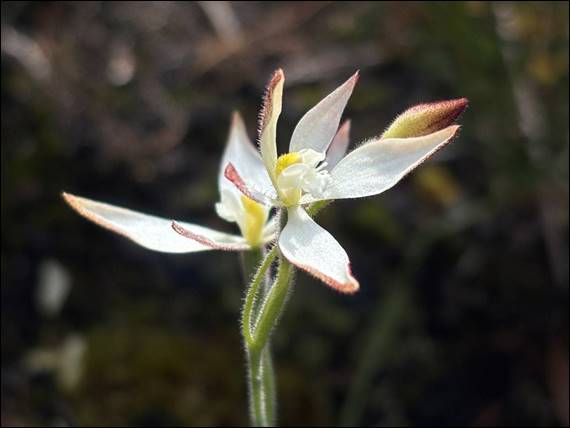
The other find being the White Fairy Orchid (Caladenia marginate). Both were out in good numbers, indicating a shift into the mid to late spring flowering species. Other repeat finds were out but the only spider I was able to find were a few two Rusty Spider Orchid (Caladenia ferruginea), above. I had quietly being hoping to find a few more of the very local species of spiders. In this less than usual season it seems they are not out yet, and the window of opportunity may be closing. Not put off by this I was thinking about another spot:
Feeling like I could manage another short plod I went to the Big Rock Nature Reserve. Only having been here once before. Back then there was nothing that stood out but I thought I’d give it another shot. Quite a few repeat finds and more Blue Lady Orchid (Thelymitra crinita) than I could count. However, none of these sun orchids were keen to open up, despite it being mid-morning and reasonably sunny. The only sun orchid I found in flower was a different species, being a single Slender Sun Orchid (Thelymitra pauciflora):
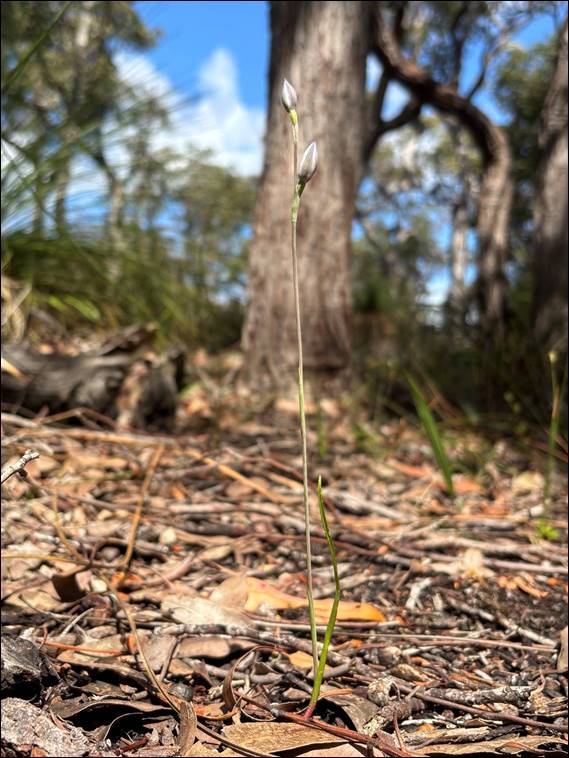
The above also caught my attention, the narrow leaf indicating it is likely the Shy Sun Orchid (Thelymitra graminea), which happens to be closely related to the Slender Sun Orchid. Both generally have smaller flowers and do not stand as tall as other species. Making my way back to the car I followed a tributary of the Dandatup Brook. This eventually runs through the town of Dunsborough and was also unusually still flowing. Feeling I had had a very healthy dose of nature’s medicine, the thought of a relax and cuppa was now calling me home:
Having just got back from overseas yesterday evening, which will be a much longer write up and may take a bit longer, you may wonder why I would be heading out today. It’s been planned for a while now. Originally Howsie and I were keen to sample the rock at a quarry in Perth, chosen for various reasons. None of which Mario could quite understand! Granted the quarries there do not have the green and more nature based charm of our local Well Dam. On the plus side for me it would have been a place I had not been too before:
For that reason alone I really should give it a go one day. If we had headed that way we would most certainly have driven out in darkness. Both being a good 5 hour round trip and wanting to avoid the horrendous weekday traffic heading into and round Perth, which only seems to ease up during the dark hours of the day. What put a stop to that idea was the weather forecast that was hit and miss, in stark contrast to two years back to the day. When Howsie and I did a similar trip in that direction, when the land was scorched:
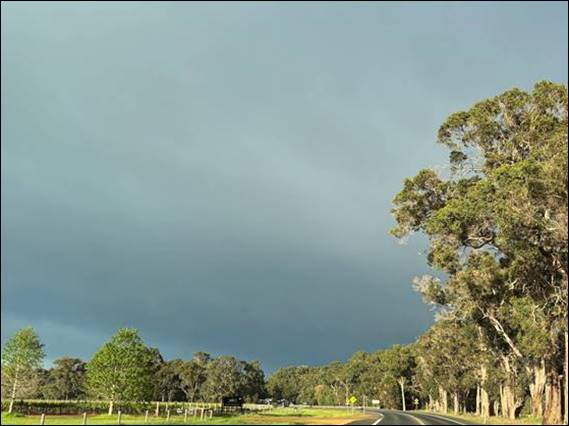
In 2023 we climbed in the blistering heat of the sun with no shade. Today despite the trickery of the morning sky in the first image, as I drove out of Peppy Beach at a far more reasonable hour, I knew we would likely get wet. We picked Craig up on the way down, someone else who is not afraid of being on rock in inclement weather. After that and as we hit the road south the sky ahead became more broody. Wilyabrup was the best place to head, if only for the bigger rooves dotted along the crag to shelter under if it really got too silly:
On days like these there is no need to aim high, it becomes more of a test of the head than the muscles. None of us had anything in mind to give a go, other than me egging Howsie on to try the new line I recently put up with Adrian. I had suggested it was grade 14 and may warrant an R rating, which ‘implies that the protection is widely spaced or relatively poor in quality and that along fall (over 20 feet) is likely, with a pretty good chance of hitting a ledge or something else and getting hurt, or it could be that a short fall guarantees hitting a ledge’:
This description is taken straight from Jim Erickson’s 1980 Colorado guide called Rocky Heights. Some suggest he is the creator of the system. This may be incorrect as the R and X ratings were referenced in the Yosemite Decimal System. Developed in the 1930s by what was known as the Sierra Club. The club had and continues to have strong links to climbing, particularly in Yosemite and the Sierra Nevada. It however originated from the need to act as a non-governmental watchdog to preserve the natural environment:
They were instrumental in getting land placed under federal control, allowing the creation of national parks to provide ongoing protection. A focus that the club continues to monitor and ensure continues. Back to 2025 where the R rating made Howsie second guess himself. So I egged Craig on instead, which he happily agreed to taking on one of the big wide corner cracks. Requiring those traditional climbing techniques of the older climbs to be used. Body jams, worming your way up, and ignoring the wet rock and water running down your sleeves:
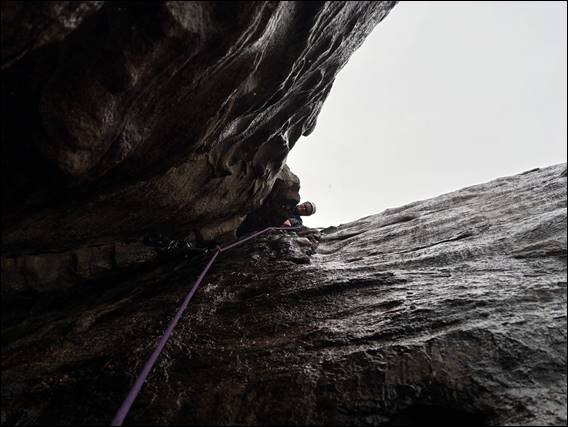
Due to Craig taking the first lead the rock only got wetter. Ignoring this fact, or simply putting it to the back of his mind, Howsie seemed to be happy to give the Christening a go. The reason for the R rating was the image above. A nervous long reach up into the unknown. If you go for it, you are rewarded with a good hold. The sequence in this section has three nervous moves, and with each you get further away from the gear. Slip at the last moment and a 20 foot fall awaits, but it may be a clean fall so the R rating could be unwarranted:
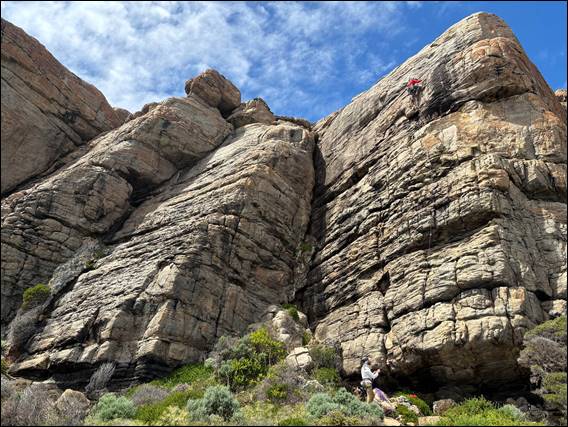
After a bit of a chat about what Howsie and Craig felt. We agreed there are a few other lines at Wilyabrup that will provide a fall of a similar length, which do not have R ratings. The gear is bomber and while untested you are probably not likely to hit a ledge. Not surprisingly the wet conditions made it feel harder but the grade of 14 was considered reasonable, sorry Adrian. If Howsie had waited to lead it for his second route we would know for sure. As on the longest single pitch lower grade traditional style route here, I was bathed in sunlight high on the wall:
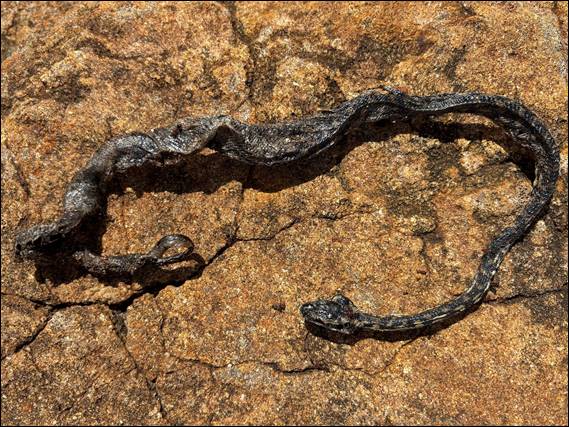
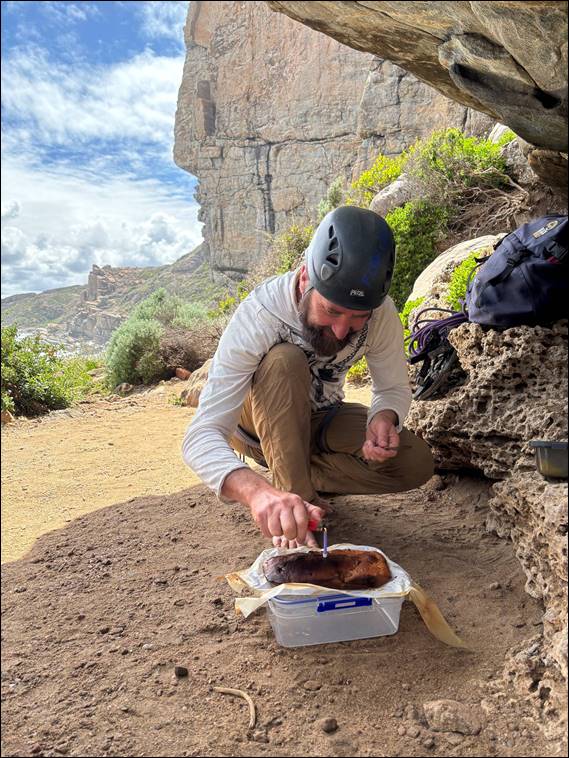
Sadly walking down we came across a dead Carpet Python. The lower part of the body had been ruptured suggesting it may have been squashed. By accident or not was unclear. On a more happy note the unexpected blue skies that seemed to appear quickly and remain with us, drew out quite a few live scaly friends. As well as an almost surfing pod of dolphins. They lined up for the bigger waves and then teasingly hovered on the crest without following it in. Three climbs in it was time for Craig to pour a brew, and Howsie surprised me with a cake:
So as Worzel Gummidge sang it was time for ‘a cup o’ tea an’ a slice o’ cake’, both of which went down very well so thank you both. And in response to the question at the start, of why I would be heading out today, the answer should be clear. Being the one day of the year I will not go to work and, if at all possible, rain or shine I will hit rock. We managed three of the more well-trodden climbs, evening bumping up the grade just a wee bit seeing the rock had dried off. As had the gear that we packed away before the next band of rain drifted in:
I really had no idea what I was in store for. Having previously only ever had a stopover at the airport for a few hours in Singapore on the way to and back from England. All I knew was the airport was grand in scale and display, so maybe that was a hint. Lisa on the other hand likes to have an idea of what we may be heading into. As such she had researched our destination and had an inkling of what to expect. That said no amount of research can prepare you for what to truly expect when heading overseas to a different country and culture:
Singapore is suggested to be one of the most westernised countries in Asia. This is a result of the long history as a British colony, which started way back in the early 1800s. Traditional Asian values are however promoted, creating a blended culture that sets it apart from other Asian countries. Singapore started to break free from British rule in the late 1950s, and became part of Malaysia. This only lasted a for a short period, after which it was expelled due to ideological differences. Primarily due to two reasons, the first being Singapore’s free-market approach:
The second, which became abundantly clear to us, was Singapore’s inclusive approach to different races. Values, morality, and respect aren’t so much preached, but there is evidence as you look round the place, as well as the signage, that there is a strong expectations that we treat each other with kindness and thoughtfulness. And it shows in the communities energy and approach to life, from what we experienced. It was very refreshing and certainly for our six brief days of exploring the area, we were made to feel welcome and safe by all:
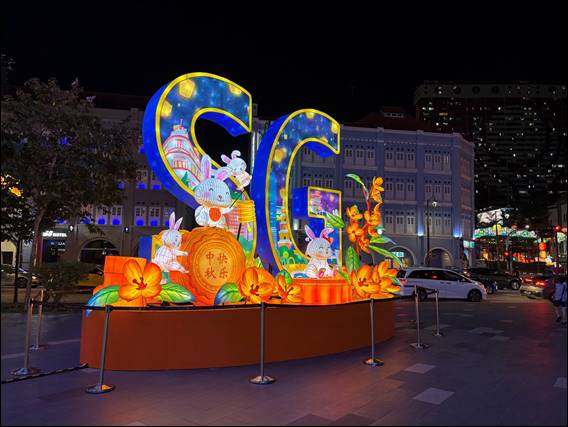
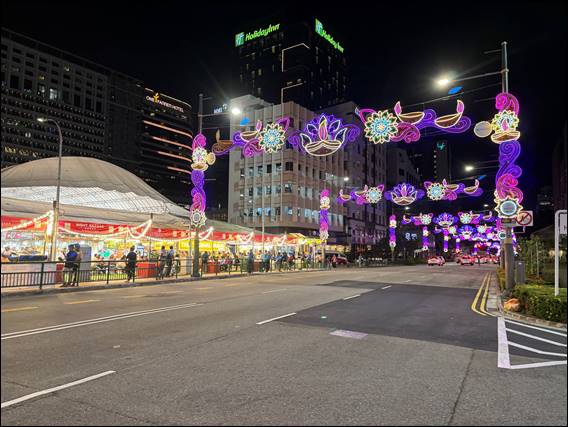
Not just those that we engaged with because they happen to be working, but also the general public. After being expelled from Malaysia, Singapore gained independence in 1965. This meant they celebrated their 60th National Day in 2025, which was on 9 August. Evidence of this was still all about the place, such as the display in the first image. Oblivious to this fact we missed the date and we also unintentionally missed the Singapore Grand Prix. Over a week after the big race, evidence of it remained round the city centre:
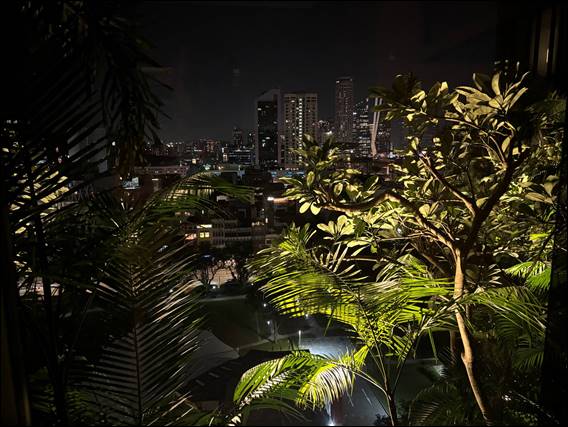
Even though we got in late on the Monday evening, we were keen to get our first sample of the place. After dumping our bags in a hotel that was way more fancy than either of us had stayed in before, check out the view from our room in the second image, we ventured out. Singapore’s climate comprises abundant rainfall, uniform temperatures, and high humidity all year round. The tropical climate sits between a humid 25 to 32 degree Celsius, something that would normally knock me out. Lisa on the other hand does well in humid climates:
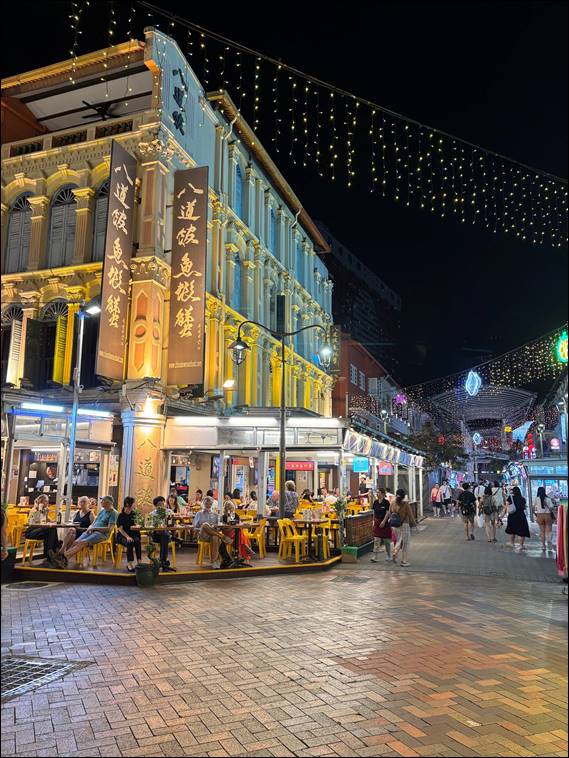
While it was humid it was fortunately not too bad for most of our stay, more of a comfortable muggy feel. Our hotel was right next to China Town, which was a hive of activity. Things take a while to get moving here in the evenings but once they do the place is bustling with locals and tourists alike. Eating out seemed to be the norm for many, with so much choice on offer that it was difficult to know where to try. Not that we needed any food this time, but each day thereafter we tried new places and different foods. None disappointed:
For our first full day we decided to have a wander, to very much a touristy spot of Gardens by the Bay. Lisa had a few things she had spotted that took her fancy, and each day we would have a think about what we felt like we were up for. As we walked through what may be regarded as the heart of the city, it was difficult not to be impressed with the concrete jungle that spread out in every direction. Immense is probably the word. Towering high rises. More than you can poke a stick at, creating incredible skylines to make you dizzy as you looked up:
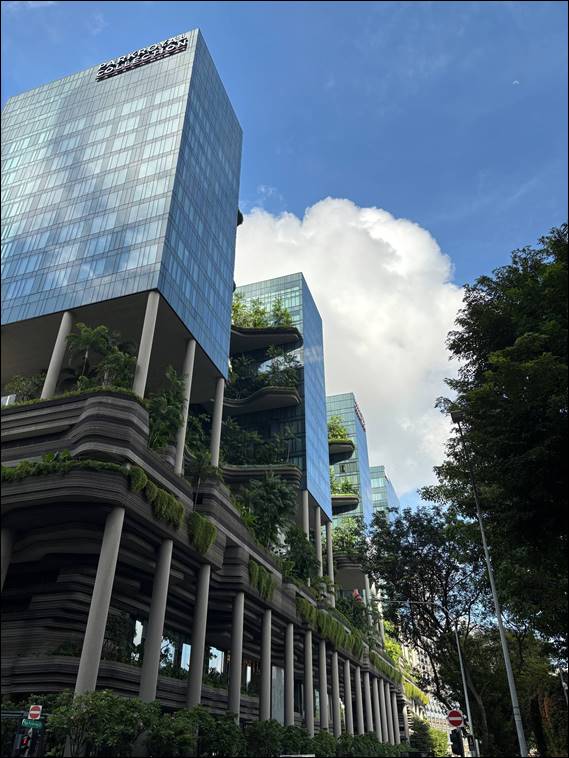
Despite being a city, and we have both been in plenty across multiple continents, this one was different. It was immaculate, clean, neat as a pin, and green. The tropical climate assists with maintaining plant health but the sheer amount of greenery, which had been purposefully and carefully integrated into the street and building designs was stunning. Even the green roofs, green walls, and street scape garden beds were in pristine condition. Something that I hear back home is aspired too, but has never been achieved in any great scale:
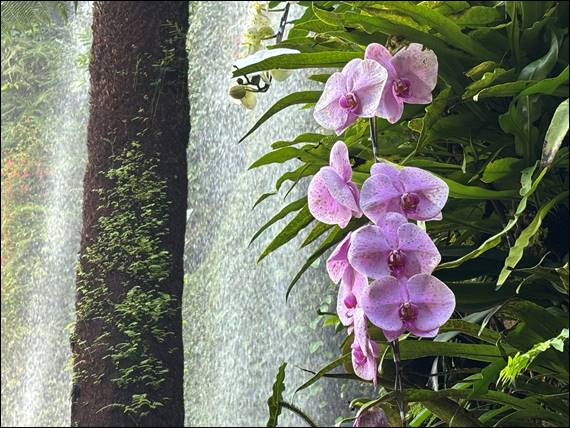
There’s an image of the hotel we are staying at with greenery draped all over it, and then one of the skyline as we walked along the main road to our destination. The flowers are however not from the vegetation we saw, as we walked down, but at the Cloud Forest. One of two huge glass domed gardens at Gardens by the Bay, that provide a celebration of plants from every continent other than Antarctica. The other was closed to allow a change in display, but no matter we spent ages in this one which opened my eyes to a whole new world:
I wasn’t even aware of what a cloud forest was. Typically found at between 1,000 and 2,500m above sea level, and as the name suggests they are frequently covered by clouds. Found in tropical or subtropical regions, these mountainous forests are evergreen and sport exceptionally high biodiversity. I was of course drawn towards the many orchids, but the carnivorous plants also really drew my attention particularly the pitcher plants. Waterfalls cascaded 35m down, and a walkway spiralled from above to the deck:
Having been to many a botanical garden, this one blew me away. Well worth the money, and as with everything else we saw it was so well maintained. Lisa is not keen on heights, and not wanting to miss out did well to navigate the walkways. The waterfalls and misters kept the dome a lovely cool temperature, so eventually walking out into the midday heat was a shock. With the sun out too, the humidity felt a little higher and there was no escaping it. As such we avoided the sun were possible and wandered to a hawkers place in the gardens:
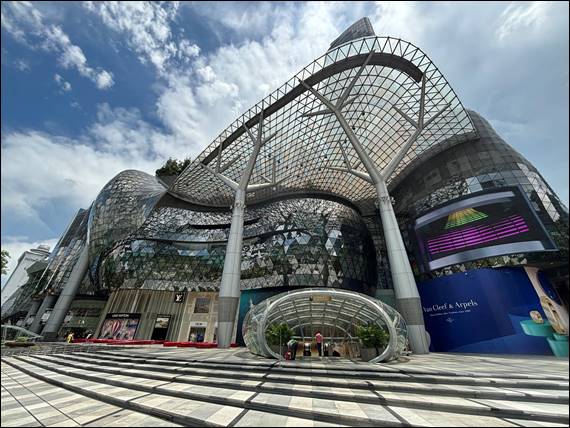
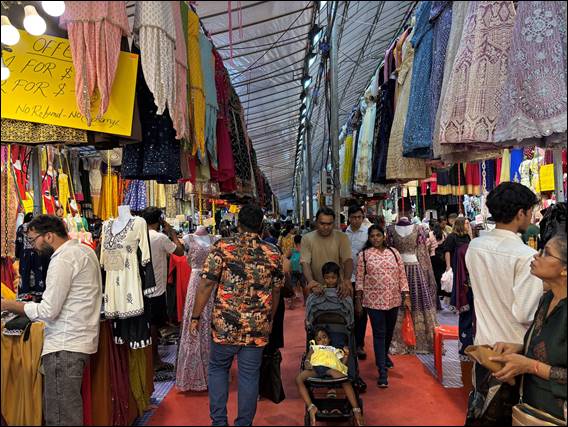
Here we were keen for some local cuisine, of which there was a good variety including a stall with only frog stews. Singapore is not just impressive above ground, but also below. The public transport system has a network of underground trains, with immense stations. And each one seemed to be linked to or right next to a shopping plaza of equally gobsmacking scale. Two images up is just one of so many we saw and had to walk through. Multiple floors of shops and eateries, so many you have to wonder how they are all able to make a profit:
In contrast and as we experienced that night there is Little India. Similar to Little China and Arab Quarter, which we went to later in the trip, these locales were not a sprawl of high rises. The buildings looked old, and indeed the three areas date back to the early 19th century. Little India was established as a settlement for the Indian community that migrated here during the British colonial era. Whereas China Town was a settlement for Chinese immigrants under the 1822 Raffles Town Plan, which was in stark contrast to Singapore’s current inclusive approach:
The concept was to design a structured town plan with racial segregation in mind that was applied to the Arab Quarter too. Not surprisingly there is a strong Chinese, Indian, and Arabic influence and feel in each place, while the rest of Singapore is more diverse. Little India was aglow with light and colour, in preparation for the Diwali festival of lights on 21 October 2025. Another spectacle we missed out on, although we did see Little India fully prepared with the streets lights up. These three districts certainly had a different feel, so were well worth a visit:
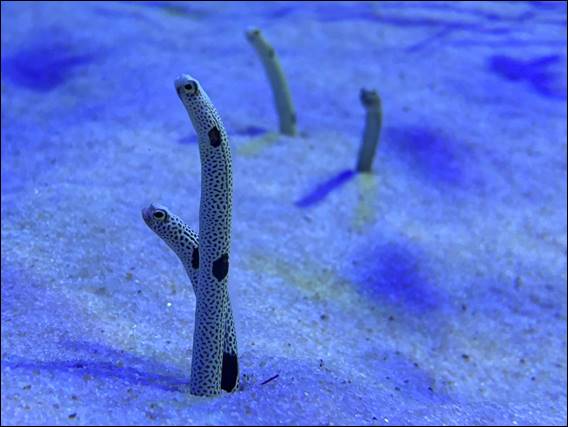
Day two dawned, and we were once more tourists doing the real touristy things. We headed to Sentosa Island located the southern coast. A place where the locals flock to for a local holiday. Beaches and theme parks abound but it was the aquarium that was calling us. Where we whiled away nearly five hours. You’ll get tired of hearing it but again the scale was insane. A network of tunnels that led past exhibitions and tanks covering 22 distinct habitats, the biggest having a 36m wide viewing panel holding back just short of 19 million litres of water:
It was then time for a bit of culture, as we headed to some of the older colonial buildings. Nowhere near as high and with architectural designs that stood out against the more modern buildings of the seemingly never high rises. But standing their own, and equally cared for to ensure they are well maintained and presented. There is a pride of place that came through in every area we ventured. That evening we popped back to China Town for more local cuisines, mind you the variety of cuisine could leave you asking what is truly local:
There is of course plenty of western food on offer, and to be expected with any city all the main food chains are on offer. Part of the trip expectations for me was to eat local, and as such we didn’t have any western food during our visit. While we made use of the public transport, we also realised that there was still going to be a lot of walking. Just to get from one platform to the next in the underground caverns was often a trek. Lisa was struggling a bit for various reasons, so we needed to slow the pace on day three:
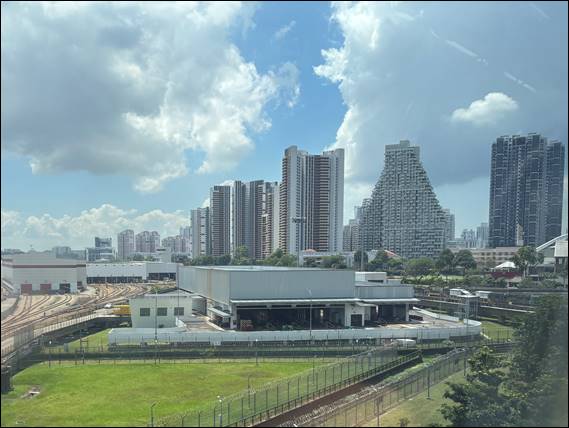
Not wanting to slob about at the hotel, we hatched a plan to see a bit more of Singapore without needing to walk. While the vast majority of the rail system in underground, one line called the north south line is mostly above ground. This actually does a loop round the island, so we sat on the train for nearly an hour as we watched the landscape pass us by. Singapore is small, coast to coast being 49km from east to west and 28km from north to south. Depending on the source I’ve looked at it ranks as the 21st smallest country:
However, the 2025 world population review ranked it third in the world in relation to population density. A staggering 8,177 people live per square kilometre. Not surprisingly with the massive amount of outback Australia has a lowly density of just 4, and Western Australia’s capital city of Perth has a density of just 371. Melbourne has the highest population density of all Australian cities, and even that is only 521 people per square kilometre. Urban sprawl in Australia is an issue, but we seem to have a culture opposed to higher density:
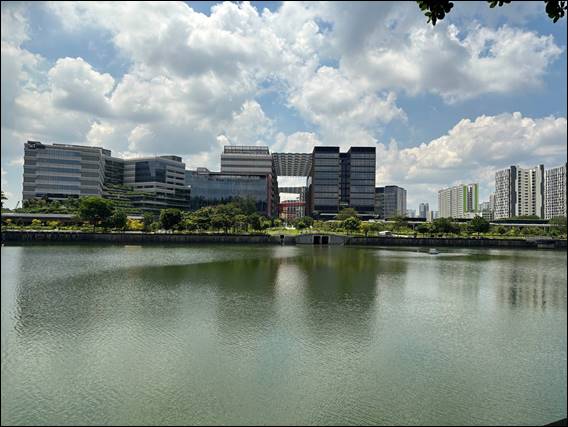
In Singapore they have gone up, and not just in the main city centre. As we sat on the train and rolled along the 27km of above ground tracks it was clearly everywhere, see three images up. There were some areas of lower buildings, mostly industrial areas and a few green spaces but it was mostly up, up, and up. With so many more buildings going up all over the place. The building sites were kept just as neat and tidy as the already built environments, pride of place shone out everywhere, despite four-fifths of the population living in public housing:
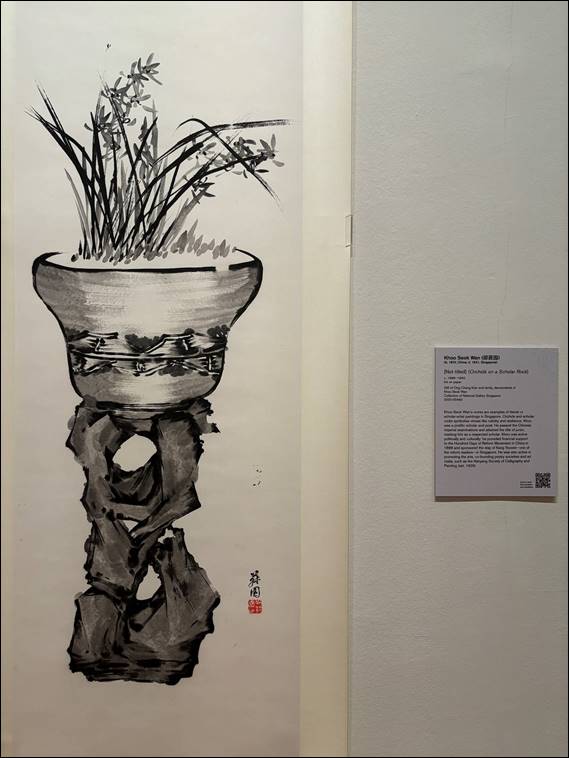
We left the trains behind and headed back to the older buildings, Lisa was keen to find out a bit more about Singapore’s history and culture so we went to the museum. It was incredibly informative but not focused on Singapore. It had a lot about the general geographic area and trade connections. Plus a very cool exhibitions on the history of games, which really tickled our fancy. I’ve included a single image from the museum of one of the many ink on paper artworks, this one dates to 1929 and was called Orchids on a Scholar Rock:
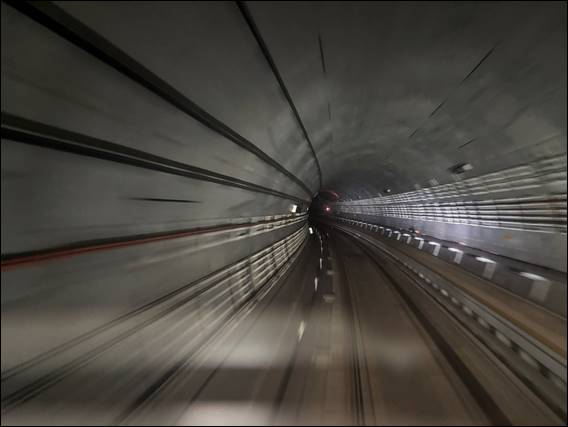
Even the underground train tunnels shown a few images up were neat and tidy. There was a distinct lack of litter in the vast majority of places, despite a relative absence of bins. A complete contrast to the state of the London Underground, which I worked on for near nine months. This was admittedly mostly down to the mindset of the general public about littering. It was time to head back to the room for a rest, and sometime later we hit the trains again to get back to Gardens by the Bay. Being keen to see the Supertree Grove at night:
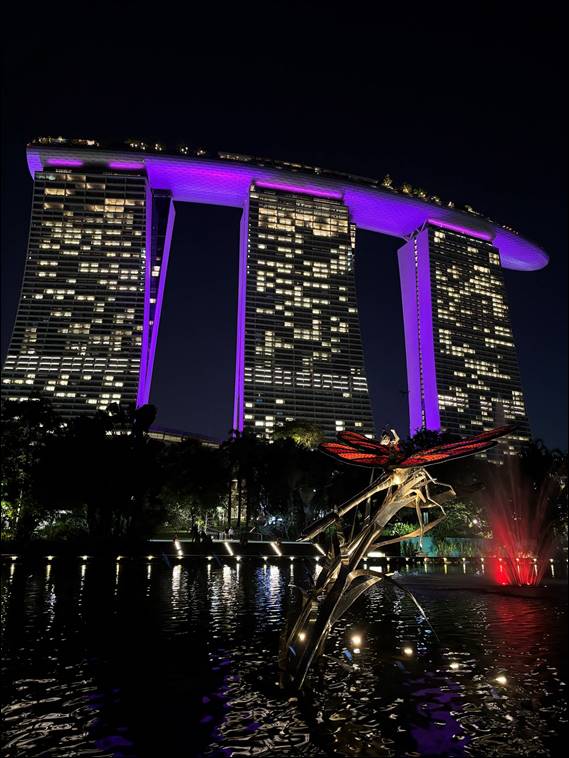
Arriving to find people laying all over the ground, and only then finding out that the daily light show was to start in ten minutes. We laid back to enjoy the show. The metallic trees above not just being for show, as the globes flicked on and off changing colour in time with the music, but also acting as vents for the biomoass energy plant used to generate power for the park. It seems that things here are not just designed in isolation, but as part of the bigger picture. As we wandered back we admired the Marina Bay Sands two image up:
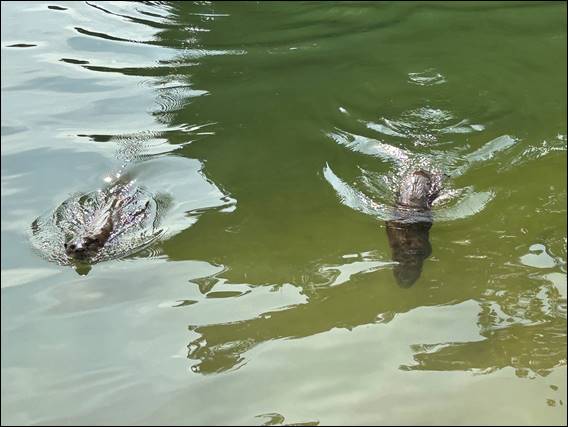
Day four, and we aimed to stay close and observe a bit of both nature and the city. The nature part was manufactured, as we returned to the Gardens by the Bay to visit the second dome, being the Flower Dome. On the way from the train station to the dome we spied some Smooth-Coated Otters playing in the canals. One of the two species that can be found on the island. Both were near to extinction in the 1960s due to the waterways being polluted. A concerted effort to clean up the waterways has resulted in the otters now thriving:
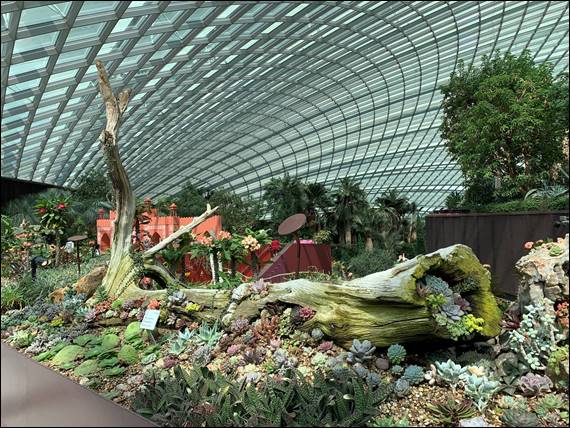
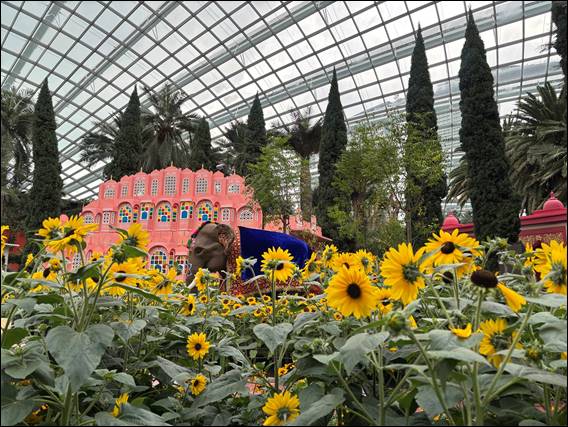
It was more humid today by far, but we sat and watched them for quite a while before escaping to the cool of the Flower Dome. An impressive display of global flora, with two new displays being prepared and near complete. The Aloes in Wonderland and Hindu Diwali festival of lights, the latter surprising me as I had no idea just how many different variety of sunflowers there were. It was very different to the Cloud Forest dome, but equally worthy. Back out in the humidity we started towards the Marina Bay Sands, mentioned previously:
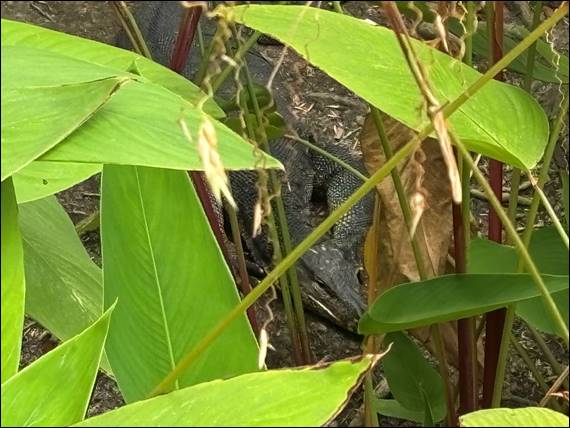
Along the way we took in a few more sections of the outdoor gardens, spotting a couple of reptiles including the above Malaysian Water Monitor. The second largest lizard, behind the Komodo Dragon, and capable of reaching up to 3m in length. Most adults are between 1.5 to 2m, and this one was in that range. The otters were however sadly nowhere to be seen, as we continued. Level 57 of the Marina Bay Sands resembles a boat, perched on three towers. The north tower is where we went up off which the boat hangs 66.5m past over the edge:
Making it the world’s largest public cantilevered platform. I mentioned how Lisa was not keen on heights, so why on earth would we come here. Several reasons, all of which she agreed with. The building is insane and has to be seen to be believed, the views from above are second to none, and it was the perfect place for us to have a drink. When we got to the bow of the boat, Lisa kept her eyes facing inwards and sat well away from the edge. I however wandered round and soaked up the views, and then got soaked myself:
The hot sticky feel in the air was released as a storm cloud came over and huge droplets of rains pounded and splashed off the deck. Some people headed for the lifts to get back down, others found shelter. Allowing me the entire bow to myself. It was atop this mighty position that Lisa and I cheers our near twenty fifth wedding anniversary. First with a champagne for Lisa and local beer for me. Then we decided this was the best place to have a Singapore sling, after which Lisa became more comfortable and got closer to the edge to admire the views:
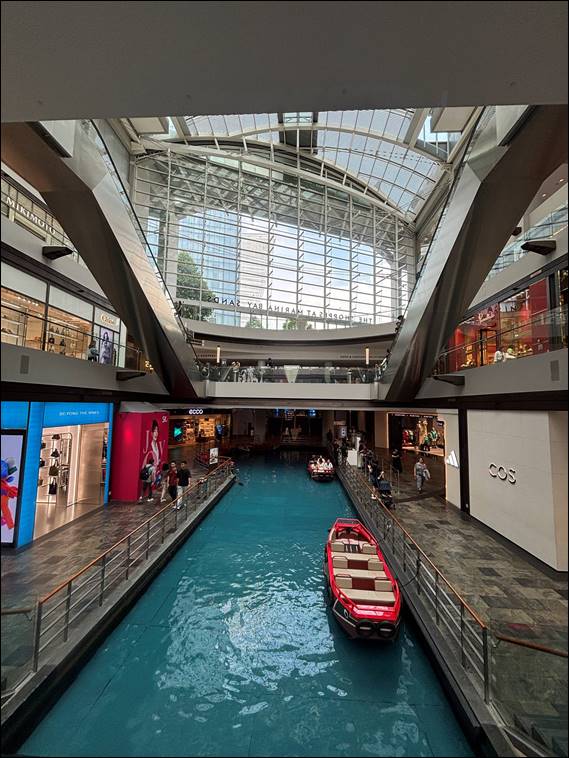
I say near twenty fifth, as the actual date was still two weeks away. October being a busy month for us with both our birthdays and anniversary, so this holiday was a present to ourselves and is also our first ‘just us’ holiday. With the rain having passed over the next load of people arrived to take in the views, and we headed back down. Wandering through yet another crazy looking shopping plaza on the way to the train. This one including a canal and gondolas. We found out the ground floor of all high rises provide for public facilities:
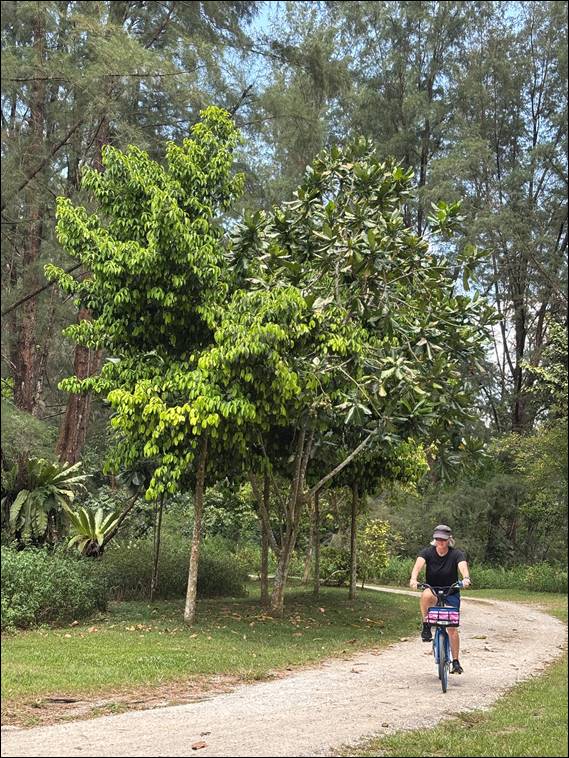
This includes office and residential high rises, again the whole concept has been carefully thought out. The final day arrived, and for this one we headed north to Coney Island. A relatively natural area that displays coastal forests, grasslands, and mangroves. With tracks running around the place, and several bike stations from where you can pick up and drop off hire bikes to get around. As we walked from the station to the island we finally got to see insects, something that seemed strangely absent in all the other areas we had been:
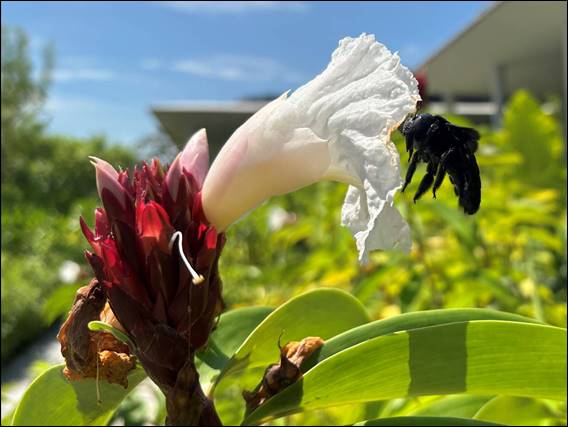
The above Broad-handed Carpenter Bee was somewhat easy to spot, being an inch and a half long and having a wingspan greater than two inches. Once on the island the shade of the tall trees was very welcome, as we pottered about stopping in a few of the small bays and shelters for a rest and to take the place in. It is home to a heap of estuarine and terrestrial land fauna, reptiles, and mammals. Arriving in the heat of the day we didn’t see many, as most of the animals are more active in the early morning and late evening when it is cooler:
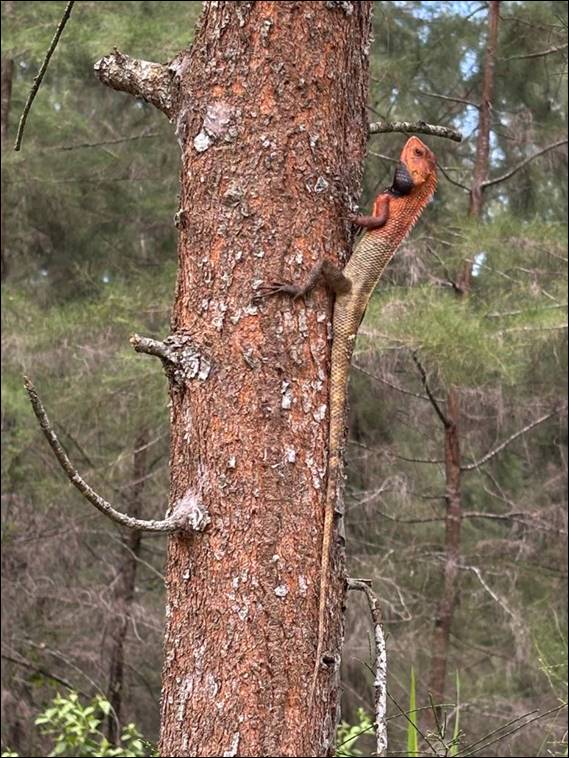
Birds could be heard all over, hidden in the foliage. So other than flashes of colour as birds flew off, and a single Plantain Squirrel the only other creatures we saw were lizards. I thought we had seen a few species of lizards, only to discover most were Oriental Garden Lizards. This lizard can be found in an amazing variety of colours, and has earnt another common name of a Changeable Lizard. Like a chameleon, although not as dramatically, they can change their coloration to match the surroundings or to display its mood:
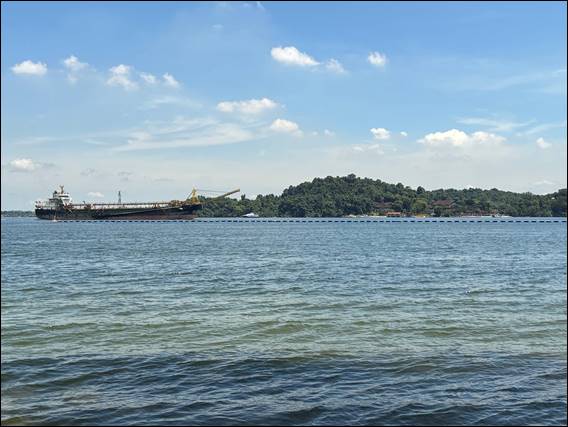
The above Oriental Garden Lizard is displaying its mating colours. We also had a good meter long Clouded Monitor walk across the path as we cycled along. Not caring too much about us as it lazily went on its way, not changing its pace. A good thing as Lisa didn’t see it until I could point it out in the bush right next to the track, where she had stopped after I had excitedly told her to brake. Singapore is separated from Malaysia by the Strait of Johor, an estuarine water body that is 1.6km and 0.6km at its widest and narrowest points:
Above looking north Malaysia can be seen. Despite having expelled Singapore sixty years back, the two countries enjoy a complex but generally cooperative relationship. And continue to have a strong trading partnership. It is hard to understand how Singapore finances the continual growth and development and on such a grand scale. Looking south from Coney Island is Punggol. Designed and built as walkable precinct with a network of pedestrian walkways, cycling paths, and shaded trails. The rail station only opened in December 2024:
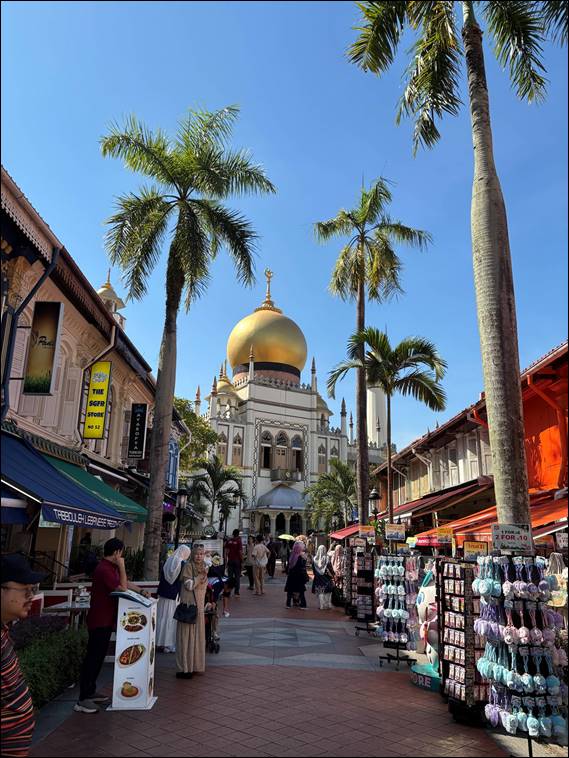
We headed back to the station, and started to get a little desensitised from the grandeur of the infrastructure all around us. We wanted to get to the Arab Quarter, for yet another change in culture and feel. The buildings here took on a different appearance to that of China Town and Little India. As did the wares and food on offer, but not the trinket shops that seemed to be the same everywhere. Lisa only had one aim in mind, and that was to find the place that was reputed to sell the best coffee. We found it and she loved it:
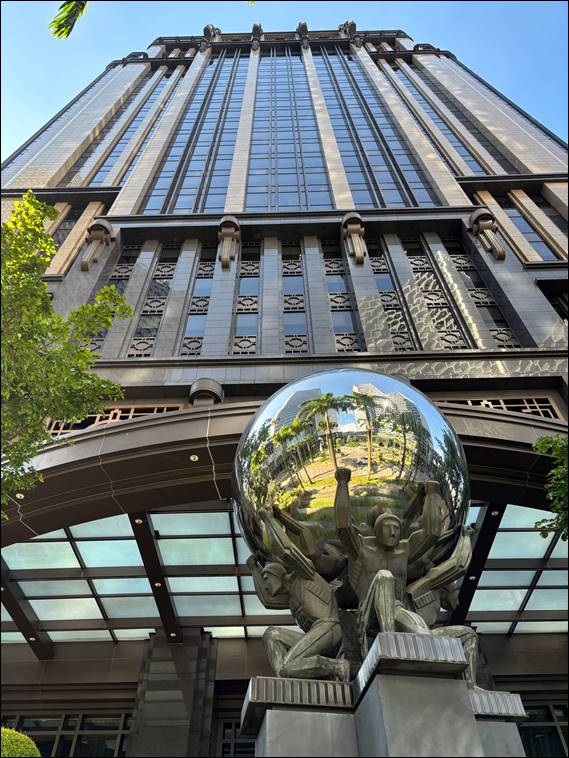
Getting a little weary from the heat, we wandered towards the station to sit in the shade of yet another monstrous building. As Lisa supped her very tasty coffee, I joked that I could see batman emerge from this one. But I am not alone. The locals call Parkview Square ‘Gotham City’ as the architectural style resembles that of the infamous town the superhero watches over. It is one of the most expensive office buildings in Singapore, and home to the Honorary Consulate of Oman and the embassies of the United Arab Emirates, Austria, and Mongolia:
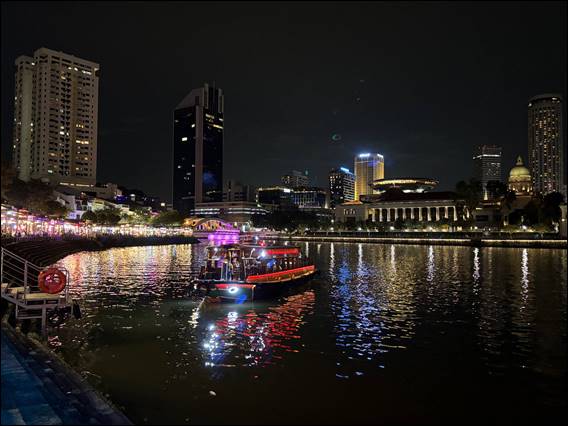
On our last night we wandered through the balmy air to Boat Quay on the south side of the Singapore River. Lined with way too many choice of cuisines, where we plumped for a traditional Singaporean meal. Watching no end of Singapore River boats, known as bumboats, pass by with mostly tourists ogling the city lights and sights. The next morning we were up and out as daylight was coming in. Well and truly satisfied with our fill of city life during a very worthwhile visit. But now looking forward to heading home to our small and sleepy hamlet:
Things might be drying up at Welly Dam but the Capel Nature Reserve is still full of water. In mid-October I would not usually have too much of an issue wandering round, wherever the fancy takes me. Not today, while I had in mind to visit some of the lesser frequented places it was a mission to try and get to them. Often I had to turn back, thwarted and needing to work my way through at times thick bush. The promise I made, as I walked out the door, that I’d only be an hour was dashed. It turned into a lot longer walk both in distance and time:
I was keen for some wet areas, just not as severe as they were. My rationale being that I may spot something unusual due to the wet soils persisting as long as they have. Working my way along the edge of the water, being careful not to sink in sodden soils, I only found two orchids. A Rusty Spider Orchid (Caladenia ferruginea) and soon after what might be considered an aptly named Swamp Spider Orchid (Caladenia paludosa). The former can grow in a wide range of habitats, the latter however likes thick scrubland that is swampy in winter:
Not only is the common name appropriate the species name of paludosa also is, being a Latin word for swampy or marshy. It is stated to be one of the last of the similar spider orchids to flower. That said it has a long flowering period of over three months, from September to early December. Most of the others have a flowering window of two months finishing in October, with a few stretching into three and still about in November. This species is pretty easy to identify, as the fringes and calli are both heavily clubbed:
Calli is derived from a Greek word kallos, which means beauty. It is often used as a prefix for words that relate to something beautiful whether letters, exercise, singing, poems, etc. In the world of plants however it is used as a word in its own right. Mostly however for orchids. Not to be confused with a callus, which is used to described a hardened and thickened area of plant tissue that is often a result of a wound or pathogen infection. In orchids calli are a natural part of the plant and they have a specific and important role in pollination:
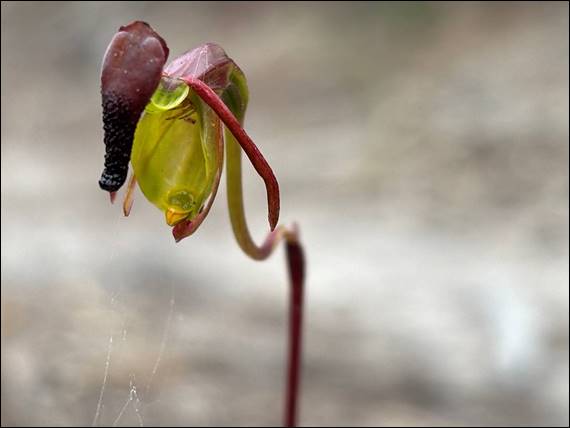
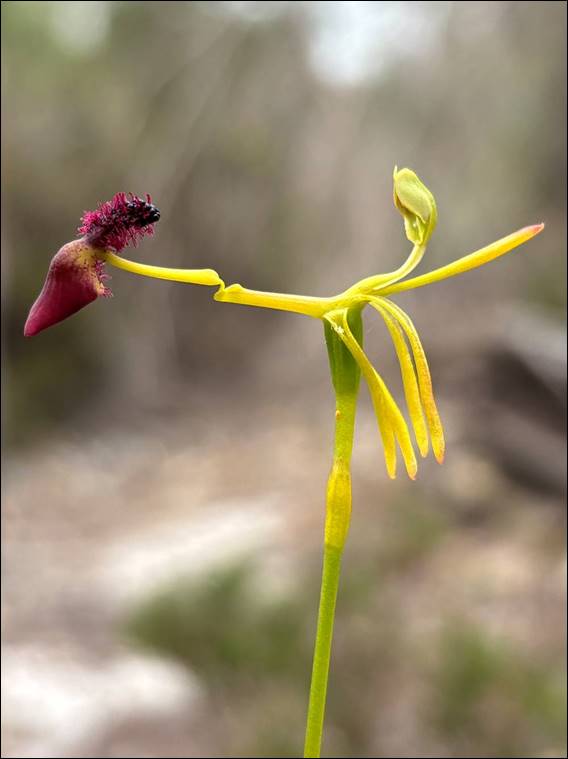
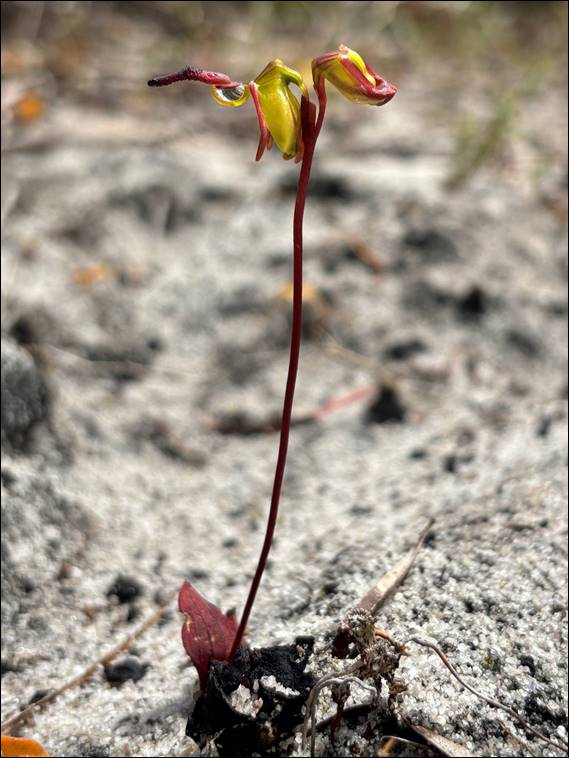
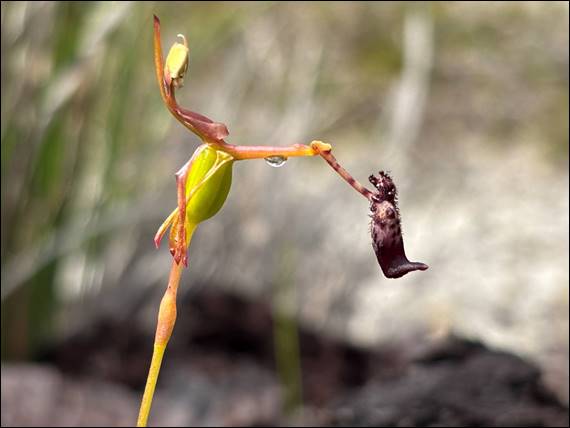
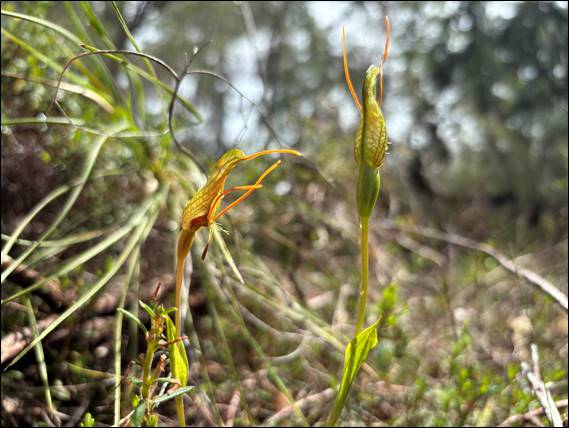
In the Swamp Spider Orchid, they are the raised red bits on the labellum. Looking like upside down shoehorns all neatly lined up in rows. The next image is of a Blue Lady Orchid (Thelymitra crinita), for which the calli are the mauve tuffs that look hairlike. Followed by a Hort’s Duck Orchid (Caleana hortiorum), hosting a spider, on which they present as deep purple glands or balls along the ‘beak’. Finally the Glossy-leaved Hammer Orchid (Drakaea elastica) below on which they are at the top of the labellum again deep purple glands or balls but with fine hairs:
All of the above images are fortunate finds from today, and help to show the range of forms calli can appear in. The way they achieve their purpose can also vary. At times used to attract pollinators, their colour, texture, and/or shape designed to trick the pollinator. Both into thinking the plant may be a mate or a food source. In other orchid species they can be strategically placed and sized. Helping to manoeuver the pollinator to a specific area or part of the flower such as the parts to pick up or spread pollen, i.e. the anther and stigma:
I did not get an image of the calli for the above Twisted Sun-Orchid (Thelymitra flexuosa). Unlike the other orchids I have included in this post, this one is self-pollinating. Yesterday at Welly Dam I saw hundreds of plants, here I saw just two and only one had a flower open. The flowers can grow up to 15mm wide, are short-lived, and open slowly on hot humid days. Today was feeling stickier than yesterday, working in my favour. Not that I would like to climb at Welly Dam in these conditions, I hope I don’t miss the spectacle of seeing them open:
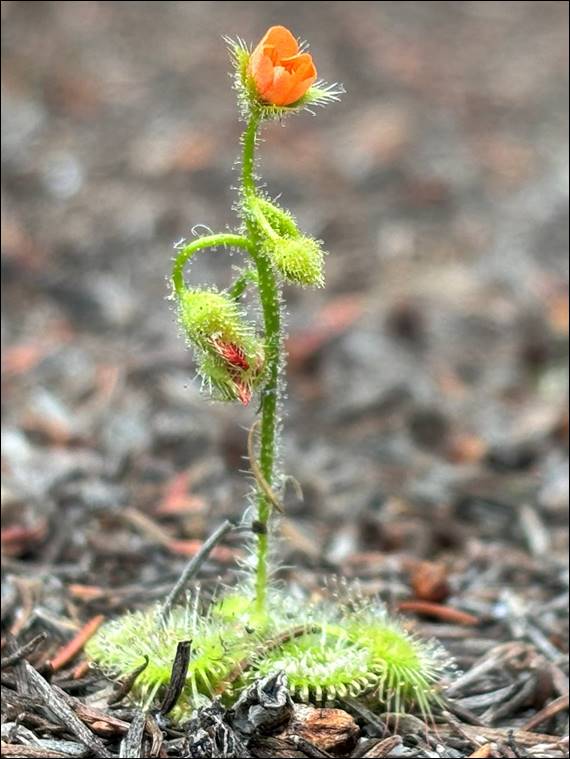
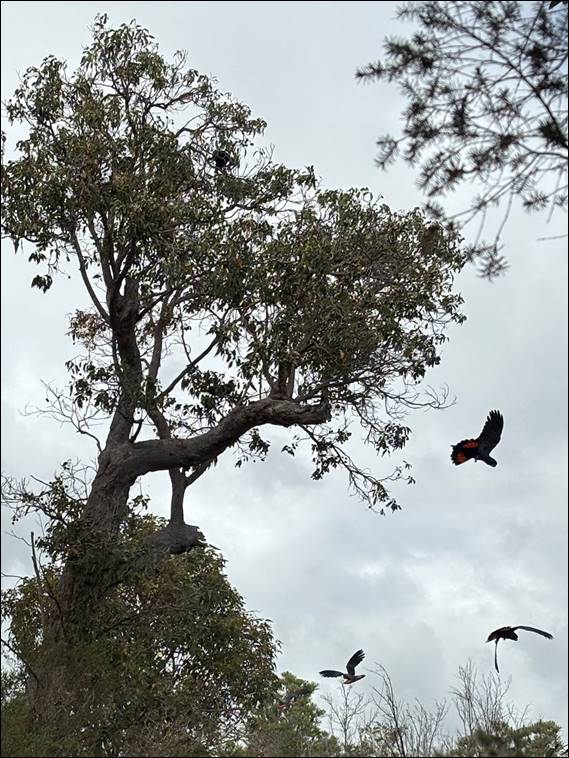
I couldn’t resist an image of the above Pimpernel Sundew (Drosera glanduligera) but didn’t hang about. The combination of bush bashing and being humid meant I was a bit sweaty. Staying still for too long taking images was not wise. The smell of lactic acid and ammonia was the perfect attractant for mosquitoes. There were plenty of them about, although I did stop for a while to listen to and watch the Forest Red-Tailed Black-Cockatoo (Calyptorhynchus banksii naso). Hoping to catch a glimpse of their namesake tail flash its colour:
This post overlaps with the last one. I ran out of my self-imposed text allocation per image to include details about the specific epithet, which basically mean species name, of the Water Bush (Bossiaea aquifolium). This is derived from two Latin words of acus and folium meaning needle and leaf, and the whole word is said to suggest sharp-leafed. This name is most often used for plants in the holly family, and if you check the leaves of the Water Bush they do have a holly leaf shape. As I read on aquifolium was stated to be the pre-Linnaean name for holly:
This led me down a rabbit warren into finding out about what ‘pre-Linnaean’ meant. Taking me back to the 18th century, when a Swedish biologist developed what is called the binomial nomenclature. In plain language this means a two-term naming system, and relates to the genus and specific epithet. The scientific names of these two components are usually derived from Latin, but other languages have been known to creep in. The biologist responsible for setting this up being Carl Linnaeus, known as the father of modern taxonomy:
I did find it interesting that taxonomy itself is in fact derived from two Greek words taxis and νομία (pronounced nomia), meaning arrangement and method. And while on this fact finding mission I thought I would check out the word I use the most, species. This does come directly from a Latin word that means kind, sort, or appearance, which in itself is derived from the verb specere meaning to look at. As such the eminent and more well-known Charles Darwin did use the right term for his 19th century book The Origin of Species. Of course he did:
The full title of his work was ‘On the origin of species by means of natural selection, or the preservation of favoured races in the struggle for life’. One of the modern day definitions of species is ‘a group of living organisms consisting of similar individuals capable of exchanging genes or interbreeding’. Something that I guess could occur as part of preservation. And this would suggest the term specific epithet and species are not interchangeable. As I have found in trying to identify my finds, many orchids regularly exchange genes or interbreed:
When two different specific epithet orchids do this they are said to hybridise, but should they be one species? Hybridise comes from a Latin word hybrid, translating to mongrel or offspring of parents of different species. This however now indicates they may be interchangeable. Confused yet, because I am. You can probably see why I ran out of room, and after all that I think I will stick with species rather that the mouthful of specific epithet. Especially seeing in the classification breakdown on the Atlas of Living Australia, they use the term species:
It felt like I was going round in circles with all that, which is what I did at Crook Brook. Two circuits in fact, on a relatively quiet day here. This may be surprising considering the lovely day it was for a walk, not a climb at Welly Dam. The crowds were instead being drawn to the nearby Dardanup for the annual Bull & Barrel Festival, something we have still not been to. I’d rather be out here than in amongst throngs of people. And while it was a very pleasant gentle stroll, despite not seeing many orchids I now have to speed things up:
This will now be a quick fire list of what I found being: a spectacular looking Scented Banjine (Pimelea suaveolens); a lonely Leaping Spider Orchid (Caladenia macrostylis) with the maximum number of three flowers; one of several Scented Sun Orchids (Thelymitra macrophylla) that unlike those at Welly Dam had a few flowers open; all I can work out is it is one of the Flame Peas(Chorizema); and an elegant Blue Lady Orchid (Thelymitra crinite) from which I was going to get into detail about the role of calli but that can wait for another day:
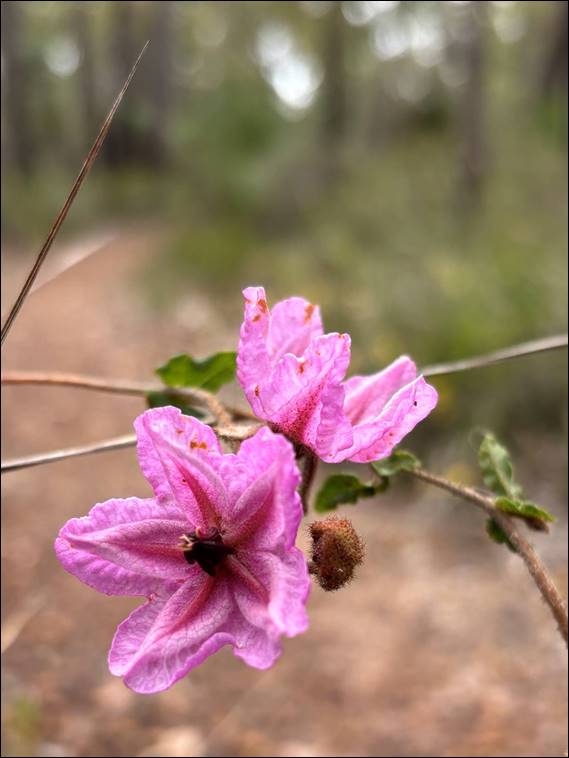
The next image being one of the thirty one species of Thomasia, thirty of which are endemic to the south-west of Australia. My guess is it maybe the Large Flowered Thomasia (Thomasia grandiflora). The last two images are of a Clubbed Spider Orchid (Caladenia longiclavata), I only found one. Said to be common and widespread yet this is just the second I have ever come across. Part of the species name comes from clavus meaning “club” or “cudgel” in Latin, appropriate as my brain feels a bit like it has been bashed in from researching these posts:
I saw things had changed when I checked my phone at 4:15am, which was my designated time to get up and ready for a proposed cruisy climb on the coast with Rongy. His body clock had been thrown out by shift work and prevented him from managing to get much sleep, so he decided it was best to bail. I was torn. The idea of a cruisy morning out was still appealing. However, I was also keen to check out what may have changed at Crook Brook seeing I hadn’t been there for some time. That meant heading to Welly Dam, which would be far from cruisy:
I still hadn’t made my mind up as I started to drive out. And it wasn’t until I hit the T-junction at the end of the only road out of Peppy Beach that the decision was made. It was the sky that assisted in swaying my indecision. Grey and overcast to the west, while clear skies lay to the east. My thinking was that clear skies would hopefully mean relatively low humidity levels, which is kinda important at Welly Dam. Plus Crooked Brook was still at the back of my mind. Gently urging me to turn left to a more serious session, which is what I did:
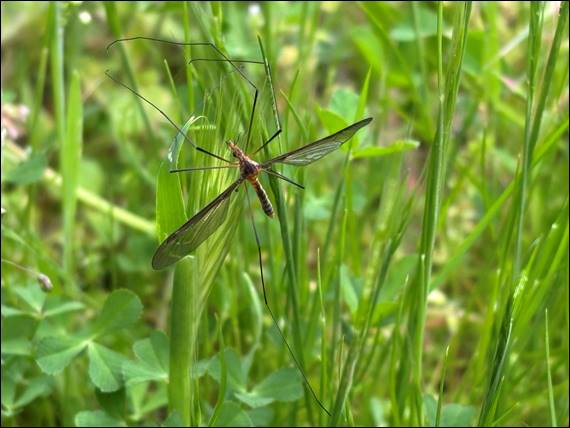
Before we get to the rock I better mention the Crane Fly (Leptotarsus) in the first image. The only living thing I saw after I had set up on the first route of the day. This genus is one of several in the Tipulidae family, commonly known as large crane flies, found in Western Australia. Further, it is suggested there are approx. thirty species in Western Australia, and despite this relatively low number I have not been able to narrow it down to a species. Seeing Rongy was, hopefully, catching up on sleep, I was flying solo. Flying being the operative word:
I did a fair bit of that today even though I picked sensible lines. It felt like I needed a crane to lift me up the climbs, as at times even when I felt in a secure position I slipped. It was in complete contrast to how I performed here a week back, and for that trip I picked harder routes. The second image might give a hint as to one issue. It may be difficult to make out but I have left a sweaty palm print just below the sloper. By the time I arrived the clear skies were gone and grey clouds hung above. The rock felt a little ‘off’ and the skin a tad clammy:
On the plus the seepages that were still evident a week back on many of the lines was mostly gone, with only two routes still sporting water on them. The above climb, which I slip-slided my way up, didn’t have any water but was still splattered with debris that had been dribbled down the rock from above. This was the last line, four climbs was defiantly enough today. Eight laps at the dam is respectable, the main cue to wrap thing up was however the people that had started to appear. But before I left I wanted to check out the top of the crag:
The water at the top of the crag that had been evident in relatively large pools had also mostly gone. It had however already worked it’s magic of giving life, and I found hundreds of Twisted Sun Orchid (Thelymitra flexuosa) buds, all tightly still clamped shut. In addition there were stacks of Plain Sun Orchids (Thelymitra paludosa), also firmly closed except one or two that had started to crack open a touch. The below pink variety being the one I really like. If I waited around for the temperature to warm up some may have opened:
That was not going to happen today. Crooked Brook was calling. I was also put off staying much longer, when a couple of the groups of people who had started to appear almost shouted out in excitement ‘look there’s a climber!’ To put the final nail in the coffin, an abseil group was about to turn up. Back at the carpark the tour operator was pulling the gear out, as I was putting mine away. On the road out I pulled over for a positive sensory overload, provided by swaths of fragrant Water Bush (Bossiaea aquifolium):
Some may consider that just thinking about heading out for a wander at the Capel Nature Reserve was not appropriate, on today of all days. Lisa was however heading to F45, her usual workout class, for the first time in several weeks. She’s been figuring out a back injury, and is just starting to get to grips with what does and does not trigger it and how to manage it. As such, and under instruction from her physio, she has been given the green light to head back. Leaving me an hour and half or more to sneak out by myself, where I was hit with colour:
Where I began my walk White Myrtle (Hypocalymma angustifolium) and Orange Stars (Hibbertia stellaris) carpeted the area. Continuing on, it was hard not to get distracted by all the orchids species. All mentioned in recent posts, and while I couldn’t help myself and took lots of images I will refrain from including them here. Just like Lisa was this morning, I was on a mission so had to keep going. All season I’ve been banging on about a particular endangered species of orchid. I spotted the leaves in April and I have been eagerly awaiting the flowers:
Not wanting to miss out on seeing the Glossy-leaved Hammer Orchid (Drakaea elastica) in all its glory was the main driving factor for this morning’s visit. Since April, each time I have come back I have seen more plants. Despite seeing so many leaves very few have formed spikes, and some of those have since been damaged. Above is a clump I have been observing most regularly, with one bud just opening. Even at the area with the greatest abundance of leaves, where someone has been placing cages to protect them, only a few look like they will flower:
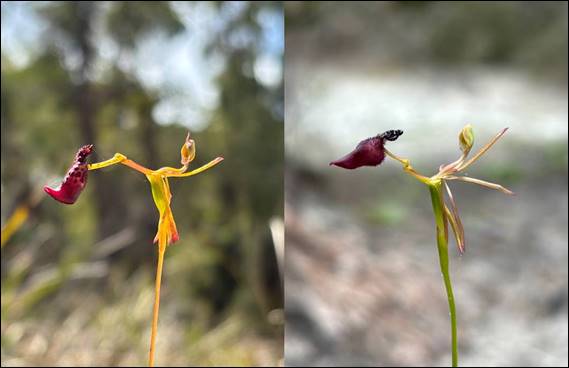
One was however out, and looked stunning in the early morning light. Needless to say I was one happy bunny. In total I’ve been lucky enough to have found four species of the hammer orchid. One back in 2022 during an overnight trip further to the south, and this season I’ve bagged the three species whose range extends into our local area. Images taken this season of the other two are shown below, for comparison sake. Being the Warty Hammer Orchid (Drakaea livida) and King-in-his-carriage (Drakaea glyptodon):
Back home after my success I was greeted by Lisa hobbling round the corner. It seemed she had not been successful and done herself in again, until she smirked and gave her ruse away. The cheeky bugger. This meant our plans to head out for breakfast at the South West Bottega to celebrate today was still on. A relaxed munch with a game of king cribbage was on the cards, after which we felt the need to walk the food down. Ambergate Nature Reserve is just down the road, offering the perfect destination with a level path to avoid any back issues:
The walk is neatly spilt into four sections, and as if knowing what day it was the Rusty Spider Orchids (Caladenia ferruginea) were shooting up all over the place. A bit like party poppers firing confetti into the air. We lost count of how many we saw, which really surprised me as I saw no trace of even their spikes on my last visit. Lisa was very happy to see them but felt I was barking up the wrong tree when I showed her at least two Carbunup King Spider Orchids (Caladenia procera) in the party mix. One shown above with a Rusty Spider Orchid behind it:
With all the spinal references above, you may be wondering how Lisa managed our walk yesterday. In answer, a little painfully. During that walk she did however suss out how to release the tension whenever it came on. By more frequently applying the technique, todays wander was way more enjoyable. Each time she felt the need to take on the squat pose, it also allowed my eyes to drift a bit longer. This meant I found the above Common Mignonette Orchid (Microtis media) for which both the common and genus names mean small:
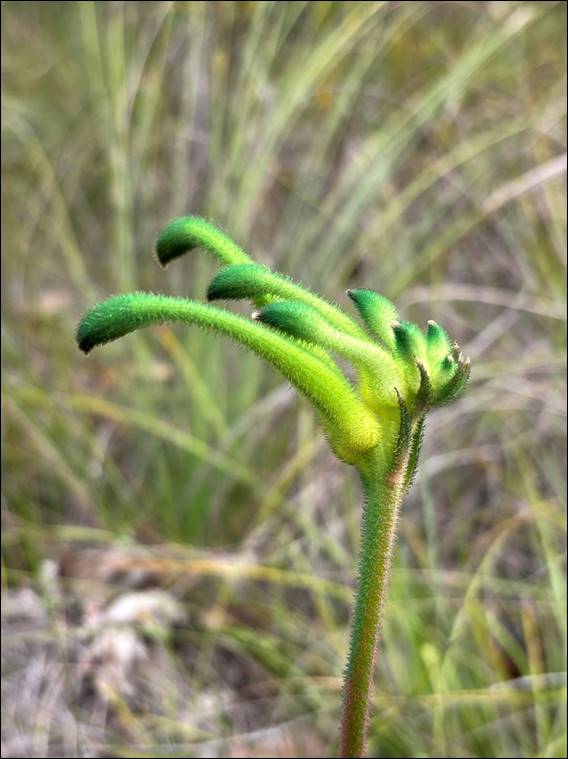
This was spotted in the second quarter of the walk, as well as the above Green Kangaroo Paw (Anigozanthos viridi). Despite being native to south western coastal regions it is the first time we have seen the green variety in the wild. The Red-and-Green Kangaroo Paw (Anigozanthos manglesii) is the one that is the most prolifically found. The flowers that tickled Lisa’s fancy the most on this section, which we didn’t see in the others, were the Pink Fairies (Caladenia latifolia). Looking like pretty bows used to top a ribbon on a present:
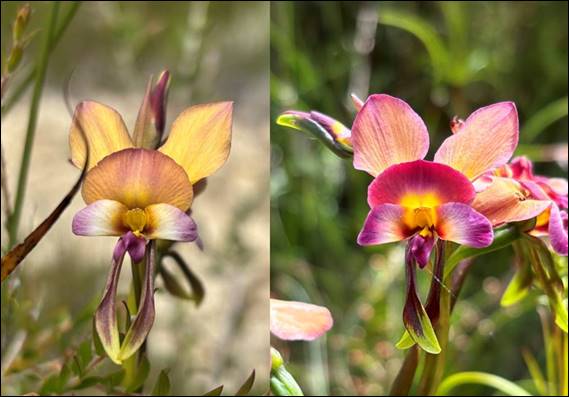
As there had been during this morning’s wander we saw lots in flower, so I’ve sneakily doubled up a few images. Crossing the road into the third quarter, the vegetation changed again. In this section it was the Donkey Orchids time to stand out. Like the Pink Fairies they were only in a small area, it is funny how that happens. However, the two most colourful species were out, being the Dunsborough Donkey Orchid (Diuris jonesii) and Purple Pansy Orchid (Diuris longifolia). On display like a bowl of candy’s, a sweet treat on a special day:
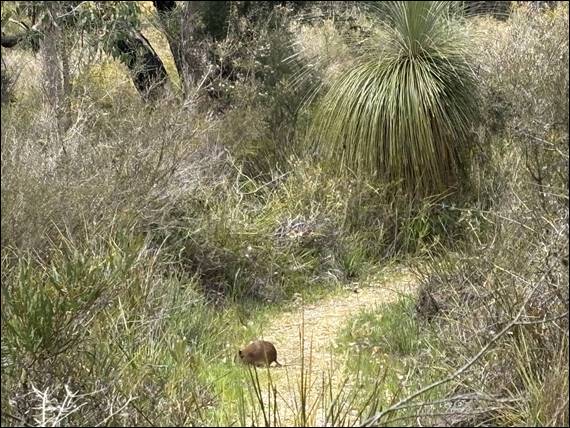
The last leg can at times feel a little lame in comparison, when it comes to finding orchids. Today was no exception. Then Lisa stopped dead in her tracks. Not because her back spasmed. Ahead of us was a Quenda (Isoodon fusciventer), happily nibbling the grass on the side of the track. We stood quietly for what felt like ages watching it until it had enough and headed off. Seeing it felt like a real gift. Finishing the walk it was back to the South West Bottega for lunch and game of scrabble. If you hadn’t guessed by now, happy birthday Lisa:
An English manuscript in the 16th century, about what I cannot find, reportedly referred to the not so pleasant life of a dog. A life of subservience, fed scraps, kept out in the cold, and only kept alive while it could undertake the works forced upon it by its owners. The phrase coined was not intended to create images of what you would consider a good life. Shakespeare also used this intent in the seventieth century, 1606 to be precise, when in Timon of Athens he used the insult ‘Thou was’t whelpt a Dogge, and thou shalt famish-a Dogges death!’:
In much more recent times and in stark contrast, in western society at least, for many a dog the idiom ‘It’s a dog’s life’ has been completely flipped on its head. Now being very much in their favour, as these pampered pooches have become part of the family. Many given as good, and some are even given better treatment than our fellow humans. No longer thrown out and abandoned when they are no longer useful, indeed some strive to keep them in the best health possible to extend their life span:
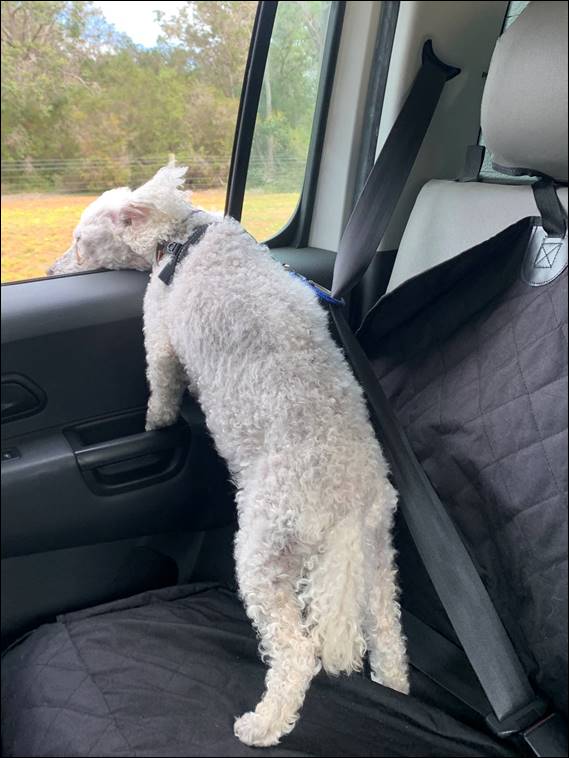
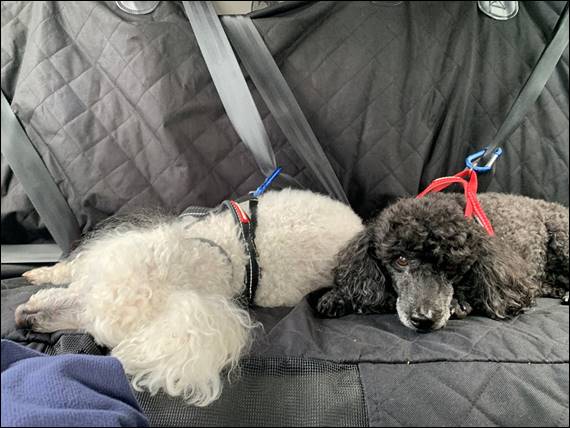
At fifteen years old Nicka, shown hanging out the window, is certainly going well. But her and Sooky’s, who is two years younger, good condition comes down to the basics in life. A balanced diet, healthy living, and of course a dose of luck in terms of not having been afflicted by the many ailments that can impact us despite our best efforts to look after ourselves. Miniature poodles are said to start to lose that youthful puppy personality at around 3 to 4 years of age, but not our two. At their very much mature years, they are still very playful:
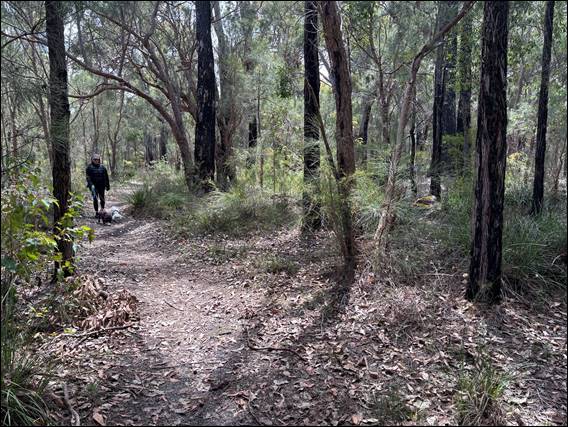
The basics of life and maintaining a youthful attitude, as much as possible because there are times you do need to act your age, is high on Lisa and my agenda. For me that includes getting out in nature as much as possible, which is why here is yet another post of the great outdoors. Visiting a place we have been to three times before, twice in spring and once in winter. Today as we wandered round the Kondil Wildflower circuit just outside of Nannup, it felt a little more like a winter walk despite being spring time. As were others out, we were rugged up:
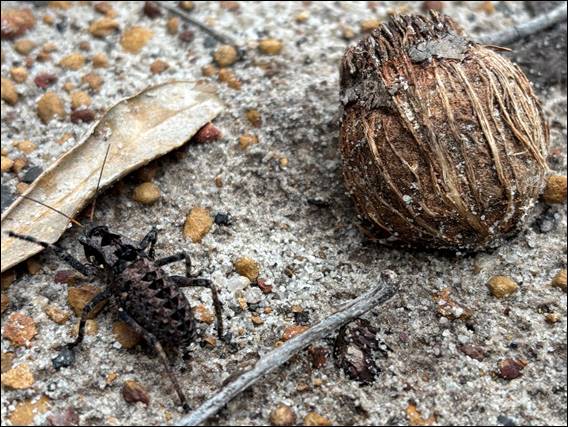
A circuit of contrasts. The start was damp, vegetation thick and green, and one section of the path was completely underwater. Then from about the halfway point it became dry and barren, the vegetation looking like it was just hanging on. With the poodles in tow, the pace was dictated more by them than me, as I looked for orchids. It wasn’t fast but not as slow as the Sluggish Katydid (Pachysaga australis) we spotted as soon as we stepped out of the car. There are approx. 1,000 katydids in Australia but only six species in the Pachysaga genus:
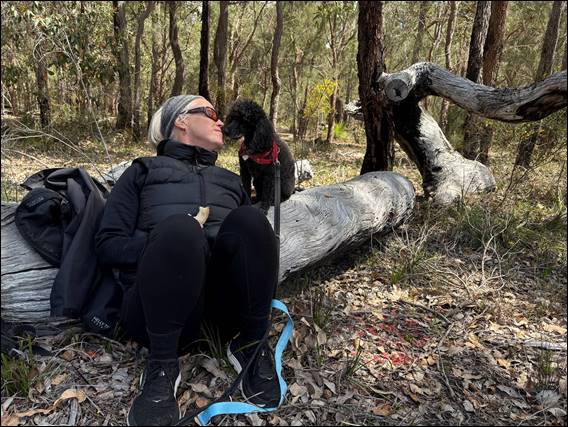
The markings make the identification indisputable. The recorded observations however hint otherwise, most being round the Perth Region and just one sighting near Bunbury. Halfway round Lisa and I ducked off the circuit onto another track, where I knew we would find some perfect logs to rest against for a cuppa and cheese butty. I also hoped for some orchids but in comparison to our previous spring walks it was incredibly light on. This particular spot has previously been abound with ducks and hammers, today I spotted just one or two of each:
Unlike the Hooded Lily (Johnsonia lupulina) a few images up, all the greenhoods we saw were wilting and on their way out. The only orchids in abundance were the karri cowslips and rattle beaks. That said not all was lost and I did clock up another subspecies of the white spider orchids, with the above Merritt’s White Spider Orchid (Caladenia longicauda subsp. merrittii). This subspecies are found mostly in a narrow corridor that stretches from Karridale to Nannup, another large flowered plant of which we only spotted the one:
There were quite a few people out, not that we saw them during the walk. This included two locals geared up with cameras, obviously looking for orchids. They too said it had been very light on today, so I do not think we missed anything of note. To wrap up the walk there was a single Leaping Spider Orchid (Caladenia macrostylis) very close to the car. The species name macrostylis comprises two words for which the meaning should be obvious, being big style. The poodles showed none of this, flopped on the back seat asleep for most of the trip home:
Yesterday was a great day to catch up with general stuff. The things that need sorting but you seem to put off just one more day. In my mind while it was a wet rainy day I did think a quick trip down to Iron Gully Fall might be nice. That is a not too far away, but first I focused on the other bits. Doing pretty well until my phone, which I really do not use too much other than organising climbing trips, started suggesting a bunch of messages dropped. It was Josh, climbing Josh this time. He sent me a load of images of orchids that Kellie had spotted:
One of the species was still on my tick list for this season, and I had to ask where she had been. Yallingup Siding was the spot. Funnily enough a short three to four kilometre drive north of the place I checked out last weekend for the first time, Yelverton National Park. It is not part of this park but sits alongside it, and is part of the same continuous bit of bush. I had noticed this area last weekend, because from the aerial imagery it looked to be more open. So while connected it was likely to have a different vegetation complex:
Lisa was having a lazy day and more than happy to have the house to herself. Especially seeing it was peeing it down outside, and had been all morning. This meant I went prepared with rain gear, thoroughly expecting to get thoroughly wet. Not put off by the dampness and being geed up by the chance of another species to add to the tally. It rained the whole way down, and it was not until I got closer to my destination that the windscreen wipers could be turned off. I timed it perfectly not even needing a Granny’s Bonnets (Isotropis cuneifolia):
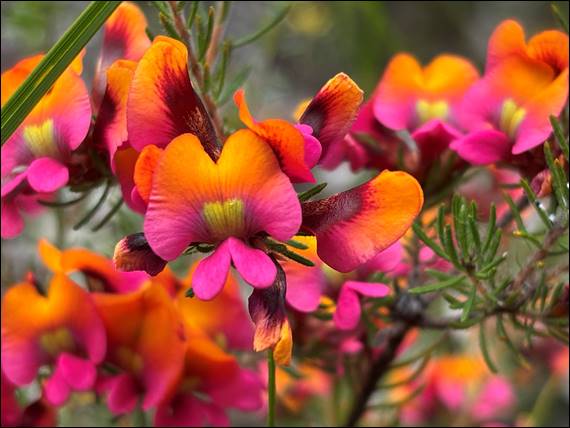
This particular pea was very pretty, as they all are, but seemed more so. The structure of the broad petals being visible on the back of the flower was extremely striking. I didn’t find a cluster of flowers that allowed me get a front and back shot at the same time. Although the above starts to give an idea of what the back looks like. So you get the best of both worlds, so to speak. There is always a risk of going somewhere with a preconceived idea of what you will see, and I tried to push those thoughts of what Kelly had seen to the back of my mind:
It was a bit of a slow start as I shuffled along scouring the ground. Pleased the rain looked to have finished, with only the lightest of sprinkles when I first arrived. My first spot was diverted by the an Australian darkling beetle, Ecnolagria aeneoviolacea that I can find no specific name for. Darkling beetle is the general name given to beetles in the Tenebrionidae family. It is not surprising they do not all have common names. There are over 30,000 known species worldwide of which 1,500 have been observed so far in Australia:
I’m getting side-tracked but will mention that there are currently over 400,000 described species of beetles, which makes up a quarter of all known animal species. This makes me wonder how they can allude me considering all the time I spend in nature. Above is another specimen of the orchid that the Darkling Beetle had drew my attention from. This really is a Flying Duck Orchid (Caleana nigrita), and unlike my rookie error a few weeks back the image includes the basal leaf. A wider leaf than the Hort’s Duck Orchid (Paracaleana hortiorum):
The hump in the labellum is also more pronounced in the Flying Duck Orchid. Making me think that at the Capel Nature Reserve I have only seen the Hort’s Duck Orchid. While there are plenty of images online to check these details out, it is not until you see things for yourself that some of these subtle differences really start to stand out. Another orchid that Kelly spotted, which is known for not standing out is the above Zebra Orchid (Caladenia cairnsiana). While its range extends from Bunbury and Esperance it is not often seen here:
I saw it a few weeks back for the first time in our local area, so when she had spotted one I was keen to come down and check out how many I might find. They can easily be missed, being such a small and compact flower with colours that blend in with its surrounds. So while there may have been more I only spotted one. As I did with the above Warty Hammer Orchid (Drakaea livida), which was the species that made me decide to come down this way today. The ovary at the top of the stem is starting to swell indicating it has been pollinated:
As such I was pleased I had made the effort to come down today. In a matter of days some species of orchids can wither and disappear. The above Bird Orchids (Pterostylis barbata) had also been pollinated, and were starting to recede with the lateral sepals already pointing upwards. Kelly had found one still flourishing, and despite finding five specimens today they were all on the way out. It was only after my visit that I asked Josh when Kelly had come down, and it was only four days back. It was still very worthwhile, with one more find:
Just as I was about to head off, I spotted a single Karri Spider Orchid (Caladenia brownii). Making me even happier about having made the trip down, if that was possible. You may recall in my post from a few days back, this is the species that had been claimed to be found at Minninup Tuart Woodland https://sandbagged.blog/2025/10/02/a-sticky-ending/. Flicking between posts you can see what I meant about the calli on the labellum, in addition the underside of the labellum has a green tinge in the above. Thanks Josh and Kelly for the info:
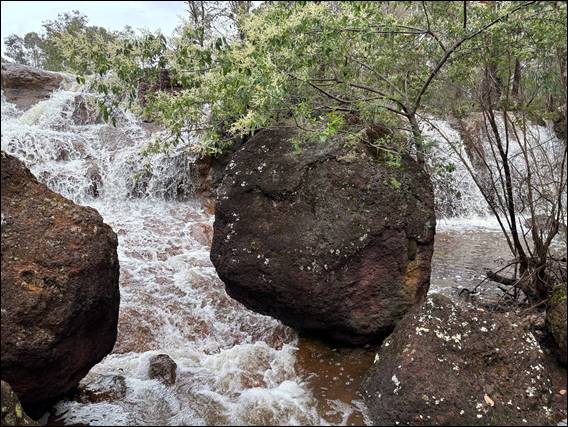
On the way home I decided a quick stop in at Iron Gull Falls was worthwhile. It is our closest waterfall, and in twenty years this was only my second time here. The catchment was already saturated and I hoped the overnight and morning rain would result in more flow cascading over the lateritic rocks, which give the falls their name. It was very overgrown and seemed weedy. We last came here in 2017 and those images suggest it has become more overgrown. Indeed it took a bit of effort to get to the base of the falls to take the above picture:
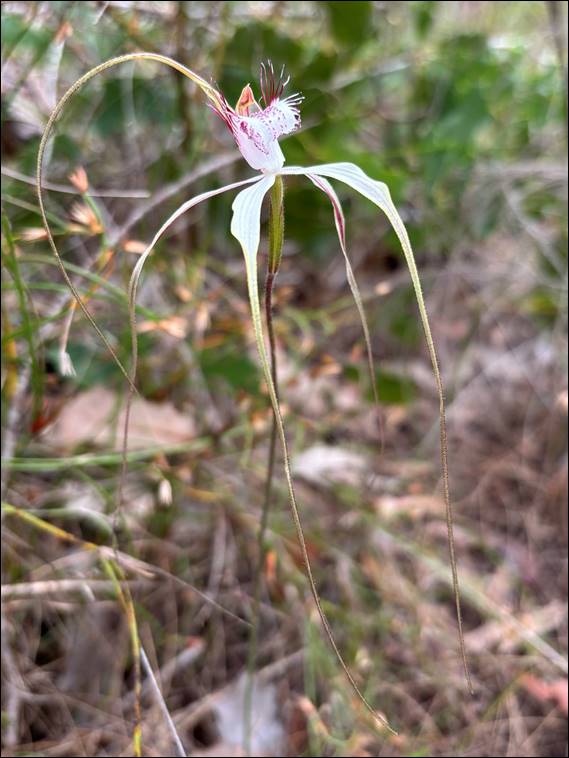
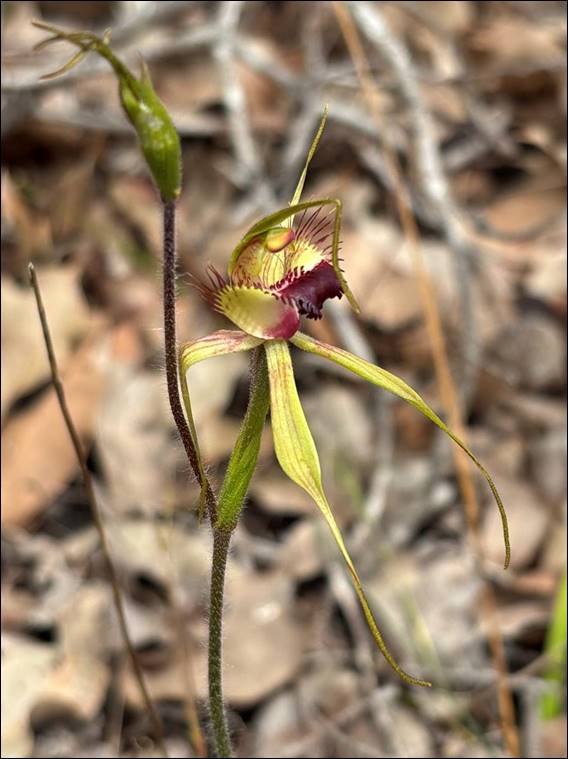
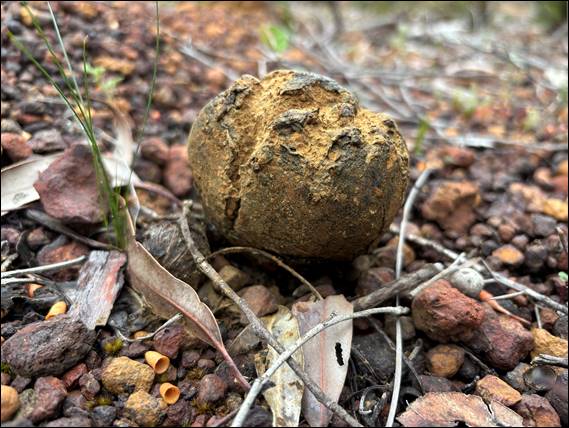
The last image I wanted to include is another species to add to the list this season. As such the above Dyeball (Pisolithus arhizus) is just a filler because I seemed to have prattled on too long. I spied a heap of Splendid Spider Orchids (Caladenia splendens) in a patch of weed free bush on the side of the road, just a short distance on the way home. Alongside the Giant Spider Orchid (Caladenia excelsa) it is the largest of the spider orchids. The flowers can reach just shy of 300mm, which this one did with wonderfully long drooping sepals and petals:




























 Sandbagged