Being keen spy a whale or two, Lisa was up for a wander on Saturday. The obvious place to head was Cape Naturaliste Lighthouse from where a number of walk trails head out. One of which takes you to the point of Cape Naturaliste and a whale watching platform. Here you can in 180 degree views of the south Indian Ocean. While this is a great spot to be, you are only able to observe the ocean when you get to the platform, so having been lucky with recent whale sightings both in the bay and off the west coast I suggested those locations. We plumped for the closer location of Meelup Regional Park, for several reasons:
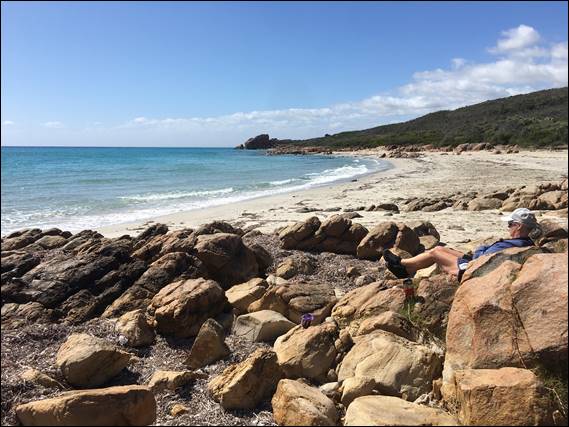
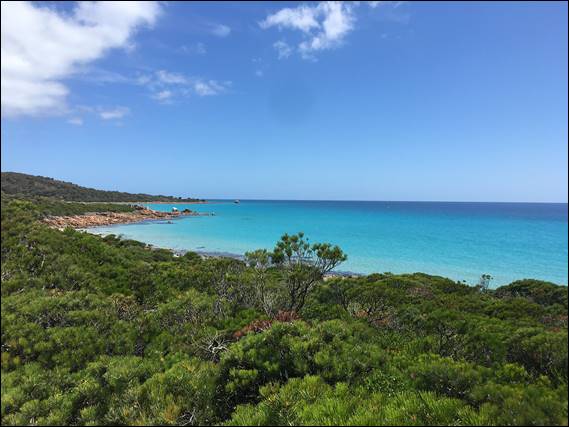
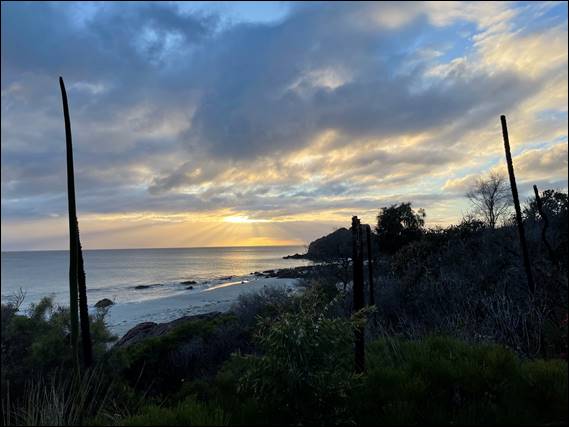
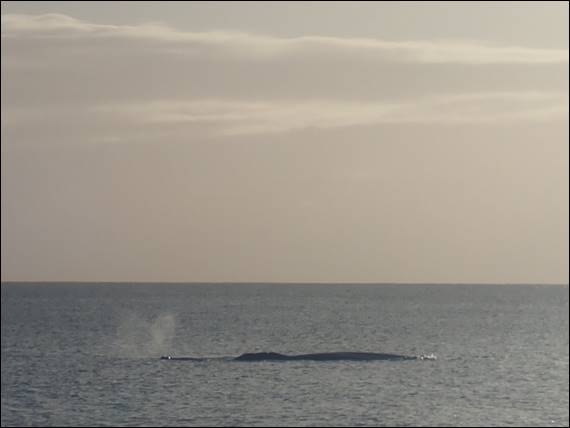
Firstly, it is generally calmer here than on the west coast, making whale spotting that bit easier. Secondly, the meandering path is lovely and takes in stunning views of the bays with their aqua blue waters before then branching out up on the ridge for views from on high. Lastly, we could stop in Dunsborough on the way out to grab a feed from the bakery, allowing us to start the walk by sitting down and taking it all in. The plan worked well, and as we laid back on the rocks munching away we were greeted to a few whales travelling northwards up the bay:
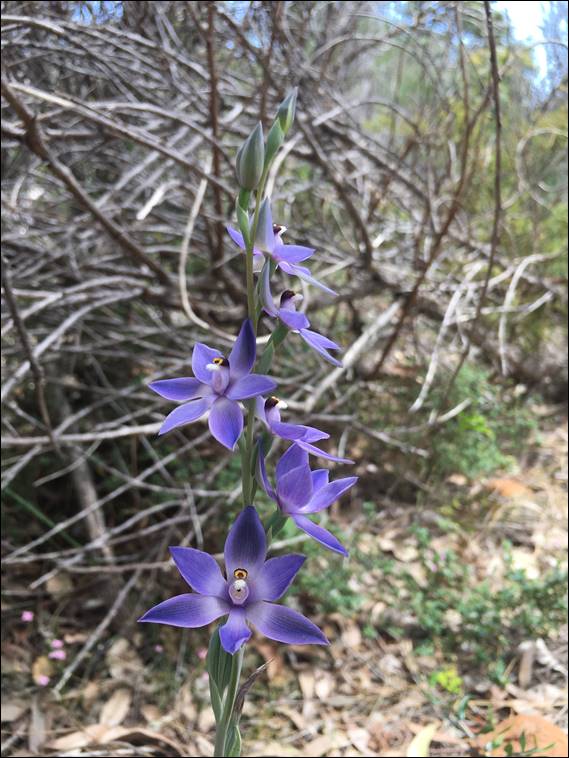
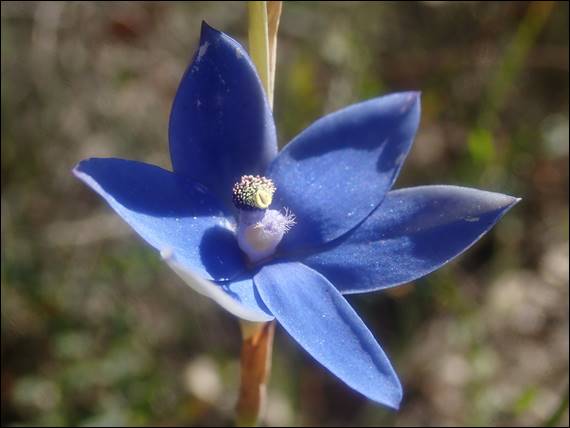
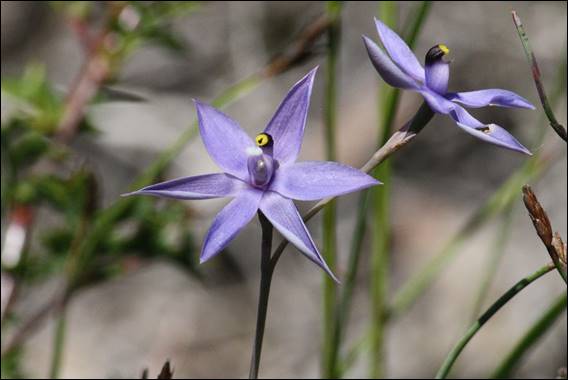
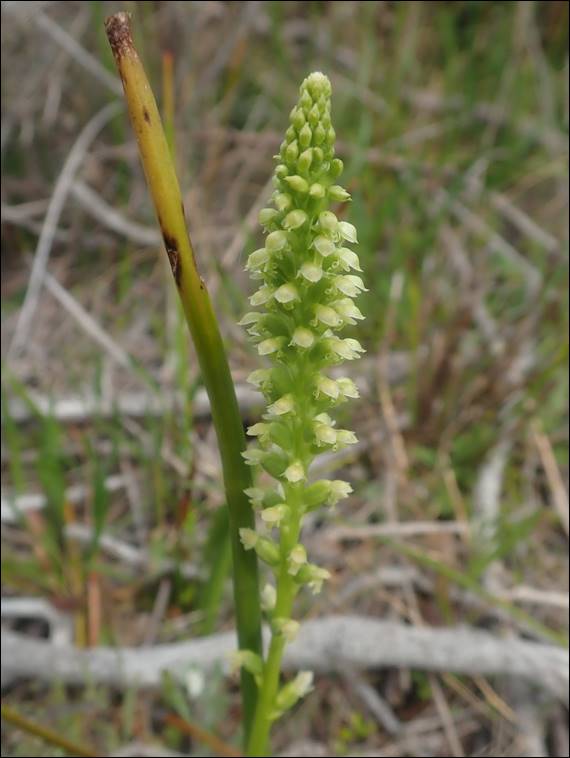
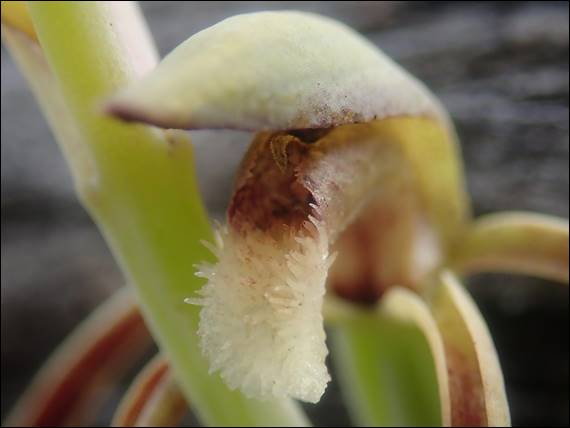
They were some distance out and did not give us an acrobatic show. Based on the shape of the tails and way the bodies arched out of the water it is possible that they were Blue Whales (Balaenoptera musculus). Geographe Bay is claimed to be the most accessible place in Western Australia to see these whales, as they come in close to shore in relatively shallow and crystal clear waters. I’m pleased to say that we did go for our wander, but didn’t see any more whales. Also, and not surprisingly with the way the season is tracking, we didn’t see any orchids other than a couple of Scented Sun Orchids (Thelymitra macrophylla):
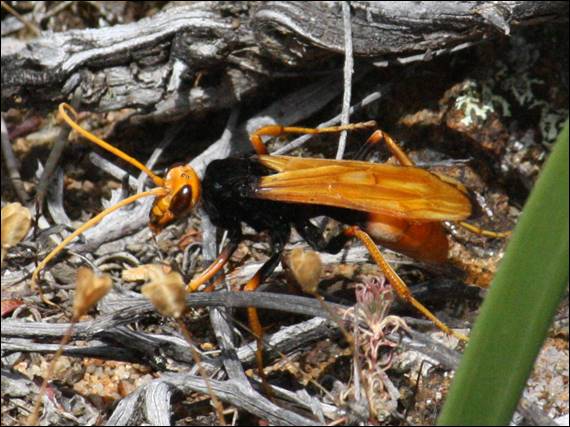
The heat did however bring out a few Bobtails (Tiliqua rugosa) and King’s Skinks (Egernia kingii), but no snakes. But for a change here is an image of an Orange Spider Wasp (Cryptocheilus bicolor), which we found busily checking under rocks and vegetation. No doubt looking for a Huntsman or Wolf spider to paralyse, before laying a single egg in its body and then burying the ill-fated spider. This is the most common species of spider wasps, growing to an inch and a half and looking pretty fearsome. They are however not aggressive so will only waste their venom on humans, by stinging us, if extremely provoked:
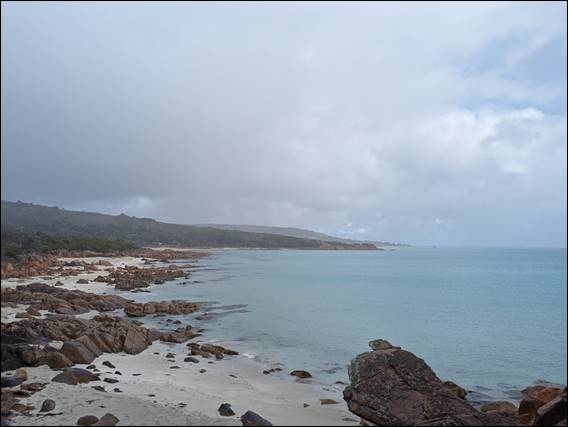
Sarah was back in town for a few days and keen to get out, so for Sunday we made plans to head to Moses Rocks. Driving out the clouds along the western coast looked dark and ominous, whereas to the north they were more broken. This kinda aligned with the forecasts I had been tracking for each location, so we changed plans. This resulted in me finding myself parking at Castle Rock beach for a second day. The bay at times looked as stunning as yesterday, although every so often a bank of clouds would come over ridge and the amazing colour of the water dulled, as rain started to drizzle down and soak the rock:
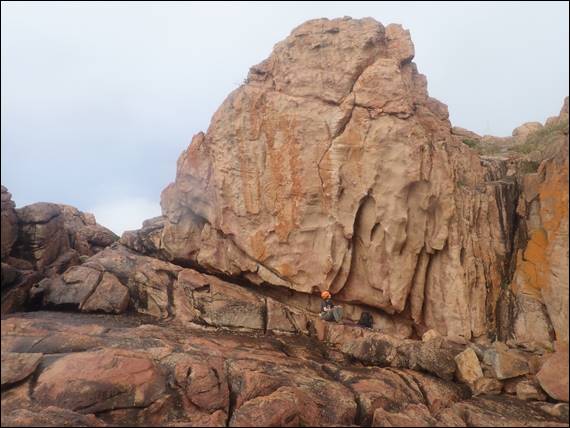
It was warm and there was a moderate wind, so in-between the showers the rock dried up just fine. Not that there was a need to stop when the water fell, as the coarse grained granite provided great friction whether dry or wet. As Sarah found out, as she willingly followed me up one, two, and then a third line on the north facing side of the castle. I had offered her the chance to have a lead, and she was at first keen but as we racked up quick climbs her desire faltered. Maybe dampened by the weather, but also may be put off a bit by the lack of a break between each climb, which didn’t allow her arms to recover:
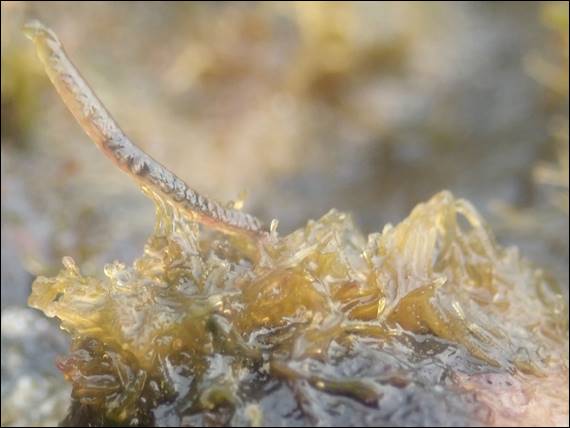
When we moved to the southern face we did take a break, and as she sat up the wall protected from the rain I went looking about. Thinking there was nothing to see a movement caught my eye. In the weed and algae that was within the wave wash zone there were heaps of worms, seemingly reaching upwards but I have no idea what they were searching for. I also have no idea what they were, and my best guess is a type of sandworm. Possibly, based on some of the body characteristics, juvenile Blow Lugworms (Arenicola marina). The larvae of which are known to settle on firmer ground to further develop, before moving to more sandy areas where they can burrow:
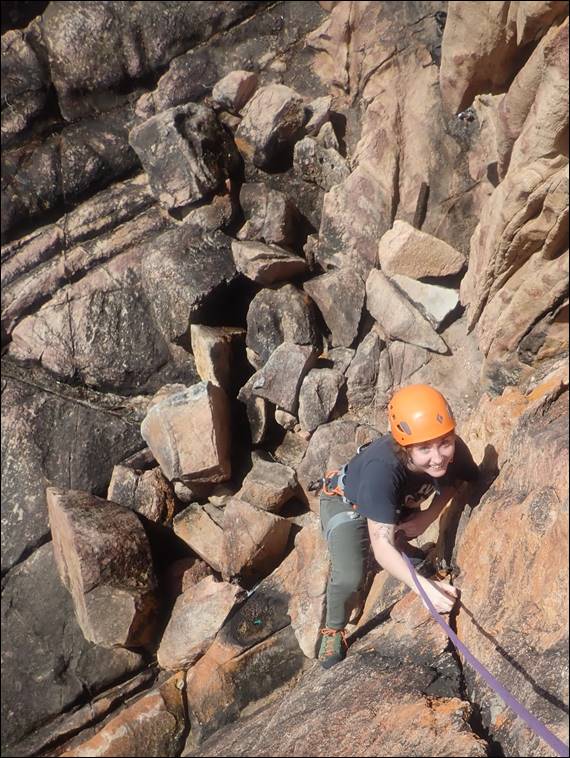
It may seem that there was not a lot of climbing going on, but after the short interlude we cracked on. The climbs from here on were a bit longer and certainly more technical, and I could sense Sarah’s self-doubting nature creep in. But with a bit of gentle encouragement she followed me up another three fun lines. Even keeping going when her brain was telling her she couldn’t do it, or her arms were telling her they were done. All up it was a very successful second visit to the area, and there were smiles all round at the end of both of the back to back trips here:
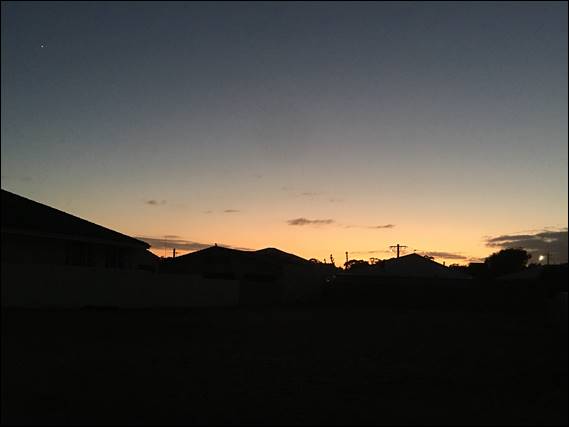
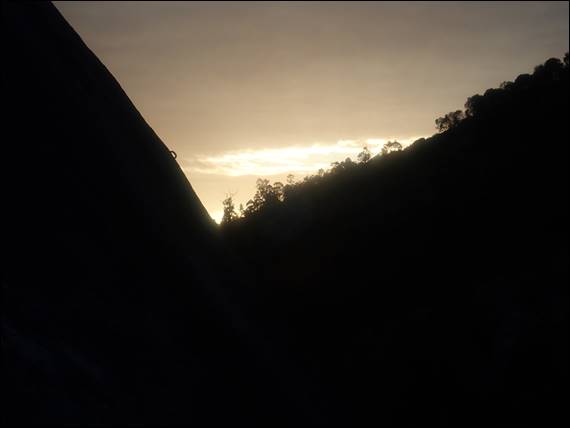
I was hoping to capture todays sunrise. And being aware that I might miss that special moment of the day due to being on the road, I took this snap while parked outside Howsie’s house. The morning hues were on display, but it didn’t really show the full glory of the sun peaking over the horizon. What with all the first light and sunrise images I have previously used, you may be left wondering where I am going with this. In short I wanted to take the image for Tomski. Longer term readers may remember him from a few years back:
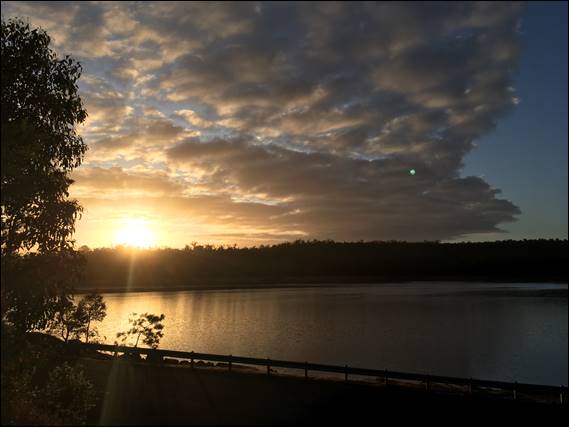
His last trip out with us was two and half years back, at the place Howsie and I were heading today. And soon after that he returned to his homeland of Israel, and I’m sure I don’t need to explain what is happening there. I recently confessed to him it felt somehow weird writing about all my outdoor adventures, while life over there was in such turmoil. His response was however not to stop, and to keep getting out and typing away. He also said that to help stay positive he was taking an image of the sunrise each morning:
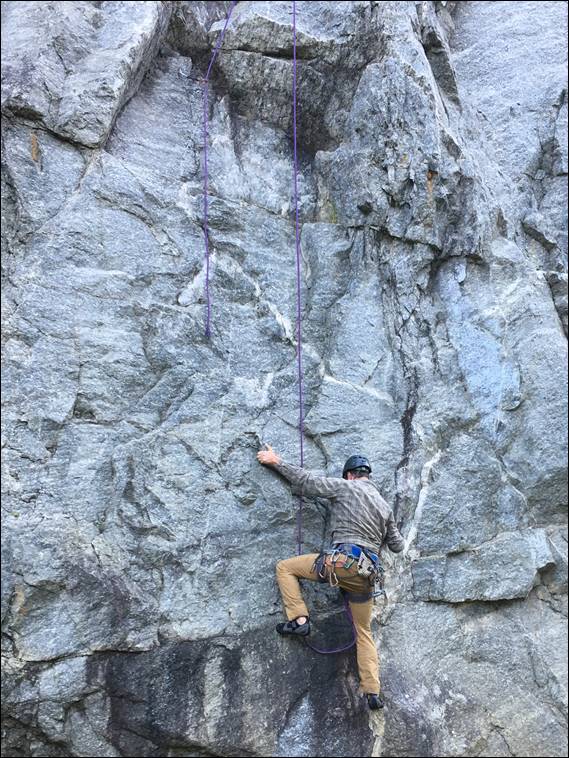
We arrived at the dam just in time for me to take the above image for Tomski. And I will now get back to today’s short and sharp session at the formidable quarry. I needed to get back to work at a reasonable hour, so we were pressed for time but also keen to pack some lines in. I had pulled together a list of ten routes from grade 18 to 20. While maybe a bit optimistic it did mean we didn’t stand looking at the wall wasting precious time trying to work out which lines to jump on. There was a game plan, and on arrival Howsie was keen to get the ball rolling:
To hit all ten lines we would have to climb at a rate of a route every twenty minutes. Something we had managed on the more sedate routes at Wungong Slab last weekend to beat the heat. Things certainly started well, although on the second route we forgot to pull out the longer rope. Only remembering the errors of our way as Howsie lowered me down after the lead. Route three and four also got knocked off quickly, the conditions today were great. The low humidity meant the friction was superb, and so far our stamina was holding out:
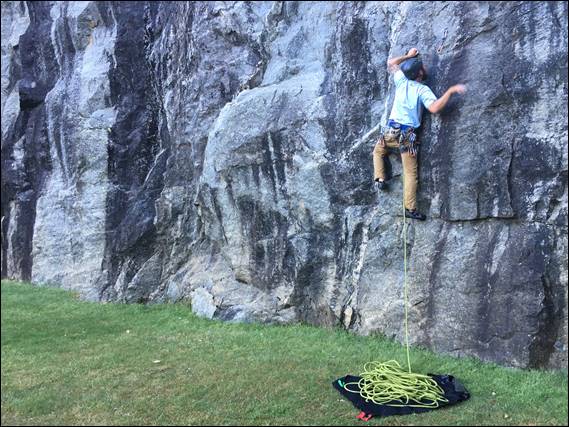
Route five came along and tell-tale signs crept in. If you look closely Howsie’s left elbow is sticking out. Ideally when you crimp down on small holds, of which the quarry offers many, it is best to keep your elbows close to the rock. This enables you to apply pressure to where your fingertips make contact with the rock in the most efficient way. As the elbow creeps out, the angle results in the need to apply more pressure and you waste more energy. Simple really, but as weariness takes hold the brain struggles to remember and then get the body to apply even these little techniques. As a result the route rate slowed down:
After climb five and six, both of which Howsie will confess to having dogged up, I thought we would be done. But, like me, he was enjoying being out too much. To ensure he had a chance to get up with a clean lead, we deviated away from the list allowing him to jump on a lower grade route. And for my last lead, he picked what he thought would be the least punishing climb that remained on the list. This seemed to work, and surprisingly we got very close to our target of one route per twenty minutes. Next we just need to work on someone’s stamina to allow us to stay and climb that bit longer:
It’s the one day of the year that I really don’t want to be at work, and would much rather get out into nature and enjoy life. Luckily falling on a Friday I was able to encourage Howsie to join me on a little excursion to head to unfamiliar territory, just to make the day that little bit more special. For a day trip, the only direction for us to drive to discover new locations is Perth, which of course meant the drive was a tad longer than usual. Based on the closest weather station in a similar landscape we could expect temperatures of the low twenties:
However, as the week crept slowly forward the forecasted temperature crept slowly up. This meant we could now expect temperatures in the high twenties. This is getting pretty warm, and could be uncomfortable especially as the crag is in the full glare of the sun, with no shade until after mid-afternoon. We agreed an early, and then even earlier, start was warranted. By early I mean early, driving out of our driveway at 2:30am. The timing was to allow us to arrive at first light, so we could at least see where we were going as we walked in:
Driving out of Bunbury in darkness I was grateful for the extra light bar on my car. And out of courtesy, which is at times is not provided in return when on dual carriageways, I turn off my full beam off when a car is coming the other way. I wish I hadn’t been so thoughtful this time, because with the lower light and oncoming car we saw the kangaroo too late. It lopped across the two lanes, from the central reservation, right in front of me. Going 100km/hr it was too risky to abruptly manoeuvre, so all I could do was brake and brake hard:
There quite simply was not enough stopping distance, and sadly we collided. On my part the damage was not terrible due to the roo-bar, and we could carry onwards. For the poor kangaroo it was not such a good outcome. Not a great way to start the day, but it is a hazard that I have to accept what with all the early morning driving I do to feed my desire to climb. Fortunately a rare occurrence. Although I did wonder if nature was not on my side today, when before we started climbing two bull ants got up my trousers and bit me several times:
I’m pleased to say there were no more mishaps with nature from that point on. And Howsie and I relished the enjoyment of coming to a new location, needing to orientate ourselves. Firstly to find the place and then work out which line is which. We arrived at Wungong Slabs at 5:30’ish and the climbing began a bit before 6, with no sign of the sun, cloud in the sky, and a stiff cold wind blowing down the valley right across the slabs. Good slabbing conditions, and I’m normally pretty comfortable with the climbing style slabs require:
For some reason my footwork was not as nifty as usually at the start. I could blame the run ins with nature, or my hay fever that blew up today, but that would just be a feeble excuse. Slab climbing will include, at times, the need to trust nothing but friction. The hands really don’t help much on these sections. It is all down to the angle of your feet and the direction of the force you apply, to maximise the friction between the sole of the shoe and rock hold to hold you in place. Body tension is everything, and a couple of times I let that relax a bit too much:
I just had to focus a bit harder to make the smears stick, and as the morning wore on I did just that. And as time ticked along and the sky became lighter we also noticed the place wake up, while we beavered away ticking climb after climb. The warmth of the sun, which eventually burnt off the clouds, was well received after the cold start to the morning. Birds became a bit more vocal, and once the sun was on the rock proper more insects popped up. Other than the couple of pesky bull ants, the first insect of interest was this soft-winged flower beetle:
This family of beetles, Melyridae, is vast and at first I thought I had got it right away. Finding a couple of identical images that made me think it was a Black-headed Melyrid (Collops tricolor). Then I discovered this species has not as yet been recorded in Australia. I have since spent hours trawling my reference sites, and cannot find anything even close to it in Australia. There was once species I pondered but the elytra, or hind wing component of the carapace, had distinct grooves. The one I spotted did not being smooth with fine hairs, so I am at a loss:
As for the climbing, it was a lot of fun. The routes were a mixture of bolted, mixed, and full trad lines. The various guide books gave three of the lines either a R or X rating. R indicating the protection is dodgy or runout and a fall could cause major injury, and X indicating that a fall could result in death. Climbing is however all about risk management, and you need to consider the grade or difficulty of the climb, your physical ability, your state of mind at the time, and the conditions on the day. Despite my early foot slips, today we both felt good:
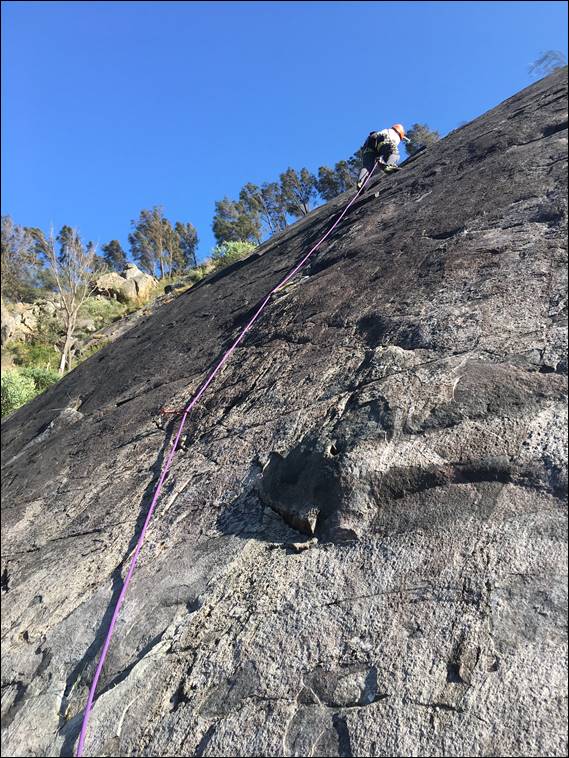
Fully bolted lines really should not warrant an R or X rating, so these lines were trad although one sported a single bolt. Howsie and I both prefer trad over bolts, so have the right mind set to take on such challenges. Above I’m on the only X rated route and I also led one of the R rated lines, both were absolutely fine and great fun. Howsie nabbed the hardest line of the day, which also happened to be the other R rated line. Several of the routes here were also contrived. Meaning the difficult climbing can be easily avoided, but we did them anyway:
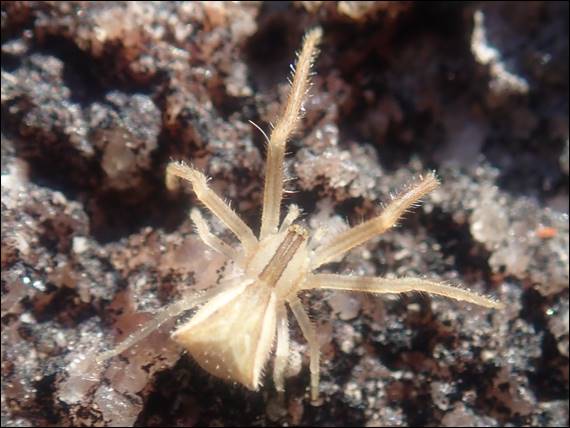
Onwards we marched, regardless of the grade, rating, or contrived nature of the routes and each one had its own charm. While Howsie was on lead I took the chance to look about and spotted a few interesting and very small spiders, and I wonder if he was also looking about while I climbed. Some would frown upon my wandering eyes, suggesting my focus should only be on the climber. But as I said it is all about risk management and being aware of the situation. These routes for the most part allowed wandering eyes, which spotted the above Trapezoid Crab Spider (Sidymella trapezia):
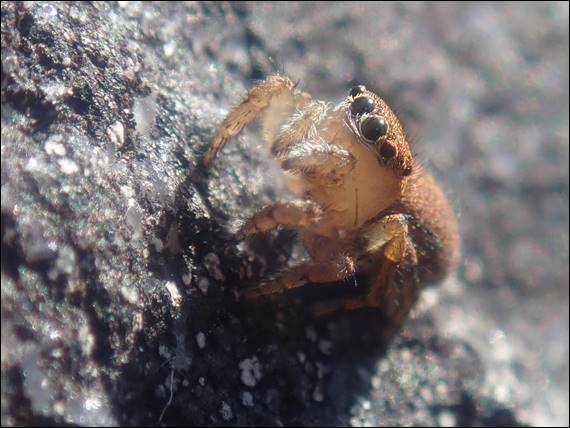
The two stripes across the back of the thorax, and triangular shaped abdomen making it an easy identification. The find below has however foxed me, and I’m waiting for Howsie’s entomologists friend to come to my rescue. Clearly from the Salticidae family, but being the largest of the spider families claiming 13% of known species I’ve had no luck in working out which of the 6,000 plus species it is. These spiders have a distinctive eye configuration and unlike other spiders, assisted with the enlarged eyes at the front, they are forward looking:
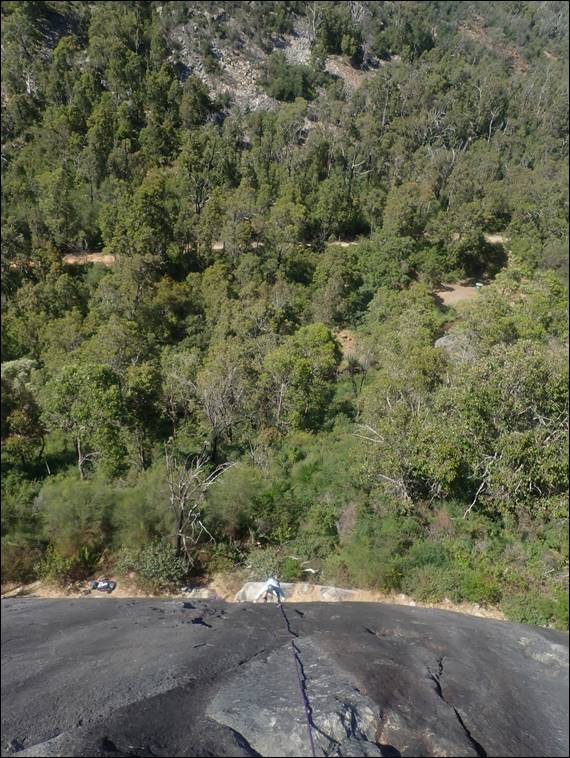
Howsie and I also had a clear forward facing vision of how our day would map out in terms of climbing. There was a chance the heat of the day could have got in the way of that. While I was feeling too hot to care Howsie’s stubbornness prevented us from not reaching our goal and five hours after we started climbing we finished by topping out on a slightly pointless and very short line. With 14 routes under our belt, one of which being so good we both led it, we were very content and walked out, with not an orchid in sight, to find the car thermometer indicating it was 28 degrees:
Just for the records, as Howsie got confused on the way back working out the numbers, probably because we both led the crag classic Whisper: 1) Tramping on Roses 13 – led by Howsie 2) Dead Seal 17 – led by Krish 3) Juggamatic 14 – led by Howsie 4) Crossroads 18 – led by Krish 5) Freedom 19R – led by Howsie 6) Flake and Slab 15X – led by Krish 7) Whisper 17 – led by Howsie & Krish 8) Middle Line 13 – led by Howsie 9) Easy Street 14 – led by Krish 10) All Holds Barred (15) – led by Howsie 11) Mirror Mirror 17R – led by Krish 12) Strange Idea 14 – led by Howsie 13) Weird at my School 14 – led by Krish 14) Death by Cutty Sark 17 – led by Howsie
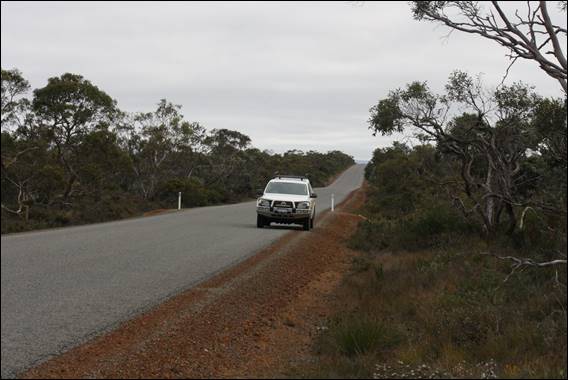
Our 2006 Roads and Tracks Road Map of Western Australia, prepared by a potentially dodgy publisher on the basis that the contact for them was a ‘bigpond’ email address was once again misleading. The road names had potentially changed or swapped in places, and many of the dirt roads were shown as sealed and vice versa. As such I have no doubt I took a meandering path on the back roads from the Stirling Ranges National Park to Cheyenne’s Beach. No matter I rolled up to find Ron deflating his tyres ready for the sandy track to our destination:
Kym, Jim, and Ange were also there so we almost had the full contingent of (relatively) older climbing crew of the South Coast, with only Jon as the missing link. The familiar and somehow endearing bickering, needling, and cajoling started almost straight away. It was great to catch up with everyone, and from what I heard it has been a while since the crew has been out together. We were heading to Lost World, a place I’ve been to twice before. One successful day out and one not so, which I will come back to a little later on:
Jim hasn’t been out climbing for a few months, after being knocked off his bike by a dog which has caused him no end of grief. Today, as such, he was out for a bit of top rope soloing to see, in his own words, “if I can still climb”. Ron and Ange eyed up a fun single pitch climb to warm up on, and Kym and I sat there with no real idea of what to do. During some of my south coast trips we have been on a mission. A new crag to check out, a first ascent or two that was itching to be climbed, or some gnarly classic we were keen to test ourselves one. But today there was none of that:
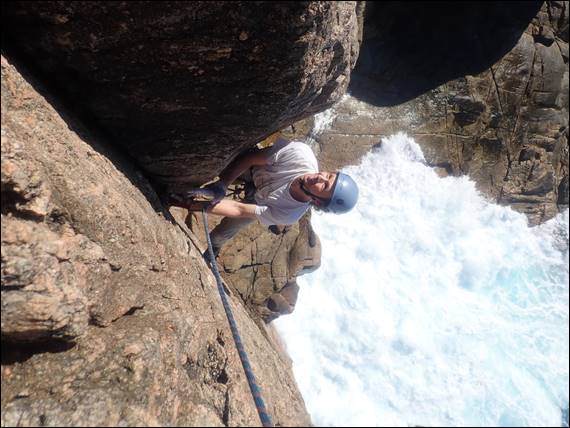
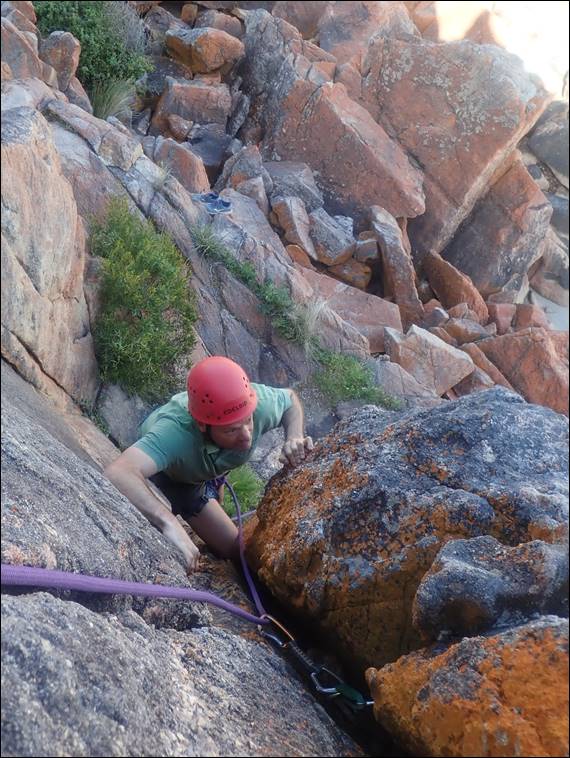
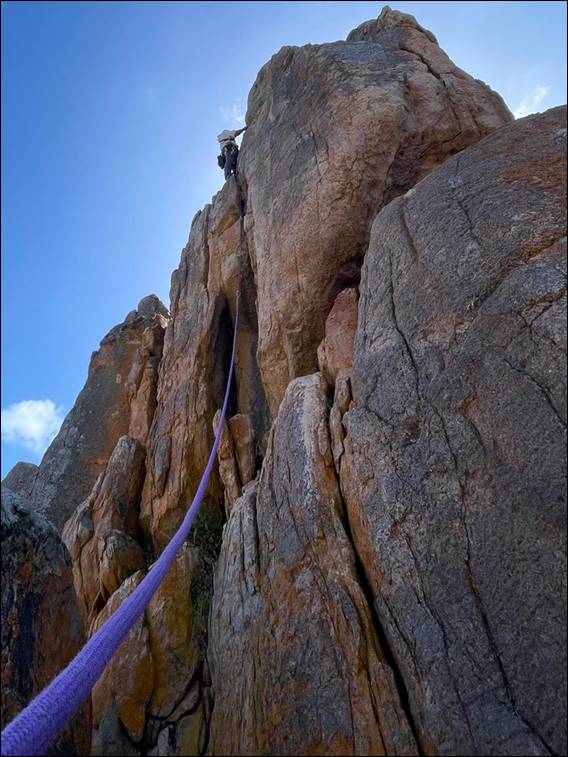
Eventually I let Kym, who knows the area way better than I do, lead me to a long abseil all the way to the base of the cliff where a three pitch route called Blitzkrieg started. It began with a bang, a steep and awkward pitch the grade of which that was heavily debated. Was it a 20, 19, or 18? No matter the number jumping onto it cold and not being overly used to the south coast granite climbing style it felt hard. There was even a section where you have little choice but to act like a beached whale, lie down and gracefully worm your way upwards:
It had just about everything on it, making the whole climb super interesting and engaging. Including a clump of Coastal Sun Orchids (Thelymitra granitora), which are found in shallow soils on granite outcrops along the south coast, sadly the flowers were not open as shown a couple of images above. And just below the vegetation in the image below I found some Southwest Granite Snail Orchids (Pterostylis jacksonii) surivisng in a thin layer of moss, sadly past flowering and wilting away. These being found in ‘moss on granite outcrops’ along the south coast:
It was the longest route at Lost World, in part due to the long rising traverses that allowed the line to avoid towering blank faces of granite by meandered its way along the weaknesses comprising flakes and cracks. These ranged in width from barely finger tips through to full arm bars, and the route also included a couple of spicy vertical sections. Needless to say Kym and I had an absolute blast in an amazing position, and of course a backdrop that few crags even along the south coast can match:
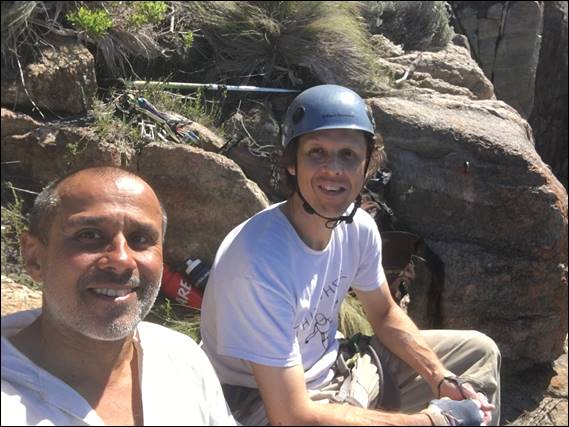
Once on top we caught up with the rest of the crew, Jim found that he could still climb and Ange and Ron fired up after a fun warm up were heading down to jump on the route Kym and I had just had such a blast on. Coming down this way is as much about catching up with Kym, and his family, as it is the climbing. So we grabbed a bite to eat and chilled out pondering what next. The multi-pitch route had been such fun that we plumped for a second multi-pitch climb, one that Rongy and I had attempted to get on during my second less successful trip here:
On that visit we managed the first abseil and were about to go down the second when the storm hit. Huge raindrops transformed the granite slabs into a waterfall, made even more exhilarating when the lightning started. Today was a complete contrast, and I had the glory of leading the first pitch up Cloud Street at 16, which followed an unusual dolerite dike with different holds to the rest of the area. Kym then padded us to the top on the delicate slab of Silver Lining again 16 , which I had previously done in the rain. Both pitches were crackers on clean rock with no vegetation, and hence no orchids:
Back on top there was no sign of Ron and Ange, but we found Jim. His hands had given up on him so was just packing up. We were not sure what to do next, but he had suggested earlier we try a route he had not seen anyone repeat. And also a new line that Ron had secretly put up some time back. This time, and under the watchful eye of Jim we hit a couple of single pitch routes. I got the feeling that I had led Schmidchen Schleicher at 17 on my first trip here, but checking my post from that trip I hadn’t. Kym’s toes were starting to complain, so he was happy to hand me the rope again for one last climb:
Ron’s new route, Panel Beater, was not here on my last two trips, and Jim was keen to see someone lead it and give a second opinion. It may have even been the second ascent. After climbing it the grade like the first route of the day created a bit of heckling, based on all the routes I did today I’d struggle to give it more than an 18, possibly only 17. Not the 19 that Ron adamantly claims it deserves, but that was not the only bickering that was going on. As when Ron and Ange finally topped out there was the sorting of gear, and the need to make sure something had not ended up in the wrong rucksack as can at times happen:
Ron’s route Panel Beater, whether 19, 18 , or 17 was great fun and on the way out we discovered where the name had come from. The track was wet on the day he and Ange had come here to establish the route, and as they drove in the car slipped where the tracked was angled sharply to one side. This resulted in a bit of panel beating needing to be undertaken. The banter that might have some worried carried on all the way out, and as we sorted the gear between the cars were we parted ways. It was a fitting way to end yet another very enjoyable day out with the old’uns, although that I said only Jim is older than I am:
The evening went by relatively quickly. Firstly topping up on tea, then playing ping pong with Tessa as Beau ran round as the ball boy. Meg had made a lovely homemade quiche for dinner, and after a bit of grown up chat once the kids had finally drifted off, we all hit the sack. Claire was up early and made us breakfast, as Kym and I pondered our choices for the morning. It was going to be a morning session only, to allow me to head home at a reasonable time. A trip to West Cape Howe was tempting but the conditions would mean the rock would likely be damp and in the shade:
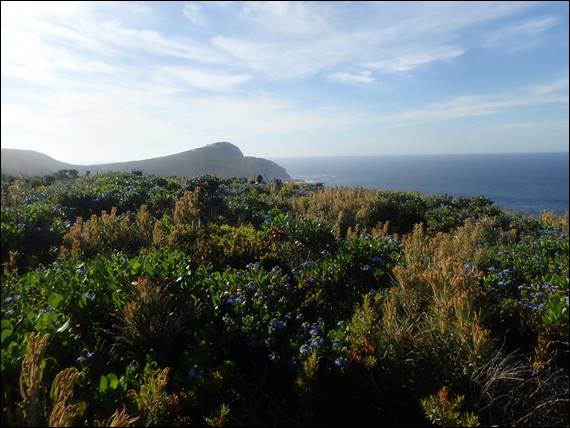
Many of the other options, which didn’t have a long hike in, faced east and would be subject to the swell. And while being a paltry two meter swell, something Lisa would consider bobbing in the water off Peppy Beach in, here on the south coast that could result in a fair bit of spray. The final decision, right or wrong, was East Side about a twenty to thirty minute hike from the Blowholes. A crag that see’s very, very few visitors and as such there was no track to follow when we worked our way through the, at times, head high bush:
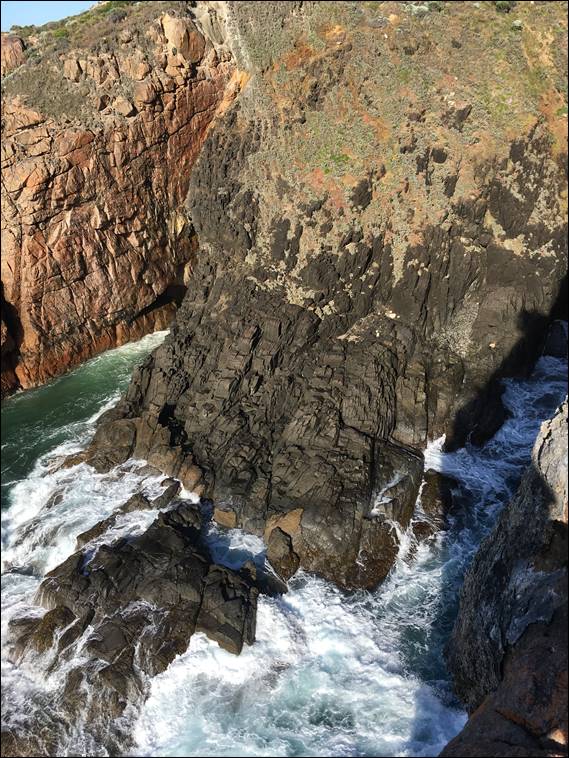
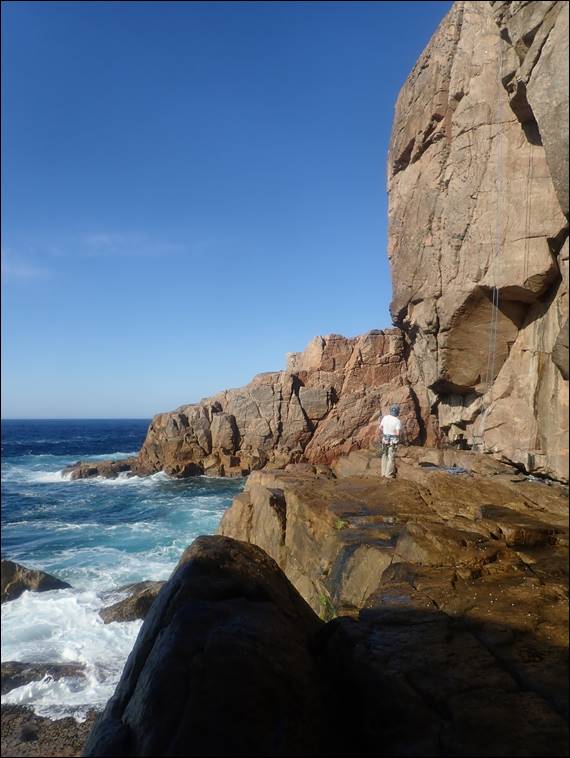
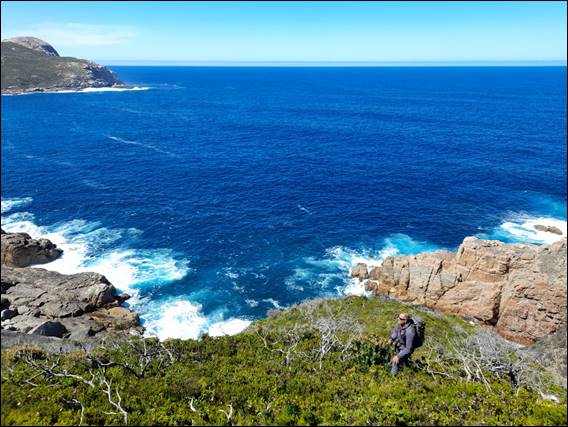
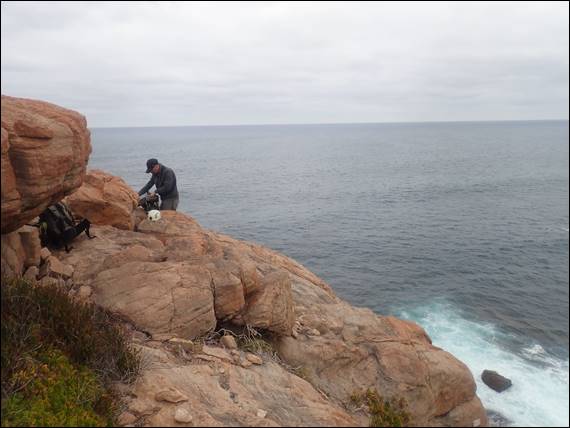
Kym did well and we found our way there with no detours or backtracking required. And on arrival the magnificent position and view made us realise we had made a good choice. As seen above a two meter swell was indeed pretty serious. The 25m crag was small compared to where we were yesterday, but it felt like it towered above us. Higher than it did due to the proximity to the waves. It was also pretty steep with sheer faces, cracks, and corners. Some overhanging, and that just added to the intimidating south coast experience that is strangely enjoyable:
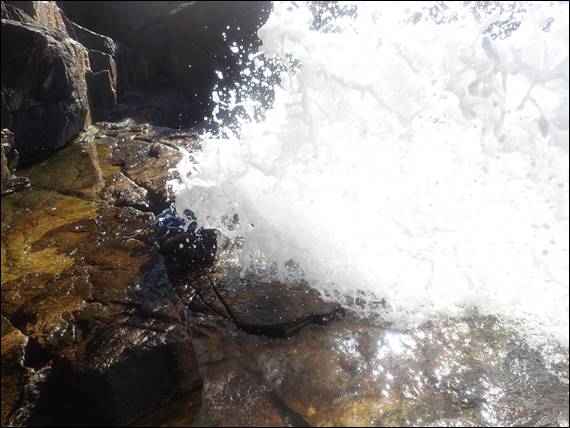
Feeling the seriousness of the place, also makes you question the grade at which you want to climb. An accident here would become a massive situation, boat and helicopter access wouldn’t work. And with no defined track the rescue from above would be a logistical nightmare. As such I flaked the rope out to avoid the risk of it becoming a knotted mess as Kym would lead us out on Sea Serpent, a snaking grade 14 line. And as soon as I had finished a wave got that bit close, then another, and finally a third captured in the above image:
The swell eased off again and Kym set off with the dripping rope below him. Soon finding himself on clean dry rock, while I watched out to sea waiting for the next descent set to come in which it didn’t do. It was weird how hard a grade 14 climb could feel just because your nerves are more on edge, but it may also have been because it was a fairly sustained so it kept you on your toes. Or maybe I was making excuses, because our options for the next route, and it was my lead, were a bumbly grade 10 or bumping things up to grade 17 on the crag classic:
I certainly waivered as I stood below the steep corner crack, weighing up my ability to take it on. Kym meanwhile kept providing words of encouragement, until the biggest wave of the lot came in and completely drenched him. I managed to be that bit further back from the edge and stayed dry, but wasn’t keen to hang about anymore. Tying in and going for it, I won’t lie and I was nervous. It was sustained, technical, and committing. Everything you would want from a classic, making it completely absorbing and thrilling. Luckily the crack gobbled up gear helping to calm my nerves:
Heads and Tails certainly earnt every one of the three stars it is given in the guidebook, and I’d be keen to come back here on a slightly calmer day to try some of the other lines. But we agreed that there was little point in going back down today, the wind was picking up just enough to increase the impact of the swell. Also if we were to go back down we’d have to resort to the grade 10 bumbles, as the remaining lines all started at grade 20 and the conditions today made the thought of trying them pretty undesirable:
It’s also fair to say we had just climbed two classic routes in conditions that elevated the experience significantly, and we wanted to end on a high. Instead we kicked back on the little bench that Jon had made here years back, with a 30m drop into the ocean at our feet. Taking it all in while having a snack or two. Eventually, sorting through the wet salty gear and packing up for the fight through the bush back to the car. Armed with walking sticks to ward of any unseen snakes in the thick undergrowth:
Those that know me, will also be glad to hear that I wore shoes and not sandals for today’s venture. I’m probably not making this sound particularly inviting to most, but as Kym said we ended my weekend away with a proper south coast experience. Difficult to find access, getting scratched up by the bush, a remote location, brilliant views, bundles of atmosphere, superb rock, and classic climbing. We may not have climbed much on the second day but the whole experience was quality through and through:
Back at the house we had a well-deserved cuppa and it was a final catch-up with Meg, Tessa, Claire, and Beau before I said my thankyous and goodbyes and hit the long road home. Passing kilometres upon kilometres of bush and wondering what I might find if I stopped, which I only did the one time to check out one of the many very obvious patches of Scented Sun Orchids (Thelymitra macrophylla), which seemed to be scattered along the roadside for much of the journey. And while it was great to get away, it was equally lovely to get home:
Several years back I heard of a fabled location called Orchid Valley, a place with a name that simply screamed out to be visited. Several of my work colleagues knew about it, as we have water resource monitoring stations located in the vicinity. They just happen to have been lucky enough to maintain the stations at the right time of the year to spot a few orchids. It is not too far off the approach to take to get down to Albany, and seeing I was going south to catch up with Kym and his family this weekend I tagged on an extra day onto my trip:
After a bit of research I identified a few places I wanted to cram in on the Friday. First and foremost Orchid Valley, aiming for a Mettabinup Nature Reserve that is dissected by Flora and Fauna Road. Then I’d head to Mondurup Reserve on the edge of Mount Barker, which has a Facebook Group that claims it has a very good diversity of flora with some forty plus orchids species having been found there. Finally, ending my road trip at the old faithful of Mount Trio Bush Camp, in the Stirling Ranges:
With some five hours of driving ahead of me, and three stops for orchid hunting I allowed myself a generous eleven hours so I could have a good sticky beak at all three locations. Mettabinup Nature Reserve has no facilities, being simply a block of land that is designated a nature reserve, and importantly for my service provider it has no phone reception. So without any walking tracks I had to be careful that I kept my car in sight, and that I didn’t wander off into the bush and lose my bearings as I have many a time before:
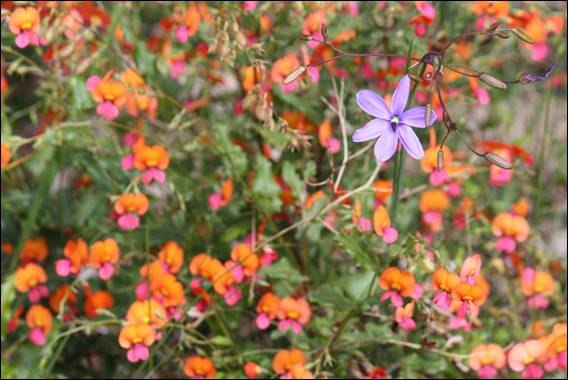
There were certainly lots of flowers in bloom, such as the above Everlasting Daisy (Rhodanthe chlorocephala ssp. Rosea). While there were not too many orchid species in flower, I spied one or two of each of the usual suspects including Purple Enamel Orchids (Elythranthera brunonis), Cowslip Orchids (Caladenia flava), and Blue Lady Orchids (Thelymitra crinita). The Sun Orchids (Thelymitra spp.) were out in the greatest numbers, and despite looking at the finer details I have struggled to work out which species they were:
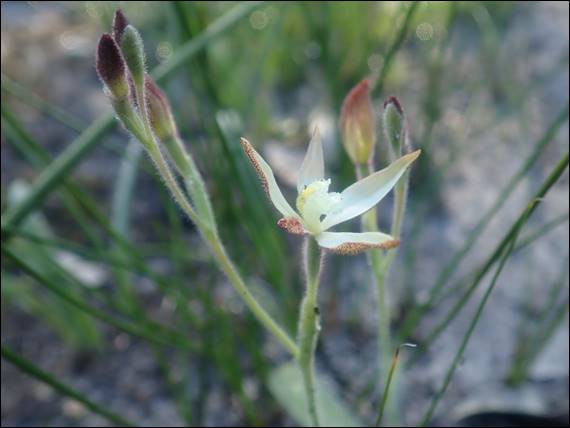
It took a while to find anything new, which wasn’t wilted. Patience eventually paid off when I came across a few of the above Christine’s Spider Orchids (Caladenia christineae). Looking more dainty than the white spiders I have found in my local area; with narrower, shorter, and more stiffly held petals and sepals that have a light coating of red hairs at the tips. It was a nice area and I whittled the allocated time away keeping a close eye on the ground, finding just one Dragon Orchid (Caladenia barbarossa):
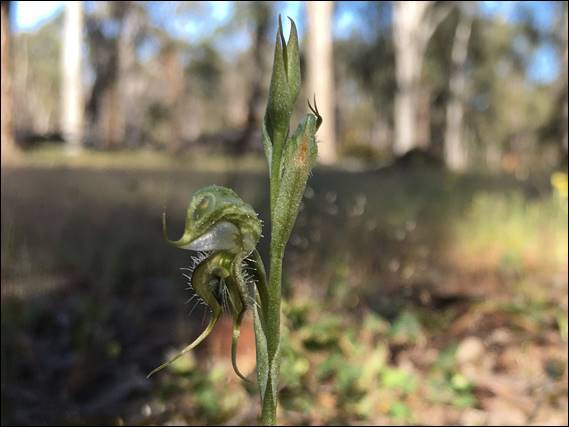
Dragon Orchids, like the various species of Hammer Orchid (Drakaea spp.) uses trickery to ensure pollination occurs. Luring the male thynnid wasps into trying to mate with the labellum by emitting a particular scent. I also found just one Hairy Rufous Greenhood (Pterostylis ciliata), a strange looking species of the greenhood genus. Named due to the fringing hairs of the labellum resembling eyelashes, with the name ciliata coming from the Latin word cilium meaning “eyelash”:
To be fair it wasn’t a bad tally, but I do feel that I had probably come here a bit late in the season. And as I have previously said the 2023 orchid season has been a bit on the lean side. I also fell-foul of this at my second location, Mondurup Reserve. Here there were walking tracks and I wandered a bit further afield from the car. And being just on the edge of Mount Barker I had phone reception, so if I did go off track I could work my way back. However, after an hour of ambling on and off the tracks it was clear that I wasn’t going to see anything new:
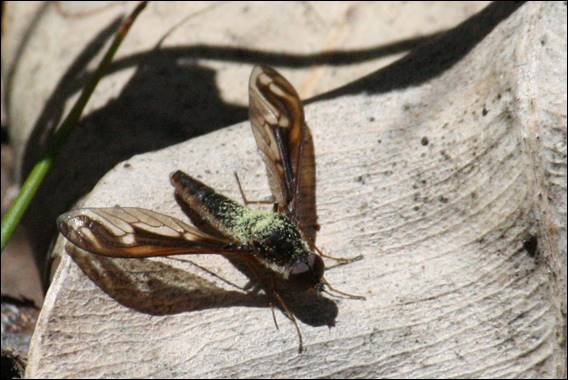
The above is likely to be the Slender Sun-Orchid (Thelymitra pauciflora), and it is possible I also came across the Shy Sun Orchid (Thelymitra graminea) and Scented Sun Orchid (Thelymitra macrophylla) at the first two locations. I am simply not proficient enough to distinguish between them and be confident, and equally I won’t attempt to identify the following insect. I did however like the fact that it was busy carrying pollen around to help make sure we would have flowers to look out for next season, whether orchids or not:
Due to the shorter second stop, I arrived at Mount Trio Bush Camp that bit earlier than anticipated. And while the campsite has expanded as a result of becoming very well-known and popular, it was fairly quiet and I had the camp kitchen all to myself as I made a welcome brew and kicked back supping on that. Arriving earlier than intended allowed me to wander round the nature trail, and also the adjacent National Park for ages. Since my last visit here the National Park had recovered from the fires a few years back and the bush was thick:
I must have spent over three hours scouring the area. The most commonly found species being the White Fairy Orchid (Caladenia marginata), it was everywhere and in great numbers. I did come across a few of the ones I have previously listed above, with the Dragon Orchids coming in second in quantity. But I was too late to see any of the local Spider Orchids (Caladenia spp.), other than the White Fairy, Cowslip, and Dragon Orchids that despite their quite different petal and sepal configuration, and shape are in the spider orchid genus:
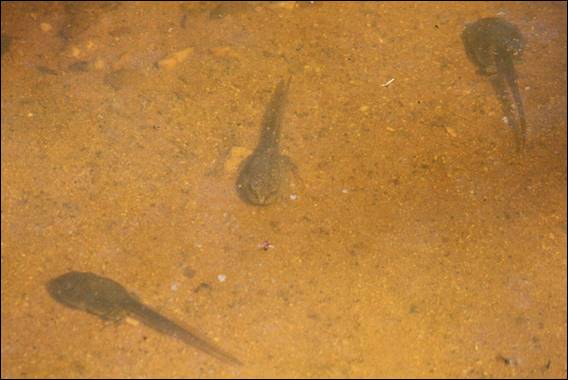
It was probably the least number of orchids I have found at the bush camp, and not for trying. I went to all the places that are off the beaten track where I have previously had a lot more success. However, it was definitely still spring time with tadpoles lazing about in the small pools that remained in the creek line, and the occasional Western Grey Kangaroo (Macropus fuliginosus) with their joeys. Seemingly becoming used to people milling about in the bush, as they allowed me to walk round where they were grazing without being spooked:
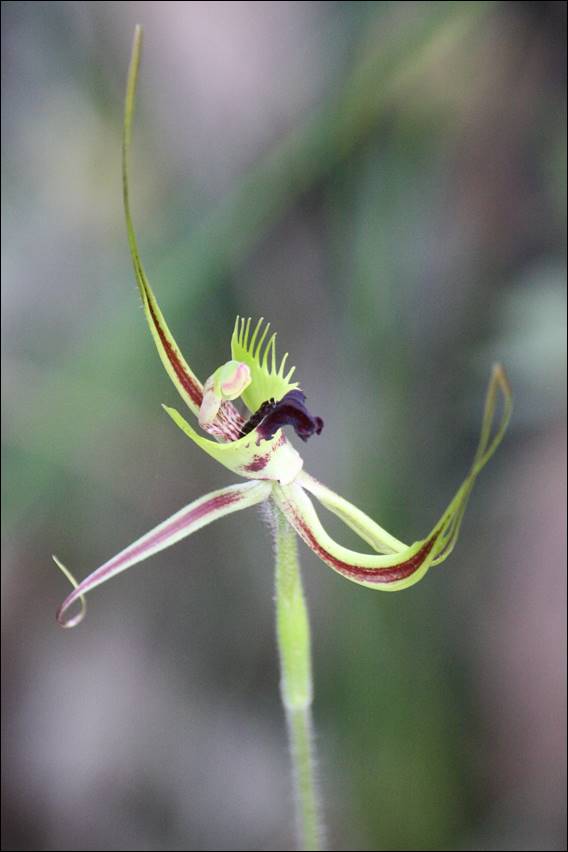
I have to admit that I lied above about the spiders, as I also came across a few Green Spider Orchids (Caladenia falcate). This was previously called the Fringed Mantis Orchid and it does look very similar to a Forest Mantis Orchid (Caladenia attingens subsp. attingens), which we get in my local area. As to why it is no longer called a mantis I don’t know. That was the lot for Friday, and unfortunately I had been so busy looking for orchids in the bush that I missed my chance to catch up with the owner, John, before he headed down to Albany:
It was a quiet night, and there were only a handful of campers about. Providing a very different atmosphere to the usual visit that Lisa and I have had during spring school holidays in years gone by. Without Lisa about I hit the sack early, and was up having a bite to eat before anyone else stirred. Even as I drove out a bit before 6 only one or two people were milling about. The reason for such an early departure being I had organised to meet Kym and Ron at Cheyenne’s Beach Caravan Park at 8:30 and was keen to check out a reserve on the way:
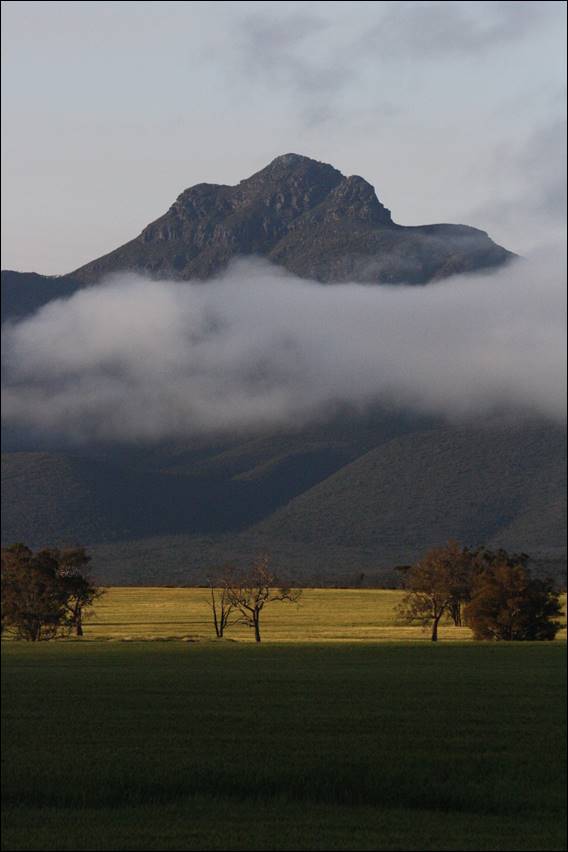
The clouds couldn’t make their minds up, allowing the lofty peaks to poke out and the sun to hit the ground on and off. But as I drove south to South Stirling Nature Reserve all the peaks where hidden from sight by a thick blanket of clouds hanging heavy in the sky. Like Mettabinup Nature Reserve this place didn’t have any facilities. So taking a punt I stopped at one of the lowest points on the long straight road, on the assumption that there may be more moisture about to aid some orchids in lasting that bit longer:
The Sun Orchids were out, as they seemed to be everywhere. But it was the Swamp or Albany Daisy (Actinodium cunninghamii) that stole the show, these intricate and delicate flowers were beautiful. They are called a daisy, but are in fact related to the gum tree family Myrtaceae. Being the only flowering plants in this family that is formerly named. Usually found in winter-wet areas in near-coastal areas in the south-west of Western Australia, with the majority of sightings listed on the Atlas of Living Australia being round the Albany area:
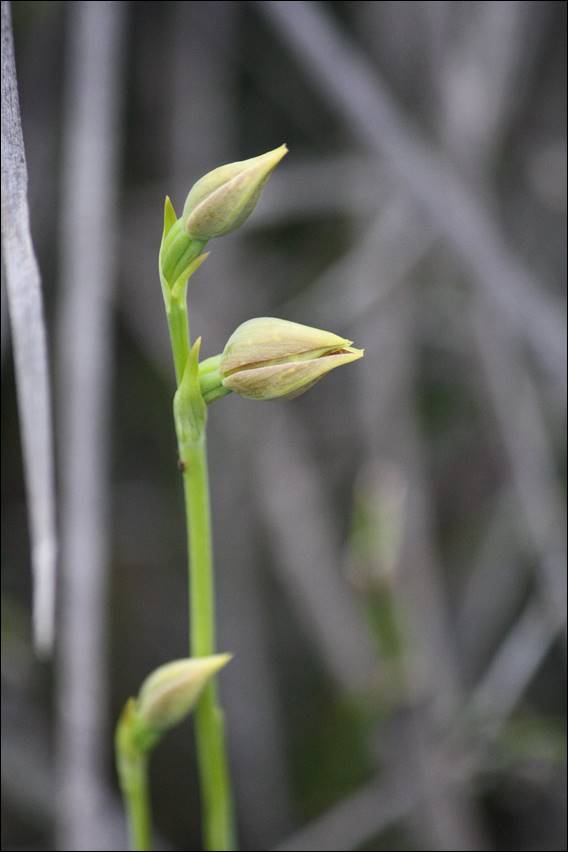
I also spotted the Common Mignonette Orchid (Microtis media), and just one specimen of the Leopard Orchid (Diuris pardina), below. Sadly, as the it was still relatively early and the sun was hidden away the flowers were closed up. The distinctive upwards pointing, green, and fleshy leaf wrapped round the base of the stem, and speckled pattern barely hidden in the bud gave this one away. So all up despite my complaining about not seeing too much I managed to tally up a baker’s dozen of species. However, now had to truck on to get to Cheyenne’s Beach Caravan Park on time:
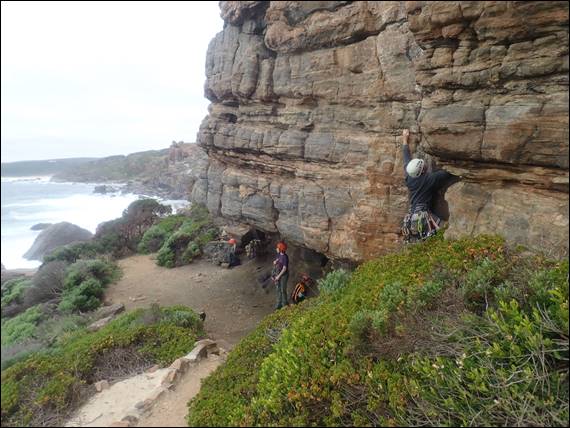
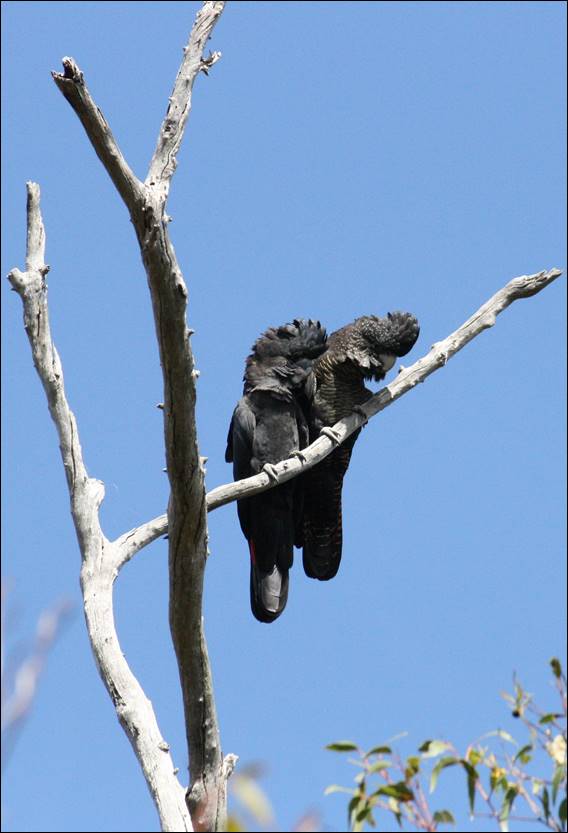
Rongy is once more heading off travelling, so today we popped down to Wilyabrup for a farewell climb. Sarah is joining him this time, so she too came along for a climb, but was also hoping to get a bit of herping in. “Herpet” is a Greek word that means creeping, and it could be used to describe both the people who are herpetologists as they go about herping, or the creatures they are looking for through the act of herping, being amphibians or reptiles. The first creature we spotted was however of the feathered, as opposed to scaly, variety. Driving in on the final gravel road we stopped to watch what looked to be 1-200 Carnaby’s Black Cockatoos (Zanda latirostris):
I’ve seen these birds here a heap of times before, but never in these numbers and it was good to see as this species has been listed as endangered since 2000. The primary reason is habitat loss due to clearing, which has resulted in their distribution over the past 50 years being observed to have moved considerably more west and south. They are however doing better than there close relative the Baudin’s Black-Cockatoo (Zanda baudinii), which has been listed as critically endangered since 2018. Then as started the walk into the crag the herping began, when I noticing a movement in the leaf litter:
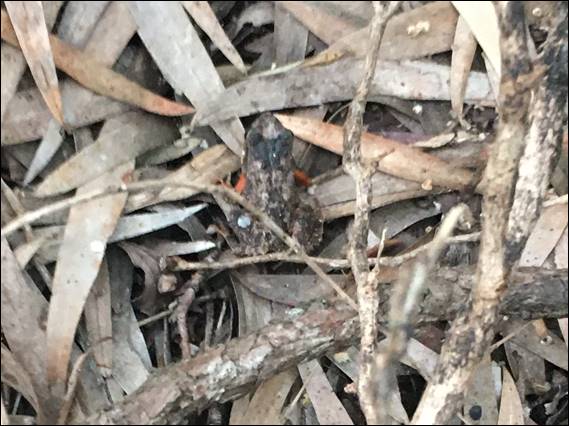
Wisely I had worn my glasses and this helped me to spot the above Quacking Froglet (Crinia georgiana). It wasn’t all that keen in hanging about, so the image was a bit fuzzy. Sarah wasn’t sure of the species so as we walked in I sent the image to Howsie, who provided the identification. This species is also known as the Red-Thighed Froglet for the obvious reason, although Howsie tells me he also identified it based on the distinctive colour of the upper eyelids which I’m still struggling to see. I’ve read that these frogs will talk to humans by quack back if you attempt to quack at it:
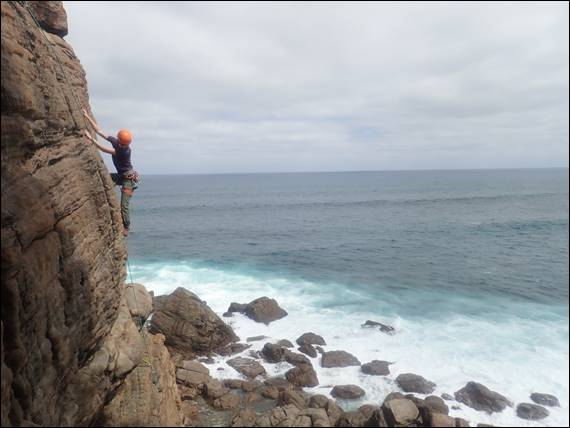
Despite being a climbing trip, and yes we did climb, it seemed that nature was intent on being the star of the show. The next spectacle came to sight when we made it to the base of the crag. A pod of whales was frolicking in the ocean. It’s hard to say but maybe a dozen whales were happily playing, putting on a display of tail and pec slaps through to full breaches. Too far to see which whales there were, but close enough to stall us getting on rock. Even when Rongy finally set off on the first lead Sarah and I still stood there watching out to sea. We did however climb, and after knocking off a couple routes Sarah said she was happy to take a break:
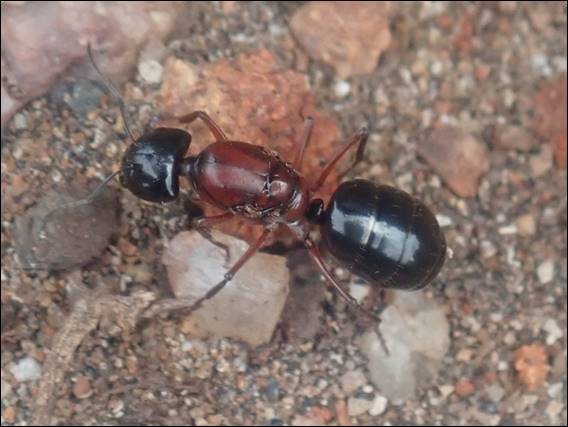
Providing an opportunity for Rongy to jump on something a bit more testy. After following him up we were delayed from walking back down when I couldn’t help myself from observing the above ant that was out all by itself. I’m pretty sure it is a Carpenter Ant (Camponotus spp.), of which there are dozens of species native to Western Australia. The name comes from the fact they like to build their nests by boring into damp or decaying timber, and some species found in other countries are considered as problematic as termites. Although the extent of damage to property by species found in Western Australia is limited. They are also known as Sugar Ants, as they feed on and are attracted to sugary liquids such as honeydew:
When we finally got back down Sarah was keen for another climb, and I again handed him the rope to Rongy. He hinted it was my turn to lead, at one point during the morning but it really didn’t take much to convince him to jump onto the sharp end. After all it was his farewell climb. With Sarah happy with three climbs under her belt, I suggested Rongy take one more lead to allow us to climb out with packs. Unfortunately the usual climbs we would pick, which would also offer the chance to see our friendly Carpet Python, were in use by a group. Mind you what with all the people going up them the chance of seeing a python today was probably very slim:
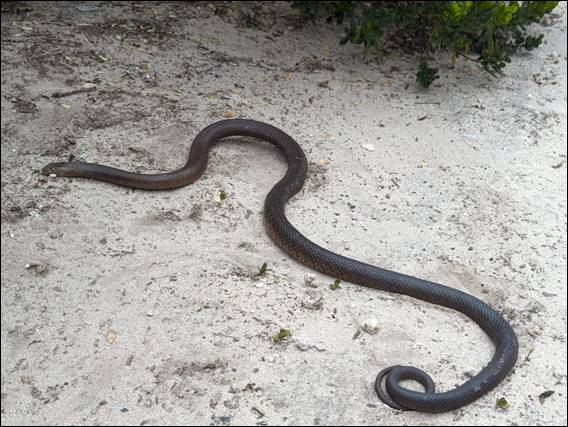
Instead we jumped on one of the longest routes at Wilyabrup. As Rongy sat atop with Sarah who had walked up, they watched the whales that were still playing about. It had certainly been a fun morning on rock, made all the more special by the extra special dose of nature’s wonders. There had also been King’s and Southwestern Crevice Skinks, which would normally have satisfied Sarah’s herping addiction. There was however one more surprise in store, being not one by two Dugites (Pseudonaja affinis) waiting for us on the track. We kept a healthy distance from the first one below. It’ll be hard to see but the eye looks glassy; a sign that it is in the process of shedding its skin:
This is the new skin covering its eye and results in its eyesight not being as good as normal, which can result in the snake coming across as being more aggressive during this period. Hence why Sarah wasn’t tempted to try and handle it, while the second snake was quite simply too alert and got away by slithering into the bush before we got too close. Walking back to the car the huge crackle, and yes that really is the right collective noun, of Carnaby’s Black Cockatoos had moved to the trees. As we walked under them, the air was filled with the whistling sound they make, as if to give Rongy and Sarah a send-off to remember:
October is a bit of a hot month for celebrations for us, with three major milestones in Lisa and my life all making an appearance, and if I sneak the 1 Nov into that period it becomes four. Lisa’s birthday is first up, and luckily for her it always falls in the spring school holidays resulting in her being off work. I too took Friday off, so we could spend the day together. Opting for a bike ride towards Busselton, for a mid-morning feed at a small but relaxing café that is a little of out the way from the hustle and bustle of the main town:
It is a forty plus kilometre round trip, so not to be sneezed at considering we haven’t been on the bikes for a long time. Quite some months back I forced myself to cycle round a local circuit, to build up some cardio fitness. However, after a couple of times it fell by the wayside. While Lisa can’t even recall when she was last on her treadly. I’m happy to report that we had a scrumptious feed, played a few games, and enjoyed the bike ride made all the more special with a couple of lucky spots along the way:
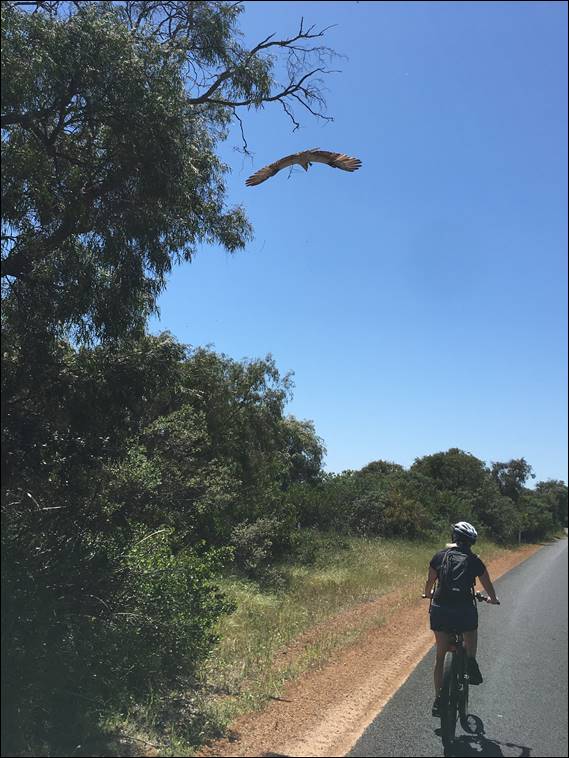
As can be seen in the first image, when we cycled under a big bird of prey that was perched just off the roadside it alighted. Providing my second close up encounter with a Eastern Osprey (Pandion haliaetus cristatus) within a week of each other. Lisa and I survived the bike ride despite the distance and the temperature, which was starting to creep into the high twenties on the return trip. While I full expected to have tree-trunk legs today they were fine, and based on all that I feel it is fair to say that our fitness levels are not too shabby:
Today was forecast to be another warmer than average spring day, which prompted me to head out early for a stretch of the legs round Ambergate Reserve. Early enough to be the first there and only as I got back to my car, two hours later, did another car finally roll into the carpark. Being early the sun was low making it a little tricky to scour the scrub, and as I was the first person out today the path was crisscrossed with spider webs. I’m not entirely sure how may spiders hitched a ride on me, but I was continually collecting more webs as I walked round:
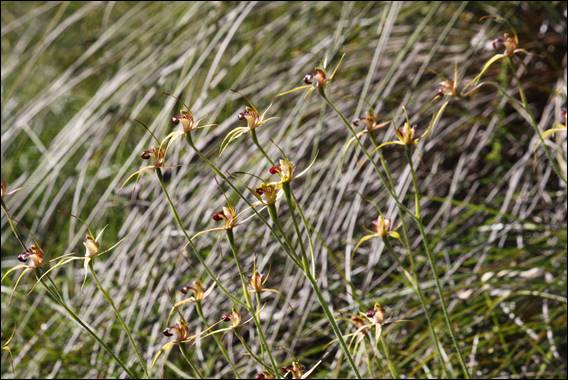
The eight-legged variety were not the only spiders out, and as can be seen by the second image there were a bounty of spider orchids. That was by far the biggest single collection I spotted with some 30-40 flowers, but they were also scattered all over the place. I looked at each closely and took way too many images, checking them out again at home but I’m struggling to figure out if they were all the same species. I’d suggest they were, being the Karri Spider Orchid (Caladenia brownii), which named after one of the authors of the orchid guide I have, Andrew Brown:
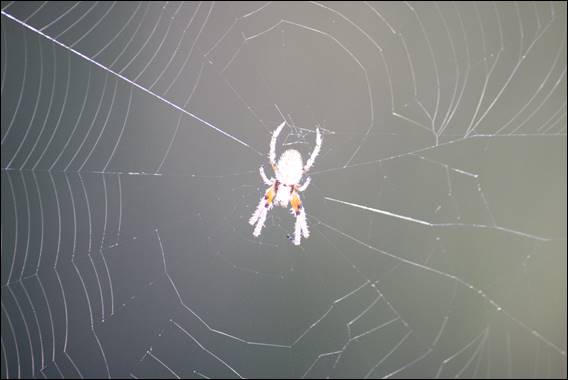
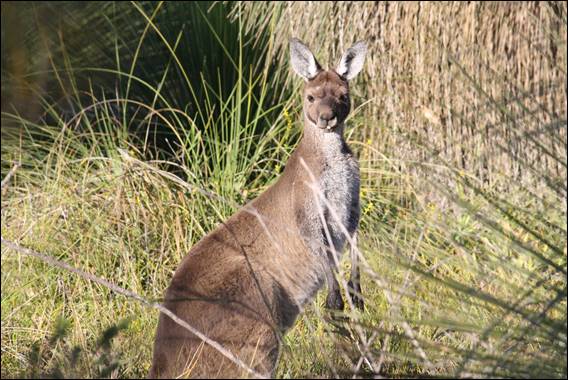
The spider shown in a web, which I did not walk through, is more than likely a Garden Orb Weaving Spider (Eriophora sp.). This is based on the body shape, size, and areas that the hairs are not covering, i.e. the femur (the section of the leg closest to the body) and the maxilla (the sides of the head). There are however over 100 species found in Australia, and with the quality of the image I got there is no point in trying to narrow it down. It seemed that Western Grey Kangaroos (Macropus fuliginosus) were finding it a bit too early to be disturbed, and they seemed a bit sluggish:
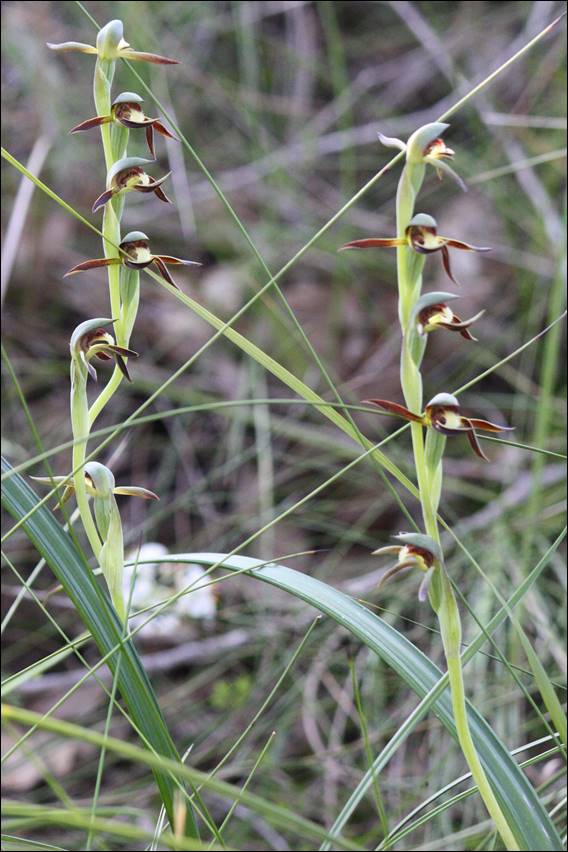
They would normally bound off as soon as they became aware of me, but at this hour of the day they seemed content enough to simply and lazily hop a few metres and then carrying on grazing. Needless to say I did find other orchids in addition to the proliferation of spiders, but of the others I spotted there were only one or a few of each species. The Rattle Beaks (Lyperanthus serratus) a couple of image up reminded me a bit like the kangaroos I spotted, standing to attention to look at me but not really caring or moving:
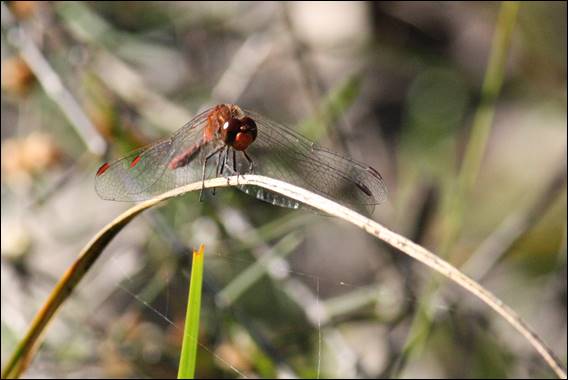
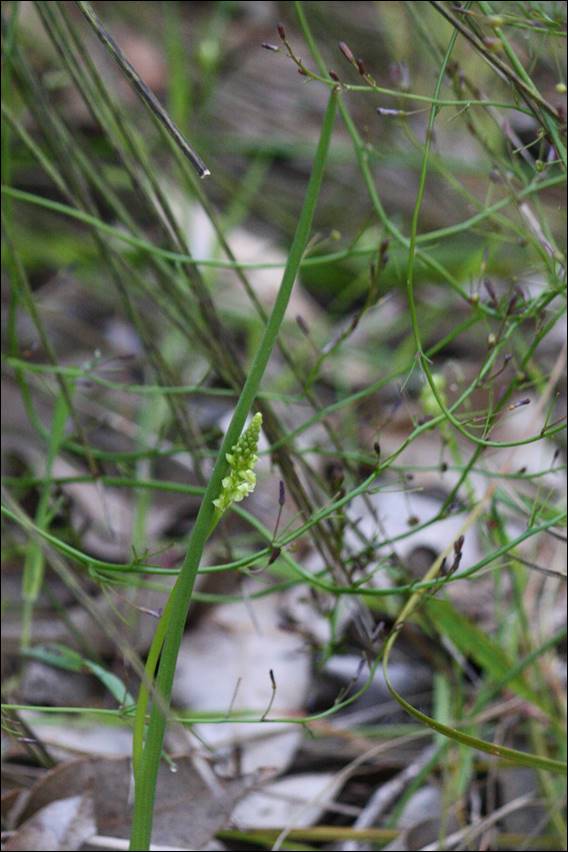
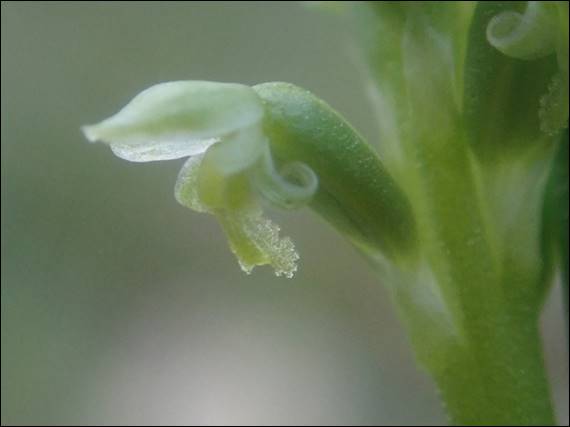
There were a number of dragonflies about, but above was the only red one I spotted. And if I am right, it may be that this was the only male I spotted, probably being known as either the Red or Wandering Percher (Diplacodes bipunctata). A small species with a wingspan of a couple of inches, but one that wanders all over Australia. Another small find, of which I only found one, was the above Common Mignonette Orchid (Microtis media subsp. media). As mentioned in my last post this species has an elaborately fringed labellum, as shown below:
This walk comprises four sections, each being a little different. The first is money section, if you are after orchids. They can be found in the other three segments but from my experience they are generally in lesser numbers. Some of the others sections have far denser understorey making it tricky to see what might be there. The third section was burnt some time ago and has still not fully recovered. I’m not sure if it was a controlled burn, but it looks like it may have burned a bit too hot and if I am right the seed base in the soils may have been damaged:
In this blackened section I did however spot one small clump of White Fairy Orchid (Caladenia marginata), which is one of the species that is said to do well after a summer burn. Mind you last season I spotted this species in great numbers in the money section, which I have not known to be burnt in the many years I have been coming here. It is said to have unpleasant odour, which is used to attract small native flies, although I didn’t notice it myself. With all the understorey burnt I spotted movement at the base of an exposed and burnt trunk:
I waited patiently standing motionless for five to ten minutes, although my eyes drifted about looking for anything else of interest. The only other movement I saw was the below Buchanan’s snake-eyed skink (Cryptoblepharus buchananii). Way less timid than the above find, and happy for me to take some close up snaps making it easy to identify. That said based on the scale configuration, shape, and size of the head plus the meaty foreleg with long toes, I’m prepared to guess it was a King’s Skink (Egernia kingii) that had been cautiously watching me and refused to come out of its home any further than shown above:
I was also being carefully watched by a myriad of birds. As the morning wore on, and the temperature began to rise, the dawn chorus became less prominent. I still caught the sound of song for the whole two hours, which drew my eyes to where it came from and on occasion a bird would perched long enough for me watch it. The below White-Browed Scrubwren (Sericornis frontalis) providing me with the best opportunity. While it is the most common of the five species of scrubwrens found in Australia, it varies in appearance in the differing geographical locations it is found. With this race, maculatus, with its speckled breast being restricted to the southern coastal areas of Western Australia:
I’ll leave you with a selection of my spider orchids images, and if anyone is game to suggest that some may not be the Karri Spider Orchid (Caladenia brownii) shout out:
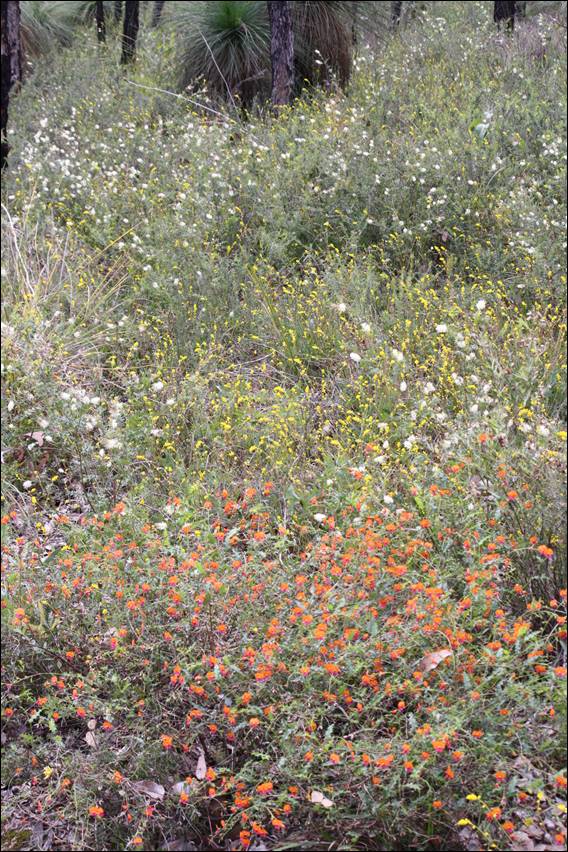
The Capel Nature Reserve was calling me for a little nature boost. And I went there despite looming clouds that threatened a sprinkling of rain, which did eventuated but didn’t dampen my spirits. I parked in a different location this time and wandered off into the bush at some random spot. Hoping that by taking a completely different path, and not being drawn to the familiar locations, where I have previously seen particular species, I might stumble on something new. The groundcover, like at Crooked Brook, was a wonderful sight:
The main shrub in flower being the Yellow Buttercups (Hibbertia hypericoides), there are some 400 species of Hibbertia in Australia although I can’t find out how many of these are found in the SW of Western Australia. Regardless of how many there may be I’m taking a gamble with my identification, but it looks about right. One of the drawcards for coming here was not the blanket of yellow, but the Chapman’s Spider Orchid (Caladenia chapmanii). When I last came here just three weeks back, they were only just starting to come out:
Sadly however every specimen I stumbled across was wilted and on its way out. And if you want to get an idea of the display that I had missed, check out my post from last year https://sandbagged.blog/2022/09/18/the-multi-coloured-picture-show/. Walking on aimlessly with no idea of where I was going or indeed where I was, other orchids were scattered about. The most common being the Cowslip Orchid (Caladenia flava). This particular orchid, while common as muck, can pop up with quite a wide range of petal and sepal sizes, shapes, and hues of yellow, white, and pink:
There were also a fair few Sandplain White Spider Orchids (Caladenia speciosa). It was when I spotted the first one of these and put my bag on the ground, that right next to it I spied this Burton’s Legless Lizard (Lialis burtonis). Several things made it obvious that it wasn’t a snake, including the shape of the face and ear openings. It stayed completely still, as I took a few images getting very close. So close that I thought it may have been dead, that is until I lightly touched it. When it shot off into the undergrowth, slithering like a snake. This particular legless lizard has no front limbs, and only tiny hind limbs that are hard to see:
While in warm climates they are nocturnal, in cooler climates they can be active during the day. Today for me was one of those lucky cooler periods. These lizards wrap themselves round their prey, suffocating it. Then use a special hinge in the skull that allows it to dislocate its jaw and swallow its prey. Carrying on there was a swampy area, with no snakes that I could find, but heaps of Dense Mignonette Orchids (Microtis media subsp. densiflora). These look similar to the Common Mignonette Orchid (Microtis media subsp. media), but its spike has a far denser arrangement of flowers:
It has up to one hundred and fifty small yellowish-green flowers, that have a less elaborately fringed labellum to the Common Mignonette Orchid. There are a number of different Mignonette species and I’ve read they are often overlooked, even by orchid enthusiasts. This is due to the seemingly dull and insignificant flowers, when compared against the many other varied flowers of other genera of orchid. But just like the drably coloured Rattle Beak Orchid (Lyperanthus serratus), below, when you take a close look at the flowers they are in fact just as pretty in their own unique way:
For quite a while now a couple of work colleagues and I have been trying to organise a date to get out on rock. All three of them have young families so it has been somewhat tricky but we eventually plumped for this weekend, which suited three out of the four of us. Sam has been out with me a few times now, but Pat had yet to sample the delights of climbing. We had to watch the clock, as needs to happen that bit more with young families, so we opted for a trip to Castle Rock. Offering a shorter walk-in and some good introductory low grade lines. I offered Lou to join us, but she hinted it was a tad too early for her:
Some of her gear did however make it out with us, as she loaned it to us for Pat to use so thank you for that. It was a great choice for many reasons. This included Sam not having climbed here before and Pat, until today, ever having visited this particularly beautiful part of the South West, which is nestled in the Meelup Regional Park. As you may have picked up on, we got an early start and were rewarded by a glorious view of the sun radiating through the clouds that were starting to disperse. And as soon as we arrived at the crag I got super excited when I spotted a whale a mere 1-200m off the shoreline, and I set off like a mountain goat scampering across the rocks to get a closer look:
It was so very tempting to jump in the water and swim out to the whale. However, with the sun as low as it still was, the light would not be penetrating the water enough plus I didn’t have a snorkel mask with me. Then I almost ignored both of these reason not to go in when I realised it was a mother and calf, who stayed in the same general area for the entire time we were at the crag. There was the occasional bit of flipper and tail action and this allowed Sam to deduce that it was a Southern Right Whale (Eubalaena australis), which I have now read are well known for using the bays along this coastline to protect their young:
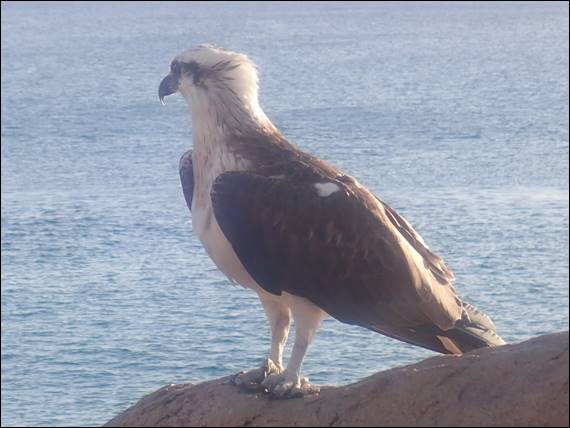
I eventually wandered back to the boys and the crag, when I was again distracted. This time by the above Eastern Osprey (Pandion haliaetus cristatus). The species and subspecies names coming from the Greek and Latin words of haliaietos and cristatus, meaning ‘sea eagle’ (noting that actual sea eagles are a different genus to osprey) and ‘crested’ in reference to the clearly visible stiff tuft of feathers at the nape. As I inched closer it looked me straight in the eye, just for a brief moment and after that it didn’t pay me any further attention not even when got within five meters of it:
I left the Eastern Osprey perched on the boulder and finally got back. Sam is used to my, at times, overly exuberant response to nature’s marvels. And while Pat had an inclination about it before today, he now fully appreciates just how much of a kick I get out of such sights. This also made it clear that climbing, for me, was just one part of being out here. Luckily it was the same for them, that said we had come here to give Pat a taste of climbing so that is what we did. I was not aware of Pat’s fear of heights before today, it was something he had considered but felt he would be OK about it due to the ropes and intention of going easy:
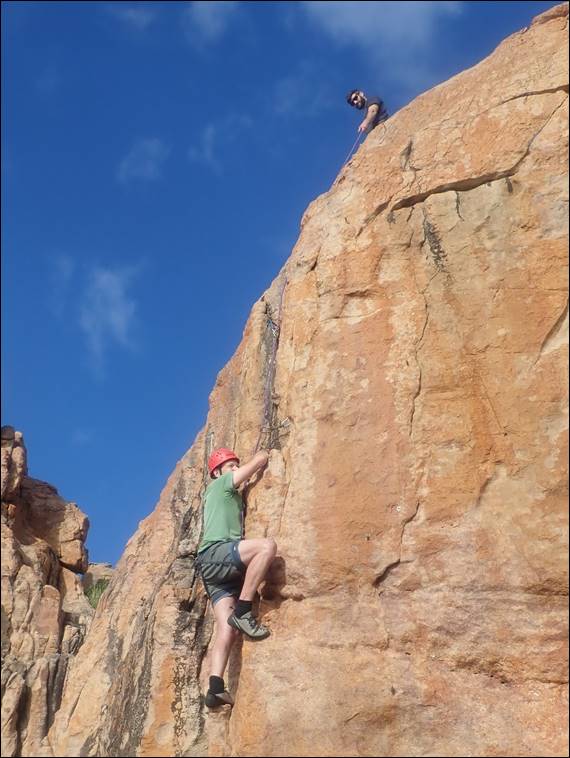
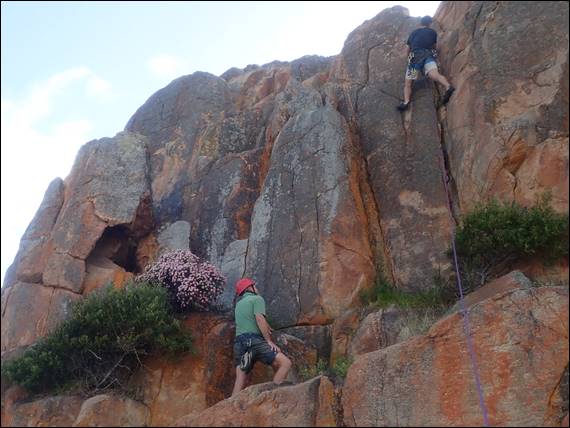
However after sending Sam on lead up the fun Cornflakes, the exposure of the flake out on an arête was just too much for Pat’s brain. He gave it a go and a third of the way up his anxiety got the better of him forcing him to retreat. The good news being that he was not completely put off. So we found an easier line and, more importantly, one that was in a more secure and less exposed position. Pat seemed to be more keenly observing Sam as he led the route, taking note of the holds and how he climbed it. He then followed up, and while he had to sort himself out a bit half way up, he managed to get up the route:
It was great to see him overcome the battle that was obviously raging in his brain. His movements were not what I would call smooth, and at times he looked very conflicted but overcame that and was smiling we he got up. He was however happy to take a break to collect his thoughts and allow his heartrate to return back to normal. This left Sam and I to tackle a slightly more challenging line, one Sam had spotted and was drawn too without any encouragement form me. Above he can be seen as he floated up Pursuits to clock up the highest graded lead he’s done to date, after which Pat was keen for more action:
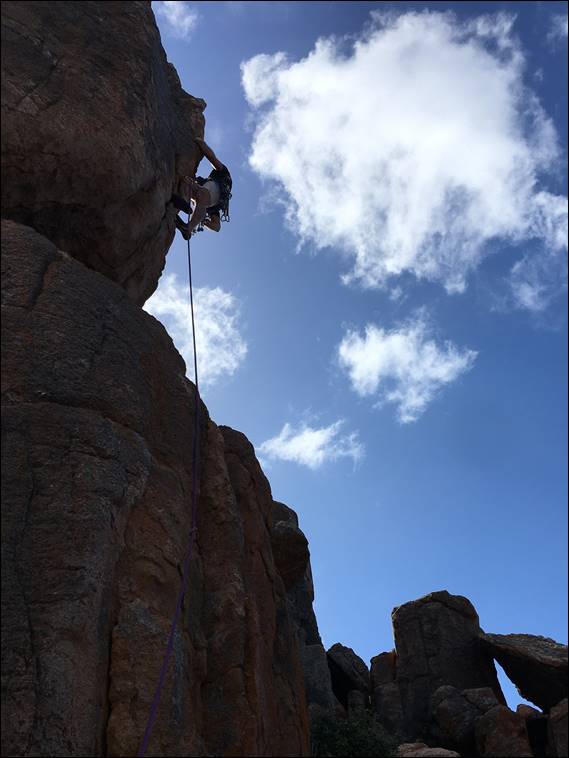
We picked another similar fun and short unnamed line, and this time he looked way more relaxed making far smoother movements and not needing to stop and sort himself out. The morning had been somewhat disrupted by all the whale watching, which included what we believe may have been a pod of Pygmy Whale based on their size. Therefore, time was catching up with us, but before we left we had a bash at Smear to Glory. And in the interest of time Sam suggested I lead. Pat decided this one looked a bit too spicy for him, but he has not been put off and said he is keen to come out again:
As to be expected I have been out and about for a wander to look for orchids since our return from overseas. My first jolly in nature was not in fact climbing related, being a walk at Crooked Brook where I drove to full of anticipation of seeing a heap of orchids. You may wonder why I have not reported my findings, especially as this trip out was before my post about Howsie and my trip to Wilyabrup. Quite simply it was due to not seeing many orchids, although I did have a lovely walk round a couple of the circuits:
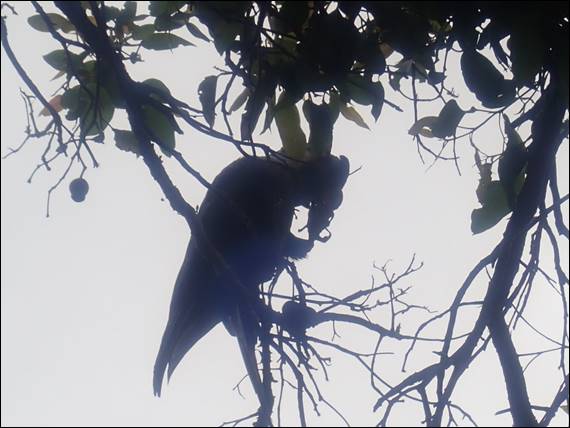
And despite the abundance of cars, which was not unexpected being a long weekend and the start of the spring school holidays, I didn’t bump into too many people. My eyes were however mostly glued to the ground, but I also looked across the colourful groundcover to take in the beauty of all the flowers in bloom. At one point in particular I also spent a long time looking at a flock of Forest Red-tailed Black-Cockatoo (Calyptorhynchus banksii naso) who seemed unperturbed at just how close I was to them:
There were of course some orchids out, but I really had to look hard to find them. Sadly some of the beauties I found on my last visit here had already disappeared or were wilting. While a couple of the more commonly seen species were coming out to keep the numbers up a bit, such as the Purple Enamel (Caladenia brunonis) and Cowslip (Caladenia flava). The only new find for the season was the Forest Mantis-Orchid (Caladenia attingens), of which I only spotted one despite being described as a relatively common orchid:
The common name is self-evident, and the Latin name also seems appropriate for the same reason with attingens meaning “reaching to”. This was not however intended to refer to the sepals at the front of the flower that are reaching upwards like a praying mantis. It was instead used to describe how the calli, or fleshy lumps on the upper surface of the lip, were said to extend as far as the tip of the labellum. However, as seen in the image above they only reach as far as the green portion, and do not extend into the tip where it turns purple:
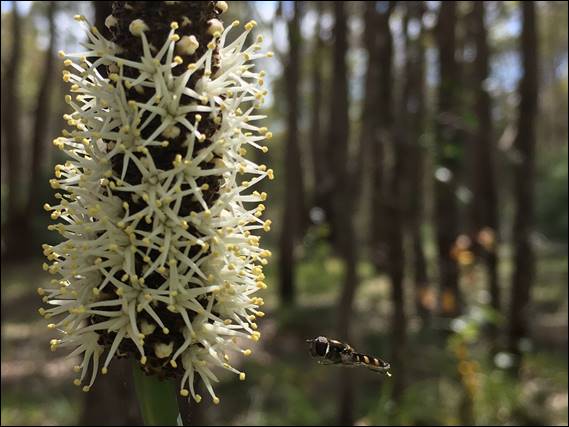
Despite the lack of orchids I managed to spend a very relaxing couple of hours scouring the area, and even took images of different ant nests with an aim to identify them for a post. Spotting amongst others Bull Ants (Myrmecia gratiosa) and Green-Head Ants (Rhytidoponera metallica), which have very different entrances to their nests. But when I discovered there are over 500 species of ants in the South West of Western Australia alone, I abandoned that idea. And we will finish that walk with an image of a flowering Grasstree (Xanthorrhoea):
The order of insects Diptera covers flies, and Hoverflies are considered the most important pollinators of all fly families. You may notice in the above image a Hoverfly, possibly being Melangyna collates or Symosyrphus grandicornis both of which are common native Australian species. These two species have been identified as being pollinators of orchids. My hunt of which continued on Thursday, when after three days of being back in the office I really needed to get out and declutter my brain, so popped into Manea Park on the way home:
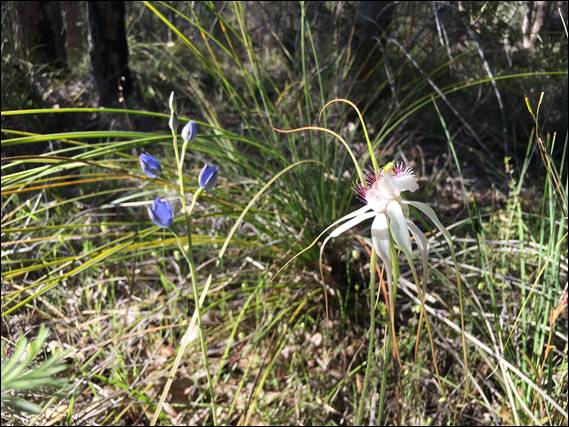
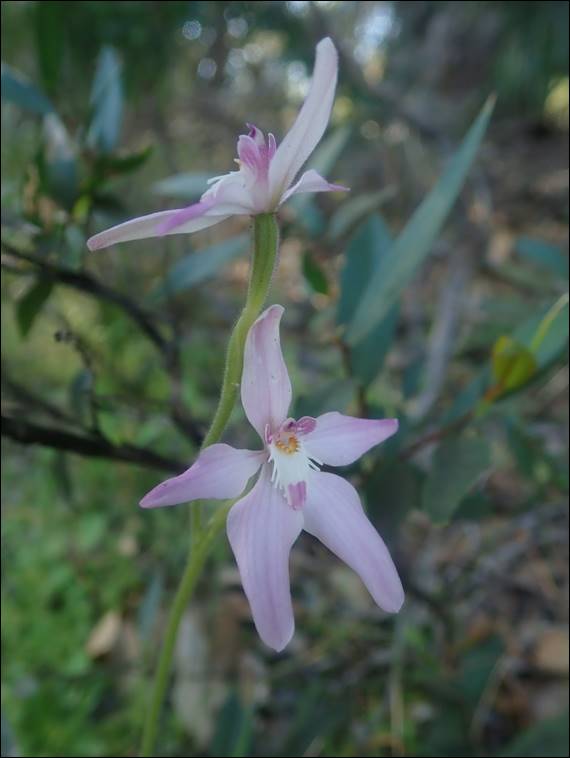
This time I had a fair bit more success with several new species for the season including the Blue Lady Orchid (Thelymitra crinita) and a number of hybridised Pink Fairy Orchids (Caladenia latifolia). While this restored my faith that there could be more to come, chatting to a friend in Perth, Verity tells me that the orchid season up that has also been somewhat lame. With many of the usual species that are commonly seen being hard to find this year. All I can do is keep my fingers crossed for down here, and keep heading out:


















 Sandbagged