While I was not driving today, I asked Craig if it would be silly to aim to get to the carpark at first light. He replied “yes it would be silly, but let’s do it anyway”. Working shifts he is used to waking up, and going to bed, at all sorts of weird hours. Plus an early start was more inviting, due to the forecast of a hot day in the high thirties. Setting the alarm for 3:30 was forgotten and forgiven when the sky lit up, as we approached the crag. In view that he doesn’t get out too much, I asked Craig where he’d like to head:
Moses Rocks was his choice, the friendly crag. His reasoning was however somewhat swayed by the unfinished business I mentioned in my post of my last climb with Rongy in the south west https://sandbagged.blog/2023/12/28/placed-on-hold/. It was indeed the last climb here, and Rongy and Sarah finally hit the road soon after New Years and are now somewhere over east. Seeing we were back at Rumpoles Rocks and Rongy and I had climbed every route here last time, I handed Craig the rope and left him to pick a line:
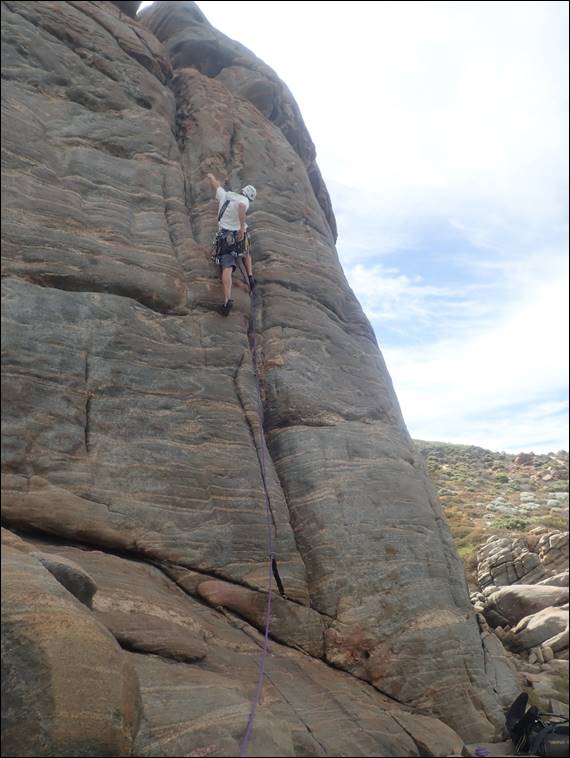
We warmed up on a couple of fun lines, nothing too serious to start with. Although the conditions were not as good as my last visit. The rock had a coating of salt spray making the rock feel a little greasy, and the air hung heavy with humidity despite the early hour. It did make me wonder how the unfinished business would feel, not that I had to worry too much about it myself. When after my warm up lead I again handed the rope to Craig and offered him the opportunity to bag the first ascent:
The route may be deemed a little contrived. It goes up a wall between two existing climbs that use more obvious crack systems. This route is climbed without using the cracks, even though they are tantalisingly. Especially at the two crux sections. The first being a very delicate slab that had Craig foxed for a while. The second being the first rooflet that despite several attempts had him completely stumped. If he’d studied the images in the above linked post, it may have provided him with the all-important beta. Climbing speak for information:
He came back down, happy to have given it a red hot go. After cleaning the gear from the potential new climb, it was my turn. Despite the less than ideal conditions it, not I, fell reasonably easily. And we have once again added another fun puzzle of a climb at this crag, which we called Off the Rails. So named because you need to avoid using the obvious track/cracks that the two lines either side take. While it may seem harder for someone trying to climb it on-sight, with no beta, we decided to grade it 17 (HVS 5a):
This was in keeping with the grading of some of the other climbs here. They really do feel like those little brain teasing puzzles, with two or more pieces that can be so damn hard to separate. I’m pretty good at them, but I do have one sat on my desk that Elseya bought me a year or two back that I still haven’t solved. And yes I threw away the answer that came with it, so I couldn’t cheat. As is usually the case, Craig came armed with a flask of tea. So a cuppa was poured and allowed to cool, while he tackled another line at Rumpoles Rocks:
Upon bagging another fun line, one that was easier to read and not having secret tricks needing to be solved to unlock the sequence required to get up, we supped our welcome teas before moving across to Hands Up Wall. Here, as the temperature was rising and the greasiness seemed to get worse, we picked another four fun routes. On the penultimate climb, my fourth lead, the humidity was wearing me down. And despite my grin, I found myself pulling harder than necessary on every hold. A sure sign I was ready to call it a wrap:
Having already lead almost four routes, due to his oh so close success on the new route, it wasn’t too hard to convince Craig to finish the session on the classic of the crag. But not before we poured yet another brew, and let that cool so it was ready to drink as we sorted the gear when we got down. It may seem strange to be having a cuppa on a hot day, but research has shown that a hot drink on a hot day can aid your body to cool down. As long as you are not already sweating, something we did a fair bit of as we walk out:
With a full moon looming tonight, when the gravitational pull of both the sun and moon gang up on us, the tides have been gradually getting bigger. To be fair the tidal range doesn’t change all that much where we are, but with a lower than normal low tide much of the reef was poking above the waterline. Sadly the winds have been whipping up each afternoon. Therefore, while the water looked flat and the sun didn’t have to contend with a single cloud in the sky, the visibility wasn’t wonderful:
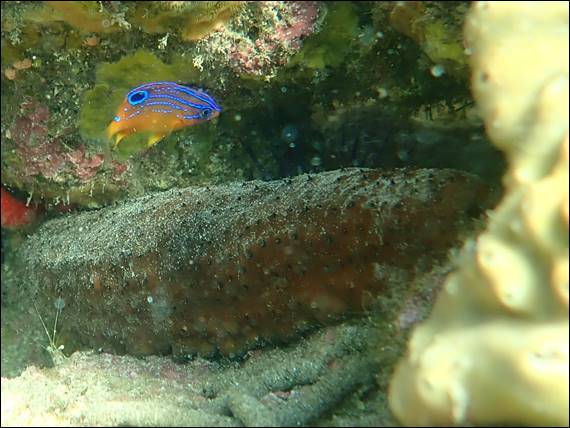
This post will include images from two trips out that way. During the initial swim out I came across a few reasonable schools of Western Striped Grunter (Helotes octolineatus), Grey Drummer (Kyphosus bigibbus), and Australian Herring (Arripis georgianus). But once out at the bommies, caves, and ledges, life on the reef became relatively quiet. I was however happy to see a Southern Garfish (Hyporhamphus melanochir), even if it was a single fish. this fish that can often be seen swimming just under the surface, where it is catches insects:
I also spotted a sandy area littered with egg sacs from Lugworms (Arenicola marina). The worms themselves have alluded me, but their casts are always evident. They create U shaped borrows by sucking sand in through their mouth and excreting it out in the form of cast. So like Sea Cucumbers they vacuum the sea bed and help to maintain a healthy ecosystem. From these borrows the female Lugworms will also create these balloon like jelly sacs, which becomes a nursery for her fertilised eggs. The bags are attached at one end so sway about with the swell:
Another find on the sandy bed was this Cone Shell. Globally there are approx. 600 species, with a quarter of them being found in Australian waters. It is a shame I didn’t get a better image, but the pattern looks akin to Geography Cone (Conus geographus). Found widely in the waters round northern Australia, and as afar down the west coast as approx. Geraldton. Although with warming temperatures it could possibly have made its way further down. Regardless of which one I found it was wise to steer clear of it, as their sting can be fatal:
With the full moon tonight the low tide had crept as low as it would go before it once again commences its upward journey. Sadly the wind was blowing a hooley yesterday afternoon. Lisa advised me that there were ‘proper’ waves off Peppy Beach when she and her fellow plungers went for an early evening dip. In addition as I walked out in the morning the banks of clouds were out to sea, with their wispy edges fingering their way towards the sun. Despite a potentially sediment ladened water column and limited light I kept walking:
My destination being a part of the reef where the bommies were taller, standing above the seabed five to six meter down. As the strength of the sun fluctuated in response to the movement of the clouds, my vision was not always able to penetrate the water to the side and also below me. It would have been enough to put most people off. However, like when I climb you need to be able to control your fear or miss out. Not that there was a whole heap to miss out on today:
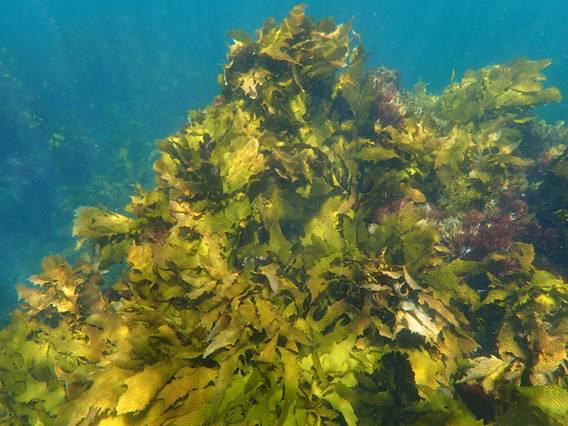
In-between diving down to check ledges and caves, a few of the familiar fish I see dart about in the kelp covering the bommies kept me occupied. The kelp forests of the southwest is extremely important to the ecosystem of our local waters. Providing the main food source for the marine food web, but also an important habitat for many species of both fish and marine animals. Such a great habitat that it can be near impossible to see what lies beneath, so I have to be quick to take a snap when a fish pops it head up:
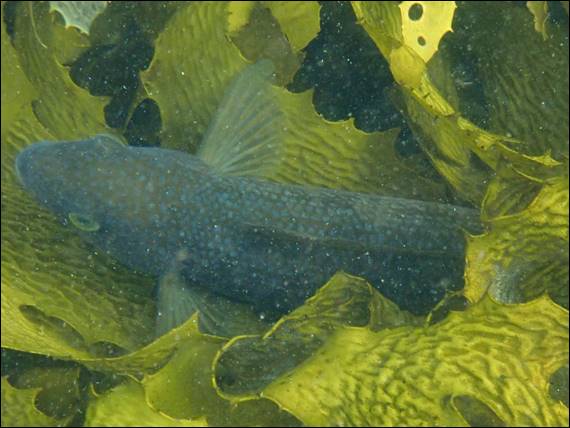
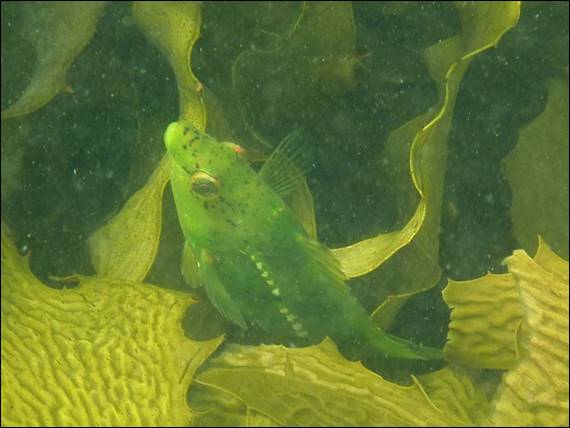
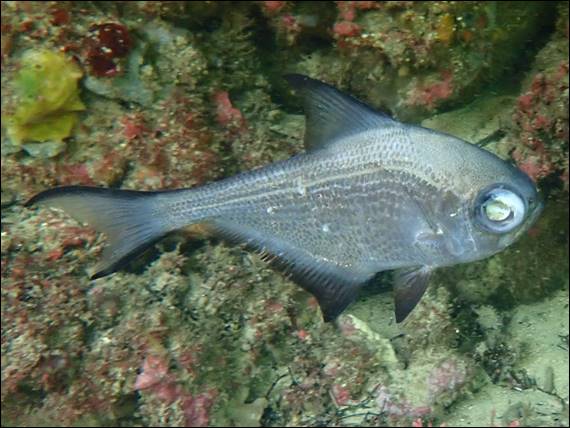
Two images above is Herring Cale (Olisthops cyanomelas), with a nice close up showing the a brown body and blue dots making me think this fish may be transitioning from being a female to a male. And above another nice close up of what I believe to be a juvenile Castelnau’s Wrasse (Dotalabrus aurantiacus). The bright green with black flecks hinting I could be right. The last image is of a Bigscale Bullseye (Pempheris multiradiata), one I could easily creep up on to get the image, as it has either had a scuffle or has been infected such that it has lost sight in one eye:
In theory I would have arrived back on dry land yesterday, after sailing in the Bass Strait and climbing on Deal Island. Instead I’m still, surprisingly, enjoying three weeks off work while staying at home. With no trips planned or taken other than some local jaunts. Lisa is equally bemused by my lack of tetchiness and hankering to get outdoors and do stuff, and both she and I were concerned this may have been an issue. It has helped that I have had the occasional mornings out on rock, and also that the conditions have been reasonable for frequent snorkels. I have also used the time at home to reset my indoor climbing wall:
It seems that resetting my wall occurs by default approx. every three years. Within half an hour placing the last hold, Lisa’s Facebook sent her a “memory” from six years back to the day. Which was when my wall was first completed and ready for a climb, although the second resetting project was not exactly three years in, it wasn’t too far off. Doing it myself this time was a mammoth fifteen plus hour task. I had split the task over quite a few early mornings, before the shed heated up like an oven. Mornings selected based on whether the water conditions were inviting me in or not. The water has been inviting some mornings, although it has at times also been deceptive:
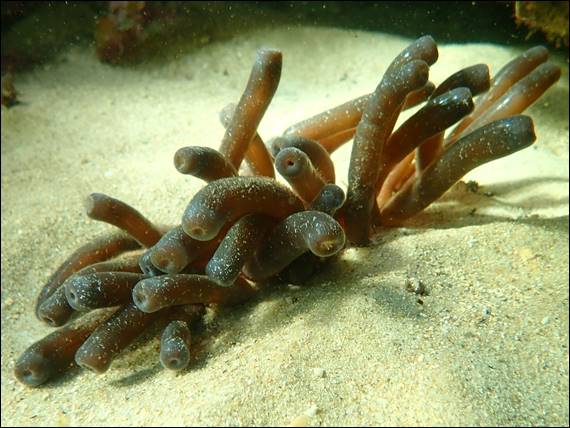
The first two images are the only ones I have kept from my near hour long swim off the beach from the Capel River mouth. The water looked reasonable but a combination of wind, swell, and cloud made it not so great. The first picture is of Finger Zoanthid (Zoanthus praelongus), which for some reason reminds me of a fictional creature in the 2005 King Kong film. They were giant slugs, called Carnictis, but the mouth looks very vaguely like the Finger Zoanthid when its tentacles are out. This generally occurs at night, when they draw in plankton and particulate matter from the water column. Some Zoanthid species have however, like Carnictis, been observed to eat meaty foods for example krill and bloodworms:
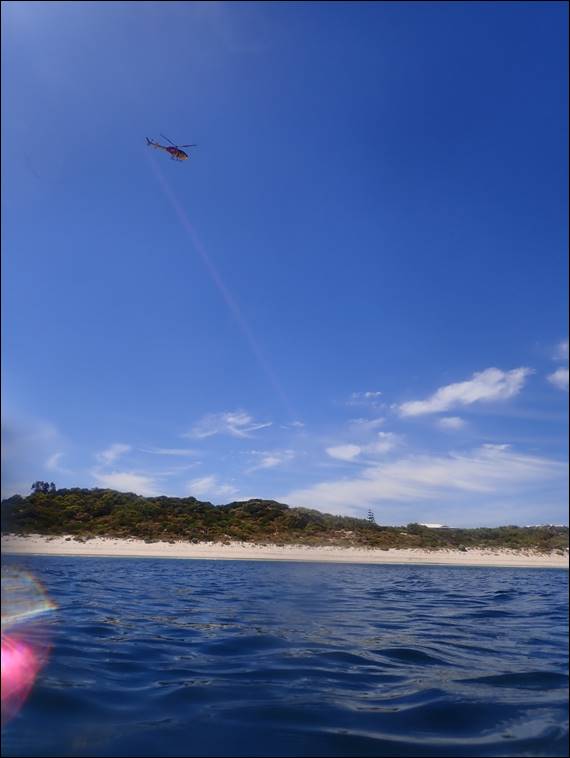
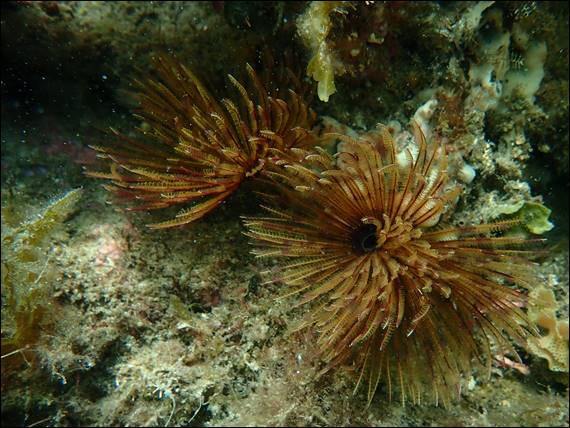
The second image was of a Troughtons seastar (Pseudonepanthia troughtoni), easily identified by the skin texture and colour. One that is endemic to the coastline of southern Australia and Tasmania, but I can find very little information about it. Although the Museum of Victoria claims it is rarely seen and little is known of its biology. The image above and the next two are from a different swim this time off our local beach. Lisa later advised me I was in the water when a 1.5m unidentified shark was observed swimming northward along our beach. I wonder if that is why the Rescue Helicopter was flying as low and slow as it was, but sadly I didn’t see the shark. I did however see theses European Fan Worm (Sabella spallanzani):
It has many different common names, and as the name I have used suggests it is an invasive species. Being first observed in Albany in 1965. Probably brought in on the hull of ships, and having now spread round much of the southern coast and also up the west and east coast. Based on molecular data, research indicates the spread of the species along the Australian coast all originated from that single introduction in Western Australia. On the plus side there do not seem to be any impacts, other than possibly interfering with nutrient cycles where dense colonies exists. However, as I have alluded to enough times we manage to interfere to a far greater extent when it comes to nutrient cycles both in waterways and the ocean:
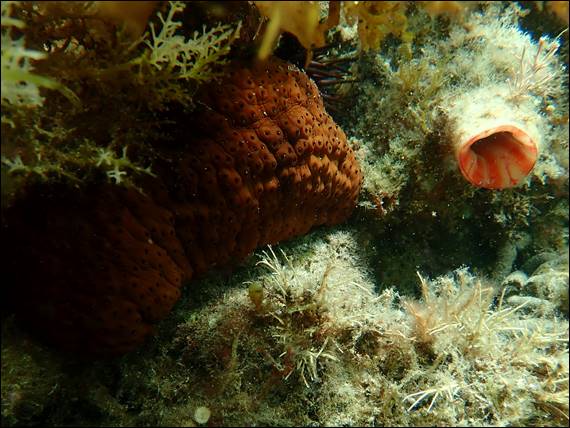
To the left of the above image is Red-mouthed Ascidian (Herdmania grandis). My reason for including the image, was because Dan had read up on these creature after reading a past post of mine, and found out that they eat their own brain. This is not entirely true. To reproduce they release sperm and eggs into the water, and fertilised eggs then become a larvae that resembles a tadpole. The wriggling movement of this larvae is controlled by the cerebral ganglion, which forms a basic brain. As the adult is a sessile creature, attaching to a substrata, the “brain” becomes redundant when the larvae transforms into its adult form. As such the brain along with other body parts are absorbed, so it is kind of eaten:
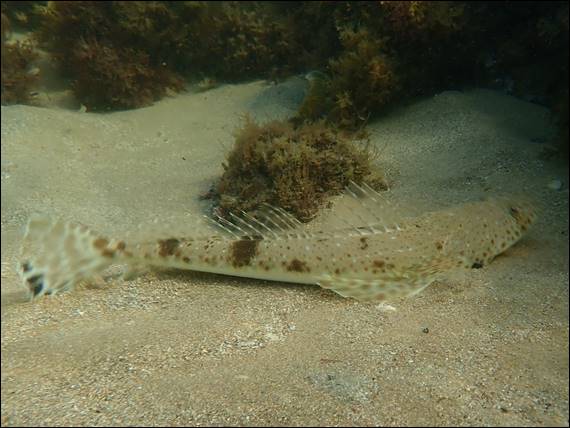
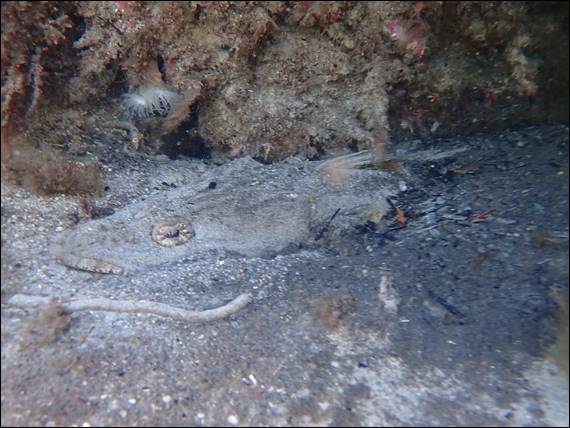
The above and next few mages are from a far more successful snorkel that was past “The Point”. To get here it is a short one kilometre plus walk from the River Mouth carpark, and a place I should go to more regularly. With way more intact reef and as such far more places to explore. Where I went in the reef was approx. 200m out and the water swimming out was murky, but once at the reef things cleared up nicely. On the way out I spotted yet another Flathead, of which there are some sixty odd species in Western Australia. This one being the Southern Bluespotted Flathead (Platycephalus speculator):
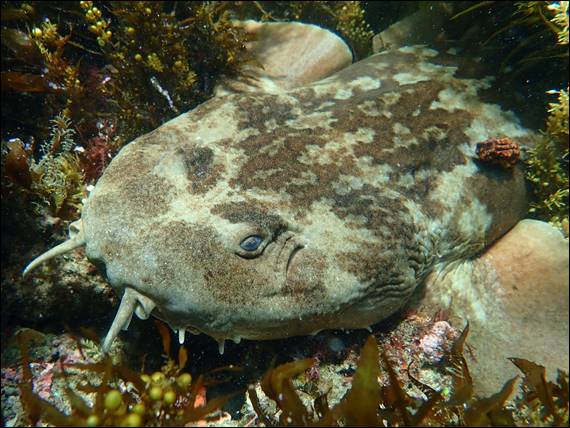
I’ve not included the best image, which was just before it decided to get away from me. But this image does however clearly show the black spots surrounded by white on the caudal fins, as well as the dusky brown blotches on the pelvic and caudal fins. Which is how I was able to identify this species with confidence, but not without a fair bit of checking out the different species. My next sight was another Cobbler Wobbegong (Sutorectus tentaculatus), but much smaller than the adult I recently spotted. They tend to sleep during the day. But this one did not have a very secure position, and the swell was pushing it about. I watched as it was tumbled over the reef and eventually found a place under the weed to rest up:
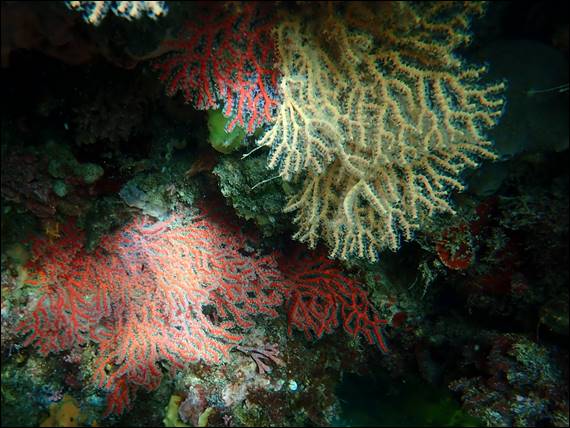
With heaps of places to dive down too, I didn’t find any other big fish resting up for the day. But did enjoy checking out the Zimmers Sea Fan (Mopsella Zimmeri), which can be found in various colours of red, yellow, white and orange. This coral creates a rigid and flat fan shape, that resembles a tree and can be as big as one and half meters tall. These were sadly tiny in comparison. The polyps, which are the living part of the coral, create the structure by secreting a calcareous sclerites. A fancy name for plates that form an exoskeleton. The polyps then live in this structure and pop out from the branches, extending their eight tentacles into the water to capture zooplankton:
The polyps can be seen sticking out all along the branches in the above image, looking like leaves on a tree. During this dive I was lucky to spot two Blackspotted Catshark (Aulohalaelurus labiosus) on separate occasions. There twenty to thirty species of Catshark in Western Australia, but this is the only species I have been lucky enough to come across. Being an endemic species to the south-western Western Australia it is a nocturnal fish, so I was lucky to see them out and about and took this video as one of them swam below me. They do not grow too big only reaching a couple of feet in length, so this one with be an adult:
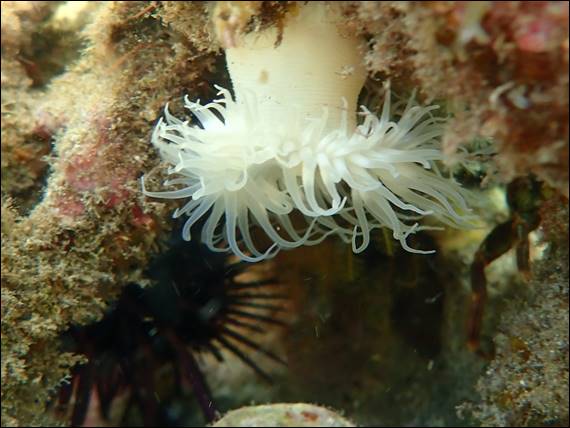
The last image is from another not so great dive off our local beach, of a white sea anemone that I have not identified with a small crab lurking in the background. The reason for including one more image is however to allow me room in this post to confess that I had incorrectly identified the large mollusc I recently saw. It was not a Giant Triton (Charonia tritonis), but a Giant Conch (Syrinx aruanus). The former having a pattern on the mustard yellow foot, and the latter not. It did mean that I had found what is reported as being the world’s largest living snail reaching close to a meter in length. But it does not feed on Crown-of-Thorns Starfish but polychaete tube worms:
The upside of not having gone over east is that I got to head out with Mikey and Howsie, on their last climb before Mikey and his family were to head back. You may be forgiven in thinking that we had camped out at Wilyabrup to get a truly early start, but that was not the case. While there were no climbers about at our relatively tardy arrival time of 6:30, a full hour after the sun had come up, a couple were camping at the base of the crag. Smack bang in the middle of the path making it hard to avoid walking right past as they lay in slumber:
Today we were joined by Peter. Peter who, you may ask and for good reason as he hasn’t copped a mention in my posts until now. March last year was when I last managed to get Sam from work out for a climb, and another trip out with him is long overdue. I digress but before I continue and just to encourage Sam back out he may want to revisit that day https://sandbagged.blog/2023/03/25/hidden-delights/. In the linked post I mentioned a couple of climbers who were ascending Hope, while I was belaying Sam who was leading the second pitch of Sirius:
And as I do, and with such a good vantage point I took a few images of them and then offered to send them a copy. Well that was Peter, who was climbing with a mate over on holiday from the UK called Fred. Both of them had an additional decade or more of climbing under their belt than I do; a love for traditional climbing; and knowledge of some of the crags I used to visit back in the homelands. As such we had a good ole yarn. This week Peter happened to be back in the area, escaping the hustle and bustle of Perth, and had reached out to see if I was keen to get out:
Today offered the ideal opportunity, although when I told Peter our arrival time he remarked that it was an early start. Which I had to have a laugh about. When I finally get my car sorted and I can be the lift giver, the start times may well resume back to earlier starts. As it was I had scrounged a lift off Howsie and Mikey today, and during the drive down they said they had already talked about going a bit harder today. Making me doubly happy to have arranged for Peter to join us, which I thought may have allowed me to enjoy a few more mellow lines:
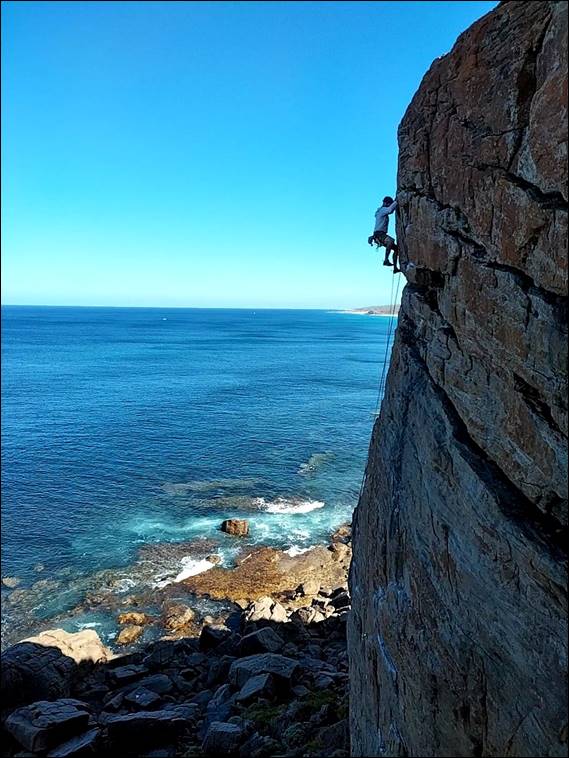
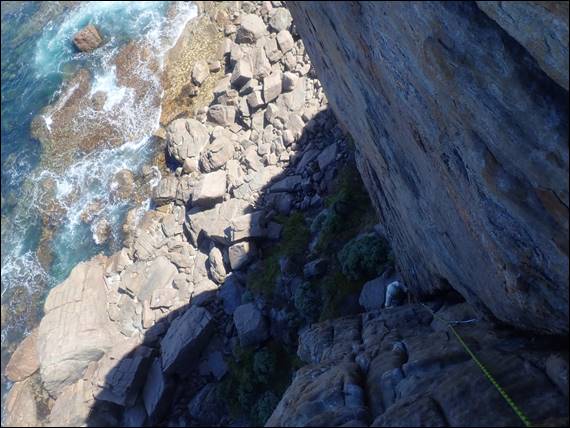
It certainly started that way and after I had worked my marketing skills, as Mikey described them, he started on Golden Buttress. A very exposed climb with a couple of very out there positions, as shown in the second image. This probably makes it a mean one to get someone to lead to kick the morning off. It is however one of the best here. Something he agreed with after climbing it. Peter and I climbed the more relaxed Road Trip and then Hitching. The latter giving Peter some delicate and exposed climbing shown in the third image:
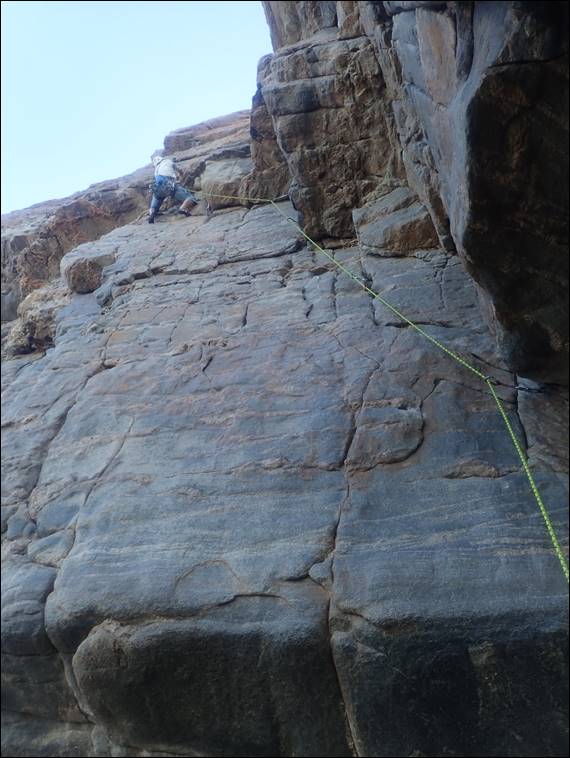
While Peter has climbed here a heap of times, he had not been on the first two lines we hit so it was great to allow him to jump on something new. When we were coming down off our second route we found Howsie was starting up one of lines he had been really keen to complete last year, being 2023. It was his third attempt on Washed up Punks, and as he crept up the wall Peter mentioned he was keen to jump on Mobjob. While three grades easier than what Howsie was tackling, this route has a bit of a reputation and is in fact quite physical. Especially at the start as shown two images above. I’m not one to dissuade people, so went along with it:
Wondering however if I may be being a bit silly. We left Howsie to it and as luck had it Mick arrived at the crag to prepare for a pretty big day with four consecutive groups booked in. He had allowed plenty of time to set up, so sat and watched Howsie get a magnificent clean ascent. As such the picture with the backdrop of the calm ocean two images back is courtesy of Mick. Meanwhile, Peter managed the first pitch clean and on second I found it quite reasonable. And to boot not even a hint of a twinge from my shoulder. Although, it has to be said having a rope above does help to make you more relaxed even when it gets tough:
I topped out on the second pitch of Mobjob, up the fine and much easier corner. Again two images up. Peter followed up just as Mikey and Howsie appeared at the base ready to start the first pitch. In all the years I have climbed here I have never seen a queue for this route, and probably won’t again. And while they jumped on the route we had just climbed, Peter then said he would be keen to give Washed up Punks a go. Any thoughts I had of a more mellow day becoming an even more distant memory, but I was more than happy to climb it with the rope above me. Peter’s idea was however put to bed, as the abseil lines Mick had now set up crossed over the line at several points:
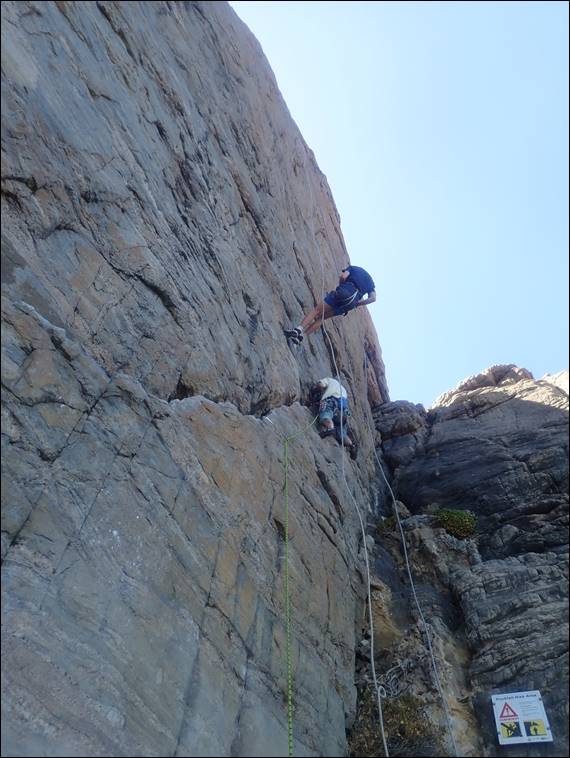
Instead he plumped for Stainless Steel, another route that commands respect. And one that only required us to navigate the two abseil lines for a short period at the start of the climb as shown above. Something we chatted to Mick about so he was aware and comfortable with what we were doing. By the time I got to the roof my forearms were feeling it, making me grunt up the last physical move much to Mick’s entertainment. Meanwhile, Howsie and Mikey had only just finished the first pitch and were now getting ready but not for the easier corner I had climbed. They had their sights set on the face to the left, being Howsie’s first 24 for 2024:
While they took turns at taking whippers and eventually climbing out up the corner, I went up the Unbolted and the Beautiful. Another line that Peter was not familiar with. And one that made him think, along with his experiences at Smiths Beach, that routes I had establish and graded may have a greater tendency to be sandbags. Not that this line presented him with any problems. During our chats I found out he was one of Mario’s ‘partners in climb’. Then later that day when I told Mario I had been out with Peter, and his first response was that he was a strong climber. And hopefully one that I get the chance to climb with again:
Despite seeing the New Year in, my body clock wouldn’t allow a lie in. So bright and early Lisa was off for a walk with the poodles and I went for a dip at my usual spot. In contrast to yesterday’s hustle and bustle on the shore and in the water off Castle Rock beach, our beach was practically deserted. A school of Weeping Toadfish (Torquigener pleurogramma) escorted me from the sand and over the reef. After wondering whether I see many fish from different orders, these are from the Tetraodontiformes order:
The common name for this order being puffer fishes, some of which are poisonous. This includes the Weeping Toadfish and it is not a fish to be eaten by humans or pets. Like our beach the water was relatively quiet, and I didn’t see too much that was out of the ordinary. Although during one of my descents to the sea floor, I spotted the creature below that was an inch and a half long at the most. I wondered if it was a limb that had been detached from a sea star, but the shape does not look right. It may be a Bristle Worm (Polychaetes):
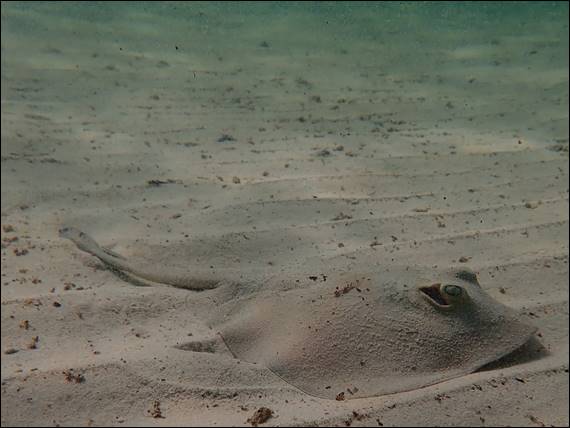
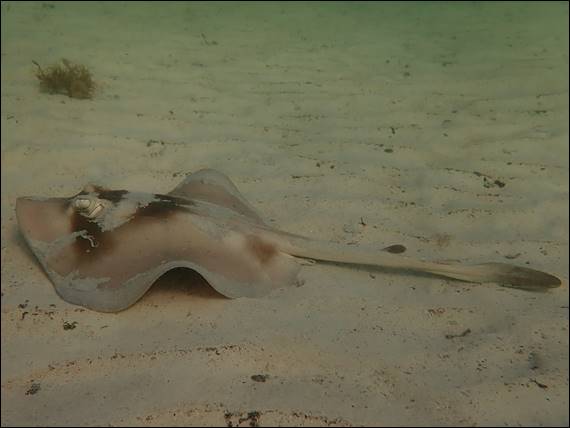
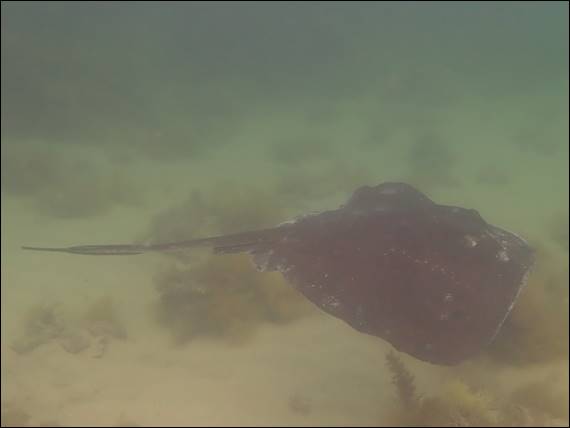
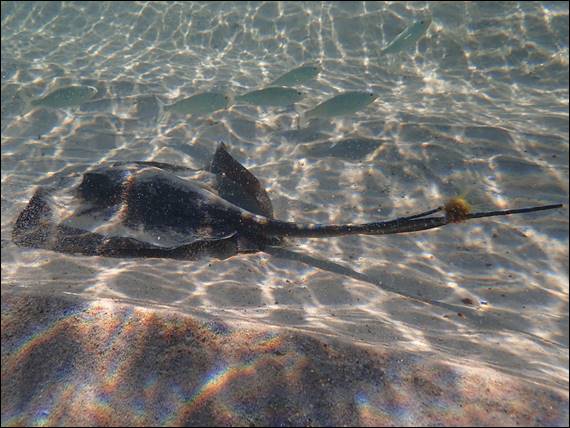
The images I got simply were not good enough to conclusively identify it, and there are no obvious matches from my searches online. My pictures of the following ray were however good enough for me to work out that this was a Sparsely-spotted Stingaree (Urolophus paucimaculatus). In the image below it has a light coating of sand over it, but watching it glide away the dark edging round the tail fin was evident. They are all along southern Australia but the populations in the west do not usually display the spots from which it gets it name:
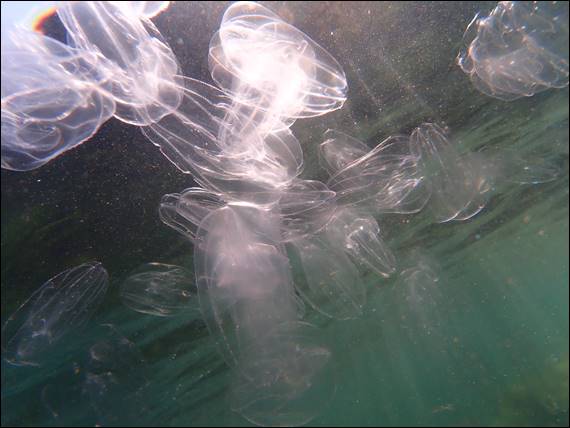
Today came in a bit cloudy, which meant the visibility could be a bit rubbish. As such I headed to Wave Walk, where the reef comes in close to the shoreline and the water is shallow. My theory being that with reduced light I’d still be able to see OK. Unfortunately while the swell was slight, it seemed to be enough to mobilise the sand and it really wasn’t much cop. But once in there was no point in getting straight out and I scoured the reef, where I literally bumped into huge pockets of Comb Jellies (Ctenophores):
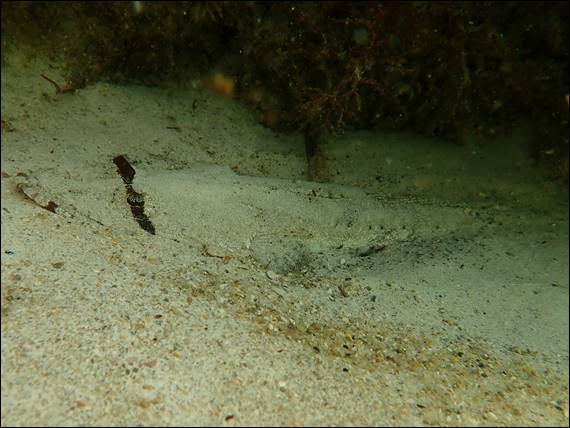
These do not have stingers, but some species are still voracious predators. Preying on other jellies, with some comb jellies able to expand their stomachs to half their size to enable them to absorb their prey. I was about to head back in when during my last intended duck dive I spotted another flathead. Thinking it was probably the same species as the one I found off the river mouth beach. However, the dark band, a bit like war paint, across the eyes had me wondering. And it was different being a Longhead Flathead (Leviprora inops):
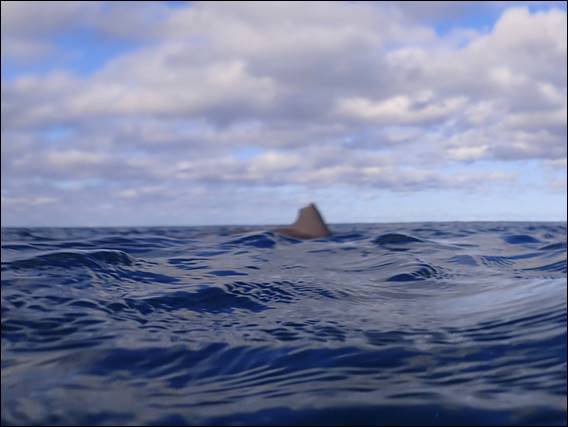
I popped my head up to see which way the beach was. Being a little disoriented due to it being pretty murky, so much so that it was hard to see what was below me or indeed what may be off to the side. A couple were standing on the beach looking out, directly towards me. So I did a quick 360 degree scan and saw a fin pop up just a few meters away. I watched it and no caudal (tail) fin followed the dorsal fin. That told me it was likely to be a dolphin, as their caudal fin is horizontal. So I started to breathe easy again:
Despite being really close and getting a great view of the Bottlenose Dolphin (Tursiops aduncus) and it’s calf, this was the best image I could get. The two of them went up and down in unison, like synchronised swimmers. Circling round me but not making any obvious moves to swim away. Eventually they started along the coast and even though they were swimming at what looked to be a very leisurely I had no hope of keeping up. Soon enough they were out of sight and I was alone again in the gloomy water:
So I thought. In trying to swim after the dolphins I had gone out a bit deeper and the water looked to clear up. Enough to see the seabed where I spied another ray. The markings had me intrigued and sure enough it was yet another species being a Masked Stingaree (Trygonoptera personata). Unlike the Sparsely-spotted Stingaree this one had its namesake markings over the eyes, with another dark mark centred on the disc. It is also endemic to Southwestern Australia between, with Geographe Bay being its most southerly range:
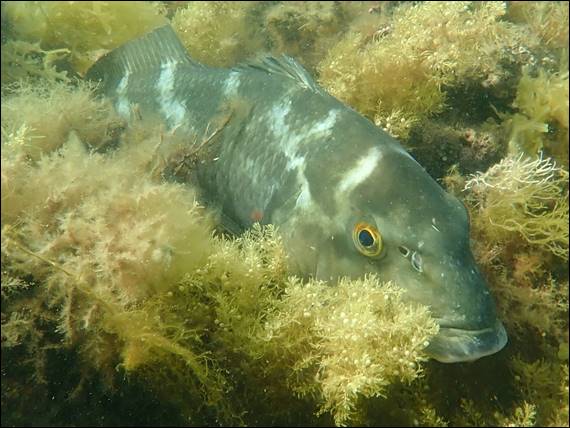
With renewed enthusiasm I checked out the reef, which was further out but started to shallow. I spotted more fish all too quick for me take any images, so I just watched them including what I though may have been a spectacular Senator Wrasse (Pictilabrus laticlavius). Sadly I have no evidence, so instead here is an image of yet another near full size one meter long Dusky Morwong (Dactylophora nigricans). These fish have been reported to get used to humans to the point they will let you get quite close, which this one certainly did much to my delight:
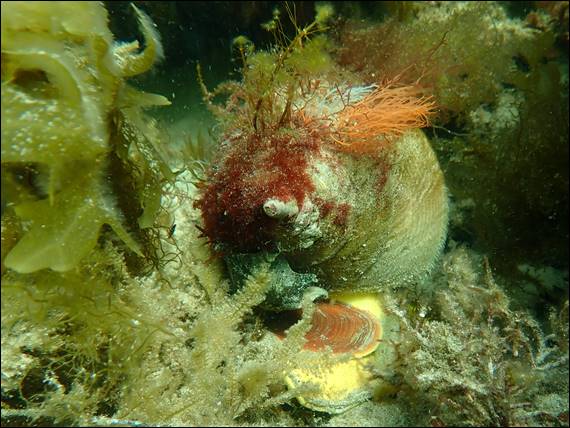
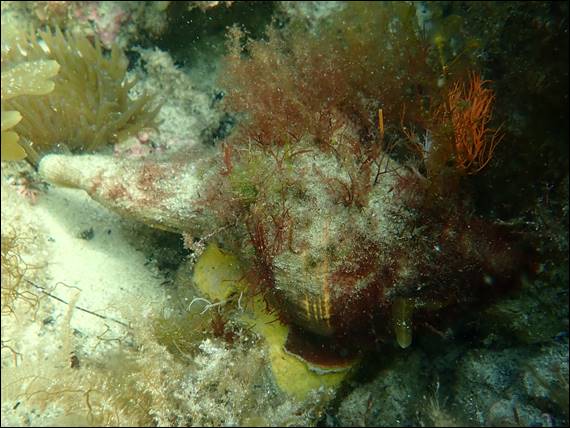
One last find to report, and another slow moving one that allowed me to go down and take lots of images. I was drawn by the large shell, from which a yellow foot of a mollusc came out. Attached to the upper surface of the foot the operculum was clearly visible. A bit like a trapdoor used to full seal it’s protective house when the mollusc retracts inside the shell. The shell had a bit of an ecosystem living on it. Various weeds growing out of detritus stuck on the shell, and a Six-armed Cushion Star (Meridiastra gunnii) hitching a ride. Based on the shell shape this looked to be a Giant Triton Snail (Charonia tritonis), one of the largest marine snails reaching up to two feet in length:
This one was probably half that size, but a great find. The unseen shell has a beautiful pattern and was highly sought after, to the point the snail became rare and endangered so it is now protected. These snails feed on Crown-of-Thorns Starfish (Acanthaster planci), which are a naturally found species on the great barrier reef but can kill ninety percent of the reef they live on. As such a Giant Triton Snail breading program was initiated for the great barrier reef. In the hope it would keep in check the number of Crown-of-Thorns Starfish, and the impact they were having on an already struggling coral reef, by increasing the numbers of this protector of the reef. I’ve since worked out that this was a Giant Conch (Syrinx aruanus), but I liked the facts I found out above so haven’t changed them:
Josh was keen to get to Castle Rock, in part so a mate of his who lived relatively close could join us. One day this elusive friend of his will join us but today was not that day, and not for the first time he bailed. This of course did not stop us having a great morning, nor Kellie who joined us but also didn’t join us. While we played on rock she headed off for a ‘short’ thirteen kilometre run and then did a few laps up and down the bay in a kayak. While we decided what to do Josh’s memory was playing games, and mine was also a little hazy on the facts:
He could not recall playing on what is described in the guide as ‘a number of fun 6m chimneys and jamming cracks, some of which you need to traverse out over the water to get into. None are harder than grade 14’. With a low tide and very few of the mass of flies that often lurk in these cracks we played on for of the lines they offered. I had a bit of a blank and for some reason felt they were in the grade 6 to 8 range, but that was certainly not the case and it was also not true that Josh had not climbed any of them:
Here is the proof https://sandbagged.blog/2022/07/05/waving-goodbye/, although back then we only managed to access one. Even that was not from the ground but by stepping in from a boulder due to the higher tide. So missed the tricky start. I have encouraged a few people to have a go at climbing these lines, and nearly everyone I have record of trusting my suggestions didn’t enjoy them. Rounded holds, slick rock, tight squeezes and all up quite physical and at times insecure climbing. Sounds delightful, but it is not everyone cup of tea:
Today we lapped them up, at only 6m high they are short but they felt like they packed a punch and we could feel our bodies working hard. On my side, being that this style of climbing didn’t require the big overhead movements, I didn’t aggravate my shoulder. I do not make New Year’s resolutions, but have made a commitment to do some proper shoulder rehabilitation this year. And reading up on the way to manage a SLAP (Superior Labrum from Anterior to Posterior) tear, they say not to stop everything:
It is about climbing smarter to avoid movements that are not favourable, or at least not doing them too often. This is a good thing as I am sure I’d get a tad irritable and cranky if I couldn’t go climbing. After leading for the first four routes I was happy when Josh said he was keen to have a lead. It meant hitting a couple of easier and more sedate lines, which I was not going to complain about. He racked up one repeat and one new lead, and for the first time ever set up the top belay anchors without a watchful eye guiding him:
In my usual way, while I could see he was a bit nervous I encouraged him to give each climb a go and then to keep going when his mind started to play games. I tend to forget Josh does not get out too much, in fact he didn’t even hit is target of a climb each month this year. And in addition he leads less frequently than that, so all things considered he did really well today. Even more so after having drained a lot of mental and physical energy on the first four lines. In part due to the building heat we were both happy to call it:
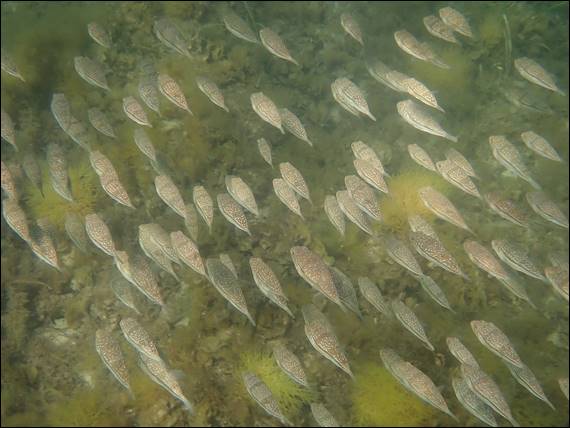
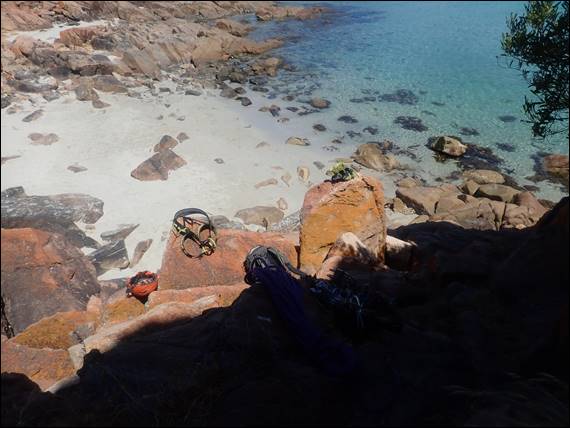
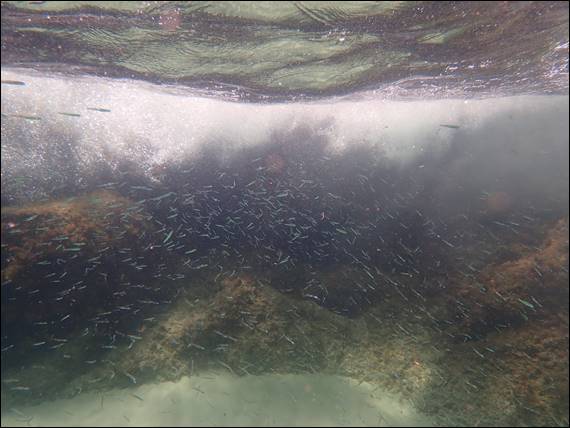
The winds were fresh and whipping along the coast line from the south. This was great to help cool us down while we were climbing in the sun, but it was chopping up the water. Still it looked pretty clear, so before we wrapped things up we went in for a dip. As soon as we were underwater we were surrounded by thousands of juvenile fish, often called fingerling. The water swept over the rocks filling the water with bubbles adding the sight. The waves were being driven by the winds and not a swell, so it felt quite comfortable bobbing about:
It even felt like it wasn’t going to push us against the rocks, as I followed fish here and there. This was fortunate for another reason. Being New Year’s Eve the bay was full of boats and jet skis, whose wash added to the chop from the wind. So venturing too far out was likely to be perilous. The people in control of the vessels were highly unlikely to be observant enough to spot us. The whine of engines and propellers became background noise, unlike when there is only one vessel which makes you pop your head up to check there the danger lies:
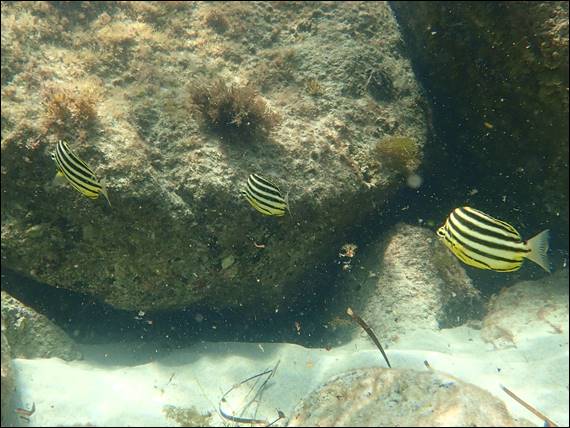
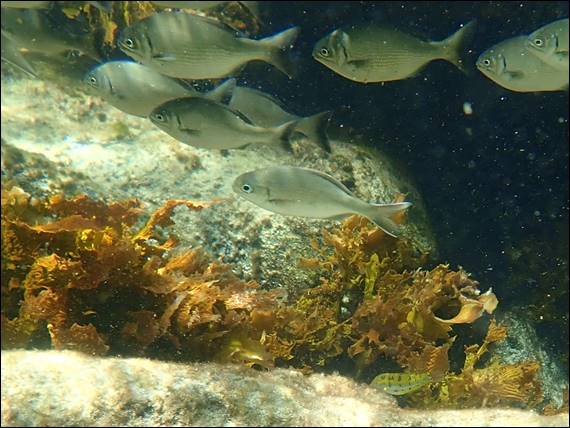
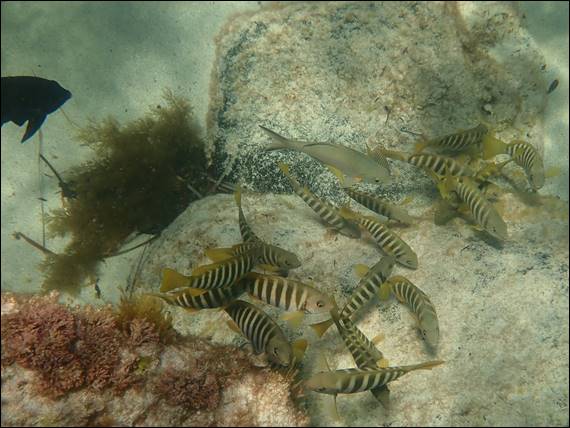
My focus was squarely on the fish, with such an abundance of species. Above are Stripey (Microcanthus strigatus) with the common name and scientific name coming from the pattern, with the Latin word strigatus meaning furrowed, grooved, or strigate. The latter word meaning ‘streaked with different colours’, something I had to look up. Below are Grey Drummer (Kyphosus bigibbus), not to be confused with Silver Drummer (Kyphosus sydneyanus). Distinguishable by the clear small black spot below the pectoral-fin base:
I was not trying to take photos of the Grey Drummer. It was a single and small wrasse that I liked, only just visible in the bottom right of the image and quick to hide in the weed. I believe it is a Castelnau’s Wrasse (Dotalabrus aurantiacus), a fish of many names including Castelnau’s Parrotfish, Ornate Wrasse, Pretty Dolly, and Pretty Polly. All the fish I have mentioned, including the below Zebrafish (Girella zebra), with a McCulloch’s Scalyfin (Parma mccullochi) sneaking in to photobomb the image on the left, are in the order of Perciformes:
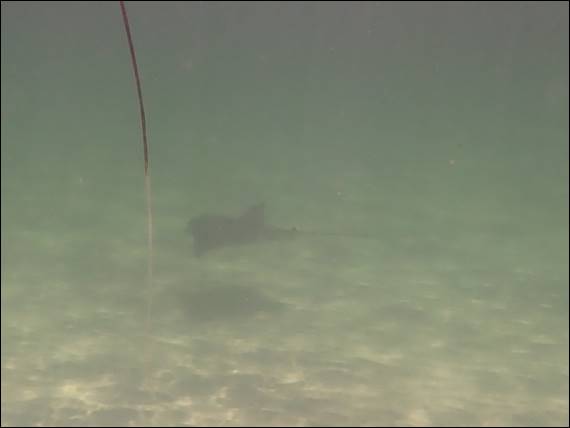
This order includes about forty percent of all bony fish, and is the largest and most diverse group of fish. Making me wonder what fish, if any, I see that are from a different order. But I’ll end this post with one sighting that is definitely from a different order, being Myliobatiformes, which comprises rays from eight families. This one being a Southern Eagle Ray (Myliobatis tenuicaudatus), which I daren’t follow out into the bay in case I drifted into the path of boat or jet ski. So I continued to hug the rocks:
The on again, off again traveller is back in town. So I won’t say this is the last climb in the south west of Western Australia before Rongy and Sarah hit the road. I have done that before and been proven wrong to many times. Plus we have made tentative arrangements to get out again on the weekend. After my last trip here with Howsie and Mikey I managed to aggravate my shoulder and I was resting it up. So for those that follow all my words you may be asking why am I climbing before my big trip, which was to start in just a few days away:
“Was to” being the operative words. It was not my shoulder that put paid to the trip, but Dan’s. Managing to dislocate his, while paddling on a surfboard to catch a small wave literally just a few days back. This meant we only had one fit and functional experienced sailor resulting in too much risk for our planned sail. The intention had been to sail eleven hours from Victoria to Deal Island in the middle of the Bass Strait. Anchor up and climb the big granite cliffs. So much bigger than what Rongy and I were climbing today at Moses Rocks:
I have literally just been chatting to Dan and we are already talking about next year’s trip to Deal Island. So in the words of Johnny Logan ‘What’s another year’, and Dan and I can treat this proposed trip a bit like the last one we had planned for April 2020. That was delayed by two years to the day because of COVID, but we got there in the end. There seems to be a running theme here, a bit like Rongy and his goodbyes, that aren’t really goodbyes. That was a lot of words to say I’m back on rock, after what has felt like a long break:
It was in fact only eighteen days since I had touched rock. The twinges from my shoulder had subsided, and I felt risking a climb would be OK. And it was. Although there was one climb I decided not to follow up, due to the physically demanding nature. Being the one below and my most recent creation here, called The Bunyip. This was probably only the second ascent, and Rongy agreed the grade of 19/20 seemed reasonable. Putting to bed the discussions on the day of the first ascent with Craig, Howsie, and Ash that it was another sandbag route:
Today we were climbing on Rongy’s gear, as I had lent my rack and ropes to Dan and Jo. They were over for a family Christmas and had all headed south, where they intending to get a one day’s climb in the mighty south coast. Dan managed to pop his shoulder before they went climbing, rubbing a bit more salt into the wound. But this did mean I got to help christen Rongy’s latest acquisition, a set of five C3 cams that he got for a steel. I even managed to climb two routes only using his new shiny gear, hopefully I didn’t scratch it up to much:
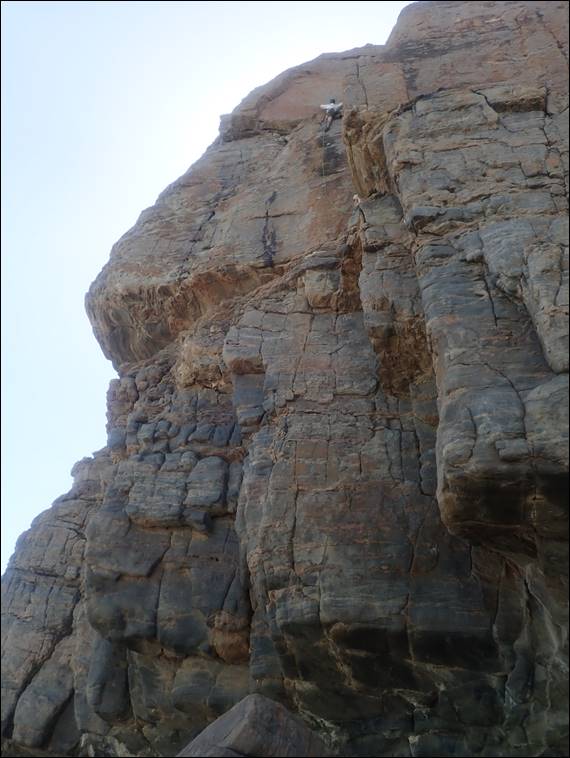
Despite not being as tall as the up to 150m high granite cliffs on offer on Deal Island, which has been placed on hold. Moses Rocks, or more precisely the section called Rumpoles Rocks, was good to us today. We had a thoroughly enjoyable time, and even spied yet another possible first ascent. I sadly jumped on it as the last climb of the morning and didn’t have enough gumption left to pull the moves over the roof, so missed the on-sight glory. At least we now know it goes, so I’ll hopefully be back in the not too distant future to bag that one:
Dog walking doesn’t stop at Peppy Beach just because it was Christmas day. I again joined them, jumping in at a new location. But the ground was pretty ordinary and there were no extra presents waiting for me under the water, other than thick patches of stingers. Heading back after the walk and snorkel the beach was already starting to fill. It would no doubt be a busy day on the beach, so I was happy to head home. However, later on Lisa was keen to get to the beach herself. And to my surprise she messaged me saying it was pretty well empty:
Encouraged by the lack of people I popped down shortly afterwards, with the intention of having a second dip. Not put off by the stingers of the morning, nor the onshore wind that was starting to chop up the water. In fact the small consistent waves that seemed to get a little bigger as I swam, resulted in the stingers no longer guarding the upper water column. They were instead lurking near the sandy seabed, away from the chop and me. And being waves driven by the afternoon wind, as opposed to swell, the water was reasonably clear:
Like the morning there was not a lot to report on, and I spent most of my time popping down to get a really good look at what I spotted above. The mottled pale brown pattern could only mean one fish, a Cobbler Wobbegong (Sutorectus tentaculatus). Better still, it was a full sized adult of approx. a meter long. This nocturnal hunter was resting peacefully, and wasn’t put off by my persistent dives to get a really good look. Also called carpetsharks due to the patterning and also the distinctive barbels near the mouth, both clearly visible above:
The name Wobbegong is also said to be due to the distinctive barbels, which for some species are very tassel like. Coming from one of the many Australian Indigenous languages and said to translate to ‘shaggy beard’. There are twelve species of Wobbegongs, most grow to less than four feet, but two reach about ten feet. While not one of the big species, being an adult it was the biggest Cobbler Wobbegong I’ve come across. Making me pretty chuffed that Lisa had encouraged me to pop down for a second dip:
So much so that I joined the dog patrol the morning after the big day. While others ready themselves to deal with the crowds of people at the Boxing Day sales, I prepared myself for the hordes of stingers. Luckily they were short lived and close to shore, and I was soon bobbing about looking for anything that looked unusual. Not such stood out but I went down anyway, and I’ll take a punt that this was a False Burrowing Anemone (Actinothoe glandulosa). It’s the closest I could get to a match, and as the name suggests this species doesn’t burrow like most other anemones do:
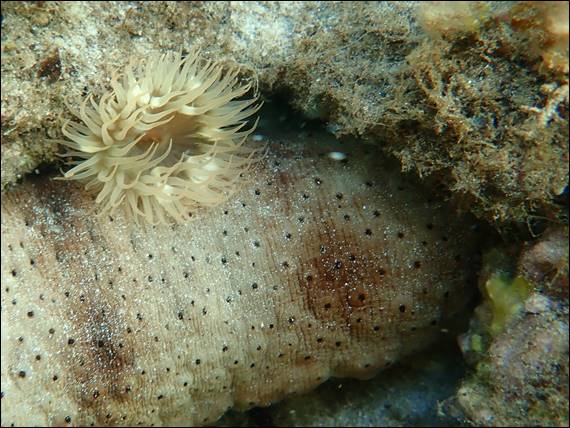
It does however have a column that it embeds into the substrate. A common anemone on the temperate reefs off the south west of Western Australia, and often found in clusters. The next image also includes a Rough Sea Cucumber (Australostichopus mollis), known as the vacuum cleaners of the sea. At night they suck up the sand to get whatever organic particles there may be, and excretes long strands of clean sand. The reason for taking the image was however the iridescent juvenile McCulloch’s Scalyfin (Parma mccullochi):
I also noticed afterwards that there was shrimp poking its head up in front of the Rough Sea Cucumber. I can find no common name for the shrimp, but believe the scientific name is Palaemonetes atrinubes. This marine shrimp is closely related to the freshwater South-west Glass Shrimp (Palaemon australis), which is found in the connected rivers and drain but also way inland. My next find I can’t even provide a guess for, other than it resembles a bivalve mollusc. I was drawn to the discarded Bicoloured Razor Clam (Pinna bicolor) shell:
Once I was down I noticed the distinctive opening of what looked to be a bivalve. It detected unusual movement in water when I got too close and snapped shut. But it did not have an obvious shell and the two halves were certainly not similar in shape, as I would expect for a bivalve. But like a Bicoloured Razor Clam it looked to have the base borrowed into the sand for stability and possibly a degree of protection. One last underwater Boxing Day find being a Horned Blenny (Parablennius intermedius):
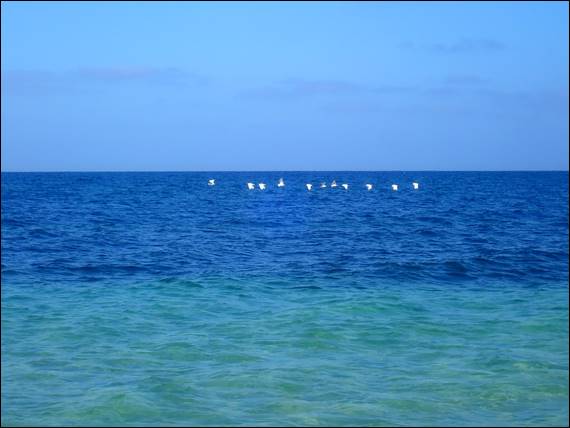
It was poking its head out by no more than a centimetre of what looked to be an old tubeworm home. Then as I poked my head out of the water a small flocks of Eastern Reef Egret (Egretta sacra) skimmed across the surface. There was also a solitary Greater Crested Tern (Thalasseus bergii), right on the shoreline hoovering about looking for a feed. No doubt thinking the chances of a catch were heightened due to some people fishing, or more likely as the burley they had thrown into the water was attracting fish in the shallows:
Terns may be related to gulls, but they have straighter pointed beaks, forked tails, and a much more graceful flight patterns. We watched it bob about and then hoover before diving down to catch a fish, too fast for me to get a focused image. Previously called sea-swallows due to the forked tail and smooth flight. Despite some great finds down out end of the beach, today I decided to head to the north eastern end of Peppy Beach where the Capel River flows into the ocean during winter. The water was flat and inviting:
But being summer, the rivers in this part of Australia have very limited if any flows. The Capel River is fed by groundwater year round; so while there was no sign of a river mouth on the beach a pool of freshwater persists in the river year round. It was pretty smelly today, no doubt coming from the breakdown of algae coming from excessive eutrophication. A result of the nutrients that have been washed down from the upstream farmlands, now festering in the stagnant pool of warm water. That wasn’t so inviting:
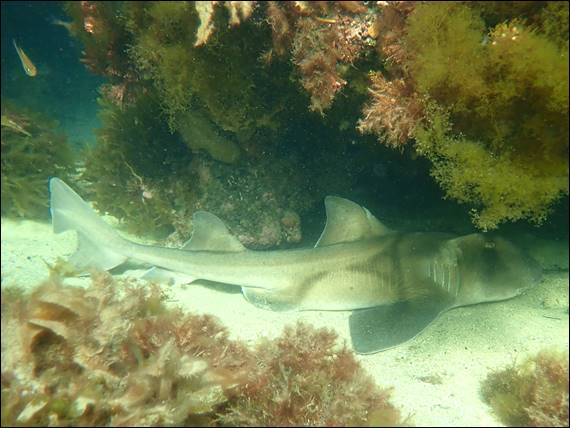
To get away from the smell I quickly popped my head underwater. There is some great ground here two to three hundred meters out. I spotted heaps of fish as I went out, and once in the good stuff I was diving down to every crevice and cave I could see. Above a Rock Flathead (Platycephalus laevigatus) was barely visible, and as I took the image it shot off. However, my next find has to be the best to date. Not one but two adult Port Jackson Sharks (Heterodontus portusjacksoni) under separate ledges, so I couldn’t get an image with both:
This was the larger of the two, and I’d guess close to four feet long. They can grow to a bit over five feet but more commonly males grow to two and half and females to three feet, so this really was a big one. Like the Wobbegong, it is another nocturnal feeder, and was happy for me to go down a couple of times to take a few images. But unlike the Wobbegong after that they both decided to move on. Fortunately, they did not view my actions as threatening. Like Wobbegongs, they are not considered dangerous but if provoked have been known to defend themselves:
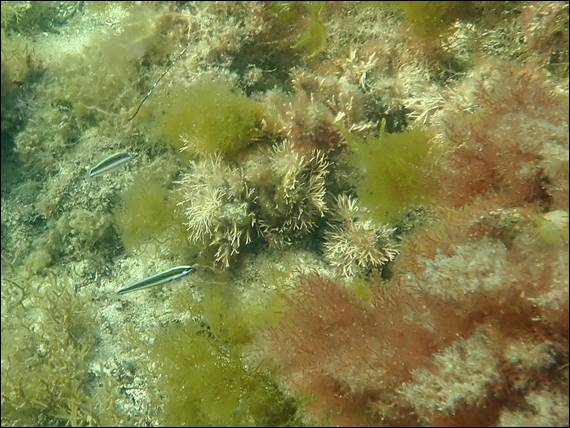
Fair to say I was buzzing after that find, and will be for some days to come. It didn’t however stop me taking a few more images. I’d seen the above small fish a fair bit and decided to try and identify them. They are reputed to be one of the most abundant wrasse species found within their range, although the wrasse I see the most has to be the Snakeskin Wrasse (Eupetrichthys angustipes). I’ve seen the female a few times but I can’t recall ever seeing the male, both of which look very different to the above two juvenile Western King Wrasse (Coris auricularis):
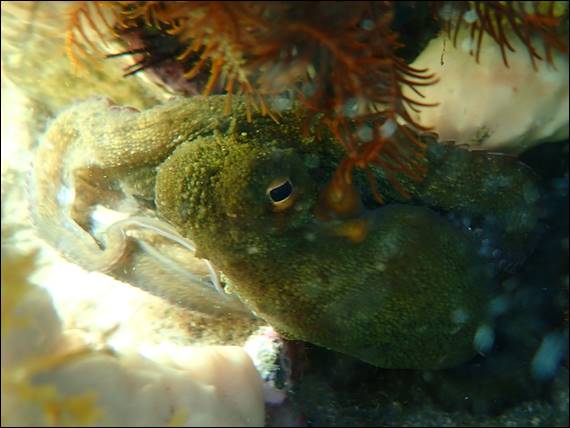
Clouds were forming overhead as I headed in, so the above image isn’t the best. I was however very pleased to see a good sized Smooth Stingray (Bathytoshia brevicaudata) glide past me, so have included it. These gentle giants can be up to four meters long and two meters wide, this one was no more than half that. I’ll leave you with one last image, well a series of images. I purposely floated above to avoid my find darting away. Being one of two motion pictures I got of a Western Rock Octopus (Octopus djinda) doing it’s very best to hide from me:
With time on my hands and limited options for driving anywhere, it has been time to explore a few more local sights. Since my last day at work for 2023 on Thursday, I’ve managed to get into the water five times. Each time sampling a new part of the coastline off Peppy Beach, and in part assisted by tagging along with the dog walking crew with Lisa. That is until I spot a section where I decide to jump in, leaving them to carry on without me. The first dip on Friday morning was extra special as a dolphin lazily swam past me. So close I could have reached out and brushed its smooth and rubbery feeling skin:
I refrained and thought I had taken a video that included looking right into its eye, but I must have been too excited and didn’t press the button to start recording. Swimming round a new location was lovely, not having favourite spots to go to and just exploring with no idea of what I might find. I did like the bright yellow encrusting sponge below, which I believe may be a Crella (Pytheas). This sponge is no more than a few centimetres thick, but is still laced with pores and channels through which the water is circulated as detritus, plankton, viruses, and bacteria are filtered out:
Sponges, like corals, do not move about comprising a collection of aquatic invertebrates. Other than that they are completely different in just about every way, including their anatomy, way of feeding, and in how they reproduce. Corals are also much more complex organisms made of many cells, while sponges comprise very simple creatures. However, both are important to the marine ecology and have adapted to many variety of conditions. There are some six to seven thousand and eight to nine thousands identified species of corals and sponges respectively:
I often chose where I duck dived down due to an interesting looking bright sponge. However, with so species I have failed miserably in trying to identify anymore. The above Western Rock Lobster (Panulirus cygnus) was an easy identification, but I only took the image as I endeavoured to digitally capture the Southern Roughy (Trachichthys australis). Normally a nocturnal fish it was refuging under this ledge until I disturbed it, after which it used several lobsters as shields to avoid the lens. Heading back in a number of juvenile Bight Stingaree (Trygonoptera ovalis) were scouring the shallows and were also not keen on the camera (or more likely me) but didn’t have anything to hide behind:
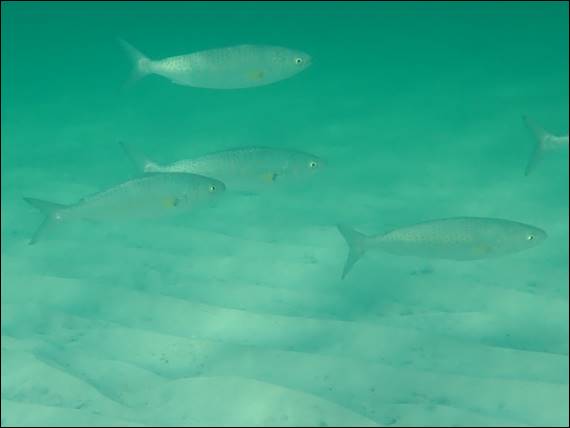
I liked the above image and persisted, due to the Bight Stingaree being followed by a small school of Australian Herring (Arripis georgianus). A fish that is sometimes mistaken with the below juvenile Western Australian Salmon (Arripis truttaceus). These fish when fully grown reach up to one meter and can weigh a tad over ten kilograms. And are very popular recreationally due to their fight, so much so that there is an official salmon run season. But their flesh is considered less desirably being strongly flavoured, a bit oily, coarse, and on the soft side. As such when fished commercially, they are mostly used for canning:
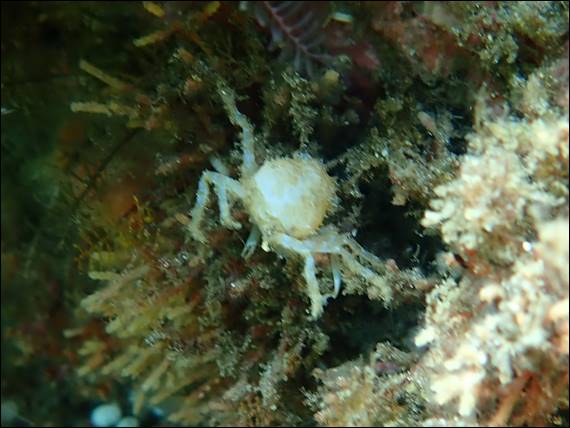
During one dive I spotted what looked to be a exoskeleton of a Pebble Crab, but which species I have no idea. All crustaceans moult, when their hard protective shell becomes to small for them. It’s an energy consuming process, and involved four stages, which includes starting to preparing a new initial soft shell under the old one, dissolving and making use of some of the calcium carbonate from the old shell, shedding the old shell and then finishing off the new one. A process that can take hours and it is at that final stage the crab is most vulnerable:
I can’t even recall what I had spotted when I went down and noticed this small fish right by my hand. Seemingly too scared to move, I took a quick snap, already with an idea that I had seen a Threefin. It is either a juvenile male or a female Blackthroat Threefin (Helcogramma decurrens), the adult male being easily identified and quite stunning (https://sandbagged.blog/2021/03/14/barren-ground/). This fish is in some ways similar to a Blenny, which is worth mentioning as you will see later. Although these have three dorsal fins, which you may guess is where the name comes from, and relatively large scales, not that I got close enough to inspect them:
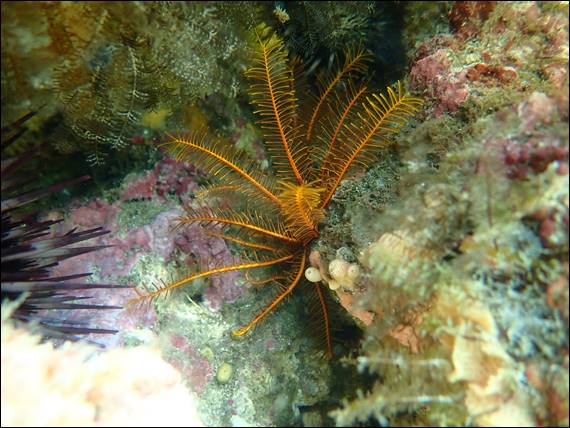
And just for something a bit different, I’ve included a Feather-star (Crinoids). Related to and just like starfish, brittle stars, sea urchins, and sea cucumbers, they are an animal not a plant. There are not as many species to choose from as corals or sponges, but I’ve still managed to fail. This may be due to them often being overlooked, despite being found all over the place. Therefore, I haven’t found too many images to compare it against. Juveniles are attached to a substrata by a stalk, which they lose when they become adults allowing them to move about and even swim:
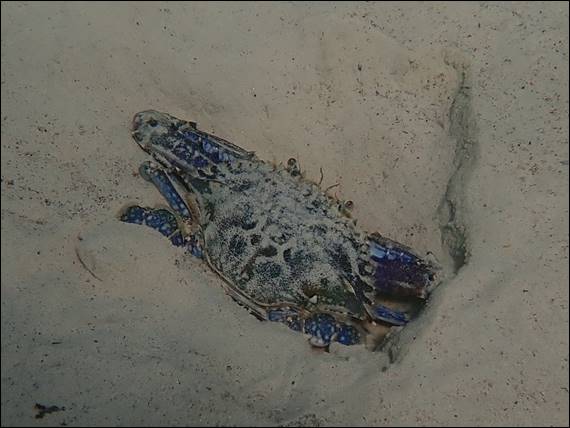
In fact they can be quite quick have been observed to move along a surface at five centimetres per second. After each dive I swim across a few open sandy areas in search of rays, but as yet I haven’t spotted any other than the Bight Stingaree. A creature that I do however see often in these areas is the Blue swimmer crab (Portunus armatus), sometimes just their eyes poking out. They have evolved to be on stalks allowing them to look out for predators while buried. Other times they quickly bury themselves before I get to them, but this one allowed me to sneak up on it:
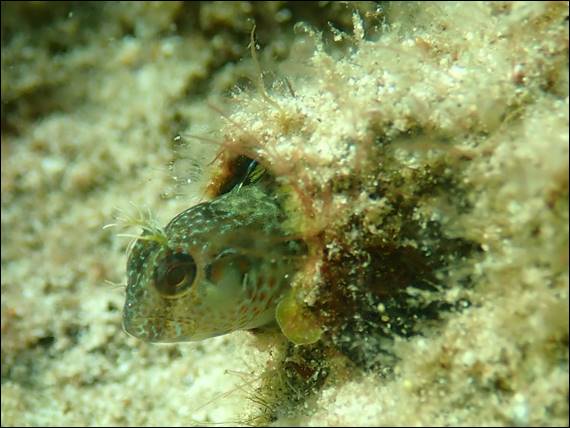
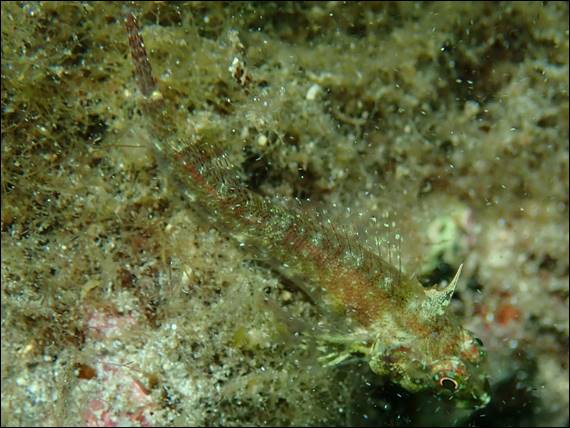
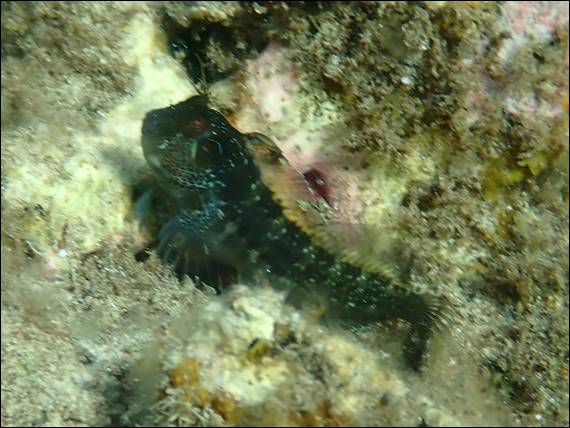
I spotted this fish from above, the distinctive shape intrigued me so I dove down someway away and snuck up on it. And while not the best quality image it was enough for me to know it was a Blenny and definitely not a Threefin, but which one? There are more species than I realised, and it has been one of the hardest fish I have to try and identity to date. Maybe because it is likely a juvenile, based on size, and many fish will change their appearance significantly as they mature. The fringe of tentacles above and behind the eyes, which had an orange iris, along with the pale bands and spots along its body makes me think it may be a False Tasmanian Blenny (Parablennius postoculomaculatus):
Today I was very happy as I saw my first octopus of the season. It moved at speed, dropping against a rock and using its amazing skill to change skin colour and texture. Going down, it shot off and went against some weed and changed again. Next time I went down it disappeared from sight. An octopus’s skin contains thousands of elastic sacs that contain pigments, called chromatophores. There are a variety of pigment colours in these balloon like sacs, and an intricate network of nerves and muscles control how much of each colour is visible by blowing up or deflating the sacs. There is more to it, in terms of skin texture and also an ability to create iridescent colours and even reflect the surrounding colours:
But I’ll leave it there, and have included two images of the Western Rock Octopus (Octopus djinda) after I found it again hiding in the very place I first saw it come from. I was also a little sad to read they only reach an age of three years. A primary reason being that the process of reproduction is a cause of death. Males will live a for a few months after mating, and females pass away shortly after the eggs have hatched. From the time of laying thousands of eggs in a long chain the female won’t feed again. This may last for up to a month, during which she will blow water over the eggs to prevent algae growing on them and she will also defend them against predators:
I also managed a dip at Forrest Beach today, which is a short ten minute drive away. Lisa was meeting a friend so I tagged along to try my luck in the water there. Here I spotted an adult Bight Stingaree (Trygonoptera ovalis), at its maximum size of approx. two feet. Nestled in a seagrass meadow of Posidonia sinuosa. Despite only being about ten kilometres down the coast from us, we do not get much of seagrass. It is however a valuable plant for identifying the health of the bay. The amount of algae on the grass, which can be seen below, helps to work out the level of nutrient enrichment. Nutrients coming from our urban and agricultural drains:
Seagrass meadows are critically important as they provide refuge, a source of food, and a nursery for many marine creatures. If we lose them, many other species will also suffer, including the much sought after Western Rock Lobster. Seagrasses and also take up a significant amount of carbon dioxide worldwide, and as such are being developed as valuable ecosystem in the global carbon market. So it really does make sense for us to protect them, but most people are oblivious of what is happening below the surface:
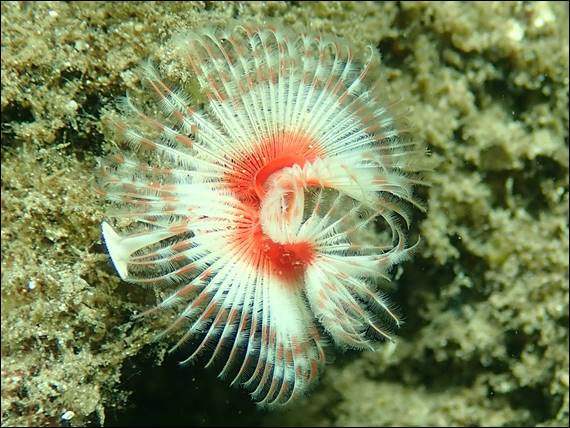
Well seeing it is Christmas Eve I better end this one on a more colourful note. And what better way than to include a splash of an orange sponge, but I have no idea which species. The area had loads of them, sticking up a bit like termite mounds and adding to the quite different feel of diving Forrest Beach. And finally a beautiful Red Tube Worm (Protula bispiralis). One that allowed me to dive down and take numerous images, without retracting the featherlike filters back into its cylindrical shell:
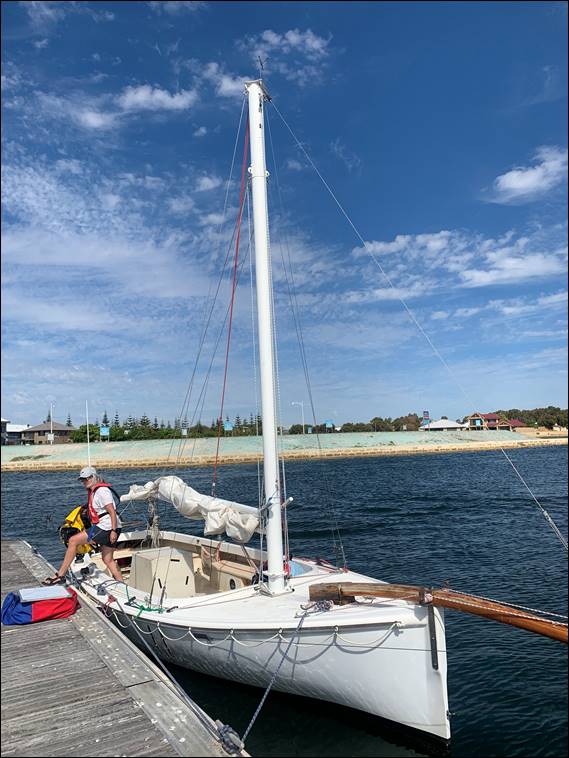
Lisa and my time was all above-board this weekend. Lisa had suggested we book onto a keelboat sailing course, to provide me with some prior hands on experience before my big trip. It was a bit uncertain as to whether the course would go ahead. Being the only ones booked for this weekend, and they needed a minimum of four people to make it cost effective. No one else booked. However, Adventure Sailing, with a bit of encouragement from Emma who we had been dealing with, gave us an early Christmas Present:
So Saturday morning, completely unsure of what to expect, we made the short drive to Port Geographe. Parked up and within 20min were on the boat receiving a rundown of the basics, which included a plethora of nautical names and phrases that our instructor for the day, Tim, rattled off. Like I can rattle off climbing language. Something that continued for the next two days. And was further compounded by having a few trainee instructors tag along, resulting in five people throwing these unfamiliar words at us:
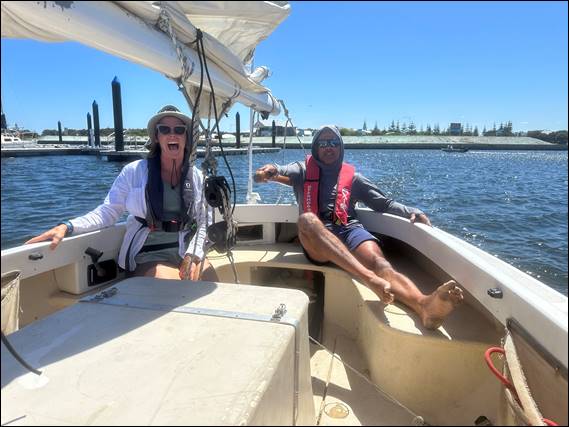
It was all part of it, and as the first day wore on the names and phrases took on meaning. Assisted by practicing the basics of sailing, including preparing the boat for sailing and when coming in and then undertaking manoeuvres. On Saturday we also had Rosie to help ease us into things on the first day. A day for which we experienced no more than moderate winds. Not a bad way to start, allowing us to focus on each step in a more relaxed way. Not needing to react to sudden gusts or change of wind at speed:
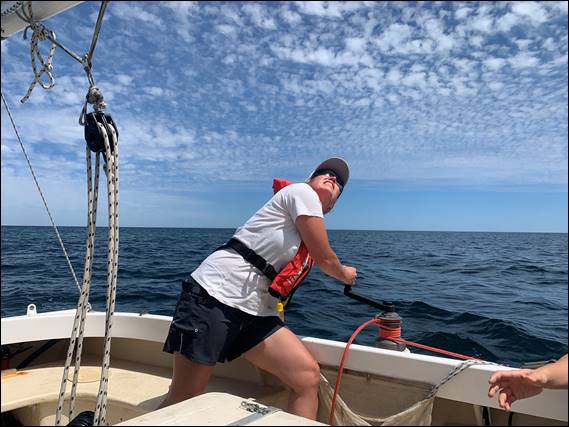
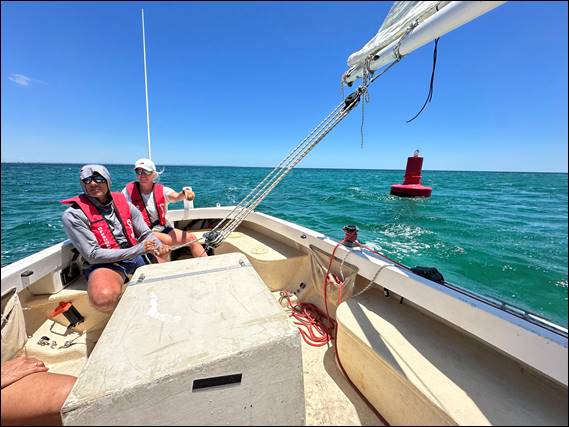
We must have spent five hours on the water in the first day, and with just two of us we covered heaps and got lots of practical experience. Sunday blew in with fresh to strong, and at times gusty, winds. And while I drove the boat out of the marina is a very relaxed manner, once in the bay I wasn’t able to kick back with my feet up. Due to the stronger winds we downsized the jib, and even then didn’t actually put it up, and reefed the mainsail to make is shorter. Even then we were moving a fair bit faster than at any time on Saturday:
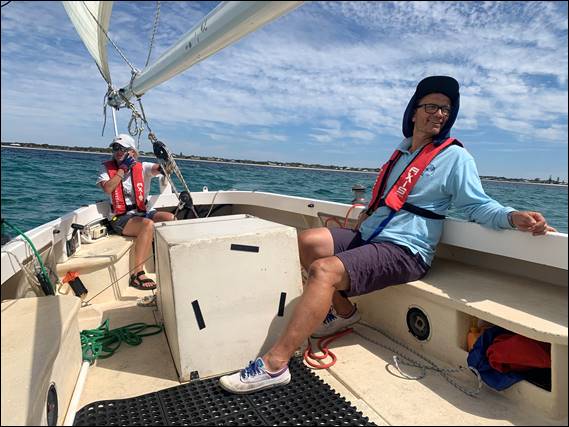
Emma was happy for Lisa and I to take the tiller for the entire trip, and it was so different to our chilled Saturday. Needing to be a bit more decisive and quicker with our decision making. We were also glad for the extra hands today from Sasha and Potsi, which really assisted as we went through ‘man overboard’ drills and other manoeuvres. And despite the need for constant vigilance of changes in the conditions, it was not stressful and we both really enjoyed the experience as well as all the banter and laughs:
I had confessed to Dan when first invited on the big trip, which is now only two weeks away, that while not worried I was just a little nervous. That healthy level of nervousness that makes you tread carefully and consider the risks appropriately. But not so much as to hold you back from giving things a go. However, after these two days on the water I feel the levels of nervousness have dropped a notch or two. Thanks for the suggestion Lisa! That said where we are heading will probably be a whole lot different to the protected waters of Geographe Bay:



















 Sandbagged