The rambling buoy

It’s often not the accomplishment of the climbs for me, but the journey.  That includes the approach or walk into the crag, and then back out.  Going up the routes of choice is almost a bonus.  And for really big crags, which we lack locally, the descent is also great fun.  Howsie and I planned to go to Welly Dam, where the approach is non-existent but that can be convenient for quick trips.  Sadly he started to feel unwell.  Next David indicated he would be keen, but as he predicted he got called into work due to other workers feeling unwell:
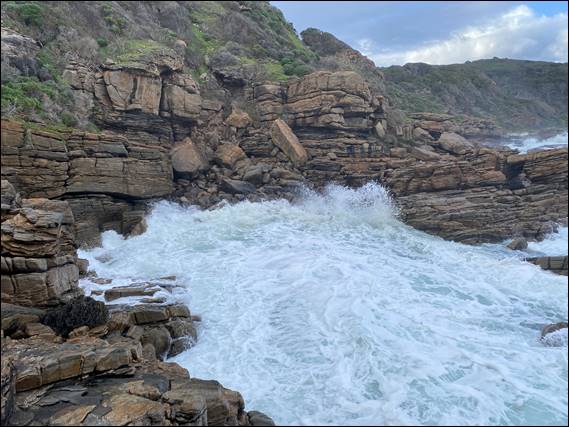
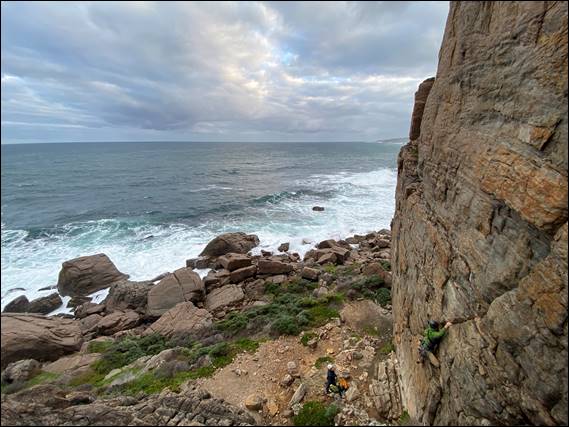
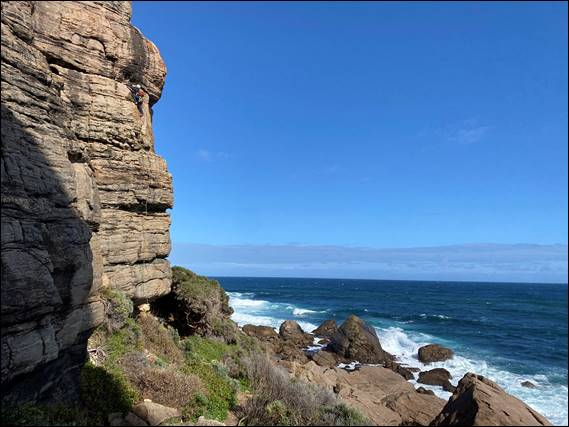
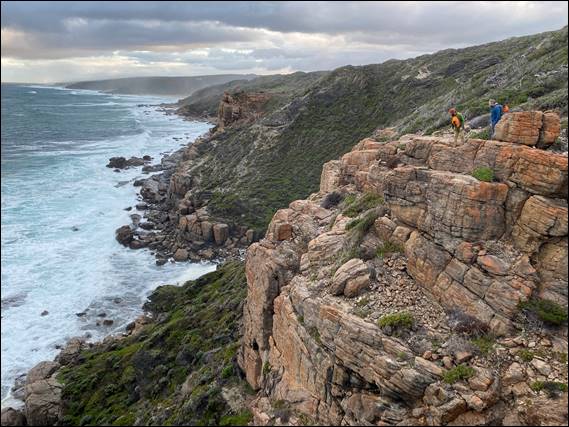
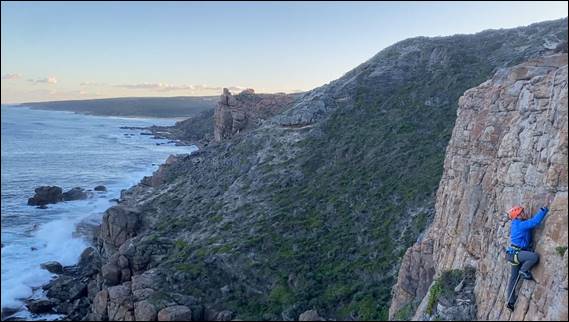
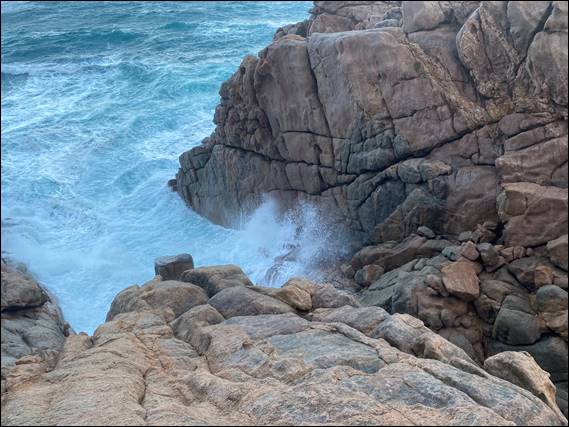
Third time lucky and Craig was feeling well, so we wandered out to Lost Buttress.  Of all our local crags this one has the longest approach.  At least it is the way I head there, along the coastline.  I was possibly a little optimistic today, but Craig went along with it.  The swell was at five meters, it was high tide, and fresh to strong winds were aimed at the coast.  Bays such as the one above, which we normally rock hop across, were awash.  And others, like below, were coated in foam, resulting in the boulders being incredibly dangerous to step on:
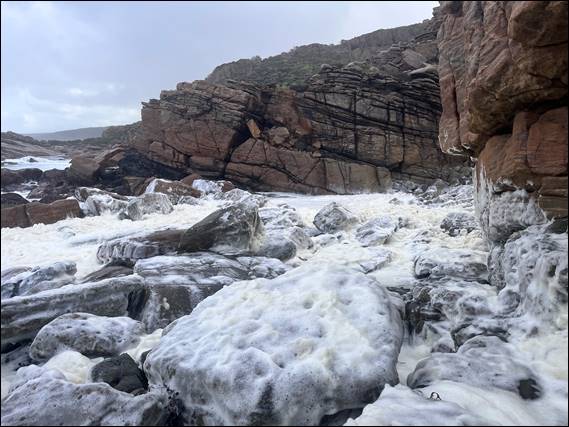
We attempted to follow the rocky coastline as much as possible, without getting too silly.  But had to occasionally escape by scrambling up short faces and corners.  Then needing to bush-bashing a path higher on the ridge, until it looked safe to descend back down.  I will always remember a family trip to a place called Woody Island.  Sat on the boulder strewn beach, a woman screeched at her kids ‘STAY OFF THE BLACK ROCKS!!’, because they were slippery.  Today however the black basalt rocks had the best friction, and we did exactly the opposite:
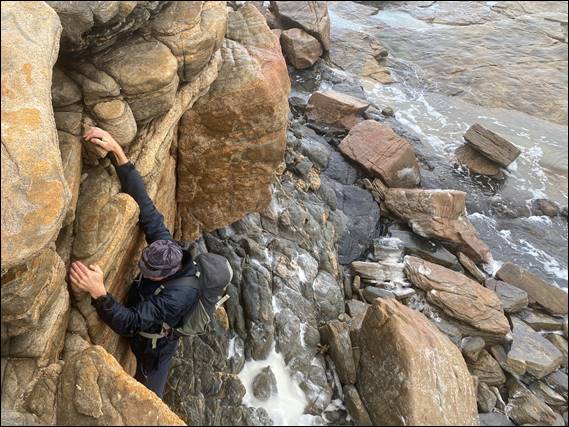
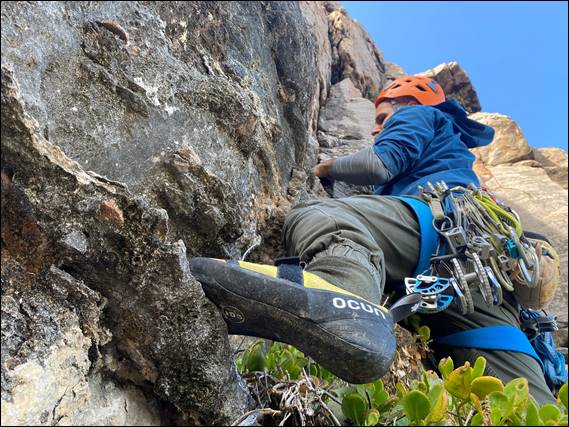
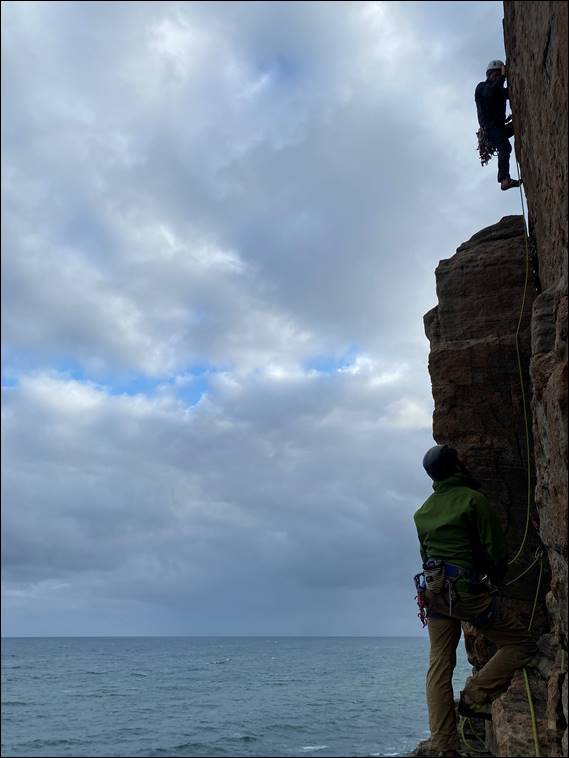
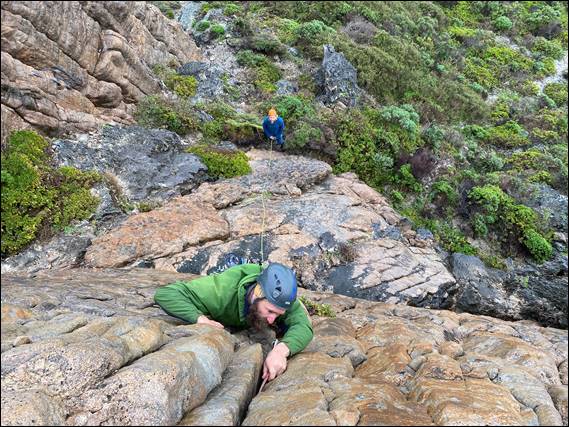
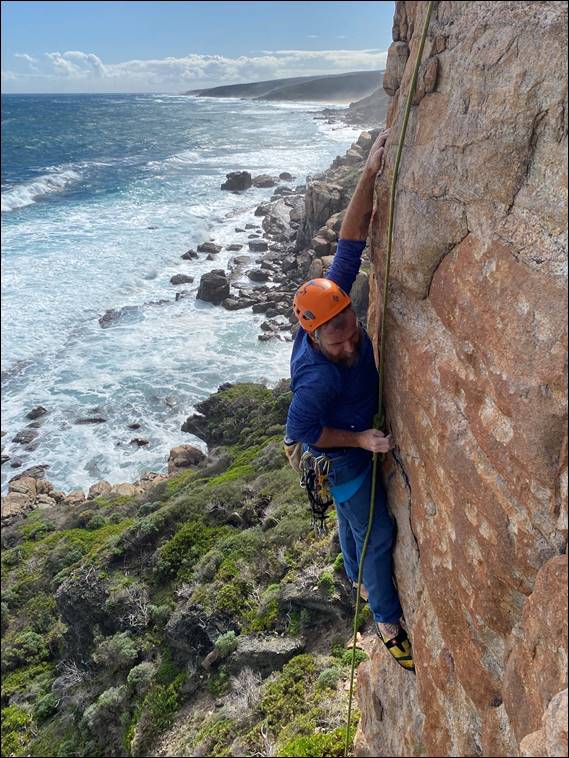
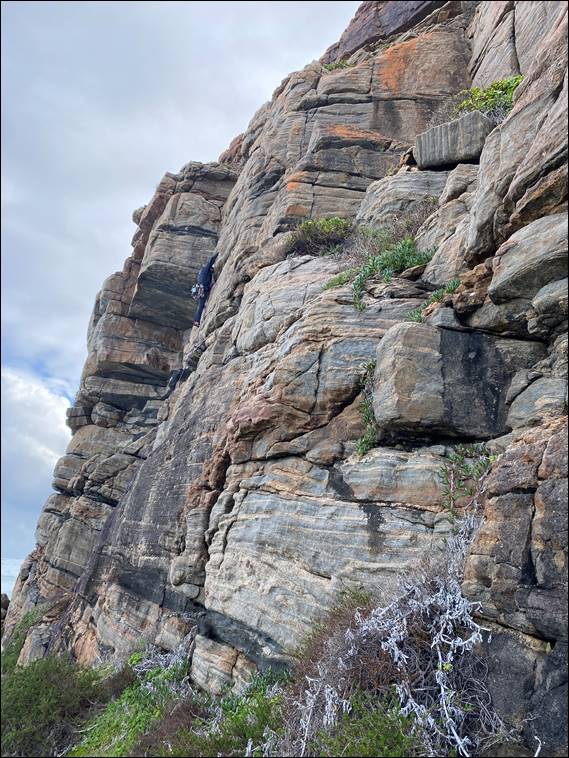
It took us a while longer to get to the crag, but we were in no rush aiming for a fun relaxed day out.  Nothing too silly, not that this place offers too much of that.  It does however have a fine selection of lines that I knew I could point Craig too, which is exactly what I did for the first lead.  Taking his time and complaining that it was all wet.  We had just been hit by a short squall so it was quite possibly the case, but by the time I followed up it was dry.  Even if it hadn’t dried between the showers, the routes are of a grade that it wouldn’t have stopped us:
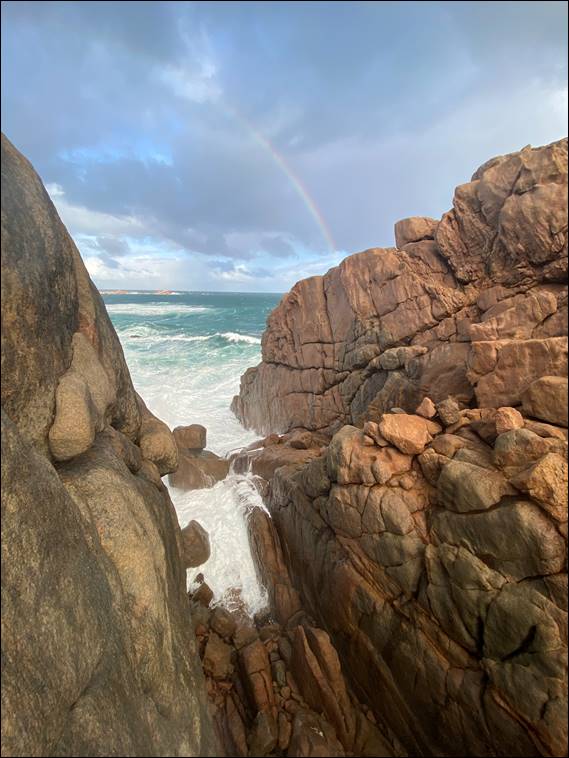
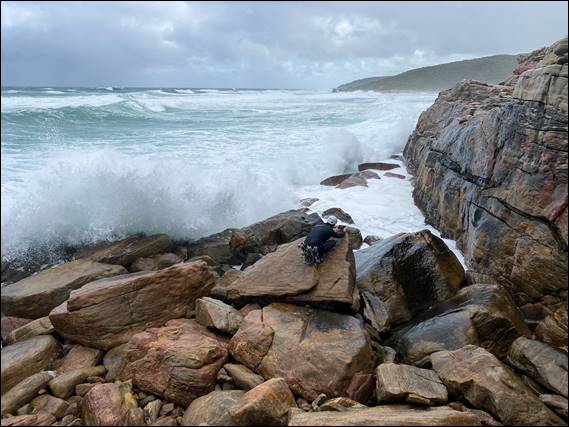
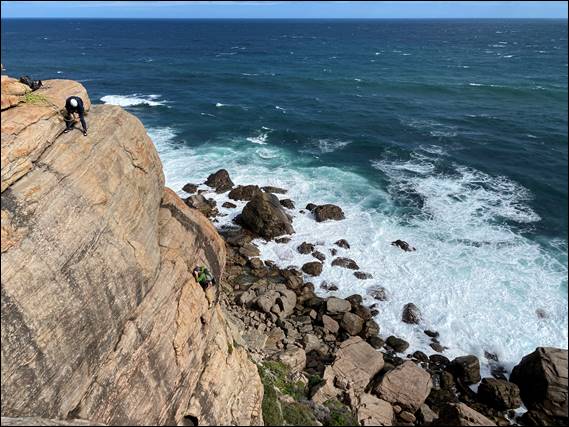
We were however somewhat distracted by the ocean.  The waves crashed into a short wall next to the crag, sending water towering into the air.  Then as it came back down, it created cascading waterfalls along the length of the wall.  This did stop us climbing for a while, and as Craig inched closer trying to get that perfect image I did wonder if he may have been trying his luck a little too much.  On this occasion he remained dry, and needless to say sights such as what we were lucky to observe today simply can’t be captured in a single picture:
The image below shows a plume of sand splaying out from the vegetated slope into the boulders.  It is possible to drive to this crag, and then wander down this slope.  The scramble down to the beach has over time created a more defined path, and place for water to flow.  The path is eroding badly, turning into a deep incised track with more and more sand being washed down.  To be fair very few climbers come here, but it is also a popular place to camp on the Cape to Cape track.  And those people along with fishers, do use the track:
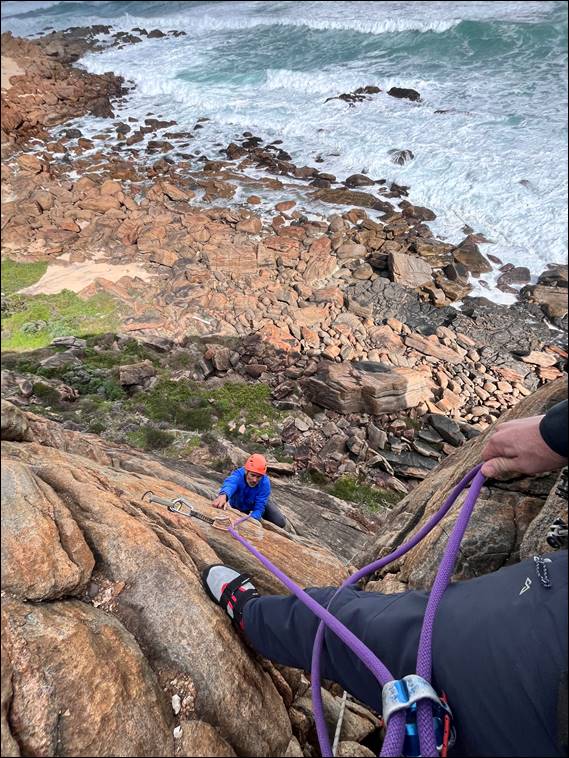
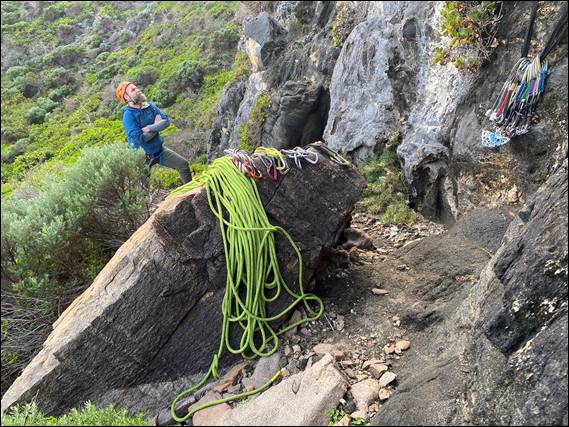
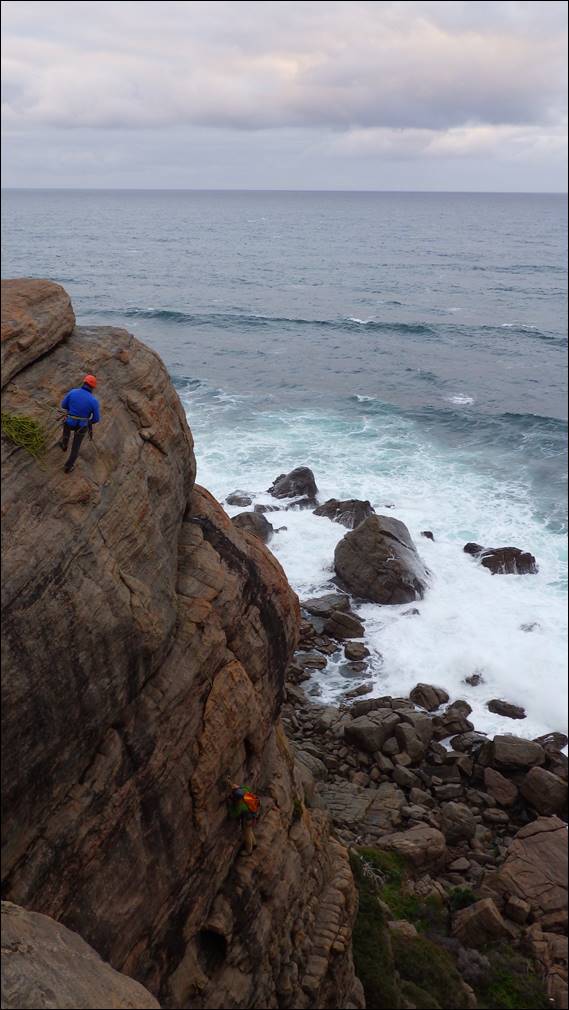
This erosion does have a bearing on why I don’t like driving in, and prefer the walk along the coast.  But the walk in along the coast had felt a little too dicey at times today.  As such when Craig suggested we could make our way up to the Cape to Cape track to walk out, I felt that would be OK as long as we followed the more solid and rocky ridgeline to get to it.  This started with a scramble up the crag but before we could do that Craig went to pick up a bit of flotsam he intended to take home.  The buoy was tied to the rap line, so we could haul it up:
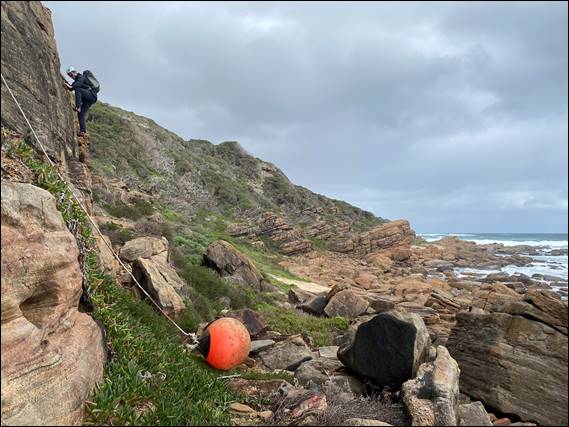
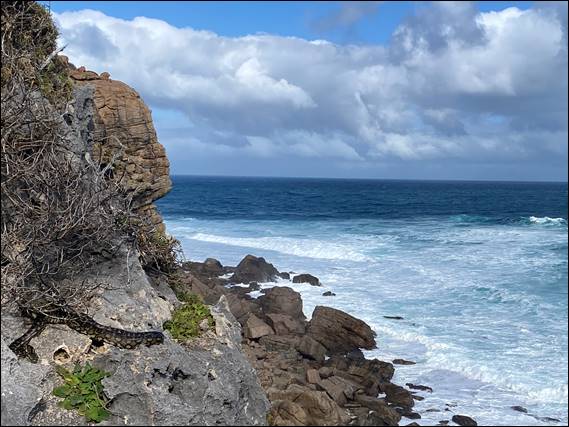
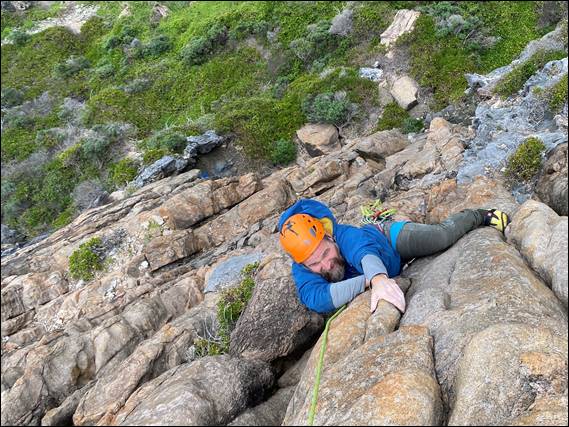
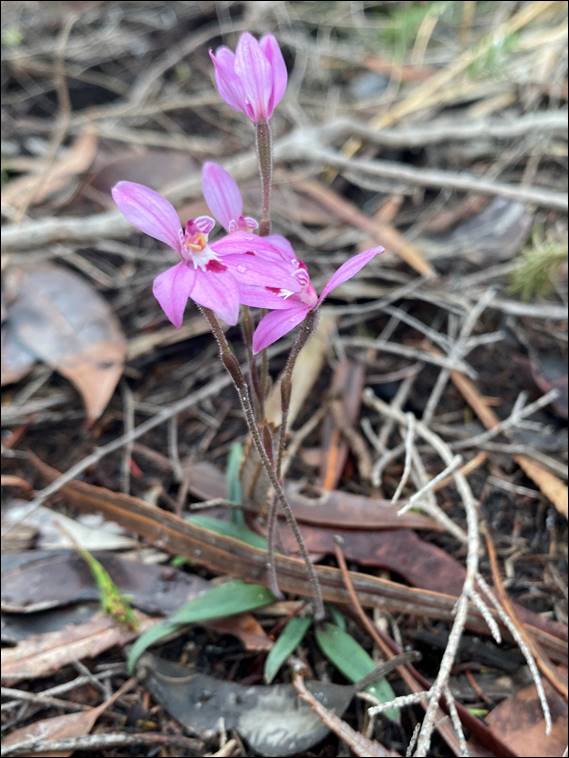
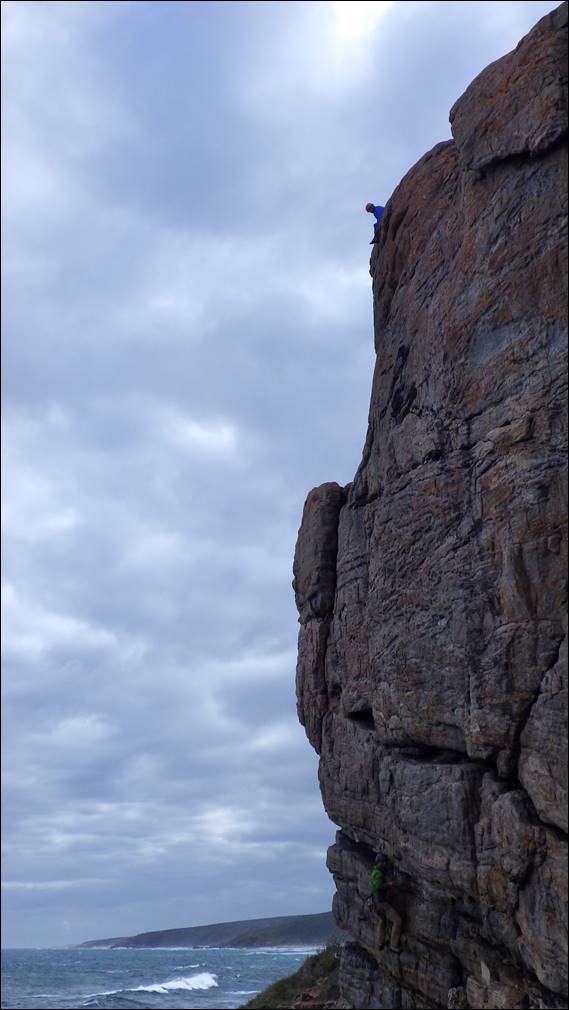
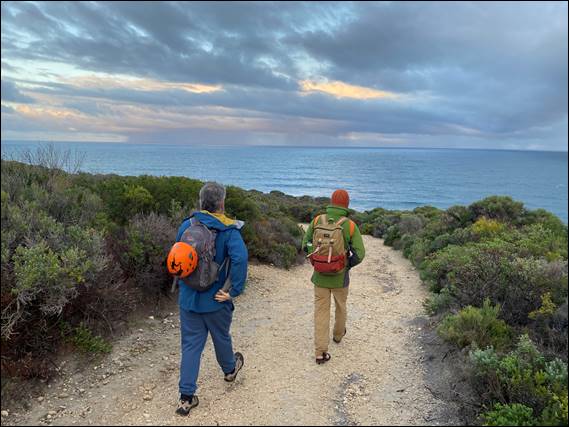
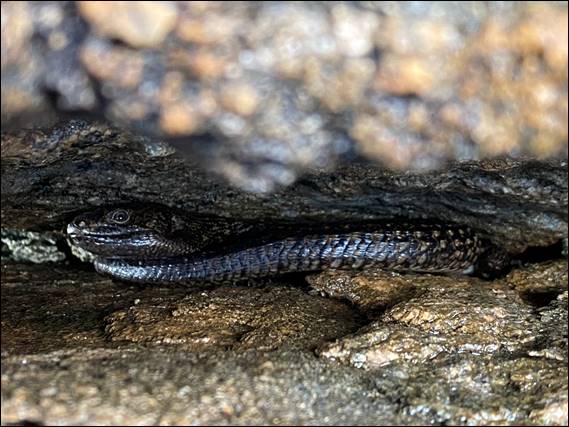
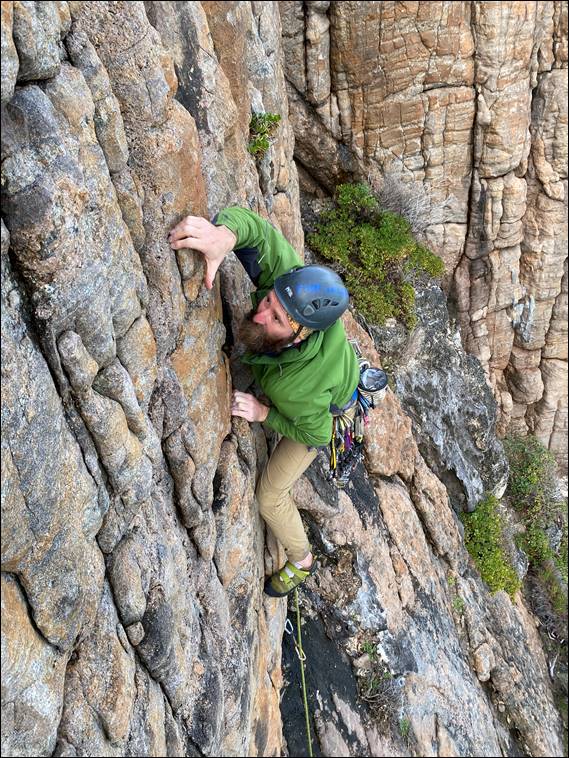
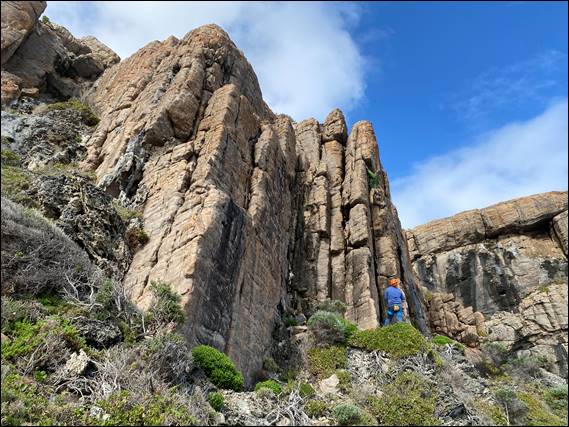
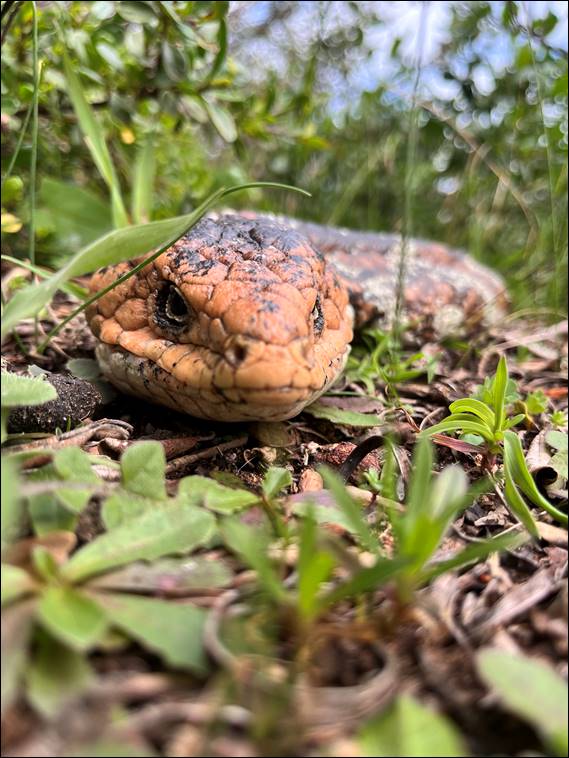
We did however carry our packs up as we solo’d up a new line, which Craig aptly called ‘The Rambling Buoy’.  Probably no harder than a grade 7 or Diff in UK grades, but a fun route all the same.  While soloing a new route with packs on may not seem sensible, taking the Cape to Cape track back certainly was.  We spotted a couple of orchids in flower that I’ve mentioned previously on recent trips to Wilyabrup, and signs there are plenty more other ones on their way.  We were also greeted by this very sluggish Bobtail Lizard (Tiliqua rugosa):
The blue armada

Orchid season is great for encouraging me to get out for a few more walks than I would normally.  I let that slip last week, so made a conscious effort to refocus my life to work balance, managing to get out for a wander three times.  This was made in part easier by having slightly improved weather.  Like the rest of the world things are all a bit topsy-turvy.  The southern parts of Australia, which includes where we live, are being battered by strong winds, dropping the temperatures, and lashings of rain:

To date it has certainly been a year of contrasts.  Starting with the longest and hottest summer on record.  Then over the last week or so we have recorded the highest river flows on record in quite a few systems.  While other systems have had very rare events, which have only been witnesses a couple of time over the last thirty plus years.  It all sounds very dramatic, but most of the river catchments in the South West of Western Australia are relatively small, so we are not at risk of being flooded out:

Meanwhile the northern parts of Australia are being subject to a very hot August.  The record for the hottest day in August, at many weather stations, are tumbling.  In some cases the record has been exceeded on successive days, as the temperatures creep up.  Many places up north are baking with forty degrees or more, and I know which part of Australia I would rather be.  While it is windy, and at times cold and wet, I can more easily cope with that than shearing heat.  The conditions might also just might help with the orchid season:

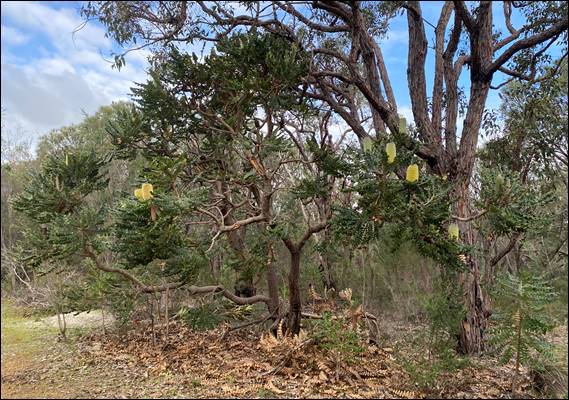
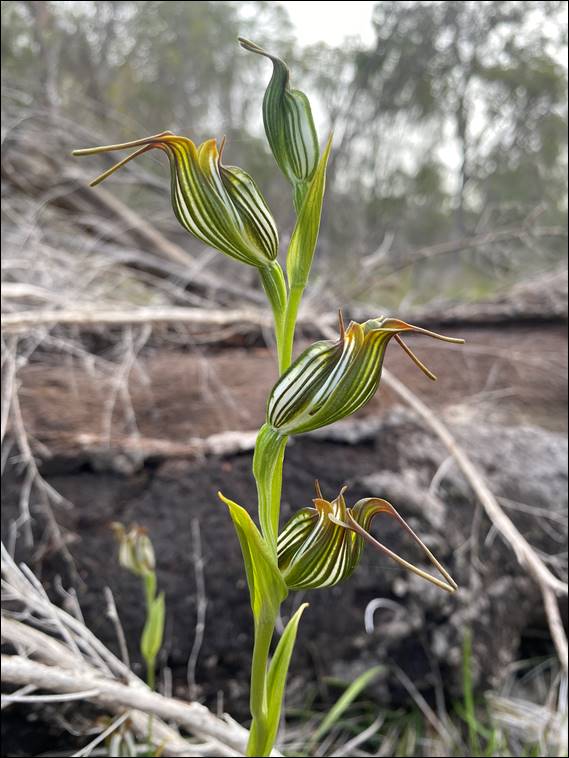
My species count at Manea Park crept close to double digits.  But I’ve started with an image of a beautiful old Bull or Giant Banksia (Banksia grandis) in flower.  Many of the Banksia woodlands are suffering badly, with trees being knocked off by a plant disease called Phytophthora Dieback caused by a microscopic organisms present in the soil.  So it was great to see this tree going so well.  Many of the orchids I saw are repeat finds for the season, such as the second image of a rather specky looking Jug Orchid (Pterostylis recurve):

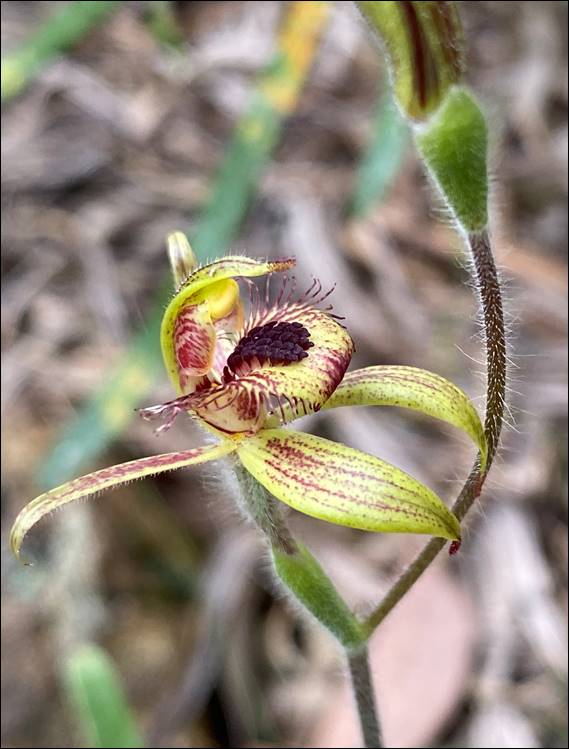
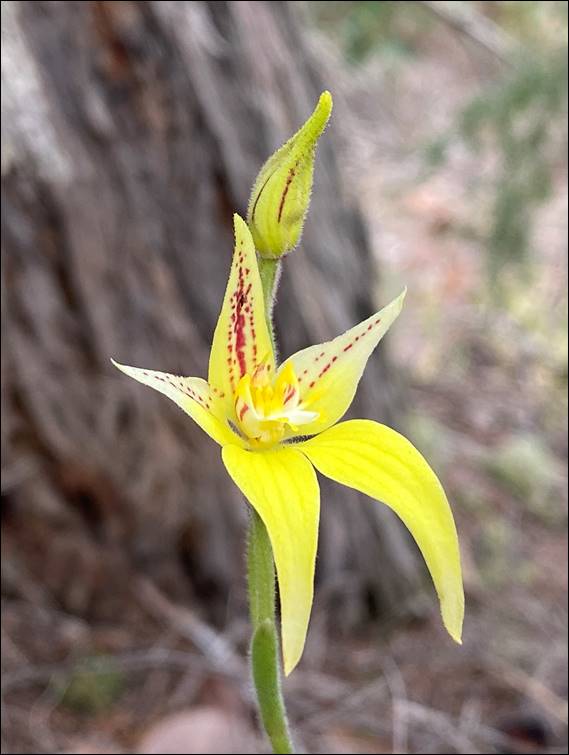
The third images, as I start to catch up with myself, being a Dancing Spider Orchid (Caladenia discoidea).  I spotted these last year but only in one location.  After unsuccessfully trying to find them anywhere else I went back to where I knew, or hoped, they would be once more.  It took me a little off the loop I had chosen, but that worked in my favour a second time when I spotted my first Cowslip Orchid (Caladenia flava) of the season, above.  No doubt in a few weeks many of the places I visit will be absolutely rife with these:

It was a bit that way with the Dwarf Pink Fairies at Crooked Brook, during my second wander on Wednesday.  Everywhere I looked they were popping up, along with the blues, purples, and yellows of quite a few other shrubs and plants starting to bloom.  Hidden amongst them I spotted three Bird Orchids (Pterostylis barbata).  An orchid that I feel I will never tire from seeing time and time again.  I still recall the first time I found one, a walk that is sadly also when I lost my Buffalo (https://wordpress.com/post/sandbagged.blog/6738):

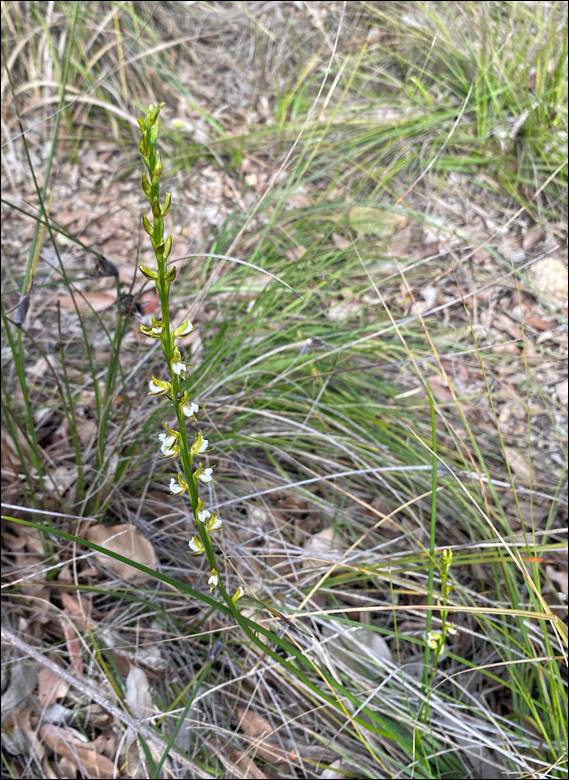
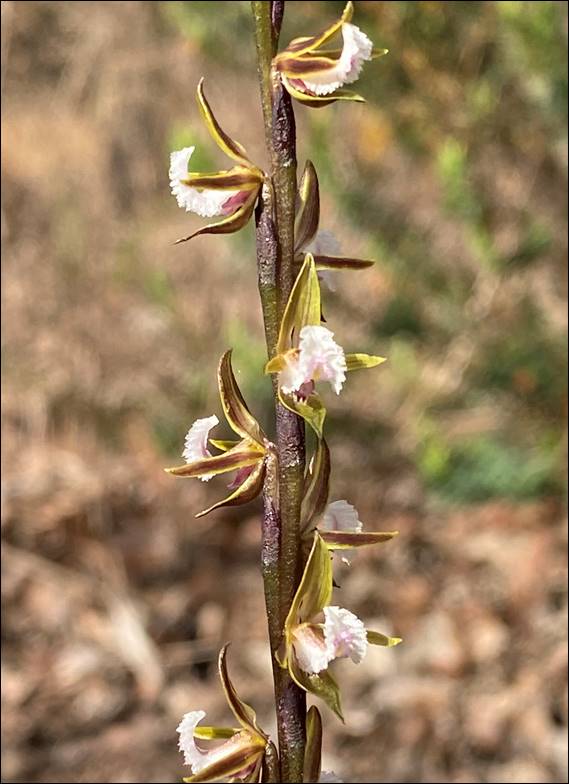
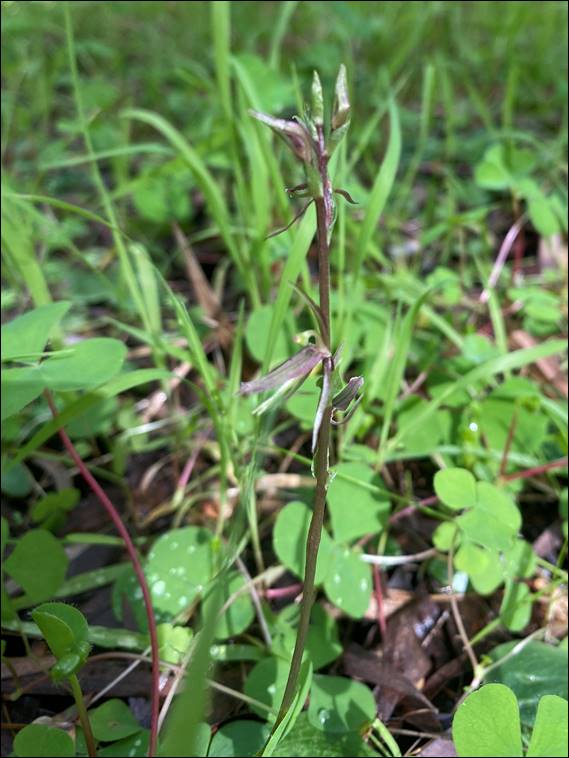
Crooked Brook also had a few Frilled Leek Orchids (Prasophyllum sargentii) out on display.  Looking quite stunning on their near one meter tall stems.  I’ve not seen these before so spent a fair bit of time looking at the intricate detail.  Staring more intently as I thought I had found two species because of the different coloured stems.  The petals and sepals were also differently colours, but the shape and colours of the frilled labellum was the same.  Despite them being the same species it was certainly a worthwhile trip:

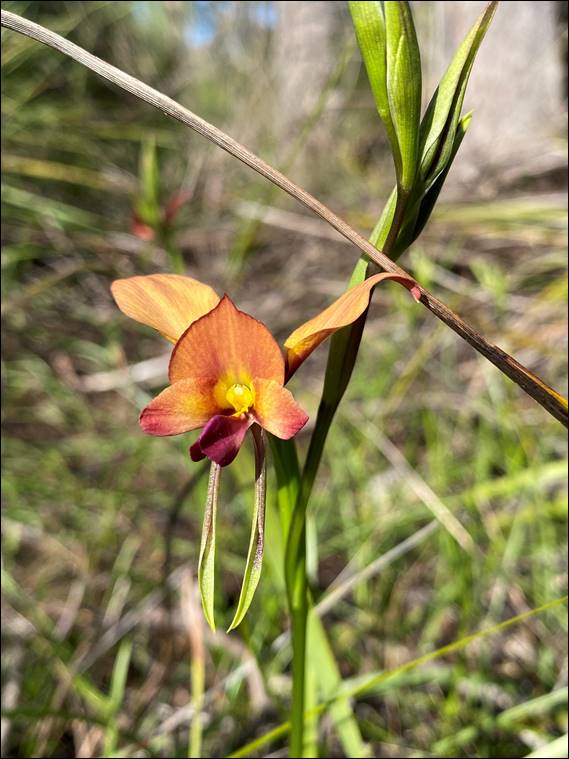
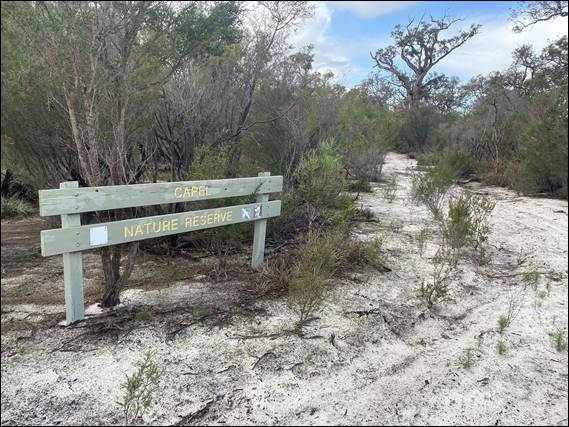
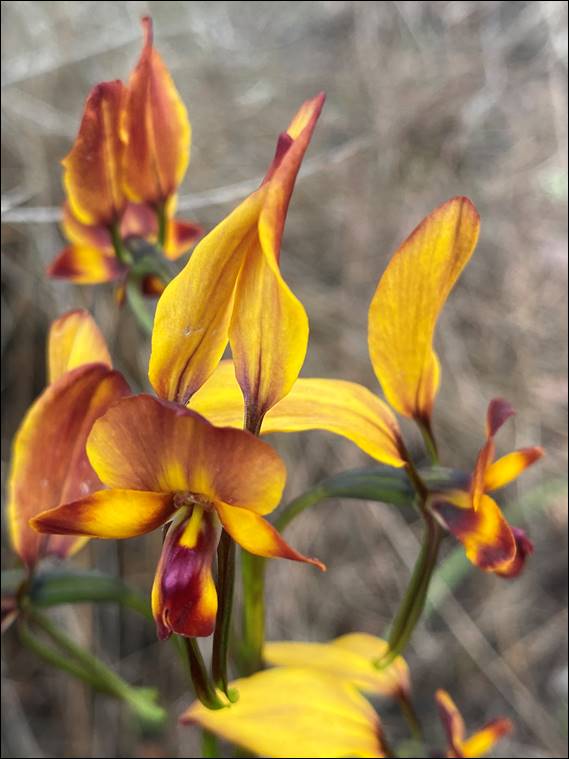
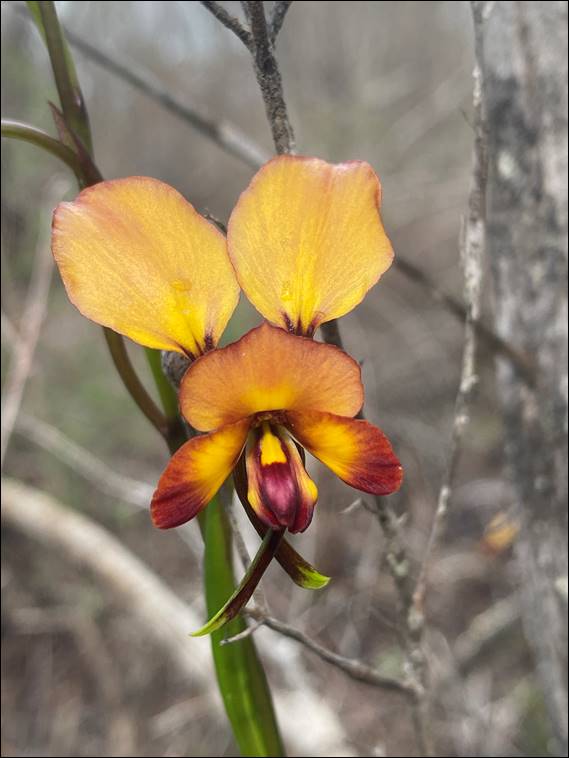
This afternoon I wandered out to Ambergate, hoping something might be coming out.  My last visit here over threes back with Lisa yielded Buckley’s.  This trip wasn’t much better with a couple of small clumps of Kemerton Donkey Orchids (Diuris cruenta), below, and not much else.  On the plus side this image made me revisit the species I found at the Capel Nature Reserve, realising for that trip I incorrectly identified some Sandplain Donkey Orchids (Diuris tinctoria) as Kemerton Donkey Orchids.  This has now been corrected in that previous post:

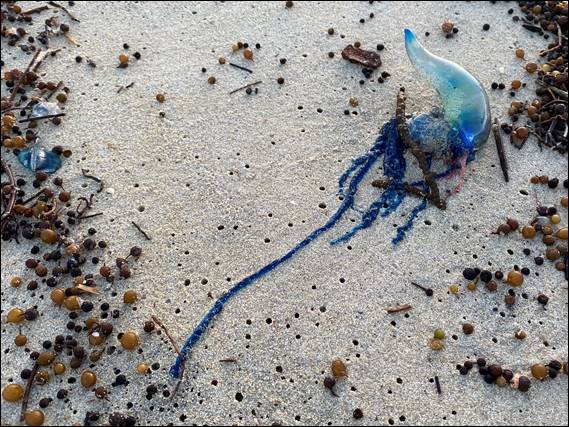
Going back in time, I went down the beach with Lisa and the poodles this morning.  It’s rare to spot a crab on our beach in the daytime, but she had done just that a few days back.  The chances of a second sighting was slim, but we did see a bunch of By-the-wind Sailors (Velella velella) and Blue Bottles (Physalia physalis), which had been left high and dry.  These get washed up during winter on our beaches, and in summer over on the east coast of Australia.  And like our Western Stingers that arrive in our summer, they can deliver an unpleasant sting:

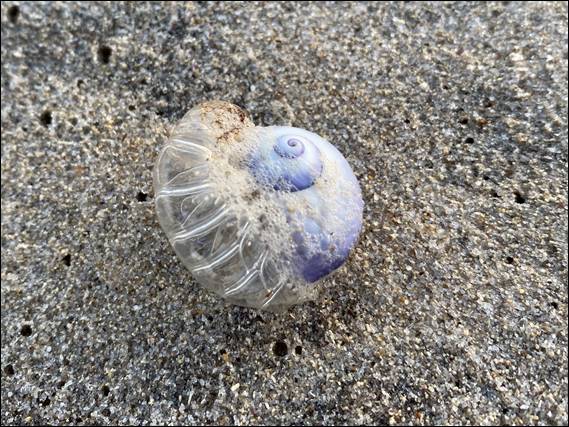
When this happens over east they are joined by another blue floating colonial cnidarian, being the Blue Button Jellyfish (Porpita porpita).  This blue armada is also joined by Violet Snails (Janthina janthina), shown below, and a very alien looking creature called a Blue Sea Slug (Glaucus atlanticus).  These two float on the surface with, and feed on, the cnidarians.  Even ingesting their stinging cells, resulting in becoming toxic themselves.  All five of the full fleet can be found where we live, but the Blue Button Jellyfish and Blue Sea Slug are a rare find:

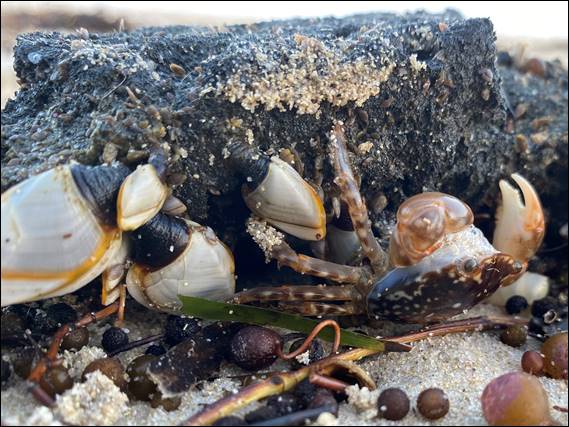
As lucky would have it I also found a crab, the same species as the one Lisa had spotted.  A Smooth-Handed Ghost Crab (Ocypode cordimanus).  During the day they normally live in burrows deep in the sand, reaching all the way down to the water table.  They usually forage on the beach at night or early and late in the day, which is why it is such a treat to see one.  Maybe one day I’ll have to head down just after dark with a torch, to see who else might be out and about:

Showing their true colours

I won’t lie and I steered the ship to my advantage today.  This resulted in a fourth trip, on the trot, out to rock starting with a walk towards Wilyabrup.  I would have headed out solo if no one else was keen, but David was and was also happy to risk the weather.  Having climbed in Ireland and England before moving here, he isn’t one to shy away from a bit of dampness.  He is also yet to sample all the crags available that collectively reside at Wilyabrup,  This made it easy to offer a selection of options I felt would appeal to him:

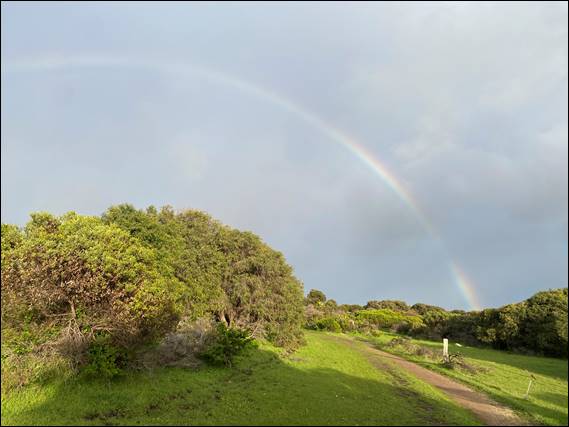
The drive took us through a mixed bag, and it stayed that way on arrival.  Being greeted by some very welcome sunshine and a colourful rainbow, which was rapidly advancing to shore.  This could mean only one thing.  We pondered if it was worth sheltering in the dunny while it passed over, as I had last weekend.  Deciding not to bother, we scrambled round the loose top in the rain.  I’m a little desensitised to the terrain and loped along happily, whereas David took his time to make sure each footfall was solid.  Aiming to avoid tumbling over the cliff edge:

Two weeks back David joined us at the Organ Pipes, a relatively short crag with clean lines and only the very occasional loose stuff.  Driftwood Bay is the next crag along, and is a step up into the murkiness of what I’d regard as proper traditional climbing.  With a bit of a mountaineering style thrown in.  Longer rambling lines, loose rock, and the occasional longer runout.  In its favour however the grades are much lower, reducing the impact of those more nervous aspects.  The description, and on arrival the environment, appealed to David:

It was all a bit slippy when we got there, but he is getting used to the quickly changing weather and drying rock here.  And sure enough as he followed up the first climb the sun was upon us and the rock was starting to dry.  His face however hinted that the loose rock on the line I chose to start on, had made him a little nervous.  It was probably the worse line for loose rock, and in hindsight maybe I should have started on another route.  But hindsight isn’t particularly helpful and it resulted in me taking a second lead.  This time on more solid terrain:

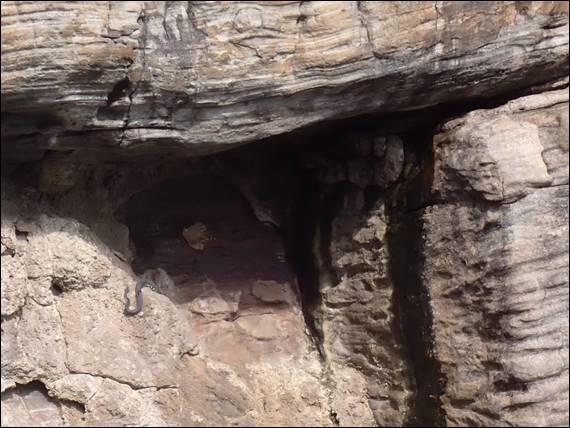
As I set up the belay anchors, I spotted the above Southwestern Carpet Python (Morelia imbricata) sunning itself just across from where our abseil line was.  I wonder if David will expect to see a snake every time we climb here now.  He has certainly been very lucky to date.  We were able to get very close for a good look.  Making sure that as soon as it showed signs of having a good sniff, with its tongue, that we backed off.  Not wanting to disturb it too much.  Back at the base, someone’s brain was having a battle.  To lead or not to lead:

Without being too pushy I encouraged the ‘go-for-it’ side of David’s brain, which seemed to gain traction.  He started up the rock, but  it was however clear that the mental struggle wasn’t over.  He placed a piece of gear, after which he struggled to push himself any higher.  This had nothing to do with the precarious looking left foothold that he kept using.  I thought it better not to mention that until after the ‘don’t-do-it’ side of his brain had won out, and he was back on the deck.  I also found out how long it had been since he had led anything:

The few times we have managed to encourage him to lead, has resulted in him bagging more leads than he has managed in the last four to five years.  So it’s no wonder he was not overly motivated to get on the sharp end at such a ‘traditional’ style crag.  Needless to say I jumped on sharp end again and then again, picking a rarely climbed route for the last one.  While not prepared to lead these kind of lines, David certainly wasn’t afraid to climb them on second.  Pulling off the moves, and occasional loose hold, and is keen to come back here for more:

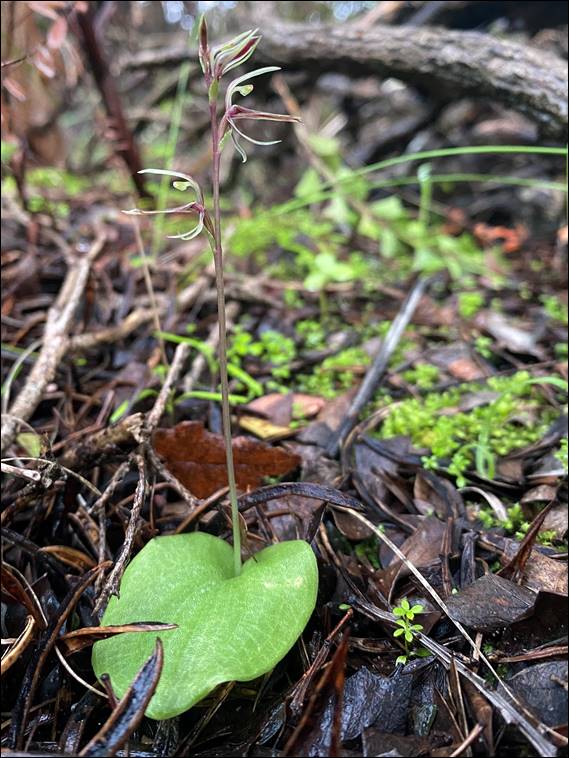
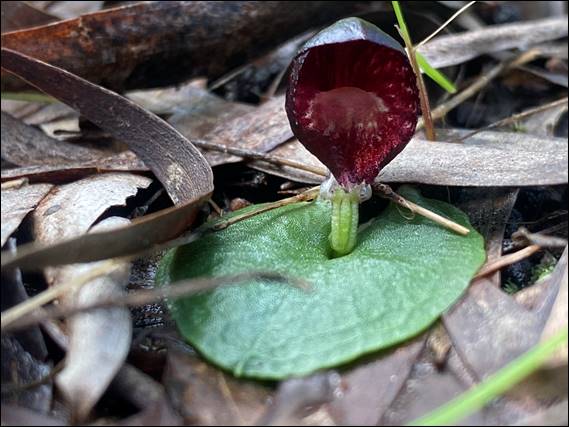
Four lines may not seem a heap to bag.  We did have a slightly later start, but it was the sudden drop in temperature, and wind picking up, that helped us decide.  Out to sea it was hit and miss as to what might befall us.  On the plus side this meant the gear was packed away dry, which is always nice.  Then on the walk out we stopped to check out the reason I wanted to come here.   Finally the tiny Sandhill Helmet Orchid (Corybas despectans) was in bloom and showing us its true colours, and despite having a flower less than 5mm long it was a beauty:

Keeping it short

There has been no time for a wander during the week.  Stuff kept getting in the way, plus the weather has been somewhat meh.  Today was again forecast to be pretty average.  It started that way, and we were hit by pounding rain and hail with thunder booming in the background:

But I needed to get out, so when a dry patch appeared I seized the opportunity.  Josh had nipped out one lunch during the week to an old faithful spot in Bunbury, and stumbled across a lone white spider in flower.  Raising my hopes when I headed back to the above place:

There were certainly heaps so spikes indicating there will be a booty of spider’s in bloom at some point.  Just not today.   No matter I was out, and that in itself felt good.  There didn’t seem to be too much about, as I scanned the relatively drab scrub for splashes of colour: 

With persistence I found a few donkey orchids.  The first image being the Yalgorup Donkey Orchid (Diuris porphyrochila).  And there are subtle, but sufficient differences to give me the confidence to say the above is a Sandplain Donkey Orchid (Diuris tinctoria):
Other times those little differences can be a huge timewaster.  The above is Slender Snail Orchids (Pterostylis crispula), but the one below has had me flip-flopping over different species too many times.  The hood and main body shape looked quite different:
But it took a bit of zooming into the image, for me to notice the hairy stem.  Allowing me to decide on a Red-sepalled Snail Orchid (Pterostylis erubescens).  I was out for about an hour and half.  Getting hit by two fortunately short showers, as I continued to scour the ground:

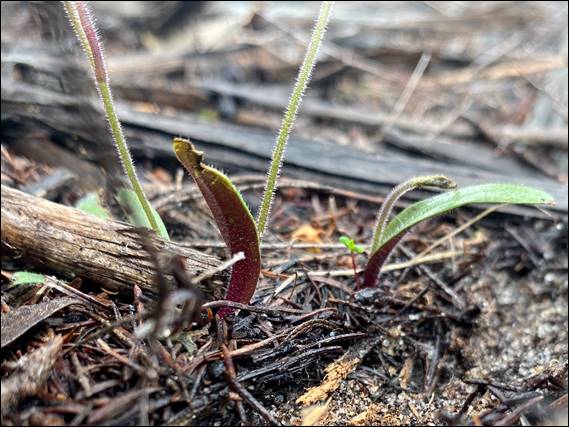
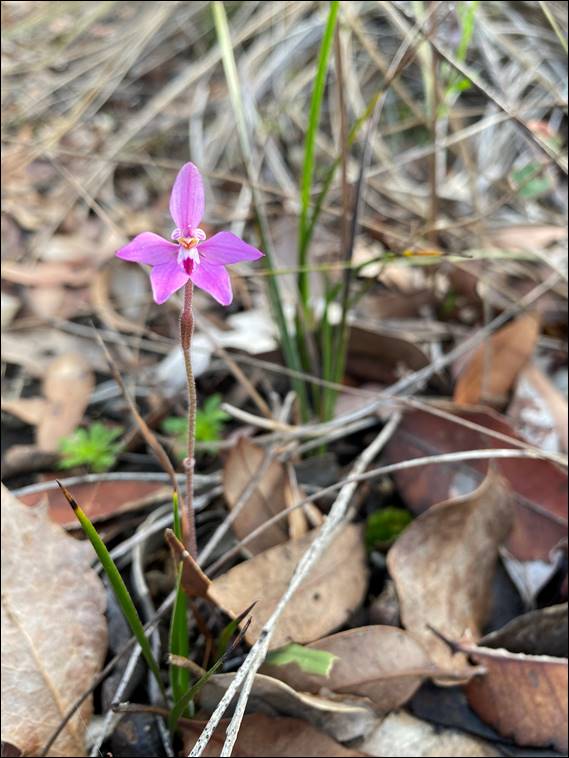
I also got to check out the trick I learnt last weekend to confirm if I had found the Dwarf Pink Fairy (Caladenia reptans) when I found this one, and some others.  Sure enough the small leaf at the base had that purple hue on its underside:

All up I came across eight orchid species in flower, so while the spiders weren’t ready it was definitely worth the time.  Nothing particularly new, but I thought you may like the images, so I’ve kept the words uncharacteristically brief for me:

Blink and you miss it

In thinking of themes for this post, The Gambler keeps going through my head for this post.  I felt the lyrics from the songs chorus were apt for various moments during Friday mornings foray to our rocky coastal playground.  There were times we needed to know when to hold ’em, fold ’em, walk away, and run.  It is of course a song that most will associate with one artist.  However, written by Don Schlitz, it was recorded by some pretty big artists, including Bobby Bare and Johnny Cash, before Kenny Rogers made it famous:

The forecast was grim, very grim.  But as Friday approached the synoptic charts indicated an early sliver of dry weather may be upon us.  Craig and Howsie were game.  We had a choice between Wilyabrup and Welly Dam.  The latter, being inland and potentially further away from the approaching front so may have stayed dry for longer.  No one seemed keen for hard climbing, so Wilyabrup won out.  Working in our favour, in more ways than one.  On arrival I thought it may not have been the right decision, when, while using the facilities, rain arrived:

I made use of the shelter a little longer, not wandering down until it eased off.  Here I found the two of them gasbagging under an overhang.  Bags unopened, and not a hint of motivation to climb.  It had been a while since I have been on lead, so as they continued chatting I racked up.  In view of the conditions, the first route was one we often finish on.  It was the right choice with just the right amount of dampness to keep it more than exciting enough.  I’m still not overly keen on taking a lead fall, not wanting to impact our fast approaching climbing trip over east:

In addition and despite it having been nine weeks since I sustained my injuries, my knee still groans at times and my foot also complains.  Possibly due to having continued to climb, maybe because my body does not heal as quickly as a young whipper snapper’s might, or it could be that I did more damage than suspected.  Whatever the reason, today was not a day to take risks.  Added to that I was feeling heavy on rock, and on his first lead Howsie said he felt clunky.  A slow paced day was a good idea, and we started by each getting a grade 14 lead in:

Seemingly to keep us all on a level pegging, Craig mentioned feeling uncoordinated.  To be fair he had the most justification for not quite feeling it on rock, considering how infrequently he gets out.  Not that this prevented us from badgering him into taking on a lead.  After efficiently climbing the third lead, he then took his time to re-familiarise himself with setting up a belay anchor.  Unaware of the next belt of rain whisking its way towards us.  Once ready to belay us, Howsie and I ran up making it atop just before the drops once again fell:

It was my turn to lead, having seemed to luck out with the timing.  However, with Craig comes flasks of tea.  Allowing us to pour cuppas and spend a moment or two to let the rain ease, and consider what next.  There was a lot of indecision about what that might be, nothing jumping out to any of us.  Finally I went for an old favourite, which in hindsight was a dumb choice.  The freshly moistened holds on the headwall played with my head.  After three attempts I decided to be sensible and fold.  Escaping the difficulties via a long, unprotected, but easy traverse:

The other two managed to get up the headwall, but it did make Howsie reconsider what he was keen to do next.  He had hinted at being keen on the complimentary climb to my lead, being next to it and at the same grade.  Then while supping his brew, it was his turn to come to a sensible decision.  And was drawn to an easier, but equally enjoyable, line.  Even that made him stop and think at the crux, where, unlike I had, he pulled through.  All the while the clouds were being blown away, and as the clear sky arrived two people also arrived:

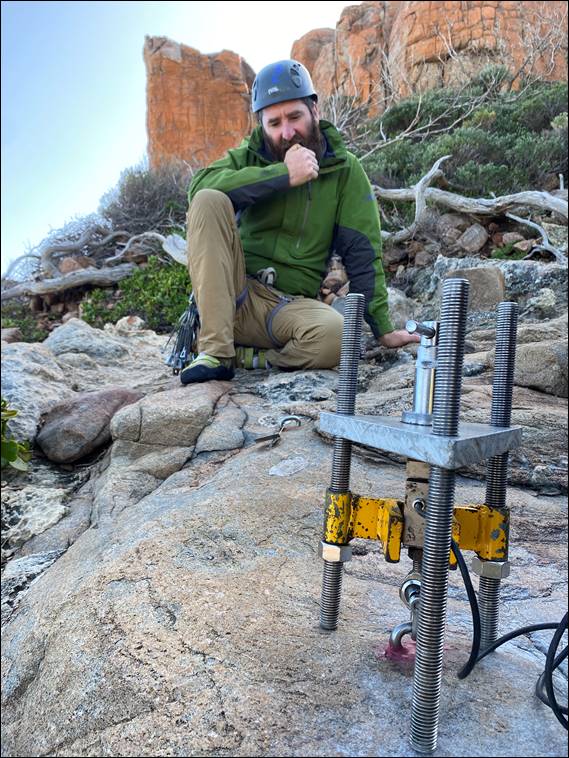
Not climbers, but staff from the state agency that maintains the abseil anchors at the top of the cliff.  They had replaced a couple of bolts yesterday and were now testing them.  All the bolts along the top of the crag get tested every year, so it is surprising that in nearly two decades of climbing here this was the first time any of us had bumped into them.  We found out that they only test the glue strength, which is done by applying a vertical load of 8kN for a period of three minutes.  It is simply assumed that the horizontal strength of the bolts is maintained:

Wandering back down, Craig had already decided on the path out for our final climb.  There was not a hint of rain in any direction, with only whispery clouds on the horizon.  The forecast had been way off; in our favour this time.  Allowing Craig to lead us out with the sun on our backs.  Still being fully rugged up, as while the clouds and rain had gone the wind had not eased up.  We had, and were still, being buffeted by gale to strong gale force winds.  Howsie came up last taking his time and having a good long look behind the flakes and in the cracks:

Not for trying, but we did not seen a single scaly friend today, unlike our last trip out.  Not put off, as we walked away from the crag, and as the howling of the wind eased, we continued to keep our eyes peeled.  Spotting the same three orchid species as last week, two having been mentioned in that post.  The third is the one I am waiting to see in flower.  It is getting there, and we spent quite a while checking it out.  But I’m going to hold my cards close to my chest, and not reveal an image of it yet.  Not until it is in flower, unless I miss the spectacle, as I did last year:

Place your bets

Things are heating up, and the number of images popping up on the orchid Teams chat group at work are increasing.  Josh and Elspeth managed another lunchtime wander late last week and found a few more in flower.  But it was an image taken by Josh’s young son, it seems that his whole family enjoy hunting these little flower, that really caught my eye.  During a trip to Crook Brook they stumbled across an absolute beauty.  So good that I headed there on Tuesday after work, despite a storm front approaching:

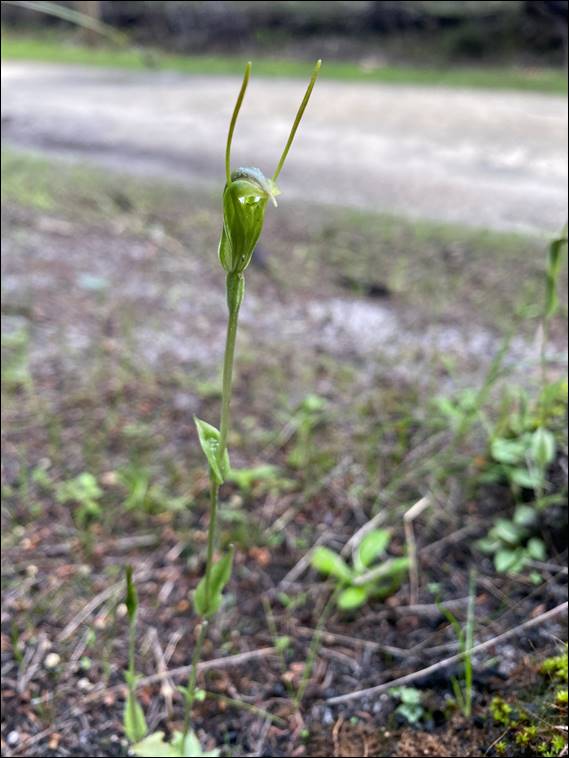
This was my second visit to this delightful place this year, and the first visit in June didn’t yield too much at all.  So little that I haven’t made a mention of it in any of my posts.  Having been in the dry period between the early orchids that come out around Easter and those that winter starts to draw out.  On the drive out I stopped at Lisa’s school, which is conveniently on the way, to pick her up.  Walking slowly and looking all round, it looked fairly quiet.  There were the usual winter flowering greenhoods, and quite a few Pink Fairies out but which ones:

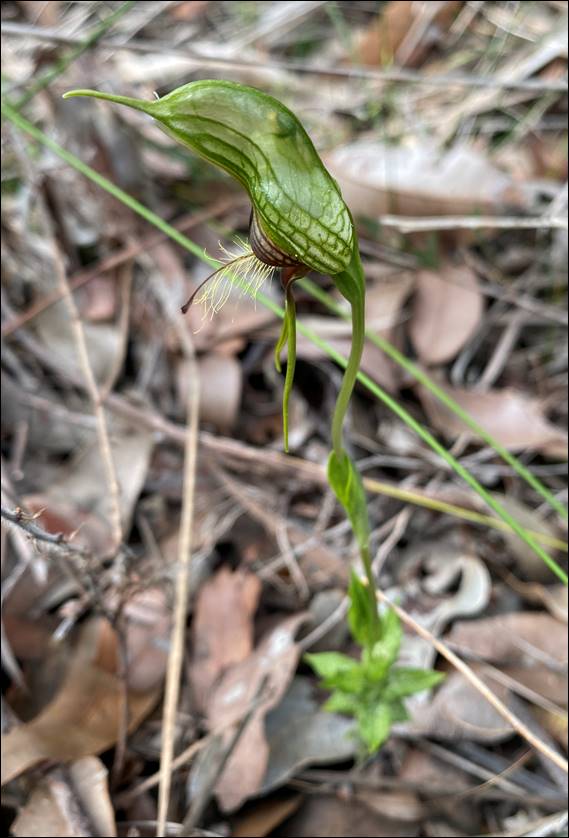
As can be seen in the first image the petals, which are the two that sit to the side of the flower, are slight downward pointing.  This flower had a total height of approx. four inches and looked relatively dark in colour.  These characteristics indicated to me it may have been the Little, or also known as Dwarf, Pink Fairy (Caladenia reptans).  I’ll have to pay a little more attention next time, as another and more distinguishing feature that will assist in a true identification, is the smaller basal leaf usually has a purple hue on its underside:

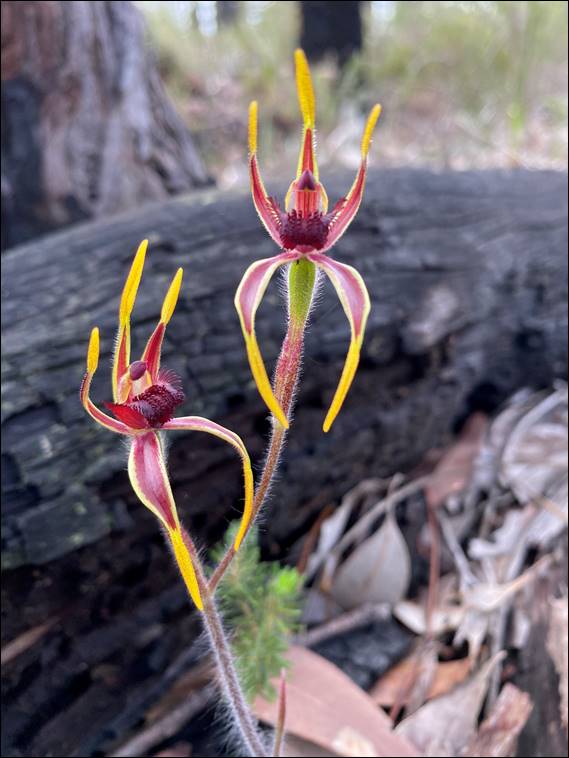
The real gem that I was hunting was the second image, and I was lucky Lisa joined me as she spotted the only one we saw on the short three kilometre wildflower loop.  It is my first ever sighting of a Reaching Spider Orchid (Caladenia arrecta), one of the earliest flowering spider orchids with amazing eye popping colours.  Made more striking by the heavily clubbed bright yellow sepals and petals.  And unlike the petals on the Little Pink Fairy Orchid, the petals on this flower reach up towards the sky, further adding to the visual impact:

We sat and admired it for a while before carrying on.  There may well have been more out, but halfway round the sky darkened, the temperature lower, and as expected rain started to fall.  Our pace quickened and we didn’t look round anywhere near as much.  No matter I was very chuffed and grateful to Josh for sharing, who I mentioned had got out for a lunchtime walk with Elspeth.  Because it is right on our workplace doorstep, they had wandered round Manea Park, which is where I went on Wednesday on my way home from work:

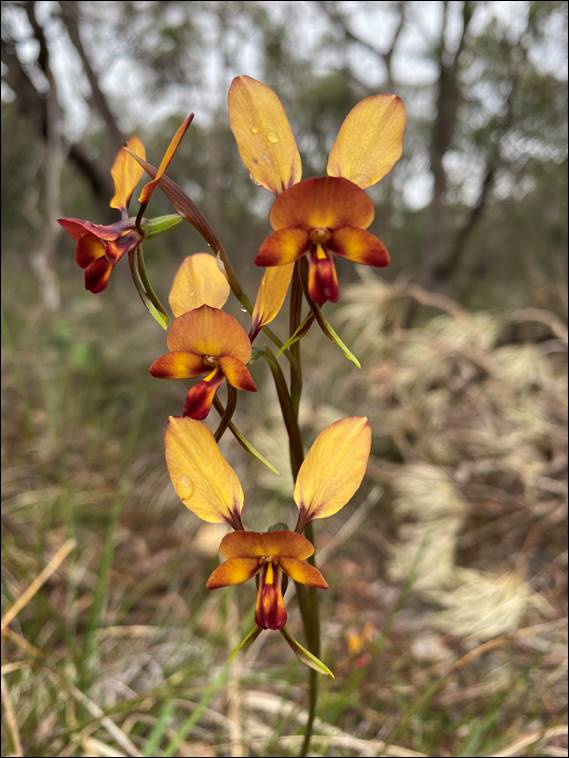
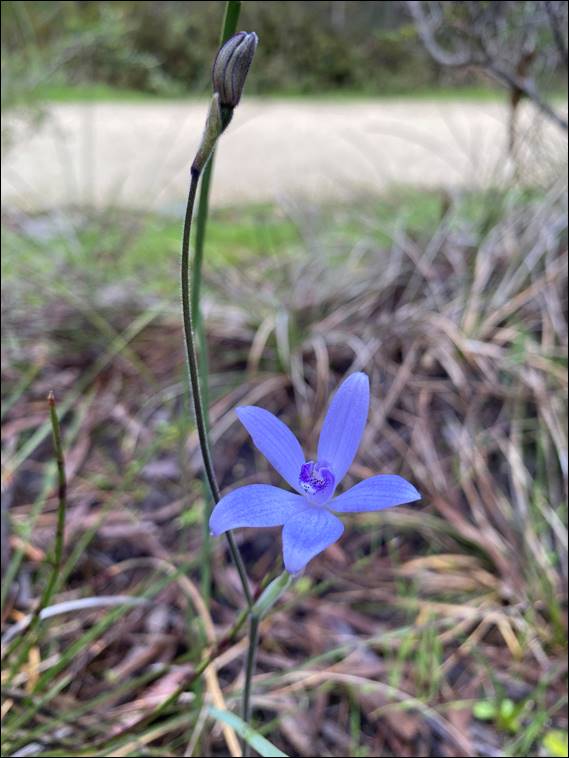
They had spotted a single Yalgorup Donkey Orchid (Diuris porphyrochila) in flower, but plenty more spikes looking to be on the verge of flowering.  And in the short five days since they had gone out, I did find heaps more in flower.  It is a common and plentiful orchid that comes out almost every year, distinguished by having more colour variation to contrast against its orange base colour.  I also spied a single flowering Silky Blue Orchid (Caladenia sericea).  An orchid that I have never seen in great numbers, so it is always lovely to see it again:

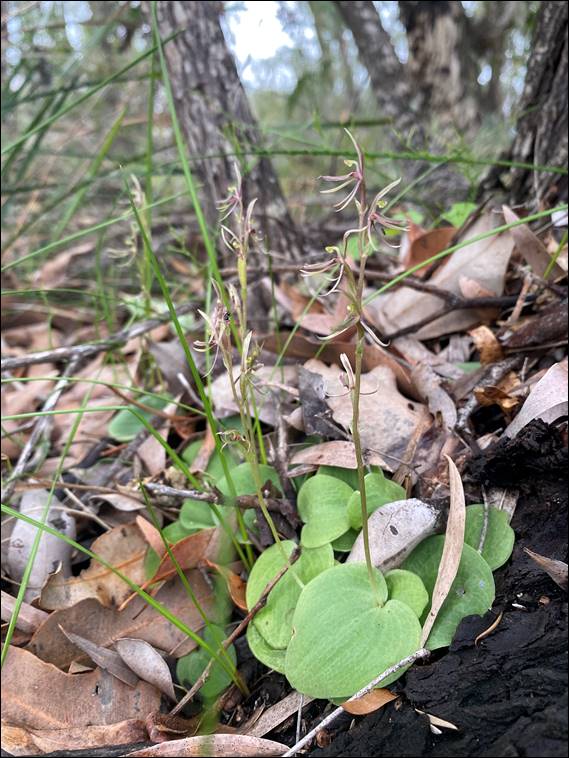
I advised the orchid crew at work of my find, and Josh went out there a few days later finding three flowering plants.  He said our recent knowledge sharing, between the Reaching Spider and Blue Silky Orchid, was a fair trade.  Mind you I somehow feel like I got the better deal, this time.  Continuing on my wander round the two and a half kilometre circuit, I found a small patch of Midge Orchids (Cyrtostylis huegelii) and the Slender Snail Orchid (Pterostylis crispula), with its long sepals and small basal rosette of leaves.  Shown in the two above images:

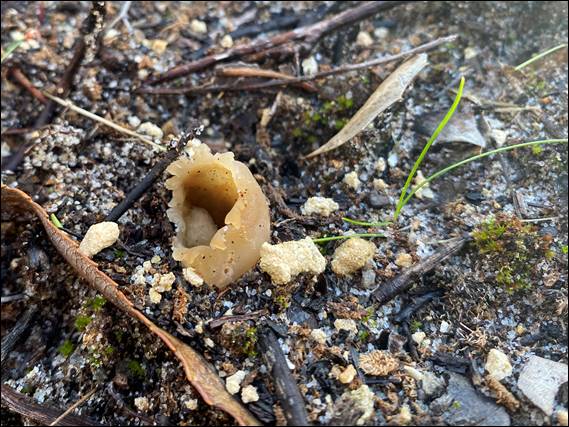
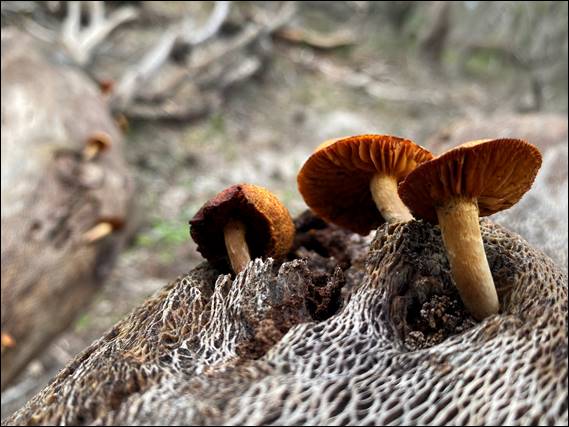
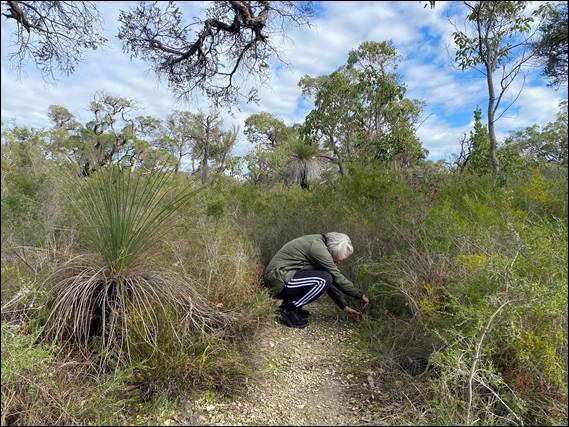
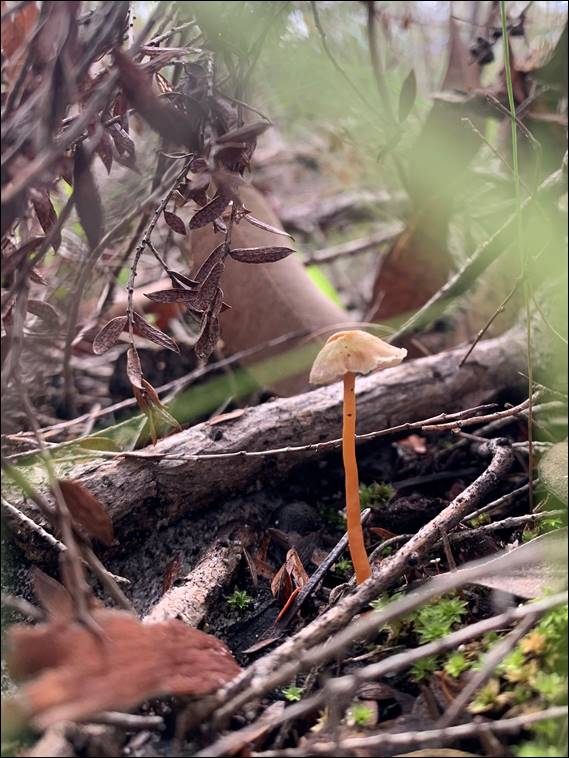
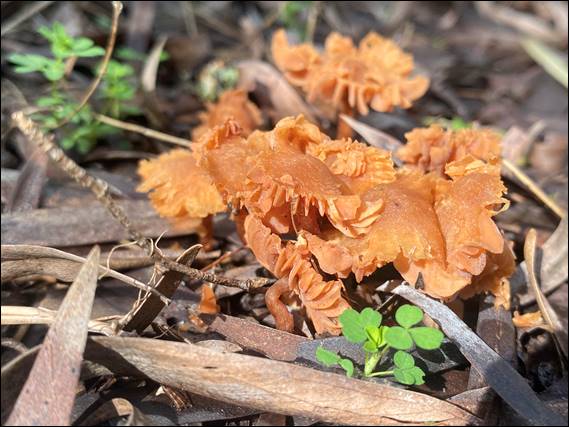
My last find was the above fungi, breaking through the soil with an opening that look like it had been torn open with ragged edges.  My first thought, which Howsie agreed with, was a cup fungus.  Many of them are above ground.  But this one looked to be more of a geophyte, which is a posh word for plants that have growing parts below ground.  Remembering of course that fungi are not classified as plants or animals.  It took a while and I think it may be Peziza austrogeaster, with a bit of luck Verity will use her networks to confirm if I am right:

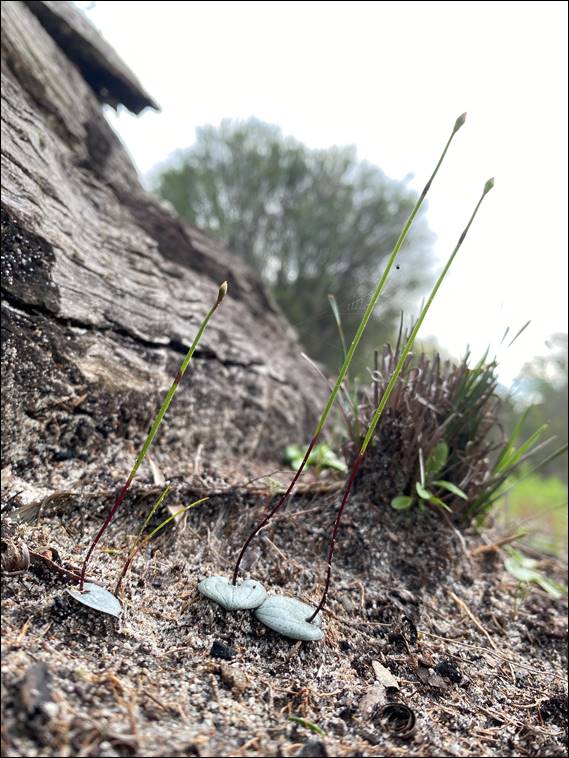
To wrap up the weekday wanders I popped out to the Ruabon Nature Reserve on Thursday, where things were still pretty well under wraps.  Having exhausted my research stamina I’ll let the above fungi slip, but liked the image enough to include it.  There were of course positive signs about, including these three orchids.  My guess is that they are likely to be the King-in-his-Carriage Orchid.  However, the basal leaves looked different so it could be one of the lesser found hammer orchids.  I’m not willing to place my bets just yet, and will wait till they flower:

Winter surprises

It has been an unusually long spell since I’ve been on the sharp end of a rope.  Being just shy of a month.  While winter took a while to getting going, it is fully here and feeling like a winter of the old days.  That is no bad thing for the environment.  It does however put paid to the ability to find someone willing to get out each week, come rain or shine.  Truth be told today’s forecast was also looking a bit iffy.  Maybe through oversight or intent, I omitted to mention this to Howsie and David when we organised a Friday trip out:

I did mention it would be worth rugging up, with fresh onshore winds forecast the whole day.  Driving out rain hit the windshield, neither of them seemed phased.  The draw of touching rock seemingly taking precedence, over worrying whether it may be a little damp out not.  Things cleared up as we got to the carpark, the roads were however soaked and big puddles were everywhere.  As I mentioned last week, I knew where I would climb this week, and there was no objection to Wilyabrup.  It was David’s introduction to my passion for orchids:

This meant the walk in was a little bit slower.  Sadly the Sandhill Helmet Orchids flowers still hadn’t blossomed.  Although we did spot what I stated was ‘just another’ Mosquito Orchid.  However, it is a Cape Mosquito Orchid (Cyrtostylis sp. ‘Cape Naturaliste’).  My orchid book indicting it was recently identified as a species, but I cannot find out when this occurred.  Differing from Mosquito Orchids, by being a third of the height, having a slightly narrower labellum, and having the lateral sepals that are held slightly differently: 

The fact that is was damp was not lost on us.  And during on our journey in we discussed where would be best to head.  Our choices including thinking about finding some good lower grade lines, to continue to build David’s leading confidence.  While the ground was wet, the fresh onshore winds had, as expected, dried the rock faces.  We had pondered on Driftwood Bay or the Organ Pipes.  I was keen on the latter to enable us to also test Howsie’s metal on a few of the spicier lines, but let them walk ahead and choose for themselves:

The Organ Pipes won out, and despite having been here last week by myself I had no objection to this.  On arrival the day was relatively clear, with the dark clouds out to sea looking to bypassing us.  Howsie kicked off proceeding with a gentle warm up climb.  David liked the route and rock and hinted he was keen to lead, just not yet.  With the three of us, I could focus a bit more on taking images.  As such Howsie jumped on lead again, hitting the crag classic and bumping the grade up a bit.  We all topped out in time to see the above sight:

It was an incredibly vivid rainbow, and moving towards us fast.  While it was wonderful to observe, as David said it was a harbinger of what was to come.  And come it did.  The video above shows that the rain didn’t just fall, but was driven horizontally at us by those fresh onshore winds.  This continued for some time and when it eventually subsided, everything was completely drenched.  Little waterfalls ran over the edge of all the rock faces, and yet no one even hinted that we should pack up and go:

On such a day the last thing I would have expected to see was any reptiles, but we stumbled across two Marbled Gecko (Christinus marmoratus).  On the first route David managed to dislodge a rock and exposed one, which after the shock of being exposed so suddenly slowly slunk away into a crevice.  Having missed out on seeing it I hunted all over and spotted one buried deep in a crack, too deep to get an image.  The two we saw were both dark, dulling the effects of their marbled patterning, and Howsie hinted this was due to the temperature:

As Howsie continued to climb I ran round snapping images, and also looking for more creatures.  Being rewarded by a second surprising find of two King’s Skink (Egernia kingii), which were more accessible for my camera as shown above.  You may have guessed that David’s desire to lead had been washed away by the rain.  I too was quite happy running round with the camera.  At times I feel David was torn between keeping an eye on Howsie leading, and me scrambling round like a mountain goat in at times precarious positions: 

Not surprisingly Howsie didn’t mind taking the lead one bit.  The next two he bagged were on a short wall.  Despite the lack of height it offered slightly more heady routes.  The intense feeling was due to the gear and dubious looking stability of the rock.  The dodgy looking rock is enhanced by the natural flaky features on the wall.  We found no loose rock, but it doesn’t change how the head plays games when you are on lead, needing to put full faith in the holds.  The wet rock added to this nervousness, but it was dry by the time we hit the second line:

We then moved to a route I was super keen to see Howsie attempt.  David reinforced he had no desire to lead, and was thoroughly enjoying following up.  This climb was one I really wanted Howsie to try to on-sight.  I recounted my fall the last time I climbed it with Craig (https://sandbagged.blog/2024/01/28/driving-with-confidence/).  While I received no strains, sprains, or break from that fall, I got the biggest bruise I have ever had and it lasted for weeks.  It is possible this story messed with his head, and he falter on the runout headwall:

After a couple of failed attempts he admitted he wasn’t up to it today.  Whether I had affected him, he was simply tiring from lead after lead, or that the route is harder than I had graded it didn’t matter and he was happy with how he went on it.  As he sat atop belaying David who stretched to full capacity to make the above move that Howsie just couldn’t commit too, he somehow spotted one of the biggest South-western Carpet Python (Morelia imbricate) we have seen here.  Shown two images up:

The python, similar to the geckos was dark resulting in its full glory being masked.  I’ve read that geckos can change their colours depending on their mood and also the temperature, humidity, and surroundings.  Some snakes also change their colour to aid heat absorption but I could not find any reference to indicate Carpet Pythons exhibit this trait.  Howsie wrapped up our session with a more sedate route.  In the background you can see the roof under which Howsie had spied the Carpet Python.  I’m still impressed he spotted it:

He was climbing in sun, as it started to hit the front of the crag, but we were still wrapped up to fence of the wind.  The wind that had also managed to dry nearly everything, from the early morning drenching.  Only the ropes had a slight dampness to them, as we packed up.  I fell behind walking out, looking for orchids.  Only finding a few more Murdoch Snail Orchids (Pterostylis ectypha), which we had already seen on the way in.  While we had been lucky with what we had seen today, winter still had one more surprise for me:

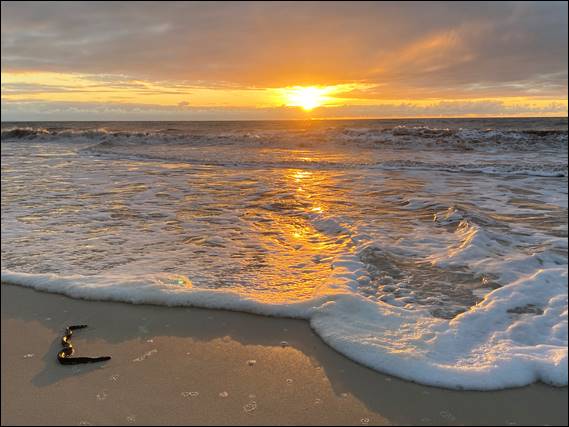
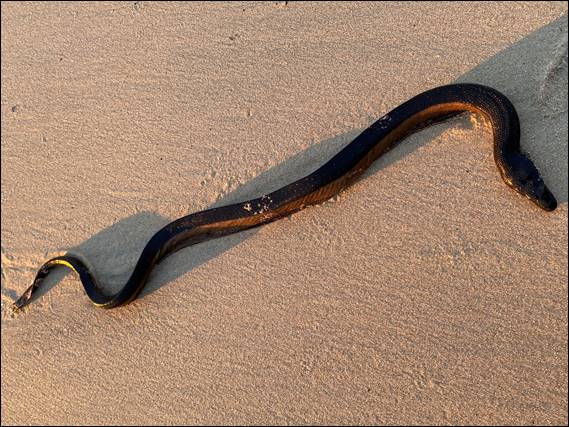
As the day was coming to a close, someone on Lisa’s Peppy Plungers Group posted about a snake on the beach, so I went to investigate.  Finding a Yellow-bellied Sea Snake (Hydrophis platurus).  The most abundant and wide spread of sea snakes, but I have yet to see one when snorkelling.  They live their entire life in the water, but sometimes get beached like this one.  As the rely on the support of the water to maintain an even blood pressure, when they are beached they are unlikely to survive.  Being highly venomous it is dangerous to handle them, plus with only the slightest bit of life left it was too far gone.  So I let nature take its course:

Better luck next time

With a break from the rain upon us, which coincided with the weekend, it was time to make use of our great outdoor playground.  On Saturday morning the swell was having a break from resembling a washing machine, providing for a more relaxed bob for Lisa and the rest of the Peppy Plungers.  I’m not entirely convinced she had enough time at home to restore her core temperature, before we were heading out the door.  She was however as keen as I was to go for a wander, and the combination of her Buffalo and sun soon warmed her up:

We went to Ambergate Reserve.  Being close to Busselton, where we would head afterwards, and allowing me to see what may be preparing to bloom.  Similar to the Capel Nature Reserve there were positive signs, but I only found two orchids in more advanced stages.  A single Jug Orchid (Pterostylis recurva), and a lonely Rattle Beak (Lyperanthus serratus) that had a bud but was yet to flower.  While I wasn’t stopping quite as much as usual, Lisa was.  Checking out the fungi because some of the children at her school are learning about it:

I did have a quick look to see if I could identifying the above one, but have given up and will leave the children to work it out.  After a very relaxing and leisurely stroll we headed into town to get the weekly shopping.  Rewarding ourselves with a feed, drink, and game on the foreshore, seeing we were not in any great rush to get home.  The next morning it was me heading out in the dark towards the ocean.  There was a hint that Ash may have been keen.  It didn’t happen when he rightly chose to spend time with his better half, rather than with me on rock:

Despite no one being available, I didn’t want to waste the opportunity to hit rock on such a glorious morning.  Wilyabrup was my choice for several reasons.  There was a particular orchid, which I have only ever see here, that I was keen to hunt for.  Also Howsie and I had been pulling on plastic holds in my shed on Friday, so I was a little weary.  In fact my body has been giving me a few warning signs to ease of the training regime I have imposed on myself.  Not enough of a warning to prevent me going out, but I do need to be sensible:

Walking to the crag, as the birds were welcoming first light, I took a right at the end of the track to get to the top of the Organ Pipes.  Offering shorter climbs that are not too hard, and probably rarely get any attention from anyone else.  Meaning that I would have the place to myself, not that anyone else was about just yet.  The car suggested it was a mere 4 degrees when I started walking in, so today I was grateful for my Buffalo.  The coldness of the rock still made my fingers tingle, and even in my climbing shoes my toes started to feel a little numb:

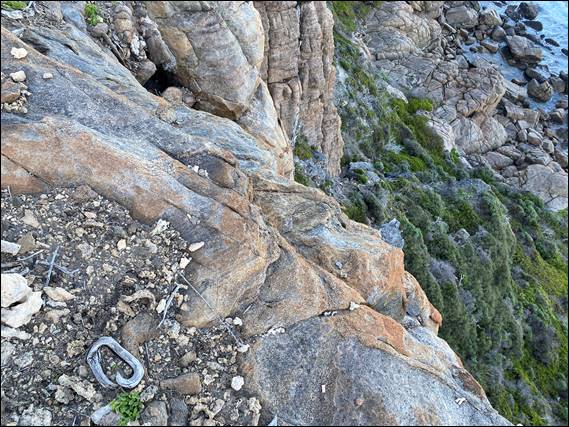
If only for a very brief moment I thought I may have found a bit of crag booty above.  Belying my statement that the area is rarely visited.  Sadly it was just an unusually contorted branch.  And as I played on my chosen lines, the reason why people don’t climb here much was reinforced.  The climbs are a tad runout, and the rock at times feels a little insecure.  Not surprisingly quite a few of them are routes I have established.  And based on the lack of gear, I climbed them at a time when I was obviously feeling more confident than I did today:

Six routes under my belt, I was packing up the gear a mere two hours after I had set it up.  It was long enough for me to feel worked, and also spend time enjoying looking out at the calm ocean.  Kinda in the hope of spotting a whale, or at the very least seeing a spout.  A task that can be a bit like finding a needle in a haystack, and it was not to be, for today at least.  Walking out I prepared myself for another difficult task.  Needing to spot an orchid, which I have previously seen under the bush on the side of the track:

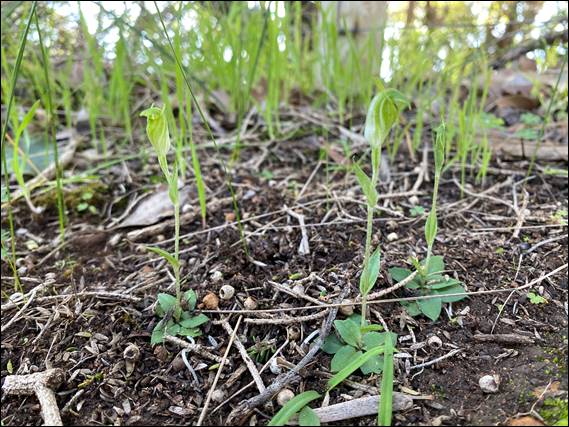
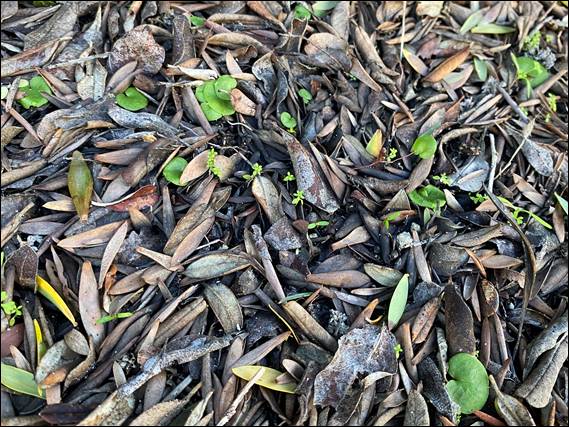
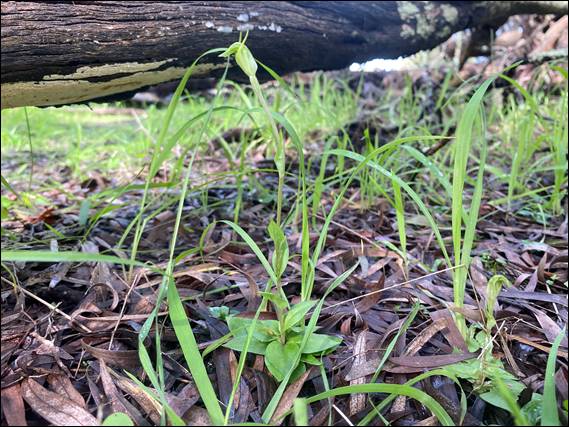
Need I say it was a slow walk out.  Having almost given up trying to find the very small leaves, I somehow found the little colony.  Taking the above image to remind me where to look next time.  That will hopefully be soon, as one of the leaves had a bud getting ready to flower.  Last year, the first time I saw these Sandhill Helmet Orchids (Corybas despectans), I was a little too late.  The few in flower were withering and pretty bedraggled.  Fingers crossed for better luck next time, and if there is good weather next weekend for a climb I think I know where I’ll be heading:

Orchid spikes

Apologies for those that may have been wondering where I was hiding over the last two weeks.  It is a rarity for me not to sit down at my keyboard for a fortnight.  I certainly wasn’t out on rock, nor wandering out bush.  Not due to injuries or illnesses, but because Lisa and I got away for the weekend.  We stayed in a concrete jungle, which really is not my usual habitat.  It did however make a change and we had a lovely time.  It meant we had to sort the stuff we usually get done on a weekend into a compressed timeframe when we got home:

I think it was on Monday, but it could have been Tuesday, Elspeth and Josh suggested ducking between the showers to get a wander in round the Manea Park.  While tempted and itching to get out in nature, I was a little snowed under and didn’t join them.  Missing out on a shower and a solitary Pink Fairy Orchid.  They saw nothing else, not even a basal leaf.  Not put off by the lack of treasures, on Wednesday I asked if they were keen to try again.  This time we wandered down the road to another area, where we have had previous success:

The small patch of bush is technically still part of Manea Park.  It sits out on a limb and the main difference is that, unlike other areas of the park, it is heavily weed infested.  There was no need to dodge the rain today, we had nabbed a nice spell and the next front wasn’t due to land till early afternoon.  We have certainly had a reasonable fill of rain during July, which has been very much needed after our driest summer on record.  It has also helped the introduced pasture grasses, clovers, and arum lilies, which were popping up all over:

I just got a little distracted for a moment, not that you would have noticed.  Getting caught up looking at my image library for this time last year.  While Lisa and I may not get away too often for weekends away, scrolling back through the images we do however fit a lot of good times into our life.  Josh had said that it was nearly a year to the day that he had spotted Helmet Orchids (Corybas recurvus), hence the reason for my distraction as I checked my past images of these beautiful orchids.  This image being from our wander this year:

They were not out in the same amazing numbers as last year, but with a little hunting we found some great specimens.  You may also notice in the previous images we came across a few Murdoch Snail Orchids (Pterostylis ectypha).  I guessed the wrong species while out, each year I struggle with identifying the different snail orchids.  Telling myself I won’t bother next year.  Then next year comes in, and I get sucked in.  For, my, future reference this one has distinctive fleshy basal leaves and generally more leaves up the stalk than other species:

We also came across Mosquito Orchids (Cyrtostylis robusta), which is another one I get a little confused with.  I discussed this in my post last year about this very spot.  They are very similar to the Midge Orchid, with a very subtle difference.  Just as a note there are five species in the Mosquito Orchid genus, with one species actually called a Mosquito Orchid.  Confused?  Well I guess you may now appreciate while my head at times gets a little muddled to.  But not as much with orchids as I do with fungi, that is a whole different and far more complex game:

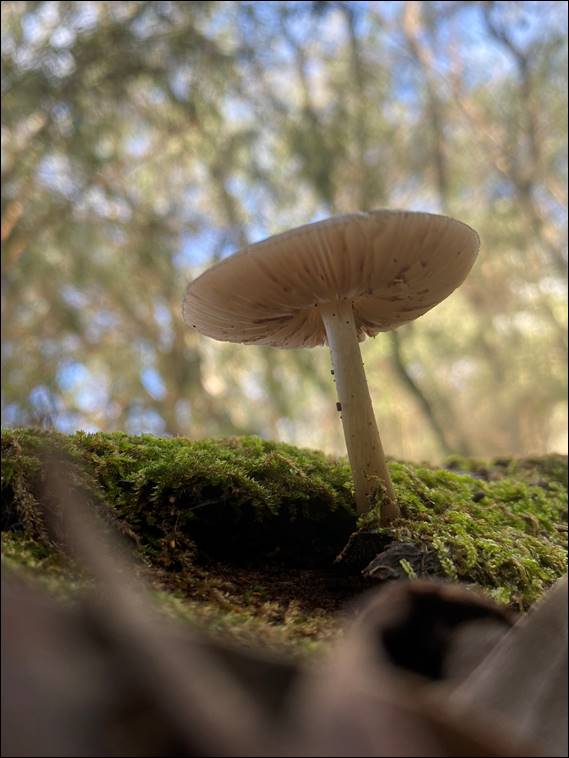
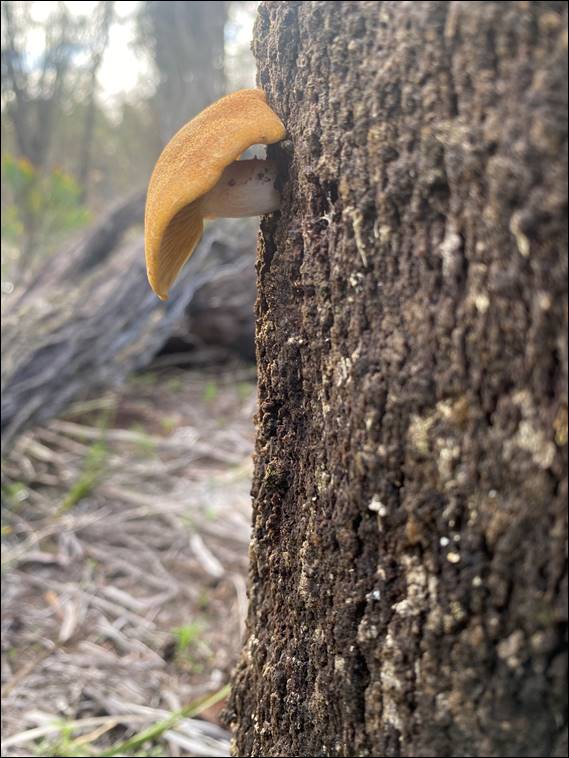
Elspeth also enjoys spotting fungi, but I got the indication she didn’t go so far as trying to identify them.  The is probably sensible, but I’ll give it a stab.  I’ve seen the first one before and know it is from the Laccari genus, and think maybe a Brick Red Laccaria (Laccaria lateritia).  The second fungi could be a Common Rosegill (Volvariella gloiocephalus), and the one below has me stumped.  Unlike oyster mushrooms and bracket fungi this one had a distinctive stem attaching it to the tree, and I’ve had no success researching it:

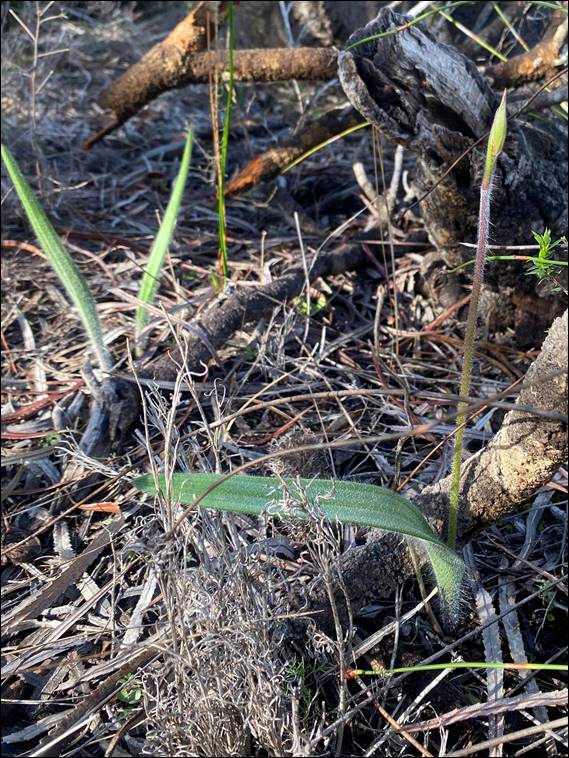
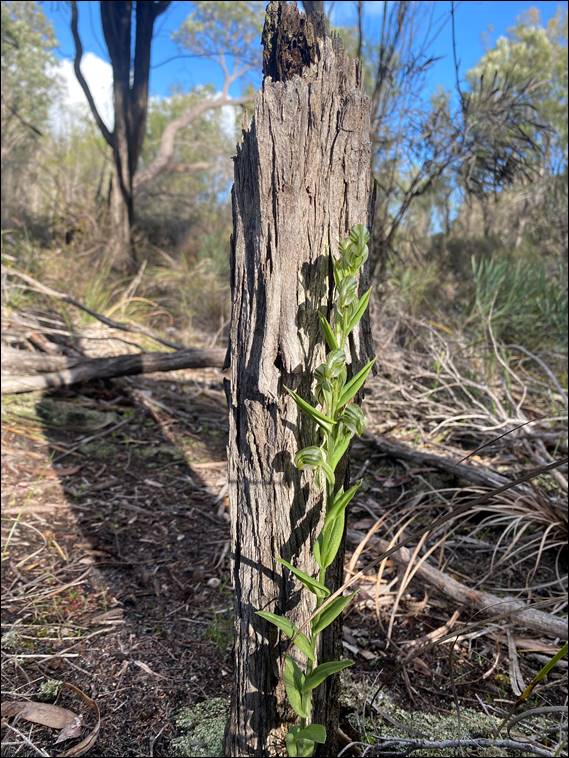
The last three images are taken from a wander on Thursday at my local Capel Nature Reserve, which is not weed infested.  Below is the only species of flowering orchid I could find, a Banded Greenhood (Pterostylis vittata), there was however lots of promise for months to come.  Orchid spikes, a name I‘ve often heard used to describe pre-flowering orchids, were everywhere.  The one two images up being a Sandplain White Spider Orchid (Caladenia speciosa).  August is upon us and the next batch of exciting finds should soon start to come out:

Taking a rain check

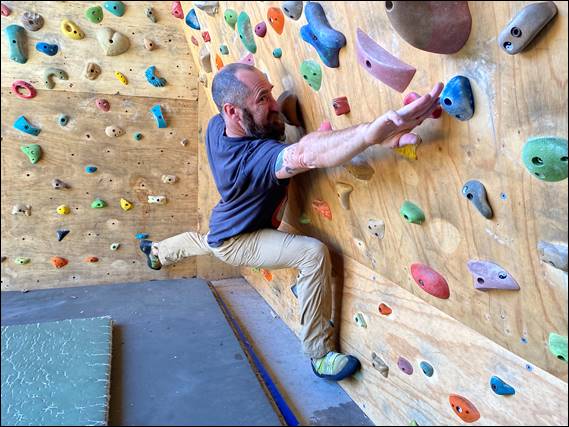
You may recall Howsie was considering not climbing on Friday this week.  However, once the boys had left for school he found himself home alone, with Nadia out until mid-morning.  Indicating to me that he may crack on with a bit of gardening, I planted a seed of my own.  Suggesting we could spend an hour or so on my climbing wall.  It worked out quite well.  I was working from home, making it is easy to take a few hours out.  In addition we have been meaning to catch up to discuss a climbing trip planned for later this year:

I am using the flights from my cancelled trip in January.  This one does not involve sailing, so the reasons of it falling through should be reduced.  It is a good reason to stay injury free, and when I took my tumble five weeks back it felt that I had plenty of time to recover.  However, it now feel like the trip is fast approaching.  Hence why I have been using a hangboard.  I have also started doing some weights, while only a fraction of what Lisa does it is enough for what I need.  The last few weeks of exercising helped with our wall session, and it felt good:

We agreed a session of pulling plastic once a week would help both of us.  We need to be injury free.  But ideally we also need to improve our climbing strength and stamina, if we want to keep climbing during the weeklong trip.  It felt like my body was holding up well despite the more intense climbing on a wall.  Saturday morning however I could feel my knee.  Nothing too bad, but for my quick trip out I did don my knee brace just in case.  No one had indicated being keen to get out, the gale force winds and very rough swell probably putting them off:

I don’t mind the elements and was quite looking forward to being in amongst them.  Purposely picking the zawn at Smiths Beach, knowing the waves would be dramatic and close.  Walking in the waves in the bay of Smiths Beach didn’t look too bad.  The sets were very close, resulting in tumbling waves that resembled more of a washing machine.  Due to the conditions the Peppy Plungers had decided they would not meet for their first light dip in the ocean back at our local beach.  It was dark when I left home so I couldn’t see what it was like but they probably made the right call:

Peppy Beach, like Smith Beach, is in a bay and they are usually that little bit more protected.  Although on occasion the swell comes from a different direction, but not today.  The zawn on the other hand was at the mercy of the full fury of the ocean.  As such I sat and watched for some time before deciding my course of action, and am pleased I did.  The video might suggest climbing the wall to the left would be crazy.  Indeed my initial thinking was to climb on the right wall, but as shown above the entire base of that wall was being smashed:

My rationale for being on the right wall was it had the easier climbs, but I had to go with the conditions.  With the anchors set up at the top of the wall, I dropped the rope into the zawn.  All the while being buffeted by winds reaching 70km/hr.  Needless to say I was tied in all the time.  After rapping down, and before I could coil the rope a big set came in.  The water was close to lapping at my feet, it was very exhilarating.  Similar to being at the top I remained tied in while at the base.  Spray continually funnelled up the zawn almost horizontally and everything was wet.  But this is Smiths Beach, with coarse grained granite:

The friction while marginally reduced, was still great.  It was totally epic conditions, and I attempted to capture a few more videos but the continual spray made it tricky.  Due to the size of the waves coming in, I was restricted to routes on the left hand side of this wall.  Climbing out on the last line, being the closest to the end of the zawn that I dared go, a huge wave came in just as I left the deck.  I still got drenched.  Not just from the spray, as the heavens opened at the same time.  Big drops fell from the sky and water was soon running down the rock.  While others took a raincheck today I’m glad I didn’t, and had an ear to ear grin: