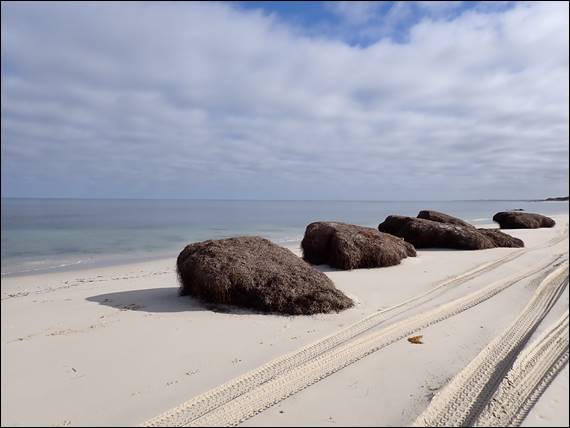
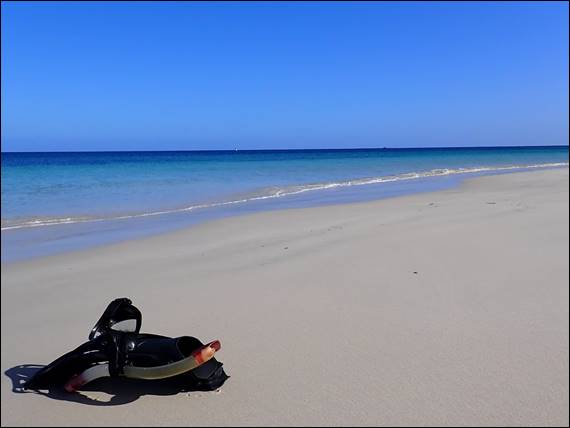
With a solid climbing session at Welly Dam under my belt on Friday morning, the weekend was set aside for other adventures. Starting with what I was hoping would be fun snorkel on Saturday morning. I was encouraged to head to the river mouth end of our local beach, by what looked pretty good conditions. On paper, or should I say in digital form, at least. Walking past the few remaining seaweed sentinels, the last reminders of winter, it was clear the water was not clear. But I went in anyway:
Needless to say it wasn’t the best, despite heading way out to get away from the near shore murkier conditions. In my hour plus swim a few of the usual friendly species followed me, and I spied some of the shyer species hiding as I approached. Back home, there was no need to sit at the computer researching my lack of finds or to write up a post. This left the rest of the day for something I felt my body needed, a day of nothing. I’ve burnt both ends of the candle a bit over the last months, and it felt good to slob for a change:
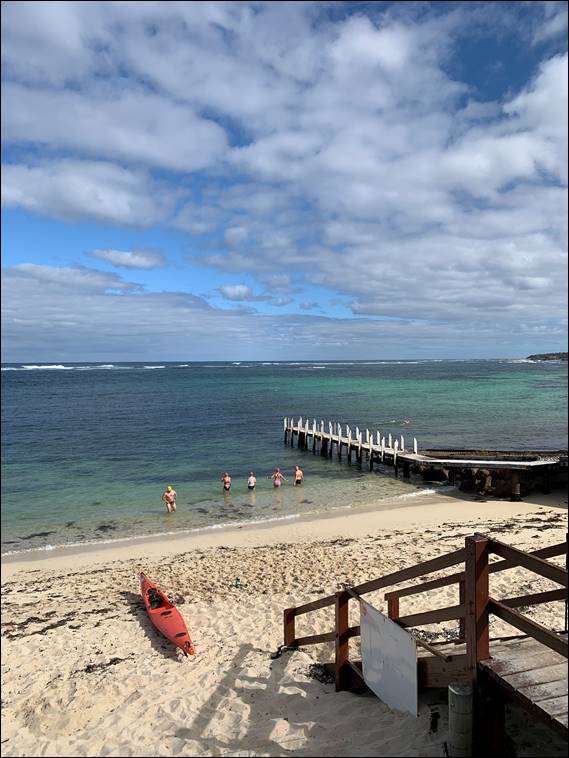
After our fun and relaxing trip away to Gnarabup in early November, Lisa and I had booked another night away. School holiday was however upon us making it tricky to find anywhere at a reasonable price, other than for a Sunday night. We got a place in Augusta, in the hope of a bit of snorkelling in some new ground. Plus, if I was lucky maybe a bit of orchid hunting. Just like my local dip, things were not going in our favour. The wind was whipping up during Sunday, bringing in a swell that looked likely to scupper our watery intentions:
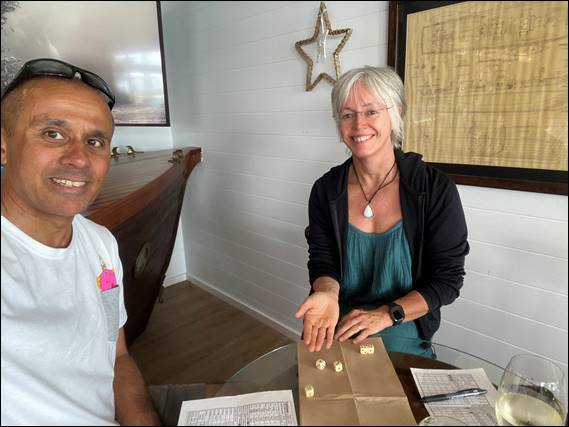
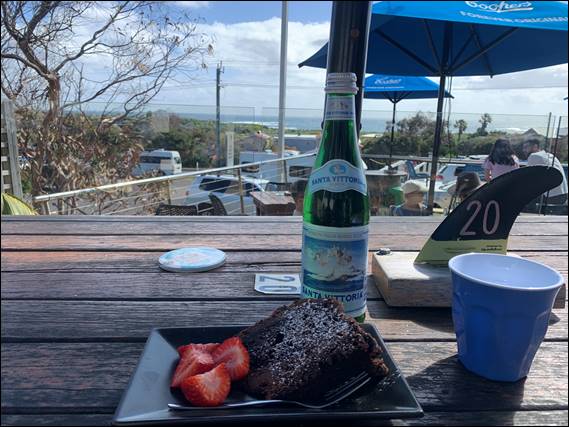
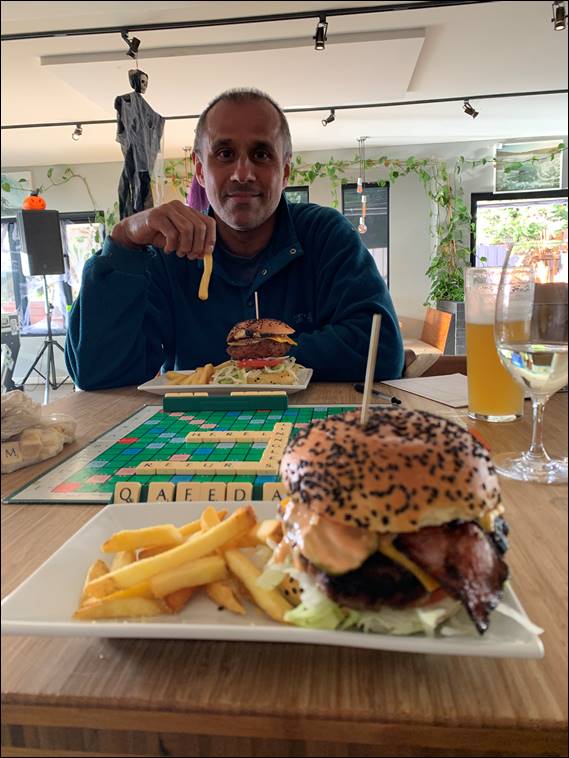
On arrival, we wandered down to what we had been told would be a great place to eat out that night. And those plans were also dashed, when they advised that they would not start opening on Sunday evenings until after Christmas. We had a drink and game of Yahtzee ay the bar, as we contemplated our options. They seemed even slimmer when the barman told us that there weren’t any other worth places he could recommend in Augusta. So it was we broke tradition and got fish and chips, our usual Friday night meal, on Sunday night:
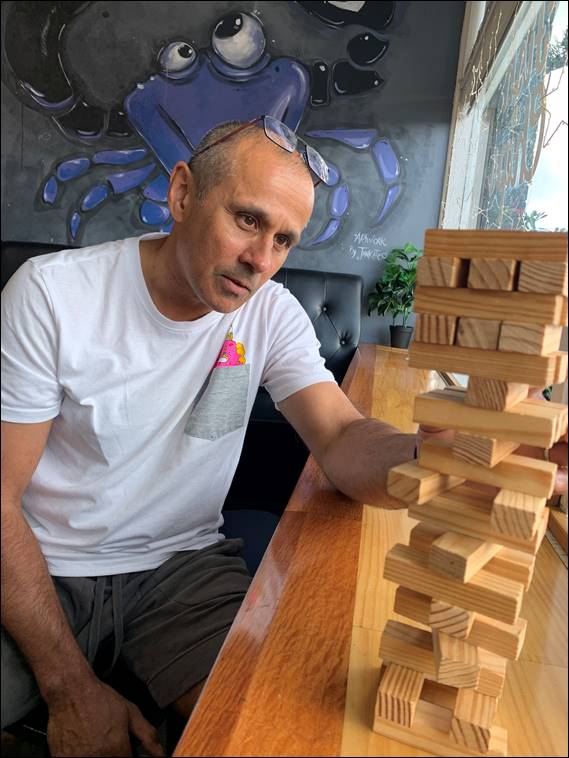
While we did not find ourselves sat in our restaurant of choice playing a boardgame, as we waited to be served, the take away at least had Jenga on offer. This kept us entertained until our number was called, and wandered back to our digs. Being the start of the school holidays it usually takes Lisa a few days to bouncy back from her hectic and demanding job, which never seems to be confined to office hours or weekdays. This resulted in me ready for the world bright and early, with Lisa being more interested to dip into her book while dozing:
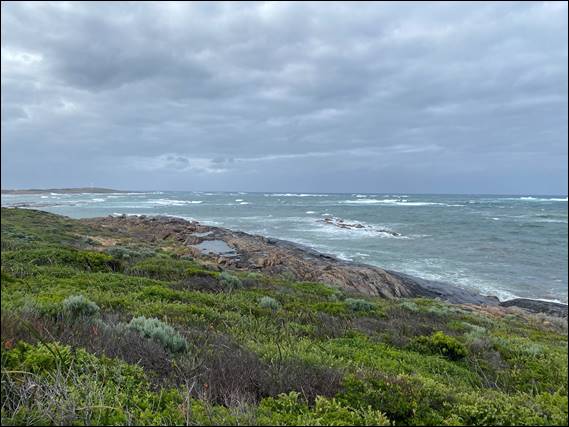
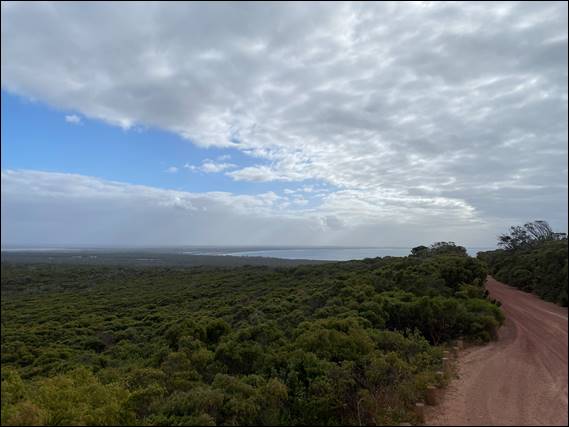
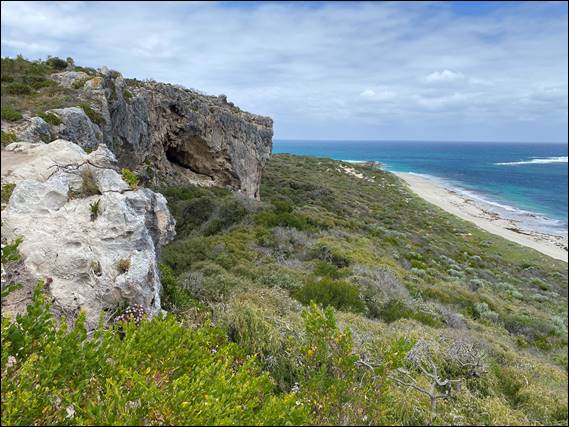
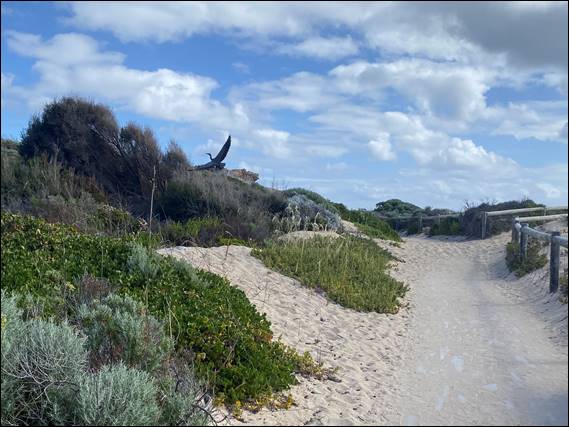
After making a brew I headed out, to allow her to continue to snooze. My first stop was a dense patch of bush, so thick it was a bit of a struggle at times to walk through. The chances of seeing the ground, let alone anything nice, was very difficult. Finally I gave up, and went for a short drive to check a few bays along the west coast, where we had hoped to have a snorkel. As shown two images up, the water was a little less and ideal. Looking back east at Flinders Bay, see above, the waters were calmer but no less gloomy looking:
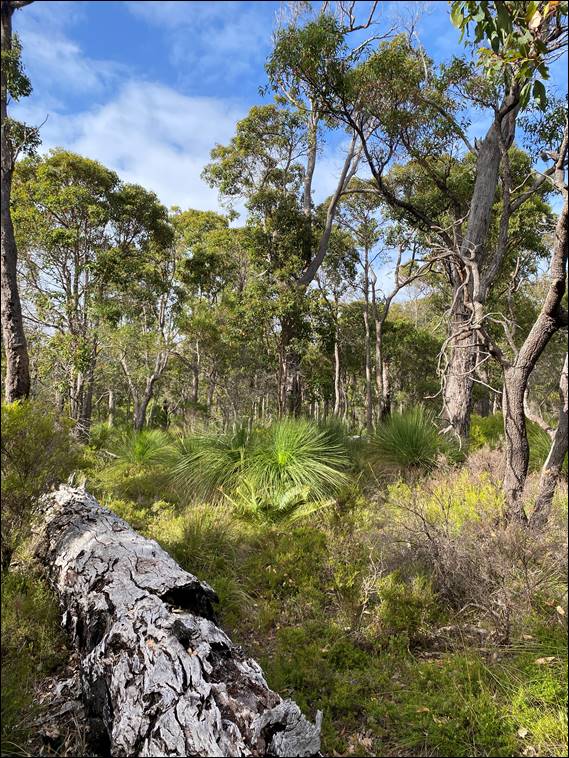
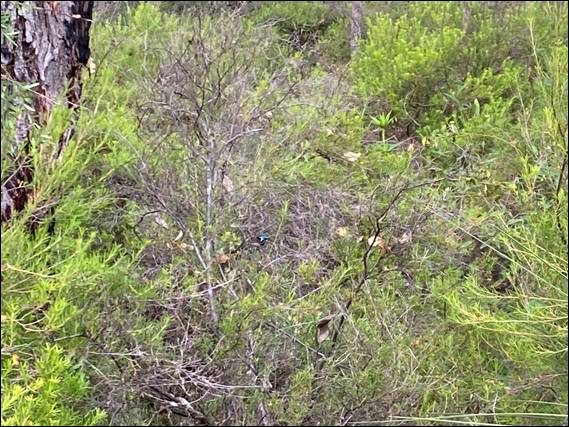
Too early to head back, I looked at the satellite imagery and took a punt. Stumbling across a much more open patch of bush. One I could walk through while look around at the same time. Out of the corner of my eye I spied a Variegated Fairywren (Malurus lamberti). I got a great look, but not picture, of the bright blue head and rich chestnut shoulders. Being found across most of Australia, this is the most common of the nine species of fairywrens. Although, it is absent in a few places including the extreme south-west corner of Western Australia:
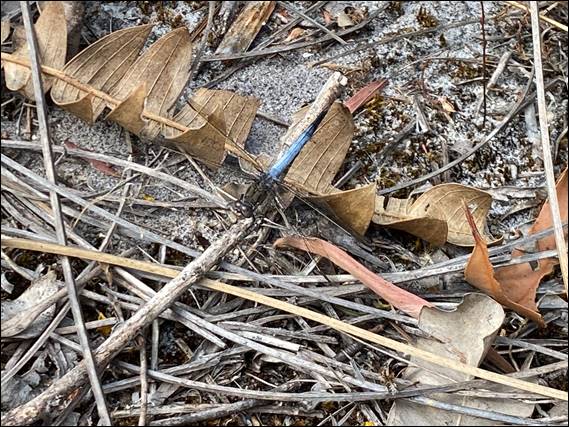
A fact I had to dive into. Checking the Atlas of Living Australia and iNaturalist both only had one observation recorded in the Cape region. So was this may well have been a very lucky find. My next find was not so rare but equally beautiful to see. A dragonfly called a Blue Skimmer (Orthetrum caledonicum). The powder blue abdomen with a tapered dark tip, giving away that this was a mature male. Like the males of this species, the females change colour with age. Being a brownish grey while fertile, and eventually turning a dull powder blue:
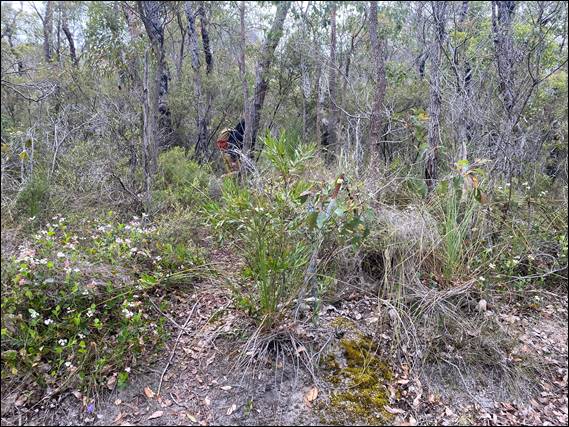
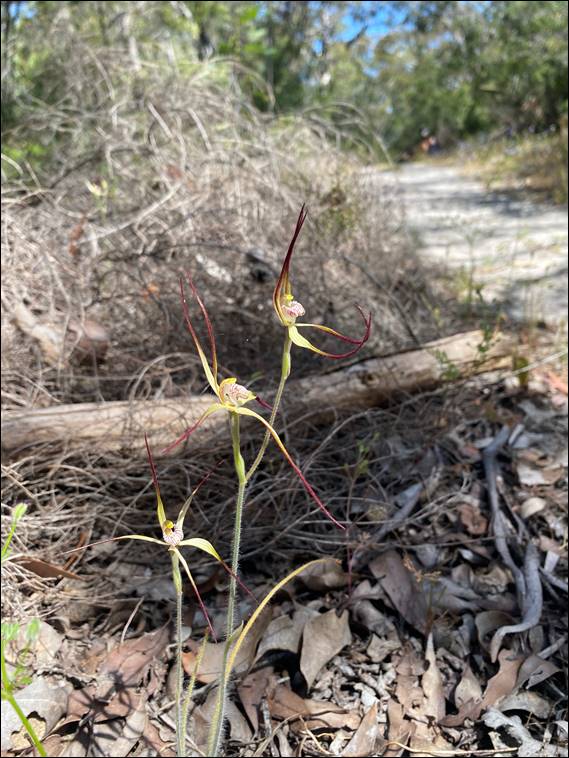
They never attain the glowing colours of mature males, and only turn blue towards the end of their life. Eventually I spotted an orchid that was very much not at the end of its life. I had been quietly hoping to find a couple of late flowering spider orchids that my books tell me could be found in the Augusta area. My search was not helped when I had forgotten to take the book with maps of where they had been previously seen. While they alluded me I was pleased to find the last species of the Prasophyllum, or leek orchid, genus to flower:
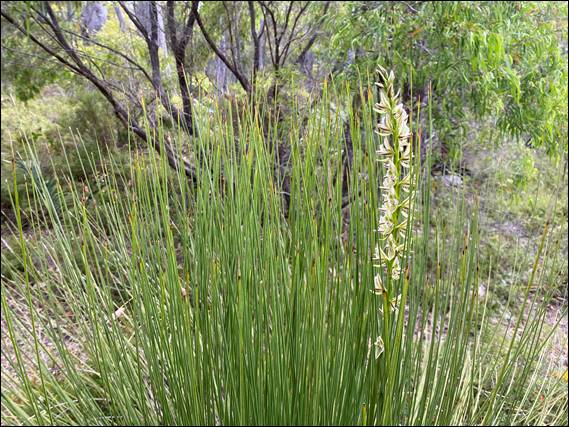
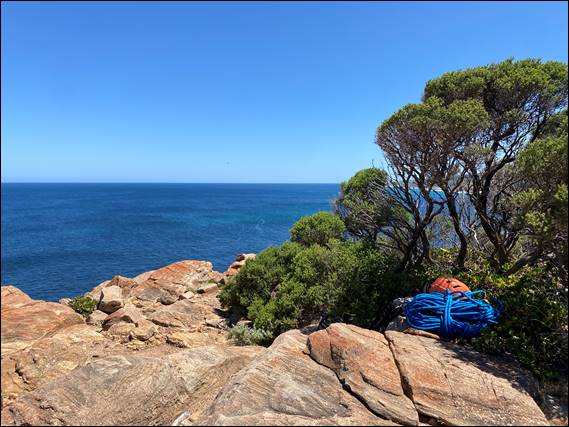
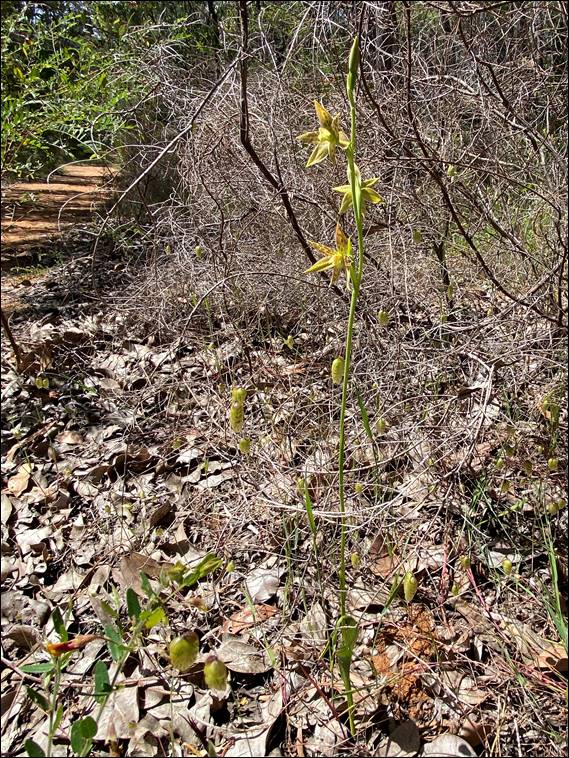
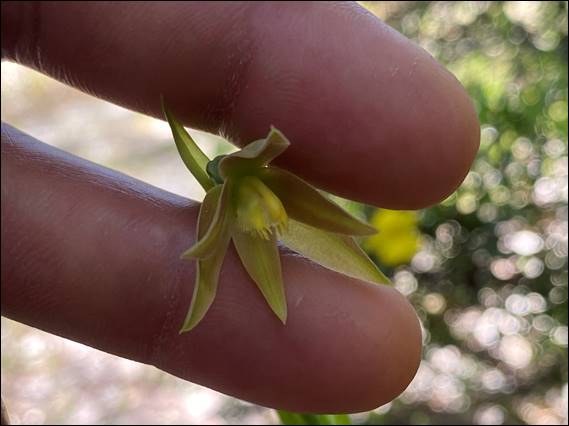
The aptly called the Christmas Leek Orchid (Prasophyllum brownii) it can have up to eighty pale green and fawn-coloured flowers. Arranged on a tall stem, which I have read can often be found growing out of a rotting log or stump. Or as I found today out of a plant with a live log or stem. It was reluctantly time to get back, where I made Lisa a second cuppa to aid in her recuperation. Eventually we had to vacate the room, taking a leisurely drive back. Stopping in at a few spots along the way, including this specky spot to take in the waves:
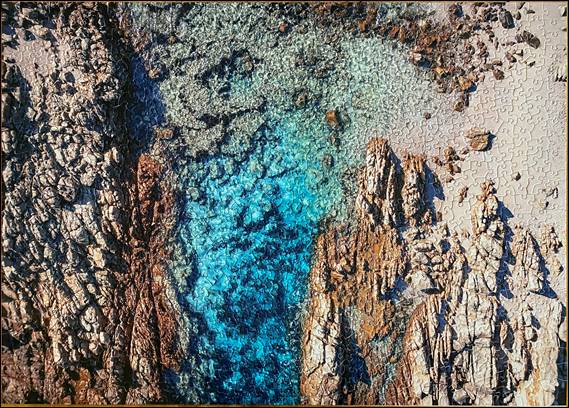
Over the last few months, mostly, Elseya and I have been working on a few puzzles. With Lisa dipping in on rare occasions. I do love getting lost in a good puzzle, and it can be a great relaxing timewaster. This one however was not relaxing, not in the slightest, and was frustratingly difficult. In the end perseverance paid off, and we were rewarded with a lovely drone image of a local spot. Having now completed all the puzzles in the house, we are hoping the big man dressed in red might bring us a few new ones to work on:
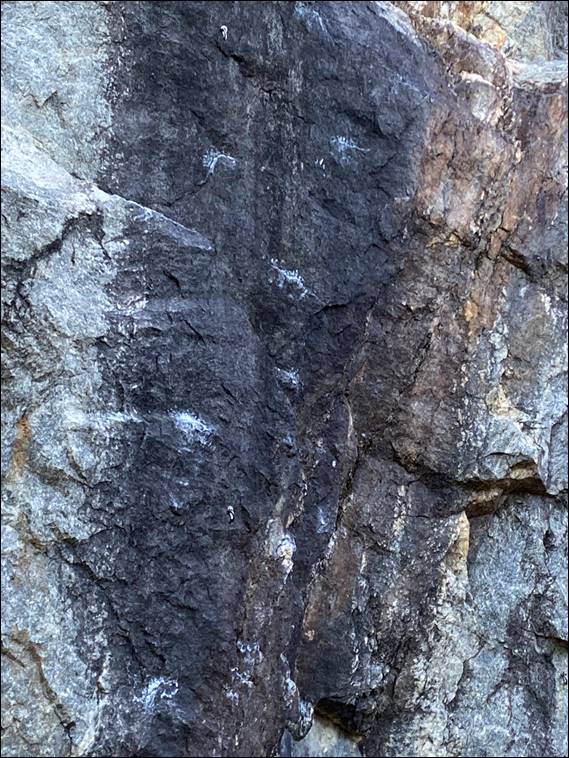
I’ve said on countless times that Welly Dam is considered a place where the grades of the climbs feel stiff. This is in part due to the very difficult to read rock. It takes patience to find the holds, no different in some ways to working on a puzzle, and at times the combination of holds to make the moves work. It was an early first light climb, as I had to squeeze the session in before work. While we both begrudged our respective 3:30 alarms. It was in our favour today as its been heating up, and by the time we were done it was starting to get uncomfortable:
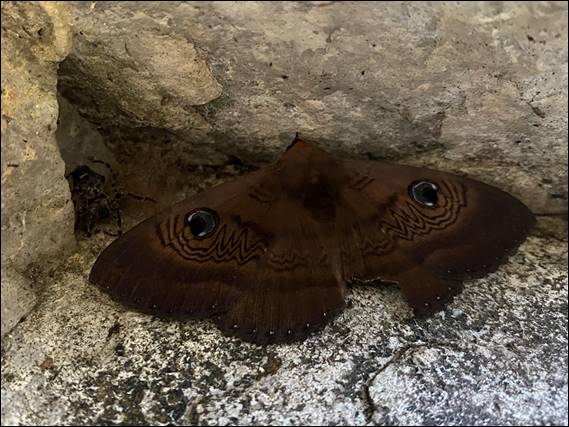
The early start meant that the Garden Orb Weavers (Eriophora transmarina) hadn’t packed away their homes. These are one of a few spiders known to take down their web in the morning and rebuild them at night. A form of predatory avoidance. We also came across a few Southern Old Lady Moth (Dasypodia selenophora), so called due to the patterned wings resembling the shawl of an old lady. These moths like to hide in nooks and crannies. I’ve read they can stay there motionless for months on end, but find that a little incredulous:
As with so many other groups, social media abounds. So it was we were able to read up about the experience of some recent visiting climbers from Perth. Clearing stating that they found the grades at Welly Dam incredulous. There was plenty of evidence of their endeavours to unlock the way up the routes, which they had moaned about online. When on a climb with holds chalked up as much as this, it is hard to avoid the eye being drawn to wanting to try and use the same holds. This can at times not work in your favour, but it can be hard to ignore these signs:
Howsie and I know better than to trust a path marked out by chalk. Only because we have climbed here so much, and know most of the routes well. There are however some that we do not get on quite so often. Generally the harder climbs, although my body wasn’t ready for them today. Proven when I was sore after playing on five grade 15 and lower routes at Wilyabrup last weekend. After just two routes this morning I could feel my muscles and joints being stretched. I even took a whipper on my first lead, but bounced back after that:
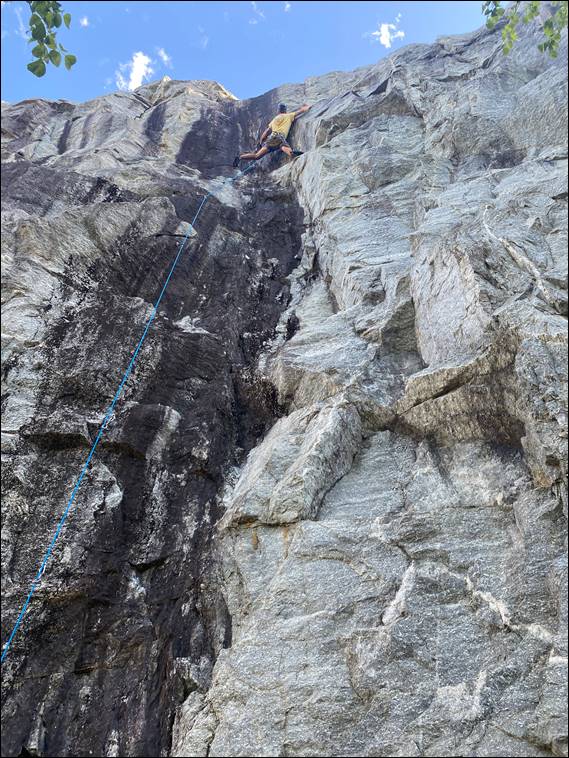
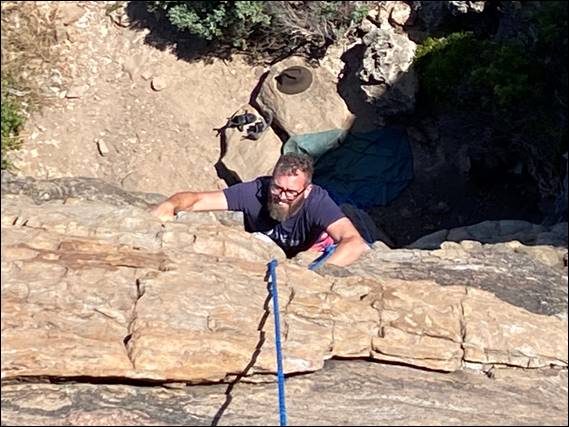
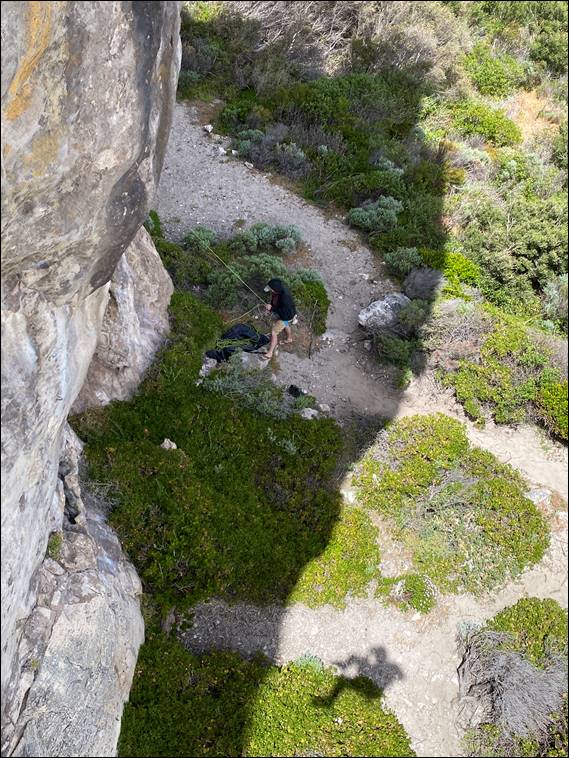
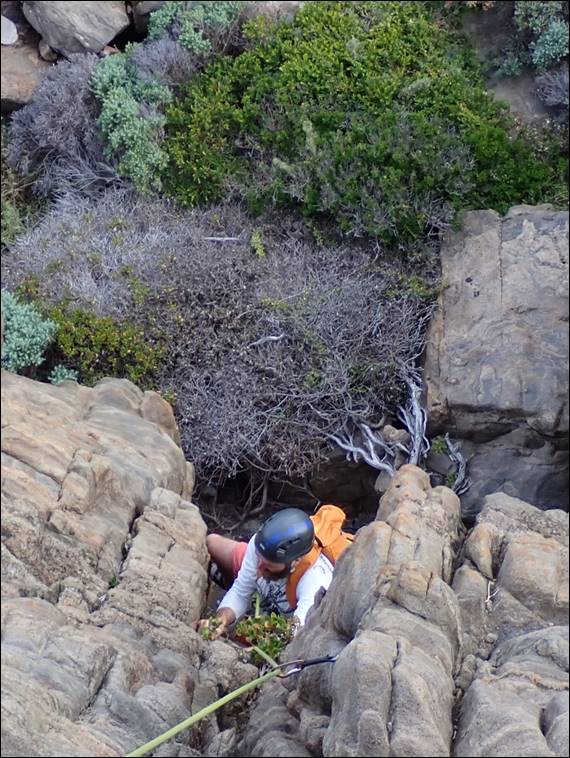
We jumped on two routes we still consider new, despite establishing them close to two years back. My memory works a mysterious way, and I can recall the holds and sequences of most climbs I’ve been on. Even those I have only been on once. Howsie, does not poses this ability to the same extent. So, having only been on them a couple of times he had to work the routes as if he hadn’t climbed them before. There was also no chalk to mark the path, or indeed lead you astray. Check out how many holds he has to try for just a short part of this climb. I’m pleased to say with perseverance he managed to complete the puzzle and reach the top:
After walking in the dark until seven thirty or later in England last week, it felt a little strange for the sun to be on its way up at five as I waited for Josh in Capel. I even wondered whether we should have met an hour earlier to maximise our time on rock during the cooler part of the day. Mind you if I was being honest and while I may have been back for close to a week, my body clock wasn’t really quite ready for that. With summer nudging it’s way in, I can foresee that earlier starts will be on the way soon:
It’s been a three week absence from rock. Therefore, I was more than happy for a relaxed reintroduction at Willyabrup on a few lower grade classics. This suited Josh, and also Harry. Someone Josh has been trying to get out for some time. Yet another person who used to climb, and after a decade long break was keen to get back into it. This meant his harness was pretty old, and he was keen for me to check it out. I’m probably the worst person to ask, having gear of my own much older. Giving it a once over it looked in better nick than mine:
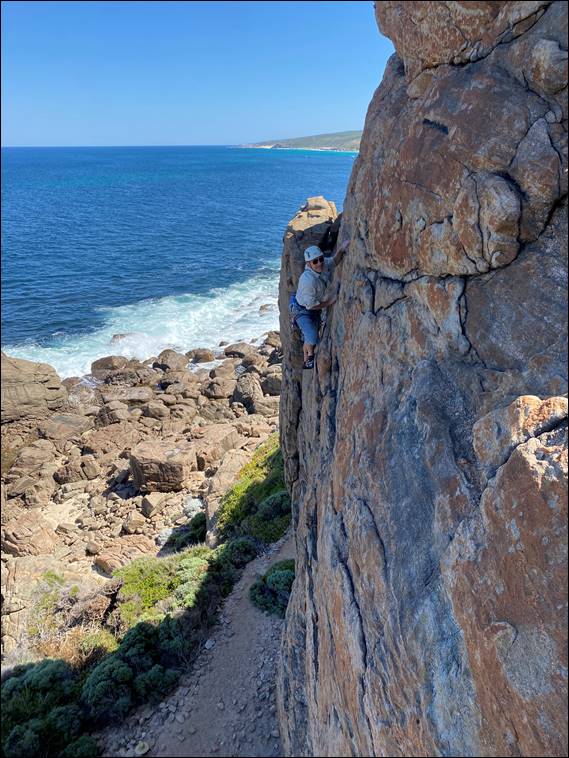
Two cars were already in the carpark, again I wondered was this too late a start. Luckily no one was on the cliffs. A good thing as the better quality lower grade lines can get busy on such fine mornings. Josh picked the first line. Maybe having been scarred from when he had previously led the route I had to suggested warm up on. He had forgotten the climb he chose today was four grades harder, so it was a little mean on Harry. For once I can say it wasn’t me doing the sandbagging. But I can understand why Josh felt this one may be better:
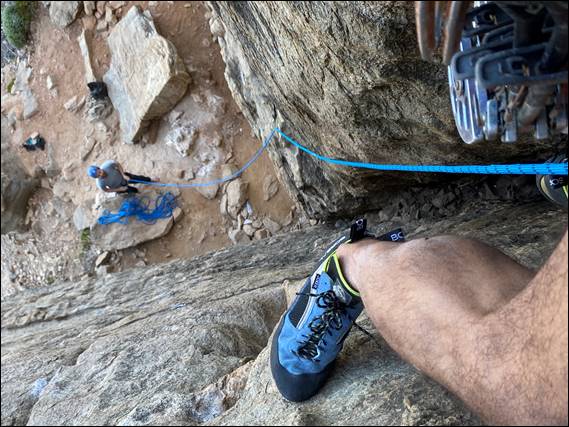
His memory had been distorted by the intense feeling he experienced when on lead. Watching Harry climb I could hear Josh mention that he had an advantage with his extra-long reach. But reach only works when you also use technique. There was only one time Harry made this mistake. It was impressive to see how quickly he tuned his head into needing to trust his feet, take his time, and work the moves. On our second route Josh admitted, with the safety of the rope above him, that this climb was much easier. But no less enjoyable:
Josh will also admit his technique can be a bit up and down. Today he also climbed well, even hinting he may be keen for a lead today. That was until the third route, on which he focused on the wrong holds. Wearing himself down with each attempt to reach them, and that was for the moves near the base of the climb. By the time he finally made the clean ascent, his arms were weary and head was no longer in the mode to be on the sharp end. Wandering back down, it was then my turn to focus on the wrong thing. Texting good morning to Lisa:
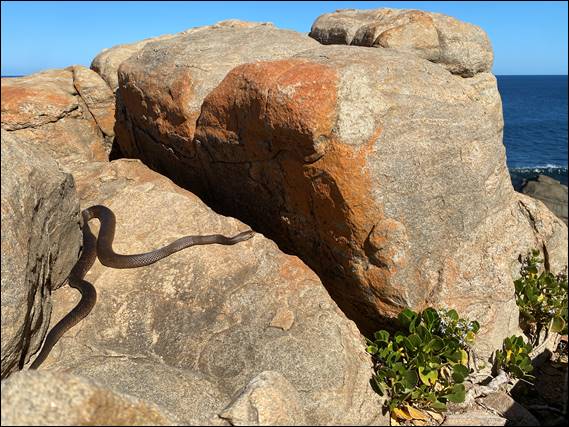
While doing so I narrowly missed stepping on a scaly friend on the path. It slithered into a five meter wide patch of scrub, so I careful looked about. As luck would have it out it popped out on the other side onto the rocks. A Dugite (Pseudonaja affinis subsp. affinis) can grow up to two meters, but generally only reach one and half. This one was a full grown adult and could transfer highly toxic venom in its bite. Accounting for approx. 70% of snake bites reported to Perth Hospital, needless to say I kept my distance and diligently observed its behaviour:
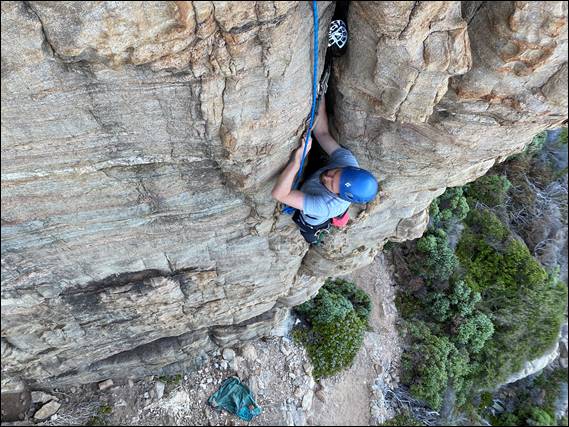
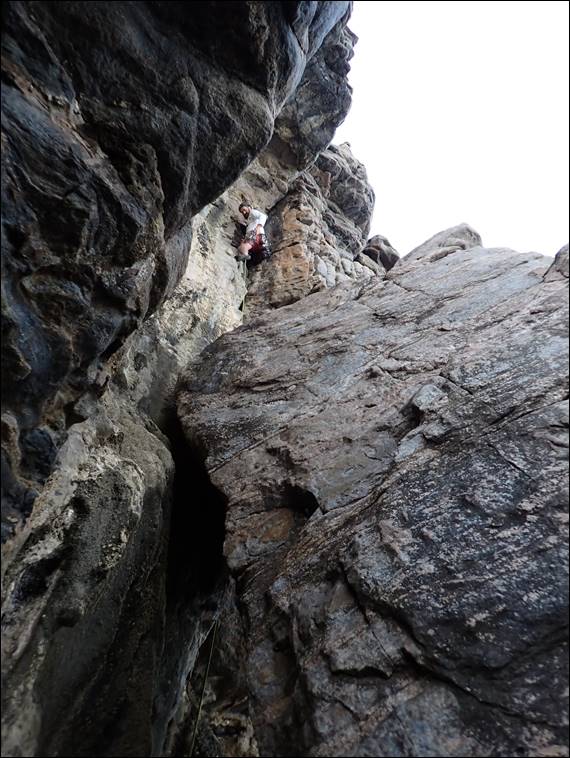
Watching it for maybe too long, resulting in Josh feeling he needed to keep an eye on me. Just in case and from a safe distance,. He had to do the same again for the fourth climb. An old style corner / chimney line. Being an off-width, the gear was limited. He belayed below, but because of the runout and if I had slipped it wouldn’t have helped me. With the lack of gear I substituted the feeling of safety gear provides by wedging myself in the chimney. Squeezing my way up, several bit of gear fell from my harness as one of the gear loops broke:
Um maybe I should have got Harry to check my harness. Looking at the other gear loops, I feel it is time for me to retire it before they too fail sending more gear flying. During our ascent another pair of climbers turned up. Curious, I popped my head over the top and saw none other the Peter. Leaving it a little late to start, but enjoying the shade while he could. We moved over to one more route that no longer had shade. The obvious low grade classic, to see if I would be lucky and see the non-venomous scaly friend I usually see here:
It was not to be. No matter how hard I looked there were no pythons to be seen on the flake. Harry had to work hard to get this one, stating after he topped out that he was done. Josh had managed to find his mojo again, cruising the route but equally happy to call it. The sun would soon bathe the entire crag and none of us were keen to endure that. I hadn’t climbed out with my pack as I normally would on this line, so sorted left all the gear up top to save carrying back up. Meanwhile Josh went for his customary dip in the ocean, before we walked out:
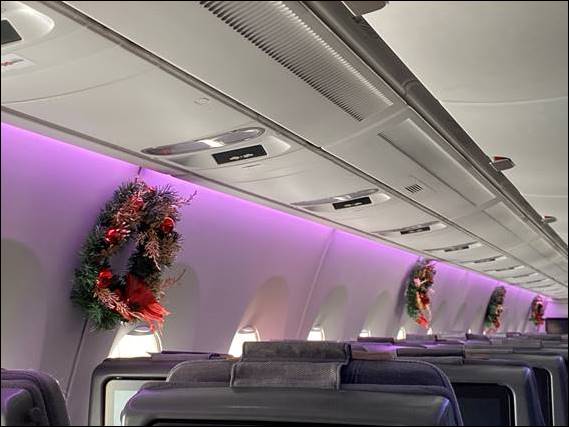
On Thursday 21 November I once more found myself settling into a seat for a trip back to see the folks. Festive wreaths donned the walls of the plane, giving the surrounds a more joyous feel. Not that there is much fun when it comes to the first leg of the journey, at fourteen hours. This visit was a bit closer to the last one than my usual nine monthly trips, having only been six months ago. The reason for this was to align it with a holiday that my sister and her family were taking. Leaving me and the folks to fend for ourselves:
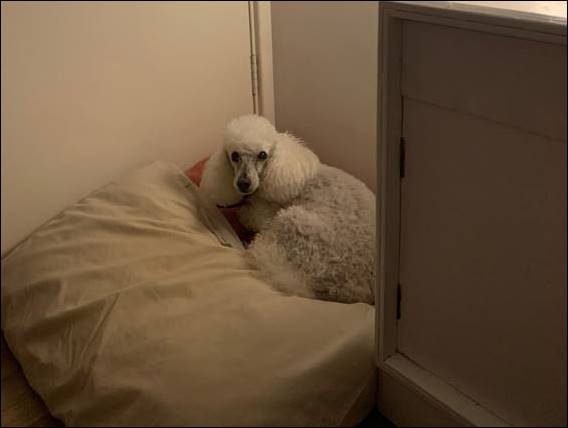
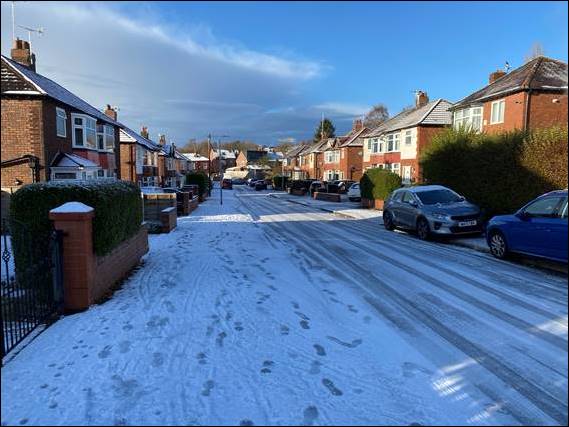
While I endeavoured to get some sleep, at home Lisa was enjoying the luxury of more room in our bed. She had even relegated my pillows to the floor. At least it seemed Nicka was missing me. Sleeping on my pillows for the first part of each night, before sneaking into the bed on to join Lisa and Sooky. Unbeknown to me, I was flying towards Storm Bert. As the plane descended after the second flight, the countryside of England below was coated in white. Not having a window seat I didn’t manage to get a picture of the wintery sight:
It looked lovely on arrival. However, much of Scotland, Wales, and England was being ravaged by the storm. Strong winds and heavy rain and snowfalls resulted in severe damage. Homes and business were destroyed, life in many parts were further disrupted by the flooding of roads and rail lines, and lives were lost. The area my parents and sister live was fortunately not affected by the storm in any great way. I had also luckily arrived at the tail end of the storms, and more settled weather was on the way:
Arriving on Friday morning there was not much time to chill out on the first day. We were due to head out late in the morning for lunch at the hospital in Manchester, before an appointment for my Dad. These sort of trips have been the norm for my stays with the folks over recent years. This time however there was only one face to face appointment on the cards. My sister wasn’t flying out till Sunday, and having just arrived I was grateful she drove us to Manchester. There was a phone appointment on another day, but other than that our time was free:
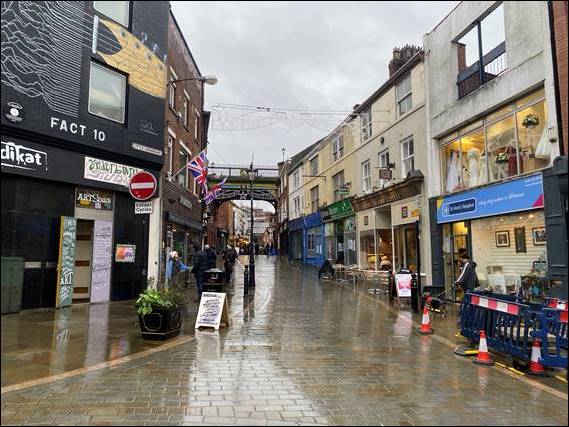
As expected the snow was all gone when Saturday arrived. A result of milder temperatures that came with the tail end of the storm, which had brought in wet and windy weather overnight and for most of Sunday. This put paid to my intention of going out for an early morning walk. I did however get out with Neil for a wander round Stockport while Asha and Leena went to get their nails done in preparation for their holiday to sunnier climates in Spain. The Christmas market wasn’t much cop but it was nice to have a catch up with Neil:
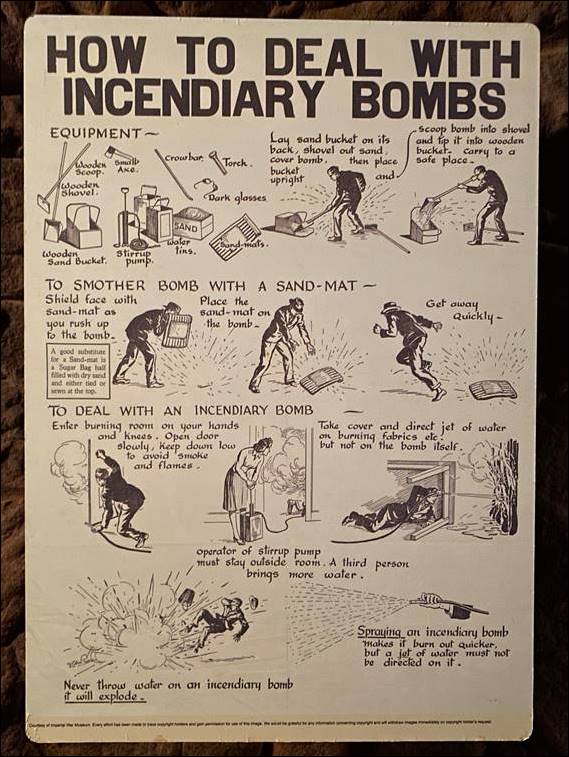
He suggested we could visit the air raid shelters built for the second world war, which was a fascinating place. One of the single biggest loss of civilian life occurred when a building was bombed, and approximately five hundred people were buried alive in the basement where they were sheltered. As such the government did not sanction air raid shelters that housed more than five hundred people to avoid mass causalities. The Stockport council went against this order and dug tunnels into the bed rock. A two man team could dig a meter a day:
Within a year the tunnels were ready and could house four thousand people. With a canteen, first aid area, running water, electricity, and flushing toilets the ‘luxurious’ standards resulted in them being called the Chestergate Hotel. Originally paid for by the local council, it was such a success that the government agreed to pay for extensions resulting in a mile of tunnels as well as several other tunnels close by. Providing refuge for an additional four and a half thousand people, these networks were the only large scale purpose built shelters in the country:
It was a very worthwhile place to visit and we peppered the staff with questions, which loaded me up with lots of amazing information. Too much to go into here. Just before midday Seeta picked the folks up and brought them out so we could all pile into the pub for a feed. The Arden Arms is a grade II listed building, built in 1815. One of only two pubs in England with a room that can only be accessed by going through the servery. It also has handpumps fitted to the back of the bar in the original fashion, rather than the counter:
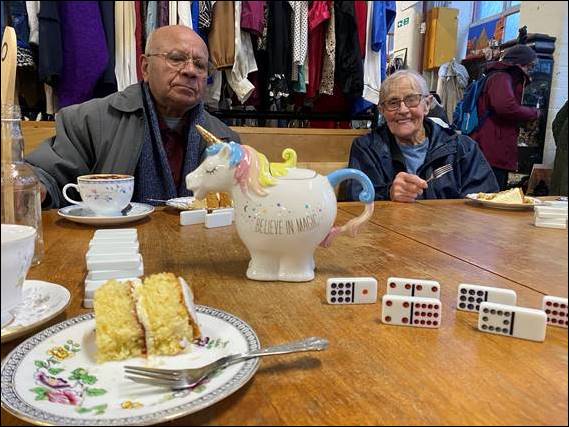
Seeing I wasn’t driving I indulged in a good old British ale, and it went down very well indeed. After today I would be the one driving, so it was the only beer that I managed during our trips out. Many of the places we visited were old and steeped in history. And what would a trip to the folks be without a cuppa, cake, and game at Pear Mill. Popping in on the way back from the pub, and this time only Seeta, the folks, and I partook in this ritual. I did wander round to check to the antiquities, managing to restrain myself from buying anything:
If you are keen to read up about Pear Mill’s history you’ll have to check one of my previous posts (https://sandbagged.blog/2022/08/01/time-to-head-back/) or go online. From day one I was keen to get into a routine, and it was early to bed and early to rise. However, for a second day my morning walk was scuppered. Sunday morning came in wet and windy. Seeta and family would be escaping this weather, as they were jetting off on their holiday relatively early. Living just round the corner I popped over to wish them a happy holiday:
Then it was just the folks and me. We dusted off a few of the games from their cupboard, which had not been out since my last visit. Played a few games and at eleven or so our intention was to head out for a pub lunch. It was to be my first time of driving them into the countryside. The roads here are narrow in comparison to back home, definitely busier, unfamiliar to me, and all up less relaxing to drive on. Because of this I had for the first time in all my visits purchased a roaming pack for my phone, to allow google maps direct me:
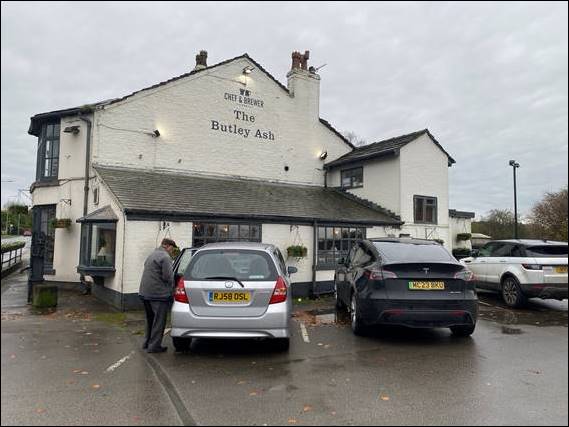
Or so I had hoped. For some reason, as technology does, it was glitching and not connecting. This resulted in the first trip out, which was the only one in wet and manky conditions, not being very pleasant for me. We did however make it to The Butley Ash, and just like my phone’s antics this pub was disappointing. Something we all agreed on, and something I hoped would not set a precedence for the rest of trips. Back at home I got to work on the phone, and without needing to change any settings it was suddenly all peachy:
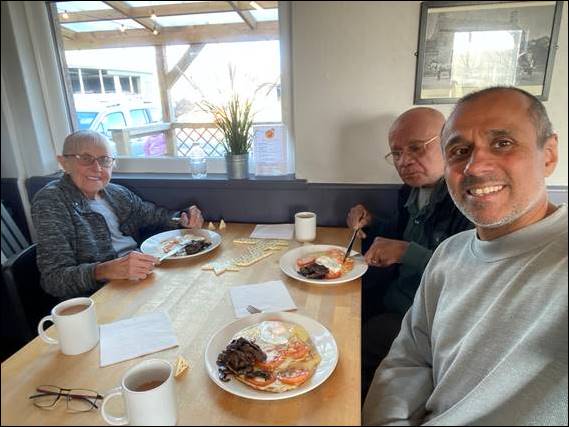
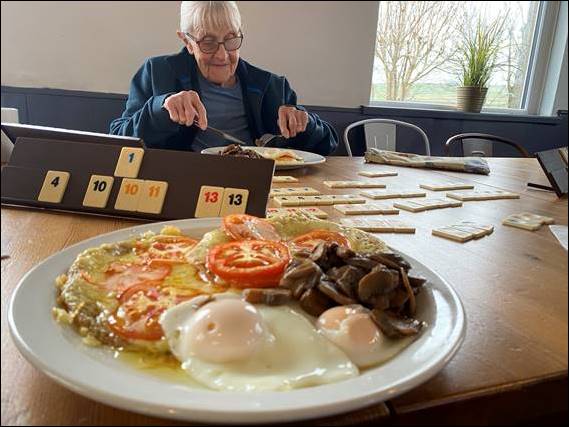
Monday arrived and everything was fresh, bright, and seemed to fall into place. The weather cleared up, I got out for a morning walk, and google maps made the route finding on the many windy roads way more pleasant and enjoyable. After the hick-up with our, or should I say my, first pub of choice, I had spent a bit of time looking for places that looked worthwhile. This included cafes as well as pubs. On arrival at today’s café it did not look like much from the outside. But a cosy interior, tables made for playing games, and hearty food made it perfect:
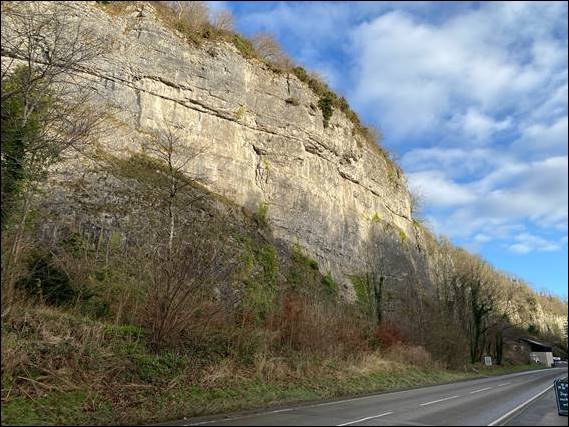
I’ll confess that my investigations of where to head was somewhat swayed by other motives. Being on the edge of the Peak District, I was keen to visit differing areas and when possible drive past old climbing haunts. Such as Stoney Middleton, with its great limestone walls. At my folks age, mobility is definitely on the decline and the idea of going out for a wander with them was optimistic at best. So our trips were very much a country drive, with food stops. And while I threw in places like this one, we didn’t hang about at these:
It was a quick photo, and then onwards to the next food destination. Taking in the countryside, and enjoying seeing new places along the way. In theory being Monday I was supposed to be heading out for a walk with Dave, my folks old postie. He has changed his rounds so works closer to his home. This is good for him but this means he can no longer read the weekly postcards I send my folks. That said we still keep in touch, and Monday was his one free day. Sadly a cold had taken hold of him, and neither of us felt the risk was worth it:
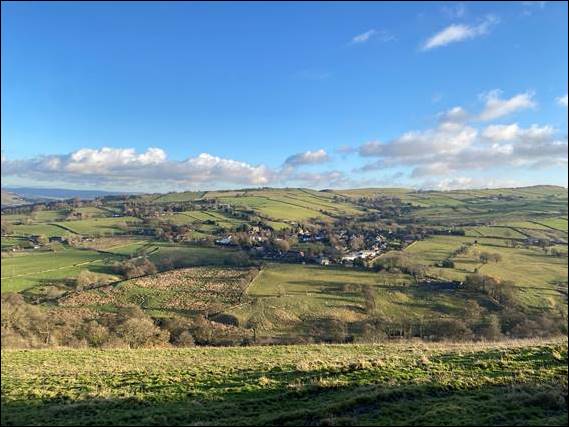
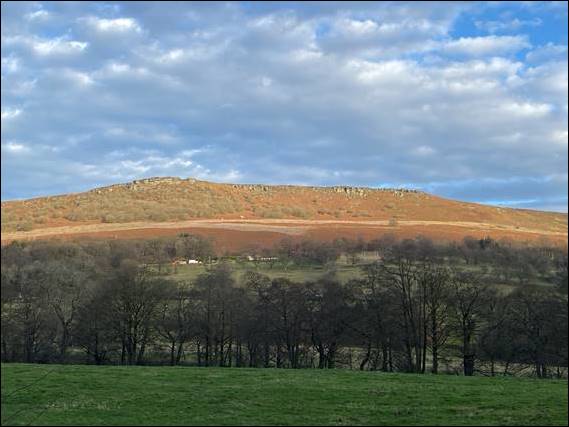
I didn’t want to catch it, but more importantly we did not want to risk my folks getting it. Hopefully, we will get out for a wander next time, and just to plant a seed in Dave’s brain as he reads this, the Snowdon Horseshoe Scramble is particularly good. On the plus side having Monday with the folks meant we enjoyed what was mostly a sunny day out. With some three hours of driving through rolling hills, and scarps capped with the infamous Peak District gritstone (https://sandbagged.blog/2017/07/30/part-4-the-peak-district-learning-the-ropes/):
Our daily routines were starting to form. I was up at five, and despite first light not coming in until after seven I would head out for a two to three hour walk. Meaning at times I walked in darkness for the whole walk. Picking up the daily rag on the way back. My dad no longer picks up these papers, so is no longer the oldest paperboy in the hood. Seeta now drops the papers off at the aged care centre and bring one back for my folks. This was my job for the week. Then it was breakfast and games, before getting ready to hit the road at eleven:
Heading to a, hopefully, well selected food establishment or two via a three hour or so country drive circuit. This would see us return by four when it was starting to get dark. After which a few more games would lead us towards the end of the day, and a bit of quiet telly time. What with all the big daytime meals, no one would feel like an evening meal so a snack was sufficient. On Tuesday I left a little later for my walk. Keen to watch the sunrise but also because today’s the phone appointment would change things a bit:
We waited an hour for the phone to ring, and then gave up and headed to the Pack Horse Inn. Due to the later than usual arrival we got to a fairly busy pub, with lots of the areas reserved for groups. There was a table free, and we enjoyed another lovely meal but it was certainly a tad noisy. Resulting in making it a bit uncomfortable. More so for my mam due to her hearing going downhill. As a result I started to plan a bit more. Not only picking our destinations, but also booking a table and asking for one that was quiet and out of the way:
The noise aside the pub was great, as was the meal. And the drive through another part of the Peak District, this time not taking in any old climbing areas of mine, was equally enjoyable. When we got back there was a message on the phone, left at three thirty. Four and a half hours after the time we were told they would call, so we didn’t feel bad for missing it. For my Wednesday morning walk I came across something I didn’t expect, a milk float. Hand delivered milk bottles are something of a rarity these days, but used to be common practise:
For most of the 20th century the British milk float undoubtedly comprised the vast majority of electric vehicles on the road. Some twelve hundred were made each year. And while they still exist, since the 1990s they have become a rare sight. This find brought back memories, as well as one in particular. During a school trip in 1983 or 84, we went to North Wales and stayed at the Snowdon Bryn Gwynant youth hostel. The hostel is set in forty two acres and one morning I encouraged two others to join me for an early walk, out the back over the hill:
When it was time to turn back, we didn’t recognise any of the landmarks and got thoroughly lost. Eventually coming across a road, but it wasn’t the right one. After speed marching for what left like an eternity we came across a milk float. The milkman offered us a lift and took us several kilometres before he had to head in a different direction. But got us onto the right road and the speed marching resumed. We got back some three plus hours later to find everyone in the hostel out looking for us, and the teachers just about to call the police:
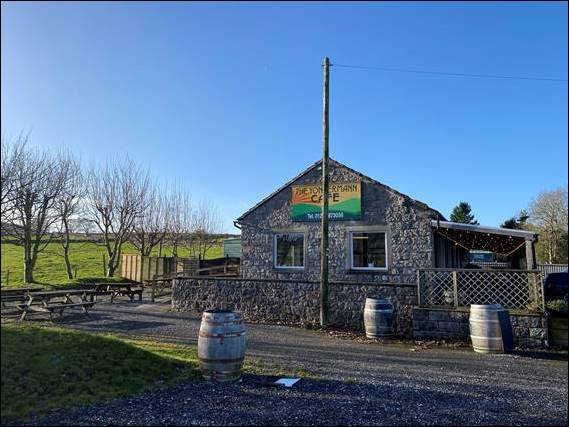
We missed out on breakfast, and as punishment had to do the washing up for the rest of the week. But had a great adventure. I asked my folks if they had any memory of what would have been considered major incident of child safety these days, and they said no they didn’t even realise it happened. How times change. We didn’t get lost during our country drive on Wednesday. Admittedly we went back to the Yondermann Café upon my dad’s request, and my mam nor I complained as the oat cakes there were worthy of the Roaches Teahouse:
To understand the significance of the Roaches Teahouse you’ll have to dig into the two posts I have linked above. After our feed and a game we drove towards the Peak View Tea Rooms, which was a last minute change from where I intended to go. A change I didn’t check quite thoroughly enough, as Wednesday was the one day it was closed. So we drove on and didn’t spot anywhere that looked inviting enough for us to stop. This meant that the appetites were up that night, and it was my mam that chose an Indian from Indigos:
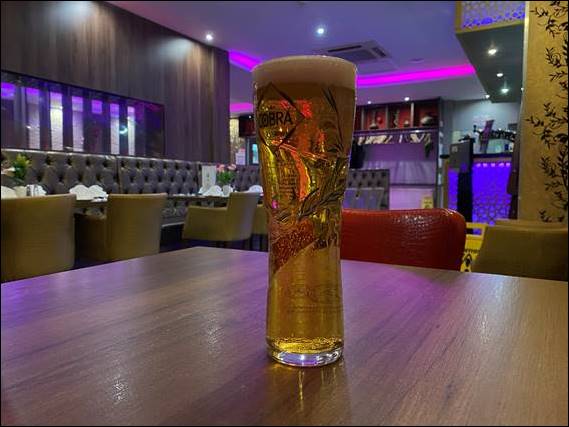
She was also keen to wander down to eat out, but my dad wasn’t keen on the idea of having to go back out. It was probably more the walk that put him off, so I offered to wander down to order it and bring it back. This allowed me to have a cheeky quiet beer while I waited for the food to be cooked. Rather than a British ale, seeing we were having an Indian meal, it had to be a Cobra beer that originally came from a brewery in Bangalore, but is now made in England. The next morning was the coldest. It was minus four degrees as I stepped outside:
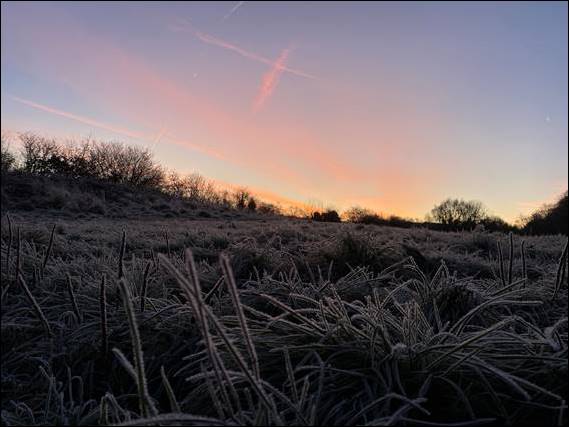
The meant that many of the muddy paths, which I had been navigating in the dark would not be quite as slippy in the same way. Instead there were plenty of places where ice covered the ground. I had to keep an eye out for condition of the smoother sections, which were more likely to send me flying this time. It was worth the risk to see the frost covered fields. It is not possible to put the heater on in the car without it affecting my mams breathing. As the daytime temperature didn’t get above five degrees, this made for a chilly drive:
My dad on the other hand isn’t too good at tolerating the cold, another one of those seemingly minor things for which they have different needs and likes. And as they become more weary these differences need to be well managed. There were several cold days, and for these my dad was wrapped up in a cosy blanket on the back seat. I managed to weather the cold to save my mam from starting to wheeze, cough, and finally start spluttering. Today the coldness was forgiven as we arrived at what was the best pub of the trip:
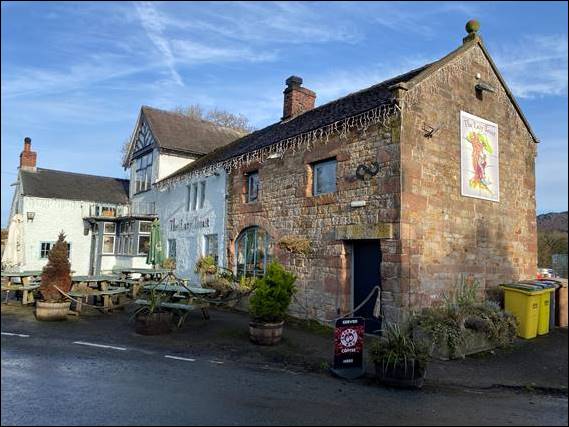
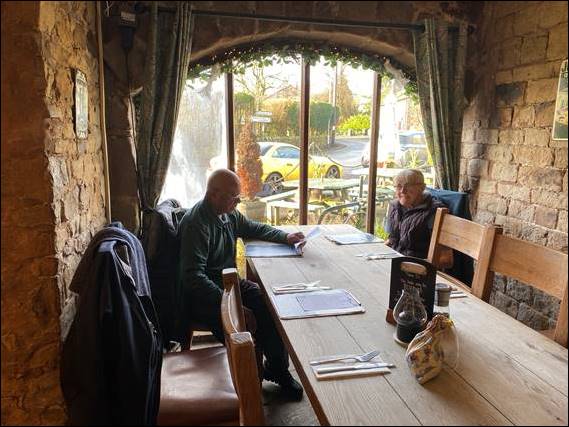
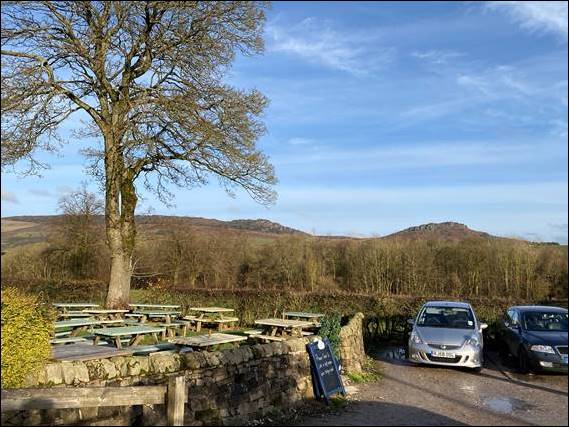
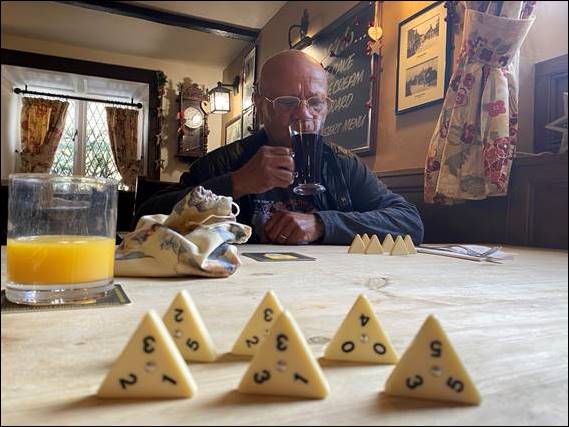
The Lazy Trout was the furthest south we ventured, located between Leek and the mighty Roaches that could be seen from the carpark. It was the only place we went where they had games available to borrow, and we were given a large game playing sized table away from the noise. The food looked and was scrumptious, so much so that my dad didn’t hesitate to order a full sized meal. It did however beat him, and he had to take a doggie bag home. Although I suspect that was more down to the two huge portions of Indian he ate the night before:
Everything about this pub earnt it the top spot for the week. The countryside was also lovely, and we went on some incredibly narrow roads between our stops. Skinny, high hedged, roller-coaster lanes, just wide enough for one vehicle. When we came across a car going the other way, one of us would have to reverse to the nearest passing area. Areas that at times didn’t seem big enough to squeeze my folks small car in, let along wide enough to facilitate the passing of vehicles. Somehow it worked, even when there was a lorry to contend with:
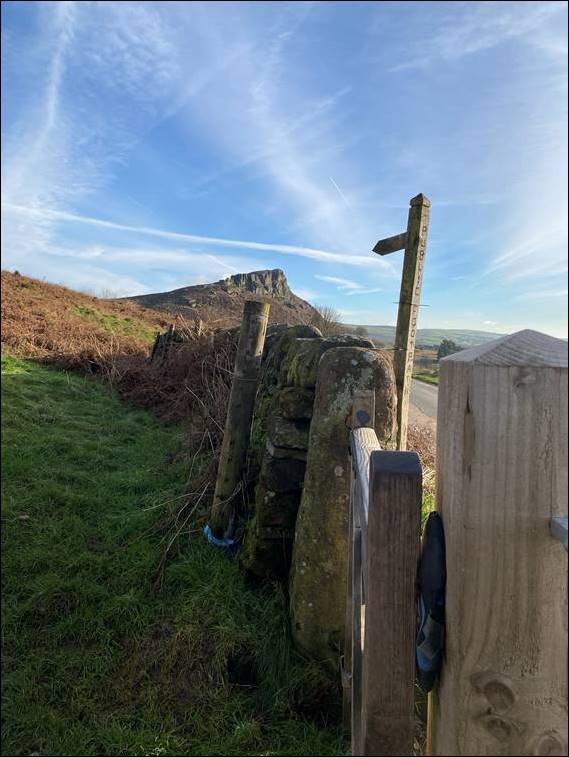
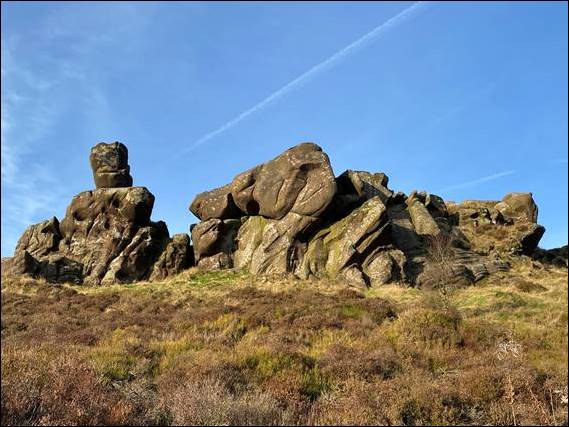
The roads, with google maps directing, made for very entertaining journeys. I could feel both my dad and mam thoroughly enjoying the excitement of not knowing what was round the many tight corners or over the blind summits on these roads. And then the roads would open up to lovely vistas, and for this trip that had to include a drive past Hen Cloud and Ramshaw Rocks, above and below. And the Roaches, which are accessed via the above gate, that has an interesting accessory to stop the gate from making too much noise when it closes:
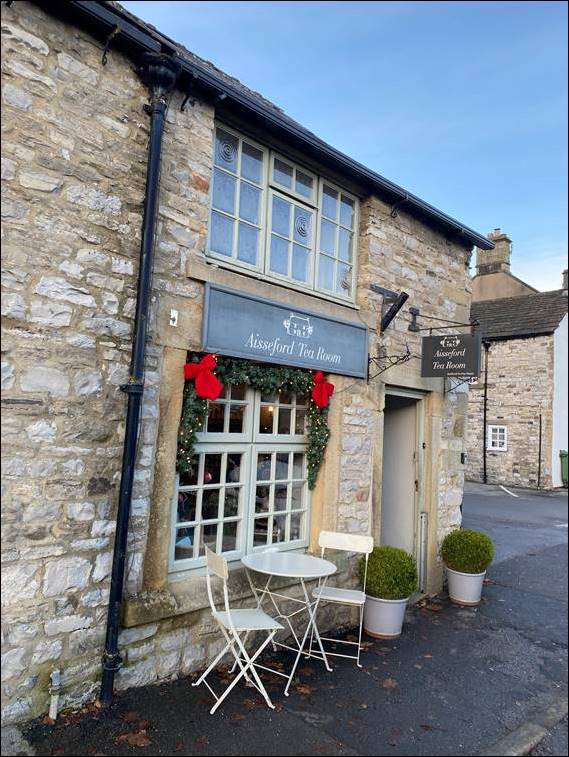
And if you have dipped into the posts linked above, you will know why having a climbing shoe for this purpose is quite topical. We continued east through more roads that you just can’t drive fast along to the teahouse I had originally intended to take the folks to yesterday. This time I double checked the opening times, and we were greeted to a delightful and quaint place. Just like today’s pub and meandering roads the Aisseford Tea Room was a big hit. And with the sweet treat in the afternoon, we were back to a light dinner. Well two of us were:
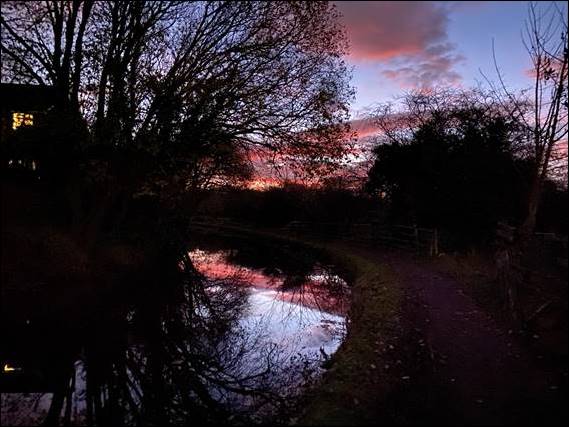
As is the case every time I come back, it feels like the week is long. Then by the time I get to my last morning walk I wonder where the days have gone. It was probably the most speculator morning sky of the lot, and one that it would have been good to be in the higher hills for. I had however chosen the circuit that had the most paved areas and least muddy bits, meaning it stuck to the lower areas. This was in part due to not wanting to muddy up my boots too much, as they would need an extra thorough clean before I headed back:
After each walk I had given them a scrub to get the worst off, but for this last clean they needed to be detailed. Coming into Australia, the slightest speck of mud could result in delays in getting back in. It may sound sensationalist, but having witnessed what can happen I would rather avoid the situation. For our last country drive, we headed in a roundabout way to The Cheshire Cheese Inn built in 1577. The oldest pub we went to and named due to the packhorse men who worked the old salt route from Cheshire across the Pennines to Yorkshire:
They used the pub for lodgings and a feed, and paid for this with cheese. The lower room still has the original cheese hooks to prove this. It was built into the hillside, and as such has quite a few steps and some of these are quite big. I made the mistake of parking uphill of the pub, out the back. Completely overlooking the small carpark opposite the pub. This meant we entered, much to the concern of the landlady, down these steep steps. So concerned, she allowed us entry through the private area with more manageable steps:
We survived the adventure without incident, but I did move the car to the front to make an easier exit. Much to the relief of the land lady. The games came out as we waited for our food. Being close to the festive period Dad enjoyed yet another mulled wine, relishing the heat of it just as much as the flavour. With bellies full we managed the flat exit with ease, and then headed northwards to just outside of the Peak District and into South Yorkshire. The Bank View Café sits up from Langsett Reservoir and is impossible to miss:
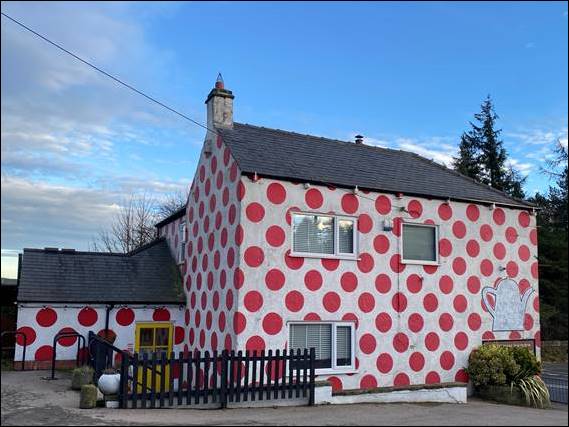
The café was on the route of the 2015 Tour de Yorkshire and the owner gave the building a special face lift, in 2014, to celebrate the event. Using the King of the Mountain jersey colours. They have remained since, and cafes connection with cycling has continued. Having received many accolades including winning Cycling UKs Cyclist Cafe of the year 2019 Lifetime Achievement Award. It was another friendly and very welcoming place, and great way to round of a week of exploring and finding new good spots to grab a feed:
The last slice of sugar must have invigorated my dad who, despite avoiding exertion whenever possible, took on the steps to get back to the car. Even though there is a mobility access ramp. The drive back included an additional stop to stock the house up on a few essentials. Not that we had put much of a dent into the larder, what with all the eating out we had done. It did also allowed us to pick up some milk for my sister’s house too. Allowing them to have a cuppa on their return, which would be later on the same day I was leaving:
Saturday arrived, and I had booked a taxi to pick me up at seven thirty. Allowing me enough time to grab the Saturday rag for my folks and Neil, and squeeze in a couple of final and very early morning games with the folks. So early that I suspect my dad probably went back to bed after I left. While Seeta and her mob had a relaxing, warm, and sunny holiday in Spain, my mam summed it up perfectly. Saying it felt like they too had been on holiday this week with lovely trips out every day to visit plenty of great new pubs and cafes:
Walking into Bob’s Hollow yesterday with David I sent an image of the ocean to Lisa, knowing she would be up. In return, as she wandered along the beach to meet the Peppy Plungers, I received an image of glassy calm conditions. One of the other plungers mentioned the water was starting to clearing up locally, although they had experienced that during an offshore boat dive. Whereas I know the waters off the beach take a while longer to clear up. Despite my doubt, and seeing the swell had been relatively low for a few days, I gave it a go:
I was also encouraged to go in when I saw the very low tide, which conveniently coincided with the morning. When the winds are general lighter, and the sun is sufficiently high enough to allow its rays to penetrate the water. The very low tide was courtesy of the position of the moon. Friday night’s supermoon resulted in a stronger gravitational pull creating a larger tidal range. Lisa and a few of the plungers were meeting up for a second morning today, this time to go for a swim, so Lisa and I walked down together and then went our separate ways:
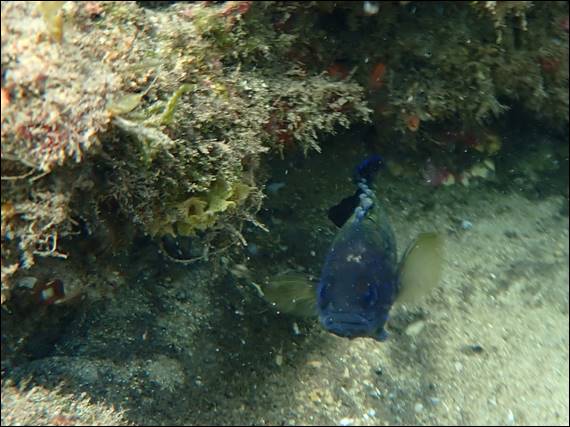
The water was indeed pretty clear. After my dip round the bay, in waters teaming with fish, the local reef seemed very quiet and a little drab. But knowing the better areas to check the fish started to appear, even if they weren’t in the same kind of numbers. This included a single Western Blue Devil (Paraplesiops sinclairi). Not the best image, but the only one I got. I’ve not seen this fish before, which is not surprising because it is known to be shy and is rarely encountered. The large eyes almost give an impression of its surprise to see me:
It is often confused with the Southern Blue Devil (Paraplesiops meleagris). Despite the very brief encounter and slightly blurry image, the distinguishing features of the endemic Western Blue Devil were clear enough. Having yellowish pectoral fins, blue edged caudal fin, and significantly reduced number of blue spotting over the face and body. Also in contrast the Southern Blue Devil, has been observed to shows little fear of divers. Allowing them to get relatively close, and only when they get too close does it slowly retreat into a refuge:
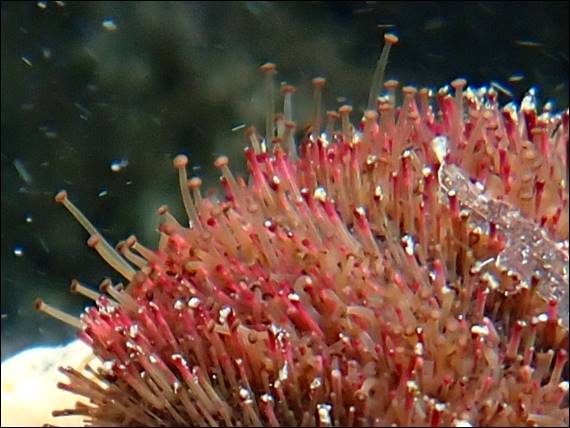
The other fish I saw were all familiar, so I started to take images of the many different coloured sponges. However, as is often the case when I duck dive down more treasures come into view. The above is something I have only seen once before underwater, approx. five years back. I say that as this type of urchin is often seen washed up on the beach during winter. Five years back I didn’t spend as much time identify my finds. Naively calling it a collector urchin, which is it not and is in fact a Short-spined Urchin (Holopneustes porosissimus):
There are over a thousand species of sea urchin globally, many are round in shape but about a quarter of them have evolved into differing shapes. One such type has a flattened body and burrows into and moved below the sand. Now I have an idea of what to look for I‘ll keep an eye out. While the Short-spined Urchin is common and has vivid red tips on its primary spines and purple heads on its tube feet, it is not often seen. It has a habit of hiding away by wrapping itself in algae, something the last one I found was attempting not very successfully:
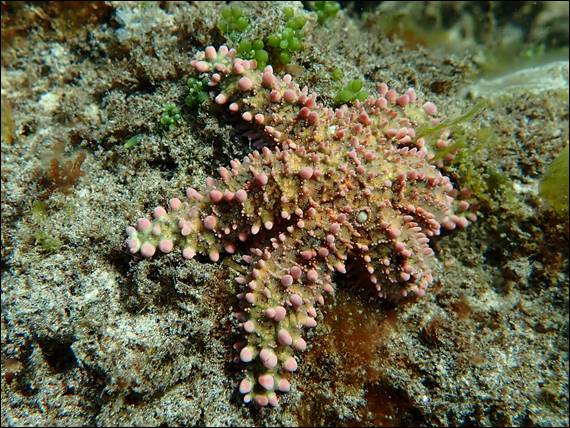
I mentioned tube feet. These have suckers on the ends that are used to move the urchin about. Controlling the feet by varying the hydraulic pressure of water moving in and out of them, all done with no brain. I’ve included a close up image of the main picture to show these feet extending beyond the spines. The Short-spined Urchin also uses the suckers to pull the algae round itself. There were plenty of sea stars out, which I have included before. The above one however stood out as being distinctly different, and took me ages to identify:
The Five-Armed Seastar (Uniophora granifera) comes in a multitude of colours. The surface can also vary from smooth to being covered in blunt spines or rounded tubercles, as this one is. The range is so vast that the differences have resulted in some being incorrectly described as different species. The Atlas of Living Australia, which pulls on data from various sources, has just over 900 sightings recorded. Only one of those observations was in Western Australia, at the Busselton Jetty, with the rest being in waters off south-eastern Australia:
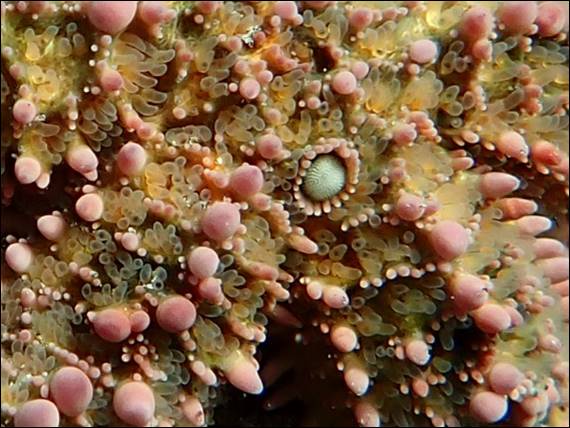
As such I’m pretty chuffed with this find. The other thing that intrigued me about this species was the prominent madreporite. I have again provided a close up of the main picture, to highlight the feature. Usually light in colour, it forms a calcareous pressure-equalizing valve. Filtering water before it is drawn into the vascular system, and also being where water is ejected from. For this species the calcareous surface almost looks like a brain. For my next two images I have also got a close up to allow the amazing detail to again shine through:
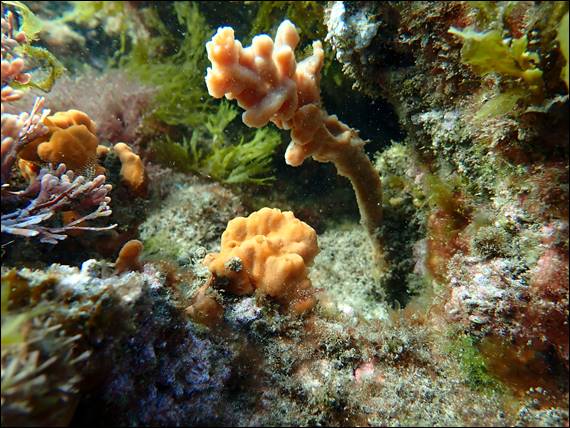
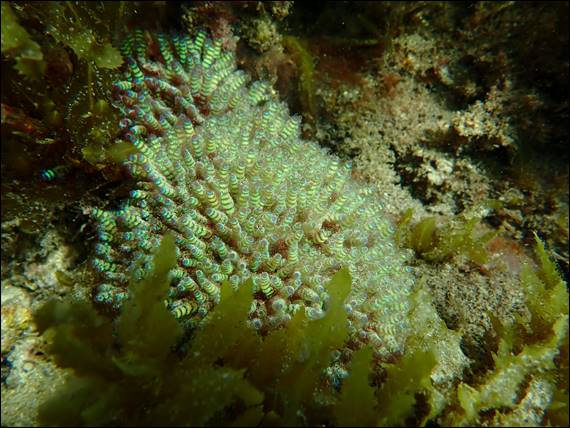
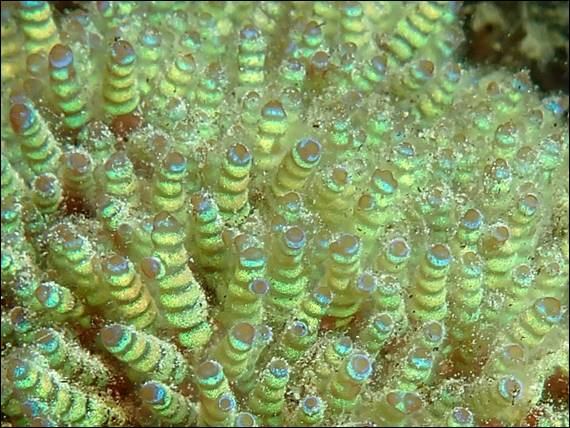
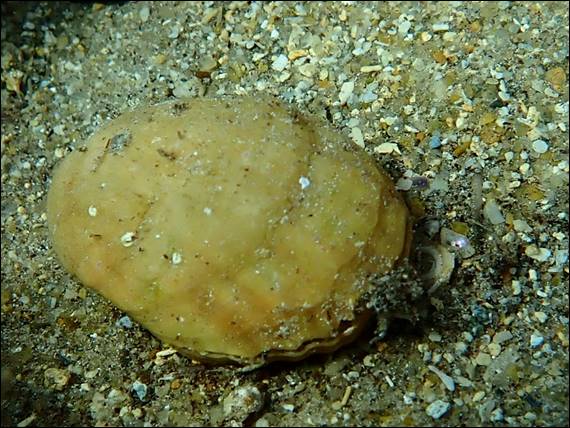
This time however I have not been able to work out what I have found. The fleshy tentacles made me think it may be an anemone, which is what Rongy also thought. This did not assist when I tried to narrow down my research. So for now I’ll have to wait and see if anyone replies Rongy’s request for an identification, from the South West diving community. My final image is of a bivalve I often see. What caught my attention about this picture is it looks to be munching on something. While bivalves are generally filter feeders, some are scavengers and others predators. I’ll have to continue to try and identify this one, to work out it diet:
The moon looked extra special this morning. Unfortunately the view didn’t last, as it slipped below a doona made of clouds. A bit like Lisa’s face did after I had popped a sippy mug of tea on her bedside table, and said goodbye. I’ve just read that the moon’s orbit last night had brought it as close to earth as it comes, meaning it was a super moon explaining why it was so stunning. No less beautiful was the walk into David’s chosen destination for today. With a magical visit over the aqua blue ocean and the morning light forming streaks against the clouds on the horizon:
We were serenaded, as we walked in. The Carnaby’s Black Cockatoo (Zanda latirostris) is not a bird I normally associate with this location, but small flocks flew back and forth along the coast for the entire time we were out. At one point they got really close, before deftly adjusting their wings to veer off in a different direction. Being one of the five black cockatoos found in Australia, the Carnaby’s Black-Cockatoos are also known as the ‘rain bird’ due to moving to higher rainfall areas in their range, for summer. It was mostly cloudy today, so the chance of rain was minimal:
You may recall David is still getting back into lead climbing, and he will confess his head space on the sharp end is a major obstacle. The last time he led was at The Playground and Lost Buttress, where the easier climbing allowed him to lead every route. Today we were at Bob’s Hollow and there isn’t a crag in our little slice of the South West of Western Australia that isn’t more contrasting. Well maybe Welly Dam is up there too, which is where he last climbed with Adrian and myself. He didn’t lead there, and it didn’t take many lines before he was shattered. I therefore wondered how we would go at Bob’s:
David had checked Bob’s Hollow out online in a fair bit of detail, so had a fair idea of what was to come. He also told me that he had been dreaming about the session here. And in his dreamland he was concerned I was getting disappointed, because we didn’t bag many lines. From my perspective, each time I head out I adjust my expectations of how many and what routes we may get up based on who I am going with. Not in a bad way, but there is no point in being overly optimistic from the outset. And as a result I can’t recall ever losing patience with someone when out on rock, but am happy to be told otherwise:
Climbing for me, after all, is about the experience and not what we achieve. Unlike what seemed like most of the near twenty other people that rolled into the crag during the morning. Several large groups, of true sport climbers, bringing their chairs to watch the action from, some of those above blasphemed whenever a move proved too hard for them. Ropes hung from almost every line at the northern end of the crag, so we stuck to the southern end. Having it to ourselves until the last route, when a couple also looking to avoid crowds came over. It is of course good to celebrate what we do get done, and what we see:
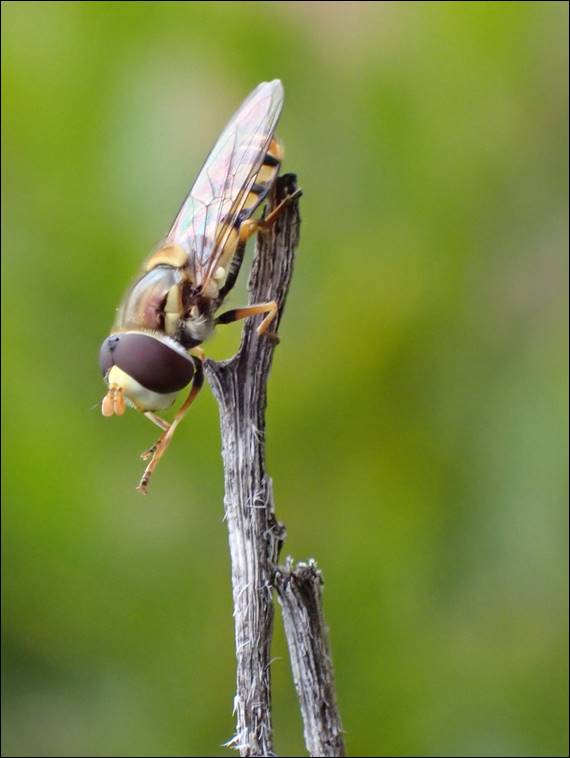
With the clouds about, and a reasonably blustery and cool wind the chances of seeing a reptile were low. I also wonder if due to increasing popularity of this place, being like an outdoor indoor wall, I may see less snakes here now. I did however spot one Southwestern Crevice Skink (Egernia napoleonis), which was quick to scuttle away. So instead, above is an image of a Yellow-shouldered Stout Hover Fly (Simosyrphus grandicornis), which I watched delicately using its front legs to wipe down its face. This is one of the two most common hover fly species found in Australia, of which there are some 160:
Hover flies, not unexpectedly are often found hovering in the one spot. And can suddenly move forwards or sideways and then just as quickly come back to a stationary position. The wind seemed to be making this a little more difficult today, which may also be the reason why at one point a pair of Carnaby’s Black Cockatoo had got so close to us. We were also lucky to see a pair of Australasian Osprey (Pandion haliaetus subsp cristatus), which hung about for a while moving between the cliffs and ocean. There are four subspecies found round the globe, with the Australasian Osprey being the smallest in size:
By now you may be wondering how the climbing went. We started on the two easiest routes here, which really don’t get too steep. When first established the holds were very sharp, but having become very popular I noticed the sharpness had significantly reduced. David ate up the first line, but as the second one steepened up his head started to play games with him. It was definitely his head that was the issue and once there was a rope above, he walked up it. We then moved to the most heavily bolted line, which is steeper and more akin to the style here. He was happy to go second again:
The steepness hit him, but he got up it. Then we did something a fair bit harder. The crag classic, a route everyone comes here to climb. It felt sustained and pumpy on lead, so once at the top I looked down and asked if he was game. To which he said yes. This meant the draws stayed in, and he had no choice but to get up it. All I’ll say is that he made a piecemeal ascent, and by the end of it I was feeling pretty chilly. It really wasn’t surprising. The route is pretty stiff, and the hardest thing he has climbed in our time of getting out together. But he was not put off, so we picked a route that doesn’t get much attention so still has razor sharp holds:
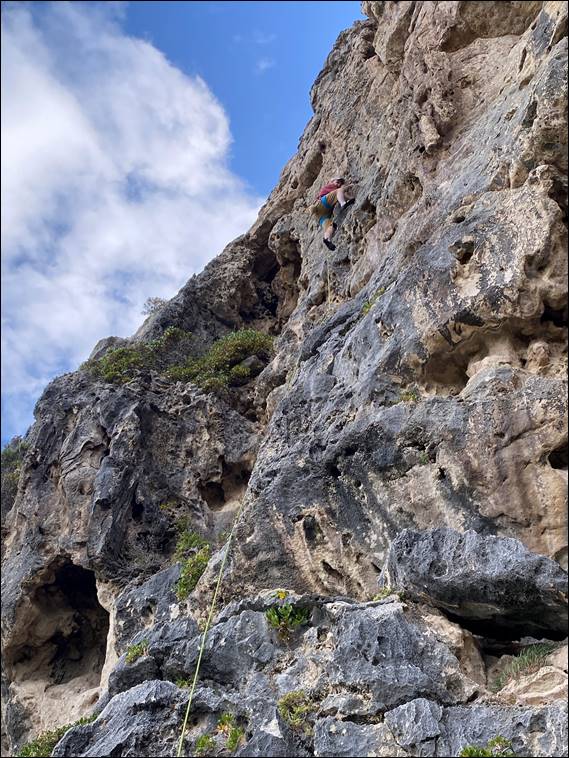
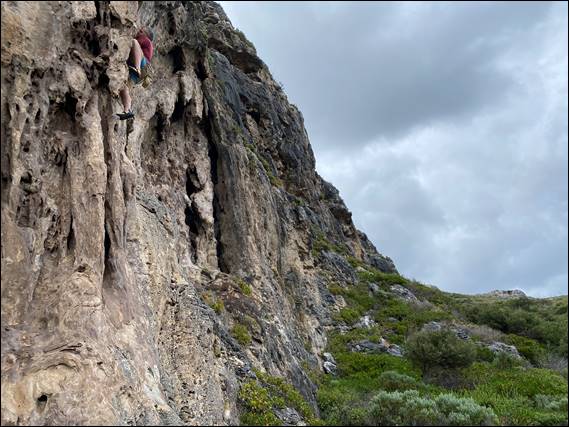
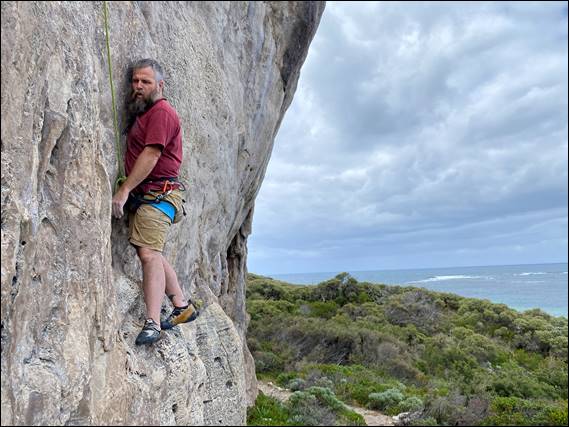
Chosen due to being restricted to the southern area, but also despite the vertical finale it has a relatively gentle rising traverse. It was a great choice and he loved it, as did I. So much so, that with eye’s bigger than his belly he wanted one more. The best choice left was a line devoid of bolts in the bottom half, so I had to pull out my slings. Making for a long adventure and traditional style route, which goes up some very impressive and steep looking terrain. David made it to the point above, which is when his body started to agree with his head. So after I cleaned the route we wrapped the session up, both being very satisfied:
My body clock seems to be getting into the swing of 4:30am wakeup times. This may be in part due to the earlier start time of the dawn chorus. Something I consider a welcome natural alarm clock, while others may view it as a rude awakening. Depending on the species of bird this can begin anywhere from half to one and half hours before sunrise. Meaning it can start well before first light. When the poor, or absent light, means foraging isn’t practical and the males use the time to reconfirming their territories and let females know where they are:
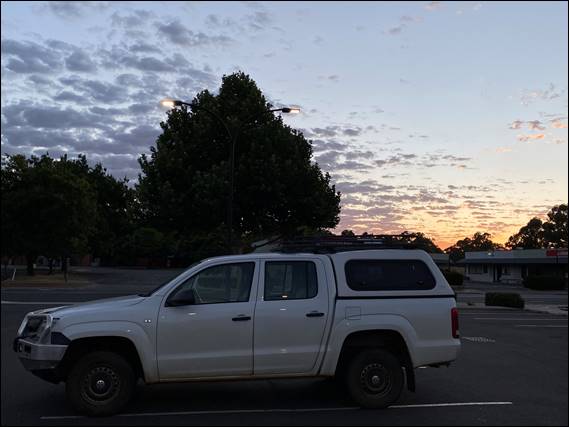
My alarm on Friday was set for just after 4am. Funnily enough with the ring tone set to ‘birds’. However, the real life birds had already done their job. I was already stirring before the alarm had the chance to also wake Lisa up. Hopping into the pre-packed car as the minute hand reached the bottom of the clock face. The agreed meeting time, not by design, worked well to align with first light. As such I was rewarded with the changing colours of the morning sky. Something I assume Howsie was also admiring as he was driving out:
Our meeting place this time was not Capel, but Boyanup as we were heading south to the big stuff. Some months back I had reached out to Kym and suggested a catch-up was long overdue. A weekend was set, which aligned with what Howsie and my calendars foretold would work. Kym’s life is unfortunately somewhat more erratic and unpredictable. Things were looking good until several weeks out. Kym was still getting out and about in nature, enjoying a camping trip with the family. It did however mean he would not be able to join us:
The south coast and it’s inland crags offer a plethora of opportunities that are in stark contrast to our local crags. I have often said to Kym he is spoilt for choice when it comes to rock, and he knows it. Intimidating boulders right in town, looming cliff faces that drop straight into the ocean, through to huge granite domes that rise up from the landscape. All within an hour or less drive from Kym’s house. With such variety it can be a conundrum working out where to spend the time, but this trip was guided by some images Mario had recently shared with us:
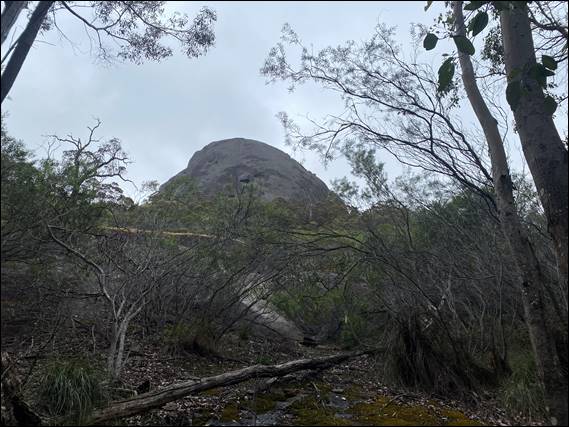
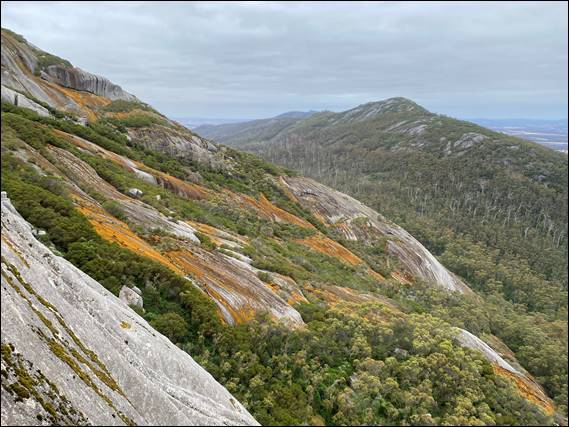
Four hours after leaving home, we were parked up and shouldering our packs for the walk into Gibraltar Rock. Kym you will be pleased to know that this time we found the star-picket that marks the track that leads off the firebreak. We were aiming for one of the many mighty monoliths of the Porongurup Range National Park. Erosion over geological timeframes having removed the material from round these hard igneous rock formations. Now looking like heads watching over the landscape:
Aboriginal beliefs are that this place harbours the spirits of the dead. Jarnaks, which are ghosts or evil spirits, reside here and it was a place to tread carefully and not to stay in after dark. I have come across a similar situation when I lived in Ghana for a couple of years. John, a fellow volunteer and climber, and I were soloing the granite domes. Not as tall as these, but equally impressive in an otherwise flat landscape. The local villagers started to congregate in big numbers and we were asked to come to the village to meet with the elders:
We were led into a dark, musty, and smoke filled mud hut. A small fire emitted barely enough light to see. It took time for our eyes to adjust, and when they did we found ourselves surrounded by solemn looking elderly men. Age and wisdom etched in their faces, and with all eyes on us. It was an ominous situation to find ourselves in. We talked for some time in low quite voices, which seemed to added to the uncertain atmosphere. But they had our interests in mind. Worried about our safety, as the granite hills were a place of bad juju:
Juju is a belief system that can harbour good and bad, and is practised across much of West Africa. Recent statistics from census data suggests a small percentage of Ghanaians hold with traditional beliefs. I was there in the mid to late nineties, when it was suggested that 95% of the population held them. Many of the Muslim and Christian population also maintained some connection or belief in juju. Having lived, hiked, and climbed in several countries and areas with ancient cultures, I have certainly been to locations I have not wanted to stay in:
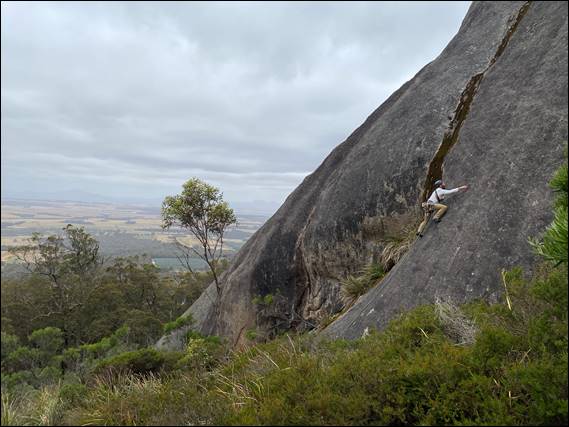
They simply felt ‘wrong’, my skin crawled and I felt like I was being watched. The sooner I moved on the better, and as soon as I did that dark foreboding feeling lifted. With having had such experiences, for me at least there is something in all of this. However, the Porongurup’s emits a good feeling to me, making me feel welcome so I was happy to be here. We scampered further round from the main face in search of a couple of lines on a wall that I had not been too before. My images show the wall, but not too much of the climbing:
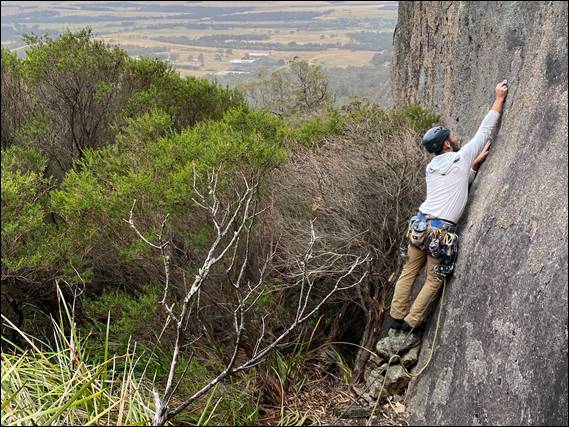
With just two of us on these tall, steep, and direct lines it was very hard to get any images of worth. Unlike the two climbs we picked, which in contrast were stunning. Both had been established in the mid 2000’s, and were protected with old school based in carrots. The often bent bolts didn’t inspire, but we used them regardless. Needing on two occasions to test them. Both times being when a hold came away from the rock mass. Due to the steepness of the lines, with often marginal holds at best when this happened it is hard to avoid the fall:
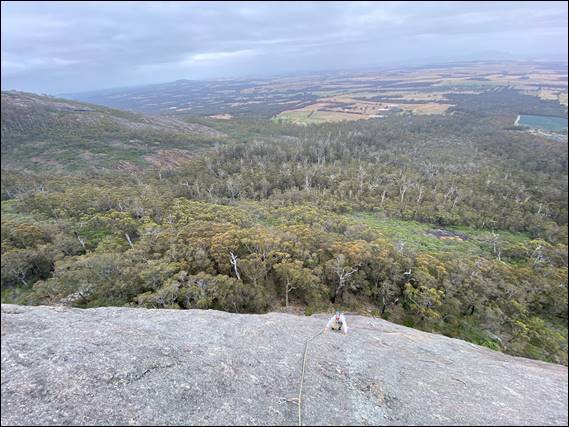
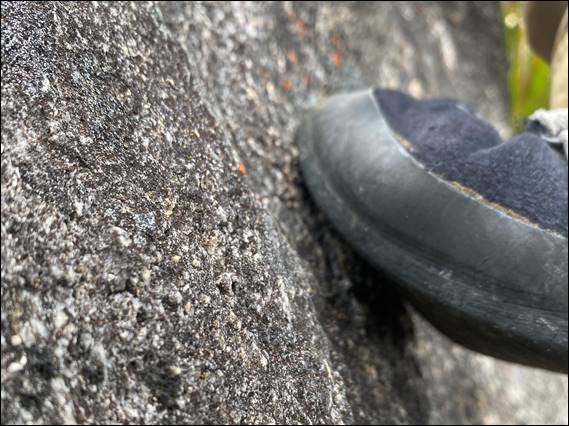
The climbing was epic. We had to get used to smearing and trusting friction, in a way our local crags don’t require us to. It is a strange feeling to push the mid sole to toe of your shoes against a near vertical rock, and trust the friction between the rubber and rock. Often we could hear the crystals of the granite crumble under the stress. Needing to brush the sole off on the other leg, before pushing it back onto the wall. Holds for hands were spaced, instead weighting our fingertips on small crystals and indentation. It was very focused climbing:
After the two lines, I was keen to send Howsie up what used to be regarded as one of the better protected routes here when it was put up in 1999. I climbed Sucked in Ben ten years after then. It felt run out and sketchy, but great. However, we had to watch the clock and get to the campsite by 6pm. So decided on a route I had not been on, which we coincidently happened to climb ten years after that one was established And being a more recent route it was a bolt ladder. Only having 50m ropes with us they were not long enough for two pitches:
To overcome this on those pitches once all of the rope had been fed out, we adopted the alpine approach of simul-climbing. Where we both climb at the same time, the grades on this line were way easier so this felt fine to do this. And not intentionally we climbed the 200 plus meter route in three quarters of an hour. After 340m of climbing we didn’t really feel the need to jump on another route. Leaving us heaps of time to wander round the top to take in the vista and look for anything interesting. Then rapping down where we had a relaxing late lunch, lying under the trees and chilling out before the walk back to the car:
The campsite was a quiet place, perfect for an early night after a long day. Getting back at a reasonable time we were able to set up camp, freshen up, and have dinner all before darkness came in. When in theory it was time for everyone to avoid being in the hills. The owners had made an effort to plant a variety of grevilleas, which were all in flower. Red, pink, and yellow blossoms abound. Reported to be the jewels of the Australian flora, for avid gardeners round the globe. Attracting heaps of birds, and maybe enhancing the dawn chorus:
It was another early start, as we only had one night away and wanted to be on the road home at a reasonable time. Before making the first brew, my gear was packed and tent upended to allow the ground sheet to dry. Not that I needed to do this. Despite the cloudy days, with moisture hanging in the air, there was no a hint of a dew and everything was bone dry. This didn’t make much sense to either of us, but we were grateful to be able to pack away our dry tents just before we rolled out. When only a handful of other campers were starting to stir:
Today we were heading to a place Howsie had not been to before, which had piqued his interest when Mario popped an image of it on our local climbing chat group. Having only been to Marmabup Rock once with Craig a couple of years back I was happy to come here again to explore it a bit more (https://sandbagged.blog/2022/10/16/a-curly-question/). In relation to climbing it is a bit of a hidden gem in the Porongurup’s. Not receiving anywhere near as much attention as Gibraltar Rock, but being equally worthy. One difference being the approach:
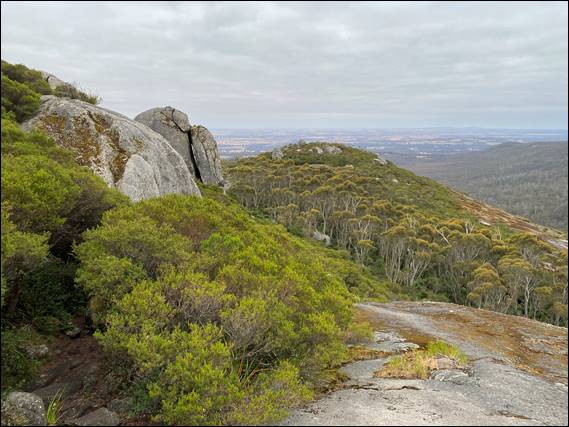
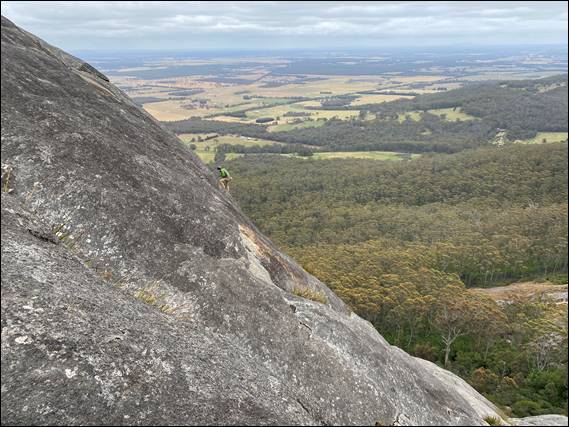
Yesterday we walked to the base of the granite dome, today we had to hike to the top and rap back down. This required getting to the top of the peak called the Devil’s Slide, which sits some 30m higher than our chosen peak. Here a sign tells you the trail ends, but not for us. We still had to descend to and cross the saddle that linked the two peaks. Marmabup Rock is the same elevation as Gibraltar Rock, and provides equally impressive slabs and walls. But it is harder to orientate yourself from the top, as opposed to when you look up from the base:
Craig and I had struggled to identify where the climbs were, mind you that was a very claggy day making visibility poor. Visibility was great today but it was just as cold as that previous visit. The air temperature didn’t break fifteen degrees on this trip, and for today especially there was no escaping the wind chill factor. We had a quick look round at the top but the route locations didn’t feel any clearer. One issue being there is no topo and the routes are not described in order. We did however know how to get to our first route:
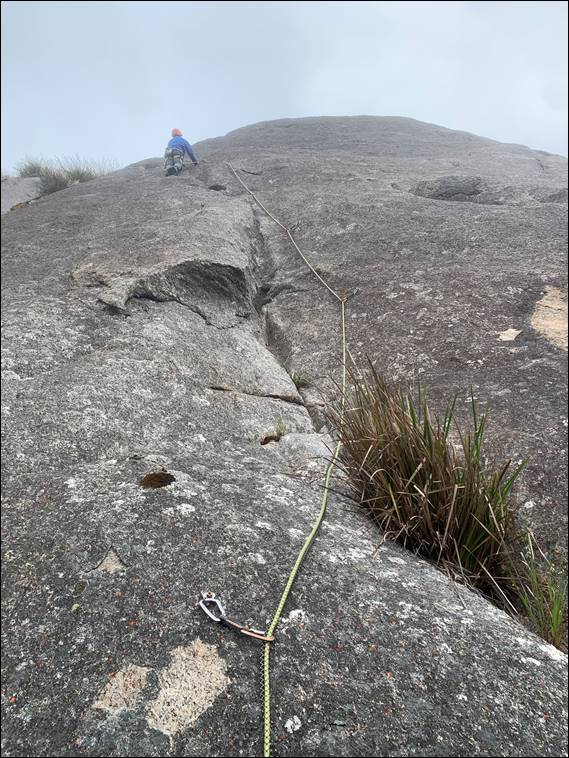
I was keen to hit one of the older lines. But was not keen on taking on the likely bush bash to get round the base of the cliff. Instead we rapped in on the line Craig and I had done. Getting us to the top of the second pitch, which I didn’t mind as the first two are supposed to be a relatively easy scramble. From here I took on the leaning flake, which is the reason we had hauled the trad gear up here. Old school lay-backing. Hands holding onto the back of the often rounded flake, while pushing our feet again the slab to create an opposing force:
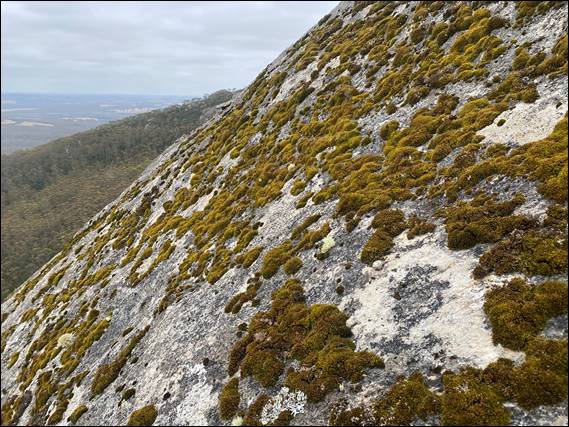
The slab was in places mossy making for a nervous lead, and in true old school style it was bold climbing. With that under-graded feeling due to the boldness, but the moves were about right. It was after all a Truscott and Rosser route, and I have said before that I find their climbs can feel tough. Howsie took on pitch two, being an amazing steep slab pitch. The hard granite not yielding any features or cracks for traditional protection. As such this pitch, like the first two routes yesterday, was of an era when they were created with bashed in carrots:
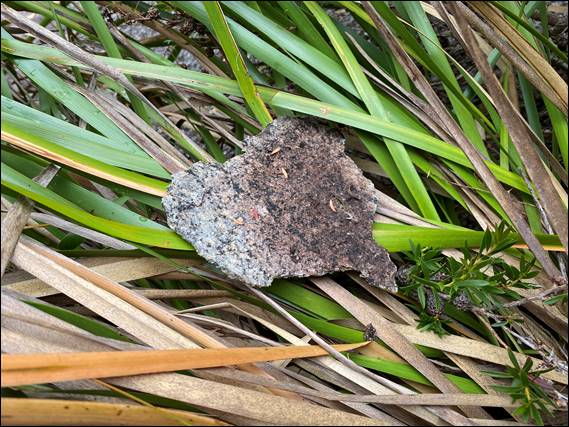
At times the small machine bolt head was hard to find due to the moss, as shown below. Fortunately, the moss was generally only present when the angle of the slab eased. On the steeper territory this allowed Howsie to more easily to see where his next protection was. So he could put all his focus on the delicate slab techniques required. It was a sustained and engaging pitch, a very impressive lead. After which I soloed the last 30m pitch, as in good old school style due to the lower grade there were no bolts that either of us could find:
In order for us to rap down we had to leave some gear on the line Craig and I had previously done. Seeing Howsie hadn’t been on the line before I was more than happy to climb it again, which we did with a Nankeen Kestrel (Falco cenchroides) circling and watching from above. This route was established 13 years after, and is given the same grade, as our first old school climb of the day. Grading is a hard thing, but we both agreed that it was easier in comparison. We had also thought the newer route yesterday was also a bit over-graded:
So is it that modern day climbers are going soft, and we are grading things harder than they should be. This is evident in other places too, for example in Scotland the older climbs given lowly grades can be desperate. Maybe this is akin to the modern age of being, to some degree, overly safety conscious and less willing to take risks. Certainly quite a few of the routes I have established have been suggested to be under-graded, and I wonder if that is really the case. This is not to say that it is true that all newer routes are soft, as we found out:
Grading is a fickle matter, so you should never believe what you read. Much can change from the first ascentist experience to your own. Including your mental state, technical preferences and skill set, ability to find and importantly trust protection, the weather conditions, and of course the rock due to holds falling off. After two very fine and contrasting climbs, we kicked back and had an early lunch pondering our next move. Fortunately we had phone reception and read and reread the details provided, giving us a hint of where to look next:
After much looking, we spotted a bolt some way down from the top. Identifying a 40m wall that topped out on the summit and had two climbs. Developed in the ‘modern’ era, which was good as it meant they were not protected by hard to find bashed in carrots. Having fixed hangers. The wall had some blank vertical sections near the top and I could feel my fingers tingle and muscles ach as I rapped down. This led me to picking the lower graded of the two lines. Very funky climbing up some features low down led to an improbable looking finale:
Working the moves I eventually unlocked the sequence. Then just started to curl my fingertips over what was the first reasonable hold for some time, that familiar and very unwelcome crumbling sound came from under one foot. Resulting in finding myself free falling. The on-sight was lost, and while it stung a bit that is climbing. On the plus side we both felt this was a climb for which the modern verses old school grading thinking didn’t apply. The climbing was nails, and we wondered what the next route would feel like:
Being a grade harder it felt an ominous undertaking, luckily for me one that Howsie would tackle. Watching intently it was clear it was pushing him, so my camera stayed in my pocket. At times he looked to struggle to work the moves, in positions and on holds that didn’t allow for a mistake. To his credit he held it together, and pulled off a great lead. Following up afterwards, I was pleased to have the rope above me as at times the holds seemed to disappear. Neither of the lines gets stars but they definitely deserve them:
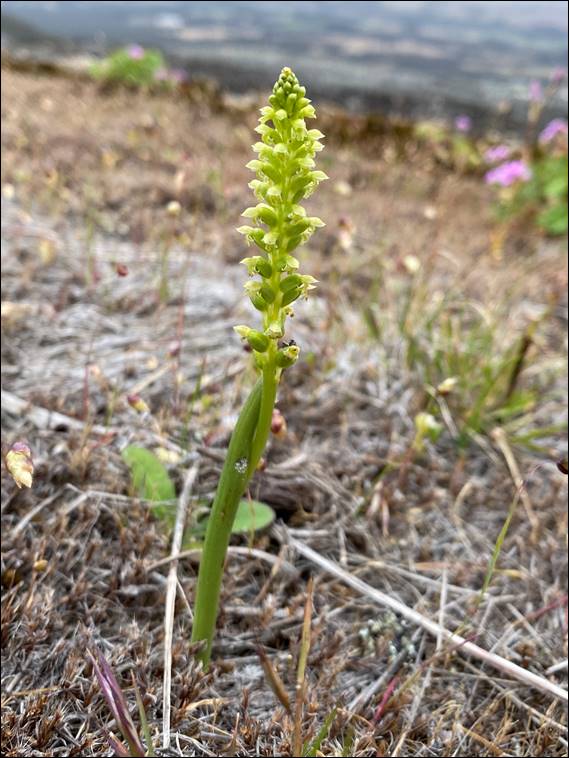
More than happy with our lot, we sorted the gear and had a snack before escaping the biting wind. It had even been too cold for the Sun Orchids. They somehow survive in very thin soils held in place by moss, over the granite outcrops. We saw hundreds if not thousands of them on the walk to and all over Marmabup Rock. However, with not one opening up all day it is hard to pin the species down. Unlike the obvious Common Mignonette Orchid (Microtis media) shown in an earlier image, which was also about but not in such large numbers:
The hike out, being downhill, was always going to feel that much easier despite us being weary after two early starts and long days. The taller Karri (Eucalyptus diversicolor) trees, towering up to a 100m above us, seemed to be watching over us like sentinels. Making sure we got back safe. Keen to come back and find a few of the other routes, which despite our best efforts alluded us today. For now it felt good to take the packs off for the last time. Although before resting up, it was time to prepare some food and the all-important brew for the road:
Route list: Gibraltar Rock Dance of the Slab Spiders 65m 19** The Real A.L Pedro 55 20** Made in Australia, from Local and Imported Ingredients 220 15* Marmabup Rock Rehearsing The Fate of Absalom 110m 17*** Beckey-Gledhill-Swain 110m 17** Custardly 40m 18 Excess Grip 40m 19
Lisa and I headed to Gnarabup for a night away, sticking to our agreement to make an effort and have a minibreak once in a while. Being relatively close it allowed her to partake in the local plunge before we left. Our destination was the number one surfing location in Margaret River, with accessible, reliable, and spectacular breaks. Not being familiar with the coastline here, and after my experience in a 1.4m swell at Wilyabrup, I decided that with forecast of a 2.6m swell on Saturday and Sunday I’d best leave the snorkel gear behind:
This was also in part due to our thoughts, when we first looked at this place, including hiking along the Cape to Cape track. Our familiarity about the track, like the coast here, was very low. Resulting is us walking south along the beach. Lisa however like to have a bit more certainty about where we are going, and what it might entail. Making the start of the walk less relaxing than it should have been. Next time we’ll make a bit more effort to investigate our plans. After following the beach for a couple of kilometres we reached Boodjidup Creek:
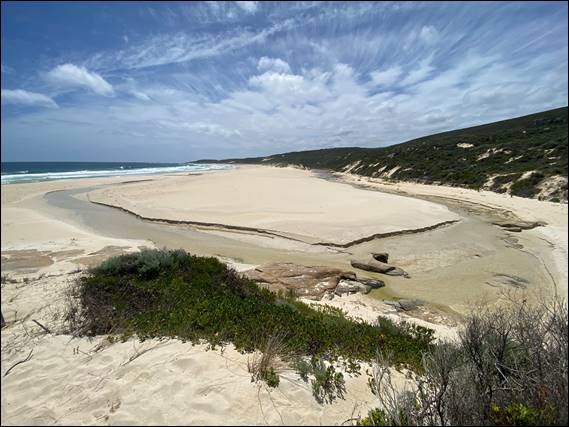
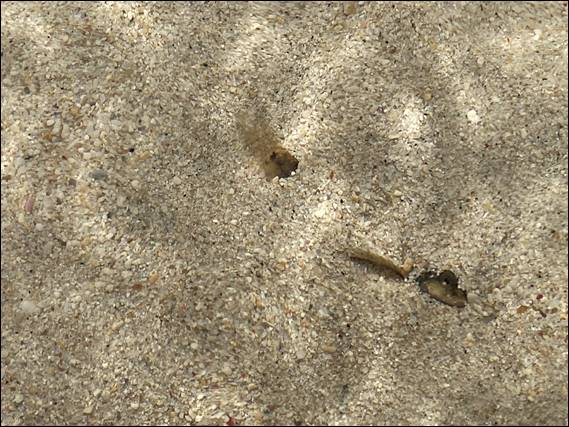
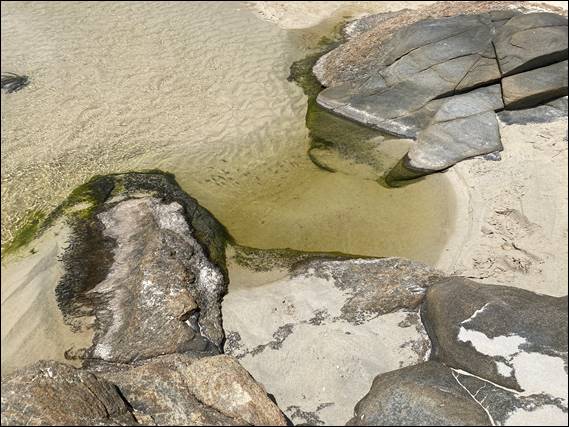
A piggyback for Lisa, over the creek as it flowed into the ocean, along with having reached where the Cape to Cape track met the beach, lightened our mood. Here Lisa chilled out on a rock, as I explored the creek line. My attention was drawn to some small fish, above you can see two of them looking back to me. I believe from their heads and snouts to be South-Western Goby (Pseudogobius suppositus). An benthic fish that exhibits a behaviour of burrowing. Found most commonly in slow-flowing brackish estuaries, coastal lakes and rivers:
Wandering up the creek line as it meandered its way up the beach and behind the dunes, there were hundreds of small fish. But these didn’t behave in the same way. Not burrowing to hide, but moving in schools and looking for shelter. With longer and more slender bodies, leading me to think they were Common Jollytail (Galaxias maculatus). This species has the largest natural distribution of any freshwater fish species in Australia. And while I said freshwater, they are more commonly found in still or slow-flowing waters within a short distance of the sea:
It was time to mosey. While I had been exploring, Lisa had been checking out our route back. Despite having only gone a short distance on the beach, the Cape to Cape track would take us back by going some way inland. Popping out on the coast north of Prevelly, which is a couple of kilometres north of where we started. This meant we had only completed a fifth of the entire circuit, taking up over an hour. It was time to pick up the pace, which started when we followed the weaving creek line until a bridge allowed us to cross it for the second time:
As we reached the bridge, the banks were covered in Arum Lily (Zantedeschia aethiopica) a declared pest in Western Australia. Someone had cut a heap of flower stems off these, and piled them up. Maybe in an attempt to help remove them. However, they have extensive tubers, and can regenerate from just a fragment of the tuber. As such if mechanical removal is not possible, which would require scappling the area and taking every out, then chemical control is required to kill of the tubers. As such their efforts may have been misled:
After the bridge a very long series of pine log steps led us up the dunes and inland, leaving the ocean behind us. The wind died down and the bite of the sun could be felt, the heat that came down also brought out several Bobtail Lizards (Tiliqua rugosa). And I quietly hoped there may be a snake or two basking on the path, but it was not to be. Once the sound of the waves were out of earshot, the path took on a familiar form. Several landforms brought back memories to me, but Lisa was not so sure:
On that last trip we had seen a snake, and we had also come across the Leopard Sun Orchid (Thelymitra benthamiana) for the first time: https://sandbagged.blog/2020/10/18/creepy-crawlies/. Since then I’ve seen heaps of these, and today there were quite a few out, along with several other repeat finds for this season. Lisa’s shoes had filled with sand on the soft track, so while she emptied them I looked about. Spotting a small clump of Coastal Spider Orchids (Caladenia abbreviata). These flower later in the season than most, when their basal leaf often looks a bit withered:
They have been given a Priority Three conservation status by the Western Australian government. This does not mean they are under immediate threat, but they are poorly known and only found in a few locations. Having been first formally described in 2001, by Stephen Hopper and Andrew Brown. The latter of the two being the person who recently helped identify some of my finds at the Capel Nature Reserve. The name, a Latin word, abbreviata means shortened, and refers to the relatively short petals and lateral sepals:
I’ve checked a number of other features that all point to my identification being correct. Sometimes however the most distinct features can be missing, a bit like may be the case with the above Leopard Sun Orchid. With no spots. That said the yellowish green flowers can have brownish spots, blotches, and/or patterns. With all the unexpected finds the approx. next ten kilometres went by pretty quickly. And after that we felt like we could reward ourselves with a snack at a café in Prevelly overlooking the bay, which went down very well:
There was still a few kilometre left before we got back, most of which took us on a limestone track just about the beach. Here we saw what we think is likely to have been a juvenile Dugite (Pseudonaja affinis), but it slithered away too fast to be able to catch a picture and check it. And as we looked down hoping to see another, we would have walked past this White-faced Heron (Egretta novaehollandiae) if it hadn’t given its location away by flying away. Being the most common of the herons in Australia, found everywhere water is found:
Despite the dodgy start, the walk was a lot of fun and we got to see heaps along the way. And I won’t lie I did enjoy unexpectedly finding orchids, and am quietly hoping now to find more. We felt that fifteen kilometres later it was now time to settle into the room, have a brew or two, and put our feet up for a bit. For dinner the hotel had a bar on site, serving good ole pub food and a decent pint. All of which went down well, as we pulled out the scrabble. Managing to polish off our food, drinks, and game before the Halloween party kicked off:
It was a slow start on Sunday, we did however wander down the road to a small café right of the beach. More food was consumed, as Lisa watched people get in off the beach and swim various distances across the bay before returning. Suggesting it is something she will never be brave enough to do, but I am not so sure. I would however prefer to look at the sea life while snorkelling. Being a little annoyed with myself for not bringing the gear, when we saw much of the bay was protected by an outer reef and looked very inviting. Maybe next time:
Driving out shortly after 5am, the radio broadcaster was talking about all the glorious sunrise images listeners were sending in across the south west of Western Australia. I didn’t send an image of my view to them, but did stop to take a quick snap. Mist clung to the ground, while the hues of the morning sky changed. Sadly all too quickly, not allowing the time needed to truly savour the varying colours. As someone who enjoys a good sunrise or sunset, living at a latitude of approx. 33.5 degrees they really don’t last long enough:
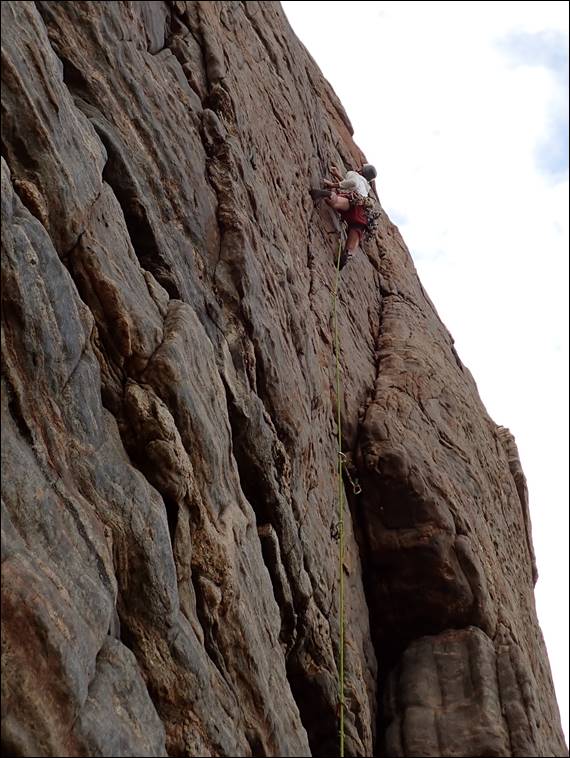
A particular climb at Wilyabrup was calling to Howsie, therefore this is where we found ourselves. Tackling the first route a bit after six thirty, and only having four hours before we had to be hiking back to the car. Needing to get back by midday, we were on a timeline. For this reason I had half expected to be further in our journey by the time light had filled the sky. However, feeling a little weary Howsie felt that setting the alarm for 4:30 was early enough. To be honest I’ve also been pretty pooped this week, maybe due to the warming days so didn’t mind at all:
I may also be feeling my big day at Bob’s Hollow last weekend. My shoulders not being used to that kind of climbing. After all the bolt clipping of that trip, it was nice to get out with the trad rack. There is something satisfying about getting a piece of gear in, something that using bolts just can’t emulate. I also got to use my crag booty from Queensland, a long draw with a carabiner that has a built in roller. Poking out from under the final undercut headwall. The idea of the roller being to reduce friction as the rope moves through the carabiner:
For direct lines such as these there is little benefit. However, it would feel great not having to battle rope drag on climbs that meander about, and for which it is hard to keep the rope alignment relatively straight. These sort of climbs are very rare locally, which may be why I’ve never invested in this bit of kit. There are so many options for different types and styles of traditional climbing gear, and some people just can’t resist keeping up with the latest fad. A bit like a dedicated follower of fashion, who needs to change their clothes to stay in vogue:
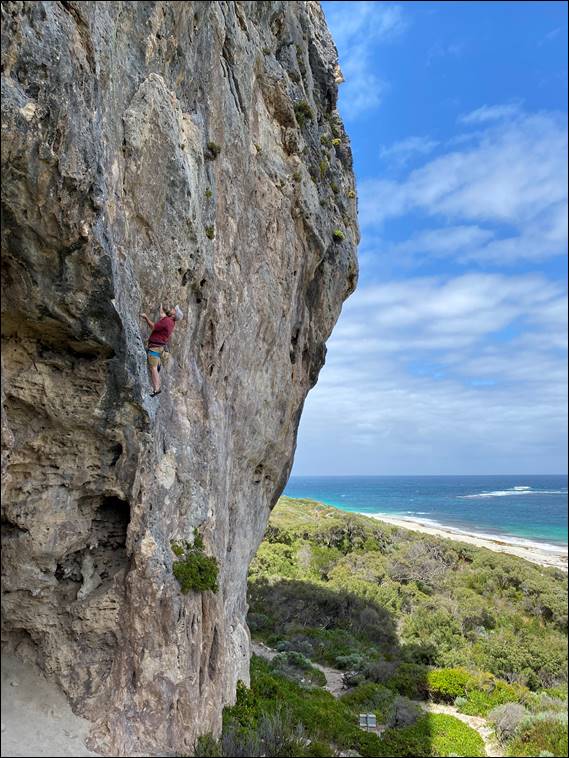
The first line felt fairly damp and insecure. This meant the route that had been calling out to Howsie, before we got here, was now only whispering very faintly to him. Unsure of what to do next, I suggested heading to bottom end of the crag. Here the rock changes from clean slabs and faces to blocky three dimensional features. Cracks, flakes, corners, overhangs, and arêtes awaited us above. The climbs here don’t get much attention, but deserve more. Providing exposed and exhilarating climbing, which was enhanced today due to the dampness:
From our lofty stances at the top of each climb we looked out to sea. Dolphins cruised past when we first arrived, and the very occasional whale could be seen breaching way out. I was however, also looking at the shoreline. It was a relatively low 1.4m swell, and after my snorkel last weekend I had suggested we take our gear down just in case. The sun came and went, as the broken clouds blew in, while the sets of waves kept their own rhythm. There were certainly periods when the sun hit the water as it flattened out, making it look inviting:
Other times the wash and darker waters looked less inviting. As the conditions fluctuated our enthusiasm to snorkel also waxed and waned. On the plus side, with three routes in the bag Howsie was keen to jump on Totally Awesome. The climb that had been calling to him. This saw us move back to the vertical faces, which most climbers seem to like to stick to. It may seem a pretentious name for a route, but it is very good and deservedly popular. It certainly felt good today, made all the more enjoyable due to the open face having dried off nicely:
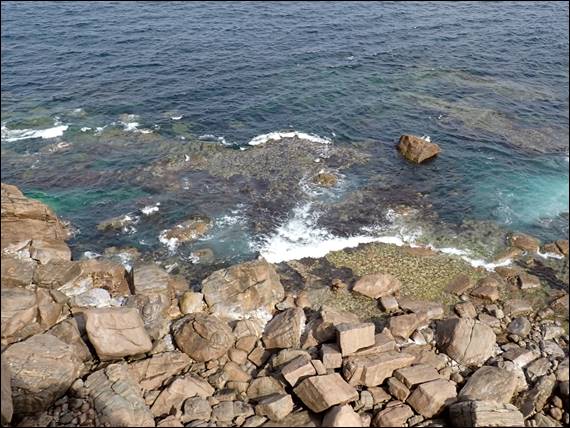
This was due to the onshore winds having picked up. Great for climbing, but no so great for snorkelling. A time check told us that we only had an hour left. Enough time for two lower grade routes we have done countless times, or a snorkel which we had never done here before. It was decision time. We plumped for a swim, heading to what had looked earlier on like a good spot to go in from. This was based on when we had arrived and it was calmer. I went in first but didn’t far, clinging onto the boulders as wave after wave pummelled me:
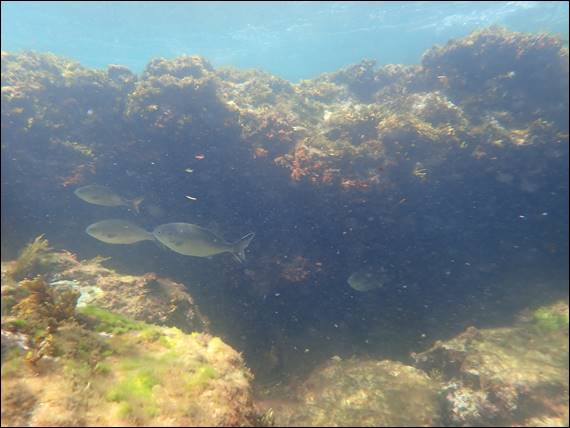
Undeterred I finally got out and we rock hoped along a bit further. Finding an abalone filled rock shelf, from where we could dive straight into the deeper water. Once in our focus constantly switched between watching the waves some of which we had to dive under; how close we may be to the boulders and whether they had barnacles on them; and of course looking underwater to see what life there may be beneath the surface. The water was reasonably clear but the fish were relatively absent, maybe hiding somewhere less turbulent:
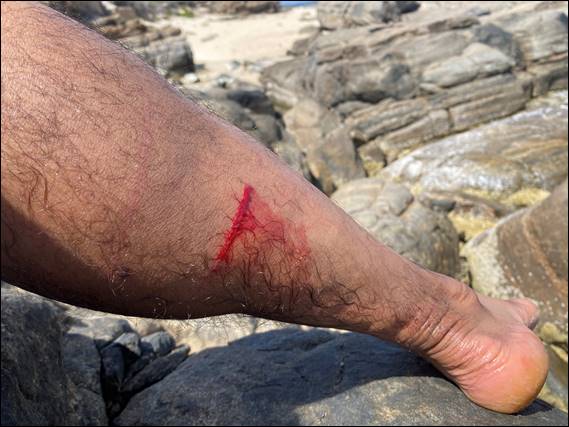
With our attention being pulled multiple ways, we didn’t see too much life. No matter, it was certainly fun and on a calmer day it would be a great place to do more exploring. At one point it seemed the waves were abating, so we headed to what looked like a good place to get out. Something I made much more of a meal of than Howsie did, but we got out unscathed or so I thought. And in case you were wondering about the reference to barnacles, well this is the reason. Unbeknown to me I much have brushed against one, resulting in a clinical cut:
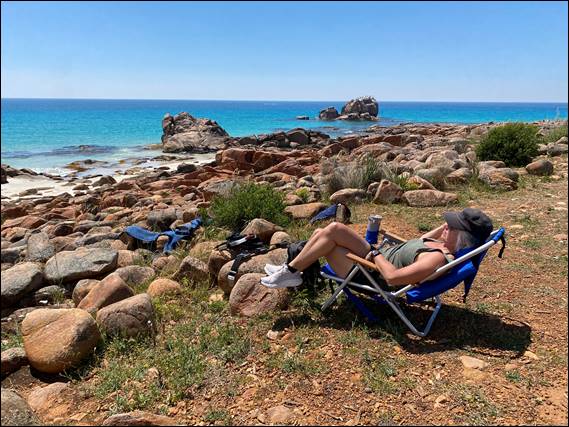
Lisa was keen to see if the whales were back in action between Cape Naturaliste Lighthouse and Dunsborough. She is happy to kick back are stare out into the big blue, whereas I tend to get a bit fidgety and need to be a bit more active during my searches. However, a short video taken by one of the Peppy Plungers on Friday showed a whale playing about for well over half a minute splashing all over the place. As such my interest was piqued, and we headed out mid-morning hoping that the whales would again be out having fun:
I of course took a backup plan with me, and as luck would have it the ocean was relatively calm. So leaving Lisa to scour the ocean for signs of life breaking the surface, I pulled my wetsuit and snorkel gear on and went to search for life underneath the surface. I can’t recall having been in the water in October before, and my image library indicates that could be right on that front. My local snorkelling season usually starts in November, I say that as when we have been holidaying up north the waters can be clear and warm enough year round:
The main reason for my snorkel season starting later in the year is however due to the waters of Peppy Beach taking ages to clear up. They are also quick to churn up when a larger swell comes in, so you need a reasonable length of settled ocean conditions. On this stretch of the Geographe Bay coastline, further to the west, there are no major waterways dropping fine sediments into the ocean. And the coarser bed sediments settle far quicker and so the water can be reasonable even in winter, and today it was lovely and clear:
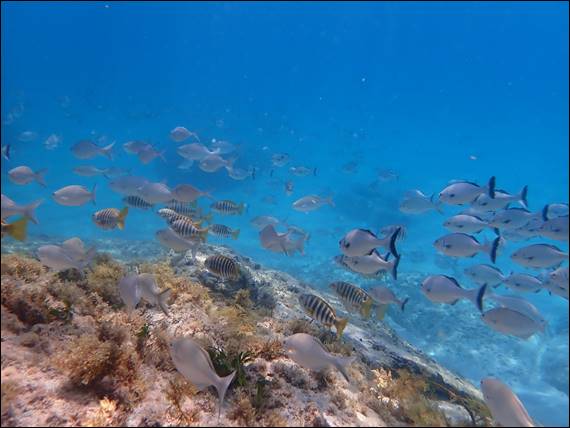
I did wonder if it would feel cold, but was pleasantly surprised. The initial shock was over quickly, and despite staying in for between half to three quarters of an hour I didn’t even have a chill when I came out. So why have I not started earlier before, round these parts you may ask. Simple, it seems like too much effort to drive all the way round the coast just for a snorkel. Maybe my logic is a bit skewed and I should make more of an effort, as while the whales were quiet the fish today were out in big numbers:
There were heaps of species, but nothing stood out as particular new. I did however like the above Bluespotted Goatfish (Upeneichthys vlamingii), which allowed me to get close. They can have a huge colour diversity. Even the brown snout to tail band is only found on some specimens. Some are also able to rapidly change their colour, and can be found to be more brightly coloured at night. And while all the fish were easy to identify, I’ve rediscovered the huge amount of time I can waste trying to unsuccessfully identify some other finds:
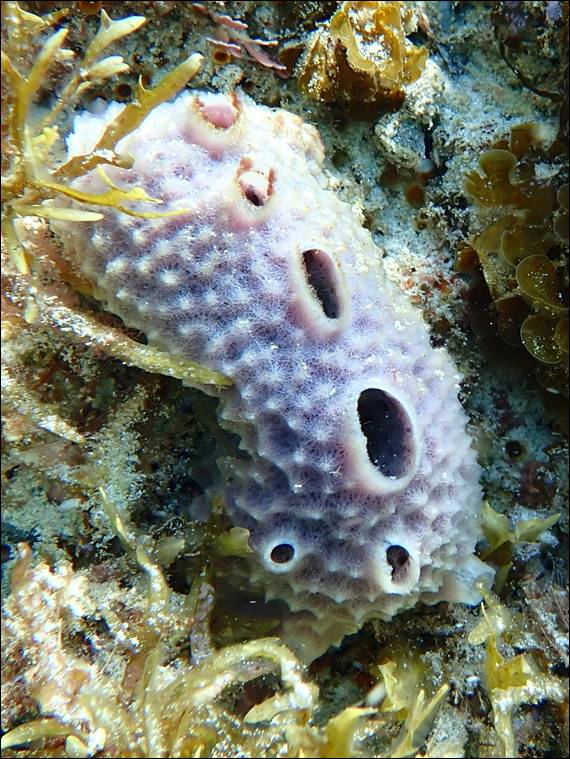
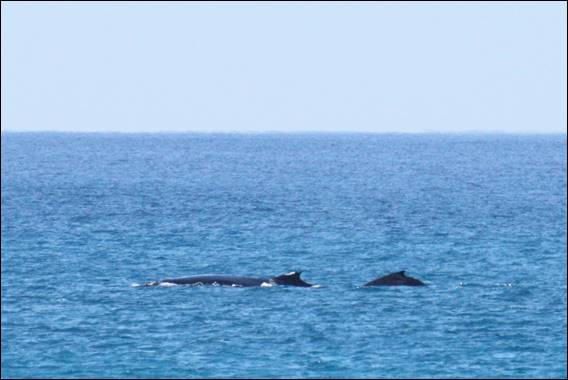
Such as the above sponge. Back on shore Lisa had not had any success, which we thought may be due to all the weekend ocean traffic. Boats and jet skis were all over the place, and some seemed to be honing. Then way out and just briefly a whale came up for a breathe, and was then gone. Undeterred we moved a little further up the coast and with less ocean traffic we had a bit more success. Spotting what may have been a mother and calf making their way northwards. There was no tail or fin slapping, and no breaching but it was nice to see them:






























 Sandbagged