Cheers to that

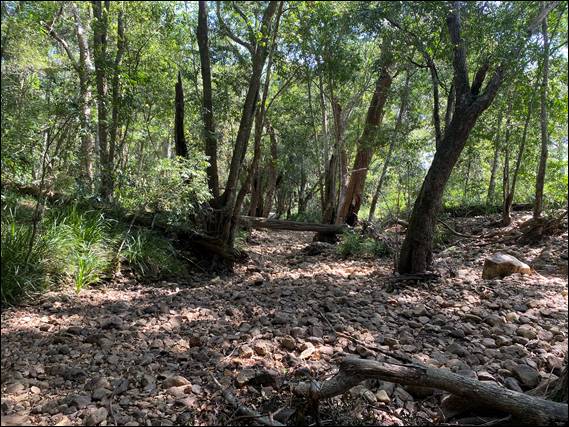
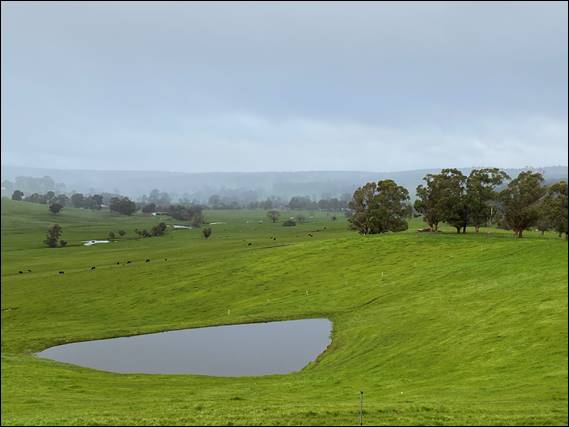
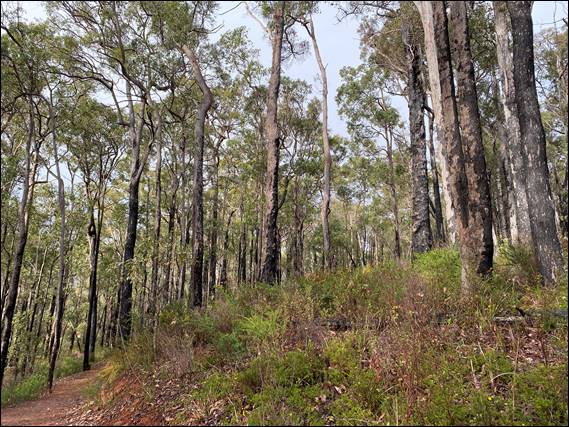
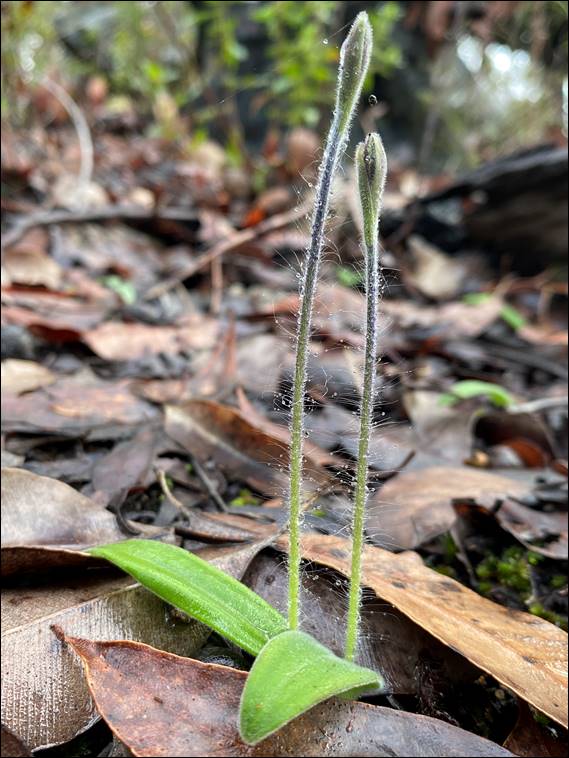
A weekend of not climbing was on the cards last weekend, to allow the body to relax and recover.  But the weekend cried out to include some outdoor time, resulting in Lisa and I going for a Sunday wander with the poodles out at Crooked Brook Forest.  Allowing us to balance some outdoor time together and provide the poodles with an adventure full of interesting scents.  And for me also the hope of maybe having a bit more luck than my last visit here, which was not particularly productive from an orchid perspective:
The carpark was overflowing more than ever, but we came across surprisingly few people on the two walk trails we plodded round.  Our slow pace was more due to the poodles intently sniffing every few meters, than me wanting to stop and look at orchids.  A few of the usual suspect were out, but we really had to look hard to find them.  And as for anything particularly new or unexpected it was very light on, and even when we found something there was only one or two plants of the species.  A few other groups were out looking, and they fared the same fate:
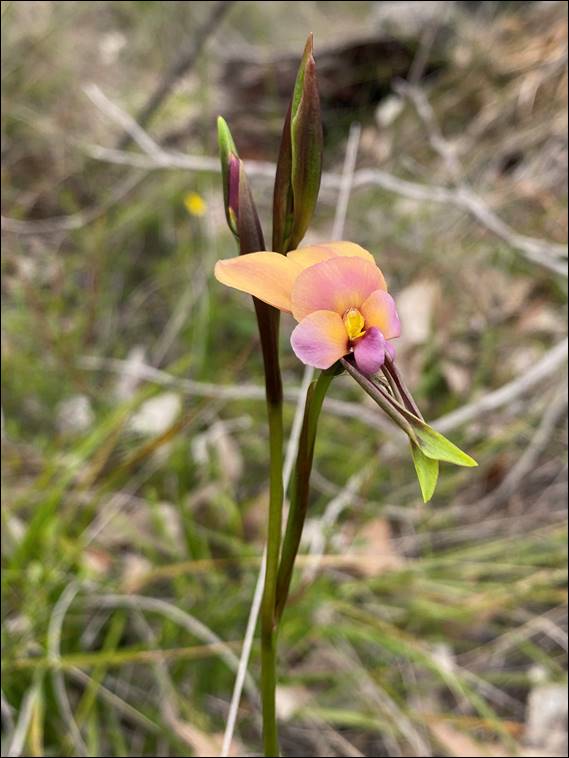
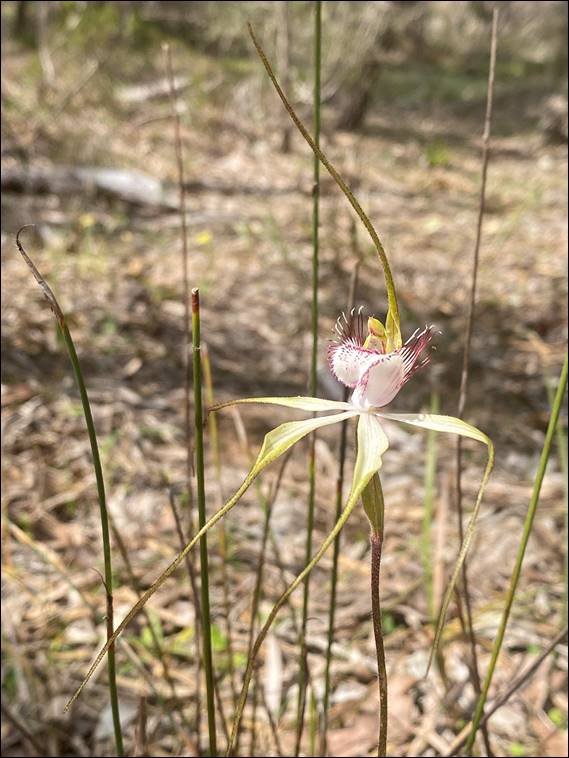
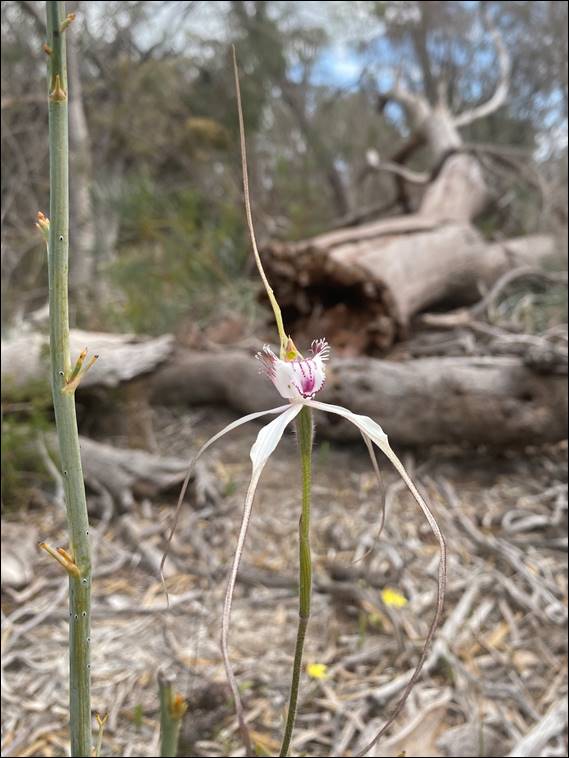
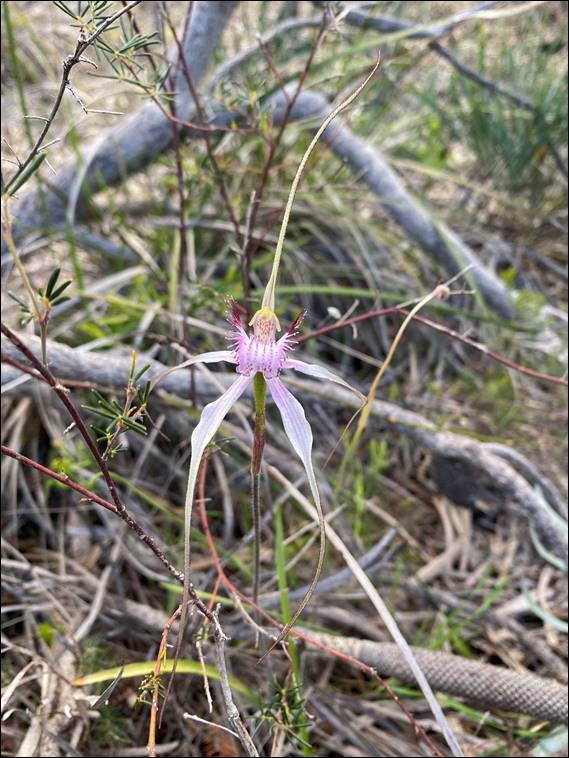
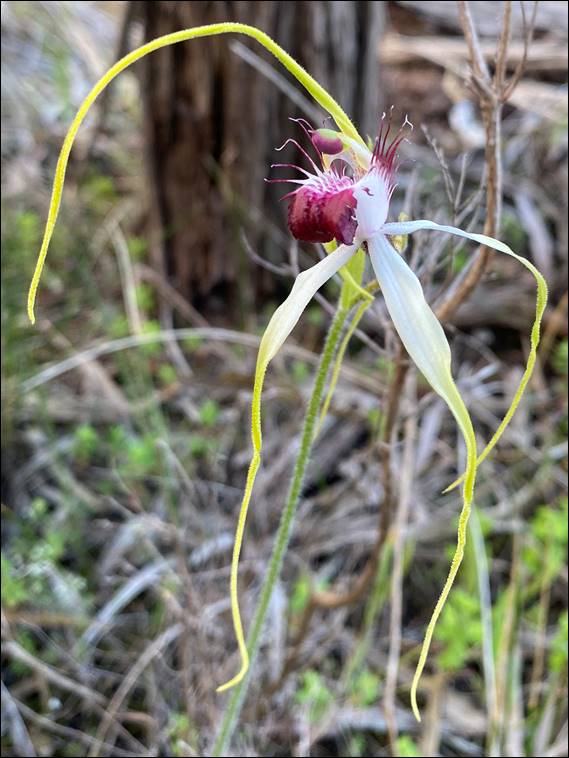
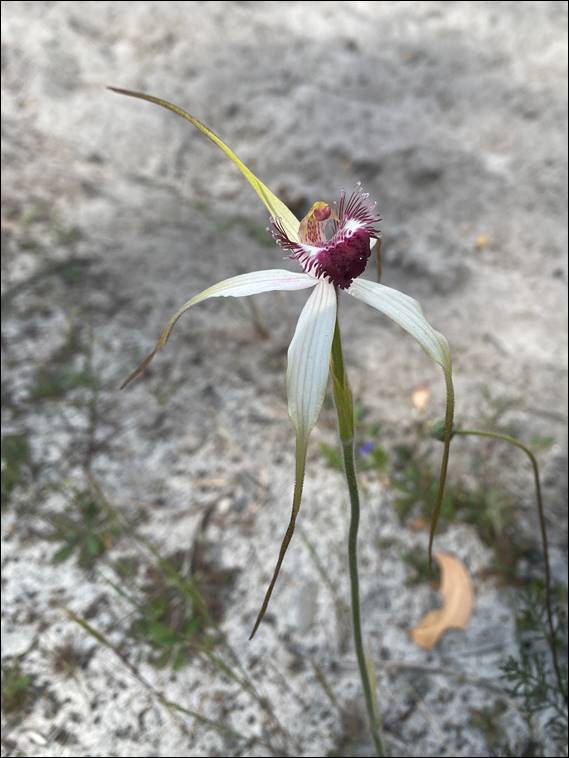
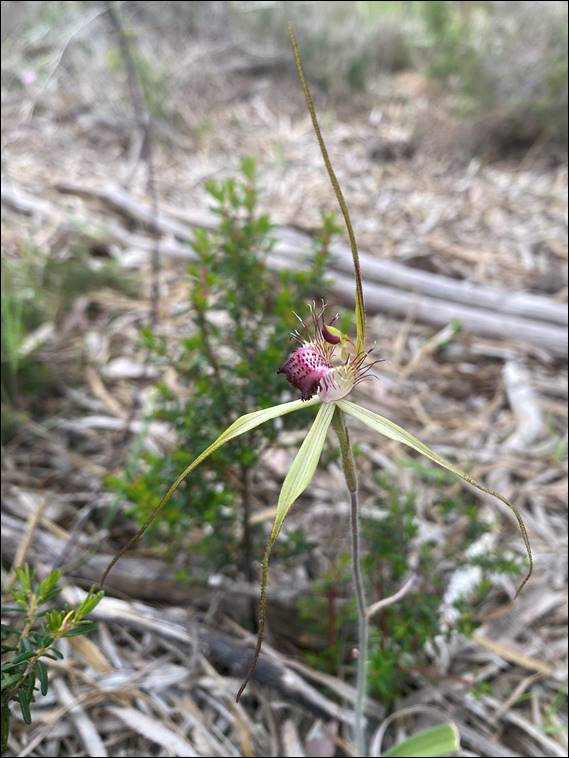
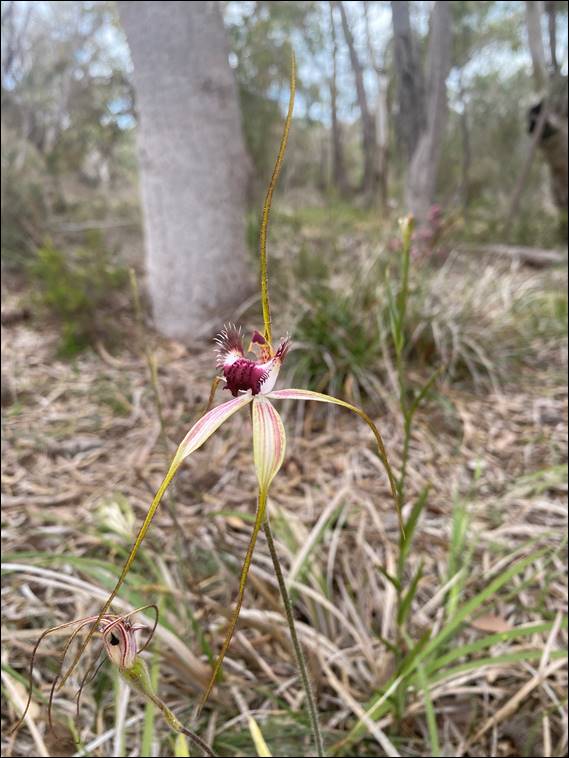
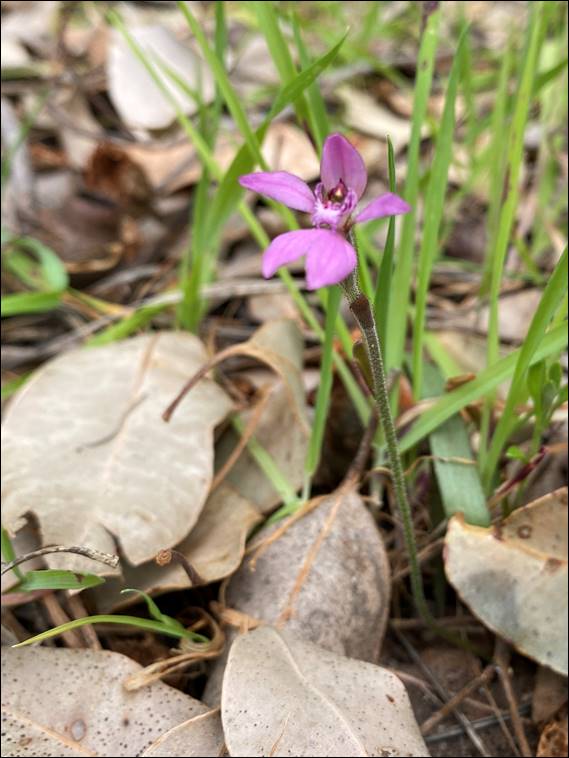
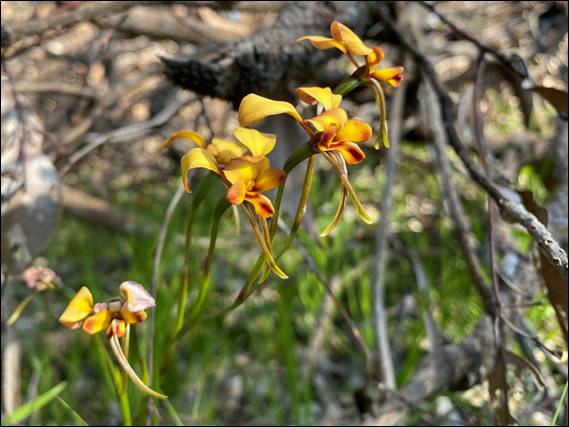
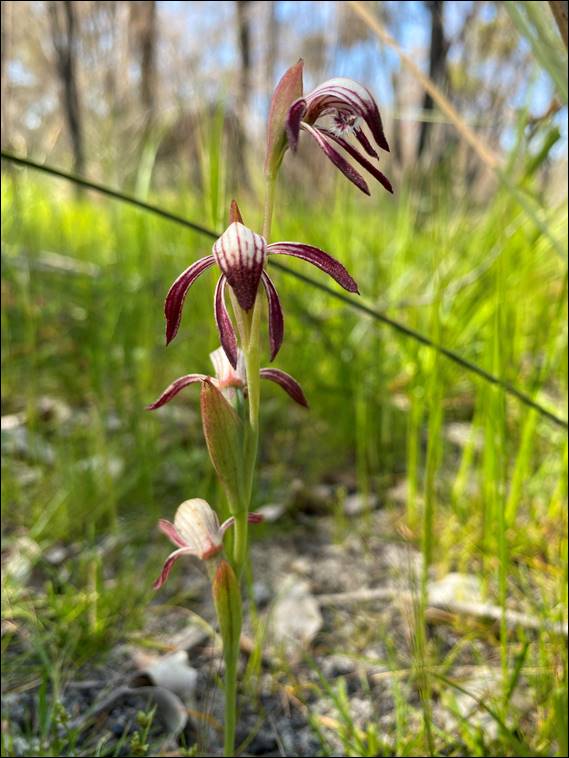
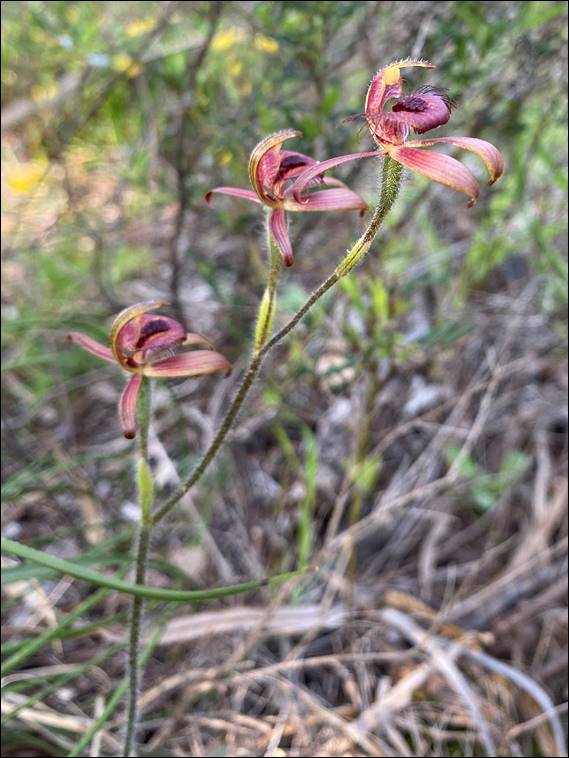
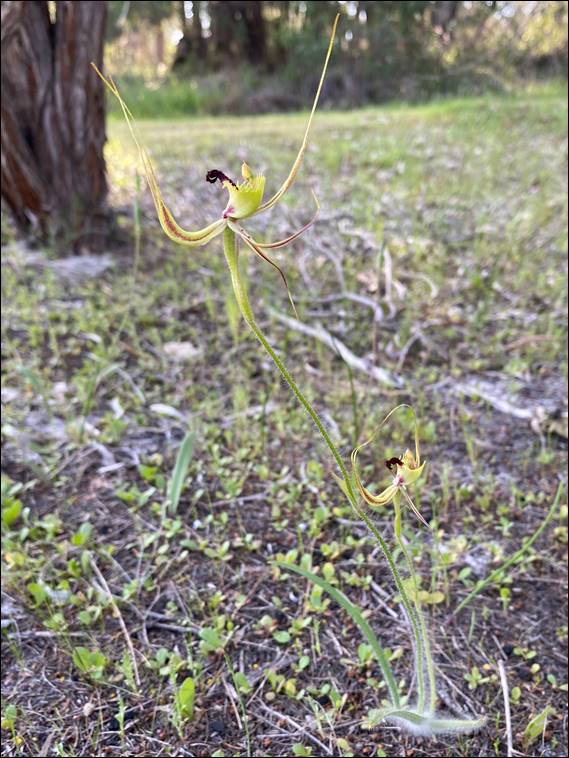
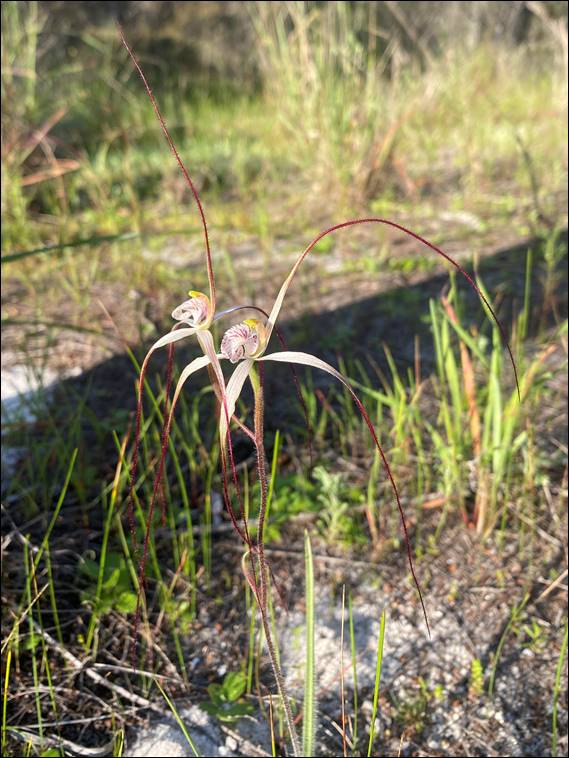
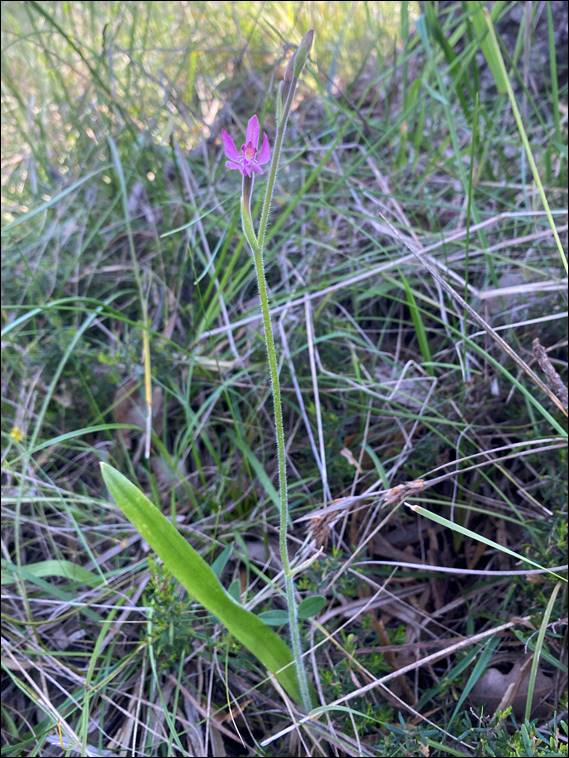
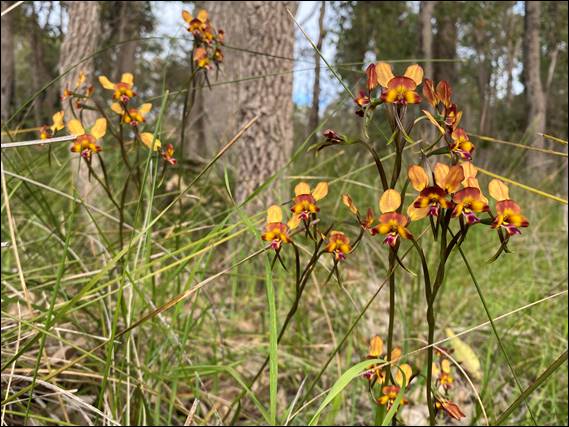
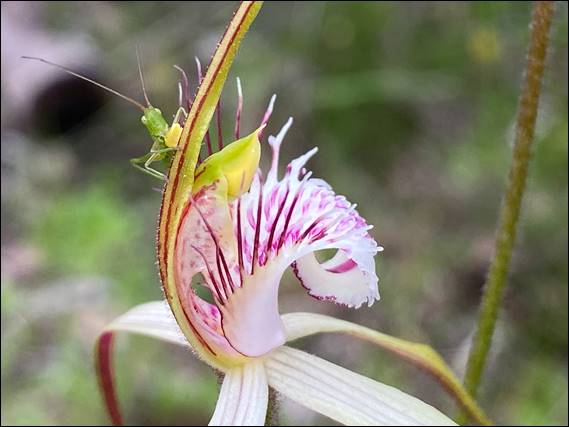
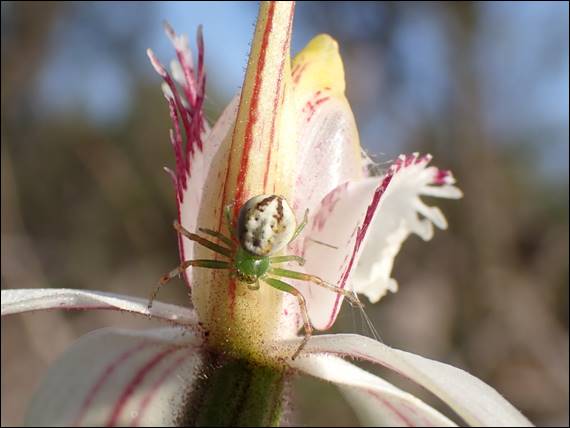
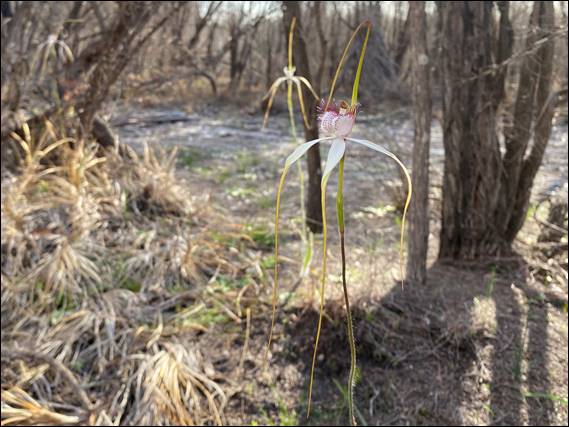
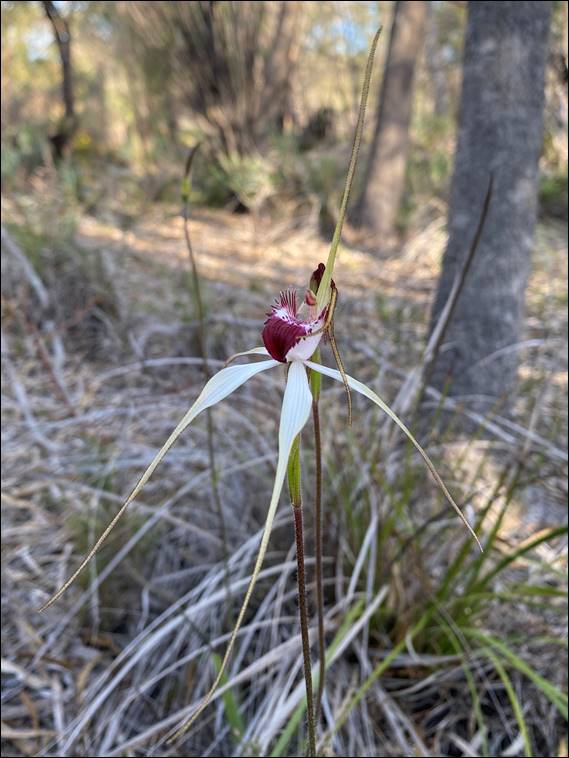
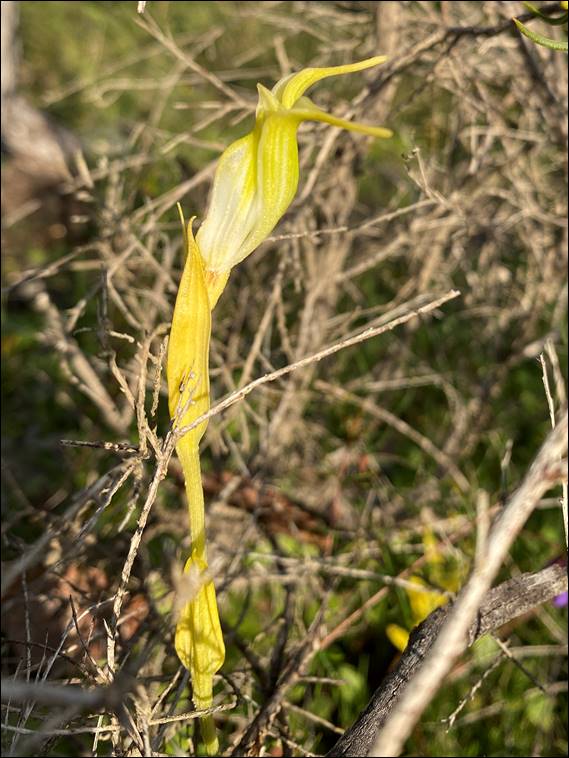
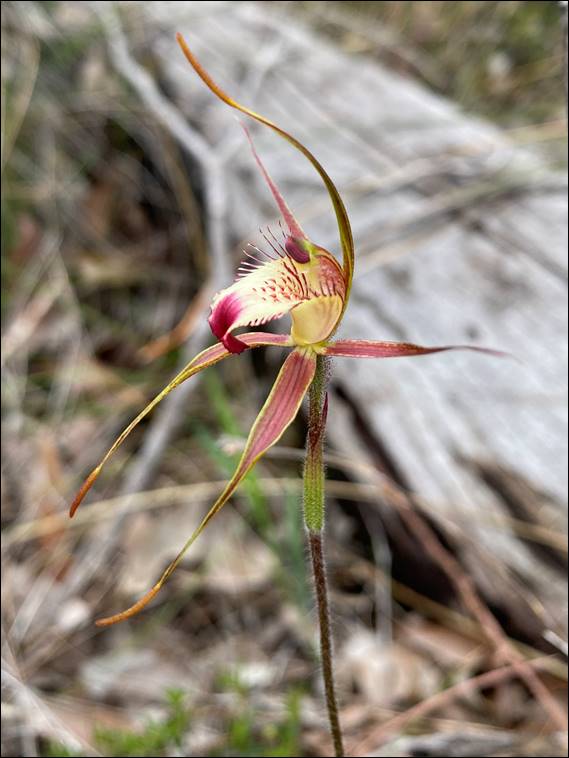
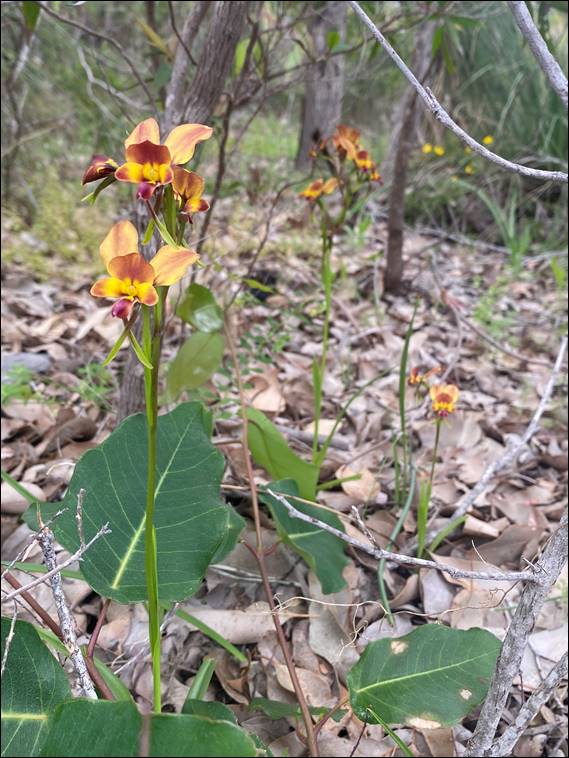
On the plus side we came across a single Rusty Spider Orchid (Caladenia ferruginea), which I mentioned in my last post as a species we have in previous years found at Ambergate Nature Reserve as a bit of a companion spider orchid to the Swamp Spider Orchid (Caladenia paludosa).  Above we also found a single flowering Purple Pansy Orchid (Diuris longifolia), one of many donkey orchids species.  The species name selected due to the length of its leaves that protrude below the flower head, with longifolia meaning long-leaved in Latin:
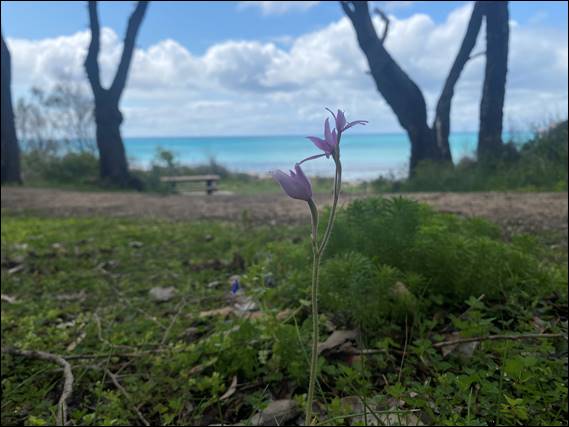
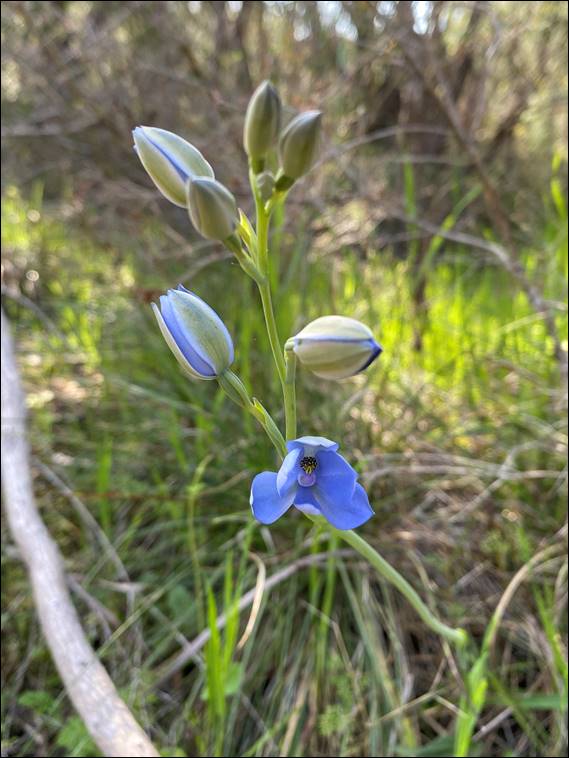
It wasn’t a total whitewash and I tallied seven flowering species in all.  It didn’t however fill me with confidence of finding too much when Lisa and I went for a walk along the eastern coastline of Cape Naturaliste, from Dunsborough to Eagle Bay on Friday.  My last trip here was in mid-August, and I didn’t even write that visit up, despite going orchid hunting and climbing.  That had been a very wet visit, with the paths flooded and most flowers either looking battered or closed up.  This included a couple of Blue Fairy Orchids (Pheladenia deformis):
Blue Fairy Orchids are a common and wide spread species that can tolerate a variety of habitats, for which I can’t recall a year in which I haven’t seen them in good numbers in many places I visit.  This year however I’ve only sighted those two bedraggled specimens.  The reason for returning was not to try and find them again, but for Lisa to get a decent walk in.  The Peppy Plungers are book in for a Coastrek charity event in a few weeks’ time, which will take in a 20km walk along this reach of the coastline.  Raising funds for the Heart Foundation:
To get a bit of training in they had organised to head here for a trek on Wednesday, but a cold front came through with strong to gale force winds and belts of rain.  A couple of them then decided to head out on Friday, but Lisa and I had already organised to get out ourselves.  Our plan included a night away to celebrate her birthday.  After we had parked up in Dunsborough we spotted the other Peppy Plunger’s car, who had just happened to decide to start at the same place as us, but were an hour or so ahead of us:
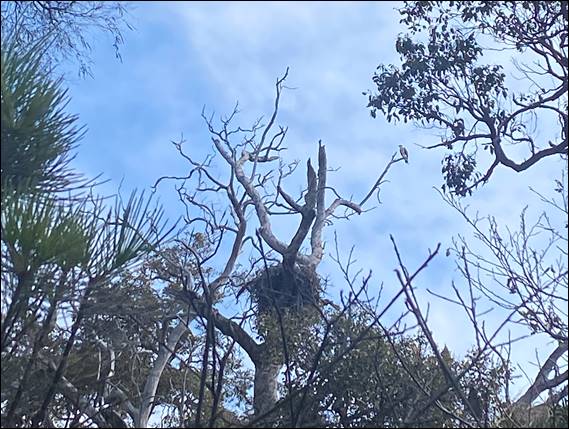
With the intention to get a few miles under our belt, the pace was a little quicker than my orchid walks.  Reducing my ability to stop and look about.  Certainly on the walk northwards there seemed very little to see, with only a few specimens of species previously sighted this season.  Having tempered my expectations I was prepared for the faster pace, and likely low species count.  Three images up we did however get to watch a White-bellied Sea-Eagle (Haliaeetus leucogaster), perched above its huge nest of tangled twigs and branches:
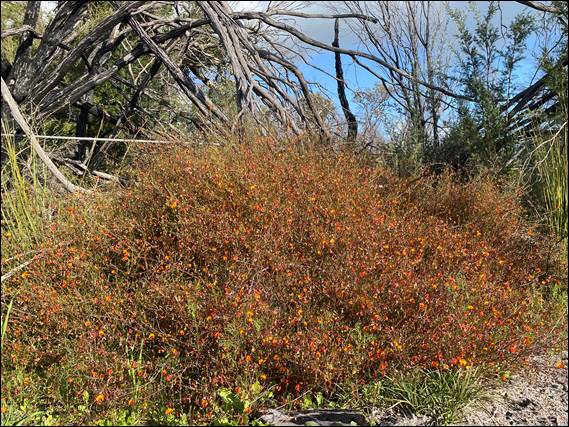
And despite there not been many orchids, there were lots of other flowers out including a wide variety of triggerplants, of the genus Stylidium.  The smaller species of this genus formed large colonies close to the ground, but they come in a wide variety of forms.  They are described as being protocarnivorous.  Meaning they trap and kill insects, directly digesting or absorbing the nutrients by dissolving the bodies using enzymes or bacteria.  The most well-known plant to use this technique is probably the Venus Flytrap (Dionaea muscipula):
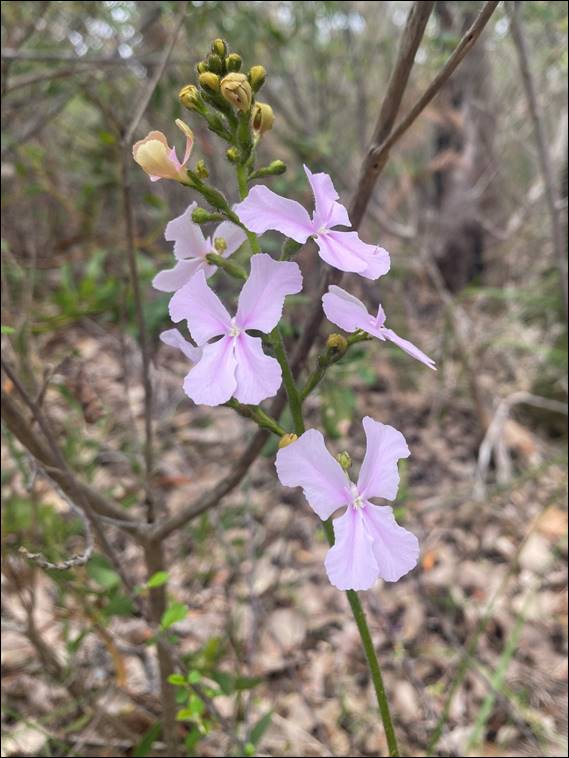
After only scant repeat finds over five to six kilometres, we bumped into Lisa’s fellow Peppy Plungers Linda and Jenny.  We were a kilometre or two from Eagle Bay, and they were on their return trip.  As we chatted they said quite a few orchids were in the last stretch, raising my hopes.  They also referred to a pale pink donkey orchid like looking flower.  The latter was in fact the Queen Triggerplant (Stylidium affine).  The flowers being several centimetres long, much bigger than the ground cover trigger plants, both shown several images up:
They were however not wrong about the orchids, and as we closed in on Eagle Bay several clumps of Dunsborough Donkey Orchid (Diuris jonesii) appeared.  These have relative large flowers, for donkey orchids, being in some instances two inches long.  And with the more colourful petals and sepals they are a very pretty sight.  Endemic to the south-west of Western Australia, they are not confined to Dunsborough and can be found all along the Leeuwin-Naturaliste National Park and along the Great Southern coast as far east as Albany:
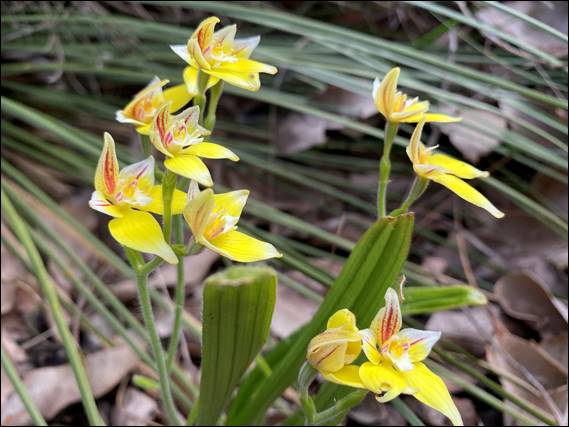
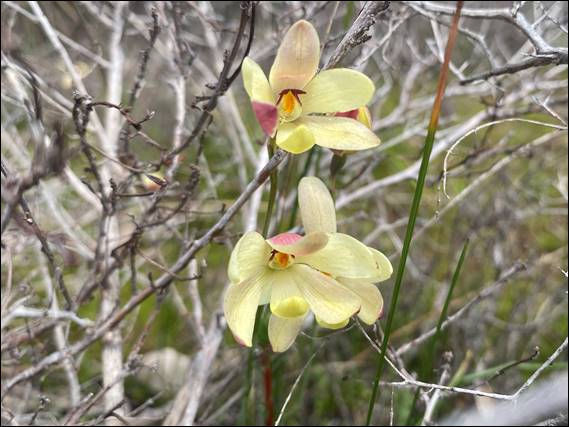
I also got pretty excited when I stumbled across a patch of some twenty Lemon-Scented Sun Orchids (Thelymitra antennifera), all clustered in a small area.  These bright yellow flowers, three images up, are very distinctive so I am pretty sure that we would have seen them if they had been more widespread along the walk.  This species is very wide spread being found across the biogeographic Southwest Australia region, from Geraldton to Esperance, as well as the southern areas of South Australia and Victoria, and rarely in Tasmania:
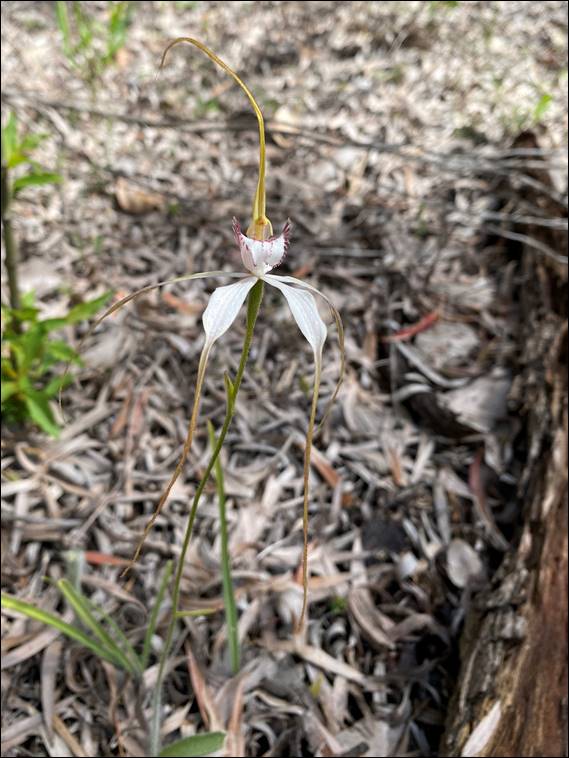
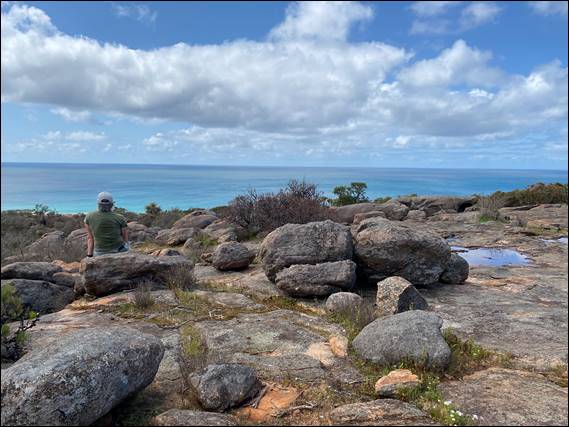
On the return walk, the pace was kept up although we did take five when we diverted on the Meelup Beach lookout loop.  Waiting for a whale to spout, tail or flipper splash, or if we were lucky a fully beach.  Lisa thought she saw a few whales break the surface, but it was too far off to be sure.  After staring out to sea for a while we continued, down the steps and back to the coastline walk.  And here the finds continued, with the above Hills White Spider Orchid (Caladenia longicauda subsp. Clivicola) and below Blue China Orchid (Cyanicula gemmate):
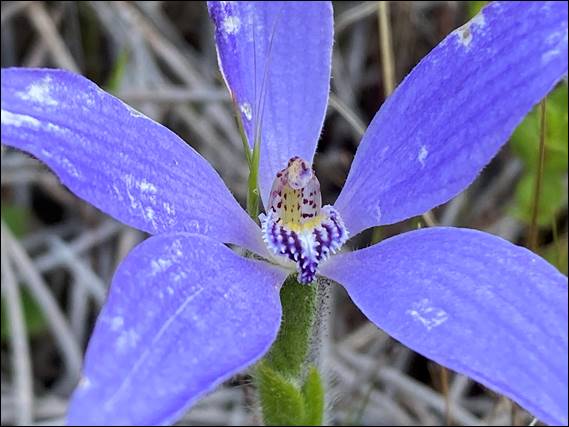
We only spied a couple of Hills White Spider Orchids.  They are also known as the Darling Scarp White Spider Orchid, as they grow in a restricted area mostly on the Darling Scarp near Harvey.  There is however a population that grows near Dunsborough, which is where the greatest concentration of finds have been recorded according to the Atlas of Living Australia.  The Blue China Orchid is yet another widespeard and common species I would expect to find all over the place.  So far this is the only sighting I’ve managed this year, and it was a little tatty:
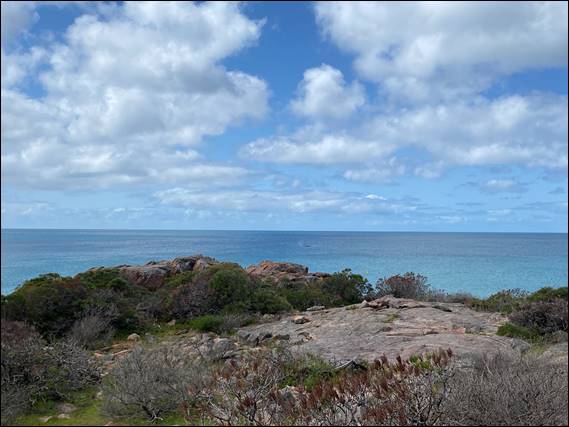
While I was taking images Lisa walked onwards, lunch was calling.  This meant that she missed out on seeing two Humpback Whales (Megaptera novaeangliae) cruise northwards seemingly close to shore when I saw them.  It is however very hard to see the one that has broken the surface and just spouted, above.  Later we both got to see one breach, even if it was quite a long way off by then.  By which time my focus was back on the ground, looking for smaller things.  This included a single Dunsborough Spider Orchid (Caladenia viridescens):
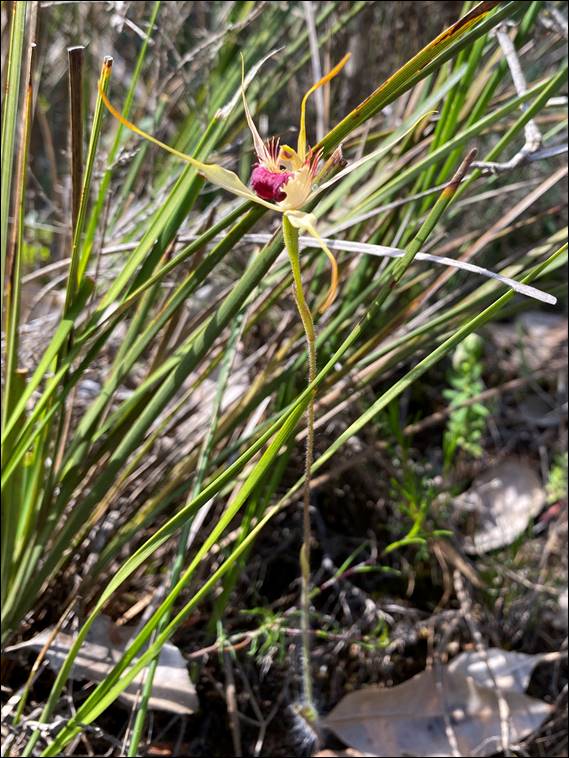
This time, as the name suggests, this spider orchid is only found locally between Yallingup and Busselton in the Jarrah Forest biogeographic region.  While not in the best of conditions it was an exciting find being classified as critically endangered by the Western Australian Government, and listed nationally as endangered under the Environment Protection and Biodiversity Conservation Act 1999.  You may assume right that this was a fist time find for me, as was the below Broad-Lipped Spider Orchid (Caladenia applanata) making for two lucky last finds:
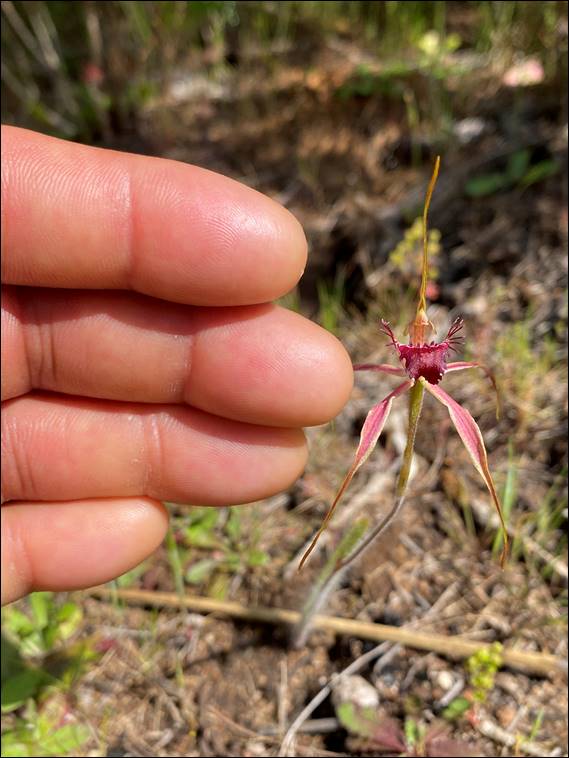
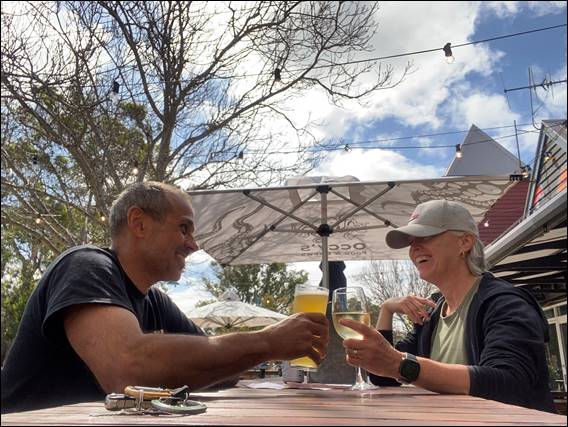
I again I only found a single plant, taking the time to ensure I had enough images to be able to distinguish it from similar species.  Before having to keep moving to catch up with Lisa.  Finally returning back to the car after having walked ten miles in well under four hours, spotted legs eleven orchids species in flower, and taken the time to spot some whales as well as heaps of birds and assorted flowers.  Lunch and a well-deserved drink awaited us in Dunsborough, before driving onto our hotel to continue our short but very lovely and relaxing min-break.  Cheers to that:
Local is best

A lot can happen in a week in the orchid world, so I was very keen to get out and look about as soon as returned from Queensland.  I’ve often heard how people travel from far and wide to experience the ‘big’ months of Western Australia’s South West orchid season, when many species come out.  Something I am lucky to have right on my doorstep.  That’s not to say there aren’t many orchids in other parts of Australia.  There are reported to be some 1,900 species found across the country, a quarter of which can be found in Western Australia:

There is a two volume book for the 461 known orchid species in Western Australia.  This was recently revised and reprinted this year, with a couple of new finds.  Authored by none other than the person who verified my recent find in the Capel Nature Reserve as being a hybrid.  It certainly seems to be big business, but with approx. 30,000 species found worldwide what sets Australian orchids apart?  It may be that most species found outside of Australia are epiphytes, and often found in more tropical environments:

And while I discovered both epiphyte and lithophyte orchid species in my recent trip to Queensland, which happens to have a tropical and subtropical climate, orchids found in Australia are mostly terrestrial.  Furthermore, many of these species will only flower for a short period.  Ranging from days to months, so if you are really keen to see a specific species you need to be committed.  Like my persistence at Wilyabrup this year.  Added to that there are orchids out most of the year, so if you are really keen you can keep searching year round:

However, spring is the time of the year when more species are likely to be seen.  It is however not guaranteed they will come out, seasonal conditions need to be right and can affect whether they flower and then for how long.  Germination is also dependent on fungi for many orchid species, with which they have a symbiotic relationship.  Each species being reliant on very few, and at times only one, fungi species.  With our changing climate, as well as other land use impacts, this fragile environment and the relationships within are at risk:

It was originally though that orchids may have originated from Australia, but the Kew Royal Botanical Garden 2023 State of the World’s Plants and Fungi report, the firth in a series since 2016, has changed that thinking.  I do wonder how they can be sure, but it is now considered that orchids first came from the northern hemisphere round 83 million years ago.  It is suggested that they spread across the globe, with the origins of approx. 60% of the Australian orchids dating back more than 40 million years:

That is in contrast to many of the species across the globe, which have been estimated to have originated more recently in the last 5 million years.  The DNA studies and investigations to inform all this work came from 200 international researchers across 30 countries, is it not likely to be biased.  About 2,500 new plants are discovered each year across the globe, however it is estimated that 45% of all known flowering plant species may be under threat of extinction.  Amongst the most threatened families is the Orchidaceae (orchid) family:

Well that all took a bit of an unintentional dark turn.  And certainly not in keeping with the plethora of colours, shapes, and sizes of orchids I have found during my week back.  I started with a local spot, being the Capel Nature Reserve where I stumbled across two other orchid parties hunting these plants.  Like I said it’s a bit of a hotspot here, and springs time especially brings out like-minded people.  Often willing to share snippets of information about what they have found and where to look for them:

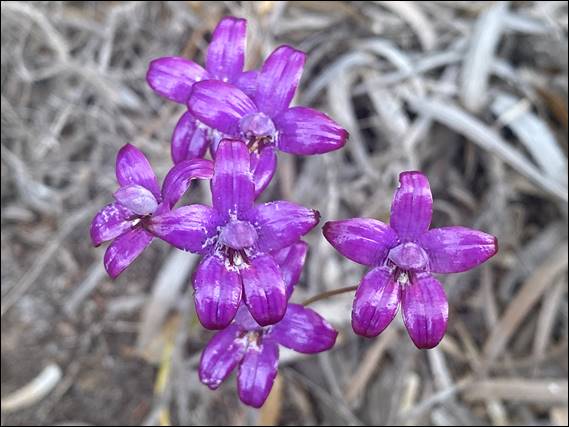
I’ve started this post with a splash of colour, finding a clump of Purple Enamel Orchid (Elythranthera brunonis).  Lisa’s favourite species, and which I usually find one or two plants at most together.  This collection however had four plants, making for a more spectacular image than usual.  I mentioned earlier the occurrence of each species is dependent upon conditions, for both the orchid and related fungi species.  We’ve had a wonky year with a dry start to the year, very wet August, and relatively hot and dry September:

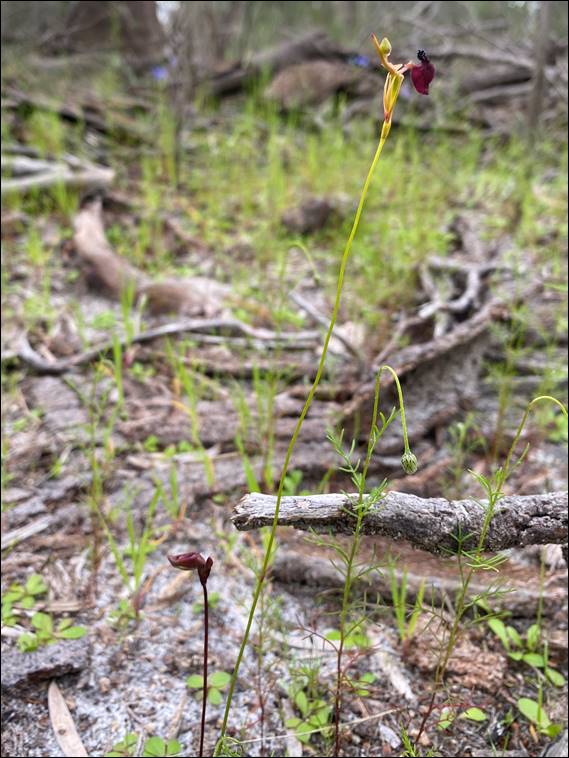
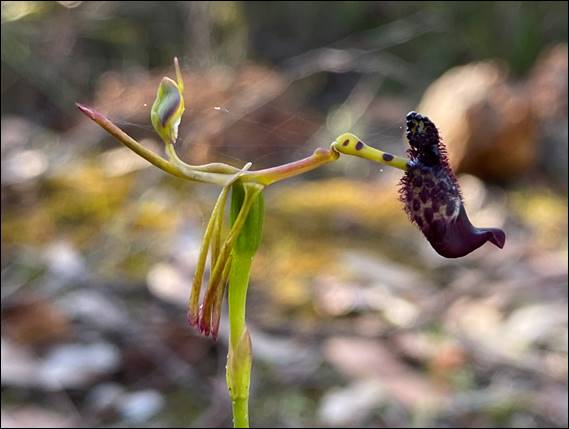
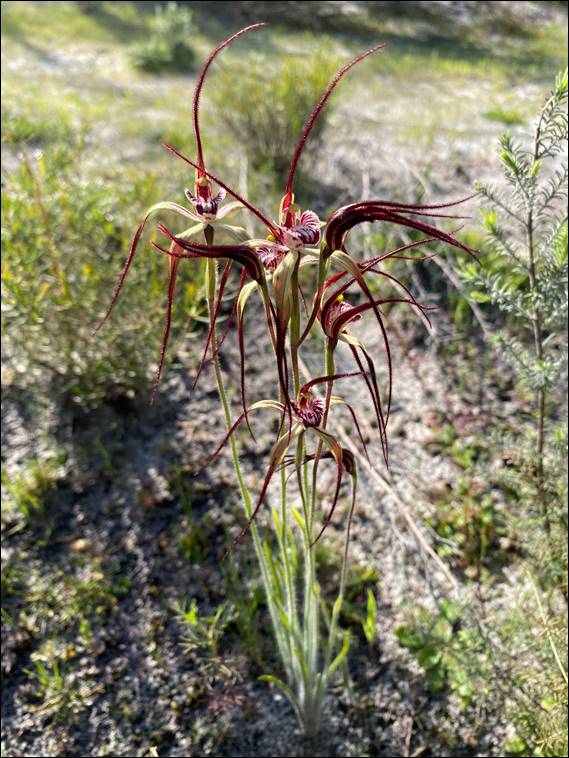
This may be why, unlike at the Ruabon Nature Reserve, the usual abundance of King-in-his-Carriage Orchid (Drakaea glyptodon) and companion Flying Duck Orchid is greatly diminished here.  I only spotted a couple of lonely King-in-his-Carriage Orchids, and one cluster of two Flying Duck Orchid plants.  These are shown in the second image and I believe are the Hort’s Duck Orchid (Paracaleana hortiorum).  Based on the labellum, which resembles the bill, not being humped and having a limited number of calli concentrated towards the end:

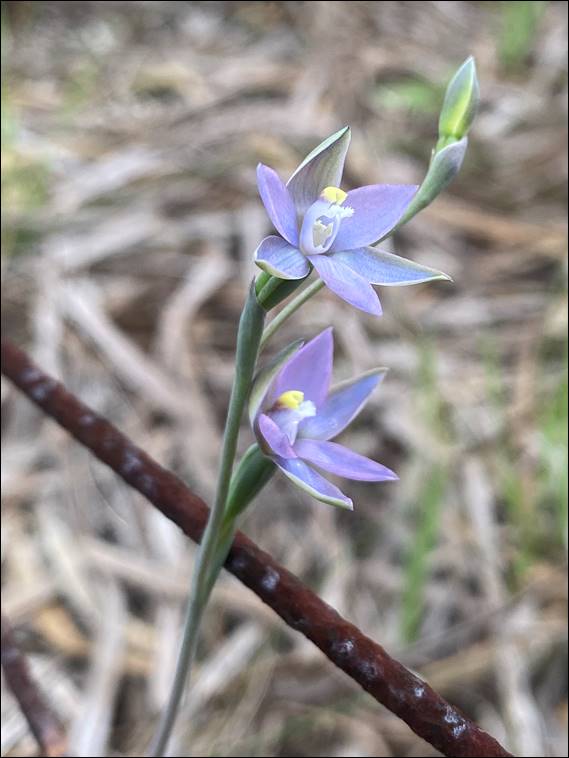
I make this statement about their absence off the back of two visits here, which has included hours of scouring areas I have seen them previously.  I did however come across the Slender Sun Orchid (Thelymitra vulgaris), which I was told about by one of the other parties.  Endemic to the south-west of Western Australia, it has a smaller flower to most sun orchids found locally.  Not to be confused with the most widespread and common orchid species in Australia, the Slender Sun Orchid (Thelymitra pauciflora) that is found everywhere but Western Australia and the Northern Territory:

I was lucky to be out on a relatively hot day when I saw the Slender Sun Orchid, as they only open their flowers on warm days and even then for short periods.  Indeed on my second visit here, which was cloudy, all the flowers were closed up.  It is all about being in the right place and right time, and for orchids also to be looking in the right direction.  This was my first sighting of the Slender Sun Orchid, even if it was an assisted find.  After the first three finds included in this post, all the others from the Capel Nature Reserve are of the Caladenia (spider) genus:

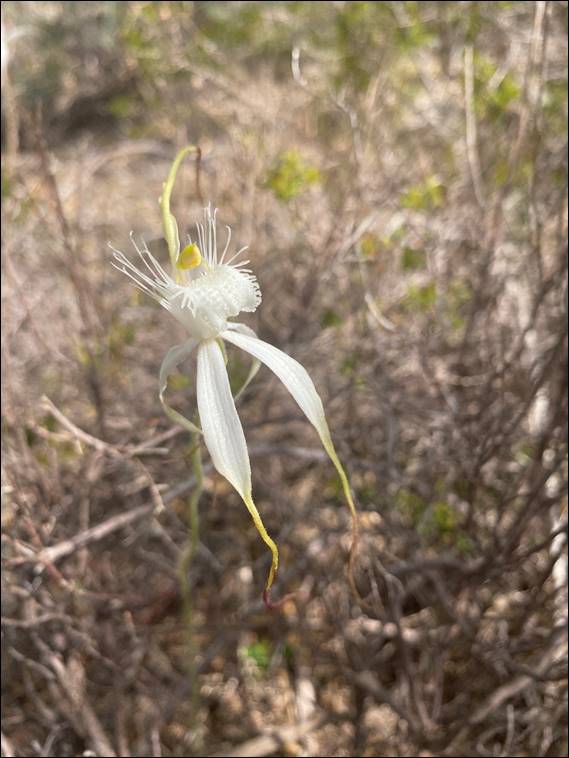
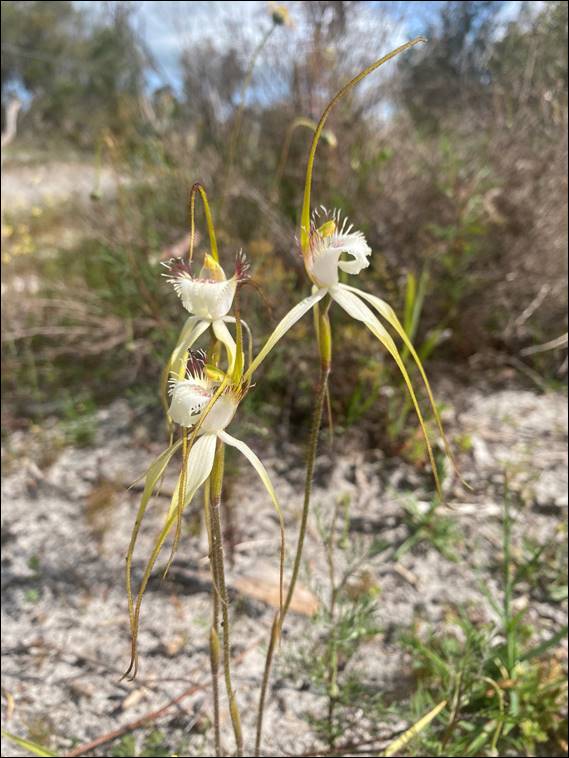
There were so many out including lutea, albino, and hybrid forms, making their identification extremely hard.  There are nine images of them in this post, and I could have added more.  Each has subtle differences, in the fringe lengths and neatness, number of calli, petal and sepal width, length and colour, and the colour of the labellum.  I’m simply not skilled up enough to work it out, so have sent a range of images to one of the authors of my orchid guide for assistance.  For now I’ll have to sit tight and wait to see what I’m told about them:

I can see traits of the King Spider Orchid (Caladenia huegelii), Scott River Spider Orchid (Caladenia thinicola), and Tuart Spider Orchid (Caladenia georgei) in the specimens found with more colour.  The first two of which would be a good find, as they are threatened species.  After such an amazing time at my local spot, I was full of hope and expectation when I went to check out the Ambergate Nature Reserve with Lisa.  It was however a very different story there, and while we did have a few good finds they were few and far between:

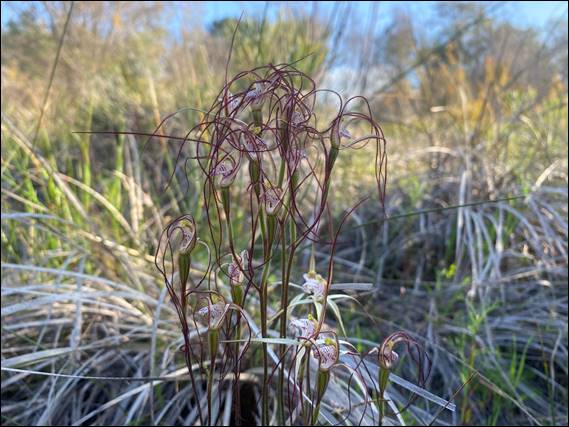
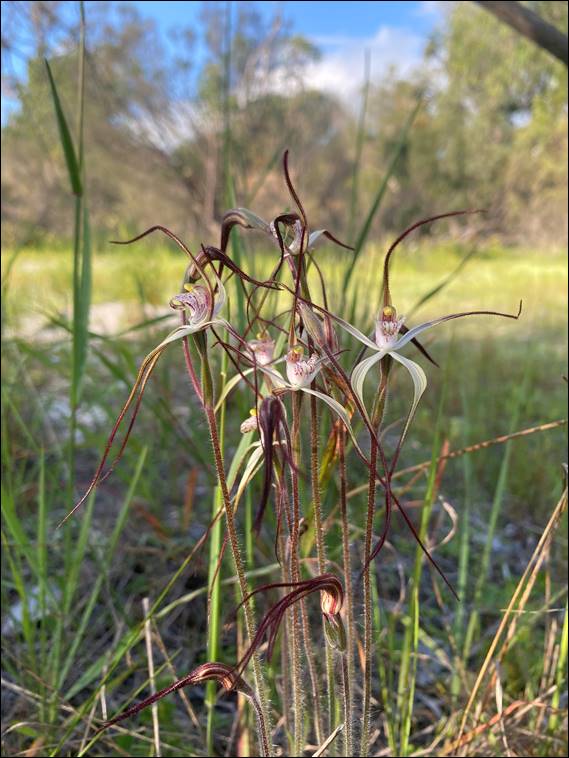
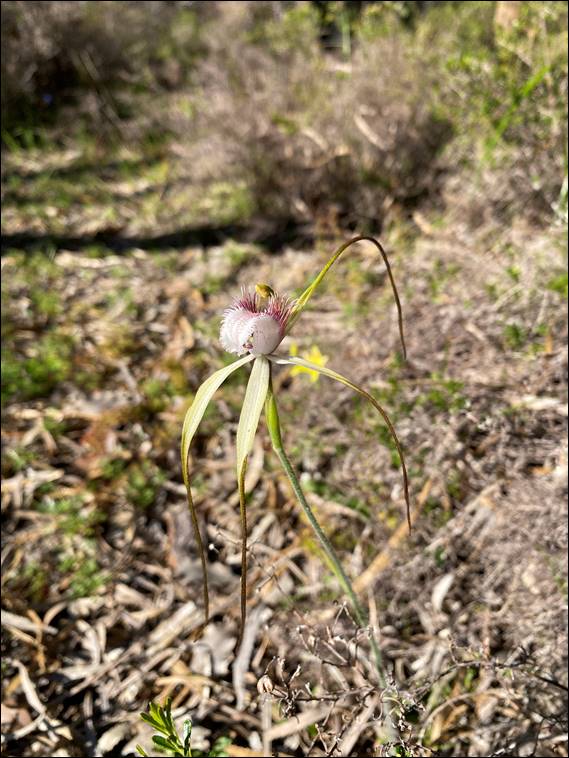
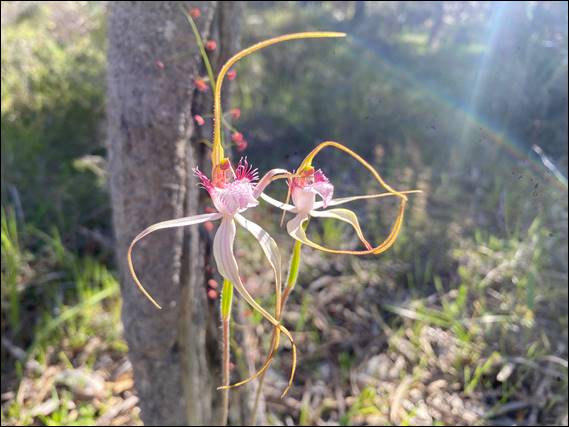
The only species of spider out that we found was the above Swamp Spider Orchid (Caladenia paludosa), of which we found quite a few.  In past seasons this one has come out at the same time as, and in similar numbers to, the Rusty Spider Orchid (Caladenia ferruginea).  We were however unable to locate any of the second species this time.  Below is the only Little Pink Fan Orchid (Caladenia nana subsp. nana) on offer, which was getting close to its maximum plant height of 10cm:

The height being the only physical characteristic to distinguish it from the Pink Fan Orchid (Caladenia nana subsp. unita).  Although this other taller subspecies flowers later, between October and November, and prefers wetter and heavier soils.  The reason for having an image of the above, which I included in a recent post, was that I found the following Cowslip Orchids (Caladenia flava).  Based on the petal and sepal shape this plant looks to have cross bred with the Little Pink Fan Orchid, which is not an uncommon thing to happen:

I had my first day back to work on Thursday, a day I would normally work from home.  But during the school holidays, to provide Lisa with a more relaxed feel at home, I go into the office five days a week.  Seeing I was in Bunbury, after work I decided to have a look at patch of bush on the edge of the highway heading north.  This had a fairly big fire go through it a year or so back, and fire can be another stimulus for orchid activity.  Indeed, a local enthusiast has been suggesting this place could go gangbusters this year:

It was somewhat disappointing, and after forty five minutes I found just one White Spider, a heap of Cowslip Orchids, and the above small cluster of what I believe may be the Common Donkey Orchid (Diuris corymbosa).  There was one more find, and the fire had at least done its magic and brought out a couple of Pyrorchis nigricans.  I’ve known this as a Red Beak Orchid, but in reading up on it they say it is now called a Fire Orchid.  The newly appointed genus Pyrorchis coming from the Greek word pyr and orchis; literally translating to Fire Orchid:

The large fleshy leaves of Fire Orchids can be found in many areas forming large colonies, but most populations will only flower after a hot summer fire.  I have seen just a few plants flower, in the Stirling Ranges. These have been in poor condition, whereas the above specimen is in great condition.  While the area really wasn’t all that good I was happy with this one find.  There was evidence of lots of four wheel driving and fly tipping, and I doubt I’ll go back in a hurry.  Having time up my sleeve I did however pop into Manea Park on the way home:

This was another place that for me seemed a little lean, it is of course possible that I just get to see too much so am a little spoilt.  There was indeed a great variety just not in big numbers, and with quite a few repeat finds including the above Dancing Spider Orchid (Caladenia discoidea).  It is one of the longer flowering species, and the colours have changed since I first saw it a month back, from mostly green to mostly a deep red.  If you are keen to see what I mean check the previous post https://sandbagged.blog/2024/08/29/the-blue-armada/:

While the Red Beak Orchid has had its name changed and is no longer considered a beak orchid, the above is definitely a beak orchid.  The Rattle Beak Orchid (Lyperanthus serratus) is endemic to the south-west of Western Australia, and there is only one other species in the genus.  Being the Brown Beak Orchid (Lyperanthus suaveolens), which is not found here being endemic to the eastern states of Australia.  If you look at the flower shape and configuration, it is easy to see why the Fire Orchid was originally classified as a beak orchid:

There are certainly plenty of similarities.  The genus name for beak orchids means poor or wretched flower, being derived from the Greek words of lypros and Anthos.  I feel this is rather unfair even though the rationale is due to the dull-colours, which the Fire Orchid definitely does not have.  The above orchid is far from dull.  It is one of the thirty eight species of sun orchids found in Western Australia, of which I have seen very few.  The Blue Lady Orchid (Thelymitra crinita) is a seasonal regular and comes out in large numbers:

While I’m delving into ancient Greek, the genus name of Thelymitra is derived from thelys and mitra meaning bishop and headwear or hat respectively.  Hence the name means a bishop’s mitre, referring to the plumed or decorated wings of the columns of many sun orchids.  This species having yellow bristles on the top of the column, and a light purple tuff of filaments on top of the anther.  There were also a few of the above Forest Mantis Orchids (Caladenia attingens subsp. attingens) starting to appear, the only subspecies of three found in this area:

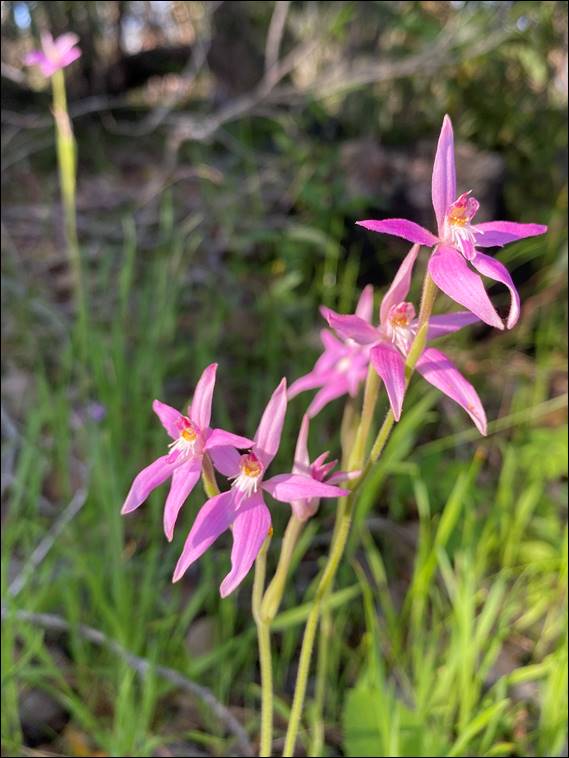
To wrap up this rather long post are the above Common Mignonette Orchid (Microtis media subsp. media) and below Pink Fairies (Caladenia latifolia).  Both starting to make an appearance.  Neither are particularly astonishing discoveries, being regular finds in abundant numbers.  I however wanted to finish the write up, as I had started, with a splash of colour.  I lost count of how many species I found during this week’s wanders, but it was well in excess of twenty.  The Capel Nature Reserve providing the widest diversity, so there could be something in the old shopping adage that local is best:

Part 4 – The final push

Howsie and I decided we would head to completely different location in the morning, and that required an early’ish departure.  But not before we enjoyed breakfast at the campsite, helped break camp, and said goodbye to Rongy and Sarah.  They were heading back to Brisbane, and had work the next day.  Mikie didn’t need to pick the boys up from the grandparents until a little later, allowing him to head back to Eagles Nest to top rope solo a few of the longer lines.  For us it was a short hour drive to the top of Ocean Vista Drive:

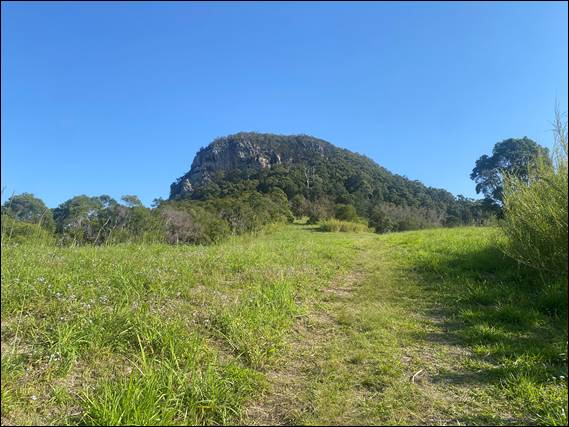
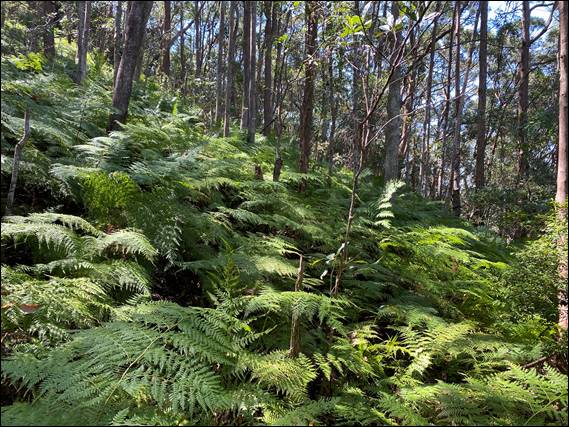
This road snakes up the hill towards Mount Ninderry, from where views stretched all the way to the coast.  The houses on either side of this ridge were big and looked incredibly expensive.  Our sights however were not set on them, but the steep limestone cliffs that hung off the peak that lay ahead.  Mount Ninderry is located in a 150 hectare nature reserve, and once we hit the tree canopy the place took on a tropical feel.  Ferns stretched across the understorey, tall lush trees rose up, and vines hung down.  As we walked there was a rustle:

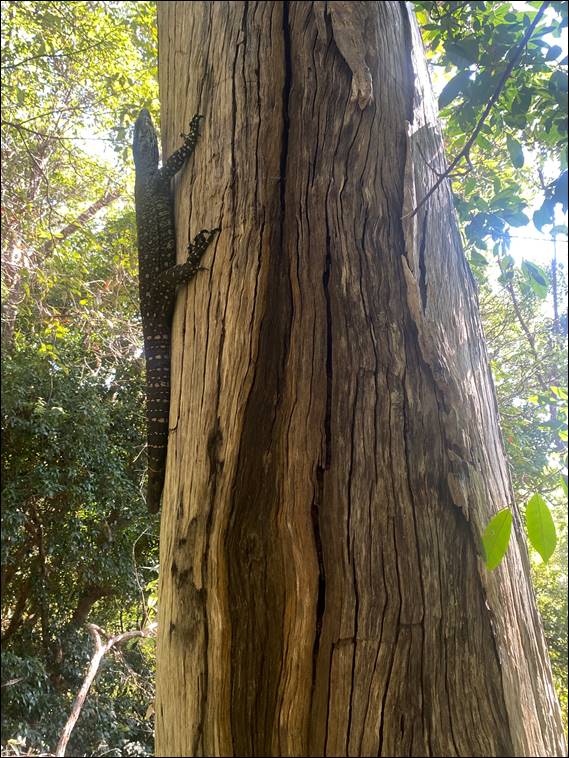
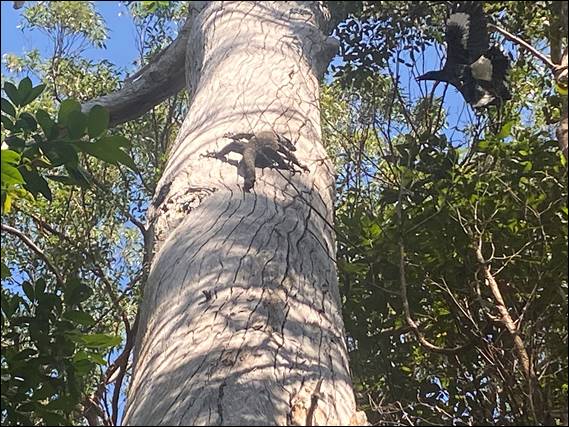
A large Lace Monitor (Varanus varius) made its way through the vegetation appearing and disappearing out of sight, and then going silent.  We thought we had lost it, when Howsie spotted it making its way up a tree.  Another name that is used for them is a Tree Goanna, and while on occasion they forage on the ground they mainly move about in the trees and shelter in tree hollows.  This one certainly looked very at home easily walking up the vertical trunk, but as it went higher an Australian Magpie (Gymnorhina tibicen) started to swoop it:

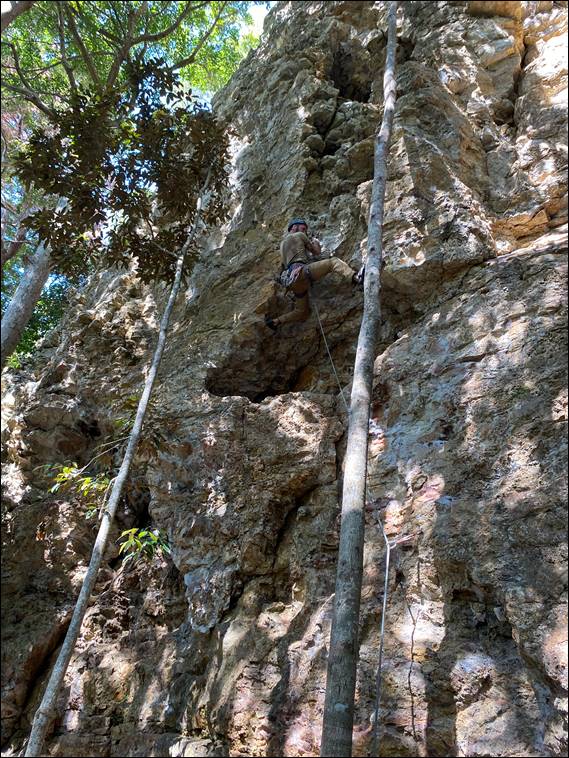
We left the two to argue it out, and carried on towards the Octopuses Garden.  A place the two climbers who hadn’t thought so highly of Eagles Nest had suggested.  This was in part because we asked them about places that were in shade all day, but they also suggested a route here that they considered worthy.  The reason for wanting shade is that today was going to be hot, we would break the thirty degree barrier.  And despite the wonderful shade, the air hung heavy.  The humidity was up at 95% and we were already dripping with sweat:
The route they had suggested did indeed look fun, and Howsie was keen to jump on it.  The conditions and last six days of climbing took their toll, and we climbed slowly.  The moves felt hard but we pulled through them one by one.  Looking for any chance to get a stance and rest where we could.  We both got a clean lead and thoroughly enjoying the route.  I had also spied the namesake climb, a classic route according to the guidebook but only gaining two stars on The Crag.  A full on roof climb that came out from a cave onto a steep headwall:

I was really keen to try it, but wanted to see how I was feeling.  If I failed on the roof it would have been really difficult to retrieve the gear, and the only sensible way to clean the line would be to climb it on second.  As such we both needed to feel comfortable in getting up it.  That is partly why I pulled the rope on the first climb, and that lead was enough to tell me that taking on a route three grades harder on much steeper terrain was probably dumb.  Howsie agreed, already being satisfied with his first lead and the crag booty he found on it:
An extender, like my crag booty in near new condition.  And with not another soul in sight it was his for the taking.  We checked the area for other possible routes but everything else was harder or looked average.  So we packed up and wandered round to the Enter the Ninja Sector, timing it well because the sun was just moving round enough for the mighty wall to be in shade.  We had our eye on two lines up this near 30m wall.  Starting on the lower graded route of the two, to see how we went on the more technical slabby climbing on offer:
We again pulled the rope and both led the first route, which was great fun.  And it was then that I wished I still had that stick clip, as the first bolt on the second line was a dizzying eight meters up with a nasty ground landing waiting below.  We were lucky and were able to sensibly clip the first bolt when we rapped off the first line.  The route really kept us focused, the bolts being a bit more spaced with some delicate and airy climbing between them.  On the plus side being out of the tree canopy there was a slight breeze that helped cool down:

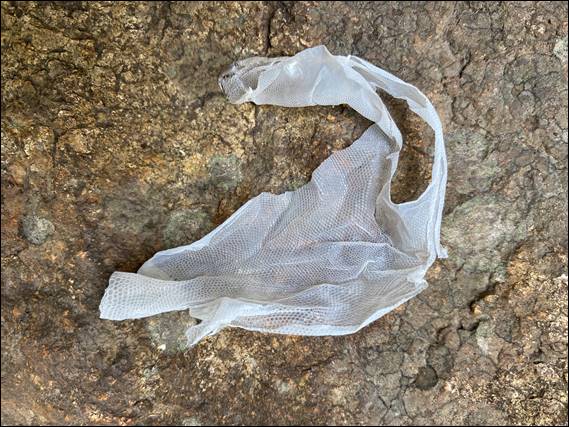
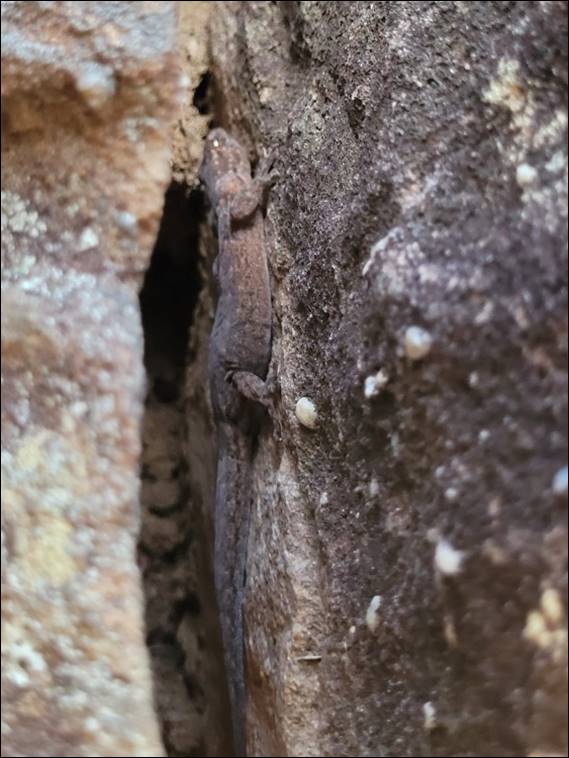
It was an epic route and very worthwhile, and I also found a Dubious Dtella (Gehyra dubia) high up on the face with the below skin it had recently shed.  We were however now both really tired, so I am not sure why I suggested we look for one last climb, but I did.  We walked round the tracks looking for a line of ring bolts on a lonely pillar.  Back under the canopy it felt hot again and we sweated our way round.  Just as I was about to say let’s give up, Howsie said he found it.  My response wasn’t very enthusiastic, but it had sounded a good route:

Seeing I had suggested it, I should at least give it a go.  I only managed to get to the second bolt and then simply couldn’t read the route and/or didn’t have the gas left in the tank to pull the moves.  I looked down at Howsie, and he didn’t seem overly keen to try it.  The decision was made.  We packed up, walked back down through the fern covered slopes, across the thankfully short paddock section in the blazing sun, and once back at the car we cranked the air conditioner to its coldest setting and sank into the seats:

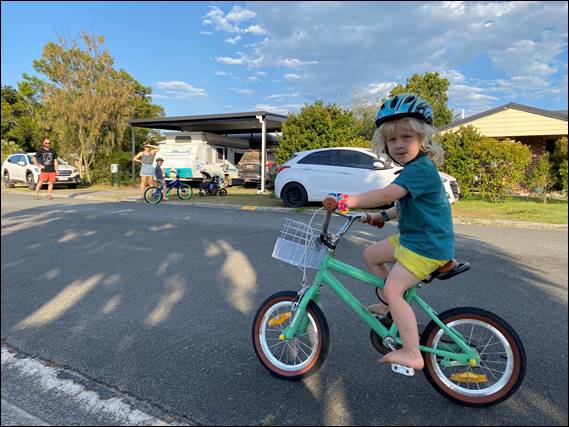
While we may have only got three routes in, it was definitely worth the short diversion of the highway to experience the place.  And should I be lucky enough to have another climbing trip here, I’ll be sure to get back at the Octopuses Garden for that amazing looking roof climb.  For now however we drove the hour back to Mikie and Helen’s house, where we sorted through the gear and got cleaned up.  The idea being to shout everyone a meal out, but before we could do that Bryn wanted to show us that he could ride his bike without training wheels:

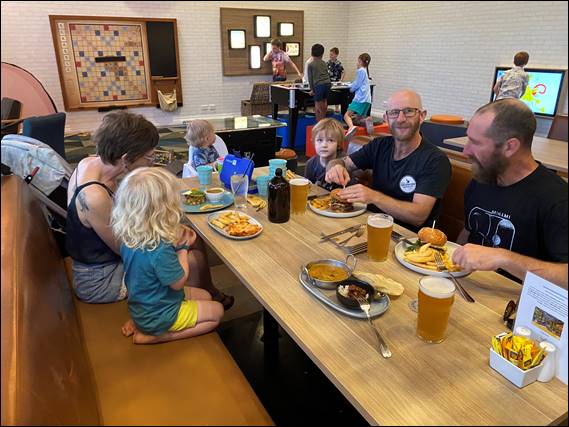
Then with training wheels back on he and Rupert rode their bikes ahead of us, as the four of us walked down the road with Maggie in the pram.  We went to the RSL club, which was huge and looked to boast a good menu.  First priority however was to get a drink in, and even I got a pint feeling like this one was deserved.  Everyone’s meal was really yummy, and we washed it down with a second round.  Even I had another pint, as the first one had gone down so well.  Managing to also sneak in a takeaway collection of desserts, for the grownups only:

It was a lovely way to wrap up the last seven days.  And while our flight home wasn’t until Saturday evening, Howsie and I were content not to head out for a final climb in the morning.  There was plenty of time, but the heat and humidity was up and we were pretty toasted from everything we had packed in.  For the real nerds I’ve even added a few stats of what we achieved climbing wise, and it isn’t too shabby a list.  So Saturday morning saw everyone wake up at the usual time, except Howsie who enjoyed a well-deserved lie in:

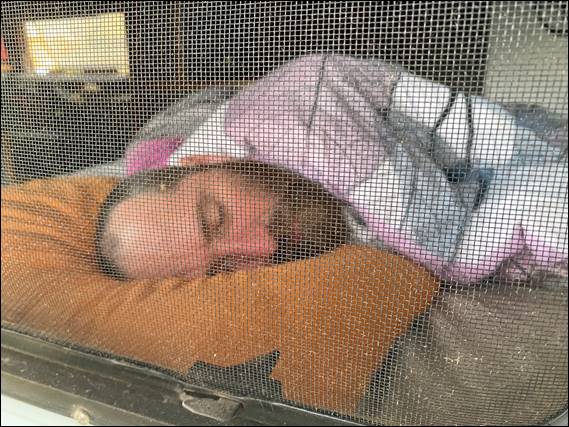
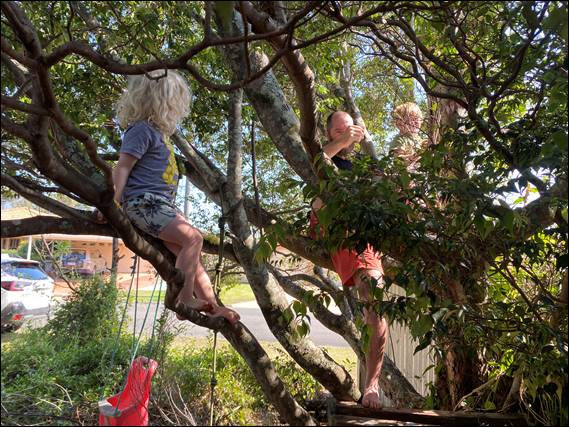
That was until the boys wanted him to catch up on all the bedtime stories they had missed out on, while we were away camping.  This started in the caravan and then moved the tree house, and by mid-morning we all headed out to have a wander round the Bribie Island Bicentennial Trails.  This just so happened to be next to the Community Arts Centre, which had a pottery exhibition that Helen was keen to check out.  While it is called Bribie Island, looking at a map it is not your typical island:

It is described as a sand island, being split from the mainland by Pumicestone Passage.  The passage is a shallow and narrow estuary in which the two meter tide creates a series of channels and sand banks.  As such it is only accessible by one bridge, and in the wider and deeper parts of the passage where the bridge is located you may be lucky enough to spot dugongs and turtles.  However, each time we drove over the bridge we would look up at the light poles.  These are fitted with a false lights on one side to provide the pelicans a roosting spot:
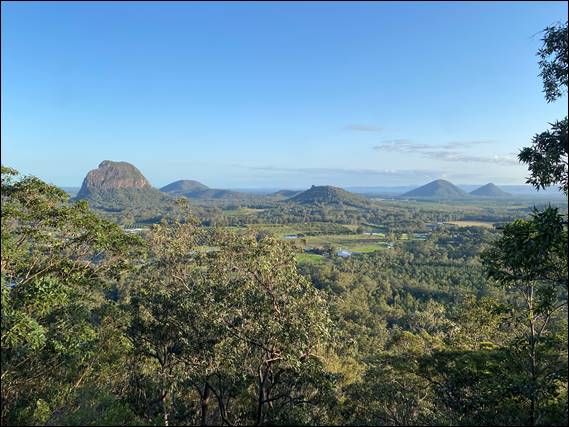
Despite not being an island in the sense most would think, it is a lovely place comprising mostly state forest edged with lovely beaches.  And as we found out on this trip, having good access to plenty of amazing climbing spots.  The only downside, from a climbers perspective, being that for quite a long period the climate is not conducive to being out on rock.  This time however we managed to score a great week, and our climbing cup was well and truly filled.  A very big thank you to Mikie and Helen for accommodating us and also Rongy and Sarah for tagging along:
Route summary

Fri 20 Sep – Mount Ninderry
The Octopuses Garden
Lava Tube 18** 17m Krish
Enter the Ninja Sector
Neo Nasi Goreng 18** 25m Krish
Enter the Ninja 19** 26m Krish
Ocean Vista Area
The Big Boss 19* 12m Krish (attempt)

The final stats
Days climbing 7
No. routes 51
No. pitches 64
Total length 1,398m
Average grade 17

Part 3 – The big days

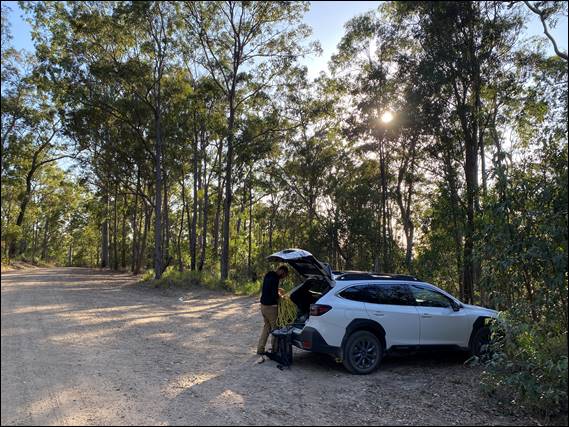
It felt like a normal climbing day on Wednesday, when Howsie and I were up in darkness and snuck out before anyone was up.  We had a two hour trip ahead of us, and were aiming to be on the rock at 7am.  The changed approach was a reflection of the temperatures creeping into the high twenties, and wanting to make the most of the cooler mornings.  We drove to the Brooyar State Forest, a place that is described as a quiet getaway camping experience nestled in an area that features sandstone cliffs and scenic forests:

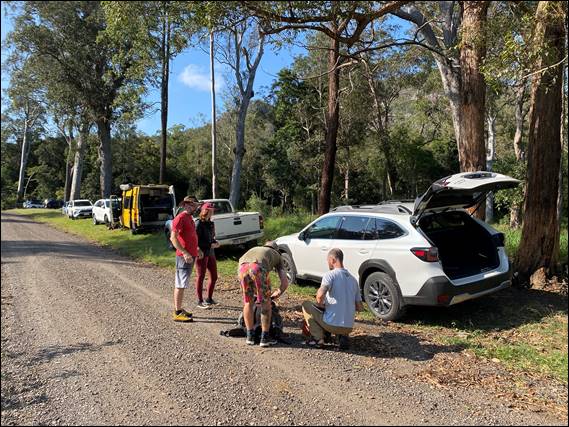
Mikie would follow later, Rupert and Bryn were having a few days at the grandparents so he would drop them off at their house at a more reasonable hour.  Then continue the journey with the caravan in tow, so we would be glamping as opposed to camping.  Hoping for that ‘quiet getaway’ experience, as we had heard it could get a bit rowdy when the trail bike rider groups descended on the area.  They generally only go here on weekends, so we felt we should be safe.  We arrived at seven and for now it was just the two of us:

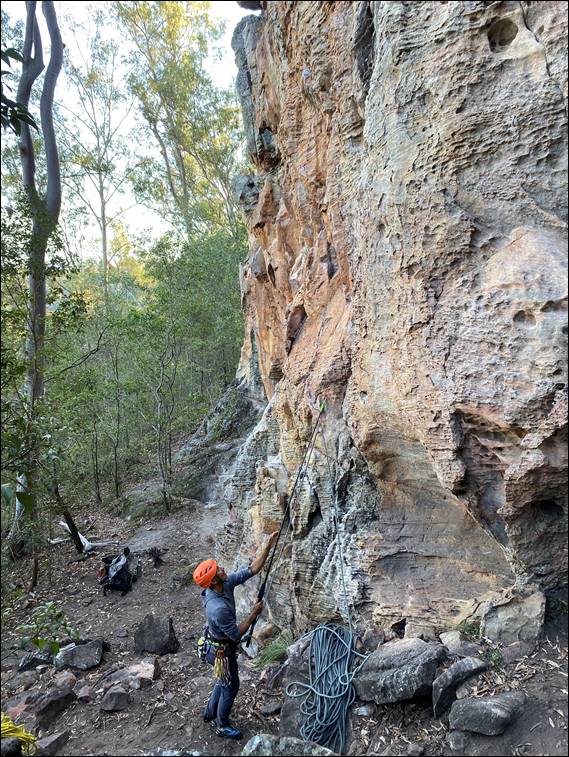
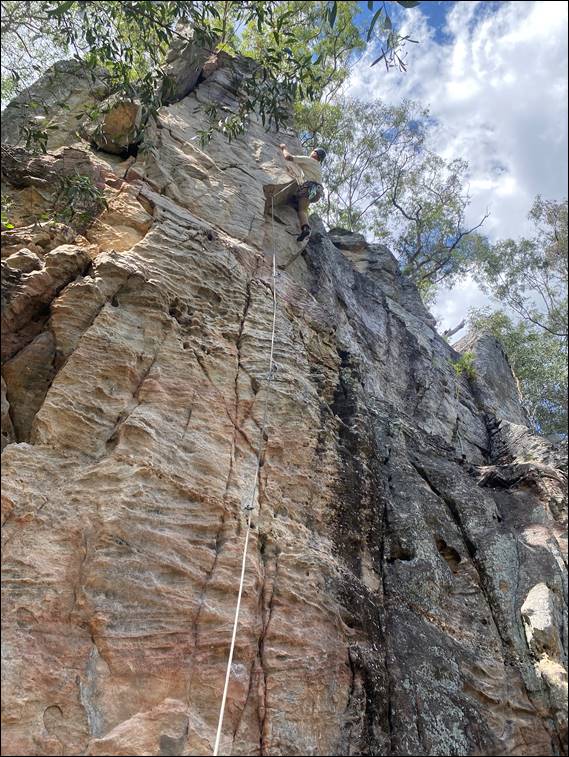
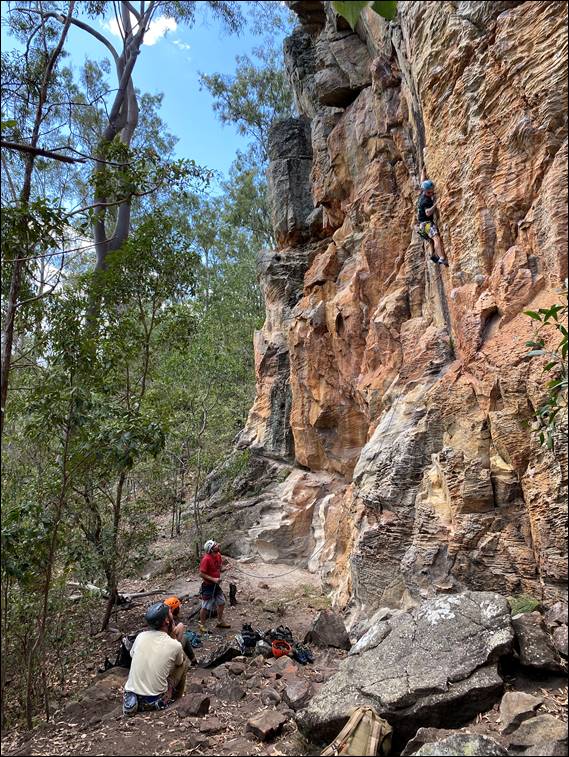
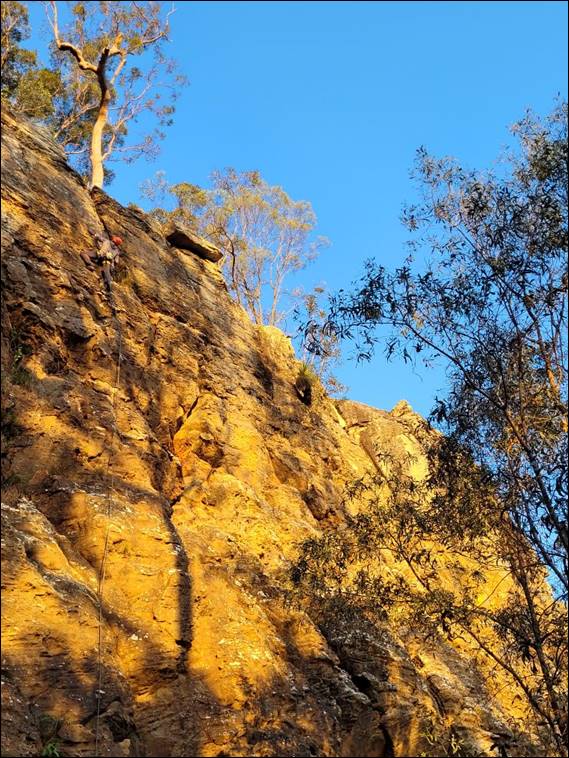
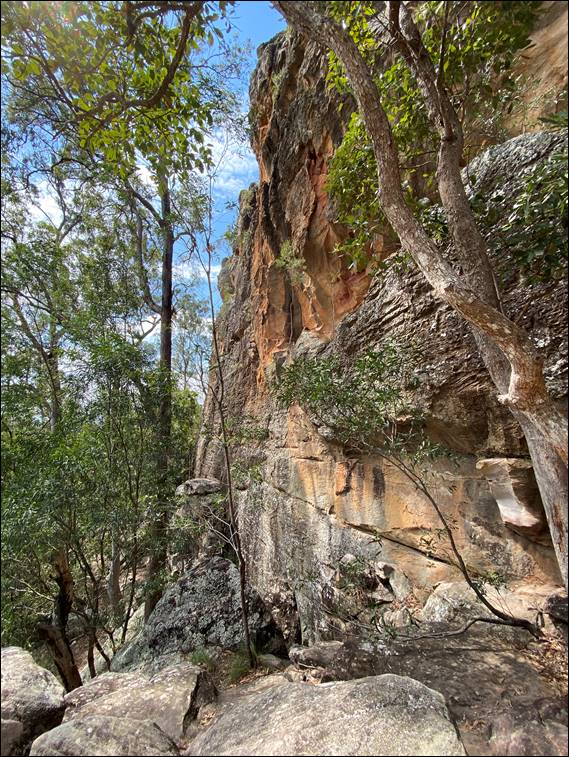
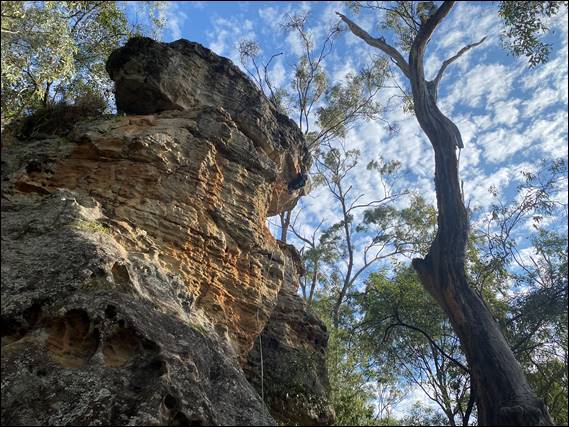
The climbing is on a bunch of scattered crags, most of which sit on the west and south side of a ridgeline that runs through the park.  They range in height from ten to forty meters in height, so there were some reasonable length routes to bag.  On advice from Mikie we picked Black Stump Buttress for our first area to visit, and being west facing it held shade till midday.  There were only two lines at this area that Howsie and I really wanted to climb, but we started on some easier stuff to get a feel for the rock and style:

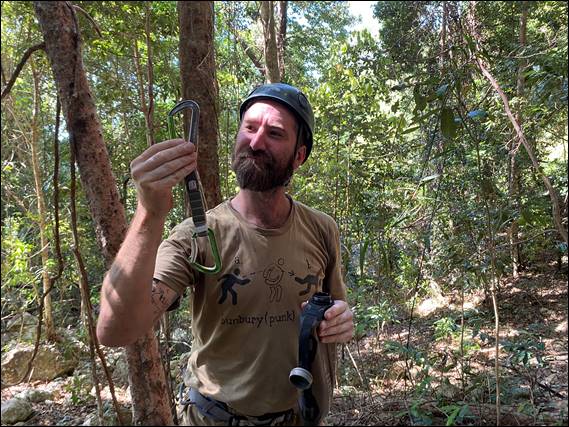
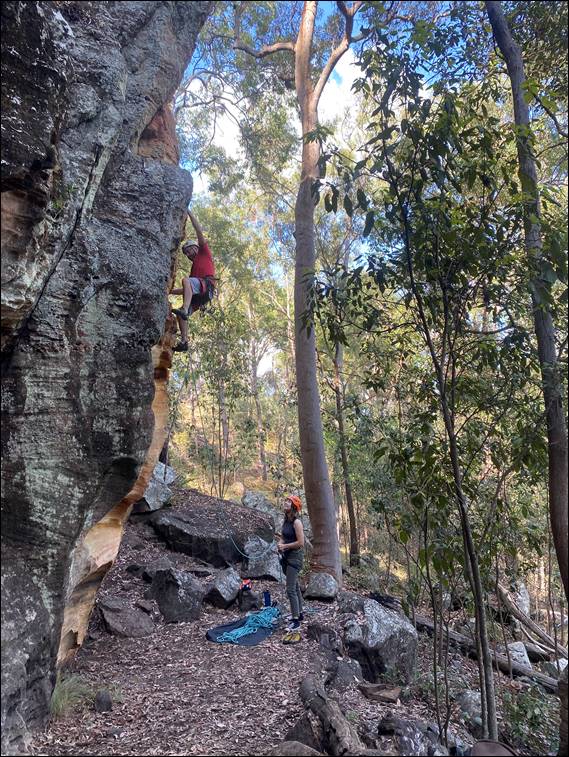
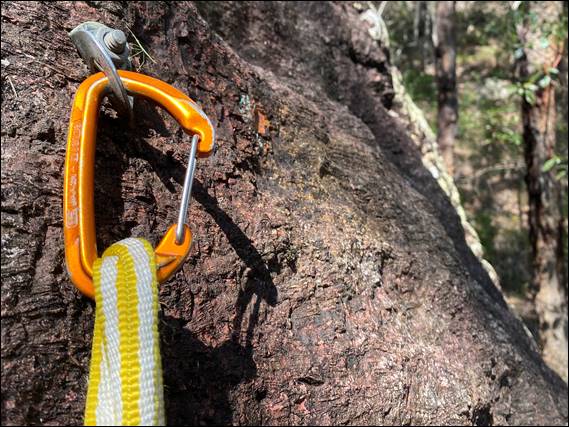
I forgot to mention that as Rongy and I rapped down, after our second big multi-pitch route I spied an extender in a bush.  It must have been dropped by a previous party, and was near new.  Today my crag booty collection during the trip extended further when I spotted a stick clip.  This is a device to allow you to clip the first bolt of a sport route from the ground, and I’m using it in the second image.  Just for fun more than necessity, as this is not a piece of equipment that I would ever consider buying:

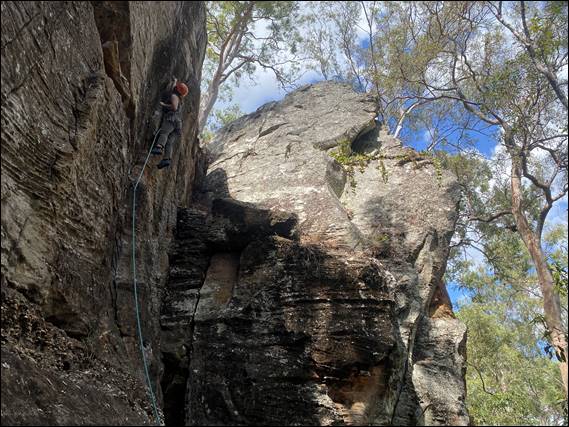
As you may have guessed by now this is a bolted sports crag.  There are a few trad lines hidden amongst the bolts and some routes are mixed, but for the most part it is all bolts.  This didn’t detract from the very good climbing, and sandstone can have some very interesting and unlikely features adding to the fun of the place.  We’d already snagged three lines, by the time Rongy and Sarah joined us.  Shortly after their arrival I lost my crag booty, when two other climbers came along looking for a stick clip they had misplaced just yesterday:

Mikie joined us by mid-morning, and we worked our way back and forth along the crag jumping on lines that looked fun.  This included a grade 24, just because it is 2024 and Howsie had to attempt at least one.  It was thin, technical, sequencey, and sustained, and no one got it.  There was no point in projecting one hard route, when there were plenty of great routes to climb so we kept moving.  Also the sandstone rock was the coarsest rock we had climbed on so far, and there was a risk our finger tips could be quickly worn down on such a route:

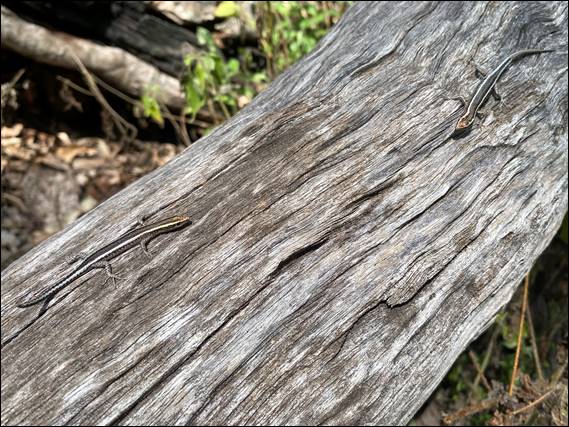
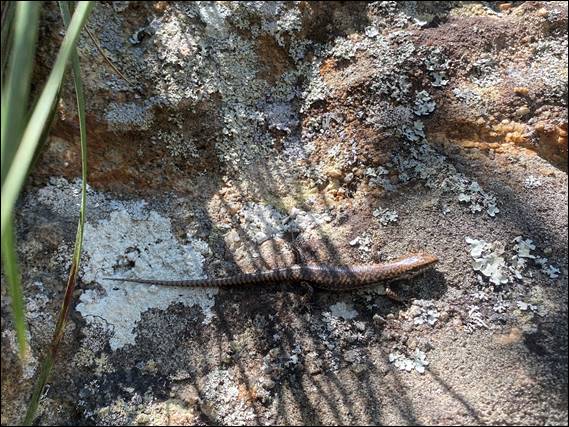
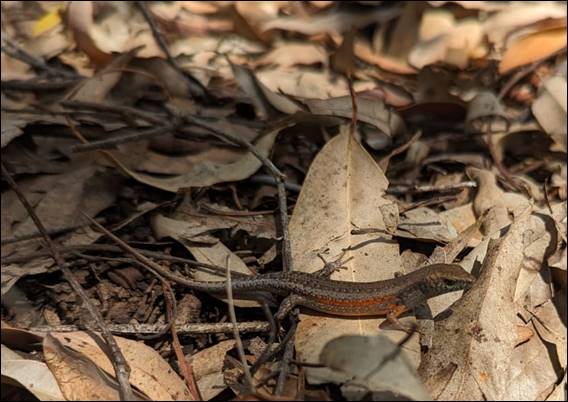
As the morning wore on the sun crept round, and this brought out the skinks.  The timing was good, as Sarah doesn’t climb as much and this left the four of us to pick the lines off while she indulged in herpetology.  Letting us know when she spotted a cool find so we could have a look.  Two images up there are two Southeastern Morethia Skinks (Morethia boulengeri) facing each other of.  This is a common species found over a large area and living in a wide range of habitats.  Population densities can be as much as several hundred in one hectare:

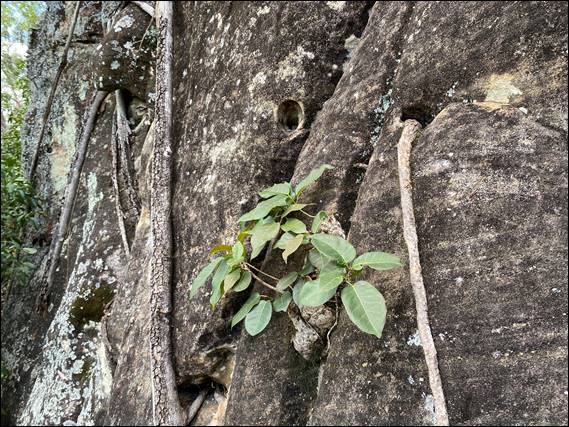
The above is a Dark Barsided Skink (Concinnia martini).  A species with a more confined range of south east Queensland and northern New South Wales.  Sarah also noticed something I missed, a climb that was called Orchid Lane.  So while Rongy and Mikie kept picking off lines Howsie and I had bagged before their arrival, we wandered over to check out the climb.  The rock here was darker, more rounded, and had interesting pockets.  It also had a tree growing half way up the face with roots draping down the rock that seemed to disappear into the rock

It simply had to be climbed, and the rock features were so fun that we did two routes.  We even got Sarah on lead.  Everyone was getting their monthly, if not greater, climbing quota in.  Being relatively short walls with bolts, we were able to rack up a lot of lines.  Eventually however our stomachs were telling us we should get some lunch, but only after one last climb. A very fun route called Hand in the Honeypot.  An apt name as we were feeling pretty lucky being out climbing, just as Pooh Bear would be to have his hand in that honey pot:

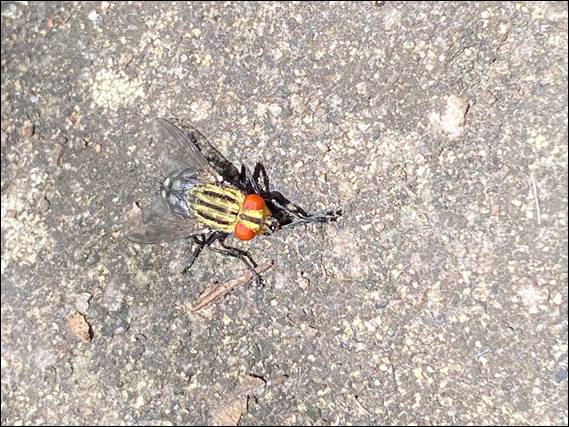
The area certainly was a great playground, and other than the two people who had come back to find their stick clip we didn’t see anyone else climbing in our two days here.  We had done pretty well to keep going but it was getting on now, being close to two.  And as the route tally at the end of the post shows we hadn’t dilly-dallied about.  I do not recall a climb that we didn’t enjoy, and each one seemed to have something a little different about it.  Just before we left this Yellow Flesh Fly (Sarcophaga bidentate) braved landing on my foot:

There were of course flies about, but this was the only Yellow Flesh Fly I spotted.  These produce live young, being viviparous, birthing their maggots directly on a food source.  This may comprise rotting vegetation, carrion, and/or decomposing organic matter, but not a live foot such as mine.  Amongst the other flies about were the dreaded March Flies of the Tabanidae family.  These use their proboscis to pierce through the skin and suck out blood, which the females require to produce eggs.  Fortunately they were not out in great numbers:

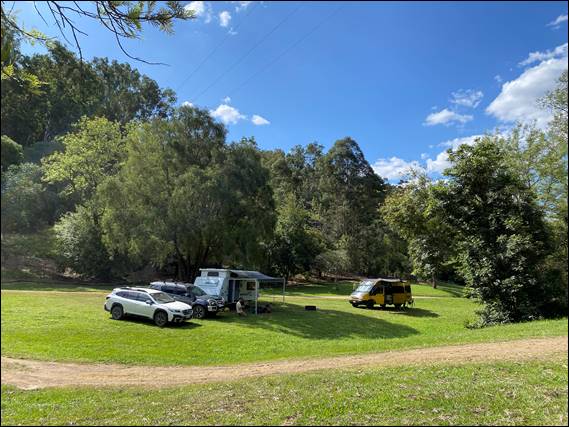
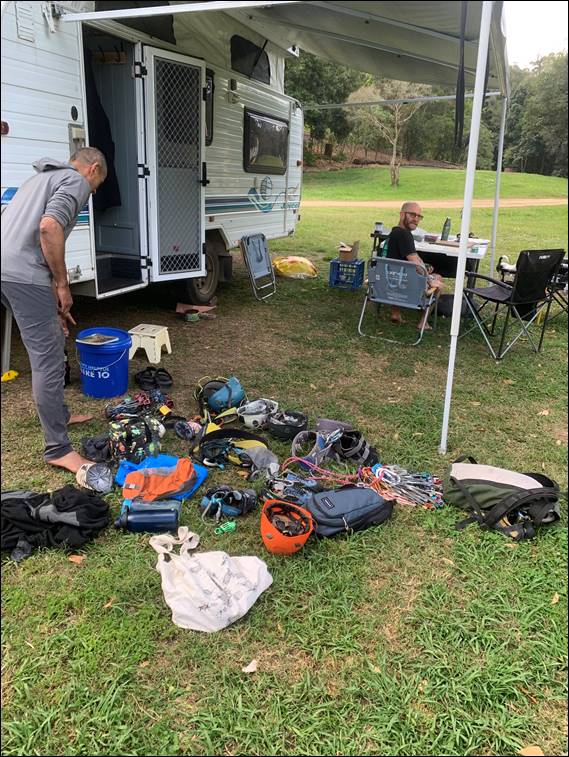
Our lunch was much more pleasant.  The kettle went on and wraps were prepared, while the gear was sorted on the grass.  We had every intention of getting back out, but first needed to build up our energy reserves.  Mikie had found a great spot with a shady tree to provide additional shelter from the sun.  Here we were content to sit and relax, waiting for the heat of the day to pass us by.  Supping on several more cups of tea while contemplating where to head next and browsing the guidebook, as we didn’t really have pre-set a game plan:

We chose Pure Point.  There was a classic line that Rongy was keen to see and maybe try, and there was also a classic route for Sarah to lead in a very unlikely position.  This one started from a hanging belay approx. ten meters above the ground and followed a very cool arête.  This meant we needed to take the rap line in to access the route.  Carrying the extra rope in was no problem.  All the areas seemed to be right next to the parking areas.  The longest walk-in was a few minutes, making it a very accessible place to climb:

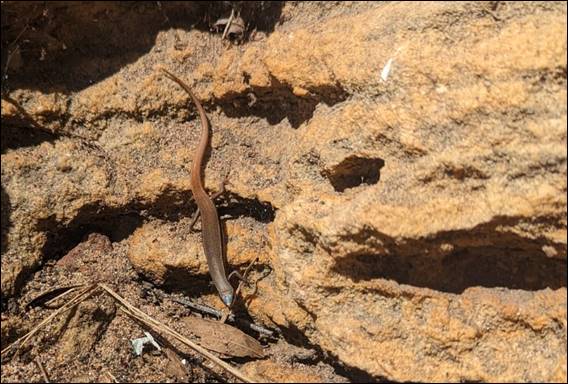
Rongy decided against his line, but Sarah went for hers and I have to say did very well.  After that lead, she was however happy to go back to looking about finding a few Elegant Rainbow Skinks (Carlia decora), as above.  This species has an even narrower range than the previous ones mentioned, being along the eastern side of Queensland but only as far north as Cairns.  I had my eye on two lines just because of their breakfast orientated names, struggling to decide which one to try first Mikie suggested I go for the breakfast I was more likely to enjoy:

It was a good way to stop me procrastinating, and both lines were great fun.  I also managed to find a couple of Dubious Dtella (Gehyra dubia) in the final crack on the second route.  It was a good job Sarah was about to identify our reptile finds, as this one is a crafty fella.  It can change in appearance both to avoid predators but also to deceive its prey.  They can change from a darker to lighter colour, and are also able to lose the spots that are normally along their back.  While we got images of our reptilian finds, very few images were taken of the climbs:

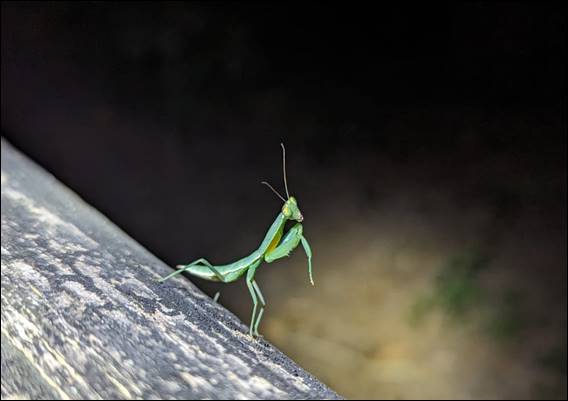
We used all the daylight available and then went back to the camp.  While the days were warming up the nights were a little cooler.  Not so cold as to really need a fire, but it was very cosy and did help to keep the mosquitoes at bay.  I was really expecting Sarah and Rongy to go for a walk to look for snakes, but it didn’t happen.  She did however spot the above False Garden Mantid (Pseudomantis albofimbriata).  Being one of the smaller species of Praying Mantids species found in Australia, only growing to just over a couple of inches in length:

After our early start had worked so well yesterday, we agreed on the same time again.  Heading to an area Howsie had been too, but Mikie had not.  Eagles Nest has the longest routes in the park, and I was keen to bag as many of them as possible.  But before we got to them we jumped on a couple of shorter and quality warm up routes.  We didn’t bother pulling the rope on every climb to allow everyone to lead every line, instead focusing on getting the routes in.  At the top of the first one Howsie spotted something he thought I may like:

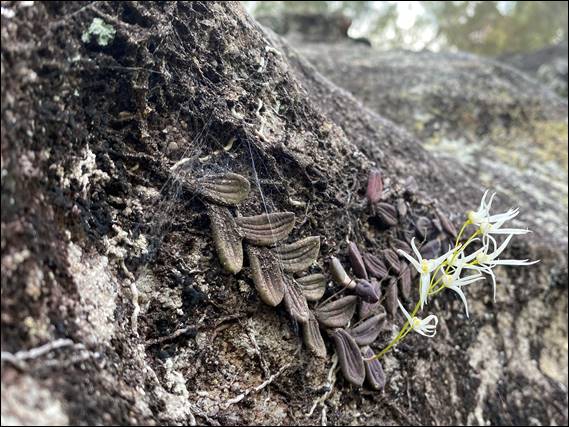
And he was right.  Another lithophyte orchid, this one being the Tongue Orchid (Dockrillia linguiformis).  This species is found in New South Wales and Queensland and is also known to be an epiphyte orchid and can be found growing on both rocks and trees.  The Latin words lingua and forma meaning tongue and shape, referring to the leaves as opposed to the flower.  And now that we had spotted this one, we spied quite a few more of them scattered round this particular rock outcrop.  This was the last species we managed to find in flower:

The pace of the morning was not so much fast, but it was unrelenting.  I did wonder if Howsie would survive each time I encouraged him to jump on the next, and then next line.  We climbed quite a few of the forty meter plus lines, and quite a few of them had relatively steep sections.  It is hard to pick the standouts and going through the online route database, The Crag, just about every route we did had a star or two.  Interestingly the climbs given three stars in the physical guidebook had been knocked down to two stars, which did surprise me:

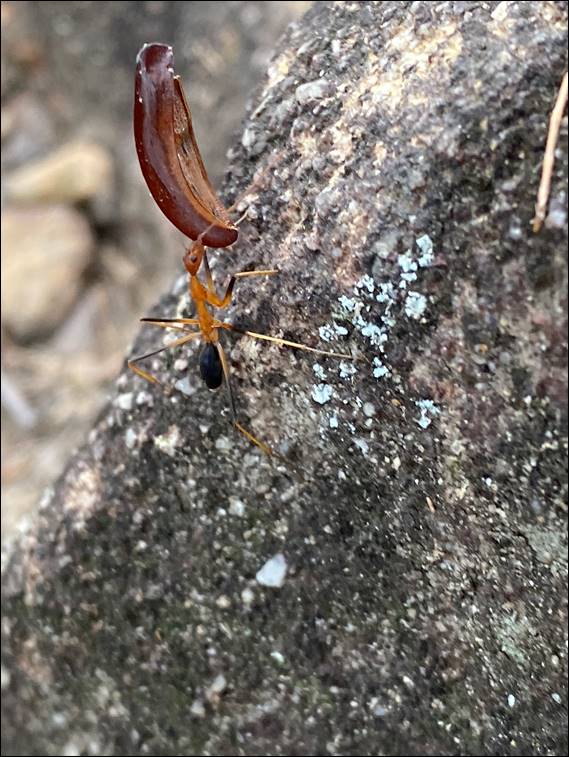
But before I attempt to detail the doozy routes, I have to introduce the Red Spider Ant (Leptomyrmex rufipes).  Of all the Leptomyrmex species this one has the widest range, from the base of the Cape York Peninsula to the southern border of Queensland.  What caught our attention about this particular ant was the away the abdomen would be pointed upwards when we got to close.  They were also fast moving, their speed aided by the long legs, and never seemed to sit still.  It took a lot of images to get one that was clear enough to include:

We also didn’t really sit still, resulting in me taking even less climbing images than I had yesterday.  Of the climbs I really liked Miss Kandy Kane, which followed a very cool flake line and was trickier than I expected.  The other two that really struck me was Looking for the Sun, for which we had to pull out the trad rack.  It did have a couple of bolts, only one of which seemed essential.  The climbing was however superlative and engaging all the way up, and I do not understand why the general consensus on The Crag to is knock a star of it:

The other one very worthy of a mention, in my opinion, is Free Range Heggs.  I encouraged Howsie to jump on this one towards the end of the morning.  He was looking weary and unsure, and kept looking up at the steep and exposed pathway.  I am so please he went for it, and he was super chuffed to have bagged the lead.  But you should not always trust what other people think, if we had we may not have come to this area at all.  The people we had met yesterday said they didn’t rate the climbs at Eagles Nest, we however did:

It was back to the camp for lunch, at a slightly earlier time than yesterday.  More wraps and cups of tea were needed.  While it was a bit hotter today, we were lucky to have a bit of high cloud about to take the bite out of the direct sun.  This did however bring more moisture in, resulting in the humidity also creeping upwards.  We were really unsure of where to go for the afternoon session, and ended up picking a place on the basis that we could probably clean it up plus it had a fun mini roof climb to keep us honest:

I also liked the name of Hammerhead Rock, and it was a good choice.  Again just a minute or two walk in, and then Mikie and I went for the glory route straight of the bat.  The sun was back out and stung, so we figured we were better off getting the harder route under our belt first.  After our lunch break the body was feeling a little lethargic and stiff, although with each climb we did we limbered up and got into a routine.  Unlike the morning on the longer routes, this time we did pull the rope every time so we both led every climb:

Yesterday we were still climbing as the sun was setting, and it seemed that once that had happened darkness fell quite quickly afterwards.  Today we timed things a bit better, achieving what we came for in daylight.  Mikie and I finished on the lowest graded route, and both felt the top was poorly bolted.  Providing the potential for a nasty fall when clipping the anchors.  Maybe our bodies were just getting tired, making it feel that way but we were both grateful when the anchors were clipped.  Howsie and Rongy were not too far behind us:

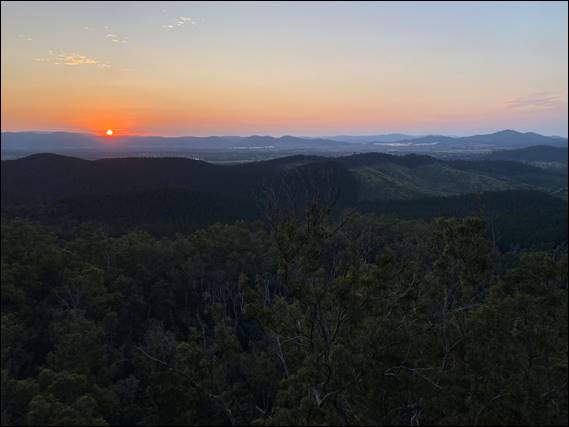
And once all was done we managed to drive to a lookout in time to watch the sun go down, after a second big day.  As the sky changed colour, Sulphur-Crested Cockatoos (Cacatua galerita) noisily flew about perching on the tree tops in the valley.  Howsie and I had racked up a worthy seventeen routes on each day, and we were both a bit surprised we had managed to keep going.  It was not over just yet, but before the climbing continued we had another hearty meal next to the fire and slept well in what was a very peaceful campsite:

Route summary

Wed 18 Sep – Brooyar State Forest
Black Stump Buttress
Snake Charmer 16* 18m Krish
Annabelistic 18** 18m Howsie
Footprints on the other Side 19** 18m Krish
The Enticer 17** 15m Howsie
Dreamcatcher 20** 15m Krish
Shake and Bake 24** 14m Krish (attempt)
French Bandit 15* 12m Krish
My Brothers Keeper 15* 12m Howsie
Right of Passage 21** 15m Krish
Via the Rainbow 18* 12m Howsie
Sun Chaser 16** 12m Krish
Orchid Lane 15* 14m Krish
Found the Salt 14* 13m Sarah
Hand in the Honeypot 21** 18m Rongy
Point Pure

The Cornflake Climb 18** 25m Krish
Coco Pops 15** 25m Krish
The Great Barrier Reef 13** 18m Howsie

Thu 19 Sep – Brooyar State Forest
Eagles Nest

Miss Manners 15* 20m Howsie
Miss Kandy Kane 15* 20m Krish
Digit Crucifixion 18 10m Mike
Up a Rat in a Drain Pipe 18** 20m Krish
Send Me An Angel 17** 40m Howsie
The Pioneer 16** 40m Krish
It’s a Long Way to Tip Fairy 16** 45m Howsie
Little Ray of Sunshine 17* 45m Krish
Free Range Heggs 17** 20m Howsie
Looking for the Sun 19** 40m Krish
Hammerhead Rock

Catch of the Day 20** 10m Krish
Grey Nurse 15* 10m Krish
Becalm 16* 13m Krish
Hook Line and Sinker 18 10m Krish
Chironex 18 8m Krish
Not on Porpoise 18 8m Krish
Irukandji 15 7m Krish

Part 2 – The big stuff

The Glass House Mountains alone contain 24 regional ecosystems.  And being spring I was hoping there may have been a heap of flowers.  However, as we walked to each crag, often through a different vegetation complex, we really didn’t see too much.  My attention was of course aimed at orchids, but I should have done a bit more research in that department before heading out.  There are certainly some species of orchids that are similar to what we find in the South West of Western Australia, many are however very different:

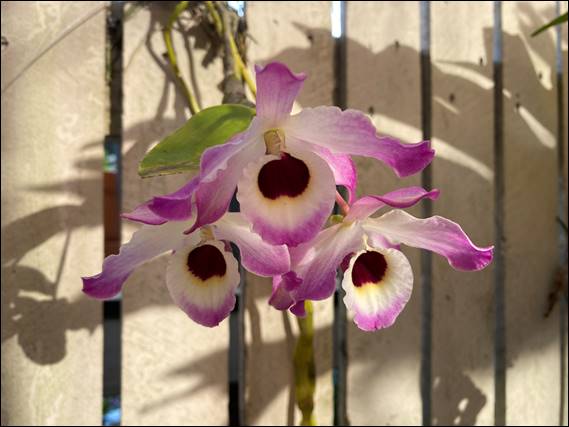
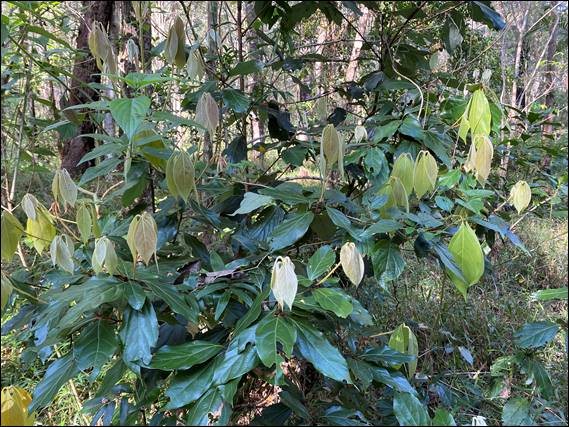
The above is a Noble Rock Orchid (Dendrobium nobile), this species which Mikie and Helen have in their garden is an introduced ornamental species.  But does introduce the term epiphyte and lithophyte, which quite a few of the native orchids of South East Queensland are.  These terms mean a plant that grows on the surface of another plant and that grows in or on rocks, respectively.  Some of the native orchid plant masses are also very different, often with a mass of exposed roots and/or leaves that can be quite fleshy in nature:

While I didn’t see many, I was lucky to find three native species.  I unknowingly took an image of one on my first day out, and have included an image of it in the first post.  It will crack another mention later in this post.  Day three and it was time for a long route.  Mikie had suggested he may only join us for one day on the big lines.  Allowing him to spend some time with Helen and the kids.  Sarah was also absent, as she is not overly keen on big multi-pitch routes.  This meant Rongy had driven up alone last night to join us for an earlier start:

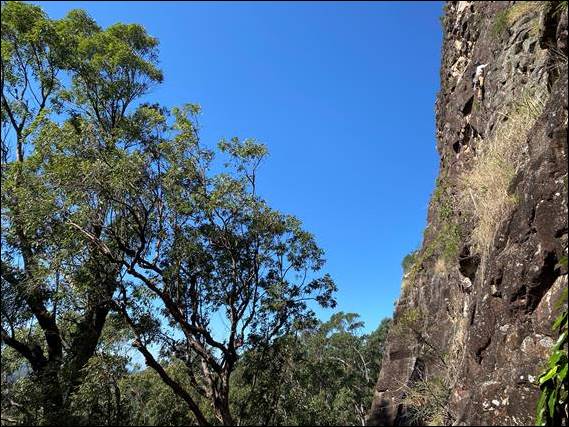
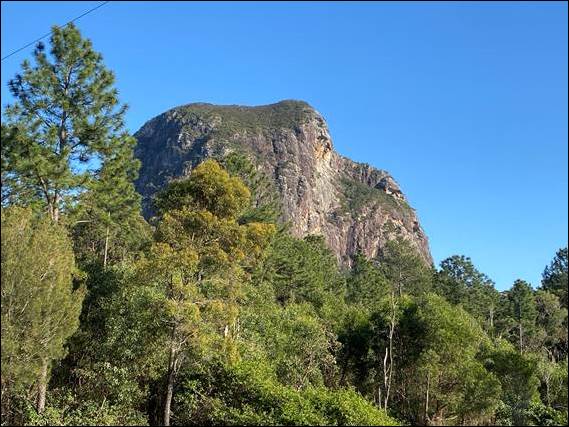
The destination for the three of us so happened to be the third tallest peak in the Glass House Mountains.  Mount Tibrogargan at 364m.  Despite being the third tallest, it seemed to stand out the most.  An impressive peak with steep sides falling away on every side.  This illusion of grandeur didn’t just make an impression on me, and culturally Tibrogargan was said to be the father of all the other peaks in the Glass House Mountains.  The mother being the tallest peak called Mount Beerwah:

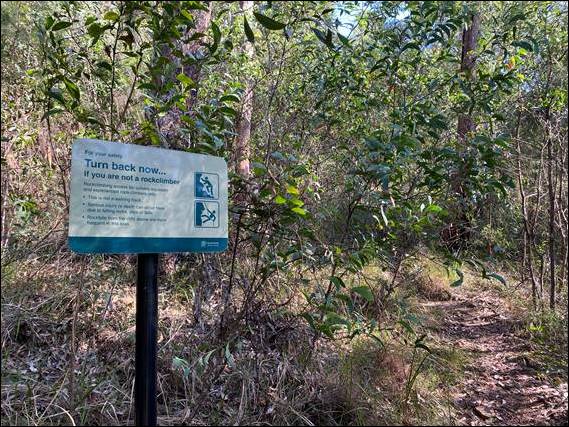
The sides are so steep that in 1799 when Captain Matthew Flinders was exploring the area, he wrote in his journal that ‘the steepness of the cliffs, utterly forbad all idea of ascending to the top’.  This was despite having already ascended Mount Beerwah.  These steep sides are however a draw card for climbers, and as we walked in I had a giggle when I saw the sign two images up telling non-climbers to ‘turn back now’.  On the face of it, it seemed that Queensland had a more outward facing regard of climbing than in Western Australia:

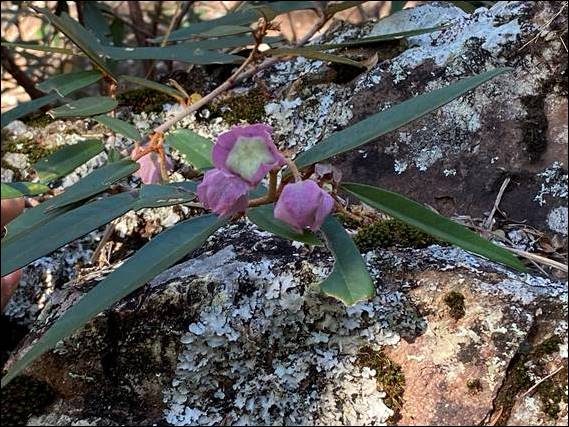
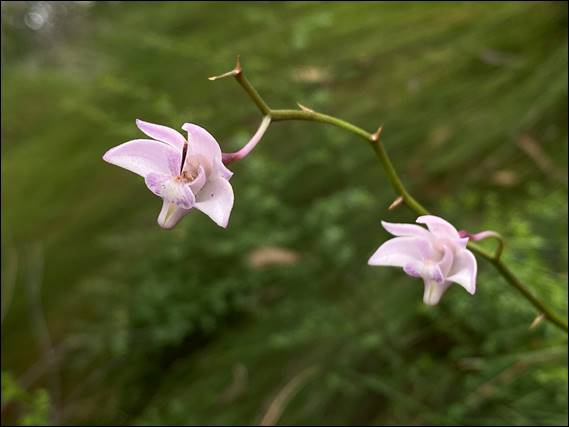
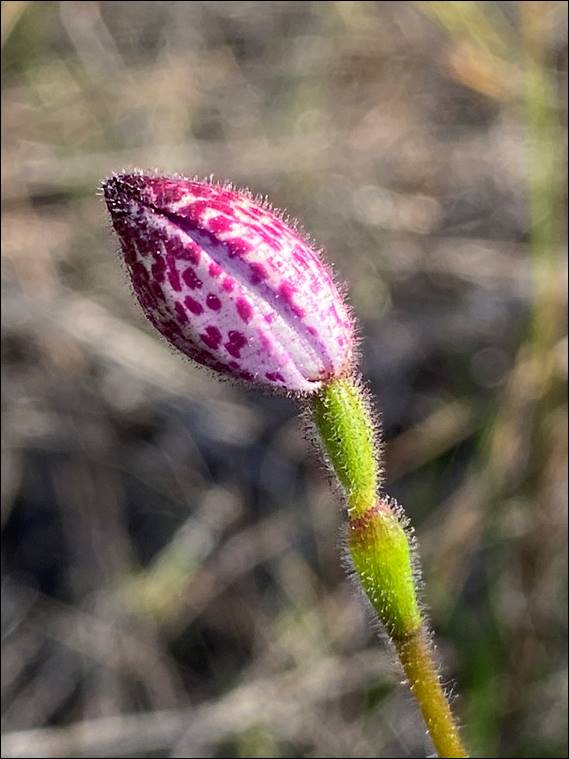
The little pink flowers two images up deserve a mention, I’ve never seen anything like them.  As the petals start to open they reveal what looks like a bud of yellow cotton wool.  This must fall out or get absorbed when it fully opens, as the flowers then displayed the usual arrangement of a stigma and anthers.  I asked a few local people about them but no one could tell me anything about them, and my research has also failed to pin them down.  Fortunately Rongy, Howsie, and were able to pin down the route we would aim for, but it did take time:

The routes we were looking at were located on the impressive +200m Carborundum Wall.  Descriptions of many lines were plastered with warnings that only climbers with good traditional skills and route finding experience should undertake them.  Added to that it was a rock we were not familiar with, being different to what we had climbed on in the last two days.  Then climbing with three of us would slow things down.  The route that drew our attention, was also a little daunting due to the grades but if all else failed we could rap off:

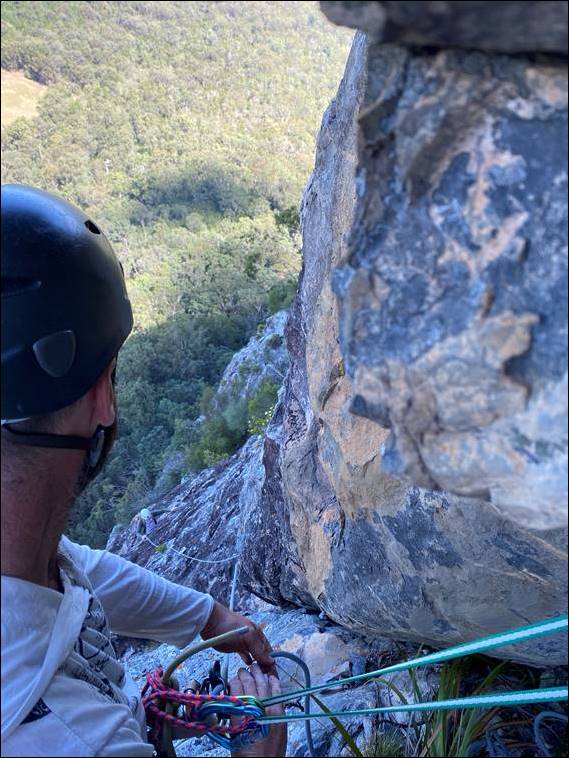
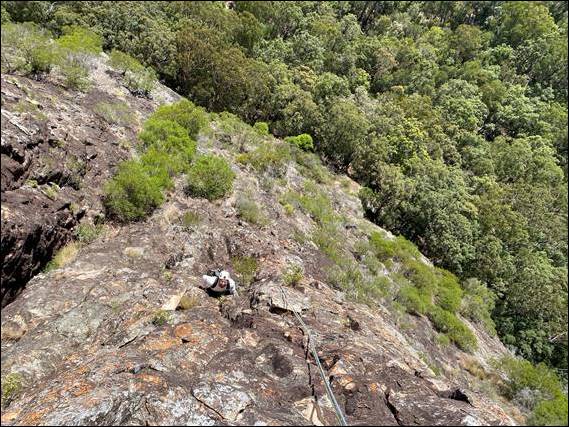
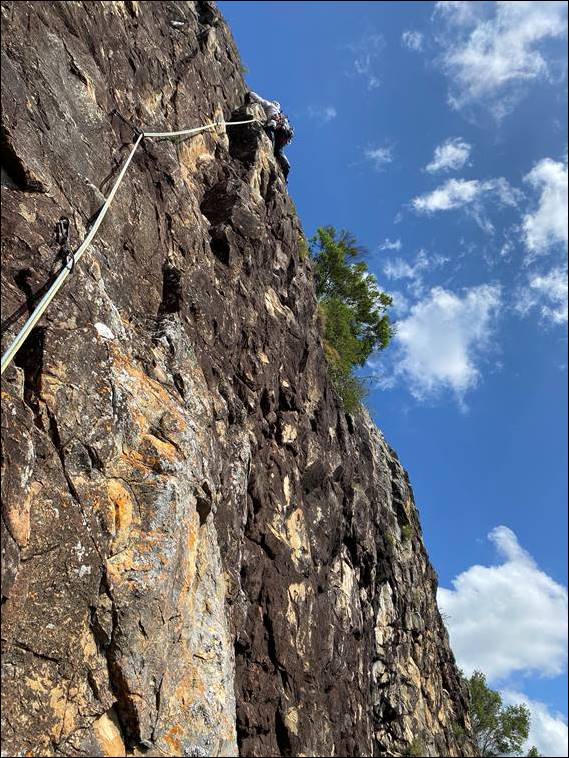
As such we went for it, 245m comprising six pitches with five of them having a grade of 18 (E1 5a/b) or more.  Howsie was once more first up, and if the crux on that pitch was anything to go by it promised to be a big day.  It may well have been that it was the first pitch of the day.  Also it took a while to get used to the sloping holds, which nearly always seemed to be angled the wrong way.  Making for nervous moves when the gear was spaced, but after the first two pitches there seemed to be a generous offering of bolts making the climbing less intimidating:

The bolts also meant that finding the route really wasn’t all that hard.  The second pitch was the trickiest but with the description given it didn’t take too long to unlock.  I think it took longer for me to get my big wall leading head on, than it did to find the way.  We lapped up pitch after pitch, and Rongy was the one brave enough to take on the one graded the hardest.  And as I have said many a time, grading is a little subjective.  Not taking anything away from the quality of the climbing and the route, we felt it was somewhat over graded:

We were in no rush by any means and sat on a couple of the belay ledges to take in the vista sprawled below us.  Each pitch taking about an hour for all three of us to ascend, and at the top of pitch six we were still a good 50m short of the summit.  We had an option to rap back down the line.  Warnings online of rusty anchors at the top of the last pitch might put some off, but upon inspection they looked in good enough condition.  We all agreed however that it would be worth the scramble required to enable us to stand on top of Mount Tibrogargan:

The scramble started up clean rock, which is where I came across the above Pink Rock Orchid (Dendrobium kingianum).  This is the flower I took an image of on the first day, shown in the fifth image of the first post.  It is endemic to eastern Australia and one of the lithophyte orchids.  The scramble then entered thick vegetation and was horrendous, with the occasional loose rock underfoot.  We persisted, topping out only to find that there is no clear view from the peak.  Still it was worth it, to have a clear area to sit and finish off our food:

After a well-deserved chill, we started the hike back down the tourist track.  And it was a track like no other I have walked down, and was not something I would call your average person walk track.  It dropped away steeply, and would be treacherous when wet.  The thin veneer of soil having been eroded and washed away due to foot traffic.  This exposed a light coloured smooth rock, creating a scar on the peak that can be seen from many miles away.  Requiring full on scrambling in sections.  Whilst a lot of fun for us, it could be pretty daunting for others:

I can see why Flinders and his crew decided not to attempt this peak.  After the very long scramble we came across a few people walking up who said they would only go as far as the scramble started.  It did however make for a great day out for us, and the walk/scramble of the peak was just as entertaining, in its own way, to the climb up the impressive face.  And to boot as we wandered round the base, back to the carpark, I spotted one and then quite a few more White Fingers Orchids (Caladenia catenata):

This dainty orchid is endemic to New South Wales, Queensland and Victoria.  Reminding me of the Leafless Orchid (Praecoxanthus aphyllus) that is endemic to Western Australia, which I have only just found this year.  But unlike our local orchid with no leaf, the similar eastern orchid has a single hairy leaf.  It was a great way to wrap up an epic day out, which was celebrated with a BBQ that was well underway when we got back to the house.  Courtesy of Mikie and Helen, which was very much appreciated and went down very well:

Having got a big route under our belt, and of the grade that it was, heading out on Tuesday back to the same place didn’t feel quite as daunting.  This time Mikey joined us and we intended to climb as two parties.  Both on the North East Buttress on routes that were just shy of 200m.  We had originally picked two lines hoping that each party could climb both routes.  However, we needed to get back at a reasonable time to be able to prepare for the next couple of days, as we intended stay away overnight.  So while possible, it wasn’t likely:

As we walked in there was a slight change of who climbed with who, and Mikey and Howsie climbed together.  This left Rongy and I to tackle our chosen line, which we had also changed.  Our rationale being that if we were not going to have time to fit both lines in we should pick a climb of similar grade.  While the face wasn’t quite as sheer as yesterday, most of the eight pitches were steep enough.  Bolts showed the path, so it was hard to go wrong.  Rongy and I climb pretty efficiently, and even faster when not needing to fiddle with gear placements:

The climbing was really good, and that bit more comfortable now that we were accustomed to the smooth slopey holds on offer.  We were not rushing but managed to climb the route and rap back down in a three hours.  This would have allowed us plenty of time to wander round and climb the route that Mikey and Howsie were still on.  It had however been pretty warm, the sky was near clear and this buttress had no shade.  This made Rongy admit to being a little weary, once we had rapped back to the base and not show signs of being keen to press on:

Not too weary to miss this St Andrew’s Cross Spider (Argiope keyserlingi), a common species that is easily identified by the markings and colouration.  Cross spiders are so named due to the cross that is woven into the web.  The spider will often then sit on the cross with their legs paired together in line with each arm of the cross.  The cross is thought to play many roles including making the web stronger, providing camouflage of the spider, reflecting more light to attract prey, and also to deter predators due to the extra mass of silk to deal with:

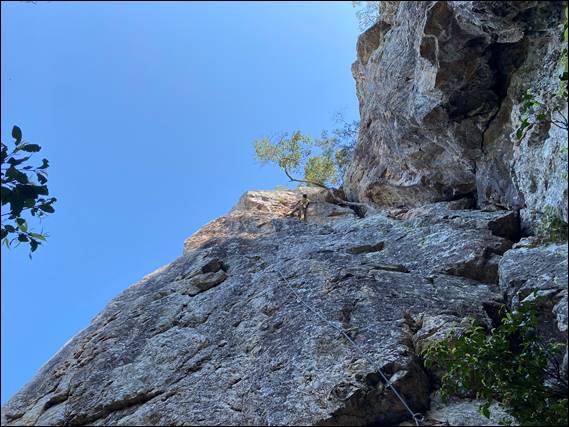
Just below were we had climbed is an area called Candy Mountain.  Mostly lower than the tree line, it had very welcome shade.  I popped round the corner to check if I could see where the others were, and timed it perfectly to see Howsie just before he went out of sight.  It’ll be hard to see in the image below, but he is there right on the skyline.  It is a false summit and not the top, so they were a way off.  We sat in the shade for a while munching on our food and rehydrating, and once the energy levels were up the short wall beckoned:

Rongy had climbed here with Sarah, but there were still a few lines that he hadn’t picked off.  So we started on them and worked our way rightwards.  The short 12m wall provided some entertaining lines.  It felt that just because it was a short wall, the grading allocated was more on par with what it should be.  Unlike the grades allocated to the pitches on the multi-pitches we had done today and yesterday.  Maybe it is an additional layer of precaution applied to make sure people don’t bite of more than they could chew, but it did seem strange:

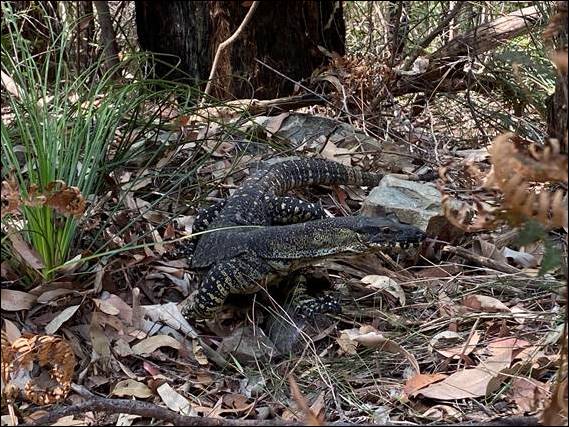
During our session on the little wall we had a visitor, a good four foot long Lace Monitor (Varanus varius).  It is the second largest monitor found in Australia, being pipped at the post by half a meter, by the Perentie (Varanus giganteus).  They are of the same genus, and Lisa and I have seen heaps of Perentie during our time in the Red Centre.  The Lace Monitor can grow to six foot so this one was a good size.  Wandering about as we picked off two lines each.  On the last one, and for the first time, I felt my arms ache just as Howsie and Mikie arrived:

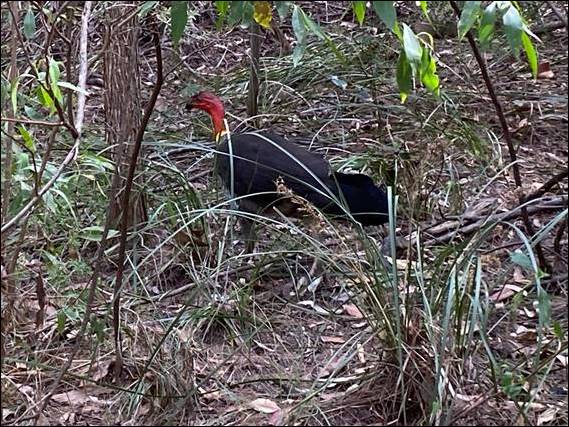
Finishing the line off, we packed up.  They, as we did, had a thoroughly enjoyable time on the big wall and were buzzing.  It was however now time to make a move.  Rongy was heading back to Brisbane, with plans for he and Sarah to meet us at the next crag tomorrow.  While we needed to get back to get things ready for a couple of nights of camping out.  On the walk out this Australian Brushturkeys (Alectura lathami) was too busy scratching about to notice us.  While they are pretty common I do like them, and had to include an image:

Route summary

Mon 16 Sep – Mount Tibrogargan
Carborundum Wall
Airtime Over Pumicestone 21** 245m Howsie/Krish/Rongy (alt)

Tue 17 Sep – Mount Tibrogargan
North East Buttress
Ross Millar Route 19** 180m Rongy/Krish (alt)
Candy Mountain
The Real Rainbow Unicorn 16* 12m Krish
Glove Slap 15* 12m Rongy
One Eyed Wanderer 18* 12m Krish
Old Elvis 17* 12m Rongy

{North East Buttress
Sunburnt Buttress 19** 185m Howsie/Mike (alt)}

Part 1 – Old and new introductions

The last time I had a week long climbing trip was to Victoria to visit and climb with Dan in the Grampians.  Originally planned for Easter 2020, it was delayed by two years due to the pandemic.  Early last year, Dan and I started to chat about another catch-up.  An adventurous one that would see us sail into the Bass Straight between Australia and Tasmania, and climb on a remote place called Deal Island.  A week before I was to fly out he dislocated his shoulder and the trip had to be canned.  The big question left hanging was what to do with the flights:

One option I had floated with Howsie was to go to Victoria and spend a week at Arapiles.  In some ways it is a bit like Stanage in England.  Both are a great place to learn trad climbing, boast over 2,000 routes, and are very accessible.  Stanage however only has routes up to 20m high, whereas Arapiles has lines towering up to 140m.  Long trad multi-pitch routes are what I love. The timing seemed perfect for spring this year, marking my thirtieth anniversary of the one and only very short visit I have had there.  But the plans changed:

Howsie’s brother, Mikie, caught wind of our plans and hinted we might want to head to Queensland.  Rumour of our possible visit got out and Rongy, who happened to be over that way, was also keen to get in on the action.  So it was that close to a year and a half after Dan and my plans were forming, Howsie and I flew to Brisbane.  I do hope my next climbing trip is not quite as convoluted and delayed in the planning.  It felt like this trip was far off for a long time, and when it eventually arrived it was a very much needed circuit breaker from work:

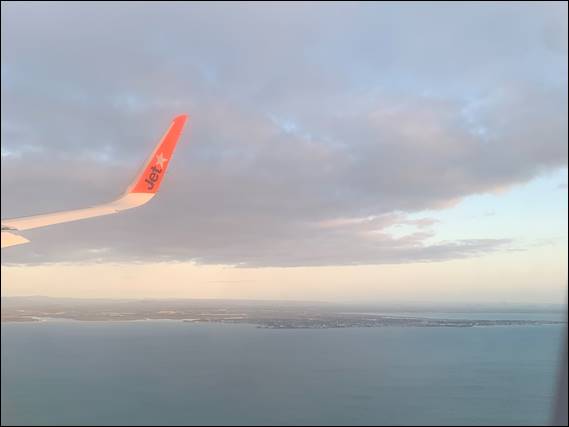
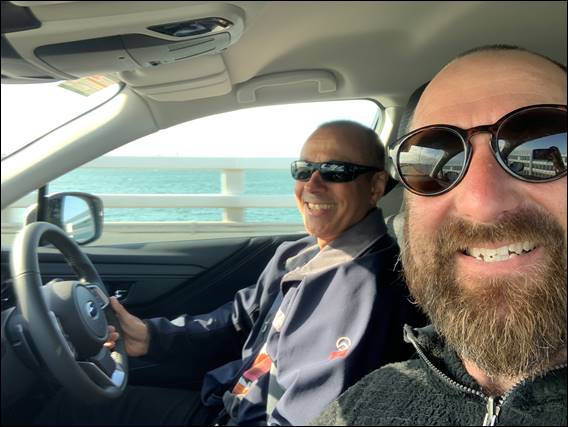
Mikie, along with his wife Helen and three young kids Rupert, Bryn, and Maggie, live on Bribie Island.  A short car trip north from Brisbane airport, which we drove after our red-eye flight that saw us get a maximum of three hours sleep.  I’ll provide more detail about Bribie Island later on, but fair to say the first impression was a quiet and pretty seaside town.  A popular getaway destination, and being the Queensland school holidays it was busy but never too crazy.  Better still the island is located on the doorstep of the Glass House Mountains:

The Glass House Mountains had on offer big two to three hundred meter routes.  But before we went climbing, the morning was spent catching up with Mikie and Helen, and Howsie of course had uncle duties to perform.  With three young kids, putting us two up for a week was no small undertaking.  I was given the luxury of a granny flat, and Howsie took the caravan giving everyone a bit of space.  And there has to be a massive shout out to Helen, who kept the kids entertained while we kept Mikie entertained with our trips out:

We were however also conscious of not making home life too busy and unrelenting for Helen.  Our start times were generally fairly relaxed, and we didn’t climb till light faded.  Aiming to get back to the house by approximately three most days, so we could give a hand with the kids.  Due to our close proximity to the crags and the relatively short walk ins, with nothing more than half an hour, there was plenty of time to climb.  Plus if we were to keep going for eight days straight, we needed to pace ourselves to avoid getting burnt out:

The risk of getting burnt out was not only from the climbing but also the climate.  We have had a bit of an unusual end to winter and start to spring in Australia.  The southern parts have been hit by windy, wet, and cold conditions, while the northern parts have been hit by a heat wave.  Temperatures reaching ten to fifteen degrees above the expected averages.  Where Mikie lives was no different and just a week before we got here, the temperatures were in the thirties.  Being Queensland you can add the humidity to that, so it gets hot and sweaty:

I don’t like climbing in the sun, and certainly don’t perform well in heat and even worse in high humidity.  It was a risk, and coming here in spring elevated that risk.  In fact the majority of local climbers consider our visit here to be outside of the climbing season.  Autumn and winter being regarded as when the weather is great for this type of activity, and as spring works its way in the temperature and humidity start to put people off.  Then comes the wet season, when only the real diehards might be seen out on rock:

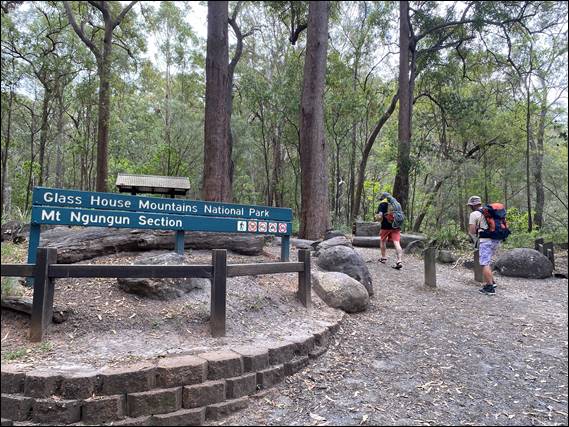
Indeed Mikie had suggested we leave our warm clothes at home, but I came a little more prepared than that just in case.  In part because, just in time, there was a promising looking forecast for while we were to be here.  Great temperatures that steadily increased as the week progressed.  And with the great outdoors beckoning, and after we had settled in and caught up, it was time to hit some rock.  Our first destination was Mount Ngungun, which has several short crags on it with mostly single pitch climbs:

Mount Ngungun is the smallest peak in the Glass House Mountains, at only 235m high.  There are thirteen peaks that rise out of the otherwise flat landscape.  Remnants of volcanic plugs that have resisted the erosion of time.  A process that has lowered the landscape around them, into what we see today.  These plugs were formed 26 to 27 million years ago, but the Glass House Mountains were only named as such in 1770, by Lieutenant James Cook.  This was because the peaks reminded him of the glass furnaces in Yorkshire, back in England:

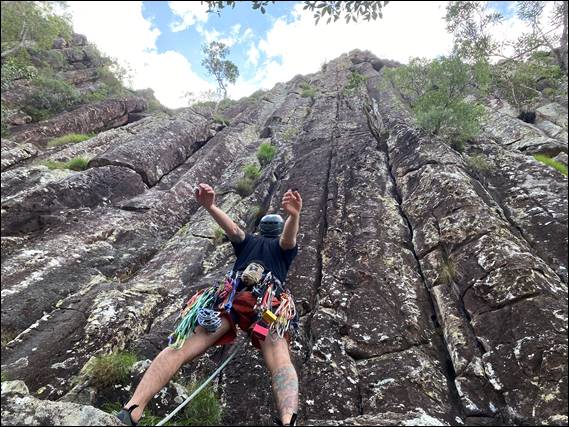
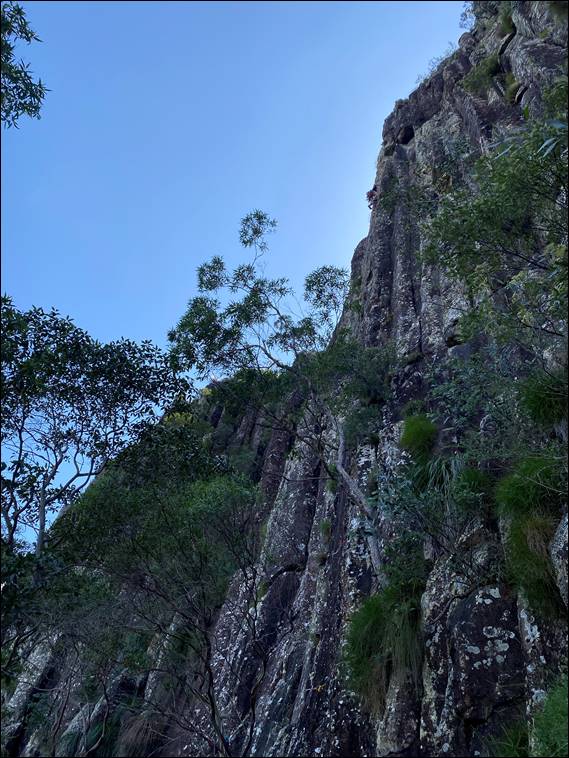
The area is of course steeped with a much older cultural history, having deep spiritual importance for the Jinibara, Gubbi Gubbi and Kabi Kabi Traditional Owners.  And in more recent decades joint agreements have been put in place to ensure appropriate management of the area.  This has generally, so far, not prevented climbing.  Access and activities are however, and understandably, restricted on some peaks.  But not Mount Ngungun, and we aimed for the Upper Cliff, offering 40 plus meter climbs on the hexagonal basalt columns:

In planning where to climb, we were mindful that Howsie has been here before and of course Mikie has climbed all over.  We endeavoured to pick areas and routes that Howsie hadn’t been too, but also tried to find crags that were new to Mikie.  The Upper Cliffs were the perfect start and we picked three great, steep, sustained, and continually interesting traditional lines.  The cracks between and on the basalt columns looked great, but were deceptive in nature.  Flared and often blind, making gear placements a thoughtful process:

It was also an introduction to an unfamiliar style of climbing for Howsie and myself, adding to the mind game that climbing can play.  Mikie while a local, has not been out too much over the last year or so.  Family life having taken over.  So while he was bouldering fit from his indoor wall, leading fitness is quite different.  The three lines were all listed as classics, three stars hanging off their names in the guidebook.  Stars can be subjective, but in this case they were spot on, totally absorbing and engaging routes in a great position:

All three of them had us on edge the whole way up, and I could write stacks about each line but will restraint myself.  What a way to start the trip.  And despite the advice not to pack warm stuff, which was fine while climbing, all three of us got cold while sitting at the base or at the top.  But I’d rather be cold than hot, so that is certainly not a complaint.  In the evening Howsie put another one of his talents to the test, when reading the bedtime stories.  Keeping the boys interested with an impressive array of voices, which became a hit for the week:

Being amongst friends, once the kids had gone to bed, Mikie and Helen didn’t bat an eyelid when I would sloped off to the granny flat at a reasonably early hour.  Even before Rongy and Sarah had arrived, in their campervan.  After a chat with Lisa who was two hours behind me in Western Australia, that first night in a bed was bliss.  It was wonderful to catch up on some sleep.  I still however awoke early, at 4 most days.  And was grateful to have a small kitchenette at my disposal to have a brew or three before venturing into the house:

Rongy and Sarah are traveling about, hence the campervan.  They had a very stop-start beginning to their travels, with many a false starts for various reasons.  Since then they have however enjoyed a relative free lifestyle on the road in their big yellow van.  They have been in Brisbane for a few months now, working before they head back on the road.  Managing to take a week off work while Howsie and I were over.  Day two arrived and the five of us aimed for a crag called Serpent.  This place was in the Blackall Range, which was a bit further away:

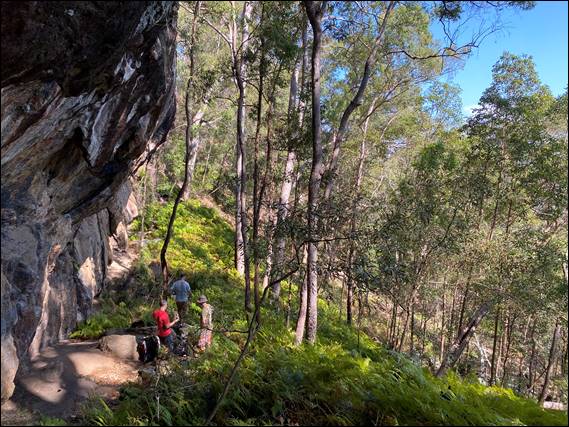
It is a small but steep crag, that had one of the longest walk ins of the trip.  At only half an hour, but it was one of the steeper approaches.  Or was it that today it felt warmer and the air was a little heavier with moisture.  The drawcard for this place was a climb called Minotaur, one that Howsie had placed on his tick list.  It included a great geological feature, that simply had to played on.  We were all keen to jump on it.  However before we hit it, we were kept entertained with an offering of less steep climbs at the edges of the crag:

The cooling time for the lava that formed the basalt at this crag was different to that of Ngungun, changing the mineral sizes and rock texture.  Forming a rock mass as opposed to columns, needing a changed approach to the climbing techniques.  Another aspects that we aimed to keep mixing up on the trip.  You’ll have noticed a variety of images so far, that has included some flowers, trees, shrubs, and fauna.  Unlike my usual approach, I haven’t attempted to identify my finds.  There are simply too many, and I would spend days if I tried:

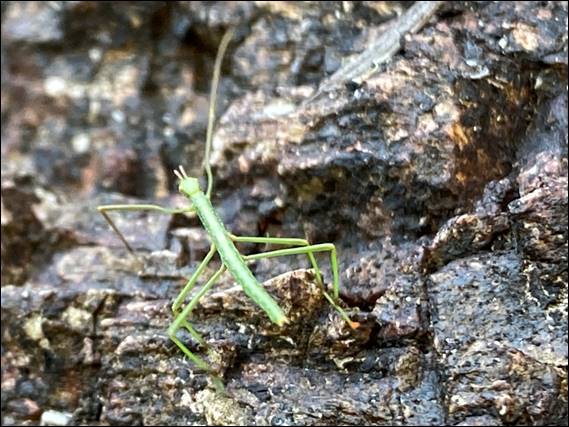
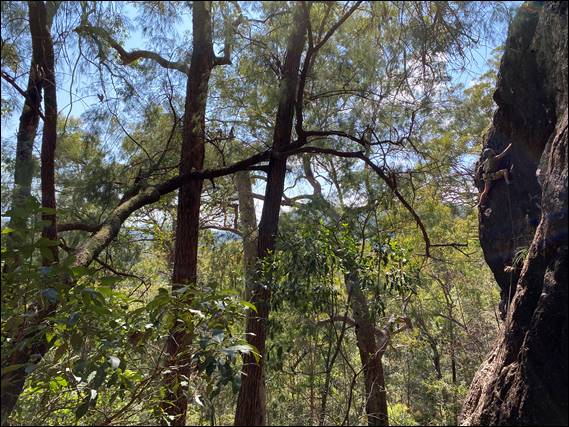
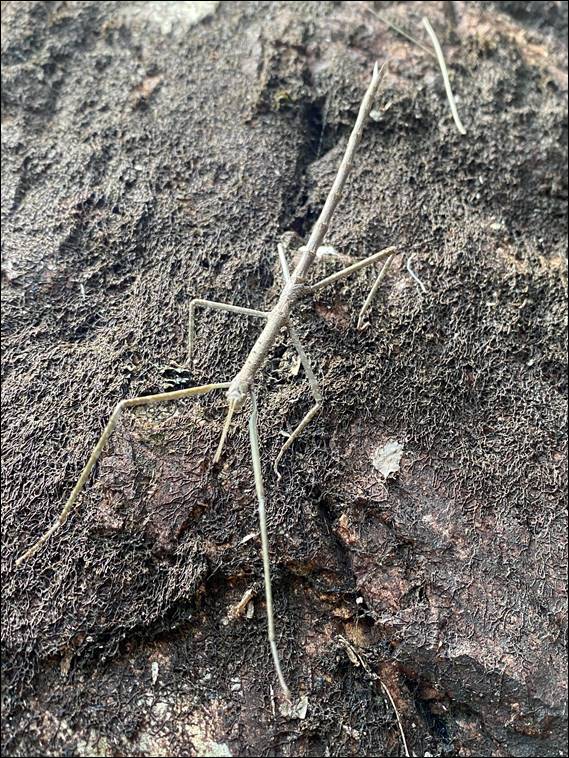
I will however get into more detail for some of them as I go along.  And I’ll start with the stick insects in three of the above images.  I believe that the small green and big brown specimens may be a very young nymph and adult male Titan Stick Insect (Acrophylla titan).  It is a bit of a guess as I didn’t look for the finer details that are required for a true identification, and is based on the short antenna and spines on the back of the thorax.  We only saw them on one climb, and didn’t see any more during the entire trip.  But there was plenty more to see:

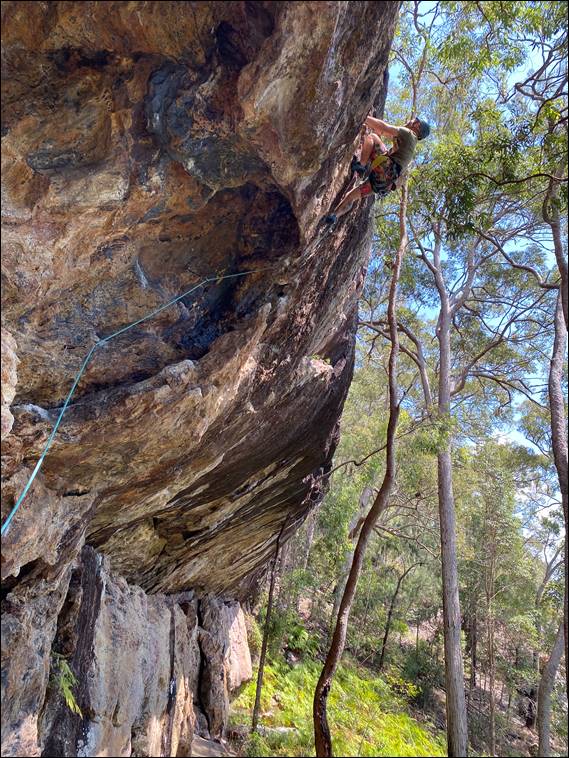
Minotaur, above, was as good as we had hoped.  A steep line snaking it’s way between a huge flake that looked to be defying gravity.  After caterpillaring up this you poke out of a window, onto the steep juggy headwall.  It was the last route of the day, being our shortest day of climbing as a group.  The travel time and walk in having chewed into our ability to stay any longer.  That said the remaining routes were much harder and it was heating up, so I was happy to call it quits.  Ending on a high note of another well-deserved three star classic climb:

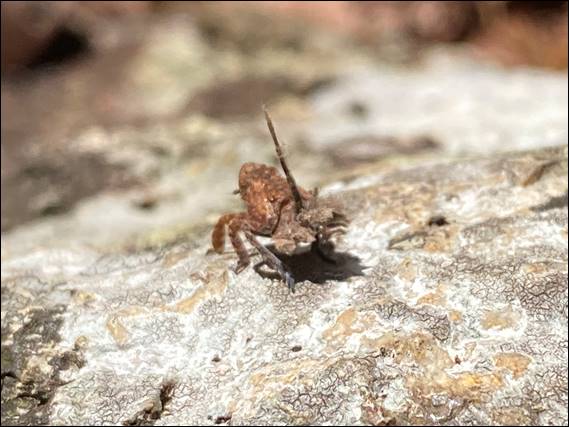
It was so good that it took a while for everyone to lead or second the very cool two pitch routes.  And while that happened the rest of us were kept entertained with a myriad of interesting insects and arachnids that were mulling about below.  The above insect is a nymph planthopper, probably of the Eurybrachys genus.  This one may well have lost one of its false antenna, which are located at the back of the body.  This is an example of mimicry to make it look like a different and more aggressive creature, to deter predators:

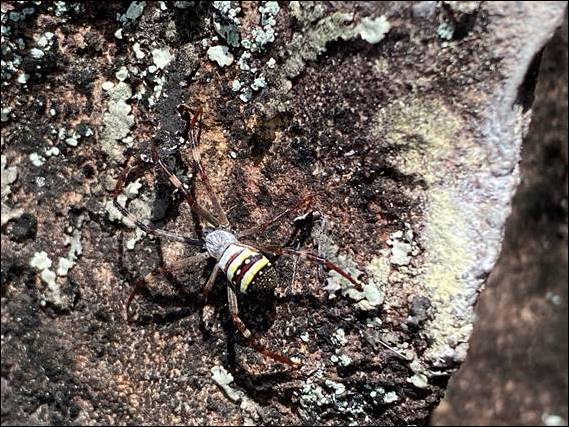
They also walk backwards to make the back look like the head, and then when the situation requires they can hop away quite some distance.  Sarah also spied this tiny arachnid, which I have, not surprisingly, had absolutely no luck in identifying.  It is likely to be a juvenile, being a mere millimetre or two in size.  What really intrigued us was the cluster of soil and leaf detritus attached to its back.  Again I can only assume this may have been a camouflage technique, but I can only find out about a spider in Mexico that is known to use this method of concealment:

Sarah also found some crag booty, a misplaced chalk bag with koala print.  She wasn’t overly interested in keeping it, so I nabbed that.  My two outdoor chalk bags are getting a little ratty and worn out, and this one will serve as a good replacement.  Arriving back at the cars Rongy and Sarah drove to Brisbane, where they are house sitting, while Mikie, Howsie and I went back to Bribie Island.  All up our first two days in Queensland had been great.  Two quite different crags, lots of new flora and fauna to spot, and catching up with friends:

Route summary

Sat 14 Sep – Mount Ngungun
Upper Cliffs
Icehouse 16*** 45m Howsie
Visions of a Transmitter 18*** 45m Krish
Ensorcelled 17*** 45m Mike

Sun 15 Sep – Serpent
Serpent Wall
Off With the Pixies 13* 18m Krish
Berserker 17* 15m Krish
Arcane Secrets 18* 12m Krish
Minotaur 17*** 35m Mike/Krish (alt)

Drawn out by the sun

In centuries, and decades, gone past mass land clearing has resulted in isolated pockets of native vegetation complexes remaining.  Sometimes these look orchidy, and at other times they look infested with weeds that have crept in from the surrounding land.  Usually agricultural or rural in nature.  South of Bunbury the Franklandia Nature Reserve is split by the South Western Highway, the larger area to the west looks pretty good.  But the eastern side looks degraded and run down, strewn with litter discarded by people using the layby area:

Not surprisingly I found myself walking about in the bush on the western side of the road, not seeing too much that I hadn’t seen before.  A lady was also hunting orchids, and she got a bit of a start when I said hello.  And as we exchanged details of our finds, she told me the other side of the road was worth a visit.  With clumps of orchids that simply had to be seen, so I went there to see what I could see.  And just like a book shouldn’t be judged by its cover, I should not have judged this patch of bush by all the weeds:

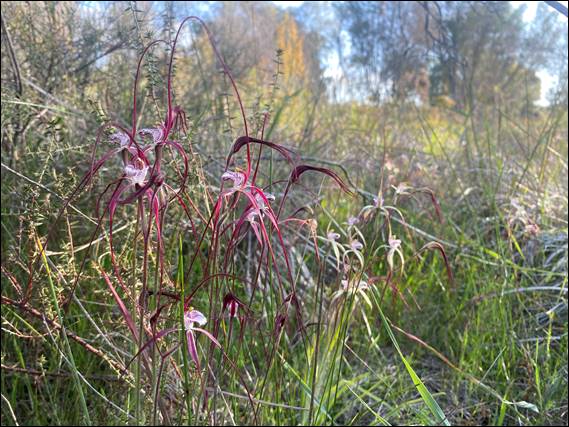
Spider orchids abound, as well as others, but it was the spiders I was keen to see.  They resemble the Chapman’s Spider Orchid (Caladenia chapmanii) and there may have been a few of them about.  But there were also some different characteristics that made me dig a little deeper.  This leads to be to think that the mass of orchids included some Common Spider Orchids (Caladenia vulgata) and possibly Pendant Spider Orchids (Caladenia pendens) of which there are two subspecies of pendens and talbotii, the latter being more colourful:

As such this little patch yielded some good finds, or so it seems.  I say that as I recently tested my orchid identification skills for a find I was really unsure about.  I went to the Department of Biodiversity, Conservation and Attractions to see what they thought my find in the Capel Nature Reserve had been (https://sandbagged.blog/2024/09/06/its-all-relative/).  I didn’t tell them what I thought, and indeed they were a little stumped too.  As such they call in the big guns, and asked one of the authors of the orchid book I use:

Although, not the same person I have previously used a few years back to test some of my more curly finds.  His assessment was that I had found a hybrid, and it was suggested to be a cross between a White Spider Orchid (Caladenia speciose) and either the Grand Spider Orchid (Caladenia huegelii) or the Scott River Spider Orchid (Caladenia thinicola).  It was suggested to be more likely the Grand Spider Orchid, which in itself is critically endangered.  So I will now have to go back there and start looking for that one too:

I’ve previously found the Scott River Spider Orchid.  The first time was in the Scott River National Park some 70 to 80 kilometres to the south (https://sandbagged.blog/2022/10/05/true-to-its-name/). However, despite its name this species can be found over quite a wide range.  After a very successful short walk and on the way home I stopped in to check out another small patch of bush in a place called Gelorup.  This one had less on offer but I did come across my first Pink Fairy Orchid (Caladenia latifolia) of the season, almost out in flower, shown above:

Tuesday I plumped for the Ruabon Nature Reserve, and it seems that we have slipped from winter into summer.  High twenty degree temperatures and a weeklong forecast of sun and heat.  It has started draw out more orchids, and there were quite a lot of King-in-his-carriage Orchids (Drakaea glyptodon) in flower.  Standing taller than the companion Flying Duck Orchids (Caleana nigrita), often found together, but they were a little way of being in flower:

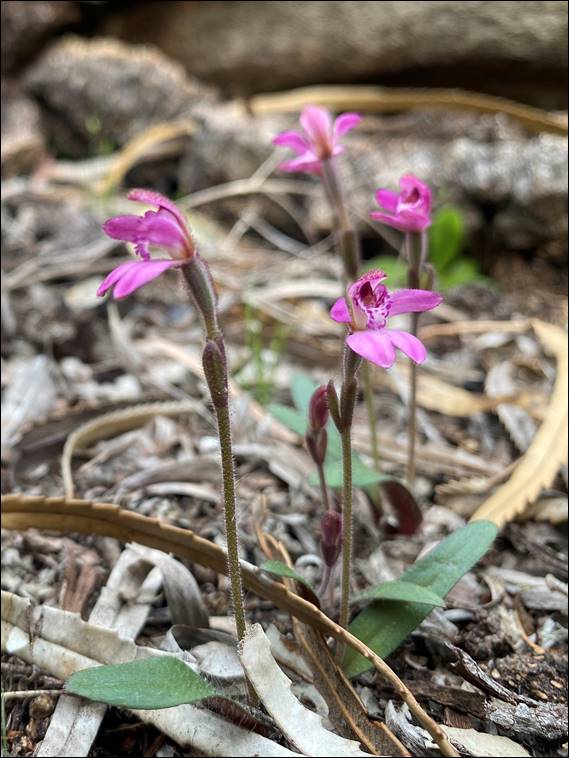
It was not the place to stand still for too long, being overrun with mosquitoes.  I braved them for quite a while in the hope of finding more, but the only other sighting to report was the above lonely clump of Little Pink Fan Orchids (Caladenia nana subsp nana).  Tiny plants for which I had to get down on my hands and knees to be able to observe, allowing the mosquitoes an easy target.  But it was worth it.  Later in the season the other subspecies unita will come into flower, having a similar flower shape and size but with a much taller stem:

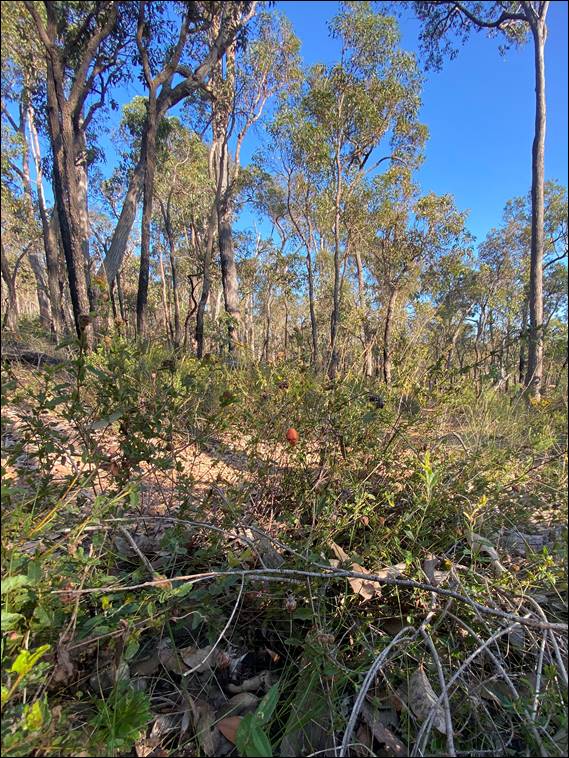
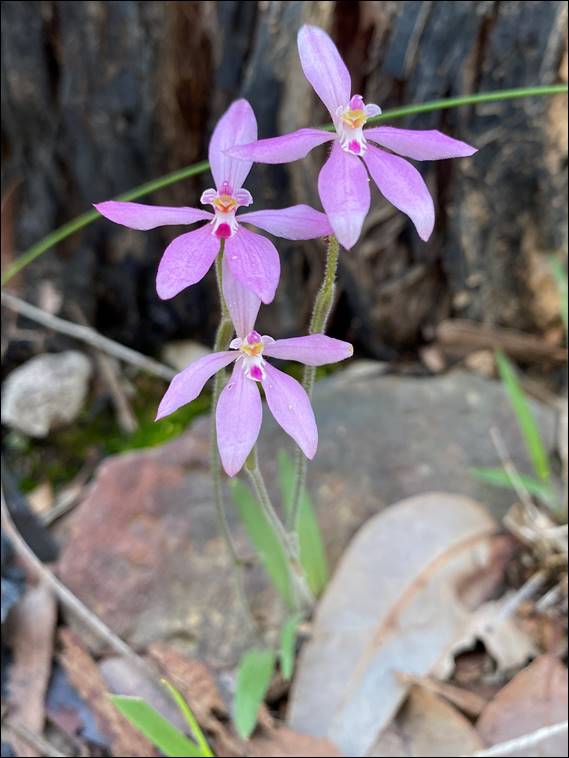
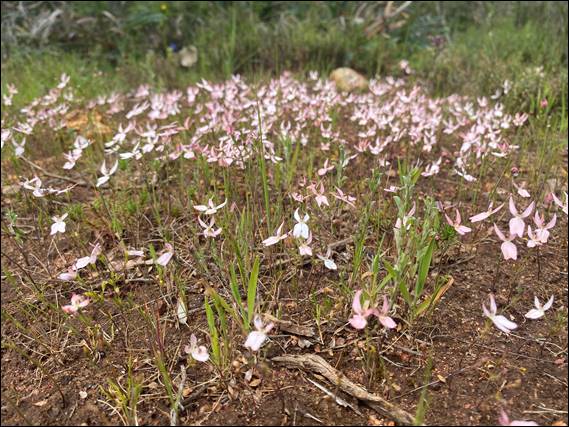
I was eventually driven out by the clouds of winged pests, but content with my finds.  Wednesday came and true to my word of last week, I got out again.  This time a bit inland to the higher and rocky area of Crooked Brook Forrest.  The sun was out and had bite to it; on the plus side it was drier and I wasn’t being forced to keep moving.  It seems however this place will take a little while longer to wake up.  There was very little on show, to the point I started to take images of even more Dwarf Pink Fairy Orchids (Caladenia reptans):

With the three species of Pink Fairies in one post you may get an appreciation of the differences between them.  My book has five different ones, including subspecies, of which I have seen four.  I’d need to travel 550 kilometres to the north to find the fifth species, which is unlikely to happen.  There is a limit to my obsession.  I did however walk 5.5 kilometres on this trip, the longest walk of the week, and completed that in an hour.  A sign of how quiet it was, although with the pace I kept I did surprise myself when I saw this:

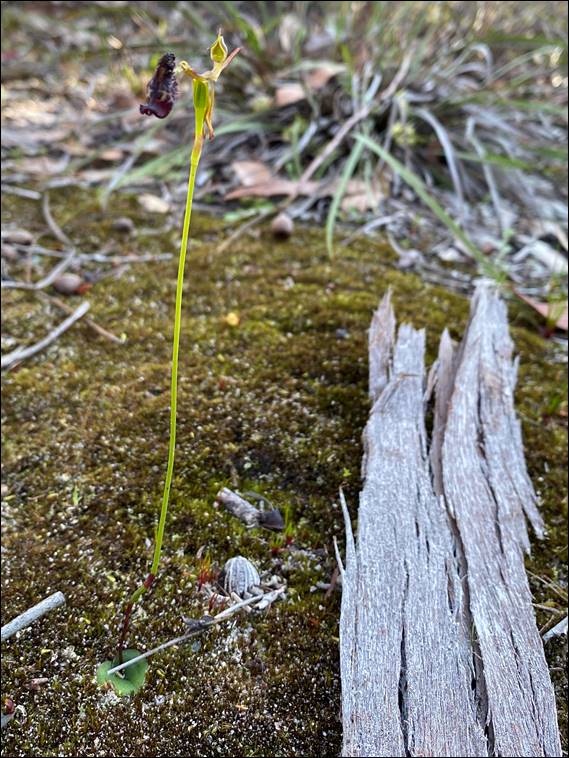
Standing no more than 20 centimetres high with a flower less than an inch in length, I feel it was a good spot and I was a bit lucky to see this Warty Hammer Orchid (Drakaea livida).  It was not the plant that had caught my eye, but the 10mm in diameter basal leaf.  I may have been keeping a reasonable pace, but still had my eye tuned in for orchidy type shapes and colours.  Sounds a bit silly, but Craig noticed this when we walked along the Cape to Cape track a few weeks back.  He was amazed at what he missed, after I pointed things out to him:

Thursday rolled in and I gave a Tuart Woodland a go, just on the edge of Bunbury.  The entire ground looked like it had yellow lights covering it.  Cowslip Orchids (Caladenia flava) were out ‘en masse’ and occasionally I came across a white spider or two.  I took heaps of images and think I managed to find the White Spider Orchid (Caladenia longicauda subsp longicauda) below, and the second image being a Sandplain White Spider Orchid (Caladenia speciosa).  It’s a place that will be worth going back too:

The sun has not only drawn out more orchid species, but also more of the orchid hunters.  I heard the little car park at Manea Park was full on Thursday evening.  Hordes of people were scouring the paths looking for these delicate flowers.  Luckily, as I mentioned at the start, there are of pockets of bush scatter about.  I will be visiting those, leaving the more accessible and well known areas to the masses.  That won’t however be for another week or so, by which time I hope more species will be out:

Watch your step

Despite having had a week off work David hadn’t managed a trip out to explore his new outdoor playground.  It seems his desire to get out is near equal to mine, and his fingers were itching to touch rock by the time Saturday arrived.  We’d planned a trip out with, in my mind, one focus.  To get him back on the sharp end.  And there is but one place to go when you need to start from basics.  This meant a repeat trip to where I climbed with Craig last weekend, and also attempting the rock hoping path along the coast:

The path wasn’t being smashed like last weekend.  It was low tide.  The swell was lower than last weekend, although it had only receded overnight.  Foamy bubbles, a result from the recent churning ocean conditions along with natural decomposing organic matter, were scattered about and being blown around in the wind.  The boulders that were no longer wave washed, had a green hue to them.  The residue from the sea foam, which resulted in what felt like icy conditions.  We had to be very careful with our foot placements to avoid a spill:

David admitted to not being as sure footed.  Fortunately we managed to keep on our feet, but it did mean it was a relatively slow walk in.  During which we only had a couple of near misses, which included from my at times over confidence.  A bit of time was also spent hiding from a squall that wetted everything up.  This conveniently reached the shore at the time we walked past the only shelter of note.  There were only two sections, where the conditions were such that, we had to scramble inland a bit more to reach our destination safely:

Back to basics was a bit harsh way to explain the situation.  David has plenty of climbing experience, it has just been packed away for too long.  You could say it is has become rusty and needs a bit of lubrication.  A major block after his abstinence from leading, being the need to rebuild his mental focus and confidence when on the pointy end of the rope.  Climbing above your gear and being prepared, if necessary, to take a fall, and trust your gear implicitly can really mess with your emotions.  This requires training your amygdala to not do its job:

The small in size amygdala plays a big role, as the part of the brain where your emotions are processed.  I often say to people when they are looking stressed on rock, to find a stance and focus on their breathing.  There is science behind this technique, unintended on my part.  It is no different to applying stress management practises, which include meditation, deep breathing, and exercising.  The trick is being able to apply that when your amygdala is starting to kick off.  This can be helped by offering the right verbal cues, in a calm and controlled voice:

We started at The Playground.  Easy lines with plenty of gear and a nice sandy landing below.  These all help to make it easier to focus on controlling the brain, by making it feel like fun.  It is however hard to avoid your shoes getting sandy, especially when the beach is a little damp as it was today.  The sand acts like marbles, eliminating much of the friction between the rock and the rubber on the soles of our shoes.  So once again care was required with our footfalls.  David made use of his approach shoes to minimise the amount of sand his shoes picked up:

After five leads at The Playground, which got progressively steeper making David need to control his emotions, we wandered across to Lost Buttress.  On the way over we came across a, sadly deceased, hatchling Loggerhead Turtle (Caretta caretta).  There are four life stages of turtles, being an egg, hatchling, juvenile, and adult.  Born in the warmer northern parts of Western Australia between January and May, hatchlings and juveniles live in the open ocean for up to seven to fifteen years, before moving to near shore environments:

They can be encouraged to move further south along the coastline by the warmer waters in the Leeuwin Current.  Then, during winter storms, they can end up being washed up, such as this one, when they are unlikely to survive.  This is only one of the many perils needing to be navigated while growing up.  There are articles that indicate only 1 in 1,000 hatchlings will make it through the nest couple of life stages to become an adult.  On the plus side I’m however pleased to advise that David did survive today’s experience:

Polishing today off with two more leads at the taller Lost Buttress.  These routes made him run out is gear a bit more, and he also got his first experience of the great Australian icon… the carrot bolt.  So I feel it was definitely mission accomplished, and I had a relatively relaxed day following up with a rope above me.  We were rewarded with an improving day and settling ocean, meaning we could rock hop the entire way back.  With David blindly following me on a couple of airy scrambles that sometimes made him stop, needing to placate his amygdala:

Once the path took us back up the ridge we took a slightly deviated route.  Allowing me to show him a few lesser frequented crags.  Although the main reason was to get to Driftwood Bay, where two weeks back I hoped we had dropped a piece of gear.  It required some bush bashing, and sure enough my missing gear was at the top of the crag.  We had to tread carefully through the bush, where David once more got to see a Southwestern Carpet Python (Morelia imbricata) and shortly after also his first Bobtail Lizard (Tiliqua rugosa):

It’s all relative

This week I only managed two trips, and as things are heating up I’ll have to make an effort and get out for more after work wanders next week.  I say that as I soon won’t be able to enjoy my local strolls for a while.  Not for too long, but some species flower and disappear quickly.  For example that tiny Sandhill Helmet Orchid (Corybas despectans) that I checked weekly at Wilyabrup, flowered and withered within a week.  On Tuesday, after Josh at work had shared that he had spotted even more White Spider Orchid’s, so I went to Manea Park:

The Sandplain Donkey Orchids (Diuris tinctoria) were out in numbers, along with a few other species of this genus.  This particular species have up to five flowers on one plant, where as the similar species that I sometimes get it mixed up with have up to seven.  This particular species is also commonly found after periods of higher than average rain, which we certainly had in August.  The other orchid out in numbers, as I predicted would happen after spotting my first one just one week back, was the Cowslip Orchid (Caladenia flava):

The trip paid off when I found a single White Spider Orchid (Caladenia longicauda) in flower.  My book has fourteen subspecies, so you may be able to imagine my quandary of trying to identify them.  However, I feel comfortable in saying this one was a Sandplain White Spider Orchid (Caladenia speciose).  The pink tinge of the flower being the clue.  This one also had a grasshopper nymph nibbling on the more juicy bits.  They belong to a group of insects known as orthopterans, meaning ‘straight wings’, of which there are some 3,000 species in Australia:

Needless to say I didn’t try too hard to identify it, which is even harder being a nymph.  Based on its size this nymph looked to be one of the early stages of development.  They moult four to six times over five to six weeks, before becoming an adult.  Each time they moult they reach another ‘instar’, which is Latin for form or likeness and is used to refer to a developmental stage.  At each development stage they grow and hence need to moult, becoming an adult when they reach sexual maturity:

My next trip out was on Friday, and as I was working from home I kept it really local.  Heading to the Capel Nature Reserve, where on arrival the above Heart-leaf Flame Pea (Chorizema cordatum) shrub looked wonderful in the late afternoon light.  The Chorizema genus has approx. eighteen species, all of which but one are endemic to Western Australia.  Many other native peas were also in flower.  Many various sizes and colours, but too many to count with over twenty genus in Australia.  There were also lots of Sandplain White Spider Orchids out:

I lost count of how many I saw, all looking very elegant with their tall drooping sepals and petals, and upright dorsal sepal.  And there look to heaps more getting ready to flower. While  I didn’t look super hard at every flower I did notice the above, not so uncommon sight on spider orchids, being a Flower or Crab Spider of the Thomisinae subfamily.  I’ve spotted this species before and unsuccessfully tried to identify it.  Despite getting a better image this time, I have still not managed to find a match:

The other spider orchid that this nature reserve has in abundance is the Chapman Spider Orchid (Caladenia chapmanii).  Last year this was a species I noted quickly transitioned from flowering to wilting.  It was a shame, as it really is a striking and incredibly colourful species.  Only a few were in flower, with heaps of large clumps being on the verge of blooming.  First identified in 1940 it wasn’t published, so the naming rights were lost.  It was finally published in 2001 when it was named in honour of an amateur orchid enthusiast:

I have found a few orchids over the years that the authors of my guide have failed to identify.  However, it takes a fair bit of effort and time to publish a find and be able to claim it as a new species.  So I can’t see this amateur enthusiast ever receiving such an honour, at least not while I’m working.  I mentioned it was heating up.  I meant this metaphorically, due to more and more species starting to appear and be at a stage where I can identify them.  Such as this Purple Enamel Orchid (Elythranthera brunonis):

I feel that some orchids are more striking before they flower, and the above is one of them.  Not to say it isn’t pretty when in flower, being one of Lisa’s favourites.  With spring upon us it is also literally warming up, and drying up.  A gradual process that signals to many orchid species that it is time to show yourself.  Such as this Flying Duck Orchid (Paracaleana nigrita).  It is watching this transition from bud to flower that I may miss, while I won’t be able to go on my local walks.  Despite seeing it each season it seems a shame, maybe I have FOMO:

By which I mean ‘fear of missing orchids’.  But for now back to the Capel Nature Reserve, where I spotted a different species of white spider.  The red labellum and neater fringes making it stand out amongst the countless Sandplain White Spider Orchids.  I’ve checked and double checked based on its features, the soil type (deep sands), and vegetation complex (Banksia) in which I found it.  The only option is a Giant Spider Orchid (Caladenia excelsa), but is outside of its normal range.  If I’m right it is an uncommon find, being listed as endangered:

I reckon this is one I should send to the Department of Biodiversity, Conservation and Attractions to have checked out, just to be sure, because if I am right it is a significant find.  Significant is of course a relative term and my last find also falls into that category, for me at least.  It is the first lutea, being the Latin word for yellow, Jug Orchid (Pterostylis recurva) I have come across.  The flowers being devoid of the green and white strips and brown tips, and the stem and leaves also looking bleached out.  Another reason to go back:

Knocked for six

With another blustery morning, and a rough ocean the Peppy Plungers were not gathering for their dip today.  Despite that Lisa was still leaving early, for swimming lessons.  Or should I say lessons to improve her swimming style.  While she has a never ending urge to keep learning and doing something different, the lessons are part of her plan to feel more comfortable and safe in the ocean.  And that is a good thing.  On the other hand I am a bit of a stick in the mud, and have a select few interests that more than adequately chew up my time:

Feeling the rock calling me, I too headed out early.  Driving to my chosen destination the above sight brought back memories of many a view of lush green rolling hills in the homelands.  And like many of those trips I drove through the rain in hope of finding better conditions at the end of the journey.  A big difference being that back then I would be on the road for anywhere from three to six hours; driving hundreds of kilometres to get away for a weekend.  This was an hour trip, heading towards the darker clouds as oppose to past them:

My hopes of touching rock waxed and waned with the weather.  Every time I had to put the windscreen wipers on full, they swished back a forth mimicking a head shaking from side to side.  Sending me an unspoken message of disapproval.  Pushing such thoughts to the back of my mind, stubbornness kept me going forward.  A friend from Alice Springs used to say, he who dares wins.  It was also a catchphrase used by David Jason, as Del Boy, in a brilliant British sitcom called Only Fools and Horses, only for Del Boy it rarely worked in his favour:

Water, water everywhere is probably an apt way to describe what greeted me.  In my favour the clouds looked to be lifting and breaking up a bit.  Before I put my trust in that being the case, I went for a wander through the forest.  Keeping a sharp eye on ground but also spotting wildlife in the scrub, at times just off the path.  The fact that they were still out, and so close to a walk trail, hinted that no one else was braving being out just yet.  During the three to four kilometre loop I didn’t find any new orchids in flower, however it did not rain:

I think it may have been Howsie’s suggestion to come here on Friday that resulted in me being drawn this way today.  He’s still crook, and I doubt anyone else would have contemplated joining me for a visit here on such a day.  I could hear frogs croaking away in the quarry, a sure sign it was going to be wetter than usual.  They were probably hidden in the many nooks and crannies, but I failed to find any of them.  Water had been flowing down several of the climbs for a long period, with green algae taking hold:

But as the streaky walls indicate, some sections were drier.  I even found some parts that were completely dry, just not entire climbs.  Having made the effort to get here, I set the top rope up on each line with extra caution.  Big puddles and algae where scattered across the top of the crag, ready to send me flying if I was careless.  As is the case after we have had a break from climbing here, it felt hard.  And even harder due to the conditions.  Two laps on three climbs, and I was knocked for six.  It was however still a lot of fun.  This one dared and won: