With enough daylight for a play, Lisa and I drove off on Wednesday after I had packed my laptop away. We were heading a couple of hours north, but stopped on the way at a short walk that had been mentioned on the orchid chat group at work. After our walk and look around Crooked Brook recently, I was not expecting to make any great finds on the Harvey Wildflower Ridge Walk. It is however high in the landscape so should provide nice vistas. This included the below patchwork of native bush and pine plantations round Harvey Dam:
It really was just a quick stretch of the legs. The track passed a few rocky outcrops, which I couldn’t resist but to look around. No faces of note that were worth a revisit with my sticky boots. And as suspected there was very little in terms of flowers, and not surprisingly not a sniff of an orchid. That said the varied terrain could provide for a bit of diverse flora come spring time. It was also a little lacking on the fungi side too, looking a fair bit drier than the places just that bit further south where we live. With only one catching my eye:
And despite its very distinctive deep and well-spaced gills I have not identified it. I have to admit to also using Google Lens, as part of my collective of tools to research what I find. It is funny just how many times it will suggest that a white cap mushroom, regardless of scale or other features, could be a Death Cap. It would seem the app may have a high degree of risk adverseness, and it is not alone. I did wonder if it may have been from the Russula genus, also called brittle caps because the caps have a brittle chalk like texture that crumbles easily:
I did not however put that to the test. Back in the car we drove on, our destination was Serpentine. A place we have driven past many a time over the last couple of decades, but having been on the road somewhere we have never stopped. It is home of Serpentine Falls, one of the more renowned waterfalls in the South West of Western Australia. Not that there are too many to choose from, being mostly a relatively flat landscape. I was of course also interested to see the rock formations, just in case there may be a sneaky place to explore:
I have heard many a time there is nothing worth climbing there, plus it is a tourist hotspot so why would you anyway. But my curiosity had to be quelled. We planned to walk to the falls from Jarrahdale, which is famed for being Western Australia’s very first timber town. Now a scenic tourist town with quaint timber cottages, dating back to the early 1800s. That would not however be until the next day. We were staying overnight to avoid the need to cram the plus four hour drive, on top of what we hoped to be five or so hours in nature, all in one day:
It was a good call, and we had a relaxed evening munching at the Serpentine Falls Tavern. Occasionally being asked by the staff who was winning the games we played. Not quite as old as the cottages of Jarrahdale, but still going back to the early 1900s. Built some ten years after the rail line through Serpentine was opened. The rail line serviced a thriving timber milling town back in the day. Unlike our local rail line that has fallen into disrepair a long time back, this one is still in use. It was strange to hear the horns of the engines during the night:
We awoke refreshed and not needing to rush about to get out the door. Instead taking our time, being able to pull out the scrabble and have a few cuppas before it was time to get sorted. Being less than an hour from Perth and during the school holidays, not surprisingly we were not the first to park up. Although we imagine the place would get much busier on the weekend. I’ve got behind on the images and the first image as we set off on the walk is of both of us. Today was going to be more of a walking walk, the trail we thought was 14km:
The Kitty’s Gorge Walk is a reasonable length and listed as a grade4 hike, so it was not one to dilly dally on too much. Just like the landscape at yesterday’s short wander it was relatively dry, the recent big rainfalls we had experienced had not made it here. As such while there was a trickle of flow in the Gooralong Brook, which the path first took us along, the falls along the way were not gushing with white water. Before we got to the Serpentine Falls the brook confluences with the Serpentine River, which would hopefully boost the flows:
The hike down to the Serpentine Falls was never too bad, so the grade 4 status seemed a little overkill. But we were not to know that from the outset, as such I had suggested Lisa take my hiking poles. She’s got dodgy knees and while she wouldn’t say too much, a grade 4 hike of this length was sure to aggravate them. It took a bit of getting used to, but by the end of it she said they had certainly helped to take some of the pressure off the joints. So I think we may see them come out a bit more often on the bigger walks:
Along the way you pass Spencer’s Cottage, built in the 1860s by Joshua Spencer and claimed to be one of the first residences to be built in the Serpentine-Mardella district. The cottage looks pretty dilapidated, and is enclosed in an unsightly six foot high ring mesh fence. No doubt to avoid someone getting hurt, rather than to safe guard the building which really could do with some TLC. I though the name of the walk may have been linked to this cottage, but it is not and the only reference I can find it that it is named after a cow that got lost in the area:
This seems somewhat unlikely, especially seeing this was supposed to occur in the 1800s and it is said the cow was found living a happy life over a year later. As we wandered on the trail didn’t seem to make sense, and we wondered if just like Kitty we too had got lost. But gradually more people were coming the other way. A sign we were getting close, and that we were not lost. It turned out that the last part of the original trail had been closed and was being rehabilitated back to bush. The new track followed an access track the long way round:
Adding an extra couple of kilometres it took us down to the main car park, heaving with people. Despite the crowds we had to get to the falls just to have a look, and while the combined flows of the two waterways was still not huge, it was a pretty sight. The waters cascading into an eight meter deep pool that suggests the flowrates get much bigger. We found a quite spot to pull out the flask and, what has become our tradition of, cheese sandwiches. Under the watchful eyes of a group of Australian Magpies (Gymnorhina tibicen):
There are several collective nouns for magpies including a charm, tidings, tribe, conventicle, gulp, and/or parliament. The one that seemed most appropriate however is a mischief. As soon as we sat down at the bench, they joined us. Quite literally sitting with us. Using various tactics to win our favour, as they vied for morsels to feast on. They are after all not silly and are known for their high level of intelligence. Being capable of solving complex problems to access food, make use of tools to aid their cause, and remember faces for years:
Refreshed and content we hit the track for the return journey. The further we got from the main falls the quieter it became. After the initial broader landscape we made it back into the narrower valley and onto the slightly more rugged track. Taking a slight detour at the end to allow us to take in a slight detour on Stacey’s Loop. I can however find no folklore to explain who or what Stacey may be. There was even less stopping on the way back, not that we had spotted much to distract my attention on the way down either:
While I have not been able to identify the above delicate little fungi, I was able to work out the one sandwiched between the two unidentifiable ones. The dainty Orange Moss Navel (Rickenella fibula) is also called the Moss Sentinel, no doubt because it is grows amongst moss. It ended up being a neat ten mile hike. As we had hoped, with an extended lunch stop to enjoy the company of the magpies, we had enjoyed a lovely five and half hours in nature. On the drive back we already started to think about where we might go next:
We are experiencing a bit of a lull. I had a fair bit of success in April and May. Now with most of the early orchids having been and gone things have eased up during June and into July. The next batch are starting their journey of coming into bloom albeit a bit slowly, which is fair enough being a reasonably wet winter. I suspect that towards the end of July and into August more of them will come out to play. With the boom time of course being the big months of September through to November, when the greatest number of species spring into action:
That is not to say that I’ve given up completely. It does get a little trickier to find days that I am motivated enough to get out for a slow walk. Balancing using the better day to hit rock, with of course the majority of the week being taken up by work. It doesn’t always leave too many options on these shorter, wetter, and windier days. I’m not alone on this, and our orchid chat group at work has been extremely quiet of late. Although a few weeks back Rob sent me an image from his place, a mostly vegetated block with five acres of bush and pines:
This led me to pop round, seeing it was on the way back from work and it was one of those not to bad afternoons. As he gave me the grand tour round the block, it reminded me of when we lived in Capel and had just over an acre. It took a lot of our free time looking after the place. Mowing, weeding, tending fallen branches, and then there was the menagerie, veggie garden, and fruit trees, not to mention the usual domestic duties. It was never ending for us, and I can’t begin to imagine how much time five acres takes up or how Rob does it:
He mentioned, as we wander round, that it had been a very long time since he had simply strolled round to look about. Most other times he’s busy with some form of maintenance that demands his attention. Being rewarded by finding quite a few good finds, in order of the images being Brown-veined Shell Orchid (Pterostylis aspera), Yellow Fieldcap (Bolbitius titubans), Collinitus Slippery Jack (Suillus collinitus), and the below what at the time I had hoped was the Green-veined Shell Orchid (Pterostylis scabra):
I’ve only seen the Brown-veined Shell Orchid once or twice, probably because I have never specifically gone out looking at the right time of year. The heart of winter. While the Green-veined Shell Orchid is common in the Wheatbelt, it has on rare occasions been identified towards the coast and in our area by citizen scientists. Hence my added word of potentially. Sadly upon a bit more research and interrogation it is more likely my find was a Brown-veined Shell Orchid. I suspect the other recorded observations in this area are also wrong:
When something like this happens I tend to dig into a particular genre a bit more. For shell orchids there are two other species that can be found round here. Maybe next year I’ll try a bit harder to see if I can spot them. Saturday was the first day of Lisa’s break from school, and with a forecast dry morning I suggested a wander. This meant she didn’t have enough time to reheat her core after the usual 7am bob in the ocean. So rugged up in her buffalo we had the heating on in the car as we drove along. On arrival and she was still cold, while I felt hot:
Despite being a bit hot I still donned my buffalo when we got out of the car. It was a cool morning. I imagine it was a very cool dip for Lisa in the ocean too, something that really does not appeal to me. Armed with a hot sippy cup of tea to help heat her up from the inside, we set out on the flower walk at Crooked Brook. I was keen to check out the lateritic country. And as per my above chitchat, I wasn’t expecting too much. Although with a bit of luck there may be a Blue Fairy out, a lonely species seeing there is only one in the pheladenia genre:
While it is winter the Scarlet Kunzea (Kunzea baxteri) two images up, is known to flower from July to September but can be seen in bloom earlier. We are lucky to have relatively quick access to different land forms and geology, which helps to mix up what we might see. This one is an endemic myrtle of the south-west of Western Australia, found near granite outcrops and hills. That said it is also a very popular cultivated plant, so is not really an uncommon find. It did however add a splash of colour to the otherwise mostly brown and green bush:
Not surprisingly the ground was littered with fungi, lots of regular finds and a few not so. I’ve limited my images to mostly the ones I have managed to identify. Two images up is the not so exciting Field Mushroom (Agaricus campestris), a well-known edible species for the fungi aficionado. But for a lesser person such as myself I would not risk it. There are, of course, some similar poisonous species. The above was the fungi of the day with its vibrant purple coloured cap, more interesting to observe due to the slime coating that made it glisten:
The above is nothing new, but I did like the way this Terracotta Mushroom(Lactarius eucalypti) was framed against the moss covered fallen limb. With its cap, due to the stem having come up next to the limb, being forced outwards and also upwards in a fan shape to expose its deep and well-spaced gills. The next image is of a Fleshy Cup Fungus (Aleurina ferruginea), something I have been keen to see for some time but have never really known what to look for. This may sound strange as it looks quite distinctive:
But sometimes until you have seen something for the first time it seems impossible to find. Then suddenly you start seeing it everywhere. I only spotted it as I was looking at a much bigger fungi specimen. Afterwards, due to its size, I didn’t find them everywhere. The cup of this fungus was only half a centimetre in diameter, and they do not get a whole heap bigger. So unless you get down and look closely it is easily missed, despite it lovely colour. It’s funny as Lisa has in the past told me I also need to also look up and see the wider views:
It is true that I tend to keep my head down looking at the ground for the hidden finds. However, knelling down and observing the Fleshy Cup Fungus there is yet another scale beyond that, still available to the naked eye. The beautiful green and almost translucent leafy moss in which it was sat was equally amazing. It is likely to be a moss of the Rosulabryum genus, of which there are three main species in this area. Based solely on how commonly it is found I think this one is going to be the Twisting Thread Moss Rosulabryum torquescens:
So do you hike and look at the big stuff, wander slowly and look at the smaller stuff, or scour a confined area looking for the micro sized gems. The latter is probably something for me to spend my own time on, while I can get away with the other two when out walking with Lisa. There is one more image of a fungi that we have gone past as I ramble on, and this one I have not been able to identify. Despite the delicately coloured and evenly textured dome and matching mottled coloured stem, I’ve had no joy in pinning this decomposer down:
Lisa sent me a great cartoon once to show what it was like to be out on a walk with a botanist, not that I profess to being one. At best I would say I’m a very amateur scaled enthusiast. But I reckon it would be a step backwards to ‘walk’ with a mycologist. I’ve refrained from expanding my arsenal of research tools to more books or potentially identifier apps. While it may aid my ability to work out what I have found, it would open up whole new world. One that would no doubt only result in me slowing down on the track even more:
Moving on, as we must. I have included the few orchid specimens we spotted. A single Banded Greenhood (Pterostylis vittata). Common as they are to see, I liked the image due to the background of the brunt stump of a Grass Tree (Xanthorrhoea preissii). One of ten species of grass trees found in the southwest of Western Australia. Next is my first and only sighting of a Jug Orchid (Pterostylis recurve) this year. A few weeks away from blooming, and again a common species to see. Finally a tiny Slender Hammer Orchids (Drakaea gracilis):
One of two spotted, at least I am assuming that is what it was. The Slender Hammer Orchid is a bit tricky to differentiate from the Warty Hammer Orchid at this stage of growth. The former is however more likely to be found in mossy ironstone environments. Only time will tell if I am right. Onwards, passing the above lookout where we stopped for a while, the last image is of a plant Lisa particularly liked. The basal leaves of a Golden Triggerplant (Stylidium ciliatum), which when we come back in spring will have lovely white, cream, or yellow flowers:
Another weekday jaunt, and you may be wondering how I managed back to back Friday outings. Several reasons that I won’t dwell on The most important one being that with a soon to be changing job, from August onwards, Howsie will no longer have Friday’s free. At least for his first month or two. Not surprisingly we are therefore keen to make the most of the good thing while it lasts. I’d been watching the weather during the week, as you do when the location and what might be feasible relies solely on whether the heavens might open up:
Wednesday night the rain drummed on the roof. Not the usual downpour we are used to that lasts for a short period, after which the rain bank has passes over. This lasted for hours. Four days into July and some local areas have already received over half the average monthly rainfall. This includes Busselton that received its highest daily rainfall on record, for the month on July. The pluvio station has observations stretching back close to 150 years, so it was a good dump. Not surprisingly we didn’t expect perfect conditions wherever we plumped for:
The decision was made and we headed to the safest bet, the old faithful Wilyabrup. Our guess that the cracks would be seeping and some of the slabs would be trickling with water was right. But with a stiff southerly wind cutting across the coastline, the steeper faces were looking pretty good and if it stayed dry would only improve. We had no idea of what to climb. It was a slow start, and one that saw me on the sharp end first. Today I was hoping we would go lead for lead, and I aimed to go just a wee bit harder on pointy end to see how I fared:
Like most people, my physical and mental climbing state fluctuates in response to many things. My keenness to keep a tidy belay station however rarely wavers. I won’t say never. There is never a situation where never truly applies. Life is too unpredictable. Good rope work, appropriately angled and tensioned anchors, gear sorted ready for the next person to rack up, and for me climbing shoes off is all part of the ritual. Some spots have a bit more room, making it easier. The above ledge is a beauty. One we have set up on many a time:
We picked it right, the day was shaping up to be a fine one. Regardless of that we were still rugged up. After all we are in the middle of winter, so it wasn’t warm and the biting wind cut through the layers. I had my cosy buffalo on, while Howsie kept his waterproof over multiple other layers to keep the heat on the inside. At time this resulted in us heating up a tad when we were on rock. The protection when we got to the belay ledges, when we tended to be that bit more exposed to the elements, however made us grateful for the choices we made:
Today we kept moving. Despite the slow start and having a bit of a time limit set for our departure from the crag, we clocked up eight routes. Nothing super silly, but all good routes with a few more testy moments on thinner holds and occasional runouts. The way things panned out the obvious last two climbs, which would allow us to climb with packs for a quick exit, were bathed in dappled sunlight. Managing alternate leads, I was very happy. Even more so when, while it wasn’t quite warm enough for our friends to come out, we got to see them:
I say them, as there were two nestled in the same big flake, we both spotted one on each climb. They were a safe distance apart, which I say as while not common the Southwestern Carpet Python (Morelia imbricata) can display cannibalistic behaviour. One was very young and much smaller, while the above specimen was a reasonable size. We also found a shed in the flake, and above it is possible that during its recent shedding process a scale on its snout didn’t dislodge, which is why it looks a little odd:
Atop the last climb the rapid jumping movement of these half a centimetre long spiders, caught our eyes. Having very occasionally been out during our outdoor adventures I still can’t get any closer to an identification other than an undescribed Bronze Rockhopper (Euophryinae). With Howsie’s changing situation I will have to encourage a few other local climbers who during winter at least, like these spiders, are only very occasionally seen outdoors. Saying they may be fair weather climbers won’t necessarily help my cause, but it is too late now:
For a change this post does not start with an early morning, but a late arrival image. Lisa and I were sticking to our agreed plan, and were off for our next short getaway. Heading out on Friday Lisa struggled to leave work any earlier than normal, so by the time we arrived at our destination we were only just in time to see the last of the daylight fade away. Fortunately the pub was just a hop, skip, a jump away from where we were staying. And after a good pub meal and a game or two, which made me feel like I was back in England, we hit the sack:
Unlike in England it was a late start the next morning. Something we both welcomed and it took a few brews to get us going. More than happy to make use of our time away from home to chill out. Hoping that by slowing down for a few days our bodies might have a better chance of shaking the unwanted bugs, which seemed to be lingering on. Thinking back on our walk round Mount Frankland, we joked about how the stroll into town was on her kind of path. This was however just a short wander to a café to get breakfast, with a game of course:
After we had our fill it was back to the room to pack a few provisions and head out on a proper wander. We had scored a blue sky day, raising my hopes of seeing a reptile or two. To start with however, our chosen route took us past a few fungi. I believe these to be Milky Conecaps (Conocybe apala). They emerge after rain, which we had plenty of last week, and only last a few days. I feel a little like the middle name of their other common name of White Dunce Cap, as I have been unable to work out nearly all of the others species we saw:
These have therefore been omitted. The path was a bit of a roller coaster working along the ridge, but at least it was level and wide. Allowing me to check out what was on offer, not much in the way of orchids and nothing worth including. Lisa was happy I was in front when I spotted this juvenile Dugite (Pseudonaja affinis). They usually lay their eggs between mid-December to the end of January, with the time required to hatch is temperature dependent. Almost doubling from 53 to 105 days, in response to temperatures of 30°C and 23°C:
As hoped our scaly friends came out to play and we got to see a Bobtail (Tiliqua rugosa), a couple of South-Western Crevice-Skinks (Egernia napoleonis), and plenty of Buchanan’s Snake-eyed Skinks (Cryptoblepharus buchananii). Coming down off the ridge, a relatively long beach section awaited us. Someone would be forgiven for thinking we weren’t in the heart of winter, with such a glorious day and warm sun. But it was winter, and that meant we were likely to have to cross the Gunyulgup Creek:
I already knew this, but had omitted to tell Lisa about it. Half expecting some resistance, she simply didn’t have the energy to say anything. Not feeling the best, but also wanting to make the most of our time away and carry on with the walk. Before we headed out in the morning I’d suggested it may be nice to reach the high point above Smiths Beach rocks. Allowing us a view back to Yallingup where we had started from, and across the bay to Canal Rocks. So after the beach the track became more rocky. I kept checking in to make sure she was OK with it:
She was keen to carry on, being rewarded with a great vista. And to boot perfectly angled rocks to lay back on to recuperate before the trek back. As Lisa kicked back I, not surprisingly, went off to a do a bit of exploring. Having been here heaps of times before I have never, as we had today, gone past where we climb in the zawn. As such I was keen to have a look round. Finding a small wall that may be worth a visit on another day to see what climbs it may yield, and also plenty of boulders that simply looked too inviting to walk past:
After my Friday out with Howsie, which hadn’t aggravated any niggles I couldn’t resist playing on a few of them. After which it was time to begin the wander back, which we made a bit easier by following the beach most of this way. Lisa will admit to loving being by the ocean, and walking along the crashing waves almost seemed to energise her. Or maybe it was the fact that there wasn’t as much uphill to negotiate, by avoiding the roller coaster ridgeline.. Whatever the reason she seemed to perk up a bit, which enabled her to enjoy it more:
We couldn’t avoid the last uphill section but the draw of a cuppa urged us on. I only had to stop once for fungi, a specimen that simply looked too weird to walk past. Checking the citizen scientists sites it seem that I may have found a Gilled Bolete (Phylloporus rhodoxanthus), which unlike most other Bolete has a gill like, rather than a honeycomb, structure under the cap. However, I have read recent research has shown the species found in Australia is likely to be a very similar looking Golden-gilled Bolete (Phylloporus pelletieri):
Rewarding ourselves with some cake to take back to the room to have with a cuppa, we both thoroughly enjoyed the eight kilometre loop. It may have been shorter than we would normally go, but we agreed it was long enough and we both felt a little weary. So much so that we opted for vegging out by eating in. We didn’t even feel like the short hop, skip, and jump to the pub next door. No matter, as after all we had never said our mini breaks had to involve lots of activities and getting out and about:
Not quite with it, may be the best way to describe the feeling this morning. Better however than last week, when I was feeling distinctly ropey due to a bug I brought back with me. A phrase I was surprised to find Howsie was unfamiliar with. Admittedly another colloquial phrase from the homelands, but one I thought would have spread across the oceans sufficiently. It was this reason I suggested we may want to head out in separate cars today. While definitely on the uphill, as opposed to going down, why risk it:
Weather wise the forecast was suggesting the west may not be best, with a likely sprinkle in the air. Keen to find some dry rock we therefore headed east, to the beast. This meant, like me, we were going uphill. Howsie, also didn’t seem quite with it when he suggested a 6:30 meet at the crag. The above image was taken at that time, being a good twenty minutes before first light. Arriving at our agreed more sensible time saw us get there when it was both light and very noisy. The bridge that was closed four years back is finally being worked on:
It’s been eight weeks since we have been here, and on that last trip I finally succumbed to the fact I needed to get checked out. The diagnosis was golfers and tennis elbow, compounded by a chipped elbow. Making me reside to lower grade routes during my weekly visit rock, without which I would get grumpy. I rarely led and if I did only easy stuff, and have done no additional training. Heading to the unforgiving Welly Dam, hence the earlier beast reference, would be a test for sure. Whether it was a sensible one or not, we would just have to see:
Howsie said he’d had second thoughts about coming here. Not sure his body was ready for it. As such we started the morning with a slow wander to check out the bridge construction, and hopefully watch the sun rise. Due to a thick bank of cloud hanging on the horizon there wasn’t even a hint of the sun, so it was back to the quarry where we started very slowly. Howsie romped up, but after pulling the rope my ascent was way more clunky. Not trusting my feet, feeling heavy, and not seemingly able to make moves that should come naturally:
As such we wandered back to the dam, to see if the sun that would be higher enough to be visible. It was as shown above, and after having sufficiently soaked up the views we plodded back. It was shaping up to be a very relaxed session, neither of us being keen to push the pace. I was also happy for Howsie to be on point for each route, like our last visit here. It was a good move on my part. I got up the next two routes I won’t argue that my style wasn’t the best. The grades were heading upwards, and the next line made Howsie work hard:
Another clean ascent at least. Strangely I was getting my mojo back and while I didn’t run up it, it felt like I was climbing that bit smoother. Still with the rope above me of course, which takes out the head game that Howsie had to battle with. As I sat atop preparing to rap down, Howsie used the time to make a brew. The car park was fuller than normal during our weekday morning sessions, but we were the only people in the quarry. The other cars that had rolled in were workers heading down to the bridge:
With a brew inside us, Howsie set off again. The short break, tea and biscuits were however not enough to allow him to recover sufficiently. Kym had messaged me just before Howsie set off on this route, asking me to video him taking a whipper. I don’t think Howsie did it to appease Kym, and after the fall he admitted he was toast. Meaning that it was time for me to get on the sharp end to polish the route off. We then upped the grade again, but sensibly top roped that. My eight weeks of being sensible seems to have paid dividends, and everything held together pretty well:
With a little under ten hours of daylight today it could only mean one thing. The Winter Solstice was upon us. Thinking it would be a shame not to celebrate the shortest day of the year and if at all possible watch the sun rise, I was up and out early. Lisa was heading off shortly after me, but not down the local beach for her Saturday morning catch up and bob with the Peppy Plungers. Today they decided to head to Busselton and join the Winter Solstice Geographe Bay Plunge, which aimed to raise funds for the Busselton Hospice Care:
As seasoned year round plungers, I hear they were first in the water and last out. She tells me the life guards were keen for them to get out. Maybe because Shelter Brewing was laying on what was, by all accounts, a very yummy breakfast for all participants. The winter solstice has been celebrated for numerous reasons over thousands of years, and has and continues to be honoured in varying ways by different cultures round the globe. One thing has however remained relatively constant, being that it is a social event. That said I was happy to go solo:
The organisers for Busselton’s event were hoping to attract 250 people brave enough to endure the cold water dip. The actual numbers may have been reduced as a result of the weather. For several days it has been what can only be described as wild and woolly. This morning was no different. Mind you Geographe Bay is well-protected, and there were no safety issues at the event. I was however going to the west coast. Open to the Indian Ocean with no land insight until South Africa, some seven and half thousand kilometres away:
But first I had to get there safely. It was dark, raining, and my vision was hampered all too often by oncoming vehicles. Way more cars were out than I usually encounter on such early ventures. I can only guess I was not the only one who had the idea of enjoying as much of the day as possible today. With just a few kilometres before the last turnoff, I had to dip my full beams one more time. For cars whose headlights I though needed adjusting. All I saw was a broken branch, a good six inches in diameter, aimed towards the car and rapidly approaching:
A tree or large limb had fallen foul of the overnight gale force winds, and was now protruding into the lane. There was barely enough time to break. All I recall is the noise when the branch made contact with the bull bar. The weight of the car won out forcing it up and away from the windscreen and towards the verge. Pulling over a short way along, other than the bull bar now being closer to the car body than before I could see no other damage. A huge sigh of relief waved over me, as I jumped back in to complete the short distance left:
Onwards and upwards, as they say. It was not until I made it to the coast that I noticed the car being buffeted by the winds. Having checked the observations, the winds this morning had dropped from a forecasted near gale to strong on the Beaufort Scale. Still windy enough to make it atmospheric, and make me that bit more cautious as I scrambled along the rocky coastline of Moses Rocks. The waves were doing what I had hoped. At over six meters they made for fascinating watching, and I idled most of my time away transfixed by them:
For the observant ones you may have spotted in the second image I didn’t have my usual rucksack. Making use, for the first time, of a water proof bag I bought for a sailing and climbing trip in Bass Strait, between Australia and Tasmania. A trip that sadly never eventuated. The bag was however brilliant, keeping everything inside dry. I however got a tad damp. Hit by rain and liberal amounts of spray from the crashing waves. The rope eventually made it out. Certainly not by design, but just as the sun made a short appearance:
During my trip to the home country just a week back, I drove round the Peak District quite a bit. It therefore made sense to climb Stanage Youth and Hathersage today. These are located on a wall that was conveniently facing north and as such sheltered me from the wind, belts of rain, and spray. Here I also observed the below climb for a long time. Despite a plus six meter swell today, I did not see a single wave as big as the one that wiped me during much calmer conditions this time last year: https://sandbagged.blog/2024/06/07/davy-jones-locker/:
The above was the biggest by far and would not have bodily lifted me as I had been back then. The constant thunderous noise continued to beat my eardrums, but with the sheltered face almost made me forget standing on top of the ridge the wind was nearly strong enough to bowl me over. Being reminded me of this, without incident, as I was cleared the gear way. Being distracted the waves again, the walk out was slow. A great way for me to welcome the Winter Solstice, and now we welcome and look forward to brighter mornings:
‘The wing flaps are not responding as they should’ was the message from the captain after we got in the plane. Considering they are used to increase the lift and drag during take-off and landing, and as the captain advised, it was considered a critical issue. The initial fifteen minute inspection by the engineers was extended four times by progressively longer durations. And the two hour delay in leaving Perth resulted in having just enough time to get to the next gate in Singapore to board the connecting flight, slightly out of breathe. I’m glad I didn’t miss it:
As were the folks when I arrived at their doorstep, a little before ten in the morning. The daily outings into the countryside during my last visit were obviously very much enjoyed. My Dad seemed eager to get them underway. Having hardly had time to get a cuppa before he asked what the plan was for today, and where we might be going. There wasn’t a plan, and I hadn’t booked anything. Thinking that driving into the Peak District after a near thirty hour journey could possibly be unwise. We went out regardless, picking a café we all really liked last time:
Starting the adventure as we meant to continue, taking with us a game to play. After my last visit and realising some of the pubs became booked out for lunch, I had an itinerary ready. Different pubs to last time were booked for each of the five days we didn’t have to get to a medical appointment. This included selecting a café to head to on the return journey. Each trip would see us head to another part of the Peak District. Allowing us to sample as many winding single lane roads as we could. For this unexpected day out we only went to a café:
And by early evening my eye lids felt like lead shutters. There was little point in forcing them to stay open any longer. I slept solidly, being woken up by the dawn chorus. Being not long till the longest day meant it was getting light early and the birds were at it from just after three. An hour later I was up and by four thirty I was creeping out the house, as quietly as possible. The folks are both in their nineties, and the days of early mornings is long behind them. Allowing me time to walk round the beautiful countryside right on their doorstep:
These circular walks are tried and tested, I’ve been on them a heap of times. So to mix things up I used the little local knowledge I have built up to link a few up. Making my own circuits and where I had an incline of where a path I stumbled across may end up, taking routes I was not familiar with. This resulted in walking round the Woodbank Memorial Park. Wandering under a lush green canopy was refreshing. Several flowers were lingering past spring, which officially ended a few days back and I’ve since read was exceptionally warm and sunny:
As with many other places records had been broken, and the 2025 spring had been recorded as the warmest and sunniest since records began in 1884 and 1910 respectively. The air was full of fragrance from Sweet Cicely (Myrrhis odorata) and Wild Garlic (Allium ursinum), both edible. The second image is of the Field Bindweed (Convolvulus arvensis), which has been used for medicinal application. As the name suggests it is a creeper. Despite being a native plant, growing quickly it can choke other plants so is thought by some to be a pest:
During the walk I came across Nabs Weir, in the third image. Built by the estate owner, Peter Marsland, in the 1820s when Stockport faced a water shortage. Water was directed into a tunnel suppling his mills and a reservoir. While on private land, it played a role in Stockport’s first public waterworks. Mixing up the local routes allowed me to manage a six to eight mile wander each morning, which was probably a good thing. The rest of the day fairly sedentary. Sitting down at the house playing games, in the car travelling, or at a pub or café eating:
I’d get back to a quiet house, and again creep in as soundlessly as possible. Having time to stretch for half an hour before making more noise. Usually the boiling kettle would result in my Mam shuffling into the kitchen. Her mobility is going downhill, but she refuses to give in and regular tells me ‘use it or lose it’. Another favourite being ‘getting old isn’t fun’, as I watch on nervously when she shakily picks up a kettle of boiling water to pour it into the tea pot. My Dad is also slowing down, his mobility being affected by a neurodegenerative disorder:
Regardless of this, they get out of the house a lot. That is down to my sister. Many outings are now appointment driven, but not all and on occasion she takes them on longer trips away. As such I knew that while they would be stuffed by the end of it, they would be well and truly up for a week of getting out every day. Day two the itinerary kicked in proper, a longer and more windy trip led us to a pub. The games and food tradition began in earnest. A hearty meal, being followed by a car journey to a café where we indulged in tea and cake for afters:
The image below my folks playing Yahtzee at the pub, as we waited for our lunch, was the view from the carpark of the café. One of the many mighty gritstone escarpments that stand proud, looking down at the valley from on high. And one that I particularly liked climbing at in the early to late nineties. Despite having spent many weekends climbing round here back then, I have barely touched what is available. Something that is relevant and will come up again in this post. Our daytime eating, was such that we didn’t need a heavy evening meal:
A bit of a snack was sufficient, and we of course also got the games out again to while away the few hours we had left of the day before our beds were calling us. For my second walk I again mixed up the circuits, starting the hike with a toad rescue mission. A Common Toad (Bufo bufo) had become stuck in one of the dog water bowls. Some people leave these outside their house to allow passing thirsty pooches to rehydrate, as they lead their owners on a walk. The next images shows some paths were overgrown, it was a good spring:
A few paths had been closed. Erosion was the usual reason. But the ramblers of England fight for their rights to hike, and a new path often led round the barriers. Needless to say I followed their lead, never finding the path that dangerous. I guess the council is just protecting themselves from someone who may have an accident. My second walk saw me cross Brabyns Park Iron Bridge. Built in the early 1800’s and reported to be the first iron bridge in the north west, during a time that stone was the traditional material used:
Iron was used for other products, such as steam engines, but was a relatively untried material for bridges. It has however stood the test of time, so it is surprising this was the only iron bridge the Salfrod Iron Works built. The video and images show a few of the many colourful flowers, such as: Oxeye Daisy (Leucanthemum vulgare), producing up to 26,000 seeds per plant; White Campion (Silene latifolia), also known as ‘Grave Flower’ or ‘Flower of the Dead’; and Red Campion (Silene dioica), being a great flower to attract moths, bees, and butterflies:
I was lucky when three Canada Goose (Branta canadensis) goslings waddled up to me, and their parents were fine with it. Known to aggressively defend their nests and young, all the others times I came across them the heads of the parents would go up and they started hissing a warning to stay back. The injuries sustain from attacks are usually minor, but there is however little point in getting them all worked up. Avoiding creaky floorboards on my return was part of the routine. But once we were all fed, and after a game or three, we hit the road:
Our drive today took us down Winnats Pass. The average slope of this near 2km stretch is 1:10, but in places it is as steep as 1:4. The short and stunning road, is navigated by most very cautiously leading to a build-up of traffic. Not today, it felt like we had the place to ourselves. Overtime the name changed, and it was originally called Windy Gates owing to the way the wind funnelled up the steep sided valley. Not only winds are said to haunt this pass, and the spirits of a couple, murdered and buried in a mine shaft in 1758, are said to still reside here:
Our daily feast, was exactly that for the second pub outing. It was a monstrous serving, brought to us by incredibly friendly and jolly staff. Only marred by my Dad’s taste being negatively affected by an antibiotic that he had just started taking. It took a while to work this out, as he was put on it after my sister had gone on holiday and just before I had arrived. Bad timing in more ways than one, but we made the most of it. And while he had less than half of his meal, it was wrapped up for us to take home and he polished it off later:
Heading out for meals was a good way to travel about, and the country drives were enjoyed by all. The lanes at times became very narrow, super windy, and had many a blind bend or crest. The great spring had resulted in the hedges going berserk, seemingly closing in on already tight roads that you could just about fit one car on. I took it easy on these roads, as did most others. And on occasion we had some close encounters when we rounded corners or topped hills, and every time this occurred the drivers were all courtesy:
Someone had to back up to the closest passing bay, and at times even it was still touch and go trying to get past. The folks loved it when this happened, that and the glorious views all made for very enjoyable car trips. Weather wise the week of my stay, was a little hit and miss. But when you are indoors or in a car it didn’t really matter, although we didn’t make any stops to get out when we came across a nice view or something interesting. While last time we had made such stops, this time with their reduced mobility it may not have been a bad thing:
For my third early morning wander, before any other souls were out, it was wet. This did not stop me. However, when the rain came in it was more of a head down and get on with it type of walk. During the last third of the circuit it eased off, which is where I took the image of the Lady’s Glove (Digitalis purpurea). I’d seen these everywhere, with their striking and quite unique architecture. Known as the original source of a chemical from which the prescription medication digoxin is made, used to increase the strength and blood flow of the heart:
Some other flowers out in large numbers included: Red Clover (Trifolium pratense), used in agriculture to improve soil fertility and in herbal medicine, particularly for women’s health and skin conditions; Common Bistort (Persicaria bistorta), which was an ingredient in an Easter time dessert in North England and as such locally known as ‘Pudding Dock’; and at times quite literally fields of Meadow Buttercups (Ranunculus acris). The vast number of the latter is in part due to grazing animals avoiding them due to their sap containing protoanemonin:
It is produced when the plants tissue in damaged. Effectively it is a defence mechanism, and a good one. Having an irritating and blistering effect on skin and mucous membranes, which is why gazing animals avoid it. The substance also has antibacterial activity, but due to its toxicity is not typically used medicinally. Something else that has not been typically applied, during my trips to see the folks since they have lived in Romiley over the last five years, is the upkeep of some of the older buildings. Such as the Grade II listed Old Barn of Springwood Farm:
Shown several images up in poor condition, check out what it was like just three years back in this post: https://sandbagged.blog/2022/08/01/time-to-head-back/. It was not the only building looking dilapidated and uncared for. On the positive we were not neglecting the many fine eateries on offer. The Cock Inn, being the only pub to crack a name check, was voted the best pub we got to. We all loved our meal there. Even Dad’s taste buds couldn’t resist coming back to partial life to get tingled by the taste sensation he was served up:
Such a fine meal and place, that when we rocked up to the café to find only outside seating on picnic benches we were not disappointed. I have to say the Black Stag cake, made with bitter and recommended by the staff was incredible. The best dessert for me on the trip, but not being awarded the top spot by consensus the café won’t get named. Luckily it didn’t rain while we were there, but the next morning on my walk I got a proper soaking. So much so my boots filled with water. And typically it happened on the longest of the local walks I did:
My saturated state wasn’t helped as I walked through sodden and thick vegetation. Including massive stands of Policeman’s Helmet (Impatiens glandulifera), of which the single flower I came across is shown a three images back. Also called Himalayan Balsam it was introduced as an ornamental in 1839, from it is native country of India and western Himalaya. It is now one of the most widespread and problematic invasive plants species in the United Kingdom. In researching my finds, it was interesting to see how many introduces plant species there are:
Two images up is another, Sweet Pea (Lathyrus odoratus). Originating from Sicily and Sardinia and first offered as a garden plant in Britain back in 1730. This one is however not as prolific or problematic, and as such in the countryside it adds to the colour spectrum as oppose to over powering it. Another one brought over from those Mediterranean climates, which I saw often was the Purple Toadflax (Linaria purpurea). Arriving some hundred years later on from Italy, and escaping into the wild shortly after. Again not being as invasive:
After drying up back at the house, the weather followed suit and also dried up. Not only that but patches of blue could be seen breaking up the cloud cover. It was set to be a warmer day, and one that we would drive down Snake Pass over the Pennines. During a trip a year back I went out for a big walk for a day with Dave, the postie. We endeavoured to get to Snake Pass. I hoped to find the pub the pass is named after, but Dave was on the money when he said the Snake Inn was no longer a pub: https://sandbagged.blog/2024/05/05/hard-yakka/:
It is a road that has had more than its fair share of accidents. Unlike the narrow windy roads where people seemed to accept slow and steady won the race, being a thoroughfare and less windy this road seemed to bring out the boy racers. We observed such reckless behaviour, as a panel van tried to scream past three vehicles. An accident was only averted when the innocent oncoming vehicle screeching to a full stop. It was time to pull over and let the idiots go ahead, giving us a bit of time to soak up the babbling creek line and warmth of the sun:
The roadside stop, along with another road that was closed and required quite a significant detour, resulted in our first late arrival at the pub. An isolated building with no neighbours in sight and a magnificent view from its lofty position high on an escarpment. The late arrival was not a stress, as I had booked us in for midday this is a good hour ahead of the real lunchtime rush at these quaint country pubs. We would spend approx. two hours at the pub before another half to three quarters of an hour drive before a cuppa and dessert:
The café for the day was nestled below Kinder Scout, where Dave and I walked. The place of the 1932 Mass Trespass, which I detailed in the above linked post and explained how it initiated national parks. It also paved the way for the Countryside and Rights of Way Act enacted some fifty years after the trespass event. Back then the trespassers had to climb the steep slope up to Kinder Scout, and today after our tea and cake the folks re-enacted this. They walked the few hundred yards to where I had parked the car, after dropping them off:
The last section having steps I should probably have taken them round, but both proving age should not stop you trying. The goals just need to be set at the right level, so as not to make them insurmountable. Because it was so lovely, we had a quick stop on the way back. Looking across the valley towards Edale and Jacobs Ladder. The steps of which were cut into the hillside in the 18th century to provide a more direct trade route for pack horses, by the then land owner. Today it is the most popular way to hike, the near 400m, up to Kinder Scout:
My sister’s family returned from their holiday late Monday. Sadly due to being midweek, work prevented them from joining our trips out. We did however have a lovely catch up on Tuesday night with a takeaway. To be honest I am not sure how the folks nor I fitted any more food in, but it was a very yummy. The next day was a little different. No pub was booked or café selected, as there was a hospital appointment. This did however mean I had a little more time to play with in the morning, so at the crack of dawn I drove off by myself:
My Mam had kept a paper cutting for me of the United Kingdom’s rarest native orchid, the Lady’s Slipper Orchid (Cypripedium calceolus). Once widespread in northern England, the last remaining wild population is found in the Yorkshire Dales, and the best time to see it is early June. Having been reintroduced in two nature reserves within an hour and half drive, it was so tempting to use the morning to try and find it. But I knew I would spend hours and hours and not give up easily, so decided against the idea and instead went to the Roaches:
I left quite literally the crack of dawn. Walking up onto the ridge just in time to watch the sun creep over the horizon. Unlike back home, where we are closer the equator, the sunrises and sunsets in England happens at a much more leisurely pace. Allowing way too much time to sit and observe the changing colours. I was not in a huge rush, but the walk today would be the longest of the visit, and I of course had to allow a bit of time to play on the rock. Several times along the path I got a shock when a Common Pheasant (Phasianus colchicus) flew off:
So well camouflaged in the vegetation, it was impossible to spot them. Not until I was practically on top of them would they fly away. Originally from Asia they arrived in the United Kingdom with the Normans in the 11th century, but came from Europe where the Roman’s had already introduced them. Close to becoming locally extinct until in the 19th century their popularity as a gamebird quite literally shot them to fame. Gamekeepers extensively reared them, and today an estimated 40-60 million are released every year. All in the name of sport:
The main reason for coming here was to revisit Lud’s Church, a place of refuge for a group condemned as heretics in the early 15th century. A religious group called the Lollards used the well-hidden narrow chasms for hiding, and as a place of worship. The origin of the name is however inconclusive. Theories include being named after the Celtic sun god, a Lollard preacher’s daughter shot in the chasms, a member captured during one of their meetings, and even a horse that avoided falling in but bucked its rider to his death into the deep depths:
Many a legendary figure is also said to have used this place including Robin Hood, Friar Tuck and Bonny Prince Charlie, as they hid from the authorities. It is also said, by some, to be Green Chapel of ‘Sir Gawain and the Green Knight’ from the days of King Arthur. Local folklore also indicate it to the home of a clan of fairies. While the clefts are not very long it is easy to lose track of time exploring them. The fern and moss covered walls are enhancing and beautiful. Despite being hugely popular I guessed I would, and did, have the place to myself:
Eventually I left that peaceful place, and made my way back through Back Forest in which it is nestled. The familiar coniferous and broadleaf trees would no doubt provide a cool shady wander for later visitors when the sun was higher in the sky. However, a large number of European larch (Larix decidua) had been felled. Introduced in the early 17th century for timber plantations, they were not felled due to be non-native. But in response to a Statutory Plant Health Notice issued by the Forestry Commission, which required the land manager to:
This was a result of Phytophthora ramorum having been identified in the wood. Referred to as Larch Disease, it comprises a algae-like organism called a water mould. Eventually blocking the flow of water and nutrients in the tree. It has ravaged the larch population in Britain for fifteen years, leading to mass felling such as I witnessed here. The pathogen can also result in Sudden Oak Death. Fortunately it has not reached this part of the country, and the Sessile Oaks (Quercus petraea), one of two native oaks in the United Kingdom, were looking healthy:
Back up on the ridgeline and out of the shady trees it was still very comfortable. Not till I reached the Roaches did I come across another hiker, and all up I only saw a handful of people during my last hour here. An hour used to solo a few climbs at The Roches, walk up to and round Hen Cloud, and finish off the wonderful hike by scrambling up Easy Gully. This goes up the cleft in the left hand side of the cliff below, a scramble I took Lisa up many a year back. It has a tight squeeze at the very top, which did not impress her too much:
I arrived back at the house at ten, in time to manage a few games with the folks who were both up and ready for the day. Another trip out even if it was to the hospital, which my sister as their primary carer came along for. We got ourselves a feed at the cafeteria before the appointment. Here my Dad’s comments that his usual choice of food was not to his liking today sparked a chat. During which my sister and I discovered the antibiotics can have a side effect of impacting taste, the relief of knowing this helped to improve his enjoyment a bit:
As often occurs with hospital appoints, there was a delay so this chewed up a fair bit of the afternoon. Getting us back in time to play just a couple of games before I was due to head out for a second walk. Dave’s days off coincided with when I left Australia and when I was due to fly back, as such we arranged to have a quick evening walk and catch-up. Today being the day that best suited him. With a relatively short duration available he drove us out toward Lantern Pike, offering a hike along the ridgelines giving us views stretching east and west:
Flowers of note on this walk being the above Common Cottongrass (Eriophorum angustifolium), which is not a grass but sedge preferring boggy moorlands and heaths. We also came across Yellow Flag Iris (Iris pseudacorus), one of two native iris species of the United Kingdom. The other being not so affectionately known as the Stinking Iris (Iris foetidissima). I really enjoyed finding all the flowers, but they also caused me a lot of grief. Hay fever had taken hold, and I had to double the recommended daily antihistamine dose:
Even being fully drugged up, and particularly on this evening, I sneezed and wept my way round much of the walk. It was Dave who told me about the great spring resulting in the bounty of floral displays. Maybe I should have gone hunting that rare orchid. He also mentioned that Barn Owls (Tyto alba) were about, and kept saying we’d see one. Their numbers took a hit due to the use organochlorine pesticides in the 1950s and 1960s, leading them to become a Schedule 1 and 9 species under the Wildlife and Countryside Act 1981:
This makes it an offence to intentionally or recklessly disturb them. No matter as we didn’t see one on the walk. However, as we drove out, much to his relief and my enjoyment, we spied one gliding over the fields. Normally being most active between dusk to dawn, we were lucky as dusk was still an hour and half away. We watched it swoop down and catch something, taking it back to the barn that is behind the above Yellow Flag Iris. Transfixed we watched it successfully hunt a second time, no doubt taking the prey back to feed its owlets:
After two decent walks, I decided not to head out the next morning. This resulting in me making a bit more noise earlier in the morning. Scrubbing my boots clean and putting a load of washing on in preparation for my return trip. My Mam who sleeps downstairs, and all the extra noise didn’t rouse her up. Making me think I really didn’t need to creep around quite so quietly when I had headed out and returned from the morning walks. Not heading out also meant that we could squeeze in a few more games in morning, before our final fun day out:
The last pub was another good un, and my theory that the relief of knowing what was affecting his taste might improve my Dad’s enjoyment seemed right. Even more so when I drove them to the last café, one I had hoped to visit during my last visit. We did visit it, only to find it was closed on that day. This time I had checked to make sure it would be open, and it was. Providing the perfect end to our days out, with a scrumptious cake that earnt it the top spot. And offering magnificent views, as to be expected with a name like the Peak View Café:
After two and half days of glorious weather, we got back in the car just as the rain once more came in. At least this dampened the pollen count, which was a relief for me. It had been a little unnerving needing to sneeze just as we rounded a corner or came over a crest, unsure of what might come the other way. On the road back it just so happened that we drove along Windgather Road, where Windgather Rocks are located. A place Dave had considered going for a walk, but thinking I would have climbed here he decided on somewhere else:
I haven’t climbed here, which is not that surprising with nearly 15,00 climbs on who knows how many crags just in the Peak District. I told Dave and said I intend to sample the place next time, which spruiked his interest. So we may go climbing instead of walking. The last evening of the trip was spent playing games, interrupted by a drop in visit by Seeta, Neil, and Leena, with Asha popping in the morning, all to wish me a good return trip. It had certainly been another very enjoyable visit, and I’ve already got a list of places to go to next time:
The public has been warned that “winter is coming”, and is being urged to prepare for the first major storm of the season. A cold front and low-pressure system is forecast to hit the west coast today, bringing with it showers, thunderstorms, and gusty winds. Rainfall of several inches was predicted, which doesn’t sound like much but it is for here. Never one to miss out on an opportunity to have an atmospheric time out on rock, Howsie and I decided we would head down to Wilyabrup. We were greeted to a ‘red sky in the morning’ morning:
This heeding a warning that aligned with the forecasts, but for now there was no sign of wild windy or wet weather hitting the coast. At least not where we were. We traditionally place our gear under the overhang below Hope Buttress, but today we moved a bit further along and settled under the Stormcock Boulder. Not that this provided improved shelter from the elements, should it come in. The reason was that it was closer to where we would start climbing. A sneaky little wall, hidden away. One that is as far as I know is untouched:
I spotted it last Friday when I came down on a solo mission. Rapping into a scrappy area that rarely gets any attention, I looked across and saw it. Taking an image and sending it to Howsie, suggesting it may have a couple of worthy first ascent opportunities. Always up for an adventure he was keen to check it out. Based on a visual inspection of the image I took the possible routes didn’t look like they would present too many issues. As such we picked today to check them out, fully prepared to be greeted with rain and water running down the rock:
It was not to be, and for the most part the rock was in good condition. Pleasing Howsie who, after being offered the choice, plumped for the primo looking line on the main wall. As can so often be the case, what looks straightforward is not. Steeper than we first thought, the holds were less obvious than we expected, and the gear required a fair bit hanging about to get in. All making for a very entertaining line, and one with a bit of a runout feeling and nervous finish on the upper wall. Rewarded with a new climb that we though only lived in dreams:
This is on the basis that Wilyabrup has been climbed out over the last fifty odd years. So spotting something worthy that hasn’t been played on is a real treat. Still in sensible mode, I picked the easier of the routes on offer. The left arête led to a delightful slab, coated in a veneer of quartz and providing a perfect brown tricam sized pocket for added fun. I had visions of ascending this as water cascaded over it like a waterfall, but still it remained dry. And more surprisingly we managed a third independent line on this little buttress:
A bit of squeeze up a chimney led Howsie to a clean square cut corner. Seemingly made for gear and sporting holds to make it an enjoyable climb. And while we kept looking out for rain, it was still not looking likely to worry us. This led me to suggest he jump on the climb that had led me to find this spot. Going up the buttress behind him in the above picture. At the triangle shaped roof there is an exposed move out right. He admitted to having been on it with Nadia, but the top sketchy limestone section had worried them and they escaped left:
Today he was fine to run it out past the above the unusual sling placement, which to be honest I would also have been happy with. Even the unprotected limestone coated slab up to the capping roof didn’t concern him. But at the committing traverse I felt I needed to encourage the increasingly worried sounding leader to keep going. Once atop the crag, we checked the weather radar. The storm belt was tracking south but gradually heading inland towards us. Looking to be moving slowly enough for us to squeeze another route in:
This time we picked a climb we knew well, unlike the others today. Still keeping Howsie focused and engaged, and as he inched up the final section I was tied in and ready to climb. The air temperature dropped and I felt a few drops. Somehow it eased off allowing us to finish up, pack the gear, and walk out in the dry. Not till we sat in the car did it rain. As alluded to in my words about each new climb we established, it seemed fitting to make use of our expectations of inclement weather and damp conditions to name the new routes:
Route titles, courtesy of Howard Jones, Billy Joel, and TLC, and descriptions:
Don’t Always Look at the Rain 10m 12 Squeeze up the chimney, followed by a delightful corner. Howe, Seewraj 2025
River of Dreams 10m 17 Work your way up the middle of the wall trying to place gear before pumping out, and then keep your nerves up the slightly runout headwall. Howe, Seewraj 2025
Don’t Go Chasing Waterfalls 10m 13 Steeply up the left side of the wall, before delicately tip toeing up the slab. Seewraj, Howe 2025
It was time for our next weekend getaway. Not sure we picked the best dates. A public holiday on Monday extended it to three days, which would no doubt result in more traffic and potentially difficulty in booking somewhere. Then added to that a pretty big front was due to roll in on Friday, the day we aimed to leave. And could have washed out a fair chunk of our planned two night trip. Indeed we struggled to find available accommodation that was not massively overinflated at the first couple of areas we thought it would be nice to head to:
This led me to suggest heading a little further afield. After all we had the chance to start our journey around lunchtime on Friday. Plus we could return at a leisurely pace and get back a bit later on Sunday, what with Monday in our pocket to clear up and prepare for next week. It was agreed, and we found a lovely place to stay down in Walpole. Three hours to the south, in a landscape that allowed us to experience a few wanders in amongst some big trees. After a great night sleep, without two pesky poodles hogging the bed, we awoke refreshed:
Our first destination was Mount Clare, where we got to see the Red Tingle Tree (Eucalyptus jacksonii). Only found in the higher rainfall areas round Walpole and Denmark, these trees have a huge girth at the base. The one in the first image is 12m, but they have been recorded as double that. The reddish bark is stringy, making it feel spongy and soft and you can almost feel the warmth exuding from it. Having adapted to the wetter climate it is susceptible to climate change, which is a worry with the south west of Australia already drying and warming:
This was my second visit here. The first was five or so years back during a climbing trip when we inadvertently parked on the opposite side of the mount to where we were heading. This adding four to five kilometres to the already fifteen kilometre round trip. It was a monster day already, so we didn’t get to the peak. Not heading that far today we did reach the top of Mount Clare. There the granite lay bare with lush green moss flourishing where the water ran across the depressions. This created an image of islands, and land for creatures to roam:
Lisa laughed when I got excited seeing a Black Keeled Slug (Milax gagates). It wasn’t however good enough to make the cut, being beaten by the above millipede. Despite being quite unique, with a clearly segmented body and orangey brown marks along the side, I cannot identify it. Later on Lisa then excitedly showed me one of her finds, and I think she was jesting. It may however be an endemic Glauert’s Land Snail (Bothriembryon glauerti). Named after a curator of the Western Australian Museum, who used his time studying snails:
Bugs aside we were both very taken by the Red-eared Firetails (Stagonopleura oculata). Small finches that kept a healthy distance, but were playful enough for us to get a really good look at them. Next time I’ll have to bring my SLR to get a good shot. They have intricate patterns and stunning colours. It was a lovely walk. There is something calming about being amongst truly big trees. Made more relaxing as there was not a sole in sight for the entire near five kilometre stroll. Not even another car at the carpark when we returned:
Before heading back for lunch we went to a place I had not been to before, called Circular Pool. It was still in amongst beautiful vegetation but a very different walk. A mere 600m black topped path meandered down from the carpark to an idyllic pool, which we were able to enjoy having the place mostly to ourselves. The tannin stained water cascaded over a rocky descent, and the water below each step filled with foam. In the final pool, as the water slowly swirled as it made its way along, the outer bubbles burst and created patterns:
I’ve found out the foam is a natural phenomenon. A result of something called saponin, a substance found in many plants. It has soap-like properties, and the vigorous splashing and churning of the water as it tumbles over the rocks results in the foam. The foam can then become stained by the tannins that come from the eucalyptus trees. Creating a cappuccino effect, and Circular Pool is well known for this. It is a big draw card for budding photographers. The pool is special for something else too, someone called Lionel Gunson:
Back in 1962 he was the first National Park Ranger in Western Australia, and was very progressive in what he achieved. Living at Coalmine Beach in Walpole, he was concerned about the impact visitors were having at Circular Pool. After a near miss, when a car almost rolled into the pool, he went about establishing a carpark. Then building steps down to the pool to prevent the place being eroded. We eventually wandered out, to yet another carpark in which our car was the only occupant. And drove to Walpole for a spot of lunch:
Managing to have stayed dry all morning, we then looked out of the room and watched the rain as it repeatedly came and went in belts. It was never going to stop us getting out in the afternoon. The weather had been expected, so came prepared. The drive to Mount Frankland was certainly damp. At one point, with rain to the east and sun to the west, it felt like the rainbow was inside the car. A secondary rainbow was fighting hard to be seen, but never getting any clearer than shown in the image:
This place is full of Jarrah (Eucalyptus marginate) and Australia’s tallest tree the mighty Karri (Eucalyptus diversicolor). They typically grow thirty to sixty meters high, and can be as tall as ninety meters. Sheer vertical trunks powering out of the ground, making for the perfect ‘fire tree’. Meaning a place to sit on high and watch out for fires. All up there were eight fire trees spread across the south-west forests, which the foresters would climb using pegs driven into their trunks. Then simply sit atop, on a platform, to look for the first signs of smoke:
But that is not why we came here. Mount Frankland is another place I am very familiar with, having come here many a time to climb the huge granite dome and faces. Today it was a tad wet, although I have climbed here in much worse conditions. No today, was about a pleasant stroll round the base. Lisa had not been here before, and swears blind that I suggested there was a nice and even gravel track round the base. I feel there may have been some miscommunication, as I knew full well that was not this case. She ribbed me regardless:
I did however know that is never gets too silly, and was entirely manageable. And indeed it was a wonderful day to be here, we saw a few people at the carpark but no one on the track. As we walked we did as we had on the last two walks, kept an eye out for anything of interest. Winter is upon us, so the not surprisingly there were very few if any flowers to see. But just as I had given up all hope, late in the walk we spotted my first Banded Greenhood Orchid (Pterostylis vittata)of the season. Of which there will no doubt be many more to come:
We also spied a few repeat Bunny Orchid species and sub species. Eventually making it to the end of the natural path and onto the main tarmacked, and shorter, track that takes people from the carpark up to the summit. And this is where it became claggy. The sky darkened, rain fell, and any hope of views disappeared. Lisa’s knees were ailing her a tad, so she declined the offer to climb the final three hundred steps to get to the top. But was happy for me to head up just so I could see nothing of the landscape, it had come in good and proper:
However, on the way back down I spied what some would disregard as just another Bunny Orchid. I however got all excited even though it was not in the best of shape. This was a Granite Bunny Orchid (Eriochilus pulchellus), not found up our way. It is however a relatively common species in these more southern parts of the South West, growing in shallow soils on granite outcrops. The flower has that bit more colour, and yet again a slightly differing leaf shape. It made tackling the three hundred steps in these conditions more than worthwhile:
Back at the start we escaped the rain under the impressive shelter, supping on our still hot brews we had made before driving out. Three wonderful wanders today and only during one did we get wet, or at least our rain jackets did. Watching the birds in the trees and listening to the rain fall onto the roof, it was a lovely way to end our day out in nature. Our car all by itself one more time, it was a little surprising there were not more people out and about on this long weekend. Not that we were complain about having these places to ourselves:
As the light started to fade, and we knew there was no hope of seeing a sunset, we walked back to the car. Here we were both taken by the patterns along the side of our usually white car. A bit like the patterns created by the bubbles that came from the saponin; nature had taken the dust we had kicked up as we drove along, stuck it to the car, and then used water to create an artistic display. Almost like a drone image of the landscape from on high, and something we pondered capturing more often. Touting it as art created by the mud-man:
Back in Walpole we headed out for dinner and a game, before another good night’s sleep without poodles fidgeting about. Our third day arrived, meaning we had to start the journey back. It was a lazy start, and we aimed to head off track to break up the journey with a stop in to see Lane Poole Falls. A five kilometre hike, this time through a Karri and Marri (Corymbia calophylla) forests. Starting at the Boorara Tree, which was one of the eight fire trees. The peg ladder having been removed for the first ten or so meters, to prevent anyone climbing it:
The path was much wider than the other walks we had done, but the location no less beautiful. And as an added bonus the path was littered with a stunning array of fungi. We had seen a couple of good ones on each walk, but this place blew the others out of the water. The five kilometre walk taking a fair bit longer than it should have, as we spied more and more fungi. Eventually making it to the falls, where another fun foamy pattern was on display in the pool below. After soaking up the place, again with no one around, we started back:
Fortunately the walk out was the same path, so we didn’t stop nearly half as much. And nor does the post stop here, although it is where I will leave you. If I were retired and had more time on my hands I would go through the impressive array of fungi we found to try and identify them. Indeed I recognise a few. But it is getting late and my bed is calling me, albeit with poodles in it tonight. There are a couple of sneaky double ups, but not many. So I would encourage you to keep scrolling, and it starts with two that we found at Mount Clare:
These two were at Circular Pool, the first is the size of a dinner plate:
The next two are from Mount Frankland:
And finally the explosion found along the Lane Poole Falls trail, in the order we found them:
Lucky for me I worked from home on Friday. When one of Lisa’s plunging friends messaged her to say we had a unusual visitor on the beach, I was able to quickly hoof it down to see for myself. The sweeping prints left by the flippers indicated it had come ashore very recently. They led to an adult male Australian Sea Lion (Neophoca cinerea) lazing in the dunes. Despite looking like cumbersome creatures, they are very good at climbing. The dune may not be an impressive ascent, but they are known to be able to scale steep rocky terrain:
I can only recall finding one on the beach here once before, but know they occasional turn up. This male looked old and battle weary, puncture marks across the back of it thick neck and broad powerful shoulders. More likely to be a result of territorial wars, as opposed from their two main predators that are great white sharks and killer whales. They are the only endemic species of seal in Australia. The population is estimated at 10-12,000 of which over 40% are found in three colonies over east resulting in them being sparsely distributed over their range:
As a result they are one of the rarest sea lions globally, and not surprisingly their conservation status is listed as endangered. Due to being a rare treat I went down to say hello three times that day. With each visit it had moved, but not by much and in each location it took on a perfect sunbathing pose. Not at all phased by my presence, merely opening its eyes to see who was about before closing them again. For the third time Lisa and I went down as the light was fading, and it was back up on the dune ready to settle in for the night:
We did the same and headed home. This term Lisa has been getting up early to fit in a remarkable amount of activities before work. Driving to and from an exercise class, studying, reporting writing, and the usual morning stuff. Resulting in what most regard as my unnatural time to get up, being even earlier. Lisa can somehow switch to staying in bed on weekends, but my body clock makes me restless and I end up getting up at the same time. Consequently I was at the top of the crag on Saturday while Lisa was walking down the beach:
The Australian Sea Lion was nowhere to be seen, no doubt having returned to the ocean after feeling it had suitably rested up. No one was about and available to get out today, which assisted with my early departure from home. Driving out the sliver of a moon and one star was thinly veiled by wispy clouds, the light was however too low to catch an image. At the carpark with more light starting to creep in, I couldn’t resist a shot. The morning light show was extra special today and I took quite a few more images, as set up the anchors:
I had a bit of a game plan, but wasn’t sure how far I’d get. The weather was a little unsettled. When the sun managed to peak over the ridge and through the clouds, rainbows appeared and vanished out to sea. On occasion the rain made it to shore. Never too heavy, until my fourth route. A line that is not likely to get climbed much. It is a bit broken and has a slab leading up the capping roof covered with brittle flowstone and no gear in sight. I’ve lead it once before close to twenty years back, and decided today was the day to jump on it again:
It was fun and with a rope above me felt fine. Although I will admit to being a tad nervous about the traverse from under the roof on wet holds. Even more so on my second lap, when water started to stream over the roof and the holds became even less secure. But as with all my chosen climbs today I was being sensible and had picked ones at a comfortable grade 14 or VS 4c. After completing the second lap the sky and ocean started to become one. Quickly bundling up my gear I only just made it to the shelter of the toilet bock before it poured:
My head and heart battled it out. Still keen to get two more lines in, but my head suggested it was too wet. Mind you my elbow had held up pretty well so far, only wincing a little on a few moves. Plus I do enjoy these inclement conditions, it makes me feel even more alive. This made me even more keen to make the most of it, without being silly. The heart won out, and I set up the line in the easing rain. Having a surprise when I rapped down to find a group huddled under the overhang, seemingly being given instructions on trad climbing:
Despite my cheery hello and joking suggestion that the rock was in pretty good condition, only one of the trainees looked over and smiled. Not a word was said in response to my greeting, as the person instructing carried on talking. It was all a bit strange, so I started climbing and left them to it. While the rain was slowing down water still ran down the rock. On my first lap water made its way down my arms as I reached up. Coming down three more times, they looked like statues. Huddled and still listening, looking not to have moved a muscle:
The rain stopped at some point, and clearing skies were rolling in as I walked out. Quite a few empty pupal cases of Rain Moth (Abantiades atripalpis) were about. The moth can be the size of a small bat and have an uncanny ability to know when rain is coming, which it did here yesterday. Emerging a few hours before a major downpour, and living for a single day. The female scatters up to 40,000 eggs while in flight, making us of the rain to wash the eggs into crevices and increase their chance of surviving. I didn’t however see any of the moths:
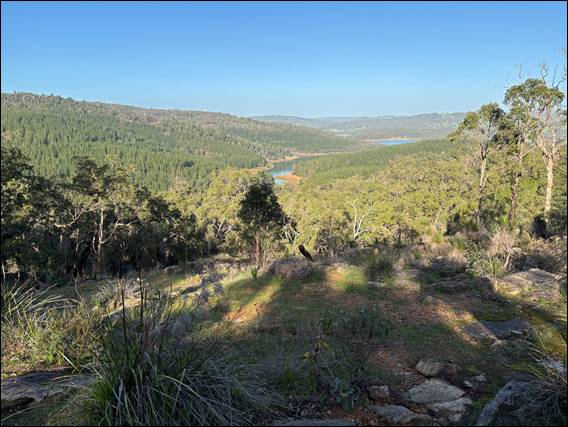
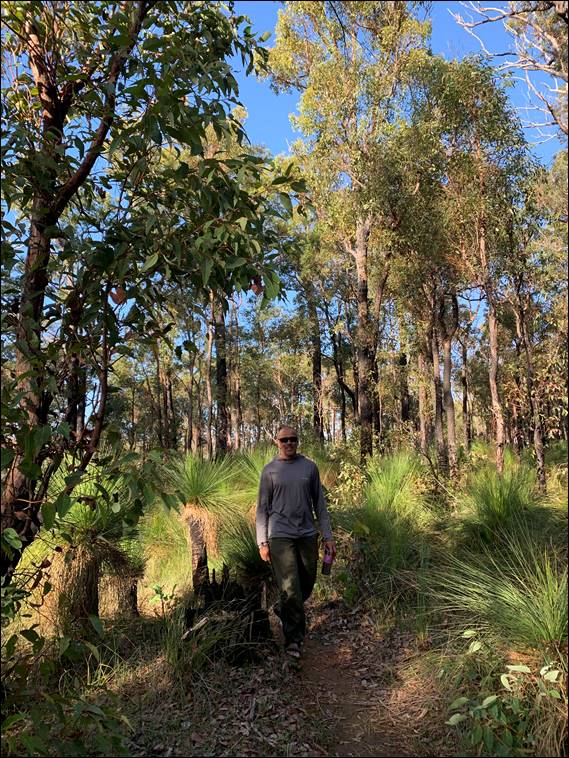
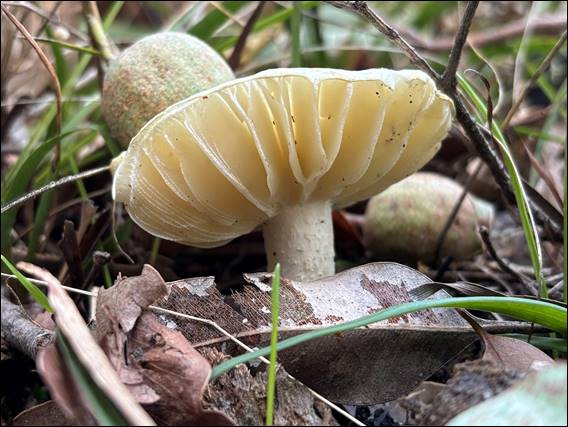
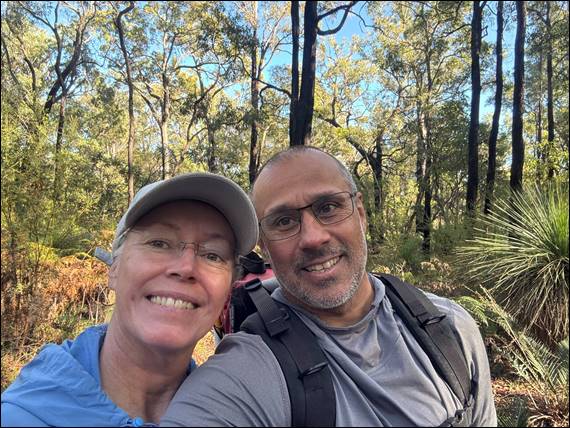
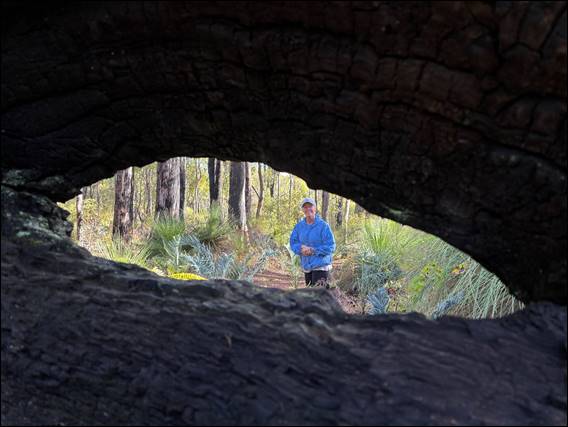
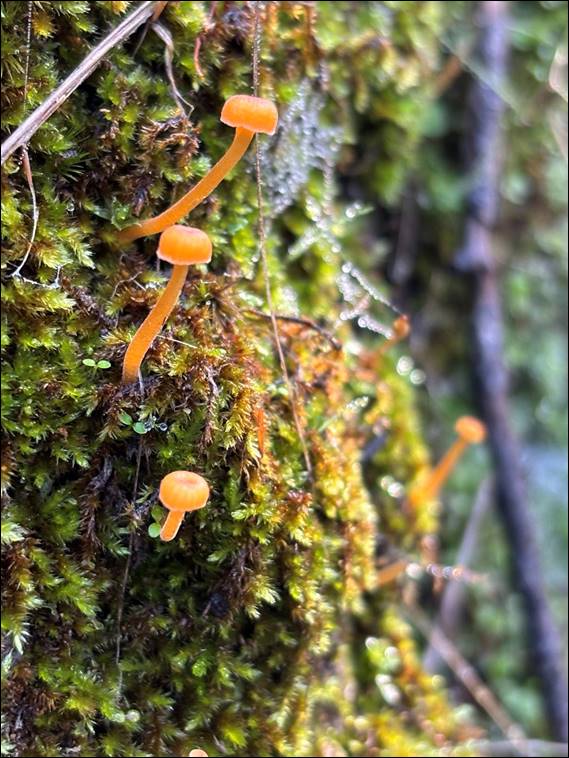
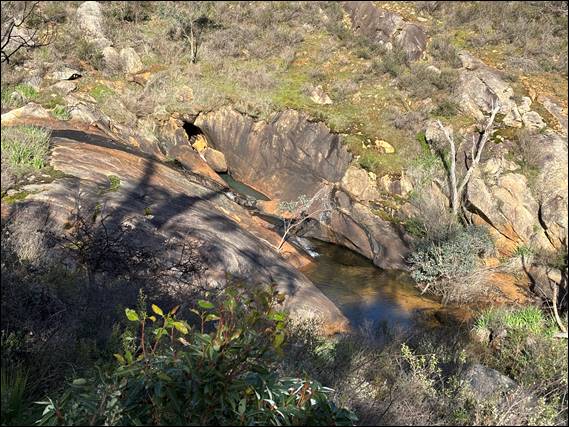
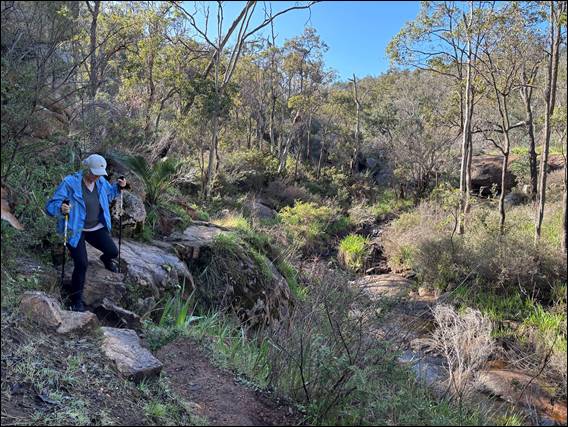
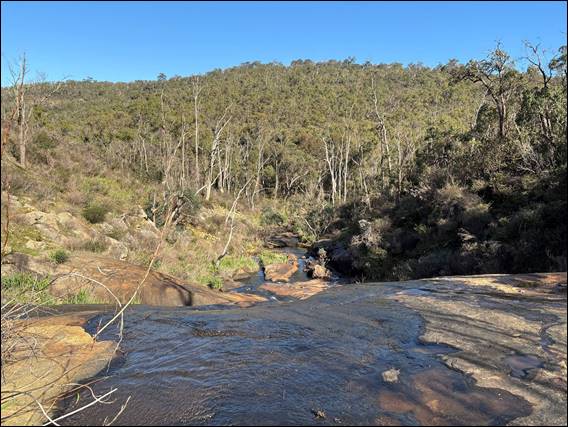
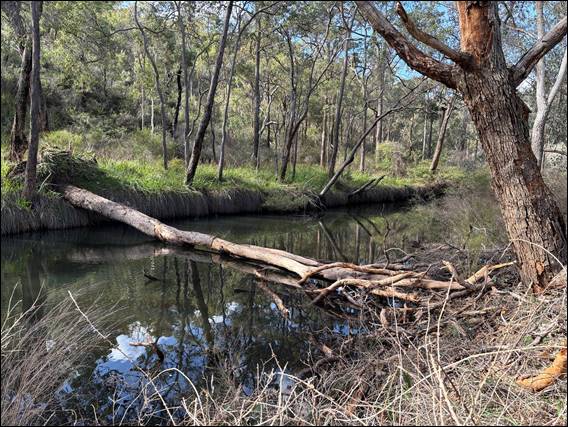
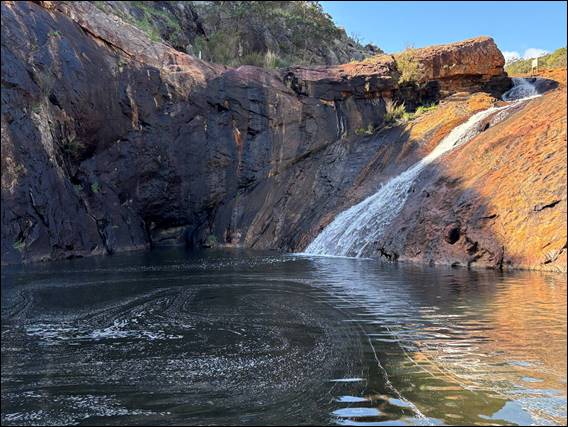
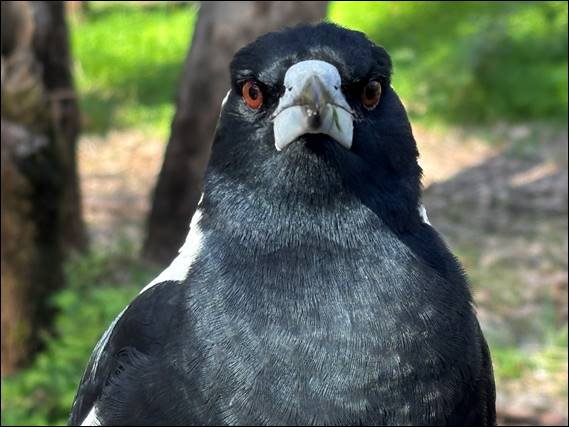
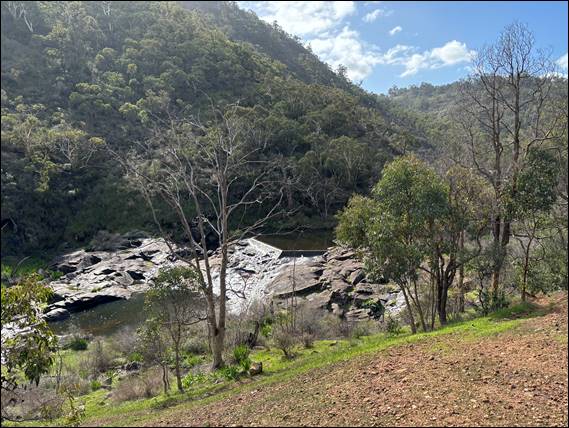
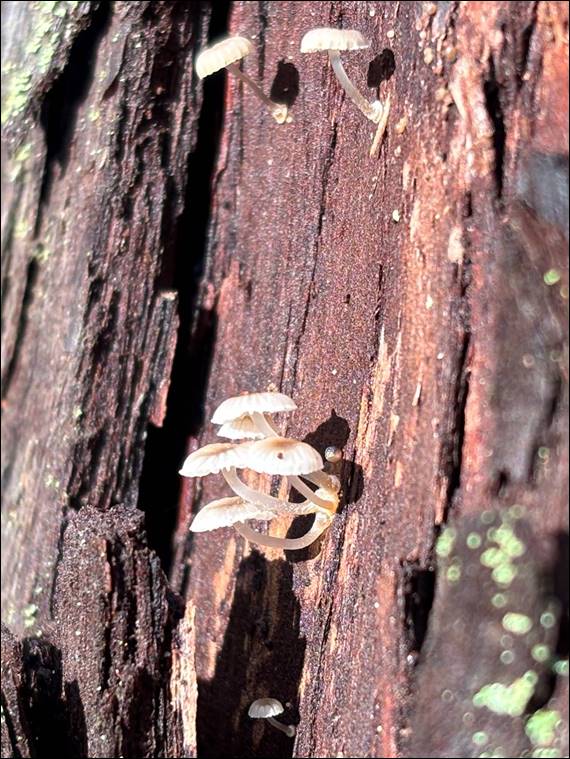
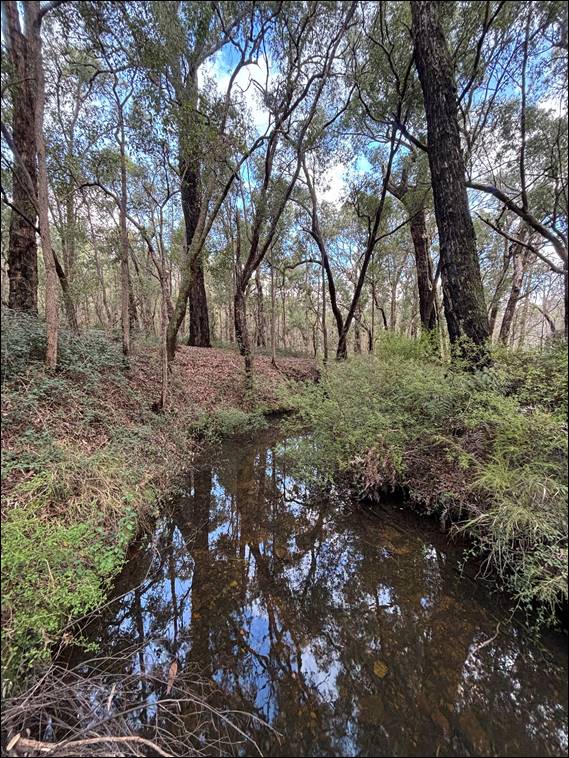
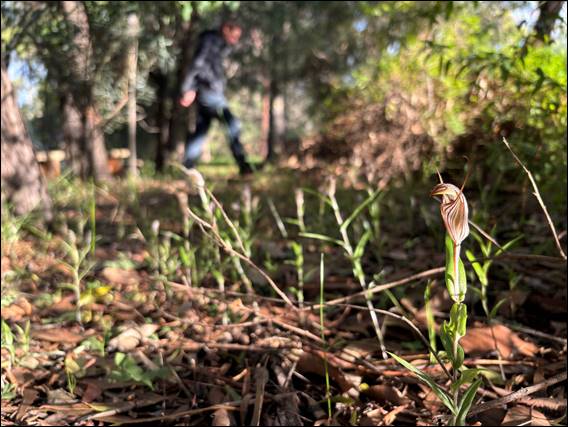


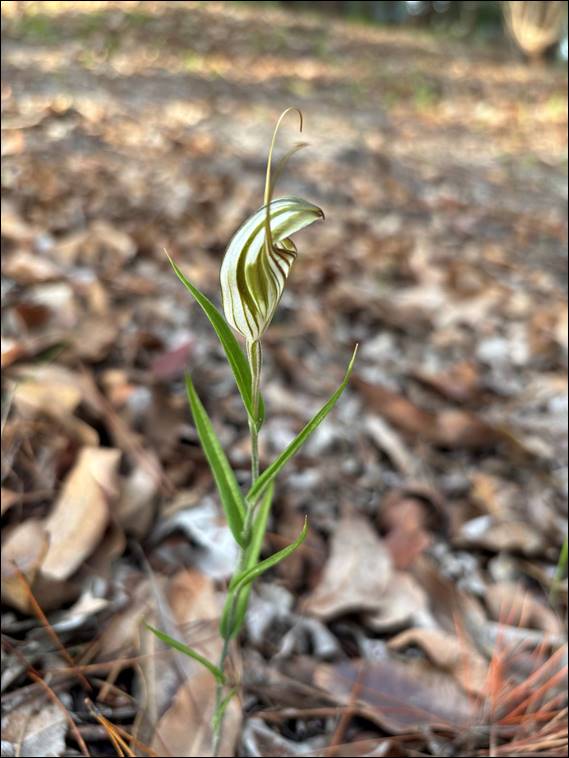
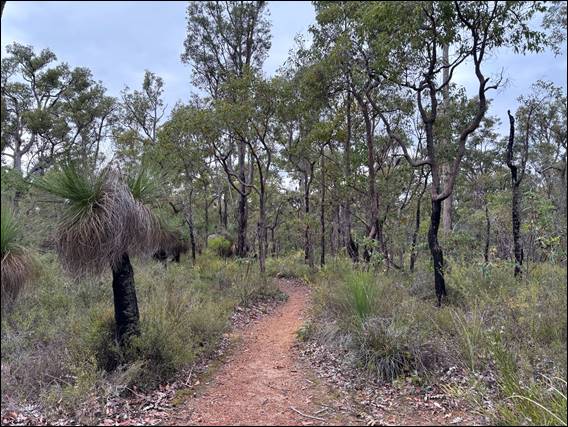


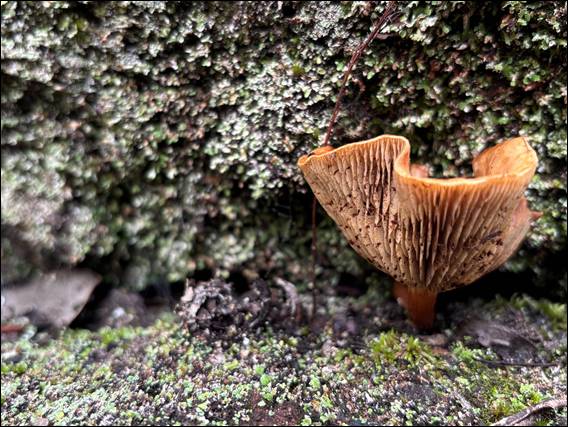
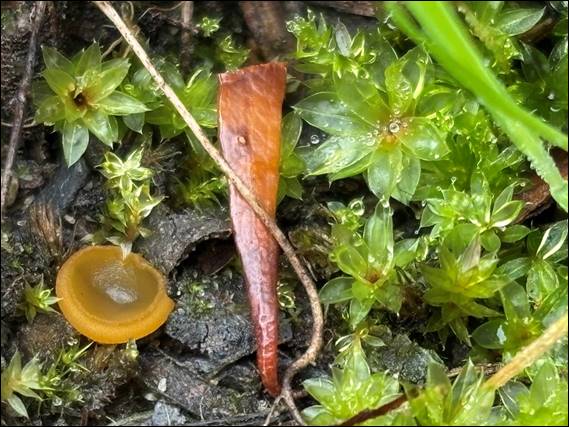
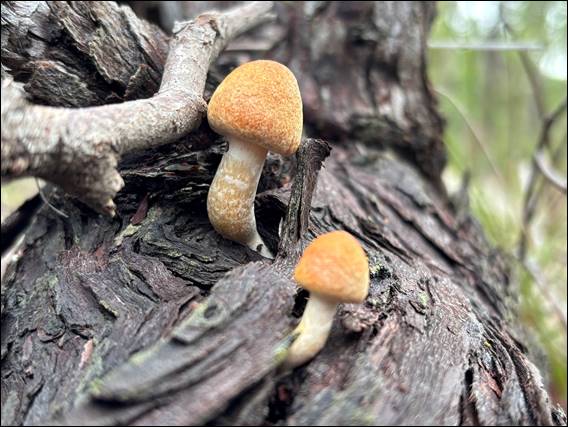
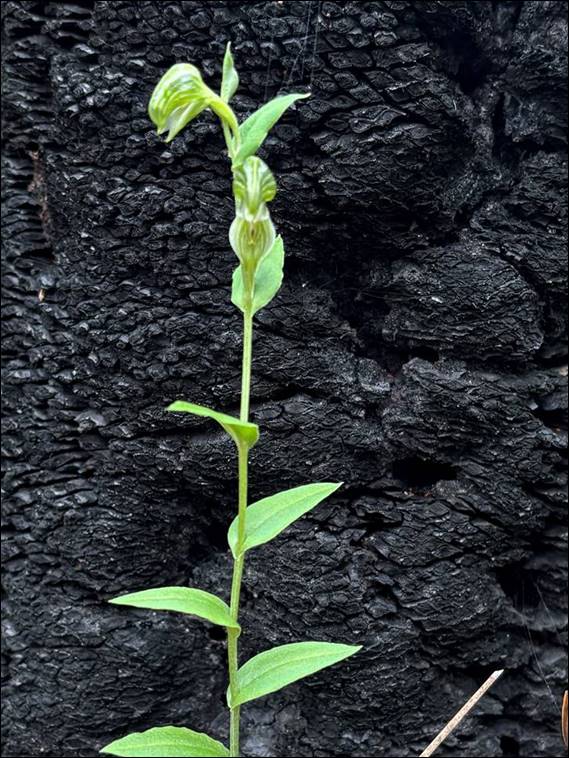
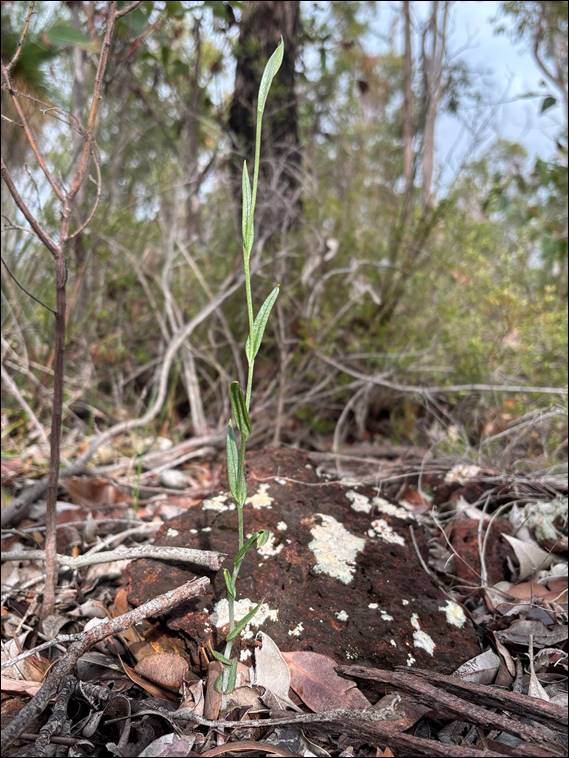
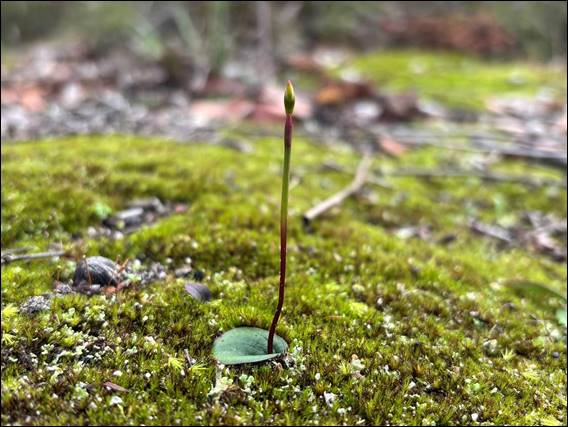

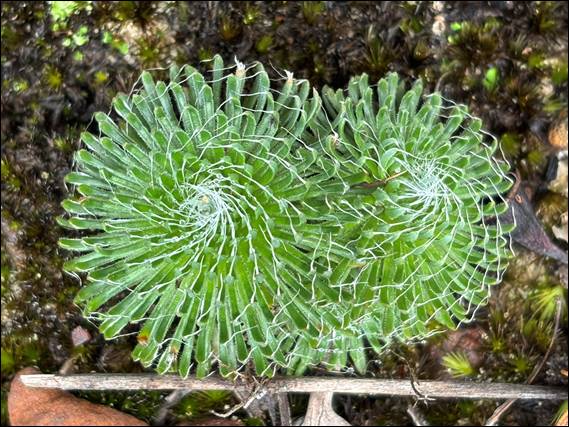
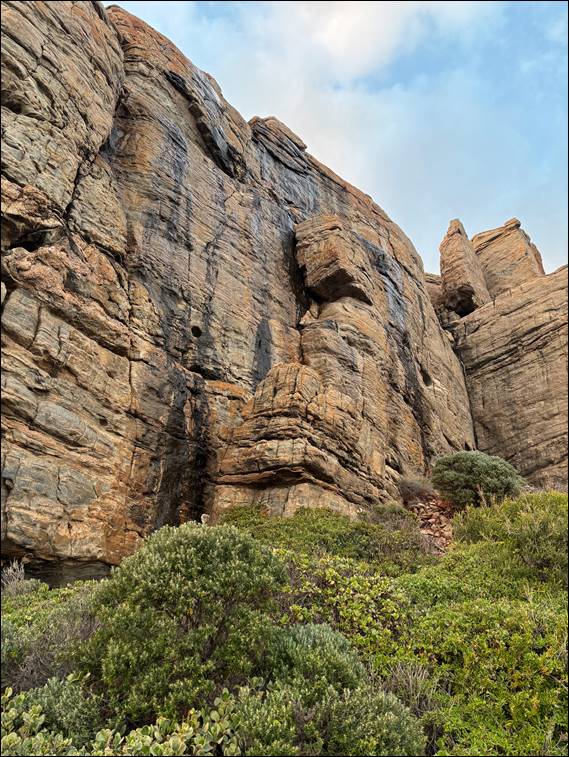
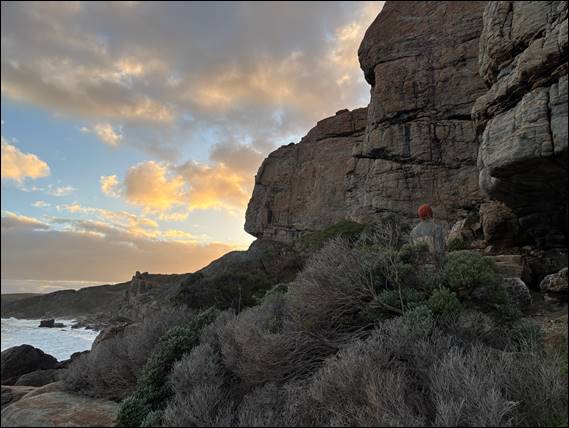
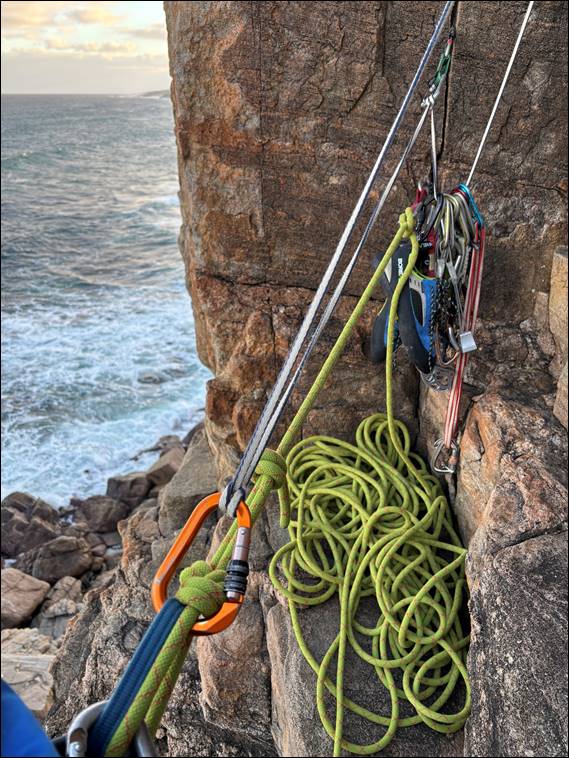
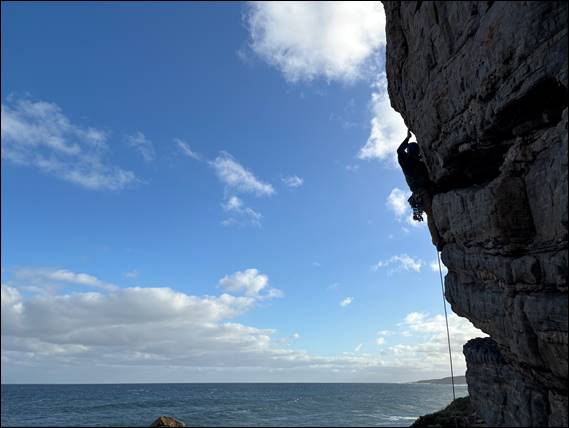

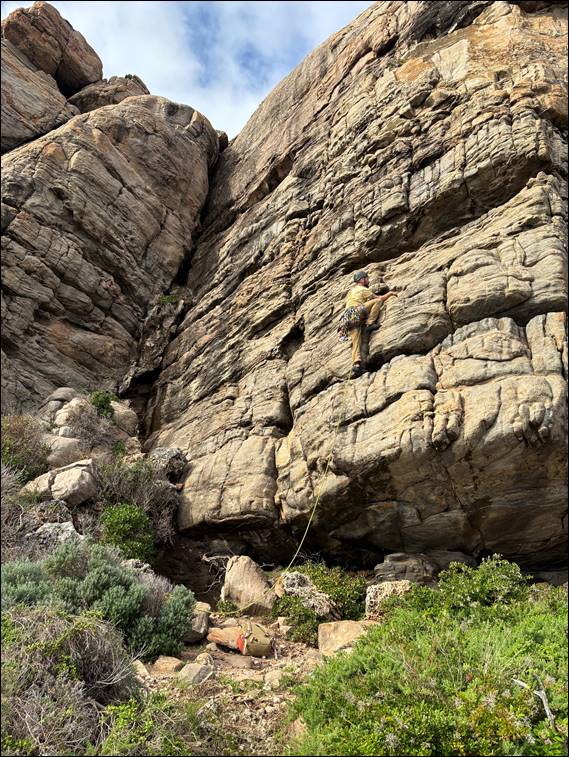
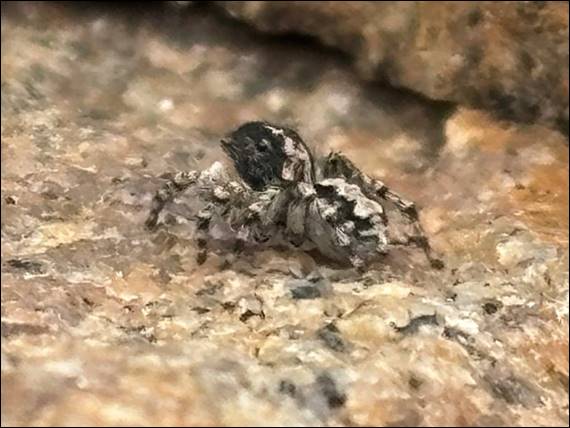
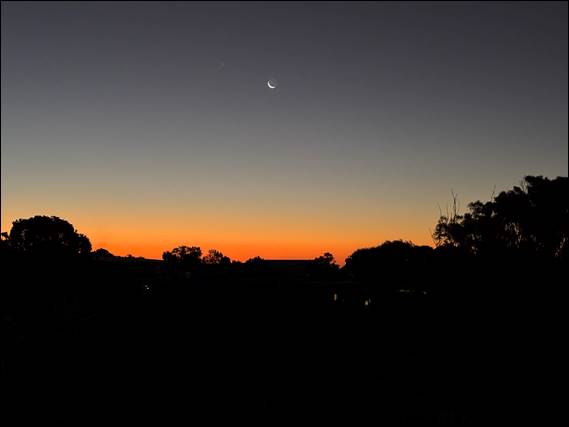
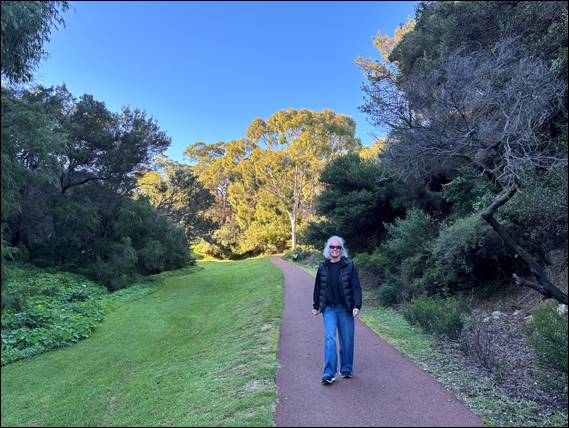

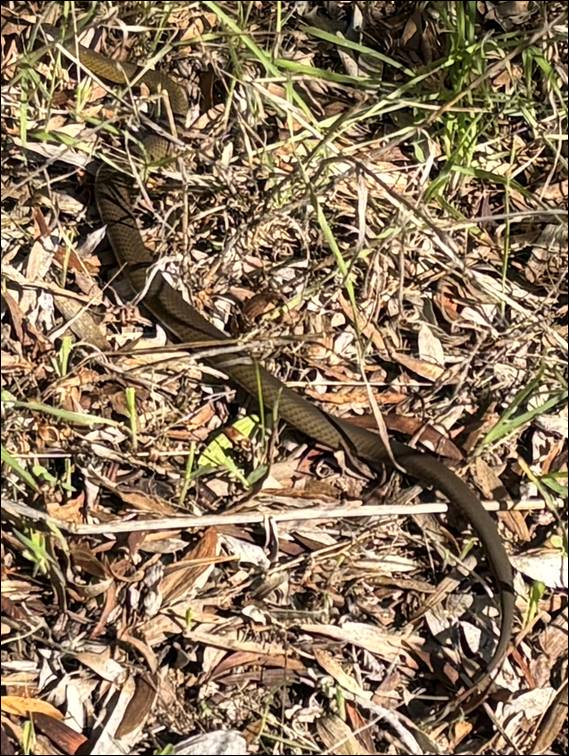
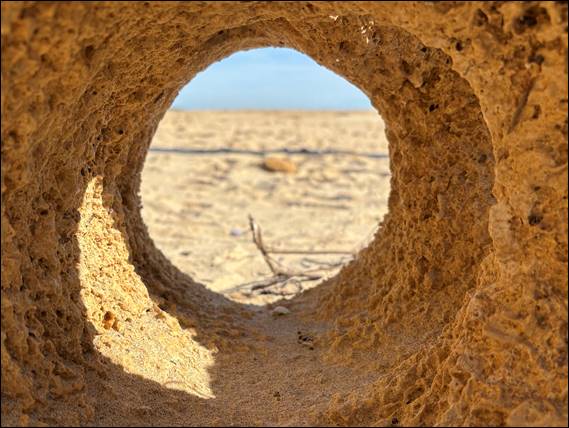
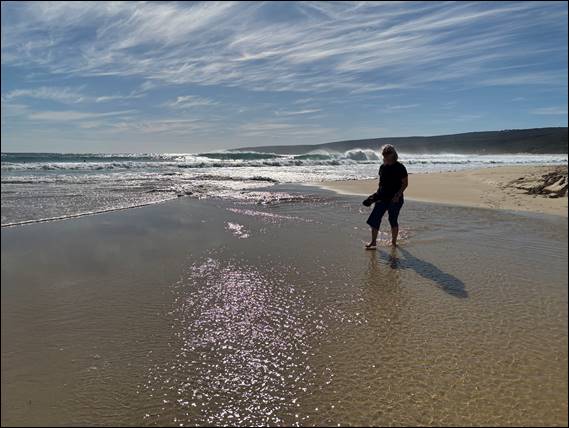

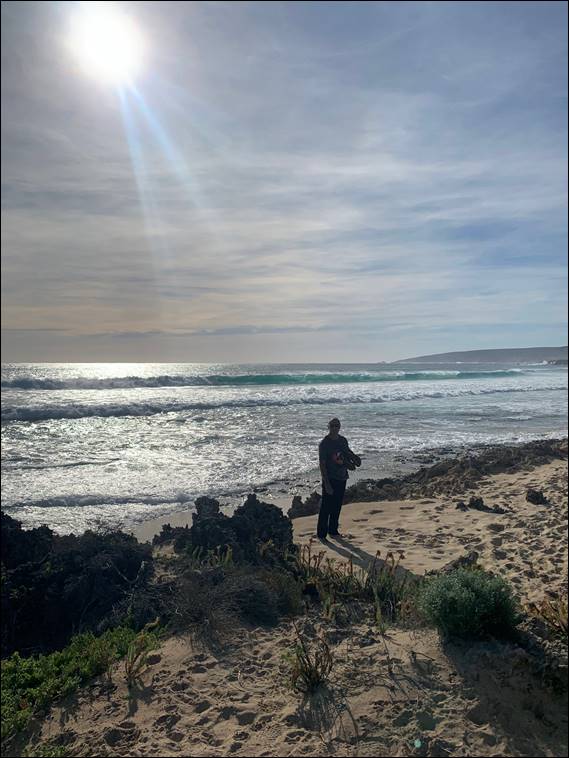
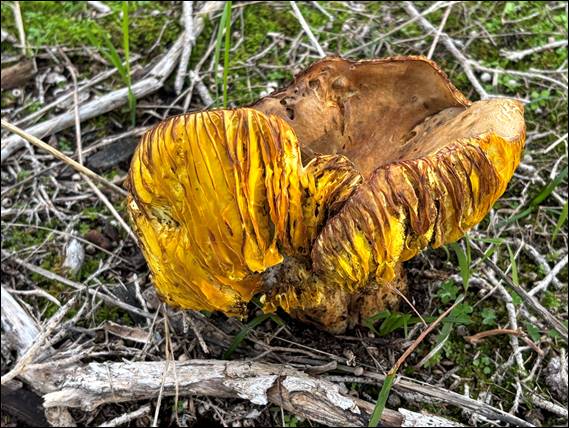
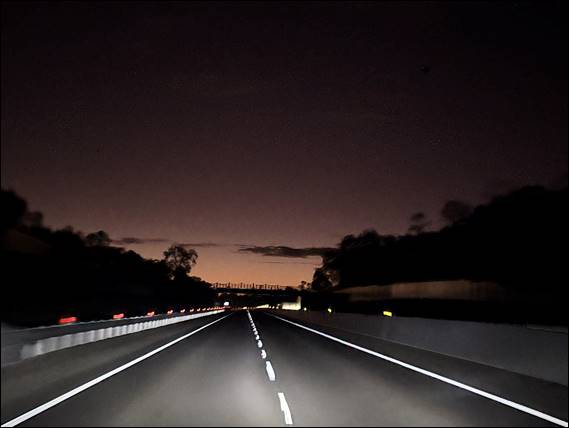
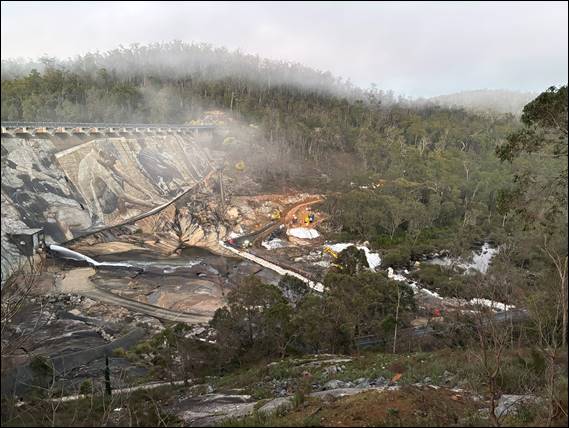
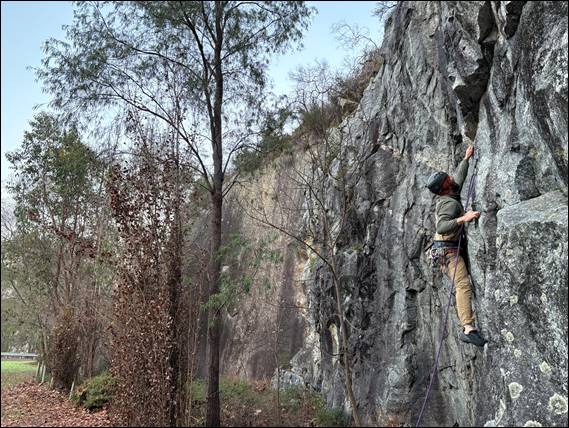

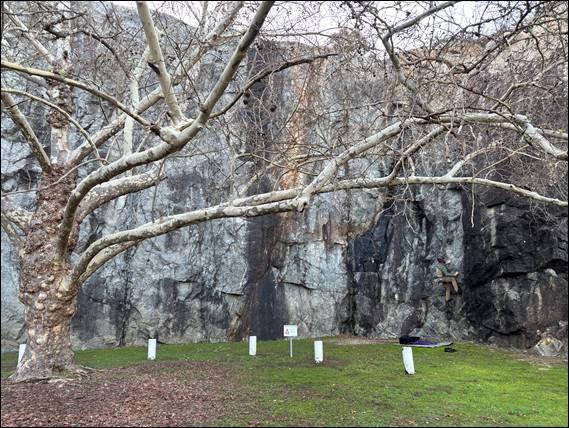
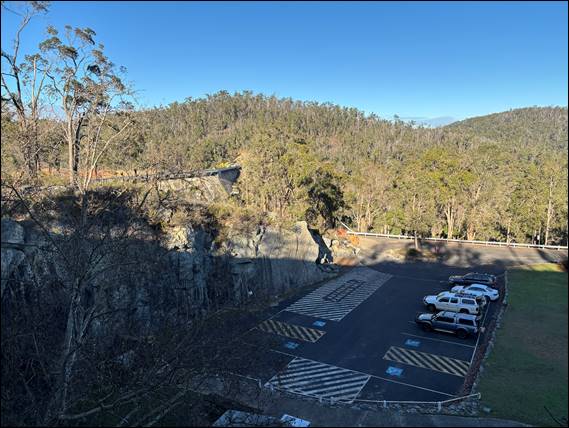


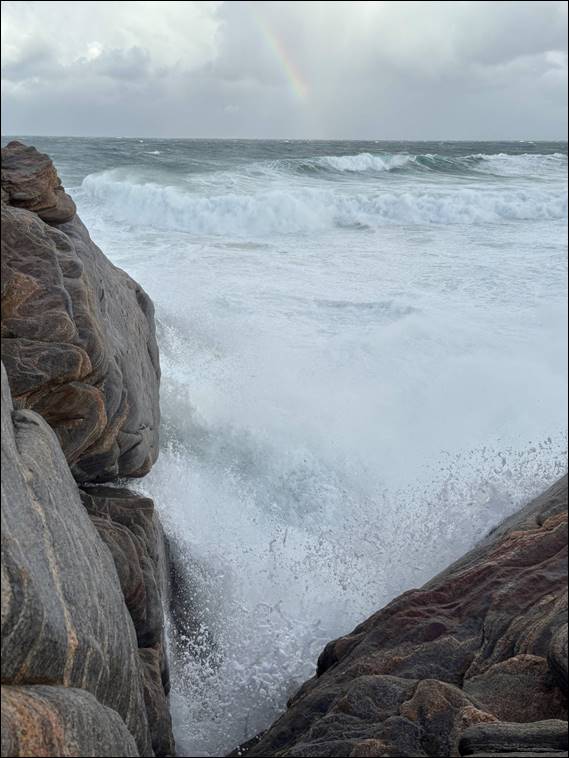


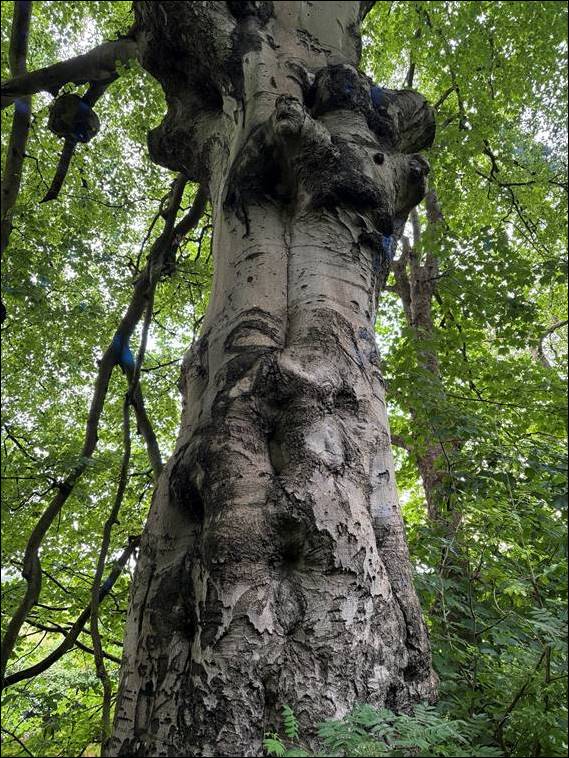
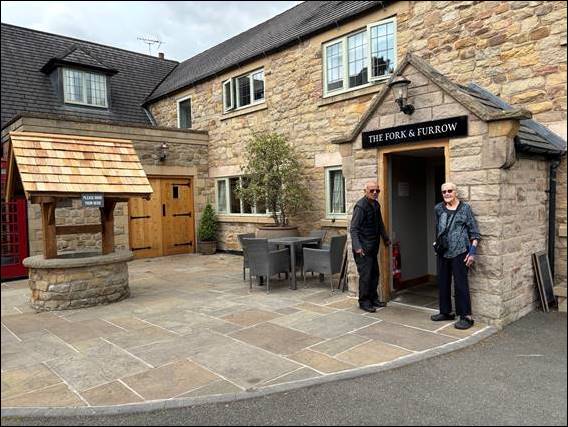

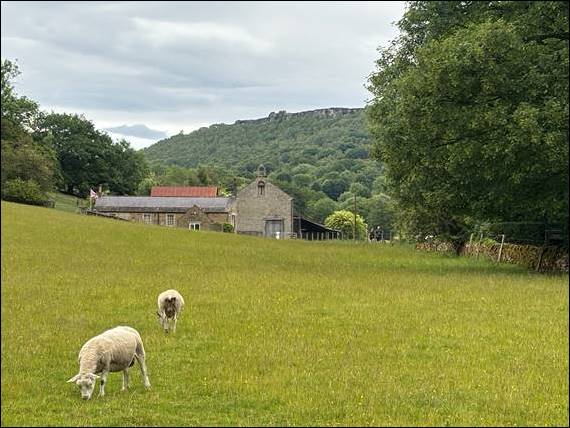


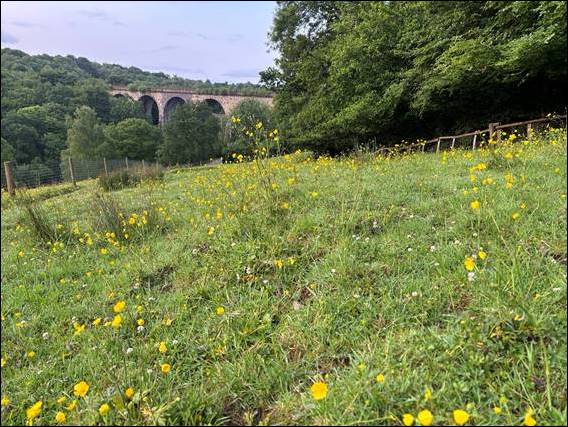


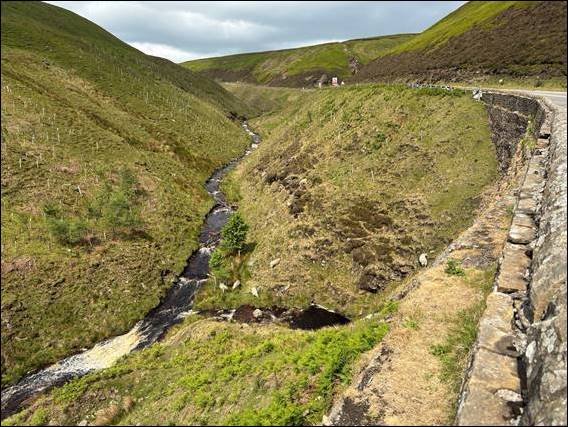


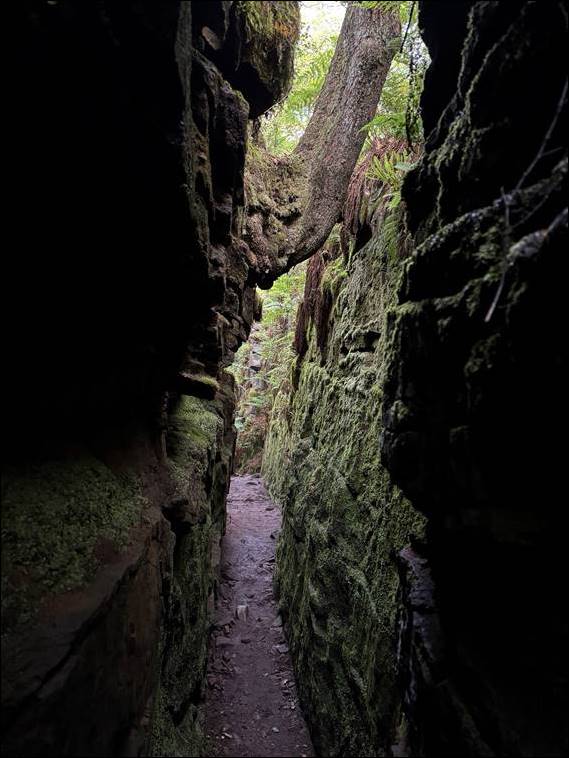

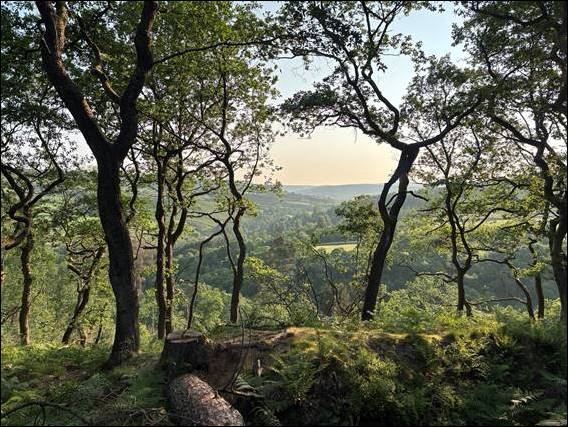


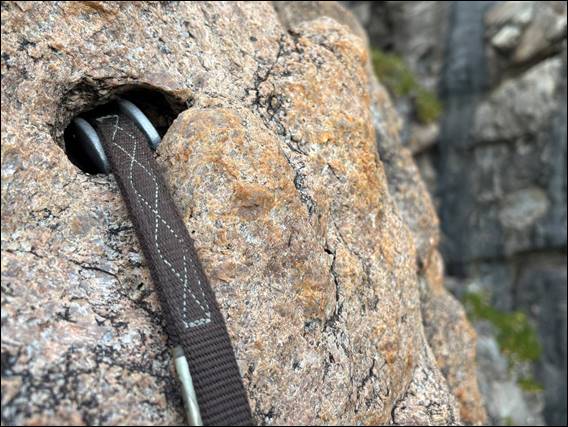
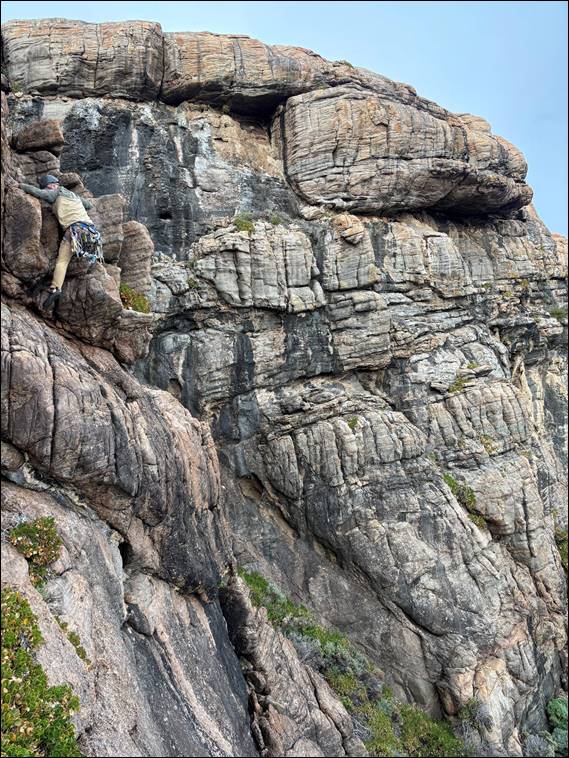

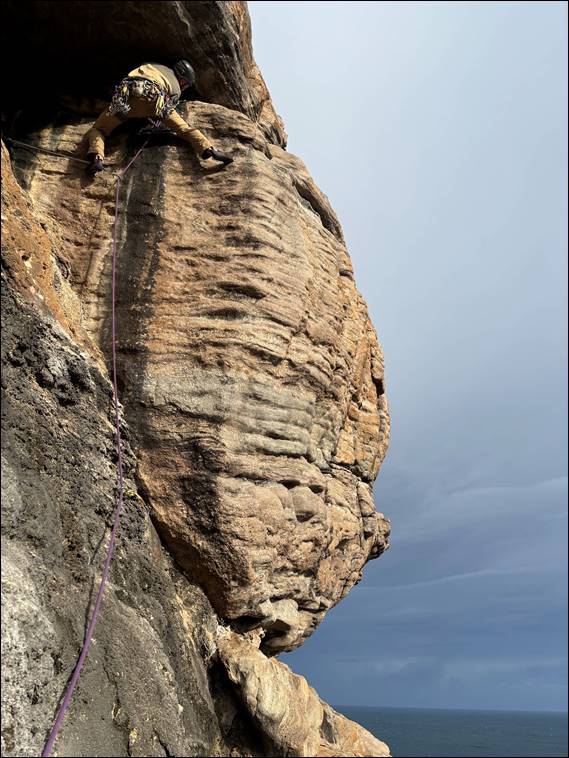


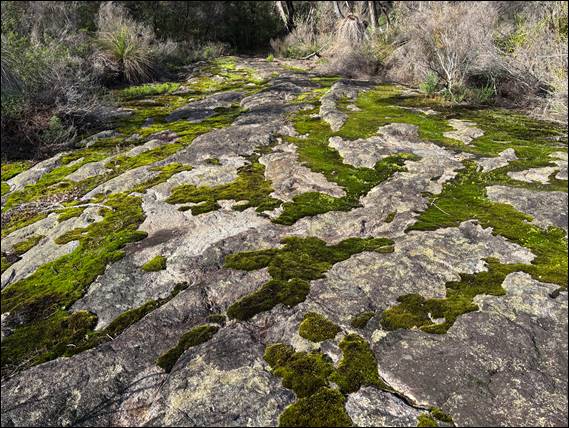
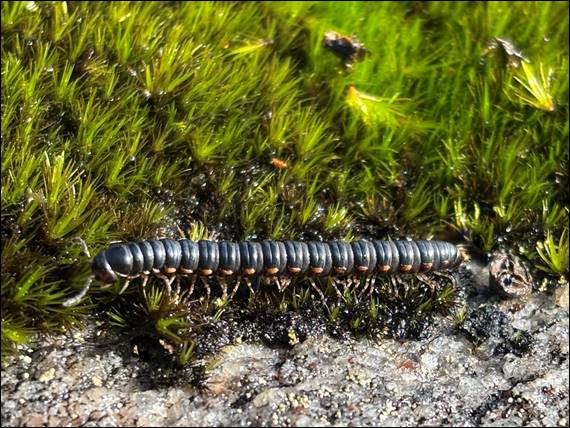
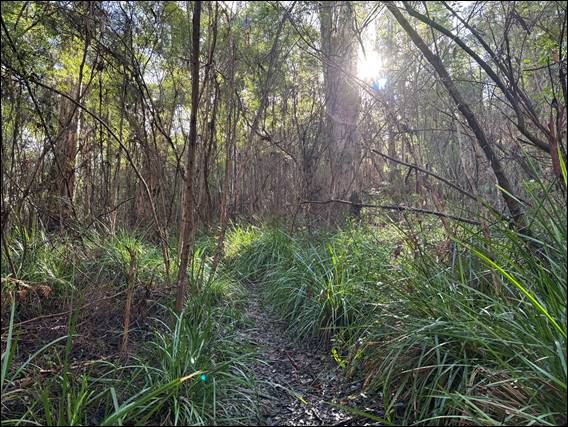
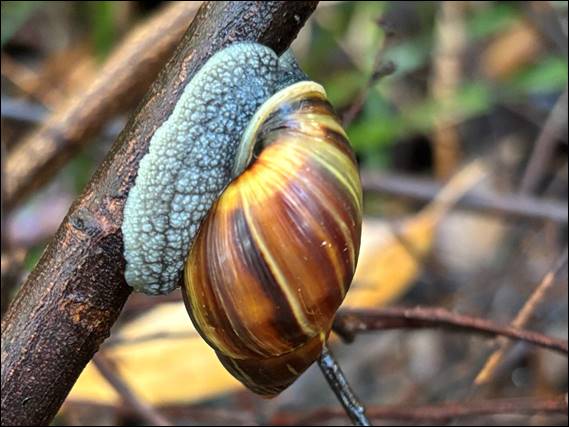
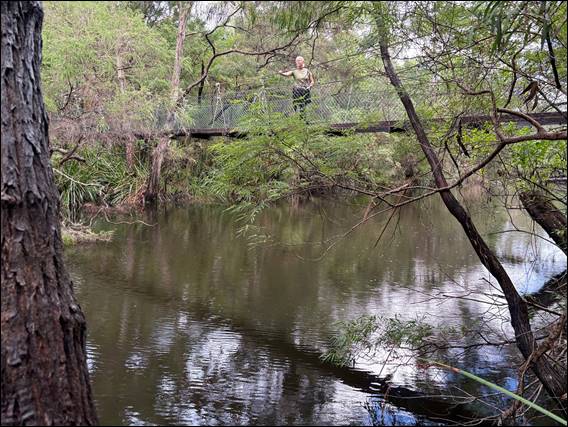
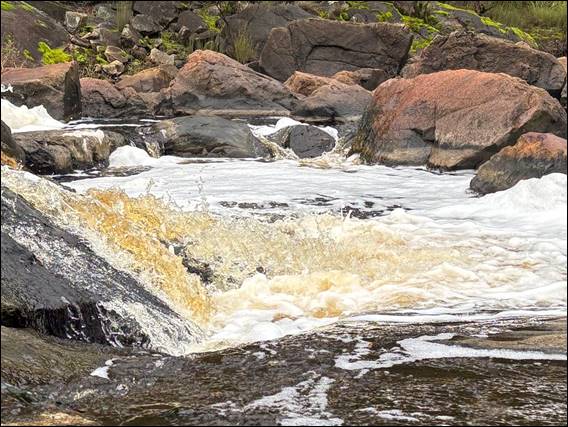
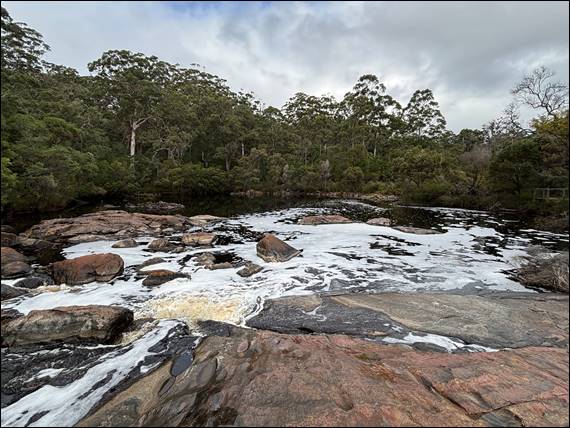
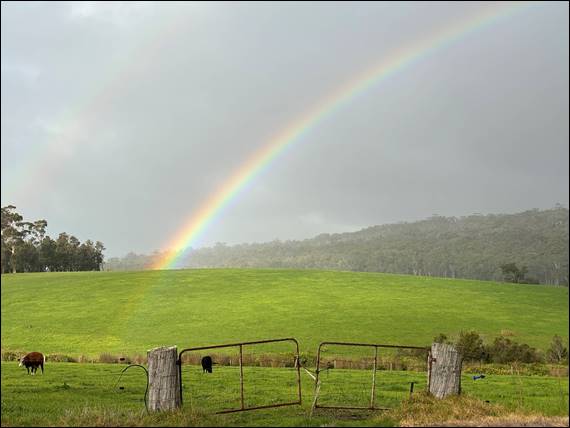
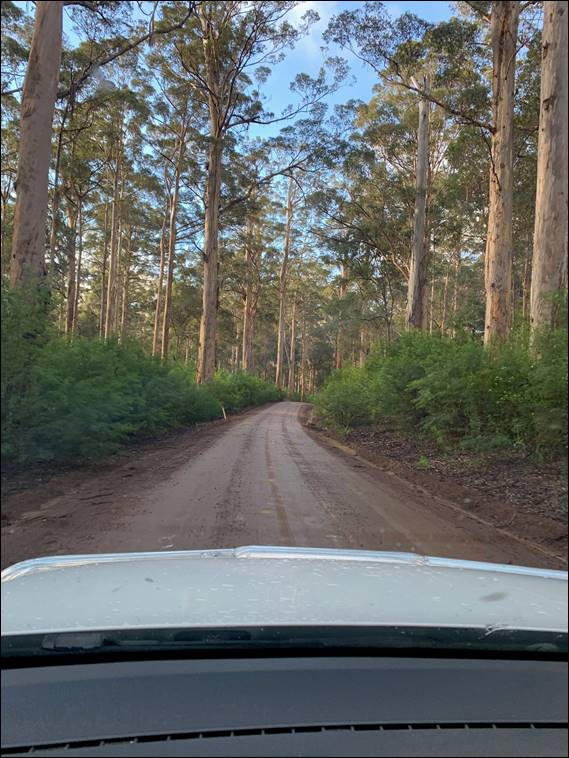
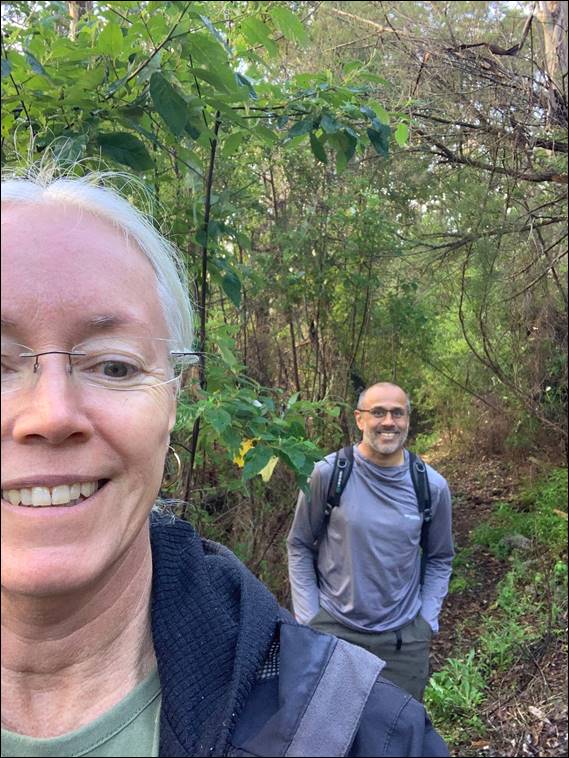
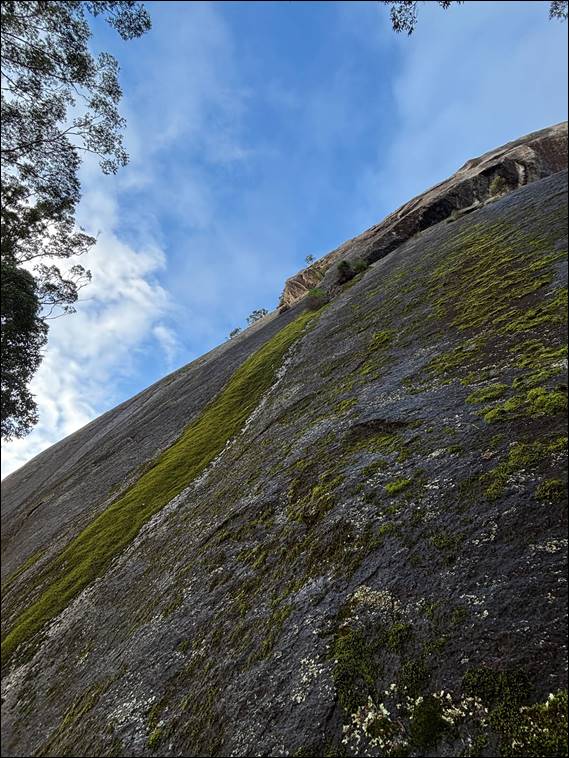
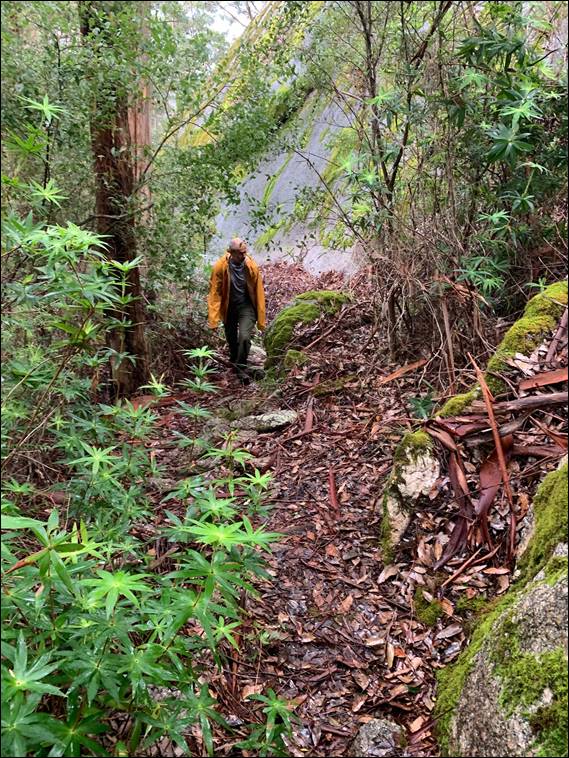
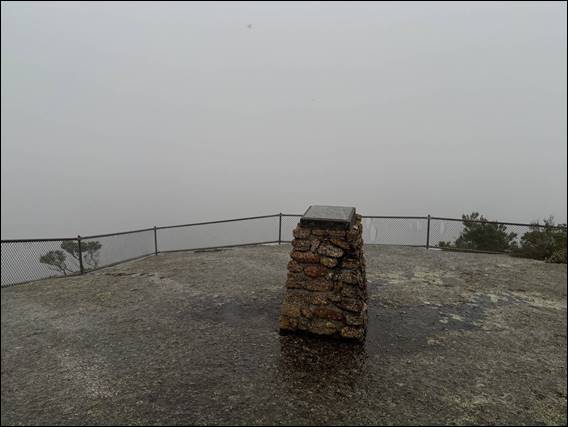

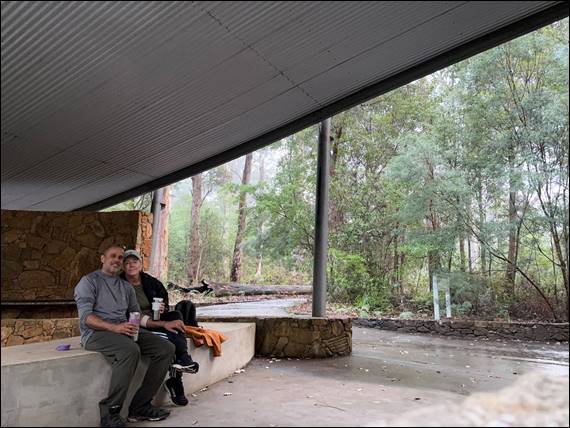
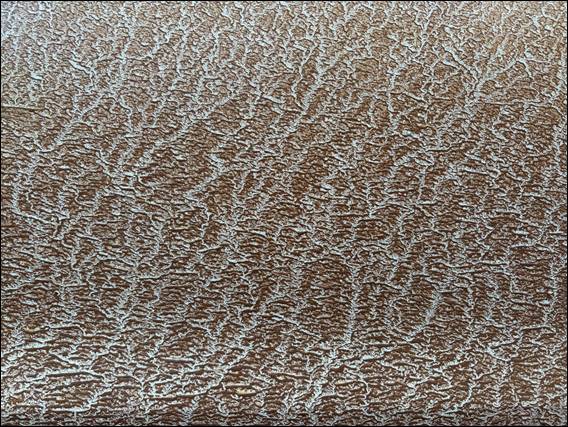
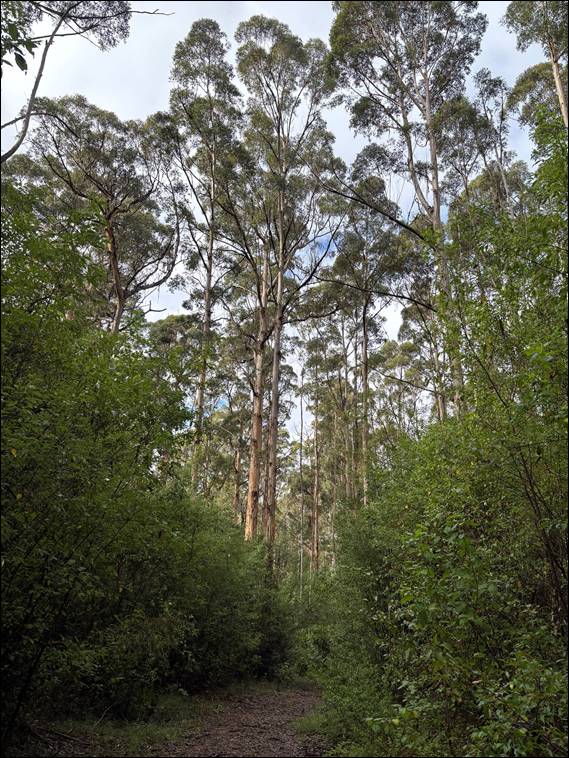
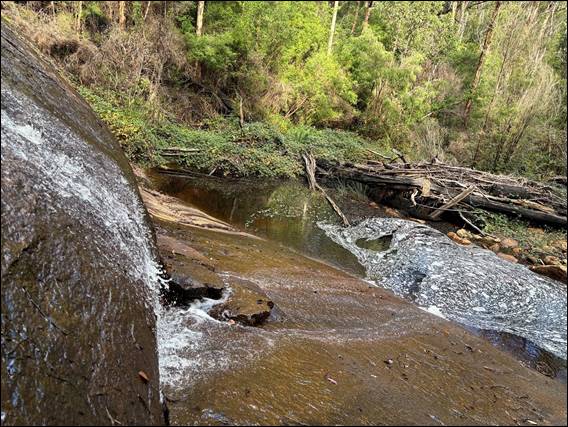
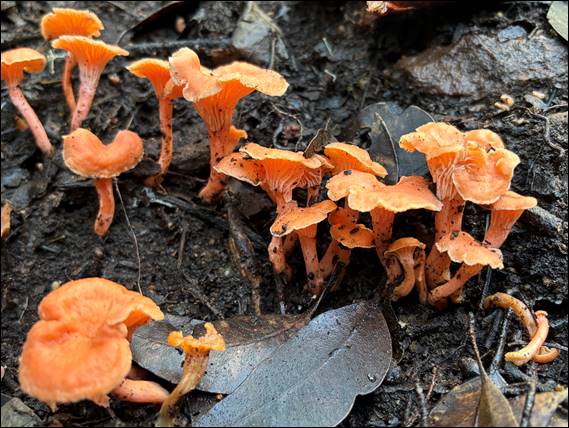
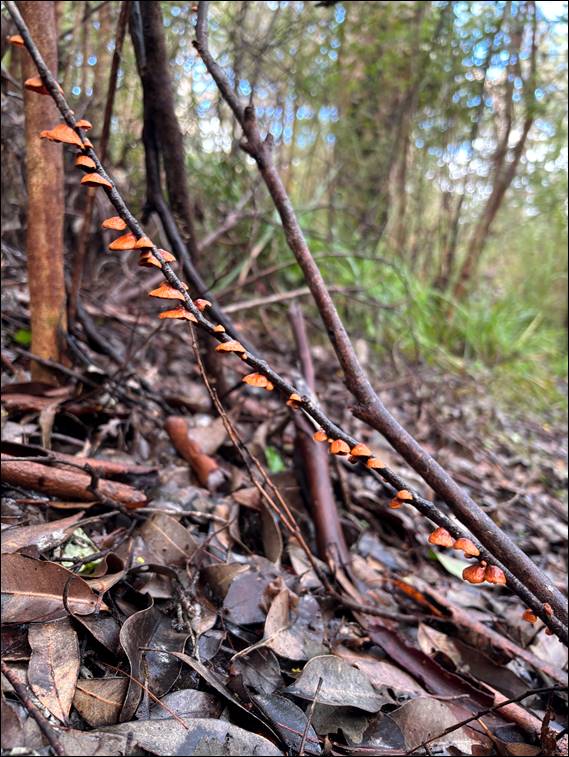
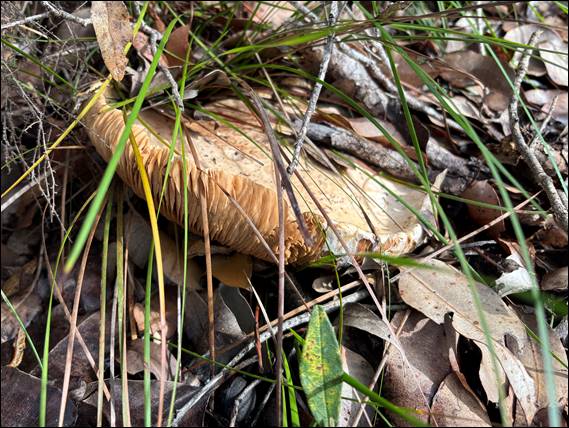
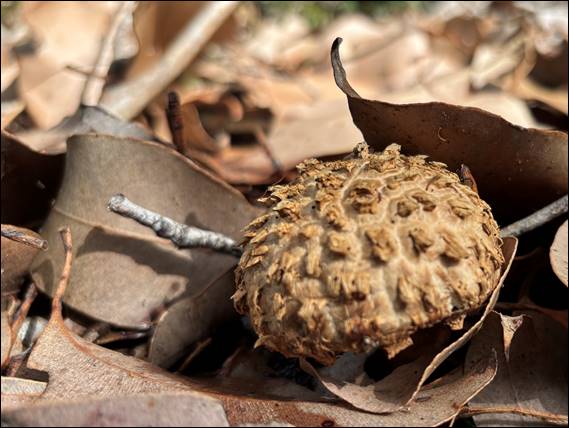
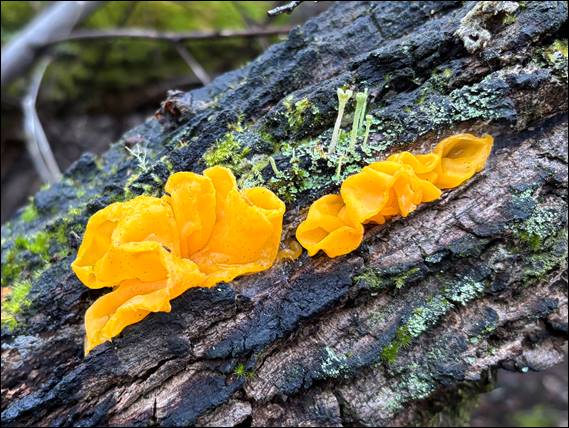
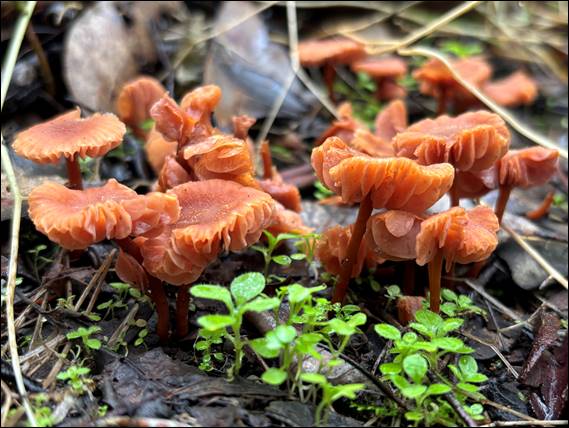
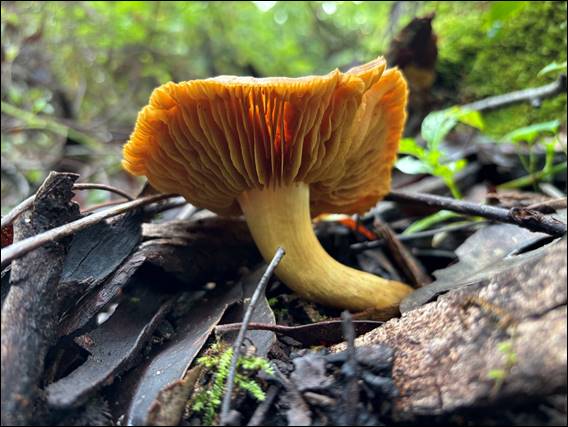
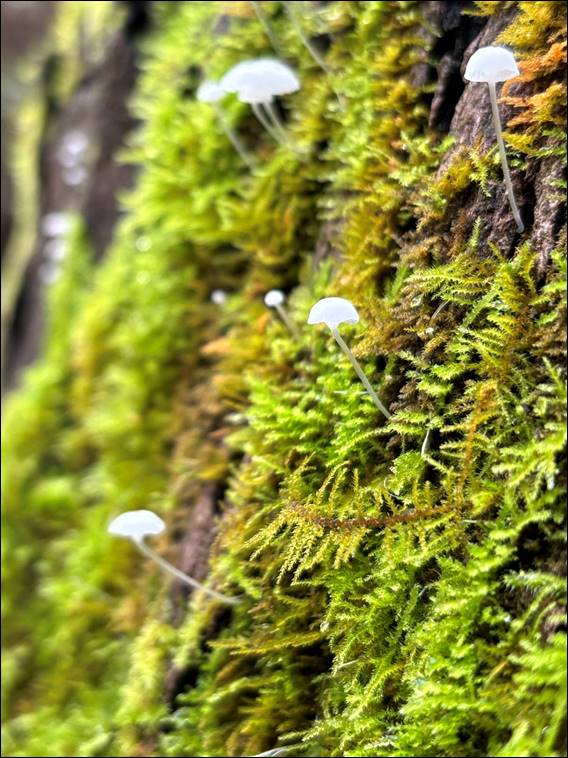
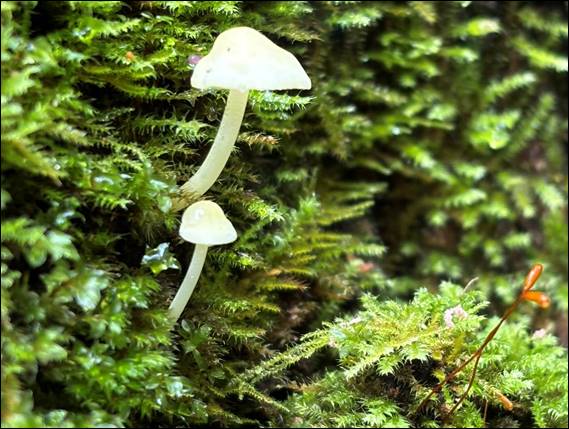
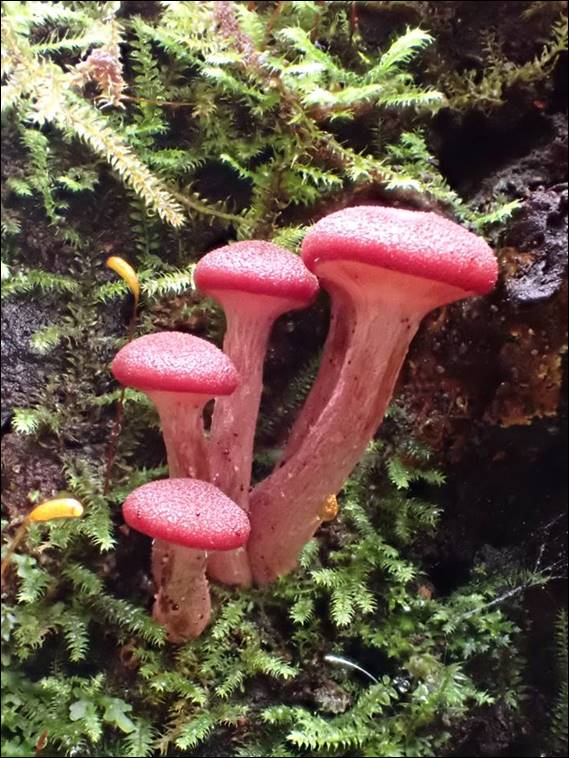
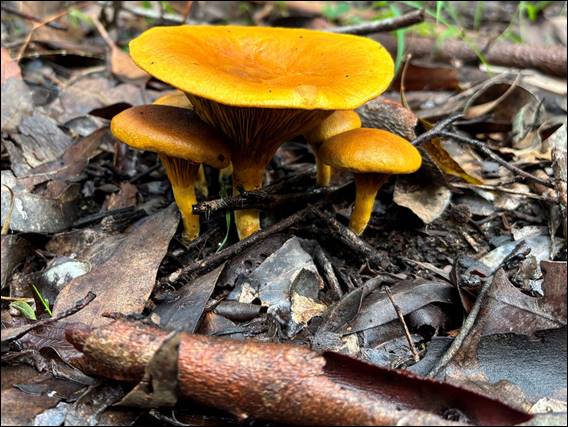
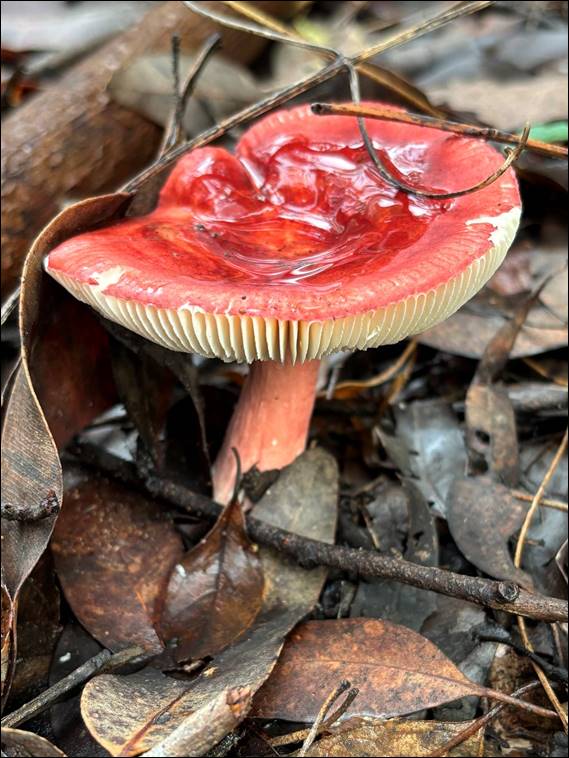
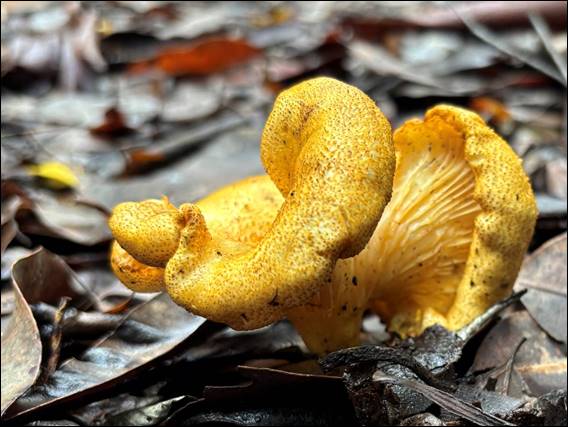
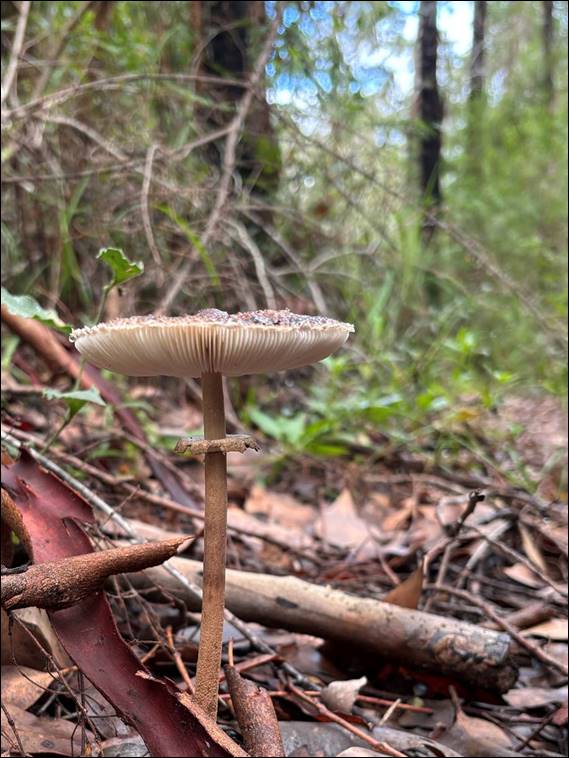
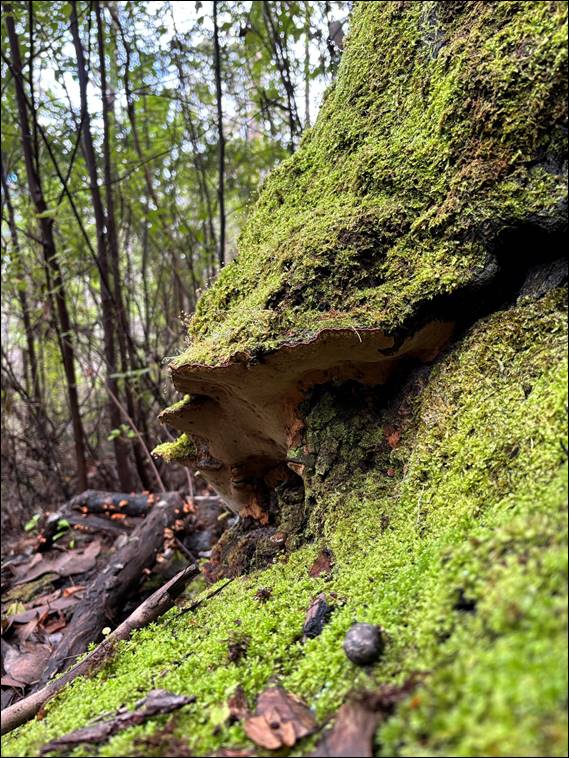
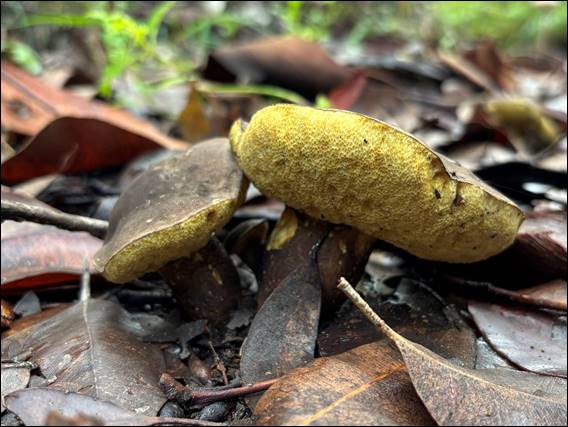


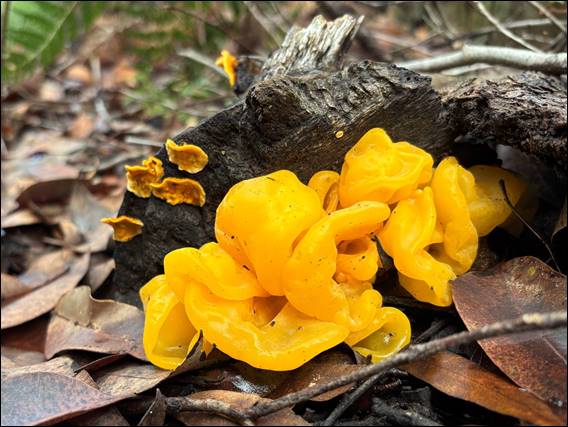
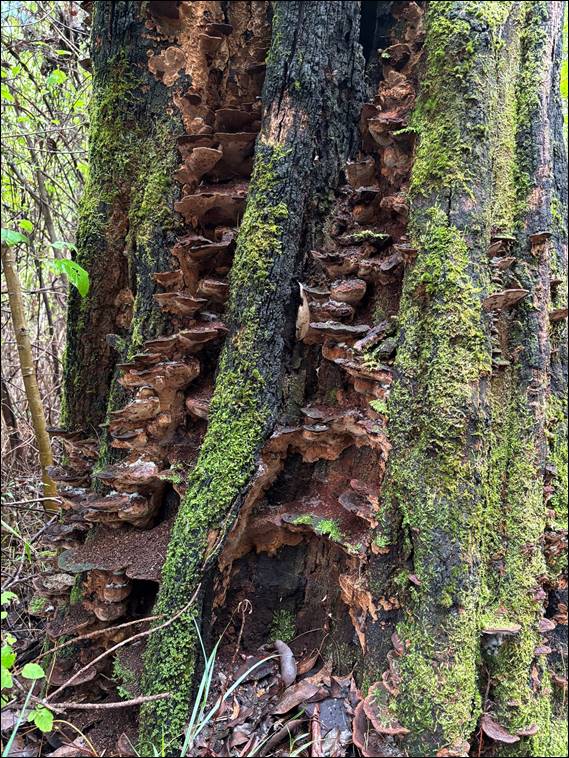
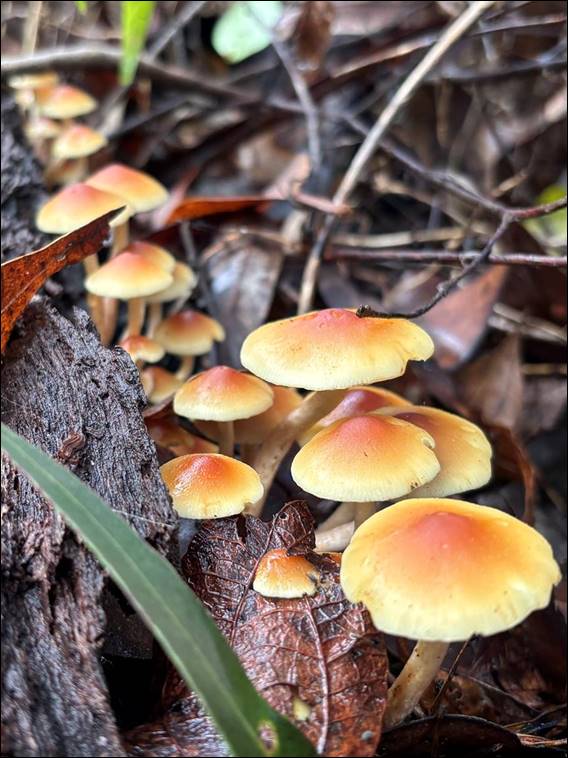
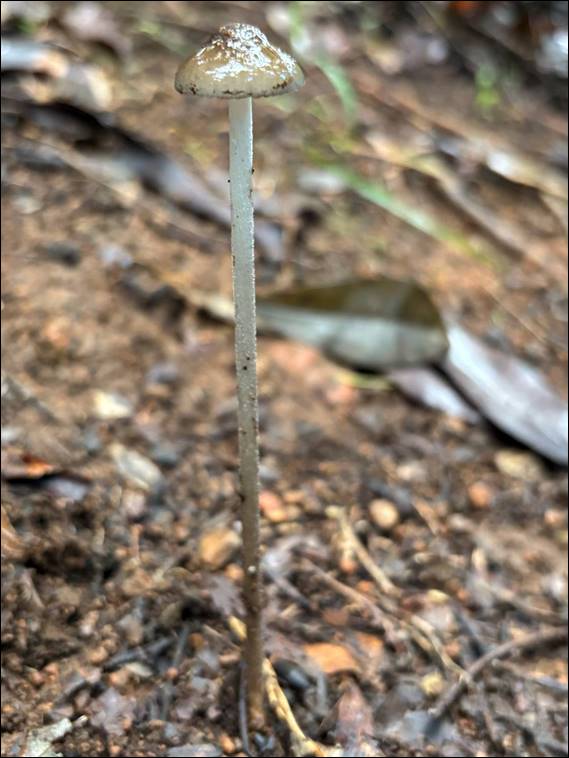
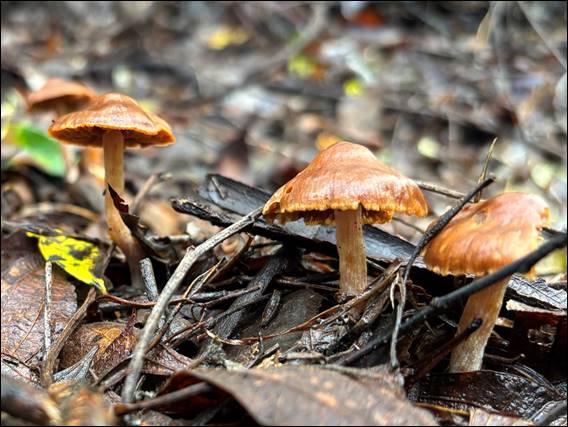
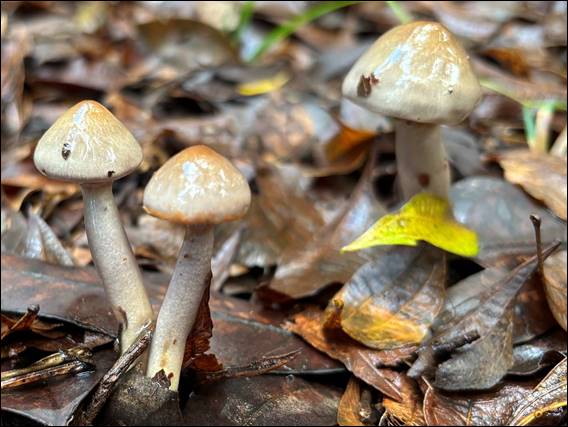
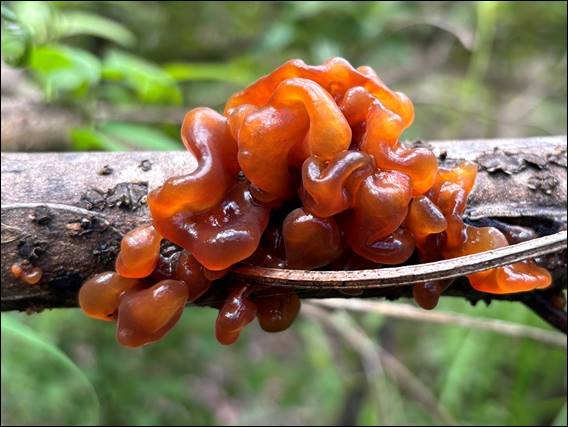
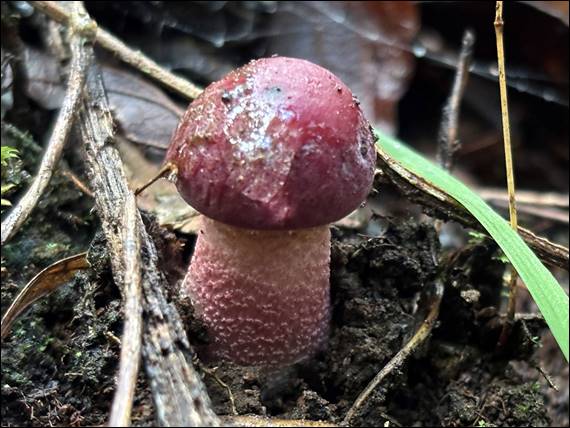

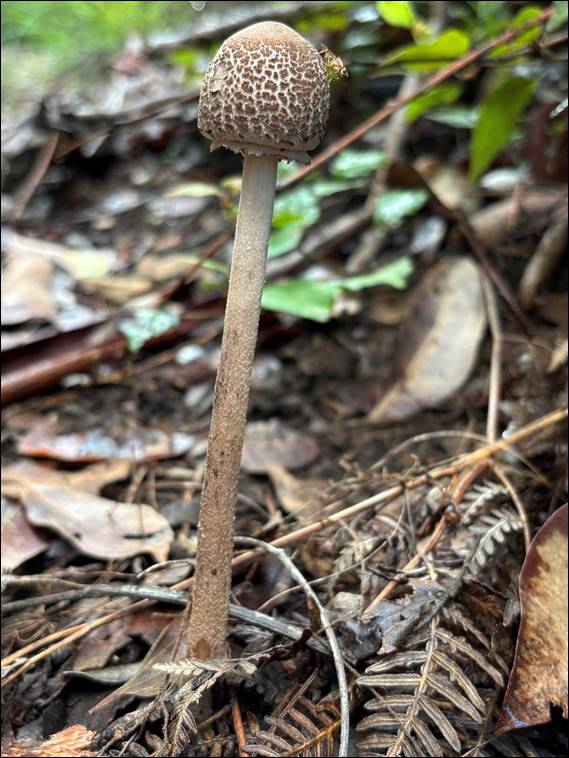
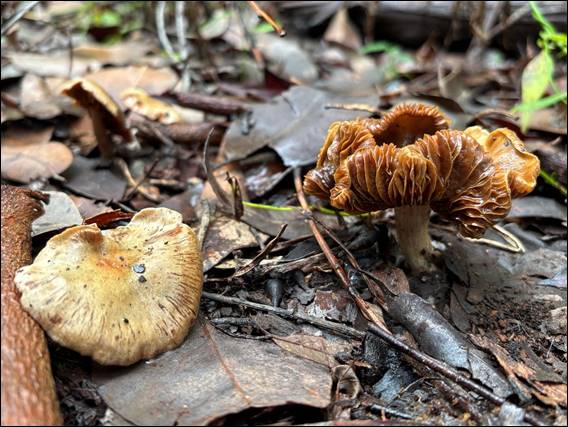
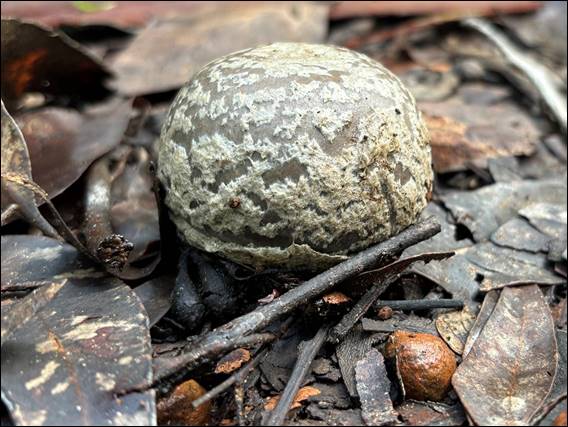


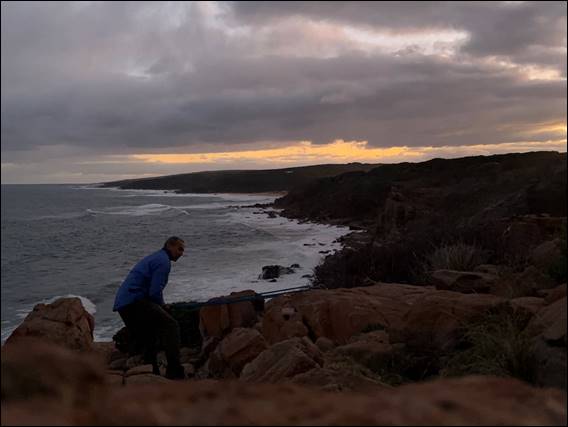


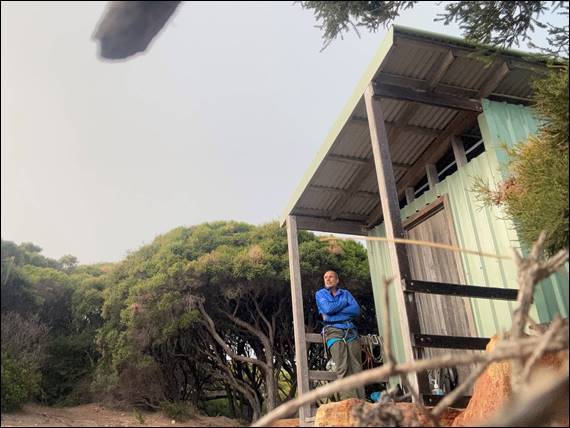


 Sandbagged