When I rolled into the Ruabon Nature Reserve on Thursday someone was wandering around doing what I went there to do. We had a bit of a chat, and it was clear he was a long-term orchid nerd. Longer than me at least. Mentioning how he had heard on the grapevine, that in relative terms during this not so usual winter and spring, Kojonup was kicking off. He had in mind to get out there for a few days on the weekend, but things were getting in the way. My weekend was also pretty sorted already, so I put the thought at the back of my mind:
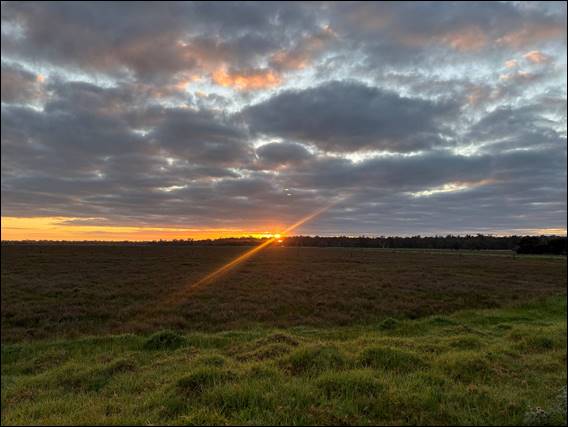
Time however was not an issue. Seeing my intended short day on Friday to allow me to have a climb had been thwarted, when Howsie told me he was not feeling the best. This in part resulted in me building up my work hours for the fortnight, to what some may call an unhealthy excess. As such I decided Monday was a good day to take off. The big nagging question was, whether to climb or hunt orchids. But I am sure you can all guess where this is heading. Kojonup was calling, although I was feeling hot and then cold about the long drive:
A near four and half hour round trip in fact. On the plus side I hadn’t been hunting round Kojonup before, so it would be somewhere new. The orchids won out. Leaving home at a reasonable time as the sun was rising. Enabling me to say goodbye to Lisa, after she had got back from her early morning fitness class, and drive out in light. While it may sound like a long way to go, the trip would only see me pass through four towns before reaching my destination, only skirting the edges of two. All connected by wide and mostly straight roads:
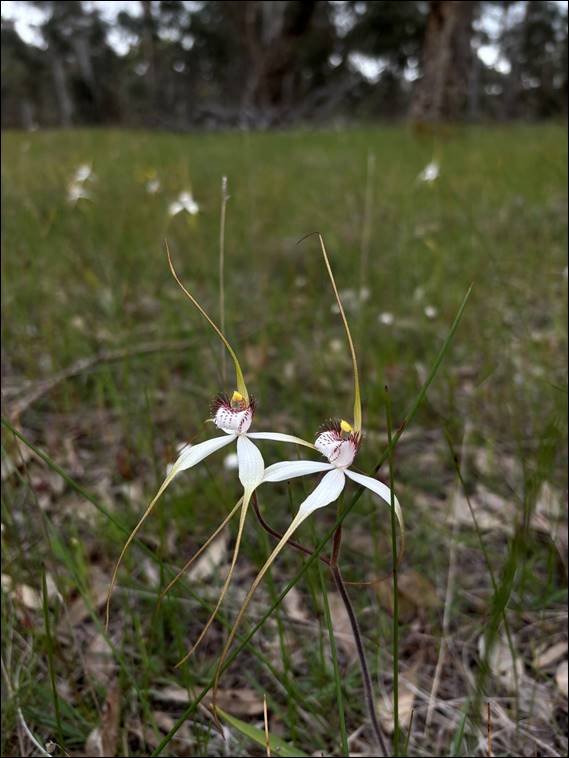
What I’m trying to say is that it is an easy drive. Even more so with cruise control and tunes. Approx. 10km before my first intended destination I spied the familiar shape of White Spider Orchids. Resulting in a quick pit stop to check them out. I’ve mentioned the 14 geographical races of these orchids before. While some can be not too bad to distinguish between, others have very subtle differences. Added to that I was in an area I have way less, if any, familiarity with. As such I will not confess to being 100% confident in some of the identifications:
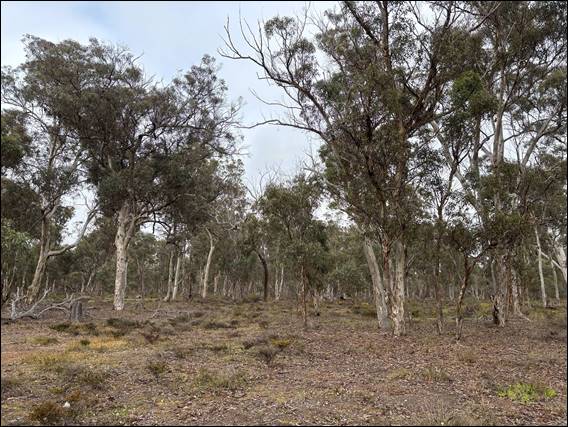
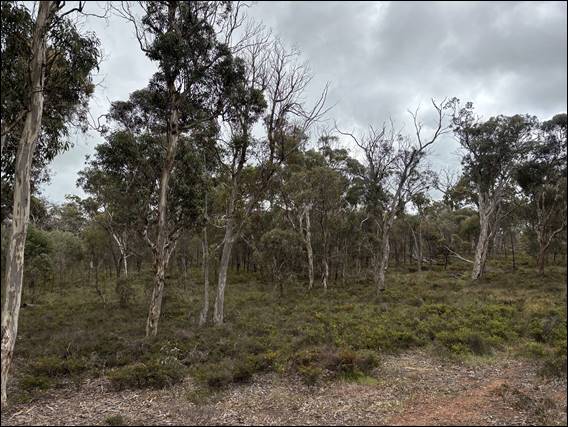
I’ve got a suspicion that the first collection of orchids were White Spider Orchids (Caladenia longicauda subsp. longicauda). And after I had a good stickybeak I drove the last leg to reach the Farrar Dam Reserve, approx. 8km before Kojonup. Two images up this reserve can be seen, comprising open woodlands with a mixture of Wandoo, Jarrah, and Marri, Sheoak groves, and granite outcrops. It extends over some 1,000 acres, and includes not surprisingly a dam. The dam was built back in 1918 to supply water for steam-powered railway engines:
I never got to see the dam, so one day will come back here and explore it further. The dam had been dug out the old fashion way, with horse and cart. Called the Farrar Railway Dam, it is heritage listed. As steam-powered train travel declined, the dam was transformed into the local go to place for family recreation and swimming. That was until a swimming pool was built in Kojonup in 1970, after which the community use of the area slowed down. But the natural beauty of the reserve did not, and it now attracts a different kind of attention:
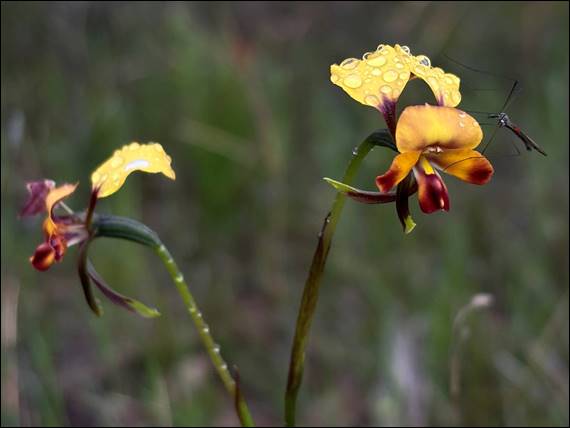
Still frequented but for less invasive pursuits of experiencing local wildflowers, native wildlife, and peaceful outdoor recreation. I had no idea what I might find here, and my first sighting was just a Donkey Orchid. Being the Common Donkey Orchid (Diuris corymbosa). Stated to be the most common orchid species in the Perth area. Its range however stretches way further and all the way to Albany. It’s species name is derived from the Latin word corymbus meaning a bunch of flowers, and the suffix –osus meaning an abundance of:
While my image is of just two flowers, I came across lots of densely packed clusters of these flowering. Another reason for including the image I have is the insect perched on it, which I have not been able to identify. The body and head look like a crane fly, and with the distinct red mark on the abdomen I thought I may have had a fighting chance. But no. I also didn’t have a fighting chance against the mosquitoes here, they were rife. Lisa’s voice rattled in my head, telling me I should have taken insect repellent. She was not wrong:
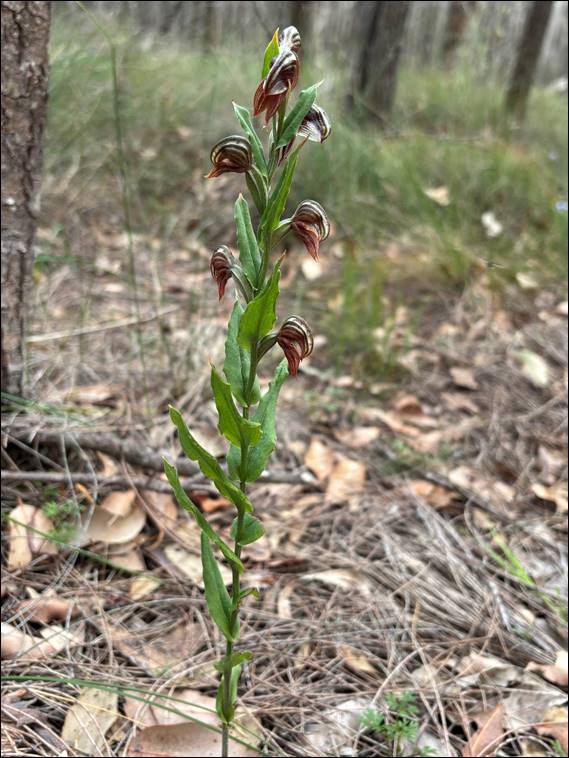
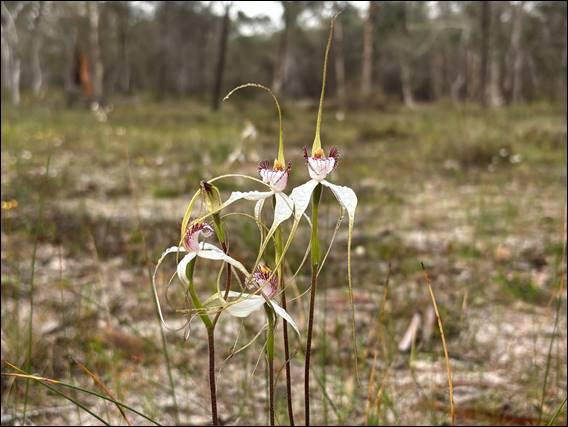
Next up are Jug Orchids (Pterostylis recurva). This image took my fancy due to the increasing red colouration. I did wonder if this may be more pronounced due to the local soil type, but there is no evidence of this occurring. These merely and naturally turn a deeper reddish-brown colour as the flowers mature. Next were the White Spider Orchids, hundreds of them in every direction. The clump may be Tangled White Spider Orchid (Caladenia longicauda subsp. redacta), not because they are tangled but based on their size:
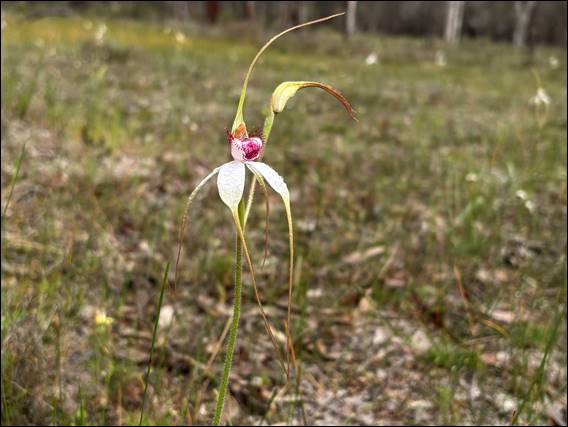
They are named because of their relative small size compared to other White Spider Orchids. With redacta coming from a Latin word meaning edited or reduced. They are at times confused with the Stark White Spider Orchid (Caladenia longicauda subsp. eminens), a species I will get to later. In addition to being smaller they also have shorter teeth on the side of the labellum. Next up is a hybrid, most likely between the White Spider Orchid and Darting Spider Orchid (Caladenia uliginosa). I did not get to see the latter unfortunately:
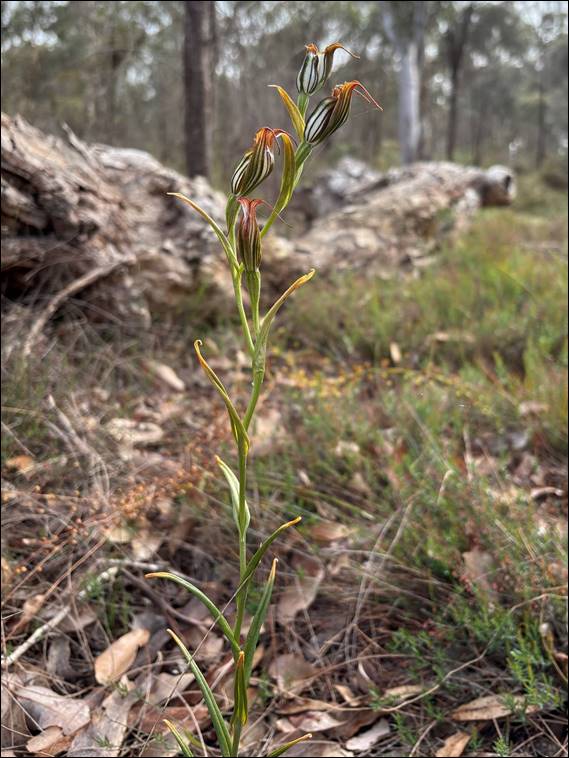
But it is well known for hybridizing with the White Spider Orchid, to the point the hybrid offspring are often more common in the wild than the Darting Spider Orchid. It’s species name uliginosa translates from Latin to of marshes or swamps. If I had gone to the dam I may have found it. While just another greenhood, I was super excited with the next image. A Red or Dark-banded Greenhood (Pterostylis sanguinea), where sanguinea comes from the Latin word for blood. I only got to see one of these, and have not seen them before:
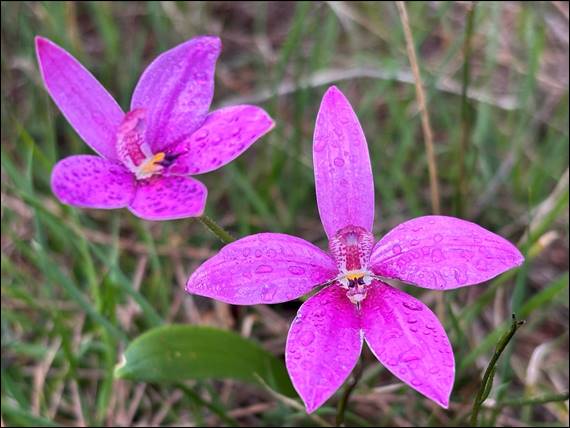
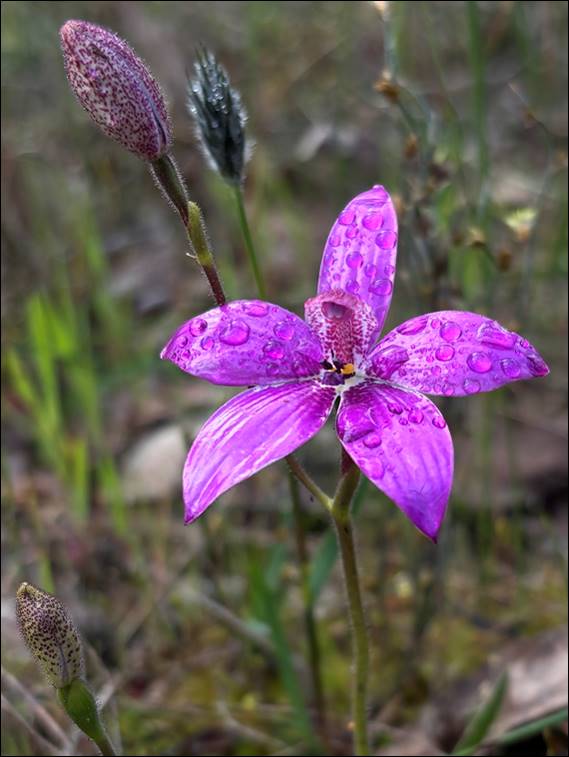
Moving along their were quite a few patches of Pink Enamel Orchids (Elythranthera emarginata). Not surprising, as they tends to form colonies. However, it is said they normally bloom from October to December so these were up a little early. I didn’t get to see any Purple Enamel Orchids (Elythranthera brunonis), which come up a bit earlier from August to October. In contrast to the Pinks, the Purples more commonly grow as scattered individuals or small groups. These two can cross-pollinate but I have read it is not very common:
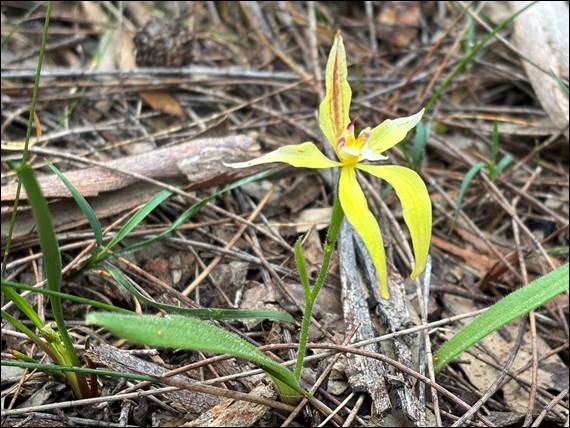
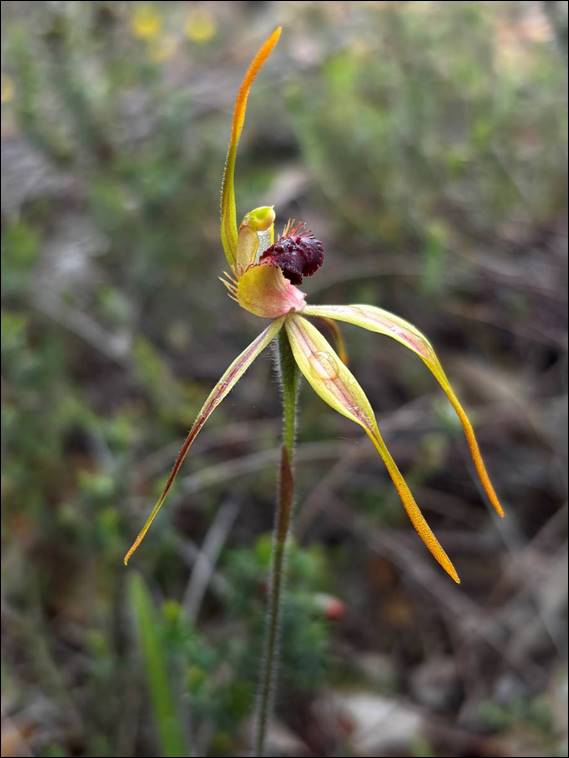
I do however think I found one, a few images up. Called an Intermediate Enamel Orchid (Elythranthera × intermedia), which sports a beautiful intermediate mauve-pink colour. I was definitely tinkled pink (and purple) with that find. Not surprisingly the Cowslip Orchids (Caladenia flava) were all over the place, and in its usual manner came in all shapes and sizes. The genus Caladenia is said to cross-breed naturally more than any other native orchid group. One reason may be that many Caladenia species share native bees and wasps for pollination:
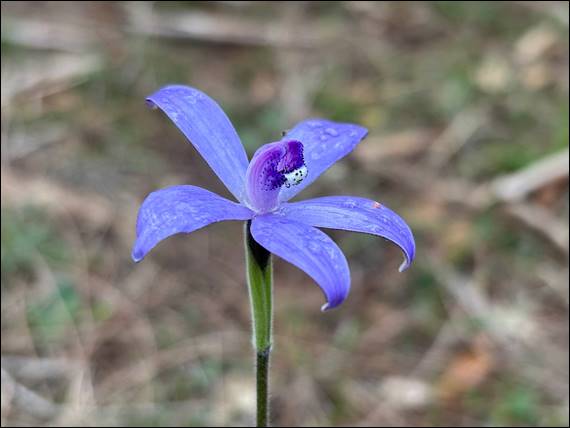
Whereas quite a few other genera rely on a single specific insect species. The last image from my first hunting ground is a Silky Blue Orchid (Cyanicula sericea). And while I talk about pollinators, as this orchid ages it puts out stronger signals to the small native bees and beetles it relies on for pollination. The labellum starts to peel backward to further expose the intense purple spots and stripes and create a more visually attractive sign. eventually I moved to my second place to check out the Myrtle Benn Flora and Fauna Sanctuary. As above:
Myrtle Benn was a teacher at the Kojonup Junior High School. Way ahead of her time and I might say even more forward thinking than many folk these days. Back in the late 1950s during her daily bus trips from her farm to town she noticed the gradual changes in the landscape and the disappearance of much of the local flora and fauna. So in 1959 she asked the shire for a bush reserve that her grade 7 students could look after. This reserve was looked after by her students until she retired in 1972. After which a group of locals took over:
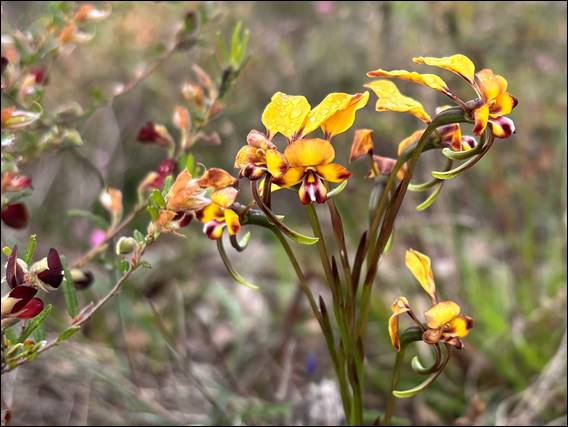
It’s a super impressive story, and the two walks at the reserve were originally created by Myrtle Benn and her students. My first find here was not a true find, a few other enthusiasts were about and told me about the Clubbed Spider Orchids (Caladenia longiclavata). It’s quite a common spider orchid, growing between Perth and Albany in quite a large variety of habitats. Then above were my second species of the Diuris genus, the Small-Flowered Donkey Orchid (Diuris porrifolia). This orchid has ultraviolet patterns on its petals:
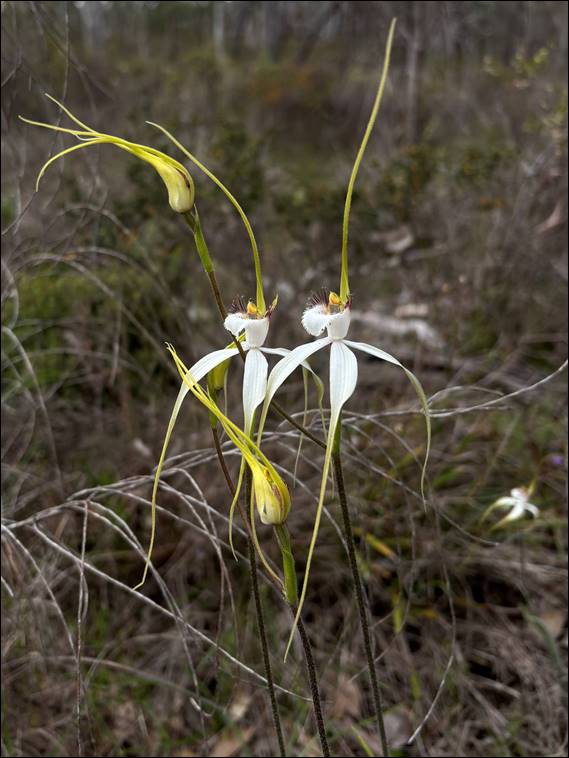
Invisible to us but providing a huge neon sign that says come and get you nectar here to native bees, not that there is actually any nectar. Research indicates this approach is used particularly by food-deceptive genera, like Donkey and Spider Orchids which target native bees. Next up is one of my favourite photos. The species name of eminens comes from a Latin word meaning prominent or illustrious, and man did this find stand out. The most elegant specimen of a White Spider Orchid I have seen:
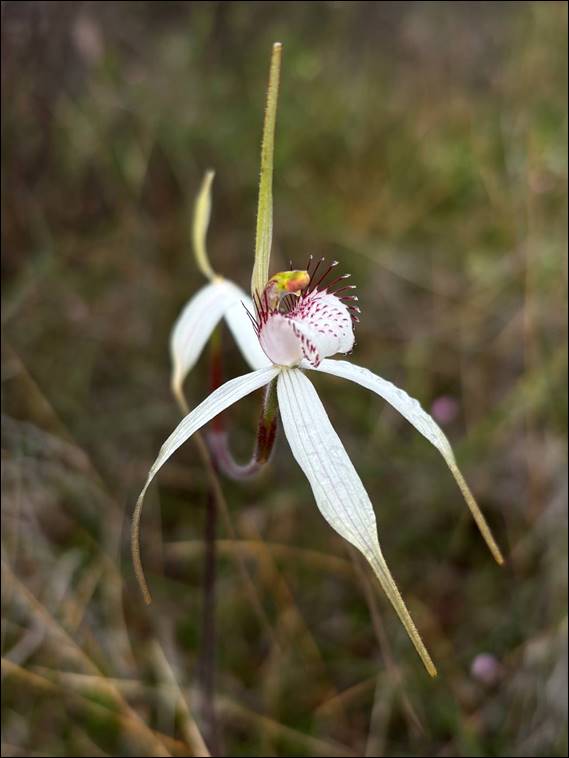
I am pretty sure it is a Stark White Spider Orchid (Caladenia longicauda subsp. eminens), and if you look closely in the bottom right of the image there is a smaller Spider Orchid. One that holds its obviously shorter petals and sepals out stiffly. Spreading them out before allowing them to down curve, a sign that this was likely the same as the above Christine’s Spider Orchid (Caladenia christineae). And as you will notice it is not one of the 14 geographical races of the White Spider Orchids, and is a species in its own right. It was a good find:
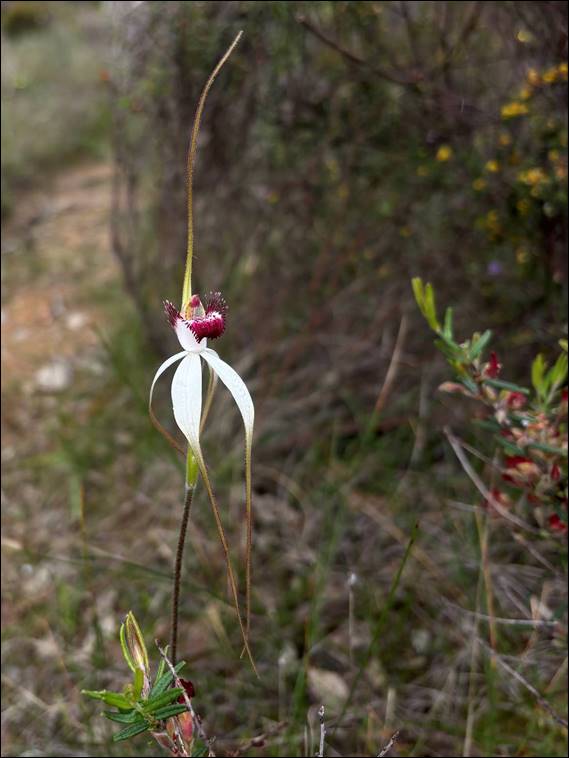
Because it is nationally classified as vulnerable, and at a state level is declared threatened flora. Above is yet another hybrid, with one half being from the illusive Darting Spider Orchid. However, the petals and sepals appear to be held differently, so it is entirely possible it is a cross –bred with a different subspecies of White Spider Orchid. Or I could be barking up the wrong tree entirely. I had forgot to mention that today was overcast, cold, and at times there was a little sprinkle. Meaning the Lemon-Scented Sun Orchid (Thelymitra antennifera) were being shy:
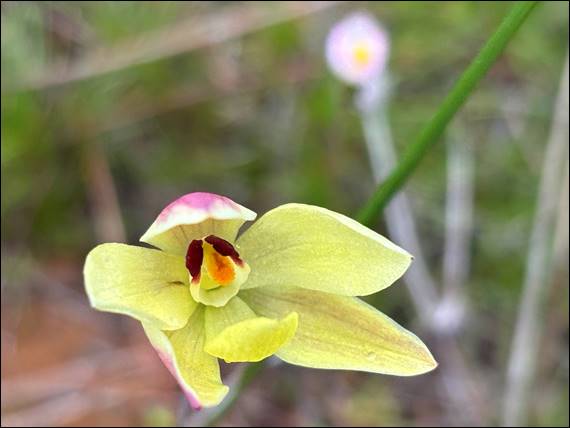
These are part of the sun orchid family. Many species typically only open their flowers on bright, warm, sunny days. This species however is sturdier than its cousins and is able and willing to open on relatively cool days. While this may be the case today the above was the best specimen I found, all the others stayed tightly closed. This orchid is a little unusual in another way, as the bottom petal looks like a normal flower petal. In orchids this petal is more often than not highly modified into a labellum, coming in all shapes, sizes, textures, and colours:
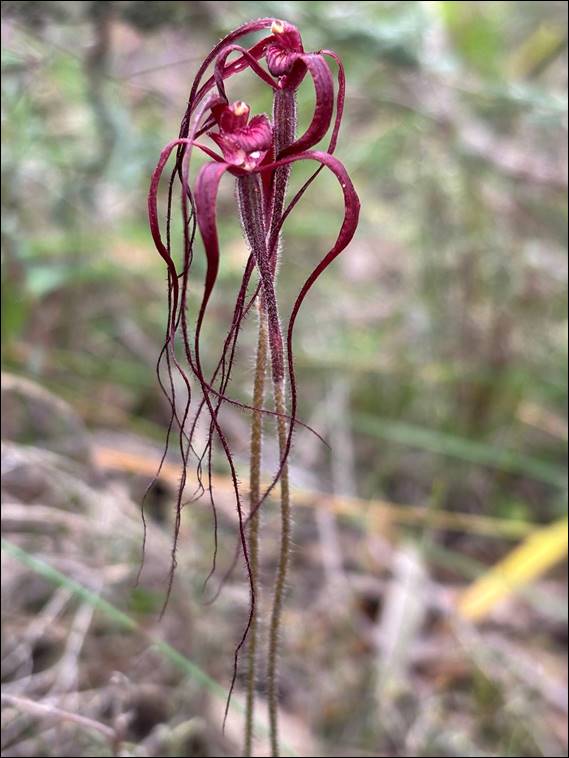
I was really hoping to find a Blood Spider Orchid (Caladenia filifera), which I did but all of the small clumps were wilting and this was the best I found. An indication to me that it may be a quick season for those orchids that do come out, due to both the drier conditions and early heat. Most of its close relatives feature gradients of white, cream, or green. This striking species however is completely and uniformly blood red, across its petals, sepals, labellum, and column. Once I felt like I had finished up here, I was in a bit of a quandary:
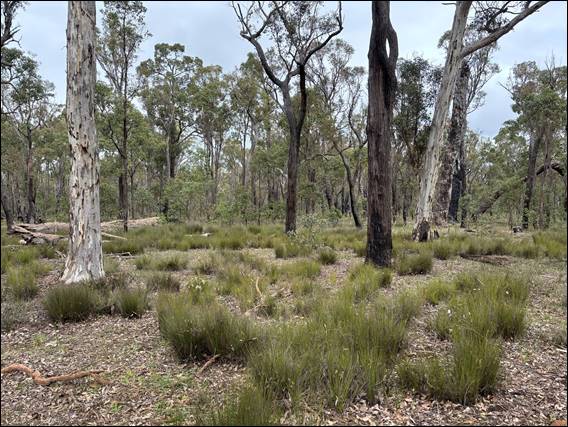
Feeling like it was too early to head home I started driving north to Narrogin. Being over an hour away and taking me a bit further away from home. A short distance up the Albany Highway it suddenly felt like a dumb idea. A lot more driving for not enough time to check out the spots I had in mind. Pulling off onto the first turning heading back west, I put my trust in my phone to direct me home. Resulting in what felt like way too many kilometres of gravels roads. It did however take me through lots of country that looked pretty orchidy:
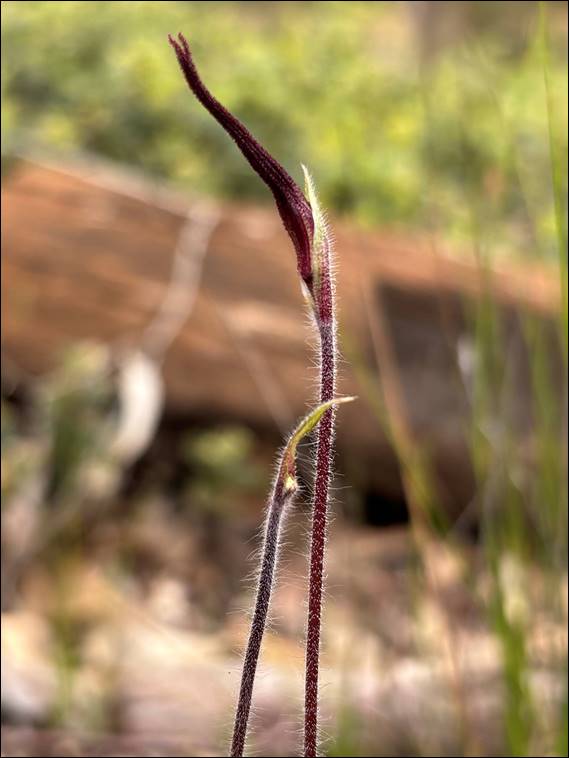
Eventually I picked a place in the middle of nowhere to pull over, and have a wander in the bush. Having checked, this area has no particular name. So unlike the last two places I visited there is no history to delve into. Here I spotted a couple of the above spikes as I wandered round. Maybe Blood Spider Orchids, but too early to be sure and none of them were anywhere near ready to open up yet. I was too late in Kojonup and too early here it seemed. While not an orchid I did like these Large Flowered Thomasia (Thomasia grandiflora):
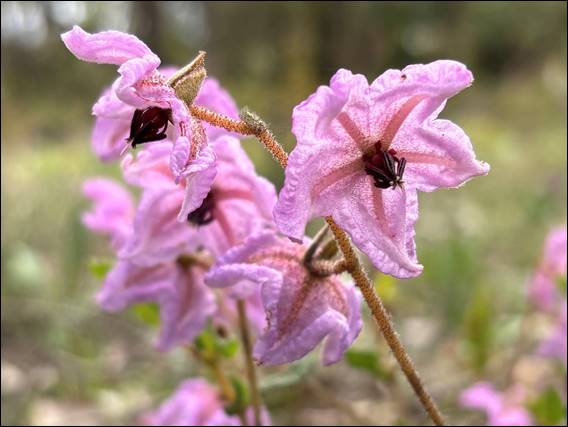
Their lantern-like shaped flowers are unique, and unlike a normal flower it comprises fused sepals. The petals are tiny, reduced, scale-like lobes. With not much else to see I headed back to the car. Approaching the gravel road and just 5m from where I had parked, I stumbled across this patch of what I believe to be Big Clubbed Spider Orchids (Caladenia magniclavata). The rarer cousin of the Clubbed Spider Orchid, which I had found earlier. Another identification I am a little uncertain of but some signs give me hope that I may be right:
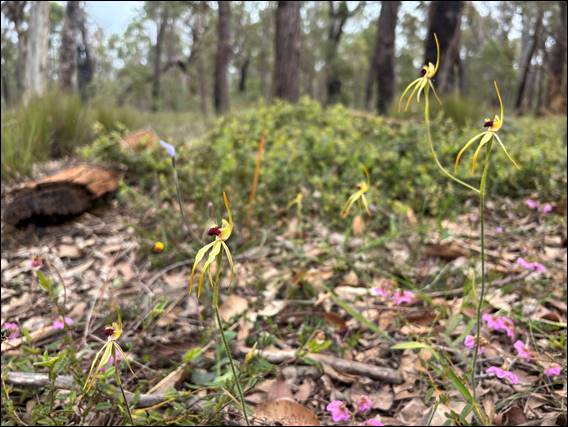
The flowers were larger, had more of a pale yellow-green colour, and stood a bit taller. The species name meaning great or large club, coming from Latin words magnus and clava. This got me excited and my motivation was given a boost. Walking back out and deeper into the area, where more and more orchids started to appear. Although I did not find any more Big Clubbed Spider Orchids. There were lots of Silky Blue Orchids, and I had to include this image because it had a native bee taking refuge in it:
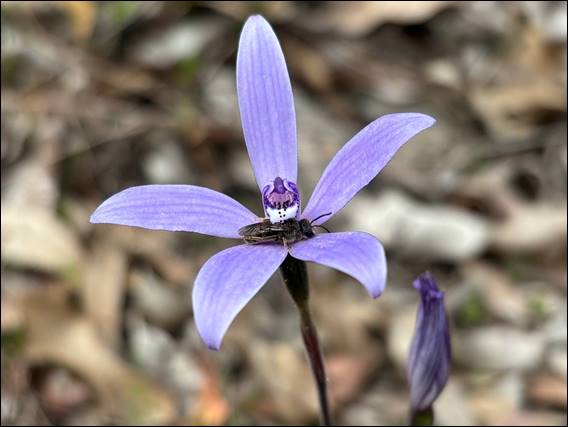
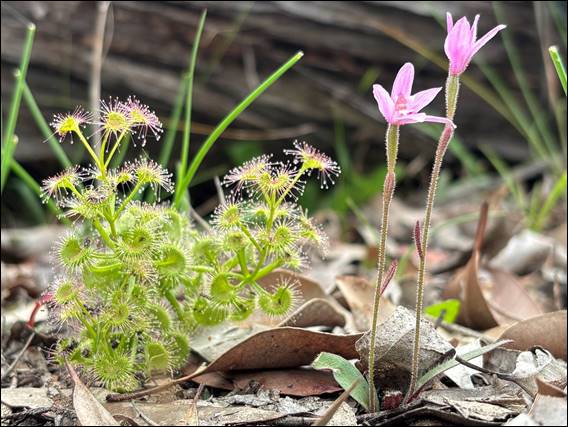
Native bees are mostly small, solitary insects. Typically darker and more slender than true honey bees. Only about 10% of native bees are social and these make tiny amounts of honey. There was no way I was even going to try and identify it, and left it to snooze. There were also quite a few Little Pink Fairies (Caladenia reptans subsp. reptans) about. Nothing new. but I did like this image with what I believe to be a Leafy Sundew (Drosera stolonifera). Like so many orchids the sundew retreats into an underground tuber to survive summer:
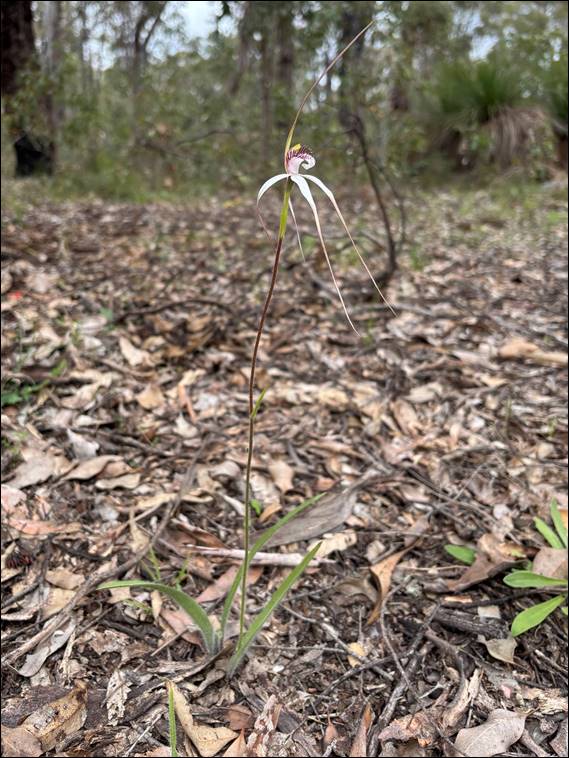
It only seems right to finish as I started, with one of the White Spider Orchids. Not a geographical race and again a species in its own right. With pendulous sepals and petals with distinct long, brown tips, a relatively long basal leaf, and standing tall; I’m prepared to take a gamble and feel somewhat sure this is a Splendid Spider Orchids (Caladenia splendens). The species name being a Latin word meaning shining, gleaming, brilliant, or splendid. And it had indeed been a splendid idea to go on a bit of road trip to see something different:
 Sandbagged