All week a wet weekend was forecast, which just like last weekend didn’t turn out all that wet. Maybe the forecasters were trying to be optimistic, despite the highly likely warmer and drier conditions that the 2026 El Niño will bring to the South West of Western Australia. Either way in view that I had not been climbing for a couple of weeks, the urge to touch rock became too strong. I had been sitting on the fence about heading out, as no one else seemed to be locally available. My change of heart saw me once more at Wilyabrup, as ‘Sad Man Solo’:
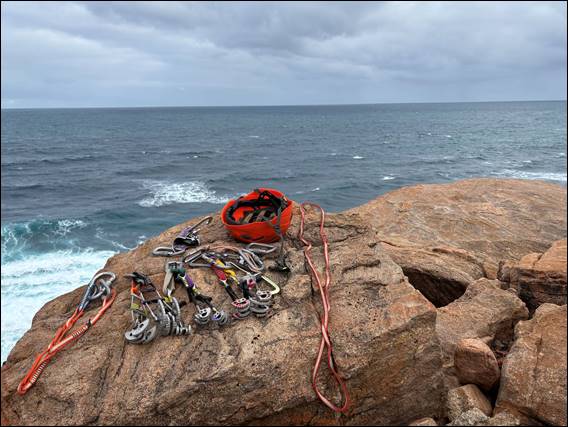
There were no lofty goals for today, it was purely to feel rock and stretch out the body. A slight drizzle came and went a few times but overall it was a glorious, if not blustery at times, morning. Not another soul was about, which suited me just fine. Mind you I was out of there by 8:30 so it is entirely possible that others will have drifted in after I had left. Walking back to the car I could hear lots of wy-lahs being hollered out, interspersed with dull thuds. Maybe I should not have parked under the Marri (Corymbia calophylla) today:
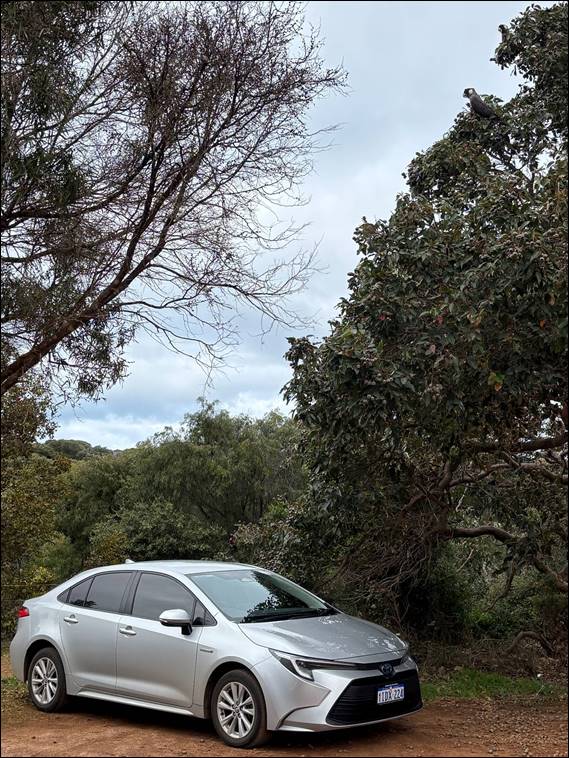
A flock of Carnaby’s Black-Cockatoos (Zanda latirostris) were perched directly above. Their short, wide, and stubby bills being used to gnaw on the hard seed pods. They feast on a vast range of native seeds and nuts from Banksia, Hakeas, Grevilleas, Dryandras, and Eucalyptus like Jarrah and Marri trees. Mari trees however have large, urn-shaped woody fruits. Locally called Honky nuts. The Cockatoos cut, chew, and/or break the woody fruit to get to the tasty seeds inside. Discarding the hard outer shell, which right now were landing on my car:
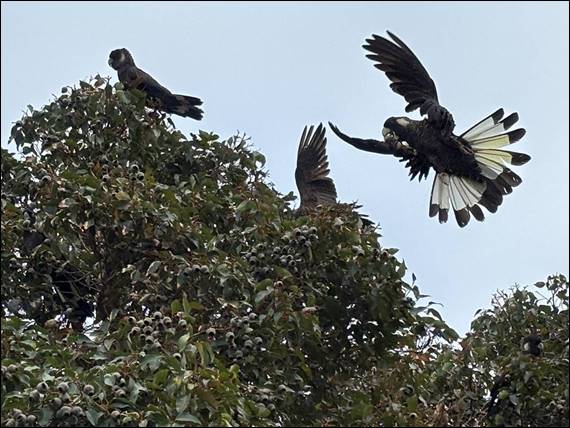
They didn’t seem at all worried by my presence and continued to drop the unwanted shells, not that they did any damage. One reason I came here today was to drop into a place on the way home. Where just yesterday Josh had told me he and Kellie had spotted a few orchids. Before that place, I stopped in a little spot before I got to the main drag. It was all very quiet, the below find however made it very worthwhile. I found two Scott River Spider Orchids (Caladenia thinicola). It took me a while to work them out, as the labellum threw me:
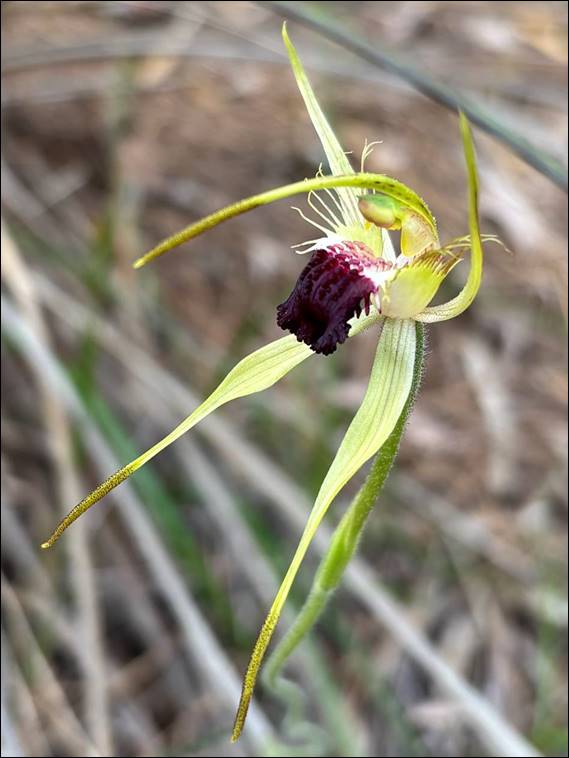
The long, wide, and red tip with thick teeth looked incredibly like my find on Friday, the Grand Spider Orchid (Caladenia huegelii). Reading up on the above it sounds like the similar labellum feature has confused others too. To add to the uncertainty you might feel, both of the species also have long fringes. Although the Scott River Spider Orchid is generally smaller and has less height. They also share something else. The specific and smaller population of the male thynnid flower wasp species Macrothynnus insignis, for pollination:
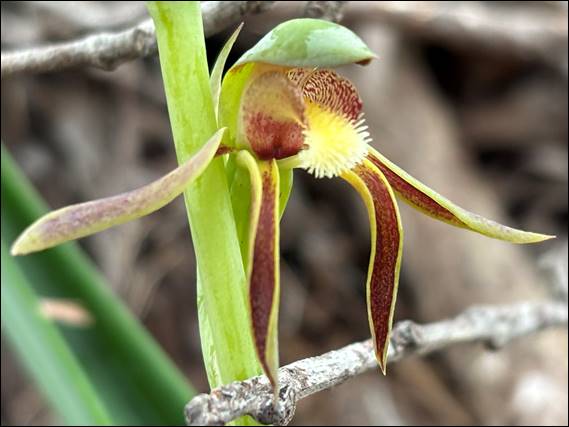
Just that one find would have seen me happy to head home. If Josh and Kellie hadn’t shared their finds I probably would have. Instead I drove on to the Yelverton National Park. Where the first find was a Rattle Beak Orchid (Lyperanthus serratus), above. These are considered to have dull plain colours and named because they are not bright or flashy. The species name Lyperanthus coming from Greek words lypros and anthos meaning poor, wretched, or sad and flower. I don’t agree and find their flowers unique compared to other orchids:
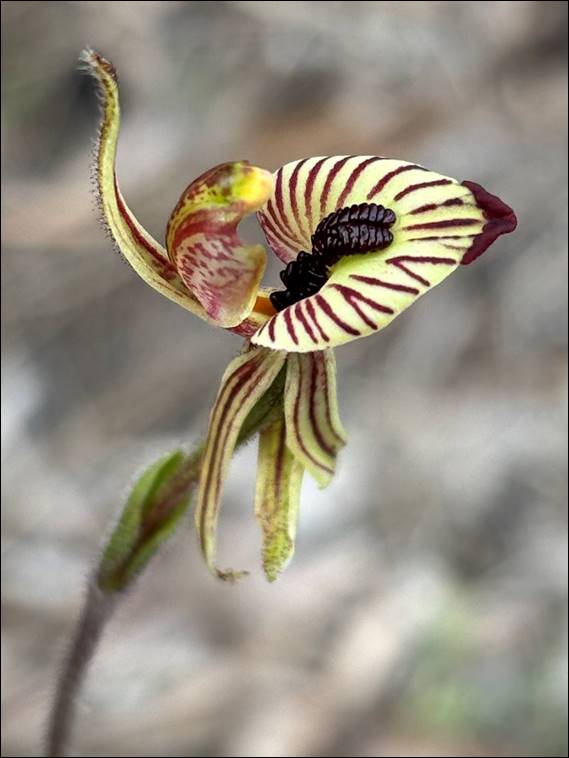
Both unique and attractive. This could also be said for the above Zebra Orchid (Caladenia cairnsiana), which is the find that had really drawn me here. Unlike any other orchid this one holds its petals and sepals tightly and flatly against the ovary. But as with so many orchids this one likes to trick its pollinator, in this case the male thynnine wasp Phymatothynnus victor. The thick dark purple-black calli visually mimic the female. When the male heads in for an embrace with the false female, the labellum tips forward brushing it against the column:
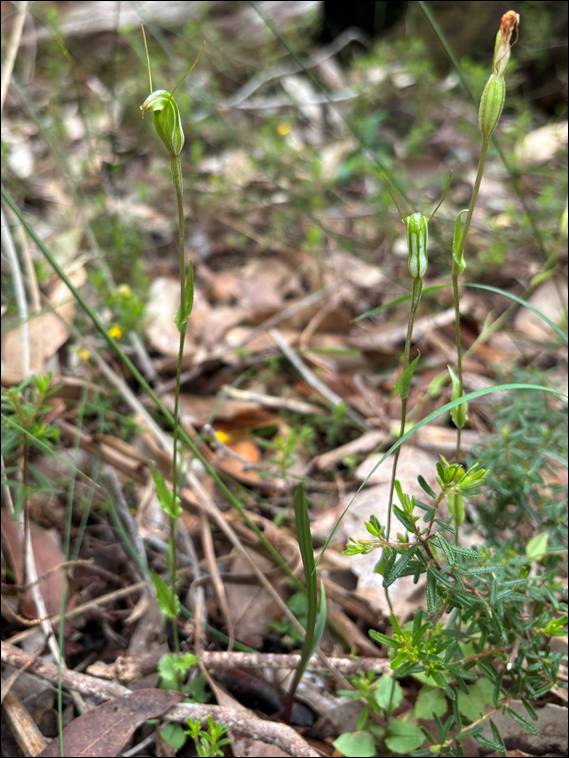
Above I found a few Karri Snail Orchids (Pterostylis karri). These are found along Leeuwin-Naturaliste Ridge and at the western edge of the Great Southern region. Looking fairly similar to the Red-Sepaled Snail Orchid (Pterostylis erubescens), which are found much more widely. My book suggest a way to tell them apart is that the former has a smooth stem and the latter a hairy stem. Another of the greenhood genre out, and in huge numbers, were Bird Orchids. I probably saw several hundred with some clusters containing as many as twenty five:
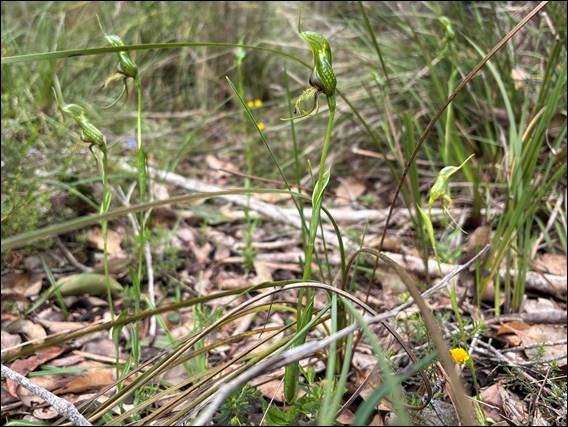
The great unknown is which ones I had seen. Always assuming I’ve found the most common being the Bird Orchid (Pterostylis barbata). The stark dark green, net-like veins being a key indicator, but also having a lightly fringed, feather-like labellum. Two other species that are quite common are the Sinuous Bird Orchid (Pterostylis sigmoidea) and Bearded Bird Orchid (Pterostylis turfosa), the feather-like labellum on both being more heavily and densely fringed. The Sinuous Bird Orchid also having a more distinct S shaped flower profile:
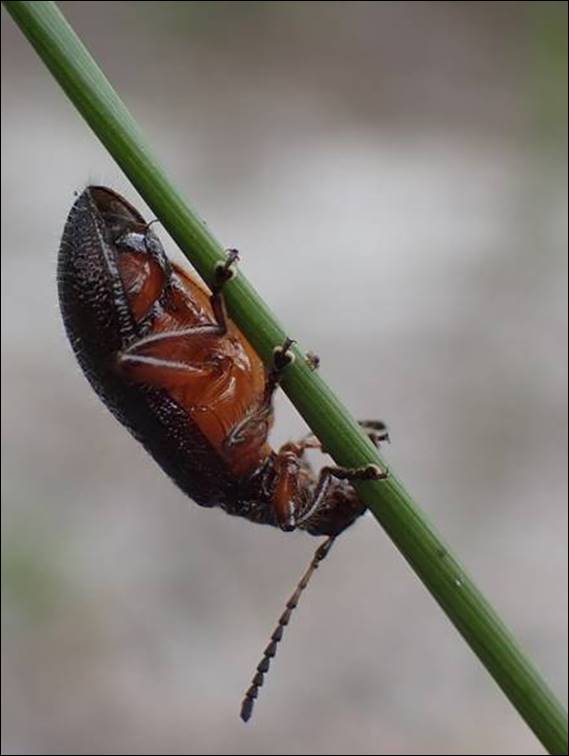
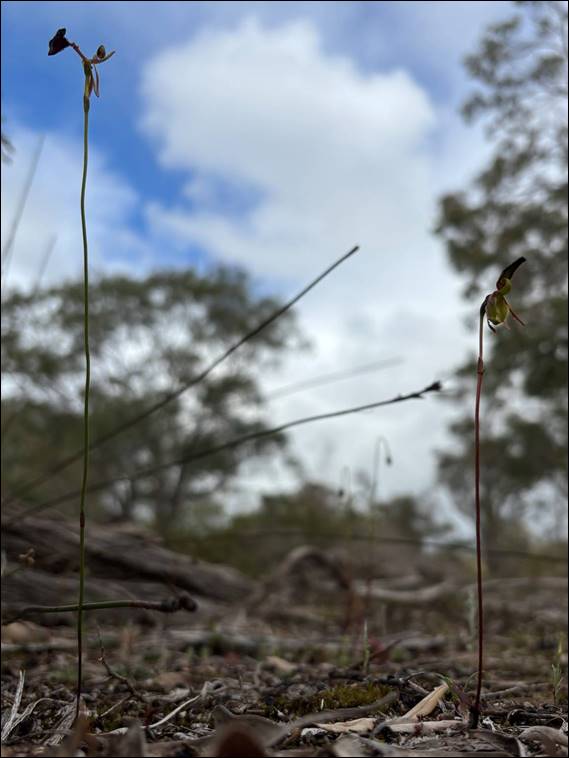
I’ve really struggled to work out which species I saw, and it has made me second guess my past identifications too. Based on the heavily fringed labellum’s of today’s specimens and varied flower shapes, the Sinuous Bird and Bearded Bird Orchid could have been out. In this previous post I definitely saw a Bird Orchid https://sandbagged.blog/2023/08/20/looking-down/. Just to mix things up above is a Darkling or Honeybrown Beetle (Ecnolagria aeneoviolacea), before returning to one more orchid image of a couple of repeat finds:
 Sandbagged