It really was the furthest thought from my mind, as Rongy and I made our way towards the Z-Bend lookout at Kalbarri National Park (https://sandbagged.blog/2026/08/03/kalbarri-bronze/). So much so that I wasn’t looking out for them, and it was Rongy who spotted the first orchid. Just another Cowslip you may be thinking. After all when these bloom they tend to flower in vast numbers, all over the place. We were however some 650km north of my usual hunting ground, in a very different climate and landscape. One that I am not at all familiar with, and have never hunted in:
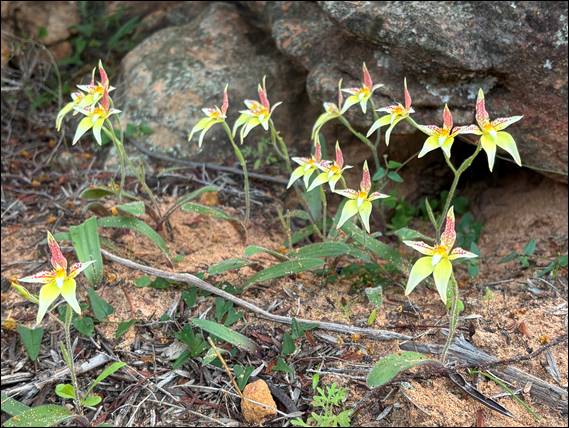
There are four recorded subspecies of Cowslips in Western Australia, two being found in our patch. This is the most northern of the four being the Kalbarri Cowslip Orchid (Caladenia flava subsp. maculata). Looking different because of the brown-red spots. Which is where the species name maculata comes from, meaning “spotted” in Greek. I‘ve not seen the fourth subspecies found in inland in Wandoo woodlands, which has the smallest range and is the latest flowering,. Next was another one you may be quick to pass by, just being a Pink Fairy:
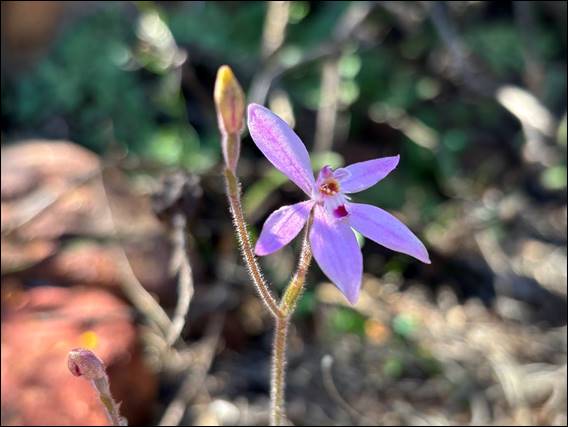
The name Pink Fairy is used for three species, being latifolia, reptans, and nana. The latter two have two subspecies each, making it five all up. Four of the five are found down south, and the above is the only one not found in our patch. With a range round Geraldton and Kalbarri. This find of the Pale Pink Fairy Orchid (Caladenia reptans subsp. impensa) has filled the gap for me, having now seen all five. As with all Pink Fairies, this one spreads and multiplies underground and was in abundant patches of tight clusters of many plants:
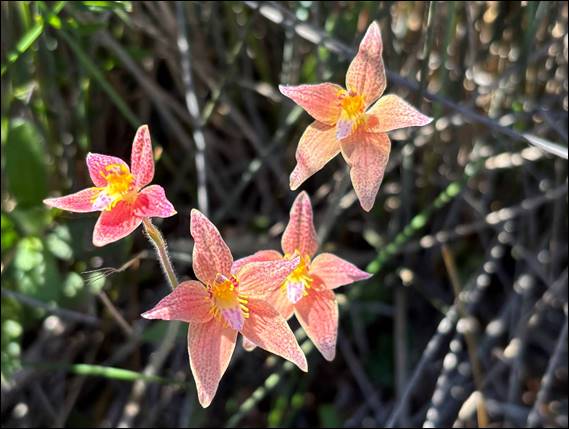
Cowslips and Pink Fairies are known to hybridise, and we were very lucky to find a cluster of the above Kalbarri Cowslip / Pale Pink Fairy Orchid hybrid. A spectacular flower, made even more so by the spotted pattern. We looked long and hard after this for more but didn’t see any, so felt pretty chuffed with the find. The next spot was probably only seen because someone else was checking it out. Although after that we spotted a few more. A year or so back I thought I had seen these, until I realised they do not extend to our coastal area:
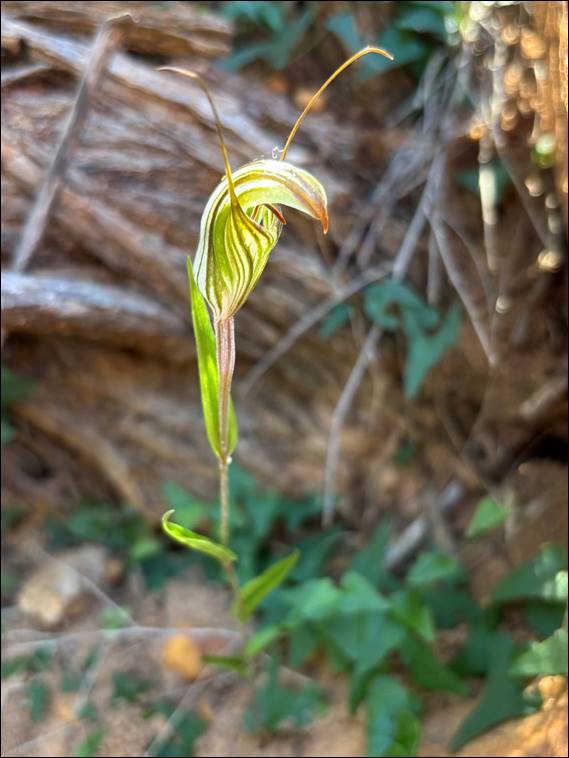
Their range extends across a wide area from Kalbarri down to Esperance, but are more inland out towards the Wheatbelt. The point at the end of the dorsal sepal, which looks like a hood, and the long, narrow, down-curved labellum that extends out of the shell is a clear sign of this being a Green-Veined Shell Orchid (Pterostylis scabra). Next up, and we hadn’t even got to the lookout let alone the gorge to touch rock yet, was one of the thirty odd Snail Orchid species. This one is often found in shallow pockets of sand or clay on top of rocky terrain:
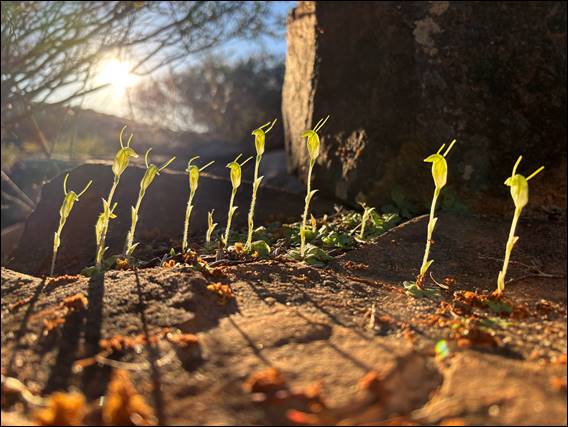
Again wide spread, from Kalbarri down to Israelite Bay. And again not found in our area, having a range that overlaps the Green-Veined Shell Orchid and extends even further inland past the Wheatbelt. The Hairy Stemmed Snail Orchid (Pterostylis setulosa) was an amazing fifth first time find, but we had now arrived at the gorge and it was time to climb. The people who had turned our attention to the fourth find, mentioned they had found ‘just a white spider’ at the Skywalk lookout. And this warranted investigation but not on our first day:
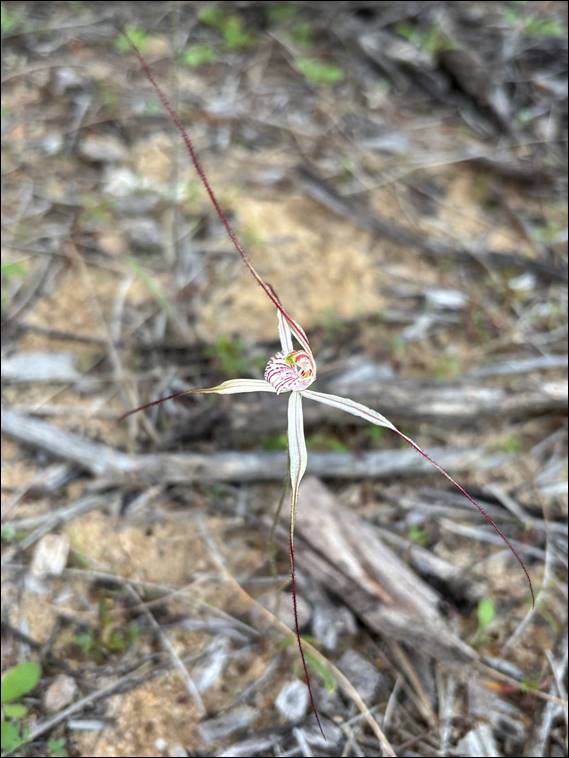
If you have delved into https://sandbagged.blog/2026/08/03/kalbarri-bronze/, you will already know we went to the other lookout on our second day. Not just because of the potential for orchids, but also due to the eerie misty morning. You’ll have to visit that post to see images of that, but above we did find the Noble Spider Orchid (Caladenia nobilis). These do extend to our area and I have previously struggled to decide if I had found it or not. Being one of the many Wispy Spider Orchids that all look very similar:
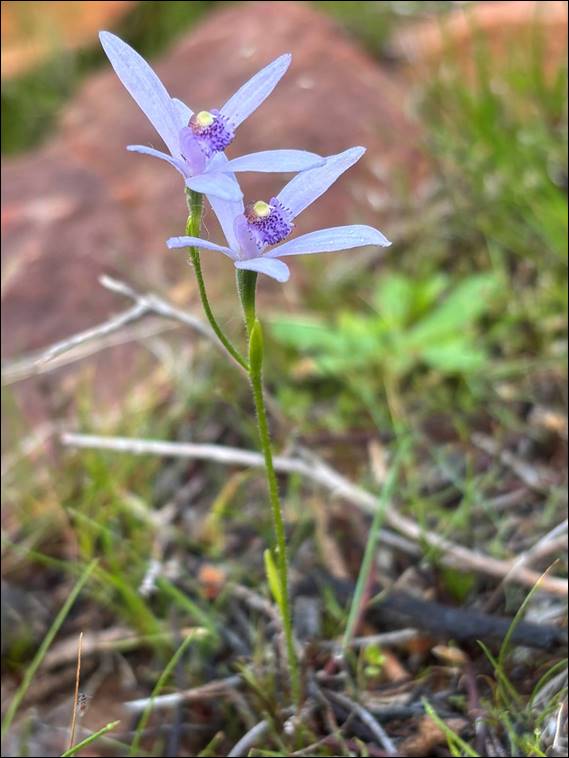
It is has the largest flower of the Wispy Spiders, and after much checking, this time I am confident my identification is on the money. This species is pretty particular, in that while it attracts many insect species, only the male Thynnid Flower Wasp (Rhagigaster discrepans) is of the exact size and displays the right behaviour needed to pollinate it. Above is another we find locally, but I have not seen it for a few years due to poor seasonal conditions. The Blue Fairy Orchid (Pheladenia deformis) genus and species name both relate to same flower part:
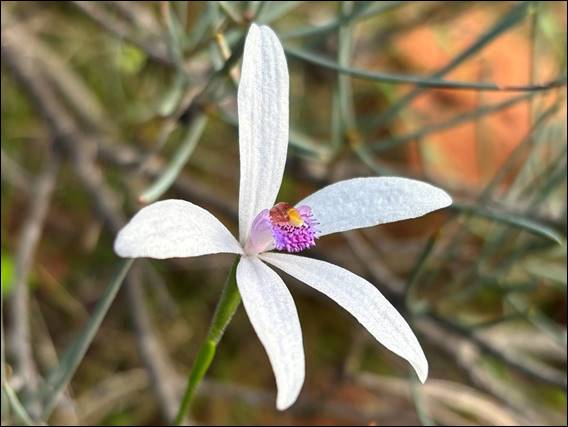
Pheladenia comes from ancient Greek words phelos and aden meaning ‘deceitful’ and ‘gland’, while deformis is a Latin word meaning ‘misshapen’. These all relate to the unusual labellum, which looks like a fuzzy beard, and which also earns this orchid the nickname of ‘Blue Beard’. There is only one species, but that said it can display petal colour variants including pinkish or yellow. The above white variant is said to be uncommon, so was a fortunate find and is why I have included two images of this orchid. We found both at the Z-Bend lookout area:
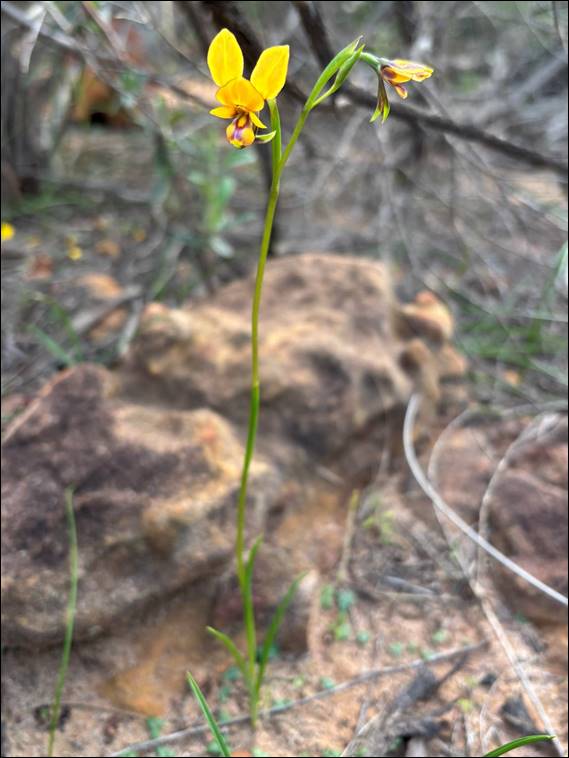
Walking back after that day’s climbing, again on the track between the lookout and the carpark, was this single Sedge-loving Donkey Orchid (Diuris carecta). New find number six for me, being a species not found in my usual hunting range. There are only a few Donkey Orchids found this far north, and this one seemed a little odd based on its described habitat. However, the two or three linear leaves, tall flowering stem, and strongly curved lateral sepals sets it apart from other northern species. So I am again confident with the identification:
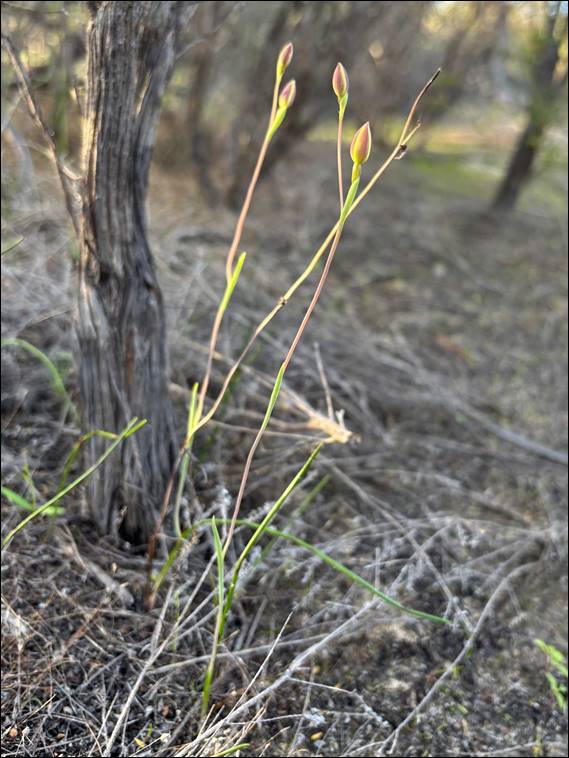
It was the only one of that species we spotted, and I thought that may have been it for orchids. Then on the walk back from Four Ways I spied the above Lemon-Scented Sun Orchids (Thelymitra antennifera). Passing them a bit later in the day when they were in cool dappled light from the low sun, with their petals tightly closed. I’ve read that they are one of the most common types of sun orchids in Western Australia. I have seen them but based on my observation of other sun orchids I’m not sure that is completely true:
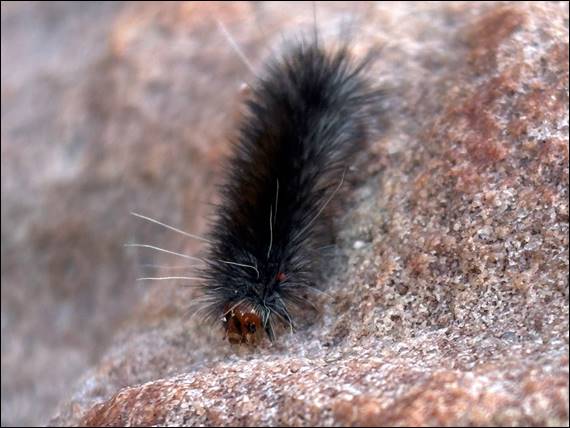
You may have noticed I have not recorded our finds in chronological order, instead collating them in groups. Next up are the larval stage of members of the order Lepidoptera, being butterflies and moths. We saw lots of the above, one of several species referred to as a Woolly Bear Caterpillar due to its appearance. Being a caterpillar of an Australian Black and White Tiger Moth (Ardices glatignyi). Easily identified by its smooth, dark orange-red head capsule, as well as the stiff black-and-brown bristle hairs with just a few long sensory hairs:
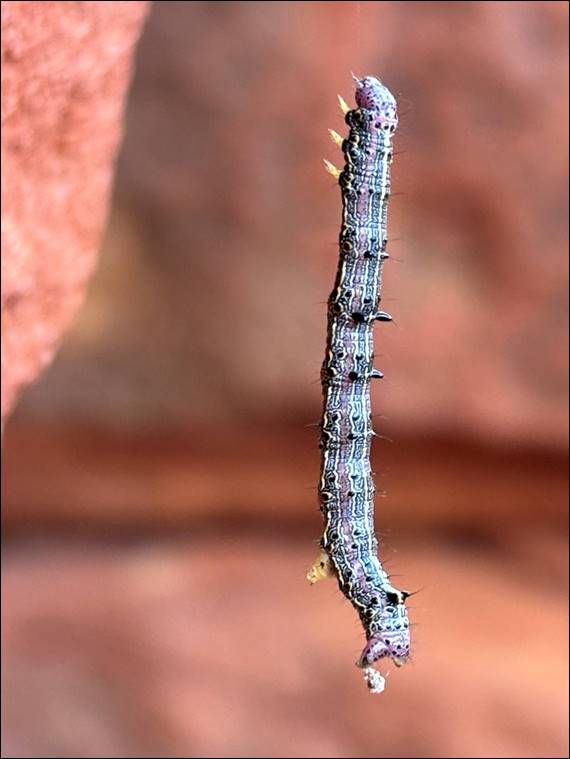
The above can easily be stated to be a looper caterpillar or inchworm. Only having legs at the front and rear of its body, it has a distinctive way of walking. Its mid-body arches up into a loop, before extend forward to repeat the motion. To narrow it down any further has however been a lot trickier. So much so I can only say it is in the Ennominae subfamily and likely a species in the Ectropis or Pholodes genera. Based on its size and behaviour it is likely to be a fully mature caterpillar ready to pupate. You’d think I’d have more luck with the next:
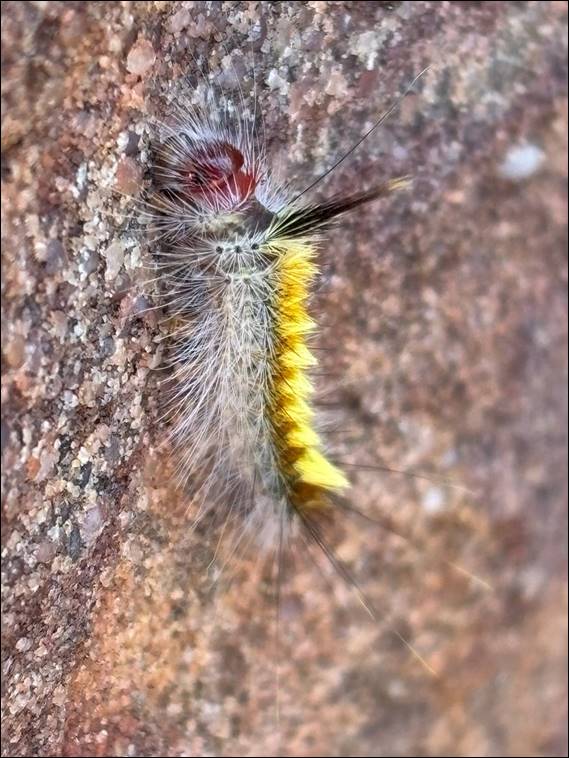
The colouration and configuration of the hairs is quite amazing including radiating white and grey side hairs, a band of dense yellow-cream tussocks along its spine, sparse pale tipped feeler hairs at the rear and front, and a single dark tuft of hair behind the head that is called a ‘hair pencil’. All I can say it is a Tussock Moth caterpillar from the subfamily Lymantriinae, but can’t narrow it down any more. The same goes for the next find as we move into a few different insects. This one being an immature juvenile of a Katydid, sat at the base of Kalbarri Bronze:
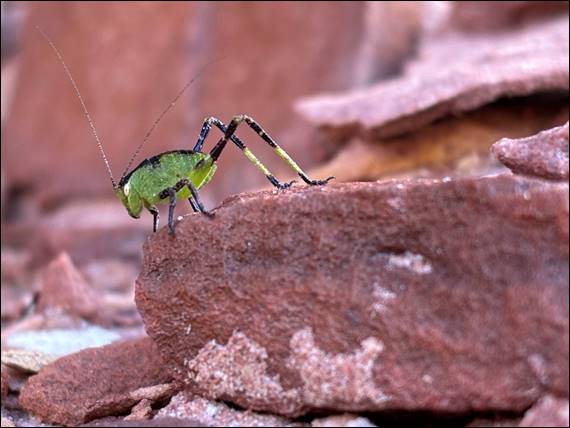
Distinguished from grasshoppers by the exceptionally long, thread-like antennae. The nymphs of these can vary massively in colour patterns, making identification very hard. It is possible that this may be a 32-Spotted Katydid (Ephippitytha trigintiduoguttata), whose juveniles have dark leg bandings. A study identified that Katydids found in Kalbarri National Park exhibited unique acoustic courtship behaviours, which includes a complex, precisely timed audio dialog between the male and female:
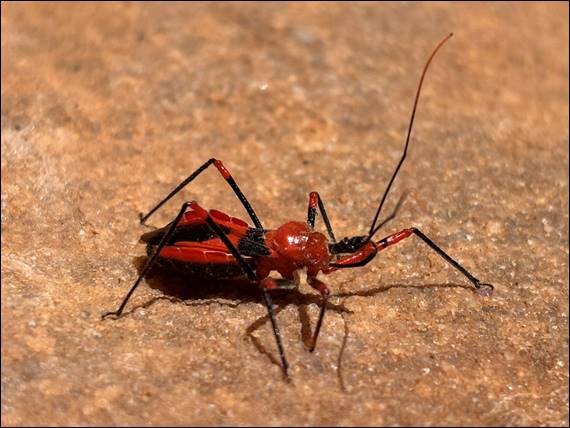
This is very different to most insects globally, which rely on a one-way system in which only the male calls out to lure a female to them. Continuing with the colour displays, above is an Orange Assassin Bug (Gminatus australis) whose bright appearance is very much a warning. Being able to inflict a painful bite if handled. These are not fussy eaters, and will prey on any insect. Converting, or more precisely melting, their innards into a liquid meal. When other insects are scarce they will even turn to cannibalistic behaviour:
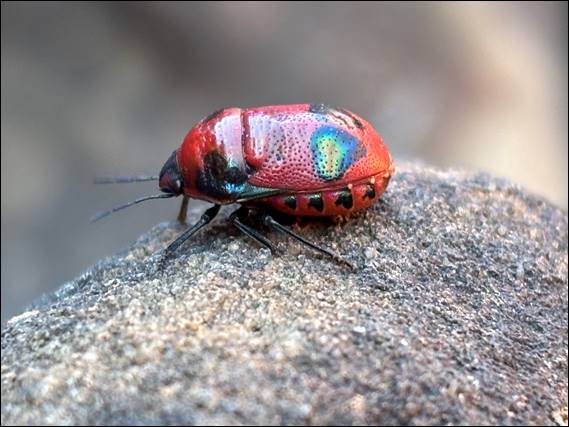
The above Red Jewel Bug (Choerocoris paganus) is the last of the insects. Commonly found across all of Australia, although the patterning can vary a lot. This one happened to be at the end of the river crossing when we exited the amphitheatre. Perched on a rock surrounded by water. And as such it seems fitting to introduce one member of the colony that inhabited the ravine, you will again need to flick to my other post for context. Taken as we were scrambling into the ravine this was the first Long-nosed Dragon (Gowidon longirostris) we came across:
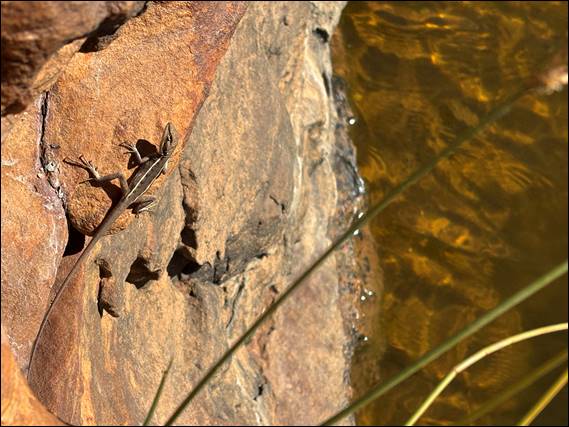
Mark and I had seen just one last time. On this trip however we saw quite a few more, all bar one being in this area. Rongy and I spent quite a bit of time admiring them, full grown adults to juveniles. They are known to lift and wave their front legs, a habit that has earned them the nickname of a ‘Ta-Ta’ Dragon as if they are waving goodbye. It is thought this action may help cool their feet down after running across scorching hot desert sand or ground. They are incredible quick and when extra speed is required they can run just on their hind legs:
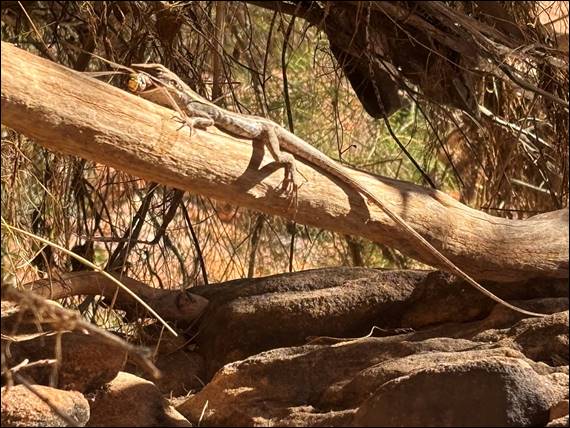
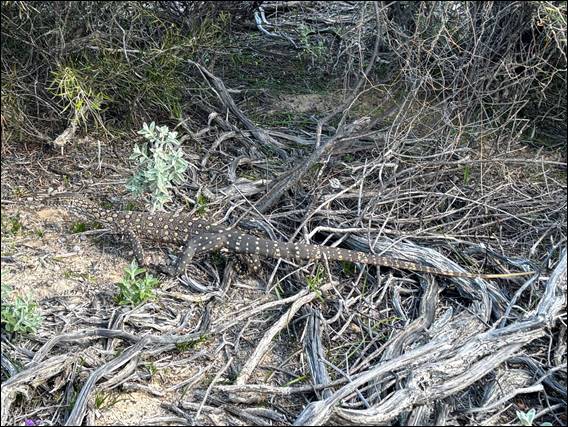
The reason for a second image of a Long-nosed Dragon should be obvious, but if you missed it take a closer look above. We felt very lucky to have seen this sight, the Dragonfly probably wasn’t so pleased. The next picture was taken as we walked out of Four Ways, a wonderful Perentie (Varanus giganteus). A common sight from Lisa and my days in Alice Springs, this is the furthest south along the coast of Western Australia you will find them. When threatened they will exhale noisily and puff up their body, this one was chilled and didn’t change pace:
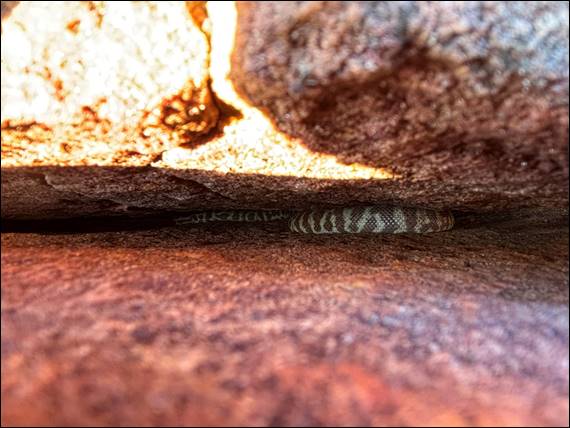
The last gem to close this post was found at Hawks Head on our last morning before driving home. We spotted not one but two Stimson’s Pythons (Antaresia stimsoni). Being nocturnal ambush predators, we found them buried in rock crevices. It was unlikely they would come out and bask, instead snoozing the day away enjoying the steady temperature their hidey hole offers. Despite having the largest range of all the Australian python species, they are not found in our local area. So they were great finds, and an awesome way to end the trip:
 Sandbagged