Some will say it is not my strongest suit. Admittedly I do have a general tendency to call a spade and spade that, as time rolls on, I find more and more people struggle to deal with. The term comes from the Latin word subtīlis, meaning finely woven, thin, or delicate. It was adopted into Middle English in the 1300s from Old French, shhh don’t tell the French. Since the 1800s we have moved into the Modern English phase, for which the term subtlety now covers a range of meanings from fineness/thinness, cunning/craftiness, to delicacy/nuance:
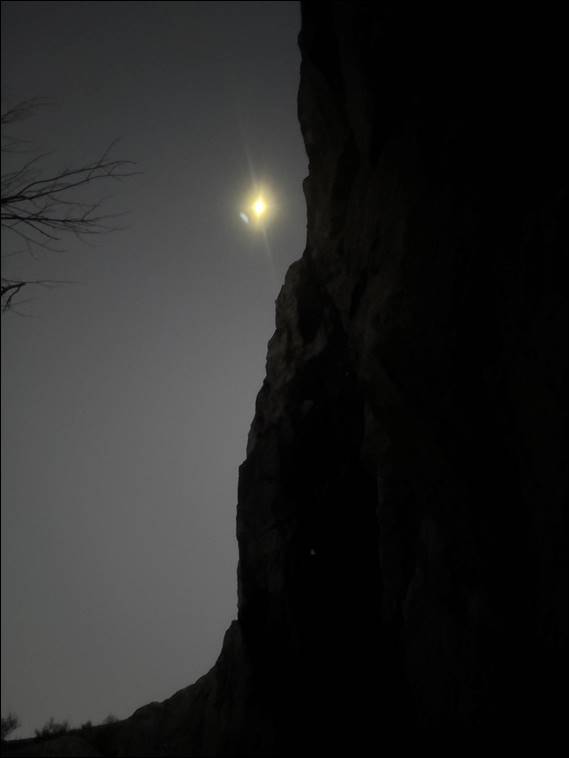
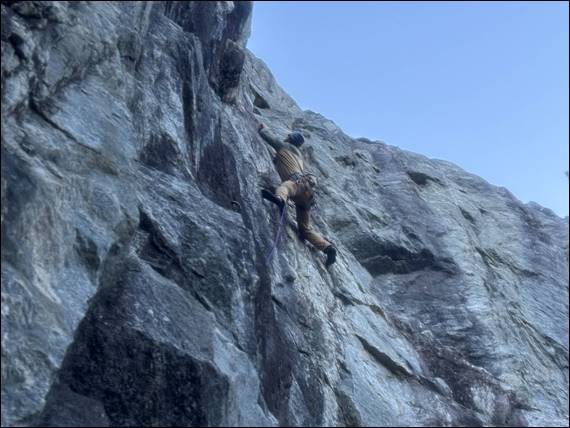
I thought I was being cunning in setting our timing for a quick dash up the hill this morning. Stood at the base of the wall at precisely the time first light was due to arrive, it felt dark. We hadn’t brought head torches. At least the clear sky above enabled the light reflecting off the Waning Gibbous moon to reach us. At 64% of illumination a full moon, this provided 0.05 lux where we stood. Only half the minimum light needed by the human eye to make shapes out. It was my lead and I was tied in and kinda ready to go. It was slow going as I gingerly went up:
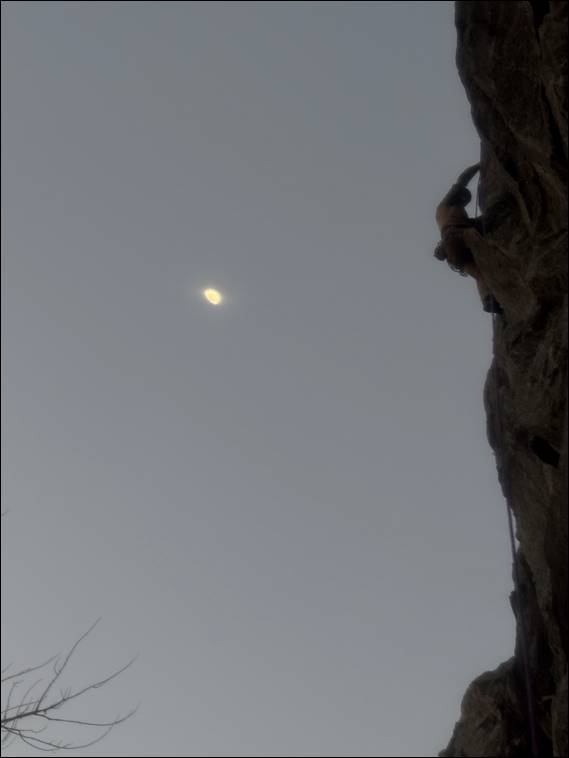
Each hand/finger hold and each foot hold was placed with extra care. The body hadn’t warmed up, and I knew it wouldn’t until we had a couple of routes under our belts. In my mind I questioned the climb I had decided to start on. At least our proximity to the equator was on my side. Rather than moving at a shallow angle the sun comes up more vertically across the horizon. Resulting in first light coming in pretty quickly, and by the time we had both finished we were bathed in several hundred lux, ample to see what we needed to:
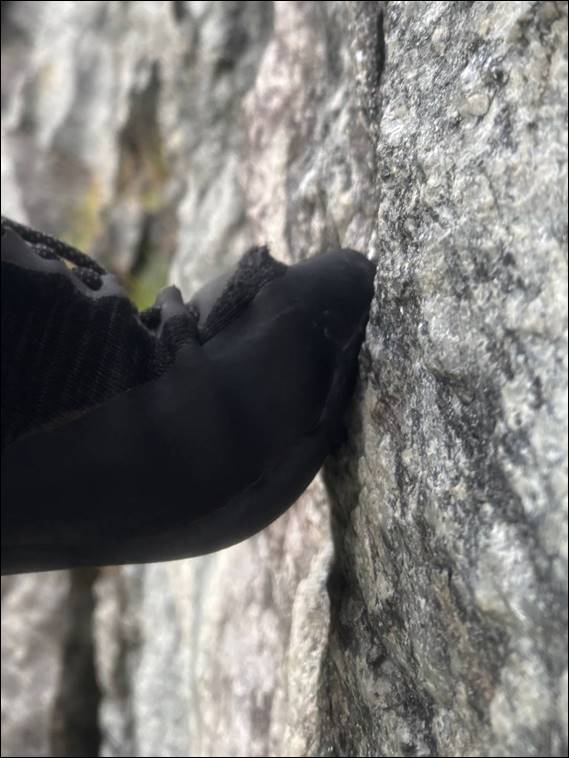
Not to say we didn’t need to apply delicacy to our climbing. Approaching the edge of winter the rock is absorbing less heat during the day, and with cooling nights more of that ‘less heat’ is sucked from the rock. Such mornings can offer great conditions for friction, but until we’ve ‘warmed up’ it is not so great for muscular performance nor how our bodies translate sensory feedback. As such Howsie’s lead was equally as slow and cautious, but for quite different reasons. My focus was more on what I could see, his was more on what he could feel:
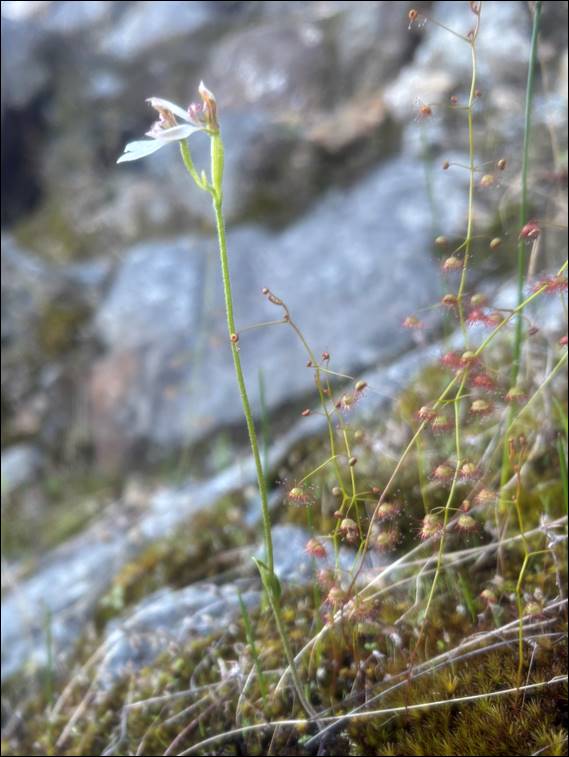
Only a few climbs at the dam require you to ‘top out’ and belay from above. We picked one of those for our fourth route. Very much on purpose, as we wanted to see if there was a floral display above. While we may have been on a timeframe to get to work, it also pays to slow down and to absorb what nature has to offer. Here we found two subspecies of the Bunny Orchids, and I’ve included an image of one of the many Crinkled-leafed Bunny Orchids (Eriochilus dilatatus subsp. undulates). An orchid that does not use mimicry or deception:
Very few orchids attract pollinators with actual nectar. This is one of the Bunny Orchid subspecies kind enough to offer a reward to the small native bees it aims to attract, with a tasty treat at the base of the column. Howsie, wondered if we may have also seen the Blunt-leafed Bunny Orchid (Eriochilus dilatatus subsp. brevifolius). It has a similar leaf although the colouration near the base is different, just a slight nuance. A fact many seem to have overlooked or missed if you check this subspecies out on the Atlas of Living Australia:
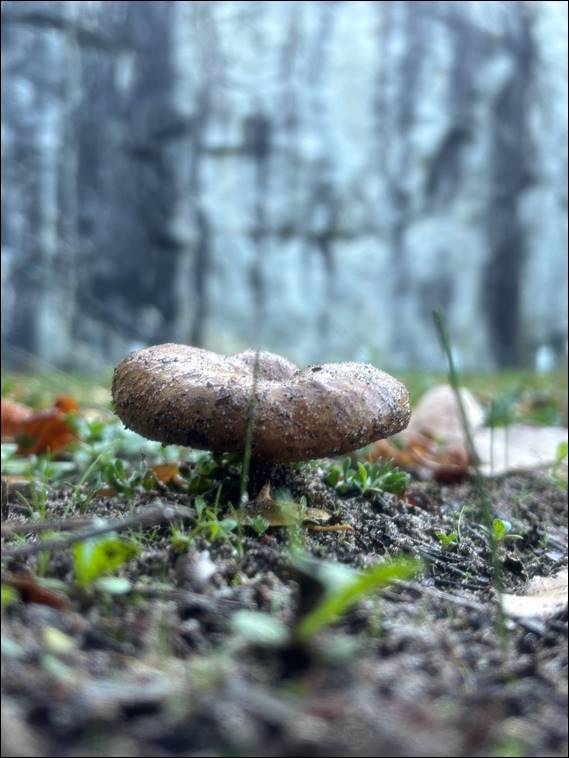
After spending some time checking out the orchids on display, we were doubly rewarded when our bodies felt refreshed and once again ready for action. Enough for us to decide to bump the grade up for the last two lines. And it was during these that I did exhibit signs of being able to be subtle. Howsie started strong but began to tire, and so I applied just enough support and encouragement without being overbearing. Especially when I could sense the draw of sitting on the rope was nibbling at his mind, helping him to push through:
 Sandbagged