The tell-tale signs are there to indicate the season for snorkelling off my local beach is drawing to a close. The sun is much lower in the sky, the water while on occasion is flat has more of a milky as oppose to aqua blue look, the beach is showing signs of the sand starting to shift, and weed is just beginning to wash ashore. Last year things seemed pretty good till the end of April, but this year I do not think I will be so lucky. That said, despite the changing conditions the water is still a good temperature and I’ll brave going in for as long as I can:
Just like a large chunk of this season, for my last three dives the ocean has been relatively quiet. Not too much to see and sadly no cephalopods, crustaceans, rays, or fish of any great note. But I have observed that the jellies are making a comeback, as had Lisa. She has decided just this week to start and brave the water again, after a bit of a break from it. Not to see the fish or get on her SUP, just to dunk and regain her confidence in the water and quite simply feel comfortable and safe in the big wide ocean:
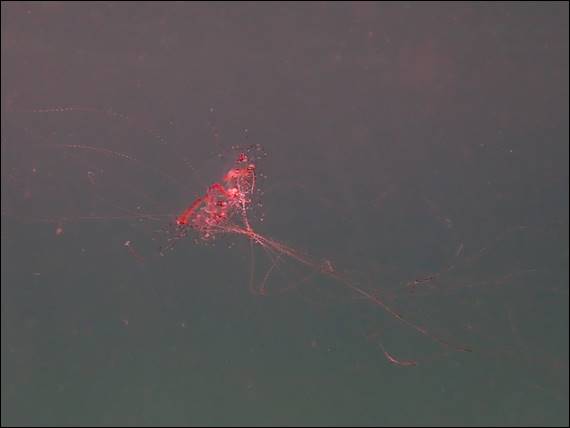
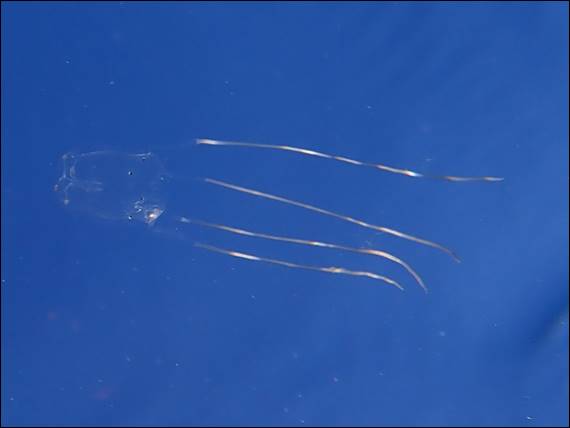
I’ve come across the jellyfish in the first image on occasion. It has the distinct jellyfish features. A bell or hood shaped body, which you can watch billow in and out to propel itself along with long tentacles, up to twenty centimetres, trailing behind. But then, and for no apparent reason, I’ve watched it become completely distorted. The body almost looks to flatten and become inside out. And the tentacles become a tangled mass, looking like a knot of discarded hair. Too entwined to be combed out, so instead pulled or cut out and thrown away:
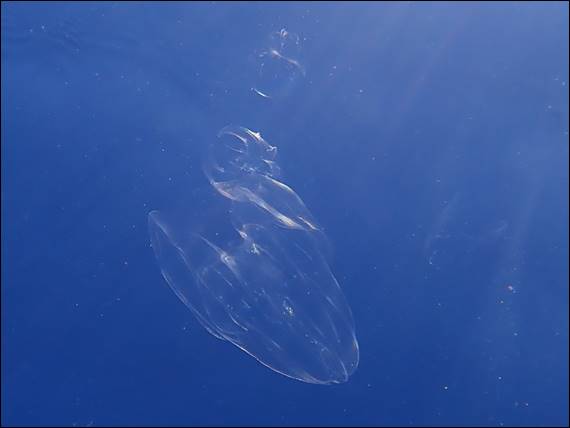
The second image should be familiar by now. The Comb Jellyfish (Phylum Ctenophora), which I have talked about in a recent post (https://sandbagged.blog/2022/02/26/close-encounters-of-the-smallest-kind/). There were lots and lots of them, and of all sizes. And as I watched this multitude of graceful and harmless jellyfish, I noticed a movement that hinted something was hiding in amongst them. A translucent fish, maybe three centimetres long, and you had to catch it in the right light to see it. I have no idea what fish it was:
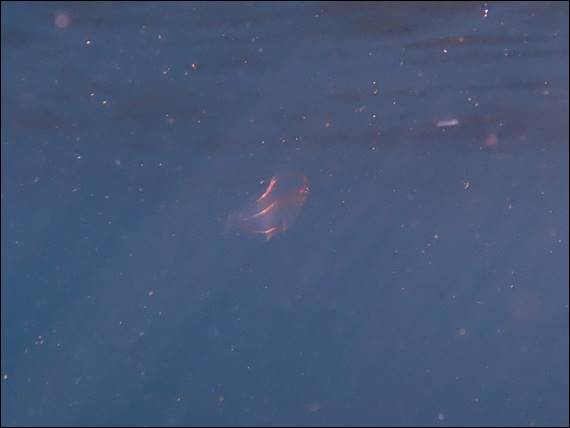
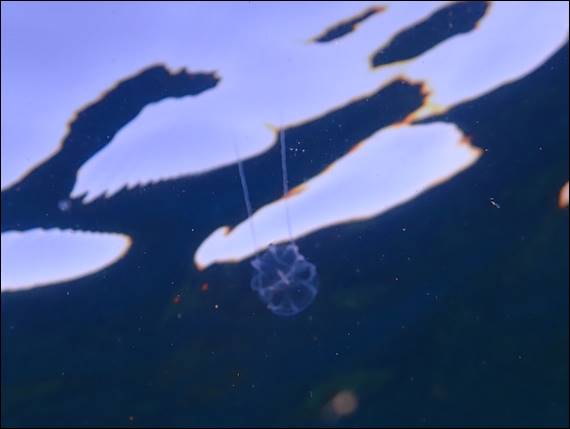
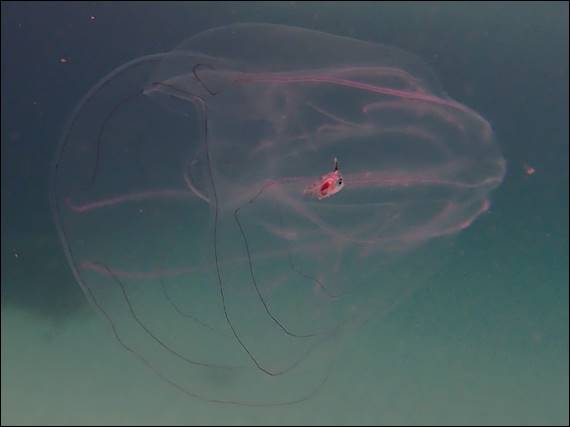
When I got too close it swam up to, and lay side on to the surface. It then flapped about making the water ripple, and just like a magician disappeared. I tried very hard, and unsuccessfully, to keep an eye on it. Shortly after I was lucky and spotted the same fish a second time, and it did the same thing and was then gone. I looked round all the combe jellyfish but didn’t see any more of these fish. While, looking so hard I did see the above jellyfish. Again almost translucence and very hard to photography. It might be a Sea Gooseberry (Euplokamis dunlapaeis), due to its body shape, small size, eight rows of combes and two tentacles:
While having a similar body size it was obviously not a South Western Stinger (Carybdea xaymacana), as above, which has no combes, more of a four sided box shaped body, and four tentacles. And unlike this jellyfish it also does not have stinging cells. The two tentacles instead have sticky cells (colloblasts), which it uses to catch its prey. On Friday after work I was eager to get in amongst the jellies one more time, quietly hoping to find that small translucent fish and get a better image. It was a very tall order, and swimming out I knew I was unlikely to be successful. There were hardly any jellyfish about:
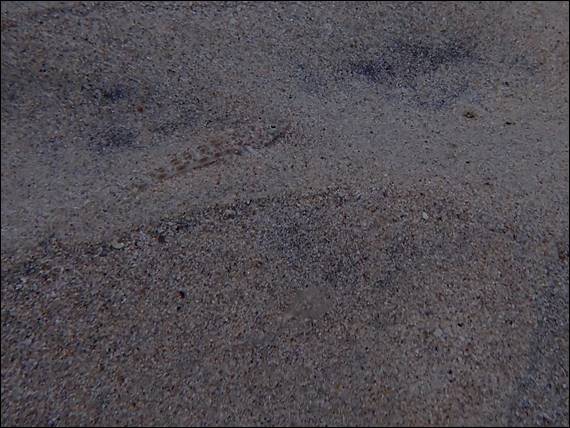
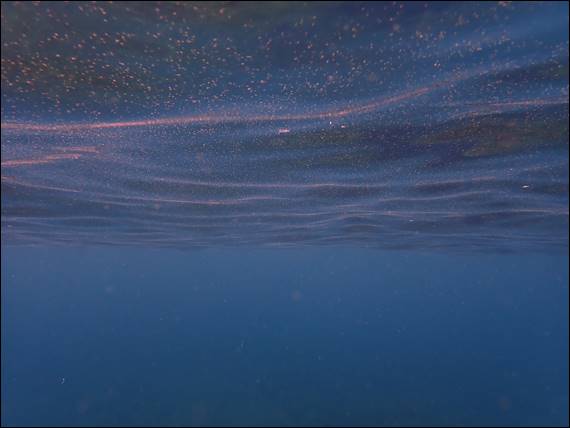
As I swam out and very close to shore I did spot the sand moving about in a strange way. Taking a closer look I found a juvenile Southern Sand Flathead (Platycephalus bassensis), no more than five centimetres long and so much smaller than the impressive ninety centimetres that these fish can grow too. If you look really closely in the above image I do wonder if I captured a second creature, but I just can’t be sure. Swimming out what struck me was that just the day before the surface was clear, and today there looked to be a dusting of particles. This was further reducing the light penetration:
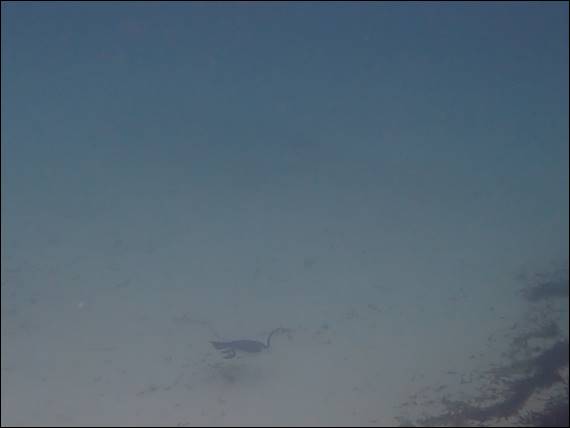
As such I stayed closer to shore, not really finding anything but just enjoying the feeling of the last remnants of the working week being washed out of my body and mind. Then out of the corner of my eye I spotted a strange shape moving along the sandy bottom, and it took me a moment or two to realise what I was seeing. I Pied Cormorant (Phalacrocorax varius) was diving for fish, and after taking a quick snap or two I videoed its ascent back to surface. You’ll have to excuse the colour distortion in the video. But just like my encounter with the translucent fish, my chances of seeing something like this again are probably pretty rare, so I just had to share it:
Our weekend hikes, mostly hunting orchids, seems such a long and distant memory and it is probably fair to say we haven’t done a huge amount together since then. As such this was the weekend that Lisa and I decided it was time that we went away for a night to do something together. In fact the idea sparked from Lisa’s covert inspection of a camper trailer, as she is keen to get out and about more. It started a rigorous debate between us. And while we didn’t get the camper trailer it did result is us heading away for this weekend, which was a good thing:
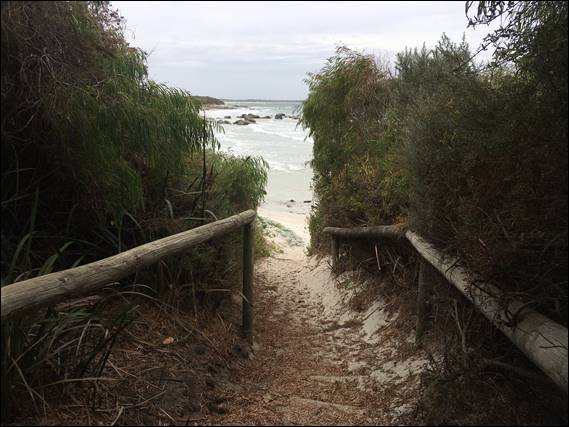
We headed south to the Flinders Bay caravan park in Augusta. A short hour and half away, and is a place which we have many fond memories of. It is a spot we came to several times when we used to head away camping with Elseya. This time it was just Lisa and I and we managed to snag our favourite camp spot, bay number nine. It is tucked under the peppermint trees right next to, the above footbath, that leads to the beach. On arrival we didn’t go to the beach, instead we drove out to Skippy Rock:
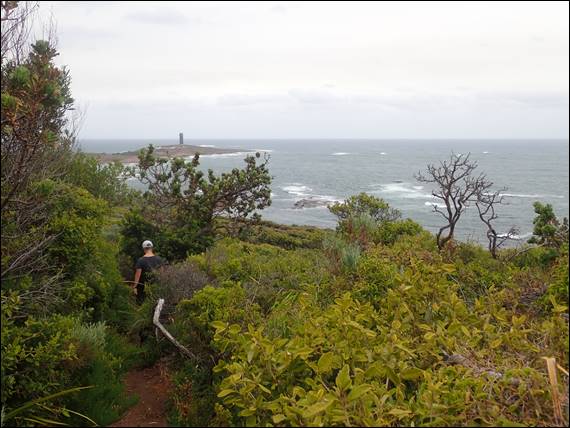
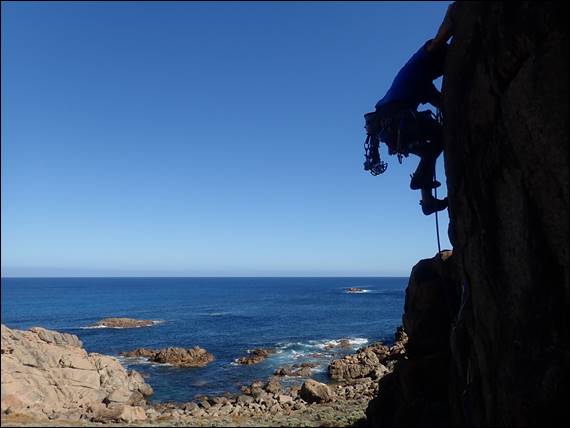
I had intended to take my snorkel gear, but the forecast didn’t look all that great. Strong winds and an undesirable swell made me think twice. Despite what the images show, I’m glad to say the conditions we were greeted with backed up my decision. Lisa and I did however go for a bit of a wander following the Cape to Cape walk trail. A lovely track in dense vegetation, so dense that for most of the walk it obscured any view of the ocean. This included when we got to a lookout, and we felt a bit silly sitting on the bench with no view but vegetation:
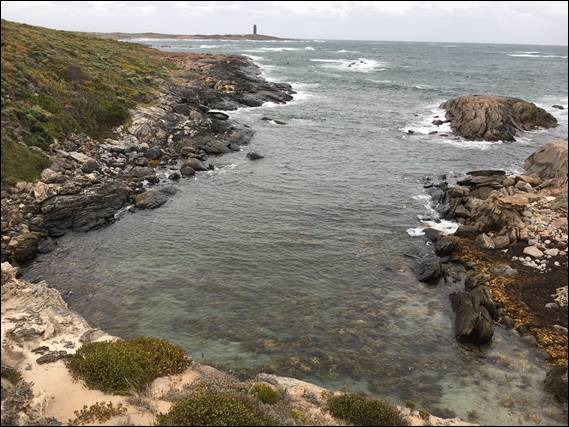
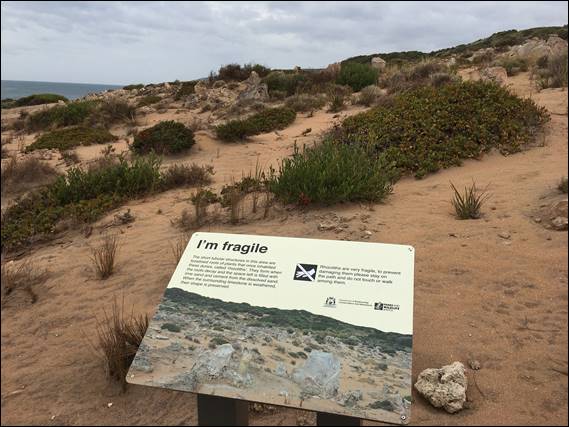
We were never intending going for a big hike but it was still lovely to be outside. We also didn’t spot much, other than some weirdly speckled coloured flies, a very well hidden cricket and the dried up stem of a spider orchid from last season. I got a bit excited by the last find, but Lisa was in walking mode and I failed to get a worthy image. On our return and to get a bit of an ocean fix we next wandered along the coast, giving a great above view of the Skippy Rock pool. Here the landscape changed a lot. And we came across a patch of rhizoliths, fossilised roots, something we came across on our hike round Mount Duckworth (https://sandbagged.blog/2021/09/26/the-south-african-pest/):
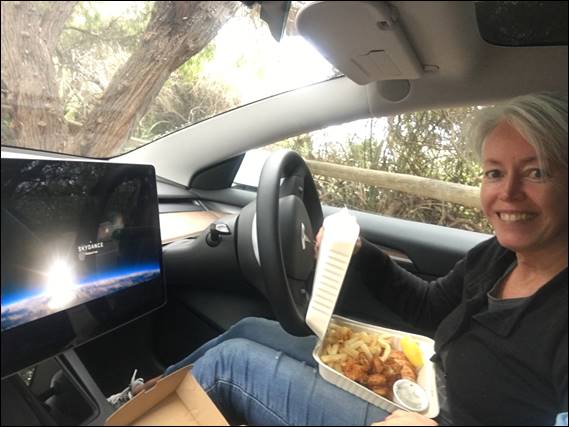
The difference being the rhizoliths on the previous walk were spindly small roots, whereas some of the ones on this trip looked like they had come from sizable trees. After all the walking and fresh air we had worked up an appetite, so it was of the chippy for fish and chips. It was a bit fresh outside and it even started to rain a little, so when we got back to the campsite with our food we didn’t fancy being outside. Instead we sat in the car and had a TV dinner, taking advantage of the technology that has come with Lisa’s Tesla:
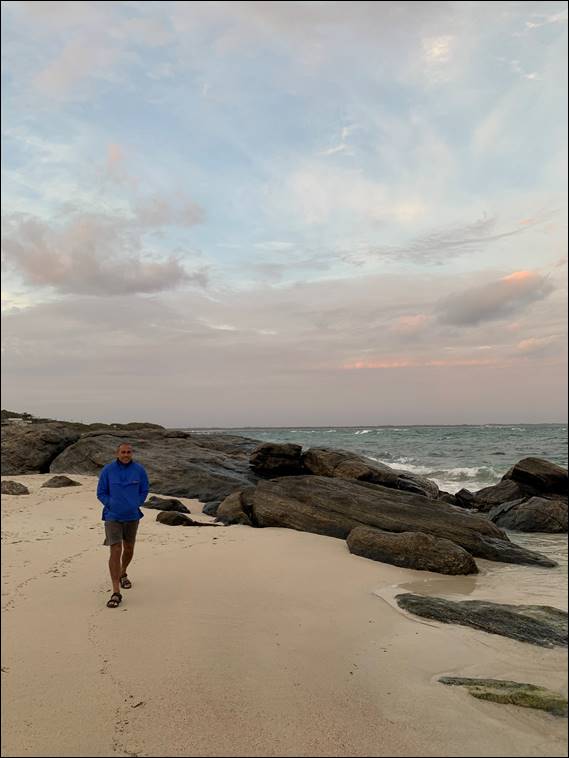
Yes it did feel a little naughty watching TV while out camping, but it was much nicer inside than out. I might add at this point that we didn’t actually bring a tent or any camping gear, having decided that for just one night we would sleep in the car. There is just enough room for us shorties to stretch out in the back, with the back seats down. But before we got the sleeping bags out, there was time for another wander along the beach. Watching the clouds turning from a light pink to a bright red, as the sun slipped towards and eventually below the horizon:
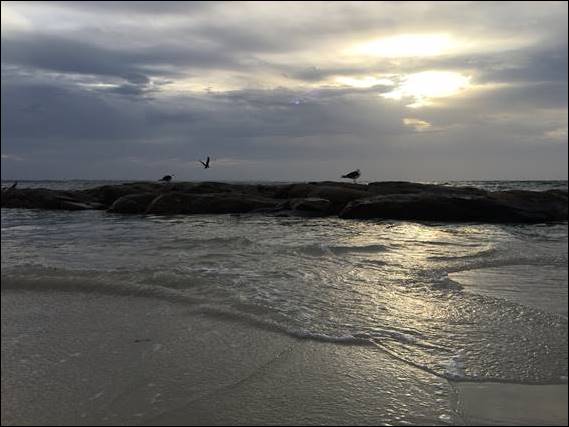
We didn’t have too bad a night’s sleep, all things considered. It is however not something we both felt we would do too often. Come morning I pulled out the only real camping gear we had brought, the tea kit. There was no way we would be going away without the ability to make a cuppa. Lisa had some of her first cuppa while still in her sleeping bag, but we then went for the same walk, as the night before, along the beach. This time gulls, petrels, cormorants, and other birds were using the rocks as perches surrounded by an ocean that was still looking too choppy for a snorkel:
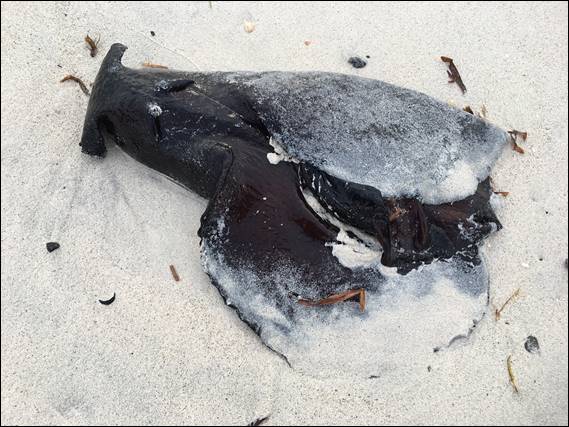
We also came across quite a lot of giant sea hares, washed up overnight. We had certainly not seen them the night before. If you would like to see one of these gentle giants when they are in the water, check out this post: https://sandbagged.blog/2022/03/09/kicking-goals/. There were lots of people out walking their dogs, off the lead. Hopefully none of the dogs got too close to the slimy bodies littered about, the reason being detailed in this post: https://sandbagged.blog/2021/04/18/the-glass-house/:
We hadn’t taken our poodles on this trip, but seeing all the other dogs Lisa now has it on her mind to return another time with them. But, for now it was just us and we reminisced past trips having fun with Elseya, rock hopped and checked rock pools, and sat at the campsite with a second cuppa playing games overlooking the ocean. Eventually we started to journey back, stopping in a café for a late breakfast. Getting home just in time to have to head back out, for a reason that I won’t mention this time:
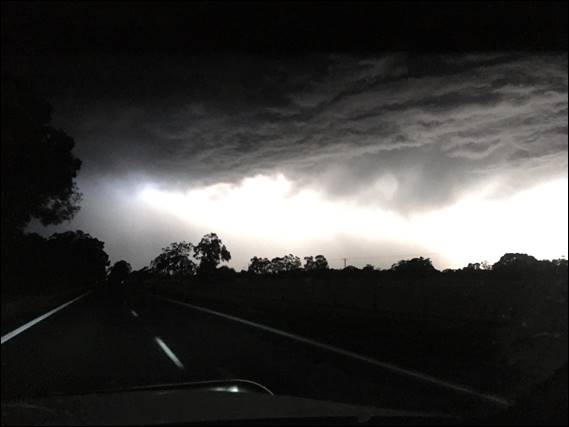
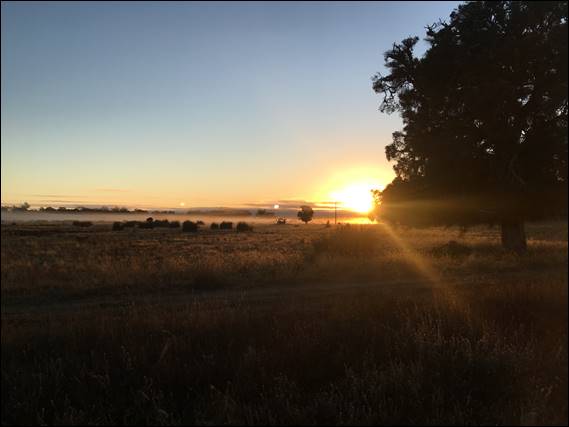
Another early 4am start, which is just under two hours before first light. But you would never believe it looking at this image taken a short fifteen minutes into the journey. For these starts, I’ll endeavour to get an early night so I’m not too tired in the morning. Last night however my sleep was broken as lightning and thunder rolled in, bringing with it rain. From the sound of it I didn’t think it was too much rain. I was meeting Howsie in Boyanup, not our usual place to meet but today we were heading south:
For much of the journey, at least until light crept into the sky, we were entertained by amazing lightning strikes streaking across the skies, coming down to earth and at times just lighting up the night sky for just a few seconds. We pondered whether our decision to keep heading south was sensible, checking the radar and in the end just deciding to go for it. During the two and half hour trip and the further south we got the weather seemed to cleared up. Even better the road and fringing vegetation, as we approached, looked bone dry:
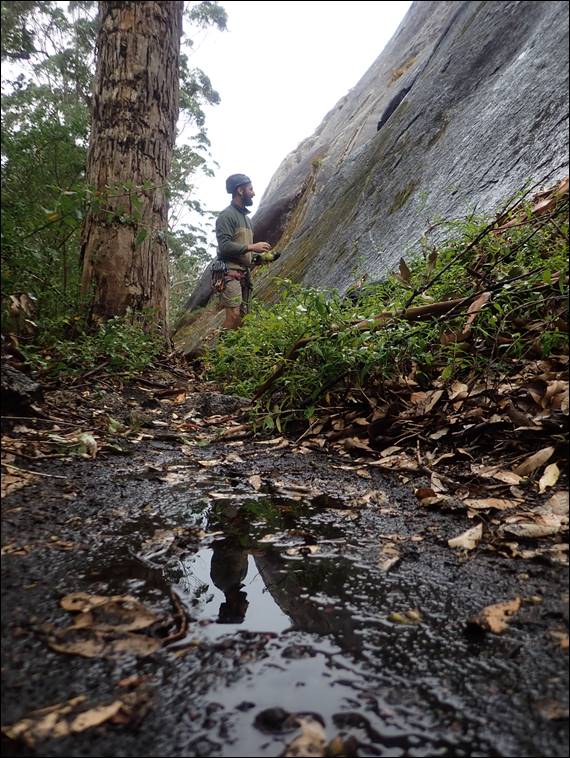
Mount Frankland stand tall and proud in the landscape, at 411m above sea level. This may not sound very high by global standards, but for the relatively flat landscape of Western Australia it is pretty impressive. This prominence does however come with an uncanny ability to have its own weather systems, and on most of my more recent trips here over the last few years that has resulted in rain. Today was no different, and with only 5km of our journey left the rain came down and we were greeted with a soggy path and wet rock:
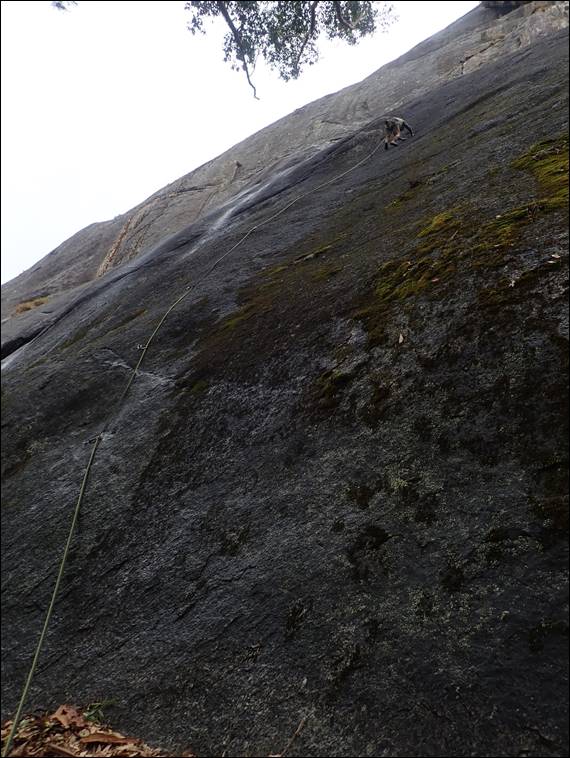
My last climbing trip here, as there have been others, was just before the boarders were closing. Not just with the world and the rest of Australia, but also across regions within Western Australia. That was on the 21/03/20, two years back almost to the day. It was wet then too, so I already knew which line was the best to start with. Having already climbed it in these conditions I was happy for Howsie step up to take the lead. 17 Burmese Tiger is a sustained fun slab. Made all the harder today by the conditions, so it was a slow and tenuous lead:
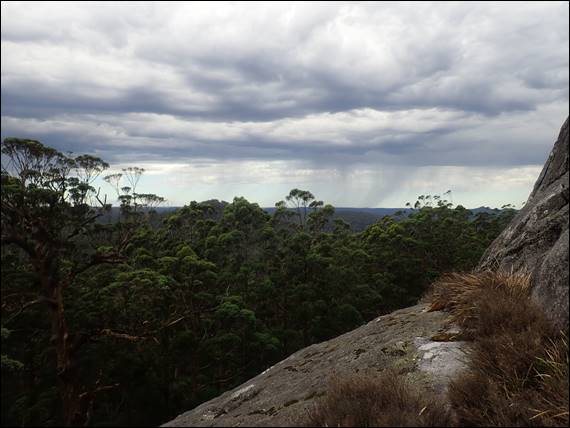
I was very grateful to have the rope above me, and as we sat some 45m above the base of the crag we could see across the tops of the towering Karri forest. Our reason for coming here was to allow Howsie the opportunity to climb a classic grade 20 slab called Hannibal. While the conditions were not ideal, there were elements of hope in that we could see dry rock. This meant the dampness had likely come from the overnight and early morning rain, as opposed to seeped in moisture over a longer period. With a good weather window the rock may dry up enough:
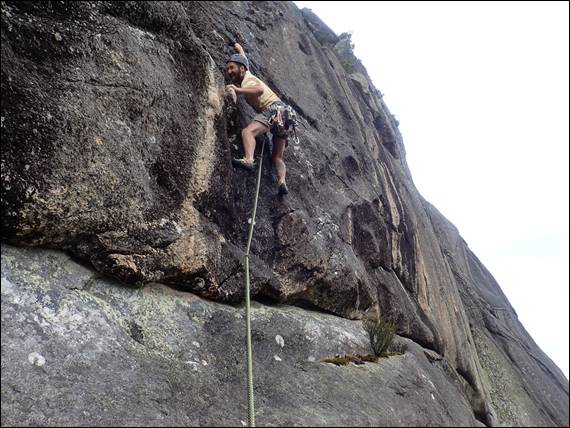
It wasn’t looking too bad as we wandered along the terrace, pondering what our next move would be. There’s a whole section of rock that I have hardly touched, 45m routes that are said to be great. But it all seemed a little too damp for my liking and I was more than happy for Howsie to take another lead. He couldn’t recall previously climbing Three Sheep Twice a Day, and didn’t even know the name of this grade 18 line. It was the features that appealed to him, they are a little unusual and to some extent can lull you into a false sense of security:
He did remarkably well. The start was soggy but higher up the route veered away from where the water flows down the rock and there were patches that we could almost call dry. Hope was with us still. That was until he was two thirds up and, after watching all the birds catching insects on the wing, I looked behind me. Promptly suggesting he may want to climb a little faster. He did, and I followed up with a level of urgency aware of what was brewing in the sky. A weather cell in which lightning strikes could be seen was rapidly moving towards us and we were 90m off the ground:
We managed a quick rap down the first 45m and quickly set up the second line. That was when the drops started to fall, not small gentle raindrops. Big fat meaty drops, ones that you can immediately feel soaking everything they make contact with. By the time we got to the base, neither of us had a patch of dry clothing on us. Then it started to hail. Fortunately the hail was short lived and was over by the time we had coiled the ropes. No need to discuss what our plans were now, it was time to get the kettle on:
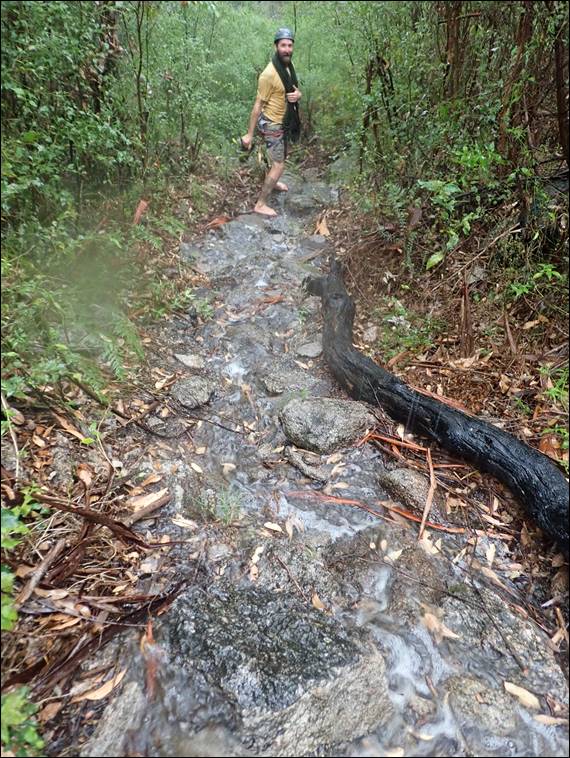
The rain continued to pelt down, the view across the valley was a blanket of white. Water streamed down the granite slabs, splashing at the base and then continuing through the vegetation. The footpath became a creek line with water splashing and gurgling over the rocks. There was no need to rush back, we were thoroughly soaked. Instead we took our time and relished the amazing sight of water everywhere. Laughing and enjoying a spectacular that neither of us had seen before:
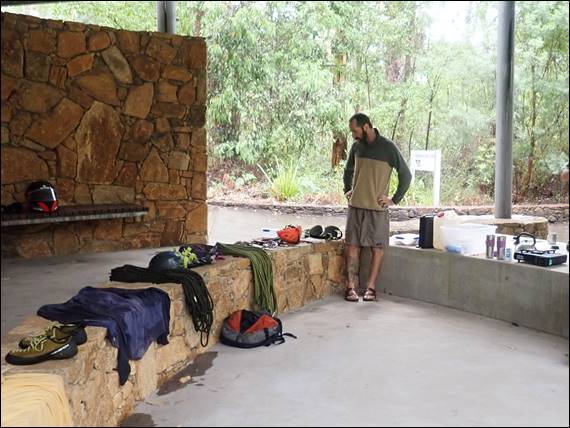
We arrived at the shelter by the carpark and draped our gear over the rock walls. Here we found three bikers keeping out of the downpour and having the very same idea we had. It was time to make a brew. The rain looked to be easing a bit, but it was pretty clear that there was little point in racking up for any more climbs. We were not upset by that, having bagged two great lines, had been privileged to be in a beautiful location, and to boot the rain had made it a great adventure:
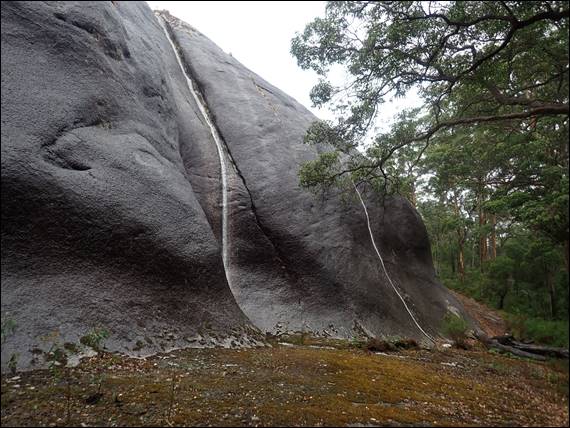
As we looked out from the shelter, the bikers pointed out a few waterfalls they had watched appear as the rain belted down. Neither Howsie nor I have ever noticed the rock before, and we assume it is what is referred to in the climbing guide as the Carpark Crag. Claimed to be a bolt free crag, so the routes here are basically solos. Neither of us felt the need to come back to climb here, but we are keen to come back to Mount Frankland in search of some better conditions. Hopefully, one day so Howsie will get to climb Hannibal:
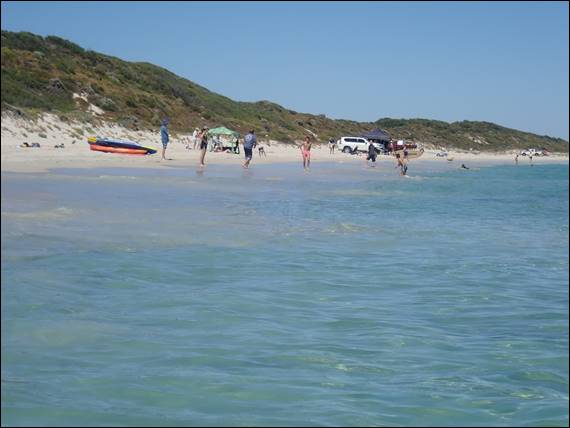
A long weekend heralds the arrival of crowds from Perth. We can expect busy roads on Friday, as we head home from work, and the beach starts to fill out more than usual. On such weekends there is little point in heading anywhere in the local area for a feed or to a coastal spot that is insta-famous, as it is likely to be packed. I feel Peppy Beach is getting to be more well-known and visited, which in part is due to the caravan park, but where we are located tends to be the quieter end:
Boat access here isn’t great, and as I came out from the first dip of the weekend another car with a boat trailer was bogged in the soft sand. Hopefully discouraged from launching from this area in the future. The sound of a propeller and engine can travel long distances underwater. When you are looking down snorkelling it can feel a little uneasy hearing the sound, but not really knowing how far away or close the boat or jet ski could be. Most time, and for my three swims last weekend and into the week, I didn’t have to worry about that:
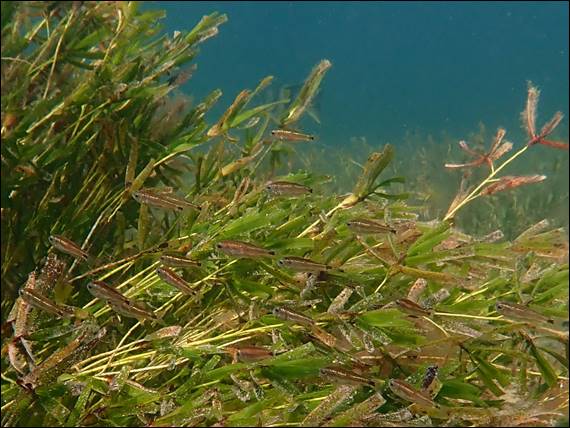
The conditions were good and I spent three quarter of an hour or so each time just floating about relaxing. During the first dive on Sunday, I spotted a few small schools of juvenile fish and spent a fair bit of time watching them. Young fish can be hard to identify, but I think the above may be juvenile Western Striped Cardinalfish (Ostorhinchus victoriae). Based on the patterning and distinctive spot at the base of the tail. But the adults of these are fish are normally solitary fish that lurk in caves, and while these were hugging a reef they were in the open water so I’m not convinced:
The above juvenile fish were staying just above the weed, and were well camouflaged. I am a little more confident in saying these were juvenile Western Striped Grunter (Helotes octolineatus). Slight horizontal, but less distinctive, lines and a slightly more streamlined body seemed to match what they will grow into, as they become adults. Sunday morning I got down a bit earlier to a relatively quiet beach, less people and flatter conditions. The oil slick from burley stretching out from a lone fisherman, a local fella who always gives me a wave when our paths cross:
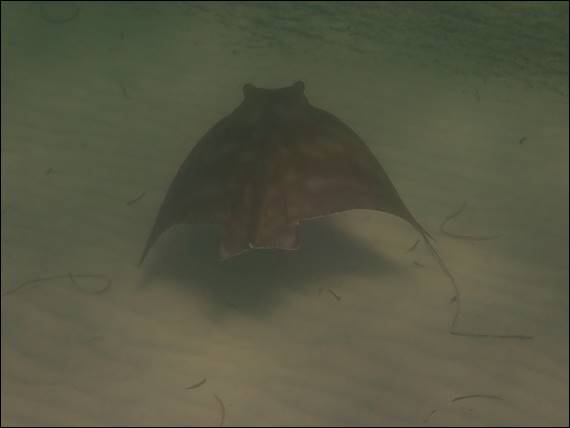
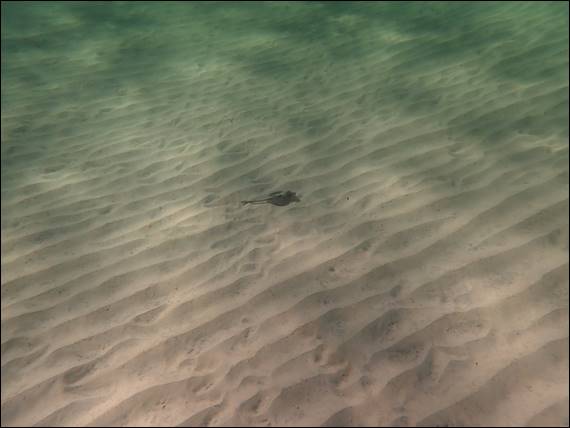
I was hoping that I might see a ray or two, drawn towards the shore by the burley. Sure enough as I went in I came across a couple of rays, but they spotted me before I saw them and took flight. A long whip like tail trailing behind, as the disappeared. With what looked like just a flick or two of the wings they were gone. Unlike the recent image of the small oval shaped stingaree, this ray’s disc was more board in shape with triangular tips, so I knew it was an eagle ray but which one was unclear:
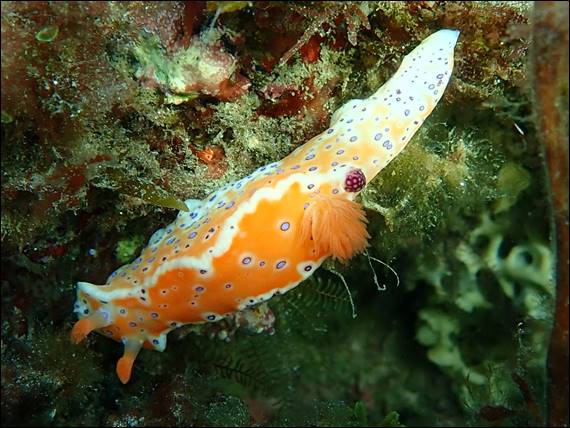
After swimming in the general direction the rays had gone, and of course not finding them, I decided to just keep swimming. Eventually I got to the furthest part of the reef that I go out too. Far from the eyes of people on the beach but still in water that is no more than 5m deep. Here I bobbed about, lots of fish life kept me entertained, and then I spotted what looked like an orange strip. To my delight I had spotted a 10cm long Short Tail Nudibranch (Ceratosoma brevicaudatum):
Despite being in 4m of water I spent a lot of time and energy duck diving down to see this fella. I was regretting not having my weights, which would have made getting down easier and saved me breathe to stay down long. Still I was able to get some great images and could clearly see the mushroom like ‘horn’ just behind the feathery gills. This horn is where it stores horrible tasting chemicals extracted from the food it eats. And it is specifically coloured to attract potential predators to the nastiest tasting part of the animal, so a kind of defensive mechanism:
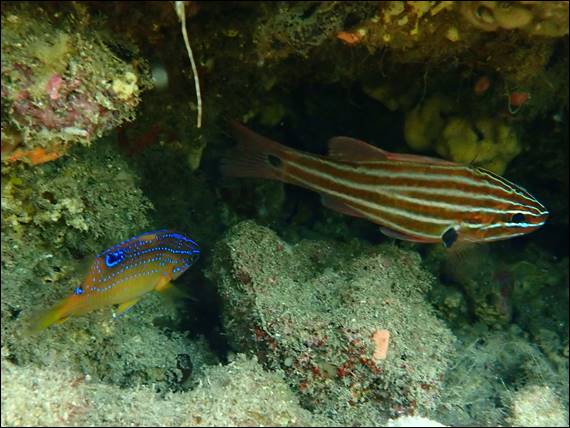
After tiring myself out in the deeper water I headed closer to shore, here I watched fish dart about below me. And have included the above image of a brightly coloured juvenile McCulloch’s Scalyfin (Parma mccullochi), next to an adult Western Striped Cardinalfish. The fish I thought the first image of the small school of juveniles might be. And not that it proves anything, but both images were taken on the same bit of reef within about five meters of each other. Looking up I saw the fisherman had left the beach and felt it was also time for me to exit the water:
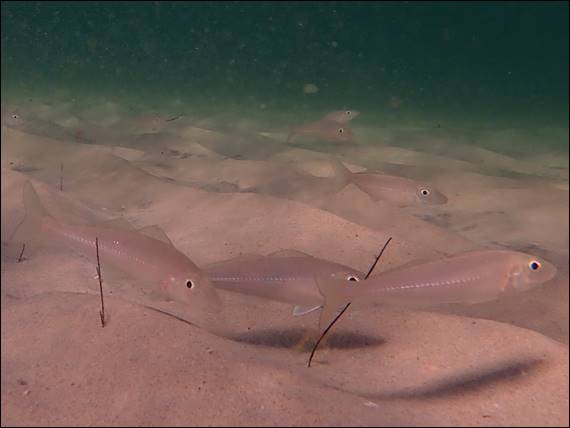
As I swam across the sandy bay, I saw a couple of the rays again. This time I got a bit closer but they were still pretty flighty. The one that didn’t escape the lens of my camera had lost its whip like tail. And with this image the mottled patterning allowed me to identify it as a Southern Eagle Ray (Myliobatis tenuicaudatus). Both rays had been munching on what I assume was burley or bait that the fisherman had left behind, and as each ray alighted from the sea bed I spotted a heap of, what I believe were, Sand Whiting (Sillago ciliate) also feasting on the leftovers:
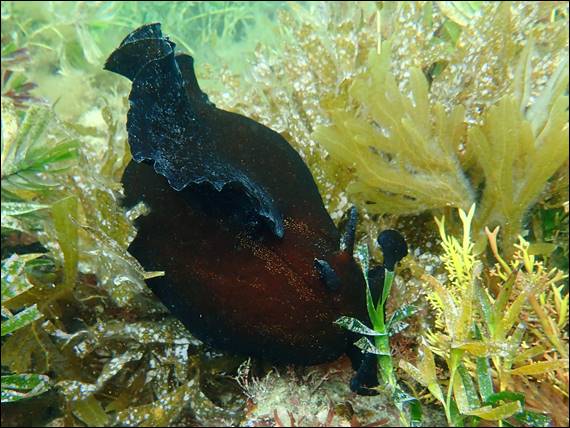
It was another hot week here so on my way home on Wednesday, with a calm wind and no hint of a sound of waves as I stepped out of my car I decided I would have a swim. I was pleased I did. I came across my second ever sighting of a Giant Sea Hare (Aplysia gigantea), my last sighting being April last year. It was at least half a meter long, and the relatives of this gentle slimy giant had hit the news as they do this time each year. Now is when dog owners are on alert, as sea hares wash onto the beach and can be very toxic to dogs:
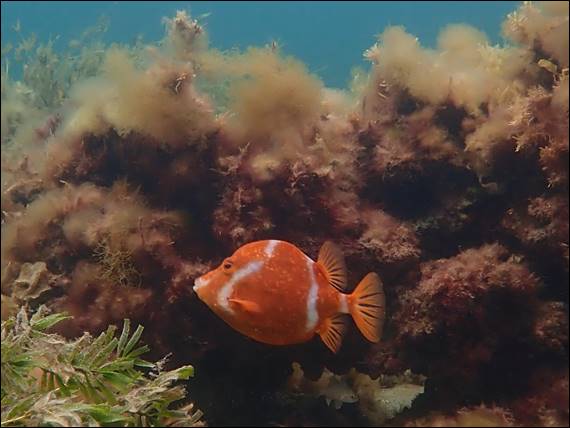
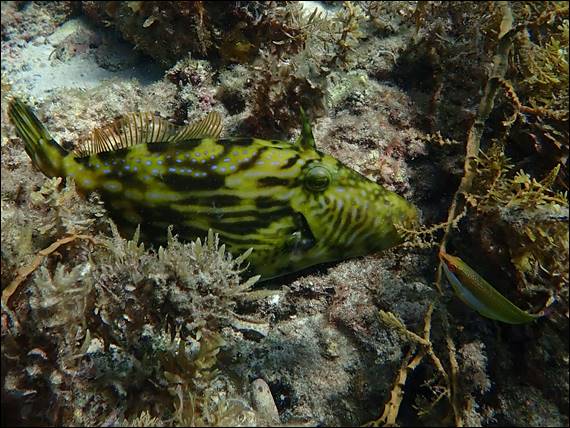
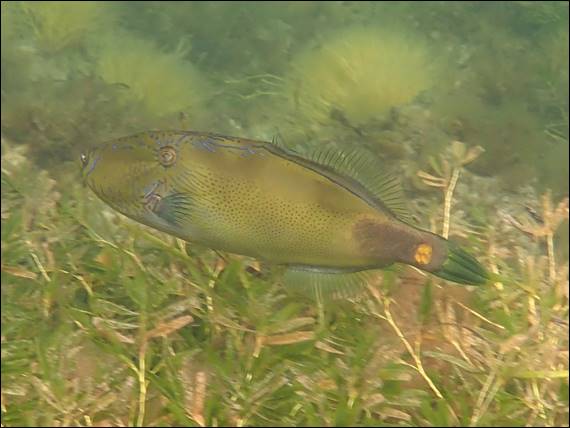
I have found afternoon dives are generally a little quieter under the surface. As such I wasn’t surprised that the rest of the dive was relatively uneventful. Still it was a great way to end a working day, and also to cool down. Just before heading out I felt like I scored when I came across a male Whitebarred Boxfish (Anoplocapros lenticularis). It really wasn’t hard to spot the foot long, bright orange, football sized fish in amongst the mottled browns and greens. Equally it wasn’t too hard for it to see me either, and it kept its distance and eventually slunk into a crevice:
Over the festive period, which seems so long ago now, I would normally pop down to the south coast to get out for a climb with Kym. However, just before the school holidays last year, he took a fall of his skateboard and badly sliced his wrist on a broken bottle. Needless to say that put paid to any climbing, as well as skateboarding, playing the guitar and most other things he enjoys. I’m glad to say that he is sufficiently on the mend now allowing most things to resume, which includes climbing:
We did however need to make sure we didn’t do anything too hard. This suited me as I continue to take things relatively easy on the climbing front, to allow old injuries to again settled down. So at just after 4am Saturday morning, I popped a cup of tea next to Lisa in her thermos mug before leaving the house in the darkness. There were a few reasons for not driving down on Friday. It’s a long weekend and the roads would have been horribly busy. Driving down when I did, I hardly saw another soul on the four hour’ish journey:
Other reasons being that Kym was working nights and we were not going too hard, so there was no need for us to get to the rock for a silly early start. I arrived just before 8am, surprised to find out that Meg, Tessa, Claire, Beau and even Sonny, the pooch, were not there. Normally by this time the house would be a hive of activity and noise, but instead it was eerily quiet and Kym was already all packed up and ready to head out. I found out that Meg and the kids had made use of the long weekend to visit family, but Kym had to work so couldn’t join them:
With such a quiet house Kym looked a little lost, which I can understand. When you are used a busy household, it seems a lovely idea to have the house to yourself. But when it happens, after an hour or two it doesn’t seems like it is so much fun after all. So in a way it was a good weekend to go down and get out with Kym, and fun was what we were after. We’d already discussed our destination. A place Kym had only been to once before, over a decade back. And a place that Howsie and I have been wanting to visit for ages:
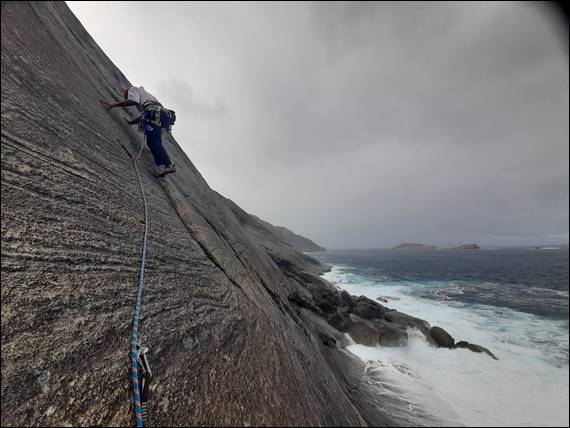
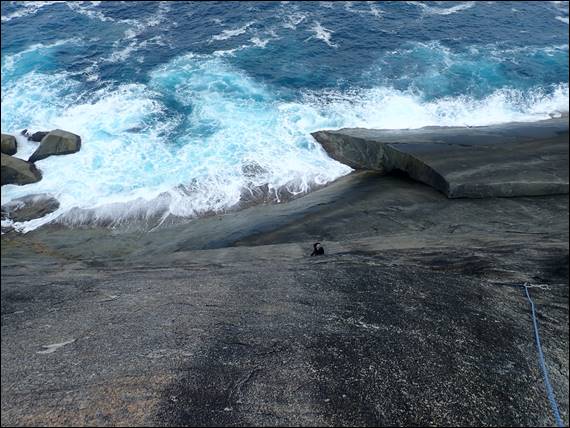
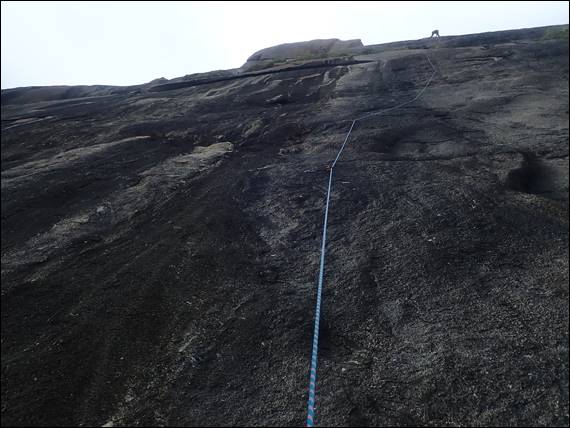
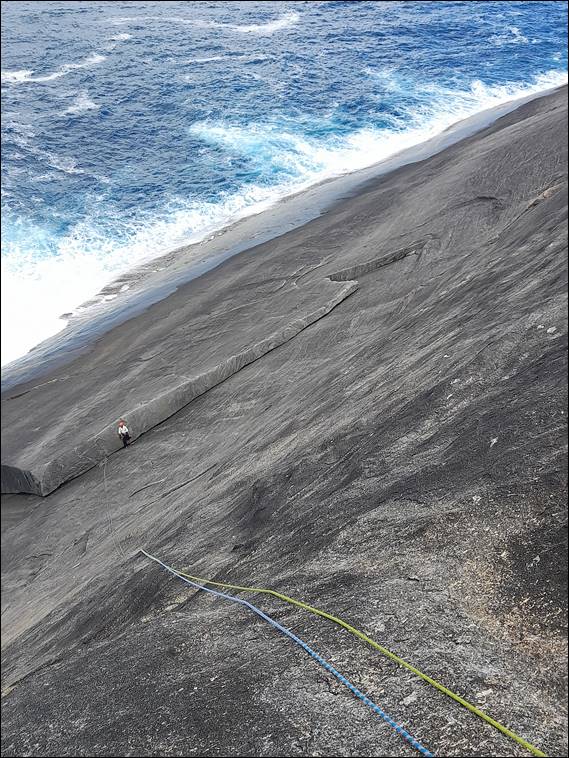
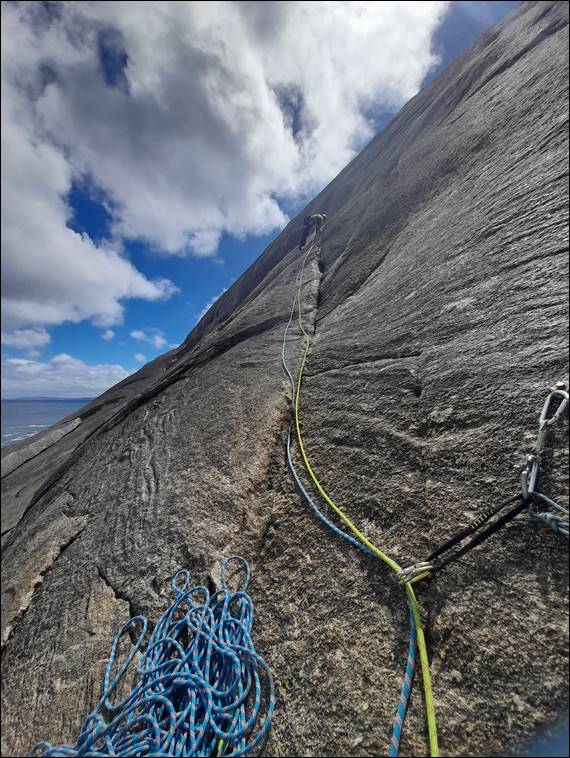
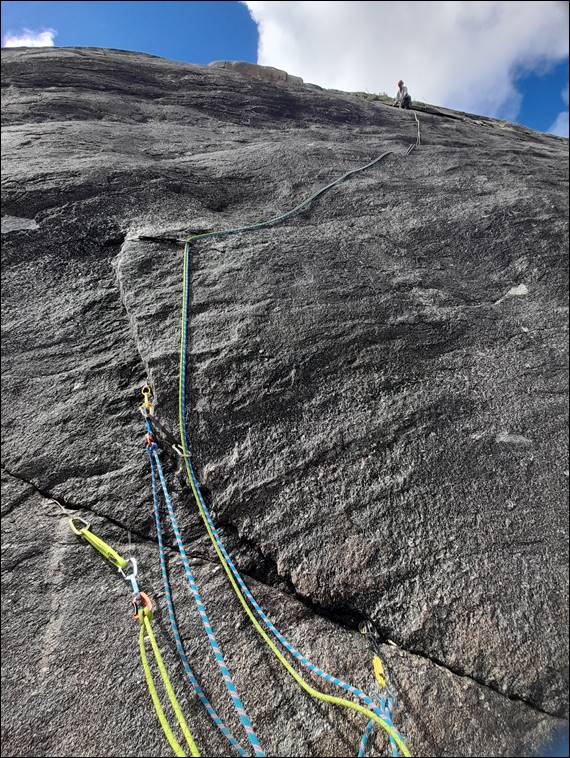
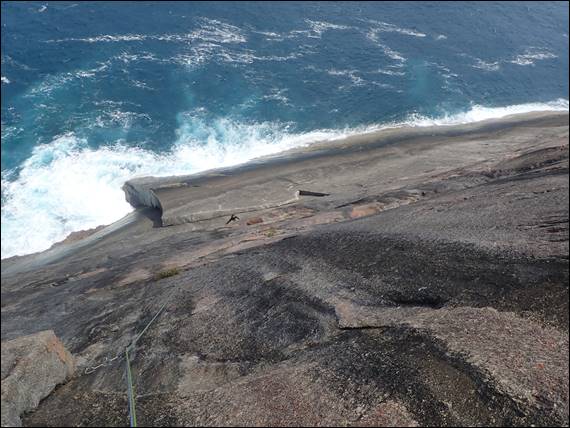
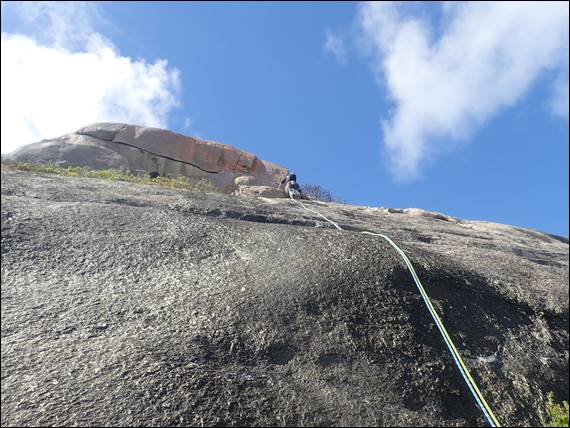
While Howsie didn’t make it this time, his rope did. To make the access easier we needed a couple of 60m ropes, Kym has one but I don’t and Howsie kindly lent us his. Family Rocks, is a strange name for the crag that requires a 2km, off the beaten track, bush hike and does not poses one aspect that I would call family friendly (check out the video above). But this out of the way and forgotten crag is a towering 150m from the ocean to its top. A gentle angled slab, with nothing too hard on it but also not a lot of gear options. The slab is enormous and it is hard to get a good idea of it when you are so close to it:
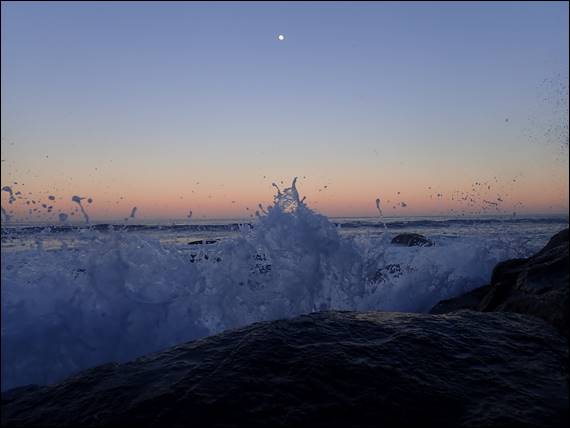
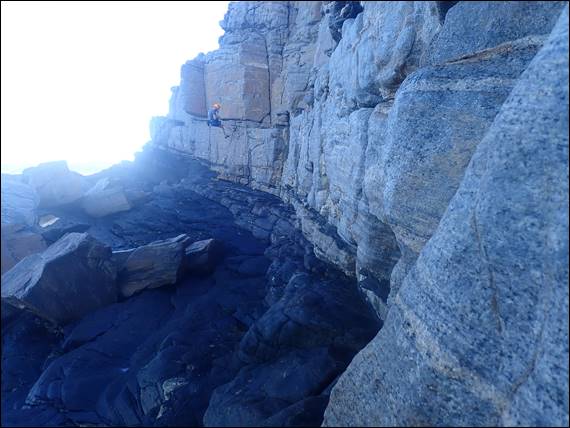
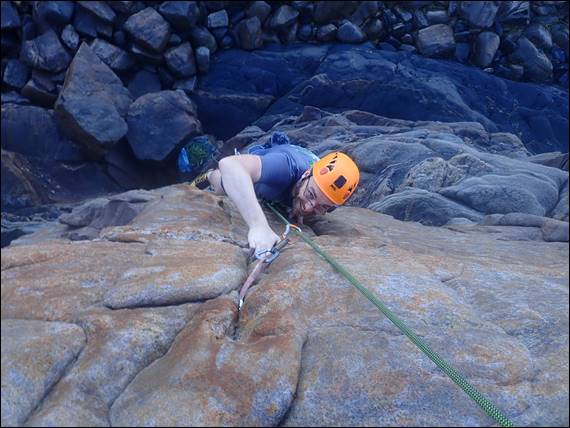
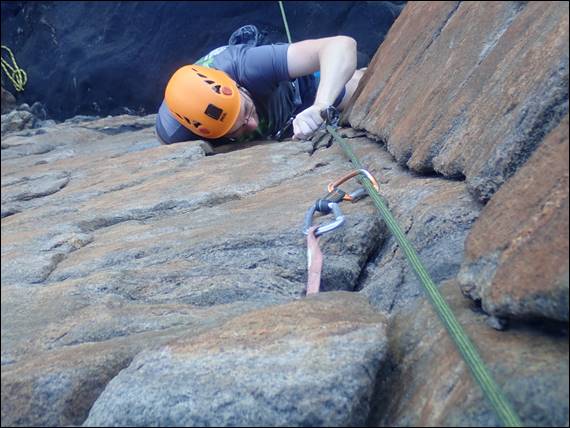
So we decided to repeat the only route Kym had done before, as this allowed us to get our bearings and also a feel for the rock. It provided 120m of climbing, and is the only bolted route here. A line of bolt heads is all that shows you the path. As we rapped down we had real problems spotting them. Eventually we found it, with the base being at the end of two long raps one being a full 60m. The belay anchors were a healthy distance about the ocean, but the roar of the waves was ever present reminding us of our situation. And the need to be careful:
I was up first, just a bank of rain looked to be coming our way. While the grades were not silly, we still had to rely on friction and some very small edges numerous times. A shower would result in water streaming down the rock, and nearly all friction would be lost. Something Rongy and I experienced on the granite slabs on the south coast on another trip: https://sandbagged.blog/2021/03/10/battling-the-elements/. Knowing what might happen I went for it, climbing quickly and fortunately as I looked up the bolts were easy to spot. As it was I could have taken my time and enjoyed the first pitch a bit more:
The rain headed out to sea and all we got were a few drops. Kym’s wrist seemed to hold up OK. Although down palming, which stretches the wrist just where he had injured it, was uncomfortable. Regardless of this he was happy to take the next lead, this time stretching the rope on a monster 60m pitch. It was no unexpectedly more of the same, following the bolts and padding your way up. It was a fun line, and there is no disputing the setting was stunning. But what Kym and I were really after was some adventurous trad, so after a snack we went back down:
The granite slabs along the south coast generally tend not have a huge amount of features. This makes trad climbing a little trick, as you need to have flakes, cracks, pockets and/or breaks in which to place gear. Added to this, and for a crag that is so vast, the route descriptions are a little vague. So this time we rapped all the way to the huge square cut slab, allowing us a better view of where the routes may go. Even then some were not entirely obvious, as we looked up at a mostly blank slab rising above us:
We decided on a weakness that resembled a crack line. It got pretty thin in places, but looked like it should provide opportunities for gear. The initial belay station from our first line just happened to be at the base of this feature, so we again set up there. The climbing was never too hard, but it was engaging and the crack provided sufficient gear opportunities. If I had taken my tricams along, which were in my pack at the top of the crag, there would have been even more. I set up a belay ready to allow Kym to follow me and he shouted up to make sure that the belay was on good gear, which it was:
His main reason for asking me that was the next pitch. From the base it looked like whichever line we took, it may be run out with less options for gear. I did not lie about the belay I had set up it was great, but I feel like I would have wanted Kym to climb the first pitch regardless of the belay as it was a lovely route. He enjoyed it as much as I did, in fact so much that any thought of his wrist, as he climbed, had vanished from his mind. He met me at the belay buzzing, which changed a little as he eyed up the two options for the next pitch. These were, continue along the disappearing crack to the left or go up the featureless slab:
Not having been out on rock for a while he wasn’t too keen to push things, so he offered me the lead. While the continuation crack looked like a lot of fun I was also conscious that being a rising traverse it would probably not be sensible. If it was thin on gear that would really mess with Kym’s head. On a traverse a fall will result in penduluming onto the closets piece of gear. And both the leader and second could experience this if they fall, so instead I decided to go upwards. That way Kym would have a rope above him, and any fall potential would be reduced:
It was a good choice that I went first, at the start there was a 10m plus runout up the slab. Not even my tricams would have helped. There were a couple of delicate moves the hardest of which being quite high up. As such I needed to double check every small edge, some were loose. It was just what I hoped for and I loved it. I was fully focused and relished the runout, need to control my thoughts, and make precise well considered moves. It was another rope stretching pitch, and we both really enjoyed it. This just left us a short final pitch, which I was pleased to see Kym step up to and romp up confidently:
Because you are continually on your toes, slab climbing will test how comfortable your shoes really are. And after two long multi-pitch routes we were both keen to get our shoes off and keep them off. So while we could have easily got another route in with the daylight left, both of us were content and preferred to leave while riding on the high of the great trad line we had just bagged. More food was consumed before sorting the gear and shouldering the packs. The 2km hike out seemed to be much longer than the hike in, another sign telling us that we had climbed enough for today:
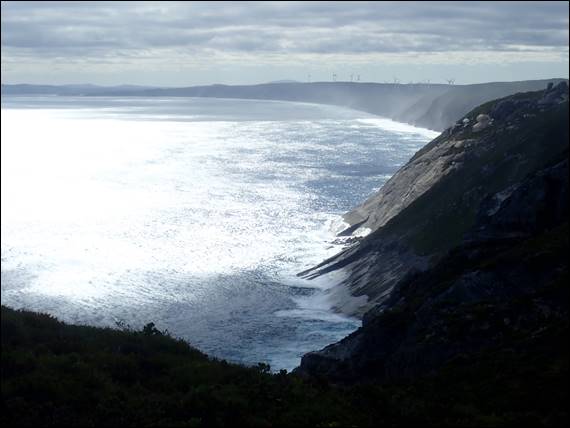
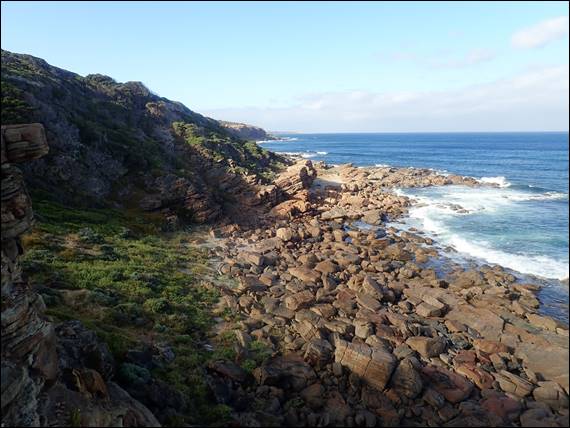
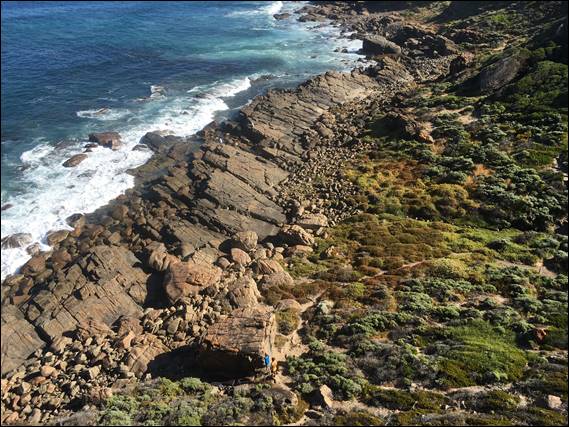
The hike is very picturesque and follows a ridge that goes up and down. Looking north we got the occasional glimpse of Albany across Frenchman’s Bay. Ahead to the east The Gap and further in the distance Peak Head came in and out of view. They seemed to be continually basking in sunlight. Then when we finished the bush hike and reached the short circular walking trail that takes in Sharp Point, there was a great view back west of Family Rocks with the turbines of the windfarm in the distance, almost obscured by the salt spray drifting up the steep cliff line:
It was a storming day out with a great hike, an amazing setting and really good climbing; as it usually is when I head out with Kym. Back at the house it again felt a little strange without the rest of the Hartley clan being there. Although we did take advantage of it and had a feast of fish and prawns, as we watched The Alpinist. The stunning scenery and scale of the ascents in the film eclipsing what we had just experienced at Family Rocks. But it is all relative and we were both still reeling from the day we had just had. While it is not everyone’s cup or tea, I’ll definitely head back to Family Rocks to explore the other trad lines on offer there:
Kym was back on a night shift that night, so as he headed off to work I hit the sack. He did try to tempt me with a morning trip to the Blowholes, but I refrained not wanting to push things at the moment plus I was feeling pretty worn out from the adventure we had just had. In addition I might have another big day next weekend, and need to make sure I pace myself. With an empty house, and not needing to say any more goodbyes, I got another early start to head home on Sunday. As I drove round Frenchman’s Bay the only light came from the street lights in Albany, and I was already half way home by the time the sun poked over the horizon:
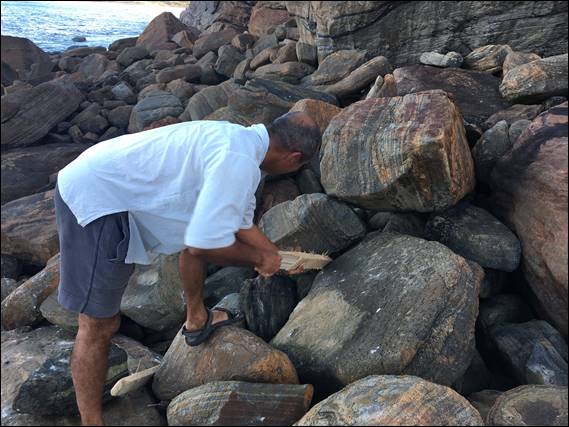
I am a great fan of The Hobbit and Lord of the Rings, so much so I have read the books and watched the films multiple times. And all I could think of, as I watched my wedding ring disappear between the boulder, was the sound of metal bouncing off rock when Gollum dropped the one ring in the deep and dark tunnels within the Misty Mountains. I would normally take my ring off in the car and attach it to my car keys, but today I waited till we were at the crag. And all Josh and I could do was watch it fall and then disappear below the boulders, listening to the tink, tink, tink that became more faded with each bounce:
We had an initial look, and then started to move a few of the more manageable rocks. We could see what looked like the bottom, but no ring was insight. The rocks we moved started to get bigger and bigger, and we need to take great care not to crush our fingers, hands or feet. Each time checking if we could see more clearly, but no luck. I was ready to call it quits, after all we were at the fittingly named Lost Buttress. But Josh reckoned if we moved the big boulder that looked iron stained, we’d be able to move the smaller ones underneath and see more clearly:
So we collected some flotsam and strategically moved some pretty big boulders to create space for the big one to fall into. It was starting to remind me of the reality television shows showing people shifting boulders on treacherous scree slopes to find gems. But with a bit of thought and care we managed to roll the biggest boulder out of the way. Next we began to lift and roll the rocks, previous pinned down by the big one, to one side. We spent a good half an hour all up, but thanks to Josh’s optimism and persistence we finally found my precious:
After the hike along the coast to get to the crag, and warming up every muscle in our bodies by shifting some sizable rocks we were finally getting down to why we came here. We started on No Nuts Required, a gentle but fun climb to begin on. Today was a bit of a slightly later start not due to the shenanigans thus far, but because it was forecast to be a bit cooler today. As such it was close to 8am before we started climbing, when I found this March Fly that was feeling too dozy, cold, or lazy to fly off. It simply walked away from me:
Only the female flies bite, with the sole purpose of getting protein from blood to develop eggs. They use tiny blades to slice into the victims flesh so they can drink the blood that pools in the wound. But fortunately for us this was the only one we saw today, and it didn’t seem in the mood to try and get our blood. Josh followed up with relative ease, the hard yakka of the morning hadn’t dented his stride. I had already mapped out a bit of a plan for the session, and we quickly scrambled back down and got ready for the next route:
Jenga was up next. And after we had shifted the large boulders at the base, some of which seemed to have moved a bit too freely, it made us think about the large boulders that give this climb it’s name. Large jumbled blocks at mid height that it is impossible to avoid. Some of which seem to be balanced in place, but I have never noticed any indication of movement before. We experienced the same today, they didn’t budge, but it didn’t stop us being that little bit more cautious, as we gingerly edged over and past them:
This one made Josh think a bit more, but he managed a clean ascent so we moved onto Washing Away the Blues, creeping the grades slowly upwards. While, just like the top of Jenga, the top of the third route played a little with his head. But each time he gave himself a little talking too, and then powered through. As I led the fourth route I felt it may have been a tad too hard. Due to the smeary footholds and steeper sustained nature, in a very exposed position. Despite all of this he worked hard and it wasn’t until the final moves at the top that his footwork let him down, and his arms started to give out:
This time when we got back down we packed up the gear and left Lost Buttress, but we were not heading out yet. After a short boulder hop we dropped the bags at The Playground, it was time for Josh to pop his leading cherry and he was sounding keen. With big juggy holds and a soft sandy landing this place is a great spot for a first lead. Before he set off on his first lead we talked a bit about gear placements and rope work. Chimpanzee was a good one to start on with comfortable stances from where you can place the gear. Despite his arms having started to give out earlier, he managed the route and placed bomber gear:
Some people don’t like lead climbing, the rope being below them makes them nervous and plays with their head. Even on climbs they may have got up before with relative ease. I therefore checked in with Josh and said he really enjoyed the feeling. So I sent him up a variation of Cookie Monster, which made him work a little harder. But not too much, and he climbed it safely popping in well-spaced and placed gear. He was eager for more, and I pointed him to a section of the wall that provided the steepest and most sustained challenge yet. I could see he was working harder this time, but again he got good gear in as he methodically worked his way up:
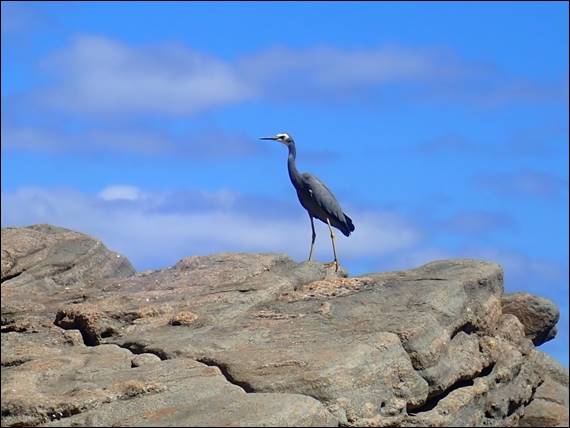
Confessing his arms were now well and truly ready for a, well deserved, rest we finally packed up. During the rock hop back along the boulders we spotted a White Faced Heron, and I couldn’t resist including the image. While they are known to inhabit tidal mudflats and beaches, I was a little surprised to see it on a rough rocky coastline with nowhere for such a wader to hunt for food. Unlike the Heron we had however been successful in looking for what we wanted today, firstly a great adventurous morning out and secondly my ring. But so as not to tempt fate it was not until we got back to the car that I popped my wedding ring back on my finger:
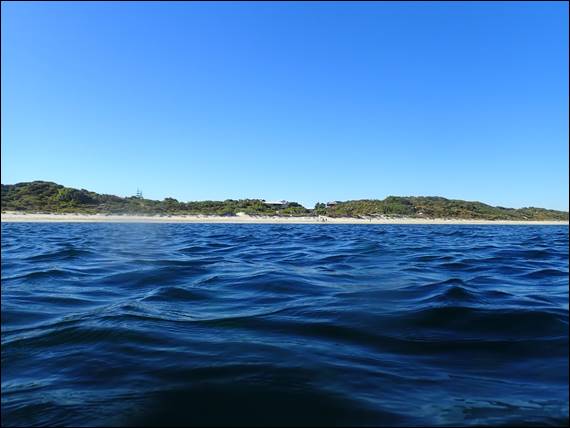
The beach is a short three minute walk from where we live, and jumping in the water after work is always so refreshing. It can also help to wash away whatever thoughts of work may remain lurking in the back of my mind. Despite knowing this, I rarely make use of the extravagant luxury of where we live. In part due to wanting to snorkel and see something, as opposed to just bobbing in the water. Often I’ll do a quick drive over the hill to check the water before getting home, and if it doesn’t look snorkelable then I don’t bother:
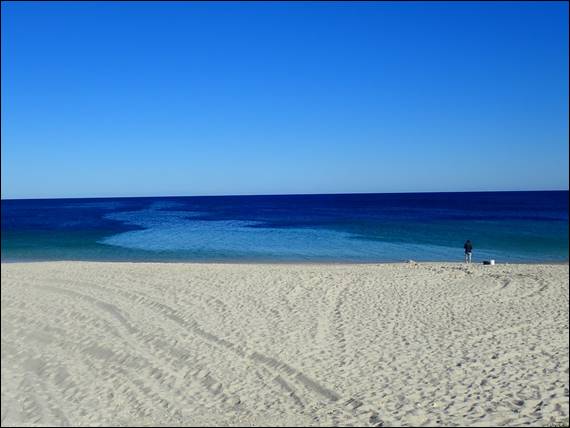
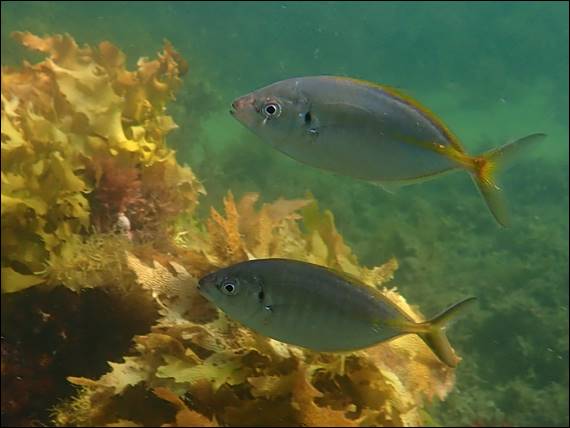
This week however, the water looked inviting, seeming to be relatively calm and potentially clear. The stark contrast in colour between the water over the sand and reef being a great indication of how good the visibility was likely to be. As a result of this I have taken advantage, and had a couple of dips during the week and one today. The first dip was on a hot and bright day with amazing visibility, and I soon found myself 150m plus from shore. Here four fish appeared and stayed with me for the majority of the dive. Staying mostly below me, and not being afraid as I duck dived down:
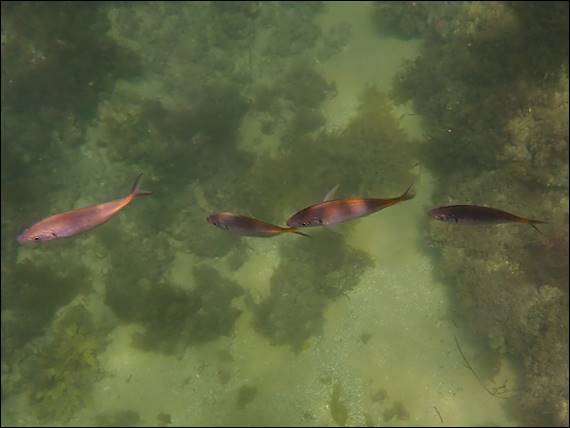
My initial thought was that they were herring, but the yellow tail indicated not. And due to their relative lack of inhibitions, compared to herring, I was able to get some great images and identified them as Silver Trevally (Pseudocaranx georgianus), a fish I do not recall seeing too often. For the second dive the sun was again bright in the sky, but the water was a little murkier. Maybe for that reason I found a few shoals of smaller fish out in the open. Below these Yellowhead Hulafish (Trachinops noarlungae) are a species I normally only find under a ledge or in a cave. They have a very distinctive yellow shaped tail that looks a bit like an arrow:
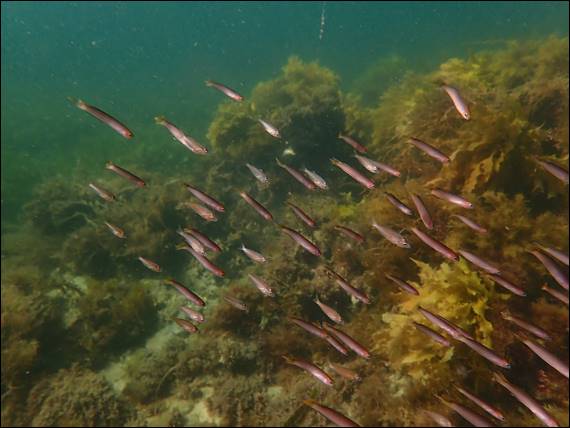
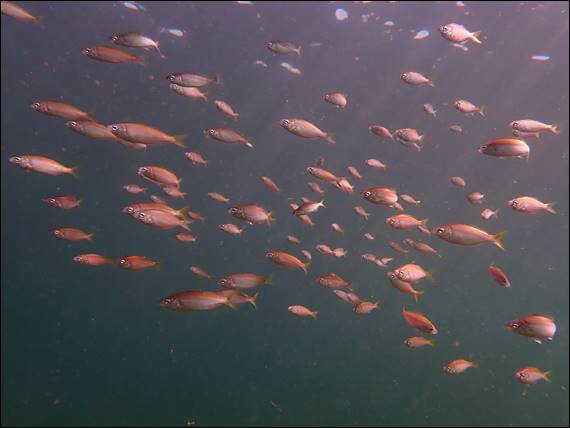
Being a carnivorous fish, known to feed on feed on crabs, fishes, and larvae, these darker recess are where they are more like to find a feed. I can only assume that the other fish intermingled with them, with a deeper and shorter body, are also carnivorous. With Rongy’s assistance we think they may be juvenile Silver Trevally. Another shoal of fish that has popped up in the last few dives are the ones below. While hard to see in the images they are different to the silver fish mixing with the Yellowhead Hulafish, plus I have seen these more frequently brazenly swimming in the open:
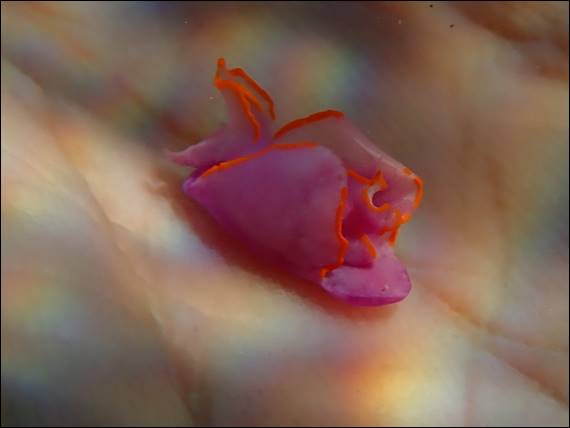
Again a bit of guess work, but Rongy and I thought they may be Juvenile Yellowback Fusilier (Caesio xanthonota). The Yellowback Fusilier feed exclusively on plankton, which would explain why I see these out in the open water more often. And again if we have guessed right, an interesting fact about these fish is that they can protrude their upper jaw outwards. Making snatching plankton out of the water easier. My next find is one that I have included in quite a few posts, and I will no doubt do so again. Every time I see Bat-wing Seaslug (Sagaminopteron ornatum) flying through the water I’m captivated:
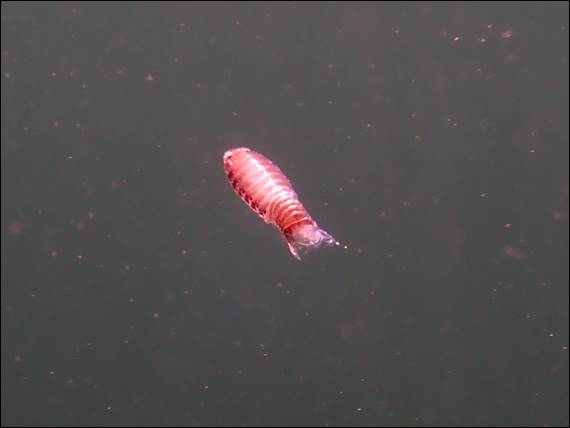
This time however, I allowed it to rest on the palm of my hand and it’s lobes, which are normally flapping as it swims through the water (check out the video of this in the linked post https://sandbagged.blog/2021/02/14/deja-vu/), curled upwards to provide protection for its main body. These sea slugs belong to the Gastropteridae family, and can be found in tropical through to artic waters off Alaska. However, one thing the many species have in common is that they are small. The largest is only an inch long, and some are mere millimetres long. This species found in Western Australia is approximately one centimetre in length. And this happened to be the same size of my next find, something I have not come across before:
To provide an idea of scale I also included the next image. I’ve been told it was a sea louse, and that they are not often seen floating about like this. Most people will find them attached to their catch, as they reel a fish in. They use suction to attach themselves to the fish, and can move along the scales as they graze on the hosts body. They can, as such, become a lethal parasite. There have been reports of people getting nasty rashes and reaction to sea lice, but today despite seeing two of these I didn’t notice any after effects:
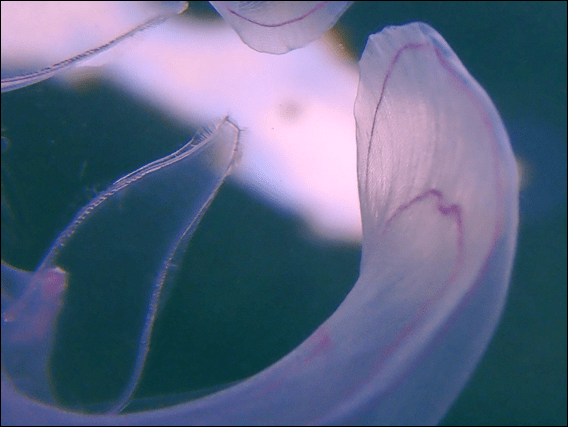
Today’s dive was again different, the water was clear enough but the sky was a bit cloudy. Resulting in the visibility being that bit reduced, and I immediately noticed that there were quite a few Comb jellies (Phylum Ctenophora) bobbing about in the water. These resemble jellyfish, but they are part of a distinct and diverse group of their own. They capture their food by literally sticking to it, not having or using the paralysing stinging tactics of true jelly fish. Although I have read there is one species called Ctenophore (Haeckelia rubra), not only does it eat other jellyfish, but it takes their stinging cells and uses them as a weapon on its own tentacles:
The stinging type is found in Australian waters, but it is not the ones I see. Or at least I have not to date been stung by them. Watching the light catch the rows of tiny hairs move in unison along each ridge is quite special, so I always stop and spend time with these gentle jellies. Today however, and on three occasions, I found something else hovering right next to them. And as I moved round to get a better look the tiny newly hatched Horseshoe Leatherjacket (Meuschenia hippocrepis), would swim to the other side of the jelly. I took lots and lots of images in the hope one would be in focus:
The camera doesn’t always pick up the translucent body of these jellies and this tiny fish was less than five millimetres long so again not big enough for the camera to focus on. I was both rewarded and really happy to have captured a few reasonable shots. The one above being my favourite, really showing the tiny fish’s dorsal spine and blue eye. These are by far the smallest fish I have seen, and it is amazing to think that they will grow into a fish that can be as much as 120 time longer, at sixty centimetres. While not the full adult size I did see some more mature specimens of this fish, and maybe due to the cloudy weather they along with numerous other fish were out and about:
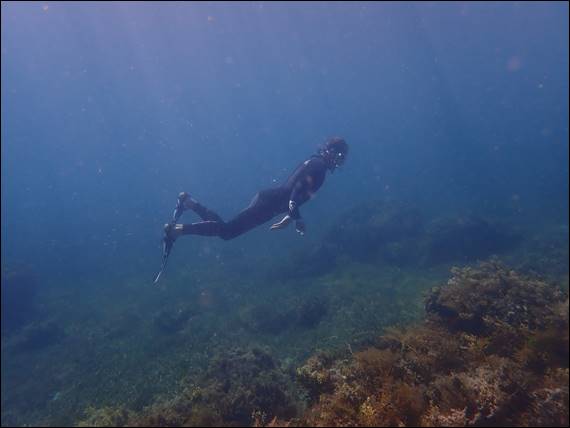
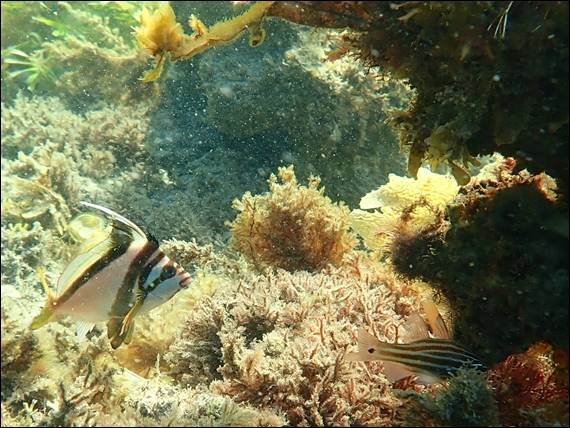
Today duck diving to check out the caves I regularly frequent, I was often faced with a good variety of fish. Being dark it was hard to get a good image, but the above one wasn’t too bad in which I watched a Horseshoe Leatherjacket, Squareback Butterflyfish, Juvenile Moonlighter, Western Striped Cardinalfish, and Orange Spotted Wrasse. Or were they watching me. As a result of the reduced visibility from the lack of direct sunlight I stayed relatively close to shore today, no more than 75m. Spending a fair bit of time combing the weedy bottom, which is where I found another shoal of small one centimetre long juvenile fish:
I am not game to try and name the above fish, although they could be from the bullseye family. But the below Impressive Pencil Urchin (Gonicocidrais impressa) is something I have found and had identify before. Swimming over the sandy bay towards the beach I spotted an oddly shaped collection of weed, which was not moving in the usual or expected rhythmically way as the gentle swell went back and forth. As I got close the spines became evident and in-between the weed covered spines I could see the armoured round body of the urchin. The ends of the spines on these urchins have cupped suckers, allowing them to hold on to the reef in rough seas:
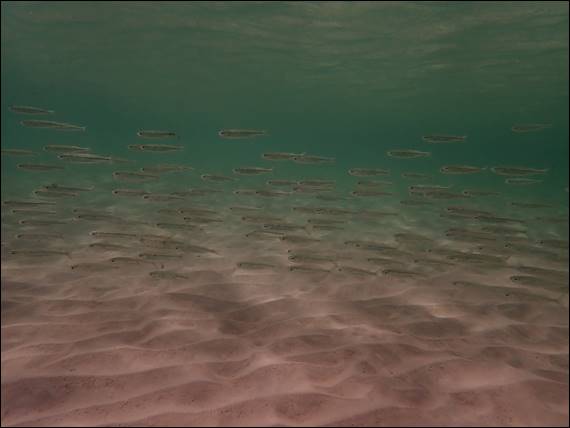
It is the first urchin I have found so far into the sandy area, and I am not sure it was intentional. Compared to the reef this was a very vulnerable and unprotected environment for the urchin. Leaving nature as I found it, I swam on back to the beach. And as I approached the shoreline a large shoal of Hardyhead Silverside (Atherinomorus lacunosus) blocked my path. A couple of thousand swam in a long seemingly never ending line, between me and the beach that was no more than five meters away. So I stopped and let them cross my path, which took some time. Watching them disappear before getting out of the water:
With a date like today’s, combined with Howsie’s 2022 challenge of attempting every grade 22 in the south west climbing guide, how could we not take a day out from the routine of life to bag a 22 or two. In fact we thought maybe in keeping with the date Howsie should jump on three 22s, but that did limit our options of where to climb. Welly Dam, which we visit most Friday mornings before work, or Bob’s Hollow were the two obvious places. Wit felt like we climb at the former enough, and for the latter the access track is still closed due to the recent bushfires:
So it came down to lines that he was particularly keen to try. There are some climbs that people see and they yearn to be climbed, it may be the neatness of the line, the rock architecture or simply a name of a route that draws you in. And for today Howsie’s response was swift, Smiths Beach it was. Not only for a great climb, but also possibly only the second ascent of the route. We arrived as light was just peeking into the sky, the timing was great. This place gets early sun and it would heat up like a hot box today, with a forecast of about 30 degrees:
To limber up the body and become accustomed to the rock, we popped into the smaller of the two zawns first. Of all places to climb around here, this is the one where you want to ease into the climbing. The roundness of the rock, and coating of small flakes that always seem to be present is not everyone’s cup of tea. And even us who venture here more frequently need to re-familiarise ourselves with these characteristics. There were two primary reason for the smaller zawn, Howsie hasn’t done many of the routes here and there are a few fun lower to mid-grade lines, perfect to get the body moving:
Sadly the rock was wet, and on one wall it was so wet that the rock felt slimy. So after one route we moved into the big zawn, where the rock was merely a little damp to touch. The friction however shone through and after a second slightly trickier warmup climb, Howsie looked up and decided now was the time. Buffalo Soldier has a tenuous, what I feel is a grade 22 traverse, on small holds some offering little more than friction, with final a nerve wrecking lean across to flake feature:
As you’ll see between the above and below image, it really doesn’t take long for the sun to creep up on you in this place. So Howsie was in full sun as he got to the traverse. There was the usual Howsie yo-yoing, in a sideways fashion, as each time he inched his way closer to the flake. Then reversing the moves back to the safety of the stance just below the gear. Eventually he went for it and leaned over, holding onto not much, as his fingertips just made contact with the flake. Pulling over the flake Howsie was deservedly very chuffed, as you will find out if you watch the video:
It is only the second time I have been on this route, and I really enjoyed it. In fact I feel like I should lead it again sometime. Speaking of which you may notice there is no mention of me having led anything. There were a few reasons for this, firstly I was a feeling weary and uncoordinated, not a good way to be when climbing on this type of rock; secondly, and sadly, I think I have been climbing too much of late and my old shoulder injury is starting to niggle again; and most importantly Howsie was climbing well from the start and I wanted to give him the best chance to bag Buffalo Solider. Allowing him to have lead after lead to build up his confidence, without getting too tired by following me up additional lines:
It had worked well, and he was feeling up for giving The Holy Grail a bash. While he got up it and had great fun, after the event, even he would agree he needs to go back and lead it again. As there was what some may call unacceptable techniques adopted. While he hadn’t exhausted his physical stamina on the first three routes, he had worn down his mental focus. And this route is even more of a mind game than Buffalo Soldier, despite being an easier grade. To finish off and Craig, you may be happy to hear, your line Small Pro also got what is probably it’s second ascent:
It was only nine in the morning as we walked out but it was already 28 degrees and the zawns were unbearable. Despite such a short climbing window, there was another reason we picked Smith Beach. It allowed us to head for a dip afterwards. The usual crowd of tourists were heading into the natural feature located approximately half way along the bay between the zawn and Canal Rocks. We left them to The Aquarium, another overrun Insta-famous attraction. Instead, jumping in the water at the Canal Rock’s boat ramp, and having the place to ourselves:
For a change we headed along the edge of the rocks out to the ocean. Some areas dropped off quite deeply, which meant there may have been bigger things out there. I only spotted one that was cruising along the edge of the sandy bay. My guess, based on body shape, is a Grouper? But it was heading steadily away from me and was in water over 10m deep, so my chances of getting any closer to check it out were zero. No matter we saw heaps of fish, and while I did take a few images, I was mostly content with just watching them:
They seemed to be in full feeding frenzy, mixed shoals of fish were hovering round the rocks. As the larger species pecked away at the rocks in search of a feed, the smaller fish seemed to be waiting until the dislodged bits floated out into the water allowing them to dart in to grab them. As I went down the big fish swam away quickly, while the smaller ones kept feeding not being too worried until I got really close. This Bluelined Leatherjacket (Meuschenia galii) and Brownfield’s Wrasse (Halichoeres brownfieldi) didn’t however seem to mind me saying hello:
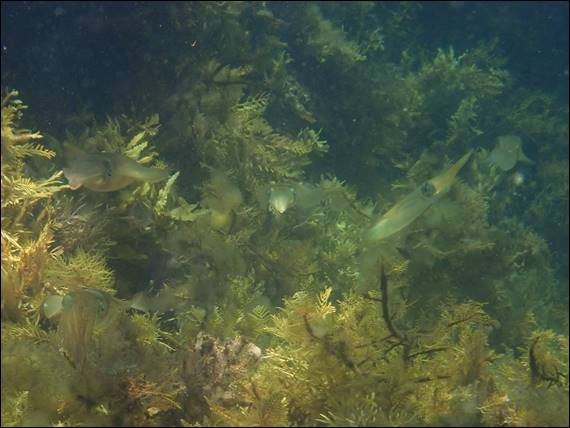
On our return swim we attempted to head into the canal, and just as we went under the bridge we spied a large group of squid watching us. As we attempted to head into the deep canals the swell was starting to pick up and it really didn’t look all that inviting. So instead we turned around and slowly pottered back to the beach, spotting plenty of life below us along the way. Fair to say that Howsie may not have bagged three 22s today, but he did get a great one under his belt and we both had a very fun climb and snorkel:
When I wrote up my thoughts about Alan, way back as COVID was taking hold, I called him the tagalong (https://sandbagged.blog/2020/04/21/alan-the-tagalong/). His trips outdoors would be few and far between, and then it was more about catching up and a bit of fun. This was in part due to his many other competing outdoor pursuits. So despite being one of the fittest people I know, his climbing fitness has in my mind never really grown to its true potential. Last year he went back to Ireland, and by the time he returned he’d been gone for twenty weeks. So today was a reintroduction to rock, with an even longer absence than usual, and of course the chance for a catch-up:
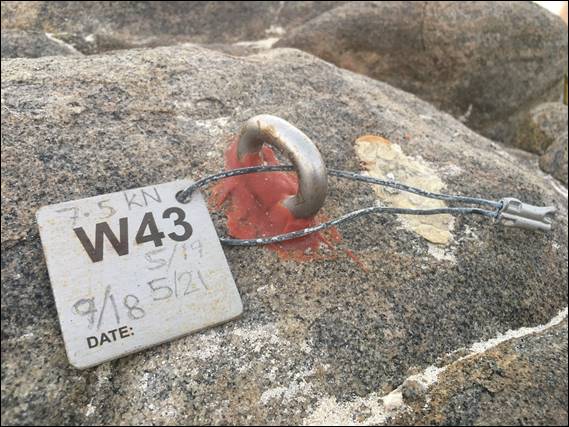
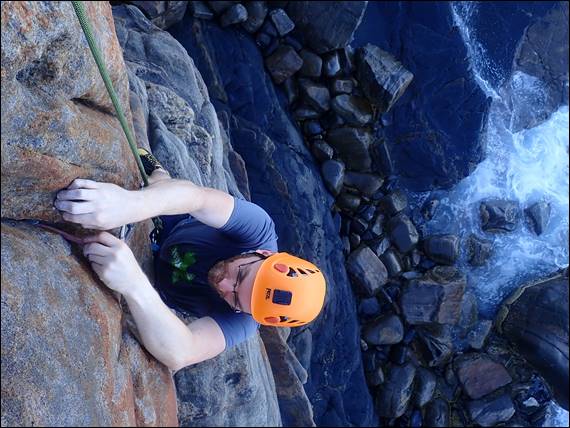
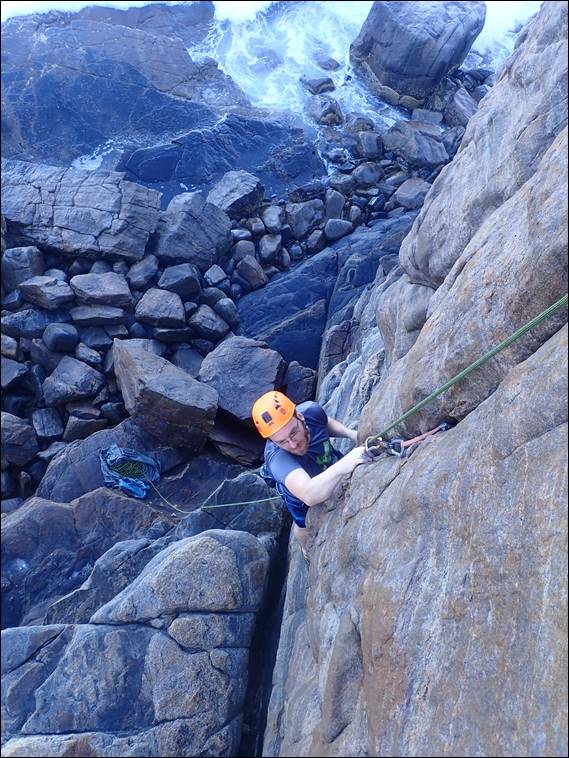
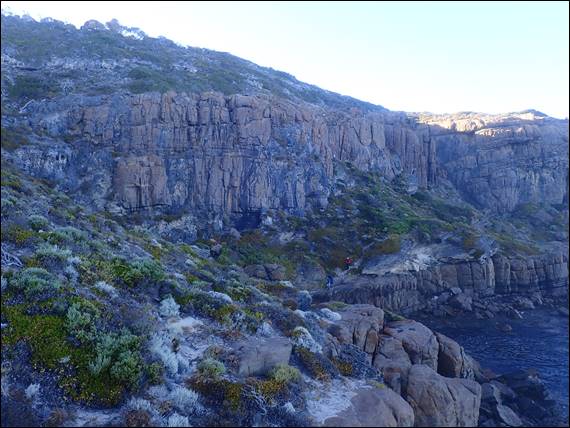
We decided on Beginners Wall. A small, some might say scrappy, crag that is part of the Wilyabrup area. It only has a bunch of mostly lower grade routes and I have not been here very often. My last record of visiting the place was in late 2014 with Steve (https://sandbagged.blog/2014/11/02/beginners-wall/) and then Lou. I remember we had a blast on both of these trips and put up a few first ascents, but I can’t honestly recall seeing glue-in P bolts at the top of the crag. I just remember the completely rusted out iron stakes and large U-bolts sunk into a big plugs of concrete, which you can check out in the linked post:
The tags indicated a couple were placed in late 2014, but others may have been more recently added. There were at least eight along the top and we even found a couple at the base of the wall no doubt to anchor into as you belayed. This was a little surprising. The crag gets very little attention and to support this statement, unlike the main area, we found absolutely no evidence of chalk on the rock. The bolts did however make it easier for us to set up an abseil and the belay anchors after each route. The was probably not in Alan’s favour, with less time between each climb for him to recover:
We started sensibly, on the easy lines in the middle of the wall. While I recognised a few of the more distinct routes, I really had no idea what we were climbing nor what the grades were. There is however nothing too hard here and certainly we were starting on routes well within Alan’s capability, despite his long absence from rock. He was quick to remark that the rock felt greasy. He wasn’t wrong, and the air looked a little misty from the spray and felt heavy with humidity. But with the grades we were hitting it really wasn’t an issue:
Being so close to the ocean this crag is far more susceptible to being coated in greasy feeling salt spray. Maybe the rock would have been better at the main cliffs, but it was nice to have this place to ourselves. We also both agreed the longer routes at the main cliffs may have drained Alan’s stamina that bit quicker. The first four lines fell quickly, and the only gear I used was a pink tricam. I even placed both of them in the fourth climb. In fact I wasn’t sure why I was carrying a full rack with me other than for weight training, as Alan pointed out:
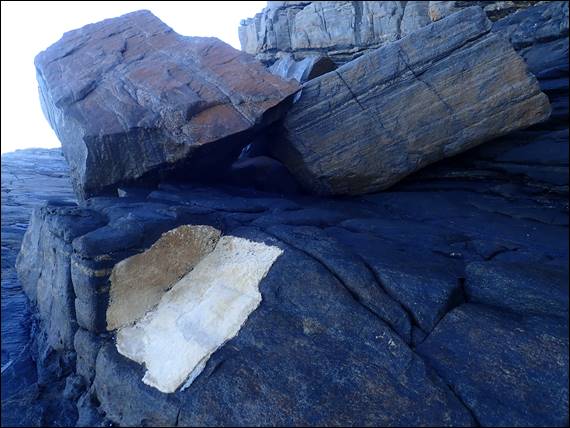
We did occasionally stop and check out things that caught our eye. Like the above, what looked like a recent scar. It was definitely very fresh, and we didn’t see any other areas with such a brilliant white colour. Completely free of any algae or discolouration due to oxidization, neither of which would take long in this environment. Surprisingly we could not find the block that had been dislodged, which meant it must have been a very rough sea. On closer inspection the white scar was not clean exposed rock, but a thin veneer of limestone. It’s almost as if a bricklayer had come along and used limestone as mortar secure the block in place:
For our fifth route, which having now inspected the guide hasn’t been recorded as a climb, was the one where Alan’s lack of climbing fitness started to show. The line looked innocent enough from below, but proved to be pretty fierce. While I desperately tried to continue the theme of using just a pink tricam the top one didn’t inspire confidence. The holds were slopey, small and spaced and due to the poor gear I decided it was best to traverse out right to better holds. Even this was a little pumpy, and it was all too much for Alan’s forearms. He didn’t give up and persevered, eventually, in-between references to greasy holds, topping out:
As we were stood on top of the unnamed route, one I will have to come back to so I can lead the direct line with maybe a better choice of gear placements, we saw three people wandering our way. Looking like hermit crabs with boulder mats strapped to their backs. Coming along the base past Driftwood Bay seemed a strange approach, seeing there is a great coastal path higher on the ridge. As they walked past us we had a chat and they too had found the boulders at the base of the main area of Wilyabrup greasy. So they were now moving to the base of the Northern Blocks in hope of slightly better conditions, which explained the rationale of their chosen path:
This short interlude provided a bit more rest time, before we hit our next line. This time I didn’t hold back placing a wire and then a cam, but of course also had to use the pink tricam. While Alan’s brain could see the moves, it seemed that his arms and legs were misbehaving and not doing what they were instructed. The problem wasn’t his internal communications but, in addition to what he claimed were greasy holds, that his forearms were shot. His hands were simply unable to hold on any long. He dogged his way up the above line but the next one, which is the classic of the crag and a very fine corner, was simply too much:
I wasn’t overly surprised, and was impressed that we had managed to get as many routes in as we did. But I wasn’t done, there was one more line I wanted to try that is mostly unprotected. I don’t recall leading it before, so I did today. I led it with a cam low down hoping to get the pink tricam in higher, but it didn’t fit. So I had to lead it again placing the pink tricam instead of the cam, taking a short video as evidence. After that, with Alan still at the base, we climbed out on one of the easier lines. And as we walked out it looked like the three boulders had also found some routes on which they, like Alan had managed on the last route, could hang onto the greasy holds:
For the first time since before the school holidays, two months back, the conditions along our stretch of coastline seem to be improving. The last week has been another scorcher, mid-thirties and above most days but this time there have not been the strong easterlies to churn up the water. As such this week I have had a couple of mid-week dips. The first one was just to cool down, but it was so good that Nana joined me for a second dip on Thursday. Before my first dive I wasn’t convinced, maybe jaded and feeling like I have been tricked once too often into thinking it would be good:
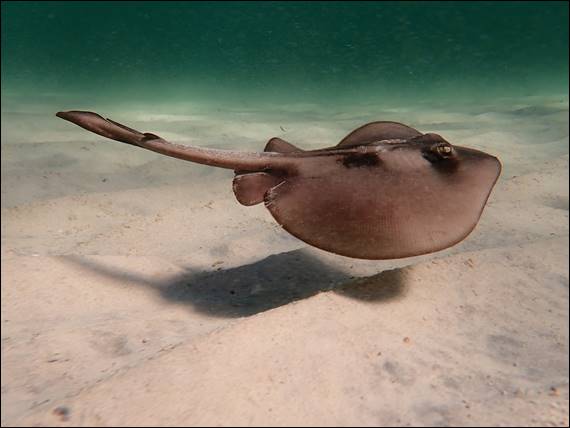
But as I swam out, the sunlight pierced right down to the sandy base. Casting that familiar, soothing and rhythmical pattern the sun makes, as it gets deflected by the surface ripples. It was a hugely welcome sight. Just the water clarity was enough to make me smile, but then saw a Bight Stingaree lounging about below making me smile even more. This species is also known as the Striped Stingaree, and the Latin name Trygonoptera ovalis reflects this distinct oval (ovalis) shape of its disc. Chatting to Nana on the second dive, during which we saw no rays, we remarked how absent the numerous rays, which are normally found here, have been this season:
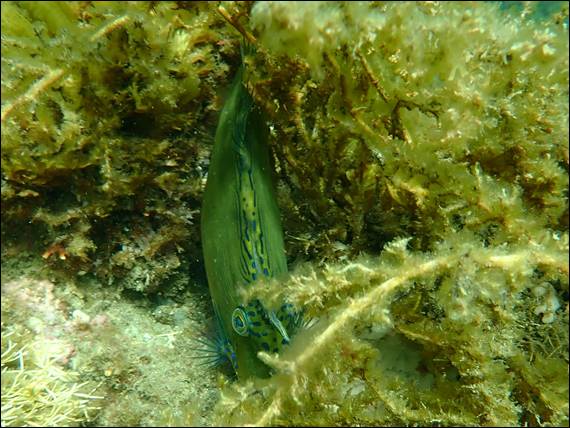
While we didn’t see any rays on that second dive, as with the first there was a lot of active fish life. The place seemed calm and had a tranquil feel to it, and maybe the fish had also noticed the change and come out to feed. On clear days like this I venture out up to about 150m, and it gets a little deeper. If you bob about on the surface in one spot your eyes become accustomed, and you start to see the movement of numerous fish. I was happy to see two fish in particular, ones that I have not frequently seen on the reef off our local beach. The first being a fish that is endemic to Western Australia being the Magpie Morwong, Goniistius gibbosus:
The second is the Spinytail Leatherjacket, Acanthaluteres brownie. I have only ever seen a few of them, but on both dives this week I saw groups of up to eight of them foraging in the weed. These are very skittish fish, and are quick to slink away, so I have never really got a good image of them. I think that I may have only ever seen the female of this fish, as checking on the Fish of Australia website it indicates the males seem to be much more brightly patterned. The females are still very striking, and also display the namesake two pairs of spines just in front of the tail:
No matter how many times I went down, nor how far away I went down from the fish to try and sneak up on them, they seemed to allude me. The deeper water gave them plenty of notice of what I was up to and I could see their bodies shifting into position to keep a better eye on where I was. Eventually I gave up with this game of cat and mouse, reverting back to bobbing about content with seeing all the other fish. Closer to shore the depth reduces and there are large areas of weed:
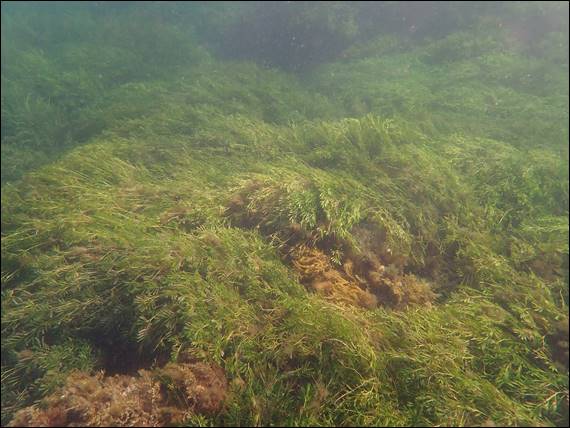
In these weedy areas while I see lots of fish, it is way too easy for them to duck undercover. It is however a good place to spot cephalopods, such as cuttlefish and squid. The former do not usually move as fast and are less skittish, and the latter tend not to go into the weed from what I have observed. I didn’t spot any cephalopods this time, but did start to see groups of the same leatherjacket. Being shallower I had a slight advantage this time, and was eventually rewarded with an almost in focus image, as this fish darted away:
Nana hadn’t been snorkelling in this area before, and was pleasantly surprised. Like me she is happy to float there and just watch, but also like me she pops down every so often to take a closer look for hidden gems. Each section of the beach has its own distinct feel, our spot is a bit deeper and more open. Wave walk is next prominent section heading north east, which is like a nursery being shallow and sheltered. Then off the beach where Nana and Geoff live there are lots of small bommies, followed by the Capel River Mouth area which has large open sandy bays between large bommies. Finally you hit the extensive reef that stretches for another six kilometres past the point, which is the densest reef:
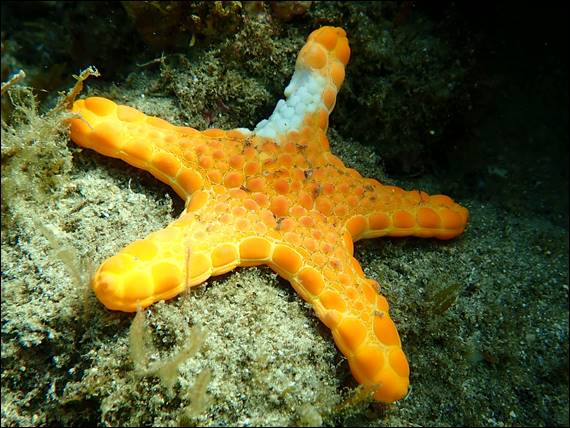
They are all good, but I do like the ability to walk out of the door and dive in off the beach. This week’s two dives were about the fish, but I spotted many other creatures and this one had to be included. Something had taken a bite out of the otherwise perfect Vermillion biscuit starfish, Pentagonaster dubeni. Despite having been mauled, the distinct pebble like pattern still prevailed in the fleshy white body under the skin. Sea stars are echinoderms, meaning “spiny skin” in Greek, which is exactly what their skin is on the upper side. Although the spins can be very small, hard to see and are not a form of protection from prey:
The primary function of the spins, or pedicellaria, is to keep the skin free of unwanted objects. Whereas for other echinoderms the spins are a form of protection, such as sea urchins. As we started to come back to shore, Nana spotted a blue swimmer crab and couldn’t resist a closer encounter. Seeing if by mimicking the crabs actions, it might accept her as one of its own. It certainly seemed to confuse the poor crab, as it didn’t swim away and seemed frozen to the spot. It looks like we might be in for some more favourable winds conditions for a little while, so with calmer waters we are hoping a few more rays might start to come back to say hello again:












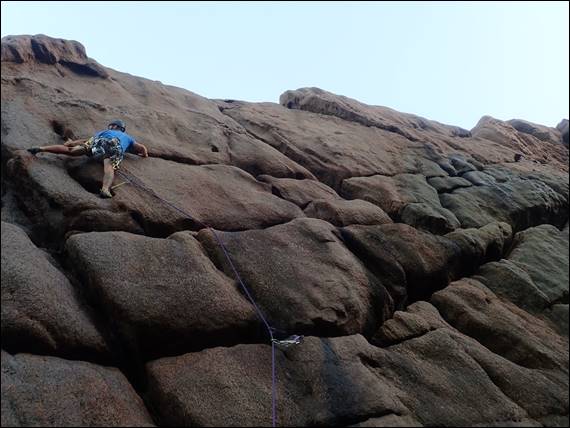
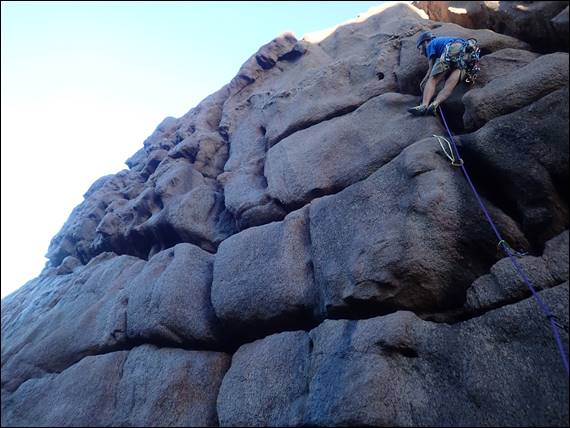
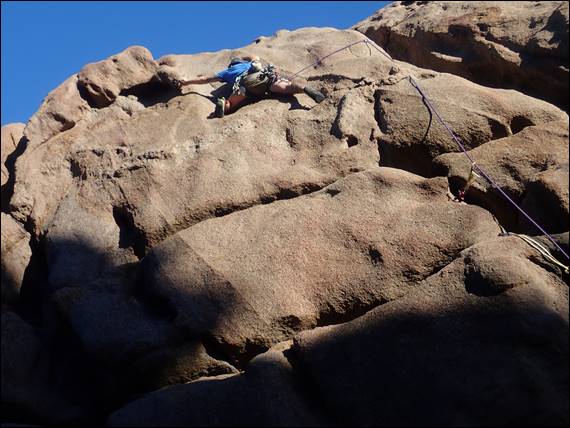
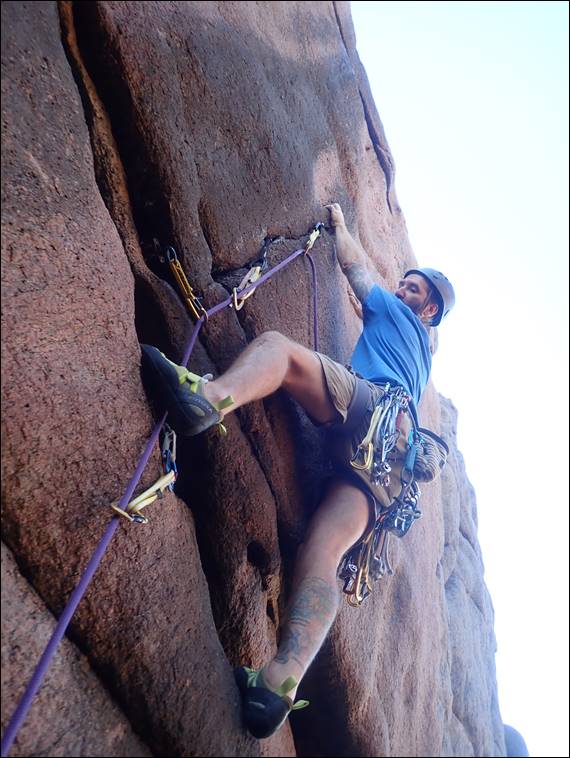


 Sandbagged