Not quite the same

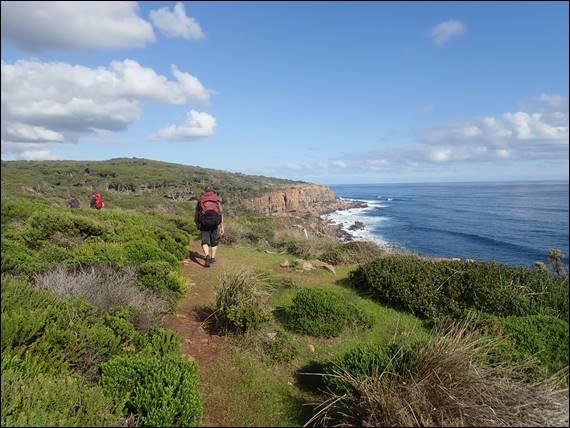
Some people feel we have had a fairly wet winter to date, but this is not the case.  I know this as through my work we prepare monthly rainfall and river streamflow data.  The latest report released just last week shows for most of the sites where we record this information, in the South West of Western Australia, the rainfall and river streamflow is well below average.  My walk today backed this up, as I could cross reference what it was like when Lisa and I were here a year ago, very nearly to the day.  Not just in terms of the wetness but also the variety of plant life:

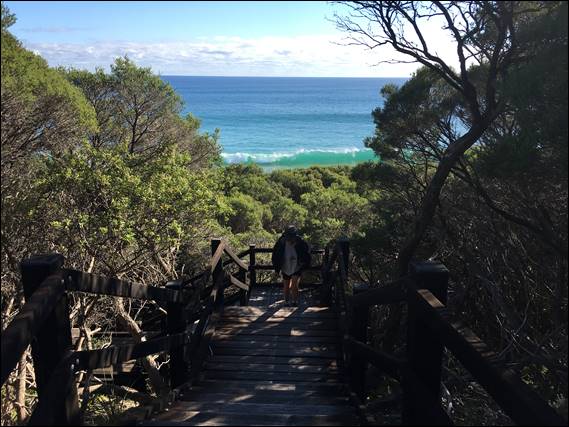
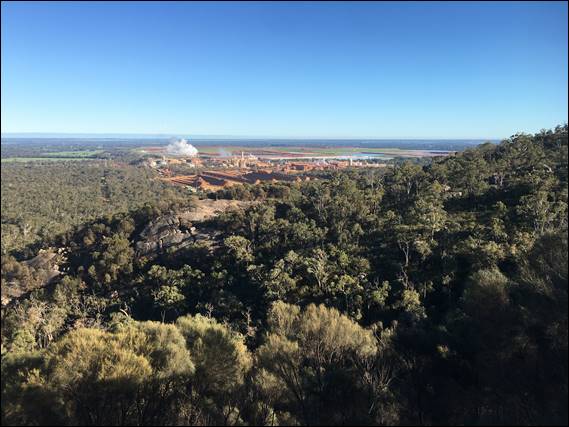
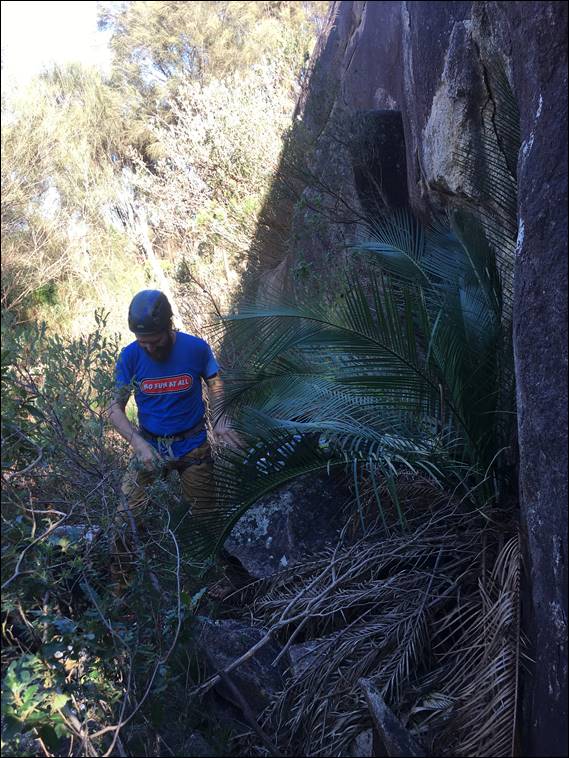
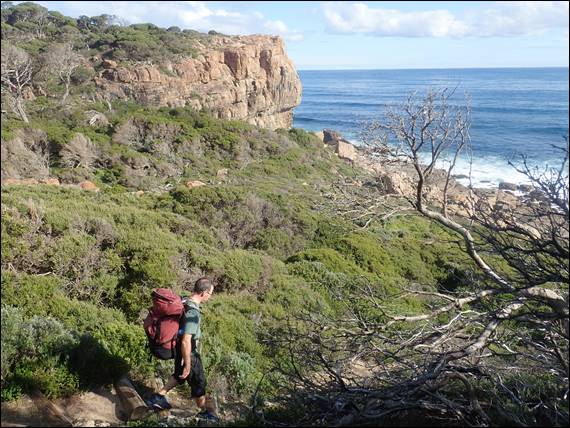
Sadly today I was by myself.  On the plus it allowed me to get an earlier start, arrived not too far after first light.  The hues of the rising sun could be seen through the trees and were being reflected off the running waters of the Collie River.  The rays of the sun also lit up a very narrow strip of the ridge behind me, but only fleetingly.  After that the sun was hidden, something I had expected as the forecast was for a 100% chance of rain of up to 25mm.  But despite this I was still keen to get out, and simply came dressed for the occasion:
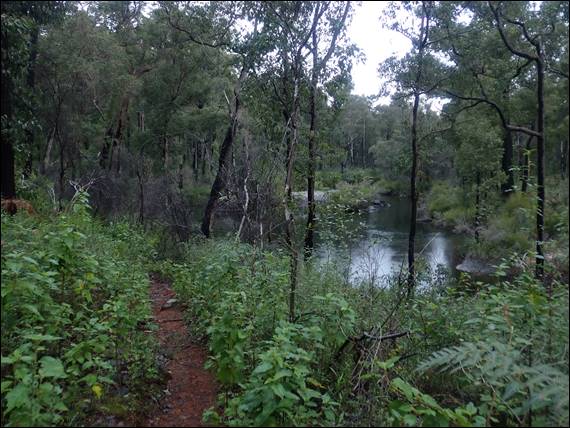
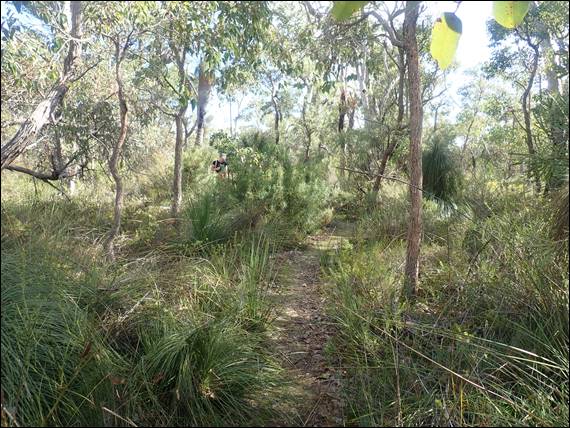
I had intended to walk the round the lookout loop, a 9km’ish hike and something I should have been able to complete, hopefully well before the rain was due to hit.  As I walked there wasn’t a lot of colour other that green, as I scoured for flecks of fungi and flowers.  If you check the post from the hike one year back you will see there was lots to see, resulting in me dawdling a bit on that walk: https://sandbagged.blog/2021/07/10/passing-the-test/.  The start of today’s walk followed the river, and with not much about I found myself at the junction to head up the ridge all too soon:
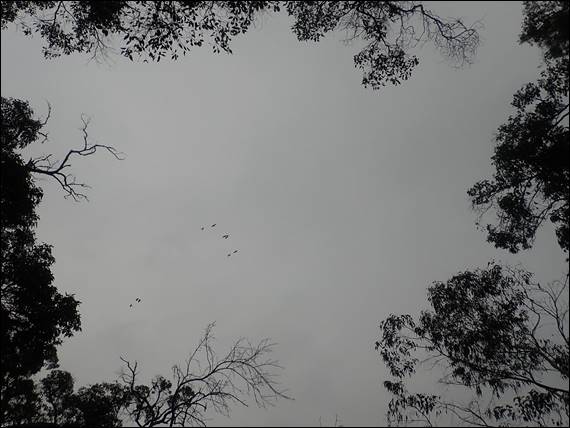
Too soon in fact.  I was enjoying the sound of the water running over the rocks, so decided to walk a bit further along the river trail before turning round and coming back to hoick up to the lookout at the top of the ridge.  In addition to the sound of the water, there seemed to be almost continuous calls from the Red-tailed Black Cockatoo, both roosting in the trees way above me and flying even further overhead.  Their birdsong is described as a “creaky, grating squawks and plaintive ‘kee’ squeals”, but this really doesn’t paint a good picture and it is in fact quite beautiful:

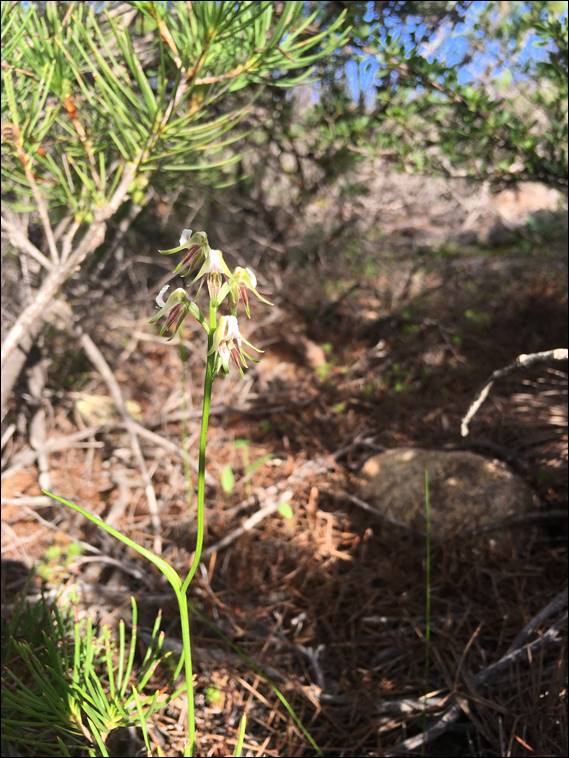
In the above linked post there is a beautiful heath like plant shown, and briefly described.  Today I found very few, and then only small specimens such as the one above.  This time I have taken the time to identify it as Foxtails (Andersonia caerulea).  The flowers are amazing when you look up close, but this evergreen shrub wasn’t ready to fully bloom just yet.  In reading up about this plant I’ve discovered the name of the genus comes from a naval surgeon and naturalist called William Anderson.  He accompanied Captain Cook on several voyages:
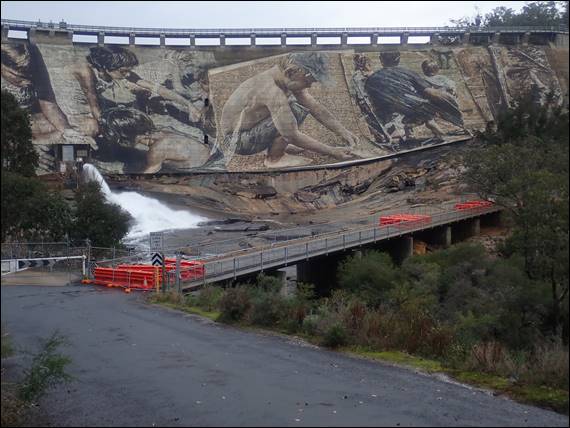
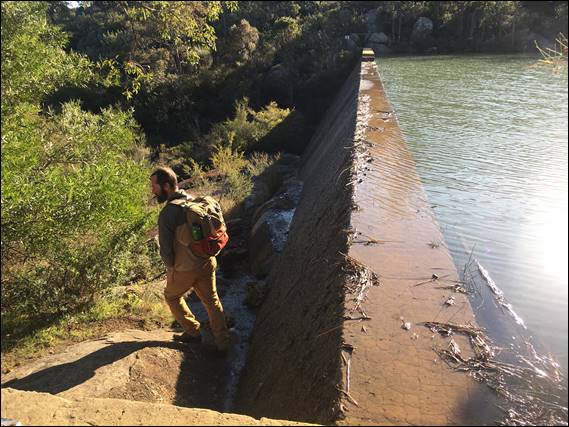
I walked on and each time I thought I would turn back to head up to the lookout, but I didn’t.  Having been on this riverside walk several times, each time I thought of a new milestone I wanted to reach before turning back.  And eventually that milestone was the dam, at the end of the river walk.  One reason for this was I wanted to see what they were up too.  This is my usual way of driving to the quarry when I come here to climb, but the 56 year old bridge is closed.  They had not started work on it yet and when they do I’m hoping that they do not use the quarry area as a laydown area, as that will mean we can’t climb there for almost a year:
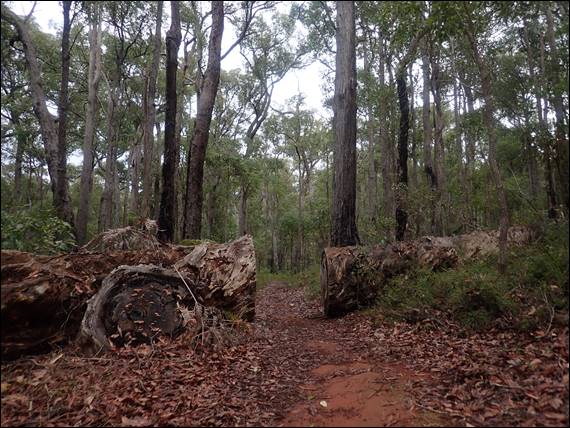
The replacement of the bridge is in part due to the structure showing signs of wearing out.  Although mostly, I think, because of the huge number of people who come to see the mural and seem incapable of behaving safely on the single carriageway bridge.  Today no one was out, and during my whole walk I didn’t see or hear a soul.  A little surprising as the new mountain bike tracks here have a great reputation, so I expected to see a few bikes flying about.  I left the empty bridge and quarry, and closed café, behind and picked up a trail that weaved its way back high up on the ridge through the forest:
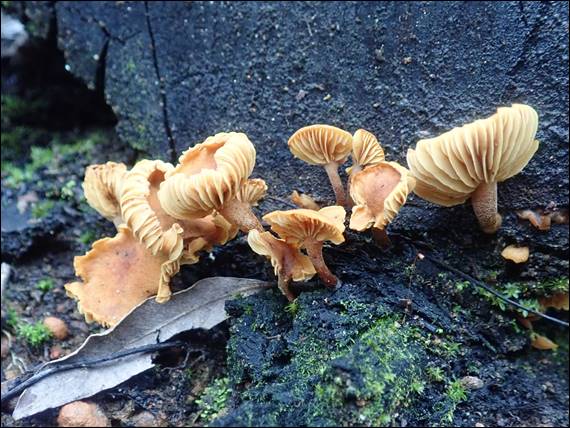
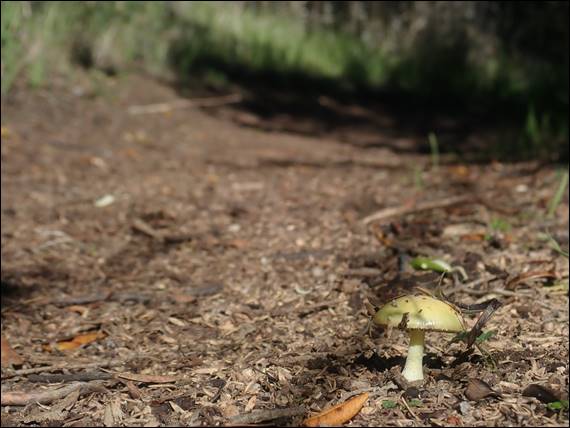
While I did see a few fungi, the displays were nowhere near what we saw one year back, again check the post as it really was quite stunning back then.  The above I believe to be the Brick Red Laccaria (Laccaria lateritia).  It does not look brick-red that is supposedly what lateritius, from which lateritia is derived, means in Latin.  However, the colours can be highly variable from browns to pinks to purples, and can include washed out, colourless and drab specimens.  That and the upturned cup shape and prominent gills gives me confidence in the identification:
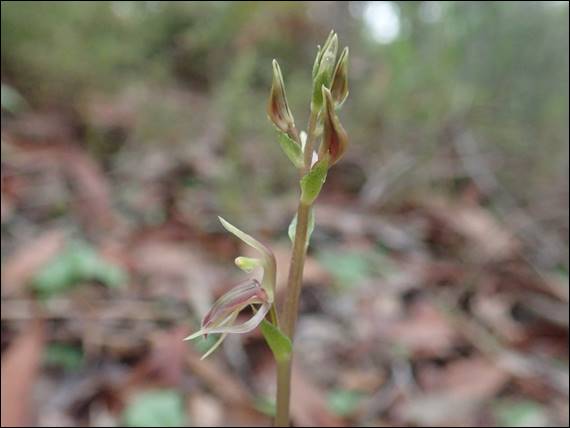
While I didn’t expect to see any orchids today, it doesn’t hurt to keep an eye out.  As I walked through the forest it was not the above plant that caught my eye, but the tell-tale basal leafs that littered just one small area during my walk.  Only two plants were in bloom, allowing me to identify it as a Midge Orchid (Cyrtostylis huegelii) that is known to flower in June to September.  While it was great to notch up my fourth confined orchid of the season, today the stars of the walk were the fungi and I particularly liked this small clump.  Their decorative stems really caught my eye:

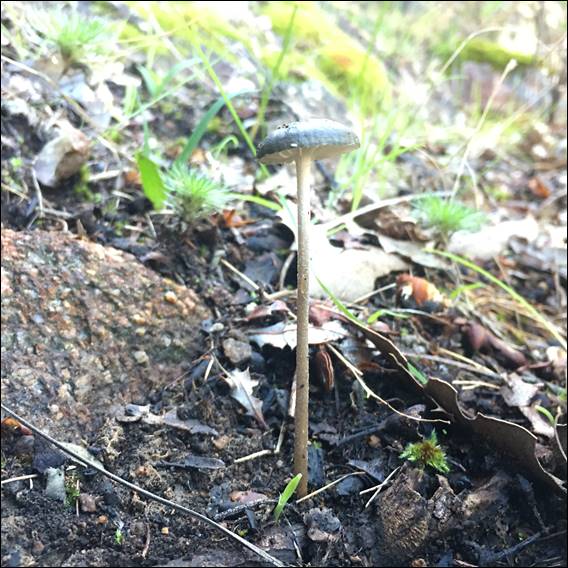
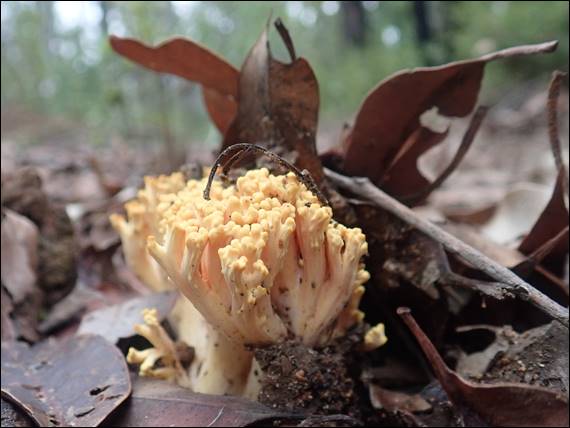
I have however not been able to identify them and have only narrowed them down to being in the Psathyrella genus, which comprises some 400 species.  This genus is said to be the one you are likely to see when there are few mushrooms about.  When I eventually got back onto the lookout loop I came across a fungi I have seen before.  It is clearly a coral fungi, but which one…  I didn’t take lots of images to allow a detailed assessment, but as the end of each branch is very rounded I’m going with a Coral Fungi (Ramaria Australiana):
Finally I made it to the lookout, it should have taken maybe two hours top.  But due to my ‘slight’ detour I had been walking for three and half hours.  And by that I mean walking.  While I had stopped occasionally to take a photo or two, the number of images I took were far less compared to the last trip here.  Another reason for walking quicker and without stops being that without Lisa, I had not thought to pack our usual provisions of a flask of tea and, of course, cheese sandwiches, preferably made with homemade sourdough:
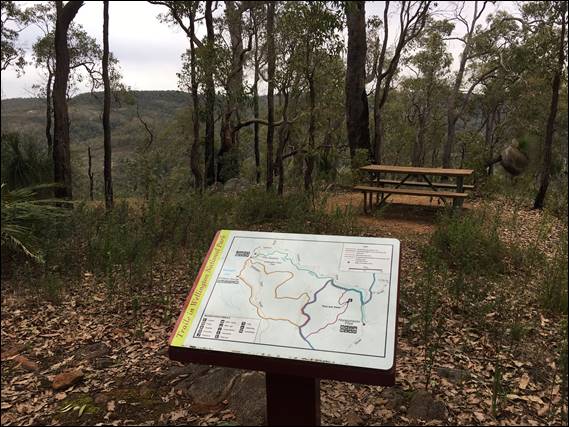
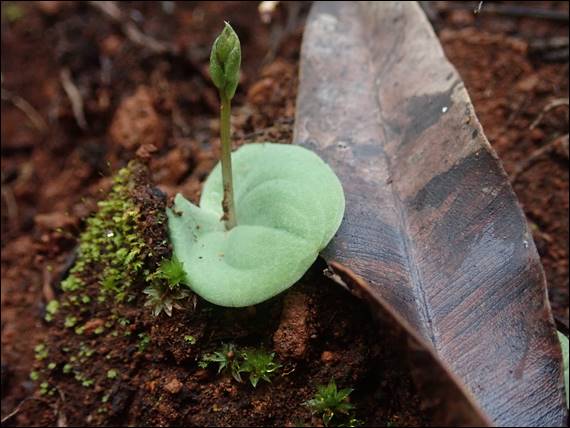
We’ve sat at the above table enjoying a brew and sarnie, and I passed a few other spots where we had done that.  This was because I had managed to combined the purple, blue and brown walks, as shown on the sign above, into one.  Without provision to enjoy, I didn’t stop and continued on my way, which from here took me down, down, down a narrow winding path back to the river’s edge.  On this winding path I came across hundreds and hundreds of the same basal leafs I had only seen in just one area before.  Again only a few stems were extending their way upwards, and will no doubt to burst into flower over the next week or two:
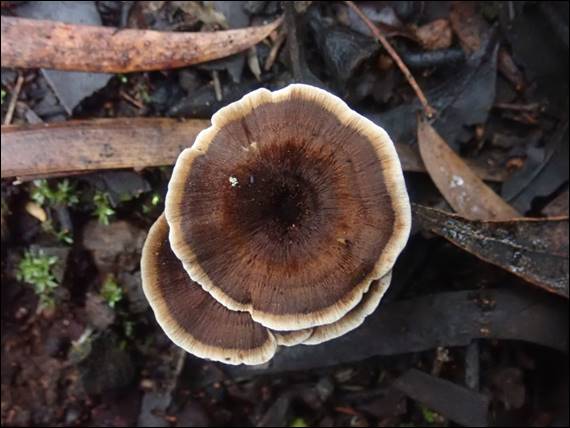
Once back on the riverside track and I saw no more signs of orchids, but did stop to capture a couple more fungi.  This one I am pretty sure is a Tiger’s Eye Fungus (Coltricia cinnamomea), the cup is has a slight vase like shape allowing it to capturing water and the radial pattern is very distinctive.  This is a wood rotting fungus, growing from already decaying sub-surface wood and tree roots.  Not to be confused, as it does look similar in some ways, with the Cinnamon Fungus (Phytophthora cinnamomi).  The Cinnamon Fungus is a disease causing organism, which kills root systems of plants and is one cause of dieback that can be easily distributed by soil caught in our shoes:
On the last stretch the raindrops finally start to fall, so I quickened the pace.  Arriving back at the car four hours after I had started, and clocking up approx. 16km.  This has left Lisa wondering why I managed such a pace when she is not here.  The answer is simple, I wanted to beat the rain but also there were less distractions.  Without Lisa there was no chitchat or tea breaks and added to that I saw very few flowers or fungi.  While I thoroughly enjoyed the mornings excursion, it was however not quite the same without Lisa enjoying it with me:

Waving goodbye

It has been four years since Lisa has been to the homelands, and today a long overdue trip back came to fruition.  I dropped her off in Capel to catch the bus.  And within a minute of the bus having left, Josh and Rongy rolled into the carpark.  Rather than head straight home, and seeing I had taken the entire day off, I took advantage of the opportunity to get an afternoon climb in.  We decided on somewhere easy to get to and with a few routes that would be suitable to continue to ease Josh into leading:

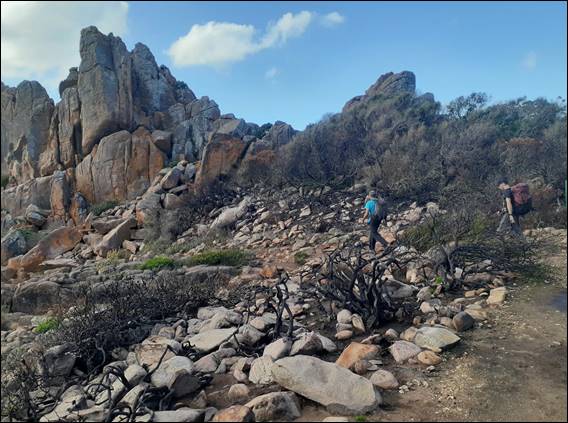
It was an obvious choice, and a place I haven’t been too for a wee while.  Indeed it has been more than a year, at which time I came here with Jamie and Tomski.  Since that last trip Meelup Regional Park has been ravaged by a bushfire.  That was in January of this year, and the scars are still abundantly obvious.  This does however allow a very clear view of the ground on either side of the path in, and as I looked at some spent orchids Rongy spotted very fine above specimen.  An Autumn Leek Orchid (Prasophyllum parvifolium), a species endemic to the south-west of Western Australia:

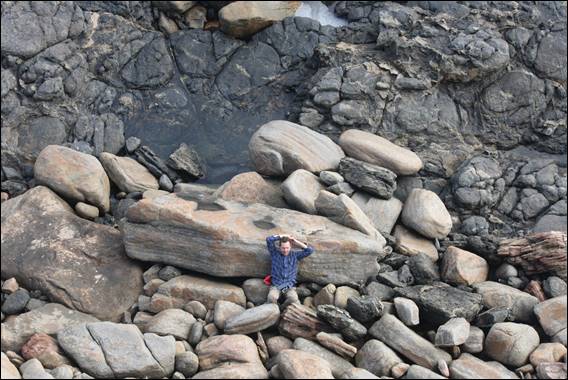
Normally as we walk towards the crag, the inland side is shrouded in bush.  The blackened branches are still standing, but it looked bare and also felt a little strange being able to scramble over to the other side without battling against the scrub.  Our rationale for starting on the southern face, in the shade, was that we would save the northern face for later so we could climb in the sun as it went down and cold crept in.  There are a few stiff lines here that always catches Rongy and my eyes, but we avoided being drawn in by them and instead eased into the climbing:

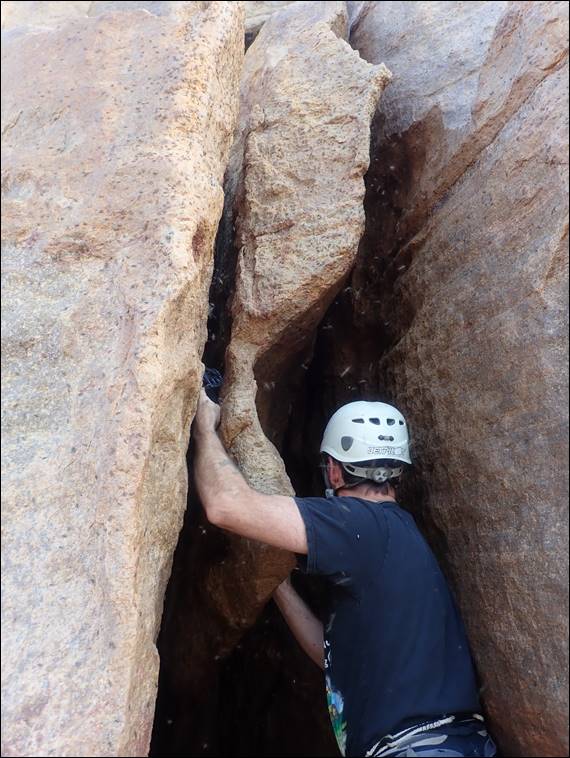
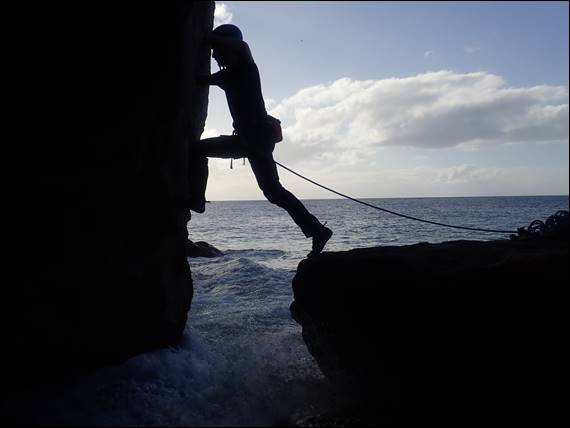
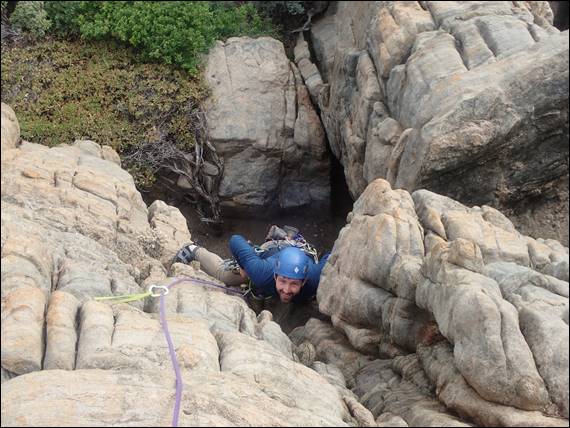
Rongy had no memory of climbing the short but fun, wide bottomless cracks.  They are very memorable as below them the ocean will often be lapping away.  Today the swell was enough to only allow access to the most landward crack system, and only then because there was a convenient large boulder from which it was possible to step into the crack.  This time of the year, and with the moisture that hangs about, these crack can house thousands of small flies.  I have no idea what flies they are, and while they do no bite it is not overly enjoyable having a thick cloud of them swirling round you as you climb (as shown above):

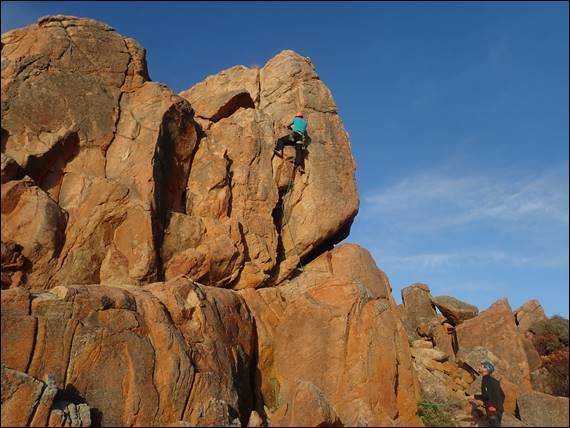
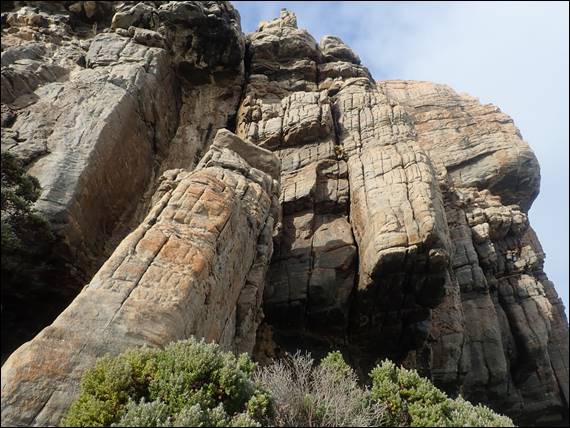
Despite the close encounters Rongy enjoyed the line, as did Josh who also liked his first experience of Castle Rock, well rock.  It is once again different to other places in our little corner of the continent.  Despite the monotony of rock type that can be experienced across vast expanses of Australia, down our way we have a surprising variety of rocks.  This fine grained granitic gneiss isn’t the same as the gneiss of Moses Rocks, not just lighter in colour but it also does not have the same distinctive banded pattern that can distinguish gneiss from granite:

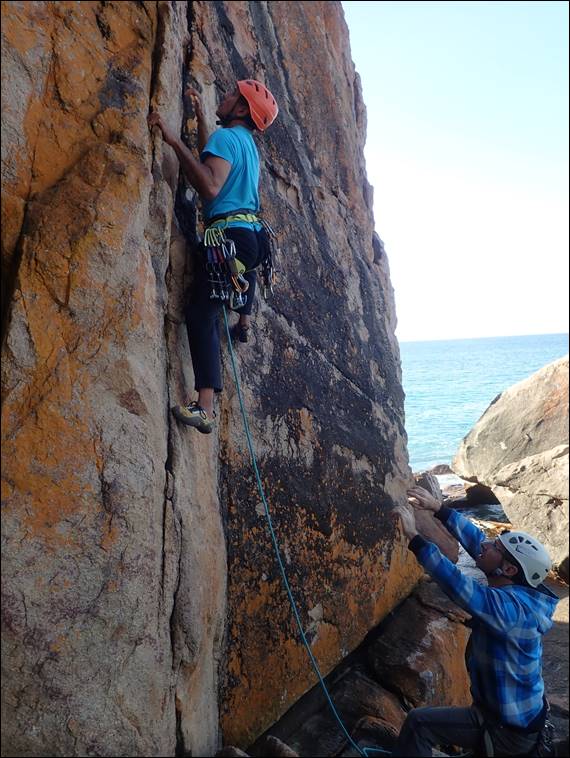
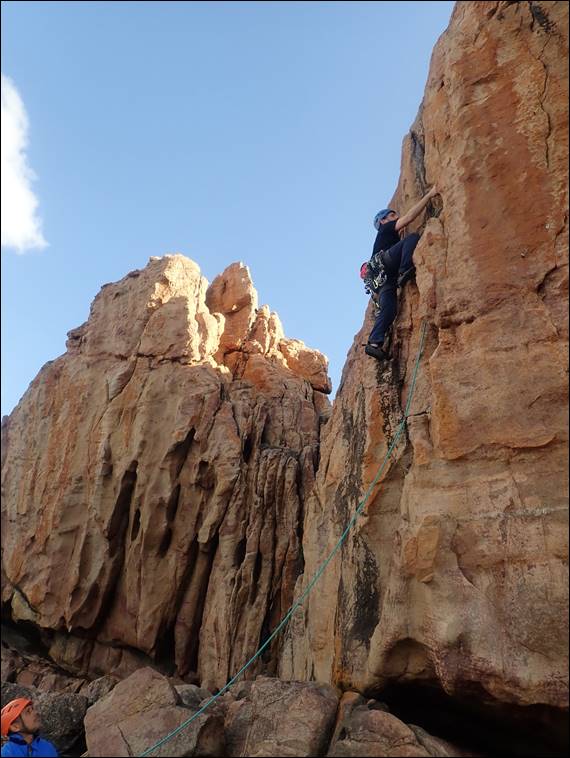
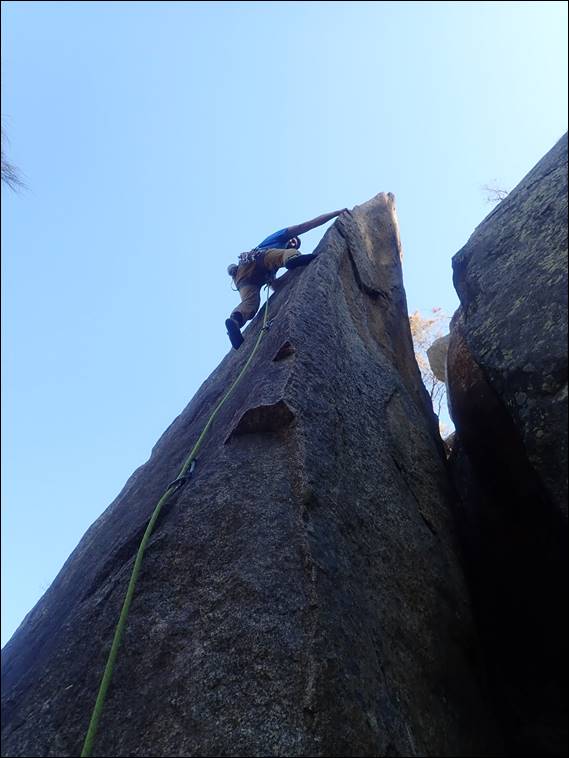
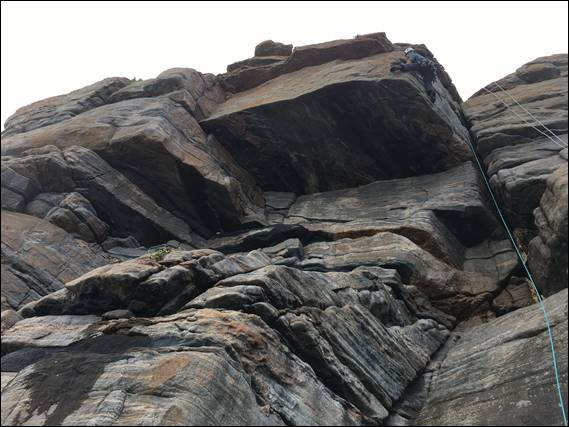
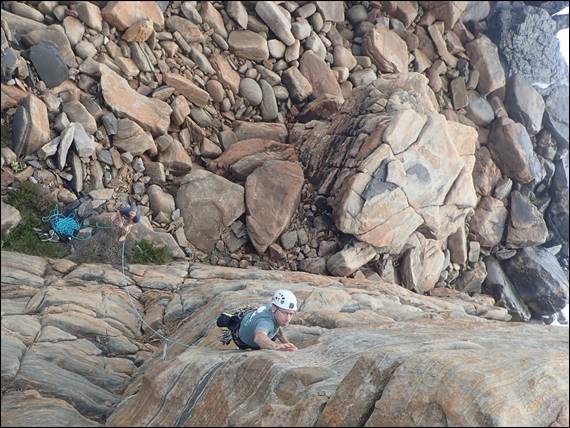
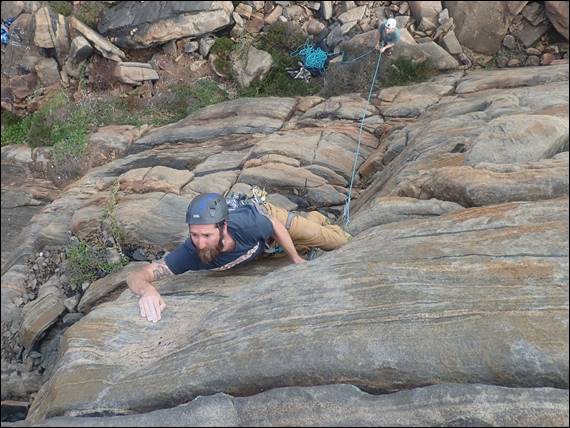
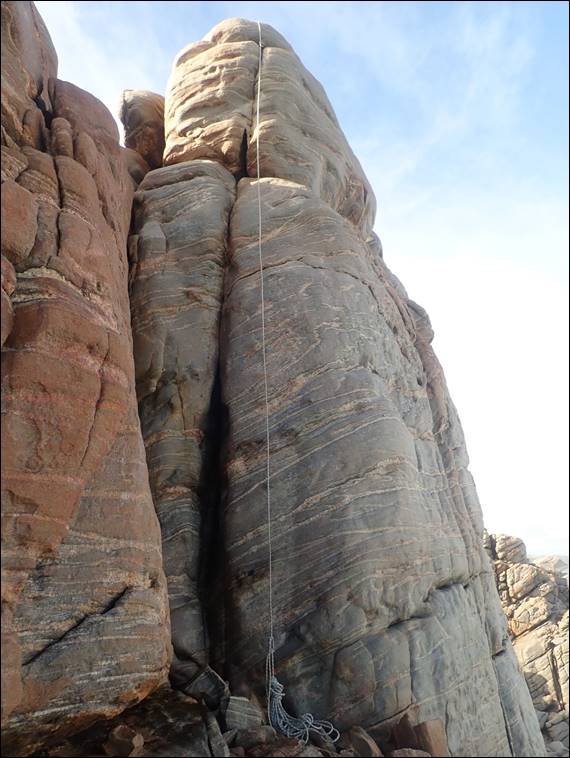
This rock also has some stunning fluted formations not found elsewhere, that can be seen on the face in the image below.  Smooth, rounded features that on the steeper territory demands an unusual, for the area, and powerful climbing style.  It is these steeper lines that usually draw Rongy and myself in, but today we mostly stayed on the easier angled terrain.  Above I, like Rongy, jumped on a line I have not led before.  Lou who may not get out climbing again, having lost her way due to burying herself deep in books and research papers, could have claimed the first ascent on the line:

She/we didn’t record her ascent of the line, way back.  And subsequently someone else came along, picked the line off, and published their ascent as the first (known) ascent.  The climb has a feisty start for the grade, so just goes to show how well Lou was climbing at the time.  Josh found the start tricky, but was put off and came down full of optimism for a lead himself.  The obvious line being the one I sent Tomski up, some fifteen months previously.  Josh had to focus his mind to get up the route, but climb it he did:

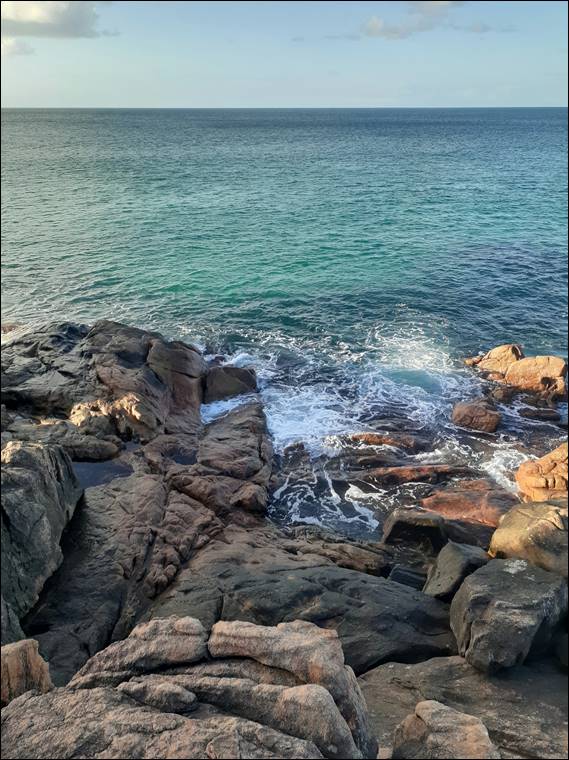
As he and I sat atop the crag, with Rongy climbing below us, we were rewarded with a birds eye view of a large seal making its way northwards along the coast.  So close to the shore that if we were stood on the boulders we had started our afternoon of climbing on, we may well have been able to touch it.  Rongy missed out, but it was his turn to lead next and he picked one of the routes on the steeper wall, with plenty of large rounded holds that make you work hard to hang on.  A tad too much for Josh, so he saved himself for what was to come next:

That included moving round to the northern side, to enjoy a couple more relaxed lines in the setting sun.  Our theory seemed good, as the air temperature started to drop, but the lowering sun didn’t offer too much warmth.  It was my lead next so I picked off one of my routes, which for a while perplexed Josh as he made his way up.  He got up, however his brain, or maybe it was his tiring body, was telling him he had reached his limit.  So as Rongy set of for one lucky last lead, Josh headed off to the water to keep up his tradition:

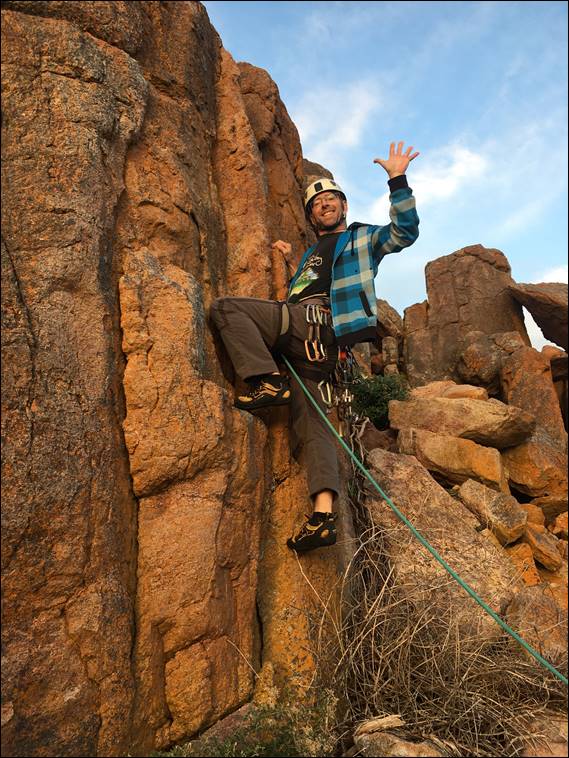
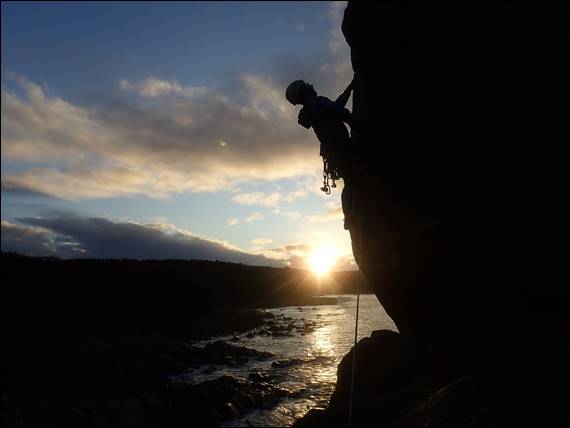
Lisa was about to board the plane as Rongy started up his route, so he gave her a last wave goodbye.  Then continued heading up Lou’s favourite climb, which makes me think that we can maybe tempt her out again with the promise of climbing this line.  Rongy went up as the sun went down below the horizon, and the air temperature dropped again.  But I doubt it was as cold as the water, judging by the gasps and other noises coming from the water’s edge as Josh gingerly made his way into the ocean, and then rather quickly back out:

Walking in circles

We dug out our ‘walking round in circles’ book to see where would be a nice place to go for a walk today.  Lisa tend to likes to have an idea of where we are going, so as to provide a little certainty of the terrain and any difficulties we might encounter.  And this book provide a good overview of what to expect on the walks listed, and she of course has an app on her phone to help with that too.  Needless to say she would have hated the bush bash that Howsie and I endured yesterday up at Oakley Falls.  Hated is not a word I would use lightly, but in this case it is very apt:

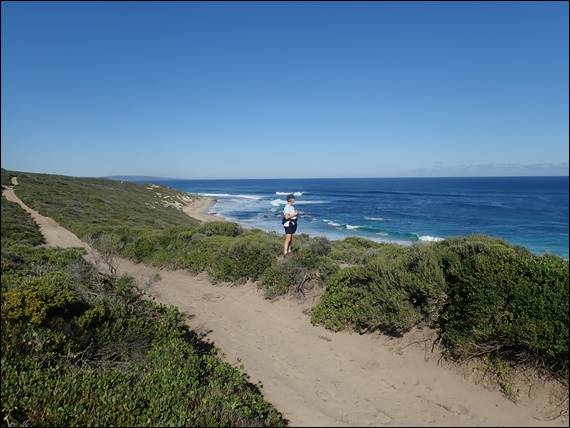
We picked the Cape Clairault loop, a short 6.5km circuit that starts from the Injidup beach carpark, heads south inland before working its way back along the coastline.  The carpark was packed, but we were the only ones out walking.  The vast majority here were in the waves surfing, but there is another type of surfing that this spot is known for that I will mention later.  We left all that behind and made our way up the steps to link in with the inland track, which led us to a wonderful enclosed track with winding and entwined branches creating a protective arch overhead:

I’m not sure what drives me but I spent probably an hour trying to identify the above fungus.  Booklets, google searches and image matches didn’t help me come up with a positive identification that I am confident with, and the closest I could get to was that it may be a member of the Amanitaceae family of fungi.  If I was going to take a punt it may have been a Vermilion Grisette (Amanita xanthocephala), as the name suggest they are usually a reddish orange colour and often referred to as chestnut in the descriptions I’ve found.  But they can be found in a paler yellow form:

Searching what at times seems endlessly for these finds is a bit like whale watching.  Looking out to sea hoping to see a splash or spray to hint something big is out there.  Whale season is on and they have been spotted, even off our local beach.  And while it is lovely to see them and I will stop for a while I prefer close encounter finds.  Lisa however is happy to sit or stand there for ages and when we spot them, she can stay for much longer that I would prefer.  Today despite the water further out being relatively calm, due to there being only a very light wind, no sign could be seen of these gentle giants:

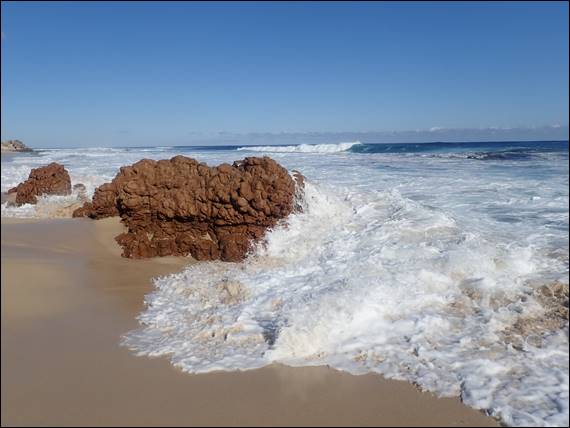
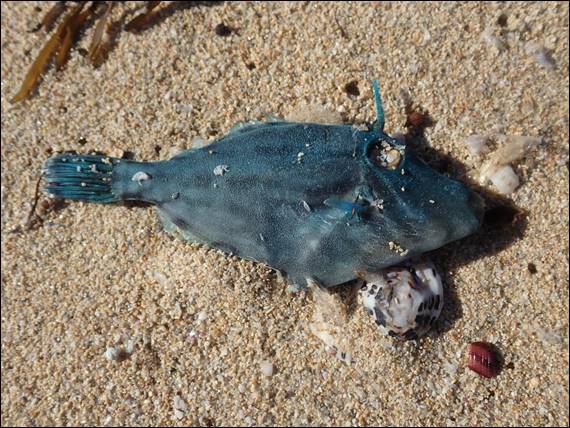
While the water far out looked flat, there was a good swell.  The fact that so many were out surfing was testament to that.  It also meant when we hit the coast to walk back the waves were front and centre, drawing our attention.  Every now and then I like to find a small memento to give to Elseya, it doesn’t happen too often but when it does it has to be something really nice.  So I was also watching out for any good finds on the beach itself.  I did like the desiccated leatherjacket below, but was mostly looking for that perfect shell.  Sadly there was lots of rubbish washed, from small bits of plastic through to large sections of smashed boats.  And like the boats most shells I found were broken or damaged:

Now you may be thinking the collection of shell is illegal, and indeed they are classified as fish under in the Western Australian Fish Resources Management Act of 1994.  However, there is a daily bag limit for the collection for shells, just like fishing.  But this is only for personal use and not for commercial gain, and the rules state you can take up to 10 shells of any one species per day.  But life is never that straight forward, there are restrictions for specific species and ‘no take zones’ where you can’t take anything regardless fo the species.  With the latter usually associated with marine parks and reserves:

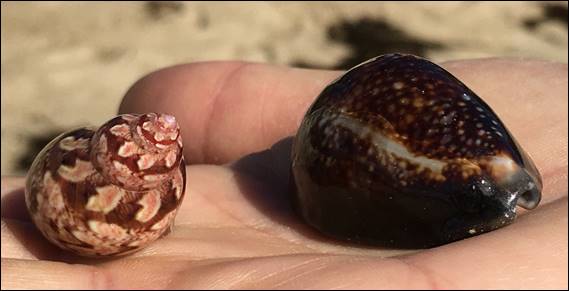
The beaches round here really are not the best for finding shells in good conditions, but I did spot the above two.  The left hand shell being a Variegated Pheasant Shell (Phasianella solida).  A naturally polished shell both in and out in part as does not have, like some shells, an epidermis nor a nacre.  Or in layman terms an outer layer of skin nor inner shell layer.  It is common to see them damaged and/or bleached from the sun, but this specimen was vibrant and very recently beached.  The other shell is a Serpent’s head cowrie (Cypraea caputserpentis) and one I have not found as often, and very rarely in such good condition:

This shell is widely used in jewellery.  It is very distinct by the base colour and pattern, which can but does not always include the clear longitudinal line.  When used in craft and jewellery, and to draw out more vibrant colours, the dorsum, or top, is dipped in acid which makes it go a more purple colour.  Although personally I am not sure why you want to do that.  The coastal stretch of our walk was really fun, sandy stretches were broken by small rocky headlands.  Some rocky sections extending into the ocean so you had to scramble, over and at times through them.  But nothing ever too serious, you just had to take your time:

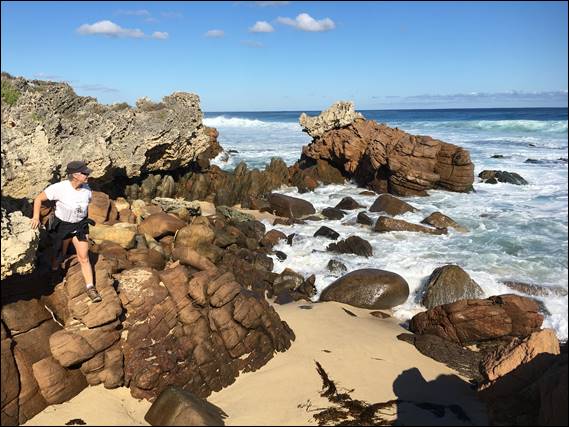
Cape Clairault is formed by a wide level granite outcrop, here the larger waves would wash over this feature and with today’s swell and tide this was never too deep.  Lisa took the safer higher ground, and if look closely below you will see her.  While I explored the rock holes in this wave washed area, and on a couple of occasions enjoyed the feeling of the bubble filled white water washing over my ankles.  I also spotted a small group of Hooded Plovers feasting on the rocks.  Separated from me by a deeper section, I wasn’t able to get too close but watched them intently for some time.  In part as I understood they were a vulnerable species:

They are known to nest, amongst other places, on beaches at the high tide mark. This makes their nests susceptible to many dangers.  I found one such nest years back on a trip to Moses Rocks, and got a few good images of it that show just how precarious their situation can be https://sandbagged.blog/2016/11/06/rumpoles-rocks/.  Having looked into this bird in more detail, I now know that of the four states they are found they are listed as vulnerable in South Australia and Victoria and critical in New South Wales.  However, in Western Australia they are secure and not under threat:

Furthermore, there is an eastern and western species, and their extents do not overlap.  So these were Hooded Plovers (western) (Thinornis rubricollis tregellasi).  As we rounded the cape the last stretch of Injidup beach came into view.  The last, and only, time we have been here was in January of 2009, when we had the place to ourselves.  We carried a big box of stuff to the sand dunes where we picnicked, swam, snorkelled, and rolled down the dune.  Despite my image below today it was busy, with most people in the water surfing.  But I did at one point spot a couple of people enjoying a different type of surfing, down the sand dunes:

The frog pond

Some trips out seem to ignite a fire in the belly and desire to get out and go a bit harder on rock.  The last trip out to Lost Buttress did exactly that for me, and I was floating on the feeling the day had given me just a bit higher and longer than normal.  However, I had a quandary in that this weekend I wasn’t going to head out for a climb.  So it was forecast to be a glorious week I checked in with Howsie and Friday happened to be his fortnightly RDO (rostered day off).  Checking my work calendar I had nothing booked in to stop me taking Friday off, so we could head out.  Like last weekend I was happy to allow Howsie to choose the destination, and first up he thought Boomer Crag:

It is a lovely place but somewhere he and I have been too several times.  There is however a second crag there called Boobyer Boulders that neither of us had been too and looked interesting, and that is what we set our sights on.  The crag is on private land so I called the owner and they were happy for us to access their land.  That was until I got a call back asking if we had insurance.  I doubt anyone has insurance to go hiking, surfing, mountain biking, etc. so why would you have it for climbing? Anyhow his insurance company advised him against allowing us to climb there, and we respected the owners position.  And fortunately, there was a third spot the same area:

It is called Oakley Falls, a collection of small crags scatter in the bush round, and mostly, downstream of a reasonably sized concrete dam.  The dam was built in the 1903’s as a water supply for steam engines that used to stop and fill up at Pinjarra train station, all owned and operated at the time by the then Western Australian Government Railways.  Rumour has it this dam was quickly deemed ineffective to supply the water, but I have not been able to find out why that was.  It is now a popular swimming hole, and due to the construction it feels like an infinity pool looking at the plains below the scarp:

Being winter I doubt anyone would have been swimming today, but the frogs were out in force and the sound of them croaking filled the air more than I have heard before.  So much so it was worth a video to capture the beautiful sound.  Howsie is a bit of a frog nerd and even has an app to identify frog songs, but there were so many different sounds that the app got confused and was unable to help us identify what frogs we were hearing.  While it was a wonderful auditory sensation, there was also a droning that could be heard in the background.  And this came from Alcoa’s Pinjarra Alumina Refinery:

A machine that never sleeps and a scar on the landscape, and one of so many similar scenes in Western Australia driven by our singular focus of economic stability and progression.  This is proven by facts from 2019-20, when mining in Western Australia accounting for 94% of total merchandise exports and 46% for the whole of Australia.  This is even when it comes at the cost of carving up the landscape and destroying vast landscapes to dig up metals, mineral sands, rare earths and other materials.  And it just shows that there is no forward thinking of diversification after the mining boom slows or ends, which it has to do eventually:

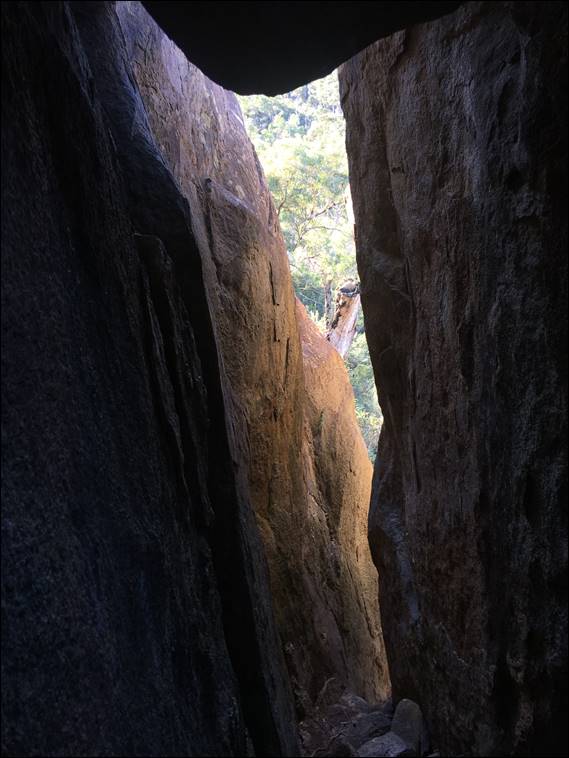
In the image of the refinery you can also see a prominent cracked slab, which is described in the climbing guide as worth a visit.  There are however a number of other spots and we decided to do the loop walk, as indicated by the guide, so we could check these out first.  We located Cargo Boulders, Fin Field and the above Fox Wall, but the routes at these spots looked scrappy and they didn’t inspire us.  We moved on.  However, from here on the track detailed in the guide disappeared, and we had to bash through thick scrub.  At one point Howsie narrowly missed stepping on an exposed bee hive:

He was hopping down some boulders.  I had the advantage of looked from above and could see the white combs, yet to be filled with honey, sticking out from under the final boulder.  He stepped over this oblivious of the risk, until I told him at which point he noticed the bees buzzing about and he made a mad dash for safety.  A few flowers were out, but obviously not enough for the bees to fill their home with that golden liquid.  We also spotted a few fungi but didn’t stop to check them out, I did however have to take a quick snap of the above one.  The stem and cap resemble a Parasol Ink Cap (Parasola plicatilis), but I’m not convinced:

The gentle walk turned into a hike, and we didn’t even find the next three crags that the guide details.  At least we could tell from the landscape which way we needed to go.  And our eyes were firmly set on the cracked slab we had previously seen from our lofty height near the dam.  During our hike we had, way back, descended into the valley below.  Sadly this meant we left the frog song behind, but on the positive side and due to the land form the sound of the refinery was also lost.  We finally got to the prominent cracked slab, called Blair Wall and were pleasantly surprised:

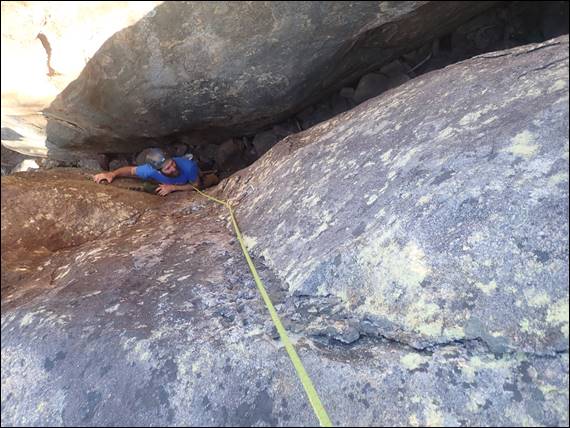
The bush bash had taken over an hour and had been hard work, but we were rewarded with a nice looking crag with some good and varied features.  The main lower crack we previously saw from afar proved to be a wide split in the crag, that offered three fun chimney style routes.  Two of them being the easiest at the crag so we started on those, Howsie kicked things off with a line that required proper bridging across the widest part of the gap.  And for both grade 14 routes the only protection was a single bolt, some 6m high up on the wall.  To give you a feel for the position below is a video of Howsie up until the point he could reach the bolt:

Despite the long runouts on Conceded Pass and then Drunk Before Dawn (the image above) we loved both lines.  They were very fun and also very different to anything we normally get to climb on.  Quite a few of the areas dotted round Perth, like this one, were discovered and established by Jim Truscott and Matthew Rosser.  A formidable pair who climbed hard and bold.  So the high bolts were not overly surprising, but thankfully not the manner in which all the lines here were bolted.  I do however, feel that every so often their lines have felt like serious sandbags, so it was anyone guess how we would go as the next lines would be graded harder:

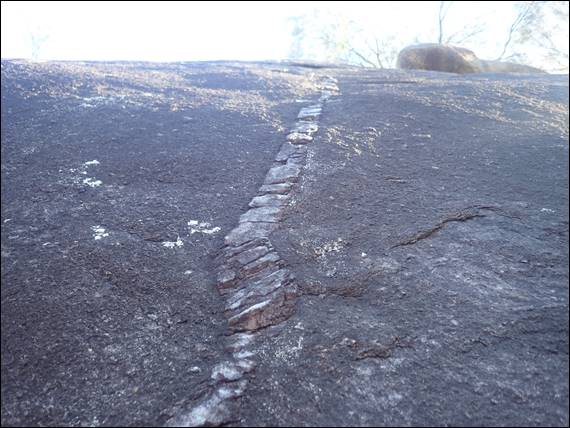
Howsie was first to test this and had his eye on a grade 17 route that looked lovely, following a rising rightward traverse up some fine cracks.  But the sun was shining directly down the line so we decided to leave it till later.  Instead he jumped on Fat Bastard, another fun looking line that followed a very clean quartz vein that cut its way from the base, to half way up, the crag.  Keeping in mind that this was only an 8m route, and the longest line here is only 15m.  It proved to be very good, with thin, delicate, balancy and sustained climbing and in keeping with the grade it was given.  This place was really warming to us:

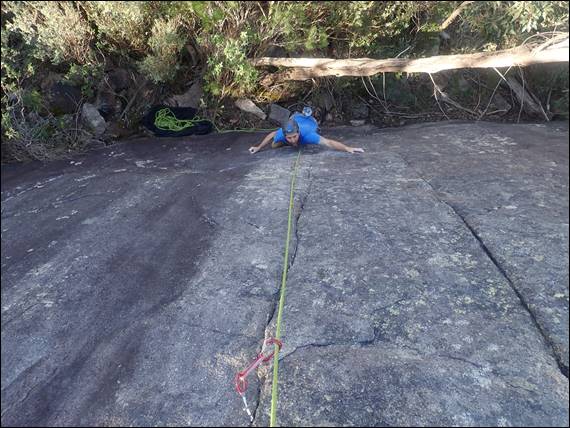
I was feeling good and that fire in the belly was stirring as I looked at the next line, it is listed as a project in the guidebook at grade ‘22+?’ and there is no record of anyone ever having climbed it.  But it looked great and I thought I could see two gear placements above the single bolt.  Setting off it proved tough, and I won’t say I got it first attempt, but did manage a clean ascent after unlocking the very fine crux sequence that comprised some 7 or 8 moves.  And with each one it felt like I could have been spat off, if I didn’t keep my core engaged or my concentration wobbled.  Seeing it was a first ascent, I couldn’t resist another video:

The first question was what to call it, and I’m thinking Call of the Wild.  The second question was of course what grade was it, and I was aiming for 21 but it felt tough so maybe 22.  However, to really check that we needed to try a few of the other harder lines here.  Before that, Howsie liked the look of another varied feature of this crag.  A stunning knife edged arête, and the climbing proved to be equally brilliant.  Oakley Arête, was in my mind the best aesthetic line here.  It was utterly fantastic and so much so I took another video of Howsie making his way up this magnificent feature. However, I didn’t want to overload this post with videos so if you’d like to see it you’ll need to ask for it:

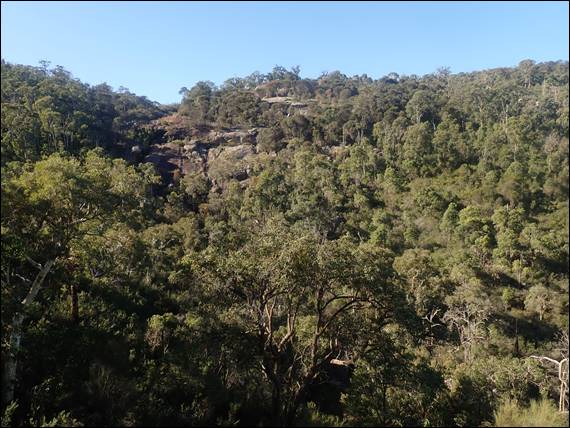
The image below looks back up to the dam, which sits above the long slab with just a trickle of water running down it.  We were conscious of time, as we still had to hike back out which we intended to do by closing the loop walk.  Hiking up the northern ridge, on the left in the image below.  But for now focusing on getting a few more lines in, I jumped on Ruthless Charm a grade 21.  I managed to clip the first bolt but then despite multiple attempts I remained absolutely baffled as to how to do the moves.  Then attempting Indecent Haste another 21 and again I clipped the first bolt, which was a very tenuous situation, and was then completely stumped:

I feel both routes are classic Truscott and Rosser sandbags, and seriously put into question the grade of the line I did the first ascent on and all the other routes we had done today.  For the second hard route I pulled on the bolt to get past the “long reach”, which both Howsie and I were almost a foot of reaching.  Thankfully the rest of the climb was achievable, and also very fine delicate slab climbing.  Time had sadly now caught up with us and we had to make a move, and leave the fun looking grade 17 we had first spied for another visit.  So we began the next bush bash and it was another slog.  We occasionally found short tracks but they quickly petered, so we attempted to find high points to look ahead for clearings between the thick spikey bush:

It was very hard going, and seemed to last for ages.  Eventually we did however find our way out feeling scratched, battered and exhausted.  Funnily enough we were guided through the final sections by the sound of the frogs.  Telling us which way the reservoir was, as we could not see it due to being completely obscured from view by think scrub despite our elevated position.  While I took a few images of our dilemma I seemed to have accidentally deleted them, so instead you get one more image of Howsie on the first route of the day inside the chimney.  All up, from Bunbury it was close to three and half hours driving and two hours plus of bush bashing, all for four hours of climbing.  But it is the whole experience that counts, and it was so worth it:

As the crow flies

We almost got all the regular locals that are remaining out in one hit today, but Ash’s back was playing up again so he pulled out on Friday night.  It was a shame as it would have been nice to get the whole small crew out together, which even with just five of us is a rare thing.  Ash confessed the push-up challenge hadn’t helped with his old back injury.  I’d suggested he pull out of it a while back, as like me when I did it he had various joints flare up.  And like me he persisted to the end, and probably also like me he is not likely to do it again:

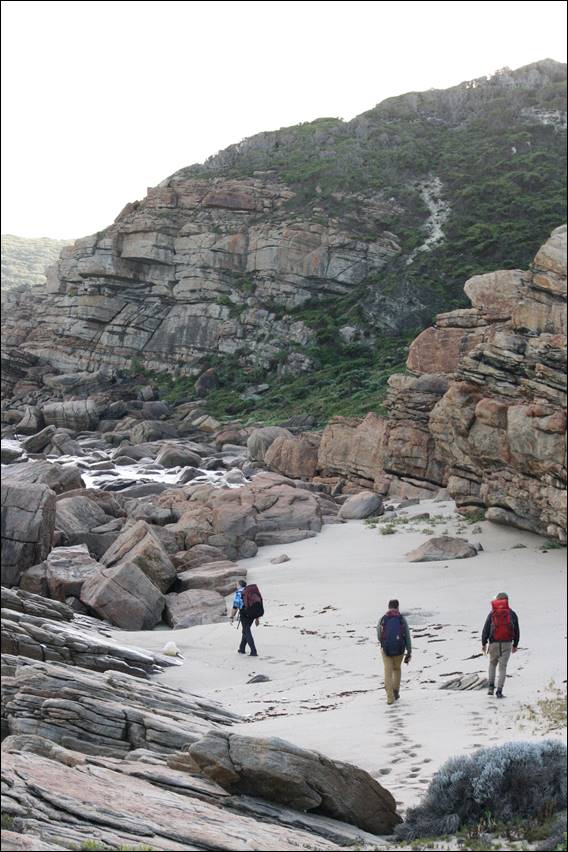
That left Josh, Rongy, Howsie and myself.  And we trouped down to Wilyabrup, not the main cliffs but the furthest crag to the north, Lost Buttress.  The tide and swell were up, as you would expect during winter, and it made for a more exciting rock hop along the coast.  Some of the places we would usually work our way across where under water, making us scramble up and down a bit more inland.  Eventually we made it unscathed, and without getting wet, to the small beach that make the Playground a great bouldering spot:

On the last stretch to the crag I stepped on a huge piece of flotsam, which comprised a very large trunk.  This promptly swivelled as I loaded my foot and sent me crashing down.  No damage done, other than a bruise and slight bit of embarrassment ,as everyone else made it the crag without tripping over.  In addition to the rock hop there is care required when you top out here.  The top for quite a bit of the crag is a sloping ledge littered with flakily rock and loose sand and gravel.  I’m pleased to say no one came a cropper due to the tops, not even me:
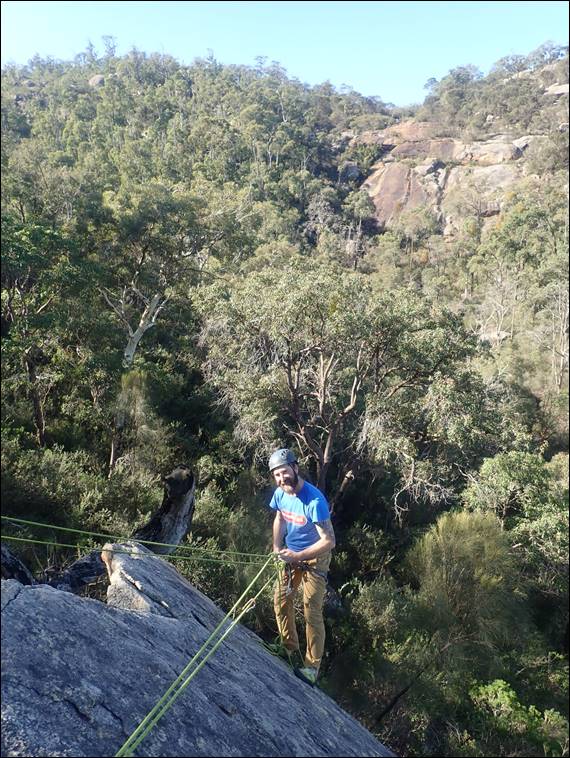
The choice of today’s location was placed on Howsie’s shoulders, in part as he is still chasing grade 22s in 2022 and has a fair few still on his list that he hasn’t tried.  This place has, if I am allowed to say it, got a great one.  Before we get to that though, it was time to warm up on some more relaxed lines.  Some of the routes on this crag provides a big wall feeling, despite its short nature.  Probably due to the huge capping roofs and exposure you get stepping out above them:

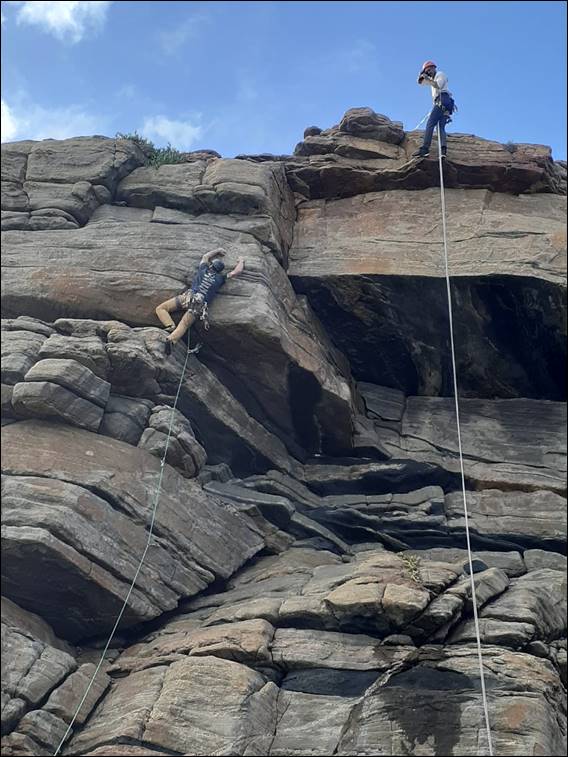
Josh was keen for a lead but wasn’t sure what to jump on, there isn’t a lot that is good for a beginner here.  Even the lower grade routes can feel a little serious.  But we did notice a line at the far right of the crag that to date I have never heard of anyone climbing.  It looked reasonable, a good angle, and with enough gear to make is sensible.  So off he set under the watchful eye of Howsie belaying and me running round taking images from various angles, of his first ascent:

It was great to see Josh keep his cool and get a clean ascent, with no dramas.  But by the time he got up he confessed his head was swimming and he found it a little hard to focus on the next stage.  So I helped him set up the belay, which is something that takes time to learn and is so important to make sure you are comfortable, both in relation to feeling safe and physically relaxed.  Howsie came up next and left Rongy below soaking up the sun watching a couple of surfers desperately trying to catch some waves:

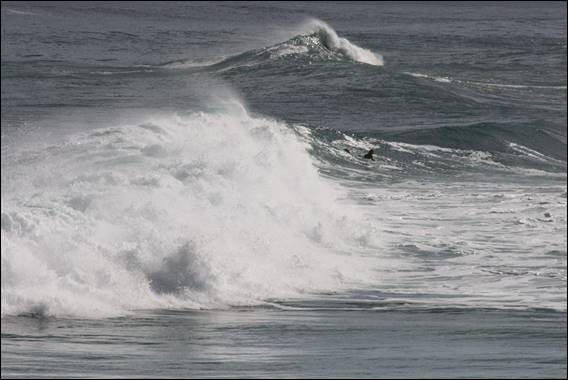
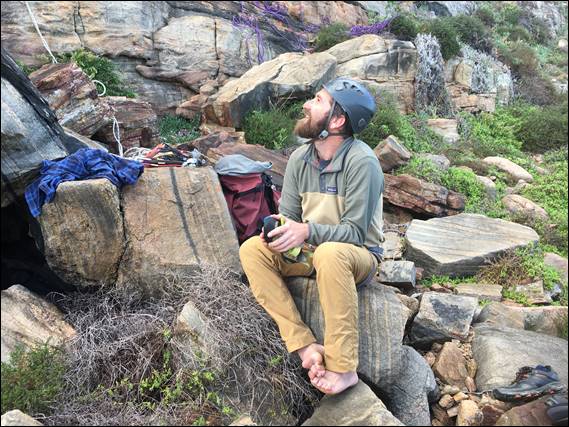
While there were some great looking waves rolling in, they didn’t seem to last too long before they tripped over their own troughs, into a mass of choppy water.  We only saw the surfers catch a handful of waves and even then their rides seemed to last but a few seconds.  Still they like us were out and about, and we seemed to be the only ones.  From here we had a great view of Wilyabrup and not a sole could be seen either out walking or climbing.  After his lead Josh was happy to take a break, and Howsie looked wistfully up:

The decision was made, and he was going to have a crack at the 22.  I’ve always said that As the Crow Flies requires good conditions with dry and grippy rock.  The conditions today were not too bad, but the rock was damp in places and the sea spray was starting to drift landwards.  This however didn’t put Howsie off and he started to mentally prepare for the task that lay ahead.  This included a bit of strategising with Rongy, as to how to tackle the crux section of the route:
Meanwhile I was scrambling back up the top ready to capture the action.  I was hoping Ash could have made it today, as I was keen to get some shots while hanging off ropes.  But it was what it was and in a way it wasn’t a bad thing that I only had this one chance.  I’ve got a sneaky feeling my trusty point and shoot camera may be playing up, and my SLR body also wasn’t performing as I am used to.  So while I took heaps of images, the quality was sadly a little disappointing:

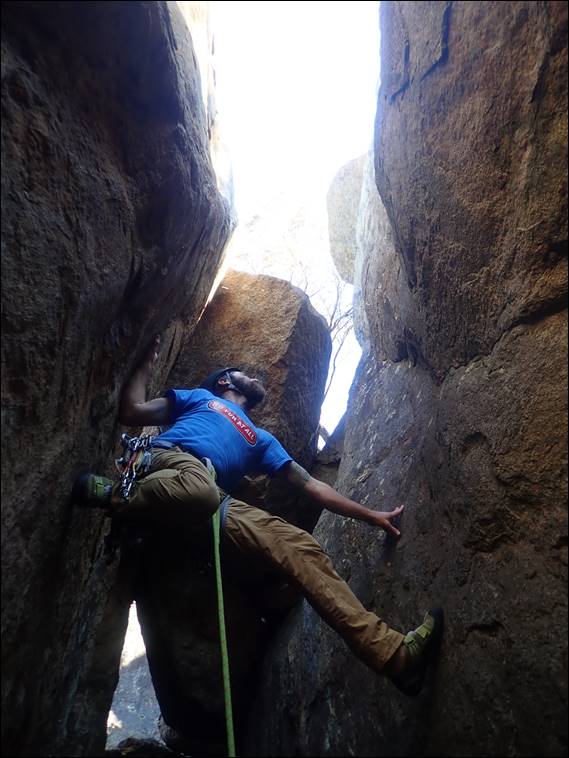
Still I took lots of images of Howsie as made his way up and then took a depth breathe before he had to make his way onto the hanging arête.  As seen in the image above the trick is getting your right foot near the base of the arête, the problem being that there are no handholds above, just a couple of fingernail wide ripples that really do not feel too secure.  Added to that once your foot goes up you are stepping above your gear and into what feels like space:
As is probably evident from the image above, Howsie didn’t get past the arête.  But not for want of trying, he gave it quite a few very determined attempts each time falling into the space below the arête.  Not only is this crux section very balancy and smeary, but getting to it feels pumpy.  So after several attempts it was Rongy’s turn to try.  He too found this section too hard to read taking several falls.  Meanwhile Josh was more than happy to kick back and watch, while allow his brain to defog as he deservedly basked in glory after his first ascent:
After Rongy was spent, Howsie went up again allowing me to move position.  But it was the same story and several times he took a whipper sailing down, landing safely in harness, before taking a few big breathes before trying again.  But he was soon utterly wasted, so I threw a rope down to allow him to yard his way up the route.  This allowed me to set up a top rope for one final play.  Rongy went up but again failed to unlock the crux sequence and decided it was not to be today.  Howsie had nothing left in the tank so didn’t even bother, happy with what he had already achieved:

Now you might ask why I hadn’t attempted the lead, and it was quite easy.  It’s my route, so I knew how scary it was and when I had established it with Kym we were both climbing strong and hard.  So I simply didn’t think I had a chance on it, but with a rope above me I was happy to try.  My first attempt at getting established on the arête failed, but I have a strange knack for remembering routes in very fine detail.  And on my second attempt this helped me to unlock the puzzle and get past the arête, which felt very cool:

Maybe next time I might have a crack at leading it, and I don’t think that will be too far away as Howsie is also keen to get this one in the bag.  And having watched me complete it might help him to dial in the sequence.  But for now it was time to pack up, I got down to find Rongy and Howsie sorting gear and Josh was nowhere to be seen.  You might guess that he had just popped down for a swim, keeping up the tradition he has started.  But again going solo.  Once all packed up we decided to head back along the cape to cape track, rather than the coastal rock hop:

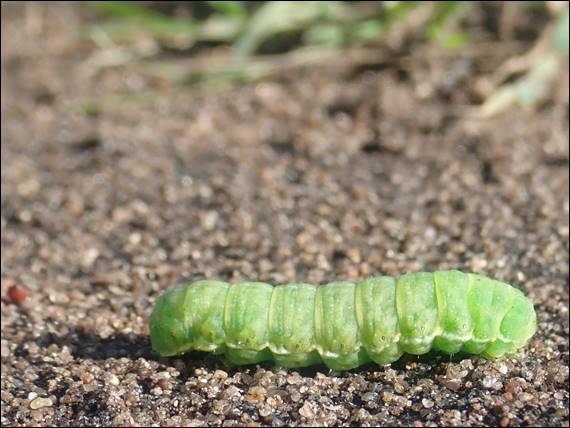
It was a good move, the cape to cape track provided great vista and was also that bit quicker.  While it may not sound like we did a lot of climbing, as with the above caterpillar we had not been in a rush today and had approached the climbing at a very relaxed pace.  Time was however slipping by and Howise did have to get back, so the walk out was not at such a relaxed pace.  And by the time we got back to the car, the legs felt like they got a proper workout, which isn’t a bad thing for a key tapping office worker:

Bubbles

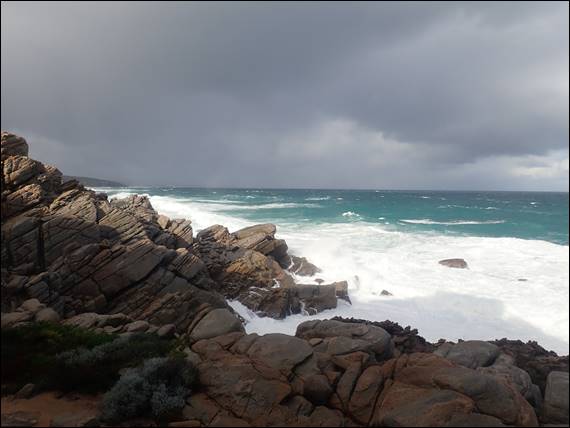
The winter solstice is almost upon us, but I can’t afford to take a day off work on Tuesday to celebrate it with a climb.  With shorter days, a lower sun, and winter being well and truly upon us some might struggle to leave the warmth and comfort of their homes.  But the forecast for today was just too good to miss, a howling westerly wind that was just shy of gale force and a six meter swell, perfectly coinciding with mid-morning high tide.  Yes I really do love conditions like that.  So after stoking up the fire at home, I ventured out to a crag that would allow me to really experience the conditions:

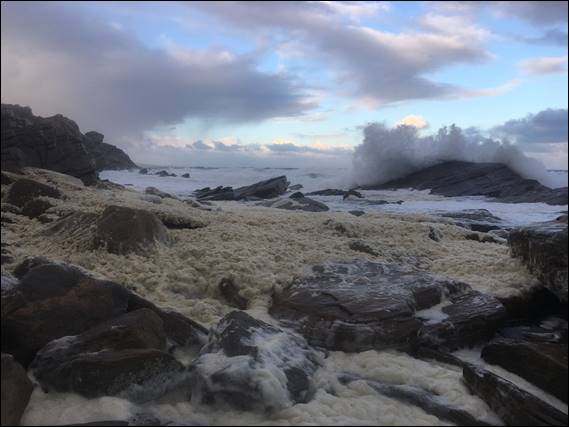
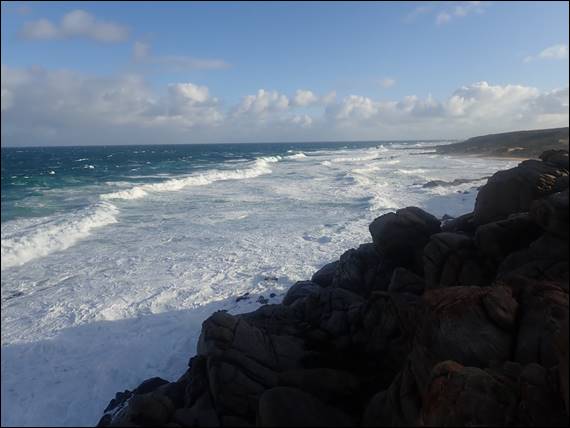
On arrival the wind wasn’t quite as strong as I suspected, but the ocean was a mass of white water.  After the wide sandy main beach the boulders I usually rock hop across were being pummelled by frequent, big and messy waves.  Normally a fun rock hop, today the journey over these large boulders was made that bit more treacherous because of a mass of a green/yellow foam that was being washed up, and then blown round by the wind.  These foam events occur when types of surfactants lower the surface tension of the water and trap air to form bubbles:

This mass collection of bubbles usually occur when there are more vigorous conditions, such as today.  And the surfactants to create it can come from both natural and/or manmade sources.  Manmade sources include detergents or dissolved salts, which can become elevated due to fertilizers.  While, natural sources can come from the proteins and fats in seaweed and other marine plant life.  Foam from natural sources are not harmful, but those from manmade sources can be.  The question is which one was I observing today:

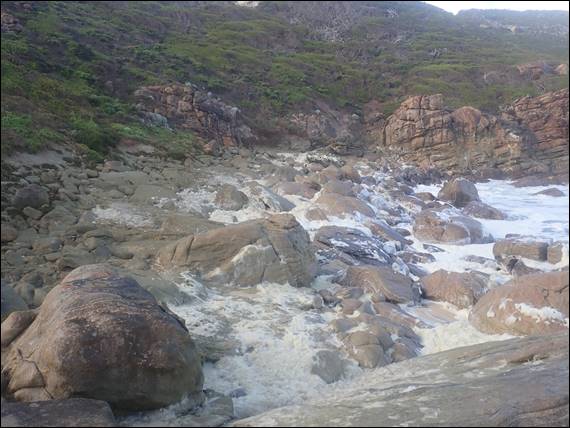
Walking across the final small bay, before I would escape these conditions, it felt like an ice rink.  I’ve seen this bay as a full sandy beach through to a completely rocky landscape.  Today it was the latter except for the land right up against the dune, and every surface that wasn’t under white water, or a foamy mass, was coated in a very slippery green slime.  I can only assume this was the residue from the foam, after all the bubbles had popped.  And being green I’m taking a punt that this was a natural event.  With each step more of the residue stuck to my sandals, leaving a clean footprint behind, as shown above:

Arriving at the crag, I really didn’t think I would have any chance of climbing from sea level.  But had to have a look at the zawn to see just how wet it would be.  While the waves were reasonably big, they were nowhere near as big as I’ve witnessed before.  But still big enough for my theory to prove right.  For trips out like this I intend to climb, but they are also about just marvelling in the experience.  The whole time I was there I was smashed with an aural overload created by the rumbling angry water and whistling wind, so I took a short video to give you a hint of what it was like:

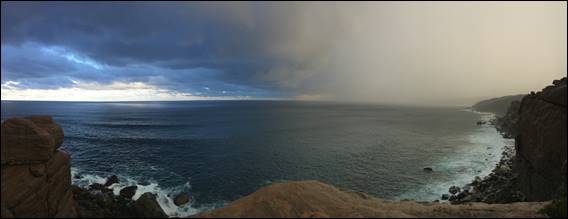
I had tossed up as to whether to head to Wilyabrup or Moses.  The former being just over 3km to the south, as the crow flies, and can be seen in the above image if you know what to look for.  But my intention today was to enjoy the conditions, for which Moses is way better.  It was also a good choice, as I could see the taller cliffs of Wilyabrup being dumped on by rain, while I remained bathed in sunlight for most of the time.  I wouldn’t have said the rock was dry it was however way better than I expected, especially with all the sea spray flying around in the air:

You’ve probably guessed I was out by myself today, as sadly no one else was available to get out.  But I still climbed in-between watching the waves below me smash the shoreline, and looking further to the north and south observing belts of dark ominous clouds reach landfall and offload the moisture they carried.  With no expectations of how much climbing I might get in, I was pleased to rack up seven very fine lines.  And, as is my usual approach when I top-rope solo, ascended each one twice:

As I finished the second lap of the last climb, my bubble of protection from the rain seemed to have used up all its power.  And I could see rain fast approaching.  I quickly threw all the ropes and gear into my pack just in time, as moments later the rain fell.  And fell it did with big drops that you could feel hit you.  Fortunately, it only lasted a short few minutes before clearer skies came overhead.  With everything already thrown in the pack I headed out and took my chances, once more, across the slippery bay.  The above image showing the extent of all the green slime, and second short video below of waves and foam:

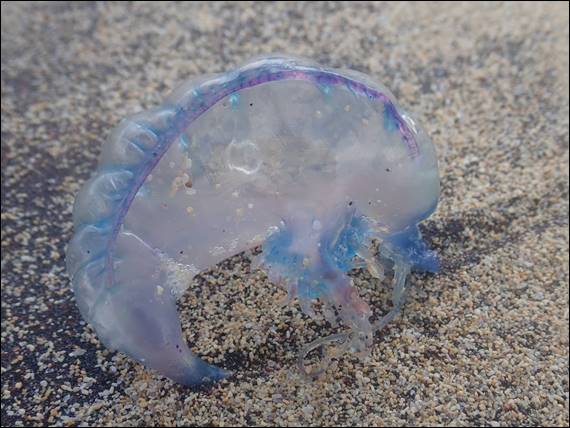
Finally I was back on the main beach, where I didn’t have to watch every footfall quite so carefully.  Allowing me to do a bit of beach combing.  Above I found a great specimen of a full sized, Bluebottle (Physalia utriculus), with a 10cm long ‘bubble’.  It is very similar to the Pacific Man-of-War (Physalia physalis), which grows to about 50% larger.  I always assumed these were a jellyfish, but have been mistaken all this time.  They are in fact a colonial hydroid that comprises four types of polyps, or clumps of cells.  Each polyp has a specific task, being to keep the colony afloat, reproduce, digest food and capture prey:

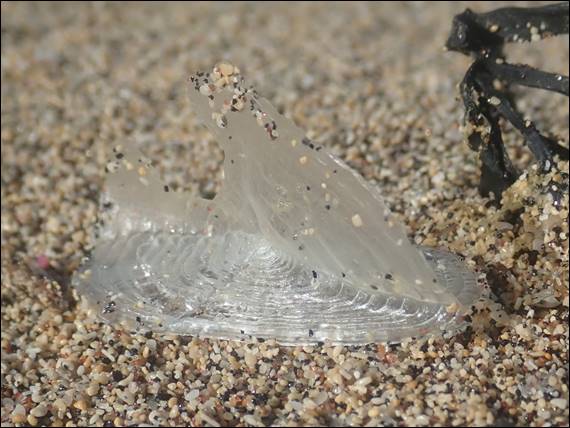
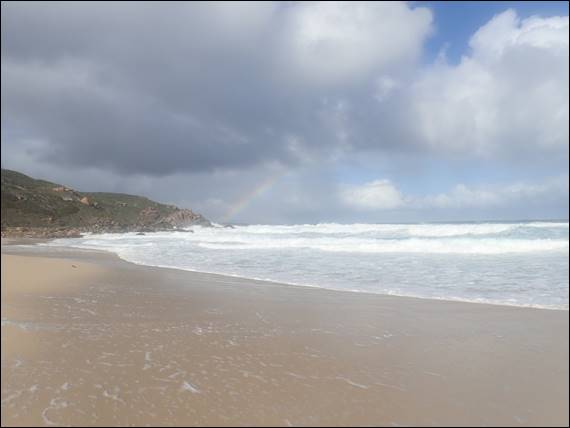
I also came across the above By-the-Wind-Sailor (Velella vellela), which is also not a jellyfish but a colonial hydroid.  Again each polyps has a function, one of which being the sail.  The sail can be either a right or left sided, and as such it depends on the wind as two which sort ends up being washed ashore.  They are usually deep bluey purple, and I’ve seen lots of these on our local beach.  So this one, being completely colourless really caught my eye.  As I was kneeling down to observe my finds behind me a rainbow hit Moses Rocks, and more rain was coming.  So now it really was time to hit the road:

A rare species

Having started climbing in the UK, I’m fairly accustomed to climbing in all kinds of conditions.  But there are not many people in this part of the world that are keen to climb when conditions are inclement.  As such with back to back days of a 90% upwards chance of rain forecasts, since Wednesday and stretching as far as the forecast dare go, I didn’t fancy my chances of getting out for a climb this weekend.  Josh however can only get out every second weekend, and this was one of them so despite the dreadful forecast we went for it:

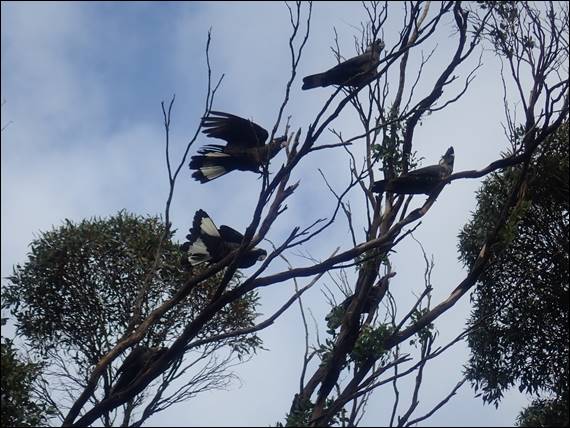
On arrival at Wilyabrup, the sensible place to climb as it has good ledges to hide under if the weather happened to come in, I was greeted by a flock of Carnaby’s black cockatoo (Calyptorhynchus latirostris) feasting on fallen honkey nuts by the side of the gravel road.  These are recognised as a threatened species and protected by law.  Whilst they didn’t appreciate my arrival, they only alighted to the trees allowing me to sit and watch them until they became brave enough to go back to their foraging on the ground.  These birds are often confused with Baudin’s cockatoo, however their shorter upper beak gave them away:

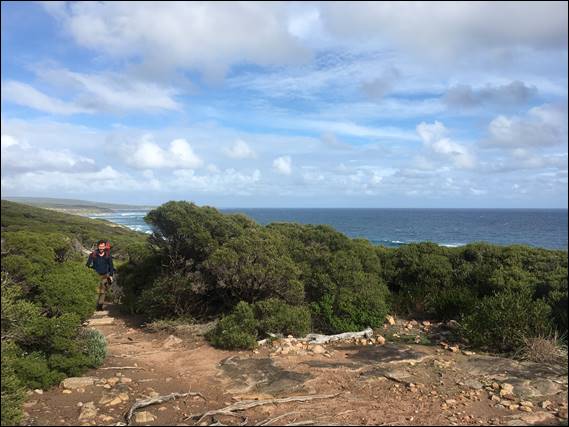
Josh arrived shortly after me and we shouldered our packs.  Due to the forecast and what the weather radar was showing, we had been messaging each other this morning, right up to the time we decided to head out.  As such we came prepared to take on the elements, and were not surprised to be the only ones out.  As we walked towards the coast we marvelled at the sight out to sea.  The clouds were high, light and broken allowing sunlight to intermittently stream through.  In part due to expecting less than ideal conditions I had already thought of a tick list for the morning:

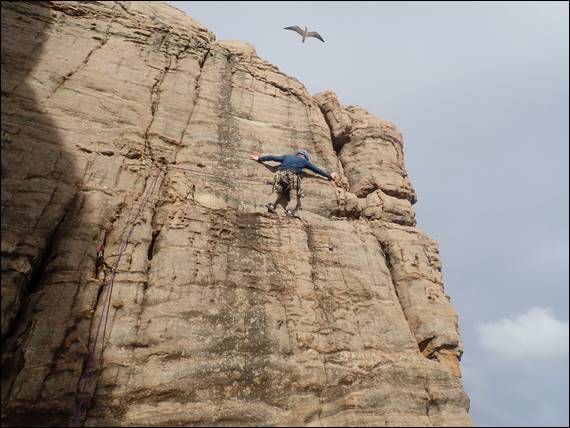
This started with Stormcock, one of the first routes established and recorded at the crag in 1973.  That was not the reason for picking it, which was due to the lower grade of the climb plus the fact that I have never climbed it.  While only a grade 10, or Very Difficult in UK grades, there was a very exposed traverse that wasn’t entirely straight forward.  Plus if I had been using protection that would have been available in the early 70s it would have been very spooky.  It is not all that unusual to, every so often, come across an older line that seems tricky for the grade, the climbers of “days gone by” were fierce and bold:

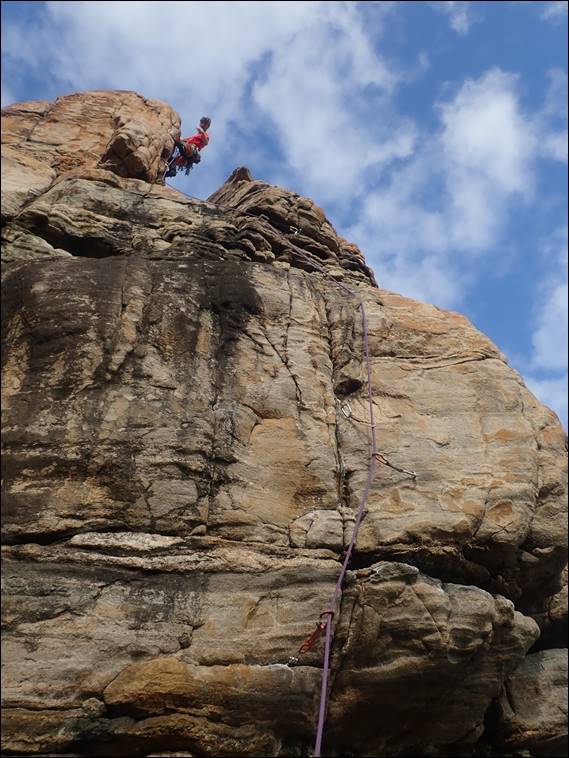
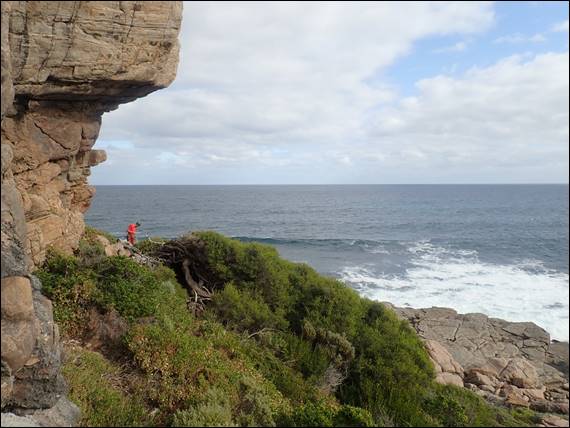
Josh followed me and despite the wind howling down the coast I could sense he was nervous, as he inched across the traverse hidden from view by a roof.  It was a sigh of relief for me when he popped out from under the roof beaming.  I’d hate to have put him on edge with the first climb of the day.  This route was developed by John Waterfall, who more by luck than design had established all three of the routes we did today.  It was also by luck that he had found the crag in 1973, he was checking out the coast looking for surf breaks.  After which it didn’t take long for the climbing community to start frequenting and developing this place:

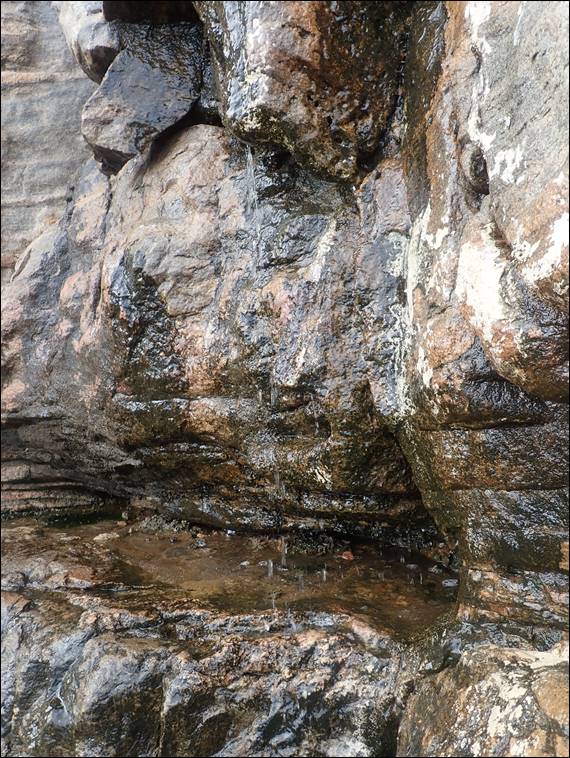
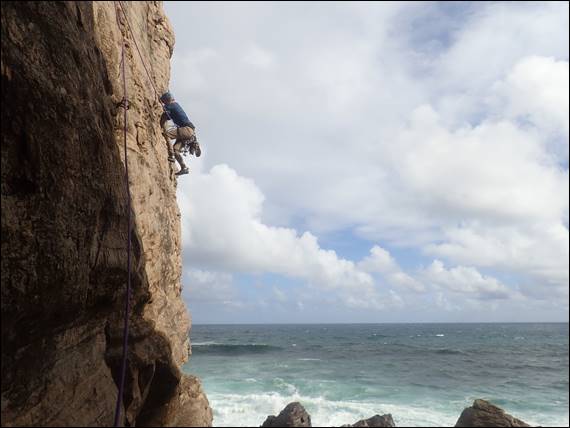
It seemed a little apt that today, as a result of all the rain in previous days, and just that morning, that small waterfalls could be found cascading down the cracks, corners and slabs below low points in the top of the cliff.  The water was being channelled down these features, but as is the case here the rock dries quickly, so in between the watery spectacles was beautiful dry rock.  This was great and meant that Josh was keen to take the lead on Tom Thumb, which is recorded as having been developed in the early 1970s:

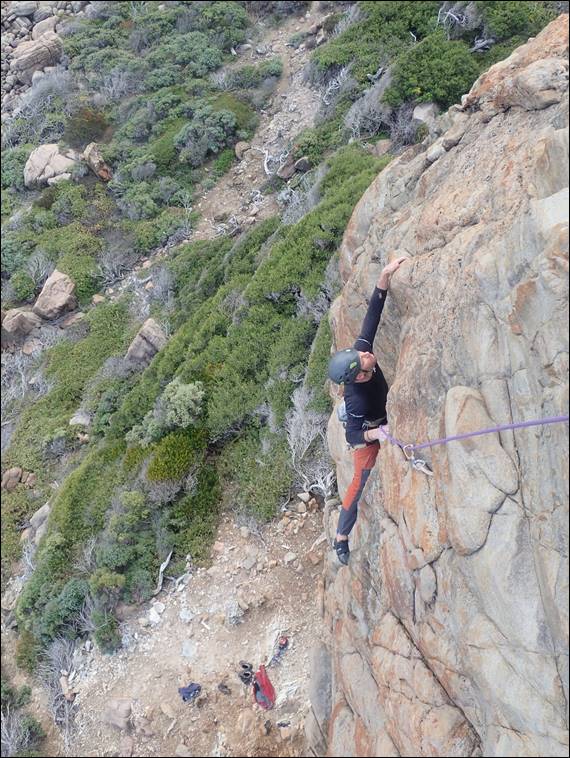
Whenever I have climbed this route we have taken a more direct line from directly beneath the prominent feature of the chimney and chock stone that start half way up the wall.  However, in the early 70s it was climbed by using the cracks in the centre of the wall before making an exposed traverse to the base of the chimney.  Not having climbed it this way I had no idea what Josh would experience, and I was mightily impressed at how he held his cool.  Due to the length of the unprotectable traverse there was a very real risk of a big pendulum and ground fall if he slipped:

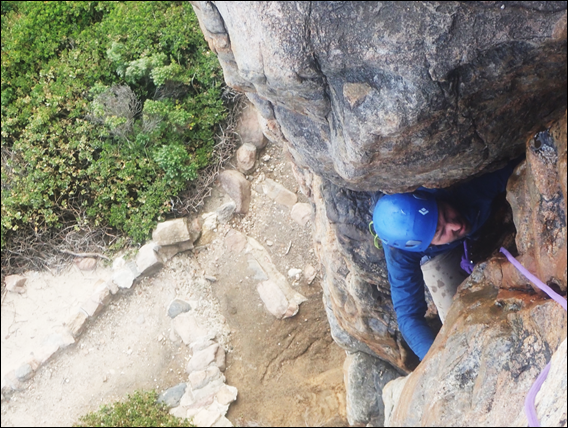
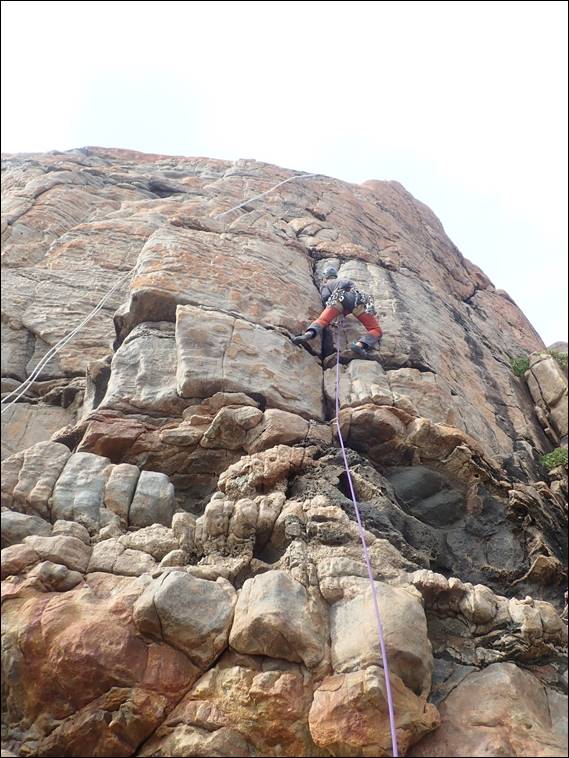
The next climb on my list was one that had been developed on the very first recorded climbing trip here, in 1973.  Orryjohn, at grade 8 or a Difficult in UK grades, should be a walk in the park.  Today however water was running down the line, but we both agreed to go for it.  The original line stepped in from the right, but that part of the face was sodden so I climbed the dry direct start that is considerably harder.  This alternate start made Josh work hard, slipping several times.  Eventually he made it past this steep section to get into the meat of the original line where he, like I had been, was continuously being dripped on:

While it may sound strange the wet nature was in part what attracted us to the line, and we both loved it.  It had however used up any juice Josh had left.  So we didn’t get onto the last route I had in mind for today called Waterfall’s Second Folly, which despite the name was not established by John, nor his brother Peter, Waterfall.  Instead, we packed up but before walking out Josh went for a dip in the ocean.  You might recall he had a dip two weeks back after climbing and he wants to make it a regular event.  Last time it did however mean he missed out on seeing the Wedge tailed eagle being chased by a couple of gulls:

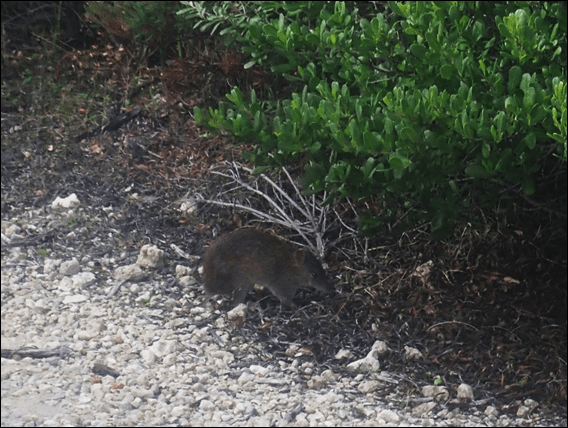
This time he didn’t however miss out what I believe to be a Quenda (Isoodon fusciventer), which I was very pleased he spotted.  It was a lucky find, as while this endemic species to south west of Australia can be active at any time, they are normally only seen at dawn or dusk.  This species is often mistaken with the Southern Brown Bandicoot (Isoodon obesulus), and I have struggled to find out what features are used to distinguish between the two.  So the rationale for my identification is purely based on size, with the former generally being slightly smaller:

Game on

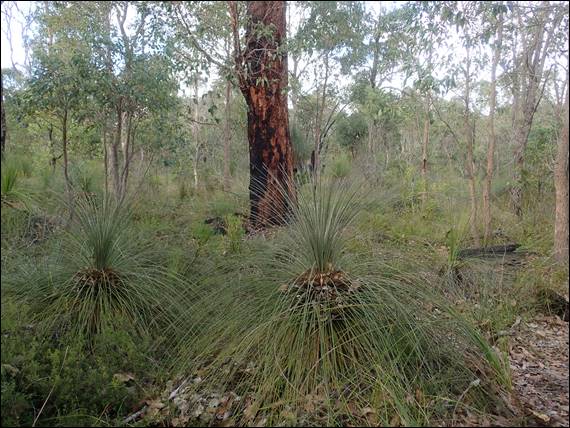
Lisa and I had intended to head out for a walk last weekend, as her energy levels had returned to somewhere near pre-COVID.  Unfortunately, as seems to happen with life, other things distracted us and we didn’t get out.  So this weekend I was more determined to get her out and about, for something other than work.  Not wanting to go too crazy, we headed to the small nature reserve at Ambergate, a short half hour drive from our place.  An easy grade walk, spilt into four quarters from which it is possible to get back to the car:

Winter is upon us and I had no expectations of seeing a floral landscape.  Indeed we were prepared for the blanket of greens interlaced with slithers of brown from the tree trunks.  While it may be winter a blue sky was above us and it certainly didn’t feel cold, nor had it rained enough recently to be wet underfoot.  This surprised me a little, as we have had a few decent fronts dump rain over the last few weeks.  I was actually hoping for slightly damper conditions, which would have brought out some fungi:

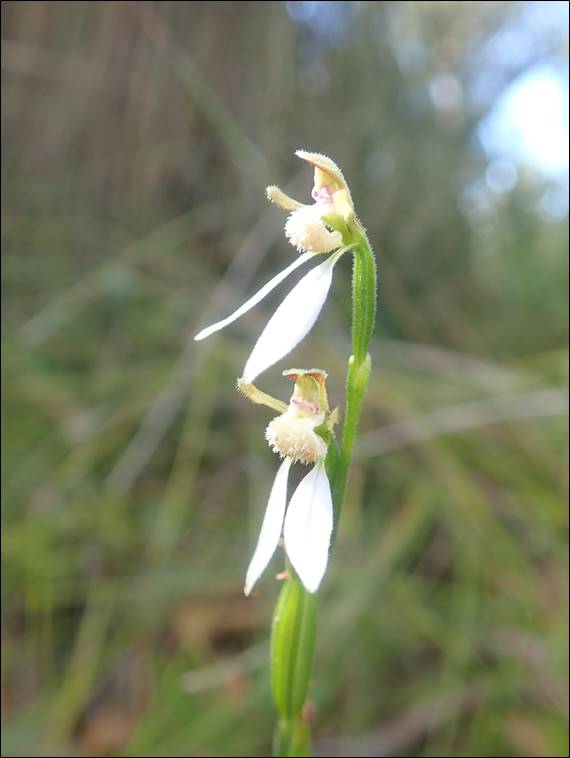
While there were not many flowers to be seen we stumbled across a Common Bunny Orchid (Eriochilus dilatatus).  Unlike the ones I’ve spotted in other locations this year this one didn’t have any red tinging, so it could have been a pale form.  Something they call Diuris, unlike the yellow form that is called Lutea.  I also noticed it had a far more hairy labellum, and again I have been left wondering.  Despite having the latest edition of Orchids of South-West Australia, with all of its 500 pages, I was unable to pin it down with any certainty:

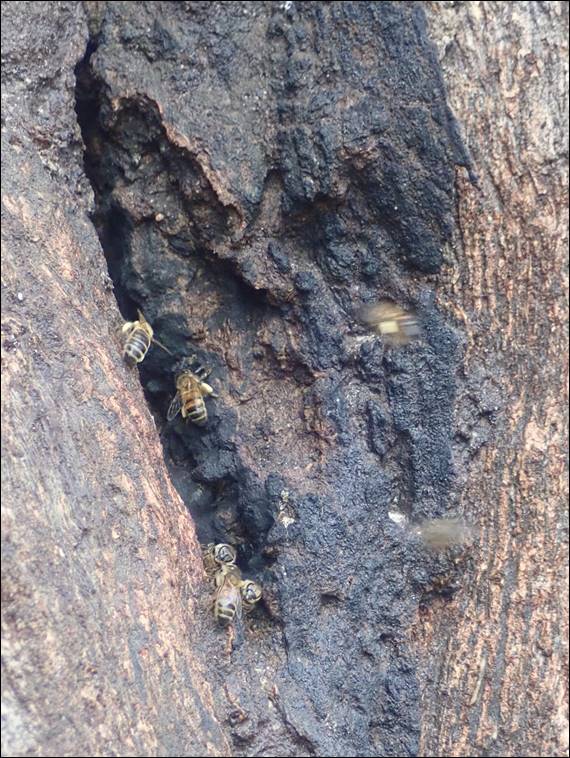
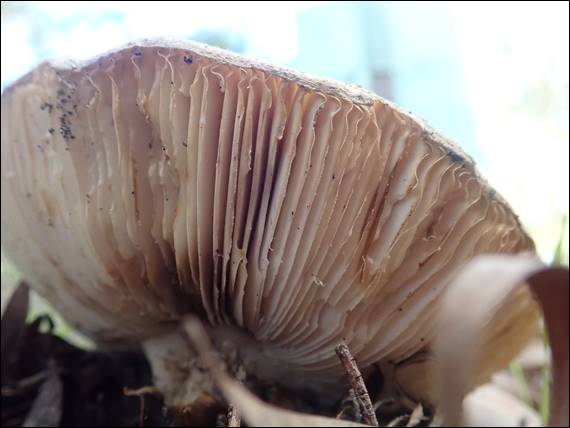
There were a few other plants in bloom but not in any great abundance, including some pea flowers.  And it made me wonder where the bees had been stocking up on pollen, which we spotted buzzing in and out of a hive in one of the tree trunks.  The returning bees all had legs fully ladened with the yellow powder.  It certainly wasn’t from the mushrooms that we did spot, and again there were not many.  I’ve attempted to identify the two species we found and this one I can only guess may have been of the Lactarius genus, commonly known as milk-caps:

If I am right the cap would have oozed a fluid that looks milky, if I had cut it.  But despite being guided by the online guide called “Fungi of the Perth Region and Beyond” I was not convinced and didn’t want to start handling it, just on case it wasn’t such an innocent species.  The next image shows the second orchid we spotted, but I have to confess at the time I didn’t think it was an orchid.  I even went so far as to tell someone else who had spotted them that I didn’t think they were orchids.  This time my trusted, but heavy, orchid book clearly showed me I was wrong:

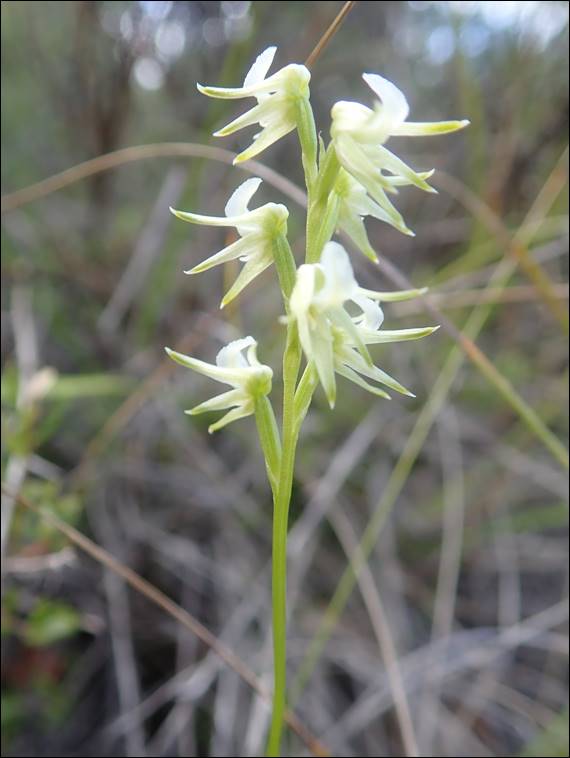
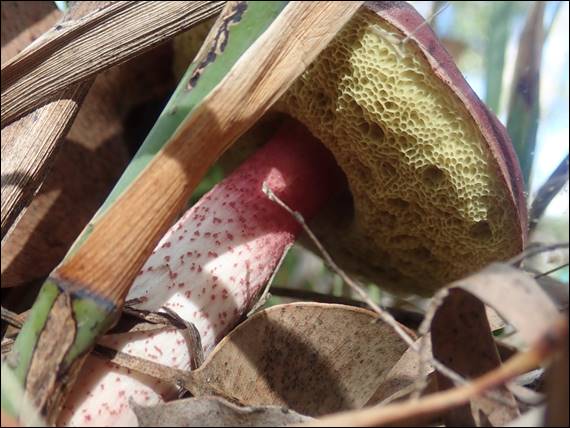
The Scented Autumn Leek Orchid (Prasophyllum), as its name suggests, is another one of the early flowering orchids.  While I am stoked to have come across two orchids today, the next find was the one that I really liked.  I’ve spent a fair bit of time checking what mushroom this is.  I thought the very distinctive and rather unusual yellow sponge like underside of the deep red cap should have been a giveaway.  Indeed, I’m sure it is of the Boletellus genus, and am prepared to go a step further and say it is a Rhubarb Bolete (Boletellus obscurecoccineus):

While on first impression the reserve had a rather drab appearance on display today, we were rewarded with some very cool finds.  Better still we managed to walk all four quadrants, and Lisa was still feeling fine.  That said the pace was fairly slow, due to me stopping to check things out.  Regardless of that we decided we should reward ourselves with a bite to eat, so jumped in the car and found a spot in Busselton to feast on jalapeno poppers while enjoying a game of King Cribbage:

Gone fishing

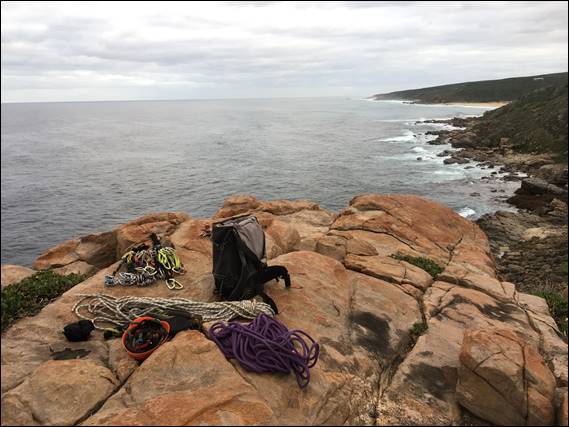
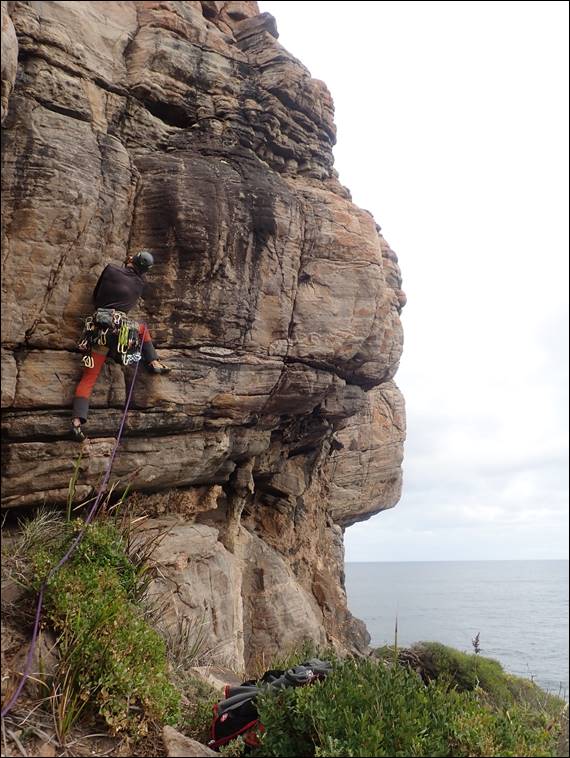
Heading out with Mario is always good, but this time I did wonder if I would have the stamina to keep up.  While I have been out the last few weekends, since my isolation period ended, on both trips we’ve jumped on lower grade routes.  Not that this has in anyway diminished our enjoyment of getting out or climbing, but today two things had me pondering how I’d go.  Firstly there really isn’t much easy stuff at our chosen location of the Northern Blocks at Wilyabrup.  And secondly I knew what Mario had his eye on:

He was interested to give a couple of Kym classics, which rarely get any attention, a crack.  But before that it was time to warm up, for which Mario decided on another route he hadn’t been on before called Graciousness.  Another line Kym had developed way back in 2015, but one for which he had kindly offered the first ascent to Wiggins.  The reason this was a good line to start on, was it was the same grade as two of the routes I had in mind today.  I too had come with a game plan:

Despite having been climbing in this area for over sixteen years it is a little surprising that there are climbs, at a grade I’m happy to attempt, which I have still not climbed.  The reasons are varied, but for the two I had in mind today this was probably because they shared starts with other more recently established and well-trodden climbs.  Also the route descriptions of these two older lines indicated they may be sparse on protection, and you have to be in the right headspace to take on climbs like that:

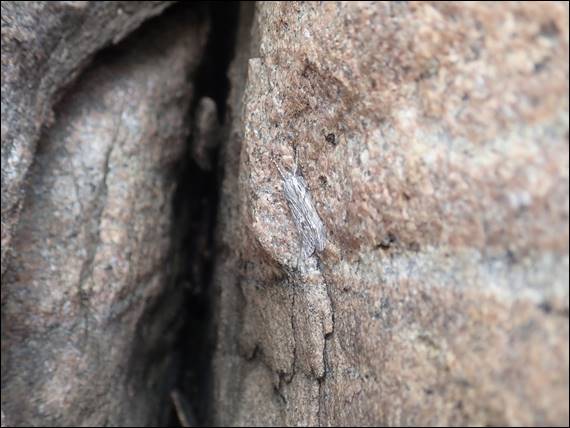
My first lead was Block and Tackle, and for those familiar with the area, it takes on the first two thirds of Corpus Delecti before traversing rightwards across the entire crag.  This line was climbed in 78 and it took a further four years before anyone considered the direct finish of the way more popular Corpus Delecti.  While the route was fun, I’m not convinced I’d lead it again, with the direct finish of the more recent route being much better.  In climbing this line I did however get to see the above very well camouflaged moth tucked up against the rock, as I set up my belay anchors:

Then it was time for Mario to head back to where we started this morning.  In 2015 Kym was on fire and also established Ain’t No Slouch and Naming Rights, with Craig and I hot on his heels and all three of us managing the routes.  I hadn’t touched either line again until I followed Howsie up Ain’t No Slouch, a couple of years back and we both found it really tough (https://sandbagged.blog/2020/05/09/aint-no-slouch/).  Today however I was quietly confident Mario would get up the route, so much so that I set the camera to take a video of the action:

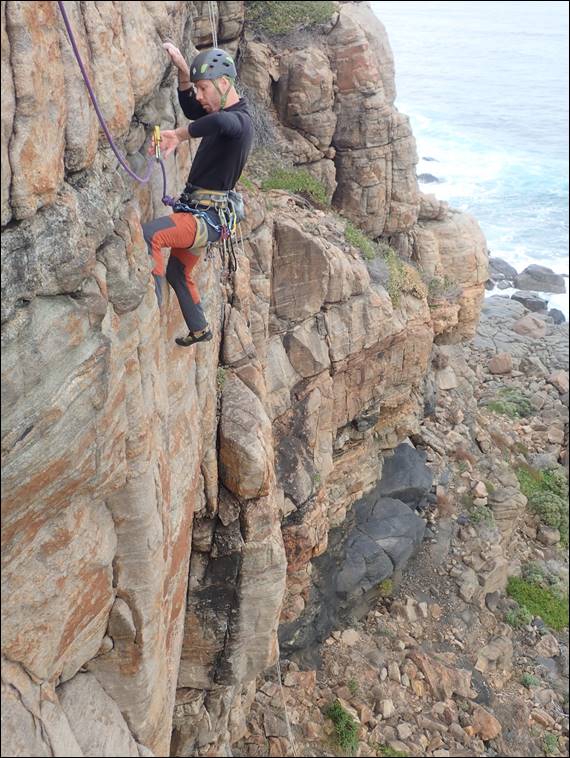
Sadly however the pumpy traverse to the bottomless chimney proved too much, not because it was a slopey rail but because it was wet.  He tried several times but it just wasn’t to be, so he instead had a go at the second line on his radar.  The harder Naming Rights, a very steep crack that really doesn’t offer much in the way of handholds.  While, as proven above, he got up the route, I’m sure he won’t be offended by me saying it was not in the best style.  He and then I too had to dog our way past the crux:

Despite Kym’s two lines being too much for today, we were not put out and it was my lead next.  This time I headed up Baited Frenzy, a route established in 86 and sharing the first half with the much more popular Digital Delecti that was established twenty years later in 06.  Both Mario and I really enjoyed the line, and to boot it had enough gear to make it sane.  The only reason I can think this one gets less attention is because it is a full trad line, and possibly also due to the route description:

I however will definitely jump on it again, and will also be encouraging others to do so.  I was not surprised when Mario came up hungry for more.  And he then made short work of what I consider to be the best line on the crag.  It’s not a crazy grade but does have a very fine, technical and sustained mid-section that is easy to pump out on with no escape.  For this very reason, he confessed that Use No SLCDs was a route that put him on edge.  Today however there was no hint of nerves or uncertainty:

I was feeling pretty tired following up, but we had left some gear at the base and also if you are keeping count you’ll notice we were only five routes in.  It was my turn to be on edge with the next lead, Trust Your Instincts is a somewhat steep and pumpy line.  The last section is awesome and feels super exposed, and even more so when you are feeling tired.  Providing the perfect situation for your mind to drift.  With arms tiring, the question is do you try to place more gear or run it out and hope you have enough gas in the tank:

I went with the latter and thankfully judged my physical and mental energy levels well, pulling over the top totally exhausted.  Mario came up with the last of the gear securely contained in his jacket dangling below him.  A sign that we might be wrapping the session up, but somehow we both got confused and thought we needed to get one more line in to even up the leads.  I’m guessing we were both a bit mentally done, but Mario was keen to finish on the much more relaxed Banana Split:

This is usually the warm-up climb when we come to this area, and today it proved an equally great warm-down climb.  It is impossible not to enjoy this route, although as I topped out my fingers, forearms, shoulders, back, legs, feet and brain were all strongly advising me to do no more.  The timing was good.  Mario too felt like he was done for the day, and out to sea a rain band was heading our way so it was a rapid pack up to avoid repeating what happened last week when all the gear and rope got wet:

Chased away

For some reason this weekend felt more welcome than usual.  I can’t quite put my finger on why but it may be related to still feeling a bit low on energy, and having just endured a full week back in the office.  Better still there were people keen to get out for a climb, which based on my almost weekly adventures may sound like a weird thing to say.  However, the local crew of active climbers has been dwindling over the last year or two and we are down to just a handful of people who actually get outdoors now:

My plans were to head out with Josh, and help him get some more trad leads under his belt.  Rongy and Howsie were also keen and available to get out, and with Rongy’s absence from rock he was more than happy with a low key morning at Driftwood Bay.  While it only offers lower grade routes they are fun and long, for this area.  He was also happy to drive down, and being the first people to arrive at the carpark he got to use my normal parking spot.  This seemed appropriate seeing he, like me, now also drives an Amarok:

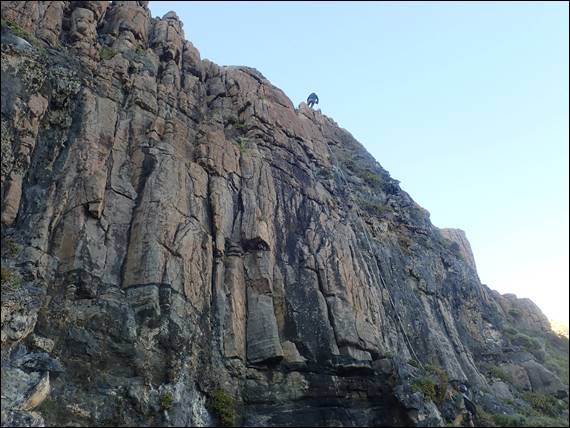
I gave him a bit of a ribbing and told him that his new vehicle had resulted in him driving like a grandad, which he didn’t deny.  Previously, when he drove in his far more sporty Subaru the journey would have been a tad quicker, today however he was happy to tootle along and at times not even worry about getting up to the speed limit.  The morning was glorious and once at Driftwood Bay we set up the rap line.  It was only an afterthought that Howsie casually asked Josh if he had ever abseiled before, which he hadn’t:

So while Josh plucked up the courage to have his first abseil experience, down a 20m cliff, I watched a carpet python very slowly work its way back into the undergrowth at the base of the crag.  Howsie, was at the bottom of the rope as Josh made his way down, ready to pull the rope tight and act like a break should Josh show any signs of getting into trouble.  But all was well, other than the carpet python having slithered away by the time everyone had got down.  We plumped for a couple of lesser climbed routes just to ease back into it, and it was not until Rongy and I set up our anchors that we looked out to sea:

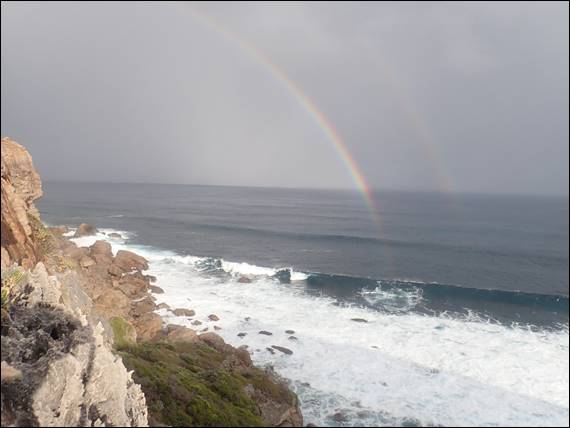
When we first saw the above rainbow it looked to be almost at the horizon, and with practically no wind we thought we would have a long time to wait for the cloud to hit land.  But the storm cell moved uncannily fast in the still air, with the rainbow at its fore.  As Howsie and Josh got close to the top of the crag the rainbow seemed to be coming right out of where the wave were hitting the shoreline.  Then the first drops started to fall, big “I’m going to drench you” type drops, and they came down heavier and heavier:

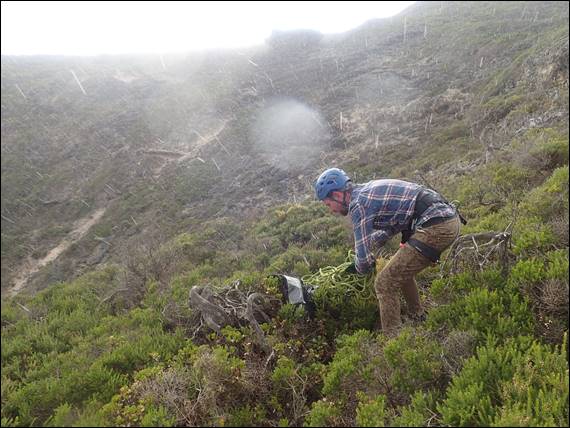
And heavier and heavier.  Eventually we seemed to be completely surrounded by low clouds and the light of the bright sunny morning turned into what looked like an evening dusky light.  Needless to say we packed up and walked out.  Driftwood Bay with its more adventurous routes, which are a bit runout and at times having loose rock would be no fun in these conditions nor for some time after.  So instead we moved across the main crag of Wilyabrup, where the rock was solid and gear generally being more plentiful:

Others might have taken their heavy wet ropes and soaked gear back to the car and driven off.  But not us.  The weather patterns here will often comprise storm cells or fronts that are very localised.  By the time we had made it to the top of the main cliffs we could see clearer skies coming in behind.  The storm cell was leaving us and making its way northwards along the coast.  The rock was still wet when we racked up for our second route, so Howsie and I jumped on the pointy end up some long, fun and easy slabs:

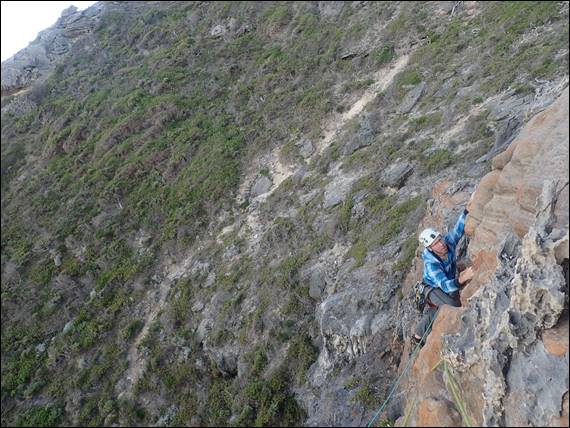
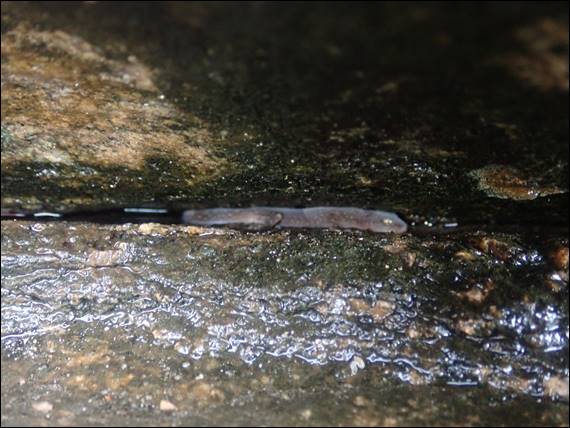
While technically it was Josh’s lead, with the conditions as they were I suggested he wait.  My rationale being also that while the slabs were easy the gear was spaced and that might feel disconcerting so early on in his trad leading career.  Half way up my route I found this beautiful gecko tucked at the back of a crack, somehow managing to stay out of the water puddling all round it.  This was sadly the best image I could get but had to include it, just to show the ghostly figure it created and also it’s striking golden eye:

Howsie felt it might be a velvet gecko, but with such poor image quality I’ve not been able to verify if it was.  I was however pleased that Josh, after following me up the 25m route on three pieces of protection had agreed with my thoughts.  The rock was however now starting to dry nicely, so it was time to send him up a route.  He and Rongy set off up lines next to each other, which worked out well allowing Rongy to give Josh a bit of advice when the climbing got a bit trickier.  He also helped Josh set up the anchors at the top, another skill that Josh will over time build his knowledge and more importantly confidence in:

Despite the trials and tribulations of the morning, that had eaten into the time we had available, we were able to squeeze one more route in.  We again picked two lines next to each other, and Josh was happy for me to lead indicating he had used up his excitement quota on the last lead.  So Howsie and I set off, with me getting a head start so I could get a few action shots.  We belayed the other two up our respective lines, as we basked in the sunlight and were amazed at how we seemed to have dried out from our earlier drenching:

I couldn’t resist sneaking in one more climb so rapped down and Howsie gave me a belay on the route he had climbed.  Meanwhile Rongy and Josh kindly walked down to get the bags and bring them up.  Josh was a bit slower coming back due to going for a quick dip in the ocean, which must have been cold.  This resulted in him missing out on the next great natural spectacle of today, a Wedge-tailed Eagle being chased away by a couple of gulls.  The morning had turned out to be great due to the sights we had seen, the vastly contrasting conditions we had experienced, and also of course the fun routes we had climbed.  As such we were all glad that unlike the eagle, we hadn’t been chased away earlier by the rain: