Just one regret…

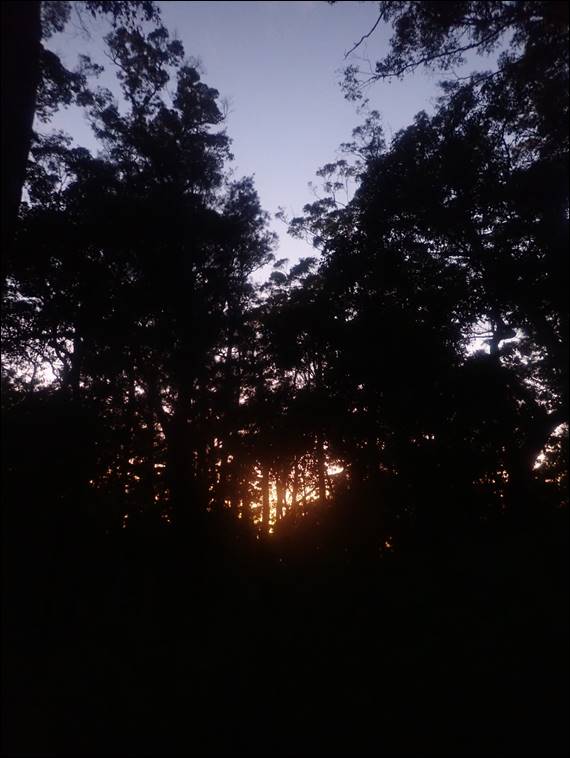
It was way too much like hard work this morning, when at 4am the alarm violently shook me out of my deep slumber.  When we had agreed the time earlier that week our reasoning was sound.  The destination being just a wee bit further than usual, and the temperatures threatening to tip into the thirties.  However, it had felt an arduous and draining week at work, and last night we popped up the road for a social at the neighbours.  The one beer I had was enough to make the early morning, as it arrived all too soon, a little less inviting:

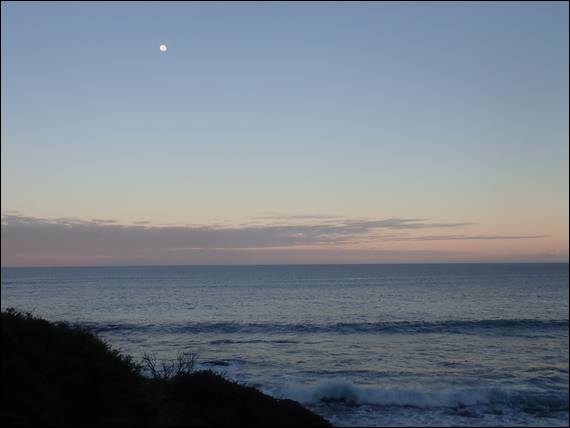
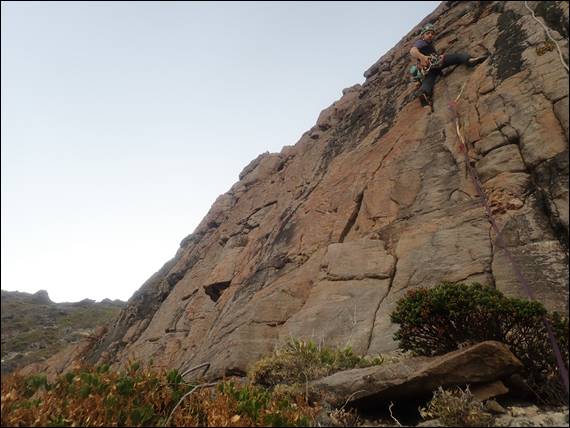
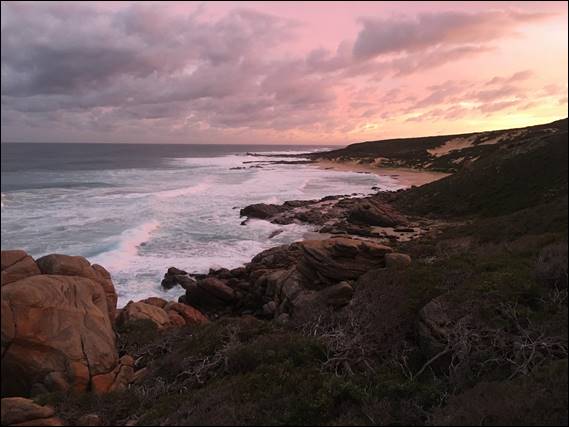
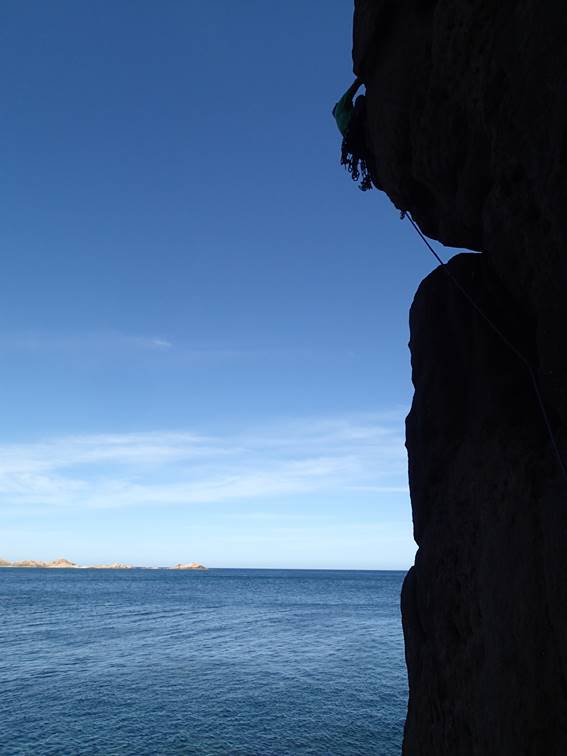
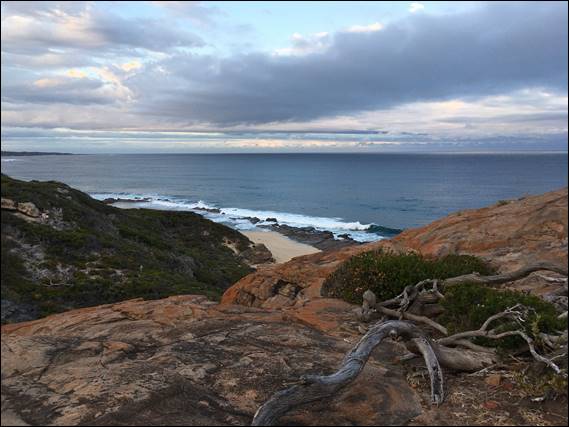
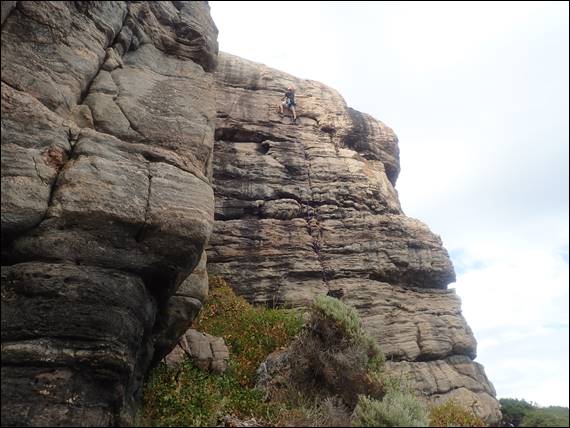
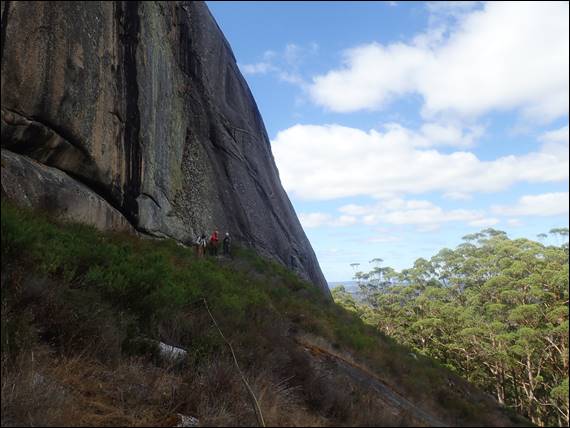
Rongy and I pulled into the carpark in Capel at the same time, and he too had found the early start a little challenging.  However, once the light started to come into the sky our circadian clocks sprang into action and the morning was once again a wonderful time of day.  The 80min trip led us to the most southern rocky outcrop worthy of climbing along the western coastline of the Leeuwin-Naturaliste National Park.  Cosy Corner doesn’t have loads of routes, but it is a place that has a special feeling to it:

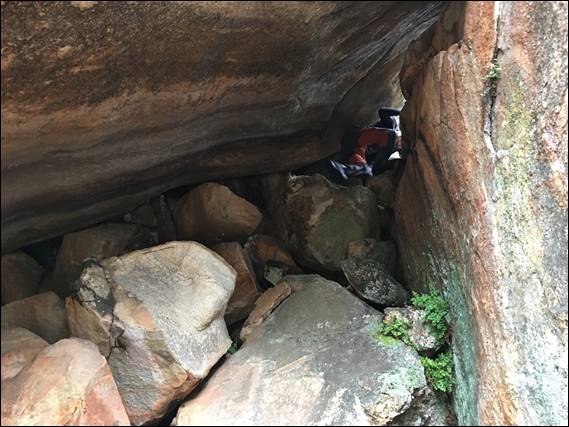
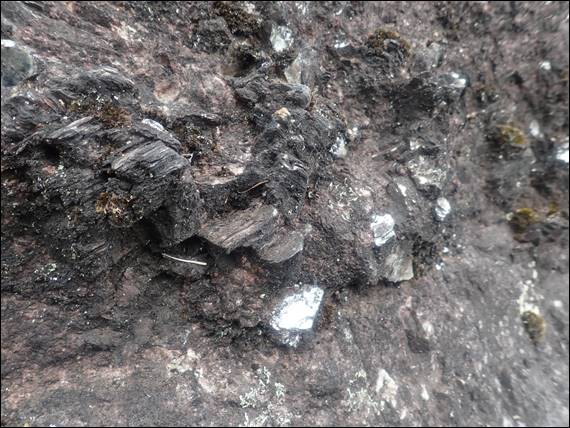
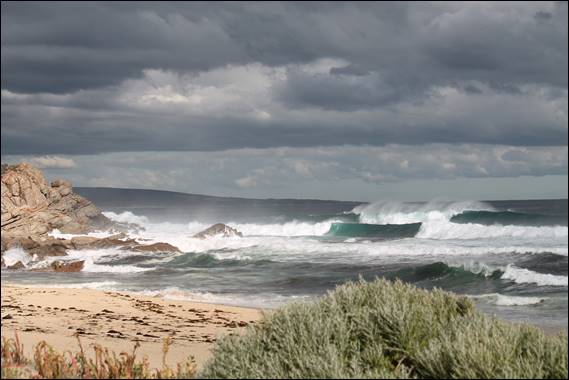
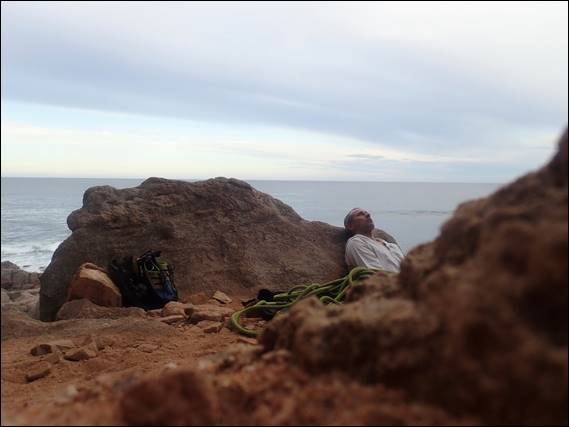
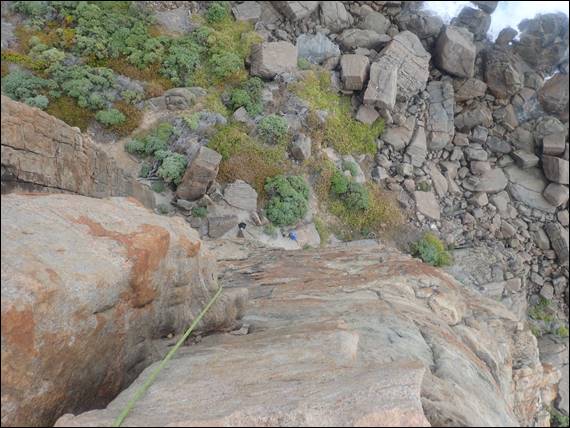
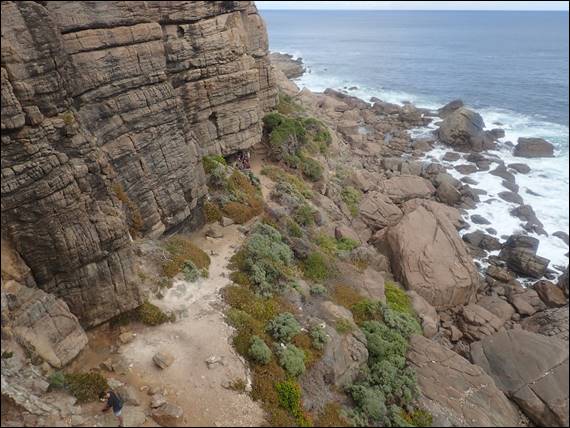
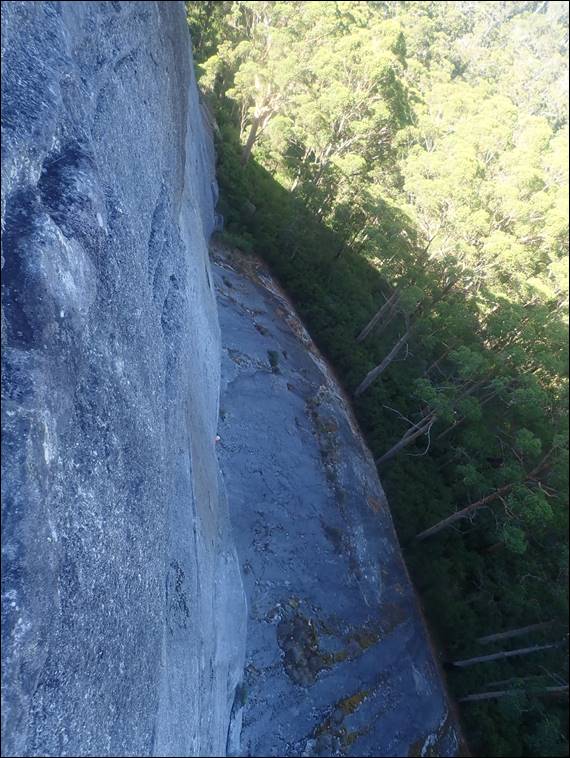
To gain access to the climbs on this cliff you need to abseil in, but neither of us had a plan for the day and were both a bit indecisive about which routes to hit.  Instead of deciding, we went for a wander, first to the southern end of the cliff, to scope out if there were any new route possibilities.  But there was good reason there are no recorded climbs on this section.  It was very broken with big blocks that looked like they were just hanging there and could tumble into the ocean with only the slightest bit of encouragement, as shown above:

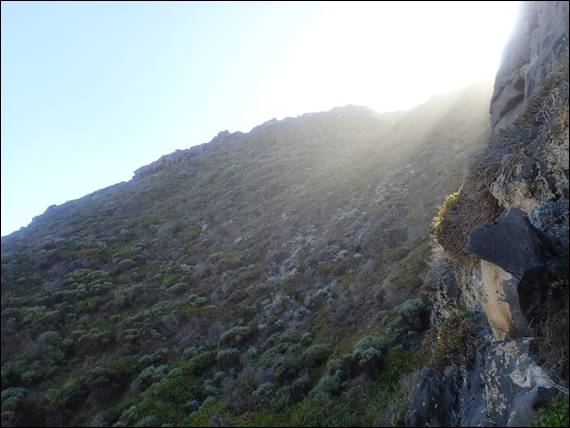
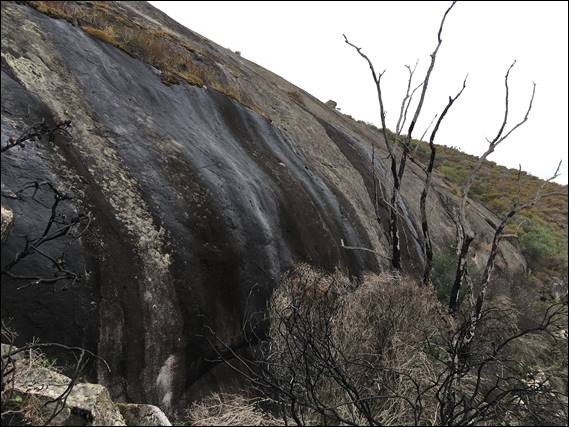
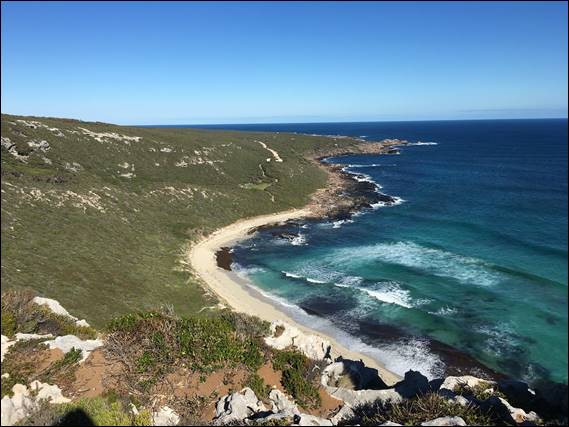
We then walked out to the headland, which is bleached out in the image above due to the contrast.  I’ve looked down this shorter and steeper face numerous times, but there are no good belay ledges at the base and the wall looks wet even in the calmest of conditions.  With no new sections worth exploring we rapped into the tallest part of the cliff, where we knew there were three worthy lines.  However, Rongy’s eagerness for something different resulted in him scoping the cliff left of where the established lines exists:

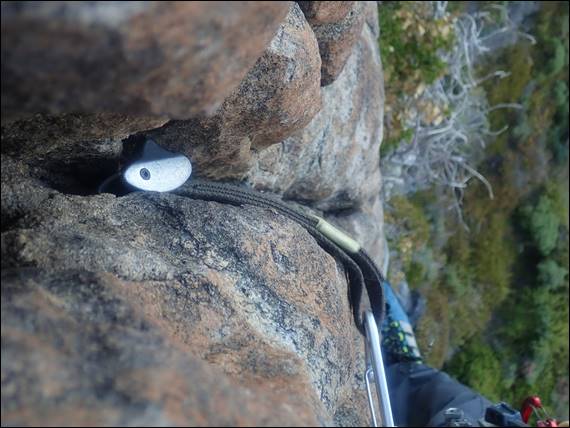
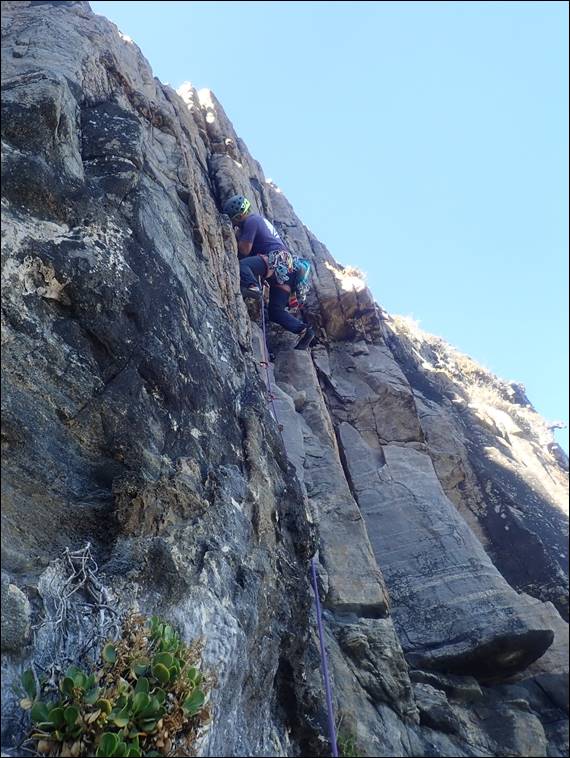
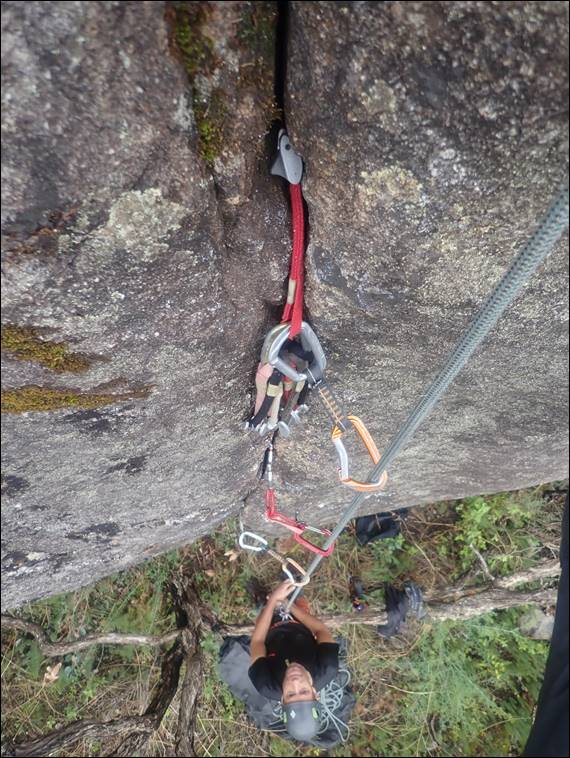
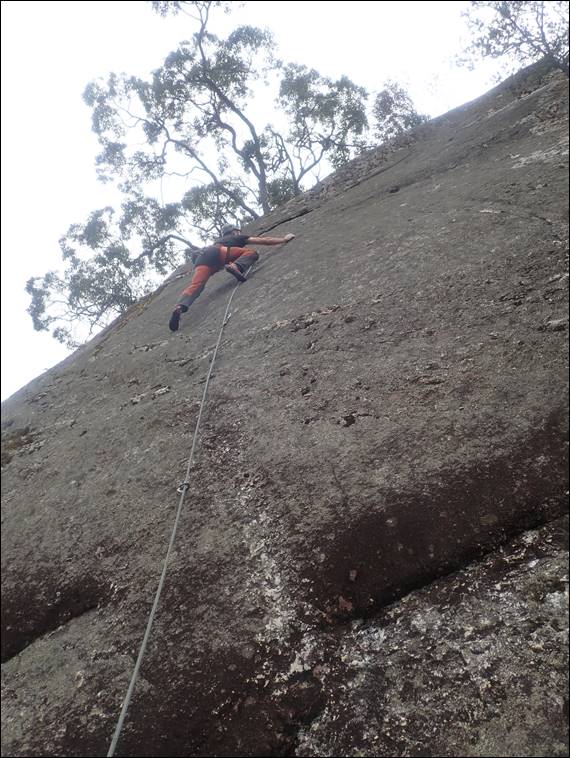
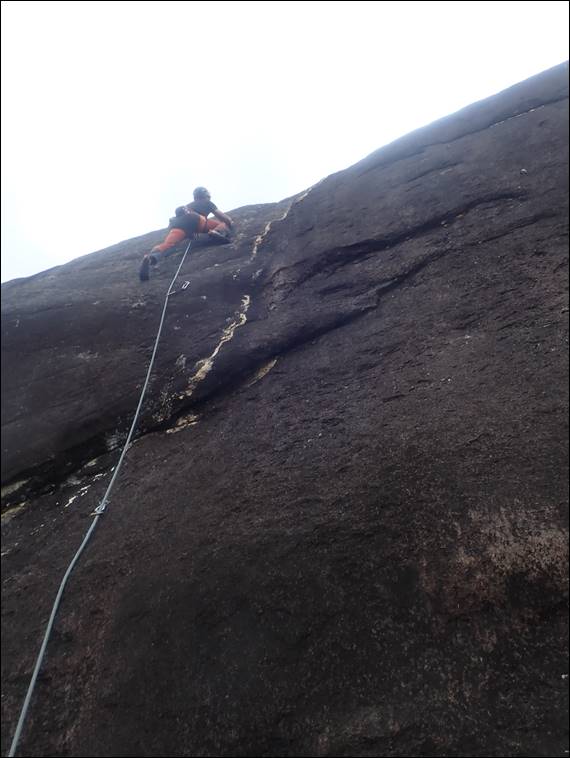
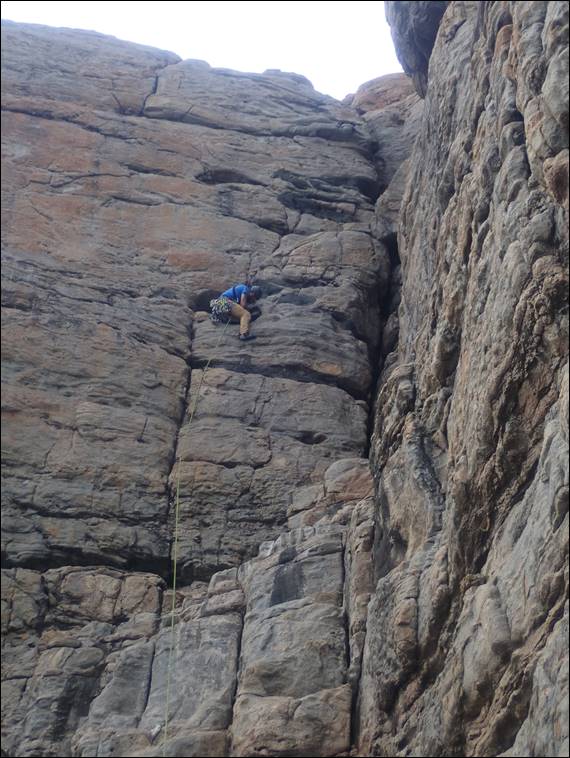
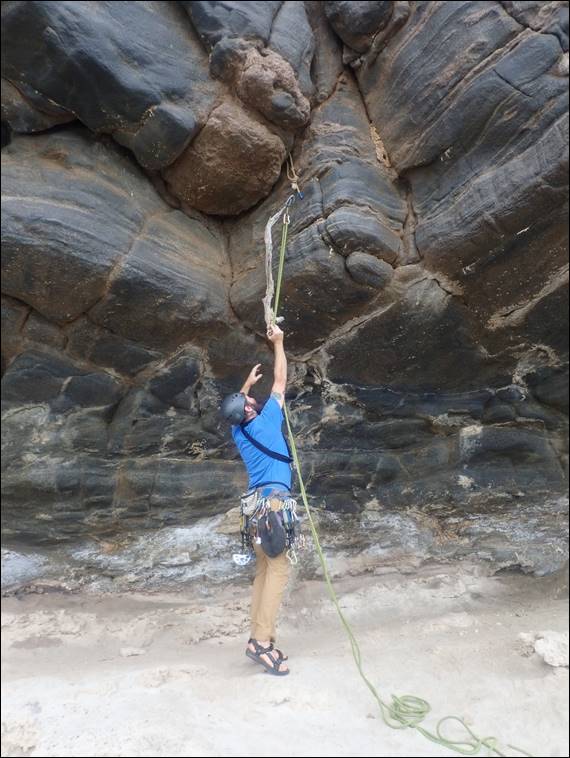
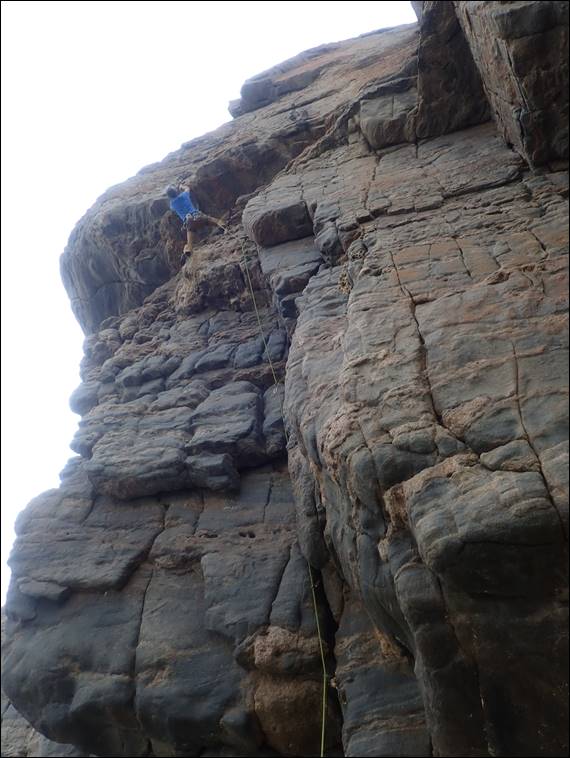
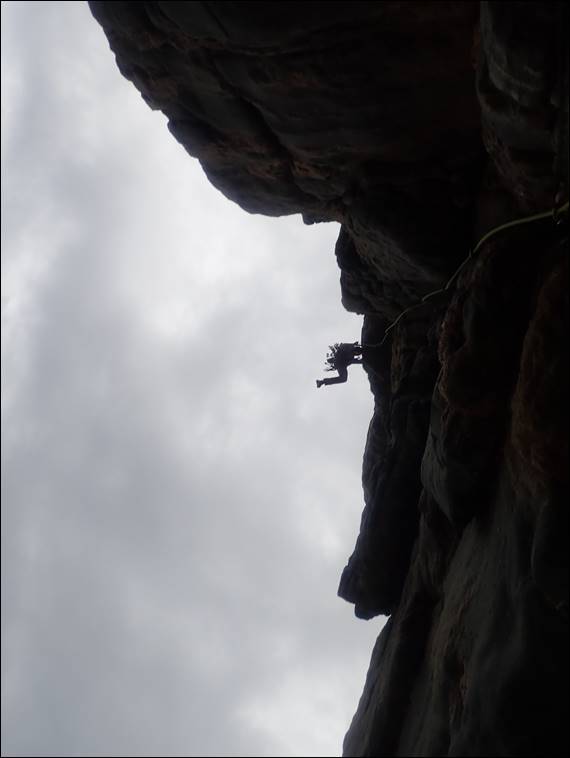
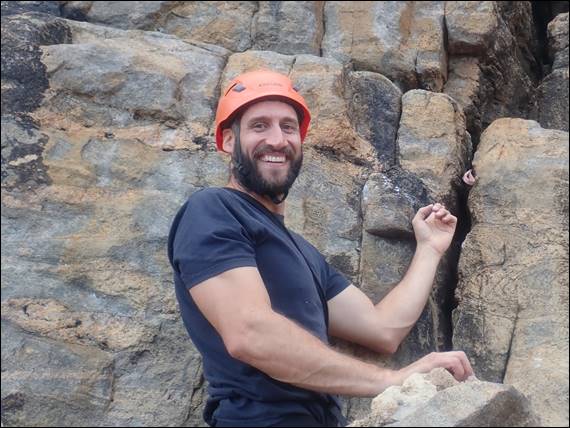
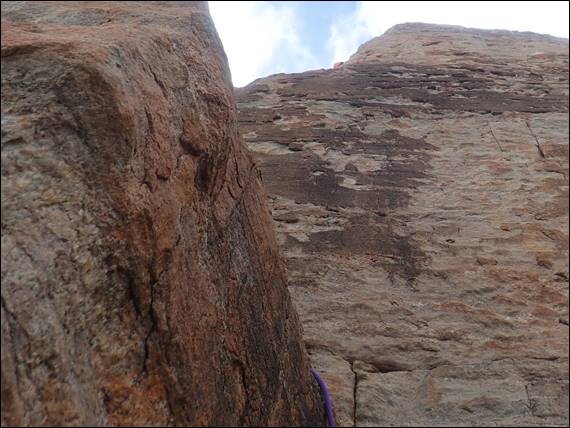
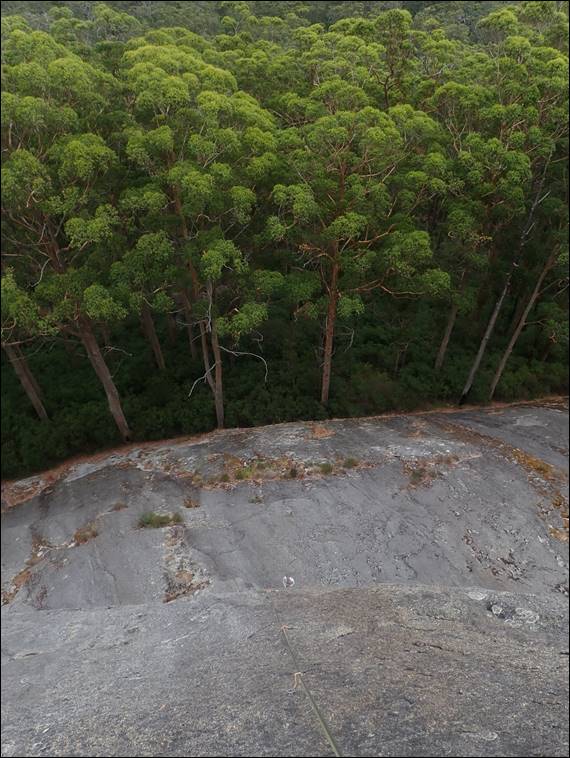
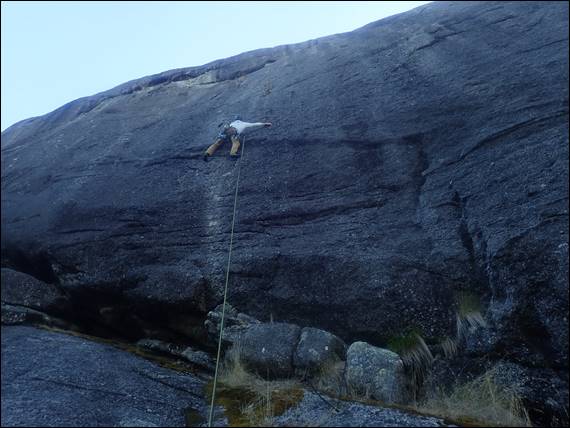
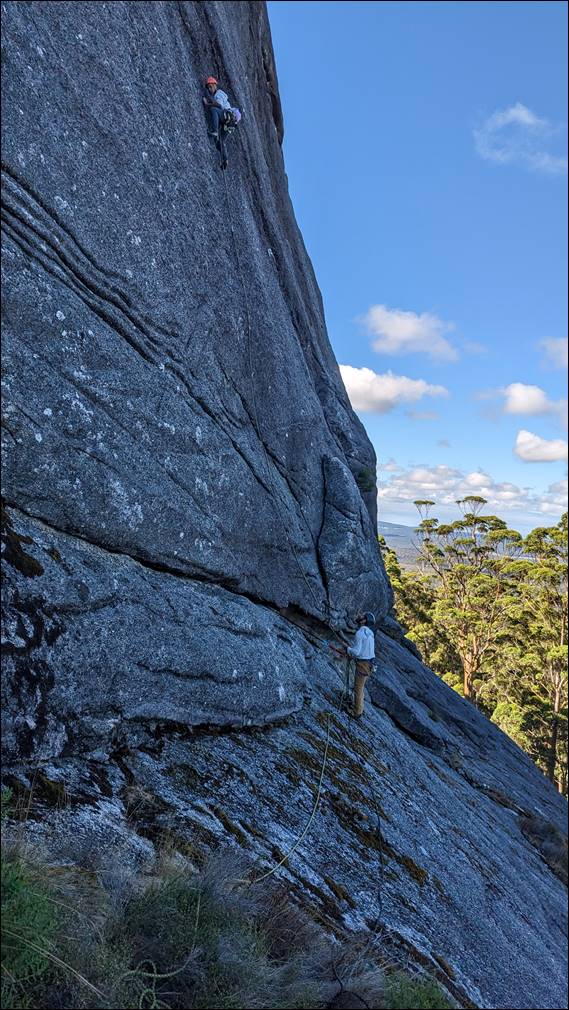
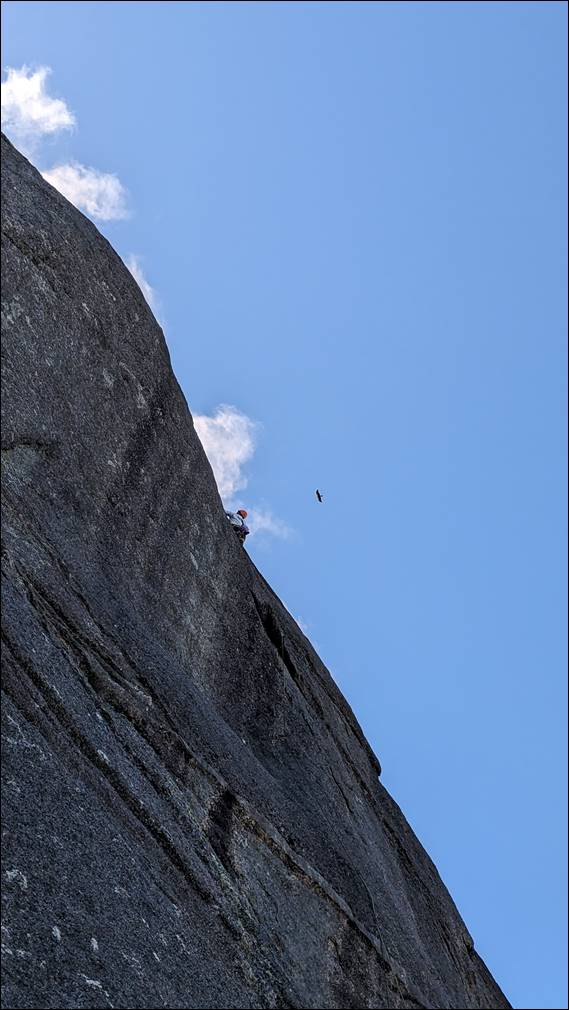
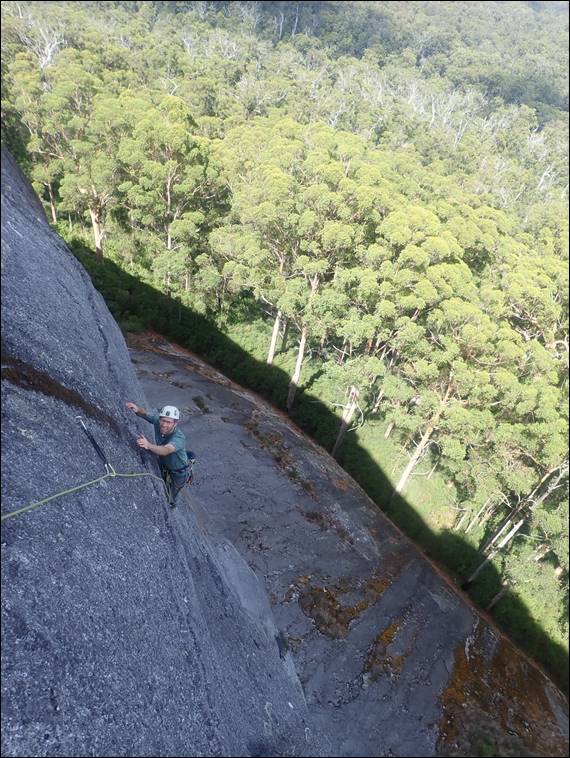
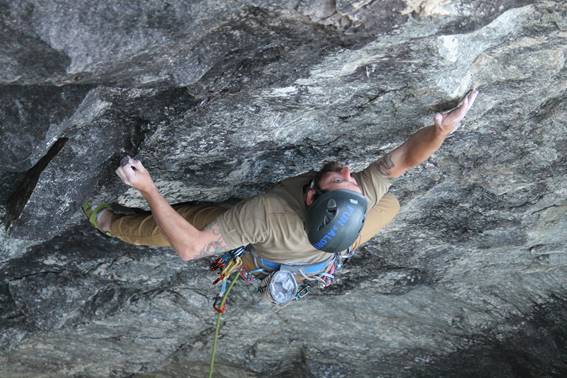
Despite not having climbed for some time and not feeling climbing fit, he managed to weave up a sneaky but worthy line that included a couple of bold sections.  The upper part of the climb eased off a bit, but not for him on lead.  The crux move, shown above, felt very exposed and insecure.  This led him to placing two pieces of gear close together, and after a quick discussion about whether to place a short or long extender on the red cam, we/he opted for a short one.  And this decision was enough to create drag, as the rope ran round the bulge:

Now I wouldn’t say I was jealous of him having bagged a new line, but it did make my eyes start to wander.  Not that they had to look too far, as just a few meters to the left there was an obvious corner crack.  The start provided great thought-provoking climbing that at the crux seemed improbable.  Above the corner there was a need for more reflections, when the climbed went up a section of the face covered in a sheet of limestone.  This stuff can vary from solid through to complete choss, which can give way at any time:

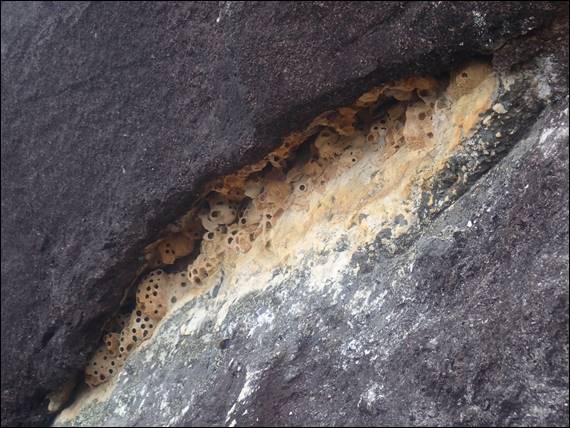
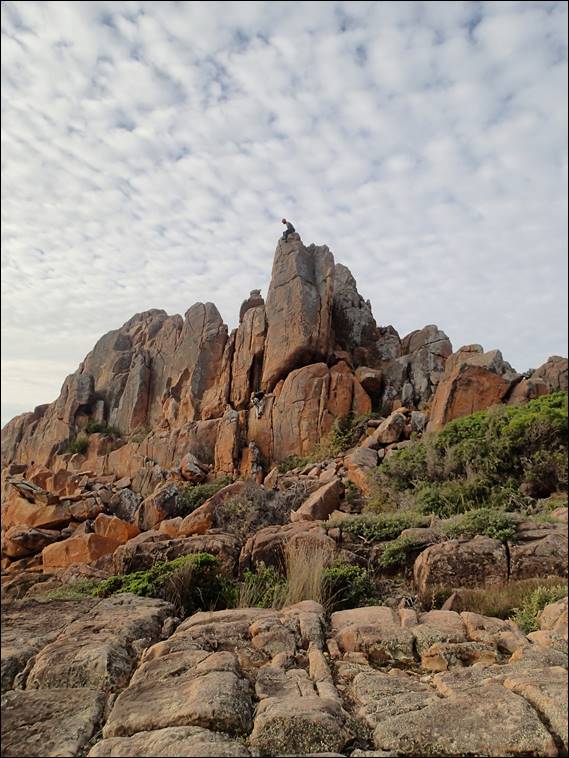
I’m pleased to say it held.  That said I can see Rongy’s line being repeated, but the limestone mid-section of mine might be enough to prevent anyone wanting to try it.  We were both pretty happy with the two new routes, but my eyes were still searching.  I pointed out a narrow section of rock on the headland that was bound by limestone on both sides, shown below.  It even had a small platform at the base from which to belay.  Rongy was not as convinced as me, so we decided it was time to jump on the established climbs:

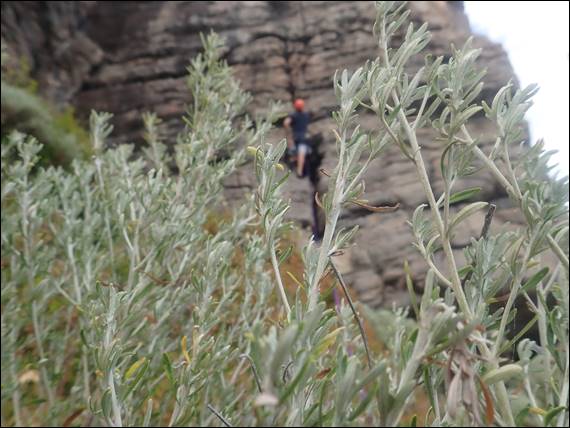
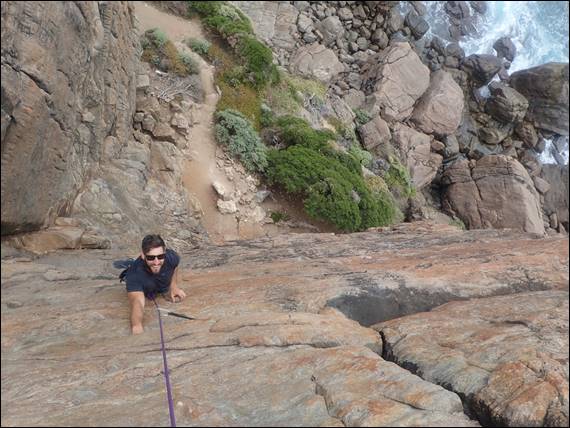
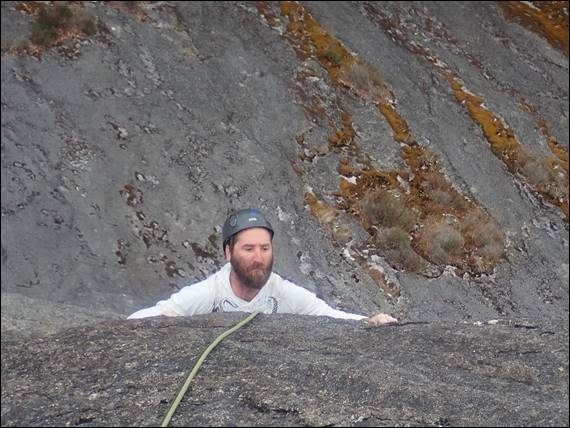
We hit all three of them allowing us to compare them against the two new lines to confirm what we might grade them.  We both agreed they were a tad harder, which was good as it meant we didn’t have to work quite so hard as we knock the first, second and finally the third line off.  It was however hard enough to work Rongy’s unconditioned arms.  And as he began to surmount the roof of the final climb he hinted that he didn’t have much juice left in the tank.  Code to say “watch me”, which I did while continuing to take photos just in case:

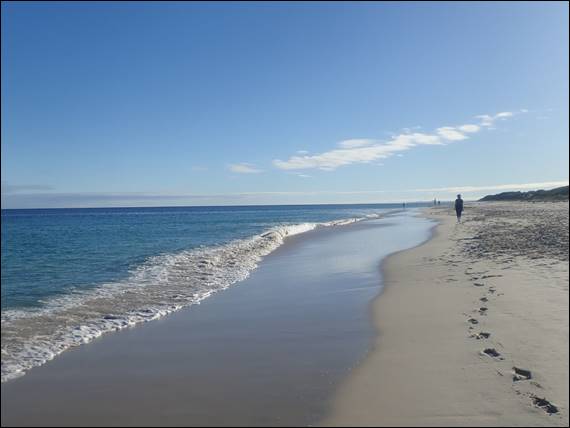
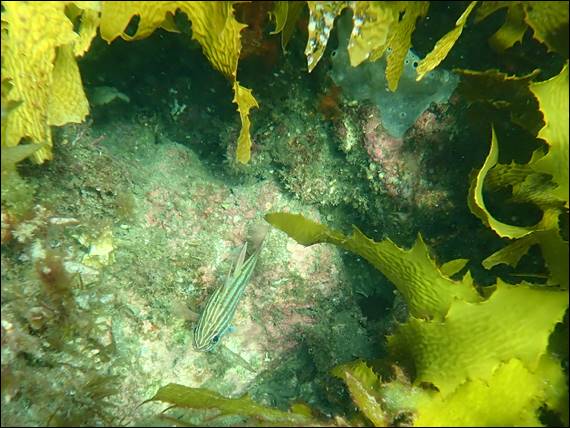
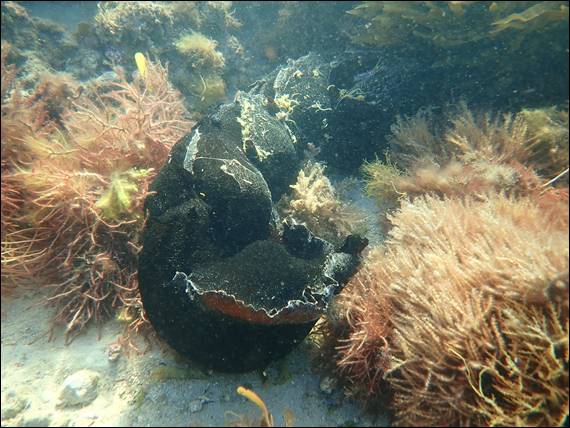
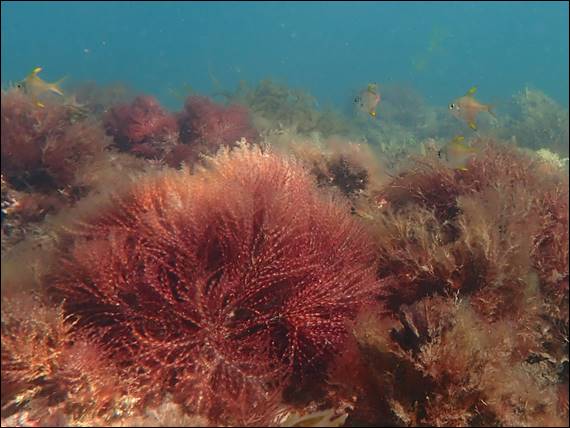
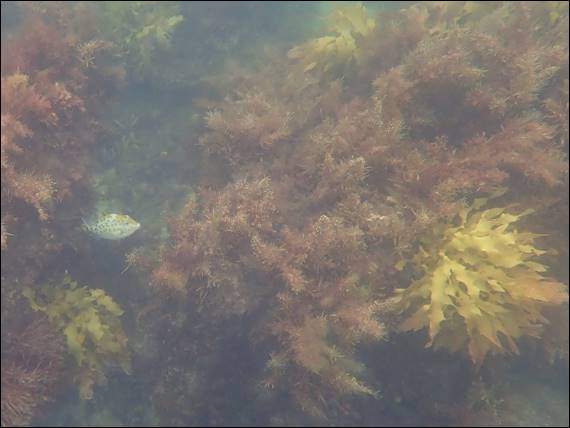
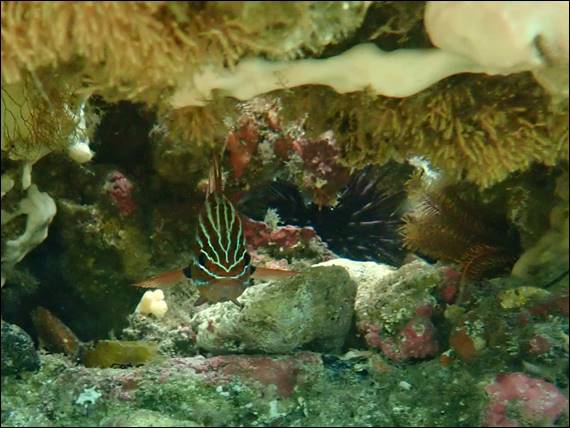
Five lines may not seem like a lot of climbing considering the distance, and there was plenty of shade time left on the wall to allow more climbing.  The decision to call it a day isn’t however always based on the amount of climbing, but also quite simply whether we feel satisfied with what we had done.  And we both did, especially the new routes: https://www.climberswa.asn.au/topic/cosy-corner/.  Our only regret was that we didn’t bring the snorkel gear.  The water wasn’t flat but it was clear and as the sun rose higher in the sky the weed covered reef looked so inviting.  Next time:

Big brother

I thought I had been pretty good with taking time off from work this year, but I seem to have got towards the end of the year with a fair bit of leave up my sleeve.  This included one day of a particular type of leave that if I did not use it I would lose it, as the clock clicked over into 2023.  A while back I had decided to use it today, and the tentative plan to get out with Howsie for a climb.  Sadly these plans were scuppered, although coming up to the silly season and all that it brings, I wasn’t overly surprised.  So already had a backup plan:

Walking in through the low scrub the birds, hidden from view, were in full song.  It was about the same time as I would normally have been driving to work, which I felt was an early enough start.  Plus after a run of low thirties/high twenties it was forecast to be partly cloudy and cooler today, so there was no need for a proper early start.  That said I was still hoping for more cloud than not, which didn’t happen.  The cloud was about, it just didn’t provide shade where I was climbing.  That meant I was going to be in for a hot and sweaty time:

The carpark at the beach can often be packed at this time, not today.  It was empty and I didn’t see a soul as a drove in, and then hiked along the track.  It was probably due to the lack of swell today, so the surfers could have a lie in.  Across the bay I reckon the snorkelling conditions would have been great.  But at the mighty zawn of Smiths Beach, where I was standing, the sets of waves while not big would have made it unpleasant to be in the water.  That didn’t however worry the crabs, who ran and dived in water as soon as they spotted me:

When writing the guide for this area I called Smiths Beach the big brother of Moses Rocks.  They have a similar style of climbing with rounded rock and flared cracks, interspersed with blank featureless sections.  Friction is everything, but only works with good balance and engaged core strength.  However, Smith Beach is more of a brute being steeper, more technical, and with rougher rock.  And just like a tussle with a big brother I find that I come away from this place with scuffed knees nearly every time, and did again today:

On previous solo missions here I have stuck to the steeper and harder north facing wall, as it hold onto the shade for longer.  Today however I plumped for the south facing Harbour Wall, on which several routes take a leaning line up the face.  To the left is the open ocean, and the thought of slipping off, down low, and swinging out above the ocean wasn’t very inspiring.  Just to show that I can be sensible and do consider the risks, to avoid that happening my set up today had more directional pieces of gear, as well as an anchor at the base:

That said the start moves of the first line and finale of the last line of the day felt pretty sketchy to say the least.  When I led the first ascent of these routes I did them ground up, which means not I did not inspect the lines beforehand so had no idea what holds or gear might or might not be available.  So the acceptable level of risk back then was a tad higher than it may be now.  While I only managed one line in the shade, after which the sun struck, I stuck to my plan and sweated it out and thoroughly enjoyed my tussles with the big brother:

Give a dog a bone

A sixteen hour round trip to catch up with friends down in Esperance was just a bit too much to think about for Ash this weekend.  This worked out well for me, as it meant I had someone to hold the rope and I didn’t have to go solo again.  As Sam found out last weekend, having the rope below you brings a whole new perspective to climbing.  Something that you can probably guess I relish.  So while I will resort to top rope soloing if I have to, my preference will nearly always be to be on the sharp end:

I say nearly, as I feel any statement that uses the word always and/or never are rarely true.  In fact Lisa and I made a pact many years back to avoid using these terms, in part as they can unexpectedly result in discussions taking a turn for the worse due to inferring accusations.  The last time Ash went climbing was with Claudia, Sam and myself, which was nearly three months back.  As such he confessed to not being climbing fit resulting in us plumping for the Organ Pipes at Wilyabrup, a rarely frequented place:

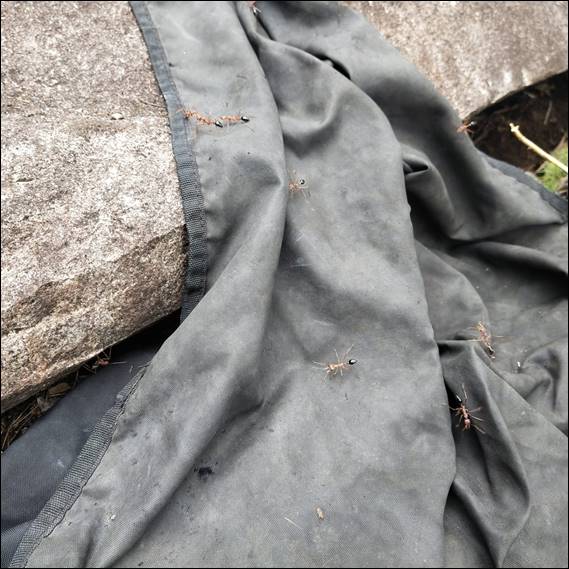
This place has short, and some might go so far as to say scrappy, lines.  They however offer some fun lower grade routes, perfect to ease Ash back into climbing.  The main face has a great level and clear area at its base, a perfect spot to belay.  The only issue today being the infestation of ants.  I attempted to get an image showing them en-masse, failing miserably so I instead focused on one of the entrances to their underground home.  Here I watched them frantically scampering in and out, and wondered what they may be communicating to each other:

While Ash looks rugged up, he discarded layers after the first line.  It was a bit of a strange morning, we had expected a crisp clear start to the day but the air seemed to hang heavy and the humidity was up.  This is what I put all the any activity down too, and made a mental note to do a bit of research to see what facts may lie behind my theory.  There are plenty of pest control sites that reference increased ant, and other insect, activity in humid conditions.  All indicating the moisture draws them out, but finding actual research or factual information was harder:

The closest I could get was a paper, which detailed observation of a 25% increase in ant activity with increased humidity.  And I am happy to take that as confirmation, although the ant activity today was way more than 25% of what I normally see here.  So much so we avoided the obvious place to belay from in order to get away from the critters.  Humidity plays another role with me, making me feel lethargic.  That added to the reduction of friction on the rock due to the moisture in the air, and increase in sweat seeping out of my fingertips.  All of which is not a good combination:

Fortunately we were having a purposely cruisy morning, so these aspects didn’t impede my performance.  Ash too did well, and even more so when I found out he had pounded out a 27km hike along part of the cape to cape trail yesterday.  That along with his active job had meant we was already aching before we started.  Making me wonder how much I could push him along even with the more sedate routes here.  We stuck to the original lines here and purposely avoided the newer routes, which tend to be that bit more sustained and slightly trickier:

The newer routes being sneaky lines that I have over the years picked off, or offered up to others so they could bag a first ascent.  There was however one sneaky option that I had not to date attempted, and despite his tiring arms Ash encouraged me to give it a go.  Even hinting I was a bit of a dog with bone, so I might as well go for it and get it out of my system.  The image above shows the route, and it was really fun.  The top wall was where it got spicy, which is a bit of theme on this face, and this was a little too much for Ash’s not tiring but now tired arms:

Being a slightly scrappy crag, he was able to avoid the hard part and came up with an ear to ear grin thoroughly enjoying the climbing, but also just being out.  Having got the new route out of my system (https://www.climberswa.asn.au/topic/wilyabrup-the-organ-pipes-2/), we hit a couple of easier routes before jumping on the crag classic.  It was clear that Ash was now pulling pretty hard to stay on.  And while the security of the rope above gave him the confidence to keep moving, it was a sign that it was time to wrap things up and hopefully Ash won’t wait so long before his next trip out:

Adjustment time

All good things must come to an end.  Or a better way to look at it, is that they are being placed on hold until the right time comes round again. After watching the spikes come up from the large green leaves that you would not usually associate with an orchid, for a month or two now, on Monday I finally saw the flowers starting to open.  The Slipper Orchids (Cryptostylis ovata) are in town, and like the Leopard Orchids this year they seem to be here in good numbers.  While these grow in colonies normally only a couple may flower in any one year:

But not in this year, and most leaves had spikes and looked like they would put on a display.  This plant is named after its basal leaf that is said to look like an egg, which is the meaning of the Latin word ovata.  And like their basal leaves, the flowers look nothing like the other orchids I have shared with you.  My last orchidy fact of the season is that this particular species, like so many others, tricks an insect into assisting with pollination.  The insect this time being aptly called the Orchid Dupe Wasp (Lissopimpla excelsa):

As we leave spring behind and look forward, we are now in summer.  This can mean for us months upon months of no rain, and that combined with the wet spring we have just had has resulted in big tinder-dry fuel loads, ready to explode into flames.  Controlled burns are underway to reduce these fuel loads, as much as practically possible.  One of these was being managed on Tuesday, and resulted in the entire area being blanketed in smoke.  The blanket covered over 150km, as the crow flies, of land along the coast:

It made for an eerie afternoon and evening, and was just one day after I had been walking about in Manea Park admiring the orchids, under a blazing sun.  These smoky conditions are not great for those with breathing problems, and these are the days to keep the windows shut.  That is despite the slightly stinky temperatures and desire to allow the sea breeze to blow cool air through the house.  Fortunately, these conditions are relatively short lived and the following day the blue sky was back with the sun being way too bright to look at:

Wednesday came with its clear sky and bright sun, and I snuck home a bit early.  Recouping a bit of my flexi time, but also purposely with a view of hitting the ocean.  On the weekend I had several reports of people getting back in the water and finding the conditions were pretty good, and today I got the chance to check for myself.  Sadly being a bit late in the day the winds had started to turn, which resulted in the surface being a bit choppy.  However, seeing I’d walked down and was wet-suited up I went for it and was pleasantly surprised.  I had expected to be hit hard by the cold, but I wasn’t:

Then I expected the visibility to be a bit meh, but it wasn’t and I could see clearly.  Bobbing about in the water felt awesome, it was so refreshing and such a great way to let the mind relax and be free of all thoughts.  There was a little bit of disappointment when I realised just how bad I was at holding my breath, was I that bad last season; and then as the water continued to chop up more, I even felt a tad queasy so eventually came out.  Those however are all part of the adjustment I’ll have to deal with, as I transition from my land to water based adventures.  All up I was very happy to be back in the water:

Too much of a good thing

Walking out this morning, and once we hit the coast to make our way northwards, ours were the only footprints to be seen.  There was however plenty of other life about.  The underside of one roof system we passed was moving, covered in hundreds of thousands of midges that once disturbed erupted into a cloud that blurred the vision.  Fortunately, we were not climbing there and we walked on.  As we did crabs speedily scuttled sideways, diving off boulders and ledges in kamikaze fashion without knowing what lay beneath, just to get away from us even though we were only walking by:

Meanwhile at a much slower pace the limpets in the rock pools lazily moved about, oblivious of us as we watched or maybe they think they were underneath a protective layer of water.  We also spotted the tracks of kangaroos, and above I think a monitor, but none of these bigger creatures were visible.  Not that we spent any length of time looking for them, as today the main focus was Sam.  As previously indicated on our next trip out, i.e. today, I was going to get him on the sharp end.  And the best place for that, in my mind, is The Playground:

It offers the chance to warm up on the slightly longer walk in, boulder to stretch the body, pick short easy routes with plentiful gear options, and the best part being the sandy landing should things should go wrong.  But before tying into the rope to set off, there was the need for the obligatory discussion session to talk about the ins and outs of lead climbing.  It involves a lot of thinking, probably more than most people realise before they set off on such an adventure.  So the initial chat can take a while, describing types of gear and where and how to place them:

New terminology comes in play, such as the zipper effect, the carcass catcher, psychological gear, and others.  All related to a single focus of mitigating the consequence of a fall.  You would think it was easy, throw loads of gear in.  But that can be counterproductive by creating rope drag, result in you pumping out due to hanging about too much, end up with running out of gear when you really need it, and/or quite simply physicking yourself out.  It is a balance to reduce the risk to acceptable level, and as such ultimately a battle of the mind:

This was something Sam noticed and remarked on as he racked up one, two and then a third lead on the fun boulder of the Playground.  For his first two leads I simply told him to climb a line that looked fun, but for his third climb I pointed him to the one shown above.  Mainly because it is steeper, and as such it teaches you to find the positions and places that you can feel most comfortable to place gear.  All the while with our arms slowly tiring, and that in turn playing games with your mind.  Not just making you second guess whether you can hold on, but whether the gear is any good, and/or if the rock round the gear ok:

Being on the pointy end with the rope below him, the consequence of a fall could have been potentially more serious than previous times when he had followed me up a route.  So much so that his mind and body was feeling it.  And of course all in a good way if you like that sort of thing, which it looked like he certainly did.  So while the three climbs Sam lead were never too hard, he felt like he had deserved a break.  But before that happened I took the lead and maybe was a little mean when I took on a fun roof, just to work those arms a bit more:

Sam had brought a flask and fruitcake, and while it may seem like I probably hadn’t earned it I was more than happy to sit in the shade and take in ocean views, while munching and supping away.  In part as, being the playground, I had found time to jump on a few of the boulder problems to work myself a wee bit more.  Such as when it was time for Sam to set up the anchors for the belay at the top of the climbs.  I had helped him set up his first belay station, after which he was able to competently apply the knowledge for his subsequent leads:

Reenergised after the short break, and importantly sustenance, we wandered across to Lost Buttress.  It was time to double the length of the routes, requiring a bit more thought to make sure you don’t run of gear and also apply good rope work.  The latter caught him out, but not so badly that it made the climb unenjoyable.  In fact Sam relished the longer line claiming it was the best route he had led today.  Fair to say I think he has caught the leading bug, although he did confess that his arms probably didn’t have enough juice for any more leading today:

To even up the number of routes I jumped on one last climb, and of course wasn’t going to make things too easy.  So we took on the big roof to get a bit of exposure and work out the last ability of those arms to hold on.  I am pleased to say they did managed to do, enabling Sam to get a clean ascent.  What with all the instructions and things to learn, the day had been relatively slow placed and the sun was already tipping over the top of the crag telling us it was time to wrap things up.  But it was to be expected, and is all part of it:

There was however the walk out to still contend with.  The rock hopping back along the coast is good fun, but then we had to ascend the ridge with step, after step, after step making my legs feel a bit tree-trunky.  Unlike this bee, seemingly laying on its back sunbathing, after it had over indulged in nectar to the point that it was ladened down with pollen, we had to keep moving and I was kind of pleased to finally reach the car and plop into the seat.  I’m also pleased to say that while the bee looked to have had too much of a good thing, it did eventually fly off:

A cool find

In the South West of Western Australia we would normally have access to the Bureau of Meteorology radar imagery from the Perth (Serpentine) radar.  But this has been out of action since late August, so it becomes a little trickier to check what’s happening in our neck of the woods.  Added to this, despite summer officially starting in less than two weeks, another cold front marched over us during the last few days.  So despite Rongy, and possibly Sarah, indicating a keenness to get to Moses, they bailed on Friday night.  Truth be told, I could sense it would happen from a few days back:

It was understandable, when life is busy I can appreciate not wanting to use up precious time when it look likely the conditions may not be ideal.  I, on the other hand, was not so easily put off and prepared for a solo mission.  Being a solo mission I changed the destination to Wilyabrup, and it is an hour’ish drive from home to the carpark.  As I drove west and approached the halfway mark, the sky ahead looked ominous.  Sure enough driving rain came and went, and then came and went.  Who knew which way this could go, and I was therefore surprised to see another car parked up.  At least it was not raining as I shouldered my pack to start the 15min walk to the crag.  Then part way along it dumped on me:

Luckily I had just got to the only shrub on the walk in, so I hid under this.  Normally the ocean can be seen from here, but it was proper claggy and the ocean could barely be seen.  Watching the water quite literally flow down the branches of the shrub I almost turned round.  But not being a mountain summit, which would have held onto the claggy weather, the belt of murkiness pass over.  My intention had been to set up on Steel Wall, a generally steeper and harder face, but everything was wet.  So I decided to set up on Hope Buttress.  Allowing one setup for my rope, round a big boulder, that would do for all the lines.  Some of which would be easier and more appropriate for the conditions:

Then just as I was about to get the rope over the edge, Wiggins popped up the finishing slab of Hope. I haven’t seen Wiggins for a long time, during which he has changed the number plate on his car, which is why I didn’t recognise it. He told me that he was here with Andrew, who I last climbed with almost exactly a year ago at Moses Rocks, which may also have been his last climb outdoors. They were also joined by Jakke, someone else who I have not seen for a very long time in part because he has been living in Canada and has only recently come back for a bit of a holiday:

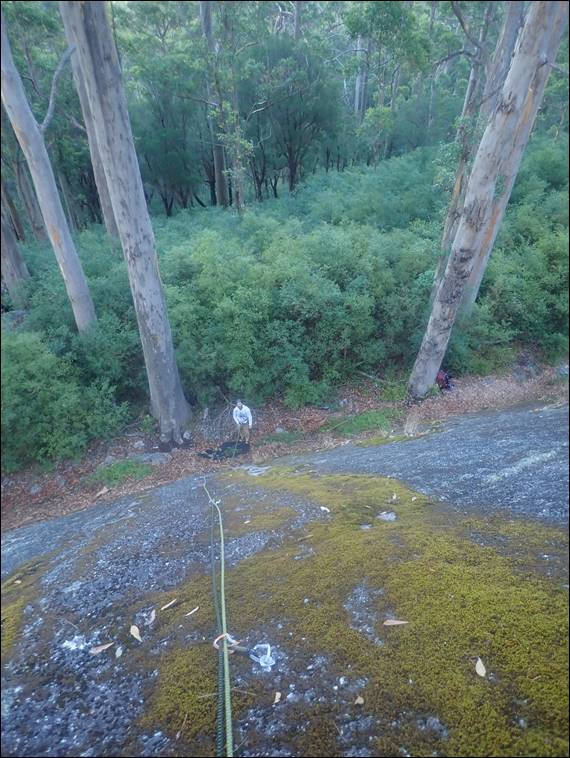
Just to be clear I had no idea they would be out, and they also didn’t know of my plans.  Wiggins had said to the others on Friday evening that it would still be worth going if there was a forecast of 5mm of less rain.  Then this morning, as they had stood where I was as I took the above photo, with rain falling a comment was made by Wiggins that seeing I wasn’t out maybe they had misjudged the conditions.  It could therefore be construed that my arrival may have been a good omen.  And it certainly seemed that way, with the rain abating and staying away until we were all wrapped up for the morning:

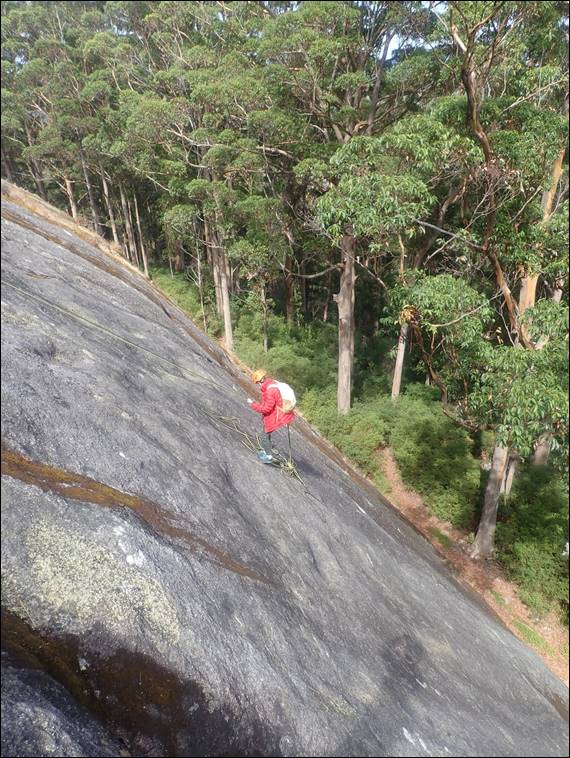
While they were with three, and they had two lead ropes and ample gear, I stuck to my plan and set up my top rope to do some laps. Although we all stuck to the same area, and they made use of my line to rap down after each route. As such I wasn’t going hell for leather as I would normally, and took a few breaks between climbs. This enabled me to catch up with the them, allow them to descend back to base after each climb, and give me an opportunity to take a few images as they climbed and abseiled. Of note I was surprised to hear the image above is of Jakke’s first recreational abseil:

That may have sounded like a random comment, but Andrew and Jakke have both been members of the State Emergency Service (SES), and have been trained up in vertical rescues. While he will have abseiled with the SES they would have used different rappel devices, with more options to meet the needs of a rescue. With my rope round a single boulder, shifting my line was quick and easy. As such while Wiggins got his second lead in, I climbed a few of the routes to the left. Far enough away not to get in his way but also close enough to still be social and catch some nice images of him on lead. With no more rain the rock was drying nicely, and I jumped on a few of the harder lines on this wall:

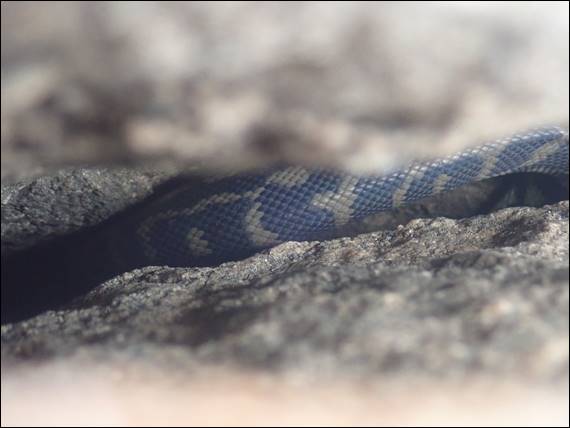
I mentioned the use of my rope as an elevator to get down.  This gave me time to kick back between climbs and look about.  Being on the Hope buttress I’d already spotted the Southwestern Carpet Python (Morelia imbricata) tucked deep behind the flake of Glory on my first climb.  And as I looked about in the small shrubs on top of the cliff I spotted a skink with a distinct red throat, so sat very still and waited to see if it would come out.  It did, not for long but enough time to enable me to get a couple of images.  Not only did it have an obvious red throat but also long toes, so I knew it was a skink I hadn’t seen before being a Western Three-Lined Skink (Acritoscincus trilineatus):
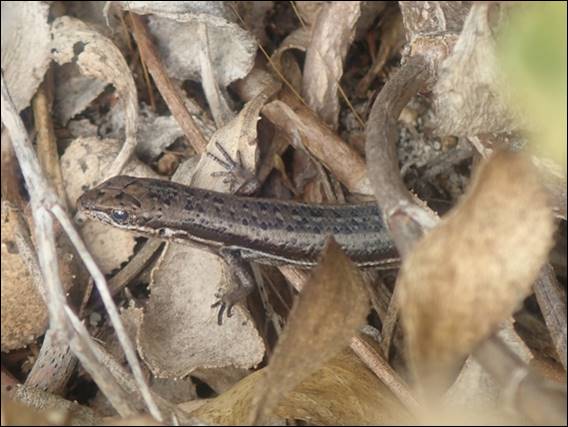
Being found in the cooler climates of the South West, relative to the north, it is also known as a Cool Skink.  I’ve read that both the male and female can have the red colouring under the throat, and that this becomes more intense during breeding season.  While the angle of the image I got doesn’t show it, the red was pretty striking.  This was apt considering we are, supposedly in spring and soon to be summer.  Once everyone was back down I left the skink alone, and I turned my attention to another line to top rope.  In between laps and as it was Andrew’s turn to dust off those leading skills, I scrambling about on the boulders below to get an image from another angle:

While I didn’t find the male and female of the Cool Skink, I did spot the pair of King Skinks (Egernia kingii) I had seen a few weeks back with Sarah and Rongy. They were sunning it up and showing signs of affection, lying right next to each other with their heads on each other’s body. One of them was a little skittish, running for shelter whenever I got too close so I left them alone. The image below is of two Southwestern Crevice-Skink (Egernia napoleonis), which I assume were a pair, and these were not at all worried about me. I used the rope in this location and even stepped over them several times and they just sat there. I reckon Sarah would have had a good day today finding reptiles:
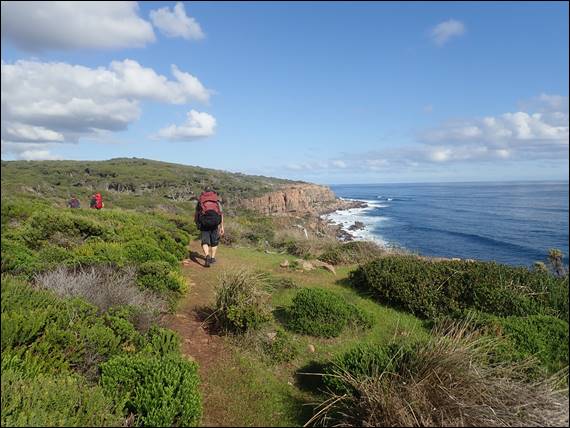
Despite the dodgy start it turned into a great morning and there was plenty to see. It seemed that the boys would call it a day after they had got up Andrew’s climb. Rather than just sit on top I set up on one last climb, this meant we all topped out for the final time at the same time. Allowing them to rap down before I pulled my rope and headed off. My choice of climb to finish on was what they had started on. On which I was very happy to find a Southwestern Carpet Python slithering behind the flake, and maybe it was the same one I had seen on my first climb of the day. I parted ways after saying bye to Wiggins, Jakke and then Andrew as they rapped back down:

In the dark

For those that may be wondering if I have given up looking for orchids, the response is both a yes and no.  Certainly as summer approaches and the land dries and temperature warms up, the abundance and variation of orchids on display in our area is declining.  I’ve been out hunting a few times, but have not come across any new finds or anything particularly startling.  In a way it feel like it has all come to a rather abrupt end this year, and the only orchid that I am hanging out to see come into flower are the Slipper Orchids (Cryptostylis ovata) at Manea Park:

I’ll be heading back their next week to check in on them, but have a feeling it may be a few more weeks before they start to flower.  In part as the warming weather is being interspersed with bouts of almost winter like spells.  This is not stopping all plants from continuing on their expected flowering timeframe, such as these Pixie Mops (Petrophile linearis), yet another plant that is endemic to southwestern Western Australia.  That said their  flowering period is relatively long being from August to December:

It is not an uncommon plant and can be found in woodlands and heathlands along the coastal plain stretching some 400km down the coastline of Western Australia, from Jurien Bay to Yallingup.  Although it has also been found in some areas along the south coastline.  While common to see I really like these flowers.  Like the Rose Coneflower (Isopogon dubius), which also grows in Ambergate Nature Reserve where Lisa and I were walking today, it has delicate protrusion that come out of the end of each limb of the flower, as shown below:

I wonder if maybe the name also is why I am drawn to looking at these plants, with the Genus name meaning rock (petros) love (phileo) in Greek.  Lisa and I spotted several orchids, such as the Swamp Spider Orchid (Caladenia paludosa) in the first image, but most of my attention today was more drawn to the insects.  And one that can be regularly found between November and December is the Christmas Spider (Austracantha minax).  This is the female, which you can tell as they are one ones that sit in the middle of the web, while the males lurk unseen in the vegetation round the edge of the web:

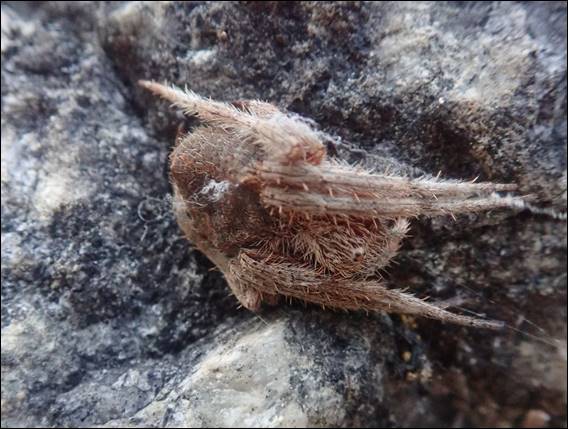
The females grow to just over a centimetre, while the males are half that size further adding to the difficulty in spotting them.  While we tend to only see the females in abundance for these two months, they are still about for the rest of the year.  The reason they are hidden from view is that during the earlier stages of their life cycle they are much smaller.  These cheeky little spiders are known to hook their webs onto those of other spiders, which is thought to be done to allow them an increase their foraging area.  While the above spider was easy to identify the next one, despite much research, has alluded me:

I also have spent a long time trawling through sites to identify the beetle below, which is happily assisting with the pollination process of a Yellow Flag (Patersonia umbrosa).  In trying to identify this beetle I did however find out the difference between a beetle and bug.  The former have mandibles, or chewing mouth parts, whereas a bugs mouth is designed to eat by piercing and sucking on plant tissue.  Also while both beetles and bugs have wings the way they are structured is different, with the wings of beetles being protected under a hardened forewing that forms part of the shell:

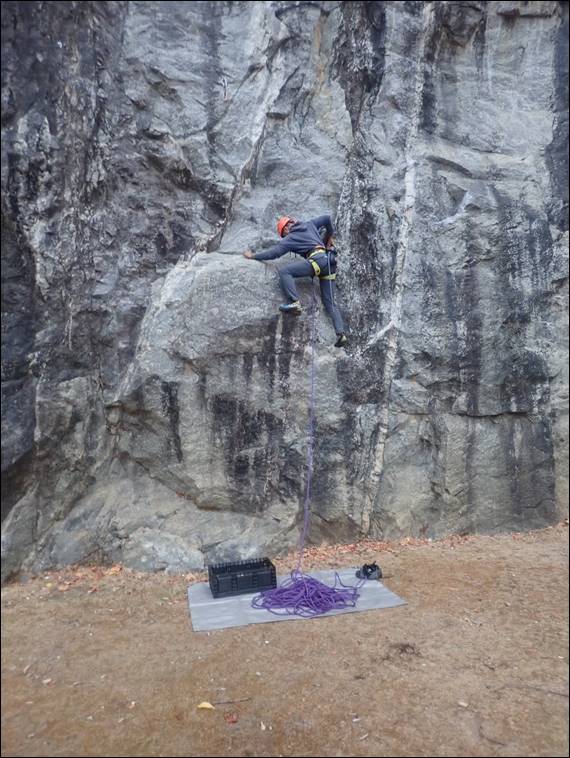
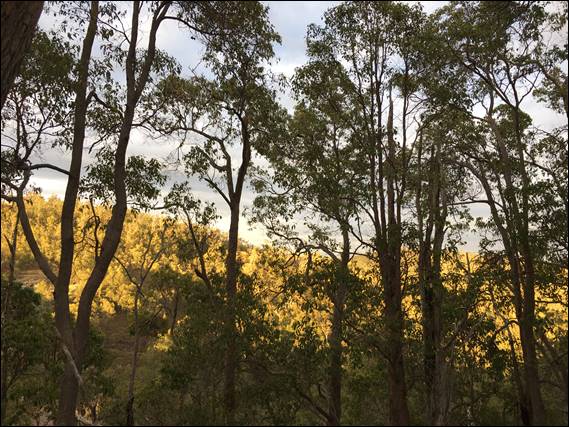
The mix up between beetles and bugs for some is no doubt created by the names, for example what is known as the Ladybug over here is in fact a beetle not a bug.  That said, back in England we always knew them as a Ladybird Beetle.  One last image from our walk today, before we headed off to find some food.  This dragonfly, if you can spot it, didn’t allow me to get any closer.  So any attempt to identify it would be as futile as my attempts with the spider and beetle above, and be a complete stab in the dark:

The Cure

Recovering from his first taste of COVID Howsie was keen to get out, but seeing it had taken it out of him he was also to take things easy.  So we agreed to hit a few familiar lines so he could ease his body back into exercise, without fear of pushing it too far and becoming exhausted.  This also meant a slightly more, in the eyes of most, reasonable start time to avoid the need to get up in darkness and compete for space on the roads with the kangaroos.  And despite this, we still had the place to ourselves on arrival:

Howsie was up for taking the first lead, and being focused on the easier routes he was eyeing up a couple of lines that I had raced up with Rongy last weekend during our 300m sprint.  Therefore, I was more than happy for him to lead both of these routes, but did encourage him to begin the day on Glory.  My reason being that I wanted to check out if the young Carpet Python I spotted last weekend, which Rongy in his haste had missed, was still there.  I did not mention it in my post of that trip due to Sarah’s more impressive finds:
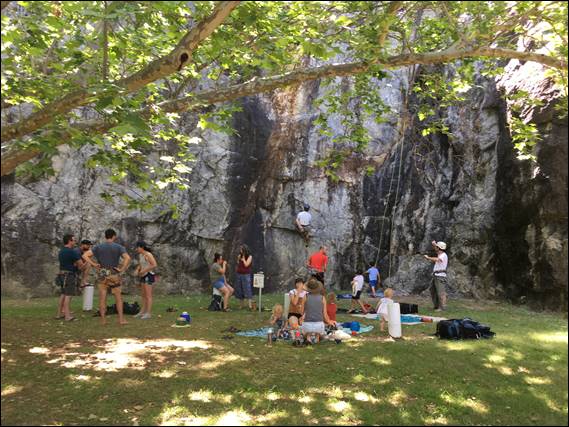
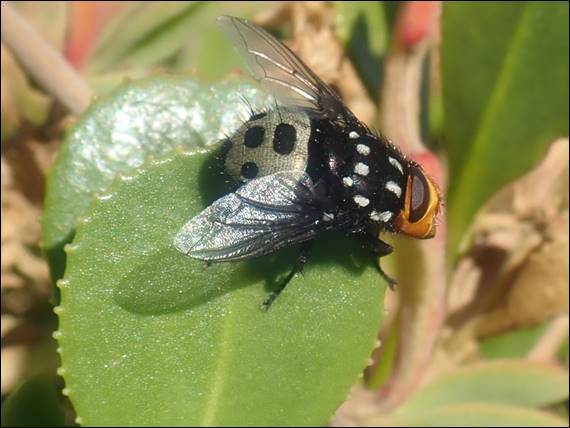
Today I am pleased to say, with a more relaxed pace, both of us were lucky.  And while you may have been expecting another image of a Carpet Python, and indeed I did take an image, it was almost in the same position as last weekend and when we saw it in late September: https://sandbagged.blog/2022/09/22/d-mob/.  Instead I have included an image of a Horse Fly (Tabanidae) that was having a lazy moment on my first lead of the day.  Well it was,  until I came along and disturbed it.  The same could be said for Howsie, and the relaxed pace he had started the morning off with took a sharp turn in the wrong direction:
I have no real reason, but today I felt like jumping on the routes that do not get much attention.  I have only climbed this route once before, and have only ever seen it being climbed by others once.  Despite the innocent grade of 19, and also despite multiple efforts I simply could not unlock the crux sequence of Battling the Bulge.  Today at least the bugle was victorious, making me wonder how long it will be before I am again foolish enough to try this route.  Howsie too battled hard but was unsuccessful and like me was left perplexed as to what to do, and we both came back down with tired forearms:

This was due to the spaced and slopey holds, only wide enough for the pads on the distal phalanges, or in layperson’s terms finger tips.  But also the fact that our feet were both below and underneath the bulge, resulting in much of our body weight being transferred to our forearms.  That, with each failed attempt, became more and more weary.  Howsie taking the next lead decided to ease the pace and while he racked up, we saw the first signs of other people quite literally dropping in.  Just like last weekend it looked like another group was about to descended on Wilyabrup:

Howsie enjoyed the pleasant line of Hope, and it seemed just in time.  Topping out he was greeted by a couple of guys setting up two top ropes, one for Hope and one for Glory.  At least this time they were checking for climbers below and not just throwing ropes over the edge without a care.  We found that the group comprised people from the Mandurah Climbing Gym.  It was not as big a group as the school group last weekend, but they were setting up just as many ropes.  We were keen to keep away from where the ropes were being dropped down, and we pondered our choices:

And after a bit of procrastination we, or should I say I, set my sights on a route that I have never climbed.  I’ve looked at many times, but have to date not been brave enough to lead so each time have walked past it.  Howsie had played on it before in 2020 with a top rope due to the lack of gear, and Nadia has made him promise that he would never lead it.  But there was no mention of not belaying someone else on it, or seconding it so he was more than keen and almost encouraging for me to have a crack at it.  And all I can say is oomph, it was brilliant but also very goey and poorly protected:

It was great to climb it in the, no doubt, intended style that the name English Ethics suggests, ground up with no inspections.  There was a moment where I felt like I was going to fall and even shouted it out to Howsie, but somehow managed to keep moving.  Getting higher and higher above the last piece of protection, with arms getting more and more tired.  Needless to say I was a wee bit happy at managing to on-sight this gnarly grade 20.  While it could be said I had made Howsie work hard again, he was partly to blame this time.  So once again he dialled things back for his last lead:

That said Hitching has got one spicy moment, at the grade, that is a little run out.  So hopefully Nadia won’t read this.  Howsie did however stick true to his intention, with three fun and gentle paced grade 14 routes.  While I had pushed the boat out a little, I had also done what I was keen to do.  Which was to jump on a few of the routes that do not get many ascents that may be because they present a greater mental challenge.  And while my last lead was merely a grade 18, it was once again a climb that is relatively poorly protected, which might explain why it is called Blubber Boy.  Something Howsie and I didn’t do, because Boys Don’t Cry:

A good day out

What with visiting the same locations for a climb as many times as we do, you sometimes have to shake things up to make them interesting.  This weekend Rongy was first to jump on the bandwagon to say he was keen to get out, and I threw out the idea of aiming to achieve what Bob, who I used to climb with in the Lake District, would consider “a good day out”.  And that was to have ascended 1,000ft, or for those modern metric people approx. 305m.  So to prepare for the day I pulled out the route database I prepared when I wrote the climbing guide for the area:

In selecting the climbs we applied a few criteria, which included only considering traditional routes (i.e. no bolts) that were between grades 13 to 19.  Or in British climbing speak HS 4b to E1/2 5b.  While 305m may not seem too bad, the route length at Wilyabrup averages around the 20m mark.  As such it meant packing in a few more lines than a normal morning out, plus with multiple short’ish routes we would have more belay stations to set up.  We would also have to walk back down to the base quite a lot, as we had also set ourselves a condition that we would not abseil to get back down:

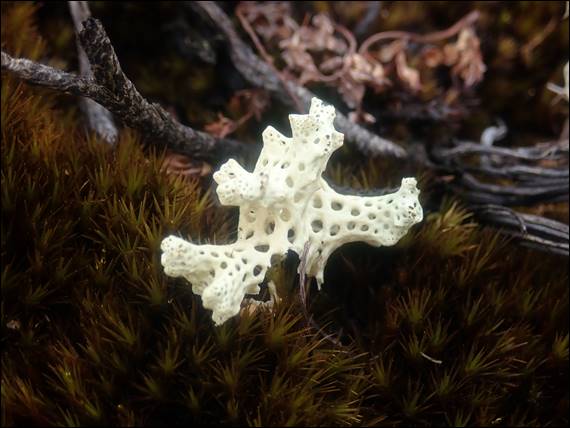
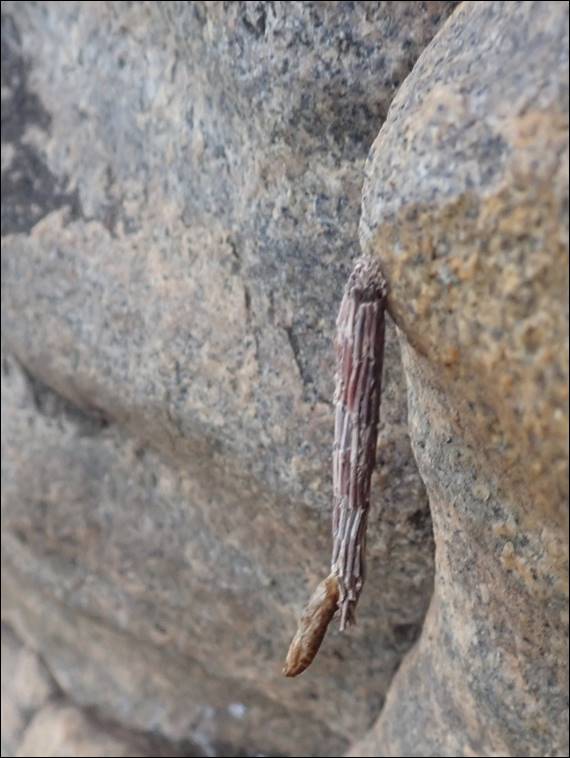
Ash was intending to join us, but sadly was a no show.  Sarah also indicated that she was keen to get out again.  However, forewarned of our challenge this time she stuck to reptile hunting, and you may remember she loves our scaly friends.  At the top of the first route I thought I was lucky to spot the above exoskeleton, which I think is from a Huntsman Spider (Sparassidae).  However, back at the base my find was well and truly trumped when we found Sarah handling a Carpet Python (Morelia imbricata) she had spotted and managed to catch.  So no matter what else she might find, she was happy as a pig in poo:

Based on our plan we had agreed we would need to hit 12 climbs (comprising 13 pitches), which is double what we would normally climb in a morning at Wilyabrup.  Our thought being to climb them from right to left, but today was shaping up to be a glorious day so we mixed things up to hit the more popular routes first.  That way if anyone else turned up they would hopefully not get in the way of our plan.  Needless to say today was about efficiency, Rongy had asked me how long I thought it would take us and I had guessed about six hours.  Basing my estimation on half an hour for both of us to climb each line and get back down:

Rongy was on a time schedule needing to walk out by midday, and as such I hoped I had not underestimated how long it would take otherwise we would not get all the routes in.  Our confidence was boosted as we knew the lines well and are both reasonably efficient climbers.  But to save on time we made sure the gear was ready for the second person up, so they could quickly get ready to lead the next climb.  We also focused on neat rope work, to ensure we were not delayed by having to unravel a knotted mess.  Added to that and to speed up the descents we took our shoes up with us.  This provided an added benefit of giving our toes a bit of relief from being stuffed into our climbing shoes:

We started well and as we closed in on the half way mark, climb number six, Rongy showed signs of becoming weary.  He has not been out much recently, and while I took the lead from him Sarah wandered past and Rongy confessed to her based on how he felt he wasn’t sure if he would be able to complete the mission.  I didn’t know this but seeing he was weary, we had a chat and adapted the plan.  Rather than alternating the leads he could pick which lines he would go on the sharp end.  Having a rope above you on a climb, usually results in using less energy so by me leading the tricky lines that were left he would hopefully conserve his strength for when he really needed it.  Although he might have regretted picking the climb below:

Unbeknown to us, a tour group operator was getting ready to set up ropes above the wall, and they threw a line down without checking below.  The guilty person was very sheepish afterwards, and rightly so it was both sloppy and dangerous of them not check below first.  Fortunately they didn’t knock Rongy off the cliff, but their arrival meant we once again had to revisit our plan of attack.  Once more shuffling the route order to now hit the climbs on the walls the group proposed to set up top ropes and abseil lines on.  As we kept cranking, every so often Sarah would pop by, and as fortunate would have it at the top of the ninth route she wandered by just as these two good sized King skinks (Egernia kingii) came out for some sun:

It seemed that she had spotted a good number of skinks and lizards, but no more snakes.  Unperturbed she set off again as we headed back down.  Ropes were now hanging all over the place, as the group finally arrived.  A huge school group of over 50 kids, but because we had left the climbs on the more obscure parts of the cliff till the end we managed to avoid feeling like we were in amongst the crowds.  So for the last three lines it almost felt like we had the place to ourselves, and more to the point with no one watching on.  It was a little surprising that on such a lovely day only a couple of recreational climbers were out today, but this did mean we also managed to avoid getting tangled up with them:

Our deviations along the way had helped Rongy keep going, and finally we were ready to hit the last line.  One I knew he would want to lead.  It was a climb we were absolutely certain no one else would be on, and also that we would be away from any groups.  It was also the longest climb of the day and we both agreed it was a fitting way to finish the session.  We climbed this one with packs, thereby avoiding the need for one more trek back down just to have to walk back up again.  And my toes only now started to complain, as I followed up, of being squished in my climbing shoes.  So it was that we hit our target of climbing 310m or 1,017ft, which had taken us nearly bang on six hours and the way things panned out Rongy led six pitches and I had led 7:

There was still one more surprise in store.  Walking out, leaving the hoards behind us, I spotted a tail sticking out from under the scrub and stopped in my tracks, as did Rongy and Sarah.  Sarah then very slowly put her bag down and pounced managing to get hold of this unsuspecting Southern Heath Monitor (Varanus rosenbergi).  It was pretty impressive watching her go for it with such confidence, and great to get a close up look at the monitor before she released back into the scrub.  It had most certainly been “a good day out” for all three of us:

A taste of things to come

My usual radio station while driving is Triple M.  Probably, as my daughter would say, because it plays old stuff.  Mixing up tunes from the 60s through to the 90s.  Although they also throw in what they consider the better tracks from the more modern era of music, i.e. since the start of the second millennium.  As such, and is often the case with these sort of stations, it is relegated to amplitude modulation airwaves commonly referred to as AM.  Amplitude modulation was first used for radio in Australia in 1923 whereas frequency modulation (FM), which the more “popular” stations use, wasn’t available until 1980 (if you exclude the initial experimental period):

The problem with amplitude modulation is the radio waves used are more prone to effects from static, which can come from a variety of sources.  And today driving out the songs were on occasion interrupted by that familiar crackling sound, indicating electrical interference in the atmosphere.  I didn’t notice any sudden flashes above, indicating lightening, but drops of water were hitting the windscreen in line with the forecasted high probability of rain today.  I knew it was a risk not heading out with Howsie and Josh for a before work climb on yesterday, but it was a calculated risk:

I do not just use the standard forecasting apps, but also the interactive forecast maps.  These show how the pressure systems are expected to shift across the state in three hourly time steps, providing a much better idea of what might or might not be.  All indications were we would get rain, but it would likely initially come from the north and not hit the area I was going to until mid-morning.  Sure enough darker clouds loomed in that direction, while Wilyabrup and the surrounding area was rain free and dry.  Plus the wind was light meaning that the clouds would not be rolling in to quick.  In fact the conditions were perfect to be out for a climb:

Knowing it would rain at some point, I was up and out of the house by 5am.  Always intending for it to be a short sharp session going solo, as once again as no one was available to join.  And not surprisingly I didn’t see another sole today.  Not even someone braving the forecast for a walk.  The session was all planned out and I had picked the areas and climbs based on ease of setups; only needing to use two anchor systems to allow me to hit five lines.  The first four were on the well-rehearsed Innerspace Wall.  Using an adjustable double figure of eight, the adjustments required to the system to make sure both anchors were tensioned for each line was quick and efficient:

This did not however allow me much rest time, and after the rapid fire eight laps in just over an hour my forearms were getting pumped.  While I alluded to timeliness being important due to the high probability of rain falling, there was also another reason.  Howsie and I are considering a trip next spring for which we will need to be fit as fiddles.  A place with big approaches, long routes, and adventurous descents made all the more challenging as neither of us have been there before.  As such we will need to be hiking and climbing fit, to allow us to move efficiently and safely and avoid being benighted on the cliffs.  This may seem a long way off still, but I had this in mind today as I packed in the meterage and moving at a quick pace:

The second anchor set up for the last line, was on a much taller part of the crag for a route that rarely gets any ascents.  Craig led this and I followed up way back in 2006, and since then I have not been on it.  I checked The Crag and the only recorded ascents are from 6 and then 3 years back, with comments of “hard and committing”.  It was a lot of faffing about, swinging about and prusiking, to get some gear in the route so the rope would follow the line, as the bottom half is completely overhanging.  But it was worth the effort and it was awesome, big corners and lots of exposure.  And my rationale for jumping on it after all these years also has something to do with next year, as this grade 23 will be on Howsie’s tick list for 2023… and I can’t wait to watch him have a crack at it: