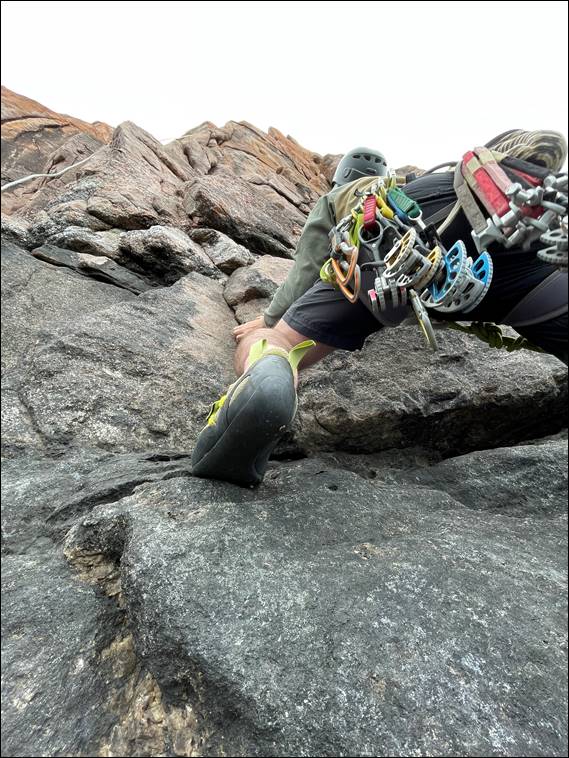
On my last trip back to the UK to see my folks we went for a few car trips to the Peak District, including one visit to Hathersage. An old haunt of mine from my climbing days in the UK. I was keen to see the village and familiar sights and also to go to the climbing shop to check out a decent range of climbing shoes. There is a belief by some that climbing shoes need to be technical in nature, to the point that wearing them becomes uncomfortable after a time. Something I certainly do not believe in, and can still remember my first shoes and how snug and comfortable they were:
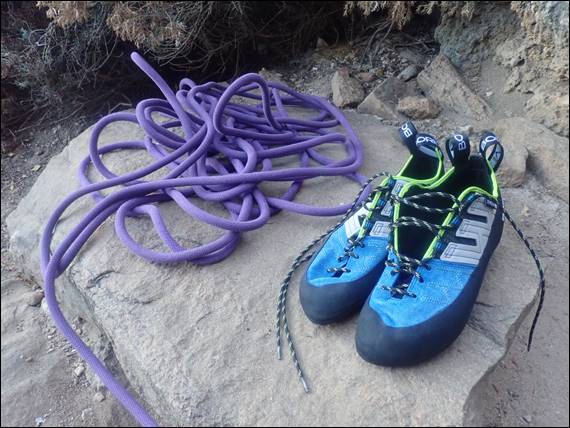
The make I had been using for many years had changed the design of my preferred shoe into something more technical in nature and less comfortable. So in the UK I was keen to find an alternative that was more akin to the old style. So it was I got a pair Boreal Jokers from Outside in Hathersage, Boreal coincidentally being the make of my very first climbing shoes nearly 30 years back. While I have had them since August last year today was the first I have worn them, and I am very happy to say they felt like a pair of comfy old slippers, bliss:
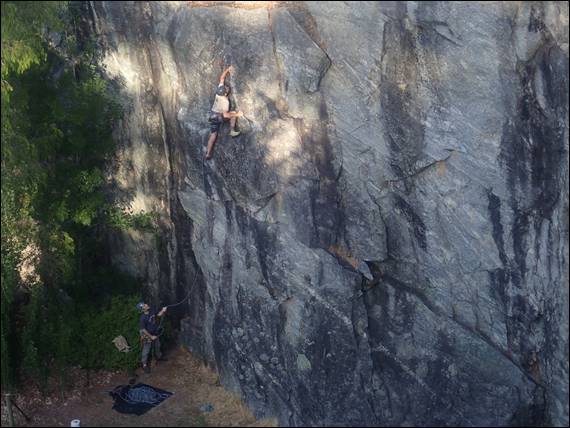
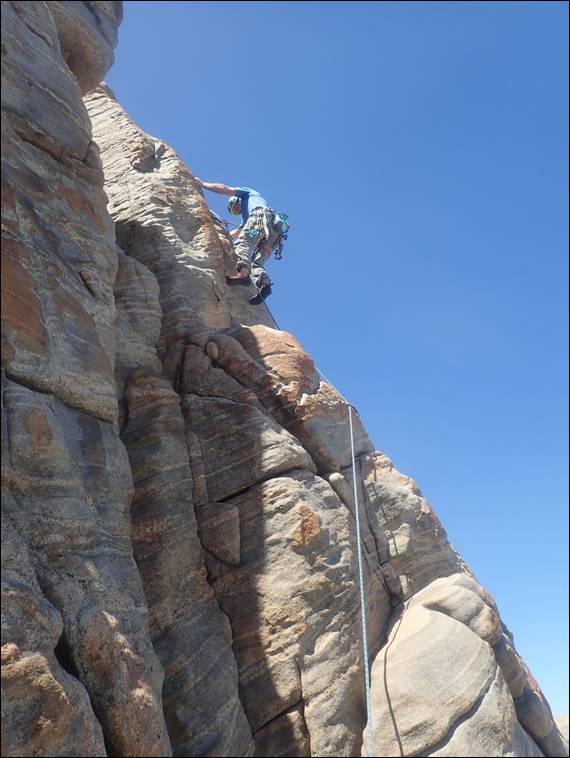
Today Rongy and I were at Wilyabrup, and as we arrived a campervan was already parked up. A guy came out when they heard the car pull up and after a quick chat we parted ways, saying we may well meet down at the crag. No one else was about and we romped up a couple of grade 14 warm ups, and it was not until our third route was under our belt and we were heading down for route number four that we spotted a crew getting ready to set up a top rope on Hope. They were close to being ready to throw the rope over the edge, as two people started to get ready to lead the same route at the base:
Having had a rope being thrown down on us, we knew it could result in a bad situation so we shouted out a warning and averted a possible accident. The top ropers took note and duly moved to another spot, and it was only then that Rongy recognised the climbers just starting up Hope. It was Kate and Josh, with Josh being the “someone” we had chatted to at the carpark. They are from the Blue Mountain in New South Wales, but Rongy had met them when he and Kate had been camping and climbing for an extended period at Arapiles in Victoria:
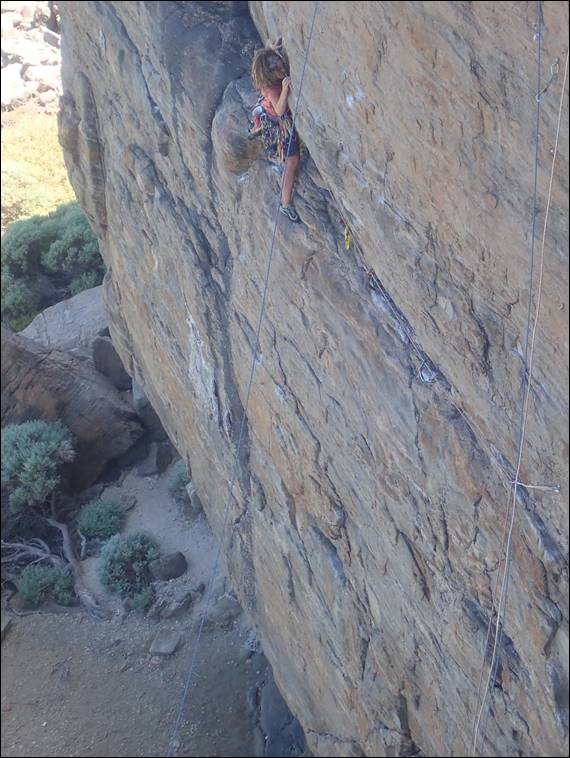
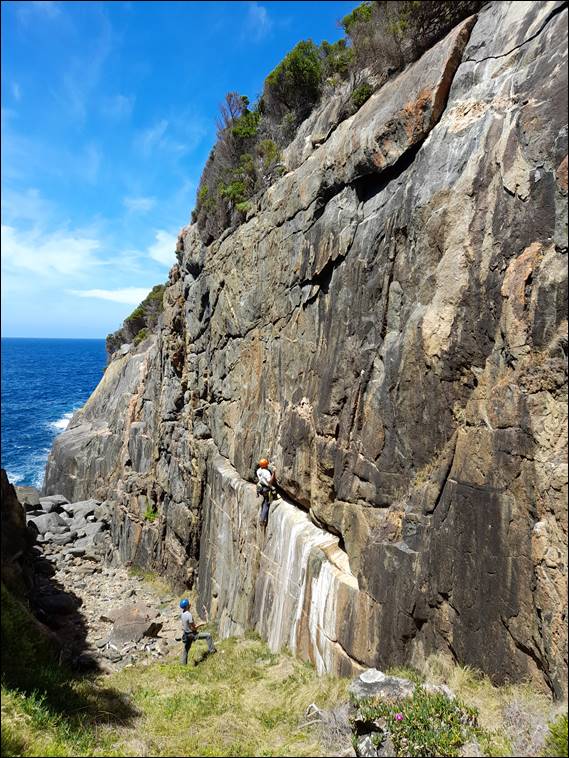
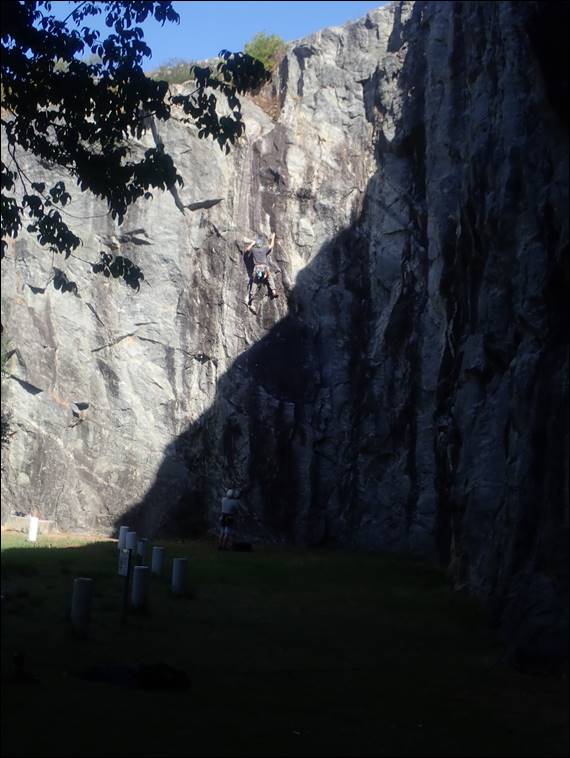
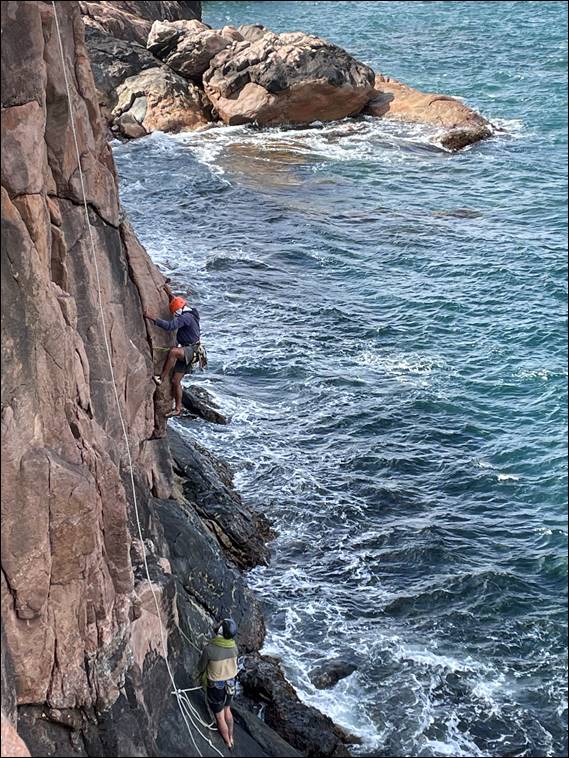
Rongy had mentioned before he had friends that may pass through, but he wasn’t aware of when they may be here. As such today was a by-luck chance meeting. He hadn’t recognised Josh earlier, as the last time they had met was some six year back. But in addition to Rongy having spent more time with Kate, her dreadlock hair was a very distinguishing feature. So much so, that Rongy had recognised from atop Steel Wall. A fair distance, as shown two images up. Not surprisingly there was a bit of catching up and chinwagging, when we got back down:
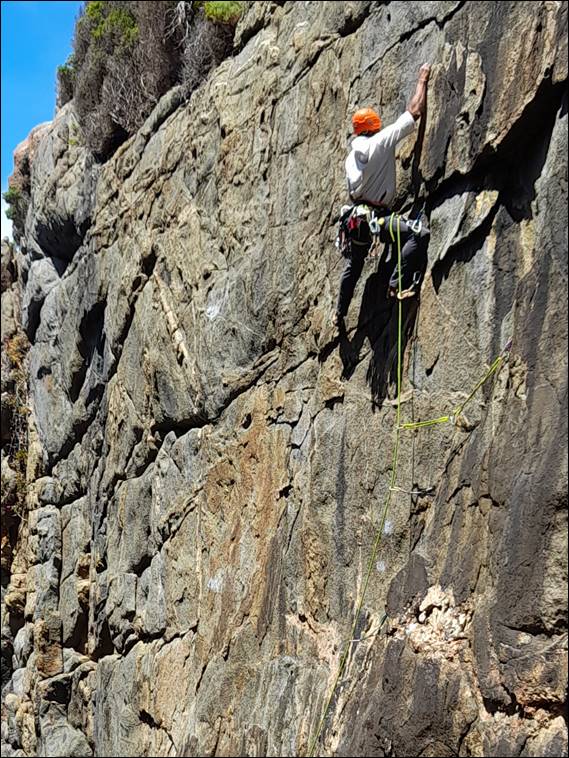
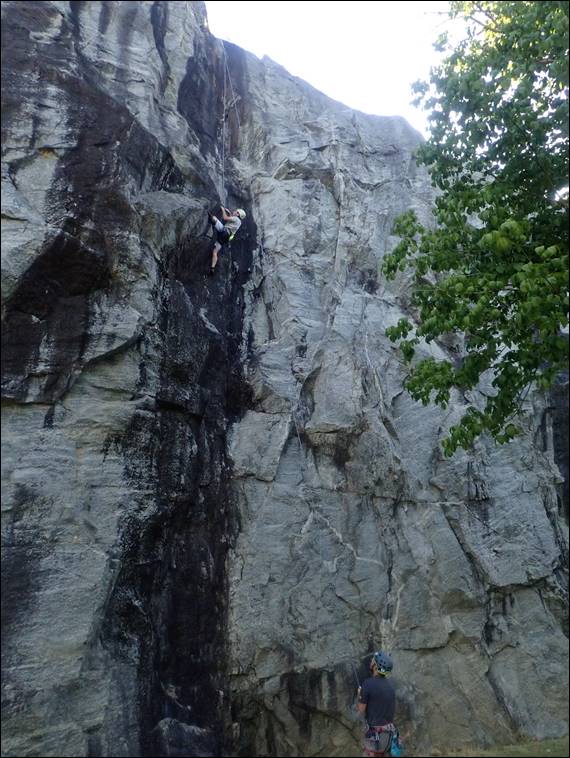
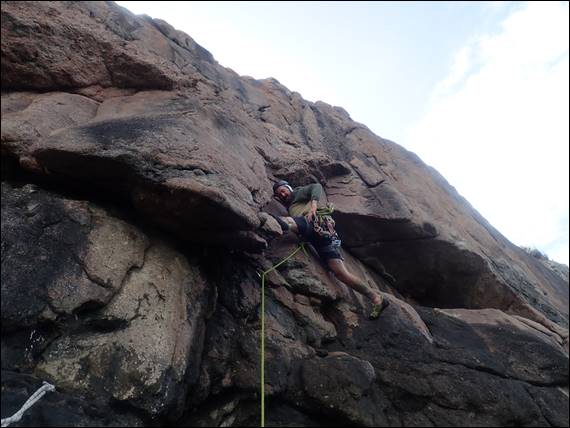
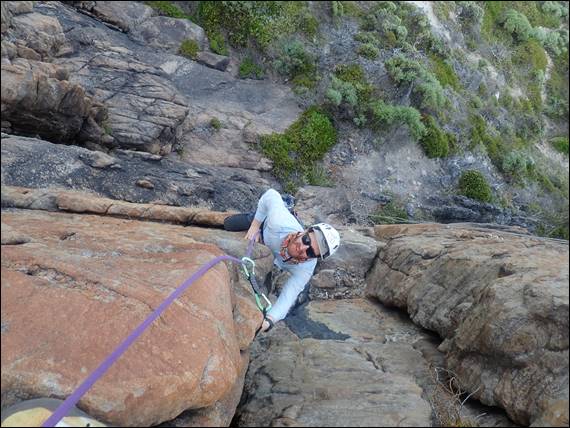
But soon it was time to keep climbing and by chance we had bagged two grade 18s for our third and fourth route. So it seemed only fitting to make sure the next two lines were also of equal grade. Rongy enjoyed the route shown below, a weird and gnarly grade 19 that I have to say I am not that keen on, and as he climbed my focus was more on the inch long bull ant. It had hitched a ride on my ankle, and after I flicked it off it seemed to make a beeline for me every time I moved position. That was until it was my turn to head upwards:
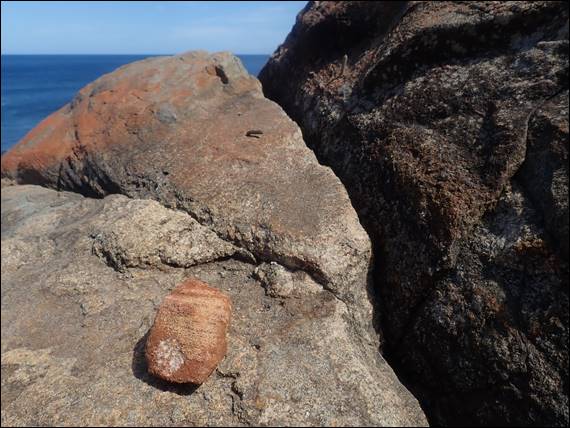
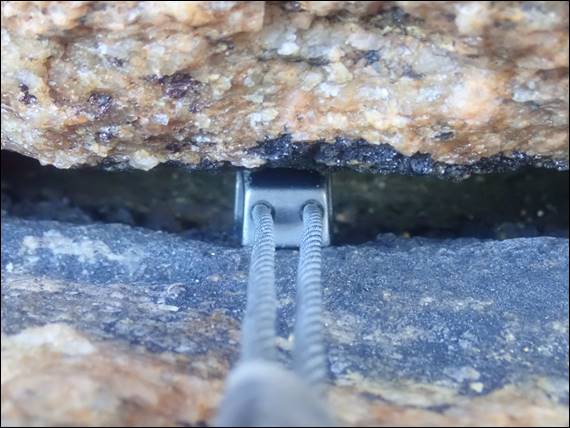
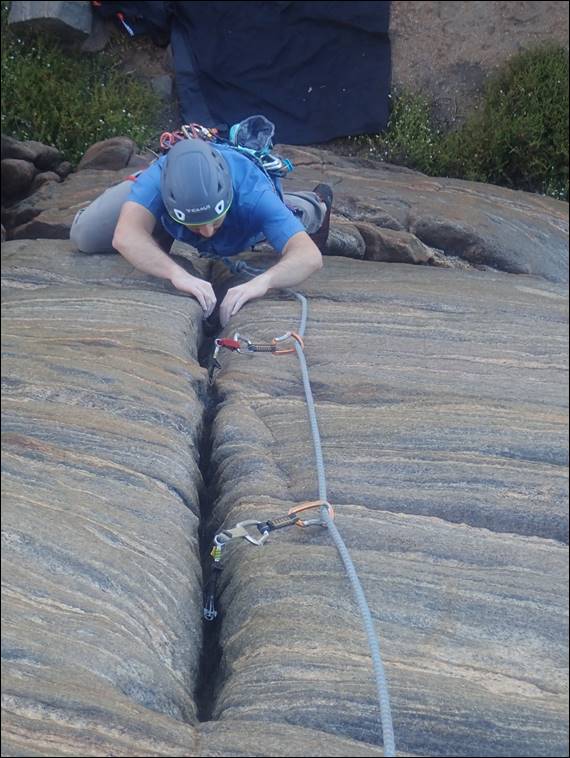
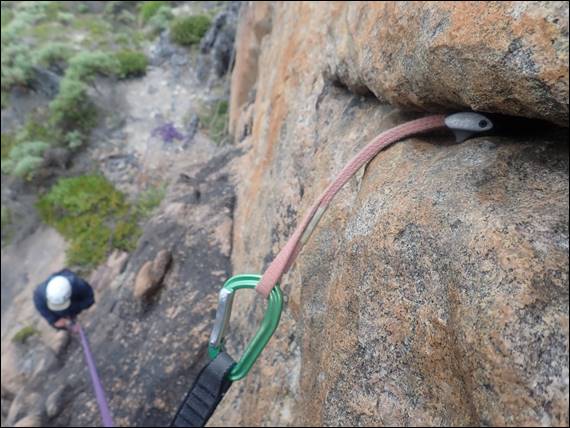
After our two grade 19s we plumped for two grade 16s, just because. But not before another chat with Kate and Josh, during which based on the grades they were keen to climb we suggested they might enjoy Sirius. For our climbs we had mostly picked routes we had not been on for a while, so I am not sure if the two pins shown either site of the crack below were new or old movement markers. They seemed to be placed in a crazy location that someone could easily have stepped on. This could be the reason someone had bashed the markers so they were less dangerous, and the offending smashing implement was still at the crime scene:
I have to say it was a very pleasant morning out, and a good selection of routes. And as we were wrapping up, Kate was still battling the traverse of the suggested route of Sirius. It did not look like she was enjoying herself. Her nerves were probably not helped by the rap line hanging down the cliff and two people climbing routes that started up the same feature that Sirius followed. Still she kept going, not giving up and managed to safely get to the belay ledge. I wonder if she would trust our advice again, mind you we won’t find out unless they happen to passing through again:
For several months Kym has been frothing about a trip up into the Stirling’s to climb the huge walls that Howsie, Dazza and I passed underneath when we hiked the Ridge Walk. To see where I mean you’ll have to dip into my previous post, of that most epic of hikes, https://sandbagged.blog/2021/11/28/a-most-unexpected-journey/. The cliffs are huge. Towering high above an already very high position, resulting in immense exposure, the sort of situation that would make a normal crag rat tremble in fear. But it is the sort of place I would feel very comfortable in after a short time to get acclimatised to it:
We set a date, and as it drew nearer I thought I could sense a kind of wavering in Kym’s messages. There were a number of factors at play including the weather, the steep and strenuous 12km hike to the cliffs, and the logistics. The latter would require an early hike in on the Saturday morning. Impossible if Kym was not able to get out of his night shift on the Friday, which he was not able to. So the week before the trip he started to send me images of another option, including an amazing looking slab that shoots straight out of the ocean:
I was happy to just catch up and get out with Kym, something we had not managed for nine months. But have to admit of all the images he sent me of this location, it was that slab that really peeked my interest. The area also has some very aesthetic looking boulders perched on wave washed rock platforms, as well as easy access cliffs that are safe from the ocean. So we changed our plans, which I didn’t mind as it also allowed me to indulge in our traditional Friday night homemade fish and chips with Lisa and Elseya. And with an early start I arrived in Albany half an hour before Kym got home:
The house was as expected a hive of activity when I arrived. And with Kym walking in half an hour after me, this allowed time for a couple of cuppas, very appreciated after the near 4 hour drive, and catch up with Meg, Tessa, Claire, and Beau. Kym walked in and had efficiently packed the night before, so it wasn’t long before we drove out and then walked into our destination. A short 15-20min walk that was mostly easy terrain but we were weighed down with climbing gear, food, and bolting equipment. The idea being to scope out some potential new routes:
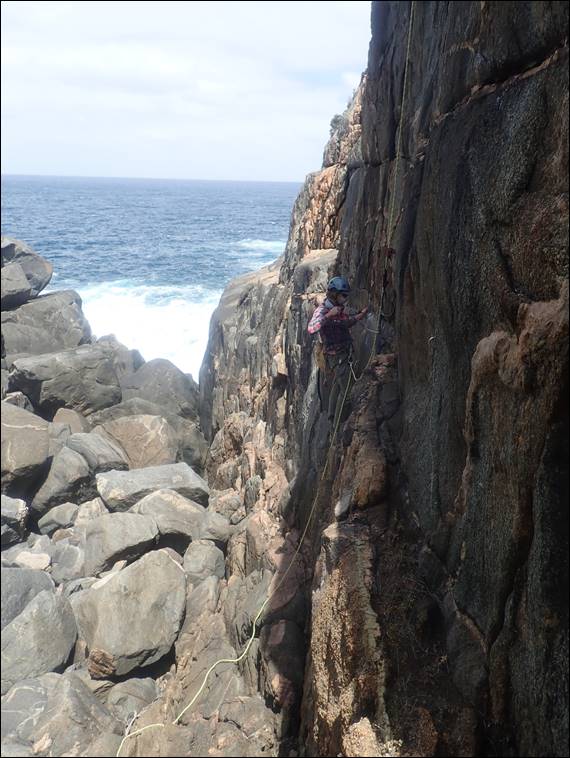
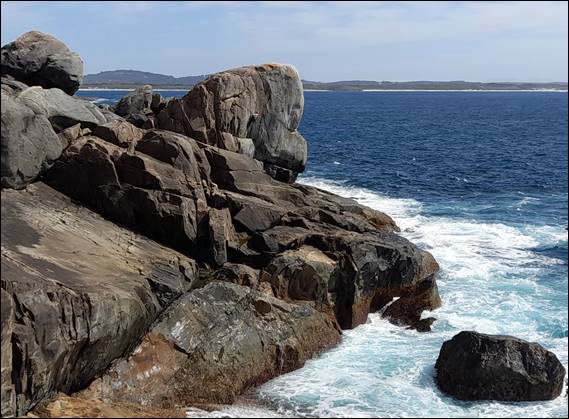
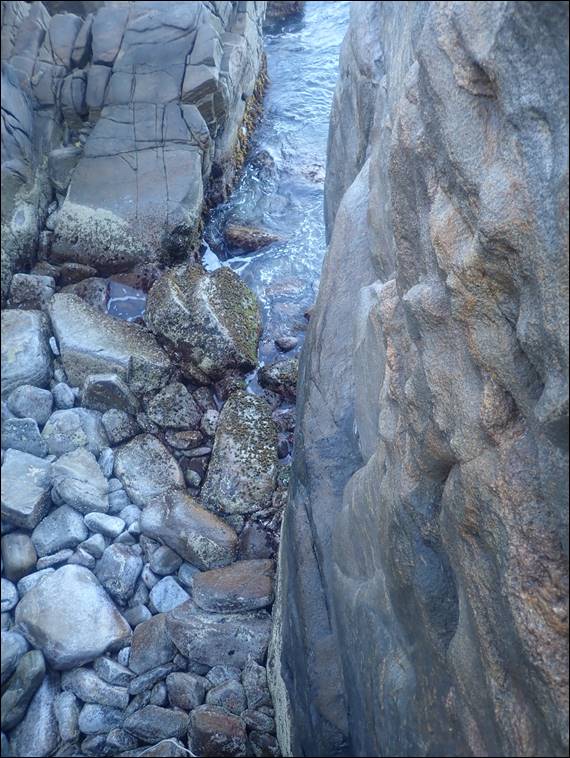
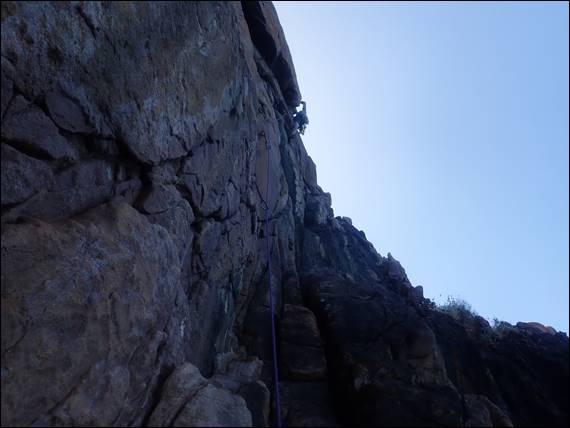
While the cliffs in the main zawn area had some developed routes, both trad, bolted, and mixed, there was plenty of scope for other lines to be considered. On arrival we spent a while rock hopping along the coast to check the area and options available to us. A stiff easterly resulted in the bottom of the iconic slab being wave washed and sadly as such not such an inviting proposition. We started the climbing by ticking a few of the established lines in the Zawn, which were all very good. The rock in the zawn was unusually for the south coast, more textured and featured but also prone to being more brittle:
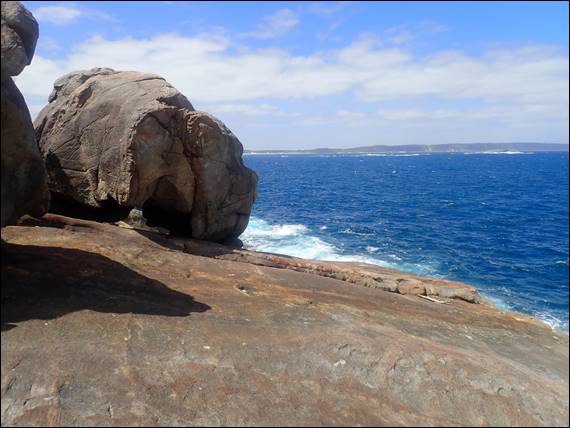
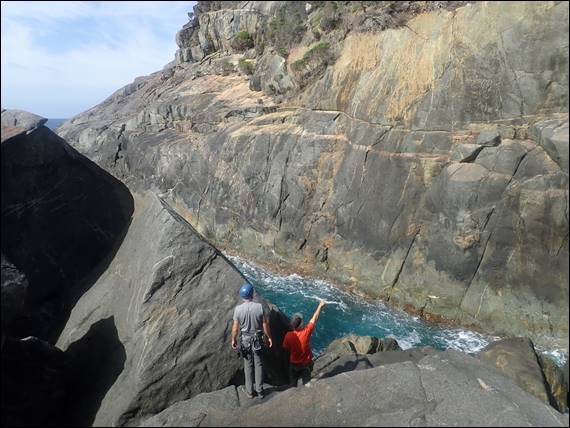
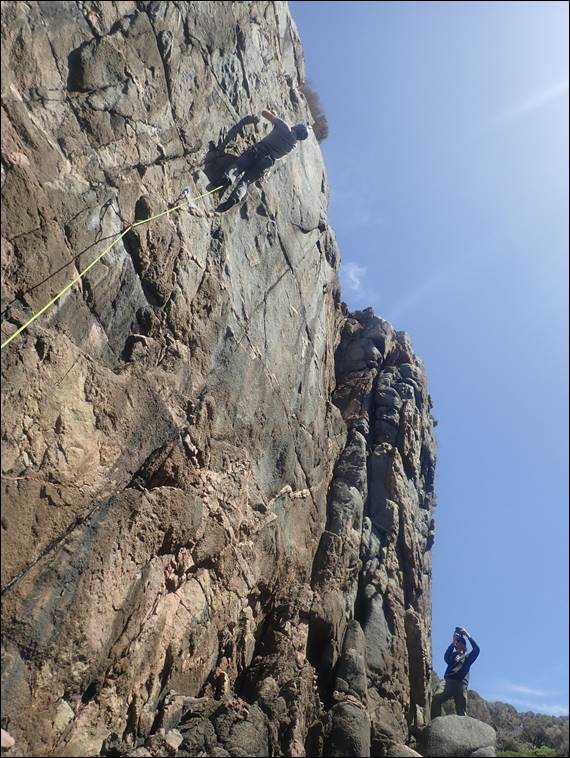
Then we got the drill out having scoped two lines in the zawn worthy of bolting, there was a third and while I was keen to jump on it and lead it full trad ground up Kym was concerned about the rock. We would have to wait for the epoxy glue to set before the bolts were safe to use, so after a bite to eat we spent the afternoon top roping on the above boulder. Sadly the routes were too contrived to make them worth equipping. The rock quality on the very steep wall, two images above, was such that the wall was unsuitable for development:
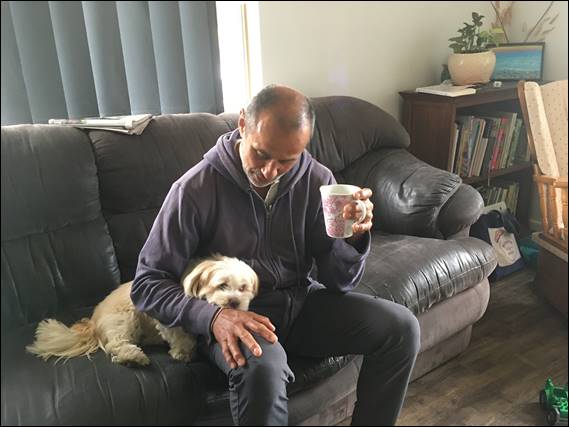
It may seem like we did not do much climbing on the first day, and I took very few images while Kym took none. We had however climbed some ten existing, possible new, and not-worthy routes, and added to that we had done a fair bit of rock hopping to scope the area out. Not a bad effort from Kym who had come straight of his third night shift on the trot. Back at the house, some ten hours after we had left, more tea was required. Sunny who on previous visits would bark at me and treat me with caution, had decided I was now OK and he was very snuggly. Hopefully Sooky and Nicka, our poodles, don’t get too jealous:
The evening went quickly with more catching up, tea, dinner, games, and then finally bed. I was feeling pretty weary, and imagine Kym was beyond tired by now. The morning came with Tessa busily preparing pancakes for everyone, Kym having a sleep in, and Meg enjoying a rare if short quiet moment on the sofa. Today Andreas, who I had met once before at Welly Dam when he was climbing with Mario, was joining us. He had to leave the crag late morning, so we drove in convoy back to the West Cape Howe National Park. Taking the track that leads down to Forsyth Bluff:
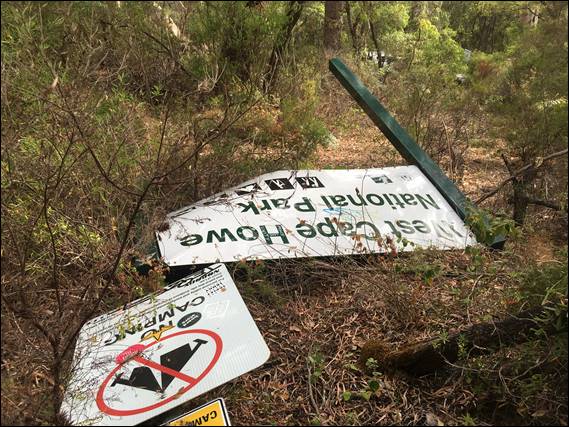
I could not resist including the above image. On inspection it did not seem to be the random act of vandalism that it first appeared to be. The sign had obviously never been erected, as the posts were unscathed and showed no sign of having ever touched soil beneath the surface of the land. Yesterday Kym and I had hauled the bolting gear out and left all the climbing gear at the crag, so we felt light as a feather walking back down unburdened. Andreas had memories from many, many years back of having been here, although the approach felt very unfamiliar:
Kym confessed to feeling really tired so unsure whether he would climb much, but was keen to watch us bag some routes and take images. With Andreas’ limited time we decided that it might be good to go and check out a couple of potential new routes on boulder that Kym and I had spotted but not played on. As we walked out, we stopped to look at the slab that wasn’t so invite yesterday. Kym and I had felt equipping it was likely to be a big mission and maybe not worthwhile, but today with somewhat renewed energy he started to contemplate it again. Maybe urged on by Andreas:
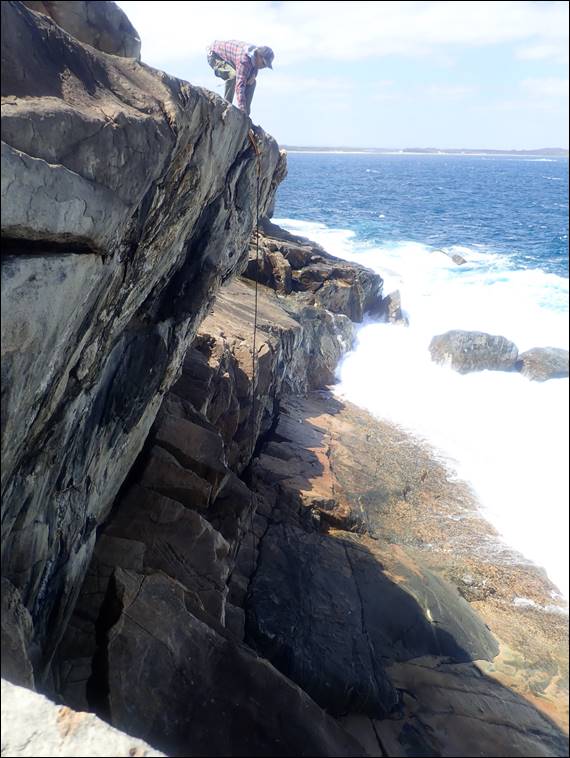
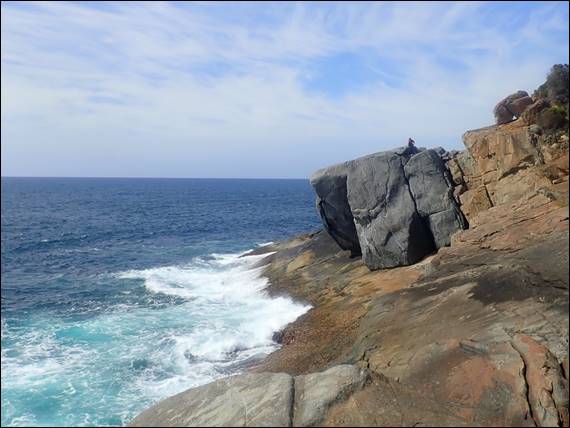
With limited time we had we walked on. As Andreas and I headed for the far away boulder, Kym perched atop the boulder he and I had unsuccessfully attempted to find worthy lines the day before. The image does however show how close to the ocean the boulder was, and the day before the swell pushed the water right up the left-hand edge of the boulder. A warning sign of how dangerous climbing in places like this can be. And as such we made sure we were tied in at all times, to avoid being washed out should a king wave appear:
King waves, as they are known in Australia, are called sneaker and sleeper waves in other places. These waves come to shore with no warning and can be as much as ten times bigger than all the other waves of the day. They arrive with huge force, and have been known to move big boulders. It is not uncommon to hear about people rock fishing, and dare I say tourists, being caught off guard and swept out. I may not be painting a very inviting picture of the situation, but I love it. It really adds to the whole experience, heightening the senses and making you really feel alive:
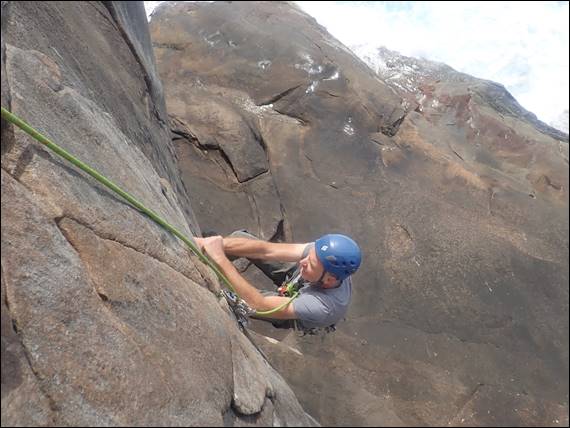
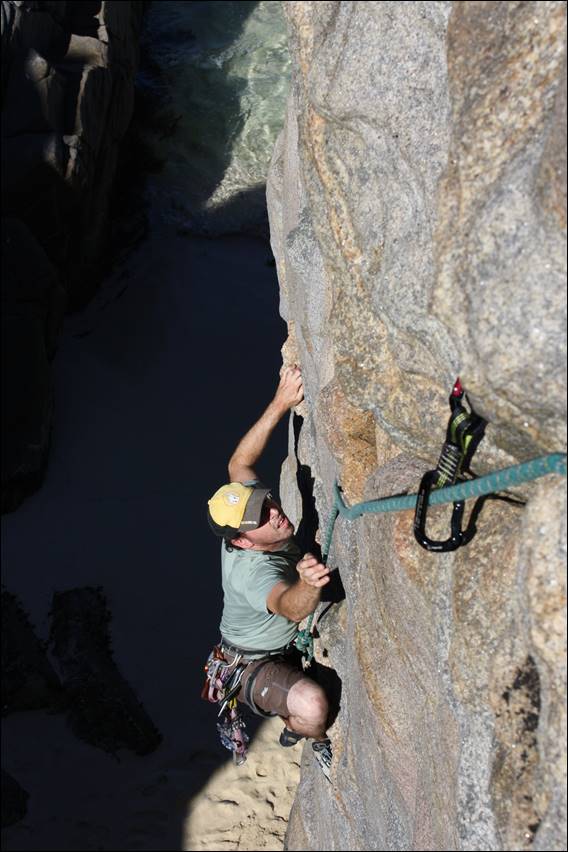
Kym was a tad too far away to capture the action as, for the first route of the day, I launched up an inviting looking flake. If you look hard you might see me in the above image launching into the flake. At least he was safe from the ocean on the boulder, and after my ascent he even managed to have a snooze in the warm sun. Meanwhile, Andreas was pulling hard as he came up the steep and sustained line after me. Yesterday when Kym and I spotted the possible route we thought it may be about 17, so I wasn’t worried about jumping on it as the first climb of the day:
However, it proved to be much steeper and harder than I expected. The footwork was tricky and I was continually my on my arms, needing to shift body position and tension all the while looking for gear and figuring out where to go next. As I topped out my forearms were solid, but not as I always assumed being due to a build-up of lactic acid. It is in fact due to the blood vessels becoming restricted because of the muscles being under strain for a prolonged period, and this results in the forearms filling to capacity with blood. As such I decided to call is Flashdance at grade 20 / E2 5b/c, both due to the pump it gave me but also the very fine movements required:
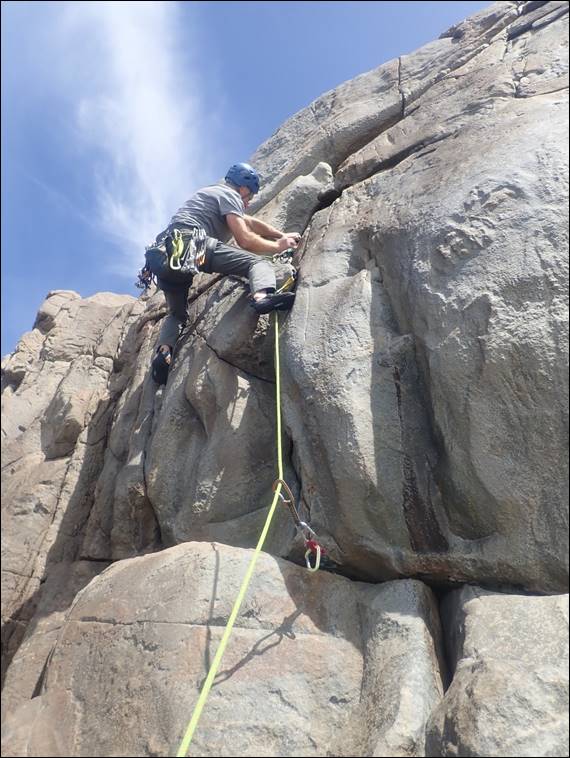
I was so happy with the on-sight first ascent lead, meaning I had no prior knowledge of what to expect, that I could happily have stopped climbing for the day. But there was more to come. Just to the left of the line I had just climbed was another fun feature, and I offered the rope to Andreas. Whether he was ready or not I don’t know, but after some hesitation he started the above sequence after which there was no going back. Regardless of how he felt to start with, when he topped out he had a massive smile. Just like my line, Kym and I had probably underestimated the grade for this one too:
We decided on 16 (HVS 5a), but I am yet to hear what Andreas wanted to call the line. Those were the only two route potentials we found that looked reasonable, on the boulder. Any other climbs would be considerably more challenging and/or unprotectable with traditional gear. Instead we came back to the zawn, where the routes Kym had bolted the day before awaited us. Kym was still enjoying just being out and chilling, so we offered the rope to Andreas to bag another first ascent on the line Kym can be seen bolting in the second image of this post. Andreas is leading it above and I then pulled the rope and also led it:
It climbed really well and again I have not heard what Andreas might call it, and we reckoned maybe 15 (VS 4c). When we first saw the line I felt that it may have gone full trad but the rock was a little friable in places, plus the gear would have been very fiddly to find and get in. Even then it may be a little suspect, which I agreed with. As it was when I led it, I agree bolting it was the sensible option. But then it came to the line I mention previously that Kym was dubious of the rock and gear, but I thought it was fine. We hadn’t placed any bolts on it so I decided to go for it:
There were some boudlery moves to get to the ledge, but it was never too high of the gounrd (for me). And it is not until you get estbalished on thee ledge that you get the first marginal piece of gear. After the first, not so inspring piece, the gear improved and just in time as the route steepens up considerably. Becoming more technical with height, and you are forced to use great underclings, side pulls, crimps, and delicate footwork. Every move was controlled, slow and precise, and it was absolutely brilliant. Much as I would like to see it remain a fully tradional climb, both Kym and Andreas felt the start required a bolt or two:
With my background of climbing in the UK and the normal practice of ground-up traditional climbing I love the excitement of such a route. Andreas even made mention that I had climbed it with that style and approach, and as he climbed it with the rope above him he looked at the rock and gear with a little concern. As such I decided to call this one The Traditionalist at grade 19 (E2 5b, although E1 if bolts are placed). I do love the UK grading system, it allows you to assign both an exposure level to tell you how sustained and/or scary it is, and technical level to advise how difficult the hardest move is. Grading lines like this with a single number gets tricky:
Andreas left us to it, so Kym offered me the lead on the other route we had bolted. A steep and very fingery start on sharp holds, shown above. Once on the ledge the holds and climbing become more forgiving, but it is still absorbing and makes you think. The holds at the start bit into my already tender finger tips. It felt like I was pushing my fingertips down onto a knife edge, holding back just enough to prevent the skin from being broken. As such it was an obvious name of Grin and Bear It at grade 20 (E2 5b/c). So far the day had comprised of five routes all first ascents, it doesn’t get better than this:
We were both pretty weary, so had a spot of lunch and then wandered over to another boulder that looked to offer a great finger crack. But when we walked up to it, it was pretty underwhelming. It was shorter than it had previously seemed and we guessed, correctly that once the tricky moves to get the flake were done it was all over. Hence the name Red Rover at grade 15 (VS 5a), made perfect sense. There was talk of checking out the access to slab to see what was needed to make it accessible and how many routes might be there, but neither of us really had any motivation left to do that so we called it a day:
So here is one last image of the slab that had so drawn my attention. We did at least have a good look at the slab from here and despite the difficult access, which would require climbing a route from the zawn and scrambling across, there looked to be potential for a few routes. Something for Kym and the south coast crew to ponder, as for us it was time to head out. Grateful not to have the bolting gear to carry out. A bonus to finishing early was that I could drive home that day and get back before darkness descended. But not until after a cuppa and final farewell. Thanks to Kym, Meg, Tessa, Claire, Beau and Sunny for another hugely enjoyable trip down south, and we are already talking about what next:
There is only one place to head when there is limited time for a play, and that is Welly Dam. Today’s trip started with Howsie and myself, and as the day got closer the group expanded with Josh, Rongy and finally Rob also keen to tag along. Josh was accompanied by Kellie, although she went trail running, leaving us to play on the rocks. Howsie and I were the first to arrive, shortly after sunrise. Rongy was next to park up and came up to us all excited, but not because we were back at the quarry:
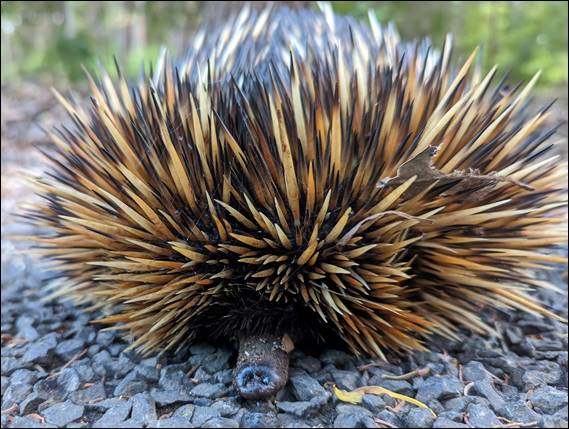
He was lucky enough to encounter a Short-beaked Echidna (Tachyglossus aculeatus). A creature that despite the few times I have been lucky to see them, holds the title of being the most widespread native mammal of Australia being found in every state and territory. It is also one of only two egg laying mammals, the other being the Duck-billed Platypus (Ornithorhynchus anatinus). I have not seen a Platypus, which is not surprising as they are only found in the eastern states and are now regarded as being near threatened:
Something I was not aware of is that like the Platypus the Echidna can swim, using their snout as a snorkel. In fact they are regarded as strong swimmers and not just out of necessity to avoid predators, with research showing they also swim to entertain themselves. Rongy had stopped to make sure the Echidna manage to get off the road safely. Taking his time, as I would to enjoy such an encounter. His relaxed pace continued when he joined us and he didn’t seem to be in any great rush to get climbing:
With five of us we set up a few ropes to entertain those not inclined to lead, or wanting to try something a bit more challenging with the safety of a rope. And to be honest even Howsie, Rongy and I, seasoned Welly Dam climbers, found the routes that bit stiffer than we remembered them. My last trip here was close to three months back, with Josh and Howsie, and Rongy’s last visit was closer to five months back. Our absence from here seemed to have resulted in us losing our edge, the edge that climbing here on a regular basis gives you:
Just like the Forest Red-tailed Black Cockatoos (Calyptorhynchus banksii naso) that were flying past, there was also humidity in the air. This resulted in the friction being that bit reduced, and combined with the warming temperature of the morning was probably also influencing why the climbs were feeling that little bit harder today. Despite that I was however keen to get a second opinion of the two possible new routes, which were a wee bit stiffer than the routes we had climbed so far:
Usually the three of us will be keen to be on the pointy end. But when establishing a sport climb at a place like this where you are not following a natural feature, there is a need to top rope it a few times before even considering equipping it with bolts. This is required to work out where the line takes you, see if it worth the effort required, clean the route, and then to check where it is best to place the bolts. So I threw a top rope down both lines keen to see what Rongy and Howsie thought, and they both thought they would make worthy additions:
That now means we will need to come back a few times to remove any loose rock and work out how many bolts we will need. This may seem at odds to my last post, in which we left the large wobbly flake in place at Cosy Corner. The difference being that here we are establishing sport routes on artificial walls created by blasting, when granite was quarried. We will also need to drill holes to place the bolts, so to create these routes there is already a need to change what exists. Josh was also busy creating today, offering a range of beverages and fruit ladened tapioca breakfasts:
I eagerly accepted the first, but declined the latter, as it brings back nightmarish memories of school dinners from an ear when you were expected to eat what you were given. Even when what you were given was what we called frogspawn, something that once described in The Guardian newspaper as “Britain’s most hated school pudding”. Hate is a harsh word, and one I try not to use too often, but there are times when its use may be considered reasonable. Another such situation being when you refer to the dreaded March Flies (Tabanidae), and as they started to come out to play it was fortunately time for us to fly:
It is of course possible to have too much of a good thing, with climbing for me that has mostly come about from strain injuries sustained from the artificial style of climbing by pulling on plastic holds indoors. When it comes to climbing outdoors, other than managing the physical bodily risks to avoid strains and the environmental risks that can pose more serious injuries, there is very little that can result in me reaching a point of saturation. At which I am unable to gain any more enjoyment from it:
So it was that once again I was heading back to Cosy Corner, and area that doesn’t have heaps of routes. What attracts me to this place is the setting, and luckily there are those that I climb with that feel the same way. In it for the whole experience, as opposed to the singular focus of the battle with the rock and for some people an even more focused battle with just one line on a piece of rock. Having this wider appreciation of the environment also helps in avoiding silly little injuries by slowing down and not needing to go hard all the time:
I was a little surprised to find out that Josh had only been climbing outdoors for about a year. In fact today was the first anniversary of me taking Josh out climbing, although it was Howsie that first got him out on real rock. On that trip the three of us, plus Nadia, went for a play at Wilyabrup on a hot and sweaty day. Today our first thought was again to visit Wilyabrup, until I suggested Cosy Corner as an alternative option. Although it would require an earlier start time of 4:30am, even though it was only supposed to be a mere 26 degree:
The temperature of 26 also happened to be where the mercury started at 4:30am for our trip one year back: https://sandbagged.blog/2021/12/27/cooling-off-time/. A far cry from today, and as can be seen we were all fairly well rugged up, with cloud that looked like it would threaten to precipitate, a stiff southerly wind that in the earlier hours felt like it cut to the bone, and a choppy ocean. In fact 26 degrees felt unattainable today, but that didn’t dampen our spirits:
Josh’s aim for 2022 was to be able to get out once a month, which he has achieved. Due to such infrequent trips he has not led many routes, with his first one being exactly ten months ago. A trip during which his perseverance also resulted in me not losing my ring of power https://sandbagged.blog/2022/02/27/my-precious/. And speaking of first, today was his initiation of sea cliff climbing, during which he even bagged a lead. Howsie’s aim for 2022, as you may be aware of, was to have a crack at all the grade 22s in the area:
Life this year has thrown a few obstacles in the way of this goal. However, in line with my comments above Howsie no longer sees the challenge as a singular focus, and enjoys the whole sensory experience nature offers to those prepared to look around and notice it. And while we may not have been out attempting grade 22 routes today, which would have resulted in Josh not being able to be so involved, much to our surprise we did manage to bag a couple more first ascents (https://www.climberswa.asn.au/topic/cosy-corner/):
The first is shown two images above and was an unexpected find, while the second shown below was a line I have considered before. It was only Howsie’s second first ascent, the first one he scored was also at Cosy Corner when the two of us climbed here six years back. On that trip we also established a line each (https://sandbagged.blog/2016/11/20/cosy-corner/), and it would seem this place yields two routes at a time for me. As this happened recently with Rongy ten days back, and not so recently with Craig way back in 2006:
I guess the opportunity to find new lines are in part because nearly all the other climbers who visit the south west end up at either the main area of Wilyabrup or Bobs Hollow, resulting in places like this rarely getting any attention. There is of course good and bad with this. The good far out weighing the bad, and includes that we have places to climb where we can enjoy the environment in relative peace and as experienced today the chance to climb new lines for which there is no prior knowledge:
Climbing new routes, ground up, is in my mind the only way to do it. No idea of what lies ahead or indeed whether it is even possible or you are good enough to complete the climb. Then there is the bad, and the only negative I can think of is that you are more likely to come across loose rock. More care is needed in these less frequented areas, where there has not been the traffic of many hands and feet to dislodge anything loose. Or at times have loose rock more forcefully removed, because it is not within their risk tolerance levels:
The only loose rock we found today was on the last route of the day. It is a large wobbly flake that we have known about since the route was established, and having climbed the line many times we have never considered trying to knock it off. Howsie was the last person up and when he reached it we pondered whether we should “clean” the line. It was certainly of a size that could likely result in a fatality, but then again we have climbed the route without incident many times and the route description clearly mentions the need to avoid it:
As can be viewed above, we decided to give it a wobble to test how secure it was. It would certainly unnerve someone while they are climbing the route, but you would need a crowbar and some grunt to dislodge it. So we left it alone. We were also not all that keen on the idea of purposely damaging the cliff, and it again comes back to why you climb. For those with a singular focus they would probably want to remove it, but for those who enjoy the bigger experience we are more likely to be able to accept the place for what it is:
Someone had hinted the week leading up to Christmas would provide the kind of conditions that would result in great scuba diving conditions, which I felt indicated the nearshore snorkelling conditions may also be much improved. Full of anticipation, I took the plunge on Friday morning and was a little disappointed with the visibility. It also seemed that the life we would normally expect in the warming waters of summer had not kicked into action. This resulted in me needing to scour the reef that extra bit harder to find anything that seemed unusual or worthy of a look-see:
Above an Old Wife (Enoplosus armatus) was watching me carefully, and was one of the few fish I went down to check out. The name might seem politically incorrect, in these days, and the rationale for it would only go to strengthen how some people would feel about that. When hooked and brought up these fish are said to grind their teeth together making the sound like an ‘old wife’, whatever that aims to infer. Whereas, the Latin name is more apt, with armatus meaning armed with sharp spines, relating to the fish’s dorsal spine that is venomous:
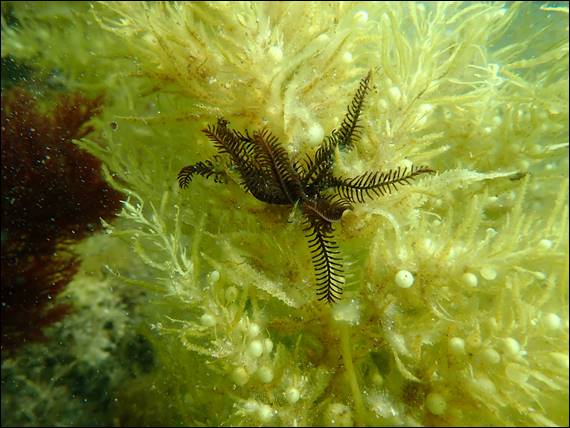
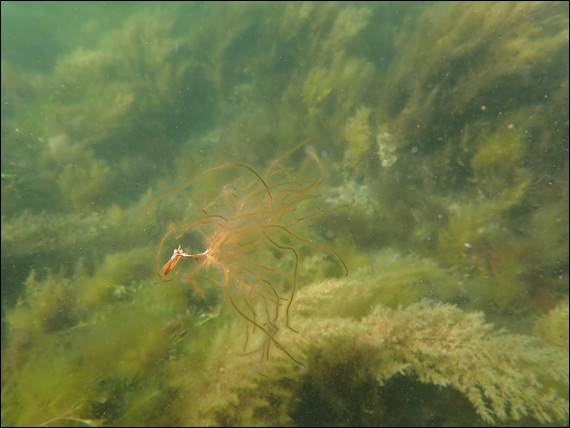
I did a lot of checking under ledges, in hope of something fun but all seemed quiet. The above did however catch my eye, I have seen these dark looking ‘things’ in the crevices of rocks but can’t recall ever seeing one attached to seaweed. Much to my surprise it is a Feather Star of the class Crinoidea, and I have not attempted to narrow it down any more. Referred to as Crinoids, when young these marine animals can have stalks to keep them securely in place. As they mature those that keep the stalk are known as Sea Lilies while those that loose it are known as Feather Stars:
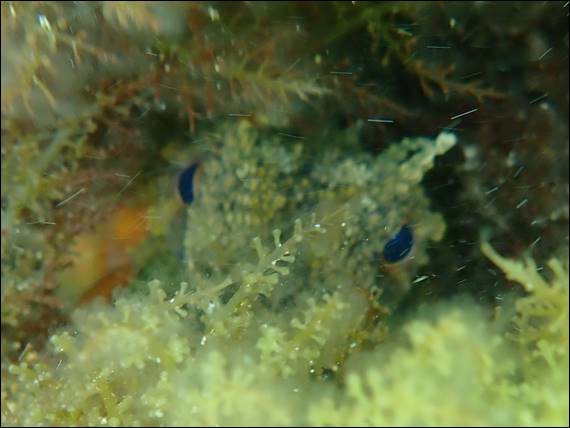
It was hard to sit and watch the Feather Star, and in the image below you can almost feel the movement in the water. I got a great view of this Western Rock Octopus (Octopus djinda), shown above and below. By day they are usually hidden away, watching the world from their protective lair or camouflaged by a collection of rocks, shells and other matter they use to cover their soft bodies. This one was using neither, being in the open and that allowed me to get glimpses of all the tentacles. But the movement of the water made it impossible to get a good image, as the weed swished this way and that:
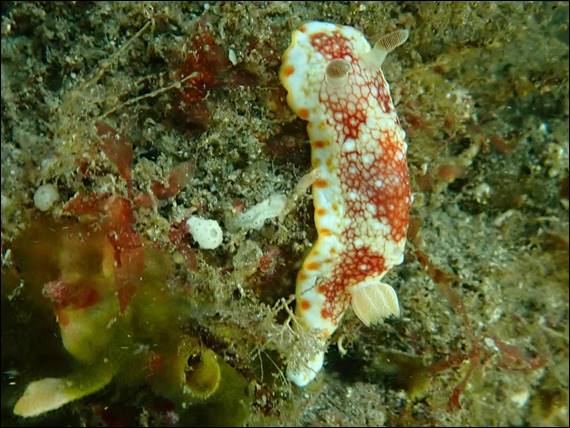
My persistence paid off again when I stumbled across a couple of adult Red-netted Nudibranchs (Goniobranchus tinctorius). They were much bigger than the young I had seen just five days before. They mature quite quickly, and these creatures never live longer than a year, in the wild, and some species less than a month. It is also sad that these very attractive and brilliantly coloured animals have very poor eyesight, so are unable to observe their own beauty. Unlike other creatures their spectacular appearance is not used to attract a mate, but to ward off predators:
As I was preparing to get out I spotted a good sized adult Brownspotted Wrasse (Notolabrus parilus) having a go at a sea urchin, which had found itself in an open sandy patch. Watching from a distance I saw the large fish circling the urchin, and going in to seemingly nip at the protective spins. Despite what looks like a defence system that is impossible to breach, the Brownspotted Wrasse is known to feed on sea urchins. So I am glad I didn’t disturb it by going down for a closer inspection, and headed to shore. Christmas morning arrived and with it the promise of an increasing swell:
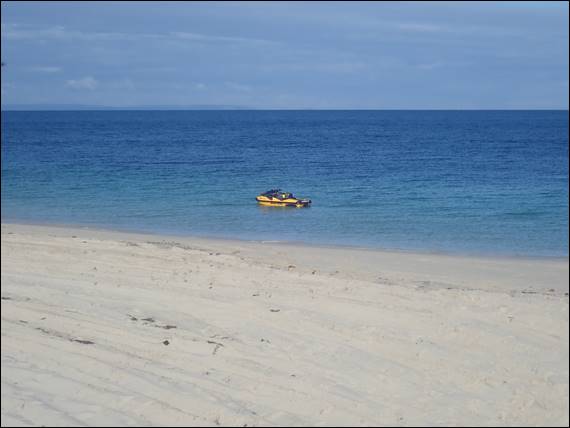
There were therefore three reasons for an early snorkel, wanting to catch the low tide, avoid the increasing swell, and to not be about when the throngs of people, which would no doubt invade the beach, arrived. I was a little worried when I walked down and saw the above jet ski bobbing about on the water. Personally I think they are one of the most useless boy toys you can get. Being no use, off a beach, for anything but honing about. Fortunately, they left soon after I entered in the water so there was no risk of being run over by it. And allowing me to focus on what lay beneath, rather than worrying about what could have been above:
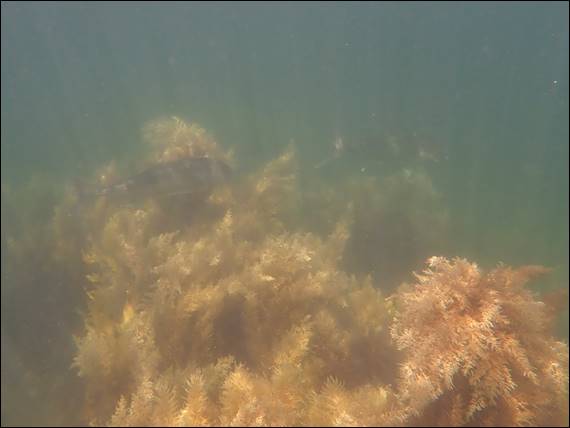
The visibility had gotten worse, this was in part due to the low sun but there was also a lot more weed floating about in the water, indicating the swells had been up. So as before I spent a lot of time looking extra hard, when out of the corner of my eye one and then a second large Samson Fish (Seriola hippos) came close by. I mentioned before how these fish display non-feeding behaviour during spawning, the reason being that their empty stomach creates more room to allow for larger ovaries. This in turn enables them to maximise how many eggs they can produce:
After a couple of circuits round me the large fish were lost in the soup, and I refocused on the sea floor. Here I spotted a long antenna poking out, and was happy when I was able to get fairly close to take this image. It could have been one of two species, being the Western Rock Lobster (Panulirus cygnus) or Southern Rock Lobster (Jasus edwardsii), the first is identified by a single white dot on the outside edge of each tail segment and the second by a single spine between the eyes. At the time I was unable to tell which it was, but with the reasonably clear image can confirm it was the smaller Western Rock Lobster species:
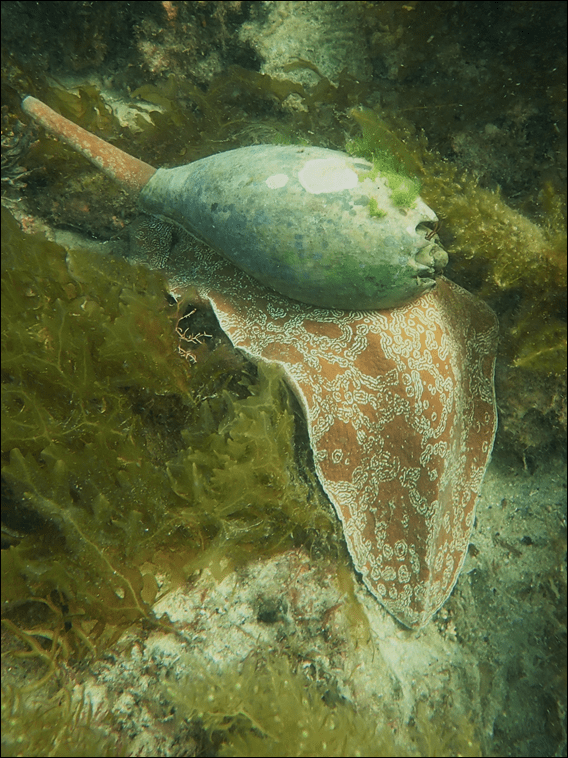
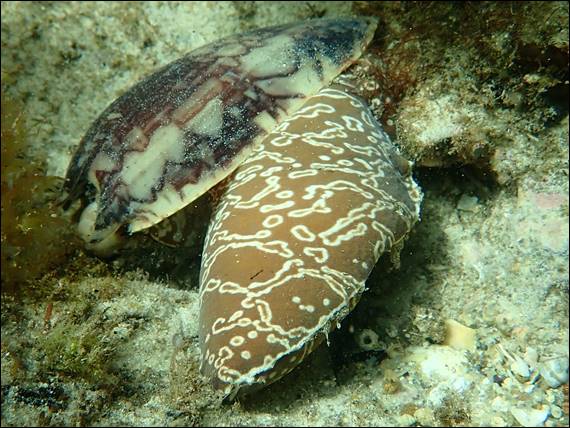
The swell was already picking up and the force of the water pushed this Southern Baler shell (Melo miltonis) out from under a ledge. To give you an indication of scale the shell on this one was approx. a foot long. I watched it tumble down and get rolled about by the water, until finally it stabilised itself and managed to get upright. Then it slowly made its way back into its daytime hiding place. I have dug a little deeper about their feeding habits and now know, these gentle looking gastropods, suffocate their prey with their large foot. I am still however none the wiser as to how they get their prey out of the shells, so will need to keep digging:
On Christmas Eve, when growing up in UK, I would be hoping that we might wake up to a white Christmas. Here there is no hope of that occurring, and in truth I still struggle to feel Christmassy in the heat of summer. But, as once happened twelve years back, I do quietly hope that I might experience another sandy Christmas in the zawn of Moses Rocks. There is no post of our trip in 2010 when, on Boxing Day, Rongy and I encountered this Christmas miracle. Allowing us to climb two new routes walls that have on every other trip here, since then, been impossible get on. And as evidence an image from back then is included below:
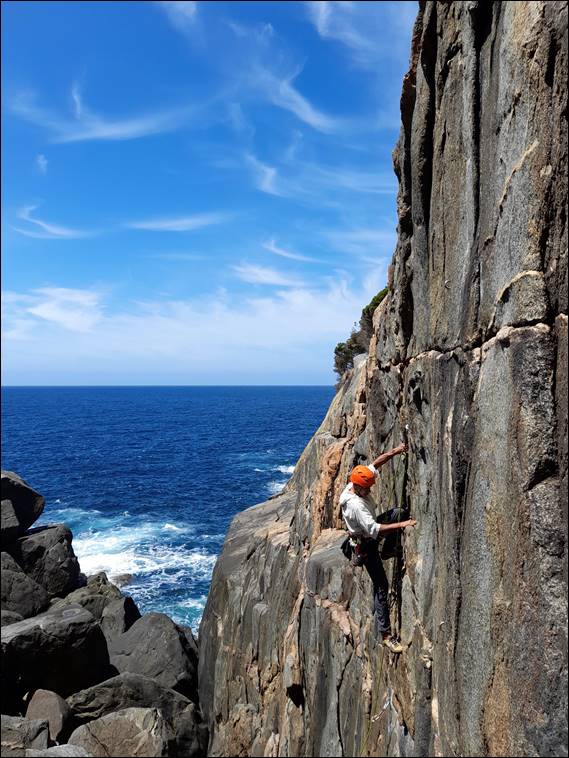
Today Ash and I had planned to get in the zawn, feeling that we would have had great conditions due to a reasonably low tide, small swell, plus a week of close to mid-thirty temperatures. Sadly Ash wasn’t able to make it, so undeterred I headed out to do a bit of top rope soloing. Feeling that the ocean conditions would also be such that it was even worth me bringing my snorkel gear to finally check out the reef here. However, the snorkel gear didn’t even make it out of the car. The view of the ocean, as I approached, made it clear there was no point in carrying the extra weight. Then as I walked in all the rock was damp, probably from the overnight sea spray and alluding to less than ideal conditions:
The above image is of the same wall that Rongy was climbing in the first picture. No sand and no dry rock. To top it off I had even forgotten to bring my ascender with me. This device would normally glide up the rope as I climbed and then, should I slip, grip the rope tightly to prevent me from plummeting back down. My only option was to revert to using my belay device with a prusik knot, which comprises a cord looped round the rope several times. This creates friction when the rope or cord is loaded, and stops the rope slipping through the belay device. Being a manual system it does not follow up as you climb, resulting in the need to find a good stance to pull the rope through the belay device, and then to move the prusik up the rope:
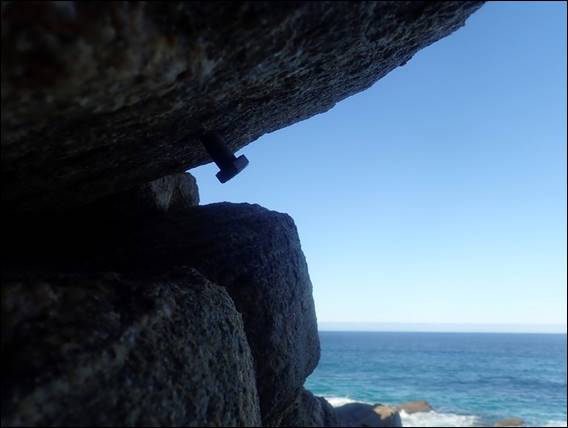
It means you have slack in the rope until you find a stance to allow you to fiddle about. And in the wet conditions it made for a slightly more exciting soloing experience than usual. It did not stop me, and I climbed a couple of routes on the wet wall before deciding to move the rope to the wall on the other side of the zawn. Here much to my amazement I spotted the above carrot bolt. It looked old and has no doubt been there a very long time, and despite how often I come here I had not noticed it before. Then, again to my amazement, I looked back across the zawn to find someone looking up at Hands Up Wall. To make the effort to get here it had to be a climber, and in seventeen years I have only come across other climbers here on two occasions:
After a quick introduction, it transpired that Rob had also come down to top rope solo a few lines. And he was equally surprised to find me here as, like me, he has not seen others here when climbing here. Between us we had enough gear and a lead rope, but Rob was just getting back into climbing after a bit of a break. Resulting in him being more than happy for me to take the pointy end, allowing him to reacclimatise both his body and mind to trad climbing with the safety of a rope above him. We hit a few of the lines on Hands Up Wall including this wonderfully flared and rounded crack, which I was quietly wishing I had my tricams for:
The climb he really wanted to get on was Wheely Things, another crack but more vertical and one that is deep enough to allow you to using a climbing technique call jamming. A great climbing skill but one so few are adept at, including me. So after three routes on the slabs we hit that one. Rob enjoyed it so much, despite getting pretty pumped on it, that I lowered him back down so he could do it again. The other line that Rob had in his mind to one day have a go at was in the zawn, being a fun arête. I set my rap line up again and we dropped in. With the sun on it the wall was drying up nicely, although the bottom being in the shade was still damp:
While he was keen to climb the arête, it was a line he wanted to lead. He had never been in the zawn before, which in itself can add to the fear factor, and was also not sure if he was ready to take it on. Plus, due to the access, it is not the sort of place you want to have an epic. So rather than spoil the opportunity to get an on-sight lead of the line, I climbed the face to the left of it. A route that really packs a punch at the grade, almost getting off vertical the higher you go. And all the time on slopey holds, all of which seems to slope the wrong way. We both thoroughly enjoyed the route, but the capability of the forearms to keep holding on had been somewhat reduced and we didn’t drop back into the zawn:
Rob was however still keen to have a lead, and the sensible option was to head back to the northern walls of Moses Rocks. Dry rock being in the sun, slabby routes to reduce the work rate of the forearms, easier grades and a sensible amount of gear all made it the obvious choice, where this time Rob did get on the sharp end and enjoyed it. With a successful lead under his belt, and one more than he was expecting to do when he decided to head to Moses, the bug was back and he was keen to jump on one more. Sadly however, the steeper and harder lines at Hands Up Wall had sapped more energy than he realised. Rather than forging onwards and risk a fall, he decided to bail on the second lead and end the session on the high of his successful lead:
After getting excited, some three weeks back, when I swapped the reference books that are sat next to my computer from orchids to fish, I have since not had to open them up. During this time the wintery weather, which seemed to intersperse the short spring spell we had, continued into what was now officially summer. Seaweed was still being washed up along the shoreline, albeit only in much reduced quantities. But it was still a good indication of what the visibility might be like. That said, prior to today I have been in twice:
Both times it was a bit murky and there was very little worth mentioning, other than this Southern Baler (Melo miltonis). I’ve previously mentioned the larger species called the Northern Baler (Melo amphora), which is quite common. Sadly the southern species is less common, mainly because the large attractive shells are harvested for ornamental purposes. They are at their best when the shell is occupied, as when unoccupied the pattern started to bleach. This means the molluscs are being killed to satisfy our need for pretty things:
It is uncommon to find them in the daytime, when they are normally buried under the sand hiding from prey. They come out at night to feed on molluscs such as scallops and turban shells. One day I’ll have to find out how these soft bodied creatures manage to get their prey out of their protective shells. Today, after several days of good conditions Geoff, Nana and I decided to head into the water. The Capel River mouth has been opened up to allow flushing of the riverine water to improve the water quality and reduce the risk of algal blooms forming:
As such the best reef was not accessible and we decided to go in and check the section of reef I spend most of my time exploring. It felt a little luxurious being picked up and driven the short distance to the beach, but certainly wasn’t going to complain. The water was flat, but the swell was enough to keep the weed swaying back and forth and to stir up a bit of sediment close to shore. My duck diving did however pay off when I stumbled across two small nudibranchs, and sadly this was the best image I could manage:
They were no more than 20mm long, so I assume they were relatively young. My first guess was maybe one of the Harlequin Nudibranchs species, but on closer inspection I believe they are probably Red-netted Nudibranchs (Goniobranchus tinctorius). These are said to be a very common species with a wide distribution. Found throughout the Indo-Pacific region, and in all waters off the Australian coast except Victoria and Tasmania. However, to find them takes a good eye and patience, and most importantly when snorkelling an ability to hold your breath:
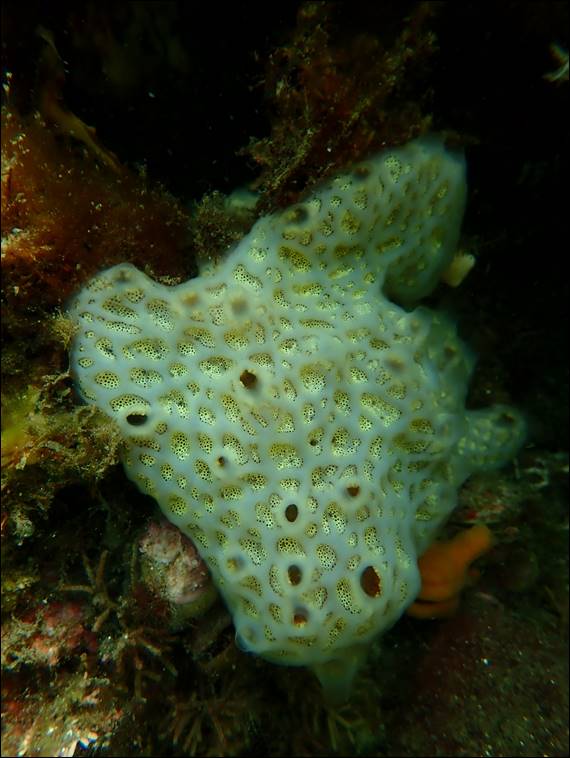
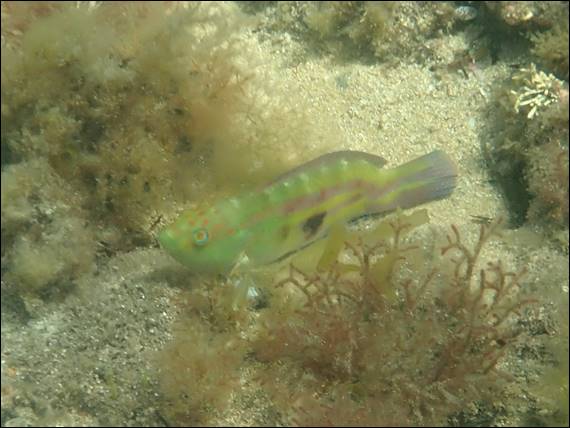
You will noticed I skipped past the above image, and try as I might I have no idea what this was. I have seen the delicate underlying honeycombed structure before, and back then thought it may have been a sponge. I have however not previously seen it with the ghostly looking lattice that is encasing this one. The find below was however easy to identify as the Senator Wrasse (Pictilabrus laticlavius), they grow to 30cm in length and this one was 15-20cm. While not fully grown I was able to tell by the colouration it was a male:
The males are highly territorial, while the females can roam across the boundaries that the males so fiercely defend. These fish are what is called protogynous hermaphrodite. In the early staged of their life they are female, free to roam. Then, anywhere from their second to fifth year, they will change into a male. And start to defend their patch while living until an age of up to ten years. We continued to check out the underwater landscape, and maybe as a result of feeling ‘safety of numbers’ ended up much further out than I have been before:
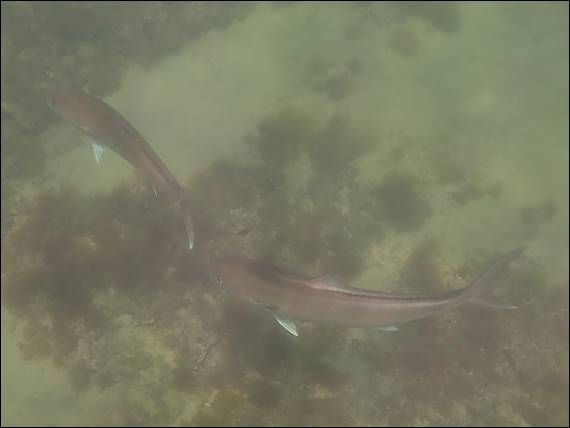
A small school of three Samson Fish (Seriola hippos) circled us with curiosity. Close to a meter long, these fish are named after the biblical figure of Samson due to their strength. Found in the waters off Western Australia more than anywhere else in their range. Fishing restrictions imposed on ‘good-eating’ demersal species have resulted in Samson Fish becoming a more sought after catch-and-release species. Care is required when releasing them during spawning activity, a time when they display non-feeding behaviour and have little in reserve to deal with the stress of the experience:
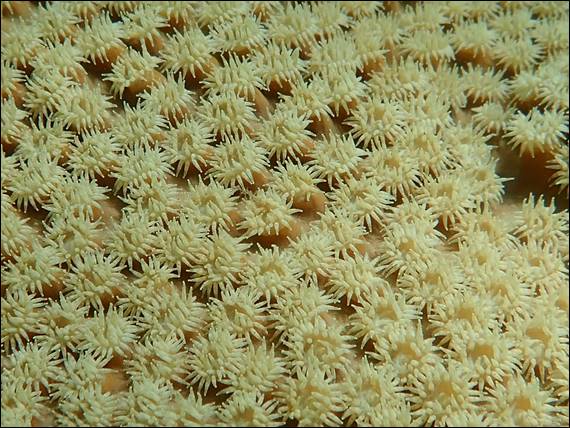
I also spotted the above coral, something not found in the reef area I normally stick too. It has been very hard to try and identify it, despite having some great close up images. The closest I am brave enough to share is that it may be of the Turbinaria genus, comprising colonial stony corals. This genus can form many shapes, which their names allude to including disc, scroll, cup, vase, pagoda and ruffled ridge corals. The polyps clearly seen below are only found on one side of these structures, and are usually housed in raised tubular skeletal cups:
Just like the Southern Baler and Samson Fish, these corals are also at risk from us. Being found in water depths of 2 to 15m they are susceptible to coral bleaching due to changes in temperature, light, and/or nutrients, all occurring due to the way we live our lives. These triggers create stress that results in the polyps eject the coral’s algal symbionts. Without this algae the coral in unable to survive. All that aside, the three of us really enjoyed the dive and what we are still able to see. So I’ll endeavour to be a bit more cheerful in my next post:
It was way too much like hard work this morning, when at 4am the alarm violently shook me out of my deep slumber. When we had agreed the time earlier that week our reasoning was sound. The destination being just a wee bit further than usual, and the temperatures threatening to tip into the thirties. However, it had felt an arduous and draining week at work, and last night we popped up the road for a social at the neighbours. The one beer I had was enough to make the early morning, as it arrived all too soon, a little less inviting:
Rongy and I pulled into the carpark in Capel at the same time, and he too had found the early start a little challenging. However, once the light started to come into the sky our circadian clocks sprang into action and the morning was once again a wonderful time of day. The 80min trip led us to the most southern rocky outcrop worthy of climbing along the western coastline of the Leeuwin-Naturaliste National Park. Cosy Corner doesn’t have loads of routes, but it is a place that has a special feeling to it:
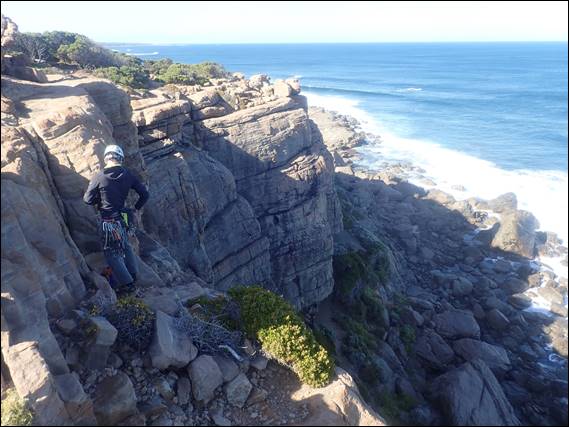
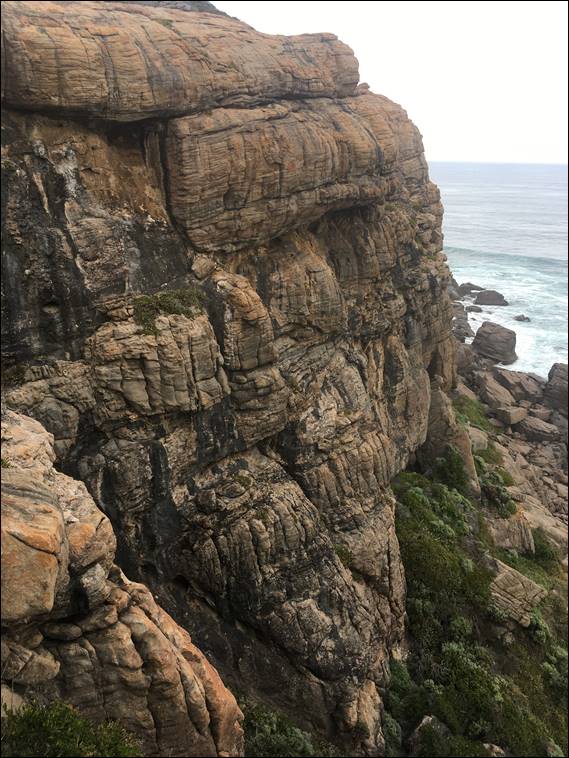
To gain access to the climbs on this cliff you need to abseil in, but neither of us had a plan for the day and were both a bit indecisive about which routes to hit. Instead of deciding, we went for a wander, first to the southern end of the cliff, to scope out if there were any new route possibilities. But there was good reason there are no recorded climbs on this section. It was very broken with big blocks that looked like they were just hanging there and could tumble into the ocean with only the slightest bit of encouragement, as shown above:
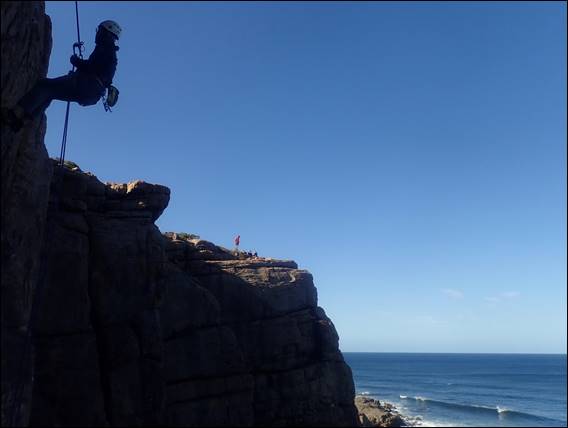
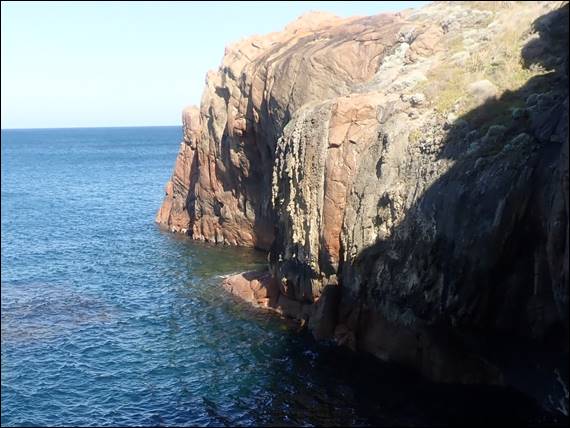
We then walked out to the headland, which is bleached out in the image above due to the contrast. I’ve looked down this shorter and steeper face numerous times, but there are no good belay ledges at the base and the wall looks wet even in the calmest of conditions. With no new sections worth exploring we rapped into the tallest part of the cliff, where we knew there were three worthy lines. However, Rongy’s eagerness for something different resulted in him scoping the cliff left of where the established lines exists:
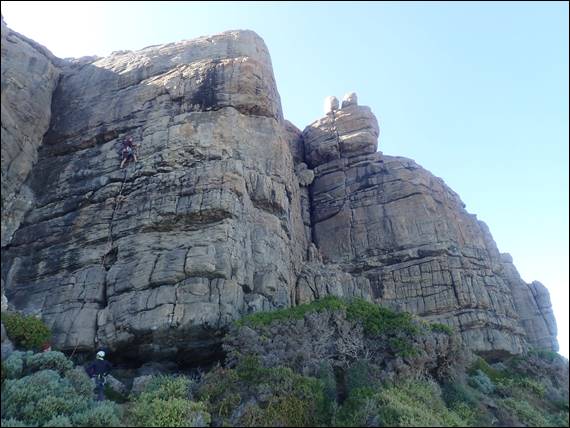
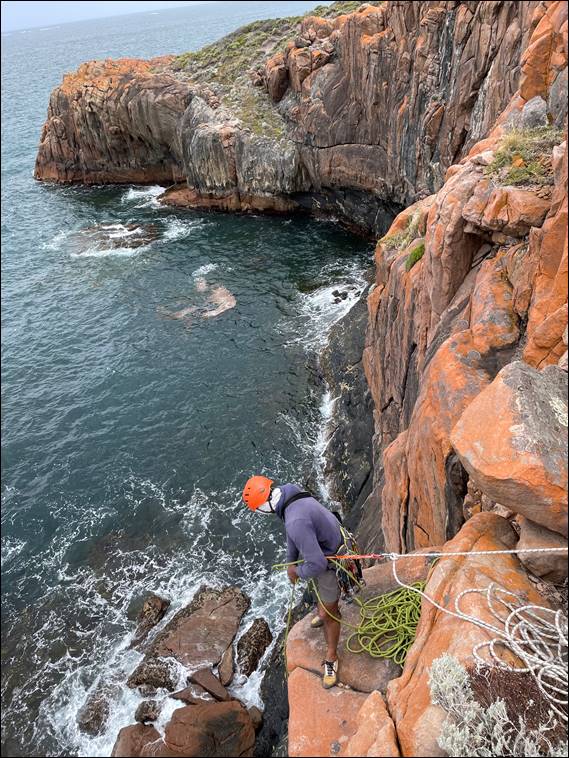
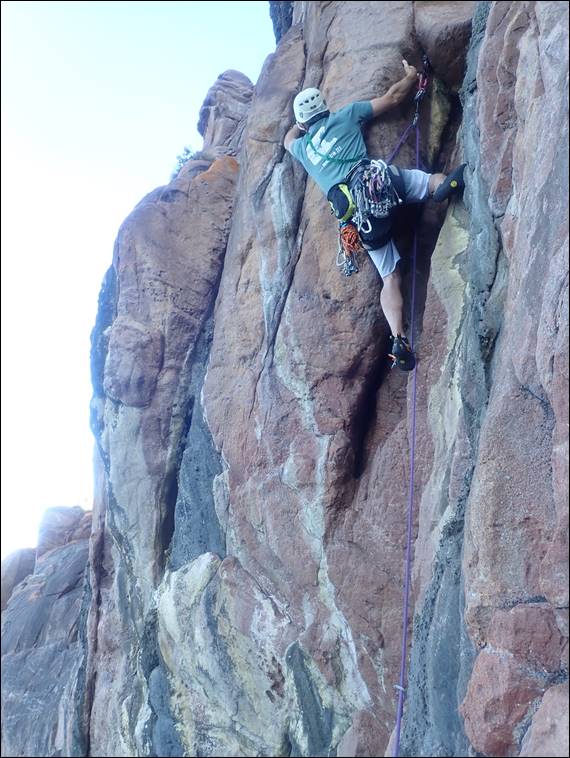
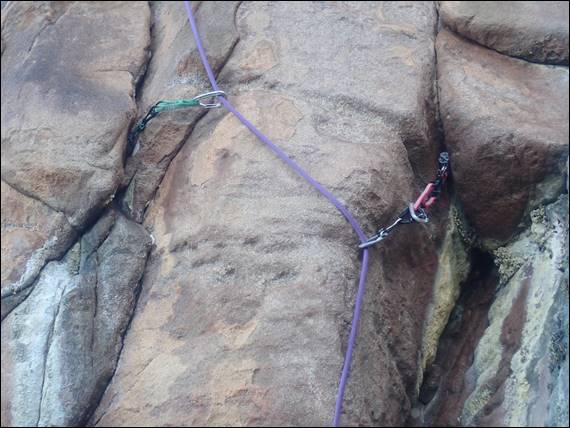
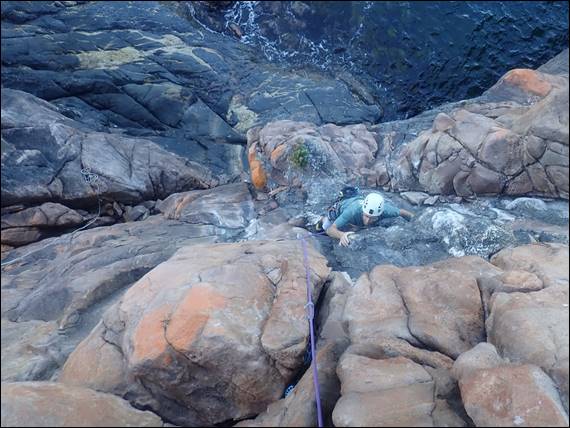
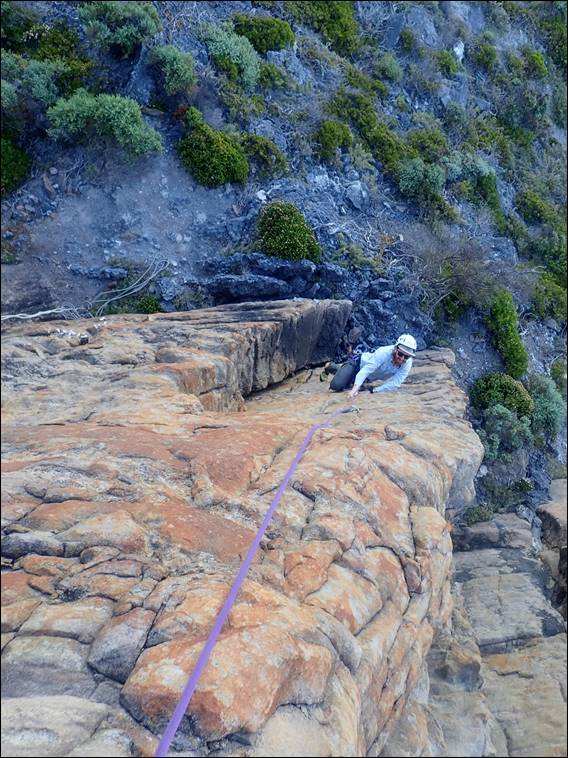
Despite not having climbed for some time and not feeling climbing fit, he managed to weave up a sneaky but worthy line that included a couple of bold sections. The upper part of the climb eased off a bit, but not for him on lead. The crux move, shown above, felt very exposed and insecure. This led him to placing two pieces of gear close together, and after a quick discussion about whether to place a short or long extender on the red cam, we/he opted for a short one. And this decision was enough to create drag, as the rope ran round the bulge:
Now I wouldn’t say I was jealous of him having bagged a new line, but it did make my eyes start to wander. Not that they had to look too far, as just a few meters to the left there was an obvious corner crack. The start provided great thought-provoking climbing that at the crux seemed improbable. Above the corner there was a need for more reflections, when the climbed went up a section of the face covered in a sheet of limestone. This stuff can vary from solid through to complete choss, which can give way at any time:
I’m pleased to say it held. That said I can see Rongy’s line being repeated, but the limestone mid-section of mine might be enough to prevent anyone wanting to try it. We were both pretty happy with the two new routes, but my eyes were still searching. I pointed out a narrow section of rock on the headland that was bound by limestone on both sides, shown below. It even had a small platform at the base from which to belay. Rongy was not as convinced as me, so we decided it was time to jump on the established climbs:
We hit all three of them allowing us to compare them against the two new lines to confirm what we might grade them. We both agreed they were a tad harder, which was good as it meant we didn’t have to work quite so hard as we knock the first, second and finally the third line off. It was however hard enough to work Rongy’s unconditioned arms. And as he began to surmount the roof of the final climb he hinted that he didn’t have much juice left in the tank. Code to say “watch me”, which I did while continuing to take photos just in case:
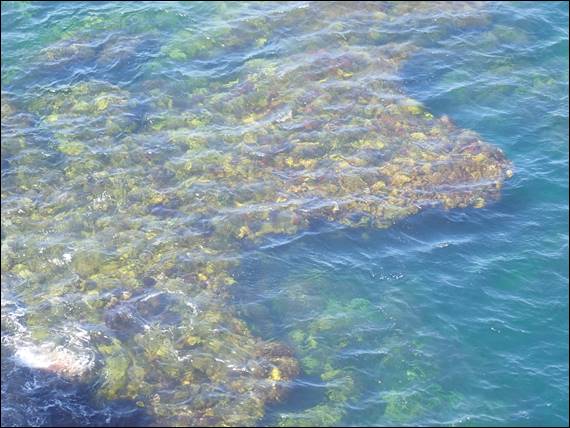
Five lines may not seem like a lot of climbing considering the distance, and there was plenty of shade time left on the wall to allow more climbing. The decision to call it a day isn’t however always based on the amount of climbing, but also quite simply whether we feel satisfied with what we had done. And we both did, especially the new routes: https://www.climberswa.asn.au/topic/cosy-corner/. Our only regret was that we didn’t bring the snorkel gear. The water wasn’t flat but it was clear and as the sun rose higher in the sky the weed covered reef looked so inviting. Next time:
I thought I had been pretty good with taking time off from work this year, but I seem to have got towards the end of the year with a fair bit of leave up my sleeve. This included one day of a particular type of leave that if I did not use it I would lose it, as the clock clicked over into 2023. A while back I had decided to use it today, and the tentative plan to get out with Howsie for a climb. Sadly these plans were scuppered, although coming up to the silly season and all that it brings, I wasn’t overly surprised. So already had a backup plan:
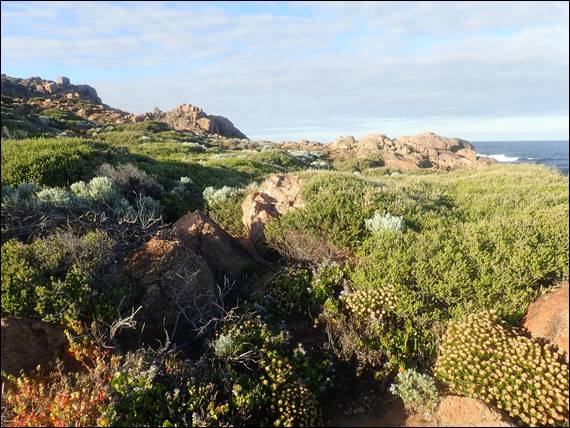
Walking in through the low scrub the birds, hidden from view, were in full song. It was about the same time as I would normally have been driving to work, which I felt was an early enough start. Plus after a run of low thirties/high twenties it was forecast to be partly cloudy and cooler today, so there was no need for a proper early start. That said I was still hoping for more cloud than not, which didn’t happen. The cloud was about, it just didn’t provide shade where I was climbing. That meant I was going to be in for a hot and sweaty time:
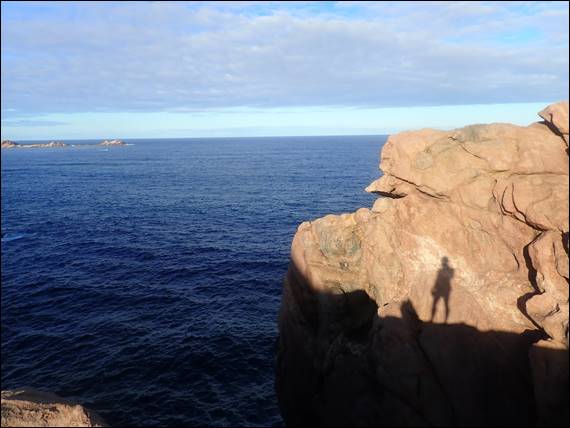
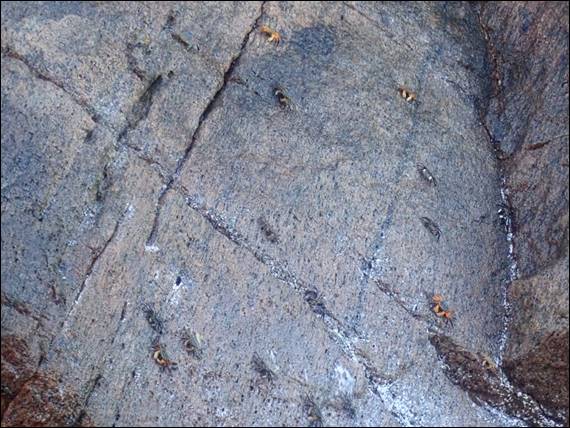
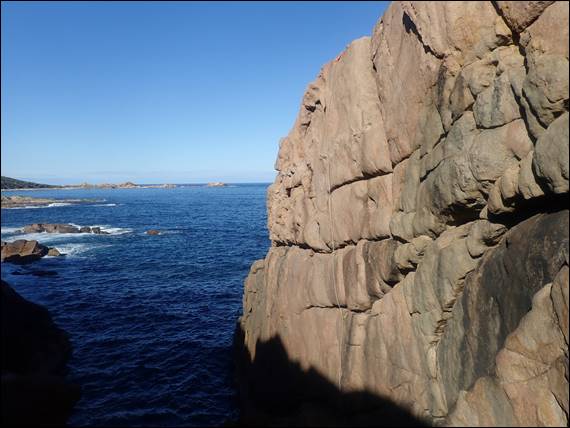
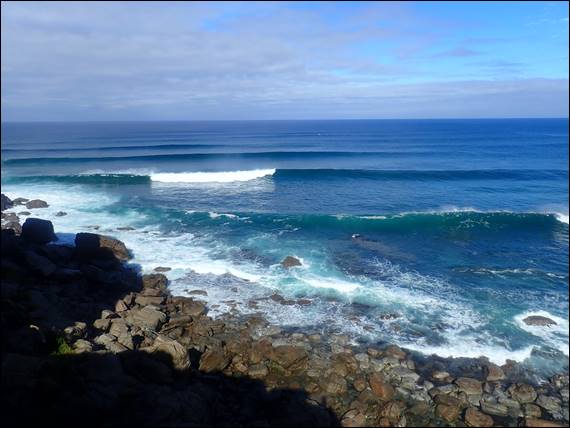
The carpark at the beach can often be packed at this time, not today. It was empty and I didn’t see a soul as a drove in, and then hiked along the track. It was probably due to the lack of swell today, so the surfers could have a lie in. Across the bay I reckon the snorkelling conditions would have been great. But at the mighty zawn of Smiths Beach, where I was standing, the sets of waves while not big would have made it unpleasant to be in the water. That didn’t however worry the crabs, who ran and dived in water as soon as they spotted me:
When writing the guide for this area I called Smiths Beach the big brother of Moses Rocks. They have a similar style of climbing with rounded rock and flared cracks, interspersed with blank featureless sections. Friction is everything, but only works with good balance and engaged core strength. However, Smith Beach is more of a brute being steeper, more technical, and with rougher rock. And just like a tussle with a big brother I find that I come away from this place with scuffed knees nearly every time, and did again today:
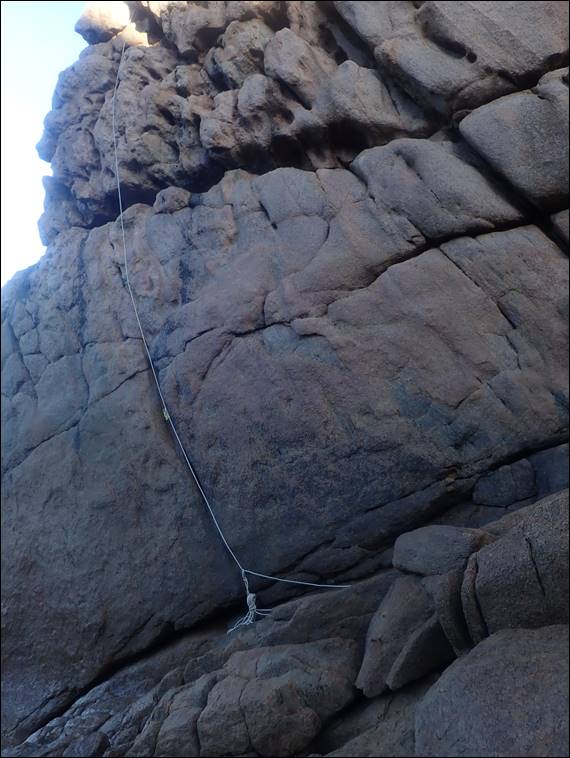
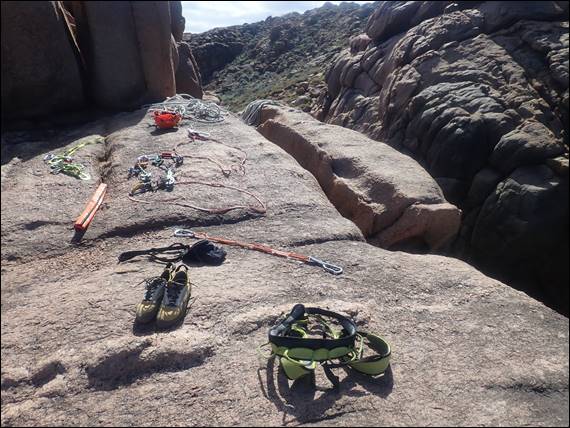
On previous solo missions here I have stuck to the steeper and harder north facing wall, as it hold onto the shade for longer. Today however I plumped for the south facing Harbour Wall, on which several routes take a leaning line up the face. To the left is the open ocean, and the thought of slipping off, down low, and swinging out above the ocean wasn’t very inspiring. Just to show that I can be sensible and do consider the risks, to avoid that happening my set up today had more directional pieces of gear, as well as an anchor at the base:
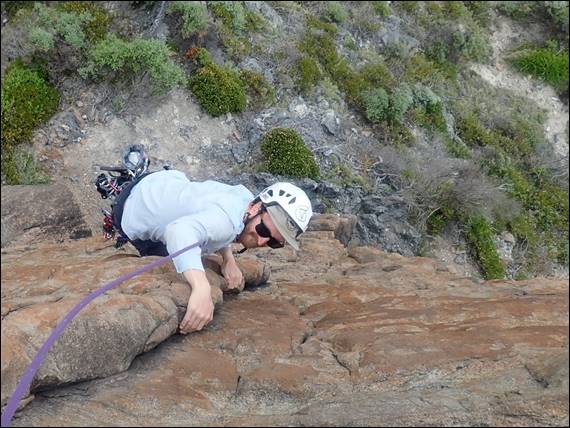
That said the start moves of the first line and finale of the last line of the day felt pretty sketchy to say the least. When I led the first ascent of these routes I did them ground up, which means not I did not inspect the lines beforehand so had no idea what holds or gear might or might not be available. So the acceptable level of risk back then was a tad higher than it may be now. While I only managed one line in the shade, after which the sun struck, I stuck to my plan and sweated it out and thoroughly enjoyed my tussles with the big brother:
A sixteen hour round trip to catch up with friends down in Esperance was just a bit too much to think about for Ash this weekend. This worked out well for me, as it meant I had someone to hold the rope and I didn’t have to go solo again. As Sam found out last weekend, having the rope below you brings a whole new perspective to climbing. Something that you can probably guess I relish. So while I will resort to top rope soloing if I have to, my preference will nearly always be to be on the sharp end:
I say nearly, as I feel any statement that uses the word always and/or never are rarely true. In fact Lisa and I made a pact many years back to avoid using these terms, in part as they can unexpectedly result in discussions taking a turn for the worse due to inferring accusations. The last time Ash went climbing was with Claudia, Sam and myself, which was nearly three months back. As such he confessed to not being climbing fit resulting in us plumping for the Organ Pipes at Wilyabrup, a rarely frequented place:
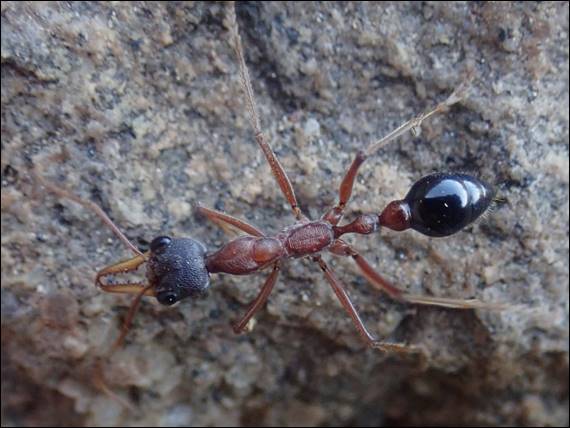
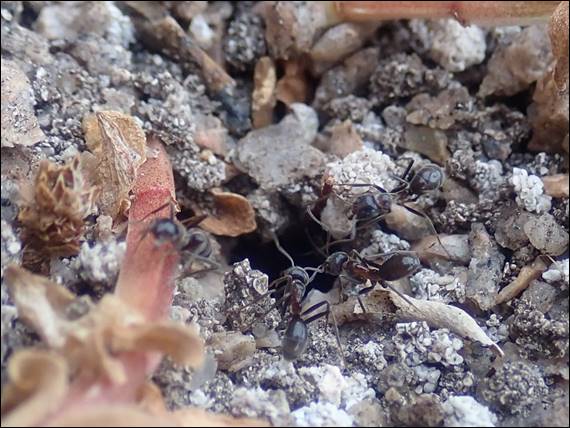
This place has short, and some might go so far as to say scrappy, lines. They however offer some fun lower grade routes, perfect to ease Ash back into climbing. The main face has a great level and clear area at its base, a perfect spot to belay. The only issue today being the infestation of ants. I attempted to get an image showing them en-masse, failing miserably so I instead focused on one of the entrances to their underground home. Here I watched them frantically scampering in and out, and wondered what they may be communicating to each other:
While Ash looks rugged up, he discarded layers after the first line. It was a bit of a strange morning, we had expected a crisp clear start to the day but the air seemed to hang heavy and the humidity was up. This is what I put all the any activity down too, and made a mental note to do a bit of research to see what facts may lie behind my theory. There are plenty of pest control sites that reference increased ant, and other insect, activity in humid conditions. All indicating the moisture draws them out, but finding actual research or factual information was harder:
The closest I could get was a paper, which detailed observation of a 25% increase in ant activity with increased humidity. And I am happy to take that as confirmation, although the ant activity today was way more than 25% of what I normally see here. So much so we avoided the obvious place to belay from in order to get away from the critters. Humidity plays another role with me, making me feel lethargic. That added to the reduction of friction on the rock due to the moisture in the air, and increase in sweat seeping out of my fingertips. All of which is not a good combination:
Fortunately we were having a purposely cruisy morning, so these aspects didn’t impede my performance. Ash too did well, and even more so when I found out he had pounded out a 27km hike along part of the cape to cape trail yesterday. That along with his active job had meant we was already aching before we started. Making me wonder how much I could push him along even with the more sedate routes here. We stuck to the original lines here and purposely avoided the newer routes, which tend to be that bit more sustained and slightly trickier:
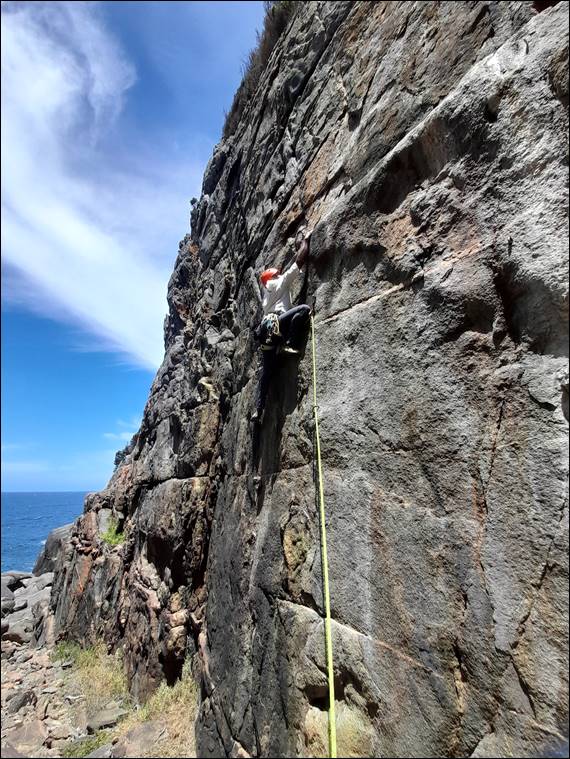
The newer routes being sneaky lines that I have over the years picked off, or offered up to others so they could bag a first ascent. There was however one sneaky option that I had not to date attempted, and despite his tiring arms Ash encouraged me to give it a go. Even hinting I was a bit of a dog with bone, so I might as well go for it and get it out of my system. The image above shows the route, and it was really fun. The top wall was where it got spicy, which is a bit of theme on this face, and this was a little too much for Ash’s not tiring but now tired arms:
Being a slightly scrappy crag, he was able to avoid the hard part and came up with an ear to ear grin thoroughly enjoying the climbing, but also just being out. Having got the new route out of my system (https://www.climberswa.asn.au/topic/wilyabrup-the-organ-pipes-2/), we hit a couple of easier routes before jumping on the crag classic. It was clear that Ash was now pulling pretty hard to stay on. And while the security of the rope above gave him the confidence to keep moving, it was a sign that it was time to wrap things up and hopefully Ash won’t wait so long before his next trip out:












 Sandbagged