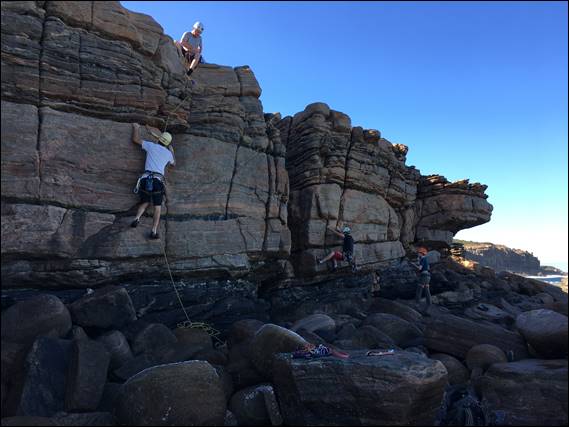
I am not the best in social situations, especially where there is small talk. That said I have tried to encourage the social aspects of our local crew. Back some years there was pretty good social element going and we’d meet up at crag, to watch climbing films or flick fests, or at someone’s house. I could usually revert any conversation I had to climbing, snorkelling or orchids so it was all good. However, I feel that I may bow out of endeavouring to keep such events going. The group is changing and so are people’s lives, that said today we had a big mob out:
But before I get to that. Lisa said to me the other day that when she had headed down to the beach with the poodles the colours and feel of the beach felt autumny. I also felt that last weekend at Beginners Wall, when the ocean had that slightly more tumulus feel to it. And you may have noticed that I have not been in the water for an age. I did pop down to check the conditions at the local beach yesterday but the water was a bit choppy. Maybe I’m being a bit too fussy but it really didn’t entice me, and I do wonder if I will go back in this season:
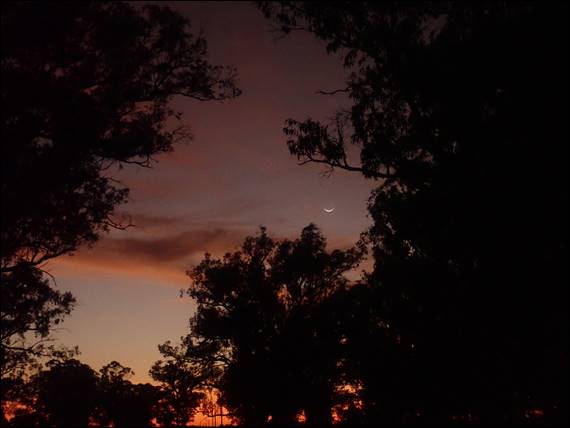
Back to today’s trip, which was going to be a gathering at Craig’s house to play on his recently completed boulder wall, have a feed, and catch up. Instead this ended into a catch-up outside, and seeing there would be a fair few kids in two the decision was made to head to The Playground. Being kid free, Rongy and I headed out a bit earlier to hit a climb or two before the mob turned up. And as I drove out to meet him in Capel, the autumn colours filled the sky with just the tiniest slither of the waning moon visible:
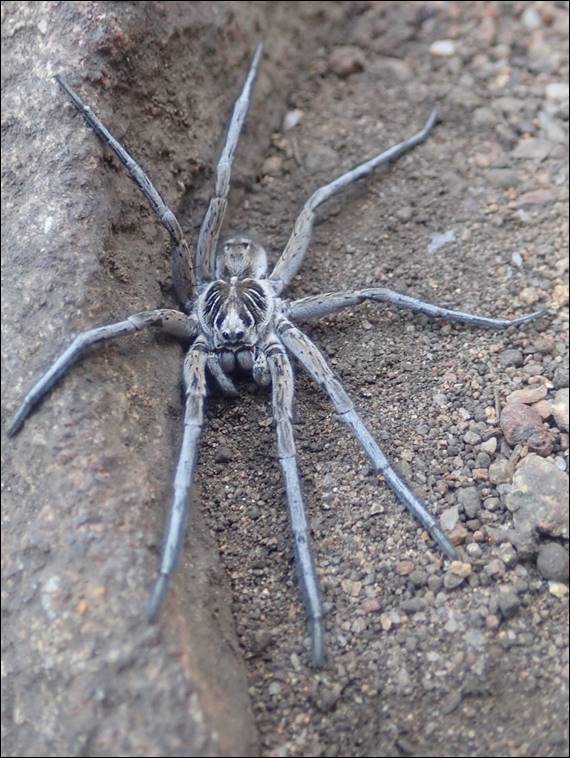
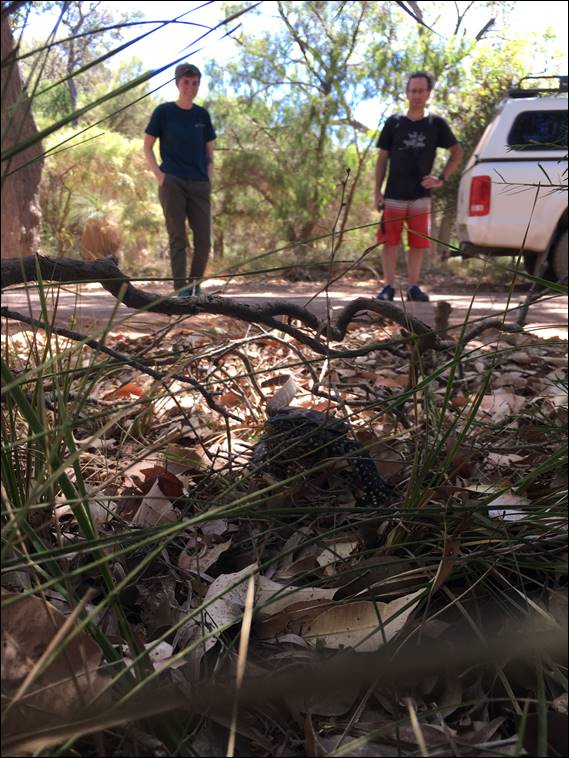
Sarah and her friend Sophia met us at the Wilyabrup carpark, after having had a camp out. Sophia said it had been a cold night, and it was still too cold for the above Wolf Spider (Lycosidae). Rongy pointed it out after I had nearly stepped on it. And despite its near death experience it was happy to sit there and allow me to then get some close up images. There are approx. 2,400 species worldwide, and one Australian pest controller reckons there are only two species in Australia, but I have found a 2018 paper that claims we have 34 species:
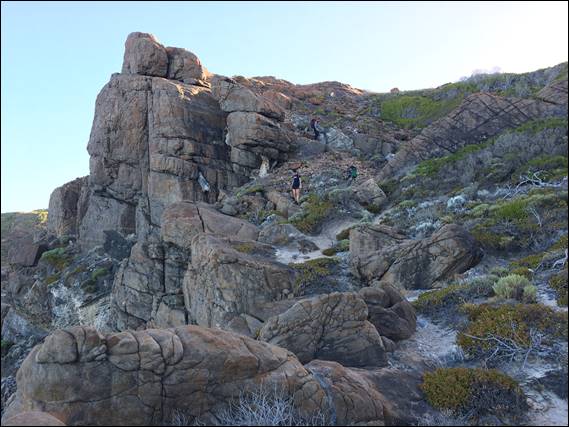
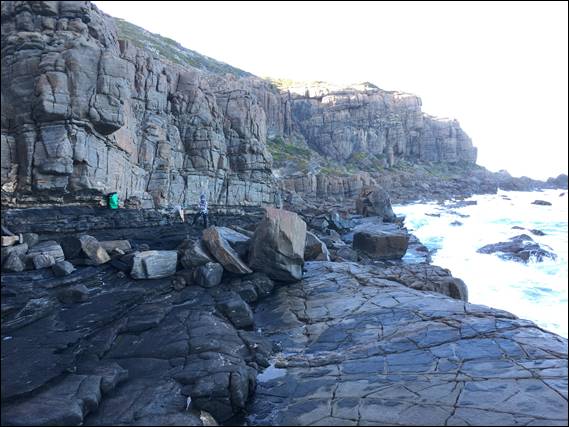
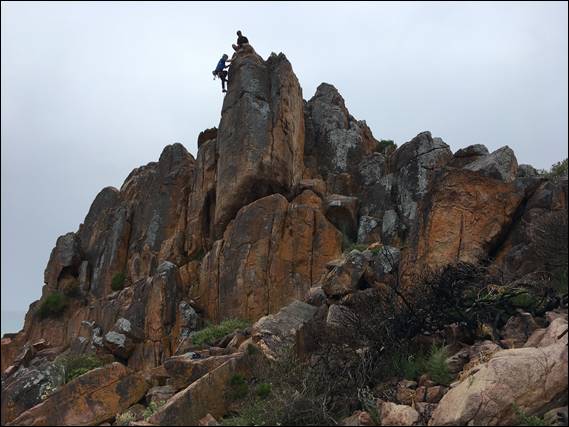
The route we took to get to The Playground was to walk in by rock hopping along the coast, which in my mind is the best way. This also allowed us to pass The Bookshelf, and as we were going to have an hour or so before anyone else would turn up I was keen to check out some possible first ascents. Many years back Lou had a bad climbing accident that resulted in her needing to wear a spinal brace, which looked a bit like white body armour. And at the shops one day a kid whispered to his mum that there was a Stormtrooper in their midst:
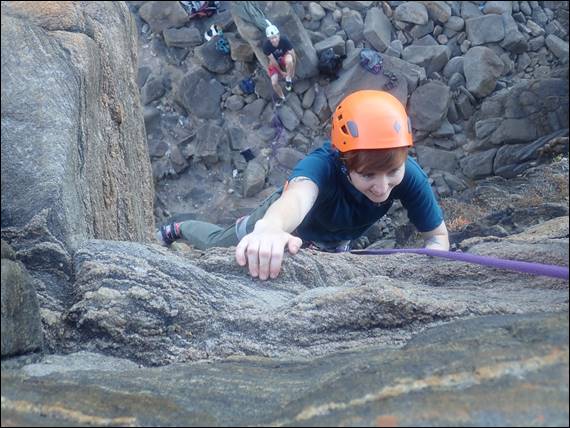
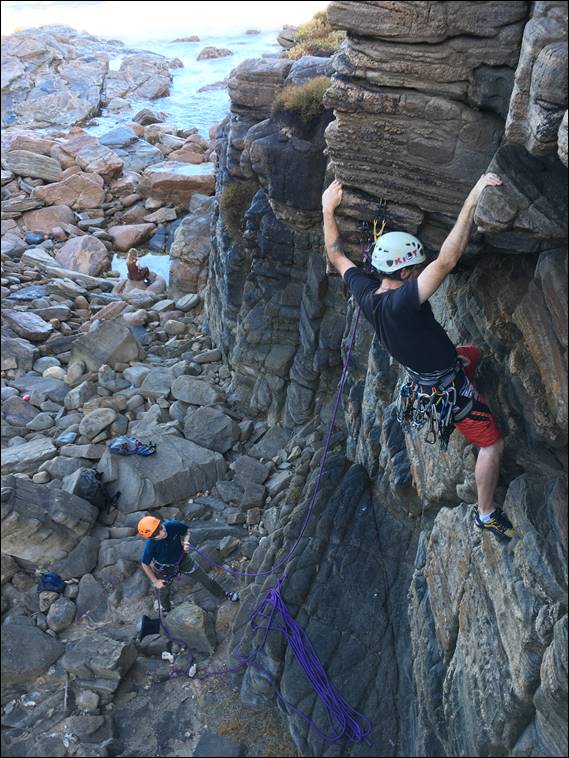
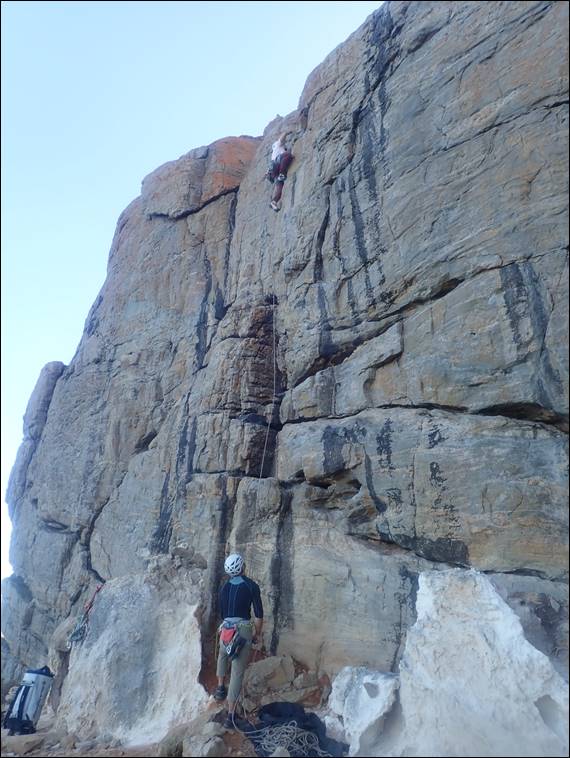
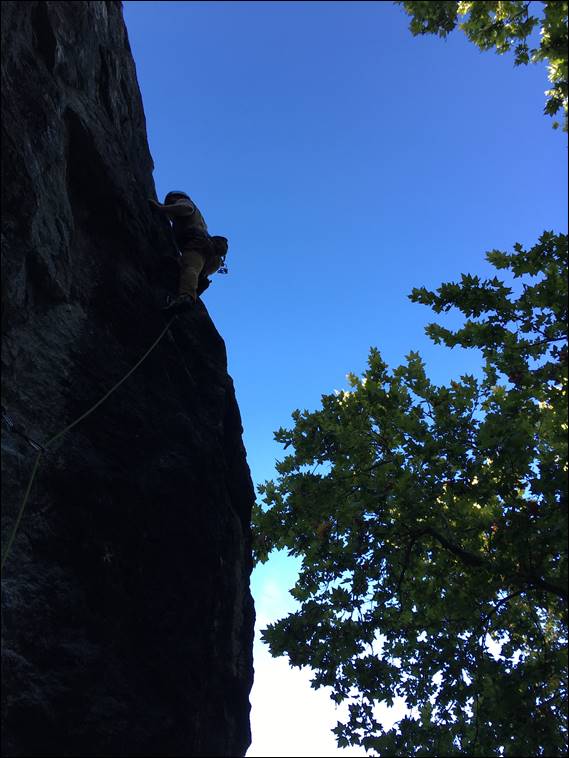
So it was that while I have known about this route for many years I have been waiting for Lou to grace rock again, so we could climb it together and name it after her guise from back then. But that isn’t likely to happen, so today I led the climb and as you may have guessed I called it The Stormtrooper. While the face and rock looked, in Rongy’s words, a little scrappy it was a fun line. So much so he then put up a second first ascent just to the right, from which Sarah promptly knocked off quite a number of large blocks. So that got called Demolition Girl:
After we had completed the two new routes, Glen rocked up with Jason and we moved round to the shorter walls of the Bookshelf. Glen has not been out for quite a long time, but jumped straight into leading a route. Jason was having his first taste of roped climbing, as such there was a bit of tuition going on about the art of belaying while Glen started to get disco legs above us. Fortunately, Glen avoided becoming a causality again, and if you want to understand why I say that check out https://sandbagged.blog/2020/04/21/glen-the-casualty/:
The first of the family crew to arrive was Craig’s mob. They had like Glen and Jason had driven to the top of Lost Buttress, walking in from the north. A much shorter distance, but nowhere near as much fun. This did however signal it was time to move again. At The Playground the ropes and gear were packed away and it was time to boulder. And shortly after Howsie, Josh and Kellie also appeared. They like us had walked in, and enjoyed checking out the rock pools along the way. Howsie had even been lucky to spot a snake, making Sarah a little jealous:
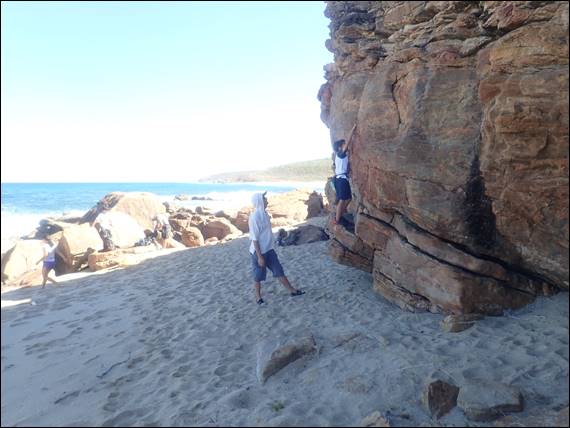
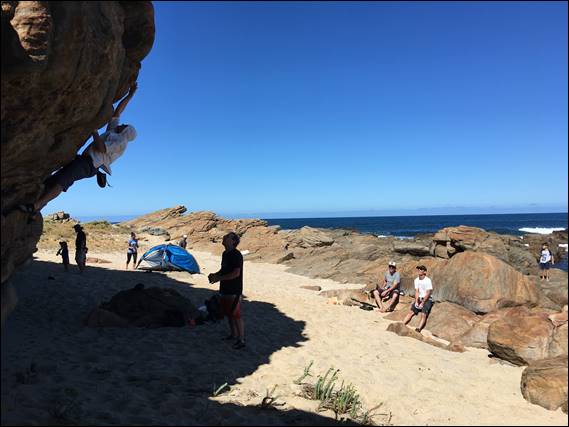
By then we had eight kids running amuck checking out the ocean and playing on the rocks. And The Playground became, well, a playground. The numbers didn’t stop the fun, and while at times it felt like we may have lost a kid or two they were generally all within earshot. Allowing the grownups to also make use of the delights of the area. Sandy landings making it a perfect place to boulder, with some fun problems many of which I help establish ten years back with Kym. Problems many people have played on and questioned the grades we assigned them:
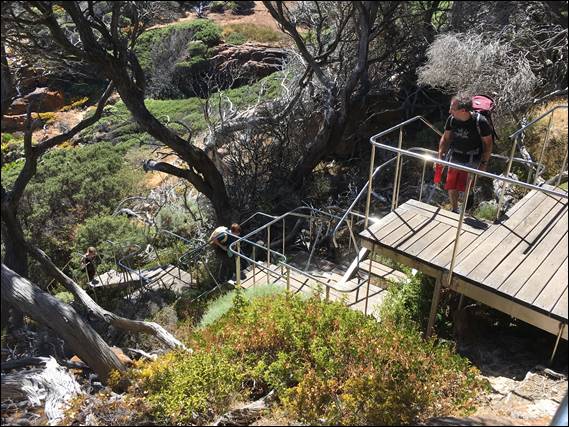
A number of them certainly did feel a little tricky for the grade Kym and I had given them back then, but that was also true of the lines we had jumped on at The Bookshelf. My reputation of sandbagging people may, as such, have some merit. Although when bouldering, failing is as much a part of the fun as succeeding. By 11’ish our arms were feeling weary and the bite of the sun was telling us it may be wise to head out. So Rongy, Sarah, Sophia and I walked out, which included the dreaded stairs, which for some reason always make my legs burn:
As we drove out Southern Heath Monitor (Varanus rosenbergi) ran across our path and I had to brake pretty hard to avoid it. It was definitely much warmer now and, unlike the Wolf Spider, the monitor made a dash for it but only into the bush by the side of the road. Allowing us to get a great view of it, before it then showed off its tree climbing ability so it could really get away from us. The rest of the mob only started to walk out from The Playground at 2:30, which would have been very toasty. And I feel that the kids will have well and truly earnt an ice cream on the way home:
The Stormtrooper (13, 8m) A steep start up and over an overlap at half height before entering the sentry box that protects the headwall. Consistent and fun climbing. Krish Seewraj, Sarah Hutt & Ryan Doe 19/02/23
Demolition Girl (13, 8m) The right facing corner, to the right of The Stormtrooper. Up the corner until the arête to the left can be accessed, proving some great exposure at the grade. Straight up from here being careful of the loose rock just below the top. Ryan Doe, Sarah Hutt & Krish Seewraj 19/02/23
At twenty six degrees we were not intending to feel like we were getting cooked. Maybe that was what led Josh to try his luck and suggest a 5:45 meeting time in Capel, by which time the sun had well and truly risen into the sky. As it was I didn’t object to the time, and Rob indicated he was OK with it too. So there were no excuses for feeling tired before we began, and added to that we aimed to find a place that had a bunch of routes to suit both Josh and Rob. While they are not novices, Beginners Wall at Wilyabrup was our destination:
We walked in past the mighty northern blocks, definitely not the place to head when you are building your confidence in leading. Down a rubbly slope on which you can at times feel your feet slip forward in an unsettling way, as the rocks roll underneath. Then meandering through the sharp limestone features standing proud above the cliffs, like a castle or watchtower of some dark lord. Kelly had joined us today, but as I am becoming to expect she donned her running shoes and headed off shortly after we had arrived:
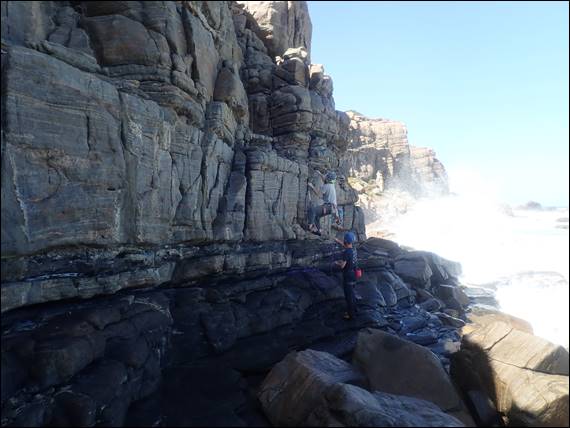
Her journey was to take her south along the Cape to Cape track, aiming to get some 20km of running in. That sounds way more impressive than us scaling the short 10m walls at this scrappy coastal location. A wall that looked to be dwarfed by the main cliffs of Wilyabrup to the south. Scrappy is a word Rob use to describe the cliffs of the Organ Pipes and Driftwood Bay, which lie between where we were and the main cliffs. It is a good word to use for those and this location, but it doesn’t mean the climbing isn’t fun:
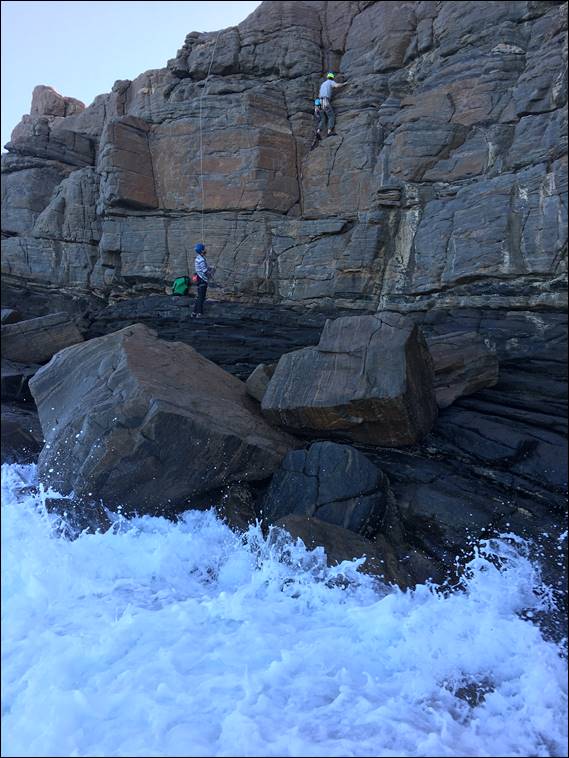
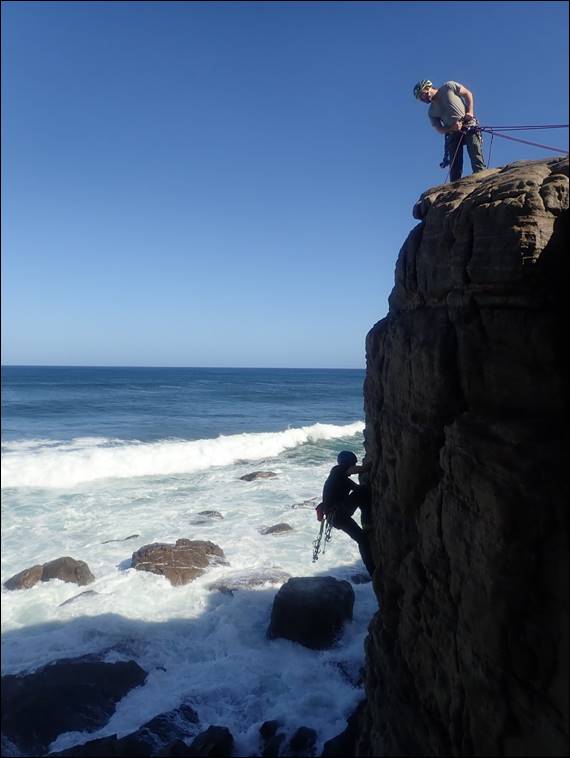
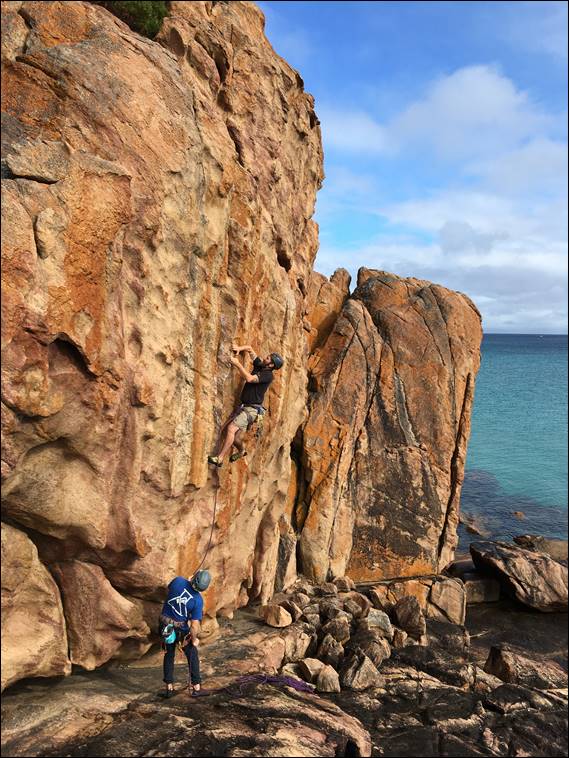
And it also belies the great situation we found ourselves in, with the 3m swell resulting in us looking over our shoulders every so often to see what might be heading our way. I was happy to allow the boys go lead for lead, so they could rack up a few ascents on routes they felt looked good and appealing. To start with there was no looking at the guidebook, it was a case of picking the lines that drew their attention. This resulted in allowing them to warm to this place, which despite its short nature is very well featured with ample protection:
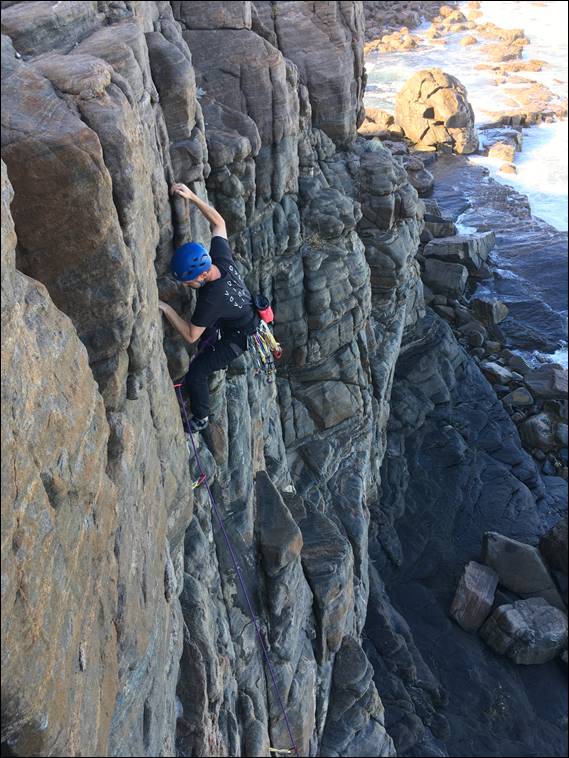
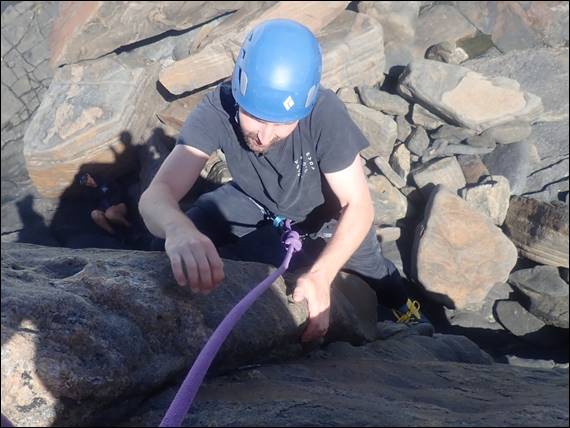
Having felt comfortable on their initial leads, and finding plenty of solid gear Rob decided to jump on an interesting looking grade 14. While there was one moment he stopped to consider what next, it really didn’t worry him too much. Although he did think it was somewhat over graded, and I made a suggestion that he should have picked up on. As I felt the original climb didn’t go up the relatively easy flake, but a flared crack to the right. One I have tried before and backed off due to lack of gear:
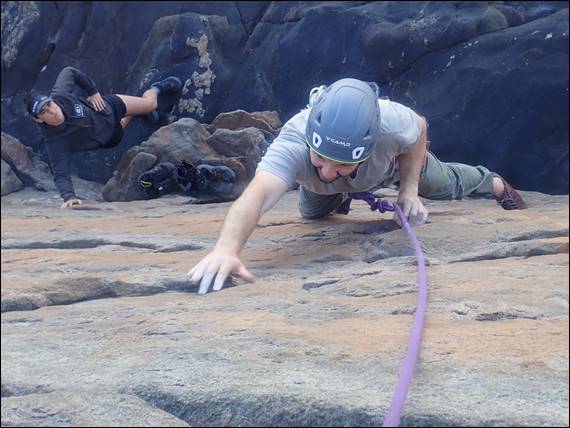
This was relevant, as after Josh notched up another enjoyable and relaxed lead and having had a boost by the above ascent Rob jumped on a second grade 14. For this one the line was obvious and inescapable, and this time it felt considerably harder. He went for it, but not before placing some solid gear, and promptly slipped. This was his first lead fall on trad, which surprised me a little as he has over the years done a fair bit of trad climbing. At least this time I couldn’t be blamed for sandbagging him, as I didn’t establish or grade the route:
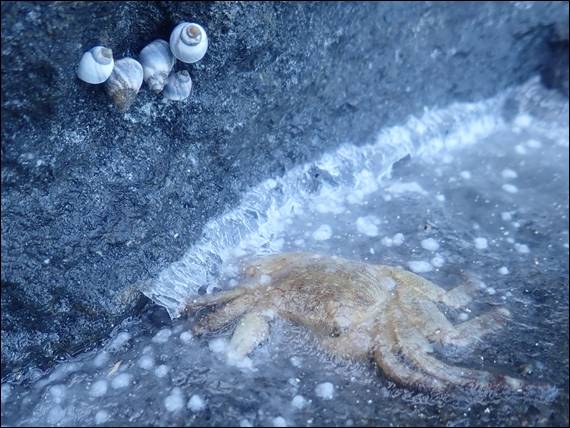
After a couple of attempts he came down and offered me the lead, and I have to confess for a grade 14 it is pretty spicy. And he was very happy with the decision to allow me to finish it off. They were both a little weary after that climb, but Rob was still keen for another lead. Sensibly dropping the difficulty, but he still left tired on the steep start. And was probably made a little nervous by the rising tide. The water at times lapped just a few feet from Josh, and also filled the above pool to release the crab’s carcass from its salty tomb:
Kellie returned from her 20km run as we racked up nearly 60m of climbing, not that it is a competition. Still I felt like we could jump on another route, this time it was clear that I would be leading and it might feel a little spicy. Seeing the climb is called Spicy. Being one of my creations, if Rob had led it he may have been justified in saying I sandbagged him. While he forced his way up the line, his body really didn’t want to pay attention anymore despite his mind understanding what he had to do. It was clear that Josh was now cooked:
But before we wrapped up, I knew that Rob had really liked the look of a short steep face. So I suggested that should be our final climb, and he seemed keen. Kellie watched on thinking I was a little mad, as I climbed the route. Other than one piece of gear it is effectively a solo, but I knew this so it didn’t faze me. Then it was Rob’s turn. Whether it was weariness from all the climbing and leading, nerves of watching me solo it, or that he felt it was yet another sandbag his goose was also now well and truly cooked:
We finally managed to get the pest control booked in for Thursday last week, to spray the house and deter spiders from cohabitating with us. We have this done annually, this time being delayed and we had noticed an increase in White-tailed Spiders (Lampona cylindrata). These were the biggest concern, as bites from these can cause swelling and itchiness. Something all three of us had experienced recently. The other common spiders were not so much of a worry, such as the Black House Spider (Badumna insignis) that like the in White-tailed Spider is native, and of course the introduced Daddy-long-legs Spider (Pholcus phalangioides):
We have the house sprayed with pyrethrin based chemicals, which is naturally found in some chrysanthemum flowers. That said, these chemicals can affect humans and dogs alike, mucking about with the normal operation of the nerves and brain function. Therefore, the poodles had gone with Lisa to school and, as I was working from home, I had to get out of the house for a few hours. A trip to the post office to pick up the mail only chewed up half an hour, so I took my snorkel gear with me and went in for a swim at Wave Walk off Peppy Beach:
The flat looking ocean looked inviting, with small rolling waves on occasion washing the shoreline. But as soon as my head went under it was clear that it wasn’t clear. Far from it and the under toad, for those familiar with The World According to Garp, had stirred up a storm below the surface. Needless to say it was a pretty ordinary snorkel, and I saw very little. Come Saturday and driving back from my morning out climbing with Ash at Wilyabrup the ocean once more looked very inviting:
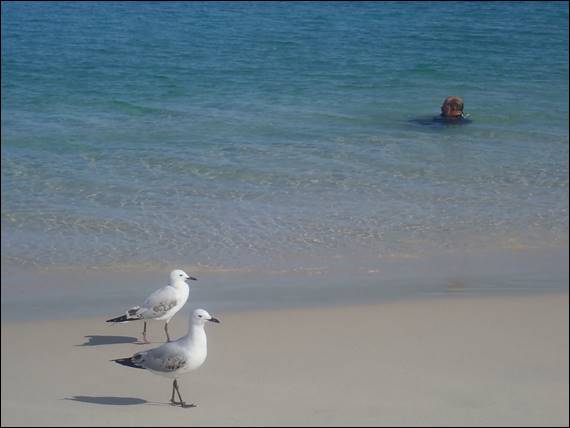
Not completely put off by the deception from a few days back, I planned to tag along with Geoff and Benny for a dive, again off Wave Walk, on Sunday morning,. It turned out to be a fair crew, with Nana, Moni, and Gav also joining. At 8:30, as we stood on the beach it already felt hot, as we waited for Benny who seemed to forget one thing after another. Gav had to cool down and bobbed in the water, watched on by a couple of gulls. And as Benny continued to faff, the rest of us went in ahead of him:
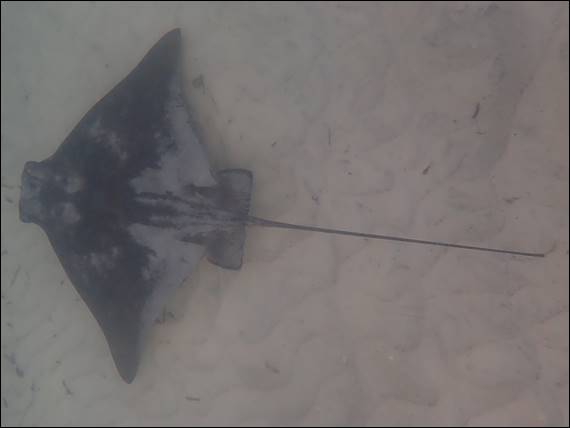
The visibility over the near shore reef looked a bit better than it had on Thursday, but only marginally. I was however encouraged by a Southern Eagle Ray (Myliobatis tenuicaudatus) that seemed happy for me to swim with and above it, as it led me out to deeper waters. Here the visibility definitely improved, with the swell being distributed over a deeper column of water so it did not have the force required to mobilise the bed sediments. The reef was fairly plain and flat, but the occasional feature provided an opportunity to explore:
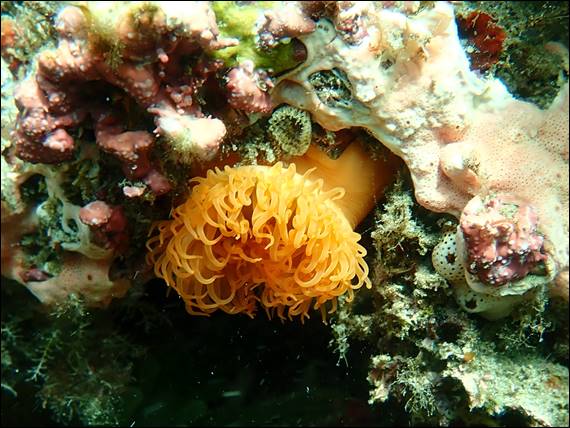
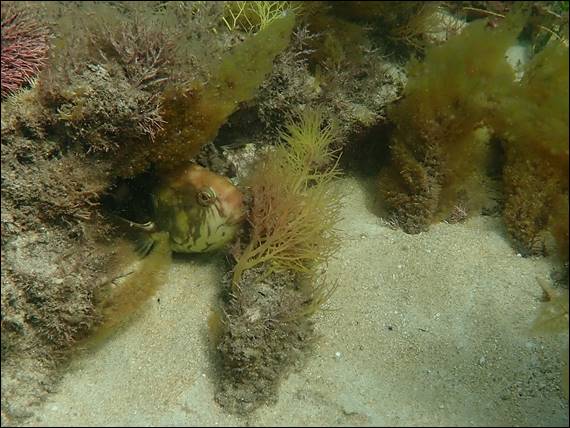
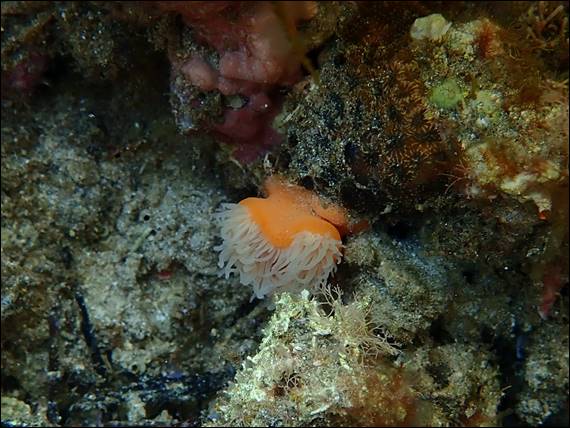
While there were plenty of fish about, I didn’t spot anything unusual or new. Not all of them were hiding from me like the above Brownspotted Wrasse (Notolabrus parilus), and no doubt someone new to the area would have marvelled over the many species I saw. I was however very happy to find the fully orange anemone shown two images above. It seemed a bit of a coincidence, after finding and getting so excited with the Sea Anemone with an orange body last weekend while diving the reef off from the Capel River mouth:
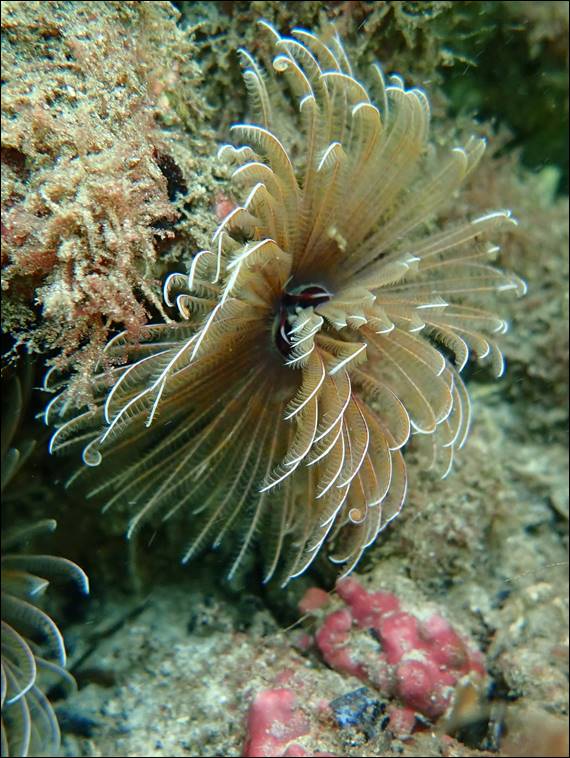
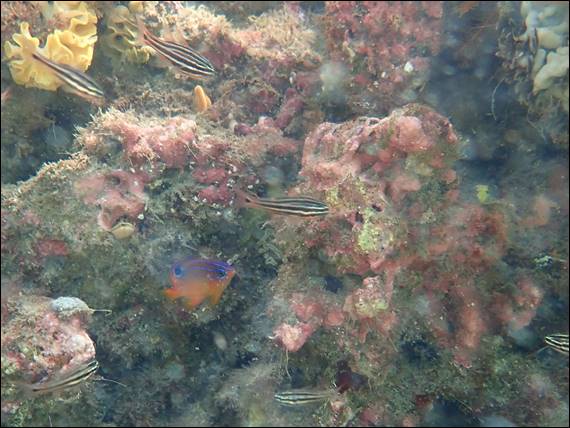
Similar to that last dive I also came across yet another species of Feather Duster Tubeworm (Sabellidae). The colouration of the delicate radiole, which swayed gently with the water as they filtered out food, was distinctly different to the ones I had seen before. It is this that I am assuming indicates it was a difference species, but I could be wrong. The below colourful find is however an easy one to identify, the electric blue lines and spots covering the bright orange body meaning it was undoubtedly a juvenile Common Scalyfin (Parma victoriae):
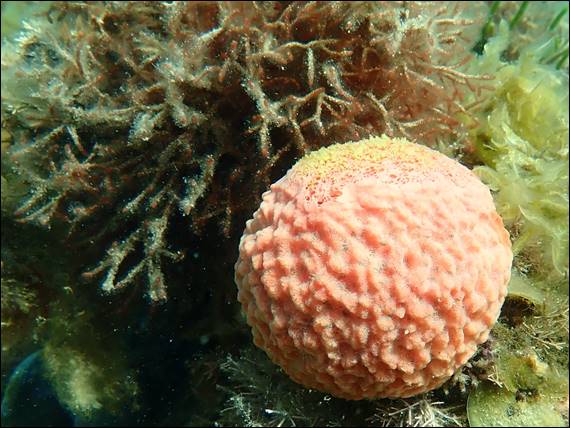
One more image of a Golf Ball Sponge (Tethya). While there are fifteen species found in southern Australian waters and despite the pinky looking colour, which may be partly an optical illusion created by the way the light was refracting through the water, I’d hazard a guess at saying it is an Orange Golf Ball Sponge (Tethya ingalli). After an hour plus in the water, one by one we headed back to shore. And as we got closer we were once again engulfed in sediment and weed unable to see the seabed:
It seems a few of the local crew may be heading off for travels this year, some with a stint of climbing in mind and others not so much. Ash is soon going to have a climbing trip, so he was keen to get a bit of his climbing fitness back. Missing out last weekend at Castle Rock, his last trip out was again with me. And that was some time back when I introduced him to the delights of the Organ Pipes. As such in fairness due to his absence from rock, his climbing fitness has not been particularly high for a while. And so maybe my idea for the day was a little ambitious:
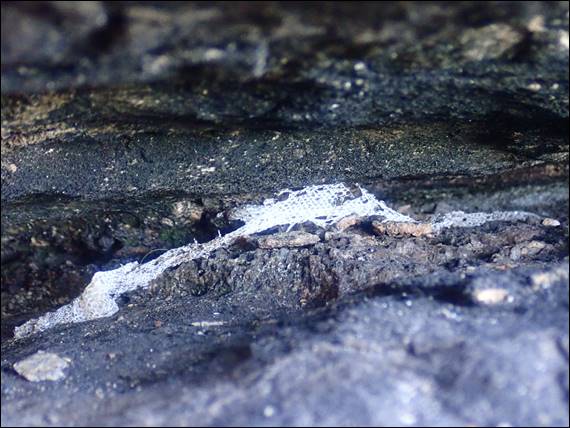
We decided on longer routes, and the obvious place round here for that is Wilyabrup. I had also thought about the sort of climbs that were a little longer, slightly more sustained, and would push him a bit. As we talked about the selection I was thinking he seemed keen, but also a little wary. Before we got to those we jumped on a pleasant warm up, and the joy getting out early was that no one else was about so we could have a pick of the classics. I was hoping to find a snake but it was not to be, with the only evidence of them being about was a discarded skin:
Warmed up and feeling pretty good, we moved on to a slightly harder line. And after my bolting and sport climbing session yesterday, I was keen to place some trad. Bob I thought you would appreciate the above thread, placing slings for gear always makes me think of climbing in the Lake District with you! While I had in mind for higher grades still to come, I have to admit I was still feeling a little weary from yesterday’s hugely successful morning at Well Dam. But not as weary as Ash was looking as he followed up after me:
His forearms were already complaining to the point they hurt, but he held on to get a clean ascent, for which he had to dig deep. It was clear we may not get onto those trickier lines, there was no point in burning Ash out. After all we were after endurance, and that can also be built up on the lower grades. It may have also been a blessing for me, as I do wonder how worn out I might have been with my intended tick list. The first other climbers for the day arrived, and it happened to be Julian who I have met a few times before:
The chance of a chat broke up the usual back to back pace of jumping on routes that I would normally be keen to keep going. Allowing a bit more recovery time, but not quite enough for Ash before our third line. I was aware it would probably push him a little too hard with its steep and physical start on which it is hard to take the weight of your arms. Still I knew Mario would appreciate me placing the No.4 Camelot, so we did it anyway. And sure enough the start was a little too tough, but after a rest on the rope Ash battled on to the top:
As we walked back down he resorted to stopping for another chat with Julian to extend his opportunity for recovery. We dialled it back a bit and racked up a couple of shorter and easier lines, which were still good fun and made him work. Having to the pull moves, as his body was starting to wane and his mind wavered. But by digging deep he got two more clean ascents, and we were rewarded by a huge pod of dolphins that looked to be feeding in the bay, and then later during our last climb ambled right off the coast in front of us at a very leisurely pace:
A few more climbers arrived, and the first area of Wilyabrup started to look like an indoor gym. Julian and Conner were leading their chosen lines, while everyone else that turned up resorted to top roping. But it was touch and go as to whether Ash had anything else left in the tank. The morning was also moving along and the hot sun was creeping onto the northern faces, a sign for both of us it was time to bail. So I subtlety suggested climbing out with packs, which would save hiking back out. We didn’t pick a silly line, but it was still one I was expecting Ash to finally just say no:
But he didn’t. So we wrapped up the morning with a sixth route made all the more interesting by the changed centre of gravity that a backpack creates. A great way to end the session and after another clean ascent fo Ash. It was warming up considerably, and neither Ash nor I enjoy climbing in the heat. So we left those now crawling about the cliffs to it. Hopefully, today will help Ash with building up a bit of fitness, but ultimately it doesn’t matter. He’ll enjoy his climbing trip regardless, as like many of us he is in it for the experience and just getting out:
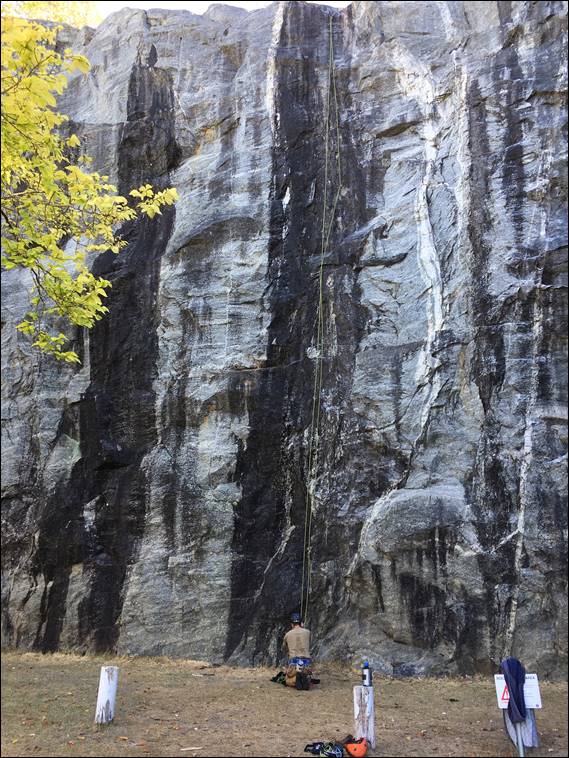
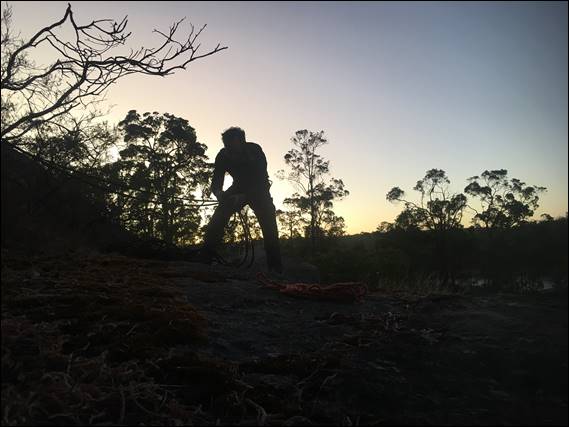
Today was take 2. My lack of experience, and to a degree observations, led Rongy and my last attempt to bolt the three new routes at Welly Dam come to a grinding halt. What was lacking was grunt in the equipment we had, but also the fact that there is a difference between a hammer and rotary hammer drill. It made perfect sense to me when this was pointed out, as I sheepishly admitted to overlooking the difference. Today however, Howsie and I came appropriately armed, again starting early so the noisy drilling could be undertaken without anyone about:
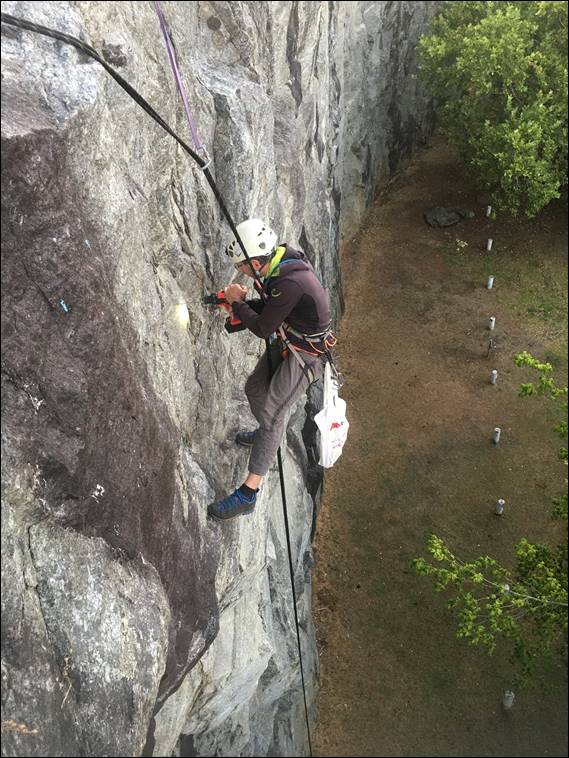
We had twenty bolts to place, and only one drill. Howsie has never been bolting and my experience of mechanical bolting extends to only one route, again at Welly Dam, in 2012. Yes I have hand drilled bolts in true alpine style, but only two. While I have watched Kym bolt quite a few lines over the years, I wasn’t sure if the granite here would be a tougher opposition and may take longer. As such we had no idea how long it would take and were pleasantly surprised to see the drill bit bite and sink into the grey granite with relative ease on the first hole:
The first line had a few steep, slightly overhung, and off line sections which made getting behind the drill at times interesting. Requiring a little bit of acrobatics, holding on, toe hooking, and body tensioning. This line took seven bolts and I was pretty puffed by the end of it, so I offered the drill to Howsie. He was more than happy to bolt the second line, a slabby route that thankfully allowed more straightforward access to the bolt placements. But there is still a fair bit of paraphernalia to carry about, and all that weight takes its toll:
Howsie came down, like me before, claiming that a desk jockey job is not good for fitness. Handing the equipment back to me, there were eight more bolts to place on the last line. I wasn’t sure if it was me or the battery wearing down, as progress seemed to be slowing down. Then I popped a new bit into the drill, and the holes once more became easier to sink. All up it only took us two hours to place the bolts and clear up, so not too bad really. The downside being that we were both fairly weary, and I could have killed a cup of tea:
Luckily my sippy mug still had some tea left, still hot, from when I had walked out the door at 3:45am. I eagerly supped that, savouring every drop and taking my time. Feeling sore and achy, which is sad to admit but truthful, I wondered how we would go on the routes. I started on a climb I called Building Bridges. The name comes from the fact that the bridge at the base of the dam is being rebuilt, the route uses a technique up part of the corner called bridging, and the fact that this route has seven bolts:
The last point being relevant as Kym and I developed to the climb to the right, which is bagged for its first high bolt. So this one is to appease those not so keen for a possible high ground fall before the first bolt. It’s a physical route, steep, and a tad strenuous in places, and I was feeling it. Almost coming off at what for me felt like the crux, but somehow just managing to cling on. One route down and I was happy as, but worried about the next two. We moved across to the route Howsie bolted, and I offered him the first ascent:
He gratefully accepted, but as per the name it was given he made a bit of a Strom in a Teacup of it. Pontificating on the crux move, yo-yoing and pumping out on arms already hurting from the bolting and last climb. Eventually falling and grateful his bolting seemed to be of a good enough standard to hold him. Exhausted he handed me the rope and I bagged route number two, calling it the name given. But for another reason to that above, being a statement that it isn’t worth blowing things out of proportion to the determent of friendship, life is too short:
One more route, and this was the toughy. Rongy, Howsie and I all felt so based on when we were trying the lines and setting bolt placements. It weaves a path up good rock to the sides of one of the blast holes, used to literally blow the rock out of the quarry. As such some of the rock is a tad fragile in places and prone to coming off. So quite simply I named this one Peanut Brittle, which describes the rock and is also in keeping with the food, BBQ, and picnic theme of names of the adjacent climbs. While I was worried about this one, I do not feel that I am boasting when I say I floated up it, and it was divine:
The new route names and descriptions are given below, as described online (https://www.climberswa.asn.au/topic/welly-dam/), but I think you may agree the above background detail provides far more context. And I have purposely not given any hints away about how the routes climb or what the cruxes may be, so those that may want to try to get the on-sight lead can go for it:
Building Bridges (20, 20m) The left wall of the black gully between Go Go Gadget Arms and Raging Torrent. A steep line with some unusual features and moves for the dam, finishing with a rising rightward traverse to the anchors of Raging Torrent. 7BRs & DBB Krish Seewraj, Chris Howe 03/02/23
Peanut Brittle (21, 18m) The black streak between Hole in the Wall and Savage Sausage Sniffer, a straight line that takes in the best rock with an exciting finale. 6BRs & DBB Krish Seewraj, Chris Howe 03/02/23
Storm in a Teacup (18, 14m) The unclaimed wall between Taj vs the World and Full Tiller has been claimed. Try not to make a meal of the thought provoking move midway up. 3BRs & DBB Krish Seewraj, Chris Howe 03/02/23
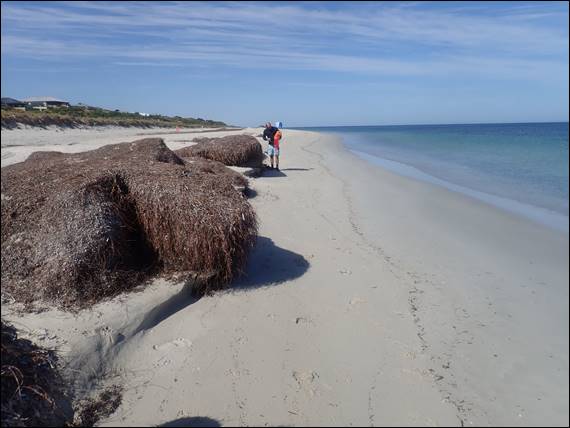
After a successful dive yesterday I was keen for a second dip before the usually relaxed start to the working year, during January, would come to an abrupt end on Monday. You may be pleased to know that this also signals a likely slowdown in posts, as my time to get out into nature will be mostly limited to weekends. Geoff was keen to join and suggested going in from the northern most beach access, near the Capel Rover Mouth. I have not been to this part of our local beach since last snorkelling season and was surprised to see seaweed piled up:
This accumulation of weed is common in winter and is usually buried under the sand as summer comes on, leaving the pristine and inviting sandy beaches the tourists flock here to use. Being the last weekend of the summer school holidays, many would be on their way, or preparing to be on their way, home making for quieter beaches for us. That said there seemed to be one or two out and about, including several paddlers. Thankfully there were no jet skis. Like yesterday the water looked flat and calm so fingers crossed the visibility would be good:
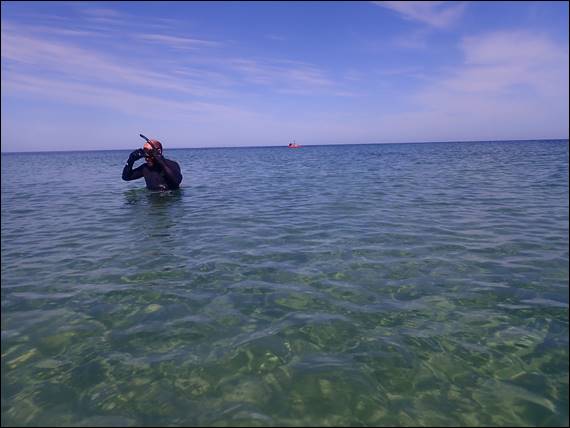
I will confess up front that I took a lot of images, and we saw heaps. Not that life was swarming round us, we had to move about to find the many treasures we did but we stayed in the water for just over two hours. Plenty fo time for us to explore lots of nooks and crannies for quite a way along the reef towards and just past the Capel River mouth. As such from this point onwards I will attempt not to type so much this time, allowing the pictures to do most of the talking:
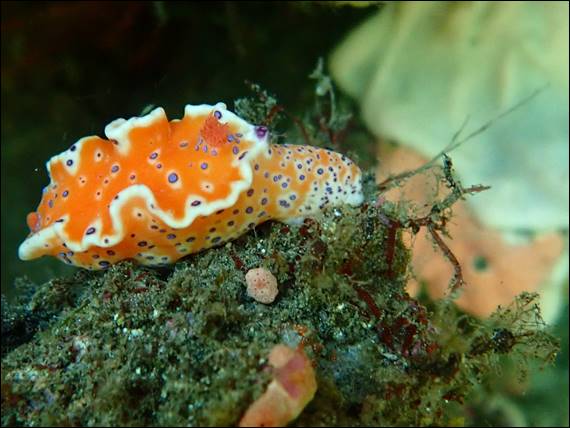
I almost immediately spotted a Short Tail Nudibranch (Ceratosoma brevicaudatum), and then thought I saw a second a bit further along. But as the weed parted in the low swell it was Sea Anemone, and it was the orange body that had caught my eye. I do not recall previously seeing one with this coloured body, not that it has helped me one bit in trying to identify it. Sea anemones are named after a terrestrial flower, although these underwater beauties are not plants but predatory animals of the order Actiniaria:
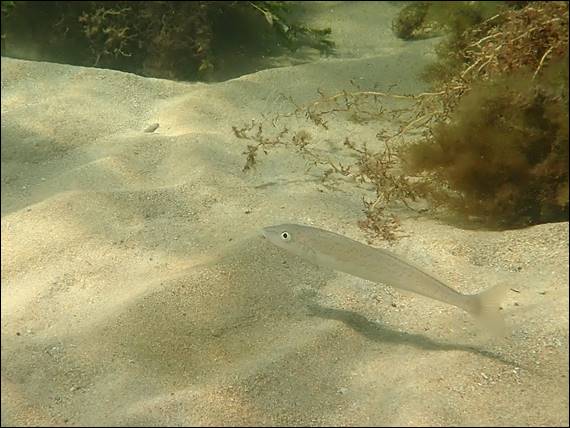
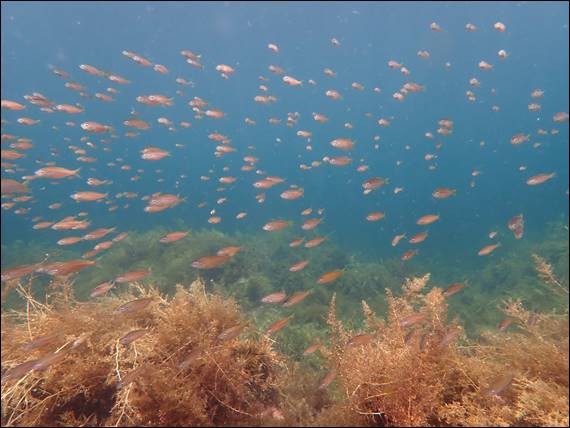
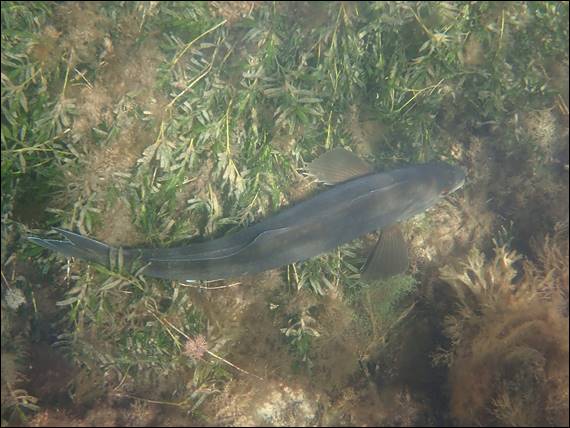
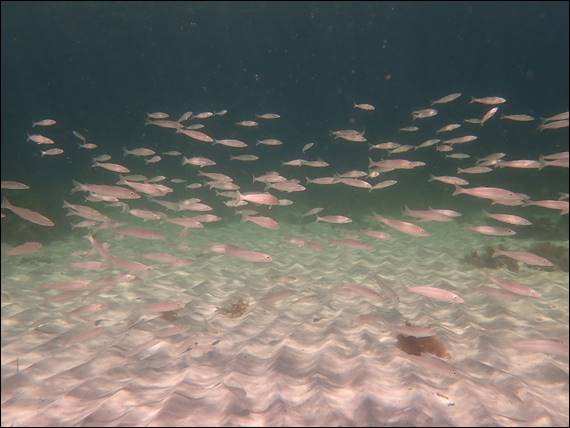
There were plenty of small fish in reasonably sized schools, some discrete species and others mixed. The above was a cluster of possible juvenile Western Pomfred (Schuettea woodwardi) and Western Gobbleguts (Ostorhinchus rueppellii). The larger fish were also about, with a few that I do not see at the spot where I can walk to the beach near our house. They are probably there, just more prominent here due to the more extensive reef system. Below was a solitary King George Whiting (Sillaginodes punctatus):
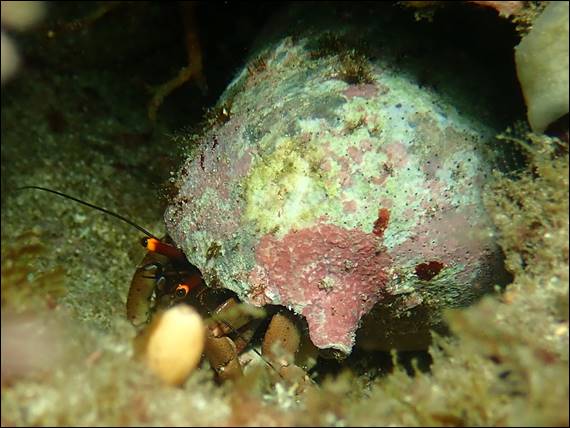
There are 13 species of Whiting in Australian waters, and the King George Whiting has spots along it’s body and small sized scales that are clear-cut ways to distinguish this species. It is a highly prized table fish but a little pricey, maybe because of the need to catch it by line or only by specific netting techniques. In addition to being the largest of the species, it is the only member of the genus Sillaginodes. My next find was hidden in a small hole in the reef in which I saw some movement, being a Hermit Crab (Pagurus) having a feed:
Despite trying I was unable to narrow down the species any further. Hermit Crabs are unique in the crab world as they do not have a hard shell, resulting in their soft bodies being exposed. To overcome this they borrow whatever casing may be suitably sized, until they outgrow it. The term hermit is used to describe someone who does not yearn for or need company, which is ironic as Hermit Crabs are known to be a social creature. There was much diving to check out caves and ledges, and under one I found this:
I got all excited about finding another species of nudibranch. And while this may be a Pustulose Wart Slug (Phyllidiella pustulosa), which is a nudibranch. It could also be a Mimic Flatworm (Pseudoceros imitatus). The Flatworm looks very similar, neither have external gills and the two antenna look almost the same on the two creatures. The only difference I can think to use to differentiate it was the amount of volume of its body. Unlike the one I found in Dec 2021, which looked flatter (https://wordpress.com/post/sandbagged.blog/7293):
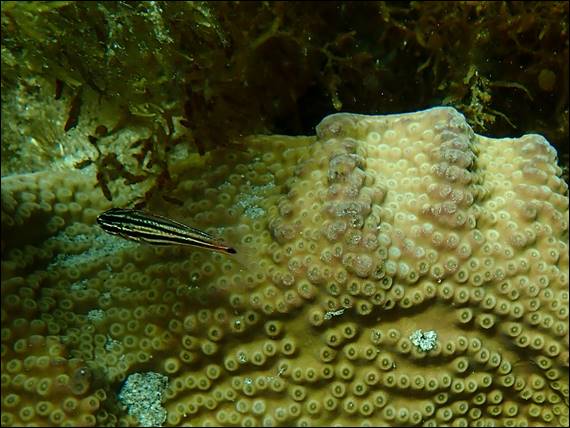
So taking a punt back in 2021 I probably found a Mimic Flatworm, which I incorrectly identified, while the one today was a Pustulose Wart Slug. I was also pleasantly surprised during this dive to find a few corals, and on several separate occasions I spotted a single small striped fish swimming about in the bowl that these corals made. The coral was a hard coral of the Astreopora genus and I believe, but am not completely convinced, the fish was a juvenile Western Striped Cardinalfish (Ostorhinchus victoriae):
There was no end of discoveries on our dive, way too many to include. Some of the nicer finds that won’t get shown today include one or more Rock Lobster, Western Rock Octopus, Cuttlefish, Boarfish, and Stingaree. We also spotted a few Southern Calamari Squid (Sepioteuthis australis), putting on their usual defensive display to make themselves look more aggressive and dangerous, before using their incredible speed to simply disappear:
We also heard the familiar noise of Bottlenose dolphin (Tursiops truncatus), and were lucky enough for them to pass us twice as the cruised up and then back down the coastline. Unlike the squid and many other fish, they were in no rush and slowly swam past us. With a second day of favourable weather the water was a little clearer, and the visibility was helped also by having the sun higher in the sky to allow more light to filter through the water. Instead of an image I have included a short video:
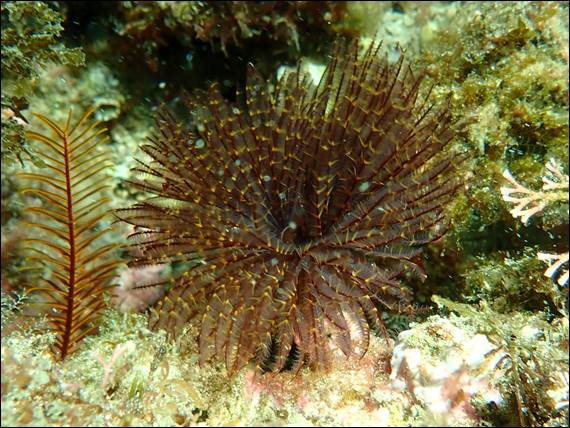
At one location I spotted two types of Feather Duster Tubeworm (Sabellidae). The first is a repeat find what I reported a couple of years back further along the coast past the River Mouth and the coastal feature called The Point (https://wordpress.com/post/sandbagged.blog/5843), and then there was this other species. Information on these seems to be sparse and I have not managed to dig any deeper into the names of the two types I found:
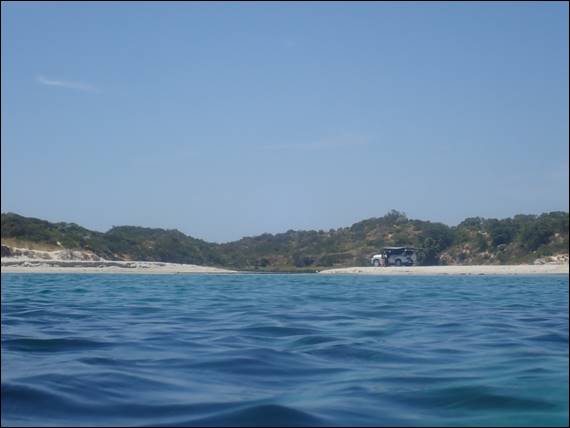
Below is an image of the Capel River mouth, as we saw it today. Geoff had told me someone had recently opened up the river mouth to allow a connection between the river and ocean. I doubt it was to allow water from the river, which doesn’t flow in summer, out. So there are two options. Either the trapped river water was at risk of forming algal blooms and becoming smelly so they let sea water in. Or someone wanted to prevent all the holiday 4WDs from crossing this point and going past The Point by digging a channel in the beach:
It sounds as if there may have been some disgruntled holiday makers as they attempted to get a quiet bit of beach to celebrate Australia Day, so the latter possibility may not be so far-fetched. Snorkelling with Geoff is good as he thoroughly checks every spot hoping to find Rock Lobsters. In one cave he spotted a big Dusky Morwong (Dactylophora nigricans). Calling me over, I went down and saw the fish as it escaped out the back of the cave. Whether it was the same fish or not, a Dusky Morwong later swam past Geoff before settling in the weed to rest up allowing me a great birds eye view as I swam over it:
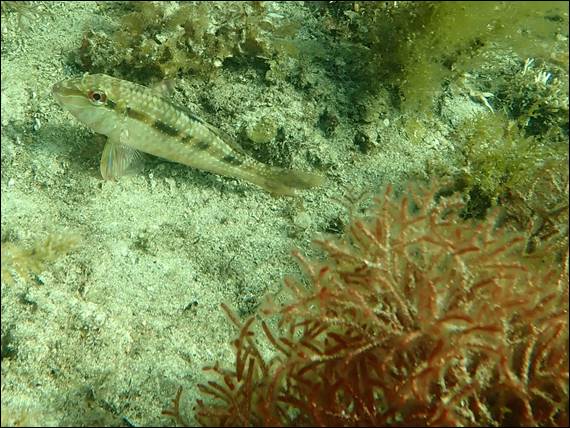
One last image, which was taken as we were on our way out. Another species of Whiting, being the Southern School Whiting (Sillago bassensis). A fish people are often seeking to catch fishing of the beach, along with the Australian Herring (Arripis georgianus). We finally exited the water with toes and finger tips just starting to tingle, but we were not at the point of our teeth chattering. The timing was however good as the winds soon changed to an onshore, which meant the water would soon be not quite so calm:
I did wonder if the title of my last post may have made some think that they would get some long overdue underwater images. And I did indeed consider taking my snorkel gear when we climbed at Castle Rock, as I knew the water would be clear. The coarse sand there settles quickly. It is also closer to Cape Naturalist, and as such is offered more protection from the regular swells that seem to be occurring this year. I have been down to our local beach a few times since my last dip, which was over a month back on Christmas Day. Only for a walk, and the wind and swell conditions have resulted in water not looked inviting:
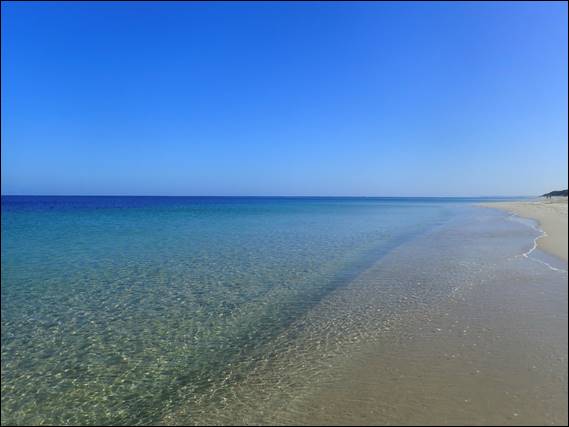
Chatting to some keen divers at work who live in the area, and regularly visit this stretch of coast albeit by boat so further off shore, they have a theory that the Capel River is to blame. North of the river mouth they feel the water clears up that bit quicker than south of where the sediment rich waters of the river come out. They feel it is the fine sediments from the river that accumulate over winter in the near shore areas, and these create an environment that is quick to become cloudy. Having climbed for the last two days and with the weekend free I was however keen to go in whatever the conditions. Being pleasantly surprised to find flat calm waters. Not quite the millpond we saw at Castle Rock yesterday, but not too shabby:
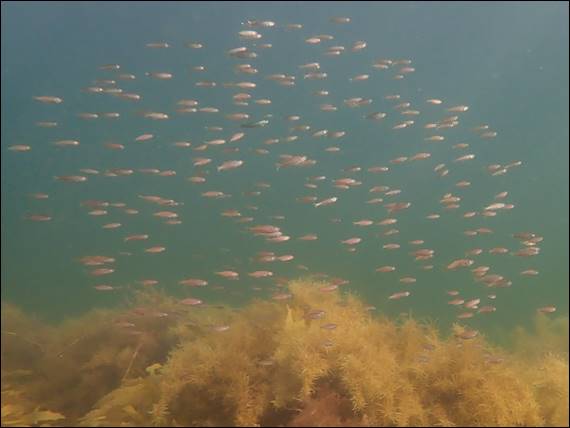
There was certainly sediment in the water column, and to avoid too many beach goers I had popped in at 8am before the sun had got high in the sky. This meant the light penetration was not the best. No matter and I was encouraged when encountered small schooling fish, something I feel is a first this season. Having tried to identify these fish before without much confidence, I won’t try again. But this Short Tail Nudibranch (Ceratosoma brevicaudatum) is an easy one, and I have included images of them a few times over the years. They are the most commonly found species, which might be because they are the biggest of over 100 species of nudibranchs in the family Chromodoridae identified in Australian waters:
They are also considered the most abundant of the species, plus have very vivid colouration. Growing up to 15cm certainly makes them easier to spot. That said I can’t recall seeing them much bigger than 10cm and this one was even smaller. Based on the short gills and small size of the purple dorsal ‘tail’, where most of the distasteful toxic chemicals are stored, I imagine it is a young one. I would like to see more species, and to do that I would need to stay under water longer. The above nudibranch was in +4m of water, and I can only stay down at that depth for approx. 30 seconds. I had the same dilemma of limited time, when I spotted this tail. After some careful checking of what was hiding under the weed I had to go up for air:
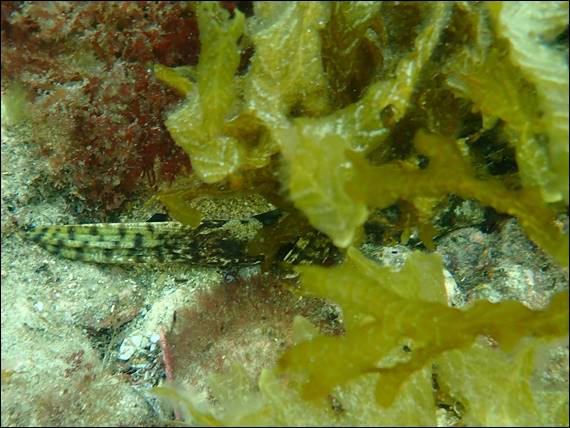
Fortunately I had not disturbed the fish and on my return attempted to get an image. While I snapped one, as I steadied myself for a better shot the fish darted away so all you get is this slightly blurry picture. Obviously a flathead, and I believe this one is a Longhead Flathead (Leviprora inops). It would have been nice to have had a bit more time to get some more features on (digital) film. The main distinguishing feature I captured and have used to identify it was the length of the fringes coming down from the top of the eye. These break up the large black eye and help the fish stay camouflaged. To help me stay down longer there are non-scuba diving options I am considering, such as floating hookahs that pump air to you or small portable handheld tanks. More toys and money, so they probably not something for this year:
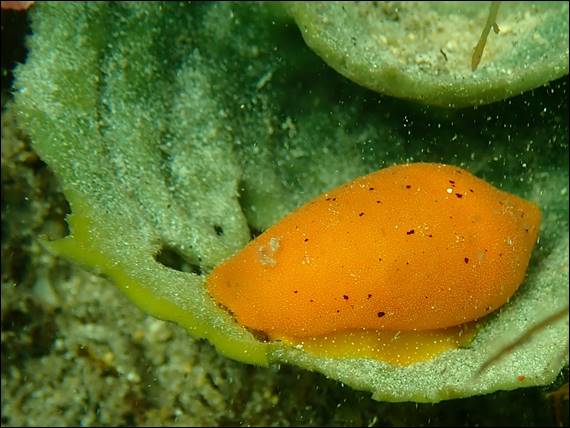
My next find was a shell and I would not normally try to identify them as like the weeds I find them very challenging. This one however was spectacular. Based on the shape this could be a Strombs Shell, of which I found one specimen (Strombus luhuanus) that had a somehow similar colour (http://www.stromboidea.de/?n=Species.ConomurexLuhuanus). The shape is also similar to Cone Shells such as Conus bullatus, although the coloration of these from what I have seen is generally more speckled. Looking at the images of the shell I found, it looks to be covered in a fleshy substance that is orange with tiny white spots. You can also make out the foot of the gastropod that lives inside, being a slightly paler orange colour still with tiny white spots. Sadly, despite multiple duck dives, I never got to see the eye stalks nor proboscis:
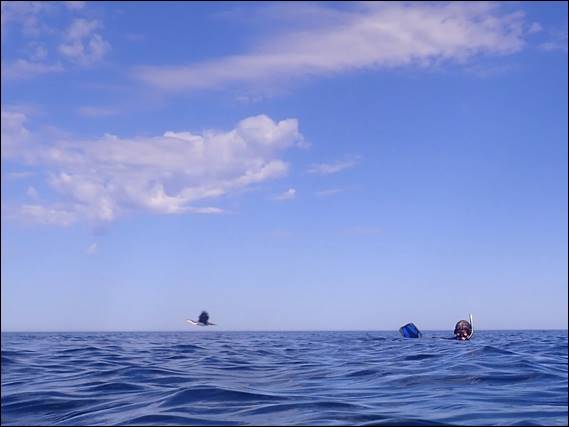
With so much cumulative underwater time I needed a rest, and looked up just in time to see a Pied Cormorant (Phalacrocorax varius) fly right over my head as it headed towards the shore. These birds primarily feed on fish, and are often seen bobbing about on the ocean looking below for a feed. When they spot something, diving down using their feet to propel themselves and half open their wings to control or steer their direction. I was lucky once to observe one swimming under water: https://sandbagged.blog/2022/03/25/taking-on-the-jellies/. Some birds have a uro-pygial or preen gland at the base of their tails that exudes an oil, which the bird can spread with their beak to help make the feathers water resistant:
Not all Cormorants have well developed preen glands, which seeing they are in the water a lot may seem counterproductive. However, the oil would make them more buoyant and limit their ability to fish underwater. Instead, like many water birds, can have feathers with a tighter structure to slow down the rate at which water can get between each bard of the feather and saturate them. That is why we commonly see cormorants perched with wings outstretched, drying them ready for the next foraging session. The next fish I see most times I go out but rarely get very close too, being a Bluespotted Goatfish (Upeneichthys vlamingii):
I was interested to read that they are known to quickly change colour, and can become more brightly-coloured at night. Something for me to look into another time, as you may be wondering what the next image is all about. Well I heard the obvious trill and squeak sounds of a Bottlenose dolphin (Tursiops truncatus), which I thought sounded some distance off so I looked up for any signs of dorsal fins. When I popped my head back underwater all I saw was the fuzzy outline of a silhouette, as a single large adult swum approx. 10m away from me. Like I said the conditions weren’t perfect but I had no complaints and thoroughly enjoyed finally being back in the water:
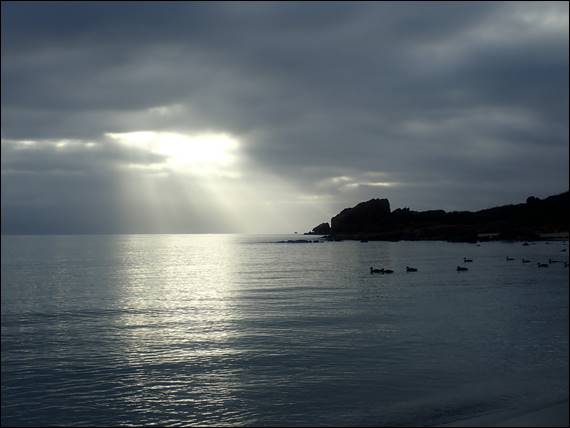
Ash has been a little quiet on our climbing chat group, but was keen to get out on Friday this week. A day that suited Howsie, Rob and myself for a quick not too serious morning session. And the best place for such situations is Castle Rock. It wasn’t a crazy early start, but the forecasted cloud cover made it feel early. Not a whisper of wind was in the air and the bay of Castle Rock beach was a millpond. This term comes from England, referring to the pool of water used to power a mill wheel, often referred to as a water wheel:
These pools were often artificial and large compared to the normal channel of the waterway that fed them, and the use of term is reflective of the relative still and calm nature of the waters held in the pool. There was an added effect to round off the “pool view”, which we were lucky to be seeing this morning. Approx. twenty Pacific Black Ducks (Anas superciliosa) were bobbing about just off the shoreline. Normally found in freshwater environments, they do venture into tidal mudflats and on occasion into the ocean, having been recorded a considerable distance offshore:
Despite their occasional use of the ocean they are not listed as one of the 15 species of sea ducks, for which a Sea Duck Joint Venture has been operating since the early 90s to improve the understanding of the ecology and conservation of sea ducks. Back to our morning and the clouds looked to be lifting and breaking up. The sun came out allowing for the usual stunning images. The climbing here is short and limited but the setting, like so many of the crag we have the fortunate to have in our small patch of the world, is very specky:
Sadly, Ash was once again in a dilemma. Friends of his had just tested positive for COVID and he had woken up with a headache. While he did not know if he had once again caught it, thinking of us he made the decision to stay away, which all three of us were very grateful for. We still have a long road ahead of us before our daily life won’t be at risk from suddenly being interrupted by COVID. Don’t ask me why but I looked into it and it seems that the world has been affected by just under 250 recorded pandemics, dating back as far as 1,200BC:
As I had been at Welly Dam yesterday and we only had a few hours to climb, I was happy to offer the leads to Howsie and Rob. Something they were more than happy with, and more so Howsie as it has been a few years since Rob has led any trad lines. Howsie gobbled up Lou’s favourite climb, before jumping on a sneaky but worthy route that Craig and I had put up. One that had surprisingly been overlooked until we bagged it in 2018. It was on this line that it started to sprinkle, and looking across the bay claggy weather was rolling in despite there not even being a breeze:
It has dawned on me that this is the fifth time I have used the term claggy in a post, but have not explained what I mean by this. The word is claimed to be a Scottish or northern English term meaning thick and sticky, and is more commonly used to describe clayey soil. It is however also used to describe when the air feels wet and thick, i.e. humid conditions, which can be extended to mist or light drizzle. So my use of it was only appropriate for a short time as, even by Craig’s standards, what fell on us as Rob and then I followed Howsie up the second route was definitely rain:
The conditions may put some off, but the rock on this side of the castle is well featured and the excellent friction is not diminished by a bit of moisture. And so Rob took on his first trad lead with us, having been drawn in by the aesthetics and appeal of the short but enjoyable corner crack. One Nana may recall from six years back almost to the day as her first lead, unless I’m am wrong as I didn’t write that trip up so can’t check. Rob thoroughly enjoyed the climb, as Nana had back then, but time was now catching up with us and we only had time for one more route:
We popped over to the other side of the castle where there were options for both Rob and Howsie. I was down first and threw the rope to the ground without checking first and it landed within a foot of a King’s skink (Egernia kingii). It was lazily basking in the sun, which had come back out just as quickly as the rain had hit us, and was unperturbed by my carelessness. Sadly once all three of us hit the deck it scampered away. While Rob was keen to do a bit more leading the time pressure would have made it a less than enjoyable experience, so Howsie was up:
Before the trip he had considered pushing himself on a stiff grade 22 on offer here, but like Rob the ticking of the clock niggled away at his mind. So instead plumped for a few grades less, but a no less challenging line. One that all three of us got up and, like our quick morning out, thoroughly enjoyed. Not just because of the climbing but also the many other treasures we spotted during the morning, too many to include in this post. But I have to include this Southwestern Crevice-Skink (Egernia napoleonis) that was cautiously keeping an eye on me, as I watched it:
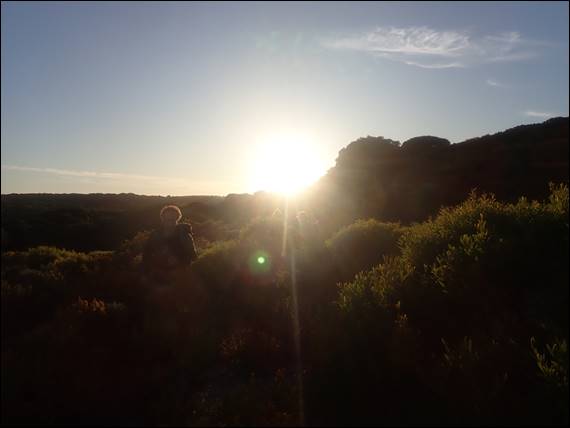
Everything that was needed had arrived, so all that was left was to head out and start bolting. Today was the day the three new routes at Welly Dam would spring to life, and Rongy would get his first experience of bolting. In view of the noisy nature of the process it is not something you want to be doing with lots of people around, so we decided on a first light start. The sky went through its morning routine. A tiny slither of orange starting out as a speck on the horizon, before radiating up and out, before turning pale yellow, and finally settling on blue:
There is a fair bit of gear required when bolting. So despite arriving at the carpark in darkness, by the time we had it all sorted out, set up the static ropes to allow us safe access to the walls below, and descended and got into position to drill the first hole it was already light. Although still way too early for anyone else to be about. I had my reservations about a crucial piece of equipment, and that was the drills but we where he so we gave it a go. While it was great that Rongy was able to source two cordless hammer drills through his networks, they were a bit on the small side. Sure enough they simply did not have enough grunt for the job in hand:
The hard granite almost laughed at us as we attempted to sink the drill bit into it. It was immediately obvious that we wouldn’t get very far, and rather than get frustrated we made the quick decision to abandon the plan. Within an hour of having arrived, we had everything packed away. That is bar our leading gear which we needed to hit some of the established climbs. We were both feeling a little weary from our recent trips out. Rongy also admitted he was keeping a careful eye on his shoulders and tendons, having climbed more in the last few weeks than for many months before, resulting in them telling him to be sensible:
In addition to our bodies not having fully recovered from all the recent climbing, our mindset also had to change. Going from hanging on rope drilling holes to clinging onto the rock with a rope below us. All the more reason to ease into things gently, and seeing no one was about it seemed to be the ideal opportunity to hit the four lines on the carpark slabs. Shorter and lower grade routes than the climbs on the main walls, but fun and worth the occasional attention. It was a good move and helped loosen us up:
We were keen to jump on a few of the lines on the bigger walls, for which we pulled the rope to allow both of us feel the thrill of leading. With a rope below, a slip would result in a bigger fall and this makes you focus that bit more providing a more exhilarating experience. That said our desire to have that feeling also depends on your mood, as well as what your body might be telling you. The latter hinting to Rongy to ease off, after we had both lead Ebonie Road and Savage Sausage Sniffer. He felt he would be OK with a rope above him, which proved to be a sensible option for my next chosen climb of Just Do It:
As Rongy rapped back down he declared that his body was now telling him to stop. It would have been dumb to go against the warning signs, and risk an injury that may take a long time to recover from. While too was feeling a tad weary I didn’t have any niggling pains, so was keen to even up the numbers and jump on one more climb before calling it day. So it seemed fitting to end our supposed day of bolting, on Gumby Goes Bolting. My task now to allow us to bolting being to source a cordless hammer drill with sufficient grunt:
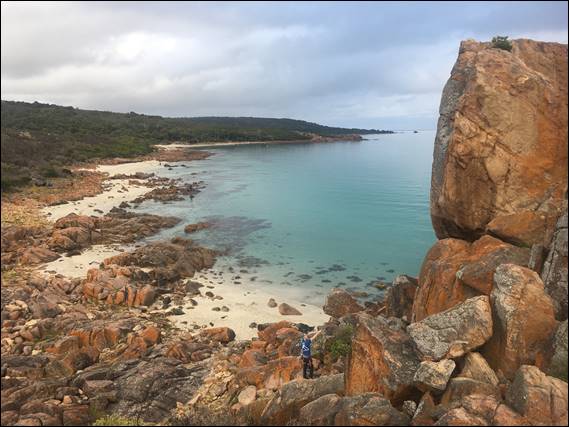
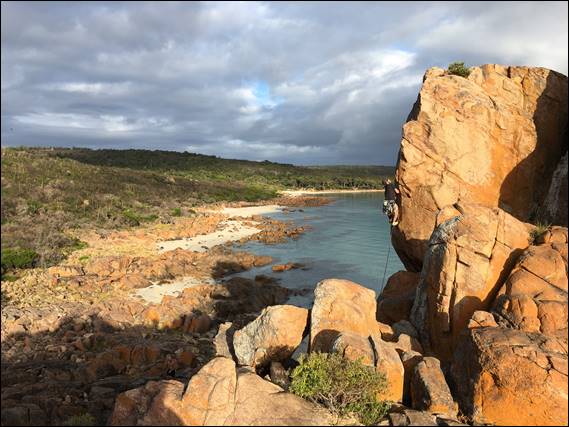
It is unusual for me to have two back to back weekend trips away, but that is how things landed. Last weekend a very overdue jaunt down south to catch up with Kym and his family, and this weekend was the one that suited Rongy best for a getaway. Although the idea for this destination came from Mario, who spotted a new mini-guide for the recently developed area. Two of the more dedicated climbers in WA got bored during the COVID lock downs of 2020 and 2021 and found this place, which kept them occupied:
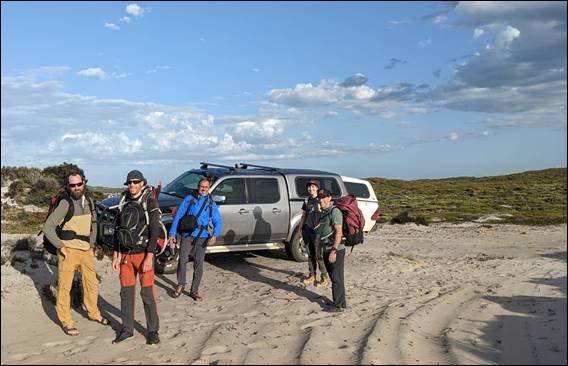
The location being a headland called Point Irwin just south of Peaceful Bay. Based on what the mini-guide showed this place looked interesting, and I sent it on to Rongy who was keen to get down to check it out. Then the group ballooned out to Howsie, Sarah and Andreas keen to join in the fun. The six of us met up on Friday evening at the campsite, with Mario and Andreas having had an earlier start so they could stop in at Mount Frankland. Getting in some long 40 plus meter inland slab routes in before our coastal adventures:
An adventure that nearly didn’t happen. The guide recommends light winds and a one meter swell as being the best conditions for this spot. The forecast all week was strong winds up to 50km/hr with a moderate two to three meter swell, so the promise of rough waters and lots of salt spray was a very high probability. The group chat we set up was busy for a few days pondering our options, and enough of us were keen to give it a go. In part because it was a place that none of us had been to before, which is a rare opportunity for the group we had:
From the campsite the options are to walk 4km along the Bibbulmun Track, or drive a short 20 minutes along a sandy 4WD track. We came prepared for the latter, although maybe not as prepared as may have been sensible. There was an air of excitement as we got ready, bright an early, driving out at 6am. While most of the other campers, in a very full site, were still in slumber land. In fact the campsite was so full that we almost didn’t manage to get a spot. However luck was on our side, and we were being optimistic that the conditions would be too:
The winds were easterlies, Kym would tell you they are the worse winds for Albany. The only people happy to have them are the kite surfers who can then power about in Shoal Bay, flying high into the air as the wind buffets everyone else who is out and about. The forecast was for moderate winds in the morning and by lunchtime it was tipped to get to the real strong winds. The reason this was an important consideration was that the place had two cliffs one facing east and the other west, and it made sense to hit the east facing one first while the winds were not as strong:
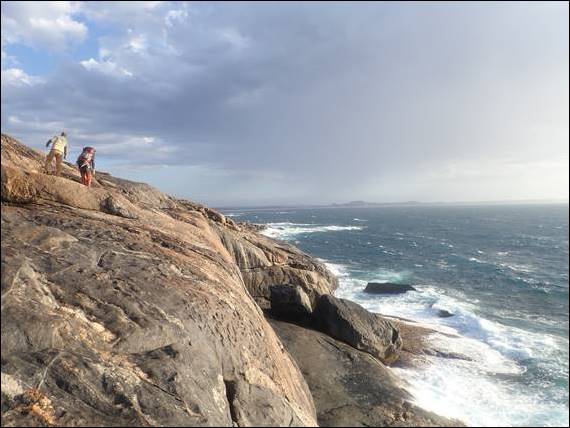
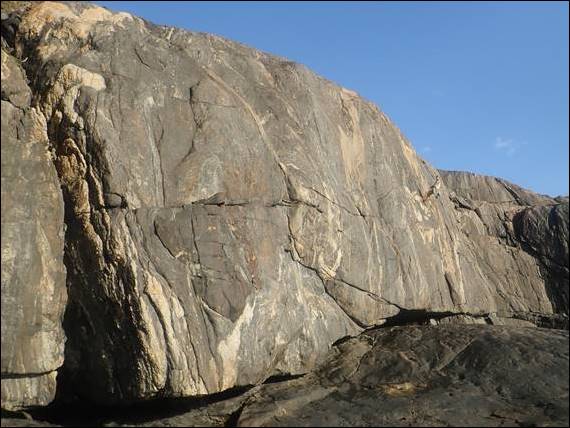
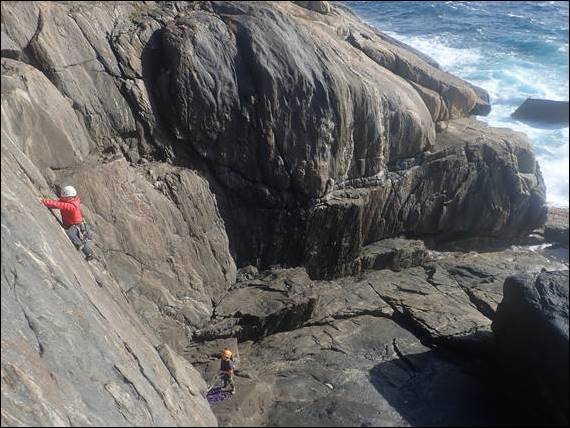
The twenty meter slabby walls of King Penguin Cliffs looked stunning, and they were also in great condition. No greasy salt covering them, feeling like we were somehow sheltered from the easterly winds, and the sun was a nice temperature. I was super excited and quickly got ready to rap in, and being the first down I was squealing like an excited kid when it feels like all your dreams come true. On first inspection the spot looked very, very cool. But it is a sea cliff and with a moderate swell, so while I feeling like a kid I had to act as an adult:
Luck was again on our side and the low tide meant the water didn’t come too high up, and we were protected by a good length of platform between us and the choppy ocean. That said freak waves are not uncommon here, so we stayed tied in at the base. Above Howsie was second to come down and gives a bit of perspective on the size of the wall. And below Mario was the first off the deck to start a climb, on the steeper and more featured walls to the left hand end. Most of the routes here were in the 17 to 20 range, so there was plenty for most:
That said it was only Sarah’s third time on rock, and truth be told the first time she only went up one route. Added to that she is also not all that keen on the ocean, and it unnerves her a bit. But since that first taste of rock she has been to bouldering gyms and is hooked, so was keen to get away for a weekend of climbing even if it meant bottling up any discomfort the ocean might bring. There were fortunately two grade 15s. Although that is harder than any route she had previously climbed, with Rongy’s guidance she really enjoyed her first climb here:
Howsie and I were spoilt for choice, with a good number of lines to pick from. We didn’t go for the grades, more so interested in the names of the routes and also the features that the routes scaled. The grey granite was interwoven with bands of quartz, some fine lines with near invisible crystals and others comprised wide chunky bands with the hexagonal structured quartz that you would expect to see in a shop. The names all had a marine creature theme and I was particular taken with “Dancing with a Dugong”, also because it was a fully trad line:
The place has a mix of sport, trad and mixed routes and we were all absorbed in the delight of scaling up and then rapping back down the face. The wind couldn’t be further away from our minds, and the roar of the ocean became a tranquil and almost soothing background noise. It was most definitely smiles all round, and for Rongy and Sarah’s second climb they climbed a corner that has no recorded ascents. A little surprising as it was an obvious line and looked good, so in keeping with the theme they called it “The sea’s not your anemone”:
And as all good climbing names should, there is a play on words and rationale behind it that is not always obvious. I’ll leave you to ponder on that, based on what I have said so far, and see if you can work it out. While all this was going on Mario decided to test himself on a route that I was kind of keen to jump on, but I also didn’t want to wear myself out. So it was good to see how he fared on “Tusky Times” a layback crack at grade 22. He certainly enjoyed himself and took a few falls on it, until he finally worked out a sequence that worked for him:
It looked pretty powerful and as such I decided not to go for it myself. But I was happy to jump on “Cling-On Like a Crab” at a grade 22/23, and only because it was a slabby route so would be more about balance and technique, as opposed to energy draining power and endurance. My only mistake was to climb it, as I had been all morning, without chalk. While the conditions were great, a slab at that grade has marginal holds and several times I fell off the crux with a good five meter drop each time:
Being a new’ish crag, and not having had many visitors there were no chalk to mark the holds. This added to the enjoyment of climbing here, really needing to work out the routes with no hints or clues. Having so much fun the morning seemed to fly past, and soon we were on the last climbs of the session. It is hard to say if it felt time to head out because we were starting to get hungry, the wind was picking up, or that the tide was getting higher allowing the water to creep that bit closer:
And just because the names were so much fun I’ll mention that the last climbs we did were “Cranky Crab”, “Sea Possum”, and “Sir Henry the Seagull” being climbed by Howsie, Mario and Rongy in the above and below images. It still feels very strange that the conditions were as good as they were, and despite the continuing army of white crested waves and easterly winds we couldn’t feel any sea spray. So while it was sad to finish up on the King Penguin Cliffs, we were excited to see what was on offer on the other side of the headland:
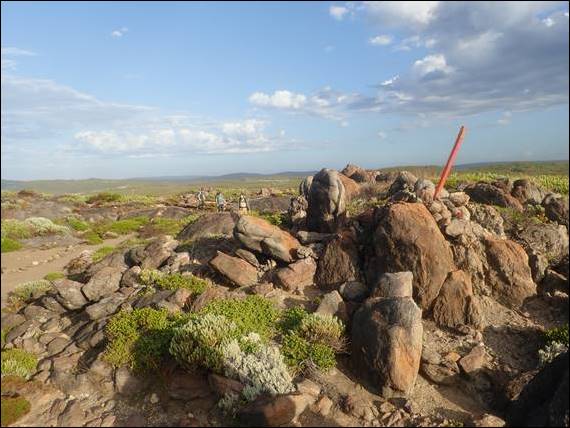
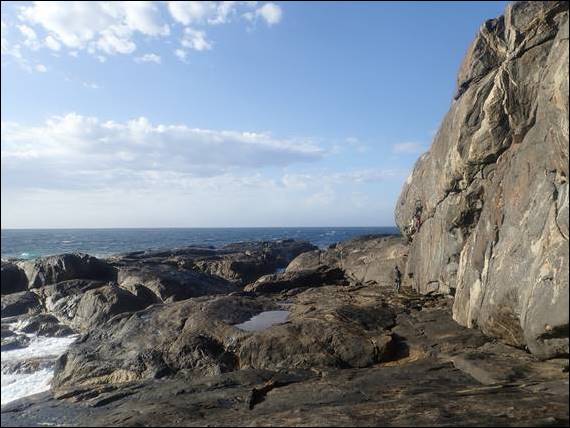
Before we got there we hiked back to the car, dropping the bags part way to save lugging them back and forth. Both crags are within ten minutes of the carpark of what the signs called Castle Rock, although we never saw the feature that might give this headland that name. And interestingly I do not recall seeing any signs calling it Irwin Point, although I do know that name comes from the Irwin Inlet which is where the Bow and Kent Rivers discharge into Peaceful Bay. At the car we had lunch and filled our water bottles, before heading back down:
King Walrus Cliffs are a stark difference to the first crag. Way more broken and blocky in nature. Not so much slabby but littered with broken faces that provide cracks and features on what gave an appearance of steeper walls. Not as high with routes up to fifteen meters and while we expected the place to be sheltered and dry, it was the complete opposite. The easterly winds seemed to blow over the top and then circle back into the amphitheatre and with it came showers of sea spray. And surprisingly a number of faces were heavily seeping:
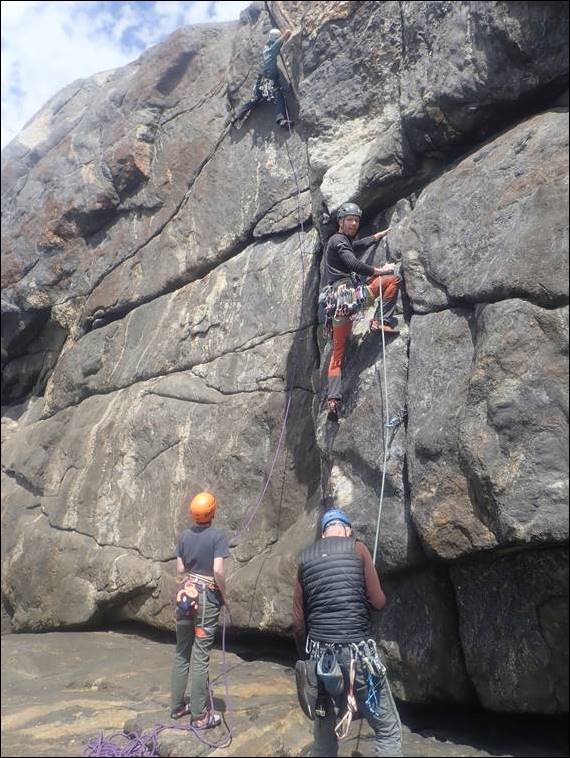
It took us a little by surprise and we spent some time wondering what we might bother trying, on what seemed initially to be more scrappy routes on less than ideal rock conditions. Sadly there wasn’t much for Sarah to jump on, all seeming that bit steeper and harder. But she was content to potter about checking the area out, and it also seemed that Mario had worn Andreas out too. After one line here he too was happy to not climb anymore. That left Rongy, Howsie, Mario and I to accustom ourselves to the changed environment:
The sun beating down on us with more intensity and the blustery conditions seemed to help dry a few of the lines just a little bit, or maybe we were imagining that. Soon we got back into the tickety tick mode of the morning, knocking one line off after another. We were warming to the place and the different charm of the King Walrus Cliffs was growing on us. Mario in his usual manner was keen to try a more testy looking line and wasn’t disappointed with this unusual and very intriguing route, and enjoyed in despite again finding some air time:
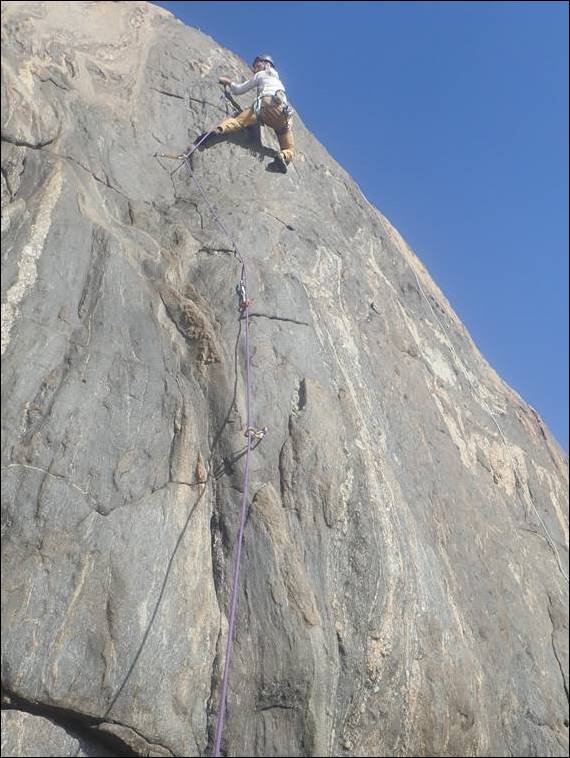
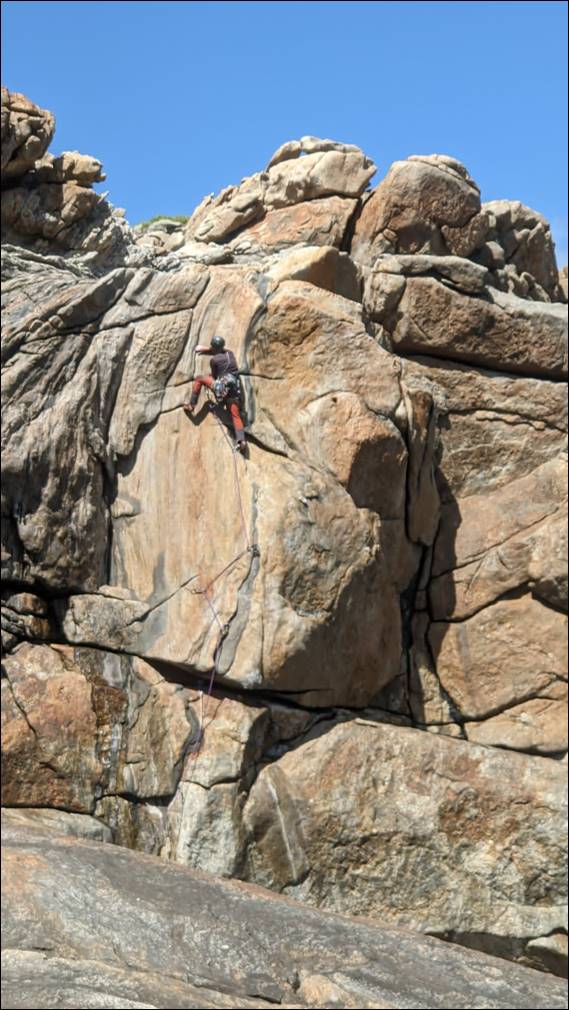
Howsie and I aimed for the more sedate lines, easing into the finale of the day. The routes names didn’t have the same consistent theme as in the morning, but the climbing was still interesting and engaging. The longest line on the back wall, as shown below, was graded 18. A slabby wall made it the best bet for Sarah to get a climb in. While it didn’t feel like an 18, that is what it is given so she can now claim to not only to have been involved in a first ascent but also having climbed an 18, which is pretty impressive:
We were thankful for the huge leaning boulder, giving us respite from the sun between routes. It was definitely hotting up and the pace and energy wasn’t being exuded by anyone at the same rate as it was when we first arrived. After two days of climbing Mario’s fingertips were looking worse for wear, with the skin almost broken on several fingers. Andreas and Sarah were looking ready to call it a day, and Rongy, Howsie and I were fast running out of reasonable options to choose from:
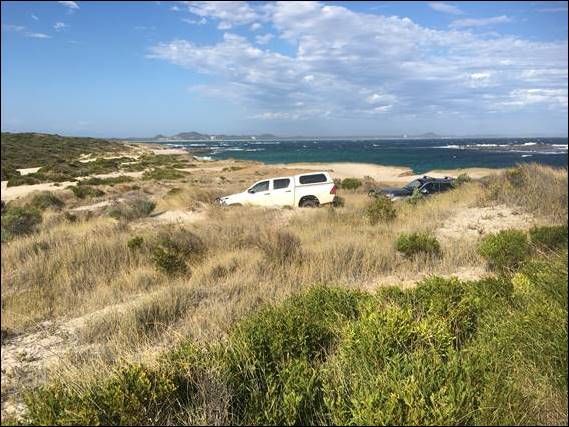
So while there seemed to be lots of daylight left we decided it was time to pack up and head out. But not before taking in the majestic location we were so lucky to have experienced. I even jested that we were leaving too early when we got back to the cars, it wasn’t even 4pm. A comment brought about by the thought of being back at a busy packed campsite rather than out here. And maybe I jinxed it, when as we drove back out and were just about to finish the last section of soft sand when Howsie’s car came to a halt:
Andreas behind also had to stop and so it was both cars became bogged. It was time to dig and let down the tires even more, but that didn’t seem to help Andreas. Fortunately someone else came along and they had sand plates. With these, snatch straps, and a bit of pushing we eventually got the cars off the soft sandy beach. Meanwhile the generous passer-by also got a bit bogged, it was all quite comical. We discovered later it is a common occurrence, even for the experienced, to come unstuck here:
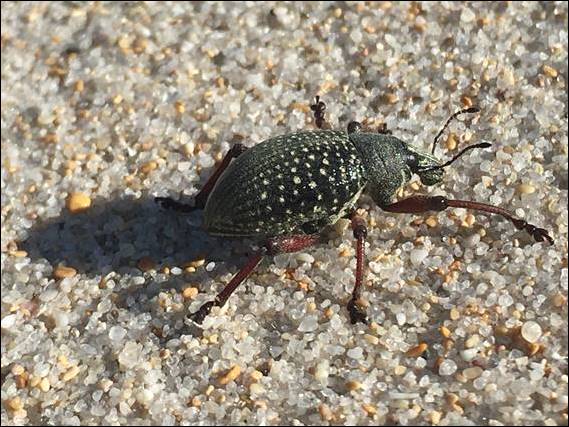
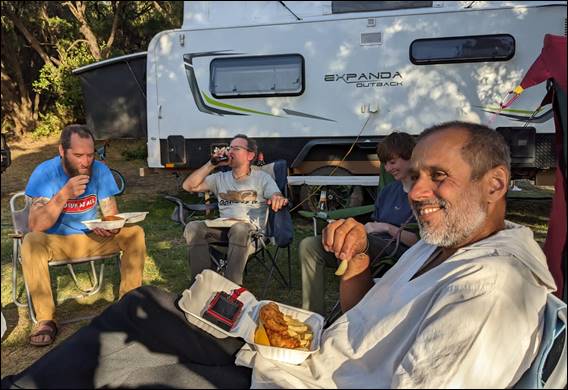
During all the de-bogging I spotted the above native Red Legged Weevil (Catasarcus impressipennis). And like this weevil, once free from the sand, the cars continued on their journey with no more hiccups, and we still got back at what I would regard as an early finish. But we were all pretty toasted and had got plenty of climbing in. On the plus there was plenty of time to put our food order in, go to the beach for a very refreshing dunk in the protected Peaceful Bay, have a shower, and sink a beer before it was time to eat:
An advantage of being in a campsite such as this was that there was a fish and chips shop. Doing a roaring trade during the school holiday and it was a good job that we pre-ordered, and thankfully not being affected by the potato shortage with plenty of chips to go round. The shortage having come about due to the consistent wet weather and flooding affecting many parts of Australia, weather conditions that we are grateful to not be subjected too in the South West corner of Western Australia:
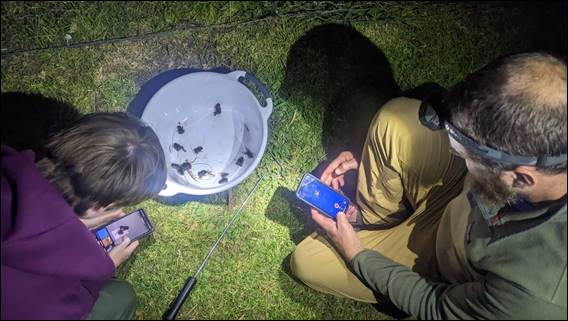
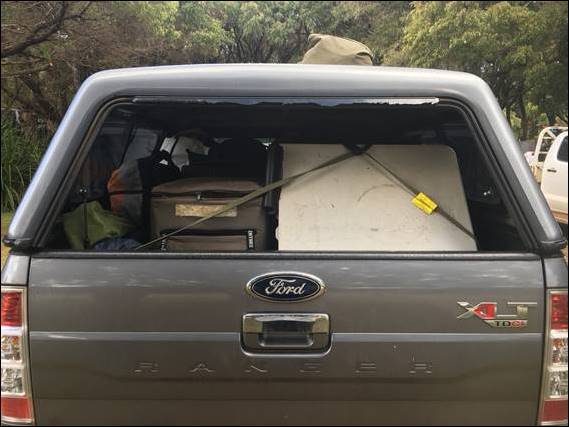
You may recall Sarah as being a bit of a reptile nerd, and on the first night her and Rongy had gone snake hunting. It was unsuccessful but they did find some frogs about, so tonight Howsie and I were going to join them in the hunt. As we cleared the site up reading to go, I somehow managed to be involved in my second rear window shattering experience. The canopy window literally exploding in my hand. It was then almost comical as six of us were on hands and knees using head troches to pick out the hundreds of glass shards from the grass:
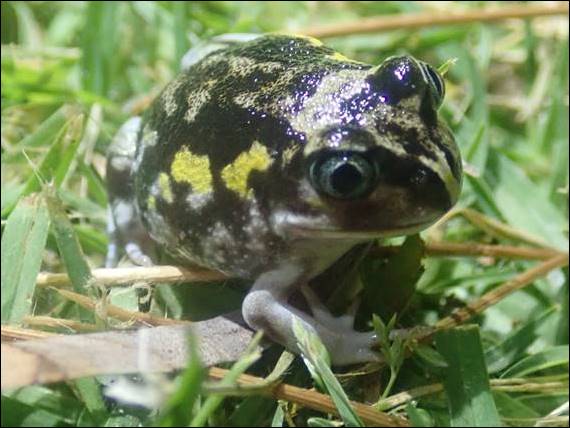
It was a great team effort and I feel like just about all of the glass was picked up, at least everything we could find. Then we went frog hunting, and even before we got out of the camp site there were Quacking Froglets (Crinia georgiana), Slender Tree Frogs (Litoria adelaidensis), Motorbike Frogs (Litoria moorei), and Moaning Frogs (Heleioporus eyrei), the latter shown below. Howsie and Sarah confirming our finds on their frog identification apps. We didn’t see too much else on the hike, but did lots of lightening that got closer and closer:
The abundance of frogs should have been a sign. Sometime after we were all tucked up in our sleeping bags the drops started to fall. It rained, hard at times, for some two hours and then on and off for many more. The morning looked to be clearing up but east and south dark clouds and lightening was still apparent. Several factors came to mind including the rock could well be seeping, the risk of taking on the soft sand hung over the heads of the drivers, and the broken back window made the car more vulnerable to theft:
Added to that Mario would have been foolish to risk breaking skin on his fingertips. Once that happens the healing time is significantly extended. Andreas was also happy not to climb after their two solid days. So we broke the wet camp slowly, the decision was made and there was little point attempting to get a morning climb in with all the risks and uncertainties. We were not however despondent, it had been a great trip during which we had packed in a heap of routes and really enjoyed the whole getting away experience and all it offered:



















 Sandbagged