The comfort zone

I’m sure everyone has at some point been told putting yourself out of your comfort zone brings benefits, and trying new things helps us grow as individuals.  We can choose to do this, but at times it is thrust upon us.  This past week could have been an “interesting” one in that regard, but fortune was on my side and just in the nick of time things took an unexpected turn in my favour.  Twenty one years back, almost to the day, the official running the ceremony when along with a bunch of strangers I took the final vows in order to become a citizen, told us that we now had three great advantages in life:

The passport was the first, and the second was the chance to be called for jury duty.  I had managed to avoid this second wonderful advantage in life until two weeks back when I got the letter calling me in.  On Monday last week I turned up and waited in a small stuffy room with some fifty other people.  Over an hour later we marched into the court room and the accused stood and pleaded not guilty.  This meant twelve of us would be “lucky” to get picked, and the lotto was drawn.  They quite literally pulled pieces of paper out of a box with our respective allocated numbers on them.  My number was drawn, and it was due to be a four day trail:

All I will say is that it was not going to be a pleasant experience.  The formal court proceedings were broken up with various adjournments, and soon it was late on the first day.  We walked back into the jury box for the fifth time bracing ourselves again for the uncomfortable experience of hearing from witnesses and seeing confronting and graphic evidence.  Instead, the accused unexpectedly changed their plea and the jury was discharged.  It is fair to say all twelve jurors breathed a huge sigh of relief, and of all the people who knew I had been called up only a small handful said they would enjoy the experience:

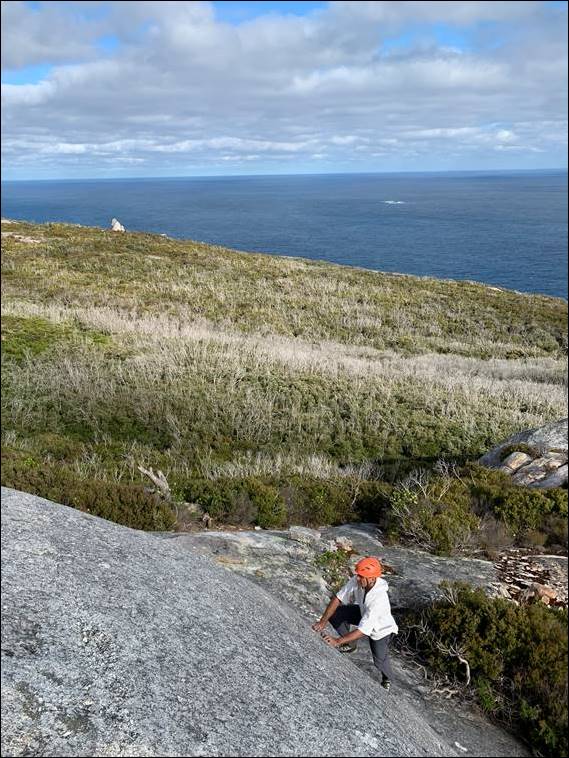
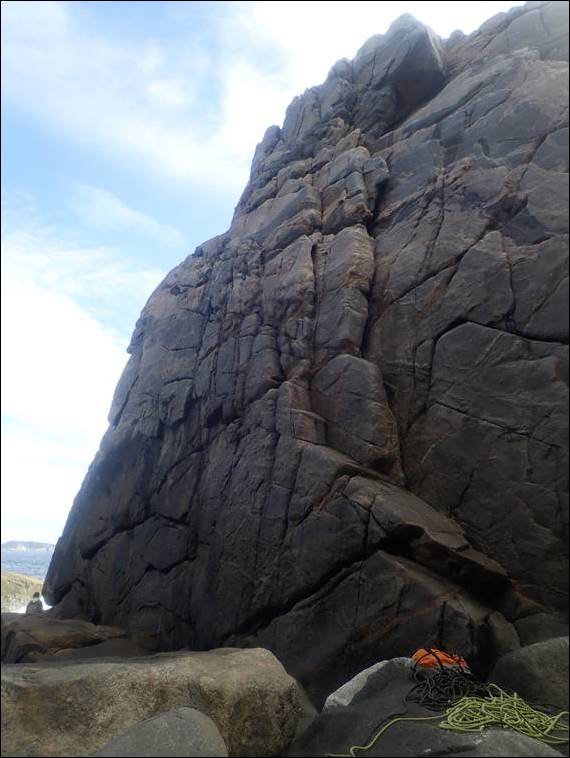
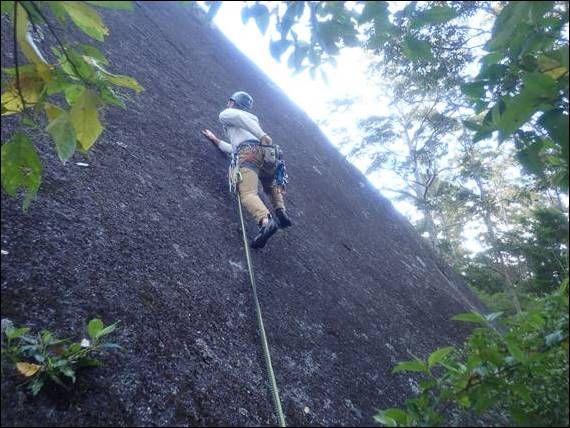
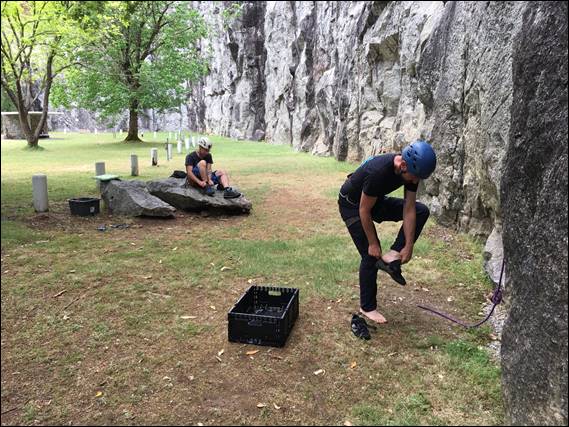
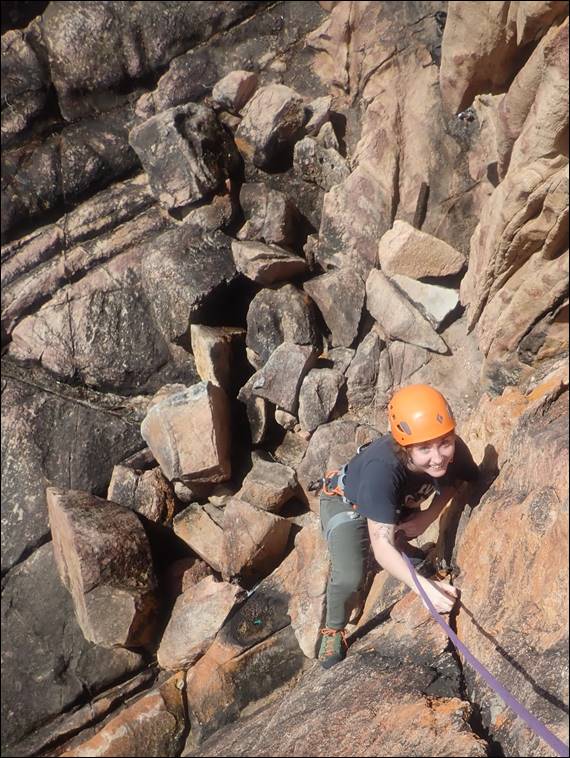
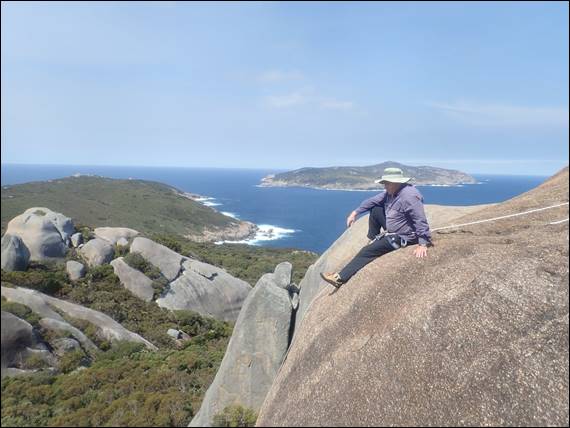
You may be wondering what the final “great advantages in life” was that I earned twenty one year back.  And this one I really hope we, and I mean we, never have to encounter as it was being able to be enlisted to serve and fight for the country.  While this may seem a rather miserable topic for my musings today, the topic of trying new things is relevant.  After taking Sarah to Moses Rocks last week, Rongy and I today introduced her to its big brother.  We had another wet and wild week, but the Friday and weekend were forecast to have a minimal chance of precipitation:

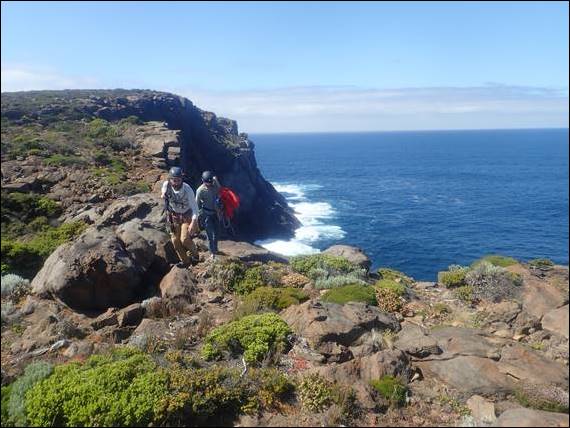
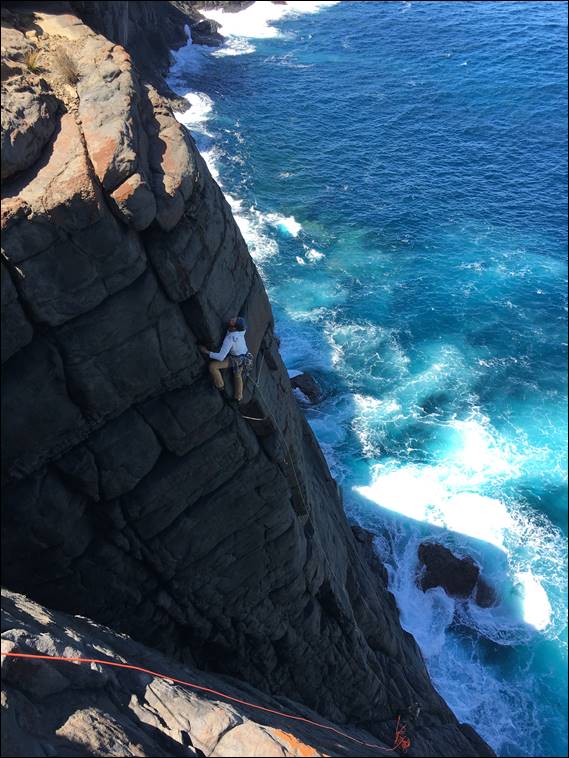
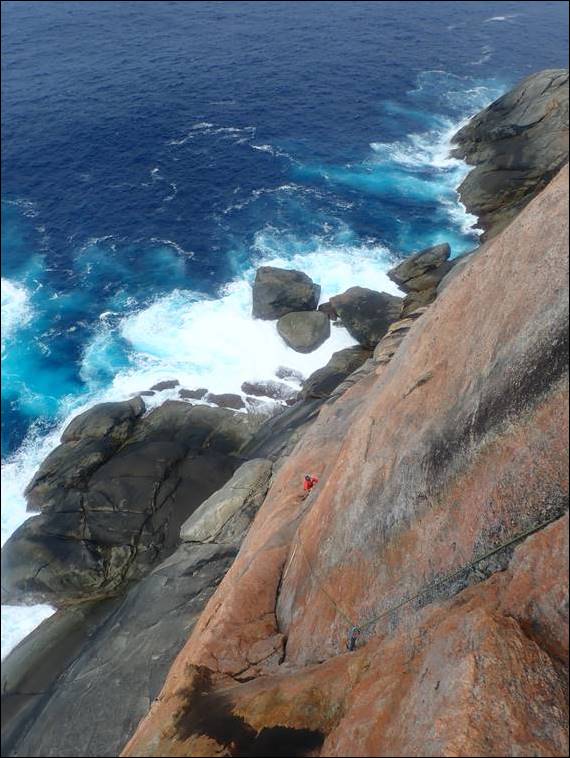
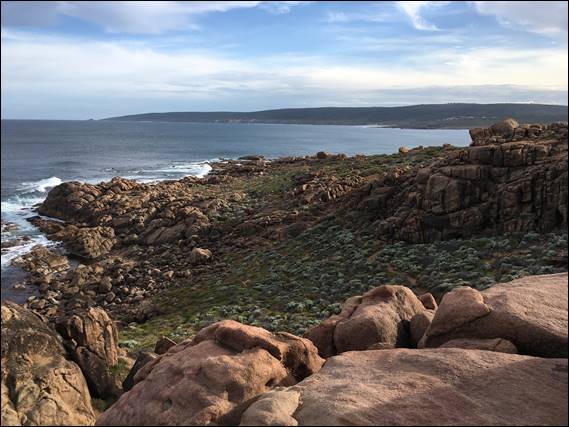
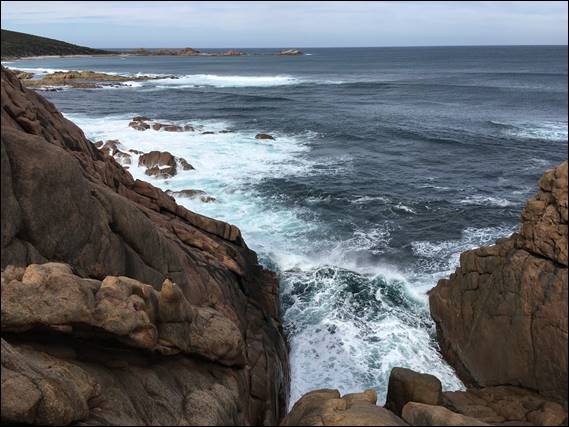
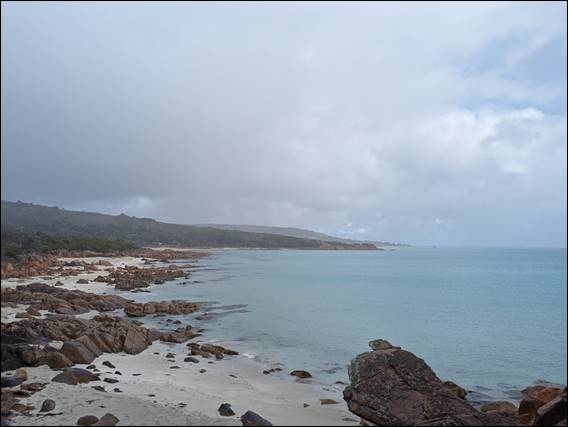
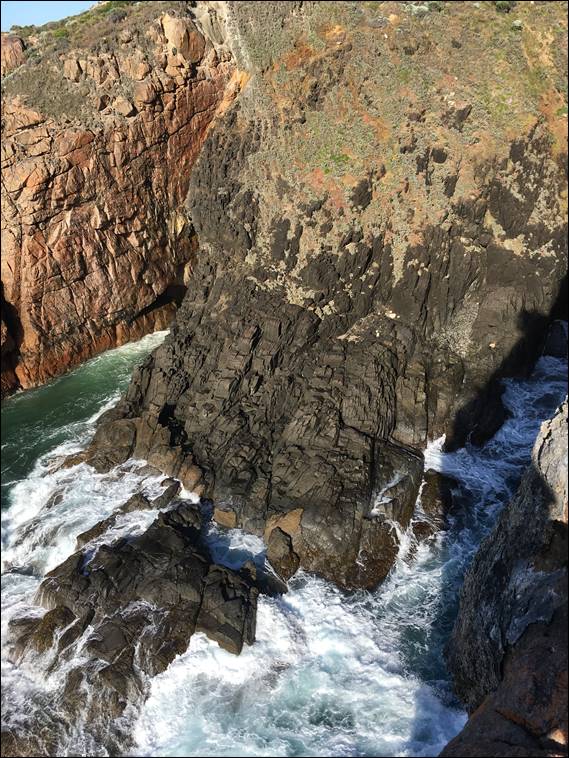
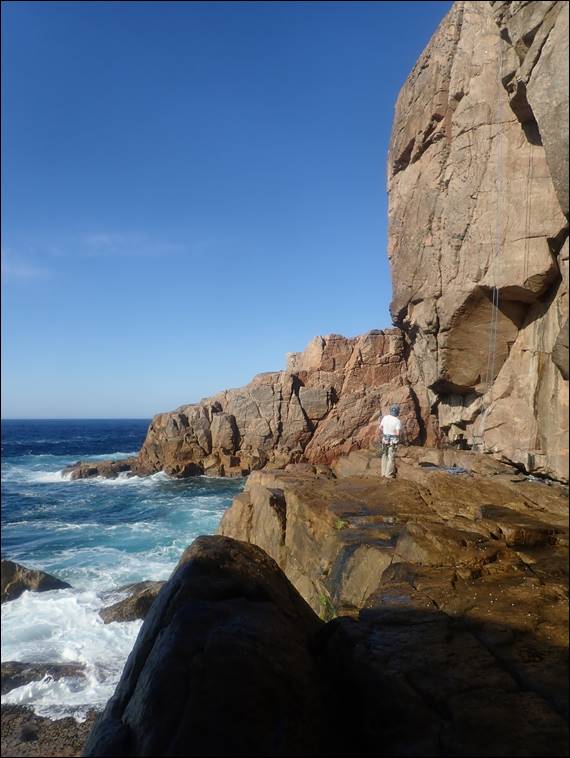
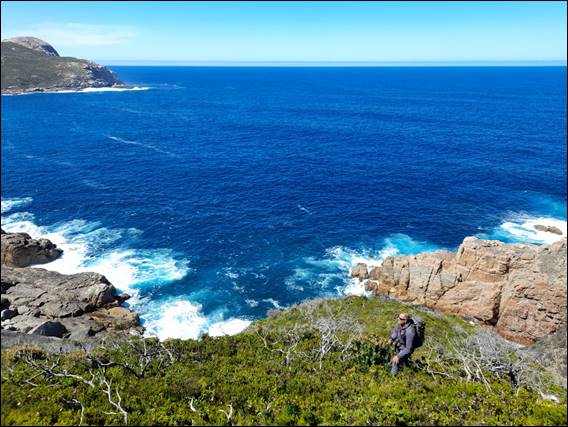
Howsie popped up to Welly Dam on Friday and told me every route was running with water, which is unusual.  Due to the steep walls there, normally one or two lines are dry enough to be climbable.  The conditions steered our thinking towards Smiths Beach, which like Moses Rocks has amazing friction so it didn’t matter if the rock was wet.  Of course it was wet, although it was more because of the rough swell that was crashing at our feet.  As we drove in the bay of Smiths Beach was full of people surfing, but many of them would feel confronted by standing were we were now:

Despite being the very same ocean that they were fully immersed in, I guess standing on the edge of where the waves hit land is probably the worst spot to be.  As all the momentum is abruptly halted the direction the water takes somewhat unpredictable.  Understandably, for many it would be a strange place to be able to operate in an anxiety-neutral state of mind.  But it is well within my comfort zone, and to be honest I feel there isn’t much that nature can throw at me that would really worry me.  Although that may be a statement that I have to retract in approx. five months:

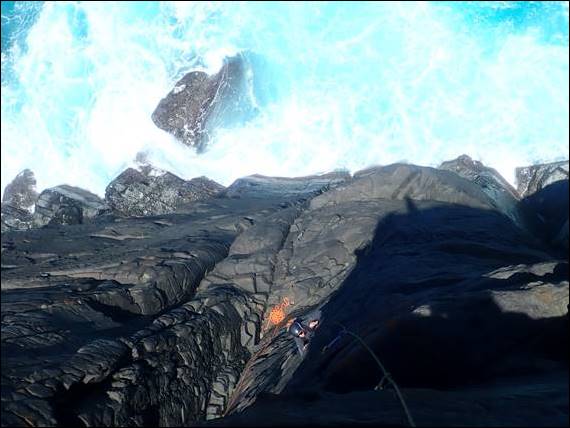
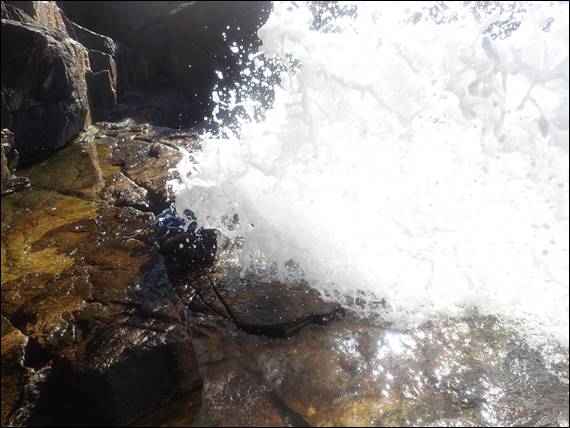
We of course applied good safety practises being in such a location, although at the very start before we had even started climbing I was caught out and got drenched from head to toe.  As I stood looking out across the bay I noticed the water dropping at the end of the zawn, as a clean wall of water came in.  A sure sign that when the wave smashed into the rocks water would be sent high into the air and sure enough all over me.  At times like this it is best to brace for what is coming rather than trying to run away from it, which due to the terrain would likely result in a fall and probably a more serious injury:

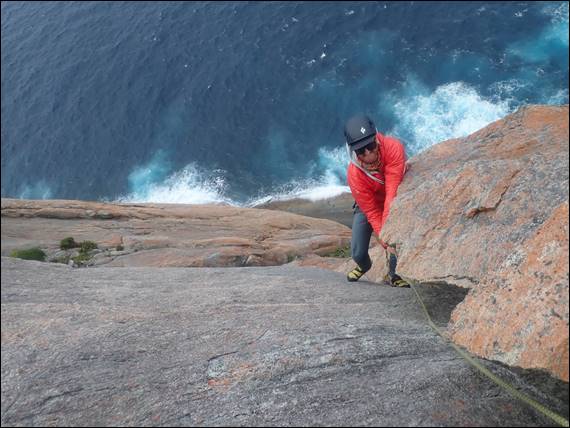
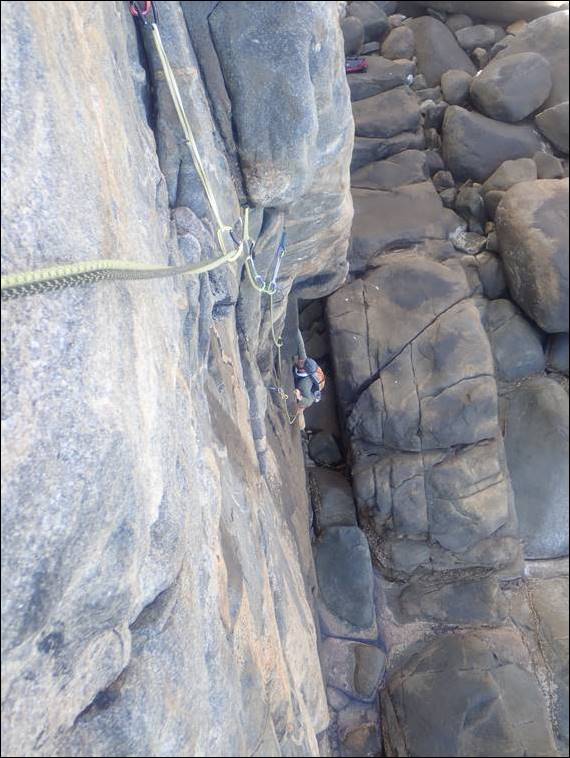
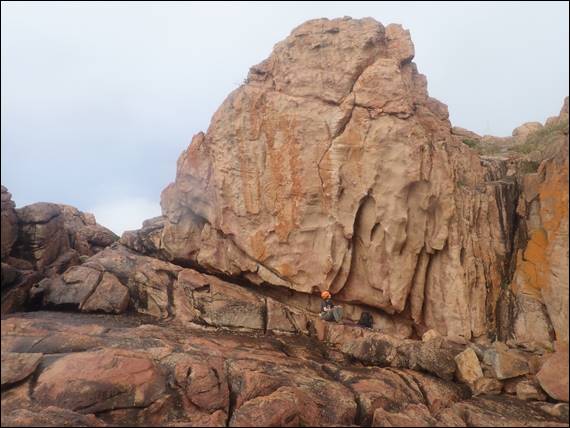
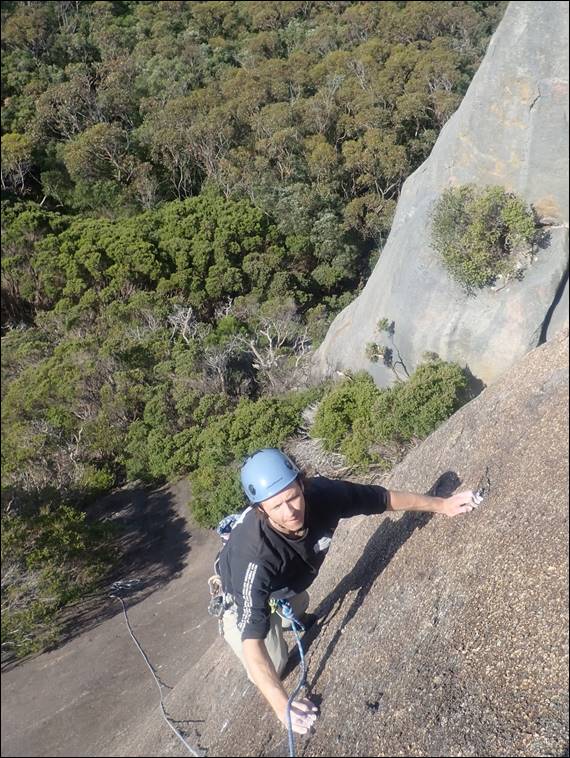
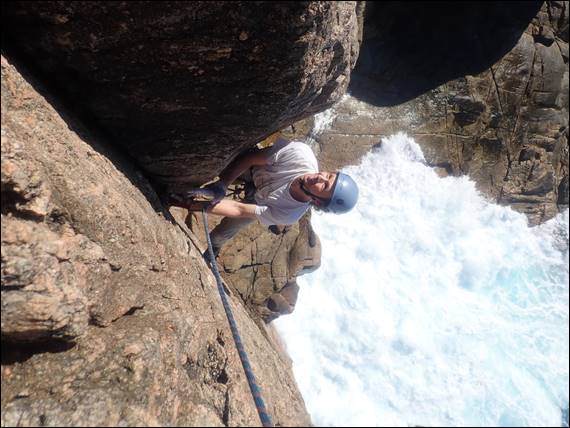
We notched up four of the great routes on Harbour Wall, which always avoids being directly hit by the waves due to the direction the swell takes as it enters the bay.  Sarah got up the first two, but whether due to being physically or mentally exhausted she sat and watched the waves as we climbed.  Then to allow her to get another climb in we left the zawn and headed to a small buttress on the headland high up above the water.  It felt strangely quiet and calm here.  Despite the easier angled rock and less intimidating situation, while having a go at the start of the first route here she had nothing left to give:

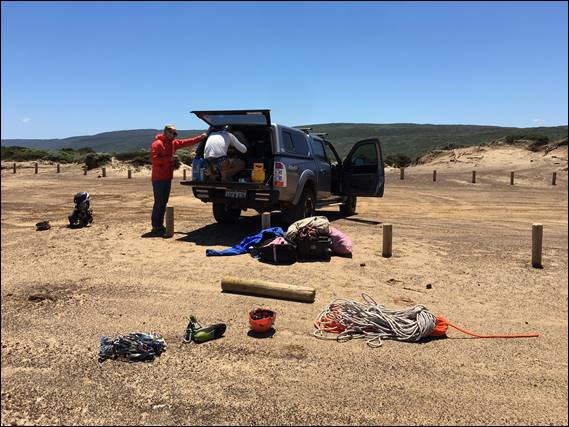
Rongy and I ran up the two short lines and called it a day.  Normally it would be back to the car and time to head home, but today Sarah was keen to try a café in Busselton.  And seeing that she was brave enough to give Smiths Beach a go, I agreed.  Although in terms of comfort level I really don’t think the two compare.  It was however an opportunity to see if Lisa wanted to pop out and join us for a bite to eat, which she was more than happy to do.  It did feel strange when I finally got home not to feel like I did needed to grab a feed.  Something I really should do after being out, but as Lisa will remind me it is something I don’t do often enough:

Crystal healing

It is a rare thing to have to scrape the ice of the windscreen where we live, but today it happened.  First light was trickling in from the horizon but not enough to be able to clearly see the amazing patterns nature creates using ice, and the waning crescent moon didn’t help the cause.  Not only was it a tad dark but it was also a mere one degree just before seven, as Lisa walked down to the beach for her weekend cold water dip and I got into the comfort of my car.  Needless to say the heater went on, something Lisa didn’t have the luxury of being able to do:

I’m impressed that she still goes for her cold water dip.  The Peppy Plungers, as they are known, would by now have ceased the ritual a while back in previous years.  Lisa has however managed to keep a few of them going for longer than they normally would.  This morning was a bit more of a struggle for her, as she could hear the waves suggesting that getting in would be that bit more of a struggle.  The height of the tide is of course related to the position of the moon and because it is waning, or getting smaller, we are very close to a new moon and spring tide:

The term spring tide has nothing to do with the seasons, and is instead related to the concept of the tide “springing forth”.  This happens twice a month when the moon lines up with the earth and sun, and when it finds itself sandwiched between the earth and sun the gravitational pull of the sun and moon join forces resulting in a stronger spring tide.  This lined up with Lisa’s observation, based on the audible cue, that the tide was up and indeed it was.  They struggled to make it past the waves this morning but still plunged into the balmy 18 degree water:

The waves at our destination were also up.  Clean, crisp, and almost orderly looking waves that crested beautifully with a trailing white mane, as they rolled into the bay.  The wave washed beach was covered with smooth sand, devoid of tracks for us to identify unlike my visit here with Josh just a few weeks back.  And after the main beach, the small bay before we got to the rocks proper, where Josh and I had found a second set of Bandicoot tracks, there was no sand left.  The strong spring tide no doubt having played a part in taking it all out to sea or moving it a bit further along the coast:

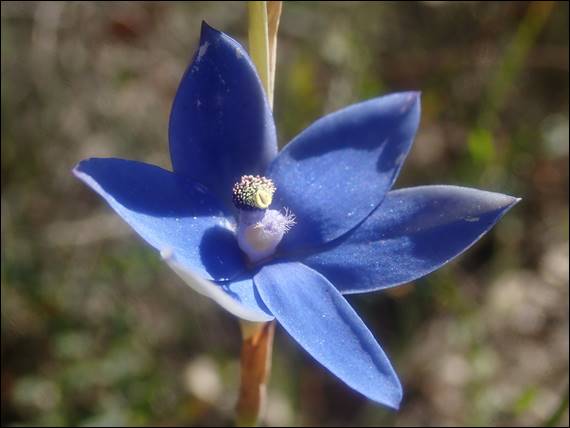
Despite the lack of sand in the small bay, and high spring tide, we managed to avoid testing the water temperature by skirting the rock between the sets of waves.  After which we stood atop the outcrop looking back at the waves marching into the main bay.  We were not in a rush but when we arrived at the main face it was finally down to business.  Howsie is back in town after a three month road trip so he set off up the cold to touch and wet rock.  It was not cold enough to turn his fingers blue, his nails had rather been painted by his kids, and the rock here can never be too wet to counter the great friction on offer:

While Lisa was no doubt trying to warm up her core temperature back home, we didn’t have that problem.  After the walk in and then our first climb the blood was circulating heat round our bodies nicely.  Howsie’s family road trip had not included any climbing, so he had picked Moses to ease himself back into things.  The place also suited Sarah and Rob, who had both joined us today for a bit of mid to low grade fun.  But they were, like us, also just coming out to enjoy the stunning location and allow it to clear the head:

After a couple of routes on the main wall we wandered over to a small buttress that would offer some good lines for Rob to lead.  This happened to be above an elevated rock pool, which has a reasonable vertical drop into the sink.  On days like this, the good sized waves hit this wall and tower into the sky, adding to the dampness on the rock but staying just far enough away to make it a safe location.  As Rob and Howsie were on lead, one wave did however surprise Sarah and myself getting that bit closer than any of the others we witnessed:

Oblivious of the action behind us, they climbed on enjoying the friendly feel of the rock.  I’ve often have, and will continue to refer to Moses as a friendly place.  It is not only the rounded, smooth, and high friction rock, but also the general feel the place gives me, and others.  Simply put it feels welcoming, and today I picked up on something else that I have either not noticed or paid any attention to before.  The occasional pocket of garnet, blood red crystals contrasted against the brighter quartz veins that cut across the grey speckled gneiss, which is the predominant rock of these formations:

The appearance and size of garnet crystals can vary massively, as can its value from practical nothing to $130,000 per gram.  I’m pretty sure that the ones here at Moses Rocks are very much at the lower end of the spectrum.  They are however still very pretty to see and due to the deep red colour people, since the old days, connected this crystal to the heart.  Believing, amongst other things, that it could counter deep or serious thoughts of sadness.  It has also been known as the gem of faith, with some believing that those wearing it and doing good would have more good befall them:

Certainly today, being at Moses Rocks, all of us could feel nothing but happiness to be here.  We also had to have faith in the holds, which while not sharp or painfully did need you put complete trust in friction.  Also Rob went that bit further than expected and led three climbs, while Sarah while doubting at times managed to follow us up every line.  Not that I am claiming that it is down to crystal healing, but the presence of garnet here does tie in nicely to how I have felt about and described this particular crag since I first visited it nearly twenty three years back:

Window of opportunity

Not put off by the forecast, Rongy and I headed out hoping to catch a weather window.  Reckoning the better chance would be on the coast of our little corner of the South West of Western Australia, as opposed to our other consideration of heading to an inland crag towards Perth.  Based on this we decided on Bobs Hollow, which may seem strange as during winter the build-up of moisture behind the cliffs eventually results in a slimy substance oozing out of, and coating the surface of the rock making climbing pretty horrendous.  However, I felt it was too early for this to happen and we stuck to our guns:

It felt like an age since we had been here, so much so that we even forgot the directions and ended up heading to Cosy Corner.  Driving some twenty kilometres too far to the south before realising the error of our ways.  It didn’t worry us too much, as the windscreen wipers were being worked and that fortunately eased up as we got closer to our destination.  Checking my images, the last time I came here was March 2021, with Tomski, Dan, Mikie and Howsie.  I recall it got fairly busy down at Bob’s on that day and that is a key reason I have not been back for so long:

During COVID times Bob’s became very popular and it was not uncommon to find up to fifty people here, which based on the number of climbs is very busy.  Today, walking in, we were pretty sure we would have the place to ourselves.   Not only because it is winter, but as per the forecast early belts of rain floated above the ocean, threatening land fall.  Walking on regardless of the view out to sea, there was a distinct difference with the scenery.  My Walking in Circles book describes the landscape vegetation in this general area as being a mix of Holly-leaved Banksia (Banksia ilicifolia), Western Sheoak (Allocasuarina fraseriana) and dense coastal heath:
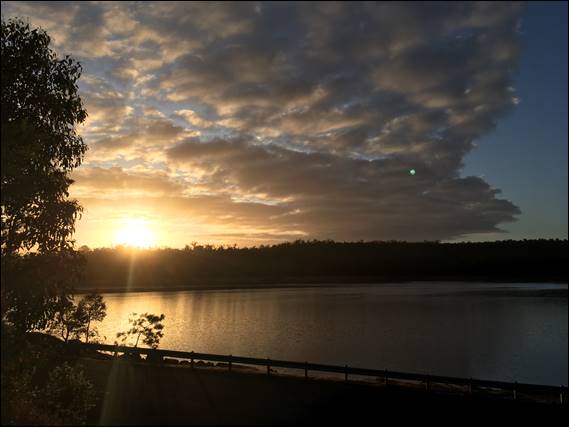
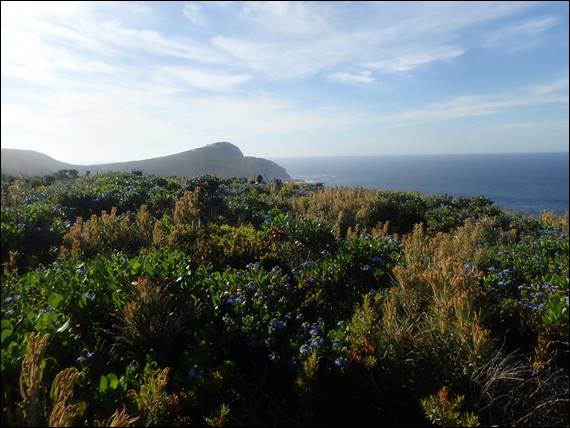
Normally on the walk in the vegetation would be head height or higher.  This prevents you seeing where you are going, and certainly stops you enjoying the vistas from the elevated position.  Today, however, we had a clear view in all directions for the entire walk.  In December 2021 a bushfire ripped through this country and burned 5,200 hectares.  A similar occurrence happened in 2006, which my trusty Walking in Circles book references stating that it would take several years for the vegetation to recover.  Well it has been over two years since the 2021 fires and the vegetation was knee height at best:

We also noticed the vegetation coming back included a lot of Yellow Tailflower (Anthocercis littorea), easily identified by the yellow flower a few images up.  This is one of the coastal heath shrubs, being native to Western Australia and known to grow on coastal limestone and dunes.  The plant can reach a height of three meters, but has a very long way to go to reach that size.  Indeed we found very few remnants of the taller pre-fire vegetation, a sign that this place really was ravaged.  That said, as always, it was a lovely walk and even better on arrival the rock was not looking to shabby:

Another rain belt made land fall before we managed to get on a climb, but which such a steep overhung cliff it was easy to find shelter.  Using this time to warm up the upper body muscles by having a boulder, which drilled home what we were in store for.  It has been awhile since either of us have climbed routes of such a physical nature and we wondered how long we may last.  What was on our side, however, was that we had not set our sights too high.  Being out for the scenery, experience, and enjoyment.  All of which was boosted as we scored that weather window we had been hoping for:

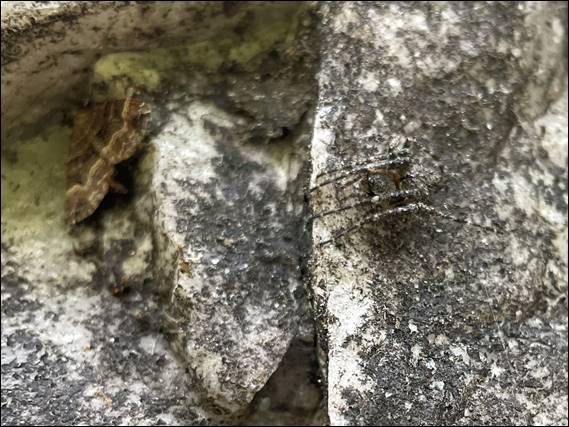
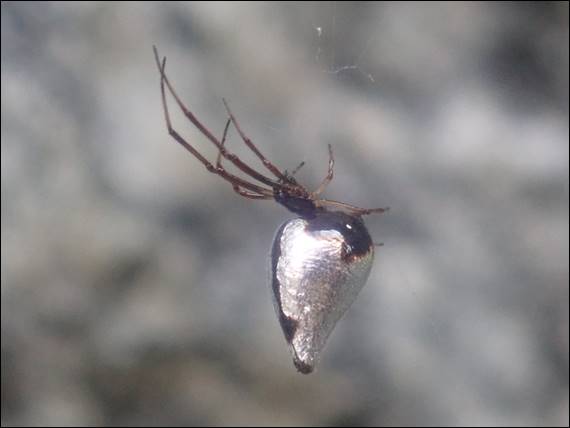
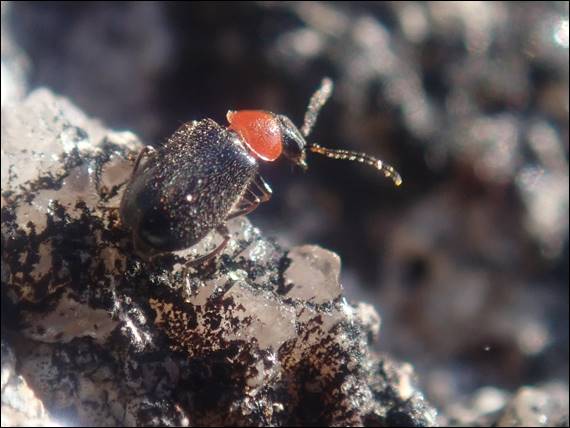
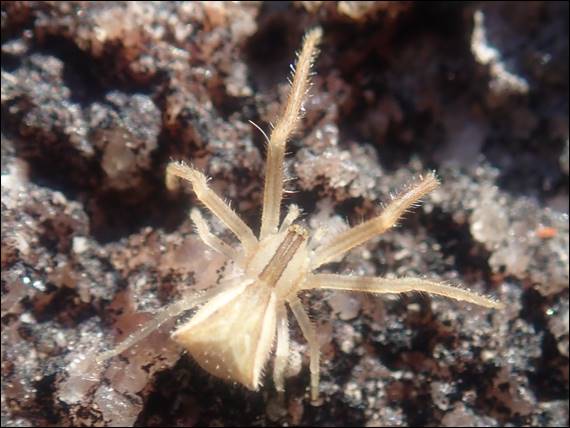
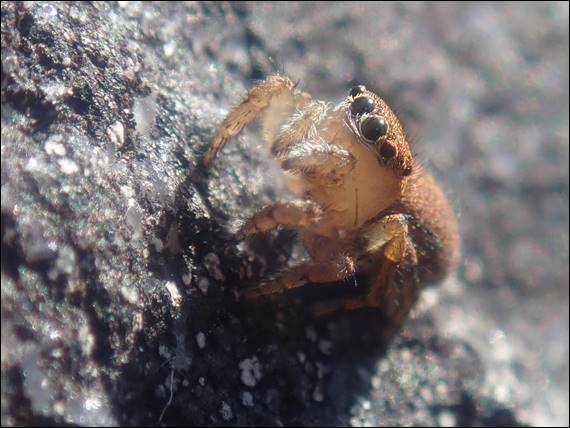
Relishing having the place to ourselves, mostly dry rock, and the right attitude to what we could achieve today I also kept an eye out.  Spotting Welcome Swallows (Hirundo neoxena) flying in and out of their nests made of mud that were safely tucked away in the many holes in the rooves of the caves, and occasional Nankeen Kestrel (Falco cenchroides).  The former darted about catching insects on the wing, while the later skilfully used quick shallow wingbeats to allow it to stay horizontal in one position as it searched for prey.  There were also a few spiders out, and the above tiny specimen caught my eye despite only being approx. half a centimetre long:

With some 5,000 species of jumping spiders I didn’t fancy my chances, but am fairly confident that this is a female White Garland House Hopper (Maratus scutulatus).  This species is common in coastal locations, including in the South West of Western Australia.  Despite their miniature size jumping spiders are known to be efficient and stealthy hunters, just like a cat they pounce on their quarry holding nothing back.  For such a small creature I was also surprised to read that if they bite you it can result in local pain/inflammation, and at times mild illness.  My next find can also cause us humans pain, if we are foolish enough to get too close and allow the stiff barbed hairs penetrate our skin:

This one was always going to be a hard ask to identify.  There are some 20,000 species of moths and butterflies found in Australia, and of these less than 5% of their respective caterpillars are known.  I’ve attempted to work it out, but haven’t found anything despite taking note of quite a few very distinctive markings on my hairy find.  We unfortunately also came across an even less savoury creature.  A human who felt it was OK to go walking in a national park with his two dogs, which he even allowed to roam off the leash.  Who when challenged on this point turned aggressive, but it fortunately did not come to blows:

Rather than expend energy on such an individual we continued to climb, and the rock was more than willing to sap our strength in a far more enjoyable way.  Maybe even quicker than we would like to admit, but we had a great time and thoroughly enjoyed the six lines we picked off.  After which we felt very content, and no other climbs were calling out to us.  Therefore, despite the great conditions continuing to provide the ideal opportunity to stick about, we opted to finish up and enjoy the hike back out.  Passing quite a few responsible people, out for a walk without any dogs, and who were also enjoying for the weather window:

Making tracks

Josh foolishly said he was up for an early start when we made plans to head out to Moses Rocks.  He was however in luck, and being a Saturday morning I already had in mind to offer Lisa a lift to the beach, for her first light ocean dip, before heading out.  I left her on the beach with the self-named Peppy Plungers, whose numbers were slowly dropping just like the water temperature.  Driving to Capel for the agreed rendezvous with Josh, light had already crept into the sky.  And it was another cold, crisp, can clear sky start to the day:

It has only been six weeks since I was last here, but the beach access had taken a noticeable change for the better.  From the carpark it was previously possible, if you were that way inclined, to drive onto the beach.  It is however a year round soft beach and I have seen a few people really struggle to negotiate the exit up the steep dune.  Carving the place up and generally making a mess.  So while those people may be upset with the work undertaken, I personally like the dune restoration that has limited the beach access to foot traffic:

A lone fisherman was packing up and walking off the beach as we walked onto it.  Claiming that he was giving up because all he was doing was feeding the fish.  This reminded me of when Lisa and Elseya used to fish of our local beach many year back.  They used to refer to their trips as feeding the fish, and they never caught anything.  The fisherman did however advise there was a big one out there, and sure enough as he pointed in the general direction the familiar top of a whale briefly rose above the water as it was migrating northwards:

Being the first of July, whale watching season has officially started.  I was hoping to see one and the wind and swell conditions indicated that if they were out today we had a chance of seeing them.  We watched this one make its slow paced journey in the opposite direction to where we were going for a while.  Then a bit further along the beach stumbled across some unusual tracks.  They had us a bit stumped as to what animal had made them, and I made a note to check them out when I got home.  But for now our tracks took us to the rocks:

I asked Josh if he had any preference of routes, and he didn’t really mind but did say he had never climbed in the zawn.  To make sure it would be safe today we sat at the top looking down, watching the waves come and go for a while.  It certainly was not ideal conditions.  The boulders at the base were all wet and green, and the base of most of the walls also looked slimy.  However, the waves did not seem to be reaching the far corner, and as the tide was receding this could only improve.  Josh was keen, and I didn’t need any extra encouragement:

Due to the circumstances our attention was drawn to the slab on the back wall.  Offering generally lower grade routes and being accessible from the small corner that we huddled in, as we attempted to avoid getting wet.  This we managed mostly, although Josh was severely sprayed just before he followed me up the first climb.  Only the first three or so meters of the first and second climbs were wet, after which the wall dried up providing delightful climbing.  The third line to the far left, was however slimy and sketchy for more than half the route:

As I fiddled the gear in at the start a couple of reasonable waves hit, and I spent the rest of the morning in wet shoes.  But that is all part of sea cliff climbing and added to the experience we were both after, and had willingly had put ourselves in.  After that slimy ascent we went down for one more, a steeper route up the side wall.  Again accessible from our little nook, but certainly more challenging.  As I sat atop that climb I hoped to see another whale, but the winds had picked up and the white tips of the waves made whale spotting near impossible:

As I struggled to spot any gentle giants, below me Josh’s arms were struggling with the steeper terrain.  Digging deep and taking a slightly more meandering path, to allow a rest or two, he made his way up.  It was however now time to leave the soggy zawn, and head to the main wall to get a couple more routes in.  Here we stayed dry being high above the ocean, and for the last line the sun had swung round to the north.  Just enough to bathe us in warmth and while lovely, despite the chilly start to the day neither of us had at any time felt cold:

Nearly every move of the last climb was accompanied with a grunt, and Josh was ready to accept that his arms were toast.  While we never saw another whale, we were however more than happy with the fun routes we had played on.  Plus, to our surprise we came across another set of tracks like the ones we had seen in the morning.  Not completely convinced, but based on the paired larger rear prints being just ahead of smaller staggered front prints I reckon it was a Southern Brown Bandicoot (Isoodon obesulus):

Cramping my style

Unlike progress on the bridge at the base of the dam at Wellington National Park, I’ve been overdoing it a bit and have clocked up way too many hours at work.  So much so I had a choice today, work and forfeit the hours or take the day off as a flexi.  The choice was easy and I decided to head to Welly Dam, not for a climb but a hike.  Driving into the National Park  the paddocks were white and crunchy in the near zero degree temperatures, with a thin coating of ice.  I really should have stopped to take a photo, but was too keen to get walking:

Not unexpected, as started to descend into the bowl where the dam is located fog hung heavy and thick.  A great sight, but the blanket of moisture in the air meant the temperatures were not quite as cold and there were no icy images to be taken.  No matter I sorted myself out and set off, leaving the empty carpark behind me as I headed into the soupy conditions.  I was a little surprised to see that there had been no progress on the removal and replacement of the bridge at the base of the dam.  I know the reason is because the approvals take forever:

It was still a little annoying to see nothing had start though.  The bridge has been closed for maybe a year now, and I do enjoy the journey to this place coming for the south.  Far more than needing to trudge all the way into Bunbury, up the scarp, and entering from the north.  What with all the roadworks going on it takes almost double the time, and is nowhere near as pretty a drive.  The sights as I walked were however very lovely, watching the sun slowly burn the through the fog leaving only drops of water hanging off the leaves and spider webs:

The first section of the walk today was along the river.  The sound of water cascading over the rocks filled the air, and almost masked the faint thumping sound.  I was lucky as I wasn’t ready for the first Western Brush Wallaby (Notamacropus irma) I came across, being too shy and bounded off.  The above one however was quite happy to pose for me.  Macropodidae is a family of marsupials, and most species in this family are somewhat nocturnal.  The Western Brush Wallaby, also known as the Black-Gloved Wallaby, does not however follow the trend and feeds during daylight:

As I continued along the river I left the rapids behind and the river took a more gentle path, with wide open pools.  Perfect for water birds to feed, and I spotted a Little Pied Cormorant (Microcarbo melanoleucos) pop back to the surface after a dive with a fish securely held in its hooked beak.  Unfortunately it was too far for the images I took to be worthy of inclusion, and the above image is of another one a bit further along.  These birds are often solitary when found on smaller inland waters, but hang about in big numbers on larger water bodies or the coast:

Eventually I had to leave the tranquil river, but I stood there for a while watching the water before I started up the hill.  The track I wanted to take had a closed sign across it, the same one that was in place when I came here in July last year.  So it seems that work on maintaining the walking tracks is happening at about the same pace as the works on the bridge.  It didn’t stop me and like last time I went round the flimsy barrier, and began the incline.  I seemed to recall from last time that it felt like the hill never ended, and it was the same this time:

I consider myself to be reasonably fit, but when I got to the top I was puffing away.  Time to stop for a snack, but not for too long and I was soon back on the track.  Walking through the tall tress the silence was deafening.  Due to stuff I’ve got on at work and not having Lisa to chat with, it was all too easy for my thoughts to drift towards work.  To refocus my thinking on where I was, I kept a sharp eye out for anything interesting.  Unlike my visit here last July there was nowhere near as many flowers or fungi about, so the finds were few and far between:

I was very interested in the insect three images up.  I am not going to try and identify it, but it looked to me that the insect was being attacked by a fungus.  Reading up on this gruesome subject, the poor creature was probably infected with the aptly named Zombie-Ant Fungus also known as Cordyceps (Ophiocordyceps unilateralis).  If this fungus manages to get into an insects cavity, the host is doomed.  It sucks all the nutrients out of its living host, before filling the body with spores to allow the fungus to reproduce:

Back to more pleasant subjects, and every so often the undergrowth would spring into gentle sounds and frenzied activity with lots of small birds looking to be playing chasey.  They were too fast but the Grey Currawong (Strepera versicolor sp plumbea), several images up, was happy to pose.  These birds are found across the southern portion of Australia, comprising six sub-species.  The Western Australian subspecies is also referred to as the Leaden Cuckoo-Shrike.  I assume because of similar features it has with the Black-Faced Cuckoo-Shrike (Coracina novaehollandiae), which in my opinion is one of the most sleek and majestic birds:

You may have noticed a couple of orchids images pop up.  Two more first time finds for this season being a Jug Orchid (Pterostylis recurve) three image up, and the above Midge Orchid (Cyrtostylis huegelii).  The latter can be found in large colonies but only a few may flower, like a some other species I have recently mentioned.  It was this orchid I was hoping to find in flower on the uphill slog, which was not the case and the above image is from later in the walk.  Neither species I spotted were in flower, and feel this season is starting slightly later than last year:

There were a few fungi out, nothing particularly specky but I did like the above image.  I believe the one centimetre high fungus is from the Psathyrella genus, but with some 400 species to wade through I’m not going down that rabbit hole.  For the last few of the sixteen kilometre circuit my legs were getting pretty achy, and I was quite pleased to finally get back.  With very few cars or people about I soon became surrounded by Splendid Fairy Wrens (Malurus splendens).  These ones being way less shy than their cousins in the forest:

Being at the dam I had come prepared to finish the trip off with a top rope solo.  Wondering how I would go with my stiff legs there really was only one way to find out.  Right of the bat it was my turn to make a Storm in a Teacup of it, as I felt my calves seizing and arms lacking in the required gumption.  Not put off I then threw the rope down Building Bridges.  It was slow work, not quite as slow as the bridge building not too far away, but after one lap my legs were cramping my style and I packed up:

Setting the pace

While I was having fun on rock yesterday Lisa had managed to polish off the last of the school reports.  So waking up to a crisp blue sky, we decided to head out for a walk.  Having a sneaky feeling the weather would break at some point during the day, we plumped for a quick trip to Manea Park.  Things it had going for it being it was less than half an hour away, it is dog friendly place so the poodles could join us, and it is kinda just round the corner from subway, which Lisa had been yearning for since yesterday:

It is widely accepted that dogs, even when on the lead, result in the physical and temporal displacement of wildlife from their habitat.  Furthermore, the scent they leave behind as they mark their territory can continuing to repel wildlife so has lingering impacts.  For these reasons we never take our dogs to national parks or areas where dogs are not permitted, but if a place is recognised as dog friendly such as this we do make use of them.  The good thing about taking the poodles was that we took a slow pace, as there were so many smells for them to check: 

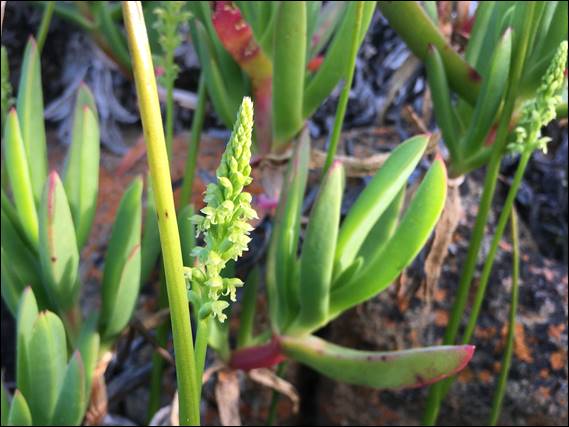
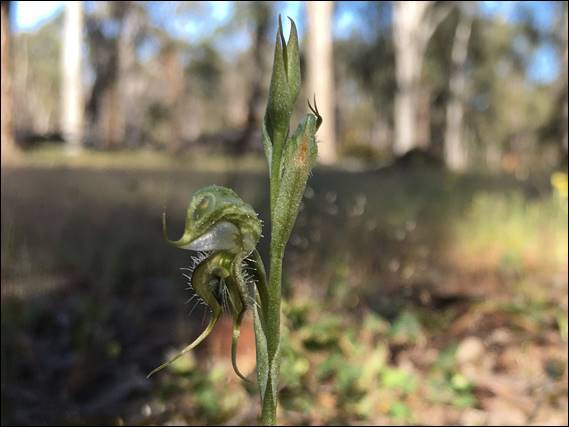
The pace allowed me to keep an eye out.  I was expecting to see a myriad of fungi but not too much else, but that was flipped today.  For the second time this year I’ve spotted Banded Greenhoods (Pterostylis vittata), this time in huge numbers.  However, in the background of the above image there was something different.  A solitary Scented Leek Orchid (Prasophyllum sp. ‘early’), yet to fully come into flower but the spikey petal configuration was unmistakeable.  Unlike the abundance of Greenhoods I only found this one Scented Leek Orchid:

Soon afterwards I stumbled across a couple of Hare Orchid (Leporella fimbriata), one of the orchids I was hoping to find a month or so back and a species that until today I had not seen.  I’ve read these can form colonies of thousands of plants with, like some other orchids such as Red Beaks, relatively few flowering in any one year.  However, after fertilization they can continue to flower as late as August or September, so I am a little surprised it has taken me this long to find one.  Maybe the relatively drab colours and small flower help to camouflage them:

Once the poodles had worn themselves down a tad from all the sniffing about, they got into a more relaxed and consistent pace and my opportunity to keep an eye out was more limited.  You may laugh at that, but checking out all the scents activates their brain and this can use as much energy as a fast paced walk.  With noses that can have up to 50 times more scent receptors than ours their sense of smell can be 10 to 100,000 times more sensitive than ours, resulting in a lot of sniffing:

I did however happen to spot the above very pretty Scarlet Waxy Cap (Hygrocybe coccinea).  After which I stopped looking, as a sudden chill in the wind signalled it was time to get to the car.  Looking up reinforced that thinking, and we made tracks but before heading home we had to stop in at subway, to satisfy Lisa’s hankering.  With one week of school remaining, and next term not being a reporting term, we might get out for a walk a bit more often again.  And are already considering which dog friendly places to visit, where they can set the pace:

Seeing the wood, not the trees

There was a fair bit of procrastinating this week.  The total rainfall for June was inching its way upwards in the statistics table, as I had predicted in my last post.  Due to the uncertain conditions, I lost count of how many times I checked the regular weather app alongside the BoM isobar maps.  Looking, or was it willing, for even a glimpse of a weather window to appear.  Even then it was a last minute decision to head out on Saturday morning.  Driving down clear patches lingered to the east, in the opposite direction to where I was heading:

Ahead of me, to the west, dark clouds loomed fronted by stunning displays of rainbows.  Then, as I drove into the belting rain the rainbows disappeared from sight and I pondered my decision.  I admit that at times I can be a little stubborn.  If I have an idea or plan, even when things suggest it may not be the wisest, I can at times forge on regardless.  Today was one of the those times, and not surprisingly I was heading out alone.  Less surprisingly and despite not getting to the carpark until just past nine it was empty, as was the crag for my entire visit:

It was already a bit nippy, and made all the more chilly by a stiff north westerly wind that was whipping across the face of the crag.  Quick to take the rope on a sideways adventure as soon as I let go of it, and at times making me hold on that bit tighter for the more delicate moves of my chosen climbs.  On the plus side, I had ventured past the rain and while dark clouds were out to sea it looked like things might improve.  My destination was primarily based on the ease of setting up, and the first anchors gave me access to seven routes:

Being appropriately dressed for the conditions, and being able to keep moving due to not needing to faff with the ropes between routes, I soon warmed up and acclimatised to the conditions.  While not everyone’s cup of tea, being on a coastal crag in such blustery conditions provides a very exhilarating experience.  One I was thoroughly enjoying and not wanting to end too quickly, so I kept knocking off climb after climb.  One went up a huge partially detached flake, which is being monitored for movement using these two steel pins:

On a much bigger scale, there are seven major and eight minor lithospheric plates that make up the earth’s crust.  Australia has its own plate, not unlike a few others continents but what makes it different is the rate at which it is moving.  Shifting by approx. seven centimetres per year.  When I first started surveying some thirty years back it probably didn’t matter too much, as positioning systems generally provided an accuracy of five to ten meters.  However, with technology advancements and dare I say our obsession with detail and accuracy, it matters heaps:

Today I was definitely observing the woods and not the trees, taking in the whole experience and situation rather than focusing on each of the individual components that made it so wonderful to be out.   That may be why I didn’t stick to my predictable formula for top rope soloing of two laps on six lines.  Instead bagging two laps on nine lines and a single lap on both Glory and Hope to finish.  The last two being very purposeful, and even though my quick inspection as I rapped down the lines indicated I would be unlucky, I wasn’t:

My spirits weren’t even damped when the rope became stuck, as I tried to pull it up after my last climb.  Instead rapping back down to free it, before scrambling up an easy slab to make it 21 instead of the usual 12 ascents.  It was now time to wrap up the climbing, although I had one more stop in mind.  A quick check in the bush before I hit the sealed road that would take me home.  Wanting to see if the orchid leaves, which look so much like helmet orchids leaves, had transformed into a more substantial plant:

They hadn’t, but I was rewarded with some great fungi, including a very fine specimen of Rhubarb Bolete (oletellus obscurecoccineus).  The above fungus was first found and named in South Australia as recently as 1997, and observation recorded on the Atlas of Living Australia have only included one sighting in Western Australia, in the metro area.  That said I have read Russula lenkunya, which has not been attributed a common name, is considered a native fungus to Western Australia.  As for the fungus in my last image I have no idea:

Good karma

Winter seems to have set in and along with the increasing rain and decreasing temperatures comes the season of illnesses.  There is currently talk of the big three hitting Western Australia being COVID, respiratory syncytial virus, and influenza A; and it seems that possibly during my trip to Perth I caught the latter.  Starting to feel a tad ropey on the following Wednesday and not really coming good until Friday last week.  This put paid to any hopes of a trip out last weekend, despite having had plans for a session in-between the showers.  Instead I spent the weekend laid up, allowing the body to fight whatever I had:

It is pretty rare for me to get proper sick, so even while I had the bug I was working from home.  Despite being low on energy my brain doesn’t slow down quite so willingly, resulting in getting bored senseless if I don’t have something to focus on over such a long period.  Gotta to love the flexible working opportunities, which in my mind is one of the good things to come out of COVID.  But after nine days of not leaving the house I was keen to get out to blow the cobwebs away, as was  Rongy.  So we endeavoured to re-enact the plans from last weekend, and head out for an afternoon climb:

Thoughts had crossed our mind of a longer trip to a Perth crag, but for various reasons such as not knowing the area and also whether I was recovered enough for such a big day we decided to play a safer option.  It was a good decision, as Mario advised the place we had considered visiting in Perth usually seeps heavily in winter.  Earlier I mentioned how the season was well and truly upon us, a statement that is based on how many fronts and belts of rain have been hitting us.  It does seem much earlier in the year than what we have previously experienced so I did a quick check:

So it seems that April was a very wet month with the total rainfall hitting the 95%ile based on near a hundred years of records, and eclipsing anything we have had in the last ten years.  In contrast, May was below the 5%ile from all records and only just sneaking in as the second driest in recent years.  If June carries on like it has started, it’ll be above average across the hundred years and the second wettest in the last ten years.  Temperatures show a similar inverse story with April and June looking pretty cold and May relatively warm.  Regardless of what the records and statistics may tell us, it certainly feels like we have had a lot of wet days:

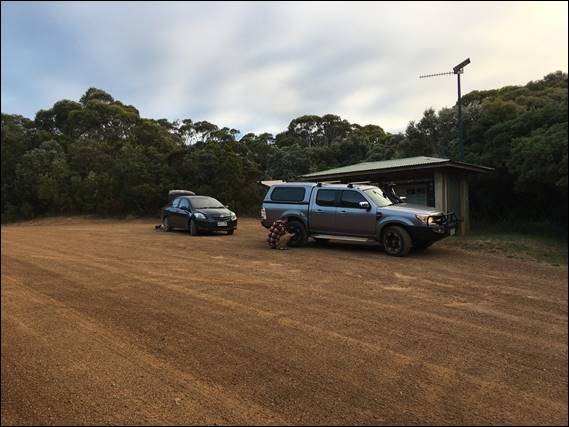
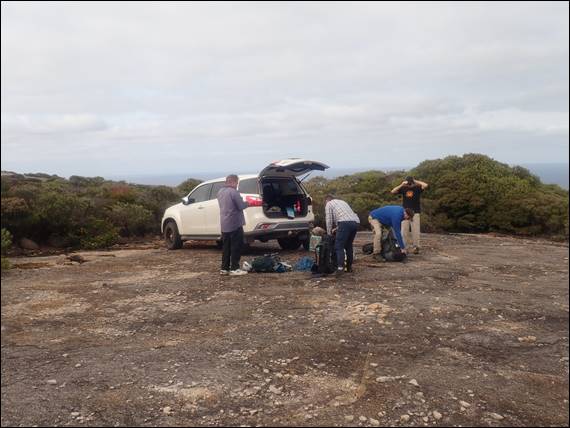
It was therefore entirely possible when we got to Wilyabrup that we were going to find a crag with water seeping down the cracklines and runnels.  On arrival our first surprise was a full carpark and my usual spot for parking being taken, which may be a first.  Fortunately, most of the cars belonged to walkers.  Other than us there was only small school group who were squeezing in a couple of abseils, in-between two legs of hiking the 14km’ish from Gracetown to Moses Rock on the Cape to Cape track.  It was this group that had stored all their rucksacks near the toilet, as shown in the first image:

This was the second surprise, as the rucksacks where the same style as Rongy’s.  I did wonder if he may have been scoping them to see if there was one in better condition than his, but as it is pretty rare to see someone with the same brand, let alone a whole row of them, he was just soaking in the sight of them.  I can liken it to when I owned a Triumph Dolomite (car) in England and whenever I passed another one on the road we always waved and flashed our lights at each other, despite having no idea of who the person was.  They say familiarity breeds contempt, although it can also lead to comfort:

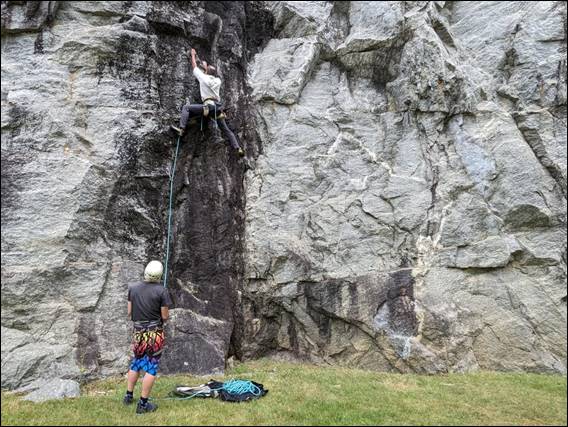
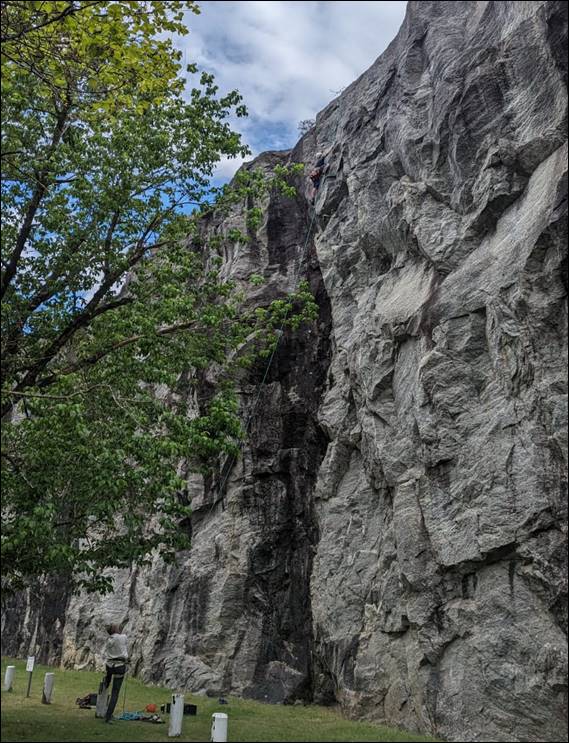
Our third surprise was the crag being in mint condition.  The group was very quiet and unobtrusive compared to other school groups we have encountered, making it feel like we had the place to ourselves.  With no set plans let the mood take us.  While not spoken, it had previously sort of been in the back our minds to take it easy.  That all changed as I was drawn to a couple of gnarly traditional lines that rarely get any attention, and Rongy was attracted to some of the steeper well featured face climbs.  It all feel into place nicely, and we also thoroughly enjoying the sun on our backs when was able to sneak through the clouds:

For our final route we went searching, with packs on, for the local Carpet Python.  Not being overly hopeful due to the darkening clouds and lowering temperatures, we were not disappointed when we found no trace of it.  For the observant, two images up you may notice the gear that I had found here in mid-May, when I offered to be a taxi service for Lisa and Elseya who were enjoying a local wine and food experience.  I finally tracked down the owner, being a local tour company, and later in the day a couple from that company turned up to retrieve their gear.  I had been offered a bottle of wine as a thank you, but declined the offer instead banking the good karma:

Back to basics

It has been a long time coming but I finally took up Mario’s offer to crash at Jena and his place for a night in Perth.  Why has it taken this long, well there is no particular reason.  Maybe in part because it is only two and half hours each way to most of the spots, so while making a longish day it is entirely doable as a day trip.  And indeed I have had multiple skirmishes this way over the years.  Therefore, I have sampled a good variety of the places, although there are still a few on my wish list, one of them being the first cab off the rank for this trip:

For most Chruchmans Brook’s main draw card is a water supply dam built in the 1920s and associated recreational facilities, which includes peaceful hikes not too far from the hustle and bustle of the city.  Located in the Darlington Scrap, otherwise known as the Perth Hills, this is not a place to visit in summer when it is stifling hot, but on a wonderful autumn day like today it was bliss.  I have actually been here once before, in 2009, when I had a spare hour or two while waiting to pick someone up from the airport.  Taking the opportunity to duck down for a quick top rope solo:

That was in the hotter months and I recall the one and only route I did being slick and smooth, which was not ideal in the sweaty conditions.  The tops were also a little loose and earthy, as can be seen above.  Nowhere near as bad as the big cliffs of Swanage but still a little disconcerting when you are by yourself.  I have however heard good things about this place, and since it’s discovery in the mid 1970s the early guidebooks claim this as being the most popular place for Perth climbers.  It is also suggested this crag was a milestone in Perth’s sport climbing history:

It’s discovery and development initiated what would become a greater desire to explore and bolt new crags outside of the main staple until that time, which where the Perth quarries.  That is not to say this place still holds such revere, and I don’t feel it draws the crowds those old guidebooks claim.   Indeed The Crag, the main online climbing guide, now describes it as having been one of the most popular places.  But now an area that is a lot quieter, and today we had the whole crag all to ourselves.  Mario warned me of the runout finishes, but the rock was nearly all solid, other than a hold he removed from the above route:

I was at Mario’s mercy today, he had a list of routes and I simply followed his directions.  Seeing it was one of his local crags and he had climbed so much here, I lead every route.  The only climb he also lead was the above one, quite simply because it was so good and definitely worth the three star classic status.  Neither of us muck about when we climb, and there is little if any rests between routes.  Added to that Mario still has the eye of the tiger, and is keen to push it.  All of this means I tend to come away from a day’s climbing with Mario very satisfied, but fairly achy:

If I was honest that may be another reason that has held me back from accepting the offer of staying at his place up until now, not being sure I could manage two days of solid climbing.  The climbing on the compact, blocky, and well featured dolerite rock of Churchmans reminded me of the style in the Grampians.  Quite a few of the lines we did were physically demanding and three dimensional, with a need to use your whole body and use a variety of techniques.  More so because Mario included quite a few of the very fine older traditional routes, as opposed to full sport lines.  Added to that, leading each route certainly increases the emotional energy expended:

This use of energy was enhanced further by the fact I climbed each route on-sight, not having a guidebook to provide any hints nor being given any indication of what the grade was.  Merely being shown the general direction by Mario before setting off.  Although he did tell me that we would ease the grade back down as we came to the last two routes.  These were back to the old school traditional climbs, up well featured lines with cracks and flakes.  But still demanding concentration and focus, with at times marginal gear and being runout.  I could really feel my body on the last line, and it also happened to start with a mantle:

For this technique you reach for a ledge above you with your hands and pull up, then continue the upwards motion until your shoulders are above the ledge, and then push down and match our feet where your hands are.  When the feet below the ledge aren’t very good it becomes a very physical move, and not one I am very adept at.  I pushed through it, but then half way up there was a second mantle with worse features for your feet.  That one really drained me physically and emotionally, taking me many attempts while hanging on my arms between attempts.  Topping out on that routes I could safely say I was toasted for the day:

We drove back to their place, and I was grateful that Mario was driving as my body was aching all over.  Eight rapid fire lines had certainly been a good introduction to the delights of Churchmans, and while I have waited so long to go back and climb there I don’t think I’ll wait as long before the next trip.  If you are keen to see what we climbed the tick list is at the end of this post.  But for now it was time to sink into the couch, and enjoy a very well earned beer before a wonderful seafood risotto dinner followed by homemade lemon bake, with the family.  Having a five year old they generally get up and crash early, a routine that suited me just fine as I slunk off to bed:

Sunday was my turn to drive, as we headed to one of the many pebbles in the Perth hills.  The hills are scattered with these granite boulders.  It is fair to say all the boulders of reasonable height that are worth climbing have been found, developed, and for some since forgotten by most.  And two of the more prolific early pioneers whose names are scattered as far and wide, as these many boulders, are Jim Truscott and Matthew Rosser.  Even now with the surge in popularity of bouldering, where there are no ropes and strict etiquettes regarding sit starts, and at times off limit holds.  All to maximise the length and technical difficulty of a problem, which means even the shorter boulders become of interest, few new spots are being found:

We walked past Shark Rock Quarry, above, a sheer featureless face created in the old days when the granite rock was highly sought after, being a valuable construction material.  Quarrying of these remote and hard to get to places started in the 1830s, and carried on until the mid-1960s.  Numerous quarries are left from this bygone era, providing a variety of rock faces ranging from forty plus to five short meter playgrounds.  Some full of loose crumbling features, and others provide clean solid rock.  The tallest is probably Mountain Quarry, which has since taken the title of Perth area’s premier outdoor climbing crag from Churchmans:

We continued past the small quarry.  There was a line that Mario hinted that he was keen to have a crack at in the quarry, if time permitted on our way out.  Like I used to, when Elseya was young, Mario balances his time on rock with making sure he has quality time with the family.  Therefore, today was not going to be an all-day session.  That was good on several counts, Shark Rock doesn’t have heaps of lines and the ones we had in mind were nearly all Truscott and Rosser routes.  To understand what that means you’ll have to check an earlier post when Howsie and I visited Oakley Falls:

Another reason being this place, Mario claimed, had quite a few climbs that were complete and utter sandbags.  Probably because of that, unlike yesterday, he provided me with more detail of the lines we eyed up.  With a focus on the severity and sustained nature, and some of the safety issues in relation to available gear.  It certainly put me on edge and made me that bit more cautious.  Even on the easier lines that we started on, which were on a couple of manmade faces.  Created of course by early quarrying activity.  These climbs, above and below, had a more gentle angle to them providing a more forgiving introduction to the rock:

Being early in the morning it felt cold, the fingers tingled and toes felt a little numb as we padded our way up.  The granite boulders have amazing friction, which at times is essential as they can also be lacking in features to provide positive holds.  This became important when we moved round to the next and steeper face, as shown below and which was a natural feature.  The night before I had only looked at the grades and thought this face would be ideal to enjoy a few good lines, that was until Mario described his experiences on them.  And while he didn’t give away the tricks in relation to the holds or moves on each climb, it did put me on notice:

The first line on this face, above, was a fun crack with a prominent bulge at half height.  With my fingers jammed in a crack to the side, and feet buried deep in a crack below, the bulge, it was hard to scope what options lay ahead.  And after a few futile attempts with tiring muscles I slunk onto the rope, and almost immediately due to not being buried in the crack I was able to spy another option.  It was a shame, as after I got back on I managed to clean the route, even negotiating a mantle with not quite as much fuss as yesterdays.  I certainly came down worked, no doubt assisted by yesterday’s aches:

The next line was up a shallow flared seam, with three carrot bolts for gear.  The first a tentative clip and the second providing a ground fall potential, which I’ve now read is noted in the detail of the route description.  Blame it on tiredness, nervousness, or unfamiliarity with the rock and climbing style here but my footwork was pretty ordinary.  Unable to identify and stick the small smeary holds and certainly worried about making the crux moves to reach the second bolt.  I also wasn’t completely convinced of my ability to tension onto the shallow holds that only allowed fingertip contact.  I came down defeated and handed the rope to Mario, and he too struggled but eventually got up the route:

That allowed me to second the route, which Mario then led clean with the draws in place making it slightly less nervous.  I pondered my options but while my mind teetered on the edge of going for it on led, my body held me back.  Instead I attempted the line to the right, a full trad line with marginal and very spaced gear.  One Mario had previously led after lots of rehearsing and one he said he would never lead again.  Needless to say I top roped it and was very grateful that I did, and found it very difficult to read and sketchy.  My body was exhausted and footwork become even less graceful, but for some reason I jumped on one last route.  A traverse across the crag, which I absolutely dogged:

Struggling to read the rock, using terrible footwork, and finding it near impossible to use the marginal smeary hand holds; I rested on most placements.  Strangely I enjoyed it, but was even happier when it was over.  Mario followed up, but slipped soon after the above image and as he pendulum below the next bolt he smacked his ankle.  It immediately started to bruise and swell, so it was time to call it a day.  Obviously, we did not stop in at the quarry for the route he was keen to try, as he carefully walked out so as not to further aggravate the ankle and I carried both packs to avoid putting extra pressure on it:

Regardless of how it ended we thoroughly enjoyed both days out.  And I definitely crammed in as much time on rock that I was able to sustain.  Dropping Mario off I said my goodbyes to Jena and Mario, thanking them for putting me up and feeding me so well, and also Luna who wanted me to take this painting of hers.  And much as it was lovely to visit, it was also wonderful to roll in back into the driveway back home.  My body was more bruised and scrapped than it probably should have been, and my muscles groaned as I moved in bed.  Resulting in me getting up at silly o’clock to start typing.  Despite the severity of the climbs at Shark Rock, I would be tempted to go back even if just to redeem my faith in my ability of the basic skills of footwork:

The tick list:

Churchmans Brook (as per the 2002 Perth guide, not The Crag):
First Route 30m 15**
The Sting 25m 14***
Slash and Burn 28m 18***
Bodgy Dolts 28m 21**
Gates of Mordor 30m 20R**
Red Giant 30m 19**
The Bite 25m 17*
The Fang 25m 16*

Shark Rock (as per the 2002 Perth guide, not The Crag):
The Fin 10m 17 **
Defining Moments 10m 18
Fatal Rivalry 10m 18*
Phalanx 10m 19*
Spatial Encounter 10m 18*
Traverse of the Gods 25m 18

Waiting to be named

Instead of hours on rock this weekend; hours have been spent futilely delving into the world of fungi.  The reason for not getting out for a climb, and not worrying too much about it, being that Craig opened up his indoor wall to allow a few of us to pop over on Saturday afternoon, for a bit of a social and indoor boulder session.  I took advantage of a morning at home to jump on my pushbike and head to the Tuart Forest National Park, part of which is right on our doorstep.  Tuarts (Eucalyptus gomphocephala) are only found along the Swan Coastal Plain of the south west of Western Australia, favouring the limestone soils found along the coastline:

However, over the last two hundred years, many of these areas have been cleared resulting in our local national park being the largest remaining tuart woodlands.  Reputedly having the biggest surviving specimen of these majestic trees that be as old as 600 years, reach 33m in height, and/or have a girth of up to 10m.  That said, even here, the tuarts were felled.  In some areas they were cleared to make way for pine plantations, to fuel the demand for plywood.  These plantations are no longer in operations, and all that remains of that past industry is the Ludlow forestry mill and settlement:

As the image above shows while there are some giants still about, much of the landscape is a far cry from the glory that existed before colonial intervention.  In addition to the changed upper storey vegetation status, the groundcover has also massively changed with key threats coming from Bridal Creeper (Asparagus asparagoides), Arum Lily (Zantedeschia aethiopica), and pasture grasses.  As such the once amazing floral display that could be witnessed here at particular times of the year, are no longer anywhere near as spectacular, varied, or widespread.  That didn’t stop me having a wander to check for orchids today:

The only signs of orchids I found were two Banded Greenhood (Pterostylis vittata), a common greenhood in these parts and the first one to come into flower as the new season approaches.  They were taking advantage of an elevated position, above the weeds on the ground below, by growing in soil and detritus that had collected in a rotten fallen tree.  And, as alluded to before, I had more success with fungi.  Albeit in finding them, not identifying them.  This is not a huge surprise as there are about 5,000 known species of larger fungi in Australia, and if you count all types of fungi there are potentially quarter of a million species:

This didn’t stop me having a crack at identifying what I found.  The image of first one had me a little confused, thinking it was a species of Bolete mushroom.  These are distinguished by having a thick cap with a spongy body that has pores instead of gills.  However, this type of cap is not unique to Bolete mushrooms, and after much pondering I believe it is more likely Slippery Jack (Suillus granulatus).  These are associated with pine plantations, and seeing the area has been used for pines I’m taking a punt that these are still lingering here.  But I do not believe it is the species luteus, which is more common to the south west, as there was no ring on the stem:

I’ve slotted in an image of what I believe to be a species of Leafy Foliose Lichens, which is made of flattened thalli.  This means their structure does not have components of a leaf, stem, and roots.  They attach to their host using root like structures called rhizines, but are not harmful as they do not take any nutrients.  Walking round the woodlands, the occasional bigger tree still stood proud.  Tuarts have wide straight trunks, making them a great resource for the durable hardwood timber industry.  While protections are now in place to conserve what remains of this species, they can and are still felled with strict conditions:

Despite checking the many fallen logs, looking deep into the dark hollows.  I didn’t spot any creatures, other than the birds in the trees and on one occasion a mob of kangaroos, as they bounded away after I disturbed them while they were resting up.  Insect wise it was also very quiet, and the best I could find were the many relatively small spiders hanging in their webs.  The only species I spotted was one of the elongated spiders, being the Long-Jawed Orb Weaver (Tetragnatha Latreille).  These spiders when disturbed straighten up their body and legs, and resemble a stick that has been caught in the web:

After an hour or so, I could take the mosquitos no more.  So made my way back to where I had dropped my bike, keeping a hopeful eye out.  But all that I found were more fungi, and so it seems fitting to finish with two more images.  Based on the texture and pattern of the cap, the above looked to resemble a type of Scaly Sawmill mushroom from the Neolentinus genus, while the deep and straight gills of the one below looking to be like a species of the Russula genus, but I have not been able to get any closer than that.  I’m not too upset though as, whether right or wrong, I’ve also read that many of the fungi located in the Tuart woodlands are yet to be named: