Brain power

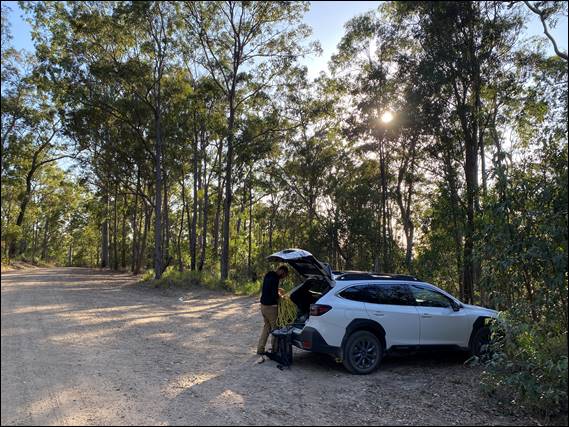
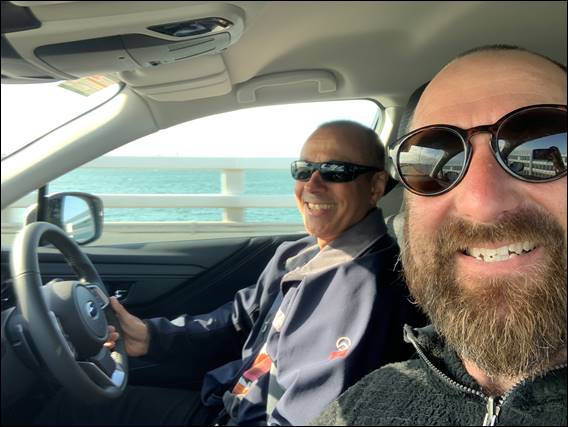
With a near full (office) work day under my belt, I was able to slip out the house at 11am.  The drive to Howsie’s was way busier compared to the earlier times we normally head out.  And it was also that way when we drove out of Bunbury and up the hill towards Collie.  However, the journey only took fifteen minutes longer today, at an hour and half.  The brain is a strange beast, and the psychology of driving can make trips seem longer and/or shorter for a variety of reasons.  One trigger can be how much traffic is on the road.  So even when the cars are flowing, it can feel much slower than it actually is.  It felt that way today.  Another strange fact being that driving to get somewhere, can feel shorter when afterwards you come home the same way:

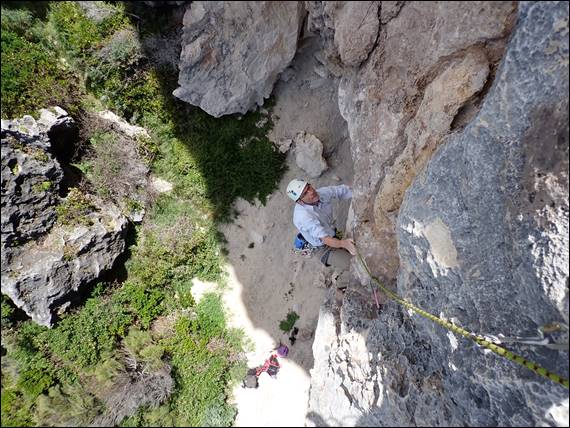
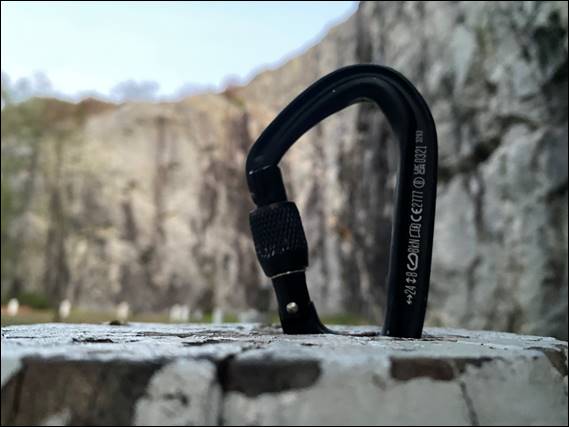
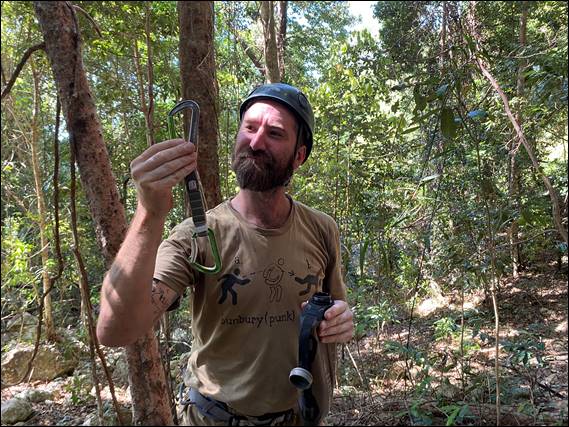
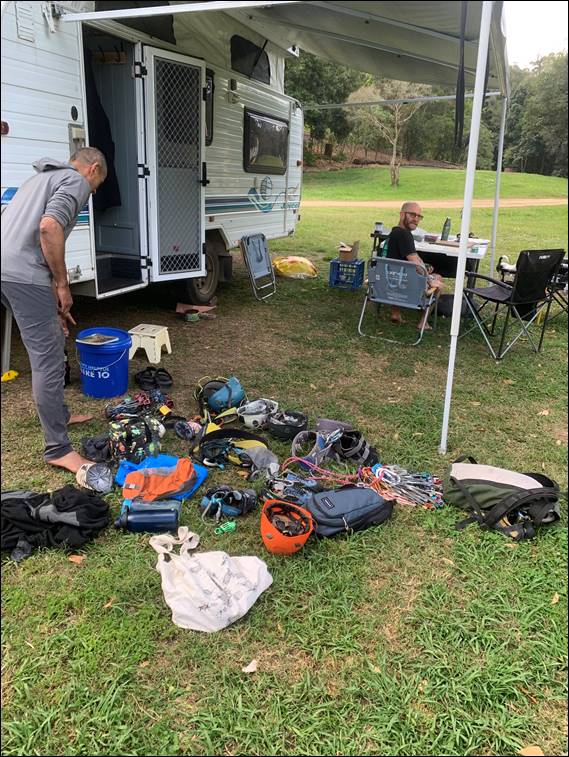
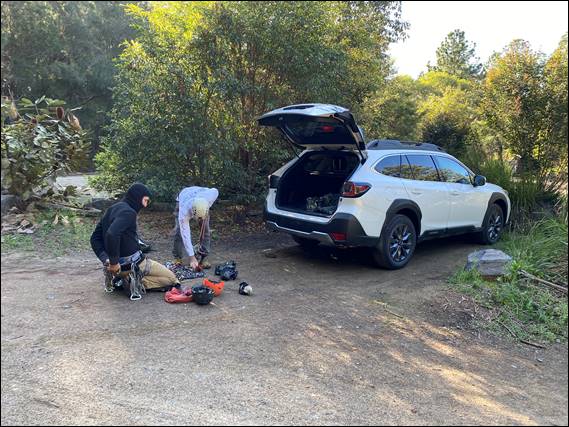
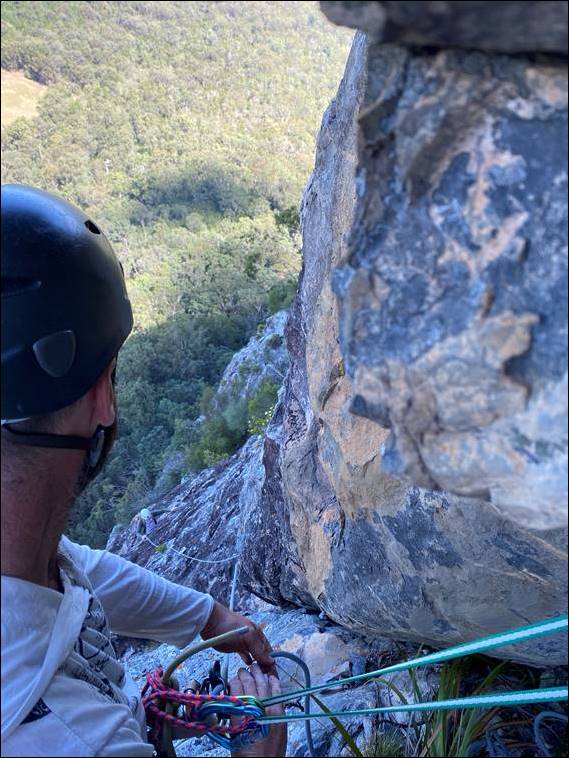
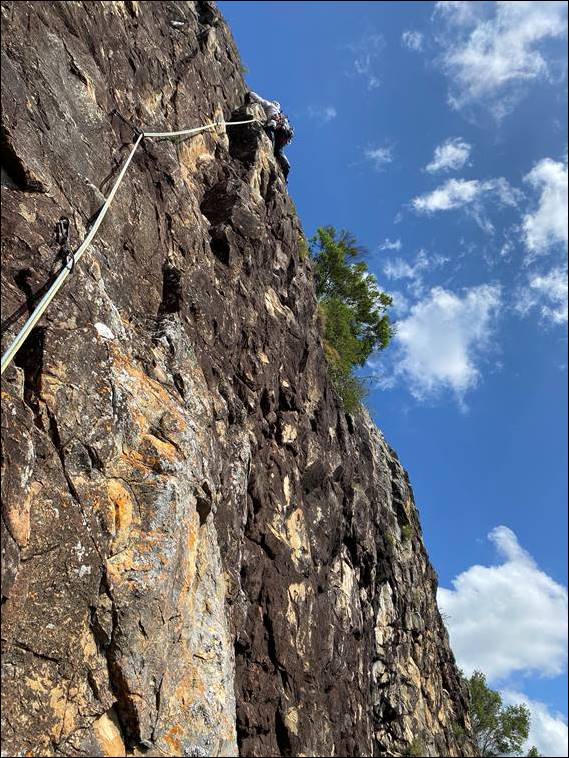
There are even published papers on what they call the Return Trip Effect or perceptual phenomenon, whereby getting home feels the quicker of the two journeys.  There are many factors to this, which I won’t dwell on.  We had reached our destination and typically on arrival both Howsie and my brains would clear and focus on the rock.  This took a little longer today, we were both feeling weary and not quite sure which battle we were prepared to take on.  It was only when we got out the car that we pondered our options.  We would normally think about this on the journey, but not today.  You could say I had a premonition of this occurring, and uncharacteristically had thrown in a small trad rack:

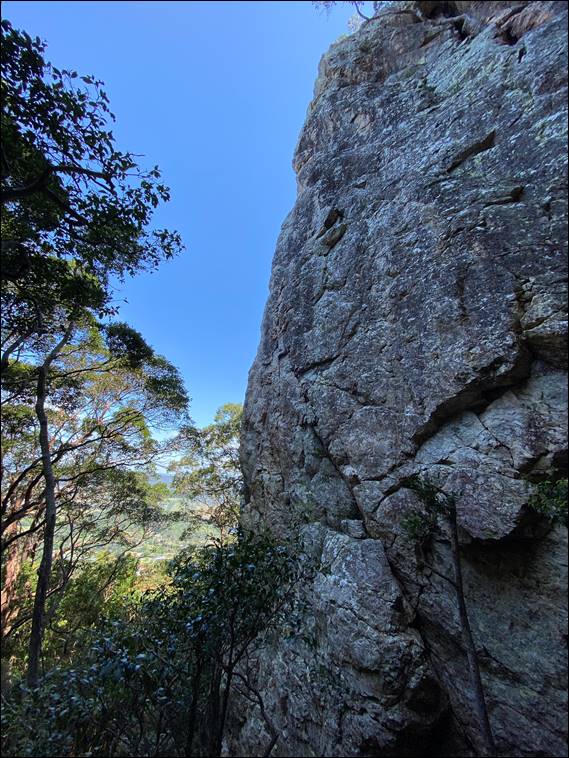
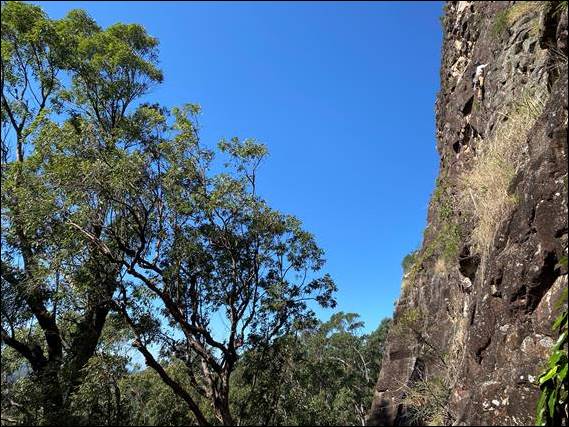
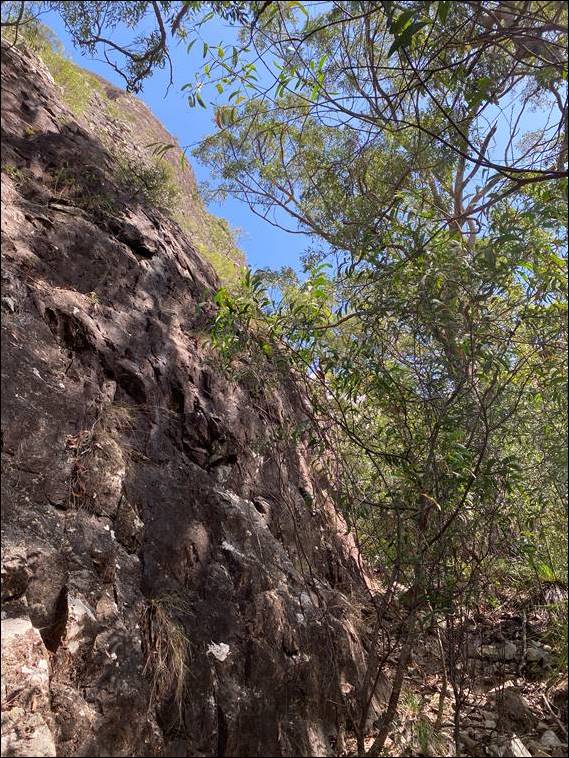
My thinking when pulling my gear together back at home being that we might play on the small carpark crag.  This has routes of a lower length and grade, than the more serious undertakings on steeper walls on offer.  With the big walls in shade I wonder whether we were also drawn to climbing in the sun.  This part of the country was greeted with chilly zero degrees at first light.  This drop in temperature coming about due to the skies being devoid of clouds overnight, which if present would have acted like a duvet to keep some of the warmth.  It may have been much later in the day, but it still felt a little cool so we opted for the sunny option.  Jumping on nothing too hard felt like a good idea to both of us:

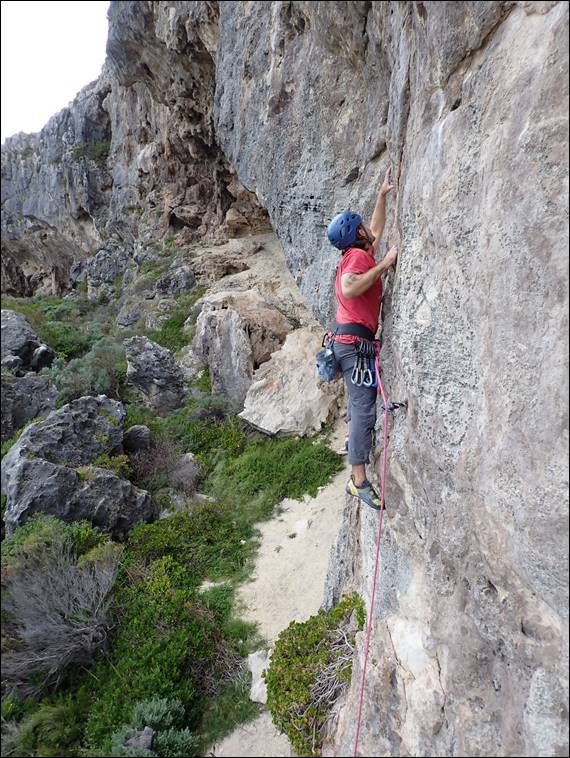
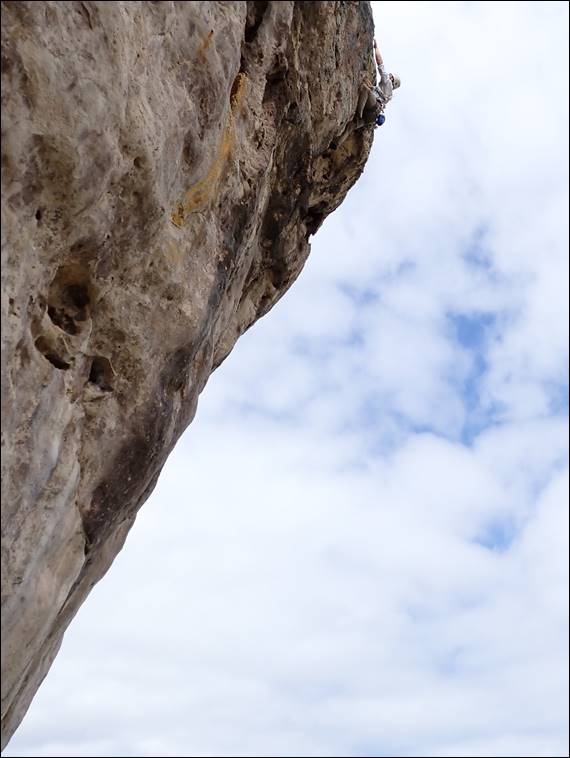
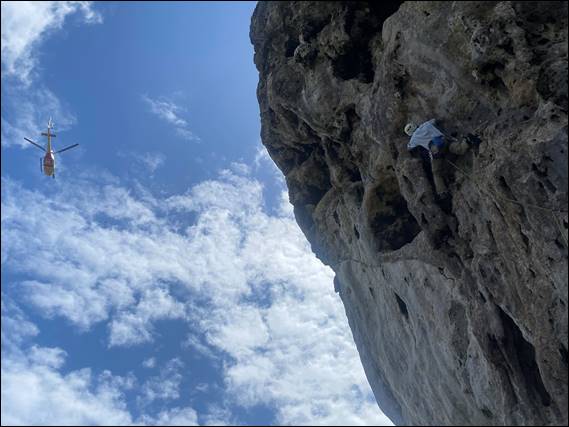
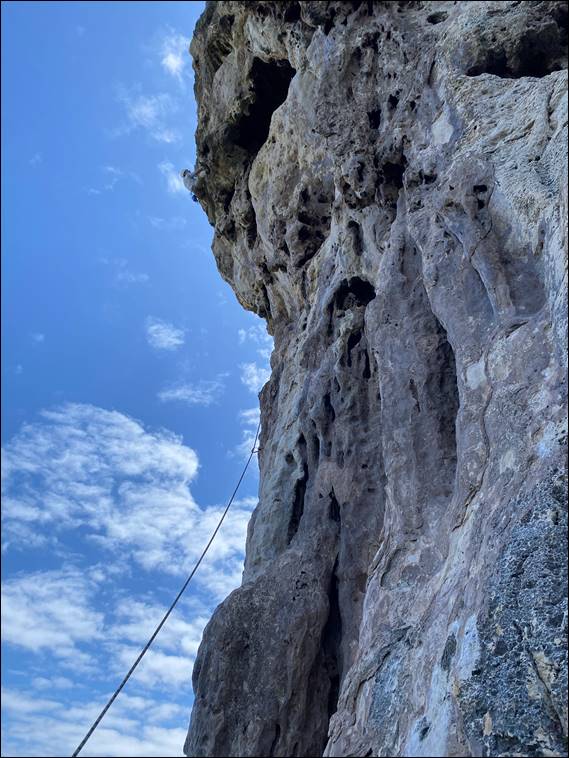
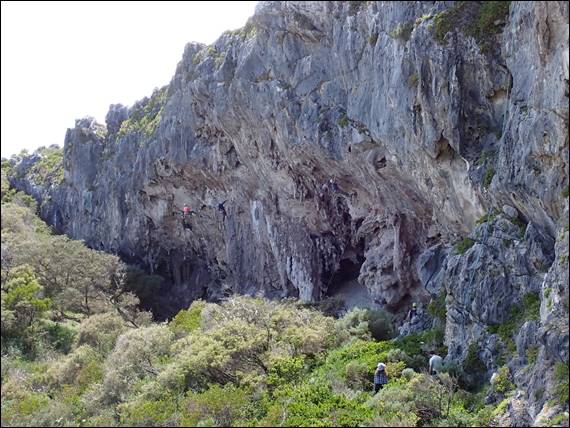
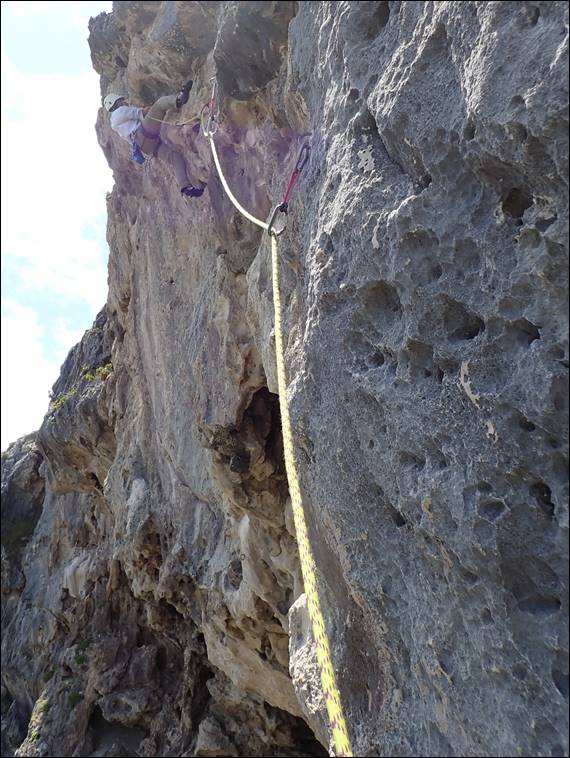
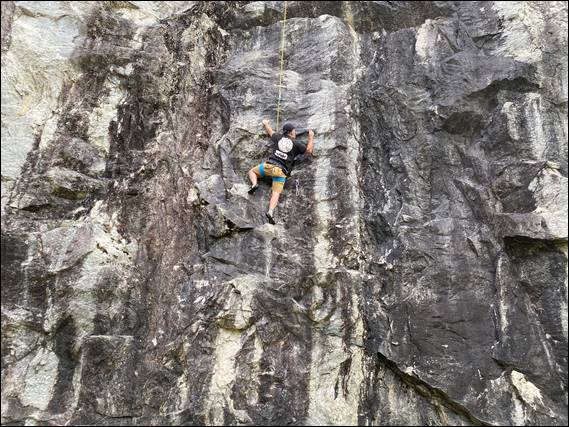
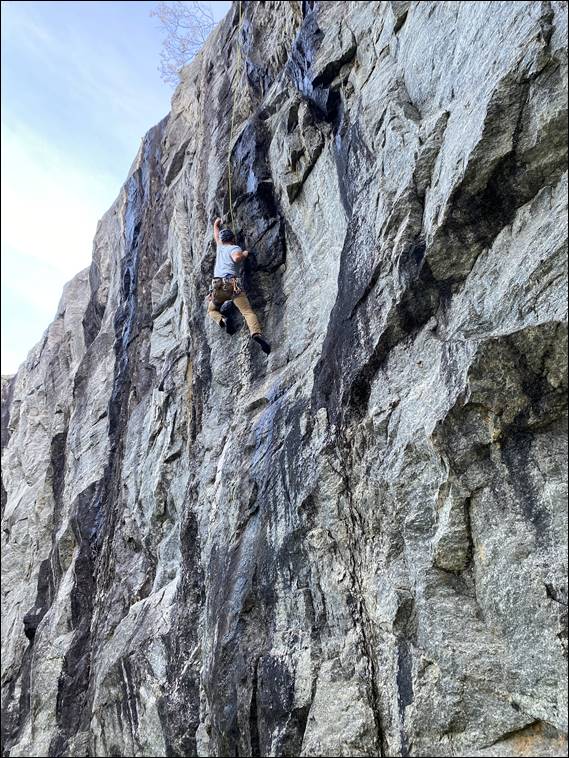
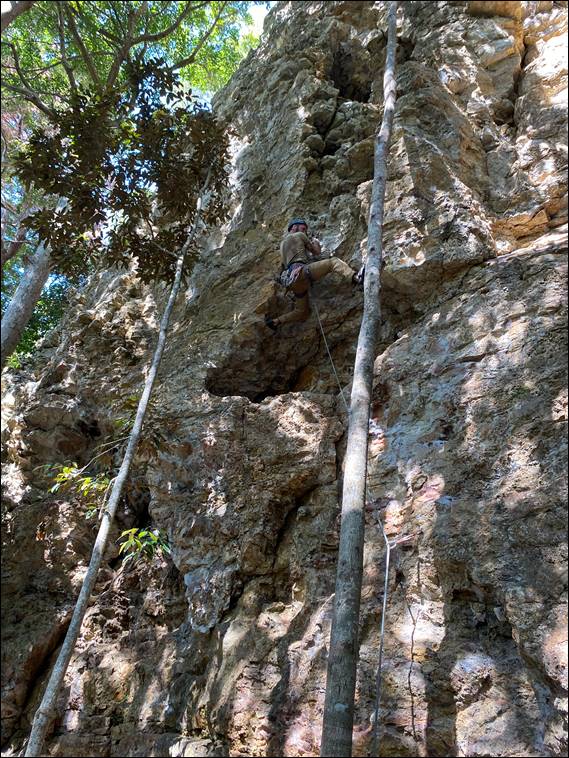
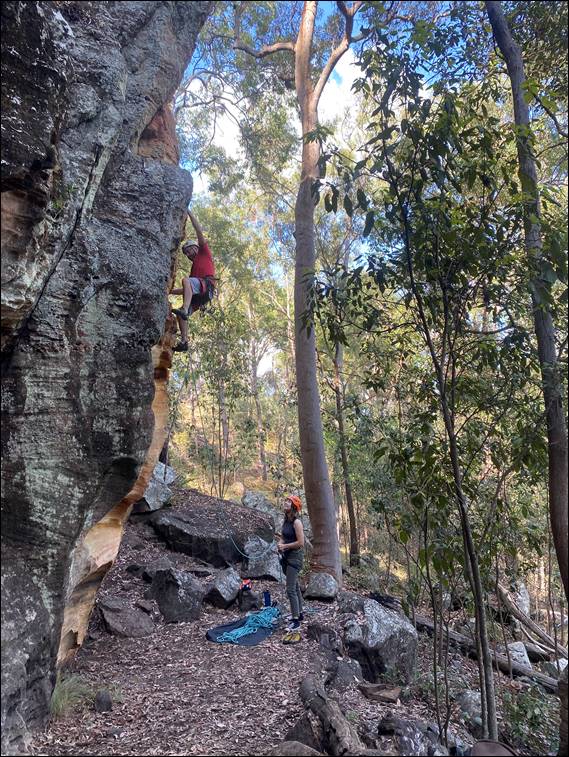
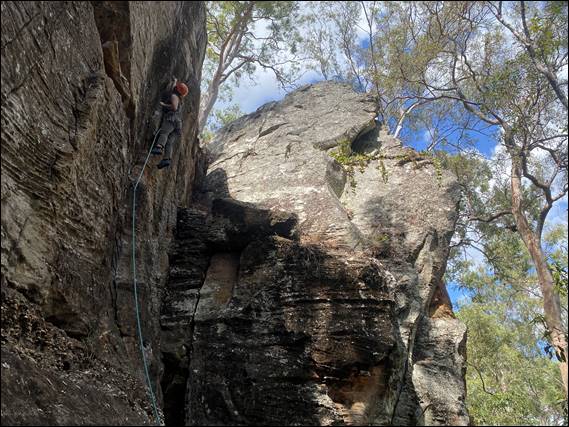
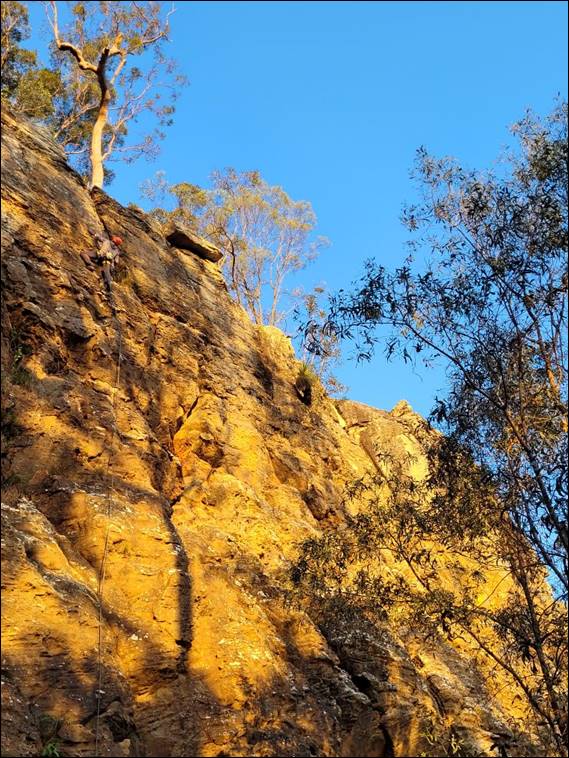
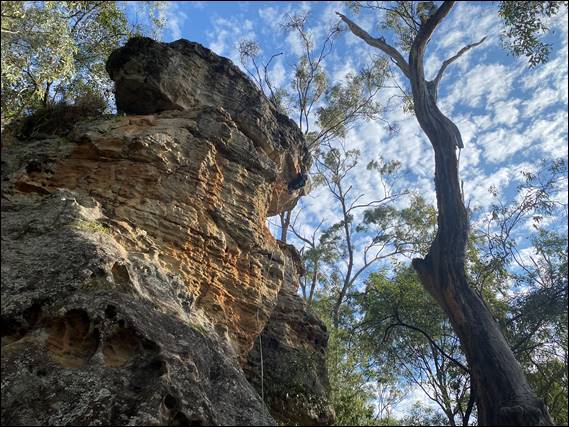
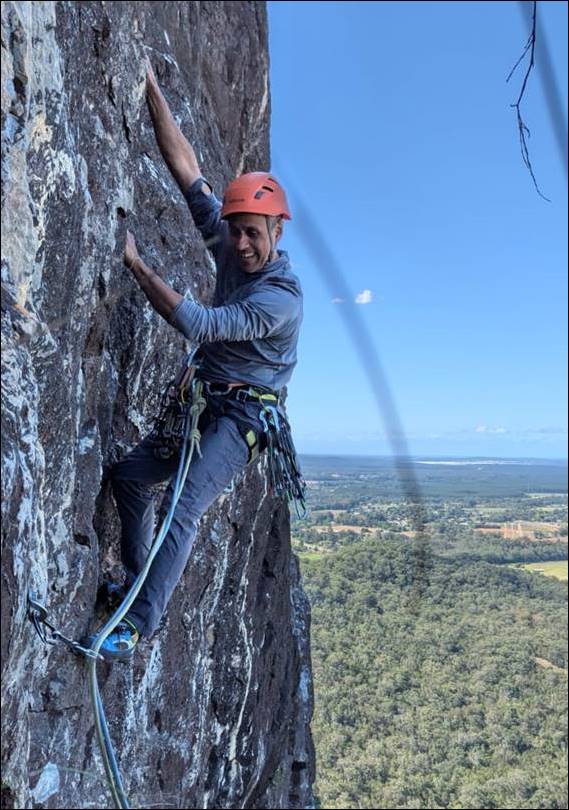
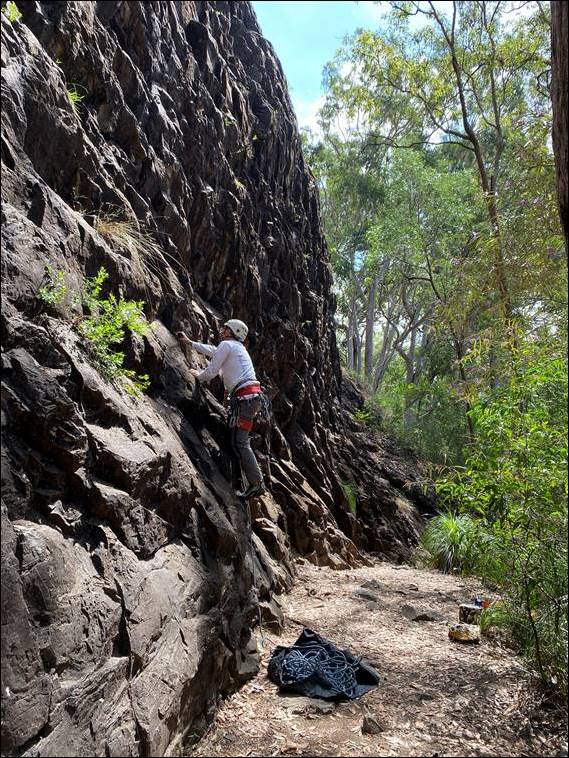
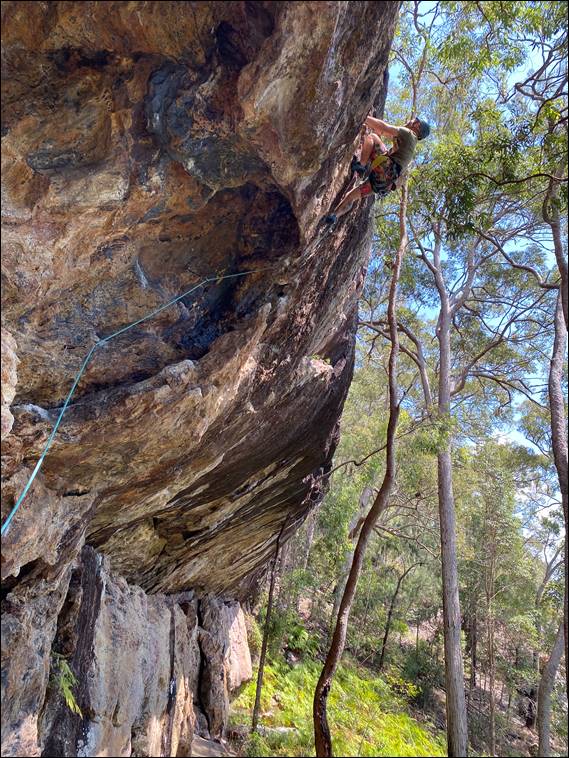
As we started, and despite the lower grades, neither of us were climbing well today.  It felt awkward and nervous.  Our brains playing on many factors such as: not having climbed these routes for some time, needing to switch to a different climbing style of slab climbing; the small and slick feel of the holds; a bit of moss being about making some of the holds feel even less secure; after each route we were feeling the heat of the sun that bit more; or was it that we were feeding of each other’s state of mind.  There are five routes on the small carpark crag, which we knocked off from right to left.  I purposely let Howsie take the first lead, so he could attempt the fifth climb.  Although, when the time came he really wasn’t looking keen:

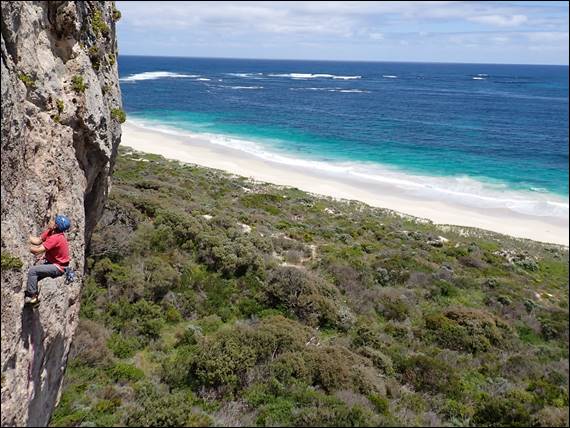
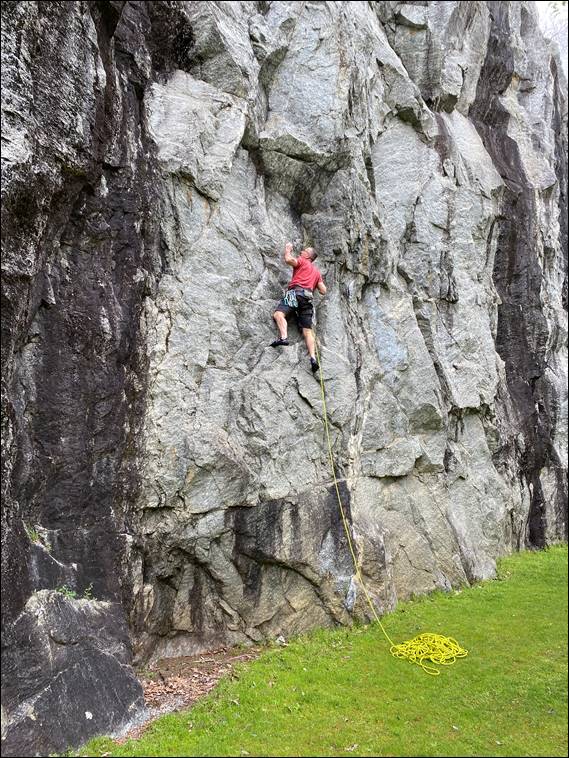
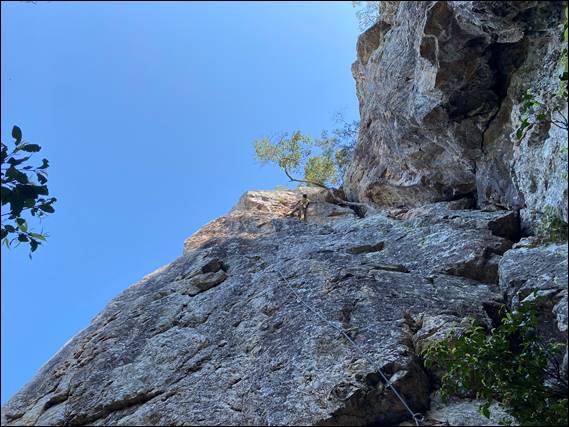
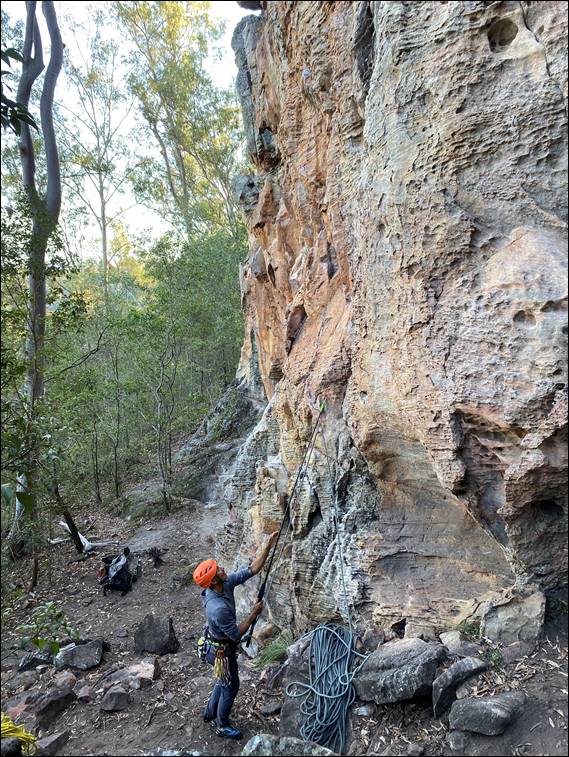
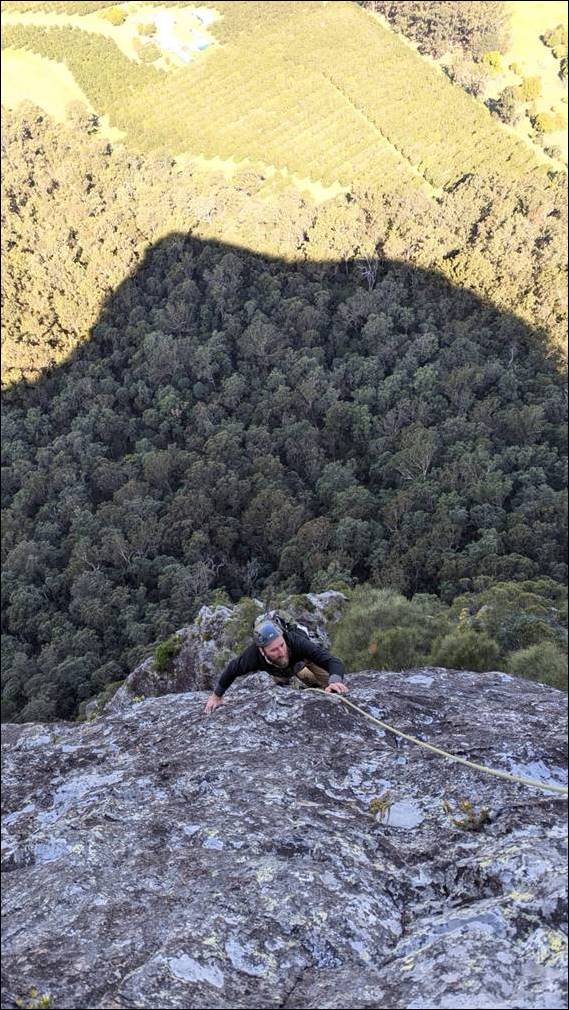
After what felt like an eternity of procrastination I offered to take the lead.  This would result in me, most likely, still being the only person to have led the Roman Nose at grade 17.  This is despite what the guide book says, and would be the third time I’ve led it.  Today was in some ways similar to the last time when Howsie started it but then backed off, https://sandbagged.blog/2022/10/01/history-repeating-itself/.  It was different today in that he didn’t even get of the deck.  It is by far the feistiest and most nervous of the five leads on the small crag, and I do wonder about the grade.  To add to the fear factor the gear in the upper section is a little dubious, mind you there is a bomber and deep cam placement 6m up on this 10m wall:

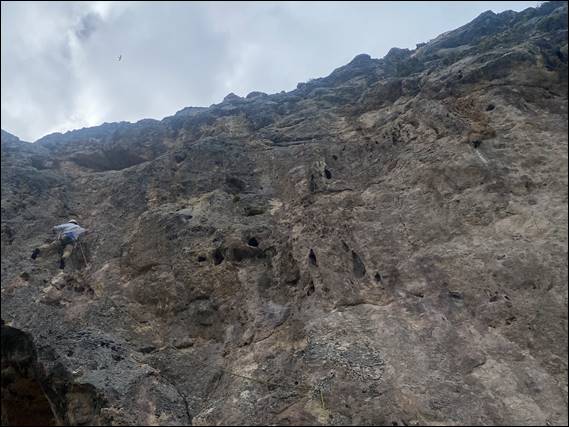
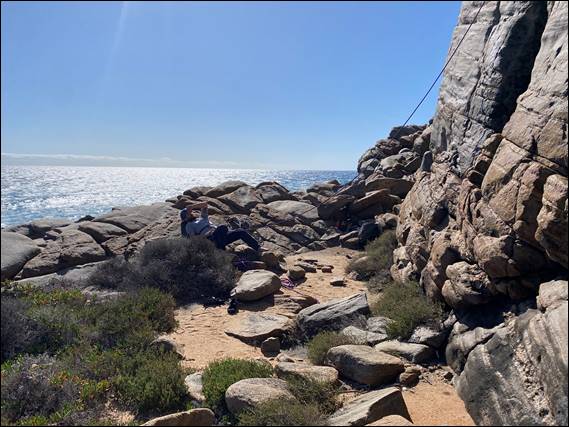
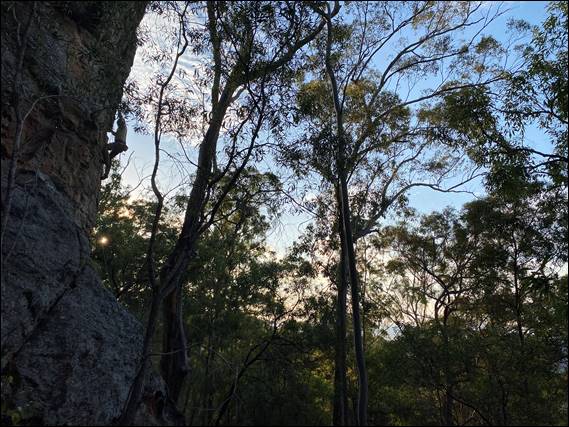
I teetered my way past this ‘thank god’ placement trying this way and that.  Eventually committing to the rising rightward traverse on small mossy footholds and not much better fingertip holds.  I thought I was solid and through the worse when my right foot slipped, and I flew to the right.  Then as the rope started to tighten I pendulum back to the left, heading downwards.  Finally coming to rest a mere meter of the ground, having fallen some six or seven meters and unfortunately twisting my knee on the final impact.  After being lowered down the last meter, I just lay on the ground and looked up.  I thought I should get Howsie to take an image of my predicament, but didn’t:

Instead I lay there allowing my body to recognise what had just happened.  Trying to work out where I might be sore.  However, in reality with a fall like that the body takes a different path.  I’ve been through it before, and should have recognised the signs.  A part of the brain called the amygdala kicks into action, activating another part called the hypothalamus.  That part then releases stress hormones, like adrenaline and cortisol.  These prepare the body through a number of physical responses, and this can lead to a false realisation of the situation you are in or indeed the damage sustained.  As such I jumped back on and finished the climb off, and then we hit the big walls:

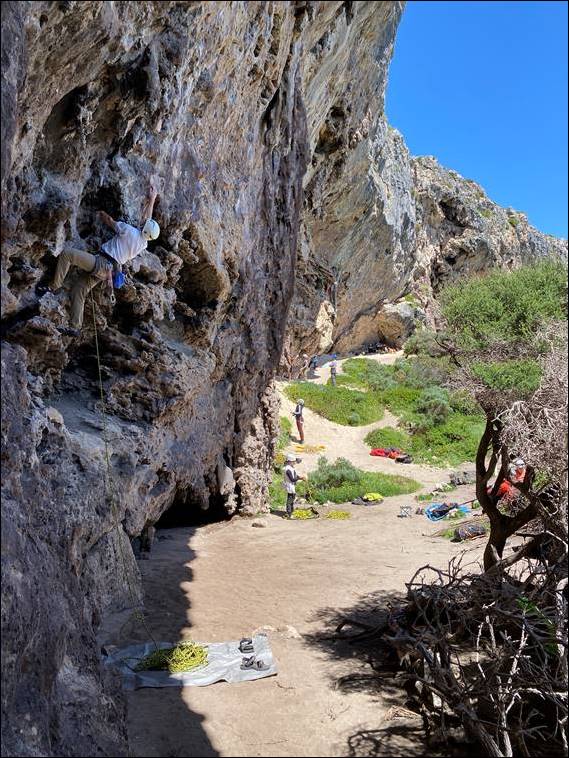
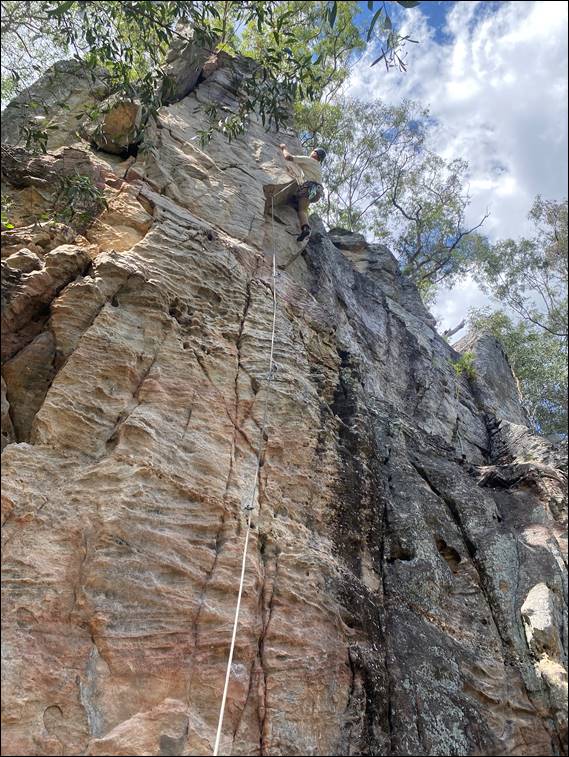
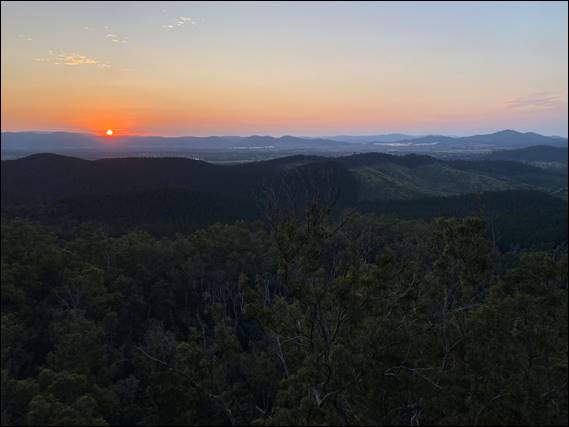
Not wanting to risk another fall I offered Howsie all the leads.  He lapped up four more lines, climbing much more confidently.  The familiarity of these harder lines helping, along with far more positive holds.  I managed to follow up with the safety of the rope above me, but was noticeably trying to avoid using my right foot and knee too much.  With each climb the effect of the stress hormones was reducing, and realisation was hitting me.  On the last climb it was impossible to avoid big moves on the right leg, which I simply wasn’t able to do.  Instead I pulled on the draws to get past the lower section.  It was certainly a great session and glorious day to be out, although maybe I should have called it quits after my fall and just belayed Howsie.  My brain is however wired to be a bit stubborn when it comes to climbing:

Seeing things

Needing to rectify the error of my ways, after I dunked my phone in the ocean or should I say the ocean dunked my phone and me, I scored a five series upgrade.  Being lucky to avoid the expense of buying a new one, as Elseya still had her old phone.  It was somewhat of a palaver setting up, having to start from scratch, but it is done now.  The replacement camera will however have to wait a few weeks.  Until then my technological options for taking images will be reduced.  Reduced but not hindered, and here is a selection of finds at the Capel Nature Reserve:

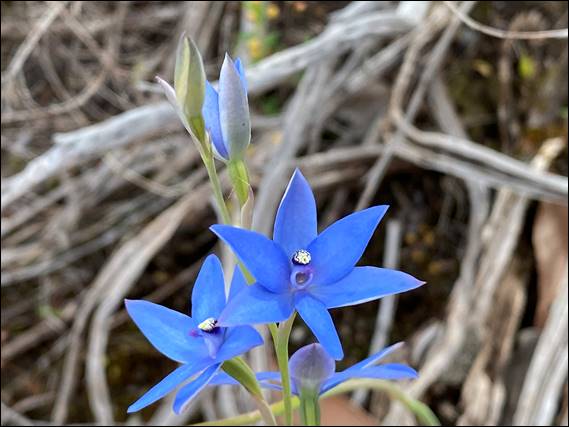
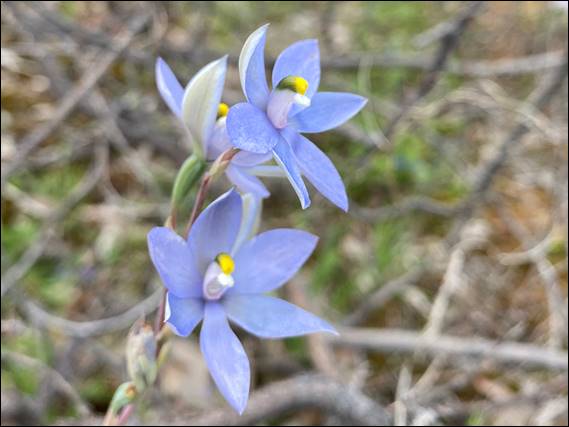
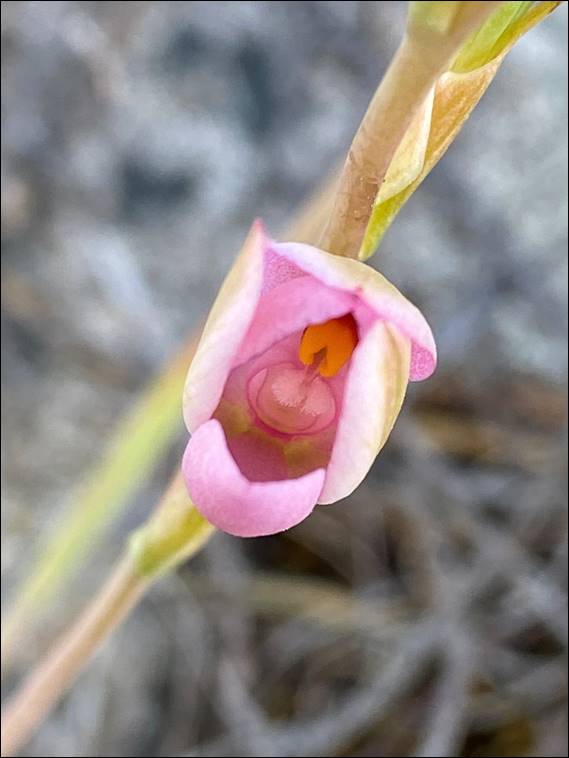
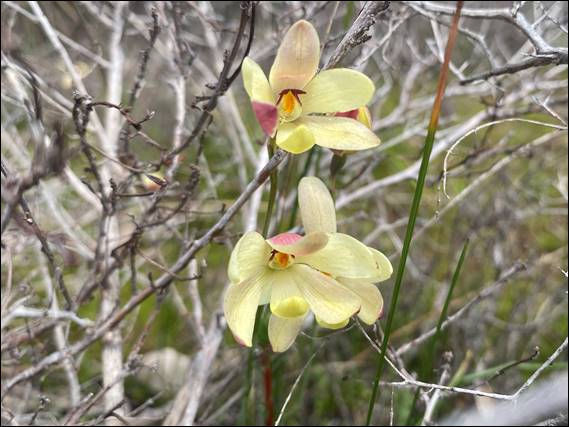
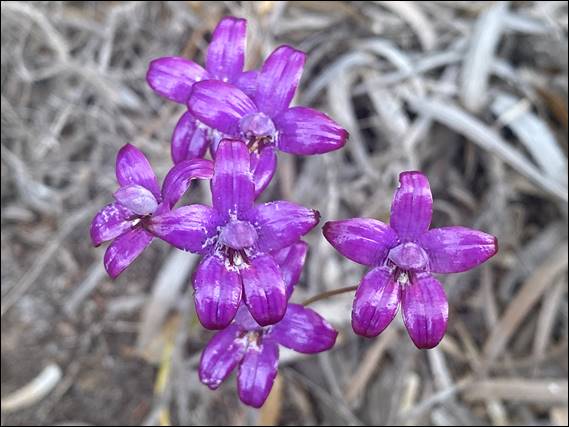
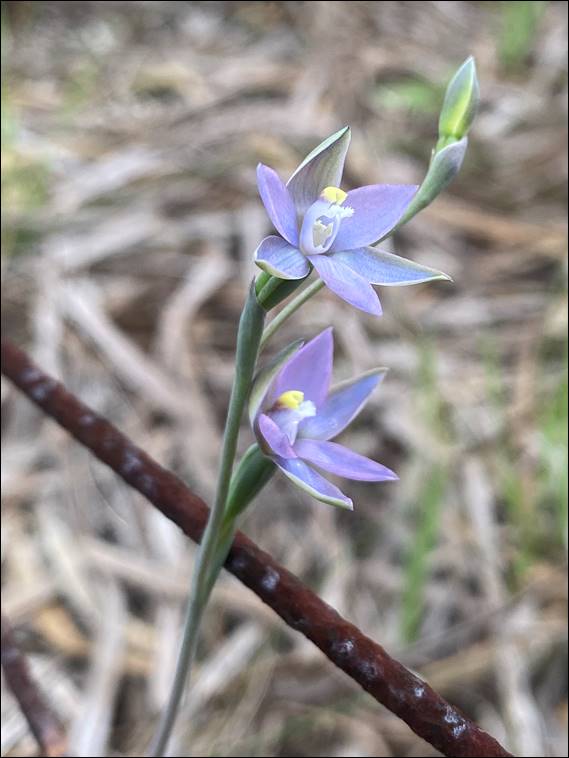
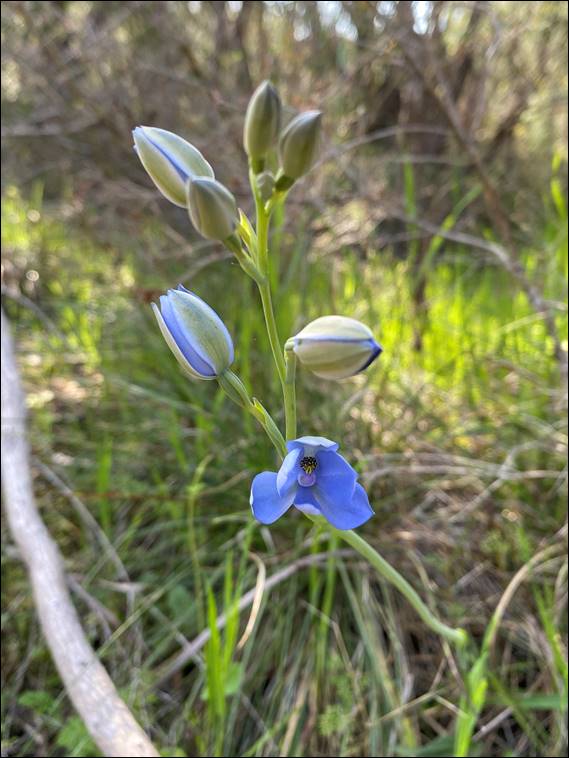
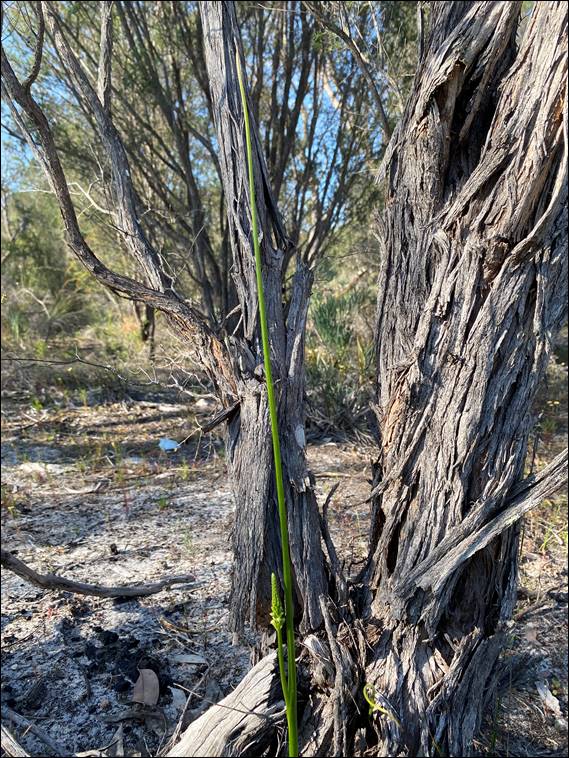
The early flowering bunnies were done, and there wasn’t much else in bloom.  I did however luck upon two Scented Autumn Leek Orchids (Prasophyllum sp. ‘early’), one being shown above and the other one not having opened yet.  The two plants helped confirm I was correct with my identification of the unopened specimen last week at the Ambergate Reserve.  The light green flowers being one of the few differences that can be used, by an amateur such as myself, to distinguish it from the Autumn Leek Orchid (Prasophyllum parvifolium):

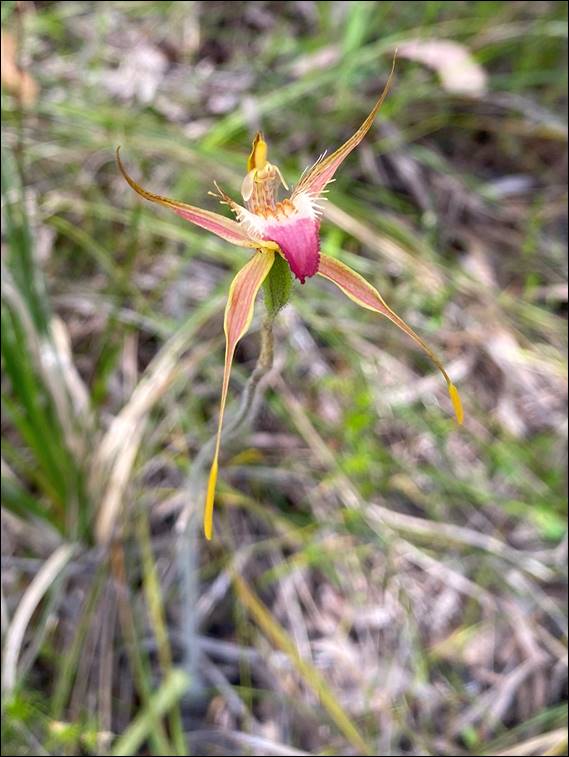
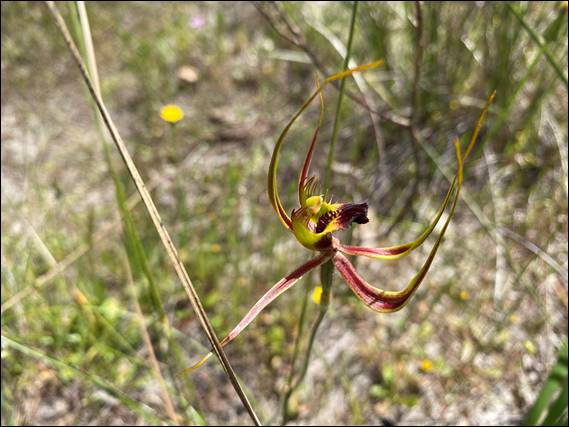
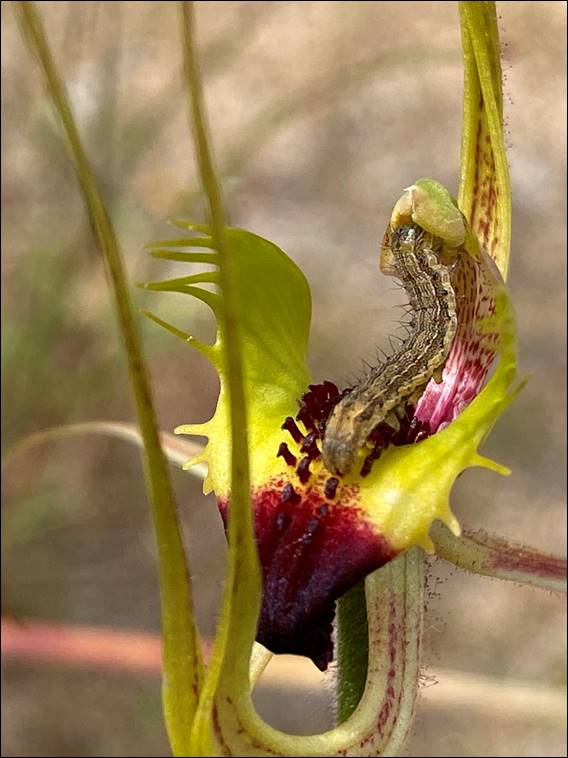
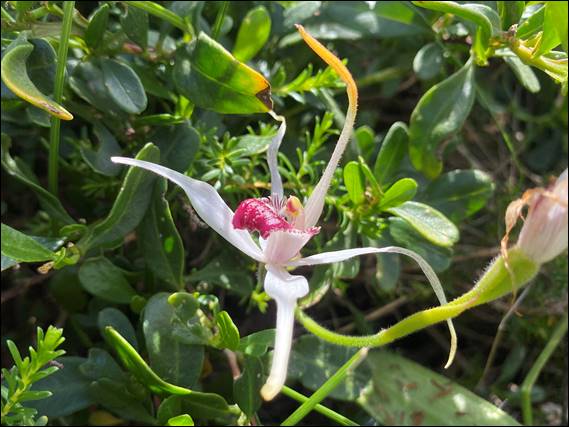
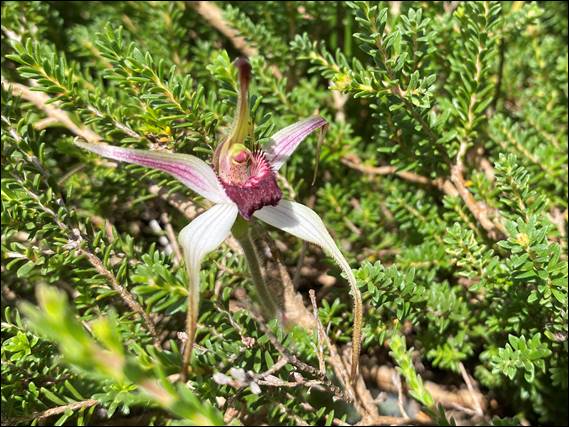
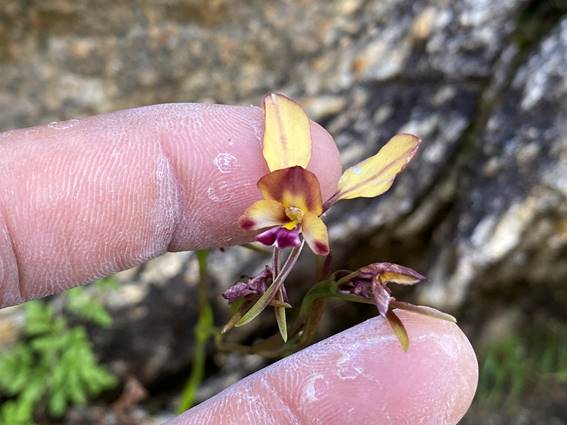
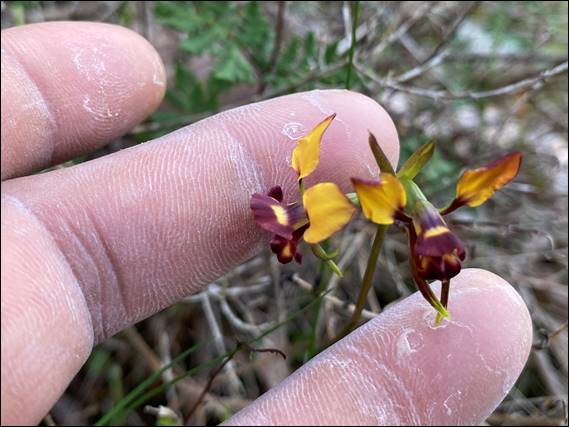
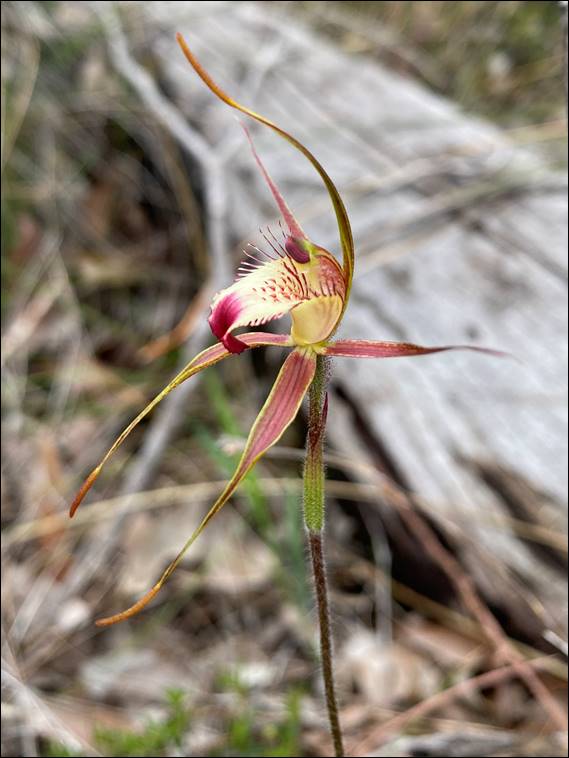
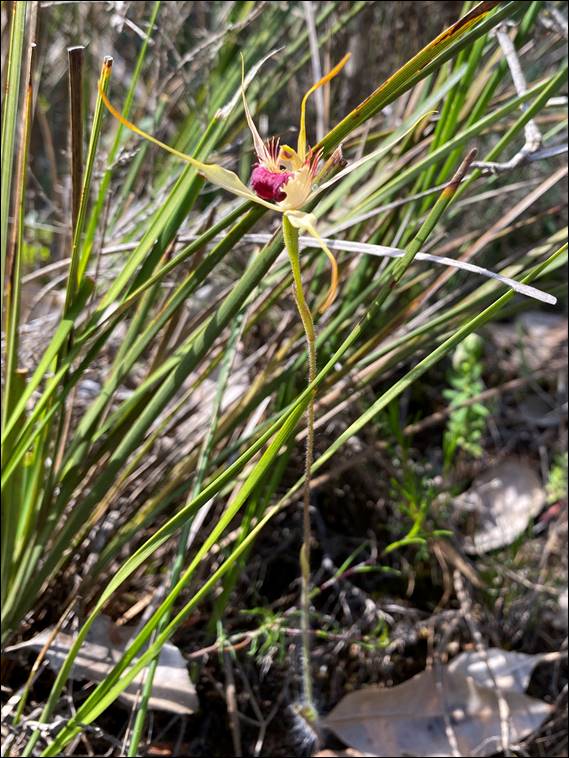
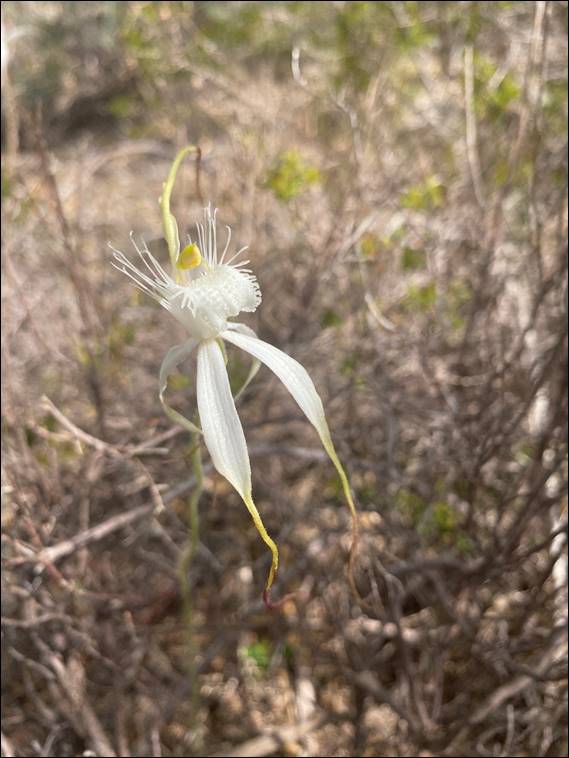
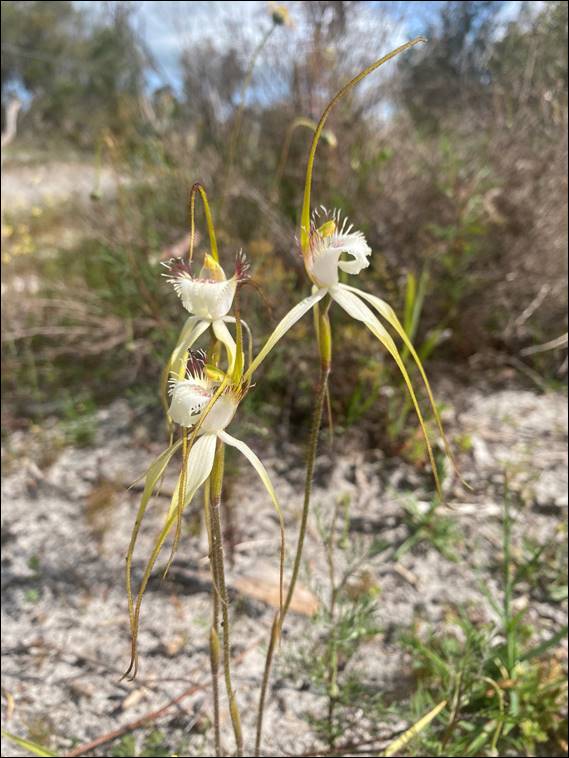
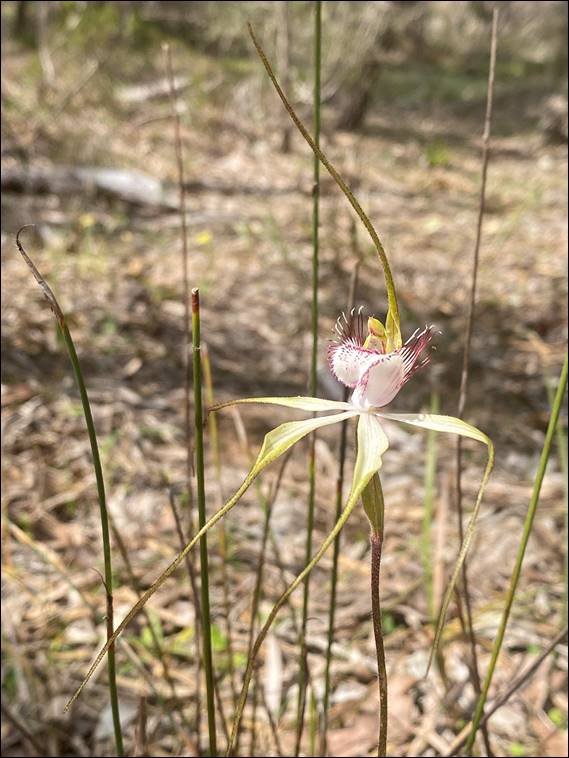
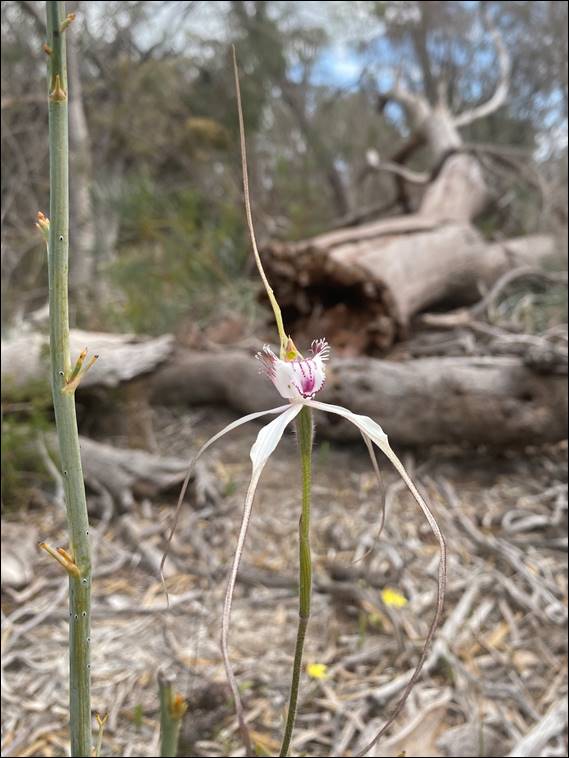
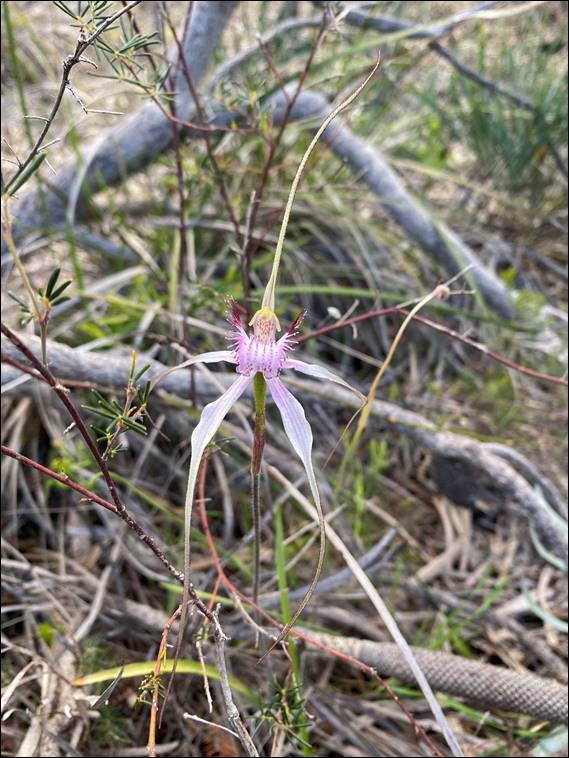
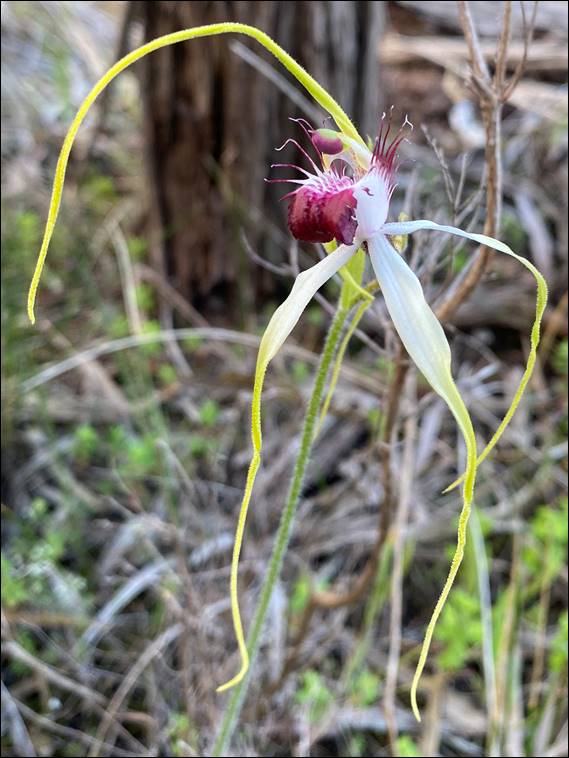
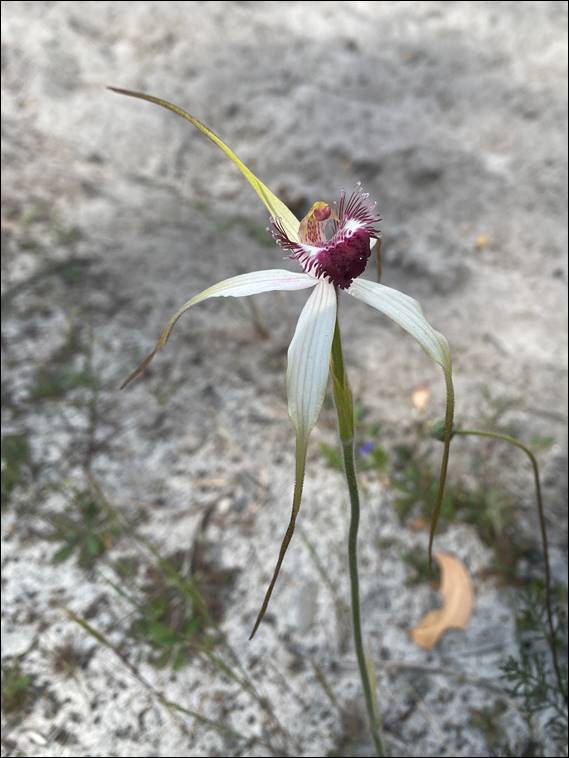
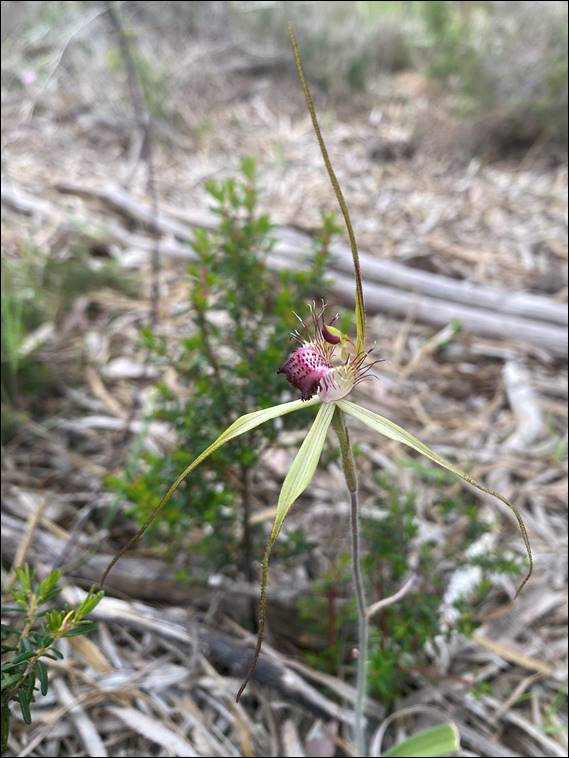
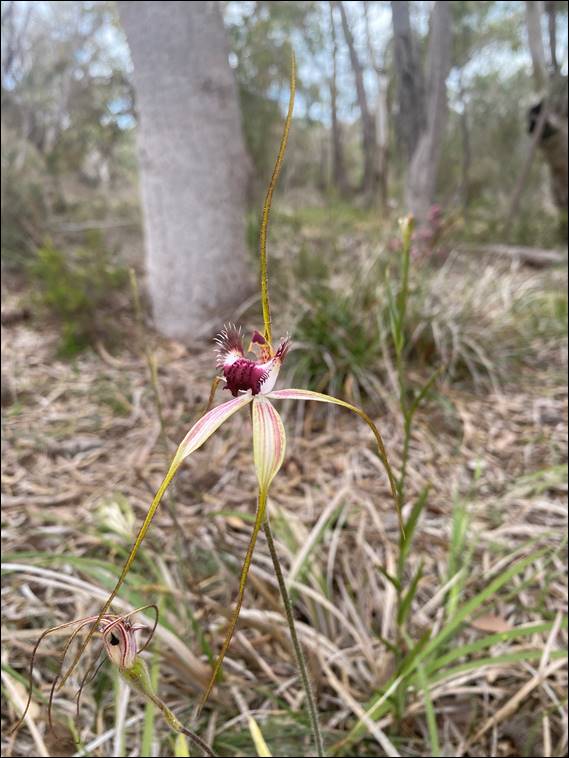
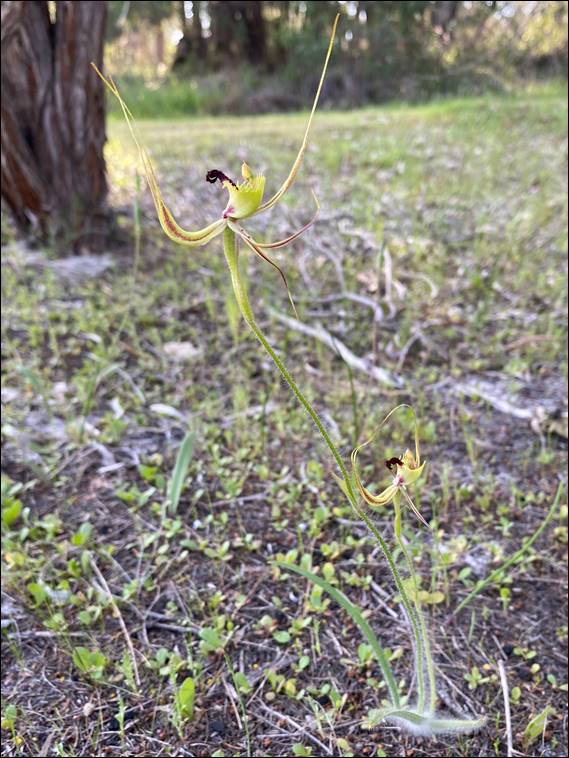
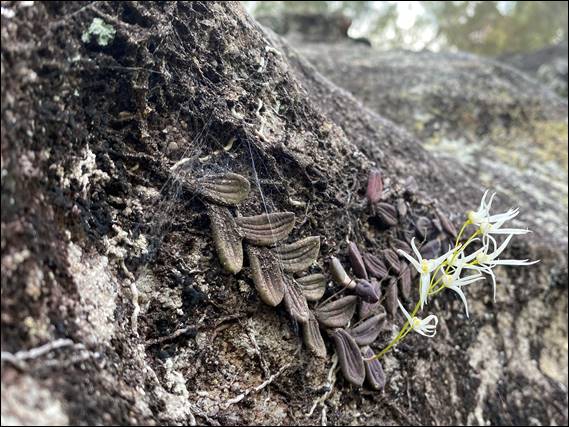
The flower of both species are about 10mm long, but the later blooming Autumn Leek Orchid has more colour, including a longitudinal stripe on the dorsal sepals and petals.  This detail is however invisible until the flower opens.  As is often the case there were lots and lots of basal leaves, and I have given up hoping that this is a sign of a bumper orchid season.  Although the above hairy leaves, with a tinge of purple at the base did make me smile.  Being one of the most spectacular spiders, the Chapman’s Spider Orchid (Caladenia chapmanii):

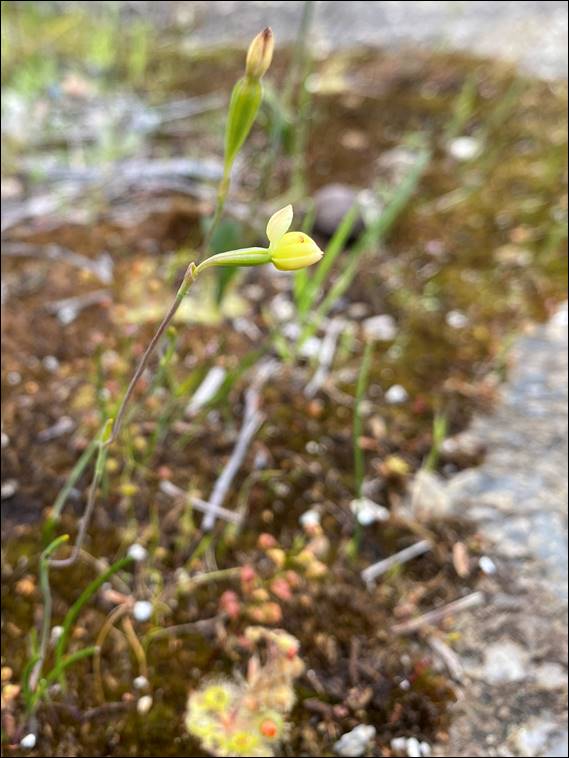
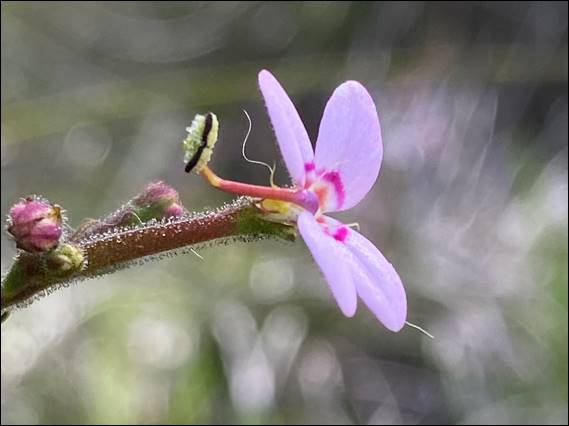
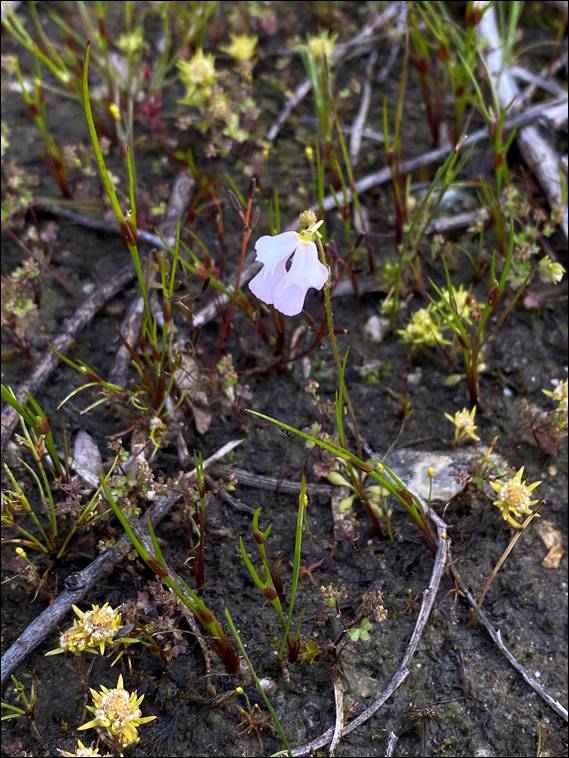
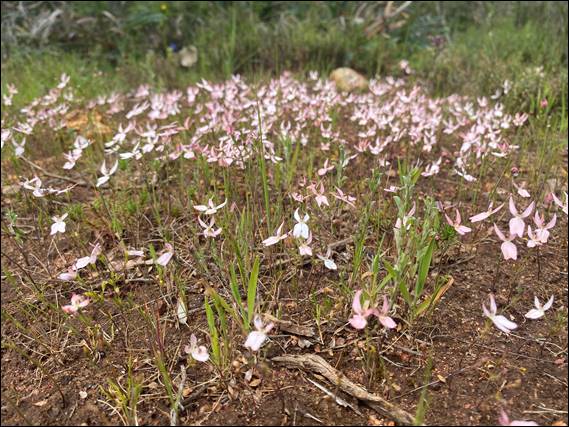
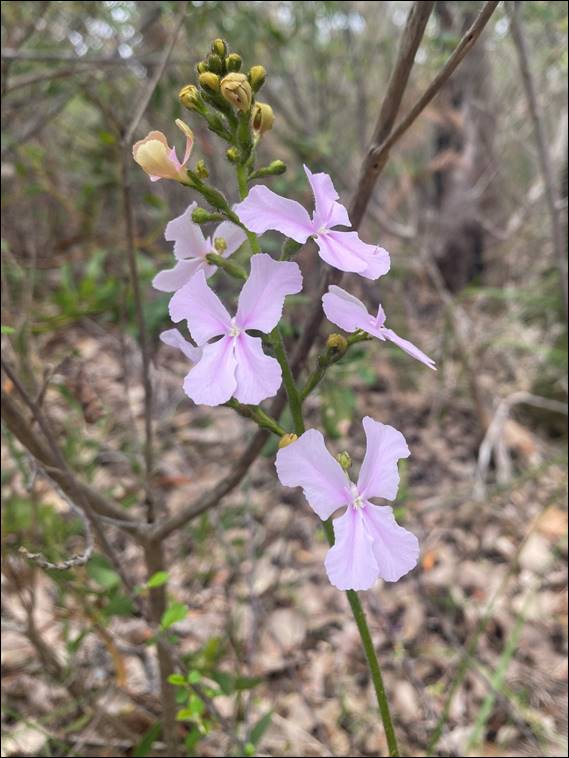
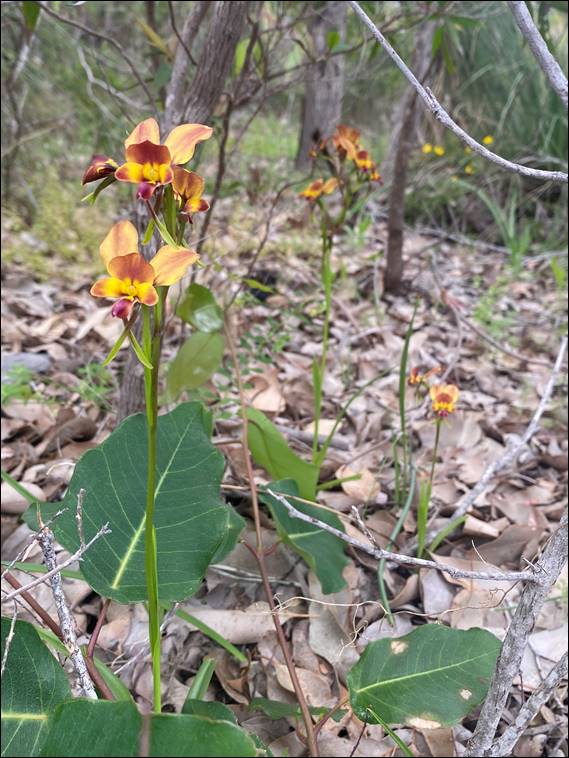
It was also hard not to smile at the many beautiful Painted Sundews(Drosera zonaria), shown above.  An endemic carnivorous plant of the south-west Western Australia.  It is a perennial tuber found in open woodland or coastal heathland with deep silica sands.  I’ve read it only blooms after a bushfire.  The tuber was first identified in 1848, but it took 106 years before the first flowering specimen was recorded in 1954.  The soil it grows in has also been extensively mined in this area, making me wonder how rare a treat it was to see so many today:

A less uncommon, but equally nice, find was the above Ladder Lichen (Cladonia verticillata) with a Portuguese Millipede (Ommatoiulus moreletii) carefully navigating through them.  And today I too had to navigate a bit more carefully through the bush.  Avoiding the orchid basal leaves as usual, but also the many fungi starting to push up through the soil.  They are likely to be decomposer or mycorrhizal fungi, both of which live in harmony with their environment.  The third main type being disease fungi, which extract the energy and nutrients from their living hosts:

The disease fungi already out included the above Southern Cinnabar Polypore (Trametes coccinea), and also the specimen below.  It has several features that resemble the Ghost Fungus (Omphalotus nidiformis). They are found on dead or dying trees, have caps with varying shades of colour, and have deep and well defined white or cream gills.  One way to be sure is to go back at night to see if it glows, but I’m not convinced.  As such I got Verity to help out once more and it is more likely to be a Brown Oyster Mushroom (Pleurotus australis). So as we might say to someone who tells us they saw a ghost, I am just seeing things:

Davy Jones’ locker

The term ‘lost at sea’ is a bit of a misunderstood saying.  It was linked to Davy Jones’ locker in 1791, when an article in the newspaper called the Chester Chronicle said ‘to be within Davy Jones’s locker was to be lost at sea’.  It was originally used to refer to the final resting place of drowned sailors and travellers.  However, these days the term is more commonly used to infer a sense, rather than physicality, of being lost.  Someone referred to as being ‘lost at sea’ is considered completely discombobulated, or more plainly put confused:

There should however be no confusion as to where I was today, and not by my own choosing.  Needing to take a break from studying, I offered Craig the opportunity to get out on rock.  It has been proven that disconnecting your brain, and body, from study will result in enhancing your ability to focus.  The research I have found suggested breaks of up to an hour are good, but when I was studying I was a firm believer in taking a day out to truly reset the grey matter.  Before he disconnected his brain I did however give Craig the choice of where we should go:

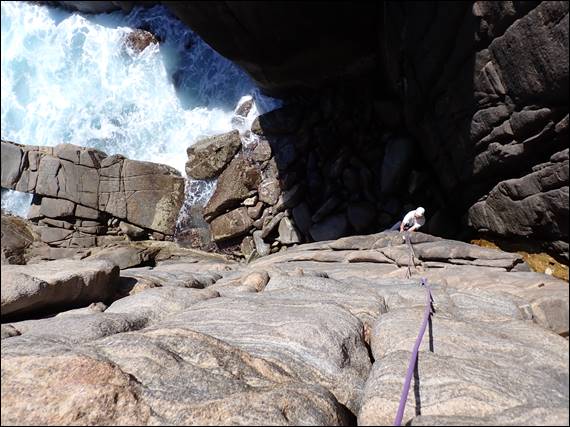
He picked Moses Rocks.  Seeing I had unfinished business here, I was more than happy to come back so soon.  After a couple of warm up routes I suggested he might want to jump on Nothing too Serious, a short but fun traverse that makes you feel like you are right over the ocean.  There are however some big rock steps that take the energy out of the waves, and all you are left with is wash and spray.  That doesn’t mean you shouldn’t be careful, and we watched for ages to check the wave patterns.  Even then tying in when he went for it:

Craig understandably was taking his time, as I relished watching from my secure and importantly dry perch.  Snapping images and taking videos of the dramatic situation.  Seeing a good set come in I started the next video, and then it hit.  Seemingly from nowhere a huge wave appeared lifting me a full meter into the air, and as it dropped me back down I felt the rope tighten.  As I looked about Craig was still in the same position as before, and had watched my predicament.  The wave had only glanced him, but fully took me out:

Fair to say I was a little discombobulated.  But soon realised my camera and phone, both of which I had been using, were gone.  With Craig secure I did a quick search, keeping a careful eye on the ocean.  Somehow that one freak wave had taken the phone out of my hand, placing it on the rock where my camera had been.  And taken the camera, which we assume is now lost at sea, or as I like to think swimming with the fish by itself.  It took Craig a while to finish the climb, and then for me to follow:

The whole time it took to finish up we didn’t see another wave like it.  This may seem like enough to put anyone off, such that they would pack up and head home.  Not us, while what we do may seem a bit daft, we are safety conscious as we know that things can and do on occasion not go to plan.  Yes, I may have lost a camera but neither of us were hurt, so we climbed on.  How could I not, as I still had to have a bash at my new route.  The one with the ‘adequate’ gear, which upon checking Craig said looked sketchy but was in fact reasonable:

Trying to think of a good name for the new route we decided on Hung out to Dry, with a play on words in a couple of ways.  The route is a bit runout, so if anyone is game to try it they may feel like they have been put in a difficult situation.  Hence I decided to give the climb what we call an R rating.  This means you could get seriously hurt if you fall, but this would only happen if didn’t know how to place gear in tricky places.  And of course I was thoroughly drenched when I climbed it, not that I was anywhere near drying after I finished the route:

Craig wrapped the session up with one more lead, before we returned to the scene of the crime.  We poured a cuppa, sorted the sodden gear, and scanned the waters.  Still no waves matched the beast.  Back on the beach we spotted holes in the sand, likely to be the homes of Ghost Crabs (Ocypode), and a couple of Australian Pied Oystercatchers (Haematopus longirostris).  These were the last photos I took on my phone.  The wave may not have taken it, with the camera, to Davy Jones’ locker; but had inflicted water damage to seal its fate:

Sometimes adequate is good enough

Continuing my theory that fresh air is currently even better for me than usual, and because it is a public holiday I headed and out again.  Or was it more because regardless of how I feel, and as long as I am able too, I will always prefer being outdoors rather than indoors.  Truth be told, the reason I haven’t been hit anywhere near as hard as Lisa and Elseya have, is almost certainly due to having had the most recent vaccination of the three of us.  A precaution I took just a bit before I headed back to the homelands, and I am so grateful that I did:

I fancied a first light walk in, and arrived right on cue.  The early start was also because the swell was still up at six meters, despite the cold fronts having moved east.  This was forecast to reduce as the morning wore on.  While the main beach was a awash it still had plenty of sand.  However, after rock hoping along the boulders to reach the second small beach, this looked like it was deep into winter.  The sand was gone and the area was covered in creamy colour foam.  With each set the foam oozed it’s way this way and that, looking very uninviting:

A light drizzle started to fall as I reached the crags.  Ensuring every bit of rock glistened when the morning light hit it.  This of course did not worry me.  Unlike Howsie and my visit to Welly Dam, the friction at Moses Rocks remains good in wet conditions including when water is running down it.  Also I wasn’t in a rush to get on the rock, spending a good three quarters of an hour watching the waves.  It was hard to draw myself away from hypnotic movements.  Set after set roll in, barrelling, roaring, crashing, and spraying all over the place. The water streaming down this face showing how high the wave went:

Eventually I started to rig up the anchors for the top rope.  Even then going slower than normal, as I kept an eye out for when the bigger sets were coming in.  Once set up I knew I could knock the climbs off reasonably quickly.  They are close enough to avoid the need to keep moving the placements too often.  In fact I managed ten lines with three setups.  And for each setup, when I shifted the rope a few meter across to the next route, all it took was a simple adjustment of the rope work.  Making sure the placements were all under even load:

Howsie, told me that he had been reading a book about setting up anchors for belays, and it said there is no perfect set up.  Stating it is always possible to find a different way.  What is important is understanding whether it is fit for purpose, and as safe as possible.  I was completely confident with the anchors I had used, placed deep in the cracks that spilt the top of the crag, unlike this example.  While I was out by myself I looked at a line, which I thought might yield an independent climb.  The question being whether it could be safely protected:

As with belay setups, when climbing it may not be possible to find placements that are inspiring.  It comes down to your confidence in your own ability, a knowledge of the mechanics of how gear works, understanding how the gear gets loaded during a fall, how far you have to run it out to the next piece, and most importantly assessing the consequence of getting it wrong.  The next size down of camming device might sit better in the above placement, but that was being used in the anchors at the top so I couldn’t check that:

Guess I’ll have to check if the next size down is the better option on the next trip, when I attempt to lead it.  Others may not come to the same conclusion, but weighing up all the considerations I’m pretty comfortable that the line can be adequately protected.  Rapping down for the last lap on the last route on Hands-up Wall, I stopped for a moment to watch the waves.  Yet another reasonable set thundered towards the narrowing zawn.  It was hard to see if the swell had dropped, but my shadow was clear as day in the white water:

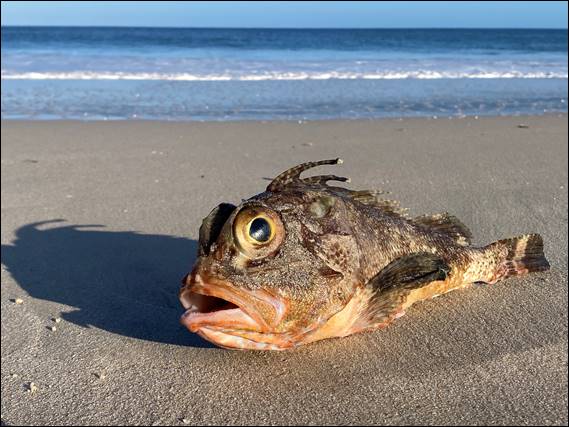
There were two more lines to hit on a separate wall.  The first beat me at the crux move on both laps, my arms were getting weary.  Not so much as to stop me from getting two clean laps on the second.  A route I have done easily fifty times before, yet today I discovered a direct way to climb it.  Quite possibly the original way it was intended to be climbed.  Something else to aim for on my next trip here.  Hopefully when I jump on those two leads next time, I will fare better than this Reticulated Sea Hare (Aplysia dactylomela) did today:

Putting things into perspective

It’s an extra-long weekend for me, having taken Friday off and Monday being a public holiday.  Not the best timing for Lisa to share her lurgy with Elseya and me.  While I can feel that I am not bug free, I have not been struck down in the same way Lisa was all of last week and now it looks like Elseya may be next week.  It may sound dumb but even when I don’t feel great, and I am able to, I feel a whole heap better in the fresh air.  As such and despite the wild weather, Lisa and I managed to find a weather window to enjoy the great outdoors:

We drove to Ambergate Reserve.  Heading towards the darkening skies, eventually seeing rain in increasing intensity hitting the windscreen.  This was not unexpected and we had come prepared with rain gear, although we did sit in the car for a moment and I could feel a tinge of hesitancy from Lisa.  Rather than focus on that I simply got out and Lisa followed suit.  I kinda feel it seems like it is raining heavier when you are driving.  My theory, right or wrong, being that more drops hit the windscreen driving at speed:

We timed it well.  While there was a little sprinkle here and there, for the most part of our hour long walk it remained reasonably dry.  During which time we only walked a couple of kilometres, half of the complete circuit on offer here.  The slow pace was in part, of course, due to me stopping to check things out.  However, it was also because neither of us were feeling completely healthy.  Now it may get a little boring to include similar flowers so often, this is however one that I have not included to date:

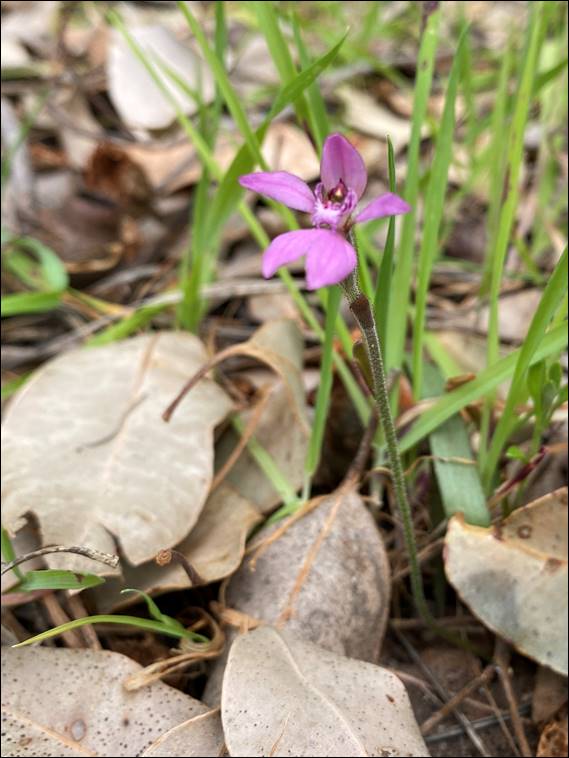
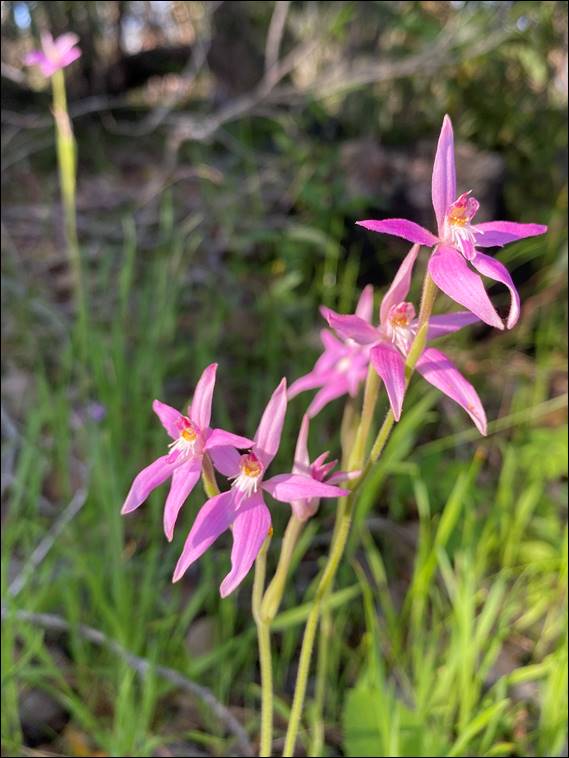
In previous seasons when I have sighted Bunny Orchids, they seemed to me to simply be Bunny Orchids.  There are however six species and six subspecies in the South West of Western Australia.  And this is the third different one I have spotted this year.  The two I have previously included were the Swamp and Common Bunny Orchids, which are different species so more distinct from each other.  However, I’ve just noticed an error in my orchid guide which led me down the wrong track.  One of the characteristics to look is the leaf:

What I thought were Common were in fact White Bunny Orchids (Eriochilus dilatatus subsp. dilatatus).  The one in this post is the Common Bunny Orchid (Eriochilus dilatatus subsp. multiflorus), proven by the small oval leaf.  These are subspecies having lots of similar features, hence why one error led me astray.  The South West, and for my orchid guide, extends from Kalbarri, 660km north, to Israelite Bay, 760km east, of where we live, as the crow flies.  As such my chances of seeing all of the species and subspecies is non-existent:

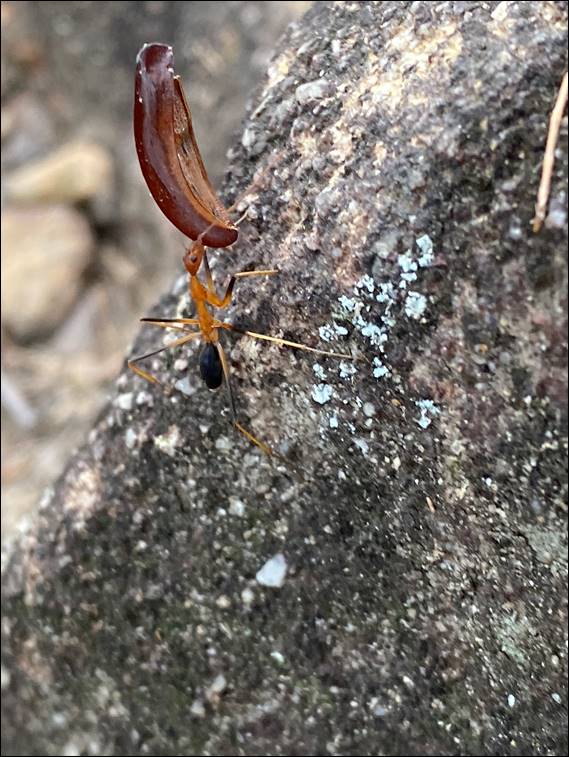
There are a few more species and subspecies round here though, so I’ll keep looking and will be more careful.  This includes paying a bit more attention to the finer details, but also double checking my sources even when they are in print.  You will no doubt have spotted the mosquito in the second image.  It has a distinctive curved proboscis, and using a great tool from the Department of Health I’ve tried to identify it.  The image didn’t capture all the intricate detail required, but based on what I have available it may be a Culiseta atra:
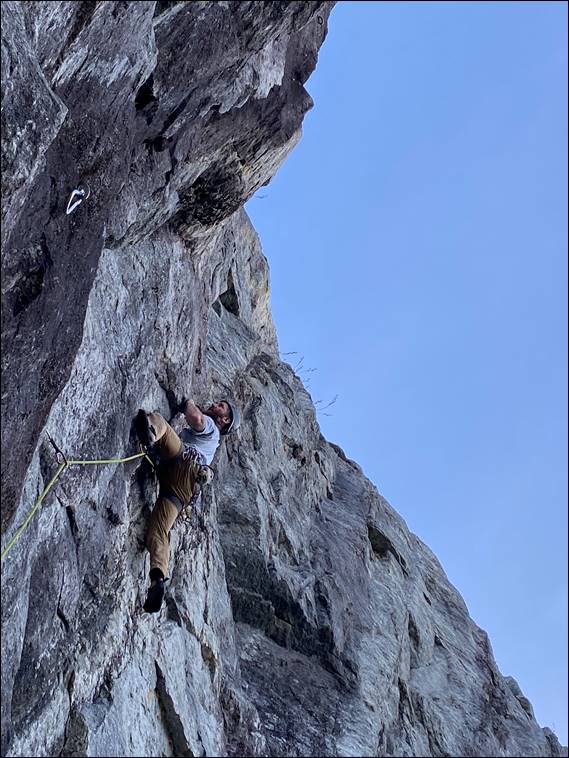
It was a very pleasant stroll, and we even spotted two Scented Autumn Leek Orchids (Prasophyllum sp. ‘early’).  Yet to bloom, with their small flowers still tucked inside what looked a bit like duck heads.  It is very similar to the Autumn Leek Orchid (Prasophyllum parvifolium), which you could argue is incorrectly named.  I say that as the Scented Autumn Leek Orchid flowers in April to June, i.e. Autumn, while the Autumn Leek Orchid flowers in June to August, i.e. winter.  That said being the first day of June, it is technically winter:
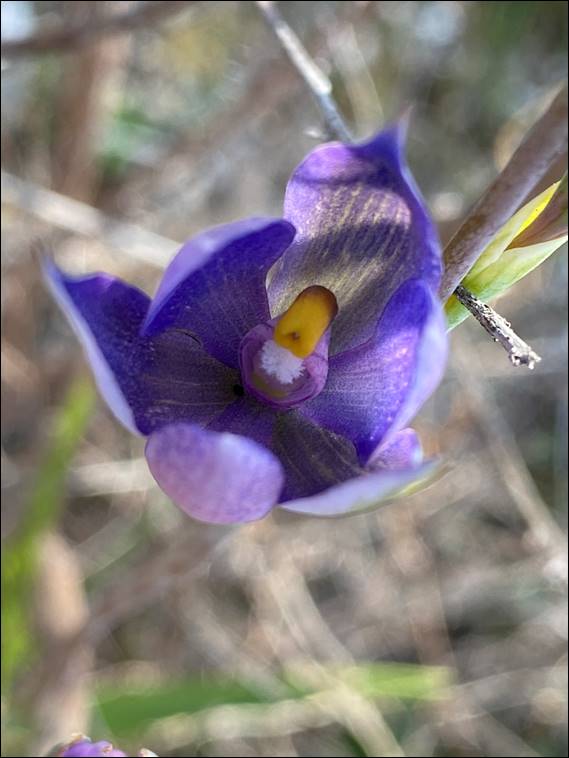
There is an image earlier in the post I did not mentioned.  Showing stringy white filaments coating a plant.  My first thought was a lichen of fungi, whereas Lisa suggested an animal.  She had looked more closely and was on the money.  The stringy bits have a pattern and look to be segmented, these could be eggs.  I was at a loss and felt it could be a number of critters such as aphids, scales, or mealybugs.  However, Verity used her social media contacts and has confirmed it was a Burgan Woolly Scale (Callococcus acaciae). Having enjoyed the morning amble so much, while Lisa stayed home to recuperate I went back out later:
This time not going so far, and visiting a different section the Capel Nature Reserve from my last visit.  Like the Ambergate Nature Reserve the ecosystems vary in different parts, and can include tall trees and shrubs such as marri, jarrah, peppermints, banksia, and snottygobble, to creepers and a multitude of ground covers.  A sign of just how much we have changed the landscape, which would formerly have all looked like this.  These remaining ecologies have been compressed into small pockets, still battling to survive and remain as pristine as possible:

I didn’t find anything new on this wander, but did get to spot White and Common Bunny Orchids and Hare Orchids.  These were massively outnumbered by all the Greenhood Orchids popping up everywhere.  I did stop to watch another mosquito, on the above Common Bunny Orchid.  Again I didn’t look hard enough at what I was seeing.  Only noticing that it had been captured by a spider after I looked at the images back at home.  Putting my new mosquito identification tool to use this may be a Southern House Mosquito (Culex quinquefasciatus):

As for the spider, it is going to have to be a bit of a punt.  The angle I was taking the image from didn’t capture the all-important body.  It is definitely a crab, also known as flower, spider.  With the limited detail, and checking which ones are common here it may be a Milky Flower Spider (Zygometis xanthogaster).  On a final note it has been said the images can make it hard to gauge scale, a fair point.  So to put my sightings into perspective for you, above are three Common Bunny Orchids with one in flower, and below three Hare Orchids all in flower:

Having a laugh

I hadn’t picked up on the silence last Sunday, as I battled hard on the steep unforgiving walls at Welly Dam.  Not from the lack of people, but the lack of birds.  I thought it may have been as a result of the quicker pace I take when top rope soloing, meaning I’m on rock for a greater percentage of the time.  Also that on that trip I had to focus harder than normal, trying not to falloff.  Probably from weariness from the recent big trip to Wilyabrup, although also due to the humid conditions.  All that said I would normally also notice, as a minimum, the creaky squawks of the Forest Red-tailed Black-Cockatoo (Calyptorhynchus banksii naso) on high:

Today we were immediately greeted by four Laughing Kookaburra (Dacelo novaeguineae), like us unafraid of the damp and what started out as foggy conditions.  You may recall I previously explained that fog is heavier than mist, and the point of reference for calling it fog is when the distance you can see is less than 1,000m.  When we arrived it wasn’t even possible to see the valley below the dam, a mere 200m away.  The above Laughing Kookaburra was barely visible, but could be clearly heard.  I also spotted two Australian Ringneck (Barnardius zonarius) on the grass next to the car, looking like shadows:

We seem to be in a feast or famine cycle when it comes to rainfall.  After the long dry, we had a big dump of rain during the week.  With a bigger front heading our way this weekend.  Based on the closest rainfall gauges in the area several inches fell.  In the four days since my last visit the lichen on the walls had turned from dry dark grey to wet black streaks, at times with water dripping down them.  Patches of fallen London Plane Tree (Platanus acerifolia) leaves lay across the lush green grass.  And the patchwork quilt was provided another colour, with the moisture bringing out an explosion of Common Agrocybe (Agrocybe pediades):

London Plane Trees were introduced to eastern Australia in the 1850s.  The rationale provided by a professor of the Victorian Department of Agriculture in 1889 included: “when there’s most rain, the drip from them is little, and at the moistest season the roads beneath them soon dry up and keep in good preservation”.  This was of course true for their climate and also because the roads were unsealed.  What was not considered was how they along with other deciduous trees brought over, such as the Weeping Willow (Salix babylonica), would negatively affect the waterways, water quality and even increase flood risks:

We were only into our second climb when rain started to fall.  I watched Splendid Fairywrens (Malurus splendens), hoping about on the grass.  Coming within a foot of me.  Unconcerned by either our presence nor the damp conditions.  And above me Howsie was also pushing thoughts of the wetness to the back of his mind.  Climbing on, and having to make use of the now even less secure hand holds.  And that added to the rubber on our shoes being cold, meaning that it is not as pliable and as such the contact friction is reduced.  Maybe only marginally, but it all adds to a reduced feeling of security:

On my climb Howsie mentioned he could hear a bit of a thud when my feet made contact with the rock, whereas it is usually a relatively quiet process.  Today was definitely more of a mental, than physical, game.  We climbed slowly and cautiously.  Maybe holding on that bit too tight, and certainly not maximising our flexibility or ability to reach as we would normally.  There is a tendency to stay in a more compact position, which somehow feels safer but then makes the climbing harder.  Howsie was rewarded for his perseverance when he topped out.  The winds were pushing the fog and rain away, and brought over some welcome clear skies:

With the clearing skies came another feathered friend being the Scarlet Robin (Petroica boodang).  More brightly coloured, but very much subdued compared against the Grey Fantail (Rhipidura albiscapa) that had also come out.  They were providing endless aerial acrobatics displays, and when perched they spread their tail feathers into a fan shape at every opportunity.  It was almost as if they were showing off.  Something we were not doing today, not that anyone else was dumb enough to have got here as early as we had.  It was a case of picking the driest line at a reasonable grade, and that didn’t leave us too many choices:

The sun may have broken through, but it made no difference to the wet walls.  They remain in shade nearly all day, great for hot summer days but not so good on wet and cold winters mornings like today.  We could see the high clouds being sped along by the winds, again this was not help as at ground level it was still.  So despite the rain having left us, the damage was done and we were having to climb to the conditions.  This on occasion included avoiding using the holds we normally would, being too slick today.  So despite the countless time we have been up the routes, it was definitely one of those sessions where things felt different:

You may be wondering why we had even come out today.  The main reason should be abundantly clear, both Howsie and I have a passion for climbing.  We are not easily put off by such conditions, and today reminded us of a mad year when we came here before work for a climb almost every week and in all conditions.  That was eight years back, and we both felt that we probably couldn’t sustain that now (https://sandbagged.blog/2016/05/14/not-so-early-starts/).  While I mentioned another big front would sweep across the South West, I saw a weather window today so we were willing to take a punt and get out fix today.  And that we managed in spades, getting up six fun routes in conditions that would put most off:

We also enjoyed the companionship of our feathered friends and observing what the changing season brings.  The above could be Brick Red Laccaria (Laccaria lateritia) in their early stages.  I’ll be honest and that is a bit of a guess, there is no fun in fungi when it comes to trying to identify them.  The Swamp Bunny Orchids (Eriochilus helonomos) I had seen were gone, but to Howsie’s delight we found a few more.  Their delicate flowers measuring no more than 10mm in length.  I was thinking of bringing Sam from work up here tomorrow, which would be a significant step up in terms of difficulty for him.  So while Howsie and I are used to this stuff, I thought better of the idea.  Unlike we had today, he probably and understandably would not have a laugh about it:

Hanging by a thread

Today’s plans to head out for a walk, followed by a feed, with Lisa were scuppered.  When yesterday she started to feel unwell.  Rather than rattling about the house feeling restless, which would not have provided a relaxing environment to aid her recovery, I aimed to get out.  An unsettled forecast meant the decision of whether it would be a wander or solo climb was uncertain.  After checked the radar in the morning, as well as clearing the kitchen, feeding the dogs, and of course putting a thermos mug of tea was on Lisa’s bedside, I slipped out:

The radar and synoptic charts indicated a window of opportunity.  Despite being before first light, the moon was enough to show the sky to the west, where the coastal crags stood, was blanketed in cloud.  Whereas inland was clear.  Although, not entirely unexpected, as I entered Wellington National Park mist hung in the air.  There were pockets where the mist lifted, and I was treated to great views of the valley.  The valley sides covered in tall jarrah, marri, and blackbutt trees.  Looking particularly green as the moisture ran off their leaves:

Unfortunately, as I looked further up the sides of the valley, the scars of the unprecedented hot and dry period we have experienced was also evident.  A patchwork of brown and green canopies, suggested that in some areas as many as fifty percent of the trees have succumbed.  The cooler weather and rains, which have finally arrived, will hopefully prevent any further loss of trees, for this year at least.  While the tree below may also look in a poorly state, being a non-native deciduous tree it is just doing what it does naturally:

Not surprisingly I had the place to myself.  I didn’t even see any cars to indicate mountain bikers were out and about.  My expectations were lower today than they had been on Friday, fully expecting to do fewer climbs.  Although, and purely because of what is available, the grades would be higher.  With so little rain to date I was not expecting too much seepage.  There were some starting, such as this one where water is exuding, seemingly magically, out of solid rock.  They were few and far between, and did not to restrict my options for today:

My mind was certain of one thing, the friction would be a bit meh.  On account of there being plenty of humidity in the air.  Added to that, and not by design but just plain oversight, I hadn’t brought my chalk bag to counter the negative effect of the humidity.  My first route felt tough, which not an uncommon feeling here, so actually went quite well.  I was however completely overoptimistic with my next choice.  A sustained and technical climb, on which I hung in my harness way too much.  Each time I got back on the rock my muscles ached:

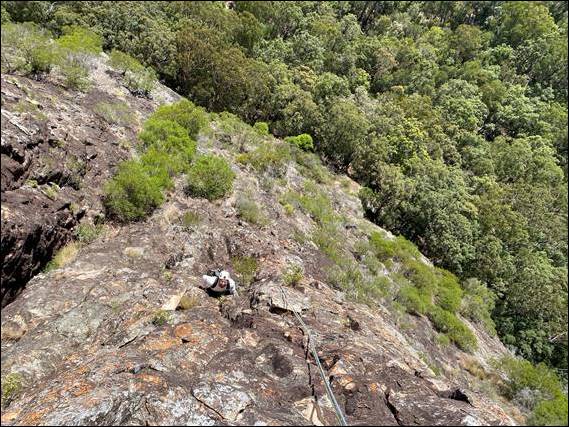
Climbing by myself I use the above ascender.  When I fall a single spring loaded cam with teeth compresses the rope against the main housing.  The short teeth don’t go much beyond the outer sheaf, but considerably add to the grip the tool has on the rope.  A simple and effective system, one you have to have complete trust in it.  It may seem madness, but is no different to abseiling that also uses a simple device and relies purely on friction.  Not put off by my silly route choice, I found three more to play on.  Climbs I would normally run up:

The cumulative effects of two solo sessions in one weekend took its toll, as the morning wore on.  On the last lap, which is also when a light sprinkle of rain started, it felt like a repeat of my second route.  I spent a disproportionate amount of time hanging on the rope, thankfully not just a thread.  The soreness creeping over my body was however forgotten when I spotted a Swamp Bunny Orchid (Eriochilus helonomos) in the thin veneer of soil atop the granite.  The tell-tale heart shaped leaf, along with the height, and position of the petals giving it away:

Setting the right pace

Maybe despite better judgement, after my pretty big morning climbing, Lisa convinced me to walk the zig-zag with her, when she got home.  This is a circuit she does with the Peppy Plungers, who are also known to walk up and down the lookout.  The dogs were excited when their leads went on, but this is not a relaxing stroll.  There is little time for sniffing.  The pace is set with one aim, get the heart rate going.  On the return leg there are various paths leading to the beach, and at each one they attempted to protest and try to lead us down to the sand:

On the plus side the brisk walk wears them out.  Resulting in them not being so restless every time there is a sound in the garden during the night.  Usually a possum, or sadly sometimes a cat from one of the neighbours that lets them roam.  On the negative side my legs were even more achy, which led to me having a restless night.  Compounded by the strong winds and waves.  Sounds which seem to help Lisa sleep, but not me.  The swell was up, and in the morning most of the Peppy Plungers were put off from going for a full immersion:

If you look closely in the first image can see them congregated on the beach.  An image I took from the lookout.  While it may seem contradictory to my thinking of the night before, I decided to head out for another walk, after leaving the Peppy Plungers to contemplate the dark tumbling waters.  The dogs would probably have been happy to join me for my walk.  I wasn’t aiming to get the heartrate up, but to watch the sunrise.  It also included a return leg along the beach, where I eventually met up with Lisa so we could walk back togther:

Midmorning I ducked out again.  Heading out in-between the squalls, which the less settled weather was sending our way.  For an even slower paced walk, round the Capel Nature Reserve.  After finding the Common Bunny Orchid (Eriochilis dilatatus subsp. multiflorus) yesterday, something inside told me to have a bash at seeing what this place had to offer.  As can be seen above it is a relatively pristine bit of bush.  Somehow the weeds have not invaded this place, and sure enough I came across some Common Bunny Orchids quite quickly:

The reserve doesn’t have set walking paths.  There are a few maintenance tracks that criss-cross the area.  My approach however is to go where it looks like it might be interesting.  This leads me to weave all over the place, often getting completely disorientated and having no idea where I am.  You have to walk slowly, it can be hard to spot orchids.  Go to fast and you might miss out, or worse accidently stepping on them.  It also takes a while to tune your vision into what you are looking for.  There is no rushing, and only then will you be rewarded:

I would not say orchids were all over the place, but I saw quite a few Common Bunny Orchids.  The next most abundant were the above Hare Orchids (Leporella fimbriata).  I’ve only once seen a couple of plants previously, in Manea Park, so I was happy to see more here.  As the image shows some of these had been out for a while, with the lower one having already been pollinated.  Evident by the swollen ovary that sits between the flower and stem.  There is also a Rabbit Orchid, just to complete the set.  But they flower later, from September onwards:

A few Banded Greenhood (Pterostylis vittata), above, had also started to pop up.  A couple even had flowers forming.  These are the first of the Greenhood family to flower, and can be seen from April onwards.  Then when May arrives, the Slender Snail Orchids start to appear. I spied a couple of basal leaves, but no flowers.  There are also a few of the Shell Orchids that can pop up in May, and as yet I have never managed to find any of these.  I was however treated with this Lutea (or albino) Common Bunny Orchid, which was pretty cool:

But not as good as the find shown below.  A Leafless Orchid (Praecoxanthus aphyllus).  The first time I have sighted one, and despite looking hard for over an hour it was the only one I found.  This was the second species I came across today, but being the best find I have left it till last to show you.  I was so excited that I could almost have given up and gone home there and then.  If I had I would have missed out on so much more.  The Capel Nature Reserve, in its near pristine state, has been a bit of a gold mine for me.  And I have Ed at work to thank:

He let me in on this place a few years back, and today it once again had plenty on offer.  My thermos mug of tea was drained, and happy with my finds I headed home.  Taking in a quick stop to check the Tuart Forest National Park, hoping to find one of those Shell Orchids.  Orchids aside, this is the largest remaining area of Tuart (Eucalyptus gomphocephala) forest.  So is pretty important, but unlike the Capel Nature Reserve it is heavily weed infested.  They germinate early, out competing native ground cover plants.  Including orchids, and I saw none:

Let the hunt begin

It was an early start today, and there was a full moon to light the way.  My intention being to get a first light start at Wilyabrup.  The decision to head out so early was made easy being a solo trip, and my body is back to waking up at silly o’clock.  Watching the moon through the treetops, as I drove through the Ludlow Tuart Forest, was almost hypnotic.  I had to keep reminding myself to watch the road.  Not for other cars, kangaroos.  The moon phase can affect their activity, and with more ambient light they are generally out and about more:

And just because there is a full moon it doesn’t mean that all the creatures of the night are more active.  The predator and prey behaviour can also be an influencing factor, also altering in response to the changing ambient light conditions.  When there is more light prey may modify their activity to reduce their predation risk, which could include being less active.  That said there are very few natural predators that kangaroos need to worry about.  Possibly Dingos (Canis familiaris), but I doubt very much they are round where we live:

Then there are Wedge-tailed Eagles (Aquila audax).  They generally hunt at sunrise and sunset, so there was little risk of them being about.  As it was I didn’t see any kangaroos, but I did pull over to try to get a shot of the moon that was silhouetting the tall tree tops.  Not taking the time required to get such low light images, they were pretty average.  My focus was more intent on getting to the crag to watch sunrise, so I drove on.  Managing this as shown by the first image, taken as I walked the short kilometre’ish from where I parked my car in darkness:

I had a plan for today, and it was more than usual.  While I am feeling so much better, Howsie is laid up recovering from a bout of COVID.  He was however well enough to communicate so I teased him with my thoughts.  The options I had in mind comprised The Playground where there are a couple of harder boulder problems, which I have never played on, or the usual Wilyabrup.  The latter won out, and he agreed it was the better destination.  I like the height, but there is a front is on its way and the main cliffs are a much shorter walk from the car.  Just in case I got caught out:

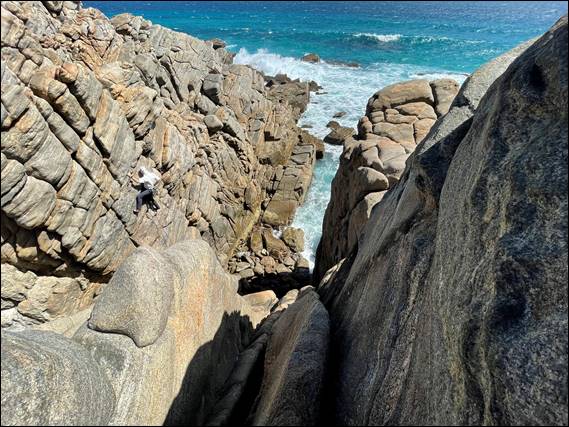
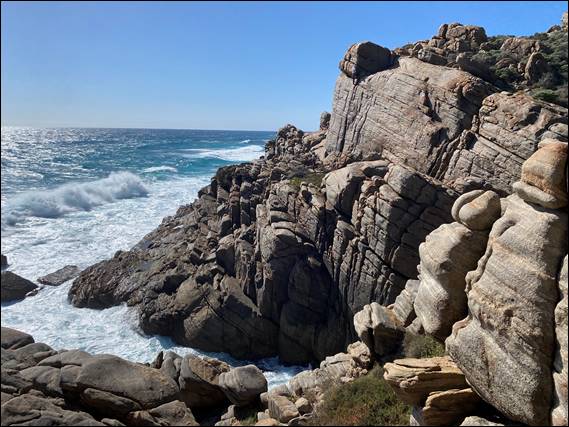
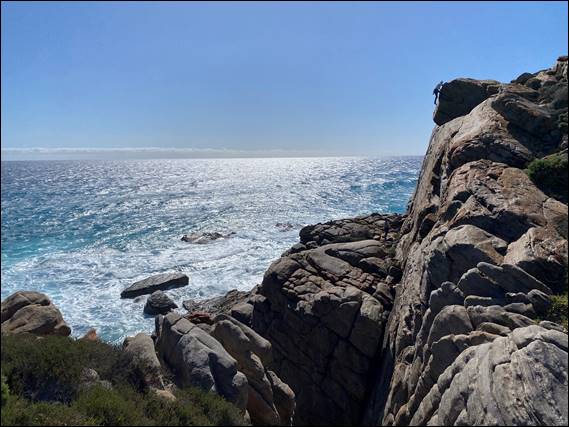
This was also a factor when I decided on the slightly earlier start.  Mind you, those that know me will be well aware that I would rather watch the world wake up while being at the cliff.  The images show that my timing payed off, it was a glorious start to the day.  In fact sunrises and sunsets have been particularly good of late, due in part to smoke haze hanging low in the horizon as a result of people back-burning before winter sets in.   I was already well into my itinerary for the day before the sun had managed to get high enough to touch the first boulder, two images up:

I began on the same wall that Howsie and I had started and finished on just a week back.  For no other reason than it being a good height and beautifully featured, providing great lines.  It may seem that it would get boring revisiting these places so often, but climbing for me is so much more than just the routes.  Sure if there were more options in a reasonable distance I’d shake it up.  However, each time I head out, something is different.  The weather, season, how I feel, and/or what I see, any one of which can make the climbing feel not completely new but certainly fresh and enjoyable:

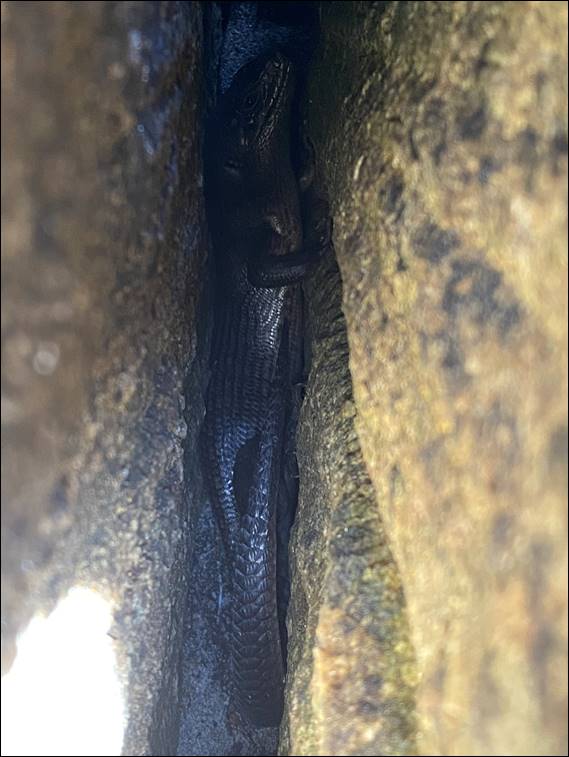
It was only for the last climb of the day that the sun was on my back, so I was being hopeful.  Rapping down I didn’t see anything and resided to not being lucky, just like we had not been last weekend.  However, hope won out when looking that bit harder during the climb I spotted one of our scaly friends.  Snuggly tucked away deep behind the flake.  What a great way to finish the session.  One that saw me ascend 500m on twenty laps of quality lines, with an average grade of HVS/E1 5a.  Not too shabby at all even if I do say so myself.  And to boot, while packing away I looked up at just the right time:

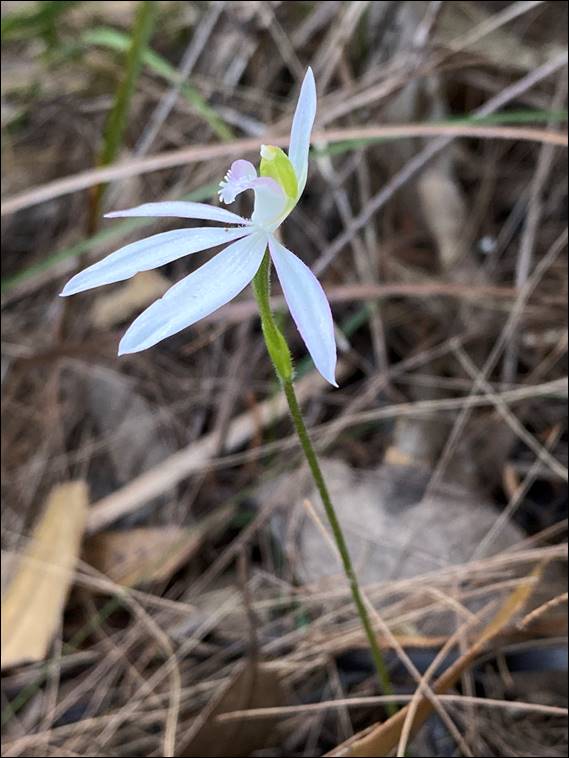
Allowing me to witness a lightning strike in the brooding cloud.  Still way too far out to deliver any rain.  However, despite the long dry that we have endured, the cooling temperatures are resulting in a morning dew.  With enough moisture to bring a bit of life to the vegetation, including the pasture that was looking lush and green across the valley.  The orchid leaves we saw last weekend were still nowhere near flowering.  This time though, I stopped at a small patch of bush just off the gravel road leading to Wilyabrup.  Being rewarded with another wonderful find of six flowering Common Bunny Orchid (Eriochilus dilatatus).  Let the hunt begin:

It’s different up north

Back in the homeland it’s a common thing to hear ‘its grim up north’, or at least it used to be.  Having lived in the north and south of England and really enjoying both areas for different reasons, I’d disagree.  Hence, I’d rather say ‘it’s different up north’.  And Western Australia is similar, although from a climate perspective even more so.  Ranging from tropical in the north to Mediterranean in the south.  Even the short distance of approx. 200km from where we live to Perth can see quite a change, as Verity proved when she went for a snorkel this morning:

The waters at her local spot proving to be much better than my local pea soup.  Enabling her to spot several Fantail Leatherjackets (Monacanthus chinensis).  A fish that doesn’t venture this far south, which means I will not be lucky enough to find round these parts.  And while she was enjoying the waters before it feels too cold, Howsie and I set off for yet another Friday climb.  Yes I have restarted my attempts to get my leave hours down by sneaking out on the last working day of the week, and I’m not doing a very good job of it:

We were greeted by a large male Western Grey Kangaroo (Macropus fuliginosus), as we walked towards the cliffs.  Not worried by our intrusion, it took a lazy hop to get off the path and then just watched us as we walked past.  While it was looking super chilled, it’s broad muscular shoulders suggested that it was best not to tangle with this one.  Continuing down to Wilyabrup we chatted about what we might jump on.  Should we continue on the 2024 challenge and push the grades, or have a more laid back day and maybe get some mileage in:

We opted to start with mileage and see where the day took us.  Ten cruisy lines would be fun, and the first two pitches were exactly that.  Allowing me to continue making good use of my crag booty, and this time I brought all of it along.  Howsie inspected the carabiners and slings for wear and corrosion, and was unable to find any.  In fact the gear looked practically unused.  Our next two lines were not quite as easy, being three grades harder.  The first seemed fine, but on the second we both hinted that our not so muscular shoulders were starting to feel it:

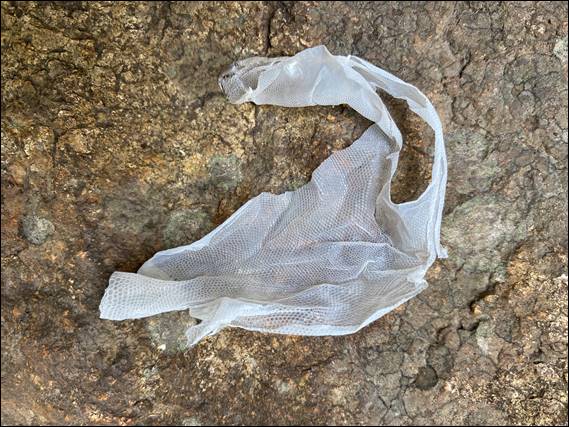
We were just enjoying being out and wanted to keep it that way, so dropped the grades back down by three for the next two routes.  Searching for any signs of our local Carpet Python as we climbed them.  Sadly only finding an old snakeskin tucked behind a flake.  The easier lines seemed to revitalise us as the iconic Steel Wall, on which we started the day, again drew our attention.  It meant bumping the grades up by six.  Both of us spent time on the halfway ledge to have a that bit more of a breather than usual, which assited us in managing clean ascents.  The two lines did however take enough out of us to call it a day:

Being happy with our lot, and not worrying about having fallen short of our intended ten climb goal.  I knew it was the right choice for me when I puffed my way back up the path, with my legs feeling pretty ‘tree trunky’.  As I scoured the bush, Howsie mentioned a friend had sent him an image of a Common Bunny Orchid (Eriochilus dilatatus) found in the hills that fringe Perth.  And a bit like I started this post, I said to him ‘it’s different up north’ and the orchids usually flower earlier up there.  We did however find a small patch of Common Bunny Orchid leaves, indicating the orchids are on their way: