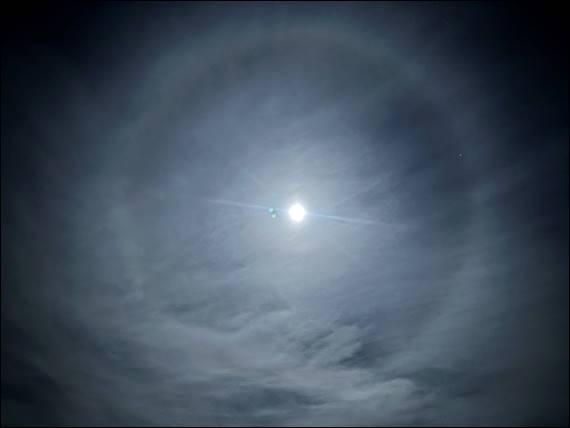
Loading the car ready for an early morning start to head up the hill with Howsie, the moon lit up the evening sky. Forming a specky phenomenon in the same way I described when the sun had, as Craig and I were climbing at Castle Rock some months back. Not surprisingly 22-degree halos tend to occur more often around the sun than moon. For the night time display to come on the atmospheric conditions have to align with a sufficiently bright moon. It was at 95% and I did check on subsequent nights as the full moon approached but there was no halo:
This post is not about climbing. Although I will say that we had a quick look for sun orchids at Welly Dam. Sadly being an early morning climb none of them were on display. And no I didn’t head to the Capel Nature Reserve after climbing. Work was calling so my destination was the office. I did however have a quick walk round my local reserve in Capel Thursday afternoon. Yes the images are out of kilter, but the above picture felt like a nice one to start with. So now it is time to see what orchids I have found recently starting with this lovely and small spider:
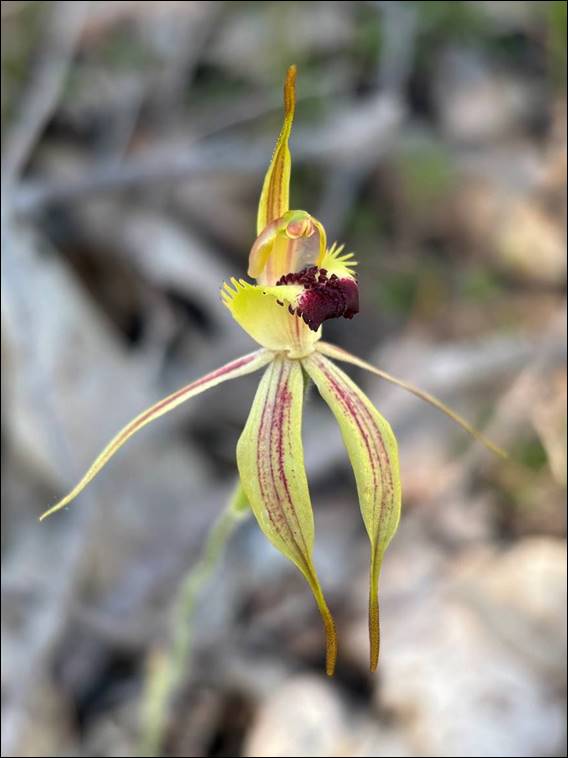
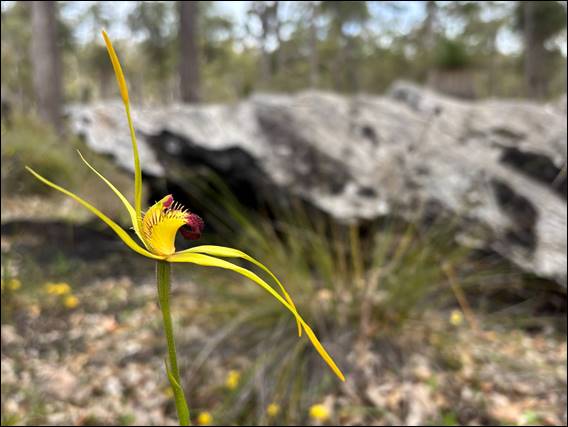
The Diamond Spider Orchid (Caladenia rhomboidiformis) measures no more than a couple of inches across. Four years back I thought I had come across this inland near Nannup. Looking at that find in more detail and with a number of years more experience, just like another species in my last post, I had incorrectly identified it. As such this is the first time I had seen the Diamond Spider Orchid, or at least I think so after finding two past incorrect assessments. It is included in the group known as Clubbed Spider Orchids, but has a distinct difference:
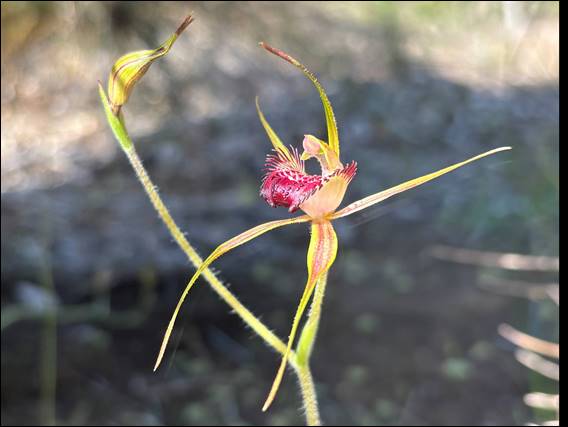
The clubbed group all have thickened, club-like glandular tips on their petals and sepals. The Diamond Spider Orchid displays this on the sepals but not the petals, which are pointed rather than clubbed. The one I got confused four years back is one of the other Clubbed Spider Orchids, with the sepals and petals being clubbed. The above one could also prove tricky if found round Dunsborough. That is because the above Swamp Spider Orchid (Caladenia paludosa) is closely related to the Dunsborough Spider Orchid (Caladenia viridescens):
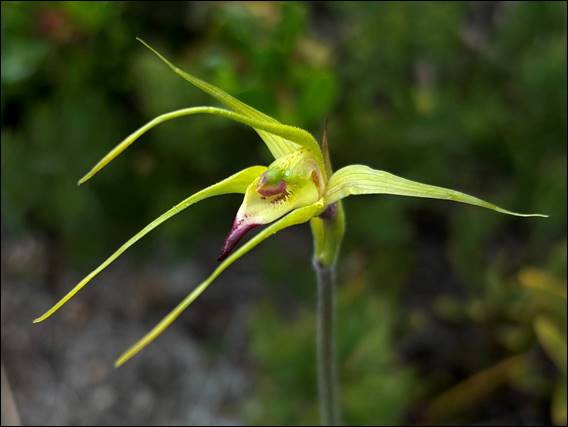
The Dunsborough Spider Orchid has a massively smaller range. Other telling features being it is slightly smaller, has paler greenish-yellow petals and sepals, and the labellum has a more dull maroon apex. I bumped into a couple of people experiencing the reserve for the first time and got chatting. They mentioned an impressive spider orchid they saw at Crooked Brook Forest, and I knew straight away what it was and where they found it. Having seen the above Carbunup King Spider Orchid (Caladenia procera) there before:
Despite seeing it last year, I still made a quick trip after work on Friday to see what else there may be. The answer being nothing new, and not much at all. Interestingly the Carbunup King Spider Orchid is listed as Critically Endangered under both Western Australian and Australian legislation, a key reason being an ‘extremely limited range’. I have however seen it pop up in in some unexpected places that are quite far and wide, and regularly see it each year. The Dunsborough Spider Orchid is only listed as Endangered under Australian legislation:
Not only does it have a considerably narrower range, but based on my efforts it has been far harder to find. I don’t think I will ever understand the logic applied, so time to move along both in terms of topic and geographical location. The people I was chatting too also told me of something they had seen down in Augusta. Something I have definitely not seen before, and have been keen to find for years now. This place would take a little more time to get to, which saw me driving down there on Saturday despite the forecast looking a little messy:
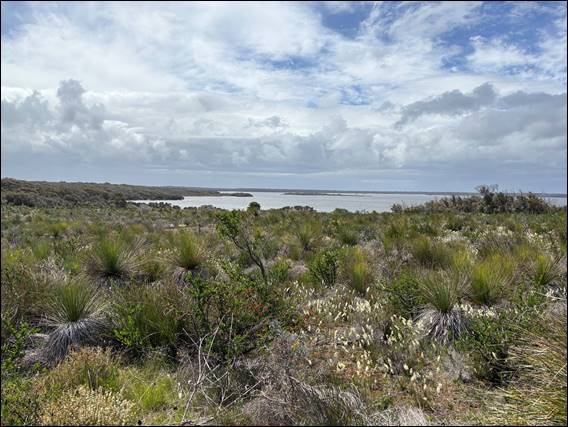
My destination being Flat Rock, where I have only been once before with Craig. That trip was in December, looking for orchids that have a festive theme. Conscious of how dry it has been this year my hopes were not too high, even though this visit being in spring. Flat rocks is a granite outcrop, with a thin veneer of soil. This means the area is open with no tall trees and very few shrubs of any height. The undulating granite provides areas for water to pool both on the surface and within the thin soil prolife, as such it can be quite a productive area:
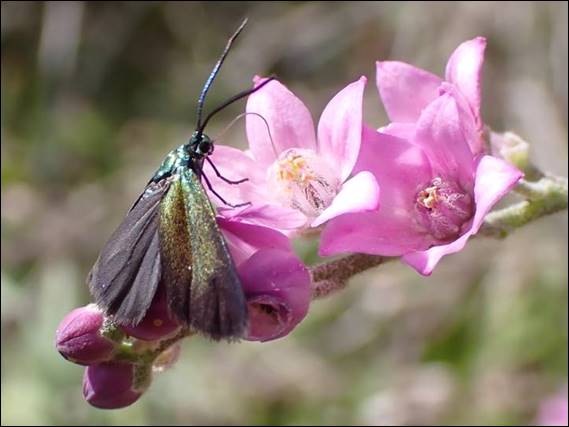
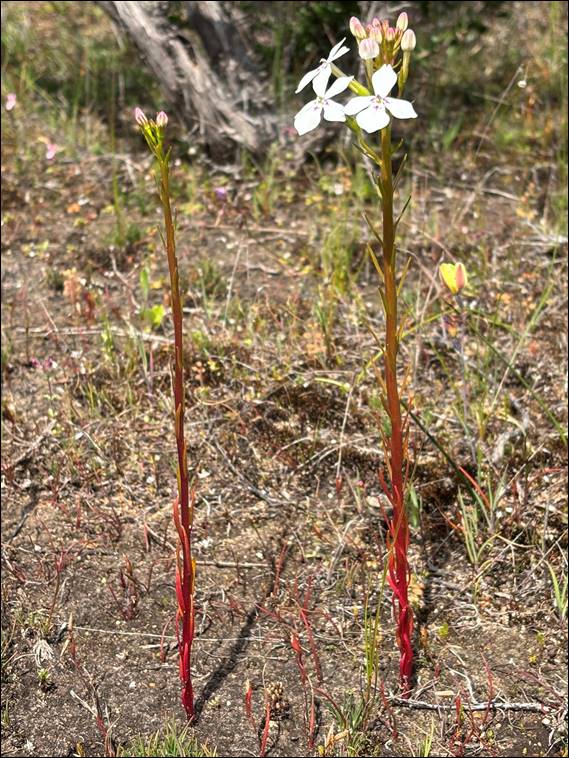
And as the images show I was having a ball! The first image being a Forester Moth (Pollanisus cupreus) on a Pepper and Salt Shrub (Philotheca spicata). The wind was up so while I did get one image of the lovely metallic forewings shining in the sunlight, a gust resulted in the moth splaying its wings for balance. The reason for using this image was its proboscis can be clearly seen deep inside a flower. The thin soil did not stop the plants, and there were blankets of them all over. I also liked the Woodbridge Poison (Isotoma hypocrateriformis):
Again not an orchid but the deep red stem that grades to green, as do its narrow upright leaves, really drew my attention. Now onto the orchids, of which there were more than I have included but having seen some already this year they are not in the post. The Lemon-scented Sun Orchid (Thelymitra antennifera) will however get a special mention. There were literally thousands. Unfortunately, and even with the sun out for long periods, they were all closed up. Two images up is a first time find for me, although not the one I was hoping to see:
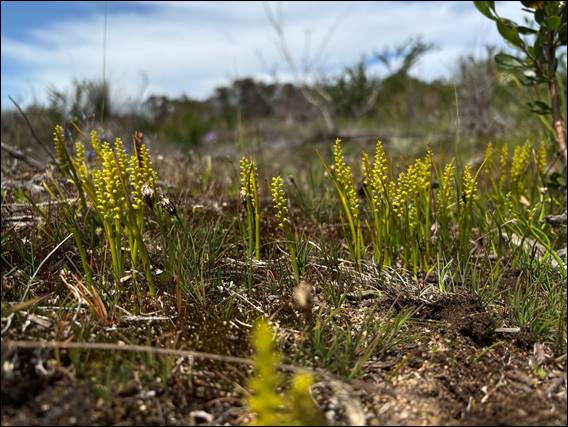
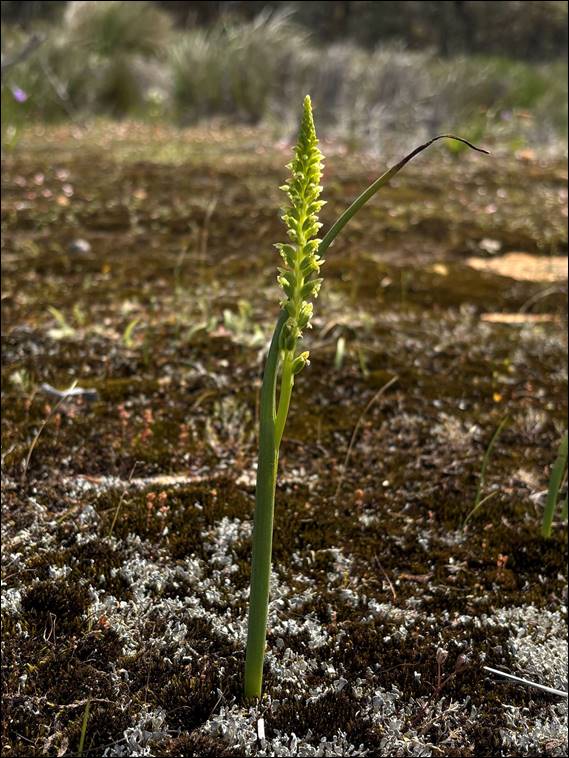
Lots of tiny Swamp Mignonette Orchid (Microtis atrata) were in clusters. The flowers are 1-2mm and the plants reach four to five inches tall, although when in water they can reach up to eight inches. These were on the short side, maybe two inches. The next one I am going to play safe, and say it is a Common Mignonette Orchid (Microtis media) as opposed to the more rare South Coast Mignonette Orchid (Microtis quadrata). I’ll need to take some macro images of the flowers next time, as the images I took just aren’t clear enough to make the bold call:
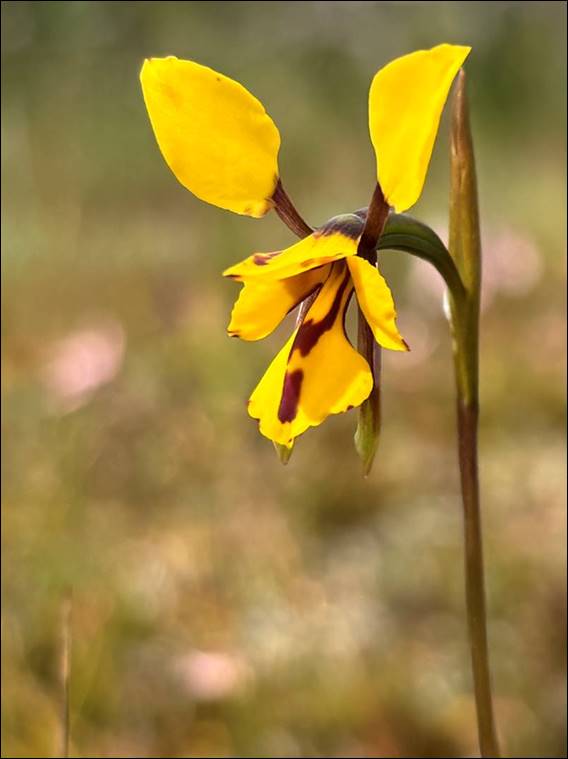
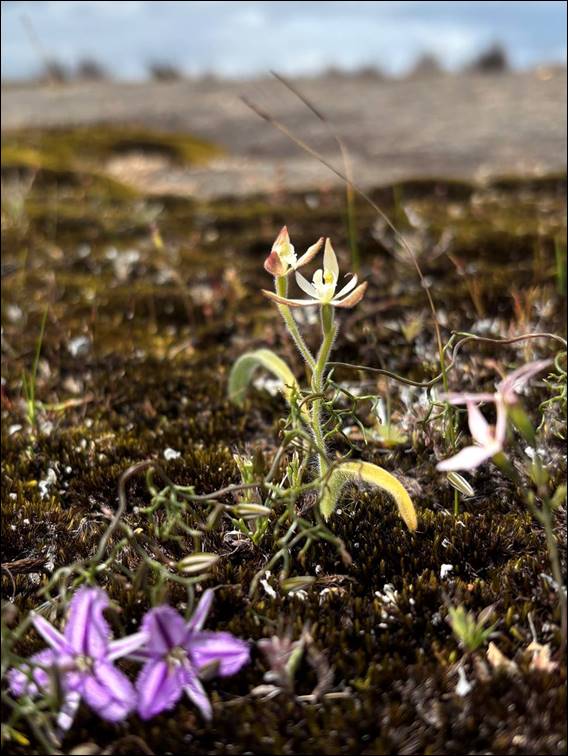
The mossy patches on the granite were in parts covered with small hairy leaves, and I was lucky to find two of the White Fairy Orchids (Caladenia marginate) in bloom. Then there was the above, which made the trip worthwhile all by itself. The Augusta Bee Orchid (Diuris molloyae). Like so many that I mention this also has a limited range, and while it has been known for just over twenty years it was only formally named as a new taxon last year. Bee Orchids are lumped in with Donkey Orchids, and this is the first of any of the bees I have seen:
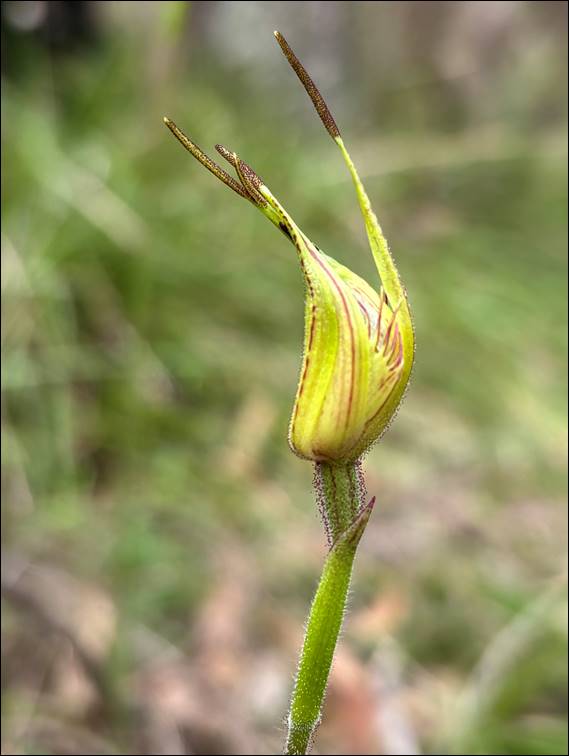
Rain started to lightly fall, so it was time to head off. I had selected a few spots to check out on the way back, locations that my twenty year old orchid book suggested. The first one was behind the waste transfer station at Kadardup, I kid you not. I do wonder why these little patches of bush made it into the book with so many expansive areas not mentioned. Regardless I went there, having my doubts as I walked through Arum Lilly infested and rubbish littered bush. But it did improve with the above first find:
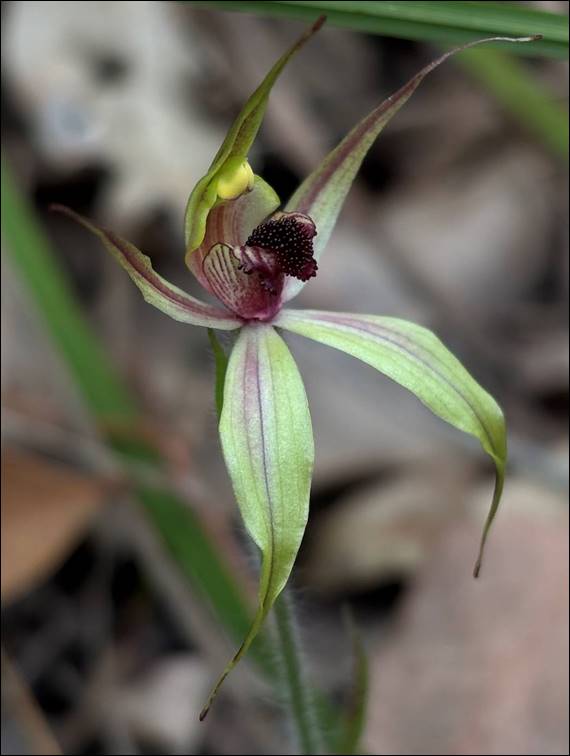
It may have been a Scott River Spider Orchid (Caladenia thinicola), but it is hard to tell at such an early stage. The next find was however easy, being a Leaping Spider Orchid (Caladenia macrostylis). The only one I saw and well hidden in the scrubby understorey. This Spider Orchid shows almost zero variation across its very wide range. This is a little unusual as most spiders will hybridize and vary wildly in appearance depending on where they grow. Next is a Karri Cowslip Orchid (Caladenia flava subsp. sylvestris), identifiable by the white colouring:
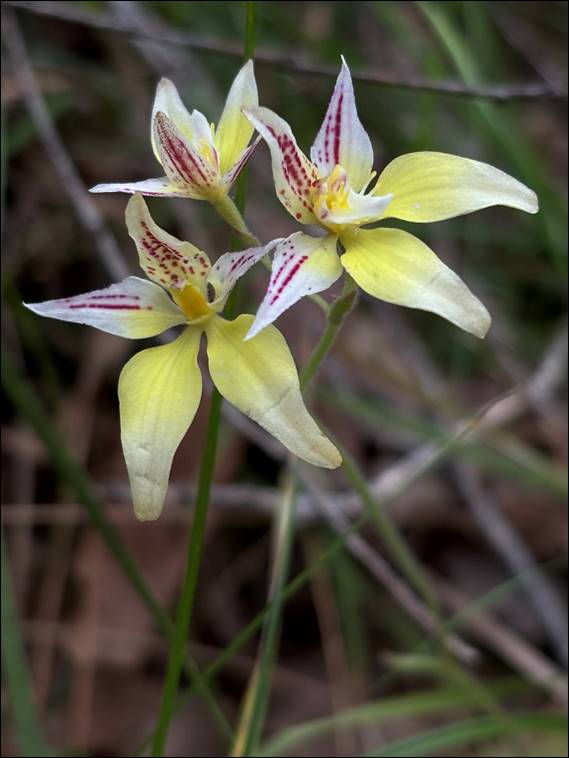
Generally found in the lower south-west, so not one I come across too often. The next two spots near Karridale and Witchcliffe didn’t yield anything at all. Maybe due to the season we are having, but equally it may not be. Making me think that twenty years on the book could be a little outdated with its suggested areas. Although the last spot off the road to Gracetown proved very successful four years back. This time it was quiet and I only found one Funnel-web Spider Orchid (Caladenia infundibularis), which is what I wanted to see, but not quite ready to put on its full display: