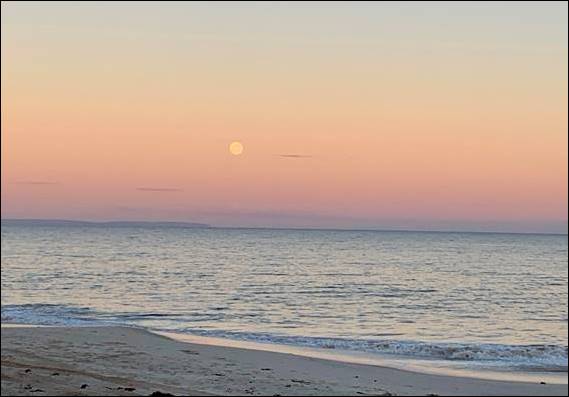
Lisa was happy to be greeted by a calm ocean this morning, a balmy air temperature of 7 degrees, and a very picturesque sight of the moon. It was heading towards the horizon a bit after the sun had come up, allowing a feast of colours to be added to the spectacle. I to was hoping to finally have some success in seeing some specific colours today. That of the Pink Fairy Orchid (Caladenia latifolia) and the bright yellow of the Cowslip Orchid (Caladenia flava), these normally start blooming in August and July respectively. But as yet I’ve not seen them:
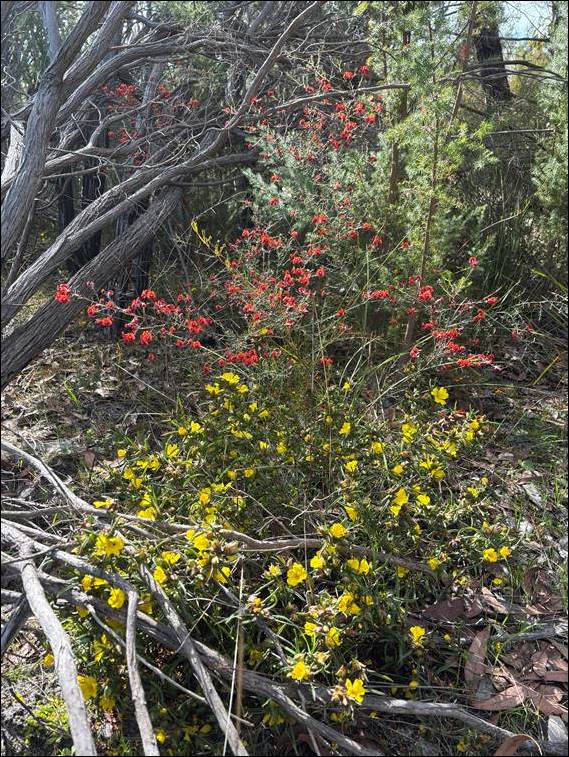
Josh from work had spotted a few of the latter at Manea, but when I went looking after work on Friday there were none to be found. At least by me. Today I wanted to see what the Capel Nature Reserve may have on display. There was certainly lots of colour about. The below Yellow Buttercups (Hibbertia hypericoides) and a species of Flame Pea (Chorizema), which I have had no luck in identifying, were in flower all over the place. While Yellow Buttercups flower from April to December, it seemed to be in greater abundance today:
There were no Pink Fairy or Cowslip Orchids to be found, again by me. But I did find my first flowering specimen of a droopy style spider orchid, being a White Spider Orchid (Caladenia longicauda subsp. longicauda). Like other orchids it relies on a specialized symbiotic relationship with an endomycorrhizal fungi. The tiny dust-like seeds have no food reserves, so they make use of carbon and vital nutrients absorbed by the fungi providing nothing in return. While most adult orchid plants make their own food through photosynthesis they maintained this link:
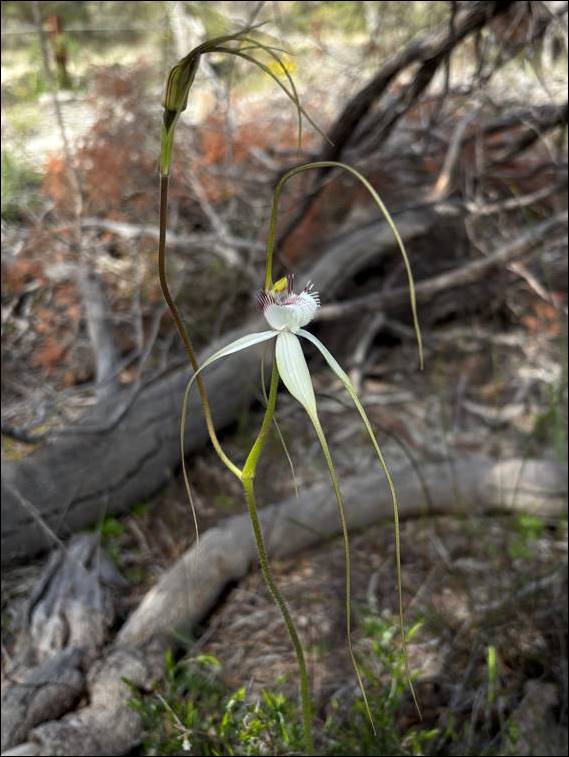
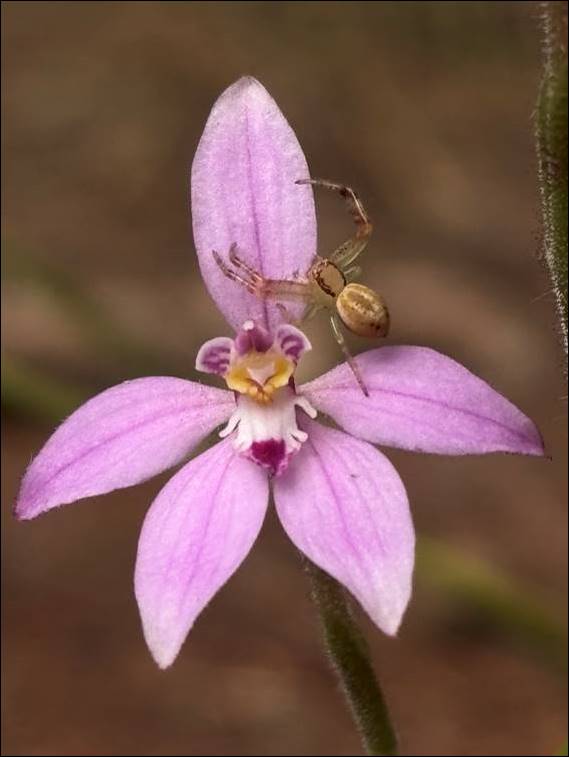
Supplementing their own food supplies with that from the fungi. Some not so nice orchids are permanent carbon parasites. With no leaf to make their own food they are reliant on the fungi for its entire life. These are known as Mycoheterotrophic Orchids, with a couple in Western Australia both being underground species. So you could say we have nice orchids, and not just because they look pretty. While there were no Pink Fairy Orchids, I spotted this Little Pink Fairy (Caladenia reptans subsp. reptans) hosting a Flower Crab Spider (Thomisidae):
My next find was much bigger. While I am used to seeing kangaroos hopping away from me in this reserve, this is the first time I have seen an Emu (Dromaius novaehollandiae). Hard to miss being Australia’s tallest native bird, reaching between 5-6 feet when standing upright. The genus name of comes from the Greek word dromeas, meaning ‘racer’ or ‘runner’. Very apt and did this one run, I was lucky to be able to get this shot. There’s only one species in this genus, whose species name is derived from the historical European name for Australia:
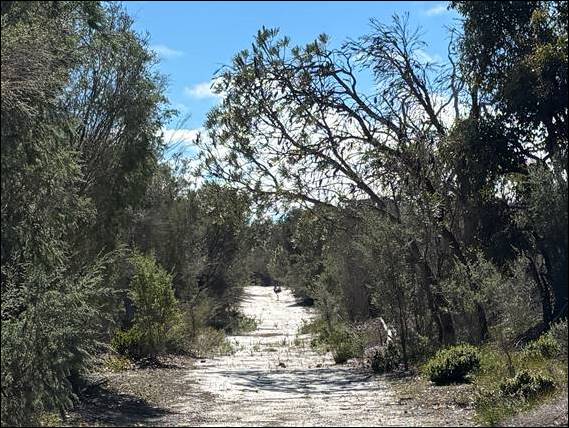
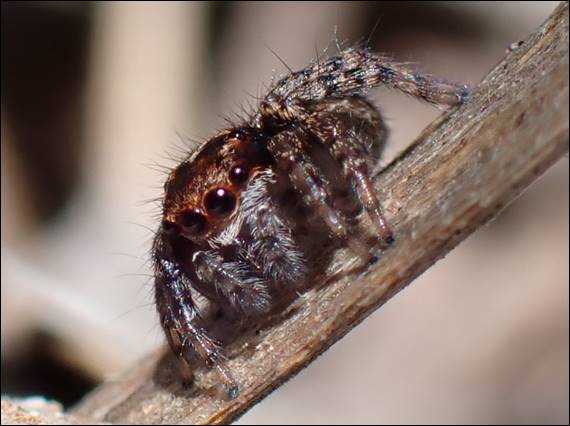
A combination of Latin words nova and hollandiae, meaning ‘new’ and ‘Holland’. Not much else was about, so I decided to have a bash at being a arachnophile. I don’t think I have the patience required, but did find what is either a female or an immature male Peacock Spider (Maratus). Managing to get a few great images of differing angles, I had a go at identifying it. Even with a webpage dedicated to the females of differing species I was unsuccessful, which wasn’t really surprising. I do like this image showing the eyes round the 1-2mm sized head:
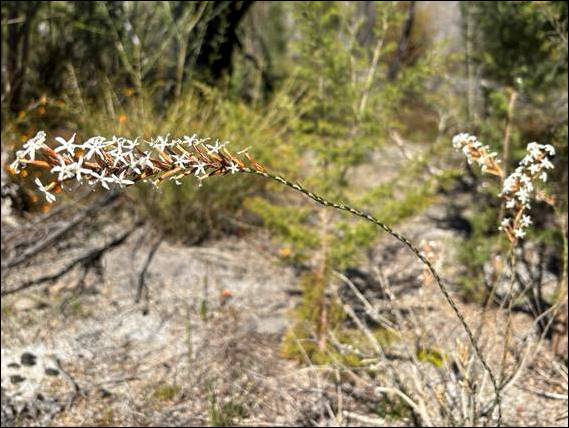
For my last image I have a Curry Flower (Lysinema pentapetalum). The species name literally translates to five petals, and it is from these flowers that the distinct curry-like aroma can be smelt. However, like orchids this plant also has a relationship with a mycorrhizal fungus and the smell is strongly linked to the fungus. The stems of the plant have a very distinct pattern, making me think I may be closer to identifying one of the complete unknowns from a visit in September last year. But it has sadly not assisted, and the mystery continues:
 Sandbagged