An intended solo mission turned into a roped session, as a result of Craig and Henry’s camping trip being cancelled. Choosing a location that would offer something for both of them to sink their teeth into. For one-track Henry that is easy, fishing. Craig would have been more than happy to take images all afternoon, which what he started doing almost straight away, but the main focus was to be climbing. We were thinking the west coast crags would have been fun with longer lines, but they also came with a bigger swell. Not great for Henry’s style of fishing:
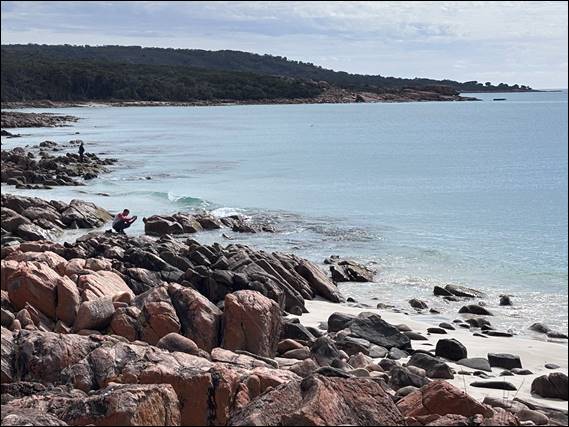
Even before we completed the short 600m walk into Castle Rock, Henry was drawn to the near flat waters in the bay that were gently lapping the shoreline. Scampering onto the rocks and dropping his line in the water, as if to test the conditions and see what might be biting. With a slightly unusual afternoon session on a sunny day, the beach side face of the Castle was bathed in sunlight making for a sight we do not often see. As such not long after Henry had left the path so had Craig, with camera and phone and was busily snapping away:
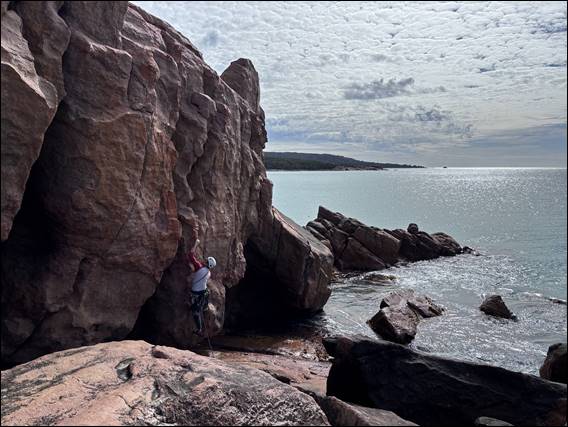
My last visit to this small but fun crag was with Craig. Rather than repeat the same routes, we decided to make use of the calm waters and low tide to play on possibly the shortest of the curtain walls. Being the term used for the outer defensive walls of a castle, and quite apt for this face. With a series of deep cracks running all the way up, looking from the base, the top edge looked serrated. Further imitating the battlement or notched top of a curtain wall allowing openings to attack from and solid sections to hide behind while reloading your bow:
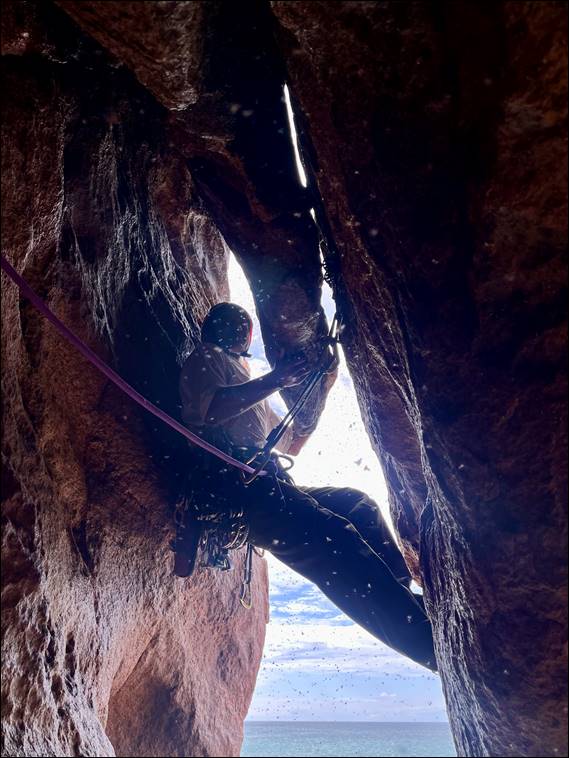
Today the attack did not come from above, but from inside the cracks. Swarms of Kelp Flies (Coelopidae), of which there are less than 40 species worldwide most of which are found in Australasian. These flies can be found clustering in vast and countless numbers on damp shaded coastal rock. A habitat provided by the cracks we aimed to climb, and as we did they took to the air. The good news is that they feed on decomposing organic matter and micro-vegetation, and as such are harmless. The trick is not to breathe, or risk inhaling one or ten:
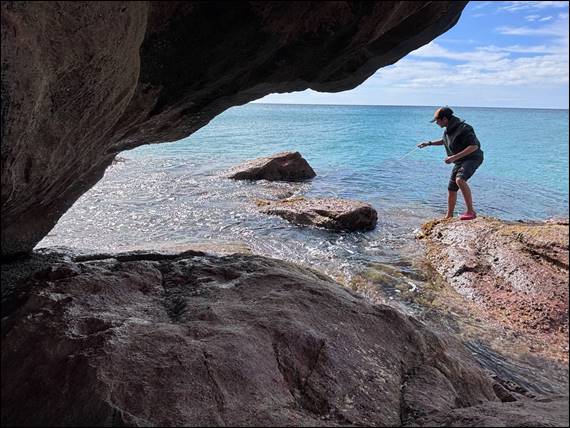
As we used our line to scale the cracks, Henry was using his to lure fish. A fresh south westerly was steadily pushing the waters back towards the beach. Care was required to avoid his line becoming snagged between the rocks or tangle round the Giant Rock Barnacles (Austromegabalanus nigrescens), which he did not always manage as was the case above. These are the largest Australian barnacle, standing 6cm tall. Not a scratch on how big barnacles can get, and being just a fifth the height of the largest found globally:
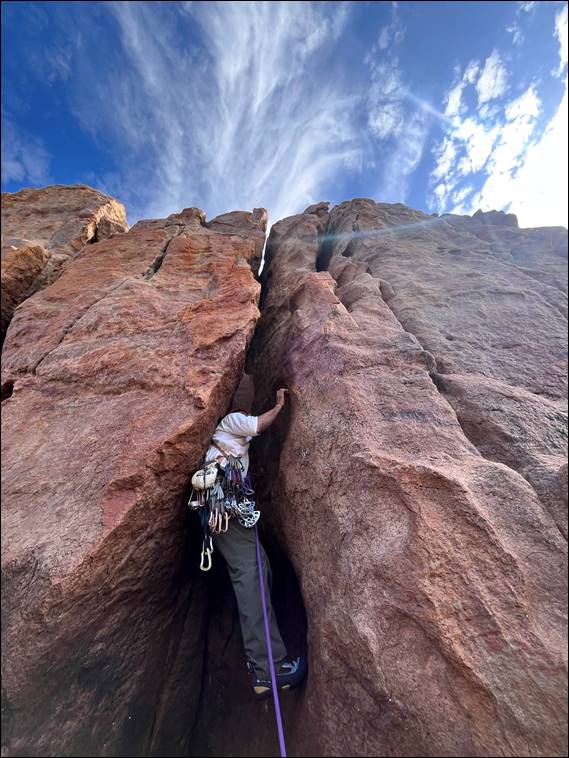
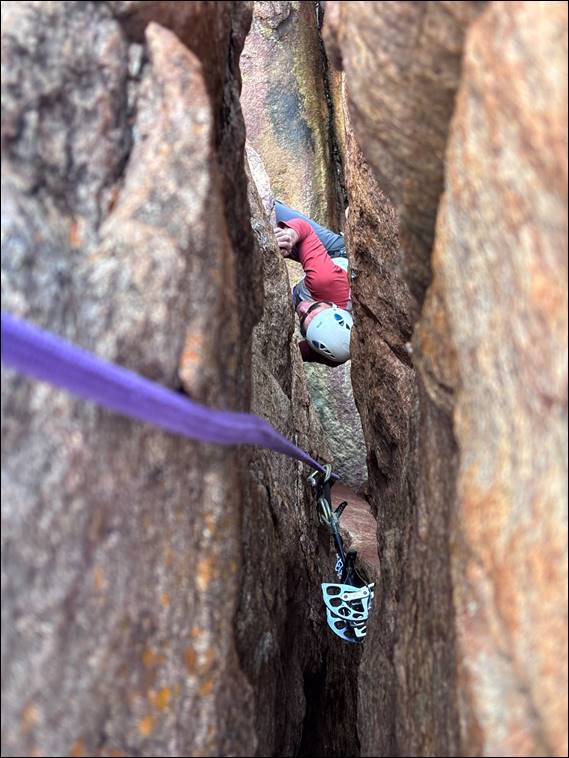
Equally the climbs we were scaling today are not the tallest about. They are however full of character. Providing a type of climbing we do not often get to experience. I took on the two more confined routes, having to squirm my way up through narrowing chimneys while disturbing Kelp Flies. Lou may recognise the route above and below, from near ten years back. I had encouraged her to try it, much to her disgust. It really felt like a grovelling grunt fest, but was a strangely satisfying experience. Even though I was grateful when it was over:
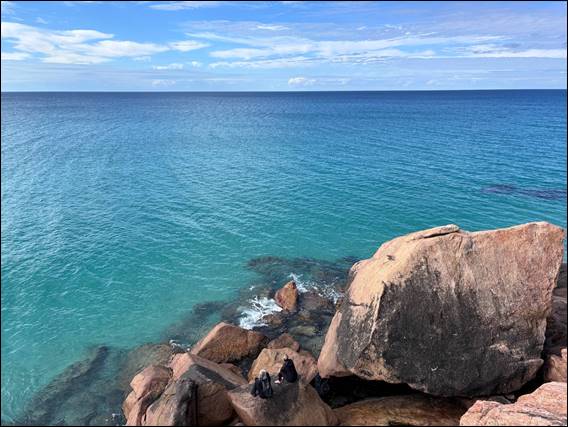
Lisa and Natalia arrived as I was completely absorbed, at times quite literally, by the crack. Making the most of what was an amazing winter’s afternoon, they were wandering along this bit of the coastline. Hoping to catch sight of a bigger creature than Henry was trying to hook. Craig and I had on occasion kept an eye on the blue waters, and not seen any. Then somehow, as if by magic, once they had perched themselves on the rock a Humpback Whale’s (Megaptera novaeangliae) back gracefully broke the waters some 400m off the shore:
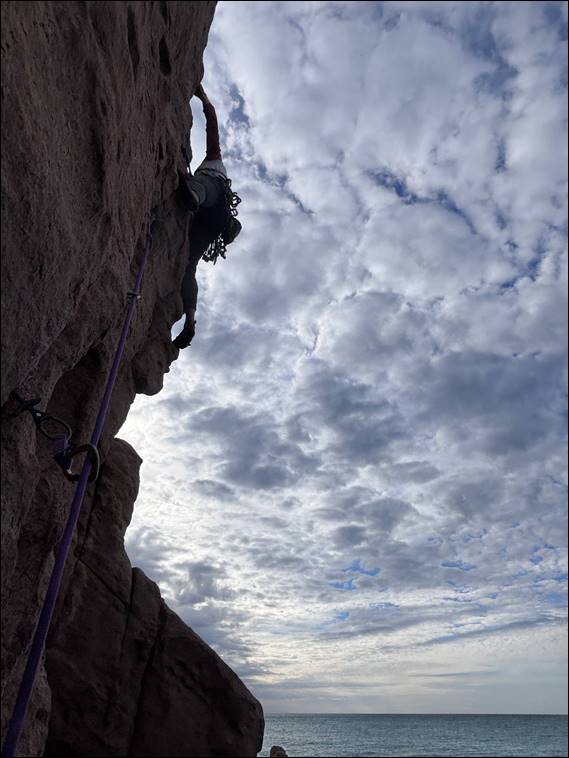
Lisa and Natalia’s focus remained seaward. Being rewarded with tails, flippers, blows, and the occasional breach, admittedly way out to sea. Too far for my eyes, without glasses, to be able to make out and appreciate. As such Craig and I didn’t see anymore. Having taken on the narrower cracks, these kept him more on the face of the curtain wall. And this last route had him extremely focused, challenging him both mentally and physically. Maybe another classic case of being under graded, as I gave it a mere legs-eleven in my now updated mini-guide:
As Craig battled onwards, or should I upwards, Lisa and Natalia left us to it. Only then and after catching a few tiddlers, a fun term from the homelands for small fish in case you were wondering, Henry too finally had more luck. Pulling in a Brownspotted Wrasse (Notolabrus parilus) and two Chinaman Rockcod (Epinephelus rivulatus), the bigger one shown below. All released back to their watery home. He did however have his eye on a big Rockcod that occasionally ventured out from under a ledge. I have not heard if he was successful:
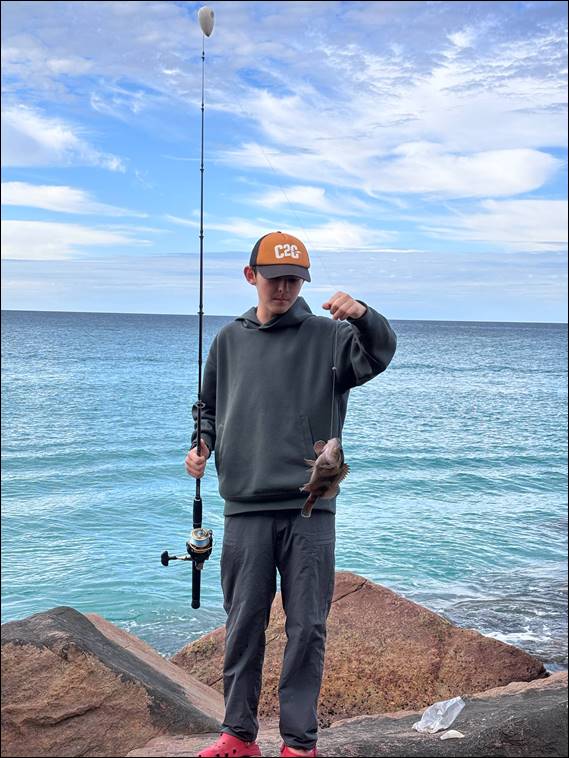
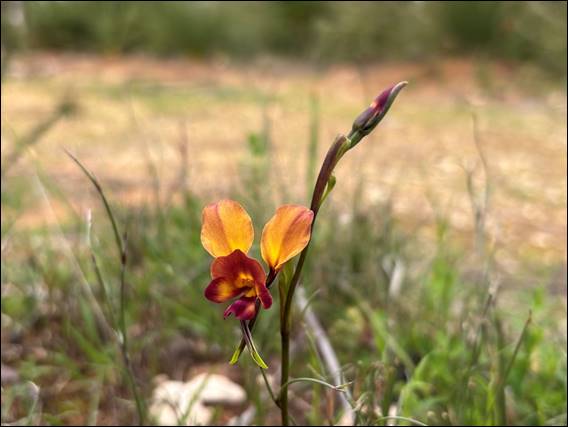
As after that climb I too headed off. Leaving Henry who was definitely not keen to leave yet, wanting to continue his pursuit. This allowed Craig to pull out the big camera, for when the evening light would start to come on. Allowing his arms some time to recover, after I had sandbagged him on his last lead. On the way home I couldn’t resist a quick check and was rewarded with yet another relatively new species, only formally described in 2014. A solitary Dunsborough Donkey Orchid (Diuris jonesii), which wrapped up the day nicely:
 Sandbagged