In 1546 John Heywood’s collection of proverbs was published in A Dialogue conteinyng the nomber in effect of all the Prouerbes in the Englishe tongue. This work included ‘whan the sunne shinth make hay’, and yes I have got the spelling right. It’s origins were very literal being related to the best time to cut hay. Obviously when it is dry. Today we use the saying ‘make hay while the sun shines’ more broadly to suggest taking advantage of a good situation, a lucky break, or a favourable time before it ends. Today ‘the sunne’ did indeed ‘shinth’:
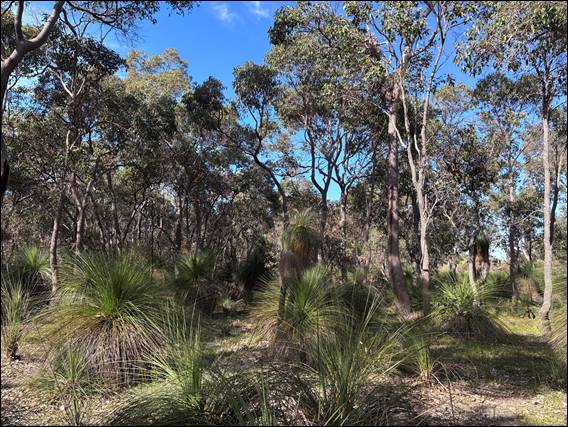
Resulting in me being drawn out to the Ruabon Nature Reserve. Offering a varied range of vegetation complexes in a small area. Above a Marri and Jarrah woodland. Two tree species that are often found growing together. Both liking the Mediterranean climate, poor and gravelly soils, and able to handle dry summers. This is where I found the Yalgorup Donkey Orchid (Diuris porphyrochila). You may think the Donkey Orchid genus name would relate to the ears, but no. It comes from ancient Greek words dis and oura meaning double and tail:
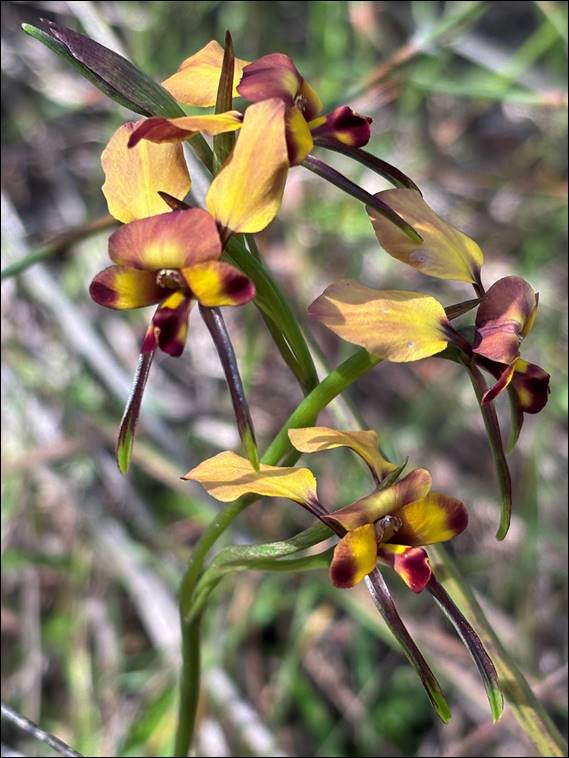
Relating to the two long drooping side sepals hanging below the flower. All Donkey Orchids have these, just like all Donkey Orchids do not produce nectar and have no scent. They instead attract pollinators by micking the colours and ultraviolet light patterns of local Pea Flowers. The species name is made up from ancient Greek words porphyros and cheilos that mean purple, purple-red, or dark-red and lip, rim, or edge. These colours trick insects, making it look like the below Common Brown Pea (Bossiaea eriocarpa) as well as other Pea Flowers:
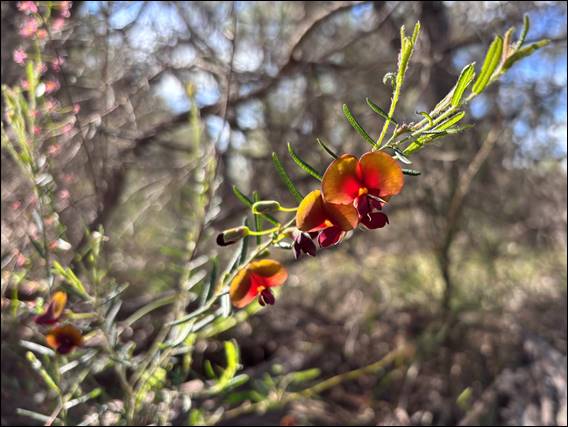
The Common Brown Pea is endemic to the south-west of Western Australia, and is primarily pollinated by native bees. Donkey Orchids are probably happy not to attract all insects drawn to the Common Brown Pea, which is subject to a parasitic interaction with Gall Wasps (Tanaostigmodes). They lay eggs in the plant tissue, resulting in a protective swelling being formed in which the larva feeds and eventually breaks out of. While it does not kill the plant there is no physiological or reproductive gain, plus the larvae feeds on valuable nutrients:
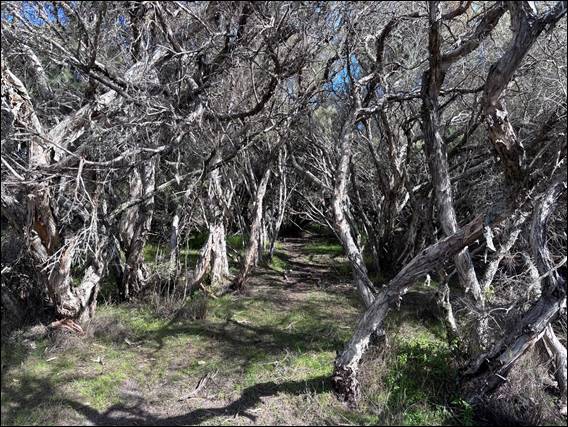
The reserve also includes stands of Tea Trees and Paperbarks, Leptospermum and Melaleuca, which thrive in the lower lying wet areas. These areas would usually be inundated at this time of the year, but are bone dry. I have not seen too many fungi, in view of how dry as it has been, but did stumble across these two Craypot Stinkhorn (Colus pusillus). Having just missed seen them in their prime. However, the olive-brown slime called gleba is just about visible on the right. This is what stinks of rotting flesh, dung, or decay to attract flies:
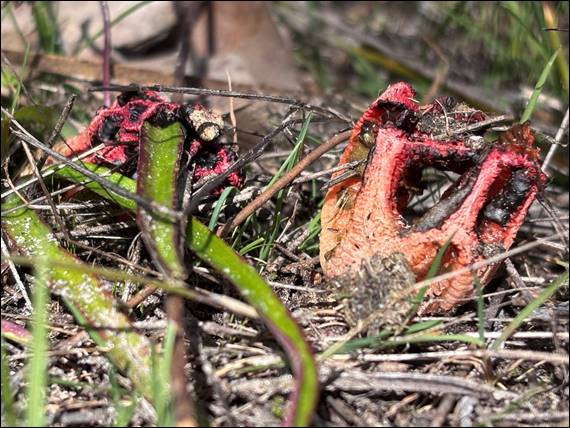
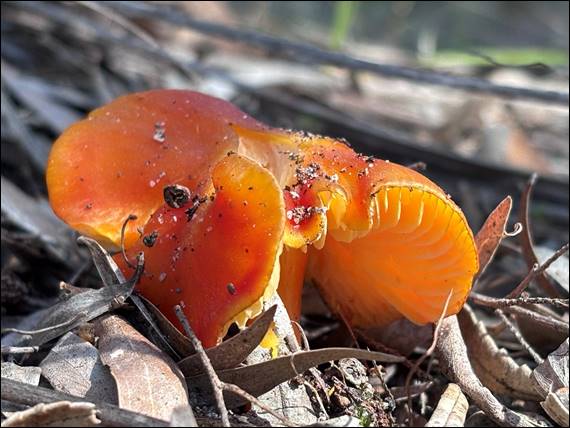
The slime contains microscopic spores that are spread when they stick to the flies mouthparts, bodies, and feet, or pass through their digestive tracts. In this situation the attractant is not used as a trick, and the flies are rewarded. The foul smelling goo is not just ‘sweet smelling’ to them but is also a sweet, nutrient-rich liquid. I also found a single Waxcap (Hygrocybe polychroma), another endemic species to the south-west of Western Australia and one that is said to favour wet Jarrah woodlands. I have however seen them in other environments:
There were a couple of isolated repeat orchid finds from my recent outings, which I have not included. The next image is instead of a Pearl Flower (Conostephium pendulum). Favouring sandy soils and often found in Banksia woodlands. Yes this reserve also has areas dominated by Banksia. Seeing I have focused a bit on pollination and spore dispersal, this flower also has an interesting tale. The strangely shaped flowers have evolved for ‘buzz pollination’, which is performed by native Sweat and Plaster Bees (Lasioglossum and Leioproctus):
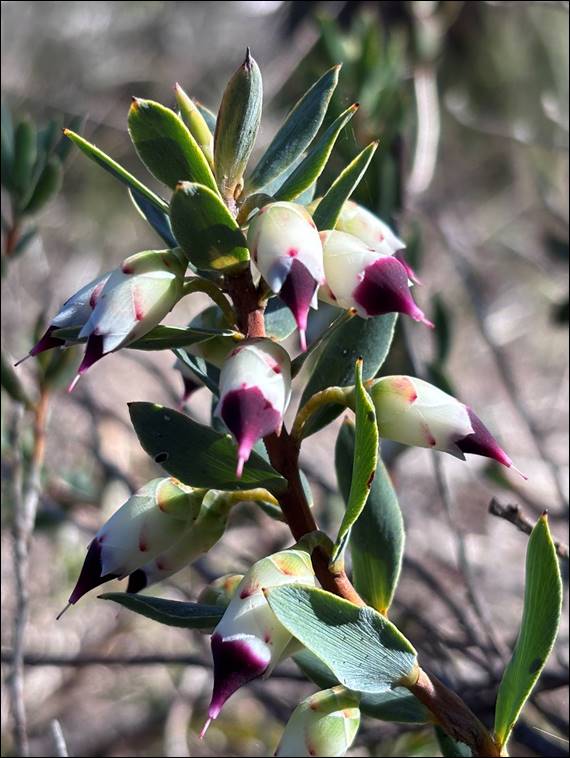
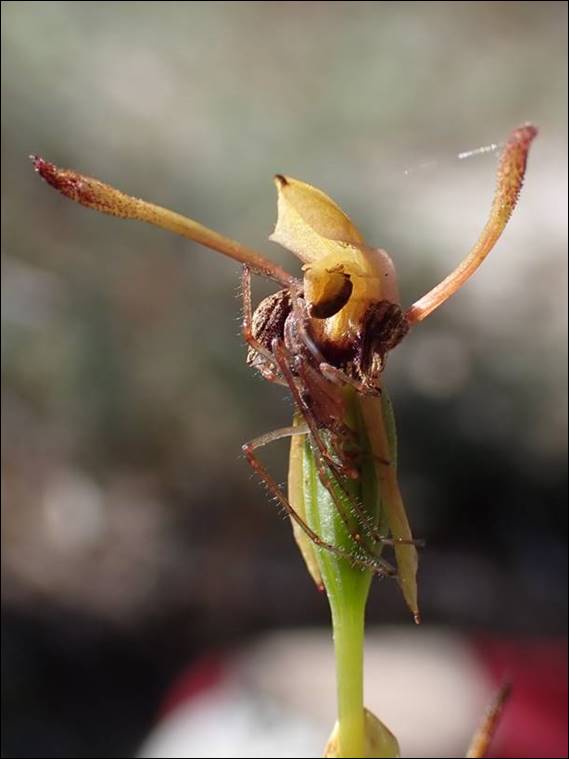
These bees wings vibrate at a very specific frequency, which is required to release the pollen onto their hairy bodies. Going to show that it is not just orchids that have formed some very specific plant-pollinator relationships. My last image is of a wilting Fringed Hare Orchid (Leporella fimbriata). Only included due to what I believe to be a Lynx Spider (Oxyopes), which is no doubt only making use of the flower as somewhere to hang out as it waits to ambush an unsuspecting prey:
 Sandbagged