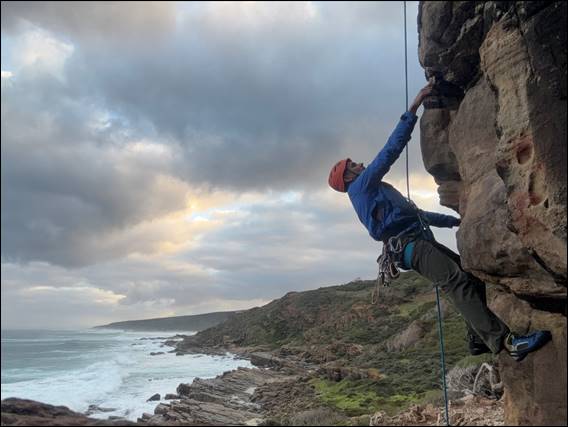
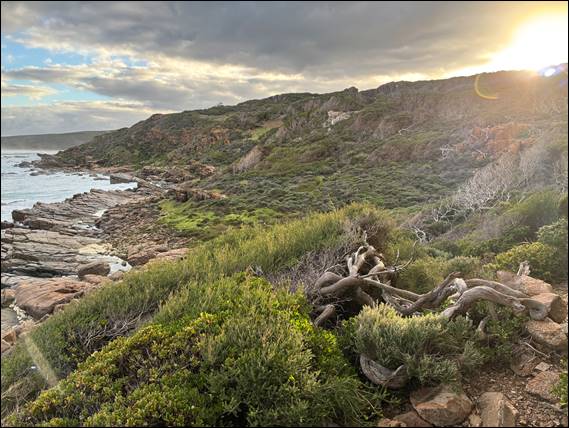
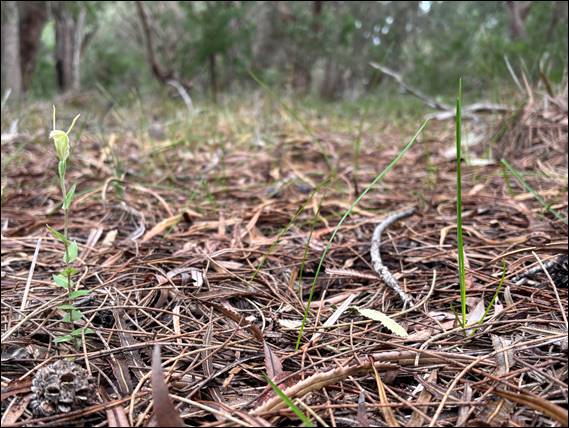
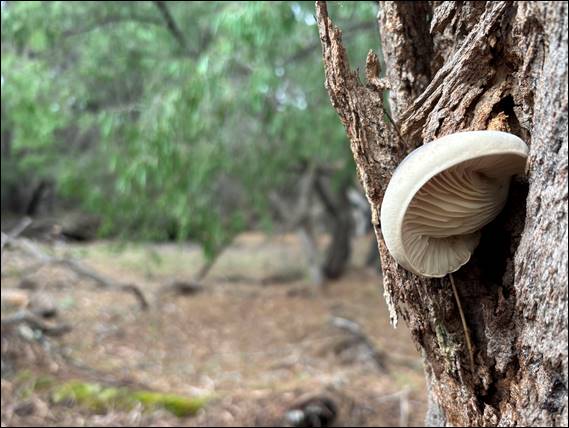
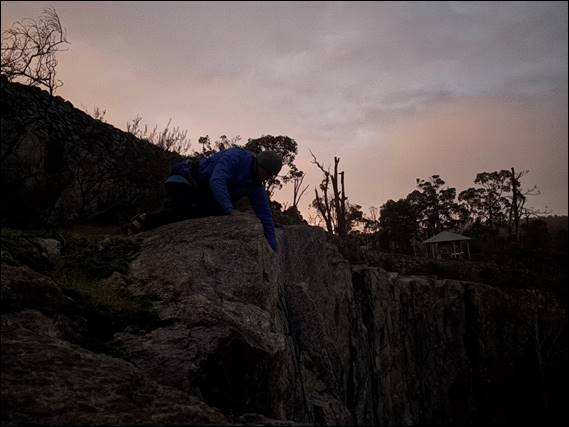
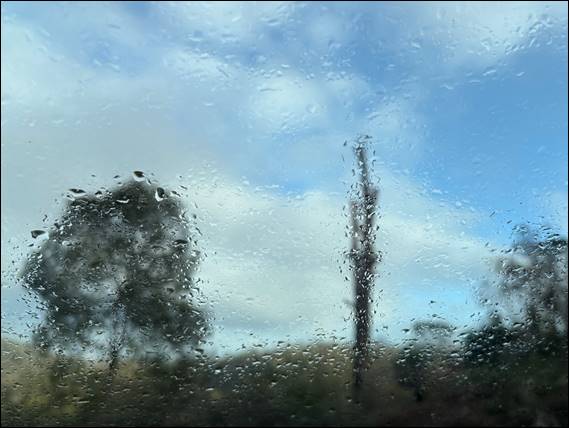
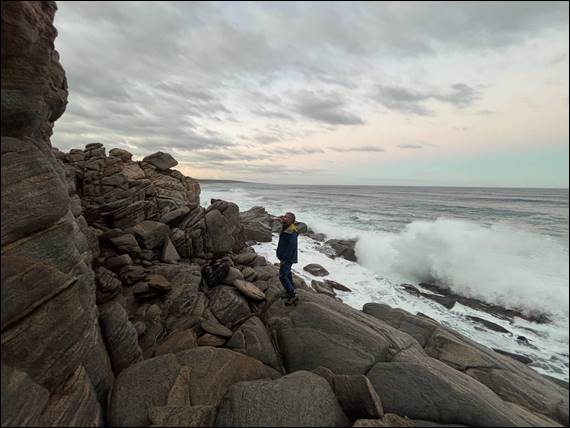
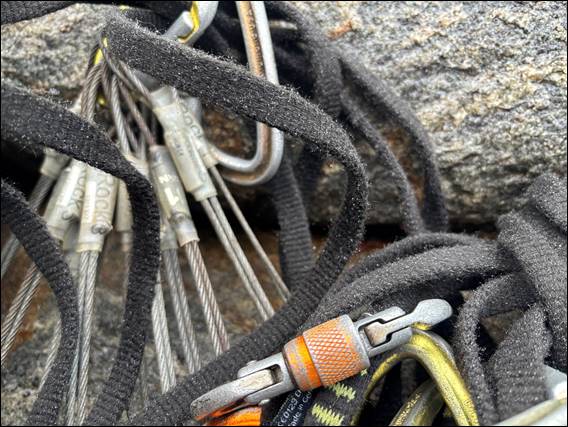
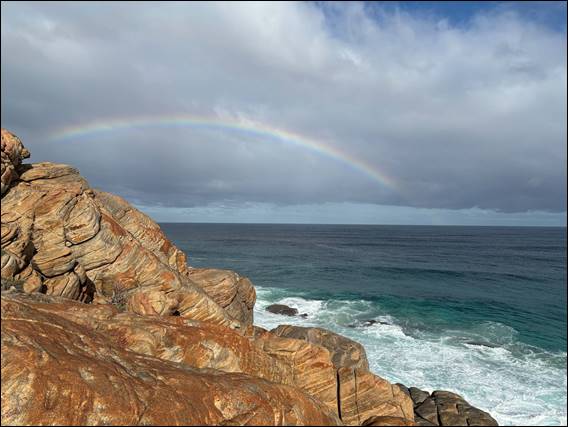
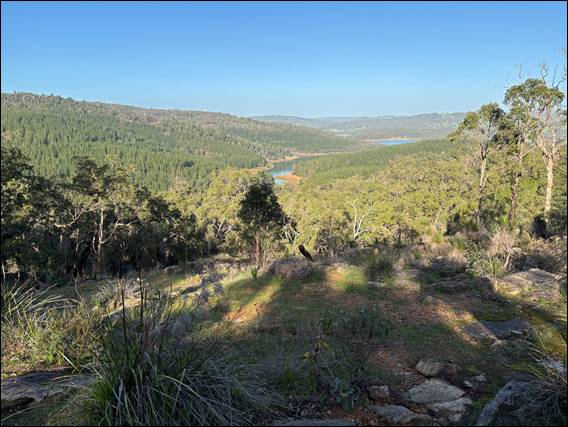
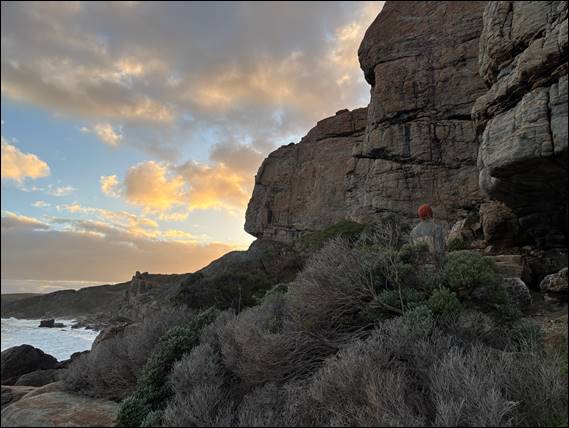
The public has been warned that “winter is coming”, and is being urged to prepare for the first major storm of the season. A cold front and low-pressure system is forecast to hit the west coast today, bringing with it showers, thunderstorms, and gusty winds. Rainfall of several inches was predicted, which doesn’t sound like much but it is for here. Never one to miss out on an opportunity to have an atmospheric time out on rock, Howsie and I decided we would head down to Wilyabrup. We were greeted to a ‘red sky in the morning’ morning:
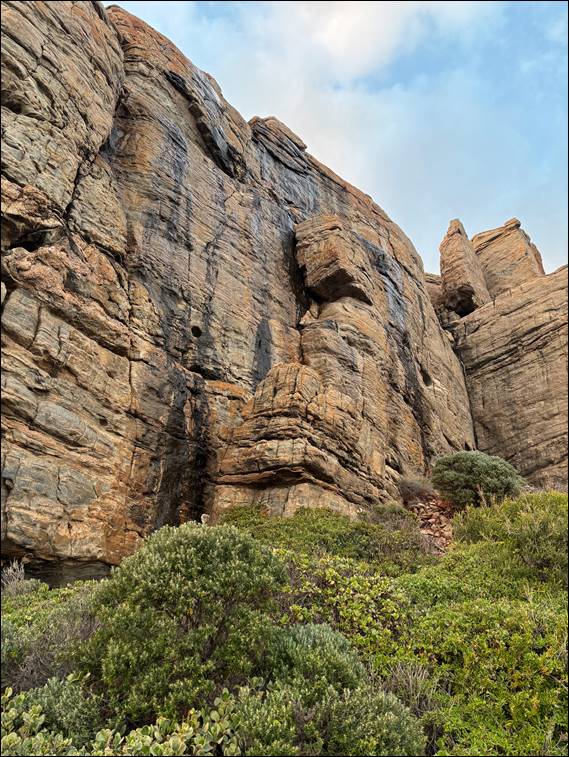
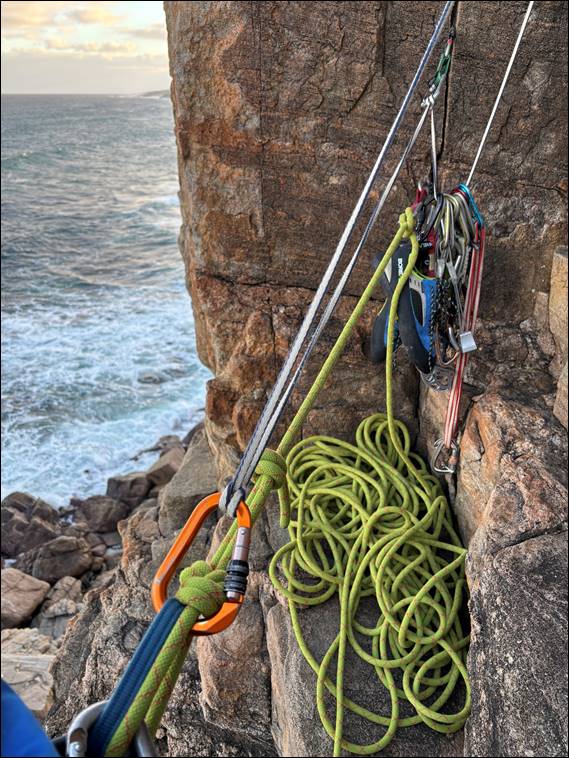
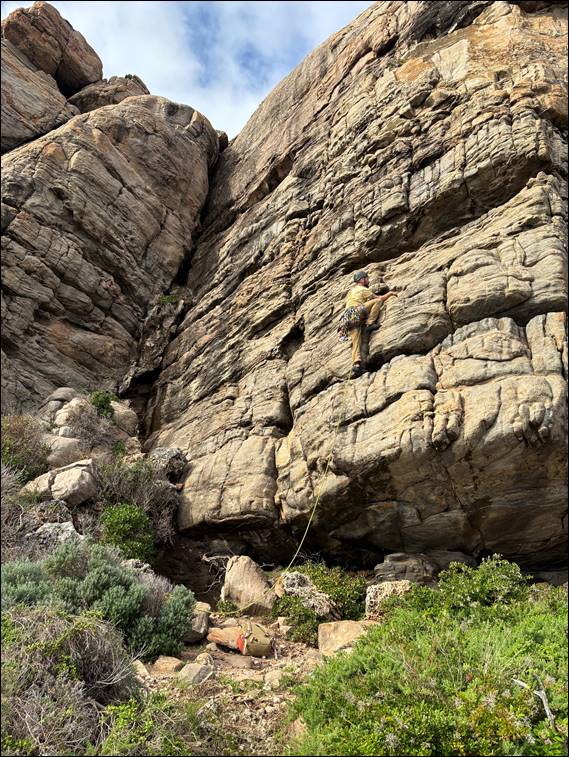
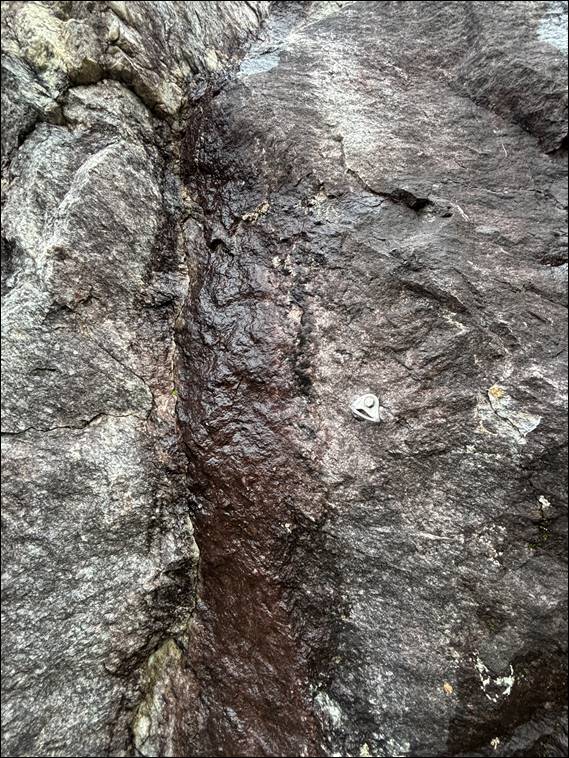
This heeding a warning that aligned with the forecasts, but for now there was no sign of wild windy or wet weather hitting the coast. At least not where we were. We traditionally place our gear under the overhang below Hope Buttress, but today we moved a bit further along and settled under the Stormcock Boulder. Not that this provided improved shelter from the elements, should it come in. The reason was that it was closer to where we would start climbing. A sneaky little wall, hidden away. One that is as far as I know is untouched:
I spotted it last Friday when I came down on a solo mission. Rapping into a scrappy area that rarely gets any attention, I looked across and saw it. Taking an image and sending it to Howsie, suggesting it may have a couple of worthy first ascent opportunities. Always up for an adventure he was keen to check it out. Based on a visual inspection of the image I took the possible routes didn’t look like they would present too many issues. As such we picked today to check them out, fully prepared to be greeted with rain and water running down the rock:
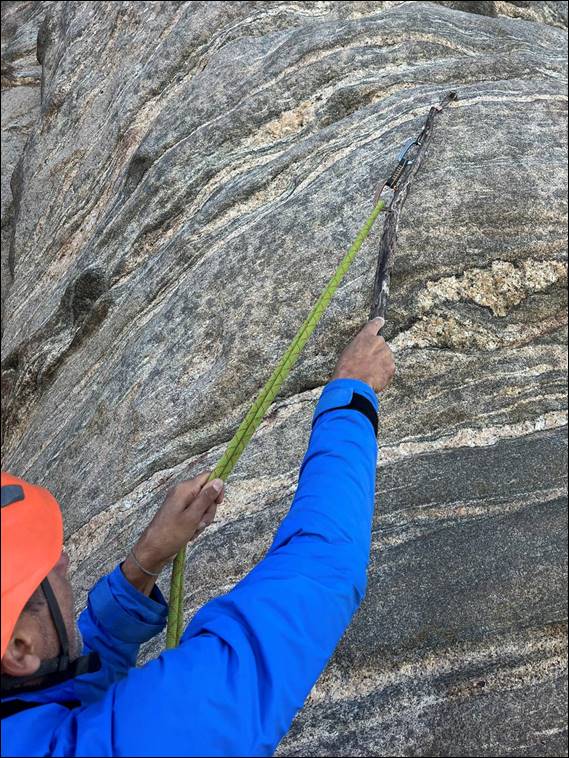
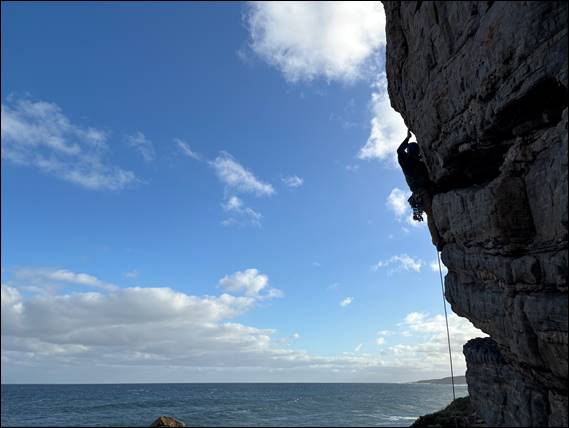
It was not to be, and for the most part the rock was in good condition. Pleasing Howsie who, after being offered the choice, plumped for the primo looking line on the main wall. As can so often be the case, what looks straightforward is not. Steeper than we first thought, the holds were less obvious than we expected, and the gear required a fair bit hanging about to get in. All making for a very entertaining line, and one with a bit of a runout feeling and nervous finish on the upper wall. Rewarded with a new climb that we though only lived in dreams:
This is on the basis that Wilyabrup has been climbed out over the last fifty odd years. So spotting something worthy that hasn’t been played on is a real treat. Still in sensible mode, I picked the easier of the routes on offer. The left arête led to a delightful slab, coated in a veneer of quartz and providing a perfect brown tricam sized pocket for added fun. I had visions of ascending this as water cascaded over it like a waterfall, but still it remained dry. And more surprisingly we managed a third independent line on this little buttress:
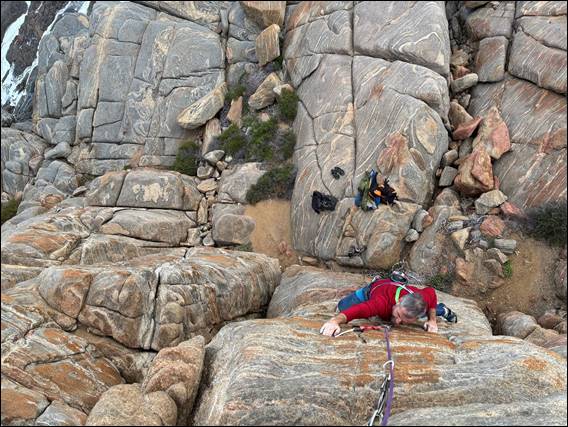
A bit of squeeze up a chimney led Howsie to a clean square cut corner. Seemingly made for gear and sporting holds to make it an enjoyable climb. And while we kept looking out for rain, it was still not looking likely to worry us. This led me to suggest he jump on the climb that had led me to find this spot. Going up the buttress behind him in the above picture. At the triangle shaped roof there is an exposed move out right. He admitted to having been on it with Nadia, but the top sketchy limestone section had worried them and they escaped left:
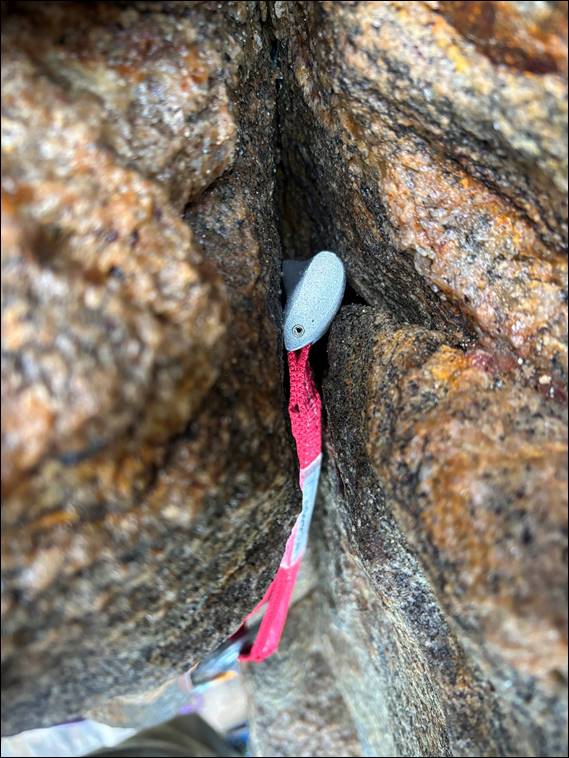
Today he was fine to run it out past the above the unusual sling placement, which to be honest I would also have been happy with. Even the unprotected limestone coated slab up to the capping roof didn’t concern him. But at the committing traverse I felt I needed to encourage the increasingly worried sounding leader to keep going. Once atop the crag, we checked the weather radar. The storm belt was tracking south but gradually heading inland towards us. Looking to be moving slowly enough for us to squeeze another route in:
This time we picked a climb we knew well, unlike the others today. Still keeping Howsie focused and engaged, and as he inched up the final section I was tied in and ready to climb. The air temperature dropped and I felt a few drops. Somehow it eased off allowing us to finish up, pack the gear, and walk out in the dry. Not till we sat in the car did it rain. As alluded to in my words about each new climb we established, it seemed fitting to make use of our expectations of inclement weather and damp conditions to name the new routes:
Route titles, courtesy of Howard Jones, Billy Joel, and TLC, and descriptions:
Don’t Always Look at the Rain 10m 12 Squeeze up the chimney, followed by a delightful corner. Howe, Seewraj 2025
River of Dreams 10m 17 Work your way up the middle of the wall trying to place gear before pumping out, and then keep your nerves up the slightly runout headwall. Howe, Seewraj 2025
Don’t Go Chasing Waterfalls 10m 13 Steeply up the left side of the wall, before delicately tip toeing up the slab. Seewraj, Howe 2025
It was time for our next weekend getaway. Not sure we picked the best dates. A public holiday on Monday extended it to three days, which would no doubt result in more traffic and potentially difficulty in booking somewhere. Then added to that a pretty big front was due to roll in on Friday, the day we aimed to leave. And could have washed out a fair chunk of our planned two night trip. Indeed we struggled to find available accommodation that was not massively overinflated at the first couple of areas we thought it would be nice to head to:
This led me to suggest heading a little further afield. After all we had the chance to start our journey around lunchtime on Friday. Plus we could return at a leisurely pace and get back a bit later on Sunday, what with Monday in our pocket to clear up and prepare for next week. It was agreed, and we found a lovely place to stay down in Walpole. Three hours to the south, in a landscape that allowed us to experience a few wanders in amongst some big trees. After a great night sleep, without two pesky poodles hogging the bed, we awoke refreshed:
Our first destination was Mount Clare, where we got to see the Red Tingle Tree (Eucalyptus jacksonii). Only found in the higher rainfall areas round Walpole and Denmark, these trees have a huge girth at the base. The one in the first image is 12m, but they have been recorded as double that. The reddish bark is stringy, making it feel spongy and soft and you can almost feel the warmth exuding from it. Having adapted to the wetter climate it is susceptible to climate change, which is a worry with the south west of Australia already drying and warming:
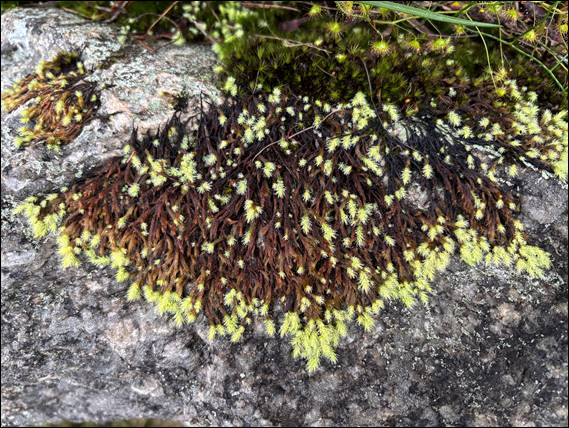
This was my second visit here. The first was five or so years back during a climbing trip when we inadvertently parked on the opposite side of the mount to where we were heading. This adding four to five kilometres to the already fifteen kilometre round trip. It was a monster day already, so we didn’t get to the peak. Not heading that far today we did reach the top of Mount Clare. There the granite lay bare with lush green moss flourishing where the water ran across the depressions. This created an image of islands, and land for creatures to roam:
Lisa laughed when I got excited seeing a Black Keeled Slug (Milax gagates). It wasn’t however good enough to make the cut, being beaten by the above millipede. Despite being quite unique, with a clearly segmented body and orangey brown marks along the side, I cannot identify it. Later on Lisa then excitedly showed me one of her finds, and I think she was jesting. It may however be an endemic Glauert’s Land Snail (Bothriembryon glauerti). Named after a curator of the Western Australian Museum, who used his time studying snails:
Bugs aside we were both very taken by the Red-eared Firetails (Stagonopleura oculata). Small finches that kept a healthy distance, but were playful enough for us to get a really good look at them. Next time I’ll have to bring my SLR to get a good shot. They have intricate patterns and stunning colours. It was a lovely walk. There is something calming about being amongst truly big trees. Made more relaxing as there was not a sole in sight for the entire near five kilometre stroll. Not even another car at the carpark when we returned:
Before heading back for lunch we went to a place I had not been to before, called Circular Pool. It was still in amongst beautiful vegetation but a very different walk. A mere 600m black topped path meandered down from the carpark to an idyllic pool, which we were able to enjoy having the place mostly to ourselves. The tannin stained water cascaded over a rocky descent, and the water below each step filled with foam. In the final pool, as the water slowly swirled as it made its way along, the outer bubbles burst and created patterns:
I’ve found out the foam is a natural phenomenon. A result of something called saponin, a substance found in many plants. It has soap-like properties, and the vigorous splashing and churning of the water as it tumbles over the rocks results in the foam. The foam can then become stained by the tannins that come from the eucalyptus trees. Creating a cappuccino effect, and Circular Pool is well known for this. It is a big draw card for budding photographers. The pool is special for something else too, someone called Lionel Gunson:
Back in 1962 he was the first National Park Ranger in Western Australia, and was very progressive in what he achieved. Living at Coalmine Beach in Walpole, he was concerned about the impact visitors were having at Circular Pool. After a near miss, when a car almost rolled into the pool, he went about establishing a carpark. Then building steps down to the pool to prevent the place being eroded. We eventually wandered out, to yet another carpark in which our car was the only occupant. And drove to Walpole for a spot of lunch:
Managing to have stayed dry all morning, we then looked out of the room and watched the rain as it repeatedly came and went in belts. It was never going to stop us getting out in the afternoon. The weather had been expected, so came prepared. The drive to Mount Frankland was certainly damp. At one point, with rain to the east and sun to the west, it felt like the rainbow was inside the car. A secondary rainbow was fighting hard to be seen, but never getting any clearer than shown in the image:
This place is full of Jarrah (Eucalyptus marginate) and Australia’s tallest tree the mighty Karri (Eucalyptus diversicolor). They typically grow thirty to sixty meters high, and can be as tall as ninety meters. Sheer vertical trunks powering out of the ground, making for the perfect ‘fire tree’. Meaning a place to sit on high and watch out for fires. All up there were eight fire trees spread across the south-west forests, which the foresters would climb using pegs driven into their trunks. Then simply sit atop, on a platform, to look for the first signs of smoke:
But that is not why we came here. Mount Frankland is another place I am very familiar with, having come here many a time to climb the huge granite dome and faces. Today it was a tad wet, although I have climbed here in much worse conditions. No today, was about a pleasant stroll round the base. Lisa had not been here before, and swears blind that I suggested there was a nice and even gravel track round the base. I feel there may have been some miscommunication, as I knew full well that was not this case. She ribbed me regardless:
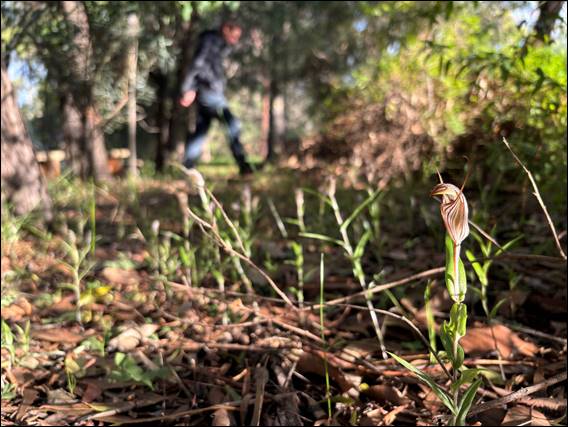
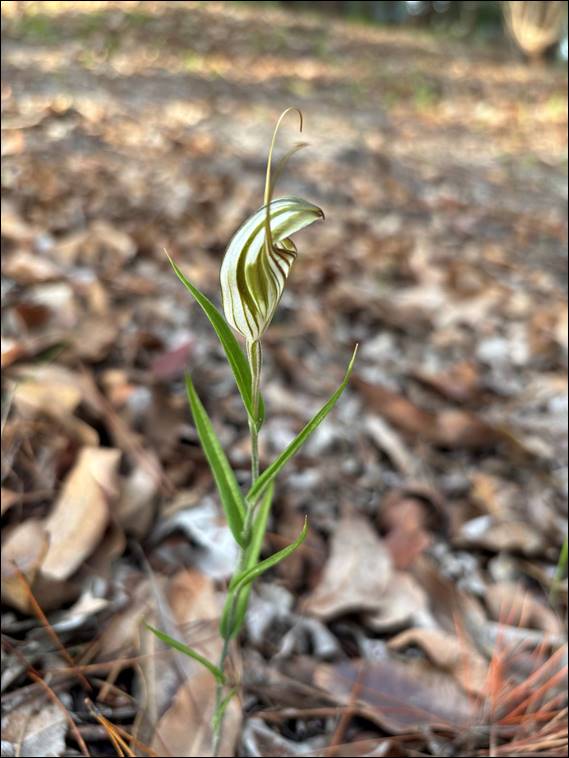
I did however know that is never gets too silly, and was entirely manageable. And indeed it was a wonderful day to be here, we saw a few people at the carpark but no one on the track. As we walked we did as we had on the last two walks, kept an eye out for anything of interest. Winter is upon us, so the not surprisingly there were very few if any flowers to see. But just as I had given up all hope, late in the walk we spotted my first Banded Greenhood Orchid (Pterostylis vittata)of the season. Of which there will no doubt be many more to come:
We also spied a few repeat Bunny Orchid species and sub species. Eventually making it to the end of the natural path and onto the main tarmacked, and shorter, track that takes people from the carpark up to the summit. And this is where it became claggy. The sky darkened, rain fell, and any hope of views disappeared. Lisa’s knees were ailing her a tad, so she declined the offer to climb the final three hundred steps to get to the top. But was happy for me to head up just so I could see nothing of the landscape, it had come in good and proper:
However, on the way back down I spied what some would disregard as just another Bunny Orchid. I however got all excited even though it was not in the best of shape. This was a Granite Bunny Orchid (Eriochilus pulchellus), not found up our way. It is however a relatively common species in these more southern parts of the South West, growing in shallow soils on granite outcrops. The flower has that bit more colour, and yet again a slightly differing leaf shape. It made tackling the three hundred steps in these conditions more than worthwhile:
Back at the start we escaped the rain under the impressive shelter, supping on our still hot brews we had made before driving out. Three wonderful wanders today and only during one did we get wet, or at least our rain jackets did. Watching the birds in the trees and listening to the rain fall onto the roof, it was a lovely way to end our day out in nature. Our car all by itself one more time, it was a little surprising there were not more people out and about on this long weekend. Not that we were complain about having these places to ourselves:
As the light started to fade, and we knew there was no hope of seeing a sunset, we walked back to the car. Here we were both taken by the patterns along the side of our usually white car. A bit like the patterns created by the bubbles that came from the saponin; nature had taken the dust we had kicked up as we drove along, stuck it to the car, and then used water to create an artistic display. Almost like a drone image of the landscape from on high, and something we pondered capturing more often. Touting it as art created by the mud-man:
Back in Walpole we headed out for dinner and a game, before another good night’s sleep without poodles fidgeting about. Our third day arrived, meaning we had to start the journey back. It was a lazy start, and we aimed to head off track to break up the journey with a stop in to see Lane Poole Falls. A five kilometre hike, this time through a Karri and Marri (Corymbia calophylla) forests. Starting at the Boorara Tree, which was one of the eight fire trees. The peg ladder having been removed for the first ten or so meters, to prevent anyone climbing it:
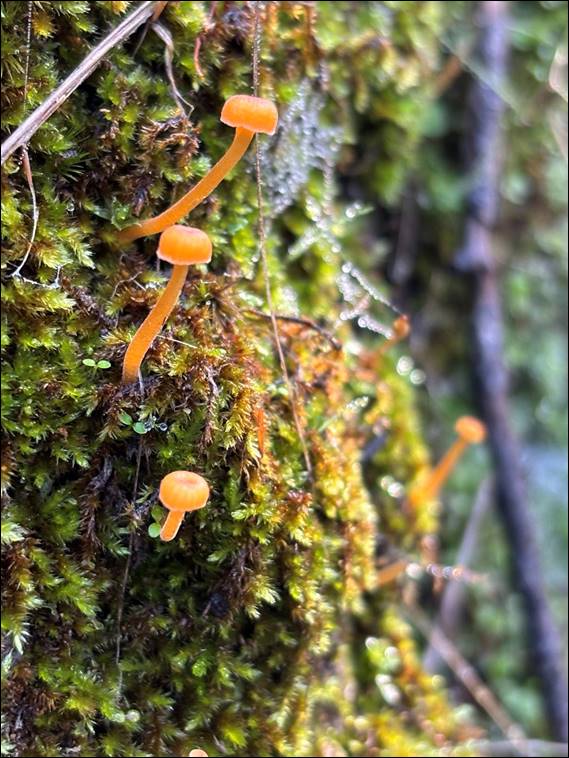
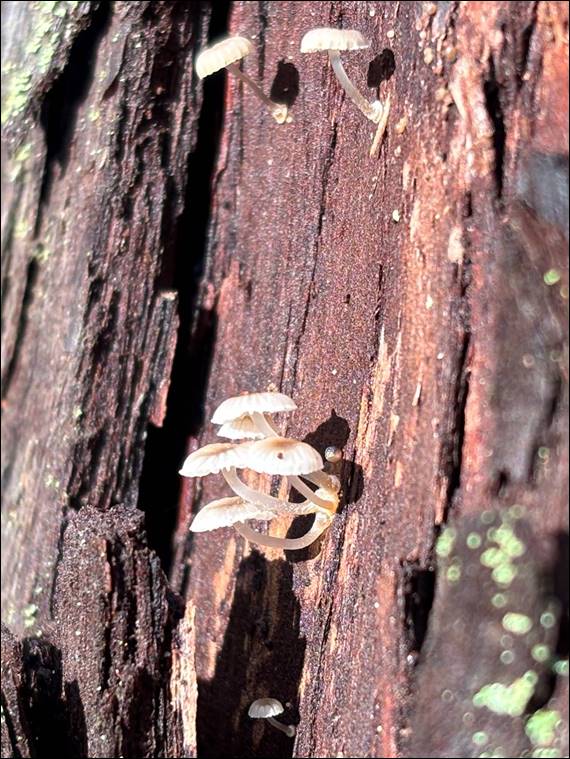
The path was much wider than the other walks we had done, but the location no less beautiful. And as an added bonus the path was littered with a stunning array of fungi. We had seen a couple of good ones on each walk, but this place blew the others out of the water. The five kilometre walk taking a fair bit longer than it should have, as we spied more and more fungi. Eventually making it to the falls, where another fun foamy pattern was on display in the pool below. After soaking up the place, again with no one around, we started back:
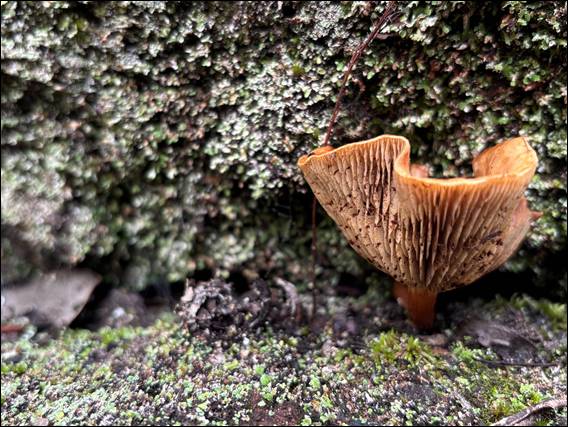
Fortunately the walk out was the same path, so we didn’t stop nearly half as much. And nor does the post stop here, although it is where I will leave you. If I were retired and had more time on my hands I would go through the impressive array of fungi we found to try and identify them. Indeed I recognise a few. But it is getting late and my bed is calling me, albeit with poodles in it tonight. There are a couple of sneaky double ups, but not many. So I would encourage you to keep scrolling, and it starts with two that we found at Mount Clare:
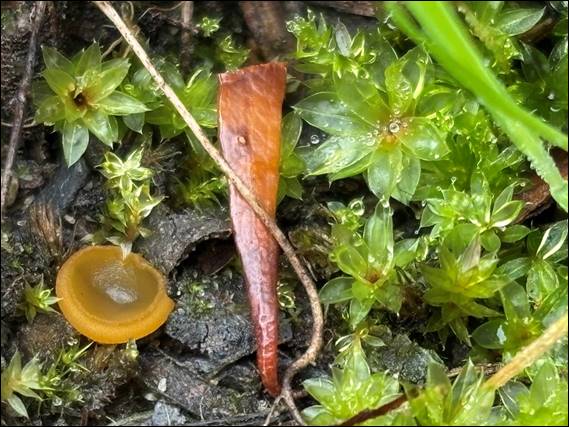
These two were at Circular Pool, the first is the size of a dinner plate:
The next two are from Mount Frankland:
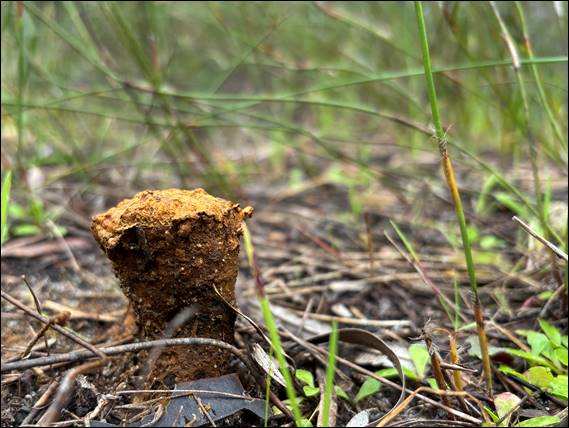
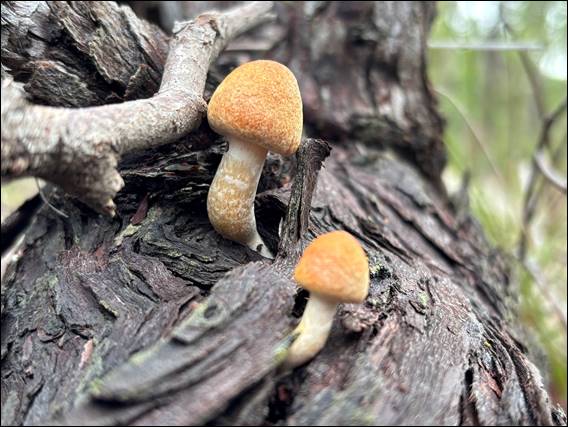
And finally the explosion found along the Lane Poole Falls trail, in the order we found them:
Lucky for me I worked from home on Friday. When one of Lisa’s plunging friends messaged her to say we had a unusual visitor on the beach, I was able to quickly hoof it down to see for myself. The sweeping prints left by the flippers indicated it had come ashore very recently. They led to an adult male Australian Sea Lion (Neophoca cinerea) lazing in the dunes. Despite looking like cumbersome creatures, they are very good at climbing. The dune may not be an impressive ascent, but they are known to be able to scale steep rocky terrain:
I can only recall finding one on the beach here once before, but know they occasional turn up. This male looked old and battle weary, puncture marks across the back of it thick neck and broad powerful shoulders. More likely to be a result of territorial wars, as opposed from their two main predators that are great white sharks and killer whales. They are the only endemic species of seal in Australia. The population is estimated at 10-12,000 of which over 40% are found in three colonies over east resulting in them being sparsely distributed over their range:
As a result they are one of the rarest sea lions globally, and not surprisingly their conservation status is listed as endangered. Due to being a rare treat I went down to say hello three times that day. With each visit it had moved, but not by much and in each location it took on a perfect sunbathing pose. Not at all phased by my presence, merely opening its eyes to see who was about before closing them again. For the third time Lisa and I went down as the light was fading, and it was back up on the dune ready to settle in for the night:
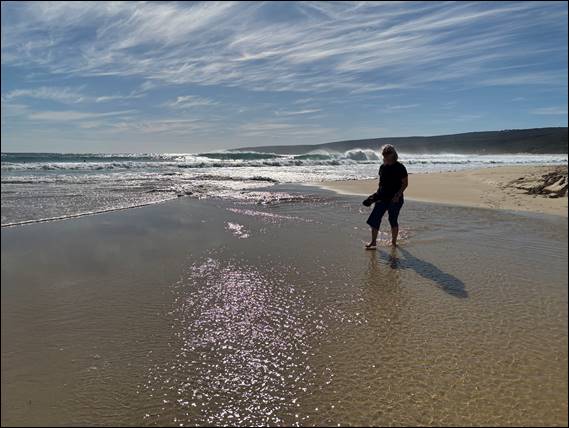
We did the same and headed home. This term Lisa has been getting up early to fit in a remarkable amount of activities before work. Driving to and from an exercise class, studying, reporting writing, and the usual morning stuff. Resulting in what most regard as my unnatural time to get up, being even earlier. Lisa can somehow switch to staying in bed on weekends, but my body clock makes me restless and I end up getting up at the same time. Consequently I was at the top of the crag on Saturday while Lisa was walking down the beach:
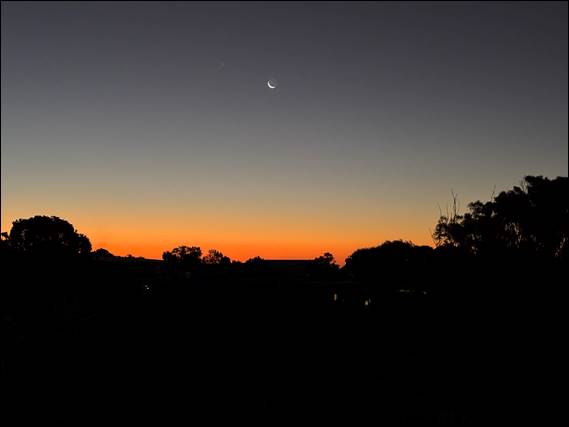
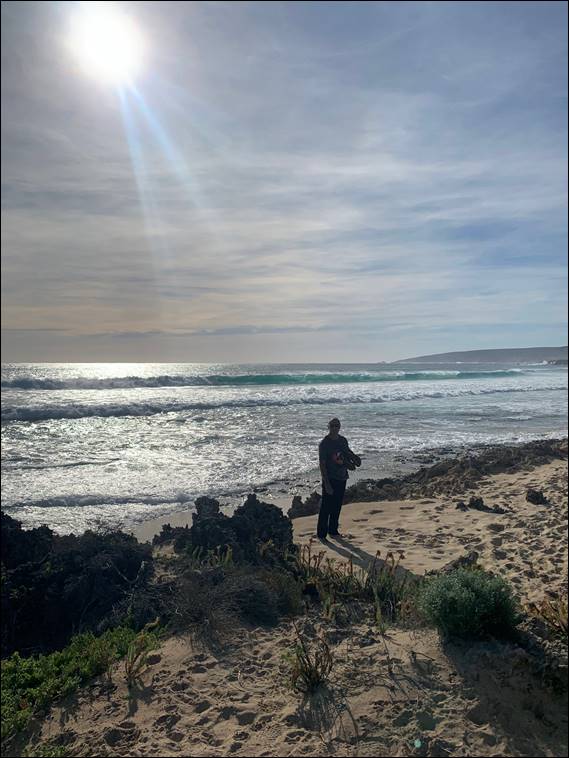
The Australian Sea Lion was nowhere to be seen, no doubt having returned to the ocean after feeling it had suitably rested up. No one was about and available to get out today, which assisted with my early departure from home. Driving out the sliver of a moon and one star was thinly veiled by wispy clouds, the light was however too low to catch an image. At the carpark with more light starting to creep in, I couldn’t resist a shot. The morning light show was extra special today and I took quite a few more images, as set up the anchors:
I had a bit of a game plan, but wasn’t sure how far I’d get. The weather was a little unsettled. When the sun managed to peak over the ridge and through the clouds, rainbows appeared and vanished out to sea. On occasion the rain made it to shore. Never too heavy, until my fourth route. A line that is not likely to get climbed much. It is a bit broken and has a slab leading up the capping roof covered with brittle flowstone and no gear in sight. I’ve lead it once before close to twenty years back, and decided today was the day to jump on it again:
It was fun and with a rope above me felt fine. Although I will admit to being a tad nervous about the traverse from under the roof on wet holds. Even more so on my second lap, when water started to stream over the roof and the holds became even less secure. But as with all my chosen climbs today I was being sensible and had picked ones at a comfortable grade 14 or VS 4c. After completing the second lap the sky and ocean started to become one. Quickly bundling up my gear I only just made it to the shelter of the toilet bock before it poured:
My head and heart battled it out. Still keen to get two more lines in, but my head suggested it was too wet. Mind you my elbow had held up pretty well so far, only wincing a little on a few moves. Plus I do enjoy these inclement conditions, it makes me feel even more alive. This made me even more keen to make the most of it, without being silly. The heart won out, and I set up the line in the easing rain. Having a surprise when I rapped down to find a group huddled under the overhang, seemingly being given instructions on trad climbing:
Despite my cheery hello and joking suggestion that the rock was in pretty good condition, only one of the trainees looked over and smiled. Not a word was said in response to my greeting, as the person instructing carried on talking. It was all a bit strange, so I started climbing and left them to it. While the rain was slowing down water still ran down the rock. On my first lap water made its way down my arms as I reached up. Coming down three more times, they looked like statues. Huddled and still listening, looking not to have moved a muscle:
The rain stopped at some point, and clearing skies were rolling in as I walked out. Quite a few empty pupal cases of Rain Moth (Abantiades atripalpis) were about. The moth can be the size of a small bat and have an uncanny ability to know when rain is coming, which it did here yesterday. Emerging a few hours before a major downpour, and living for a single day. The female scatters up to 40,000 eggs while in flight, making us of the rain to wash the eggs into crevices and increase their chance of surviving. I didn’t however see any of the moths:
It wasn’t FOMO that resulted in me driving towards Welly Dam at first light. The trip was certainly not for a climb. That would have been dumb after what happened on the last visit just a few weeks back. Climbing aside, during that last trip with Howsie we were lucky to see some great orchids. At that time I explained the features to look for to help identify them. He’d use this new found knowledge early this week to recognise some Swamp Bunny Orchid (Eriochilus helonomos), during a work trip along the bank of the Collie River:
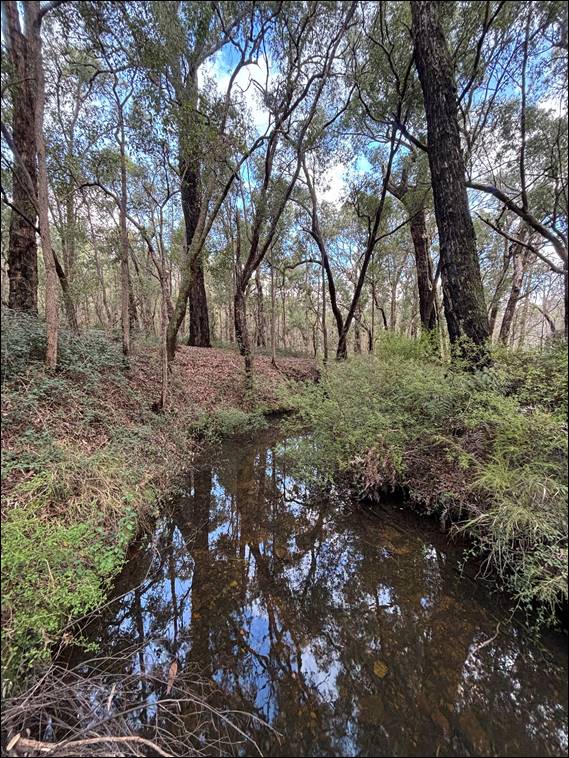
A species that has alluded me to date. I could have used his direction to find them. However, it felt a bit excessive to drive the approximately three hour round trip, for no other purpose. Instead, and because he had spotted them on the South Branch of the Collie River, I hoped they could also be on banks of the main branch of the Collie River. Hence why I was heading to Wellington National Park. Lisa had a morning full of stuff that she wasn’t to crack on with, so I went solo. Making it that bit easier to sneak out and arrive at first light:
Getting there early, when it was not so bright, had other bonuses. This place has got very popular. Not just with the hikers, but also the mountain bikers. Many of what used to be great trails to wander along peacefully are now dual use. So you need to keep an eye out for those travelling on two wheels, more often than not dressed in Lycra, who tend to go that bit faster. The roads were mostly quiet but a car tailgated me most of the way into the park. Seemingly not caring that if I had to brake suddenly they would likely have rear ended me:
They pulled up alongside me in the parking area that was devoid of anyone else, and a woman hopped out to get ready for a walk. After a polite hello I left her to it and went ahead. I didn’t see her again, so I guess her walking pace did not match her driving pace. I must admit I kept a pretty good speed. Keeping an eye out along the way, but also keen for some mileage. Much as I was keen to spy some orchids, after what Howsie had told me yesterday, a few days earlier I had already decided to have a longer hike to get a bit of a cardio workout:
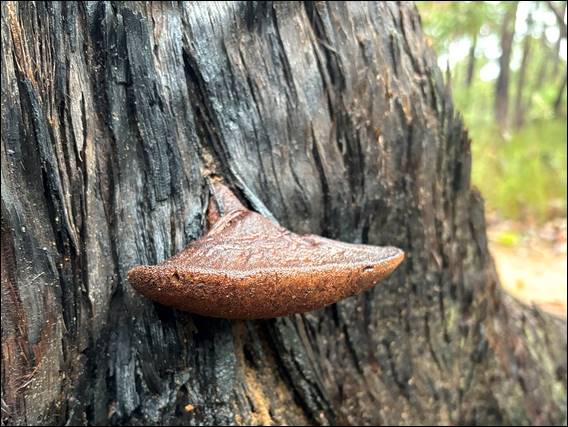
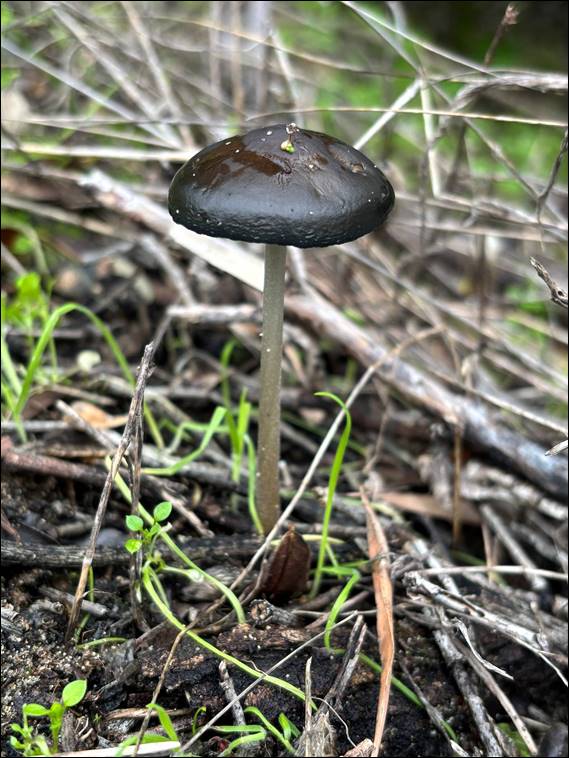
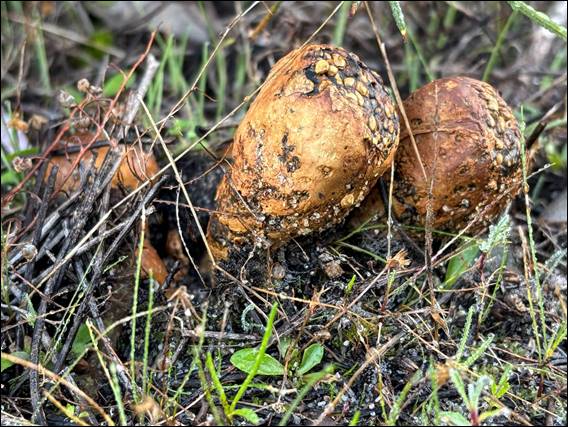
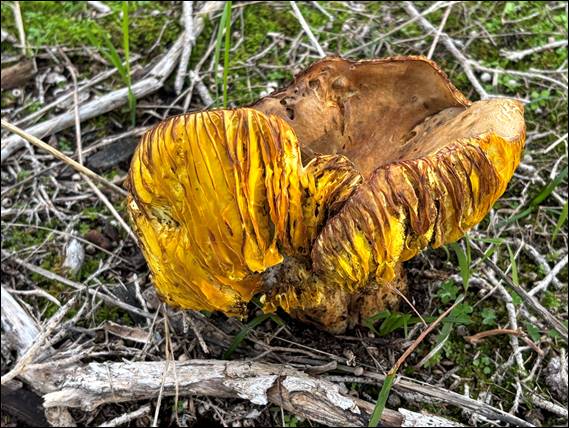
I’ll get to the orchids later, as the stars of the day were the fungi. A couple of images up is one from the Boletus genus, which is as far as I have managed to get with it. The giveaway for the genus being under the cap. A mass of porous almost honeycomb looking flesh, as opposed to the neat radial lines of gills. I started along the river walk from the Honeymoon Pool end, and it took just over an hour to get to Welly Dam. The longest I stopped was when for a Tammar Wallaby (Notamacropus eugenii), two in fact and both observed me as much as I did them:
They are the smallest of the seven living species in the genus Notamacropus, and have a couple of special qualities. This includes having colour vision, using less energy than most when hopping, and also being able to drink sea water. The latter being in their favour due to the Collie River suffering from inland salinity. Not reaching ocean salinity levels of 35,000mg/L, but being over double, and at times triple, what is considered the levels for fresh water. There used to be an eighth species, sadly after colonisation the species only lasted another 85 years:
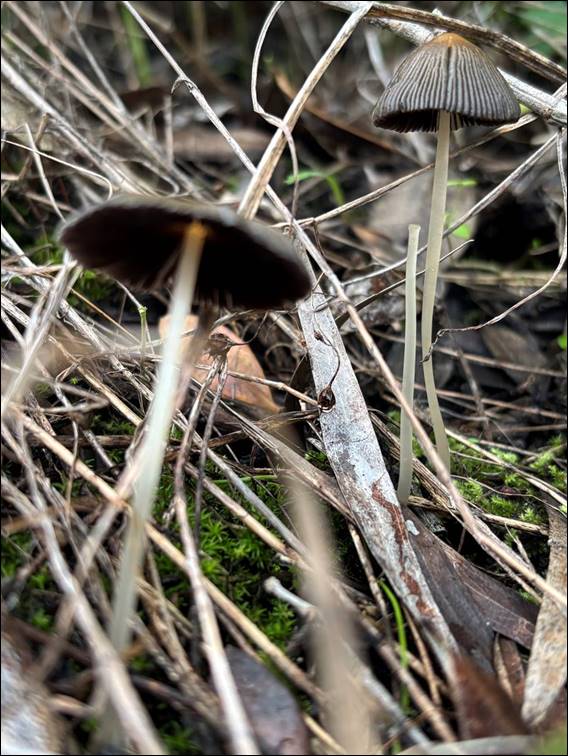
Moving on, the second fungi image may be of a Dark Melanoleuca (Melanoleuca cf. fusca). That is according to a fungi field guide of the general area that I have a copy of. My web searches hoover suggest maybe not, and hasn’t helped to suggest what it may be. For me, identifying fungi feels like working on a really tricky puzzle. Of which I have one that is still in the box, unopened. The image is a little like the above one, but instead of Jarrah and Marri trees, it is of the taller Karri trees found further south in the Boranup Forest:
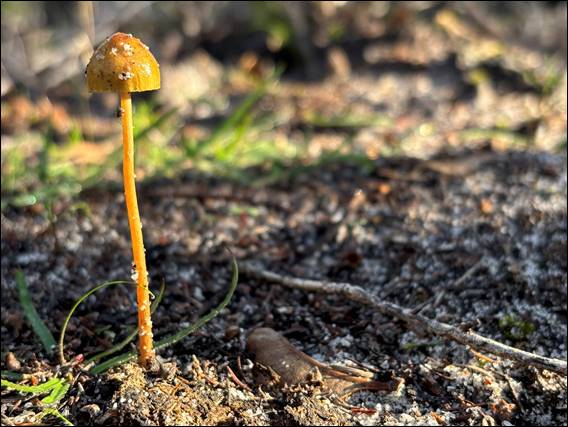
This time my field guide hasn’t helped me one bit with the above find, and after lots of research I may have to admit defeat. But just like puzzling if you keep going eventually you’ll find a piece that fits. Although to be fair there really is no mistaking the below, and very aptly named, Egg Yolk Fungus (Bolbitius titubans) for anything else. It would seem I was lucky with my timing to see them in all their glory. Several sites suggest they typically live for no more than 24 hours, making it one of the shortest-lived mushrooms:
Finding natures wonders will so often happen when you are in the right place at the right time, so to a degree is a bit of luck. For example all those great orchids Howsie and I saw just two weeks, at the top of the walls we climb, were gone. However, with time you build up a knowledge base of what you have found and where. Mind you I do feel going back to the same places takes away some of the fun of the hunt. Today’s hunt scored me more Common and Crinkle-Leafed Bunny Orchids, both of which I have already seen this season:
I also added the Easter Bunny Orchid (Eriochilus dilatatus subsp. magnus) and above White Bunny Orchid (Eriochilus dilatatus). Increasing my chance of luck today by walking back on the tracks higher in the landscape, through differing vegetation and soil types. This also assisted in me working up a bit more of a sweat on a ten mile, or so, circuit up and down the hills. All that said maybe next year I won’t rely on luck alone, and may dip into Howsie’s beta to see the Swamp Bunny. For now however I can safely say I do not have fear of missing orchids:
With Nadia away with friends, we had to wait till a wee bit later in the morning before we could hit the road for another Friday rock session. It meant the chance of a collision with the animals was far reduced. Although the roads were significantly busier with the less fortunate souls that still had to go to work today. All these factors had to be taken account of, if Howsie was to get back in time for the school pick up. Driving down we got organised. Agreeing the climbs on the hit list, and the times for various steps to make sure we returned on time:
While I enjoy the walk back down after a climb, due to the circumstances I brought a rap line. Maximising our time going up the rock, by speeding up our descents. With strategically selected routes and the rap line placed in the middle of the cluster, we were set to go. For those wondering, yes I do still need to be careful. To lessen the risk of me doing something silly, I told Howsie he was on point for the whole session. A rope above me as I climbed would allow me to be more relaxed, and be less likely to make sudden movements out of desperation:
There was no complaint from the other side. In addition, and before, we had started the trip down Howsie had hinted at moderating the grades to doubly make sure I was being sensible. There was however one route here that Howsie has previously bottled on. Never having managed a completed lead on it. Admittedly there is at least one pretty spicy moment on it. Other parts feel airy and runout even though they are not. This makes it as much of a mental battle as a physical one, and this set the scene for the lines we picked for the day:
Not super high in difficulty, but each climb having a bit of a reputation for being a mental sandbag at their grade. And not surprisingly they are all fully trad, there would be no bolt clipping today. After Adrian’s battle on the route below not that long back, this was one I suggested as fitting the bill. Howsie having no memory of ever leading it trusted my thoughts. It took one test run to get over the crux bulge. Coming back to the stance below to compose himself before going for it. Made more impressive, due to the rough swell today:
We were not racing to pack the lines in, just aiming to keep a steady pace. It was up to Howsie’s head to decide the rate he would take on, and style he would ascend, each route. Three lines in and he was starting to feel his arms, the flash pump on the first route didn’t help. The super long runout on the second and greasiness on the third had then made him grip that bit harder. None of this helped when on the fourth climb. At the crux where you have to leave your gear behind, he started to lose the mental battle. But not completely:
Down climbing the sequence back to the ledge to shake out, and refocus. I’m reading a book, which is a rare occurrence, called ‘Ron Fawcett – Rock Athlete: The story of a climbing legend’. As an autobiography it might sound like ole Ron is blowing his own trumpet. However, he was an exceptional climber and pioneered rock climbing into a new era with amazing first ascents. Lines many thought would need to wait for several generation to come. Climbed without the modern sticky rubber shoes or protection. They are still a significant undertaking today:
Why is any of this relevant you may ask. Well, in the 70s when Ron was at the forefront of British rock climbing and up there with the world’s best climbers, I have just been reading about what was called the yoyo technique. Frowned upon by the previous generation of climbers, but accepted by the modern day elite to make ascents that bit safer. Climbing as high as you dared placing gear, and then coming back down. Then repeating this with the rope already above you at the high point reached. With the aim to get that bit higher:
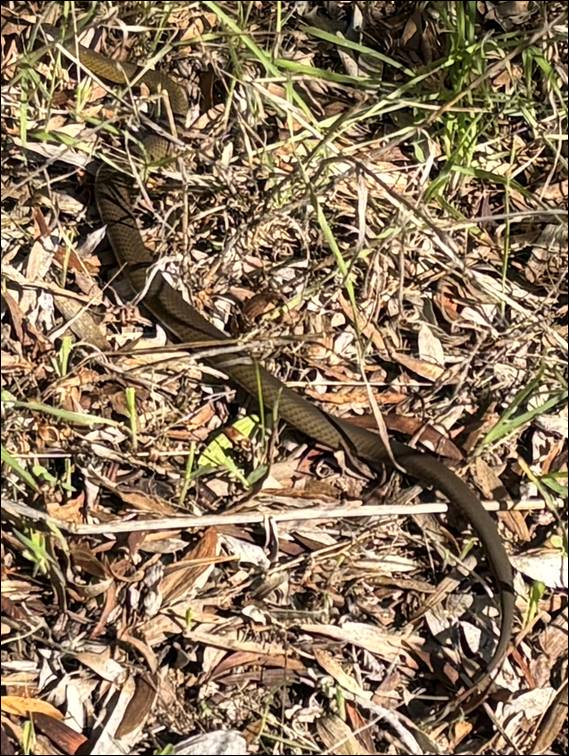
I guess if this technique was good enough for Ron, then its good enough for Howsie. After resting up he stormed up the line. Then despite his nerves tingling, bagging the above route in one push. The one he’s previously backed off and never completed. The last line had to be the obvious one to climb out on with packs. Having an added bonus of a baby Carpet Python buried deep in the flake on high. Not purposely watching the clock, we somehow packed up, got back to the car, and arrived at Capel pretty well bang on our pre-planned timeline:
It may be dead but I couldn’t resist including an image of this Hairy Stone Crab (Lomis hirta), mainly because it is the first time I have found one. While the name includes the word crab, it only has three pairs of legs in addition to the claws. This means it is not a true crab and is a carcinisation, or non-crab crustaceans that has evolved over time to form a crab-like body. They only grow to about an inch wide so this one may have died of old age. We spotted it as we rock hopped along the coast to the Playground, and were equally fascinated by it:
We being Craig, a different Craig to the usual one, and myself. Mikie had introduced Craig to the group a little while back. When I posted that I was up for a cruisy Saturday morning out, he jumped at the chance to join me. An easy trip was on order after I went to see a sports medical practitioner last week. The good news being that I was advised not to stop all activities, the bad news was that I have added tennis elbow to my golfers elbow alignments. I had to have a giggle when the practitioner asked if I was a professional climber:
Unlike the Hairy Stone Crab I did not pretend to be something I am not and was pretty clear that I was not a professional climber. Despite this, after quizzing me about how much I climb he wasn’t so convinced. Now all I can do is wait on an x-ray and ultrasound to see just how much damage I’ve done. And like the Hairy Stone Crab, age is not on my side. At least not in relation to the time it will take to heal. Back to today and Craig didn’t know me from a bar of soap, but was willing to put his trust in me when I said I would teach him trad climbing:
The Playground was the perfect place. Short low grade lines that suited both my need to take it easy, and his need to be on something easy. Allowing him to focus more on learning how to place gear and practising good rope work. We had just had a glorious end to the week, only to be greeted to the ‘slight’ chance of a shower this morning. Craig made no mention of this as we walked in, having picked up from the chat on our group that I wasn’t adverse to being out in damp conditions. He also found out on the walk in that I liked a bit of adventure:
I took us along the slippery boulders on the coast. At times needing to wait for a set of waves to calm down before making our way across the wetter sections. I was the one to fall foul of this folly, being hit by the spray of a wave and getting soaked from head to toe. All I could think was how pleased I was that I had bought a waterproof case for my phone. Craig followed where I went and we eventually reached The Playground. I started to download knowledge before Craig racked up and tied in, and it looked like we may have been in luck:
We even managed to get a line in, before the rain hit. Most times along this coast we get a short sharp shower and can sit it out. Then, being so compact and with no porosity, the gneiss will dry out quickly. The ‘slight’ chance of a shower was however a ‘bit’ misleading. It rained, rained, and rained for the next two climbs. Even then when we thought we had got through to the other side, it came back. Craig climbed on unperturbed, taking lead after lead. Water was running down the rock and we were both soaked to the skin. And still we continued:
With each climb I checked the gear, his belay set up and anchors, and we talked through various elements. It was a rare thing for him to put a foot wrong, which was pretty impressive considering it was his first time of leading, first time of using trad, and even more so the conditions that we were out in. That did however finally change and the sun won out, which was very welcome indeed. Working our way from right to left the wall got steeper with each climb, and it was the fifth route below that was Craig’s undoing:
Taking his first lead fall on trad, and then taking several more at the same spot before admitting defeat and sending me up to finish the job off. We had a bit of a chat about grading, both for lead climbing and bouldering. At this place a few of my solos have been significantly upgraded, which I am still not convinced about. However, that aside he will be happy to know that the climb that had pumped him out so much is suggested, on The Crag, to be a V2 boulder problem. Not put off we kept moving left, below:
Another climb that made him work hard, but with perseverance he managed a clean ascent. There was no testing the gear this time, and again I was not able to fault what Craig had put in. He did however make the route that bit harder for himself, as a result of starting to tire and not thinking about technique as much as he could. I though he was going to be keen to bail and call it a day, but instead said he had one more lead in him. This time the climbing eased up, and it was a pleasant line with the sun on our back. A nice way to wrap up the session:
There was of course the walk back to contend with, and I did wonder if Craig would once more blindly follow my footsteps back along the coast. He did. Admittedly the sun had dried up most of the boulders nicely, although there were a couple of sections for which we had to be careful with our timing. It was Craig that fell foul on the return trip, but not to the same degree. Trusting in mounds of seaweed he lost a leg thigh deep, fortunately out of harm’s way as the waves crashed behind him. I get the feeling Craig will be keen to get out again:
The Peppy Plungers only dared to go into the water waist deep this morning. It was a tad wavy, and the less than ideal weather continued into the morning. On her return Lisa and I pottered about and finally got round to breakfast as we played a game. When she then hinted it was time to hit the books to prepare for next week’s study load, it was the perfect segue for me to head out the door. Armed with a brew in my sippy mug, and not put off by the patchy rain nor the rainbow that hung low in the sky over the Capel Nature Reserve:
The wet weather of late had started to bring out some familiar fungi. The above being an edible Southern Oyster Mushroom (Pleurotus ostreatus), if my identification is correct. As I just had breakfasts I felt no need to test that. This species crosses over two of the three main types of fungi, being both a decomposer and a weak pathogenic. Due to being found on both dead and live wood, but more generally the former as it was today. Decomposers are an essential part of the forests ecosystem, breaking down dead organic matter to make it more bioavailable:
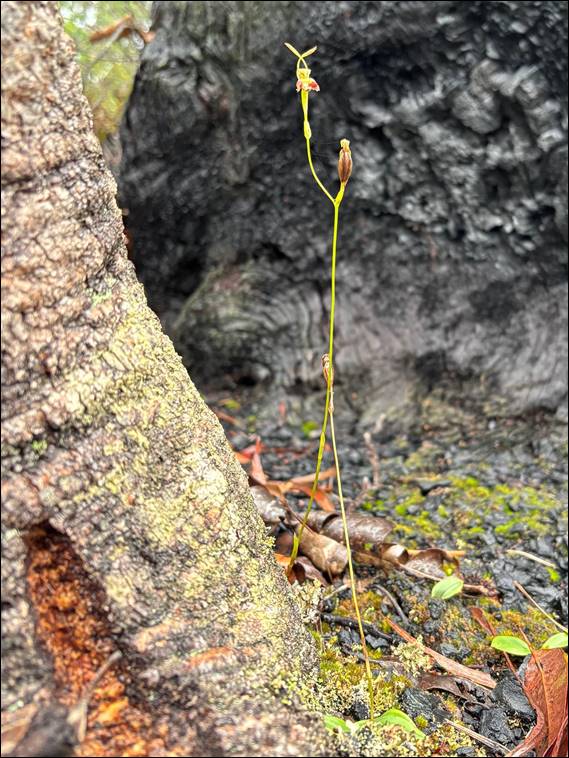
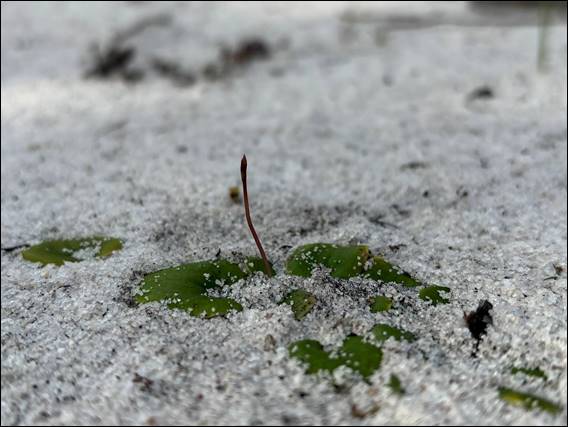
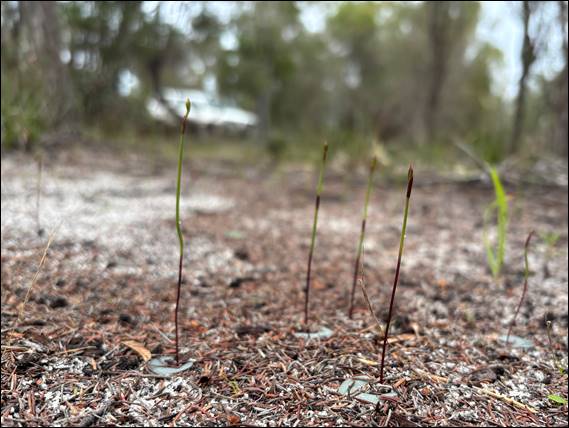
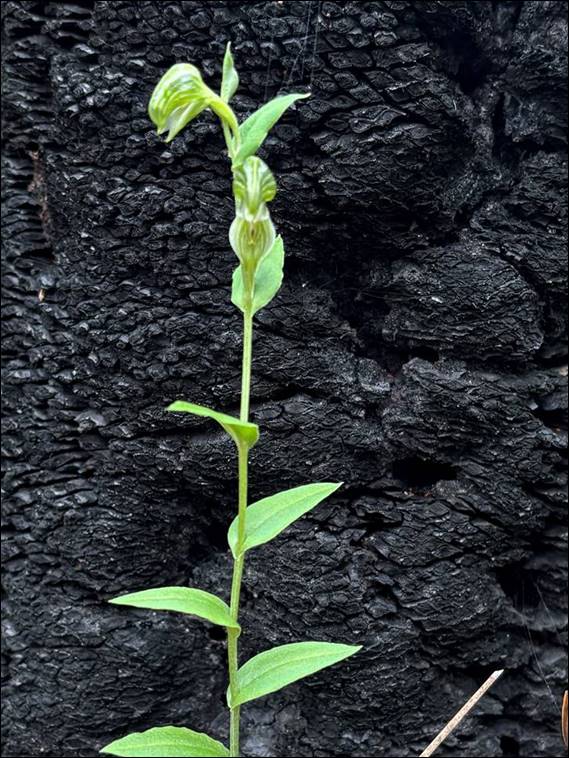
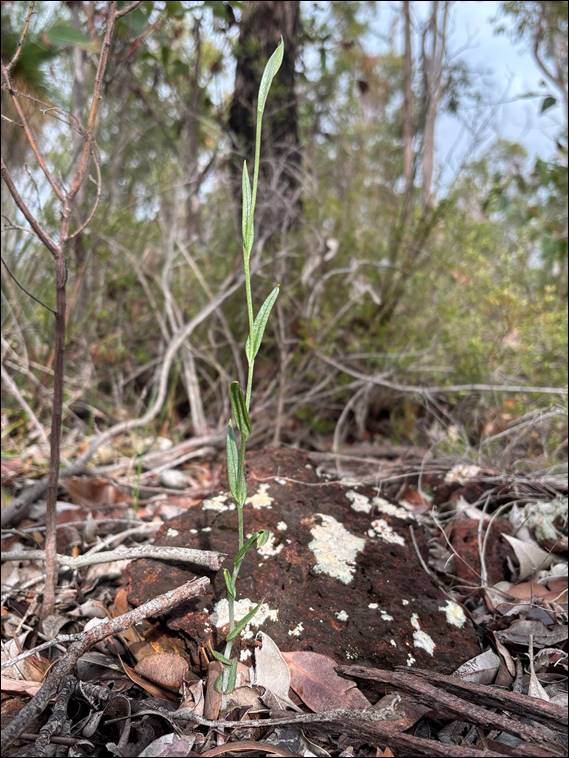
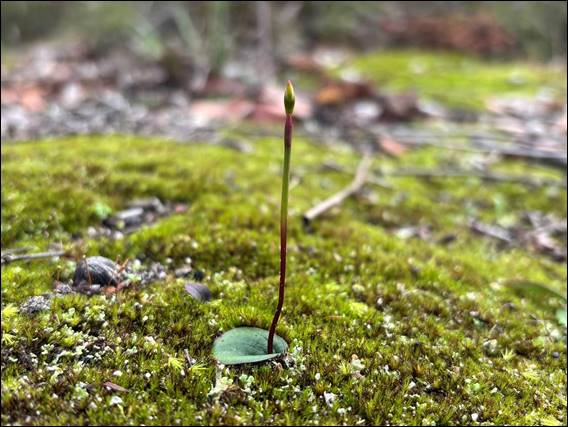
Needless to say pathogenic, or disease, fungi have a negative impact by invading and often killing their hosts. This can be trees, insects, and/or other organisms. As for the third main type of fungi, I’ll get to that later. A few weeks back I thought the first orchid spike I saw, as shown in the second image of this post https://sandbagged.blog/2025/04/12/the-tortoise-and-the-hare/, was a Hare Orchid. Much to my surprise and delight it was in fact the above Leafless Orchid (Praecoxanthus aphyllus). Only the second one of these that I have seen:
There were many Hare Orchids (Leporella fimbriata) in flower today. Lots in full colour, not just sporting the beard that gives this orchid its species name of fimbriata, a Latin word meaning fringed, but also having the delicate spotted pattern on the side of the broad labellum on proud display. During recent wanders its amazed me how rare it is to find any insects, so I was happy to come across this one. Even when, after a lot of digging about, it turned out to be nothing more than a Common Gum Tree Shield Bug (Poecilometis patruelis):
There are many genera and species of Shield Bugs that like to live on gum trees, and they share many similarities. The way to tell them apart, like some orchid species, is the detail. This can be the wing numbers and arrangements, segments of antennae, and placement of mouth parts. This one was a bit trickier, being in the nymph stage. From the time of hatching they go through up to five nymph or instar stages, each time moulting their exoskeleton. Not getting their wings until they become adults, and I’d suggest this one is at the 5th instar stage:
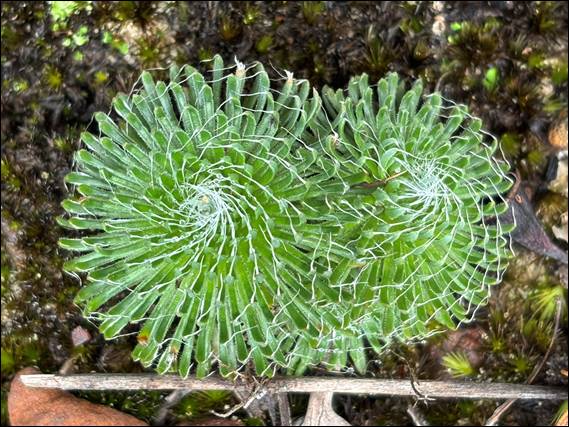
After a while I followed a track toward an area I’ve not been before, marvelling at the patches of little basal leaves that I recognised as Hare Orchids. And then I noticed the ones shown below, which are from the Glossy-Leaved Hammer Orchid (Drakaea elastica). Just a few weeks back I discovered that they are located in the general area, but I’ve never seen them. With only 42 known places in which they are found and a total population size of around 230 plants across these areas, they are listed as “endangered” by the state and federal government:
This listing means the probability of extinction of the species in the wild has been assessed to be greater 20% within in 20 years or within 5 generations of the species, whichever is longer. Hence why I was so delighted with my find of ten plants, and I went so far as to mark a pin of the location. I will however have to wait till September or October to see if any of them flower. Next up is a fungi belonging to the third main type, a mycorrhizal or symbiotic fungi. Without these many plants and animals would struggle to thrive, so they too are essential:
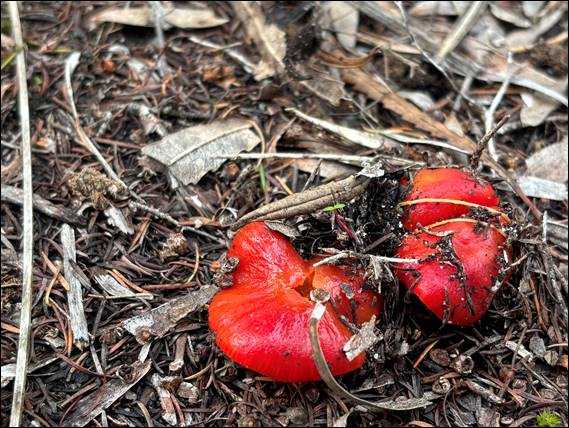
This one is an Erupting Russula (Russula erumpens), bursting into the light from under the earth. Fungi in this type can act like a secondary root system, extracting nutrients from the soil and supplying them to plants, including orchids. In fact many orchids are highly reliant on specific fungi, just like they are on specific insects to pollinate them, another area of their fascinating life I have yet to delve into. In the world of conservation and management we often refer to flora and fauna, many feel it is time to change that to the three Fs of flora, fauna, and fungi:
Deep into my second hour or walking, and to be honest I had no idea I’d been wandering about that long, I almost missed a second Leafless Orchid. Not that they are easy to spot, it’s there in the above image if you can see it near the base of the picture. This one was more mature, with petals that had a bit more colour in them. These orchids are highly fragrant, to help them attract native bees for pollination. The purple labellum has yellow calli to resemble pollen-bearing stamens, but there is no nectar so any bees attracted by the scent get no reward for their services:
For my last image, I found one Scented Autumn Leek Orchid (Prasophyllum sp. ‘early’) starting to bud. These flower in autumn, April to May, and should not be confused with the similar looking and incorrectly named Autumn Leek Orchid (Prasophyllum parvifolium). Incorrect because it does not flower until winter arrives. In the background was one of the many Common Bunny Orchids (Riochilus dilatatus subsp. Multiflorus), showing why it is named so. The most number of flowers I saw on a single plant was six, a far cry from the twenty flowers one plant can have:
Back in the era when cassette tapes were all the rage, I had an album titled Greatest Western Themes. It got a good workout. There’s something about the music from the older westerns that I kinda like. One composer stood out on this album, Ennio Morricone. In addition to his previous achievements, once he moved into composing scores for cinema he clocked up some 400. It was however his western themes that saw him rise to international stardom. One still regarded as ‘one of the most recognizable and influential soundtracks in history’:
The title of this particular film is apt in some ways for today’s adventure. It all began on a dark morning, when the unmistakable sound of drops hitting the veranda roof made the very clear statement that the weather had arrived early. The room lit up when I turned my phone on to check the radar. It hinted it was moving south east and hadn’t made it to where we were going. The radar like the forecast, when checked yesterday, was full of misinformation. The wipers stayed on for most of the journey into Bunbury and from there up the hill:
You may well be asking why we would be going to Welly Dam, after all my posts about how tough this place can be. And you would be doubly right to question my reasoning based on my confessions about the injuries I am managing. However, the weather system was forecast to hit the capes coming in from the west. So we decided the inland option was better, and if it had been dry here it would have been fine. It was not. We were not rained out but the lichen covered sections had turned all spongy from soaking up the moisture:
Even the bare granite was moist to touch. This meant the friction was nothing less than pants. As a result we crimped, pulled, and generally held onto each hold much harder than we normally do. Not the best for my elbows in the state they are, and on the third line my left one protested with a solid twinge. It was time to come back down, and let Howsie lead that one. Rightly or wrongly I went back up with the rope above me, being very careful of the angle I loaded the arms as I went. It was definitely time to break out the kettle and biscuits:
The tea kit was loaded into the car yesterday, with biscuits added as an extra bonus. Being something we do not often have in our house. There were no illusions it would feel tough today, even if it was dry. We haven’t been coming often enough to be ready for what this place, like no other in the South West, does to your body. And today, more than most times, the brew was very welcome as we watched the Australian Ringnecks (Barnardius zonarius) get closer and closer. Invading our space so much I thought they may eat out of my hand:
The parrot in the image became camera shy and froze, despite my hand being right under its beak with tasty morsels on offer. And then flew off with its mates as my fingers brushed its feathers. With the entertainment having flown off, it was back to the rock. Where I let Howsie take all the leads. Pleased that he was keen to take on the slippy holds and risk the falls. With the safety of the rope above me, my brain wasn’t making me hold on quite as tight as they would with on lead. For the penultimate climb Howsie popped his head over the top:
Just to have a look. He called down that he could see what looked like Bunny Orchids. This resulted in me steering him towards a route, for the last climb, that would see us top out and have to walk down. He seemed keen, and with the somewhat painful climbing behind us the focus was now on dainty little flowers. Using the information I recently read up on, I got all excited. As can be seen above we found a bunch of them with small crinkly leaves. Added to that it looked like the petals were hugging the column, so they could be one of two types:
I’ve not seen either before, so whichever it was I would have been happy. Back home after much checking out of the details we captured on film, looking at my books, and researching several online guides and databases, I am pretty sure these were Crinkle-Leafed Bunny Orchids (Eriochilus dilatatus subsp. undulatus). Even better we found one plant that was a lutea form, striped of the usual colours and only displaying pale hues. While I won’t say what falls under each, you could say that today we sampled The Good, the Bad, and the Ugly:
I’ve again found myself fall foul of my own enthusiasm. Pushing things that bit too far, such that my body is giving me warning signs to ease up. The niggles of golfers elbow developing in both arms. More than likely as a result of the weights session rather than the climbing, but to be safe I’m putting the brakes on most forms of exercise. Hence the golfing title of fore, which has made me dig into where this term originates. It seems it is a debated phrase, and may in fact come from an artillery term as opposed to a pure golfing term:
Either way it has been described as a phrase to warn people in front of what is happening, which may sound strange in terms of being an artillery term. And maybe for this reason the modern historians feel this use cannot be proven or is unlikely. It is also unlikely, that despite the threat of injuries that I will stop climbing. Ease up yes, but to not get out at all is not in my nature unless I’m completely physically incapacitated. And where better to go when you want a low grade fun day out, but Moses Rocks:
Josh was keen and it so happens our last trip out was here, but he didn’t mind that. It wasn’t an early start by any means, and in front of us there was another party of four climbers. In the near two decades of climbing here this has been unheard of. I’ve met people hear by arrangement, and seen signs of other climbers having been about, but have never seen anyone else climb while I’ve been here. As we passed them at the norther end, we had a quick meet and greet and then left them to it, as we continued to Hands Up Wall:
Today was going to be a busy day at the crag, so Josh and I went ahead of Howsie’s crew to get a couple of lines in before they turned up. This included a warm up on a pretty wet crack on the main wall, before I suggested that we could try the above route. A line that I doubt anyone else has ever climbed since I put it up. The conditions were perfect for it today. Boiling white water below, crashing sound bouncing off the walls, and the occasional larger waves to encourage you to not dilly-dally at the base for too long:
I might add that when I led it Josh was belaying high and dry, as I climbed down a corner as far as I dared before stepping right to start heading back up the middle of the wall. As he followed me up loving the experience and really enjoying the climbing to, the Howsie mob turned up. Howsie, Nadia, Fergus, Frank, as well as Marnie who I haven’t caught up with for years. I didn’t realise it but this was Howsie birthday outing, although to start with he didn’t cram too much climbing in. Instead being belayed by, and then belaying Fergus:
I ran up a few of the easier lines with Josh and Marnie in tow, as Howsie kept the boys going. Fergus was more keen to climb than Frank, but they both had a go. Frank was soon climbed out, which didn’t take too long and he sat with Nadia. Out came the sketch books, and I was a bit remiss when I didn’t get to have a peak at their artistry of the walls and us climbing them. Eventually Fergus had also had his fill but not before taking on a tricky corner, especially for someone of his size. Howsie was not surprisingly still keen to climb:
So with people pottering about exploring, drawing, and taking photos I threw the rope down. It conveniently hung down in a place where Howsie could play on two lines. It was a case of warming his fingers up before me moved to a smaller wall, which I knew he was keen to get to. The route below was not the one I had climbed, keeping my sensible head on I had tackled the easier crack to its left. But with climbing easy is a relative term, last time Josh really struggled on it this time however he made much better work of it:
It was however not Marnie’s style. She got up it but it took a fair amount of effort. Being encouraged from below by the entourage. To wrap up the morning we headed to Red Wall, a short crag with a couple of punchy lines. I headed up the easier crack, which this time did not prove easy for Josh who had a real battle. Howsie played on a line to our left, one he’s been keen to try for some time. It wasn’t the best conditions, the was rock glistening, but he managed all the moves and is now looking forward to our next trip here when he hopes to bag it:
The sun is rising later and once up staying lower in the sky. The swell is also looking that bit bigger and as a result the beach is transitioning towards wintery conditions. The writing was on the wall and the snorkel gear was packed away last weekend. It has been a pretty disappointing season for swimming with the fish. But when you get to see the sky as it was when Lisa and I took the poodles down the beach on Wednesday night all that was forgiven and forgotten. It is still a glorious place to be even if the underwater visibility was pants:
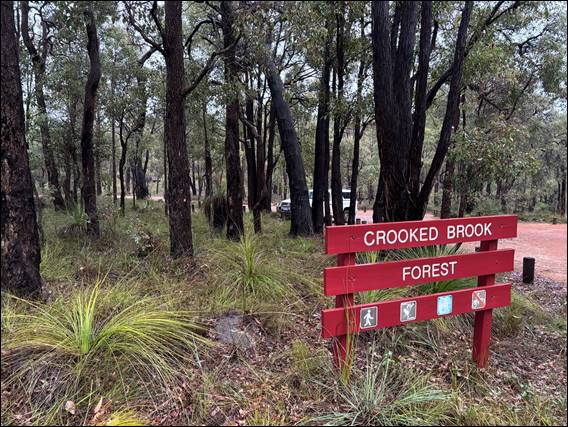
I’ve now shifted my gaze to terrestrial treasures. Having had several wanders at the Manea Park and the Cape Nature Reserve. My first trip to Manea Park, conveniently on the way home from work, didn’t yield any flowering orchids. But I did enjoy watching the bees bury themselves deep into flowers of this Swamp Banksia (Banksia littoralis). A species endemic to the south-west of Western Australia, which I’ve read may be a bit more resistant to dieback than other western banksias. A good thing considering the impact the disease is having:
Manea Park is well known for its biodiversity and boasts quite a range of banksia species. While the above Swamp Banksia was in bloom many others were not. The various species flower anywhere from late summer through to winter, with some species flowering as late as spring. Another plant out in flower, this time of the Orchidaceae or orchid family, was the Common Bunny Orchid (Eriochilus dilatatus subsp. multiflorus). On my first walk I only found one spike with no flowers, but during the next wander I found a couple of plants flowering:
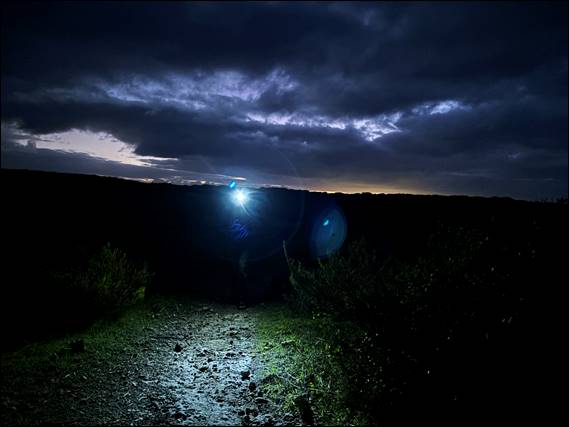
There are six species of white bunny orchids, including six subspecies. Each having flowers that look very similar, and the best way to distinguish them are by the stems and leaves. To date I’ve only found two of the subspecies. Then there are the pink species, and I have never seen any of them. The pinks generally only flower after a hot summer fire, so tend to be more difficult to track down. For my next adventure I decided to try a bit of night time herping. On advice from Sarah I headed out all hopeful at 8pm to the Capel Nature Reserve:
I spent in excess of an hour, wandering round checking the leaf litter, trunks (live and fallen), and foliage. Wondering what insects and/or reptiles may come out at night for a feed. The answer, at least from my observations, was none. Not even a possum, kangaroo, nor wallaby could be heard or seen. In fact it was deafeningly quiet, as I slowly walked round keeping an eye on where the beam of my torch landed. The only find being a solitary Common Bunny Orchid, whose subspecies name comes from a Latin word that is apt and should be obvious:
The common name of common is also apt. Today when Lisa I wandered round the Ambergate Reserve we spotted a good number of them. I won’t lie and got a little excited when I thought the leaf of a few specimens indicated I’d found a different subspecies, but that was never the case. As it warmed up we caught the movement of commonly seen Buchanan’s Snake-eyed Skinks (Cryptoblepharus buchananii), scurrying off the path and through the leaf litter. They hunt small insects and are very agile, even being able to leap into the air to catch flies:
The above one is carrying a snail, and once happy we were not going to intervene or come any closer it allowed us to observe it nibbling away. We sadly didn’t spot any bigger reptiles, but this flower caught my attention. Looking to be sprouting straight out of a tuber. It was not till I got home that I spotted the leaves of a sundew round the base. Not yet fully matured, and as such not creating the distinctive rosette of sticky leaves of this carnivorous Drosera rosulata. Yet another plant that is endemic to southwest Western Australia:
The next find is however not endemic, being introduced. Although I have no idea of when or whether by accident or on purpose. Native to North and South America the Banded Orb Weaving or Banded Garden Spider (Argiope trifasciata) has successfully spread round much of the globe. I’ve seen one before, so if you want to see the distinctive pattern of the top of the spider check this post https://sandbagged.blog/2022/04/07/the-beach-shack/. I liked this image that shows the zig-zag pattern of the stabilimenta, i.e. web decoration:
The feature is not made of the same silk that the web is constructed, and isn’t even sticky. Its purpose is not clear. Some say it could be used to attract prey while others think it may provide a degree of camouflage, although I don’t see that. We also spied quite a few Australian Golden Orb-Weaving Spiders (Nephila edulis), and the path had a fair few of these much bigger webs spanning across the track. Not keen to walk into them, Lisa kept a careful eye out to try and avoid disturbing them. On occasion taking a bow, as we crept under them: