It’s all in the tail

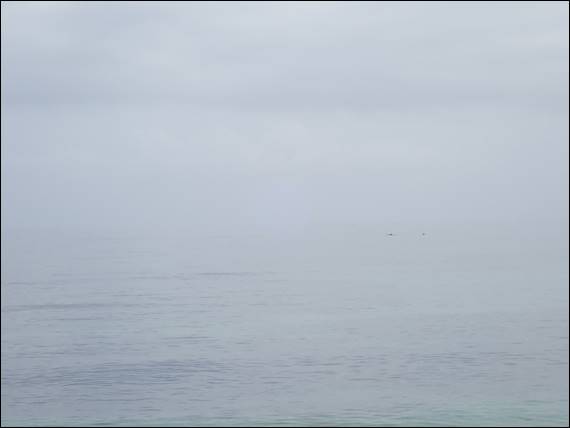
It is going to be a busy social weekend for us with the weekend packed with a year twelve ball, meals out and a bit of a shin dig for the premier of the latest Wiggins film, of which you will hear more about after the red carpet event has occurred.  But before the mayhem started we had put the word out on the local snorkel group for a quick Saturday morning escape.  It was a grey morning making it hard to detect the horizon, and as we drove along the beach a large pod of dolphins were heading in the same direction:
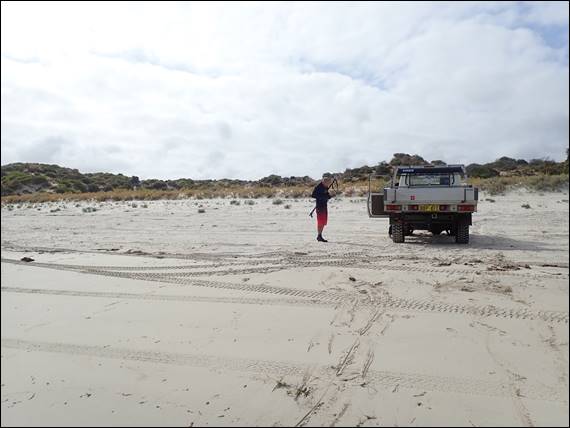
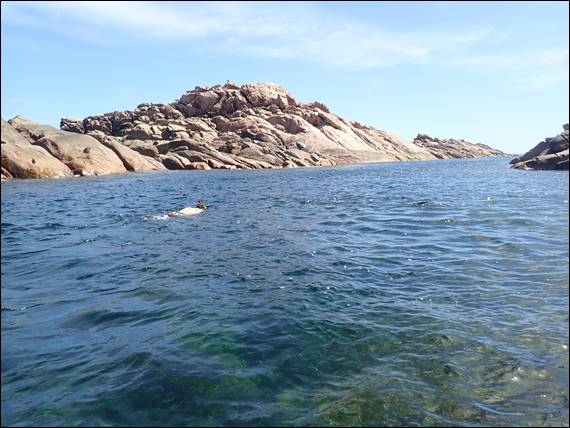
Geoff and Nana had replied and so the four of us were heading to a spot they wanted to return too.  While Lisa and I had played off our local beach last weekend they had come to this spot and scored a couple of good finds, include a big blue groper.  Legs, arms, fingers and toes were crossed that a similar find might occur today, in fact Geoff had brought his spear gun just in case.  Despite it being mid-morning there was minimal sun, but the water was flat and so we felt it was still worth a dip:
We all seemed to drift off in different directions.  Once your head is underwater you tend to focus on what is in front of you rather than where everyone else is tootling off to.  The water was clear, but there was very little if any sunlight.  Maybe that is why within meters of heading out an unsuspecting octopus shot across my path, maybe it thought it was still early morning.  It neatly landed in some weed instantaneously changing colour and disappearing from view.  I knew there was little point in trying to find it again so carried on:

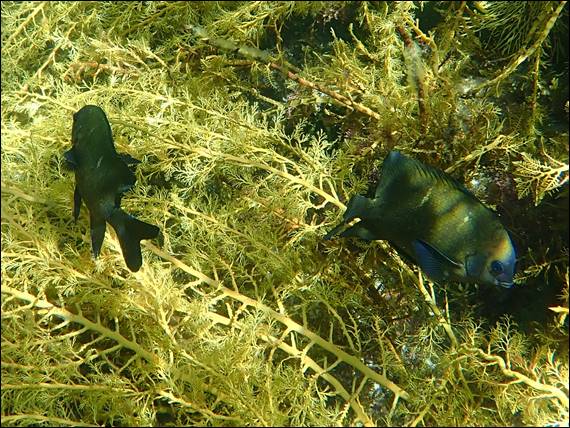
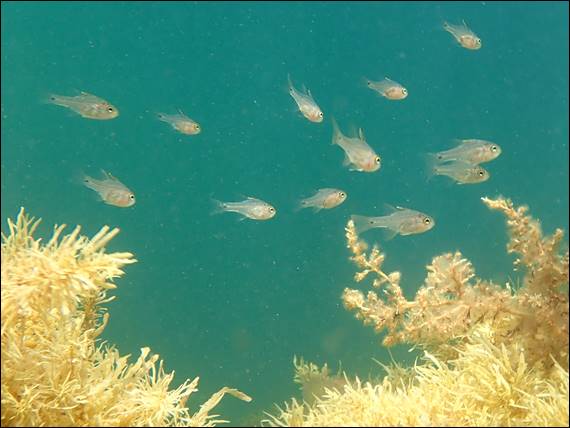
There were a great set of limestone rocks near the beach, it is very shallow here and with the low light it was the best area.  The top of the rocks were covered in the fluorescent green sea lettuce, which still glowed that magical green without the sun.  There were also plenty of fish about, this little fish swam circles round me keeping a safe distance.  I thought it was a juvenile Truncated Coralfish but the markings now tell me that it is a juvenile Moonlighter, so is not even in the same family as the coralfish:

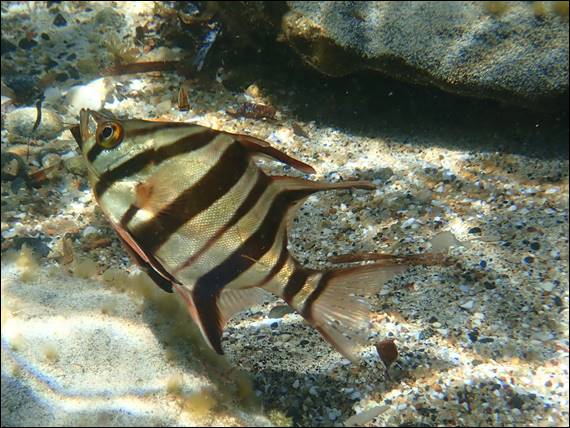
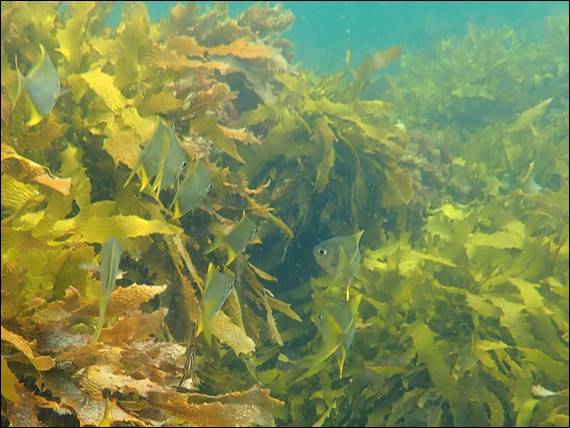
Despite the low light it was still very beautiful, the clear water compensated for the dimness and we were greeted with plenty of variety.  Here a shoal of adult Western Pomfrey was not what caught my eye, it was the solitary Old Wife just below them.  The Western Pomfrey moved on relatively quickly leaving the Old Wife by itself, it was a shame as the contrasting colours of these two species would have made a great image if they had stuck together.  I popped my head up and could see people were out deeper, so I left the shallow and made my way out:
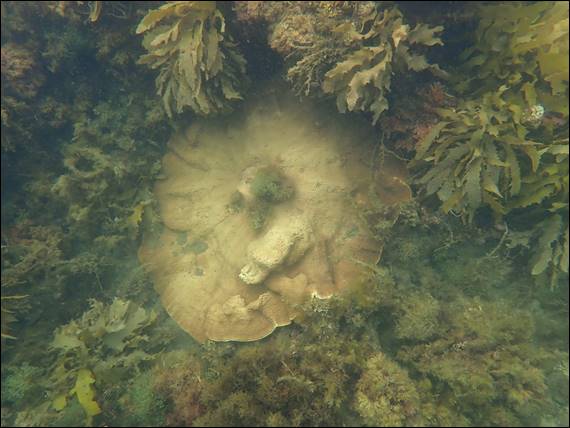
In the deeper water it was harder to spot much below, but it was impossible not to see this huge plate coral.  I’ve mentioned this species before as being hard coral of the Astreopora genus.  It was pretty cool to see such a large one, which was spreading out encrusting the ground around it.  As I went along I thought that I had found a couple more smaller specimens of this coral so duck dived down for a closer look to see if I could get a few close-up images:
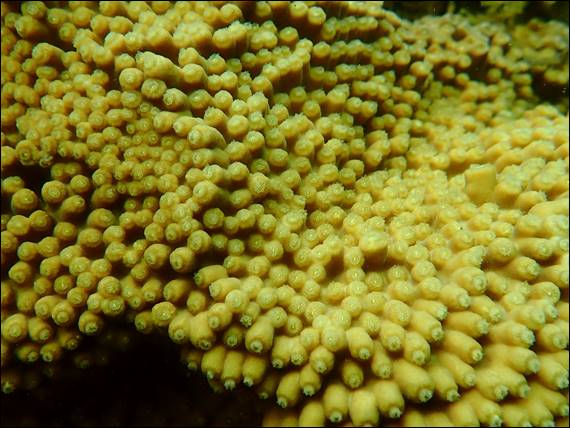
In one of the corals the corallites were really pronounced looking like little tubes, and in the image you can see the coral polyp sticking out of the end of the bony houses that the corallites form.  These polyps are soft-bodied organisms that are related to sea anemones and jellyfish.  Corals get most of their nutrients from particles, which are the by-product created when algae’s photosynthesis.  The small tentacles that you can just make out, filter out and draw these particles into the body of the polyp.  However, some corals can also have venomous tentacles used to snare zooplankton and even small fish:
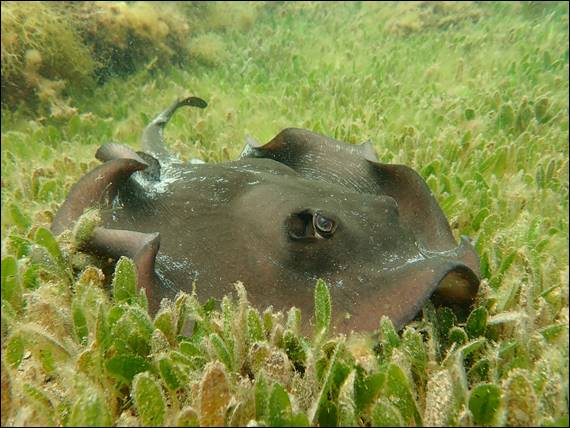
With such low light I didn’t take many images out deep instead just looked round to see what might be about.  Plenty of good fish but there was little point in attempting to take a snap, and so I soon decided it was time to head back to the shallow area.  On the way back I passed over a huge flat sandy patch area that looked like a meadow.  It was the same seagrass I has seen before, called Halophila, and with Ryan’s previous comments that Dugongs eat this grass I was hoping to see something grazing on it.  While there was nothing eating it, there was a nice little Stingaree that was happy for me to sneak right up to it:
Back in the shallow I joined Lisa for a little while and we saw some nice fish up close.  The swell was starting build up and so it was harder to stay still and get any great images.  So I decided that I would inspect the limestone rocks, on which the cormorants would often perch to dry their wings.  I had to hold onto the rocks and let my eye’s adjust, quietly hoping to find some nudibranchs or something similar.  Instead what caught my eye was what I believe are cleaner shrimps, but what type I have no idea:
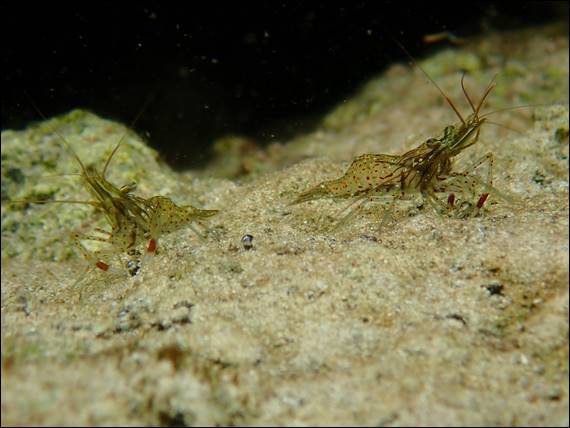
Now that my eyes had adjusted and I knew what I was looking for I saw them all along the rocks, which offered a level of protection in very shallow waters.  If I got too close they would seemingly jump from sight, sometime to another part of the rock and at times into the open water swimming to another hidey hole.  Their translucent bodies, with white and red spots were very striking.  But it was the beady eyes on stalks that really caught my attention, and I spent a long time holding onto the rocks watching them:
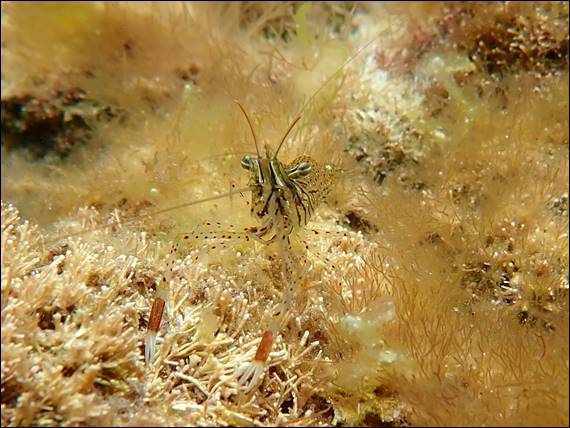
While watching the shrimps I also noted small fish, but only when they made a super-fast dash to get away.  While they were still it was hard to see them, so again I had to readjust what I was looking for and eventually I managed to sneak an image or two of them.  This one was keeping a close eye on me as I steadily crept up on it, literally millimetre by millimetre, but before I could get a good look at its body it shot off.  Meanwhile the shrimp behind it continued to happily scavenge away:
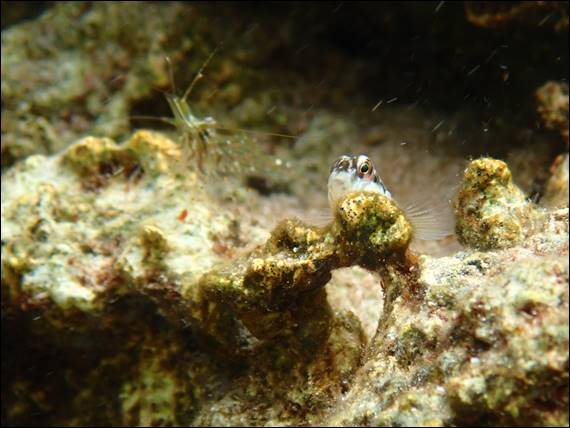
I eventually managed to get a few images, but none too great.  Having worked with our native south west fresh water fish at work I thought I had an idea what it was once I had seen it, and believe it is a Goby.  I have not however been able to narrow it down to a particular species of Goby.  That said this is the largest family of marine fish, with an estimated 1500 species worldwide of which 350 are found in Australian waters.  So I’m not really surprised I’ve had difficulty in identify it.  While I was busy with my small finds Lisa and Nana, not too far away called me over:
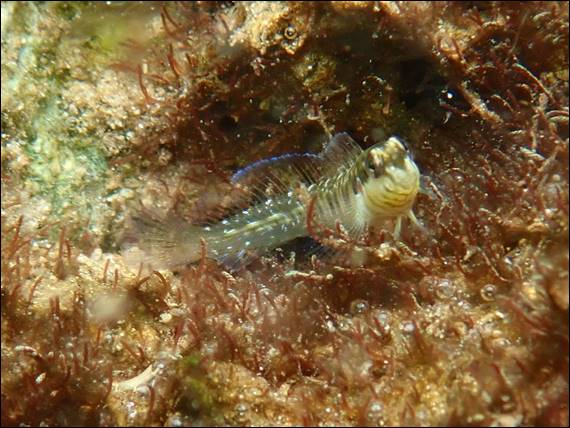
They had seen a large fish that, as they described to me, sounded like a Wobbegong or Catfish.  It was close to a meter in length and they had been able to observe it for some time, but sadly it had slunk away by the time I had come over.  They had purposely not call Geoff over with his spear gun, just to make sure that the fish lived for another day.  Checking the books back home they are convinced that they had discovered an adult Estuary Catfish, also known as an Estuary Cobbler, with Nana claiming of the positive identification that “it’s all in the tail”:
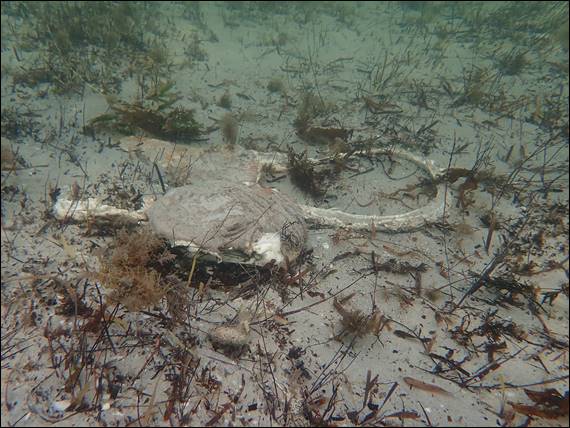
By now all of our finger tips were saying it was time to head back.  On the way in we came across the remains of a couple of wobbegongs, one of them shown above.  These had however not been speared by Geoff, who had come back empty handed.
Into the deep

After a great mornings climbing at Smiths Beach Rongy and I had always intended, if the conditions were good, to head out for a snorkel.  The intention being to check out some new territory.  Just along the coast from where we had been climbing is a place called the aquarium, a local secret before social media came along and told the world.  We intended to go there but got a little side tracked and instead ended up at Canal Rocks.  In rough conditions this place is spectacular with the swell sending crashing waves through this channel, today it was calm:

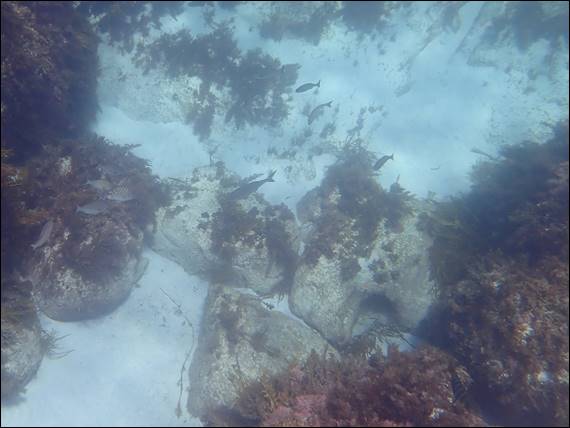
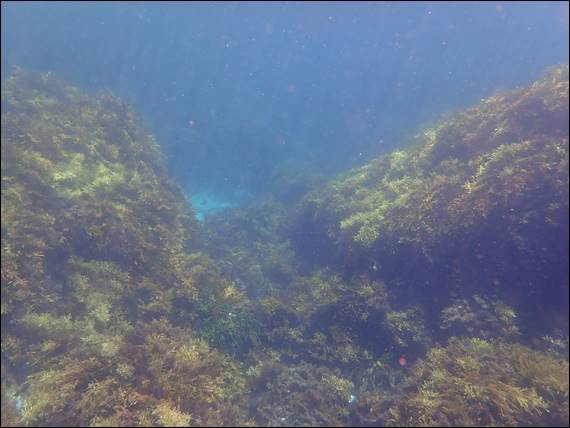
We really had no idea of what to expect once our heads were under the surface, and it took me a little by surprise.  The channel was deeper that I thought it may have been in places 6 or more meters.  On either side were steep slabby walls descending into the depths, covered mostly with weeds.  The base varied from weedy to open sand patches, boulders were strewn haphazardly creating a varied landscape for the fish below to feel safe in.  There were many fish but being so deep it was hard to get down before they swam off:

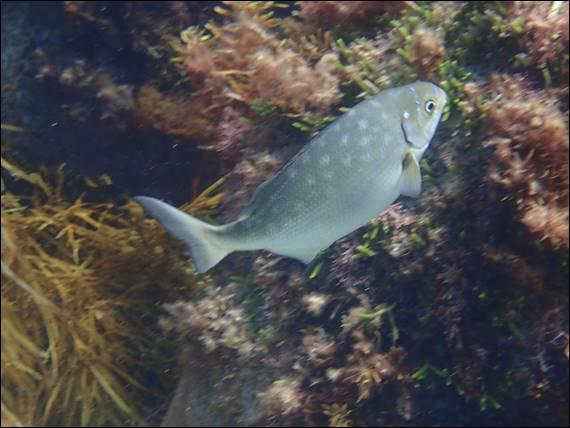
In the image above I’m pretty sure these were Western Drummers, but if you look closely you’ll see one towards the left hand side which has what looks like yellow spots.  Getting closer this is what I found, the facial marks are more akin to a Southern Silver Drummer.  And the way the others flocked about his one fish, getting as close as they could and even pestering, it I am assuming that this was a female.  If not then I’m a bit baffled at the behaviour that I witnessed, as the spotted one didn’t make any attempt to flee the pack:

We continued on our journey up the channel, and after all my snorkelling off the beach this felt cavernous.  Duck diving down to the base was hard work and I wasn’t able to stay down for very long at all.  A shame as there were lots of fish at the floor, many I could make out such as Scalyfins, Drummers, Zebra Fish, Wrasse, Sweetlips, Sweeps, Old Wives, Cales, etc.  There were also many I didn’t recognise and a good number of large fish too:

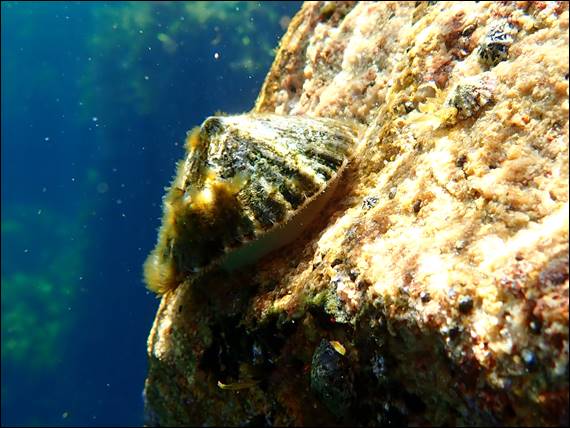
On the slabby granite walls I found this limpet, while in the snail or gastropod family it actually descends from a different species.  They are quite different to snails with a single muscular foot and no discernible head or tail.  Not to say they do not have these features, and in fact while most of their body is made up of the digestive system they are very complex creatures.  I’ve never seen one with so much of its body exposed, so couldn’t resist taking a snap:

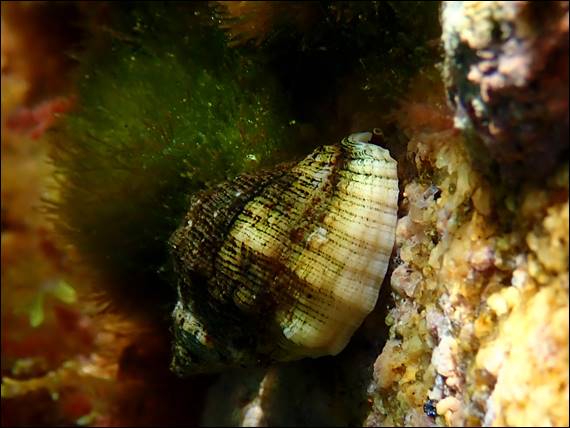
Searching along these rocks I also found a true gastropod, this one too had not recessed into its protective shell.  At the base of the conical shell its siphon is sticking out.  Water is drawn through this tube and is used for many purposes including movement, feeding and breathing.  The limpet on the other hand has teeth for feeding, using them to scrap material off the surface, it can have as many as 100 teeth although on a handful are used at any one time with the others ready to replace the worn out ones, a little like shark teeth:

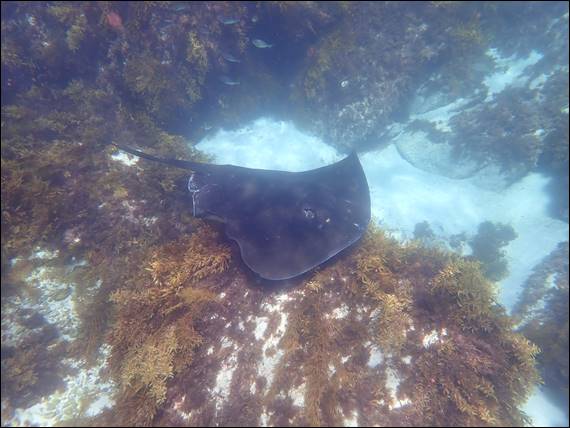
I happened to look back at one point, being in such deep water I felt it was prudent to be aware of my surroundings.  While I had seen lots of larger fish down in the depths I was also quietly hoping to see something much bigger.  I was not disappointed and below along the surface a huge stingray was gliding along at a relaxed pace.  This one had a wingspan in excess of 2m, much larger than the rays we have seen off the beach.  Rongy was thinking to duck dive down to it to get some scale into the image but while it was only cruising along it was too fast for that:

We continued up the channel to where a little bridge crosses over a narrow gap in one side of the valley.  Here during rougher conditions the water gushes through the narrow gap providing a spectacular wave action on the surface.  Not surprisingly just downstream of the narrow channel it got very deep, too deep to make it all the way down for us.  It is certainly an eerie feeling being is such deep water, but that said I reckon I would be tempted to come here again for another looksee:

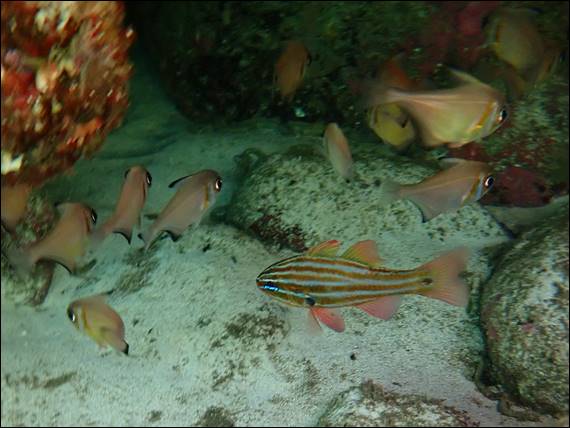
After we made our way under the bridge, with the tourists above us looking down, we popped out into the bay that separates Canal Rocks from the place we had been climbing in the morning.  We followed the shoreline of the bay only a short distance to the boat ramp.  It was very shallow here allowing a closer look at some of the fish.  Here I found a very skittish shoal of what I believe are Small Scale Bullseye, who just didn’t want to settle down for a family photo.  The single Western Striped Cardinal Fish was however not so phased by my presence:

Rongy was getting pretty cold now and had scooted ahead to the boat ramp, while I was getting absorbed by the opportunity to see a bunch of fish up close in the shallow waters.  Fish that would normally dart away quickly at our local beach seemed more at ease with me floating about next to them.  That includes these McCulloch’s Scalyfin, a fish that I have so often chased round the reef without being able to ever get too close too.  Here they seemed to be in abundant numbers and all very relaxed:

Another one that would usually run for cover but not here was Old Wifes.  So for the last image I’ve included the Old Wife that was right next to the boat ramp before I got out.  This fish is endemic to Australia, and is the only listed species in the family.  It does bear visual resembles to a number of other species, such as boarfish, but no link has been proven.  I didn’t want to get any closer than this as the dorsal fin has a spine that carries venom:

Poor casting

Rongy has been dropping hints about getting back to Smiths Beach for a long time now, the last time I had been here with him is close to three year now.  So today we finally got there, and it had been a long time since I have climbed here.  A top rope solo mission in March 2019 and the last person to want to climb here was Howsie in December 2018.  So you may ask why, with such a great selection of routes, this place been absent from our climbing destinations for so long:

The answer is simple, it has a bit of a reputation and I liken it to the big brother of Moses Rocks.  Being all trad climbs and having a serious feel to the place with rounded holds, bold leads at the grade, and at times crashing waves to create a fantastic atmosphere.  I’m not aware of any local of visiting climbers who come here, and there is no activity recorded on The Crag.  It is a shame as there is so much on offer.  Today neither Rongy or I were feeling particularly bold so we decided to start easy and see where things ended up:

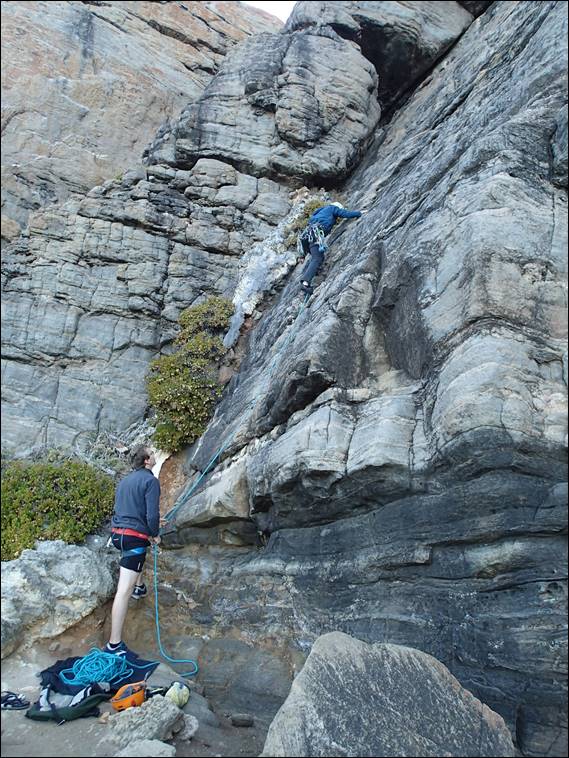
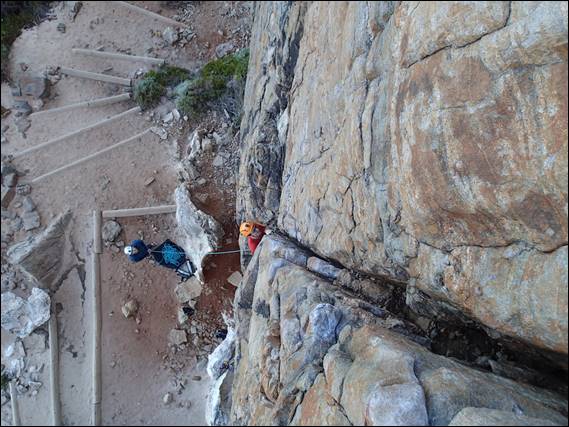
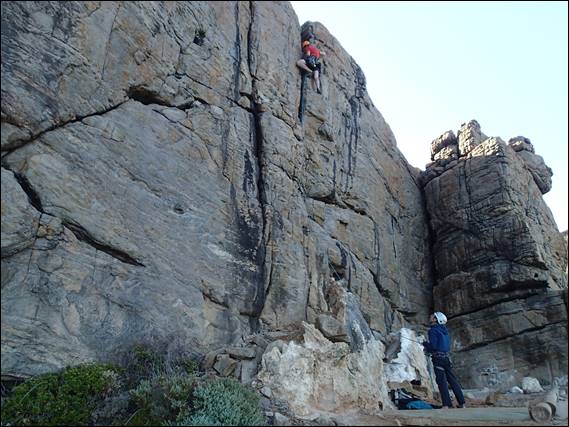
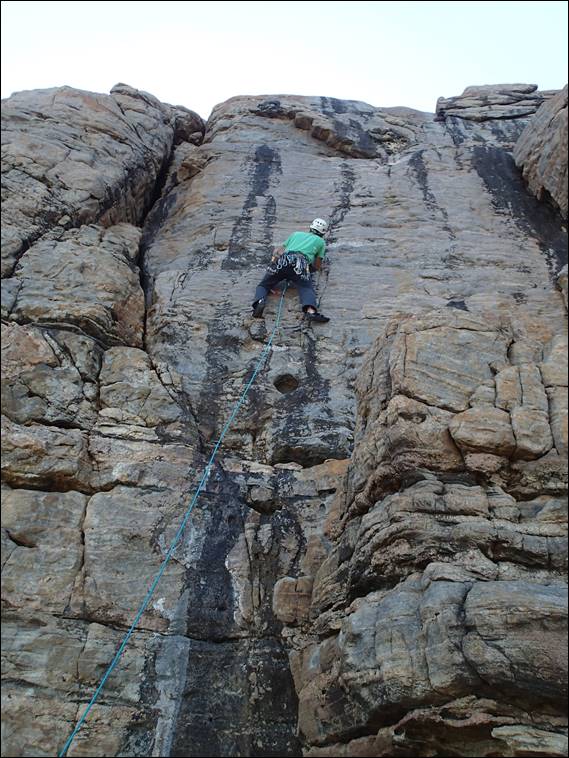
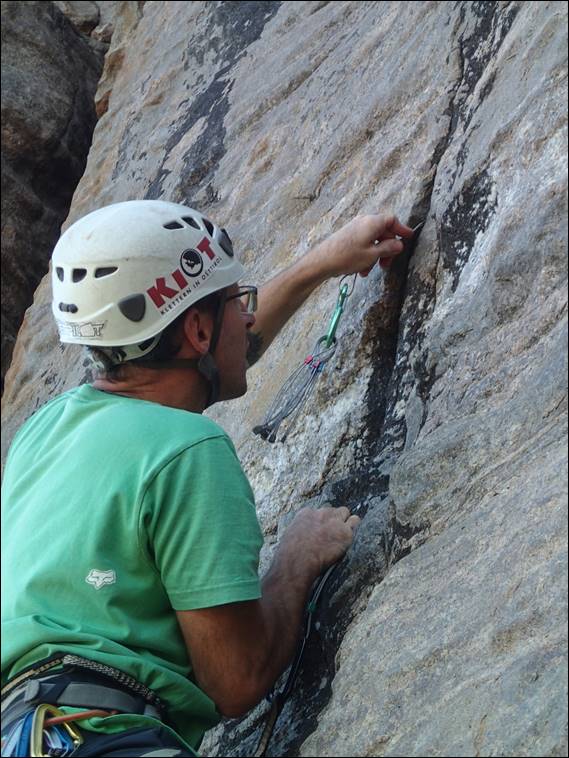
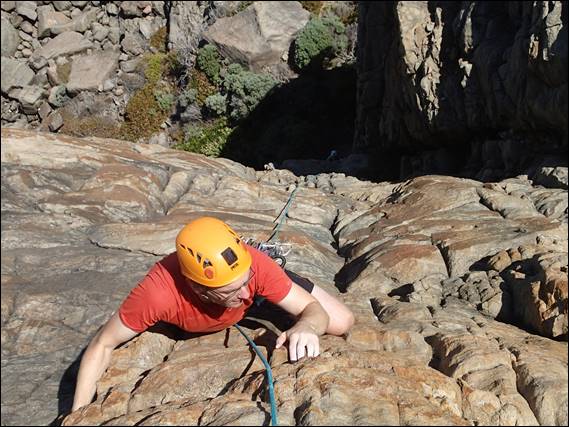
In view that he had been busting to get back here I offered up the floppy end to him, which he gratefully accepted before jumping on Photographic Belayer, above.  He promptly started to run it out after placing the first piece making me redundant and allowing me to take some more images.  It was not intentionally and as he placed a few bits higher up I could hear him say to himself “welcome back to Smiths Beach”:

I took a much more leisurely stroll up Side Walk.  A line that never gets serious and allows plenty of opportunity to lace it up, which I did.  There was no risk of a ground fall on my watch.  Now while the day had started somewhat uncertainly with the first leads I did mention a route that as far as I am aware has never been repeated.  Doubtful Casting is a short but feisty leaning crack line in an exposed position.  He eyed it up and was keen, but first we had to get the small gear:

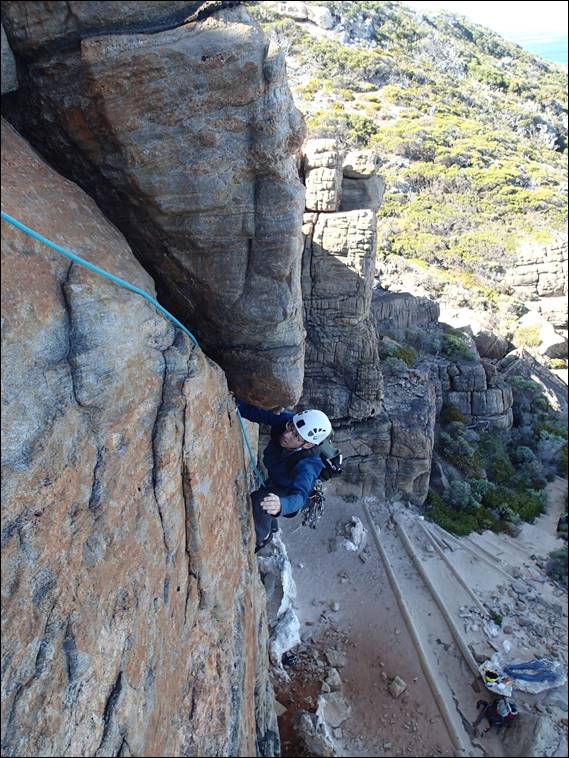
That meant a return to the main crag.  After picking up the small gear we decided that while we were here I should jump on my second lead.  I was thinking maybe to jump on Lady of the Lake but after getting to where that branched off I chickened out and continued up Excalibur.  The route was still awesome with plenty of gear so it is never too scary and being direct, sustained and with great moves.  The only issue for me was the sun was in my eyes, this being the one downfall of Smiths.  The sun creeps round to blind you and heat you up from early on:

We then hoicked back round to Doubtful Casting, a line that sits away from all the other areas.  Rongy started strong working the gear in and having to fiddle about with it a fair bit.  The line leans ferociously to the right and is very steep, so there are no real rests.  The next sequence was on the steepest territory and required commitment to run it out to the next gear and hopefully better holds.  Commitment that just wasn’t in his tank:

I laughed (inside) when Rongy offered me the sharp end to finish the route off.  I too only got to the last piece of gear and bottled the next sequence.  My arms or was it my head, like Rongy, was not up for the challenge.  So we cleaned the route and headed back to the smaller of the two zawns.  Here I sat with a stunning view, laid back against a rock armchair that would make my wife Lisa envious:

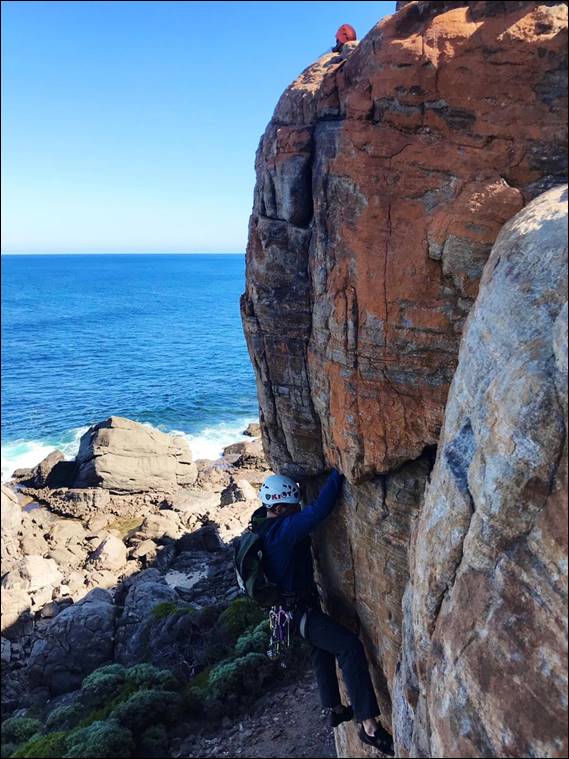
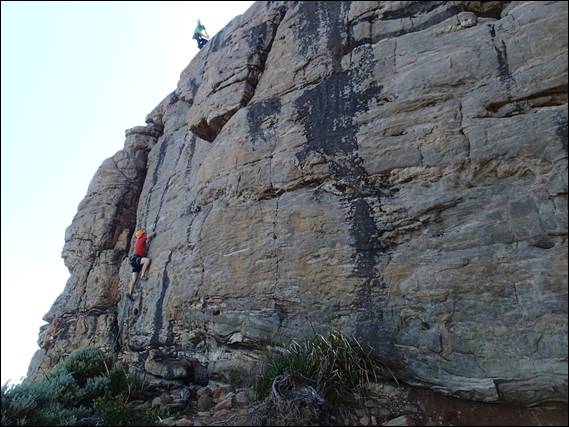
While I soaked in the magnificent sight in front of me Rongy set off up the Bellowing Sails.  Personally I feel this route has the best exposure of any at this place, following up the arête high above the water.  It takes in some steep territory with hidden holds that you have to find to make it work.  While I laid back Rongy was making his way up the line making very satisfying sounds, as he slowly unlocked this gem of a puzzle:

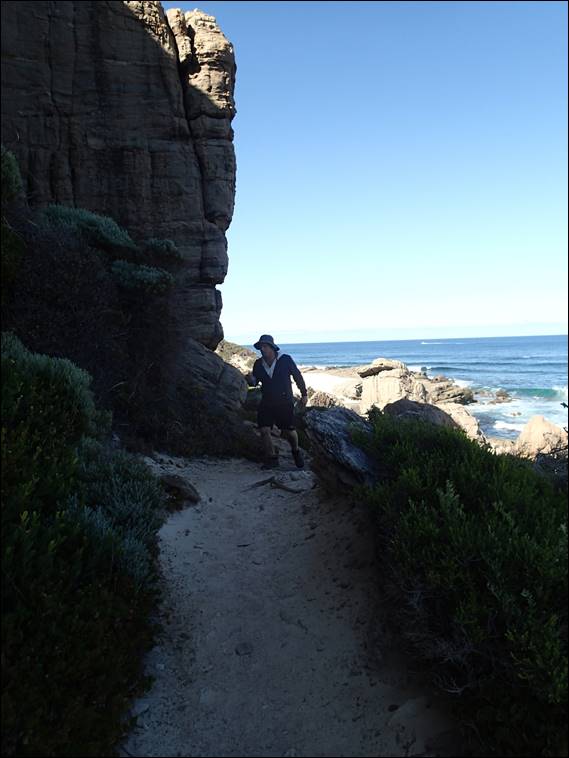
We were both pretty happy with the leads we had bagged today, and were not feeling the need to push things anymore.  The lines had created that satisfying feeling in our arms to tell us we had worked enough.  There was also another reason for wanting to head off, and that was the conditions in the bay behind us were looking very good for a snorkel.  We had come prepared for this so we packed up and headed back to the car for part two of our morning out:

As we walked out Rongy admitted that he was glad I hadn’t finished Doubtful Casting off, as it would allow him to try again with no prior knowledge of what lay above his highest point.  Maybe next time his casting will be more successful…

Nice to see you again (maybe)

As I drove home from Welly Dam, after a morning out climbing with Steve, the wind was strong and the trees were bending this way and that.  However, it looked like it may have been a southerly wind, i.e. offshore, so I checked the beach before going home and it was looking good.  When I got home Lisa was looking sprightly, her migraine from the last few days had finally left her with a clear head.  So it didn’t take much convincing to get her to come down to the beach for a snorkel:

It felt like the wind could be turning soon so we walked down to the local beach to avoid chewing up time before it did change.  At the water’s edge the tell-tale shapes of rays could be seen, four in all, so we decided to go in near where these were.  Four Eagle Rays were feasting on the carcasses of fish that had been cast back into the water after they had been filleted by the people who had caught them.  While we got to see them the rays did not hang about and soon they were lost from sight.  So we worked our way towards the reef:

The water didn’t seem super clear, the sand along the shore was being stirred up.  However, as we went out to the weed and reef section I normally check out it improved.  This was a good thing as Lisa had so far only been out a few times in areas where the water was shallow, here it got deeper and I wasn’t sure if that with poor visibility would have made her too nervous.  We have lived in Peppy Beach for coming up to eight years and this was the first time she has snorkelled off our local beach:

Due to the depth of water here while it is possible to see things from the surface, to get a really good look you need to duck dive down and check out the many hidey holes.  From above I spied a fish that I hadn’t seen before, a colourful orange with a few vertical white bands near the face.  Sure enough under a shelf I saw a Scalyfin, it was watching me closely and probably weighing up what direction it should go for to get away from me.  We saw lots of sea stars, this originally named Red Sea Star was snuggling up against an equally originally named Purple Sea Urchin:

I thought that after the close encounters she had had in the shallow reefs past the point that Lisa would not find this area as interesting.  I needn’t have worried and she soon had a go at duck diving so she could also check a few finds out that bit closer.  After initially struggling with the additional buoyancy that the wetsuit gave her, she soon got the hang of how to get down more efficiently before then swimming along the bottom:

Many other fish were lurking but all were too quick for me to take a snap, this Herrmann’s Sea Cucumber was however going nowhere.  I was going to show Lisa but by the time I popped my head above the surface and managed to get her attention the swell had shifted my position and I wasn’t able to recollect where I had found it.  The wind was turning as predicted and with it the surface was no long flat, and so it was getting close to time to head back to shore:

I kept duck diving along the way finding more interesting finds and of course sea stars, including this Echinsaster Arcystatus.  Lisa asked me afterwards how often I felt that I had seen the same creature from a previous snorkel, an interesting question but one I thought would be impossible to answer.  In her usual inquisitive way she then asked how old sea stars get, so I had to check that out and while each species is different some can live for up to 35 years:

As we were swimming over the last of the weed we came across a Bight Stingaree, it was quick to see me and slunk into the weed.  This time I kept an eye on it while I managed to get Lisa’s attention.  We hovered over it for ages just watching to see if it would emerge, not that it would.  Eventually I was starting to cool down. While Lisa was snug in her full length wetsuit I was only in my boardies and starting to feel it.  Time to really start making our way back.  Lisa thoroughly enjoyed the local snorkel, but one thing did put her off:

Being a long weekend there were more people than usual on the beach and that included a group who had brought a jet ski.  I felt like they knew where we were and had stayed away from us, but underwater you can hear them from miles away and it is impossible to really tell just how close they get.  When we got back to shore the jet ski started to come over where we had been, making me think they had kept an eye out for us.  Regardless of that it still doesn’t stop you feeling on edge when you are in the water:

We were hoping to get out past the point on Monday but a fresh easterly was blowing from early morning.  So we plumped for a local snorkel of Wave Walk, with no beach driving and only a short road drive required.  The last time we came here it was also choppy and Lisa had opted to walk the poodles rather than come in for a snorkel.  One day I might get here in better conditions, it will probably be worth it as while I’ve never been in during good conditions I have always seen plenty of life:

As soon as our heads were under we saw a huge shoal of Garfish, and while we were pushed about by the swell in the slightly murky waters we saw heaps of Western Gobbleguts, Banded Sweeps, Western Pomfrey and Herring.  Other fish, which Lisa can now add to her tally include a Shaw’s Cowfish, Southern Goatfish and the impressive male Humpback Boxfish.  In fact thinking back to Lisa’s question yesterday about whether any of my finds are repeat finds, I think the Humpback Boxfish may well have been exactly that from my last snorkel here:

Fingers crossed conditions will be slightly better next weekend.

Taking a rest

It has been a month since I was last climbing, each weekend since then has been taken up with domestic duties and then a very quick trip back to the UK to see the folks.  This climbing session, to the place where the crate comes out, would not have happened if I hadn’t cut my trip back to the UK short.  My reasons for heading back home sooner than planned may have been an overreaction to the impending pandemic, but I just didn’t fancy getting stuck in quarantine somewhere on the way back:

So with a few extra days at home before work started I thought it was high time to catch up with Steve and see how he was faring.  How better to do that than to meet up at Welly Dam, for a climb, cuppa and a bit of banter.  We took a relaxed pace and started the session off with a leisurely stroll up Barbie Q, the climb that always seems like a warm up but probably is a little too feisty.  Today proved that once more, and no doubt the same mistake will happen again in the future.  This time I blamed the Popeye forearms I had at the top of the route to my jet lag:

It was a mixed day, drizzle sprinkled the windscreen of the car as I drove up the hill towards the dam.  As I got closer the roads had that mottled look after it had rained but not fully dried.  The sky was a mixture of ominous looking clouds and brilliant blue patches.  This along with the lush green of the lawn and deciduous trees made it feel like I was still in the UK.  The drizzle threatened but never came down on us, nor did the humidity rise.  So the rock was in perfect condition:

Steve was keen to jump on his old friend Murky Corner, and being just that little bit jet lagged I felt the need to sit down on the job as I belayed him.  A handy tri-nut placement at the base of the corner helped make this more sensible, although others may not agree with my thinking on that.  For those who have followed Steve’s journey over the last six or so months he is getting to the end of it, with the final surgery coming up soon.  He did not want to do anything that might result in needing to postpone it, so he played it safe and climbed with extra caution:

He was taking his time, with no sudden or rushed movements and checking each position and hold.  In so doing he managed to find yet another way to climb the corner direct, which provided a more secure and solid sequence, one you are less likely to come flying off from.  He also topped out, as opposed to using the lower-off bolts, proving an extra few meters of fine climbing.  All this with a pack on his back, as nature was calling meaning a trip to the upper carpark:

So as he went off to sort that out I walked back down made a cuppa and set us up for the next route.  After how I fared on Barbie Q I wasn’t too sure what to jump on, but we had at the start of the session talked about A Walk in Central Park.  A route with a crux sequence that has slopey holds leading in a fingery section.  Um maybe not the right choice I thought, but I went up it in the best style I can remember.  I was rewarded with one of the those very, very, very satisfying moments as I looked back down:

Steve managed to get up in good style, considering he still hasn’t regained sensation in all of his extremities.  The residues of chemo still lingering in his body being the cause for that and also cuts on some fingers that simply won’t heal.  He came back down pumped and weary, and as such also deciding not to lead any more.  Who is this calm and sensible Steve that I was climbing with, and will he still be around after he has healed from the last operation?!  So I jumped on Welcome to Edges, as we needed to do another route to let the tea cool down:

Steve managed to work his way up Edges and I showed him the alternate left-hand finish, which takes the bite out of the finale of the climb.  The section that scares many people, as their arms start to tire.  After that line he was toasted, so we sat and enjoyed the cuppa I’d made earlier.  We had yet to see anyone else, usually on a long weekend families would be making breakfast on the BBQs and kids would be running about screaming but not today.  Today the only noise was the wind and the Red-tailed Black Cockatoos, bliss:

Steve was done but offered to belay me for a route or two if I wanted, so I took him up on the offer and scooted up Ebonie Road.  At the top I pondered that this was route number five, but I didn’t fancy leading another line.  So I decided to down climb it, not with a top rope but reversing the lead.  It proved trickier than the ascent and I had to rest on one section, and I’d be interested to know if anyone can guess which section.  It was a great morning out and hopefully Steve can get out one more time before his operation:

Nowhere to hide

Friday morning instead of stretching as soon as I got up, I prepared myself to head in for a swim.  I was working today but wanted to get a swim in while the conditions looked favourable, as the weekend wasn’t looking to crash hot.  As such I found myself getting into the water a little after 6am even before the sun had poked its head over the dunes.  I half expected not to be able to see very well but there was enough light penetrating the shallow 3m or so to the sea bed.  It was low tide, which was on my side:

I was again hoping for that early life that may have been out in the more dimpsy, as Lisa would describe the, conditions.  While I wasn’t presented with lots of obvious fish life I did come across a few jelly fish that I have only seen once before off our beach.  It looks like a plastic bag, and I’ve been told they are called handbag jellyfish although I can find no reference of them online.  As a favourite food of sea turtles it is easy to see why plastic bags really are such a danger to them:

I spent a lot of time taking heaps of cool images of the jellyfish, like the Comb Jellyfish they have no tentacles and are covered is tiny hairs that rhythmically move.  They catch the light as they seemingly pulse across its body making the jellyfish glide through the water.  After a while I went in search of fish, no shoals but still plenty to see.  I snuck up on a few to try and get those cheeky images that I have so often not managed to get.  Again I was mostly thwarted, but I couldn’t resist including this image of a Magpie Morwong:

I scoured all areas of the sea bed including the weed, reef, sand patches and bare desolate rocky areas.  It is all luck when you are out there and you need to be looking the right direction and be in the right place at the right time.  There however also a degree of skill required to spy patterns and things that just don’t look right.  Sure enough tucked up close to the patch of weed was one such sight.  I knew straight away what I had found and that meant needing to take my time and not spook the creature that I knew would have seen me way before I saw it:

This octopus didn’t really have anywhere to go, the last one I spied slid under a rock shelf and was lost.  This one tried to suck itself deeper into the little hollow but there was nothing covering it.  So not wanting to scare it too much I got reasonably close, but avoided sticking my camera right in its face.  The eyes on these creatures are very striking.  Unlike the eyes of vertebrates, their nerve fibres run behind, and this means that more light can reach, the retina.  This provides them with good vision, an real advantage for a marine predator:

It was a quick dip of no more than 30min.  I could have happily stayed out there for longer but the clock was ticking and I did sadly have to get to work.  Despite the shortness of the swim it was very worthwhile and I wonder now why I hadn’t done a before work dip before.  Maybe I’ll change my ways, although I have missed the best opportunities this season as the morning light is arriving later and later with each passing day.  Fingers crossed conditions are OK for me to get back into the water this weekend:

The flat battery

Last weekend there was no time for outdoor fun, as Lisa and I spent every daylight hour of both days working in the garden.  While there was no playtime on rock or in the water, we did however get a workout.  There was still more to be done in the garden this weekend, but not as much so I snuck out for a snorkel early Saturday morning.  It was sunny above our house but the clouds were quickly moving in from the east, as was the wind resulting in poor light and choppy conditions.  Undeterred I went in, and almost immediately the battery on my camera died:

Sunday morning I decided to head back out, this time the blue sky extended across the whole sky and there was hardly any wind.  Due to having a morning full of “other things to do” I went out earlier than usual and was in the water by 7am.  Yesterday’s dip had also been quite early and I found squid, heaps of fish including two new fish for me (a Magpie Morwong and Butterflyfish), and a very strange spikey alien sea cucumber.  I was quietly hoping that another early morning would allow me the chance to have more new finds:

The visibility was so much better but it took a while before I found any fish, in fact there had been far more life in the gloomy, cloudy conditions than today’s calm and clear conditions.  Of course the Banded Sweeps were quick to appear, as were the bait fish.  There also seemed to be loads of Western Pomfrey, one of the fish that I hadn’t seen the day before.  I was only one bay away from yesterday’s location but the place look very different in formations, weeds and the fish species I was spotting:

I kept an eye on the sandy beds for any tell-tale signs of things to find.  Not much stood out, the weaving lines gave away the nights movements of the sea snail that lives in the Bell Clapper shell.  This one was left stranded in the open, I’ve found theses before with hermit crabs inside them.  Watching as they drag their home the sandy beds looking for juicy morsels to eat.  The snail’s scientific name is Campanile symbolicum, and it is said to be a living fossil, and the only surviving species of Campaniidae:

The tide heights have risen a bit since a few weeks back and as such some of the previously exposed platforms that were a hundred of so meter from shore, were just covered over.  It was possible to caterpillar yourself across them, but for the most part I went round the edges peering at the more exposed surfaces looking for anything unusual.  It was on this terrain that I found the freaky sea cucumber.  Today I was not so lucky, but this small shoal of what I think are juvenile Silver Drummers came up to me and danced right in front of me for ages:

I continued my journey spotting fish here and there but focusing mostly on the exposed limestone reef sides which were littered with all sorts of sponges, weeds, fans and squirts.  Several of them looked very much like fungi, which has in the past been one of the land based flora that I have been known to take copious images of before.  There were two today that really reminded me of the fungi I have found on fallen trees, this orange one being one.  Alas try as I might I have not been able to identify them:

It seems that every time I head out past the point I find a place with a different feel to it.  This time I came across this lush green underwater paddock.  It may be seedlings from the more common weed that we have round the place, the stuff in which I have managed to lose track of so many creatures like the recent cuttlefish.  There is no reason for having this image in here other than it striking me as looking very different, and in a way out of place with all the towers of kelp around it:

As I started to head back to shore I came across what looked like a tangled hair, the sort of thing that makes swimming in a pool so unpleasant!  I watched it for a while and then moved the water near it with a single pass of my hand.  It uncurled and the whole length started to move about, but in a way that was not in sync with the movement of the swell.  I’m not going to even try and guess what it was but there definitely seemed to be a purpose to how it moved, slowly making its way downwards:

Before I got back to shore I had one more find, a small fish.  Despite being very well camouflaged in the green kelp, I knew this little triggerfish would also be very quick to hide once I got to close.  I have come across them before but have never been lucky enough to take a snap of one.  Being just 5cm long tops and with a very distinctive pattern I’ve yet to name it.  While triggerfish can be found in many sizes and some quite small it is also possible that this one is a juvenile:

Both morning swims were very worthwhile, as there is always something new to see.  But it was time to pack up and head back to get on with more chores round the garden.  The image below gives you an idea of how far down the beach I head, with the houses Of Peppy Beach just visible in the distance.  Too far to head back to get a fully charged camera battery, so from now on I will have to remember to take a spare battery with me, just in case:

Being Stalked

Last week a low pressure system came over the SW, which dropped the temperature, brought some wind and resulted in the waters looking a little cloudy compared to the previous stellar conditions of last weekend.  I was however keen to get out and seeing Sunday morning was booked up with a climb Lisa and I headed to Wave Walk on Saturday, a spot that Geoff had once told me was worth a visit.  In view of the weather not being ideal Lisa chose to not go in, and instead was enjoying some beach time with her book and a cuppa:

The toll of the week’s weather was clear, weed was floating on the surface and the water had a cloudy look to it. Still I persevered and tootled about to see what I could find.  The longer I stayed in the more my eye’s tuned into the conditions and there was the occasional fish to spot.  I duck dived down to check out some ledges but there was nothing to exciting to report on hiding underneath them:

Contemplating whether to stay in or not a large Smooth Stingray cruised past.  This one was in no hurry and I swam alongside it taking some video footage and a number of snaps before leaving it to dawdled into the murkiness.  These gentle giants can grow to 2m and weight 350kg, and this one was only a tad over a meter wide.  I’ve seen a few without their tail, and it is said that some anglers and commercial trawlers cut them off to reduce the risk of getting hurt while throwing them back into the ocean.  After watching the ray I started to see lots of shoals of fish, but mostly stuff I have already reported on this season:

There was a small squid that stayed just far enough away from me to take an image, before finally having enough of me and powering out of sight.  I also spotted a Spiny Tail Leatherjacket that looked amazing, the four bright yellow spikes just in front of the tail giving it away.  That one too stayed a safe distance.  This Humpback Boxfish was not so shy and allowed me to follow it round for quite a while.  After an hour I came out happy with my finds.  Lisa and I sat on the beach while I sipped my tea, and fought the urge not to jump back in as a large pod of dolphins slowly drift past:

Sunday I drove back into Peppy in the early afternoon, after my morning climb, and there was no wind.  So before heading home I did a quick circuit to check the conditions.  It was pancake and very snorkelable, so after dumping the climbing gear and have a quick drink I wandered to the local beach.  Not a wave and hardly a ripple, a complete contrast to the day before.  While the water temperature never really changes on hot days like this it somehow feels much easier to slip into the water and not have to fight the initial shock:

The water was clear and calm, so I started to scour the familiar territory of my old hunting ground.  There wasn’t much fish life to be seen but that didn’t stop me pottering about, diving down to check out sponges and where I could find them fan worms.  Occasionally there are opening in the limestone reef and you can see in the cracks and crevices, and in this one I spied a very colourful striped fish.  It was of course gone when I dove down and from this image alone it is impossible to try and work out which fish it was:

While I didn’t see much else I did get the feeling I was being stalked.  Normally garfish have not hung about, but a reasonably sized shoal was following behind me and continued to tail me for a long time.  Previously I have spotted the Robust Garfish, but these are Southern Garfish.  They spawn in the shallow sea grass, of which we have lots, and the young can stay in the shallows for a couple of years.  Feeding on strange mixture of sea grass, algal filaments and on occasion crustacean.  In this image one of the them has its mouth open, which I was surprised to see above the beak:

The clear waters made it a pleasant dive and to boot there were no stingers, which I would normally expect on such a calm day.  That said the school holidays are now over so maybe like all the tourists they too have gone.  I also came across a big school of Australian Herring, these fish move along the southern coast of Australia from Victoria to the SW of Western Australia.  Our SW corner is the only place they are known to spawn, and as such this area plays an important part in the life cycle:

Heading back in, more because my calves were cramping after climbing, I came across a small school of what I am going to assume to be Southern School Whiting.  Alongside the herring these are the more common fish that the local beach anglers catch for a feed.  These fish have a wider distribution than the herring stretching further up the west coast.  I often find these right along the shore and you can see them from the beach:

I’m hoping to venture a bit further afield with Lisa next weekend, so who knows what we might see.

The Missing Man

After an abstinence of climbing during the long weekend there was need to get back out there, and that opportunity arose on Sunday when Rongy, Steve, Alan and I headed down to the main area of Wilyabrup.  The choice of location was based on my one request for some longer routes.  Normally Rongy or I would have a game plan and tick list in mind, but today it was a relaxed and low key affair.  So much so that we were umming and ahhing about who would take first lead, who would climb with who and what we should climb:

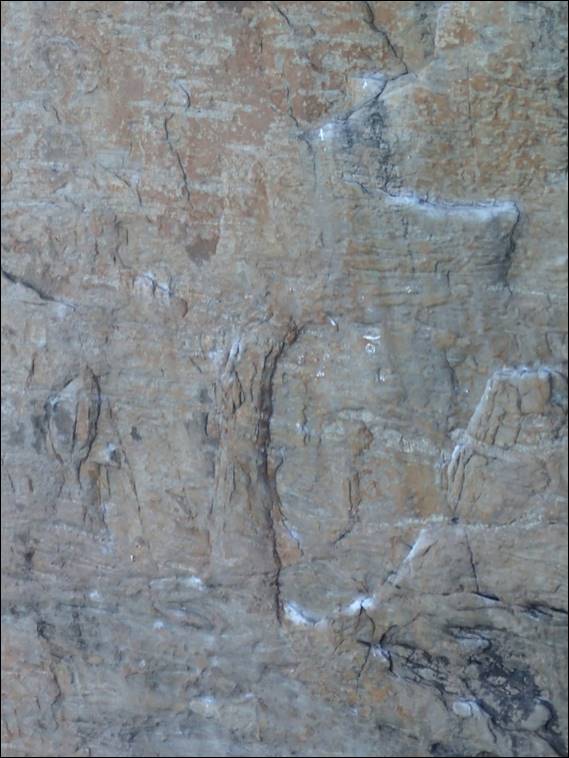
Rongy broke the stalemate and started the first climb of the day on First Climb.  Meanwhile Steve was keen to jump on Hope, so he racked up.  Now you may be wondering about the next image and its relevance.  There is none other than on the last weekend the WA climbing association had a trip down here, and as is usual with gym climbers the place was splattered with chalk.  Hold being marked with ticks and one even being indicated by a smiley face, seeing this it is not surprising why some complain about climbers disfiguring rock faces:

Now Steve was physical ready to roll, but mentally he seemed not altogether there.  A third of the way up he looked down at me and confessed to just not being in the right frame of mine.  So he down climbed and I took the lead, and while he managed to second up he decided that he would not climb any more today.  Chemo and other things were clouding his focus and he felt it better not to continue, a shame but at times you have to do the sensible thing.  Walking down we found Alan also wondering if he was being sensible as he tackled Twenty Questions:

He certainly had to stop and talk to himself a few times but he never rested on the rope or fell, nor did he even indicate he might back down from the lead.  Slow and steady won the race and after he made the crux move he continued to keep his cool on the last exposed section before topping out.  It was a great lead considering it is his second lead on trad in years, Lou take note!  Rongy and then I followed up checking his gear, which at times he was nervous about, but it was all bomber:

Now to the left of that crack is wait for it… Left Crack.  A well protected and challenging climb at the grade, which can be made harder and longer by traversing left.  You may recall it from a recent trip here I did with Howsie when I led it.  It is a route I often talk up and I’m not sure but it felt like Rongy didn’t believe that I could or have climbed it .  So I gave into the pressure and jumped on it one more time.  The last time was it was sopping wet and a bit of a horror show, but at least today it was all dry and the friction was great:

I have to confess to having huffed and puffed along the traverse, stepping high and having to use unseen hand jams while making use of the better higher footholds.  It’s a pumpy line and steeper than it looks, and I was grateful when I got to the end.  Alan took one look and decided that this was not for him so only Rongy followed up.  Below on the rocks Steve had collated all his gear, but he was missing.  We were not too worried as he wouldn’t have got far and so we moved on for the next line:

After having been up Blubber Boy twice on second it was finally time for Rongy to give it a go himself.  Alan was certainly looking on very apprehensively as Rongy took his time fiddling with the gear and doing a bit of yo-yoing trying to figure out the moves.  On second with the safety of the rope above you this climb never feels too serious, but on lead it is a whole new ball game.  At one point he climbed down to a ledge and had to shake out confessing that on lead the climb felt a lot more pumpy:

It is for good reason that it can feel pumpy, the gear is small in the bottom of the slab, which is also the crux section.  RPs are the only choice and you really have to trust them as it is not until higher up the slab that the holds become more positive and gear bigger.  This explains the yo-yoing and the possible over gripping that Rongy was now experiencing.  He kept going and in his usual style enjoyed and soaked up the experience, as oppose to allowing it to get to his head:

Steve ambled down the path as I was belaying Rongy up the last sections.  He was happy pottering about and had been wandering about up top, and was now just about to head down to the boulders along the water’s edge.  His best mate Mark, from the UK, had really liked this area when he had come out to visit.  He had sadly and only recently passed unexpectedly and Steve was using his time today to collect some footage to use for the eulogy.  So as he wandered down to the boulders we continued to focus on Rongy:

Alan was feeling very unsure about this one, but both Rongy and I had confidence that he could give it a red hot go.  Looking particularly nervous and clunky at the start he soon found a rhythm and managed to pull off the crux moves with relative ease.  There was one moment when he asked Rongy to take and that he would rest, to which I hollered encouragement to make the next move where the holds really did improve.  He did as told and was not surprisingly, and deservedly so, very chuffed to have climbed it clean:

We could see Steve lurking between the boulders and decided that one more climb was on the cards.  My lead, as Alan put his foot down and said he was not leading anything after that last climb.  So to slow the pace down and make the most of the last climb we aimed for Verbosity.  It is one we have all three led before so there were no nasty surprises.  However, the main reason for picking this line was that it is the longest route here.  It was as always great fun and I had an awesome view from the top:

Alan came up second tied in part way along the rope, and while we had a 60m rope this route is so long that Rongy had to start climbing before Alan had topped out.  You can just make out Rongy with his white helmet getting to the top of the crux corner that guards the more relaxed upper wall of this route.  With that climb under our belt we went back down and packed up, Steve was ahead of us having got  ahead start as he was starting to feel the heat.  It was a warm hike out and we finally found the missing man under the shelter of the trees by the car:

The old stomping ground

The last day of the long weekend and in view of the beach having been crazily busy on Sunday, we thought it would be safe to head out this morning without the crowds.  Sure enough the plan worked like a dream and today Rongy and Alana tagged along, with Lisa and I.  It was always going to be a short dip due to other things that needed doing, but that didn’t deter us.  Having got over my little bogging incident we ventured back on the beach past the point, as Rongy was very keen to check the area out:

Not far out and the fish and rays were out, Rongy also spied a Heteractis Malu or more commonly called a Malu, Delicate or Sand Anemone.  I’ve seen three in all my years of snorkelling here, and today I doubled that.  Much as these look like harmless creatures they are in fact carnivorous and any small creature that happen upon them, such as fish, crabs or snails, will be paralysed and then drawn into the mouth at the centre of the disk to be digested:

I drifted off leaving the three of them to watch the myriad of fish that were about including Wrasse, Pomfrey, Leatherjackets, Sweeps, Morwongs, Globefish and many more.  The visibility was good and the ocean bed below was like a garden in bloom.  I didn’t chase any fish and was content to simply drift along checking out the ground that varied from flat sea grass, shallow reef covered in kelp to deeper crevices with sandy bottoms:

My patience finally paid off and I spied one of the creatures I had been hoping to one day stumble across.  An octopus was on the sandy bottom, obviously focusing on something which may well have been a prey.  I stayed very still, knowing that this very intelligent creatures will quickly disappear if it saw me.  It was of course inevitable and it slunk under the weed and rocks, then despite looking around all over I was unable to locate it again:

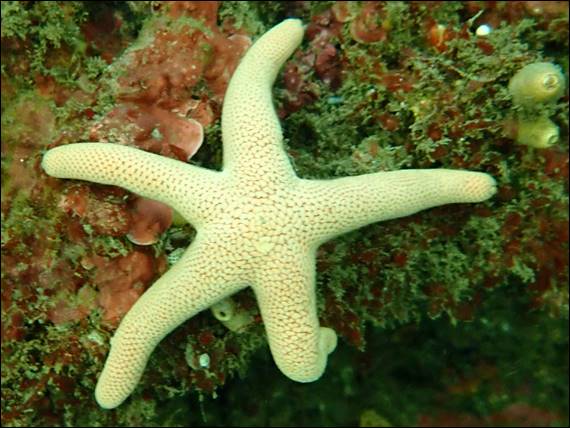
After that I started duck diving and getting more adventurous by going into caves and through swim throughs.  There are usually fish lurking in these areas but the light is not that great and as such getting a good image of them is hard.  I did however find this creamy coloured sea star, the shape is similar to the Echinaster genus of sea star but I’ve struggled to find any info on ones that are this colour, most being orange or red:

Today the water was pancake, a tiny swell but not a ripple on the surface.  The car was far, far way on the beach and while it is hard to say I reckon we were close to 200 meters out.  Despite being so far out a ridge of reef provides a great playground that goes from at surface to 5m deep in a short few meters.  I worked my way round this area looking for more ledges and crevices to see what I could find:

Under one I found what I think is a Cup or Barrel Sponge.  There are many sponges but they all have the same basic structure.  An organisms that has no tissue or organs and is effectively a body full of pores and channels.  Like a chimney they take water in from their base and it is piped through these channels to be ejected out of the top.  Filtering out food particles as the water goes through these channels, while oxygen is absorbed and waste products ejected:

It was great fun diving up and down checking out the area and not really being too fussed with taking images, however soon the allotted hour we had available was coming to a close.  Rongy was already out of the water and the girls were heading in so I made my way back trying not to get distracted and taken of course by the many sights that there are too see out here.  The area impressed Rongy and Alana them and it sound like may be keen for a revisit next weekend:

We got home, with no issues driving off the beach this time, and after a quick freshen up went about our errands.  As Lisa and I were driving back from Busselton late in the morning the ocean looked flat and clear.  So when we got home, much as I needed food, I was pondering whether to go down to our local beach.  It felt like I hadn’t been here for a very long time, and seeing it was so convenient to be able to walk down I decided to get one last quick dip in:

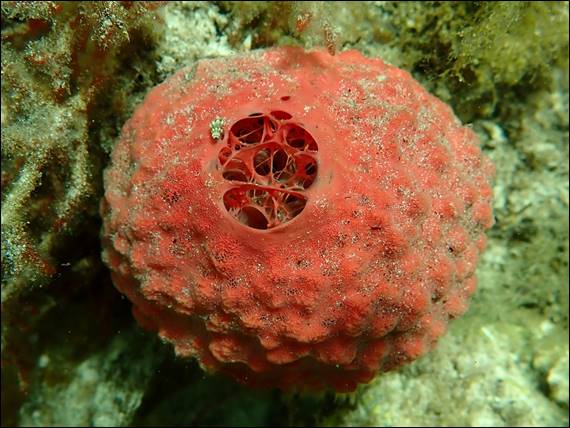
The water was still very clear but the surface wasn’t flat anymore and I bobbed up and down.  This area felt deeper and far more exposed than past the point.  That said it still had some nice areas and I again took to going up and down to see what I could see.  The above Golf Ball Sponge, yes it really is called that, drew my attention.  The image shows the intricacy of the internal structure of sponges, but something else caught my eye:

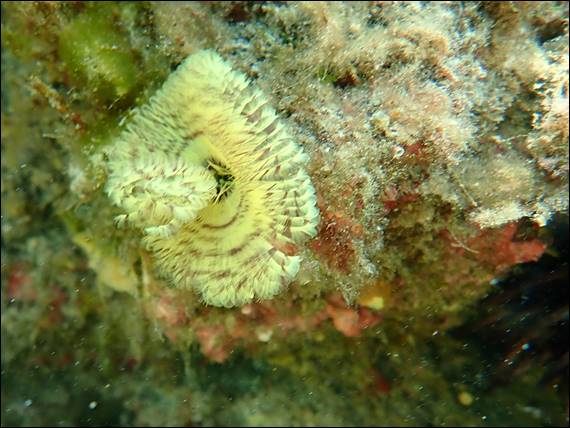
The above image is the after-image and the before-image is below.  My guess is that this is a Feather Duster Tube Worm, as you can no doubt guess rather than force the water through its body to collect food these allow the water to simple flow through the fine filaments making up the feathers.  Despite the natural water movement it doesn’t take much human (or animal) created movement to spook them, and they very quickly retract back into the tube shown in the image above:

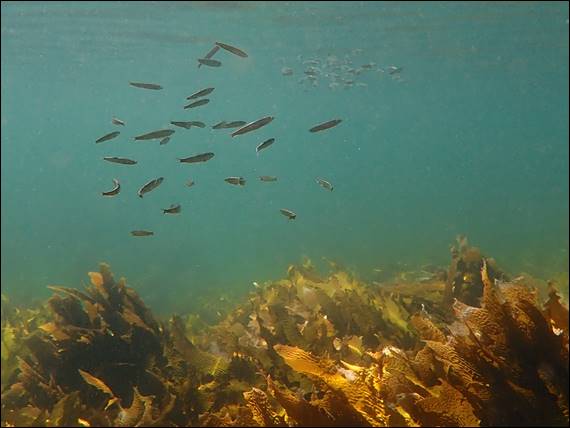
I spent a lot of my time looking very closely at the weed checking for signs of Pipefish or Sea Horses.  We have on rare occasions found their desiccated bodies on the beach, but as yet I’ve yet to find a living one.  Having been told they are very hard to spot I don’t fancy my chances.  At least this afternoon when I was looking for them there were plenty of shoals of small fish to distract me, such as what I assume are young Gobbleguts:

I was about to head in when a cuttlefish drifted below me, and just like when I saw the octopus in the morning I froze.  Another intelligent creature that belongs to the class of Cephalopoda, which includes squids and of course octopuses.  I was hoping it would get curious and come to me, as I have heard they can.  But instead it slid into the weed changing colour as it did, and disappeared from sight.  I tried to find it again but once it was under the weed it was an impossible task:

Eventually after an hour in the water and a total of 6 to 7 hours of snorkelling during this long weekend I headed back to shore.  Roll on next weekend and fingers crossed the conditions are good again.