Seeing the Welly Dam was out of action for a climb today I suggested to Adrian, who had intended to drive down from Perth for the session, that he may fancy heading to a crag just north of Pinjarra instead. Seeing there were at least two of them heading there, my absence wouldn’t be a hindrance. And I really did not feel like the longer hour and half drive each way to get there. Not after all the driving last weekend. Instead, it was a lazy morning writing up Friday and yesterday’s finds, preparing for my next trip, and then what to do:
We were running low on milk. Now while the caravan park is just down the road, a thought crossed my mind. if I nipped into Capel to get the milk, it really would be no fuss to drive an extra five minutes to check out the nature reserve. Being the second option on my list from last week, the one where I said that I would lose and hour or two. The temptation to see if what I wanted to see was in fact out, was too great. Decision made, and so I did indeed loose myself for an hour and half wandering around the reserve:
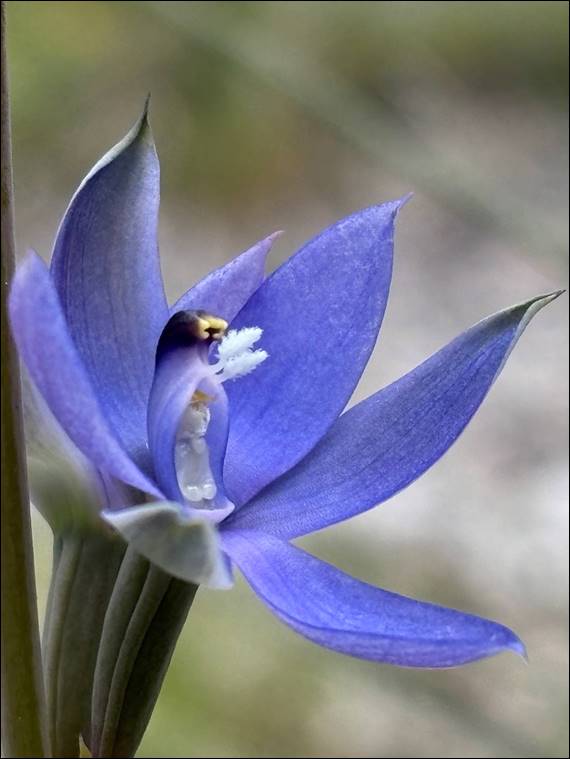
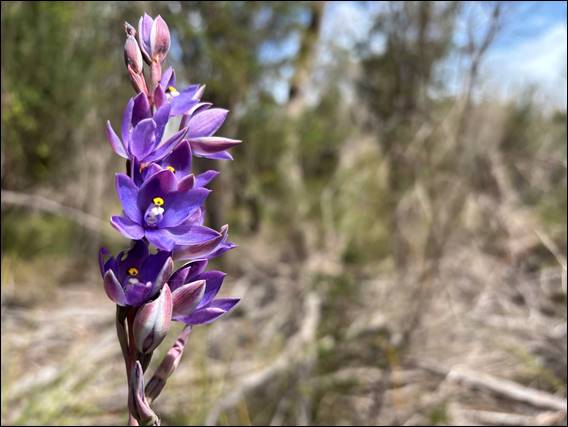
A quick recky of the spots I knew about proved things really are drying up. Lots of wilted stems that would have been unrecognizable, other than for the fact I had seen them in all their glory some weeks back. Many having been pollinated, which was a great sign. And today for the first time this season, finally, every Sun Orchid I came across was open. As proof the first image of heavily clustered Scented Sun Orchid (Thelymitra macrophylla). There were several other species too, including the above Plain Sun Orchid (Thelymitra paludosa):
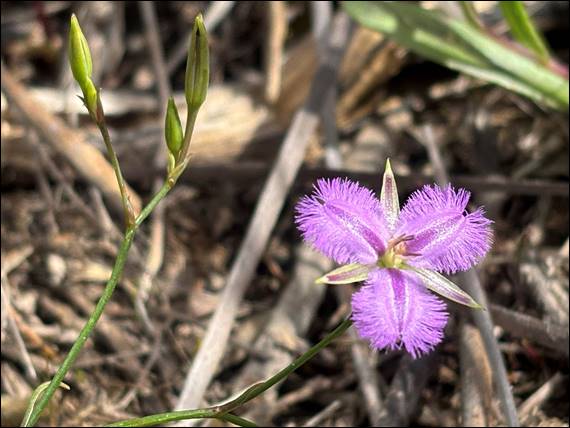
Other flowers were catching my eye today too, including the above repeat find of the Leafless Fringed Lily (Thysanotus sparteus). I thought it may have been yet another different species. Due to the sepals being more green, being a much smaller plant, and with each only having one flower open. But it was not different. When growing in open sandy clearings they will often present as smaller and low-lying plants with just a couple of flowers at the tips. I’ve also read that to increase the plant’s reproductive chances, only one flower may open each day:
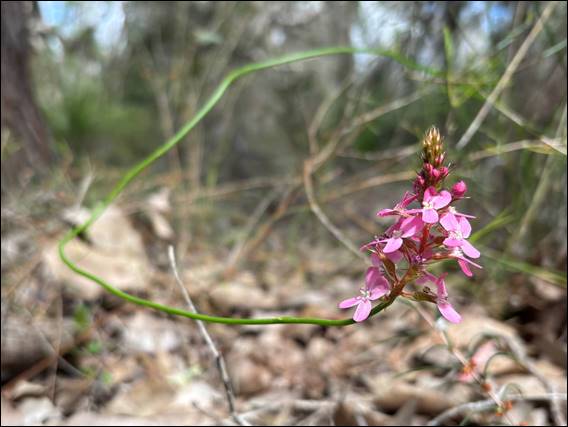
Then there was the above, a cluster of flowers at the end of a very long wiry stem. Being a Rhizomatous Reed Triggerplant (Stylidium squamosotuberosum). The species name comes from Latin words squamosus and tuberosum meaning scaly and tuberous or bearing tubers, which refers to this plants fleshy, scaly tubers, or rhizomes. The common name also refers to its underground origins, with Rhizomatous meaning having, producing, or spreading through a rhizome. The base word originating from Ancient Greek, and later adopted in Modern Latin:
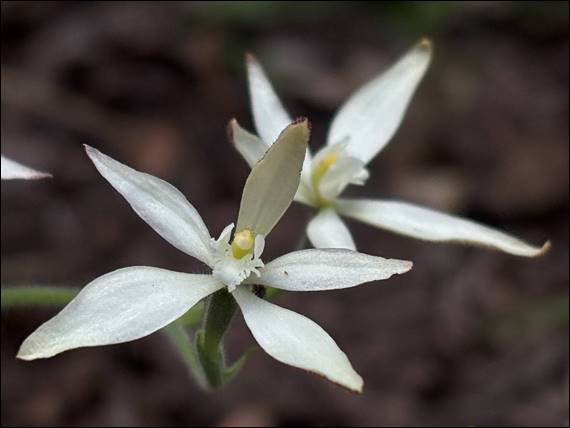
You may be forgiven for wondering why I would include two images of what appear to be White Fairy Orchids (Caladenia marginata). Look again and you may notice above that the hairs covering the back surface of the sepals and petals are rusty-brown, as is to be expected, but are yellow in the specimen below. These orchids are known to cross with Cowslip Orchids (Caladenia flava), resulting in the Dusky Fairy Orchid (Caladenia × erminea). This hybrid usually exhibits an upper side of the petals and sepals with yellows and hints of red coloration:
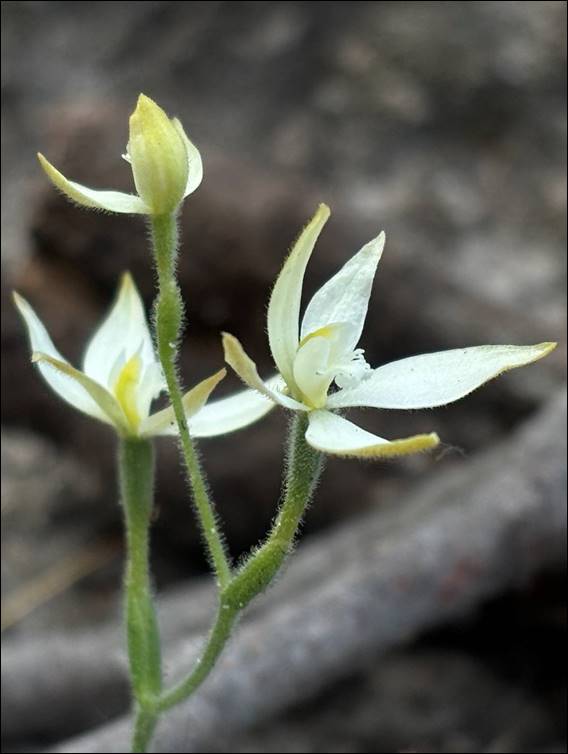
None of this exists in the above image, plus the labellum is completely white. In my original research AI suggested it may have been a F2 hybrid or a backcross, where a Dusky Fairy Orchid has crossed with a White Fairy Orchid resulting in more prominent features of the latter. However, digging deeper I’ve also discovered through AI that the Dusky Fairy Orchid, a F1 hybrid, is functionally sterile, as are many plant hybrids. As such it is impossible to achieve a F2 hybrid or a backcross, and what I found is instead explained as an unusually pale form:
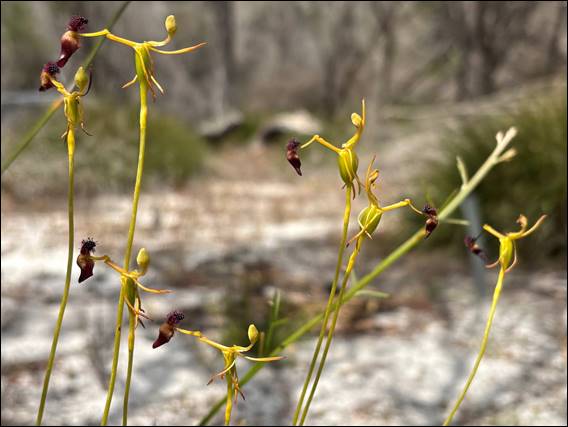
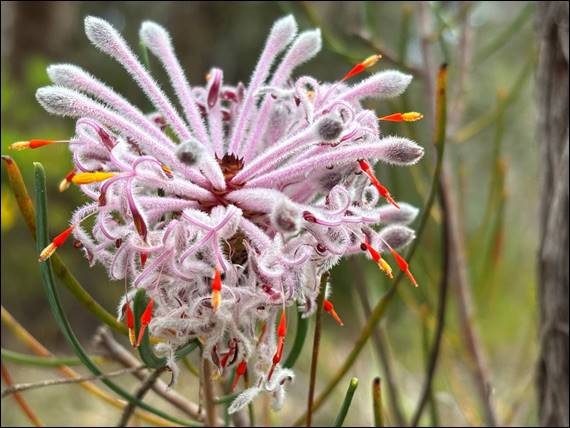
Something considered possible due to the highly variable traits of the parent Cowslip Orchid. Either way a pretty neat observation. Just as exciting as the above, which is what I came here to find. It was so pleasing to find well over ten flowering Glossy-Leaved Hammer Orchids (Drakaea elastica), most having been pollinated. Lastly a Pixie Mops (Petrophile linearis) that to prevent self-pollination has a specialized structure, called pollen presenters. Starting out yellow when it has pollen to give, with just one in this image, before turning bright red to signal it is ready to receive pollen: