Of the myriad of small basal leaves I spotted at Castle rock a few weeks back, only one had a stem and was in flower today. Even when flowering these can be pesky things to differentiate but I feel confident to say this is a Mosquito Orchid (Cyrtostylis robusta). As with several orchids here, they do not grow from a seed but a tuber. Resulting in each years plant effectively being a clone. The seedless process results in large colonies forming, in which every plant is genetically identical. It is common for only a few plants in a colony to flower:
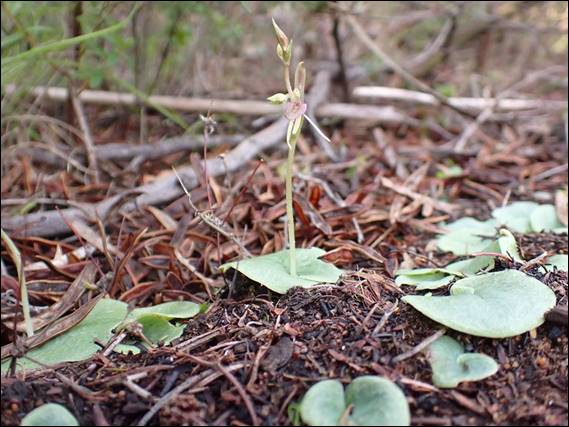
Digging deeper into these, and other Cyrtostylis, there are finer details that I have previously overlooked. Next time I will have to take the time to take some macro images. A bit of a silly term considering it means to take close-up images of the small or micro details. One of the features I want to check out are the two glands on the labellum. Said to resemble eyes. These are used to attract Fungus Gnats (Mycetophilidae), and also other very small flies, to aid pollination. But these fooled insects are not the only way pollination can occur:
With approx. 450 species of orchids in the region very few are known to use autogamy, which means it can pollinate itself. Most species have a barrier between the pollinia, which hold the pollen, and the stigma, which is the ‘gatekeeper’. The gatekeeper makes sure the pollen is worthy, which is a whole other story for another time. If Cyrtostylis are not visited by any pollinators the pollinia breaks down and makes direct contact with the stigma, resulting in fertilization. This may explain why some species are out in larger numbers nearly every year:
I was however not here to hunt orchids. Climbing was on the cards. But I had a bit of time to kill when Craig was delayed, due to having trouble wrangling Henry and Charlie who were a bit resistant to leaving the house. A slower walk to the crag looking for orchids and a bit of bouldering kept me busy until they arrived. Needless to say it was a late start. By the time we touched rock it was close to three hours after the Peppy Plungers had submerged themselves in the ocean. Not that Lisa managed to get in the water today:
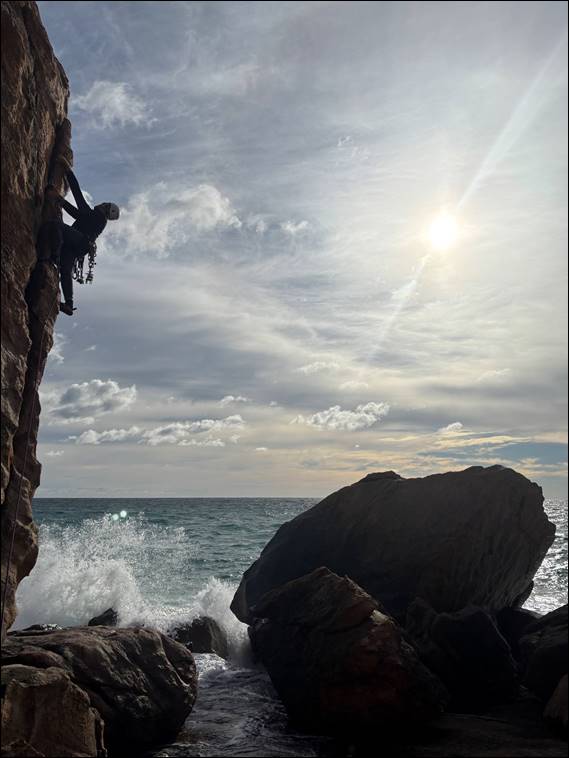
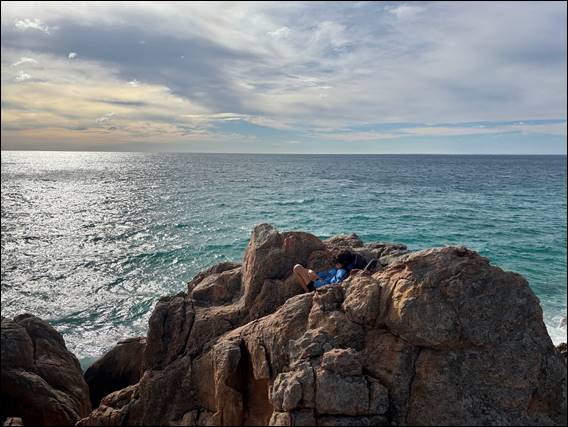
As the images show there was a bit of a swell, and as she walked in a wave came in loaded with a good sized rock that caught her right on the shin. That was enough to put her off. The waves were also a problem for Henry, not being the best conditions for fishing. Charlie however had a few things packed away to keep him occupied. Including a book that he can be seen reading in a nook he found that was protected from the fresh wind. While the sun was high in the sky and offer some warmth, the wind countered this in equal measure:
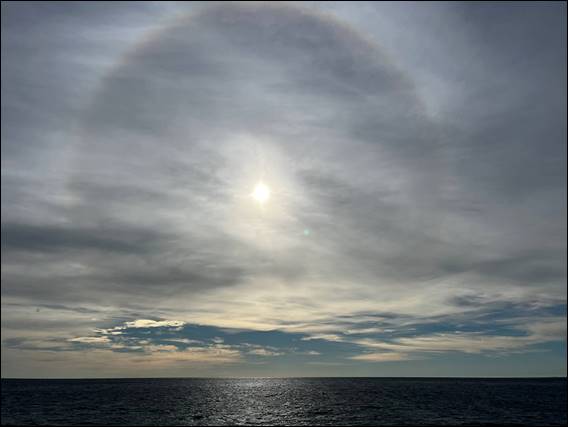
A high veil of cloud was tempering the effects of the sun’s rays. In the third image Charlie captured a great image of a sun halo, an effect caused as the sunlight was distorted by millions of microscopic ice crystals suspended in high-altitude cirrus or cirrostratus clouds. Today they were cirrostratus clouds, which forms veil like sheets covered larger areas as opposed to wispy hair like features of cirrus clouds. We witnessed a 22° halo, the most frequently seen and common of halos. They can also form horizontal lines, pillars, and various arcs:
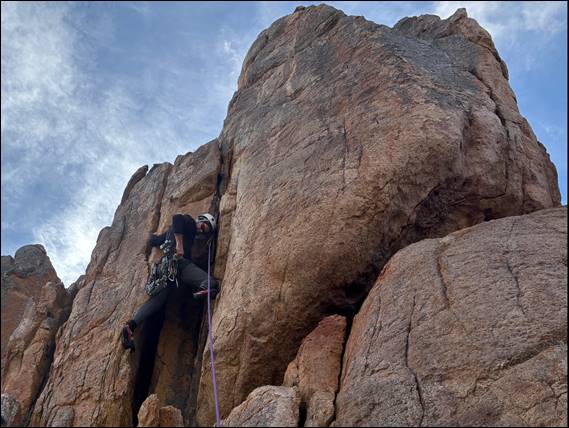
While the waves never stopped, Henry did eventually find a perch from where to throw a line in. Not that he had any success. Meanwhile Craig and I did what we came here to do. Ticking off a few lines. Nothing too serious, meaning we could go lead for lead. Craig was looking very calm and collected on rock today. There were no slips or rests on our chosen lines, and today I did have more focus and bagged the route that spat me off last time. Soon enough lunchtime caught up with us, which we were alerted to by the boys who were getting hungry:
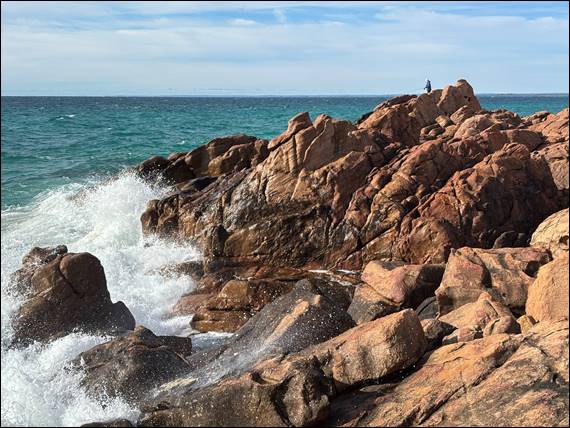
Before we could get them back to the cars, where they had left their lunch, there was the short 600m walk. Made all the slower when Craig pulled out his macro lens in case there was anything worthy of an image. And of course we found a few things. He was taking a much more professional approach with artificial lighting and image composition, whereas I went for the point and shot approach. We only stopped a couple of times, sensing that food for the boys was a more pressing matter and they were going to hang about afterwards anyway:
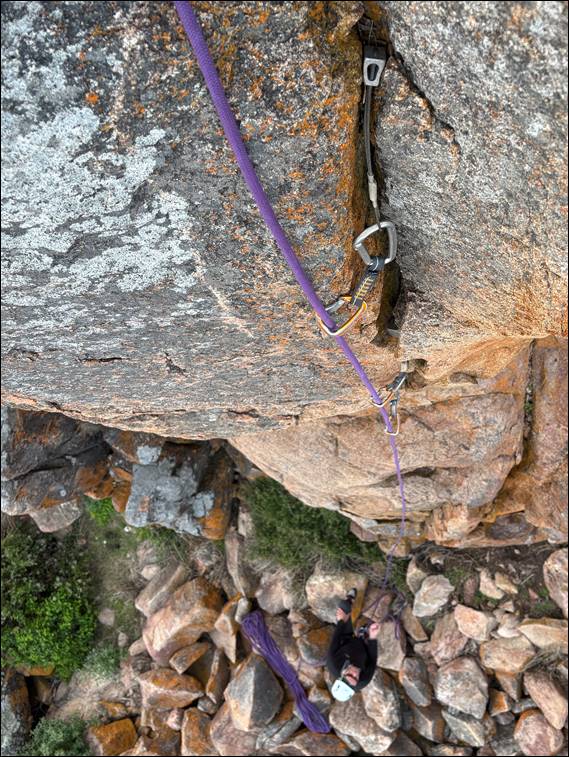
The first find was a Waxcap (Hygrocybe polychroma). Only a few of the thirty odd species of Waxcaps in the south west are known to grow in sandy coastal heath environments. This is one, and it has no specific common name. The scientific name is however interesting comprising Hygr and cybe meaning moisture and head, and poly and chrom meaning many and bright colour. Mushrooms comprise 85-92% water, and Waxcaps are in the upper range. This Waxcap species is also one that comes is a myriad of colours from yellow through to red:
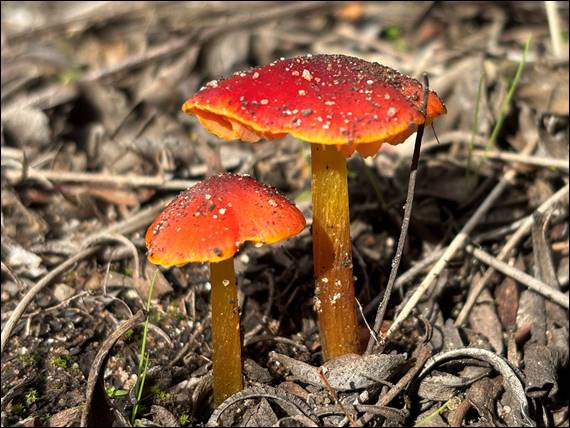
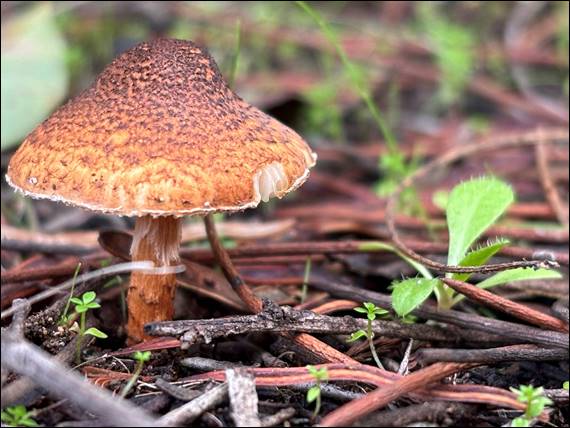
The next fungi has features from the Lepiota genus, and the closest match is an introduced species. The caps size, central knob, scaly surface, brown colour, and white gills along with a scaly stem that is chestnut-brown all point to a Chestnut Dapperling (Lepiota castanea). This species can contain lethal amounts of amatoxins that attack the liver and kidneys. However the toxin levels vary wildly based on geography, and is completely absent in some regional populations. While something looks to have had a nibble on it, we left it alone:
 Sandbagged