I have a vague recollection of including a reference about a guide being released, probably a wee while back now. One that had drawn Howsie and my attention, as well as many others. After my last visit to the UK in February we planned two trips to this majestic place. The first would have seen me gate crash a Howe family weekend at The Lily. A lovely spot I have stayed at once before during another foray that Howsie and I did down this way, some five years back as detailed in this post: https://sandbagged.blog/2021/05/09/small-world/:
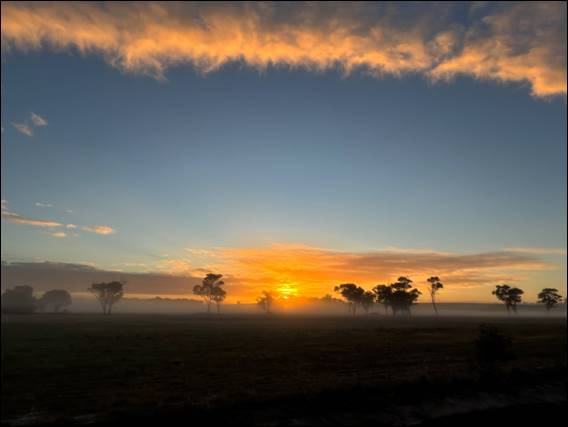
It could have been that I was still in holiday mode, jet lagged, or maybe age is increasing the leakiness of my brain. Regardless, I got the dates mixed up and double booked myself for the day that was to be the first planned trip here. There was no contest and of course Lisa won out, when I suggested that we have a night away in Pemberton. Yet another wet and cool stay in the relaxing forested area, despite being in the last throes of summer. The weather wasn’t a whole heap better in the Stirling Ranges, so it was kind of lucky that I did stuff up:
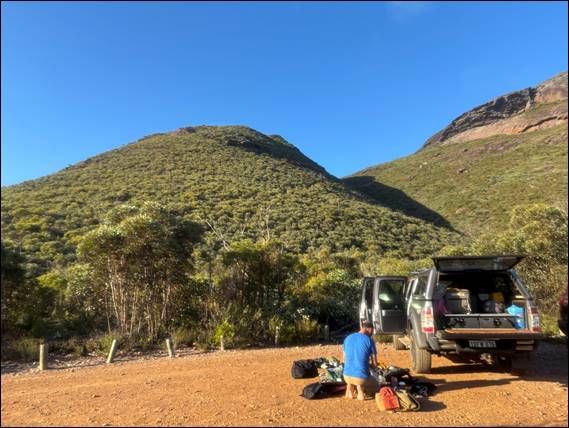
All up it worked out well, and I have to admit I did feel a little guilty to have even thought it was reasonable to Shanghai Howsie for a day. Despite Nadia having said it would be OK. On a side note the term Shanghaiing came about in the late 19th century. Meaning to kidnap people to serve as sailors on ships. It was a rife practise in England and America. Particularly in San Francisco, when they would be forced onto the Shanghai Passage. Once on that trip getting home was very difficult, other than to continue on a journey round the globe:
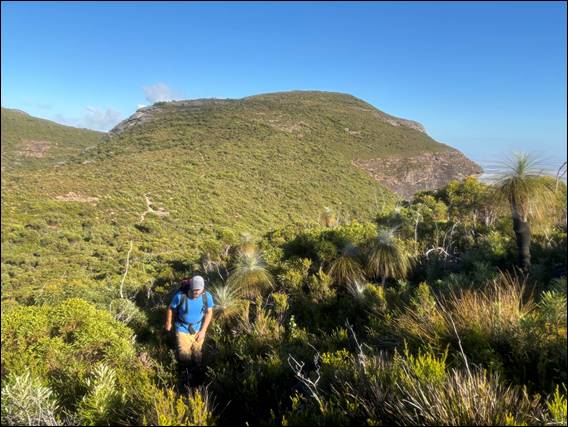
The abduction would often be through violence, intimidation, or drugging. There is a report of 100 men being taken in one night using drug-laced whiskey, when they attended a fake ‘booze cruise’. It got so bad in America that they brought out legislation to ban it, but that contained loopholes, as is so often the case. And it was not until the early 20th century that it was made a federal crime in the Seamen’s Act 1915. An act that is just one year younger than the Act we still use to manage water resources here in Western Australia:
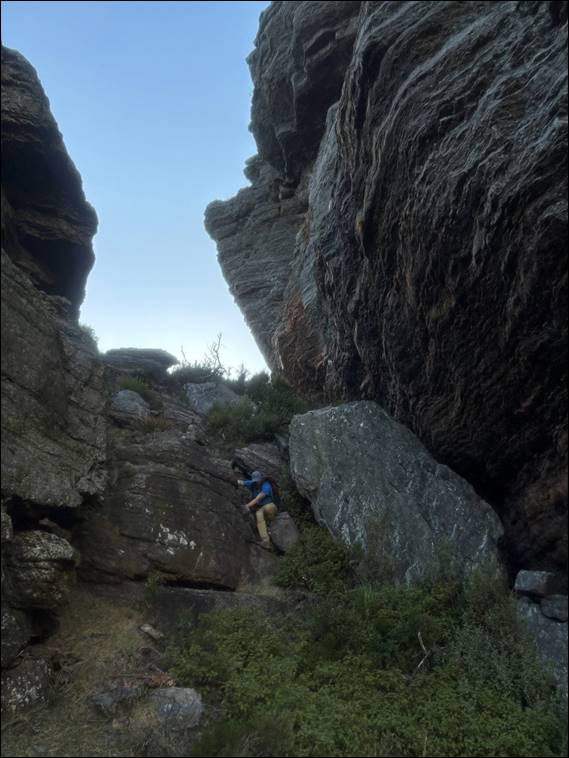
I’ll make no apology for that little bit of history. When Jonas stumbled across the climbing in the Stirling Ranges in the early 2010s, he commenced a journey that took over a decade of exploration. Both of new routes and the history of climbing in the area. It was his guidebook, which he finally published in late 2025, that had drawn Howsie and I back to this place. I got an email from Jonas in 2016, three years after he started this mammoth journey. He had invited me to come down and explore the area with him, and did so several times since then:
Something I never managed to take up. Maybe a missed opportunity but there is no point looking in the rear view mirror. I was keeping myself busy enough. Plus committing to weekends at a place that takes four hours to drive to, with crags that generally require at least an hour to walk into, it would have taken me away from Lisa and Elseya too much. I’d already done that to them in developing the guides for Alice Springs and the South West of Western Australia. Funnily enough they were published a decade apart in 2005 and 2015 respectively:
The Stirling Range guide came out at a decade later in 2025. If I had taken up the offer from Jonas I would have immersed myself deeply into the area. While it is Jonas’s guide, as with John’s recent book of climbing in Australia, I would have become heavily invested. Instead I can now simply enjoy the fruits of Jonas’s labour, and be immensely grateful for all his hard work. Climbing in the Stirling Ranges is not to be taken lightly, it is remote mountain style stuff. Many areas get very few visits, although that may change now the guide is out:
We have both climbed here a bit over the years so knew what we were up for. Even still it does take a little getting used to. It is certainly sensible to re-familiarise yourself with the place. More so, due to having been mostly a crag rat in recent years, climbing on single pitch faces. Most of which get regular action so are generally devoid of loose rock. As such our goals were not lofty in grades but high in meterage, aiming for multi-pitch routes. However, rather than chew a whole day on one line we aimed for two areas to bag a few choice lines:
You may sense that I am pushing the safety aspect that bit more in this post, and for good reason. Accidents here become a lot more involved than at our local spots. This switching into a more serious mode is nothing new for me. When I started climbing over thirty years back I had it instilled in me, by the ‘old boys’ I used to climb with. The time it kicked in the hardest was during an attempt on the mighty Horseshoe Ridge on the Isle of Skye, recounted in this post: https://sandbagged.blog/2017/08/27/part-6-scotland-the-long-road/:
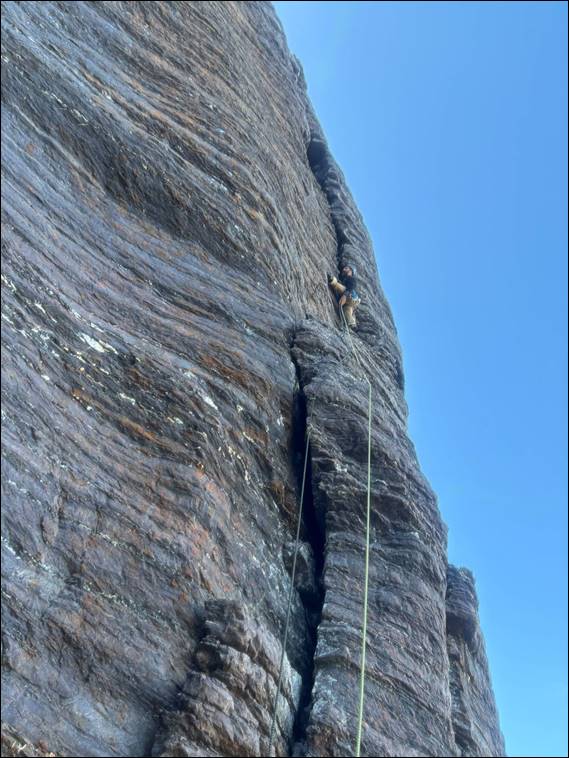
Our first destination was the South Face of Mount Trio. A wall that I looked at with yearning during Lisa, Elseya, and my many camping and glamping trips since we first stayed at the Mount Trio Bush Camp in 2010. But not one I ever managed to get to when I came here to climb. So I was excited to sample the delights on offer. The Stirling Ranges was the place where the first roped climbing routes were undertaken in Western Australia, and it remained the main focus into the late 70s. The first known but not recorded line, was establish on Mount Trio in 1957:
That route was not on this face, but there was a historic line that I did fancy jumping on. Howsie and I started our day early, and I was to blame for that. I didn’t miscalculate as badly as our first planned trip, and this time it was due to work. We shuffled plans about and then had to change them again, to avoid a front with a good amount of rain due to hit Monday. What with the distance to get here it is not really the place to come if you don’t get two decent days on rock. This saw us leave in darkness, so we could arrive at the carpark of Mount Trio at 7:30:
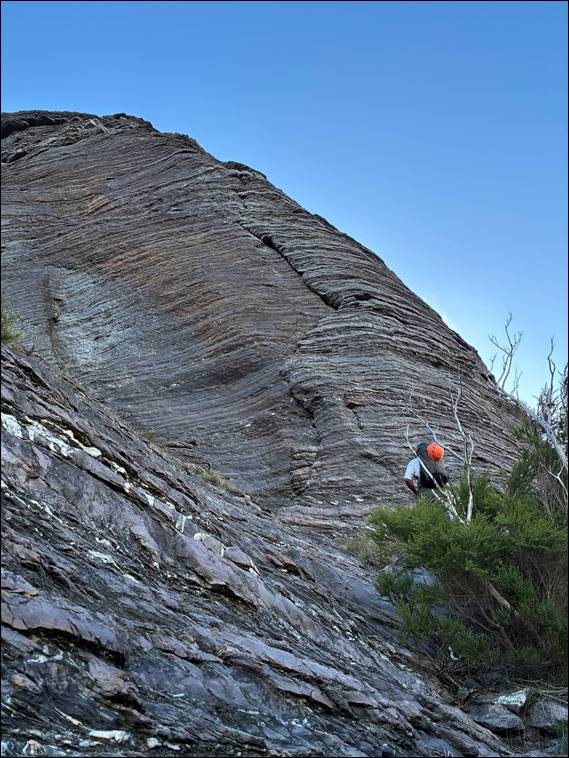
After sorting out the gear to even up the weight of the packs, we began the hike up the leg achingly steep hikers trail towards the summit. At the saddle there is a goat track that leads to the South Face, from where we opted for the West Gully decent to the base of the crag. This covers the first five images. With each step and as the walls started to tower above us, the excitement and nervousness built in equal measure. Looking at the primo features on offer, I racked up for the first pitch of Directtissima. A true sandbag route from 1974:
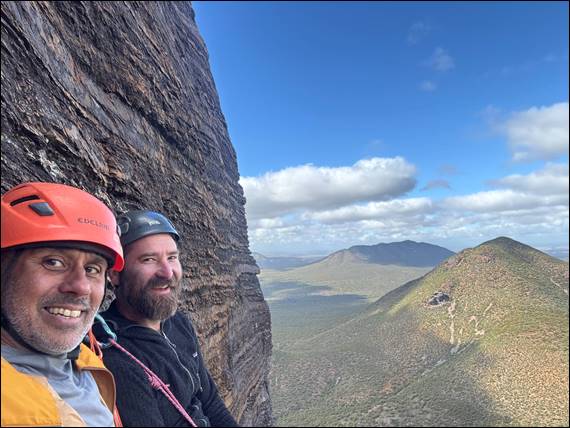
The guide warned us of this, and had even taken caution by bumping the grade from a lowly 12 (S 4a) to 16 (HVS 4c/5a). The first pitch certainly felt unrelentingly steep, and I had to work hard. Possibly, the nerves were on edge, maybe I was tired from the walk in, or was it the relative lack of sleep due to the ‘sparrow farts’ start. No matter, it was utterly absorbing and truly brilliant. Howsie followed up and we sat on top of the flake to take it all in. When we are places like this, we slow down. Taking time to soak in the experience and situation:
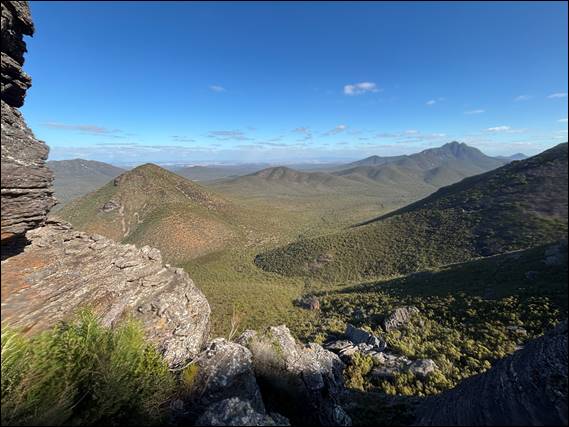
The climbing is a bonus, and for this route a sobering thought was that when they established this climb and gave it a lowly grade 12 (S 4a), they had no camming devices. Something we made lots of use of. Hopefully, you are following the images as I slowly catch up. Howsie took the second pitch, which was equally stunning. Only awarded one star, we considered with two brilliantly absorbing pitches it was the best of the four lines we hit here. Howsie then took on the next lead, being drawn in by the obvious and main feature of the wall:
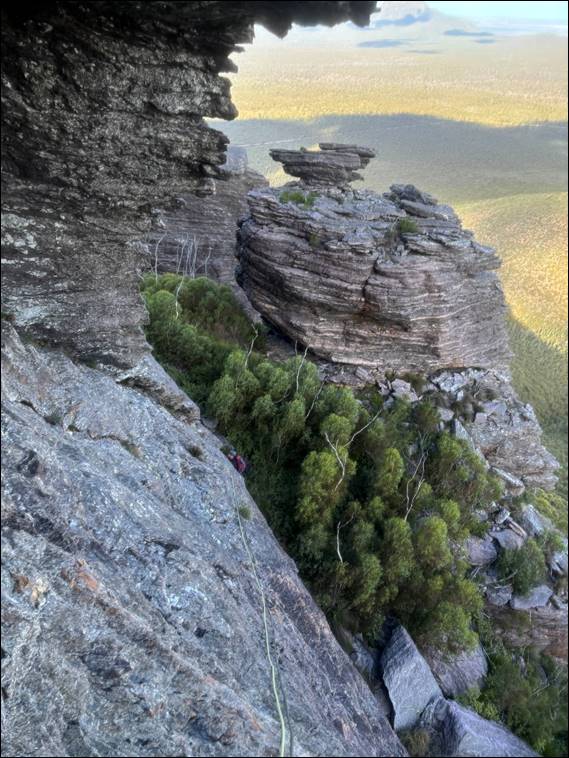
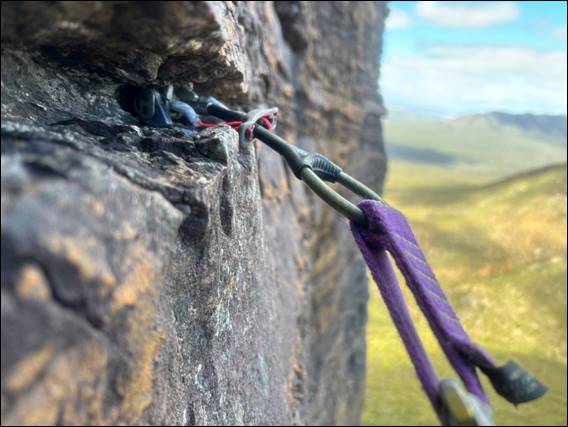
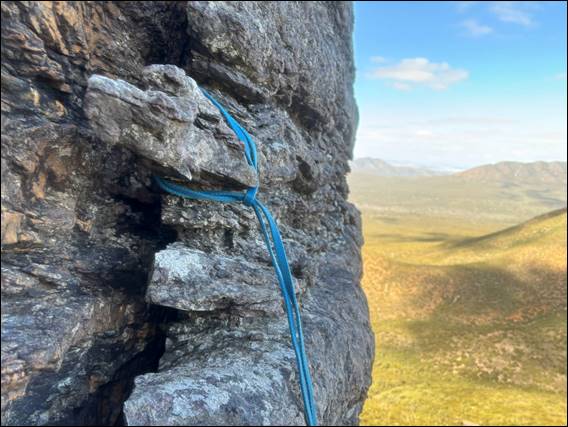
A wonderful flake, providing a magnificent near 40m pitch. Rip’em Off come in at 16 (HVS 4c/5a) and was first climbed in 1973. This is awarded two stars. The first pitch was very deserving of this, if not three. Howsie even used a bit of old school trad gear that I simply had to take an image of, being the sling round a horn of rock. We looked up at the second pitch and decided to rap back down. Even the guide says the second pitch is a letdown. This then allowed me to bag the first pitch of Sisyphus, which is awarded three stars in the guide:
A 1971 route, and yet again 16 (HVS 4c/5a) and yet again really fun. This conveniently finished near the previous lines first pitch. Allowing us to sample the upper pitch. While the guide says it is, and it was, a little meh, we had to do it at least once. Our rating of the routes in relation to stars was opposite the guide and went three, two, one. However, each person’s experience will always be unique and can vary on different days, as such it is just a guide. All three lines were stonking and well worth the effort. Then there was one more line to bag:
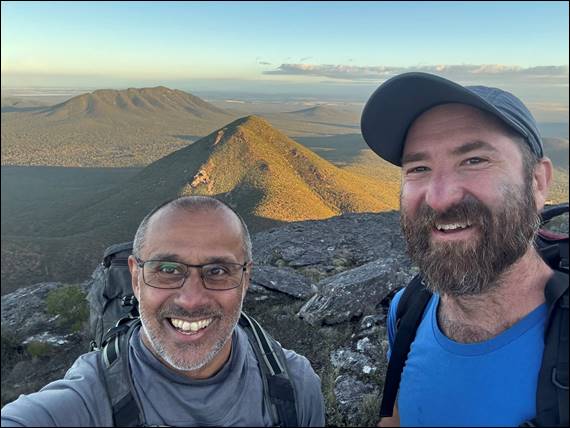
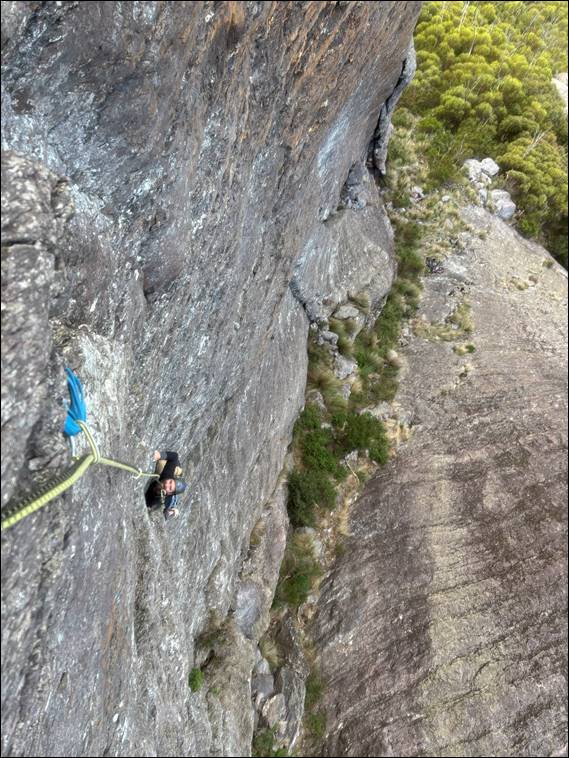
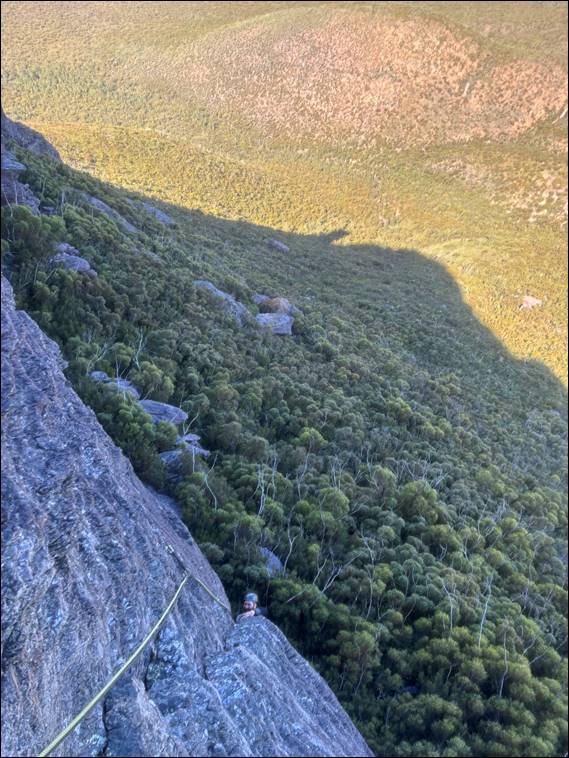
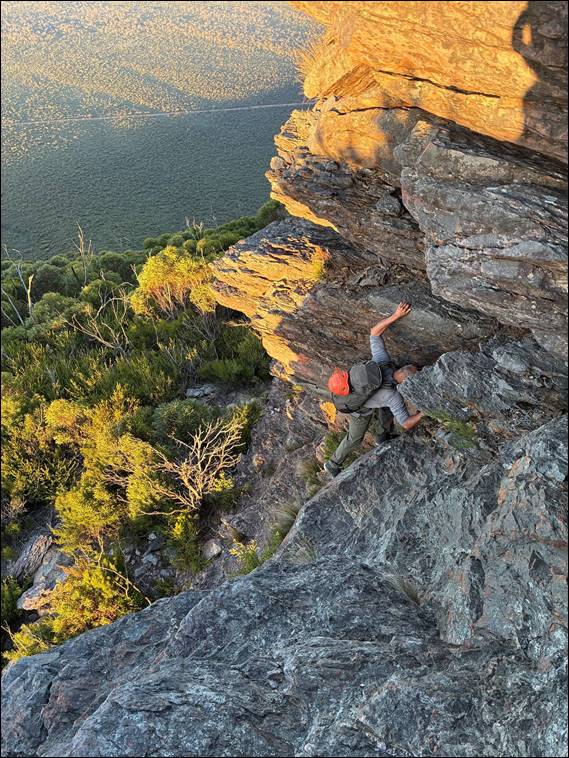
Staircase is given grade 4 (not quite a M in the UK system). Listed as a long five pitch route, and a good beginners climb. First climbed in 1966, so we climbed it on the sixtieth anniversary of the first ascent, which was pretty epic. As was the line. Those old climbers were bold as brass. The gear was scant, even with camming devices which they had none of. I’ve included an image of Howsie following up the first pitch, in which I challenge you to find my gear placements. And an image of Howsie going up the second pitch, which did have more gear:
We climbed it with packs, making it even more fun. But it is certainly not a beginners route due to the long runouts, even if they came up on second they would risk a big pendulum fall on the first pitch should they slip. We loved it! Better still it went on, and on, and on, and we reckon it went for close to 180m. A brilliant way to end the first days climbing, on what is described as ‘the original route of the mountain and one of the first in the Range’ (the first to be written up that is). The day was not over yet and first we had to get off the peak:
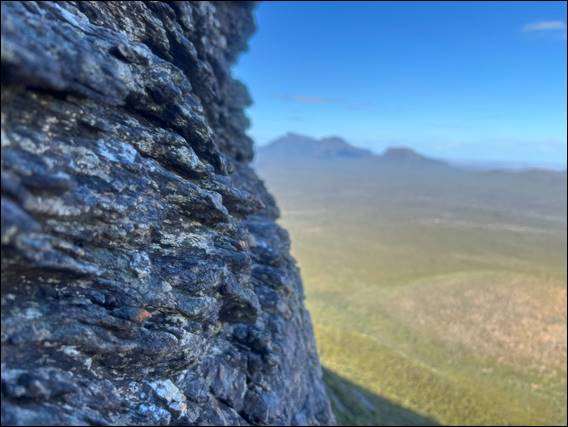
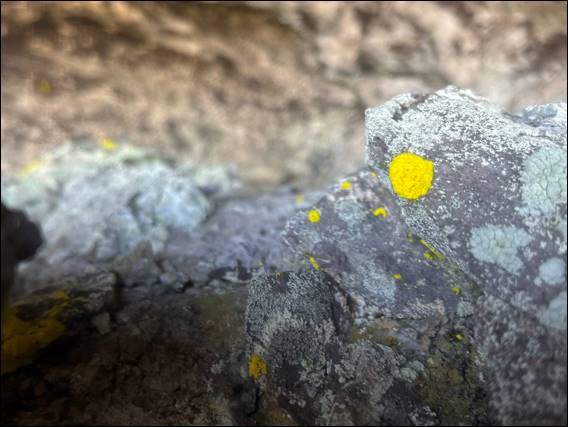
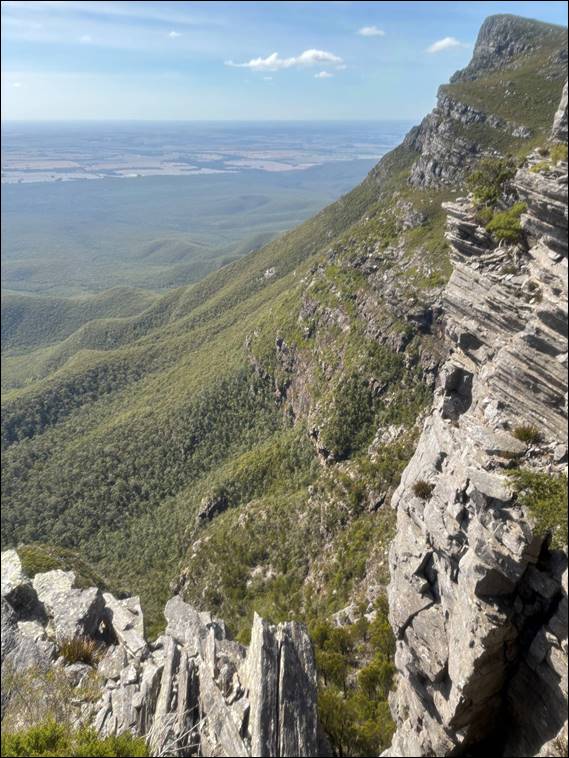
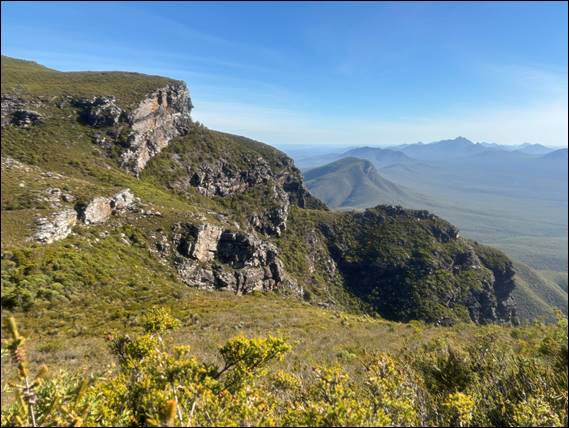
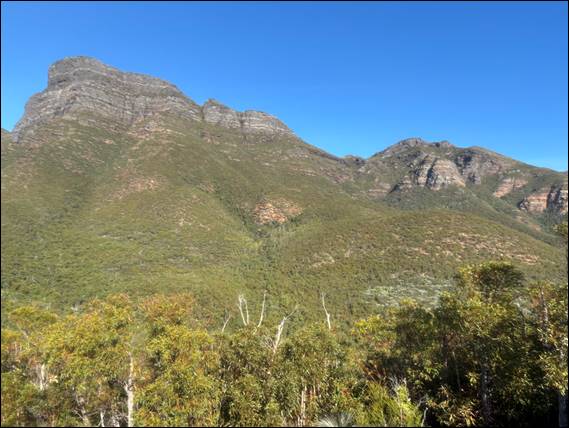
After finding the above scramble, it was back down the hikers track. Arriving at the Mount Trio Bush Camp as light was fading from the sky. We definitely made the most of our first day. Bob will be happy to hear we managed our old goal of a 1,000ft of ascent on rock, with some 340m (1,100ft). While I have rambled on with some climbing talk I have included a few images to show the rock texture, which varied quite a bit on some lines, and scenery. Also an image of what I believe to be Sulphur Dust Lichen (Chrysothrix chlorina):
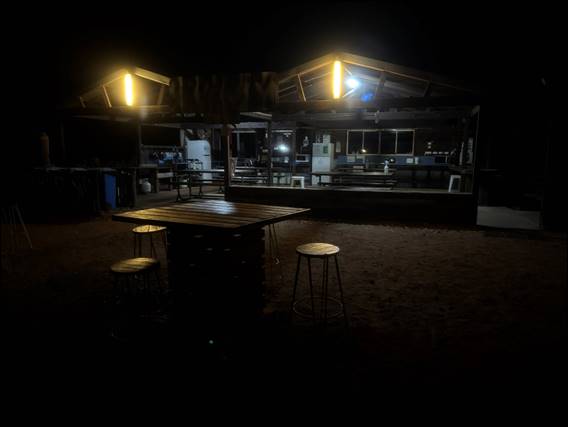
The Stirling Range, especially the south-facing slopes, is reputed to have the most varied and abundant lichen growth in Western Australia. This stand out that is a brilliant yellow likes shady damp rock faces, and is usually found under overhangs and in crevices. The area is also well known for orchids, another reason I enjoy coming here. It is however still a tad early in the season and we didn’t see any. When Lisa, Elseya, and I first came here the camp site was quiet and peaceful. Now in complete contrast it is a humming place, but still hold charm:
Arriving when we did, there was time to pitch the tents, have a brew, and make and eat dinner before it was time to hit the sack. We were however delayed, when someone sat right next to me and started gabbing away. I feel like I can be forgiven for not immediately recognising Alan. One of the social crew back in the day, who I had not met for some four years since he moved north (https://sandbagged.blog/2020/04/21/alan-the-tagalong/). He just so happened to be down to enjoy the area with his mates Shane and Colin:
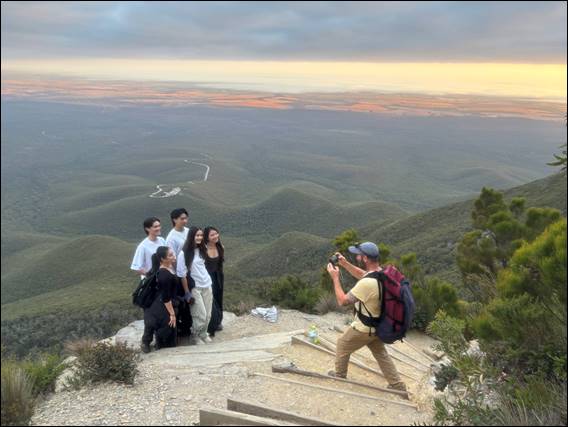
If you do read the linked post about Alan, the one change that was evident is that his endurance has waned somewhat. Admitting that even the walk up and down Talyuberlup had worn him out. Back in his day he had run up and down all of the six main peaks in the Stirling Range’s in one day. It really was lovely to see him and he was still smiling like a Cheshire Cat. Sadly being as weary as I felt, my social cup didn’t take long to fill and my sleeping bag was calling. Plus we had another early start planned, but not as early as some:
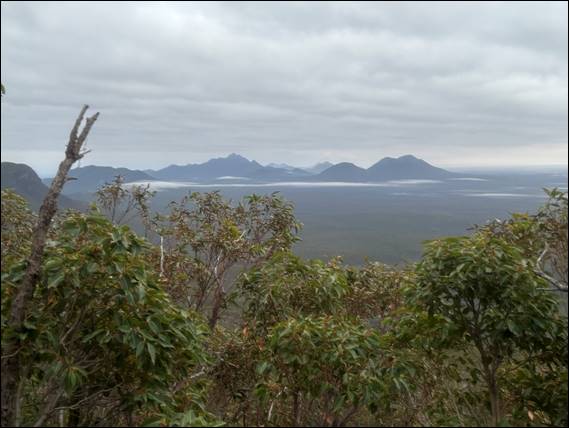
From three onwards for an hour and half, car after car after car put its headlights on and drove out. Undoubtedly all heading to where we intended to go. The difference being that they were aiming to watch sunrise from atop of Bluff Knoll. We however got up at four and reversed our arrival by having breakfast, a brew, and then breaking camp. It was a leisurely pace, and we arrived at the Bluff Knoll carpark at six. Vehicles were spilling over by some 300m meters on both sides of the approach road:
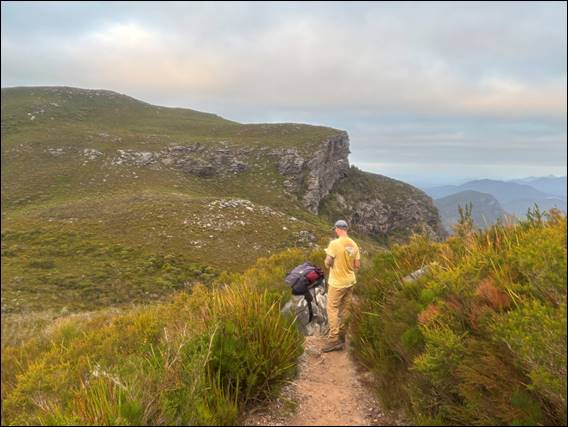
In the darkness, a trail of headlights weaved the path of the hikers track and there were several atop the peak. A peak that would be called a Munro in Scotland, due to being above 3,000ft (914.4m). It is the tenth tallest peak in Western Australia but the highest in the south, as all nine that are above it are in the northern region of the Pilbara. We started our walk as first light started to creep in, so didn’t need head torches. Having a bit of a trudge ahead of us, taking about the same time as for the Mount Trio approach but with a more forgiving grade:
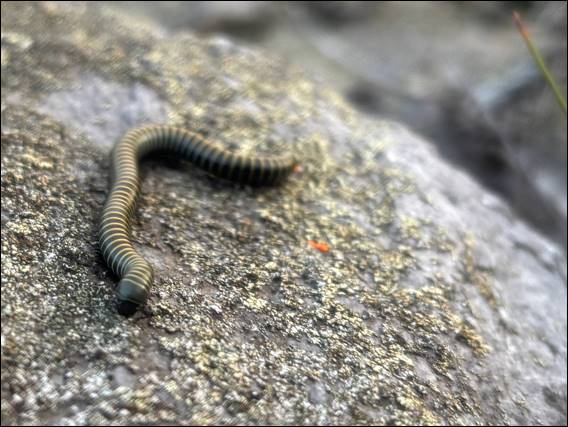
Not that our legs acknowledge that. When the track veers left to reach the summit, it was our cue to leave the hordes of people. Part way across to The Fortress, which is one of the faces on Coyananrup, we came across the above Eastern Massif Tiger Millipede (Atelomastix tigrina). Not the first time I have seen one, and there is an image of one in the post linked at the start of this one. Back then I didn’t identify this species , which is listed as vulnerable. It has a very restricted and patchy range, all contained within the eastern part of the Stirling Range:
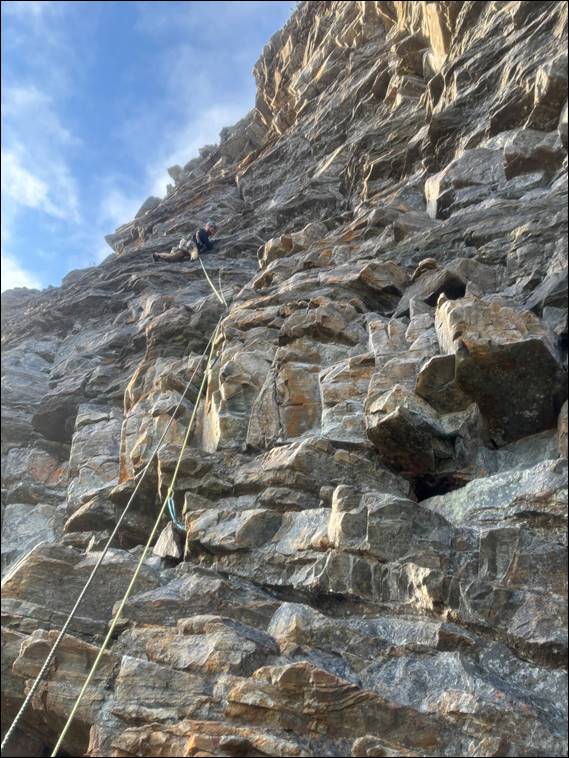
Onwards we went. Along a ridge and then down to round the edge of The Fortress. As soon as we got up close and personal, it loomed some plus 70m above us. Looking steep and overhung in many parts. Mount Trio comprised geological features of folded sedimentary rock that was relatively homogenous, which gave it a crag like feel in comparison to this spot. The Fortress, like the nearby Bluff Knoll, comprised folded and faulted quartzite, sandstone, and shale. The blocky nature looked less stable and along with its steepness it was intimidating:
We both felt it. There is however only one way to see if it was just in our minds, and that was to get on and climb. We racked up with Howsie taking first lead today. Taking on a relatively new route from 2003 called Coyanacorna. No surprises that this one star route was graded 16 (HVS 4c/5a), which seemed to have become our staple grade. The climbing felt more nervous and it was not as easy to read if the rock would stay in place. It did but care was required, checking for cracks indicating weaknesses and at times avoiding bigger unattached blocks:
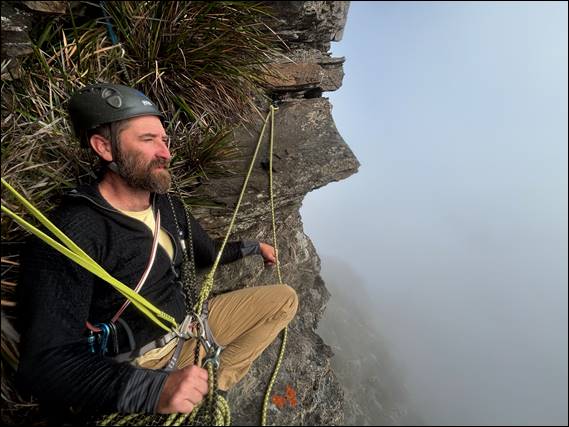
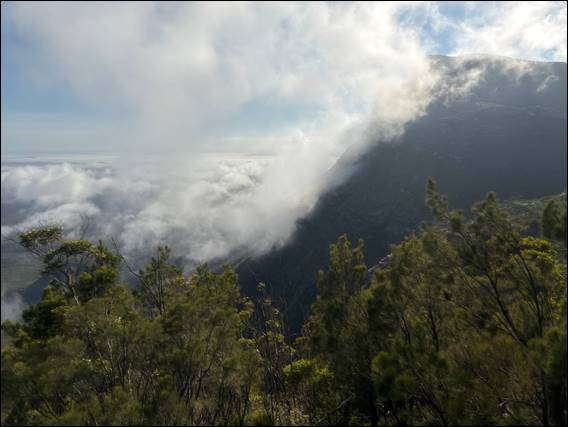
I came up on second grateful for the rope above me, as I accustomed my brain. The second equally engaging pitch was just as entertaining, problem solving, and nervous as the first. I took this one as the cloud rose up the hillside and over us, obscuring any view. The steepness was more evident here. We relish the exposure of air below our feet, but with steepness comes a tendency to hold on tighter than you need to. It was a stellar line and a great introductory route. But what next. Mind you before thinking about that we had to figure out how to get off:
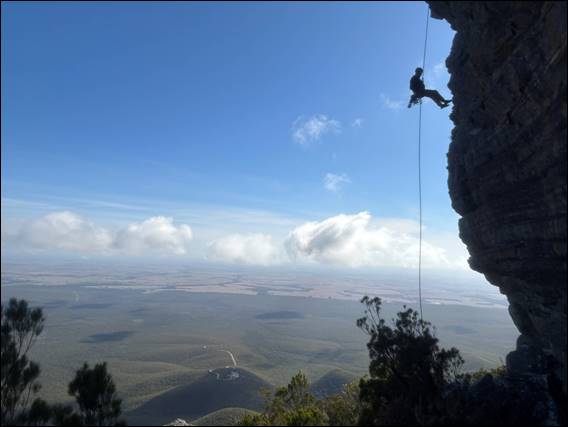
Jonas has done a great job of detailing descents in his guide. For our two locations they were often aided by permanent or thread anchors to allow an abseil. The one shown below was a little nervous, due to all the sizable loose rocks on the ledges you passed on the rap. To avoid any unintended incidents, we slowed down even more and took our time. In part because of this and despite the earlier start on rock, we knew we wouldn’t get a 1,000ft of ascent in today. The routes took longer as did the descents, and with one in the bag it was time for food:
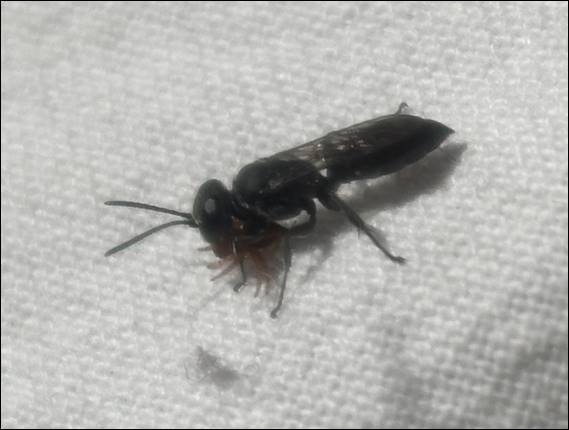
Sat down munching on snacks several Potter Wasps (Trypoxylon) flew round us. The below one landed on my top, which provided the perfect background to show the prey it had captured. These solitary wasps are, for humans, non-aggressive. But this species is not so for spiders. Leaving their prey with their eggs, so when the larvae hatch they have a fresh live meal. The spider it has caught is doomed to be buried in a purpose built mud nest or any hole that seems suitable. We watched some going in and out of holes in the rock next to us:
The lingering cloud of the morning was disappearing, and being north facing the cliff would have full sun. It was the first time we shed layers for a route, feeling like we did not need to wrap up. Howsie had already picked the line. Being one of the first new routes Jonas and his mates had scoped out in the Stirling Ranges in 2014. Freeballing goes at grade 17 (HVS/E1 5a). It is given two stars and is talked up in the guide. And rightly so. The long first pitch was all consuming, sustained, and extremely good. Howsie was rightly proud as punch with his lead:
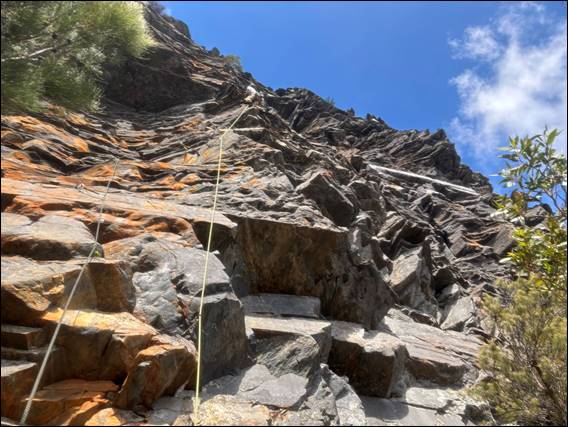
On second, weariness weighed heavy on me. At the belay I sat down to sort the gear. And only after some time dared look up at the crux pitch. Setting off nervously things soon flowed well. Then just below the crux I found a large loose flake that put me on edge. Reaching up in the wall above the holds felt small. On fingertips only, I cranked up. To avoid the flake I had to spreadeagle my legs making the next move feel very long, with gear below my feet. I got a little vocal as I went up. The holds improved but I did not stop for about three meters. A big fall awaited:
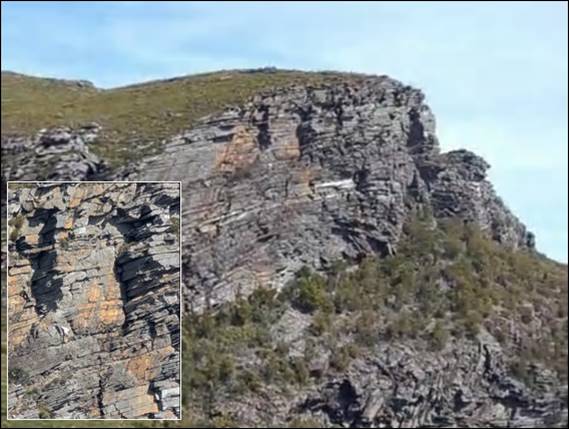
Managing to keep it together, the whole pitch was soooooo good. I had however attracted the attention of hikers on the main track some 3-400m away. A crowd had formed watching intently. I hardly heard their distant murmuring. Howsie however heard the call of a kid shouting ‘go red helmet, he got up’ as I topped out. Howsie came up as most of the crowd started to disperse. As he passed the crux he attempted to lightly place a foot on the flake. It spun into the air and exploded below. He fortunately managed to hold on, and kept going:
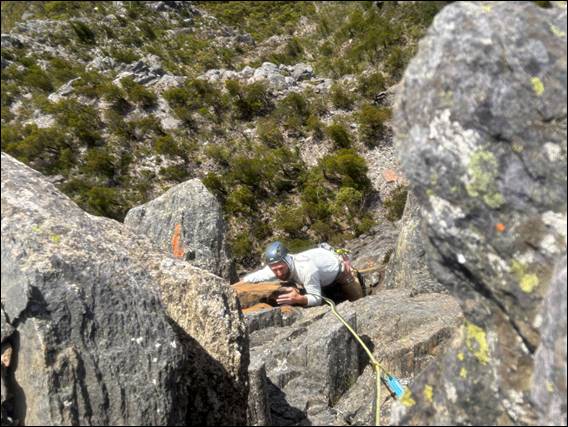
Wow, wow, wow is all we could say about that route. It had it all. But it had also taken it all out of us. I could feel my muscles starting to cramp up from the two big days. Rapping back down and sat at our packs we ate more food and guzzled water. Pondering one more line, but that would mean a much later departure. We had hoped to get home tonight, to allow some family time on this long weekend. Plus there would be no climbing on Monday if we had stayed tonight. Not just because of the rain, but also because we felt toasted:
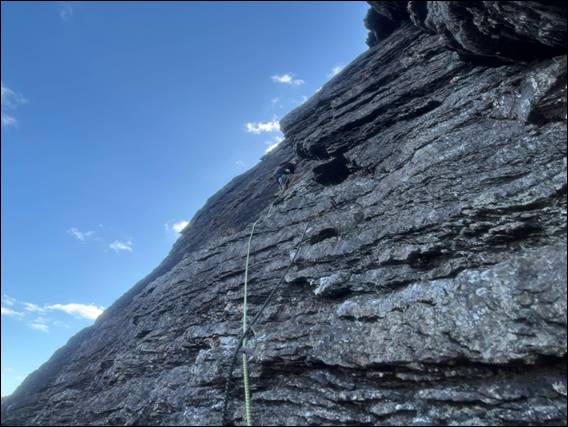
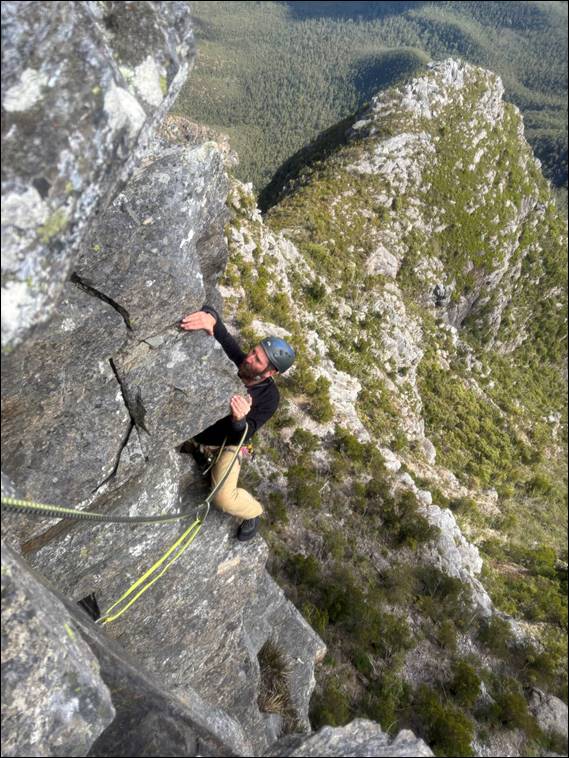
Decision made. We packed up and hoicked it back to the main track. Practically running, we passed lots of people sweating their way up and anyone heading down. Saying hello to everyone we passed, and just about everyone was cheerful and happy. When we went to pass Success and his partner, who were heading down, they asked if we were the ones they had seen climbing. Indeed we were, and he kindly provided me with a couple of photos he took of Howsie just starting up the second pitch, which I have used three images up:
A Canadian lady heading down, taking it very easy with hike poles but with an ear to ear grin of her achievement today, politely asked if we had any water that we could spare. Not for her but someone she called ‘her adopted hiker’, who was too shy to ask for it himself. He was heading down after completing the Ridge Walk. If you are keen to see what that hike is like check out this post https://sandbagged.blog/2021/11/28/a-most-unexpected-journey/. We obliged and offered what water we had left, before continuing our rapid descent. Rolling up to Howsie’s home at seven, grateful to be back but also still buzzing from two glorious days:
 Sandbagged
Great stuff. Ah yes, the 1000ft of rock objective. After a 6 year break I have started back at the wall. Kong at Keswick, and at Egremont, which is Weds 5 to 7pm in term time, with Pete Strong still co ordinating.
Bob Mayow
LikeLike
Wonderful news Bob I still recall some fun nights on the wall at Egremont. With luck you do at times also get the chance to sample real rock. Pass our love onto the girls, and hope everyone is well.
LikeLike
Will do. Our best wishes to you folks. I think the outside stuff, if I do it now, will straight up and down bolted stuff. I realised my balance, agility (and knees) etc was not what it was, and I was less competent (confident) on steep ground. This was the reason I retired from MR in 2016. Great times. You do have to keep moving!
LikeLike
Indeed as my Mam says use it or loose it. I hope to keep hitting rock for as long as possible even if it is just M and Diffs!
LikeLike