Things at work seem to slow down a tad during the Easter school holidays. Maybe due to hordes of people taking advantage of the opportunity to book just a few days off and be rewarded with a decent break. The downside for us, living where we do, is many of these people gravitate towards our neck of the woods. Resulting in busy roads, booked up accommodation, and a general difficulty in getting away from the crowds. Despite this when I took a couple of days off this week Lisa and I managed to have a couple of lovely days out:
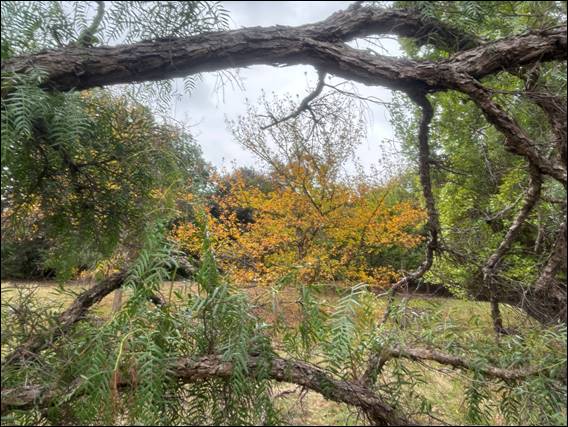
This particular day being quite apt as we did indeed head out to the woods. But not in our local neck, which some believe is a word that replaced the term naiack in the original use of the idiom. This word means ‘point’ or ‘corner’ in the North American native language of Algonquian. We drove a short hour to get to the Golden Valley Tree Park, located just outside of Balingup. Being the largest arboretum in Western Australia, both in terms of size and the number of species of which there are some 500. Not bad for a park established in 1980:
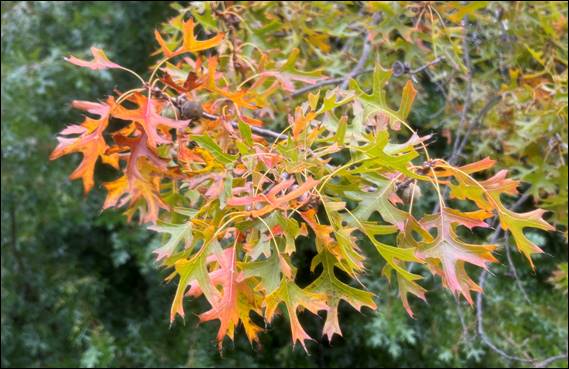
Even more so when you consider it is community run. The genus best represented is the Oak (Quercus), of which they boast 40 of the approx. 500 species found globally. Some 90 are native to North American so it seems right to start with the above species, the Pin Oak (Quercus palustris). Starting to put on a display to show of why we decided to come here. To witness some autumn colours. Plus coming here allowed us to bring the poodles. In the image below, as Lisa read up on the Oak collection, Sooky is wondering why we stopped:
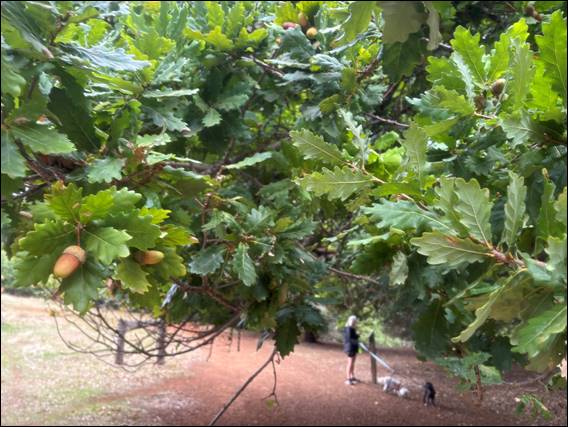
That is not to say there wasn’t lots of stopping, usually when they wanted to check out the smells. We knew it would be a slow paced stroll, but that was fine with us. The species name of the above Gall Oak (Quercus lusitanica) refers to the ancient Roman Province of Lusitania that is roughly present-day Portugal and Extremadura in Spain. Like many trees it wasn’t showing signs of turning yet, we came here a bit too early. There were however a couple of standouts, this Mongolian Oak (Quercus mongolica) being one with a blaze of yellow:
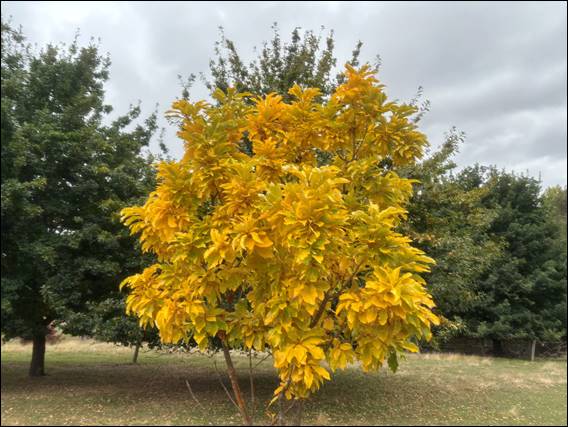
It is quite staggering that this community managed park has been as successful as it has. Reading up on many of the species we found, it is hard to work out how these trees have survived. This one usually thrives in cold, dry climates in mountainous areas, hardly what little Balingup has to offer. There were others that prefer coastal environments, which this place is far from. Then as we moved away from the Oaks, and other intersperse species, we came to a tall stand of familiar trees, London Plane Tree (Platanus acerifolia):
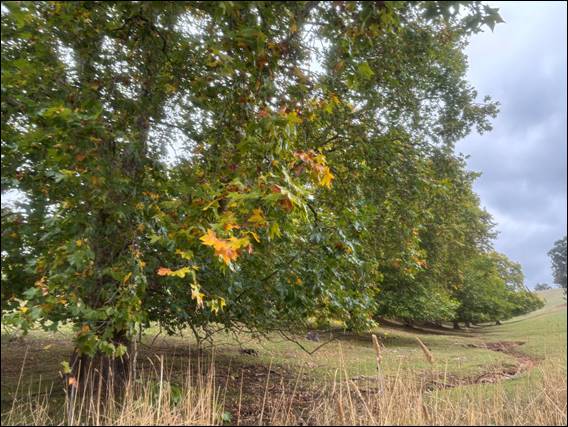
These tall proud trees stood well above the others and caught the wind in their canopies, ladened with leaves. The gentle rustling sound drew our attention and we stood there for a while, and the poodles had to lump it. Particularly in poetry or literature the sound is called psithurism. Derived from psithuros, a Greek word that means whispering. This term is often used to infer a noise that has a calming and meditative quality, which this certainly was. These trees are found in many parklands and streetscapes in major cities of England:
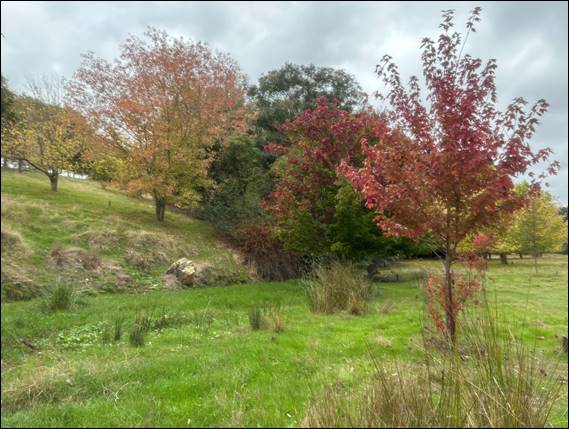
They are not however widespread across the countryside of England. Being not only an introduced species, but also a hybrid. The first two specimens being planted in England way back in the 1660s in Cambridgeshire, and quickly becoming a popular choice for growing cities. In part because they rarely shed branches, making them relatively safe, but also because it is a tough tree. Being able to grow in compacted soils and put up with poor air quality. The hybrid species was not purposely created, and was more likely an accidental cross-pollination:
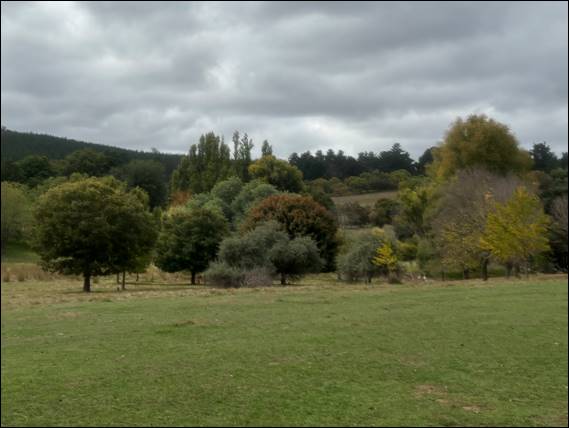
Where this occurred is unclear but it may have been in Spain in the early 17th century resulting from a cross between the Oriental Plane (Platanus orientalis) and American Plane (Platanus occidentalis). Two images up is another hybrid, and the one that drew Lisa and I to want to come here today. The Autumn Blaze Maple was purposely created by crossbreeding. Done to combine the fast growth and adaptability traits of Silver Maple (Acer saccharinum)and brilliant red autumn colour and strong structure of the Red Maple (Acer rubrum):
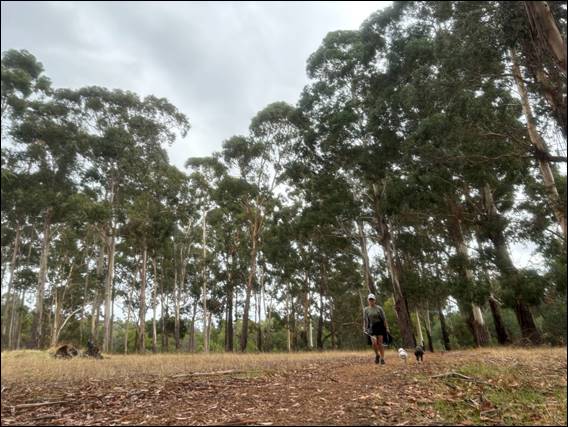
Both native North American species. While there was an impressive global diversity on display many of species we spotted originated from this area. The park has two distinct parts displaying a world collection, which I have been describing so far, and an Australian collection, across 35ha and 25 ha respectively. Moving from the world collection with shapely deciduous trees and ground cover that gave the area a more lush feel, there was a very stark contrast when we entered the dry Australian area landscape with, dare I say, more spindly trees:
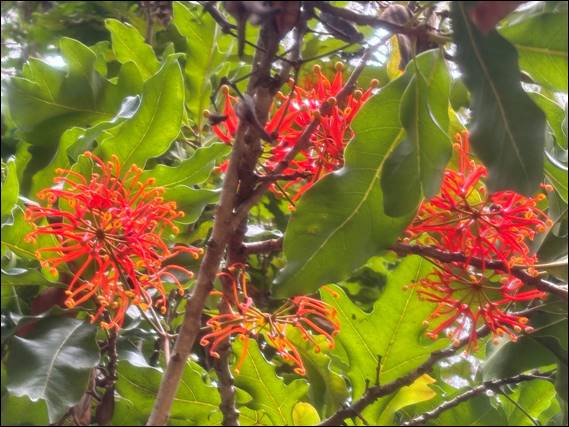
While the walk started in familiar territory, it did include sections that were not so familiar. Covering the more tropical areas of Australia. Somehow they have managed to even grow some rainforest species, such as the above evergreen Firewheel Tree (Stenocarpus sinuatus) with its namesake flowers that were stunning. It is surprising how well a tree used to the climate of the Nambucca River in New South Wales to the Atherton Tableland in tropical Queensland survives so well here. Then there were the Bottle Trees (Brachychiton rupestris):
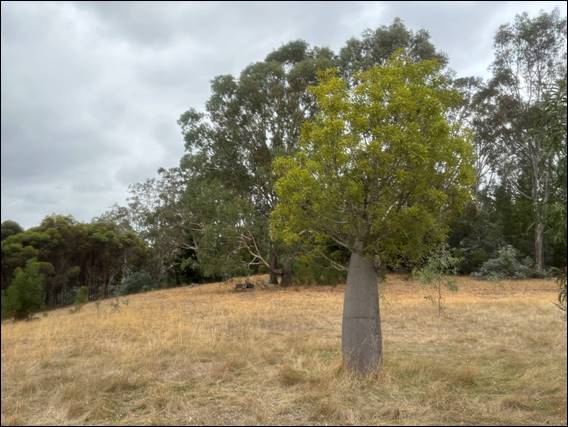
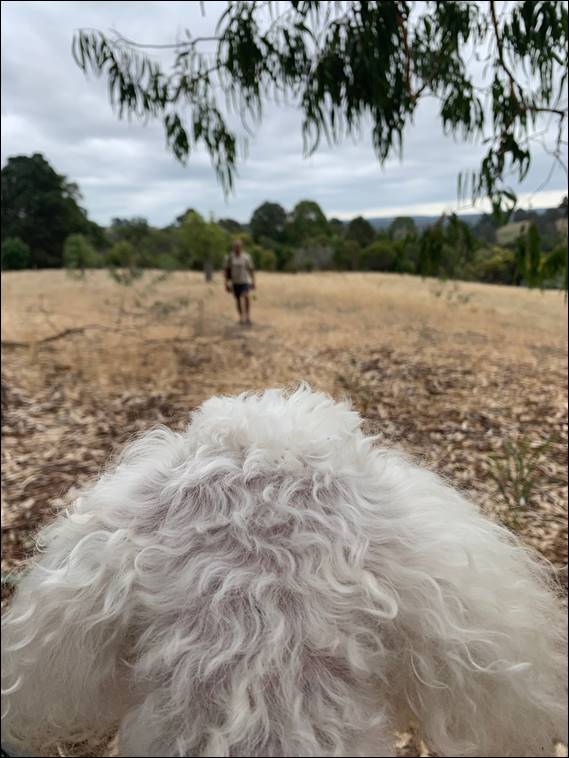
Again from Queensland. One of several species in the genus of Brachychiton, which all display a large swollen trunk. While Bottle trees are a different genus to Boabab trees, the one on display is often mixed up with the Australian Boabab (Adansonia gregorii). Because of the similarly shaped trunk. I was particularly drawn to this tree as it reminded me of the African Baobab (Adansonia digitate). A tree I regularly saw in Ghana’s Upper East Region. While I had a closer look, the others took a seat and Nicka watched me to make sure I came back:
In Ghana the tree was often called the upside-down tree. During the dry season it would lose all its leaves, and the branches would then resemble roots. It was also known as the tree of life, providing multiple sources of food. I have a large batik artwork from Burkina Faso depicting the tree in this way, with villages and people merged into its impressive form. All up we wandered for about just over two hours and in contrast to the journey out, during the drive back, there was little life on display in the poodles who slept most of the way home:

 Sandbagged