‘The wing flaps are not responding as they should’ was the message from the captain after we got in the plane. Considering they are used to increase the lift and drag during take-off and landing, and as the captain advised, it was considered a critical issue. The initial fifteen minute inspection by the engineers was extended four times by progressively longer durations. And the two hour delay in leaving Perth resulted in having just enough time to get to the next gate in Singapore to board the connecting flight, slightly out of breathe. I’m glad I didn’t miss it:

As were the folks when I arrived at their doorstep, a little before ten in the morning. The daily outings into the countryside during my last visit were obviously very much enjoyed. My Dad seemed eager to get them underway. Having hardly had time to get a cuppa before he asked what the plan was for today, and where we might be going. There wasn’t a plan, and I hadn’t booked anything. Thinking that driving into the Peak District after a near thirty hour journey could possibly be unwise. We went out regardless, picking a café we all really liked last time:

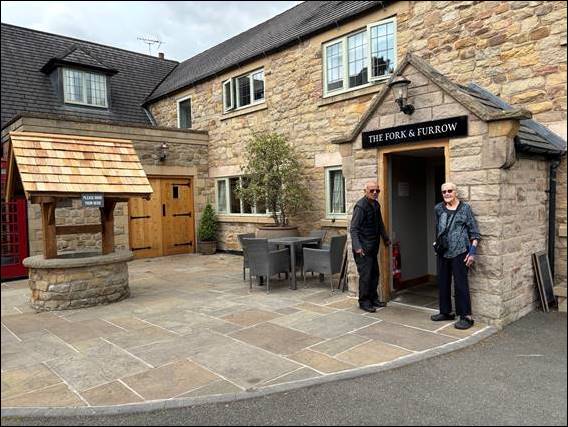
Starting the adventure as we meant to continue, taking with us a game to play. After my last visit and realising some of the pubs became booked out for lunch, I had an itinerary ready. Different pubs to last time were booked for each of the five days we didn’t have to get to a medical appointment. This included selecting a café to head to on the return journey. Each trip would see us head to another part of the Peak District. Allowing us to sample as many winding single lane roads as we could. For this unexpected day out we only went to a café:

And by early evening my eye lids felt like lead shutters. There was little point in forcing them to stay open any longer. I slept solidly, being woken up by the dawn chorus. Being not long till the longest day meant it was getting light early and the birds were at it from just after three. An hour later I was up and by four thirty I was creeping out the house, as quietly as possible. The folks are both in their nineties, and the days of early mornings is long behind them. Allowing me time to walk round the beautiful countryside right on their doorstep:
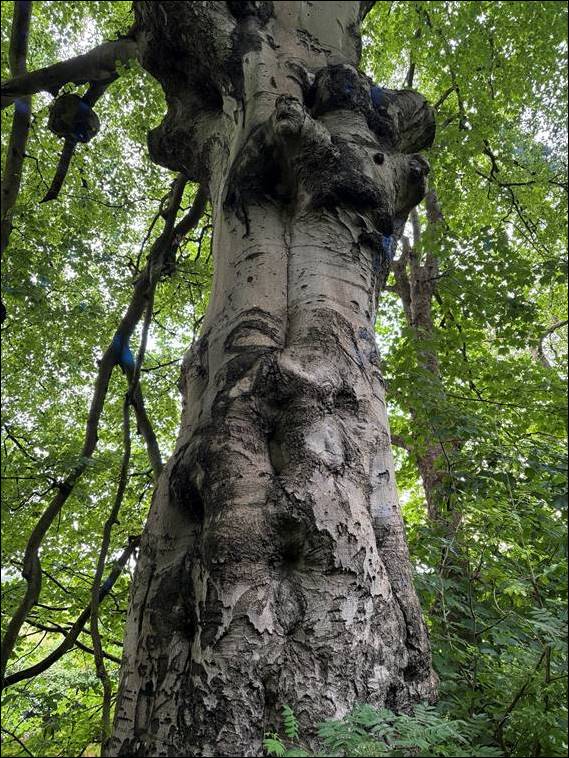
These circular walks are tried and tested, I’ve been on them a heap of times. So to mix things up I used the little local knowledge I have built up to link a few up. Making my own circuits and where I had an incline of where a path I stumbled across may end up, taking routes I was not familiar with. This resulted in walking round the Woodbank Memorial Park. Wandering under a lush green canopy was refreshing. Several flowers were lingering past spring, which officially ended a few days back and I’ve since read was exceptionally warm and sunny:
As with many other places records had been broken, and the 2025 spring had been recorded as the warmest and sunniest since records began in 1884 and 1910 respectively. The air was full of fragrance from Sweet Cicely (Myrrhis odorata) and Wild Garlic (Allium ursinum), both edible. The second image is of the Field Bindweed (Convolvulus arvensis), which has been used for medicinal application. As the name suggests it is a creeper. Despite being a native plant, growing quickly it can choke other plants so is thought by some to be a pest:

During the walk I came across Nabs Weir, in the third image. Built by the estate owner, Peter Marsland, in the 1820s when Stockport faced a water shortage. Water was directed into a tunnel suppling his mills and a reservoir. While on private land, it played a role in Stockport’s first public waterworks. Mixing up the local routes allowed me to manage a six to eight mile wander each morning, which was probably a good thing. The rest of the day fairly sedentary. Sitting down at the house playing games, in the car travelling, or at a pub or café eating:
I’d get back to a quiet house, and again creep in as soundlessly as possible. Having time to stretch for half an hour before making more noise. Usually the boiling kettle would result in my Mam shuffling into the kitchen. Her mobility is going downhill, but she refuses to give in and regular tells me ‘use it or lose it’. Another favourite being ‘getting old isn’t fun’, as I watch on nervously when she shakily picks up a kettle of boiling water to pour it into the tea pot. My Dad is also slowing down, his mobility being affected by a neurodegenerative disorder:

Regardless of this, they get out of the house a lot. That is down to my sister. Many outings are now appointment driven, but not all and on occasion she takes them on longer trips away. As such I knew that while they would be stuffed by the end of it, they would be well and truly up for a week of getting out every day. Day two the itinerary kicked in proper, a longer and more windy trip led us to a pub. The games and food tradition began in earnest. A hearty meal, being followed by a car journey to a café where we indulged in tea and cake for afters:

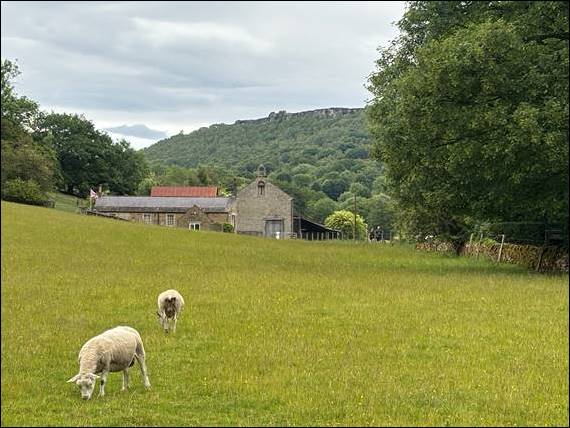
The image below my folks playing Yahtzee at the pub, as we waited for our lunch, was the view from the carpark of the café. One of the many mighty gritstone escarpments that stand proud, looking down at the valley from on high. And one that I particularly liked climbing at in the early to late nineties. Despite having spent many weekends climbing round here back then, I have barely touched what is available. Something that is relevant and will come up again in this post. Our daytime eating, was such that we didn’t need a heavy evening meal:

A bit of a snack was sufficient, and we of course also got the games out again to while away the few hours we had left of the day before our beds were calling us. For my second walk I again mixed up the circuits, starting the hike with a toad rescue mission. A Common Toad (Bufo bufo) had become stuck in one of the dog water bowls. Some people leave these outside their house to allow passing thirsty pooches to rehydrate, as they lead their owners on a walk. The next images shows some paths were overgrown, it was a good spring:
A few paths had been closed. Erosion was the usual reason. But the ramblers of England fight for their rights to hike, and a new path often led round the barriers. Needless to say I followed their lead, never finding the path that dangerous. I guess the council is just protecting themselves from someone who may have an accident. My second walk saw me cross Brabyns Park Iron Bridge. Built in the early 1800’s and reported to be the first iron bridge in the north west, during a time that stone was the traditional material used:
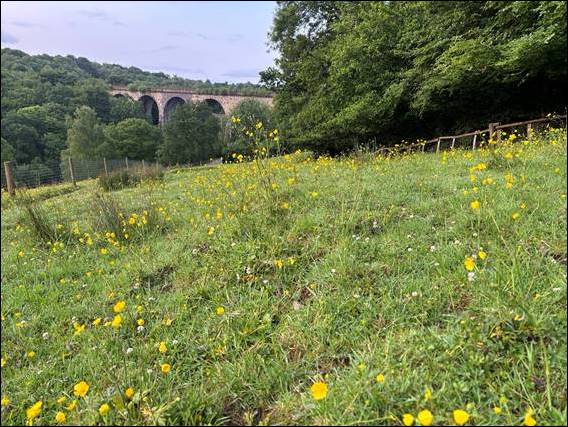
Iron was used for other products, such as steam engines, but was a relatively untried material for bridges. It has however stood the test of time, so it is surprising this was the only iron bridge the Salfrod Iron Works built. The video and images show a few of the many colourful flowers, such as: Oxeye Daisy (Leucanthemum vulgare), producing up to 26,000 seeds per plant; White Campion (Silene latifolia), also known as ‘Grave Flower’ or ‘Flower of the Dead’; and Red Campion (Silene dioica), being a great flower to attract moths, bees, and butterflies:

I was lucky when three Canada Goose (Branta canadensis) goslings waddled up to me, and their parents were fine with it. Known to aggressively defend their nests and young, all the others times I came across them the heads of the parents would go up and they started hissing a warning to stay back. The injuries sustain from attacks are usually minor, but there is however little point in getting them all worked up. Avoiding creaky floorboards on my return was part of the routine. But once we were all fed, and after a game or three, we hit the road:

Our drive today took us down Winnats Pass. The average slope of this near 2km stretch is 1:10, but in places it is as steep as 1:4. The short and stunning road, is navigated by most very cautiously leading to a build-up of traffic. Not today, it felt like we had the place to ourselves. Overtime the name changed, and it was originally called Windy Gates owing to the way the wind funnelled up the steep sided valley. Not only winds are said to haunt this pass, and the spirits of a couple, murdered and buried in a mine shaft in 1758, are said to still reside here:

Our daily feast, was exactly that for the second pub outing. It was a monstrous serving, brought to us by incredibly friendly and jolly staff. Only marred by my Dad’s taste being negatively affected by an antibiotic that he had just started taking. It took a while to work this out, as he was put on it after my sister had gone on holiday and just before I had arrived. Bad timing in more ways than one, but we made the most of it. And while he had less than half of his meal, it was wrapped up for us to take home and he polished it off later:

Heading out for meals was a good way to travel about, and the country drives were enjoyed by all. The lanes at times became very narrow, super windy, and had many a blind bend or crest. The great spring had resulted in the hedges going berserk, seemingly closing in on already tight roads that you could just about fit one car on. I took it easy on these roads, as did most others. And on occasion we had some close encounters when we rounded corners or topped hills, and every time this occurred the drivers were all courtesy:

Someone had to back up to the closest passing bay, and at times even it was still touch and go trying to get past. The folks loved it when this happened, that and the glorious views all made for very enjoyable car trips. Weather wise the week of my stay, was a little hit and miss. But when you are indoors or in a car it didn’t really matter, although we didn’t make any stops to get out when we came across a nice view or something interesting. While last time we had made such stops, this time with their reduced mobility it may not have been a bad thing:

For my third early morning wander, before any other souls were out, it was wet. This did not stop me. However, when the rain came in it was more of a head down and get on with it type of walk. During the last third of the circuit it eased off, which is where I took the image of the Lady’s Glove (Digitalis purpurea). I’d seen these everywhere, with their striking and quite unique architecture. Known as the original source of a chemical from which the prescription medication digoxin is made, used to increase the strength and blood flow of the heart:

Some other flowers out in large numbers included: Red Clover (Trifolium pratense), used in agriculture to improve soil fertility and in herbal medicine, particularly for women’s health and skin conditions; Common Bistort (Persicaria bistorta), which was an ingredient in an Easter time dessert in North England and as such locally known as ‘Pudding Dock’; and at times quite literally fields of Meadow Buttercups (Ranunculus acris). The vast number of the latter is in part due to grazing animals avoiding them due to their sap containing protoanemonin:

It is produced when the plants tissue in damaged. Effectively it is a defence mechanism, and a good one. Having an irritating and blistering effect on skin and mucous membranes, which is why gazing animals avoid it. The substance also has antibacterial activity, but due to its toxicity is not typically used medicinally. Something else that has not been typically applied, during my trips to see the folks since they have lived in Romiley over the last five years, is the upkeep of some of the older buildings. Such as the Grade II listed Old Barn of Springwood Farm:

Shown several images up in poor condition, check out what it was like just three years back in this post: https://sandbagged.blog/2022/08/01/time-to-head-back/. It was not the only building looking dilapidated and uncared for. On the positive we were not neglecting the many fine eateries on offer. The Cock Inn, being the only pub to crack a name check, was voted the best pub we got to. We all loved our meal there. Even Dad’s taste buds couldn’t resist coming back to partial life to get tingled by the taste sensation he was served up:

Such a fine meal and place, that when we rocked up to the café to find only outside seating on picnic benches we were not disappointed. I have to say the Black Stag cake, made with bitter and recommended by the staff was incredible. The best dessert for me on the trip, but not being awarded the top spot by consensus the café won’t get named. Luckily it didn’t rain while we were there, but the next morning on my walk I got a proper soaking. So much so my boots filled with water. And typically it happened on the longest of the local walks I did:

My saturated state wasn’t helped as I walked through sodden and thick vegetation. Including massive stands of Policeman’s Helmet (Impatiens glandulifera), of which the single flower I came across is shown a three images back. Also called Himalayan Balsam it was introduced as an ornamental in 1839, from it is native country of India and western Himalaya. It is now one of the most widespread and problematic invasive plants species in the United Kingdom. In researching my finds, it was interesting to see how many introduces plant species there are:

Two images up is another, Sweet Pea (Lathyrus odoratus). Originating from Sicily and Sardinia and first offered as a garden plant in Britain back in 1730. This one is however not as prolific or problematic, and as such in the countryside it adds to the colour spectrum as oppose to over powering it. Another one brought over from those Mediterranean climates, which I saw often was the Purple Toadflax (Linaria purpurea). Arriving some hundred years later on from Italy, and escaping into the wild shortly after. Again not being as invasive:
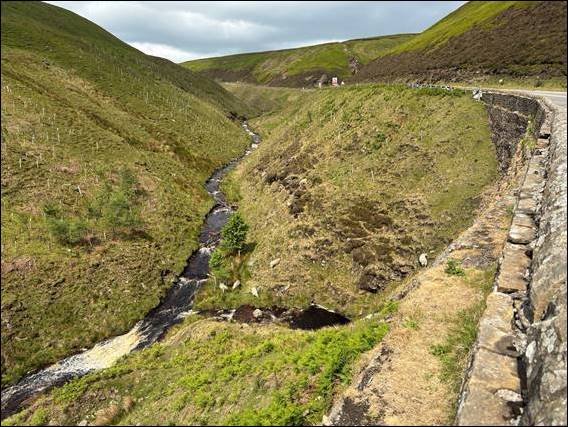
After drying up back at the house, the weather followed suit and also dried up. Not only that but patches of blue could be seen breaking up the cloud cover. It was set to be a warmer day, and one that we would drive down Snake Pass over the Pennines. During a trip a year back I went out for a big walk for a day with Dave, the postie. We endeavoured to get to Snake Pass. I hoped to find the pub the pass is named after, but Dave was on the money when he said the Snake Inn was no longer a pub: https://sandbagged.blog/2024/05/05/hard-yakka/:

It is a road that has had more than its fair share of accidents. Unlike the narrow windy roads where people seemed to accept slow and steady won the race, being a thoroughfare and less windy this road seemed to bring out the boy racers. We observed such reckless behaviour, as a panel van tried to scream past three vehicles. An accident was only averted when the innocent oncoming vehicle screeching to a full stop. It was time to pull over and let the idiots go ahead, giving us a bit of time to soak up the babbling creek line and warmth of the sun:

The roadside stop, along with another road that was closed and required quite a significant detour, resulted in our first late arrival at the pub. An isolated building with no neighbours in sight and a magnificent view from its lofty position high on an escarpment. The late arrival was not a stress, as I had booked us in for midday this is a good hour ahead of the real lunchtime rush at these quaint country pubs. We would spend approx. two hours at the pub before another half to three quarters of an hour drive before a cuppa and dessert:

The café for the day was nestled below Kinder Scout, where Dave and I walked. The place of the 1932 Mass Trespass, which I detailed in the above linked post and explained how it initiated national parks. It also paved the way for the Countryside and Rights of Way Act enacted some fifty years after the trespass event. Back then the trespassers had to climb the steep slope up to Kinder Scout, and today after our tea and cake the folks re-enacted this. They walked the few hundred yards to where I had parked the car, after dropping them off:

The last section having steps I should probably have taken them round, but both proving age should not stop you trying. The goals just need to be set at the right level, so as not to make them insurmountable. Because it was so lovely, we had a quick stop on the way back. Looking across the valley towards Edale and Jacobs Ladder. The steps of which were cut into the hillside in the 18th century to provide a more direct trade route for pack horses, by the then land owner. Today it is the most popular way to hike, the near 400m, up to Kinder Scout:

My sister’s family returned from their holiday late Monday. Sadly due to being midweek, work prevented them from joining our trips out. We did however have a lovely catch up on Tuesday night with a takeaway. To be honest I am not sure how the folks nor I fitted any more food in, but it was a very yummy. The next day was a little different. No pub was booked or café selected, as there was a hospital appointment. This did however mean I had a little more time to play with in the morning, so at the crack of dawn I drove off by myself:

My Mam had kept a paper cutting for me of the United Kingdom’s rarest native orchid, the Lady’s Slipper Orchid (Cypripedium calceolus). Once widespread in northern England, the last remaining wild population is found in the Yorkshire Dales, and the best time to see it is early June. Having been reintroduced in two nature reserves within an hour and half drive, it was so tempting to use the morning to try and find it. But I knew I would spend hours and hours and not give up easily, so decided against the idea and instead went to the Roaches:
I left quite literally the crack of dawn. Walking up onto the ridge just in time to watch the sun creep over the horizon. Unlike back home, where we are closer the equator, the sunrises and sunsets in England happens at a much more leisurely pace. Allowing way too much time to sit and observe the changing colours. I was not in a huge rush, but the walk today would be the longest of the visit, and I of course had to allow a bit of time to play on the rock. Several times along the path I got a shock when a Common Pheasant (Phasianus colchicus) flew off:

So well camouflaged in the vegetation, it was impossible to spot them. Not until I was practically on top of them would they fly away. Originally from Asia they arrived in the United Kingdom with the Normans in the 11th century, but came from Europe where the Roman’s had already introduced them. Close to becoming locally extinct until in the 19th century their popularity as a gamebird quite literally shot them to fame. Gamekeepers extensively reared them, and today an estimated 40-60 million are released every year. All in the name of sport:
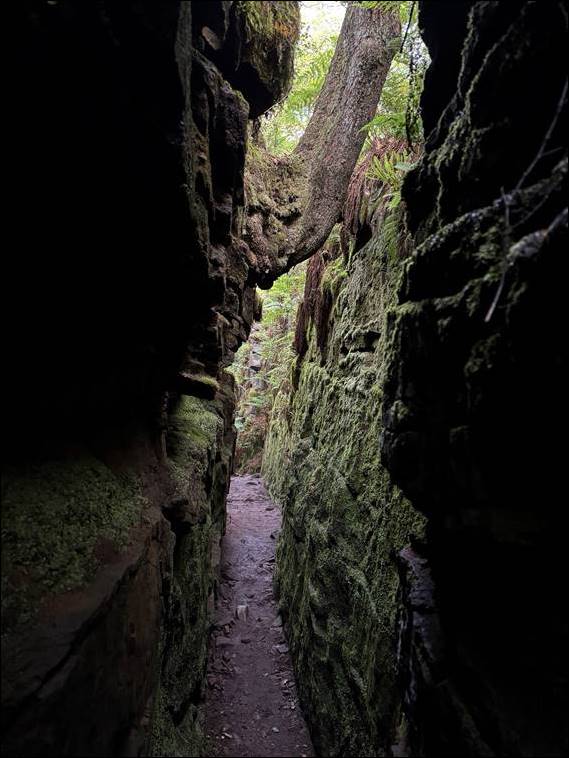
The main reason for coming here was to revisit Lud’s Church, a place of refuge for a group condemned as heretics in the early 15th century. A religious group called the Lollards used the well-hidden narrow chasms for hiding, and as a place of worship. The origin of the name is however inconclusive. Theories include being named after the Celtic sun god, a Lollard preacher’s daughter shot in the chasms, a member captured during one of their meetings, and even a horse that avoided falling in but bucked its rider to his death into the deep depths:

Many a legendary figure is also said to have used this place including Robin Hood, Friar Tuck and Bonny Prince Charlie, as they hid from the authorities. It is also said, by some, to be Green Chapel of ‘Sir Gawain and the Green Knight’ from the days of King Arthur. Local folklore also indicate it to the home of a clan of fairies. While the clefts are not very long it is easy to lose track of time exploring them. The fern and moss covered walls are enhancing and beautiful. Despite being hugely popular I guessed I would, and did, have the place to myself:
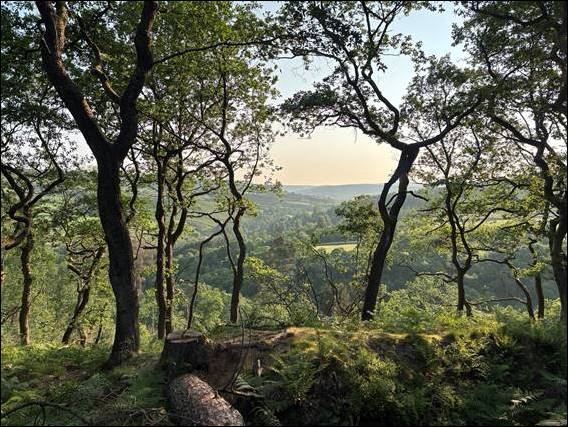
Eventually I left that peaceful place, and made my way back through Back Forest in which it is nestled. The familiar coniferous and broadleaf trees would no doubt provide a cool shady wander for later visitors when the sun was higher in the sky. However, a large number of European larch (Larix decidua) had been felled. Introduced in the early 17th century for timber plantations, they were not felled due to be non-native. But in response to a Statutory Plant Health Notice issued by the Forestry Commission, which required the land manager to:

This was a result of Phytophthora ramorum having been identified in the wood. Referred to as Larch Disease, it comprises a algae-like organism called a water mould. Eventually blocking the flow of water and nutrients in the tree. It has ravaged the larch population in Britain for fifteen years, leading to mass felling such as I witnessed here. The pathogen can also result in Sudden Oak Death. Fortunately it has not reached this part of the country, and the Sessile Oaks (Quercus petraea), one of two native oaks in the United Kingdom, were looking healthy:

Back up on the ridgeline and out of the shady trees it was still very comfortable. Not till I reached the Roaches did I come across another hiker, and all up I only saw a handful of people during my last hour here. An hour used to solo a few climbs at The Roches, walk up to and round Hen Cloud, and finish off the wonderful hike by scrambling up Easy Gully. This goes up the cleft in the left hand side of the cliff below, a scramble I took Lisa up many a year back. It has a tight squeeze at the very top, which did not impress her too much:

I arrived back at the house at ten, in time to manage a few games with the folks who were both up and ready for the day. Another trip out even if it was to the hospital, which my sister as their primary carer came along for. We got ourselves a feed at the cafeteria before the appointment. Here my Dad’s comments that his usual choice of food was not to his liking today sparked a chat. During which my sister and I discovered the antibiotics can have a side effect of impacting taste, the relief of knowing this helped to improve his enjoyment a bit:

As often occurs with hospital appoints, there was a delay so this chewed up a fair bit of the afternoon. Getting us back in time to play just a couple of games before I was due to head out for a second walk. Dave’s days off coincided with when I left Australia and when I was due to fly back, as such we arranged to have a quick evening walk and catch-up. Today being the day that best suited him. With a relatively short duration available he drove us out toward Lantern Pike, offering a hike along the ridgelines giving us views stretching east and west:

Flowers of note on this walk being the above Common Cottongrass (Eriophorum angustifolium), which is not a grass but sedge preferring boggy moorlands and heaths. We also came across Yellow Flag Iris (Iris pseudacorus), one of two native iris species of the United Kingdom. The other being not so affectionately known as the Stinking Iris (Iris foetidissima). I really enjoyed finding all the flowers, but they also caused me a lot of grief. Hay fever had taken hold, and I had to double the recommended daily antihistamine dose:

Even being fully drugged up, and particularly on this evening, I sneezed and wept my way round much of the walk. It was Dave who told me about the great spring resulting in the bounty of floral displays. Maybe I should have gone hunting that rare orchid. He also mentioned that Barn Owls (Tyto alba) were about, and kept saying we’d see one. Their numbers took a hit due to the use organochlorine pesticides in the 1950s and 1960s, leading them to become a Schedule 1 and 9 species under the Wildlife and Countryside Act 1981:

This makes it an offence to intentionally or recklessly disturb them. No matter as we didn’t see one on the walk. However, as we drove out, much to his relief and my enjoyment, we spied one gliding over the fields. Normally being most active between dusk to dawn, we were lucky as dusk was still an hour and half away. We watched it swoop down and catch something, taking it back to the barn that is behind the above Yellow Flag Iris. Transfixed we watched it successfully hunt a second time, no doubt taking the prey back to feed its owlets:

After two decent walks, I decided not to head out the next morning. This resulting in me making a bit more noise earlier in the morning. Scrubbing my boots clean and putting a load of washing on in preparation for my return trip. My Mam who sleeps downstairs, and all the extra noise didn’t rouse her up. Making me think I really didn’t need to creep around quite so quietly when I had headed out and returned from the morning walks. Not heading out also meant that we could squeeze in a few more games in morning, before our final fun day out:

The last pub was another good un, and my theory that the relief of knowing what was affecting his taste might improve my Dad’s enjoyment seemed right. Even more so when I drove them to the last café, one I had hoped to visit during my last visit. We did visit it, only to find it was closed on that day. This time I had checked to make sure it would be open, and it was. Providing the perfect end to our days out, with a scrumptious cake that earnt it the top spot. And offering magnificent views, as to be expected with a name like the Peak View Café:

After two and half days of glorious weather, we got back in the car just as the rain once more came in. At least this dampened the pollen count, which was a relief for me. It had been a little unnerving needing to sneeze just as we rounded a corner or came over a crest, unsure of what might come the other way. On the road back it just so happened that we drove along Windgather Road, where Windgather Rocks are located. A place Dave had considered going for a walk, but thinking I would have climbed here he decided on somewhere else:

I haven’t climbed here, which is not that surprising with nearly 15,00 climbs on who knows how many crags just in the Peak District. I told Dave and said I intend to sample the place next time, which spruiked his interest. So we may go climbing instead of walking. The last evening of the trip was spent playing games, interrupted by a drop in visit by Seeta, Neil, and Leena, with Asha popping in the morning, all to wish me a good return trip. It had certainly been another very enjoyable visit, and I’ve already got a list of places to go to next time:

 Sandbagged