Rongy is once more heading off travelling, so today we popped down to Wilyabrup for a farewell climb. Sarah is joining him this time, so she too came along for a climb, but was also hoping to get a bit of herping in. “Herpet” is a Greek word that means creeping, and it could be used to describe both the people who are herpetologists as they go about herping, or the creatures they are looking for through the act of herping, being amphibians or reptiles. The first creature we spotted was however of the feathered, as opposed to scaly, variety. Driving in on the final gravel road we stopped to watch what looked to be 1-200 Carnaby’s Black Cockatoos (Zanda latirostris):
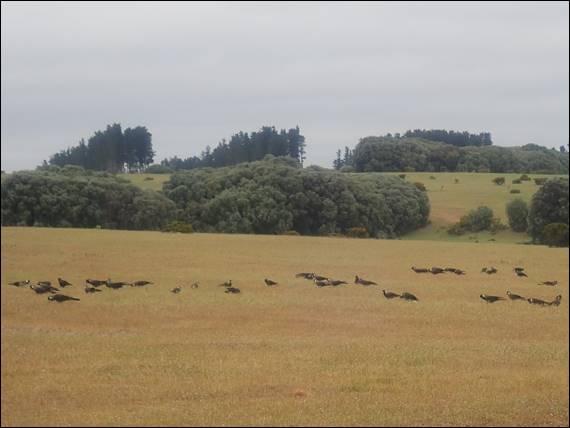
I’ve seen these birds here a heap of times before, but never in these numbers and it was good to see as this species has been listed as endangered since 2000. The primary reason is habitat loss due to clearing, which has resulted in their distribution over the past 50 years being observed to have moved considerably more west and south. They are however doing better than there close relative the Baudin’s Black-Cockatoo (Zanda baudinii), which has been listed as critically endangered since 2018. Then as started the walk into the crag the herping began, when I noticing a movement in the leaf litter:
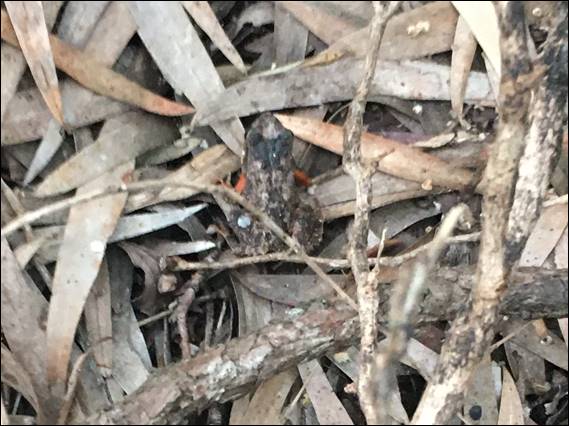
Wisely I had worn my glasses and this helped me to spot the above Quacking Froglet (Crinia georgiana). It wasn’t all that keen in hanging about, so the image was a bit fuzzy. Sarah wasn’t sure of the species so as we walked in I sent the image to Howsie, who provided the identification. This species is also known as the Red-Thighed Froglet for the obvious reason, although Howsie tells me he also identified it based on the distinctive colour of the upper eyelids which I’m still struggling to see. I’ve read that these frogs will talk to humans by quack back if you attempt to quack at it:
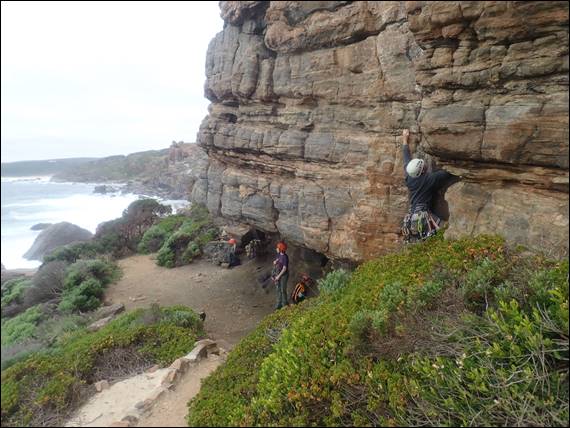
Despite being a climbing trip, and yes we did climb, it seemed that nature was intent on being the star of the show. The next spectacle came to sight when we made it to the base of the crag. A pod of whales was frolicking in the ocean. It’s hard to say but maybe a dozen whales were happily playing, putting on a display of tail and pec slaps through to full breaches. Too far to see which whales there were, but close enough to stall us getting on rock. Even when Rongy finally set off on the first lead Sarah and I still stood there watching out to sea. We did however climb, and after knocking off a couple routes Sarah said she was happy to take a break:
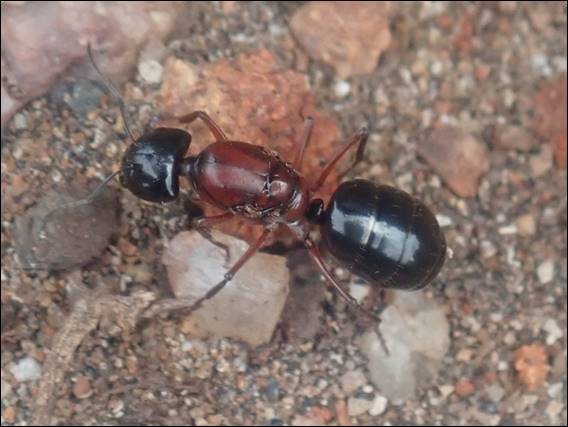
Providing an opportunity for Rongy to jump on something a bit more testy. After following him up we were delayed from walking back down when I couldn’t help myself from observing the above ant that was out all by itself. I’m pretty sure it is a Carpenter Ant (Camponotus spp.), of which there are dozens of species native to Western Australia. The name comes from the fact they like to build their nests by boring into damp or decaying timber, and some species found in other countries are considered as problematic as termites. Although the extent of damage to property by species found in Western Australia is limited. They are also known as Sugar Ants, as they feed on and are attracted to sugary liquids such as honeydew:
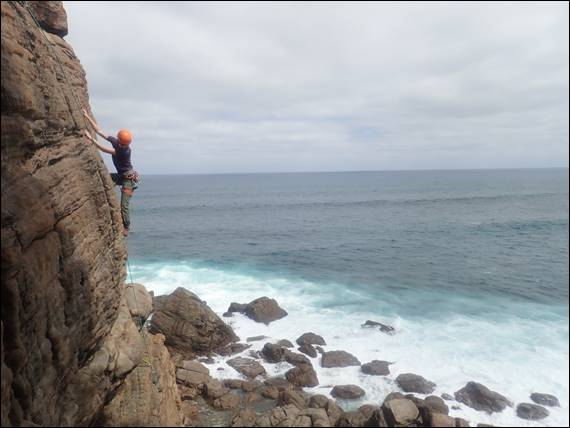
When we finally got back down Sarah was keen for another climb, and I again handed him the rope to Rongy. He hinted it was my turn to lead, at one point during the morning but it really didn’t take much to convince him to jump onto the sharp end. After all it was his farewell climb. With Sarah happy with three climbs under her belt, I suggested Rongy take one more lead to allow us to climb out with packs. Unfortunately the usual climbs we would pick, which would also offer the chance to see our friendly Carpet Python, were in use by a group. Mind you what with all the people going up them the chance of seeing a python today was probably very slim:
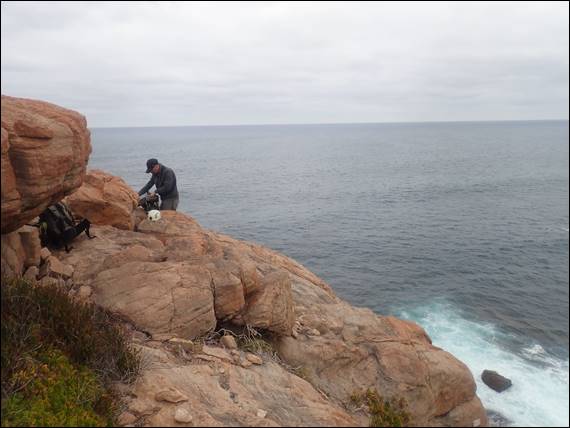
Instead we jumped on one of the longest routes at Wilyabrup. As Rongy sat atop with Sarah who had walked up, they watched the whales that were still playing about. It had certainly been a fun morning on rock, made all the more special by the extra special dose of nature’s wonders. There had also been King’s and Southwestern Crevice Skinks, which would normally have satisfied Sarah’s herping addiction. There was however one more surprise in store, being not one by two Dugites (Pseudonaja affinis) waiting for us on the track. We kept a healthy distance from the first one below. It’ll be hard to see but the eye looks glassy; a sign that it is in the process of shedding its skin:
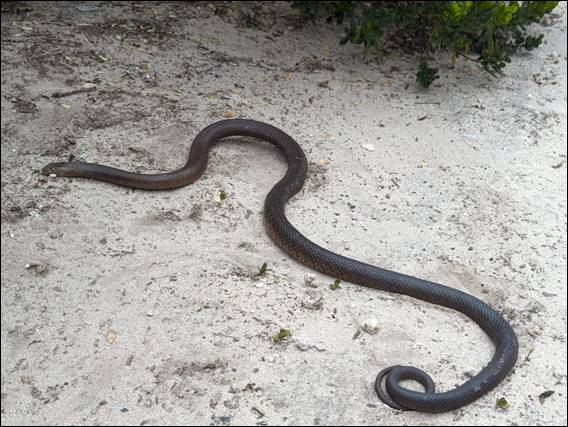
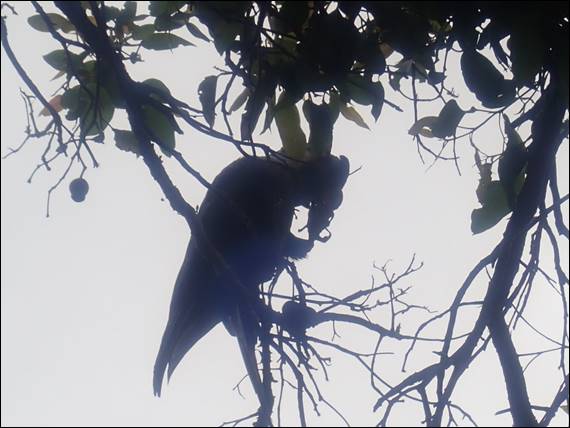
This is the new skin covering its eye and results in its eyesight not being as good as normal, which can result in the snake coming across as being more aggressive during this period. Hence why Sarah wasn’t tempted to try and handle it, while the second snake was quite simply too alert and got away by slithering into the bush before we got too close. Walking back to the car the huge crackle, and yes that really is the right collective noun, of Carnaby’s Black Cockatoos had moved to the trees. As we walked under them, the air was filled with the whistling sound they make, as if to give Rongy and Sarah a send-off to remember:
 Sandbagged
Great! 👌
LikeLike
Mother Nature was very generous today 😊
LikeLike