I feel like I’ve been wandering about a fair bit weeks… and in part blame Josh for it. Not the Josh I climb with, but someone from work. Unlike me his job takes him out in the field a fair bit, to secluded spots where we have stream flow and groundwater level measurement infrastructure. For the sites that in areas of native vegetation, at this time of the year, they are conveniently also places that, as we say to each other, orchidy looking. As such he has been sending me images of his finds, which in turn has enthused me to get out hunting:
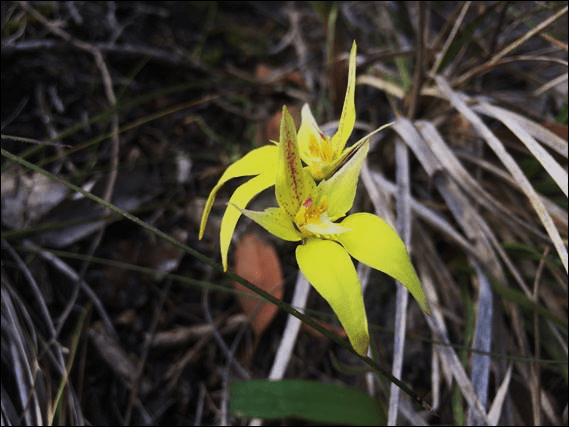
Tuesday was my first trip out. And seeing I practically drive past it on the way home, I stopped in at Manea Park. I didn’t stay too long, and the only new find was a common orchid being the Cowslip Orchid (Caladenia flava). As the season progresses this orchid will, like the Pink Fairy Orchid (Caladenia latifolia) and Dwarf Pink Fairy Orchid (Caladenia reptans), litter the ground. I was however interested to learn more about where the rather dull common name of the poor old Cowslip Orchid came from, but have been unable to find anything:
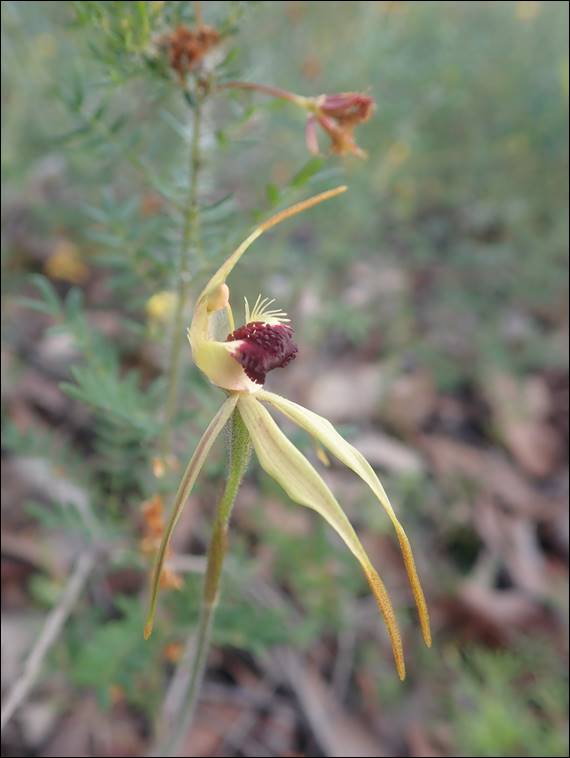
I did however discover the genus name, Caladenia, originates from two Greek words, calos and aden, meaning beautiful and gland. This large genus represents over 350 species of orchids. And the scientific name of the plain old Cowslip species, flava, simply means yellow and is derived from the Latin word flavus. Meanwhile the species name of the above Clubbed Spider Orchid (Caladenia longiclavata), which I found on my Wednesday after work trip to Crooked Brook, not surprisingly means long club based on the Latin words of longus and clavus:
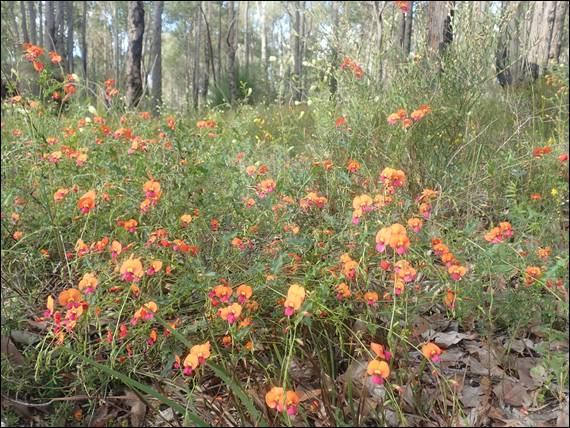
It was the only species of spider orchid I found at Crooked Brook, and I was unable to locate the other one Josh had spotted. But unlike Lisa and my hike in Wellington National Park last weekend there were plenty of other flowers out here. One of the more striking ones being the above Heart-leaf Flame Pea (Chorizema cordatum). This is a plant that helps gardeners due to its ability to extract nitrogen from air and ’fix’ is in nodules of their roots, making it a living fertiliser. There were plenty of other orchids about, but only one other new one for this season:
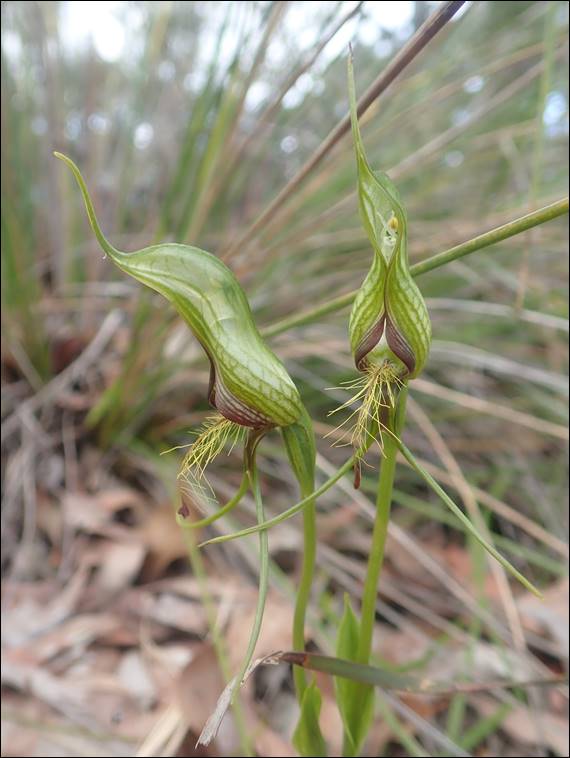
I was very excited when I spotted a Bird Orchid (Pterostylis barbata), and better still I later found the above specimen. These orchids generally will only have one flower, and it is rare to find a plant with two flowers as the above one had. I haven’t narrowed down where the genus name of pterostylis originates, which covers some 300 species of greenhood orchids. But the species name barbata is a Latin word meaning bearded, and what I didn’t know is that the Bird Orchid is also commonly known as a Western Bearded Greenhood:
Thursday and Friday arrived and these are great days for me as I work from home. Being an early bird I usual start work at 6am and sometimes before that, meaning that I can wrap up a bit earlier than most. So on Thursday I snuck out mid-afternoon to the Ruabon Nature Reserve, a place that Josh had put me onto last year. Although last year I visited this area a little late in the season. And this year I am hoping to find some cool spider orchids here, but it seems that it is still a bit early for them. I did however find a couple of species I found last year:
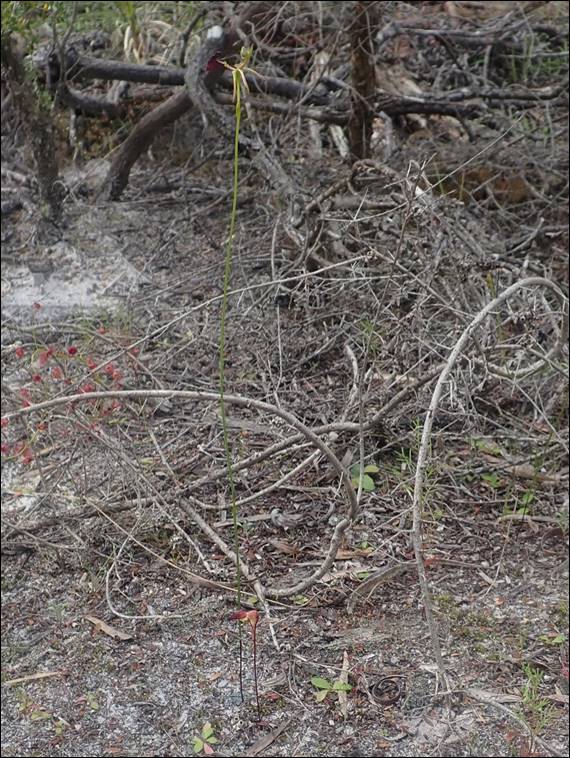
The taller and green stemmed King In-His-Carriage Orchid (Drakaea glyptodon), is approx. 350mm high. It is the most common of the hammer orchids, and I’m yet to find any of the other ones. The unusually shape of this orchid has a very specific purpose, which is to trick a single species of male thynnid wasp. The dark red flower is both shaped like, and has a pheromone like scent that mimics, a female wasp. The male wasp tries to carry the flower off but is pulled back hitting the top of the stem where the ovary is located:
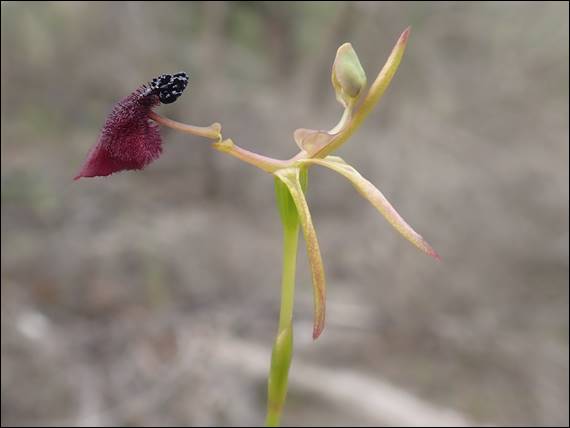
This process is repeated for each flower the male wasp is lured to, and this results in the flowers being pollinated. It may sound unbelievable but here is a link to a BBC Green Planet Video to prove it: https://youtu.be/6yLnKfhmUzg. The video is of a Warty Hammer Orchid, as opposed to a King In-His-Carriage Orchid, but the process is the same. In the image of the full plant, you may have noticed another small orchid with a brown stem that is a mere 50mm high, being a Flying Duck Orchid (Paracaleana nigrita):
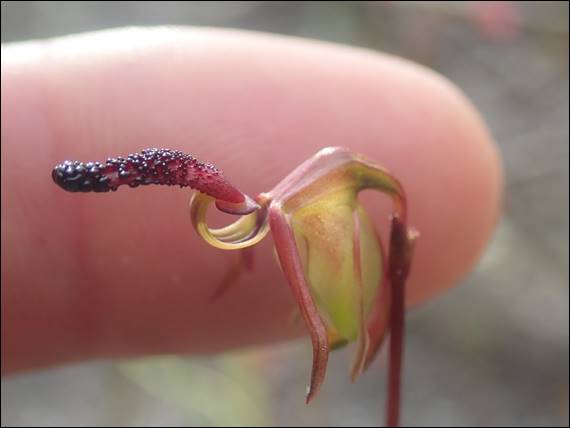
Both of the above orchids have tiny flowers, and the above image gives an indication of scale. This will in part justify why some of my walks with Lisa have to be a bit slow. Although it is amazing that once you tune your eye into what to look for, it becomes quite a bit easier to see even the smallest specimens. Similar to the King In-His-Carriage Orchid the Flying Duck Orchid also uses deception to become fertilized, this one relying on the male sawfly. Pollination results in the ovary forming a capsule that can contain as many as 500 seeds:
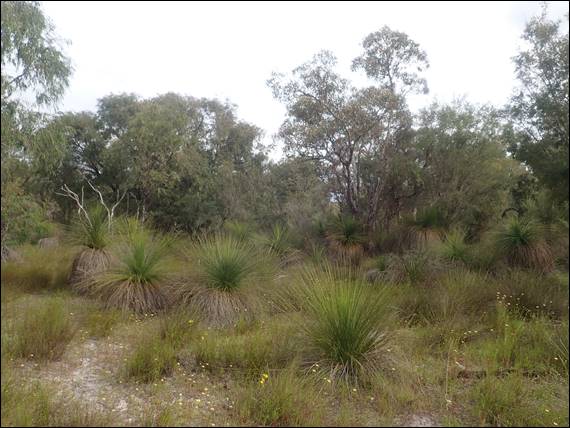
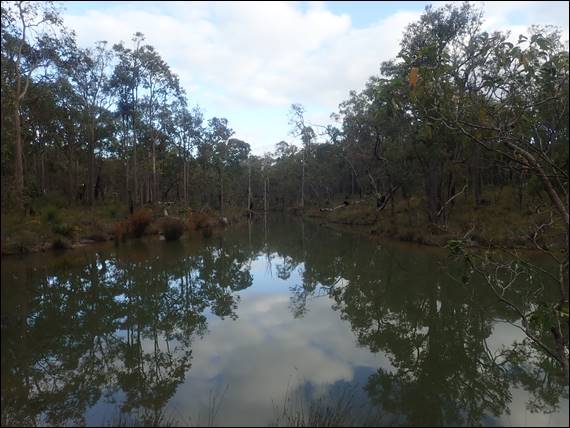
I included the above image to show the quite different landscape and vegetation makeup of the Ruabon Nature Reserve, as opposed to Crooked Brook that is shown in the image with the water. Ruabon having sandy soils, while Crooked Brook is underlain by lateritic and granite deposits. We have quite diverse soils and landscapes in close proximity, which provides an opportunity to find a wide variety of species of orchids as well as other plants. The other orchid of note that I found, en masse, on this trip to Ruabon was the Common Donkey Orchid (Diuris corymbosa):
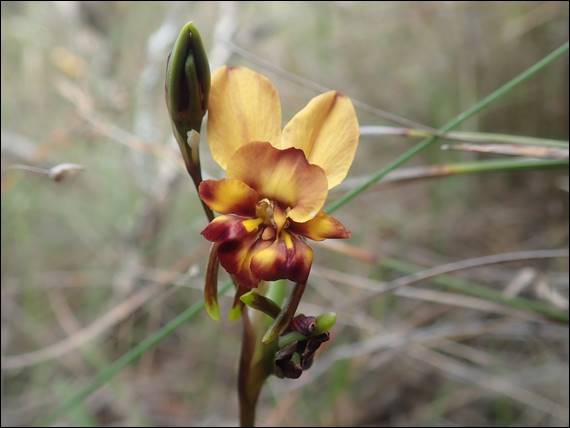
However, the above specimen is rather special as it has three labellums. These look like the bottom lip of the flower. If you check back through previous posts, every other Donkey Orchid, regardless of species, only has one labellum. I checked this find with Noel Hoffman, one of the authors of Orchids of South-west Australia of which I have the fourth edition. Bearing in mind he lives and breathes orchids, he advised me that he hadn’t come across this before for in a Donkey Orchid, but had seen a White Spider Orchid with 3 labellums some 15 years ago. So I feel it is fair to say it was a very rare and lucky find:
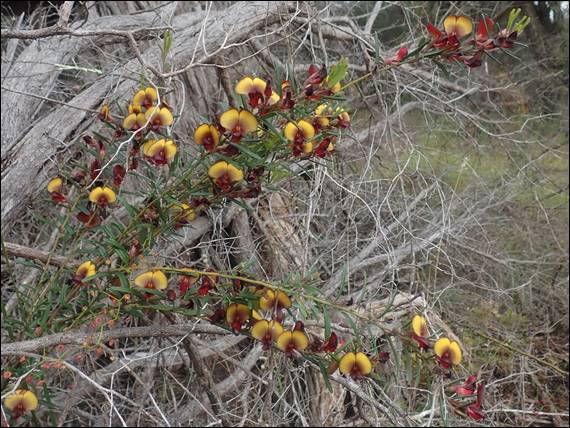
I was quite taken by the above peas, but have been unable to identify this species. It is worth including the image, as looking it and the image above it you can see why some people might confuse the two very different flowers. Friday came and as I worked, a message popped up with more images from Josh. This time he had the day off and was on a serious hunt. So I decided on a fourth trip out making it four days of orchid hunting in a row. This time it was to the closest spot to home the Capel Nature Reserve:
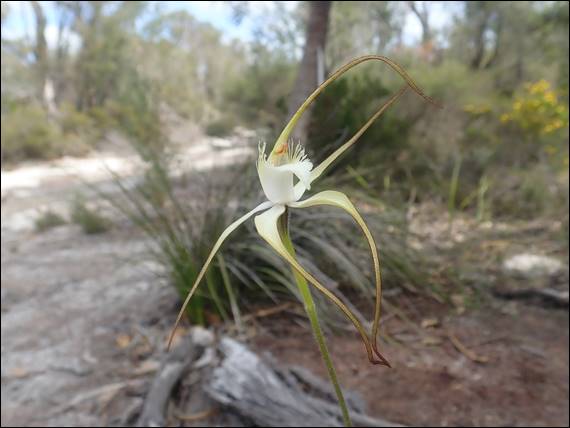
I think the above is a Splendid White Spider Orchid (Caladenia splendens), and you’ll see in the previous post that I have and will struggle with narrowing these down: https://sandbagged.blog/2022/08/27/time-for-a-cuppa/. To add to my quandary the above specimen had no red or pink colouring in the flower, something you would normally expect as shown in the linked post and the below image. It is possible that it is a pale form, similar to an albino, and after way too much time trying to figure it out if it is another species I have given up:
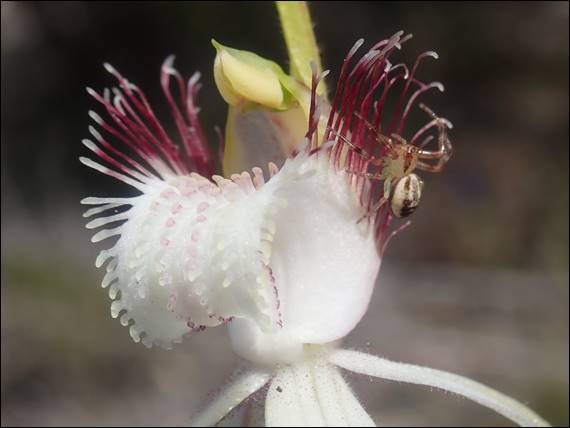
The reason for including the above image was to show the colouration variation, but also because I had a lot of fun watching the spider. There was previously a beetle on the flower, but that flew away as the spider closed in. I also found a similar beetle on the flower below. Not on an orchid, but a Jewel Rainbow Sundew (Drosera neesii) that is easily distinguished by the pink flowers. This can form both a free standing plant, but is also known to act like a vine using the sticky pads, usually used to trap insects, to attach itself to another plant or object:
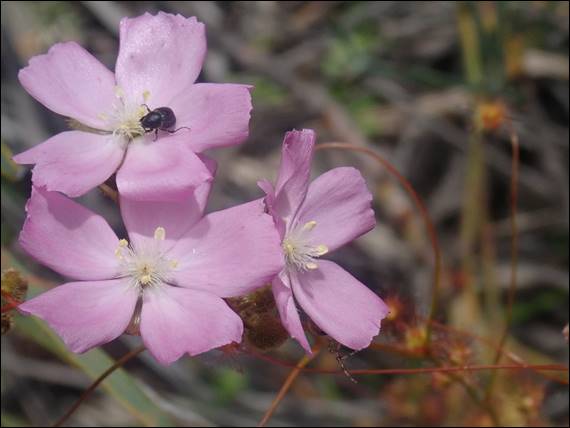
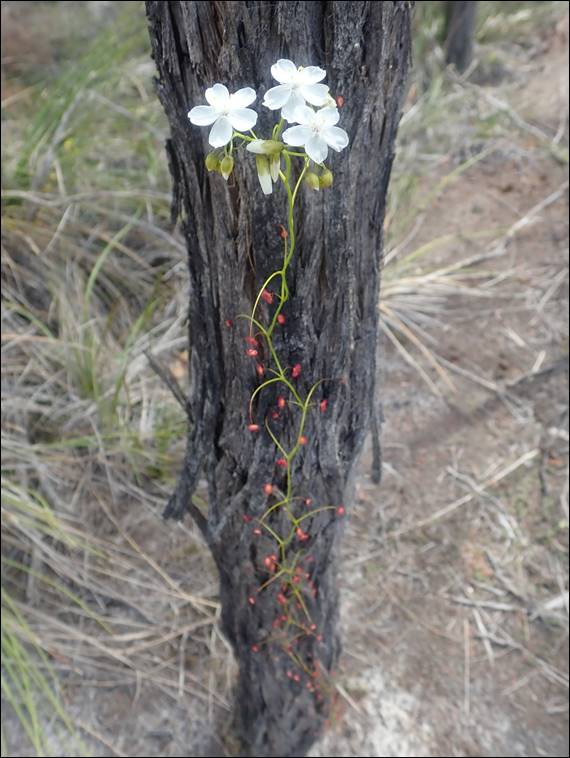
I was quite taken by the sundew flowers, which were out in force. The other prominent one being the Pale Rainbow Creeper (Drosera pallida), this one having white flowers and the image below shows beautifully how it is making use of the tree trunk. Both of these sundews are endemic to Western Australia, and can be found in a wide variety of land forms and soils types. From sandplains to heathlands, and deep sands or lateritic deposits, so I’m likely to see a lot more of them a bit like the Cowslip Orchids. I wonder if I’ll be as well travelled next week:
 Sandbagged
Wow, that’s a couple of great finds!
LikeLike
And still so much more to find!
LikeLike