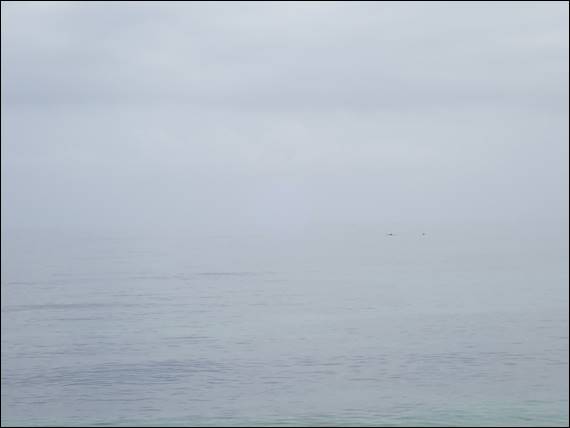
It is going to be a busy social weekend for us with the weekend packed with a year twelve ball, meals out and a bit of a shin dig for the premier of the latest Wiggins film, of which you will hear more about after the red carpet event has occurred. But before the mayhem started we had put the word out on the local snorkel group for a quick Saturday morning escape. It was a grey morning making it hard to detect the horizon, and as we drove along the beach a large pod of dolphins were heading in the same direction:
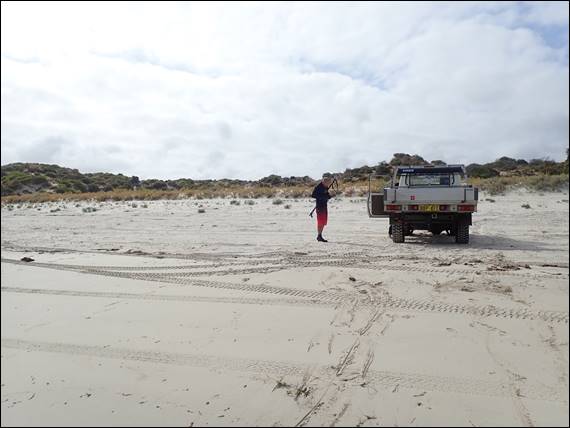
Geoff and Nana had replied and so the four of us were heading to a spot they wanted to return too. While Lisa and I had played off our local beach last weekend they had come to this spot and scored a couple of good finds, include a big blue groper. Legs, arms, fingers and toes were crossed that a similar find might occur today, in fact Geoff had brought his spear gun just in case. Despite it being mid-morning there was minimal sun, but the water was flat and so we felt it was still worth a dip:
We all seemed to drift off in different directions. Once your head is underwater you tend to focus on what is in front of you rather than where everyone else is tootling off to. The water was clear, but there was very little if any sunlight. Maybe that is why within meters of heading out an unsuspecting octopus shot across my path, maybe it thought it was still early morning. It neatly landed in some weed instantaneously changing colour and disappearing from view. I knew there was little point in trying to find it again so carried on:

There were a great set of limestone rocks near the beach, it is very shallow here and with the low light it was the best area. The top of the rocks were covered in the fluorescent green sea lettuce, which still glowed that magical green without the sun. There were also plenty of fish about, this little fish swam circles round me keeping a safe distance. I thought it was a juvenile Truncated Coralfish but the markings now tell me that it is a juvenile Moonlighter, so is not even in the same family as the coralfish:

Despite the low light it was still very beautiful, the clear water compensated for the dimness and we were greeted with plenty of variety. Here a shoal of adult Western Pomfrey was not what caught my eye, it was the solitary Old Wife just below them. The Western Pomfrey moved on relatively quickly leaving the Old Wife by itself, it was a shame as the contrasting colours of these two species would have made a great image if they had stuck together. I popped my head up and could see people were out deeper, so I left the shallow and made my way out:
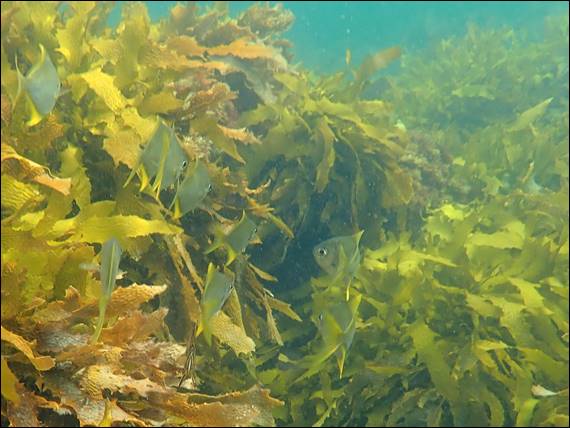
In the deeper water it was harder to spot much below, but it was impossible not to see this huge plate coral. I’ve mentioned this species before as being hard coral of the Astreopora genus. It was pretty cool to see such a large one, which was spreading out encrusting the ground around it. As I went along I thought that I had found a couple more smaller specimens of this coral so duck dived down for a closer look to see if I could get a few close-up images:
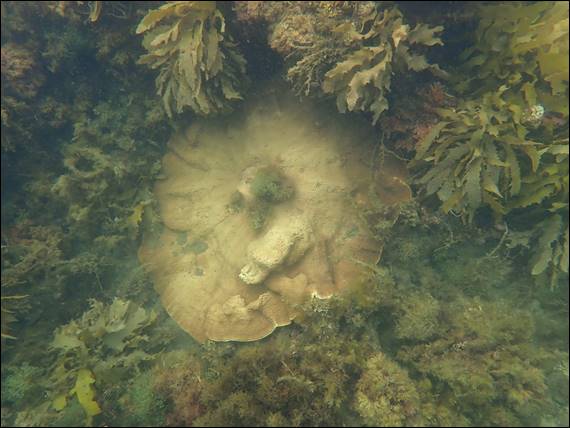
In one of the corals the corallites were really pronounced looking like little tubes, and in the image you can see the coral polyp sticking out of the end of the bony houses that the corallites form. These polyps are soft-bodied organisms that are related to sea anemones and jellyfish. Corals get most of their nutrients from particles, which are the by-product created when algae’s photosynthesis. The small tentacles that you can just make out, filter out and draw these particles into the body of the polyp. However, some corals can also have venomous tentacles used to snare zooplankton and even small fish:
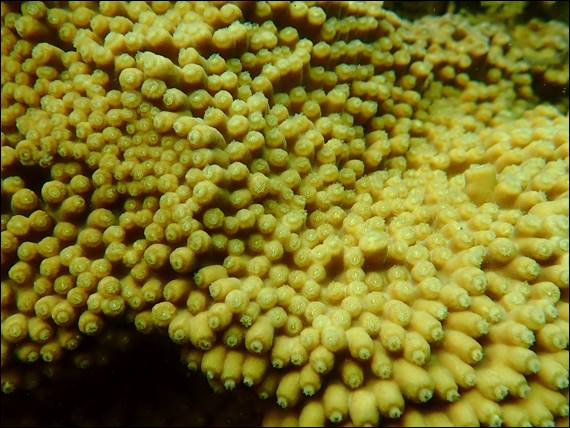
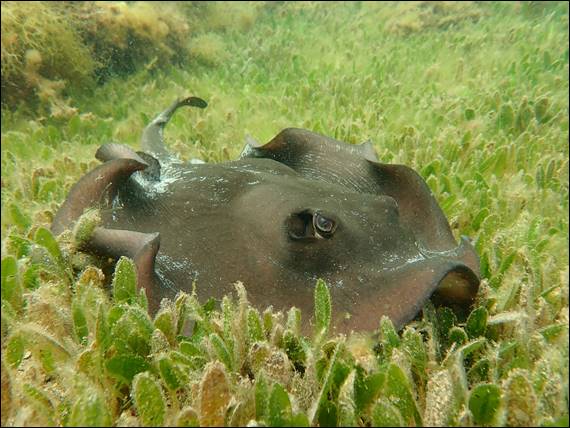
With such low light I didn’t take many images out deep instead just looked round to see what might be about. Plenty of good fish but there was little point in attempting to take a snap, and so I soon decided it was time to head back to the shallow area. On the way back I passed over a huge flat sandy patch area that looked like a meadow. It was the same seagrass I has seen before, called Halophila, and with Ryan’s previous comments that Dugongs eat this grass I was hoping to see something grazing on it. While there was nothing eating it, there was a nice little Stingaree that was happy for me to sneak right up to it:
Back in the shallow I joined Lisa for a little while and we saw some nice fish up close. The swell was starting build up and so it was harder to stay still and get any great images. So I decided that I would inspect the limestone rocks, on which the cormorants would often perch to dry their wings. I had to hold onto the rocks and let my eye’s adjust, quietly hoping to find some nudibranchs or something similar. Instead what caught my eye was what I believe are cleaner shrimps, but what type I have no idea:
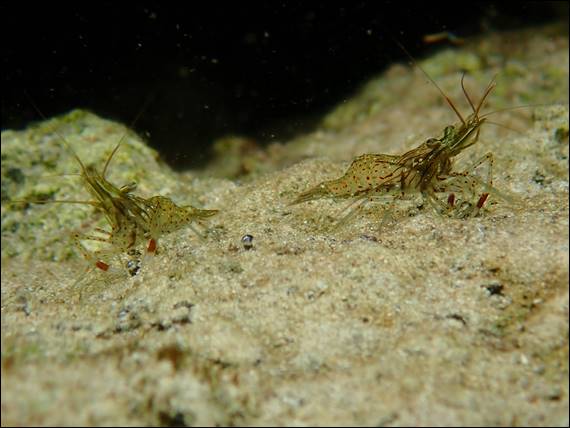
Now that my eyes had adjusted and I knew what I was looking for I saw them all along the rocks, which offered a level of protection in very shallow waters. If I got too close they would seemingly jump from sight, sometime to another part of the rock and at times into the open water swimming to another hidey hole. Their translucent bodies, with white and red spots were very striking. But it was the beady eyes on stalks that really caught my attention, and I spent a long time holding onto the rocks watching them:
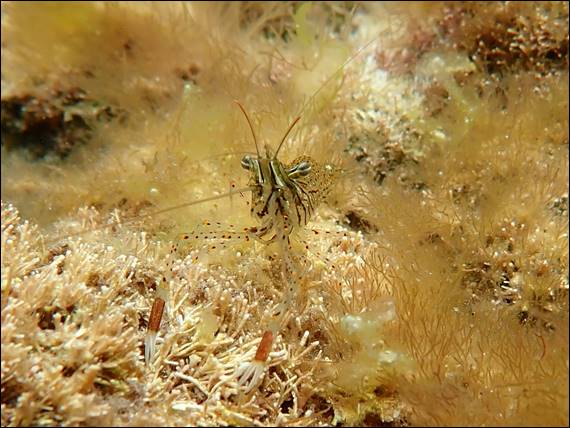
While watching the shrimps I also noted small fish, but only when they made a super-fast dash to get away. While they were still it was hard to see them, so again I had to readjust what I was looking for and eventually I managed to sneak an image or two of them. This one was keeping a close eye on me as I steadily crept up on it, literally millimetre by millimetre, but before I could get a good look at its body it shot off. Meanwhile the shrimp behind it continued to happily scavenge away:
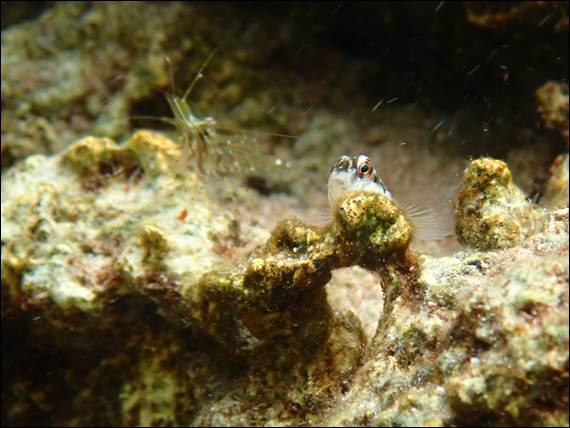
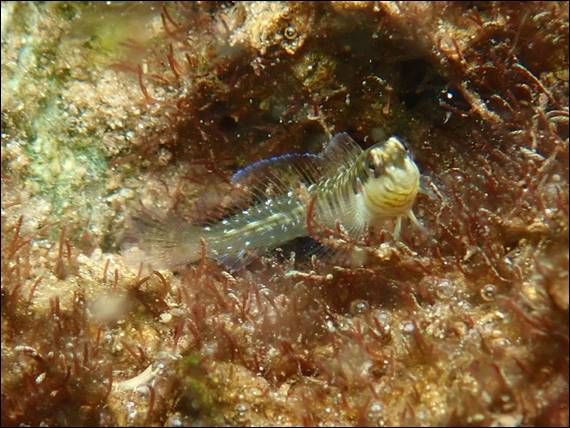
I eventually managed to get a few images, but none too great. Having worked with our native south west fresh water fish at work I thought I had an idea what it was once I had seen it, and believe it is a Goby. I have not however been able to narrow it down to a particular species of Goby. That said this is the largest family of marine fish, with an estimated 1500 species worldwide of which 350 are found in Australian waters. So I’m not really surprised I’ve had difficulty in identify it. While I was busy with my small finds Lisa and Nana, not too far away called me over:
They had seen a large fish that, as they described to me, sounded like a Wobbegong or Catfish. It was close to a meter in length and they had been able to observe it for some time, but sadly it had slunk away by the time I had come over. They had purposely not call Geoff over with his spear gun, just to make sure that the fish lived for another day. Checking the books back home they are convinced that they had discovered an adult Estuary Catfish, also known as an Estuary Cobbler, with Nana claiming of the positive identification that “it’s all in the tail”:
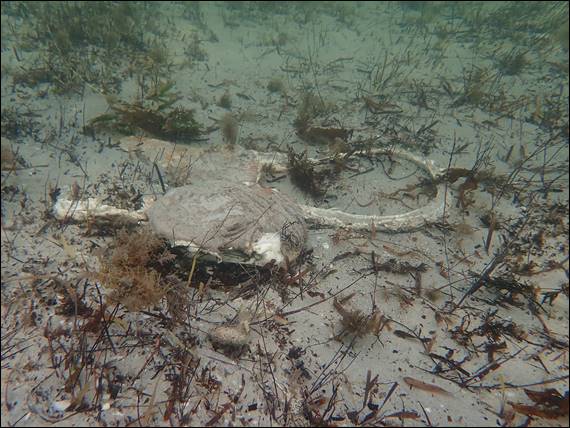
By now all of our finger tips were saying it was time to head back. On the way in we came across the remains of a couple of wobbegongs, one of them shown above. These had however not been speared by Geoff, who had come back empty handed.
 Sandbagged
As much as Geoff loves to catch a fish, he knows if I am around that most species are off limits. I will however not get in the way of him going for a dhu fish, that would be a deal breaker for the relationship.. He doesnt even need me to say it, but he knows that I am a vegetarian when in the ocean. I get it from my grandmother. We used to go boat fishing and she would quietly throw the live fish back in the water..my uncle tried to ban her from coming but it was her boat hahaha
LikeLike