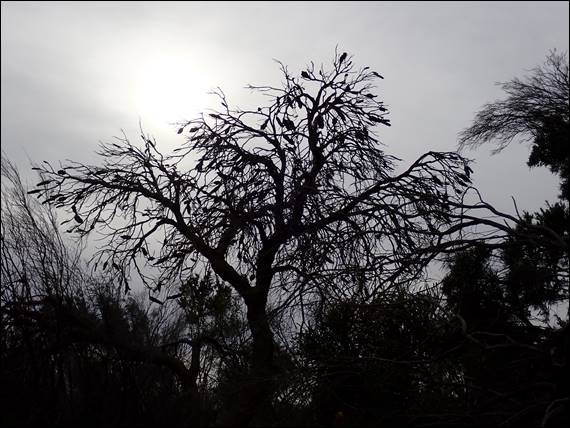
Urged on by my recent first orchid sighting, as well as needing a bit of a stretch after an extremely relaxed do nothing day yesterday, I headed to the Capel Nature Reserve for a stroll. It was a chilled wander in more ways than one. Firstly I was in no rush. Secondly, a liberal layer of thick grey clouds covered the sky and without radiant heat from direct sunlight it felt chilly. Even more so as a breeze was blowing the air immediately round the skin away, which would normally form an insulating layer. Definitely a long trousers and hoody day:
While there were greys above, down at ground level there were some specks of colour to be found. The deceptively named Pink Summer Calytrix (Calytrix fraseri) were the most abundant of the blooms to be seen. Deceptive as they flower for an exceptionally long period from November to August, so nearly year round. Also while the ones I found were pink, their flowers can be found in cherry, purple, and sometimes yellow. The only part of the name that does hold true being Calytrix, derived from two Greek words of calyx (cup) and thrix (hair):
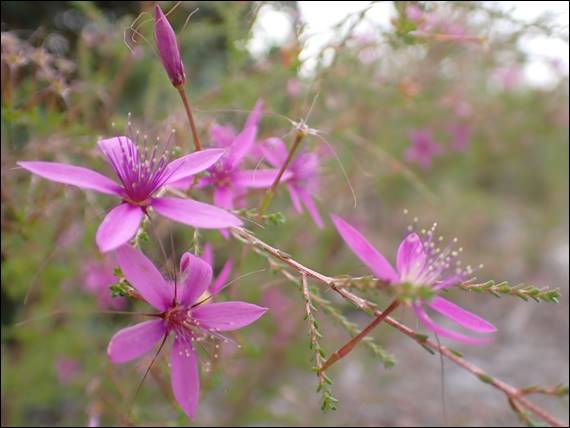
This refers to the long and thin rigidly held bristles stretching out like hair extensions from each sepals that fringes the receptacle, which forms a cup like base to the flower. Closer to ground the recent rains had started to bring out tiny Matted Triggerplants (Stylidium repens). These are the only species of triggerplant known to flower twice, in both autumn and late spring. The catapult-like column that these plants are named after is not visible in the image below, nor would it be when it is triggered. A movement that take a mere 10-20 milliseconds:
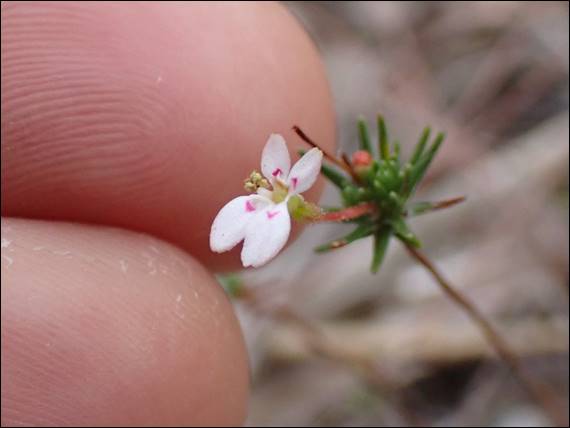
The super quick movement puts them among the fastest-moving plants to be found. Next up are Grey Stinkwood (Jacksonia furcellata). A fun fact about this plant being that it photosynthesizes through its stems. Unable to use its leaves, which have evolved over time to become tiny toothed, egg-shaped scales a mere 1 to 4mm long. Like the Pink Summer Calytrix, this is another plant that can flower year round, with its peak period to blossom being from October to March. And while it is called a stinkwood, that is a little unjust:
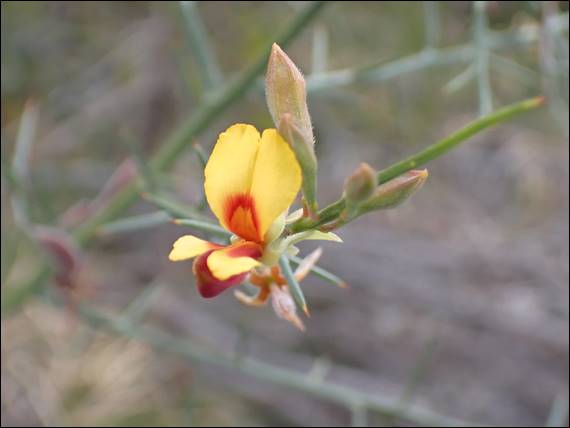
Someone has taken the time to test the theory behind the name only to find the aroma being that of burning wood. The lucky last to be included in this post is not a flower. I’d need to come here between December and February to see the cream white flowers that would have covered the knobbly branches extending beyond the seed pod in the image below. There are six species of Woody Pear in Australia. Two of which are found in Western Australia and only one in my local area being the Western Woody Pear (Xylomelum occidentale):
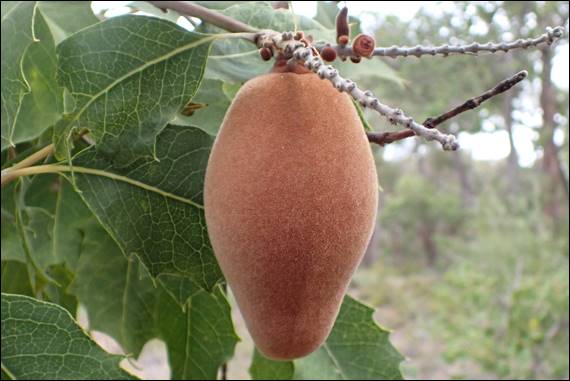
This tree has an unusually long seed pod cycle. After pollination the pear-shaped fruit can take several years to fully mature, in the image above a few flowers have been successfully pollinated and the tiny fruits are starting to form. Once mature they are then reliant on the high temperatures from a fire to open and release their seeds, so can remain sealed for several more years. However, they can also open if the branch it is on dies. The above pod has not reached maturity, as it still has a smooth velvet-covering. Providing a defence against insects and reducing temperature related stress by providing an insulated layer:

 Sandbagged