I’ve said it before but it has been somewhat of a shocker of a snorkelling season, which I now say with a pinch of salt. I had to search through my images to help with this post. While it is true that I have not been in the water anywhere near as much as usual, there have been windows of opportunities and I have seen some cool things. This weekend, and stretching well into next week, provided one of the biggest windows so far. And due to the long settled period, you could also say it will potentially provide one of the best views of the season:
Feeling somewhat achy from two days of climbing Sunday was a rest day to allow my body to recover. A perfect time to have a soak in the ocean to assist with the muscle relaxation. Wandering down it looked pretty good, other than having a group of people already in the water exploring my local reef. It may sound a little shellfish, pun intended, but I’m so used to being alone out there. Plus two of them had fishing spears which I seriously hoped they did not use. Especially with one fish I spotted, but I better catch up before I get to that:
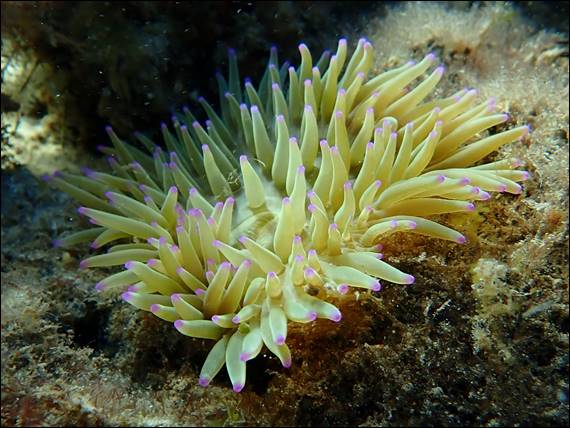
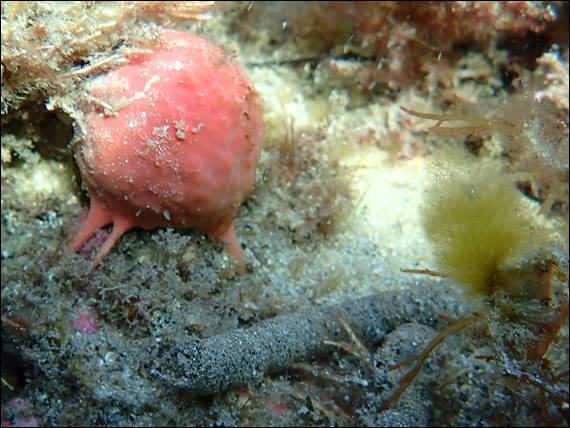
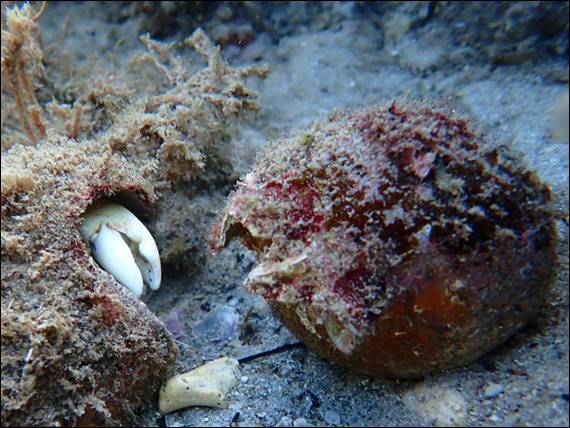
Although I spotted quite a few familiar species the fish were not out in any great numbers, but most of the images didn’t make the cut. Instead I’ve started with a Pink Golf Ball Sponge (Tethya bergquistae), one I liked because of the long, thin, root-like structures being visible. Used to secure itself. Then the above Sand Anemone (Heteractis malu). I would normally see these in abundance, but not this year. And below one of the fifteen species of Diogenid or two species of Pagurid, or in layman terms hermit crabs. Having a snoozing during the day:
The fish I really hope alluded the other people in the water was this Longsnout Boarfish (Pentaceropsis recurvirostris). They are described as being both curious and territorial towards divers. I’ve only seen them a few times, the last time being four years back. Today it stuck around for an age, allowing me to swim alongside it and get some great images. On occasion coming close with its eyes fixed on me. Mostly solitary but during summer pairs may come into shallow waters where they head to spawn. I’ve not come across a pair yet:
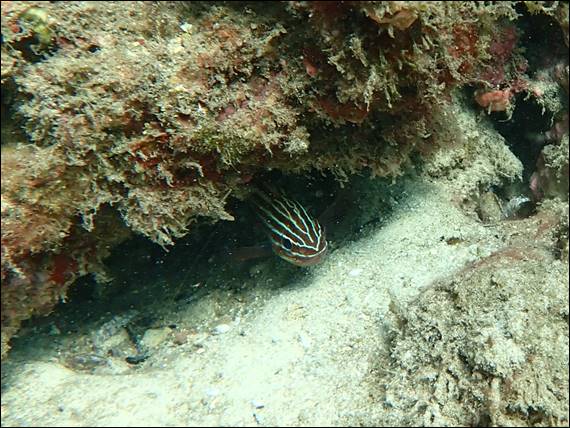
Below is one more image from Sunday, a Western Striped Cardinalfish (Ostorhinchus victoriae). As with so much marine life, another nocturnal species. It can however be, and is often, found as it shelters in caves and under ledges during the day, as this adult at a whopping three inches was. And while it may be a night swimmer it is one of the fish seen most times I come out, that is if I am in the mood to duck dive and check out the hidey holes. This week my work from home days were a little different, working in my favour:
Another trip to Perth resulted in my usual two days at home, at the end of the week, being scattered. The plan was to get out for a swim on Monday and Wednesday morning, both before the daytime winds had a chance to shift and also before the swell started to pick up again on Thursday. A well laid plan that would have worked if I wasn’t so work conscious. On Monday by the time I got down, being mid-afternoon, the easterlies were chopping it up. Come Wednesday I decided to relax my brain a bit and make a conscious effort to get out:
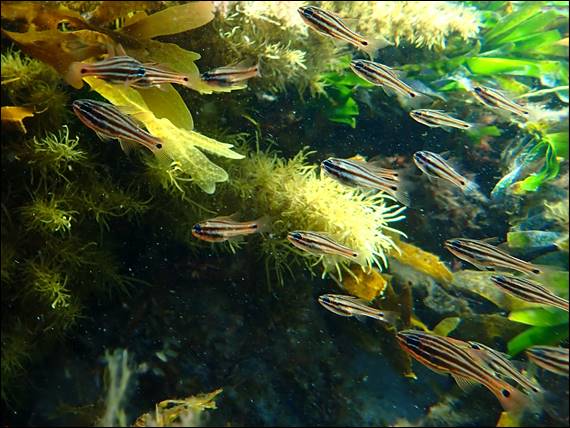
Not only that but, to recoup just a smidge of the additional hours work is currently demanding, I drove down to other side of Peppy Beach for a swim over the reef out from the Capel River mouth. The ground here, as shown by the images, was looking quite bright and colourful, in contrast to the sediment and algae covered reef of my local spot. I immediately spotted lots of schools of young fish. Leading on for the last image from Sunday, the first above image is of juvenile Western Striped Cardinalfish looking like mini adults:
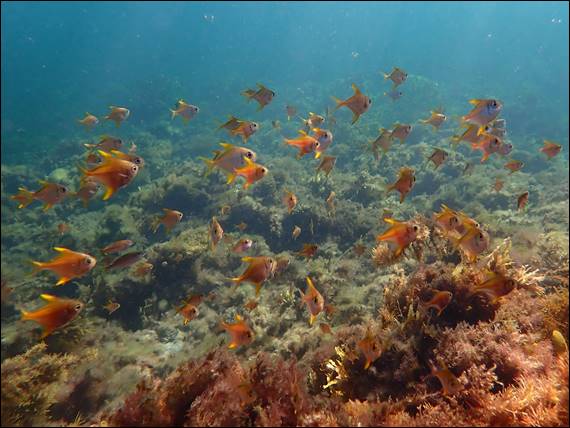
Next are juvenile Western Pomfred (Schuettea woodwardi), with a couple of mates hiding amongst them. After all there is truth it the term safety in numbers, especially when so young and vulnerable. Western Pomfred display yellow in the body when young and that shifts to silver as they age. Adults have yellow colouring mostly restricted to the edges of their fins. These are multiple batch spawners. A single fish can produce young several times within a single season, with the spawning often being associated with the lunar cycles:
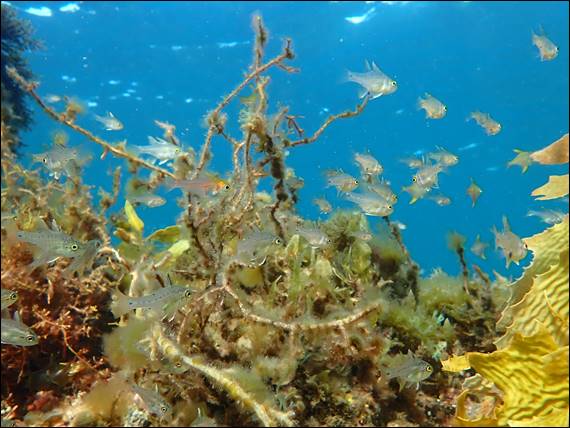
Lunar-synchronized spawning, yes it is a real term, has several benefits and is displayed by a lot of fish species. It results in spawning being undertaken at select times by many fish. Vast amounts of sperm and eggs are released, which increases the chance of fertility and also overwhelms predators. Back to my images, above are juvenile Gobbleguts (Ostorhinchus rueppellii). As with Western Striped Cardinalfish these are mouthbrooders. The males can carry a staggering 50 to 230 fertilised eggs in their mouths for about two weeks:
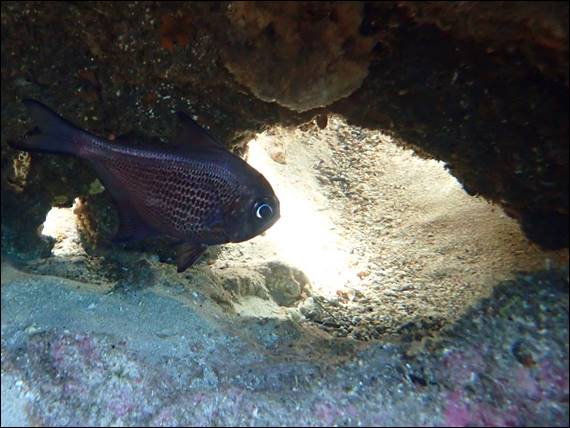
If you look closely you can see one young fish that is quite different, being a juvenile Bigscale Bullseye (Pempheris multiradiata). It is described as having a bronze to yellowish tinge along its back, to my mind it looks orange, and distinct yellow pelvic fins with black tips. The rest of the body being translucent. This creates an illusion of a half-eaten body. Believed to be a form of camouflage developed by this species. Very different in appearance to their adult form shown above, this one being approx. eight inches but they can grow to a full foot:
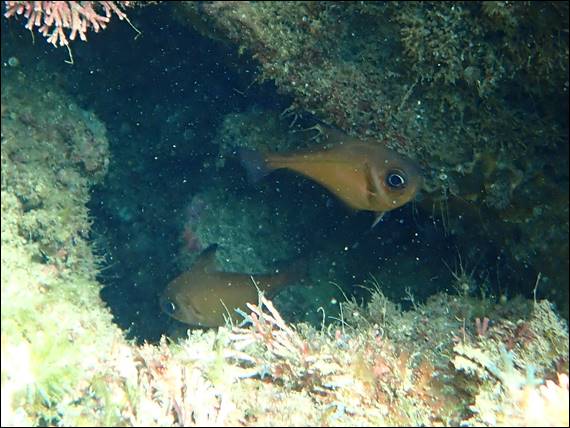
I have found have all species of Bullseye to be generally pretty skittish. Today however they were more accommodating to my intrusions than I am used to. Above are two Rough Bullseye (Pempheris klunzingeri). Very different in appearance to the Bigscale Bullseye, with a body of pale bronze to coppery-brown. With this colouration I almost felt the juvenile I spotted could be from this species but my research indicates that is not the case. While a common find below are Western Striped Grunter (Helotes octolineatus):
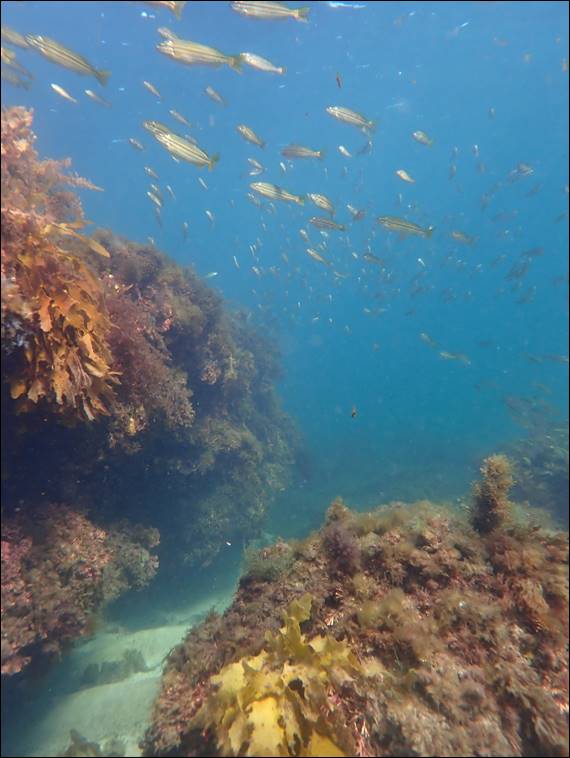
Included to show the water clarity. The view was pretty damn good! I also came across large schools of Australian Herring (Arripis georgianus), which can live up to a ripe ole age of twelve. However, they are very popular and most caught by both recreational and commercial fishers are between 1 and 4 years old, according to WA’s fisheries research. A bit of a scary thought for their long term future, seeing they become mature at around 2 to 3 years old. Another popular fish, one I have only seen once before, is the Snapper (Chrysophrys auratus):
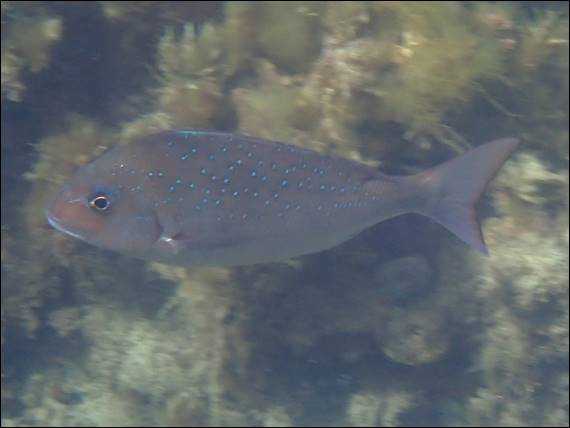
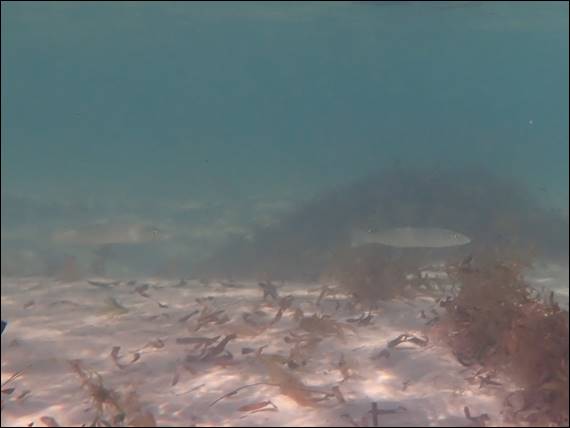
Shown below, these can live to over 40 years. Based on the obvious blue dots this one is likely to be between what they call a ‘cockney bream’ or ‘squires’, both stages being under a year or two old, and ‘pan-sized’. Their size in the latter is approx. a foot, which this one was just shy of. This stage occurs when they are three and five years of age, as they reach sexual maturity and the spots begin to fade. It was time to think about heading back in to my desk. On the way in I took one last image of Sea Mullet (Mugil cephalus) right on the shoreline:
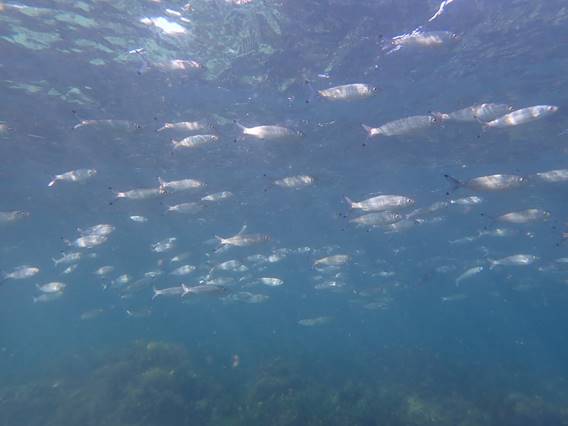
Adults exhibit a schooling behaviour forming large groups on the shoreline or just outside the surf zone, as these were. The term ‘mullet’ is engrained in Australian culture, referring to a hairstyle associated with a ‘bogan’ in the 70/80s. That said the term wasn’t recorded as being used in this way until the 90s, after the song “Mullet Head” by the Beastie Boys came out in 1994. The first written use of the term mullet head was however way before in 1857 to describe a ‘stupid, dull person’ and based on the perceived lack of intelligence of the Sea Mullet. Maybe harsh for a fish that has adapted to differing environments across vast oceans:
 Sandbagged