My last post of a dive was over six weeks back; an unusual abstinence for watery activities for this time of year. Up until March the image library for each successive year would normally be filled with more underwater than above water imagery. I did have a sneaky snorkel a week after the last one I posted, and while the water clarity wasn’t too bad there was really nothing of interest to be seen. Having taken this week off, both to get back into the (time) zone and ease my body back into the humdrum of life, I can join Lisa for her morning beach walks:
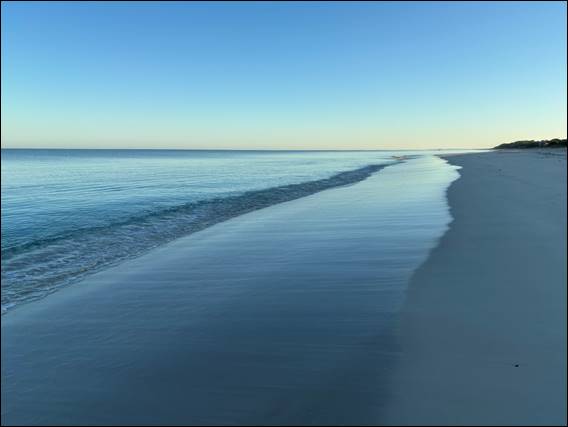
Today the ocean looked flat with hardly a ripple to be seen. In addition the nearshore waters looked to be reasonably clear. However, while there may not have been any waves the water’s edge was gently surging up and down the beach. And as it did so South Western Stingers (Carybdea xaymacana) were left stranded in the sand. The freshly washed up ones still pulsated. In response to the nervous system continuing to function and tell the muscular ring on the bottom of their bell, used to propel it through the water, to rhythmically contract:
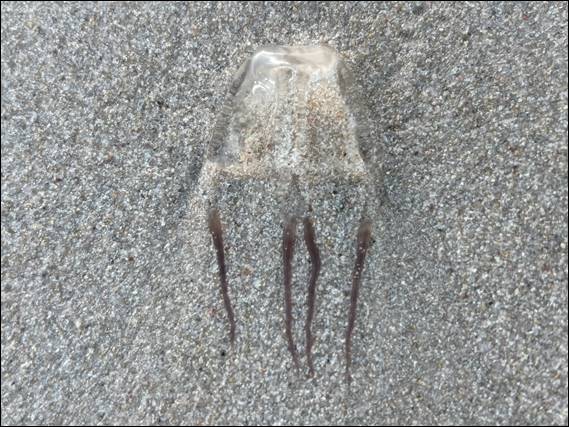
There are four main life stages of jellyfish. As a box jellyfish (Cubozoa) the last two stages of the South Western Stinger comprise a juvenile and adult medusa stage. Thus skipping the ephyra stage that some other jellyfish go through. Key features distinguishing juvenile from adult medusa stages are the bell size and length of the tentacles. The term medusa having been adopted, not surprisingly, because similar to the mythological Medusa with snakes instead of hair turning people to stone, the sting from jellyfish can sometimes deliver a paralysing sting:
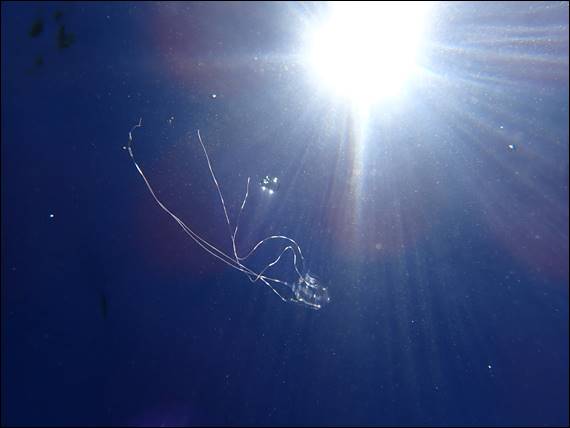
In the above two images. The washed up specimen has tentacles of similar length to the bell, whereas the free swimming specimen above has much longer tentacles. These may be examples of the juvenile and adult medusa stages, although the bells are similar sizes and when washed up the tentacles contract which could explain the darker colour. Even after being washed up the nematocysts, or stinging cells, can remain active. The ability to sting can last several hours and potentially up to a day. The duration being dependent upon the tentacles staying moist:
Encouraged by the conditions, but not being completely fooled in view of the length of water washed beach, I decided that after the household chores were done I should jump in. And just to try something different I went off the beach at Wave Walk. Here the reef is very close to shore and also quite shallow, making it a bit of a nursey to quite a few species. The water, as expected, was a tad cloudy. I started by scouring the deeper waters for half an hour with nothing to show for it, before heading back along the shallower near shore reef:
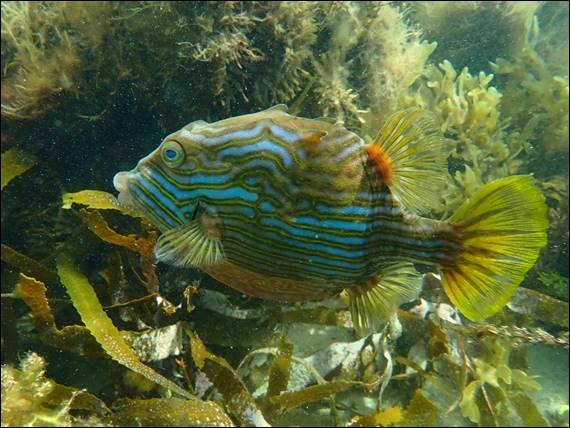
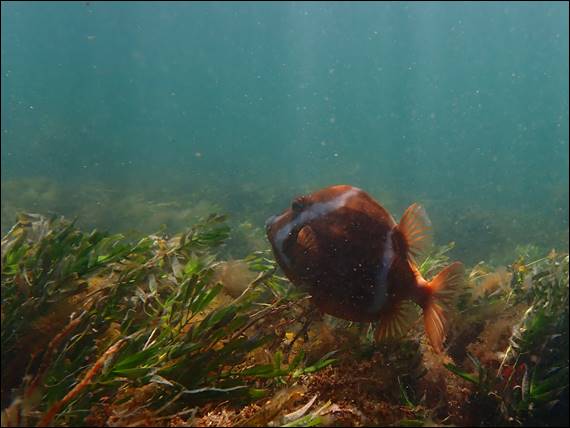
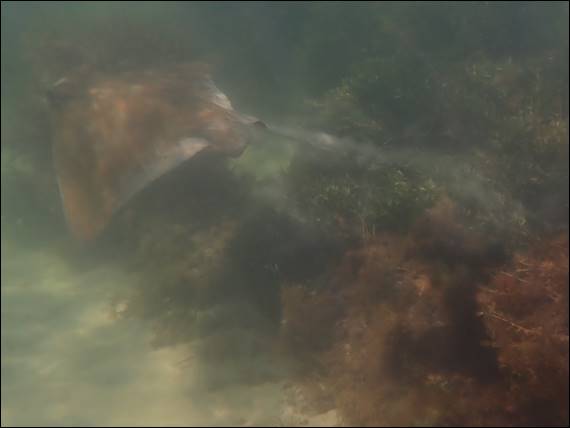
Fish came into sight here, with the boys showing off their colours such as the above male Whitebarred Boxfish (Anoplocapros lenticularis) and Shaw’s Cowfish (Aracana aurita). Maybe giving it one last go with the ladies, as the spawning season for these species starts to draw to a close. In the murkiness my eyes caught a Southern Eagle Ray (Myliobatis tenuicaudatus) leisurely cruising along side me. Content to simply watch it glide, it was not till I went to take an image that is sped up. Leaving a trail of the dust in the water behind it:
 Sandbagged