All good things must come to an end, and the shutdown at work finished last week meaning tomorrow it’ll be back to the grind. Before that happens there was time today for another dive, this time with Geoff and his usual partner in crime Benny. They tend to head out to fish or hunt crays, but this time he advised the dive would be just to cool off. That said they still came armed with spear guns and catch bags. Rongy and Sarah also joined us, as we drove a fair way past the point. The reef stretches all the way to Stratham, approx. 7km away:
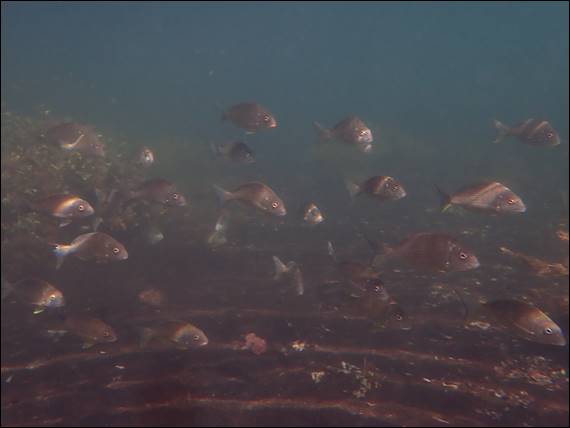
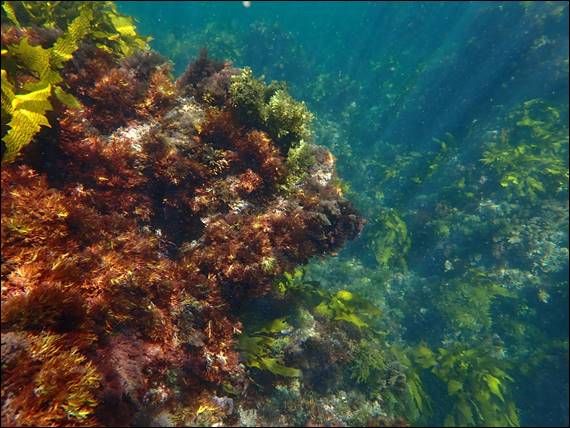
You can stop pretty well anywhere along this part of Geographe Bay, and find great ground to search. Our dive spot was approx. 4km away from the beach access at Peppy Beach. Starting with a very shallow swim passing a school of Tarwhine (Rhabdosargus sarba) hugging the ocean floor, while Southern Garfish (Hyporhamphus melanochir) seemed to be hovering above, as they skimmed just below the ocean’s surface and kept a safe distance from me. Once we reached the reef the water got deeper and the clarity improved greatly:
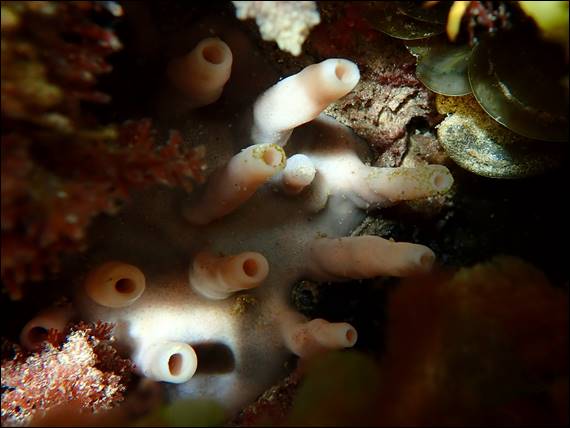
Quite a few different fish, schooling and solitary, were about but I initially kept my focus on the nooks and crannies. Looking for anything unusual, without too much success. This sponge, hidden in a hollow was however a pretty cool. Sponges, once considered plants, are the simplest animals on the planet. However, with at least 10,000 species globally and close to 20% of those found round Australia, they are also infuriatingly difficult to try and identify. You have probably guessed where this is going, and no I had no success with this specimen:
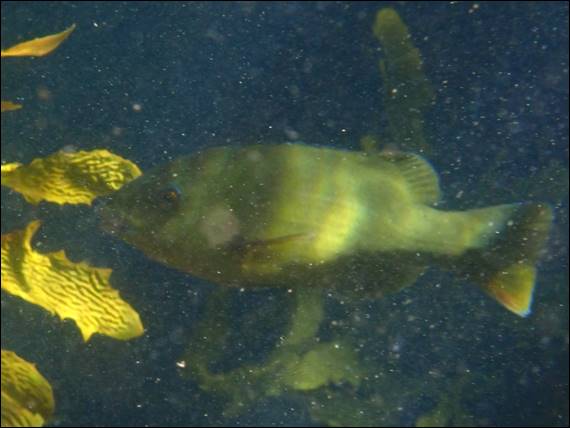
Moving onto fish the below is likely a female Western Blue Groper (Achoerodus gouldii). I say likely as these fish grow very slowly, and it is suggested that a fish of 40cm and 80cm is likely to be 8 and 25 years old respectively. Like the Southern Garfish, this one also kept a safe distance hence the poor image quality but it clearly wasn’t showing the expected markings of a juvenile. Being a little under two foot long it may be about to reach the initial phase of sexually mature as a female. This happens on average at about 15-20 years of age, and length of about 65cm:
Once they reach 30 years of age their length does not increase much more. Living one of the longest life spans for a wrasse, reaching a ripe ole age of 70 and growing to a maximum length of 175cm. These fish home-range, meaning they live within a certain area, and as such can be more susceptible to overfishing. I do not recall seeing a Western Blue Groper before, but had heard they can be found here. While my next image is of a fish I have seen many a time, it is worth including due to the amazing patterns and vivid colours:
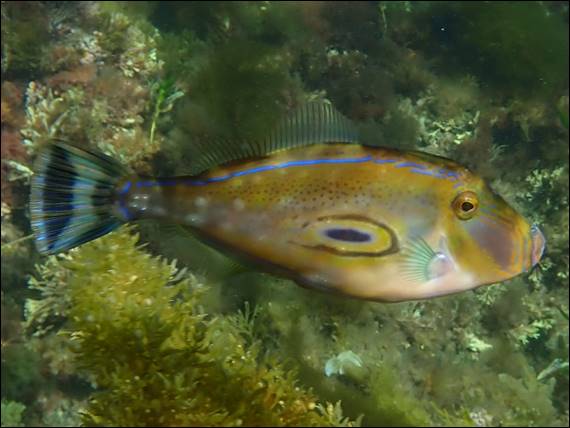
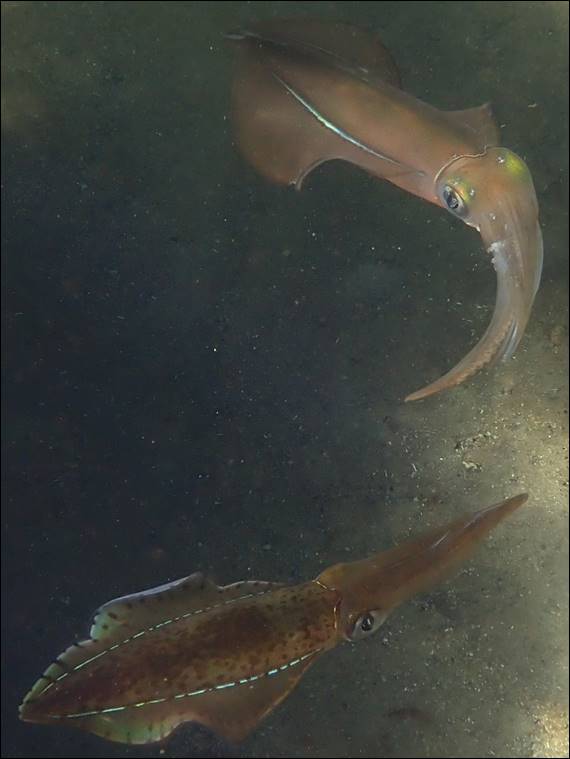
Easily being recognised as a male Horseshoe Leatherjacket (Meuschenia hippocrepis), another popular recreational fish. And the final image is also of a popular catch, being two from a small shoal of Southern Calamari Squid (Sepioteuthis australis). Identifying males from females externally is tricky, even the differing size and patterning shown in the image doesn’t help. Unlike the long lifespan of the Western Blue Groper, these cephalopods have a lifespan of about a year living as an adult for a mere 4 month. Seeing the others exit with empty catch bags, my finds get to live for another day:
 Sandbagged