Still trying to be sensible, I passed up a chance of scaling the stiff and technical granite walls at Welly Dam for a second weekend. Hoping instead the ocean conditions would be in my favour, however Saturday morning came in a bit breezy. Good enough for Lisa’s bob but sadly too choppy to contemplate a snorkel. With a forced day of relative rest, I contemplated how long I can be sensible for. Lisa deepening my thinking about this, when she told me how she’s been researching differing thoughts on the best way to recover from and manage injuries:
There is a view that you should not stop your usual form of exercise completely, but back off the intensity and ease up the frequency. Funnily enough my physio had advised against climbing just yet. Although, as I wrote to Tomski today, my compulsive and obsessive climbing disorder had been acknowledged. Resulting in a similar approach with gentle routes been accepted. I did not head out today, admittedly because those I touched base with late yesterday were not available, but I’ve certainly got plans brewing for some low grade fun:

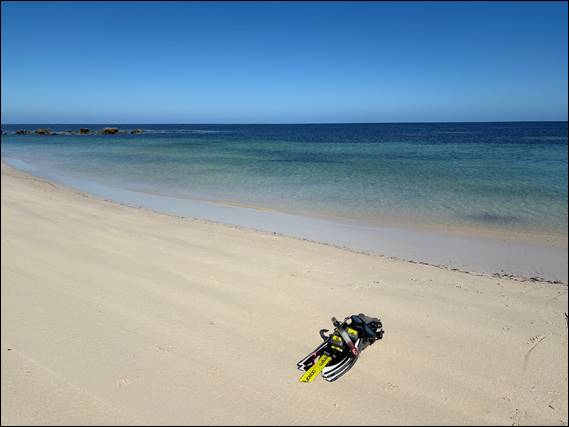
I did however have a swim with the fish today. Overnight the wind reduced to a mere tickle, the swell dropped, low tide hit the right time, and as a result I was greeted with flatness as I looked out. So inviting I decided to walk out past the Capel River mouth where the reef is way better. Wandering along several cars were already parked up. Not so many that I wouldn’t find a quiet bay. The traffic will undoubtedly intensify significantly after Christmas when droves of holiday makers descend, and then it will be trickier to find a spot away from people:

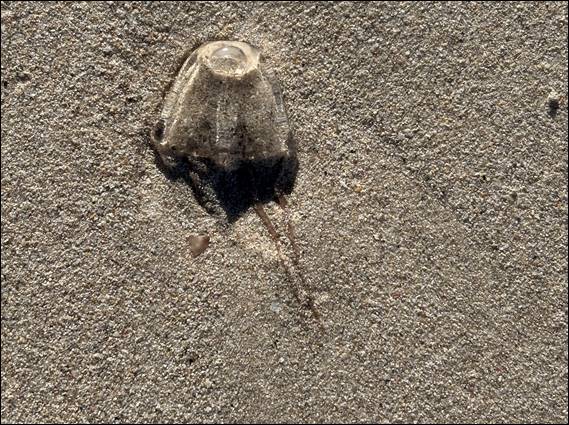
Along the way small gelatinous blobs were on the sand, and could mean only one thing. It is the time of year when the South Western Stingers (Carybdea xaymacana) come in. Today I saw very few in the water and only near the shore, but just like holiday makers it won’t take long before more arrive. My entry point today was an unoccupied bay. Here the tops of the reef poked out above today’s low tide mark, providing a perch for many a bird. Including several Australian Pelicans (Pelecanus conspicillatus) who kept a wary distance from me:
The water felt warm and once a bit away from the beach, there was good visibility. Schools of Australian Herring (Arripis georgiana) were immediately evident. Like the Australian Pelicans treating me with caution, and parting as I swam towards them. Leaving them be, my first image of living marine life is a very well camouflaged Eleven-Legged Sea Star (Coscinasterias muricata). Some people kill these, mistaking these important native creatures for the highly invasive and very different looking Crown of Thorns Starfish (Genus Acanthaster):

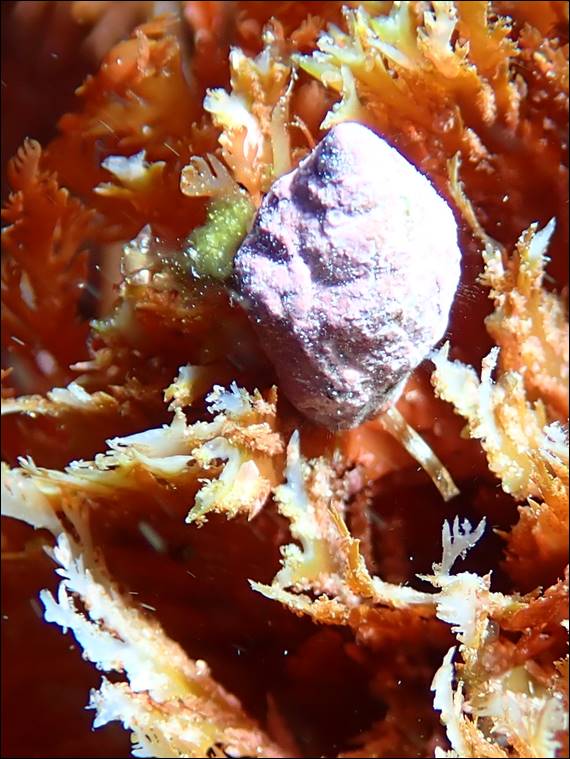
The Crown of Thorns Starfish is however found in tropical and subtropical regions, and is not present in our part of the ocean. Not being able to correctly identifying an Eleven-Legged Sea Star which, in my opinion is very distinctive, seems strange. While I feel I could be forgiven for not correctly identifying the small marine gastropod mollusc in the next image. It is highly likely to be one of the Dove Snails in the Columbellidae family, and based on the shell size and shape I’m even game to suggest it may be a Dotted Dove Shell (Euplica scripta):

If you look closely you’ll see it’s inhalant siphon. The low number of only three commonly found Euplica species in this area assisted me. What did not is the Crustose Coralline Algae (CCA) that has coated the shell. Concealing the pattern that would normally be used to aid the identification. CCA is a rock-hard calcareous red or pink algae that forms on reefs and shells. For reefs if can assist in providing stability to the reef structure, and has a secondary benefit of being the perfect surface for the larval stage of many benthic organisms:
It also aids shells, making them less attractive to collectors. The chemicals needed to remove the calcareous algal, also risks dissolving and damaging the shell. Next up the only ray I saw, a Southern Eagle Ray (Myliobatis tenuicaudatus). Minus its tail, which is sadly a common sight along southern Australia and I’ve seen a few. The most common reason is anglers who cut off the tail to prevent being stung by the venomous barb. The tail has a large vein in it, and this unnecessary action can result in fatal blood loss. The tail is also of course it’s primary defence:
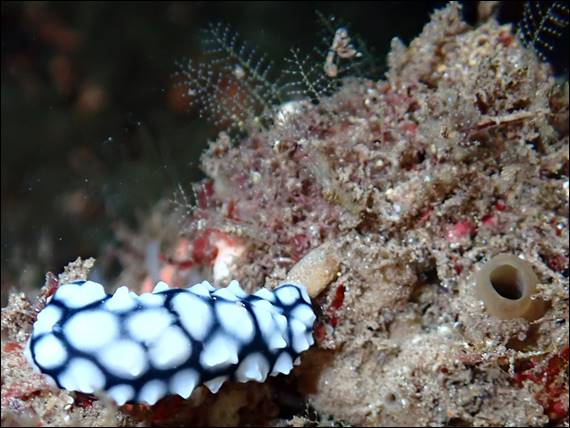
Onto brighter things with a solitary Moonlighter (Tilodon sexfasciatus). More commonly seen in pairs when they are adults, as this one is. With the ocelli, or false eye-spot, that juveniles display no longer present. Now only showing the six dark bands that relate to the species name, with the Latin words sex and fasciatus meaning six and banded. Over an hour later I came out. Then walking back it looked so inviting I went in again. Rewarded with another reef to explore with more fish and the above Pustulose Wart Slug (Phyllidiella pustulosa):
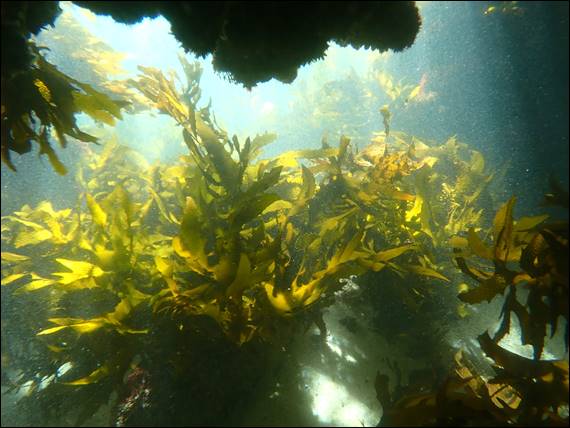
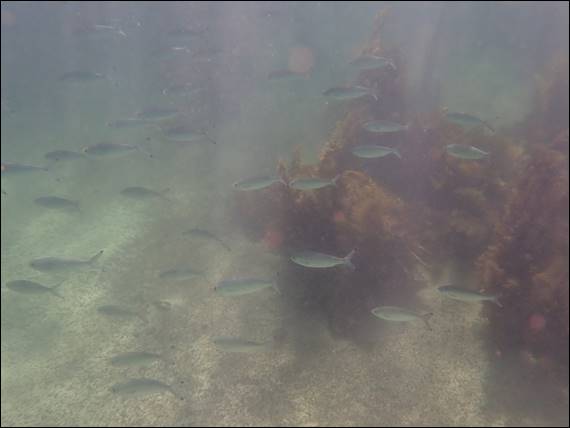
Classified as a nudibranch, despite not having the distinctive feather-like plume of gills protruding from its back. Only a few nudibranch genera do not breathe using external gills, this particular genus is one. Using leaflets between the mantle and foot to breathe. Feeling like I was ready to get out, for the second time, as I headed to the shore as the swell was picking up just enough to murky up the water. Not so much that I wasn’t able to enjoy being surrounded yet again by shoals of Australian Herring:
 Sandbagged